EP2801560A2 - Mischmaschine, Mischung von Rohstoff für die Pulvermetallurgie - Google Patents
Mischmaschine, Mischung von Rohstoff für die Pulvermetallurgie Download PDFInfo
- Publication number
- EP2801560A2 EP2801560A2 EP14167185.9A EP14167185A EP2801560A2 EP 2801560 A2 EP2801560 A2 EP 2801560A2 EP 14167185 A EP14167185 A EP 14167185A EP 2801560 A2 EP2801560 A2 EP 2801560A2
- Authority
- EP
- European Patent Office
- Prior art keywords
- temperature
- tank
- mixture
- circuit
- mixer
- Prior art date
- Legal status (The legal status is an assumption and is not a legal conclusion. Google has not performed a legal analysis and makes no representation as to the accuracy of the status listed.)
- Granted
Links
Images



Classifications
-
- B—PERFORMING OPERATIONS; TRANSPORTING
- B01—PHYSICAL OR CHEMICAL PROCESSES OR APPARATUS IN GENERAL
- B01F—MIXING, e.g. DISSOLVING, EMULSIFYING OR DISPERSING
- B01F33/00—Other mixers; Mixing plants; Combinations of mixers
-
- B—PERFORMING OPERATIONS; TRANSPORTING
- B28—WORKING CEMENT, CLAY, OR STONE
- B28C—PREPARING CLAY; PRODUCING MIXTURES CONTAINING CLAY OR CEMENTITIOUS MATERIAL, e.g. PLASTER
- B28C5/00—Apparatus or methods for producing mixtures of cement with other substances, e.g. slurries, mortars, porous or fibrous compositions
- B28C5/08—Apparatus or methods for producing mixtures of cement with other substances, e.g. slurries, mortars, porous or fibrous compositions using driven mechanical means affecting the mixing
- B28C5/10—Mixing in containers not actuated to effect the mixing
- B28C5/12—Mixing in containers not actuated to effect the mixing with stirrers sweeping through the materials, e.g. with incorporated feeding or discharging means or with oscillating stirrers
- B28C5/16—Mixing in containers not actuated to effect the mixing with stirrers sweeping through the materials, e.g. with incorporated feeding or discharging means or with oscillating stirrers the stirrers having motion about a vertical or steeply inclined axis
- B28C5/166—Pan-type mixers
-
- B—PERFORMING OPERATIONS; TRANSPORTING
- B01—PHYSICAL OR CHEMICAL PROCESSES OR APPARATUS IN GENERAL
- B01F—MIXING, e.g. DISSOLVING, EMULSIFYING OR DISPERSING
- B01F23/00—Mixing according to the phases to be mixed, e.g. dispersing or emulsifying
- B01F23/50—Mixing liquids with solids
- B01F23/53—Mixing liquids with solids using driven stirrers
-
- B—PERFORMING OPERATIONS; TRANSPORTING
- B01—PHYSICAL OR CHEMICAL PROCESSES OR APPARATUS IN GENERAL
- B01F—MIXING, e.g. DISSOLVING, EMULSIFYING OR DISPERSING
- B01F23/00—Mixing according to the phases to be mixed, e.g. dispersing or emulsifying
- B01F23/50—Mixing liquids with solids
- B01F23/57—Mixing high-viscosity liquids with solids
-
- B—PERFORMING OPERATIONS; TRANSPORTING
- B01—PHYSICAL OR CHEMICAL PROCESSES OR APPARATUS IN GENERAL
- B01F—MIXING, e.g. DISSOLVING, EMULSIFYING OR DISPERSING
- B01F27/00—Mixers with rotary stirring devices in fixed receptacles; Kneaders
-
- B—PERFORMING OPERATIONS; TRANSPORTING
- B01—PHYSICAL OR CHEMICAL PROCESSES OR APPARATUS IN GENERAL
- B01F—MIXING, e.g. DISSOLVING, EMULSIFYING OR DISPERSING
- B01F27/00—Mixers with rotary stirring devices in fixed receptacles; Kneaders
- B01F27/05—Stirrers
- B01F27/11—Stirrers characterised by the configuration of the stirrers
- B01F27/19—Stirrers with two or more mixing elements mounted in sequence on the same axis
- B01F27/192—Stirrers with two or more mixing elements mounted in sequence on the same axis with dissimilar elements
-
- B—PERFORMING OPERATIONS; TRANSPORTING
- B01—PHYSICAL OR CHEMICAL PROCESSES OR APPARATUS IN GENERAL
- B01F—MIXING, e.g. DISSOLVING, EMULSIFYING OR DISPERSING
- B01F27/00—Mixers with rotary stirring devices in fixed receptacles; Kneaders
- B01F27/80—Mixers with rotary stirring devices in fixed receptacles; Kneaders with stirrers rotating about a substantially vertical axis
- B01F27/90—Mixers with rotary stirring devices in fixed receptacles; Kneaders with stirrers rotating about a substantially vertical axis with paddles or arms
-
- B—PERFORMING OPERATIONS; TRANSPORTING
- B01—PHYSICAL OR CHEMICAL PROCESSES OR APPARATUS IN GENERAL
- B01F—MIXING, e.g. DISSOLVING, EMULSIFYING OR DISPERSING
- B01F27/00—Mixers with rotary stirring devices in fixed receptacles; Kneaders
- B01F27/80—Mixers with rotary stirring devices in fixed receptacles; Kneaders with stirrers rotating about a substantially vertical axis
- B01F27/90—Mixers with rotary stirring devices in fixed receptacles; Kneaders with stirrers rotating about a substantially vertical axis with paddles or arms
- B01F27/906—Mixers with rotary stirring devices in fixed receptacles; Kneaders with stirrers rotating about a substantially vertical axis with paddles or arms with fixed axis
-
- B—PERFORMING OPERATIONS; TRANSPORTING
- B01—PHYSICAL OR CHEMICAL PROCESSES OR APPARATUS IN GENERAL
- B01F—MIXING, e.g. DISSOLVING, EMULSIFYING OR DISPERSING
- B01F35/00—Accessories for mixers; Auxiliary operations or auxiliary devices; Parts or details of general application
- B01F35/20—Measuring; Control or regulation
- B01F35/21—Measuring
- B01F35/211—Measuring of the operational parameters
- B01F35/2115—Temperature
-
- B—PERFORMING OPERATIONS; TRANSPORTING
- B01—PHYSICAL OR CHEMICAL PROCESSES OR APPARATUS IN GENERAL
- B01F—MIXING, e.g. DISSOLVING, EMULSIFYING OR DISPERSING
- B01F35/00—Accessories for mixers; Auxiliary operations or auxiliary devices; Parts or details of general application
- B01F35/20—Measuring; Control or regulation
- B01F35/21—Measuring
- B01F35/212—Measuring of the driving system data, e.g. torque, speed or power data
-
- B—PERFORMING OPERATIONS; TRANSPORTING
- B01—PHYSICAL OR CHEMICAL PROCESSES OR APPARATUS IN GENERAL
- B01F—MIXING, e.g. DISSOLVING, EMULSIFYING OR DISPERSING
- B01F35/00—Accessories for mixers; Auxiliary operations or auxiliary devices; Parts or details of general application
- B01F35/20—Measuring; Control or regulation
- B01F35/22—Control or regulation
- B01F35/2201—Control or regulation characterised by the type of control technique used
- B01F35/2209—Controlling the mixing process as a whole, i.e. involving a complete monitoring and controlling of the mixing process during the whole mixing cycle
-
- B—PERFORMING OPERATIONS; TRANSPORTING
- B01—PHYSICAL OR CHEMICAL PROCESSES OR APPARATUS IN GENERAL
- B01F—MIXING, e.g. DISSOLVING, EMULSIFYING OR DISPERSING
- B01F35/00—Accessories for mixers; Auxiliary operations or auxiliary devices; Parts or details of general application
- B01F35/20—Measuring; Control or regulation
- B01F35/22—Control or regulation
- B01F35/221—Control or regulation of operational parameters, e.g. level of material in the mixer, temperature or pressure
- B01F35/2214—Speed during the operation
- B01F35/22142—Speed of the mixing device during the operation
- B01F35/221422—Speed of rotation of the mixing axis, stirrer or receptacle during the operation
-
- B—PERFORMING OPERATIONS; TRANSPORTING
- B01—PHYSICAL OR CHEMICAL PROCESSES OR APPARATUS IN GENERAL
- B01F—MIXING, e.g. DISSOLVING, EMULSIFYING OR DISPERSING
- B01F35/00—Accessories for mixers; Auxiliary operations or auxiliary devices; Parts or details of general application
- B01F35/20—Measuring; Control or regulation
- B01F35/22—Control or regulation
- B01F35/221—Control or regulation of operational parameters, e.g. level of material in the mixer, temperature or pressure
- B01F35/2215—Temperature
-
- B—PERFORMING OPERATIONS; TRANSPORTING
- B01—PHYSICAL OR CHEMICAL PROCESSES OR APPARATUS IN GENERAL
- B01F—MIXING, e.g. DISSOLVING, EMULSIFYING OR DISPERSING
- B01F35/00—Accessories for mixers; Auxiliary operations or auxiliary devices; Parts or details of general application
- B01F35/75—Discharge mechanisms
- B01F35/754—Discharge mechanisms characterised by the means for discharging the components from the mixer
- B01F35/75455—Discharge mechanisms characterised by the means for discharging the components from the mixer using a rotary discharge means, e.g. a screw beneath the receptacle
- B01F35/754551—Discharge mechanisms characterised by the means for discharging the components from the mixer using a rotary discharge means, e.g. a screw beneath the receptacle using helical screws
-
- B—PERFORMING OPERATIONS; TRANSPORTING
- B01—PHYSICAL OR CHEMICAL PROCESSES OR APPARATUS IN GENERAL
- B01F—MIXING, e.g. DISSOLVING, EMULSIFYING OR DISPERSING
- B01F35/00—Accessories for mixers; Auxiliary operations or auxiliary devices; Parts or details of general application
- B01F35/90—Heating or cooling systems
- B01F35/92—Heating or cooling systems for heating the outside of the receptacle, e.g. heated jackets or burners
-
- B—PERFORMING OPERATIONS; TRANSPORTING
- B01—PHYSICAL OR CHEMICAL PROCESSES OR APPARATUS IN GENERAL
- B01J—CHEMICAL OR PHYSICAL PROCESSES, e.g. CATALYSIS OR COLLOID CHEMISTRY; THEIR RELEVANT APPARATUS
- B01J10/00—Chemical processes in general for reacting liquid with gaseous media other than in the presence of solid particles, or apparatus specially adapted therefor
-
- B—PERFORMING OPERATIONS; TRANSPORTING
- B28—WORKING CEMENT, CLAY, OR STONE
- B28B—SHAPING CLAY OR OTHER CERAMIC COMPOSITIONS; SHAPING SLAG; SHAPING MIXTURES CONTAINING CEMENTITIOUS MATERIAL, e.g. PLASTER
- B28B3/00—Producing shaped articles from the material by using presses; Presses specially adapted therefor
- B28B3/20—Producing shaped articles from the material by using presses; Presses specially adapted therefor wherein the material is extruded
- B28B3/22—Producing shaped articles from the material by using presses; Presses specially adapted therefor wherein the material is extruded by screw or worm
- B28B3/226—Means for heating or cooling the screw
-
- B—PERFORMING OPERATIONS; TRANSPORTING
- B28—WORKING CEMENT, CLAY, OR STONE
- B28C—PREPARING CLAY; PRODUCING MIXTURES CONTAINING CLAY OR CEMENTITIOUS MATERIAL, e.g. PLASTER
- B28C5/00—Apparatus or methods for producing mixtures of cement with other substances, e.g. slurries, mortars, porous or fibrous compositions
- B28C5/46—Arrangements for applying super- or sub-atmospheric pressure during mixing; Arrangements for cooling or heating during mixing, e.g. by introducing vapour
- B28C5/466—Heating, e.g. using steam
-
- B—PERFORMING OPERATIONS; TRANSPORTING
- B28—WORKING CEMENT, CLAY, OR STONE
- B28C—PREPARING CLAY; PRODUCING MIXTURES CONTAINING CLAY OR CEMENTITIOUS MATERIAL, e.g. PLASTER
- B28C5/00—Apparatus or methods for producing mixtures of cement with other substances, e.g. slurries, mortars, porous or fibrous compositions
- B28C5/46—Arrangements for applying super- or sub-atmospheric pressure during mixing; Arrangements for cooling or heating during mixing, e.g. by introducing vapour
- B28C5/468—Cooling, e.g. using ice
-
- B—PERFORMING OPERATIONS; TRANSPORTING
- B28—WORKING CEMENT, CLAY, OR STONE
- B28C—PREPARING CLAY; PRODUCING MIXTURES CONTAINING CLAY OR CEMENTITIOUS MATERIAL, e.g. PLASTER
- B28C7/00—Controlling the operation of apparatus for producing mixtures of clay or cement with other substances; Supplying or proportioning the ingredients for mixing clay or cement with other substances; Discharging the mixture
- B28C7/02—Controlling the operation of the mixing
-
- C—CHEMISTRY; METALLURGY
- C04—CEMENTS; CONCRETE; ARTIFICIAL STONE; CERAMICS; REFRACTORIES
- C04B—LIME, MAGNESIA; SLAG; CEMENTS; COMPOSITIONS THEREOF, e.g. MORTARS, CONCRETE OR LIKE BUILDING MATERIALS; ARTIFICIAL STONE; CERAMICS; REFRACTORIES; TREATMENT OF NATURAL STONE
- C04B35/00—Shaped ceramic products characterised by their composition; Ceramics compositions; Processing powders of inorganic compounds preparatory to the manufacturing of ceramic products
- C04B35/01—Shaped ceramic products characterised by their composition; Ceramics compositions; Processing powders of inorganic compounds preparatory to the manufacturing of ceramic products based on oxide ceramics
- C04B35/10—Shaped ceramic products characterised by their composition; Ceramics compositions; Processing powders of inorganic compounds preparatory to the manufacturing of ceramic products based on oxide ceramics based on aluminium oxide
-
- C—CHEMISTRY; METALLURGY
- C04—CEMENTS; CONCRETE; ARTIFICIAL STONE; CERAMICS; REFRACTORIES
- C04B—LIME, MAGNESIA; SLAG; CEMENTS; COMPOSITIONS THEREOF, e.g. MORTARS, CONCRETE OR LIKE BUILDING MATERIALS; ARTIFICIAL STONE; CERAMICS; REFRACTORIES; TREATMENT OF NATURAL STONE
- C04B35/00—Shaped ceramic products characterised by their composition; Ceramics compositions; Processing powders of inorganic compounds preparatory to the manufacturing of ceramic products
- C04B35/01—Shaped ceramic products characterised by their composition; Ceramics compositions; Processing powders of inorganic compounds preparatory to the manufacturing of ceramic products based on oxide ceramics
- C04B35/48—Shaped ceramic products characterised by their composition; Ceramics compositions; Processing powders of inorganic compounds preparatory to the manufacturing of ceramic products based on oxide ceramics based on zirconium or hafnium oxides, zirconates, zircon or hafnates
-
- C—CHEMISTRY; METALLURGY
- C04—CEMENTS; CONCRETE; ARTIFICIAL STONE; CERAMICS; REFRACTORIES
- C04B—LIME, MAGNESIA; SLAG; CEMENTS; COMPOSITIONS THEREOF, e.g. MORTARS, CONCRETE OR LIKE BUILDING MATERIALS; ARTIFICIAL STONE; CERAMICS; REFRACTORIES; TREATMENT OF NATURAL STONE
- C04B35/00—Shaped ceramic products characterised by their composition; Ceramics compositions; Processing powders of inorganic compounds preparatory to the manufacturing of ceramic products
- C04B35/515—Shaped ceramic products characterised by their composition; Ceramics compositions; Processing powders of inorganic compounds preparatory to the manufacturing of ceramic products based on non-oxide ceramics
- C04B35/56—Shaped ceramic products characterised by their composition; Ceramics compositions; Processing powders of inorganic compounds preparatory to the manufacturing of ceramic products based on non-oxide ceramics based on carbides or oxycarbides
- C04B35/5607—Shaped ceramic products characterised by their composition; Ceramics compositions; Processing powders of inorganic compounds preparatory to the manufacturing of ceramic products based on non-oxide ceramics based on carbides or oxycarbides based on refractory metal carbides
-
- C—CHEMISTRY; METALLURGY
- C04—CEMENTS; CONCRETE; ARTIFICIAL STONE; CERAMICS; REFRACTORIES
- C04B—LIME, MAGNESIA; SLAG; CEMENTS; COMPOSITIONS THEREOF, e.g. MORTARS, CONCRETE OR LIKE BUILDING MATERIALS; ARTIFICIAL STONE; CERAMICS; REFRACTORIES; TREATMENT OF NATURAL STONE
- C04B35/00—Shaped ceramic products characterised by their composition; Ceramics compositions; Processing powders of inorganic compounds preparatory to the manufacturing of ceramic products
- C04B35/515—Shaped ceramic products characterised by their composition; Ceramics compositions; Processing powders of inorganic compounds preparatory to the manufacturing of ceramic products based on non-oxide ceramics
- C04B35/56—Shaped ceramic products characterised by their composition; Ceramics compositions; Processing powders of inorganic compounds preparatory to the manufacturing of ceramic products based on non-oxide ceramics based on carbides or oxycarbides
- C04B35/5607—Shaped ceramic products characterised by their composition; Ceramics compositions; Processing powders of inorganic compounds preparatory to the manufacturing of ceramic products based on non-oxide ceramics based on carbides or oxycarbides based on refractory metal carbides
- C04B35/5611—Shaped ceramic products characterised by their composition; Ceramics compositions; Processing powders of inorganic compounds preparatory to the manufacturing of ceramic products based on non-oxide ceramics based on carbides or oxycarbides based on refractory metal carbides based on titanium carbides
-
- C—CHEMISTRY; METALLURGY
- C04—CEMENTS; CONCRETE; ARTIFICIAL STONE; CERAMICS; REFRACTORIES
- C04B—LIME, MAGNESIA; SLAG; CEMENTS; COMPOSITIONS THEREOF, e.g. MORTARS, CONCRETE OR LIKE BUILDING MATERIALS; ARTIFICIAL STONE; CERAMICS; REFRACTORIES; TREATMENT OF NATURAL STONE
- C04B35/00—Shaped ceramic products characterised by their composition; Ceramics compositions; Processing powders of inorganic compounds preparatory to the manufacturing of ceramic products
- C04B35/515—Shaped ceramic products characterised by their composition; Ceramics compositions; Processing powders of inorganic compounds preparatory to the manufacturing of ceramic products based on non-oxide ceramics
- C04B35/56—Shaped ceramic products characterised by their composition; Ceramics compositions; Processing powders of inorganic compounds preparatory to the manufacturing of ceramic products based on non-oxide ceramics based on carbides or oxycarbides
- C04B35/5607—Shaped ceramic products characterised by their composition; Ceramics compositions; Processing powders of inorganic compounds preparatory to the manufacturing of ceramic products based on non-oxide ceramics based on carbides or oxycarbides based on refractory metal carbides
- C04B35/5626—Shaped ceramic products characterised by their composition; Ceramics compositions; Processing powders of inorganic compounds preparatory to the manufacturing of ceramic products based on non-oxide ceramics based on carbides or oxycarbides based on refractory metal carbides based on tungsten carbides
-
- C—CHEMISTRY; METALLURGY
- C04—CEMENTS; CONCRETE; ARTIFICIAL STONE; CERAMICS; REFRACTORIES
- C04B—LIME, MAGNESIA; SLAG; CEMENTS; COMPOSITIONS THEREOF, e.g. MORTARS, CONCRETE OR LIKE BUILDING MATERIALS; ARTIFICIAL STONE; CERAMICS; REFRACTORIES; TREATMENT OF NATURAL STONE
- C04B35/00—Shaped ceramic products characterised by their composition; Ceramics compositions; Processing powders of inorganic compounds preparatory to the manufacturing of ceramic products
- C04B35/515—Shaped ceramic products characterised by their composition; Ceramics compositions; Processing powders of inorganic compounds preparatory to the manufacturing of ceramic products based on non-oxide ceramics
- C04B35/58—Shaped ceramic products characterised by their composition; Ceramics compositions; Processing powders of inorganic compounds preparatory to the manufacturing of ceramic products based on non-oxide ceramics based on borides, nitrides, i.e. nitrides, oxynitrides, carbonitrides or oxycarbonitrides or silicides
- C04B35/584—Shaped ceramic products characterised by their composition; Ceramics compositions; Processing powders of inorganic compounds preparatory to the manufacturing of ceramic products based on non-oxide ceramics based on borides, nitrides, i.e. nitrides, oxynitrides, carbonitrides or oxycarbonitrides or silicides based on silicon nitride
-
- C—CHEMISTRY; METALLURGY
- C04—CEMENTS; CONCRETE; ARTIFICIAL STONE; CERAMICS; REFRACTORIES
- C04B—LIME, MAGNESIA; SLAG; CEMENTS; COMPOSITIONS THEREOF, e.g. MORTARS, CONCRETE OR LIKE BUILDING MATERIALS; ARTIFICIAL STONE; CERAMICS; REFRACTORIES; TREATMENT OF NATURAL STONE
- C04B35/00—Shaped ceramic products characterised by their composition; Ceramics compositions; Processing powders of inorganic compounds preparatory to the manufacturing of ceramic products
- C04B35/622—Forming processes; Processing powders of inorganic compounds preparatory to the manufacturing of ceramic products
- C04B35/626—Preparing or treating the powders individually or as batches ; preparing or treating macroscopic reinforcing agents for ceramic products, e.g. fibres; mechanical aspects section B
- C04B35/62605—Treating the starting powders individually or as mixtures
- C04B35/62645—Thermal treatment of powders or mixtures thereof other than sintering
- C04B35/62675—Thermal treatment of powders or mixtures thereof other than sintering characterised by the treatment temperature
-
- C—CHEMISTRY; METALLURGY
- C04—CEMENTS; CONCRETE; ARTIFICIAL STONE; CERAMICS; REFRACTORIES
- C04B—LIME, MAGNESIA; SLAG; CEMENTS; COMPOSITIONS THEREOF, e.g. MORTARS, CONCRETE OR LIKE BUILDING MATERIALS; ARTIFICIAL STONE; CERAMICS; REFRACTORIES; TREATMENT OF NATURAL STONE
- C04B35/00—Shaped ceramic products characterised by their composition; Ceramics compositions; Processing powders of inorganic compounds preparatory to the manufacturing of ceramic products
- C04B35/622—Forming processes; Processing powders of inorganic compounds preparatory to the manufacturing of ceramic products
- C04B35/626—Preparing or treating the powders individually or as batches ; preparing or treating macroscopic reinforcing agents for ceramic products, e.g. fibres; mechanical aspects section B
- C04B35/62605—Treating the starting powders individually or as mixtures
- C04B35/62685—Treating the starting powders individually or as mixtures characterised by the order of addition of constituents or additives
-
- C—CHEMISTRY; METALLURGY
- C04—CEMENTS; CONCRETE; ARTIFICIAL STONE; CERAMICS; REFRACTORIES
- C04B—LIME, MAGNESIA; SLAG; CEMENTS; COMPOSITIONS THEREOF, e.g. MORTARS, CONCRETE OR LIKE BUILDING MATERIALS; ARTIFICIAL STONE; CERAMICS; REFRACTORIES; TREATMENT OF NATURAL STONE
- C04B35/00—Shaped ceramic products characterised by their composition; Ceramics compositions; Processing powders of inorganic compounds preparatory to the manufacturing of ceramic products
- C04B35/622—Forming processes; Processing powders of inorganic compounds preparatory to the manufacturing of ceramic products
- C04B35/626—Preparing or treating the powders individually or as batches ; preparing or treating macroscopic reinforcing agents for ceramic products, e.g. fibres; mechanical aspects section B
- C04B35/62605—Treating the starting powders individually or as mixtures
- C04B35/62695—Granulation or pelletising
-
- C—CHEMISTRY; METALLURGY
- C04—CEMENTS; CONCRETE; ARTIFICIAL STONE; CERAMICS; REFRACTORIES
- C04B—LIME, MAGNESIA; SLAG; CEMENTS; COMPOSITIONS THEREOF, e.g. MORTARS, CONCRETE OR LIKE BUILDING MATERIALS; ARTIFICIAL STONE; CERAMICS; REFRACTORIES; TREATMENT OF NATURAL STONE
- C04B35/00—Shaped ceramic products characterised by their composition; Ceramics compositions; Processing powders of inorganic compounds preparatory to the manufacturing of ceramic products
- C04B35/622—Forming processes; Processing powders of inorganic compounds preparatory to the manufacturing of ceramic products
- C04B35/626—Preparing or treating the powders individually or as batches ; preparing or treating macroscopic reinforcing agents for ceramic products, e.g. fibres; mechanical aspects section B
- C04B35/63—Preparing or treating the powders individually or as batches ; preparing or treating macroscopic reinforcing agents for ceramic products, e.g. fibres; mechanical aspects section B using additives specially adapted for forming the products, e.g.. binder binders
- C04B35/632—Organic additives
-
- C—CHEMISTRY; METALLURGY
- C04—CEMENTS; CONCRETE; ARTIFICIAL STONE; CERAMICS; REFRACTORIES
- C04B—LIME, MAGNESIA; SLAG; CEMENTS; COMPOSITIONS THEREOF, e.g. MORTARS, CONCRETE OR LIKE BUILDING MATERIALS; ARTIFICIAL STONE; CERAMICS; REFRACTORIES; TREATMENT OF NATURAL STONE
- C04B35/00—Shaped ceramic products characterised by their composition; Ceramics compositions; Processing powders of inorganic compounds preparatory to the manufacturing of ceramic products
- C04B35/622—Forming processes; Processing powders of inorganic compounds preparatory to the manufacturing of ceramic products
- C04B35/626—Preparing or treating the powders individually or as batches ; preparing or treating macroscopic reinforcing agents for ceramic products, e.g. fibres; mechanical aspects section B
- C04B35/63—Preparing or treating the powders individually or as batches ; preparing or treating macroscopic reinforcing agents for ceramic products, e.g. fibres; mechanical aspects section B using additives specially adapted for forming the products, e.g.. binder binders
- C04B35/632—Organic additives
- C04B35/634—Polymers
- C04B35/63404—Polymers obtained by reactions only involving carbon-to-carbon unsaturated bonds
- C04B35/63408—Polyalkenes
-
- C—CHEMISTRY; METALLURGY
- C04—CEMENTS; CONCRETE; ARTIFICIAL STONE; CERAMICS; REFRACTORIES
- C04B—LIME, MAGNESIA; SLAG; CEMENTS; COMPOSITIONS THEREOF, e.g. MORTARS, CONCRETE OR LIKE BUILDING MATERIALS; ARTIFICIAL STONE; CERAMICS; REFRACTORIES; TREATMENT OF NATURAL STONE
- C04B35/00—Shaped ceramic products characterised by their composition; Ceramics compositions; Processing powders of inorganic compounds preparatory to the manufacturing of ceramic products
- C04B35/622—Forming processes; Processing powders of inorganic compounds preparatory to the manufacturing of ceramic products
- C04B35/626—Preparing or treating the powders individually or as batches ; preparing or treating macroscopic reinforcing agents for ceramic products, e.g. fibres; mechanical aspects section B
- C04B35/63—Preparing or treating the powders individually or as batches ; preparing or treating macroscopic reinforcing agents for ceramic products, e.g. fibres; mechanical aspects section B using additives specially adapted for forming the products, e.g.. binder binders
- C04B35/632—Organic additives
- C04B35/634—Polymers
- C04B35/63404—Polymers obtained by reactions only involving carbon-to-carbon unsaturated bonds
- C04B35/63416—Polyvinylalcohols [PVA]; Polyvinylacetates
-
- C—CHEMISTRY; METALLURGY
- C04—CEMENTS; CONCRETE; ARTIFICIAL STONE; CERAMICS; REFRACTORIES
- C04B—LIME, MAGNESIA; SLAG; CEMENTS; COMPOSITIONS THEREOF, e.g. MORTARS, CONCRETE OR LIKE BUILDING MATERIALS; ARTIFICIAL STONE; CERAMICS; REFRACTORIES; TREATMENT OF NATURAL STONE
- C04B35/00—Shaped ceramic products characterised by their composition; Ceramics compositions; Processing powders of inorganic compounds preparatory to the manufacturing of ceramic products
- C04B35/622—Forming processes; Processing powders of inorganic compounds preparatory to the manufacturing of ceramic products
- C04B35/626—Preparing or treating the powders individually or as batches ; preparing or treating macroscopic reinforcing agents for ceramic products, e.g. fibres; mechanical aspects section B
- C04B35/63—Preparing or treating the powders individually or as batches ; preparing or treating macroscopic reinforcing agents for ceramic products, e.g. fibres; mechanical aspects section B using additives specially adapted for forming the products, e.g.. binder binders
- C04B35/632—Organic additives
- C04B35/634—Polymers
- C04B35/63404—Polymers obtained by reactions only involving carbon-to-carbon unsaturated bonds
- C04B35/63424—Polyacrylates; Polymethacrylates
-
- C—CHEMISTRY; METALLURGY
- C04—CEMENTS; CONCRETE; ARTIFICIAL STONE; CERAMICS; REFRACTORIES
- C04B—LIME, MAGNESIA; SLAG; CEMENTS; COMPOSITIONS THEREOF, e.g. MORTARS, CONCRETE OR LIKE BUILDING MATERIALS; ARTIFICIAL STONE; CERAMICS; REFRACTORIES; TREATMENT OF NATURAL STONE
- C04B35/00—Shaped ceramic products characterised by their composition; Ceramics compositions; Processing powders of inorganic compounds preparatory to the manufacturing of ceramic products
- C04B35/622—Forming processes; Processing powders of inorganic compounds preparatory to the manufacturing of ceramic products
- C04B35/626—Preparing or treating the powders individually or as batches ; preparing or treating macroscopic reinforcing agents for ceramic products, e.g. fibres; mechanical aspects section B
- C04B35/63—Preparing or treating the powders individually or as batches ; preparing or treating macroscopic reinforcing agents for ceramic products, e.g. fibres; mechanical aspects section B using additives specially adapted for forming the products, e.g.. binder binders
- C04B35/632—Organic additives
- C04B35/634—Polymers
- C04B35/63404—Polymers obtained by reactions only involving carbon-to-carbon unsaturated bonds
- C04B35/63428—Polymers obtained by reactions only involving carbon-to-carbon unsaturated bonds of ethylenically unsaturated dicarboxylic acid anhydride polymers, e.g. maleic anhydride copolymers
-
- C—CHEMISTRY; METALLURGY
- C04—CEMENTS; CONCRETE; ARTIFICIAL STONE; CERAMICS; REFRACTORIES
- C04B—LIME, MAGNESIA; SLAG; CEMENTS; COMPOSITIONS THEREOF, e.g. MORTARS, CONCRETE OR LIKE BUILDING MATERIALS; ARTIFICIAL STONE; CERAMICS; REFRACTORIES; TREATMENT OF NATURAL STONE
- C04B35/00—Shaped ceramic products characterised by their composition; Ceramics compositions; Processing powders of inorganic compounds preparatory to the manufacturing of ceramic products
- C04B35/622—Forming processes; Processing powders of inorganic compounds preparatory to the manufacturing of ceramic products
- C04B35/626—Preparing or treating the powders individually or as batches ; preparing or treating macroscopic reinforcing agents for ceramic products, e.g. fibres; mechanical aspects section B
- C04B35/63—Preparing or treating the powders individually or as batches ; preparing or treating macroscopic reinforcing agents for ceramic products, e.g. fibres; mechanical aspects section B using additives specially adapted for forming the products, e.g.. binder binders
- C04B35/632—Organic additives
- C04B35/634—Polymers
- C04B35/63492—Natural resins, e.g. rosin
-
- B—PERFORMING OPERATIONS; TRANSPORTING
- B01—PHYSICAL OR CHEMICAL PROCESSES OR APPARATUS IN GENERAL
- B01F—MIXING, e.g. DISSOLVING, EMULSIFYING OR DISPERSING
- B01F35/00—Accessories for mixers; Auxiliary operations or auxiliary devices; Parts or details of general application
- B01F35/90—Heating or cooling systems
- B01F2035/98—Cooling
-
- B—PERFORMING OPERATIONS; TRANSPORTING
- B01—PHYSICAL OR CHEMICAL PROCESSES OR APPARATUS IN GENERAL
- B01F—MIXING, e.g. DISSOLVING, EMULSIFYING OR DISPERSING
- B01F35/00—Accessories for mixers; Auxiliary operations or auxiliary devices; Parts or details of general application
- B01F35/90—Heating or cooling systems
- B01F2035/99—Heating
-
- C—CHEMISTRY; METALLURGY
- C04—CEMENTS; CONCRETE; ARTIFICIAL STONE; CERAMICS; REFRACTORIES
- C04B—LIME, MAGNESIA; SLAG; CEMENTS; COMPOSITIONS THEREOF, e.g. MORTARS, CONCRETE OR LIKE BUILDING MATERIALS; ARTIFICIAL STONE; CERAMICS; REFRACTORIES; TREATMENT OF NATURAL STONE
- C04B2235/00—Aspects relating to ceramic starting mixtures or sintered ceramic products
- C04B2235/60—Aspects relating to the preparation, properties or mechanical treatment of green bodies or pre-forms
- C04B2235/602—Making the green bodies or pre-forms by moulding
- C04B2235/6022—Injection moulding
Definitions
- the invention relates to a kneader for the production of ceramic granules called feedstock comprising, on the one hand at least one inorganic powder of at least one element of the oxide or cermet or metal or nitride type or of at least one compound comprising at least one of said elements, and secondly at least one organic binder, said mixer comprising at least one tank in which at least one mixing means is movable, and comprising heat exchange means.
- the invention also relates to the use of such a kneader for the production of so-called ceramic feedstock granules comprising, on the one hand, at least one inorganic powder of at least one element of oxide or cermet or metal or nitride type or at least one compound comprising at least one of said elements, and secondly at least one organic binder.
- the invention further relates to a binder composition for injection molding and an injection molding composition (feedstock) for the manufacture of metal or ceramic shaped parts.
- the invention also relates to a process for mixing raw material for powder metallurgy, in particular for producing feedstock granules of a given type of ceramic from a mixture comprising at least one inorganic powder of at least one element oxide or cermet or metal or nitride or at least one compound comprising at least one of said elements and at least one binder.
- the invention relates to the field of powder metallurgy for obtaining ceramics, and in particular the kneading process of the mixture of raw materials to form an intermediate material called feedstock for feeding an injection press for shaping the component to produce.
- inorganic synthesis material obtained, whatever the nature of this material, sapphire, ruby, artificial diamond, sapphire crystal, ceramic, micro-magnet, metal, alloy, or other.
- the basic raw materials are of different kinds, some are kept secret for the protection of the productions.
- the raw materials used comprise at least, on the one hand, ceramic powder, and on the other hand organic binders such as resins or plastics or the like which allow the injection and the good behavior of the component produced. with the mixture of all the raw materials.
- Other additives may be incorporated into the mixture.
- the raw materials can be of different textures: solid, powdery, liquid, or pasty.
- the mixture may change structure during its preparation, in particular, and not limitatively, when complementary components of a resin undergo a polymerization reaction.
- the homogenization mixing step is crucial for the rest of the process.
- This mixing step can in certain cases be combined with the preliminary step of mixing the raw materials, which can be done directly in the manufacturing station that is called here "kneader”.
- the document EP 2 338 590 A1 in the name of NITTO DENKO CORP discloses an apparatus and a process for the production of resin, with a vane mixer, and in a very particular arrangement, relating to the material outlet at the lower end of the vat, in the form of a curved portion equipped with heat exchange means to manage by cooling the progressive solidification of the synthetic resin manufactured, before crushing. The fusion of the materials results from the only friction.
- This document is specific to polymeric resin, and is not intended for powder mixtures, and may not be suitable for the manufacture of feedstock.
- the document EP 0 956 918 A1 in the name of LOEDIGE MASCHINENBAU GmbH describes a method of manufacturing an intermediate product for injection molding, formed by a metal or ceramic powder and an organic binder.
- a mixer creates a ring of mixed material, to obtain a flowable powder, and a mechanical treatment is performed to melt the organic binder, without heating other than the temperature rise resulting from the friction of the materials, resulting in an impossibility of mastering the final temperature of the mixture thus produced.
- EP 1 344 593 A2 ADVANCED MATERIALS TECH is a process for manufacturing an injection-molded aluminum alloy article of a sintered material from a blend of at least 95% by weight of aluminum powder and oxides or additives, and describes very specific parameters for such a mixture. It does not describe a means of heating materials.
- thermoplastic materials for the manufacture of ceramic moldings which contain a sinterable inorganic powder and a polymeric organic binder, the latter consisting essentially of a mixture of polyoxymethylene and copolymers of polyoxymethylene and polyoxolanes.
- the invention proposes to improve the kneading in metallurgy of powders for obtaining ceramics, so as to obtain a production of very reproducible quality, with a controlled shrinkage coefficient, with a relative dispersion amplitude of less than 2 per thousand or 1 per thousand.
- the invention relates to a kneader for the manufacture of so-called ceramic feedstock granules comprising, on the one hand at least one inorganic powder of at least one element of oxide or cermet or metal or nitride type or of at least one compound comprising at least one of said elements, and secondly at least one organic binder, said mixer comprising at least one vessel in which at least one mixing device is movable, and comprising heat exchange means, characterized in that that said heat exchange means comprise heating means arranged for heating said vessel and / or its contents to a temperature between a lower temperature from which a mixture corresponding to a given type of ceramic reaches the temperature pasty state, and a higher temperature below which must remain said mixture corresponding to said type of given ceramic, said lower temperature and said upper temperature being stored, for said mixture corresponding to a given type of ceramic, and further characterized in that said heating means exchange energy, in a first connection, with a first circuit of heat exchange maintaining the mixing temperature, external to said vessel, and whose
- the heat exchange means further comprise cooling means exchanging the energy, in a second connection, with a second circuit at ambient temperature, external to said tank, and whose thermal inertia is much greater than that of said tank full load said mixture in a second factor.
- the invention also relates to a binder for a molding composition which obviates the abovementioned drawbacks, and more particularly which aims to improve the homogeneity and fluidity of the feedstock to enable the manufacture of metal or ceramic parts of more complex shapes, to reduce the time required. from cycle to production, to increase the mechanical strength of green and debonded bodies to the constraints of production (handling and various operations of recovery), and finally which removes the necessity to use products aggressive for the environment for the elimination of the organic binder, replacing them with non-polluting solvents that can be removed by simple heat treatment.
- the temperature of said vessel and its contents is carried out in a natural manner, or by conducting said heat exchange means with a negative gradient temperature, or by connecting said heat exchange means to a second circuit at ambient temperature of 20 ° C.
- said compact mass is crushed, or in said tank at a temperature below 100 ° C. and at a speed greater than or equal to 700 revolutions per minute of said mixing means or in a crushing station annexed to said mixer.
- the so-called ceramic powder more particularly used in the context of the invention is an inorganic powder of at least one element of oxide or cermet or metal or nitride type or of at least one compound comprising at least one of said elements.
- this inorganic powder comprises zirconia or alumina, carbides, nitrides, or the like.
- These elements or oxides are selected to guarantee a high hardness, a high resistance to wear, a high resistance to mechanical forces, and an exceptional durability without alteration.
- the organic binders used, resins or plastics or the like make it possible to bring this inorganic powder to the pressing and / or injection operation, with a viscosity sufficient for its flow in a mold, while having sufficient strength to avoid deformations.
- the kneader according to the invention allowing the implementation of the kneading process described later, is versatile, and these examples of powder metallurgy are not limiting of its possible uses.
- the implementation of "MIM" metal injection molding is also possible.
- the purpose of the kneading is to coat the grains of powder with the binding agent (s) so as to obtain a homogeneous paste.
- This homogeneous paste becomes a compact mass after cooling at the outlet of the kneading.
- This compact mass is then fractionated by crushing to obtain granules called feedstock, of composition homogeneous and calibrated dimensions, and which are ready to be used in the state of supply of an injection press for example.
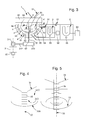
- a kneader 1 is used for the production of ceramic feedstock granules comprising, on the one hand at least one such inorganic powder, and on the other hand at least one an organic binder, this mixer 1 comprises at least one tank 2.
- this mixer 1 is movable at least one mixing means 3, immersed in a corresponding vessel 2 or protruding from the bottom of such a tank 2 as shown in the figures .
- the mixer 1 comprises heat exchange means 4, which may comprise at least one circuit in which a fluid flows in a double wall of a tank 2, or circulates in coils immersed in a tank 2, or the like.
- the mixer 1 advantageously comprises control means 5 connected to measuring means 6 and means 7 for storing temperature parameters depending on the type of material to be produced.
- control means 5 are arranged for regulating the temperature of the tank 2 and the heat exchange between the tank 2 and at least one medium external to the tank 2, by the heat exchange means 4.
- control means 5 are manually controlled, and comprise means for controlling the rotational speeds of each mixing means 3, and the temperatures or / and flow rates of each heat exchange circuit, at seen information displayed by measuring means 6 such as temperature probes located in the tank 2, in each heat exchange circuit, or thermometers immersed in the dough, manually or automated.
- control means 5 comprise at least one programmable controller capable of performing these actions according to stored production programs for each type of inorganic material called "ceramic" to produce.
- control means 5 may, depending on the degree of automation of the installation, control in particular these heat exchange means 4, in correlation with measured values of tree speed and / or compacted mass flow, of measured mass and / or tank temperatures, and with threshold values, in particular of temperature, imposed for the manufacture of a given product.
- the set of parameters relating to a given product, stored in the storage means 7, advantageously makes it possible to control the whole of its manufacturing cycle, including all the desired timings.
- the heat exchange means 4 comprise heating means 41 arranged for heating the tank 2 and / or its contents at a temperature between a lower temperature TINF from which a mixture corresponding to a The type of ceramics produced reaches the pasty state, and at a higher temperature TSUP below which the mixture corresponding to the given type of ceramic must remain, to avoid degradation of the binders.
- This lower temperature TINF and this upper temperature TSUP are memorized, for the mixture corresponding to a given type of ceramics, at the level of the storage means 7.
- the storage means consist of summary sheets of the composition of the mixer charge, with its tolerances, containing the limit temperatures of each phase, and a range of duration of each phase.
- heating means 41 exchange the energy, in a first connection, with a first heat exchange circuit 8 maintaining the mixing temperature, external to the tank 2.
- the thermal inertia of the first circuit 8 is greater than that of the tank 2 at full load of the mixture. Preferably it is higher in a factor K1 greater than 2.
- This thermal inertia characteristic of the heating circuit is an essential characteristic of the invention because it makes it possible to obtain very short cycle times.
- Heating the tank 2 and its contents goes against the prejudices of the prior art.
- the heating makes it possible to have less deviation from an average temperature, and to completely control the temperature gradient. It is no longer necessary to rotate the kneading shaft at high speed to achieve the melting temperatures of the components by friction thereof.
- the production obtained is more homogeneous, which is crucial in powder metallurgy, because it is a question of perfectly controlling the shrinkage coefficient during sintering, and this coefficient depends on the quality of the kneading.
- the prior art allowed to obtain for a production in 5 daily batches of 20 kg each, a withdrawal coefficient in the range 1 , 2850 to 1.2920, while the implementation of the mixer according to the invention and the associated mixing process allows, all things being equal, to reduce this coefficient in the range 1.2875 to 1.2895, or respectively respectively in the range 1.2880 to 1.2890, which is excellent, since the amplitude of the relative dispersion is then 1.6 per thousand, respectively 0.8 per thousand against 5.4 per thousand in the prior art , a division by a factor of about 3.5, respectively 7.
- the production is thus very reproducible.
- the heat exchange means 4 comprise cooling means 42 for cooling the tank 2 and / or its contents.
- the cooling means 42 are then distinct from the heating means 41, as visible on the figures 3 and 8 .
- the cooling means 42 exchange the energy, in a second connection, with a second circuit 9 at ambient temperature, external to the tank 2, and whose thermal inertia is much greater than that of the tank 2 to full load of the mixture, and preferably higher in a second factor K2 greater than 2.
- this thermal inertia characteristic of the possible cooling circuit is an important feature of the invention, because it allows to obtain very short cycle times.
- each of thermal inertia much greater than that of the tank and its contents, allows, on the one hand, the control of the cycle times which can be reduced by very important way compared to the old techniques, and on the other hand the control of the thermal gradient: the stabilization of temperature ensured by the heat exchange with an external circuit makes it possible to avoid the gradients impossible to control of the prior art based on the use of friction for binder melting, which was commonly above 10 ° C per second or more.
- the invention allows the control of the product at high temperature.
- the invention also guarantees the control of withdrawals, due to the absence of any degradation of the ingredients.
- This problem of degradation is complex, because of the diversity of the melting temperatures of the usual binders, since 50 ° C. for waxes, up to 165 ° C for polymers or the like. It should be understood that very close to the melting point is the point of degradation and loss of properties of many ingredients. Thus a paraffin, melt to 50 ° C, is completely degraded to 185 ° C, only 20 ° C beyond the melting point of the last polymer melt, which is obviously impossible to control with a gradient of the order 10 ° C per second. The same phenomenon concerns acrylic compounds.
- This high temperature control (that is to say, for the ceramic type feedstocks to which the invention is more specifically dedicated, between 150 ° C. and 200 ° C.) is therefore fundamental for obtaining, in a reproducible manner, a quality product.
- control means 5 control the heat exchange means 4 so as to activate the heat exchange with the tank 2, at a given instant, only cooling means 42 or only means of heating 41.
- the use of a single heat exchange circuit at the tank alternatively put into a heat exchange situation with a hot source or with a cold source, makes it possible to achieve the desired temperature curve.
- the second variant with two separate circuits, on which one can connect the tank instantaneously overcomes the effects of the thermal inertia specific to the tank 2, by its instantaneous communication with a circuit of inertia thermal superior to his, allowing to stabilize very quickly in a range of temperatures consistent with the good conduct of the process, and thus significantly reduce the overall cycle time.
- the mixing means 3 preferably comprises, and not limited to, a rotating shaft 30 carrying blades 33 and / or knives in the tank 2.
- Each mixing shaft 30 is preferably driven, via a belt or the like, by a motor 31 equipped with a continuous drive connected to control means 5 which control this drive.
- the shaft 30 is preferably equipped with a tachometer dynamo 63 which communicates the real speed of rotation of the shaft 30 to the control means 5.
- the figure 2 shows a kneading shaft 30 cantilevered and driven under the bottom of the tank 2, which it passes through, this shaft 30 is equipped with a pulley 310 of diameter greater than that of the motor pulley 311, joined by a belt 312 or similar, so as to obtain more torque, to the extent that one less need to achieve high rotational speeds as in the prior art.
- the Figures 1 to 3 illustrate the action of the control means 5, on the basis of at least one speed information of the mixing means 3 or a mass of product being processed by the mixer 1, and at least one information of temperature of the tank 2 or of this mass of product, read by sensors included in the measuring means 6, for controlling the speed of the motor 31 directly or indirectly driving the mixing shaft 30, and a heat exchange flow, in particular by a first pump 81 on the first circuit 8 of the heating means 41.
- the control means 5 When, in particular in the second variant, the cooling means 42 exchange energy, in a second connection, with a second circuit 9, the control means 5 also act on a second pump 91 on the second circuit 9 of the means Cooling 42.
- the control means 5 comprise a clock 51, making it possible to respect the process parameters introduced in the storage means 7.
- the control means 5 may, again, act on a first regulator 82 effecting a supply (or removal) of heat to the first circuit 8, and / or acting on a second regulator 92 performing a removal (or a supply) of heat to the second circuit 8, these first 82 and second 92 controllers may comprise a resistor or / and a cold group.
- the first circuit 8 carries oil
- the second circuit 9 conveys brine, or the like.
- the mixer 1 comprises a plurality of tanks 2 thus equipped, communicating with each other from an upstream tank where the raw materials are discharged through a feed 21 such as a hopper or the like, to a tank of water. downstream serving in particular the final crushing of the compacted kneaded mass.
- This downstream tank can have a dual function of mixing tank and crushing tank: the raw materials in mixture are poured therein by the upstream tank, at least one mixing shaft performs the mixing itself with blades or and shaped knives adapted to the turning of a pasty mass in the mixing tank and its separation by slicing, the final crushing can be performed, as the case, by such a mixing shaft 30, or by at least one shaft crusher equipped with knives 22 more precisely adapted to the fragmentation of a solidified solid mass. If necessary an auxiliary crusher can be used downstream to achieve the desired particle size.
- the figures illustrate the non-limiting case of a single vessel 2, in which the entire mixing process is carried out, from the introduction of the raw materials, to the crushing of the cooled kneaded mass known as slab, to obtain granules. feedstock or fine flour.
- the shaft 30 is vertical, and in particular comprises blades 33, preferably distributed in several parallel planes.
- the pitch of the blades and / or knives is preferably adjustable, so as to be effective for both small and large loads: or the entire mixing shaft is interchangeable, at a coupling 32, or it comprises a succession of bushes carrying blades or knives, resting on each other and strung on a common shaft, and separated if necessary by spacers 35 to obtain a particular configuration, as visible on the Figures 3 and 4 , where the shaft 30 is thus equipped with three sets of lower blades 33A, 33B, 33C, surmounted by upper blades 34. If the arrangement in substantially flat levels of the blades or knives is the most common, it can also be used, especially for the upper level adapted to large loads, blades 34 or knives inscribed in a substantially conical envelope relative to the axis of the shaft.
- blades substantially radial fins having a shape to give a particular movement, the mixture of raw materials first, and the paste afterwards.
- knives are meant fins of similar shape and finer section, and having a sharpened leading edge, in particular for slicing the pasty mass while driving it in motion; however, a sharp edge may be counterproductive because it is more sensitive to wear than a blade for driving the paste, this wear generating pollution that affects the precision of the composition of the feedstock obtained, thereby sharpening eventual requires further monitoring of production.
- the so-called lower blades or knives the closest to the bottom of the tank adopt a shape close to it, or are inscribed in a conical, toric, or spherical surface, and exert a scraping function of the dough in the bottom of the tank.
- the blades and knives are preferably angularly offset from one stage to another, the different stages may comprise different numbers of blades or knives with a variable angular disposition, in particular to prevent any phenomenon of resonance and noise.
- the blades 33 and / or knives preferably have a slight incidence relative to the plane perpendicular to the axis of the shaft 30. This incidence can be adjusted, either very simply by exchanging a mounted cutting stage on a bushing as presented above, either in larger installations with a return mechanism which however is more sensitive to wear generated by the movement of the dough.
- a mixed embodiment certainly consumes more than power, but an upper stage tending to take off the dough from the bottom of the tank facilitates its amalgam, while a lower cutting stage tends to fold the dough to the bottom of the tank is advantageous especially in the final stages of the process and in the fractionation of the slab obtained after cooling of the pasty compact mass.
- Crushing of the wafer can also be performed, after a vertical clearance of the mixing shaft 30, by the combined action of a worm 37 embedded in a groove 39 at the bottom of the tank 2, and flaps 36 articulated on a vertical axis, the extraction of crushed feedstock pellets is done by reversing the direction of the worm and conveying to a service station 38.
- the crushing is conducted until obtaining a flour.
- This flour is transformed downstream, in an auxiliary granulation station where it is first compressed to form an extruded pudding, cut into pellets as and when it advances.
- Each tank 2 is preferably provided with a closure means comprising at least one valve or a pressure relief outlet.
- the driving, as a function of time, of the means of temperature exchange and the kneading speed therefore conditions the quality of the final product, at the same time the parameters specific to the intermediate product, in particular its viscosity.
- the good management of this pipe naturally conditions the cycle time in the mixer, and therefore the cost of production and the depreciation of the installation.
- the mixer 1 can, again, be equipped with means for measuring the speed of circulation of the compact mass in the tank, for example at a mobile 60 such as a worm or an idler wheel immersed in the mass inside the vessel, the rotational speed of which is measured by a dough movement sensor 64, and advantageously the temperature at the core of the pasty compact mass by a dough temperature sensor 65.
- Means for measuring the temperature of the compact mass may be located, or at such a mobile 60, and / or at the bottom of the tank 2 by a temperature sensor 66 on an inner surface of the tank 2, and / or at the periphery of the mixing shaft 30, by a temperature sensor 67 preferably at its lower part near the bottom of the tank 2.
- the binder of the invention comprises from 2 to 7% by volume of one of said copolymers or of their mixtures, about 25% by volume of polyethylene, of 2 to 15% by volume of polypropylene and of 6 to 15% in volume of acrylic resin.
- the copolymer of ethylene and methacrylic or acrylic acid contains from 3 to 10% by weight of methacrylic or acrylic comonomer
- the ethylene-vinyl acetate copolymer contains from 7 to 18% by weight of vinyl acetate comonomer
- the ethylene-anhydride copolymer is a random ( random ) copolymer of ethylene and maleic anhydride having a melting point of 100 to 110 ° C or a copolymer of polyethylene HD and a modified anhydride having a melting point of 130 to 134 ° C.
- the acrylic resin has a molecular weight between 50,000 and 22,000 and a viscosity of 0.21 to 0.83, and is selected from the group consisting of isobutyl methacrylate, methyl, ethyl and N-methyl polymers. -butyl, and methacrylate copolymers of isobutyl and N-butyl and methyl and N-butyl methacrylates or a mixture of these polymers and / or copolymers.
- the wax is a carnauba wax or a paraffin wax, or a palm oil, or a mixture of these elements.
- the surfactant is a NN'-ethylene-bis (stearamide) or a mixture of stearic and palmitic acids (stearin), or a mixture of these elements.
- the inorganic powder of the injection molding composition may be chosen from the group comprising an oxide, nitride, carbide or metal powder, or a mixture of these said powders and preferably the powder.
- inorganic material is selected from the group consisting of an alumina powder, a zirconium oxide powder, a chromium carbide powder, a titanium carbide powder or a powder tungsten carbide, a metal tungsten powder or silicon nitride powder, a stainless steel powder, a titanium metal powder or a mixture of these powders.
- the polymeric portion of the binder is mixed with a black zirconium oxide powder (St. Gobain Zir Black type) at a temperature of about 150 ° C to form a premix.
- a black zirconium oxide powder St. Gobain Zir Black type
- To this premix are added the waxes and the surfactant, and the temperature is again increased to about 180 ° C to form a kind of homogeneous paste, which is then cooled and granulated until solidification, and then kept to form the feedstock can be used in the manufacture of a piece of injection molding according to a known technique.
- feedstocks can be prepared with various ceramic or metal powders, more particularly alumina, with a shrinkage index of 1.19 or 1.30 ( translucent), chromium carbide or titanium carbide, tungsten carbide (of different grades) and metallic tungsten, according to the following table.
- Binder (% vol.) Al 2 O 3 Al 2 O 3 (transl.) CrC (90% wt) CW W (85-6% wt) (78-9% wt) TiC (89% wt) (94-94.5% wt) (94-5% wt) HD polyethylene 26 28 24 25/25 26/25 polypropylene 6 2 6 8/8 10/10 Copolymer ("Nucrel") 3.5 3 3 4/4 4/4 Resin "Elvacite 2045” 6 5 5 7/7 9/7 Resin "Elvacite 2046" 1 1 1 1/1 1/1 Carnauba Wax 12 12 12 11/11 11/11 Paraffin wax 35 39 39 34/37 29/32 Bix-steroid of NN'-ethylene 5.5 5 5 5/5 5/5 Stearin (Dubois) 5 5 5 5 5/2 5/5
- the heat exchange means 4 comprise a single heating circuit, which comprises heating means 41 and which is connected to a first heat exchange circuit 8 maintaining the mixing temperature.
- the heating means 41 comprise, for example, at least one thermo-regulator of the "HB Therm” type or similar, with oil, controlled in temperature, under a maximum pressure of 5 bar, which allows a temperature control with a positive gradient, or with a negative gradient. The temperature drop of the tank 2 and its contents can then be controlled by this thermoregulator.
- the stabilization at high temperature greater than or equal to a temperature specific to the mixture considered and characteristic of a homogeneous compact mass, of the vessel 2 and its contents is stopped, it is carried out lowering the temperature of the tank 2 and its contents, either naturally or by driving the heat exchange means to a second circuit at ambient temperature of 20 ° C.
- the mixer 1 when the mixer 1 is equipped with a second cooling circuit 9, it is possible to connect the heat exchange means 4 to this second circuit 9, which is at an ambient temperature close to 20, in order to lower the temperature. ° C.
- the tank 2 is preferably equipped with a tight cover 39 to prevent any pollution of the mixture, and ensure compliance with the proportions of the various components of the mixture.
- the compact mass is crushed, or in the tank 2 at a temperature below 100 ° C. and at a speed greater than or equal to 700 revolutions per minute. of the mixing means 3, or in a crushing station attached to the mixer 1.
- the tank 2 is advantageously lined internally with a wear-resistant coating, diamond type, or vitrification, or the like.
- the following steps depend on the equipment of the mixer 1 in slicing means, crushing, and means for protecting the tank 2 against abrasion.
- cut blocks are manually extracted from the slab, and the crushing is carried out in an auxiliary means.
- the total engine cycle time is between 20 and 30 minutes
- the total cooling time is between 15 and 30 minutes
- the total evacuation time is between 5 and 15 minutes. minutes.
- Such a sequence is particularly suitable for a mixture of raw materials comprising 14% by weight of a binder which itself comprises 50% by volume of a material constituting a structuring matrix, 42% of a constituent material of a fluidizing matrix, and 8% of a material constituting a surfactant matrix.
- polymeric base contains copolymers of ethylene and methacrylic or acrylic acid, or copolymers of ethylene and vinyl acetate, or copolymers of ethylene comprising a maleic anhydride or a mixture of these copolymers, as well as only polyethylene, polypropylene and acrylic resin.
Landscapes
- Chemical & Material Sciences (AREA)
- Engineering & Computer Science (AREA)
- Ceramic Engineering (AREA)
- Manufacturing & Machinery (AREA)
- Structural Engineering (AREA)
- Chemical Kinetics & Catalysis (AREA)
- Organic Chemistry (AREA)
- Materials Engineering (AREA)
- Inorganic Chemistry (AREA)
- Mechanical Engineering (AREA)
- Dispersion Chemistry (AREA)
- Composite Materials (AREA)
- Physics & Mathematics (AREA)
- Thermal Sciences (AREA)
- Accessories For Mixers (AREA)
- Processing And Handling Of Plastics And Other Materials For Molding In General (AREA)
- Producing Shaped Articles From Materials (AREA)
- Powder Metallurgy (AREA)
- Glanulating (AREA)
- Press-Shaping Or Shaping Using Conveyers (AREA)
- Preparation Of Clay, And Manufacture Of Mixtures Containing Clay Or Cement (AREA)
- Mixers Of The Rotary Stirring Type (AREA)
Priority Applications (1)
| Application Number | Priority Date | Filing Date | Title |
|---|---|---|---|
| EP14167185.9A EP2801560B1 (de) | 2013-05-07 | 2014-05-06 | Mischverfahren für Rohstoffe für die Pulvermetallurgie |
Applications Claiming Priority (6)
| Application Number | Priority Date | Filing Date | Title |
|---|---|---|---|
| CH00923/13A CH708039B1 (fr) | 2013-05-07 | 2013-05-07 | Malaxage de matière première pour métallurgie des poudres. |
| CH00984/13A CH708077B1 (fr) | 2013-05-17 | 2013-05-17 | Malaxage de matière première pour métallurgie des poudres. |
| CH01021/13A CH708097B1 (fr) | 2013-05-28 | 2013-05-28 | Liant pour composition de moulage par injection. |
| EP13176532.3A EP2765121A1 (de) | 2013-07-15 | 2013-07-15 | Bindemittel für Spritzgusszusammensetzung |
| EP13178141.1A EP2765123B1 (de) | 2013-07-26 | 2013-07-26 | Zwangsmischer von Rohstoff für die Pulvermetallurgie |
| EP14167185.9A EP2801560B1 (de) | 2013-05-07 | 2014-05-06 | Mischverfahren für Rohstoffe für die Pulvermetallurgie |
Publications (3)
| Publication Number | Publication Date |
|---|---|
| EP2801560A2 true EP2801560A2 (de) | 2014-11-12 |
| EP2801560A3 EP2801560A3 (de) | 2014-12-31 |
| EP2801560B1 EP2801560B1 (de) | 2019-08-21 |
Family
ID=50624511
Family Applications (1)
| Application Number | Title | Priority Date | Filing Date |
|---|---|---|---|
| EP14167185.9A Active EP2801560B1 (de) | 2013-05-07 | 2014-05-06 | Mischverfahren für Rohstoffe für die Pulvermetallurgie |
Country Status (6)
| Country | Link |
|---|---|
| US (2) | US9908261B2 (de) |
| EP (1) | EP2801560B1 (de) |
| JP (1) | JP5957029B2 (de) |
| KR (2) | KR101740096B1 (de) |
| CN (1) | CN104139180B (de) |
| PT (1) | PT2801560T (de) |
Cited By (6)
| Publication number | Priority date | Publication date | Assignee | Title |
|---|---|---|---|---|
| CN106984222A (zh) * | 2017-04-21 | 2017-07-28 | 深圳市景方盈科技有限公司 | 涂料制造设备 |
| CN107081084A (zh) * | 2017-04-21 | 2017-08-22 | 深圳市景方盈科技有限公司 | 环氧树脂生产方法 |
| CN108943389A (zh) * | 2018-05-29 | 2018-12-07 | 江苏力连重工机械有限公司 | 搅拌设备控制系统 |
| CN109499474A (zh) * | 2018-12-19 | 2019-03-22 | 禹州市远大塑料电器有限责任公司 | 一种胶木粉热态制粒设备 |
| EP3482850A1 (de) | 2017-11-08 | 2019-05-15 | The Swatch Group Research and Development Ltd | Zusammensetzung zum formgiessen durch pulvermetallurgie, die insbesondere für die herstellung von dekor- oder verkleidungsartikeln aus gesintertem massivem cermet bestimmt ist, und diese dekor- oder verkleidungsartikel aus gesintertem massivem cermet |
| CN115972350A (zh) * | 2023-01-10 | 2023-04-18 | 中硼科技(威海)有限公司 | 一种碳化硼复杂形状制品的近净成形制备方法 |
Families Citing this family (31)
| Publication number | Priority date | Publication date | Assignee | Title |
|---|---|---|---|---|
| US9908261B2 (en) * | 2013-05-07 | 2018-03-06 | Comadur S.A. | Mixer, method of mixing raw material for powder metallurgy binder for injection moulding composition |
| WO2014191304A1 (fr) * | 2013-05-28 | 2014-12-04 | Comadur S.A. | Liant pour composition de moulage par injection |
| CN104651699A (zh) * | 2015-01-28 | 2015-05-27 | 安徽省和翰光电科技有限公司 | 一种不锈钢/碳化硅陶瓷基复合材料及其制备方法 |
| CN105624452B (zh) * | 2016-01-05 | 2018-04-24 | 南方科技大学 | 多孔金属间化合物的制备方法 |
| DE102016103289A1 (de) * | 2016-02-24 | 2017-08-24 | Hans Heidolph GmbH | Magnetrührer |
| CN106110988A (zh) * | 2016-08-12 | 2016-11-16 | 重庆聚瑞化工新材料有限公司 | 复合多方向搅拌的密封胶分散系统 |
| WO2018066721A1 (ko) * | 2016-10-04 | 2018-04-12 | 주식회사 쓰리디컨트롤즈 | 3차원 프린트용 금속 분말 원료 공급 장치 |
| WO2018066726A1 (ko) * | 2016-10-06 | 2018-04-12 | 주식회사 쓰리디컨트롤즈 | 금속 분말 함유 조성물을 원료로 하는 3차원 프린팅 방법 |
| EP3332897A1 (de) * | 2016-12-08 | 2018-06-13 | The Swatch Group Research and Development Ltd | Bindemittel für spritzgusszusammensetzung |
| CN106827184B (zh) * | 2016-12-19 | 2018-09-25 | 重庆市豫鹰保温材料有限公司 | 保温板生产用工装 |
| US10870219B2 (en) * | 2017-10-11 | 2020-12-22 | Caterpillar Inc. | Monitoring system for three-dimensional printing |
| CN108295732B (zh) * | 2018-03-14 | 2023-11-07 | 张洪 | 一种锂离子电池制浆混料装置 |
| CN108405088B (zh) * | 2018-03-20 | 2019-07-16 | 何淑琼 | 一种血吸虫病防治药物制备装置 |
| EP3563950B1 (de) * | 2018-05-04 | 2023-11-01 | Comadur S.A. | Bindemittel für spritzgusszusammensetzung |
| WO2020092740A1 (en) * | 2018-10-31 | 2020-05-07 | Rosenblatt Innovations Llc | Geopolymer foam deposition and mixing system and apparatus |
| US12383873B2 (en) | 2018-10-31 | 2025-08-12 | Rosenblatt Innovations Llc | Geopolymer foam deposition and mixing system and apparatus |
| US11981049B2 (en) | 2018-10-31 | 2024-05-14 | Rosenblatt Innovations Llc | Geopolymer foam deposition and mixing system and apparatus |
| JP7319073B2 (ja) * | 2019-03-29 | 2023-08-01 | Ube三菱セメント株式会社 | 混練装置及び混練システム |
| CN110292877A (zh) * | 2019-05-21 | 2019-10-01 | 杭州笑谈科技有限公司 | 一种金属材料的配比加工装置 |
| CN110201591A (zh) * | 2019-06-17 | 2019-09-06 | 河源泳兴硬质合金有限公司 | 一种硬质合金粉原料的混合搅拌设备 |
| JP7156191B2 (ja) * | 2019-07-11 | 2022-10-19 | トヨタ自動車株式会社 | 金型冷却回路設計方法、金型製造方法、金型冷却回路設計装置、及びプログラム |
| CN110841575A (zh) * | 2019-11-20 | 2020-02-28 | 郎蕾 | 一种利用聚酯化缩聚反应对玻璃钢粘结的设备 |
| DE102020113321B4 (de) | 2020-05-15 | 2022-07-07 | Atm Qness Gmbh | Einbettpresse für Proben |
| CN115666895A (zh) | 2020-05-15 | 2023-01-31 | Atm金尼斯有限公司 | 用于包埋样品和加工包埋样品的包埋压力机、研磨和/或抛光设备及生产线 |
| JP6813927B1 (ja) * | 2020-07-22 | 2021-01-13 | 大阪特殊合金株式会社 | コアードワイヤーの製造装置及びこれを用いたコアードワイヤーの製造方法 |
| JP6851669B1 (ja) * | 2020-07-22 | 2021-03-31 | 大阪特殊合金株式会社 | コアードワイヤーの製造装置及びこれを用いたコアードワイヤーの製造方法 |
| CN112717865A (zh) * | 2020-12-09 | 2021-04-30 | 铜鼓县湘鸿化工有限公司 | 一种焦亚硫酸钠制备反应釜 |
| CN112475305B (zh) * | 2020-12-19 | 2021-06-22 | 宁波市富瑞鸿金属材料有限公司 | 一种用于注射成型的金属粉末原料处理系统及其处理方法 |
| CN112964093A (zh) * | 2021-04-08 | 2021-06-15 | 顺德职业技术学院 | 一种双路拓扑隔离转向直排管式换热器 |
| WO2022241221A2 (en) * | 2021-05-14 | 2022-11-17 | Cummins Inc. | Enhancements for low cost autothermal pyrolyzer |
| CN114150175A (zh) * | 2021-11-18 | 2022-03-08 | 北京科技大学 | 一种利用粉末注射成形技术制备Al-Zn-Mg-Cu系铝合金的方法 |
Citations (5)
| Publication number | Priority date | Publication date | Assignee | Title |
|---|---|---|---|---|
| US5145900A (en) | 1990-02-21 | 1992-09-08 | Basf Aktiengesellschaft | Thermoplastic materials for the production of ceramic moldings |
| EP0956918A1 (de) | 1998-05-12 | 1999-11-17 | Gebrüder Lödige Maschinenbaugesellschaft mbH | Verfahren zur Herstellung eines spritzgussfähigen Zwischenprodukts |
| EP1344593A2 (de) | 2002-03-11 | 2003-09-17 | Advanced Materials Technologies, Pte Ltd. | Herstellung von komplex geformten Aluminiumkörpern |
| US20040217524A1 (en) | 2003-04-18 | 2004-11-04 | Morris Robert Craig | Simplified processing of metal and cermet feedstocks |
| EP2338590A1 (de) | 2009-12-22 | 2011-06-29 | Nitto Denko Corporation | Harzherstellungsvorrichtung und Harzherstellungsverfahren |
Family Cites Families (26)
| Publication number | Priority date | Publication date | Assignee | Title |
|---|---|---|---|---|
| NL142820C (de) * | 1940-08-27 | |||
| DE3127218A1 (de) * | 1981-07-10 | 1983-01-27 | Bayer Ag | Verfahren und vorrichtung zum einmischen von pulverfoermigen bis kleinteiligen zusatzstoffen in eine fluessige reaktionskomponente |
| JPS61222529A (ja) * | 1985-03-29 | 1986-10-03 | Hitachi Ltd | 撹拌装置 |
| JP2652155B2 (ja) * | 1986-05-02 | 1997-09-10 | 富士写真フイルム株式会社 | ゲル状物質を連続熔融する方法及び装置 |
| JPS6347105A (ja) * | 1986-08-14 | 1988-02-27 | 株式会社東芝 | セラミツクス成形材料の製造方法 |
| CH674472A5 (de) * | 1987-05-06 | 1990-06-15 | List Ag | |
| JPH0755491B2 (ja) * | 1988-11-01 | 1995-06-14 | トヨタ自動車株式会社 | セラミックス用混練装置 |
| JPH03115504A (ja) * | 1989-09-27 | 1991-05-16 | Sumitomo Metal Mining Co Ltd | 射出成形粉末治金製品の製造方法 |
| JPH03290374A (ja) * | 1990-04-03 | 1991-12-20 | Japan Steel Works Ltd:The | 焼結品の製造方法 |
| JPH0474602A (ja) * | 1990-07-16 | 1992-03-10 | Inax Corp | 泥漿の加温装置と加温方法 |
| TW268910B (de) | 1991-06-18 | 1996-01-21 | Hoechst Ag | |
| JPH0534784A (ja) * | 1991-07-30 | 1993-02-12 | Showa Aircraft Ind Co Ltd | カメラのボデイシヤーシおよびその製造方法 |
| US5266264A (en) | 1991-12-31 | 1993-11-30 | The Japan Steel Works Ltd. | Process for producing sinters and binder for use in that process |
| US5403088A (en) * | 1993-06-18 | 1995-04-04 | The Dow Chemical Company | Apparatus and method for the dispersion of minute bubbles in liquid materials for the production of polymer foams |
| JPH08127021A (ja) * | 1994-11-01 | 1996-05-21 | Sekisui Chem Co Ltd | セメントモルタル原料の計量供給装置 |
| US6376585B1 (en) | 2000-06-26 | 2002-04-23 | Apex Advanced Technologies, Llc | Binder system and method for particulate material with debind rate control additive |
| JP2002256149A (ja) * | 2001-03-01 | 2002-09-11 | Ngk Insulators Ltd | 無機物質粉末成形用組成物 |
| CN2491204Y (zh) * | 2001-05-17 | 2002-05-15 | 中国兵器工业第五二研究所 | 粉浆浇铸及注射成型机 |
| JP4031995B2 (ja) * | 2003-01-27 | 2008-01-09 | 三井金属鉱業株式会社 | 射出成形体の製法 |
| US20090117218A1 (en) * | 2004-08-05 | 2009-05-07 | Fujifilm Corporation | Apparatus for producing dope |
| GB0513456D0 (en) * | 2005-06-29 | 2005-08-10 | Brown Christopher J | Mixer and method of mixing |
| JP4932219B2 (ja) * | 2005-10-18 | 2012-05-16 | ヤマハリビングテック株式会社 | 焼成用成形体の製造方法および焼成体の製造方法 |
| FR2980983B1 (fr) * | 2011-10-11 | 2013-11-22 | Centre Nat Recherche | Reacteur et procede de dissolution d'un solide |
| EP2765123B1 (de) * | 2013-07-26 | 2016-01-20 | Comadur S.A. | Zwangsmischer von Rohstoff für die Pulvermetallurgie |
| CH708039B1 (fr) * | 2013-05-07 | 2017-06-30 | Comadur Sa | Malaxage de matière première pour métallurgie des poudres. |
| US9908261B2 (en) * | 2013-05-07 | 2018-03-06 | Comadur S.A. | Mixer, method of mixing raw material for powder metallurgy binder for injection moulding composition |
-
2014
- 2014-05-02 US US14/268,227 patent/US9908261B2/en active Active
- 2014-05-06 EP EP14167185.9A patent/EP2801560B1/de active Active
- 2014-05-06 PT PT141671859T patent/PT2801560T/pt unknown
- 2014-05-07 JP JP2014095663A patent/JP5957029B2/ja active Active
- 2014-05-07 KR KR1020140054136A patent/KR101740096B1/ko active Active
- 2014-05-07 CN CN201410293325.3A patent/CN104139180B/zh active Active
-
2016
- 2016-01-19 KR KR1020160006669A patent/KR102019537B1/ko active Active
-
2017
- 2017-04-04 US US15/478,594 patent/US10611050B2/en active Active
Patent Citations (5)
| Publication number | Priority date | Publication date | Assignee | Title |
|---|---|---|---|---|
| US5145900A (en) | 1990-02-21 | 1992-09-08 | Basf Aktiengesellschaft | Thermoplastic materials for the production of ceramic moldings |
| EP0956918A1 (de) | 1998-05-12 | 1999-11-17 | Gebrüder Lödige Maschinenbaugesellschaft mbH | Verfahren zur Herstellung eines spritzgussfähigen Zwischenprodukts |
| EP1344593A2 (de) | 2002-03-11 | 2003-09-17 | Advanced Materials Technologies, Pte Ltd. | Herstellung von komplex geformten Aluminiumkörpern |
| US20040217524A1 (en) | 2003-04-18 | 2004-11-04 | Morris Robert Craig | Simplified processing of metal and cermet feedstocks |
| EP2338590A1 (de) | 2009-12-22 | 2011-06-29 | Nitto Denko Corporation | Harzherstellungsvorrichtung und Harzherstellungsverfahren |
Cited By (6)
| Publication number | Priority date | Publication date | Assignee | Title |
|---|---|---|---|---|
| CN106984222A (zh) * | 2017-04-21 | 2017-07-28 | 深圳市景方盈科技有限公司 | 涂料制造设备 |
| CN107081084A (zh) * | 2017-04-21 | 2017-08-22 | 深圳市景方盈科技有限公司 | 环氧树脂生产方法 |
| EP3482850A1 (de) | 2017-11-08 | 2019-05-15 | The Swatch Group Research and Development Ltd | Zusammensetzung zum formgiessen durch pulvermetallurgie, die insbesondere für die herstellung von dekor- oder verkleidungsartikeln aus gesintertem massivem cermet bestimmt ist, und diese dekor- oder verkleidungsartikel aus gesintertem massivem cermet |
| CN108943389A (zh) * | 2018-05-29 | 2018-12-07 | 江苏力连重工机械有限公司 | 搅拌设备控制系统 |
| CN109499474A (zh) * | 2018-12-19 | 2019-03-22 | 禹州市远大塑料电器有限责任公司 | 一种胶木粉热态制粒设备 |
| CN115972350A (zh) * | 2023-01-10 | 2023-04-18 | 中硼科技(威海)有限公司 | 一种碳化硼复杂形状制品的近净成形制备方法 |
Also Published As
| Publication number | Publication date |
|---|---|
| US9908261B2 (en) | 2018-03-06 |
| KR20140132287A (ko) | 2014-11-17 |
| EP2801560B1 (de) | 2019-08-21 |
| KR20160011693A (ko) | 2016-02-01 |
| KR102019537B1 (ko) | 2019-09-06 |
| CN104139180B (zh) | 2017-04-12 |
| KR101740096B1 (ko) | 2017-05-25 |
| US20170203469A1 (en) | 2017-07-20 |
| US20140336034A1 (en) | 2014-11-13 |
| HK1203886A1 (en) | 2015-11-06 |
| JP2014218082A (ja) | 2014-11-20 |
| CN104139180A (zh) | 2014-11-12 |
| EP2801560A3 (de) | 2014-12-31 |
| PT2801560T (pt) | 2019-11-29 |
| JP5957029B2 (ja) | 2016-07-27 |
| US10611050B2 (en) | 2020-04-07 |
Similar Documents
| Publication | Publication Date | Title |
|---|---|---|
| EP2801560B1 (de) | Mischverfahren für Rohstoffe für die Pulvermetallurgie | |
| EP2765123B1 (de) | Zwangsmischer von Rohstoff für die Pulvermetallurgie | |
| EP3643693B1 (de) | Bindemittel für spritzgusszusammensetzung | |
| EP0605781A1 (de) | Verfahren und Apparat zum kontinuierlichen Mischen von Kautschuk | |
| EP3345882A1 (de) | Bindemittel für spritzgusszusammensetzung | |
| EP0737123A1 (de) | Verfahren zur behandlung eines talkumpuders bei dem einbringen in eine kunststoffmasse | |
| FR2608171A1 (fr) | Granule pour la fabrication de composites a matrice metallique et procede de preparation du granule | |
| EP2661332B1 (de) | Masterbatch für keramik- oder metallpulverspritzgiessen und verfahren zur herstellung dieses masterbatches | |
| FR2990894A1 (fr) | Couteau de tondeuse autolubrifiant et son procede de fabrication | |
| FR2569683A1 (fr) | Procede de moulage de materiaux en poudre | |
| WO2009096606A1 (en) | Preform for press working and manufacturing method thereof | |
| CH708077A2 (fr) | Malaxage de matière première pour métallurgie des poudres. | |
| CH708039A2 (fr) | Malaxage de matière première pour métallurgie des poudres. | |
| FR2977251A1 (fr) | Procede de fabrication de pieces colorees en ceramique par pim | |
| HK1203886B (en) | Mixer. method of mixing raw material for powder metallurgy binder for injection moulding composition | |
| CH714966A2 (fr) | Liant pour composition de moulage par injection. | |
| WO2018103931A1 (fr) | Liant pour composition de moulage par injection | |
| FR2736579A1 (fr) | Procede et installation pour la fabrication de produits composites et produits en resultant | |
| FR2597763A1 (fr) | Systeme pour produire un melange homogene de matieres, notamment a base de caoutchouc comprenant un melangeur a transfert par cavites |
Legal Events
| Date | Code | Title | Description |
|---|---|---|---|
| PUAI | Public reference made under article 153(3) epc to a published international application that has entered the european phase |
Free format text: ORIGINAL CODE: 0009012 |
|
| 17P | Request for examination filed |
Effective date: 20140506 |
|
| AK | Designated contracting states |
Kind code of ref document: A2 Designated state(s): AL AT BE BG CH CY CZ DE DK EE ES FI FR GB GR HR HU IE IS IT LI LT LU LV MC MK MT NL NO PL PT RO RS SE SI SK SM TR |
|
| AX | Request for extension of the european patent |
Extension state: BA ME |
|
| PUAL | Search report despatched |
Free format text: ORIGINAL CODE: 0009013 |
|
| AK | Designated contracting states |
Kind code of ref document: A3 Designated state(s): AL AT BE BG CH CY CZ DE DK EE ES FI FR GB GR HR HU IE IS IT LI LT LU LV MC MK MT NL NO PL PT RO RS SE SI SK SM TR |
|
| AX | Request for extension of the european patent |
Extension state: BA ME |
|
| RIC1 | Information provided on ipc code assigned before grant |
Ipc: C04B 35/56 20060101ALI20141126BHEP Ipc: C04B 35/10 20060101AFI20141126BHEP Ipc: C04B 35/584 20060101ALI20141126BHEP Ipc: B22F 3/22 20060101ALI20141126BHEP Ipc: C04B 35/632 20060101ALI20141126BHEP Ipc: C04B 35/634 20060101ALI20141126BHEP Ipc: C04B 35/48 20060101ALI20141126BHEP Ipc: C04B 26/06 20060101ALI20141126BHEP |
|
| R17P | Request for examination filed (corrected) |
Effective date: 20150120 |
|
| RBV | Designated contracting states (corrected) |
Designated state(s): AL AT BE BG CH CY CZ DE DK EE ES FI FR GB GR HR HU IE IS IT LI LT LU LV MC MK MT NL NO PL PT RO RS SE SI SK SM TR |
|
| STAA | Information on the status of an ep patent application or granted ep patent |
Free format text: STATUS: EXAMINATION IS IN PROGRESS |
|
| 17Q | First examination report despatched |
Effective date: 20170619 |
|
| GRAP | Despatch of communication of intention to grant a patent |
Free format text: ORIGINAL CODE: EPIDOSNIGR1 |
|
| STAA | Information on the status of an ep patent application or granted ep patent |
Free format text: STATUS: GRANT OF PATENT IS INTENDED |
|
| INTG | Intention to grant announced |
Effective date: 20190424 |
|
| GRAS | Grant fee paid |
Free format text: ORIGINAL CODE: EPIDOSNIGR3 |
|
| GRAA | (expected) grant |
Free format text: ORIGINAL CODE: 0009210 |
|
| STAA | Information on the status of an ep patent application or granted ep patent |
Free format text: STATUS: THE PATENT HAS BEEN GRANTED |
|
| AK | Designated contracting states |
Kind code of ref document: B1 Designated state(s): AL AT BE BG CH CY CZ DE DK EE ES FI FR GB GR HR HU IE IS IT LI LT LU LV MC MK MT NL NO PL PT RO RS SE SI SK SM TR |
|
| REG | Reference to a national code |
Ref country code: GB Ref legal event code: FG4D Free format text: NOT ENGLISH |
|
| REG | Reference to a national code |
Ref country code: CH Ref legal event code: EP |
|
| REG | Reference to a national code |
Ref country code: DE Ref legal event code: R096 Ref document number: 602014052041 Country of ref document: DE |
|
| REG | Reference to a national code |
Ref country code: AT Ref legal event code: REF Ref document number: 1169570 Country of ref document: AT Kind code of ref document: T Effective date: 20190915 |
|
| REG | Reference to a national code |
Ref country code: IE Ref legal event code: FG4D Free format text: LANGUAGE OF EP DOCUMENT: FRENCH |
|
| REG | Reference to a national code |
Ref country code: PT Ref legal event code: SC4A Ref document number: 2801560 Country of ref document: PT Date of ref document: 20191129 Kind code of ref document: T Free format text: AVAILABILITY OF NATIONAL TRANSLATION Effective date: 20191121 |
|
| REG | Reference to a national code |
Ref country code: LT Ref legal event code: MG4D |
|
| REG | Reference to a national code |
Ref country code: NL Ref legal event code: MP Effective date: 20190821 |
|
| PG25 | Lapsed in a contracting state [announced via postgrant information from national office to epo] |
Ref country code: FI Free format text: LAPSE BECAUSE OF FAILURE TO SUBMIT A TRANSLATION OF THE DESCRIPTION OR TO PAY THE FEE WITHIN THE PRESCRIBED TIME-LIMIT Effective date: 20190821 Ref country code: HR Free format text: LAPSE BECAUSE OF FAILURE TO SUBMIT A TRANSLATION OF THE DESCRIPTION OR TO PAY THE FEE WITHIN THE PRESCRIBED TIME-LIMIT Effective date: 20190821 Ref country code: SE Free format text: LAPSE BECAUSE OF FAILURE TO SUBMIT A TRANSLATION OF THE DESCRIPTION OR TO PAY THE FEE WITHIN THE PRESCRIBED TIME-LIMIT Effective date: 20190821 Ref country code: NO Free format text: LAPSE BECAUSE OF FAILURE TO SUBMIT A TRANSLATION OF THE DESCRIPTION OR TO PAY THE FEE WITHIN THE PRESCRIBED TIME-LIMIT Effective date: 20191121 Ref country code: LT Free format text: LAPSE BECAUSE OF FAILURE TO SUBMIT A TRANSLATION OF THE DESCRIPTION OR TO PAY THE FEE WITHIN THE PRESCRIBED TIME-LIMIT Effective date: 20190821 Ref country code: BG Free format text: LAPSE BECAUSE OF FAILURE TO SUBMIT A TRANSLATION OF THE DESCRIPTION OR TO PAY THE FEE WITHIN THE PRESCRIBED TIME-LIMIT Effective date: 20191121 Ref country code: NL Free format text: LAPSE BECAUSE OF FAILURE TO SUBMIT A TRANSLATION OF THE DESCRIPTION OR TO PAY THE FEE WITHIN THE PRESCRIBED TIME-LIMIT Effective date: 20190821 |
|
| PG25 | Lapsed in a contracting state [announced via postgrant information from national office to epo] |
Ref country code: ES Free format text: LAPSE BECAUSE OF FAILURE TO SUBMIT A TRANSLATION OF THE DESCRIPTION OR TO PAY THE FEE WITHIN THE PRESCRIBED TIME-LIMIT Effective date: 20190821 Ref country code: AL Free format text: LAPSE BECAUSE OF FAILURE TO SUBMIT A TRANSLATION OF THE DESCRIPTION OR TO PAY THE FEE WITHIN THE PRESCRIBED TIME-LIMIT Effective date: 20190821 Ref country code: GR Free format text: LAPSE BECAUSE OF FAILURE TO SUBMIT A TRANSLATION OF THE DESCRIPTION OR TO PAY THE FEE WITHIN THE PRESCRIBED TIME-LIMIT Effective date: 20191122 Ref country code: LV Free format text: LAPSE BECAUSE OF FAILURE TO SUBMIT A TRANSLATION OF THE DESCRIPTION OR TO PAY THE FEE WITHIN THE PRESCRIBED TIME-LIMIT Effective date: 20190821 Ref country code: RS Free format text: LAPSE BECAUSE OF FAILURE TO SUBMIT A TRANSLATION OF THE DESCRIPTION OR TO PAY THE FEE WITHIN THE PRESCRIBED TIME-LIMIT Effective date: 20190821 Ref country code: IS Free format text: LAPSE BECAUSE OF FAILURE TO SUBMIT A TRANSLATION OF THE DESCRIPTION OR TO PAY THE FEE WITHIN THE PRESCRIBED TIME-LIMIT Effective date: 20191221 |
|
| REG | Reference to a national code |
Ref country code: AT Ref legal event code: MK05 Ref document number: 1169570 Country of ref document: AT Kind code of ref document: T Effective date: 20190821 |
|
| PG25 | Lapsed in a contracting state [announced via postgrant information from national office to epo] |
Ref country code: TR Free format text: LAPSE BECAUSE OF FAILURE TO SUBMIT A TRANSLATION OF THE DESCRIPTION OR TO PAY THE FEE WITHIN THE PRESCRIBED TIME-LIMIT Effective date: 20190821 |
|
| PG25 | Lapsed in a contracting state [announced via postgrant information from national office to epo] |
Ref country code: EE Free format text: LAPSE BECAUSE OF FAILURE TO SUBMIT A TRANSLATION OF THE DESCRIPTION OR TO PAY THE FEE WITHIN THE PRESCRIBED TIME-LIMIT Effective date: 20190821 Ref country code: PL Free format text: LAPSE BECAUSE OF FAILURE TO SUBMIT A TRANSLATION OF THE DESCRIPTION OR TO PAY THE FEE WITHIN THE PRESCRIBED TIME-LIMIT Effective date: 20190821 Ref country code: RO Free format text: LAPSE BECAUSE OF FAILURE TO SUBMIT A TRANSLATION OF THE DESCRIPTION OR TO PAY THE FEE WITHIN THE PRESCRIBED TIME-LIMIT Effective date: 20190821 Ref country code: AT Free format text: LAPSE BECAUSE OF FAILURE TO SUBMIT A TRANSLATION OF THE DESCRIPTION OR TO PAY THE FEE WITHIN THE PRESCRIBED TIME-LIMIT Effective date: 20190821 Ref country code: IT Free format text: LAPSE BECAUSE OF FAILURE TO SUBMIT A TRANSLATION OF THE DESCRIPTION OR TO PAY THE FEE WITHIN THE PRESCRIBED TIME-LIMIT Effective date: 20190821 Ref country code: DK Free format text: LAPSE BECAUSE OF FAILURE TO SUBMIT A TRANSLATION OF THE DESCRIPTION OR TO PAY THE FEE WITHIN THE PRESCRIBED TIME-LIMIT Effective date: 20190821 |
|
| PG25 | Lapsed in a contracting state [announced via postgrant information from national office to epo] |
Ref country code: SK Free format text: LAPSE BECAUSE OF FAILURE TO SUBMIT A TRANSLATION OF THE DESCRIPTION OR TO PAY THE FEE WITHIN THE PRESCRIBED TIME-LIMIT Effective date: 20190821 Ref country code: CZ Free format text: LAPSE BECAUSE OF FAILURE TO SUBMIT A TRANSLATION OF THE DESCRIPTION OR TO PAY THE FEE WITHIN THE PRESCRIBED TIME-LIMIT Effective date: 20190821 Ref country code: SM Free format text: LAPSE BECAUSE OF FAILURE TO SUBMIT A TRANSLATION OF THE DESCRIPTION OR TO PAY THE FEE WITHIN THE PRESCRIBED TIME-LIMIT Effective date: 20190821 Ref country code: IS Free format text: LAPSE BECAUSE OF FAILURE TO SUBMIT A TRANSLATION OF THE DESCRIPTION OR TO PAY THE FEE WITHIN THE PRESCRIBED TIME-LIMIT Effective date: 20200224 |
|
| REG | Reference to a national code |
Ref country code: DE Ref legal event code: R097 Ref document number: 602014052041 Country of ref document: DE |
|
| PLBE | No opposition filed within time limit |
Free format text: ORIGINAL CODE: 0009261 |
|
| STAA | Information on the status of an ep patent application or granted ep patent |
Free format text: STATUS: NO OPPOSITION FILED WITHIN TIME LIMIT |
|
| PG2D | Information on lapse in contracting state deleted |
Ref country code: IS |
|
| 26N | No opposition filed |
Effective date: 20200603 |
|
| PG25 | Lapsed in a contracting state [announced via postgrant information from national office to epo] |
Ref country code: SI Free format text: LAPSE BECAUSE OF FAILURE TO SUBMIT A TRANSLATION OF THE DESCRIPTION OR TO PAY THE FEE WITHIN THE PRESCRIBED TIME-LIMIT Effective date: 20190821 |
|
| PG25 | Lapsed in a contracting state [announced via postgrant information from national office to epo] |
Ref country code: MC Free format text: LAPSE BECAUSE OF FAILURE TO SUBMIT A TRANSLATION OF THE DESCRIPTION OR TO PAY THE FEE WITHIN THE PRESCRIBED TIME-LIMIT Effective date: 20190821 |
|
| REG | Reference to a national code |
Ref country code: BE Ref legal event code: MM Effective date: 20200531 |
|
| PG25 | Lapsed in a contracting state [announced via postgrant information from national office to epo] |
Ref country code: LU Free format text: LAPSE BECAUSE OF NON-PAYMENT OF DUE FEES Effective date: 20200506 |
|
| PG25 | Lapsed in a contracting state [announced via postgrant information from national office to epo] |
Ref country code: IE Free format text: LAPSE BECAUSE OF NON-PAYMENT OF DUE FEES Effective date: 20200506 |
|
| PG25 | Lapsed in a contracting state [announced via postgrant information from national office to epo] |
Ref country code: BE Free format text: LAPSE BECAUSE OF NON-PAYMENT OF DUE FEES Effective date: 20200531 |
|
| PG25 | Lapsed in a contracting state [announced via postgrant information from national office to epo] |
Ref country code: MT Free format text: LAPSE BECAUSE OF FAILURE TO SUBMIT A TRANSLATION OF THE DESCRIPTION OR TO PAY THE FEE WITHIN THE PRESCRIBED TIME-LIMIT Effective date: 20190821 Ref country code: CY Free format text: LAPSE BECAUSE OF FAILURE TO SUBMIT A TRANSLATION OF THE DESCRIPTION OR TO PAY THE FEE WITHIN THE PRESCRIBED TIME-LIMIT Effective date: 20190821 |
|
| PG25 | Lapsed in a contracting state [announced via postgrant information from national office to epo] |
Ref country code: MK Free format text: LAPSE BECAUSE OF FAILURE TO SUBMIT A TRANSLATION OF THE DESCRIPTION OR TO PAY THE FEE WITHIN THE PRESCRIBED TIME-LIMIT Effective date: 20190821 |
|
| P01 | Opt-out of the competence of the unified patent court (upc) registered |
Effective date: 20230611 |
|
| PGFP | Annual fee paid to national office [announced via postgrant information from national office to epo] |
Ref country code: DE Payment date: 20250423 Year of fee payment: 12 |
|
| PGFP | Annual fee paid to national office [announced via postgrant information from national office to epo] |
Ref country code: GB Payment date: 20250423 Year of fee payment: 12 |
|
| PGFP | Annual fee paid to national office [announced via postgrant information from national office to epo] |
Ref country code: PT Payment date: 20250423 Year of fee payment: 12 |
|
| PGFP | Annual fee paid to national office [announced via postgrant information from national office to epo] |
Ref country code: FR Payment date: 20250424 Year of fee payment: 12 |
|
| PGFP | Annual fee paid to national office [announced via postgrant information from national office to epo] |
Ref country code: CH Payment date: 20250601 Year of fee payment: 12 |