EP2804135A1 - Personalisierung eines Mitteilungsdienst-Interface - Google Patents
Personalisierung eines Mitteilungsdienst-Interface Download PDFInfo
- Publication number
- EP2804135A1 EP2804135A1 EP14168284.9A EP14168284A EP2804135A1 EP 2804135 A1 EP2804135 A1 EP 2804135A1 EP 14168284 A EP14168284 A EP 14168284A EP 2804135 A1 EP2804135 A1 EP 2804135A1
- Authority
- EP
- European Patent Office
- Prior art keywords
- user
- interface
- message
- identifier
- interface elements
- Prior art date
- Legal status (The legal status is an assumption and is not a legal conclusion. Google has not performed a legal analysis and makes no representation as to the accuracy of the status listed.)
- Ceased
Links
Images


Classifications
-
- G—PHYSICS
- G06—COMPUTING OR CALCULATING; COUNTING
- G06Q—INFORMATION AND COMMUNICATION TECHNOLOGY [ICT] SPECIALLY ADAPTED FOR ADMINISTRATIVE, COMMERCIAL, FINANCIAL, MANAGERIAL OR SUPERVISORY PURPOSES; SYSTEMS OR METHODS SPECIALLY ADAPTED FOR ADMINISTRATIVE, COMMERCIAL, FINANCIAL, MANAGERIAL OR SUPERVISORY PURPOSES, NOT OTHERWISE PROVIDED FOR
- G06Q10/00—Administration; Management
- G06Q10/10—Office automation; Time management
- G06Q10/107—Computer-aided management of electronic mailing [e-mailing]
-
- G—PHYSICS
- G06—COMPUTING OR CALCULATING; COUNTING
- G06F—ELECTRIC DIGITAL DATA PROCESSING
- G06F3/00—Input arrangements for transferring data to be processed into a form capable of being handled by the computer; Output arrangements for transferring data from processing unit to output unit, e.g. interface arrangements
- G06F3/01—Input arrangements or combined input and output arrangements for interaction between user and computer
- G06F3/048—Interaction techniques based on graphical user interfaces [GUI]
- G06F3/0484—Interaction techniques based on graphical user interfaces [GUI] for the control of specific functions or operations, e.g. selecting or manipulating an object, an image or a displayed text element, setting a parameter value or selecting a range
- G06F3/04842—Selection of displayed objects or displayed text elements
Definitions
- the present invention relates to a dynamic personalization of human-machine interface, particularly but not exclusively in the field of instant messaging (or "chat").
- UI customization is an important element to ensure their attractiveness in all types of applications (computer applications on personal computer, web interfaces, client applications on mobile phones, etc.).
- the Microsoft Word application allows you to customize its interface through the "Word Options" menu.
- the customizable web interface of Google: "iGoogle” allows you to customize the content of the page by choosing the items (gadgets) from a list and the type of information that the user wants to appear, or by changing the interface theme.
- the user is allowed to choose coordinated themes or to import content elements that he has designed himself (such as photos). These themes are also called “skins” (skin in English) and this type of personalization is “skinning”.
- the interface is allowed to "change skin”.
- the present invention improves the situation.
- the invention allows other actors to customize the human machine interface of the receiving terminal of a message (the above entity B). People (message issuers) interacting with Entity B at Through this interface, the interface can dynamically customize the interface of Entity B to reflect their own personality, interests and / or immediate identification.
- the method may comprise a step in which a user of the receiving terminal can validate or not the application of the aforementioned interface elements for displaying the message from the first user, for example via a human machine interface of the receiving terminal. .
- the interface elements transmitted to the operation b1) are received by the receiving terminal with a message from the first user and the interface elements are stored at the receiving terminal in correspondence of at least one identifier the first user in the message.
- the identifier of the first user can be an identifier of a contact database that stores the receiving terminal.
- the receiving terminal upon receipt of subsequent messages including the identifier of the first user, after the operation b1), the receiving terminal can recover the stored interface elements according to the identifier of the first user that the messages contain later, and display these subsequent messages with the previously stored interface elements.
- the interface elements can be stored in addition to a terminal of the first user in correspondence with at least one user identifier of the receiving terminal, and thus, for subsequent messages intended for the receiving terminal, the terminal the first user can transmit these subsequent messages without having to transmit interface element or corresponding identifier.
- the interface elements transmitted to the operation b1) can be stored with a server in correspondence of at least one identifier.
- the aforementioned server may be an interface element customization server and the identifier may be a unique personalization identifier, specific to a given interface form.
- step a) may comprise a communication operation between a terminal available to the first user and an interface element customization server, proposing a choice of interface elements among a plurality of elements of the interface. possible interface, the elements finally chosen being stored possibly in correspondence of at least one identifier (with the personalization server with a unique personalization identifier, and / or with the terminal of the first user, possibly but not necessarily in correspondence of one or more recipient identifiers of future messages from the first user).
- the method according to the invention finds an advantageous but non-limiting application to instant messaging.
- the present invention also relates to a computer program comprising instructions for implementing the above method, when this program is executed by a processor.
- the program may comprise instructions stored by the receiving terminal for their execution, but also instructions distributed between the interface personalization server and the terminal of the first user, in particular to ensure their interaction.
- the invention applies advantageously but not exclusively to the case of messaging software.
- a user A may wish to customize the interface of the terminal of a user B (entity B mentioned above) to better project his personality or mood of the moment on the user B.
- customization may include a change of wallpaper, a specific message font, changing the layout of the screen controls, highlighting some commands to facilitate specific answers requested.
- Customization makes it possible to modify all or part of the interface, and in particular to modify a specific part or to disseminate the modifications into various sections of the interface.
- the personalization can be triggered by an individual, or by the result of an algorithm taking into account, for example, customization proposals exchanged via a messaging system, by all the subscribers or by a subset specific to the user B (customizations received from his contacts, last customizations received, etc.).
- the resulting customization can be a combination of personalization triggered by an individual, for a part of the interface, and by an algorithm, for another part. A direct application of this last possibility then allows the user B to dynamically know the interests most shared by the contacts with whom he exchanges the most messages.
- the invention thus enables a user A to "push” (that is to say to send in so-called “push” mode) elements of interface customization to his contacts (for example a user B) in the exchange of messages with him. He enriches the communication with his correspondents, expresses his personality, his interests of the moment, while communicating the content of his message. User A is therefore better identified, with user B, by distinctive signs that reflect his mood of the moment, or, more usually, his "mark”. The user can thus associate with a group, an individual or a commercial brand that best represents his interest.
- These personalization elements can be grouped (in JAVA language for example) to form a set communicated as is. These sets can be created by the user A on his terminal or proposed by the interface of his terminal.
- an algorithm can make it possible to propose personalization elements that best correspond to the interests of the user A, identified according to the themes of his message exchanges and / or his navigation choices on the web for example.
- the interface elements may include a specific advertising skin (for example for a sports team or a group of musicians, for a clothing brand, or for any brand).
- the invention then allows user B to receive these customizations and dynamically adapt his messaging interface to reflect the personality or the interests of people using messaging in general and his circle of contacts in particular . It allows user B to easily identify his interlocutor, to associate him with a group of individuals, a personality, an artist, a trademark, a hobby, and more generally to his current interest. It can enable the user B in particular to know the interests of the moment most shared by his close friends or by subscribers who are in the same geographical area as him, the same age as him, the same school, etc.
- TERA for example a mobile telephone terminal, of smartphone type by example, or a tablet, or a computer, etc.
- a terminal TERA for example a mobile telephone terminal, of smartphone type by example, or a tablet, or a computer, etc.
- IHMA interface human machine
- the user B has a TERB terminal, connected and programmed to run an HMI machine interface in the context of the aforementioned application of instant messaging.
- the communication between TERA and TERB terminals is provided by the SERM messaging server (double arrows with dashed lines of the figure 1 ), via the aforesaid telecommunication network (not shown).
- the first step of the method consists in that the user A initially chooses the customization of the HMI interface that he wants to "push" for the user B.
- the interface IHMA of the TERA terminal of the user A proposes to the user A to personalize the interface of the terminals of persons to whom future messages of the user A are intended, or still modify this interface if user A has already adopted a customization previously.
- the mail program installed on the TERA terminal executes by causing a query, the TERA terminal, a SERP customization server capable of proposing interface customizations (arrow S1-REQ of the figure 1 ).
- This personalization server can be the same entity as the SERM mail server or a separate entity.
- the server SERM responds (arrow S2-REP of the figure 1 ) by transmitting to the TERA terminal personalization proposals (for example by sending texts with colors and fonts of different characters and on different colored backgrounds) so that the user A can then choose a proposed form of interface or a combination of proposed forms.
- the user A sends a message MES to the user B, this message being associated with the personalization chosen.
- the messaging application updates the base of the BCA contacts of the user A on his terminal TERA (arrow S3-MAJ (IUP) of the figure 2 ), with the IUP ID as defining the interface forms of the terminals of the contacts of the user A in the messaging application.
- the message frame contains the associated personalization elements, in a identified data segment (or "compartment") not to be confused with the content of the message itself.
- the identifier IUP is also communicated in the frame of the message.
- the personalization elements and the identifier IUP can alternatively be sent in a specific service message, which is transmitted in parallel with the message MES.
- the personalization server SERP can then store this personalization information according to the identifier IUP communicated to it by the mail server SERM (arrow S6-IUP of the figure 2 ).
- the terminal of the user A needs to transmit only the identifier IUP.
- the SERP personalization server finds the personalized interface elements chosen by the user A, to transmit these characteristics to the recipients of messages of the user A, as will be seen later in the embodiment illustrated on the figure 4 .
- the server SERM transmits to the terminal of the user B the message he receives from the user A (arrow S7-MES + PERS of the figure 2 ).
- the TERB terminal of the user B receives from the server SERM the message of the user A
- he displays the message content for the user B and stores in his database of the BCB contacts the personalization information sent.
- the user's terminal A (arrow S8-MAJ of the figure 2 ), in correspondence of the contact details of the user A and possibly the identifier IUP.
- user B may choose whether or not to let the user customize his interface during the communication with user A. If user B has accepted user A's customizations, the local contact base BCB the messaging application of the user B is updated, in particular to associate the user A with his personalization contents and possibly the identifier IUP, the personalization contents being stored on the telephone of the user B.
- the terminal B may be advantageous to store on the terminal B the personalization elements according to an IUP identifier, even if they are associated with the same user A. Indeed, according to a current mood or a current message timestamp, the user A may prefer a display of his message with a different form of interface (for example a whimsical interface for messages received from 20h and weekends and a more classic interface during office hours). Thus, it will be understood that several IUP identifiers can be associated with the same user A.
- user A sends a new message to user B, without modifying the personalization data.
- user A sends a message again to user B without having changed his personalization.
- the messaging application that executes on the TERA terminal of user A then queries the BCA contact database (arrow S9-PERS (B) of the figure 3 ) and obtains the information that the current customization has already been communicated to the user B.
- the terminal TERA does not send the personalization information with the content of the message sent to the server SERM (arrow S10-MES of the figure 3 ).
- the SERM messaging server transmits the message (arrow S11-MES of the figure 3 ) at the TERB terminal.
- the latter upon receipt of this message, queries his BCB contact database (arrow S12-PERS (A) of the figure 3 ) and thus determines that the messages from the user A give rise to a customization stored in the terminal TERB (arrow S13-PERS of the figure 3 ).
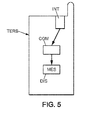
- the terminal TERB modifies the human machine interface of the messaging application accordingly.
- the user A sends for the first time a message to a user C since the last personalization done by the user A.
- the embodiment represented on the figure 2 can be implemented.
- the terminal TERA sends the message (arrow S15-MES + IUP of the figure 4 ), without personalization element, but with the identifier IUP coming from the base of the contacts BCA (arrow S14-IUP of the figure 4 ) in which it was previously stored (arrow S3-MAJ (IUP) of the figure 2 ).
- the mail routing server detects the identifier IUP and sends a request to the SERP personalization server (arrow S16-REQ (IUP) of the figure 4 ) to retrieve the corresponding personalization elements (arrow S17-PERS (A) of the figure 4 ).
- the SERM mail server aggregates the personalization elements thus recovered with the message sent to the TERC terminal of the user C (arrow S18-MES + PERS of the figure 4 ).
- the IHMC interface of the terminal TERC then displays the message according to the customization of the user A. The latter can then decide to accept to store the personalization elements of the terminal.
- the user A in the BCC contact base of his TERC terminal in order to implement such customization for the following e-mail sessions with the user A (arrow S19-PERS (A)), as described above in reference to the figure 2 .
- the terminal of the user B (or the user C in the embodiment of the figure 4 ) contains in its local database personalization information of its contacts. They are updated dynamically as soon as the sender sends a message to the user B after modifying his personalization.
- This local database is therefore a good sample of the centers of interest of the moment in the contact network of the user B.
- a specific page of the human machine interface can present these data in an aggregated manner.
- An adapted algorithm can filter this local information and present it in an order best illustrating for the user B the centers of interest of his network of contacts.
- This algorithm can be established based for example on statistical information on the customizations adopted by the network of contacts of the user B, the number of messages exchanged with each of these contacts, their time stamp, the geographical location of the user B or profile data collected from user B himself. User B thus at the heart of the interests of his relations. It will thus be understood that the invention then makes it possible to measure a "virality" (that is to say a speed of propagation) of certain centers of social interest.
- the application of the invention can be extended to all types of terminals beyond only mobile terminals.
- the invention can also be implemented in the case where the human machine interface is not resident on a local application but on a centralized server of Internet type with web interfaces for the users and a central database replacing the bases contact of each user.
- the aforementioned unique personalization identifier although advantageous, is only optional. Indeed, in one possible embodiment, depending on an issuer identifier (a contact coordinate of the terminal of the user A for example), usually indicated in a frame of the message, the mail server SERM can be adapted to transmit the interface elements (which it has previously stored) to any terminal receiving the message. However, such an embodiment consumes communication resources on a network.
- an issuer identifier a contact coordinate of the terminal of the user A for example
Landscapes
- Engineering & Computer Science (AREA)
- Business, Economics & Management (AREA)
- Human Resources & Organizations (AREA)
- Theoretical Computer Science (AREA)
- Strategic Management (AREA)
- Entrepreneurship & Innovation (AREA)
- General Physics & Mathematics (AREA)
- Physics & Mathematics (AREA)
- General Engineering & Computer Science (AREA)
- Computer Hardware Design (AREA)
- Data Mining & Analysis (AREA)
- Economics (AREA)
- Marketing (AREA)
- Operations Research (AREA)
- Quality & Reliability (AREA)
- Tourism & Hospitality (AREA)
- General Business, Economics & Management (AREA)
- Human Computer Interaction (AREA)
- Information Transfer Between Computers (AREA)
Applications Claiming Priority (1)
| Application Number | Priority Date | Filing Date | Title |
|---|---|---|---|
| FR1354415A FR3005770B1 (fr) | 2013-05-16 | 2013-05-16 | Personnalisation d'une interface de messagerie |
Publications (1)
| Publication Number | Publication Date |
|---|---|
| EP2804135A1 true EP2804135A1 (de) | 2014-11-19 |
Family
ID=48980005
Family Applications (1)
| Application Number | Title | Priority Date | Filing Date |
|---|---|---|---|
| EP14168284.9A Ceased EP2804135A1 (de) | 2013-05-16 | 2014-05-14 | Personalisierung eines Mitteilungsdienst-Interface |
Country Status (3)
| Country | Link |
|---|---|
| US (1) | US20140344713A1 (de) |
| EP (1) | EP2804135A1 (de) |
| FR (1) | FR3005770B1 (de) |
Families Citing this family (2)
| Publication number | Priority date | Publication date | Assignee | Title |
|---|---|---|---|---|
| US10503810B2 (en) * | 2015-06-18 | 2019-12-10 | International Business Machines Corporation | Font personalization |
| US10178152B2 (en) | 2016-04-29 | 2019-01-08 | Splunk Inc. | Central repository for storing configuration files of a distributed computer system |
Citations (2)
| Publication number | Priority date | Publication date | Assignee | Title |
|---|---|---|---|---|
| WO2003017077A1 (en) * | 2001-08-16 | 2003-02-27 | Nokia Corporation | Skins for mobile communication devices |
| EP1434127A2 (de) * | 2002-12-27 | 2004-06-30 | Microsoft Corporation | Vorlagen-basierende Anpassung der Benutzerschnittstelle eines Nachrichtenanwendungsprogramms |
Family Cites Families (12)
| Publication number | Priority date | Publication date | Assignee | Title |
|---|---|---|---|---|
| US6034970A (en) * | 1996-05-31 | 2000-03-07 | Adaptive Micro Systems, Inc. | Intelligent messaging system and method for providing and updating a message using a communication device, such as a large character display |
| US7565136B1 (en) * | 2000-06-12 | 2009-07-21 | Weeworld Limited | Messaging system |
| AU2002950502A0 (en) * | 2002-07-31 | 2002-09-12 | E-Clips Intelligent Agent Technologies Pty Ltd | Animated messaging |
| US7610352B2 (en) * | 2002-09-09 | 2009-10-27 | Meca Communications, Inc. | Sharing skins |
| US7874983B2 (en) * | 2003-01-27 | 2011-01-25 | Motorola Mobility, Inc. | Determination of emotional and physiological states of a recipient of a communication |
| US20050021935A1 (en) * | 2003-06-18 | 2005-01-27 | Openwave Systems Inc. | Method and system for downloading configurable user interface elements over a data network |
| US20080189364A1 (en) * | 2004-06-23 | 2008-08-07 | Ayman Llc | Method Of Updating Information In An Electronic Note |
| US20060041848A1 (en) * | 2004-08-23 | 2006-02-23 | Luigi Lira | Overlaid display of messages in the user interface of instant messaging and other digital communication services |
| US20090037279A1 (en) * | 2007-07-27 | 2009-02-05 | Ortiva Wireless, Inc. | Dynamic Creation of Personalized Presentations For Network Communication Systems |
| US10346849B2 (en) * | 2011-07-12 | 2019-07-09 | Ca, Inc. | Communicating personalized messages using quick response (QR) codes |
| US9600807B2 (en) * | 2011-12-20 | 2017-03-21 | Excalibur Ip, Llc | Server-side modification of messages during a mobile terminal message exchange |
| US20130226728A1 (en) * | 2012-02-29 | 2013-08-29 | Bruno Oghittu | Methods and Systems for Personalized Message Delivery |
-
2013
- 2013-05-16 FR FR1354415A patent/FR3005770B1/fr active Active
-
2014
- 2014-05-14 EP EP14168284.9A patent/EP2804135A1/de not_active Ceased
- 2014-05-14 US US14/277,267 patent/US20140344713A1/en not_active Abandoned
Patent Citations (2)
| Publication number | Priority date | Publication date | Assignee | Title |
|---|---|---|---|---|
| WO2003017077A1 (en) * | 2001-08-16 | 2003-02-27 | Nokia Corporation | Skins for mobile communication devices |
| EP1434127A2 (de) * | 2002-12-27 | 2004-06-30 | Microsoft Corporation | Vorlagen-basierende Anpassung der Benutzerschnittstelle eines Nachrichtenanwendungsprogramms |
Also Published As
| Publication number | Publication date |
|---|---|
| FR3005770A1 (fr) | 2014-11-21 |
| US20140344713A1 (en) | 2014-11-20 |
| FR3005770B1 (fr) | 2015-05-01 |
Similar Documents
| Publication | Publication Date | Title |
|---|---|---|
| US11303590B2 (en) | Suggested responses based on message stickers | |
| US11502975B2 (en) | Automatic suggestions and other content for messaging applications | |
| US9647898B2 (en) | Method for providing media content using multi-channel navigator and route sequences | |
| Newman | The future of voice and the implications for news | |
| US20150207765A1 (en) | Messaging Service with Conversation Suggestions | |
| US20190138165A1 (en) | Web parts integration in social networking system | |
| US9032027B2 (en) | Enhanced consumer engagement using advanced communication exchange services | |
| WO2017075515A1 (en) | Interactive icons with embedded functionality used in text messages | |
| KR20140060312A (ko) | 클릭 투 다이얼 | |
| EP3019986B1 (de) | Systeme und verfahren zur bereitstellung benutzerspezifischer inhalte auf einer elektronischen vorrichtung | |
| CN114138146A (zh) | 一种卡片推荐方法及电子设备 | |
| US20160021042A1 (en) | Video messaging | |
| WO2009047164A1 (fr) | Dispositif et procedes de diffusion personnalisee de publicites ciblees depuis un serveur local | |
| KR102353392B1 (ko) | 휴대용 전자 기기에서 위젯을 이용하여 컨텐츠를 제공하기 위한 방법 및 그 시스템 | |
| FR3005770A1 (fr) | Personnalisation d'une interface de messagerie | |
| US20210377196A1 (en) | Server-side ui task control for onboarding users to a messaging platform | |
| EP2929673B1 (de) | Verfahren zur mitteilung eines präsenzzustands einer benutzergruppe in einem virtuellen kommunikationsraum, der von einem kommunikationsserver durch ein kommunikationsnetz bereitgestellt wird | |
| Abernethy | The Complete Idiot's Guide to Social Media Marketing | |
| WO2009050375A2 (fr) | Procede de representation d'un utilisateur, dispositif, et produit programme d'ordinateur correspondants | |
| FR3005181A1 (fr) | Generation d'un document multimedia personnalise relatif a un evenement | |
| FR3021779A1 (fr) | Procede et dispositif de controle d l' affichage d' un groupe de contacts | |
| Jansson et al. | Speedflirt for Android, a study of porting a mobile application and its effects on user experience | |
| EP3021602A1 (de) | Parametrierungsverfahren eines kommunikationsdienstes, der von einem server eines dienst-providers an ein kommunikationsmodul eines nutzers über ein tragbares gerät übermittelt wird | |
| WO2006092505A1 (fr) | Procede et dispositif de mise en relation automatique de terminaux proches | |
| FR3011364A1 (fr) | Dispositif et procede d'information d'un utilisateur de la presence de messages de comptes recus |
Legal Events
| Date | Code | Title | Description |
|---|---|---|---|
| PUAI | Public reference made under article 153(3) epc to a published international application that has entered the european phase |
Free format text: ORIGINAL CODE: 0009012 |
|
| 17P | Request for examination filed |
Effective date: 20140514 |
|
| AK | Designated contracting states |
Kind code of ref document: A1 Designated state(s): AL AT BE BG CH CY CZ DE DK EE ES FI FR GB GR HR HU IE IS IT LI LT LU LV MC MK MT NL NO PL PT RO RS SE SI SK SM TR |
|
| AX | Request for extension of the european patent |
Extension state: BA ME |
|
| R17P | Request for examination filed (corrected) |
Effective date: 20150119 |
|
| RBV | Designated contracting states (corrected) |
Designated state(s): AL AT BE BG CH CY CZ DE DK EE ES FI FR GB GR HR HU IE IS IT LI LT LU LV MC MK MT NL NO PL PT RO RS SE SI SK SM TR |
|
| 17Q | First examination report despatched |
Effective date: 20150303 |
|
| STAA | Information on the status of an ep patent application or granted ep patent |
Free format text: STATUS: THE APPLICATION HAS BEEN REFUSED |
|
| 18R | Application refused |
Effective date: 20160922 |