EP2804860B1 - Derives d'indole en tant que colorant de marquage pour biomolecule - Google Patents
Derives d'indole en tant que colorant de marquage pour biomolecule Download PDFInfo
- Publication number
- EP2804860B1 EP2804860B1 EP13709026.2A EP13709026A EP2804860B1 EP 2804860 B1 EP2804860 B1 EP 2804860B1 EP 13709026 A EP13709026 A EP 13709026A EP 2804860 B1 EP2804860 B1 EP 2804860B1
- Authority
- EP
- European Patent Office
- Prior art keywords
- group
- compound
- conr
- peg
- ethylene glycol
- Prior art date
- Legal status (The legal status is an assumption and is not a legal conclusion. Google has not performed a legal analysis and makes no representation as to the accuracy of the status listed.)
- Active
Links
- 0 C[C@](CCCS(O)(=O)=O)([C@@](C=CC=CC=C([C@@]1(C)CCOC)N(CCCCCC(O)=O)c(cc2)c1cc2S([O-])(=O)=O)NC1=CC=*)C1=CCS(O)(=O)=O Chemical compound C[C@](CCCS(O)(=O)=O)([C@@](C=CC=CC=C([C@@]1(C)CCOC)N(CCCCCC(O)=O)c(cc2)c1cc2S([O-])(=O)=O)NC1=CC=*)C1=CCS(O)(=O)=O 0.000 description 4
- YATORRDSDYYMMR-HNYXTHBYSA-M CC(C)(C(/C=C/C=C/C=C/C=C(\C(C)(CCOC)c1c2)/N(CCCCCC(O)=O)c1ccc2S([O-])(=O)=O)=[IH])c(cc(cc1)S(O)(=O)=O)c1NCCOC Chemical compound CC(C)(C(/C=C/C=C/C=C/C=C(\C(C)(CCOC)c1c2)/N(CCCCCC(O)=O)c1ccc2S([O-])(=O)=O)=[IH])c(cc(cc1)S(O)(=O)=O)c1NCCOC YATORRDSDYYMMR-HNYXTHBYSA-M 0.000 description 1
- FUFZQRCVJOXUDI-VUOBGLCYSA-L CC(C)(CCO)N(c(c(C1(C)CCCS(O)(=O)=O)c2)ccc2S(O)(=O)=O)[I]=C1/C=C/C=C/C=C(\C1(C)CCCS([O-])(=O)=O)/N(CCCCCC(O)=O)c(cc2)c1cc2S([O-])(=O)=O Chemical compound CC(C)(CCO)N(c(c(C1(C)CCCS(O)(=O)=O)c2)ccc2S(O)(=O)=O)[I]=C1/C=C/C=C/C=C(\C1(C)CCCS([O-])(=O)=O)/N(CCCCCC(O)=O)c(cc2)c1cc2S([O-])(=O)=O FUFZQRCVJOXUDI-VUOBGLCYSA-L 0.000 description 1
- IJRLXZXUWJHECO-SCVAKZGNSA-M CC(CCCS(O)(=O)=O)(C(/C=C/C=C/C=C(\C(C)(CCOC)c1c2)/N(CCCCCC(O)=O)c1ccc2S([O-])(=O)=O)=[IH])c(cc(cc1)S(O)(=O)=O)c1N Chemical compound CC(CCCS(O)(=O)=O)(C(/C=C/C=C/C=C(\C(C)(CCOC)c1c2)/N(CCCCCC(O)=O)c1ccc2S([O-])(=O)=O)=[IH])c(cc(cc1)S(O)(=O)=O)c1N IJRLXZXUWJHECO-SCVAKZGNSA-M 0.000 description 1
- NSKQNETWXSLVED-UHFFFAOYSA-N CC(CCCS([O-])(=O)=O)c(cc(cc1)S(O)=O)c1N(CCCCCC(O)=O)/C(/C)=C/C=C/C=C/C1=[N+](CCOC)c2ccc(CCOC)cc2C1(C)CCCS(O)(=O)=O Chemical compound CC(CCCS([O-])(=O)=O)c(cc(cc1)S(O)=O)c1N(CCCCCC(O)=O)/C(/C)=C/C=C/C=C/C1=[N+](CCOC)c2ccc(CCOC)cc2C1(C)CCCS(O)(=O)=O NSKQNETWXSLVED-UHFFFAOYSA-N 0.000 description 1
- YVMYSQVRXXDERM-UHFFFAOYSA-P CC(CCOC)(C(CCC=CC=C(C1(C)CCOC)N(CCCCCC(O)=O)c(cc2)c1cc2S(O)(=O)=O)[NH+]1CCOC)C(C2)C1=CC=C2S([OH2+])(=O)=O Chemical compound CC(CCOC)(C(CCC=CC=C(C1(C)CCOC)N(CCCCCC(O)=O)c(cc2)c1cc2S(O)(=O)=O)[NH+]1CCOC)C(C2)C1=CC=C2S([OH2+])(=O)=O YVMYSQVRXXDERM-UHFFFAOYSA-P 0.000 description 1
- XVGCHWPCIQYHTJ-JSBHAKPGSA-N CC1(CCOC)c2ccccc2N(CCCCCC(O)=O)/C1=C/C=C/C=C/C(C1(C)C)=[I]N(CCOC)c(cc2)c1cc2S(O)(=O)=O Chemical compound CC1(CCOC)c2ccccc2N(CCCCCC(O)=O)/C1=C/C=C/C=C/C(C1(C)C)=[I]N(CCOC)c(cc2)c1cc2S(O)(=O)=O XVGCHWPCIQYHTJ-JSBHAKPGSA-N 0.000 description 1
- UKBNIMFOSXACQL-DIPNOEGCSA-N CC1(CCOCCOCCOCCOC)c(cccc2)c2N(CCOCCOCCOCCOCCC2OC2O)/C1=C/C=C/C=C/C=C/C(C1(C)CCOCCOCCOCCOC)=[I]N(CCOCCOCCOCCOC)c2c1cccc2 Chemical compound CC1(CCOCCOCCOCCOC)c(cccc2)c2N(CCOCCOCCOCCOCCC2OC2O)/C1=C/C=C/C=C/C=C/C(C1(C)CCOCCOCCOCCOC)=[I]N(CCOCCOCCOCCOC)c2c1cccc2 UKBNIMFOSXACQL-DIPNOEGCSA-N 0.000 description 1
- RCRKWFVMEGQHEL-HMDNYJEDSA-M CC1(CCOCCOCCOCCOC)c2cc(S(O)(=O)=O)ccc2N(CCOCCOCCOCCOCCC(O)=O)/C1=C/C=C/C=C/C(C(C)(CCOCCOCCOCCOC)c1c2)=[I]N(CCOCCOCCOCCOC)c1ccc2S([O-])(=O)=O Chemical compound CC1(CCOCCOCCOCCOC)c2cc(S(O)(=O)=O)ccc2N(CCOCCOCCOCCOCCC(O)=O)/C1=C/C=C/C=C/C(C(C)(CCOCCOCCOCCOC)c1c2)=[I]N(CCOCCOCCOCCOC)c1ccc2S([O-])(=O)=O RCRKWFVMEGQHEL-HMDNYJEDSA-M 0.000 description 1
Images










Classifications
-
- C—CHEMISTRY; METALLURGY
- C07—ORGANIC CHEMISTRY
- C07D—HETEROCYCLIC COMPOUNDS
- C07D209/00—Heterocyclic compounds containing five-membered rings, condensed with other rings, with one nitrogen atom as the only ring hetero atom
- C07D209/02—Heterocyclic compounds containing five-membered rings, condensed with other rings, with one nitrogen atom as the only ring hetero atom condensed with one carbocyclic ring
- C07D209/04—Indoles; Hydrogenated indoles
- C07D209/10—Indoles; Hydrogenated indoles with substituted hydrocarbon radicals attached to carbon atoms of the hetero ring
- C07D209/12—Radicals substituted by oxygen atoms
-
- C—CHEMISTRY; METALLURGY
- C07—ORGANIC CHEMISTRY
- C07D—HETEROCYCLIC COMPOUNDS
- C07D401/00—Heterocyclic compounds containing two or more hetero rings, having nitrogen atoms as the only ring hetero atoms, at least one ring being a six-membered ring with only one nitrogen atom
- C07D401/14—Heterocyclic compounds containing two or more hetero rings, having nitrogen atoms as the only ring hetero atoms, at least one ring being a six-membered ring with only one nitrogen atom containing three or more hetero rings
-
- A—HUMAN NECESSITIES
- A61—MEDICAL OR VETERINARY SCIENCE; HYGIENE
- A61K—PREPARATIONS FOR MEDICAL, DENTAL OR TOILETRY PURPOSES
- A61K47/00—Medicinal preparations characterised by the non-active ingredients used, e.g. carriers or inert additives; Targeting or modifying agents chemically bound to the active ingredient
- A61K47/50—Medicinal preparations characterised by the non-active ingredients used, e.g. carriers or inert additives; Targeting or modifying agents chemically bound to the active ingredient the non-active ingredient being chemically bound to the active ingredient, e.g. polymer-drug conjugates
- A61K47/51—Medicinal preparations characterised by the non-active ingredients used, e.g. carriers or inert additives; Targeting or modifying agents chemically bound to the active ingredient the non-active ingredient being chemically bound to the active ingredient, e.g. polymer-drug conjugates the non-active ingredient being a modifying agent
- A61K47/68—Medicinal preparations characterised by the non-active ingredients used, e.g. carriers or inert additives; Targeting or modifying agents chemically bound to the active ingredient the non-active ingredient being chemically bound to the active ingredient, e.g. polymer-drug conjugates the non-active ingredient being a modifying agent the modifying agent being an antibody, an immunoglobulin or a fragment thereof, e.g. an Fc-fragment
- A61K47/6835—Medicinal preparations characterised by the non-active ingredients used, e.g. carriers or inert additives; Targeting or modifying agents chemically bound to the active ingredient the non-active ingredient being chemically bound to the active ingredient, e.g. polymer-drug conjugates the non-active ingredient being a modifying agent the modifying agent being an antibody, an immunoglobulin or a fragment thereof, e.g. an Fc-fragment the modifying agent being an antibody or an immunoglobulin bearing at least one antigen-binding site
- A61K47/6871—Medicinal preparations characterised by the non-active ingredients used, e.g. carriers or inert additives; Targeting or modifying agents chemically bound to the active ingredient the non-active ingredient being chemically bound to the active ingredient, e.g. polymer-drug conjugates the non-active ingredient being a modifying agent the modifying agent being an antibody, an immunoglobulin or a fragment thereof, e.g. an Fc-fragment the modifying agent being an antibody or an immunoglobulin bearing at least one antigen-binding site the antibody targeting an enzyme
-
- A—HUMAN NECESSITIES
- A61—MEDICAL OR VETERINARY SCIENCE; HYGIENE
- A61K—PREPARATIONS FOR MEDICAL, DENTAL OR TOILETRY PURPOSES
- A61K49/00—Preparations for testing in vivo
- A61K49/04—X-ray contrast preparations
-
- A—HUMAN NECESSITIES
- A61—MEDICAL OR VETERINARY SCIENCE; HYGIENE
- A61K—PREPARATIONS FOR MEDICAL, DENTAL OR TOILETRY PURPOSES
- A61K49/00—Preparations for testing in vivo
- A61K49/06—Nuclear magnetic resonance [NMR] contrast preparations; Magnetic resonance imaging [MRI] contrast preparations
- A61K49/08—Nuclear magnetic resonance [NMR] contrast preparations; Magnetic resonance imaging [MRI] contrast preparations characterised by the carrier
- A61K49/10—Organic compounds
- A61K49/12—Macromolecular compounds
-
- A—HUMAN NECESSITIES
- A61—MEDICAL OR VETERINARY SCIENCE; HYGIENE
- A61K—PREPARATIONS FOR MEDICAL, DENTAL OR TOILETRY PURPOSES
- A61K49/00—Preparations for testing in vivo
- A61K49/06—Nuclear magnetic resonance [NMR] contrast preparations; Magnetic resonance imaging [MRI] contrast preparations
- A61K49/08—Nuclear magnetic resonance [NMR] contrast preparations; Magnetic resonance imaging [MRI] contrast preparations characterised by the carrier
- A61K49/10—Organic compounds
- A61K49/14—Peptides, e.g. proteins
- A61K49/143—Peptides, e.g. proteins the protein being an albumin, e.g. HSA, BSA, ovalbumin
-
- A—HUMAN NECESSITIES
- A61—MEDICAL OR VETERINARY SCIENCE; HYGIENE
- A61K—PREPARATIONS FOR MEDICAL, DENTAL OR TOILETRY PURPOSES
- A61K49/00—Preparations for testing in vivo
- A61K49/06—Nuclear magnetic resonance [NMR] contrast preparations; Magnetic resonance imaging [MRI] contrast preparations
- A61K49/08—Nuclear magnetic resonance [NMR] contrast preparations; Magnetic resonance imaging [MRI] contrast preparations characterised by the carrier
- A61K49/10—Organic compounds
- A61K49/14—Peptides, e.g. proteins
- A61K49/16—Antibodies; Immunoglobulins; Fragments thereof
-
- A—HUMAN NECESSITIES
- A61—MEDICAL OR VETERINARY SCIENCE; HYGIENE
- A61K—PREPARATIONS FOR MEDICAL, DENTAL OR TOILETRY PURPOSES
- A61K49/00—Preparations for testing in vivo
- A61K49/22—Echographic preparations; Ultrasonic imaging preparations
- A61K49/221—Echographic preparations; Ultrasonic imaging preparations characterised by the targeting agent or modifying agent linked to the acoustically-active agent
-
- C—CHEMISTRY; METALLURGY
- C07—ORGANIC CHEMISTRY
- C07D—HETEROCYCLIC COMPOUNDS
- C07D209/00—Heterocyclic compounds containing five-membered rings, condensed with other rings, with one nitrogen atom as the only ring hetero atom
- C07D209/02—Heterocyclic compounds containing five-membered rings, condensed with other rings, with one nitrogen atom as the only ring hetero atom condensed with one carbocyclic ring
- C07D209/04—Indoles; Hydrogenated indoles
- C07D209/10—Indoles; Hydrogenated indoles with substituted hydrocarbon radicals attached to carbon atoms of the hetero ring
- C07D209/18—Radicals substituted by carbon atoms having three bonds to hetero atoms with at the most one bond to halogen, e.g. ester or nitrile radicals
-
- C—CHEMISTRY; METALLURGY
- C07—ORGANIC CHEMISTRY
- C07D—HETEROCYCLIC COMPOUNDS
- C07D403/00—Heterocyclic compounds containing two or more hetero rings, having nitrogen atoms as the only ring hetero atoms, not provided for by group C07D401/00
- C07D403/02—Heterocyclic compounds containing two or more hetero rings, having nitrogen atoms as the only ring hetero atoms, not provided for by group C07D401/00 containing two hetero rings
- C07D403/06—Heterocyclic compounds containing two or more hetero rings, having nitrogen atoms as the only ring hetero atoms, not provided for by group C07D401/00 containing two hetero rings linked by a carbon chain containing only aliphatic carbon atoms
-
- C—CHEMISTRY; METALLURGY
- C07—ORGANIC CHEMISTRY
- C07D—HETEROCYCLIC COMPOUNDS
- C07D403/00—Heterocyclic compounds containing two or more hetero rings, having nitrogen atoms as the only ring hetero atoms, not provided for by group C07D401/00
- C07D403/02—Heterocyclic compounds containing two or more hetero rings, having nitrogen atoms as the only ring hetero atoms, not provided for by group C07D401/00 containing two hetero rings
- C07D403/08—Heterocyclic compounds containing two or more hetero rings, having nitrogen atoms as the only ring hetero atoms, not provided for by group C07D401/00 containing two hetero rings linked by a carbon chain containing alicyclic rings
-
- C—CHEMISTRY; METALLURGY
- C07—ORGANIC CHEMISTRY
- C07K—PEPTIDES
- C07K16/00—Immunoglobulins [IG], e.g. monoclonal or polyclonal antibodies
- C07K16/40—Immunoglobulins [IG], e.g. monoclonal or polyclonal antibodies against enzymes
-
- C—CHEMISTRY; METALLURGY
- C09—DYES; PAINTS; POLISHES; NATURAL RESINS; ADHESIVES; COMPOSITIONS NOT OTHERWISE PROVIDED FOR; APPLICATIONS OF MATERIALS NOT OTHERWISE PROVIDED FOR
- C09B—ORGANIC DYES OR CLOSELY-RELATED COMPOUNDS FOR PRODUCING DYES, e.g. PIGMENTS; MORDANTS; LAKES
- C09B23/00—Methine or polymethine dyes, e.g. cyanine dyes
- C09B23/0008—Methine or polymethine dyes, e.g. cyanine dyes substituted on the polymethine chain
- C09B23/0016—Methine or polymethine dyes, e.g. cyanine dyes substituted on the polymethine chain the substituent being a halogen atom
-
- C—CHEMISTRY; METALLURGY
- C09—DYES; PAINTS; POLISHES; NATURAL RESINS; ADHESIVES; COMPOSITIONS NOT OTHERWISE PROVIDED FOR; APPLICATIONS OF MATERIALS NOT OTHERWISE PROVIDED FOR
- C09B—ORGANIC DYES OR CLOSELY-RELATED COMPOUNDS FOR PRODUCING DYES, e.g. PIGMENTS; MORDANTS; LAKES
- C09B23/00—Methine or polymethine dyes, e.g. cyanine dyes
- C09B23/0008—Methine or polymethine dyes, e.g. cyanine dyes substituted on the polymethine chain
- C09B23/0025—Methine or polymethine dyes, e.g. cyanine dyes substituted on the polymethine chain the substituent being bound through an oxygen atom
-
- C—CHEMISTRY; METALLURGY
- C09—DYES; PAINTS; POLISHES; NATURAL RESINS; ADHESIVES; COMPOSITIONS NOT OTHERWISE PROVIDED FOR; APPLICATIONS OF MATERIALS NOT OTHERWISE PROVIDED FOR
- C09B—ORGANIC DYES OR CLOSELY-RELATED COMPOUNDS FOR PRODUCING DYES, e.g. PIGMENTS; MORDANTS; LAKES
- C09B23/00—Methine or polymethine dyes, e.g. cyanine dyes
- C09B23/0066—Methine or polymethine dyes, e.g. cyanine dyes the polymethine chain being part of a carbocyclic ring,(e.g. benzene, naphtalene, cyclohexene, cyclobutenene-quadratic acid)
-
- C—CHEMISTRY; METALLURGY
- C09—DYES; PAINTS; POLISHES; NATURAL RESINS; ADHESIVES; COMPOSITIONS NOT OTHERWISE PROVIDED FOR; APPLICATIONS OF MATERIALS NOT OTHERWISE PROVIDED FOR
- C09B—ORGANIC DYES OR CLOSELY-RELATED COMPOUNDS FOR PRODUCING DYES, e.g. PIGMENTS; MORDANTS; LAKES
- C09B23/00—Methine or polymethine dyes, e.g. cyanine dyes
- C09B23/02—Methine or polymethine dyes, e.g. cyanine dyes the polymethine chain containing an odd number of >CH- or >C[alkyl]- groups
- C09B23/06—Methine or polymethine dyes, e.g. cyanine dyes the polymethine chain containing an odd number of >CH- or >C[alkyl]- groups three >CH- groups, e.g. carbocyanines
-
- C—CHEMISTRY; METALLURGY
- C09—DYES; PAINTS; POLISHES; NATURAL RESINS; ADHESIVES; COMPOSITIONS NOT OTHERWISE PROVIDED FOR; APPLICATIONS OF MATERIALS NOT OTHERWISE PROVIDED FOR
- C09B—ORGANIC DYES OR CLOSELY-RELATED COMPOUNDS FOR PRODUCING DYES, e.g. PIGMENTS; MORDANTS; LAKES
- C09B23/00—Methine or polymethine dyes, e.g. cyanine dyes
- C09B23/02—Methine or polymethine dyes, e.g. cyanine dyes the polymethine chain containing an odd number of >CH- or >C[alkyl]- groups
- C09B23/08—Methine or polymethine dyes, e.g. cyanine dyes the polymethine chain containing an odd number of >CH- or >C[alkyl]- groups more than three >CH- groups, e.g. polycarbocyanines
- C09B23/083—Methine or polymethine dyes, e.g. cyanine dyes the polymethine chain containing an odd number of >CH- or >C[alkyl]- groups more than three >CH- groups, e.g. polycarbocyanines five >CH- groups
-
- C—CHEMISTRY; METALLURGY
- C09—DYES; PAINTS; POLISHES; NATURAL RESINS; ADHESIVES; COMPOSITIONS NOT OTHERWISE PROVIDED FOR; APPLICATIONS OF MATERIALS NOT OTHERWISE PROVIDED FOR
- C09B—ORGANIC DYES OR CLOSELY-RELATED COMPOUNDS FOR PRODUCING DYES, e.g. PIGMENTS; MORDANTS; LAKES
- C09B23/00—Methine or polymethine dyes, e.g. cyanine dyes
- C09B23/02—Methine or polymethine dyes, e.g. cyanine dyes the polymethine chain containing an odd number of >CH- or >C[alkyl]- groups
- C09B23/08—Methine or polymethine dyes, e.g. cyanine dyes the polymethine chain containing an odd number of >CH- or >C[alkyl]- groups more than three >CH- groups, e.g. polycarbocyanines
- C09B23/086—Methine or polymethine dyes, e.g. cyanine dyes the polymethine chain containing an odd number of >CH- or >C[alkyl]- groups more than three >CH- groups, e.g. polycarbocyanines more than five >CH- groups
-
- C—CHEMISTRY; METALLURGY
- C09—DYES; PAINTS; POLISHES; NATURAL RESINS; ADHESIVES; COMPOSITIONS NOT OTHERWISE PROVIDED FOR; APPLICATIONS OF MATERIALS NOT OTHERWISE PROVIDED FOR
- C09B—ORGANIC DYES OR CLOSELY-RELATED COMPOUNDS FOR PRODUCING DYES, e.g. PIGMENTS; MORDANTS; LAKES
- C09B69/00—Dyes not provided for by a single group of this subclass
-
- C—CHEMISTRY; METALLURGY
- C09—DYES; PAINTS; POLISHES; NATURAL RESINS; ADHESIVES; COMPOSITIONS NOT OTHERWISE PROVIDED FOR; APPLICATIONS OF MATERIALS NOT OTHERWISE PROVIDED FOR
- C09B—ORGANIC DYES OR CLOSELY-RELATED COMPOUNDS FOR PRODUCING DYES, e.g. PIGMENTS; MORDANTS; LAKES
- C09B69/00—Dyes not provided for by a single group of this subclass
- C09B69/10—Polymeric dyes; Reaction products of dyes with monomers or with macromolecular compounds
-
- G—PHYSICS
- G01—MEASURING; TESTING
- G01N—INVESTIGATING OR ANALYSING MATERIALS BY DETERMINING THEIR CHEMICAL OR PHYSICAL PROPERTIES
- G01N33/00—Investigating or analysing materials by specific methods not covered by groups G01N1/00 - G01N31/00
- G01N33/48—Biological material, e.g. blood, urine; Haemocytometers
- G01N33/50—Chemical analysis of biological material, e.g. blood, urine; Testing involving biospecific ligand binding methods; Immunological testing
- G01N33/58—Chemical analysis of biological material, e.g. blood, urine; Testing involving biospecific ligand binding methods; Immunological testing involving labelled substances
- G01N33/582—Chemical analysis of biological material, e.g. blood, urine; Testing involving biospecific ligand binding methods; Immunological testing involving labelled substances with fluorescent label
-
- C—CHEMISTRY; METALLURGY
- C07—ORGANIC CHEMISTRY
- C07K—PEPTIDES
- C07K2317/00—Immunoglobulins specific features
- C07K2317/70—Immunoglobulins specific features characterized by effect upon binding to a cell or to an antigen
- C07K2317/76—Antagonist effect on antigen, e.g. neutralization or inhibition of binding
Definitions
- the compounds can be conjugated to proteins and nucleic acids for biological imaging and analysis. Synthesis of the compounds, formation and use of the conjugated compounds, and specific non-limiting examples of each are disclosed.
- Biomolecules e.g., antigens, antibodies, DNA-segments with the corresponding complimentary species for measuring enzyme kinetics, receptor-ligand interactions nucleic acid hybridization kinetics in vitro as well as in vivo, etc.
- labels or dyes are useful for, e.g., pharmacological characterization of receptors and drugs, binding data, etc.
- Compounds such as xanthylium salts ( U.S. Patent No. 5,846,737 ) and/or cyanines ( U.S. Patent No. 5,627,027 ) are used for such applications, but aggregate and form dimers, especially in aqueous solution, due to planarity of their n-system.
- Compounds that have insufficient hydrophilicity undergo non-specific interactions with various surfaces, resulting in problems when attempting purify the corresponding conjugate, and an unsatisfactory signal to noise ratio.
- Efforts are directed to reducing undesirable properties by introducing substituents that increase the hydrophilicity of the compounds.
- substituents that increase the hydrophilicity of the compounds.
- sulfonic acid function substituents have been introduced into the cyanine chromophore.
- U.S. Patent No. 6,083,485 (Licha ) and U.S. Patent Nos. 6,977,305 and 6,974,873 (Molecular Probes) disclose cyanine compounds having one of the common methyl groups in the 3-position of the terminal indole heterocycle substituted by a ⁇ -carboxyalkyl function, and in which the previously present (e.g.
- N-alkyl or N- ⁇ -carboxyalkyl functions are replaced by N- ⁇ -alkyl sulfonic acid functions.
- WO 05/044923 discloses cyanine compounds having the common methyl substituent in the 3-position of the terminal indole heterocycle substituted by a N- ⁇ -alkyl sulfonic acid function.
- cyanine compounds having more than two sulfonic acid function substituents exhibited higher solubility and correspondingly a lower tendency to dimer formation, in comparison to cyanine compounds (Cy3, Cy5) described in U.S. Patent No. 5,627,027 .
- the disclosed cyanine compounds are useful as labels in optical, especially fluorescence optical, determination and detection methods.
- the compounds have high hydrophilicity, high molar absorbance, high photo-stability, and high storage stability. These compounds can be excited by monochromatic (e.g., lasers, laser diodes) or polychromatic (e.g., white light sources) light in the ultraviolet (UV), visible, and near infrared (NIR) spectral region to generate emission of fluorescence light.
- monochromatic e.g., lasers, laser diodes
- polychromatic e.g., white light sources
- Typical application methods are based on the reaction of the compounds with biomolecules such as proteins (e.g., antigens, antibodies, etc.), DNA and/or RNA segments, etc. with the corresponding complimentary species.
- biomolecules such as proteins (e.g., antigens, antibodies, etc.), DNA and/or RNA segments, etc. with the corresponding complimentary species.
- the compounds are useful to measure enzyme kinetics, receptor-ligand interactions, and nucleic acid hybridization kinetics in vitro and/or in vivo.
- the compounds are useful for the pharmacological characterization of receptors and/or drugs.
- Applications include, but are not limited to, uses in medicine, pharmacy, biological sciences, materials sciences, environmental control, detection of organic and inorganic micro samples occurring in nature, etc.
- 1 ethylene glycol (PEG 1 ) on an indole N
- 2 is diethylene glycol (PEG 2 ) on an indole N
- X is the total number of PEG groups on the compound.
- 650 Compound 4/4 contains PEG 4 on an indole N and a total of four PEG groups on the compound.
- the cyanine compounds have, in an N-position of one heterocycle, ethylene glycol, diethylene glycol, or an ethylene glycol polymer (i.e., poly(ethylene) glycol, abbreviated as PEG), and the other heterocycle has, in a N-position, a function for conjugating the compound to a biomolecule, and an ethylene glycol, diethylene glycol, or an ethylene glycol polymer (i.e., poly(ethylene) glycol, abbreviated as PEG) in another position of the cyanine compound.
- the cyanine compound has, in any position of the compound, at least one sulfo and/or sulfoalkyl.
- the cyanine compound has, in any position of the compound, a sulfonamide and/or carboxamide comprising an ethylene glycol group or an ethylene glycol polymer (i.e., poly(ethylene) glycol, abbreviated as PEG), either directly or indirectly attached to the compound.
- a sulfonamide and/or carboxamide comprising an ethylene glycol group or an ethylene glycol polymer (i.e., poly(ethylene) glycol, abbreviated as PEG), either directly or indirectly attached to the compound.
- PEG poly(ethylene) glycol
- the cyanine compounds have, in an N-position of one heterocycle, an ethylene glycol, diethylene glycol, or ethylene glycol polymer (i.e., poly(ethylene) glycol, abbreviated as PEG), and the other heterocycle has, in a N-position, an ethylene glycol, diethylene glycol, or ethylene glycol polymer (i.e., poly(ethylene) glycol, abbreviated as PEG) and a function for conjugating the compound to a biomolecule, and an ethylene glycol group or an ethylene glycol polymer (i.e., poly(ethylene) glycol, abbreviated as PEG) in another position of the benzocyanine compound.
- PEG poly(ethylene) glycol, abbreviated as PEG
- the cyanine compound has, in any position of the compound, at least one sulfo and/or sulfoalkyl. In one embodiment, the cyanine compound has, in any position of the compound, a sulfonamide and/or carboxamide comprising an ethylene glycol, diethylene glycol, or ethylene glycol polymer (i.e., poly(ethylene) glycol, abbreviated as PEG), either directly or indirectly attached to the compound. Indirect attachment indicates use of a linker, direct attachment indicates lack of such a linker.
- a linker can be any moiety.
- the compound is a compound according to general formula Ia with "a" indicating the chain from the right indole N terminates in COX: or general formula Ib with "b” indicating the chain from the right indole N terminates in OH: where each of R 1 and R 2 is the same or different and is independently selected from the group consisting of an aliphatic, heteroaliphatic, sulfoalkyl, heteroaliphatic with terminal SO 3 , a PEG group P-L-Z where P is selected from an ethylene glycol group, a diethylene glycol group, and a (poly)ethylene glycol group where the (poly)ethylene glycol group is (CH 2 CH 2 O) s where s is an integer from 3-6 inclusive, a sulfonamide group -L-SO 2 NH-P-L-Z, and a caboxamide group -L-CONH-P-L-Z; where L is selected from the group consisting of a divalent linear (-(CH 2 ) a
- the PEG group is selected from -C-C-O-C (ethylene glycol with terminal methyl), -C-C-O-C-C-O-C (diethylene glycol with terminal methyl), -C-C-O-C-C-O-C-C-O-C ((poly)ethylene glycol (3) with terminal methyl), -C-C-O-C-C-O-C-C-O-C-C-O-C ((poly)ethylene glycol (4) with terminal methyl), -C-C-O-C-C-O-C-C-O-C-C-O-C-C-O-C ((poly)ethylene glycol (5) with terminal methyl), or C-C-O-C-C-O-C-C-O-C-C-C-O-C-C-O-C-C-O-C-C-O-C ((poly)ethylene glycol (6) with terminal methyl).
- the PEG group P may be either uncapped, e.g., lack a terminal methyl, or may be capped with an atom or group other than a methyl.
- the PEG group P terminates with a Z group, where Z is selected from H, CH 3 , a CH 3 group, alkyl, or a heteroalkyl group.
- the compound is general formula I where R1 is sulfoalkyl and R2 is a PEG group; X is -OH, -NHS, -O-TFP, or -NR-L-maleimide; m is 0; o is 3; and n is 1.
- the compound is general formula I where R1 is sulfoalkyl and R2 is a PEG group; X is-OH, -NHS, -O-TFP, or-NR-L-maleimide; m is 1; o.is 3; and n is 1.
- the compound is general formula I where R1 is sulfoalkyl and R2 is a PEG group; X is -OH, -NHS, -O-TFP, or -NR-L-maleimide; m is 2; o is 3; and n is 1.
- the compound is general formula I where R1 is sulfoalkyl and R2 is a PEG group; X is -OH, -NHS, -O-TFP, or -NR-L-maleimide; m is 3; o is 3; and n is 1.
- the compound is general formula I where R1 is sulfoalkyl and R2 is a PEG group; X is -OH, -NHS, -O-TFP, or -NR-L-maleimide; m is 4; o is 3; and n is 1.
- the compound is general formula I, where R1 is sulfoalkyl and R2 is a PEG group; X is -OH, -NHS, - O-TFP, or -NR-L-maleimide; m is 5; o is 3; and n is 1.
- the compound is general formula I where R1 is sulfoalkyl and R2 is a PEG group; X is -OH, -NHS, -O-TFP, or -NR-L-maleimide; m is 0; o is 3; and n is 2.
- the compound is general formula I, where R1 is sulfoalkyl and R2 is a PEG group; X is -OH, -NHS, -O-TFP, or -NR-L-maleimide; m is 2; o is 3; and n is 2.
- the compound is general formula I where R1 is sulfoalkyl and R2 is a PEG group; X is -OH, -NHS, -O-TFP, or -NR-L-maleimide; m is 3; o is 3; and n is 2.
- the compound is general formula I where R1 is sulfoalkyl and R2 is a PEG group; X is -OH, -NHS, -O-TFP, or -NR-L-maleimide; m is 4; o is 3; and n is 2. In one embodiment the compound is general formula I where R1 is sulfoalkyl and R2 is a PEG group; X is-OH, -NHS, -O-TFP, or -NR-L-maleimide; m is 5; o is 3; and n is 2.
- the compound is general formula I where R1 is sulfoalkyl and R2 is a PEG group; X is -OH, -NHS, -O-TFP, or -NR-L-maleimide; m is 0; o is 3; and n is 3.
- the compound is general formula I where R1 is sulfoalkyl and R2 is a PEG group; X is - OH, -NHS, -O-TFP, or -NR-L-maleimide; m is 1; o is 3; and n is 3.
- the compound is general formula I where R1 is sulfoalkyl and R2 is a PEG group; X is -OH, -NHS, -O-TFP, or -NR-L-maleimide; m is 2; o is 3; and n is 3.
- the compound is general formula I where R1 is sulfoalkyl and R2 is a PEG group; X is -OH, -NHS, -O-TFP, or -NR-L-maleimide; m is 3; o is 3; and n is 3.
- the compound is general formula I, where R1 is sulfoalkyl and R2 is a PEG group; X is -OH, -NHS, -O-TFP, or -NR-L-maleimide; m is 4; o is 3; and n is 3.
- the compound is general formula I where R1 is sulfoalkyl and R2 is a PEG group; X is-OH, -NHS, -O-TFP, or -NR-L-maleimide; m is 5; o is 3; and n is 3.
- the compound is general formula I where R1 is methyl and R2 is a PEG group; X is -OH, -NHS, -O-TFP, or -NR-L-maleimide; m is 0; o is 3; and n is 1.
- the compound is general formula I where R1 is methyl and R2 is a PEG group; X is -OH, -NHS, -O-TFP, or -NR-L-maleimide; m is 1; o is 3; and n is 1.
- the compound is general formula I where R1 is methyl and R2 is a PEG group; X is -OH, -NHS, -O-TFP, or -NR-L-maleimide; m is 2; o is 3; and n is 1.
- the compound is general formula I where R1 is methyl and R2 is a PEG group; X is -OH, -NHS, -O-TFP, or -NR-L-maleimide; m is 3; o is 3; and n is 1.
- the compound is general formula I, where R1 is methyl and R2 is a PEG group; X is - OH, -NHS, -O-TFP, or -NR-L-maleimide; m is 4; o is 3; and n is 1.
- the compound is general formula I where R1 is methyl and R2 is a PEG group; X is -OH, -NHS, -O-TFP, or -NR-L-maleimide; m is 5; o is 3; and n is 1.
- the compound is general formula I where R1 is methyl and R2 is a PEG group; X is -OH, -NHS, -O-TFP, or -NR-L-maleimide; m is 0; o is 3; and n is 2.
- the compound is general formula I where R1 is methyl and R2 is a PEG group; X is -OH, -NHS, -O-TFP, or -NR-L-maleimide; m is 1; o is 3; and n is 2.
- the compound is general formula I where R1 is methyl and R2 is a PEG group; X is -OH, -NHS, -O-TFP, or -NR-L-maleimide; m is 2; o is 3; and n is 2.
- the compound is general formula I where R1 is methyl and R2 is a PEG group; X is -OH, -NHS, -O-TFP, or-NR-L-maleimide; m is 3; o is 3; and n is 2.
- the compound is general formula I where R1 is methyl and R2 is a PEG group; X is -OH, -NHS, -O-TFP, or -NR-L-maleimide; m is 4; o is 3; and n is 2. In one embodiment the compound is general formula I where R1 is methyl and R2 is a PEG group; X is -OH, -NHS, -O-TFP, or -NR-L-maleimide; m is 5; o is 3; and n is 2.
- the compound is general formula I where R1 is methyl and R2 is a PEG group; X is -OH, -NHS, -O-TFP, or -NR-L-maleimide; m is 0; o is 3; and n is 3.
- the compound is general formula I where R1 is methyl and R2 is a PEG group; X is -OH, -NHS, -O-TFP, or -NR-L-maleimide; m is 1; o is 3; and n is 3.
- the compound is general formula I where R1 is methyl and R2 is a PEG group; X is -OH, -NHS, -O-TFP, or-NR-L-maleimide; m is 2; o is 3; and n is 3.
- the compound is general formula I where R1 is methyl and R2 is a PEG group; X is -OH, -NHS, -O-TFP, or -NR-L-maleimide; m is 3; o is 3; and n is 3.
- the compound is general formula I where R1 is methyl and R2 is a PEG group; X is -OH, -NHS, -O-TFP, or -NR-L-maleimide; m is 4; o is 3; and n is 3.
- the compound is general formula I where R1 is methyl and R2 is a PEG group; X is -OH, -NHS, -O-TFP, or-NR-L-maleimide; m is 5; o is 3; n is 3.
- the compound is general formula I where R1 and R2 are PEG groups; X is -OH, -NHS, -O-TFP, or -NR-L-maleimide; m is 0; o is 3; and n is 1.
- the compound is general formula I where R1 and R2 are PEG groups; X is -OH, -NHS, -O-TFP, or-NR-L-maleimide; m is 1; o is 3; and n is 1.
- the compound is general formula I where R1 and R2 are PEG groups; X is -OH, -NHS, -O-TFP, or-NR-L-maleimide; m is 2; o is 3; and n is 1.
- the compound is general formula I where R1 and R2 are PEG groups; X is -OH, -NHS, - O-TFP, or -NR-L-maleimide; m is 3; o is 3; and n is 1.
- the compound is general formula I, where R1 and R2 are PEG groups; X is -OH, -NHS, -O-TFP, or -NR-L-maleimide; m is 4; o is 3; and n is 1.
- the compound is general formula I where R1 and R2 are PEG groups; X is -OH, -NHS, -O-TFP, or-NR-L-maleimide; m is 5; o is 3; and n is 1.
- the compound is general formula I where R1 and R2 are PEG groups; X is -OH, -NHS, -O-TFP, or -NR-L-maleimide; m is 0; o is 3; and n is 2. In one embodiment the compound is general formula I where R1 and R2 are PEG groups; X is -OH, -NHS, -O-TFP, or -NR-L-maleimide; m is 1; o is 3; and n is 2.
- the compound is general formula I where R1 and R2 are PEG groups; X is -OH, -NHS, -O-TFP, or -NR-L-maleimide; m is 2; o is 3; and n is 2. In one embodiment the compound is general formula I where R1 and R2 are PEG groups; X is -OH, -NHS,-O-TFP, or -NR-L-maleimide; m is 3; o is 3; and n is 2.
- the compound is general formula I where R1 and R2 are PEG groups; X is -OH, -NHS, -O-TFP, or -NR-L-maleimide; m is 4; o is 3; and n is 2. In one embodiment the compound is general formula I where R1 and R2 are PEG groups; X is -OH, -NHS, -O-TFP, or -NR-L-maleimide; m is 5; o is 3; and n is 2.
- the compound is general formula I where R1 and R2 are PEG groups; X is -OH, -NHS, -O-TFP, or -NR-L-maleimide; m is 0; o is 3; and n is 3.
- the compound is general formula I where R1 and R2 are PEG groups; X is -OH, -NHS, -O-TFP, or -NR-L-maleimide; m is 1; o is 3; and n is 3.
- the compound is general formula I where R1 and R2 are PEG groups; X is -OH, -NHS, -O'-TFP, or-NR-L-maleimide; m is 2; o is 3; and n is 3.
- the compound is general formula I where R1 and R2 are PEG groups; X is -OH, -NHS,-O-TFP, or -NR-L-maleimide; m is 3; o is 3; and n is 3.
- the compound is general formula I, where R1 and R2 are PEG groups; X is -OH, -NHS, -O-TFP, or -NR-L-maleimide; m is 4; o is 3; and n is 3.
- the compound is general formula I where R1 and R2 are PEG groups; X is -OH, -NHS, -O-TFP, or -NR-L-maleimide; m is 5; o is 3; and n is 3.
- the compound is general formula I where R1 is sulfoalkyl and R2 is a sulfonamide group -L-SO 2 NH-P where P is a PEG group; X is -OH. -NHS, -O-TFP, or-NR-L-maleimide; m is 0; o is 3; and n is 1.
- the compound is general formula I where R1 is sulfoalkyl and R2 is a sulfonamide group -L-SO 2 NH-P where P is a PEG group; X is -OH, -NHS, -O-TFP, or -NR-L-maleimide; m is 1; o is 3; and n is 1.
- the compound is general formula I where R1 is sulfoalkyl and R2 is a sulfonamide group -L-SO 2 NH-P where P is a PEG group; X is -OH, -NHS, -O-TFP, or -NR-L-maleimide; m is 2; o is 3; and n is 1.
- the compound is general formula I where R1 is sulfoalkyl and R2 is a sulfonamide group -L-SO 2 NH-P where P is a PEG group; X is -OH, -NHS, -O-TFP, or-NR-L-maleimide; m is 3; o is 3; and n is 1.
- the compound is general formula I, where R1 is sulfoalkyl and R2 is a sulfonamide group -L-SO 2 NH-P where P is a PEG group; X is -OH, -NHS, -O-TFP, or -NR-L-maleimide; m is 4; o is 3; and n is 1.
- the compound is general formula I where R1 is sulfoalkyl and R2 is a sulfonamide group -L-SO 2 NH-P where P is a PEG group; X is -OH, -NHS, -O-TFP, or -NR-L-maleimide; m is 5; o is 3; and n is 1.
- the compound is general formula I where R1 is sulfoalkyl and R2 is a sulfonamide group -L-SO 2 NH-P where P is a PEG group; X is -OH, -NHS, -O-TFP, or -NR-L-maleimide; m is 0; o is 3; and n is 2.
- the compound is general formula I where R1 is sulfoalkyl and R2 is a sulfonamide group -L-SO 2 NH-P where P is a PEG group; X is -OH, -NHS, -O-TFP, or -NR-L-maleimide; m is 1; o is 3; and n is 2.
- the compound is general formula I where R1 is sulfoalkyl and R2 is a sulfonamide group -L-SO 2 NH-P where P is a PEG group; X is -OH, -NHS, -O-TFP, or-NR-L-maleimide; m is 2; o is 3; and n is 2.
- the compound is general formula I where R1 is sulfoalkyl and R2 is a sulfonamide group -L-SO 2 NH-P where P is a PEG group; X is -OH.
- the compound is general formula I where R1 is sulfoalkyl and R2 is a sulfonamide group -L-SO 2 NH-P where P is a PEG group; X is -OH, -NHS, -O-TFP, or -NR-L-maleimide; m is 4; o is 3; and n is 2.
- the compound is general formula I where R1 is sulfoalkyl and R2 is a sulfonamide group -L-SO 2 NH-P where P is a PEG group; X is -OH, -NHS, -O-TFP, or -NR-L-maleimide; m is 5; o is 3; and n is 2.
- the compound is general formula I where R1 is sulfoalkyl and R2 is a sulfonamide group -L-SO 2 NH-P where P is a PEG group; X is -OH, -NHS, -O-TFP, or -NR-L-maleimide; m is 0; o is 3; and n is 3.
- the compound is general formula I where R1 is sulfoalkyl and R2 is a sulfonamide group -L-SO 2 NH-P where P is a PEG group; X is -OH, -NHS, -O-TFP, or-NR-L-maleimide; m is 1; o is 3; and n is 3.
- the compound is general formula I where R1 is sulfoalkyl and R2 is a sulfonamide group -L-SO 2 NH- where P is a PEG group; X is -OH, -NHS, -O-TFP, or -NR-L-maleimide; m is 2; o is 3; and n is 3.
- the compound is general formula I where R1 is sulfoalkyl and R2 is a sulfonamide group -L-SO 2 NH-P where P is a PEG group; X is -OH, -NHS, -O-TFP, or -NR-L-maleimide; m is 3; o is 3; and n is 3.
- the compound is general formula I, where R1 is sulfoalkyl and R2 is a sulfonamide group -L-SO 2 NH-P where P is a PEG group; X is -OH, -NHS, -O-TFP, or -NR-L-maleimide; m is 4; o is 3; and n is 3.
- the compound is general formula I where R1 is sulfoalkyl and R2 is a sulfonamide group -L-SO 2 NH-P where P is a PEG group; X is -OH, -NHS, -O-TFP, or-NR-L-maleimide; m is 5; o is 3; and n is 3.
- an isolated enantiomeric mixture selected from diastereomer la of general formula Ia shown below: diastereomer Ib of general formula la shown below: diastereomer Ic of general formula Ib shown below: or diastereomer Id of general formula Ib shown below: is provided, where each of R 1 and R 2 is the same or different and is independently selected from the group consisting of aliphatic, heteroaliphatic, sulfoalkyl, heteroaliphatic with terminal SO 3 , a PEG group P-L-Z where P is selected from an ethylene glycol group, a diethylene glycol group, and a (poly)ethylene glycol group where the (poly)ethylene glycol group is (CH 2 CH 2 O) s where s is an integer from 3-6 inclusive, a sulfonamide group -L-SO 2 NH-P-L-Z, and a caboxamide group -L-CONH-P-L-Z; where L is selected from the group consisting of
- the compound has general formula IIa with "a” indicating the chain from the right indole N terminates in COX: or general formula IIb with “b” indicating the chain from the right indole N terminates in COH: where each of R 1 , R 2 , R 5 , and R 6 is the same or different and is independently selected from the group consisting of aliphatic, heteroaliphatic, sulfoalkyl, heteroaliphatic with terminal SO 3 , a PEG group P-L-Z where P is selected from an ethylene glycol group, a diethylene glycol group, and a (poly)ethylene glycol group where the (poly)ethylene glycol group is (CH 2 CH 2 O) s where s is an integer from 3-6 inclusive, a sulfonamide group -L-SO 2 NH-P-L-Z, and a caboxamide group -L-CONH-P-L-Z; each of R 7 and R 8 is the same or different and is independently selected from
- the compound is general formula II where R1, R5, and R6 are methyl and R2 is a PEG group; R7 and R8 are sulfo; X is -OH, -NHS, -O-TFP, or -NR-L-maleimide; m is 0; o is 3; and n is 1.
- the compound is general formula II where R1, R5, and R6 are methyl and R2 is a PEG group; R7 and R8 are sulfo; X is -OH, -NHS, -O-TFP, or -NR-L-maleimide; m is 1; o is 3; and n is 1.
- the compound is general formula II where R1, R5, and R6 are methyl and R2 is a PEG group; R7 and R8 are sulfo; X is -OH, -NHS, -O-TFP, or -NR-L-maleimide; m is 2; o is 3; and n is 1.
- the compound is general formula II where R1, R5, and R6 are methyl and R2 is a PEG group; R7 and R8 are sulfo; X is -OH, -NHS, -O-TFP, or -NR-L-maleimide; m is 3; o is 3; and n is 1.
- the compound is general formula II where R1, R5, and R6 are methyl and R2 is a PEG group; R7 and R8 are sulfo; X is -OH, -NHS, -O-TFP, or - NR-L-maleimide; m is 4; o is 3; and n is 1.
- the compound is general formula II where R1, R5, and R6 are methyl and R2 is a PEG group; R7 and R8 are sulfo; X is -OH, -NHS, -O-TFP, or -NR-L-maleimide; m is 5; o is 3; and n is 1.
- the compound is general formula II where R1, R5, and R6 are methyl and R2 is a PEG group; R7 and R8 are sulfo; X is -OH, -NHS, -O-TFP, or -NR-L-maleimide; m is 0; o is 3; and n is 2.
- the compound is general formula II where R1, R5, and R6 are methyl and R2 is a PEG group; R7 and R8 are sulfo; X is -OH, -NHS, -O-TFP, or -NR-L-maleimide; m is 1; o is 3; and n is 2.
- the compound is general formula II where R1, R5, and R6 are methyl and R2 is a PEG group; R7 and R8 are sulfo; X is -OH, -NHS, -O-TFP, or -NR-L-maleimide; m is 2; o is 3; and n is 2.
- the compound is general formula II where R1, R5, and R6 are methyl and R2 is a PEG group; R7 and R8 are sulfo; X is -OH, -NHS, -O-TFP, or -NR-L-maleimide; m is 3; o is 3; and n is 2.
- the compound is general formula II where R1, R5, and R6 are methyl and R2 is a PEG group; R7 and R8 are sulfo; X is -OH, -NHS, -O-TFP, or-NR-L-maleimide; m is 4; o is 3; and n is 2.
- the compound is general formula II where R1, R5, and R6 are methyl and R2 is a PEG group; R7 and R8 are sulfo; X is -OH, -NHS, -O-TFP, or-NR-L-maleimide; m is 5; o is 3; and n is 2.
- the compound is general formula II where R1, R5, and R6 are methyl and R2 is a PEG group; R7 and R8 are sulfo; X is -OH, -NHS, -O-TFP, or -NR-L-maleimide; m is 0; o is 3; and n is 3.
- the compound is general formula II where R1, R5, and R6 are methyl and R2 is a PEG group; R7 and R8 are sulfo; X is -OH, -NHS, -O-TFP, or -NR-L-maleimide; m is 1; o is 3; and n is 3.
- the compound is general formula II where R1, R5, and R6 are methyl and R2 is a PEG group; R7 and R8 are sulfo; X is -OH, -NHS, -O-TFP, or -NR-L-maleimide; m is 2; o is 3; and n is 3.
- the compound is general formula II where R1, R5, and R6 are methyl and R2 is a PEG group; R7 and R8 are sulfo; X is -OH, -NHS, -O-TFP, or-NR-L-maleimide; m is 3; o is 3; and n is 3.
- the compound is general formula II where R1, R5.
- R6 are methyl and R2 is a PEG group; R7 and R8 are sulfo; X is -OH, -NHS, -O-TFP, or-NR-L-maleimide; m is 4; o is 3; and n is 3.
- the compound is general formula II where R1, R5, and R6 are methyl and R2 is a PEG group; R7 and R8 are sulfo; X is -OH, -NHS, -O-TFP, or -NR-L-maleimide: m is 5; o is 3; and n is 3.
- the compound is general formula II where R5 and R6 are methyl; R1 and R2 are PEG groups; R7 and R8 are sulfo; X is -OH, -NHS, -O-TFP, or -NR-L-maleimide; m is 0; o is 3; and n is 1.
- the compound is general formula II where R5 and R6 are methyl; R1 and R2 are PEG groups; R7 and R8 are sulfo; X is -OH, -NHS, -O-TFP, or-NR-L-maleimide; m is 1; o is 3; and n is 1.
- the compound is general formula II where R5 and R6 are methyl; R1 and R2 are PEG groups; R7 and R8 are sulfo; X is -OH, -NHS, -O-TFP, or -NR-L-maleimide; m is 2; o is 3; and n is 1.
- the compound is general formula II where R5 and R6 are methyl; R1 and R2 are PEG groups; R7 and R8 are sulfo; X is -OH, -NHS, -O-TFP, or -NR-L-maleimide; m is 3; o is 3; and n is 1.
- the compound is general formula II, where R5 and R6 are methyl; R1 and R2 are PEG groups; R7 and R8 are sulfo; X is -OH, -NHS, -O-TFP, or -NR-L-maleimide; m is 4; o is 3; and n is 1.
- the compound is general formula II where R5 and R6 are methyl; R1 and R2 are PEG groups; R7 and R8 are sulfo; X is -OH, -NHS, -O-TFP, or -NR-L-maleimide; m is 5; o is 3; and n is 1.
- the compound is general formula II where R5 and R6 are methyl; R1 and R2 are PEG groups; R7 and R8 are sulfo; X is -OH, -NHS, -O-TFP, or -NR-L-maleimide; m is 0; o is 3; and n is 2.
- the compound is general formula II where R5 and R6 are methyl; R1 and R2 are PEG groups; R7 and R8 are sulfo; X is -OH, -NHS, -O-TFP, or-NR-L-maleimide; m is 1; o is 3; and n is 2.
- the compound is general formula II, where R5 and R6 are methyl; R1 and R2 are PEG groups; R7 and R8 are sulfo; X is -OH, -NHS, -O-TFP, or-NR-L-maleimide; m is 2; o is 3; and n is 2.
- the compound is general formula II, where R5 and R6 are methyl; R1 and R2 are PEG groups; R7 and R8 are sulfo; X is -OH, -NHS, -O-TFP, or -NR-L-maleimide; m is 3; o is 3; and n is 2.
- the compound is general formula II, where R5 and R6 are methyl; R1 and R2 are PEG groups; R7 and R8 are sulfo; X is -OH, -NHS, -O-TFP, or -NR-L-maleimide; m is 4; o is 3; and n is 2.
- the compound is general formula II, where R5 and R6 are methyl; R1 and R2 are PEG groups; R7 and R8 are sulfo; X is -OH, -NHS, -O-TFP, or -NR-L-maleimide; m is 5; o is 3; and n is 2.
- the compound is general formula II where R5 and R6 are methyl; R1 and R2 are PEG groups; R7 and R8 are sulfo; X is -OH, -NHS, -O-TFP, or -NR-L-maieimide; m is 0; o is 3; and n is 3.
- the compound is general formula II where R5 and R6 are methyl; R1 and R2 are PEG groups; R7 and R8 are sulfo; X is -OH, -NHS, -O-TFP, or -NR-L-maleimide; m is 1; o is 3; and n is 3.
- the compound is general formula II where R5 and R6 are methyl; R1 and R2 are PEG groups; R7 and R8 are sulfo; X is -OH, -NHS, -O-TFP, or -NR-L-maleimide; m is 2; o is 3; and n is 3.
- the compound is general formula II where R5 and R6 are methyl; R1 and R2 are PEG groups; R7 and R8 are sulfo; X is -OH, -NHS, -O-TFP, or -NR-L-maleimide; m is 3; o is 3; and n is 3.
- the compound is general formula II, where R5 and R6 are methyl; R1 and R2 are PEG groups; R7 and R8 are sulfo; X is -OH, -NHS, -O-TFP, or -NR-L-maleimide; m is 4; o is 3; and n is 3.
- the compound is general formula II where R5 and R6 are methyl; R1 and R2 are PEG groups; R7 and R8 are sulfo; X is -OH, -NHS, -O-TFP, or-NR-L-maleimide; m is 5; o is 3; and n is 3.
- the compound is general formula II, where R5 and R6 are methyl; R1 and R2 are PEG groups; R7 is sulfo; R8 is sulfonamide -L-SO 2 NH-P where P is a PEG group; X is-OH, -NHS, -O-TFP, or -NR-L-maleimide; m is 0; o is 3; and n is 1.
- the compound is general formula II, where R5 and R6 are methyl; R1 and R2 are PEG groups; R7 is sulfo; R8 is sulfonamide -L-SO 2 NH-P where P is a PEG group; X is -OH, -NHS, -O-TFP, or -NR-L-maleimide; m is 1; o is 3; and n is 1.
- the compound is general formula II, where R5 and R6 are methyl; R1 and R2 are PEG groups; R7 is sulfo; R8 is sulfonamide -L-SO 2 NH-P where P is a PEG group; X is -OH, -NHS, -O-TFP, or-NR-L-maleimide; m is 2; o is 3; and n is 1.
- the compound is general formula II, where R5 and R6 are methyl; R1 and R2 are PEG groups; R7 is sulfo; R8 is sulfonamide -L-SO 2 NH-P where P is a PEG group; X is -OH, -NHS, -O-TFP, or -NR-L-maleimide; m is 3; o is 3; and n is 1.
- the compound is general formula II, where R5 and R6 are methyl; R1 and R2 are PEG groups; R7 is sulfo; R8 is sulfonamide -L-SO 2 NH-P where P is a PEG group; X is -OH, -NHS, -O-TFP, or -NR-L-maleimide; m is 4; o is 3; and n is 1.
- the compound is general formula II, where R5 and R6 are methyl; R1 and R2 are PEG groups; R7 is sulfo; R8 is sulfonamide -L-SO 2 NH-P where P is a PEG group; X is -OH, -NHS, -O-TFP, or -NR-L-maleimide; m is 5; o is 3; and n is 1.
- the compound is general formula II, where R5 and R6 are methyl; R1 and R2 are PEG groups; R7 is sulfo; R8 is sulfonamide -L-SO 2 NH-P where P is a PEG group; X is-OH, -NHS, -O-TFP, or -NR-L-maleimide; m is 0; o is 3; and n is 2.
- the compound is general formula II, where R5 and R6 are methyl; R1 and R2 are PEG groups; R7 is sulfo; R8 is sulfonamide -L-SO 2 NH-P where P is a PEG group; X is -OH, -NHS, -O-TFP, or -NR-L-maleimide; m is 1; o is 3; and n is 2.
- the compound is general formula II, where R5 and R6 are methyl; R1 and R2 are PEG groups; R7 is sulfo; R8 is sulfonamide -L-SO 2 NH-P where P is a PEG group; X is -OH, -NHS, -O-TFP, or -NR-L-maleimide; m is 2; o is 3; and n is 2.
- the compound is general formula II, where R5 and R6 are methyl; R1 and R2 are PEG groups; R7 is sulfo; R8 is sulfonamide -L-SO 2 NH-P where P is a PEG group; X is -OH, -NHS, -O-TFP, or -NR-L-maleimide; m is 3; o is 3; and n is 2.
- the compound is general formula II, where R5 and R6 are methyl; R1 and R2 are PEG groups; R7 is sulfo; R8 is sulfonamide -L-SO 2 NH-P where P is a PEG group; X is -OH, -NHS, -O-TFP, or -NR-L-maleimide; m is 4; o is 3; and n is 2.
- the compound is general formula II, where R5 and R6 are methyl; R1 and R2 are PEG groups; R7 is sulfo; R8 is sulfonamide -L-SO 2 NH-P where P is a PEG group; X is -OH, -NHS, -O-TFP, or -NR-L-maleimide; m is 5; o is 3; and n is 2.
- the compound is general formula II, where R5 and R6 are methyl; R1 and R2 are PEG groups; R7 is sulfo; R8 is sulfonamide -L-SO 2 NH-P where P is a PEG group; X is-OH, -NHS, -O-TFP, or -NR-L-maleimide; m is 0; o is 3; and n is 3.
- the compound is general formula II, where R5 and R6 are methyl; R1 and R2 are PEG groups; R7 is sulfo; R8 is sulfonamide -L-SO 2 NH-P where P is a PEG group; X is-OH, -NHS, -O-TFP, or-NR-L-maleimide; m is 1; o is 3; and n is 3.
- the compound is general formula II, where R5 and R6 are methyl; R1 and R2 are PEG groups; R7 is sulfo; R8 is sulfonamide -L-SO 2 NH-P where P is a PEG group; X is -OH, -NHS, -O-TFP, or -NR-L-maleimide; m is 2; o is 3; and n is 3.
- the compound is general formula II, where R5 and R6 are methyl; R1 and R2 are PEG groups; R7 is sulfo; R8 is sulfonamide -L-SO 2 NH-P where P is a PEG group; X is -OH, -NHS, -O-TFP, or -NR-L-maleimide; m is 3; o is 3; and n is 3.
- the compound is general formula II, where R5 and R6 are methyl; R1 and R2 are PEG groups; R7 is sulfo; R8 is sulfonamide -L-SO 2 NH-P where P is a PEG group; X is -OH, -NHS, -O-TFP, or -NR-L-maleimide; m is 4; o is 3; and n is 3.
- the compound is general formula II, where R5 and R6 are methyl; R1 and R2 are PEG groups; R7 is sulfo; R8 is sulfonamide -L-SO 2 NH-P where P is a PEG group; X is -OH, -NHS, -O-TFP, or -NR-L-maleimide; m is 5; o is 3; and n is 3.
- the compound is general formula II, where R5 and R6 are methyl; R1 and R2 are PEG groups; R7 is sulfo; R8 is a caboxamide group -CONH-P where P is a PEG group; X is -OH, -NHS, -O-TFP, or -NR-L-maleimide; m is 0; o is 3; and n is 1.
- the compound is general formula II, where R5 and R6 are methyl; R1 and R2 are PEG groups; R7 is sulfo; R8 is a caboxamide group -CONH-P where P is a PEG group; X is -OH, -NHS, -O-TFP, or -NR-L-maleimide; m is 1; o is 3; and n is 1.
- the compound is general formula II, where R5 and R6 are methyl; R1 and R2 are PEG groups; R7 is sulfo; R8 is a caboxamide group -CONH-P where P is a PEG group; X is -OH, -NHS, -O-TFP, or -NR-L-maleimide; m is 2; o is 3; and n is 1.
- the compound is general formula II, where R5 and R6 are methyl; R1 and R2 are PEG groups; R7 is sulfo; R8 is a caboxamide group -CONH-P where P is a PEG group; X is -OH, -NHS, - O-TFP, or -NR-L-maleimide; m is 3; o is 3; and n is 1.
- the compound is general formula II, where R5 and R6 are methyl; R1 and R2 are PEG groups; R7 is sulfo; R8 is caboxamide-CONH-P where P is a PEG group; X is -OH, -NHS, -O-TFP, or -NR-L-maleimide; m is 4; o is 3; and n is 1.
- the compound is general formula II, where R5 and R6 are methyl; R1 and R2 are PEG groups; R7 is sulfo; R8 is a caboxamide group -CONH-P where P is a PEG group; X is - OH, -NHS, -O-TFP, or -NR-L-maleimide; m is 5; o is 3; and n is 1.
- the compound is general formula II, where R5 and R6 are methyl; R1 and R2 are PEG groups; R7 is sulfo; R8 is a caboxamide group -CONH-P where P is a PEG group; X is -OH, -NHS, -O-TFP, or -NR-L-maleimide: m is 0; o is 3; and n is 2.
- the compound is general formula II, where R5 and R6 are methyl; R1 and R2 are PEG groups; R7 is sulfo; R8 is a caboxamide -CONH-P where P is a PEG group; X is -OH, -NHS, -O-TFP, or -NR-L-maleimide; m is 1; o is 3; and n is 2.
- the compound is general formula II, where R5 and R6 are methyl; R1 and R2 are PEG groups; R7 is sulfo; R8 is caboxamide -CONH-P where P is a PEG group; X is -OH, -NHS, -O-TFP, or -NR-L-maleimide; m is 2; o is 3; and n is 2.
- the compound is general formula II, where R5 and R6 are methyl; R1 and R2 are PEG groups; R7 is sulfo; R8 is caboxamide -CONH-P, where P is a PEG group; X is -OH, -NHS, -O-TFP, or -NR-L-maleimide; m is 3; o is 3; and n is 2.
- the compound is general formula II, where R5 and R6 are methyl; R1 and R2 are PEG groups; R7 is sulfo; R8 is caboxamide -CONH-P where P is a PEG group; X is -OH, -NHS, -O-TFP, or -NR-L-maleimide; m is 4; o is 3; and n is 2.
- the compound is general formula II, where R5 and R6 are methyl; R1 and R2 are PEG groups; R7 is sulfo; R8 is a caboxamide group -CONH-P where P is a PEG group; X is -OH, -NHS, -O-TFP, or -NR-L-maleimide; mis 5; o is 3; and n is 2.
- the compound is general formula II, where R5 and R6 are methyl; R1 and R2 are PEG groups; R7 is sulfo; R8 is a caboxamide group -CONH-P where P is a PEG group; X is -OH, -NHS, -O-TFP, or -NR-L-maleimide; m is 0; o is 3; and n is 3.
- the compound is general formula II, where R5 and R6 are methyl; R1 and R2 are PEG groups; R7 is sulfo; R8 is a caboxamide group -CONH-P where P is a PEG group; X is -OH, -NHS, -O-TFP, or -NR-L-maleimide; m is 1; o is 3; and n is 3.
- the compound is general formula II, where R5 and R6 are methyl; R1 and R2 are PEG groups; R7 is sulfo; R8 is caboxamide -CONH-P where P is a PEG group; X is -OH, -NHS, -O-TFP, or -NR-L-maleimide; m is 2; o is 3; and n is 3:
- the compound is general formula II, where R5 and R6 are methyl; R1 and R2 are PEG groups; R7 is sulfo; R8 is carboxamide -CONH-P where P is a PEG group; X is -OH, -NHS, -O-TFP, or -NR-L-maleimide; m is 3; o is 3; and n is 3.
- the compound is general formula II, where R5 and R6 are methyl; R1 and R2 are PEG groups; R7 is sulfo; R8 is caboxamide -CONH-P where P is a PEG group; X is -OH, -NHS, -O-TFP, or -NR-L-maleimide; m is 4; o is 3; and n is 3.
- the compound is general formula II, where R5 and R6 are methyl; R1 and R2 are PEG groups; R7 is sulfo; R8 is a caboxamide group -CONH-P where P is a PEG group; X is -OH, -NHS, -O-TFP, or -NR-L-maleimide; m is 5; o is 3; and n is 3.
- the compound has general formula IIIa with "a” indicating the chain from the right indole N terminates in COX: or general formula IIIb with "b” indicating the chain from the right indole N terminates in COH: where each of R 1 , R 2 , R 5 , and R 6 is the same or different and is independently selected from the group consisting of an aliphatic, heteroaliphatic, sulfoalkyl group, heteroaliphatic with terminal SO 3 , a PEG group P-L-Z where P is selected from an ethylene glycol group, a diethylene glycol group, and a (poly)ethylene glycol group where the (poly)ethylene glycol group is (CH 2 CH 2 O) s where s is an integer from 3-6 inclusive, a sulfonamide group -L-SO 2 NH-P-L-Z, and a caboxamide group -L-CONH-P-L-Z; each of R 7 and R 8 is the same or different and is independently
- the compound is general formula III, where R1, R5, and R6 are methyl; R2 is a PEG group; R7 and R8 are sulfo; X is -OH, -NHS, -O-TFP, or -NR-L-maleimide; m is 0; p is 1; and n is 1.
- the compound is general formula III, where R1, R5, and R6 are methyl; R2 is a PEG group; R7 and R8 are sulfo; X is -OH, -NHS, -O-TFP, or -NR-L-maleimide; m is 1; p is 2; and n is 1.
- the compound is general formula III, where R1, R5, and R6 are methyl; R2 is a PEG group; R7 and R8 are sulfo; X is -OH, -NHS, -O-TFP, or -NR-L-maleimide; m is 2; p is 3; and n is 1.
- the compound is general formula III, where R1, R5, and R6 are methyl; R2 is a PEG group; R7 and R8 are sulfo; X is -OH, -NHS, -O-TFP, or -NR-L-maleimide; m is 3; p is 4; and n is 1.
- the compound is general formula III, where R1, R5, and R6 are methyl; R2 is a PEG group; R7 and R8 are sulfo; X is -OH, -NHS, -O-TFP, or-NR-L-maleimide; m is 4; p is 5; and n is 1.
- the compound is general formula III, where R1, R5, and R6 are methyl; R2 is a PEG group; R7 and R8 are sulfo; X is -OH, -NHS, -O-TFP, or -NR-L-maleimide; m is 5; p is 6; and n is 1.
- the compound is general formula III, where R1, R5, and R6 are methyl; R2 is a PEG group; R7 and R8 are sulfo; X is -OH, -NHS, -O-TFP, or -NR-L-maleimide; m is 0; p is 1; and n is 2.
- the compound is general formula III, where R1, R5, and R6 are methyl; R2 is a PEG group; R7 and R8 are sulfo; X is -OH, -NHS, -O-TFP, or -NR-L-maleimide; m is 1; p is 2; and n is 2.
- the compound is general formula III, where R1, R5, and R6 are methyl; R2 is a PEG group; R7 and R8 are sulfo; X is -OH, -NHS, -O-TFP, or -NR-L-maleimide; m is 2; p is 3; and n is 2.
- the compound is general formula III, where R1, R5, and R6 are methyl; R2 is a PEG group; R7 and R8 are sulfo; X is -OH, -NHS, -O-TFP, or -NR-L-maleimide: m is 3; p is 4; and n is 2.
- the compound is general formula III, where R1, R5, and R6 are methyl; R2 is a PEG group; R7 and R8 are sulfo; X is -OH, -NHS, -O-TFP, or-NR-L-maleimide; m is 4; p is 5; and n is 2.
- the compound is general formula III, where R1, R5, and R6 are methyl; R2 is a PEG group; R7 and R8 are sulfo; X is -OH, -NHS, -O-TFP, or -NR-L-maleimide; m is 5; p is 6; and n is 2.
- the compound is general formula III, where R1, R5, and R6 are methyl; R2 is a PEG group; R7 and R8 are sulfo; X is -OH, -NHS, -O-TFP, or -NR-L-maleimide; m is 0; p is 1; and n is 3.
- the compound is general formula III, where R1, R5, and R6 are methyl; R2 is a PEG group; R7 and R8 are sulfo; X is -OH, -NHS, -O-TFP, or -NR-L-maleimide; m is 1; p is 2; and n is 3.
- the compound is general formula III, where R1, R5, and R6 are methyl; R2 is a PEG group; R7 and R8 are sulfo; X is -OH, -NHS, -O-TFP, or -NR-L-maleimide; m is 2; p is 3; and n is 3.
- the compound is general formula III, where R1, R5, and R6 are methyl; R2 is a PEG group; R7 and R8 are sulfo; X is -OH, -NHS, -O-TFP, or -NR-L-maleimide; m is 3; p is 4; and n is 3.
- the compound is general formula III, where R1, R5, and R6 are methyl; R2 is a PEG group; R7 and R8 are sulfo; X is -OH, -NHS, -O-TFP, or-NR-L-maleimide; m is 4; p is 5; and n is 3.
- the compound is general formula III, where R1, R5, and R6 are methyl; R2 is a PEG group; R7 and R8 are sulfo; X is -OH, -NHS, -O-TFP, or -NR-L-maleimide; m is 5; p is 6; and n is 3.
- the compound is general formula III where R5 and R6 are methyl; R1 and R2 are a PEG group; R7 and R8 are sulfo; X is -OH, -NHS, -O-TFP, or -NR-L-maleimide; m is 0; p is 1; and n is 1.
- the compound is general formula III where R5 and R6 are methyl; R1 and R2 are a PEG group; R7 and R8 are sulfo; X is -OH, -NHS, -O-TFP, or -NR-L-maleimide; m is 1; p is 2; and n is 1.
- the compound is general formula III where R5 and R6 are methyl; R1 and R2 are a PEG group; R7 and R8 are sulfo; X is -OH, -NHS, -O-TFP, or -NR-L-maleimide; m is 2; p is 3; and n is 1.
- the compound is general formula III where R5 and R6 are methyl; R1 and R2 are a PEG group; R7 and R8 are sulfo; X is -OH, -NHS, -O-TFP, or -NR-L-maleimide; m is 3; p is 4; and n is 1.
- the compound is general formula III where R5 and R6 are methyl; R1 and R2 are a PEG group; R7 and R8 are sulfo; X is -OH, -NHS, -O-TFP, or -NR-L-maleimide; m is 4; p is 5; n is 1.
- the compound is general formula III where R5 and R6 are methyl; R1 and R2 are a PEG group; R7 and R8 are sulfo; X is -OH, -NHS,-O-TFP, or -NR-L-maleimide; m is 5; p is 6; n is 1.
- the compound is general formula III, where R5 and R6 are methyl; R1 and R2 are a PEG group; R7 and R8 are sulfo; X is -OH, -NHS, -O-TFP, or -NR-L-maleimide; m is 0; p is 1; and n is 2.
- the compound is general formula III, where R5 and R6 are methyl; R1 and R2 are a PEG group; R7 and R8 are sulfo; X is -OH, -NHS, -O-TFP, or -NR-L-maleimide; m is 1; p is 2; and n is 2.
- the compound is general formula III, where R5 and R6 are methyl; R1 and R2 are a PEG group; R7 and R8 are sulfo; X is -OH, -NHS, -O-TFP, or -NR-L-maleimide; m is 2; p is 3; and n is 2.
- the compound is general formula III, where R5 and R6 are methyl; R1 and R2 are a PEG group; R7 and R8 are sulfo; X is -OH, -NHS, -O-TFP, or -NR-L-maleimide; m is 3; p is 4; and n is 2.
- the compound is general formula III, where R5 and R6 are methyl; R1 and R2 are a PEG group; R7 and R8 are sulfo; X is -OH, -NHS, -O-TFP, or -NR-L-maleimide; m is 4; p is 5; and n is 2.
- the compound is general formula III, where R5 and R6 are methyl; R1 arid R2 are a PEG group; R7 and R8 are sulfo; X is -OH, -NHS, -O-TFP, or -NR-L-maleimide; m is 5; p is 6; and n is 2.
- the compound is general formula III, where R5 and R6 are methyl; R1 and R2 are a PEG group; R7 and R8 are sulfo; X is -OH, -NHS, -O-TFP, or -NR-L-maleimide; m is 0; p is 1; and n is 3.
- the compound is general formula III, where R5 and R6 are methyl; R1 and R2 are a PEG group; R7 and R8 are sulfo; X is -OH, -NHS, -O-TFP, or -NR-L-maleimide; m is 1; p is 2; and n is 3.
- the compound is general formula III, where R5 and R6 are methyl; R1 and R2 are a PEG group; R7 and R8 are sulfo; X is -OH, -NHS, -O-TFP, or -NR-L-maleimide; m is 2; p is 3; and n is 3.
- the compound is general formula III, where R5 and R6 are methyl; R1 and R2 are a PEG group; R7 and R8 are sulfo; X is -OH, -NHS, -O-TFP, or -NR-L-maleimide; m is 3; p is 4; and n is 3.
- the compound is general formula III, where R5 and R6 are methyl; R1 and R2 are a PEG group; R7 and R8 are sulfo; X is -OH, -NHS, -O-TFP, or -NR-L-maleimide; m is 4; p is 5; and n is 3.
- the compound is general formula III, where R5 and R6 are methyl; R1 and R2 are a PEG group; R7 and R8 are sulfo; X is -OH, -NHS, -O-TFP, or -NR-L-maleimide; m is 5; p is 6; and n is 3.
- the compound is general formula III, where R5 and R6 are methyl; R1 and R2 are a PEG group; R7 is sulfo; R8 is sulfonamide -SO 2 NH-P where P is a PEG group; X is - OH, -NHS, -O-TFP, or -NR-L-maleimide; m is 0; p is 1; and n is 1.
- the compound is general formula III, where R5 and R6 are methyl; R1 and R2 are a PEG group; R7 is sulfo; R8 is sulfonamide -SO 2 NH-P where P is a PEG group; X is -OH, -NHS, -O-TFP, or -NR-L-maleimide; m is 1; p is 2; and n is 1.
- the compound is general formula III, where R5 and R6 are methyl; R1 and R2 are a PEG group; R7 is sulfo; R8 is sulfonamide -SO 2 NH-P where P is a PEG group; X is -OH, -NHS, -O-TFP, or -NR-L-maleimide; m is 2; p is 3; and n is 1.
- the compound is general formula III, where R5 and R6 are methyl; R1 and R2 are a PEG group; R7 is sulfo; R8 is sulfonamide -SO 2 NH-P where P is a PEG group; X is -OH, -NHS, -O-TFP, or -NR-L-maleimide; m is 3; p is 4; and n is 1.
- the compound is general formula III, where R5 and R6 are methyl; R1 and R2 are a PEG group; R7 is sulfo; R8 is sulfonamide -SO 2 NH-P where P is a PEG group; X is -OH, -NHS, -O-TFP, or-NR-L-maleimide; m is 4; p is 5; and n is 1.
- the compound is general formula III, where R5 and R6 are methyl; R1 and R2 are a PEG group; R7 is sulfo; R8 is sulfonamide -SO 2 NH-P where P is a PEG group; X is -OH, -NHS, -O-TFP, or -NR-L-maleimide; m is 5; p is 6; and n is 1.
- the compound is general formula III, where R5 and R6 are methyl; R1 and R2 are a PEG group; R7 is sulfo; R8 is sulfonamide -SO 2 NH-P where P is a PEG group; X is - OH, -NHS, -O-TFP, or -NR-L-maleimide; m is 0; p is 1; and n is 2.
- the compound is general formula III, where R5 and R6 are methyl; R1 and R2 are a PEG group; R7 is sulfo; R8 is sulfonamide -SO 2 NH-P where P is a PEG group; X is -OH, -NHS, -O-TFP, or-NR-L-maleimide; m is 1; p is 2; and n is 2.
- the compound is general formula III, where R5 and R6 are methyl; R1 and R2 are a PEG group; R7 is sulfo; R8 is sulfonamide -SO 2 NH-P where P is a PEG group; X is -OH, -NHS, -O-TFP, or -NR-L-maleimide; m is 2; p is 3; and n is 2.
- the compound is general formula III, where R5 and R6 are methyl; R1 and R2 are a PEG group; R7 is sulfo; R8 is sulfonamide -SO 2 NH-P where P is a PEG group; X is -OH, -NHS, -O-TFP, or -NR-L-maleimide; m is 3; p is 4; and n is 2.
- the compound is general formula III, where R5 and R6 are methyl; R1 and R2 are a PEG group; R7 is sulfo; R8 is sulfonamide -SO 2 NH-P where P is a PEG group; X is -OH, -NHS, -O-TFP, or -NR-L-maleimide; m is 4; p is 5; and n is 2.
- the compound is general formula III, where R5 and R6 are methyl; R1 and R2 are a PEG group; R7 is sulfo; R8 is sulfonamide -SO 2 NH-P where P is a PEG group; X is -OH, -NHS, -O-TFP, or -NR-L-maleimide; m is 5; p is 6; and n is 2.
- the compound is general formula III, where R5 and R6 are methyl; R1 and R2 are a PEG group; R7 is sulfo; R8 is sulfonamide -SO 2 NH-P where P is a PEG group; X is - OH, -NHS, -O-TFP, or -NR-L-maleimide; m is 0; p is 1; and n is 3.
- the compound is general formula III, where R5 and R6 are methyl; R1 and R2 are a PEG group; R7 is sulfo; R8 is sulfonamide -SO 2 NH-P where P is a PEG group; X is -OH, -NHS, -O-TFP, or -NR-L-maleimide; m is 1; p is 2; and n is 3.
- the compound is general formula III, where R5 and R6 are methyl; R1 and R2 are a PEG group; R7 is sulfo; R8 is sulfonamide -SO 2 NH-P where P is a PEG group; X is -OH,-NHS, -O-TFP, or -NR-L-maleimide; m is 2; p is 3; and n is 3.
- the compound is general formula III, where R5 and R6 are methyl; R1 and R2 are a PEG group; R7 is sulfo; R8 is sulfonamide -SO 2 NH-P where P is a PEG group; X is -OH, -NHS, -O-TFP, or -NR-L-maleimide; m is 3; p is 4; and n is 3.
- the compound is general formula III, where R5 and R6 are methyl; R1 and R2 are a PEG group; R7 is sulfo; R8 is sulfonamide -SO 2 NH-P where P is a PEG group; X is -OH, -NHS, -O-TFP, or -NR-L-maleimide; m is 4; p is 5; and n is 3.
- the compound is general formula III, where R5 and R6 are methyl; R1 and R2 are a PEG group; R7 is sulfo; R8 is sulfonamide -SO 2 NH-P where P is a PEG group; X is -OH, -NHS, -O-TFP, or -NR-L-maleimide; m is 5; p is 6; and n is 3.
- the compound is general formula III, where R5 and R6 are methyl; R1 and R2 are a PEG group; R7 is sulfo; R8 is a caboxamide group -CONH-P where P is a PEG group; X is -OH, -NHS, -O-TFP, or-NR-L-maleimide; m is 0; p is 1; and n is 1.
- the compound is general formula III, where R5 and R6 are methyl; R1 and R2 are a PEG group; R7 is sulfo; R8 is a caboxamide group -CONH-P where P is a PEG group; X is -OH, -NHS, -O-TFP, or -NR-L-maleimide; m is 1; p is 2; and n is 1.
- the compound is general formula III, where R5 and R6 are methyl; R1 and R2 are a PEG group; R7 is sulfo; R8 is a caboxamide group - CONH-P where P is a PEG group; X is -OH, -NHS, -O-TFP, or -NR-L-maleimide; m is 2; p is 3; and n is 1.
- the compound is general formula III, where R5 and R6 are methyl; R1 and R2 are a PEG group; R7 is sulfo; R8 is a caboxamide group -CONH-P where P is a PEG group; X is - OH, -NHS, -O-TFP, or -NR-L-maleimide; m is 3; p is 4; and n is 1.
- the compound is general formula III, where R5 and R6 are methyl; R1 and R2 are a PEG group; R7 is sulfo; R8 is a caboxamide group -CONH-P where P is a PEG group; X is -OH, -NHS, -O-TFP, or -NR-L-maleimide; m is 4; p is 5; and n is 1.
- the compound is general formula III, where R5 and R6 are methyl; R1 and R2 are a PEG group; R7 is sulfo; R8 is a carboxamide group -CONH-P where P is a PEG group; X is -OH, -NHS, -O-TFP, or -NR-L-maleimide; m is 5; p is 6; and n is 1.
- the compound is general formula III, where R5 and R6 are methyl; R1 and R2 are a PEG group; R7 is sulfo; R8 is a caboxamide group -CONH-P where P is a PEG group; X is -OH, -NHS, -O-TFP, or-NR-L-maleimide; m is 0; p is 1; and n is 2.
- the compound is general formula III, where R5 and R6 are methyl; R1 and R2 are a PEG group; R7 is sulfo; R8 is a caboxamide group -CONH-P where P is a PEG group; X is -OH, -NHS, -O-TFP, or -NR-L-maleimide; m is 1; pis 2; and n is 2.
- the compound is general formula III, where R5 and R6 are methyl; R1 and R2 are a PEG group; R7 is sulfo; R8 is a caboxamide group-CONH-P where P is a PEG group; X is -OH, -NHS, -O-TFP, or -NR-L-maleimide; m is 2; p is 3; and n is 2.
- the compound is general formula III, where R5 and R6 are methyl; R1 and R2 are a PEG group; R7 is sulfo; R8 is a caboxamide group -CONH-P where P is a PEG group; X is - OH, -NHS, -O-TFP, or -NR-L-maleimide; m is 3; p is 4; and n is 2.
- the compound is general formula III, where R5 and R6 are methyl; R1 and R2 are a PEG group; R7 is sulfo; R8 is a caboxamide group -CONH-P where P is a PEG group; X is -OH, -NHS, -O-TFP, or-NR-L-maleimide; m is 4; p is 5; and n is 2.
- the compound is general formula III, where R5 and R6 are methyl; R1 and R2 are a PEG group; R7 is sulfo; R8 is a caboxamide group -CONH-P where P is a PEG group; X is -OH, -NHS, -O-TFP, or -NR-L-maleimide; m is 5; p is 6; and n is 2.
- the compound is general formula III, where R5 and R6 are methyl; R1 and R2 are a PEG group; R7 is sulfo; R8 is a caboxamide group -CONH-P where P is a PEG group; X is -OH, -NHS, -O-TFP, or-NR-L-maleimide; m is 0; p is 1; and n is 3.
- the compound is general formula III, where R5 and R6 are methyl; R1 and R2 are a PEG group; R7 is sulfo; R8 is a caboxamide group -CONH-P where P is a PEG group; X is -OH, -NHS, -O-TFP, or -NR-L-maleimide; m is 1; p is 2; and n is 3.
- the compound is general formula III, where R5 and R6 are methyl; R1 and R2 are a PEG group; R7 is sulfo; R8 is a caboxamide group-CONH-P where P is a PEG group; X is -OH, -NHS, -O-TFP, or -NR-L-maleimide; m is 2; p is 3; and n is 3.
- the compound is general formula III, where R5 and R6 are methyl; R1 and R2 are a PEG group; R7 is sulfo; R8 is a caboxamide group -CONH-P where P is a PEG group; X is - OH, -NHS, -O-TFP, or -NR-L-maleimide; m is 3; p is 4; and n is 3.
- the compound is general formula III, where R5 and R6 are methyl; R1 and R2 are a PEG group; R7 is sulfo; R8 is a caboxamide group -CONH-P where P is a PEG group; X is -OH, -NHS, -O-TFP, or -NR-L-maleimide; m is 4; p is 5; and n is 3.
- the compound is general formula III, where R5 and R6 are methyl; R1 and R2 are a PEG group; R7 is sulfo; R8 is a caboxamide group -CONH-P where P is a PEG group; X is -OH, -NHS, -O-TFP, or -NR-L-maleimide; m is 5; p is 6; and n is 3.
- the compound is 550 Compound 1/2
- the methyl group on the ethylene glycol prevents the terminal -OH from oxidation. Oxidation is known to occur, over time, on an unprotected terminus of an ethylene glycol group, diethylene glycol group, or (poly)ethylene glycol group, collectively referred to herein as an unprotected PEG terminus. Adding a methyl ether provides this protection, and prevents reaction with electrophilic reactive groups.
- the inventive compounds are activated.
- Activation of the compound adds a chemical moiety such that the compound is in a form that can be conjugated to a biological moiety. Examples of chemical moieties for activation are described below with reference to activation of 550 Compound 1, but one skilled in the art appreciates that activation is not limited to these examples.
- One non-limiting example of an activated compound is the NHS-ester of 550 Compound 1/2, shown below:
- the compound is a NHS-ester of 550 Compound 1/2 where, according to general formula I, o is 1, shown below:
- the compound is an NHS-ester of 550 Compound 1/2 where, according to general formula I, o is 5, shown below:
- the compound is 550 Compound 2/2
- 550 Compound 2/2 (1-(5-carboxypentyl)-2-((1E,3E)-3-(1-(2-(2-methoxyethoxy)ethyl)-3-methyl-5-sulfonato-3-(3-sulfonatopropyl)indolin-2-ylidene)prop-1-enyl)-3-(2-methoxyethyl)-3-methyl-3H-indolium-5-sulfonate) contains a diethylene glycol on the indole N of the left heterocycle.
- 550 Compound 2/2, with the diethylene glycol shown in abbreviated notation used throughout, represents the following structure.
- 550 Compound 2/2 is activated as described above, one non-limiting example of which is the NHS-ester form of 550 Compound 2/2, shown below. In one embodiment, the compound is 550 Compound 3/2
- methyl group on the ethylene glycol prevents the terminal -OH from oxidation. Oxidation is known to occur, over time, on an unprotected PEG terminus. Adding a methyl ether provides this protection, and prevents reaction with electrophilic reactive groups.
- 550 Compound 3/2 is activated as described above.
- the compound is 550 Compound 4/2
- methyl group on the ethylene glycol prevents the terminal -OH from oxidation. Oxidation is known to occur, over time, on an unprotected PEG terminus. Adding a methyl ether provides this protection, and prevents reaction with electrophilic reactive groups.
- 550 Compound 4/2 is activated as described above.
- the compound is 550 Compound 5/2
- methyl group on the ethylene glycol prevents the terminal -OH from oxidation. Oxidation is known to occur, over time, on an unprotected PEG terminus. Adding a methyl ether provides this protection, and prevents reaction with electrophilic reactive groups.
- 550 Compound 5/2 is activated as described above.
- the compound is 550 Compound 6/2
- methyl group on the ethylene glycol prevents the terminal -OH from oxidation. Oxidation is known to occur, over time, on an unprotected PEG terminus. Adding a methyl ether provides this protection, and prevents reaction with electrophilic reactive groups.
- 550 Compound 6/2 is activated as described above.
- the degree of sulfonation is varied to, e.g., vary the compound's degree of hydrophilicity or hydrophobicity.
- One non-limiting example is a monosulfonate form of 550 Compound 1/2, shown below, but it is understood that the single sulfo group can be at any of the described positions:
- the compound contains one or more substitutions of the polymethine linker.
- the compound has general formula IVa with "a” indicating an ethylene glycol, diethylene glycol, or (poly)ethylene glycol group on the left indole N, and the chain on the right indole N terminating in COX: general formula IVb with "b” indicating an ethylene glycol, diethylene glycol, or (poly)ethylene glycol group on the left indole N, and the chain on the right indole N terminating in COH: general formula IVc with "c” indicating an ethylene glycol, diethylene glycol, or (poly)ethylene glycol group on the left and right indole N, and the chain on the right indole N terminating in COX: or general formula IVd with "d” indicating an ethylene glycol, diethylene glycol, or (poly)ethylene glycol group on the left indole N, and the chain on the right indole N terminating in COH:
- the compound of general formula IV wherein each of R3 and R4 is the same or different and is independently hydrogen, an aliphatic group, or a heteroaliphatic group, or R3 and R4 together form a cyclic structure where R3 and R4 are directly joined or joined using a divalent structural element selected from the group consisting of -(CH 2 ) q - and CH CH, where q is an integer from 1 to 2 inclusive, to result in a 3-, 4-, or 5-membered ring.
- One non-limiting example is a substituted polymethine form of 550 Compound 1/2, shown below:
- One non-limiting example is a substituted polymethine form of 550 Compound 2/2, shown below:
- One non-limiting example is a substituted polymethine form of 550 Compound 3/2, shown below:
- One non-limiting example is a substituted polymethine form of 550 Compound 4/2, shown below:
- One non-limiting example is a substituted polymethine form of 550 Compound 5/2, shown below:
- One non-limiting example is a substituted polymethine form of 550 Compound 6/2, shown below:
- One non-limiting example is a substituted polymethine form of 550 having an ethylene glycol, diethylene glycol, or (poly)ethylene glycol as described for general formula IV, such as the compound shown below:
- an ethylene glycol group, diethylene glycol group, and/or a (poly)ethylene glycol group which will collectively be referred to as a PEG group, unless specifically defined, may be present at position(s) in addition to such groups being present on the indole N atom(s).
- One non-limiting example of an additionally PEG-substituted compound is a 550 Compound 1/2 according to general formula II where R1 is an ethylene glycol group terminating with a methyl group, shown below:
- One non-limiting example of an additionally PEG-substituted compound is a 550 Compound 1/2 according to general formula II where R1 is a diethylene glycol group terminating with a methyl group, shown below:
- One non-limiting example of an additionally PEG-substituted compound is a 550 Compound 1/2 according to general formula II where R1 is a (poly)ethylene glycol (3) group terminating with a methyl group, shown below:
- One non-limiting example of an additionally PEG-substituted compound is a 550 Compound 1/2 according to general formula II where R1 is a (poly)ethylene glycol (4) group terminating with a methyl group, shown below:
- One non-limiting example of an additionally PEG-substituted compound is a 550 Compound 1/2 according
- the compound is 650 Compound 1/2
- Compound 1/2 ((2-((1E,3E,5E)-5-(1-(5-carboxypentyl)-3-(2-methoxyethyl)-3-methyl-5-sulfonatoindolin-2-ylidene)penta-1,3-dienyl)-1-(2-methoxyethyl)-3-methyl-3-(3-sulfonatopropyl)-3H-indolium-5-sulfonate tri sodium salt) contains an ethylene glycol on the indole N of the left heterocycle, i.e., a methylated ethylene glycol. The methyl group on the ethylene glycol prevents the terminal -OH from oxidation.
- Oxidation is known to occur, over time, on an unprotected PEG terminus(i.e., an unprotected ethylene glycol group, diethylene glycol group, or (poly)ethylene glycol group). Adding a methyl ether provides this protection, and prevents reaction with electrophilic reactive groups.
- the inventive compounds are activated. Activation of the compound adds a chemical moiety such that the compound is in a form that can be conjugated to a biological moiety. Examples of chemical moieties for activation are described below with reference to activation of 650 Compound 1, but one skilled in the art appreciates that activation is not limited to these examples.
- One non-limiting example of an activated compound is the NHS-ester of 650 Compound 1/2, shown below: In one embodiment, the compound is a NHS-ester of 650 Compound 1/2 where, according to general formula I, o is 1, shown below:
- the compound is an NHS-ester of 650 Compound 1/2 where, according to general formula I, o is 5, shown below:
- Oxidation is known to occur, overtime, on an unprotected PEG terminus. Adding a methyl ether provides this protection, and prevents reaction with electrophilic reactive groups.
- 650 Compound 2/2 is activated as described above, one non-limiting example of which is the NHS-ester form of 650 Compound 2/2, shown below.
- the compound is 650 Compound 3/2
- Oxidation is known to occur, over time, on an unprotected PEG terminus. Adding a methyl ether provides this protection, and prevents reaction with electrophilic reactive groups.
- 650 Compound 3/2 is activated as described above, one non-limiting example of which is the NHS-ester form of 650 Compound 3/2, shown below.
- the compound is 650 Compound 4/2
- Oxidation is known to occur, over time, on an unprotected PEG terminus. Adding a methyl ether provides this protection, and prevents reaction with electrophilic reactive groups.
- 650 Compound 4/2 is activated as described above.
- the compound is 650 Compound 5/2
- Oxidation is known to occur, over time, on an unprotected PEG terminus. Adding a methyl ether provides this protection, and prevents reaction with electrophilic reactive groups.
- 650 Compound 5/2 is activated as described above.
- the compound is 650 Compound 6/2
- Oxidation is known to occur, over time, on an unprotected PEG terminus. Adding a methyl ether provides this protection, and prevents reaction with electrophilic reactive groups.
- 650 Compound 6/2 is activated as described above.
- the compound contains one or more substitutions of the polymethine linker.
- the compound has general formula Va general formula Vb general formula Vc or general formula Vd where each of R 1 , R 2 , R 5 , and R 6 is the same or different and is independently selected from the group consisting of an aliphatic, heteroaliphatic, sulfoalkyl group, heteroaliphatic with terminal SO 3 , a PEG group P-L-Z where P is selected from an ethylene glycol group, a diethylene glycol group, and a (poly)ethylene glycol group, where the (poly)ethylene glycol group is (CH 2 CH 2 O) s , where s is an Integer from 3-6 inclusive; a sulfonamide group -L-SO 2 NH-P-L-Z, and a caboxamide group -L-CONH-P-L-Z; each of R 7 and R 8 Is the same or different and is independently selected from either H, SO 3 ,
- each of R3 and R4 is the same or different and is independently hydrogen, an aliphatic group, a heteroaliphatic group, or a PEG group P-L-Z where P is selected from an ethylene glycol group, a diethylene glycol group, and a (poly)ethylene glycol group, where the (poly)ethylene glycol group is (CH 2 CH 2 O) s , where s is an integer from 3-6 inclusive; or R3 and R4 together form a cyclic structure where R3 and R4 are joined using a divalent structural element selected from the group consisting of -(CH 2 ) q -, -(CH 2 ) q O(CH 2 ) q' -.
- Y is selected from the group consisting of hydrogen, alkyl, sulfoalkyl, fluorine, chlorine, bromine, and a.PEG group P-L-Z where P is selected from an ethylene glycol.
- the compound of general formula V wherein each of R3 and R4 is the same or different and is independently hydrogen, an aliphatic group, or a heteroaliphatic group, or R3 and R4 together form a cyclic structure where R3 and R4 are directly joined or joined using a divalent structural element selected from the group consisting of -(CF 2 ) q - and CH CH, where q is an integer from 1 to 2 inclusive, to result in a 3-, 4-, or 5-membered ring.
- an isolated enantiomeric mixture selected from diastereomer la of general formula Va diastereomer Ib of general formula Va diastereomer Ic of general formula Vb or diastereomer of general formula Vb is provided, where each of R 1 , R 2 , R 5 , and R 6 is the same or different and is Independently selected from the group consisting of an aliphatic, heteroaliphatic, sulfoalkyl group, heteroaliphatic with terminal SO 3 , a PEG group P-L-Z where P is selected from an ethylene glycol group, a diethylene glycol group, and a (poly)ethylene glycol group, where the (poly)ethylene glycol group is (CH 2 CH 2 O) s , where s is an integer from 3-6 inclusive, a sulfonamide group -L-SO 2 NH-P-L-Z, and a caboxamide group -L-CONH-P-L-Z; each of R 7 and R 8 is the same
- the compound of general formula V wherein each of R3 and R4 is the same or different and is independently hydrogen, an aliphatic group, or a heteroaliphatic group, or R3 and R4 together form a cyclic structure where R3 and R4 are directly joined or joined using a divalent structural element selected from the group consisting of -(CH 2 ) q - and CH CH, where q is an integer from 1 to 2 inclusive, to result in a 3-, 4-, or 5-membered ring.
- One non-limiting example is a substituted polymethine form of 650 Compound 1/2, shown below:
- One non-limiting example is a substituted polymethine form of 650 Compound 2/2, shown below:
- One non-limiting example is a substituted polymethine form of 650 Compound 3/2, shown below:
- One non-limiting example is a substituted polymethine form of 650 Compound 4/2, shown below:
- One non-limiting example is a substituted polymethine form of 650 Compound 5/2, shown below:
- One non-limiting example is a substituted polymethine form of 650 Compound 6/2, shown below:
- One non-limiting example is a substituted polymethine form of 650 Compound 1/3 having an ethylene glycol, diethylene glycol, or (poly)ethylene glycol as described for general formula V, such as the compound shown below:
- One non-limiting example is a substituted polymethine form of 650 Compound 1/2, shown below:
- One non-limiting example is a substituted polymethine form of 650 Compound 2/2, shown below:
- One non-limiting example is a substituted polymethine form of 650 Compound 3/2, shown below:
- One non-limiting example is a substituted polymethine form of 650 Compound 4/2, shown below:
- One non-limiting example is a substituted polymethine form of 650 Compound 5/2, shown below:
- One non-limiting example is a substituted polymethine form of 650 Compound 6/2, shown below:
- One non-limiting example is a substituted polymethine form of 650 Compound 1/3 having an ethylene glycol, diethylene glycol, or (poly)ethylene glycol as described for general formula V, such as the compound shown below:
- the degree of sulfonation is varied to, e.g., vary the compound's degree of hydrophilicity or hydrophobicity.
- One non-limiting example is a monosulfonate form of 650 Compound 1/2, shown below, but it is understood that the single sulfo group can be at any of the described positions:
- an ethylene glycol group, diethylene glycol group, and/or a (poly)ethylene glycol group which will collectively be referred to as a PEG group, unless specifically defined, may be present at position(s) in addition to such groups being present on the N atom(s) of the indole structure.
- One non-limiting example of an additionally PEG-substituted compound is a 650 Compound 1/2 according to general formula II where R1 is an ethylene glycol group terminating with a methyl group, shown below:
- One non-limiting example of an additionally PEG-substituted compound is a 650 Compound 1/2 according to general formula II where R1 is a diethylene glycol group terminating with a methyl group, shown below:
- One non-limiting example of an additionally PEG-substituted compound is a 650 Compound 1/2 according to general formula II where R1 is a (poly)ethylene glycol (3) group terminating with a methyl group, shown below:
- One non-limiting example of an additionally PEG-substituted compound is a 650 Compound 1/2 according to general formula II where R1 is a (poly)ethylene glycol (4) group terminating with a methyl group, shown below:
- One non-limiting example of an additionally PEG-substituted compound is a 650 Compound 1/2 according
- an additionally PEG-substituted compound is a 650 Compound 4/4 according to general formula III (V19-03005) where both R1 and R2 are a (poly)ethylene glycol(4) group terminating with a methyl group, and R7 and R8 are sulfo, shown below:
- One non-limiting example of an additionally PEG-substituted compound is a 650 Compound 4/4 according to general formula III where both R1 and R2 are a (poly)ethylene glycol (4) group terminating with a methyl group, and R7 and R8 are H, shown below:
- One non-limiting example of an additionally PEG-substituted compound is a 650 Compound 4/4 according to general formula III where both R1 and R2 are a (poly)ethylene glycol (4) group terminating with a methyl group, and R7 and R8 are H, shown below:
- One non-limiting example of an additionally PEG-substituted compound is a 650 Compound 1/3 according to general formula II where both R1 and R2 are a (poly)ethylene glycol (5) group terminating with a methyl group, shown below:
- One non-limiting example of an additionally PEG-substituted compound is a 650 Compound 1/3 according to general formula II where both R1 and R2 are a (poly)ethylene glycol (6) group terminating with a methyl group, shown below:
- One non-limiting example of an additionally PEG-substituted compound is a 650 Compound 1/3 according to general formula II where both R1 and R2 are a sulfonamide group -L-SO
- the compound is 755 Compound 1/2
- Oxidation is known to occur, over time, on an unprotected PEG terminus (i.e., an unprotected terminus of an ethylene glycol group, diethylene glycol group, or (poly)ethylene glycol group). Adding a methyl ether provides this protection, and prevents reaction with electrophilic reactive groups.
- the inventive compounds are activated.
- Activation of the compound adds a chemical moiety such that the compound is in a form that can be conjugated to a biological moiety.
- Examples of chemical moieties for activation are described below with reference to activation of 755 Compound 1/2, but one skilled in the art appreciates that activation is not limited to these examples.
- One non-limiting example of an activated compound is the NHS-ester of 755 Compound 1/2, shown below:
- the compound is an NHS-ester of 755 Compound 1/2 where, according to general formula I, o is 1, shown below:
- the compound is an NHS-ester of 755 Compound 1/2 where, according to general formula I, o is 5, shown below:
- One non-limiting example of an activated 755 Compound 1/2 is a tetrafluorophenyl (TFP)-ester form of 755 Compound 1/2, shown below:
- One non-limiting example of an activated 755 Compound 1/2 is a sulfotetrafluorophenyl (STP)-ester form of 755 Compound 1/2, shown below:
- One non-limiting example of an activated 755 Compound 1/2 is a hydrazide form of 755 Compound 1/2, shown below:
- One non-limiting example of an activated 755 Compound 1/2 is a maleimide form of 755 Compound 1/2, shown below:
- the compound is 755 Compound 2/2
- Oxidation is known to occur, over time, on an unprotected PEG terminus. Adding a methyl ether provides this protection, and prevents reaction with electrophilic reactive groups.
- 755 Compound 2/2 is activated as described above, one non-limiting example of which is the NHS-ester form of 755 Compound 2/2, shown below.
- the compound is 755 Compound 3/2
- Oxidation is known to occur, over time, on an unprotected PEG terminus. Adding a methyl ether provides this protection, and prevents reaction with electrophilic reactive groups.
- 755 Compound 3/2 is activated as described above, one non-limiting example of which is the NHS-ester form of 755 Compound 3/2, shown below.
- the compound is 755 Compound 4/2
- Oxidation is known to occur, over time, on an unprotected PEG terminus. Adding a methyl ether provides this protection, and prevents reaction with electrophilic reactive groups.
- 755 Compound 4/2 is activated as described above.
- the compound is 755 Compound 5/2
- Oxidation is known to occur, over time, on an unprotected PEG terminus. Adding a methyl ether provides this protection, and prevents reaction with electrophilic reactive groups.
- 755 Compound 5/2 is activated as described above.
- the compound is 755 Compound 6/2
- Oxidation is known to occur, over time, on an unprotected PEG terminus. Adding a methyl ether provides this protection, and prevents reaction with electrophilic reactive groups.
- 755 Compound 6/2 is activated as described above.
- the compound contains one or more substitutions of the polymethine linker.
- the compound has general formula VIa with "a” indicating an ethylene glycol, diethylene glycol, or (poly)ethylene glycol group on the left indole N, and the chain on the right indole N terminating in COX: general formula Vlb with “b” indicating an ethylene glycol, diethylene glycol, or (poly)ethylene glycol group on the left indole N, and the chain on the right indole N terminating in COH: general formula Vlc with "c” indicating an ethylene glycol, diethylene glycol, or (poly)ethylene glycol group on the left and right indole N, and the chain on the right indole N terminating in COX: or general formula Vld with "d” indicating an ethylene glycol, diethylene glycol, or (poly)ethylene glycol group on the left and right indole N, and the chain on the right indole N terminating in COX:
- R' and R" is selected from the group consisting of H, aliphatic group, and heteroaliphatic group, and the biomolecule is a protein, antibody, nucleotide, oligonucleotide, biotin, or hapten;
- X is selected from the group consisting of-OH, -SH, -NH 2 , -NH-NH 2 , -F, -Cl, -Br, I, -NHS (hydroxysuccinimidyl/sulfosuccinimidyl), -O-TFP (2,3,5,6-tetrafluorophenoxy), -O-STP (4-sulfo-2,3,5,6-tetrafluorophenoxy), -O-benz
- the compound of general formula VI where each of R3 and R4 is the same or different and is independently hydrogen, an aliphatic group, or a heteroaliphatic group, or R3 and R4 together form a cyclic structure where R3 and R4 are directly joined or joined using a divalent structural element selected from the group consisting of-(CH 2 ) q - and CH CH, where q is an integer from 1 to 2 inclusive, to result in a 3-, 4-, or 5-membered ring.
- the compound of general formula VI wherein R3 and R4 together form a cyclic structure where R3 and R4 are joined using a divalent structural element of -(CH 2 ) q -, where q is 3, to result in a 6-membered ring, and Y is OR PM where R PM is a substituted 6-membered aryl group, where the substituted group is sulfo.
- One non-limiting example is a substituted polymethine form of 755 Compound 1/3 having an ethylene glycol, diethylene glycol, or (poly)ethylene glycol as described for general formula VI, such as the compound shown below:
- One non-limiting example is a substituted polymethine form of 755 Compound 4/4 having an ethylene glycol, diethylene glycol, or (poly)ethylene glycol as described for general formula VI, such as the compound shown below:
- the degree of sulfonation is varied to, e.g., vary the compound's degree of hydroplilicity or hydrophobicity.
- One non-limiting example is a monosulfonate form of 755 Compound 1/2, shown below, but it is understood that the single sulfo group can be at any of the described positions:
- an ethylene glycol group, diethylene glycol group, and/or a (poly)ethylene glycol group which will collectively be referred to as a PEG group unless specifically defined, may be present at position(s) in addition to such groups being present on the N atom(s) of the indole structure.
- One non-limiting example of an additionally PEG-substituted compound is a 755 Compound 1/2 according to general formula II where R1 is an ethylene glycol group terminating with a methyl group, shown below:
- One non-limiting example of an additionally PEG-substituted compound is a 755 Compound 1/2 according to general formula II where R1 is a diethylene glycol group terminating with a methyl group, shown below:
- One non-limiting example of an additionally PEG-substituted compound is a 755 Compound 1/2 according to general formula II where R1 is a (poly)ethylene glycol (3) group terminating with a methyl group, shown below:
- One non-limiting example of an additionally PEG-substituted compound is a 755 Compound 1/2 according to general formula II where R1 is a (poly)ethylene glycol (4) group terminating with a methyl group, shown below:
- One non-limiting example of an additionally PEG-substituted compound is a 755 Compound 1/2 according
- the disclosed compounds are used and are useful as chromophores and/or fluorophores.
- they can be used for optical labelling and, therefore, for the qualitative and/or quantitative detection of proteins, nucleic acids, oligomers, DNA, RNA, biological cells, lipids, mono-, oligo- and polysaccharides, ligands, receptors, polymers, drugs, polymeric beads, etc.
- inventive compounds containing the disclosed functionality or functionalities, may be synthesized using methods known in the art, e.g.
- the hydrophilicity or hydrophobicity of the inventive compounds is modified by the number and location of hydrophilic groups, such as sulfo, carboxy, hydroxy, etc., groups.
- the number and location of hydrophilic groups is symmetrical, such that the number and location of hydrophilic group(s) on one of the indoles of the inventive cyanine compound is also found on the other indole.
- at least one hydrophilic group is found on each of the indoles of the inventive cyanine compound.
- solubility, lack of aggregation, reactivity, lack of cross-reactivity, etc. are effected by the number and location of the disclosed functionality or functionalities on the compound.
- short PEG groups are added on opposite sides and opposite ends of indole cyanine compounds to effectively surround the hydrophobic core structure of the molecule.
- sulfonate groups are added to the outer phenyl rings of indole cyanine dyes along with the symmetrical placement of short PEG chains on opposite sides and opposite ends.
- PEG 1-6 group(s) are added on opposite sides and opposite ends of indole cyanine compounds to effectively surround the hydrophobic core structure of the molecule.
- sulfonate groups are added to the outer phenyl rings of indole cyanine dyes along with the symmetrical placement of short PEG chains on opposite sides and opposite ends.
- the compound is synthesized by a condensation reaction, known to one skilled in the art,of the two differently substituted indole heterocycles separated by a (poly)methine linker or bridge, e.g., C1, C3, or C5.
- a condensation reaction known to one skilled in the art,of the two differently substituted indole heterocycles separated by a (poly)methine linker or bridge, e.g., C1, C3, or C5.
- a condensation reaction known to one skilled in the art,of the two differently substituted indole heterocycles separated by a (poly)methine linker or bridge, e.g., C1, C3, or C5.
- a condensation reaction known to one skilled in the art,of the two differently substituted indole heterocycles separated by a (poly)methine linker or bridge, e.g., C1, C3, or C5.
- Other synthesis methods are possible.
- one of the indole heterocycles is first
- Conjugates of the compounds were prepared by covalently coupling the compounds to a biomolecule using the functional substituent on the N-position of the indole ring.
- This functional substituent was activated by routine protein chemistry reaction methods known to one skilled in the art
- the activated compound may be converted to, e.g, and without limitation, aN-hydroxysuccinimide (NHS)-ester, an acid fluoride, a tetrafluorophenyl (TFP)- or sulfotetrafluorophenyl (STP)-ester, an iodoacetyl group, a maleimide, a hydrazide, a sulfonyl chloride, or a phenylazide. Methods for preparing such compounds are known to one skilled in the art.
- the activated substituent was then reacted with an amino group on the biomolecule under conditions to conjugate the desired biomolecule.
- a non-activated carboxyl group on the N-position of the indole In the compound was coupled to an amine using a carbodimide.
- a hydroxyl group such as a terminal hydroxyl group
- a reactive derivative able to link with, for example, proteins and other molecules.
- activating groups include tosyl chloride (TsCI), tresyl chloride (TrCI), disuccinimidyl carbonate (DSC), divinyl sulfone, bis-epoxy compounds, carbonyl diimidazole (CDI), 2-fluoro-1-methylpyridinium (FMP), and trichloro-s-triazine (TsT).
- the hydroxyl group is activated to a succinimidyl carbonate, which is reactive with amines.
- Coupling between the compound and the biomolecule may be performed as follows.
- the compound was reacted with the biomolecule in an organic or aqueous solution at pH between pH 5-pH 12 inclusive.
- the compound need not be dissolved in an organic solvent, such as dimethyl formamide (DMF) or dimethyl sulfoxide (DMSO) prior to adding the biomolecule.
- coupling reaction may be performed in a 100% aqueous solution. In one embodiment, the coupling reaction occurs at room temperature (about 20°C to about 22°C).
- composition (dye) at least one biocompatible excipient was added to the compound(s), as known to one of ordinary skill in the art.
- Excipients include, but are not limited to, buffers, solubility enhancing agents, stabilizing agents, etc.
- a kit for performing an assay method comprises a disclosed compound, and instructions for performing the method using the compound.
- the disclosed activated compounds are useful to label macromolecules (e.g., antibodies, streptavidin, etc) using methods known to one skilled in the art, e.g., Hermanson, Bioconjugate Techniques, 2nd Ed., London, Elsevier Inc. 2008 .
- the reaction was carried out for 1-2 h at room temperature (about 20°C to about 22°C), and then desalted by dialyzing against several changes of phosphate buffered saline (pH 7.2) or purified by gel filtration to remove the unreacted fluorescent dye.
- the resulting compound-biomolecule conjugate was used to detect, e.g., specific proteins in immunoassays, sugars in glycoproteins with lectins, protein-protein interactions, oligonucleotides in nucleic acid, hybridization, and in electrophoretic mobility shift assays (EMSA).
- specific proteins in immunoassays e.g., specific proteins in immunoassays, sugars in glycoproteins with lectins, protein-protein interactions, oligonucleotides in nucleic acid, hybridization, and in electrophoretic mobility shift assays (EMSA).
- ESA electrophoretic mobility shift assays
- the resulting compound-biomolecule conjugates exhibited fluorescent properties.
- they were used in optical methods including fluorescence opticalqualitative and quantitative determination methods. Examples of such methods include, but are not limited to, microscopy, immunoassays, hybridization methods, chromatographic and electrophoretic methods, fluorescence resonance energy transfer (FRET) systems, bioluminescence reasonance energy transfer (BRET), high throughput screenings, analysis of receptor-ligand interactions on a microarray, etc.
- FRET fluorescence resonance energy transfer
- BRET bioluminescence reasonance energy transfer
- Recognition units are molecules having specificity and/or affinity for a specific group of molecules. Examples include, but are not limited to, antibodies that have affinity for antigens, enzymes that bind and/or react with a specific bond or bonds within a sequence of amino acids in a peptide or react with a substrate, cofactors such as metals that enhance or inhibit specific interactions, lectins that bind specific sugars or sugar sequences (e.g., oligosaccharides, polysaccharides, dextrans, etc.), biotin binding proteins such as avidin and streptavidin that bind biotin and biotinylated molecules, antibody binding proteins such as Protein A, Protein G, Protein A/G and Protein L, sequences of amino acids or metals that have affinity for each other (e.g., histidine sequences that bind nickel or copper, phosphate containing proteins that bind gallium, aluminium
- inventive compounds and/or conjugates are used in optical, including fluorescence optical, qualitative and/or quantitative determination methods to diagnose properties of cells (molecular imaging), in biosensors (point of care measurements), for investigation of the genome, and in miniaturizing technologies.
- Microscopy, cytometry, cell sorting, fluorescence correlation spectroscopy (FCS), ultra high throughput screening (uHTS), multicolor fluorescence in situ hybridisation (mc-FISH), FRET-systems, BRET-systems, and microarrays (DNA- and protein-chips) are exemplary application fields.
- a microarray is a grid-like arrangement where more than two different molecules are immobilized in a known predefined region on at least one surface, and is useful to evaluate receptor ligand interactions.
- a receptor is a naturally occurring or synthetic molecule that exhibits an affinity to a given ligand.
- Receptors can be used in a pure form or bound to another. Receptors can be coupled covalently or noncovalently to a binding partner either directly or indirectly (e.g., through a coupling mediator).
- Receptor examples include, but are not limited to, agonists and antagonists for cell membrane receptors, toxins and other poisons, viral epitopes, hormones (e.g., opiates, steroids), hormone receptors, peptides, enzymes, enzyme substrates, drugs acting as cofactors, lectins, sugars, oligonucleotides, nucleic acids, oligosaccharides, cells, cell fragments, tissue fragments, proteins, antibodies, etc.
- a ligand is a molecule that is recognized by a certain receptor.
- Ligand examples include, but are not limited to, agonists and antagonists for cell membrane receptors, toxins and other poisons, viral epitopes, hormones (e.g., opiates, steroids), hormone receptors, peptides, enzymes, enzyme substrates, drugs acting as cofactors, lectins, sugars, oligonucleotides, nucleic acids, oligosaccharides, proteins, antibodies, etc.
- Example 1 Synthesis of 4-methyl-5-oxohexane sulfonic acid used to synthesize Example 2 compound 2,3-dimethyl-3-(3-sulfopropyl)-3 H -indole-5-sulfonic acid di-potassium salt and
- Example 2 Synthesis of 2,3-dimethyl-3-(3-sulfopropyl)-3H-indole-5-sulfonic acid di-potassium salt used to synthesize Example 3 compound 1-(2-methoxy-ethyl)-2,3-dlmethyl-6-sulfo-3-(3-sulfo-propyl)-3 H -indolium and
- Example 4 compound 1-[2-(2-methoxy-ethoxy)-ethyl]-2,3-dimethyl-5-sulfo-3-(3-sulfo-propyl)-3H-indolium and
- Example 5 compound 1-(2-[2-(2-methoxy-ethoxy)-ethoxyl-ethyl)-2,3-dimethyl-5-sulfo-3-(3-sulfo-propyl)-3 H -indolium and
- Example 7 compound 1-(5-carboxypentyl)-3-methyl-2-((E)-2-phenylamino-vinyl)-5-sulfo-3-(3-sulfo-propyl)-3 H -indolium and
- Example 9 compound 1-(5-carboxypentyl)-3-methyl-2-((1E,3E,5E)-6-phenylamino-hexa-1,3,5-trienyl)-5-sulfo-3-(3-sulfopropyl)-3 H -indolium
- the residue was purified by column chromatography (RP-18, acetonitrile/water and concentrated HCl) to separate the diastereomers from each other.
- the diastereomer that first eluted from the column was termed diastereomer 1 (550 Compound 1 (isomer 1)).
- the diastereomer that eluted second from the column was termed diastereomer 2 (550 Compound 1 (isomer 2)).
- the diastereomers were separated, followed by neutralization and evaporation. Purification of the single diastereomeric compound was completed on a RP-18 column, acetonitrile/water. The corresponding fractions were pooled and the solvent was removed by distillation.
- the two products (diastereomers 550 Compound 1 (isomer 1) and 550 Compound 1 (isomer 2)) were dried in high vacuum.
- Example 13 650 Compound 1 Synthesis of 2- ⁇ (1E,3E)-5-[1-(5-carboxypentyl)-3-methyl-5-sulfo-3-(3-sulfopropyl)-1,3-dihydro-indol-(2E)-ylidene]-penta-1,3-dienyl ⁇ -1-(2-methoxy-ethyl)-3-methyl-5-sulfo-3-(3-sulfopropyl)-3H-indolium tri sodium salt
- the residue was purified by column chromatography (RP-18, acetonitrile/water and concentrated HCl) to separate the diastereomers from each other.
- the diastereomer that first eluted from the column was termed diastereomer 1 (650 Compound 1 (isomer 1)).
- the diastereomer that eluted second from the column was termed diastereomer 2 (650 Compound 1 (isomer 2)).
- the diastereomers were separated, followed by neutralization and evaporation. Purification of the single diastereomeric compound was completed on a RP-18 column, acetonitrile/water. The corresponding fractions were pooled and the solvent was removed by distillation.
- the two products (diastereomers 650 Compound 1 (isomer 1) and 650 Compound 1 (isomer 2)) were dried in high vacuum.
- Example 14 650 Compound 2 Synthesis of 2- ⁇ (1E,3E)-5-[1-(5-carboxypentyl)-3-methyl-5-sulfo-3-(3-sulfopropyl)-1,3-dihydro-indol-(2E)-ylidene]-penta-1,3-dienyl ⁇ -1-[2-(2-methoxy-ethoxy)-ethyl]-3-methyl-5-sulfo-3-(3-sulfopropyl)-3H-indolium tri sodium salt
- Example 15 Compound 3 Synthesis of 2- ⁇ (1E,3E)-5-(1-(5-carboxypentyl)-3-methyl-5-sulfo-3-(3-sulfopropyl)-1,3-dihydro-indol-(2E)-ylidene]-penta-1,3-dienyl ⁇ -1- ⁇ 2-[2-(2-methoxy-ethoxy)-ethoxy]-ethyl ⁇ -3-methyl-5-sulfo-3-(3-sulfopropyl)-3H-indolium tri sodium salt - 650 compound 3
- the residue was purified by column chromatography (RP-18, acetonitrile/water and concentrated HCI) to separate the diastereomers from each other.
- the diastereomer that first eluted from the column was termed diastereomer 1 (755 Compound 1 (isomer 1)).
- the diastereomer that eluted second from the column was termed diastereomer 2 (755 Compound 1 (isomer 2)).
- the diastereomers were separated, followed by neutralization and evaporation. Purification of the single diastereomeric compound was completed on a RP-18 column, acetonitrile/water. The corresponding fractions were pooled and the solvent was removed by distillation.
- the two products (diastereomers 755 Compound 1 (isomer 1) and 755 Compound 1 (isomer 2)) were dried in high vacuum.
- Excitation / emission spectra of 755 Compound 4/4-NHS was within +/-10 nm compared to DyLight 800-NHS.
- DyLight 650 1/1 and DyLight 650 4/4 were dissolved in dimethylformamide (DMF) at 10 mg/ml, mixed on a vortex mixer for 15 seconds, and observed to determine if the dyes went into solution. The dyes were then allowed to incubate for five minutes and again mixed on a vortex mixer for 30 seconds. DyLight 650 (4/4) dissolved immediately and DyLight 650 (1/1) did not go into solution until it was incubated for five minutes and mixed again.
- DMF dimethylformamide
- Inventive and commercial compounds each as the NHS ester, were conjugated to goat antimouse (GAM) and goat anti-rabbit (GAR) antibodies.
- GAM and GAR at 10 mg/ml in phosphate buffered saline (PBS), were dialyzed against 50 mM borate buffer, pH 8.5.
- PBS phosphate buffered saline
- the compounds were reconstituted in DMF, and CF 647 was reconstituted in dimethylsulfoxide (DMSO), at 10 mg/ml and combined at 2.5X, 5X, 10X, or 15X molar excess with GAM or GAR for about two hours at room temperature to label the antibodies.
- DMSO dimethylsulfoxide
- Labeled compounds also termed dyes or labels, were subjected to PDDR to remove the unlabeled (free) compound; 100-200 ⁇ l of the packed resin was used per mg of protein purified.
- the purified antibody-labeled dyes were then diluted 1:50 in PBS and scanned for absorbance from 700 nm to 230 nm on a UV Cary spectrophotometer to determine the protein concentration, and to determine the mole dye to mole protein ratio.
- Each conjugate was diluted 1:10 in 50% glycerol and heated in the presence of 10 mM dithiothreitol (DTT) for 5 min at 95°C, then separated by electrophoresis on polyacrylamide gels in the presence of sodium dodecyl sulfate (SDS-PAGE). The gels were scanned using the Typhoon 9400 Imager to verify removal of the unconjugated compound. Labeling efficiency was compared, with results showing degree of labeling below, where 650 Compound 1/1 (4S) denotes four sulfo groups on the compound and 650 Compound 1/1 (2S) denotes two sulfo groups on the compound.
- DTT dithiothreitol
- SDS-PAGE sodium dodecyl sulfate
- 755 Compound 4/4 and DyLight 800 were conjugated to goat antimouse (GAM) and goat anti-rabbit (GAR) antibodies as described above. Briefly, 755 Compound 4/4-NHS and DyLight 800-NHS were reconstituted at 10 mg/ml in DMF. Each compound showed good solubility.
- GAM goat antimouse
- GAR goat anti-rabbit
- 755 Compound 4/4-NHS and DyLight 800-NHS were reconstituted at 10 mg/ml in DMF. Each compound showed good solubility.
- One mg in 100 ⁇ l of GAM or GAR was prepared at 10.0 mg/ml in borate buffer pH 8.5.
- Ten mg in 1000 ⁇ l of GAM was prepared at 10.0 mg/ml in borate buffer pH 8.5.
- Ten mg in 1000 ⁇ l of GAM was prepared at 10.0 mg/ml in PBS pH 7.4.
- GAM and GAR were labeled with each compound at 2.5 X, 5X, 7X (10 mg) and 9X molar excesses.
- Ten mg GAM was labeled with each compound at 5X and 7X molar excesses in borate buffer.
- Ten mg GAM was labeled with each compound at 5X and 7X molar excesses in PBS buffer, and incubated for greater than 60 min.
- Conjugates were purified on Pierce Dye Removal Resin in Harvard columns with 100-200 ⁇ l resin per mg of each conjugate. All the conjugates were diluted 1:50 and scanned on UV Cary Spectrophotometer. Absorption maxima for free compounds is shown in FIG.
- Performance of the dye-GAM conjugates and dye-GAR conjugates was evaluated in a functional assay.
- Wells of a 96 white opaque plate were coated with target proteins mouse IgG immunoglobulin or rabbit IgG immunoglobulin.
- One hundred ⁇ l mouse or rabbit IgG at a concentration of 10 ⁇ g/ml was applied to the corresponding wells in columns 1 and 2.
- the target proteins were serially diluted 1:1 from the wells in columns 2 to 11 using 100 ⁇ l PBS.
- One hundred ⁇ l of the samples from the wells in column 11 were discarded.
- One hundred ⁇ l PBS was added to the wells in column 12.
- the plates were incubated overnight at 4°C and then blocked 2 X 200 ⁇ l with Thermo Scientific SuperBlock® Blocking Buffer.
- the coated plates were washed 2 x 200 ⁇ l with PBS-Tween and 1 x 200 ⁇ l with PBS. Based on the calculated concentrations, GAM and GAR conjugates were diluted 1:250 (of 1mg/ml) in PBS buffer. Conjugates diluted in PBS to 4 ⁇ g/ml were added to the corresponding plates (100 ⁇ l/well) and then incubated for 1 h in the dark. The plates were washed with 2 x 200 ⁇ l with PBS-Tween and 1 x 200 ⁇ l with PBS and filled with PBS buffer (100 ⁇ l /well) prior to scanning on Tecan Safire to detect fluorescence intensity.
- the relative fluorescence units (RFU) or signal-to-background ratio (S/B) of the dyes were compared at various concentrations, using the indicated conjugation conditions.
- FIG. 2 shows results of a functional assay using GAR conjugated with either 650 Compound 4/4 (diamonds), 650 Compound 1/1 (circles), CF 647 (triangles), or Alexa Fluor 647 (squares) at a 2.5X molar excess of the dyes, showing relative fluorescence units (RFU) versus amount of target antibody per well (ng/well).
- FIG. 3 shows the signal-to-background ratio (SB) of the functional assay of FIG. 2 , showing either 650 Compound 4/4 (diamonds), 650 Compound 1/1 (circles), CF 647 (triangles), or Alexa Fluor 647 (squares) at a 2.5X molar excess of the dyes.
- SB signal-to-background ratio
- FIG. 4 shows results of a functional assay using GAR conjugated with either 650 Compound 4/4 (diamonds), 650 Compound 1/1 (circles), CF 647 (triangles), or Alexa Fluor 647 (squares) at a 5X molar excess of the dyes, showing relative fluorescence units (RFU) versus amount of target anibody per well (ng/well).
- FIG. 5 shows the signal-to-background ratio (SB) of the functional assay of FIG. 4 , showing either 650 Compound 4/4 (diamonds), 650 Compound 1/1 (circles), CF 647 (triangles), or Alexa Fluor 647 (squares) at a 5X molar excess of the dyes.
- SB signal-to-background ratio
- 650 Compound 1/1-GAR was the best performing conjugate at all molar excesses. Up to 125 ng/well of rabbit IgG, the 650 Compound 4/4-GAR showed similar binding fluorescence as Alexa Fluor 647-GAR but better than CF 647-GAR. CF 647 showed significantly lower performance of all the conjugates.
- FIG. 6 shows results of a functional assay using GAM conjugated with either 650 Compound 4/4 (diamonds), 650 Compound 1/1 (circles), CF 647 (triangles), or Alexa Fluor 647 (squares) at a 2.5X molar excess of the dyes, showing relative fluorescence units (RFU) versus amount of target antibody per well (ng/well).
- FIG. 7 shows the signal-to-background ratio (SB) of the functional assay of FIG. 6 , showing either 650 Compound 4/4 (diamonds), 650 Compound 1/1 (circles), CF 647 (triangles), or Alexa Fluor 647 (squares) at a 2.5X molar excess of the dyes.
- SB signal-to-background ratio
- FIG. 8 shows results of a functional assay using GAM conjugated with either 650 Compound 4/4 (diamonds), 650 Compound 1/1 (circles), CF 647 (triangles), or Alexa Fluor 647 (squares) at a 5X molar excess of the dyes, showing relative fluorescence units (RFU) versus amount of target antibody per well (ng/well).
- FIG. 9 shows the signal-to-background ratio (SB) of the functional assay of FIG. 8 , showing either 650 Compound 4/4 (diamonds), 650 Compound 1/1 (circles), CF 647 (triangles), or Alexa Fluor 647 (squares) at a 5X molar excess of the dyes.
- SB signal-to-background ratio
- 650 Compound 1/1-GAM was the best performing conjugate at all molar excesses. Up to 125ng/well of mouse IgG, 650 Compound 4/4-GAM showed similar binding fluorescence as Alexa Fluor 647-GAM but better than CF 647-GAM. CF-647 showed significantly lower performance of all the conjugates.
- Performance of the dye-GAM conjugates and dye-GAR conjugates was evaluated in a functional fluorescence plate assay, as described above. After incubation, the plates were scanned on LiCor Odyssey at 800 channel (unbound). Plates were washed 2 x 200 ⁇ l with PBS-Tween20 and 1 x 200 ⁇ l with PBS and filled with PBS buffer (100 ⁇ l / well) prior to scanning on LiCor Odyssey at 800 channel (bound). Average total unbound fluorescence intensity is shown in FIG. 10A , and the corresponding plate image in FIG.
- FIG. 11A Average total bound fluorescence intensity is shown in FIG. 11A , with 755 Compound 4/4-GAR (solid lines) and DyLight 800-GAR (dotted lines) at either 2.5X molar excess (triangles), 5X molar excess (diamonds), 7X molar excess (circles), or 9X molar excess (squares).
- FIG. 11B shows the plate image of FIG.
- Average total unbound fluorescence intensity is shown in FIG. 12A , and corresponding plate image in FIG. 12B , showing 1 (755 Compound 4/4-GAR; 7X molar excess; D/P 2.22), 2 (DyLight 800-GAR; 7X molar excess; D/P 1.39), 3 (IR800-GAR (Rockland); D/P 2.6), and 4 (DyLight 800-GAR (Rockland); D/P 2.1). Average total bound fluorescence intensity is shown in FIG.
- FIG. 13A shows the plate image of FIG. 13A , showing 1 (755 Compound 4/4-GAR; 7X molar excess), 2 (DyLight 800-GAR; 7X molar excess), 3 (IR800-GAR (Rockland)), and 4 (DyLight 800-GAR (Rockland)).
- 755 Compound 4/4-GAR showed significantly higher binding fluorescence intensity compared to DyLight 800-GAR conjugates in borate buffer.
- 755 Compound 4/4-GAR performed better than IR800-GAR (conjugate made by Rockland using IR800 Dye from LiCOR ; sold in lyophilized form) and DyLight 800-GAR (conjugate made by Rockland using DyLight 800; sold in lyophilized form). No quenching at high dye molar excesses was observed with 755 Compound 4/4.
- the inventive compounds and commercial dye were evaluated for immunofluorescence in cell based assays using the following protocol. Plates containing U20S cells (human osteosarcoma cell line) were fixed in 4% paraformaldehyde in PBS/0.1% Triton X-100 for 15 min at room temperature. The cells were then permeabilized with 2% BSA in PBS/0.1% Triton X-100 for 15 min at room temperature. Negative controls contain only 2% BSA /PBS-0.1% Triton-X100 blocker.
- Diluted primary antibodies, mouse-anti-protein disulphide isomerase (PDI) or rabbit-anti-HDAC2, diluted in 2% BSA /PBS-0.1% Triton-X100 were added to the plates and incubated for one hour at room temperature.
- Negative controls contain only 2% BSA/PBS-0.1% Triton-X100 blocker.
- the plates were washed 3 x100 ⁇ l with PBS. Based on the calculated protein concentrations, the conjugates made in Example 22 were diluted to 4 ⁇ g/ml in PBS/0.1% Triton X-100 and added to the plates (50 ⁇ l/well) and incubated one hour in the dark at room temperature.
- FIGS. 14A-E shows results of an immunofluorescence assay using rabbit-anti-HDAC2 as a primary antibody, and either 650 Compound 4/4-GAR ( FIG. 14A ; column A), 650 Compound 1/1 (4S)-GAR ( FIG. 14B ; column A), CF 647-GAR ( FIG. 14C ; column A), Alexa Fluor 647-GAR ( FIG. 14D ; column A), or 650 Compound 1/1 (2S)-GAR ( FIG.
- 650 Compound 4/4-GAR does not appear to quench
- 650 Compound 1/1, CF 647, and Alexa Fluor 647 conjugates showed significant quenching at high molar excesses.
- CF 647-GAR and Alexa 647-GAR conjugates showed lower intensity at all molar excesses.
- FIGS. 17A-D show immunofluorescence assay results using mouse-anti-PDI as a primary antibody, and either 650 Compound 4/4-GAR ( FIG. 17A ; column A), 650 Compound 1/1 (4S)-GAR ( FIG. 17B ; column A), CF 647-GAR ( FIG. 17C ; column A), or Alexa Fluor 647-GAR ( FIG. 17D ; column A) as secondary antibody, with negative controls shown in column B, where the compound was conjugated to GAM (secondary antibody) at 2.5X molar excess (row 1), 5X molar excess (row 2), 10X molar excess (row 3), or 15X molar excess (row 4).
- GAM secondary antibody
- 650 Compound 4/4-GAM was the brightest at all molar excesses.
- 650 Compound 1/1, CF 647, and Alexa Fluor 647 conjugates showed significant quenching above 2.5X molar excess.
- CF 647-GAM and Alexa 647-GAM conjugates showed lower intensity at all molar excesses.
- FIG. 18 Quantitative analysis of the data of FIGs. 17A-D , expressed as Mean Total Intensity, which is the average total intensity of all pixels within a defined area or defined primary object such as a nucleus, is shown in FIG. 18 and signal to background ratio (S/B) is shown in FIG. 19 , at molar excesses of 2.5X (open bars), 5X (upward diagonal lined bars), 10X (downward diagonal lined bars), and 15X (vertical lined bars).
- S/B signal to background ratio
- 650 Compound 4/4-GAM was the brightest at all molar excesses.
- 650 Compound 4/4-GAM showed quenching above 5X molar excess, while 650 Compound 1/1, CF 647, and Alexa Fluor 647 conjugates showed significant quenching above 2.5X molar excess. CF 647-GAM and Alexa 647-GAM conjugates showed lower intensity at all molar excesses.
- FIGS. 20A-D shows results of an immunofluorescence assay using rabbit-anti-HDAC2 as a primary antibody, and either 650 Compound 4/4-GAR ( FIG. 20A ; column A), 650 Compound 1/1 (4S)-GAR ( FIG. 20B ; column A), CF 647-GAR ( FIG. 20C ; column A), or Alexa Fluor 647-GAR ( FIG. 20D ; column A) as secondary antibody, with negative controls shown in column B, where the compound was conjugated to GAR (secondary antibody) at 2.5X molar excess (row 1), 5X molar excess (row 2), 10X molar excess (row 3), or 15X molar excess (row 4).
- GAR secondary antibody
- FIGS. 20A-D Quantitative analysis of the data of FIGS. 20A-D , expressed as Mean Total Intensity, which is the average total intensity of all pixels within a defined area or defined primary object such as a nucleus, is shown in FIG. 21 and signal to background ratio (S/B) is shown in FIG. 22 , at molar excesses of 2.5X (open bars), 5X (upward diagonal lined bars); 10X (downward diagonal lined bars), and 15X (vertical lined bars). 650 Compound 1/1, CF 647, and Alexa Fluor 647 conjugates showed the highest binding intensity at 2.5X dye molar excess, however 650 Compound 4/4 was the brightest at all molar excesses.
- Mean Total Intensity which is the average total intensity of all pixels within a defined area or defined primary object such as a nucleus
- 650 Compound 4/4-GAR did not appear to quench
- 650 Compound 1/1, CF 647, and Alexa Fluor 647 conjugates showed significant quenching above 2.5X molar excess.
- CF 647-GAR and Alexa 647-GAR conjugates showed lower intensity at all molar excesses.
- 650 Compound 4/4-NHS was within +/- 10 nm compared to 650 Compound 1/1-NHS, Alexa Fluor 647-NHS, and CF 647-NHS ester. Labeling efficiency of 650 Compound 4/4 was the highest, followed by 650 Compound 1/1, compared to the other dyes at each molar excess. 650 Compound 1/1 and CF 647 required extra time for complete solubility. 650 Compound 1/1-GAM/R was the best performing conjugate at all molar excesses.
- 650 Compound 4/4-GAM showed similar binding fluorescence as 650 Compound 1/1-GAM and Alexa Fluor 647-GAM, but better than CF 647-GAM.
- CF 647 showed significantly lower performance of all dyes. When purified with 200 ⁇ l of resin /mg of protein, the conjugates did not show any non-specific binding. Conjugates made with 650 Compound 4/4 (GAM/R) were the brightest and showed the highest signal to background ratios.
- 650 Compound 1/1, CF 647, and Alexa Fluor 647 conjugates showed significant quenching above 2.5X molar excess.
- CF 647 and Alexa Flour 647 conjugates showed lower intensity at all molar excesses.
- the inventive compounds are evaluated for stability. All compounds are packed under argon in plastic vials. The vials are sealed with a drying pad in an aluminium coated pouch, and then stored at 50°C for seven days.
- inventive compounds are evaluated in direct fluorescence labeling of cell surface proteins using methods known in the art.
- suitable cell plates such as IMR90 cells (human lung embryonic fibroblast) are washed and then incubated with the conjugates.
- the cell plates are then washed and imaged using an appropriate instrument, such as a Thermo Scientific ArrayScan VTI HCS Reader.
- the inventive compounds are used for in vivo imaging to obtain information about biological tissues that are not readily accessible.
- the compounds are responsive to light in the near infrared (NIR) region of the spectrum, which is a part of the spectrum that has minimal interference from the absorbance of biological materials.
- the compounds are used for fluorescent imaging of targets within animals.
- in vivo imaging information can be obtained using methods such as X-ray, magnetic resonance imaging, positron emission tomography, ultrasound imaging and probing, and other non-invasive methods used for diagnosing and treating disease.
- Light in the NIR region from about 650 nm to about 1000 nm wavelength, can permeate through several centimeters of tissue and therefore, can be used for in vivo imaging.
- Fluorescent dyes such as the inventive compounds that are responsive to light in these longer wavelengths, can be used as conjugates with targeting molecules such as antibodies to bind and accumulate in, e.g., diseased tissue such as tumors, and may be used to distinguish healthy from diseased tissue.
- the inventive compound may be attached to a biomolecule, such as a protein, peptide, or a drug, which is localized or retained in the desired tissue environment.
- Fluorescent in vivo imaging using NIR dyes such as the inventive compounds are diagnostic agents to discretely target disease tissue directly within animals or humans.
- the compound or a conjugate of the compound with a targeting agent is administered to a tissue (e.g., intravenously), permitted to accumulate with excess compound removed by the circulatory system, then the tissue is irradiated with light at an appropriate wavelength. NIR fluorescent light is recorded and/or an image is generated from the data obtained to specifically detect and visualize the targeted cells or tissues.
- the dose of compound administered can differ depending upon the specific tissue, application, etc., as long as the method achieves a detectable concentration of the compound in the tissue to be assessed.
- the inventive dyes were evaluated in biodistribution and bioclearance studies.
- One mg NHS-DyLight 650 4/4 and NHS-DyLight 650 1/1 are reconstituted to 10 mg/ml and diluted to 1 mg/ml in PBS.
- the dyes are incubated fro 30 minutes and then quenched by adding one-tenth volume of 3M N-ethanolamine.
- One hundred ⁇ L of 1 mg/mL of each hydrolyzed dye solution is intravensouly injected via the retro orbital plexus of non-tumored nude mice.
- One mouse is injected for each dye.
- the animals are imaged on a Carestream MSFX at 0 h, 3 h, 6 h, 12 h, and 24 h post Injection.
- Example 28 In vivo imaging using 650 Compound 4/4 conjugated to anti-HER2 antibody
- 650 Compound 4/4-NHS is conjugated to a rabbit anti-HER2 antibody (Genscript USA, Piscataway NJ) by reconstituting the compound in dimethylformamide (DMF) at 10 mg/ml, then incubated at 10X molar excess with rabbit anti-HER2 antibody (0.1 mg) for 1 h at room temperature to result in a 650 Compound 4/4-anti-HER2 conjugate.
- the sample is then subjected to PDDR to remove unlabeled (free) 650 Compound 4/4.
- Ten microgram of the conjugate is injected intravenously (IV) to athymic mice bearing BT474 tumors. The animals are imaged over time at 1, 24, 48, 72, 96, and 120 hours post-injection using Pearl Impulse Imager from LI-COR Biosciences (LI-COR Instruments, Lincoln NE).
- fluorescence intensity is observed to be distributed over the whole animal during the first hour imagining and diminishes significantly at 72 hours. After 96 hours, the signal is localized and specific to the tumor.
- the compound may be rendered less hydrophilic, i.e., more hydrophobic or less negatively charged, by altering the number of sulfonate groups. Fewer sulfonates render the compound more hydrophobic and less negatively charged. In this embodiment, the compound may be more readily retained in a desired tissue or location if the appropriate number of sulfonates is determined. For example, compound penetration into cells is more efficient if fewer sulfonates are on the compound.
- the compound may contain one, two, three, or four sulfonate groups. Hydrophobic compounds are also known to more efficiently cross the cell membrane, and therefore are more desirable when the target of interest is located within the cell.
- Alendronate a compound that binds to, and is retained in, LNCap prostate cancer cells, is conjugated with disulfonated or monosulfonated 650 Compound 4/4 by incubating a solution containing 1mM disulfonated or monosulfonated 650 Compound 4/4-NHS in 1 ml of PBS and 0.5 ml tetrahydrofuran (THF) with 0.1 mM alendronate and 0.2 mM diisopropylethylamine at room temperature overnight.
- THF 0.5 ml tetrahydrofuran
- the conjugate is purified using reverse phase HPLC with 0-50% methanol against a 0.1 M ammonium acetate buffer, and is then lyophilized.
- LNCap cells are grown orthotopically in nude mice.
- 650 Compound 1 (isomer 1)-alendronate (5 nmole) is injected into the tumor.
- Control mice are injected with free 650 Compound 4/4 containing a carboxylic acid residue instead of the reactive NHS ester.
- X-ray and near infra-red fluorescence images are captured.
- both the monosulfonated and disulfonated 650 Compound 4/4-alendroneate conjugate is retained in mouse tissue but the free dyes are not retained; the conjugate is retained in the LNCap cell-induced tumor for at least 18 hrs.
- a drug delivery nanoparticle system conjugated with disulfonated and monosulfonated 650 Compound 4/4 is prepared as followes.
- a solution containing 1 mM disulfonated or monosulfonated 650 Compound 4/4-NHS in 1 ml of PBS is incubated overnight at room temperature with 0.1 mM of an anti-cancer drug conjugated with transferrin in the form of a nanoparticle.
- the resulting 650 Compound 4/4-nanoparticle conjugates are purified by centrifugation, and then lyophilized.
- the 650 Compound 4/4-nanoparticle conjugates (1 nmole) are injected intravenously into the tail vein of different mice. Control mice are injected with non-reactive 650 Compound 4/4 dye containing a carboxylic acid residue instead of a reactive NHS ester. X-ray and near infra-red fluorescence images of mouse brain are captured.
- Both 650 Compound 4/4-nanoparticle conjugates are found to localize in the mouse brain for greater than about 24 hours after injection. Tumor size progressively decreases after injection of 650 Compound 4/4-nanoparticle conjugate, compared to 650 Compound 4/4-nanoparticle without the anticancer drug.
- the mono-sulfonated derivative could be on any one of six possible positions on the 650 compound, accounting for the stereochemistry around the carbon positions on the rings as well as the non-symmetrical nature of the two ends of each dye.
- the di- and tri-substituted sulfonates could be on multiple possible positions on the inventive compounds.
- LogP partition coefficient
- logD distributed coefficient
- the logP value of a compound is the logarithm of a compound's partition coefficient between n-octanol and water log(C octanol /C water ), and is a well established measure of a compound's hydrophilicity.
- LogP is a constant for the molecule under its neutral form. Low hydrophilicity, and thus high logP, causes poor absorption or permeation. For compounds to have a reasonable probability of being well absorbed, their logP is generally ⁇ 5.0.
- Lipophilicity is not determined by the partitioning of the neutral species in octanol/water, but by the distribution of both the neutral and positively charged forms of the molecule.
Landscapes
- Chemical & Material Sciences (AREA)
- Organic Chemistry (AREA)
- Health & Medical Sciences (AREA)
- Life Sciences & Earth Sciences (AREA)
- General Health & Medical Sciences (AREA)
- Medicinal Chemistry (AREA)
- Veterinary Medicine (AREA)
- Epidemiology (AREA)
- Animal Behavior & Ethology (AREA)
- Public Health (AREA)
- Immunology (AREA)
- Engineering & Computer Science (AREA)
- Molecular Biology (AREA)
- Radiology & Medical Imaging (AREA)
- Nuclear Medicine, Radiotherapy & Molecular Imaging (AREA)
- Urology & Nephrology (AREA)
- Biomedical Technology (AREA)
- Biochemistry (AREA)
- Hematology (AREA)
- Physics & Mathematics (AREA)
- Bioinformatics & Cheminformatics (AREA)
- Pharmacology & Pharmacy (AREA)
- Biotechnology (AREA)
- Food Science & Technology (AREA)
- Microbiology (AREA)
- Analytical Chemistry (AREA)
- Cell Biology (AREA)
- General Physics & Mathematics (AREA)
- Pathology (AREA)
- Acoustics & Sound (AREA)
- Biophysics (AREA)
- Genetics & Genomics (AREA)
- Proteomics, Peptides & Aminoacids (AREA)
- Medicinal Preparation (AREA)
- Medicines Containing Antibodies Or Antigens For Use As Internal Diagnostic Agents (AREA)
- Plural Heterocyclic Compounds (AREA)
- Measuring Or Testing Involving Enzymes Or Micro-Organisms (AREA)
Claims (15)
- Composé de formule générale IIa :

 dans lequel chacun de R1, R2, R5 et R6 est identique ou différent et est indépendamment choisi dans le groupe constitué d'un groupe aliphatique, hétéroaliphatique, sulfoalkyle, hétéroaliphatique avec SO3 terminal, un groupe PEG P-L-Z où P est choisi parmi un groupe éthylène glycol, un groupe diéthylène glycol et un groupe polyéthylène glycol, où le groupe polyéthylène glycol est (CH2CH2O)s, où s est un entier entre 3 et 6 inclus, un groupe sulfonamide -L-SO2NH-P-L-Z, et un groupe carboxamide -L-CONH-P-L-Z ;chacun de R7 et R8 est identique ou différent et est indépendamment choisi dans le groupe constitué de H, SO3, un groupe PEG P-L-Z où P est choisi parmi un groupe éthylène glycol, un groupe diéthylène glycol et un groupe polyéthylène glycol, où le groupe polyéthylène glycol est (CH2CH2O)s, où s est un entier entre 3 et 6 inclus, un groupe sulfonamide -L-SO2NH-P-L-Z, et un groupe carboxamide -L-CONH-P-L-Z ;où L est choisi dans le groupe constitué d'une groupe alcane divalent linéaire (-(CH2)o-, o = 0 à 15), réticulé ou cyclique, facultativement substitué par au moins un atome choisi dans le groupe constitué d'oxygène, azote substitué et/ou soufre ;où Z est choisi dans le groupe constitué de H, CH3, alkyle, hétéroalkyle, NH2, -COO-, -COOH, -COSH, -CO-NH-NH2, -COF, -COCI, -COBr, -COI, -COO-Su (succinimidyle/sulfosuccinimidyle), -COO-STP (4-sulfo-2,3,5,6- tetraflurophényle), -COO-TFP (2,3,5,6-tetraflurophényle), -COO-benzotriazole,-CO-benzotriazole, -CONR'-CO-CH2I, -CONR'R", -CONR'-biomolécule, -CONR'-L-COO-, -CONR'-L-COOH, -CONR'-L-COO-Su, -CONR'-L-COO-STP, -CONR'-L-COO-TFP, -CONR'-L-CONR"2, -CONR'-L-CO-biomolécule, -CONR'-L-CO-NH-NH2, -CONR'-L-OH, -CONR'-L-O-phosphoramidite, -CONR'-L-CHO, -CONR'-L-maléimide et -CONR'-L-NH-CO-CH2I ; R' et R" sont choisis dans le groupe constitué de H, groupe aliphatique et groupe hétéroaliphatique, et la biomolécule est une protéine, un anticorps, un nucléotide, un oligonucléotide, une biotine ou un haptène ;X est choisi dans le groupe constitué de -OH, -SH, -NH2, -NH-NH2, -F, -Cl, -I, -NHS (hydroxysuccinimidyle/sulfosuccinimidyle), -O-TFP (2,3,5,6- tetraflurophénoxy), -O-STP (4-sulfo-2,3,5,6-tetraflurophénoxy), O-benzotriazole, - benzotriazole, -NR-L-OH, -NR-L-O-phosphoramidite, -NR-L-SH, -NR-L-NH2,-NR-L-NH-NH2, -NR-L-COOH, -NR-L-CO-NHS, -NR-L-CO-STP, -NR-L-CO-FTP,-NR-L-CO-benzotriazole, -NR-L-CHO, -NR-L-maléimide et NR-L-NH-CO-CH2I, où R est H ou un groupe aliphatique ou hétéroaliphatique ;Kat est un nombre de Na+, K+, Ca2+, ammoniums ou un ou plusieurs autres cations nécessaires pour compenser la charge négative apportée par la cyanine ; m est un entier entre 0 et 5 inclus ; o est un entier entre 0 et 12 inclus ; et n est un entier entre 1 et 3 inclus ; avec la condition qu'au moins un entre R1, R2, R5, R6, R7, et R8 contient un groupe PEG.
 - Composé choisi dans le groupe constitué de :


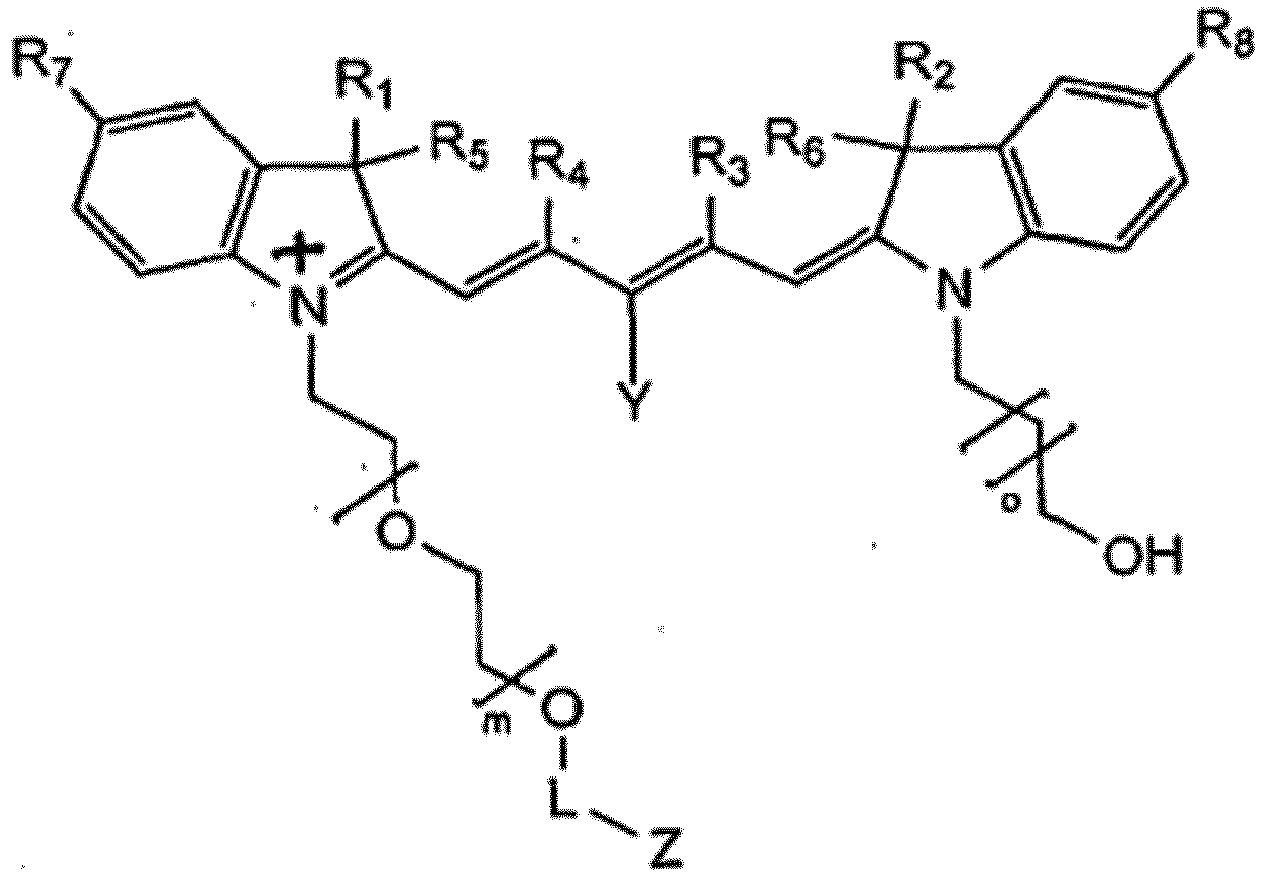

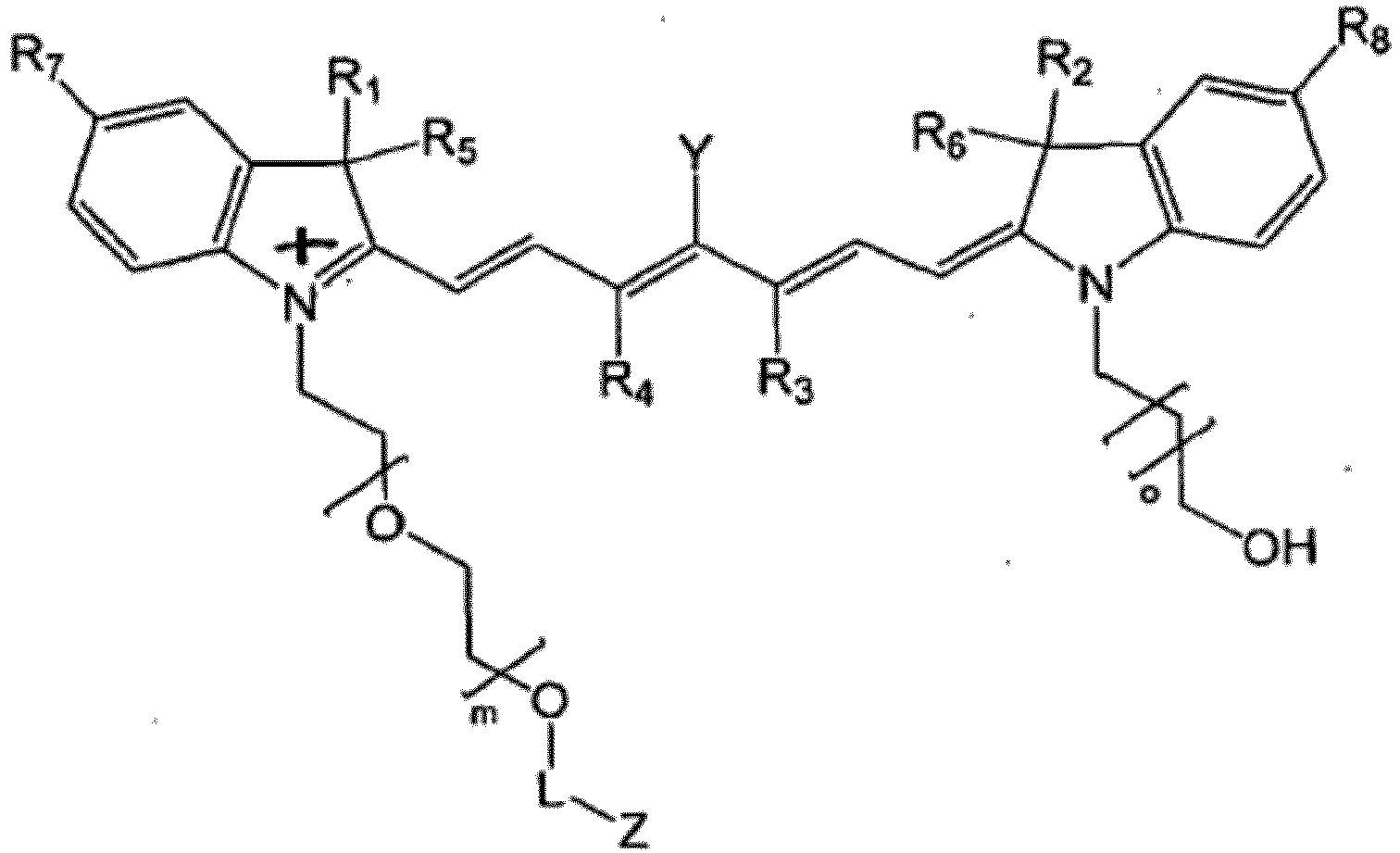 dans lequel chacun de R1, R2, R5 et R6 est identique ou différent et est indépendamment choisi dans le groupe constitué d'un groupe aliphatique, hétéroaliphatique, sulfoalkyle, hétéroaliphatique avec SO3 terminal, un groupe PEG P-L-Z où P est choisi parmi un groupe éthylène glycol, un groupe diéthylène glycol et un groupe polyéthylène glycol, où le groupe polyéthylène glycol est (CH2CH2O)s, où s est un entier entre 3 et 6 inclus, un groupe sulfonamide -L-SO2NH-P-L-Z, et un groupe carboxamide -L-CONH-P-L-Z ;chacun de R7 et R8 est identique ou différent et est indépendamment choisi dans le groupe constitué de H, SO3, un groupe PEG P-L-Z où P est choisi parmi un groupe éthylène glycol, un groupe diéthylène glycol et un groupe polyéthylène glycol, où le groupe polyéthylène glycol est (CH2CH2O)s, où s est un entier entre 3 et 6 inclus, un groupe sulfonamide -L-SO2NH-P-L-Z, et un groupe carboxamide -L-CONH-P-L-Z ;où L est choisi dans le groupe constitué d'une groupe alcane divalent linéaire (-(CH2)o-, o = 0 à 15), réticulé ou cyclique, facultativement substitué par au moins un atome choisi dans le groupe constitué d'oxygène, azote substitué et/ou soufre ;où Z est choisi dans le groupe constitué de H, CH3, alkyle, hétéroalkyle, NH2, -COO-, -COOH, -COSH, -CO-NH-NH2, -COF, -COCl, -COBr, -COI, -COO-Su (succinimidyle/sulfosuccinimidyle), -COO-STP (4-sulfo-2,3,5,6- tetraflurophényle), -COO-TFP (2,3,5,6-tetraflurophényle), -COO-benzotriazole,-CO-benzotriazole, -CONR'-CO-CH2I, -CONR'R", -CONR'-biomolécule, -CONR'-L-COO-, -CONR'-L-COOH, -CONR'-L-COO-Su, -CONR'-L-COO-STP, -CONR'-L-COO-TFP, -CONR'-L-CONR"2, -CONR'-L-CO-biomolécule, -CONR'-L-CO-NH-NH2, -CONR'-L-OH, -CONR'-L-O-phosphoramidite, -CONR'-L-CHO, -CONR'-L-maléimide et -CONR'-L-NH-CO-CH2I ; R' et R" sont choisis dans le groupe constitué de H, groupe aliphatique et groupe hétéroaliphatique, et la biomolécule est une protéine, un anticorps, un nucléotide, un oligonucléotide, une biotine ou un haptène ;X est choisi dans le groupe constitué de -OH, -SH, -NH2, -NH-NH2, -F, -Cl, -I, -NHS (hydroxysuccinimidyle/sulfosuccinimidyle), -O-TFP (2,3,5,6- tetraflurophénoxy), -O-STP (4-sulfo-2,3,5,6-tetraflurophénoxy), O-benzotriazole, - benzotriazole, -NR-L-OH, -NR-L-O-phosphoramidite, -NR-L-SH, -NR-L-NH2,-NR-L-NH-NH2, -NR-L-COOH, -NR-L-CO-NHS, -NR-L-CO-STP, -NR-L-CO-FTP,-NR-L-CO-benzotriazole, -NR-L-CHO, -NR-L-maléimide et NR-L-NH-CO-CH2I, où R est H ou un groupe aliphatique ou hétéroaliphatique ;Kat est un nombre de Na+, K+, Ca2+, ammoniums ou un ou plusieurs autres cations nécessaires pour compenser la charge négative apportée par la cyanine ; m est un entier entre 0 et 5 inclus ; o est un entier entre 0 et 12 inclus ; chacun des R3 et R4 est identique ou différent et est indépendamment choisi dans le groupe constitué d'un hydrogène, d'un groupe aliphatique, d'un groupe hétéroaliphatique, ou un groupe PEG P-L-Z où P est choisi parmi un groupe éthylène glycol, un groupe diéthylène glycol et un groupe polyéthylène glycol, où le groupe polyéthylène glycol est (CH2CH2O)s, où s est un entier entre 3 et 6 inclus ; ou R3 et R4 ensemble forment une structure cyclique où R3 et R4 sont joints par un élément structurel divalent choisi dans le groupe constitué de - (CH2)q-, -(CH2)qO(CH2)q'-, -(CH2)qS(CH2)q'-, -(CH2)qCH=CH-, -OCH=CH-, où chaque q et q' est identique ou différent et est un entier entre 2 et 6 inclus ; etY est choisi dans le groupe constitué de H, alkyle, sulfoalkyle, fluor, chlore, brome, un groupe PEG P-L-Z où P est choisi parmi un groupe éthylène glycol, un groupe diéthylène glycol et un groupe polyéthylène glycol, où le groupe polyéthylène glycol est (CH2CH2O)s, où s est un entier entre 3 et 6 inclus, ou un groupe contenant de l'oxygène ORPM, où RPM est choisi dans le groupe constitué de -H, alkyle substitué ou non-substitué, hétéroalkyle substitué ou non-substitué, cycloalkyle substitué ou non-substitué, alkyle hétérocyclique substitué ou non-substitué, aryle substitué ou non-substitué, et hétéroaryle substitué ou non-substitué, où le groupe est facultativement substitué une ou plusieurs fois par au moins un hydroxyle, sulfo, carboxy et/ou amino ; avec la condition qu'au moins un des R1, R2, R3, R4, R5, R6, R7 et R8 contienne un groupe PEG.
 - Composé choisi dans le groupe constitué de :
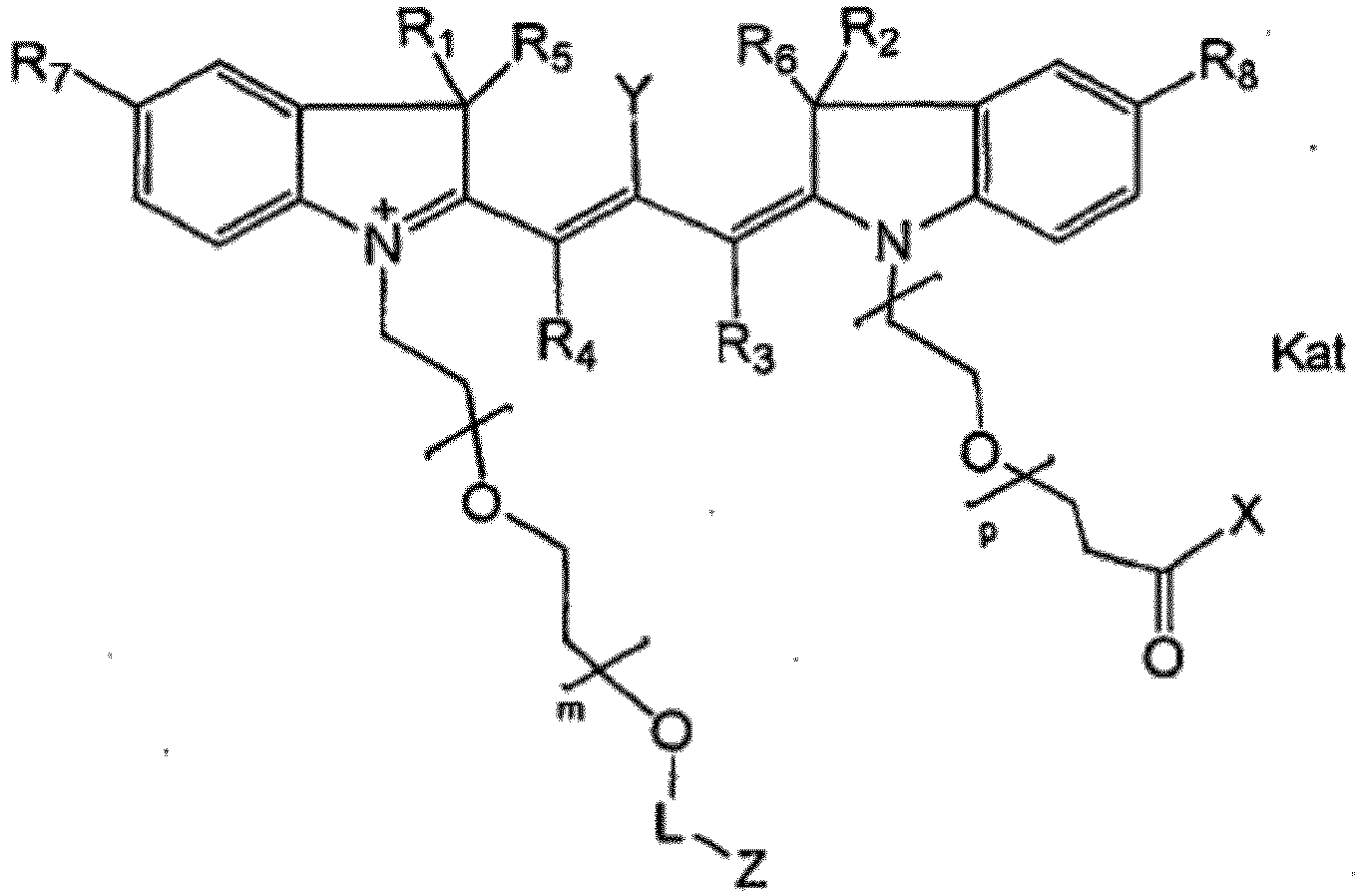

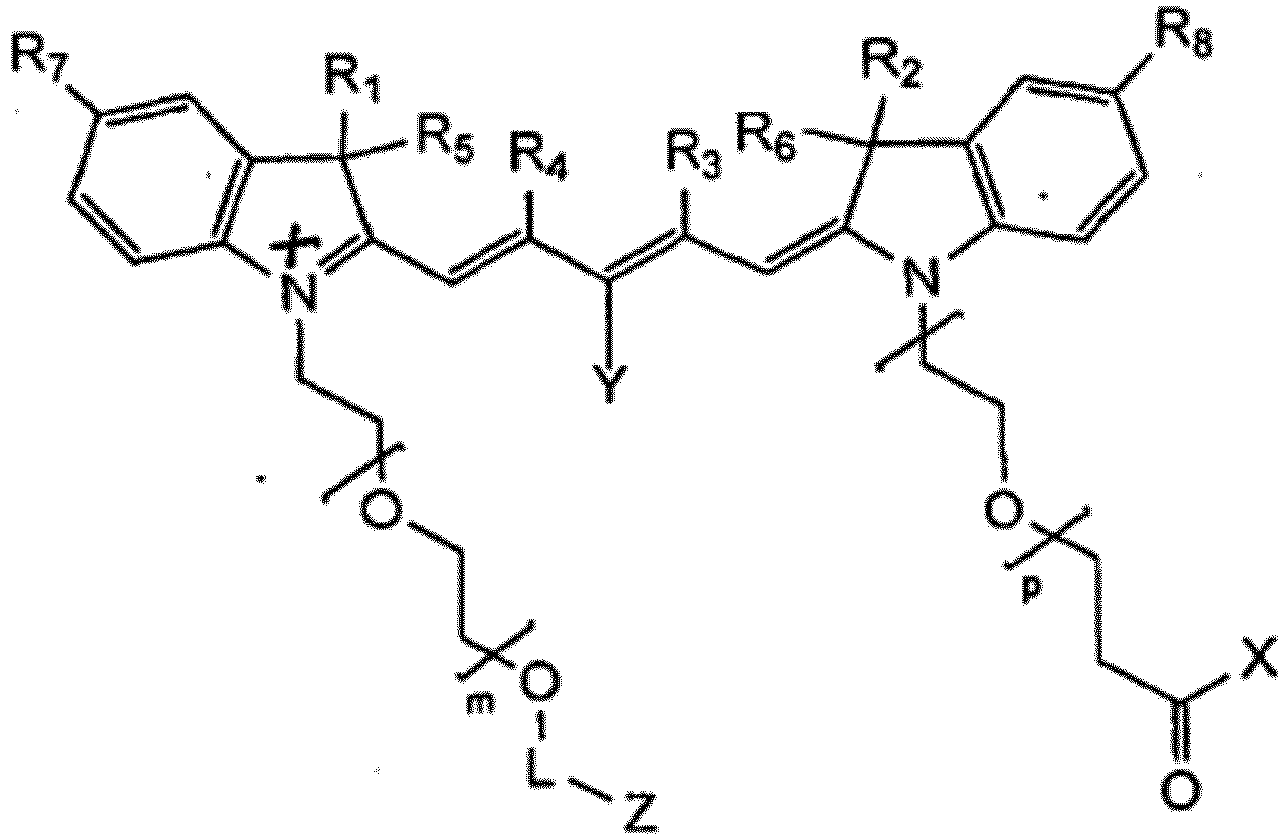


 dans lequel chacun de R1, R2, R5 et R6 est identique ou différent et est indépendamment choisi dans le groupe constitué d'un groupe aliphatique, hétéroaliphatique, sulfoalkyle, hétéroaliphatique avec SO3 terminal, un groupe PEG P-L-Z où P est choisi parmi un groupe éthylène glycol, un groupe diéthylène glycol et un groupe polyéthylène glycol, où le groupe polyéthylène glycol est (CH2CH2O)s, où s est un entier entre 3 et 6 inclus, un groupe sulfonamide -L-SO2NH-P-L-Z, et un groupe carboxamide -L-CONH-P-L-Z ;chacun de R7 et R8 est identique ou différent et est indépendamment choisi dans le groupe constitué de H, SO3, un groupe PEG P-L-Z où P est choisi parmi un groupe éthylène glycol, un groupe diéthylène glycol et un groupe polyéthylène glycol, où le groupe polyéthylène glycol est (CH2CH2O)s, où s est un entier entre 3 et 6 inclus, un groupe sulfonamide -L-SO2NH-P-L-Z, ou un groupe carboxamide -L-CONH-P-L-Z ;où L est choisi dans le groupe constitué d'une groupe alcane divalent linéaire (-(CH2)o-, o = 0 à 15), réticulé ou cyclique, facultativement substitué par au moins un atome choisi dans le groupe constitué d'oxygène, azote substitué et/ou soufre ;où Z est choisi dans le groupe constitué de H, CH3, alkyle, hétéroalkyle, NH2, -COO-, -COOH, -COSH, -CO-NH-NH2, -COF, -COCI, -COBr, -COI, -COO-Su (succinimidyle/sulfosuccinimidyle), -COO-STP (4-sulfo-2,3,5,6-tetraflurophényle), -COO-TFP (2,3,5,6-tetraflurophényle), -COO-benzotriazole,-CO-benzotriazole, -CONR'-CO-CH2I, -CONR'R", -CONR'-biomolécule, -CONR'-L-COO-, -CONR'-L-COOH, -CONR'-L-COO-Su, -CONR'-L-COO-STP, -CONR'-L-COO-TFP, -CONR'-L-CONR"2, -CONR'-L-CO-biomolécule, -CONR'-L-CO-NH-NH2, -CONR'-L-OH, -CONR'-L-O-phosphoramidite, -CONR'-L-CHO, -CONR'-L-maléimide et -CONR'-L-NH-CO-CH2I ; R' et R" sont choisis dans le groupe constitué de H, groupe aliphatique et groupe hétéroaliphatique, et la biomolécule est une protéine, un anticorps, un nucléotide, un oligonucléotide, une biotine ou un haptène ;X est choisi dans le groupe constitué de -OH, -SH, -NH2, -NH-NH2, -F, -CI, -I, -NHS (hydroxysuccinimidyle/sulfosuccinimidyle), -O-TFP (2,3,5,6-tetraflurophénoxy), -O-STP (4-sulfo-2,3,5,6-tetraflurophénoxy), O-benzotriazole, - benzotriazole, -NR-L-OH, -NR-L-O-phosphoramidite, -NR-L-SH, -NR-L-NH2,-NR-L-NH-NH2, -NR-L-COOH, -NR-L-CO-NHS, -NR-L-CO-STP, -NR-L-CO-TFP,-NR-L-CO-benzotriazole, -NR-L-CHO, -NR-L-maléimide et NR-L-NH-CO-CH2I, où R est H ou un groupe aliphatique ou hétéroaliphatique ;Kat est un nombre de Na+, K+, Ca2+, ammoniums ou un ou plusieurs autres cations nécessaires pour compenser la charge négative apportée par la cyanine ; m est un entier entre 0 et 5 inclus ; p est un entier entre 1 et 6 inclus ;chacun de R3 et R4 est identique ou différent et est indépendamment choisi dans le groupe constitué d'un hydrogène, d'un groupe aliphatique, d'un groupe hétéroaliphatique, ou un groupe PEG P-L-Z où P est choisi parmi un groupe éthylène glycol, un groupe diéthylène glycol et un groupe polyéthylène glycol, où le groupe polyéthylène glycol est (CH2CH2O)s, où s est un entier entre 3 et 6 inclus ; ou R3 et R4 ensemble forment une structure cyclique où R3 et R4 sont joints par un élément structurel divalent choisi dans le groupe constitué de - (CH2)q-, -(CH2)qO(CH2)q', -(CH2)qS(CH2)q', -(CH2)qCH=CH-, -OCH=CH-, où chaque q et q' est identique ou différent et est un entier entre 2 et 6 inclus ; et
Y est choisi dans le groupe constitué de H, alkyle, sulfoalkyle, fluor, chlore, brome, un groupe PEG P-L-Z où P est choisi parmi un groupe éthylène glycol, un groupe diéthylène glycol et un groupe polyéthylène glycol, où le groupe polyéthylène glycol est (CH2CH2O)s, où s est un entier entre 3 et 6 inclus, et un groupe contenant de l'oxygène ORPM, où RPM est choisi dans le groupe constitué de -H, alkyle substitué ou non-substitué, hétéroalkyle substitué ou non-substitué, cycloalkyle substitué ou non-substitué, alkyle hétérocyclique substitué ou non-substitué, aryle substitué ou non-substitué, et hétéroaryle substitué ou non-substitué, où le groupe est facultativement substitué une ou plusieurs fois par au moins un hydroxyle, sulfo, carboxy et/ou amino ; avec la condition qu'au moins un des R1, R2, R3, R4, R5, R6, R7 et R8 contienne un groupe PEG. - Composé selon la revendication 3, le composé étant choisi dans le groupe constitué de :


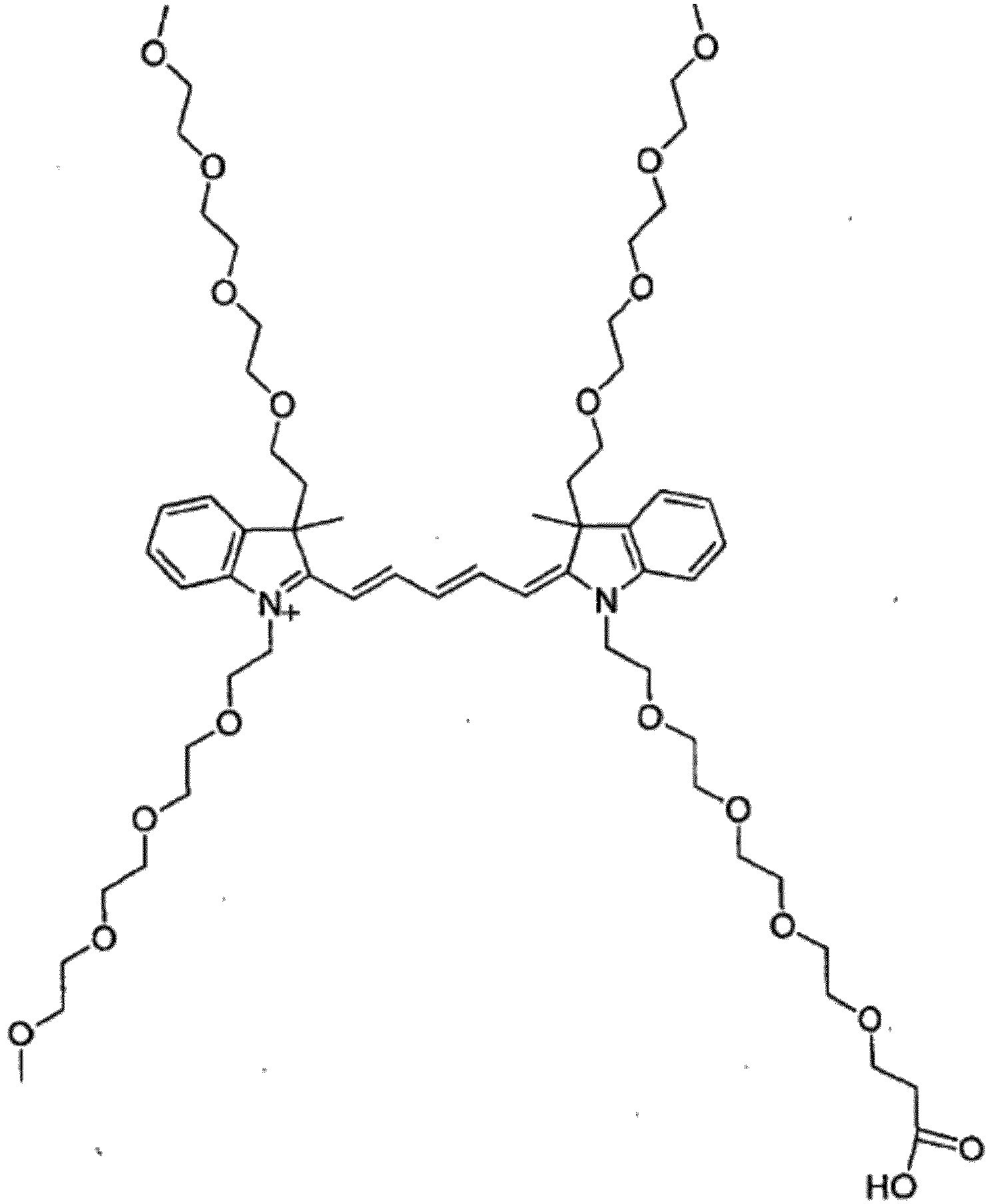


- Procédé de marquage d'au moins une biomolécule, le procédé comprenant la fourniture d'une composition comprenant au moins un excipient et le composé selon l'une quelconque des revendications 1 à 4 dans une quantité efficace à au moins une biomolécule dans des conditions suffisantes pour marquer la biomolécule avec le composé.
- Procédé selon la revendication 5, dans lequel la biomolécule est choisie dans le groupe constitué d'une protéine, d'un anticorps, d'un enzyme, d'un nucléoside triphosphate, d'un oligonucléotide, d'une biotine, d'un haptène, d'un cofacteur, d'une lectine, d'une protéine liant un anticorps, d'un caroténoïde, d'un sucre, d'une hormone, d'un neurotransmetteur, de facteurs de croissance, d'une toxine, d'une cellule biologique, d'un lipide, d'un médicament se liant à un récepteur, de protéines fluorescentes, d'un matériau porteur polymère organique, d'un matériau porteur polymère minéral, et de combinaisons de ceux-ci.
- Procédé selon la revendication 6, dans lequel le composé est V19-03005.
- Procédé de détection d'au moins une biomolécule, le procédé comprenant la fourniture d'une combinaison comprenant au moins un excipient et le composé selon l'une quelconque des revendications 1 à 4 dans une quantité efficace à au moins une biomolécule dans des conditions suffisantes pour lier le composé à la biomolécule, et la détection du composé biomolécule-composé lié.
- Procédé selon la revendication 8 dans lequel la biomolécule est choisie dans le groupe constitué d'une protéine, d'un anticorps, d'un enzyme, d'un nucléoside triphosphate, d'un oligonucléotide, d'une biotine, d'un haptène, d'un cofacteur, d'une lectine, d'une protéine liant un anticorps, d'un caroténoïde, d'un sucre, d'une hormone, d'un neurotransmetteur, de facteurs de croissance, d'une toxine, d'une cellule biologique, d'un lipide, d'un médicament se liant à un récepteur, de protéines fluorescentes, d'un matériau porteur polymère organique, d'un matériau porteur polymère minéral, et de combinaisons de ceux-ci.
- Procédé selon l'une des revendications 8 à 9 dans lequel l'au moins une biomolécule est détectée par microscopie à fluorescence, cytométrie de flux, imagerie in vivo, immuno-essai, hybridation, dosage chromatographique, essai d'électrophorèse, essai sur plaque à micropuits, système de transfert d'énergie de résonance par fluorescence (FRET), criblage haut débit ou biopuce.
- Procédé selon l'une quelconque des revendications 8 à 10, dans lequel la biomolécule est détectée par imagerie in vivo, comprenant la fourniture du composé biomolécule-composé lié dans au moins un échantillon biologique, tissu ou organisme, et la détection de la biomolécule dans l'au moins un échantillon biologique, tissu ou organisme.
- Procédé selon l'une quelconque des revendications 8 à 11, dans lequel le composé est V19-03005.
- Kit de marquage d'au moins une biomolécule dans un échantillon, comprenant le composé selon l'une quelconque des revendications 1 à 4 et au moins un excipient, et des instructions d'utilisation du composé pour marquer une biomolécule dans un échantillon.
- Kit de détection d'au moins une biomolécule dans un échantillon, comprenant le composé selon l'une quelconque des revendications 1 à 4 et au moins un excipient, et des instructions d'utilisation du composé pour détecter une biomolécule dans un échantillon.
- Kit selon l'une quelconque des revendications 13 ou 14, dans lequel le composé est V19-03005.
Priority Applications (1)
| Application Number | Priority Date | Filing Date | Title |
|---|---|---|---|
| EP16169172.0A EP3081564B1 (fr) | 2012-03-02 | 2013-02-28 | Dérivés d'indole comme colorant de marquage de biomolécule |
Applications Claiming Priority (3)
| Application Number | Priority Date | Filing Date | Title |
|---|---|---|---|
| US201261606210P | 2012-03-02 | 2012-03-02 | |
| US201261718805P | 2012-10-26 | 2012-10-26 | |
| PCT/US2013/028252 WO2013130761A1 (fr) | 2012-03-02 | 2013-02-28 | Dérivés d'indole comme colorant de marquage de biomolécule |
Related Child Applications (2)
| Application Number | Title | Priority Date | Filing Date |
|---|---|---|---|
| EP16169172.0A Division EP3081564B1 (fr) | 2012-03-02 | 2013-02-28 | Dérivés d'indole comme colorant de marquage de biomolécule |
| EP16169172.0A Division-Into EP3081564B1 (fr) | 2012-03-02 | 2013-02-28 | Dérivés d'indole comme colorant de marquage de biomolécule |
Publications (2)
| Publication Number | Publication Date |
|---|---|
| EP2804860A1 EP2804860A1 (fr) | 2014-11-26 |
| EP2804860B1 true EP2804860B1 (fr) | 2016-06-15 |
Family
ID=47846213
Family Applications (2)
| Application Number | Title | Priority Date | Filing Date |
|---|---|---|---|
| EP13709026.2A Active EP2804860B1 (fr) | 2012-03-02 | 2013-02-28 | Derives d'indole en tant que colorant de marquage pour biomolecule |
| EP16169172.0A Active EP3081564B1 (fr) | 2012-03-02 | 2013-02-28 | Dérivés d'indole comme colorant de marquage de biomolécule |
Family Applications After (1)
| Application Number | Title | Priority Date | Filing Date |
|---|---|---|---|
| EP16169172.0A Active EP3081564B1 (fr) | 2012-03-02 | 2013-02-28 | Dérivés d'indole comme colorant de marquage de biomolécule |
Country Status (4)
| Country | Link |
|---|---|
| US (3) | US20140072515A9 (fr) |
| EP (2) | EP2804860B1 (fr) |
| CN (1) | CN104395306B (fr) |
| WO (1) | WO2013130761A1 (fr) |
Families Citing this family (17)
| Publication number | Priority date | Publication date | Assignee | Title |
|---|---|---|---|---|
| WO2012088007A1 (fr) | 2010-12-21 | 2012-06-28 | Pierce Biotechnology, Inc. | Composés fluorescents |
| US9249307B2 (en) | 2011-08-16 | 2016-02-02 | Pierce Biotechnology, Inc. | Benzocyanine compounds |
| US9751868B2 (en) | 2012-02-28 | 2017-09-05 | Pierce Biotechnology, Inc. | Benzocyanine compounds |
| EP2804860B1 (fr) | 2012-03-02 | 2016-06-15 | Pierce Biotechnology, Inc. | Derives d'indole en tant que colorant de marquage pour biomolecule |
| CA2904127C (fr) | 2013-03-14 | 2023-10-17 | Profusa, Inc. | Capteurs d'oxygene a base de polymeres |
| JP6700750B2 (ja) | 2014-12-09 | 2020-05-27 | キヤノン株式会社 | 化合物、および、前記化合物を有する光学イメージング用造影剤 |
| US9862682B2 (en) | 2016-01-08 | 2018-01-09 | BroadPharm | Functionalized pegylated cyanine compounds, pharmaceutical compositions, and methods of use thereof |
| US20170296679A1 (en) | 2016-04-18 | 2017-10-19 | Intuitive Surgical Operations, Inc. | Compositions of Near IR Closed Chain, Sulfo-Cyanine Dyes and Prostate Specific Membrane Antigen Ligands |
| DK3548492T5 (en) | 2016-12-01 | 2024-08-05 | Promega Corp | Cell impermeable coelenterazine analogues |
| CN115505280A (zh) | 2016-12-21 | 2022-12-23 | 普罗菲尤萨股份有限公司 | 可聚合的近红外染料 |
| WO2019213119A1 (fr) | 2018-05-01 | 2019-11-07 | Promega Corporation | Composés de coelentérazine utilisés en tant que substrats suicide de nanoluc |
| CA3104346A1 (fr) | 2018-06-27 | 2020-01-02 | Profusa, Inc. | Capteurs de glucose a infrarouge proche |
| EP3636635A1 (fr) * | 2018-10-11 | 2020-04-15 | Academisch Ziekenhuis Leiden h.o.d.n. LUMC | Agents d'imagerie |
| JP7423888B2 (ja) * | 2019-11-22 | 2024-01-30 | 株式会社同仁化学研究所 | 脂質二分子膜染色用色素及びそれを用いた脂質二分子膜の染色方法 |
| JP7441306B2 (ja) | 2020-04-24 | 2024-02-29 | 富士フイルム株式会社 | 化合物及びこれを用いた標識生体物質 |
| KR20230034333A (ko) | 2020-07-02 | 2023-03-09 | 라이프 테크놀로지스 코포레이션 | 트리뉴클레오티드 캡 유사체, 제조 및 이의 용도 |
| JP7423789B2 (ja) | 2020-07-30 | 2024-01-29 | 富士フイルム株式会社 | 化合物及びこれを用いた標識生体物質 |
Family Cites Families (63)
| Publication number | Priority date | Publication date | Assignee | Title |
|---|---|---|---|---|
| US1524791A (en) | 1923-05-05 | 1925-02-03 | Farbenfab Vorm Bayer F & Co | Basic dye |
| GB434875A (en) | 1933-02-08 | 1935-09-05 | Bela Gasper | An improved method of producing multi-colour photographic images on coloured and differently sensitized multi-layer photographic material |
| JPS62123454A (ja) | 1985-08-08 | 1987-06-04 | Fuji Photo Film Co Ltd | ハロゲン化銀写真感光材料 |
| US6956032B1 (en) | 1986-04-18 | 2005-10-18 | Carnegie Mellon University | Cyanine dyes as labeling reagents for detection of biological and other materials by luminescence methods |
| US5627027A (en) | 1986-04-18 | 1997-05-06 | Carnegie Mellon University | Cyanine dyes as labeling reagents for detection of biological and other materials by luminescence methods |
| US5268486A (en) | 1986-04-18 | 1993-12-07 | Carnegie-Mellon Unversity | Method for labeling and detecting materials employing arylsulfonate cyanine dyes |
| US5569587A (en) | 1986-04-18 | 1996-10-29 | Carnegie Mellon University | Method for labeling and detecting materials employing luminescent arysulfonate cyanine dyes |
| US6225050B1 (en) | 1986-04-18 | 2001-05-01 | Carnegie Mellon University | Cyanine dyes as labeling reagents for detection of biological and other materials by luminescence methods |
| US6048982A (en) | 1986-04-18 | 2000-04-11 | Carnegie Mellon University | Cyanine dyes as labeling reagents for detection of biological and other materials by luminescence methods |
| US4981977A (en) | 1989-06-09 | 1991-01-01 | Carnegie-Mellon University | Intermediate for and fluorescent cyanine dyes containing carboxylic acid groups |
| JP2838563B2 (ja) | 1990-01-23 | 1998-12-16 | コニカ株式会社 | ハロゲン化銀写真感光材料 |
| JPH05313304A (ja) | 1992-05-11 | 1993-11-26 | Fuji Photo Film Co Ltd | ハロゲン化銀写真感光材料 |
| US5556959A (en) | 1993-01-22 | 1996-09-17 | Pharmacia P-L Biochemicals Inc. | Indocarbocyanine-linked phosphoramidites |
| DE4445065A1 (de) | 1994-12-07 | 1996-06-13 | Diagnostikforschung Inst | Verfahren zur In-vivo-Diagnostik mittels NIR-Strahlung |
| IT1276833B1 (it) | 1995-10-09 | 1997-11-03 | Sorin Biomedica Cardio Spa | Coloranti fluorescenti della famiglia della solfo benz e indocianina |
| US5846737A (en) | 1996-07-26 | 1998-12-08 | Molecular Probes, Inc. | Conjugates of sulforhodamine fluorophores with enhanced fluorescence |
| DE19717904A1 (de) | 1997-04-23 | 1998-10-29 | Diagnostikforschung Inst | Säurelabile und enzymatisch spaltbare Farbstoffkonstrukte zur Diagnostik mit Nahinfrarotlicht und zur Therapie |
| AU7221398A (en) | 1997-04-29 | 1998-11-24 | Nycomed Imaging As | Method of demarcating tissue |
| US5986086A (en) | 1997-06-20 | 1999-11-16 | Amersham Pharmacia Biotech Inc. | Non-sulfonated cyanine dyes for labeling nucleosides and nucleotides |
| US7250517B2 (en) | 1998-04-08 | 2007-07-31 | Ewald A. Terpetschnig | Luminescent compounds |
| US5972838A (en) | 1998-06-24 | 1999-10-26 | Eastman Kodak Company | Infrared-absorbing cyanine colorants for laser-colorant transfer |
| CA2375740A1 (fr) | 1999-06-09 | 2000-12-14 | Carnegie Mellon University | Colorants a base de cyanine sensibles au ph utilises comme reactifs fluorescents |
| US6939532B2 (en) | 2000-01-18 | 2005-09-06 | Mallinckrodt, Inc. | Versatile hydrophilic dyes |
| US7790144B2 (en) | 2000-01-18 | 2010-09-07 | Mallinckrodt Inc. | Receptor-avid exogenous optical contrast and therapeutic agents |
| US20080233050A1 (en) | 2000-01-18 | 2008-09-25 | Mallinckrodt Inc. | Diagnostic and therapeutic optical agents |
| JP2001288197A (ja) | 2000-04-10 | 2001-10-16 | Fuji Photo Film Co Ltd | 蛍光ヌクレオチド |
| US6342326B1 (en) | 2000-05-10 | 2002-01-29 | Beckman Coulter, Inc. | Synthesis and use of acyl fluorides of cyanine dyes |
| DE10046215B4 (de) | 2000-09-19 | 2004-04-15 | Institut für Chemo- und Biosensorik Münster e.V. i.Ins. | Fluorochrome und deren Verwendung |
| AU2006200511B2 (en) | 2000-09-29 | 2008-08-28 | Molecular Probes, Inc. | Modified Carbocyanine Dyes and Their Conjugates |
| DE20122672U1 (de) | 2000-09-29 | 2007-04-05 | Molecular Probes, Inc., Eugene | Modifizierte Carbocyaninfarbstoffe und deren Konjugate |
| DE60126297T2 (de) | 2000-09-29 | 2007-11-15 | Molecular Probes, Inc., Eugene | Modifizierte carbocyaninfarbstoffe und deren konjugate |
| US6673334B1 (en) * | 2000-10-16 | 2004-01-06 | Mallinkcrodt, Inc. | Light sensitive compounds for instant determination of organ function |
| DE10058528A1 (de) | 2000-11-24 | 2002-05-29 | Emhart Inc | Clipanordnung zum lösbaren Befestigen eines Gegenstandes an mindestens einer Leitung |
| US6761878B2 (en) | 2001-10-17 | 2004-07-13 | Mallinckrodt, Inc. | Pathological tissue detection and treatment employing targeted benzoindole optical agents |
| DE10258150A1 (de) | 2002-12-10 | 2004-07-08 | Dyomics Gmbh | Hydrophile Marker auf der Basis von Benzopyrylo-Polymethinen |
| BR0318028A (pt) * | 2003-01-24 | 2005-12-06 | Schering Ag | Corantes hidrofìlicos de cianina reativos a tiol e conjugados dos mesmos com biomoléculas para diagnóstico por fluorescência |
| US7172907B2 (en) | 2003-03-21 | 2007-02-06 | Ge Healthcare Bio-Sciences Corp. | Cyanine dye labelling reagents with meso-substitution |
| ATE522580T1 (de) | 2003-10-31 | 2011-09-15 | Ge Healthcare Ltd | Cyaninfarbstoffe als markieragenzien |
| US7312326B2 (en) | 2004-04-09 | 2007-12-25 | Beckman Coulter, Inc. | Fluorescent labeled nucleotide derivatives |
| EP1781675B1 (fr) | 2004-08-13 | 2014-03-26 | Epoch Biosciences, Inc. | Phosphonates fluorescents et conjugues |
| US7776567B2 (en) | 2005-03-17 | 2010-08-17 | Biotium, Inc. | Dimeric and trimeric nucleic acid dyes, and associated systems and methods |
| ATE480596T1 (de) | 2005-12-05 | 2010-09-15 | Dyomics Gmbh | Hydrophile marker auf der basis von diastereomeren cyaninen |
| DE102006029454A1 (de) | 2005-12-05 | 2007-06-06 | Dyomics Gmbh | Hydrophile Marker auf Basis von diasteromeren |
| US7175835B1 (en) * | 2005-12-23 | 2007-02-13 | Conopco, Inc. | Cosmetic emulsions with inorganic sunscreens stabilized with conjugated linoleic acid |
| CA2695147A1 (fr) * | 2006-08-03 | 2008-02-07 | Beth Israel Deaconess Medical Center, Inc. | Teintures et precurseurs et leurs conjugues |
| GB0718967D0 (en) | 2007-09-28 | 2007-11-07 | Ge Healthcare Ltd | Peptide imaging agents |
| GB0718957D0 (en) | 2007-09-28 | 2007-11-07 | Ge Healthcare Ltd | Optical imaging agents |
| JP5618827B2 (ja) | 2007-08-14 | 2014-11-05 | ミフェニオンゲゼルシャフト ミット ベシュレンクテルハフツング | リュウマチ性関節炎等の炎症性疾患の診断もしくは診断準備、および/または炎症性疾患の治療監視を行うための装置、ならびにその方法 |
| EP2036577A1 (fr) | 2007-09-14 | 2009-03-18 | mivenion GmbH | Matières diagnostiques pour l'examen optique sur la base de formulations contenant des nanoparticules |
| CN101946171B (zh) * | 2007-12-14 | 2014-03-12 | 拜奥蒂乌姆股份有限公司 | 荧光化合物 |
| EP2100621A1 (fr) | 2008-03-10 | 2009-09-16 | mivenion GmbH | Conjugués de dendrimère de polyol de polyéther dotés de molécules effectrices pour le ciblage biologique |
| JP5501962B2 (ja) | 2008-06-05 | 2014-05-28 | 株式会社Adeka | アルミニウムフェノキシド化合物を用いた安定化ポリマーの製造方法。 |
| US7951959B2 (en) | 2008-09-17 | 2011-05-31 | Thermo Fisher Scientific (Milwaukee) LLC | Hydrophilic labels for biomolecules |
| CN102300861B (zh) | 2009-02-03 | 2015-07-01 | 百奥提姆股份有限公司 | 包含磺酰胺基团的呫吨染料 |
| RU2011138096A (ru) | 2009-03-19 | 2013-04-27 | Дженерал Электрик Компани | Агенты для оптической визуализации |
| WO2012088007A1 (fr) * | 2010-12-21 | 2012-06-28 | Pierce Biotechnology, Inc. | Composés fluorescents |
| WO2012129128A1 (fr) | 2011-03-18 | 2012-09-27 | Biotium, Inc. | Colorants fluorescents, kits de colorants fluorescents et procédés de préparation de molécules marquées |
| US8889884B1 (en) | 2011-07-14 | 2014-11-18 | Pierce Biotechnology, Inc. | Phosphine derivatives of fluorescent compounds |
| US9249307B2 (en) | 2011-08-16 | 2016-02-02 | Pierce Biotechnology, Inc. | Benzocyanine compounds |
| US9751868B2 (en) | 2012-02-28 | 2017-09-05 | Pierce Biotechnology, Inc. | Benzocyanine compounds |
| EP2804860B1 (fr) | 2012-03-02 | 2016-06-15 | Pierce Biotechnology, Inc. | Derives d'indole en tant que colorant de marquage pour biomolecule |
| CN104540819B (zh) | 2012-08-28 | 2019-04-19 | 皮尔斯生物科技有限公司 | 苯并吡喃鎓化合物 |
| US20140255312A1 (en) | 2013-03-07 | 2014-09-11 | Greg Hermanson | Cyanine compounds |
-
2013
- 2013-02-28 EP EP13709026.2A patent/EP2804860B1/fr active Active
- 2013-02-28 US US13/780,338 patent/US20140072515A9/en not_active Abandoned
- 2013-02-28 EP EP16169172.0A patent/EP3081564B1/fr active Active
- 2013-02-28 WO PCT/US2013/028252 patent/WO2013130761A1/fr not_active Ceased
- 2013-02-28 CN CN201380005497.XA patent/CN104395306B/zh active Active
-
2016
- 2016-02-12 US US15/042,328 patent/US10000467B2/en active Active
-
2018
- 2018-05-10 US US15/976,491 patent/US10696653B2/en active Active
Non-Patent Citations (1)
| Title |
|---|
| None * |
Also Published As
| Publication number | Publication date |
|---|---|
| EP3081564A1 (fr) | 2016-10-19 |
| WO2013130761A1 (fr) | 2013-09-06 |
| US20140072515A9 (en) | 2014-03-13 |
| US10000467B2 (en) | 2018-06-19 |
| CN104395306B (zh) | 2019-04-23 |
| EP2804860A1 (fr) | 2014-11-26 |
| US10696653B2 (en) | 2020-06-30 |
| US20180327387A1 (en) | 2018-11-15 |
| US20170114038A9 (en) | 2017-04-27 |
| US20160176852A1 (en) | 2016-06-23 |
| EP3081564B1 (fr) | 2019-07-10 |
| CN104395306A (zh) | 2015-03-04 |
| US20130230466A1 (en) | 2013-09-05 |
Similar Documents
| Publication | Publication Date | Title |
|---|---|---|
| EP2804860B1 (fr) | Derives d'indole en tant que colorant de marquage pour biomolecule | |
| US11053222B2 (en) | Fluorescent compounds | |
| US10730857B2 (en) | Benzocyanine compounds | |
| US20170158858A9 (en) | Cyanine compounds | |
| US10526317B2 (en) | Benzocyanine compounds | |
| US10174045B2 (en) | Benzopyrylium compounds | |
| US9365598B2 (en) | Phosphine derivatives of fluorescent compounds |
Legal Events
| Date | Code | Title | Description |
|---|---|---|---|
| PUAI | Public reference made under article 153(3) epc to a published international application that has entered the european phase |
Free format text: ORIGINAL CODE: 0009012 |
|
| 17P | Request for examination filed |
Effective date: 20140818 |
|
| AK | Designated contracting states |
Kind code of ref document: A1 Designated state(s): AL AT BE BG CH CY CZ DE DK EE ES FI FR GB GR HR HU IE IS IT LI LT LU LV MC MK MT NL NO PL PT RO RS SE SI SK SM TR |
|
| DAX | Request for extension of the european patent (deleted) | ||
| GRAJ | Information related to disapproval of communication of intention to grant by the applicant or resumption of examination proceedings by the epo deleted |
Free format text: ORIGINAL CODE: EPIDOSDIGR1 |
|
| GRAP | Despatch of communication of intention to grant a patent |
Free format text: ORIGINAL CODE: EPIDOSNIGR1 |
|
| INTG | Intention to grant announced |
Effective date: 20151027 |
|
| RIN1 | Information on inventor provided before grant (corrected) |
Inventor name: CZERNEY, PETER T. Inventor name: LEHMANN, FRANK G. Inventor name: NLEND, MARIE CHRISTINE Inventor name: WENZEL, MATTHIAS S. Inventor name: DESAI, SURBHI Inventor name: DWORECKI, BOGUSLAWA R. Inventor name: HERMANSON, GREG |
|
| INTG | Intention to grant announced |
Effective date: 20160211 |
|
| GRAS | Grant fee paid |
Free format text: ORIGINAL CODE: EPIDOSNIGR3 |
|
| GRAJ | Information related to disapproval of communication of intention to grant by the applicant or resumption of examination proceedings by the epo deleted |
Free format text: ORIGINAL CODE: EPIDOSDIGR1 |
|
| GRAP | Despatch of communication of intention to grant a patent |
Free format text: ORIGINAL CODE: EPIDOSNIGR1 |
|
| GRAR | Information related to intention to grant a patent recorded |
Free format text: ORIGINAL CODE: EPIDOSNIGR71 |
|
| GRAA | (expected) grant |
Free format text: ORIGINAL CODE: 0009210 |
|
| AK | Designated contracting states |
Kind code of ref document: B1 Designated state(s): AL AT BE BG CH CY CZ DE DK EE ES FI FR GB GR HR HU IE IS IT LI LT LU LV MC MK MT NL NO PL PT RO RS SE SI SK SM TR |
|
| INTG | Intention to grant announced |
Effective date: 20160510 |
|
| REG | Reference to a national code |
Ref country code: CH Ref legal event code: EP Ref country code: GB Ref legal event code: FG4D |
|
| REG | Reference to a national code |
Ref country code: IE Ref legal event code: FG4D |
|
| REG | Reference to a national code |
Ref country code: AT Ref legal event code: REF Ref document number: 806457 Country of ref document: AT Kind code of ref document: T Effective date: 20160715 |
|
| REG | Reference to a national code |
Ref country code: DE Ref legal event code: R096 Ref document number: 602013008586 Country of ref document: DE |
|
| REG | Reference to a national code |
Ref country code: NL Ref legal event code: FP |
|
| REG | Reference to a national code |
Ref country code: SE Ref legal event code: TRGR |
|
| REG | Reference to a national code |
Ref country code: LT Ref legal event code: MG4D |
|
| PG25 | Lapsed in a contracting state [announced via postgrant information from national office to epo] |
Ref country code: FI Free format text: LAPSE BECAUSE OF FAILURE TO SUBMIT A TRANSLATION OF THE DESCRIPTION OR TO PAY THE FEE WITHIN THE PRESCRIBED TIME-LIMIT Effective date: 20160615 Ref country code: NO Free format text: LAPSE BECAUSE OF FAILURE TO SUBMIT A TRANSLATION OF THE DESCRIPTION OR TO PAY THE FEE WITHIN THE PRESCRIBED TIME-LIMIT Effective date: 20160915 Ref country code: LT Free format text: LAPSE BECAUSE OF FAILURE TO SUBMIT A TRANSLATION OF THE DESCRIPTION OR TO PAY THE FEE WITHIN THE PRESCRIBED TIME-LIMIT Effective date: 20160615 |
|
| REG | Reference to a national code |
Ref country code: AT Ref legal event code: MK05 Ref document number: 806457 Country of ref document: AT Kind code of ref document: T Effective date: 20160615 |
|
| PG25 | Lapsed in a contracting state [announced via postgrant information from national office to epo] |
Ref country code: GR Free format text: LAPSE BECAUSE OF FAILURE TO SUBMIT A TRANSLATION OF THE DESCRIPTION OR TO PAY THE FEE WITHIN THE PRESCRIBED TIME-LIMIT Effective date: 20160916 Ref country code: LV Free format text: LAPSE BECAUSE OF FAILURE TO SUBMIT A TRANSLATION OF THE DESCRIPTION OR TO PAY THE FEE WITHIN THE PRESCRIBED TIME-LIMIT Effective date: 20160615 Ref country code: HR Free format text: LAPSE BECAUSE OF FAILURE TO SUBMIT A TRANSLATION OF THE DESCRIPTION OR TO PAY THE FEE WITHIN THE PRESCRIBED TIME-LIMIT Effective date: 20160615 Ref country code: RS Free format text: LAPSE BECAUSE OF FAILURE TO SUBMIT A TRANSLATION OF THE DESCRIPTION OR TO PAY THE FEE WITHIN THE PRESCRIBED TIME-LIMIT Effective date: 20160615 |
|
| REG | Reference to a national code |
Ref country code: FR Ref legal event code: PLFP Year of fee payment: 5 |
|
| PG25 | Lapsed in a contracting state [announced via postgrant information from national office to epo] |
Ref country code: EE Free format text: LAPSE BECAUSE OF FAILURE TO SUBMIT A TRANSLATION OF THE DESCRIPTION OR TO PAY THE FEE WITHIN THE PRESCRIBED TIME-LIMIT Effective date: 20160615 Ref country code: RO Free format text: LAPSE BECAUSE OF FAILURE TO SUBMIT A TRANSLATION OF THE DESCRIPTION OR TO PAY THE FEE WITHIN THE PRESCRIBED TIME-LIMIT Effective date: 20160615 Ref country code: IS Free format text: LAPSE BECAUSE OF FAILURE TO SUBMIT A TRANSLATION OF THE DESCRIPTION OR TO PAY THE FEE WITHIN THE PRESCRIBED TIME-LIMIT Effective date: 20161015 Ref country code: CZ Free format text: LAPSE BECAUSE OF FAILURE TO SUBMIT A TRANSLATION OF THE DESCRIPTION OR TO PAY THE FEE WITHIN THE PRESCRIBED TIME-LIMIT Effective date: 20160615 Ref country code: SK Free format text: LAPSE BECAUSE OF FAILURE TO SUBMIT A TRANSLATION OF THE DESCRIPTION OR TO PAY THE FEE WITHIN THE PRESCRIBED TIME-LIMIT Effective date: 20160615 Ref country code: IT Free format text: LAPSE BECAUSE OF FAILURE TO SUBMIT A TRANSLATION OF THE DESCRIPTION OR TO PAY THE FEE WITHIN THE PRESCRIBED TIME-LIMIT Effective date: 20160615 |
|
| PG25 | Lapsed in a contracting state [announced via postgrant information from national office to epo] |
Ref country code: ES Free format text: LAPSE BECAUSE OF FAILURE TO SUBMIT A TRANSLATION OF THE DESCRIPTION OR TO PAY THE FEE WITHIN THE PRESCRIBED TIME-LIMIT Effective date: 20160615 Ref country code: PT Free format text: LAPSE BECAUSE OF FAILURE TO SUBMIT A TRANSLATION OF THE DESCRIPTION OR TO PAY THE FEE WITHIN THE PRESCRIBED TIME-LIMIT Effective date: 20161017 Ref country code: AT Free format text: LAPSE BECAUSE OF FAILURE TO SUBMIT A TRANSLATION OF THE DESCRIPTION OR TO PAY THE FEE WITHIN THE PRESCRIBED TIME-LIMIT Effective date: 20160615 Ref country code: BE Free format text: LAPSE BECAUSE OF FAILURE TO SUBMIT A TRANSLATION OF THE DESCRIPTION OR TO PAY THE FEE WITHIN THE PRESCRIBED TIME-LIMIT Effective date: 20160615 Ref country code: PL Free format text: LAPSE BECAUSE OF FAILURE TO SUBMIT A TRANSLATION OF THE DESCRIPTION OR TO PAY THE FEE WITHIN THE PRESCRIBED TIME-LIMIT Effective date: 20160615 Ref country code: SM Free format text: LAPSE BECAUSE OF FAILURE TO SUBMIT A TRANSLATION OF THE DESCRIPTION OR TO PAY THE FEE WITHIN THE PRESCRIBED TIME-LIMIT Effective date: 20160615 |
|
| REG | Reference to a national code |
Ref country code: DE Ref legal event code: R097 Ref document number: 602013008586 Country of ref document: DE |
|
| PLBE | No opposition filed within time limit |
Free format text: ORIGINAL CODE: 0009261 |
|
| STAA | Information on the status of an ep patent application or granted ep patent |
Free format text: STATUS: NO OPPOSITION FILED WITHIN TIME LIMIT |
|
| 26N | No opposition filed |
Effective date: 20170316 |
|
| PG25 | Lapsed in a contracting state [announced via postgrant information from national office to epo] |
Ref country code: DK Free format text: LAPSE BECAUSE OF FAILURE TO SUBMIT A TRANSLATION OF THE DESCRIPTION OR TO PAY THE FEE WITHIN THE PRESCRIBED TIME-LIMIT Effective date: 20160615 |
|
| PG25 | Lapsed in a contracting state [announced via postgrant information from national office to epo] |
Ref country code: SI Free format text: LAPSE BECAUSE OF FAILURE TO SUBMIT A TRANSLATION OF THE DESCRIPTION OR TO PAY THE FEE WITHIN THE PRESCRIBED TIME-LIMIT Effective date: 20160615 |
|
| PG25 | Lapsed in a contracting state [announced via postgrant information from national office to epo] |
Ref country code: MC Free format text: LAPSE BECAUSE OF FAILURE TO SUBMIT A TRANSLATION OF THE DESCRIPTION OR TO PAY THE FEE WITHIN THE PRESCRIBED TIME-LIMIT Effective date: 20160615 |
|
| REG | Reference to a national code |
Ref country code: IE Ref legal event code: MM4A |
|
| PG25 | Lapsed in a contracting state [announced via postgrant information from national office to epo] |
Ref country code: LU Free format text: LAPSE BECAUSE OF NON-PAYMENT OF DUE FEES Effective date: 20170228 |
|
| REG | Reference to a national code |
Ref country code: FR Ref legal event code: PLFP Year of fee payment: 6 |
|
| PG25 | Lapsed in a contracting state [announced via postgrant information from national office to epo] |
Ref country code: IE Free format text: LAPSE BECAUSE OF NON-PAYMENT OF DUE FEES Effective date: 20170228 |
|
| PG25 | Lapsed in a contracting state [announced via postgrant information from national office to epo] |
Ref country code: MT Free format text: LAPSE BECAUSE OF NON-PAYMENT OF DUE FEES Effective date: 20170228 |
|
| PG25 | Lapsed in a contracting state [announced via postgrant information from national office to epo] |
Ref country code: AL Free format text: LAPSE BECAUSE OF FAILURE TO SUBMIT A TRANSLATION OF THE DESCRIPTION OR TO PAY THE FEE WITHIN THE PRESCRIBED TIME-LIMIT Effective date: 20160615 |
|
| PG25 | Lapsed in a contracting state [announced via postgrant information from national office to epo] |
Ref country code: HU Free format text: LAPSE BECAUSE OF FAILURE TO SUBMIT A TRANSLATION OF THE DESCRIPTION OR TO PAY THE FEE WITHIN THE PRESCRIBED TIME-LIMIT; INVALID AB INITIO Effective date: 20130228 |
|
| PG25 | Lapsed in a contracting state [announced via postgrant information from national office to epo] |
Ref country code: BG Free format text: LAPSE BECAUSE OF FAILURE TO SUBMIT A TRANSLATION OF THE DESCRIPTION OR TO PAY THE FEE WITHIN THE PRESCRIBED TIME-LIMIT Effective date: 20160615 |
|
| PG25 | Lapsed in a contracting state [announced via postgrant information from national office to epo] |
Ref country code: CY Free format text: LAPSE BECAUSE OF FAILURE TO SUBMIT A TRANSLATION OF THE DESCRIPTION OR TO PAY THE FEE WITHIN THE PRESCRIBED TIME-LIMIT Effective date: 20160615 |
|
| PG25 | Lapsed in a contracting state [announced via postgrant information from national office to epo] |
Ref country code: MK Free format text: LAPSE BECAUSE OF FAILURE TO SUBMIT A TRANSLATION OF THE DESCRIPTION OR TO PAY THE FEE WITHIN THE PRESCRIBED TIME-LIMIT Effective date: 20160615 |
|
| PG25 | Lapsed in a contracting state [announced via postgrant information from national office to epo] |
Ref country code: TR Free format text: LAPSE BECAUSE OF FAILURE TO SUBMIT A TRANSLATION OF THE DESCRIPTION OR TO PAY THE FEE WITHIN THE PRESCRIBED TIME-LIMIT Effective date: 20160615 |
|
| P01 | Opt-out of the competence of the unified patent court (upc) registered |
Effective date: 20230508 |
|
| PGFP | Annual fee paid to national office [announced via postgrant information from national office to epo] |
Ref country code: DE Payment date: 20250117 Year of fee payment: 13 |
|
| PGFP | Annual fee paid to national office [announced via postgrant information from national office to epo] |
Ref country code: SE Payment date: 20250205 Year of fee payment: 13 |
|
| PGFP | Annual fee paid to national office [announced via postgrant information from national office to epo] |
Ref country code: CH Payment date: 20250301 Year of fee payment: 13 |
|
| PGFP | Annual fee paid to national office [announced via postgrant information from national office to epo] |
Ref country code: FR Payment date: 20250218 Year of fee payment: 13 |
|
| PGFP | Annual fee paid to national office [announced via postgrant information from national office to epo] |
Ref country code: GB Payment date: 20250211 Year of fee payment: 13 |
|
| PGFP | Annual fee paid to national office [announced via postgrant information from national office to epo] |
Ref country code: NL Payment date: 20260113 Year of fee payment: 14 |
|
| REG | Reference to a national code |
Ref country code: CH Ref legal event code: U11 Free format text: ST27 STATUS EVENT CODE: U-0-0-U10-U11 (AS PROVIDED BY THE NATIONAL OFFICE) Effective date: 20260301 |