EP2809756B1 - Kombination aus aminoalkohol, duftstoff und kieselsäureester und ihre verwendung als duftstoffvorläufer - Google Patents
Kombination aus aminoalkohol, duftstoff und kieselsäureester und ihre verwendung als duftstoffvorläufer Download PDFInfo
- Publication number
- EP2809756B1 EP2809756B1 EP13700520.3A EP13700520A EP2809756B1 EP 2809756 B1 EP2809756 B1 EP 2809756B1 EP 13700520 A EP13700520 A EP 13700520A EP 2809756 B1 EP2809756 B1 EP 2809756B1
- Authority
- EP
- European Patent Office
- Prior art keywords
- scent
- salicylate
- general formula
- methyl
- alcohol
- Prior art date
- Legal status (The legal status is an assumption and is not a legal conclusion. Google has not performed a legal analysis and makes no representation as to the accuracy of the status listed.)
- Active
Links
- 0 *C(C(*)(C(*)O)N)O Chemical compound *C(C(*)(C(*)O)N)O 0.000 description 3
Classifications
-
- C—CHEMISTRY; METALLURGY
- C11—ANIMAL OR VEGETABLE OILS, FATS, FATTY SUBSTANCES OR WAXES; FATTY ACIDS THEREFROM; DETERGENTS; CANDLES
- C11D—DETERGENT COMPOSITIONS; USE OF SINGLE SUBSTANCES AS DETERGENTS; SOAP OR SOAP-MAKING; RESIN SOAPS; RECOVERY OF GLYCEROL
- C11D3/00—Other compounding ingredients of detergent compositions covered in group C11D1/00
- C11D3/50—Perfumes
-
- A—HUMAN NECESSITIES
- A61—MEDICAL OR VETERINARY SCIENCE; HYGIENE
- A61K—PREPARATIONS FOR MEDICAL, DENTAL OR TOILETRY PURPOSES
- A61K8/00—Cosmetics or similar toiletry preparations
- A61K8/18—Cosmetics or similar toiletry preparations characterised by the composition
- A61K8/30—Cosmetics or similar toiletry preparations characterised by the composition containing organic compounds
- A61K8/40—Cosmetics or similar toiletry preparations characterised by the composition containing organic compounds containing nitrogen
- A61K8/41—Amines
-
- A—HUMAN NECESSITIES
- A61—MEDICAL OR VETERINARY SCIENCE; HYGIENE
- A61K—PREPARATIONS FOR MEDICAL, DENTAL OR TOILETRY PURPOSES
- A61K8/00—Cosmetics or similar toiletry preparations
- A61K8/18—Cosmetics or similar toiletry preparations characterised by the composition
- A61K8/30—Cosmetics or similar toiletry preparations characterised by the composition containing organic compounds
- A61K8/58—Cosmetics or similar toiletry preparations characterised by the composition containing organic compounds containing atoms other than carbon, hydrogen, halogen, oxygen, nitrogen, sulfur or phosphorus
- A61K8/585—Organosilicon compounds
-
- A—HUMAN NECESSITIES
- A61—MEDICAL OR VETERINARY SCIENCE; HYGIENE
- A61Q—SPECIFIC USE OF COSMETICS OR SIMILAR TOILETRY PREPARATIONS
- A61Q13/00—Formulations or additives for perfume preparations
-
- A—HUMAN NECESSITIES
- A61—MEDICAL OR VETERINARY SCIENCE; HYGIENE
- A61Q—SPECIFIC USE OF COSMETICS OR SIMILAR TOILETRY PREPARATIONS
- A61Q19/00—Preparations for care of the skin
-
- C—CHEMISTRY; METALLURGY
- C11—ANIMAL OR VEGETABLE OILS, FATS, FATTY SUBSTANCES OR WAXES; FATTY ACIDS THEREFROM; DETERGENTS; CANDLES
- C11B—PRODUCING, e.g. BY PRESSING RAW MATERIALS OR BY EXTRACTION FROM WASTE MATERIALS, REFINING OR PRESERVING FATS, FATTY SUBSTANCES, e.g. LANOLIN, FATTY OILS OR WAXES; ESSENTIAL OILS; PERFUMES
- C11B9/00—Essential oils; Perfumes
- C11B9/0003—Compounds of unspecified constitution defined by the chemical reaction for their preparation
-
- C—CHEMISTRY; METALLURGY
- C11—ANIMAL OR VEGETABLE OILS, FATS, FATTY SUBSTANCES OR WAXES; FATTY ACIDS THEREFROM; DETERGENTS; CANDLES
- C11B—PRODUCING, e.g. BY PRESSING RAW MATERIALS OR BY EXTRACTION FROM WASTE MATERIALS, REFINING OR PRESERVING FATS, FATTY SUBSTANCES, e.g. LANOLIN, FATTY OILS OR WAXES; ESSENTIAL OILS; PERFUMES
- C11B9/00—Essential oils; Perfumes
- C11B9/0007—Aliphatic compounds
- C11B9/0015—Aliphatic compounds containing oxygen as the only heteroatom
-
- C—CHEMISTRY; METALLURGY
- C11—ANIMAL OR VEGETABLE OILS, FATS, FATTY SUBSTANCES OR WAXES; FATTY ACIDS THEREFROM; DETERGENTS; CANDLES
- C11D—DETERGENT COMPOSITIONS; USE OF SINGLE SUBSTANCES AS DETERGENTS; SOAP OR SOAP-MAKING; RESIN SOAPS; RECOVERY OF GLYCEROL
- C11D3/00—Other compounding ingredients of detergent compositions covered in group C11D1/00
- C11D3/50—Perfumes
- C11D3/502—Protected perfumes
- C11D3/507—Compounds releasing perfumes by thermal or chemical activation
-
- A—HUMAN NECESSITIES
- A61—MEDICAL OR VETERINARY SCIENCE; HYGIENE
- A61K—PREPARATIONS FOR MEDICAL, DENTAL OR TOILETRY PURPOSES
- A61K2800/00—Properties of cosmetic compositions or active ingredients thereof or formulation aids used therein and process related aspects
- A61K2800/10—General cosmetic use
Definitions
- the invention relates to a combination of an aminoalcohol compound, a perfume aldehyde and / or a perfume ketone and a silicic acid ester.
- the invention also relates to their use as perfume precursors and detergents and cleaners, fabric softeners and cosmetics containing them, to a method of prolonging the fragrance sensation of such compositions, and to a process for reducing bad odors.
- perfume precursors in addition to the direct addition of fragrances to detergents and cleaners, fabric softeners and cosmetics, the addition of so-called perfume precursors has also been proposed.
- perfume precursors in analogy to the prodrugs, are a chemical derivative of a perfume which, for example, reduces the volatility of the perfume and allows a sustained release of the perfume under ambient conditions.
- fragrances such as fragrance aldehydes, perfume ketones or perfume alcohols
- the vapor pressure of these compounds can be lowered.
- the derivatization reaction is reversible, the chemically-bound perfume aldehyde, perfume ketone, or perfume alcohol may be cleaved at the binding site under certain conditions, such as environmental conditions. As a result, the fragrance or fragrance is released again, which can lead to a prolonged scent impression.
- Another object was to provide a way to reduce bad odors.
- radicals R of the general formula (II) are selected from the group consisting of the radicals of the perfume alcohols 10-undecen-1-ol , 2,6-dimethylheptan-2-ol, 2-methylbutanol, 2-methylpentanol, 2-phenoxyethanol, 2-phenylpropanol, 2-tert-butylcyclohexanol, 3,5,5-trimethylcyclohexanol, 3-hexanol, 3-methyl-5 phenylpentanol, 3-octanol, 3-phenylpropanol, 4-heptenol, 4-isopropylcyclohexanol, 4-tert-butylcyclohexanol, 6,8-dimethyl-2-nonanol, 6-nonene-1-ol, 9-decen-1-ol , alpha-methylbenzylal
- bicyclic oxazolidine derivatives of fragrance aldehydes and perfume ketones result in a reduction of the vapor pressure of the fragrance aldehydes and perfume ketones and an extension of the fragrance impression.
- deposition of bicyclic compounds on solid surfaces such as textiles, skin or hard surfaces is improved.
- the compounds of the general formula (I) are derived from 2-amino-1,3-propanediol.
- the bicyclic compounds By forming the bicyclic compounds, it is possible to achieve a high degree of loading of the 2-amino-1,3-propanediols, so that the use of small amounts of 2-amino-1,3-propanediols is required.
- an extension of the fragrance impression can be achieved even with lower amounts of 2-amino-1,3-propanediols, which can lead to cost advantages and also the entry of larger amounts of amino alcohol compound in agents, such as detergents or softeners or cosmetics , avoids.
- R 2 , R 4 , R 5 , R 6 , R 7 are hydrogen and R 1 and R 3 are each a C 5-24 hydrocarbon radical.
- the fragrance aldehydes and fragrance ketones are selected from jasmones, ionones, damascans and damascenones, menthone, carvone, iso-E-super, methylheptenone, melonal, cymal, ethylvanillin, helional, hydroxycitronellal, koavon, methylnonylacetaldehyde, phenylacetaldehyde , Undecylenealdehyde, 3-dodecene-1-al, alpha-n-amylcinnamaldehyde, benzaldehyde, 3- (4-tert-butylphenyl) -propanal, 2-methyl-3- (para-methoxyphenylpropanal), 2-methyl-4- ( 2,6,6-trimethyl-2 (1) -cyclohexen-1-yl) butanal, 3-phenyl-2-propenal, cis- / trans-3
- fragrance aldehydes and the perfume ketones are particularly well suited to impart a pleasant fragrance and / or a sense of freshness.
- a part of the radicals R of the general formula (II), preferably at least 5 mol% of the radicals R is selected from the group consisting of methyl, ethyl, n-propyl, isopropyl, n-butyl, isobutyl, Butyl and tert-butyl.
- Oligokieselkladreester lower alcohols are commercially available, with usually methanol, ethanol, n-propanol, iso-propanol, n-butanol, isobutanol and tert-butanol were used for the esterification.
- the production of oligo-silicic acid ester which is not completely interesterified with perfume alcohols leads to silicic acid ester mixtures in which a part of the radicals R is selected from the group consisting of methyl, ethyl, n-propyl, isopropyl, n-butyl, isobutyl and tert-butyl.
- Such compounds are preferred in the context of the present invention.
- the remaining radicals R are preferably selected from the group of perfume alcohol radicals.
- At least 10 mol%, preferably at least 20 mol% and particularly preferably more than 40 mol% of the radicals R of the general formula (II) are selected from the group consisting of the radicals of the perfume alcohols 10-undecen-1-ol, 2,6-dimethylheptan-2-ol, 2-methylbutanol, 2-methylpentanol, 2-phenoxyethanol, 2-phenylpropanol, 2-tert-butylcyclohexanol, 3,5,5-trimethylcyclohexanol, 3-hexanol, 3 Methyl 5-phenylpentanol, 3-octanol, 3-phenylpropanol, 4-heptenol, 4-isopropylcyclohexanol, 4-tert-butylcyclohexanol, 6,8-dimethyl-2-nonanol, 6-nonene-1-ol, 9-decene-1-ol, alpha-methylbenzyl alcohol
- n assumes values from the range from 2 to 50, preferably from the range from 2 to 20 and in particular from the range from 3 to 10 with particular preference to the values 4, 5, 6, 7 and 8 ,
- the starting compounds for the preparation of the silicic acid esters are preferably not pure substances but technical mixtures of oligosilicic acid esters of lower alcohols with different degrees of oligomerization, a distribution of the degrees of oligomerization is also found in the esters according to the invention, which may correspond to the starting material or modified by the reaction conditions is.
- the invention also relates to the use of the combination of (a) an aminoalcohol compound of the general formula (I), (b) a fragrance aldehyde and / or fragrance ketone and (c) a silicic acid ester of the general formula (II) as a fragrance precursor. It may be particularly preferred that the combination is used together with other fragrances.
- the invention also relates to washing or cleaning agents, fabric softeners or cosmetics which comprise the combination of (a) an aminoalcohol compound of the general formula (I), (b) a fragrance aldehyde and / or perfume ketone and (c) a silicic acid ester of the general formula ( II).
- the invention further relates to a method for prolonging the fragrance sensation of detergents and cleaners, softeners and cosmetics or solid surfaces treated therewith, wherein the washing or cleaning agents, fabric softeners or cosmetics, the combination of (a) an aminoalcohol compound of the general formula (I), (b) a fragrance aldehyde and / or perfume ketone and (c) a silicic acid ester of the general formula (II).
- the invention relates to a method for the reduction of bad odors by using a combination of (a) an aminoalcohol compound of the general formula (I), (b) a fragrance aldehyde and / or perfume ketone and (c) a silicic acid ester of the general formula (II) ,
- bad smell is well known to those skilled in the art.
- malodors include all odors classified as unpleasant / bad in a group of ten persons from at least 7 of these persons. Examples of such unpleasant odors are sweat odor, fecal odor, mold odor, bacterially generated bad odor, fishy odor, the smell of C 1 to C 15 fatty acids or the smell of hours-long, wet laundry.
- the reduction of bad odors includes in particular the control and / or covering of bad odors.
- the combination of (a) selected aminoalcohol compound, (b) perfume aldehyde and / or perfume ketone and (c) selected silicic acid ester has synergistic properties in degrading malodor, especially over a period of several days.
- the combination contains (a) a selected aminoalcohol compound, (b) a fragrance aldehyde and / or a fragrance ketone, and (c) a selected silicic acid ester.
- the combination contains an aminoalcohol compound of the general formula (I)
- the aminoalcohol compounds are 2-amino-1,3-propanediols.
- R 6 may be hydrogen or alkyl, which may be substituted by one or two hydroxyl groups and / or an amino group, wherein also up to 8 non-adjacent -CH 2 groups may be replaced by -O-.
- Alkyl groups are preferably C 1-24 -alkyl, more preferably C 1-16 alkyl, especially C 1-12 alkyl, especially C 1-6 -alkyl radicals, by way of example C 1-3 alkyl.
- Alkyl radicals may be linear, branched or cyclic. Preferably, they are linear alkyl radicals.
- alkyl radicals may also be substituted or unsubstituted. If the alkyl radicals are interrupted by -O-, they are preferably structural elements of the formula -CH 2 -CH 2 -O- or -CH 2 -CH (CH 3 ) -O-. Such compounds are accessible in a simple manner by alkoxylation of the corresponding hydroxy compounds.
- radicals R 6 are methyl, ethyl, and hydroxymethyl radicals.
- R 5 and R 7 are hydrogen or a C 1-6 -alkyl radical, preferably C 1-3 -alkyl radical.
- R 5 and R 7 are particularly preferably hydrogen or a methyl or ethyl radical, in particular hydrogen.
- Preferred aminoalcohol compounds are 2-amino-1,3-propanediol, 2-amino-2-hydroxymethyl-1,3-propanediol, 2-amino-2-methyl-1,3-propanediol, 2-amino-2-ethyl 1,3-propanediol and mixtures thereof.
- the combination also contains a fragrance aldehyde and / or a perfume ketone.
- the perfume ketones can all comprise ketones which can impart a desired fragrance or freshness. It is also possible to use mixtures of different ketones.
- the ketone may be selected from the group consisting of buccoxime, iso-jasmon, methyl-beta-naphthyl ketone, musk indanone, tonalid / musk plus, alpha-damascone, beta-damascone, delta-damascone, iso-damascone, damascenone, Damarose, methyldihydrojasmonate, menthone, carvone, camphor, fenchone, alpha-ion, beta-ionone, dihydro-beta-ionone, gamma-methyl so-called ionone, fleuramon, dihydrojasmon, cis-jasmone, iso-e-super, methylcedrenyl ketone or methylcedrylon , Ace
- the ketones may be selected from alpha-damascone, delta-damascone, Iso-damascone, carvone, gamma-methyl-ion, iso-E-super, 2,4,4,7-tetramethyl-oct-6-en-3-one, benzylacetone, beta damascone, damascenone, methyldihydrojasmonate, methylcedrylon, hedione and mixtures thereof.
- Suitable fragrance aldehydes may be any aldehydes which, in accordance with the fragrance ketones, impart a desired fragrance or sensation of freshness. In turn, they may be individual aldehydes or aldehyde mixtures. Suitable aldehydes are, for example, Melonal, Triplal, Ligustral, Adoxal, Anisaldehyde, Cymal, Ethylvanillin, Florhydral, Helional, Heliotropin, Hydroxycitronellal, Koavon, Laurinaldehyd, Lyral, methyl nonyl-acetaldehyde, p, t-Bucinal, phenylacetaldehyde, Undecylenaldehyd, vanillin, 2,6,10-trimethyl-9-undecenal, 3-dodecene-I-al, alpha-n-amylcinnamaldehyde, 4-methoxybenzaldehyde, benzaldehyde, 3- (4-ter
- the fragrance aldehydes and / or perfume ketones may have an aliphatic, cycloaliphatic, aromatic, ethylenically unsaturated structure or a combination of these structures. There may also be other heteroatoms or polycyclic structures. The structures may have suitable substituents such as hydroxyl or amino groups.
- the listed perfume aldehydes and / or perfume ketones also have particularly good results in the control and coverage of bad odors.
- the combination contains a silicic acid ester of the general formula (II) wherein all R are independently selected from the group comprising H, straight or branched, saturated or unsaturated, substituted or unsubstituted C 1-6 hydrocarbon radicals and the perfume alcohol radicals, and n takes values in the range 2 to 100.
- the preparation of the compounds mentioned succeeds by simple transesterification of oligosilicic acid esters of lower alcohols with perfume alcohols, it being possible to use both individual perfume alcohols and perfume alcohol mixtures.
- the lower alcohols are cleaved off and the perfume or biocide alcohols are bonded, whereby the alcohols are more easily exchanged along Si-O-Si chains or rings than the terminal alcohols.
- the starting materials used are the commercially available silicic acid esters.
- the ethanol ester should be mentioned here.
- the transesterification can be controlled exclusively by increasing the temperature and distilling off the volatile by-products. However, it is preferred if catalysts are used for the transesterification.
- silicic acid ester mixtures usually also contain, as radical R, some hydrogen.
- Oligokieselkladreester lower alcohols are commercially available, with usually methanol, ethanol, n-propanol, iso-propanol, n-butanol, isobutanol and tert-butanol were used for the esterification.
- the illustration is not complete with perfume alcohols transesterified oligosilicic ester leads to silicic acid ester mixtures in which a part of the radicals R is selected from the group consisting of methyl, ethyl, n-propyl, iso-propyl, n-butyl, iso-butyl and tert-butyl.
- the remaining radicals R are preferably selected from the group of perfume alcohol radicals.
- perfume alcohols are understood as meaning fragrances which have free hydroxyl groups which are esterifiable, regardless of how the molecule is developed further.
- Salicylic acid esters can also be used as perfume alcohols.
- Fragrance alcohols are selected so that in the context of the present invention silicic acid esters are used in which each R and R independently of one another is selected from the group of the radicals of the following perfume alcohols: 10-undecen-1-ol, 2,6-dimethylheptan-2 ol, 2-methylbutanol, 2-methylpentanol, 2-phenoxyethanol, 2-phenyl-propanol, 2-tert-butylcyclohexanol, 3,5,5-trimethylcyclohexanol, 3-hexanol, 3-methyl-5-phenylpentanol, 3-octanol, 3-phenylpropanol, 4-heptenol, 4-isopropylcyclohexanol, 4-tert-butycyclohexanol, 6,8-dimethyl-2-nonanol, 6-nonene-1-ol, 9-decen-1-ol, alpha-methyl benzyl alcohol, alpha-terpin
- the amount of aminoalcohol of the general formula (I) in the combination is preferably 0.5 to 50% by weight based on the total amount of the combination.
- the amount of perfume aldehyde and / or perfume ketone in the combination is preferably 0.5 to 50 wt .-%, based on the total amount of combination.
- the amount of silicic acid ester of the general formula (II) in the combination is preferably 0.5 to 50% by weight, based on the total amount of combination.
- fragrance precursor describes derivatives of fragrance aldehydes and perfume ketones which release the original fragrance aldehydes and perfume ketones under ambient conditions.
- Ambient conditions are the typical environmental conditions in the human habitat or the conditions encountered on the human skin.
- the compounds of the general formula (I) decompose slowly in the reversal of the preparation process, releasing the original fragrance aldehydes and / or perfume ketones.
- the chemically boundWstoffaldehyde andWstoffketone be cleaved at the binding site, whereby the fragrances are released again.
- fragrance precursor which preferably releases fragrance substances as fragrance aldehydes and / or fragrance ketones, is particularly preferred.
- the disclosed combination can be used alone, for example as a perfume, but it is also possible to use fragrance mixtures which consist only in part of the combination described.
- radicals R of the general formula (II) are selected from the group consisting of the radicals of the perfume alcohols 10-undecen-1-ol , 2,6-dimethylheptan-2-ol, 2-methylbutanol, 2-methylpentanol, 2-phenoxyethanol, 2-phenylpropanol, 2-tert-butylcyclohexanol, 3,5,5-trimethylcyclohexanol, 3-hexanol, 3-methyl-5 phenylpentanol, 3-octanol, 3-phenylpropanol, 4-heptenol, 4-isopropylcyclohexanol, 4-tert-butycyclohexanol, 6,8-dimethyl-2-nonanol, 6-nonene-1-ol, 9-decen-1-ol , alpha-methylbenzylalco
- perfumes which contain from 0.1 to 50% by weight, preferably from 0.5 to 40% by weight and in particular not more than 30% by weight, of the combination of (a) a selected aminoalcohol compound (b ) Fragrance aldehyde and / or perfume ketone and (c) selected silicic acid ester.
- fragrances which can be conventionally incorporated into the compositions are not subject to any restrictions.
- perfume oils or fragrances individual fragrance compounds of natural or synthetic origin, e.g. of the type of esters, ethers, aldehydes, ketones, alcohols and hydrocarbons. Fragrance type ester compounds are e.g.
- the ethers include, for example, benzyl ethyl ether and ambroxane, to the aldehydes e.g.
- the linear alkanals having 8 to 18 carbon atoms citral, citronellal, citronellyloxyacetaldehyde, cyclamen aldehyde, lilial and bourgeonal, to the ketones e.g. the ionones, alpha-isomethylionone and methylcedryl ketone, the alcohols anethole, citronellol, eugenol, geraniol, linalool, phenylethyl alcohol and terpineol, the hydrocarbons mainly include terpenes such as limonene and pinene. Preferably, however, mixtures of different fragrances are used, which together produce an attractive fragrance.
- perfume oils may also contain natural perfume mixtures as are available from vegetable sources, eg pine, citrus, jasmine, patchouly, rose or ylang-ylang oil. Also suitable are Muskateller sage oil, camomile oil, clove oil, lemon balm oil, mint oil, cinnamon leaf oil, lime blossom oil, juniper berry oil, vetiver oil, olibanum oil, galbanum oil and labdanum oil and O-Rangenblütenöl, neroli oil, orange peel oil and sandalwood oil.
- fragrances which can be used in the context of the present invention are, for example, the essential oils such as angelica root oil, aniseed oil, arnica blossom oil, basil oil, Bayöl, Champacablütenöl, Edeltannenöl, Edeltannenzapfenapfen, Elemiöl, eucalyptus oil, fennel oil, spruce needle oil, galbanum oil, geranium oil, ginger grass oil, guaiac wood oil , Gurjunbalsam oil, Helichrysum oil, Ho oil, ginger oil, iris oil, cajeput oil, calamus oil, chamomile oil, camphor oil, kanga oil, cardamom oil, cassia oil, pine oil, copaia balsam, coriander oil, spearmint oil, caraway oil, cumin oil, lavender oil, lemongrass oil, lime oil, tangerine oil, lemon balm oil, musk kernel oil , Myrrh Oil, Clove Oil, Neroli Oil,
- the combination of (a) selected aminoalcohol compound, (b) perfume aldehyde and / or perfume ketone and (c) selected silicic acid ester is preferably used in detergents, fabric softeners or cosmetics. It may be solid, gel or liquid formulations, wherein solid formulations may be in powder, granular or tablet form. Liquid formulations may be solutions, emulsions or dispersions. Liquid detergents and liquid fabric softeners preferably contain water as the main solvent.
- the combination of (a) selected aminoalcohol compound, (b) perfume aldehyde and / or perfume ketone and (c) selected silicic acid ester is preferably used in detergents or cleaners or fabric softeners.
- the washing or cleaning agent or the fabric softener may contain other ingredients that are the technical application and / or aesthetic properties of the washing or cleaning agent or fabric softener on.
- the washing or cleaning agent or softener preferably additionally contains one or more substances from the group of surfactants, builders, bleaching agents, bleach catalysts, bleach activators, enzymes, electrolytes, nonaqueous solvents, pH adjusters, perfume compositions, perfume carriers, Fluorescent agents, dyes, hydrotopes, foam inhibitors, silicone oils, soil release polymers, grayness inhibitors, shrinkage inhibitors, wrinkle inhibitors, dye transfer inhibitors, other antimicrobial agents, germicides, fungicides, antioxidants, preservatives, corrosion inhibitors, antistatic agents, bittering agents, ironing aids, repellents and impregnating agents, swelling agents and slip-resistance agents, softening components, skin care agents, detergency-enhancing polymer (“booster polymers”) and UV absorbers.
- surfactants builders, bleaching agents, bleach catalysts, bleach activators, enzymes, electrolytes, nonaqueous solvents, pH adjusters, perfume compositions, perfume carriers, Fluorescent agents, dyes, hydrotopes,
- a household washing machine (Miele W1735) was charged with 3 kg of washed laundry and 75 ml of a heavy duty liquid detergent containing 0.45% by weight of perfume (based on total liquid detergent). The laundry was washed at 40 ° C and then left for 4 days at 20 ° C in the washing drum (V1).
- the perfume of liquid heavy duty detergent contained octanal, cyclamenaldehyde and 2-methylundecanal.
- V3 in addition to the heavy-duty detergent, 2% by weight (based on the total liquid detergent) of an aminoalcohol mixture of 2-amino-1,3-propanediol and 2-amino-2-methyl-1,3- added propanediol.
- Table 1 Intensity of bad smell V1 V2 V3 E1 Fresh 2 2.2 2.5 2.3 1 day 5.7 4.5 3.3 2.5 4 days 8.1 7.4 4 2.3
- results show the markedly improved performance of the combination of (a) a selected aminoalcohol compound of general formula (I), (b) a perfume aldehyde and / or perfume ketone and (c) a selected silicic acid ester in the degradation of bad odors, especially over a period of time of several days.
- a textile made of cotton terry (size: 30 ⁇ 30 cm) was treated with 100 mg of bad odor "sweat" (20% by weight of octanoic acid, 20% by weight of nonanoic acid, 20% by weight of 3-methylbutanoic acid, 2-ethyl-2 hexenoic acid and 20% by weight of 3-mercapto-1-hexanol).
- a household washing machine (Miele W1735) was loaded with 3.5 kg accompanying laundry as well as the compulsorily applied cloth rag.
- 75 ml of a liquid detergent which contained 0.45% by weight of perfume (based on the total liquid detergent).
- the laundry was washed at 40 ° C and then left for 4 days at 20 ° C in the washing drum (V1).
- the perfume of liquid heavy duty detergent contained octanal, cyclamenaldehyde and 2-methylundecanal.
- results show the markedly improved performance of the combination according to the invention of the combination of (a) a selected aminoalcohol compound of the general formula (I), (b) a fragrance aldehyde and / or perfume ketone and (c) a selected silicic acid ester in the degradation of bad odors, especially the bad smell "sweat", especially over a period of several days.
Landscapes
- Life Sciences & Earth Sciences (AREA)
- Chemical & Material Sciences (AREA)
- Health & Medical Sciences (AREA)
- Chemical Kinetics & Catalysis (AREA)
- Veterinary Medicine (AREA)
- Public Health (AREA)
- General Health & Medical Sciences (AREA)
- Animal Behavior & Ethology (AREA)
- Wood Science & Technology (AREA)
- Organic Chemistry (AREA)
- Oil, Petroleum & Natural Gas (AREA)
- Engineering & Computer Science (AREA)
- Birds (AREA)
- Epidemiology (AREA)
- Dermatology (AREA)
- General Chemical & Material Sciences (AREA)
- Fats And Perfumes (AREA)
- Cosmetics (AREA)
- Detergent Compositions (AREA)
- Treatments For Attaching Organic Compounds To Fibrous Goods (AREA)
Description
- Die Erfindung betrifft eine Kombination aus einer Aminoalkohol-Verbindung, einem Duftstoffaldehyd und/oder einem Duftstoffketon und einem Kieselsäureester. Die Erfindung betrifft auch ihre Verwendung als Duftstoffvorläufer und diese enthaltende Wasch- und Reinigungsmittel, Weichspüler und Kosmetika, ein Verfahren zur Verlängerung des Duftempfindens von derartigen Mitteln sowie ein Verfahren zum Abbau von Schlechtgerüchen.
- Neben dem direkten Zusatz von Duftstoffen zu Wasch- und Reinigungsmitteln, Weichspülern und Kosmetika wurde auch der Zusatz so genannter Duftstoffvorläufer vorgeschlagen. Duftstoffvorläufer stellen in Analogie zu den Pro-Drugs ein chemisches Derivat eines Duftstoffs dar, das beispielsweise die Flüchtigkeit des Duftstoffs vermindert und unter Umgebungsbedingungen eine zeitlich verzögerte Freisetzung des Duftstoffs erlaubt. Durch eine Derivatisierung von Duftstoffen wie Duftstoffaldehyden, Duftstoffketonen oder Duftstoffalkoholen kann der Dampfdruck dieser Verbindungen erniedrigt werden. Da die Derivatisierungsreaktion reversibel ist, kann der chemisch gebundene Duftstoffaldehyd, das Duftstoffketon oder den Duftstoffalkohol unter bestimmten Bedingungen, beispielsweise Umgebungsbedingungen, an der Bindungsstelle gespalten werden. Dadurch wird der Riechstoff oder Duftstoff wieder freigesetzt, was zu einem verlängerten Dufteindruck führen kann.
- In der
WO 2007/087977 A1 sind Duftstoffvorläufer beschrieben, die einen Duftstoffaldehyd und/oder ein Duftstoffketon in Form eines bicyclischen Oxazolidins gebunden enthalten. - Aus der
DE 19841147 A1 sind Duftstoffvorläufer in Form von Kieselsäureestern bekannt, die Duftstoffalkohole freisetzen. - Es besteht allerdings weiterhin Bedarf Duftstoffvorläufer bereit zu stellen, die einen verlängerten Dufteindruck bei Duftstoffaldehyden, Duftstoffketonen und Duftstoffalkoholen erlauben.
- Entsprechend war eine Aufgabe der vorliegenden Anmeldung, Möglichkeiten, die einen verlängerten Dufteindruck bei Duftstoffaldehyden, Duftstoffketonen und Duftstoffalkoholen erlauben, bereitzustellen.
- Eine weitere Aufgabe lag darin, eine Möglichkeit zum Abbau von Schlechtgerüchen bereit zu stellen.
- Überraschenderweise wurde nun gefunden, dass die Kombination aus
- (a) einer Aminoalkohol-Verbindung der allgemeinen Formel (I)

oder Gemische dieser Verbindungen, - (b) einem Duftstoffaldehyd und/oder Duftstoffketon und
- (c) einem Kieselsäureester der allgemeinen Formel (II):

- Wobei mindestens 10 mol-%, vorzugsweise mindestens 20 mol-% und insbesondere bevorzugt sogar mehr als 40 mol-% der Reste R der allgemeinen Formel (II) ausgewählt sind aus der Gruppe bestehend aus den Resten der Duftstoffalkohole 10-Undecen-1-ol, 2,6-Dimethylheptan-2-ol, 2-Methylbutanol, 2-Methylpentanol, 2-Phenoxyethanol, 2-Phenylpropanol, 2-tert-Butylcyclohexanol, 3,5,5-Trimethylcyclohexanol, 3-Hexanol, 3-Methyl-5-phenylpentanol, 3- Octanol, 3-Phenylpropanol, 4-Heptenol, 4-Isopropylcyclohexanol, 4-tert-Butylcyclohexanol, 6,8-Dimethyl-2-nonanol, 6-Nonen-1 -ol, 9-Decen-1-ol, alpha-Methylbenzylalkohol, alphaTerpineol, Amylsalicylat, Benzylalkohol, Benzylsalicylat, beta-Terpineol, Butylsalicylat, Citronellol, Cyclohexylsalicylat, Decanol, Dihydromyrcenol, Dimethylbenzylcarbinol, Dimethylheptanol, Dimethyloctanol, Ethylsalicylat, Ethylvanillin, Eugenol, Farnesol, Geraniol, Heptanol, Hexylsalicylat, Isoborneol, Isoeugenol, Isopulegol, Linalool, Menthol, Myrtenol, n-Hexanol, Nerol, Nonanol, Octanol, p-Menthan-7-ol, Phenylethylalkohol, Phenol, Phenylsalicylat, Tetrahydrogeraniol, Tetrahydrolinalool, Thymol, trans-2-cis-6-Nonadienol, trans-2-Nonen-1- ol, trans-2-Octenol, Undecanol, Vanillin, Zimtalkohol und Mischungen daraus.
- Es ist bevorzugt, dass der Duftstoffaldehyd und/oder das Duftstoffketon zumindest teilweise unter Ringschluss mit der Aminoalkohol-Verbindung der allgemeinen Formel (I) zu einer 1-Aza-3,7-dioxabicyclo[3.3.0]octan-Verbindung der allgemeinen Formel (III)

- Ohne an diese Theorie gebunden sein zu wollen, wird vermutet, dass die Aminoalkohol-Verbindung mit dem Duftstoffaldehyd bzw. dem Duftstoffketon unter Ausbildung bicyclischer Oxazolidin-Derivate reagiert. Bicyclische Oxazolidin-Derivate von Duftstoffaldehyden und Duftstoffketonen führen zu einer Verminderung des Dampfdrucks der Duftstoffaldehyde und Duftstoffketone und einer Verlängerung des Dufteindrucks. Zudem ist die Ablagerung der bicyclischen Verbindungen auf festen Oberflächen wie Textilien, Haut oder harten Oberflächen verbessert.
- Die Verbindungen der allgemeinen Formel (I) leiten sich von 2-Amino-1,3-propandiol ab. Durch Bildung der bicyclischen Verbindungen ist es möglich, einen hohen Beladungsgrad der 2-Amino-1,3-propandiole zu erreichen, so dass der Einsatz geringer Mengen der 2-Amino-1,3-propandiole erforderlich ist. Damit kann eine Verlängerung des Dufteindrucks bereits mit geringeren Mengen an 2-Amino-1,3-propandiolen erreicht werden, was unter anderem zu Kostenvorteilen führen kann und auch den Eintrag größerer Mengen an Aminoalkohol-Verbindung in Mittel, beispielsweise Waschoder Reinigungsmittel, Weichspüler oder Kosmetika, vermeidet.
- In insbesondere bevorzugten Verbindungen der allgemeinen Formel (III) bedeuten R2, R4, R5, R6, R7 Wasserstoff und R1 und R3 jeweils einen C5-24-Kohlenwasserstoffrest.
- Es ist insbesondere bevorzugt, dass die Duftstoffaldehyde und die Duftstoffketone ausgewählt sind aus den Jasmonen, lononen, Damasconen und Damascenonen, Menthon, Carvon, Iso-E-Super, Methylheptenon, Melonal, Cymal, Ethylvanillin, Helional, Hydroxycitronellal, Koavon, Methylnonylacetaldehyd, Phenylacetaldehyd, Undecylenaldehyd, 3-Dodecen-I-al, alpha-n-Amylzimtaldehyd, Benzaldehyd, 3-(4-tert-Butylphenyl)-propanal, 2-Methyl-3-(para-methoxyphenylpropanal), 2-Methyl-4-(2,6,6-trimethyl-2(1)-cyclohexen-1-yl)butanal, 3-Phenyl-2-propenal, cis-/trans-3,7-Dimethyl-2,6-octadien-I-al, 3,7-Dimethyl-6-octen-I-al, [(3,7-Dimethyl-6-octenyl)oxy]acetaldehyd, 4-Isopropyl-benzyaldehyd, 2,4-Dimethyl-3-cyclohexen-1-carboxyaldehyd, 2-Methyl-3-(isopropylphenyl)propanal, Decylaldehyd, 2,6-Dimethyl-5-heptenal, alpha-n-Hexylzimtaldehyd, 7-Hydroxy-3,7-dimethyl octanal, Undecenal, 2,4,6-Trimethyl-3-cyclohexene-I-carboxaldehyd, 1-Dodecanal, 2,4-Dimethyl-cyclohexene-3-carboxaldehyd, 4-(4-Hydroxy-4-methyl pentyl)-3-cylohexene-I-carboxaldehyd, 2-Methyl undecanal, 2-Methyl decanal, 1-nonanal, 1-Octanal, 2,6,10-Trimethyl-5,9-undecadienal, 2-Methyl-3-(4-tertbutyl)propanal, Dihydrozimtaldehyd, 3,7-Dimethyloctan-1-al, 1-Undecanal,10-Undecen-1-al, 4-Hydroxy-3-methoxybenzaldehyd, trans-4-decenal, 2,6-Nonadienal, para-Tolylacetaldehyd, 3,7-Dimethyl-2-methylene-6-octenal, 2-Methyloctanal, alpha-Methyl-4-(I-methyl-ethyl)benzeneacetaldehyd, 2-methyl-3-phenyl-2-propen-1-al, 3,5,5-Trimethylhexanal, 3-Propyl-bicyclo[2.2.1]hept-5-ene-2-carbaldehyd, 9-Decenal, 3-Methyl-5-phenyl-1-pentanal, Methylnonylacetaldehyd, Citral, 1-Decanal, Florhydral, 2,4-Dimethyl-3-cyclohexen-1-carboxaldehyd, Heliotropin und Mischungen daraus.
- Diese Duftstoffaldehyde und die Duftstoffketone eigenen sich besonders gut, um Mitteln einen angenehmen Duft und/oder eine Frischeempfinden zu vermitteln.
- Es kann auch bevorzugt sein, dass der Duftstoffaldehyd und/oder das Duftstoffketon zumindest teilweise unter Ringschluss mit der Aminoalkohol-Verbindung der allgemeinen Formel (I) zu einer Verbindung der allgemeinen Formel (IV)

- Es ist erfindungsgemäß auch möglich, dass sich Gemische von einfach und zweifach geschlossenen Verbindungen auf Grundlage der 2-Amino-1,3-propandiol-Derivate bilden.
- In einer bevorzugten Ausführungsform der Erfindung ist ein Teil der Reste R der allgemeinen Formel (II), vorzugsweise mindestens 5 mol-% der Reste R ausgewählt aus der Gruppe Methyl, Ethyl, n-Propyl, iso-Propyl, n-Butyl, iso-Butyl und tert-Butyl.
- Oligokieselsäureester niederer Alkohole sind kommerziell erhältlich, wobei üblicherweise Methanol, Ethanol, n-Propanol, iso-Propanol, n-Butanol, iso-Butanol und tert-Butanol zur Veresterung eingesetzt wurden. Die Herstellung nicht vollständig mit Duftstoffalkoholen umgeesterter Oligokieselsäureester führt zu Kieselsäureester-Mischungen in denen ein Teil der Reste R ausgewählt ist aus der Gruppe Methyl, Ethyl, n-Propyl, iso-Propyl, n-Butyl, iso-Butyl und tert-Butyl. Solche Verbindungen sind im Rahmen der vorliegenden Erfindung bevorzugt.
- Werden nicht-vollständig umgeesterte Oligokieselsäureester hergestellt, sind die übrigen Reste R vorzugsweise aus der Gruppe der Duftstoffalkoholreste ausgewählt.
- Mindestens 10 mol-%, vorzugsweise mindestens 20 mol-% und insbesondere bevorzugt sogar mehr als 40 mol-% der Reste R der allgemeinen Formel (II) sind ausgewählt aus der Gruppe bestehend aus den Resten der Duftstoffalkohole 10-Undecen-1-ol, 2,6-Dimethylheptan-2-ol, 2-Methyl-butanol, 2-Methylpentanol, 2-Phenoxyethanol, 2-Phenyl-propanol, 2-tert-Butylcyclohexanol, 3,5,5-Trimethylcyclohexanol, 3-Hexanol, 3-Methyl-5-phenylpentanol, 3-Octanol, 3-Phenylpropanol, 4-Heptenol, 4-Isopropylcyclohexanol, 4-tert-Butylcyclohexanol, 6,8-Dimethyl-2-nonanol, 6-Nonen-1-ol, 9-Decen-1-ol, alpha-Methylbenzylalkohol, alpha-Terpineol, Amylsalicylat, Benzylalkohol, Benzylsalicylat, beta-Terpineol, Butylsalicylat, Citronellol, Cyclohexylsalicylat, Decanol, Dihydromyrcenol, Dimethylbenzylcarbinol, Dimethylheptanol, Dimethyloctanol, Ethylsalicylat, Ethylvanillin, Eugenol, Farnesol, Geraniol, Heptanol, Hexylsalicylat, Isoborneol, Isoeugenol, Isopulegol, Linalool, Menthol, Myrtenol, n-Hexanol, Nerol, Nonanol, Octanol, p-Menthan-7-ol, Phenylethylalkohol, Phenol, Phenylsalicylat, Tetrahydrogeraniol, Tetrahydrolinalool, Thymol, trans-2-cis-6-Nonadienol trans-2-Octenol, Undecanol, Vanillin, Zimtalkohol und Mischungen daraus.
- In einer weiteren, bevorzugten Ausführungsform nimmt n Werte aus dem Bereich von 2 bis 50, vorzugsweise aus dem Bereich von 2 bis 20 und insbesondere aus dem Bereich von 3 bis 10 unter besonderer Bevorzugung der Werte 4, 5, 6, 7 und 8, an.
- Da die Ausgangsverbindungen für die Herstellung der Kieselsäureester aus ökonomischen Gründen vorzugsweise keine Reinstoffe sind, sondern technische Gemische von Oligokieselsäureestern niederer Alkohole mit unterschiedlichen Oligomerisierungsgraden, findet sich eine Verteilung der Oligomerisierungsgrade auch in den erfindungsgemäßen Estern wieder, die dem Ausgangsmaterial entsprechen kann oder durch die Reaktionsbedingungen modifiziert ist.
- Die Erfindung betrifft auch die Verwendung der Kombination aus (a) einer Aminoalkohol-Verbindung der allgemeinen Formel (I), (b) einem Duftstoffaldehyd und/oder Duftstoffketon und (c) einem Kieselsäureester der allgemeinen Formel (II) als Duftstoffvorläufer. Dabei kann es insbesondere bevorzugt sein, dass die Kombination zusammen mit anderen Duftstoffen eingesetzt wird.
- Die Erfindung betrifft ebenso Wasch- oder Reinigungsmittel, Weichspüler oder Kosmetika, die die Kombination aus (a) einer Aminoalkohol-Verbindung der allgemeinen Formel (I), (b) einem Duftstoffaldehyd und/oder Duftstoffketon und (c) einem Kieselsäureester der allgemeinen Formel (II) enthalten.
- Die Erfindung betrifft ferner ein Verfahren zur Verlängerung des Duftempfindens von Wasch- und Reinigungsmitteln, Weichspülern und Kosmetika oder mit diesen behandelten festen Oberflächen, wobei man den Wasch- oder Reinigungsmitteln, Weichspülern oder Kosmetika die Kombination aus (a) einer Aminoalkohol-Verbindung der allgemeinen Formel (I), (b) einem Duftstoffaldehyd und/oder Duftstoffketon und (c) einem Kieselsäureester der allgemeinen Formel (II) zusetzt.
- Ferner betrifft die Erfindung ein Verfahren zum Abbau von Schlechtgerüchen durch Einsatz einer Kombination aus (a) einer Aminoalkohol-Verbindung der allgemeinen Formel (I), (b) einem Duftstoffaldehyd und/oder Duftstoffketon und (c) einem Kieselsäureester der allgemeinen Formel (II).
- Der Begriff Schlechtgeruch ist dem Fachmann allgemein bekannt. Unter Schlechtgeruch im Sinne dieser Anmeldung werden alle Gerüche einbezogen, die in einer Gruppe von zehn Personen von mindestens 7 dieser Personen als unangenehm/schlecht eingestuft werden. Beispiele solcher Schlechtgerüche sind Schweißgeruch, Fäkalgeruch, Modergeruch, Bakteriell erzeugter Schlechtgeruch, Fischgeruch, der Geruch von C1- bis C15-Fettsäuren oder der Geruch von stundenlang stehender, nasser Wäsche.
- Der Abbau von Schlechtgerüchen umfasst insbesondere die Bekämpfung und/oder Überdeckung von Schlechtgerüchen. Die Kombination aus (a) ausgewählter Aminoalkohol-Verbindung, (b) Duftstoffaldehyd und/oder ein Duftstoffketon und (c) ausgewähltem Kieselsäureester weist synergistische Eigenschaften beim Abbau von Schlechtgerüchen, insbesondere über einen Zeitraum von mehreren Tagen auf.
- Im Folgenden soll die Erfindung, unter anderem anhand von Beispielen, eingehender erläutert werden.
- Als essentielle Bestandteile enthält die Kombination (a) eine ausgewählte Aminoalkohol-Verbindung, (b) einen Duftstoffaldehyd und/oder ein Duftstoffketon und (c) einen ausgewählten Kieselsäureester.
- Die Kombination enthält eine Aminoalkohol-Verbindung der allgemeinen Formel (I)

- Bei den Aminoalkohol-Verbindungen handelt es sich um 2-Amino-1,3-propandiole. R6 kann Wasserstoff oder Alkyl bedeuten, das durch ein oder zwei Hydroxylgruppen und/oder eine Aminogruppe substituiert sein kann, wobei auch bis zu 8 nicht benachbarte -CH2-Gruppen durch -O- ersetzt sein können. Alkylreste sind dabei bevorzugt C1-24-Alkylreste, besonders bevorzugt C1-16-Alkylreste, insbesondere C1-12-Alkylreste, speziell C1-6-Alkylreste, beispielhaft C1-3-Alkylreste. Alkylreste können dabei linear, verzweigt oder cyclisch sein. Vorzugsweise handelt es sich um lineare Alkylreste. Es kann sich um Mono- oder Dihydroxyalkylreste handeln, die anstelle der Hydroxylgruppen oder zusätzlich auch eine Aminogruppe aufweisen können. Die Alkylreste können ferner substituiert oder unsubstituiert sein. Sofern die Alkylreste durch -O- unterbrochen sind, handelt es sich vorzugsweise um Strukturelemente der Formel -CH2-CH2-O- oder -CH2-CH(CH3)-O-. Derartige Verbindungen sind in einfacher Weise durch Alkoxylierung der entsprechenden Hydroxyverbindungen zugänglich.
- Besonders bevorzugte Reste R6 sind Methyl-, Ethyl-, und Hydroxymethylreste.
- R5 und R7 sind Wasserstoff oder ein C1-6-Alkylrest, vorzugsweise C1-3-Alkylrest. Besonders bevorzugt sind R5 und R7 Wasserstoff oder ein Methyl- oder Ethylrest, insbesondere Wasserstoff.
- Bevorzugte Aminoalkohol-Verbindungen sind 2-Amino-1,3-propandiol, 2-Amino-2-hydroxymethyl-1,3-propandiol, 2-Amino-2-methyl-1,3-propandiol, 2-Amino-2-ethyl-1,3-propandiol und Mischungen daraus.
- Die Kombination enthält ferner einen Duftstoffaldehyd und/oder ein Duftstoffketon. Dies bedeutet, dass die Kombination nur einen Typ Duftstoffaldehyd oder nur einen Typ Duftstoffketon enthalten kann. Davon umfasst ist aber auch, dass die Kombination einen Typ Duftstoffaldehyd und einen Typ Duftstoffketon enthalten kann. Ferner ist umfasst, dass die Kombinationen mehrere Typen Duftstoffaldehyd oder mehrere Typen Duftstoffketon enthalten können. Ebenso ist es möglich, dass die Kombination mehrere Typen Duftstoffaldehyd und einen Typ Duftstoffketon oder mehrere Typen Duftstoffaldehyd und mehrere Typen Duftstoffketon enthält. In einer weiteren Ausführungsform enthält die Kombination mehrere Typen Duftstoffketon und einen Typ Duftstoffaldehyd oder mehrere Typen Duftstoffketon und mehrere Typen Duftstoffaldehyde.
- Die Duftstoffketone können alle Ketone umfassen, die einen erwünschten Duft oder ein Frischeempfinden verleihen können. Es können auch Gemische unterschiedlicher Ketone eingesetzt werden. Beispielsweise kann das Keton ausgewählt sein aus der Gruppe, bestehend aus Buccoxim, Iso-jasmon, Methyl-beta-naphthylketon, Moschus indanon, Tonalid/Moschus plus, Alpha-Damascone, Beta-Damascone, Delta-Damascone, Iso-Damascone, Damascenone, Damarose, Methyldihydrojasmonat, Menthon, Carvon, Campher, Fenchon, Alpha-Ionen, Beta-Ionon, Dihydro-Beta-Ionon, Gamma-Methyl so genanntes Ionon, Fleuramon, Dihydrojasmon, Cis-Jasmon, Iso-E-Super, Methylcedrenylketon oder Methylcedrylon, Acetophenon, Methylacetophenon, Para-Methoxyacetophenon, Methyl-beta-naphtylketon, Benzylaceton, Benzophenon, Para-Hydroxyphenylbutanon, Celery Keton oder Livescon, 6-Isopropyldecahydro-2-naphton, Dimethyloctenon, Freskomenth, 4-(1-Ethoxyvinyl)-3,3,5,5,-tetramethyl-cyclohexanon, Methylheptenon, 2-(2-(4-Methyl-3-cyclohexen-1-yl)propyl)-cyclopentanon, 1-(p-Menthen-6(2)-yl)-1-propanon, 4-(4-Hydroxy-3-methoxyphenyl)-2-butanon, 2-Acetyl-3,3-dimethyl-norbornan, 6,7-Dihydro-1,1,2,3,3-pentamethyl-4(5H)-indanon, 4-Damascol, Dulcinyl oder Cassion, Gelson, Hexalon, Isocyclemon E, Methylcyclocitron, Methyl-Lavendel-keton, Orivon, Para-tert-butyl-cyclohexanon, Verdon, Delphon, Muscon, Neobutenon, Plicaton, Velouton, 2,4,4,7-Tetramethyl-oct-6-en-3-on, Tetrameran, Hedion und Gemischen davon. Bevorzugt können die Ketone ausgewählt sein aus Alpha-Damascone, Delta-Damascone, Iso-Damascone, Carvon, Gamma-Methyl-Ionen, Iso-E-Super, 2,4,4,7-Tetramethyl-oct-6-en-3-on, Benzylaceton, Beta Damascon, Damascenone, Methyldihydrojasmonat, Methylcedrylon, Hedion und Gemischen davon.
- Geeignete Duftstoffaldehyde können beliebige Aldehyde sein, die entsprechend der Duftstoffketone einen gewünschten Duft oder eine Frischeempfinden vermitteln. Es kann sich wiederum um einzelne Aldehyde oder Aldehydgemische handeln. Geeignete Aldehyde sind beispielsweise Melonal, Triplal, Ligustral, Adoxal, Anisaldehyd, Cymal, Ethylvanillin, Florhydral, Helional, Heliotropin, Hydroxycitronellal, Koavon, Laurinaldehyd, Lyral, Methyl-nonyl-acetaldehyd, p,t-Bucinal, Phenylacetaldehyd, Undecylenaldehyd, Vanillin,2,6,10-Trimethyl-9-undecenal, 3-Dodecen-I-al, alpha-n-Amylzimtaldehyd, 4-Methoxybenzaldehyd, Benzaldehyd, 3-(4-tert-Butylphenyl)-propanal, 2-Methyl-3-(para-methoxyphenylpropanal), 2-Methyl-4-(2,6,6-trimethyl-2(1)-cyclohexen-1-yl)butanal, 3-Phenyl-2-propenal, cis-/trans-3,7-Dimethyl-2,6-octadien-I-al, 3,7-Dimethyl-6-octen-I-al, [(3,7-Dimethyl-6-octenyl)oxy]acetaldehyd, 4-Isopropylbenzyaldehyd, 1,2,3,4,5,6,7,8-octahydro-8,8-Dimethyl-2-naphthaldehyd, 2,4-Dimethyl-3-cyclohexen-1-carboxyaldehyd, 2-Methyl-3-(isopropylphenyl)propanal,Decyl aldehyd, 2,6-Dimethyl-5-heptenal, 4-(tricyclo[5.2. 1.0 (2,6)]-decylidene-8)-butanal, Octahydro-4,7-methano-IH-indenecarboxaldehyd, 3-Ethoxy-4-hydroxybenzaldehyd, para-Ethyl-alpha, alpha-Dimethylhydrozimtaldehyd, alpha-Methyl-3,4-(methylenedioxy)-hydrozimtaldehyd, 3,4-Methylenedioxybenzaldehyd, alpha-n-Hexylzimtaldehyd, m-Cymene-7-carboxaldehyd, alpha-Methylphenylacetaldehyd, 7-Hydroxy-3,7-dimethyloctanal, Undecenal, 2,4,6-Trimethyl-3-cyclohexene-I-carboxaldehyd, 4-(3)(4-Methyl-3-pentenyl)-3-cyclohexen-carboxaldehyd, 1-Dodecanal, 2,4-Dimethyl cyclohexene-3-carboxaldehyd, 4-(4-Hydroxy-4-methyl pentyl)-3-cylohexene-I-carboxaldehyd, 7-Methoxy-3,7-dimethyloctan-1-al, 2-Methyl undecanal, 2-Methyl decanal,1-nonanal, 1-Octanal, 2,6,10-Trimethyl-5,9-undecadienal, 2-Methyl-3-(4-tertbutyl)propanal, Dihydrozimtaldehyd,1-methyl-4-(4-methyl-3-pentenyl)-3-cyclohexene-1-carboxaldehyd, 5 oder 6 Methoxyhexahydro-4,7-methanoindan-1 oder 2-carboxyaldehyd, 3,7-Dimethyloctan-1-al, 1-Undecanal,10-Undecen-1-al, 4-Hydroxy-3-methoxybenzaldehyd, 1-Methyl-3-(4-methylpentyl)-3-cyclohexenecarboxyaldehyd, 7-Hydroxy-3,7-dimethyl-octanal, trans-4-decenal, 2,6-Nonadienal, para-Tolylacetaldehyd, 4-Methylphenylacetaldehyd, 2-Methyl-4-(2,6,6-trimethyl-1-cyclohexen-1-yl)-2-butenal, ortho-Methoxyzimtaldehyd, 3,5,6-Trimethyl-3-cyclohexenecarboxaldehyd, 3,7-Dimethyl-2-methylene-6-octenal, Phenoxyacetaldehyd, 5,9-Dimethyl-4,8-decadienal, Peony aldehyd (6,10-dimethyl-3-oxa-5,9-undecadien-1-al), Hexahydro-4,7-methanoindan-1-carboxaldehyd, 2-Methyl octanal, alpha-Methyl-4-(I-methylethyl) benzeneacetaldehyd, 6,6-Dimethyl-2-norpinene-2-propionaldehyd, para-Methylphenoxyacetaldehyd, 2-methyl-3-phenyl-2-propen-1-al, 3,5,5-Trimethylhexanal, Hexahydro-8,8-dimethyl-2-naphthaldehyd, 3-Propyl-bicyclo [2.2.1]-hept-5-ene-2-carbaldehyd, 9-Decenal, 3-Methyl-5-phenyl-1-pentanal, Methylnonylacetaldehyd, 1-p-Menthene-q-carboxaldehyd, Citral oder Gemische davon, Lilial citral, 1-Decanal, Florhydral, 2,4-Dimethyl-3-cyclohexen-1-carboxaldehyd, bevorzugte Aldehyde können ausgewählt sein aus cis/trans-3,7-Dimethyl-2,6-octadien-I-al, Heliotropin, 2,4,6-Trimethyl-3-cyclohexene-I-carboxaldehyd, 2,6-Nonadienal, alpha-n-Amylzimtaldehyd, alpha-n-Hexylzimtaldehyd, p-tert-Bucinal, Lyral, Cymal, Methylnonylacetaldehyd, trans-2-Nonenal, Lilial, trans-2-Nonenal und Gemische davon.
- Wie vorstehend beispielhaft ausgeführt, können die Duftstoffaldehyde und/oder Duftstoffketone eine aliphatische, cycloaliphatische, aromatische, ethylenisch ungesättigte Struktur oder eine Kombination dieser Strukturen aufweisen. Es können ferner weitere Heteroatome oder polycyclische Strukturen vorliegen. Die Strukturen können geeignete Substituenten wie Hydroxyl- oder Aminogruppen aufweisen.
- Die aufgeführten Duftstoffaldehyde und/oder Duftstoffketone weisen zudem besonders gute Ergebnisse bei der Bekämpfung und Überdeckung von Schlechtgerüchen auf.
- Als dritten essentiellen Bestandteil enthält die Kombination einen Kieselsäureester der allgemeinen Formel (II)

- Die Herstellung der genannten Verbindungen gelingt durch einfache Umesterung von Oligokieselsäureestern niederer Alkohole mit Duftstoffalkoholen, wobei sowohl einzelne Duftstoffalkohole als auch Duftstoffalkoholgemische eingesetzt werden können. Je nach Reaktionszeit und -bedingungen werden die niederen Alkohole abgespalten und die Duftstoff- bzw. Biozidalkohole gebunden, wobei die Alkohole entlang von Si-O-Si-Ketten oder -Ringen leichter ausgetauscht werden als die terminalen Alkohole. Üblicherweise werden als Edukte die handelsüblichen Kieselsäureester eingesetzt. Hier ist insbesondere der Ethanol-Ester zu nennen. Die Umesterung kann dabei ausschließlich durch Temperaturerhöhung und Abdestillation der leichtflüchtigen Nebenprodukte gesteuert werden. bevorzugt ist es jedoch, wenn zur Umesterung Katalysatoren eingesetzt werden. Es handelt sich dabei üblicherweise um Lewis-Säuren, vorzugsweise um Aluminiumtetraisopropylat, Titantetraisopropylat, Siliciumtetrachlorid oder basische Katalysatoren oder auch um Zubereitungen wie beispielsweise aus Aluminiumoxid mit Kaliumfluorid. Die so gebildeten oligomeren Kieselsäureester weisen dann zumindest teilweise Duftstoffalkoholreste auf. Üblicherweise enthalten die resultierenden Ester jedoch auch noch Reste niederer Alkohole. Soweit bei der Herstellung der Kieselsäureester geringe Mengen Wasser oder anderer Wasserstoff-acider Verbindungen anwesend sind, findet auch Austausch von Alkohol-Resten gegen OH-Gruppen statt. Dementsprechend enthalten die erfindungsgemäßen Kieselsäureester-Mischungen üblicherweise als Rest R teilweise auch Wasserstoff.
- Oligokieselsäureester niederer Alkohole sind kommerziell erhältlich, wobei üblicherweise Methanol, Ethanol, n-Propanol, iso-Propanol, n-Butanol, iso-Butanol und tert-Butanol zur Veresterung eingesetzt wurden. Die Darstellung nicht vollständig mit Duftstoffalkoholen umgeesterter Oligokieselsäureester führt zu Kieselsäureester-Mischungen in denen ein Teil der Reste R ausgewählt ist aus der Gruppe Methyl, Ethyl, n-Propyl, iso-Propyl, n-Butyl, iso-Butyl und tert-Butyl.
- Werden nicht-vollständig umgeesterte Oligokieselsäureester hergestellt, sind die übrigen Reste R vorzugsweise aus der Gruppe der Duftstoffalkoholreste ausgewählt.
- Unter dem Begriff "Duftstoffalkohole" werden im Rahmen der vorliegenden Erfindung Duftstoffe verstanden, die über freie Hydroxylgruppen verfügen, welche veresterbar sind, unabhängig davon, wie das Molekül weiter aufgebaut ist. So lassen sich auch Salicylsäureester als Duftstoffalkohole einsetzen. Es werden Duftstoffalkohole ausgewählt, so dass im Rahmen der vorliegenden Erfindung Kieselsäureester verwendet werden, in denen jedes R und R unabhängig voneinander ausgewählt ist aus der Gruppe der Reste folgender Duftstoffalkohole: 10-Undecen-1-ol, 2,6-Dimethylheptan-2-ol, 2-Methylbutanol, 2-Methylpentanol, 2-Phenoxyethanol, 2-Phenyl-propanol, 2-tert-Butycyclohexanol, 3,5,5-Trimethylcyclohexanol, 3-Hexanol, 3-Methyl-5-phenylpentanol, 3-Octanol, 3-Phenylpropanol, 4-Heptenol, 4-Isopropylcyclo-hexanol, 4-tert-Butycyclohexanol, 6,8-Dimethyl-2-nonanol, 6-Nonen-1-ol, 9-Decen-1-ol, alpha-Methyl-benzylalkohol, alpha-Terpineol, Amylsalicylat, Benzylalkohol, Benzylsalicylat, beta-Terpineol, Butylsalicylat, Citronellol, Cyclohexylsalicylat, Decanol, Dihydromyrcenol, Dimethylbenzylcarbinol, Dimethylheptanol, Dimethyloctanol, Ethylsalicylat, Ethylvanillin, Eugenol, Farnesol, Geraniol, Heptanol, Hexylsalicylat, Isoborneol, Isoeugenol, Isopulegol, Linalool, Menthol, Myrtenol, n-Hexanol, Nerol, Nonanol, Octanol, para-Menthan-7-ol, Phenylethylalkohol, Phenol, Phenylsalicylat, Tetrahydrogeraniol, Tetrahydrolinalool, Thymol, trans-2-cis-6-Nonadienol trans-2-Nonen-1-ol, trans-2-Octenol, Undecanol, Vanillin, Zimtalkohol und Mischungen daraus.
- Bevorzugt werden Phenylethylkieselsäureester, Geranylkieselsäureester, Citronellylkieselsäureester, Cynamylkieselsäureester, Hexenylkieselsäureester, Nonadienylkieselsäureester, Octenylkieselsäureester oder Mischungen aus zwei oder mehr dieser Kieselsäureester eingesetzt.
- Die Menge an Aminoalkohol der allgemeinen Formel (I) in der Kombination beträgt vorzugsweise 0,5 bis 50 Gew.-%, bezogen auf die Gesamtmenge an Kombination. Die Menge Duftstoffaldehyd und/oder Duftstoffketon in der Kombination beträgt vorzugsweise 0,5 bis 50 Gew.-%, bezogen auf die Gesamtmenge an Kombination. Die Menge an Kieselsäureester der allgemeinen Formel (II) in der Kombination beträgt vorzugsweise 0,5 bis 50 Gew.-%, bezogen auf die Gesamtmenge an Kombination.
- Die Kombination aus (a) ausgewählter Aminoalkohol-Verbindung, (b) Duftstoffaldehyd und/oder Duftstoffketon und (c) ausgewähltem Kieselsäureester wird vorzugsweise als Duftstoffvorläufer eingesetzt. Der Begriff "Duftstoffvorläufer" beschreibt dabei Derivate von Duftstoffaldehyden und Duftstoffketonen, die unter Umgebungsbedingungen die ursprünglichen Duftstoffaldehyde und Duftstoffketone freisetzen. Umgebungsbedingungen sind dabei die typischen Umgebungsbedingungen im menschlichen Lebensraum bzw. die auf der menschlichen Haut anzutreffenden Bedingungen. Unter Umgebungsbedingungen zerfallen die Verbindungen der allgemeinen Formel (I) in Umkehr des Herstellungsverfahrens langsam unter Freisetzung der ursprünglichen Duftstoffaldehyde und/oder Duftstoffketone. Die chemisch gebundenen Duftstoffaldehyde und Duftstoffketone werden an der Bindungsstelle gespalten, wodurch die Duftstoffe wieder freigesetzt werden.
- Demgemäß ist die Verwendung der beschriebenen Kombination als Duftstoffvorläufer, welche vorzugsweise als Duftstoffe Duftstoffaldehyde und/oder Duftstoffketone freisetzt, besonders bevorzugt.
- Die offenbarte Kombination kann alleine, beispielsweise als Parfüm, eingesetzt werden, es ist aber auch möglich, Duftstoffgemische einzusetzen, die lediglich zu einem Teil aus der beschriebenen Kombination bestehen.
- In einer bevorzugten Ausführungsform enthält ein Parfüm eine Kombination aus
- (a) einer Aminoalkohol-Verbindung der allgemeinen Formel (I)

oder Gemische dieser Verbindungen, - (b) einem Duftaldehyd oder Duftketon und
- (c) einem Kieselsäureester der allgemeinen Formel (II):

- Wobei mindestens 10 mol-%, vorzugsweise mindestens 20 mol-% und insbesondere bevorzugt sogar mehr als 40 mol-% der Reste R der allgemeinen Formel (II) ausgewählt sind aus der Gruppe bestehend aus den Resten der Duftstoffalkohole 10-Undecen-1-ol, 2,6-Dimethylheptan-2-ol, 2-Methylbutanol, 2-Methylpentanol, 2-Phenoxyethanol, 2-Phenylpropanol, 2-tert-Butylcyclohexanol, 3,5,5-Trimethylcyclohexanol, 3-Hexanol, 3-Methyl-5-phenylpentanol, 3- Octanol, 3-Phenylpropanol, 4-Heptenol, 4-Isopropylcyclohexanol, 4-tert-Butycyclohexanol, 6,8-Dimethyl-2-nonanol, 6-Nonen-1 -ol, 9-Decen-1-ol, alpha-Methylbenzylalkohol, alphaTerpineol, Amylsalicylat, Benzylalkohol, Benzylsalicylat, beta-Terpineol, Butylsalicylat, Citronellol, Cyclohexylsalicylat, Decanol, Dihydromyrcenol, Dimethylbenzylcarbinol, Dimethylheptanol, Dimethyloctanol, Ethylsalicylat, Ethylvanillin, Eugenol, Farnesol, Geraniol, Heptanol, Hexylsalicylat, Isoborneol, Isoeugenol, Isopulegol, Linalool, Menthol, Myrtenol, n-Hexanol, Nerol, Nonanol, Octanol, p-Menthan-7-ol, Phenylethylalkohol, Phenol, Phenylsalicylat, Tetrahydrogeraniol, Tetrahydrolinalool, Thymol, trans-2-cis-6-Nonadienol, trans-2-Nonen-1- ol, trans-2-Octenol, Undecanol, Vanillin, Zimtalkohol und Mischungen daraus.
- So können insbesondere Parfüme eingesetzt werden, die 0,1 bis 50 Gew.-%, vorzugsweise 0,5 bis 40 Gew.-% und insbesondere maximal 30 Gew.-% an der Kombination aus (a) ausgewählter Aminoalkohol-Verbindung, (b) Duftstoffaldehyd und/oder Duftstoffketon und (c) ausgewähltem Kieselsäureester enthalten.
- Durch die Aufteilung des Gesamt-Parfümgehaltes eines Mittels, beispielsweise eines Wasch- oder Reinigungsmittels, in Parfüm, welches in Form der beschriebenen Kombination vorliegt und Parfüm, das herkömmlich eingearbeitet wurde, lässt sich eine Vielzahl von Produktcharakteristiken realisieren, die erst durch die beschriebene Kombination aus (a) ausgewählter Aminoalkohol-Verbindung, (b) Duftstoffaldehyd und/oder Duftstoffketon und (c) ausgewähltem Kieselsäureester möglich werden.
- Die Duftstoffe, die auf herkömmliche Weise in die Mittel inkorporiert werden können, sind dagegen keinerlei Beschränkungen unterworfen. So können als Parfümöle bzw. Duftstoffe einzelne Duftstoffverbindungen natürlichen oder synthetischen Ursprungs, z.B. vom Typ der Ester, Ether, Aldehyde, Ketone, Alkohole und Kohlenwasserstoffe verwendet werden. Duftstoffverbindungen vom Typ der Ester sind z.B. Benzylacetat, Phenoxyethylisobutyrat, p-tert-Butylcyclohexylacetat, Linalylacetat, Dimethylbenzylcarbinylacetat (DMBCA), Phenylethylacetat, Benzylacetat, Ethylmethylphenylglycinat, Allylcyclohexylpropionat, Styrallylpropionat, Benzylsalicylat, Cyclohexylsalicylat, Floramat, Melusat und Jasmacyclat. Zu den Ethern zählen beispielsweise Benzylethylether und Ambroxan, zu den Aldehyden z.B. die linearen Alkanale mit 8 bis 18 C-Atomen, Citral, Citronellal, Citronellyloxyacetaldehyd, Cyclamenaldehyd, Lilial und Bourgeonal, zu den Ketonen z.B. die Jonone, alpha-Isomethylionon und Methylcedrylketon, zu den Alkoholen Anethol, Citronellol, Eugenol, Geraniol, Linalool, Phenylethylalkohol und Terpineol, zu den Kohlenwasserstoffen gehören hauptsächlich Terpene wie Limonen und Pinen. Bevorzugt werden jedoch Mischungen verschiedener Duftstoffe verwendet, die gemeinsam eine ansprechende Duftnote erzeugen.
- Solche Parfümöle können auch natürliche Duftstoffgemische enthalten, wie sie aus pflanzlichen Quellen zugänglich sind, z.B. Pine-, Citrus-, Jasmin-, Patchouly-, Rosen- oder Ylang-Ylang-Öl. Ebenfalls geeignet sind Muskateller-Salbeiöl, Kamillenöl, Nelkenöl, Melissenöl, Minzöl, Zimtblätteröl, Lindenblütenöl, Wacholderbeeröl, Vetiveröl, Olibanumöl, Galbanumöl und Labdanumöl sowie O-rangenblütenöl, Neroliöl, Orangenschalenöl und Sandelholzöl.
- Weitere herkömmliche Duftstoffe, die im Rahmen der vorliegenden Erfindung einsetzbar sind, sind beispielsweise die ätherischen Öle wie Angelikawurzelöl, Anisöl, Arnikablütenöl, Basilikumöl, Bayöl, Champacablütenöl, Edeltannenöl, Edeltannenzapfenöl, Elemiöl, Eukalyptusöl, Fenchelöl, Fichtennadelöl, Galbanumöl, Geraniumöl, Gingergrasöl, Guajakholzöl, Gurjunbalsamöl, Helichrysumöl, Ho-Öl, Ingweröl, Irisöl, Kajeputöl, Kalmusöl, Kamillenöl, Kampferöl, Kanagaöl, Kardamomenöl, Kassiaöl, Kiefernnadelöl, Kopaïvabalsamöl, Korianderöl, Krauseminzeöl, Kümmelöl, Kuminöl, Lavendelöl, Lemongrasöl, Limetteöl, Mandarinenöl, Melissenöl, Moschuskörneröl, Myrrhenöl, Nelkenöl, Neroliöl, Niaouliöl, Olibanumöl, Origanumöl, Palmarosaöl, Patschuliöl, Perubalsamöl, Petitgrainöl, Pfefferöl, Pfefferminzöl, Pimentöl, Pine-Öl, Rosenöl, Rosmarinöl, Sandelholzöl, Sellerieöl, Spiköl, Sternanisöl, Terpentinöl, Thujaöl, Thymianöl, Verbenaöl, Vetiveröl, Wacholderbeeröl, Wermutöl, Wintergrünöl, Ylang-Ylang-Öl, Ysop-Öl, Zimtöl, Zimtblätteröl, Zitronellöl, Zitronenöl sowie Zypressenöl sowie Ambrettolid, Ambroxan, alpha-Amylzimtaldehyd, Anethol, Anisaldehyd, Anisalkohol, Anisol, Anthranilsäuremethylester, Acetophenon, Benzylaceton, Benzaldehyd, Benzoesäureethylester, Benzophenon, Benzylalkohol, Benzylacetat, Benzylbenzoat, Benzylformiat, Benzylvalerianat, Borneol, Bornylacetat, Boisambrene forte, alpha-Bromstyrol, n-Decylaldehyd, n-Dodecylaldehyd, Eugenol, Eugenolmethylether, Eukalyptol, Farnesol, Fenchon, Fenchylacetat, Geranylacetat, Geranylformiat, Heliotropin, Heptincarbonsäuremethylester, Heptaldehyd, Hydrochinon-Dimethylether, Hydroxyzimtaldehyd, Hydroxyzimtalkohol, Indol, Iron, Isoeugenol, Isoeugenolmethylether, Isosafrol, Jasmon, Kampfer, Karvakrol, Karvon, p-Kresolmethylether, Cumarin, p-Methoxyacetophenon, Methyl-n-amylketon, Methylanthranilsäuremethylester, p-Methylacetophenon, Methylchavikol, p-Methylchinolin, Methyl-beta-naphthylketon, Methyl-n-nonylacetaldehyd, Methyl-n-nonylketon, Muskon, beta-Naphtholethylether, beta-Naphtholmethylether, Nerol, n-Nonylaldehyd, Nonylalkohol, n-Octylaldehyd, p-Oxy-Acetophenon, Pentadekanolid, beta-Phenylethylalkohol, Phenylacetaldehyd-Dimethyacetal, Phenylessigsäure, Pulegon, Safrol, Salicylsäureisoamylester, Salicylsäuremethylester, Salicylsäurehexylester, Salicylsäurecyclohexylester, Santalol, Sandelice, Skatol, Terpineol, Thymen, Thymol, Troenan, gamma-Undelacton, Vanillin, Veratrumaldehyd, Zimtaldehyd, Zimtalkohol, Zimtsäure, Zimtsäureethylester, Zimtsäurebenzylester, Diphenyloxid, Limonen, Linalool, Linalylacetat und -propionat, Melusat, Menthol, Menthon, Methyl-n-heptenon, Pinen, Phenylacetaldehyd, Terpinylacetat, Citral, Citronellal und Mischungen daraus.
- Die Kombination aus (a) ausgewählter Aminoalkohol-Verbindung, (b) Duftstoffaldehyd und/oder Duftstoffketon und (c) ausgewähltem Kieselsäureester wird bevorzugt in Wasch- oder Reinigungsmitteln, Weichspülern oder Kosmetika eingesetzt. Es kann sich dabei um feste, gelförmige oder flüssige Formulierungen handeln, wobei feste Formulierungen in Pulver-, Granulat-, TablettenForm vorliegen können. Bei flüssigen Formulierungen kann es sich um Lösungen, Emulsionen oder Dispersionen handeln. Flüssige Wasch- oder Reinigungsmittel und flüssige Weichspüler enthalten vorzugsweise Wasser als Hauptlösungsmittel.
- Typischerweise wird in Endformulierungen, das heißt gebrauchsfertigen Wasch- oder Reinigungsmitteln, Weichspülern oder Kosmetika, die Kombination aus (a) ausgewählter Aminoalkohol-Verbindung, (b) Duftstoffaldehyd und/oder Duftstoffketon und (c) ausgewähltem Kieselsäureester in Mengen von weniger als 10 Gew.-%, vorzugsweise weniger als 5 Gew.-%, insbesondere weniger als 3 Gew.-% eingesetzt.
- Bevorzugt wird die Kombination aus (a) ausgewählter Aminoalkohol-Verbindung, (b) Duftstoffaldehyd und/oder Duftstoffketon und (c) ausgewähltem Kieselsäureester in Wasch- oder Reinigungsmitteln oder Weichspülern eingesetzt.
- Zusätzlich zu der Kombination aus (a) ausgewählter Aminoalkohol-Verbindung, (b) Duftstoffaldehyd und/oder Duftstoffketon und (c) ausgewähltem Kieselsäureester und den optionalen weiteren Duftstoffen kann das Wasch- oder Reinigungsmittel bzw. kann der Weichspüler weitere Inhaltsstoffe enthalten, die die anwendungstechnischen und/oder ästhetischen Eigenschaften des Waschoder Reinigungsmittels bzw. des Weichspülers weiter verbessern. Im Rahmen der vorliegenden Erfindung enthält das Wasch- oder Reinigungsmittel bzw. der Weichspüler vorzugsweise zusätzlich einen oder mehrere Stoffe aus der Gruppe der Tenside, Gerüststoffe, Bleichmittel, Bleichkatalysatoren, Bleichaktivatoren, Enzyme, Elektrolyte, nichtwässrigen Lösungsmittel, pH-Stellmittel, Parfümzusammensetzungen, Parfümträger, Fluoreszenzmittel, Farbstoffe, Hydrotope, Schauminhibitoren, Silikonöle, Soil-Release-Polymere, Vergrauungsinhibitoren, Einlaufverhinderer, Knitterschutzmittel, Farbübertragungsinhibitoren, weitere antimikrobiellen Wirkstoffe, Germizide, Fungizide, Antioxidantien, Konservierungsmittel, Korrosionsinhibitoren, Antistatika, Bittermittel, Bügelhilfsmittel, Phobier- und Imprägniermittel, Quell- und Schiebefestmittel, weichmachenden Komponenten, hautpflegenden Mittel, Waschkraft-verstärkenden Polymer ("Booster-Polymere") sowie UV-Absorber.
- Zur Bestimmung des Abbaus von Schlechtgerüchen wurde eine Haushaltswaschmaschine (Miele W1735) mit 3 kg getragener Wäsche sowie 75 ml eines flüssigen Vollwaschmittels, welches 0,45 Gew.-% Parfüm (bezogen auf das gesamte flüssige Waschmittel) enthielt, beladen. Die Wäsche wurde bei 40°C gewaschen und dann für 4 Tage bei 20°C in der Waschtrommel liegen gelassen (V1). Das Parfüm des flüssigen Vollwaschmittels enthielt Octanal, Cyclamenaldehyd und 2-Methylundecanal.
- Zehn olfaktorisch geschulte Personen haben die Wäsche frisch, nach 1 Tag und nach 4 Tagen abgerochen und die Intensität des Schlechtgeruchs auf einer Skala von 1 bis 10 (1 = nicht mehr wahrnehmbar bis 10 = extrem stark) bestimmt. Durch die in der Waschmaschine und im Waschwasser vorhandenen Bakterien sowie dem Eintrag durch die getragene Wäsche entsteht ein Schlechtgeruch.
- In einem weiteren Waschversuch (V2) wurden zusätzlich zu dem Vollwaschmittel 0,6 Gew.-% (bezogen auf das gesamte flüssige Waschmittel) eines Kieselsäureestergemisches aus Phenylethylkieselsäureester, Geranylkieselsäureester und Citronellylkieselsäureester zudosiert.
- In einem weiteren Waschversuch (V3) wurden zusätzlich zu dem Vollwaschmittel 2 Gew.-% (bezogen auf das gesamte flüssige Waschmittel) eines Aminoalkoholgemisches aus 2-Amino-1,3-propandiol und 2-Amino-2-methyl-1,3-propandiol zudosiert.
- In noch einem weiteren Waschversuch (E1) wurden zusätzlich zu dem Vollwaschmittel 0,3 Gew.-% (bezogen auf das gesamte flüssige Waschmittel) eines Kieselsäureestergemisches aus Phenylethylkieselsäureester, Geranylkieselsäureester und Citronellylkieselsäureester und 1 Gew.-% (bezogen auf das gesamte flüssige Waschmittel) eines Aminoalkoholgemisches aus 2-Amino-1,3-propandiol und 2-Amino-2-methyl-1,3-propandiol zudosiert.
- Die Ergebnisse sind in Tabelle 1 gezeigt.
Tabelle 1: Intensität des Schlechtgeruchs V1 V2 V3 E1 Frisch 2 2,2 2,5 2,3 1 Tag 5,7 4,5 3,3 2,5 4 Tage 8,1 7,4 4 2,3 - Die Ergebnisse zeigen die deutlich verbesserte Leistung der Kombination aus (a) einer ausgewählten Aminoalkohol-Verbindung der allgemeinen Formel (I), (b) einem Duftstoffaldehyd und/oder Duftstoffketon und (c) einem ausgewählten Kieselsäureester beim Abbau von Schlechtgerüchen, insbesondere über einen Zeitraum von mehreren Tagen.
- Ein Textil aus Baumwollfrottee (Größe: 30 x 30 cm) wurde mit 100 mg des Schlechtgeruchs "Schweiß" (20 Gew.-% Octansäure, 20 Gew.-% Nonansäure, 20 Gew.-% 3-Methylbutansäure, 2-Ethyl-2-hexensäure und 20 Gew.-% 3-Mercapto-1-hexanol) zwangsappliziert.
- Anschließend wurde eine Haushaltswaschmaschine (Miele W1735) mit 3,5 kg Begleitwäsche sowie dem zwangsapplizierten Stofflappen beladen. Zusätzlich wurden 75 ml eines flüssigen Vollwaschmittels, welches 0,45 Gew.-% Parfüm (bezogen auf das gesamte flüssige Waschmittel) enthielt, zugegeben. Die Wäsche wurde bei 40°C gewaschen und dann für 4 Tage bei 20°C in der Waschtrommel liegen gelassen (V1). Das Parfüm des flüssigen Vollwaschmittels enthielt Octanal, Cyclamenaldehyd und 2-Methylundecanal.
- Außerdem wurden Waschversuche durchgeführt, bei denen die Waschmaschine zusätzlich zu dem Vollwaschmittel
- mit 0,6 Gew.-% (bezogen auf das gesamte flüssige Waschmittel) eines Kieselsäureestergemisches aus Phenylethylkieselsäureester, Geranylkieselsäureester und Citronellylkieselsäureester (V2),
- 2 Gew.-% (bezogen auf das gesamte flüssige Waschmittel) eines Aminoalkoholgemisches aus 2-Amino-1,3-propandiol und 2-Amino-2-methyl-1,3-propandiol (V3) und
- 0,3 Gew.-% (bezogen auf das gesamte flüssige Waschmittel) eines Kieselsäureestergemisches aus Phenylethylkieselsäureester, Geranylkieselsäureester und Citronellylkieselsäureester und 1 Gew.-% (bezogen auf das gesamte flüssige Waschmittel)eines Aminoalkoholgemisches aus 2-Amino-1,3-propandiol und 2-Amino-2-methyl-1,3-propandiol (E1)
- Die Ergebnisse sind in Tabelle 2 gezeigt.
Tabelle 2: Intensität des Schlechtgeruchs V1 V2 V3 E1 Frisch 9 8,6 5,7 5 1 Tag 7,4 7,1 3,3 2,5 4 Tage 6,8 6,4 2,9 2,3 - Die Ergebnisse zeigen die deutlich verbesserte Leistung der erfindungsgemäßen Kombination der Kombination aus (a) einer ausgewählten Aminoalkohol-Verbindung der allgemeinen Formel (I), (b) einem Duftstoffaldehyd und/oder Duftstoffketon und (c) einem ausgewählten Kieselsäureester beim Abbau von Schlechtgerüchen, besonders des Schlechtgeruchs "Schweiß", insbesondere über einen Zeitraum von mehreren Tagen.
Claims (12)
- Kombination aus(a) einer Aminoalkohol-Verbindung der allgemeinen Formel (I)
 (b) einem Duftstoffaldehyd und/oder Duftstoffketon und(c) einem nicht-vollständig mit Duftstoffalkoholen umgeesterten Kieselsäureester der allgemeinen Formel (II):
wobei mindestens 10 mol-%, vorzugsweise mindestens 20 mol-% und insbesondere bevorzugt sogar mehr als 40 mol-% der Reste R der allgemeinen Formel (II) ausgewählt sind aus der Gruppe bestehend aus den Resten der Duftstoffalkohole 10-Undecen-1-ol, 2,6-Dimethylheptan-2-ol, 2-Methylbutanol, 2-Methylpentanol, 2-Phenoxyethanol, 2-Phenylpropanol, 2-tert-Butyl-cyclohexanol, 3,5,5-Trimethylcyclohexanol, 3-Hexanol, 3-Methyl-5-phenylpentanol, 3-Octanol, 3-Phenylpropanol, 4-Heptenol, 4-Isopropylcyclohexanol, 4-tert-Butylcyclohexanol, 6,8-Dimethyl-2-nonanol, 6-Nonen-1-ol, 9-Decen-1-ol, alpha-Methylbenzylalkohol, alpha-Terpineol, Amylsalicylat, Benzylalkohol, Benzylsalicylat, beta-Terpineol, Butylsalicylat, Citronellol, Cyclohexylsalicylat, Decanol, Dihydromyrcenol, Dimethylbenzylcarbinol, Dimethylheptanol, Dimethyloctanol, Ethylsalicylat, Ethylvanillin, Eugenol, Farnesol, Geraniol, Heptanol, Hexylsalicylat, Isoborneol, Isoeugenol, Isopulegol, Linalool, Menthol, Myrtenol, n-Hexanol, Nerol, Nonanol, Octanol, p-Menthan-7-ol, Phenylethylalkohol, Phenol, Phenylsalicylat, Tetrahydrogeraniol, Tetrahydrolinalool, Thymol, trans-2-cis-6-Nonadicnol, trans-2-Nonen-1-ol, trans-2-Octenol, Undecanol, Vanillin, Zimtalkohol und Mischungen daraus. - Kombination nach Anspruch 1, dadurch gekennzeichnet, dass der Duftstoffaldehyd und/oder das Duftstoffketon zumindest teilweise unter Ringschluss mit der Aminoalkohol-Verbindung der allgemeinen Formel (I) zu einer 1-Aza-3,7-dioxabicyclo[3.3.0]octan-Verbindung der allgemeinen Formel (III)
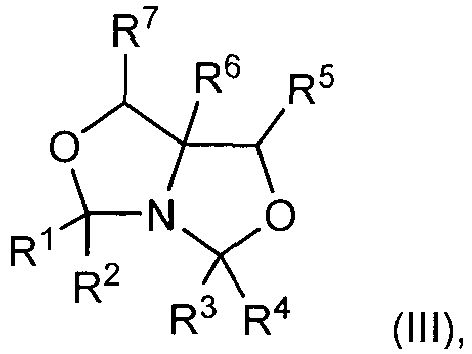
- Kombination nach Anspruch 2, dadurch gekennzeichnet, dass R2, R4, R5, R6, R7 Wasserstoff bedeuten und R1 und R3 jeweils einen C5-24-Kohlenwasserstoffrest bedeuten.
- Kombination nach einem der Ansprüche 1 bis 3, dadurch gekennzeichnet, dass die Duftstoffaldehyde und die Duftstoffketone ausgewählt sind aus den Jasmonen, lononen, Damasconen und Damascenonen, Menthon, Carvon, Iso-E-Super, Methylheptenon, Melonal, Cymal, Ethylvanillin, Helional, Hydroxycitronellal, Koavon, Methyl-nonyl-acetaldehyd, Phenylacetaldehyd, Undecylenaldehyd, 3-Dodecen-1-al, alpha-n-Amylzimtaldehyd, Benzaldehyd, 3-(4-tert-Butylphenyl)-propanal, 2-Methyl-3-(para-methoxyphenylpropanal), 2-Methyl-4-(2,6,6-trimethyl-2(1)-cyclohexen-1-yl)butanal, 3-Phenyl-2-propenal, cis-/trans-3,7-Dimethyl-2,6-octadien-I-al, 3,7-Dimethyl-6-octen-I-al, [(3,7-Dimethyl-6-octenyl)oxy]acetaldehyd, 4-Iso-propylbenzyaldehyd, 2,4-Dimethyl-3-cyclohexen-1-carboxyaldehyd, 2-Methyl-3-(isopropylphenyl)propanal, Decylaldehyd, 2,6-Dimethyl-5-heptenal, alpha-n-Hexylzimtaldehyd, 7-Hydroxy-3,7-dimethyloctanal, Undecenal, 2,4,6-Trimethyl-3-cyclohexene-I-carboxaldehyd, 1-Dodecanal, 2,4-Dimethylcyclohexene-3-carboxaldehyd, 4-(4-Hydroxy-4-methyl pentyl)-3-cylohexene-I-carboxaldehyd, 2-Methyl undecanal, 2-Methyldecanal, 1-nonanal, 1-Octanal, 2,6,10-Trimethyl-5,9-undecadienal, 2-Methyl-3-(4-tertbutyl)propanal, Dihydrozimtaldehyd, 3,7-Dimethyloctan-1-al, 1-Undecanal, 10-Undecen-1-al, 4-Hydroxy-3-methoxybenzaldehyd, trans-4-decenal, 2,6-Nonadienal, para-Tolylacetaldehyd, 3,7-Dimethyl-2-methylene-6-octenal, 2-Methyloctanal, alpha-Methyl-4-(1-methylethyl)benzeneacetaldehyd, 2-methyl-3-phenyl-2-propen-1-al, 3,5,5-Trimethylhexanal, 3-Propyl-bicyclo[2.2.1]hept-5-ene-2-carbaldehyd, 9-Decenal, 3-Methyl-5-phenyl-1-pentanal, Methylnonylacetaldehyd, Citral, 1-Decanal, Florhydral, 2,4-Dimethyl-3-cyclohexen-1-carboxaldehyd, Heliotropin und Mischungen daraus.
- Kombination gemäß einem der Ansprüche 1 bis 4, dadurch gekennzeichnet, dass der Duftstoffaldehyd und/oder das Duftstoffketon zumindest teilweise unter Ringschluss mit der Aminoalkohol-Verbindung der allgemeinen Formel (I) zu einer Verbindung der allgemeinen Formel (IV)

- Kombination gemäß einem der Ansprüche 1 bis 5, dadurch gekennzeichnet, dass ein Teil der Reste R der allgemeinen Formel (II), vorzugsweise mindestens 5 mol-% der Reste R ausgewählt sind aus der Gruppe Methyl, Ethyl, n-Propyl, iso-Propyl, n-Butyl, iso-Butyl und tert-Butyl.
- Kombination gemäß einem der Ansprüche 1 bis 6, dadurch gekennzeichnet, dass n Werte aus dem Bereich von 2 bis 50, vorzugsweise aus dem Bereich von 2 bis 20 und insbesondere aus dem Bereich von 3 bis 10 unter besonderer Bevorzugung der Werte 4, 5, 6, 7 und 8, annimmt.
- Verwendung der Kombination nach einem der Ansprüche 1 bis 7 als Duftstoffvorläufer.
- Verwendung nach Anspruch 8, dadurch gekennzeichnet, dass die Kombination zusammen mit anderen Duftstoffen eingesetzt wird.
- Wasch- oder Reinigungsmittel, Weichspüler oder Kosmetika, enthaltend eine Kombination aus(a) einer Aminoalkohol-Verbindung der allgemeinen Formel (I)
 (b) einem Duftstoffaldehyd und/oder Duftstoffketon und(c) einem Kieselsäureester der allgemeinen Formel (II):
wobei mindestens 10 mol-%, vorzugsweise mindestens 20 mol-% und insbesondere bevorzugt sogar mehr als 40 mol-% der Reste R der allgemeinen Formel (II) ausgewählt sind aus der Gruppe bestehend aus den Resten der Duftstoffalkohole 10-Undecen-1-ol, 2,6-Dimethylheptan-2-ol, 2-Methylbutanol, 2-Methylpentanol, 2-Phenoxyethanol, 2-Phenylpropanol, 2-tert-Butyl-cyclohexanol, 3,5,5-Trimethylcyclohexanol, 3-Hexanol, 3-Methyl-5-phenylpentanol, 3-Octanol, 3-Phenylpropanol, 4-Heptenol, 4-Isopropylcyclohexanol, 4-tert-Butylcyclohexanol, 6,8-Dimethyl-2-nonanol, 6-Nonen-1-ol, 9-Decen-1-ol, alpha-Methylbenzylalkohol, alpha-Terpineol, Amylsalicylat, Benzylalkohol, Benzylsalicylat, beta-Terpineol, Butylsalicylat, Citronellol, Cyclohexylsalicylat, Decanol, Dihydromyrcenol, Dimethylbenzylcarbinol, Dimethylheptanol, Dimethyloctanol, Ethylsalicylat, Ethylvanillin, Eugenol, Farnesol, Geraniol, Heptanol, Hexylsalicylat, Isoborneol, Isoeugenol, Isopulegol, Linalool, Menthol, Myrtenol, n-Hexanol, Nerol, Nonanol, Octanol, p-Menthan-7-ol, Phenylethylalkohol, Phenol, Phenylsalicylat, Tetrahydrogeraniol, Tetrahydrolinalool, Thymol, trans-2-cis-6-Nonadicnol, trans-2-Nonen-1-ol, trans-2-Octenol, Undecanol, Vanillin, Zimtalkohol und Mischungen daraus. - Verfahren zur Verlängerung des Duftempfindens von Wasch- oder Reinigungsmitteln, Weichspülern oder Kosmetika oder mit diesen behandelten festen Oberflächen, dadurch gekennzeichnet, dass man den Wasch- oder Reinigungsmitteln, Weichspülern oder Kosmetika die Kombination nach einem der Ansprüche 1 bis 7 zusetzt, wobei der Duftstoff durch Hydrolyse wieder freigesetzt wird.
- Verfahren zum Abbau von Schlechtgerüchen durch Einsatz einer Kombination aus(a) einer Aminoalkohol-Verbindung der allgemeinen Formel (I)
 (b) einem Duftstoffaldehyd und/oder Duftstoffketon und(c) einem Kieselsäureester der allgemeinen Formel (II):
wobei mindestens 10 mol-%, vorzugsweise mindestens 20 mol-% und insbesondere bevorzugt sogar mehr als 40 mol-% der Reste R der allgemeinen Formel (II) ausgewählt sind aus der Gruppe bestehend aus den Resten der Duftstoffalkohole 10-Undecen-1-ol, 2,6-Dimethylheptan-2-ol, 2-Methylbutanol, 2-Methylpentanol, 2-Phenoxyethanol, 2-Phenylpropanol, 2-tert-Butyl-cyclohexanol, 3,5,5-Trimethylcyclohexanol, 3-Hexanol, 3-Methyl-5-phenylpentanol, 3-Octanol, 3-Phenylpropanol, 4-Heptenol, 4-Isopropylcyclohexanol, 4-tert-Butylcyclohexanol, 6,8-Dimethyl-2-nonanol, 6-Nonen-1-ol, 9-Decen-1-ol, alpha-Methylbenzylalkohol, alpha-Terpineol, Amylsalicylat, Benzylalkohol, Benzylsalicylat, beta-Terpineol, Butylsalicylat, Citronellol, Cyclohexylsalicylat, Decanol, Dihydromyrcenol, Dimethylbenzylcarbinol, Dimethylheptanol, Dimethyloctanol, Ethylsalicylat, Ethylvanillin, Eugenol, Farnesol, Geraniol, Heptanol, Hexylsalicylat, Isoborneol, Isoeugenol, Isopulegol, Linalool, Menthol, Myrtenol, n-Hexanol, Nerol, Nonanol, Octanol, p-Menthan-7-ol, Phenylethylalkohol, Phenol, Phenylsalicylat, Tetrahydrogeraniol, Tetrahydrolinalool, Thymol, trans-2-cis-6-Nonadicnol, trans-2-Nonen-1-ol, trans-2-Octenol, Undecanol, Vanillin, Zimtalkohol und Mischungen daraus.
Priority Applications (1)
| Application Number | Priority Date | Filing Date | Title |
|---|---|---|---|
| PL13700520T PL2809756T3 (pl) | 2012-02-01 | 2013-01-09 | Kompozycja z aminoalkoholu, substancji zapachowej i estru kwasu krzemowego oraz jej zastosowanie jako prekursora substancji zapachowej |
Applications Claiming Priority (2)
| Application Number | Priority Date | Filing Date | Title |
|---|---|---|---|
| DE102012201422A DE102012201422A1 (de) | 2012-02-01 | 2012-02-01 | Kombination aus Aminoalkohol, Duftstoff und Kieselsäureester und ihre Verwendung als Duftstoffvorläufer |
| PCT/EP2013/050245 WO2013113533A1 (de) | 2012-02-01 | 2013-01-09 | Kombination aus aminoalkohol, duftstoff und kieselsäureester und ihre verwendung als duftstoffvorläufer |
Publications (2)
| Publication Number | Publication Date |
|---|---|
| EP2809756A1 EP2809756A1 (de) | 2014-12-10 |
| EP2809756B1 true EP2809756B1 (de) | 2017-04-05 |
Family
ID=47563465
Family Applications (1)
| Application Number | Title | Priority Date | Filing Date |
|---|---|---|---|
| EP13700520.3A Active EP2809756B1 (de) | 2012-02-01 | 2013-01-09 | Kombination aus aminoalkohol, duftstoff und kieselsäureester und ihre verwendung als duftstoffvorläufer |
Country Status (9)
| Country | Link |
|---|---|
| US (1) | US9587206B2 (de) |
| EP (1) | EP2809756B1 (de) |
| KR (1) | KR20150001723A (de) |
| DE (1) | DE102012201422A1 (de) |
| ES (1) | ES2628300T3 (de) |
| HU (1) | HUE034648T2 (de) |
| MX (1) | MX351371B (de) |
| PL (1) | PL2809756T3 (de) |
| WO (1) | WO2013113533A1 (de) |
Families Citing this family (11)
| Publication number | Priority date | Publication date | Assignee | Title |
|---|---|---|---|---|
| BR112017007027B1 (pt) * | 2014-11-10 | 2022-02-22 | Givaudan Sa | Precursor de fragrância, uso de um precursor de fragrância, composição de perfume,composição de cuidado pessoal ou de casa e método de obtenção do odor muguet em umacomposição de perfume |
| WO2016074697A1 (en) * | 2014-11-10 | 2016-05-19 | Givaudan Sa | Improvements in or relating to organic compounds |
| RU2662197C1 (ru) * | 2014-11-10 | 2018-07-24 | Живодан Са | Усовершенствование органических соединений или усовершенствование, относящееся к органическим соединениям |
| DE102016208619A1 (de) * | 2016-05-19 | 2017-11-23 | Henkel Ag & Co. Kgaa | Zusammensetzung zur Entfernung von Schlechtgerüchen |
| EP3266861A1 (de) * | 2016-07-08 | 2018-01-10 | The Procter & Gamble Company | Flüssige reinigungsmittelzusammensetzung |
| CN110809622B (zh) * | 2017-06-19 | 2024-05-24 | 西姆莱斯有限公司 | 新型的龙涎香类和/或吲哚类的芳香剂组合物 |
| JP7579330B2 (ja) | 2019-09-09 | 2024-11-07 | ダウ シリコーンズ コーポレーション | アルコキシ官能性有機ケイ素化合物を調製する方法 |
| US20230099941A1 (en) | 2020-02-19 | 2023-03-30 | Henkel Ag & Co. Kgaa | Bad-odor control using encapsulation technologies containing a neutralizing agent |
| KR102147245B1 (ko) | 2020-03-03 | 2020-08-25 | 주식회사 다원체어스 | 의자의 가방걸이 장착 구조 |
| WO2022125359A1 (en) | 2020-12-11 | 2022-06-16 | Dow Silicones Corporation | Functional substance releasing agent |
| USD1004315S1 (en) | 2021-07-19 | 2023-11-14 | Gary Platt Manufacturing, Llc | Chair |
Family Cites Families (9)
| Publication number | Priority date | Publication date | Assignee | Title |
|---|---|---|---|---|
| DE19841147A1 (de) | 1998-09-09 | 2000-03-16 | Henkel Kgaa | Kiselsäureester |
| DE10012949A1 (de) * | 2000-03-16 | 2001-09-27 | Henkel Kgaa | Kieselsäureester-Mischungen |
| US20060251597A1 (en) * | 2005-05-04 | 2006-11-09 | Yu Ruey J | Anti-odor compositions and therapeutic use |
| DE102006003092A1 (de) | 2006-01-20 | 2007-07-26 | Henkel Kgaa | 1-Aza-3,7-dioxabicyclo[3.3.0]octan-Verbindungen und ihre Verwendung als Pro-Fragrances |
| DE102007012909A1 (de) | 2007-03-19 | 2008-09-25 | Momentive Performance Materials Gmbh | Mit Duftstoffen modifizierte, reaktive Polyorganosiloxane |
| ATE549391T1 (de) * | 2007-04-27 | 2012-03-15 | Dial Corp | Verfahren zur behandlung eines stoffs in einem trockner |
| DE102009026856A1 (de) * | 2009-06-09 | 2010-12-16 | Henkel Ag & Co. Kgaa | Verfahren zur Verminderung von Schlechtgerüchen |
| DE102009026854A1 (de) * | 2009-06-09 | 2010-12-16 | Henkel Ag & Co. Kgaa | Duftgebendes Wasch-, Reinigungs- oder Pflegemittel |
| DE102010002106A1 (de) * | 2010-02-18 | 2011-08-18 | Henkel AG & Co. KGaA, 40589 | Stabilisierte Parfümöle |
-
2012
- 2012-02-01 DE DE102012201422A patent/DE102012201422A1/de not_active Withdrawn
-
2013
- 2013-01-09 MX MX2014009269A patent/MX351371B/es active IP Right Grant
- 2013-01-09 KR KR1020147023990A patent/KR20150001723A/ko not_active Ceased
- 2013-01-09 EP EP13700520.3A patent/EP2809756B1/de active Active
- 2013-01-09 PL PL13700520T patent/PL2809756T3/pl unknown
- 2013-01-09 WO PCT/EP2013/050245 patent/WO2013113533A1/de not_active Ceased
- 2013-01-09 HU HUE13700520A patent/HUE034648T2/en unknown
- 2013-01-09 ES ES13700520.3T patent/ES2628300T3/es active Active
-
2014
- 2014-07-10 US US14/327,795 patent/US9587206B2/en active Active
Non-Patent Citations (1)
| Title |
|---|
| None * |
Also Published As
| Publication number | Publication date |
|---|---|
| KR20150001723A (ko) | 2015-01-06 |
| WO2013113533A1 (de) | 2013-08-08 |
| HUE034648T2 (en) | 2018-02-28 |
| PL2809756T3 (pl) | 2017-08-31 |
| MX351371B (es) | 2017-10-12 |
| US20140323375A1 (en) | 2014-10-30 |
| US9587206B2 (en) | 2017-03-07 |
| EP2809756A1 (de) | 2014-12-10 |
| ES2628300T3 (es) | 2017-08-02 |
| MX2014009269A (es) | 2014-09-22 |
| DE102012201422A1 (de) | 2013-08-01 |
Similar Documents
| Publication | Publication Date | Title |
|---|---|---|
| EP2809756B1 (de) | Kombination aus aminoalkohol, duftstoff und kieselsäureester und ihre verwendung als duftstoffvorläufer | |
| EP2364186B1 (de) | Photolabile duftspeicherstoffe | |
| EP2809761B1 (de) | Kombinationen aus 1-aza-3,7-dioxabicyclo[3.3.0]octan-verbindungen und kieselsäureestern und ihre verwendung als duftstoffvorläufer | |
| DE102017218991A1 (de) | Feste parfümhaltige Zusammensetzung | |
| EP3701005B1 (de) | Feste parfümhaltige zusammensetzung | |
| WO2021164964A1 (de) | Textilbehandlungsmittel | |
| DE102018211691A1 (de) | Herstellung parfümhaltiger Formkörper | |
| EP4004172B1 (de) | Parfümhaltiger formkörper | |
| EP4004170B1 (de) | Aktivstoffhaltige formkörper und verfahren zu deren herstellung | |
| EP3824060B1 (de) | Verfahren zur herstellung einer festen parfümhaltigen zusammensetzung | |
| EP4106822B1 (de) | Zusammensetzung, enthaltend mikoverkapselte schlechtgeruchsbekämpfufngsmittel und ihre verwendung zur verminderung von fehlgerüchen | |
| DE102016219295A1 (de) | Kontinuierliches Verfahren zur Herstellung parfümhaltiger Schmelzkörper | |
| EP3692047A1 (de) | Hydrolyselabile silylenolether von riechstoffketonen oder -aldehyden | |
| DE102017218992A1 (de) | Feste parfümhaltige Zusammensetzung | |
| DE102017203505A1 (de) | Parfümhaltige Schmelzkörper enthaltend EO/PO-Block-Copolymere | |
| EP3360951B1 (de) | Zusammensetzung enthaltend parfumöl und parfümkapseln | |
| DE102012223423A1 (de) | Wasch-, Reinigungs- oder Pflegemittel enthaltend Duftpartikel | |
| DE102019133688A1 (de) | Kontrollierte riechstofffreisetzung von carbonylverbindungen aus amino-substituierten kohlenhydrat-vorläufern | |
| DE102019111844A1 (de) | Hitz-Aktivierte Parfums I | |
| EP3713921A1 (de) | Hydrolyselabile heterocyclen von riechstoffketonen oder -aldehyden | |
| DE102017124612A1 (de) | Hydrolyselabile Dienolsilylether von Riechstoffketonen oder -aldehyden | |
| DE102017221902A1 (de) | Feste parfümhaltige Zusammensetzung | |
| DE102017218987A1 (de) | Feste parfümhaltige Zusammensetzung | |
| DE102017220086A1 (de) | Verfahren zur Herstellung eines flüssigen Wasch- oder Reinigungsmittels, enthaltend Salz und Polymer |
Legal Events
| Date | Code | Title | Description |
|---|---|---|---|
| PUAI | Public reference made under article 153(3) epc to a published international application that has entered the european phase |
Free format text: ORIGINAL CODE: 0009012 |
|
| 17P | Request for examination filed |
Effective date: 20140305 |
|
| AK | Designated contracting states |
Kind code of ref document: A1 Designated state(s): AL AT BE BG CH CY CZ DE DK EE ES FI FR GB GR HR HU IE IS IT LI LT LU LV MC MK MT NL NO PL PT RO RS SE SI SK SM TR |
|
| AX | Request for extension of the european patent |
Extension state: BA ME |
|
| DAX | Request for extension of the european patent (deleted) | ||
| RIC1 | Information provided on ipc code assigned before grant |
Ipc: C11D 3/50 20060101ALI20160920BHEP Ipc: C11B 9/00 20060101AFI20160920BHEP Ipc: A61Q 13/00 20060101ALI20160920BHEP Ipc: A61K 8/58 20060101ALI20160920BHEP Ipc: A61L 9/01 20060101ALI20160920BHEP Ipc: A61Q 19/00 20060101ALI20160920BHEP Ipc: A61K 8/41 20060101ALI20160920BHEP |
|
| GRAP | Despatch of communication of intention to grant a patent |
Free format text: ORIGINAL CODE: EPIDOSNIGR1 |
|
| INTG | Intention to grant announced |
Effective date: 20161115 |
|
| GRAS | Grant fee paid |
Free format text: ORIGINAL CODE: EPIDOSNIGR3 |
|
| GRAA | (expected) grant |
Free format text: ORIGINAL CODE: 0009210 |
|
| AK | Designated contracting states |
Kind code of ref document: B1 Designated state(s): AL AT BE BG CH CY CZ DE DK EE ES FI FR GB GR HR HU IE IS IT LI LT LU LV MC MK MT NL NO PL PT RO RS SE SI SK SM TR |
|
| REG | Reference to a national code |
Ref country code: GB Ref legal event code: FG4D Free format text: NOT ENGLISH |
|
| REG | Reference to a national code |
Ref country code: CH Ref legal event code: EP |
|
| REG | Reference to a national code |
Ref country code: AT Ref legal event code: REF Ref document number: 881846 Country of ref document: AT Kind code of ref document: T Effective date: 20170415 |
|
| REG | Reference to a national code |
Ref country code: IE Ref legal event code: FG4D Free format text: LANGUAGE OF EP DOCUMENT: GERMAN |
|
| REG | Reference to a national code |
Ref country code: DE Ref legal event code: R096 Ref document number: 502013006869 Country of ref document: DE |
|
| REG | Reference to a national code |
Ref country code: ES Ref legal event code: FG2A Ref document number: 2628300 Country of ref document: ES Kind code of ref document: T3 Effective date: 20170802 |
|
| REG | Reference to a national code |
Ref country code: NL Ref legal event code: MP Effective date: 20170405 |
|
| REG | Reference to a national code |
Ref country code: LT Ref legal event code: MG4D |
|
| PG25 | Lapsed in a contracting state [announced via postgrant information from national office to epo] |
Ref country code: NL Free format text: LAPSE BECAUSE OF FAILURE TO SUBMIT A TRANSLATION OF THE DESCRIPTION OR TO PAY THE FEE WITHIN THE PRESCRIBED TIME-LIMIT Effective date: 20170405 |
|
| PG25 | Lapsed in a contracting state [announced via postgrant information from national office to epo] |
Ref country code: LT Free format text: LAPSE BECAUSE OF FAILURE TO SUBMIT A TRANSLATION OF THE DESCRIPTION OR TO PAY THE FEE WITHIN THE PRESCRIBED TIME-LIMIT Effective date: 20170405 Ref country code: HR Free format text: LAPSE BECAUSE OF FAILURE TO SUBMIT A TRANSLATION OF THE DESCRIPTION OR TO PAY THE FEE WITHIN THE PRESCRIBED TIME-LIMIT Effective date: 20170405 Ref country code: NO Free format text: LAPSE BECAUSE OF FAILURE TO SUBMIT A TRANSLATION OF THE DESCRIPTION OR TO PAY THE FEE WITHIN THE PRESCRIBED TIME-LIMIT Effective date: 20170705 Ref country code: GR Free format text: LAPSE BECAUSE OF FAILURE TO SUBMIT A TRANSLATION OF THE DESCRIPTION OR TO PAY THE FEE WITHIN THE PRESCRIBED TIME-LIMIT Effective date: 20170706 Ref country code: FI Free format text: LAPSE BECAUSE OF FAILURE TO SUBMIT A TRANSLATION OF THE DESCRIPTION OR TO PAY THE FEE WITHIN THE PRESCRIBED TIME-LIMIT Effective date: 20170405 |
|
| PG25 | Lapsed in a contracting state [announced via postgrant information from national office to epo] |
Ref country code: BG Free format text: LAPSE BECAUSE OF FAILURE TO SUBMIT A TRANSLATION OF THE DESCRIPTION OR TO PAY THE FEE WITHIN THE PRESCRIBED TIME-LIMIT Effective date: 20170705 Ref country code: LV Free format text: LAPSE BECAUSE OF FAILURE TO SUBMIT A TRANSLATION OF THE DESCRIPTION OR TO PAY THE FEE WITHIN THE PRESCRIBED TIME-LIMIT Effective date: 20170405 Ref country code: SE Free format text: LAPSE BECAUSE OF FAILURE TO SUBMIT A TRANSLATION OF THE DESCRIPTION OR TO PAY THE FEE WITHIN THE PRESCRIBED TIME-LIMIT Effective date: 20170405 Ref country code: RS Free format text: LAPSE BECAUSE OF FAILURE TO SUBMIT A TRANSLATION OF THE DESCRIPTION OR TO PAY THE FEE WITHIN THE PRESCRIBED TIME-LIMIT Effective date: 20170405 Ref country code: IS Free format text: LAPSE BECAUSE OF FAILURE TO SUBMIT A TRANSLATION OF THE DESCRIPTION OR TO PAY THE FEE WITHIN THE PRESCRIBED TIME-LIMIT Effective date: 20170805 |
|
| REG | Reference to a national code |
Ref country code: DE Ref legal event code: R097 Ref document number: 502013006869 Country of ref document: DE |
|
| REG | Reference to a national code |
Ref country code: FR Ref legal event code: PLFP Year of fee payment: 6 |
|
| PG25 | Lapsed in a contracting state [announced via postgrant information from national office to epo] |
Ref country code: SK Free format text: LAPSE BECAUSE OF FAILURE TO SUBMIT A TRANSLATION OF THE DESCRIPTION OR TO PAY THE FEE WITHIN THE PRESCRIBED TIME-LIMIT Effective date: 20170405 Ref country code: EE Free format text: LAPSE BECAUSE OF FAILURE TO SUBMIT A TRANSLATION OF THE DESCRIPTION OR TO PAY THE FEE WITHIN THE PRESCRIBED TIME-LIMIT Effective date: 20170405 Ref country code: RO Free format text: LAPSE BECAUSE OF FAILURE TO SUBMIT A TRANSLATION OF THE DESCRIPTION OR TO PAY THE FEE WITHIN THE PRESCRIBED TIME-LIMIT Effective date: 20170405 Ref country code: DK Free format text: LAPSE BECAUSE OF FAILURE TO SUBMIT A TRANSLATION OF THE DESCRIPTION OR TO PAY THE FEE WITHIN THE PRESCRIBED TIME-LIMIT Effective date: 20170405 |
|
| PLBE | No opposition filed within time limit |
Free format text: ORIGINAL CODE: 0009261 |
|
| STAA | Information on the status of an ep patent application or granted ep patent |
Free format text: STATUS: NO OPPOSITION FILED WITHIN TIME LIMIT |
|
| PG25 | Lapsed in a contracting state [announced via postgrant information from national office to epo] |
Ref country code: SM Free format text: LAPSE BECAUSE OF FAILURE TO SUBMIT A TRANSLATION OF THE DESCRIPTION OR TO PAY THE FEE WITHIN THE PRESCRIBED TIME-LIMIT Effective date: 20170405 |
|
| REG | Reference to a national code |
Ref country code: HU Ref legal event code: AG4A Ref document number: E034648 Country of ref document: HU |
|
| 26N | No opposition filed |
Effective date: 20180108 |
|
| PG25 | Lapsed in a contracting state [announced via postgrant information from national office to epo] |
Ref country code: SI Free format text: LAPSE BECAUSE OF FAILURE TO SUBMIT A TRANSLATION OF THE DESCRIPTION OR TO PAY THE FEE WITHIN THE PRESCRIBED TIME-LIMIT Effective date: 20170405 |
|
| PGFP | Annual fee paid to national office [announced via postgrant information from national office to epo] |
Ref country code: HU Payment date: 20180125 Year of fee payment: 6 |
|
| REG | Reference to a national code |
Ref country code: CH Ref legal event code: PL |
|
| PG25 | Lapsed in a contracting state [announced via postgrant information from national office to epo] |
Ref country code: MT Free format text: LAPSE BECAUSE OF FAILURE TO SUBMIT A TRANSLATION OF THE DESCRIPTION OR TO PAY THE FEE WITHIN THE PRESCRIBED TIME-LIMIT Effective date: 20170405 |
|
| PG25 | Lapsed in a contracting state [announced via postgrant information from national office to epo] |
Ref country code: LU Free format text: LAPSE BECAUSE OF NON-PAYMENT OF DUE FEES Effective date: 20180109 |
|
| REG | Reference to a national code |
Ref country code: IE Ref legal event code: MM4A |
|
| REG | Reference to a national code |
Ref country code: BE Ref legal event code: MM Effective date: 20180131 |
|
| PG25 | Lapsed in a contracting state [announced via postgrant information from national office to epo] |
Ref country code: LI Free format text: LAPSE BECAUSE OF NON-PAYMENT OF DUE FEES Effective date: 20180131 Ref country code: CH Free format text: LAPSE BECAUSE OF NON-PAYMENT OF DUE FEES Effective date: 20180131 Ref country code: BE Free format text: LAPSE BECAUSE OF NON-PAYMENT OF DUE FEES Effective date: 20180131 |
|
| PG25 | Lapsed in a contracting state [announced via postgrant information from national office to epo] |
Ref country code: IE Free format text: LAPSE BECAUSE OF NON-PAYMENT OF DUE FEES Effective date: 20180109 |
|
| REG | Reference to a national code |
Ref country code: AT Ref legal event code: MM01 Ref document number: 881846 Country of ref document: AT Kind code of ref document: T Effective date: 20180109 |
|
| PG25 | Lapsed in a contracting state [announced via postgrant information from national office to epo] |
Ref country code: AT Free format text: LAPSE BECAUSE OF NON-PAYMENT OF DUE FEES Effective date: 20180109 |
|
| PG25 | Lapsed in a contracting state [announced via postgrant information from national office to epo] |
Ref country code: MC Free format text: LAPSE BECAUSE OF FAILURE TO SUBMIT A TRANSLATION OF THE DESCRIPTION OR TO PAY THE FEE WITHIN THE PRESCRIBED TIME-LIMIT Effective date: 20170405 |
|
| PG25 | Lapsed in a contracting state [announced via postgrant information from national office to epo] |
Ref country code: HU Free format text: LAPSE BECAUSE OF NON-PAYMENT OF DUE FEES Effective date: 20190110 |
|
| PG25 | Lapsed in a contracting state [announced via postgrant information from national office to epo] |
Ref country code: PT Free format text: LAPSE BECAUSE OF FAILURE TO SUBMIT A TRANSLATION OF THE DESCRIPTION OR TO PAY THE FEE WITHIN THE PRESCRIBED TIME-LIMIT Effective date: 20170405 |
|
| PG25 | Lapsed in a contracting state [announced via postgrant information from national office to epo] |
Ref country code: MK Free format text: LAPSE BECAUSE OF NON-PAYMENT OF DUE FEES Effective date: 20170405 Ref country code: CY Free format text: LAPSE BECAUSE OF FAILURE TO SUBMIT A TRANSLATION OF THE DESCRIPTION OR TO PAY THE FEE WITHIN THE PRESCRIBED TIME-LIMIT Effective date: 20170405 |
|
| PG25 | Lapsed in a contracting state [announced via postgrant information from national office to epo] |
Ref country code: AL Free format text: LAPSE BECAUSE OF FAILURE TO SUBMIT A TRANSLATION OF THE DESCRIPTION OR TO PAY THE FEE WITHIN THE PRESCRIBED TIME-LIMIT Effective date: 20170405 |
|
| P01 | Opt-out of the competence of the unified patent court (upc) registered |
Effective date: 20230530 |
|
| PGFP | Annual fee paid to national office [announced via postgrant information from national office to epo] |
Ref country code: PL Payment date: 20251231 Year of fee payment: 14 |
|
| PGFP | Annual fee paid to national office [announced via postgrant information from national office to epo] |
Ref country code: GB Payment date: 20260123 Year of fee payment: 14 |
|
| PGFP | Annual fee paid to national office [announced via postgrant information from national office to epo] |
Ref country code: ES Payment date: 20260227 Year of fee payment: 14 |
|
| PGFP | Annual fee paid to national office [announced via postgrant information from national office to epo] |
Ref country code: DE Payment date: 20260121 Year of fee payment: 14 |
|
| PGFP | Annual fee paid to national office [announced via postgrant information from national office to epo] |
Ref country code: IT Payment date: 20260126 Year of fee payment: 14 |
|
| PGFP | Annual fee paid to national office [announced via postgrant information from national office to epo] |
Ref country code: FR Payment date: 20260123 Year of fee payment: 14 |
|
| PGFP | Annual fee paid to national office [announced via postgrant information from national office to epo] |
Ref country code: TR Payment date: 20260108 Year of fee payment: 14 |
|
| PGFP | Annual fee paid to national office [announced via postgrant information from national office to epo] |
Ref country code: CZ Payment date: 20260102 Year of fee payment: 14 |