EP2812766B2 - Procédé de déclenchement automatique d'une auto-localisation - Google Patents
Procédé de déclenchement automatique d'une auto-localisation Download PDFInfo
- Publication number
- EP2812766B2 EP2812766B2 EP13713066.2A EP13713066A EP2812766B2 EP 2812766 B2 EP2812766 B2 EP 2812766B2 EP 13713066 A EP13713066 A EP 13713066A EP 2812766 B2 EP2812766 B2 EP 2812766B2
- Authority
- EP
- European Patent Office
- Prior art keywords
- robot
- module
- map
- localization
- displacement
- Prior art date
- Legal status (The legal status is an assumption and is not a legal conclusion. Google has not performed a legal analysis and makes no representation as to the accuracy of the status listed.)
- Active
Links
Images

Classifications
-
- G—PHYSICS
- G05—CONTROLLING; REGULATING
- G05D—SYSTEMS FOR CONTROLLING OR REGULATING NON-ELECTRIC VARIABLES
- G05D1/00—Control of position, course, altitude or attitude of land, water, air or space vehicles, e.g. using automatic pilots
- G05D1/02—Control of position or course in two dimensions
- G05D1/021—Control of position or course in two dimensions specially adapted to land vehicles
- G05D1/0268—Control of position or course in two dimensions specially adapted to land vehicles using internal positioning means
- G05D1/0274—Control of position or course in two dimensions specially adapted to land vehicles using internal positioning means using mapping information stored in a memory device
-
- B—PERFORMING OPERATIONS; TRANSPORTING
- B25—HAND TOOLS; PORTABLE POWER-DRIVEN TOOLS; MANIPULATORS
- B25J—MANIPULATORS; CHAMBERS PROVIDED WITH MANIPULATION DEVICES
- B25J9/00—Program-controlled manipulators
- B25J9/16—Program controls
- B25J9/1679—Program controls characterised by the tasks executed
- B25J9/1692—Calibration of manipulator
-
- B—PERFORMING OPERATIONS; TRANSPORTING
- B25—HAND TOOLS; PORTABLE POWER-DRIVEN TOOLS; MANIPULATORS
- B25J—MANIPULATORS; CHAMBERS PROVIDED WITH MANIPULATION DEVICES
- B25J11/00—Manipulators not otherwise provided for
- B25J11/008—Manipulators for service tasks
- B25J11/0085—Cleaning
-
- B—PERFORMING OPERATIONS; TRANSPORTING
- B25—HAND TOOLS; PORTABLE POWER-DRIVEN TOOLS; MANIPULATORS
- B25J—MANIPULATORS; CHAMBERS PROVIDED WITH MANIPULATION DEVICES
- B25J5/00—Manipulators mounted on wheels or on carriages
-
- B—PERFORMING OPERATIONS; TRANSPORTING
- B25—HAND TOOLS; PORTABLE POWER-DRIVEN TOOLS; MANIPULATORS
- B25J—MANIPULATORS; CHAMBERS PROVIDED WITH MANIPULATION DEVICES
- B25J9/00—Program-controlled manipulators
- B25J9/16—Program controls
- B25J9/1656—Program controls characterised by programming, planning systems for manipulators
- B25J9/1664—Program controls characterised by programming, planning systems for manipulators characterised by motion, path, trajectory planning
-
- Y—GENERAL TAGGING OF NEW TECHNOLOGICAL DEVELOPMENTS; GENERAL TAGGING OF CROSS-SECTIONAL TECHNOLOGIES SPANNING OVER SEVERAL SECTIONS OF THE IPC; TECHNICAL SUBJECTS COVERED BY FORMER USPC CROSS-REFERENCE ART COLLECTIONS [XRACs] AND DIGESTS
- Y10—TECHNICAL SUBJECTS COVERED BY FORMER USPC
- Y10S—TECHNICAL SUBJECTS COVERED BY FORMER USPC CROSS-REFERENCE ART COLLECTIONS [XRACs] AND DIGESTS
- Y10S901/00—Robots
- Y10S901/01—Mobile robot
Definitions
- the present description relates to a method for automatically triggering a self-localization, in particular an automatic global self-localization of a self-driving autonomous robot (e.g. robotic vacuum cleaners).
- a self-driving autonomous robot e.g. robotic vacuum cleaners
- the publication EP 2 256 574 A1 a technique for estimating one's own position and generating an environment map for an autonomous mobile robot.
- the publication US 2003/030398 A1 describes a service robot with a stored environment map, a task being assigned to at least one map segment.
- Jensfelt, P. Active Global Localization for a Mobile Robot Using Multiple Hypothesis Tracking, IEEE Trans. In Robotics and Automation, Vol. 17, No. 5, Oct. 5, 2001 , describes a propabilistic approach to localizing a mobile robot using an incomplete topological "world model”.
- DE 10 2007 010979 B3 describes a method for cleaning a floor surface by means of a robot vacuum.
- the described robot vacuum cleaner determines the degree of soiling of individual areas of the floor area on the basis of the amount of dust picked up there during cleaning and recorded by the sensor device, stores this and controls the processing intensity of an area in a subsequent processing cycle as a function of the stored amount of dust in this area measured amount of dust for updating can be combined with the existing data, for example by averaging or another mathematical link, which makes the system adaptive and self-learning. If the robot vacuum cleaner is moved to another room, a massive deviation of the new data from the old data is found after a short time. In this way, the control unit recognizes the change of room and reacts with a renewed learning run with a complete extraction with maximum blower output and brush speed.
- the publication US 2005/0182518 also relates to a vacuum robot that navigates using a Visual SLAM (VSLAM) method. Errors in the odometry of the robot can be corrected using a position estimate based on the (visual) detection of landmarks.
- VSLAM Visual SLAM
- More complex systems create a map of the environment for targeted path planning and targeted cleaning of the floor area using a SLAM algorithm
- SLAM Simultaneous Localization and Mapping
- a map and the position of the robot in the map are determined using external sensors (laser range scanner, triangulation using a camera and laser, touch sensors, etc.) and inertial sensors (odometric sensors, acceleration sensors, etc.).
- the card created is non-permanent, i.e. a new card is created for each new cleaning process (i.e. after a previous cleaning process has been completed).
- a self-localization which after a such a procedure can take a long time, depending on the size and number of cards available.
- the robot is partially deactivated for its actual task, e.g. moving to a target point, which delays the processing of the task.
- the object on which the invention is based is now to provide an autonomous robot which is to perform self-localization as far as possible, in particular only when it proves to be necessary, in order to save time and energy for the actual task processing.
- the robot has the following: a drive module for moving the robot over the floor surface, a processing module for carrying out the activities during a processing operation; at least one sensor module for acquiring information regarding the structure of the environment and / or regarding the floor area; a detector module which is designed to detect a displacement of the robot on the basis of sensor data before or during a machining operation; and a navigation module, which is designed to navigate the robot during the processing operation using a map of the environment over the floor area, to store and manage one or more maps of the environment, and to carry out self-localization when the detector module has detected a displacement of the robot , where self-localization - with or with only limited prior knowledge of the actual position of the robot relative to the map - detects whether and where the robot is within the stored maps, using the sensor data on the basis of which the detector module relocates the Robot detects, it is determined with what probability the robot is still on the same map as before the move.
- the method comprises: storing and managing at least one map of the surroundings; Starting the machining process and carrying out the activities with the aid of a machining module arranged on the robot; Navigating the robot over the floor area during the machining process using a map of the area; Acquiring information regarding the structure of the environment and / or regarding the floor area during the machining process by at least one sensor module arranged on or in the robot; Carrying out a self-localization if a detector module arranged on or in the robot detects on the basis of sensor data that the robot has been displaced, with self-localization being used to detect whether and where - without or with only limited prior knowledge of the actual position of the robot relative to the map the robot is inside the saved cards; Determine - on the basis of the sensor data on the basis of which the detector module detects the movement of the robot - with what probability the robot is still on the same map as before the
- the examples and technical features of the mobile robot described in connection with the processing of a floor area can also be transferred to a mobile robot for performing other or additional activities.
- the activities carried out by the described mobile robot can also include, for example, the processing of floor surfaces, the inspection of the floor surface or the surroundings, the transport of objects, the cleaning of air and / or the execution of entertainment games.
- a processing module, for example, is not absolutely necessary for sole use for inspection.
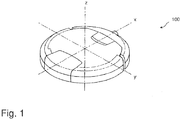
- Figure 1 shows an example of a schematic isometric representation of a self-driving robot 100 for autonomous cleaning of floor surfaces.
- the Figure 1 also shows a Cartesian coordinate system originating in the center of the robot 100. Such devices are often, but not necessarily, disc-shaped.
- the vertical axis z goes through the center of the disk.
- the longitudinal axis is labeled x and the transverse axis is labeled y.
- the robot 100 comprises a drive module (not shown), which can have, for example, electric motors, gears and wheels.
- the drive module can be designed, for example, to move the robot in the forward and backward direction (in the illustration from Fig. 1 that would be along the x axis) and to rotate around the vertical axis (in the illustration from Fig. 1 that would be the z axis).
- the robot can - theoretically - approach any point on a floor surface (which is parallel to the plane defined by the x-axis and y-axis).
- the robot further comprises a processing module, such as a cleaning module, which is designed to clean the floor area located below (and / or next to) the robot.
- dust and dirt particles are sucked into, or mechanically (or in some other way) conveyed into a collection container.
- Such robots are known as such and differ essentially in the type of navigation in the environment and the "strategy" that is used when processing the floor surface, such as during a cleaning process.
- Robots which do not require the creation or use of a card. Random navigation methods are generally used in such relatively simple systems. No location-related information, such as information relating to obstacles or orientation points, is stored and used again during the processing operations. In combination with local movement strategies, such robots usually change the direction of travel (accidentally) when they collide with an obstacle. In this way, floor areas in an area to be cleaned are partially cleaned several times, while other floor areas may not be cleaned at all.
- SLAM Simultaneous Localization and Mapping
- German simultaneous localization and map creation, see for example H. Durrant-Whyte and T. Bailey: Simultaneous Localization and Mapping (SLAM): Part I The Essential Algorithms, "in: IEEE Robotics and Automation Magazine, Vol. 13, No. 2, pp. 99-110, June 2006 ).
- This enables targeted navigation.
- the map and the position of the robot in the map can be determined using one or more sensors.
- a new card is created for each new cleaning process, so the cards are not permanent.
- Figure 2 shows an example of an autonomous robot 100 at a position A within an area G to be cleaned.
- the area G to be cleaned is subdivided into different rooms which are connected to one another by doors.
- Various types of objects hatchched areas can be found in the individual rooms. If the robot 100 ends a cleaning process at position A, for example, it usually stores this position. At the start of the next cleaning process, the robot 100 thus knows where it is located within the card used. However, this requires that the robot 100 start the next cleaning process from position A again.
- the robot 100 is moved to a different position B in the same room or a position C in another room of the area G to be cleaned before the next cleaning process, for example, the position A stored when the previous cleaning process is ended does not match the actual starting position B or C of the next cleaning process.
- a user could also move the robot 100 to another location B or C during a cleaning process, for example from position A '.
- the robot 100 would therefore have to continue the cleaning process that has already started from another position. If the robot 100 has stored several cards, for example one card for each floor of a building, it is also possible that the robot 100 is not only moved within one card, but from one card to another.
- Global self-localization means that the robot 100 locates itself autonomously in a permanent map, without or only with very limited prior knowledge of its actual position relative to the map.
- the robot 100 can start, for example, a new, temporary one To actively build up the map through new exploration ("Active Global Selflocalization").
- the robot 100 compares the new temporary card repeatedly with all the stored cards while it is still being set up, until sufficient security is achieved via successful or unsuccessful localization.
- the robot 100 autonomously determines global localization hypotheses in the stored maps. This means that he checks various criteria in order to be able to clearly assign the current location to a position on the map.
- the robot can, for example, determine in which direction and at what distance a door, walls or certain pieces of furniture are located. The number of possible positions can be restricted with each identified characteristic.
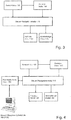
- FIG. 3 is a block diagram illustrating the schematic structure of an example of a robot according to the invention for autonomous processing (eg cleaning) of floor surfaces.
- a drive module 130 and a processing module 140 are shown, which have already been mentioned above. Both modules 130 and 140 are controlled by a control and navigation module 110.
- the navigation module is designed to navigate the robot over the floor area during a cleaning process using a map of the surroundings.
- the map is stored in a memory of the control and navigation module 110 in the form of map data.
- Different strategies for planning the target trajectory of the robot are known for navigating in the environment. In general, an attempt is made to cover the surface to be worked (for example, to be cleaned) as completely as possible with the shortest possible trajectory, in order to ensure surface-wide processing (for example, cleaning).
- the robot 100 further comprises a sensor module 120 for acquiring information regarding the structure of the environment and / or regarding the properties of the floor area.
- the sensor module can have one or more sensor units which are designed to acquire information, on the basis of which a map of the surroundings can be built up and the position of the robot on the map can be localized.
- Suitable sensors for this purpose are e.g. Laser range scanners, cameras, triangulation sensors, touch sensors to detect a collision with an obstacle, etc.
- a SLAM method can be used, as already described, to set up the card and to simultaneously position the robot within the card.
- the newly created (temporary) map and the permanent localization map corresponding to it can be meaningfully combined in order to update possible differences. For example, new objects may have been present during the localization, or previously existing objects may have been removed.
- the localization hypotheses should have a sufficiently high quality, that is, a minimum number of clear matches between the new and the stored map should have been found.
- the localization fails if a localization with a sufficiently high quality cannot be achieved.
- the robot 100 can, for example, generate a map of the current environment from the data obtained during the localization and save it as a new map. A map obtained in this way is also available for future cleaning processes.
- the robot 100 has, for example, a detector module 150.
- the detector module 150 can be designed as a separate module, but could also be integrated into the navigation module 110 or the sensor module 120, for example.
- the detector module 150 is designed to detect whether the robot 100 is being moved. This detection can be done in different ways.
- the robot 100 could detect a lifting and a subsequent resetting of the robot 100.
- the robot could, for example, have one or more contact switches on spring-mounted wheels (not shown), by means of which the lifting and the subsequent resetting can be detected.
- an inertial sensor such as a gyroscope, is located in the sensor module 120.
- Inertial sensors can measure translational and rotational accelerations. When moving the robot 100, this sensor would deliver higher values than when it was at a standstill or when navigating normally during a cleaning process. With these exemplary solutions, it would be possible to detect a displacement of the robot both before and during a cleaning process. Alternatively, the lifting could be done by so-called “fall sensors” (also referred to as “cliff sensors”). Essentially, this is a reflex light barrier (reflex optocoupler), which is arranged on the underside of the device (preferably on the edge, e.g. to detect the edge of a staircase), the light beam being reflected from the floor and reflected back to the reflected light barrier. There is no more reflection when the device is picked up. After resetting, the reflection is back and self-localization can be triggered.
- reflex light barrier reflex optocoupler
- robot 100 could also use other sensors in sensor module 120 to detect that it is not in the same position as when it was switched off. For this, the position should be saved when switching off. If the data supplied by the sensors when switching on, for example distances to objects that could be detected using laser range scanners, for example, are not consistent with the last stored position, this is an indication that that the robot 100 has been moved.
- a global self-localization is triggered automatically. In this way, if the robot 100 has not been moved, self-localization does not have to be carried out automatically before each new cleaning process. This is particularly advantageous if the robot 100 has stored many and / or very complex maps and the self-localization would take a relatively long time. Furthermore, it is possible to detect a displacement at any time, that is to say also during a cleaning process. One or more and / or methods other than those described above can be used for the detection.
- the robot uses the data supplied by the sensors or contact switches to determine the probability with which it is still on the same map as before it was moved. For example, the robot 100 can perform a time measurement between lifting and subsequent resetting. If such a time measurement results in only a short period of time, the robot 100 can assume with a relatively high probability that it has been moved only slightly from its original position and is still located on the same map. In contrast, the likelihood that it will be on a different card increases if the time between the lift and the subsequent reset is very long.
- the sensor units which provide the environmental information necessary for the construction of the map, can also be used, for example, to identify obstacles not yet recorded on an existing map.
- Touch sensors can detect a collision; current sensors for measuring the load current of the drive unit can e.g. recognized when the robot is stuck (e.g. on the fringes of a carpet).
- Other sensor units can e.g. detect that the robot is stuck by rotating the drive wheels.
- Further sensor units can be provided, e.g. are designed to determine the degree of pollution of the floor.
- the recorded environmental information can be transmitted to the control and navigation module 110 together with a position of the robot on the map that is assigned to the respective information.
- FIG. 4 shows another example of a robot according to the invention for autonomous processing of floor surfaces.
- a communication module 150 is hereby provided to establish a communication connection to a human machine interface 200 (human machine interface, HMI).
- a personal computer (PC) can be used as the human-machine interface 200, but it can also be only a simple display on the robot housing. The user can, for example, enter a control command via a PC or via a button arranged on the robot housing.
- This human-machine interface 200 enables the stored information with the corresponding positions to be displayed for a user, and thus gives the user the opportunity to intervene in the machining process (or alternatively an inspection process) or to make changes to the environment.
- the human-machine interface 200 enables the user to cancel, modify, continue or start the machining process (or the inspection process) by entering control commands.
- the user could inform the robot 100 of the desired partial area or a partial amount of the cards to be viewed via the human-machine interface 200. If the user moves the robot from the ground floor to the first floor, for example, he can inform the robot 100 of this by means of a user message "1st floor”. The user could also inform the robot 100, for example, via a user message “new card”, that the robot 100 is in an area for which no card has yet been stored. The robot 100 thus knows in which map it has to carry out the localization or whether it has to create a new map. With a large number of stored maps, this can significantly reduce the time required for localization. Even if, as in hotels, for example, the rooms on the different floors are very similar, such user input can significantly reduce localization times and increase the corresponding chances of success.
- the robot starts exploring a two-storey apartment on the ground floor, creates a map of the ground floor and saves it under "Map 1" after the exploration has been completed. He then carries out a cleaning process from "card 1" and returns to his base station after the cleaning process has been completed. The user then renames the stored card “card 1" to "ground floor” via a human-machine interface.
- the robot During his next cleaning process from "Ground floor,” the robot is lifted up and moved to the first floor of the apartment.
- the robot detects that it has been moved (lifting followed by resetting) and triggers global self-localization. He explores a new, temporarily temporary map and compares it repeatedly with the "Ground Floor” map. Since this localization fails, the robot performs the exploration of the first floor and then saves the new card under "Card 2". The robot then performs a "Card 2" cleaning process. The user then renames "Card 2" again to "First Floor” via the human-machine interface.
- the robot When the robot is subsequently moved to the ground floor, the robot can locate itself in "Ground floor,” and possibly complete a previously interrupted cleaning process in such a way that only the areas that have not yet been cleaned are cleaned. Each time the robot is moved between floors, global self-localization is triggered in the "Ground floor” and "First floor” cards. This allows the user a flexible use of the robot with permanent self-made cards.
- the robot starts exploring an apartment, creates a map and saves the map under "Map 1" after the exploration has been completed. He then performs a "Card 1" cleaning process and, after completing this, returns to his base station. Then the user gives the name "apartment” to the map created via a human-machine interface. During his next cleaning process, the user switches the robot off and carries it, including its base station, to another part of the apartment in order to achieve an embellished apartment picture. The user then switches the robot on again. The robot recognizes that it has been switched on and then detects that its sensor data does not match its last saved position on the "Apartment" map.
- the robot finishes the new exploration and saves the newly created map under "Map 2" "from.
- the user then has the option of deleting the already existing "apartment” card and renaming "card 2" to "apartment,”.
- the examples and technical features of the mobile robot described in connection with the processing of a floor area can also be transferred to a mobile robot for performing other activities. All activities that can be carried out by autonomous self-driving robots are conceivable here. These activities can include, for example, inspecting the floor area or the surrounding area, transporting objects, cleaning the air and / or playing entertainment games.
- the processing module 140 described is designed accordingly for robots which carry out other or additional activities than the processing of floors. In some cases, a processing module 140 is not necessary, such as when monitoring or inspecting rooms, surfaces or objects alone.
Landscapes
- Engineering & Computer Science (AREA)
- Robotics (AREA)
- Mechanical Engineering (AREA)
- Radar, Positioning & Navigation (AREA)
- Aviation & Aerospace Engineering (AREA)
- Remote Sensing (AREA)
- Physics & Mathematics (AREA)
- General Physics & Mathematics (AREA)
- Automation & Control Theory (AREA)
- Control Of Position, Course, Altitude, Or Attitude Of Moving Bodies (AREA)
- Electric Suction Cleaners (AREA)
- Electric Vacuum Cleaner (AREA)
Claims (15)
- Robot (100) mobile automoteur pour effectuer des activités de manière autonome ; le robot comprenant :un module d'entraînement (130) pour déplacer le robot (100) sur la surface du sol ;un module de traitement (140) pour effectuer les activités durant une opération de traitement ;au moins un module capteur (120) pour recueillir des informations concernant la structure de l'environnement ;un module détecteur (150), lequel est destiné à détecter à l'aide de données de capteur un déplacement du robot (100) avant ou pendant une opération de traitement ; etun module de navigation (110), lequel est destiné à naviguer le robot (100) sur la surface du sol pendant l'opération de traitement à l'aide d'une carte de l'environnement, et à sauvegarder et à gérer une ou plusieurs cartes de l'environnement,caractérisé en ce quele module de navigation est également destiné à effectuer une auto-localisation globale, quand le module de détection (150) a détecté un déplacement du robot (100), et que pendant l'auto-localisation globale - sans connaissance préalable ou seulement avec une connaissance préalable limitée de la position réelle du robot (100) par rapport à la carte - on détecte si et où le robot (100) se trouve à l'intérieur des cartes sauvegardées, et que, à l'aide des données de capteur à l'aide desquelles le module de détection (150) détecte le déplacement du robot (100), on détermine la probabilité avec laquelle le robot (100) se trouve encore à l'intérieur de la même carte qu'avant le déplacement.
- Robot (100) selon la revendication 1, le module de navigation (110) étant également destiné à générer et sauvegarder une nouvelle carte à partir des données recueillies par le module capteur (120), quand le robot (100) n'est pas localisé à l'intérieur des cartes sauvegardées.
- Robot (100) selon la revendication 1 ou 2, le module de navigation (110) effectuant l'auto-localisation globale en formulant des hypothèses de localisation globale quant à l'emplacement du robot à l'aide des cartes sauvegardées, selon lequel durant la formulation des hypothèses de localisation globale on vérifie si l'emplacement actuel peut être attribué à une position sur la carte.
- Robot (100) selon la revendication 3, le module de navigation (110) déterminant un facteur de qualité des hypothèses de localisation sur les cartes sauvegardées.
- Robot (100) selon l'une des revendications 1 à 4, comprenant également un module de communication (160), lequel est destiné à établir une connexion avec une interface homme-machine (200) afin de recevoir des entrées utilisateur grâce à cette connexion.
- Robot (100) selon l'une des revendications précédentes, le module détecteur (150) étant destiné à détecter un déplacement du robot (100) en détectant un soulèvement et une dépose subséquente du robot (100).
- Robot (100) selon la revendication 6, le robot (100) comprenant également au moins un interrupteur de contact sur des roues à ressorts et/ou un système reflex disposé en-dessous du robot et émettant un rayon susceptible d'être réfléchi sur le sol, grâce auquel un soulèvement et une dépose subséquente du robot (100) peuvent être détectés.
- Robot (100) selon l'une des revendications précédentes, le module capteur (120) possédant un capteur inertiel pour saisir des mouvements du robot (100), le module détecteur (150) détectant un déplacement du robot (100) à l'aide des mouvements saisis.
- Robot (100) selon l'une des revendications précédentes, les informations saisies par le module capteur (120) avant l'arrêt étant sauvegardées et un déplacement du robot étant détecté quand les informations saisies par le module capteur (120) pendant une nouvelle mise en marche diffèrent des informations sauvegardées.
- Robot (100) selon l'une des revendications précédentes, les activités effectuées de manière autonome comprenant le traitement des surfaces de sol et/ou l'inspection d'un environnement ou des objets se trouvant dans l'environnement et/ou le transport d'objets et/ou le nettoiement d'air.
- Méthode pour effectuer des activités de manière autonome à l'aide d'un robot (100) mobile automoteur ; la méthode comprenant :la sauvegarde et la gestion d'au moins une carte de l'environnement ;le démarrage d'une opération de traitement et l'exécution des activités à l'aide d'un module de traitement (140) situé sur le robot (100) ;la navigation du robot sur la surface du sol pendant l'opération de traitement à l'aide d'une carte de l'environnement ;la saisie d'informations concernant la structure de l'environnement pendant l'opération de traitement par au moins un module capteur (120) situé sur ou dans le robot (100) ; caractérisée parl'application d'une auto-localisation globale, quand un module de détection (150) situé sur ou dans le robot (100) détecte à l'aide de données de capteur que le robot (100) a été déplacé, tandis que pendant l'auto-localisation globale - sans connaissance préalable ou seulement avec une connaissance préalable limitée de la position réelle du robot (100) par rapport à la carte - on détecte si et où le robot (100) se trouve à l'intérieur des cartes sauvegardées, etle fait de déterminer - à l'aide des données de capteur à l'aide desquelles le module de détection (150) détecte le déplacement du robot (100) - la probabilité avec laquelle le robot (100) se trouve encore à l'intérieur de la même carte qu'avant le déplacement.
- Méthode selon la revendication 11, une nouvelle carte étant générée et sauvegardée à partir des données recueillies par le module capteur (120), quand le robot (100) n'est pas localisé à l'intérieur des cartes sauvegardées.
- Méthode selon la revendication 11 ou 12, un soulèvement et une dépose subséquente du robot (100) étant détectés par le module détecteur (150).
- Méthode selon l'une des revendications 11 à 13, le module capteur (120) possédant un capteur inertiel pour saisir des mouvements du robot (100), le module détecteur (150) détectant un déplacement du robot (100) à l'aide des mouvements saisis.
- Méthode selon l'une des revendications 11 à 14, comprenant également :la sauvegarde des informations saisies par le module capteur (120) avant l'arrêt etla détection d'un déplacement du robot par le module détecteur (150) quand les informations saisies par le module capteur (120) pendant une nouvelle mise en marche diffèrent des informations sauvegardées.
Applications Claiming Priority (2)
| Application Number | Priority Date | Filing Date | Title |
|---|---|---|---|
| DE102012201870A DE102012201870A1 (de) | 2012-02-08 | 2012-02-08 | Verfahren zum automatischen Auslösen einer Selbstlokalisierung |
| PCT/AT2013/050031 WO2013116887A1 (fr) | 2012-02-08 | 2013-02-08 | Procédé de déclenchement automatique d'une auto-localisation |
Publications (3)
| Publication Number | Publication Date |
|---|---|
| EP2812766A1 EP2812766A1 (fr) | 2014-12-17 |
| EP2812766B1 EP2812766B1 (fr) | 2017-06-14 |
| EP2812766B2 true EP2812766B2 (fr) | 2020-06-17 |
Family
ID=48039951
Family Applications (1)
| Application Number | Title | Priority Date | Filing Date |
|---|---|---|---|
| EP13713066.2A Active EP2812766B2 (fr) | 2012-02-08 | 2013-02-08 | Procédé de déclenchement automatique d'une auto-localisation |
Country Status (7)
| Country | Link |
|---|---|
| US (1) | US9527212B2 (fr) |
| EP (1) | EP2812766B2 (fr) |
| JP (1) | JP6054425B2 (fr) |
| CN (1) | CN104115082B (fr) |
| DE (1) | DE102012201870A1 (fr) |
| ES (1) | ES2637210T3 (fr) |
| WO (1) | WO2013116887A1 (fr) |
Families Citing this family (81)
| Publication number | Priority date | Publication date | Assignee | Title |
|---|---|---|---|---|
| WO2015018437A1 (fr) | 2013-08-06 | 2015-02-12 | Alfred Kärcher Gmbh & Co. Kg | Procédé de fonctionnement d'un appareil de nettoyage de sol et appareil de nettoyage de sol |
| AT515166B1 (de) * | 2013-11-27 | 2024-08-15 | Dr Kuhn Andreas | Verfahren zum motorenbetriebenen Anlegen |
| US10240930B2 (en) | 2013-12-10 | 2019-03-26 | SZ DJI Technology Co., Ltd. | Sensor fusion |
| JP6181300B2 (ja) | 2014-09-05 | 2017-08-16 | エスゼット ディージェイアイ テクノロジー カンパニー リミテッドSz Dji Technology Co.,Ltd | 無人航空機の速度を制御するシステム |
| EP3399381A1 (fr) | 2014-09-05 | 2018-11-07 | SZ DJI Technology Co., Ltd. | Sélection de mode de vol basée sur le contexte |
| EP3428766B1 (fr) | 2014-09-05 | 2021-04-07 | SZ DJI Technology Co., Ltd. | Cartographie environnementale à capteurs multiples |
| CN120403650A (zh) * | 2014-11-26 | 2025-08-01 | 艾罗伯特公司 | 用于使用机器视觉系统执行同时定位和映射的系统和方法 |
| US10618174B2 (en) * | 2014-12-09 | 2020-04-14 | Aeolus Robotics, Inc. | Robotic Touch Perception |
| EP3230814B1 (fr) | 2014-12-10 | 2021-02-17 | Aktiebolaget Electrolux | Utilisation d'un capteur laser pour la détection d'un type de sol |
| WO2016103067A1 (fr) * | 2014-12-22 | 2016-06-30 | Husqvarna Ab | Cartographie et planification d'un jardin par l'intermédiaire d'un véhicule robotisé |
| DE102015100419A1 (de) | 2015-01-13 | 2016-07-14 | Miele & Cie. Kg | Verfahren und Anordnung zum Bearbeiten von Bodenflächen |
| CN105982682A (zh) * | 2015-02-12 | 2016-10-05 | 上海西门子医疗器械有限公司 | 移动式x-光检查设备 |
| JP6411917B2 (ja) * | 2015-02-27 | 2018-10-24 | 株式会社日立製作所 | 自己位置推定装置および移動体 |
| KR101684072B1 (ko) | 2015-03-06 | 2016-12-07 | 엘지전자 주식회사 | 진공 청소기 및 그의 제어방법 |
| KR101697857B1 (ko) * | 2015-04-08 | 2017-01-18 | 엘지전자 주식회사 | 이동 로봇 및 그의 위치인식방법 |
| WO2016165772A1 (fr) * | 2015-04-17 | 2016-10-20 | Aktiebolaget Electrolux | Dispositif de nettoyage robotique et procédé de commande de dispositif de nettoyage robotique |
| DE102015006014A1 (de) * | 2015-05-13 | 2016-11-17 | Universität Bielefeld | Bodenbearbeitungsgerät und Verfahren zu dessen Navigation sowie Schwarm von Bodenbearbeitungsgeräten und Verfahren zu deren gemeinsamer Navigation |
| DE102015109775B3 (de) | 2015-06-18 | 2016-09-22 | RobArt GmbH | Optischer Triangulationssensor zur Entfernungsmessung |
| CN106406301B (zh) * | 2015-07-29 | 2020-09-18 | 苏州宝时得电动工具有限公司 | 自动割草设备及其安全自启系统和方法 |
| DE102015114883A1 (de) * | 2015-09-04 | 2017-03-09 | RobArt GmbH | Identifizierung und Lokalisierung einer Basisstation eines autonomen mobilen Roboters |
| DE102015119501A1 (de) | 2015-11-11 | 2017-05-11 | RobArt GmbH | Unterteilung von Karten für die Roboternavigation |
| DE102015119865B4 (de) | 2015-11-17 | 2023-12-21 | RobArt GmbH | Robotergestützte Bearbeitung einer Oberfläche mittels eines Roboters |
| JP2017107275A (ja) * | 2015-12-07 | 2017-06-15 | カシオ計算機株式会社 | 自律移動装置、自律移動方法及びプログラム |
| DE102015121666B3 (de) | 2015-12-11 | 2017-05-24 | RobArt GmbH | Fernsteuerung eines mobilen, autonomen Roboters |
| CN107037806B (zh) * | 2016-02-04 | 2020-11-27 | 科沃斯机器人股份有限公司 | 自移动机器人重新定位方法及采用该方法的自移动机器人 |
| DE102016102644A1 (de) | 2016-02-15 | 2017-08-17 | RobArt GmbH | Verfahren zur Steuerung eines autonomen mobilen Roboters |
| EP3430424B1 (fr) | 2016-03-15 | 2021-07-21 | Aktiebolaget Electrolux | Dispositif de nettoyage robotique et procédé au niveau du dispositif de nettoyage robotique pour effectuer une détection de falaise |
| DE102017109882A1 (de) * | 2016-05-08 | 2017-11-09 | ADLATUS Robotics GmbH | Servicestation für mobile Roboter |
| CN105816106B (zh) * | 2016-05-31 | 2019-10-18 | 台州市霸业智能科技有限公司 | 智能扫地机器人 |
| DE102016114594B4 (de) * | 2016-08-05 | 2025-12-18 | Papst Licensing Gmbh & Co. Kg | Verfahren zur Steuerung eines autonomen mobilen Roboters |
| DE102016114593A1 (de) * | 2016-08-05 | 2018-02-08 | RobArt GmbH | Verfahren zur Steuerung eines autonomen mobilen Roboters |
| EP3494446B1 (fr) * | 2016-08-05 | 2023-09-13 | Robart GmbH | Procédé de commande d'un robot mobile autonome et dispositif de mise en oeuvre du procédé |
| CN106239517B (zh) * | 2016-08-23 | 2019-02-19 | 北京小米移动软件有限公司 | 机器人及其实现自主操控的方法、装置 |
| EP3540552B2 (fr) | 2016-11-11 | 2025-01-22 | Positec Power Tools (Suzhou) Co., Ltd | Système de travail automatique et procédé de commande correspondant |
| US10120386B2 (en) * | 2016-11-18 | 2018-11-06 | Robert Bosch Start-Up Platform North America, LLC, Series 1 | Robotic creature and method of operation |
| EP3549726B1 (fr) * | 2016-11-30 | 2023-01-11 | Yujin Robot Co., Ltd. | Aspirateur robotique, appareil de commande de fonction de nettoyage équipé d'un aspirateur robotique, et appareil de détection d'obstacle basé sur un lidar à canaux multiples équipé d'un aspirateur robotique |
| US10962647B2 (en) | 2016-11-30 | 2021-03-30 | Yujin Robot Co., Ltd. | Lidar apparatus based on time of flight and moving object |
| DE102016125224A1 (de) * | 2016-12-21 | 2018-06-21 | Vorwerk & Co. Interholding Gmbh | Verfahren zur Navigation und Selbstlokalisierung eines sich autonom fortbewegenden Bearbeitungsgerätes |
| DE102017103986A1 (de) * | 2017-02-27 | 2018-08-30 | Vorwerk & Co. Interholding Gmbh | Verfahren zum Betrieb eines sich selbsttätig fortbewegenden Roboters |
| JP2020509500A (ja) | 2017-03-02 | 2020-03-26 | ロブアート ゲーエムベーハーROBART GmbH | 自律移動ロボットの制御方法 |
| SE541866C2 (en) * | 2017-04-18 | 2020-01-02 | Husqvarna Ab | Method for detecting lifting of a self-propelled robotic tool and a self-propelled robotic tool |
| DE102017109219A1 (de) * | 2017-04-28 | 2018-10-31 | RobArt GmbH | Verfahren für die Roboternavigation |
| CN107370869B (zh) * | 2017-05-27 | 2020-02-18 | 深圳奥比中光科技有限公司 | 一种移动终端及手机 |
| KR20220025250A (ko) | 2017-06-02 | 2022-03-03 | 에이비 엘렉트로룩스 | 로봇 청소 장치 전방의 표면의 레벨차를 검출하는 방법 |
| CN107655471A (zh) * | 2017-08-02 | 2018-02-02 | 北京云迹科技有限公司 | 基于imu的楼层测量方法及机器人跨楼层导航方法 |
| CN111328386A (zh) * | 2017-09-12 | 2020-06-23 | 罗博艾特有限责任公司 | 通过自主移动机器人对未知环境的探察 |
| US11579298B2 (en) | 2017-09-20 | 2023-02-14 | Yujin Robot Co., Ltd. | Hybrid sensor and compact Lidar sensor |
| US11921517B2 (en) | 2017-09-26 | 2024-03-05 | Aktiebolaget Electrolux | Controlling movement of a robotic cleaning device |
| EP3692336B1 (fr) * | 2017-10-06 | 2022-05-18 | Qualcomm Incorporated | Relocalisation et réinitialisation simultanées de vslam |
| CN111107774A (zh) * | 2017-10-13 | 2020-05-05 | 千叶工业大学 | 自走式扫除机 |
| CN108052101B (zh) * | 2017-12-06 | 2021-12-21 | 北京奇虎科技有限公司 | 机器人的重定位方法及装置 |
| SG11202009494YA (en) * | 2018-03-28 | 2020-10-29 | Agency Science Tech & Res | Method and system for returning a displaced autonomous mobile robot to its navigational path |
| US11454981B1 (en) * | 2018-04-20 | 2022-09-27 | AI Incorporated | Versatile mobile robotic device |
| CN109008804A (zh) * | 2018-04-28 | 2018-12-18 | 深圳乐动机器人有限公司 | 清洁机器人信息加载方法和清洁机器人 |
| US11874399B2 (en) | 2018-05-16 | 2024-01-16 | Yujin Robot Co., Ltd. | 3D scanning LIDAR sensor |
| CN110704140A (zh) * | 2018-07-09 | 2020-01-17 | 科沃斯机器人股份有限公司 | 地图处理方法、装置、终端设备和存储介质 |
| CN110733033B (zh) | 2018-07-19 | 2023-03-24 | 科沃斯机器人股份有限公司 | 机器人控制方法、机器人及存储介质 |
| DE102018212167B4 (de) | 2018-07-20 | 2023-04-27 | BSH Hausgeräte GmbH | Steuern einer Bodenbearbeitungsmaschine |
| DE102018214464A1 (de) * | 2018-08-27 | 2019-07-11 | Robert Bosch Gmbh | Beweglicher Haushaltsroboter, Verfahren zum Betrieb eines beweglichen Haushaltsroboters |
| US10835096B2 (en) * | 2018-08-30 | 2020-11-17 | Irobot Corporation | Map based training and interface for mobile robots |
| DE102018121365A1 (de) | 2018-08-31 | 2020-04-23 | RobArt GmbH | Exploration eines robotereinsatzgebietes durch einen autonomen mobilen roboter |
| JP7063310B2 (ja) * | 2018-08-31 | 2022-05-09 | 株式会社デンソー | 地図生成システム、車載装置 |
| CN111481114A (zh) * | 2019-01-29 | 2020-08-04 | 北京奇虎科技有限公司 | 扫地机工作环境的检测方法、装置及扫地机 |
| US11175652B2 (en) * | 2019-02-20 | 2021-11-16 | International Business Machines Corporation | Real-time detection and visualization of potential impairments in under-floor appliances |
| JP7295657B2 (ja) * | 2019-02-26 | 2023-06-21 | 東芝ライフスタイル株式会社 | 自律走行体装置 |
| CN110495821B (zh) * | 2019-09-05 | 2023-11-28 | 北京石头世纪科技股份有限公司 | 一种清洁机器人及其控制方法 |
| CN110772178A (zh) * | 2019-09-25 | 2020-02-11 | 深圳市无限动力发展有限公司 | 扫地机清扫的方法、装置、计算机设备和存储介质 |
| CN112743534B (zh) * | 2019-10-29 | 2022-09-06 | 苏州宝时得电动工具有限公司 | 自主机器人及其移动控制方法、装置和存储介质 |
| IT201900023217A1 (it) | 2019-12-06 | 2021-06-06 | R C M S P A | Robot di pulizia e metodo di guida dello stesso |
| WO2022066453A1 (fr) * | 2020-09-24 | 2022-03-31 | Alarm.Com Incorporated | Environnement autonettoyant |
| CN115177178B (zh) * | 2021-04-06 | 2024-10-15 | 美智纵横科技有限责任公司 | 一种清扫方法、装置和计算机存储介质 |
| CN113191412B (zh) * | 2021-04-25 | 2024-09-06 | 珠海格力电器股份有限公司 | 设备重定位方法、装置、计算机设备和存储介质 |
| CN113190380B (zh) * | 2021-04-25 | 2024-09-24 | 珠海格力电器股份有限公司 | 设备重定位错误恢复方法、装置、计算机设备和存储介质 |
| CN113180557B (zh) * | 2021-04-25 | 2022-06-14 | 珠海格力电器股份有限公司 | 设备重定位作业恢复方法、装置、计算机设备和存储介质 |
| CN113449058B (zh) * | 2021-06-25 | 2023-06-02 | 安克创新科技股份有限公司 | 一种地图数据传输方法、清洁机器人及存储介质 |
| CN113985882B (zh) * | 2021-10-29 | 2024-02-27 | 珠海格力电器股份有限公司 | 作业路径规划方法、装置、电子设备和存储介质 |
| CN116222561B (zh) * | 2021-12-06 | 2025-12-19 | 追觅创新科技(苏州)有限公司 | 基于地图导航的地图数据处理方法、系统和自移动机器人 |
| CN117435682A (zh) * | 2022-07-15 | 2024-01-23 | 追觅创新科技(苏州)有限公司 | 地图处理方法、装置、自移动设备及存储介质 |
| CN115729242B (zh) * | 2022-11-18 | 2025-08-08 | 四川启睿克科技有限公司 | 一种清洁机器人重定位清扫方法及设备 |
| CN117369449A (zh) * | 2023-10-23 | 2024-01-09 | 深圳拓邦股份有限公司 | 作业机器人控制方法、装置、作业机器人和存储介质 |
| KR20250070648A (ko) * | 2023-11-13 | 2025-05-21 | 삼성전자주식회사 | 전자 장치 및 이의 제어 방법 |
Citations (1)
| Publication number | Priority date | Publication date | Assignee | Title |
|---|---|---|---|---|
| WO2011013862A1 (fr) † | 2009-07-28 | 2011-02-03 | 주식회사 유진로봇 | Procédé de commande pour la localisation et la navigation de robot mobile et robot mobile utilisant un tel procédé |
Family Cites Families (33)
| Publication number | Priority date | Publication date | Assignee | Title |
|---|---|---|---|---|
| DE4421805C1 (de) * | 1994-06-22 | 1995-08-17 | Siemens Ag | Verfahren zur Orientierung, Fahrwegplanung und Steuerung einer autonomen mobilen Einheit |
| WO1995035531A1 (fr) | 1994-06-22 | 1995-12-28 | Siemens Aktiengesellschaft | Procede pour l'orientation, l'etablissement d'un itineraire et le pilotage d'une unite mobile autonome |
| US5995884A (en) | 1997-03-07 | 1999-11-30 | Allen; Timothy P. | Computer peripheral floor cleaning system and navigation method |
| US7429843B2 (en) | 2001-06-12 | 2008-09-30 | Irobot Corporation | Method and system for multi-mode coverage for an autonomous robot |
| ES2660836T3 (es) | 2001-06-12 | 2018-03-26 | Irobot Corporation | Método y sistema de cobertura multicódigo para un robot autónomo |
| US6667592B2 (en) | 2001-08-13 | 2003-12-23 | Intellibot, L.L.C. | Mapped robot system |
| US20060064202A1 (en) | 2002-08-26 | 2006-03-23 | Sony Corporation | Environment identification device, environment identification method, and robot device |
| JP2005216021A (ja) * | 2004-01-30 | 2005-08-11 | Funai Electric Co Ltd | 自律走行ロボットクリーナー |
| US7689321B2 (en) | 2004-02-13 | 2010-03-30 | Evolution Robotics, Inc. | Robust sensor fusion for mapping and localization in a simultaneous localization and mapping (SLAM) system |
| KR100571834B1 (ko) | 2004-02-27 | 2006-04-17 | 삼성전자주식회사 | 청소 로봇의 바닥 먼지 검출 방법 및 장치 |
| KR100657530B1 (ko) * | 2005-03-31 | 2006-12-14 | 엘지전자 주식회사 | 자동주행 로봇의 들림감지장치 |
| KR20070027840A (ko) | 2005-08-29 | 2007-03-12 | 삼성광주전자 주식회사 | 로봇청소기 및 이를 이용한 제어방법 |
| EP2806326B1 (fr) | 2005-09-02 | 2016-06-29 | Neato Robotics, Inc. | Dispositif robotique multifonction |
| KR100834761B1 (ko) | 2005-11-23 | 2008-06-05 | 삼성전자주식회사 | 이동 로봇의 자기 위치 인식 방법 및 장치 |
| CN100461058C (zh) * | 2006-03-07 | 2009-02-11 | 北京大学 | 在复杂环境下智能机器人自主定位的方法 |
| US20070271011A1 (en) * | 2006-05-12 | 2007-11-22 | Samsung Electronics Co., Ltd. | Indoor map building apparatus, method, and medium for mobile robot |
| KR100791382B1 (ko) | 2006-06-01 | 2008-01-07 | 삼성전자주식회사 | 로봇의 이동 경로에 따라 소정 영역의 특성에 관한 정보를수집하고 분류하는 방법 및 상기 영역 특성에 따라제어되는 로봇, 상기 영역 특성을 이용한 ui 구성 방법및 장치 |
| KR101297388B1 (ko) * | 2006-06-16 | 2013-08-19 | 삼성전자주식회사 | 위치 보정 기능을 제공하는 이동 장치 및 위치 보정 방법 |
| JP2008097088A (ja) | 2006-10-06 | 2008-04-24 | Matsushita Electric Ind Co Ltd | 自走式機器およびそのプログラム |
| DE102007010979B3 (de) * | 2007-03-05 | 2008-05-08 | Miele & Cie. Kg | Verfahren zur Reinigung einer Bodenfläche mittels eines selbstfahrenden Reinigungsgerätes, insbesondere eines Robotsaugers |
| CN100573387C (zh) * | 2007-12-10 | 2009-12-23 | 华中科技大学 | 机器人自主定位系统 |
| KR20090077547A (ko) * | 2008-01-11 | 2009-07-15 | 삼성전자주식회사 | 이동 로봇의 경로 계획 방법 및 장치 |
| KR100926783B1 (ko) * | 2008-02-15 | 2009-11-13 | 한국과학기술연구원 | 물체인식 및 인식된 물체를 포함하는 주변 환경 정보를바탕으로 한 로봇의 자기 위치 추정 방법 |
| JP4788722B2 (ja) | 2008-02-26 | 2011-10-05 | トヨタ自動車株式会社 | 自律移動ロボット、自己位置推定方法、環境地図の生成方法、環境地図の生成装置、及び環境地図のデータ構造 |
| CN102083352B (zh) * | 2008-04-24 | 2014-10-15 | 艾罗伯特公司 | 用于机器人使能的移动产品的定位、位置控制和导航系统的应用 |
| KR101493075B1 (ko) | 2008-12-17 | 2015-02-12 | 삼성전자 주식회사 | 이동 로봇의 위치 인식 장치 및 방법 |
| KR101484940B1 (ko) * | 2009-05-14 | 2015-01-22 | 삼성전자 주식회사 | 로봇청소기 및 그 제어방법 |
| US20100288796A1 (en) | 2009-05-14 | 2010-11-18 | Powers Fasteners, Inc. | Valve system assembly |
| CN101920498A (zh) * | 2009-06-16 | 2010-12-22 | 泰怡凯电器(苏州)有限公司 | 实现室内服务机器人同时定位和地图创建的装置及机器人 |
| JP2011129095A (ja) * | 2009-12-18 | 2011-06-30 | Korea Electronics Telecommun | 自律走行ロボットを利用した地図生成方法、これを利用した最適走行経路算出方法およびこれらを遂行するロボット制御装置 |
| JP5828776B2 (ja) * | 2012-02-10 | 2015-12-09 | 本田技研工業株式会社 | 無人走行作業車の制御装置 |
| EP3342266A1 (fr) * | 2012-02-22 | 2018-07-04 | Husqvarna AB | Tondeuse à gazon robotisée |
| KR102116285B1 (ko) * | 2013-11-29 | 2020-06-05 | 삼성전자주식회사 | 청소 로봇 및 그 제어 방법 |
-
2012
- 2012-02-08 DE DE102012201870A patent/DE102012201870A1/de active Pending
-
2013
- 2013-02-08 US US14/377,515 patent/US9527212B2/en active Active
- 2013-02-08 ES ES13713066.2T patent/ES2637210T3/es active Active
- 2013-02-08 CN CN201380008517.9A patent/CN104115082B/zh active Active
- 2013-02-08 WO PCT/AT2013/050031 patent/WO2013116887A1/fr not_active Ceased
- 2013-02-08 EP EP13713066.2A patent/EP2812766B2/fr active Active
- 2013-02-08 JP JP2014555895A patent/JP6054425B2/ja active Active
Patent Citations (1)
| Publication number | Priority date | Publication date | Assignee | Title |
|---|---|---|---|---|
| WO2011013862A1 (fr) † | 2009-07-28 | 2011-02-03 | 주식회사 유진로봇 | Procédé de commande pour la localisation et la navigation de robot mobile et robot mobile utilisant un tel procédé |
Non-Patent Citations (2)
| Title |
|---|
| SE, S. ET AL: "Vision-based Global Localization and Mapping for Mobile Robots", IEEE TRANSACTIONS ON ROBOTICS, vol. 21, no. 3, 6 January 2005 (2005-01-06), pages 364 - 375 † |
| SEONGSOO LEE ET AL.: "Vision-Based Kidnap Recovery with SLAM for Home Cleaning Robots", JOURNAL OF INTELLIGENT & ROBOTIC SYSTEMS, vol. 67, no. 1, 15 December 2011 (2011-12-15), pages 7 - 24 † |
Also Published As
| Publication number | Publication date |
|---|---|
| US20160008982A1 (en) | 2016-01-14 |
| CN104115082B (zh) | 2016-09-07 |
| JP2015508202A (ja) | 2015-03-16 |
| WO2013116887A1 (fr) | 2013-08-15 |
| EP2812766B1 (fr) | 2017-06-14 |
| ES2637210T3 (es) | 2017-10-11 |
| JP6054425B2 (ja) | 2016-12-27 |
| US9527212B2 (en) | 2016-12-27 |
| CN104115082A (zh) | 2014-10-22 |
| DE102012201870A1 (de) | 2013-08-08 |
| EP2812766A1 (fr) | 2014-12-17 |
Similar Documents
| Publication | Publication Date | Title |
|---|---|---|
| EP2812766B1 (fr) | Procédé de déclenchement automatique d'une auto-localisation | |
| EP2898382B1 (fr) | Robot et procédé d'inspection autonome ou de traitement de surface | |
| DE102011006062B4 (de) | Verfahren zur autonomen Inspektion einer Umgebung oder Bearbeitung von Bodenflächen | |
| EP4235342A2 (fr) | Exploration d'une zone d'intervention d'un robot par un robot mobile autonome | |
| EP3822730B1 (fr) | Procédé de fonctionnement d'un appareil de nettoyage de sol et appareil de nettoyage de sol | |
| EP3417350B1 (fr) | Procédé de contrôle d'un robot mobile autonome | |
| WO2019097012A1 (fr) | Traitement du sol au moyen d'un robot mobile autonome | |
| EP3659001B1 (fr) | Magnétomètre pour la navigation de robot | |
| EP3376933B1 (fr) | Usinage d'une surface assisté par robot | |
| EP3415070B1 (fr) | Système pourvu d'au moins deux dispositifs de traitement du sol | |
| EP3379990B1 (fr) | Systeme de nettoyage de sol et procede de nettoyage d'une surface | |
| WO2018158248A2 (fr) | Procédé de commande d'un robot mobile autonome | |
| EP3367200B1 (fr) | Procédé de fonctionnement d'un robot en mouvement de manière automatique | |
| DE102016114594A1 (de) | Verfahren zur Steuerung eines autonomen mobilen Roboters | |
| EP3613321B1 (fr) | Appareil de traitement du sol se déplaçant de manière autonome dans un environnement | |
| DE102017104427A1 (de) | Verfahren zur Steuerung eines autonomen, mobilen Roboters | |
| EP2867874A2 (fr) | Interaction entre un robot mobile et un système d'alarme | |
| WO2018086979A1 (fr) | Procédé de fonctionnement d'un robot se déplaçant de façon autonome | |
| DE102017118383A1 (de) | Verfahren zum Betrieb eines sich selbsttätig fortbewegenden Reinigungsgerätes | |
| DE102015100419A1 (de) | Verfahren und Anordnung zum Bearbeiten von Bodenflächen | |
| WO2021233670A1 (fr) | Configuration, exécution et/ou analyse d'une application d'un robot mobile et/ou collaboratif | |
| DE102021205620A1 (de) | Verfahren zum Bestimmen eines Bewegungspfades auf einem Untergrund | |
| DE102020208893A1 (de) | Steuerung eines Reinigungsroboters | |
| DE102024204255A1 (de) | Verfahren zum Erstellen einer Karte eines Arbeitsbereichs für ein mobiles Gerät | |
| DE102024202543A1 (de) | Verfahren zum Bestimmen eines Bewegungspfades für ein mobiles Gerät |
Legal Events
| Date | Code | Title | Description |
|---|---|---|---|
| PUAI | Public reference made under article 153(3) epc to a published international application that has entered the european phase |
Free format text: ORIGINAL CODE: 0009012 |
|
| 17P | Request for examination filed |
Effective date: 20140825 |
|
| AK | Designated contracting states |
Kind code of ref document: A1 Designated state(s): AL AT BE BG CH CY CZ DE DK EE ES FI FR GB GR HR HU IE IS IT LI LT LU LV MC MK MT NL NO PL PT RO RS SE SI SK SM TR |
|
| AX | Request for extension of the european patent |
Extension state: BA ME |
|
| RIN1 | Information on inventor provided before grant (corrected) |
Inventor name: SEETHALER, DOMINIK Inventor name: SCHAHPAR, MICHAEL Inventor name: ARTES, HAROLD |
|
| DAX | Request for extension of the european patent (deleted) | ||
| 17Q | First examination report despatched |
Effective date: 20160113 |
|
| STAA | Information on the status of an ep patent application or granted ep patent |
Free format text: STATUS: EXAMINATION IS IN PROGRESS |
|
| GRAP | Despatch of communication of intention to grant a patent |
Free format text: ORIGINAL CODE: EPIDOSNIGR1 |
|
| STAA | Information on the status of an ep patent application or granted ep patent |
Free format text: STATUS: GRANT OF PATENT IS INTENDED |
|
| RIC1 | Information provided on ipc code assigned before grant |
Ipc: B25J 11/00 20060101ALI20170301BHEP Ipc: B25J 5/00 20060101ALI20170301BHEP Ipc: G05D 1/02 20060101AFI20170301BHEP Ipc: B25J 9/16 20060101ALI20170301BHEP |
|
| INTG | Intention to grant announced |
Effective date: 20170316 |
|
| GRAS | Grant fee paid |
Free format text: ORIGINAL CODE: EPIDOSNIGR3 |
|
| GRAA | (expected) grant |
Free format text: ORIGINAL CODE: 0009210 |
|
| STAA | Information on the status of an ep patent application or granted ep patent |
Free format text: STATUS: THE PATENT HAS BEEN GRANTED |
|
| AK | Designated contracting states |
Kind code of ref document: B1 Designated state(s): AL AT BE BG CH CY CZ DE DK EE ES FI FR GB GR HR HU IE IS IT LI LT LU LV MC MK MT NL NO PL PT RO RS SE SI SK SM TR |
|
| REG | Reference to a national code |
Ref country code: GB Ref legal event code: FG4D Free format text: NOT ENGLISH |
|
| REG | Reference to a national code |
Ref country code: CH Ref legal event code: EP Ref country code: AT Ref legal event code: REF Ref document number: 901549 Country of ref document: AT Kind code of ref document: T Effective date: 20170615 |
|
| REG | Reference to a national code |
Ref country code: IE Ref legal event code: FG4D Free format text: LANGUAGE OF EP DOCUMENT: GERMAN |
|
| REG | Reference to a national code |
Ref country code: DE Ref legal event code: R096 Ref document number: 502013007493 Country of ref document: DE |
|
| REG | Reference to a national code |
Ref country code: ES Ref legal event code: FG2A Ref document number: 2637210 Country of ref document: ES Kind code of ref document: T3 Effective date: 20171011 |
|
| REG | Reference to a national code |
Ref country code: NL Ref legal event code: MP Effective date: 20170614 |
|
| REG | Reference to a national code |
Ref country code: LT Ref legal event code: MG4D |
|
| PG25 | Lapsed in a contracting state [announced via postgrant information from national office to epo] |
Ref country code: HR Free format text: LAPSE BECAUSE OF FAILURE TO SUBMIT A TRANSLATION OF THE DESCRIPTION OR TO PAY THE FEE WITHIN THE PRESCRIBED TIME-LIMIT Effective date: 20170614 Ref country code: GR Free format text: LAPSE BECAUSE OF FAILURE TO SUBMIT A TRANSLATION OF THE DESCRIPTION OR TO PAY THE FEE WITHIN THE PRESCRIBED TIME-LIMIT Effective date: 20170915 Ref country code: LT Free format text: LAPSE BECAUSE OF FAILURE TO SUBMIT A TRANSLATION OF THE DESCRIPTION OR TO PAY THE FEE WITHIN THE PRESCRIBED TIME-LIMIT Effective date: 20170614 Ref country code: NO Free format text: LAPSE BECAUSE OF FAILURE TO SUBMIT A TRANSLATION OF THE DESCRIPTION OR TO PAY THE FEE WITHIN THE PRESCRIBED TIME-LIMIT Effective date: 20170914 Ref country code: FI Free format text: LAPSE BECAUSE OF FAILURE TO SUBMIT A TRANSLATION OF THE DESCRIPTION OR TO PAY THE FEE WITHIN THE PRESCRIBED TIME-LIMIT Effective date: 20170614 |
|
| PG25 | Lapsed in a contracting state [announced via postgrant information from national office to epo] |
Ref country code: BG Free format text: LAPSE BECAUSE OF FAILURE TO SUBMIT A TRANSLATION OF THE DESCRIPTION OR TO PAY THE FEE WITHIN THE PRESCRIBED TIME-LIMIT Effective date: 20170914 Ref country code: LV Free format text: LAPSE BECAUSE OF FAILURE TO SUBMIT A TRANSLATION OF THE DESCRIPTION OR TO PAY THE FEE WITHIN THE PRESCRIBED TIME-LIMIT Effective date: 20170614 Ref country code: RS Free format text: LAPSE BECAUSE OF FAILURE TO SUBMIT A TRANSLATION OF THE DESCRIPTION OR TO PAY THE FEE WITHIN THE PRESCRIBED TIME-LIMIT Effective date: 20170614 Ref country code: NL Free format text: LAPSE BECAUSE OF FAILURE TO SUBMIT A TRANSLATION OF THE DESCRIPTION OR TO PAY THE FEE WITHIN THE PRESCRIBED TIME-LIMIT Effective date: 20170614 Ref country code: SE Free format text: LAPSE BECAUSE OF FAILURE TO SUBMIT A TRANSLATION OF THE DESCRIPTION OR TO PAY THE FEE WITHIN THE PRESCRIBED TIME-LIMIT Effective date: 20170614 |
|
| PG25 | Lapsed in a contracting state [announced via postgrant information from national office to epo] |
Ref country code: RO Free format text: LAPSE BECAUSE OF FAILURE TO SUBMIT A TRANSLATION OF THE DESCRIPTION OR TO PAY THE FEE WITHIN THE PRESCRIBED TIME-LIMIT Effective date: 20170614 Ref country code: CZ Free format text: LAPSE BECAUSE OF FAILURE TO SUBMIT A TRANSLATION OF THE DESCRIPTION OR TO PAY THE FEE WITHIN THE PRESCRIBED TIME-LIMIT Effective date: 20170614 Ref country code: SK Free format text: LAPSE BECAUSE OF FAILURE TO SUBMIT A TRANSLATION OF THE DESCRIPTION OR TO PAY THE FEE WITHIN THE PRESCRIBED TIME-LIMIT Effective date: 20170614 Ref country code: EE Free format text: LAPSE BECAUSE OF FAILURE TO SUBMIT A TRANSLATION OF THE DESCRIPTION OR TO PAY THE FEE WITHIN THE PRESCRIBED TIME-LIMIT Effective date: 20170614 |
|
| REG | Reference to a national code |
Ref country code: FR Ref legal event code: PLFP Year of fee payment: 6 |
|
| PG25 | Lapsed in a contracting state [announced via postgrant information from national office to epo] |
Ref country code: SM Free format text: LAPSE BECAUSE OF FAILURE TO SUBMIT A TRANSLATION OF THE DESCRIPTION OR TO PAY THE FEE WITHIN THE PRESCRIBED TIME-LIMIT Effective date: 20170614 Ref country code: PL Free format text: LAPSE BECAUSE OF FAILURE TO SUBMIT A TRANSLATION OF THE DESCRIPTION OR TO PAY THE FEE WITHIN THE PRESCRIBED TIME-LIMIT Effective date: 20170614 Ref country code: IS Free format text: LAPSE BECAUSE OF FAILURE TO SUBMIT A TRANSLATION OF THE DESCRIPTION OR TO PAY THE FEE WITHIN THE PRESCRIBED TIME-LIMIT Effective date: 20171014 |
|
| REG | Reference to a national code |
Ref country code: DE Ref legal event code: R026 Ref document number: 502013007493 Country of ref document: DE |
|
| PLBI | Opposition filed |
Free format text: ORIGINAL CODE: 0009260 |
|
| PLAX | Notice of opposition and request to file observation + time limit sent |
Free format text: ORIGINAL CODE: EPIDOSNOBS2 |
|
| 26 | Opposition filed |
Opponent name: MIELE & CIE. KG Effective date: 20180313 Opponent name: VORWERK & CO. INTERHOLDING GMBH Effective date: 20180314 |
|
| PG25 | Lapsed in a contracting state [announced via postgrant information from national office to epo] |
Ref country code: DK Free format text: LAPSE BECAUSE OF FAILURE TO SUBMIT A TRANSLATION OF THE DESCRIPTION OR TO PAY THE FEE WITHIN THE PRESCRIBED TIME-LIMIT Effective date: 20170614 |
|
| PLBB | Reply of patent proprietor to notice(s) of opposition received |
Free format text: ORIGINAL CODE: EPIDOSNOBS3 |
|
| PG25 | Lapsed in a contracting state [announced via postgrant information from national office to epo] |
Ref country code: SI Free format text: LAPSE BECAUSE OF FAILURE TO SUBMIT A TRANSLATION OF THE DESCRIPTION OR TO PAY THE FEE WITHIN THE PRESCRIBED TIME-LIMIT Effective date: 20170614 |
|
| REG | Reference to a national code |
Ref country code: CH Ref legal event code: PL |
|
| PG25 | Lapsed in a contracting state [announced via postgrant information from national office to epo] |
Ref country code: MC Free format text: LAPSE BECAUSE OF FAILURE TO SUBMIT A TRANSLATION OF THE DESCRIPTION OR TO PAY THE FEE WITHIN THE PRESCRIBED TIME-LIMIT Effective date: 20170614 Ref country code: MT Free format text: LAPSE BECAUSE OF FAILURE TO SUBMIT A TRANSLATION OF THE DESCRIPTION OR TO PAY THE FEE WITHIN THE PRESCRIBED TIME-LIMIT Effective date: 20170614 |
|
| REG | Reference to a national code |
Ref country code: IE Ref legal event code: MM4A |
|
| REG | Reference to a national code |
Ref country code: BE Ref legal event code: MM Effective date: 20180228 |
|
| PG25 | Lapsed in a contracting state [announced via postgrant information from national office to epo] |
Ref country code: LI Free format text: LAPSE BECAUSE OF NON-PAYMENT OF DUE FEES Effective date: 20180228 Ref country code: LU Free format text: LAPSE BECAUSE OF NON-PAYMENT OF DUE FEES Effective date: 20180208 Ref country code: CH Free format text: LAPSE BECAUSE OF NON-PAYMENT OF DUE FEES Effective date: 20180228 |
|
| PG25 | Lapsed in a contracting state [announced via postgrant information from national office to epo] |
Ref country code: IE Free format text: LAPSE BECAUSE OF NON-PAYMENT OF DUE FEES Effective date: 20180208 |
|
| PG25 | Lapsed in a contracting state [announced via postgrant information from national office to epo] |
Ref country code: BE Free format text: LAPSE BECAUSE OF NON-PAYMENT OF DUE FEES Effective date: 20180228 |
|
| REG | Reference to a national code |
Ref country code: AT Ref legal event code: MM01 Ref document number: 901549 Country of ref document: AT Kind code of ref document: T Effective date: 20180208 |
|
| PG25 | Lapsed in a contracting state [announced via postgrant information from national office to epo] |
Ref country code: AT Free format text: LAPSE BECAUSE OF NON-PAYMENT OF DUE FEES Effective date: 20180208 |
|
| PGFP | Annual fee paid to national office [announced via postgrant information from national office to epo] |
Ref country code: PL Payment date: 20190314 Year of fee payment: 7 Ref country code: IT Payment date: 20190222 Year of fee payment: 7 |
|
| PG25 | Lapsed in a contracting state [announced via postgrant information from national office to epo] |
Ref country code: TR Free format text: LAPSE BECAUSE OF FAILURE TO SUBMIT A TRANSLATION OF THE DESCRIPTION OR TO PAY THE FEE WITHIN THE PRESCRIBED TIME-LIMIT Effective date: 20170614 |
|
| PUAH | Patent maintained in amended form |
Free format text: ORIGINAL CODE: 0009272 |
|
| STAA | Information on the status of an ep patent application or granted ep patent |
Free format text: STATUS: PATENT MAINTAINED AS AMENDED |
|
| PG25 | Lapsed in a contracting state [announced via postgrant information from national office to epo] |
Ref country code: HU Free format text: LAPSE BECAUSE OF FAILURE TO SUBMIT A TRANSLATION OF THE DESCRIPTION OR TO PAY THE FEE WITHIN THE PRESCRIBED TIME-LIMIT; INVALID AB INITIO Effective date: 20130208 Ref country code: PT Free format text: LAPSE BECAUSE OF FAILURE TO SUBMIT A TRANSLATION OF THE DESCRIPTION OR TO PAY THE FEE WITHIN THE PRESCRIBED TIME-LIMIT Effective date: 20170614 |
|
| 27A | Patent maintained in amended form |
Effective date: 20200617 |
|
| AK | Designated contracting states |
Kind code of ref document: B2 Designated state(s): AL AT BE BG CH CY CZ DE DK EE ES FI FR GB GR HR HU IE IS IT LI LT LU LV MC MK MT NL NO PL PT RO RS SE SI SK SM TR |
|
| REG | Reference to a national code |
Ref country code: DE Ref legal event code: R102 Ref document number: 502013007493 Country of ref document: DE |
|
| PG25 | Lapsed in a contracting state [announced via postgrant information from national office to epo] |
Ref country code: MK Free format text: LAPSE BECAUSE OF NON-PAYMENT OF DUE FEES Effective date: 20170614 Ref country code: CY Free format text: LAPSE BECAUSE OF FAILURE TO SUBMIT A TRANSLATION OF THE DESCRIPTION OR TO PAY THE FEE WITHIN THE PRESCRIBED TIME-LIMIT Effective date: 20170614 |
|
| PG25 | Lapsed in a contracting state [announced via postgrant information from national office to epo] |
Ref country code: AL Free format text: LAPSE BECAUSE OF FAILURE TO SUBMIT A TRANSLATION OF THE DESCRIPTION OR TO PAY THE FEE WITHIN THE PRESCRIBED TIME-LIMIT Effective date: 20170614 |
|
| PG25 | Lapsed in a contracting state [announced via postgrant information from national office to epo] |
Ref country code: ES Free format text: LAPSE BECAUSE OF FAILURE TO SUBMIT A TRANSLATION OF THE DESCRIPTION OR TO PAY THE FEE WITHIN THE PRESCRIBED TIME-LIMIT Effective date: 20200617 |
|
| PG25 | Lapsed in a contracting state [announced via postgrant information from national office to epo] |
Ref country code: IT Free format text: LAPSE BECAUSE OF NON-PAYMENT OF DUE FEES Effective date: 20200208 |
|
| REG | Reference to a national code |
Ref country code: DE Ref legal event code: R079 Ref document number: 502013007493 Country of ref document: DE Free format text: PREVIOUS MAIN CLASS: G05D0001020000 Ipc: G05D0001430000 |
|
| REG | Reference to a national code |
Ref country code: DE Ref legal event code: R081 Ref document number: 502013007493 Country of ref document: DE Owner name: PAPST LICENSING GMBH & CO. KG, DE Free format text: FORMER OWNER: ROBART GMBH, LINZ, AT Ref country code: DE Ref legal event code: R081 Ref document number: 502013007493 Country of ref document: DE Owner name: ROTRADE ASSET MANAGEMENT GMBH, AT Free format text: FORMER OWNER: ROBART GMBH, LINZ, AT |
|
| REG | Reference to a national code |
Ref country code: DE Ref legal event code: R081 Ref document number: 502013007493 Country of ref document: DE Owner name: PAPST LICENSING GMBH & CO. KG, DE Free format text: FORMER OWNER: ROTRADE ASSET MANAGEMENT GMBH, LEONDING, AT |
|
| REG | Reference to a national code |
Ref country code: GB Ref legal event code: 732E Free format text: REGISTERED BETWEEN 20250213 AND 20250219 |
|
| REG | Reference to a national code |
Ref country code: GB Ref legal event code: 732E Free format text: REGISTERED BETWEEN 20250227 AND 20250305 |
|
| PGFP | Annual fee paid to national office [announced via postgrant information from national office to epo] |
Ref country code: GB Payment date: 20260219 Year of fee payment: 14 |
|
| PGFP | Annual fee paid to national office [announced via postgrant information from national office to epo] |
Ref country code: DE Payment date: 20260323 Year of fee payment: 14 |
|
| PGFP | Annual fee paid to national office [announced via postgrant information from national office to epo] |
Ref country code: FR Payment date: 20260223 Year of fee payment: 14 |