EP2818246B1 - Coque de broyage avec surface de concassage profilée - Google Patents
Coque de broyage avec surface de concassage profilée Download PDFInfo
- Publication number
- EP2818246B1 EP2818246B1 EP13174042.5A EP13174042A EP2818246B1 EP 2818246 B1 EP2818246 B1 EP 2818246B1 EP 13174042 A EP13174042 A EP 13174042A EP 2818246 B1 EP2818246 B1 EP 2818246B1
- Authority
- EP
- European Patent Office
- Prior art keywords
- shell
- crushing
- wedge
- region
- axially
- Prior art date
- Legal status (The legal status is an assumption and is not a legal conclusion. Google has not performed a legal analysis and makes no representation as to the accuracy of the status listed.)
- Active
Links
Images



Classifications
-
- B—PERFORMING OPERATIONS; TRANSPORTING
- B02—CRUSHING, PULVERISING, OR DISINTEGRATING; PREPARATORY TREATMENT OF GRAIN FOR MILLING
- B02C—CRUSHING, PULVERISING, OR DISINTEGRATING IN GENERAL; MILLING GRAIN
- B02C2/00—Crushing or disintegrating by gyratory or cone crushers
-
- B—PERFORMING OPERATIONS; TRANSPORTING
- B02—CRUSHING, PULVERISING, OR DISINTEGRATING; PREPARATORY TREATMENT OF GRAIN FOR MILLING
- B02C—CRUSHING, PULVERISING, OR DISINTEGRATING IN GENERAL; MILLING GRAIN
- B02C2/00—Crushing or disintegrating by gyratory or cone crushers
- B02C2/005—Lining
Definitions
- the present invention relates to a gyratory crusher annular crushing shell and in particular, although not exclusively to a series of axially extending wedges that project radially at a crushing surface of the shell, the wedges being spaced apart around the axis with material flow channels defined by and positioned between each of the wedges.
- Gyratory crushers are used for crushing ore, mineral and rock material to smaller sizes.
- the crusher comprises a crushing head mounted upon an elongate main shaft.
- a first crushing shell (typically referred to as a mantle) is mounted on the crushing head and a second crushing shell (typically referred to as a concave) is mounted on a frame such that the first and second crushing shells define together a crushing chamber through which the material to be crushed is passed.
- a driving device positioned at a lower region of the main shaft is configured to rotate an eccentric assembly positioned about the shaft to cause the crushing head to perform a gyratory pendulum movement and crush the material introduced in the crushing chamber.
- Example gyratory crushers are described in DE 1757362 ; DE 2542660 ; DE 1810270 ; EP 0567077 ; WO 2004/110626 ; WO 2008/140375 , WO 2010/123431 and WO 2012/005651 .
- Primary crushers are heavy-duty machines designed to process large material sizes of the order of one meter. Secondary and tertiary crushers are however intended to process relatively smaller feed materials typically of a size less than fifty centimetres. Cone crushers represent a sub-category of gyratory crushers and may be utilised as downstream for final processing of materials. However, common to all types of gyratory crushers is a requirement to crush the material according to a predetermined reduction so as to obtain a desired particulate size of material exiting the crusher.
- WO 2006/101432 discloses an inner crushing shell having a series of raised crushing surfaces that project radially from the outward facing surface of the shell wall that are configured to provide a variable gap distance between the outer crushing shell to accommodate and crush a range of different sized pieces of material within the crushing zone.
- the crushing process is complex and the performance of the crusher is determined by a number of factors including i) the size distribution of material as it enters the crusher ii) the dynamics of the material as it is crushed and breaks; iii) the machine operating parameters including for example the close side setting (CSS), open side setting (OSS), stroke and speed and iv) the geometry of the machine and the crushing zone including in particular the gap between the concave and the mantle in to which the material falls.
- the machine operating parameters including for example the close side setting (CSS), open side setting (OSS), stroke and speed and iv) the geometry of the machine and the crushing zone including in particular the gap between the concave and the mantle in to which the material falls.
- the objectives are achieved by providing a crushing shell having a plurality of wedges that project radially at the shell crushing surface.
- the wedges are spaced apart in a circumferential direction around a central longitudinal axis (around which the shell extends) such that channels are created between the wedges at the crushing surface.
- the wedges act to direct the material flow into channels (that extend between the wedges) so as to control the flow of material passing through the crushing zone between the opposed inner and outer crushing shells.
- the wedges are provided at the inner crushing shell.
- wedges may be provided at both the inner and outer crushing shells.
- the wedges are positioned at an axially upper region of the shell so as to extend axially downward along the body of the shell and to decrease in radial extension in the axially downward direction such that the wedges do not continue to the axially lower regions of the crushing surface. Accordingly, the wedges are intended to control the flow of material into the axially lower crushing zones between the inner and outer crushing shells.
- the wedges effectively decrease the overall volume within a ' choke zone ' and this serves to raise the position of the choke zone axially upward in the crushing chamber.
- the wedges are further advantageous to reduce the amount of material being processed in the crushing chamber and to allow the crusher to be operated at a smaller CSS without a requirement to increase the crushing force. Accordingly, the reduction level of the crusher is increased together with the process capacity as the need to ' open ' the crushing zone (typically via hydraulic rams) is avoided as the crusher does not experience choking as with conventional crushers.
- a gyratory crusher inner crushing shell for positioning opposed to a crusher head of a gyratory crusher, the shell comprising: a main body mountable within a crushing zone defined by a frame of a gyratory crusher, the main body extending around a central longitudinal axis; the main body having a mount surface for positioning opposed to the crusher head movably mounted within the crushing zone and a crushing surface to contact material to be crushed, a wall defined by and extending between the mount and crushing surfaces, the wall having an axially upper first end and an axially lower second end; a plurality of wedges projecting radially outward at the crushing surface and distributed in the circumferential direction around the axis, each wedge extending axially downward from a region of the first end; each wedge terminated in the circumferential direction by a pair of lengthwise shoulders; the shell further comprising a plurality of axially extending channels defined by and positioned in the circumferential direction between the shoulders of
- the radial distance of the crushing surface relative to a central axis of the shell increases and decreases according to an alternating profile in a circumferential direction around the axis at an axial position of the wedges and channels.
- the circumferentially extending alternating profile of the crushing surface at the axially upper region of the shell is effective to control the volume of material that is fed to be axially lower crushing region (between the opposed inner and outer crushing shells). That is, the radially extended shell walls at the region of the wedges feed material into the channels to effectively raise axially the choke point of the crushing zone. This is advantageous to avoid undesirable and premature choking of the crusher.
- the decreased area function (due to the presence of the wedges) within the crushing zone is effective to allow for a greater reduction whilst maintaining and optimising the particle size distribution exiting the crusher. Accordingly, the need to ' open ' the crushing zone to purge the crusher is avoided.
- the wedges extend axially downward from a region substantially at or immediately below the first end.
- the wedges extend axially to a region substantially halfway between the first and second ends such that the axially lower region of the shell is devoid of the wedges and the channels or above the halfway region.
- an axially lower region, and optionally an axially lower half of the crushing shell is devoid of wedges and channels. This provides that the lower region of the crushing zone is optimised for crushing material according to the CSS.
- each of the wedges may comprise a radial thickness that decreases in a direction from the first end to the second end.
- the shell wall may comprise a radial thickness that decreases at a region of each wedge in the axial direction from the region of the first end to the second end.
- the shell wall comprises a radial thickness that is substantially uniform at the region of each wedge in the axial direction from the region of the first end to the second end. This is advantageous to provide a uniform cooling rate at the shell wall which in turn eliminates or reduces porosity of the cast material.
- a radial distance between the crushing surface of each wedge and the crushing surface of each channel decreases in an axially downward direction from the region of the first end to the second end.
- each of the wedges comprise a tapered shape profile in the axial direction such that a radial extension of the wall at a region of each wedge is greater at an axially upper region of each wedge than an axially lower region of each wedge relative to the central axis.
- This reducing tapered radial extension of the wedge from the central axis (and importantly each neighbouring channel) provides a smooth transition for material flowing from the axially upper to the axially lower crushing zones. That is, the effective difference in the radial extension of the wedge crushing surface relative to the radial position of the crushing surface at each channel decreases to zero so as to provide a smooth transition onto the axially lower crushing surface.
- a radial thickness of each wedge, or a radial thickness of the wall at the region of each wedge is substantially uniform in a circumferential direction between the shoulders.
- a radial thickness of each channel, or a radial thickness of the wall at the region of each channel is substantially uniform in a circumferential direction between the shoulders.
- each wedge may be defined as the radially extending surfaces that terminate each circumferential end of the crushing surface at the region of each wedge. That is, the shoulders may be considered to comprise the end faces of each wedge that define the intermediate channels that are radially recessed relative to the wedges.
- each wedge that define each channel
- the shoulders (end surfaces) of each wedge, that define each channel are substantially uniform in shape and configuration such that each lengthwise edge of each wedge, and therefore each channel, is substantially identical.
- the tapered profile of each side surface of each wedge, at each side of each wedge is substantially the same or identical.
- each channel is defined and bordered by a side surface of each wedge that is substantially the same or identical.
- each shoulder comprises a pair of axially extending lengthwise side surfaces, each side surface having a tapered shape profile in the circumferential direction to provide a smooth transition with a respective channel.
- each wedge is configured to provide a smooth transition for material flow from the surface of the wedge into the intermediate channel for the subsequent controlled feed to the lower crushing zone.
- the sides (or shoulders) of the wedges are also tapered in the axial direction so as to decrease to zero at approximately the mid-region between the upper and lower ends of the shell.
- each side surface comprises a concave curvature so as to provide a smooth transition between the crushing surface of each wedge and the crushing surface of each channel.
- a width of each channel in the circumferential direction around the axis is substantially equal to a width of each wedge in the circumferential direction around the axis.
- a width of each wedge in a circumferential direction around the axis and between the shoulders increases in the axial direction from the first to the second end.
- a width of each wedge in a circumferential direction around the axis and between the shoulders is substantially uniform along the axial length of the wedge in a direction from the first to the second end.
- a width of each channel in a circumferential direction around the axis is substantially equal to a width of each wedge in a circumferential direction around the axis at the same axial position.
- the shell comprises between two to ten, three to ten, three to eight or three to six wedges distributed circumferentially around the axis.
- the shell comprises 3, 4, 5, 6 or 7 wedges distributed circumferentially around the axis.
- the shell comprises a plurality of recesses embedded within the mount surface, each of the recesses having a position corresponding to a position directly behind one of the respective wedges.
- a thickness of the wall is substantially uniform in a circumferential direction around the axis within the axially upper region of the shell.
- a gyratory crusher comprising at least one crushing shell as claimed herein.
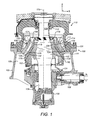
- a crusher comprises a frame 100 having an upper frame 101 and a lower frame 102.
- a crushing head 103 is mounted upon an elongate main shaft 107.
- a first (inner) crushing shell 105 is fixably mounted on crushing head 103 and a second (outer) crushing shell 106 is fixably mounted indirectly at upper frame 101 via an intermediate filler ring 114.
- a crushing zone 104 is formed between the opposed crushing shells 105, 106.
- a discharge zone 109 is positioned immediately below crushing zone 104 and is defined, in part, by lower frame 102.
- a drive (not shown) is coupled to main shaft 107 via a drive shaft 108 and suitable gearing 131 so as to rotate shaft 107 eccentrically about longitudinal axis 115 and to cause head 103 to perform a gyratory pendulum movement and crush material introduced into crushing zone 104.
- An upper end region 128 of shaft 107 is maintained in an axially rotatable position by a top-end bearing assembly 112 positioned intermediate between main shaft 107 and a central boss.
- a bottom end 129 of shaft 107 is supported by a bottom-end bearing assembly 130.
- Upper frame 101 is divided into a topshell 111, mounted upon lower frame 102 (alternatively termed a bottom shell), and a spider assembly 113 that extends from topshell 111 and represents an upper portion of the crusher.
- Shell 106 comprises an annular upper end 121 and opposed lower annular end 122 with a wall 110 extending axially between ends 121, 122.
- Shell 106 further comprises a radially outward facing mount surface 132 and an opposed radially inward facing crushing surface 125.
- inner crushing shell 105 comprises a radially outward facing crushing surface 117 and an opposed radially inward facing mount surface 118.
- Crushing zone 104 is defined between the crushing surface 125, 117 of the opposed shells 106, 105 respectively.
- Outer shell 106 further comprises a first raised upper contact region 126 and a second raised lower contact region 124, the contact regions 126, 124 projecting radially outward from the wall 110 of shell 106 so as to be axially separated and define an annular channel 123 extending circumferentially around shell 106 between upper and lower regions 126, 124.
- Shell 106 is configured to contact the spacer ring 114 at regions 126, 124.
- inner shell 105 comprises an annular upper end 119 and an opposed annular lower end 120 with a wall 116 extending axially between ends 119, 120.
- Shell 105 is mounted at head 103 via contact with an axially lower region of mount surface 118 that is seated upon a radially outward facing surface 133 of head 103.
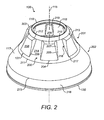
- Shell 105 further comprises a plurality of wedges 127 that projects radially outward from wall 116 to represent raised ridges at the crushing surface 117.
- Wedges 127 project radially into crushing zone 104 from crushing surface 117 so as to reduce the volume of the crushing zone 104 at an axially upper region of shell 105 and 106.
- a radial extension of each wedge 127 from axis 115 decreases in the axial direction such that the wedges 127 taper radially inward so as to diminish and effectively terminate approximately axially mid-way between upper and lower ends 119, 120.
- inner crushing shell 105 comprises a generally annular configuration extending around axis 115 from upper to lower annular end 119, 120
- Shell 106 may be considered to be divided axially into an upper half 201 starting at upper end 119 and a lower half 202 terminating at lower end 120.
- An axially lowermost region of crushing surface 117 is terminated by an annular edge 215.
- a lowermost chamfered surface 216 extends axially between edge 215 and the lowermost annular end 120 to allow crushed material to exit crushing zone 104.
- Wedges 127 are positioned within upper half 201 and extend axially downward from region 212 positioned immediately below upper end 119.
- Each wedge 127 terminates at a lowermost region 204 at the junction between the upper and lower halves 201, 202.
- shell 106 comprises, according to the specific implementation, five wedges distributed circumferentially around axis 115 and projecting radially outward from wall 116.
- Each wedge 127 projects radially outward at region 212 to define an upper end surface 203 extending a short distance in a circumferential direction around axis 115.
- Surface 203 extends a short radial distance from axis 115 and is terminated at its circumferential ends by radial edges 213.
- Each wedge 127 is further defined by a pair of opposed axially extending lengthwise side edges 205. Each side edge 205 extends from each end of edge 209 to terminate at lowermost region 204. A side surface 207 projects rearwardly from each side edge 205 to provide a transition to a channel 200 positioned circumferentially between each neighbouring wedge 127.
- the edges 205, 213 and side surface 207 collectively define a shoulder extending axially along the lengthwise side of each wedge 127.
- Each shoulder therefore defines the termination regions of each wedge 127 in a circumferential direction around axis 115.
- the shoulders 218 of neighbouring wedges 126 accordingly define each channel 200 that is recessed radially relative to each wedge 127.
- Each shoulder 218 and accordingly each side surface 207 of each wedge 127 are substantially identical such that each channel 200 is substantially identical in shape and configuration at both its lengthwise sides 206.
- Each side surface 207 comprises a concave curvature so as to provide a smooth transition between the crushing surface 208 of each wedge 127 and the crushing surface 214 of each channel 200.
- a radial thickness of each wedge 127 is greatest at its axially uppermost region corresponding to an axial position at edge 209.
- the ' radial thickness ' of each wedge 127 is defined with reference to the radial position of the crushing surface 218 at each wedge relative to the radial position of crushing surface 214 at each channel 200.
- the radial thickness then decreases in the axial direction towards lowermost region 204. That is, a radial distance of surface region 204 is substantially equal to the radial distance at a lowermost surface region 211 of channel 200 (relative to axis 115) where regions 204, 211 are at the same axial position.
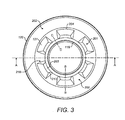
- shell 106 comprises a plurality of recesses 219 embedded within the mount surface 118 having a position corresponding to the position directly behind wedges 127.
- These recesses 219 provides that the shell wall thickness is substantially uniform in the circumferential direction around the axis. This is advantageous to moderate the cooling rate at the shell wall and eliminate material porosity of the cast shell.
- the radial distance of the crushing surface 117 relative to central axis 115 of the shell 106 increases and decreases according to an alternating profile in a circumferential direction around the axis at its uppermost half 201. That is, a radial position of the crushing surface 208 at each wedge 127 is greater than a corresponding radial position of the crushing surface 214 at each channel 200 (at the same axial position). According to the specific implementation, a width of each wedge in a circumferential direction around axis 115 is approximately equal to a corresponding width of each channel 200 at the same axial position.
- each wedge 127 represents a raised ridge projecting radially from the radially outward facing surface 214 of each channel 200 within the axially upper half 201 of shell 106.
- the radially outward facing surface 208 of each wedge 127 represents a component part of the collective crushing surface 117 of shell 106 within region 201.
- the corresponding surface 214 of each channel 200 also forms a component part of the crushing surface 117 within upper half 201.
- Surface 208 is substantially concave in the axial direction so as to provide a smooth transition of the radial position of the crushing surface 208 at the lowermost region 204 of each wedge 127 and the lower half 202. Additionally, and as illustrated in figure 5 , the radial thickness of each wedge 127 (relative to surface 214) decreases from the region of edge 209 to the lowermost region 204. As stated, this radial thickness of each wedge 127 is represented by the radial difference between the channel surface 214 and wedge surface 208. That is, a radial extension of each wedge 127 from axis 115 is independent of a thickness of the shell wall 116. In particular, the shell wall thickness is substantially uniform in the circumferential direction around axis 115 within the upper region 201.
- a width in a circumferential direction of surface 208 increases axially downward from upper region 212 to lowermost region 204. Accordingly, an area of side surfaces 207 decreases axially downward from edge 213 to lowermost end 204.
- Each wedge 127 is substantially symmetrical about a vertically extending plane represented as B-B. That is, a radial extension of each wedge 127 is symmetrical about the plane of B-B. Similarly, a radial extension of the shell wall 116 at the region of each channel 200 is symmetrical about a corresponding vertical plane represented by C-C.
- Wedges 127 reduce the available volume of the crushing zone 104 between shells 105, 106 above the lower region 202 of shell 106. Wedges 127 are effective to guide material to be crushed into channels 200 and in contact with side surfaces 207 and channel surface 214 being positioned opposed to the crushing surface 125 of outer shell 106. In particular, wedges 127 are effective to control the delivery of the material to be crushed to the lower region of the crushing zone 104 corresponding to the lower region 202 of shell 106.
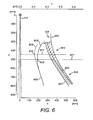
- Figure 6 illustrates schematically a section of the crushing zone 104 where line 600 represents the shape profile of crushing surface 125 of shell 106 and line 601 represents the shape profile of the crushing surface 117 of shell 105.
- Line 602 represents the position of minimum separation between shells 105, 106 as head 103 oscillates about axis 115 according to the gyroscopic procession induced by shaft 108 whilst line 601 illustrates the maximum separation distance.
- the separation distances in the x and y axes corresponding to directions A and B of figure 1 and are illustrated in 100 mm intervals.
- An area function at each axial position between surfaces 125, 117 is represented by line 605.
- a minimum 606 in the area function represents the ' choke point ' of conventional crushing shells without directing wedges 127 and this is represented by line 608.
- a horizontal bisecting line 607 defines an upper crushing region 603 above choke point 607 and a lower crushing region 604 below choke point 607.
- the effect of configuring shell 106 with a plurality of circumferentially spaced wedges 127 at upper region 201 is to reduce the area function and this represented by line 609.
- the choke point is accordingly displaced axially upward in direction A of figure 1 .
- the upper crushing zone 603 is moved axially upward to extend the axial length of lower crushing zone 604 below the displaced choke zone 611.
- the inventors have determined via assessment of the crusher dynamics and comparisons with field testing that the crusher capacity is determined by the volume of the choke zone. Importantly, the crusher dynamics assessment has confirmed that most of the crushing in the crusher within zone 104 is due to attrition (being inter-particle crushing). Additionally, material crushed within upper zone 603 is transferred to lower zone 602 by gravity and accordingly there is a mass balance between the crushing zones 603, 604. Consequently, the inventors have identified that the volume of material that is required to be crushed within lower zone 604 is controlled by the choke zone 607. If a compression ratio of material in zone 604 yields a higher force than a predetermined value of the crusher control system, the system will open the crushing zone 104 by effective separation of the shells 105, 106. Accordingly, there are two mechanisms to increase the compression, firstly, the crushing force between regions 600, 601, 602 must be increased or secondly, the volume of material within the lower crushing zone 604 must be decreased.
- the inventors have identified that the problem of accomplishing reduction within a crusher is due to the fact that as the crusher reduces the crushing gap during gyroscopic procession, the size of the choke zone 607 and the size of the closed crushing zone 604 do not decrease by the same amounts.
- the result is that a conventional crusher will eventually allow transfer of more material from upper zone 603 to lower zone 604 than can be crushed in the lower zone 604 due to limitations in the available crushing force at this zone 604.
- the present wedge 127 and channel 200 configuration of shell 106 is effective to decrease the amount of material within upper crushing zone 603 being available to be fed to the lower crushing zone 604. Accordingly, the present shell configuration restricts the volume of material to be crushed at the crushing zone 603 and effectively moves the choke zone 610, 611 axially upward. Accordingly, the choke zone 611 of the subject invention is proportionally smaller than zone 607 of conventional shells so as to balance crushing capacity with an effective increase in reduction. Importantly, wedges 127 do not extend into lower half 202 of crushing surface 117 such that the volume of the lower crushing zone 604 is unchanged relative to a conventional crusher arrangement.
- Wedges 127 are therefore effective to allow the crusher to be operated at a smaller CSS without having to increase the crushing force.
- the crusher is operated according to a closed crushing circuit (coupled to a downstream screen) an increase in the process capacity is achieved as the size distribution of material exiting the crusher is substantially uniform and within the predetermined reduction range. That is, the need to purge the crusher due to choking is avoided together with the creation of very 'f ine ' particulates (due to over crushing within the lower crushing zone 604) being resultant from crusher choking.
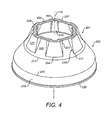
- Figures 7 and 8 illustrate by way of example only an extension of the subject invention applied to the outer crushing shell 106.
- the outer shell 106 may comprise a plurality of axially extending wedges 127 projecting radially inward from the crushing surface 125.
- wedges 127, shoulders 218 and channels 200 comprise the same geometry and general configuration as described with reference to figures 2 to 5 . That is, a radial extension of the wedges 127 decreases from the axially upper region corresponding to upper edge 209 to the axially lowermost region 204.
- the crushing surface 208 of each wedge 127 is therefore inclined at a greater angle than a corresponding crushing surface 214 of the channels 200 that extend circumferentially between the wedges 127.
- shell 106 comprises a crushing surface having a radial position relative to axis 115 that increases and decreases according to a uniform alternating profile in the circumferential direction around axis 115.
- each wedge 127 is defined by a pair of axially extending side surfaces 207 that represent shoulders 218 defining each channel 200.
- Each of the left hand and right hand side surfaces 207 are identical to one another such that each wedge 127 is symmetrical about a vertical plane B-B extending axially through the shell wall 110.
- each channel 200 is substantially symmetrical about a vertical plane C-C extending axially through shell wall 110.
- Each channel 200 is accordingly defined by the pair of opposed side surfaces 207 of the shoulders 218 neighbouring wedges 127.
- Each side surface 207 comprises a generally wedge-shaped profile having a pointed lowermost end 217 and an uppermost end defined by the leading radial edge 213.
- a surface area of each side surface 207 that defines, in part, each channel 200 is substantially identical such that each channel 200 is symmetrical about plane C-C.
- each wedge 127 therefore acts to guide material to pass axially downward through each channel 200 by representing an obstruction to any circumferential flow of material within each channel 200.
- shoulders 218 ensure an axially downward flow of material is maintained and provide a means of guiding and retaining the material flow along each channel 200 from upper end 210 to lower end 211.
Landscapes
- Engineering & Computer Science (AREA)
- Mechanical Engineering (AREA)
- Food Science & Technology (AREA)
- Crushing And Grinding (AREA)
- Crushing And Pulverization Processes (AREA)
Claims (15)
- Coque de concassage interne (105) de concasseur giratoire destinée à être positionnée à l'opposé d'une tête de concasseur (103) d'un concasseur giratoire (100), la coque (105) comprenant :un corps principal pouvant être monté à l'intérieur d'une zone de concassage (104) définie par un châssis (111) d'un concasseur giratoire, le corps principal s'étendant autour d'un axe longitudinal central (115) ;le corps principal ayant une surface de support (118) destinée à être positionnée à l'opposé de la tête de concasseur (103) montée de manière mobile à l'intérieur de la zone de concassage (104) et une surface de concassage (117) destinée à être en contact avec le matériau à concasser, une paroi (116) définie par et s'étendant entre le support (118) et les surfaces de concassage (117), la paroi (116) ayant une première extrémité (119) axialement supérieure et une seconde extrémité (120) axialement inférieure ;une pluralité de cales (127) faisant saillie radialement vers l'extérieur au niveau de la surface de concassage (117) et réparties dans la direction circonférentielle autour de l'axe (115), chaque cale (127) s'étendant axialement vers le bas à partir d'une région de la première extrémité (119) ;chaque cale (127) se terminant dans la direction circonférentielle par une paire d'épaulements (218) dans le sens de la longueur ; etla coque (105) comprenant en outre une pluralité de canaux (200) s'étendant de manière axiale, définis par et positionnés dans la direction circonférentielle entre les épaulements (218) des cales (127) opposées ;chaque cale (127) étant positionnée au niveau d'une région axialement supérieure de la coque (105) et ne s'étendant pas dans une région axialement inférieure de la surface de concassage (117) ;caractérisée en ce que :la surface de concassage (208) au niveau de la région de chaque cale (127) comprend un profil de forme concave dans la direction axiale ; et en ce que :chaque cale (127) commence à une région (212) positionnée immédiatement au-dessous de la première extrémité supérieure (119).
- Coque selon la revendication 1, dans laquelle une distance radiale de la surface de concassage (117) par rapport à l'axe (115) dans la position axiale des cales (127) et des canaux (200) augmente et diminue selon un profil alterné dans une direction circonférentielle autour de l'axe (115).
- Coque selon la revendication 2, dans laquelle les cales (127) s'étendent axialement vers une région (204) sensiblement à mi-chemin entre la première (119) et la seconde (120) extrémité de sorte que la région axialement inférieure de la coque (105) est dépourvue de cales (127) et de canaux (200).
- Coque selon l'une quelconque des revendications précédentes, dans laquelle une distance radiale entre la surface de concassage (117) de chaque cale (127) et la surface de concassage (117) de chaque canal (200) diminue dans une direction axialement descendante, à partir de la région de la première extrémité (119) jusqu'à la seconde extrémité (120).
- Coque selon l'une quelconque des revendications précédentes, dans laquelle la paroi comprend une épaisseur radiale qui est sensiblement uniforme au niveau d'une région de chaque cale (127) dans la direction axiale à partir de la région de la première extrémité (119) jusqu'à la seconde extrémité (120).
- Coque selon l'une quelconque des revendications précédentes, dans laquelle une épaisseur radiale de chaque cale (127) ou de la paroi (116) est sensiblement uniforme dans la direction circonférentielle entre les épaulements (218).
- Coque selon l'une quelconque des revendications précédentes, dans laquelle une épaisseur radiale de la paroi (116) au niveau de chaque canal (200) est sensiblement uniforme dans la direction circonférentielle entre les épaulements (218).
- Coque selon la revendication 7, dans laquelle chaque épaulement (218) comprend des surfaces latérales (207) dans le sens de la longueur s'étendant de manière axiale, chaque surface latérale (207) ayant un profil de forme conique dans une direction circonférentielle pour fournir une transition en douceur avec le canal (200) respectif.
- Coque selon la revendication 8, dans laquelle chaque surface latérale (207) comprend une courbure concave afin de fournir une transition en douceur entre la surface de concassage (208) de chaque cale (127) et la surface de concassage (214) de chaque canal (200).
- Coque selon l'une quelconque des revendications précédentes, dans laquelle une largeur de chaque canal (200) dans la direction circonférentielle autour de l'axe (115) est sensiblement égale à une largeur de chaque cale (127) dans la direction circonférentielle autour de l'axe (115).
- Coque selon l'une quelconque des revendications précédentes, dans laquelle une largeur de chaque cale (127) dans une direction circonférentielle autour de l'axe (115) augmente dans la direction axiale à partir de la région de la première (119) à la seconde extrémité (120).
- Coque selon l'une quelconque des revendications précédentes, comprenant entre trois et dix cales (127) réparties de manière circonférentielle autour de l'axe (115).
- Coque selon l'une quelconque des revendications précédentes, comprenant en outre une pluralité d'évidements (219) encastrés à l'intérieur de la surface de support (118), chacun des évidements (219) ayant une position correspondant à une position située directement derrière l'une des cales (127) respectives.
- Coque selon la revendication 13, dans laquelle une épaisseur de la paroi (116) est sensiblement uniforme dans une direction circonférentielle autour de l'axe (115) à l'intérieur de la région axialement supérieure de la coque (105).
- Concasseur giratoire comprenant au moins une coque de concassage (105) selon l'une quelconque des revendications précédentes.
Priority Applications (11)
| Application Number | Priority Date | Filing Date | Title |
|---|---|---|---|
| EP13174042.5A EP2818246B1 (fr) | 2013-06-27 | 2013-06-27 | Coque de broyage avec surface de concassage profilée |
| BR112015032538-6A BR112015032538B1 (pt) | 2013-06-27 | 2014-05-22 | Concha de esmagamento de esmagador giratório e esmagador giratório |
| AU2014301540A AU2014301540B2 (en) | 2013-06-27 | 2014-05-22 | Crushing shell with profiled crushing surface |
| CN201480036578.0A CN105392565B (zh) | 2013-06-27 | 2014-05-22 | 具有异形破碎表面的破碎壳 |
| US14/900,292 US10537895B2 (en) | 2013-06-27 | 2014-05-22 | Crushing shell with profiled crushing surface |
| MYPI2015002838A MY172356A (en) | 2013-06-27 | 2014-05-22 | Crushing shell with profiled crushing surface |
| CA2914409A CA2914409C (fr) | 2013-06-27 | 2014-05-22 | Coque de broyage a surface de broyage profilee |
| PCT/EP2014/060512 WO2014206658A1 (fr) | 2013-06-27 | 2014-05-22 | Coque de broyage à surface de broyage profilée |
| RU2016102338A RU2648700C2 (ru) | 2013-06-27 | 2014-05-22 | Дробильный кожух с профилированной поверхностью дробления |
| ZA2015/08587A ZA201508587B (en) | 2013-06-27 | 2015-11-20 | Crushing shell with profiled crushing surface |
| CL2015003701A CL2015003701A1 (es) | 2013-06-27 | 2015-12-22 | Una carcasa de trituración interna de trituradora giratoria, con una pluralidad de cuñas que sobresalen radialmente hacia fuera en la superficie de trituración, en donde cada cuña comprende un perfilado cóncavo en la dirección axial, y están posicionadas en una región axialmente superior de la carcasa; trituradora giratoria. |
Applications Claiming Priority (1)
| Application Number | Priority Date | Filing Date | Title |
|---|---|---|---|
| EP13174042.5A EP2818246B1 (fr) | 2013-06-27 | 2013-06-27 | Coque de broyage avec surface de concassage profilée |
Publications (2)
| Publication Number | Publication Date |
|---|---|
| EP2818246A1 EP2818246A1 (fr) | 2014-12-31 |
| EP2818246B1 true EP2818246B1 (fr) | 2015-12-02 |
Family
ID=48700374
Family Applications (1)
| Application Number | Title | Priority Date | Filing Date |
|---|---|---|---|
| EP13174042.5A Active EP2818246B1 (fr) | 2013-06-27 | 2013-06-27 | Coque de broyage avec surface de concassage profilée |
Country Status (11)
| Country | Link |
|---|---|
| US (1) | US10537895B2 (fr) |
| EP (1) | EP2818246B1 (fr) |
| CN (1) | CN105392565B (fr) |
| AU (1) | AU2014301540B2 (fr) |
| BR (1) | BR112015032538B1 (fr) |
| CA (1) | CA2914409C (fr) |
| CL (1) | CL2015003701A1 (fr) |
| MY (1) | MY172356A (fr) |
| RU (1) | RU2648700C2 (fr) |
| WO (1) | WO2014206658A1 (fr) |
| ZA (1) | ZA201508587B (fr) |
Families Citing this family (8)
| Publication number | Priority date | Publication date | Assignee | Title |
|---|---|---|---|---|
| AU2015401842B2 (en) * | 2015-07-03 | 2018-07-26 | Sandvik Intellectual Property Ab | Crushing shell with rotational lock |
| CN107398336B (zh) * | 2017-09-07 | 2025-02-18 | 沈阳吉大重型机械有限公司 | 物料破碎机及其破碎方法 |
| CN107599220A (zh) * | 2017-09-26 | 2018-01-19 | 浙江欧力机械有限公司 | 塑料制粒机 |
| WO2021204395A1 (fr) | 2020-04-09 | 2021-10-14 | Sandvik Srp Ab | Revêtement de bras pour ensemble coque inférieure de broyeur à cône |
| WO2021223868A1 (fr) | 2020-05-07 | 2021-11-11 | Sandvik Srp Ab | Coque interne pour broyeur à cône |
| EP4108335A1 (fr) | 2021-06-24 | 2022-12-28 | Sandvik SRP AB | Revêtement résistant à l'usure pour un concasseur à cônes |
| CN114749235B (zh) * | 2022-04-07 | 2023-05-16 | 北京市政建设集团有限责任公司 | 一种钢管柱施工用砂石回填装置 |
| CN117540508B (zh) * | 2024-01-10 | 2024-09-17 | 南昌矿机集团股份有限公司 | 一种考虑极限压缩状态的圆锥破碎机生产率分析方法 |
Family Cites Families (11)
| Publication number | Priority date | Publication date | Assignee | Title |
|---|---|---|---|---|
| DE1757362A1 (de) * | 1968-04-30 | 1971-01-07 | Krupp Gmbh | Kegelbrecher |
| DE1810270A1 (de) * | 1968-11-22 | 1972-03-16 | Krupp Gmbh | Kegelbrecher |
| DE2542660C3 (de) * | 1975-09-25 | 1981-12-17 | Fried. Krupp Gmbh, 4300 Essen | Kegelbrecher |
| SU1671339A1 (ru) * | 1989-04-18 | 1991-08-23 | Всесоюзный Научно-Исследовательский Институт Безопасности Труда В Горнорудной Промышленности | Кожух конусной дробилки |
| JP2571172B2 (ja) * | 1992-04-20 | 1997-01-16 | 川崎重工業株式会社 | 旋動式破砕機の歯板 |
| SE525341C2 (sv) | 2003-06-18 | 2005-02-08 | Sandvik Intellectual Property | Sätt och anordning för fasthållning av krossmantel |
| SE528447C2 (sv) | 2005-03-24 | 2006-11-14 | Sandvik Intellectual Property | Mantel för en gyratorisk kross samt gyratorisk kross med en tilläggskrossyta |
| SE531280C2 (sv) | 2007-05-16 | 2009-02-10 | Sandvik Intellectual Property | Innermantel för en gyratorisk kross, samt sätt att fästa en sådan mantel på ett krosshuvud |
| SE533698C2 (sv) | 2009-04-22 | 2010-12-07 | Sandvik Intellectual Property | Gyratorisk kross, därför avsedd yttermantel och förfarande för montering och demontering av yttermanteln |
| SE535215C2 (sv) | 2010-07-09 | 2012-05-22 | Sandvik Intellectual Property | Gyratorisk kross med tätningsanordning, samt förfarande för att skydda en arbetszon |
| CN101905181B (zh) | 2010-07-26 | 2012-01-25 | 樊品良 | 同步圆锥碎煤机 |
-
2013
- 2013-06-27 EP EP13174042.5A patent/EP2818246B1/fr active Active
-
2014
- 2014-05-22 MY MYPI2015002838A patent/MY172356A/en unknown
- 2014-05-22 AU AU2014301540A patent/AU2014301540B2/en active Active
- 2014-05-22 WO PCT/EP2014/060512 patent/WO2014206658A1/fr not_active Ceased
- 2014-05-22 RU RU2016102338A patent/RU2648700C2/ru active
- 2014-05-22 CA CA2914409A patent/CA2914409C/fr active Active
- 2014-05-22 US US14/900,292 patent/US10537895B2/en active Active
- 2014-05-22 CN CN201480036578.0A patent/CN105392565B/zh active Active
- 2014-05-22 BR BR112015032538-6A patent/BR112015032538B1/pt active IP Right Grant
-
2015
- 2015-11-20 ZA ZA2015/08587A patent/ZA201508587B/en unknown
- 2015-12-22 CL CL2015003701A patent/CL2015003701A1/es unknown
Also Published As
| Publication number | Publication date |
|---|---|
| CL2015003701A1 (es) | 2016-10-14 |
| CA2914409A1 (fr) | 2014-12-31 |
| CN105392565A (zh) | 2016-03-09 |
| RU2016102338A (ru) | 2017-08-01 |
| BR112015032538B1 (pt) | 2021-08-31 |
| AU2014301540A1 (en) | 2015-12-03 |
| ZA201508587B (en) | 2017-09-27 |
| US10537895B2 (en) | 2020-01-21 |
| EP2818246A1 (fr) | 2014-12-31 |
| RU2648700C2 (ru) | 2018-03-28 |
| MY172356A (en) | 2019-11-21 |
| CA2914409C (fr) | 2021-03-23 |
| AU2014301540B2 (en) | 2018-06-07 |
| BR112015032538A2 (pt) | 2017-07-25 |
| CN105392565B (zh) | 2018-04-24 |
| WO2014206658A1 (fr) | 2014-12-31 |
| US20160346786A1 (en) | 2016-12-01 |
Similar Documents
| Publication | Publication Date | Title |
|---|---|---|
| CA2914409C (fr) | Coque de broyage a surface de broyage profilee | |
| US10471436B2 (en) | Preliminary size reduction device for a ball mill or agitator ball mill and ball mill with a preliminary size reduction device | |
| CN100486709C (zh) | 圆锥形破碎机 | |
| AU2016357325B2 (en) | Pulp lifter | |
| PH12015502480B1 (en) | A grinding apparatus | |
| CN210522589U (zh) | 双侧进料立轴多级齿刃圆锥破碎机 | |
| CN106560247A (zh) | 破碎机给料斗和破碎机 | |
| CN105195255B (zh) | 八辊式破碎机 | |
| EP2774680B1 (fr) | Coque de broyage externe de concasseur giratoire | |
| KR102304913B1 (ko) | 폐타이어 고순도 철심분리장치 | |
| JP5577777B2 (ja) | 竪型粉砕機の運転方法 | |
| CN101146620B (zh) | 旋回式破碎机的内壳和旋回式破碎机 | |
| EP2582460B1 (fr) | Appareil concasseur de roches | |
| US20140252151A1 (en) | Gyratory crusher outer crushing shell | |
| CN107810063A (zh) | 颚式破碎机铲斗 | |
| JP5267333B2 (ja) | 竪型粉砕機 | |
| JP5397754B2 (ja) | 竪型粉砕機 | |
| CN121988437A (zh) | 一种原矿浆高效磨制设备 | |
| NZ297910A (en) | Vertical axis impact crusher rotor guide edge positioned to influence acceleration of discharging material | |
| CN104437786B (zh) | 用于破碎碳素块体的破碎机 | |
| US9216416B2 (en) | Wear part, processing apparatus and processing plant for mineral material | |
| EA044401B1 (ru) | Одновалковая мельница | |
| JP2010274188A (ja) | 竪型粉砕機 | |
| Kleinhans | Jaws primary gyratory: communution | |
| CN107469984A (zh) | 破碎机 |
Legal Events
| Date | Code | Title | Description |
|---|---|---|---|
| PUAI | Public reference made under article 153(3) epc to a published international application that has entered the european phase |
Free format text: ORIGINAL CODE: 0009012 |
|
| 17P | Request for examination filed |
Effective date: 20130627 |
|
| AK | Designated contracting states |
Kind code of ref document: A1 Designated state(s): AL AT BE BG CH CY CZ DE DK EE ES FI FR GB GR HR HU IE IS IT LI LT LU LV MC MK MT NL NO PL PT RO RS SE SI SK SM TR |
|
| AX | Request for extension of the european patent |
Extension state: BA ME |
|
| GRAP | Despatch of communication of intention to grant a patent |
Free format text: ORIGINAL CODE: EPIDOSNIGR1 |
|
| INTG | Intention to grant announced |
Effective date: 20150715 |
|
| RBV | Designated contracting states (corrected) |
Designated state(s): AL AT BE BG CH CY CZ DE DK EE ES FI FR GB GR HR HU IE IS IT LI LT LU LV MC MK MT NL NO PL PT RO RS SE SI SK SM TR |
|
| GRAS | Grant fee paid |
Free format text: ORIGINAL CODE: EPIDOSNIGR3 |
|
| GRAA | (expected) grant |
Free format text: ORIGINAL CODE: 0009210 |
|
| AK | Designated contracting states |
Kind code of ref document: B1 Designated state(s): AL AT BE BG CH CY CZ DE DK EE ES FI FR GB GR HR HU IE IS IT LI LT LU LV MC MK MT NL NO PL PT RO RS SE SI SK SM TR |
|
| REG | Reference to a national code |
Ref country code: GB Ref legal event code: FG4D |
|
| REG | Reference to a national code |
Ref country code: AT Ref legal event code: REF Ref document number: 763377 Country of ref document: AT Kind code of ref document: T Effective date: 20151215 Ref country code: CH Ref legal event code: EP |
|
| REG | Reference to a national code |
Ref country code: IE Ref legal event code: FG4D |
|
| REG | Reference to a national code |
Ref country code: DE Ref legal event code: R096 Ref document number: 602013003969 Country of ref document: DE |
|
| REG | Reference to a national code |
Ref country code: SE Ref legal event code: TRGR |
|
| REG | Reference to a national code |
Ref country code: NL Ref legal event code: MP Effective date: 20160302 |
|
| REG | Reference to a national code |
Ref country code: NO Ref legal event code: T2 Effective date: 20151202 Ref country code: LT Ref legal event code: MG4D |
|
| REG | Reference to a national code |
Ref country code: AT Ref legal event code: MK05 Ref document number: 763377 Country of ref document: AT Kind code of ref document: T Effective date: 20151202 |
|
| PG25 | Lapsed in a contracting state [announced via postgrant information from national office to epo] |
Ref country code: LT Free format text: LAPSE BECAUSE OF FAILURE TO SUBMIT A TRANSLATION OF THE DESCRIPTION OR TO PAY THE FEE WITHIN THE PRESCRIBED TIME-LIMIT Effective date: 20151202 Ref country code: ES Free format text: LAPSE BECAUSE OF FAILURE TO SUBMIT A TRANSLATION OF THE DESCRIPTION OR TO PAY THE FEE WITHIN THE PRESCRIBED TIME-LIMIT Effective date: 20151202 |
|
| REG | Reference to a national code |
Ref country code: FR Ref legal event code: PLFP Year of fee payment: 4 |
|
| PG25 | Lapsed in a contracting state [announced via postgrant information from national office to epo] |
Ref country code: RS Free format text: LAPSE BECAUSE OF FAILURE TO SUBMIT A TRANSLATION OF THE DESCRIPTION OR TO PAY THE FEE WITHIN THE PRESCRIBED TIME-LIMIT Effective date: 20151202 Ref country code: LV Free format text: LAPSE BECAUSE OF FAILURE TO SUBMIT A TRANSLATION OF THE DESCRIPTION OR TO PAY THE FEE WITHIN THE PRESCRIBED TIME-LIMIT Effective date: 20151202 Ref country code: AT Free format text: LAPSE BECAUSE OF FAILURE TO SUBMIT A TRANSLATION OF THE DESCRIPTION OR TO PAY THE FEE WITHIN THE PRESCRIBED TIME-LIMIT Effective date: 20151202 Ref country code: PL Free format text: LAPSE BECAUSE OF FAILURE TO SUBMIT A TRANSLATION OF THE DESCRIPTION OR TO PAY THE FEE WITHIN THE PRESCRIBED TIME-LIMIT Effective date: 20151202 Ref country code: NL Free format text: LAPSE BECAUSE OF FAILURE TO SUBMIT A TRANSLATION OF THE DESCRIPTION OR TO PAY THE FEE WITHIN THE PRESCRIBED TIME-LIMIT Effective date: 20151202 Ref country code: GR Free format text: LAPSE BECAUSE OF FAILURE TO SUBMIT A TRANSLATION OF THE DESCRIPTION OR TO PAY THE FEE WITHIN THE PRESCRIBED TIME-LIMIT Effective date: 20160303 |
|
| PG25 | Lapsed in a contracting state [announced via postgrant information from national office to epo] |
Ref country code: IS Free format text: LAPSE BECAUSE OF FAILURE TO SUBMIT A TRANSLATION OF THE DESCRIPTION OR TO PAY THE FEE WITHIN THE PRESCRIBED TIME-LIMIT Effective date: 20151202 |
|
| PG25 | Lapsed in a contracting state [announced via postgrant information from national office to epo] |
Ref country code: IT Free format text: LAPSE BECAUSE OF FAILURE TO SUBMIT A TRANSLATION OF THE DESCRIPTION OR TO PAY THE FEE WITHIN THE PRESCRIBED TIME-LIMIT Effective date: 20151202 Ref country code: CZ Free format text: LAPSE BECAUSE OF FAILURE TO SUBMIT A TRANSLATION OF THE DESCRIPTION OR TO PAY THE FEE WITHIN THE PRESCRIBED TIME-LIMIT Effective date: 20151202 |
|
| PG25 | Lapsed in a contracting state [announced via postgrant information from national office to epo] |
Ref country code: SM Free format text: LAPSE BECAUSE OF FAILURE TO SUBMIT A TRANSLATION OF THE DESCRIPTION OR TO PAY THE FEE WITHIN THE PRESCRIBED TIME-LIMIT Effective date: 20151202 Ref country code: RO Free format text: LAPSE BECAUSE OF FAILURE TO SUBMIT A TRANSLATION OF THE DESCRIPTION OR TO PAY THE FEE WITHIN THE PRESCRIBED TIME-LIMIT Effective date: 20151202 Ref country code: SK Free format text: LAPSE BECAUSE OF FAILURE TO SUBMIT A TRANSLATION OF THE DESCRIPTION OR TO PAY THE FEE WITHIN THE PRESCRIBED TIME-LIMIT Effective date: 20151202 Ref country code: IS Free format text: LAPSE BECAUSE OF FAILURE TO SUBMIT A TRANSLATION OF THE DESCRIPTION OR TO PAY THE FEE WITHIN THE PRESCRIBED TIME-LIMIT Effective date: 20160402 Ref country code: PT Free format text: LAPSE BECAUSE OF FAILURE TO SUBMIT A TRANSLATION OF THE DESCRIPTION OR TO PAY THE FEE WITHIN THE PRESCRIBED TIME-LIMIT Effective date: 20160404 Ref country code: EE Free format text: LAPSE BECAUSE OF FAILURE TO SUBMIT A TRANSLATION OF THE DESCRIPTION OR TO PAY THE FEE WITHIN THE PRESCRIBED TIME-LIMIT Effective date: 20151202 |
|
| REG | Reference to a national code |
Ref country code: DE Ref legal event code: R097 Ref document number: 602013003969 Country of ref document: DE |
|
| PLBE | No opposition filed within time limit |
Free format text: ORIGINAL CODE: 0009261 |
|
| STAA | Information on the status of an ep patent application or granted ep patent |
Free format text: STATUS: NO OPPOSITION FILED WITHIN TIME LIMIT |
|
| PG25 | Lapsed in a contracting state [announced via postgrant information from national office to epo] |
Ref country code: DK Free format text: LAPSE BECAUSE OF FAILURE TO SUBMIT A TRANSLATION OF THE DESCRIPTION OR TO PAY THE FEE WITHIN THE PRESCRIBED TIME-LIMIT Effective date: 20151202 |
|
| 26N | No opposition filed |
Effective date: 20160905 |
|
| PG25 | Lapsed in a contracting state [announced via postgrant information from national office to epo] |
Ref country code: SI Free format text: LAPSE BECAUSE OF FAILURE TO SUBMIT A TRANSLATION OF THE DESCRIPTION OR TO PAY THE FEE WITHIN THE PRESCRIBED TIME-LIMIT Effective date: 20151202 |
|
| PG25 | Lapsed in a contracting state [announced via postgrant information from national office to epo] |
Ref country code: BE Free format text: LAPSE BECAUSE OF FAILURE TO SUBMIT A TRANSLATION OF THE DESCRIPTION OR TO PAY THE FEE WITHIN THE PRESCRIBED TIME-LIMIT Effective date: 20151202 |
|
| PG25 | Lapsed in a contracting state [announced via postgrant information from national office to epo] |
Ref country code: MC Free format text: LAPSE BECAUSE OF FAILURE TO SUBMIT A TRANSLATION OF THE DESCRIPTION OR TO PAY THE FEE WITHIN THE PRESCRIBED TIME-LIMIT Effective date: 20151202 |
|
| REG | Reference to a national code |
Ref country code: CH Ref legal event code: PL |
|
| REG | Reference to a national code |
Ref country code: IE Ref legal event code: MM4A |
|
| PG25 | Lapsed in a contracting state [announced via postgrant information from national office to epo] |
Ref country code: LI Free format text: LAPSE BECAUSE OF NON-PAYMENT OF DUE FEES Effective date: 20160630 Ref country code: CH Free format text: LAPSE BECAUSE OF NON-PAYMENT OF DUE FEES Effective date: 20160630 |
|
| REG | Reference to a national code |
Ref country code: FR Ref legal event code: PLFP Year of fee payment: 5 |
|
| PG25 | Lapsed in a contracting state [announced via postgrant information from national office to epo] |
Ref country code: IE Free format text: LAPSE BECAUSE OF NON-PAYMENT OF DUE FEES Effective date: 20160627 |
|
| REG | Reference to a national code |
Ref country code: FR Ref legal event code: PLFP Year of fee payment: 6 |
|
| PG25 | Lapsed in a contracting state [announced via postgrant information from national office to epo] |
Ref country code: HU Free format text: LAPSE BECAUSE OF FAILURE TO SUBMIT A TRANSLATION OF THE DESCRIPTION OR TO PAY THE FEE WITHIN THE PRESCRIBED TIME-LIMIT; INVALID AB INITIO Effective date: 20130627 |
|
| PG25 | Lapsed in a contracting state [announced via postgrant information from national office to epo] |
Ref country code: CY Free format text: LAPSE BECAUSE OF FAILURE TO SUBMIT A TRANSLATION OF THE DESCRIPTION OR TO PAY THE FEE WITHIN THE PRESCRIBED TIME-LIMIT Effective date: 20151202 Ref country code: LU Free format text: LAPSE BECAUSE OF NON-PAYMENT OF DUE FEES Effective date: 20160627 Ref country code: MK Free format text: LAPSE BECAUSE OF FAILURE TO SUBMIT A TRANSLATION OF THE DESCRIPTION OR TO PAY THE FEE WITHIN THE PRESCRIBED TIME-LIMIT Effective date: 20151202 Ref country code: MT Free format text: LAPSE BECAUSE OF NON-PAYMENT OF DUE FEES Effective date: 20160630 Ref country code: HR Free format text: LAPSE BECAUSE OF FAILURE TO SUBMIT A TRANSLATION OF THE DESCRIPTION OR TO PAY THE FEE WITHIN THE PRESCRIBED TIME-LIMIT Effective date: 20151202 |
|
| PG25 | Lapsed in a contracting state [announced via postgrant information from national office to epo] |
Ref country code: BG Free format text: LAPSE BECAUSE OF FAILURE TO SUBMIT A TRANSLATION OF THE DESCRIPTION OR TO PAY THE FEE WITHIN THE PRESCRIBED TIME-LIMIT Effective date: 20151202 |
|
| PG25 | Lapsed in a contracting state [announced via postgrant information from national office to epo] |
Ref country code: AL Free format text: LAPSE BECAUSE OF FAILURE TO SUBMIT A TRANSLATION OF THE DESCRIPTION OR TO PAY THE FEE WITHIN THE PRESCRIBED TIME-LIMIT Effective date: 20151202 |
|
| P01 | Opt-out of the competence of the unified patent court (upc) registered |
Effective date: 20230603 |
|
| PGFP | Annual fee paid to national office [announced via postgrant information from national office to epo] |
Ref country code: FI Payment date: 20250620 Year of fee payment: 13 |
|
| PGFP | Annual fee paid to national office [announced via postgrant information from national office to epo] |
Ref country code: DE Payment date: 20250429 Year of fee payment: 13 |
|
| PGFP | Annual fee paid to national office [announced via postgrant information from national office to epo] |
Ref country code: GB Payment date: 20250508 Year of fee payment: 13 |
|
| PGFP | Annual fee paid to national office [announced via postgrant information from national office to epo] |
Ref country code: NO Payment date: 20250610 Year of fee payment: 13 |
|
| PGFP | Annual fee paid to national office [announced via postgrant information from national office to epo] |
Ref country code: FR Payment date: 20250523 Year of fee payment: 13 |
|
| PGFP | Annual fee paid to national office [announced via postgrant information from national office to epo] |
Ref country code: TR Payment date: 20250620 Year of fee payment: 13 |
|
| PGFP | Annual fee paid to national office [announced via postgrant information from national office to epo] |
Ref country code: SE Payment date: 20250514 Year of fee payment: 13 |