EP2819331B1 - Verfahren und System zur Vorhersage der besten Empfangsfrequenz - Google Patents
Verfahren und System zur Vorhersage der besten Empfangsfrequenz Download PDFInfo
- Publication number
- EP2819331B1 EP2819331B1 EP13174203.3A EP13174203A EP2819331B1 EP 2819331 B1 EP2819331 B1 EP 2819331B1 EP 13174203 A EP13174203 A EP 13174203A EP 2819331 B1 EP2819331 B1 EP 2819331B1
- Authority
- EP
- European Patent Office
- Prior art keywords
- patterns
- frequency
- multiplicity
- frequencies
- reception
- Prior art date
- Legal status (The legal status is an assumption and is not a legal conclusion. Google has not performed a legal analysis and makes no representation as to the accuracy of the status listed.)
- Active
Links
Images

Classifications
-
- H—ELECTRICITY
- H04—ELECTRIC COMMUNICATION TECHNIQUE
- H04H—BROADCAST COMMUNICATION
- H04H20/00—Arrangements for broadcast or for distribution combined with broadcast
- H04H20/26—Arrangements for switching distribution systems
-
- H—ELECTRICITY
- H04—ELECTRIC COMMUNICATION TECHNIQUE
- H04H—BROADCAST COMMUNICATION
- H04H60/00—Arrangements for broadcast applications with a direct linking to broadcast information or broadcast space-time; Broadcast-related systems
- H04H60/61—Arrangements for services using the result of monitoring, identification or recognition covered by groups H04H60/29-H04H60/54
- H04H60/65—Arrangements for services using the result of monitoring, identification or recognition covered by groups H04H60/29-H04H60/54 for using the result on users' side
Definitions
- the embodiments described herein relate to a system and method for predicting the best reception frequency.
- US Patent Application Publication No. 2008/311940 A1 discloses an alternate radio channel selection, which is adapted by user patterns.
- European Patent Application Publication No. 1 659 711 A1 discloses a vehicle entertainment and information processing system.
- US Patent Application Publication No. 2005/024264 discloses the usage of global positioning satellites to discover and select local services.
- Mobile receiving devices for example, radio and television receivers in motor vehicles, encounter the problem that the progressive motion of the devices continuously changes the transmission terrain. This can result in a broadcasting station no longer being received at the currently set frequency.
- broadcasting stations are also commonly available on at least one other frequency; by, e.g., automatically switching the receiving device to this frequency, the broadcasting station can thus continue to be heard or seen.
- the alternative frequency must be detected quickly and reliably.
- Modern mobile receiving devices are equipped with a circuit for checking the reception quality of a set station at an alternative frequency of said station.
- the information about alternative frequencies is generally derived from encoded information that is transmitted during a broadcast, for example, using radio data system (RDS) signals.
- RDS radio data system
- the reception quality at one or more alternative frequencies is checked either regularly or when the reception quality of the selected station at the set frequency deteriorates.
- Mobile receiving devices are commonly equipped with two separate receivers for this purpose, with one receiver continuously selecting and checking alternative frequencies in the background.
- a dedicated circuit compares the quality of the station received by the background receiver at the alternative frequency with the set program. This background check is carried out without the user noticing any interruption in reception.
- this concept is relatively costly because both receivers must be fully equipped with tuners, intermediate frequency (IF) filters, IF stages with demodulators, RDS decoders, signal quality test equipment, etc.
- IF intermediate frequency
- RDS alternative frequency following algorithms and digital audio broadcast (DAB) service following algorithms, which use global positioning system (GPS) signals and location tables or maps of broadcasting stations.
- GPS global positioning system
- the position of the receiver device is localized and the best frequency is selected through the use of the frequency map.
- Traditional location techniques such as GPS typically deliver very accurate location information, but considerations of cost, size, form factors and power requirements may make them too costly and impractical.
- an alternate robust backup and/or referencing system would be advantageous.
- a method for predicting the best reception frequency at a multiplicity of temporal or local points along a path segment from a multiplicity of frequencies on which a transmitter network comprising a multiplicity of transmitters broadcasts at least one radio or television program comprises defining for the path segment at least two discrete frequency values out of the multiplicity of frequencies on which the transmitter network broadcasts; scanning the reception signals in a multiplicity of runs at the multiplicity of points over the at least two of the multiplicity of frequencies on which the transmitter network broadcasts; evaluating the broadcast frequencies and signal qualities of the signals received during scanning to provide reception patterns; storing the evaluation results per frequency and program, the stored evaluation results per frequency and program representing a history of the reception patterns; and predicting from the stored evaluation results the best reception frequency or frequencies for the at least one program along the path segment by extracting a virtual location or virtual path from the pattern history and choosing, based on the extracted virtual location or virtual path, the best alternative frequency from the stored evaluation results, wherein a virtual path or a virtual location is a path or location that is
- the system comprises a unit configured to define for the path segment at least two discrete frequency values out of the multiplicity of frequencies on which the transmitter network broadcasts; a receiver configured to scan the reception signals in a multiplicity of runs at the multiplicity of points over the at least two frequencies on which the transmitter network broadcasts; an evaluation unit configured to evaluate the broadcast frequencies and signal qualities of the signals received during scanning and to provide reception patterns; a memory configured to store the evaluation results per frequency and program, the stored evaluation results per frequency and program representing a history of the reception patterns; and a predictor configured to predict from the stored evaluation results the best reception frequency or frequencies for the at least one program along the path segment by extracting a virtual location or virtual path from the pattern history and choosing, based on the extracted virtual location or virtual path, the best alternative frequency from the stored evaluation results
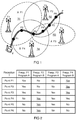
- FIG. 1 shows transmitters T1, T2, T3 and T4, their transmission regions R1, R2, R3 and R4, and vehicle V traveling along path segment P.
- Transmitters T1, T2, T3 and T4 transmit broadcasts of sufficient strength for vehicle V to receive the broadcasts from within the respective transmission regions R1, R2, R3 and R4.
- transmitters T1 and T3 may transmit broadcast program A on separate frequencies F1 and F3, and transmitters T2 and T4 may transmit broadcast program B on separate frequencies F2 and F4.
- Transmission regions R1, R2, R3 and R4 may not have - due to differences in geographical terrain, transmitter characteristics, environmental characteristics and so on - a smooth oval or circular shape, as illustrated in FIG.1 . Rather, transition regions R1, R2, R3 and R4 may vary in size and shape over time, further weakening the availability and integrity of a transmitted program.
- the driver (not shown) of vehicle V may listen to a desired program, for example, program B, while driving along path segment P.
- the program is provided by transmitter T4 on frequency F4, to which the receiver (not shown in FIG. 1 ) in vehicle V is tuned.
- the signal from transmitter T4 that carries program B may be too weak so that the system may be forced to select a different frequency (e.g., frequency F2, on which transmitter T2 broadcasts program B; if program B is not available, a different program, e.g., program A, may be transmitted from a different source, e.g., transmitter T2, even though the driver may not want to listen to or watch another program).
- An iterative tuning and retuning process may be unpleasant for the driver. For example, when the vehicle is leaving a tunnel, is in bad weather conditions, is in mountainous terrain, etc., it is difficult for the system to switch to the best available frequency. Even when the system successfully finds a desired program at an acceptable quality level, the driver may miss significant portions of the program due to the time and effort that must be spent tuning that program.
- some known systems and methods additionally evaluate GPS signals in connection with program-identifying RDS information and location tables or maps of broadcasting stations (broadcast frequency maps) in order to find the best available alternative frequency and to find it faster.
- Reliable GPS signals may be unavailable in many areas due to bad weather conditions or lack of line-of-sight with a required number of geosynchronous GPS satellites in, e.g., tunnels, locations surrounded by tall buildings, mountainous terrain or other areas where interference disrupts the signal.
- some vehicles may not include any GPS functionality at all. If GPS information is available, vehicle V can easily be localized and the most desirable frequency can be selected with the frequency maps. Without GPS signals, selection becomes very difficult, almost impossible.
- the receiver system in vehicle V on path segment P of FIG. 1 may gather certain information on the way, as shown in the table of FIG. 2 .
- the system may record at certain time intervals (e.g., controlled by a timer) or at certain distances (e.g., controlled by the vehicle's odometer; i.e., at certain points on path segment P) the discrete reception frequency spectrum, i.e., the (discrete) signal strengths over (discrete) frequencies and the broadcast program identification information corresponding to the particular frequencies.
- the discrete reception frequency spectrum i.e., the (discrete) signal strengths over (discrete) frequencies and the broadcast program identification information corresponding to the particular frequencies.
- program A can be received on frequency F1 and program B can be received on frequency F4, but no sufficient signal strength is present on frequencies F2 and F3.
- both programs A and B can be received on frequencies F1, F2, F3 and F4.
- program A can be received on frequency F3 and program B can be received on frequencies F2 and F4.
- only program B is receivable and only on frequency F3.
- the pattern of "Yes" and "No" for the particular points P1 through P6, programs A and B and frequencies F1 through F4 is distinctive for the segment of path P that extends between points P1 and P6.
- the underlined reception quality indicators (“ Yes ") represent the choice of the listener.
- the discrete frequency values may be manually defined by the user for a particular region or may be defined by the radio data system. These discrete frequency values may be used to generate, for example, the states of a Markov process or any other suitable process.
- a Markov process is a commonly used stochastic process satisfying a certain property called the Markov property. A process satisfies the Markov property if predictions can be made for the future of the process based solely on its present state or on the process's full history. That is, conditional on the present state of the system, its future and past are independent.
- Several runs of the tuner search algorithm on the same path segment provide information about listening frequencies, alternative frequencies, their weights and reception quality such as reception signal/field strength or bit error rate (BER).
- the historical information of the several runs on the same path segment may be used for prediction.
- Listening frequency sequences, as selected by the user/listener may be correlated with each other to find a shift between the different runs. In order to detect the correlation, methods including cross-correlation or any other suitable algorithms may be employed.
- the transaction probabilities between different states can be calculated from the correlation during the multiplicity of runs. Because of the discrete values, the correlation may be made in a binary way.
- the transaction probabilities between the different states of the Markov process may be calculated using the several runs.
- the information of the alternative frequencies from the several runs is fused with the transaction probabilities using a Markov decision process algorithm.
- the reception signal/field strength or the BER may be used as weighting factors in probability value calculations. Finally, the prediction probabilities of the discrete frequencies for this particular transmitter (program) are obtained.
- the vehicle position may be localized relative to the virtual path (road) segment by using the history of the listening and alternative frequencies.
- Virtual path or virtual location means a path or location that cannot be absolutely localized by the system, but the system is capable of recognizing that it has already been on that particular path segment or at that particular location before.
- the best frequency is proposed for the particular transmitter (program) using the historical information of the several runs.
- scanning receiver SR receives reception signal RS (e.g., a modulated high-frequency radio signal from a single antenna or multiple antenna configuration [not shown] mounted in vehicle V of FIG. 1 ).
- reception signal RS e.g., a modulated high-frequency radio signal from a single antenna or multiple antenna configuration [not shown] mounted in vehicle V of FIG. 1 .
- Scanning receiver SR provides at least one signal that allows for evaluating reception signal RS in signal quality evaluation unit SQE and may also provide a signal that allows for detecting the program identification code in program identification unit PI.
- frequency scan control unit FSC which controls scanning receiver SR, provides information on the currently adjusted reception frequency of scanning receiver SR.
- User behavior evaluation unit UBE monitors the adjustments and inputs made by the user in terms of the selected program and the selected frequency on which the program is broadcast. If no program identification unit is available, user behavior evaluation unit UBE may also serve as a user interface that allows the user to input information that identifies the currently tuned program.
- Frequency scan control unit FSC, program identification unit PI, signal quality evaluation unit SQE and user behavior evaluation unit UBE provide signals to pattern generation unit PG, which is clocked by clocking unit CLK and which provides a reception pattern at each clock cycle.
- the clock cycles may correspond to certain time intervals or to certain distances covered by vehicle V.
- Reception patterns e.g., the patterns for points P1 through P6 shown in FIG. 2
- pattern processing unit PP which processes the information contained in the patterns alone or, optionally, together with patterns already stored in pattern storage unit PS.
- Such pattern processing may include certain statistical evaluations (such as calculating probability and weighting factors), information management (such as data compression, classification and grouping of identical or similar patterns) and reduction of redundant data.
- the processed information is then stored in pattern storage unit PS and represents the history of the received patterns.
- the history depth may be limited, e.g., by the storage capacity of pattern storage unit PS.
- pattern recognition unit PR The history of received patterns stored in pattern storage unit PS is evaluated in pattern recognition unit PR if identical or similar patterns have already been recorded. If this is the case, vehicle V has already been at the particular location or particular path segment identified by this particular pattern or group of patterns. Pattern recognition may be configured to recognize similar patterns even if vehicle V passes the segment of path P in both directions, i.e., back and forth. In contrast to GPS, the present system does not know its exact position, but it knows if it has already been there (referred to herein as "virtual location"). It also knows what frequency was selected or what the best reception frequency was when it was at the particular location.
- the storage may provide statistics that show how often certain frequencies have been chosen by the user or the system itself on the basis of, for instance, reception signal quality.
- the statistics based on the history of the signal quality and/or user behavior at the location or on the path segment may be used to find the best frequency for the particular location or path segment.
- Pattern evaluation unit PE calculates the most promising alternative frequency FA from the information provided by pattern recognition unit PR and pattern storage unit PS, employing, for example, the Markov process, and outputs it.
- a pattern may be defined not only for either of programs A or B, each being broadcast on two frequencies, but also for both programs together, which also considers the case that a user may switch to another program when the currently selected program on its currently tuned frequency is not satisfying.
- F1 through F4 discrete broadcasting frequencies available: F1 through F4.
- These discrete frequency values may be considered the states of a Markov process, or Markov chain in the present case, due to their discrete state domain.
- the reception signal/field strength or the BER may be used as weighting factors in probability value calculations.
- the programs A and B may serve asfilters.
- the Markov process/chain or any other suitable process is intended to provide the probability that at a specific position the current state (current reception frequency) will stay as it is or change to any one of the remaining three states (frequencies).
- the probabilities may depend, for example, on the signal quality or the program currently being listened to. The higher the quality, the higher will be the probability that this frequency is selected or continued. Furthermore, the probability that the already selected program will be maintained is higher than the probability that another program will be switched to.
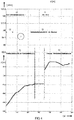
- FIG. 4 depicts, in its upper part, listening frequencies F1, F2 and F3 over three runs as frequency f [MHz] over time t [s] and, in its lower part, the corresponding change of virtual distance traveled d along a particular segment of the virtual path corresponding to path P with time t as provided by pattern recognition unit PR.
- the virtual path is an image or model of path P as modeled by the system's pattern recognition unit PR.
- Virtual distance traveled d represents the progression vehicle V makes on a particular path segment.
- Listening frequencies F1, F2 and F3, as shown in the upper part of FIG. 4 are provided by scanning receiver SR and are saved after driving the particular path segment three times. In the lower part, it can be seen that virtual distance traveled d [m] stays constant in the area between the two vertical lines.
- a reason for this may be that vehicle V is in a tunnel and there is no signal reception, which may be interpreted by the system as the vehicle not moving. It is assumed that the listening frequencies overlap in most of the regions, but there still may be frequencies that can be observed in only one run.
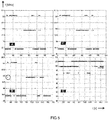
- FIG. 5 diagram A, the listening frequencies of an actual run 4 are shown.
- the prediction results are given in diagrams B, C and D of FIG. 5 . It can readily be seen that the probability values are reduced from B to D and that A and B are very similar.
- diagram B there is a signal - highlighted by a circle - at the frequency of 99.8 Mhz at a travel time of around 50 s. This prediction appears strange because at this position and frequency, there is no signal at all in any of runs 1, 2 or 3.
- the explanation for this is that in run 4, at this particular position, the frequency changes from 98.4 to 101.1. This change is not known in the histories of runs 1, 2 or 3. Therefore, the transition probability is zero.
- the prediction algorithm trusts only alternative frequency probabilities that give frequency results as good as or better than 99.8 MHz.
- a virtual location/path may be extracted from the pattern history and then, by way of the extracted virtual location/path, the best alternative frequency may be chosen.
- the system and method may include detecting program identification codes, detecting signal strengths for a multiplicity of frequencies and programs to generate a (transition) pattern, storing the generated transmitter/program (transition) patterns (e.g., as virtual [path] maps) and querying the map with the detected transition patterns to determine the virtual location of the device.
- the system or method may measure one or more transitions between transmitters and/or programs and use the measured pattern to query the virtual map. A comparison between the measured pattern and the virtual map may thus provide a direct correlation between the pattern and the assumed physical location of the vehicle.
- a specific pattern of a transmitter network may correspond to a particular location on a highway or other road.
- Correlation of a measured transmitter and/or transition pattern with one or more transition patterns in the virtual map may provide approximate physical location information in locations where absolute location determination services (e.g., GPS) are not available.
- absolute location determination services e.g., GPS
- GPS signals may be unavailable due to lack of line-of-sight with a required number of geosynchronous GPS satellites in, e.g., tunnels, locations surrounded by tall buildings or other areas where interference disrupts the signal.
Landscapes
- Engineering & Computer Science (AREA)
- Signal Processing (AREA)
- Circuits Of Receivers In General (AREA)
Claims (15)
- Verfahren zum Vorhersagen der besten Empfangsfrequenz (F1, F2, F3, F4) an einer Vielzahl von zeitlichen oder lokalen Punkten (P1, P2, P3, P4, P5, P6) entlang eines Pfadsegments (P) von einer Vielzahl von Frequenzen (F1, F2, F3, F4), auf denen ein Sendernetz (T1, T2, T3, T4) umfassend eine Vielzahl von Sendern (T1, T2, T3, T4) mindestens ein Radio- oder Fernsehprogramm sendet, das Verfahren umfassend:Festlegen von mindestens zwei diskreten Frequenzwerten (F1, F2, F3, F4) für das Pfadsegment (P) aus der Vielzahl von Frequenzen (F1, F2, F3, F4), auf denen das Sendernetz (T1, T2, T3, T4) sendet;Abtasten der Empfangssignale in einer Vielzahl von Läufen an der Vielzahl von Punkten (P1, P2, P3, P4, P5, P6) über die mindestens zwei Frequenzen (F1, F2, F3, F4), auf denen das Sendernetz (T1, T2, T3, T4) sendet;Auswerten der Sendefrequenzen (F1, F2, F3, F4) und Signalqualitäten der beim Scannen empfangenen Signale, um Empfangsmuster zu liefern;Speichern der Auswertungsergebnisse je Frequenz (F1, F2, F3, F4) und Programm, wobei die gespeicherten Auswertungsergebnisse je Frequenz und Programm eine Historie der Empfangsmuster darstellen; undVorhersagen der besten Empfangsfrequenz (F1, F2, F3, F4) oder Frequenzen (F1, F2, F3, F4) anhand der gespeicherten Auswertungsergebnisse für das mindestens eine Programm entlang des Pfadsegments (P) durch Extrahieren einer virtuellen Position oder eines virtuellen Pfades aus der Musterhistorie und Auswählen, basierend auf der extrahierten virtuellen Position oder dem virtuellen Pfad, der besten Alternativfrequenz (F1, F2, F3, F4) aus den gespeicherten Auswertungsergebnissen, wobei ein virtueller Pfad oder ein virtueller Ort ein Pfad oder Ort ist, der nicht absolut lokalisierbar ist, sondern anhand der Empfangsmusterhistorie für dieses bestimmte Pfadsegment oder diesen bestimmten Ort erkannt wird.
- Verfahren nach Anspruch 1, wobei das Vorhersagen der besten Empfangsfrequenz (F1, F2, F3, F4) oder Frequenzen (F1, F2, F3, F4) einen Markov-Prozess umfasst, bei dem die Zustände des Markov-Prozesses durch die diskreten Frequenzwerte (F1, F2, F3, F4) gegeben sind und bei dem die Gewichtungsfaktoren für Transaktionswahrscheinlichkeitsberechnungen auf den Signalqualitäten der mindestens zwei Frequenzen (F1, F2, F3, F4) basieren, auf denen das Sendernetz (T1, T2, T3, T4) sendet.
- Verfahren nach Anspruch 1 oder 2, wobei die Signalqualität durch die Signalstärke oder die Bitfehlerrate dargestellt wird.
- Verfahren nach einem der Ansprüche 1 bis 3, bei dem Hörfrequenz- (F1, F2, F3, F4) Sequenzen, wie sie von einem Benutzer oder einer Vielzahl von Benutzern während der verschiedenen Läufe ausgewählt wurden, miteinander korreliert werden, um eine Korrelation zwischen verschiedenen Läufen zu finden.
- Verfahren nach Anspruch 2, bei dem Transaktionswahrscheinlichkeiten zwischen verschiedenen Zuständen aus den Korrelationen während der Vielzahl von Läufen berechnet werden.
- Verfahren nach einem der Ansprüche 1 bis 5, wobei das Festlegen der diskreten Frequenzwerte (F1, F2, F3, F4) Folgendes umfasst:Bilden der Empfangsmuster der empfangenen Signale, die nach ihren Sendefrequenzen (F1, F2, F3, F4) und Signalqualitäten ausgewertet werden;Speichern der Empfangsmuster für die Vielzahl von zeitlichen oder lokalen Punkten (P1, P2, P3, P4, P5, P6) entlang des Pfadsegments (P);Erkennen des zuletzt ausgewerteten Musters/der zuletzt ausgewerteten Muster in den gespeicherten Mustern;Erkennen identischer, ähnlicher und anderweitig korrelierter Muster;Klassifizieren des zuletzt ausgewerteten Musters oder der zuletzt ausgewerteten Muster; undFestlegen der diskreten Frequenz- (F1, F2, F3, F4) Werte basierend auf der Klassifizierung des zuletzt ausgewerteten Musters/der zuletzt ausgewerteten Muster.
- Verfahren nach Anspruch 6, wobei das Erkennen des zuletzt ausgewerteten Musters/der zuletzt ausgewerteten Muster den Vergleich oder die Korrelation des zuletzt ausgewerteten Musters/der zuletzt ausgewerteten Muster mit den gespeicherten Mustern umfasst.
- Verfahren nach einem der Ansprüche 1 bis 7, wobei ein Muster ferner das vom Benutzer ausgewählte Programm umfasst.
- System zum Vorhersagen der besten Empfangsfrequenz (F1, F2, F3, F4) an einer Vielzahl von zeitlichen oder lokalen Punkten (P1, P2, P3, P4, P5, P6) entlang eines Pfadsegments (P) von einer Vielzahl von Frequenzen (F1, F2, F3, F4), auf denen ein Sendernetz (T1, T2, T3, T4) umfassend eine Vielzahl von Sendern (T1, T2, T3, T4) mindestens ein Radio- oder Fernsehprogramm sendet, das System umfassend:eine Einheit ausgelegt zum Festlegen von mindestens zwei diskreten Frequenzwerten (F1, F2, F3, F4) aus der Vielzahl von Frequenzen (F1, F2, F3, F4), auf denen das Sendernetz (T1, T2, T3, T4) sendet;ein Empfänger ausgelegt zum Abtasten der Empfangssignale in einer Vielzahl von Läufen an der Vielzahl von Punkten (P1, P2, P3, P4, P5, P6) über die mindestens zwei Frequenzen (F1, F2, F3, F4), auf denen das Sendernetz (T1, T2, T3, T4) sendet;eine Auswertungseinheit ausgelegt zum Auswerten der Sendefrequenzen (F1, F2, F3, F4) und Signalqualitäten der beim Scannen empfangenen Signale und zum Liefern von Empfangsmustern;ein Speicher ausgelegt zum Speichern der Auswertungsergebnisse je Frequenz (F1, F2, F3, F4) und Programm, wobei die gespeicherten Auswertungsergebnisse je Frequenz (F1, F2, F3, F4) und Programm eine Historie der Empfangsmuster darstellen; undein Vorhersager ausgelegt zum Vorhersagen der besten Empfangsfrequenz (F1, F2, F3, F4) oder Frequenzen (F1, F2, F3, F4) anhand der gespeicherten Auswertungsergebnisse für das mindestens eine Programm entlang des Pfadsegments (P) durch Extrahieren einer virtuellen Position oder eines virtuellen Pfades aus der Musterhistorie und Auswählen, basierend auf der extrahierten virtuellen Position oder dem virtuellen Pfad, der besten Alternativfrequenz (F1, F2, F3, F4) aus den gespeicherten Auswertungsergebnissen, wobei ein virtueller Pfad oder ein virtueller Ort ein Pfad oder Ort ist, der nicht absolut lokalisierbar ist, sondern anhand der Empfangsmusterhistorie für dieses bestimmte Pfadsegment oder diesen bestimmten Ort erkannt wird.
- System nach Anspruch 9, wobei der Vorhersager ausgelegt ist zum Anwenden eines Markov-Prozesses, bei dem die Zustände des Markov-Prozesses durch die diskreten Frequenzwerte (F1, F2, F3, F4) gegeben sind und bei dem die Gewichtungsfaktoren für Transaktionswahrscheinlichkeitsberechnungen auf den Signalqualitäten der mindestens zwei Frequenzen (F1, F2, F3, F4) basieren, auf denen das Sendernetz (T1, T2, T3, T4) sendet.
- System nach Anspruch 9 oder 10, wobei die Signalqualität durch die Signalstärke oder die Bitfehlerrate dargestellt wird.
- System nach einem der Ansprüche 9 bis 11, bei dem Hörfrequenz- (F1, F2, F3, F4) Sequenzen, wie sie von einem Benutzer oder einer Vielzahl von Benutzern während der verschiedenen Läufe ausgewählt wurden, miteinander korreliert werden, um eine Korrelation zwischen verschiedenen Läufen zu finden.
- System nach Anspruch 10, bei dem Transaktionswahrscheinlichkeiten zwischen verschiedenen Zuständen aus den Korrelationen während der Vielzahl von Läufen berechnet werden.
- System nach einem der Ansprüche 9 bis 13, wobei das Festlegen der diskreten Frequenzwerte (F1, F2, F3, F4) Folgendes umfasst:eine Einheit ausgelegt zum Bilden von Empfangsmustern der empfangenen Signale, die nach ihren Sendefrequenzen (F1, F2, F3, F4) und Signalqualitäten ausgewertet werden;einen Speicher ausgelegt zum Speichern der Empfangsmuster für die Vielzahl von zeitlichen oder lokalen Punkten (P1, P2, P3, P4, P5, P6) entlang des Pfadsegments (P);eine Erkennungseinheit ausgelegt zum Erkennen des zuletzt ausgewerteten Musters/der zuletzt ausgewerteten Muster in den gespeicherten Mustern;eine Mustererkennungseinheit ausgelegt zum Erkennen identischer, ähnlicher und anderweitig korrelierter Muster;und zum Klassifizieren des zuletzt ausgewerteten Musters oder der zuletzt ausgewerteten Muster; undeine Einheit ausgelegt zum Festlegen der diskreten Frequenz- (F1, F2, F3, F4) Werte basierend auf der Klassifizierung des zuletzt ausgewerteten Musters/der zuletzt ausgewerteten Muster.
- System nach Anspruch 14, wobei das Erkennen des zuletzt ausgewerteten Musters/der zuletzt ausgewerteten Muster den Vergleich oder die Korrelation des zuletzt ausgewerteten Musters/der zuletzt ausgewerteten Muster mit den gespeicherten Mustern umfasst.
Priority Applications (2)
| Application Number | Priority Date | Filing Date | Title |
|---|---|---|---|
| EP13174203.3A EP2819331B1 (de) | 2013-06-28 | 2013-06-28 | Verfahren und System zur Vorhersage der besten Empfangsfrequenz |
| KR20140068100A KR20150002465A (ko) | 2013-06-28 | 2014-06-05 | 최상의 수신 주파수를 예측하는 방법 및 시스템 |
Applications Claiming Priority (1)
| Application Number | Priority Date | Filing Date | Title |
|---|---|---|---|
| EP13174203.3A EP2819331B1 (de) | 2013-06-28 | 2013-06-28 | Verfahren und System zur Vorhersage der besten Empfangsfrequenz |
Publications (2)
| Publication Number | Publication Date |
|---|---|
| EP2819331A1 EP2819331A1 (de) | 2014-12-31 |
| EP2819331B1 true EP2819331B1 (de) | 2018-08-29 |
Family
ID=48700385
Family Applications (1)
| Application Number | Title | Priority Date | Filing Date |
|---|---|---|---|
| EP13174203.3A Active EP2819331B1 (de) | 2013-06-28 | 2013-06-28 | Verfahren und System zur Vorhersage der besten Empfangsfrequenz |
Country Status (2)
| Country | Link |
|---|---|
| EP (1) | EP2819331B1 (de) |
| KR (1) | KR20150002465A (de) |
Cited By (2)
| Publication number | Priority date | Publication date | Assignee | Title |
|---|---|---|---|---|
| US20220217556A1 (en) * | 2019-05-09 | 2022-07-07 | Telefonaktiebolaget Lm Ericsson (Publ) | Network Node, User Equipment and Methods for Handling Signal Quality Variations |
| US12621688B2 (en) * | 2019-05-09 | 2026-05-05 | Telefonaktiebolaget Lm Ericsson (Publ) | Network node, user equipment and methods for handling signal quality variations |
Family Cites Families (4)
| Publication number | Priority date | Publication date | Assignee | Title |
|---|---|---|---|---|
| US6992619B2 (en) * | 2003-08-01 | 2006-01-31 | Intel Corporation | Use of global positioning satellites (GPS) to discover and select local services |
| EP1659711A1 (de) * | 2004-11-17 | 2006-05-24 | Harman Becker Automotive Systems GmbH | Unterhaltungs- und Informationsverarbeitungssystem und Verfahren für ein Fahrzeug |
| JP4525634B2 (ja) * | 2006-05-18 | 2010-08-18 | パナソニック株式会社 | デジタル放送受信装置 |
| US7756464B2 (en) * | 2007-06-12 | 2010-07-13 | Broadcom Corporation | Alternate radio channel selection adapted per user patterns |
-
2013
- 2013-06-28 EP EP13174203.3A patent/EP2819331B1/de active Active
-
2014
- 2014-06-05 KR KR20140068100A patent/KR20150002465A/ko not_active Withdrawn
Cited By (2)
| Publication number | Priority date | Publication date | Assignee | Title |
|---|---|---|---|---|
| US20220217556A1 (en) * | 2019-05-09 | 2022-07-07 | Telefonaktiebolaget Lm Ericsson (Publ) | Network Node, User Equipment and Methods for Handling Signal Quality Variations |
| US12621688B2 (en) * | 2019-05-09 | 2026-05-05 | Telefonaktiebolaget Lm Ericsson (Publ) | Network node, user equipment and methods for handling signal quality variations |
Also Published As
| Publication number | Publication date |
|---|---|
| EP2819331A1 (de) | 2014-12-31 |
| KR20150002465A (ko) | 2015-01-07 |
Similar Documents
| Publication | Publication Date | Title |
|---|---|---|
| US7383051B2 (en) | Estimating the location of a mobile unit based on the elimination of improbable locations | |
| US6782265B2 (en) | Location determination using RF fingerprinting | |
| CN101785194B (zh) | 广播接收装置 | |
| US20090280741A2 (en) | Location-Based Transmitter Selection and Handoff | |
| EP2913634A1 (de) | Navigationssystem, navigationssystemsteuerungsverfahren und programm | |
| CA2570861C (en) | Systems and methods for geographic positioning using radio spectrum signatures | |
| US20250024226A1 (en) | Vehicle, server, control method of vehicle and control method of server | |
| EP2819331B1 (de) | Verfahren und System zur Vorhersage der besten Empfangsfrequenz | |
| US20120264371A1 (en) | Apparatus and method for controlling time synchronization between base stations | |
| US8054923B2 (en) | Radio receiver | |
| CN106027185B (zh) | 接收器中无线电服务跟随的管理方法和对应接收器 | |
| EP3001588A1 (de) | Kommunikationssystem | |
| US9419734B2 (en) | Enhanced radio | |
| EP3046277A1 (de) | Verfahren zur Empfangsverbesserung eines FM-Tuners in einer gemeinsamen Kanalsituation | |
| WO2000058749A1 (en) | Mobile radio receiver | |
| JP3875564B2 (ja) | Fm多重放送受信方法 | |
| EP1755229A1 (de) | Empfängervorrichtung | |
| JP2021093631A (ja) | 受信装置、受信方法、及びプログラム | |
| JPH05226977A (ja) | 無線データ信号用fm受信機 | |
| CN107483132B (zh) | 一种am频道组合式搜索方法 | |
| KR20070074915A (ko) | 위성라디오의 위치정보를 이용한 교통정보채널 자동 선국장치 및 방법 | |
| JP2006025136A (ja) | 受信装置 | |
| KR20080022421A (ko) | 위치정보를 이용한 주파수 튜닝방법 및 이의 단말장치 | |
| JP2012209834A (ja) | 車載用ラジオ受信装置 |
Legal Events
| Date | Code | Title | Description |
|---|---|---|---|
| PUAI | Public reference made under article 153(3) epc to a published international application that has entered the european phase |
Free format text: ORIGINAL CODE: 0009012 |
|
| 17P | Request for examination filed |
Effective date: 20130628 |
|
| AK | Designated contracting states |
Kind code of ref document: A1 Designated state(s): AL AT BE BG CH CY CZ DE DK EE ES FI FR GB GR HR HU IE IS IT LI LT LU LV MC MK MT NL NO PL PT RO RS SE SI SK SM TR |
|
| AX | Request for extension of the european patent |
Extension state: BA ME |
|
| R17P | Request for examination filed (corrected) |
Effective date: 20150625 |
|
| RBV | Designated contracting states (corrected) |
Designated state(s): AL AT BE BG CH CY CZ DE DK EE ES FI FR GB GR HR HU IE IS IT LI LT LU LV MC MK MT NL NO PL PT RO RS SE SI SK SM TR |
|
| GRAP | Despatch of communication of intention to grant a patent |
Free format text: ORIGINAL CODE: EPIDOSNIGR1 |
|
| STAA | Information on the status of an ep patent application or granted ep patent |
Free format text: STATUS: GRANT OF PATENT IS INTENDED |
|
| INTG | Intention to grant announced |
Effective date: 20180405 |
|
| GRAS | Grant fee paid |
Free format text: ORIGINAL CODE: EPIDOSNIGR3 |
|
| GRAA | (expected) grant |
Free format text: ORIGINAL CODE: 0009210 |
|
| STAA | Information on the status of an ep patent application or granted ep patent |
Free format text: STATUS: THE PATENT HAS BEEN GRANTED |
|
| AK | Designated contracting states |
Kind code of ref document: B1 Designated state(s): AL AT BE BG CH CY CZ DE DK EE ES FI FR GB GR HR HU IE IS IT LI LT LU LV MC MK MT NL NO PL PT RO RS SE SI SK SM TR |
|
| REG | Reference to a national code |
Ref country code: GB Ref legal event code: FG4D |
|
| REG | Reference to a national code |
Ref country code: CH Ref legal event code: EP |
|
| REG | Reference to a national code |
Ref country code: AT Ref legal event code: REF Ref document number: 1036397 Country of ref document: AT Kind code of ref document: T Effective date: 20180915 |
|
| REG | Reference to a national code |
Ref country code: IE Ref legal event code: FG4D |
|
| REG | Reference to a national code |
Ref country code: DE Ref legal event code: R096 Ref document number: 602013042659 Country of ref document: DE |
|
| REG | Reference to a national code |
Ref country code: NL Ref legal event code: MP Effective date: 20180829 |
|
| REG | Reference to a national code |
Ref country code: LT Ref legal event code: MG4D |
|
| PG25 | Lapsed in a contracting state [announced via postgrant information from national office to epo] |
Ref country code: NL Free format text: LAPSE BECAUSE OF FAILURE TO SUBMIT A TRANSLATION OF THE DESCRIPTION OR TO PAY THE FEE WITHIN THE PRESCRIBED TIME-LIMIT Effective date: 20180829 Ref country code: BG Free format text: LAPSE BECAUSE OF FAILURE TO SUBMIT A TRANSLATION OF THE DESCRIPTION OR TO PAY THE FEE WITHIN THE PRESCRIBED TIME-LIMIT Effective date: 20181129 Ref country code: RS Free format text: LAPSE BECAUSE OF FAILURE TO SUBMIT A TRANSLATION OF THE DESCRIPTION OR TO PAY THE FEE WITHIN THE PRESCRIBED TIME-LIMIT Effective date: 20180829 Ref country code: SE Free format text: LAPSE BECAUSE OF FAILURE TO SUBMIT A TRANSLATION OF THE DESCRIPTION OR TO PAY THE FEE WITHIN THE PRESCRIBED TIME-LIMIT Effective date: 20180829 Ref country code: NO Free format text: LAPSE BECAUSE OF FAILURE TO SUBMIT A TRANSLATION OF THE DESCRIPTION OR TO PAY THE FEE WITHIN THE PRESCRIBED TIME-LIMIT Effective date: 20181129 Ref country code: IS Free format text: LAPSE BECAUSE OF FAILURE TO SUBMIT A TRANSLATION OF THE DESCRIPTION OR TO PAY THE FEE WITHIN THE PRESCRIBED TIME-LIMIT Effective date: 20181229 Ref country code: FI Free format text: LAPSE BECAUSE OF FAILURE TO SUBMIT A TRANSLATION OF THE DESCRIPTION OR TO PAY THE FEE WITHIN THE PRESCRIBED TIME-LIMIT Effective date: 20180829 Ref country code: LT Free format text: LAPSE BECAUSE OF FAILURE TO SUBMIT A TRANSLATION OF THE DESCRIPTION OR TO PAY THE FEE WITHIN THE PRESCRIBED TIME-LIMIT Effective date: 20180829 Ref country code: GR Free format text: LAPSE BECAUSE OF FAILURE TO SUBMIT A TRANSLATION OF THE DESCRIPTION OR TO PAY THE FEE WITHIN THE PRESCRIBED TIME-LIMIT Effective date: 20181130 |
|
| REG | Reference to a national code |
Ref country code: AT Ref legal event code: MK05 Ref document number: 1036397 Country of ref document: AT Kind code of ref document: T Effective date: 20180829 |
|
| PG25 | Lapsed in a contracting state [announced via postgrant information from national office to epo] |
Ref country code: LV Free format text: LAPSE BECAUSE OF FAILURE TO SUBMIT A TRANSLATION OF THE DESCRIPTION OR TO PAY THE FEE WITHIN THE PRESCRIBED TIME-LIMIT Effective date: 20180829 Ref country code: AL Free format text: LAPSE BECAUSE OF FAILURE TO SUBMIT A TRANSLATION OF THE DESCRIPTION OR TO PAY THE FEE WITHIN THE PRESCRIBED TIME-LIMIT Effective date: 20180829 Ref country code: HR Free format text: LAPSE BECAUSE OF FAILURE TO SUBMIT A TRANSLATION OF THE DESCRIPTION OR TO PAY THE FEE WITHIN THE PRESCRIBED TIME-LIMIT Effective date: 20180829 |
|
| PG25 | Lapsed in a contracting state [announced via postgrant information from national office to epo] |
Ref country code: RO Free format text: LAPSE BECAUSE OF FAILURE TO SUBMIT A TRANSLATION OF THE DESCRIPTION OR TO PAY THE FEE WITHIN THE PRESCRIBED TIME-LIMIT Effective date: 20180829 Ref country code: IT Free format text: LAPSE BECAUSE OF FAILURE TO SUBMIT A TRANSLATION OF THE DESCRIPTION OR TO PAY THE FEE WITHIN THE PRESCRIBED TIME-LIMIT Effective date: 20180829 Ref country code: PL Free format text: LAPSE BECAUSE OF FAILURE TO SUBMIT A TRANSLATION OF THE DESCRIPTION OR TO PAY THE FEE WITHIN THE PRESCRIBED TIME-LIMIT Effective date: 20180829 Ref country code: CZ Free format text: LAPSE BECAUSE OF FAILURE TO SUBMIT A TRANSLATION OF THE DESCRIPTION OR TO PAY THE FEE WITHIN THE PRESCRIBED TIME-LIMIT Effective date: 20180829 Ref country code: ES Free format text: LAPSE BECAUSE OF FAILURE TO SUBMIT A TRANSLATION OF THE DESCRIPTION OR TO PAY THE FEE WITHIN THE PRESCRIBED TIME-LIMIT Effective date: 20180829 Ref country code: AT Free format text: LAPSE BECAUSE OF FAILURE TO SUBMIT A TRANSLATION OF THE DESCRIPTION OR TO PAY THE FEE WITHIN THE PRESCRIBED TIME-LIMIT Effective date: 20180829 Ref country code: EE Free format text: LAPSE BECAUSE OF FAILURE TO SUBMIT A TRANSLATION OF THE DESCRIPTION OR TO PAY THE FEE WITHIN THE PRESCRIBED TIME-LIMIT Effective date: 20180829 |
|
| PG25 | Lapsed in a contracting state [announced via postgrant information from national office to epo] |
Ref country code: SK Free format text: LAPSE BECAUSE OF FAILURE TO SUBMIT A TRANSLATION OF THE DESCRIPTION OR TO PAY THE FEE WITHIN THE PRESCRIBED TIME-LIMIT Effective date: 20180829 Ref country code: DK Free format text: LAPSE BECAUSE OF FAILURE TO SUBMIT A TRANSLATION OF THE DESCRIPTION OR TO PAY THE FEE WITHIN THE PRESCRIBED TIME-LIMIT Effective date: 20180829 Ref country code: SM Free format text: LAPSE BECAUSE OF FAILURE TO SUBMIT A TRANSLATION OF THE DESCRIPTION OR TO PAY THE FEE WITHIN THE PRESCRIBED TIME-LIMIT Effective date: 20180829 |
|
| REG | Reference to a national code |
Ref country code: DE Ref legal event code: R097 Ref document number: 602013042659 Country of ref document: DE |
|
| PLBE | No opposition filed within time limit |
Free format text: ORIGINAL CODE: 0009261 |
|
| STAA | Information on the status of an ep patent application or granted ep patent |
Free format text: STATUS: NO OPPOSITION FILED WITHIN TIME LIMIT |
|
| 26N | No opposition filed |
Effective date: 20190531 |
|
| PG25 | Lapsed in a contracting state [announced via postgrant information from national office to epo] |
Ref country code: SI Free format text: LAPSE BECAUSE OF FAILURE TO SUBMIT A TRANSLATION OF THE DESCRIPTION OR TO PAY THE FEE WITHIN THE PRESCRIBED TIME-LIMIT Effective date: 20180829 |
|
| PG25 | Lapsed in a contracting state [announced via postgrant information from national office to epo] |
Ref country code: MC Free format text: LAPSE BECAUSE OF FAILURE TO SUBMIT A TRANSLATION OF THE DESCRIPTION OR TO PAY THE FEE WITHIN THE PRESCRIBED TIME-LIMIT Effective date: 20180829 |
|
| REG | Reference to a national code |
Ref country code: CH Ref legal event code: PL |
|
| REG | Reference to a national code |
Ref country code: BE Ref legal event code: MM Effective date: 20190630 |
|
| PG25 | Lapsed in a contracting state [announced via postgrant information from national office to epo] |
Ref country code: TR Free format text: LAPSE BECAUSE OF FAILURE TO SUBMIT A TRANSLATION OF THE DESCRIPTION OR TO PAY THE FEE WITHIN THE PRESCRIBED TIME-LIMIT Effective date: 20180829 |
|
| PG25 | Lapsed in a contracting state [announced via postgrant information from national office to epo] |
Ref country code: IE Free format text: LAPSE BECAUSE OF NON-PAYMENT OF DUE FEES Effective date: 20190628 |
|
| PG25 | Lapsed in a contracting state [announced via postgrant information from national office to epo] |
Ref country code: LI Free format text: LAPSE BECAUSE OF NON-PAYMENT OF DUE FEES Effective date: 20190630 Ref country code: CH Free format text: LAPSE BECAUSE OF NON-PAYMENT OF DUE FEES Effective date: 20190630 Ref country code: LU Free format text: LAPSE BECAUSE OF NON-PAYMENT OF DUE FEES Effective date: 20190628 Ref country code: BE Free format text: LAPSE BECAUSE OF NON-PAYMENT OF DUE FEES Effective date: 20190630 |
|
| PG25 | Lapsed in a contracting state [announced via postgrant information from national office to epo] |
Ref country code: PT Free format text: LAPSE BECAUSE OF FAILURE TO SUBMIT A TRANSLATION OF THE DESCRIPTION OR TO PAY THE FEE WITHIN THE PRESCRIBED TIME-LIMIT Effective date: 20181229 |
|
| PG25 | Lapsed in a contracting state [announced via postgrant information from national office to epo] |
Ref country code: CY Free format text: LAPSE BECAUSE OF FAILURE TO SUBMIT A TRANSLATION OF THE DESCRIPTION OR TO PAY THE FEE WITHIN THE PRESCRIBED TIME-LIMIT Effective date: 20180829 |
|
| PG25 | Lapsed in a contracting state [announced via postgrant information from national office to epo] |
Ref country code: HU Free format text: LAPSE BECAUSE OF FAILURE TO SUBMIT A TRANSLATION OF THE DESCRIPTION OR TO PAY THE FEE WITHIN THE PRESCRIBED TIME-LIMIT; INVALID AB INITIO Effective date: 20130628 Ref country code: MT Free format text: LAPSE BECAUSE OF FAILURE TO SUBMIT A TRANSLATION OF THE DESCRIPTION OR TO PAY THE FEE WITHIN THE PRESCRIBED TIME-LIMIT Effective date: 20180829 |
|
| PG25 | Lapsed in a contracting state [announced via postgrant information from national office to epo] |
Ref country code: MK Free format text: LAPSE BECAUSE OF FAILURE TO SUBMIT A TRANSLATION OF THE DESCRIPTION OR TO PAY THE FEE WITHIN THE PRESCRIBED TIME-LIMIT Effective date: 20180829 |
|
| P01 | Opt-out of the competence of the unified patent court (upc) registered |
Effective date: 20230526 |
|
| PGFP | Annual fee paid to national office [announced via postgrant information from national office to epo] |
Ref country code: DE Payment date: 20250520 Year of fee payment: 13 |
|
| PGFP | Annual fee paid to national office [announced via postgrant information from national office to epo] |
Ref country code: GB Payment date: 20250520 Year of fee payment: 13 |
|
| PGFP | Annual fee paid to national office [announced via postgrant information from national office to epo] |
Ref country code: FR Payment date: 20250520 Year of fee payment: 13 |