EP2820008B1 - Amidospirocyclische amid- und sulfonamidderivate - Google Patents
Amidospirocyclische amid- und sulfonamidderivate Download PDFInfo
- Publication number
- EP2820008B1 EP2820008B1 EP13755811.0A EP13755811A EP2820008B1 EP 2820008 B1 EP2820008 B1 EP 2820008B1 EP 13755811 A EP13755811 A EP 13755811A EP 2820008 B1 EP2820008 B1 EP 2820008B1
- Authority
- EP
- European Patent Office
- Prior art keywords
- methyl
- pyridine
- azaspiro
- carboxamide
- octan
- Prior art date
- Legal status (The legal status is an assumption and is not a legal conclusion. Google has not performed a legal analysis and makes no representation as to the accuracy of the status listed.)
- Active
Links
- 0 CC(C)c1cc2cc(C*c(cc3)c[n]4c3ncc4)ncc2[s]1 Chemical compound CC(C)c1cc2cc(C*c(cc3)c[n]4c3ncc4)ncc2[s]1 0.000 description 52
- LQAPARJGASQPRL-UHFFFAOYSA-N CC(C)(C)OC(N(CC1)CCC11C(CNC(c(cc2)c[n]3c2ncc3)=O)C1)=O Chemical compound CC(C)(C)OC(N(CC1)CCC11C(CNC(c(cc2)c[n]3c2ncc3)=O)C1)=O LQAPARJGASQPRL-UHFFFAOYSA-N 0.000 description 2
- XZGCOZAMQKLARG-UHFFFAOYSA-N CC(C)Cc1n[nH]c(C(N(CC2)CCC22C(CNC(c3cc4ccncc4[o]3)=O)C2)=O)c1 Chemical compound CC(C)Cc1n[nH]c(C(N(CC2)CCC22C(CNC(c3cc4ccncc4[o]3)=O)C2)=O)c1 XZGCOZAMQKLARG-UHFFFAOYSA-N 0.000 description 2
- OYPXFXZWWXMCTR-UHFFFAOYSA-N O=C(Cc1cc(F)cc(F)c1)N(CC1)CCC11C(CNC(N2Cc3cnccc3C2)=O)C1 Chemical compound O=C(Cc1cc(F)cc(F)c1)N(CC1)CCC11C(CNC(N2Cc3cnccc3C2)=O)C1 OYPXFXZWWXMCTR-UHFFFAOYSA-N 0.000 description 2
- YMHJSTYIHXHGOM-UHFFFAOYSA-N O=C(NCC(C1)C1(CC1)CCN1C(N1CCOCC1)=O)N1Cc2cnccc2C1 Chemical compound O=C(NCC(C1)C1(CC1)CCN1C(N1CCOCC1)=O)N1Cc2cnccc2C1 YMHJSTYIHXHGOM-UHFFFAOYSA-N 0.000 description 2
- CSWZSKDSEYJGKX-UHFFFAOYSA-N O=C(c1cc2ccncc2[o]1)NCC(C1)C1(CC1)CCN1C(c(cc1)cc2c1[nH]cn2)=O Chemical compound O=C(c1cc2ccncc2[o]1)NCC(C1)C1(CC1)CCN1C(c(cc1)cc2c1[nH]cn2)=O CSWZSKDSEYJGKX-UHFFFAOYSA-N 0.000 description 2
- HIACNNDCIUUION-UHFFFAOYSA-N C1NCc2cnccc12 Chemical compound C1NCc2cnccc12 HIACNNDCIUUION-UHFFFAOYSA-N 0.000 description 1
- KDKKWYIVYOOVOQ-ZCTHSVRISA-N C=C(C1OC2=CCCC=C2C1)/C=N/CC(C1)C11CCC(CC2=CC(C=CC=C3)C3=C2)CC1 Chemical compound C=C(C1OC2=CCCC=C2C1)/C=N/CC(C1)C11CCC(CC2=CC(C=CC=C3)C3=C2)CC1 KDKKWYIVYOOVOQ-ZCTHSVRISA-N 0.000 description 1
- STNPDAYKHIITDF-UHFFFAOYSA-N CC(C(N(CC1)CCC11C(CNC(c2cc3ccncc3[o]2)=O)C1)=O)N1CCCC1 Chemical compound CC(C(N(CC1)CCC11C(CNC(c2cc3ccncc3[o]2)=O)C1)=O)N1CCCC1 STNPDAYKHIITDF-UHFFFAOYSA-N 0.000 description 1
- DYWFFQHFEQRTBY-UHFFFAOYSA-N CC(C)(C)CC(N(CC1)CCC11C(CNC(c2cc3cnccc3[nH]2)=O)C1)=O Chemical compound CC(C)(C)CC(N(CC1)CCC11C(CNC(c2cc3cnccc3[nH]2)=O)C1)=O DYWFFQHFEQRTBY-UHFFFAOYSA-N 0.000 description 1
- FFWDOOFDXSCCFH-UHFFFAOYSA-N CC(C)(C)NC(C(N(CC1)CCC11C(CNC(c2cc3ccncc3[o]2)=O)C1)=O)=O Chemical compound CC(C)(C)NC(C(N(CC1)CCC11C(CNC(c2cc3ccncc3[o]2)=O)C1)=O)=O FFWDOOFDXSCCFH-UHFFFAOYSA-N 0.000 description 1
- STHMLHJVDAPJOC-UHFFFAOYSA-N CC(C)(C)NC(N(CC1)CCC11C(CNC(c2cc3ccncc3[o]2)=O)C1)=O Chemical compound CC(C)(C)NC(N(CC1)CCC11C(CNC(c2cc3ccncc3[o]2)=O)C1)=O STHMLHJVDAPJOC-UHFFFAOYSA-N 0.000 description 1
- JNRZGGVFCJUSNM-UHFFFAOYSA-N CC(C)(C)NC(N(CC1)CCC11C(CNC(c2cc3cnccc3[nH]2)=O)C1)=O Chemical compound CC(C)(C)NC(N(CC1)CCC11C(CNC(c2cc3cnccc3[nH]2)=O)C1)=O JNRZGGVFCJUSNM-UHFFFAOYSA-N 0.000 description 1
- GZURACGEOLXFKI-UHFFFAOYSA-N CC(C)(C)OC(N(CC1)CCC11C(CNC(C2=CN3C=CN(C)C3C=C2)=O)=C1)=O Chemical compound CC(C)(C)OC(N(CC1)CCC11C(CNC(C2=CN3C=CN(C)C3C=C2)=O)=C1)=O GZURACGEOLXFKI-UHFFFAOYSA-N 0.000 description 1
- LXFQOWJBLSTFMH-UHFFFAOYSA-N CC(C)(C)OC(N(CC1)CCC11C(CNC(c2cc(ccnc3)c3[o]2)=O)C1)=O Chemical compound CC(C)(C)OC(N(CC1)CCC11C(CNC(c2cc(ccnc3)c3[o]2)=O)C1)=O LXFQOWJBLSTFMH-UHFFFAOYSA-N 0.000 description 1
- HYVNMIMLNFXEIN-UHFFFAOYSA-N CC(C)(C)OC(N(CC1)CCC11C(CNC(c2cc3ccn[n]3nc2)=O)C1)=O Chemical compound CC(C)(C)OC(N(CC1)CCC11C(CNC(c2cc3ccn[n]3nc2)=O)C1)=O HYVNMIMLNFXEIN-UHFFFAOYSA-N 0.000 description 1
- QVSPNLDISBELTH-UHFFFAOYSA-N CC(C)(C)OC(N(CC1)CCC11C(CNC(c2cc3ccncc3[s]2)=O)C1)=O Chemical compound CC(C)(C)OC(N(CC1)CCC11C(CNC(c2cc3ccncc3[s]2)=O)C1)=O QVSPNLDISBELTH-UHFFFAOYSA-N 0.000 description 1
- VZVMYEUFFHYQQI-UHFFFAOYSA-N CC(C)(C)OC(N(CC1)CCC11C(CNC(c2cc3cnccc3[nH]2)=O)C1)=O Chemical compound CC(C)(C)OC(N(CC1)CCC11C(CNC(c2cc3cnccc3[nH]2)=O)C1)=O VZVMYEUFFHYQQI-UHFFFAOYSA-N 0.000 description 1
- MQIGINOTGYCQHA-UHFFFAOYSA-N CC(C)(C)OC(N(CC1)CCC11C(CNC(c2cnc3[nH]ncc3c2)=O)C1)=O Chemical compound CC(C)(C)OC(N(CC1)CCC11C(CNC(c2cnc3[nH]ncc3c2)=O)C1)=O MQIGINOTGYCQHA-UHFFFAOYSA-N 0.000 description 1
- ZQVGVZYYKHRQQQ-UHFFFAOYSA-N CC(C)(C)[n]1ncc(C)c1C(N(CC1)CCC11C(CNC(c2cc3ccncc3[o]2)=O)C1)=O Chemical compound CC(C)(C)[n]1ncc(C)c1C(N(CC1)CCC11C(CNC(c2cc3ccncc3[o]2)=O)C1)=O ZQVGVZYYKHRQQQ-UHFFFAOYSA-N 0.000 description 1
- FIEPOJCYEYRCNO-UHFFFAOYSA-N CC(C)(C1)C1C(N(CC1)CCC11C(CNC(c2cc(cncc3)c3[nH]2)=O)C1)=O Chemical compound CC(C)(C1)C1C(N(CC1)CCC11C(CNC(c2cc(cncc3)c3[nH]2)=O)C1)=O FIEPOJCYEYRCNO-UHFFFAOYSA-N 0.000 description 1
- JHQOJIHIYZNJOC-UHFFFAOYSA-N CC(C)(C1)C1C(N(CC1)CCC11C(CNC(c2cc3ccncc3[o]2)=O)C1)=O Chemical compound CC(C)(C1)C1C(N(CC1)CCC11C(CNC(c2cc3ccncc3[o]2)=O)C1)=O JHQOJIHIYZNJOC-UHFFFAOYSA-N 0.000 description 1
- ZREBYHMOBURATB-UHFFFAOYSA-N CC(C)(CC(N(CC1)CCC11C(CNC(c2cc(ccnc3)c3[o]2)=O)C1)=O)O Chemical compound CC(C)(CC(N(CC1)CCC11C(CNC(c2cc(ccnc3)c3[o]2)=O)C1)=O)O ZREBYHMOBURATB-UHFFFAOYSA-N 0.000 description 1
- VVVAJZSTRIRZJG-UHFFFAOYSA-N CC(C)(CO)OC(N(CC1)CCC11C(CNC(N2Cc3cnccc3C2)=O)C1)=O Chemical compound CC(C)(CO)OC(N(CC1)CCC11C(CNC(N2Cc3cnccc3C2)=O)C1)=O VVVAJZSTRIRZJG-UHFFFAOYSA-N 0.000 description 1
- PFTDBEMPLQJJJE-UHFFFAOYSA-N CC(C)(COC(N(CC1)CCC11C(CNC(N2Cc3cnccc3C2)=O)C1)=O)O Chemical compound CC(C)(COC(N(CC1)CCC11C(CNC(N2Cc3cnccc3C2)=O)C1)=O)O PFTDBEMPLQJJJE-UHFFFAOYSA-N 0.000 description 1
- YJRDRKVNPODLSD-UHFFFAOYSA-N CC(C)C(N(C1)CC1C(N(CC1)CCC11C(CNC(c2cc3ccncc3[o]2)=O)C1)=O)=O Chemical compound CC(C)C(N(C1)CC1C(N(CC1)CCC11C(CNC(c2cc3ccncc3[o]2)=O)C1)=O)=O YJRDRKVNPODLSD-UHFFFAOYSA-N 0.000 description 1
- LSACFTHOETWTTP-UHFFFAOYSA-N CC(C)C(N(CC1)CCC11C(CNC(c2cc3cnccc3[nH]2)=O)C1)=O Chemical compound CC(C)C(N(CC1)CCC11C(CNC(c2cc3cnccc3[nH]2)=O)C1)=O LSACFTHOETWTTP-UHFFFAOYSA-N 0.000 description 1
- JEEPWBWHIHUHDD-UHFFFAOYSA-N CC(C)N(CC(C1)C(N(CC2)CCC22C(CNC(c3cc4ccncc4[o]3)=O)C2)=O)C1=O Chemical compound CC(C)N(CC(C1)C(N(CC2)CCC22C(CNC(c3cc4ccncc4[o]3)=O)C2)=O)C1=O JEEPWBWHIHUHDD-UHFFFAOYSA-N 0.000 description 1
- JVUWVKFCCZQXJA-UHFFFAOYSA-N CC(C)NC(N(CC1)CCC11C(CNC(c2cc3ccncc3[o]2)=O)C1)=O Chemical compound CC(C)NC(N(CC1)CCC11C(CNC(c2cc3ccncc3[o]2)=O)C1)=O JVUWVKFCCZQXJA-UHFFFAOYSA-N 0.000 description 1
- VIRKMQBVUAFTDC-UHFFFAOYSA-N CC(C)c1cc(C(N(CC2)CCC22C(CNC(c3cc4ccncc4[o]3)=O)C2)=O)n[nH]1 Chemical compound CC(C)c1cc(C(N(CC2)CCC22C(CNC(c3cc4ccncc4[o]3)=O)C2)=O)n[nH]1 VIRKMQBVUAFTDC-UHFFFAOYSA-N 0.000 description 1
- AGQOKBRHFPPFAH-UHFFFAOYSA-N CC(CCC(N(CC1)CCC11C(CNC(c2cc(ccnc3)c3[o]2)=O)C1)=O)=O Chemical compound CC(CCC(N(CC1)CCC11C(CNC(c2cc(ccnc3)c3[o]2)=O)C1)=O)=O AGQOKBRHFPPFAH-UHFFFAOYSA-N 0.000 description 1
- MPXPQBLUWOWHQB-UHFFFAOYSA-N CC(N(C1)CC1C(N(CC1)CCC11C(CNC(c2cc3ccncc3[o]2)=O)C1)=O)=[U] Chemical compound CC(N(C1)CC1C(N(CC1)CCC11C(CNC(c2cc3ccncc3[o]2)=O)C1)=O)=[U] MPXPQBLUWOWHQB-UHFFFAOYSA-N 0.000 description 1
- LLNHKRLTDLMWML-UHFFFAOYSA-N CC(Nc(cc1)ccc1C(N(CC1)CCC11C(CNC(c2cc3ccncc3[o]2)=O)C1)=O)=O Chemical compound CC(Nc(cc1)ccc1C(N(CC1)CCC11C(CNC(c2cc3ccncc3[o]2)=O)C1)=O)=O LLNHKRLTDLMWML-UHFFFAOYSA-N 0.000 description 1
- BWYIINPHBAAIKF-UHFFFAOYSA-N CC(Nc1cc(C(N(CC2)CCC22C(CNC(c3cc4ccncc4[o]3)=O)C2)=O)ccn1)=O Chemical compound CC(Nc1cc(C(N(CC2)CCC22C(CNC(c3cc4ccncc4[o]3)=O)C2)=O)ccn1)=O BWYIINPHBAAIKF-UHFFFAOYSA-N 0.000 description 1
- YODDIQAJXBLYKM-UHFFFAOYSA-N CC(Nc1nc(C(N(CC2)CCC22C(CNC(c3cc4ccncc4[o]3)=O)C2)=O)ccc1)=O Chemical compound CC(Nc1nc(C(N(CC2)CCC22C(CNC(c3cc4ccncc4[o]3)=O)C2)=O)ccc1)=O YODDIQAJXBLYKM-UHFFFAOYSA-N 0.000 description 1
- YTSPRGDOAWEZND-UHFFFAOYSA-N CC1(CC(N(CC2)CCC22C(CNC(N(C3)Cc4c3ccnc4)=O)C2)=O)CCN(C)CC1 Chemical compound CC1(CC(N(CC2)CCC22C(CNC(N(C3)Cc4c3ccnc4)=O)C2)=O)CCN(C)CC1 YTSPRGDOAWEZND-UHFFFAOYSA-N 0.000 description 1
- YQPSPAFFTSSKRG-UHFFFAOYSA-N CC1(CC(N(CC2)CCC22C(CNC(N3Cc4cnccc4C3)=O)C2)=O)CCOCC1 Chemical compound CC1(CC(N(CC2)CCC22C(CNC(N3Cc4cnccc4C3)=O)C2)=O)CCOCC1 YQPSPAFFTSSKRG-UHFFFAOYSA-N 0.000 description 1
- XTLQWWOBQUJTIR-UHFFFAOYSA-N CC1(CC(N(CC2)CCC22C(CNC(N3Cc4cnccc4C3)=O)C2)=O)COC1 Chemical compound CC1(CC(N(CC2)CCC22C(CNC(N3Cc4cnccc4C3)=O)C2)=O)COC1 XTLQWWOBQUJTIR-UHFFFAOYSA-N 0.000 description 1
- QFORHKAMQGBXQZ-QGZVFWFLSA-N CC1(COC1)OC(N(CC1)CCC11[C@@H](CNC(N(C2)Cc3c2ccnc3)=O)C1)=O Chemical compound CC1(COC1)OC(N(CC1)CCC11[C@@H](CNC(N(C2)Cc3c2ccnc3)=O)C1)=O QFORHKAMQGBXQZ-QGZVFWFLSA-N 0.000 description 1
- JXQDGBAWWMAMCK-UHFFFAOYSA-N CC1NC=Cc2c1[o]c(C(NCC(C1)C1(CC1)CCN1C(C1COCC1)=O)=O)c2 Chemical compound CC1NC=Cc2c1[o]c(C(NCC(C1)C1(CC1)CCN1C(C1COCC1)=O)=O)c2 JXQDGBAWWMAMCK-UHFFFAOYSA-N 0.000 description 1
- ZRUBNAJYJSKVGO-UHFFFAOYSA-N CCNCCC1CC1 Chemical compound CCNCCC1CC1 ZRUBNAJYJSKVGO-UHFFFAOYSA-N 0.000 description 1
- MHDDCLUNDJPTHW-UHFFFAOYSA-N CN(C)Cc(cc1)ccc1C(N(CC1)CCC11C(CNC(c2cc3cnccc3[nH]2)=O)C1)=O Chemical compound CN(C)Cc(cc1)ccc1C(N(CC1)CCC11C(CNC(c2cc3cnccc3[nH]2)=O)C1)=O MHDDCLUNDJPTHW-UHFFFAOYSA-N 0.000 description 1
- KLAJJQSBUHQKNZ-UHFFFAOYSA-N CN(CC1)CCC1C(C=C1)=CCC1C(N(CC1)CCC1(C12)C1C2NC(N(C1)Cc2c1ccnc2)=O)=O Chemical compound CN(CC1)CCC1C(C=C1)=CCC1C(N(CC1)CCC1(C12)C1C2NC(N(C1)Cc2c1ccnc2)=O)=O KLAJJQSBUHQKNZ-UHFFFAOYSA-N 0.000 description 1
- VXVXEMRSYHSMHP-UHFFFAOYSA-N CN1CCN(Cc(cc2)ccc2C(N(CC2)CCC22C(CNC(c3cc4ccncc4[o]3)=O)C2)=O)CC1 Chemical compound CN1CCN(Cc(cc2)ccc2C(N(CC2)CCC22C(CNC(c3cc4ccncc4[o]3)=O)C2)=O)CC1 VXVXEMRSYHSMHP-UHFFFAOYSA-N 0.000 description 1
- XWEGNQMRICHCEC-UHFFFAOYSA-N CN1CCN(Cc2ccccc2C(N(CC2)CCC22C(CNC(c3cc4ccncc4[o]3)=O)C2)=O)CC1 Chemical compound CN1CCN(Cc2ccccc2C(N(CC2)CCC22C(CNC(c3cc4ccncc4[o]3)=O)C2)=O)CC1 XWEGNQMRICHCEC-UHFFFAOYSA-N 0.000 description 1
- IITKCMRUYJFBEA-UHFFFAOYSA-N CS(N(CCC1)CC1C(N(CC1)CCC11C(CNC(c2cc3ccncc3[o]2)=O)C1)=O)(=O)=O Chemical compound CS(N(CCC1)CC1C(N(CC1)CCC11C(CNC(c2cc3ccncc3[o]2)=O)C1)=O)(=O)=O IITKCMRUYJFBEA-UHFFFAOYSA-N 0.000 description 1
- GWDNTXJFKOAJCZ-UHFFFAOYSA-N CS(N1CCC(CC(N(CC2)CCC22C(CNC(c3cc4ccncc4[o]3)=O)C2)=O)CC1)(=O)=O Chemical compound CS(N1CCC(CC(N(CC2)CCC22C(CNC(c3cc4ccncc4[o]3)=O)C2)=O)CC1)(=O)=O GWDNTXJFKOAJCZ-UHFFFAOYSA-N 0.000 description 1
- HXXRRJKELMPHLC-UHFFFAOYSA-N Cc(ccnc1)c1C(N(CC1)CCC11C(CNC(N2Cc3cnccc3C2)=O)C1)=O Chemical compound Cc(ccnc1)c1C(N(CC1)CCC11C(CNC(N2Cc3cnccc3C2)=O)C1)=O HXXRRJKELMPHLC-UHFFFAOYSA-N 0.000 description 1
- UDWXXTJROJGPCK-UHFFFAOYSA-N Cc1c(C(N(CC2)CCC22C(CNC(N3Cc4cnccc4C3)=O)C2)=O)[o]c(C)n1 Chemical compound Cc1c(C(N(CC2)CCC22C(CNC(N3Cc4cnccc4C3)=O)C2)=O)[o]c(C)n1 UDWXXTJROJGPCK-UHFFFAOYSA-N 0.000 description 1
- FHZHBJGHVWHIIM-UHFFFAOYSA-N Cc1c(C(N(CC2)CCC22C(CNC(c3cc4ccncc4[o]3)=O)C2)=O)c(C)n[n]1C Chemical compound Cc1c(C(N(CC2)CCC22C(CNC(c3cc4ccncc4[o]3)=O)C2)=O)c(C)n[n]1C FHZHBJGHVWHIIM-UHFFFAOYSA-N 0.000 description 1
- DZBZGQJLLOTQCT-UHFFFAOYSA-N Cc1cc(C)n[n]1CC(N(CC1)CCC11C(CNC(c2cc3ccncc3[o]2)=O)C1)=O Chemical compound Cc1cc(C)n[n]1CC(N(CC1)CCC11C(CNC(c2cc3ccncc3[o]2)=O)C1)=O DZBZGQJLLOTQCT-UHFFFAOYSA-N 0.000 description 1
- JNLCPXFZTFVDGF-UHFFFAOYSA-N Cc1cc(CNC(N(CC2)CCC22C(CNC(c3cc4ccncc4[o]3)=O)C2)=O)ccc1 Chemical compound Cc1cc(CNC(N(CC2)CCC22C(CNC(c3cc4ccncc4[o]3)=O)C2)=O)ccc1 JNLCPXFZTFVDGF-UHFFFAOYSA-N 0.000 description 1
- JJJHZWDXMYTOIQ-UHFFFAOYSA-N Cc1cc([nH]nc2)c2nc1 Chemical compound Cc1cc([nH]nc2)c2nc1 JJJHZWDXMYTOIQ-UHFFFAOYSA-N 0.000 description 1
- PSEAZIPYGNUYPC-UHFFFAOYSA-N Cc1cc2cnccc2[nH]1 Chemical compound Cc1cc2cnccc2[nH]1 PSEAZIPYGNUYPC-UHFFFAOYSA-N 0.000 description 1
- RSUUTIPZXHXROS-UHFFFAOYSA-N Cc1n[nH]cc1C(N(CC1)CCC11C(CNC(c2cc3ccncc3[o]2)=O)C1)=O Chemical compound Cc1n[nH]cc1C(N(CC1)CCC11C(CNC(c2cc3ccncc3[o]2)=O)C1)=O RSUUTIPZXHXROS-UHFFFAOYSA-N 0.000 description 1
- JTKXUXXCVUVGOX-UHFFFAOYSA-N Cc1nc(cn[nH]2)c2nc1 Chemical compound Cc1nc(cn[nH]2)c2nc1 JTKXUXXCVUVGOX-UHFFFAOYSA-N 0.000 description 1
- MNEWMWOJTJIXFU-UHFFFAOYSA-N Cc1nc(cncc2)c2[o]1 Chemical compound Cc1nc(cncc2)c2[o]1 MNEWMWOJTJIXFU-UHFFFAOYSA-N 0.000 description 1
- SVMHLVGLGZEALF-UHFFFAOYSA-N Cc1nc2cc(C(N(CC3)CCC33C(CNC(c4cc5ccncc5[o]4)=O)C3)=O)ccc2[nH]1 Chemical compound Cc1nc2cc(C(N(CC3)CCC33C(CNC(c4cc5ccncc5[o]4)=O)C3)=O)ccc2[nH]1 SVMHLVGLGZEALF-UHFFFAOYSA-N 0.000 description 1
- HEHXDQNEBGPVFF-UHFFFAOYSA-N Cc1nc2ccn[n]2cc1 Chemical compound Cc1nc2ccn[n]2cc1 HEHXDQNEBGPVFF-UHFFFAOYSA-N 0.000 description 1
- REIGRVQTXHOLRP-UHFFFAOYSA-N Cc1nc2ccncc2[o]1 Chemical compound Cc1nc2ccncc2[o]1 REIGRVQTXHOLRP-UHFFFAOYSA-N 0.000 description 1
- AHETXGUZZPWSCL-UHFFFAOYSA-N Cc1ncccc1C(N(CC1)CCC11C(CNC(c2cc3ccncc3[o]2)=O)C1)=O Chemical compound Cc1ncccc1C(N(CC1)CCC11C(CNC(c2cc3ccncc3[o]2)=O)C1)=O AHETXGUZZPWSCL-UHFFFAOYSA-N 0.000 description 1
- WGBVZNLUNGMMRI-UHFFFAOYSA-N N#Cc1ccc(CC(N(CC2)CCC22C(CNC(N3Cc4cnccc4C3)=O)C2)=O)cc1 Chemical compound N#Cc1ccc(CC(N(CC2)CCC22C(CNC(N3Cc4cnccc4C3)=O)C2)=O)cc1 WGBVZNLUNGMMRI-UHFFFAOYSA-N 0.000 description 1
- JBUMNIZFCXYVMM-UHFFFAOYSA-N N#Cc1cccc(C(N(CC2)CCC22C(CNC(c3cc4ccncc4[o]3)=O)C2)=O)c1 Chemical compound N#Cc1cccc(C(N(CC2)CCC22C(CNC(c3cc4ccncc4[o]3)=O)C2)=O)c1 JBUMNIZFCXYVMM-UHFFFAOYSA-N 0.000 description 1
- YFZFMADQPILDBW-UHFFFAOYSA-N NC(N(CCC1)C1C(N(CC1)CCC11C(CNC(c2cc3ccncc3[o]2)=O)C1)=O)=O Chemical compound NC(N(CCC1)C1C(N(CC1)CCC11C(CNC(c2cc3ccncc3[o]2)=O)C1)=O)=O YFZFMADQPILDBW-UHFFFAOYSA-N 0.000 description 1
- RDBYLHJXCBEXLP-UHFFFAOYSA-N O=C(C(C1)C1(F)F)N(CC1)CCC11C(CNC(c2cc3ccncc3[o]2)=O)C1 Chemical compound O=C(C(C1)C1(F)F)N(CC1)CCC11C(CNC(c2cc3ccncc3[o]2)=O)C1 RDBYLHJXCBEXLP-UHFFFAOYSA-N 0.000 description 1
- SIHJZOYDDZRTGA-UHFFFAOYSA-N O=C(C1CC1)N(CC1)CCC11C(CNC(c2cc3ccncc3[o]2)=O)C1 Chemical compound O=C(C1CC1)N(CC1)CCC11C(CNC(c2cc3ccncc3[o]2)=O)C1 SIHJZOYDDZRTGA-UHFFFAOYSA-N 0.000 description 1
- RYHLGLZAOKQYAA-UHFFFAOYSA-N O=C(C1CCCCC1)N(CC1)CCC11C(CNC(c2cc3cnccc3[nH]2)=O)C1 Chemical compound O=C(C1CCCCC1)N(CC1)CCC11C(CNC(c2cc3cnccc3[nH]2)=O)C1 RYHLGLZAOKQYAA-UHFFFAOYSA-N 0.000 description 1
- JWPZRKFEMCCUPS-UHFFFAOYSA-N O=C(C1CCOCC1)N(CC1)CCC11C(CNC(c2cc3ccncc3[o]2)=O)C1 Chemical compound O=C(C1CCOCC1)N(CC1)CCC11C(CNC(c2cc3ccncc3[o]2)=O)C1 JWPZRKFEMCCUPS-UHFFFAOYSA-N 0.000 description 1
- DKTPAFWDLCSEAW-UHFFFAOYSA-N O=C(CC1CCOCC1)N(CC1)CCC11C(CNC(N2Cc3cnccc3C2)=O)C1 Chemical compound O=C(CC1CCOCC1)N(CC1)CCC11C(CNC(N2Cc3cnccc3C2)=O)C1 DKTPAFWDLCSEAW-UHFFFAOYSA-N 0.000 description 1
- XREQFQDTYQKIDT-UHFFFAOYSA-N O=C(CC1OCCC1)N(CC1)CCC11C(CNC(c2cc3ccncc3[o]2)=O)C1 Chemical compound O=C(CC1OCCC1)N(CC1)CCC11C(CNC(c2cc3ccncc3[o]2)=O)C1 XREQFQDTYQKIDT-UHFFFAOYSA-N 0.000 description 1
- UAJGVDJTXHEESO-UHFFFAOYSA-N O=C(CN1CCOCC1)N(CC1)CCC11C(CNC(N2Cc3cnccc3C2)=O)C1 Chemical compound O=C(CN1CCOCC1)N(CC1)CCC11C(CNC(N2Cc3cnccc3C2)=O)C1 UAJGVDJTXHEESO-UHFFFAOYSA-N 0.000 description 1
- RCCXDFMJLLJGPZ-UHFFFAOYSA-N O=C(COc1ccccc1)N(CC1)CCC11C(CNC(N2Cc3cnccc3C2)=O)C1 Chemical compound O=C(COc1ccccc1)N(CC1)CCC11C(CNC(N2Cc3cnccc3C2)=O)C1 RCCXDFMJLLJGPZ-UHFFFAOYSA-N 0.000 description 1
- RXORIGDQERNCPA-UHFFFAOYSA-N O=C(Cc1ccccn1)N(CC1)CCC11C(CNC(N2Cc3cnccc3C2)=O)C1 Chemical compound O=C(Cc1ccccn1)N(CC1)CCC11C(CNC(N2Cc3cnccc3C2)=O)C1 RXORIGDQERNCPA-UHFFFAOYSA-N 0.000 description 1
- YCKZKQJDKQPYNK-UHFFFAOYSA-N O=C(Cc1ccccn1)N(CC1)CCC11C(CNC(c2cc3cnccc3[nH]2)=O)C1 Chemical compound O=C(Cc1ccccn1)N(CC1)CCC11C(CNC(c2cc3cnccc3[nH]2)=O)C1 YCKZKQJDKQPYNK-UHFFFAOYSA-N 0.000 description 1
- GDQQNXIKHYCMKZ-UHFFFAOYSA-N O=C(Cc1ncc[s]1)N(CC1)CCC11C(CNC(N2Cc3cnccc3C2)=O)C1 Chemical compound O=C(Cc1ncc[s]1)N(CC1)CCC11C(CNC(N2Cc3cnccc3C2)=O)C1 GDQQNXIKHYCMKZ-UHFFFAOYSA-N 0.000 description 1
- FSZZUDIKZVMNDZ-UHFFFAOYSA-N O=C(Cc1nccnc1)N(CC1)CCC11C(CNC(N2Cc3cnccc3C2)=O)C1 Chemical compound O=C(Cc1nccnc1)N(CC1)CCC11C(CNC(N2Cc3cnccc3C2)=O)C1 FSZZUDIKZVMNDZ-UHFFFAOYSA-N 0.000 description 1
- IZNPDULIVHAMIA-UHFFFAOYSA-N O=C(NCC(C1)C1(CC1)CCN1C(NCc1ccccc1)=O)N(C1)Cc2c1ccnc2 Chemical compound O=C(NCC(C1)C1(CC1)CCN1C(NCc1ccccc1)=O)N(C1)Cc2c1ccnc2 IZNPDULIVHAMIA-UHFFFAOYSA-N 0.000 description 1
- JHJKWZHNGRAGCR-UHFFFAOYSA-N O=C(c1cc(ccnc2)c2[o]1)NCC(C1)C1(CC1)CCN1C(c(cc1)nc2c1cncc2)=O Chemical compound O=C(c1cc(ccnc2)c2[o]1)NCC(C1)C1(CC1)CCN1C(c(cc1)nc2c1cncc2)=O JHJKWZHNGRAGCR-UHFFFAOYSA-N 0.000 description 1
- ZUFXRQYEPGJCIS-UHFFFAOYSA-N O=C(c1cc(ccnc2)c2[o]1)NCC(C1)C1(CC1)CCN1C(c1c2nccc[n]2nc1)=O Chemical compound O=C(c1cc(ccnc2)c2[o]1)NCC(C1)C1(CC1)CCN1C(c1c2nccc[n]2nc1)=O ZUFXRQYEPGJCIS-UHFFFAOYSA-N 0.000 description 1
- QARGCYMIQSGERD-UHFFFAOYSA-N O=C(c1cc(ccnc2)c2[o]1)NCC(C1)C1(CC1)CCN1C(c1c[n](cccc2)c2n1)=[U] Chemical compound O=C(c1cc(ccnc2)c2[o]1)NCC(C1)C1(CC1)CCN1C(c1c[n](cccc2)c2n1)=[U] QARGCYMIQSGERD-UHFFFAOYSA-N 0.000 description 1
- LCASHALMQGRSTA-UHFFFAOYSA-N O=C(c1cc(ccnc2)c2[o]1)NCC(C1)C1(CC1)CCN1C(c1cccc2c1ccnc2)=O Chemical compound O=C(c1cc(ccnc2)c2[o]1)NCC(C1)C1(CC1)CCN1C(c1cccc2c1ccnc2)=O LCASHALMQGRSTA-UHFFFAOYSA-N 0.000 description 1
- UPQXOYJBNRLUCU-UHFFFAOYSA-N O=C(c1cc(ccnc2)c2[o]1)NCC(C1)C1(CC1)CCN1C(c1n[nH]c2ccccc12)=O Chemical compound O=C(c1cc(ccnc2)c2[o]1)NCC(C1)C1(CC1)CCN1C(c1n[nH]c2ccccc12)=O UPQXOYJBNRLUCU-UHFFFAOYSA-N 0.000 description 1
- LTGRJIVMKHFFLI-UHFFFAOYSA-N O=C(c1cc(ccnc2)c2[o]1)NCC(C1)C1(CC1)CCN1C(c1nc(cccc2)c2nc1)=O Chemical compound O=C(c1cc(ccnc2)c2[o]1)NCC(C1)C1(CC1)CCN1C(c1nc(cccc2)c2nc1)=O LTGRJIVMKHFFLI-UHFFFAOYSA-N 0.000 description 1
- PWZSHDMFFWIAIW-UHFFFAOYSA-N O=C(c1cc2ccncc2[o]1)NCC(C1)C1(CC1)CCN1C(NCC1CCCCC1)=O Chemical compound O=C(c1cc2ccncc2[o]1)NCC(C1)C1(CC1)CCN1C(NCC1CCCCC1)=O PWZSHDMFFWIAIW-UHFFFAOYSA-N 0.000 description 1
- VXWZMRRRWDRNRO-UHFFFAOYSA-N O=C(c1cc2ccncc2[o]1)NCC(C1)C1(CC1)CCN1C(c(cc1)ccc1-c1ncn[nH]1)=O Chemical compound O=C(c1cc2ccncc2[o]1)NCC(C1)C1(CC1)CCN1C(c(cc1)ccc1-c1ncn[nH]1)=O VXWZMRRRWDRNRO-UHFFFAOYSA-N 0.000 description 1
- HGGFOPQCIRYISV-UHFFFAOYSA-N O=C(c1cc2ccncc2[o]1)NCC(C1)C1(CC1)CCN1C(c1c[n](cccn2)c2n1)=[U] Chemical compound O=C(c1cc2ccncc2[o]1)NCC(C1)C1(CC1)CCN1C(c1c[n](cccn2)c2n1)=[U] HGGFOPQCIRYISV-UHFFFAOYSA-N 0.000 description 1
- CBCDPJWBIGVNQC-UHFFFAOYSA-N O=C(c1cc2ccncc2[o]1)NCC(C1)C1(CC1)CCN1C(c1c[o]cn1)=O Chemical compound O=C(c1cc2ccncc2[o]1)NCC(C1)C1(CC1)CCN1C(c1c[o]cn1)=O CBCDPJWBIGVNQC-UHFFFAOYSA-N 0.000 description 1
- IHNYFIVIGLBKOD-UHFFFAOYSA-N O=C(c1cc2ccncc2[o]1)NCC(C1)C1(CC1)CCN1C(c1ccc(CN2CCCC2)cc1)=O Chemical compound O=C(c1cc2ccncc2[o]1)NCC(C1)C1(CC1)CCN1C(c1ccc(CN2CCCC2)cc1)=O IHNYFIVIGLBKOD-UHFFFAOYSA-N 0.000 description 1
- ZCKDADLVYGPBKE-UHFFFAOYSA-N O=C(c1cc2ccncc2[o]1)NCC(C1)C1(CC1)CCN1C(c1cccc(C[n]2ncnc2)c1)=O Chemical compound O=C(c1cc2ccncc2[o]1)NCC(C1)C1(CC1)CCN1C(c1cccc(C[n]2ncnc2)c1)=O ZCKDADLVYGPBKE-UHFFFAOYSA-N 0.000 description 1
- SXVAPTUKVOOGGB-UHFFFAOYSA-N O=C(c1cc2ccncc2[o]1)NCC(C1)C1(CC1)CCN1C(c1n[nH]c2c1CCC2)=O Chemical compound O=C(c1cc2ccncc2[o]1)NCC(C1)C1(CC1)CCN1C(c1n[nH]c2c1CCC2)=O SXVAPTUKVOOGGB-UHFFFAOYSA-N 0.000 description 1
- CMQSXQLJZXYLGX-UHFFFAOYSA-N O=C(c1cc2ccncc2[o]1)NCC(C1)C1(CC1)CCN1C(c1ncncc1)=O Chemical compound O=C(c1cc2ccncc2[o]1)NCC(C1)C1(CC1)CCN1C(c1ncncc1)=O CMQSXQLJZXYLGX-UHFFFAOYSA-N 0.000 description 1
- ZHZFGYYSLONNBY-UHFFFAOYSA-N OC(CC1CCCCC1)N(CC1)CCC11C(CNC(N(C2)Cc3c2ccnc3)=O)C1 Chemical compound OC(CC1CCCCC1)N(CC1)CCC11C(CNC(N(C2)Cc3c2ccnc3)=O)C1 ZHZFGYYSLONNBY-UHFFFAOYSA-N 0.000 description 1
- ONOJJCTXSDBVSP-UHFFFAOYSA-N OC(c(cc1)c[n]2c1ncc2)=O Chemical compound OC(c(cc1)c[n]2c1ncc2)=O ONOJJCTXSDBVSP-UHFFFAOYSA-N 0.000 description 1
- WMPIDXCJMDIDQY-UHFFFAOYSA-N OC(c1cc(ccnc2)c2[o]1)=O Chemical compound OC(c1cc(ccnc2)c2[o]1)=O WMPIDXCJMDIDQY-UHFFFAOYSA-N 0.000 description 1
- PKBWKZMOZIZGJB-UHFFFAOYSA-N OC(c1cc2ccn[n]2cc1)=O Chemical compound OC(c1cc2ccn[n]2cc1)=O PKBWKZMOZIZGJB-UHFFFAOYSA-N 0.000 description 1
- SRSKXJVMVSSSHB-UHFFFAOYSA-N c1c[nH]c2c1cncc2 Chemical compound c1c[nH]c2c1cncc2 SRSKXJVMVSSSHB-UHFFFAOYSA-N 0.000 description 1
- UTCSSFWDNNEEBH-UHFFFAOYSA-N c1cnc2[n]1cccc2 Chemical compound c1cnc2[n]1cccc2 UTCSSFWDNNEEBH-UHFFFAOYSA-N 0.000 description 1
- INSWZAQOISIYDT-UHFFFAOYSA-N c1cnc2nccc[n]12 Chemical compound c1cnc2nccc[n]12 INSWZAQOISIYDT-UHFFFAOYSA-N 0.000 description 1
- GVLRTOYGRNLSDW-UHFFFAOYSA-N c1n[nH]c2c1cccn2 Chemical compound c1n[nH]c2c1cccn2 GVLRTOYGRNLSDW-UHFFFAOYSA-N 0.000 description 1
Classifications
-
- C—CHEMISTRY; METALLURGY
- C07—ORGANIC CHEMISTRY
- C07D—HETEROCYCLIC COMPOUNDS
- C07D519/00—Heterocyclic compounds containing more than one system of two or more relevant hetero rings condensed among themselves or condensed with a common carbocyclic ring system not provided for in groups C07D453/00 or C07D455/00
-
- A—HUMAN NECESSITIES
- A61—MEDICAL OR VETERINARY SCIENCE; HYGIENE
- A61K—PREPARATIONS FOR MEDICAL, DENTAL OR TOILETRY PURPOSES
- A61K31/00—Medicinal preparations containing organic active ingredients
- A61K31/33—Heterocyclic compounds
- A61K31/395—Heterocyclic compounds having nitrogen as a ring hetero atom, e.g. guanethidine or rifamycins
- A61K31/435—Heterocyclic compounds having nitrogen as a ring hetero atom, e.g. guanethidine or rifamycins having six-membered rings with one nitrogen as the only ring hetero atom
- A61K31/438—The ring being spiro-condensed with carbocyclic or heterocyclic ring systems
-
- A—HUMAN NECESSITIES
- A61—MEDICAL OR VETERINARY SCIENCE; HYGIENE
- A61K—PREPARATIONS FOR MEDICAL, DENTAL OR TOILETRY PURPOSES
- A61K31/00—Medicinal preparations containing organic active ingredients
- A61K31/33—Heterocyclic compounds
- A61K31/395—Heterocyclic compounds having nitrogen as a ring hetero atom, e.g. guanethidine or rifamycins
- A61K31/435—Heterocyclic compounds having nitrogen as a ring hetero atom, e.g. guanethidine or rifamycins having six-membered rings with one nitrogen as the only ring hetero atom
- A61K31/44—Non condensed pyridines; Hydrogenated derivatives thereof
- A61K31/4427—Non condensed pyridines; Hydrogenated derivatives thereof containing further heterocyclic ring systems
- A61K31/444—Non condensed pyridines; Hydrogenated derivatives thereof containing further heterocyclic ring systems containing a six-membered ring with nitrogen as a ring heteroatom, e.g. amrinone
-
- A—HUMAN NECESSITIES
- A61—MEDICAL OR VETERINARY SCIENCE; HYGIENE
- A61K—PREPARATIONS FOR MEDICAL, DENTAL OR TOILETRY PURPOSES
- A61K31/00—Medicinal preparations containing organic active ingredients
- A61K31/33—Heterocyclic compounds
- A61K31/395—Heterocyclic compounds having nitrogen as a ring hetero atom, e.g. guanethidine or rifamycins
- A61K31/435—Heterocyclic compounds having nitrogen as a ring hetero atom, e.g. guanethidine or rifamycins having six-membered rings with one nitrogen as the only ring hetero atom
- A61K31/44—Non condensed pyridines; Hydrogenated derivatives thereof
- A61K31/445—Non condensed piperidines, e.g. piperocaine
- A61K31/4523—Non condensed piperidines, e.g. piperocaine containing further heterocyclic ring systems
- A61K31/4545—Non condensed piperidines, e.g. piperocaine containing further heterocyclic ring systems containing a six-membered ring with nitrogen as a ring hetero atom, e.g. pipamperone, anabasine
-
- A—HUMAN NECESSITIES
- A61—MEDICAL OR VETERINARY SCIENCE; HYGIENE
- A61K—PREPARATIONS FOR MEDICAL, DENTAL OR TOILETRY PURPOSES
- A61K31/00—Medicinal preparations containing organic active ingredients
- A61K31/33—Heterocyclic compounds
- A61K31/395—Heterocyclic compounds having nitrogen as a ring hetero atom, e.g. guanethidine or rifamycins
- A61K31/495—Heterocyclic compounds having nitrogen as a ring hetero atom, e.g. guanethidine or rifamycins having six-membered rings with two or more nitrogen atoms as the only ring heteroatoms, e.g. piperazine or tetrazines
- A61K31/496—Non-condensed piperazines containing further heterocyclic rings, e.g. rifampin, thiothixene or sparfloxacin
-
- A—HUMAN NECESSITIES
- A61—MEDICAL OR VETERINARY SCIENCE; HYGIENE
- A61K—PREPARATIONS FOR MEDICAL, DENTAL OR TOILETRY PURPOSES
- A61K31/00—Medicinal preparations containing organic active ingredients
- A61K31/33—Heterocyclic compounds
- A61K31/395—Heterocyclic compounds having nitrogen as a ring hetero atom, e.g. guanethidine or rifamycins
- A61K31/495—Heterocyclic compounds having nitrogen as a ring hetero atom, e.g. guanethidine or rifamycins having six-membered rings with two or more nitrogen atoms as the only ring heteroatoms, e.g. piperazine or tetrazines
- A61K31/4965—Non-condensed pyrazines
- A61K31/497—Non-condensed pyrazines containing further heterocyclic rings
-
- A—HUMAN NECESSITIES
- A61—MEDICAL OR VETERINARY SCIENCE; HYGIENE
- A61K—PREPARATIONS FOR MEDICAL, DENTAL OR TOILETRY PURPOSES
- A61K31/00—Medicinal preparations containing organic active ingredients
- A61K31/33—Heterocyclic compounds
- A61K31/395—Heterocyclic compounds having nitrogen as a ring hetero atom, e.g. guanethidine or rifamycins
- A61K31/495—Heterocyclic compounds having nitrogen as a ring hetero atom, e.g. guanethidine or rifamycins having six-membered rings with two or more nitrogen atoms as the only ring heteroatoms, e.g. piperazine or tetrazines
- A61K31/50—Pyridazines; Hydrogenated pyridazines
- A61K31/501—Pyridazines; Hydrogenated pyridazines not condensed and containing further heterocyclic rings
-
- A—HUMAN NECESSITIES
- A61—MEDICAL OR VETERINARY SCIENCE; HYGIENE
- A61K—PREPARATIONS FOR MEDICAL, DENTAL OR TOILETRY PURPOSES
- A61K31/00—Medicinal preparations containing organic active ingredients
- A61K31/33—Heterocyclic compounds
- A61K31/395—Heterocyclic compounds having nitrogen as a ring hetero atom, e.g. guanethidine or rifamycins
- A61K31/495—Heterocyclic compounds having nitrogen as a ring hetero atom, e.g. guanethidine or rifamycins having six-membered rings with two or more nitrogen atoms as the only ring heteroatoms, e.g. piperazine or tetrazines
- A61K31/505—Pyrimidines; Hydrogenated pyrimidines, e.g. trimethoprim
- A61K31/506—Pyrimidines; Hydrogenated pyrimidines, e.g. trimethoprim not condensed and containing further heterocyclic rings
-
- A—HUMAN NECESSITIES
- A61—MEDICAL OR VETERINARY SCIENCE; HYGIENE
- A61K—PREPARATIONS FOR MEDICAL, DENTAL OR TOILETRY PURPOSES
- A61K31/00—Medicinal preparations containing organic active ingredients
- A61K31/33—Heterocyclic compounds
- A61K31/395—Heterocyclic compounds having nitrogen as a ring hetero atom, e.g. guanethidine or rifamycins
- A61K31/495—Heterocyclic compounds having nitrogen as a ring hetero atom, e.g. guanethidine or rifamycins having six-membered rings with two or more nitrogen atoms as the only ring heteroatoms, e.g. piperazine or tetrazines
- A61K31/505—Pyrimidines; Hydrogenated pyrimidines, e.g. trimethoprim
- A61K31/513—Pyrimidines; Hydrogenated pyrimidines, e.g. trimethoprim having oxo groups directly attached to the heterocyclic ring, e.g. cytosine
-
- A—HUMAN NECESSITIES
- A61—MEDICAL OR VETERINARY SCIENCE; HYGIENE
- A61K—PREPARATIONS FOR MEDICAL, DENTAL OR TOILETRY PURPOSES
- A61K31/00—Medicinal preparations containing organic active ingredients
- A61K31/33—Heterocyclic compounds
- A61K31/395—Heterocyclic compounds having nitrogen as a ring hetero atom, e.g. guanethidine or rifamycins
- A61K31/495—Heterocyclic compounds having nitrogen as a ring hetero atom, e.g. guanethidine or rifamycins having six-membered rings with two or more nitrogen atoms as the only ring heteroatoms, e.g. piperazine or tetrazines
- A61K31/505—Pyrimidines; Hydrogenated pyrimidines, e.g. trimethoprim
- A61K31/519—Pyrimidines; Hydrogenated pyrimidines, e.g. trimethoprim ortho- or peri-condensed with heterocyclic rings
-
- A—HUMAN NECESSITIES
- A61—MEDICAL OR VETERINARY SCIENCE; HYGIENE
- A61K—PREPARATIONS FOR MEDICAL, DENTAL OR TOILETRY PURPOSES
- A61K31/00—Medicinal preparations containing organic active ingredients
- A61K31/33—Heterocyclic compounds
- A61K31/395—Heterocyclic compounds having nitrogen as a ring hetero atom, e.g. guanethidine or rifamycins
- A61K31/535—Heterocyclic compounds having nitrogen as a ring hetero atom, e.g. guanethidine or rifamycins having six-membered rings with at least one nitrogen and one oxygen as the ring hetero atoms, e.g. 1,2-oxazines
- A61K31/5375—1,4-Oxazines, e.g. morpholine
- A61K31/5377—1,4-Oxazines, e.g. morpholine not condensed and containing further heterocyclic rings, e.g. timolol
-
- A—HUMAN NECESSITIES
- A61—MEDICAL OR VETERINARY SCIENCE; HYGIENE
- A61K—PREPARATIONS FOR MEDICAL, DENTAL OR TOILETRY PURPOSES
- A61K31/00—Medicinal preparations containing organic active ingredients
- A61K31/33—Heterocyclic compounds
- A61K31/395—Heterocyclic compounds having nitrogen as a ring hetero atom, e.g. guanethidine or rifamycins
- A61K31/54—Heterocyclic compounds having nitrogen as a ring hetero atom, e.g. guanethidine or rifamycins having six-membered rings with at least one nitrogen and one sulfur as the ring hetero atoms, e.g. sulthiame
- A61K31/541—Non-condensed thiazines containing further heterocyclic rings
-
- A—HUMAN NECESSITIES
- A61—MEDICAL OR VETERINARY SCIENCE; HYGIENE
- A61K—PREPARATIONS FOR MEDICAL, DENTAL OR TOILETRY PURPOSES
- A61K45/00—Medicinal preparations containing active ingredients not provided for in groups A61K31/00 - A61K41/00
- A61K45/06—Mixtures of active ingredients without chemical characterisation, e.g. antiphlogistics and cardiaca
-
- A—HUMAN NECESSITIES
- A61—MEDICAL OR VETERINARY SCIENCE; HYGIENE
- A61P—SPECIFIC THERAPEUTIC ACTIVITY OF CHEMICAL COMPOUNDS OR MEDICINAL PREPARATIONS
- A61P19/00—Drugs for skeletal disorders
- A61P19/02—Drugs for skeletal disorders for joint disorders, e.g. arthritis, arthrosis
-
- A—HUMAN NECESSITIES
- A61—MEDICAL OR VETERINARY SCIENCE; HYGIENE
- A61P—SPECIFIC THERAPEUTIC ACTIVITY OF CHEMICAL COMPOUNDS OR MEDICINAL PREPARATIONS
- A61P29/00—Non-central analgesic, antipyretic or antiinflammatory agents, e.g. antirheumatic agents; Non-steroidal antiinflammatory drugs [NSAID]
-
- A—HUMAN NECESSITIES
- A61—MEDICAL OR VETERINARY SCIENCE; HYGIENE
- A61P—SPECIFIC THERAPEUTIC ACTIVITY OF CHEMICAL COMPOUNDS OR MEDICINAL PREPARATIONS
- A61P3/00—Drugs for disorders of the metabolism
- A61P3/08—Drugs for disorders of the metabolism for glucose homeostasis
- A61P3/10—Drugs for disorders of the metabolism for glucose homeostasis for hyperglycaemia, e.g. antidiabetics
-
- A—HUMAN NECESSITIES
- A61—MEDICAL OR VETERINARY SCIENCE; HYGIENE
- A61P—SPECIFIC THERAPEUTIC ACTIVITY OF CHEMICAL COMPOUNDS OR MEDICINAL PREPARATIONS
- A61P31/00—Antiinfectives, i.e. antibiotics, antiseptics, chemotherapeutics
- A61P31/04—Antibacterial agents
-
- A—HUMAN NECESSITIES
- A61—MEDICAL OR VETERINARY SCIENCE; HYGIENE
- A61P—SPECIFIC THERAPEUTIC ACTIVITY OF CHEMICAL COMPOUNDS OR MEDICINAL PREPARATIONS
- A61P35/00—Antineoplastic agents
-
- A—HUMAN NECESSITIES
- A61—MEDICAL OR VETERINARY SCIENCE; HYGIENE
- A61P—SPECIFIC THERAPEUTIC ACTIVITY OF CHEMICAL COMPOUNDS OR MEDICINAL PREPARATIONS
- A61P35/00—Antineoplastic agents
- A61P35/02—Antineoplastic agents specific for leukemia
-
- A—HUMAN NECESSITIES
- A61—MEDICAL OR VETERINARY SCIENCE; HYGIENE
- A61P—SPECIFIC THERAPEUTIC ACTIVITY OF CHEMICAL COMPOUNDS OR MEDICINAL PREPARATIONS
- A61P35/00—Antineoplastic agents
- A61P35/04—Antineoplastic agents specific for metastasis
-
- A—HUMAN NECESSITIES
- A61—MEDICAL OR VETERINARY SCIENCE; HYGIENE
- A61P—SPECIFIC THERAPEUTIC ACTIVITY OF CHEMICAL COMPOUNDS OR MEDICINAL PREPARATIONS
- A61P43/00—Drugs for specific purposes, not provided for in groups A61P1/00-A61P41/00
-
- A—HUMAN NECESSITIES
- A61—MEDICAL OR VETERINARY SCIENCE; HYGIENE
- A61P—SPECIFIC THERAPEUTIC ACTIVITY OF CHEMICAL COMPOUNDS OR MEDICINAL PREPARATIONS
- A61P9/00—Drugs for disorders of the cardiovascular system
- A61P9/10—Drugs for disorders of the cardiovascular system for treating ischaemic or atherosclerotic diseases, e.g. antianginal drugs, coronary vasodilators, drugs for myocardial infarction, retinopathy, cerebrovascula insufficiency, renal arteriosclerosis
-
- C—CHEMISTRY; METALLURGY
- C07—ORGANIC CHEMISTRY
- C07D—HETEROCYCLIC COMPOUNDS
- C07D471/00—Heterocyclic compounds containing nitrogen atoms as the only ring hetero atoms in the condensed system, at least one ring being a six-membered ring with one nitrogen atom, not provided for by groups C07D451/00 - C07D463/00
- C07D471/02—Heterocyclic compounds containing nitrogen atoms as the only ring hetero atoms in the condensed system, at least one ring being a six-membered ring with one nitrogen atom, not provided for by groups C07D451/00 - C07D463/00 in which the condensed system contains two hetero rings
- C07D471/04—Ortho-condensed systems
-
- C—CHEMISTRY; METALLURGY
- C07—ORGANIC CHEMISTRY
- C07D—HETEROCYCLIC COMPOUNDS
- C07D487/00—Heterocyclic compounds containing nitrogen atoms as the only ring hetero atoms in the condensed system, not provided for by groups C07D451/00 - C07D477/00
- C07D487/02—Heterocyclic compounds containing nitrogen atoms as the only ring hetero atoms in the condensed system, not provided for by groups C07D451/00 - C07D477/00 in which the condensed system contains two hetero rings
- C07D487/04—Ortho-condensed systems
-
- C—CHEMISTRY; METALLURGY
- C07—ORGANIC CHEMISTRY
- C07D—HETEROCYCLIC COMPOUNDS
- C07D491/00—Heterocyclic compounds containing in the condensed ring system both one or more rings having oxygen atoms as the only ring hetero atoms and one or more rings having nitrogen atoms as the only ring hetero atoms, not provided for by groups C07D451/00 - C07D459/00, C07D463/00, C07D477/00 or C07D489/00
- C07D491/02—Heterocyclic compounds containing in the condensed ring system both one or more rings having oxygen atoms as the only ring hetero atoms and one or more rings having nitrogen atoms as the only ring hetero atoms, not provided for by groups C07D451/00 - C07D459/00, C07D463/00, C07D477/00 or C07D489/00 in which the condensed system contains two hetero rings
- C07D491/04—Ortho-condensed systems
- C07D491/044—Ortho-condensed systems with only one oxygen atom as ring hetero atom in the oxygen-containing ring
- C07D491/048—Ortho-condensed systems with only one oxygen atom as ring hetero atom in the oxygen-containing ring the oxygen-containing ring being five-membered
-
- C—CHEMISTRY; METALLURGY
- C07—ORGANIC CHEMISTRY
- C07D—HETEROCYCLIC COMPOUNDS
- C07D495/00—Heterocyclic compounds containing in the condensed system at least one hetero ring having sulfur atoms as the only ring hetero atoms
- C07D495/02—Heterocyclic compounds containing in the condensed system at least one hetero ring having sulfur atoms as the only ring hetero atoms in which the condensed system contains two hetero rings
- C07D495/04—Ortho-condensed systems
Definitions
- the present invention relates to certain amido spirocyclic amide and sulfonamide compounds, pharmaceutical compositions comprising such compounds, and compounds and pharmaceutical compositions for use in the treatment of cancer, including leukemias and solid tumors, inflammatory diseases, osteoporosis, atherosclerosis, irritable bowel syndrome, and other diseases and medical conditions.
- the present invention also relates to certain amido spirocyclic amide and sulfonamide compounds for use in inhibiting nicotinamide phosphoribosyltransferase ("NAMPT").
- NAMPT nicotinamide phosphoribosyltransferase
- Nicotinamide adenine dinucleotide plays a fundamental role in both cellular energy metabolism and cellular signaling. NAD plays an important role in energy metabolism, as the pyridine ring in the NAD molecule readily accepts and donates electrons in hydride transfer reactions catalyzed by numerous dehydrogenases.
- the enzyme nicotinamide phosphoribosyltransferase (NAMPT, NMPRT, NMPRTase, or NAmPRTase, International nomenclature: E.C. 2.4.2.12), promotes the condensation of nicotinamide with 5-phospho-ribosyl-1-pyrophosphate to generate nicotinamide mononucleotide, which is a precursor in the biosynthesis of NAD.
- NAMPT is implicated in a variety of functions, including the promotion of vascular smooth muscle cell maturation, inhibition of neutrophil apoptosis, activation of insulin receptors, development of T and B lymphocytes, and reduction of blood glucose.
- small molecule NAMPT inhibitors have potential uses as therapies in a variety of diseases or conditions, including cancers involving solid and liquid tumors, non-small cell lung cancer, leukemia, lymphoma, ovarian cancer, glioma, breast cancer, uterine cancer, colon cancer, cervical cancer, lung cancer, prostate cancer, skin cancer, rhino-gastric tumors, colorectal cancer, CNS cancer, bladder cancer, pancreatic cancer and Hodgkin's disease.
- NAMPT inhibitors also have potential uses as therapies for diseases or conditions such as cancer, rheumatoid arthritis, diabetes, atherosclerosis, sepsis, or aging.
- NAMPT is implicated in the regulation of cell viability during genotoxic or oxidative stress, and NAMPT inhibitors may therefore be useful as treatments for inflammation.
- NAMPT may also have effects on the reaction of endothelial cells to high glucose levels, oxidative stress, and aging.
- NAMPT inbhitors may enable proliferating endothelial cells to resist the oxidative stress of aging and of high glucose, and to productively use excess glucose to support replicative longevity and angiogenic activity.
- NAMPT inhibitors have been shown to interfere with NAD biosynthesis and to induce apoptotic cell death without any DNA damaging effects or primary effects on cellular energy metabolism, and thus have important anti-tumor effects.
- the NAMPT inhibitor FK866 has these biochemical effects, and has also been shown to reduce NAD levels, induce a delay in tumor growth and enhance tumor radiosensitivity in a mouse mammary carcinoma model. See, e.g., Hasmann M. and I. Schemainda, "FK866, a Highly Specific Noncompetitive Inhibitor of Nicotinamide Phosphoribosyltransferase, Represents a Novel Mechanism for Induction of Tumor Cell Apoptosis," Cancer Res.
- CHS-828 another NAMPT inhibitor, has been shown to potently inhibit cell growth in a broad range of tumor cell lines. See Olesen, U.H. et al., "Anticancer agent CHS-828 inhibits cellular synthesis of NAD,” Biochem. Biophys. Res. Commun. 2008, 367, 799-804 ; Ravaud, A. et al., "Phase I study and guanidine kinetics of CHS-828, a guanidine-containing compound, administered orally as a single dose every 3 weeks in solid tumors: an ECSG/EORTC study," Eur. J. Cancer 2005, 41, 702-707 . Both FK866 and CHS-828 are currently in clinical trials as cancer treatments.
- the invention is directed to compounds of Formula I: wherein:
- compositions each comprising an effective amount of at least one compound of Formula I or a pharmaceutically acceptable salt of a compound of Formula I.
- Pharmaceutical compositions according to the invention may further comprise at least one pharmaceutically acceptable excipient.
- the invention is directed to at least one compound of Formula I or a pharmaceutically acceptable salt of a compound of Formula I for use in the treatment of a disease or medical condition, a subject is suffering from, mediated by NAMPT activity, comprising administering to the subject in need of such treatment an effective amount of at least one compound of Formula I or a pharmaceutically acceptable salt of a compound of Formula I, or comprising administering to the subject in need of such treatment an effective amount of a pharmaceutical composition comprising an effective amount of at least one compound of Formula I or a pharmaceutically acceptable salt of a compound of Formula I.
- An aspect of the present invention concerns the use of compound of Formula I for the preparation of a medicament for use in the treatment, prevention, inhibition or elimination of cancer.
- An aspect of the present invention concerns the use of a compound of Formula I for the preparation of a medicament for use in the treatment, prevention, inhibition or elimination of cancer, where the cancer can be selected from leukemia, lymphoma, ovarian cancer, breast cancer, uterine cancer, colon cancer, cervical cancer, lung cancer, prostate cancer, skin cancer, CNS cancer, bladder cancer, pancreatic cancer and Hodgkin's disease.
- An aspect of the present invention concerns the use of a compound of Formula I for the preparation of a medicament for use in the treatment, prevention, inhibition or elimination of cancer, where the cancer can be selected from cancers with solid and liquid tumors, non-small cell lung cancer, leukemia, lymphoma, ovarian cancer, glioma, breast cancer, uterine cancer, colon cancer, cervical cancer, lung cancer, prostate cancer, skin cancer, rhino-gastric tumors, colorectal cancer, CNS cancer, bladder cancer, pancreatic cancer and Hodgkin's disease.
- the compounds of Formula I and pharmaceutically acceptable salts thereof are useful as NAMPT modulators.
- the invention is directed to an effective amount of at least one compound of Formula I or a pharmaceutically acceptable salt of a compound of Formula I for use in modulating NAMPT activity, including when NAMPT is in a subject, comprising exposing NAMPT to an effective amount of at least one compound of Formula I or a pharmaceutically acceptable salt of a compound of Formula I.
- the present invention is directed to methods of making compounds of Formula I and pharmaceutically acceptable salts thereof.
- the compound of Formula I is a compound selected from those species described or exemplified in the detailed description below, or is a pharmaceutically acceptable salt of such a compound.
- alkyl refers to a saturated, straight- or branched-chain hydrocarbon group having from 1 to 10 carbon atoms.
- Representative alkyl groups include, but are not limited to, methyl, ethyl, n-propyl, isopropyl, 2-methyl-1-propyl, 2-methyl-2-propyl, 2-methyl-1-butyl, 3-methyl-1-butyl, 2-methyl-3-butyl, 2,2-dimethyl-1-propyl, 2-methyl-1-pentyl, 3-methyl-1-pentyl, 4-methyl-1-pentyl, 2-methyl-2-pentyl, 3-methyl-2-pentyl, 4-methyl-2-pentyl, 2,2-dimethyl-1-butyl, 3,3-dimethyl-1-butyl, 2-ethyl-1-butyl, butyl, isobutyl, t-butyl, n-pentyl, isopentyl, neopentyl, n-he
- alkoxy as used herein includes -O-(alkyl), wherein alkyl is defined above.
- alkoxyalkyl means -(alkylenyl)-O-(alkyl), wherein each "alkyl” is independently an alkyl group defined above.
- amino refers to an -NH 2 group.
- alkylamino denotes an amino group as defined above wherein one hydrogen atom of the amino group is replaced by an alkyl group as defined herein.
- Aminoalkyl groups can be defmed by the following general formula -NH-alkyl. This general formula includes groups of the following general formulae: -NH-C 1 -C 10 -alkyl and -NH-C 1 -C 6 -alkyl. Examples of aminoalkyl groups include, but are not limited to aminomethyl, aminoethyl, aminopropyl, aminobutyl.
- dialkylamino denotes an amino group as defined above wherein two hydrogen atoms of the amino group are replaced by alkyl groups as defined herein.
- Diaminoalkyl groups can be defined by the following general formula -N(alkyl) 2 , wherein the alkyl groups can be the same or can be different and can be selected from alkyls as defined herein, for example C 1 -C 10 -alkyl or C 1 -C 6 -alkyl.
- Aryl means a mono-, bi-, or tricyclic aromatic group, wherein all rings of the group are aromatic. For bi- or tricyclic systems, the individual aromatic rings are fused to one another.
- exemplary aryl groups include, but are not limited to, phenyl, naphthalene, and anthracene.
- Aryloxy refers to an -O-(aryl) group, wherein aryl is defined as above.
- Arylalkyl refers to an -(alkylenyl)-(aryl) group, wherein alkylenyl and aryl are as defined above.
- Non-limiting examples of arylalkyls comprise a lower alkyl group.
- suitable arylalkyl groups include benzyl, 2-phenethyl, and naphthalenylmethyl.
- Arylalkoxy refers to an -O-(alkylenyl)-aryl group wherein alkylenyl and aryl are as defined above.
- cyano as used herein means a substituent having a carbon atom joined to a nitrogen atom by a triple bond.
- deuterium as used herein means a stable isotope of hydrogen having one proton and one neutron.
- halogen refers to fluorine, chlorine, bromine, or iodine.
- halo represents chloro, fluoro, bromo, or iodo. Halo can also denote chloro, fluoro, or bromo.
- haloalkyl denotes an alkyl group as defined above wherein one or more, for example one, two, or three of the hydrogen atoms of the alkyl group are replaced by a halogen atom, for example fluoro, bromo, or chloro, in particular fluoro.
- haloalkyl examples include, but are not limited to, monofluoro-, difluoro-, or trifluoro-methyl, -ethyl or -propyl, for example, 3,3,3-trifluoropropyl, 2-fluoroethyl, 2,2,2-trifluoroethyl, fluoromethyl, difluoromethyl, or trifluoromethyl, or bromoethyl or chloroethyl.
- fluoroalkyl refers to an alkyl group as defined above substituted with one or more, for example one, two, or three fluorine atoms.
- haloalkoxy refers to an -O-(haloalkyl) group wherein haloalkyl is defined as above.
- exemplary haloalkoxy groups are bromoethoxy, chloroethoxy, trifluoromethoxy and 2,2,2-trifluoroethoxy.
- hydroxy means an -OH group.
- hydroxyalkyl denotes an alkyl group that is substituted by at least one hydroxy group, for example, one, two or three hydroxy group(s).
- the alkyl portion of the hydroxyalkyl group provides the connection point to the remainder of a molecule.
- hydroxyalkyl groups include, but are not limited to, hydroxymethyl, hydroxyethyl, 1-hydroxypropyl, 2-hydroxyisopropyl, 1,4-dihydroxybutyl, and the like.
- N-oxide refers to the oxidized form of a nitrogen atom.
- cycloalkyl refers to a saturated or partially saturated, monocyclic, fused polycyclic, bridged polycyclic, or spiro polycyclic carbocycle having from 3 to 15 ring carbon atoms.
- a non limiting category of cycloalkyl groups are saturated or partially saturated, monocyclic carbocycles having from 3 to 6 carbon atoms.
- Illustrative examples of cycloalkyl groups include, but are not limited to, the following moieties:
- cycloalkoxy refers to a -O-(cycloalkyl) group.
- Heterocycloalkyl refers to a monocyclic, or fused, bridged, or spiro polycyclic ring structure that is saturated or partially saturated and has from 3 to 12 ring atoms selected from carbon atoms and up to three heteroatoms selected from nitrogen, oxygen, and sulfur.
- the ring structure may optionally contain up to two oxo groups on carbon or sulfur ring members.
- Heterocycloalkyl groups also include monocyclic rings having 5 to 6 atoms as ring members, of which 1, 2, or 3 ring members are selected from N, S, or O and the rest are carbon atoms.
- a "nitrogen-linked" heterocycloalkyl is attached to the parent moiety via a nitrogen ring atom.
- a "carbon-linked” heterocycloalkyl is attached to the parent moiety via a carbon ring atom.
- Illustrative heterocycloalkyl entities include, but are not limited to:
- heteroaryl refers to a monocyclic, or fused polycyclic, aromatic heterocycle having from three to 15 ring atoms that are selected from carbon, oxygen, nitrogen, and sulfur. Suitable heteroaryl groups do not include ring systems that must be charged to be aromatic, such as pyrylium. Certain suitable 5-membered heteroaryl rings (as a monocyclic heteroaryl or as part of a polycyclic heteroaryl) have one oxygen, sulfur, or nitrogen atom, or one nitrogen plus one oxygen or sulfur, or 2, 3, or 4 nitrogen atoms. Certain suitable 6-membered heteroaryl rings (as a monocyclic heteroaryl or as part of a polycyclic heteroaryl) have 1, 2, or 3 nitrogen atoms.
- heteroaryl groups include, but are not limited to, pyridinyl, imidazolyl, imidazopyridinyl, pyrimidinyl, pyrazolyl, triazolyl, pyrazinyl, tetrazolyl, furyl, thienyl, isoxazolyl, thiazolyl, oxazolyl, isothiazolyl, pyrrolyl, quinolinyl, isoquinolinyl, indolyl, benzimidazolyl, benzofuranyl, cinnolinyl, indazolyl, indolizinyl, phthalazinyl, pyridazinyl, triazinyl, isoindolyl, pteridinyl, purinyl, oxadiazolyl, triazolyl, thiadiazolyl, furazanyl, benzofurazanyl, benzothiophenyl, benzothiazo
- bicyclic heteroaryl refers to a heteroaryl as defined above, having two constituent aromatic rings, wherein the two rings are fused to one another and at least one of the rings is a heteroaryl as defined above.
- Bicyclic heteroaryls include bicyclic heteroaryl groups comprising 1, 2, 3, or 4 heteroatom ring members and are unsubstituted or substituted with one or more substituents selected from the group consisting of amino and halo; and wherein one or more N atoms of said heteroaryl is optionally an N-oxide.
- Bicyclic heteroaryls also include 8-, 9-, or 10-membered bicyclic heteroaryl groups.
- Bicyclic heteroaryls also include 8-, 9-, or 10-membered bicyclic heteroaryl groups that have 1, 2, 3 or 4 heteroatom ring members and that are unsubstituted or substituted with one or more substituents selected from the group consisting of amino and halo; and wherein one or more N atoms of said heteroaryl is optionally an N-oxide.
- Illustrative examples of bicyclic heteroaryls include, but are not limited to:
- heteroaryl, cycloalkyl, and hetero-cycloalkyl groups listed or illustrated above are not exhaustive, and that additional species within the scope of these defined terms may also be selected.
- substituted means that the specified group or moiety bears one or more suitable substituents.
- unsubstituted means that the specified group bears no substituents.
- optionally substituted means that the specified group is unsubstituted or substituted by the specified number of substituents. Where the term “substituted” is used to describe a structural system, the substitution is meant to occur at any valency-allowed position on the system.
- substituents denotes one to the maximum possible number of substitution(s) that can occur at any valency-allowed position on the system.
- one or more substituents means 1, 2, 3, 4, or 5 substituents.
- one or more substituent means 1, 2, or 3 substituents. Such substituents may be the same or different from one another.
- Any atom that is represented herein with an unsatisfied valence is assumed to have the sufficient number of hydrogen atoms to satisfy the atom's valence.
- variable e.g., alkyl, alkylenyl, heteroaryl, R 1 , R 2 , R a , etc.
- the definition of that variable on each occurrence is independent of its definition at every other occurrence.
- Numerical ranges are intended to include sequential whole numbers. For example, a range expressed as “from 0 to 4" or "0-4" includes 0, 1, 2, 3 and 4.
- aryloxy- refers to a moiety in which an oxygen atom is the point of attachment to the core molecule while aryl is attached to the oxygen atom.
- the term "subject” encompasses mammals and non-mammals.
- mammals include, but are not limited to, any member of the Mammalian class: humans; non-human primates such as chimpanzees, and other apes and monkey species; farm animals such as cattle, horses, sheep, goats, swine; domestic animals such as rabbits, dogs, and cats; and laboratory animals including rodents, such as rats, mice and guinea pigs, and the like.
- non-mammals include, but are not limited to, birds, fish and the like.
- the mammal is a human.
- Patient includes both human and animals.
- inhibitor refers to a molecule such as a compound, a drug, an enzyme activator, or a hormone that blocks or otherwise interferes with a particular biologic activity.
- modulator refers to a molecule, such as a compound of the present invention, that increases or decreases, or otherwise affects the activity of a given enzyme or protein.
- an "effective amount” or “therapeutically effective amount” refer to a sufficient amount of the agent to provide the desired biological result. That result can be reduction and/or alleviation of the signs, symptoms, or causes of a disease or medical condition, or any other desired alteration of a biological system.
- an "effective amount” for therapeutic use is the amount of a compound, or of a composition comprising the compound, that is required to provide a clinically relevant change in a disease state, symptom, or medical condition.
- An appropriate “effective” amount in any individual case may be determined by one of ordinary skill in the art using routine experimentation.
- the expression “effective amount” generally refers to the quantity for which the active substance has a therapeutically desired effect.
- treat or “treatment” encompass both “preventative” and “curative” treatment.
- Preventative treatment is meant to indicate a postponement of development of a disease, a symptom of a disease, or medical condition, suppressing symptoms that may appear, or reducing the risk of developing or recurrence of a disease or symptom.
- “Curative” treatment includes reducing the severity of or suppressing the worsening of an existing disease, symptom, or condition.
- treatment includes ameliorating or preventing the worsening of existing disease symptoms, preventing additional symptoms from occurring, ameliorating or preventing the underlying metabolic causes of symptoms, inhibiting the disorder or disease, e.g., arresting the development of the disorder or disease, relieving the disorder or disease, causing regression of the disorder or disease, relieving a condition caused by the disease or disorder, or stopping the symptoms of the disease or disorder.
- any formula given herein is intended to represent compounds having structures depicted by the structural formula as well as certain variations or forms.
- compounds of any formula given herein may have asymmetric or chiral centers and therefore exist in different stereoisomeric forms. All stereoisomers, including optical isomers, enantiomers, and diastereomers, of the compounds of the general formula, and mixtures thereof, are considered to fall within the scope of the formula.
- certain structures may exist as geometric isomers (i.e., cis and trans isomers), as tautomers, or as atropisomers. All such isomeric forms, and mixtures thereof, are contemplated herein as part of the present invention.
- any formula given herein is intended to represent a racemate, one or more enantiomeric forms, one or more diastereomeric forms, one or more tautomeric or atropisomeric forms, and mixtures thereof.
- Diastereomeric mixtures may be separated into their individual diastereomers on the basis of their physical chemical differences by methods well known to those skilled in the art, such as, for example, by chromatography and/or fractional crystallization.
- Enantiomers may be separated by converting the enantiomeric mixture into a diastereomeric mixture by reaction with an appropriate optically active compound (e.g., chiral auxiliary such as a chiral alcohol or Mosher's acid chloride, or formation of a mixture of diastereomeric salts), separating the diastereomers and converting (e.g., hydrolyzing or de-salting) the individual diastereomers to the corresponding pure enantiomers.
- Enantiomers may also be separated by use of chiral HPLC column.
- the chiral centers of compounds of the present invention may be designated as "R" or "S” as defined by the IUPAC 1974 Recommendations.
- the compounds of the invention can form pharmaceutically acceptable salts, which are also within the scope of this invention.
- a "pharmaceutically acceptable salt” refers to a salt of a free acid or base of a compound of Formula I that is non-toxic, is physiologically tolerable, is compatible with the pharmaceutical composition in which it is formulated, and is otherwise suitable for formulation and/or administration to a subject.
- Reference to a compound herein is understood to include reference to a pharmaceutically acceptable salt of said compound unless otherwise indicated.
- Compound salts include acidic salts formed with inorganic and/or organic acids, as well as basic salts formed with inorganic and/or organic bases.
- a given compound contains both a basic moiety, such as, but not limited to, a pyridine or imidazole, and an acidic moiety, such as, but not limited to, a carboxylic acid
- a zwitterion inner salt
- such salts are included within the term "salt” as used herein.
- Salts of the compounds of the invention may be prepared, for example, by reacting a compound with an amount of a suitable acid or base, such as an equivalent amount, in a medium such as one in which the salt precipitates or in an aqueous medium followed by lyophilization.
- Exemplary salts include, but are not limited, to sulfate, citrate, acetate, oxalate, chloride, bromide, iodide, nitrate, bisulfate, phosphate, acid phosphate, isonicotinate, lactate, salicylate, acid citrate, tartrate, oleate, tannate, pantothenate, bitartrate, ascorbate, succinate, maleate, gentisinate, fumarate, gluconate, glucuronate, saccharate, formate, benzoate, glutamate, methanesulfonate ("mesylate"), ethanesulfonate, benzenesulfonate, p- toluenesulfonate, and pamoate (i.e., 1,1'-methylene-bis(2-hydroxy-3-naphthoate)) salts.
- a pharmaceutically acceptable salt may involve the inclusion of another molecule such as an acetate ion, a succinate ion or other counterion.
- the counterion may be any organic or inorganic moiety that stabilizes the charge on the parent compound.
- a pharmaceutically acceptable salt may have more than one charged atom in its structure. Instances where multiple charged atoms are part of the pharmaceutically acceptable salt can have multiple counterions. Hence, a pharmaceutically acceptable salt can have one or more charged atoms and/or one or more counter ion.
- Exemplary acid addition salts include acetates, ascorbates, benzoates, benzenesulfonates, bisulfates, borates, butyrates, citrates, camphorates, camphorsulfonates, fumarates, hydrochlorides, hydrobromides, hydroiodides, lactates, maleates, methanesulfonates, naphthalenesulfonates, nitrates, oxalates, phosphates, propionates, salicylates, succinates, sulfates, tartarates, thiocyanates, toluenesulfonates (also known as tosylates,) and the like.
- Exemplary basic salts include ammonium salts, alkali metal salts such as sodium, lithium, and potassium salts, alkaline earth metal salts such as calcium and magnesium salts, salts with organic bases (for example, organic amines) such as dicyclohexylamines, t-butyl amines, and salts with amino acids such as arginine, lysine and the like.
- Basic nitrogen-containing groups may be quarternized with agents such as lower alkyl halides (e.g. methyl, ethyl, and butyl chlorides, bromides and iodides), dialkyl sulfates (e.g.
- any compound described herein is intended to refer also to any unsolvated form, or a hydrate, solvate, or polymorph of such a compound, and mixtures thereof, even if such forms are not listed explicitly.
- Solvate means a physical association of a compound of the invention with one or more solvent molecules. This physical association involves varying degrees of ionic and covalent bonding, including hydrogen bonding.
- solvate will be capable of isolation, for example when one or more solvent molecules are incorporated in the crystal lattice of a crystalline solid.
- solvent encompasses both solution-phase and isolatable solvates. Suitable solvates include those formed with pharmaceutically acceptable solvents such as water, ethanol, and the like. In some embodiments, the solvent is water and the solvates are hydrates.
- One or more compounds of the invention may optionally be converted to a solvate.
- Methods for the preparation of solvates are generally known. Thus, for example, M. Caira et al., J. Pharmaceutical Sci., 93(3), 601-611 (2004 ), describes the preparation of the solvates of the antifungal fluconazole in ethyl acetate as well as from water. Similar preparations of solvates, hemisolvate, hydrates, and the like are described by E. C. van Tonder et al, AAPS PharmSciTech., 5(1), article 12 (2004 ); and A. L. Bingham et al, Chem. Commun., 603-604 (2001 ).
- a typical, non-limiting process involves dissolving the inventive compound in a suitable amounts of the solvent (organic solvent or water or a mixture thereof) at a higher than ambient temperature, and cooling the solution at a rate sufficient to form crystals which are then isolated by standard methods.
- Analytical techniques such as, for example, infrared spectroscopy, show the presence of the solvent (or water) in the crystals as a solvate (or hydrate).
- the disclosure also relates to pharmaceutically acceptable prodrugs of the compounds of Formula I, and treatment methods employing such pharmaceutically acceptable prodrugs.
- prodrug means a precursor of a designated compound that, following administration to a subject, yields the compound in vivo via a chemical or physiological process such as solvolysis or enzymatic cleavage, or under physiological conditions (e.g., a prodrug on being brought to physiological pH is converted to the compound of Formula I).
- a “pharmaceutically acceptable prodrug” is a prodrug that is non-toxic, biologically tolerable, and otherwise suitable for formulation and/or administration to the subject.
- prodrugs include pharmaceutically acceptable esters of the compounds of the invention.
- Pharmaceutically acceptable esters of the present compounds include the following groups: (1) carboxylic acid esters obtained by esterification of the hydroxy groups, in which the non-carbonyl moiety of the carboxylic acid portion of the ester grouping is selected from straight or branched chain alkyl (for example, acetyl, n-propyl, t-butyl, or n-butyl), alkoxyalkyl (for example, methoxymethyl), aralkyl (for example, benzyl), aryloxyalkyl (for example, phenoxymethyl), aryl (for example, phenyl optionally substituted with, for example, halogen, C 1-4 alkyl, or C 1-4 alkoxy or amino); (2) sulfonate esters, such as alkyl- or aralkylsulfonyl (for example, methanesulfonyl); (3) amino acid esters (for example,
- the phosphate esters may be further esterified by, for example, a C 1-20 alcohol or reactive derivative thereof, or by a 2,3-di(C 6-24 )acyl glycerol. Additional discussion of prodrugs is provided in T. Higuchi and V. Stella, Pro-drugs as Novel Delivery Systems (1987) 14 of the A.C.S. Symposium Series , and in Bioreversible Carriers in Drug Design, (1987) Edward B. Roche, ed., American Pharmaceutical Association and Pergamon Press .
- a prodrug can comprise an ester formed by the replacement of the hydrogen atom of the acid group with a group such as, for example, (C 1 -C 8 )alkyl, (C 2 -C 12 )alkanoyloxymethyl, 1-(alkanoyloxy)ethyl having from 4 to 9 carbon atoms, 1-methyl-1-(alkanoyloxy)-ethyl having from 5 to 10 carbon atoms, alkoxycarbonyloxymethyl having from 3 to 6 carbon atoms, 1-(alkoxycarbonyloxy)ethyl having from 4 to 7 carbon atoms, 1-methyl-1-(alkoxy-carbonyloxy)ethyl having from 5 to 8 carbon atoms, N-(alkoxycarbonyl)aminomethyl having from 3 to 9 carbon atoms, 1-(N-(alkoxycarbonyl)amino)ethyl having from 4 to 10 carbon carbon atoms
- a prodrug can be formed by the replacement of the hydrogen atom of the alcohol group with a group such as, for example, (C 1 -C 6 )alkanoyloxymethyl, 1-((C 1 -C 6 )alkanoyloxy)ethyl, 1-methyl-1-((C 1 -C 6 )alkanoyloxy)ethyl, (C 1 -C 6 )alkoxycarbonyloxymethyl, N-(C 1 -C 6 )alkoxycarbonylaminomethyl, succinoyl, (C 1 -C 6 )alkanoyl, ⁇ -amino(C 1 -C 4 )alkanyl, arylacyl and ⁇ -aminoacyl, or ⁇ -aminoacyl- ⁇ -aminoacyl, where each ⁇ -aminoacyl group is independently selected from the naturally occurring L-amino acids, P(O)
- a prodrug can be formed by the replacement of a hydrogen atom in the amine group with a group such as, for example, R"-carbonyl, R"O-carbonyl, NR"R'-carbonyl where R" and R' are each independently (C 1 -C 10 )alkyl, (C 3 -C 7 ) cycloalkyl, benzyl, or R"-carbonyl is a natural ⁇ -aminoacyl or natural ⁇ -aminoacyl, -C(OH)C(O)OY' wherein Y 1 is H, (C 1 -C 6 )alkyl or benzyl, -C(OY 2 )Y 3 wherein Y 2 is (C 1 -C 4 ) alkyl and Y 3 is (C 1 -C 6 )alkyl, carboxy(C 1 -C 6 )-alkyl, amino(C 1 -C 4 )
- the present disclosure also relates to pharmaceutically active metabolites of compounds of Formula I, and uses of such metabolites in the methods of the invention.
- a "pharmaceutically active metabolite” means a pharmacologically active product of metabolism in the body of a compound of Formula I or salt thereof.
- Prodrugs and active metabolites of a compound may be determined using routine techniques known or available in the art. See, e.g., Bertolini et al., J. Med. Chem. 1997, 40, 2011-2016 ; Shan et al., J. Pharm. Sci. 1997, 86 (7), 765-767 ; Bagshawe, Drug Dev. Res. 1995, 34, 220-230 ; Bodor, Adv. Drug Res.
- any formula given herein is also intended to represent unlabeled forms as well as isotopically labeled forms of the compounds.
- Isotopically labeled compounds have structures depicted by the formulas given herein except that one or more atoms are replaced by an atom having a selected atomic mass or mass number.
- isotopes that can be incorporated into compounds of the invention include isotopes of hydrogen, carbon, nitrogen, oxygen, phosphorous, fluorine, chlorine, and iodine, such as 2 H, 3 H, 11 C, 13 C, 14 C, 15 N, 18 O, 17 O , 31 P, 32 P, 35 S, 18 F, 36 Cl and 125 I, respectively.
- Such isotopically labelled compounds are useful in metabolic studies (for example with 14 C), reaction kinetic studies (with, for example 2 H or 3 H), detection or imaging techniques [such as positron emission tomography (PET) or single-photon emission computed tomography (SPECT)] including drug or substrate tissue distribution assays, or in radioactive treatment of patients.
- PET positron emission tomography
- SPECT single-photon emission computed tomography
- an 18 F or 11 C labeled compound may be particularly suitable for PET or SPECT studies.
- substitution with heavier isotopes such as deuterium (i.e., 2 H) may afford certain therapeutic advantages resulting from greater metabolic stability, for example increased in vivo half-life or reduced dosage requirements.
- Isotopically labeled compounds of this invention and prodrugs thereof can generally be prepared by carrying out the procedures disclosed in the schemes or in the examples and preparations described below by substituting a readily available isotopically labeled reagent for a non-isotopically labeled reagent.
- compounds of the invention have the following Formula I-a: wherein R, R 1 , R 2 , and R 3 are as defined herein for Formula I.
- R is an unsubstituted or substituted bicyclic heteroaryl as defined for Formula I.
- the bicyclic heteroaryl has 1, 2, or 3 nitrogen ring atoms.
- the bicyclic heteroaryl is a 9- or 10-membered bicyclic heteroaryl, unsubstituted or substituted as described for Formula I.
- the bicyclic heteroaryl is an 8- or 9-membered heteroaryl, unsubstituted or substituted as described for Formula I.
- R is a bicyclic heteroaryl selected from the group consisting of: each unsubstituted or substituted as described for Formula I.
- R is selected from the group consisting of: each unsubstituted or substituted as described for Formula I.
- R is selected from the group consisting of: each unsubstituted or substituted as described for Formula I.
- R is selected from the group consisting of:
- R is
- R is a five- or six-membered nitrogen-linked heterocycloalkyl ring fused to an unsubstituted or substituted phenyl or monocyclic heteroaryl, for examples a 6 membered heteroaryl, as defined in Formula I.
- R is or In still other embodiments, R is
- R is substituted with one or more substituents selected from the group consisting of amino and halo.
- R 1 is H. In other embodiments, R 1 is -C(O)R a , -CO 2 R a , -S(O)R a , or -SO 2 R a . In further embodiments, R 1 is -C(O)R a , -CO 2 R a , or -SO 2 R a . In other embodiments, R 1 is -C(O)NH(R a ) or -C(O)C(O)NH(R a ). In other embodiments, R a is alkyl, unsubstituted or substituted as described for Formula I. In other embodiments, R a is -NR x R y . In further embodiments, R a is -CH 2 C(O)R a or -CH 2 SO 2 R a .
- R a is methyl, ethyl, propyl, isopropyl, tert-butyl, isobutyl, isopentyl, phenyl, cyclopropyl, cyclobutyl, cyclopentyl, cyclohexyl, pyrrolyl, furanyl, thiophenyl, imidazolyl, pyrazolyl, oxazolyl, isoxazolyl, thiazolyl, triazoyl, pyridyl, pyrimidinyl, pyrazinyl, pyridazinyl, isoindolinyl, azetidinyl, oxetanyl, pyrrolidinyl, piperidinyl, morpholinyl, piperazinyl, tetrahydrofuranyl, tetrahydropyranyl, or tetrahydrothiophenyl, each unsubstit
- R a is a bicyclic heteroaryl, unsubstituted or substituted with one or more substituents selected from the group consisting of alkyl, -CO2-tert-butyl, oxo, and halo.
- R a is alkyl, phenyl, benzyl, cycloalkyl, or heterocycloalkyl, each unsubstituted or substituted as described for Formula I.
- R a is methyl, ethyl, propyl, isopropyl, butyl, isobutyl, sec-butyl, tert-butyl, 2,2-dimethylpropyl, hydroxyethyl, aminoethyl, cyanoethyl, ethoxy, tert-butoxy, phenyl, benzyl, cyclobutyl, cyclopentyl, cyclohexyl, oxetanyl, pyrrolidinyl, piperidinyl, tetrahydrofuranyl, or tetrahydropyranyl, each unsubstituted or substituted as described for Formula 1.
- R a is tert-butoxy, 2,2-dimethylpropyl, benzyl, cyclohexyl, tetrahydropyranyl, phenyl, methyl, ethyl, or isopropyl.
- R a is phenyl, cycloalkyl, heteroaryl, or heterocycloalkyl, each unsubstituted or substituted as described for Formula I.
- R a is phenyl, cyclopropyl, cyclobutyl, cyclopentyl, cyclohexyl, pyrrolyl, furanyl, thiophenyl, imidazolyl, pyrazolyl, oxazolyl, isoxazolyl, thiazolyl, triazoyl, pyridyl, pyrimidinyl, pyrazinyl, pyridazinyl, isoindolinyl, azetidinyl, oxetanyl, pyrrolidinyl, piperidinyl, morpholinyl, piperazinyl, tetrahydrofuranyl, tetrahydropyranyl, or tetrahydrothi
- R a is phenyl, cycloalkyl, heteroaryl, or heterocycloalkyl, each unsubstituted or substituted with one or more substituents selected from the group consisting of fluoro, oxo, methyl, -CONH 2 , acetyl, -SO 2 methyl, -C(O)-isopropyl, pyridazinyl, triazolyl, dimethylaminomethyl, cyano, methyl-triazolyl-methoxy, trifluoromethoxy, pyrrolidinylmethyl, acetylamino, tetrazolyl-methyl, methyl-tetrazolyl-methyl, methyl-imidazolyl-methyl, -NHSO 2 methyl, 1,1-dioxo-thiomorpholinyl, 4-methyl-piperazinylmethyl, -NHCONH 2 , -SO 2 CF 3 , morpholinylmethyl, imi
- R 1 is -SO 2 R a , where R a is methyl, ethyl, phenyl, benzyl, or 2,2-dimethylpropyl.
- R 1 is -C(O)NHR a , wherein R a is methyl, ethyl, propyl, isopropyl, tertobutyl, cyclohexyl, -CH 2 -cyclohexyl, oxetanyl, or methyloxetanyl, or R a is a phenyl or benzyl group, each optionally substituted with one or more substituents selected from the group consisting of cyano, methyl, fluoro, methoxy, and chloro.
- one of R 2 and R 3 is deuterium and the other is H. In other embodiments, both R 2 and R 3 are H.
- each alkyl or alkylene described above is independently a C 1-10 -alkyl. In other embodiments, each alkyl or alkylene in Formula I is independently a C 1-6 -alkyl. In still other embodiments, each alkyl or alkylene in Formula I is independently a C 1-4 alkyl.
- the compound of Formula I is chosen from the following table: Ex. Structure Chemical Name 1 tert-butyl 2-[(1,3-dihydropyrrolo[3,4-c]-pyridine-2-carbonylamino)methyl]-8-azaspiro[2.5]octane-8-carboxylate 2 tert-butyl 2-[(thieno-[2,3-c]pyridine-2-carbonylamino)-methyl]-8-azaspiro-[2.5]octane-8-carboxylate 3 tert-butyl 2-[(imidazo-[1,2-a]pyrimidine-6-carbonylamino)methyl]-8-azaspiro[2.5]octane-8-carboxylate 4 tert-butyl 2-[(furo[2,3-c]pyridine-2-carbonylamino)methyl]-8-azaspiro[2.5]octane-8-carboxylate 5 tert-butyl 2-[(imidazo
- the compound of Formula I is chosen from the following table: Ex. Structure Chemical Name 22 tert-butyl 2-[(imidazo[1,2-a]pyridine-6-carbonylamino)methyl]-6-azaspiro[2.5]-octane-6-carboxylate 23 tert-butyl 2-[(furo[2,3-c]-pyridine-2-carbonylamino)methyl]-6-azaspiro[2.5]-octane-6-carboxylate 24 N-[[6-(3,3-dimethylbutanoyl)-6-azaspiro[2.5]octan-2-yl]methyl]-1H-pyrrolo[3,2-c]pyridine-2-carboxamide 25 tert-butyl 2-[(1,3-dihydro-pyrrolo[3,4-c]pyridine-2-carbonylamino)methyl]-6-azaspiro[2.5]octane-6-carboxylate 26 N-[[6-(2-a]pyridine-6
- the dosage forms of the present invention may contain a mixture of one or more compounds of this invention, and may include additional materials known to those skilled in the art as pharmaceutical excipients.
- Excipient includes any excipient commonly used in pharmaceutics and should be selected on the basis of compatibility and the release profile properties of the desired dosage form.
- Exemplary excipients include, e.g., binders, suspending agents, disintegration agents, filling agents, surfactants, solubilizers, stabilizers, lubricants, wetting agents, diluents, and the like.
- Exemplary exipients include, e.g., acacia, gelatin, colloidal silicon dioxide, calcium glycerophosphate, calcium lactate, maltodextrin, glycerine, magnesium silicate, sodium caseinate, soy lecithin, sodium chloride, tricalcium phosphate, dipotassium phosphate, sodium stearoyl lactylate, carrageenan, monoglyceride, diglyceride, pregelatinized starch, and the like. See, e.g., Hoover, John E., Remington's Pharmaceutical Sciences, Mack Publishing Co., Easton, Pa. 1975 .
- excipients include: stabilizing additives such as gum acacia, gelatin, methyl cellulose, polyethylene glycol, carboxylic acids and salts thereof, and polylysine; acidifying agents (acetic acid, glacial acetic acid, citric acid, fumaric acid, hydrochloric acid, diluted hydrochloric acid, malic acid, nitric acid, phosphoric acid, diluted phosphoric acid, sulfuric acid, tartaric acid); aerosol propellants (butane, dichlorodifluoro-methane, dichlorotetrafluoroethane, isobutane, propane, trichloromonofluoromethane); air displacements (carbon dioxide, nitrogen); alcohol denaturants (denatonium benzoate, methyl isobutyl ketone, sucrose octacetate); alkalizing agents (strong ammonia solution, ammonium carbonate, diethanolamine, diisopropanolamine, potassium hydroxide, sodium bicarbonate,
- the invention relates to compounds for use in the treatment of diseases or conditions mediated by elevated levels of NAMPT, or which are generally mediated by NAMPT activity.
- disease or condition can be one or more selected from the group consisting of cancer, ovarian cancer, breast cancer, uterine cancer, colon cancer, cervical cancer, lung cancer, prostate cancer, skin cancer, bladder cancer, pancreatic cancer, leukemia, lymphoma, Hodgkin's disease, viral infections, Human Immunodeficiency Virus, hepatitis virus, herpes virus, herpes simplex, inflammatory disorders, irritable bowel syndrome, inflammatory bowel disease, rheumatoid arthritis, asthma, chronic obstructive pulmonary disease, osteoarthritis, osteoporosis, dermatitis, atoptic dermatitis, psoriasis, systemic lupus erythematosis, multiple sclerosis, psoriatic arthritis, ankylosing spodylitis, graft-versus
- inventive compounds can be useful in the therapy of proliferative diseases such as, but not limited to cancer, autoimmune diseases, viral diseases, fungal diseases, neurological/neurodegenerative disorders, arthritis, inflammation, anti-proliferative (e.g., ocular retinopathy), neuronal, alopecia and cardiovascular disease.
- proliferative diseases such as, but not limited to cancer, autoimmune diseases, viral diseases, fungal diseases, neurological/neurodegenerative disorders, arthritis, inflammation, anti-proliferative (e.g., ocular retinopathy), neuronal, alopecia and cardiovascular disease.
- the compounds can be useful in the treatment of a variety of cancers, including (but not limited to) the following: carcinoma, including that of the bladder, breast, colon, kidney, liver, lung, including small cell lung cancer, non-small cell lung cancer, head and neck, esophagus, gall bladder, ovary, pancreas, stomach, cervix, thyroid, prostate, and skin, including squamous cell carcinoma, hematopoietic tumors of lymphoid lineage, including leukemia, acute lymphocytic leukemia, acute lymphoblastic leukemia, B-celllymphoma, T-cell lymphoma, Hodgkins lymphoma, non-Hodgkins lymphoma, hairy cell lymphoma, mantle cell lymphoma, myeloma, and Burkett's lymphoma, hematopoietic tumors of myeloid lineage, including acute and chronic myelogenous leukemias, myelodysplastic syndrome and
- the compounds of the invention may induce or inhibit apoptosis.
- the compounds of the invention may also be useful in the chemoprevention of cancer.
- Chemoprevention is defined as inhibiting the development of invasive cancer by either blocking the initiating mutagenic event or by blocking the progression of pre-malignant cells that have already suffered an insult or inhibiting tumor relapse.
- a further aspect of the invention is compounds for use in inhibiting a NAMPT pathway in a subject, said use comprising administering to said subject a pharmaceutically acceptable amount of a compound of the invention to a subject in need thereof.
- Another embodiment of the invention comprises a pharmaceutical formulation of the invention, wherein the pharmaceutical formulation, upon administration to a human, results in a decrease in tumor burden.
- Still another embodiment of the invention is a pharmaceutical formulation comprising at least one compound of Formula I and a pharmaceutically acceptable excipient.
- Such formulations may further comprise one or more adjunctive active agent.
- the pharmaceutical formulations of the invention may further comprise a therapeutic effective amount of an adjunctive active agent.
- the compounds of the present invention are also useful in combination therapies with at least one adjunctive active agent. Such methods include regimes in which the compound of the invention and the at least one adjunctive active agent are administered simultaneously or sequentially. Also useful are pharmaceutical compositions in which at least one compound of the present invention and at least one adjunctive active agent are combined in a single formulation.
- adjunctive active agent generally refers to agents which targets the same or a different disease, symptom, or medical condition as the primary therapeutic agent.
- Adjunctive active agents may treat, alleviate, relieve, or ameliorate side effects caused by administration of the primary therapeutic agents.
- adjunctive active agents include, but are not limited to, antineoplastic agents, filgrastim, and erythropoietin. Such agents include those which modify blood cell growth and maturation.
- Non-limiting examples of adjunctive active agent are filgrastim, pegfilgrastim and erythropoietin.
- adjunctive active agents include those which inhibit nausea associated with administration of chemotherapeutic agents, such as a 5-HT 3 receptor inhibitor (e.g., dolansetron, granisetron, or ondansetron), with or without dexamethasone.
- chemotherapeutic agents such as a 5-HT 3 receptor inhibitor (e.g., dolansetron, granisetron, or ondansetron), with or without dexamethasone.
- chemotherapeutic agents such as a 5-HT 3 receptor inhibitor (e.g., dolansetron, granisetron, or ondansetron)
- TNF e.g., TNF, GCSF, or other chemotherapeutic agents.
- Additional adjunctive active agents include those that mediate cytotoxicity of NAMPT inhibitors, such as nicotinic acid rescue agents, or other compounds that play a role in the NAMPT pathway, such as niacin (nicotinic acid), nicotinamide, or related compounds, or modified release formulations of such compounds, for example, NIASPAN ® .
- chemotherapeutic agent and “antineoplastic agent” generally refer to agents, which treat, prevent, cure, heal, alleviate, relieve, alter, remedy, ameliorate, improve, or affect malignancies and their metastasis.
- agents include, but are not limited to, prednisone, fluorouracil (e.g., 5-fluorouracil (5-FU)), anastrozole, bicalutamide, carboplatin, cisplatin, chlorambucil, cisplatin, carboplatin, docetaxel, doxorubicin, flutamide, interferon-alpha, letrozole, leuprolide, megestrol, mitomycin, oxaliplatin, paclitaxel, plicamycin (MithracinTM), tamoxifen, thiotepa, topotecan, valrubicin, vinblastine, vincristine, and any combination of any of the foregoing.
- fluorouracil e
- the invention is also directed to an effective amount of the pharmaceutical formulation of the invention for use in the treatment of or prevention of a disorder associated with excessive rate of growth of cells in a mammal comprising administering to the mammal an effective amount of the pharmaceutical formulation of the invention.
- disorder include cancer or metastasis from malignant tumors.
- Another aspect of the invention is an effective amount of the pharmaceutical formulation of the invention for use in the inhibition of tumor cell growth and rate of division in a mammal with cancer, or other disorder associated with abnormally dividing cells comprising administering to the mammal an effective amount of the pharmaceutical formulation of this invention.
- Another embodiment of the invention is an effective amount of the pharmaceutical formulation of the invention for use in the treatment of bone pain due to excessive growth of a tumor or metastasis to bone in a mammal in need thereofcomprising administering to the mammal an effective amount of the pharmaceutical formulation of this invention.
- a further embodiment of the invention is a method of preparing a pharmaceutical formulation comprising mixing at least one compound of the present invention, and, optionally, one or more pharmaceutically acceptable excipients.
- the invention is also directed to methods of synthesizing compounds of the present invention.
- Still another aspect of this invention is to provide compounds of the disclosure for use in treating, preventing, inhibiting or eliminating a disease or condition in a patient by inhibiting NAMPT in said patient by administering a therapeutically effective amount of at least one compound of this disclosure, wherein said disease or condition is selected from the group consisting of cancer, ovarian cancer, breast cancer, uterine cancer, colon cancer, cervical cancer, lung cancer, prostate cancer, skin cancer, bladder cancer, pancreatic cancer, leukemia, lymphoma, Hodgkin's disease, viral infections, Human Immunodeficiency Virus, hepatitis virus, herpes virus, herpes simplex, inflammatory disorders, irritable bowel syndrome, inflammatory bowel disease, rheumatoid arthritis, asthma, chronic obstructive pulmonary disease, osteoarthritis, osteoporosis, dermatitis, atoptic dermatitis, psoriasis, systemic lupus erythematosis, multiple sclerosis, ps
- the compounds of Formula I can be used in the treatment of solid and liquid tumors, non-small cell lung cancer, leukemia, lymphoma, ovarian cancer, glioma, breast cancer, uterine cancer, colon cancer, cervical cancer, lung cancer, prostate cancer, skin cancer, rhino-gastric tumors, colorectal cancer, CNS cancer, bladder cancer, pancreatic cancer and Hodgkin's disease.
- the compounds of Formula I can be used in the treatment of solid and liquid tumors, non-small cell lung cancer, leukemia, lymphoma, ovarian cancer, breast cancer, uterine cancer, colon cancer, cervical cancer, lung cancer, prostate cancer, skin cancer, rhino-gastric tumors, colorectal cancer, bladder cancer, pancreatic cancer and Hodgkin's disease.
- Another embodiment is a pharmaceutical formulation comprising a pharmaceutically acceptable compound of the present invention, which provides, upon administration to a subject (e.g., a human), a decrease in tumor burden and/or metastases.
- the pharmaceutical formulation can be administered by oral means or other suitable means.
- Yet another embodiment is an effective amount of the pharmaceutical formulation of the invention for use in the treatment of ovarian cancer in a subject (e.g., a human) in need thereof by administering to the subject an effective amount of the compound or the pharmaceutical formulation of the present invention.
- a subject e.g., a human
- Yet another embodiment is an effective amount of the pharmaceutical formulation of the invention for use in the treatment of non-small cell lung cancer (NSCLC) in a subject (e.g., a human) in need thereof by administering to the subject an effective amount of the compound or the pharmaceutical formulation of the present invention.
- NSCLC non-small cell lung cancer
- Yet another embodiment is an effective amount of the pharmaceutical formulation of the invention for use in the treatment of colon cancer in a subject (e.g., a human) in need thereof by administering to the subject an effective amount of the compound or the pharmaceutical formulation of the present invention.
- a subject e.g., a human
- Yet another embodiment is an effective amount of the pharmaceutical formulation of the invention for use in the treatment of breast cancer in a subject (e.g., a human) in need thereof by administering to the subject an effective amount of the pharmaceutical formulation of the present invention.
- Yet another embodiment is an effective amount of the pharmaceutical formulation of the invention for use in the treatment of leukemia in a subject (e.g., a human) in need thereof by administering to the subject an effective amount of the compound or the pharmaceutical formulation of the present invention.
- Yet another embodiment is an effective amount of the pharmaceutical formulation of the invention for use in the treatment of colon cancer before or after surgical resection and/or radiation therapy, in a subject (e.g., a human) in need thereof by administering to the subject an effective amount of the compound or the pharmaceutical formulation of the present invention.
- a subject e.g., a human
- Yet another embodiment is an effective amount of the pharmaceutical formulation of the invention for use in the treatment of cancer before or after surgical resection and/or radiation therapy, in a subject (e.g., a human) in need thereof by administering to the subject an effective amount of the compound or the pharmaceutical formulation of the present invention, including adjunctive therapy to treat nausea, with or without dexamethasone.
- Yet another embodiment is an effective amount of the pharmaceutical formulation of the invention for use in the treatment of cancer before or after surgical resection and or radiation therapy, in a subject (e.g., a human) in need thereof by administering to the subject an effective amount of the compound or the pharmaceutical formulation of the present invention, including adjunctive therapy with one or more additional therapeutic agents, or their pharmaceutically acceptable salts.
- additional therapeutic agents include cytotoxic agents (such as for example, but not limited to, DNA interactive agents (such as cisplatin or doxorubicin)); taxanes (e.g.
- topoisomerase II inhibitors such as etoposide
- topoisomerase I inhibitors such as irinotecan (or CPT-11), camptostar, or topotecan
- tubulin interacting agents such as paclitaxel, docetaxel or the epothilones
- hormonal agents such as tamoxifen
- thymidilate synthase inhibitors such as 5-fluorouracil or 5-FU
- anti-metabolites such as methoxtrexate
- alkylating agents such as temozolomide, cyclophosphamide
- Farnesyl protein transferase inhibitors such as, SARASARTM.(4-[2-[4-[(11R)-3,10-dibromo-8-chloro-6,11-dihydro-5H-benzo[5,-6]cyclohepta[1,2-b]pyridin-11-yl-]-1-piperidinyl]-2
- anti-cancer agents include but are not limited to Uracil mustard, Chlormethine, Ifosfamide, Melphalan, Chlorambucil, Pipobroman, Triethylenemelamine, Triethylenethiophosphoramine, Busulfan, Carmustine, Lomustine, Streptozocin, dacarbazine, Floxuridine, Cytarabine, 6-Mercaptopurine, 6-Thioguanine, Fludarabine phosphate, oxaliplatin, leucovirin, oxaliplatin (ELOXATIN ® from Sanofi-Synthelabo Pharmaceuticals, France), Pentostatine, Vinblastine, Vincristine, Vindesine, Bleomycin, Dactinomycin, Daunorubicin, Doxorubicin, Epirubicin, Idarubicin, Mithramycin, Deoxycoformycin, Mitomycin-C, L-Asparaginase, Teniposide
- the compounds of the invention described herein may be administered and/or formulated in combination with an adjunctive active agent.
- the adjunctive active agent is niacin, nicotinamide, nicotinic acid, nicotinamide mononucleotide (NMN), or variations thereof, including modified release formulations of niacin, such as NIASPAN ® .
- Niacin, nicotinamide, nicotinic acid, nicotinamide mononucleotide (NMN), or variations thereof have also been described in the literature as "rescue agents” or “rescuing agents” and these terms have been used herein.
- nicotinamide and/or nicotinic acid as a rescuing or rescue agent has for example been described by Beauparlant et al. in Anti-Cancer Drugs 2009, 20:346-354 and by Rongvaux et al. in The Journal of Immunology, 2008, 181: 4685-4695 . These two references describe the role of a rescuing or rescue agent with regards to ameliorating possible toxic effects of NAMPT inhibitors.
- such combination products employ the compounds of this invention within the dosage range described herein (or as known to those skilled in the art) and the other pharmaceutically active agents or treatments within its dosage range.
- the CDC2 inhibitor olomucine has been found to act synergistically with known cytotoxic agents in inducing apoptosis ( J. Cell Sci., (1995) 108, 2897 ).
- the compounds of the invention may also be administered sequentially with known anticancer or cytotoxic agents when a combination formulation is inappropriate.
- the invention is not limited in the sequence of administration; compounds of the disclosed Formulas may be administered either prior to or after administration of the known anticancer or cytotoxic agent.
- cytotoxic activity of the cyclin-dependent kinase inhibitor flavopiridol is affected by the sequence of administration with anticancer agents. Cancer Research, (1997) 57, 3375 . Such techniques are within the skills of persons skilled in the art as well as attending physicians.
- any of the aforementioned treatments may be augmented by administration of fluids (such as water), loop diuretics, one or more adjunctive active agents, such as a chemotherapeutic or antineoplastic agent, such as leucovorin and fluorouracil, or an adjunctive chemotherapeutic agent (such as filgrastim and erythropoietin), or any combination of the foregoing.
- fluids such as water
- loop diuretics such as a chemotherapeutic or antineoplastic agent, such as leucovorin and fluorouracil
- an adjunctive chemotherapeutic agent such as filgrastim and erythropoietin
- Yet another embodiment is a compound of the instant invention for use in administering a compound of the instant invention to a subject (e.g., a human) in need thereof by administering to the subject the pharmaceutical formulation of the present invention.
- a subject e.g., a human
- Yet another embodiment is a method of preparing a pharmaceutical formulation of the present invention by mixing at least one pharmaceutically acceptable compound of the present invention, and, optionally, one or more pharmaceutically acceptable additives or excipients.
- inert, pharmaceutically acceptable carriers can be either solid or liquid.
- Solid form preparations include powders, tablets, dispersible granules, capsules, cachets and suppositories.
- the powders and tablets may be comprised of from about 5 to about 95 percent active ingredient.
- Suitable solid carriers are known in the art, e.g., magnesium carbonate, magnesium stearate, talc, sugar or lactose. Tablets, powders, cachets and capsules can be used as solid dosage forms suitable for oral administration. Examples of pharmaceutically acceptable carriers and methods of manufacture for various compositions may be found in A. Gennaro (ed.), Remington's Pharmaceutical Sciences, 18th Edition, (1990), Mack Publishing Co., Easton, Pa .
- compositions and formulations of the invention can be administered as sterile compositions and sterile formulations.
- Sterile pharmaceutical formulations are compounded or manufactured according to pharmaceutical-grade sterilization standards (e.g., United States Pharmacopeia Chapters 797, 1072, and 1211; California Business & Professions Code 4127.7; 16 California Code of Regulations 1751, 21 Code of Federal Regulations 21, or ex-U.S. counterparts to such regulations) known to those of skill in the art.
- Liquid form preparations include solutions, suspensions and emulsions. As an example may be mentioned water or water-propylene glycol solutions for parenteral injection or addition of sweeteners and opacifiers for oral solutions, suspensions and emulsions. Liquid form preparations may also include solutions for intranasal administration.
- Aerosol preparations suitable for inhalation may include solutions and solids in powder form, which may be in combination with a pharmaceutically acceptable carrier, such as an inert compressed gas, e.g. nitrogen.
- a pharmaceutically acceptable carrier such as an inert compressed gas, e.g. nitrogen.
- solid form preparations that are intended to be converted, shortly before use, to liquid form preparations for either oral or parenteral administration.
- liquid forms include solutions, suspensions and emulsions.
- the compounds of the invention may also be deliverable transdermally.
- the transdermal compositions can take the form of creams, lotions, aerosols and/or emulsions and can be included in a transdermal patch of the matrix or reservoir type as are conventional in the art for this purpose.
- the compounds of this invention may also be delivered subcutaneously.
- the compound can be administered orally or intravenously.
- the pharmaceutical preparation can be in a unit dosage form.
- the preparation is subdivided into suitably sized unit doses containing appropriate quantities of the active component, e.g., an effective amount to achieve the desired purpose.
- the quantity of active compound in a unit dose of preparation may be varied or adjusted from about 1 mg to about 1000 mg, for example from about 1 mg to about 500 mg, in particular from about 1 mg to about 250 mg, or from about 1 mg to about 25 mg, according to the particular application.
- the actual dosage employed may be varied depending upon the requirements of the patient and the severity of the condition being treated. Determination of the proper dosage regimen for a particular situation is within the skill of the art. For convenience, the total daily dosage may be divided and administered in portions during the day as required.
- a typical recommended daily dosage regimen for oral administration can range from about 1 mg/day to about 500 mg/day, preferably 1 mg/day to 200 mg/day, in two to four divided doses.
- Compounds according to the invention may be synthesized by synthetic routes that include processes analogous to those well-known in the chemical arts, particularly in light of the description contained herein, and those for other heterocycles described in: Comprehensive Heterocyclic Chemistry II, Editors Katritzky and Rees, Elsevier, 1997, e.g. Volume 3 ; Liebigs Annalen der Chemie, (9):1910-16, (1985 ); Helvetica Chimica Acta, 41:1052-60, (1958 ); Arzneistoff-Forschung, 40(12):1328-31, (1990 ).
- Synthetic chemistry transformations and protecting group methodologies useful in synthesizing compounds according to the invention and necessary reagents and intermediates are known in the art and include, for example, those described in R. Larock, Comprehensive Organic Transformations, VCH Publishers (1989 ); T. W. Greene and P. G.M. Wuts, Protective Groups in Organic Synthesis, 3rd Ed., John Wiley and Sons (1999 ); and L. Paquette, ed., Encyclopedia of Reagents for Organic Synthesis, John Wiley and Sons (1995) and subsequent editions thereof. The need for such protection will vary depending on the nature of the remote functionality and the conditions of the preparation methods.
- Suitable amino-protecting groups include acetyl, trifluoroacetyl, t-butoxycarbonyl (BOC), benzyloxycarbonyl (CBz) and 9-fluorenylmethyleneoxycarbonyl (Fmoc). The need for such protection is readily determined by one skilled in the art.
- Additional particularly useful reactions in preparing compounds of the present invention include alkylation, reductive amination, oxidation, reduction, and hydrolysis reactions. Such transformations are well within the ordinary skill in the art.
- Compounds according to the invention may be prepared singly or as compound libraries comprising, for example, at least two, or 5 to 1,000 compounds, or 10 to 100 compounds.
- Libraries of compounds of Formula I may be prepared by a combinatorial "split and mix” approach or by multiple parallel syntheses using either solution phase or solid phase chemistry, by procedures known to those skilled in the art.
- a compound library comprising at least two compounds of Formula I, or pharmaceutically acceptable salts thereof.
- reaction products from one another and/or from starting materials.
- the desired products of each step or series of steps is separated and/or purified to the desired degree of homogeneity by the techniques common in the art.
- separations involve multiphase extraction, crystallization from a solvent or solvent mixture, distillation, sublimation, or chromatography.
- Chromatography can involve any number of methods including, for example: reverse-phase and normal phase; size exclusion; ion exchange; high, medium and low pressure liquid chromatography methods and apparatus; small scale analytical; simulated moving bed (SMB) and preparative thin or thick layer chromatography, as well as techniques of small scale thin layer and flash chromatography.
- SMB simulated moving bed
- reagents selected to bind to or render otherwise separable a desired product, unreacted starting material, reaction by product, or the like.
- reagents include adsorbents or absorbents such as activated carbon, molecular sieves, ion exchange media, or the like.
- the reagents can be acids in the case of a basic material, bases in the case of an acidic material, binding reagents such as antibodies, binding proteins, selective chelators such as crown ethers, liquid/liquid ion extraction reagents (LIX), or the like.
- a single stereoisomer, e.g., an enantiomer, substantially free of its stereoisomer may be obtained by resolution of the racemic mixture using a method such as formation of diastereomers using optically active resolving agents ( Eliel, E. and Wilen, S. "Stereochemistry of Organic Compounds," John Wiley & Sons, Inc., New York, 1994 ; Lochmuller, C. H., (1975) J. Chromatogr., 113(3):283-302 ).
- Racemic mixtures of chiral compounds of the invention can be separated and isolated by any suitable method, including: (1) formation of ionic, diastereomeric salts with chiral compounds and separation by fractional crystallization or other methods, (2) formation of diastereomeric compounds with chiral derivatizing reagents, separation of the diastereomers, and conversion to the pure stereoisomers, and (3) separation of the substantially pure or enriched stereoisomers directly under chiral conditions. See: “ Drug Stereochemistry, Analytical Methods and Pharmacology," Irving W. Wainer, Ed., Marcel Dekker, Inc., New York (1993 ).
- diastereomeric salts can be formed by reaction of enantiomerically pure chiral bases such as brucine, quinine, ephedrine, strychnine, a-methyl-b-phenylethylamine (amphetamine), and the like with asymmetric compounds bearing acidic functionality, such as carboxylic acid and sulfonic acid.
- the diastereomeric salts may be induced to separate by fractional crystallization or ionic chromatography.
- addition of chiral carboxylic or sulfonic acids such as camphorsulfonic acid, tartaric acid, mandelic acid, or lactic acid can result in formation of the diastereomeric salts.
- the substrate to be resolved is reacted with one enantiomer of a chiral compound to form a diastereomeric pair
- a diastereomeric pair E. and Wilen, S. "Stereochemistry of Organic Compounds", John Wiley & Sons, Inc., 1994, p. 322 .
- Diastereomeric compounds can be formed by reacting asymmetric compounds with enantiomerically pure chiral derivatizing reagents, such as menthyl derivatives, followed by separation of the diastereomers and hydrolysis to yield the pure or enriched enantiomer.
- a method of determining optical purity involves making chiral esters, such as a menthyl ester, e.g., (-) menthyl chloroformate in the presence of base, or Mosher ester, a-methoxy-a-(trifluoromethyl)phenyl acetate of the racemic mixture and analyzing the 1H NMR spectrum for the presence of the two atropisomeric enantiomers or diastereomers ( Jacob III. J. Org. Chem. (1982) 47:4165 ).
- Stable diastereomers of atropisomeric compounds can be separated and isolated by normal- and reverse-phase chromatography following methods for separation of atropisomeric naphthyl-isoquinolines ( WO 96/15111 ).
- a racemic mixture of two enantiomers can be separated by chromatography using a chiral stationary phase (" Chiral Liquid Chromatography” (1989) W. J. Lough, Ed., Chapman and Hall, New York ; Okamoto, J. Chromatogr., (1990) 513:375-378 ).
- Enriched or purified enantiomers can be distinguished by methods used to distinguish other chiral molecules with asymmetric carbon atoms, such as optical rotation and circular dichroism.
- Compounds of Formula I may be prepared as shown above in Scheme A.
- Compounds of Formula A in which X is, for example, OH, chloro, or bromo, are reacted with amines B to produce compounds of Formula I.
- X is OH
- coupling reactions may occur in the presence of a coupling reagent such as EDCI, HATU, or HOBt, and a base (e.g., K 2 CO 3 , Cs 2 CO 3 , trialkylamine, sodium or potassium alkoxide) in an inert solvent such as dichloromethane, N,N-dialkylformamide, N,N-dialkylacetamide, dialkylethers, cyclic ethers, DMSO, or N-methyl-2-pyrrolidinone, or a mixture thereof, at temperatures ranging from -78°C to 200°C.
- a coupling reagent such as EDCI, HATU, or HOBt
- a base e.g.,
- Certain compounds of Formula I wherein the R group is connected to the carbonyl carbon via a nitrogen atom within the R group (forming a urea) may be prepared according to General Scheme B.
- Amines B are activated using methods known to one of skill in the art, wherein LG is a suitable leaving group such as an alkoxy or halo group, and the activated compounds C are then reacted, either in situ or in a separate reaction step, with a suitably substituted amine R 20 R 21 NH in the presence of a base such as a trialkylamine, to form compounds of Formula I.
- Amines B may be prepared according to General Scheme C.
- the spirocyclic nitrogen in amines D where PG 1 and PG 2 are suitable nitrogen protecting groups, such as a Boc or CBz group, or PG 1 is R-C(O)- (in which case compounds D may be formed as shown in Scheme A), is deprotected using standard protecting group chemistry to form amines E.
- Acylation or sulfonylation with suitably substituted acid chlorides or sulfonyl chlorides, in the of a base such as a tertiary amine base, or with suitably substituted acids R a CO 2 H under peptide coupling conditions as described in Scheme A generate compounds F.
- PG 1 is a protecting group, removal of that group generates amines B.
- 1 H NMR spectra were recorded at ambient temperature using one of the following machines: Varian Unity Inova (400 MHz) spectrometer with a triple resonance 5 mm probe, Bruker Avance DRX400 (400 MHz) spectrometer with a triple resonance 5 mm probe, a Bruker Avance DPX 300 (300 MHz) equipped with a standard 5 mm dual frequency probe for detection of 1 H and 13 C, a Bruker AVIII (400 MHz) using a BBI Broad Band Inverse 5 mm probe, or a Bruker AVIII (500 MHz) using a QNP (Quad Nucleus detect) 5 mm probe.
- Varian Unity Inova 400 MHz
- Bruker Avance DRX400 400 MHz
- a Bruker Avance DPX 300 300 MHz equipped with a standard 5 mm dual frequency probe for detection of 1 H and 13 C
- a Bruker AVIII 400 MHz
- LC Parameters Column: Shim-pack XR-ODS, 2.2 um, 3.0*50 mm; Mobile Phase A: Water/0.05% TFA; Mobile Phase B: Acetonitrile; Gradient: 5% to 100% B in 2.0 min, 100% B for 1.1 min, 100% to 5% B in 0.2 min, then stop; Flow Rate: 1.0 mL/min; Column Temperature: 40°C; Detector: 254 nm and ELSD; Sample Preparation: 1 mg/mL in Methanol; Injection Volume: 1 ⁇ L.
- Interface ESI (Positive); Interface Voltage: 4.5 kv; Heat Block: 250°C; Nebulizing Gas: 1.50 L/min; Scan Range: 90-900 (m/z); Detector voltage: 1.7 kv.
- LC Parameters Column: Waters XBridge C18, 3.0x50 mm, 3.5 ⁇ ; Mobile Phase A: Water/5mM Ammonium Acetate; Mobile Phase B: Methanol; Gradient: 10% to 100% B in 1.8 min, 100% B for 1.3 min, 100% to 10% B in 0.1 min, then stop; Flow Rate: 0.9 mL/min; Column Temperature: 40°C; Detector: PDA and ELSD; Sample Preparation: 1 mg/mL in Methanol; Injection Volume: 1 ⁇ L.
- Interface ESI (Positive & Negative); Interface Voltage: 4.0kv; Heat Block: 250°C; Nebulizing Gas: 1.50 L/min; Scan Range: 90-900(m/z); Detector voltage: 1.5 kv.
- LC Parameters Column: Shim-pack XR-ODS, 2.2 um, 3.0*50 mm; Mobile Phase A: Water/0.05% TFA; Mobile Phase B: Acetonitrile/0.05% TFA; Gradient: 5% to 100% B in 2.0 min, 100% B for 1.1 min, 100% to 5% B in 0.2 min, then stop; Flow Rate: 1.0 mL/min; Column Temperature: 40°C; Detector: 254 nm and ELSD; Sample Preparation: 1 mg/mL in Methanol; Injection Volume: 1 ⁇ L.
- Interface ESI (Positive); Interface Voltage: 4.5 kv; Heat Block: 250°C; Nebulizing Gas: 1.50 L/min; Scan Range: 90-900 (m/z); Detector voltage: 1.5 kv.
- LC Parameters Column: Waters Xselect C18, 3.0x50 mm, 3.5 ⁇ m; Mobile Phase A: Water/0.1% formic acid; Mobile Phase B: Acetonitrile/0.05% formic acid; Gradient: 5% to 100% B in 2.0 min, 100% B for 1.2 min, 100% to 5% B in 0.1 min, then stop; Flow Rate: 0.9 mL/min; Column Temperature: 35°C; Detector: 254 nm and ELSD; Sample Preparation: 1 mg/mL in Methanol; Injection Volume: 1 ⁇ L.
- Interface ESI (Positive & Negative); Interface Voltage: 4.5 kv; Heat Block: 250°C; Nebulizing Gas: 1.50 L/min; Scan Range: 90-900 (m/z); Detector voltage: 1.5 kv.
- LC Parameters Column: Shim-pack XR-ODS, 3.0x50 mm, 2.2 ⁇ m; Mobile Phase A: Water/0.05% TFA; Mobile Phase B: Acetonitrile; Gradient: 5% to 100% B in 2.0 min, 100% B for 1 min, 100% to 5% B in 0.3 min, then stop; Flow Rate: 1.0 mL/min; Column Temperature: 40°C; Detector: 254 nm and ELSD; Sample Preparation: 1 mg/mL in Methanol; Injection Volume: 1 ⁇ L.
- Interface ESI (Positive); Interface Voltage: 4.5 kv; Heat Block: 250°C; Nebulizing Gas: 1.50 L/min; Scan Range: 90-900 (m/z); Detector voltage: 1.3 kv.
- LC Parameters Column: Shim-pack XR-ODS, 3.0x50 mm, 2.2 ⁇ m; Mobile Phase A: Water/0.05% TFA; Mobile Phase B: Acetonitrile; Gradient: 5% to 100% B in 2.0 min, 100% B for 1.2 min, 100% to 5% B in 0.1 min, then stop; Flow Rate: 1.0 mL/min; Column Temperature: 40°C; Detector: 254 nm and ELSD; Sample Preparation: 1 mg/mL in Methanol; Injection Volume: 1 ⁇ L.
- Interface ESI (Positive); Interface Voltage: 4.5 kv; Heat Block: 250°C; Nebulizing Gas: 1.50 L/min; Scan Range: 70-900 (m/z); Detector voltage: 1.1 kv.
- LC Parameters Column: Shim-pack XR-ODS, 50 mm*3.0 mm, 2.2 um; Mobile Phase A: Water/0.05% TFA; Mobile Phase B: Acetonitrile; Gradient: 5% to 100% B in 2.1 min, 100% B for 0.8 min, 100% to 5% B in 0.1 min, then stop; Flow Rate: 1.0 mL/min; Column Temperature: 40°C; Detector: 254 nm and ELSD; Sample Preparation: 1 mg/mL in Acetonitrile; Injection Volume: 1 ⁇ L.
- Interface ESI (Positive); Interface Voltage: 4.5 kv; Heat Block: 250°C; Nebulizing Gas: 1.50 L/min; Scan Range: 90-900 (m/z); Detector voltage: 1.05 kv.
- LC Parameters Column: Shim-pack XR-ODS, 2.2 um, 3.0*50 mm; Mobile Phase A: Water/0.05% TFA; Mobile Phase B: Acetonitrile/0.05% TFA; Gradient: 5% to 100% B in 2.0 min, 100% B for 1.2 min, 100% to 5% B in 0.1 min, then stop; Flow Rate: 1.0 mL/min; Column Temperature: 40°C; Detector: 254 nm and ELSD; Sample Preparation: 1 mg/mL in Methanol; Injection Volume: 1 ⁇ L.
- Interface ESI (Positive); Interface Voltage: 4.5 kv; Heat Block: 250°C; Nebulizing Gas: 1.50 L/min; Scan Range: 90-900 (m/z); Detector voltage: 1.1 kv.
- LC Parameters Column: Shim-pack XR-ODS 50*3.0 nm, 2.2 um; Mobile Phase A: Water/0.05% TFA; Mobile Phase B: Acetonitrile/0.05% TFA; Gradient: 5% B to 100% B for 2.0 min, 100% B for 1.2 min, 100% B to 5% in 0.1 min, then stop; Flow Rate: 1.0 mL/min; Column Temperature: 40°C; Detector: 254 nm and ELSD; Sample Preparation: 1 mg/mL in Methanol; Injection Volume: 1 ⁇ L.
- Interface ESI (Positive); Interface Voltage: 4.5 kv; Heat Block: 250°C; Nebulizing Gas: 1.50 L/min; Scan Range: 70-900 (m/z); Detector voltage: 1.05 kv.
- LC Parameters Column: Shim-pack XR-ODS, 3.0x50 mm, 2.2 ⁇ ; Mobile Phase A: Water/0.05% TFA; Mobile Phase B: Acetonitrile; Gradient: 5% to 100% B in 2.0 min, 100% B for 1.2 min, 100% to 5% B in 0.2 min, then stop; Flow Rate: 1.0 mL/min; Column Temperature: 40°C; Detector: 254 nm and ELSD; Sample Preparation: 1 mg/mL in Acetonitrile; Injection Volume: 1 ⁇ L.
- Interface ESI (Positive); Interface Voltage: 4.5 kv; Heat Block: 200°C; Nebulizing Gas: 1.50 L/min; Scan Range: 90-900 (m/z); Detector voltage: 1.05 kv.
- LC Parameters Column: Gemini-NX 3u C18 110A; Mobile Phase A: Water/0.04% Ammonia; Mobile Phase B: Acetonitrile; Gradient: 5% to 100% B in 2.0 min, 100% B for 1.1 min, 100% to 5% B in 0.1 min, then stop; Flow Rate: 1.0 mL/min; Column Temperature: 35°C; Detector: 254 nm and ELSD; Sample Preparation: 1 mg/mL in Methanol; Injection Volume: 1 ⁇ L.
- LC Parameters Column: Shim-pack XR-ODS, 2.2 um, 3.0*50 mm; Mobile Phase A: Water/0.05% TFA; Mobile Phase B: Acetonitrile; Gradient: 5% B to 100% B for 2.0 min, 100% B for 1.2 min, 100% B to 5% in 0.1 min, then stop; Flow Rate: 1.0 mL/min; Column Temperature: 40°C; Detector: UV and ELSD; Sample Preparation: 1 mg/mL in Methanol; Injection Volume: 1 ⁇ L.
- Interface ESI (Positive); Interface Voltage: 4.5 kv; Heat Block: 250°C; Nebulizing Gas: 1.50 L/min; Scan Range: 70-900 (m/z); Detector voltage: 1.1 kv.
- LC Parameters Column: Shim-pack XR-ODS, 1.6 um, 2.0*50 mm; Mobile Phase A: Water/0.1% formic acid; Mobile Phase B: Acetonitrile/0.1% formic acid; Gradient: 5% B to 100% B for 2.0 min, 100% B for 1.1 min, 100% B to 5% in 0.1 min, then stop; Flow Rate: 0.7 mL/min; Column Temperature: 40°C; Detector: Diode Array Detector (DAD) and ELSD; Injection Volume: 1 ⁇ L.
- DAD Diode Array Detector
- Interface ESI (Positive); Interface Voltage: 4.0 kv; Heat Block: 200°C; Nebulizing Gas: 1.50 L/min; Scan Range: 90-900 (m/z); Detector voltage: 0.9 kv.
- LC Parameters Column: Shim-pack XR-ODS, 2.2 um, 3.0*50 mm; Mobile Phase A: Water/0.1% formic acid; Mobile Phase B: Acetonitrile/0.05% formic acid; Gradient: 5% B to 100% B for 2.0 min, 100% B for 1.1 min, 100% B to 5% in 0.1 min, then stop; Flow Rate: 1.0 mL/min; Column Temperature: 40°C; Detector: PDA and ELSD; Sample Preparation: 1 mg/mL in acetonitrile; Injection Volume: 1 ⁇ L.
- Interface ESI (Positive); Interface Voltage: tuning file; Heat Block: 250°C; Nebulizing Gas: 1.50 L/min; Scan Range: 90-900 (m/z); Detector voltage: 0.9 kv.
- LC Parameters Column: Shim-pack XR-ODS, 2.2 um, 3.0*50 mm; Mobile Phase A: Water/0.1% formic acid; Mobile Phase B: Acetonitrile/0.05% formic acid; Gradient: 5% B to 100% B for 2.0 min, 100% B for 1.2 min, 100% B to 5% in 0.2 min, then stop; Flow Rate: 1.0 mL/min; Column Temperature: 40°C; Detector: UV and ELSD; Sample Preparation: 1 mg/mL in acetonitrile; Injection Volume: 1 ⁇ L.
- Interface ESI (Positive); Interface Voltage: 4.5 kv; Heat Block: 200°C; Nebulizing Gas: 1.50 L/min; Scan Range: 90-900 (m/z); Detector voltage: 0.95 kv.
- LC Parameters Column: Shim-pack XR-ODS, 2.2 um, 3.0*50 mm; Mobile Phase A: Water/0.05% TFA; Mobile Phase B: Acetonitrile/0.05% TFA; Gradient: 5% B to 100% B for 1.2 min, 100% B for 0.9 min, 100% B to 5% in 0.2 min, then stop; Flow Rate: 1.0 mL/min; Column Temperature: 40°C; Detector: PDA and ELSD; Sample Preparation: 1 mg/mL in acetonitrile; Injection Volume: 1 ⁇ L.
- Interface ESI (Positive); Interface Voltage: tuning file; Heat Block: 250°C; Nebulizing Gas: 1.50 L/min; Scan Range: 90-900 (m/z); Detector voltage: 1.1 kv.
- LC Parameters Column: Shim-pack XR-ODS, 1.6 um, 2.0*50 mm; Mobile Phase A: Water/0.1% formic acid; Mobile Phase B: Acetonitrile/0.05% formic acid; Gradient: 5% B to 100% B for 2.0 min, 100% B for 1.1 min, 100% B to 5% in 0.1 min, then stop; Flow Rate: 0.7 mL/min; Column Temperature: 40°C; Detector: PDA and ELSD; Sample Preparation: 1 mg/mL in acetonitrile; Injection Volume: 1 ⁇ L.
- Interface ESI (Positive); Interface Voltage: tuning file; Heat Block: 250°C; Nebulizing Gas: 1.50 L/min; Scan Range: 90-900 (m/z); Detector voltage: 0.85 kv.
- LC Parameters Column: Agilent SB C18, 2.1*30 mm, 1.8 um; Mobile Phase A: Water/0.05% TFA; Mobile Phase B: Acetonitrile; Gradient: 3% B for 0.3 min, 3% B to 95% B in 6.5 min, 95% B for 1.5 min, 95% to 3% B in 0.1 min, then stop; Flow Rate: 0.4 mL/min; Column Temperature: 25°C; Detector: 254 nm.
- LC Parameters Column: Acquity UPLC BEH C18, 1.7 mm, 2.1*50 mm; Mobile Phase A: Water/0.05% TFA; Mobile Phase B: Acetonitrile; Gradient: 2% to 98% B in 17.5 min, 98% B for 1.5 min, equilibrate for 1.5 min, then stop; Flow Rate: 0.6 mL/min; Column Temperature: 40°C; Detector: 254 nm and 220 nm.
- MS Parameters Waters LCT Premier XE; Interface: ESI (Positive); Scan Range: 80-1300 amu; Detector: Time of flight.
- Step 1 Ethyl 3-hydroxyisonicotinate.
- a solution of 3-hydroxyisonicotinic acid (495 g, 3.56 mol) in ethanol (7 L) and concentrated H 2 SO 4 (250 mL) was heated under reflux for 72 h and then cooled to rt and concentrated under reduced pressure to remove the solvent.
- the residue was dissolved in water (3 L) and the pH was adjusted to 4 by addition of saturated aqueous NaHCO 3 solution.
- the resulting precipitate was removed by filtration and the filtrate was extracted with DCM (2 L ⁇ 3).
- the combined organic phase was washed with brine, dried over anhydrous Na 2 SO 4 , and then concentrated under reduced pressure to give ethyl 3-hydroxyisonicotinate (414 g, 70%) as yellow oil.
- Step 2 Ethyl 3-(2-ethoxy-2-oxoethoxy)isonicotinate.
- triphenylphosphine 780 g, 2.97 mol
- diisopropyl azodicarboxylate 600 mL, 2.97 mol
- the reaction mixture was stirred at -10°C for 30 min and then ethyl 3-hydroxyisonicotinate (414 g, 2.48 mol) in THF (1 L) solution was added dropwise.
- the resulting mixture was stirred at rt for 16 h and then concentrated under reduced pressure.
- the residue was partitioned between ethyl acetate (4 L) and 1 N HCl (2 L).
- the aqueous layer was separated and the organic phase was extracted by 1 N HCl (1 L ⁇ 2).
- the combined aqueous layers were slowly adjusted to pH 8 by addition of solid NaHCO 3 and then extracted with ethyl acetate (2 L ⁇ 2).
- the combined organic layers were dried over anhydrous Na 2 SO 4 and then concentrated under reduced pressure to give the title compound (380 g, 61%) as a brown oil.
- the precipitated solid was collected by filtration and washed with ethyl acetate (1 L).
- the filtrate was washed with ethyl acetate (1 L ⁇ 2) and the aqueous layer was combined with the solid and carefully acidified to a pH of 5 with acetic acid.
- the resulting solid was collected by filtration and dried under vacuum to give the title compound (210 g, 68%) as a yellow solid.
- Step 4 Ethyl 3-(((trifluoromethyl)sulfonyl)oxy)furo[2,3-c]pyridine-2-carboxylate.
- ethyl 3-hydroxyfuro[2,3-c]pyridine-2-carboxylate 210 g, 1.01 mol
- pyridine 107 mL, 1.3 mol
- triflic anhydride 203 g, 1.2 mol
- the reaction mixture was stirred at rt for 16 h and then quenched with ice water (1 L).
- the aqueous layer was extracted with DCM (1 L ⁇ 2) and the combined organic layer was dried over anhydrous Na 2 SO 4 and then concentrated under reduced pressure.
- the residue was purified by silica gel column chromatography eluting with 10% ethyl acetate/petroleum ether to give the title compound (298 g, 87%) as a white solid.
- Step 6 To a solution of ethyl furo[2,3-c]pyridine-2-carboxylate (158 g, 0.83 mol) in water:THF:MeOH (1:1:1, 2.4 L) was added KOH (139 g, 2.49 mol). The reaction mixture was stirred at rt for 16 h and then concentrated to a volume of 750 mL. To this residue was added acetic acid until pH ⁇ 4. The resulting solids were collected by filtration, washed with water (300 mL ⁇ 2) and dried in a vacuum oven overnight to give the title compound (101 g, 75%) as a pale yellow solid.
- Step 1 Imidazo[1,2-a]pyridine-6-carboxylic acid hydrochloride salt.
- a mixture of 2-chloroacetaldehyde (277 g, 40%) and 6-aminonicotinic acid (150 g) in ethanol (330 mL) was heated to reflux and stirred for 8 h. After cooling, a solid precipitated and was isolated by vacuum filtration, then washed with ethanol and dried under vacuum to give the title compound as a light yellow solid (1.78 g, 82%).
- Step 1 Sodium (Z)-2-(dimethoxymethyl)-3-methoxy-3-oxoprop-1-en-1-olate.
- Methyl 3,3-dimethoxypropanoate 100 g, 675 mmol
- methyl formate 81 g, 1350 mmol
- Sodium hydride 60% dispersion; 32.4 g, 810 mmol, 1.2 eq.
- the reaction mixture was stirred at rt for 1 h, then was heated at 50°C for 3 h. During this period, H 2 evolution was observed. After cooling to rt, the solvent was then removed under reduced pressure to give the crude product which was directly used in the next step without further purification.
- Step 2 Methyl 2-aminopyrimidine-5-carboxylate.
- the crude enolate from step 1 was dissolved in DMF (200 mL), and guanidine hydrochloride (64 g, 670 mmol) was added.
- the mixture was heated at 100°C under N 2 for 3 h. After cooling to rt, water was added and the mixture was cooled with an ice-water bath. The resulting precipitate was collected by vacuum filtration and dried under vacuum to give the desired product (63 g, 61% yield for 2 steps).
- Step 3 Methyl imidazo[1,2-a]pyrimidine-6-carboxylate.
- 2-bromo-1,1-diethoxyethane 100.6 g, 0.51 mol
- methyl 2-aminopyrimidine-5-carboxylate 63 g, 0.41 mol
- concentrated HBr 40%) (55 g).
- the reaction mixture was heated to reflux for 3 h under N 2 . After cooling to rt, the mixture was further cooled with an ice-water bath. The resulting precipitate was collected by vacuum filtration and dried under vacuum overnight to give the desired product (92 g, 87%).
- Step 1 1-(4-Methoxybenzyl)-1H-pyrazol-5-amine.
- NH 2 NH 2 ⁇ H 2 O 23.19 mL, 478 mmol
- 4-methoxy-benzaldehyde 55.4 mL, 455 mmol
- the mixture was stirred at rt overnight, then at reflux for 2 h. After cooling to rt the mixture was quenched by addition of 300 mL of ice water.
- the mixture was extracted with ethyl acetate (3 x), then the combined organic layers were extracted with 1 N HCl.
- the aqueous layer was neutralized with aqueous 10 N NaOH solution, then extracted with ethyl acetate.
- the organic layer was washed with H 2 O and brine, then dried over Na 2 SO 4 . Filtration, concentration, and recrystrallization with Et 2 O gave the target compound as a white solid (50 g, 60%).
- Step 2 Ethyl 4-hydroxy-1-(4-methoxybenzyl)-1H-pyrazolo[3,4-b]pyridine-5-carboxylate.
- 1-(4-Methoxybenzyl)-1H-pyrazol-5-amine (3.94 g, 19.39 mmol) followed by diethyl 2-(ethoxymethylene)malonate (4 mL, 20 mmol) was added to a 200 mL round bottom flask fitted with a distillation head to remove ethanol. The mixture was heated to 130°C for 45 min, then 10 mL of diphenyl ether was added and the temperature was raised to 240°C for 2 h. The reaction mixture was then cooled to rt and diethyl ether (100 mL) was added. The resulting precipitate was collected by vacuum filtration and dried under vacuum to afford the target compound as a white solid (4 g, 62%).
- Step 3 Ethyl 4-chloro-l-(4-methoxybenzyl)-1H-pyrazolo[3,4-b]pyridine-5-carboxylate.
- POCl 3 (10 mL) was added to ethyl 4-hydroxy-1-(4-methoxybenzyl)-1H-pyrazolo[3,4-b]-pyridine-5-carboxylate (7.5 g, 19.39 mmol).
- the mixture was stirred at 60°C for 3 h.
- the mixture was poured into ice water and the resulting precipitate was collected by vacuum filtration and dried under vacuum to afford the target compound a light yellow solid (6.4 g, 80%).
- Step 5 Ethyl 1-(4-methoxybenzyl)-1H-pyrazolo[3,4-b]pyridine-5-carboxylate (4.4 g, 14 mmol) was dissolved in TFA (158 mL) and heated to 80°C. The mixture was stirred at 80°C for 4 h, then was concentrated to dryness. The residue was poured into ice water, then aqueous NaOH solution (2 M) was added until the pH was approximately 14. The solid formed was removed by filtration, and the aqueous layer was washed with ethyl acetate. To the aqueous layer was added concentrated HCl was added until the pH was approximately 7.
- Step 1 3-Iodopyridin-4-amine. To a 2 L 3-necked flask was added a solution of 38 mL of concentrated sulfuric acid in 200 mL water. The solution was cooled with an ice-water bath, then 4-aminopyridine (200 g, 2.12 mol) and acetic acid (700 mL) were added in batches. The mixture was then heated to reflux. Iodine (189 g, 0.745 mol) and periodic acid dihydrate (97 g, 0.424 mol) were both equally divided into four parts. One batch of iodine was added and then one batch of periodic acid dihydrate was added 15 min later. After 30 min, a new batch of iodine and periodic acid dihydrate were added in the same way.
- Step 2 To a 2 L 3-necked flask was added DMF (700 mL), triethylene diamine (168 g, 1.5 mol), and 4-amino-3-iodopyridine (24, 110 g, 0.5 mol). The mixture was cooled with an ice-water bath and pyruvic acid (132 g, 1.5 mol) was slowly added, followed by palladium acetate (4.49 g, 0.02 mol). Under nitrogen atmosphere, the mixture was heated to 115°C. The reaction generated effervescence. The reaction mixture was kept at 115-120°C for 11 h. The mixture was concentrated under reduced pressure. The residue was poured into water (500 mL), and concentrated HCl was added to adjust pH to ⁇ 1. The mixture was cooled by adding ice and a filtration was performed. The cake thus obtained was a brownish black solid.
- Step 1 3,5-Dibromoisonicotinaldehyde.
- Lithium diisopropylamide (507 mmol, 1.2 eq.) was added to 200 mL of dry THF at -78°C under N 2 .
- a solution of 3,5-dibromopyridine (100 g, 424 mmol) in 537 mL of dry THF was then added drop-wise over 30 min.
- the reaction mixture was stirred at -78°C for 1 h.
- Ethyl formate (34.4 g, 465 mmol) was added drop-wise and stirred at -78°C for 30 min, then the reaction mixture was poured into ice-cold saturated aqueous NaHCO 3 solution.
- Step 2 Methyl 4-bromothieno[2,3-c]pyridine-2-carboxylate. 3,5-Dibromoisonicotin-aldehyde (80 g, 303 mmol), followed by cesium carbonate (98 g, 302 mmol) was added to a 2 L round bottom flask containing THF (1.3 L) under N 2 . Methyl mercaptoacetate (32 g, 302 mmol) was added and the mixture was heated at 60°C overnight. After cooling to rt, ethyl acetate was added and the organic layer was washed with water, aqueous saturated NaHCO 3 solution, and brine, then dried over Na 2 SO 4 and filtered to give a white solid. The crude product was purified by recrystallization from ethyl acetate to give the desired product (60 g, 73%).
- Step 3 Methyl thieno[2,3-c]pyridine-2-carboxylate.
- Methyl 4-bromothieno[2,3-c]pyridine-2-carboxylate 115 g, 423 mmol
- triethylamine 42.7 g, 423 mmol
- THF 1.5 L
- MeOH 500 mL
- palladium on carbon 10%, 14.7 g, 13.9 mmol
- the mixture was hydrogenated with a Parr apparatus at 45 psi H 2 for 3 days.
- the catalyst was filtered off and the filtrate was concentrated to give the desired compound as a white solid (65 g, 80%).
- Step 4 A three necked 2 L round bottom flask equipped with an overhead stirrer and thermocouple was charged with methyl thieno[2,3-c]pyridine-2-carboxylate (130 g, 674 mmol) and water (650 mL). Aqueous sodium hydroxide solution (10 N) was added with stirring at 20°C. Over the next 20 min, the temperature rose to 25°C and the solid dissolved. After 1 h, concentrated HCl (1.5 eq.) was slowly added to the reaction mixture with rapid stirring, generating a thick slurry. After stirring for 1 h, the slurry was filtered and the solid was dried under vacuum to give the title compound as a white solid (105.5 g, 88%).
- Step 1 6-Chloro-imidazo[1,2-b]pyridazine.
- a solution of 6-chloro-1,2-diazinan-3-amine (10 g, 73.75 mmol, 1.00 equiv), 2-bromo-1,1-dimethoxyethane (50 g, 295.83 mmol, 4.01 equiv), and HBr (40%, 45 mL) in ethanol (100 mL) was stirred overnight at 90°C. The majority of the ethanol was removed under reduced pressure then the pH value of the solution was adjusted to 10 with 5% aqueous potassium carbonate solution. The resulting mixture was extracted with 6x500 mL of ethyl acetate.
- Step 2 Imidazo[1,2-b]pyridazine-6-carboxylic acid methyl ester.
- Step 1 1-Amino-4-methoxypyridinium iodide.
- a solution of aminooxysulfonic acid (11.4 g, 100.80 mmol, 0.50 equiv) and 4-methoxypyridine (22 g, 201.60 mmol, 1.00 equiv) in water (200 mL) was stirred under nitrogen for 0.5 h at 90°C.
- Potassium carbonate (14 g, 101.30 mmol, 0.50 equiv) was added at rt.
- the resulting mixture was concentrated under vacuum then ethanol (150 mL) was added to dissolve the residue.
- the insoluble material was removed by filtration.
- the filtrate was cooled to -20°C and then hydroiodic acid (16 g, 40%) was added.
- Step 2 5-Methoxy-pyrazolo[1,5-a]pyridine-3-carboxylic acid methyl ester.
- Step 3 Pyrazolo[1,5-a]pyridin-5-ol.
- a mixture of methyl 5-methoxypyrazolo[1,5-a]-pyridine-3-carboxylate (100 mg, 0.48 mmol, 1.00 equiv) in 40% HBr (5 mL) was stirred for 16 h at 100°C.
- the reaction mixture was cooled to rt and the pH value of the solution was adjusted to 8 with 5 M potassium hydroxide solution.
- the resulting solution was extracted with 2x50 mL of ether. The organic layers were combined and concentrated under vacuum.
- Step 4 Trifluoro-methanesulfonic acid pyrazolor[1,5-a]pyridin-5-yl ester.
- a mixture of pyrazolo[1,5-a]pyridin-5-ol (300 mg, 2.24 mmol, 1.00 equiv) and trifluoromethanesulfonic anhydride (0.5 mL) in pyridine (5 mL) was stirred for 10 h at rt. The resulting mixture was concentrated under vacuum and the residue was dissolved in 100 mL of dichloromethane. The mixture was washed with 1x10 mL of sodium bicarbonate solution. The organic layer was dried over anhydrous sodium sulfate and concentrated under vacuum.
- Step 5 Pyrazolo[1,5-a]pyridine-5-carboxylic acid methyl ester.
- Step 6 A mixture of pyrazolo[1,5-a]pyridine-5-carboxylic acid methyl ester (130 mg, 0.74 mmol, 1.00 equiv) and potassium hydroxide (1 g, 17.82 mmol, 24.15 equiv) in methanol (2 mL), THF (2 mL), and water (5 mL) was stirred for 12 h at rt. The reaction mixture was washed with 2x50 mL of ethyl acetate. The aqueous layer was collected and the pH value of the solution was adjusted to 6 with 1 N HCl. The solution was extracted with 5x50 mL of ethyl acetate.
- Step 1 5-Bromo-2-methyl-pyridin-3-ylamine.
- iron filings 5 g, 89.29 mmol, 3.88 equiv
- ammonium chloride 1 g, 18.70 mmol, 0.81 equiv
- ethanol 66 mL
- water 33 mL
- 5-bromo-2-methyl-3-nitropyridine 5 g, 23.04 mmol, 1.00 equiv
- Step 3 1-(6-Bromo-pyrazolo[4,3-b]pyridin-1-yl)-ethanone.
- Step 4 1H-Pyrazolo[4,3-b]pyridine-6-carboxylic acid methyl ester.
- a mixture of 1-(6-bromo-pyrazolo[4,3-b]pyridin-1-yl)-ethanone (2 g, 8.33 mmol, 1.00 equiv), bis(triphenylphosphine)palladium(II) dichloride (1 g, 1.42 mmol, 0.17 equiv), and triethylamine (2.5 mL) in methanol (70 mL) was stirred overnight under carbon monoxide (10 atmospheres) at 100°C in a 100 mL pressure reactor. The reaction mixture was cooled to rt and the solid material was removed by filtration.
- Step 1 N'-(5-Bromo-pyridin-2-yl)-N,N-dimethyl-formamidine.
- a solution of 5-bromo-pyridin-2-amine (4 g, 23.12 mmol, 1.00 equiv) and N,N-dimethylformamide dimethyl acetal (9.6 mL, 3.00 equiv) in DMF (30 mL) was stirred under nitrogen for 12 h at 130°C. The reaction mixture was cooled to rt and then concentrated under vacuum to give 4 g (76%) of the title compound as an oil.
- TLC: 1:5 MeOH/DCM, R f 0.6.
- Step 2 6-Bromo-[1,2,4]triazolo[1,5-a]pyridine.
- methanol 40 mL
- pyridine 4 mL, 2.00 equiv
- (aminooxy)-sulfonic acid 3.6 g, 31.83 mmol, 1.30 equiv.
- the resulting solution was stirred for 12 h at rt. After the reaction completed, the mixture was concentrated under vacuum.
- Step 1 4H-Pyrazolor[1,5-a]pyrimidin-5-one.
- a solution of 1H-pyrazol-3-ylamine (7 g, 84.24 mmol, 1.00 equiv) and ethyl prop-2-ynoate (50 mL) in dioxane (10 g, 1.21 equiv) was stirred under nitrogen overnight at 110°C.
- the reaction mixture was cooled to rt and the precipitated product was collected by filtration to give 4 g (36%) of the title compound as a light brown solid.
- Step 3 Pyrazolo[1,5-a]pyrimidine-5-carboxylic acid methyl ester.
- a mixture of 5-chloro-pyrazolo[1,5-a]pyrimidine (2 g, 13.02 mmol, 1.00 equiv), triethylamine (4 mL), methanol (80 mL), and bis(triphenylphosphine)palladium(II) dichloride (1 g, 1.42 mmol, 0.11 equiv) was stirred in a 100-mL pressure reactor overnight at 100°C under 10 atmospheres of carbon monoxide. The reaction mixture was cooled to rt then concentrated under vacuum.
- Step 4 To a solution of methyl pyrazolo[1,5-a]pyrimidine-5-carboxylic acid methyl ester (100 mg, 0.56 mmol, 1.00 equiv) in acetic acid (5 mL) was added concentrated HCl (37%, 5 mL). The resulting solution was stirred for 3 h at 120°C, then concentrated under vacuum. The residue was dissolved in 3 mL of water and then adjusted to pH 5 with saturated aqueous sodium carbonate solution. The precipitated product was collected by filtration then air-dried to give 0.08 g (87%) of pyrazolo[1,5-a]pyrimidine-5-carboxylic acid as a light yellow solid.
- Step 1 3-tert-Butylamino-imidazo[1,2-a]pyridine-6-carboxylic acid methyl ester.
- methyl 6-aminopyridine-3-carboxylate (3.8 g, 24.98 mmol, 1.00 equiv) and 2-oxoacetic acid hydrate (3.9 g, 42.39 mmol, 1.70 equiv) in methanol (120 mL) was added perchloric acid (250 mg, 2.50 mmol, 0.10 equiv).
- the reaction mixture was stirred for 30 min and 2-isocyano-2-methylpropane (2.08 g, 25.02 mmol, 1.00 equiv) was then added.
- Step 2 Sodium 3-tert-Butylamino-imidazo[1,2-a]pyridine-6-carboxylate.
- 3-tert-butylamino-imidazo[1,2-a]pyridine-6-carboxylic acid methyl ester 300 mg, 1.21 mmol, 1.00 equiv
- methanol 5 mL
- sodium hydroxide 9 mg, 2.42 mmol, 2.00 equiv
- the resulting solution was stirred for 1.5 h at 46°C.
- the reaction mixture was cooled to rt and then quenched by the addition of 0.15 mL of HCl.
- Step 3 Sodium 3-tert-butylamino-imidazo[1,2-a]pyridine-6-carboxylate (300 mg, 1.17 mmol, 1.00 equiv) was dissolved in acetic acid (10 mL) and then concentrated under vacuum. The residue was purified on a silica gel column eluted with dichloromethane/methanol (20:1) to give 150 mg (54%) of the title compound as a yellow solid.
- Step 1 Ethyl N-(prop-2-yn-1-yl)carbamate.
- ethyl chloroformate (23.9 g, 220.23 mmol, 1.05 equiv) dropwise in 20 min with stirring at 10°C.
- the resulting solution was stirred overnight at rt then extracted with 3x100 mL of toluene.
- Step 2 Pyrimidine-5-carboxaldehyde .
- THF tetrahydrofurimidine
- n-butyllithium 1.1 mL
- Ethyl formate 5.2 mL
- the resulting solution was stirred for 2 h at -78°C.
- the resulting mixture was warmed to 0 °C and washed with 50 mL of brine.
- Step 3 Pyrimidin-5-ylmethanol.
- a mixture of pyrimidine-5-carboxaldehyde (2 g, 18.50 mmol, 1.00 equiv) and sodium borohydride (2 g) in methanol (100 mL) was stirred at 0 - 10°C for 30 min.
- the reaction mixture was concentrated under vacuum and the residue was purified on a silica gel column eluted with dichloromethane/methanol (50:1) to yield 1.2 g (59%) of pyrimidin-5-ylmethanol as a light yellow solid.
- Step 4 5-(Chloromethyl)pyrimidine.
- pyrimidin-5-ylmethanol 1.1g, 10 mmol, 1.00 equiv
- dichloromethane 30 mL
- thionyl chloride 2 mL
- the resulting solution was stirred at rt for 2 h then concentrated in vacuum to give 1.1 g of crude 5-(chloromethyl)pyrimidine as a yellow oil.
- Step 5 Ethyl N-(prop-2-yn-1-yl)-N-(pyrimidin-5-ylmethyl)carbamate.
- Step 7 2,3-Dihydro-1H-pyrrolo[3,4-c]pyridine.
- a mixture of ethyl 1H,2H,3H-pyrrolo[3,4-c]pyridine-2(3H)-carboxylate (400 mg, 2.4 mmol, 1.00 equiv) and barium hydroxide (0.8 g) in water (100 mL) was stirred overnight at 120°C.
- the reaction mixture was cooled to rt and the solid material was collected by filtration.
- the residue was stirred in hot ethyl acetate (150 mL) and then filtered to remove solid material.
- Step 1 tert-Butyl 2H,4H,5H,6H-pyrrolo[3,4-c]pyrazole-5-carboxylate.
- Step 1 4-Methoxypyridazine.
- a mixture of 3,6-dichloro-4-methoxypyridazine (30 g, 167.59 mmol, 1.00 equiv), ammonium formate (31 g, 491.63 mmol, 2.93 equiv) and 10% palladium on carbon (3 g) catalyst in MeOH (500 mL) was stirred under 1 atmosphere of hydrogen at rt overnight. The catalyst was removed by filtration and the filtrate was concentrated under vacuum. The residue was dissolved in 500 mL of DCM/MeOH (10:1). The solid material was removed by filtration.
- Step 2 Methyl 5-methoxypyrazolo[1,5-b]pyridazine-3-carboxylate.
- hydroxylamine-O-sulfonic acid 30.8 g, 272.57 mmol, 1.50 equiv
- potassium bicarbonate 29.1 g, 290.67 mmol, 1.60 equiv
- the resulting mixture was stirred for 10 min then a solution of 4-methoxypyridazine (20 g, 181.63 mmol, 1.00 equiv) in water (100 mL) was added.
- reaction mixture was stirred at 70°C for 5 h and then cooled back to rt.
- a solution of methyl prop-2-ynoate (16.8 g, 199.83 mmol, 1.10 equiv) in DCM (500 mL) followed by a solution of potassium hydroxide (17.3 g, 308.32 mmol, 1.70 equiv) in water (100 mL) were added to the reaction mixture.
- the resulting solution was stirred overnight at rt then extracted with 4000 mL of DCM.
- the organic layer was washed with 3x500 mL of brine, dried over anhydrous sodium sulfate and concentrated under vacuum.
- Step 3 Pyrazolo[1,5-b]pyridazin-3-ol.
- a solution of methyl 5-methoxypyrazolo[1,5-b]pyridazine-3-carboxylate (2 g, 9.65 mmol, 1.00 equiv) in 40% hydrobromic acid (50 mL) was refluxed overnight.
- the resulting mixture was cooled to rt then concentrated under vacuum.
- the residue was dissolved in 50 mL of H 2 O and the pH value of the solution was adjusted to 6-7 with saturated aqueous KHCO 3 solution (50mL).
- Step 4 Pyrazolo[1,5-b]pyridazin-3-yl trifluoromethanesulfonate.
- pyrazolo[1,5-b]pyridazin-3-ol 450 mg, 3.33 mmol, 1.00 equiv
- pyridine 1.1 g, 13.91 mmol, 3.00 equiv
- trifluoromethanesulfonic anhydride 1.9 g, 6.73 mmol, 2.02 equiv
- Step 5 Methyl pyrazolo[1,5-b]pyridazine-3-carboxylate.
- Step 6 To a solution of methyl pyrazolo[1,5-b]pyridazine-3-carboxylate (60 mg, 0.34 mmol, 1.00 equiv) in THF (5 mL) was added a solution of LiOH (40 mg, 1.667 mmol, 1.7 equiv) in water (1 mL). The reaction mixture was stirred overnight at 50°C and then concentrated under vacuum to give 150 mg of crude lithium pyrazolo[1,5-b]pyridazine-5-carboxylate as a dark red solid.
- Step 1 1.3-Diethyl 2-(6-nitropyridin-3-yl)propanedioate.
- Step 2 1,3-Diethyl 2-(6-aminopyridin-3-yl)propanedioate.
- a mixture of 1,3-diethyl 2-(6-nitropyridin-3-yl)propanedioate (1.5 g, 5.31 mmol, 1.00 equiv) and Raney Ni (1 g) in MeOH (30 mL) was stirred under 1 atmosphere of H 2 at rt for 2 h. The catalyst was removed by filtration and the filtrate was concentrated under vacuum.
- Step 3 Ethyl 2-(6-aminopyridin-3-yl)acetate.
- a mixture of 1,3-diethyl 2-(6-aminopyridin-3-yl)propanedioate (1.2 g, 4.76 mmol, 1.00 equiv) and lithium chloride (600 mg, 14.15 mmol, 2.98 equiv) in DMSO (10 mL) and water (1 mL) was stirred under nitrogen at 130°C for 18 h. The reaction was cooled to rt and then diluted with 200 mL of ethyl acetate. The mixture was washed with 3x50 mL of H 2 O.
- Step 1 6-Chloropyridine-3-carbonyl chloride.
- a mixture of 6-chloropyridine-3-carboxylic acid (20 g, 126.94 mmol, 1.00 equiv), DMF (1 g, 13.68 mmol, 0.11 equiv) and thionyl chloride (20 mL) in toluene (200 mL) was stirred under nitrogen for 3 h at 80°C.
- the resulting solution was cooled to rt and concentrated under vacuum to give 25 g of crude 6-chloropyridine-3-carbonyl chloride as a light yellow solid.
- Step 2 6-Chloro-N,N-bis(propan-2-yl)pyridine-3-carboxamide.
- DCM diisopropylamine
- Step 3 6-Chloro-4-formyl-N,N-bis(propan-2-yl)pyridine-3-carboxamide.
- diisopropylamine (1 g, 9.88 mmol, 4.76 equiv) in ether (30 mL) at -50°C maintained under nitrogen was added a 2.5M solution of n-BuLi (5 mL) in hexanes dropwise.
- n-BuLi 5 mL
- the reaction mixture was stirred for 30 min a -50°C then solid 6-chloro-N,N-bis(propan-2-yl)pyridine-3-carboxamide (500 mg, 2.08 mmol, 1.00 equiv) was added in a single portion.
- the resulting solution was stirred for 30 min at -50°C.
- Step 4 6-Chloro-4-(hydroxymethyl)-N,N-bis(propan-2-yl)pyridine-3-carboxamide.
- Step 8 6-Chloro-2-[(2,4-dimethoxyphenyl)methyl]-1H,2H,3H-pyrrolo[3,4-c]pyridine.
- Step 9 N,2-bis[(2,4-Dimethoxyphenyl) methyl-1H,2H,3H-pyrrolo[3,4-c]pyridin-6-amine.
- a mixture of 6-chloro-2-[(2,4-dimethoxyphenyl)methyl]-1H,2H,3H-pyrrolo[3,4-c]pyridine 200 mg, 0.66 mmol, 1.00 equiv
- t-BuONa 200 mg, 2.08 mmol, 3.17 equiv
- BINAP 100 mg, 0.16 mmol, 0.24 equiv
- (2,4-dimethoxyphenyl)methanamine 400 mg, 2.39 mmol, 3.65 equiv) in toluene (20 mL) was stirred under nitrogen overnight at 80°C.
- Step 1 3,4-Dimethyl pyridine-3,4-dicarboxylate.
- MeOH 250 mL
- concentrated sulfuric acid 55 mL
- the resulting solution was stirred at 100°C overnight.
- the reaction mixture was cooled to rt and then concentrated under vacuum.
- the residue was diluted with 500 mL of H 2 O and the pH of the solution was adjusted to 8 with 2M aqueous sodium carbonate solution.
- the resulting mixture was extracted with 3x300 mL of DCM.
- Step 2 3,4-bis(Hydroxymethyl)pyridine-d 4 hydrochloride.
- NaBD 4 4.3 g, 102.38 mmol, 4.00 equiv
- EtOD 15 mL
- EtOD a solution of 3,4-dimethyl pyridine-3,4-dicarboxylate
- CaCl 2 2.5 g, 22.73 mmol, 0.90 equiv
- the reaction mixture was stirred for 3 h while the reaction temperature was maintained between 0 to 10°C by an ice/water bath.
- the resulting mixture was concentrated under vacuum and the residue was dissolved in 200 mL of ethanol.
- the solid material was removed by filtration.
- the filtrate was cooled to 0°C then hydrogen chloride gas was bubbled into the solution while keeping the reaction temperature below 5°C with an ice/water bath.
- the resulting solution was stirred at 0-10°C for 2 h.
- the reaction mixture was concentrated under vacuum and the residue was triturated in 100 mL of THF.
- the solid was collected by filtration and dried in vacuum to give 2.9 g of crude 3,4-bis(hydroxymethyl)pyridine-d 4 hydrochloride as a white solid.
- the reaction was then quenched by the addition of 20 mL of water and the resulting mixture was extracted with 2x50 mL of DCM. The combined organic layers was washed with 1x200 mL of brine, dried over anhydrous sodium sulfate and filtered. The filtrate was cooled to 0°C then DIPEA (5 mL, 2.0 equiv) followed by (2,4-dimethoxyphenyl)methanamine (3 mL, 1.10 equiv) was added dropwise at 0°C within 5 min. The resulting solution was stirred at rt for 8 h. The reaction was then quenched by the addition of 20 mL of water.
- Step 4 A solution of 2-(2,4-dimethoxybenzyl)-2,3-dihydro-1H-pyrrolo[3,4-c]pyridine-d 4 (700 mg, 2.04 mmol, 1.00 equiv, 80%) in CF 3 COOD (5 mL) was stirred at 70°C for 10 h. The resulting mixture was concentrated under vacuum and the residue was dissolved in 50 mL of DCM. Hydrogen chloride gas was bubbled into the stirred reaction mixture at 0°C for 30 min. The precipitate was collected by filtration and dried in vacuum to give 600 mg of crude 2,3-dihydro-1H-pyrrolo[3,4-c]pyridine-d4 hydrochloride as a yellow solid.
- Step 1 1-[[(4-Nitrophenoxycarbonyl)amino]methyl]-6-azaspiro[2.5]octane-6-carboxylate.
- Step 2 tert-Butyl 2-[(1,3-dihydropyrrolo[3,4-c]pyridine-2-carbonylamino)methyl]-8-azaspiro[2.5]octane-8-carboxylate.
- Step 1 tert-Butyl 2-[(1H-pyrrolo[3,2-c]pyridine-2-carbonylamino)methyl]-8-azaspiro[2.5]-octane-8-carboxylate.
- Step 3 To a solution of N-(8-azaspiro[2.5]octan-2-ylmethyl)-1H-pyrrolo[3,2-c]pyridine-2-carboxamide trifluoroacetate salt (179 mg, 0.44 mmol, 1.00 equiv) and triethylamine (136 mg, 1.32 mmol, 3.01 equiv) in dichloromethane (5 mL) at 0°C was added 3,3-dimethylbutanoyl chloride (60 mg, 0.44 mmol, 1.00 equiv) dropwise with stirring. The resulting solution was stirred for 1 h at room temperature.
- Step 1 Ethyl 2-(oxetan-3-ylidene)acetate.
- a solution of oxetan-3-one (2.0 g, 27.75 mmol, 1.00 equiv) and (ethoxycarbonylmethylene)triphenylphosphorane (10.2 g, 29.28 mmol, 1.10 equiv) in DCM (40 mL) was stirred at 0°C for 30 min.
- the reaction mixture was concentrated under vacuum and the residue was triturated in 200 mL of petroleum ether.
- the solid material was removed by filtration.
- the filtrate was concentrated under vacuum to give 3.3 g of crude ethyl 2-(oxetan-3-ylidene)acetate as a colorless liquid.
- Step 2 Ethyl 2-(3-methyloxetan-3-yl)acetate.
- ethyl 2-(oxetan-3-ylidene)-acetate 1.5 g, 8.55 mmol, 1.00 equiv, 81%) and CuI (163 mg, 0.86 mmol, 0.10 equiv) in THF (10 mL) maintained under nitrogen was added a solution of chlorotrimethylsilane (1.85 g, 17.03 mmol, 2.00 equiv) in THF (30 mL). The reaction mixture was stirred at rt for 15 min and then cooled to -15°C.
- Step 4 A solution of 2-(3-methyloxetan-3-yl)acetic acid (66 mg, 0.51 mmol, 2.00 equiv), EDCI (72 mg, 0.38 mmol, 1.50 equiv), HOBt (51 mg, 0.38 mmol, 1.50 equiv) and DIPEA (162 mg, 1.25 mmol, 5.00 equiv) in DMF (10 mL) was stirred at rt for 1 h.
- N-[6-Azaspiro-[2.5]octan-1-ylmethyl]-1H-pyrrolo[3,2-c]pyridine-2-carboxamide dihydrochloride (90 mg, 0.25 mmol, 1.00 equiv) was then added and the resulting solution was stirred at 25°C for 12 h. The reaction mixture was concentrated under vacuum. The residue was dissolved in 100 mL of DCM and then washed with 2x100 mL of brine.
- Step 1 tert-Butyl 2-(2.2-dichloro-3-oxocyclobutyl)acetate.
- Step 2 tert-Butyl 2-(3 -oxocyclobutyl)acetate.
- a mixture of tert-butyl 2-(2,2-dichloro-3-oxocyclobutyl)acetate (500 mg, 1.98 mmol, 1.00 equiv) and zinc (635 mg, 9.71 mmol, 4.91 equiv) in a saturated NH 4 Cl solution in MeOH (20 mL) was stirred at rt overnight. The mixture was filtered to remove the solid material. The filtrate was concentrated under vacuum t give 300 mg (82%) of tert-butyl 2-(3-oxocyclobutyl)acetate as a light yellow oil.
- Step 5 A solution of 2-(3-hydroxy-3-methylcyclobutyl)acetic acid (200 mg, 1.39 mmol, 5.58 equiv), EDCI (265 mg, 1.38 mmol, 5.56 equiv), HOBt (187 mg, 1.38 mmol, 5.57 equiv) and DIPEA (1 mL) in DMF (10 mL) was stirred for 10 min at rt. N-[6-Azaspiro-[2.5]octan-1-ylmethyl]furo[2,3-c]pyridine-2-carboxamide hydrochloride (80 mg, 0.25 mmol, 1.00 equiv) was then added. The reaction mixture was stirred overnight at rt and then concentrated under vacuum.
- the partially purified product (110 mg) was repurified by Prep-HPLC (Column,Xbridge RP18 19*150; mobile phase, CH 3 CN:NH 4 CO 3 /H 2 O (10 mmol/L), 5%-19% over 15 min; Detector, UV 254 nm) to give 19.6 mg (19%) ofN-([6-[2-(3-hydroxy-3-methylcyclobutyl) acetyl]-6-azaspiro-[2.5]octan-1-yl]methyl)furo[2,3-c]pyridine-2-carboxamide as a white solid.
- Step 2 A solution of tert-butyl 1-[[(4-nitrophenoxycarbonyl)amino]methyl]-6-azaspiro-[2.5]octane-6-carboxylate (250 mg, 0.62 mmol, 1.00 equiv), 1H,4H,5H,6H-pyrrolo[3,4-c]-pyrazole hydrochloride (90 mg, 0.62 mmol, 1.00 equiv) and triethylamine (187 mg, 1.85 mmol, 3.00 equiv) in ethanol (5 mL) was stirred at 78°C for 2 h. The resulting mixture was warmed to rt and concentrated under vacuum.
- Step 1 Ethyl 2-(1-methylpiperidin-4-ylidene)acetate.
- a mixture of 1-methylpiperidin-4-one (5 g, 44.19 mmol, 1.00 equiv) and (ethoxycarbonylmethylene)triphenylphosphorane (17 g, 48.80 mmol, 1.00 equiv) in DCM (200 mL) was stirred at 0-5°C for 3 h. The resulting mixture was concentrated under vacuum.
- Step 2 Ethyl 2-(1,4-dimethylpiperidin-4-yl)acetate.
- Step 3 2-(1,4-Dimethylpiperidin-4-yl)acetic acid.
- ethyl 2-(1,4-dimethylpiperidin-4-yl)acetate 800 mg, 4.01 mmol, 1.00 equiv
- THF 10 mL
- a 10% aqueous sodium hydroxide solution 6 mL
- the resulting solution was stirred overnight at 65°C.
- the reaction mixture was cooled to rt and the pH value of the solution was adjusted to 7 with 5% HCl.
- the resulting mixture was extracted with 3x50 mL of DCM.
- Step 4 tert-Butyl 1-([furo[2,3-c]pyridin-2-ylformamido]methyl)-6-azaspiro[2.5]octane-6-carboxylate.
- Step 5 N-[6-Azaspiro[2.5]octan-1-ylmethyl]furo[2,3-c]pyridine-2-carboxamide hydrochloride.
- Step 6 A solution of 2-(1,4-dimethylpiperidin-4-yl)acetic acid (1.6 g(crude solid), 9.34 mmol, 11.16 equiv), EDCI (300 mg, 1.56 mmol, 1.87 equiv), HOBt (250 mg, 1.85 mmol, 2.21 equiv) and DIPEA (2 mL) in DMF (30 mL) was stirred at rt for 10 min. N-[6-azaspiro[2.5]octan-1-ylmethyl]furo[2,3-c]pyridine-2-carboxamide dihydrochloride (300 mg, 0.84 mmol, 1.00 equiv) was then added and the resulting solution was stirred overnight at rt.
- Step 1 Ethyl 4-(4-methylpiperazin-1-yl)benzoate.
- a solution of ethyl 4-fluorobenzoate (2 g, 11.89 mmol, 1.00 equiv), 1-methylpiperazine (1.6 g, 15.97 mmol, 1.34 equiv) and potassium carbonate (2.2 g, 15.92 mmol, 1.34 equiv) in DMF (30 mL) was stirred at 80°C for 2 days.
- the resulting solution was diluted with 150 mL of H 2 O and the pH value of the solution was adjusted to 1 with 10% HCl.
- the resulting solution was washed with 100 mL of ethyl acetate.
- Step 2 4-(4-Methylpiperazin-1-yl)benzoic acid.
- ethyl 4-(4-methylpiperazin-1-yl)benzoate 1.3 g, 5.24 mmol, 1.00 equiv
- THF 10 mL
- a 10% aqueous sodium hydroxide solution 8 mL
- the resulting solution was stirred at 70°C overnight.
- the pH value of the solution was adjusted to 5 with 5% HCl.
- the resulting solution was extracted with 3x100mL of DCM.
- the combined organic layers was and concentrated under vacuum to give 2.2 g of crude 4-(4-methylpiperazin-1-yl)-benzoic acid as a white solid.
- Step 3 N-[(6-[[4-(4-Methylpiperazin-1-yl)phenyl]carbonyl]-6-azaspiro[2.5]octan-1-yl)-methyl]furo[2,3-c]pyridine-2-carboxamide.
- the partially purified product was repurified by Prep-HPLC (Waters-1; Column, XBridge C18 19*150; mobile phase A: 0.2% aqueous NH 4 HCO 3 ; mobile phase B: CH 3 CN; gradient, 10 to 43% CH 3 CN in 10 min, up to 100% in 13 min; Detector, UV 254 nm) to give 17.2 mg (9%) of tert-butyl 1-([pyrazolo[1,5-b]-pyridazin-3-ylformamido]methyl)-6-azaspiro[2.5]octane-6-carboxylate as a white solid.
- Step 1 Ethyl 2-(oxan-4-ylidene)acetate.
- a solution of oxan-4-one (2 g, 19.98 mmol, 1.00 equiv) and (ethoxycarbonylmethylene)triphenylphosphorane (8 g, 22.96 mmol, 1.15 equiv) in acetonitrile (50 mL) was stirred at 70°C for 16 h. The resulting mixture was cooled to rt and concentrated.
- Step 2 Ethyl 2-(4-methyloxan-4-yl)acetate.
- ether 50 mL
- a 1.6 M solution of methyllithium 20 mL, 32mmol, 6.8 equiv
- the resulting solution was stirred at 0°C for 10 min and the ether solvent was removed from the reaction vessel under vacuum at 0°C.
- DCM 50 mL was then added to the residue and the reaction was cooled to -78°C.
- Step 4 A solution of 2-(4-methyloxan-4-yl)acetic acid (100 mg, 0.63 mmol, 1.26 equiv), DIPEA (1 mL), HOBt (85 mg, 0.63 mmol, 1.26 equiv), and EDCI (120 mg, 0.63 mmol, 1.25 equiv) in DMF (4 mL) was stirred at rt for 10 min. N-[6-Azaspiro[2.5]octan-1-ylmethyl]-1H,2H,3H-pyrrolo[3,4-c]pyridine-2-carboxamide dihydrochloride (180 mg, 0.50 mmol, 1.00 equiv) was then added and the reaction mixture was stirred overnight at rt.
- Step 1 tert-Butyl 4-methyl-4-[2-oxo-2-(1-[[(1H,2H,3H-pyrrolo[3.4-c]pyridin-2-yl]-carbonyl)amino]methyl]-6-azaspiro[2.5]octan-6-yl)ethyl]piperidine-1-carboxylate.
- Step 3 To a solution of N-([6-[2-(4-methylpiperidin-4-yl)acetyl]-6-azaspiro[2.5]octan-1-yl]methyl)-1H,2H,3H-pyrrolo[3,4-c]pyridine-2-carboxamide dihydrochloride (220 mg, 0.44 mmol, 1.00 equiv) in DMF (10 mL) at rt was added 2,2,2-trifluoroethyl trifluoromethanesulfonate (140 mg, 0.60 mmol, 1.37 equiv) followed by DIPEA (2 mL).
- reaction mixture was stirred at room temperature for 2 h and then diluted with 200 mL of ethyl acetate. The resulting mixture was washed with 100 mL of H 2 O. The organic layer was dried over anhydrous sodium sulfate, filtered and concentrated under vacuum.
- Step 1 tert-Butyl 4-[4-(ethoxycarbonyl)phenyl]-1,2,3,6-tetrahydropyridine-1-carboxylate.
- Step 2 tert-Butyl 4-[4-(ethoxycarbonyl)phenyl]piperidine-1-carboxylate.
- a mixture of tert-butyl 4-[4-(ethoxycarbonyl)phenyl]-1,2,3,6-tetrahydropyridine-1-carboxylate (1 g, 3.02 mmol, 1.00 equiv) and 10% palladium on carbon (0.5 g) catalyst in ethanol (50 mL) was stirred under 1 atmosphere of H 2 at rt for 2 h. The catalyst was removed by filtration.
- Step 4 Methyl 4-(1-methylpiperidin-4-yl)benzoate.
- a solution of methyl 4-(piperidin-4-yl)benzoate hydrochloride (800 mg, 3.13 mmol, 1.00 equiv) and paraformaldehyde (180 mg) in ethanol (50 mL) and water(10 mL) was stirred at 60°C for 1 h.
- Sodium cyanoborohydride (400 mg) and acetic acid (0.1 mL) were then added.
- the resulting solution was stirred overnight at 60°C.
- the reaction mixture was cooled to rt and concentrated under vacuum.
- the resulting solution was diluted with 50 mL of H 2 O and extracted with 3x50 mL of DCM.
- Step 5 4-(1-Methylpiperidin-4-yl(benzoic acid.
- ethyl 4-(1-methylpiperidin-4-yl)benzoate 700 mg, 2.83 mmol, 1.00 equiv
- sodium hydroxide 340 mg, 8.50 mmol, 3.00 equiv
- the reaction mixture was stirred overnight at 60°C and then cooled tort.
- the pH of the solution was adjusted to 7 with 5% HCl and then extracted with 3x50 mL of DCM.
- Step 6 A solution of 4-(1-methylpiperidin-4-yl)benzoic acid (131 mg, 0.60 mmol, 2.15 equiv), EDCI (80 mg, 0.42 mmol, 1.50 equiv), HOBt (57 mg, 0.42 mmol, 1.52 equiv) and DIPEA (1 mL) in DMF (6 mL) was stirred at rt for 10 min.
- Step 1 tert-Butyl 1-[( ⁇ 1H,2H,3H-pyrrolo[3,4-c]pyridin-2-yl ⁇ carbonylamino)methyl]-6-azaspiro[2.5]octane-6-carboxylate-d 4 .
- Step 3 A solution of N- ⁇ 6-azaspiro[2.5]octan-1-ylmethyl ⁇ -1H,2H,3H-pyrrolo[3,4-c]-pyridine-2-carboxamide-d 4 (500 mg, crude), 3-methyloxetan-3-yl 4-nitrophenyl carbonate (136 mg, 0.54 mmol, 1.2 equiv) and triethylamine (91 mg, 0.90 mmol, 2.0 equiv) in DCM (15 mL) was stirred at rt for 5 h. The reaction mixture was diluted with 50 mL of DCM and then washed with 1x50 mL of sodium bicarbonate, 1x50 mL of water and 1x50 mL of brine.
- Step 1 tert-Butyl 4-(2-ethoxy-2-oxoethylidene)piperidine-1-carboxylate.
- a mixture of tert-butyl 4-oxopiperidine-1-carboxylate (300 g, 1.51 mol, 1.00 equiv), ethyl 2-(diethoxy-phosphoryl)acetate (405 g, 1.81 mol, 1.20 equiv) and potassium carbonate (314 g, 2.26 mol, 1.50 equiv) in DMF (4.5 L) was stirred overnight at 80°C. The reaction was cooled to rt and then quenched by the addition of 5 L of water/ice.
- Step 2 6-tert-Butyl 1-ethyl 6-azaspiro[2.5]octane-1,6-dicarboxylate.
- a solution of trimethylsulfoxonium iodide (618 g, 2.81 mol, 3.00 equiv) and t-BuOK (315 g, 2.81 mol, 3.00 equiv) in DMSO (5 L) was stirred at rt for 1 h.
- tert-Butyl 4-(2-ethoxy-2-oxo-ethylidene)piperidine-1-carboxylate (252 g, 935.63 mmol, 1.00 equiv) was then added in several portions.
- Step 3 6-[(tert-Butoxy)carbonyl]-6-azaspiro[2.5]octane-1-carboxylic acid.
- 6-tert-butyl 1-ethyl 6-azaspiro[2.5]octane-1,6-dicarboxylate 147 g, 1.00 equiv
- ethanol 1 L
- sodium hydroxide 104 g, 2.60 mol, 5.00 equiv
- the resulting mixture of diastereomers was separated by chiral supercritical fluid chromatography (Column: 3 x 25 cm, 5 um Chiralpak AD; Mobile phase A: CO2; Mobile phase B: 0.1 % NH4OH in MeOH; Isocratic conditions: 87:13 A:B; Flow rate: 200 g/min; UV: 220 nm; Back pressure: 100 bar; Column temperature: 40°C).
- the first eluting diastereomer was carried forward into the next step.
- Step 6 tert-Butyl(1S)-1-([[(1S)-1-phenylethyl]amino]methyl)-6-azaspiro[2.5]octane-6-carboxylate.
- (1S)-N-[(1S)-1-phenylethyl]-6-azaspiro[2.5]octane-1-carboxamide 8 g, 30.96 mmol, 1.00 equiv
- THF 800 mL
- a 1 M solution of borane in THF 100 mL, 100 mmol, 3.3 equiv
- the resulting mixture was concentrated under vacuum then water (50 mL) was added to the residue.
- the pH of the solution was adjusted to 1 with 5% HCl (5%).
- the resulting solution was stirred at reflux for 4 h.
- the reaction mixture was cooled to rt and the pH of the solution was adjusted to 12 with a 10% sodium hydroxide solution.
- the solution was cooled to 0°C then a solution of di-tert-butyl dicarbonate (6.7 g, 30.70 mmol, 0.68 equiv) in 20 mL of THF was added dropwise with stirring.
- the reaction mixture was stirred overnight at rt.
- the resulting mixture was extracted with 2x200 mL of ethyl acetate.
- Step 7 tert-Butyl(1S)-1-(aminomethyl)-6-azaspiro[2.5]octane-6-carboxylate.
- a mixture of tert-butyl (1S)-1-([[(1S)-1-phenylethyl]amino]methyl)-6-azaspiro[2.5]octane-6-carboxylate (700 mg, 2.03 mmol, 1.00 equiv) and Pd(OH) 2 (100 mg) in MeOH (30 mL) was stirred under 5 atmosphere of H 2 in a 50-mL pressure reactor overnight at rt. The catalyst was removed by filtration.
- Step 8 tert-Butyl (1S)-1-[[([1H,2H,3H-pyrrolo[3,4-c]pyridin-2-yl]carbonyl)amino]-methyl]-6-azaspiro[2.5]octane-6-carboxylate.
- a solution of tert-butyl (1S)-1-(aminomethyl)-6-azaspiro[2.5]octane-6-carboxylate (5 g, 20.80 mmol, 1.00 equiv), 4-nitrophenyl chloroformate (4.4 g, 21.83 mmol, 1.05 equiv) and DIPEA (10 mL) in THF (200 mL) was stirred overnight at rt.
- Step 9 N-[(1S)-6-Azaspiro[2.5]octan-1-ylmethyl]-1H,2H,3H-pyrrolo[3,4-c]pyridine-2-carboxamide hydrochloride.
- Step 10 3-Methyloxetan-3-yl 4-nitrophenyl carbonate.
- oxetan-3-one 9 g, 124.89 mmol, 1.00 equiv
- THF 200 mL
- a 1.6M solution of methyllithium in ether 150 mL, 240 mmol, 1.9 equiv
- the reaction mixture was warmed to 0°C and stirred for 2 h.
- a solution of 4-nitrophenyl chloroformate 26 g, 128.99 mmol, 1.03 equiv
- Step 11 A solution of N-[(1S)-6-azaspiro[2.5]octan-1-ylmethyl]-1H,2H,3H-pyrrolo[3,4-c]-pyridine-2-carboxamide hydrochloride (1.7 g, 5.27 mmol, 1.00 equiv), 3-methyloxetan-3-yl 4-nitrophenyl carbonate (1.7 g, 6.71 mmol, 1.27 equiv) and DIPEA (2 mL) in ethanol (50 mL) was stirred overnight at rt. The resulting mixture was concentrated under vacuum. The residue was dissolved in 150 mL of DCM and then washed with 100 mL of H 2 O.
- NAMPT protein purification Recombinant His-tagged NAMPT was produced in E.coli cells, purified over a Ni column, and further purified over a size-exclusion column by XTAL Biostructures.
- the NAMPT enzymatic reaction The NAMPT enzymatic reactions were carried out in Buffer A (50 mM Hepes pH 7.5, 50 mM NaCl, 5 mM MgCl 2 , and 1 mM THP) in 96-well V-bottom plates. The compound titrations were performed in a separate dilution plate by serially diluting the compounds in DMSO to make a 100X stock. Buffer A (89 ⁇ L) containing 33 nM of NAMPT protein was added to 1 ⁇ L of 100X compound plate containing controls (e.g. DMSO or blank).
- Buffer A 50 mM Hepes pH 7.5, 50 mM NaCl, 5 mM MgCl 2 , and 1 mM THP
- the compound and enzyme mixture was incubated for 15 min at room temperature, then 10 ⁇ L of 10X substrate and co-factors in Buffer A were added to the test well to make a final concentration of 1 ⁇ M NAM, 100 ⁇ M 5-Phospho-D-ribose 1-diphosphate (PRPP), and 2.5 mM Adenosine 5'-triphosphate (ATP).
- the reaction was allowed to proceed for 30 min at room temperature, then was quenched with the addition of 11 ⁇ L of a solution of formic acid and L-Cystathionine to make a final concentration of 1% formic acid and 10 ⁇ M L-Cystathionine. Background and signal strength was determined by addition (or non-addition) of a serial dilution of NMN to a prequenched enzyme and cofactor mix.
- NMN ⁇ -nicotinamide mononucleotide
- L-Cystathionine the internal control
- NMN and L-Cystathionine were detected using the services of Biocius Lifesciences with the RapidFire system.
- the NMN and L-Cystathionine were bound to a graphitic carbon cartridge in 0.1 % formic acid, eluted in 30% acetonitrile buffer, and injected into a Sciex 4000 mass spectrometer. The components of the sample were ionized with electrospray ionization and the positive ions were detected.
- the Q1 (parent ion) and Q3 (fragment ion) masses of NMN were 334.2 and 123.2, respectively.
- the Q1 and Q3 for L-Cystathionine were 223.1 and 134.1, respectively.
- the fragments are quantified and the analyzed by the following method.
- the compounds of this invention have IC 50 values that are preferably under 1 ⁇ M, more preferably under 0.1 ⁇ M, and most preferably under 0.01 ⁇ M. Results for the compounds tested in this assay are provided in Table 2 below.
- A2780 cells were seeded in 96-well plates at 1 x 10 3 cells/well in 180 ⁇ L of culture medium (10% FBS, 1% Pen/Strep Amphotecricin B, RPMI-1640) with and without the addition of either NMN or nicotinamide (NAM). After overnight incubation at 37 °C and 5% CO 2 , the compound titrations were performed in a separate dilution plate by serially diluting the compounds in DMSO to make a 1000X stock. The compounds were then further diluted to 10X final concentration in culture media, whereupon 20 ⁇ L of each dilution was added to the plated cells with controls (e.g.
- DMSO and blank to make a final volume of 200 ⁇ L.
- the final DMSO concentration in each well was 0.1%.
- the plates were then incubated for 72 hours at 37 °C in a 5% CO 2 incubator. The number of viable cells was then assessed using sulforhodamine B (SRB) assay. Cells were fixed at 4 °C for 1 hour with the addition of 50 ⁇ L 30% trichloroacetic acid (TCA) to make a final concentration of 6 % TCA.
- TCA trichloroacetic acid
- the plates were washed four times with H 2 O and allowed to dry for at least 1 hour, whereupon 100 ⁇ L of a 4% SRB in 1% acetic acid solution was added to each well and incubated at room temperature for at least 30 min.
- the plates were then washed three times with 1% acetic acid, dried, and treated with 100 ⁇ L of 10mM Tris-Base solution. The plates were then read in a microplate reader at an absorbance of 570 nm. Background was generated on a separate plate with media only.
- IC 50 Values 100 ⁇ 100 * x / y wherein x denotes the average signal of the compound-treated cells and y denotes the average signal of the DMSO-treated cells.
Landscapes
- Health & Medical Sciences (AREA)
- Chemical & Material Sciences (AREA)
- Organic Chemistry (AREA)
- Medicinal Chemistry (AREA)
- Veterinary Medicine (AREA)
- Public Health (AREA)
- General Health & Medical Sciences (AREA)
- Animal Behavior & Ethology (AREA)
- Life Sciences & Earth Sciences (AREA)
- Pharmacology & Pharmacy (AREA)
- Epidemiology (AREA)
- Chemical Kinetics & Catalysis (AREA)
- General Chemical & Material Sciences (AREA)
- Nuclear Medicine, Radiotherapy & Molecular Imaging (AREA)
- Bioinformatics & Cheminformatics (AREA)
- Engineering & Computer Science (AREA)
- Oncology (AREA)
- Diabetes (AREA)
- Hematology (AREA)
- Rheumatology (AREA)
- Heart & Thoracic Surgery (AREA)
- Immunology (AREA)
- Vascular Medicine (AREA)
- Cardiology (AREA)
- Emergency Medicine (AREA)
- Communicable Diseases (AREA)
- Pain & Pain Management (AREA)
- Endocrinology (AREA)
- Obesity (AREA)
- Urology & Nephrology (AREA)
- Orthopedic Medicine & Surgery (AREA)
- Physical Education & Sports Medicine (AREA)
- Pharmaceuticals Containing Other Organic And Inorganic Compounds (AREA)
- Nitrogen Condensed Heterocyclic Rings (AREA)
- Nitrogen And Oxygen Or Sulfur-Condensed Heterocyclic Ring Systems (AREA)
- Medicines That Contain Protein Lipid Enzymes And Other Medicines (AREA)
- Heterocyclic Carbon Compounds Containing A Hetero Ring Having Oxygen Or Sulfur (AREA)
- Plural Heterocyclic Compounds (AREA)
- Organic Low-Molecular-Weight Compounds And Preparation Thereof (AREA)
Claims (15)
- Verbindung der Formel I:
 R(a) ein 8-, 9- oder 10-gliedriges bizyklisches Heteroaryl ist, umfassend ein Heteroatom, ausgewählt aus N, S und O, und ein, zwei oder drei zusätzliche N-Atomen, wobei das bizyklische Heteroaryl unsubstituiert ist oder mit einem oder mehreren Substituenten substituiert ist, ausgewählt aus der Gruppe, die aus Deuterium, Amino, Alkylamino, Dialkylamino, Alkyl, Halogen, Cyan, Halogenalkyl, Hydroxy, Hydroxyalkyl und Alkoxy besteht, und wobei eines oder mehrere N-Atome des bizyklischen Heteroaryls optional ein N-oxid sind; oder(b) ein 5- oder 6-gliedriger Stickstoff-verknüpfter Heterocycloalkylring, fusioniert mit einem Phenyl oder monozyklischem 5- oder 6-gliedrigen Heteroaryl, wobei das Phenyl oder Heteroaryl unsubstituiert ist oder mit einem oder mehreren Substituenten substituiert ist, ausgewählt aus der Gruppe, die aus Deuterium, Amino, Alkylamino, Dialkylamino, Alkyl, Halogen, Cyan, Halogenalkyl, Hydroxy, Hydroxyalkyl und Alkoxy besteht; undR1 H, -(C1-4alkylene)0-1C(O)Ra, -(C1-4alkylene) 0-1CO2Ra -(C1-4alkylene) 0-1S(O)Ra,
-(C1-4alkylene) 0-1SO2Ra, -C(O)NH(Ra), -C(O)N(Ra)2 oder-C(O)C(O)NH(Ra) ist;
wobei jedes Ra unabhängig ist(1) Alkyl, unsubstituiert oder mit einem oder mehreren Rm Substituenten substituiert,
wobei jeder Rm unabhängig aus der Gruppe ausgewählt ist, die besteht aus Hydroxy, -
NRbRc, Alkoxy, Cyan, Halogen, -C(O)alkyl, -CO2alkyl, -CONRbRC, -S(O)alkyl, -SO2alkyl, -SO2NRbRC, Aryl, Heteroaryl, Cycloalkyl, Heterocycloalkyl, Phenoxy und -O-alkyl-OH;
wobei Rb H oder Alkyl ist;
Rc H, Alkyl, Alkoxyalkyl, Halogenalkyl, -C(O)alkyl, -CO2alkyl, -SO2alkyl, -C(O)NH2 oder C(O)H ist; und
jedes Aryl, Heteroaryl, Cycloalkyl und jede Heterocycloalkyl-Gruppe in Rm unsubstituiert ist oder mit einem oder mehreren Substituenten substituiert ist, unabhängig ausgewählt aus der Gruppe, die besteht aus Alkyl, Halogenalkyl, Hydroxy, -NRbRC, Alkoxy, Halogenalkoxy, Cyan, Halogen, Oxo, -C(O)alkyl,-CO2alkyl, -C(O)heterocycloalkyl,
-CONRbRC, -S(O)alkyl, -SO2alkyl, -SO2-halogenalkyl, -SO2NRbRC, Aryl, Heteroaryl, Cycloalkyl und Heterocycloalkyl;
wobei jedes Alkyl oder Alkoxy unsubstituiert ist oder mit-NRbRC, Heterocycloalkyl, Heteroaryl oder -C(O)alkyl substituiert ist; und
jedes Aryl, Heteroaryl, Cycloalkyl und Heterocycloalkyl unsubstituiert ist oder mit Alkyl, Halogen oder -C(O)alkyl substituiert ist;(2) Phenyl, Cycloalkyl, Heteroaryl oder Heterocycloalkyl, jeweils unsubstituiert oder mit einem oder mehreren Substituenten substituiert ist, ausgewählt aus der Gruppe, die besteht aus Alkyl, Halogenalkyl, Hydroxy, -NRbRC, Alkoxy, Halogenalkoxy, Cyan, Halogen, Oxo, -C(O)alkyl, -CO2alkyl,-C(O)-heterocycloalkyl, -C0NRbRC, -S(O)alkyl, -SO2alkyl, -SO2- halogenalkyl, -SO2NRbRC, Aryl, Heteroaryl, Cycloalkyl und Heterocycloalkyl;
wobei jedes Alkyl oder Alkoxy unsubstituiert ist oder mit - NRbRC, Heterocycloalkyl, Heteroaryl oder -C(O)alkyl substituiert ist; und
jedes Aryl, Heteroaryl, Cycloalkyl und Heterocycloalkyl unsubstituiert ist oder mit Alkyl, Halogen oder -C(O)alkyl substituiert ist; oder(3) -NRXRY,
wobei RX H oder Alkyl ist; und
RY H, Alkyl, Alkoxyalkyl, Halogenalkyl, -C(O)alkyl, -CO2alkyl oder -SO2alkyl ist;R2 und R3 jeweils unabhängig H oder Deuterium sind; undn 1 oder 2 ist;oder ein Stereoisomer davon oder ein pharmazeutisch unbedenkliches Salz einer solchen Verbindung oder eines solchen Stereoisomers. - Verbindung nach Anspruch 1, wobei R ein 8- oder 9-gliedriges Heteroaryl, unsubstituiert oder substituiert, ist, wie in 1 beschrieben.
- Verbindung nach Anspruch 1 oder 2, wobei R:





- Verbindung nach Anspruch 1, wobei R ein 5- oder 6-gliedriger Stickstoff-verknüpfter Heterocycloalkylring ist, fusioniert mit einem unsubstituierten oder substituierten Phenyl oder monozyklischen Heteroaryl, wie in Anspruch 1 definiert.
- Verbindung nach Anspruch 1, wobei R1 H, -C(O)Ra, -CO2Ra,-S(O)Ra oder -SO2Ra ist.
- Verbindung nach einem der Ansprüche 1 bis 5, wobei Ra Methyl, Ethyl, Propyl, Isopropyl, Tert-butyl, Isobutyl, Isopentyl, Phenyl, Cyclopropyl, Cyclobutyl, Cyclopentyl, Cyclohexyl, Pyrrolyl, Furanyl, Thiophenyl, Imidazolyl, Pyrazolyl, Oxazolyl, Isoxazolyl, Thiazolyl, Triazoyl, Pyridyl, Pyrimidinyl, Pyrazinyl, Pyridazinyl, Isoindolinyl, Azetidinyl, Oxetanyl, Pyrrolidinyl, Piperidinyl, Morpholinyl, Piperazinyl, Tetrahydrofuranyl, Tetrahydropyranyl oder Tetrahydrothiophenyl ist, jeweils unsubstituiert oder substituiert.
- Verbindung nach einem der Ansprüche 1 bis 6, wobei Ra Phenyl, Cycloalkyl, Heteroaryl oder Heterocycloalkyl, jeweils unsubstituiert oder mit einem oder mehreren Substituenten substituiert ist, ausgewählt aus der Gruppe, die besteht aus Fluor, Oxo, Methyl, -CONH2, Acetyl, -SO2methyl,-C(O)isopropyl, Pyridazinyl, Triazolyl, Dimethylaminomethyl, Cyan, Methyl-triazolyl-methoxy, Trifluoromethoxy, Pyrrolidinylmethyl, Acetylamino, Tetrazolylmethyl, Methyltetrazolyl-methyl, Methyl-imidazolyl-methyl, -NHSO2methyl, 1,1-Dioxothiomorpholinyl, 4-Methylpiperazinylmethyl,-NHCONH2, -SO2CF3, Morpholinylmethyl, Imidazolyl, -SO2NH2, Methylpiperidinyl, Methyl-piperazinyl, -C(O)(4-methyl-piperazinyl), Morpholinyl, Trifluoromethyl, Cyclopropyl, Ethyl, Isoxazolyl, Tetrazolyl, Isopropyl, Phenyl, Fluorophenyl, Tert-butyl, Benzyl, N-methylpyrrolidinyl, N-acetyl-pyrrolidinyl, Isobutyl, Propyl, Methylpyrazolyl, Trifluoroethyl, Pyrimidinyl, Oxo, Acetyl, Cyan, -CO2-Tert-butyl und Amino.
- Verbindung nach einem der Ansprüche 1 bis 6, wobei Ra Alkyl, unsubstituiert oder mit einem oder mehreren Substituenten substituiert ist, ausgewählt aus der Gruppe, die aus Fluor, Tert-butoxy, -C(O)NMe2, -NHCHO, Methoxy, Phenoxy, Cyan, Acetyl, Hydroxy, -OCH2C(CH3)=OH, -NH(acetyl) und -N(Me)(acetyl) besteht.
- Verbindung nach Anspruch 1, wobei R1 -SO2Ra ist, wobei Ra Methyl, Ethyl, Phenyl, Benzyl oder 2,2-Dimethylpropyl ist.
- Verbindung nach Anspruch 1, wobei R1 -C(O)NHRa ist, wobei Ra Methyl, Ethyl, Propyl, Isopropyl, Tertobutyl, Cyclohexyl, -CH2-cyclohexyl, Oxetanyl oder Methyloxetanyl ist oder Ra eine Phenyl- oder Benzyl-Gruppe, jeweils optional substituiert mit einem oder mehreren Substituenten ist, ausgewählt aus der Gruppe, die aus Cyan, Methyl, Fluor, Methoxy und Chlor besteht.
- Verbindung nach Anspruch 1 ausgewählt aus der Gruppe, die besteht aus:

Tert-butyl 2-[(1,3-Dihydropyrrolo[3,4-c]pyridin-2-carbonylamino)methyl]-8-azaspiro[2.5]octan-8-carboxylat; 
Tert-butyl 2-[(thieno[2,3-c]pyridin-2-carbonylamino)methyl]-8-azaspiro[2.5]octan-8-carboxylat; 
Tert-butyl 2-[(imidazo[1,2-a]pyrimidin-6-carbonylamino)methyl]-8-azaspiro[2.5]octan-8-carboxylat; 
Tert-butyl 2-[(furo[2,3-c]pyridin-2-carbonylamino)methyl]-8-azaspiro[2.5]octan-8-carboxylat; 
Tert-butyl 2-[(imidazo[1,2-a]pyridin-6-carbonylamino)methyl]-8-azaspiro[2.5]octan-8-carboxylat; 
N-[[8-(3,3-dimethylbutanoyl)-8-azaspiro[2.5]octan-2-yl]methyl]-1H-pyrrolo[3,2-c]pyridin-2-carboxamid; 
N-[[8-(2-phenylacetyl)-8-azaspiro[2.5]octan-2-yl]methyl]-1H-pyrrolo[3,2-c]pyridin-2-carboxamid; 
Tert-butyl 2-[(1H-pyrrolo[3,2-c]pyridin-2-carbonylamino)methyl]-8-azaspiro[2.5]octan-8-carboxylat; 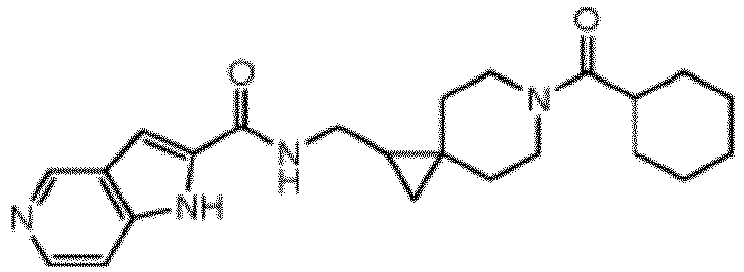
N-[[8-(cyclohexancarbonyl)-8-azaspiro[2.5]octan-2-yl]methyl]-1H-pyrrolo[3,2-c]pyridin-2-carboxamid; 
N-[[8-(tetrahydropyran-4-carbonyl)-8-azaspiro[2.5]octan-2-yl]methyl]-1H-pyrrolo[3,2-c]pyridin-2-carboxamid; 
N-[(8-benzoyl-8-azaspiro[2.5]octan-2-yl)methyl]-1H-pyrrolo[3,2-c]pyridin-2-carboxamid; 
N-[[8-(2-methylpropanoyl)-8-azaspiro[2.5]octan-2-yl]methyl]-1H-pyrrolo[3,2-c]pyridin-2-carboxamid; 
N-[[8-(benzenesulfonyl)-8-azaspiro[2.5]octan-2-yl]methyl]-1H-pyrrolo[3,2-c]pyridin-2-carboxamid; 
N-[(8-ethylsulfonyl-8-azaspiro[2.5]octan-2-yl)methyl]-1H-pyrrolo[3,2-c]pyridin-2-carboxamid; 
Tert-butyl 2-[(1H-pyrazolo[3,4-b]pyridin-5-carbonylamino)methyl]-8-azaspiro[2.5]octan-8-carboxylat; 
N-[(8-acetyl-8-azaspiro[2.5]octan-2-yl)methyl]-1H-pyrrolo[3,2-c]pyridin-2-carboxamid; 
N-[(8-methylsulfonyl-8-azaspiro[2.5]octan-2-yl)methyl]-1H-pyrrolo[3,2-c]pyridin-2-carboxamid; 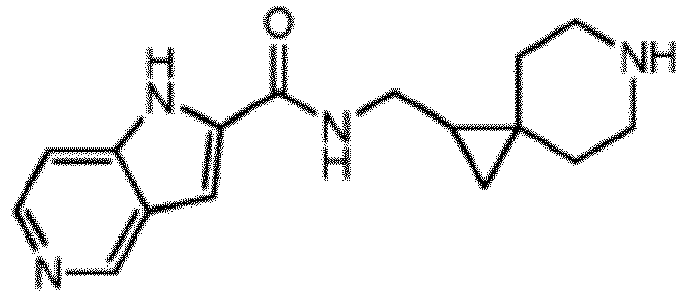
N-(8-azaspiro[2.5]octan-2-ylmethyl)-1H-pyrrolo[3,2-c]pyridin-2-carboxamid; 
N-(8-azaspiro[2.5]octan-2-ylmethyl)-1H-pyrazolo[3,4-b]pyridin-5-carboxamid; 
N-[(8-propanoyl-8-azaspiro[2.5]octan-2-yl)methyl]-1H-pyrrolo[3,2-c]pyridin-2-carboxamid; 
Tert-butyl 2-((imidazo[1,2-a]pyridin-6-carboxamido)methyl)-7-azaspiro[3.5]nonan-7-carboxylat; 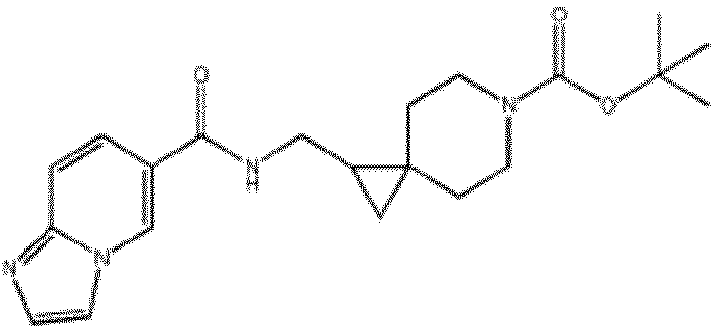
Tert-butyl 2-[(imidazo[1,2-a]pyridin-6-carbonylamino)methyl]-6-azaspiro[2.5]octan-6-carboxylat; 
Tert-butyl 2-[(furo[2,3-c]pyridin-2-carbonylamino)methyl]-6-azaspiro[2.5]octan-6-carboxylat; 
N-[[6-(3,3-dimethylbutanoyl)-6-azaspiro [2.5]octan-2-yl]methyl]-1H-pyrrolo[3,2-c]pyridin-2-carboxamid; 
Tert-butyl 2-[(1,3-Dihydropyrrolo[3,4-c]pyridin-2-carbonylamino)methyl]-6-azaspiro [2.5]octan-6-carboxylat; 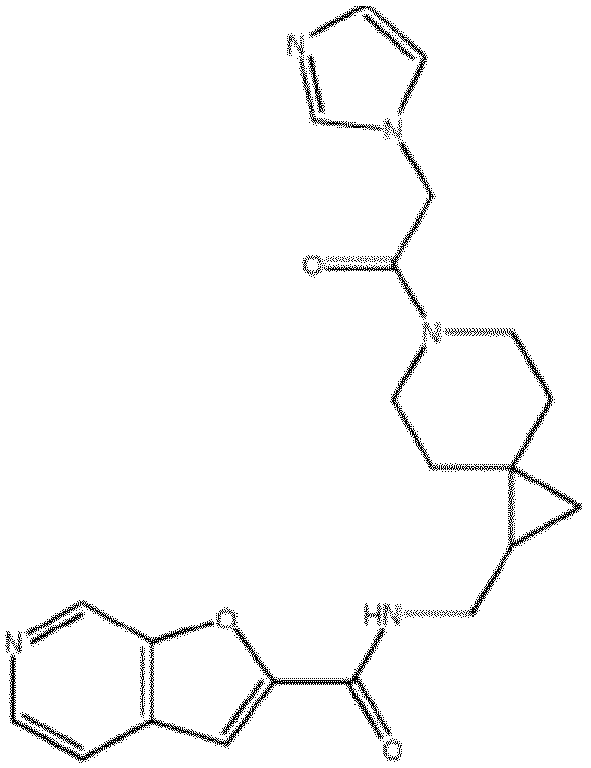
N-[[6-(2-imidazol-1-ylacetyl)-6-azaspiro[2.5]octan-2-yl]methyl]furo[2,3-c]pyridin-2-carboxamid; 
N-[[6-(4,4,4-trifluoro butanoyl)-6-azaspiro [2.5]octan-2-yl]methyl]furo[2,3-c]pyridin-2-carboxamid; 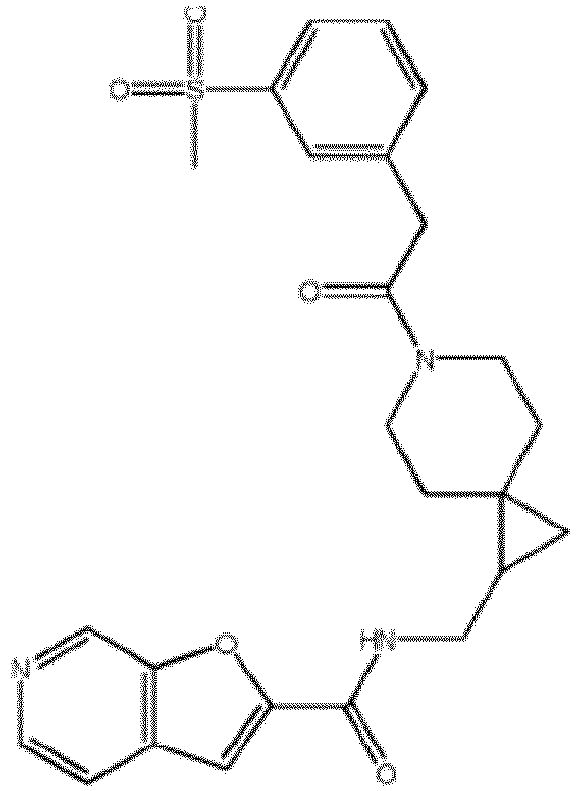
N-[[6-[2-(3-methylsulfonylphenyl)acetyl]-6-azaspiro[2.5]octan-2-yl]methyl]furo[2,3-c]pyridin-2-carboxamid; 
N-[[6-(3 ,3-dimethylbutanoyl)-6-azaspiro [2.5]octan-2-yl]methyl]furo[2,3-c]pyridin-2-carboxamid; 
N-[[6-[2-(4-methylpiperazin-1-yl)acetyl]-6-azaspiro[2.5]octan-2-yl]methyl]furo[2,3-c]pyridin-2-carboxamid; 
N-[[6-[2-(3-cyanophenyl)acetyl]-6-azaspiro[2.5]octan-2-yl]methyl]furo[2,3-c]pyridin-2-carboxamid; 
N-[[6-(2-cyclopropylacetyl)-6-azaspiro [2.5]octan-2-yl]methyl]furo[2,3-c]pyridin-2-carboxamid; 
N-[[6-(2-pyrrolidin-1-ylacetyl)-6-azaspiro[2.5]octan-2-yl]methyl]furo[2,3-c]pyridin-2-carboxamid; 
N-[[6-[2-(3-methylisoxazol-5-yl)acetyl]-6-azaspiro[2.5]octan-2-yl]methyl]furo[2,3-c]pyridin-2-carboxamid; 
N-[[6-[2-(1-piperidyl)acetyl]-6-azaspiro [2.5]octan-2-yl]methyl]furo[2,3-c]pyridin-2-carboxamid; 
N-[[6-(2-tetrahydropyran-4-ylacetyl)-6-azaspiro[2.5]octan-2-yl]methyl]furo[2,3-c]pyridin-2-carboxamid; 
N-[[6-(2-tetrahydrofuran-2-ylacetyl)-6-azaspiro[2.5]octan-2-yl]methyl]furo[2,3-c]pyridin-2-carboxamid; 
N-[[6-(2-tert-butoxyacetyl)-6-azaspiro [2.5]octan-2-yl]methyl]furo[2,3-c]pyridin-2-carboxamid; 
N-[[6-[2-(3-pyridyl)acetyl]-6-azaspiro[2.5]octan-2-yl]methyl]furo[2,3-c]pyridin-2-carboxamid; 
N-[[6-[2-[1-(2,2,2-trifluoroethyl)-4-piperidyl]acetyl]-6-azaspiro[2.5]octan-2-yl]methyl]-1H-pyrrolo[3,2-c]pyridin-2-carboxamid; 
Tert-butyl 2-[(imidazo[1,2-a]pyridin-6-carbonylamino)methyl]-6-azaspiro[2.5]octan-6-carboxylat; 
Tert-butyl 2-[(imidazo[1,2-a]pyridin-6-carbonylamino)methyl]-6-azaspiro[2.5]octan-6-carboxylat; 
Tert-butyl 2-[(furo[2,3-c]pyridin-2-carbonylamino)methyl]-6-azaspiro[2.5]octan-6-carboxylat; 
Tert-butyl 2-[(furo[2,3-c]pyridin-2-carbonylamino)methyl]-6-azaspiro[2.5]octan-6-carboxylat; 
N-[[6-(3,3-dimethylbutanoyl)-6-azaspiro[2.5]octan-2-yl]methyl]-1,3-dihydropyrrolo[3,4-c]pyridin-2-carboxamid; 
N-[[6-(3-methylbutanoyl)-6-azaspiro[2.5]octan-2-yl]methyl]-1H-pyrrolo[3,2-c]pyridin-2-carboxamid; 
N-[[6-(2-phenylacetyl)-6-azaspiro[2.5]octan-2-yl]methyl]-1,3-dihydropyrrolo[3,4-c]pyridin-2-carboxamid; 
Tert-butyl 2-[(1,3-Dihydropyrrolo[3,4-c]pyridin-2-carbonylamino)methyl]-6-azaspiro[2.5]octan-6-carboxylat; 
Tert-butyl 2-[(1,3-Dihydropyrrolo[3,4-c]pyridin-2-carbonylamino)methyl]-6-azaspiro[2.5]octan-6-carboxylat; 
N-[[6-(2-pyrazin-2-ylacetyl)-6-azaspiro[2.5]octan-2-yl]methyl]furo[2,3-c]pyridin-2-carboxamid; 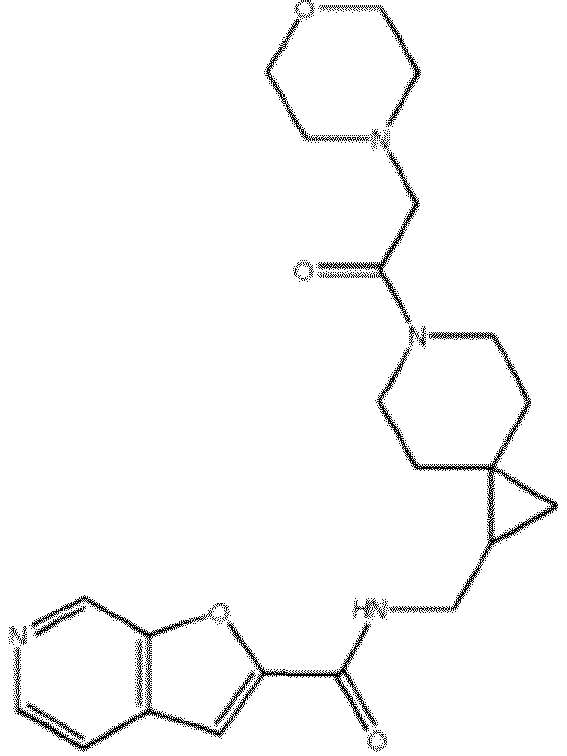
N-[[6-(2-morpholinoacetyl)-6-azaspiro[2.5]octan-2-yl]methyl]furo[2,3-c]pyridin-2-carboxamid; 
N-[[6-(2-tetrahydropyran-2-ylacetyl)-6-azaspiro[2.5]octan-2-yl]methyl]furo[2,3-c]pyridin-2-carboxamid; 
N-[[6-(2-pyrrolidin-1-ylpropanoyl)-6-azaspiro[2.5]octan-2-yl]methyl]furo[2,3-c]pyridin-2-carboxamid; 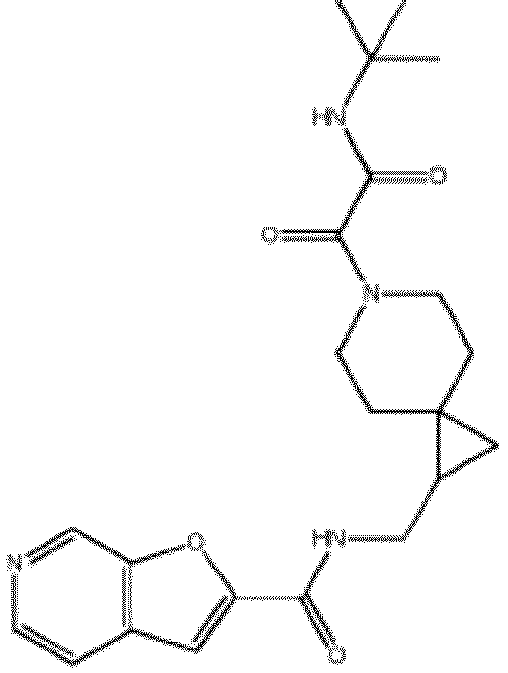
N-[[6-[2-(Tert-butylamino)-2-oxo-acetyl]-6-azaspiro[2.5]octan-2-yl]methyl]furo[2,3-c]pyridin-2-carboxamid; 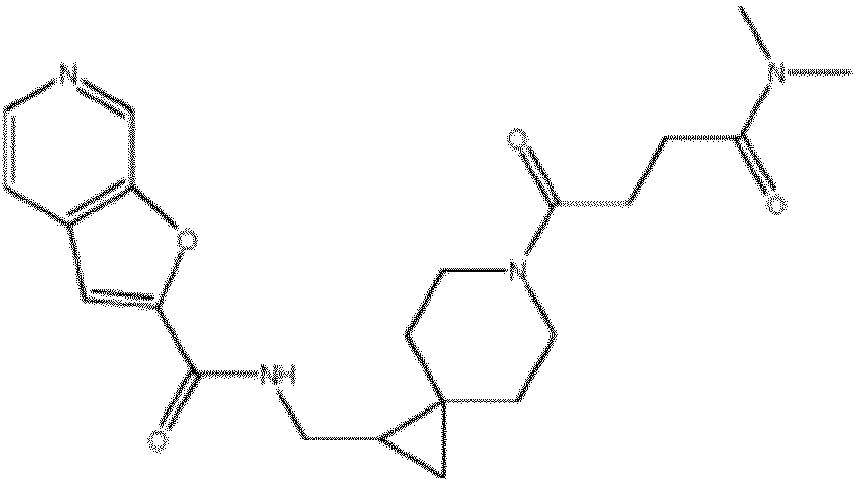
N-[[6-[4-(dimethylamino)-4-oxo-butanoyl]-6-azaspiro[2.5]octan-2-yl]methyl]furo[2,3-c]pyridin-2-carboxamid; 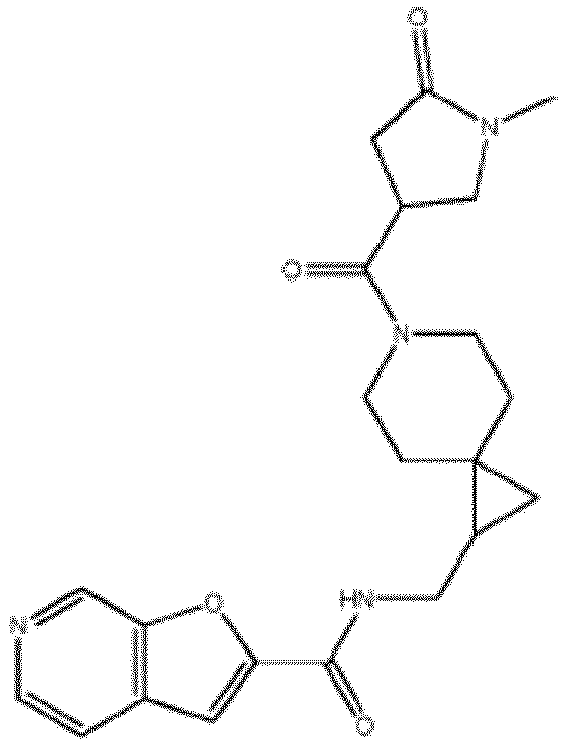
N-[[6-(1-methyl-5-oxo-pyrrolidin-3-carbonyl)-6-azaspiro[2.5]octan-2-yl]methyl]furo[2,3-c]pyridin-2-carboxamid; 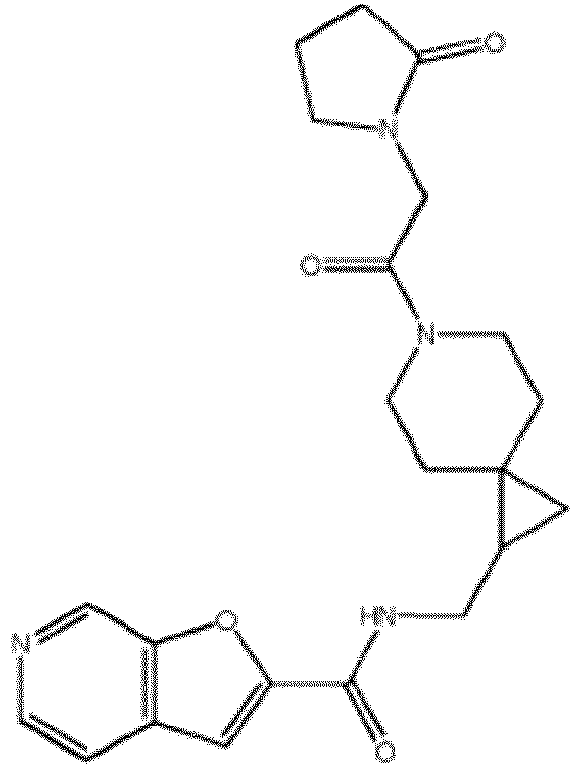
N-[[6-[2-(2-oxopyrrolidin-1-yl)acetyl]-6-azaspiro[2.5]octan-2-yl]methyl]furo[2,3-c]pyridin-2-carboxamid; 
N-[[6-(2,2-difluorocyclopropancarbonyl)-6-azaspiro[2.5]octan-2-yl]methyl]furo[2,3-c]pyridin-2-carboxamid; 
N-[[6-(tetrahydrofuran-3-carbonyl)-6-azaspiro[2.5]octan-2-yl]methyl]furo[2,3-c]pyridin-2-carboxamid; 
N-[[6-(tetrahydropyran-4-carbonyl)-6-azaspiro[2.5]octan-2-yl]methyl]furo[2,3-c]pyridin-2-carboxamid; 
N-[[6-(tetrahydrofuran-2-carbonyl)-6-azaspiro[2.5]octan-2-yl]methyl]furo[2,3-c]pyridin-2-carboxamid; 
N-[[6-(2-formamidoacetyl)-6-azaspiro[2.5]octan-2-yl]methyl]furo[2,3-c]pyridin-2-carboxamid; 
N-[[6-[3-(3,5-dimethylpyrazol-1-yl)propanoyl]-6-azaspiro[2.5]octan-2-yl]methyl]furo[2,3-c]pyridin-2-carboxamid; 
N-[[6-(1-carbamoylpyrrolidin-2-carbonyl)-6-azaspiro[2.5]octan-2-yl]methyl]furo[2,3-c]pyridin-2-carboxamid; 
N-[[6-(3-morpholinopropanoyl)-6-azaspiro[2.5]octan-2-yl]methyl]furo[2,3-c]pyridin-2-carboxamid; 
N-[[6-(1,1-dioxothiolane-3-carbonyl)-6-azaspiro[2.5]octan-2-yl]methyl]furo[2,3-c]pyridin-2-carboxamid; 
N-[[6-[2-(3,5-dimethylpyrazol-1-yl)acetyl]-6-azaspiro[2.5]octan-2-yl]methyl]furo[2,3-c]pyridin-2-carboxamid; 
N-[[6-(1-acetylpyrrolidin-2-carbonyl)-6-azaspiro[2.5]octan-2-yl]methyl]furo[2,3-c]pyridin-2-carboxamid; 
N-[[6-(2-methylsulfonylbenzoyl)-6-azaspiro[2.5]octan-2-yl]methyl]furo[2,3-c]pyridin-2-carboxamid; 
N-[[6-[3-(1,2,4-triazol-4-yl)benzoyl]-6-azaspiro[2.5]octan-2-yl]methyl]furo[2,3-c]pyridin-2-carboxamid; 
N-[[6-[4-[(dimethylamino)methyl]benzoyl]-6-azaspiro[2.5]octan-2-yl]methyl]furo[2,3-c]pyridin-2-carboxamid; 
N-[[6-(4-acetamidobenzoyl)-6-azaspiro[2.5]octan-2-yl]methyl]furo[2,3-c]pyridin-2-carboxamid; 
N-[[6-(1-methylsulfonylpiperidine-3-carbonyl)-6-azaspiro[2.5]octan-2-yl]methyl]furo[2,3-c]pyridin-2-carboxamid; 
N-[[6-(1-methylsulfonylpiperidine-4-carbonyl)-6-azaspiro[2.5]octan-2-yl]methyl]furo[2,3-c]pyridin-2-carboxamid; 
N-[[6-(2-morpholinopropanoyl)-6-azaspiro[2.5]octan-2-yl]methyl]furo[2,3-c]pyridin-2-carboxamid; 
N-[[6-(1-methylsulfonylpyrrolidin-2-carbonyl)-6-azaspiro[2.5]octan-2-yl]methyl]furo[2,3-c]pyridin-2-carboxamid; 
N-[[6-[2-(3-oxoisoindolin-1-yl)acetyl]-6-azaspiro[2.5]octan-2-yl]methyl]furo[2,3-c]pyridin-2-carboxamid; 
N-[[6-(1-carbamoylpiperidine-4-carbonyl)-6-azaspiro[2.5]octan-2-yl]methyl]furo[2,3-c]pyridin-2-carboxamid; 
N-[[6-(1-carbamoylpiperidine-3-carbonyl)-6-azaspiro[2.5]octan-2-yl]methyl]furo[2,3-c]pyridin-2-carboxamid; 
N-[[6[2-(1,1-dioxothiolan-3-yl)acetyl]-6-azaspiro[2.5]octan-2-yl]methyl]furo[2,3-c]pyridin-2-carboxamid; 
N-[[6-[2-(2,4-dioxopyrimidin-1-yl)acetyl]-6-azaspiro[2.5]octan-2-yl]methyl]furo[2,3-c]pyridin-2-carboxamid; 
N-[[6-(1-acetylpiperidine-4-carbonyl)-6-azaspiro[2.5]octan-2-yl]methyl]furo[2,3-c]pyridin-2-carboxamid; 
N-[[6-[4-(tetrazol-1-ylmethyl)benzoyl]-6-azaspiro[2.5]octan-2-yl]methyl]furo[2,3-c]pyridin-2-carboxamid; 
N-[[6-[4-(methanesulfonamido)benzoyl]-6-azaspiro[2.5]octan-2-yl]methyl]furo[2,3-c]pyridin-2-carboxamid; 
N-[[6-[4-(1,1-dioxo-1,4-thiazinan-4-yl)benzoyl]-6-azaspiro[2.5]octan-2-yl]methyl]furo[2,3-c]pyridin-2-carboxamid; 
N-[[6-[4-[(4-methylpiperazin-1-yl)methyl]benzoyl]-6-azaspiro[2.5]octan-2-yl]methyl]furo[2,3-c]pyridin-2-carboxamid; 
N-[[6-[2-[(4-methylpiperazin-1-yl)methyl]benzoyl]-6-azaspiro[2.5]octan-2-yl]methyl]furo[2,3-c]pyridin-2-carboxamid; 
N-[[6-[3-[(4-methylpiperazin-1-yl)methyl]benzoyl]-6-azaspiro[2.5]octan-2-yl]methyl]furo[2,3-c]pyridin-2-carboxamid; 
N-[[6-[3-(4-methylpiperazin-1-yl)propanoyl]-6-azaspiro[2.5]octan-2-yl]methyl]furo[2,3-c]pyridin-2-carboxamid; 
N-[[6-(1-isopropyl-5-oxo-pyrrolidin-3-carbonyl)-6-azaspiro[2.5]octan-2-yl]methyl]furo[2,3-c]pyridin-2-carboxamid; 
N-[[6-[2-(3-oxopiperazin-1-yl)acetyl]-6-azaspiro[2.5]octan-2-yl]methyl]furo[2,3-c]pyridin-2-carboxamid; 
N-[[6-(3-methylsulfonylbenzoyl)-6-azaspiro[2.5]octan-2-yl]methyl]furo[2,3-c]pyridin-2-carboxamid; 
N-[[6-(4-methylsulfonylbenzoyl)-6-azaspiro[2.5]octan-2-yl]methyl]furo[2,3-c]pyridin-2-carboxamid; 
N-[[6-(4-ureidobenzoyl)-6-azaspiro[2.5]octan-2-yl]methyl]furo[2,3-c]pyridin-2-carboxamid; 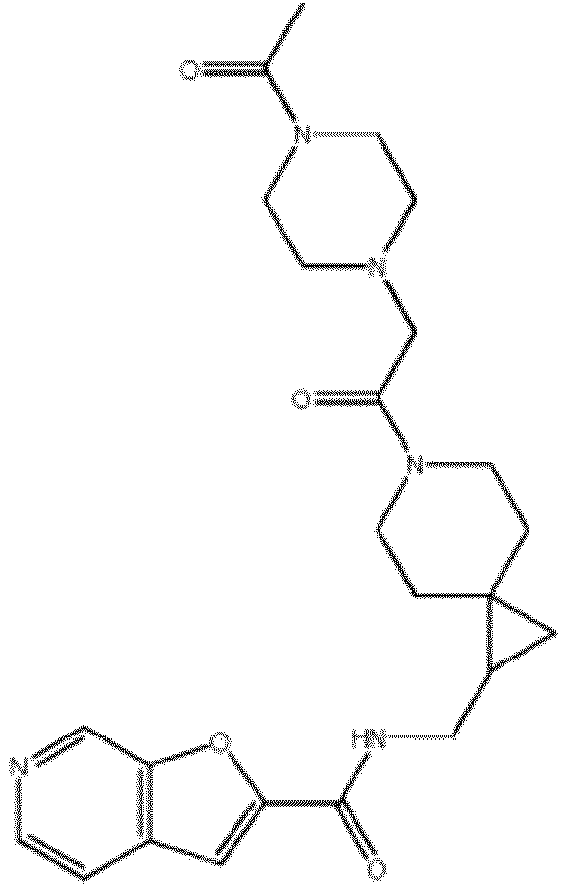
N-[[6-[2-(4-acetylpiperazin-1-yl)acetyl]-6-azaspiro[2.5]octan-2-yl]methyl]furo[2,3-c]pyridin-2-carboxamid; 
N-[[6-[4-[(5-methyltetrazol-1-yl)methyl]benzoyl]-6-azaspiro[2.5]octan-2-yl]methyl]furo[2,3-c]pyridin-2-carboxamid; 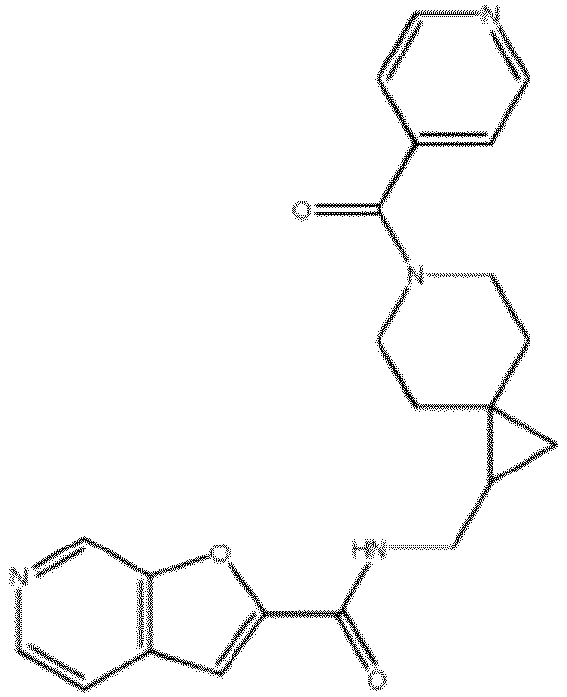
N-[[6-(pyridin-4-carbonyl)-6-azaspiro[2.5]octan-2-yl]methyl]furo[2,3-c]pyridin-2-carboxamid; 
N-[[6-(pyridin-2-carbonyl)-6-azaspiro[2.5]octan-2-yl]methyl]furo[2,3-c]pyridin-2-carboxamid; 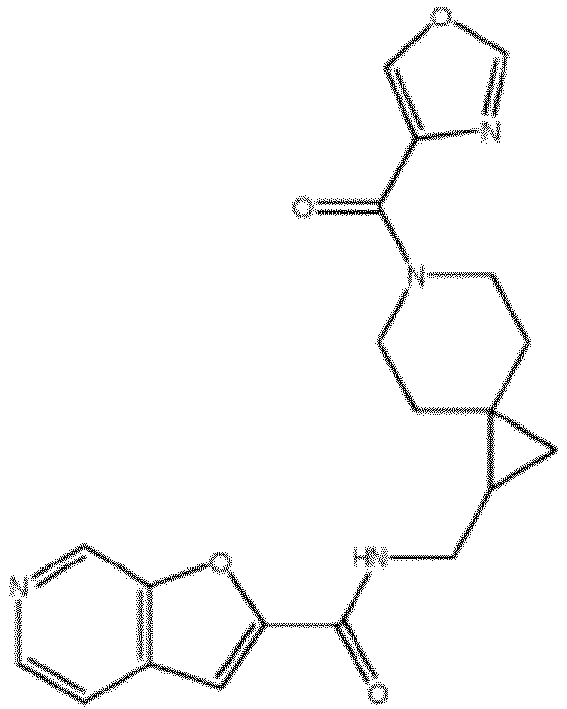
N-[[6-(oxazol-4-carbonyl)-6-azaspiro[2.5]octan-2-yl]methyl]furo[2,3-c]pyridin-2-carboxamid; 
N-[[6-(1H-1,2,4-triazol-3-carbonyl)-6-azaspiro[2.5]octan-2-yl]methyl]furo[2,3-c]pyridin-2-carboxamid; 
N-[[6-(1H-imidazol-4-carbonyl)-6-azaspiro[2.5]octan-2-yl]methyl]furo[2,3-c]pyridin-2-carboxamid; 
N-[[6-(pyrimidin-4-carbonyl)-6-azaspiro[2.5]octan-2-yl]methyl]furo[2,3-c]pyridin-2-carboxamid; 
N-[[6-(pyridin-3-carbonyl)-6-azaspiro[2.5]octan-2-yl]methyl]furo[2,3-c]pyridin-2-carboxamid; 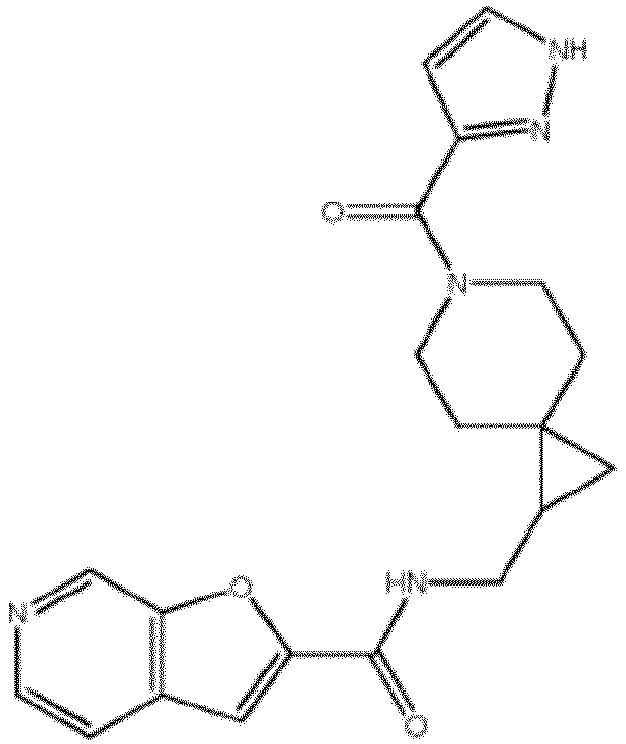
N-[[6-(1H-pyrazol-3-carbonyl)-6-azaspiro[2.5]octan-2-yl]methyl]furo[2,3-c]pyridin-2-carboxamid; 
N-[[6-(1-methylimidazol-4-carbonyl)-6-azaspiro[2.5]octan-2-yl]methyl]furo[2,3-c]pyridin-2-carboxamid; 
N-[[6-(3-methyl-1H-pyrazol-4-carbonyl)-6-azaspiro[2.5]octan-2-yl]methyl]furo[2,3-c]pyridin-2-carboxamid; 
N-[[6-(2-methylpyrazol-3-carbonyl)-6-azaspiro[2.5]octan-2-yl]methyl]furo[2,3-c]pyridin-2-carboxamid; 
N-[[6-(5-methyl-1H-pyrazol-3-carbonyl)-6-azaspiro[2.5]octan-2-yl]methyl]furo[2,3-c]pyridin-2-carboxamid; 
N-[[6-(1-methylpyrazol-3-carbonyl)-6-azaspiro[2.5]octan-2-yl]methyl]furo[2,3-c]pyridin-2-carboxamid; 
N-[[6-(pyridazin-3-carbonyl)-6-azaspiro[2.5]octan-2-yl]methyl]furo[2,3-c]pyridin-2-carboxamid; 
N-[[6-(pyrimidin-5-carbonyl)-6-azaspiro[2.5]octan-2-yl]methyl]furo[2,3-c]pyridin-2-carboxamid; 
N-[[6-(pyrazin-2-carbonyl)-6-azaspiro[2.5]octan-2-yl]methyl]furo[2,3-c]pyridin-2-carboxamid; 
N-[[6-(pyridazin-4-carbonyl)-6-azaspiro[2.5]octan-2-yl]methyl]furo[2,3-c]pyridin-2-carboxamid; 
N-[[6-(1-methylpyrazol-4-carbonyl)-6-azaspiro[2.5]octan-2-yl]methyl]furo[2,3-c]pyridin-2-carboxamid; 
N-[[6-(1,5-dimethylpyrazol-3-carbonyl)-6-azaspiro[2.5]octan-2-yl]methyl]furo[2,3-c]pyridin-2-carboxamid; 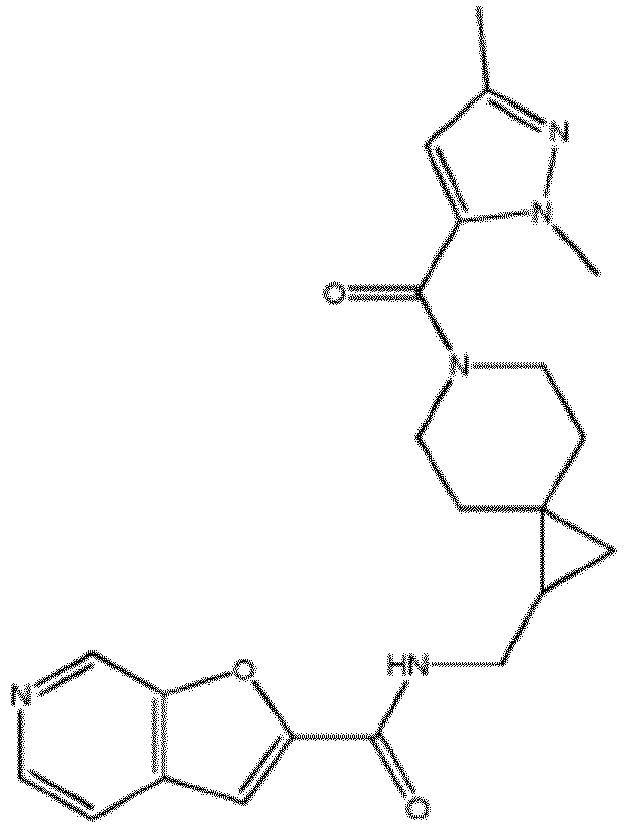
N-[[6-(2,5-dimethylpyrazol-3-carbonyl)-6-azaspiro[2.5]octan-2-yl]methyl]furo[2,3-c]pyridin-2-carboxamid; 
N-[[6-(5-methylisoxazol-3-carbonyl)-6-azaspiro[2.5]octan-2-yl]methyl]furo[2,3-c]pyridin-2-carboxamid; 
N-[[6-(4-methyl-1,2,5-oxadiazol-3-carbonyl)-6-azaspiro[2.5]octan-2-yl]methyl]furo[2,3-c]pyridin-2-carboxamid; 
N-[[6-(2-methylpyridin-3-carbonyl)-6-azaspiro[2.5]octan-2-yl]methyl]furo[2,3-c]pyridin-2-carboxamid; 
N-[[6-(4-methylpyridin-3-carbonyl)-6-azaspiro[2.5]octan-2-yl]methyl]furo[2,3-c]pyridin-2-carboxamid; 
N-[[6-(2-methylpyridin-4-carbonyl)-6-azaspiro[2.5]octan-2-yl]methyl]furo[2,3-c]pyridin-2-carboxamid; 
N-[[6-(5-methylpyrazin-2-carbonyl)-6-azaspiro[2.5]octan-2-yl]methyl]furo[2,3-c]pyridin-2-carboxamid; 
N-[[6-(3-cyclopropyl-1H-pyrazol-5-carbonyl)-6-azaspiro[2.5]octan-2-yl]methyl]furo[2,3-c]pyridin-2-carboxamid; 
N-[[6-(1-ethyl-5-methyl-pyrazol-4-carbonyl)-6-azaspiro[2.5]octan-2-yl]methyl]furo[2,3-c]pyridin-2-carboxamid; 
N-[[6-(3,5-dimethylisoxazol-4-carbonyl)-6-azaspiro[2.5]octan-2-yl]methyl]furo[2,3-c]pyridin-2-carboxamid; 
N-[[6-(1-ethylpyrazol-4-carbonyl)-6-azaspiro[2.5]octan-2-yl]methyl]furo[2,3-c]pyridin-2-carboxamid; 
N-[[6-(6-cyanopyridin-3-carbonyl)-6-azaspiro[2.5]octan-2-yl]methyl]furo[2,3-c]pyridin-2-carboxamid; 
N-[[6-(2,4-dimethyloxazol-5-carbonyl)-6-azaspiro[2.5]octan-2-yl]methyl]furo[2,3-c]pyridin-2-carboxamid; 
N-[[6-(2-morpholinopyridin-4-carbonyl)-6-azaspiro[2.5]octan-2-yl]methyl]furo[2,3-c]pyridin-2-carboxamid; 
N-[[6-(cyclopropancarbonyl)-6-azaspiro[2.5]octan-2-yl]methyl]furo[2,3-c]pyridin-2-carboxamid; 
N-[[6-[1-methyl-5-(trifluoromethyl)pyrazol-3-carbonyl]-6-azaspiro[2.5]octan-2-yl]methyl]furo[2,3-c]pyridin-2-carboxamid; 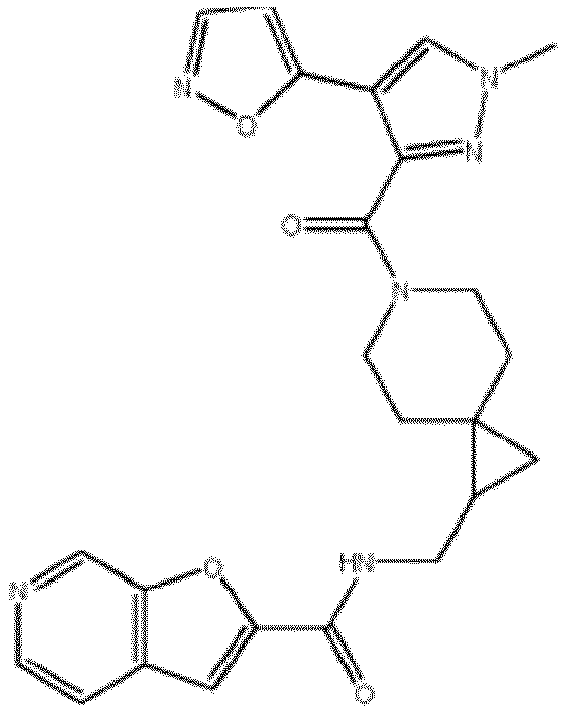
N-[[6-(4-isoxazol-5-yl-1-methyl-pyrazol-3-carbonyl)-6-azaspiro[2.5]octan-2-yl]methyl]furo[2,3-c]pyridin-2-carboxamid; 
N-[[6-(2-acetamidopyridin-4-carbonyl)-6-azaspiro[2.5]octan-2-yl]methyl]furo[2,3-c]pyridin-2-carboxamid; 
N-[[6-[3-(tetrazol-1-yl)-1H-pyrazol-4-carbonyl]-6-azaspiro[2.5]octan-2-yl]methyl]furo[2,3-c]pyridin-2-carboxamid; 
N-[[6-(6-acetamidopyridin-2-carbonyl)-6-azaspiro[2.5]octan-2-yl]methyl]furo[2,3-c]pyridin-2-carboxamid; 
N-[[6-(3-ethyl-5-methyl-isoxazol-4-carbonyl)-6-azaspiro[2.5]octan-2-yl]methyl]furo[2,3-c]pyridin-2-carboxamid; 
N-[[6-(2-ethyl-5-methyl-pyrazol-3-carbonyl)-6-azaspiro[2.5]octan-2-yl]methyl]furo[2,3-c]pyridin-2-carboxamid; 
N-[[6-(1-ethyl-3-methyl-pyrazol-4-carbonyl)-6-azaspiro[2.5]octan-2-yl]methyl]furo[2,3-c]pyridin-2-carboxamid; 
N-[[6-(3-methylisoxazol-4-carbonyl)-6-azaspiro[2.5]octan-2-yl]methyl]furo[2,3-c]pyridin-2-carboxamid; 
N-[[6-[2-methyl-3-(3-methylpyrazol-1-yl)propanoyl]-6-azaspiro[2.5]octan-2-yl]methyl]furo[2,3-c]pyridin-2-carboxamid; 
N-[[6-(1H-pyrazol-4-carbonyl)-6-azaspiro[2.5]octan-2-yl]methyl]furo[2,3-c]pyridin-2-carboxamid; 
N-[[6-[2-(1-methylsulfonyl-4-piperidyl)acetyl]-6-azaspiro[2.5]octan-2-yl]methyl]furo[2,3-c]pyridin-2-carboxamid; 
N-[[6-(4-methylmorpholine-2-carbonyl)-6-azaspiro[2.5]octan-2-yl]methyl]furo[2,3-c]pyridin-2-carboxamid; 
N-[[6-[1-(2-methylpropanoyl)azetidin-3-carbonyl]-6-azaspiro[2.5]octan-2-yl]methyl]furo[2,3-c]pyridin-2-carboxamid; 
N-[[6-(1-acetylazetidin-3-carbonyl)-6-azaspiro[2.5]octan-2-yl]methyl]furo[2,3-c]pyridin-2-carboxamid; 
N-[[6-(1-pyridazin-3-ylpyrrolidin-3-carbonyl)-6-azaspiro[2.5]octan-2-yl]methyl]furo[2,3-c]pyridin-2-carboxamid; 
N-[[6-[2-(1-pyrimidin-2-yl-4-piperidyl)acetyl]-6-azaspiro[2.5]octan-2-yl]methyl]furo[2,3-c]pyridin-2-carboxamid; 
N-[[6-[2-(1-isopropyl-4-piperidyl)acetyl]-6-azaspiro[2.5]octan-2-yl]methyl]furo[2,3-c]pyridin-2-carboxamid; 
N-[[6-[2-(1-methyl-4-piperidyl)acetyl]-6-azaspiro[2.5]octan-2-yl]methyl]furo[2,3-c]pyridin-2-carboxamid; 
N-[[6-[2-(3-methyloxetan-3-yl)acetyl]-6-azaspiro[2.5]octan-2-yl]methyl]-1H-pyrrolo[3,2-c]pyridin-2-carboxamid; 
Isopropyl 2-[(1,3-Dihydropyrrolo[3,4-c]pyridin-2-carbonylamino)methyl]-6-azaspiro[2.5]octan-6-carboxylat; 
N-[[6-[2-(2-cyanophenyl)acetyl]-6-azaspiro[2.5]octan-2-yl]methyl]furo[2,3-c]pyridin-2-carboxamid; 
N-[[6-(3-methoxypropanoyl)-6-azaspiro[2.5]octan-2-yl]methyl]furo[2,3-c]pyridin-2-carboxamid; 
N-[[6-[2-[4-(trifluoromethylsulfonyl)phenyl]ac etyl]-6-azaspiro[2.5]octan-2-yl]methyl]furo[2,3-c]pyridin-2-carboxamid; 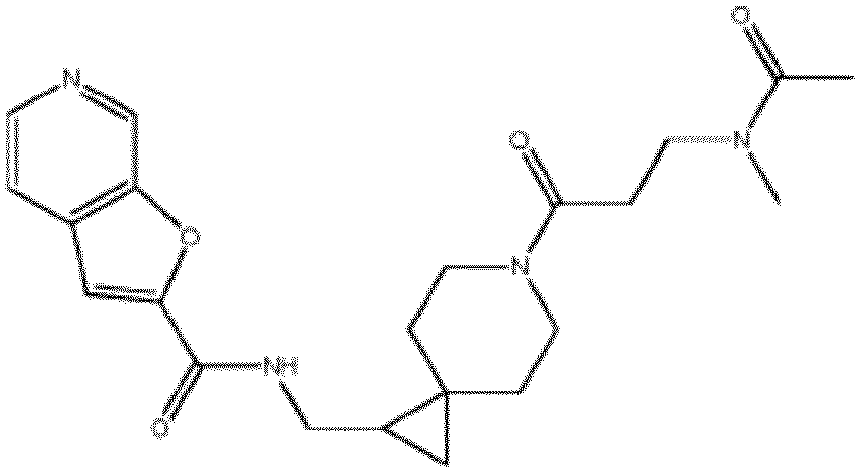
N-[[6-[3-[acetyl(methyl)amino]propanoyl]-6-azaspiro[2.5]octan-2-yl]methyl]furo[2,3-c]pyridin-2-carboxamid; 
N-[[6-[2-(2-pyridyl)acetyl]-6-azaspiro[2.5]octan-2-yl]methyl]furo[2,3-c]pyridin-2-carboxamid; 
N-[[6-[(4-cyanophenyl)carbamoyl]-6-azaspiro[2.5]octan-2-yl]methyl]furo[2,3-c]pyridin-2-carboxamid; 
N-[[6-(m-tolylmethylcarbamoyl)-6-azaspiro[2.5]octan-2-yl]methyl]furo[2,3-c]pyridin-2-carboxamid; 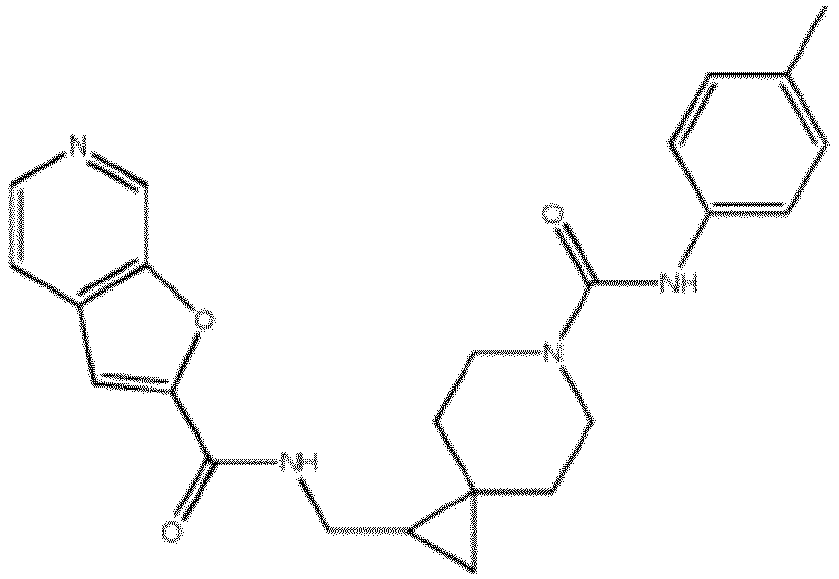
N-[[6-(p-tolylcarbamoyl)-6-azaspiro[2.5]octan-2-yl]methyl]furo[2,3-c]pyridin-2-carboxamid; 
N-[[6-(benzylcarbamoyl)-6-azaspiro[2.5]octan-2-yl]methyl]furo[2,3-c]pyridin-2-carboxamid; 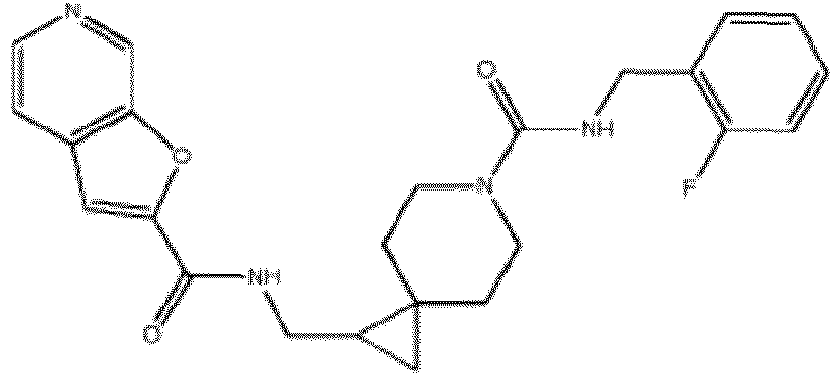
N-[[6-[(2-fluorophenyl)methylcarbamoyl]-6-azaspiro[2.5]octan-2-yl]methyl]furo[2,3-c]pyridin-2-carboxamid; 
N-[[6-(p-tolylmethylcarbamoyl)-6-azaspiro[2.5]octan-2-yl]methyl]furo[2,3-c]pyridin-2-carboxamid; 
N-[[6-(m-tolylmethylcarbamoyl)-6-azaspiro[2.5]octan-2-yl]methyl]furo[2,3-c]pyridin-2-carboxamid; 
N-[[6-(p-tolylcarbamoyl)-6-azaspiro[2.5]octan-2-yl]methyl]furo[2,3-c]pyridin-2-carboxamid; 
N-[[6-(benzylcarbamoyl)-6-azaspiro[2.5]octan-2-yl]methyl]furo[2,3-c]pyridin-2-carboxamid; 
N-[[6-[(2-fluorophenyl)methylcarbamoyl]-6-azaspiro[2.5]octan-2-yl]methyl]furo[2,3-c]pyridin-2-carboxamid; 
N-[[6-(p-tolylmethylcarbamoyl)-6-azaspiro[2.5]octan-2-yl]methyl]furo[2,3-c]pyridin-2-carboxamid; 
N-[[6-[(4-fluorophenyl)methylcarbamoyl]-6-azaspiro[2.5]octan-2-yl]methyl]furo[2,3-c]pyridin-2-carboxamid; 
N-[[6-[(2-methoxyphenyl)methylcarbamoyl]-6-azaspiro[2.5]octan-2-yl]methyl]furo[2,3-c]pyridin-2-carboxamid; 
N-[[6-[(3-methoxyphenyl)methylcarbamoyl]-6-azaspiro[2.5]octan-2-yl]methyl]furo[2,3-c]pyridin-2-carboxamid; 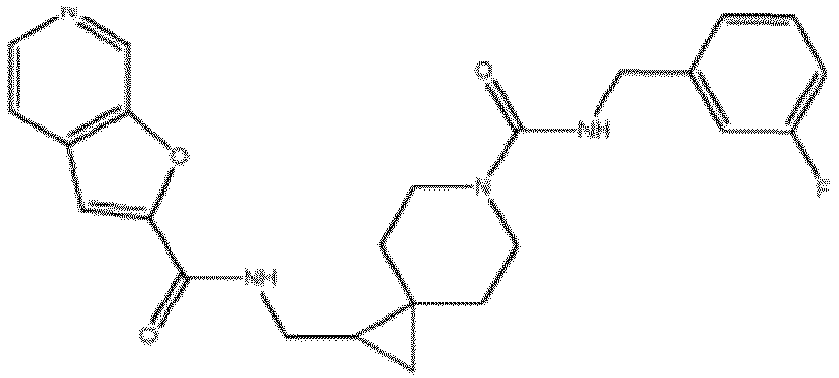
N-[[6-[(3-fluorophenyl)methylcarbamoyl]-6-azaspiro[2.5]octan-2-yl]methyl]furo[2,3-c]pyridin-2-carboxamid; 
N-[[6-[(4-methoxyphenyl)methylcarbamoyl]-6-azaspiro[2.5]octan-2-yl]methyl]furo[2,3-c]pyridin-2-carboxamid; 
N-[[6-[(3,4-dichlorophenyl)methylcarbamoyl]-6-azaspiro[2.5]octan-2-yl]methyl]furo[2,3-c]pyridin-2-carboxamid; 
N-[[6-(1-adamantylcarbamoyl)-6-azaspiro[2.5]octan-2-yl]methyl]furo[2,3-c]pyridin-2-carboxamid; 
N-[[6-[(4-chlorophenyl)methylcarbamoyl]-6-azaspiro[2.5]octan-2-yl]methyl]furo[2,3-c]pyridin-2-carboxamid; 
N-[[6-[(2-chlorophenyl)methylcarbamoyl]-6-azaspiro[2.5]octan-2-yl]methyl]furo[2,3-c]pyridin-2-carboxamid; 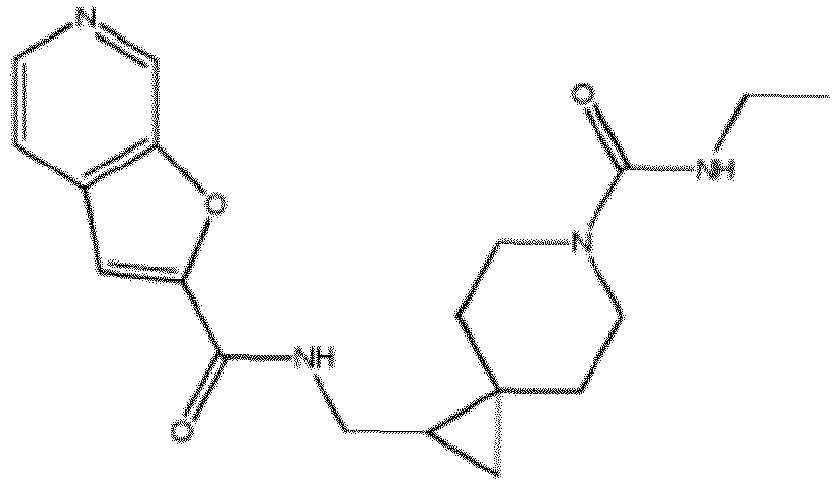
N-[[6-(ethylcarbamoyl)-6-azaspiro[2.5]octan-2-yl]methyl]furo[2,3-c]pyridin-2-carboxamid; 
N-[[6-[(2,4-dichlorophenyl)methylcarbamoyl]-6-azaspiro[2.5]octan-2-yl]methyl]furo[2,3-c]pyridin-2-carboxamid; 
N-[[6-[2-(3-hydroxy-3-methyl-cyclobutyl)acetyl]-6-azaspiro[2.5]octan-2-yl]methyl]furo[2,3-c]pyridin-2-carboxamid; 
N-[[6-[2-(3-methyloxetan-3-yl)acetyl]-6-azaspiro[2.5]octan-2-yl]methyl]-1,3-dihydropyrrolo[3,4-c]pyridin-2-carboxamid; 
N-[[6-[2-(2-pyridyl)acetyl]-6-azaspiro[2.5]octan-2-yl]methyl]-1,3-dihydropyrrolo[3,4-c]pyridin-2-carboxamid; 
N-[[6-[2-(3-pyridyl)acetyl]-6-azaspiro[2.5]octan-2-yl]methyl]-1,3-dihydropyrrolo[3,4-c]pyridin-2-carboxamid; 
N-[[6-[2-(3-cyanophenyl)acetyl]-6-azaspiro[2.5]octan-2-yl]methyl]-1,3-dihydropyrrolo[3,4-c]pyridin-2-carboxamid; 
N-[[6-[4-(1,2,4-triazol-1-yl)benzoyl]-6-azaspiro[2.5]octan-2-yl]methyl]furo[2,3-c]pyridin-2-carboxamid; 
N-[[6-[2-(2-methylimidazol-1-yl)acetyl]-6-azaspiro[2.5]octan-2-yl]methyl]furo[2,3-c]pyridin-2-carboxamid; 
N-[[6-(1,3,5-trimethylpyrazol-4-carbonyl)-6-azaspiro[2.5]octan-2-yl]methyl]furo[2,3-c]pyridin-2-carboxamid; 
N-[[6-(tert-butylcarbamoyl)-6-azaspiro[2.5]octan-2-yl]methyl]furo[2,3-c]pyridin-2-carboxamid; 
N-[[6-(isopropylcarbamoyl)-6-azaspiro[2.5]octan-2-yl]methyl]furo[2,3-c]pyridin-2-carboxamid; 
N-[[6-(cyclohexylmethylcarbamoyl)-6-azaspiro[2.5]octan-2-yl]methyl]furo[2,3-c]pyridin-2-carboxamid; 
N-[[6-(propylcarbamoyl)-6-azaspiro[2.5]octan-2-yl]methyl]furo[2,3-c]pyridin-2-carboxamid; 
N-[[6-(cyclohexylcarbamoyl)-6-azaspiro[2.5]octan-2-yl]methyl]furo[2,3-c]pyridin-2-carboxamid; 
N-[[6-(phenylcarbamoyl)-6-azaspiro[2.5]octan-2-yl]methyl]furo[2,3-c]pyridin-2-carboxamid; 
N-[[6-[2-(1-isopropyl-4-piperidyl)acetyl]-6-azaspiro[2.5]octan-2-yl]methyl]-1,3-dihydropyrrolo[3,4-c]pyridin-2-carboxamid; 
N-[[6-(3-methylbutanoyl)-6-azaspiro[2.5]octan-2-yl]methyl]-1,3-dihydropyrrolo[3,4-c]pyridin-2-carboxamid; 
N-[[6-[2-(4-pyridyl)acetyl]-6-azaspiro[2.5]octan-2-yl]methyl]-1,3-dihydropyrrolo[3,4-c]pyridin-2-carboxamid; 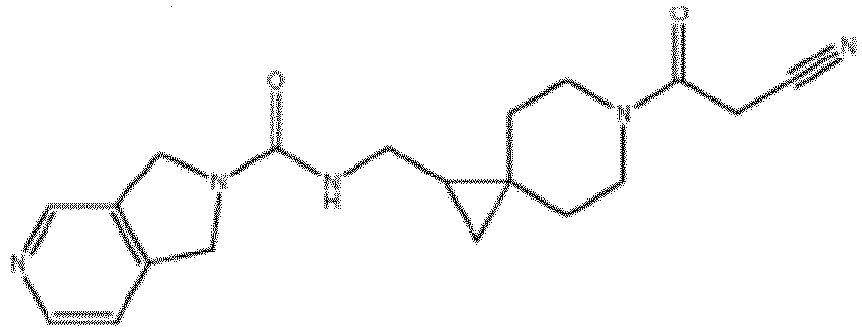
N-[[6-(2-cyanoacetyl)-6-azaspiro[2.5]octan-2-yl]methyl]-1,3-dihydropyrrolo[3,4-c]pyridin-2-carboxamid; 
2-[(1,3-dihydropyrrolo[3,4-c]pyridin-2-carbonylamino)methyl]-6-azaspiro[2.5]octan-6-carboxylat d'ethyl ; 
Tert-butyl 2-[(1H-pyrrolo[3,2-c]pyridin-2-carbonylamino)methyl]-7-azaspiro[3.5]nonan-7-carboxylat; 
Tert-butyl 2-[(furo[2,3-c]pyridin-2-carbonylamino)methyl]-7-azaspiro[3.5]nonan-7-carboxylat; 
N-[[6-[2-(3-methyloxetan-3-yl)acetyl]-6-azaspiro[2.5]octan-2-yl]methyl]furo[2,3-c]pyridin-2-carboxamid; 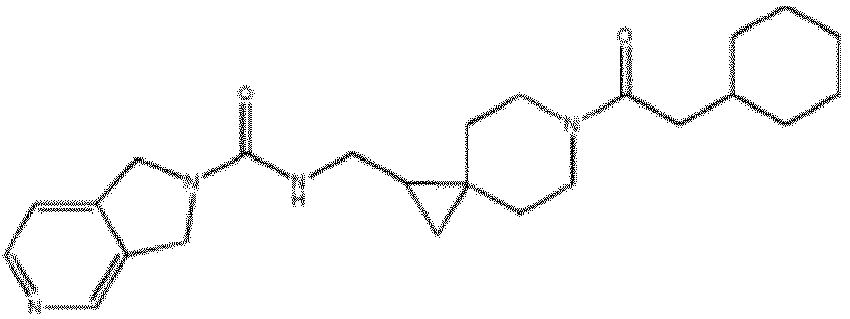
N-[[6-(2-cyclohexylacetyl)-6-azaspiro[2.5]octan-2-yl]methyl]-1,3-dihydropyrrolo[3,4-c]pyridin-2-carboxamid; 
N-[[6-(3-cyclohexylpropanoyl)-6-azaspiro[2.5]octan-2-yl]methyl]-1,3-dihydropyrrolo[3,4-c]pyridin-2-carboxamid; 
N-[[6-(2-morpholinoacetyl)-6-azaspiro[2.5]octan-2-yl]methyl]-1,3-dihydropyrrolo[3,4-c]pyridin-2-carboxamid; 
N-[[6-(3-phenylpropanoyl)-6-azaspiro[2.5]octan-2-yl]methyl]-1,3-dihydropyrrolo[3,4-c]pyridin-2-carboxamid; 
Tert-butyl 2-[(1,3-dihydropyrrolo[3,4-c]pyridin-2-carbonylamino)methyl]-7-azaspiro[3.5]nonan-7-carboxylat; 
N-[[6-[2-(3,5-difluorophenyl)acetyl]-6-azaspiro[2.5]octan-2-yl]methyl]-1,3-dihydropyrrolo[3,4-c]pyridin-2-carboxamid; 
N-[[6-[2-[3-(trifluoromethyl)phenyl]acetyl]-6-azaspiro[2.5]octan-2-yl]methyl]-1,3-dihydropyrrolo[3,4-c]pyridin-2-carboxamid; 
N-[[6-(tert-butylcarbamoyl)-6-azaspiro[2.5]octan-2-yl]methyl]-1H-pyrrolo[3,2-c]pyridin-2-carboxamid; 
[2,2,2-Trideuterio-1,1-bis(trideuteriomethyl)ethyl] 2-[(1,3-dihydropyrrolo[3,4-c]pyridin-2-carbonylamino)methyl]-6-azaspiro[2.5]octan-6-carboxylat; 
2-methoxy-1,1-dimethyl-2-oxo-ethyl 2-[(furo[2,3-c]pyridin-2-carbonylamino)methyl]-6-azaspiro[2.5]octan-6-carboxylat; 
N-[[6-[2-(3-cyanophenyl)acetyl]-6-azaspiro[2.5]octan-2-yl]methyl]-1H-pyrrolo[3,2-c]pyridin-2-carboxamid; 
N-[[6-[2-(4-cyanophenyl)acetyl]-6-azaspiro[2.5]octan-2-yl]methyl]-1,3-dihydropyrrolo[3,4-c]pyridin-2-carboxamid; 
N-[[6-(phenylcarbamoyl)-6-azaspiro[2.5]octan-2-yl]methyl]-1,3-dihydropyrrolo[3,4-c]pyridin-2-carboxamid; 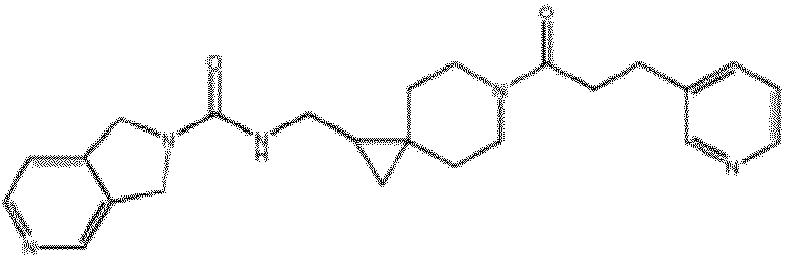
N-[[6-[3-(3-pyridyl)propanoyl]-6-azaspiro[2.5]octan-2-yl]methyl]-1,3-dihydropyrrolo[3,4-c]pyridin-2-carboxamid; 
N-[[6-(benzylcarbamoyl)-6-azaspiro[2.5]octan-2-yl]methyl]-1,3-dihydropyrrolo[3,4-c]pyridin-2-carboxamid; 
N-[(6-benzylsulfonyl-6-azaspiro[2.5]octan-2-yl)methyl]-1,3-dihydropyrrolo[3,4-c]pyridin-2-carboxamid; 
N-[[6-(tert-butylcarbamoyl)-6-azaspiro[2.5]octan-2-yl]methyl]-1,3-dihydropyrrolo[3,4-c]pyridin-2-carboxamid; 
N-[[6-(3,3-dimethylbutanoyl)-6-azaspiro[2.5]octan-2-yl]methyl]-1H-pyrrolo[3,2-c]pyridin-2-carboxamid; 
N-[[6-(3,3-dimethylbutanoyl)-6-azaspiro[2.5]octan-2-yl]methyl]-1H-pyrrolo[3,2-c]pyridin-2-carboxamid; 
(2-Hydroxy-1,1-dimethyl-ethyl) 2-[(Furo[2,3-c]pyridin-2-carbonylamino)methyl]-6-azaspiro[2.5]octan-6-carboxylat; 
N-[[6-[2-(4-cyanophenyl)acetyl]-6-azaspiro[2.5]octan-2-yl]methyl]-1H-pyrrolo[3,2-c]pyridin-2-carboxamid; 
2-[(1,3-Dihydropyrrolo[3,4-c]pyridin-2-carbonylamino)methyl]-6-azaspiro[2.5]octan-6-carboxylat (2-methoxy-1,1-dimethyl-ethyl); 
N-[[6-(2-tetrahydropyran-4-ylacetyl)-6-azaspiro[2.5]octan-2-yl]methyl]-1,3-dihydropyrrolo[3,4-c]pyridin-2-carboxamid; 
N-[[6-(1,3,5-trimethylpyrazol-4-carbonyl)-6-azaspiro[2.5]octan-2-yl]methyl]-1,3-dihydropyrrolo[3,4-c]pyridin-2-carboxamid; 
N-[[6-(1-methylpyrazol-4-carbonyl)-6-azaspiro[2.5]octan-2-yl]methyl]-1,3-dihydropyrrolo[3,4-c]pyridin-2-carboxamid; 
N-[[6-(1-isopropyl-3,5-dimethyl-pyrazol-4-carbonyl)-6-azaspiro[2.5]octan-2-yl]methyl]furo[2,3-c]pyridin-2-carboxamid; 
N-[[6-[1-(4-fluorophenyl)-3,5-dimethyl-pyrazol-4-carbonyl]-6-azaspiro[2.5]octan-2-yl]methyl]furo[2,3-c]pyridin-2-carboxamid; 
(1-Methylcyclobutyl) 2-[(1,3-Dihydropyrrolo[3,4-c]pyridin-2-carbonylamino)methyl]-6-azaspiro[2.5]octan-6-carboxylat; 
N-[[6-(3-morpholinopropanoyl)-6-azaspiro[2.5]octan-2-yl]methyl]-1,3-dihydropyrrolo[3,4-c]pyridin-2-carboxamid; 
N-[[6-(2,2-difluoro-2-phenyl-acetyl)-6-azaspiro[2.5]octan-2-yl]methyl]-1,3-dihydropyrrolo[3,4-c]pyridin-2-carboxamid; 
N-[[6-(3-methylpyridin-2-carbonyl)-6-azaspiro[2.5]octan-2-yl]methyl]furo[2,3-c]pyridin-2-carboxamid; 
N-[[6-(3-methylpyridin-4-carbonyl)-6-azaspiro[2.5]octan-2-yl]methyl]furo[2,3-c]pyridin-2-carboxamid; 
N-[[6-(6-methylpyridin-3-carbonyl)-6-azaspiro[2.5]octan-2-yl]methyl]furo[2,3-c]pyridin-2-carboxamid; 
N-[[6-(6-methylpyridin-2-carbonyl)-6-azaspiro[2.5]octan-2-yl]methyl]furo[2,3-c]pyridin-2-carboxamid; 
N-[[6-(4-methylpyridin-2-carbonyl)-6-azaspiro[2.5]octan-2-yl]methyl]furo[2,3-c]pyridin-2-carboxamid; 
N-[[6-(1H-benzimidazol-4-carbonyl)-6-azaspiro[2.5]octan-2-yl]methyl]furo[2,3-c]pyridin-2-carboxamid; 
N-[[6-(pyrrolo[1,2-c]pyrimidin-3-carbonyl)-6-azaspiro[2.5]octan-2-yl]methyl]furo[2,3-c]pyridin-2-carboxamid; 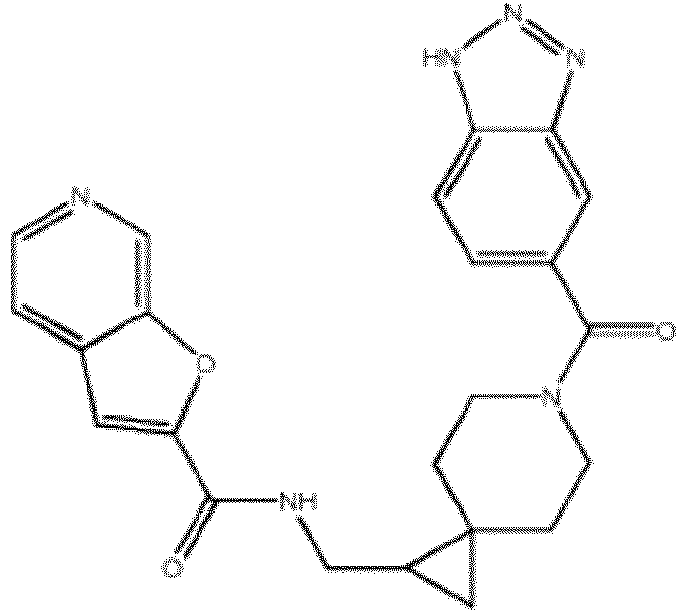
N-[[6-(1H-benzotriazol-5-carbonyl)-6-azaspiro[2.5]octan-2-yl]methyl]furo[2,3-c]pyridin-2-carboxamid; 
N-[[6-(1H-pyrrolo[2,3-b]pyridin-4-carbonyl)-6-azaspiro[2.5]octan-2-yl]methyl]furo[2,3-c]pyridin-2-carboxamid; 
N-[[6-(1H-indazol-4-carbonyl)-6-azaspiro[2.5]octan-2-yl]methyl]furo[2,3-c]pyridin-2-carboxamid; 
N-[[6-(1H-benzimidazol-5-carbonyl)-6-azaspiro[2.5]octan-2-yl]methyl]furo[2,3-c]pyridin-2-carboxamid; 
N-[[6-(4-cyanobenzoyl)-6-azaspiro[2.5]octan-2-yl]methyl]furo[2,3-c]pyridin-2-carboxamid; 
N-[[6-(3-cyanobenzoyl)-6-azaspiro[2.5]octan-2-yl]methyl]furo[2,3-c]pyridin-2-carboxamid; 
N-[[6-[4-[(5-methyl-1,2,4-oxadiazol-3-yl)methoxy]benzoyl]-6-azaspiro[2.5]octan-2-yl]methyl]furo[2,3-c]pyridin-2-carboxamid; 
N-[[6-[4-(morpholinomethyl)benzoyl]-6-azaspiro[2.5]octan-2-yl]methyl]furo[2,3-c]pyridin-2-carboxamid; 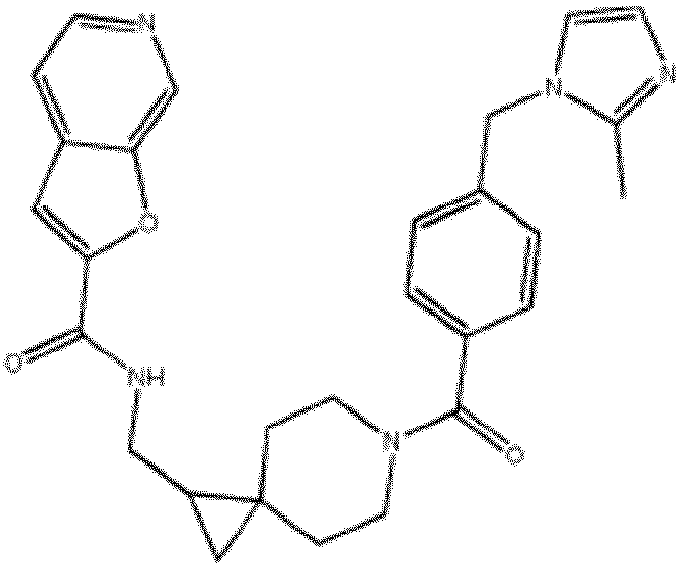
N-[[6-[4-[(2-methylimidazol-1-yl)methyl]benzoyl]-6-azaspiro[2.5]octan-2-yl]methyl]furo[2,3-c]pyridin-2-carboxamid; 
N-[[6-[4-(trifluoromethoxy)benzoyl]-6-azaspiro[2.5]octan-2-yl]methyl]furo[2,3-c]pyridin-2-carboxamid; 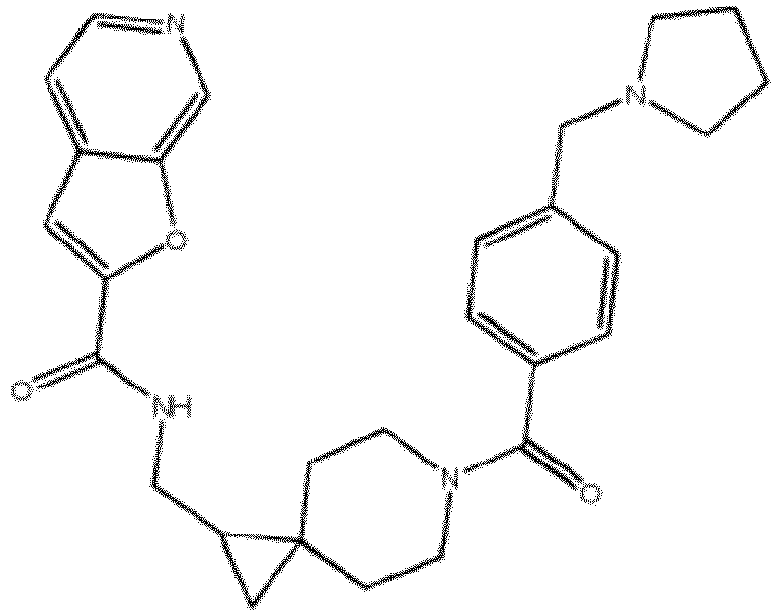
N-[[6-[4-(pyrrolidin-1-ylmethyl)benzoyl]-6-azaspiro[2.5]octan-2-yl]methyl]furo[2,3-c]pyridin-2-carboxamid; 
N-[[6-[3-(1,2,4-triazol-1-ylmethyl)benzoyl]-6-azaspiro[2.5]octan-2-yl]methyl]furo[2,3-c]pyridin-2-carboxamid; 
N-[[6-[2-(1,2,4-triazol-1-ylmethyl)benzoyl]-6-azaspiro[2.5]octan-2-yl]methyl]furo[2,3-c]pyridin-2-carboxamid; 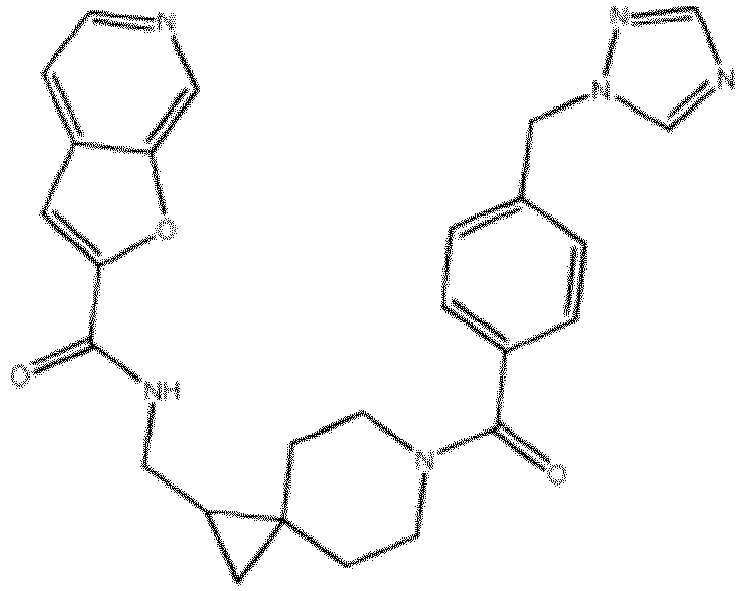
N-[[6-[4-(1,2,4-triazol-1-ylmethyl)benzoyl]-6-azaspiro[2.5]octan-2-yl]methyl]furo[2,3-c]pyridin-2-carboxamid; 
N-[[6-[3-(imidazol-1-ylmethyl)benzoyl]-6-azaspiro[2.5]octan-2-yl]methyl]furo[2,3-c]pyridin-2-carboxamid; 
N-[[6-(4-imidazol-1-ylbenzoyl)-6-azaspiro[2.5]octan-2-yl]methyl]furo[2,3-c]pyridin-2-carboxamid; 
N-[[6-[4-(1H-1,2,4-triazol-5-yl)benzoyl]-6-azaspiro[2.5]octan-2-yl]methyl]furo[2,3-c]pyridin-2-carboxamid; 
N-[[6-(6-imidazol-1-ylpyridin-3-carbonyl)-6-azaspiro[2.5]octan-2-yl]methyl]furo[2,3-c]pyridin-2-carboxamid; 
N-[[6-[4-(trifluoromethyl)pyridin-2-carbonyl]-6-azaspiro[2.5]octan-2-yl]methyl]furo[2,3-c]pyridin-2-carboxamid; 
N-[[6-[6-(trifluoromethyl)pyridin-3-carbonyl]-6-azaspiro[2.5]octan-2-yl]methyl]furo[2,3-c]pyridin-2-carboxamid; 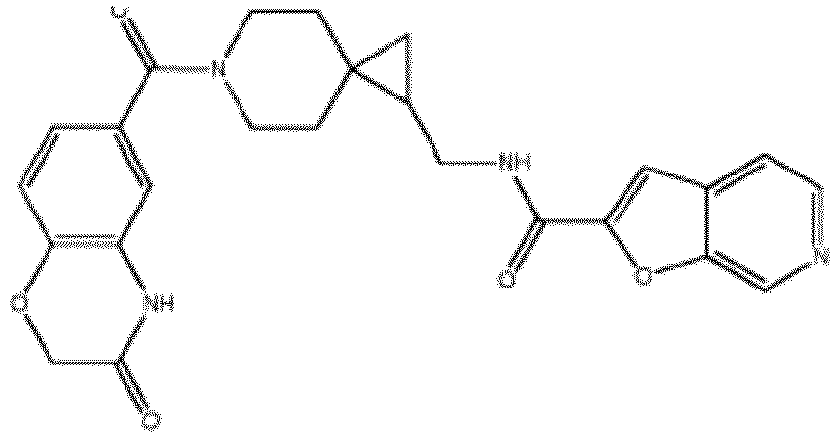
N-[[6-(3-oxo-4H-1,4-benzoxazin-6-carbonyl)-6-azaspiro[2.5]octan-2-yl]methyl]furo[2,3-c]pyridin-2-carboxamid; 
N-[[6-(4-sulfamoylbenzoyl)-6-azaspiro[2.5]octan-2-yl]methyl]furo[2,3-c]pyridin-2-carboxamid; 
N-[[6-[2-(imidazol-1-ylmethyl)benzoyl]-6-azaspiro[2.5]octan-2-yl]methyl]furo[2,3-c]pyridin-2-carboxamid; 
N-[[6-(quinoxaline-6-carbonyl)-6-azaspiro[2.5]octan-2-yl]methyl]furo[2,3-c]pyridin-2-carboxamid; 
N-[[6-(1,6-naphtyridine-2-carbonyl)-6-azaspiro[2.5]octan-2-yl]methyl]furo[2,3-c]pyridin-2-carboxamid; 
N-[[6-(2-methyl-1H-benzimidazol-5-carbonyl)-6-azaspiro[2.5]octan-2-yl]methyl]furo[2,3-c]pyridin-2-carboxamid; 
N-[[6-(3-acetamidobenzoyl)-6-azaspiro[2.5]octan-2-yl]methyl]furo[2,3-c]pyridin-2-carboxamid; 
N-[[6-(3-acetamidopyridin-4-carbonyl)-6-azaspiro[2.5]octan-2-yl]methyl]furo[2,3-c]pyridin-2-carboxamid; 
N-[[6-(2,1,3-benzoxadiazol-5-carbonyl)-6-azaspiro[2.5]octan-2-yl]methyl]furo[2,3-c]pyridin-2-carboxamid; 
N-[[6-(1,8-naphtyridine-4-carbonyl)-6-azaspiro[2.5]octan-2-yl]methyl]furo[2,3-c]pyridin-2-carboxamid; 
N-[[6-(isoquinoline-5-carbonyl)-6-azaspiro[2.5]octan-2-yl]methyl]furo[2,3-c]pyridin-2-carboxamid; 
N-[[6-(quinoxaline-2-carbonyl)-6-azaspiro[2.5]octan-2-yl]methyl]furo[2,3-c]pyridin-2-carboxamid; 
N-[[6-(1,5-naphtyridine-2-carbonyl)-6-azaspiro[2.5]octan-2-yl]methyl]furo[2,3-c]pyridin-2-carboxamid; 
N-[[6-(1,8-naphtyridine-2-carbonyl)-6-azaspiro[2.5]octan-2-yl]methyl]furo[2,3-c]pyridin-2-carboxamid; 
N-[[6-(isoxazol-5-carbonyl)-6-azaspiro[2.5]octan-2-yl]methyl]furo[2,3-c]pyridin-2-carboxamid; 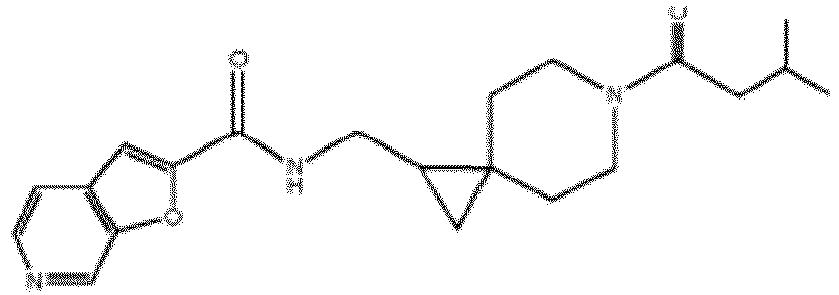
N-[[6-(3-methylbutanoyl)-6-azaspiro[2.5]octan-2-yl]methyl]furo[2,3-c]pyridin-2-carboxamid; 
Tert-butyl 2-[(4,6-dihydro-1H-pyrrolo[3,4-c]pyrazol-5-carbonylamino)methyl]-6-azaspiro[2.5]octan-6-carboxylat; 
N-[[6-[2-(1,4-dimethyl-4-piperidyl)acetyl]-6-azaspiro[2.5]octan-2-yl]methyl]furo[2,3-c]pyridin-2-carboxamid; 
N-[[6-[2-(3-hydroxy-3-methyl-cyclobutyl)acetyl]-6-azaspiro[2.5]octan-2-yl]methyl]-1,3-dihydropyrrolo[3,4-c]pyridin-2-carboxamid; 
N-[[6-[2-(3-pyridyl)acetyl]-6-azaspiro[2.5]octan-2-yl]methyl]-1H-pyrrolo[3,2-c]pyridin-2-carboxamid; 
N-[[6-[2-(4-pyridyl)acetyl]-6-azaspiro[2.5]octan-2-yl]methyl]-1H-pyrrolo[3,2-c]pyridin-2-carboxamid; 
N-[[6-(1,3-dimethylpyrazol-4-carbonyl)-6-azaspiro[2.5]octan-2-yl]methyl]-1,3-dihydropyrrolo[3,4-c]pyridin-2-carboxamid; 
N-[[6-[4-(2-methyltetrazol-5-yl)benzoyl]-6-azaspiro[2.5]octan-2-yl]methyl]furo[2,3-c]pyridin-2-carboxamid; 
N-[[6-(4,6-dimethylpyridin-3-carbonyl)-6-azaspiro[2.5]octan-2-yl]methyl]furo[2,3-c]pyridin-2-carboxamid; 
N-[[6-(4-oxopentanoyl)-6-azaspiro[2.5]octan-2-yl]methyl]furo[2,3-c]pyridin-2-carboxamid; 
N-[[6-(4-hydroxy-4-methyl-pentanoyl)-6-azaspiro[2.5]octan-2-yl]methyl]furo[2,3-c]pyridin-2-carboxamid; 
N-[[6-(3-hydroxy-3-methyl-butanoyl)-6-azaspiro[2.5]octan-2-yl]methyl]furo[2,3-c]pyridin-2-carboxamid; 
N-[[6-[2-(2-pyridyl)acetyl]-6-azaspiro[2.5]octan-2-yl]methyl]-1H-pyrrolo[3,2-c]pyridin-2-carboxamid; 
N-[[6-(2-pyrimidin-2-ylacetyl)-6-azaspiro[2.5]octan-2-yl]methyl]-1,3-dihydropyrrolo[3,4-c]pyridin-2-carboxamid; 
N-[[6-(2-pyrazin-2-ylacetyl)-6-azaspiro[2.5]octan-2-yl]methyl]-1,3-dihydropyrrolo[3,4-c]pyridin-2-carboxamid; 
N-[[6-(3-thiazol-2-ylpropanoyl)-6-azaspiro[2.5]octan-2-yl]methyl]-1,3-dihydropyrrolo[3,4-c]pyridin-2-carboxamid; 
N-[[6-(2-phenoxyacetyl)-6-azaspiro[2.5]octan-2-yl]methyl]-1,3-dihydropyrrolo[3,4-c]pyridin-2-carboxamid; 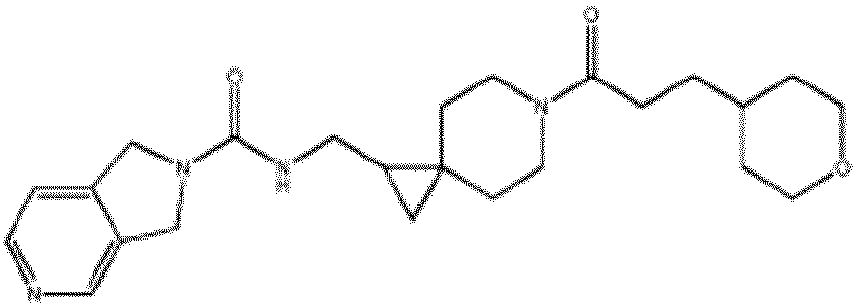
N-[[6-(3-tetrahydropyran-4-ylpropanoyl)-6-azaspiro[2.5]octan-2-yl]methyl]-1,3-dihydropyrrolo[3,4-c]pyridin-2-carboxamid; 
N-[[6-(4-methylpyridin-3-carbonyl)-6-azaspiro[2.5]octan-2-yl]methyl]-1H-pyrrolo[3,2-c]pyridin-2-carboxamid; 
N-[[6-(3,5-dimethyl-1H-pyrazol-4-carbonyl)-6-azaspiro[2.5]octan-2-yl]methyl]-1,3-dihydropyrrolo[3,4-c]pyridin-2-carboxamid; 
N-[[6-(1,3,5-trimethylpyrazol-4-carbonyl)-6-azaspiro[2.5]octan-2-yl]methyl]-1H-pyrrolo[3,2-c]pyridin-2-carboxamid; 
N-[[6-(1-Tert-butyl-3,5-dimethyl-pyrazol-4-carbonyl)-6-azaspiro[2.5]octan-2-yl]methyl]furo[2,3-c]pyridin-2-carboxamid; 
N-[[6-(1-benzyl-3,5-dimethyl-pyrazol-4-carbonyl)-6-azaspiro[2.5]octan-2-yl]methyl]furo[2,3-c]pyridin-2-carboxamid; 
N-[[6-(5-Tert-butyl-2-methyl-pyrazol-3-carbonyl)-6-azaspiro[2.5]octan-2-yl]methyl]furo[2,3-c]pyridin-2-carboxamid; 
N-[[6-(2-ethylpyrazol-3-carbonyl)-6-azaspiro[2.5]octan-2-yl]methyl]furo[2,3-c]pyridin-2-carboxamid; 
N-[[6-(2-Tert-butyl-4-methyl-pyrazol-3-carbonyl)-6-azaspiro[2.5]octan-2-yl]methyl]furo[2,3-c]pyridin-2-carboxamid; 
N-[[6-(2,4-dimethylpyrazol-3-carbonyl)-6-azaspiro[2.5]octan-2-yl]methyl]furo[2,3-c]pyridin-2-carboxamid; 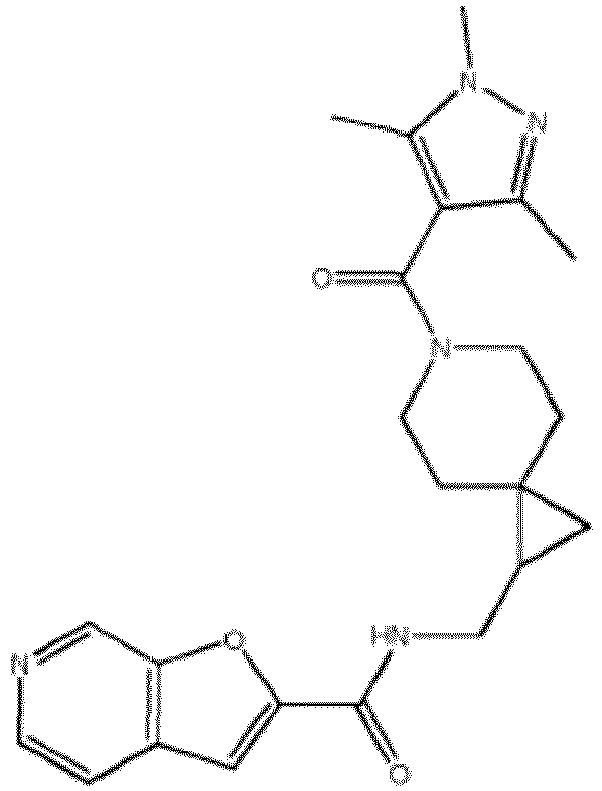
N-[[6-(1,3,5-trimethylpyrazol-4-carbonyl)-6-azaspiro[2.5]octan-2-yl]methyl]furo[2,3-c]pyridin-2-carboxamid; 
N-[[6-(1,3,5-trimethylpyrazol-4-carbonyl)-6-azaspiro[2.5]octan-2-yl]methyl]furo[2,3-c]pyridin-2-carboxamid; 
N-[[6-(1H-indazol-3-carbonyl)-6-azaspiro[2.5]octan-2-yl]methyl]furo[2,3-c]pyridin-2-carboxamid; 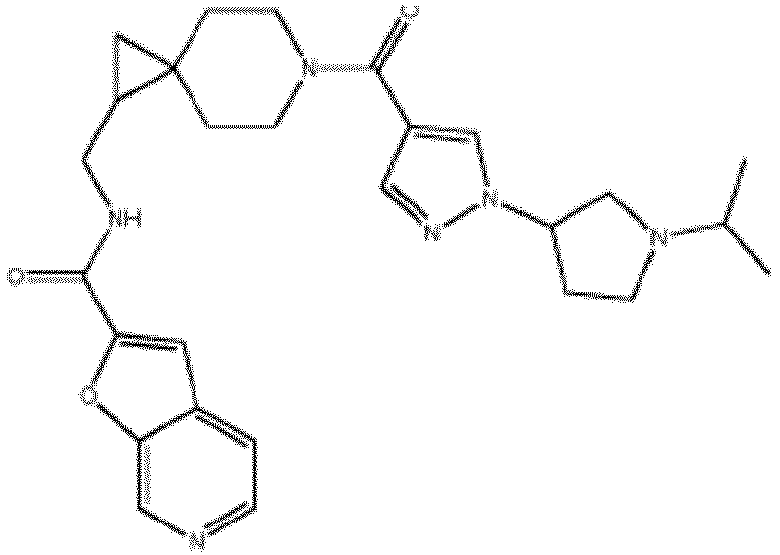
N-[[6-[1-(1-isopropylpyrrolidin-3-yl)pyrazol-4-carbonyl]-6-azaspiro[2.5]octan-2-yl]methyl]furo[2,3-c]pyridin-2-carboxamid; 
N-[[6-[1-(1-acetylpyrrolidin-3-yl)pyrazol-4-carbonyl]-6-azaspiro[2.5]octan-2-yl]methyl]furo[2,3-c]pyridin-2-carboxamid; 
N-[[6-[5-(1,3-dimethylpyrazol-4-yl)isoxazol-3-carbonyl]-6-azaspiro[2.5]octan-2-yl]methyl]furo[2,3-c]pyridin-2-carboxamid; 
Tert-butyl 3-[2-[(furo[2,3-c]pyridin-2-carbonylamino)methyl]-6-azaspiro[2.5]octan-6-carbonyl]-4,6-dihydro-1H-pyrrolo[3,4-c]pyrazol-5-carboxylat; 
N-[[6-[1-(1-methylpyrrolidin-3-yl)pyrazol-4-carbonyl]-6-azaspiro[2.5]octan-2-yl]methyl]furo[2,3-c]pyridin-2-carboxamid; 
N-[[6-(2-Tert-butyl-5-methyl-pyrazol-3-carbonyl)-6-azaspiro[2.5]octan-2-yl]methyl]furo[2,3-c]pyridin-2-carboxamid; 
N-[[6-(2-methylimidazo[1,2-a]pyridin-3-carbonyl)-6-azaspiro[2.5]octan-2-yl]methyl]furo[2,3-c]pyridin-2-carboxamid; 
N-[[6-(6-methyl-1H-benzimidazol-2-carbonyl)-6-azaspiro[2.5]octan-2-yl]methyl]furo[2,3-c]pyridin-2-carboxamid; 
N-[[6-(5-methylimidazo[1,2-a]pyridin-2-carbonyl)-6-azaspiro[2.5]octan-2-yl]methyl]furo[2,3-c]pyridin-2-carboxamid; 
N-[[6-(6-fluoro-1H-indazol-3-carbonyl)-6-azaspiro[2.5]octan-2-yl]methyl]furo[2,3-c]pyridin-2-carboxamid; 
N-[[6-(pyrazolo[1,5-a]pyrimidin-2-carbonyl)-6-azaspiro[2.5]octan-2-yl]methyl]furo[2,3-c]pyridin-2-carboxamid; 
N-[[6-(1-ethyl-3,5-dimethyl-pyrazol-4-carbonyl)-6-azaspiro[2.5]octan-2-yl]methyl]furo[2,3-c]pyridin-2-carboxamid; 
N-[[6-(6-methylimidazo[1,2-a]pyridin-2-carbonyl)-6-azaspiro[2.5]octan-2-yl]methyl]furo[2,3-c]pyridin-2-carboxamid; 
N-[[6-(imidazo[1,2-a]pyridin-2-carbonyl)-6-azaspiro[2.5]octan-2-yl]methyl]furo[2,3-c]pyridin-2-carboxamid; 
N-[[6-(5-isopropylisoxazol-4-carbonyl)-6-azaspiro[2.5]octan-2-yl]methyl]furo[2,3-c]pyridin-2-carboxamid; 
N-[[6-(3-isobutyl-1H-pyrazol-5-carbonyl)-6-azaspiro[2.5]octan-2-yl]methyl]furo[2,3-c]pyridin-2-carboxamid; 
N-[[6-(imidazo[1,2-a]pyrimidin-2-carbonyl)-6-azaspiro[2.5]octan-2-yl]methyl]furo[2,3-c]pyridin-2-carboxamid; 
N-[[6-(pyrazolo[1,5-a]pyrimidin-3-carbonyl)-6-azaspiro[2.5]octan-2-yl]methyl]furo[2,3-c]pyridin-2-carboxamid; 
N-[[6-(3-Tert-butyl-1H-pyrazol-5-carbonyl)-6-azaspiro[2.5]octan-2-yl]methyl]furo[2,3-c]pyridin-2-carboxamid; 
N-[[6-(5-isopropyl-1H-pyrazol-3-carbonyl)-6-azaspiro[2.5]octan-2-yl]methyl]furo[2,3-c]pyridin-2-carboxamid; 
N-[[6-(3-isopropyl-1H-pyrazol-4-carbonyl)-6-azaspiro[2.5]octan-2-yl]methyl]furo[2,3-c]pyridin-2-carboxamid; 
N-[[6-(2-isopropylpyrazol-3-carbonyl)-6-azaspiro[2.5]octan-2-yl]methyl]furo[2,3-c]pyridin-2-carboxamid; 
N-[[6-(5-ethyl-2-methyl-pyrazol-3-carbonyl)-6-azaspiro[2.5]octan-2-yl]methyl]furo[2,3-c]pyridin-2-carboxamid; 
N-[[6-(5-cyclopropylisoxazol-3-carbonyl)-6-azaspiro[2.5]octan-2-yl]methyl]furo[2,3-c]pyridin-2-carboxamid; 
N-[[6-(5-cyclopropylisoxazol-4-carbonyl)-6-azaspiro[2.5]octan-2-yl]methyl]furo[2,3-c]pyridin-2-carboxamid; 
N-[[6-(3,5-dimethyl-1H-pyrazol-4-carbonyl)-6-azaspiro[2.5]octan-2-yl]methyl]furo[2,3-c]pyridin-2-carboxamid; 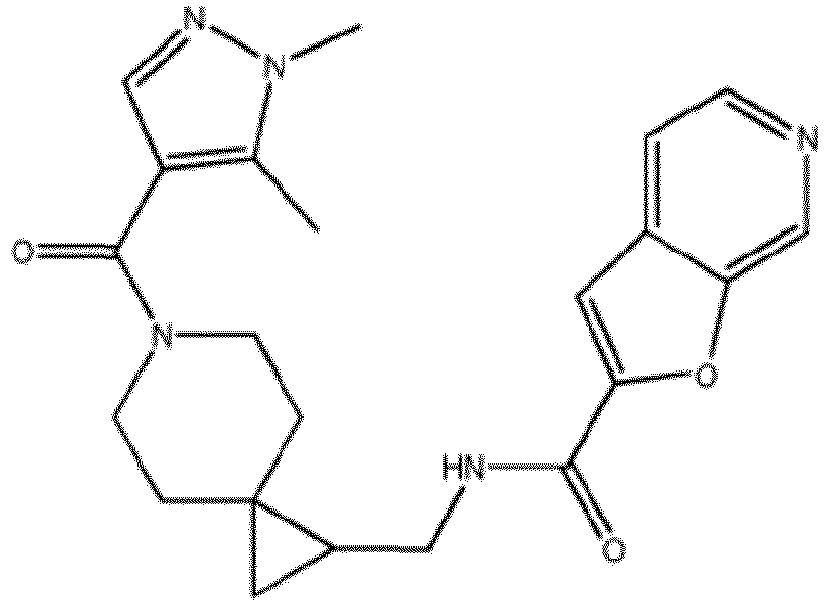
N-[[6-(1,5-dimethylpyrazol-4-carbonyl)-6-azaspiro[2.5]octan-2-yl]methyl]furo[2,3-c]pyridin-2-carboxamid; 
N-[[6-(4-methyloxazol-5-carbonyl)-6-azaspiro[2.5]octan-2-yl]methyl]furo[2,3-c]pyridin-2-carboxamid; 
N-[[6-(3-cyclopropyl-1H-pyrazol-4-carbonyl)-6-azaspiro[2.5]octan-2-yl]methyl]furo[2,3-c]pyridin-2-carboxamid; 
N-[[6-(1,4,5,6-tetrahydrocyclopenta[c]pyrazol-3-carbonyl)-6-azaspiro[2.5]octan-2-yl]methyl]furo[2,3-c]pyridin-2-carboxamid; 
N-[[6-(2,5-dimethyloxazol-4-carbonyl)-6-azaspiro[2.5]octan-2-yl]methyl]furo[2,3-c]pyridin-2-carboxamid; 
N-[[6-(1,3-dimethylpyrazol-4-carbonyl)-6-azaspiro[2.5]octan-2-yl]methyl]furo[2,3-c]pyridin-2-carboxamid; 
N-[[6-(oxazol-5-carbonyl)-6-azaspiro[2.5]octan-2-yl]methyl]furo[2,3-c]pyridin-2-carboxamid; 
N-[[6-(isoxazol-4-carbonyl)-6-azaspiro[2.5]octan-2-yl]methyl]furo[2,3-c]pyridin-2-carboxamid; 
N-[[6-(1H-imidazol-2-carbonyl)-6-azaspiro[2.5]octan-2-yl]methyl]furo[2,3-c]pyridin-2-carboxamid; 
N-[[6-[4-(4-methylpiperazin-1-yl)benzoyl]-6-azaspiro[2.5]octan-2-yl]methyl]furo[2,3-c]pyridin-2-carboxamid; 
N-[[6-(3H-imidazo[4,5-b]pyridin-6-carbonyl)-6-azaspiro[2.5]octan-2-yl]methyl]furo[2,3-c]pyridin-2-carboxamid; 
N-[[6-(5-methylpyridin-2-carbonyl)-6-azaspiro[2.5]octan-2-yl]methyl]furo[2,3-c]pyridin-2-carboxamid; 
N-[[6-[4-[(4-methylpiperazin-1-yl)methyl]benzoyl]-6-azaspiro[2.5]octan-2-yl]methyl]-1H-pyrrolo[3,2-c]pyridin-2-carboxamid; 
N-[[6-[3-[(4-methylpiperazin-1-yl)methyl]benzoyl]-6-azaspiro[2.5]octan-2-yl]methyl]-1H-pyrrolo[3,2-c]pyridin-2-carboxamid; 
N-[[6-[4-[(dimethylamino)methyl]benzoyl]-6-azaspiro[2.5]octan-2-yl]methyl]-1H-pyrrolo[3,2-c]pyridin-2-carboxamid; 
N-[[6-[4-[(4-methylpiperazin-1-yl)methyl]benzoyl]-6-azaspiro[2.5]octan-2-yl]methyl]-1,3-dihydropyrrolo[3,4-c]pyridin-2-carboxamid; 
N-[[6-(1,5-dimethylpyrazol-4-carbonyl)-6-azaspiro[2.5]octan-2-yl]methyl]-1,3-dihydropyrrolo[3,4-c]pyridin-2-carboxamid; 
N-[[6-(2,2-dimethylcyclopropancarbonyl)-6-azaspiro[2.5]octan-2-yl]methyl]-1H-pyrrolo[3,2-c]pyridin-2-carboxamid; 
(3-Methyloxetan-3-yl) 2-[(1,3-dihydropyrrolo[3,4-c]pyridin-2-carbonylamino)methyl]-6-azaspiro[2.5]octan-6-carboxylat; 
(2-Hydroxy-1,1-dimethyl-ethyl) 2-[(1,3-dihydropyrrolo[3,4-c]pyridin-2-carbonylamino)methyl]-6-azaspiro[2.5]octan-6-carboxylat; 
N-[[6-(4-methylpyridin-3-carbonyl)-6-azaspiro[2.5]octan-2-yl]methyl]-1,3-dihydropyrrolo[3,4-c]pyridin-2-carboxamid; 
N-[[6-(3-cyclopropyl-1H-pyrazol-5-carbonyl)-6-azaspiro[2.5]octan-2-yl]methyl]-1,3-dihydropyrrolo[3,4-c]pyridin-2-carboxamid; 
N-[[6-(4-isoxazol-5-yl-1-methyl-pyrazol-3-carbonyl)-6-azaspiro[2.5]octan-2-yl]methyl]-1,3-dihydropyrrolo[3,4-c]pyridin-2-carboxamid; 
N-[[6-(2,4-dimethyloxazol-5-carbonyl)-6-azaspiro[2.5]octan-2-yl]methyl]-1,3-dihydropyrrolo[3,4-c]pyridin-2-carboxamid; 
N-[[6-[2-(1,4-dimethyl-4-piperidyl)acetyl]-6-azaspiro[2.5]octan-2-yl]methyl]-1,3-dihydropyrrolo[3,4-c]pyridin-2-carboxamid; 
N-[[6-[2-(2-cyanophenyl)acetyl]-6-azaspiro[2.5]octan-2-yl]methyl]-1,3-dihydropyrrolo[3,4-c]pyridin-2-carboxamid; 
(2-Acetamido-1,1-dimethyl-ethyl) 2-[(1,3-Dihydropyrrolo[3,4-c]pyridin-2-carbonylamino)methyl]-6-azaspiro[2.5]octan-6-carboxylat (2-acetamido-1,1-dimethyl-ethyl); 
N-[[6-(2-thiazol-2-ylacetyl)-6-azaspiro[2.5]octan-2-yl]methyl]-1,3-dihydropyrrolo[3,4-c]pyridin-2-carboxamid; 
N-[[6-(4-hydroxy-4-methyl-pentanoyl)-6-azaspiro[2.5]octan-2-yl]methyl]-1,3-dihydropyrrolo[3,4-c]pyridin-2-carboxamid; 
N-[[6-[(3-methyloxetan-3-yl)carbamoyl]-6-azaspiro[2.5]octan-2-yl]methyl]-1,3-dihydropyrrolo[3,4-c]pyridin-2-carboxamid; 
N-[[6-[4-(4-methylpiperazin-1-yl)benzoyl]-6-azaspiro[2.5]octan-2-yl]methyl]-1,3-dihydropyrrolo[3,4-c]pyridin-2-carboxamid; 
N-[[6-[4-(4-methylpiperazin-1-yl)benzoyl]-6-azaspiro[2.5]octan-2-yl]methyl]-1H-pyrrolo[3,2-c]pyridin-2-carboxamid; 
N-[[6-(2,2-dimethylcyclopropancarbonyl)-6-azaspiro[2.5]octan-2-yl]methyl]-1H-pyrrolo[3,2-c]pyridin-2-carboxamid; 
N-[[6-(1,3,5-trimethylpyrazol-4-carbonyl)-6-azaspiro[2.5]octan-2-yl]methyl]-1,3-dihydropyrrolo[3,4-c]pyridin-2-carboxamid; 
N-[[6-(1,3,5-trimethylpyrazol-4-carbonyl)-6-azaspiro[2.5]octan-2-yl]methyl]-1,3-dihydropyrrolo[3,4-c]pyridin-2-carboxamid; 
Tert-butyl 2-[[(1,1,3,3-Tetradeuteriopyrrolo[3,4-c]pyridin-2-carbonyl)amino]methyl]-6-azaspiro[2.5]octan-6-carboxylat; 
N-[[6-(3-cyclopropyl-1H-pyrazol-5-carbonyl)-6-azaspiro[2.5]octan-2-yl]methyl]-1H-pyrrolo[3,2-c]pyridin-2-carboxamid; 
N-[[6-(4-isoxazol-5-yl-1-methyl-pyrazol-3-carbonyl)-6-azaspiro[2.5]octan-2-yl]methyl]-1H-pyrrolo[3,2-c]pyridin-2-carboxamid; 
N-[[6-(2,4-dimethyloxazol-5-carbonyl)-6-azaspiro[2.5]octan-2-yl]methyl]-1H-pyrrolo[3,2-c]pyridin-2-carboxamid; 
N-[[6-(2,2-dimethylcyclopropancarbonyl)-6-azaspiro[2.5]octan-2-yl]methyl]furo[2,3-c]pyridin-2-carboxamid; 
N-[[6-[4-(4-methylpiperazin-1-carbonyl)benzoyl]-6-azaspiro[2.5]octan-2-yl]methyl]-1,3-dihydropyrrolo[3,4-c]pyridin-2-carboxamid; 
N-[[6-(2,2-dimethylcyclopropancarbonyl)-6-azaspiro[2.5]octan-2-yl]methyl]furo[2,3-c]pyridin-2-carboxamid; 
(3-Methyltetrahydrofuran-3-yl) 2-[(1,3-dihydropyrrolo[3,4-c]pyridin-2-carbonylamino)methyl]-6-azaspiro[2.5]octan-6-carboxylat; 
(2-Hydroxy-2-methyl-propyl) 2-[(1,3-dihydropyrrolo[3,4-c]pyridin-2-carbonylamino)methyl]-6-azaspiro[2.5]octan-6-carboxylat; 
N-[[6-(2,2-dimethylcyclopropancarbonyl)-6-azaspiro[2.5]octan-2-yl]methyl]-1,3-dihydropyrrolo[3,4-c]pyridin-2-carboxamid; 
N-[[6-(2,2-dimethylpropylsulfonyl)-6-azaspiro[2.5]octan-2-yl]methyl]furo[2,3-c]pyridin-2-carboxamid; 
N-[[6-(2,2-dimethylpropylsulfonyl)-6-azaspiro[2.5]octan-2-yl]methyl]-1H-pyrrolo[3,2-c]pyridin-2-carboxamid; 
N-[[6-(2,2-dimethylpropylsulfonyl)-6-azaspiro[2.5]octan-2-yl]methyl]-1,3-dihydropyrrolo[3,4-c]pyridin-2-carboxamid; 
N-[[6-(4,4,4-trifluorobutanoyl)-6-azaspiro[2.5]octan-2-yl]methyl]-1,3-dihydropyrrolo[3,4-c]pyridin-2-carboxamid; 
Tert-butyl 2-[(pyrazolo[1,5-b]pyridazin-5-carbonylamino)methyl]-6-azaspiro[2.5]octan-6-carboxylat; 
N-[[6-(2,4-dimethyloxazol-5-carbonyl)-6-azaspiro[2.5]octan-2-yl]methyl]furo[2,3-c]pyridin-2-carboxamid; 
N-[[6-(2,4-dimethyloxazol-5-carbonyl)-6-azaspiro[2.5]octan-2-yl]methyl]furo[2,3-c]pyridin-2-carboxamid; 
N-[[6-[2-(2-hydroxy-2-methyl-propoxy)acetyl]-6-azaspiro[2.5]octan-2-yl]methyl]-1H-pyrrolo[3,2-c]pyridin-2-carboxamid; 
N-[[6-[2-methyl-4-(trifluoromethyl)thiazol-5-carbonyl]-6-azaspiro[2.5]octan-2-yl]methyl]-1,3-dihydropyrrolo[3,4-c]pyridin-2-carboxamid; 
N-[[6-(2,2-dimethylcyclopropancarbonyl)-6-azaspiro[2.5]octan-2-yl]methyl]-1,3-dihydropyrrolo[3,4-c]pyridin-2-carboxamid; 
Tert-butyl 2-[(imidazo[1,2-a]pyridin-6-ylmethylcarbamoylamino)methyl]-6-azaspiro[2.5]octan-6-carboxylat; 
N-[[6-[2-(2-hydroxy-2-methyl-propoxy)acetyl]-6-azaspiro[2.5]octan-2-yl]methyl]-1,3-dihydropyrrolo[3,4-c]pyridin-2-carboxamid; 
N-[[6-[2-(6-amino-3-pyridyl)acetyl]-6-azaspiro[2.5]octan-2-yl]methyl]-1,3-dihydropyrrolo[3,4-c]pyridin-2-carboxamid; 
N-[[6-(morpholine-4-carbonyl)-6-azaspiro[2.5]octan-2-yl]methyl]-1,3-dihydropyrrolo[3,4-c]pyridin-2-carboxamid; 
N-[[6-[5-(trifluoromethyl)-1H-pyrazol-3-carbonyl]-6-azaspiro[2.5]octan-2-yl]methyl]-1,3-dihydropyrrolo[3,4-c]pyridin-2-carboxamid; 
N-[[6-(4-hydroxy-4-methyl-pentanoyl)-6-azaspiro[2.5]octan-2-yl]methyl]-1H-pyrrolo[3,2-c]pyridin-2-carboxamid; 
N-[[6-[4-(trifluoromethyl)pyridin-3-carbonyl]-6-azaspiro[2.5]octan-2-yl]methyl]-1,3-dihydropyrrolo[3,4-c]pyridin-2-carboxamid; 
N-[[6-[2-(4-methyltetrahydropyran-4-yl)acetyl]-6-azaspiro[2.5]octan-2-yl]methyl]-1,3-dihydropyrrolo[3,4-c]pyridin-2-carboxamid; 
N-[[6-[2-(3-hydroxy-3-methyl-cyclobutyl)acetyl]-6-azaspiro[2.5]octan-2-yl]methyl]-1H-pyrrolo[3,2-c]pyridin-2-carboxamid; 
(2-Hydroxy-2-methyl-propyl) 2-[(1H-pyrrolo[3,2-c]pyridin-2-carbonylamino)methyl]-6-azaspiro[2.5]octan-6-carboxylat; 
Tert-butyl 2-[(imidazo[1,2-b]pyridazin-6-carbonylamino)methyl]-6-azaspiro[2.5]octan-6-carboxylat; 
N-[[6-[2-[4-methyl-1-(2,2,2-trifluoroethyl)-4-piperidyl]acetyl]-6-azaspiro[2.5]octan-2-yl]methyl]-1,3-dihydropyrrolo[3,4-c]pyridin-2-carboxamid; 
N-[[6-(2,4-dimethylthiazol-5-carbonyl)-6-azaspiro[2.5]octan-2-yl]methyl]-1,3-dihydropyrrolo[3,4-c]pyridin-2-carboxamid; 
N-[[6-[4-(1-methyl-4-piperidyl)benzoyl]-6-azaspiro[2.5]octan-2-yl]methyl]-1,3-dihydropyrrolo[3,4-c]pyridin-2-carboxamid; 
Tert-butyl 2-[[(6-amino-1,3-dihydropyrrolo[3,4-c]pyridin-2-carbonyl)amino]methyl]-6-azaspiro[2.5]octan-6-carboxylat; 
N-[[6-(2-pyrimidin-5-ylacetyl)-6-azaspiro[2.5]octan-2-yl]methyl]-1,3-dihydropyrrolo[3,4-c]pyridin-2-carboxamid; 
1,1,3,3-Tetradeuterio-N-[[6-(3-methylbutanoyl)-6-azaspiro[2.5]octan-2-yl]methyl]pyrrolo[3,4-c]pyridin-2-carboxamid; 
(3-Methyloxetan-3-yl) 2-[[(1,1,3,3-Tetradeuteriopyrrolo[3,4-c]pyridin-2-carbonyl)amino]methyl]-6-azaspiro[2.5]octan-6-carboxylat; 
1,1,3,3-Tetradeuterio-N-[[6-(2,4-dimethyloxazol-5-carbonyl)-6-azaspiro[2.5]octan-2-yl]methyl]pyrrolo[3,4-c]pyridin-2-carboxamid; 
N-[(6-benzoyl-6-azaspiro[2.5]octan-2-yl)methyl]furo[2,3-c]pyridin-2-carboxamid; 
N-[[(2S)-6-(3-methylbutanoyl)-6-azaspiro[2.5]octan-2-yl]methyl]-1,3-dihydropyrrolo[3,4-c]pyridin-2-carboxamid; 
N-[[(2R)-6-(3-methylbutanoyl)-6-azaspiro[2.5]octan-2-yl]methyl]-1,3-dihydropyrrolo[3,4-c]pyridin-2-carboxamid; 
N-[[6-(4-methyloxazol-5-carbonyl)-6-azaspiro[2.5]octan-2-yl]methyl]-1,3-dihydropyrrolo[3,4-c]pyridin-2-carboxamid; 
Isopropyl 2-[(furo[2,3-c]pyridin-2-carbonylamino)methyl]-6-azaspiro[2.5]octan-6-carboxylat d'isopropyl; 
(3-Methyloxetan-3-yl) 2-[(furo[2,3-c]pyridin-2-carbonylamino)methyl]-6-azaspiro[2.5]octan-6-carboxylat; 
N-[(6-benzoyl-6-azaspiro[2.5]octan-2-yl)methyl]-1,3-dihydropyrrolo[3,4-c]pyridin-2-carboxamid; und 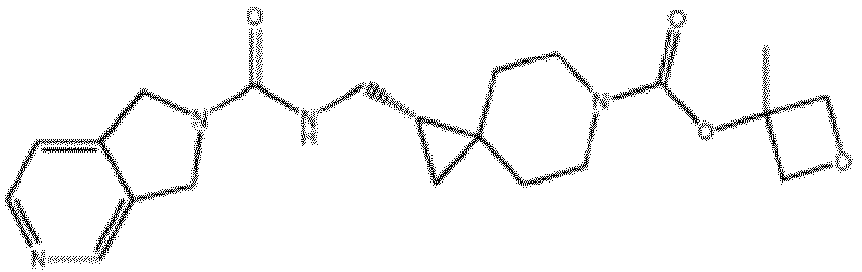
(3-Methyloxetan-3-yl) (2S)-2-[(1,3-dihydropyrrolo[3,4-c]pyridin-2-carbonylamino)methyl]-6-azaspiro[2.5]octan-6-carboxylat; - Pharmazeutische Zusammensetzung, umfassend: (a) eine wirksame Menge mindestens einer Verbindung nach Anspruch 1; und (b) einen pharmazeutisch unbedenklichen Träger.
- Pharmazeutische Zusammensetzung nach Anspruch 12, ferner umfassend einen Notwirkstoff, ausgewählt aus der Gruppe, die aus Nicotinamid, Nikotinsäure und Nicotinamidmononucleotid (NMN) besteht, oder therapeutisch wirksame Mengen eines oder mehrerer zusätzlicher adjuvanter Wirkstoffe, wobei der eine oder die mehreren zusätzlichen adjuvanten Wirkstoffe ausgewählt sind aus der Gruppe, die besteht aus zytotoxischem Stoff, Cisplatin, Doxorubicin, Taxotere, Taxol, Etoposid, Irinotecan, Camptostar, Topotecan, Paclitaxel, Docetaxel, den Epothilonen, Tamoxifen, 5-Fluorouracil, Methoxtrexat, Temozolomid, Cyclophosphamid, SCH 66336, Tipifamib (Zamestra®), R115777, L778,123, BMS 214662, Iressa®, Tarceva®, C225, GLEEVEC®, Intron®, Peg-Intron®, Aromatasekombinationen, Ara-C, Adriamycin, Cytoxan, Gemcitabin, Uracil-Senf, Chlormethin, Ifosfamid, Melphalan, Chlorambucil, Pipobroman, Triethylenemelamin, Triethylenethiophosphoramin, Busulfan, Carmustin, Lomustin, Streptozocin, Dacarbazin, Floxuridin, Cytarabin, 6-Mercaptopurin, 6-Thioguanin, Fludarabinphosphat, Leucovirin, Oxaliplatin (ELOXATIN®), Pentostatin, Vinblastin, Vincristin, Vindesin, Bleomycin, Dactinomycin, Daunorubicin, Epirubicin, Idarubicin, Mithramycin™, Deoxycoformycin, Mitomycin-C, L-Asparaginase, Teniposid 17a-Ethinylestradiol, Diethylstilbestrol, Testosteron, Prednison, Fluoxymesteron, Dromostanolonpropionat, Testolacton, Megestrolacetat, Methylprednisolon, Methyltestosteron, Prednisolon, Triamcinolone, Chlorotrianisen, Hydroxyprogesteron, Aminoglutethimid, Estramustin, Medroxyprogesteroneacetat, Leuprolid, Flutamid, Toremifen, Goserelin, Carboplatin, Hydroxy-Harnstoff, Amsacrin, Procarbazin, Mitotan, Mitoxantron, Levamisol, Navelben, Anastrazol, Letrazol, Capecitabin, Reloxafin, Droloxafin, Hexamethylmelamin, Avastin, Herceptin, Bexxar, Velcade, Zevalin, Trisenox, Xeloda, Vinorelbin, Porfimer, Erbitux, Liposomal, Thiotepa, Altretamin, Melphalan, Trastuzumab, Lerozol, Fulvestrant, Exemestan, Ifosfomid, Rituximab, Campath, Leucovorin und Dexamethason, Bicalutamid, Carboplatin, Chlorambucil, Megestrol, Valrubicin und NIASPAN®.
- Verbindung nach Anspruch 1 oder ein pharmazeutisch unbedenkliches Salz davon zur Verwendung bei der Behandlung einer Krankheit oder Beschwerde, an der ein Patient leidet oder mit der er diagnostiziert wurde, vermittelt durch NAMPT-Aktivität, wie z.B. ein solider oder flüssiger Tumor, ein nichtkleinzelliges Lungenkarzinom, Leukämie, Lymphom, Eierstockkarzinom, Gliom, Brustkarzinom, Gebärmutterkarzinom, Kolonkarzinom, Gebärmutterhalskarzinom, Lungenkarzinom, Prostatakarzinom, Hautkarzinom, Rhino-Magentumore, Colorectalkarzinom, ZNS-Karzinom, Blasenkarzinom, Bauchspeicheldrüsenkarzinom, Hodgkin's Krankheit, rheumatoide Arthritis, Diabetes, Atherosklerose, Sepsis, Altersbeschwerden oder Entzündungen.
- Verbindung zur Verwendung nach Anspruch 14, wobei die Verbindung zur Verwendung ferner umfasst einen Notwirkstoff, ausgewählt aus der Gruppe, die besteht aus Nicotinamid, Nikotinsäure und Nicotinamidmononucleotid (NMN), oder mindestens eine Verbindung, ausgewählt aus der Gruppe, die besteht aus: einem zytotoxischem Stoff, Cisplatin, Doxorubicin, Taxotere, Taxol, Etoposid, Irinotecan, Camptostar, Topotecan, Paclitaxel, Docetaxel, den Epothilonen, Tamoxifen, 5-Fluorouracil, Methoxtrexat, Temozolomid, Cyclophosphamid, SCH 66336, Tipifarnib (Zarnestra®), R115777, L778, 123, BMS 214662, lressa®, Tarceva®, C225, GLEEVEC®, Intron®, Peg-lntron®, Aromatasekombinationen, Ara-C, Adriamycin, Cytoxan, Gemcitabin, Uracil-Senf, Chlormethin, lfosfamid, Melphalan, Chlorambucil, Pipobroman, Triethylenemelamin, Triethylenethiophosphoramin, Busulfan, Carmustin, Lomustin, Streptozocin, Dacarbazin, Floxuridin, Cytarabin, 6-Mercaptopurin, 6-Thioguanin, Fludarabinphosphat, Leucovirin, Oxaliplatin (ELOXA TIN®), Pentostatin, Vincristin, Vindesin, Bleomycin, Dactinomycin, Daunorubicin, Doxorubicin, Epirubicin, ldarubicin, Mithramycin™, Deoxycoformycin, Mitomycin-C, L-Asparaginase, Teniposid 17α-Ethinylestradiol, Diethylstilbestrol, Testosteron, Prednison, Fluoxymesteron, Dromostanolonpropionat, Testolacton, Megestrolacetat, Methylprednisolon, Methyl-testosteron, Prednisolon, Triamcinolon, Chlorotrianisen, Hydroxyprogesteron, Aminoglutethimid, Estramustin, Medroxyprogesteroneacetat, Leuprolid, Flutamid, Toremifen, Goserelin, Carboplatin, Hydroxy-Harnstoff, Amsacrin, Procarbazin, Mitotan, Mitoxantron, Levamisol, Navelben, Anastrazol, Capecitabin, Reloxafin, Droloxafin, Hexamethylmelamin, Avastin, Herceptin, Bexxar, Velcade, Zevalin, Trisenox, Xeloda, Vinorelbin, Porfimer, Erbitux, Liposomal, Thiotepa, Altretamin, Melphalan, Trastuzumab, Lerozol, Fulvestrant, Exemestan, lfosfomid, Rituximab, Campath, Leucovorin, Dexamethason, Bicalutamid, Chlorambucil, Letrozol, Megestrol, Valrubicin, Vinblastin und NIASPAN®.
Priority Applications (4)
| Application Number | Priority Date | Filing Date | Title |
|---|---|---|---|
| RS20170274A RS55807B1 (sr) | 2012-03-02 | 2013-03-01 | Amido spirociklični amidni i sulfonamidni derivati |
| PL13755811T PL2820008T3 (pl) | 2012-03-02 | 2013-03-01 | Pochodne amidów amido-spirocyklicznych i sulfonamidów |
| HRP20170411TT HRP20170411T1 (hr) | 2012-03-02 | 2013-03-01 | Amido spirocilični amidni i sulfonamidni derivati |
| SM20170290T SMT201700290T1 (it) | 2012-03-02 | 2013-03-01 | Derivati ammido spirociclico ammidici e solfonammidici |
Applications Claiming Priority (2)
| Application Number | Priority Date | Filing Date | Title |
|---|---|---|---|
| US201261606291P | 2012-03-02 | 2012-03-02 | |
| PCT/CN2013/000216 WO2013127269A1 (en) | 2012-03-02 | 2013-03-01 | Amido spirocyclic amide and sulfonamide derivatives |
Publications (3)
| Publication Number | Publication Date |
|---|---|
| EP2820008A1 EP2820008A1 (de) | 2015-01-07 |
| EP2820008A4 EP2820008A4 (de) | 2015-08-26 |
| EP2820008B1 true EP2820008B1 (de) | 2016-12-14 |
Family
ID=49081603
Family Applications (1)
| Application Number | Title | Priority Date | Filing Date |
|---|---|---|---|
| EP13755811.0A Active EP2820008B1 (de) | 2012-03-02 | 2013-03-01 | Amidospirocyclische amid- und sulfonamidderivate |
Country Status (19)
| Country | Link |
|---|---|
| US (4) | US9822129B2 (de) |
| EP (1) | EP2820008B1 (de) |
| JP (1) | JP6404717B2 (de) |
| CN (1) | CN104520290B (de) |
| AU (2) | AU2013225533B2 (de) |
| CA (1) | CA2865525C (de) |
| CY (1) | CY1118869T1 (de) |
| DK (1) | DK2820008T3 (de) |
| ES (1) | ES2620668T3 (de) |
| HR (1) | HRP20170411T1 (de) |
| HU (1) | HUE032035T2 (de) |
| LT (1) | LT2820008T (de) |
| PL (1) | PL2820008T3 (de) |
| PT (1) | PT2820008T (de) |
| RS (1) | RS55807B1 (de) |
| SG (1) | SG11201405056UA (de) |
| SI (1) | SI2820008T1 (de) |
| SM (1) | SMT201700290T1 (de) |
| WO (1) | WO2013127269A1 (de) |
Families Citing this family (32)
| Publication number | Priority date | Publication date | Assignee | Title |
|---|---|---|---|---|
| JP6038792B2 (ja) | 2010-09-03 | 2016-12-07 | フォーマ ティーエム, エルエルシー. | 癌などの疾患の治療のためのnampt阻害剤としての4−{[(ピリジン−3−イル−メチル)アミノカルボニル]アミノ}ベンゼン−スルホン誘導体 |
| WO2012031197A1 (en) | 2010-09-03 | 2012-03-08 | Forma Therapeutics, Inc. | Novel compounds and compositions for the inhibition of nampt |
| US9555039B2 (en) * | 2011-05-09 | 2017-01-31 | Forma Tm, Llc. | Piperidine derivatives and compositions for the inhibition of nicotinamide phosphoribosyltransferase (NAMPT) |
| EP2820018A4 (de) | 2012-03-02 | 2015-09-02 | Genentech Inc | Amido-benzyl-sulfon- und -sulfoxidderivate |
| DK2820008T3 (en) | 2012-03-02 | 2017-03-27 | Genentech Inc | AMIDO-SPIROCYCLIC AMIDE AND SULPHONAMIDE DERIVATIVES |
| CN106279143A (zh) * | 2015-05-11 | 2017-01-04 | 天津国际生物医药联合研究院 | 噻唑杂环类化合物及其制备方法和应用 |
| EP4074378A1 (de) * | 2015-07-02 | 2022-10-19 | Janssen Sciences Ireland Unlimited Company | Antibakterielle verbindungen |
| KR102354784B1 (ko) | 2015-08-05 | 2022-01-25 | 메트로 인터내셔널 바이오테크 엘엘씨 | 니코틴아미드 모노뉴클레오티드 유도체 및 그 용도 |
| GB2542881B (en) | 2015-10-02 | 2020-01-01 | Carr Andrew | Crystal forms of ß-nicotinamide mononucleotide |
| JP6790094B2 (ja) * | 2015-11-12 | 2020-11-25 | エーエフエーエスシーアイ,インコーポレイテッド | イオンチャネル阻害化合物、医薬製剤および使用 |
| EA201990043A1 (ru) | 2016-06-16 | 2019-05-31 | Янссен Сайенсиз Айрлэнд Анлимитед Компани | Антибактериальные соединения |
| WO2018086703A1 (en) | 2016-11-11 | 2018-05-17 | Bayer Pharma Aktiengesellschaft | Dihydropyridazinones substituted with phenylureas |
| EP3558312A4 (de) | 2016-12-21 | 2021-01-13 | Newsouth Innovations Pty Limited | Verfahren zur erhöhung der gefässdichte |
| EP4417262A3 (de) | 2017-03-01 | 2024-11-27 | Janssen Sciences Ireland Unlimited Company | Kombinationstherapie |
| CN107163043A (zh) * | 2017-06-16 | 2017-09-15 | 上海毕得医药科技有限公司 | 一种吡唑并[1,5‑a]吡啶‑3‑羧酸酯衍生物的合成方法 |
| AU2018300980A1 (en) | 2017-07-12 | 2020-01-02 | Vanderbilt University | Antagonists of the muscarinic acetylcholine receptor M4 |
| EP3697781B1 (de) | 2017-10-17 | 2023-06-07 | Vanderbilt University | Antagonisten des muskarinischen acetylcholinrezeptors m4 |
| ES3064093T3 (en) | 2017-10-20 | 2026-04-22 | Univ Vanderbilt | Antagonists of the muscarinic acetylcholine receptor m4 |
| WO2019126559A1 (en) | 2017-12-20 | 2019-06-27 | Vanderbilt University | Antagonists of the muscarinic acetylcholine receptor m4 |
| US11180521B2 (en) | 2018-01-30 | 2021-11-23 | Metro International Biotech, Llc | Nicotinamide riboside analogs, pharmaceutical compositions, and uses thereof |
| WO2019178129A1 (en) | 2018-03-13 | 2019-09-19 | Shire Human Genetic Therapies, Inc. | Substituted imidazopyridines as inhibitors of plasma kallikrein and uses thereof |
| CN109369576B (zh) * | 2018-09-19 | 2020-11-27 | 上海凌凯医药科技有限公司 | 一种合成3-甲基氧杂环丁烷-3-(4-硝基苯基)碳酸酯的方法 |
| TWI767148B (zh) * | 2018-10-10 | 2022-06-11 | 美商弗瑪治療公司 | 抑制脂肪酸合成酶(fasn) |
| WO2020077071A1 (en) * | 2018-10-10 | 2020-04-16 | Forma Therapeutics, Inc. | Inhibiting fatty acid synthase (fasn) |
| US10618927B1 (en) | 2019-03-22 | 2020-04-14 | Metro International Biotech, Llc | Compositions and methods for modulation of nicotinamide adenine dinucleotide |
| US11939348B2 (en) | 2019-03-22 | 2024-03-26 | Metro International Biotech, Llc | Compositions comprising a phosphorus derivative of nicotinamide riboside and methods for modulation of nicotinamide adenine dinucleotide |
| PT4031547T (pt) | 2019-09-18 | 2024-08-27 | Takeda Pharmaceuticals Co | Inibidores de calicreína plasmática e utilizações dos mesmos |
| US11370803B2 (en) | 2019-09-18 | 2022-06-28 | Takeda Pharmaceutical Company Limited | Heteroaryl plasma kallikrein inhibitors |
| JP7736712B2 (ja) * | 2020-05-06 | 2025-09-09 | サイトキネティックス, インコーポレイテッド | Namptモジュレーター |
| TWI904281B (zh) * | 2020-11-13 | 2025-11-11 | 丹麥商H 朗德貝克公司 | Magl抑制劑 |
| BR112023024712A2 (pt) | 2021-05-27 | 2024-02-15 | Metro Int Biotech Llc | Sólidos cristalinos de mononucleotídeo de ácido nicotínico e ésteres dos mesmos e métodos de fabricação e uso |
| CN117658900B (zh) * | 2022-08-30 | 2025-11-21 | 南京药石科技股份有限公司 | 一种四氢萘啶类化合物的制备方法及其中间体 |
Family Cites Families (20)
| Publication number | Priority date | Publication date | Assignee | Title |
|---|---|---|---|---|
| US5543523A (en) | 1994-11-15 | 1996-08-06 | Regents Of The University Of Minnesota | Method and intermediates for the synthesis of korupensamines |
| JP4710606B2 (ja) * | 2003-04-18 | 2011-06-29 | 小野薬品工業株式会社 | スピロピペリジン化合物およびその医薬用途 |
| WO2007062093A2 (en) * | 2005-11-22 | 2007-05-31 | Incyte Corporation | Combination therapy for the treatment of cancer comprising a metalloprotease inhibitor |
| US7910108B2 (en) * | 2006-06-05 | 2011-03-22 | Incyte Corporation | Sheddase inhibitors combined with CD30-binding immunotherapeutics for the treatment of CD30 positive diseases |
| US8450348B2 (en) | 2007-02-21 | 2013-05-28 | Forma Tm, Llc | Derivatives of squaric acid with anti-proliferative activity |
| KR101273200B1 (ko) | 2008-02-06 | 2013-06-17 | 펄마젠 쎄라퓨틱스 (시너지) 리미티드 | 화합물 |
| US20100113465A1 (en) * | 2008-10-30 | 2010-05-06 | Pfizer Inc. | 7-azaspiro[3.5]nonane-7-carboxamide compounds |
| FR2941696B1 (fr) * | 2009-02-05 | 2011-04-15 | Sanofi Aventis | Derives d'azaspiranyl-alkylcarbamates d'heterocycles a 5 chainons, leur preparation et leur application en therapeutique |
| FR2945531A1 (fr) | 2009-05-12 | 2010-11-19 | Sanofi Aventis | Derives de 7-aza-spiro°3,5!nonane-7-carboxylates, leur preparation et leur application en therapeutique |
| WO2012031197A1 (en) | 2010-09-03 | 2012-03-08 | Forma Therapeutics, Inc. | Novel compounds and compositions for the inhibition of nampt |
| RU2593759C2 (ru) | 2010-09-03 | 2016-08-10 | ФОРМА ТиЭм, ЭлЭлСИ | Гуанидиновые соединения и композиции для ингибирования nampt |
| JP6038792B2 (ja) | 2010-09-03 | 2016-12-07 | フォーマ ティーエム, エルエルシー. | 癌などの疾患の治療のためのnampt阻害剤としての4−{[(ピリジン−3−イル−メチル)アミノカルボニル]アミノ}ベンゼン−スルホン誘導体 |
| CA2834746A1 (en) | 2011-05-04 | 2012-11-08 | Forma Tm, Llc | Novel compounds and compositions for the inhibition of nampt |
| US9555039B2 (en) | 2011-05-09 | 2017-01-31 | Forma Tm, Llc. | Piperidine derivatives and compositions for the inhibition of nicotinamide phosphoribosyltransferase (NAMPT) |
| DK2820008T3 (en) | 2012-03-02 | 2017-03-27 | Genentech Inc | AMIDO-SPIROCYCLIC AMIDE AND SULPHONAMIDE DERIVATIVES |
| WO2013127268A1 (en) | 2012-03-02 | 2013-09-06 | Genentech,Inc. | Amido-benzyl sulfone and sulfonamide derivatives |
| CN104507936A (zh) | 2012-03-02 | 2015-04-08 | 基因科技股份有限公司 | 吡啶基和嘧啶基亚砜和砜衍生物 |
| WO2013130943A1 (en) | 2012-03-02 | 2013-09-06 | Genentech, Inc. | Alkyl-and di-substituted amido-benzyl sulfonamide derivatives |
| EP2820018A4 (de) | 2012-03-02 | 2015-09-02 | Genentech Inc | Amido-benzyl-sulfon- und -sulfoxidderivate |
| WO2013130935A1 (en) | 2012-03-02 | 2013-09-06 | Genentech, Inc. | Amido-benzyl sulfoxide derivatives |
-
2013
- 2013-03-01 DK DK13755811.0T patent/DK2820008T3/en active
- 2013-03-01 WO PCT/CN2013/000216 patent/WO2013127269A1/en not_active Ceased
- 2013-03-01 US US14/382,210 patent/US9822129B2/en active Active
- 2013-03-01 ES ES13755811.0T patent/ES2620668T3/es active Active
- 2013-03-01 SM SM20170290T patent/SMT201700290T1/it unknown
- 2013-03-01 PL PL13755811T patent/PL2820008T3/pl unknown
- 2013-03-01 JP JP2014559065A patent/JP6404717B2/ja active Active
- 2013-03-01 HU HUE13755811A patent/HUE032035T2/en unknown
- 2013-03-01 SI SI201330566A patent/SI2820008T1/sl unknown
- 2013-03-01 HR HRP20170411TT patent/HRP20170411T1/hr unknown
- 2013-03-01 PT PT137558110T patent/PT2820008T/pt unknown
- 2013-03-01 AU AU2013225533A patent/AU2013225533B2/en active Active
- 2013-03-01 CA CA2865525A patent/CA2865525C/en active Active
- 2013-03-01 SG SG11201405056UA patent/SG11201405056UA/en unknown
- 2013-03-01 EP EP13755811.0A patent/EP2820008B1/de active Active
- 2013-03-01 LT LTEP13755811.0T patent/LT2820008T/lt unknown
- 2013-03-01 RS RS20170274A patent/RS55807B1/sr unknown
- 2013-03-01 CN CN201380023409.9A patent/CN104520290B/zh active Active
-
2017
- 2017-03-14 CY CY20171100326T patent/CY1118869T1/el unknown
- 2017-03-29 US US15/473,110 patent/US20170216262A1/en not_active Abandoned
- 2017-11-01 AU AU2017254876A patent/AU2017254876A1/en not_active Abandoned
-
2018
- 2018-03-26 US US15/936,086 patent/US10730889B2/en active Active
-
2020
- 2020-07-31 US US16/944,581 patent/US11485745B2/en active Active
Non-Patent Citations (1)
| Title |
|---|
| None * |
Also Published As
Similar Documents
| Publication | Publication Date | Title |
|---|---|---|
| US11485745B2 (en) | Amido spirocyclic amide and sulfonamide derivatives | |
| US12336981B2 (en) | Compounds and compositions for the inhibition of NAMPT | |
| EP2820017B1 (de) | Pyridinyl- und pyrimidinyl-sulfoxid- und sulfonderivate | |
| US10696692B2 (en) | Amido-benzyl sulfone and sulfoxide derivates | |
| WO2013130943A1 (en) | Alkyl-and di-substituted amido-benzyl sulfonamide derivatives | |
| AU2011367809A1 (en) | Piperidine derivatives and compositions for the inhibition of nicotinamide phosphoribosyltransferase (NAMPT) | |
| WO2013130935A1 (en) | Amido-benzyl sulfoxide derivatives |
Legal Events
| Date | Code | Title | Description |
|---|---|---|---|
| PUAI | Public reference made under article 153(3) epc to a published international application that has entered the european phase |
Free format text: ORIGINAL CODE: 0009012 |
|
| 17P | Request for examination filed |
Effective date: 20141001 |
|
| AK | Designated contracting states |
Kind code of ref document: A1 Designated state(s): AL AT BE BG CH CY CZ DE DK EE ES FI FR GB GR HR HU IE IS IT LI LT LU LV MC MK MT NL NO PL PT RO RS SE SI SK SM TR |
|
| AX | Request for extension of the european patent |
Extension state: BA ME |
|
| DAX | Request for extension of the european patent (deleted) | ||
| RA4 | Supplementary search report drawn up and despatched (corrected) |
Effective date: 20150724 |
|
| RIC1 | Information provided on ipc code assigned before grant |
Ipc: A61P 35/04 20060101ALI20150720BHEP Ipc: C07D 487/04 20060101ALI20150720BHEP Ipc: C07D 491/048 20060101ALI20150720BHEP Ipc: C07D 519/00 20060101ALI20150720BHEP Ipc: A61K 31/438 20060101ALI20150720BHEP Ipc: A61K 31/444 20060101ALI20150720BHEP Ipc: A61P 35/02 20060101ALI20150720BHEP Ipc: C07D 495/04 20060101ALI20150720BHEP Ipc: C07D 471/04 20060101AFI20150720BHEP Ipc: A61P 35/00 20060101ALI20150720BHEP Ipc: A61K 31/4545 20060101ALI20150720BHEP |
|
| REG | Reference to a national code |
Ref country code: DE Ref legal event code: R079 Ref document number: 602013015369 Country of ref document: DE Free format text: PREVIOUS MAIN CLASS: C07D0401120000 Ipc: C07D0471040000 |
|
| GRAP | Despatch of communication of intention to grant a patent |
Free format text: ORIGINAL CODE: EPIDOSNIGR1 |
|
| RIC1 | Information provided on ipc code assigned before grant |
Ipc: C07D 471/04 20060101AFI20160607BHEP Ipc: A61P 35/02 20060101ALI20160607BHEP Ipc: A61K 31/4545 20060101ALI20160607BHEP Ipc: A61P 35/04 20060101ALI20160607BHEP Ipc: C07D 491/048 20060101ALI20160607BHEP Ipc: C07D 495/04 20060101ALI20160607BHEP Ipc: A61K 31/444 20060101ALI20160607BHEP Ipc: C07D 519/00 20060101ALI20160607BHEP Ipc: A61K 31/438 20060101ALI20160607BHEP Ipc: A61P 35/00 20060101ALI20160607BHEP Ipc: C07D 487/04 20060101ALI20160607BHEP |
|
| INTG | Intention to grant announced |
Effective date: 20160707 |
|
| GRAS | Grant fee paid |
Free format text: ORIGINAL CODE: EPIDOSNIGR3 |
|
| GRAA | (expected) grant |
Free format text: ORIGINAL CODE: 0009210 |
|
| AK | Designated contracting states |
Kind code of ref document: B1 Designated state(s): AL AT BE BG CH CY CZ DE DK EE ES FI FR GB GR HR HU IE IS IT LI LT LU LV MC MK MT NL NO PL PT RO RS SE SI SK SM TR |
|
| REG | Reference to a national code |
Ref country code: GB Ref legal event code: FG4D |
|
| REG | Reference to a national code |
Ref country code: CH Ref legal event code: EP |
|
| REG | Reference to a national code |
Ref country code: IE Ref legal event code: FG4D |
|
| REG | Reference to a national code |
Ref country code: AT Ref legal event code: REF Ref document number: 853460 Country of ref document: AT Kind code of ref document: T Effective date: 20170115 |
|
| REG | Reference to a national code |
Ref country code: DE Ref legal event code: R096 Ref document number: 602013015369 Country of ref document: DE |
|
| PG25 | Lapsed in a contracting state [announced via postgrant information from national office to epo] |
Ref country code: LV Free format text: LAPSE BECAUSE OF FAILURE TO SUBMIT A TRANSLATION OF THE DESCRIPTION OR TO PAY THE FEE WITHIN THE PRESCRIBED TIME-LIMIT Effective date: 20161214 |
|
| REG | Reference to a national code |
Ref country code: HR Ref legal event code: TUEP Ref document number: P20170411 Country of ref document: HR Ref country code: RO Ref legal event code: EPE |
|
| REG | Reference to a national code |
Ref country code: CH Ref legal event code: NV Representative=s name: NOVAGRAAF INTERNATIONAL SA, CH |
|
| REG | Reference to a national code |
Ref country code: DK Ref legal event code: T3 Effective date: 20170322 |
|
| REG | Reference to a national code |
Ref country code: NL Ref legal event code: FP |
|
| REG | Reference to a national code |
Ref country code: SE Ref legal event code: TRGR |
|
| REG | Reference to a national code |
Ref country code: FR Ref legal event code: PLFP Year of fee payment: 5 |
|
| REG | Reference to a national code |
Ref country code: PT Ref legal event code: SC4A Ref document number: 2820008 Country of ref document: PT Date of ref document: 20170505 Kind code of ref document: T Free format text: AVAILABILITY OF NATIONAL TRANSLATION Effective date: 20170412 |
|
| REG | Reference to a national code |
Ref country code: NO Ref legal event code: T2 Effective date: 20161214 |
|
| REG | Reference to a national code |
Ref country code: HR Ref legal event code: T1PR Ref document number: P20170411 Country of ref document: HR |
|
| REG | Reference to a national code |
Ref country code: ES Ref legal event code: FG2A Ref document number: 2620668 Country of ref document: ES Kind code of ref document: T3 Effective date: 20170629 |
|
| REG | Reference to a national code |
Ref country code: EE Ref legal event code: FG4A Ref document number: E013765 Country of ref document: EE Effective date: 20170504 |
|
| PGFP | Annual fee paid to national office [announced via postgrant information from national office to epo] |
Ref country code: CY Payment date: 20170406 Year of fee payment: 5 |
|
| REG | Reference to a national code |
Ref country code: GR Ref legal event code: EP Ref document number: 20170400788 Country of ref document: GR Effective date: 20170804 |
|
| REG | Reference to a national code |
Ref country code: HU Ref legal event code: AG4A Ref document number: E032035 Country of ref document: HU |
|
| REG | Reference to a national code |
Ref country code: DE Ref legal event code: R097 Ref document number: 602013015369 Country of ref document: DE |
|
| PLBE | No opposition filed within time limit |
Free format text: ORIGINAL CODE: 0009261 |
|
| STAA | Information on the status of an ep patent application or granted ep patent |
Free format text: STATUS: NO OPPOSITION FILED WITHIN TIME LIMIT |
|
| 26N | No opposition filed |
Effective date: 20170915 |
|
| REG | Reference to a national code |
Ref country code: SK Ref legal event code: T3 Ref document number: E 24760 Country of ref document: SK |
|
| REG | Reference to a national code |
Ref country code: FR Ref legal event code: PLFP Year of fee payment: 6 |
|
| PG25 | Lapsed in a contracting state [announced via postgrant information from national office to epo] |
Ref country code: CY Free format text: LAPSE BECAUSE OF NON-PAYMENT OF DUE FEES Effective date: 20180301 |
|
| REG | Reference to a national code |
Ref country code: HR Ref legal event code: ODRP Ref document number: P20170411 Country of ref document: HR Payment date: 20190227 Year of fee payment: 7 |
|
| REG | Reference to a national code |
Ref country code: AT Ref legal event code: UEP Ref document number: 853460 Country of ref document: AT Kind code of ref document: T Effective date: 20161214 |
|
| REG | Reference to a national code |
Ref country code: HR Ref legal event code: ODRP Ref document number: P20170411 Country of ref document: HR Payment date: 20200224 Year of fee payment: 8 |
|
| REG | Reference to a national code |
Ref country code: HR Ref legal event code: ODRP Ref document number: P20170411 Country of ref document: HR Payment date: 20210219 Year of fee payment: 9 |
|
| REG | Reference to a national code |
Ref country code: HR Ref legal event code: ODRP Ref document number: P20170411 Country of ref document: HR Payment date: 20220223 Year of fee payment: 10 |
|
| REG | Reference to a national code |
Ref country code: HR Ref legal event code: ODRP Ref document number: P20170411 Country of ref document: HR Payment date: 20230221 Year of fee payment: 11 |
|
| REG | Reference to a national code |
Ref country code: HR Ref legal event code: ODRP Ref document number: P20170411 Country of ref document: HR Payment date: 20240222 Year of fee payment: 12 |
|
| REG | Reference to a national code |
Ref country code: HR Ref legal event code: ODRP Ref document number: P20170411 Country of ref document: HR Payment date: 20250220 Year of fee payment: 13 |
|
| PGFP | Annual fee paid to national office [announced via postgrant information from national office to epo] |
Ref country code: AL Payment date: 20250326 Year of fee payment: 13 |
|
| PGFP | Annual fee paid to national office [announced via postgrant information from national office to epo] |
Ref country code: ES Payment date: 20250429 Year of fee payment: 13 |
|
| PGFP | Annual fee paid to national office [announced via postgrant information from national office to epo] |
Ref country code: CH Payment date: 20250401 Year of fee payment: 13 |
|
| REG | Reference to a national code |
Ref country code: HR Ref legal event code: ODRP Ref document number: P20170411 Country of ref document: HR Payment date: 20260219 Year of fee payment: 14 |
|
| REG | Reference to a national code |
Ref country code: CH Ref legal event code: U11 Free format text: ST27 STATUS EVENT CODE: U-0-0-U10-U11 (AS PROVIDED BY THE NATIONAL OFFICE) Effective date: 20260401 |
|
| PGFP | Annual fee paid to national office [announced via postgrant information from national office to epo] |
Ref country code: SM Payment date: 20260226 Year of fee payment: 14 |
|
| PGFP | Annual fee paid to national office [announced via postgrant information from national office to epo] |
Ref country code: SE Payment date: 20260319 Year of fee payment: 14 |
|
| P01 | Opt-out of the competence of the unified patent court (upc) registered |
Free format text: CASE NUMBER: UPC_APP_0008025_2820008/2026 Effective date: 20260226 |
|
| PGFP | Annual fee paid to national office [announced via postgrant information from national office to epo] |
Ref country code: GB Payment date: 20260324 Year of fee payment: 14 Ref country code: LT Payment date: 20260220 Year of fee payment: 14 |
|
| PGFP | Annual fee paid to national office [announced via postgrant information from national office to epo] |
Ref country code: MC Payment date: 20260323 Year of fee payment: 14 |
|
| PGFP | Annual fee paid to national office [announced via postgrant information from national office to epo] |
Ref country code: NO Payment date: 20260323 Year of fee payment: 14 Ref country code: DK Payment date: 20260324 Year of fee payment: 14 Ref country code: IE Payment date: 20260319 Year of fee payment: 14 Ref country code: DE Payment date: 20260319 Year of fee payment: 14 |
|
| PGFP | Annual fee paid to national office [announced via postgrant information from national office to epo] |
Ref country code: HR Payment date: 20260219 Year of fee payment: 14 Ref country code: AT Payment date: 20260320 Year of fee payment: 14 |
|
| PGFP | Annual fee paid to national office [announced via postgrant information from national office to epo] |
Ref country code: FI Payment date: 20260323 Year of fee payment: 14 Ref country code: RO Payment date: 20260225 Year of fee payment: 14 Ref country code: LU Payment date: 20260319 Year of fee payment: 14 Ref country code: BE Payment date: 20260319 Year of fee payment: 14 Ref country code: IT Payment date: 20260324 Year of fee payment: 14 |
|
| PGFP | Annual fee paid to national office [announced via postgrant information from national office to epo] |
Ref country code: HU Payment date: 20260323 Year of fee payment: 14 Ref country code: NL Payment date: 20260319 Year of fee payment: 14 |
|
| PGFP | Annual fee paid to national office [announced via postgrant information from national office to epo] |
Ref country code: RS Payment date: 20260219 Year of fee payment: 14 |
|
| PGFP | Annual fee paid to national office [announced via postgrant information from national office to epo] |
Ref country code: IS Payment date: 20260311 Year of fee payment: 14 Ref country code: FR Payment date: 20260320 Year of fee payment: 14 |
|
| PGFP | Annual fee paid to national office [announced via postgrant information from national office to epo] |
Ref country code: TR Payment date: 20260224 Year of fee payment: 14 |
|
| PGFP | Annual fee paid to national office [announced via postgrant information from national office to epo] |
Ref country code: CZ Payment date: 20260223 Year of fee payment: 14 Ref country code: PT Payment date: 20260219 Year of fee payment: 14 |
|
| PGFP | Annual fee paid to national office [announced via postgrant information from national office to epo] |
Ref country code: GR Payment date: 20260320 Year of fee payment: 14 Ref country code: PL Payment date: 20260223 Year of fee payment: 14 Ref country code: MT Payment date: 20260226 Year of fee payment: 14 |
|
| PGFP | Annual fee paid to national office [announced via postgrant information from national office to epo] |
Ref country code: SK Payment date: 20260224 Year of fee payment: 14 Ref country code: EE Payment date: 20260325 Year of fee payment: 14 Ref country code: LV Payment date: 20260316 Year of fee payment: 14 |
|
| PGFP | Annual fee paid to national office [announced via postgrant information from national office to epo] |
Ref country code: SI Payment date: 20260219 Year of fee payment: 14 |
|
| PGFP | Annual fee paid to national office [announced via postgrant information from national office to epo] |
Ref country code: BG Payment date: 20260324 Year of fee payment: 14 |
|
| PGFP | Annual fee paid to national office [announced via postgrant information from national office to epo] |
Ref country code: MK Payment date: 20260220 Year of fee payment: 14 |