EP2820948A1 - Vorrichtung zur zucht von fliegenlarven - Google Patents
Vorrichtung zur zucht von fliegenlarven Download PDFInfo
- Publication number
- EP2820948A1 EP2820948A1 EP12873876.2A EP12873876A EP2820948A1 EP 2820948 A1 EP2820948 A1 EP 2820948A1 EP 12873876 A EP12873876 A EP 12873876A EP 2820948 A1 EP2820948 A1 EP 2820948A1
- Authority
- EP
- European Patent Office
- Prior art keywords
- breeding
- larvae
- chambers
- chamber
- fly
- Prior art date
- Legal status (The legal status is an assumption and is not a legal conclusion. Google has not performed a legal analysis and makes no representation as to the accuracy of the status listed.)
- Withdrawn
Links
Images


Classifications
-
- A—HUMAN NECESSITIES
- A01—AGRICULTURE; FORESTRY; ANIMAL HUSBANDRY; HUNTING; TRAPPING; FISHING
- A01K—ANIMAL HUSBANDRY; AVICULTURE; APICULTURE; PISCICULTURE; FISHING; REARING OR BREEDING ANIMALS, NOT OTHERWISE PROVIDED FOR; NEW BREEDS OF ANIMALS
- A01K67/00—Rearing or breeding animals, not otherwise provided for; New or modified breeds of animals
- A01K67/30—Rearing or breeding invertebrates
-
- A—HUMAN NECESSITIES
- A01—AGRICULTURE; FORESTRY; ANIMAL HUSBANDRY; HUNTING; TRAPPING; FISHING
- A01K—ANIMAL HUSBANDRY; AVICULTURE; APICULTURE; PISCICULTURE; FISHING; REARING OR BREEDING ANIMALS, NOT OTHERWISE PROVIDED FOR; NEW BREEDS OF ANIMALS
- A01K67/00—Rearing or breeding animals, not otherwise provided for; New or modified breeds of animals
-
- A—HUMAN NECESSITIES
- A01—AGRICULTURE; FORESTRY; ANIMAL HUSBANDRY; HUNTING; TRAPPING; FISHING
- A01K—ANIMAL HUSBANDRY; AVICULTURE; APICULTURE; PISCICULTURE; FISHING; REARING OR BREEDING ANIMALS, NOT OTHERWISE PROVIDED FOR; NEW BREEDS OF ANIMALS
- A01K67/00—Rearing or breeding animals, not otherwise provided for; New or modified breeds of animals
- A01K67/30—Rearing or breeding invertebrates
- A01K67/34—Insects
- A01K67/36—Industrial rearing of insects, e.g. insect farms
Definitions
- the present invention relates to an apparatus for consecutively breeding fly larvae, and in particular to an apparatus for consecutively breeding fly larvae which makes it possible to automatically breed larvae by repeatedly performing a process wherein in a state where a breeding chamber is divided into a plurality of breeding chambers configured to breed larvae in, the grownup larvae with the exception of those having escaped to a metamorphosis chamber are collected, and the larvae who escaped to the metamorphosis chamber are grown into flies, and the flies move to a habitat chamber installed above the breeding chambers and are bred and oviposit in the breeding chamber.
- fly larvae more specifically, maggot are rich in protein, so they are usually used as feed or fishing bait.
- maggot are inputted in a wounded portion where it is hard to conduct a surgical operation or where it is impossible to cure cleanly, for thereby curing rotten portions when the wound is severe or it is hard to distinguish dead skin from living skin.
- the Korean Patent Registration No. 10-0654253 describes "apparatus for breeding fly” configured so as to improve the above descried problems.
- a larvae breeding box is secured to a conveyor belt and is moved by one room per day, so the larvae may be bred under the controls of various breeding apparatuses which are fixed to the top and provide a proper habitat environment to each larvae growth stage.
- the fly larvae grow, their weights sharply increase, which needs to increase the capacity of facilities.
- the larvae may have big stress due to noise and vibrations during the operations of the fly breeding apparatus. Since the metamorphosis chamber is not directly connected, the grownup larvae should be manually selected and moved into the metamorphosis chamber, thus leading to bad work efficiency.
- the breeding box in which fly larvae inhabit is secured to the conveyer belt and is driven, the quality of breeding larvae is not much as compared with the facilities, and facility maintenance costs a lot.
- the economic and feasibility and efficiency are bad.
- the Korean Patent Registration No. 10-1044636 has disadvantages in that since the breeding chambers are arranged in a circle, the area of the breeding chamber increases, and the management is hard and space application is bad.
- the present invention is made in an effort to improve the above-described problems. It is an object of the present invention to provide an apparatus for breeding fly larvae which makes it possible to easily manufacture a larvae breeding part and to breed as many larvae as possible using the optimized spaces of the larvae breeding chambers in such a way that a plurality of independent breeding chambers in which larvae inhabit are made in a quadrangle shape and are configured to move along a rail stage by stage, and a cover of a breeding space on which many apparatuses are mounted is configured to vertically move in a fixed place and to cover top of the breeding space.
- the larvae breeding chambers and the fly metamorphosis chamber are arranged in the bottom of a fly breeding part which is separated from the outside, thus providing optimized habitat environment.
- the larvae with the exception of those having escaped from the metamorphosis chamber after growth are collected, and the metamorphosed flies are moved to a fly habitat part and oviposit therein.
- the above-described process is repeatedly performed for thereby consecutively producing best larvae.
- a plurality of breeding chambers formed in quadrangle shapes wherein larvae inhabit, and on the cover configured to cover the breeding chambers, various facilities configured to provide habitat environments proper to each growing stage are provided in place, and the quadrangle breeding chambers move under the cover which provide a growth environment by one room per day for thereby controlling the optimized habitat environment for larvae habitat. So, it is possible to prevent any load from being applied to the breeding apparatus of larvae, and the larvae may be bred economically and efficiently.
- the breeding chambers are configured and arranged in quadrangle shapes such that the cover installed so as to provide the optimized breeding environment to larvae stage by stage and configured to cover tops of the plurality of the breeding chambers ascends as it is disengaged when the breeding chambers move, and the cover move forward to one side along the rail.
- the breeding chambers move under the cover which provides a predetermined habitat environment proper to the growth stages of larvae, and the cover descends and covers the bottoms of the breeding chambers. It is possible to economically breed the larvae, and the larvae can be automatically and consecutively bred, so mass production of larvae may be possible.
- an apparatus for consecutively breeding fly larvae comprising a fly habitat part; a larvae breeding part which is installed in the fly habitat part; and a plurality of first through sixth covers which are configured to cover top of the larvae breeding part, wherein the larvae breeding part comprises a pillar unit which is installed on the floor of the fly habitat part; and a plurality of first to seventh breeding chambers which are installed in the pillar unit and are configured to independently operate with respect to one another.
- the pillar unit comprises a plurality of pillar members on top of which first through sixth covers are installed, and on top of the pillar member, an ascending and descending member is installed so as to ascend or descend the first through sixth covers, and in the center of the pillar member, a rail is installed so as to guide the first to seventh breeding chambers.
- the pillar member comprises a locking member which is configured to fix the first through sixth covers.
- the first to seventh breeding chambers are arranged in quadrangle shapes whose tops are open and have spaces inside them, and a passage is formed at one side of the first to seventh breeding chambers.
- a wheel is installed in each corner of a lower side of each of the first to seventh breeding chambers and is mounted on the rail installed in the pillar member of the pillar unit.
- a suction discharge unit configured to such and discharge impurities is installed at lower sides of the first to seventh breeding chambers.
- the suction discharge unit comprises a discharge container equipped with a filter inside, and a discharge pipe is installed at a lower side of the discharge container, and a vacuum pump is installed in the discharge pipe.
- the first through sixth covers are separately installed while matching with the first to seventh breeding chambers, and any of the first to seventh breeding chambers is open.
- a metamorphosis chamber is installed in the fly habitat chamber of the fly habitat part and is configured to communicate with the passage formed in the first to seventh breeding chambers of the larvae breeding part.
- the metamorphosis chamber comprises a connection passage through which to communicate with the passage of the first to seventh breeding chambers, and an electronic scale sensor is installed at an end portion of the connection passage.
- the breeding chambers are formed in quadrangle shapes.
- the first to seventh breeding chambers move along the rail and move in a quadrangle closed loop.
- a larvae breeding part it is possible to easily manufacture a larvae breeding part and to breed as many larvae as possible using the optimized spaces of the larvae breeding chambers in such a way that a plurality of independent breeding chambers in which larvae inhabit are made in a quadrangle shape and are configured to move along a rail stage by stage, and a cover of a breeding space on which many apparatuses are mounted is configured to vertically move in a fixed place and to cover top of the breeding space.
- the larvae breeding chambers and the fly metamorphosis chamber are arranged in the bottom of a fly breeding part which is separated from the outside, thus providing optimized habitat environment.
- the larvae with the exception of those having escaped from the metamorphosis chamber after growth are collected, and the metamorphosed flies are moved to a fly habitat part and oviposit therein. The above-described process is repeatedly performed for thereby consecutively producing best larvae.
- a plurality of breeding chambers formed in quadrangle shapes wherein larvae inhabit, and on the cover configured to cover the breeding chambers, various facilities configured to provide habitat environments proper to each growing stage are provided in place, and the quadrangle breeding chambers move under the cover which provide a growth environment by one room per day for thereby controlling the optimized habitat environment for larvae. So, it is possible to prevent any load from being applied to the breeding apparatus of larvae, and the larvae may be bred economically and efficiently.
- the breeding chambers are configured and arranged in quadrangle shapes such that the cover installed so as to provide the optimized breeding environment to larvae stage by stage and configured to cover tops of the plurality of the breeding chambers ascends as it is disengaged when the breeding chambers move, and the cover move forward to one side along the rail.
- the breeding chambers move under the cover which provides a predetermined habitat environment proper to the growth stages of larvae, and the cover descends and covers the bottoms of the breeding chambers. It is possible to economically breed the larvae, and the larvae can be automatically and consecutively bred, so mass production of larvae may be possible.
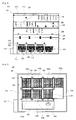
- Fig. 1 is a cross partial view illustrating an apparatus for consecutively breeding fly larvae according to the present invention.
- Fig. 2 is a plane view illustrating an apparatus for consecutively breeding fly larvae according to the present invention.
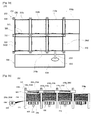
- Figs. 3A and 3B are views illustrating breeding chambers according to the present invention.
- Fig. 4 is a view illustrating a pillar unit according to the present invention.
- Fig. 5 is a view illustrating a cover according to the present invention.
- Fig. 6 is a view illustrating a metamorphosis chamber according to the present invention.
- the apparatus for consecutively breeding fly larvae 100 may include a fly habitat part 110 which is sealed and includes a fly habitat chamber 112.
- the fly habitat part 110 includes a plurality of wires 114, a gore 116 on which flies may take rest, a first heating pipe 118 configured to keep an indoor temperature of the fly habitat chamber 112, a first ventilator 120, an air purifier 122, a lighting lamp 124, a first detection and measure sensor 126, a water supply facility 128, and a vacuum cleaner (not illustrated) configured to suck impurities from the floor and to treat them.
- the above-listed components are included in the Korean Patent Registration No. 10-104636 which was invented by the same applicant as the present application. The detailed descriptions thereon will be omitted.
- a steam boiler 132 configured to supply steam to the first heating pipe 118.
- a larvae breeding part 210 wherein flies may oviposit and larvae may be bred.
- the larvae breeding part 210 includes a pillar unit 212 which is installed on the floor of the fly habitat chamber 112, and first to seventh breeding chambers 310a, 310b, 310c, 310d, 310e, 310f and 310g which are movable about the pillar unit 212 and are independently divided from one another.
- the pillar unit 212 may include a plurality of pillar members 214 which are installed on the floor of the fly habitat chamber 112 of the fly habitat part 110.
- the pillar member 214 are arranged in three rows in horizontal directions at regular intervals in their forward, backward, leftward and rightward directions, thus forming eight installation spaces in a quadrangle shape between the neighboring pillar members 214.
- a track-shaped rail 216 is installed as they are connected to one another.
- the first to seventh breeding chambers 310a, 310b, 310c, 310d, 310e, 310f and 310g are movable along the rail 216 for thereby forming a quadrangle closed-loop.
- the pillar members 214 may be arranged in a rectangular shape, not in a circular shape, the first to seventh breeding chambers 310a, 310b, 310c, 310d, 310e, 310f and 310g may be installed for thereby producing as much larvae as possible using to the max the space of the fly habitat chamber 112 of the fly habitat part 110.
- the first to seventh breeding chambers 310a, 310b, 310c, 310d, 310e, 310f and 310g are arranged in a quadrangle shape matching with the installation space formed in a quadrangle shape between the neighboring pillar members 214.
- any of the first to seventh breeding chambers 310a, 310b, 310c, 310d, 310e, 310f and 310g is not installed in a predetermined installation space while leaving it empty.
- the first to seventh breeding chambers 310a, 310b, 310c, 310d, 310e, 310f and 310g may be arranged in a quadrangle shape, thus utilizing to the max the spaces of the fly habitat chamber 112, which leads to increased production of larvae.
- the first to seventh breeding chambers 310a, 310b, 310c, 310d, 310e, 310f and 310g each are formed in quadrangle shapes wherein there are spaces whose tops are open.
- a passage 312 communicating with the spaces is formed at one side of each of the first to seventh breeding chambers 310a, 310b, 310c, 310d, 310e, 310f and 310g.
- a wheel 316 which is mounted on the rail 216 of the pillar unit 212 and by which the first to seventh breeding chambers 310a, 310b, 310c, 310d, 310e, 310f and 310g may move in one direction.
- the moving means configured to move, by one room, the first to seventh breeding chambers 310a, 310b, 310c, 310d, 310e, 310f and 310g may be substituted from the wheel 316 disposed at the bottom of each of the first to seventh breeding chambers 310a, 310b, 310c, 310d, 310e, 310f and 310g to a sprocket, and the rail 216 installed in the pillar unit 214 may be substituted with a chain engaged to the sprocket for thereby moving the first to seventh breeding chambers 310a, 310b, 310c, 310d, 310e, 310f and 310g.
- all types of moving means may be adapted so as to move the first to seventh breeding chambers 310a, 310b, 310c, 310d, 310e, 310f and 310g.
- the descriptions on the moving means configured to move the first to seventh breeding chambers 310a, 310b, 310c, 310d, 310e, 310f and 310g will be omitted.
- the second ventilator 320 is installed in the first to seventh breeding chambers 310a, 310b, 310c, 310d, 310e, 310f and 310g.
- the second detection and measure sensor 322 may be installed so as to detect the temperature and humidity of the first to seventh breeding chambers 310a, 310b, 310c, 310d, 310e, 310f and 310g.
- the suction discharge unit 410 is installed so as to suck and discharge impurities.
- the suction discharge unit 410 is installed below each of the first to seventh breeding chambers 310a, 310b, 310c, 310d, 310e, 310f and 310g, and there is further provided a discharge container 412 equipped with a filter 414.
- a discharge pipe 416 is provided below the discharge container 412.
- a vacuum pump 418 is installed at a predetermined portion of the discharge pipe 416.
- the first through sixth covers 510a, 510b, 510c, 510d, 510e and 510f configured to cover tops of the first to seventh breeding chambers 310a, 310b, 310c, 310d, 310e, 310f and 310g.
- the first through sixth covers 510a, 510b, 510c, 510d, 510e and 510f are installed matching with the first to seventh breeding chambers 310a, 310b, 310c, 310d, 310e, 310f and 310g.
- the top of any of the first to seventh breeding chambers 310a, 310b, 310c, 310d, 310e, 310f and 310g is open.
- an ascending and descending member 520 configured to ascend or descend the first through sixth covers 510a, 510b, 510c, 510d, 510e and 510f.
- the ascending and descending member 520 is installed in the pillar member 214 so as to ascend or descend the first through sixth covers 510a, 510b, 510c, 510d, 510e and 510f.
- the ascending and descending member 520 is installed in the pillar member 214, and all types of cylinder means may be used so as to ascend or descend the first through sixth covers 510a, 510b, 510c, 510d, 510e and 510f which are configured to cover tops of the first to seventh breeding chambers 310a, 310b, 310c, 310d, 310e, 310f and 310g.
- the detailed descriptions on the ascending and descending member 520 will be omitted.
- a locking member 530 is provided so as to keep in safe the covering states on tops of them.
- the locking member 530 is installed in the pillar member 214
- first to seventh breeding chambers 310a, 310b, 310c, 310d, 310e, 310f and 310g move to the next stage, the first through sixth covers 510a, 510b, 510c, 510d, 510e and 510f ascend.
- first through sixth covers 510a, 510b, 510c, 510d, 510e and 510f ascend, they are unlocked from the locking member 530 and ascend.
- the first to seventh breeding chambers 310a, 310b, 310c, 310d, 310e, 310f and 310g are unlocked from the locking member 530 and move along the rail 216, to the next stage.
- the breeding chambers are secured by the locking member 530, and at the same time the first through sixth covers 510a, 510b, 510c, 510d, 510e and 510f descend and cover tops of the first to seventh breeding chambers 310a, 310b, 310c, 310d, 310e, 310f and 310g and are fixedly secured to the locking member 530.
- a fog spray member 512 may be connected depending on the growth conditions by growth stages of larvae.
- a water supply pipe 517 equipped with a shower 516 and a CCTV 518 may be installed.
- the fog spray member 512 may be installed in the first to third covers 510a, 510b and 510c.
- the feeder 514 and the shower 514 are installed in the fourth to sixth covers 510d, 510e and 510f.
- the water supply pipe 517 is connected to the steam boiler 132.
- the CCTV 518 is installed so as to observe the growths of larvae.
- the vacuum suction unit 518 is installed so as to collect the grownup larvae.
- the fog spray member 512, the feeder 514 and the stream boiler 132 may be connected depending on the growth conditions by growth stages of larvae.
- the descriptions on the construction and operations of the water supply pipe 517 equipped with the shower 516 and the CCTV 518 may be omitted because they are same as the construction and operations described in the Korean Patent Registration No. 10-104636 invented by the same applicant as the present application.
- a metamorphosis chamber 610 wherein the larvae bred in the larvae breeding part 210 metamorphose.
- the metamorphosis chamber 610 includes a connection passage 612 connected with the passage 312 formed in the sixth breeding chamber 310f which is positioned on the sixth day portion among the first to seventh breeding chambers 310a, 310b, 310c, 310d, 310e, 310f and 310g.
- the metamorphosis chamber 614 is provided in the other side of the connection passage 612 connected to the passage 312 of the sixth breeding chamber 310f.
- lead mold, sawdust, sand and/or soil are mixed at a predetermined ratio and are inputted in the floor of the metamorphosis chamber 614 so as to make environment where the grownup larvae may metamorphose.
- an electronic scale sensor 616 which is configured to control the opening and closing door 313 which opens or closes the passage 312 of the first to seventh breeding chambers 310a, 310b, 310c, 310d, 310e, 310f and 310g.
- the second heating pipe 617 is installed so as to adjust the temperature of the metamorphosis chamber 614.
- the temperature detection sensor 618 is installed so as to detect a predetermined temperature.
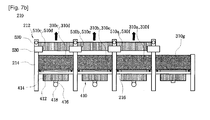
- Figs. 7A and 7B are views illustrating the operations of an apparatus for consecutively breeding fly larvae according to the present invention.
- the apparatus for consecutively breeding larvae 100 according to the present invention is partly the same as in the Korean Patent Registration No. 10-104636 invented by the same applicant as the present application, so the descriptions on the same components will be omitted. Only the different operations will be described.
- the separately arranged first to seventh breeding chambers 310a, 310b, 310c, 310d, 310e, 310f and 310g are arranged in quadrangle shapes, which leads to using the optimized space of the fly habitat camber 110 of the fly habitat part 110 and to producing as much larvae as possible.
- the flies move from the fly habitat chamber 112 into any of the first to seventh breeding chambers 310a, 310b, 310c, 310d, 310e, 310f and 310g which is not covered by any of the first through sixth covers 510a, 510b, 510c, 510d, 510e and 510f among the first to seventh breeding chambers 310a, 310b, 310c, 310d, 310e of the larvae breeding part 210, more specifically, the flies move from the fly habitat chamber 112 into the seventh breeding chamber 310g whose top is not covered by the first through sixth covers 510a, 510b, 510c, 510d, 510e and 510f and oviposit.
- the seventh breeding chamber 310a is called a chamber where the flies oviposit.
- the locking member 530 is unlocked after one day, and the first through sixth covers 510a, 510b, 510c, 510d, 510e and 510f ascend by the ascending and descending member 530, and the first to seventh breeding chambers 310a, 310b, 310c, 310d, 310e, 310f and 310g move along the rail 216, to the next stage by one room.
- the seventh breeding chamber 310g where the flies have oviposited moves to the position of the neighboring first breeding chamber 310a, and the first breeding chamber 310a moves to the position of the second breeding chamber 310b. More specifically, the first to seventh breeding chambers 310a, 310b, 310c, 310d, 310e, 310f and 310g each move by one room per day in the above described manner, and the larvae grown in the sixth breeding chamber 310f are collected, and after the collection is finished, the sixth breeding chamber 310f moves to the position of the seventh breeding chamber 310g.
- first to seventh breeding chambers 310a, 310b, 310c, 310d, 310e, 310f and 310g each move to the next stage per day
- first through sixth covers 510a, 510b, 510c, 510d, 510e and 510f which have ascended or descend by means of the ascending and descending member and are locked by the locking member 530 and at the same time cover tops of the first to seventh breeding chambers 310a, 310b, 310c, 310d, 310e, 310f.
- the locking member 530 is unlocked whenever one day passes, and the first through sixth covers 510a, 510b, 510c, 510d, 510e and 510f ascend, and at the same time the first to seventh breeding chambers 310a, 310b, 310c, 310d, 310e, 310f move by one room thus providing optimized habitat environment for each growth stage of larvae.
- the larvae are grown in the larvae breeding part 210 until sixth days when the larvae may be products.
- the first through sixth covers 510a, 510b, 510c, 510d, 510e and 510f installed on tops of the first to seventh breeding chambers 310a, 310b, 310c, 310d, 310e, 310f may be set from the first day to the sixth day of larvae growth depending on the positions of the tops of the first to seventh breeding chambers 310a, 310b, 310c, 310d, 310e, 310f.
- the method for making good growth environment so that the larvae may grow under comfort and sanitary environments by days in the first to seventh breeding chambers 310a, 310b, 310c, 310d, 310e, 310f using the devices installed in the first through sixth covers 510a, 510b, 510c, 510d, 510e and 510f is described in the Korean Patent Registration No. 10-104636 , so the descriptions thereon will be omitted.
- the opening and closing door 313 installed in the sixth breeding chamber 310f is opened for thereby opening the passage 312.
- the grownup larvae come out of the opened passage 312 and move through the connection passage 612, to the metamorphosis chamber 614 while heading for the light from the connection passage 612.
- the larvae who move through the connection passage 612, to the metamorphosis chamber 614 passes through the electronic scale sensor 616 installed in the metamorphosis chamber 614.
- the opening and closing door 313 is automatically closed based on the sensing of the electronic scale sensor 616, and the passage 312 is closed.
- Part of the larvae bred in the sixth breeding chamber 310f moves through the passage 312, to the metamorphosis chamber 614 and metamorphose into flies, and the metamorphosed flies move into the habitat chamber 112 and inhabit therein and move into the seventh breeding chamber 310g and oviposit therein.
- the above-described process is repeatedly performed, thus consecutively producing larvae.
- the suction discharge unit 410 As a means for discharging outside the secretion or the excretion generating during the growth of larvae, the suction discharge unit 410 is same as in the Korean Patent Registration No. 10-104636 which is invented by the same applicant as the present application, so the detailed descriptions thereon will be omitted.
- the first to seventh breeding chambers 310a, 310b, 310c, 310d, 310e, 310f and 310g are arranged in quadrangle shapes and are configured to move along the rail 216, thus utilizing to the max the space of the fly habitat chamber 112, which results in producing as much larvae as possible.
- first through sixth covers 510a, 510b, 510c, 510d, 510e and 510f are configured to ascend or descend in place by means of the ascending and descending member 520, and only the first to seventh breeding chambers 310a, 310b, 310c, 310d, 310e, 310f and 310g are configured to move by room whenever alarm generates per day along the rail 216.
- the larvae breeding chamber 210 and the fly metamorphosis chamber 614 are installed for thereby providing the optimized habitat environment.
- the larvae with the exception of those having escaped to the metamorphosis chamber are collected, and the metamorphosed flies move into the fly habitat part 110 and oviposit therein, the ecological circulation cycles of which are repeatedly performed, thus consecutively producing good larvae.
- the present invention relates to an apparatus for consecutively breeding fly larvae, and in particular to an apparatus for consecutively breeding fly larvae which makes it possible to automatically breed larvae by repeatedly performing a process wherein in a state where a breeding chamber is divided into a plurality of breeding chambers configured to breed larvae in, the grownup larvae with the exception of those having escaped to a metamorphosis chamber are collected, and the larvae who escaped to the metamorphosis chamber are grown into flies, and the flies move to a habitat chamber installed above the breeding chambers and are bred and oviposit in the breeding chamber.
Landscapes
- Life Sciences & Earth Sciences (AREA)
- Environmental Sciences (AREA)
- Animal Behavior & Ethology (AREA)
- Zoology (AREA)
- Animal Husbandry (AREA)
- Biodiversity & Conservation Biology (AREA)
- Farming Of Fish And Shellfish (AREA)
- Housing For Livestock And Birds (AREA)
- Greenhouses (AREA)
Applications Claiming Priority (2)
| Application Number | Priority Date | Filing Date | Title |
|---|---|---|---|
| KR1020120034562A KR101365703B1 (ko) | 2012-04-03 | 2012-04-03 | 파리 애벌레 연속사육장치 |
| PCT/KR2012/003725 WO2013151207A1 (ko) | 2012-04-03 | 2012-05-11 | 파리 애벌레 연속사육장치 |
Publications (2)
| Publication Number | Publication Date |
|---|---|
| EP2820948A1 true EP2820948A1 (de) | 2015-01-07 |
| EP2820948A4 EP2820948A4 (de) | 2015-10-14 |
Family
ID=49300673
Family Applications (1)
| Application Number | Title | Priority Date | Filing Date |
|---|---|---|---|
| EP12873876.2A Withdrawn EP2820948A4 (de) | 2012-04-03 | 2012-05-11 | Vorrichtung zur zucht von fliegenlarven |
Country Status (4)
| Country | Link |
|---|---|
| US (1) | US9462795B2 (de) |
| EP (1) | EP2820948A4 (de) |
| KR (1) | KR101365703B1 (de) |
| WO (1) | WO2013151207A1 (de) |
Cited By (3)
| Publication number | Priority date | Publication date | Assignee | Title |
|---|---|---|---|---|
| CN105941243A (zh) * | 2016-06-07 | 2016-09-21 | 苏州蓑笠翁养生科技有限公司 | 一种便于喂料的螃蟹养殖装置 |
| WO2021027279A1 (zh) * | 2019-08-12 | 2021-02-18 | 南京大学(溧水)生态环境研究院 | 一种蝇蛆养殖智能布料补料系统与方法 |
| WO2021228934A1 (de) | 2020-05-13 | 2021-11-18 | Livin Farms Agrifood Gmbh | Modulares zuchtsystem für insekten |
Families Citing this family (33)
| Publication number | Priority date | Publication date | Assignee | Title |
|---|---|---|---|---|
| NL2010666B3 (en) * | 2013-04-19 | 2018-11-21 | Buhler Changzhou Insect Tech Co Ltd | Method and system for breeding insects, using a plurality of individual crates. |
| CN103918617B (zh) * | 2014-05-04 | 2016-01-13 | 青岛中医秘方研究院 | 工程蝇养殖箱 |
| US9642344B2 (en) * | 2014-07-05 | 2017-05-09 | Livin Farms Ltd. | System and method for breeding and harvesting insects |
| ES2721767T3 (es) * | 2014-07-21 | 2019-08-05 | Enterra Feed Corp | Sistema de producción continuo para cultivo de insectos dípteros |
| WO2016015639A1 (zh) * | 2014-07-31 | 2016-02-04 | 浙江省农业科学院 | 规模化高效蝇蛆养殖设备和工艺 |
| KR101584205B1 (ko) * | 2015-03-25 | 2016-01-13 | 주식회사 싸이텍 | 파리 애벌레 사육시스템 |
| FR3034623B1 (fr) * | 2015-04-13 | 2017-04-14 | Ynsect | Procede d'elevage d'insectes |
| PL230275B1 (pl) * | 2016-08-09 | 2018-10-31 | Hipromine Spolka Akcyjna | Linia technologiczna do odchowu lub hodowli owadów, modułowy system linii technologicznych, sposób odchowu lub hodowli owadów oraz zastosowanie linii technologicznej i systemu modułowego do odchowu lub hodowli owadów |
| CN106719454A (zh) * | 2016-12-21 | 2017-05-31 | 成都华氏农业科技有限公司 | 一种猪粪生产蝇蛆配合基质方法的专用设备 |
| NL2018526B1 (en) * | 2017-03-15 | 2018-09-24 | Amusca B V | Breeding system for crawling insects |
| CN106954589A (zh) * | 2017-03-29 | 2017-07-18 | 厦门佑笙实业有限公司 | 一种养蛆自动化流水线 |
| NL2018643B1 (en) * | 2017-04-04 | 2018-10-11 | Protix Bv | Centralized system for distributing olfactory triggers for ovipositioning to insect breeding enclosures |
| HUE068946T2 (hu) | 2017-04-04 | 2025-02-28 | Protix Bv | Központosított rendszer a tojásrakást kiváltó illatingerek elosztására zárt rovartenyésztõ területeken |
| NL2020054B1 (en) * | 2017-12-12 | 2019-06-21 | Protix Bv | Centralized system for distributing olfactory triggers for ovipositioning to insect breeding enclosures |
| CN107182946B (zh) * | 2017-05-19 | 2023-02-03 | 中国农业科学院植物保护研究所 | 一种椭圆食粉螨人工繁殖盒 |
| NL2019344B1 (en) * | 2017-07-25 | 2019-02-18 | Proti Farm R & D B V | Method and system for controlling the climate of an insect rearing climate area. |
| CN107258704A (zh) * | 2017-08-01 | 2017-10-20 | 北京中农纯静园林科技有限公司 | 天敌增殖扩繁自释放栖息装置 |
| US10842138B1 (en) | 2017-08-02 | 2020-11-24 | Insecticycle LLC | Method, device, and system for use with insect larvae |
| GB201714822D0 (en) * | 2017-09-14 | 2017-11-01 | Entocycle Ltd | Apparatus and method for controlling insect production |
| CN207531712U (zh) * | 2017-10-18 | 2018-06-26 | 广州无两生物科技有限公司 | 一种大型连栋黑水虻成虫繁殖温室 |
| CN107873648A (zh) * | 2017-11-23 | 2018-04-06 | 广州飞禧特生物科技有限公司 | 黑水虻幼虫养殖收集设备及方法 |
| CN108184771A (zh) * | 2018-02-11 | 2018-06-22 | 山东省农业机械科学研究院 | 一种麦蛾卵培养除鳞收集机 |
| CN108469497B (zh) * | 2018-03-13 | 2020-06-02 | 甘肃农业大学 | 叶螨毒力测定实验装置 |
| KR102237223B1 (ko) * | 2019-04-22 | 2021-04-06 | 강장석 | 동애등에 자동사육장치 |
| US12408642B2 (en) * | 2020-03-16 | 2025-09-09 | Prezero Us, Inc. | Oviposition trays for insect eggs |
| CN111328770B (zh) * | 2020-03-25 | 2021-10-22 | 广西壮族自治区农业科学院 | 一种长尾潜蝇茧蜂的室内规模化繁育方法 |
| WO2021263149A1 (en) * | 2020-06-25 | 2021-12-30 | Soldier Fly Technologies, Inc | Insect breeding apparatus and methods |
| CN116322319A (zh) * | 2020-07-27 | 2023-06-23 | 恩比科技公司 | 用于生长生物质的设备 |
| WO2022022969A1 (en) | 2020-07-27 | 2022-02-03 | Nbtech Ab | System and method for growing biomass |
| KR102619007B1 (ko) * | 2021-02-09 | 2023-12-29 | 최정동 | 음식물 폐기물을 이용한 유충 사육 장치 |
| CN113170767A (zh) * | 2021-05-13 | 2021-07-27 | 周君荣 | 一种苍蝇饲养、培育箱及其控制系统 |
| CN116439202B (zh) * | 2023-04-08 | 2024-05-03 | 天津市农业科学院 | 一种提高成活率的黑水虻养殖设备 |
| US20260060223A1 (en) * | 2024-09-03 | 2026-03-05 | Annelida Soil Solutions Ltd. | Worm bed system and apparatus |
Family Cites Families (17)
| Publication number | Priority date | Publication date | Assignee | Title |
|---|---|---|---|---|
| US1974549A (en) * | 1933-12-01 | 1934-09-25 | Spencer Herbert | Device for rearing and capturing insects |
| US2539633A (en) * | 1946-09-11 | 1951-01-30 | Austin W Morrill | Device for breeding insects |
| US4036177A (en) * | 1976-02-13 | 1977-07-19 | Unifab Corporation | Bio-test cage and support therefor |
| FR2460617B1 (fr) * | 1979-07-10 | 1983-10-14 | Agronomique Inst Nat Rech | Unite de production en masse d'oeufs d'un insecte |
| ATE17914T1 (de) * | 1982-04-27 | 1986-02-15 | Cassou Robert | Gehege zur unterbringung von tieren, in der art einer kaefigbatterie. |
| FR2585924B1 (fr) * | 1985-08-07 | 1988-03-18 | Agric Semences Limagne Coop | Procede et dispositif de production en masse d'un insecte entomophage, son application en lutte biologique |
| JP3134138B2 (ja) * | 1992-02-19 | 2001-02-13 | ぺんてる株式会社 | 植物成長調節剤 |
| JP2852411B2 (ja) | 1995-12-25 | 1999-02-03 | 農林水産省蚕糸・昆虫農業技術研究所長 | 昆虫の自動飼育装置 |
| KR200294434Y1 (ko) * | 2002-07-15 | 2002-11-13 | 임상근 | 분변토 생산을 위한 지렁이 사육장치 |
| KR100654253B1 (ko) | 2005-09-15 | 2006-12-06 | 진병규 | 파리 사육 장치 |
| KR100731928B1 (ko) | 2005-09-15 | 2007-06-27 | 진병규 | 파리 사육 방법 |
| US20080087231A1 (en) * | 2006-10-13 | 2008-04-17 | Gabriel George S | Cage and rack system |
| JP3134138U (ja) | 2007-01-12 | 2007-08-09 | 株式会社造形美術 | 飼育用縦型回転棚 |
| JP2009172910A (ja) | 2008-01-25 | 2009-08-06 | Kyocera Mita Corp | 印刷システム、印刷プログラムおよび画像形成装置 |
| EP2263452B1 (de) * | 2009-06-16 | 2012-12-05 | TECNIPLAST S.p.A. | Automatisches System zur gesteuerten Verteilung von Substanzen an Tieraufbewahrungsvorrichtungen in einer Tierunterbringungseinrichtung |
| KR101044636B1 (ko) * | 2011-03-24 | 2011-06-29 | 진병규 | 파리 애벌레 사육장치 |
| US8733284B2 (en) * | 2012-07-18 | 2014-05-27 | Enviroflight, Llc | Method and apparatus for breeding flying insects |
-
2012
- 2012-04-03 KR KR1020120034562A patent/KR101365703B1/ko not_active Expired - Fee Related
- 2012-05-11 US US14/358,348 patent/US9462795B2/en active Active
- 2012-05-11 WO PCT/KR2012/003725 patent/WO2013151207A1/ko not_active Ceased
- 2012-05-11 EP EP12873876.2A patent/EP2820948A4/de not_active Withdrawn
Cited By (3)
| Publication number | Priority date | Publication date | Assignee | Title |
|---|---|---|---|---|
| CN105941243A (zh) * | 2016-06-07 | 2016-09-21 | 苏州蓑笠翁养生科技有限公司 | 一种便于喂料的螃蟹养殖装置 |
| WO2021027279A1 (zh) * | 2019-08-12 | 2021-02-18 | 南京大学(溧水)生态环境研究院 | 一种蝇蛆养殖智能布料补料系统与方法 |
| WO2021228934A1 (de) | 2020-05-13 | 2021-11-18 | Livin Farms Agrifood Gmbh | Modulares zuchtsystem für insekten |
Also Published As
| Publication number | Publication date |
|---|---|
| WO2013151207A1 (ko) | 2013-10-10 |
| US9462795B2 (en) | 2016-10-11 |
| KR101365703B1 (ko) | 2014-03-12 |
| US20140261188A1 (en) | 2014-09-18 |
| EP2820948A4 (de) | 2015-10-14 |
| KR20130112299A (ko) | 2013-10-14 |
Similar Documents
| Publication | Publication Date | Title |
|---|---|---|
| US9462795B2 (en) | Apparatus for breeding fly larvae | |
| CN208824934U (zh) | 用于分离蛹的筛分装置和系统 | |
| CN105850896B (zh) | 一种黑水虻养殖一体化装置和养殖方法 | |
| JP6375369B2 (ja) | 魚の養殖プラント及びその使用 | |
| KR101044636B1 (ko) | 파리 애벌레 사육장치 | |
| KR20200136458A (ko) | 성장 시스템 및 방법 | |
| CN109122582B (zh) | 一种具有自动清洁功能的黑水虻养殖设备及其使用方法 | |
| RU2020109543A (ru) | Рыбоводный садок и способ подачи воздуха и циркуляции воды в рыбоводном садке | |
| WO2017205420A1 (en) | Aquaponics system | |
| JP2013527755A (ja) | 循環システムを設けられた気候室 | |
| JP2021013303A (ja) | 可動送風ユニット、及び栽培工場での植物栽培方法 | |
| EP3457841B1 (de) | Vorrichtung und verfahren zur züchtung von wirbellosen tieren | |
| CN107094533A (zh) | 智能种植大棚 | |
| CN1286364C (zh) | 全生态组合蛇类养殖箱房及制作方法 | |
| KR102027796B1 (ko) | 곤충사육 시스템 | |
| KR101891815B1 (ko) | 귀뚜라미 사육설비 | |
| CN115176768B (zh) | 一种皂角豆象室内人工繁殖方法 | |
| KR20190073891A (ko) | 산업용 곤충의 사육을 위한 성충용 사육기 | |
| KR20200140747A (ko) | 코코배지를 활용한 다단형 식물재배기 | |
| CN106212292A (zh) | 一种智能化自动清洗奶牛棚 | |
| CN106879552A (zh) | 一种蛇类养殖的实现方法及蛇类养殖装置 | |
| CN209359141U (zh) | 一种核桃育苗用多功能温床培养架构 | |
| RU2400056C1 (ru) | Вегетационная установка | |
| KR101485159B1 (ko) | 엘이디를 이용한 식물재배공장 | |
| CN104756791B (zh) | 阳台缩微农场系统 |
Legal Events
| Date | Code | Title | Description |
|---|---|---|---|
| PUAI | Public reference made under article 153(3) epc to a published international application that has entered the european phase |
Free format text: ORIGINAL CODE: 0009012 |
|
| 17P | Request for examination filed |
Effective date: 20140929 |
|
| AK | Designated contracting states |
Kind code of ref document: A1 Designated state(s): AL AT BE BG CH CY CZ DE DK EE ES FI FR GB GR HR HU IE IS IT LI LT LU LV MC MK MT NL NO PL PT RO RS SE SI SK SM TR |
|
| AX | Request for extension of the european patent |
Extension state: BA ME |
|
| DAX | Request for extension of the european patent (deleted) | ||
| RA4 | Supplementary search report drawn up and despatched (corrected) |
Effective date: 20150914 |
|
| RIC1 | Information provided on ipc code assigned before grant |
Ipc: A01K 67/00 20060101ALI20150908BHEP Ipc: A01K 67/033 20060101AFI20150908BHEP |
|
| STAA | Information on the status of an ep patent application or granted ep patent |
Free format text: STATUS: THE APPLICATION IS DEEMED TO BE WITHDRAWN |
|
| 18D | Application deemed to be withdrawn |
Effective date: 20160412 |