EP2821576A1 - Armoire automatisée - Google Patents
Armoire automatisée Download PDFInfo
- Publication number
- EP2821576A1 EP2821576A1 EP13175374.1A EP13175374A EP2821576A1 EP 2821576 A1 EP2821576 A1 EP 2821576A1 EP 13175374 A EP13175374 A EP 13175374A EP 2821576 A1 EP2821576 A1 EP 2821576A1
- Authority
- EP
- European Patent Office
- Prior art keywords
- movable panel
- cabinet
- panels
- automated
- rail track
- Prior art date
- Legal status (The legal status is an assumption and is not a legal conclusion. Google has not performed a legal analysis and makes no representation as to the accuracy of the status listed.)
- Withdrawn
Links
- 238000000034 method Methods 0.000 claims description 21
- 230000005484 gravity Effects 0.000 claims description 20
- 230000003213 activating effect Effects 0.000 claims description 7
- 230000008859 change Effects 0.000 claims description 4
- 230000008878 coupling Effects 0.000 description 10
- 238000010168 coupling process Methods 0.000 description 10
- 238000005859 coupling reaction Methods 0.000 description 10
- 238000010276 construction Methods 0.000 description 9
- 230000008569 process Effects 0.000 description 7
- 229910000831 Steel Inorganic materials 0.000 description 6
- 239000004033 plastic Substances 0.000 description 6
- 229920003023 plastic Polymers 0.000 description 6
- 239000010959 steel Substances 0.000 description 6
- 239000002131 composite material Substances 0.000 description 4
- 230000001360 synchronised effect Effects 0.000 description 4
- 239000004411 aluminium Substances 0.000 description 3
- 229910052782 aluminium Inorganic materials 0.000 description 3
- XAGFODPZIPBFFR-UHFFFAOYSA-N aluminium Chemical compound [Al] XAGFODPZIPBFFR-UHFFFAOYSA-N 0.000 description 3
- 229910052751 metal Inorganic materials 0.000 description 3
- 239000002184 metal Substances 0.000 description 3
- 239000011121 hardwood Substances 0.000 description 2
- 230000000977 initiatory effect Effects 0.000 description 2
- 229920002994 synthetic fiber Polymers 0.000 description 2
- 239000002023 wood Substances 0.000 description 2
- 239000004677 Nylon Substances 0.000 description 1
- 230000009471 action Effects 0.000 description 1
- 239000003607 modifier Substances 0.000 description 1
- 239000005445 natural material Substances 0.000 description 1
- 229920001778 nylon Polymers 0.000 description 1
- 230000003746 surface roughness Effects 0.000 description 1
- 230000002123 temporal effect Effects 0.000 description 1
Images




Classifications
-
- E—FIXED CONSTRUCTIONS
- E05—LOCKS; KEYS; WINDOW OR DOOR FITTINGS; SAFES
- E05D—HINGES OR SUSPENSION DEVICES FOR DOORS, WINDOWS OR WINGS
- E05D15/00—Suspension arrangements for wings
- E05D15/16—Suspension arrangements for wings for wings sliding vertically more or less in their own plane
- E05D15/20—Suspension arrangements for wings for wings sliding vertically more or less in their own plane movable out of one plane into a second parallel plane
-
- E—FIXED CONSTRUCTIONS
- E05—LOCKS; KEYS; WINDOW OR DOOR FITTINGS; SAFES
- E05F—DEVICES FOR MOVING WINGS INTO OPEN OR CLOSED POSITION; CHECKS FOR WINGS; WING FITTINGS NOT OTHERWISE PROVIDED FOR, CONCERNED WITH THE FUNCTIONING OF THE WING
- E05F15/00—Power-operated mechanisms for wings
- E05F15/60—Power-operated mechanisms for wings using electrical actuators
- E05F15/603—Power-operated mechanisms for wings using electrical actuators using rotary electromotors
- E05F15/665—Power-operated mechanisms for wings using electrical actuators using rotary electromotors for vertically-sliding wings
-
- E—FIXED CONSTRUCTIONS
- E06—DOORS, WINDOWS, SHUTTERS, OR ROLLER BLINDS IN GENERAL; LADDERS
- E06B—FIXED OR MOVABLE CLOSURES FOR OPENINGS IN BUILDINGS, VEHICLES, FENCES OR LIKE ENCLOSURES IN GENERAL, e.g. DOORS, WINDOWS, BLINDS, GATES
- E06B3/00—Window sashes, door leaves, or like elements for closing wall or like openings; Layout of fixed or moving closures, e.g. windows in wall or like openings; Features of rigidly-mounted outer frames relating to the mounting of wing frames
- E06B3/32—Arrangements of wings characterised by the manner of movement; Arrangements of movable wings in openings; Features of wings or frames relating solely to the manner of movement of the wing
- E06B3/34—Arrangements of wings characterised by the manner of movement; Arrangements of movable wings in openings; Features of wings or frames relating solely to the manner of movement of the wing with only one kind of movement
- E06B3/42—Sliding wings; Details of frames with respect to guiding
- E06B3/44—Vertically-sliding wings
- E06B3/443—Vertically-sliding wings specially adapted for furniture
-
- E—FIXED CONSTRUCTIONS
- E05—LOCKS; KEYS; WINDOW OR DOOR FITTINGS; SAFES
- E05Y—INDEXING SCHEME ASSOCIATED WITH SUBCLASSES E05D AND E05F, RELATING TO CONSTRUCTION ELEMENTS, ELECTRIC CONTROL, POWER SUPPLY, POWER SIGNAL OR TRANSMISSION, USER INTERFACES, MOUNTING OR COUPLING, DETAILS, ACCESSORIES, AUXILIARY OPERATIONS NOT OTHERWISE PROVIDED FOR, APPLICATION THEREOF
- E05Y2900/00—Application of doors, windows, wings or fittings thereof
- E05Y2900/20—Application of doors, windows, wings or fittings thereof for furniture, e.g. cabinets
Definitions
- the present invention relates to cabinets, specifically to an automated cabinet system configured to switch between a closed cabinet modus and an open cabinet modus.
- motorized door systems allow remote control for opening and closing a door cabinet.
- Automated cabinet systems may comprise a motorized door system to open or close the cabinet, having a plurality of doors to be raised or lowered according to control instructions.
- the automated cabinet may be opened or closed by raising or lowering each of the doors individually, as each door may be controlled individually.
- an automated cabinet system may comprise an electrically driven lifting system coupled to a plurality of doors, to raise or lower the doors, thereby opening or closing the cabinet.
- the doors may be lifted subsequently, one after the other, in a controlled continuous manner in order to open or close the cabinet.
- Lifting systems for automated cabinet systems for raising or lowering doors may have a guiding rail system comprising a plurality of tracks with multiple track depths.
- a multiple track depth system forces the guiding wheels to bring them in different positions at different heights and depth levels.
- the guiding wheels are constantly moving in vertical as well as more horizontal direction compared to the ground surface. This forced and continuous movement of the guiding wheels into different, opposite - even orthogonal - directions make the entire construction unstable and less robust.
- these guiding wheels will have more freedom of movement whenever arriving in a rail track stage having a larger or deeper track depth. The more freedom of movement for these guiding wheels within certain rail track stages, the less stable the guiding configuration becomes.
- a multiple track depth system increases instability in the mechanical construction due to movement and freedom of movement of the guiding wheels into different directions.
- a motor is rather large and heavy and is not directly coupled to the lifting system, but transfers its energy using a shaft system.
- the energy is delivered through the shaft system, coupled to the lifting system, in order to drive the lifting system for raising or lowering doors.
- the shaft system needs to be tailor-made in order to fit in the cabinet concerned.
- this implementation being rather unique and expensive, is complex and log, causing design constraints and mechanical construction difficulties.
- the aim of the invention is to provide an automated cabinet system to overcome stability, design and construction limitations as indicated above. It is an object of the present invention to provide a more stable and mechanically improved configuration for an automated cabinet system.
- the invention provides a new type of automated cabinet system configuration characterized by the following.
- the terms "one or more” or “at least one”, such as one or more or at least one member(s) of a group of members, is clear per se, by means of further exemplification, the term encompasses inter alia a reference to any one of said members, or to any two or more of said members, such as, e.g ., any ⁇ 3, ⁇ 4, ⁇ 5, ⁇ 6 or ⁇ 7 etc. of said members, and up to all said members.
- the present invention relates to an automated cabinet (100), configured to switch between a closed cabinet modus and an open cabinet modus, the automated cabinet comprising:
- the at least one movable panel (113), being coupled to the at least two pulley systems (134), and being configured to raise or lower the at least one movable panel (113) outside its centre of gravity is herewith further explained.
- the at least one movable panel (113) is coupled to the at least two pulley systems (134) by means of at least two flexible members (136), i.e. one flexible member per pulley system being coupled to the movable panel.
- the point of application of the flexible member (136) for lifting the movable panel (113) is laying outside the centre of gravity of the movable panel (113), i.e.
- the at least one rail track (156) for each of the two opposing sidewalls (120) having an essentially constant rail track depth (157), is further clarified by the fact that the at least one rail track (156) for each of the opposing sidewalls (120) needs to have a constant depth, unless if a difference in rail track depth (157) would represent a specific functionality.
- the rail track depth (157) may vary only when there is a particular reason involved, beyond the mere guidance of the wheels moving upward or downwards.
- deviations on the essentially constant rail track depth (157) of e.g . 1 mm are allowed in case of a 6mm rail track depth (157).
- the automated cabinet (100) of the present invention may further comprise a control module (160) configured to provide control instructions to raise or lower the at least one movable panel (113).
- the control instructions are provided to the lifting system (130).
- a pulley system (134) may be provided on each of the two opposing sidewalls (120) of the cabinet (100), said pulley system comprising a flexible member (136) to raise or lower the at least one movable panel (113), and further comprising a rotor (138) driven by a driving module (140).
- the lifting system (130) of the automated cabinet (100) of the present invention can be driven at variable speed to raise or lower the at least one movable panel (113).
- the automated cabinet (100) has a driving module (140) being a motor mounted in semi-flexible configuration, wherein said motor
- the motor (142, 144) tilting upwards or downwards around an axis parallel to the rotor axis direction may also tilt upwards or downwards around an axis coinciding with the rotor axis direction.
- the contact device (148) mentioned above is configured to relatively change position with regard to the mounting piece (137) depending on the moving status of the panels (110).
- the contact device (148) is further configured to connect with the mounting piece (137) whenever the at least one movable panel (113) is raised anyhow or lowering without interruption, and is configured to disconnect with the mounting piece (137) whenever the at least one movable panel (113) is lowering and being stopped abruptly.
- the driving module (140) of an automated cabinet (100) comprises at least two motors (142,144), configured to drive the lifting system (130), and to directly drive each of the at least two pulley systems (134).
- the present invention further encompasses a method for opening an automated cabinet (100), comprising steps of:
- the invention further encompasses a method for closing an automated cabinet (100) according to descriptions above and below, is also part of the present invention, comprising steps of:
- the method according to the third aspect of the invention is for closing an automated cabinet (100) according to the first aspect of the invention, or a preferred embodiment thereof.
- an automated cabinet system comprising a plurality of panels (110), i.e. one fixed top panel (112) and at least one additional movable panel (113), wherein the plurality of panels (110) partially or completely overlap in open cabinet modus, and wherein the plurality of panels (110) are co-planar in closed cabinet modus, i.e . the large panel surface (111) of all panels (110) appearing in front view seamlessly on top of each other along their horizontally positioned long length edges.
- the automated cabinet system comprises two opposing sidewalls (120), which are perpendicular to the plurality of panels and which are provided with a guiding rail system (150), configured to guide the movable panel(s) (113).
- the guiding rail system (150) comprises different guiding zones (152) having at least one rail track (156), wherein said at least one rail track (156) has an essentially constant rail track depth (157).
- the guiding rail system (150) comprises at least one rail track (156) for each of the two opposing sidewalls (120) and per movable panel (113), wherein the at least one rail track (156) for each of the two opposing sidewalls (120) has an essentially constant rail track depth (157).
- the at least one rail track (156) for each of the two opposing sidewalls (120) has an essentially constant rail track depth (157).
- this one rail track having an essentially constant rail track depth (157).
- these rail tracks having an essentially constant rail track depth (157), having both the same rail track depth.
- the guiding rail system (150) comprises at least one rail track (156) for each of the two opposing sidewalls (120) and per movable panel (113), and wherein each at least one rail track (156) for each of the two opposing sidewalls (120) has an essentially constant rail track depth (157).
- each at least one rail track (156) for each of the two opposing sidewalls (120) has an essentially constant rail track depth (157).
- this one rail track having an essentially constant rail track depth (157).
- each of these rail tracks having an essentially constant rail track depth (157), not necessarily having both the same rail track depth.
- the automated cabinet system (100) also comprises a driving module (140), operable to drive a lifting system (130), coupled to the movable panels (113), wherein said lifting system, comprising at least two pulley systems (134), is configured to raise or lower the present movable panels (113). More specifically, the pulley systems (134) are coupled to the movable panels (113), and are configured to raise or lower the movable panels (113) outside their centre of gravity. In other words, the point of application of the flexible member (136) for lifting the movable panel (113) is laying outside the centre of gravity of the movable panel (113), i.e.
- the pulley systems (134) are directly coupled to the bottom movable panel, being the lowest positioned movable panel in the automated cabinet configuration, and the pulley systems (134) are configured to directly raise or lower the bottom movable panel (113) outside its centre of gravity.
- An automated cabinet system (100) with reference to the present invention may be further provided with a control module (160), to direct control instructions to the driving module (140).
- the automated cabinet may be covered at the backside providing a back plate or rear wall (170).
- an automated cabinet system there is no selectable access to open or close, i.e. raise or lower each of the panels individually.
- only movable panels can be lifted upwards or downwards in a fixed order, meaning the automated cabinet system is opened from bottom to top and closed from top to bottom.
- the movable panels are preferably meant to follow a predefined theoretic velocity profile curve, and hence are lifted at variable speed for opening and closing the automated cabinet.
- the movable panels are lifted for example at minimum at 15 mm/s and at maximum at 60 mm/s, preferably at minimum at 5 mm/s and at maximum at 75-80 mm/s
- the automated cabinet is preferably further configured to open and close gradually, having at least one movable panel at the time raised or lowered, towards having only the fixed top panel left in front view for open cabinet modus (102), or else towards having a flat front plane composed of all panels stripped seamlessly on top of each other, hence appearing co-planar for closed cabinet modus (104).
- the automated cabinet system (100) comprises a driving module (140) composed of at least two motors (142, 144), for driving at least two corresponding pulley systems (134).
- a lifting system (130) comprises two pulley systems, each provided with a rotor (138) via which each corresponding pulley system is driven by a respective motor (140).
- two pulley systems (134) are driven by two motors (142, 144) respectively via two corresponding rotors respectively.
- the motors directly driving each a rotor connected to a corresponding pulley system wholly or partially eliminates the use of a motor shaft born with both opposing sidewalls of the cabinet, and transmitting the driving force into a rotational movement of the motor shaft, being coupled to and thereby tightening a flexible member (136) as part of a pulley system (134).
- Preferred embodiments of the present invention provide an automated cabinet system (100) comprising:
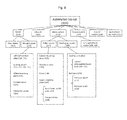
- FIG. 9 illustrates schematic overview of the different components of an automated cabinet according to the present invention.
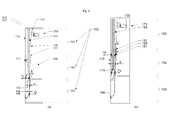
- the automated cabinet system (100) comprises a plurality of panels (110), wherein typically one panel is fixed (112) to the cabinet, and at least one movable panel (113) is provided. Furthermore, for preferred embodiments of the present invention and as shown in Figures 1 , 2 and 5 , all panels are generally positioned, such that the large panel surface (111) of the panels is placed in vertical position and all large panel surfaces (111) appear seamlessly stripped on top of each other along their long length edges, as one plane surface representing the front view of the automated cabinet system, and hereinafter referred to as co-planar, whenever the automated cabinet is in closed cabinet modus (104).
- Preferred embodiments of the present invention comprise a panel (112) at the front of the automated cabinet system, said panel (112) being in a fixed position in the upper or top area of the front surface of the cabinet, illustrated in Figures 1 , 2 and 5 .
- the fixed top panel (112) is co-planar with the other movable panels (113) whenever the automated cabinet system is in closed cabinet modus (104).
- open cabinet modus (102) illustrated by Fig. 1
- said fixed top panel is the only visible panel in front view of the automated cabinet system.
- Some embodiments of the present invention further comprise at least one panel (113), which is movable in order to change the automated cabinet system from open to closed cabinet modus or vice versa.
- the movable panel(s) (113) may be provided with guiding wheels (116, 117, 118, 119) in order to facilitate the movement of said movable panel(s) (113) upwards for opening, or either downwards for closing the automated cabinet system (100).
- the guiding wheels may be coupled to the movable panel(s) (113), using a wheel mounting piece (131) for each guiding wheel.
- a wheel mounting piece (131) is fixed onto the backside of a movable panel (113), close to its vertical edges (114, 115) respectively coupled to one of the two opposing sidewalls (120).
- guiding wheels there are guiding wheels (116, 117, 118, 119) fixed onto two opposing edges (114, 115) of the movable panels (113).
- the movable panels (113) are provided with guiding wheels on the left vertical edge (114), as well on the opposing right vertical edge (115) of the movable panels (113).
- the two guiding wheels coupled to each of the vertical edges (114, 115), are positioned at a relatively large distance from each other, i.e. one of the two guiding wheels is coupled to the vertical edge close to the top of the movable panel (113), being the left or right upper wheel (116, 118), wherein the other of the two guiding wheels is coupled to the vertical edge close to the bottom of the movable panel (113), being the left or right lower wheel (117, 119).
- the four guiding wheels fixed onto each movable panel are typically made of steel or metal, however hard plastic or composite or synthetic material may also be used, as long as the finished surface is fit for the guiding rail application.
- the guiding wheels have a width of at least 2mm and at most 25mm, for example at least 2 mm and at most 10mm, for example at least 3mm and at most 6mm, preferably at least 4mm and at most 5mm.
- the guiding wheels have a radius of at least 1.5mm and at most 10mm, for example at least 2 mm and at most 8mm, for example at least 3mm and at most 6mm, preferably at least 4mm and at most 5mm.
- the upper and lower wheels are equal, having the same size or measures.
- said guiding wheels preferably have a specific surface roughness to optimally guide said movable panel concerning e.g . friction and wear, during lifting.
- a guiding rail system (150) is provided via which the guiding wheels are moved during panel lifting, and wherein said guiding rail system comprises a rail track (156) typically made of wood, preferably hard wood, hard plastics, HPL (high pressure laminate), hard laminate, aluminium or steel, with rail track width (158) of at least 3mm and at most 20mm, for example at least 4 mm and at most 15mm, for example at least 6mm and at most 12mm, preferably at least 9mm and at most 10mm and having a rail track depth (157) of at least 2mm and at most 30mm, for example at least 3 mm and at most 20mm, for example at least 4mm and at most 10mm, preferably at least 5mm and at most 7mm, wherein the guiding rail system (150) is provided via which the guiding wheels are moved during panel
- the four guiding wheels (116, 117, 118, 119) coupled to the movable panel (113) guide each movable panel when raised or lowered via the guiding rail system (150) having a certain rail track depth (157) and rail track shape, as further described below.
- each intermediate movable panel comprises a hooked device (132) on top of said intermediate movable panel.
- a backside of an intermediate movable panel is defined as the inner cabinet surface side of the intermediate movable panel.
- this hooked device (132) is fixed on the left upper and on the right upper area of the backside of an intermediate movable panel, such that a right angle hook at the top edge of the intermediate movable panel characterizes the hooked device. Furthermore, part of the hooked device (132) is positioned perpendicularly to the vertically standing large panel surface (111) of the intermediated movable panel, and defined herein as the horizontal part of the hooked device.
- the hooked devices (132) are typically curved or bended, rod or plate shaped, wherein the horizontal part of these hooked devices (132) in some embodiments may have a length of at least 30mm and at most 250mm, for example at least 30mm and at most 100mm, for example at least 35mm and at most 75mm, preferably at least 40mm and at most 60mm in case of an automated cabinet comprising one fixed and two movable panels.
- the intermediate movable panel is lifted upwards or raised, out of closed panel modus, as said horizontal part being supported by a lower intermediate movable panel whenever present, or by the bottom movable panel.
- the hooked devices (132) are provided and configured to assist in lifting or guiding the intermediate movable panels towards the required position. Moreover, the hooked devices (132) are designed and fixed in a way to bring the corresponding intermediate movable panel, onto which the hooked devices are attached, outside its centre of gravity. The intermediate panel is lifted-up by the hooked device, such that the point of application of the lifting force is laying outside but horizontally - as compared to the ground surface - at approximately the same level or height of the centre of gravity of the intermediate panel.
- the bottom movable panel comprises a protection device (133) on top of said bottom movable panel.
- the backside of the bottom movable panel is defined as the inner cabinet surface side of said bottom movable panel.
- said protection device is fixed on the left upper and on the right upper area of the backside of the bottom movable panel, and possibly covering small part of the top edge of the bottom movable panel, such that said protection device (133) is coupled to the hooked device (132) of the intermediate movable panel, this hooked device (132) as described in the previous paragraph, whenever the bottom movable panel is supporting the intermediate movable panel when the intermediate movable panel is raised or lowered.
- the protection devices (133) are typically square clip shaped, made of plastic, polymer-type, synthetic or composite material, with length-width-thickness measures for example of at least 10mm x 10mm x 1mm and at most 100mm x 125mm x 30mm, preferably of at least 40mm x 40mm x 6mm and at most 80mm x 80mm x 16mm, for hooked devices (132) according to the description above, and are mounted onto the bottom movable panel in order to protect top edge of the bottom movable panel against wear, whenever picking up the intermediate movable panel during lifting.
- the bottom movable panel further comprises a mounting piece, referred to herein as bottom mounting piece (135), fixed respectively onto the lower left and onto the lower right of the backside surface of said bottom movable panel, whereby the bottom mounting piece (135) is part of a pulley system (134) in order to lift said bottom movable panel. More specifically, each bottom mounting piece (135) is coupled with a flexible member (136) provided by the pulley system (134) to raise or lower the bottom movable panel, in such a manner that this flexible member (136) is pending vertically along its length at a distance d from the bottom movable panel.
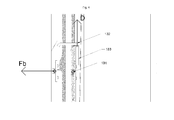
- This moment Txd results in two forces Fb and Fo, illustrated in Figure 3 .
- the force Fb pushes the upper area of the bottom movable panel towards the front of the cabinet, while the force Fo pushes the bottom movable panel towards the back of the cabinet, or more inward the cabinet. Consequently, the upper wheels (116, 118) of the bottom movable panel are pushed against the front cabinet side of the guiding trail track (157), wherein the lower wheels (117, 119) of the bottom movable panel are pushed against the back or inner cabinet side of the guiding rail track (157).
- the top edge of said bottom movable panel is coupled to a hooked device (132) fixed onto an intermediate movable panel, such that, when now further guiding the bottom movable panel upwards, said bottom movable panel picks up and supports the intermediate movable panel.
- the bottom movable panel delivers a force D onto both hooked devices (132) fixed respectively left and right onto the intermediate movable panel, such that a moment Dxd is generated.
- the moment Dxd results in two forces Fb and Fo.
- the force Fb pushes the upper area of the intermediate movable panel towards the front of the cabinet, while the force Fo pushes the intermediate movable panel towards the back of the cabinet, or more inward the cabinet. Consequently, and similarly as described above for the guiding wheels of the bottom movable panel, the upper wheels (116, 118) of the intermediate movable panel are pushed against the front cabinet side of the guiding trail track, wherein the lower wheels (117, 119) of the intermediate movable panel are pushed against the back or inner cabinet side of the guiding rail track.
- an automated cabinet system (100) comprises two opposing sidewalls (120), perpendicular to the panels (110).
- the two opposing sidewalls (120) are provided with a guiding rail system (150).
- the guiding rail system provided in the inner cabinet side of each of the two opposing sidewalls, has different guiding zones (152) and at least one rail track (156) for guiding at least one movable panel (113).
- a guiding rail system comprising different guiding zones (152), the number of different guiding zones equals the total number of panels, meaning fixed panel (112) and all movable panels (113).
- the total number of panels equals three.
- each guiding zone (152) there is at least one rail track (156) present for each of the two opposing sidewalls, preferably at least two for each of the two opposing sidewalls, whereas one of the preferred embodiments comprises two movable panels and one fixed panel.
- each movable panel (113) in embodiments of the present invention there is an individual rail track (156) to be followed, as also shown in Fig. 3 .
- each movable panel (113) has its own rail track to be guided when lifted upwards or downwards in the automated cabinet system. Consequently, each guiding zone (152) comprises at least one rail track (156) for a corresponding movable panel (113) to be guided.
- a rail track (156) of a guiding rail system (152) for embodiments of the present invention is typically made of wood, preferably hard wood, hard plastics, HPL (high pressure laminate), hard laminate, aluminium or steel, in order to generate optimal movement and friction.
- the rail track minimises wear on the guiding wheels (116, 117, 118, 119) made of steel or metal, hard plastic or a particular composite or synthetic material, as well as for the rail track (156) via which the guiding wheels are moving.
- each rail track (156) present in each of the guiding zones (152) has a constant rail track depth (157) within said guiding zone.
- Using a constant rail track depth (157) along the entire rail track length causes a better stability and balanced guidance of the panels, compared to using different rail track depths (157) for each of the guiding zones (152).
- a rail track depth (157) is preferably at least 2mm and at most 30mm, for example at least 3 mm and at most 20mm, for example at least 4mm and at most 10mm, preferably at least 5mm and at most 7mm.
- the guiding wheels in some embodiments have a width of at least 2mm and at most 25mm, for example at least 2 mm and at most 10mm, for example at least 3mm and at most 6mm, preferably at least 4mm and at most 5mm, and have a radius of at least 1.5mm and at most 10mm, for example at least 2 mm and at most 8mm, for example at least 3mm and at most 6mm, preferably at least 4mm and at most 5mm.
- the panels (110) preferably have dimensions of at least 200mm x 100mm x 10mm, for example at least 500mm x 250mm x 25mm, for example at least 1000mm x 500mm x 40mm.
- a rail track (156) in embodiments of the present invention, the following configuration is described and illustrated in Fig. 3 .
- a rail track (156) is configured as one straight vertical rail track line having at least one side track part for guiding corresponding movable panel (113) from open to closed panel modus position or vice versa.
- the upper guiding zone (153) comprises two rail tracks (156), i.e. one rail track for the intermediate movable panel to be guided and one rail track for the bottom movable panel to be guided. Both of said two rail tracks (156) are represented as straight vertical rail track lines in the upper guiding zone (153). Also depicted in Fig.
- 3 is the intermediate guiding zone (154), again having two rail tracks (156) for each of the respective movable panels to be guided, however the intermediate guiding zone now representing the rail track for the intermediate movable panel to be guided, as two short diagonal side track parts and a straight vertical rail track part in between, coupling said short diagonal side track parts, in order to bring the intermediate movable panel as moving downwards into closed panel modus position.
- the other remaining rail track for the bottom movable panel to be guided, within the intermediate guiding zone is still in the configuration of a straight vertical rail track line. Further shown in Fig.
- 3 is the lower guiding zone (155), having only one rail track (156) left, depicted as two short diagonal side track parts and a straight vertical rail track part in between, coupling said short diagonal side track parts, in order to bring the bottom movable panel into closed panel modus position, and concurrently arriving at closed cabinet modus position (104), whenever guided downwards.
- the lower guiding wheels (117, 119) are not moving at full depth within the rail track (156), but are following the rail track (156) closer to the inner cabinet surface of the sidewall (120).
- the upper guiding wheels (116, 118) roll against the front edge, i.e. the edge closest to the front of the cabinet, of the vertical track part or against the upper edge of the diagonal side track part, while the lower guiding wheels (117, 119) roll against the rear edge, i.e. the edge closest to the rear of the cabinet, of the vertical track part or against the lower edge of the diagonal side track part.
- the rail track design may be amended by replacing the two diagonal side tracks within the same guiding zone (152) by one large side track surface at rail track depth while bringing the inner sidewall surface area between the upper diagonal side track and the lower diagonal side track within the same guiding zone (152) to track depth level. Due to the fact that open space at track depth level without track edges interrupting, is now present between the upper and the lower edge of the new large side track surface, while this open space being present in the front area of the automated cabinet system (100), a security system is provided, leaving enough space and freedom of movement in the front area to easily push or pull the movable panel (113) whenever an object got stuck somewhere in the movable panel area.
- the two opposing sidewalls (120) are coupled both respectively with a pulley system (134) as part of a lifting system (130).
- the coupling between a sidewall and a pulley system is enabled using a mounting piece, hereafter referred to as an upper mounting piece (137), fixed onto the inner upper area of respectively each of the two opposing sidewalls (120), whereby the upper mounting piece (137) forms part of said pulley system (134).
- the upper mounting piece (137), comprising an outer profile (146) and an inner profile (147), is further coupled to a rotor (138), being coupled to a flexible member (136), wherein rotor and flexible member are also part of the pulley system (134), designed to raise or lower a movable panel (113).
- a contact device (148) is assembled onto the inner profile (147) of the upper mounting piece (137) onto the inner profile (147) of the upper mounting piece (137) , wherein this contact device when connected to the outer profile of upper mounting piece (146), may enable a movable panel (113) to be raised or lowered, and hence open or close the automated cabinet.
- an automated cabinet system (100) comprises a lifting system (130) to raise or lower at least one movable panel (113), said lifting system being provided with at least two pulley systems (134), coupled to the bottom movable panel by a bottom mounting piece (135), and wherein said pulley system (134) is configured to raise or lower said bottom movable panel outside its centre of gravity.
- the point of application of the flexible member (136) for lifting the bottom movable panel (113) is laying outside the centre of gravity of the bottom movable panel (113), i.e .
- the lifting system (130) for an automated cabinet system (100), is coupled to a guiding rail system (150), said guiding rail system being provided within two opposing sidewalls (120), and configured to guide at least one panel (113) when lifted upwards or downwards.
- each pulley system comprises a flexible member (136), coupling a bottom mounting piece (135) via a rotor (138) with an upper mounting piece (137).
- each pulley system (134) of a lifting system (130) is coupled on one hand to the inner upper area one of the two opposing sidewalls (120) by an upper mounting piece (137), while on the other hand each pulley system (134), and thus lifting system (130), is coupled to the inner lower area of the bottom movable panel by a bottom mounting piece (135) in order to lift the bottom movable panel upwards or downwards according to control instructions given by the control module (160).
- each pulley system of said lifting system comprising a rotor (138), is driven by a driving module (140), wherein said driving module may be a small DC-motor.
- each of these two pulley systems is coupled to a small DC-motor (142, 144).
- the lifting system when operating uses two synchronized motors, instead of just one large centrally positioned asynchronic motor as can be referred to in the prior-art, in order to open or close the automated cabinet.
- a pulley system of a lifting system comprising an upper mounting piece (137), coupling a flexible member (136) via a rotor (138) to inner upper area of a sidewall (120), said upper mounting piece comprises an outer profile (146) and an inner profile (147).
- the outer profile of upper mounting piece is fixed close to the top edge of a sidewall (120), by a plate-shaped first part coupled to an open cubical shaped second part.
- the open cubical shaped second part of the outer profile is coupled to a flexible member (136) and a driving module via a rotor (138).
- the open cubical shaped second part of the outer profile encloses the inner profile (147) of upper mounting piece, also coupled to flexible member (136) and driving module (140) via the rotor (138), and whereby the inner profile (147) is similarly but a little smaller, for example at least 1% and at most 20% smaller, open cubical shaped compared to the open cubical second part of the outer profile (146).
- a contact device (148) is assembled onto the inner profile (147) of upper mounting piece, wherein this contact device when connected to the outer profile (146) of upper mounting piece, will enable a movable panel (113) to be raised or lowered, and hence open or close the automated cabinet.
- the upper mounting piece (137) is typically made of steel or metal, having e.g . an outer profile (146) with plate shaped first part length-height dimensions of at least 20mm x 20mm, for example at least 100mm x 100mm, for example at least 150mm x 150mm, whenever an automated cabinet system (100) is considered according to the present invention, comprising panels (110) of at least 200mm x 100mm x 10mm, for example at least 500mm x 250mm x 25mm, for example at least 1000mm x 500mm x 40mm.
- the upper mounting piece (137) is coupled to a rotor (138), wherein said rotor is coupled to a flexible member (136), both being also part of the pulley system (134), designed to raise or lower a movable panel (113).
- the coupling between a rotor (138) and a flexible member (136) is enabled by a pulley wheel (139), onto which the flexible member is tightened, whenever the bottom movable panel is raised or lowered.
- the rotor (138) is further coupled to a driving module (140), for driving the pulley system (134), raising or lowering directly the bottom movable panel by its flexible member (136), and eventually having also other movable panels lifted.
- a pulley system (134) for a lifting system (130) comprising a rotor (138)
- said rotor has its axis of rotation positioned perpendicular to each of two opposing sidewalls (120), and hence the axis position being parallel to all fixed (112) and movable panels (113) of the automated cabinet system considered.
- a pulley system (134) operates and thus the rotor (138) rotates, a pulley wheel (139) is rotated as being coupled to the rotor.
- a pulley system (134) of a lifting system (130) further comprising a bottom mounting piece (135), coupling a flexible member (136) with the bottom movable panel, said bottom mounting piece is fixed respectively onto the lower left and onto the lower right of the backside surface of said bottom movable panel, in order to lift the bottom movable panel.
- the coupling of a flexible member (136) with a bottom mounting piece (135) is configured in a way such that the bottom movable panel is brought outside its centre of gravity whenever lifted, while the vertical edges (114, 115) of said bottom movable panel, positioned parallel to each of the two opposing sidewalls (120), are standing almost perpendicular to the ground surface of the cabinet (100).
- the point of application of the flexible member (136) for lifting the bottom movable panel (113) is laying outside the centre of gravity of the bottom movable panel (113), i.e.
- the weight of said bottom movable panel is slightly leaning forward in the front surface area, perfectly guiding said bottom movable panel, as well as keeping said bottom movable panel in balanced and required position, with top and bottom horizontally positioned long length edges of said movable panel remaining parallel to the ground surface of the cabinet (100), representing a stable mechanical construction whenever said movable panel is raised or lowered.
- these intermediate movable panels are balanced, guided and lifted similarly as compared to the bottom movable panel, i.e. by bringing said intermediate movable panels outside their centre of gravity and by keeping said intermediate movable panels in required individual position of having the large panel surface of the panels vertically positioned, and as proceeding from lifting the bottom movable panel towards including lifting the intermediate movable panels, thereby using supportively for a good panel guidance the hooked devices (132) fixed on top of the intermediate movable panels.
- a pulley system (134) of a lifting system (130) comprising a bottom mounting piece (135)
- said bottom mounting piece is typically rectangular plate shaped provided with a hole or clip system and tightening buttons for coupling a flexible member (136)
- this bottom mounting piece being made of plastic, polymer-type, synthetic or composite material, aluminium or steel and having length-width-thickness measures of at least 3mm x 3mm x 0,5mm, for example at least 10mm x 10mm x 1 mm, for example at least 20mm x 20mm x 2mm, whenever an automated cabinet system (100) is considered according to the present invention, comprising panels (110) of at least 200mm x 100mm x 10mm, for example at least 500mm x 250mm x 25mm, for example at least 1000mm x 500mm x 40mm.
- a flexible member (136) e.g . a belt as used for car child seats, as part of a pulley system, is preferably made of nylon or any other synthetic or natural material, representing comparable tensile strength.
- These flexible members (136) preferably have a thickness in the range of from 0.50mm to 2mm, preferably between 0.80mm and 1.5mm, and have a width for example of at least 10mm, preferably between 30mm and 60mm, in order to have good strength, optimal friction and sufficient wear resistance, wherein the length used depends on and is comparable with the automated cabinet height. Smaller or thinner flexible members can be maintained to further compact the cabinet construction, or e.g . whenever lighter panels are used.
- the at least two pulley systems (134) instead of being coupled to the inner upper area of the sidewall (120), may also be coupled to upper inner area of the back plate or rear wall (170).
- the automated cabinet system (100) comprises a driving module (140), for driving a pulley system (134) of a lifting system (130) in order to raise or lower a plurality of movable panels (113).
- the driving module may be coupled to a rotor (138) being part of the pulley system, wherein said rotor rotates as soon as said driving module is transferring energy towards said rotor, and hence a rotational force is generated by said rotor.
- said driving module will generate a rotation of said rotor in a certain predetermined direction, which in turn will lead to either raising or lowering at least one movable panel (113) due to the rotation of a pulley wheel (139), also provided by the pulley system, wherein said pulley wheel is coupled to the rotor as well as being coupled to at least one movable panel (113) via a flexible member (136).
- a driving module (140) for driving a lifting system (130) is a motor (142, 144) being mounted in semi-flexible configuration, wherein said motor is coupled to a rotor (138) of a pulley system (134), along said rotor axis direction. Moreover, said motor is positioned against the outer profile (146) of an upper mounting piece (137) that is coupled to an inner sidewall (120) surface, wherein the inner profile (147) of said mounting piece (146) comprises a contact device (148).
- said motor can move by tilting upwards or downwards around an axis parallel to the rotor axis direction and parallel to vertically positioned inner sidewall (120) standing surfaces, wherein an upward tilt is determined by the movable panel being raised or lowered regularly in a standard usual way, without any obstruction occurring and thereby bringing the panels out of balance.
- the flexible member (136) is now tightened straight, and the contact device coupled to the inner profile (147) is connected with the outer profile (146) of the upper mounting piece, indicating that the movable panel can be further guided upward or downward. Further depicted in Fig.
- a driving module such as a motor (142, 144) in order to drive a pulley system (134) of a lifting system (130) for raising or lowering movable panels (113), said driving module is configured to drive the pulley system at variable speed, attempting to follow a specific theoretic velocity profile curve.
- using at least two pulley systems (134) requires said pulley systems to operate synchronically at the same pace. Therefore, having a lifting system (130) with two pulley systems as depicted in Figures 1 , 2 and 5 , the two motors (142, 144) coupled to each of the two pulley systems respectively in order to drive the lifting system, are synchronized and controlled to follow both the theoretic velocity profile as illustrated in Fig. 6 .
- the two motors (142, 144) accelerate when just activated from closed cabinet modus (104), until a maximum velocity is reached and controlled at a constant level further lifting the respective movable panel (113).
- the movable panel arrives at this constant maximum velocity when the upper guiding wheels (116, 118) have reached vertically aligned rail track part of corresponding rail track (156), and hence will now only move the panel in upward direction, after having been guided inward the cabinet and raised simultaneously.
- the two motors (142, 144) will slow down to a lower velocity, reaching a minimum when both movable panels (113) are perfectly parallel positioned one after the other at the same height.
- the two motors accelerate again the moment said other movable panel is picked up, until the maximum velocity is reached again and kept at a constant level whenever the upper guiding wheels (116, 118) of the movable panels (113) have reached a new guiding zone.
- the velocity of the two motors is controlled and evolves over time, when activating the lifting system from open cabinet modus (102), whereby the two motors are driving synchronically said lifting system (130) in order to lower the movable panels (113) towards closed modus.
- the two synchronized motors (142, 144) are controlled to follow the theoretic velocity profile as depicted in Fig. 6 , using a programmed PID controller.
- the moment that the position of the motors deviates from the theoretic curve, this position being registered will be adjusted by comparison with the theoretical target position. For example, every 5 to 40 milliseconds such a comparison is performed, and the situation is controlled to have the least possible deviation at any time. However, whenever the deviation becomes too large and has reached a certain maximum, the motors will be stopped automatically.
- the synchronization of both motors is forced by aiming at minimum deviation of the position of the motors compared to the theoretic velocity profile curve.
- the automated cabinet system (100) comprises a control module (160), configured to provide control instructions to a driving module (140) in order to lift one or more movable panels (113), preferably all movable panels (113) upwards or downwards.
- a control module (160) provided to give control instructions to a driving module (140) to operate a lifting system (130) to raise or to lower at least one movable panel (113), comprises at least two buttons, i.e. one button when activated giving instructions to raise said at least one movable panel (113), and one button when activated giving instructions to lower said at least one movable panel (113).
- the control module can be activated by remote control comprising at least two buttons to transmit instructions to the driving module (140).
- the appropriate movable panel (113) whenever pushing the closing button a first time, the appropriate movable panel (113) will be lowered downward until in its final closed modus, or until said closing button is pushed a second time. Pushing the closing button once more after a second push will activate the closing process again.
- the appropriate movable panel (113) whenever pushing the opening button a first time, the appropriate movable panel (113) will be raised upward until in its final open modus, or until said opening button is pushed a second time. Pushing the opening button once more after second push will activate the opening process again.
- the automated cabinet system (100) comprises a back plate or rear wall (170), covering the backside of the cabinet.
- Embodiments of the present invention may comprise a back plate or rear wall (170) at the back of the automated cabinet system (100), as illustrated in Fig. 1 .
- the back plate or rear wall (170) has its large surface plate positioned parallel with the plurality of panels (110) present.
- the back plate or rear wall (170) may be coupled to a pulley system (134) being part of a lifting system (130).
- the coupling between a rear wall and a pulley system may be enabled using a mounting piece, an upper mounting piece (137), fixed respectively left and right onto the inner upper area surface of said rear wall (170), whereby said upper mounting piece is part of said pulley system.
- said upper mounting piece is further coupled to a rotor (138), being coupled to a flexible member (136), wherein rotor and flexible member are also part of the pulley system, designed to raise or lower at least one movable panel (113).
- all panels i.e. one fixed top panel and at least one movable panel, are co-planar and viewed from the front as stripped plane surfaces one on top of the other, such that the planes seamlessly connect with their long edges.
- Opening the closed cabinet can be controlled manually or remotely, by giving instructions via a control module. Whenever instructions are activated to open the cabinet, i.e.
- a driving module will start to drive a pulley system of a lifting system, such that a rotor provided by said pulley system and coupled to a flexible member via a pulley wheel, will start rotating in a certain predetermined direction, thereby tightening said flexible member in this particular direction such that the bottom movable panel which is coupled to the flexible member is lifted upwards.
- said bottom movable panel is guided upwards using a guiding rail system, and thereby moves the bottom movable panel via a rail track towards a parallel position more inwards of the cabinet until the end of a first guiding zone, as part of the guiding rail system, is reached.
- the bottom movable panel is raised and guided inwards simultaneously.
- Preferred embodiments for multiple cabinet configurations, each comprising a different amount of panels, are further considered below, when leaving the first guiding zone.
- a second guiding zone is reached by the upper wheels of the bottom movable panel and further raised as long as instructions are submitted to continue opening the cabinet.
- the bottom movable panel is now only guided via its corresponding rail track vertically in upward direction, thereby further gradually opening the cabinet.
- the protection device at top edge of said bottom movable panel is coupled to a hooked device fixed onto an intermediate movable panel, such that, when now further guiding the bottom movable panel upwards, said bottom movable panel picks up and supports the intermediate movable panel, also lifted using the guiding rail system, however being guided via a separate rail track compared to the bottom movable panel.
- the intermediate movable panel is now also guided upwards, and thereby moving said intermediate movable panel via corresponding rail track towards a parallel position more inwards of the cabinet, whereby this corresponding rail track is configured closer to the front of the cabinet compared to the rail track designed for the bottom movable panel.
- the rail track of the intermediate movable panel is configured at the inner surface of a sidewall, and located between the rail track of the bottom movable panel and the front side of the cabinet (of which the top fixed panel is always part of).
- the upper (and lower) wheels of the intermediate movable panel move upwards such that the intermediate movable panel is raised and guided inwards simultaneously, while the upper (and lower) wheels of the bottom movable panel are only further moving upwards the bottom movable panel via its vertical rail track part.
- the upper wheels of the movable panels when leaving the second guiding zone, reach a third guiding zone wherein these upper wheels of both the bottom movable panel and the intermediate movable panel further move upwards, thereby raising the movable panels, as long as instructions are submitted to continue opening the cabinet.
- both movable panels are now only guided via their respective rail track vertically in upward direction, thereby further gradually opening the cabinet.
- both movable panels reach the end of their corresponding rail track, configured close to the top of the cabinet, and bringing the movable panels in final open modus position.
- the fixed top panel and all movable panels are positioned parallel one after the other, whereby only the fixed top panel is visible from a front view of the cabinet.
- the intermediate movable panel is placed in parallel, followed by the bottom movable panel placed in parallel, and whereby said bottom movable panel is positioned closest and parallel to the back plate or rear wall of the cabinet.
- a second guiding zone is reached by the upper wheels of the movable panel and further raised as long as instructions are submitted to continue opening the cabinet.
- the movable panel is now only guided via its corresponding rail track vertically in upward direction, thereby having the cabinet further gradually opened.
- the upper wheels of the movable panel reach the end of their corresponding rail track, configured close to the top of the cabinet, and bringing the movable panel in final open modus position.
- the fixed top panel and the movable panel are positioned parallel one after the other, whereby only the fixed top panel is visible in front view of the cabinet.
- the bottom movable panel is placed in parallel, and whereby said bottom movable panel is positioned closest and parallel to the back plate or rear wall of the cabinet.
- a second guiding zone is reached by the upper wheels of the bottom movable panel and further raised as long as instructions are submitted to continue opening the cabinet.
- the bottom movable panel is now only guided via its corresponding rail track vertically in upward direction, thereby having the cabinet further gradually opened.
- the protection device at top edge of said bottom movable panel is coupled to a hooked device fixed onto a first intermediate movable panel, such that, when now further guiding the bottom movable panel upwards, said bottom movable panel picks up and supports the first intermediate movable panel, also lifted using the guiding rail system, however being guided via a separate rail track compared to the bottom movable panel.
- the first intermediate movable panel is now also guided upwards, and thereby moving said first intermediate movable panel via corresponding rail track towards a parallel position more inwards of the cabinet, whereby this corresponding rail track is configured closer to the front of the cabinet compared to the rail track designed for the bottom movable panel.
- the rail track of the first intermediate movable panel is configured at the inner surface of a sidewall, and located between the rail track of the bottom movable panel and the rail track of a second intermediate movable.
- the upper (and lower) wheels of the first intermediate movable panel move upwards such that the first intermediate movable panel is raised and guided inwards simultaneously, while the upper (and lower) wheels of the bottom movable panel are only further moving upwards the bottom movable panel via its vertical rail track part.
- the upper wheels of bottom movable panel and first intermediate movable panel when leaving the second guiding zone, reach a third guiding zone wherein these upper wheels of both bottom movable panel and first intermediate movable panel are further moving upwards, thereby raising these movable panels, as long as instructions are submitted to continue opening the cabinet.
- both bottom movable panel and first intermediate movable panel are now only guided via their respective rail track vertically in upward direction, thereby having the cabinet further gradually opened.
- the protection device at top edge of said movable panels is coupled to a hooked device fixed onto a second intermediate movable panel, such that, when now further guiding bottom movable panel and first intermediate movable panel upwards, said bottom movable panel and first intermediate movable panel pick up and support the second intermediate movable panel, also lifted using the guiding rail system, however being guided via another separate rail track compared to the bottom movable panel and the first intermediate movable panel.
- the protection device at top edge of said first intermediate movable panel is coupled to a hooked device fixed onto a second intermediate movable panel, such that, when now further guiding first intermediate movable panel upwards, said first intermediate movable panel picks up and supports the second intermediate movable panel, also lifted using the guiding rail system, however being guided via another separate rail track compared to the first intermediate movable panel.
- the length of the hooked devices coupled to intermediate movable panels strongly depends on the fact if and when more than one movable panels are picking up and supporting the next intermediate movable panel, or either only the previous intermediate movable panel is picking up and supporting the next intermediate movable panel.
- the second intermediate movable panel is now also guided upwards, and thereby moving the second intermediate movable panel via corresponding rail track towards a parallel position more inwards of the cabinet, whereby this corresponding rail track is configured closer to the front of the cabinet compared to the rail track designed for either the bottom movable panel or the first intermediate movable panel.
- the rail track of the second intermediate movable panel is configured at the inner surface of a sidewall, and located between the rail track of the first intermediate movable panel and the front side of the cabinet, of which top fixed panel is always taking part of.
- the upper (and lower) wheels of the second intermediate movable panel move upwards such that the second intermediate movable panel is raised and guided inwards simultaneously, while the upper (and lower) wheels of both bottom movable panel and first intermediate movable panel are only further moving upwards these latter movable panels via their vertical rail track part.
- the upper wheels of all of the movable panels when leaving the third guiding zone, reach a fourth guiding zone wherein these upper wheels of all of the movable panels are further moving upwards, thereby raising the movable panels, as long as instructions are submitted to continue opening the cabinet.
- all movable panels are now only guided via their respective rail track vertically in upward direction, thereby having the cabinet further gradually opened.
- the upper wheels of all of the movable panels reach the end of their corresponding rail track, configured close to the top of the cabinet, and bringing the movable panels in final open modus position.
- the fixed top panel and all movable panels are positioned parallel one after the other, whereby only the fixed top panel is visible in front view of the cabinet.
- the second intermediate movable panel is placed in parallel, followed by the first intermediate movable panel placed in parallel, and finally followed by the bottom movable panel placed in parallel, and whereby said bottom movable panel is positioned closest and parallel to the back plate or rear wall of the cabinet.
- all panels i.e. one fixed top panel and at least one movable panel, are overlapping and positioned close to the front one after another in the inside top area of the cabinet, such that only the fixed top panel is remaining visible for front view of the cabinet.
- Closing the open cabinet can be controlled manually or remotely, by giving instructions via a control module. Whenever instructions are activated to close the cabinet, i.e.
- a driving module will start to drive a pulley system of a lifting system, such that a rotor provided by said pulley system and coupled to a flexible member via a pulley wheel, will start rotating in a certain predetermined direction, thereby tightening said flexible member in this particular direction such that the bottom movable panel which is coupled to said flexible member is lifted downwards.
- said bottom movable panel is lowered, said bottom movable panel is guided downwards using a guiding rail system, and thereby moving said bottom movable panel via a corresponding rail track towards a lower position.
- the intermediate movable panel In case of two movable panels present, not only the bottom movable panel, but also the intermediate movable panel will be lowered simultaneously via their corresponding rail track, when instructions are given to close the cabinet out of fully open modus.
- the bottom movable panel In the stage of open cabinet modus or any other position of the upper wheels of the movable panels within third guiding zone, the bottom movable panel is via a top edge protection device coupled to a hooked device fixed onto the intermediate movable panel, and thereby supporting this intermediate movable panel, also being lowered using the guiding rail system, however guided via a separate rail track compared to the bottom movable panel. Both movable panels are now only guided vertically in downward direction via their respective rail track, thereby having the cabinet further gradually closed.
- the upper (and lower) wheels of the intermediate movable panel reach a diagonal track part of the rail track, after having followed the upper vertical track part of the rail track.
- the upper wheels of both of the movable panels have now entered the second guiding zone, in which at first the intermediate movable panel is further guided downward via corresponding rail track towards a parallel position closer to the front of the cabinet, while the bottom movable panel is further lowered vertically via its respective rail track.
- the top edge protection device of the bottom movable panel still being coupled to a hooked device fixed onto the intermediate movable panel, said bottom movable panel is further supporting the intermediate movable panel, thereby guided downward via diagonal track part of corresponding rail track towards a lower parallel position.
- the intermediate movable panel Whenever the upper (and lower) wheels of the intermediate movable panel reach the end of the diagonal part of its respective rail track, the intermediate movable panel has reached its closed modus position, and hence now being seamlessly part of the front view of the cabinet. Now proceeding with instructions to close the cabinet, the hooked device fixed onto the intermediate movable panel will first be decoupled from the bottom movable panel, and hence only the bottom movable panel will continue to be guided vertically in downward direction via its respective rail track, thereby having the cabinet further gradually closed. At certain moment, the upper (and lower) wheels of the bottom movable panel reach a diagonal track part of the rail track, after having followed the upper vertical track part of the rail track.
- the upper wheels of the bottom movable panel have now entered the first guiding zone, in which the bottom movable panel is further guided downward via corresponding rail track towards a parallel position closer to the front of the cabinet.
- the bottom movable panel has reached its closed modus position, and hence now being seamlessly part of the front view of the cabinet.
- the automated cabinet is now in its fully closed modus, having all panels stripped along their long edges one above the other, and thereby representing one plane as front view of the cabinet.
- this movable panel function as the bottom movable and is the only movable panel to be lowered via its corresponding rail track, whenever instructions are given to close the cabinet out of fully open modus.
- said movable panel In the stage of open cabinet modus or any other position of the upper wheels of the movable panel within second guiding zone, said movable panel is now only guided vertically in downward direction via its respective rail track, thereby having the cabinet gradually closed.
- the upper (and lower) wheels of the movable panel reach a diagonal track part of the rail track, after having followed the upper vertical track part of the rail track.
- the upper wheels of the movable panel have now entered the first guiding zone, in which the movable panel is further guided downward via corresponding rail track towards a parallel position closer to the front of the cabinet.
- the movable panel has reached its closed modus position, and hence now being seamlessly part of the front view of the cabinet.
- the automated cabinet is now in its fully closed modus, having all panels stripped along their long edges one above the other, and thereby representing one plane as front view of the cabinet.
- the bottom movable panel via a top edge protection device is coupled to a hooked device fixed onto the intermediate movable panels, and thereby supporting the intermediate movable panels, also being lowered using the guiding rail system, however guided via a separate rail track compared to the bottom movable panel.
- the bottom movable panel and the first intermediate movable panel are not both supporting the second intermediate movable panel, but e.g .
- the second intermediate movable panel is only supported by the first intermediate movable panel. All movable panels are now only guided vertically in downward direction via their respective rail track, thereby having the cabinet gradually closed. At certain moment, the upper (and lower) wheels of the second intermediate movable panel reach a diagonal track part of the rail track, after having followed the upper vertical track part of the rail track. The upper wheels of all of the movable panels have now entered the third guiding zone, in which at first the second intermediate movable panel is further guided downward via corresponding rail track towards a parallel position closer to the front of the cabinet, while the bottom movable panel and the first intermediate movable panel are further lowered vertically via their respective rail track.
- the bottom movable panel still coupled to a hooked device fixed onto the intermediate movable panels, is further supporting both of the intermediate movable panels.
- the second intermediate movable panel is thereby guided downward via diagonal track part of corresponding rail track towards a lower parallel position, wherein the first intermediate movable panel is thereby further lowered vertically via respective rail track.
- the upper (and lower) wheels of the second intermediate movable panel reach the end of the diagonal part of its respective rail track, the second intermediate movable panel has reached its closed modus position, and hence now being seamlessly part of the front view of the cabinet.
- the hooked device fixed onto the second intermediate movable panel will first be decoupled from the bottom movable panel's and the first intermediate movable panel's top edge protection device, and hence only the bottom movable panel and the first intermediate movable panel will continue to be guided vertically in downward direction via their respective rail track, thereby having the cabinet further gradually closed.
- the upper (and lower) wheels of the first intermediate movable panel reach a diagonal track part of the rail track, after having followed the upper vertical track part of the rail track.
- the upper wheels of the first intermediate movable panel and the bottom movable panel have now entered the second guiding zone, in which initially the first intermediate movable panel is further guided downward via corresponding rail track towards a parallel position closer to the front of the cabinet, while the bottom movable panel is further lowered vertically via its respective rail track.
- the bottom movable panel's top edge protection device still being coupled to a hooked device fixed onto the first intermediate movable panel
- said bottom movable panel is further supporting the first intermediate movable panel, thereby guided downward via diagonal track part of corresponding rail track towards a lower parallel position.
- the first intermediate movable panel Whenever the upper (and lower) wheels of the first intermediate movable panel reach the end of the diagonal part of its respective rail track, the first intermediate movable panel has reached its closed modus position, and hence now being seamlessly part of the front view of the cabinet. Now proceeding with instructions to close the cabinet, the hooked device fixed onto the first intermediate movable panel will first be decoupled from the bottom movable panel via its top edge protection device, and hence only the bottom movable panel will continue to be guided vertically in downward direction via its respective rail track, thereby having the cabinet further gradually closed. At certain moment, the upper (and lower) wheels of the bottom movable panel reach a diagonal track part of the rail track, after having followed the upper vertical track part of the rail track.
- the upper wheels of the bottom movable panel have now entered the first guiding zone, in which the bottom movable panel is further guided downward via corresponding rail track towards a parallel position closer to the front of the cabinet.
- the bottom movable panel has reached its closed modus position, and hence now being seamlessly part of the front view of the cabinet.
- the automated cabinet is now in its fully closed modus, having all panels stripped along their long edges one above the other, and thereby representing one plane as front view of the cabinet.
- This automated cabinet is conceived for home interior cabinet system applications but its application can be extended to industrial applications.
Landscapes
- Engineering & Computer Science (AREA)
- Mechanical Engineering (AREA)
- Civil Engineering (AREA)
- Structural Engineering (AREA)
- Combinations Of Kitchen Furniture (AREA)
Priority Applications (1)
| Application Number | Priority Date | Filing Date | Title |
|---|---|---|---|
| EP13175374.1A EP2821576A1 (fr) | 2013-07-05 | 2013-07-05 | Armoire automatisée |
Applications Claiming Priority (1)
| Application Number | Priority Date | Filing Date | Title |
|---|---|---|---|
| EP13175374.1A EP2821576A1 (fr) | 2013-07-05 | 2013-07-05 | Armoire automatisée |
Publications (1)
| Publication Number | Publication Date |
|---|---|
| EP2821576A1 true EP2821576A1 (fr) | 2015-01-07 |
Family
ID=48747414
Family Applications (1)
| Application Number | Title | Priority Date | Filing Date |
|---|---|---|---|
| EP13175374.1A Withdrawn EP2821576A1 (fr) | 2013-07-05 | 2013-07-05 | Armoire automatisée |
Country Status (1)
| Country | Link |
|---|---|
| EP (1) | EP2821576A1 (fr) |
Cited By (5)
| Publication number | Priority date | Publication date | Assignee | Title |
|---|---|---|---|---|
| CN104806121A (zh) * | 2015-05-08 | 2015-07-29 | 杨继宝 | 一种通风窗 |
| EP3228800A1 (fr) | 2016-04-08 | 2017-10-11 | Dada S.p.a. | Ensemble pour ouvrir et élément de meubles, en particulier pour les cuisinières |
| CN108756561A (zh) * | 2017-04-07 | 2018-11-06 | 海蒂诗-海因策有限及两合公司 | 用于多部件门的滑动的家具配件及具有该家具配件的家具 |
| WO2019034274A1 (fr) * | 2017-08-17 | 2019-02-21 | Kesseböhmer Holding Kg | Meuble ainsi que ferrure de meuble |
| EP3872289A1 (fr) | 2020-02-27 | 2021-09-01 | Verdonck Development & Systems bv | Porte coulissante verticale et système de suspension |
Citations (6)
| Publication number | Priority date | Publication date | Assignee | Title |
|---|---|---|---|---|
| EP0953713A2 (fr) * | 1998-04-28 | 1999-11-03 | Arturo Salice S.p.A. | Fermetures pour ouvertures de toutes sortes, notamment pour meubles |
| EP1231349A1 (fr) * | 2001-02-07 | 2002-08-14 | Eugenio Salamon | Vitrine à vantaux coulissant verticalement vers différentes positions d'ouverture et dispositif de contrôle du déplacement des vantaux |
| DE202004013525U1 (de) * | 2004-08-27 | 2004-11-04 | Fac Frank Abels Consulting & Technology Gesellschaft Mbh | Schutzvorrichtung für Kunstgegenstände, vorzugsweise Gemälde |
| WO2005054613A1 (fr) * | 2003-12-05 | 2005-06-16 | Atomlivintech Co., Ltd. | Dispositif d'ouverture/fermeture de porte coulissante |
| US20080023159A1 (en) * | 2006-07-25 | 2008-01-31 | Mullet Willis J | Support system for a sectional door |
| US20100072868A1 (en) * | 2008-09-19 | 2010-03-25 | Anvil Construction, Incorporated | Cabinet door system |
-
2013
- 2013-07-05 EP EP13175374.1A patent/EP2821576A1/fr not_active Withdrawn
Patent Citations (6)
| Publication number | Priority date | Publication date | Assignee | Title |
|---|---|---|---|---|
| EP0953713A2 (fr) * | 1998-04-28 | 1999-11-03 | Arturo Salice S.p.A. | Fermetures pour ouvertures de toutes sortes, notamment pour meubles |
| EP1231349A1 (fr) * | 2001-02-07 | 2002-08-14 | Eugenio Salamon | Vitrine à vantaux coulissant verticalement vers différentes positions d'ouverture et dispositif de contrôle du déplacement des vantaux |
| WO2005054613A1 (fr) * | 2003-12-05 | 2005-06-16 | Atomlivintech Co., Ltd. | Dispositif d'ouverture/fermeture de porte coulissante |
| DE202004013525U1 (de) * | 2004-08-27 | 2004-11-04 | Fac Frank Abels Consulting & Technology Gesellschaft Mbh | Schutzvorrichtung für Kunstgegenstände, vorzugsweise Gemälde |
| US20080023159A1 (en) * | 2006-07-25 | 2008-01-31 | Mullet Willis J | Support system for a sectional door |
| US20100072868A1 (en) * | 2008-09-19 | 2010-03-25 | Anvil Construction, Incorporated | Cabinet door system |
Cited By (9)
| Publication number | Priority date | Publication date | Assignee | Title |
|---|---|---|---|---|
| CN104806121A (zh) * | 2015-05-08 | 2015-07-29 | 杨继宝 | 一种通风窗 |
| EP3228800A1 (fr) | 2016-04-08 | 2017-10-11 | Dada S.p.a. | Ensemble pour ouvrir et élément de meubles, en particulier pour les cuisinières |
| CN108756561A (zh) * | 2017-04-07 | 2018-11-06 | 海蒂诗-海因策有限及两合公司 | 用于多部件门的滑动的家具配件及具有该家具配件的家具 |
| EP3399127A1 (fr) * | 2017-04-07 | 2018-11-07 | Hettich-Heinze GmbH & Co. KG | Ferrure de meuble pour un mouvement coulissant d'une porte en plusieurs parties et meuble doté d'une telle ferrure de meuble |
| CN108756561B (zh) * | 2017-04-07 | 2021-07-20 | 海蒂诗-海因策有限及两合公司 | 用于多部件门的滑动的家具配件及具有该家具配件的家具 |
| WO2019034274A1 (fr) * | 2017-08-17 | 2019-02-21 | Kesseböhmer Holding Kg | Meuble ainsi que ferrure de meuble |
| EP3872289A1 (fr) | 2020-02-27 | 2021-09-01 | Verdonck Development & Systems bv | Porte coulissante verticale et système de suspension |
| BE1028104A1 (nl) | 2020-02-27 | 2021-09-21 | Verdonck Dev & Systems Bv | Verticale schuifdeur en ophangsysteem |
| BE1028104B1 (nl) * | 2020-02-27 | 2021-09-27 | Verdonck Dev & Systems Bv | Verticale schuifdeur en ophangsysteem |
Similar Documents
| Publication | Publication Date | Title |
|---|---|---|
| EP2821576A1 (fr) | Armoire automatisée | |
| CN105579380B (zh) | 电梯的门装置 | |
| US20120005961A1 (en) | Revolving Door | |
| US20100132260A1 (en) | Double glazing window having built-in auto controlling blinder | |
| AU2013206568A1 (en) | Guiding device, carriage and running rail | |
| US20180148114A1 (en) | Chassis with Linear and Swiveling Movements | |
| EP2576408A1 (fr) | Ascenseur doté d'un entraînement à pignon de rouleau | |
| CN110924651A (zh) | 家装用墙面瓷砖安装辅助组件 | |
| CN101182750A (zh) | 一种方便安装的自动门 | |
| KR20110067776A (ko) | 건축물용 리프트 | |
| CN115434612A (zh) | 一种配重门窗升降系统 | |
| US10822817B2 (en) | Lifting and carrying system for maintaining building facades | |
| CN210564119U (zh) | 一种有效防蚊虫的推拉式铝合金窗 | |
| CN218809845U (zh) | 一种房建楼板吊运装置 | |
| CN219990871U (zh) | 一种施工电梯液压驱动防护翻板装置 | |
| CN111360966B (zh) | 一种木门传送智能翻转装置 | |
| WO2019179853A1 (fr) | Ensemble d'entraînement pour système de porte coulissante | |
| AU2009100447A4 (en) | Panel handling apparatus and method for handling panels | |
| CN210731430U (zh) | 型钢砼结构栓钉自动焊接装置 | |
| WO2019040019A3 (fr) | Fenêtres pliantes améliorées | |
| JP2024519859A (ja) | エレベータ設備のための駆動システム、エレベータ設備、およびエレベータ設備の支持要素上に駆動部を設置するための方法 | |
| CN105257136B (zh) | 门板顶升装置 | |
| CN206448693U (zh) | 电动平移天窗 | |
| CN210242752U (zh) | 建筑材料加工用平面度检测装置 | |
| CN208700357U (zh) | 一种壁挂式电梯 |
Legal Events
| Date | Code | Title | Description |
|---|---|---|---|
| PUAI | Public reference made under article 153(3) epc to a published international application that has entered the european phase |
Free format text: ORIGINAL CODE: 0009012 |
|
| 17P | Request for examination filed |
Effective date: 20141022 |
|
| AK | Designated contracting states |
Kind code of ref document: A1 Designated state(s): AL AT BE BG CH CY CZ DE DK EE ES FI FR GB GR HR HU IE IS IT LI LT LU LV MC MK MT NL NO PL PT RO RS SE SI SK SM TR |
|
| AX | Request for extension of the european patent |
Extension state: BA ME |
|
| 17Q | First examination report despatched |
Effective date: 20150122 |
|
| STAA | Information on the status of an ep patent application or granted ep patent |
Free format text: STATUS: THE APPLICATION HAS BEEN WITHDRAWN |
|
| 18W | Application withdrawn |
Effective date: 20161128 |