EP2822965B1 - Procédé d'enrichissement d'iga - Google Patents
Procédé d'enrichissement d'iga Download PDFInfo
- Publication number
- EP2822965B1 EP2822965B1 EP13708164.2A EP13708164A EP2822965B1 EP 2822965 B1 EP2822965 B1 EP 2822965B1 EP 13708164 A EP13708164 A EP 13708164A EP 2822965 B1 EP2822965 B1 EP 2822965B1
- Authority
- EP
- European Patent Office
- Prior art keywords
- iga
- igg
- buffer
- elution
- anion exchanger
- Prior art date
- Legal status (The legal status is an assumption and is not a legal conclusion. Google has not performed a legal analysis and makes no representation as to the accuracy of the status listed.)
- Active
Links
Images





Classifications
-
- C—CHEMISTRY; METALLURGY
- C07—ORGANIC CHEMISTRY
- C07K—PEPTIDES
- C07K16/00—Immunoglobulins [IG], e.g. monoclonal or polyclonal antibodies
- C07K16/06—Immunoglobulins [IG], e.g. monoclonal or polyclonal antibodies from serum
- C07K16/065—Purification, fragmentation
-
- B—PERFORMING OPERATIONS; TRANSPORTING
- B01—PHYSICAL OR CHEMICAL PROCESSES OR APPARATUS IN GENERAL
- B01D—SEPARATION
- B01D15/00—Separating processes involving the treatment of liquids with solid sorbents; Apparatus therefor
- B01D15/08—Selective adsorption, e.g. chromatography
- B01D15/26—Selective adsorption, e.g. chromatography characterised by the separation mechanism
- B01D15/36—Selective adsorption, e.g. chromatography characterised by the separation mechanism involving ionic interaction, e.g. ion-exchange, ion-pair, ion-suppression or ion-exclusion
- B01D15/361—Ion-exchange
- B01D15/363—Anion-exchange
-
- C—CHEMISTRY; METALLURGY
- C07—ORGANIC CHEMISTRY
- C07K—PEPTIDES
- C07K16/00—Immunoglobulins [IG], e.g. monoclonal or polyclonal antibodies
-
- C—CHEMISTRY; METALLURGY
- C07—ORGANIC CHEMISTRY
- C07K—PEPTIDES
- C07K16/00—Immunoglobulins [IG], e.g. monoclonal or polyclonal antibodies
- C07K16/18—Immunoglobulins [IG], e.g. monoclonal or polyclonal antibodies against material from animals or humans
Definitions
- the invention relates to a process for enriching IgA (and IgM) from IgA-comprising material.
- it relates to a sequential elution process of an anion exchanger that leads to an advantageous enrichment and separation of monomeric and dimeric IgA.
- Immunoglobulins play an important role in the immune system of mammals in fighting infections.
- Immunoglobulins are specific immune proteins synthesized by B-lymphocytes, found in blood plasma, lymph and other body secretions of all vertebrates. Immunoglobulins constitute approximately 20% of the plasma proteins in humans.
- All immunoglobulins independent of their specificity, have a common structure with four polypeptide chains: two identical heavy (H) chains, each carrying covalently attached oligosaccharide groups, and two identical, usually non-glycosylated light (L) chains; the chains are linked covalently by disulphide bonds. All four polypeptide chains contain constant (C) and variable (V) regions, found at the carboxyl and amino terminals, respectively. Heavy and light chains have a single V region, while light chains possess a single C region and heavy chains contain three C regions. The V regions of both heavy and light chains combine to form two identical antigen binding sites (the parts of the antibody which bind to the antigen). Structural determinants within the Fc region of the immunoglobulin mediate effector functions such as placental transport or antigen-dependent cellular toxicity.
- Immunoglobulins are divided according to their H chain components into five major classes with differing biochemical and physiological properties: IgG (y heavy chain), IgA ( ⁇ ), IgM ( ⁇ ), IgD ( ⁇ ) and IgE ( ⁇ ). There are two types of light chain, ⁇ and ⁇ . Individual molecules may contain ⁇ or ⁇ chains but never both. In man, the ratio of immunoglobulins containing ⁇ or ⁇ light chains is about 60:40.
- IgG immunoglobulin G
- IgA immunoglobulin A
- IgM immunoglobulin M
- the pure monomeric form of IgA consists of two light (L) and two heavy (H) chains; in the true dimeric form, two such monomers are coupled by a so-called J chain (joining chain).
- IgA monomers exist in an equilibrium with non-covalently associated IgA dimers; however, J chain-containing IgA dimers are also present.
- Total dimeric IgA i.e. J chain-containing true dimers and non-covalently associated IgA dimers constitutes approximately 10-25 % of total IgA.
- J-chain containing IgA dimers with an additional secretory component (SC) are predominant.
- IgA only represents approximately 3-4% of the total protein of normal human serum.
- IgM forms polymers where multiple monomers are covalently linked together with disulfide bonds, mostly as a pentamer but also as a hexamer.
- the J chain is found in pentameric IgM but not in the hexameric form, perhaps due to space constraints in the hexameric complex.
- Pentameric IgM can also be made in the absence of J chain. At present, it is still uncertain what fraction of normal pentamer contains J chain, and to this extent it is also uncertain whether a J chain-containing pentamer contains one or more than one J chain ( Erik J. Wiersma et al. (1998) J. Immunol. 160: 5979 - 5989 ).
- IgM is a large molecule; it cannot diffuse well, and is found in the interstitium only in very low quantities. IgM is primarily found in serum, but because of the presence of the J chain, it is also important as a secretory immunoglobulin. Due to its polymeric nature, IgM possesses high avidity, and is particularly effective for complement activation.
- immunoglobulin preparations were successfully used for the prophylaxis and treatment of various infectious diseases.
- immunoglobulin preparations were developed for systemic administration, and were largely comprised of IgG.
- the successful use of breast milk for the prophylaxis and treatment of infant diarrhoea highlighted the potential benefits of plasmatic and mucosal (secretory) IgA ( Hammarstrom L. et al. (1994) Immunol. Rev. 139: 43-70 ).
- anion exchange chromatography is used in negative mode, i.e. conditions are used to enable the binding of the contaminating proteins, e.g. IgA, IgM, albumin, fibrinogen, transferrin, while IgG is in the non-adsorbed product.
- IgA and IgM can be eluted from the anion exchange column e.g. by increasing the ion strength.
- IgA fractionation methods have been described in the literature, surprisingly few IgA immunotherapy products have been marketed by the pharmaceutical industry. It seems that the availability of IgA for immunotherapeutic use has been limited by technical constraints. Methods for large scale fractionation of IgA fail to produce a highly purified preparation (i. e. greater than 90%), and small scale purification methods (e. g. anti-lgA affinity columns) cannot provide a commercially viable product. Accordingly, methods for large scale purification of IgA, which generate highly purified IgA preparations suitable for immunotherapeutic use, are desirable. In particular, IgA free of IgG is highly desirable due to the fact that IgG may adversely affect the anti-inflammatory properties of IgA.
- IgA can be fractionated from plasma or other biological fluid using various combinations of precipitations, including ammonium sulfate, ethanol, caprylic acid, polyethylene glycol, and chromatographic techniques. Chromatography resins used to isolate IgA include DEAE cellulose, Sephadex G-200, DEAE-Sephadex A-50, affinity chromatography on anti-IgG and anti-IgM immunosorbents, Jacalin-Sepharose, Protein G-Sepharose, Fastflow-S Sepharose, Superose 6, thiophilic adsorption, Sephacryl S-300, anti-lgA antibody conjugated to cyanogen bromide-activated Sepharose 4B, protein-A and protein-G affinity chromatography ( Cripps, A.
- WO 97/25352 describes a method to separate the immunoglobulins IgG and IgA in an immunoglobulin-containing starting material from each other and also from their high molecular aggregates as well as from other high molecular contaminating substances which were either already present in the starting material or were formed during the purification steps using hydroxylapatite, especially ceramic hydroxylapatite and further purification steps.
- the process described in this patent application is suitable for large scale production of IgA-comprising solutions, it has several disadvantages that make it desirable to develop an improved process.
- the material used as starting material is Cohn Fraction III obtained from Fraction II+III which means that this fraction then cannot be used for IgG production, making commercially less attractive.
- the resulting IgA solution requires several further purification steps (chromatography) to achieve a preparation of an acceptable purity.
- IgA has been shown to be purified by jacalin affinity chromatography in Leung Joseph C K et al: Charge-dependent binding of polymeric IgA1 to human mesangial cells in IgA nephropathy", Kidney Inernational, vol. 59, no. 1, 2001, pages 277-285 .
- a size exclusion chromatography step is used (by FPLC) to separate monomeric from polymeric IgA.
- a strong anion exchange step on MonoQ is performed to separate the fractions from the size exclusion chromatography by charge.
- the applicant has therefore developed a new chromatographic process for the preparation of immunoglobulin A and M from an IgA-comprising composition and/or immunoglobulin-containing material.
- side fractions and/or waste material that are obtained during the process for the purification and isolation of IgG can be used for the isolation and purification of IgA (and IgM).
- the new method offers several advantages compared to other methods described in literature.
- This method is characterised by a simple sequential and selective elution without salt gradients.
- the use of dicarboxylic acids and/or dihydroxy-dicarboxylic as well as hydroxy-tricarboxylic acids (or salts thereof) as defined below in weakly acidic to slightly alkaline conditions allows a highly competitive action against the charged surface of the anion exchange resin.
- the pH remains constant during the elution of the respective peak fractions.
- the pH of the elution buffers stays constant.
- the process can separate the immunoglobulins into subfractions, which can serve as starting material for producing highly pure IgA and IgM concentrates.
- the process results in an enrichment of monomeric and dimeric/polymeric immunoglobulins in separate subfractions.
- this method it is possible to produce several useful concentrates of immunoglobulins by a single ion exchange chromatography step, which can then be further processed to yield compositions enriched in monomeric IgA, or dimeric IgA as desired.
- the described method provides significant improvements over current state of the art purification methods for the preparation of highly pure IgA.
- the invention therefore relates to a method for enriching IgA from an IgA-comprising composition, comprising the following steps:
- a pre-elution step (a1) is carried out between steps (a) and (b) by applying a low conductivity solution to the anion exchanger.
- this step (a1) is performed at a weakly acidic to neutral pH.
- the pH of the alkaline solution in step (b) is stabilized by addition of an additional buffer component, preferably Tris buffer at pH 7.6 ⁇ 0.4, to a final concentration of 1 to 20 mM, preferably 2 to 15 mM, more preferably 5 to 10 mM.
- an additional buffer component preferably Tris buffer at pH 7.6 ⁇ 0.4
- the eluate collected during step (b) is essentially devoid of IgM.
- the method described above may have an additional (optional) step (c), i.e. a further elution step carried out by applying an acidic elution solution that comprises a strong competitor for the anion exchanger, wherein the strong competitor for the anion exchanger is selected from citrate, benzenesulfonic acid, benzoic acid and salts of hydrogen sulfates or mixtures thereof.
- the strong competitor for the anion exchanger is citrate.
- the protein eluted in step c is enriched in dimeric IgA.
- the anion exchanger used in the method of the invention can be a strong anion exchanger or a weak anion exchanger.
- the anion exchanger comprises an anion exchange ligand such as quaternary ammonium, quaternary aminoethyl, diethylaminoethyl, trimethylaminoethly, or dimethylaminoethyl.
- the anion exchanger is selected from MPHQ, DEAE Sepharose FF, Q Sepharose (HP and FF), ANX Sepharose FF (low and high substituted), Capto Q, Capto Q XP, Capto DEAE, Capto ANX, Macro Cap Q, Source 30 Q and 15 Q, Q Hyper Cel, Giga Cap Q 650M, QAE 550 C, DEAE Biogel A, Fractogel DEAE, Fractogel TMAE and Fractogel DMAE.
- the IgA-comprising composition is or is derived from blood, serum, plasma or other biological fluids. More preferably, the IgA-comprising composition is an intermediate or a side fraction obtained during plasma fractionation or purification of IgG from plasma.
- the IgA-comprising composition is an intermediate in an IgG purification process, and the anion exchanger used in the method of the invention is part of the IgG production process.
- the IgG will be mainly found in the flow-through of the anion exchanger, whereas the IgA is eluted according to the methods described above.
- the IgA-comprising composition is obtained by solubilising a precipitate.
- the precipitate is an octanoic acid precipitate obtained during IgG purification.
- the supernatant of the octanoic acid precipitate is normally processed further to purify IgG.
- the solubilisation step selectively brings IgA and IgG into solution.
- the solubilisation is carried out using a solution with a conductivity of between 0.1 and 1.5 S/m (1 and 15 mS/cm), and a pH of 3.5 to 6 or 7 to 9.5.
- the solubilisation is carried out with a phosphate buffer, an acetate buffer, a Tris buffer, and/or a combination of two or more of these buffers.
- the buffer is selected from 0.22M acetate buffer or 0.15M phosphate buffer, pH 4.8.
- the buffer and intermediate precipitate are used at a ratio of between 1:5 to 1:12.
- Another aspect of the invention is the use of anion exchange chromatography to separate monomeric and dimeric IgA by sequential elution.
- the present invention as defined in claim 1 concerns an improved method for preparing an IgA enriched fraction, from an IgA-comprising composition. From the fraction obtained with the method of the invention, highly pure IgA concentrate can be produced for therapeutic use.
- the method comprises a single anion exchange chromatography step carried out at slightly acidic to neutral pH, thereby enabling IgA to be retained on the chromatographic support, while most of the IgG is collected in the flow through in a relatively pure form. Afterwards, retained IgA and other contaminants are fractionated using sequential, selective elution at slightly acidic to alkaline pH.
- the method of the invention may be used in a chromatographic process for the separation of monomeric and dimeric IgA.
- the IgA-comprising composition can be any material, preferably a biological fluid, containing IgA.
- the IgA-comprising composition is or is derived from blood, plasma or serum.
- the IgA-comprising composition can be a solution of a paste or precipitate, preferably fraction (FI+II+III), (FII+III), or Fill, from a cold ethanol fractionation process, e.g. as described in Cohn / Oncley ( Cohn et al. (1946) J. Am. Chem. Soc. 68, 459 ; Oncley et al. (1949), J. Am. Chem. Soc.
- the IgA-comprising composition is preferably a solution of an intermediate precipitate or an intermediate solution or waste fraction obtained during the purification of IgG using octanoic acid-, polyethylene glycol- and/or ammonium sulphate precipitation starting from plasma, or any IgA-comprising intermediate or waste fraction.
- the method using other IgA-containing starting materials is also intended to be included in the invention.
- IgA can also be enriched from other biological fluids such as milk or saliva using the method of the invention.
- the starting material is an intermediate solution already enriched with immunoglobulins by upstream process steps, prepared for application to an anion exchanger during a process for purification of IgG from plasma or plasma fractions described above.
- the IgG does not bind to the anion exchanger and can be directly processed further for IgG purification.
- the bound material comprising the majority of the IgA contained in the intermediate solution, can then be eluted according to the method of the invention.
- the IgA can be extracted from the precipitate (process fraction or side/waste fraction) by resuspending the precipitate in a buffer for several hours.
- IgA and IgG will be selectively solubilised during the resuspension step.
- the solubilisation is carried out using a solution with a conductivity between 1 and 15 mS/cm, more preferably between 5 and 15 mS/cm.
- the pH is either between 3.5 and 6, or between 7 and 9.5. If an acidic pH is chosen, it is preferably between 4 and 5.5, more preferably between 4.5 and 5.2, most preferably around 4.8.
- an alkaline pH is chosen, it is preferably between 7 and 9, more preferably between 7.5 and 8.5.
- a phosphate buffer, an acetate buffer, or a Tris buffer at a pH of about 4.8 is used, combinations of two or more of these buffers can also be used.
- the solubilisation is carried out with a 0.1 to 0.2M, preferably a 0.15M phosphate buffer, or a 0.1 to 0.3M, preferably 0.2 M acetate buffer at pH 4.8.
- the ratio of buffer and precipitate is about 1:5 to 1:12, preferably 1:5, 1:7, 1:10 or, 1:12, but other ratios can also be used.
- the solubilisation is carried out for at least 2 hours, preferably for at least 4 hours, even more preferably overnight, under strong agitation using a suitable mixer (e.g. Vibro mixer from e.g. Graber or Viscoprop from e.g. Ekato).
- a suitable mixer e.g. Vibro mixer from e.g. Graber or Viscoprop from e.g. Ekato.
- a clarification step may be carried out after the solubilisation, e.g. by depth filtration.
- the first step according to the method of the invention is loading the IgA-comprising composition onto an anion exchanger.
- the anion exchanger can be provided as a column, a membrane, any type of matrix, resin or other base material, and comprises an anion exchange ligand.
- the method of the invention can be carried out on any type of anion exchanger, a weak, a strong or a mixed mode anion exchanger, as long as it is carried out under conditions enabling the IgA to be retained on the anion exchanger during the loading phase, while the IgG is collected in the flow through in a relatively pure form.
- the anion exchange ligand is a positively charged group.
- an anion exchanger may comprise groups such as quaternary ammonium, quaternary aminoethyl, diethylaminoethyl, trimethylaminoethly, or dimethylaminoethyl as ligands.
- anion exchangers examples include MPHQ, DEAE Sepharose FF, Q Sepharose (HP and FF), ANX Sepharose FF (low and high substituted), Capto Q, Capto Q XP, Capto DEAE, Capto ANX, Macro Cap Q, Source 30 Q and 15 Q, Q Hyper Cel, Giga Cap Q 650M, QAE 550 C, DEAE Biogel A, Fractogel DEAE, Fractogel TMAE and Fractogel DMAE. Most preferred anion exchangers are MPHQ or Fractogel DEAE MD.
- the loading is performed under conditions that allow IgA to bind to the anion exchanger (step (a)).
- the anion exchanger is equilibrated prior to use, often with a two buffer system (equilibration buffer 1 and 2), whereby the equilibration buffer 2 is used prior to loading.
- the IgA-comprising solution is usually adjusted to have a similar pH and conductivity as the equilibration buffer (equilibration buffer 2 when using a two buffer system).
- the equilibration buffers are common buffer systems adapted to the used anion exchanger.
- the conductivity of the equilibration buffer 1 is between 5 and 50 mS/cm, more preferably between 5 and 45 mS/cm.
- the pH is between 3 and 8.
- Suitable buffers are phosphate or acetate buffers or combinations thereof.
- the buffer is an acetate buffer, pH 3 to 5, or phosphate buffer, pH 7 to 8.
- Most preferred choices for equilibration buffer 1 are about 0.8 M acetate buffer, pH 3.5 to 4.5 with a conductivity of about 8mS/cm, about 0.5 M phosphate buffer, pH 7 to 8 with a conductivity of about 40mS/cm or about 0.1 M phosphate buffer, pH 7 to 8 with a conductivity of about 10 mS/cm.
- the conductivity of the equilibration buffer 2 is between 0.5 and 1.5 mS/cm, more preferably between 0.7 and 1.3 mS/cm.
- the pH is between 5 and 8.5.
- equilibration buffer 2 examples are phosphate, acetate and combinations thereof.
- the buffer is an acetate buffer, pH 6 to 7 or phosphate/acetat buffer, pH 7-8.
- Most preferred buffers for equilibration buffer 2 are about 10 mM acetate buffer, pH 6 to 6.6 with a conductivity of about 1 mS/cm, about 7.5 mM phosphate and 2.5 mM acetate buffer, pH 6 to 6.6 with a conductivity of about 1 mS/cm, or about 5mM phosphate and 10 mM acetate buffer, pH 6 to 6.6 with a conductivity of about 1 mS/cm.
- the anion exchanger After loading the anion exchanger, it is typically washed with the equilibration buffer 2 to remove any unbound material.
- a pre-elution step can be performed to remove loosely bound material.
- This can be done with a buffer containing phosphate, acetate and combinations thereof.
- the pre-elution is preferably carried out with a low conductivity solution, preferably at a weakly acidic or neutral pH. More preferably, a phosphate/acetate buffer is used, preferably at a concentration of about 5 to 15 mM phosphate and 15 to 45 mM acetate, more preferably at about 10mM phosphate and 30mM acetate.
- the pH of the pre-elution buffer is about 6.0 to 6.8, preferably a pH of 6.0 is used, but the skilled person will be able to choose other suitable buffers.
- the pre-elution fraction(s) contain(s) mostly IgG, and the pre-elution is preferably used when the IgA-comprising composition contains a high amount of IgG as compared to the amount of IgA.
- the buffer is changed to a first elution buffer (step (b)).
- a substance as defined in claim 1 produces a good enrichment of IgA, predominantly monomeric IgA, in the material, typically fraction(s), collected during the first elution
- the material collected during the first elution is essentially devoid of IgM.
- an alkaline pH is used, for example a pH between 7.2 and 9.0, more preferably between 7.4 and 7.8, most preferably a pH of about 7.6.
- the first elution buffer contains the substance at a concentration of 5 to 100 mM, more preferably of 20 to 80 mM, even more preferably of 25 to 65 mM, most preferably of about 55 mM.
- the first elution buffer may contain other buffer substances such as sodium acetate.
- the first elution solution may contain 1 to 20 mM sodium acetate, preferably 1 to 10 mM sodium acetate, most preferably about 5 mM sodium acetate.
- the first elution solution may comprise an additional buffer component, at pH 7.6 ⁇ 0.4, preferably Tris, to a final concentration of 1 to 20 mM, preferably 2 to 15 mM, more preferably 5 -10 mM.
- additional buffer component at pH 7.6 ⁇ 0.4, preferably Tris, to a final concentration of 1 to 20 mM, preferably 2 to 15 mM, more preferably 5 -10 mM.
- Tris Tris
- the substance in the first elution solution is tartrate or oxalate, most preferably it is tartrate.
- the material collected during the first elution is enriched in monomeric IgA and essentially free of IgM, i.e. IgM-depleted.
- an additional step (c) is carried out, which is a second elution step.
- the material, typically fraction(s), eluted in step (c) is/are enriched for dimeric IgA, including J-chain-containing IgA. If IgM is present in the IgA-comprising composition, IgM is also likely to elute in this step.
- the buffer will then be changed to the second elution buffer.
- the second elution buffer will contain a strong competitor for the anion exchanger in order to replace the bound protein from the anion exchanger.
- strong competitors are citrate, benzenesulfonic acid, benzoic acid and salts of hydrogen sulfates or mixtures thereof.
- the most preferred competitor is citrate.
- the pH of the second elution buffer will be about 3.0 to 6.0, more preferably about 4.5 to 5.5, most preferably the pH is 5.0.
- the concentration of citrate in the second elution buffer is 1 to 100 mM, more preferably 1 to 50 mM, even more preferably about 25 mM.
- the second elution buffer may contain other buffer substances such as phosphate, preferably concentration is 40 to 50 mM. Most preferably, the second elution buffer may contain 50mM sodium phosphate and 25mM citrate at a pH of 5.0.
- the material or fractions that are enriched in IgA, or that are enriched in monomeric IgA, or in dimeric IgA as desired, are then pooled as desired and optionally further processed.
- size exclusion chromatography can be carried out to separate, for example, dimeric IgA from IgM and monomeric IgA
- affinity chromatography could be used to remove remaining IgG and/or IgM (e.g. by protein A affinity chromatography, CaptureSelect IgM), and/or a second ion exchange chromatography could be used for separation of impurities (e.g. anion exchanger, mostly preferably monolith Ethylen di-amine (EDA)).
- impurities e.g. anion exchanger, mostly preferably monolith Ethylen di-amine (EDA)
- steps to remove any pathogens such as viruses or prion proteins, will be included in any commercial process.
- process steps are well known to the skilled person and may be chosen from methods such as nanofiltration, solvent/detergent treatment, pasteurization, and others.
- the invention also provides the use of an anion exchange chromatography for the separation of monomeric IgA, which is eluted in the first elution step, from dimeric IgA, which is eluted in the second elution step. It is envisaged that the same could also apply, with suitable adjustments, in particular to the starting materials, to other immunoglobulin isotypes. It is challenging for a process that can be carried out on an industrial scale, to provide the separation of monomeric and dimeric or polymeric immunoglobulin, because the properties of the proteins that need to be separated are very similar and not usually amenable to separation by processes that are suitable for use on an industrial scale. the method of the invention may provide a composition obtainable by said method.
- compositions may be further processed, for example by further purification steps, and/or by formulation.
- pharmaceutically acceptable excipients or carriers may be added, a stabilizer may be added if desired, a viscosity enhancing or a viscosity-reducing agent may be added as desired. Lyophilization is also an option.
- a suitable formulation will be chosen depending on the desired medical use of the product.
- the IgA is obtained from side fractions and/or waste material that is obtainable during a process of purifying IgG from human plasma.
- plasma samples from multiple donors are pooled, and frozen until use.
- the plasma is then thawed, centrifuged, and ethanol fractionation is performed according to Cohn, or Kistler Nitschmann, or variations thereof on the supernatant (cryo-poor plasma).
- the pH is adjusted to a certain range and ethanol is added to a certain concentration, a precipitate forms during several hours of incubation, typically at 4°C, the precipitate and the soluble part are separated and used for further processing. This step is typically repeated on the soluble part with a higher ethanol concentration, etc, until the desired precipitates and solutions are obtained.
- the immunoglobulin-containing precipitates are typically solubilised using a 0.1 to 0.3M, preferably a 0.2 M acetate buffer (pH 4.8), with agitation, overnight. Octanoic acid precipitation is then carried out, and the supernatant is further processed for the purification of IgG.
- the precipitate contains IgA and can be solubilised and then further processed according to the methods of the invention.
- the supernatant is used to further purify plasma IgG.
- a buffer change is carried out, and the material is then applied to an anion exchange chromatography.
- the purified IgG is collected in the flow-through, and if it is only desired to purify IgG, the proteins bound to the anion exchanger are removed during the cleaning procedure with harsh conditions (e.g. 1M NaCl or 1M NaOH), and are discarded.
- the anion exchanger can then be eluted as described above to obtain eluates enriched for monomeric and/or dimeric IgA. If desired, IgM can also be recovered. Typically, after suitable washing steps, a pre-elution is carried out, using phosphate/acetate buffer, pH 6.0. The material collected during the pre-elution is called F3, and contains mainly IgG.
- a first elution is then carried out, using a tartrate/acetate buffer, pH 7.3 to 7.8.
- material F4 is eluted, which is enriched in monomeric IgA, but also contains IgG.
- IgM is found in this material.
- other buffers can also be used within the invention.
- a second elution step is then carried out, using a citrate/phosphate buffer at a pH of about 5.
- Other buffers that can be used according to the invention for this step are disclosed above.
- the second elution provides material F5, which contains IgG, IgA and IgM. In this material dimeric IgA is enriched.
- Pathogen inactivation and/or removal steps such as nanofiltration, will be incorporated in these processes at appropriate stages to ensure the safety of the resulting material. Many methods for pathogen inactivation and removal have been described, and the skilled person will be able to incorporate such steps into the process without undue burden.
- the octanoic acid precipitate is also a suitable starting material for the method of the invention.
- the inventors have advantageously found that solubilisation with a solution of low conductivity at a pH between 3.5 and 6 or 7 to 9.5, preferentially brings IgA and IgG into solution.
- the buffer may be acetate or phosphate buffer, although other buffers can be used.
- a preferred embodiment of the invention is a method for the separation of IgA (and IgM) from an IgA-comprising composition and/or immunoglobulin-containing material, whereby the method is characterized in that:
- the method can be optionally integrated into various processes of plasma fractionation in a very straightforward manner, and always leads to the same intermediate IgA compositions.
- IgA-comprising composition relates to any liquid composition that contains IgA.
- these compositions will be biological fluids such as saliva, tears, or mucus, any plasma fraction or side/waste fraction that may be obtained, e.g. during the processing of plasma to purify plasma proteins such as IgG for therapeutic purposes.
- the term also includes compositions of IgA produced in vitro, e.g. monoclonal IgA or recombinantly produced IgA, e.g. IgA secreted by cell lines.
- the term “enrich” or “enrichment” in the context of the present invention relates to a significant increase of the amount of a target protein relative to the total protein content in a composition, e.g. after a purification step. An enrichment would be achieved if the purity of the target protein increased by at least 20%, preferably by at least 30%, even more preferably by at least 50%, most preferably by more than 75%.
- the term “pure” relates to a composition essentially comprising only the target protein.
- a solution would be a pure IgA solution if it contains more than 90% (w/w) IgA, preferably more than 95% IgA, more preferably more than 98% IgA.
- anion exchange chromatography relates to a process that allows the separation of ions based on their charge.
- anion exchange chromatography is used, whereby negatively charged molecules (e.g. proteins in a solution at a pH, where they exhibit negatively charged domains) are selectively retained by cationic groups (anion exchange ligands), which are covalently bound to a solid matrix.
- the solid matrix can be any suitable carrier material, and can be in the shape of beads, membranes or other suitable solid support configuration. Typically, the solid matrix would be in the form of beads, and would be used as a column.
- other ways of performing anion exchange are also included in the present invention. A strong anion exchanger is charged over a broad pH range, whereas the charge of a weak anion exchanger would vary with pH.
- To "load onto an anion exchanger” means bringing the solution that is to be subjected to anion exchange chromatography in contact with the anion exchange ligands on their solid support.
- the term would refer to the column feed during the chromatography step.
- the invention is not limited to a column configuration for the anion exchanger. For example, it could also be carried out in batch mode.
- flow-through refers to the material that is not retained during the chromatography step. In the context of the present invention, it is the fraction that is unbound or only loosely bound by the anion exchanger. The flow-through for any given anion exchanger will vary according to the buffer system used.
- the term "eluate” refers to the material that was bound by the anion exchanger, but is then released from the anion exchanger after a change of conditions, i.e. after an "elution solution” is applied to the anion exchanger. It is typically collected in fractions after the elution solution is applied to the anion exchanger.
- neutral pH relates to a pH of about 7.
- a range of 6.0 to 7.5 would be considered as neutral, preferably a range of 6.5 to 7.5, more preferably a range of 6.8 to 7.2, most preferably a range of 6.9 to 7.1.
- weakly acidic would refer to a pH range of about 4.0 to 6.5, preferably a range of 5.0 to 6.0, more preferably a range of 5.5 to 6.0.
- low conductivity refers to a conductivity of below 15 mS/cm, preferably below 10 mS/cm.
- the term "essentially devoid of IgM” refers to less than 10% IgM (w/w), preferably less than 5%, even more preferably less than 2%, most preferably less than 1% IgM of the total protein present.
- biological fluid includes liquids originating from inside the bodies of vertebrates, including fluids that are excreted or secreted from the body, such as milk, saliva, mucus, tears.
- plasma refers to the liquid component of blood (about 55% of the total blood volume). It contains plasma proteins such as albumin, immunoglobulins (antibodies), clotting factors, hormones, and other components such as glucose or mineral ions.
- the term "serum” relates to plasma depleted of fibrinogen and clotting factors, i.e. the liquid fraction after clotting occurs.
- plasma fractionation relates to separation processes of plasma proteins. Typically it relates to the initial processing steps in the industrial scale purification processes of plasma proteins that allow a first separation of the main classes of plasma proteins which are then subjected to further processes for purification. Typically the fractionation is carried out by ethanol as described by Cohn, Oncley or Kistler Nitschmann or variants thereof. Other fractionation methods are based on precipitation with other agents such as octanoic acid, polyethylene glycol, or ammonium sulfate.
- intermediate precipitate relates to a precipitate that is a result of the plasma fractionation or other precipitations that may be carried out during the downstream purification processes for plasma proteins. It typically contains a mixture of different plasma proteins.
- precipitation of a precipitate relates to the addition of liquid, typically a buffer, to a precipitate to bring the proteins contained in the precipitate back in solution for further purification steps.
- side/waste fraction relates to an intermediate of plasma fractionation or down-stream processes that are normally not further processed, i.e. are discarded.
- Figure 1 shows a flow chart of the IgG purification process, and indicates examples of where in the process an IgA purification method according to the invention can be introduced.
- Plasma or cryo-poor plasma are subjected to cold ethanol fractionation, e.g. according to Cohn or Kistler - Nitschmann, and the immunoglobulin-containing fractions are further processed.
- An octanoic acid precipitation is carried out and the suspension containing most of the IgG is then subjected to filtration, virus inactivation, and anion exchange (AIEX) chromatography. Most of the IgG is collected in the AIEX flowthrough and further processed, including final formulation and packaging.
- AIEX anion exchange
- an IgA purification method according to the invention can be branched off from the cold ethanol fractionations, e.g. FI+II+III, the supernatant of FI, FII+III, precipitate A, or subfractions thereof.
- material solubilised from the octanoic acid precipitate octanoic acid cake
- the material bound to the anion exchange column is subjected to sequential elution according to the present invention to obtain plasma IgA.
- the latter materials are preferred as they are currently discarded. Carrying out the process for IgA purification from these materials does not interfere with the IgG process, so that the yield of IgG or other plasma proteins is not decreased or compromised in any way. Nevertheless, the invention is not limited to those starting materials.
- Example 1 Sequential Elution of IgA from an anion exchange (AIEX) column using tartrate buffer as elution buffer 1
- the process for the purification of IgG from plasma was carried out essentially as shown in Figure 1 and briefly described above.
- the AIEX column (MPHQ) is equilibrated with two buffers, using 0.78 M sodium acetate, pH 4.0 ⁇ 0.1, conductivity 8 - 10 mS/cm for the first 2 column volume (CV), followed by 8 CV 10 mM sodium acetate, pH 6.5 ⁇ 0.1, conductivity 0.8 - 1.2 mS/cm.
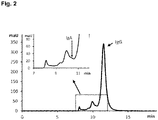
- Figure 2 shows the AIEX feedstock composition, which is loaded on the AIEX column (about 180 g protein per L resin) and afterwards washed with 2 CV equilibration buffer 2. After this step the AIEX column was subjected to sequential elution.
- a pre-elution step was carried out using 8 CV phosphate acetate buffer (10mM phosphate + 30mM sodium acetate, pH 6.0, conductivity 2-7 mS/cm).
- phosphate acetate buffer 10mM phosphate + 30mM sodium acetate, pH 6.0, conductivity 2-7 mS/cm.
- the buffer was changed to the first elution buffer (5 - 8 CV 55mM tartrate, 5mM sodium acetate, pH 7.6 ⁇ 0.2, conductivity 5-15 mS/cm).
- F4 is collected, which contains IgG and IgA in a ratio of about 60:40, and is essentially devoid of IgM.
- IgA eluted in this fraction is mainly monomeric IgA.
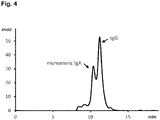
- Figure 4 shows the composition of the F4 subfraction F4A. However, all subfractions contain only IgG and monomeric IgA in various ratios.
- Fraction F5 contains IgM, IgA and IgG in the ratio 20 - 30 % IgA (predominantly di-/polymeric), 35 - 50 % IgM and 20 - 35 % IgG.
- Fractions F4 and F5 were polished by affinity chromatography (one or two steps) to selectively remove IgG and IgM. HPLC analysis showed that the obtained product from fraction F4 is highly pure monomeric IgA ( Figure 5 ), whereas fraction F5 is enriched in dimeric IgA ( Figure 6 ). Therefore, this elution method provides an excellent enrichment for monomeric IgA in fraction F4 and dimeric IgA in fraction F5.
- Example 2 Testing different buffers for the first elution step
- Example 2 The experiment was carried out essentially as described in Example 1, with a protein load between 100 to 180 g protein per L AIEX resin. However, for the first elution, tartrate buffer was replaced by oxalate, malonate, maleate, phosphate, acetate buffer (55mM of each substance + 5mM sodium acetate, pH 7.6 ⁇ 0.2).
- Fraction F4 appears to be similar for all buffers as long as substances with at least 2 acid groups were used in the first elution, whereas the acetate and phosphate elution profiles look quite different.
- the first elution also affects the second elution with citrate buffer.
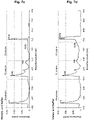
- oxalate buffer yields a similar F5 peak ( Figure 7 ).
- the IgM is not eluted during the second elution.
- acetate buffer as the first elution buffer, almost all IgA and the total amount of IgM is eluted in F5.
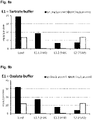
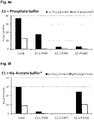
- the amount of IgA and IgM in these fractions relative to the total loaded protein is illustrated in Figure 8 .
- Tartrate and oxalate provide the preferred elution profile, where the monomeric IgA is eluted in F4, and IgM and dimeric IgA are eluted in F5.
- Only the elution with the hydroxydicarbon acids resulted in all 3 F4 subfractions and monomeric IgA elution.
- the first elution step using phosphate buffer showed only 2 subfractions and an extenuated IgA elution, whereas acetate buffer generated an F4 peak with a small amount of IgA. If the first elution is done with malonate, maleate or phosphate buffer a large peak is obtained in the strip fractions, where harsh elution conditions are used (1M NaCl)
- E1 Tartrate buffer IgG* [mg] IgA** [mg] IgM ** [mg] Load 3250.8 139.51 47.76 pre E (F3) 137.2 3.79 0.04 E1 (F4) 117.6 90.27 0.87 E2 (F5) 37.32 26.29 49.42 STRIP 0 0.00 0.00 E1: Oxalate buffer IgG* [mg] IgA** [mg] IgM ** [mg] Load 3322.7 114.78 42.60 pre E (F3) 150.2 10.55 0.09 E1 (F4) 128.8 90.38 1.72 E2 (F5) 35.77 14.94 44.14 STRIP 0 1.90 2.79 E1: Malonic acid buffer IgG* [mg] IgA** [mg] IgM ** [mg] Load 3325.8 133.68 50.99 pre E (F3) 140.2 5.94 0.14 E
- the pH of such buffers for example the tartrate buffer
- the octanoic acid precipitate (OA cake) is another waste fraction incurring during the IgG purification process. This precipitate was found to contain significant amounts of IgA and is therefore a good starting material for the purification of IgA.
- the OA cake was mixed with 0.15M phosphate buffer, pH 4.8 at a ratio of 1:6 (OA precipitate to buffer).
- buffers can also be used for IgA extraction, e.g. Tris buffer.
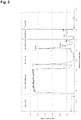
- the solubilised material was subjected to filtration, and then loaded on an AIEX column (MPHQ). The column was then sequentially eluted essentially as described in Example 1. The elution profile looks essentially as already shown in Figure 3 .
- the composition of the IgA-comprising feedstock for the AIEX column varies in the ratio of IgG to IgA in comparison to the described example 1. As shown in Table 2, the ratio of IgG to IgA in fraction F4 has shifted in favor of IgA (15 %:85 %). Also the amount of IgA in the pre-elution fraction F3 is increased. Both fractions are devoid of IgM.
- the elution of dimeric/polymeric compounds is limited due to the composition of the start material.
- the immunoglobulin content in the different fractions is also shown in Table 2: IgG* [mg] IgA** [mg] IgM ** [mg] Load 380.80 271.86 4.84 pre E (F3) 28.17 57.34 0.01 E1 (F4) 20.09 109.78 0.07 E2 (F5) 7.43 12.80 6.32 STRIP 0.30 1.08 0.03 * Nephelometric analysis method, ** ELISA analysis method
- IgA could also be solubilised from two different ethanol precipitates and subjected to AIEX chromatography, and very similar elution profiles were obtained with the method of the invention.
- the sequential elution resulted in an enriched monomeric IgA fraction (F4) containing IgG as contaminant.
- a polishing step was carried out by a selective removal of IgG by affinity chromatography (IgSelect).
- the fraction F4 was collected in two subfractions F4A and F4B ( Figure 3 ). However, the obtained F4A fraction was subjected to ultrafiltration/diafiltration to concentrate the protein and transfer it to a common buffer system with neutral pH, preferably PBS (phosphate buffered saline). This protein solution was used as feedstock for the affinity chromatography. IgA does not bind to the affinity resin and was collected in the flow through fraction. Bound IgG was eluted with 0.1 M glycine buffer, pH 3.0. Finally the IgA product can be formulated into a stable, pharmaceutical composition. Figure 5 shows the polished IgA fraction without IgG (and IgM).
Landscapes
- Chemical & Material Sciences (AREA)
- Organic Chemistry (AREA)
- Health & Medical Sciences (AREA)
- Medicinal Chemistry (AREA)
- Proteomics, Peptides & Aminoacids (AREA)
- Biophysics (AREA)
- General Health & Medical Sciences (AREA)
- Genetics & Genomics (AREA)
- Life Sciences & Earth Sciences (AREA)
- Molecular Biology (AREA)
- Biochemistry (AREA)
- Immunology (AREA)
- Analytical Chemistry (AREA)
- Chemical Kinetics & Catalysis (AREA)
- Peptides Or Proteins (AREA)
- Medicines Containing Antibodies Or Antigens For Use As Internal Diagnostic Agents (AREA)
- Saccharide Compounds (AREA)
- Diaphragms For Electromechanical Transducers (AREA)
Claims (17)
- Procédé pour l'enrichissement d'IgA à partir d'une composition comprenant de l'IgA, comprenant les étapes suivantes:(a) chargement de la composition sur un échangeur d'anions dans des conditions qui permettent à l'IgA de se lier;(b) application d'une solution d'élution alcaline comprenant une substance choisie dans le groupe constitué par l'acide tartrique ou un tartrate, l'acide oxalique ou un oxalate, l'acide malonique ou un malonate, l'acide maléique ou un maléate, et l'acide citrique ou un citrate;(c) éventuellement, application d'une solution d'élution acide qui comprend un compétiteur fort pour l'échangeur d'anions, le compétiteur fort pour l'échangeur d'anions étant choisi parmi un citrate, l'acide benzènesulfonique, l'acide benzoïque et des sels d'hydrogénosulfates ou des mélanges correspondants,la protéine éluée pendant l'étape (b) étant enrichie en IgA monomérique.
- Procédé selon la revendication 1, dans lequel entre les étapes (a) et (b), une étape de pré-élution (a1) est mise en œuvre en appliquant une solution à faible conductivité à l'échangeur d'anions, une faible conductivité faisant référence à une conductivité inférieure à 1,5 S/m (15 mS/cm).
- Procédé selon la revendication 2, l'étape (a1) étant réalisée à un pH faiblement acide/neutre, un pH faiblement acide faisant référence à une plage de pH de 4,0 à 6,5, et un pH neutre faisant référence à une plage de pH de 6,0 à 7,5.
- Procédé selon l'une quelconque des revendications 1 à 3, l'éluat collecté pendant l'étape (b) étant essentiellement dénué d'IgM.
- Procédé selon la revendication 1, la protéine éluée dans l'étape (c) étant enrichie en IgA dimérique.
- Procédé selon la revendication 1, le compétiteur fort pour l'échangeur d'anions dans l'étape (c) étant un citrate.
- Procédé selon une quelconque revendication précédente, l'échangeur d'anions étant un échangeur d'anions fort ou un échangeur d'anions faible.
- Procédé selon la revendication 7, l'échangeur d'anions comprenant un ligand d'échange d'anions tel qu'un ammonium quaternaire, aminoéthyle, diéthylaminoéthyle, triméthylaminoéthyle ou diméthylaminoéthyle quaternaire.
- Procédé selon une quelconque revendication précédente, la composition comprenant de l'IgA étant ou étant issue de sang, de sérum, de plasma ou d'autres fluides biologiques.
- Procédé selon la revendication 9, la composition comprenant de l'IgA étant une solution d'un précipité intermédiaire du fractionnement d'un plasma ou une fraction secondaire obtenue pendant la purification d'IgG à partir d'un plasma.
- Procédé selon la revendication 9 ou la revendication 10, la composition comprenant de l'IgA étant un intermédiaire dans un processus de purification d'IgG, et les étapes (a) et (b) du procédé selon la revendication 1 étant réalisées sur un échangeur d'anions qui fait partie du processus de production d'IgG.
- Procédé selon la revendication 9 ou la revendication 10, la composition comprenant de l'IgA étant obtenue en solubilisant un précipité.
- Procédé selon la revendication 12, le précipité étant un précipité d'acide octanoïque obtenu pendant une purification d'IgG.
- Procédé selon la revendication 12 ou la revendication 13, l'étape de solubilisation amenant sélectivement de l'IgA et de l'IgG en solution.
- Procédé selon la revendication 13, la solubilisation étant mise en œuvre en utilisant une solution dotée d'une conductivité comprise entre 0,1 et 1,5 S/m (1 et 15 mS/cm), et d'un pH de 3,5 à 6 ou de 7 à 9,5.
- Procédé selon la revendication 15, la solubilisation étant mise en œuvre avec un tampon phosphate, un tampon acétate, un tampon Tris, et/ou une combinaison de deux ou plus de ces tampons.
- Procédé selon la revendication 16, le tampon étant choisi parmi un tampon acétate 0,22 M et un tampon phosphate 0,15 M, pH 4,8.
Applications Claiming Priority (2)
| Application Number | Priority Date | Filing Date | Title |
|---|---|---|---|
| EP12158927.9A EP2636681A1 (fr) | 2012-03-09 | 2012-03-09 | Procédé d' enrichissement d'IgA |
| PCT/EP2013/054698 WO2013132053A1 (fr) | 2012-03-09 | 2013-03-08 | Procédé pour enrichir la glomérulonéphrite à dépôts mésangiaux d'iga |
Publications (2)
| Publication Number | Publication Date |
|---|---|
| EP2822965A1 EP2822965A1 (fr) | 2015-01-14 |
| EP2822965B1 true EP2822965B1 (fr) | 2022-05-11 |
Family
ID=47843296
Family Applications (2)
| Application Number | Title | Priority Date | Filing Date |
|---|---|---|---|
| EP12158927.9A Ceased EP2636681A1 (fr) | 2012-03-09 | 2012-03-09 | Procédé d' enrichissement d'IgA |
| EP13708164.2A Active EP2822965B1 (fr) | 2012-03-09 | 2013-03-08 | Procédé d'enrichissement d'iga |
Family Applications Before (1)
| Application Number | Title | Priority Date | Filing Date |
|---|---|---|---|
| EP12158927.9A Ceased EP2636681A1 (fr) | 2012-03-09 | 2012-03-09 | Procédé d' enrichissement d'IgA |
Country Status (9)
| Country | Link |
|---|---|
| US (1) | US9828418B2 (fr) |
| EP (2) | EP2636681A1 (fr) |
| JP (1) | JP6259777B2 (fr) |
| KR (1) | KR102079487B1 (fr) |
| CN (1) | CN104245728B (fr) |
| AU (1) | AU2013201388B2 (fr) |
| DK (1) | DK2822965T3 (fr) |
| ES (1) | ES2919861T3 (fr) |
| WO (1) | WO2013132053A1 (fr) |
Families Citing this family (12)
| Publication number | Priority date | Publication date | Assignee | Title |
|---|---|---|---|---|
| BR112014022240A2 (pt) | 2012-03-09 | 2017-08-01 | Csl Behring Ag | composições compreendendo imunoglobulinas semelhantes à secretoras |
| EP2636684A1 (fr) * | 2012-03-09 | 2013-09-11 | CSL Behring AG | Prévention des infections |
| US10144774B2 (en) * | 2013-07-01 | 2018-12-04 | Csl Behring Ag | Method for purifying IgG |
| GB201413227D0 (en) | 2014-07-25 | 2014-09-10 | Bioproducts Lab Ltd | Process |
| DE202014105749U1 (de) * | 2014-11-27 | 2015-01-09 | iCradle GmbH | Daumenschalter zur Befestigung an einem Fahrradlenker und über einen derartigen Daumenschalter bedienbares Steuersystem für ein Fahrrad |
| WO2017078947A1 (fr) * | 2015-10-21 | 2017-05-11 | Cambryn Biologics, Llc | Procédés de purification de protéines du plasma |
| EP3558362A1 (fr) | 2016-12-20 | 2019-10-30 | CSL Behring AG | Procédés pour agir sur des infections par salmonella |
| EP3684818A2 (fr) | 2017-09-21 | 2020-07-29 | UMC Utrecht Holding B.V. | Anticorps anti-gd2 pour le traitement du neuroblastome |
| WO2019219890A1 (fr) * | 2018-05-17 | 2019-11-21 | Csl Behring Ag | Procédé et système d'extraction de protéine |
| KR102875179B1 (ko) | 2018-11-30 | 2025-10-23 | 체에스엘 베링 아게 | 폴리클로날 면역글로불린을 사용한 급성 악화를 예방하거나 치료하기 위한 방법 및 조성물 |
| CN114096559B (zh) | 2019-03-27 | 2026-03-20 | 蒂嘉特克斯公司 | 工程化iga抗体及其使用方法 |
| CN112574296B (zh) * | 2020-12-30 | 2023-05-19 | 中国医学科学院输血研究所 | 一种模拟IVIg的多人份混合人血浆IgG样品的分离纯化方法 |
Family Cites Families (36)
| Publication number | Priority date | Publication date | Assignee | Title |
|---|---|---|---|---|
| US5500345A (en) * | 1989-04-25 | 1996-03-19 | Iatron Laboratories, Inc. | Hybridomas producing monoclonal antibodies specific for C-reactive protein and methods for detection of C-reactive protein |
| DE3927111C3 (de) | 1989-08-17 | 1994-09-01 | Biotest Pharma Gmbh | Verfahren zur Herstellung nicht modifizierter intravenös verabreichbarer IgM- und/oderIgA-haltiger Immunglobulinpräparate |
| US5258177A (en) * | 1991-12-10 | 1993-11-02 | Alpha Therapeutic Corporation | IgA preparation and process of making the same |
| FR2706466B1 (fr) | 1993-06-14 | 1995-08-25 | Aetsrn | Concentré d'immunoglobulines G à usage thérapeutique et procédé de production dudit concentré. |
| CA2167835A1 (fr) | 1993-07-30 | 1995-02-09 | Richard A. Weltzin | Anticorps iga monoclonaux agissant contre le virus respiratoire syncytial |
| DE19600939C1 (de) | 1996-01-12 | 1997-08-28 | Immuno Ag | Verfahren zur Trennung von IgG und IgA |
| EP0839915A1 (fr) | 1996-11-01 | 1998-05-06 | Institut Suisse De Recherches Experimentales Sur Le Cancer Isrec | Immunoglobuline A sécrétoire comme système d'administration de vaccins mucosales |
| WO1998057993A1 (fr) | 1997-06-19 | 1998-12-23 | The Regents Of The University Of California | Immunoglobuline secretoire produite par des cellules d'un seul type, et procedes de fabrication et d'utilisation de celle-ci |
| US5886154A (en) | 1997-06-20 | 1999-03-23 | Lebing; Wytold R. | Chromatographic method for high yield purification and viral inactivation of antibodies |
| US20020114802A1 (en) | 1998-02-10 | 2002-08-22 | Tjellstrom Bo Arthur Einar | Oral immunoglobulin treatment for inflammatory bowel disease |
| IL140155A (en) | 1998-06-09 | 2005-12-18 | Statens Seruminstitut | Process for producing immunoglobulins for intravenous administration and other immunoglobulin products |
| JP2000103800A (ja) | 1998-09-29 | 2000-04-11 | Yoshitomi Pharmaceut Ind Ltd | 免疫グロブリンaの精製方法 |
| AUPP806999A0 (en) * | 1999-01-08 | 1999-02-04 | Csl Limited | Process for purifying immunoglobulins |
| EP1068871A1 (fr) | 1999-07-07 | 2001-01-17 | Jean-Paul Perraudin | Nouvelles méthodes et médicament pour le traitement des infections émanant d'un biofilm microbiel |
| AU2234801A (en) | 1999-12-13 | 2002-04-29 | Universidad Nacional Autonoma De Mexico | Immunoenzymatic quantification method |
| NZ527977A (en) | 2001-02-12 | 2005-10-28 | Medarex Inc | Human monoclonal antibodies to FC alpha receptor (CD89) |
| US6932967B2 (en) | 2001-03-22 | 2005-08-23 | Michael R. Simon | Human medical treatment by aerosol inhalation of immunoglobulin A |
| FR2824568B1 (fr) * | 2001-05-11 | 2004-04-09 | Lab Francais Du Fractionnement | Procede de preparation de concentres d'immunoglobulines humaines a usage therapeutique |
| US20060165675A1 (en) | 2002-08-02 | 2006-07-27 | Richman-Eisenstat Janice Beth | Modulation of mesenchymal cells via iga-receptors |
| ES2383300T3 (es) | 2003-11-13 | 2012-06-20 | Hanmi Holdings Co., Ltd | Fragmento Fc de IgG para un vehículo de fármacos y procedimiento para su preparación |
| US8119104B2 (en) | 2006-12-13 | 2012-02-21 | Michael R. Simon | Treatment of celiac disease with IgA |
| US8709413B2 (en) | 2006-12-13 | 2014-04-29 | Michael R. Simon | Treatment of celiac disease with IgA |
| US7597891B2 (en) | 2006-12-13 | 2009-10-06 | Simon Michael R | Synthesis of human secretory IgA for the treatment of Clostridium difficile associated diseases |
| US8021645B2 (en) | 2006-12-13 | 2011-09-20 | Simon Michael R | Synthesis of human secretory IgA and IgM and the formation of a medicament therefrom |
| US8313730B2 (en) | 2006-12-13 | 2012-11-20 | Michael R. Simon | Treatment of celiac disease with IgA |
| US20080145420A1 (en) | 2006-12-13 | 2008-06-19 | Simon Michael R | HUMAN SECRETORY IgA FOR THE TREATMENT OF CLOSTRIDIUM DIFFICILE ASSOCIATED DISEASES |
| US7794721B2 (en) | 2006-12-13 | 2010-09-14 | Simon Michael R | Synthesis of human secretory IgM and the treatment of clostridium difficile associated diseases herewith |
| EP2725035A1 (fr) | 2007-10-02 | 2014-04-30 | Avaxia Biologics, Inc. | Therapie aux anticorps pour une utilisation dans le tube digestif |
| CN102124027B (zh) | 2008-05-15 | 2015-01-21 | 温氏健康有限公司 | 产生富含分泌型免疫球蛋白的乳组分的方法 |
| GB201006753D0 (en) | 2010-04-22 | 2010-06-09 | Biotest Ag | Process for preparing an immunolobulin composition |
| EP2465536A1 (fr) | 2010-12-14 | 2012-06-20 | CSL Behring AG | Activation CD89 dans une thérapie |
| WO2013122834A1 (fr) * | 2012-02-14 | 2013-08-22 | Bio-Rad Laboratories, Inc. | Diminution d'excursions de ph dans la chromatographie échangeuse d'ions |
| EP2636683A1 (fr) | 2012-03-09 | 2013-09-11 | CSL Behring AG | Traitement de la mucositis avec de l' immunoglobulin |
| BR112014022240A2 (pt) | 2012-03-09 | 2017-08-01 | Csl Behring Ag | composições compreendendo imunoglobulinas semelhantes à secretoras |
| EP2636684A1 (fr) | 2012-03-09 | 2013-09-11 | CSL Behring AG | Prévention des infections |
| WO2013158279A1 (fr) * | 2012-04-20 | 2013-10-24 | Abbvie Inc. | Procédés de purification de protéines pour réduire des espèces acides |
-
2012
- 2012-03-09 EP EP12158927.9A patent/EP2636681A1/fr not_active Ceased
-
2013
- 2013-03-08 EP EP13708164.2A patent/EP2822965B1/fr active Active
- 2013-03-08 JP JP2014560388A patent/JP6259777B2/ja active Active
- 2013-03-08 CN CN201380013075.7A patent/CN104245728B/zh active Active
- 2013-03-08 KR KR1020147028263A patent/KR102079487B1/ko active Active
- 2013-03-08 DK DK13708164.2T patent/DK2822965T3/da active
- 2013-03-08 ES ES13708164T patent/ES2919861T3/es active Active
- 2013-03-08 AU AU2013201388A patent/AU2013201388B2/en active Active
- 2013-03-08 WO PCT/EP2013/054698 patent/WO2013132053A1/fr not_active Ceased
- 2013-03-08 US US14/377,535 patent/US9828418B2/en active Active
Also Published As
| Publication number | Publication date |
|---|---|
| EP2636681A1 (fr) | 2013-09-11 |
| EP2822965A1 (fr) | 2015-01-14 |
| JP6259777B2 (ja) | 2018-01-10 |
| HK1202881A1 (en) | 2015-10-09 |
| AU2013201388A1 (en) | 2013-09-26 |
| CN104245728A (zh) | 2014-12-24 |
| KR20140136028A (ko) | 2014-11-27 |
| CN104245728B (zh) | 2017-11-28 |
| ES2919861T3 (es) | 2022-07-28 |
| JP2015509523A (ja) | 2015-03-30 |
| AU2013201388B2 (en) | 2015-09-03 |
| US9828418B2 (en) | 2017-11-28 |
| WO2013132053A1 (fr) | 2013-09-12 |
| DK2822965T3 (da) | 2022-07-11 |
| KR102079487B1 (ko) | 2020-02-21 |
| US20150005476A1 (en) | 2015-01-01 |
Similar Documents
| Publication | Publication Date | Title |
|---|---|---|
| EP2822965B1 (fr) | Procédé d'enrichissement d'iga | |
| KR100501263B1 (ko) | 정맥 주사용 면역글로불린의 제조 방법 및 그 외의 면역글로불린 제품 | |
| US5886154A (en) | Chromatographic method for high yield purification and viral inactivation of antibodies | |
| CN102712673B (zh) | 用于纯化含fc的蛋白的色谱方法 | |
| RU2266914C2 (ru) | Способ получения igg | |
| AU2014286268B2 (en) | Process | |
| JP7073333B2 (ja) | 免疫グロブリン組成物を調製するためのプロセス | |
| KR20190047376A (ko) | 개선된 면역글로불린의 정제방법 | |
| JP6309005B2 (ja) | アルブミンを精製するための方法 | |
| KR20140062459A (ko) | 다가 면역글로불린 농축물의 제조 방법 | |
| KR100236762B1 (ko) | 사람 혈장의 분별 동안에 생성된 분별물로부터 면역글로불린을 회수하는 방법 | |
| EP4377361A1 (fr) | Procédé de purification d'immunoglobuline g et ses utilisations | |
| US7041798B1 (en) | Method for the chromatographic fractionation of plasma or serum, preparations, so obtained, and their use | |
| HK1202881B (en) | Process for enriching iga | |
| US20090264630A1 (en) | Method of separating monomeric protein(s) | |
| CN121712573A (zh) | 纯化方法 | |
| KR20240154657A (ko) | 임상 인간 igg 제품의 친화도 크로마토그래피 생산 |
Legal Events
| Date | Code | Title | Description |
|---|---|---|---|
| TPAC | Observations filed by third parties |
Free format text: ORIGINAL CODE: EPIDOSNTIPA |
|
| PUAI | Public reference made under article 153(3) epc to a published international application that has entered the european phase |
Free format text: ORIGINAL CODE: 0009012 |
|
| 17P | Request for examination filed |
Effective date: 20141009 |
|
| AK | Designated contracting states |
Kind code of ref document: A1 Designated state(s): AL AT BE BG CH CY CZ DE DK EE ES FI FR GB GR HR HU IE IS IT LI LT LU LV MC MK MT NL NO PL PT RO RS SE SI SK SM TR |
|
| AX | Request for extension of the european patent |
Extension state: BA ME |
|
| DAX | Request for extension of the european patent (deleted) | ||
| REG | Reference to a national code |
Ref country code: HK Ref legal event code: DE Ref document number: 1202881 Country of ref document: HK |
|
| 17Q | First examination report despatched |
Effective date: 20151016 |
|
| STAA | Information on the status of an ep patent application or granted ep patent |
Free format text: STATUS: EXAMINATION IS IN PROGRESS |
|
| GRAP | Despatch of communication of intention to grant a patent |
Free format text: ORIGINAL CODE: EPIDOSNIGR1 |
|
| STAA | Information on the status of an ep patent application or granted ep patent |
Free format text: STATUS: GRANT OF PATENT IS INTENDED |
|
| INTG | Intention to grant announced |
Effective date: 20211217 |
|
| GRAJ | Information related to disapproval of communication of intention to grant by the applicant or resumption of examination proceedings by the epo deleted |
Free format text: ORIGINAL CODE: EPIDOSDIGR1 |
|
| STAA | Information on the status of an ep patent application or granted ep patent |
Free format text: STATUS: EXAMINATION IS IN PROGRESS |
|
| GRAP | Despatch of communication of intention to grant a patent |
Free format text: ORIGINAL CODE: EPIDOSNIGR1 |
|
| STAA | Information on the status of an ep patent application or granted ep patent |
Free format text: STATUS: GRANT OF PATENT IS INTENDED |
|
| INTC | Intention to grant announced (deleted) | ||
| RIN1 | Information on inventor provided before grant (corrected) |
Inventor name: SIEGEMUND, DOREEN Inventor name: LOETSCHER, MARIUS Inventor name: EL MENYAWI, IBRAHIM |
|
| INTG | Intention to grant announced |
Effective date: 20220302 |
|
| GRAS | Grant fee paid |
Free format text: ORIGINAL CODE: EPIDOSNIGR3 |
|
| GRAA | (expected) grant |
Free format text: ORIGINAL CODE: 0009210 |
|
| STAA | Information on the status of an ep patent application or granted ep patent |
Free format text: STATUS: THE PATENT HAS BEEN GRANTED |
|
| AK | Designated contracting states |
Kind code of ref document: B1 Designated state(s): AL AT BE BG CH CY CZ DE DK EE ES FI FR GB GR HR HU IE IS IT LI LT LU LV MC MK MT NL NO PL PT RO RS SE SI SK SM TR |
|
| REG | Reference to a national code |
Ref country code: GB Ref legal event code: FG4D |
|
| REG | Reference to a national code |
Ref country code: CH Ref legal event code: EP |
|
| REG | Reference to a national code |
Ref country code: AT Ref legal event code: REF Ref document number: 1491362 Country of ref document: AT Kind code of ref document: T Effective date: 20220515 |
|
| REG | Reference to a national code |
Ref country code: DE Ref legal event code: R096 Ref document number: 602013081636 Country of ref document: DE |
|
| REG | Reference to a national code |
Ref country code: IE Ref legal event code: FG4D |
|
| REG | Reference to a national code |
Ref country code: DK Ref legal event code: T3 Effective date: 20220708 |
|
| REG | Reference to a national code |
Ref country code: NL Ref legal event code: FP |
|
| REG | Reference to a national code |
Ref country code: ES Ref legal event code: FG2A Ref document number: 2919861 Country of ref document: ES Kind code of ref document: T3 Effective date: 20220728 |
|
| REG | Reference to a national code |
Ref country code: LT Ref legal event code: MG9D |
|
| PG25 | Lapsed in a contracting state [announced via postgrant information from national office to epo] |
Ref country code: SE Free format text: LAPSE BECAUSE OF FAILURE TO SUBMIT A TRANSLATION OF THE DESCRIPTION OR TO PAY THE FEE WITHIN THE PRESCRIBED TIME-LIMIT Effective date: 20220511 Ref country code: PT Free format text: LAPSE BECAUSE OF FAILURE TO SUBMIT A TRANSLATION OF THE DESCRIPTION OR TO PAY THE FEE WITHIN THE PRESCRIBED TIME-LIMIT Effective date: 20220912 Ref country code: NO Free format text: LAPSE BECAUSE OF FAILURE TO SUBMIT A TRANSLATION OF THE DESCRIPTION OR TO PAY THE FEE WITHIN THE PRESCRIBED TIME-LIMIT Effective date: 20220811 Ref country code: LT Free format text: LAPSE BECAUSE OF FAILURE TO SUBMIT A TRANSLATION OF THE DESCRIPTION OR TO PAY THE FEE WITHIN THE PRESCRIBED TIME-LIMIT Effective date: 20220511 Ref country code: HR Free format text: LAPSE BECAUSE OF FAILURE TO SUBMIT A TRANSLATION OF THE DESCRIPTION OR TO PAY THE FEE WITHIN THE PRESCRIBED TIME-LIMIT Effective date: 20220511 Ref country code: GR Free format text: LAPSE BECAUSE OF FAILURE TO SUBMIT A TRANSLATION OF THE DESCRIPTION OR TO PAY THE FEE WITHIN THE PRESCRIBED TIME-LIMIT Effective date: 20220812 Ref country code: FI Free format text: LAPSE BECAUSE OF FAILURE TO SUBMIT A TRANSLATION OF THE DESCRIPTION OR TO PAY THE FEE WITHIN THE PRESCRIBED TIME-LIMIT Effective date: 20220511 Ref country code: BG Free format text: LAPSE BECAUSE OF FAILURE TO SUBMIT A TRANSLATION OF THE DESCRIPTION OR TO PAY THE FEE WITHIN THE PRESCRIBED TIME-LIMIT Effective date: 20220811 |
|
| PG25 | Lapsed in a contracting state [announced via postgrant information from national office to epo] |
Ref country code: RS Free format text: LAPSE BECAUSE OF FAILURE TO SUBMIT A TRANSLATION OF THE DESCRIPTION OR TO PAY THE FEE WITHIN THE PRESCRIBED TIME-LIMIT Effective date: 20220511 Ref country code: PL Free format text: LAPSE BECAUSE OF FAILURE TO SUBMIT A TRANSLATION OF THE DESCRIPTION OR TO PAY THE FEE WITHIN THE PRESCRIBED TIME-LIMIT Effective date: 20220511 Ref country code: LV Free format text: LAPSE BECAUSE OF FAILURE TO SUBMIT A TRANSLATION OF THE DESCRIPTION OR TO PAY THE FEE WITHIN THE PRESCRIBED TIME-LIMIT Effective date: 20220511 Ref country code: IS Free format text: LAPSE BECAUSE OF FAILURE TO SUBMIT A TRANSLATION OF THE DESCRIPTION OR TO PAY THE FEE WITHIN THE PRESCRIBED TIME-LIMIT Effective date: 20220911 |
|
| PG25 | Lapsed in a contracting state [announced via postgrant information from national office to epo] |
Ref country code: SM Free format text: LAPSE BECAUSE OF FAILURE TO SUBMIT A TRANSLATION OF THE DESCRIPTION OR TO PAY THE FEE WITHIN THE PRESCRIBED TIME-LIMIT Effective date: 20220511 Ref country code: SK Free format text: LAPSE BECAUSE OF FAILURE TO SUBMIT A TRANSLATION OF THE DESCRIPTION OR TO PAY THE FEE WITHIN THE PRESCRIBED TIME-LIMIT Effective date: 20220511 Ref country code: RO Free format text: LAPSE BECAUSE OF FAILURE TO SUBMIT A TRANSLATION OF THE DESCRIPTION OR TO PAY THE FEE WITHIN THE PRESCRIBED TIME-LIMIT Effective date: 20220511 Ref country code: EE Free format text: LAPSE BECAUSE OF FAILURE TO SUBMIT A TRANSLATION OF THE DESCRIPTION OR TO PAY THE FEE WITHIN THE PRESCRIBED TIME-LIMIT Effective date: 20220511 Ref country code: CZ Free format text: LAPSE BECAUSE OF FAILURE TO SUBMIT A TRANSLATION OF THE DESCRIPTION OR TO PAY THE FEE WITHIN THE PRESCRIBED TIME-LIMIT Effective date: 20220511 |
|
| REG | Reference to a national code |
Ref country code: DE Ref legal event code: R097 Ref document number: 602013081636 Country of ref document: DE |
|
| PLBE | No opposition filed within time limit |
Free format text: ORIGINAL CODE: 0009261 |
|
| STAA | Information on the status of an ep patent application or granted ep patent |
Free format text: STATUS: NO OPPOSITION FILED WITHIN TIME LIMIT |
|
| PG25 | Lapsed in a contracting state [announced via postgrant information from national office to epo] |
Ref country code: AL Free format text: LAPSE BECAUSE OF FAILURE TO SUBMIT A TRANSLATION OF THE DESCRIPTION OR TO PAY THE FEE WITHIN THE PRESCRIBED TIME-LIMIT Effective date: 20220511 |
|
| 26N | No opposition filed |
Effective date: 20230214 |
|
| PG25 | Lapsed in a contracting state [announced via postgrant information from national office to epo] |
Ref country code: SI Free format text: LAPSE BECAUSE OF FAILURE TO SUBMIT A TRANSLATION OF THE DESCRIPTION OR TO PAY THE FEE WITHIN THE PRESCRIBED TIME-LIMIT Effective date: 20220511 |
|
| P01 | Opt-out of the competence of the unified patent court (upc) registered |
Effective date: 20230507 |
|
| REG | Reference to a national code |
Ref country code: AT Ref legal event code: UEP Ref document number: 1491362 Country of ref document: AT Kind code of ref document: T Effective date: 20220511 |
|
| PG25 | Lapsed in a contracting state [announced via postgrant information from national office to epo] |
Ref country code: MC Free format text: LAPSE BECAUSE OF FAILURE TO SUBMIT A TRANSLATION OF THE DESCRIPTION OR TO PAY THE FEE WITHIN THE PRESCRIBED TIME-LIMIT Effective date: 20220511 |
|
| PG25 | Lapsed in a contracting state [announced via postgrant information from national office to epo] |
Ref country code: LU Free format text: LAPSE BECAUSE OF NON-PAYMENT OF DUE FEES Effective date: 20230308 |
|
| REG | Reference to a national code |
Ref country code: IE Ref legal event code: MM4A |
|
| PG25 | Lapsed in a contracting state [announced via postgrant information from national office to epo] |
Ref country code: IE Free format text: LAPSE BECAUSE OF NON-PAYMENT OF DUE FEES Effective date: 20230308 |
|
| PG25 | Lapsed in a contracting state [announced via postgrant information from national office to epo] |
Ref country code: BG Free format text: LAPSE BECAUSE OF FAILURE TO SUBMIT A TRANSLATION OF THE DESCRIPTION OR TO PAY THE FEE WITHIN THE PRESCRIBED TIME-LIMIT Effective date: 20220511 |
|
| PG25 | Lapsed in a contracting state [announced via postgrant information from national office to epo] |
Ref country code: BG Free format text: LAPSE BECAUSE OF FAILURE TO SUBMIT A TRANSLATION OF THE DESCRIPTION OR TO PAY THE FEE WITHIN THE PRESCRIBED TIME-LIMIT Effective date: 20220511 |
|
| PGFP | Annual fee paid to national office [announced via postgrant information from national office to epo] |
Ref country code: ES Payment date: 20250410 Year of fee payment: 13 |
|
| PGFP | Annual fee paid to national office [announced via postgrant information from national office to epo] |
Ref country code: CH Payment date: 20250401 Year of fee payment: 13 |
|
| PG25 | Lapsed in a contracting state [announced via postgrant information from national office to epo] |
Ref country code: CY Free format text: LAPSE BECAUSE OF FAILURE TO SUBMIT A TRANSLATION OF THE DESCRIPTION OR TO PAY THE FEE WITHIN THE PRESCRIBED TIME-LIMIT; INVALID AB INITIO Effective date: 20130308 |
|
| PG25 | Lapsed in a contracting state [announced via postgrant information from national office to epo] |
Ref country code: HU Free format text: LAPSE BECAUSE OF FAILURE TO SUBMIT A TRANSLATION OF THE DESCRIPTION OR TO PAY THE FEE WITHIN THE PRESCRIBED TIME-LIMIT; INVALID AB INITIO Effective date: 20130308 |
|
| PG25 | Lapsed in a contracting state [announced via postgrant information from national office to epo] |
Ref country code: TR Free format text: LAPSE BECAUSE OF FAILURE TO SUBMIT A TRANSLATION OF THE DESCRIPTION OR TO PAY THE FEE WITHIN THE PRESCRIBED TIME-LIMIT Effective date: 20220511 |
|
| REG | Reference to a national code |
Ref country code: CH Ref legal event code: U11 Free format text: ST27 STATUS EVENT CODE: U-0-0-U10-U11 (AS PROVIDED BY THE NATIONAL OFFICE) Effective date: 20260401 |
|
| PGFP | Annual fee paid to national office [announced via postgrant information from national office to epo] |
Ref country code: GB Payment date: 20260319 Year of fee payment: 14 |
|
| PGFP | Annual fee paid to national office [announced via postgrant information from national office to epo] |
Ref country code: DK Payment date: 20260323 Year of fee payment: 14 Ref country code: DE Payment date: 20260320 Year of fee payment: 14 |
|
| PGFP | Annual fee paid to national office [announced via postgrant information from national office to epo] |
Ref country code: AT Payment date: 20260318 Year of fee payment: 14 |
|
| PGFP | Annual fee paid to national office [announced via postgrant information from national office to epo] |
Ref country code: BE Payment date: 20260323 Year of fee payment: 14 Ref country code: IT Payment date: 20260320 Year of fee payment: 14 |
|
| PGFP | Annual fee paid to national office [announced via postgrant information from national office to epo] |
Ref country code: NL Payment date: 20260323 Year of fee payment: 14 |
|
| PGFP | Annual fee paid to national office [announced via postgrant information from national office to epo] |
Ref country code: FR Payment date: 20260323 Year of fee payment: 14 |