EP2822977B1 - Katalysatorkomponenten zur olefinpolymerisation - Google Patents
Katalysatorkomponenten zur olefinpolymerisation Download PDFInfo
- Publication number
- EP2822977B1 EP2822977B1 EP13707189.0A EP13707189A EP2822977B1 EP 2822977 B1 EP2822977 B1 EP 2822977B1 EP 13707189 A EP13707189 A EP 13707189A EP 2822977 B1 EP2822977 B1 EP 2822977B1
- Authority
- EP
- European Patent Office
- Prior art keywords
- oxy
- groups
- ethoxycarbonyl
- catalyst component
- hydrogen
- Prior art date
- Legal status (The legal status is an assumption and is not a legal conclusion. Google has not performed a legal analysis and makes no representation as to the accuracy of the status listed.)
- Active
Links
- 0 CC(*)(C(*)=C(*)C(C)(*)OC(c1c(*)c(*)c(*)c(*)c1*)=O)OC(O)O* Chemical compound CC(*)(C(*)=C(*)C(C)(*)OC(c1c(*)c(*)c(*)c(*)c1*)=O)OC(O)O* 0.000 description 2
Classifications
-
- C—CHEMISTRY; METALLURGY
- C08—ORGANIC MACROMOLECULAR COMPOUNDS; THEIR PREPARATION OR CHEMICAL WORKING-UP; COMPOSITIONS BASED THEREON
- C08F—MACROMOLECULAR COMPOUNDS OBTAINED BY REACTIONS ONLY INVOLVING CARBON-TO-CARBON UNSATURATED BONDS
- C08F4/00—Polymerisation catalysts
- C08F4/42—Metals; Metal hydrides; Metallo-organic compounds; Use thereof as catalyst precursors
- C08F4/44—Metals; Metal hydrides; Metallo-organic compounds; Use thereof as catalyst precursors selected from light metals, zinc, cadmium, mercury, copper, silver, gold, boron, gallium, indium, thallium, rare earths or actinides
- C08F4/60—Metals; Metal hydrides; Metallo-organic compounds; Use thereof as catalyst precursors selected from light metals, zinc, cadmium, mercury, copper, silver, gold, boron, gallium, indium, thallium, rare earths or actinides together with refractory metals, iron group metals, platinum group metals, manganese, rhenium technetium or compounds thereof
- C08F4/62—Refractory metals or compounds thereof
- C08F4/64—Titanium, zirconium, hafnium or compounds thereof
- C08F4/647—Catalysts containing a specific non-metal or metal-free compound
- C08F4/649—Catalysts containing a specific non-metal or metal-free compound organic
- C08F4/6494—Catalysts containing a specific non-metal or metal-free compound organic containing oxygen
-
- C—CHEMISTRY; METALLURGY
- C07—ORGANIC CHEMISTRY
- C07C—ACYCLIC OR CARBOCYCLIC COMPOUNDS
- C07C69/00—Esters of carboxylic acids; Esters of carbonic or haloformic acids
- C07C69/96—Esters of carbonic or haloformic acids
-
- C—CHEMISTRY; METALLURGY
- C08—ORGANIC MACROMOLECULAR COMPOUNDS; THEIR PREPARATION OR CHEMICAL WORKING-UP; COMPOSITIONS BASED THEREON
- C08F—MACROMOLECULAR COMPOUNDS OBTAINED BY REACTIONS ONLY INVOLVING CARBON-TO-CARBON UNSATURATED BONDS
- C08F110/00—Homopolymers of unsaturated aliphatic hydrocarbons having only one carbon-to-carbon double bond
- C08F110/04—Monomers containing three or four carbon atoms
- C08F110/06—Propene
-
- C—CHEMISTRY; METALLURGY
- C08—ORGANIC MACROMOLECULAR COMPOUNDS; THEIR PREPARATION OR CHEMICAL WORKING-UP; COMPOSITIONS BASED THEREON
- C08F—MACROMOLECULAR COMPOUNDS OBTAINED BY REACTIONS ONLY INVOLVING CARBON-TO-CARBON UNSATURATED BONDS
- C08F4/00—Polymerisation catalysts
- C08F4/42—Metals; Metal hydrides; Metallo-organic compounds; Use thereof as catalyst precursors
- C08F4/44—Metals; Metal hydrides; Metallo-organic compounds; Use thereof as catalyst precursors selected from light metals, zinc, cadmium, mercury, copper, silver, gold, boron, gallium, indium, thallium, rare earths or actinides
- C08F4/60—Metals; Metal hydrides; Metallo-organic compounds; Use thereof as catalyst precursors selected from light metals, zinc, cadmium, mercury, copper, silver, gold, boron, gallium, indium, thallium, rare earths or actinides together with refractory metals, iron group metals, platinum group metals, manganese, rhenium technetium or compounds thereof
- C08F4/62—Refractory metals or compounds thereof
- C08F4/64—Titanium, zirconium, hafnium or compounds thereof
- C08F4/65—Pretreating the metal or compound covered by group C08F4/64 before the final contacting with the metal or compound covered by group C08F4/44
- C08F4/652—Pretreating with metals or metal-containing compounds
- C08F4/654—Pretreating with metals or metal-containing compounds with magnesium or compounds thereof
- C08F4/6543—Pretreating with metals or metal-containing compounds with magnesium or compounds thereof halides of magnesium
-
- C—CHEMISTRY; METALLURGY
- C07—ORGANIC CHEMISTRY
- C07C—ACYCLIC OR CARBOCYCLIC COMPOUNDS
- C07C2603/00—Systems containing at least three condensed rings
- C07C2603/02—Ortho- or ortho- and peri-condensed systems
- C07C2603/04—Ortho- or ortho- and peri-condensed systems containing three rings
- C07C2603/06—Ortho- or ortho- and peri-condensed systems containing three rings containing at least one ring with less than six ring members
- C07C2603/10—Ortho- or ortho- and peri-condensed systems containing three rings containing at least one ring with less than six ring members containing five-membered rings
- C07C2603/12—Ortho- or ortho- and peri-condensed systems containing three rings containing at least one ring with less than six ring members containing five-membered rings only one five-membered ring
- C07C2603/18—Fluorenes; Hydrogenated fluorenes
Definitions
- the present invention relates to catalyst components for the polymerization of olefins, in particular propylene, comprising a Mg dihalide based support on which are supported Ti atoms and at least an electron donor selected from a specific class of electron donor compounds.
- the present invention further relates to the catalysts obtained from said components and to their use in processes for the polymerization of olefins in particular propylene.
- Catalyst components of the Ziegler-Natta type for the stereospecific polymerization of olefins are widely known in the art.
- the latest developed catalysts for propylene polymerization comprise a solid catalyst component, constituted by a magnesium dihalide on which are supported a titanium compound and an internal electron donor compound, used in combination with an Al-alkyl compound and often with an external donor which is needed in order to obtain higher isotacticity.
- One of the preferred classes of internal donors is constituted by the esters of phthalic acid, diisobutylphthalate being the most used.
- the phthalates are used as internal donors in combination with alkylalkoxysilanes as external donor.
- This catalyst system is capable of giving good performances in terms of activity, and propylene polymers with high isotacticity and xylene insolubility endowed with an intermediate molecular weight distribution.
- R 1 -CO-O-CR 3 R 4 -A-CR 5 R 6 -O-CO-R 2 in which R 1 and R 2 groups, which may be identical or different, can be substituted or unsubstituted hydrocarbyl having 1 to 20 carbon atoms, R 3 -R 6 groups, which may be identical or different, can be selected from the group consisting of hydrogen, halogen or substituted or unsubstituted hydrocarbyl having 1 to 20 carbon atoms, R 1 -R 5 groups optionally contain one or more hetero-atoms replacing carbon, hydrogen atom or the both, said hetero-atom is selected from the group consisting of nitrogen, oxygen, sulfur, silicon, phosphorus and halogen atom, two or more of R 3 -R 6 groups can be linked to form saturated or unsaturated monocyclic or polycyclic ring; A is a single bond or bivalent linking group with chain length between two free radicals being 1
- the very broad formula reported encompass several structures with different performances. Within this general class the variety of performances is very high as some structures generate catalyst components showing activities and sterospecificities of interest while other structures make poor catalysts.
- WO2011/068775 describes three and four atoms bridged dicarbonates compounds as internal donors in propylene polymerization. Some of the structures derive from the same diols disclosed in US7,388,061 with the difference that they are then formally esterified with chloroformate derivatives instead of aromatic acids (benzoic) derivatives. According to this patent the preferred structures are those in which the diol portion is part of an aromatic mono (phenyl) or polycyclic (naphthyl) group.
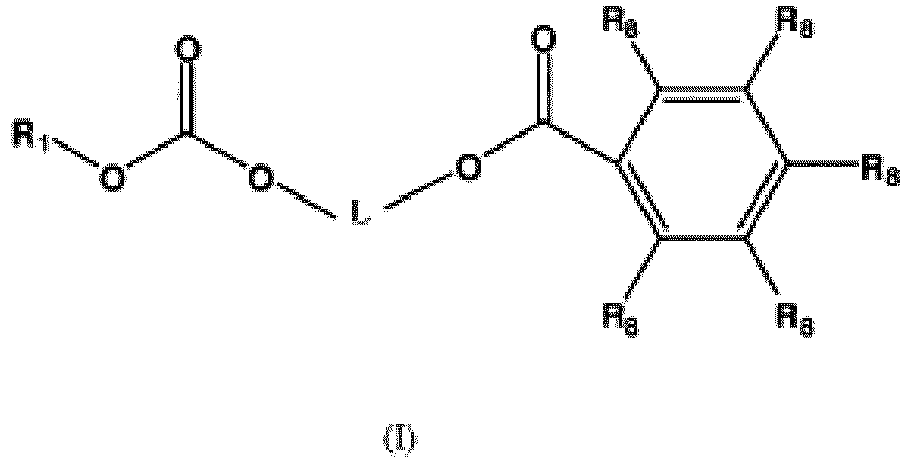
- an object of the present invention is a catalyst component for the polymerization of olefins comprising Mg, Ti and an electron donor compound of the following formula (I)
- R 1 groups are selected from C 1 -C 15 hydrocarbon groups
- R 8 groups are selected from hydrogen, halogen and C 1 -C 15 hydrocarbon groups, optionally containing an heteroatom selected from halogen, O, P, S, N and Si and L is a divalent hydrocarbon group possibly containing heteroatoms selected from halogen, O, P, S, N and Si.
- preferred R 1 groups are selected from C 1 -C 10 hydrocarbon groups, more preferably from C 1 -C 10 alkyl groups and especially from C 1 -C 4 linear alkyl groups. Ethyl is a an especially preferred R 1 group. Moreover, it is also of general applicability the fact the preferred embodiment in which at least one of R 8 is different from hydrogen and preferably selected from C 1 -C 15 hydrocarbon groups or halogen. In a most preferred embodiment only one of R 8 groups is different from hydrogen.
- hydrocarbon groups preferred substitutents are C 1 -C 10 alkyl groups, C 6 -C 14 aryl groups, C 3 -C 15 cycloalkyl groups, and C 7 -C 15 arylalkyl or alkylaryl groups. More preferably, they can be C 1 -C 10 alkyl groups and even more preferably linear C 1 -C 5 alkyl groups.
- the hydrocarbon substituents are preferably located in 4-position.
- Halogens are also preferred substituents, and among them Cl, Br and F are the preferred halogens. Cl being the most preferred. Preferred positions are meta and/or para. Also other positions in addition to meta and/or para could be susbtitued with halogens and/or hydrocarbon groups.
- L is a divalent hydrocarbon group having a spacing chain between the two oxygen linked to it of from 2 to 6 carbon atoms and in which, independently, the said carbon atoms can be replaced by heteroatoms selected from halogen, O, P, S, N and Si and the hydrogen atom of the said divalent hydrocarbon group can, independently, be replaced by halogen or C 1 -C 15 hydrocarbon groups, optionally containing an heteroatom selected from halogen, P, S, N and Si, which can be linked together and/or with the carbon atoms of said divalent group to form saturated or unsaturated mono or polycyclic rings.
- L is a divalent bridging group selected from C 1 -C 20 alkylidene, C 3 -C 20 cycloalkylidene, C 6 -C 20 arylidene, C 7 -C 20 alkylarylidene, or C 7 -C 20 arylalkylidene radicals optionally containing heteroatoms selected from halogen, O, P, S, N and Si.
- R 1 groups and R 8 groups have the same meaning as mentioned above
- R 2 to R 4 groups, equal to or different from each other are hydrogen or C 1 -C 15 hydrocarbon groups, optionally containing an heteroatom selected from halogen, P, S, N and Si, two or more of said groups which can be linked together to form a saturated or unsaturated mono or polycyclic
- n is an integer ranging from 0 to 3 and the indexes a, b, and c are, independently, 1 or 2.
- n is preferably 0 or 1.
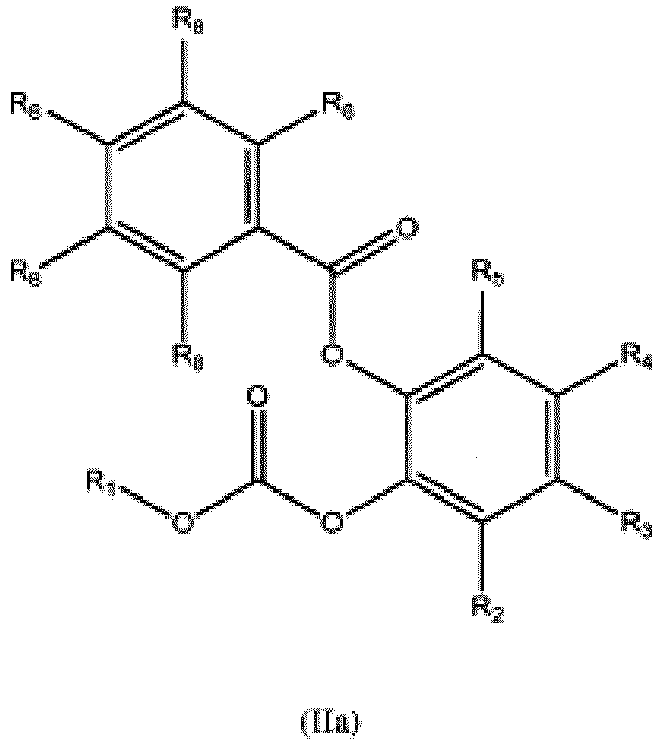
- both the indexes a and c are 1 and the groups R 2 and R 4 are fused together to form a phenyl ring which can be substituted according to formula IIa below: in which R 1 and R 8 , have the same meaning described above, R 2 -R 5 groups are selected from hydrogen or C 1 -C 10 hydrocarbon groups, more preferably from hydrogen and C 1 -C 10 alkyl groups.
- R 2 to R 5 groups are hydrogen and the other two are selected from C 1 -C 10 linear or branched alkyl groups. Particularly preferred positions of the ring where substitution of hydrogen atoms takes place are positions 3 and 5.
- Preferred alkyl groups are methyl, ethyl, n-propyl, isopropyl, n-butyl, isobutyl, tert-butyl, 2-ethyl-hexyl. Among them methyl and tert-butyl are the most preferred.
- both the indexes a and c are 2 and the groups R 2 and R 4 are, independently, selected from hydrogen and C 1 -C 10 alkyl groups, preferably from C 1 -C 5 alkyl groups and more preferably from linear C 1 -C 5 alkyl groups. In an especially preferred embodiment, both R 2 and R 4 are methyl.
- n 1
- R 1 and R 8 have the same meaning specified above
- b 0
- the groups R 2 and R 4 are fused together to form a naphtyl radical possibly substituted with halogen and/or C 1 -C 10 hydrocarbon groups optionally containing heteroatoms selected from halogen, P, S, N and Si.
- b is 1 and the radicals R 2 and R 3 or R 3 and R 4 are fused together to form a phenyl ring possibly substituted.
- Preferred substitution is with C 1 -C 10 linear or branched alkyl groups.
- Particularly preferred positions of the ring where substitution of hydrogen atoms take place are positions 3 and 5. Substitution in those positions with methyl and tert-butyl respectively is especially preferred.
- R 1 groups are selected from C 1 -C 15 hydrocarbon groups
- R 2 to R 7 groups are hydrogen or C 1 -C 15 hydrocarbon groups, optionally containing an heteroatom selected from halogen, P, S, N and Si, two or more of said groups which can be linked together to form a saturated or unsaturated cycle
- R 8 groups are selected from hydrogen, halogen and C 1 -C 15 hydrocarbon groups, optionally containing an heteroatom selected from halogen, P, S, N and Si.
- R 4 and R 5 independently, are hydrogen or C 1 -C 5 alkyl groups. More preferably, they are both hydrogen.
- R 1 to R 8 have the same meaning described above.
- R 3 -R 6 groups are selected from hydrogen or C 1 -C 10 hydrocarbon groups, more preferably from hydrogen and C 1 -C 10 alkyl groups. In a very preferred embodiment R 3 to R 6 are hydrogen.
- the new donors described in the catalyst of the present invention may exist in spatial configurations that are more preferred than others with respect to (a) capability of being fixed in the catalyst component and (b) catalyst performances.
- the catalyst components of the invention comprise, in addition to the above electron donors, Ti, Mg and halogen.
- the catalyst components comprise a titanium compound, having at least a Ti-halogen bond and the above mentioned electron donor compounds supported on a Mg halide.
- the magnesium halide is preferably MgCl 2 in active form which is widely known from the patent literature as a support for Ziegler-Natta catalysts.
- Patents USP 4,298,718 and USP 4,495,338 were the first to describe the use of these compounds in Ziegler-Natta catalysis.
- magnesium dihalides in active form used as support or co-support in components of catalysts for the polymerization of olefins are characterized by X-ray spectra in which the most intense diffraction line that appears in the spectrum of the non-active halide is diminished in intensity and is replaced by a halo whose maximum intensity is displaced towards lower angles relative to that of the more intense line.
- the preferred titanium compounds used in the catalyst component of the present invention are TiCl 4 and TiCl 3 ; furthermore, also Ti-haloalcoholates of formula Ti(OR) q-y X y can be used, where q is the valence of titanium, y is a number between 1 and q-1, X is halogen and R is a hydrocarbon radical having from 1 to 10 carbon atoms.
- the preparation of the solid catalyst component can be carried out according to several methods.
- the magnesium dichloride in an anhydrous state, the titanium compound and the electron donor compounds are milled together under conditions in which activation of the magnesium dichloride occurs.
- the so obtained product can be treated one or more times with an excess of TiCl 4 at a temperature between 80 and 135°C. This treatment is followed by washings with hydrocarbon solvents until chloride ions disappeared.
- the product obtained by co-milling the magnesium chloride in an anhydrous state, the titanium compound and the electron donor compounds are treated with halogenated hydrocarbons such as 1,2-dichloroethane, chlorobenzene, dichloromethane.
- the treatment is carried out for a time between 1 and 4 hours and at temperature of from 40°C to the boiling point of the halogenated hydrocarbon.
- Another method comprises the reaction between magnesium alcoholates or chloroalcoholates (in particular chloroalcoholates prepared according to USP 4,220,554 ) and an excess of TiCl 4 in the presence of the electron donor compounds at a temperature of 80 to 120°C.
- the solid catalyst component can be prepared by reacting a titanium compound of formula Ti(OR) q-y X y , where q is the valence of titanium and y is a number between 1 and q, preferably TiCl 4 , with a magnesium chloride deriving from an adduct of formula MgCl 2 ⁇ pROH, where p is a number between 0.1 and 6, preferably from 2 to 3.5, and R is a hydrocarbon radical having 1-18 carbon atoms.
- the adduct can be suitably prepared in spherical form by mixing alcohol and magnesium chloride in the presence of an inert hydrocarbon immiscible with the adduct, operating under stirring conditions at the melting temperature of the adduct (100-130°C). Then, the emulsion is quickly quenched, thereby causing the solidification of the adduct in form of spherical particles. Examples of spherical adducts prepared according to this procedure are described in USP 4,399,054 and USP 4,469,648 .
- the so obtained adduct can be directly reacted with Ti compound or it can be previously subjected to thermal controlled dealcoholation (80-130°C) so as to obtain an adduct in which the number of moles of alcohol is generally lower than 3, preferably between 0.1 and 2.5.
- the reaction with the Ti compound can be carried out by suspending the adduct (dealcoholated or as such) in cold TiCl 4 (generally 0°C); the mixture is heated up to 80-130°C and kept at this temperature for 0.5-2 hours.
- the treatment with TiCl 4 can be carried out one or more times.
- the electron donor compounds can be added in the desired ratios during the treatment with TiCl 4 .
- the preparation of catalyst components in spherical form are described for example in European Patent Applications EP-A-395083 , EP-A-553805 , EP-A-553806 , EPA601525 and WO98/44009 .
- the solid catalyst components obtained according to the above method show a surface area (by B.E.T. method) generally between 20 and 500 m 2 /g and preferably between 50 and 400 m 2 /g, and a total porosity (by B.E.T. method) higher than 0.2 cm 3 /g preferably between 0.2 and 0.6 cm 3 /g.
- the porosity (Hg method) due to pores with radius up to 10.000 ⁇ generally ranges from 0.3 to 1.5 cm 3 /g, preferably from 0.45 to 1 cm 3 /g.
- the solid catalyst component has an average particle size ranging from 5 to 120 ⁇ m and more preferably from 10 to 100 ⁇ m.
- the desired electron donor compounds can be added as such or, in an alternative way, can be obtained in situ by using an appropriate precursor capable of being transformed in the desired electron donor compound by means, for example, of known chemical reactions such as etherification, alkylation, esterification, transesterification.
- the final amount of the electron donor compound of formula (I) is such that its molar ratio with respect to the TiCl 4 is from 0.01 to 1, preferably from 0.05 to 0.5.
- the solid catalyst components according to the present invention are converted into catalysts for the polymerization of olefins by reacting them with organoaluminum compounds according to known methods.
- Suitable external electron-donor compounds include silicon compounds, ethers, esters, amines, heterocyclic compounds and particularly 2,2,6,6-tetramethylpiperidine and ketones.
- Another class of preferred external donor compounds is that of silicon compounds of formula (R 6 ) a (R 7 ) b Si(OR 8 ) c , where a and b are integers from 0 to 2, c is an integer from 1 to 4 and the sum (a+b+c) is 4; R 6 , R 7 , and R 8 , are alkyl, cycloalkyl or aryl radicals with 1-18 carbon atoms optionally containing heteroatoms.
- Examples of such preferred silicon compounds are methylcyclohexyldimethoxysilane (C donor), diphenyldimethoxysilane, methyl-t-butyldimethoxysilane, dicyclopentyldimethoxysilane (D donor), (2-ethylpiperidinyl)t-butyldimethoxysilane, (2-ethylpiperidinyl)thexyldimethoxysilane, (3,3,3-trifluoro-n-propyl)(2-ethylpiperidinyl)dimethoxysilane, methyl(3,3,3-trifluoro-n-propyl)dimethoxysilane.
- C donor methylcyclohexyldimethoxysilane
- D donor dicyclopentyldimethoxysilane
- D donor dicyclopentyldimethoxysilane
- the silicon compounds in which a is 0, c is 3, R 7 is a branched alkyl or cycloalkyl group, optionally containing heteroatoms, and R 8 is methyl are also preferred.
- Examples of such preferred silicon compounds are cyclohexyltrimethoxysilane, t-butyltrimethoxysilane and thexyltrimethoxysilane.
- the electron donor compound (iii) is used in such an amount to give a molar ratio between the organoaluminum compound and said electron donor compound (iii) of from 0.1 to 500, preferably from 1 to 300 and more preferably from 3 to 100.
- the polymerization process can be carried out according to known techniques for example slurry polymerization using as diluent an inert hydrocarbon solvent, or bulk polymerization using the liquid monomer (for example propylene) as a reaction medium. Moreover, it is possible to carry out the polymerization process in gas-phase operating in one or more fluidized or mechanically agitated bed reactors.
- the polymerization is generally carried out at temperature of from 20 to 120°C, preferably of from 40 to 80°C.
- the operating pressure is generally between 0.5 and 5 MPa, preferably between 1 and 4 MPa.
- the operating pressure is generally between 1 and 8 MPa, preferably between 1.5 and 5 MPa.
- the sample was prepared by analytically weighting, in a "fluxy” platinum crucible", 0.1 ⁇ 0.3 grams of catalyst and 3 grams of lithium metaborate/tetraborate 1/1 mixture.
- the crucible is placed on a weak Bunsen flame for the burning step and then after addition of some drops of KI solution inserted in a special apparatus "Claisse Fluxy" for the complete burning.
- the residue is collected with a 5% v/v HNO 3 solution and then the titanium was analyzed via ICP at a wavelength of 368.52 nm.
- the determination of the content of internal donor in the solid catalytic compound was done through gas chromatography.
- the solid component was dissolved in water.
- the solution was extracted with ethyl acetate, an internal standard was added, and a sample of the organic phase was analyzed in a gas chromatograph, to determine the amount of donor present at the starting catalyst compound.
- the melt flow rate MIL of the polymer was determined according to ISO 1133 (230°C, 2.16 Kg)
- microspheroidal MgCl 2 ⁇ 2.8C 2 H 5 OH was prepared according to the method described in Example 2 of WO98/44009 , but operating on larger scale.
- the support adduct had a P50 of about 25 ⁇ m, and an ethanol content of about 56%wt.
- the mixture was then heated at 120°C and kept at this temperature for 1 hour. Stirring was stopped again, the solid was allowed to settle and the supernatant liquid was siphoned off. The solid was washed with anhydrous hexane six times (6 x 100 ml) in temperature gradient down to 60°C and one time (100 ml) at room temperature. The obtained solid was then dried under vacuum and analyzed.
- D donor dicyclopentyldimethoxysilane
- the non-reacted propylene was removed; the polymer was recovered and dried at 70°C under vacuum for three hours. Then the polymer was weighed and fractionated with o-xylene to determine the amount of the xylene insoluble (X.I.) fraction.
- Second step 3.6 g of ethyl (4-hydroxypentan-2-yl) carbonate (20.4 mmol) are charged in a round bottom flask, under nitrogen, with 4 g of 4-n-propylbenzoyl chloride (21.9 mmol), 1.8 mL of pyridine (22.8 mmol) and 40 mL of CH 2 Cl 2 .
- the mixture is heated up to 40°C until GC shows that the reaction is completed then quenched with acidic water.
- the organic layer is washed with water until neutral pH, then is anhydrified over Na 2 SO 4 and the solvent is distilled off to afford 5.3 g of 4-((ethoxycarbonyl)oxy)pentan-2-yl 4-propylbenzoate.
- Second step ethyl 3-oxobutyl carbonate (16.7 g, 0.104 mol) and EtOH (150 mL) were cooled to 0°C.
- NaBH 4 1.1 g, 0.029 mol
- the reaction was poured into solution of aqueous HCl (25 mL) in water (500 mL). The mixture was extracted by CH 2 Cl 2 . The organic layer was washed with water, dried over MgSO 4 , evaporated to afford 11.8 g of ethyl 3-hydroxybutyl carbonate which was used in the next step without further purification.
- Second step 5.5 g of a 1:1 mixture of 4-(tert-butyl)-2-hydroxyphenyl benzoate and 5-(tert-butyl)-2-hydroxyphenyl benzoate (20.3 mmol) are charged in a flask with THF (30 mL), 2.4 g of pyridine (30.5 mmol) and 3.3 g of ethyl chloroformate (30.5 mmol). The reaction mixture is heated to 50°C until GC shows that the reaction is completed. The mixture is quenched with aqueous HCl and diluted with diethyl ether.
- Second step 2 g of a 1:1 mixture of 4-(tert-butyl)-2-hydroxy-6-methylphenyl benzoate and 5-(tert-butyl)-2-hydroxy-3-methylphenyl benzoate (7 mmol) are charged in 10 mL ofTHF under nitrogen, in a round bottom flask and 0.2 g of NaH (7.8 mmol) are added portionwise. Then 1 mL of ethyl chloroformate (10.4 mmol) is added slowly and the mixture brought to reflux until GC shows that the reaction is completed. The mixture is quenched with aqueous HCl and diluted with diethyl ether.
- the so prepared donors are also listed in Table 1.
- the solid catalyst components prepared accortding to the general procedure were analyzed for their composition, and were tested in polymerization of propylene, using the method described above.
- the titanium and internal donor content of the solid catalyst components, and their performance in polymerization are also shown in Table 1.
Landscapes
- Chemical & Material Sciences (AREA)
- Organic Chemistry (AREA)
- Health & Medical Sciences (AREA)
- Chemical Kinetics & Catalysis (AREA)
- Medicinal Chemistry (AREA)
- Polymers & Plastics (AREA)
- Engineering & Computer Science (AREA)
- Materials Engineering (AREA)
- Emergency Medicine (AREA)
- Transition And Organic Metals Composition Catalysts For Addition Polymerization (AREA)
- Organic Low-Molecular-Weight Compounds And Preparation Thereof (AREA)
Claims (15)
- Katalysatorkomponente für die Polymerisation von Olefinen, umfassend Mg, Ti und eine Elektronendonomerbindung der folgenden Formel (I)
- Katalysatorkomponente nach Anspruch 1, wobei die R1-Gruppen unter C1-C10-Alkylgruppen ausgewählt sind und mindestens eines von R8 von Wasserstoff verschieden und unter C1-C15-Kohlenwasserstoffgruppen oder Halogen ausgewählt ist.
- Katalysatorkomponente nach Anspruch 2, wobei R8 unter C1-C10-Alkylgruppen oder Halogenen ausgewählt ist und sich in Meta- oder Para-Position befindet.
- Katalysatorkomponente nach Anspruch 1, wobei L eine zweiwertige Kohlenwasserstoffgruppe ist, die eine Spacer-Kette zwischen den beiden damit verknüpften Sauerstoffen von 2 bis 6 Kohlenstoffatomen aufweist und wobei die Kohlenstoffatome unabhängig durch Heteroatome ersetzt werden können ausgewählt unter Halogen, O, P, S, N und Si und das Wasserstoffatom der zweiwertigen Kohlenwasserstoffgruppe unabhängig durch Halogen oder C1-C15-Kohlenwasserstoffgruppen ersetzt werden kann, die wahlweise ein Heteroatom enthalten ausgewählt unter Halogen, P, S, N und Si, die miteinander und/oder mit den Kohlenstoffatomen der zweiwertigen Gruppe verknüpft werden können, um gesättigte oder ungesättigte mono- oder polycyclische Ringe zu bilden.
- Katalysatorkomponente nach Anspruch 4, wobei L eine zweiwertige brückenbildende Gruppe ist ausgewählt unter C1-C20-Alkyliden-, C3-C20-Cycloalkyliden-, C6-C20-Aryliden-, C7-C20-Alkylaryliden- oder C7-C20-Arylalkylidenresten, die wahlweise Heteroatome enthalten ausgewählt unter Halogen, O, P, S, N und Si.
- Katalysatorkomponente nach einem der vorhergehenden Ansprüche, wobei zu dem Donor die folgende Formel gehört (II)

- Katalysatorkomponente nach Anspruch 6, wobei der Donor folgende Formel aufweist (IIa)
- Katalysatorkomponente nach Anspruch 7, wobei zwei der R2- bis R5-Gruppen Wasserstoff sind und die anderen beiden unter linearen oder verzweigten C l-C 10- Alkylgruppen ausgewählt sind.
- Katalysatorkomponente nach Anspruch 8, wobei die Positionen des Rings, wo die Substitution von Wasserstoffatomen erfolgt, die Positionen 3 und 5 sind.
- Katalysatorkomponente nach Anspruch 6, wobei n 1 beträgt, die Indizes a, b, und c ebenfalls 1 betragen und der Donor zur folgenden Formel gehört (III)

- Katalysatorkomponente nach Anspruch 10, wobei R4 und R5 unabhängig Wasserstoff oder C1-C5-Alkylgruppen sind.
- Katalysatorkomponente nach Anspruch 10, wobei der Donor die folgende Formel (IV) aufweist

- Katalysatorkomponente nach einem der vorhergehenden Ansprüche, wobei mehr als 50% der Gesamtmenge an Donor eine syn-Konfiguration aufweisen.
- Katalysator für die (Co)polymerisation von Olefinen CH2=CHR, wobei R Wasserstoff oder ein Hydrocarbylrest mit 1-12 Kohlenstoffatomen ist, umfassend das Produkt, das durch Kontaktieren erhalten wird von:a. der festen Katalysatorkomponente nach einem der vorhergehenden Ansprüche undb. einer Alkylaluminiumverbindung und wahlweisec. einer externen Donomerbindung.
- Verfahren für die Polymerisation von Olefinen, das in Gegenwart eines Katalysators nach Anspruch 14 ausgeführt wird.
Priority Applications (1)
| Application Number | Priority Date | Filing Date | Title |
|---|---|---|---|
| EP13707189.0A EP2822977B1 (de) | 2012-03-07 | 2013-03-05 | Katalysatorkomponenten zur olefinpolymerisation |
Applications Claiming Priority (4)
| Application Number | Priority Date | Filing Date | Title |
|---|---|---|---|
| US201261607635P | 2012-03-07 | 2012-03-07 | |
| EP12158334.8A EP2636687A1 (de) | 2012-03-07 | 2012-03-07 | Katalysatorkomponenten zur Olefinpolymerisation |
| PCT/EP2013/054399 WO2013131912A2 (en) | 2012-03-07 | 2013-03-05 | Catalyst components for the polymerization of olefins |
| EP13707189.0A EP2822977B1 (de) | 2012-03-07 | 2013-03-05 | Katalysatorkomponenten zur olefinpolymerisation |
Publications (2)
| Publication Number | Publication Date |
|---|---|
| EP2822977A2 EP2822977A2 (de) | 2015-01-14 |
| EP2822977B1 true EP2822977B1 (de) | 2016-04-27 |
Family
ID=45808288
Family Applications (2)
| Application Number | Title | Priority Date | Filing Date |
|---|---|---|---|
| EP12158334.8A Withdrawn EP2636687A1 (de) | 2012-03-07 | 2012-03-07 | Katalysatorkomponenten zur Olefinpolymerisation |
| EP13707189.0A Active EP2822977B1 (de) | 2012-03-07 | 2013-03-05 | Katalysatorkomponenten zur olefinpolymerisation |
Family Applications Before (1)
| Application Number | Title | Priority Date | Filing Date |
|---|---|---|---|
| EP12158334.8A Withdrawn EP2636687A1 (de) | 2012-03-07 | 2012-03-07 | Katalysatorkomponenten zur Olefinpolymerisation |
Country Status (6)
| Country | Link |
|---|---|
| US (1) | US9487599B2 (de) |
| EP (2) | EP2636687A1 (de) |
| CN (1) | CN104540855B (de) |
| BR (1) | BR112014021451B1 (de) |
| ES (1) | ES2577379T3 (de) |
| WO (1) | WO2013131912A2 (de) |
Families Citing this family (7)
| Publication number | Priority date | Publication date | Assignee | Title |
|---|---|---|---|---|
| EP2872538B1 (de) * | 2012-07-14 | 2020-03-11 | Indian Oil Corporation Ltd | Ziegler-natta-katalysatorsysteme mit einem 1,2-phenylenedioat als interner donator und verfahren zu herstellung davon |
| TWI639626B (zh) * | 2013-09-30 | 2018-11-01 | 中國石油化工科技開發有限公司 | Catalyst composition for olefin polymerization and application thereof |
| CN106471018B (zh) * | 2014-06-02 | 2019-09-17 | Sabic环球技术有限责任公司 | 用于烯烃的聚合的原催化剂 |
| WO2015185495A1 (en) * | 2014-06-02 | 2015-12-10 | Sabic Global Technologies B.V. | Procatalyst for polymerization of olefins |
| WO2016050662A1 (en) * | 2014-10-03 | 2016-04-07 | Basell Poliolefine Italia S.R.L. | Catalyst components for the polymerization of olefins |
| EP3268397B1 (de) * | 2015-03-10 | 2019-04-17 | Basell Poliolefine Italia S.r.l. | Katalysatorkomponenten zur olefinpolymerisierung |
| MY207750A (en) * | 2018-05-21 | 2025-03-17 | China Petroleum & Chem Corp | Catalyst component for olefin polymerization, preparation method thereof, and catalyst including same |
Family Cites Families (13)
| Publication number | Priority date | Publication date | Assignee | Title |
|---|---|---|---|---|
| NL162661B (nl) | 1968-11-21 | 1980-01-15 | Montedison Spa | Werkwijze om een katalysator te bereiden voor de poly- merisatie van alkenen-1. |
| YU35844B (en) | 1968-11-25 | 1981-08-31 | Montedison Spa | Process for obtaining catalysts for the polymerization of olefines |
| GB1603724A (en) | 1977-05-25 | 1981-11-25 | Montedison Spa | Components and catalysts for the polymerisation of alpha-olefins |
| IT1096661B (it) | 1978-06-13 | 1985-08-26 | Montedison Spa | Procedimento per la preparazione di prodotti in forma sferoidale solidi a temperatura ambiente |
| IT1098272B (it) | 1978-08-22 | 1985-09-07 | Montedison Spa | Componenti,di catalizzatori e catalizzatori per la polimerizzazione delle alfa-olefine |
| IT1230134B (it) | 1989-04-28 | 1991-10-14 | Himont Inc | Componenti e catalizzatori per la polimerizzazione di olefine. |
| IT1262934B (it) | 1992-01-31 | 1996-07-22 | Montecatini Tecnologie Srl | Componenti e catalizzatori per la polimerizzazione di olefine |
| IT1262935B (it) | 1992-01-31 | 1996-07-22 | Montecatini Tecnologie Srl | Componenti e catalizzatori per la polimerizzazione di olefine |
| IT1256648B (it) | 1992-12-11 | 1995-12-12 | Montecatini Tecnologie Srl | Componenti e catalizzatori per la polimerizzazione delle olefine |
| AUPO591797A0 (en) | 1997-03-27 | 1997-04-24 | Commonwealth Scientific And Industrial Research Organisation | High avidity polyvalent and polyspecific reagents |
| IL127230A (en) | 1997-03-29 | 2004-07-25 | Montell Technology Company Bv | Magnesium dichloride-alcohol adducts, process for their preparation and catalyst components obtained therefrom |
| CN1169845C (zh) * | 2002-02-07 | 2004-10-06 | 中国石油化工股份有限公司 | 用于烯烃聚合的固体催化剂组分和含该催化剂组分的催化剂及其应用 |
| MX2012006368A (es) | 2009-12-02 | 2012-09-07 | Dow Global Technologies Llc | Compuesto de dicarbonato puenteados por tres y cuatro atomos como donadores internos en catalizadores para la fabricacion de polipropileno. |
-
2012
- 2012-03-07 EP EP12158334.8A patent/EP2636687A1/de not_active Withdrawn
-
2013
- 2013-03-05 US US14/383,838 patent/US9487599B2/en active Active
- 2013-03-05 CN CN201380010419.9A patent/CN104540855B/zh active Active
- 2013-03-05 WO PCT/EP2013/054399 patent/WO2013131912A2/en not_active Ceased
- 2013-03-05 EP EP13707189.0A patent/EP2822977B1/de active Active
- 2013-03-05 BR BR112014021451-4A patent/BR112014021451B1/pt not_active IP Right Cessation
- 2013-03-05 ES ES13707189.0T patent/ES2577379T3/es active Active
Also Published As
| Publication number | Publication date |
|---|---|
| EP2636687A1 (de) | 2013-09-11 |
| US9487599B2 (en) | 2016-11-08 |
| EP2822977A2 (de) | 2015-01-14 |
| US20150133289A1 (en) | 2015-05-14 |
| WO2013131912A2 (en) | 2013-09-12 |
| CN104540855A (zh) | 2015-04-22 |
| BR112014021451B1 (pt) | 2020-11-17 |
| ES2577379T3 (es) | 2016-07-14 |
| CN104540855B (zh) | 2016-08-31 |
| WO2013131912A3 (en) | 2013-12-05 |
Similar Documents
| Publication | Publication Date | Title |
|---|---|---|
| EP2900706B1 (de) | Katalysatorkomponenten für die polymerisation von olefinen | |
| US9487599B2 (en) | Catalyst components for the polymerization of olefins | |
| EP2997049B1 (de) | Katalysatorkomponente zur polymerisation von olefinen | |
| EP3298048B1 (de) | Katalysatorkomponenten zur olefinpolymerisierung | |
| EP3044239B9 (de) | Katalysatorkomponenten für die polymerisation von olefinen | |
| EP3268397B1 (de) | Katalysatorkomponenten zur olefinpolymerisierung | |
| US9714303B2 (en) | Catalyst components for the polymerization of olefins | |
| EP3268398B1 (de) | Katalysatorkomponenten zur olefinpolymerisierung | |
| EP2601223B1 (de) | Katalysatorkomponenten zur olefinpolymerisation | |
| EP2768873B1 (de) | Katalysatorkomponenten zur olefinpolymerisation | |
| EP2723780B1 (de) | Katalysatorkomponenten zur olefinpolymerisation | |
| EP3268396B1 (de) | Katalysatorkomponenten zur olefinpolymerisierung | |
| EP2852623B1 (de) | Katalysatorbestandteil zur olefinpolymeriation | |
| EP3122788B1 (de) | Katalysatorkomponenten zur olefinpolymerisation | |
| EP3894448A1 (de) | Katalysatorkomponenten zur polymerisierung von olefinen |
Legal Events
| Date | Code | Title | Description |
|---|---|---|---|
| PUAI | Public reference made under article 153(3) epc to a published international application that has entered the european phase |
Free format text: ORIGINAL CODE: 0009012 |
|
| 17P | Request for examination filed |
Effective date: 20140801 |
|
| AK | Designated contracting states |
Kind code of ref document: A2 Designated state(s): AL AT BE BG CH CY CZ DE DK EE ES FI FR GB GR HR HU IE IS IT LI LT LU LV MC MK MT NL NO PL PT RO RS SE SI SK SM TR |
|
| AX | Request for extension of the european patent |
Extension state: BA ME |
|
| DAX | Request for extension of the european patent (deleted) | ||
| GRAP | Despatch of communication of intention to grant a patent |
Free format text: ORIGINAL CODE: EPIDOSNIGR1 |
|
| INTG | Intention to grant announced |
Effective date: 20150730 |
|
| GRAS | Grant fee paid |
Free format text: ORIGINAL CODE: EPIDOSNIGR3 |
|
| GRAA | (expected) grant |
Free format text: ORIGINAL CODE: 0009210 |
|
| AK | Designated contracting states |
Kind code of ref document: B1 Designated state(s): AL AT BE BG CH CY CZ DE DK EE ES FI FR GB GR HR HU IE IS IT LI LT LU LV MC MK MT NL NO PL PT RO RS SE SI SK SM TR |
|
| REG | Reference to a national code |
Ref country code: GB Ref legal event code: FG4D |
|
| REG | Reference to a national code |
Ref country code: CH Ref legal event code: EP |
|
| REG | Reference to a national code |
Ref country code: AT Ref legal event code: REF Ref document number: 794726 Country of ref document: AT Kind code of ref document: T Effective date: 20160515 |
|
| REG | Reference to a national code |
Ref country code: IE Ref legal event code: FG4D |
|
| REG | Reference to a national code |
Ref country code: DE Ref legal event code: R096 Ref document number: 602013006997 Country of ref document: DE |
|
| REG | Reference to a national code |
Ref country code: ES Ref legal event code: FG2A Ref document number: 2577379 Country of ref document: ES Kind code of ref document: T3 Effective date: 20160714 |
|
| REG | Reference to a national code |
Ref country code: LT Ref legal event code: MG4D |
|
| REG | Reference to a national code |
Ref country code: NL Ref legal event code: MP Effective date: 20160427 |
|
| REG | Reference to a national code |
Ref country code: AT Ref legal event code: MK05 Ref document number: 794726 Country of ref document: AT Kind code of ref document: T Effective date: 20160427 |
|
| PG25 | Lapsed in a contracting state [announced via postgrant information from national office to epo] |
Ref country code: NL Free format text: LAPSE BECAUSE OF FAILURE TO SUBMIT A TRANSLATION OF THE DESCRIPTION OR TO PAY THE FEE WITHIN THE PRESCRIBED TIME-LIMIT Effective date: 20160427 |
|
| PG25 | Lapsed in a contracting state [announced via postgrant information from national office to epo] |
Ref country code: NO Free format text: LAPSE BECAUSE OF FAILURE TO SUBMIT A TRANSLATION OF THE DESCRIPTION OR TO PAY THE FEE WITHIN THE PRESCRIBED TIME-LIMIT Effective date: 20160727 Ref country code: PL Free format text: LAPSE BECAUSE OF FAILURE TO SUBMIT A TRANSLATION OF THE DESCRIPTION OR TO PAY THE FEE WITHIN THE PRESCRIBED TIME-LIMIT Effective date: 20160427 Ref country code: LT Free format text: LAPSE BECAUSE OF FAILURE TO SUBMIT A TRANSLATION OF THE DESCRIPTION OR TO PAY THE FEE WITHIN THE PRESCRIBED TIME-LIMIT Effective date: 20160427 |
|
| PG25 | Lapsed in a contracting state [announced via postgrant information from national office to epo] |
Ref country code: RS Free format text: LAPSE BECAUSE OF FAILURE TO SUBMIT A TRANSLATION OF THE DESCRIPTION OR TO PAY THE FEE WITHIN THE PRESCRIBED TIME-LIMIT Effective date: 20160427 Ref country code: HR Free format text: LAPSE BECAUSE OF FAILURE TO SUBMIT A TRANSLATION OF THE DESCRIPTION OR TO PAY THE FEE WITHIN THE PRESCRIBED TIME-LIMIT Effective date: 20160427 Ref country code: GR Free format text: LAPSE BECAUSE OF FAILURE TO SUBMIT A TRANSLATION OF THE DESCRIPTION OR TO PAY THE FEE WITHIN THE PRESCRIBED TIME-LIMIT Effective date: 20160728 Ref country code: PT Free format text: LAPSE BECAUSE OF FAILURE TO SUBMIT A TRANSLATION OF THE DESCRIPTION OR TO PAY THE FEE WITHIN THE PRESCRIBED TIME-LIMIT Effective date: 20160829 Ref country code: LV Free format text: LAPSE BECAUSE OF FAILURE TO SUBMIT A TRANSLATION OF THE DESCRIPTION OR TO PAY THE FEE WITHIN THE PRESCRIBED TIME-LIMIT Effective date: 20160427 Ref country code: AT Free format text: LAPSE BECAUSE OF FAILURE TO SUBMIT A TRANSLATION OF THE DESCRIPTION OR TO PAY THE FEE WITHIN THE PRESCRIBED TIME-LIMIT Effective date: 20160427 Ref country code: SE Free format text: LAPSE BECAUSE OF FAILURE TO SUBMIT A TRANSLATION OF THE DESCRIPTION OR TO PAY THE FEE WITHIN THE PRESCRIBED TIME-LIMIT Effective date: 20160427 |
|
| PG25 | Lapsed in a contracting state [announced via postgrant information from national office to epo] |
Ref country code: BE Free format text: LAPSE BECAUSE OF FAILURE TO SUBMIT A TRANSLATION OF THE DESCRIPTION OR TO PAY THE FEE WITHIN THE PRESCRIBED TIME-LIMIT Effective date: 20160427 Ref country code: IT Free format text: LAPSE BECAUSE OF FAILURE TO SUBMIT A TRANSLATION OF THE DESCRIPTION OR TO PAY THE FEE WITHIN THE PRESCRIBED TIME-LIMIT Effective date: 20160427 |
|
| REG | Reference to a national code |
Ref country code: DE Ref legal event code: R097 Ref document number: 602013006997 Country of ref document: DE |
|
| PG25 | Lapsed in a contracting state [announced via postgrant information from national office to epo] |
Ref country code: DK Free format text: LAPSE BECAUSE OF FAILURE TO SUBMIT A TRANSLATION OF THE DESCRIPTION OR TO PAY THE FEE WITHIN THE PRESCRIBED TIME-LIMIT Effective date: 20160427 Ref country code: RO Free format text: LAPSE BECAUSE OF FAILURE TO SUBMIT A TRANSLATION OF THE DESCRIPTION OR TO PAY THE FEE WITHIN THE PRESCRIBED TIME-LIMIT Effective date: 20160427 Ref country code: SK Free format text: LAPSE BECAUSE OF FAILURE TO SUBMIT A TRANSLATION OF THE DESCRIPTION OR TO PAY THE FEE WITHIN THE PRESCRIBED TIME-LIMIT Effective date: 20160427 Ref country code: CZ Free format text: LAPSE BECAUSE OF FAILURE TO SUBMIT A TRANSLATION OF THE DESCRIPTION OR TO PAY THE FEE WITHIN THE PRESCRIBED TIME-LIMIT Effective date: 20160427 Ref country code: EE Free format text: LAPSE BECAUSE OF FAILURE TO SUBMIT A TRANSLATION OF THE DESCRIPTION OR TO PAY THE FEE WITHIN THE PRESCRIBED TIME-LIMIT Effective date: 20160427 |
|
| PG25 | Lapsed in a contracting state [announced via postgrant information from national office to epo] |
Ref country code: SM Free format text: LAPSE BECAUSE OF FAILURE TO SUBMIT A TRANSLATION OF THE DESCRIPTION OR TO PAY THE FEE WITHIN THE PRESCRIBED TIME-LIMIT Effective date: 20160427 |
|
| PLBE | No opposition filed within time limit |
Free format text: ORIGINAL CODE: 0009261 |
|
| STAA | Information on the status of an ep patent application or granted ep patent |
Free format text: STATUS: NO OPPOSITION FILED WITHIN TIME LIMIT |
|
| 26N | No opposition filed |
Effective date: 20170130 |
|
| PG25 | Lapsed in a contracting state [announced via postgrant information from national office to epo] |
Ref country code: SI Free format text: LAPSE BECAUSE OF FAILURE TO SUBMIT A TRANSLATION OF THE DESCRIPTION OR TO PAY THE FEE WITHIN THE PRESCRIBED TIME-LIMIT Effective date: 20160427 |
|
| REG | Reference to a national code |
Ref country code: CH Ref legal event code: PL |
|
| GBPC | Gb: european patent ceased through non-payment of renewal fee |
Effective date: 20170305 |
|
| PG25 | Lapsed in a contracting state [announced via postgrant information from national office to epo] |
Ref country code: MC Free format text: LAPSE BECAUSE OF FAILURE TO SUBMIT A TRANSLATION OF THE DESCRIPTION OR TO PAY THE FEE WITHIN THE PRESCRIBED TIME-LIMIT Effective date: 20160427 |
|
| REG | Reference to a national code |
Ref country code: IE Ref legal event code: MM4A |
|
| REG | Reference to a national code |
Ref country code: FR Ref legal event code: ST Effective date: 20171130 |
|
| PG25 | Lapsed in a contracting state [announced via postgrant information from national office to epo] |
Ref country code: LU Free format text: LAPSE BECAUSE OF NON-PAYMENT OF DUE FEES Effective date: 20170305 Ref country code: FR Free format text: LAPSE BECAUSE OF NON-PAYMENT OF DUE FEES Effective date: 20170331 |
|
| PG25 | Lapsed in a contracting state [announced via postgrant information from national office to epo] |
Ref country code: GB Free format text: LAPSE BECAUSE OF NON-PAYMENT OF DUE FEES Effective date: 20170305 Ref country code: CH Free format text: LAPSE BECAUSE OF NON-PAYMENT OF DUE FEES Effective date: 20170331 Ref country code: IE Free format text: LAPSE BECAUSE OF NON-PAYMENT OF DUE FEES Effective date: 20170305 Ref country code: LI Free format text: LAPSE BECAUSE OF NON-PAYMENT OF DUE FEES Effective date: 20170331 |
|
| PG25 | Lapsed in a contracting state [announced via postgrant information from national office to epo] |
Ref country code: MT Free format text: LAPSE BECAUSE OF NON-PAYMENT OF DUE FEES Effective date: 20170305 |
|
| PG25 | Lapsed in a contracting state [announced via postgrant information from national office to epo] |
Ref country code: AL Free format text: LAPSE BECAUSE OF FAILURE TO SUBMIT A TRANSLATION OF THE DESCRIPTION OR TO PAY THE FEE WITHIN THE PRESCRIBED TIME-LIMIT Effective date: 20160427 |
|
| PG25 | Lapsed in a contracting state [announced via postgrant information from national office to epo] |
Ref country code: HU Free format text: LAPSE BECAUSE OF FAILURE TO SUBMIT A TRANSLATION OF THE DESCRIPTION OR TO PAY THE FEE WITHIN THE PRESCRIBED TIME-LIMIT; INVALID AB INITIO Effective date: 20130305 |
|
| PG25 | Lapsed in a contracting state [announced via postgrant information from national office to epo] |
Ref country code: BG Free format text: LAPSE BECAUSE OF FAILURE TO SUBMIT A TRANSLATION OF THE DESCRIPTION OR TO PAY THE FEE WITHIN THE PRESCRIBED TIME-LIMIT Effective date: 20160427 |
|
| PG25 | Lapsed in a contracting state [announced via postgrant information from national office to epo] |
Ref country code: CY Free format text: LAPSE BECAUSE OF FAILURE TO SUBMIT A TRANSLATION OF THE DESCRIPTION OR TO PAY THE FEE WITHIN THE PRESCRIBED TIME-LIMIT Effective date: 20160427 |
|
| PG25 | Lapsed in a contracting state [announced via postgrant information from national office to epo] |
Ref country code: MK Free format text: LAPSE BECAUSE OF FAILURE TO SUBMIT A TRANSLATION OF THE DESCRIPTION OR TO PAY THE FEE WITHIN THE PRESCRIBED TIME-LIMIT Effective date: 20160427 |
|
| PG25 | Lapsed in a contracting state [announced via postgrant information from national office to epo] |
Ref country code: TR Free format text: LAPSE BECAUSE OF FAILURE TO SUBMIT A TRANSLATION OF THE DESCRIPTION OR TO PAY THE FEE WITHIN THE PRESCRIBED TIME-LIMIT Effective date: 20160427 |
|
| PG25 | Lapsed in a contracting state [announced via postgrant information from national office to epo] |
Ref country code: IS Free format text: LAPSE BECAUSE OF FAILURE TO SUBMIT A TRANSLATION OF THE DESCRIPTION OR TO PAY THE FEE WITHIN THE PRESCRIBED TIME-LIMIT Effective date: 20160827 |
|
| PGFP | Annual fee paid to national office [announced via postgrant information from national office to epo] |
Ref country code: FI Payment date: 20220224 Year of fee payment: 10 |
|
| P01 | Opt-out of the competence of the unified patent court (upc) registered |
Effective date: 20230414 |
|
| PG25 | Lapsed in a contracting state [announced via postgrant information from national office to epo] |
Ref country code: FI Free format text: LAPSE BECAUSE OF NON-PAYMENT OF DUE FEES Effective date: 20230305 |
|
| PGFP | Annual fee paid to national office [announced via postgrant information from national office to epo] |
Ref country code: ES Payment date: 20250409 Year of fee payment: 13 |
|
| PGFP | Annual fee paid to national office [announced via postgrant information from national office to epo] |
Ref country code: DE Payment date: 20260213 Year of fee payment: 14 |