EP2824086A2 - Hydrothermal gehärtetes Poren- oder Schaumbetonmaterial sowie Verfahren zu dessen Herstellung - Google Patents
Hydrothermal gehärtetes Poren- oder Schaumbetonmaterial sowie Verfahren zu dessen Herstellung Download PDFInfo
- Publication number
- EP2824086A2 EP2824086A2 EP14169131.1A EP14169131A EP2824086A2 EP 2824086 A2 EP2824086 A2 EP 2824086A2 EP 14169131 A EP14169131 A EP 14169131A EP 2824086 A2 EP2824086 A2 EP 2824086A2
- Authority
- EP
- European Patent Office
- Prior art keywords
- pore
- precipitated calcium
- foam concrete
- carbonate
- concrete material
- Prior art date
- Legal status (The legal status is an assumption and is not a legal conclusion. Google has not performed a legal analysis and makes no representation as to the accuracy of the status listed.)
- Granted
Links
Images

Classifications
-
- C—CHEMISTRY; METALLURGY
- C04—CEMENTS; CONCRETE; ARTIFICIAL STONE; CERAMICS; REFRACTORIES
- C04B—LIME, MAGNESIA; SLAG; CEMENTS; COMPOSITIONS THEREOF, e.g. MORTARS, CONCRETE OR LIKE BUILDING MATERIALS; ARTIFICIAL STONE; CERAMICS; REFRACTORIES; TREATMENT OF NATURAL STONE
- C04B28/00—Compositions of mortars, concrete or artificial stone, containing inorganic binders or the reaction product of an inorganic and an organic binder, e.g. polycarboxylate cements
- C04B28/18—Compositions of mortars, concrete or artificial stone, containing inorganic binders or the reaction product of an inorganic and an organic binder, e.g. polycarboxylate cements containing mixtures of the silica-lime type
-
- C—CHEMISTRY; METALLURGY
- C04—CEMENTS; CONCRETE; ARTIFICIAL STONE; CERAMICS; REFRACTORIES
- C04B—LIME, MAGNESIA; SLAG; CEMENTS; COMPOSITIONS THEREOF, e.g. MORTARS, CONCRETE OR LIKE BUILDING MATERIALS; ARTIFICIAL STONE; CERAMICS; REFRACTORIES; TREATMENT OF NATURAL STONE
- C04B2201/00—Mortars, concrete or artificial stone characterised by specific physical values
- C04B2201/30—Mortars, concrete or artificial stone characterised by specific physical values for heat transfer properties such as thermal insulation values, e.g. R-values
- C04B2201/32—Mortars, concrete or artificial stone characterised by specific physical values for heat transfer properties such as thermal insulation values, e.g. R-values for the thermal conductivity, e.g. K-factors
-
- Y—GENERAL TAGGING OF NEW TECHNOLOGICAL DEVELOPMENTS; GENERAL TAGGING OF CROSS-SECTIONAL TECHNOLOGIES SPANNING OVER SEVERAL SECTIONS OF THE IPC; TECHNICAL SUBJECTS COVERED BY FORMER USPC CROSS-REFERENCE ART COLLECTIONS [XRACs] AND DIGESTS
- Y02—TECHNOLOGIES OR APPLICATIONS FOR MITIGATION OR ADAPTATION AGAINST CLIMATE CHANGE
- Y02P—CLIMATE CHANGE MITIGATION TECHNOLOGIES IN THE PRODUCTION OR PROCESSING OF GOODS
- Y02P40/00—Technologies relating to the processing of minerals
- Y02P40/60—Production of ceramic materials or ceramic elements, e.g. substitution of clay or shale by alternative raw materials, e.g. ashes
Definitions
- the present invention relates to hydrothermally cured pore or foam concrete material, in particular in the form of a pore or Schaumbetonform stressess, and a method for producing the pore or foam concrete material.
- Aerated concrete material is a hydrothermally cured, porosated calcium silicate hydrate material. It is prepared from aqueous mixtures of at least one mineral binder which contains at least one CaO component which is reactive in the hydrothermal process, for example cement or quicklime or hydrated lime, and at least one SiO 2 component which is reactive in the hydrothermal process, for example quartz flour or fly ash, a propellant, in particular aluminum powder and / or paste, and optionally, in particular inert, additives.
- the aqueous mixture may contain at least one aggregate (aggregate) and / or conventional additives and a calcium sulfate component. The aqueous mixture is poured into molds, floated and stiffened, optionally cut and then subjected to steam curing.
- Pore and foam concrete material consists essentially of a solid scaffold of calcium silicate hydrate phases (CSH phases), residual quartz grains, optionally the inert additives and / or the aggregate and other minor constituents, such as anhydrite.
- CSH phases calcium silicate hydrate phases
- the residual quartz grains, the inert additives and the aggregate are embedded in the CSH phases.
- the solid scaffold has micropores that are embedded in the CSH phases or distributed in these. The micropores are part of the solid scaffold framework.
- the CSH phases of the solid scaffold thus act as a binding phase in the solid scaffold. you are mostly cryptocrystalline and crystalline, usually CSH (I) and mainly 11 ⁇ tobermorite.
- Pore or Schaumbetonform analyses are building blocks of pore and foam concrete material. Unreinforced pore or Schaumbetonform analyses be used mainly as bricks. They are referred to as pores or Schaumbetonplansteine- or blocks depending on the manufacturing tolerances. Reinforced pore or foam concrete moldings are mainly used as large-sized components.
- Pore and foam concrete material has good building physics properties as a building material.
- pore and foam concrete material has high compressive strengths with relatively low bulk density and low thermal conductivity. From a mathematical relation of the compressive strength to the dry bulk density results in the so-called A-number. It represents the relative compressive strength of the pore or foam concrete material. The larger the A-number, the better the compressive strength level.
- A-number [-] compressive strength [N / mm 2 ] / ((dry bulk density [kg / dm 3 ]) 2 x 0.016 [Ndm 6 / mm 2 kg 2 ])
- A-number [-] compressive strength [N / mm 2 ] / ((dry bulk density [kg / dm 3 ]) 2 x 0.016 [Ndm 6 / mm 2 kg 2 ])
- Limestone flour is chemically inert and autoclave resistant.
- the specific surface area of the commonly used limestone powder is 4000-6000 cm 2 / g according to Blaine.
- the addition of limestone powder also reduces shrinkage and sorption moisture because it is stored in the solid scaffold and the solid scaffold thus contains less CSH phases. At the same time this also causes a reduction in the compressive strength level (A-number).
- the DE 20 2008 017 703 U1 deals with the reduction of thermal conductivity. According to the DE 20 2008 017 703 U1 This is achieved by the fact that the solid scaffold contains up to 10 wt .-% residual quartz grains and / or rock grains. This results in particular from the use of quartz powder with a Blaine surface area of at least 6000 cm 2 / g and a corresponding autoclaving time.
- EP 1 892 226 A2 An attempt is made to reduce the thermal conductivity of an aerated concrete building block by adding particles of a microporous or nanoporous material during production to one or more starting materials and / or intermediates. Mentioned are microporous or nanoporous silica or zeolite material. These materials should survive the process of autoclaving without damage and be integrated into the matrix of the calcium silicate material or in the hydrothermally hardened building block in its basic matrix. Due to the nature of the particles, the hygric susceptibility of the aerated concrete produced therefrom increases, and shrinkage and sorption moisture increase while the compressive strength decreases due to the reduction in the strength-giving CSH phases.
- the object of the present invention is to provide a pore or foam concrete material with low thermal conductivity and at the same time good strength. Furthermore, a pore or SchaumbetonformMech of such a pore or foam concrete material and a process for its preparation should be provided.
- the invention provides, as an additive for the pore or foam concrete material precipitated calcium carbonate (PCC) and / or precipitated Calciummagnesiumcarbonat to use.
- PCC precipitated calcium carbonate
- Calciummagnesiumcarbonat to use.
- PCC precipitated calcium carbonate
- CaCO 3 calcium carbonate
- GCC ground calcium carbonate
- KSM limestone flour
- the production of PCC takes place by reaction of carbon dioxide with lime milk or a hydrated lime suspension.
- the hydrated lime suspension is prepared either by quenching quicklime or by dispersing calcium hydroxide in water.
- PCC is produced in a biogas upgrading plant, while separating CO 2 from biogas by washing with a hydrated lime suspension.
- five different shapes can be produced. Mainly the scalenohedral (acicular) crystal form of calcite is formed.
- the rhombohedral crystals of calcite are used primarily as a coating material or filler for paper. Although amorphous PCC can be produced, it has no technical relevance. Furthermore, PCC can be produced in the modifications aragonite and vaterite (rare). According to the invention, calcitic and / or aragonitic PCC is preferably used.
- Precipitated calcium magnesium carbonate (CaMg (CO 3 ) 2 ) is prepared by passing CO 2 -containing gas into a suspension containing extinguished dolomite.
- the advantage of the precipitated calcium carbonate or precipitated calcium magnesium carbonate is that it is chemically inert and autoclave resistant, as is natural limestone powder. As a result, in contrast to siliceous additives, the C / S ratio remains constant and a shift in the optimum phase equilibrium, in particular 11 ⁇ tobermorite / CSH (I), is avoided.
- can be precipitated Calcium carbonate or precipitated calcium magnesium carbonate in finer, narrower and more uniform grain distributions are prepared as ground, natural calcium carbonate or calcium magnesium carbonate.
- the thermal conductivity of the pore or foam concrete material according to the invention is ⁇ 10tr ⁇ 0.085 [W / mK], preferably ⁇ 10tr ⁇ 0.075 [W / mK], in particular ⁇ 10tr ⁇ 0.071 [W / mK] according to DIN EN 12664.
- the shrinkage behavior is also significantly improved.
- the shrinkage is also significantly lower by the use of precipitated calcium carbonate or precipitated calcium magnesium carbonate and surprisingly also decreases more rapidly with increasing content of precipitated calcium carbonate or precipitated calcium magnesium carbonate than when using natural limestone powder.
- the RILEM shrinkage (determined in accordance with RILEM Recommended Practice ", 1993 ) 20/43 0.25 to 0.45 [mm / m], preferably 0.25 to 0.40 [mm / m].
- the A number decreases with increasing content of precipitated calcium carbonate and / or calcium magnesium carbonate, but surprisingly the precipitate is lower in precipitated calcium carbonate / calcium magnesium carbonate than in natural, ground limestone powder. That is, a pore or foam concrete material of the present invention having precipitated calcium carbonate and / or calcium magnesium carbonate has significantly lower thermal conductivity and less shrinkage than a pore or foam concrete material having the same amount of natural limestone powder. In addition, the A-number of pore or foam concrete materials made with precipitated calcium carbonate and / or calcium magnesium carbonate is higher.
- the pore or foam concrete material according to the invention preferably has a dry bulk density ⁇ 0 of 75 to 500 [kg / m 3 ], preferably 90 to 350 [kg / m 3 ] according to DIN EN 772-13.
- the A number is preferably above 1300 [], in particular above 1700 [], particularly preferably above 2000 [].
- the solid scaffold of the pore or foam concrete material according to the invention preferably has 8 to 28 M .-%, in particular 13 to 18 M .-%, precipitated calcium carbonate or calcium magnesium carbonate, based on the solids content of the solid scaffold.
- the same amounts apply to the sum of PCC and precipitated calcium magnesium carbonate when both precipitated carbonates are present.
- the phase composition of the solid scaffold is determined by X-ray diffraction analysis and evaluation with the Rietveld method.
- the precipitated calcium carbonate or calcium magnesium carbonate stabilizes the fresh pore or foam concrete mixtures at high water / solids values (w / f values) by increasing the viscosity. Sedimentation and collapse due to escape of hydrogen after flashing are significantly reduced. At the same time precipitated calcium carbonate or calcium magnesium carbonate increases the water requirement of the fresh pore or foam concrete mixture compared to natural limestone powder. Because of this, when using precipitated calcium carbonate or calcium magnesium carbonate, it is possible to work as an additive with higher w / f values. This increases the proportion of gel pores. The amount of aluminum used can be kept constant at a correspondingly adjusted amount of water.
- the carbonate particles 1 are nanoparticles having a particle size ⁇ 500 nm, in particular ⁇ 200 nm, particularly preferably ⁇ 120 nm, determined by means of scanning electron microscopy.
- the particle size distribution of the carbonate particles 1 is preferably 2-200 nm, more preferably 40-120 nm. The smaller the particle size, the better the supporting effect of the carbonate particles 1 in the solid-state framework. It is advantageous that precipitated calcium carbonate and precipitated calcium magnesium carbonate can be produced in very narrow and uniform grain distributions and high purities and high whiteness.
- the properties of the pore or foam concrete material according to the invention can be set very accurately and easily varied.
- the particle shape of the carbonate particles 1, in particular for the stabilization of the fresh pore or foam concrete mixtures, plays a role.
- a compact grain shape, in particular an isometric grain shape of the carbonate particles 1, is preferred. Advantages of the compact grain shape are a uniform orientation of the particles without any preferred direction.
- the assessment of the grain shape can be carried out, for example, by means of scanning electron microscopy in conjunction with known granulometric criteria such as the length / width ratio.
- the length / width ratio is ⁇ 3, more preferably ⁇ 2.
- aerated concrete moldings were prepared by a conventional production process with limestone powder and precipitated calcium carbonate in different proportions by weight and the A-number (from the compressive strength determined according to DIN EN 722-1 and the dry density ⁇ 0 determined according to DIN EN 772-13), the thermal conductivity ⁇ 10tr according to DIN EN 12664 and the RILEM shrinkage determined. Furthermore, the phase composition of the solid scaffold was analyzed by XRD.
- the used limestone meal had a sieve residue of 2% at 90 ⁇ m (sieve).
- the PCC used was PCC from biogas purification. It had a grain size ⁇ 100 nm after SEM investigations.
- the production of the pore or Schaumbetonform restructuring invention can be carried out in a conventional manner. Only PCC is used as an additive. Being chemically inert, it has no influence on the phase composition of the CSH phases.
- the content of precipitated calcium carbonate and / or calcium magnesium carbonate in the mixture for producing the pore or foam concrete material according to the invention is preferably 10 to 30% by weight, in particular 15 to 25% by weight (based on the dry mixture or the total solids content of fresh concrete mass).
- suspension formed in the preparation of the precipitated calcium carbonate or calcium magnesium carbonate can be used directly.
- a complex dry is not required.
- the fresh concrete masses for the production of the pore or foam concrete material according to the invention have a water / solids value of 0.5 to 2.2, preferably 1.0 to 2.1. This increases the gel fraction.
- additives such as e.g. Aerated concrete meal and / or limestone meal, and / or conventional additives, such as e.g. Plasticizers and / or accelerators, and / or aggregates and / or fibers are added.
- aerated concrete flour which was prepared from pore or foam concrete material according to the invention.
- dispersants e.g., polyphosphates
- dispersants e.g., polyphosphates
- Chalk is fine-grained biogenic limestone, mainly marine origin. Chalk is soft, friable and discoloring and of a light color. Chalkstone consists essentially of calcite without admixtures of magnesium carbonate. It is therefore one of the limestones. In detail, it is a limestone with a very fine-grained matrix.
- the chalk meal has a grain size ⁇ 500 ⁇ m, preferably ⁇ 200 ⁇ m.
Landscapes
- Chemical & Material Sciences (AREA)
- Engineering & Computer Science (AREA)
- Ceramic Engineering (AREA)
- Chemical Kinetics & Catalysis (AREA)
- Inorganic Chemistry (AREA)
- Materials Engineering (AREA)
- Structural Engineering (AREA)
- Organic Chemistry (AREA)
- Curing Cements, Concrete, And Artificial Stone (AREA)
- Porous Artificial Stone Or Porous Ceramic Products (AREA)
Abstract
Description
- Die vorliegende Erfindung betrifft hydrothermal gehärtetes Poren- oder Schaumbe-tonmaterial, insbesondere in Form eines Poren- oder Schaumbetonformkörpers, sowie ein Verfahren zur Herstellung des Poren- oder Schaumbetonmaterials.
- Porenbetonmaterial ist ein hydrothermal gehärtetes, porosiertes Calciumsilikathydratmaterial. Es wird hergestellt aus wässrigen Mischungen aus mindestens einem mineralischen Bindemittel, welches mindestens eine im Hydrothermalprozess reaktionsfähige CaO-Komponente, z.B. Zement oder Branntkalk oder Kalkhydrat, und mindestens eine im Hydrothermalprozess reaktionsfähige SiO2-Komponente, z.B. Quarzmehl oder Flugasche, enthält, einem Treibmittel, insbesondere Aluminiumpulver- und/oder -paste, sowie gegebenenfalls, insbesondere inerten, Zusatzstoffen. Außerdem kann die wässrige Mischung zumindest eine Gesteinskörnung (Zuschlagstoff) und/oder übliche Zusatzmittel sowie eine Calciumsulfat-Komponente enthalten. Die wässrige Mischung wird in Gießformen gegossen, auftreiben und ansteifen gelassen, gegebenenfalls geschnitten und anschließend einer Dampfhärtung unterzogen.
- Für die Herstellung von hydrothermal gehärtetem Schaumbetonmaterial wird anstelle des Treibmittels vorgefertigter Schaum untergemischt und der Treibprozess entfällt.
- Poren- und Schaumbetonmaterial besteht im Wesentlichen aus einem Feststoffsteggerüst aus Calciumsilikathydratphasen (CSH-Phasen), Restquarzkörnern, gegebenenfalls den inerten Zusatzstoffen und/oder der Gesteinskörnung und weiteren Nebenbestandteilen, wie z.B. Anhydrit. Die Restquarzkörner, die inerten Zusatzstoffe und die Gesteinskörnung sind in die CSH-Phasen eingebettet. Das Feststoffsteggerüst weist Stege auf, die die durch die Porosierung oder die Schaumzugabe künstlich erzeugten Poren (=Makroporen) umgibt. Außerdem weist das Feststoffsteggerüst Mikroporen auf, die in die CSH-Phasen eingebettet sind bzw. in diesen verteilt sind. Die Mikroporen sind Bestandteil des Feststoffsteggerüsts. Die CSH-Phasen des Feststoffsteggerüsts fungieren somit als Bindephase im Feststoffsteggerüst. Sie sind größtenteils kryptokristallin und kristallin, in der Regel handelt es sich um CSH(I) und hauptsächlich um 11 Ä-Tobermorit.
- Poren- bzw. Schaumbetonformkörper sind Bausteine aus Poren- und Schaumbetonmaterial. Unbewehrte Poren- bzw. Schaumbetonformkörper werden hauptsächlich als Mauersteine eingesetzt. Sie werden in Abhängigkeit von den Fertigungstoleranzen auch als Poren- oder Schaumbetonplansteine- oder -blöcke bezeichnet. Bewehrte Poren- bzw. Schaumbetonformkörper werden hauptsächlich als großformatige Bauteile eingesetzt.
- Poren- und Schaumbetonmaterial weist als Baumaterial gute bauphysikalische Eigenschaften auf. Insbesondere weist Poren- und Schaumbetonmaterial hohe Druckfestigkeiten bei relativ geringer Rohdichte und geringer Wärmeleitfähigkeit auf. Aus einem rechnerischen Bezug der Druckfestigkeit zur Trockenrohdichte ergibt sich die sogenannte A-Zahl. Sie repräsentiert die relative Druckfestigkeit des Poren- oder Schaumbetonmaterials. Je größer die A-Zahl ist, desto besser ist das Druckfestigkeitsniveau. Die A-Zahl wird wie folgt berechnet:
A-Zahl [ - ] = Druckfestigkeit [N/mm2] / ((Trockenrohdichte [kg/dm3])2 · 0,016[Ndm6/mm2kg2])
Um die Wärmeleitfähigkeit zu verringern, ist es bekannt, als Zusatzstoff bei der Poren- oder Schaumbetonherstellung Kalksteinmehl zu verwenden. Kalksteinmehl ist chemisch inert und autoklavresistent. Die spezifische Oberfläche des üblicherweise eingesetzten Kalksteinmehls beträgt 4000-6000 cm2/g nach Blaine. Durch die Zugabe von Kalksteinmehl werden zudem die Schwindung und die Sorptionsfeuchte reduziert, weil dieses in das Feststoffsteggerüst eingelagert wird und das Feststoffsteggerüst somit weniger CSH-Phasen enthält. Dies verursacht gleichzeitig auch eine Reduzierung des Druckfestigkeitsniveaus (A-Zahl). - Auch die
DE 20 2008 017 703 U1 befasst sich mit der Verringerung der Wärmeleitfähigkeit. Gemäß derDE 20 2008 017 703 U1 wird dies dadurch erreicht, dass das Feststoffsteggerüst bis zu 10 M.-% Restquarzkörner und/oder Gesteinskörner enthält. Dies resultiert insbesondere aus der Verwendung von Quarzmehl mit einer spezifischen Oberfläche nach Blaine von mindestens 6000 cm2/g und einer entsprechenden Autoklavierdauer. - Nach der
EP 1 892 226 A2 wird versucht, die Wärmeleitfähigkeit eines Porenbetonbausteins dadurch zu reduzieren, dass während der Herstellung einem oder mehreren Ausgangsmaterialien und/oder Zwischenprodukten Partikel eines mikro- oder nanoporösen Materials zugegeben werden. Genannt werden mikro- bzw. nanoporöse Kieselsäure oder Zeolith-Material. Diese Materialien sollen den Prozess des Autoklavierens schadlos überstehen und in die Matrix des Calcium-Silikat-Materials bzw. im hydrothermal gehärteten Baustein in seiner Grundmatrix eingebunden sein. Aufgrund der Beschaffenheit der Partikel nimmt die hygrische Anfälligkeit des daraus hergestellten Porenbetons zu und Schwindung und Sorptionsfeuchte steigen bei gleichzeitigem Abfall der Druckfestigkeit durch die Reduzierung der festigkeitsgebenden CSH-Phasen. - Aufgabe der vorliegenden Erfindung ist die Bereitstellung eines Poren- oder Schaumbetonmaterials mit geringer Wärmeleitfähigkeit und gleichzeitig guter Festigkeit. Des Weiteren soll ein Poren- oder Schaumbetonformkörper aus einem derartigen Poren- oder Schaumbetonmaterial und ein Verfahren zu dessen Herstellung bereit gestellt werden.
- Diese Aufgaben werden durch ein Poren- oder Schaumbetonmaterial gemäß Anspruch 1, einen Poren- oder Schaumbetonformkörper gemäß Anspruch 10 sowie ein Verfahren gemäß Anspruch 12 und eine Verwendung gemäß Anspruch 17 gelöst. Vorteilhafte Weiterbildungen der Erfindung sind in den sich jeweils anschließenden Unteransprüchen gekennzeichnet.
- Im Folgenden wird die Erfindung anhand einer Zeichnung beispielhaft näher erläutert. Es zeigen:
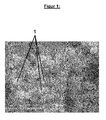
- Figur 1:
- Eine REM-Aufnahme eines PCC's
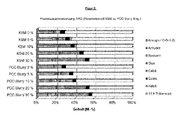
- Figur 2:
- Die Phasenzusammensetzung von zehn verschiedenen Porenbetonproben mit unterschiedlichem Gehalt an natürlichem Kalksteinmehl bzw. PCC
- Figur 3:
- Röntgendiffraktogramm von zwei Porenbetonproben
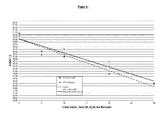
- Figur 4:
- Die A-Zahlen der zehn Porenbetonproben aufgetragen über dem CaCO3-Gehalt der Feststoffmischung der Frischbetonmasse
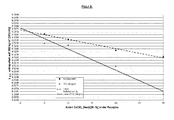
- Figur 5:
- λ10tr der zehn Porenbetonproben aufgetragen über dem CaCO3-Gehalt der Feststoffmischung der Frischbetonmasse
- Figur 6:
- RILEM-Schwindung 20/43 der zehn Porenbetonproben aufgetragen über dem CaCO3-Gehalt der Feststoffmischung der Frischbetonmasse
- Die Erfindung sieht vor, als Zusatzstoff für das Poren- oder Schaumbetonmaterial gefälltes Calciumcarbonat (PCC) und/oder gefälltes Calciummagnesiumcarbonat zu verwenden.
- Bei PCC (precipitated calcium carbonate) handelt es sich um synthetisches bzw. synthetisch hergestelltes Calciumcarbonat (CaCO3). PCC wird auch als gefälltes bzw. ausgefälltes Calciumcarbonat bezeichnet. Im Unterschied dazu handelt es sich bei GCC (ground calcium carbonate) um gemahlenes Calciumcarbonat natürlichen Ursprungs, welches auch als Kalksteinmehl (KSM) bezeichnet wird. Die Herstellung von PCC erfolgt durch Reaktion von Kohlendioxid mit Kalkmilch bzw. einer Kalkhydrat-Suspension. Die Kalkhydrat-Suspension wird entweder durch Löschen von Branntkalk oder durch Dispergieren von Calciumhydroxid in Wasser hergestellt. Beispielsweise wird PCC in einer Biogas-Aufbereitungsanlage hergestellt, beim Abtrennen von CO2 aus Biogas durch Waschen mit einer Kalkhydrat-Suspension. Je nach Prozessführung können fünf unterschiedliche Formen hergestellt werden. Hauptsächlich wird die skalenoedrische (nadelförmige) Kristallform von Calcit gebildet. Die rhomboedrischen Kristalle von Calcit werden vor allem als Beschichtungsmaterial oder Füllstoff für Papier verwendet. Amorphes PCC kann zwar hergestellt werden, hat aber keine technische Relevanz. Des Weiteren kann PCC in den Modifikationen Aragonit und Vaterit (selten) hergestellt werden. Erfindungsgemäß wird vorzugsweise calcitisches und/oder aragonitisches PCC verwendet.
- Gefälltes Calciummagnesiumcarbonat (CaMg(CO3)2) wird hergestellt durch Einleiten von CO2-haltigem Gas in eine Suspension, die gelöschten Dolomit enthält.
- Vorteil des gefällten Calciumcarbonats bzw. des gefällten Calciummagnesiumcarbonats ist, dass es wie auch natürliches Kalksteinmehl chemisch inert und autoklavresistent ist. Dadurch bleibt im Gegensatz zu silikatischen Zuschlagstoffen das C/S-Verhältnis konstant und eine Verschiebung der optimalen Phasengleichgewichte, insbesondere 11 Ä-Tobermorit / CSH(I), wird vermieden. Außerdem kann gefälltes Calciumcarbonat bzw. gefälltes Calciummagnesiumcarbonat in feineren, engeren und gleichmäßigeren Kornverteilungen hergestellt werden als gemahlenes, natürliches Calciumcarbonat bzw. Calciummagnesiumcarbonat.
- Im Rahmen der Erfindung wurde herausgefunden, dass die Verwendung von gefälltem Calciumcarbonat bzw. gefälltem Calciummagnesiumcarbonat anstelle von Kalksteinmehl natürlichen Ursprungs überraschenderweise zu deutlich verbesserten Eigenschaften des Poren- oder Schaumbetonmaterials führt. Insbesondere ist die Wärmeleitfähigkeit bei Verwendung von gefälltem Calciumcarbonat bzw. gefälltem Calciummagnesiumcarbonat deutlich geringer. Die Wärmeleitfähigkeit nimmt zudem mit steigendem Gehalt an gefälltem Calciumcarbonat bzw. gefälltem Calciummagnesiumcarbonat stärker ab als bei natürlichem Kalksteinmehl. Vorzugsweise liegt die Wärmeleitfähigkeit des erfindungsgemäßen Poren- oder Schaumbetonmaterials bei λ10tr ≤ 0,085 [W/mK], bevorzugt λ10tr ≤ 0,075 [W/mK], insbesondere λ10tr ≤ 0,071 [W/mK] gemäß DIN EN 12664.
- Auch das Schwindverhalten wird deutlich verbessert. Das Schwinden wird durch die Verwendung von gefälltem Calciumcarbonat bzw. gefälltem Calciummagnesiumcarbonat ebenfalls deutlich geringer und nimmt mit zunehmendem Gehalt an gefälltem Calciumcarbonat bzw. gefälltem Calciummagnesiumcarbonat überraschenderweise ebenfalls stärker ab als bei Verwendung von natürlichem Kalksteinmehl. Insbesondere beträgt die RILEM-Schwindung (bestimmt gemäß "RILEM Recommended Practice", 1993) 20/43 0,25 bis 0,45 [mm/m], bevorzugt 0,25 bis 0,40 [mm/m].
- Die A-Zahl nimmt mit zunehmendem Gehalt an gefälltem Calciumcarbonat und/oder Calciummagnesiumcarbonat ab, überraschenderweise ist der Abfall bei gefälltem Calciumcarbonat/Calciummagnesiumcarbonat aber geringer als bei natürlichem, gemahlenem Kalksteinmehl. Das heißt, ein erfindungsgemäßes Poren- oder Schaumbetonmaterial mit gefälltem Calciumcarbonat und/oder Calciummagnesiumcarbonat hat eine deutlich geringere Wärmeleitfähigkeit und geringere Schwindung als ein Poren- oder Schaumbetonmaterial mit der gleichen Menge an natürlichem Kalksteinmehl. Zudem ist die A-Zahl der mit gefälltem Calciumcarbonat und/oder Calciummagnesiumcarbonat hergestellten Poren- oder Schaumbetonmaterialien höher. Vorzugsweise weist das erfindungsgemäße Poren- oder Schaumbetonmaterial dabei eine Trockenrohdichte ρ0 von 75 bis 500 [kg/m3], bevorzugt 90 bis 350 [kg/m3] gemäß DIN EN 772-13 auf. Die A-Zahl beträgt vorzugsweise über 1300 [], insbesondere über 1700 [], besonders bevorzugt über 2000 [].
- Um die gewünschten Eigenschaften zu erreichen, weist das Feststoffsteggerüst des erfindungsgemäßen Poren- oder Schaumbetonmaterials dabei vorzugsweise 8 bis 28 M.-%, insbesondere 13 bis 18 M.-%, gefälltes Calciumcarbonat oder Calciummagnesiumcarbonat, bezogen auf den Feststoffanteil des Feststoffsteggerüsts, auf. Die gleichen Mengen gelten für die Summe von PCC und gefälltem Calciummagnesiumcarbonat, wenn beide gefällten Carbonate vorhanden sind. Die Phasenzusammensetzung des Feststoffsteggerüsts wird mittels Röntgenbeugungsanalyse und Auswertung mit der Rietveld-Methode ermittelt.
- Des Weiteren wurde im Rahmen der Erfindung herausgefunden, dass das gefällte Calciumcarbonat bzw. Calciummagnesiumcarbonat die frischen Poren- oder Schaumbetonmischungen bei hohen Wasser/Feststoff-Werten (w/f-Werten) durch eine Erhöhung der Viskosität stabilisiert. Das Sedimentieren und das Zusammensacken aufgrund des Entweichens von Wasserstoff nach dem Auftreiben werden deutlich verringert. Gleichzeitig erhöht gefälltes Calciumcarbonat bzw. Calciummagnesiumcarbonat den Wasseranspruch der frischen Poren- oder Schaumbetonmischung im Vergleich zu natürlichem Kalksteinmehl. Aufgrund dessen kann bei der Verwendung von gefälltem Calciumcarbonat bzw. Calciummagnesiumcarbonat als Zusatzstoff mit höheren w/f-Werten gearbeitet werden. Dies erhöht den Anteil an Gelporen. Die eingesetzte Aluminiummenge kann bei entsprechend angepasster Wassermenge konstant gehalten werden.
- Gefälltes Calciumcarbonat (siehe
Fig. 1 ) bzw. gefälltes Calciummagnesiumcarbonat besteht zudem aus einzelnen Carbonatpartikeln 1. Vorzugsweise handelt es sich bei den Carbonatpartikeln 1 um Nanopartikel mit einer Korngröße ≤ 500 nm, insbesondere ≤ 200 nm, besonders bevorzugt ≤ 120 nm, bestimmt mittels Rasterelektronenmikroskopie. Die Korngrößenverteilung der Carbonatpartikel 1 liegt vorzugsweise bei 2-200 nm, besonders bevorzugt bei 40-120 nm. Je geringer die Korngröße ist, desto besser ist dabei die Stützwirkung der Carbonatpartikeln 1 im Feststoffsteggerüst. Vorteilhaft ist dabei, dass gefälltes Calciumcarbonat und gefälltes Calciummagnesiumcarbonat in sehr engen und gleichmäßigen Kornverteilungen sowie hohen Reinheiten und hohem Weißgrad hergestellt werden können. Über die Kornverteilung der Carbonatpartikel 1 können die Eigenschaften des erfindungsgemäßen Poren- oder Schaumbetonmaterials sehr genau eingestellt werden und einfach variiert werden. Im Folgenden werden bevorzugte Reinheitsgrade angegeben:Tabelle 1: Bevorzugte Zusammensetzungen von gefälltem Calciumcarbonat insbesondere [M.-%] [M.-%] CaCO3 ≥ 98 ≥ 99 Fe2O3 ≤ 0,12 ≤ 0,08 Mn2O3 ≥ 0,03 ≤ 0,01 Tabelle 2: Bevorzugte Zusammensetzungen von gefälltem Calciummagnesiumcarbonat bevorzugt [M.-%] [M.-%] CaMg(CO3)2 ≥ 97 ≥ 99 Fe2O3 ≤ 0,15 ≤ 0,10 Mn2O3 ≤ 0,03 ≤ 0,01 - Außerdem spielt die Kornform der Carbonatpartikel 1, insbesondere für die Stabilisierung der frischen Poren- oder Schaumbetonmischungen, eine Rolle. Bevorzugt wird eine kompakte Kornform, insbesondere eine isometrische Kornform der Carbonatpartikel 1. Vorteile der kompakten Kornform ist eine gleichmäßige Ausrichtung der Partikel ohne jegliche Vorzugsrichtung. Die Beurteilung der Kornform kann beispielsweise mittels Rasterelektronenmikroskopie in Zusammenhang mit bekannten granulometrischen Kriterien wie dem Längen/Breiten-Verhältnis erfolgen. Vorzugsweise beträgt das Längen/Breiten-Verhältnis < 3, besonders bevorzugt < 2.
- In einem Versuch wurden Porenbetonformkörper nach einem üblichen Herstellungsverfahren mit Kalksteinmehl und gefälltem Calciumcarbonat in unterschiedlichen Gewichtsanteilen hergestellt und die A-Zahl (aus der Druckfestigkeit bestimmt gemäß DIN EN 722-1 und der Trockenrohdichte ρ0 bestimmt gemäß DIN EN 772-13), die Wärmeleitfähigkeit λ10tr gemäß DIN EN 12664 und die RILEM-Schwindung bestimmt. Des Weiteren wurde mittels XRD die Phasenzusammensetzung des Feststoffsteggerüsts analysiert. Es wurden insgesamt zehn unterschiedliche Mischungszusammensetzungen mit 0, 5, 10, 20 und 30 M.-% Kalksteinmehl (KSM) bzw. PCC, jeweils bezogen auf den Feststoffgehalt der Frischbetonmassen untersucht:
Tabelle 3: Zusammensetzungen der Frischbetonmassen Einheit 0% KSM/PCC 5% KSM/PCC 10% KSM/PCC 20% KSM/PCC 30% KSM/PCC Mischungsgröße [m3] 1 1 1 1 1 Wasser [kg/m3] 360/360 360/377 360/393 360/426 360/460 Sandmehl [kg/m3] 123 117 111 99 86 Zement [kg/m3] 95 90 85 76 66 Weißfeinkalk [kg/m3] 66 63 60 53 46 Anhydrit [kg/m3] 16 15 14 13 11 Kalksteinmehl/PCC [kg/m3] 0 15 30 60 90 Summe Feststoffe [kg/m3] 300 300 300 300 300 Fließmittel [kg/m3] 0,2 0,2 0,2 0,2 0,2 Sedimentationsreduzierer [kg/m3] 3 3 3 3 3 Aluminiumpulver [kg/m3] 0,4 0,4 0,4 0,4 0,4 - Das verwendete Kalksteinmehl (KSM) wies einen Siebrückstand von 2% auf bei 90 µm (Sieb) auf. Bei dem eingesetzten PCC handelte es sich um PCC aus der Biogasreinigung. Es wies nach REM-Untersuchungen eine Korngröße < 100 nm auf.
- Aus den Feststoffen wurde jeweils in herkömmlicher Weise mit Wasser eine Frischbetonmasse hergestellt. Diese wurde in an sich bekannter Weise in eine nach oben offene Gießform gegossen und in dieser ansteifen und auftreiben gelassen. Danach wurde der sogenannte grüne Porenbetonkuchen entformt und in einzelne grüne Porenbetonformkörper geschnitten. Die Porenbetonformkörper wurden dann in einem Autoklaven gehärtet und anschließend untersucht:
-
Fig. 2 zeigt die ermittelten Phasenzusammensetzungen des Feststoffsteggerüsts der einzelnen Porenbetonformkörper. Es ist zu erkennen, dass sich die Phasenzusammensetzungen der Porenbetonformkörper mit PCC nicht von denen mit der entsprechenden Menge an Kalksteinmehl (KSM) unterscheiden. -
Fig. 3 zeigt Reflexe von Tobermorit (Tob (220) und Tob (222)) sowie Calcit (CC (104)) aus natürlichem Kalksteinmehl (KSM) und PCC. Gemessen wurden jeweils die Proben mit 30 M.-% Kalksteinmehl bzw. PCC. Es ist zu erkennen, dass die Reflexe von Tobermorit bei beiden Proben gleich sind. Die Calcitreflexe unterscheiden sich allerdings signifikant. Der Calcitreflex der Probe mit PCC hat eine deutlich höhere Intensität und geringere Halbwertsbreite. Zudem entspricht seine Lage der von synthetisch gefällten CaCO3 und liegt somit leicht neben dem d-Wert von Calcit aus der Natur. Der Einsatz von PCC ist also am hergestellten Porenbetonformkörper nachweisbar. -
Fig. 4 zeigt die aus den gemessenen Druckfestigkeiten und Trockenrohdichten ρ0 berechneten A-Zahlen in Abhängigkeit vom CaCO3-Gehalt (KSM bzw. PCC) der Feststoffmischungen der Frischbetonmassen. Die A-Zahlen der einander entsprechenden Proben mit Kalksteinmehl und PCC sind im Wesentlichen jeweils gleich. Sowohl bei der Verwendung von Kalksteinmehl als auch bei der Verwendung von PCC nimmt die A-Zahl gleichermaßen mit zunehmendem Gehalt an Zusatzstoff ab. - In
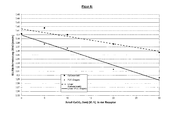
Fig. 5 sind die gemessenen Wärmeleitfähigkeiten λ10tr in Abhängigkeit vom CaCO3-Gehalt (KSM bzw. PCC) der Feststoffmischungen der Frischbetonmassen dargestellt. Es ist eindeutig zu erkennen, dass die Wärmeleitfähigkeiten λ10tr der Proben mit PCC signifikant geringer sind als die Wärmeleitfähigkeiten λ10tr der Proben mit dem entsprechenden Gehalt an Kalksteinmehl. Des Weiteren nimmt die Wärmeleitfähigkeit λ10tr bei den Proben mit PCC mit steigendem CaCO3-Gehalt deutlich stärker ab als bei den Proben mit Kalksteinmehl. Dies ist anhand der linearen Regressionen verdeutlicht. -
Fig. 6 zeigt die gemessenen RILEM-Schwindungen 20/43 in Abhängigkeit vom CaCO3-Gehalt (KSM bzw. PCC) der Feststoffmischungen der Frischbetonmassen. Hier zeigt sich die gleiche Tendenz wie bei der Wärmeleitfähigkeit. Die Schwindung der Probe mit PCC ist jeweils deutlich geringer als die Schwindung der Probe mit dem entsprechenden Gehalt an Kalksteinmehl. Des Weiteren nimmt die Schwindung bei den Proben mit PCC mit steigendem CaCO3-Gehalt deutlich stärker ab als bei den Proben mit Kalksteinmehl. Dies zeigt wiederum die lineare Regression. - Die Versuche belegen also die Verringerung der Wärmeleitfähigkeit sowie der Schwindung durch den Einsatz von PCC. Die Druckfestigkeit nimmt dabei im Vergleich weniger stark ab als bei der Verwendung von Kalksteinmehl. Die aus dem erfindungsgemäßen Poren- oder Schaumbetonmaterial bestehenden bewehrten oder unbewehrten Poren- oder Schaumbetonformkörper weisen somit hervorragende bautechnische Eigenschaften auf.
- Die Herstellung der erfindungsgemäßen Poren- oder Schaumbetonformkörper kann dabei auf herkömmliche Art und Weise erfolgen. Es wird lediglich PCC als Zusatzstoff verwendet. Da dieses chemisch inert ist, hat es keinen Einfluss auf die Phasenzusammensetzung der CSH-Phasen. Der Gehalt an gefälltem Calciumcarbonat und/oder Calciummagnesiumcarbonat in der Mischung zur Herstellung des erfindungsgemäßen Poren- oder Schaumbetonmaterials beträgt vorzugsweise 10 bis 30 M.-%, insbesondere 15 bis 25 M.-% (bezogen auf die trockene Mischung bzw. den gesamten Feststoffanteil der Frischbetonmasse).
- Vorteilhaft ist auch, dass die bei der Herstellung des gefällten Calciumcarbonats bzw. Calciummagnesiumcarbonats entstehende Suspension direkt eingesetzt werden kann. Ein aufwendiges Trocken ist nicht erforderlich.
- Wie bereits erläutert, ist es zudem möglich, mit dem PCC und/oder dem gefällten Calciummagnesiumcarbonat hohe Wasser/Feststoff-Werte einzustellen, da das PCC und/oder gefällte Calciummagnesiumcarbonat den Guss stabilisiert. Insbesondere weisen die Frischbetonmassen für die Herstellung des erfindungsgemäßen Poren- oder Schaumbetonmaterials einen Wasser/Feststoff-Wert von 0,5 bis 2,2, bevorzugt 1,0 bis 2,1 auf. Dadurch wird der Gelporenanteil erhöht.
- Des Weiteren können im Rahmen der Erfindung selbstverständlich weitere bekannte Zusatzstoffe, wie z.B. Porenbetonmehl und/oder Kalksteinmehl, und/oder übliche Zusatzmittel, wie z.B. Fließmittel und/oder Beschleuniger, und/oder Gesteinskörnungen und/oder Fasern zugegeben werden. Bevorzugt wird die Zugabe von Porenbetonmehl, das aus erfindungsgemäßem Poren- oder Schaumbetonmaterial hergestellt wurde.
- Im Rahmen der Erfindung liegt es zudem auch, dass zur Stabilisierung der Suspensionen mit dem gefällten Carbonat Dispergiermittel (z.B. Polyphosphate) zugegeben werden.
- Im Rahmen der Erfindung liegt es dabei auch, anstelle des gefällten Carbonats oder zusammen mit diesem Kreidemehl zu verwenden. Die Gesamtsumme an Carbonat bleibt dabei gleich. Bei Kreide handelt es sich um feinkörnigen biogenen Kalkstein, vorwiegend mariner Entstehung. Kreide ist weich, zerreiblich und abfärbend und von heller Farbe. Kreidegestein besteht im Wesentlichen aus Calcit ohne Beimengungen von Magnesiumcarbonat. Es zählt daher zu den Kalksteinen. Im Detail betrachtet, handelt es sich um einen Kalkstein mit sehr feinkörniger Grundmasse. Das Kreidemehl weist eine Korngröße ≤ 500 µm, bevorzugt ≤ 200 µm auf.
Claims (16)
- Hydrothermal gehärtetes Poren- oder Schaumbetonmaterial aufweisend ein Feststoffsteggerüst, welches aus einem Schaum resultierende oder durch einen Treibprozess erzeugte Poren umgibt, wobei das Feststoffsteggerüst Calciumsilikathydratphasen, Mikroporen und zumindest einen inerten Zusatzstoff aufweist,
dadurch gekennzeichnet, dass
das Feststoffsteggerüst als inerten Zusatzstoff gefälltes Calciumcarbonat und/oder gefälltes Calciummagnesiumcarbonat und/oder Kreide aufweist. - Poren- oder Schaumbetonmaterial nach Anspruch 1,
dadurch gekennzeichnet, dass
der Gesamtanteil an Carbonat in Form von gefälltem Calciumcarbonat und/oder gefälltem Calciummagnesiumcarbonat und/oder Kreide im Feststoffsteggerüst 8 bis 28 M.-%, insbesondere 13 bis 18 M.-% beträgt, bezogen auf den Feststoffanteil des Feststoffsteggerüsts. - Poren- oder Schaumbetonmaterial nach einem der vorhergehenden Ansprüche,
dadurch gekennzeichnet, dass
das Poren- oder Schaumbetonmaterial eine Wärmeleitfähigkeit λ10tr ≤ 0,085 [W/mK], bevorzugt λ10tr ≤ 0,075 [W/mK], insbesondere λ10tr ≤ 0,071 [W/mK] gemäß DIN EN 12664 aufweist. - Poren- oder Schaumbetonmaterial nach einem der vorhergehenden Ansprüche,
dadurch gekennzeichnet, dass
das gefällte Calciumcarbonat eine calcitische und/oder aragonitische Modifikation aufweist. - Poren- oder Schaumbetonmaterial nach einem der vorhergehenden Ansprüche,
dadurch gekennzeichnet, dass
das Poren- oder Schaumbetonmaterial eine RILEM-Schwindung 20/43 von 0,25 bis 0,45 [mm/m], bevorzugt 0,25 bis 0,40 [mm/m] aufweist. - Poren- oder Schaumbetonmaterial nach einem der vorhergehenden Ansprüche,
dadurch gekennzeichnet, dass
das Poren- oder Schaumbetonmaterial eine Trockenrohdichte ρ0 von 75 bis 500 [kg/m3], bevorzugt 90 bis 350 [kg/m3] gemäß DIN EN 772-13 aufweist. - Poren- oder Schaumbetonmaterial nach einem der vorhergehenden Ansprüche,
dadurch gekennzeichnet, dass
das Poren- oder Schaumbetonmaterial eine A-Zahl von über 1300 [], vorzugsweise von über 1700 [], besonders bevorzugt von über 2000 [] aufweist. - Poren- oder Schaumbetonmaterial nach einem der vorhergehenden Ansprüche,
dadurch gekennzeichnet, dass
das gefälltes Calciumcarbonat und/oder gefällte Calciummagnesiumcarbonat und/oder die Kreide aus einzelnen Carbonatpartikeln (1) besteht, die vorzugsweise eine Korngröße ≤ 500 nm, vorzugsweise ≤ 200 nm, besonders bevorzugt ≤ 120 nm, bestimmt mittels Rasterelektronenmikroskopie, aufweisen. - Poren- oder Schaumbetonmaterial nach Anspruch 8,
dadurch gekennzeichnet, dass
die Carbonatpartikel (1) eine Korngrößenverteilung von 2-200 nm, bevorzugt 40-120 nm aufweisen. - Hydrothermal gehärteter Poren- oder Schaumbetonformkörper, insbesondere Poren- oder Schaumbetonplanstein,
dadurch gekennzeichnet, dass
der Poren- oder Schaumbetonformkörper aus Poren- oder Schaumbetonmaterial nach einem der vorhergehenden Ansprüche besteht, wobei der Poren-oder Schaumbetonformkörper vorzugsweise unbewehrt ist oder eine Bewehrung aufweist. - Verfahren zur Herstellung eines hydrothermal gehärteten Poren- oder Schaumbetonformkörpers nach Anspruch 10,
gekennzeichnet durch
folgende Verfahrensschrittea) Herstellen einer gießfähigen Frischbetonmasse enthaltend mindestens eine hydrothermal reagierende CaO-Komponente, mindestens eine hydrothermal reagierende SiO2-Komponente, gefälltes Calciumcarbonat und/oder gefälltes Calciummagnesiumcarbonat und/oder Kreide, mindestens ein Treibmittel oder vorgefertigten Schaum, vorzugsweise eine Calciumsulfat-Komponente, und Wasser,b) Gießen der Frischbetonmasse in eine Gießform, in die gegebenenfalls eine Bewehrung eingehängt ist,c) Gegebenenfalls Einhängen der Bewehrung in die Gießform,d) Gegebenenfalls Auftreiben lassen der Frischbetonmasse,e) Ansteifen lassen der Frischbetonmasse zu einem Poren- oder Schaumbetonkuchen,f) Schneiden des Poren- oder Schaumbetonkuchens in einzelne Poren- oder Schaumbetonformkörper,g) Härten der Poren- oder Schaumbetonformkörper im Autoklaven. - Verfahren nach Anspruch 11,
dadurch gekennzeichnet, dass
eine Frischbetonmasse hergestellt wird, die einen Gehalt an gefälltem Calciumcarbonat oder gefälltem Calciummagnesiumcarbonat von 10 bis 30 M.-%, bevorzugt von 15 bis 25 M.-%, bezogen auf den Feststoffanteil in der Frischbetonmasse, aufweist. - Verfahren nach Anspruch 11,
dadurch gekennzeichnet, dass
eine Frischbetonmasse hergestellt wird, die einen Gehalt an gefälltem Calciumcarbonat und gefälltem Calciummagnesiumcarbonat zusammen von 10 bis 30 M.-%, bevorzugt von 15 bis 25 M.-%, bezogen auf den Feststoffanteil in der Frischbetonmasse, aufweist. - Verfahren nach einem der Ansprüche 11 bis 13,
dadurch gekennzeichnet, dass
eine Frischbetonmasse mit einem Wasser/Feststoff-Wert von 0,5 bis 2,2, bevorzugt 1,0 bis 2,1 hergestellt wird. - Verfahren nach einem der Ansprüche 11 bis 14,
dadurch gekennzeichnet, dass
gefälltes Calciumcarbonat und/oder gefälltes Calciummagnesiumcarbonat aus der Biogasreinigung verwendet wird. - Verwendung von gefälltem Calciumcarbonat und/oder gefälltem Calciummagnesiumcarbonat und/oder Kreide als Zusatzstoff bei der Herstellung eines Poren- oder Schaumbetonformkörpers, wobei vorzugsweise gefälltes Calciumcarbonat und/oder gefälltes Calciummagnesiumcarbonat aus der Biogasreinigung verwendet wird.
Priority Applications (3)
| Application Number | Priority Date | Filing Date | Title |
|---|---|---|---|
| PL14169131T PL2824086T3 (pl) | 2013-07-12 | 2014-05-20 | Hydrotermalnie utwardzany porowaty lub spieniony materiał betonowy oraz sposób jego wytwarzania |
| EP16181093.2A EP3100991B1 (de) | 2013-07-12 | 2014-05-20 | Verfahren zur herstellung eines hydrothermal gehärteten poren- oder schaumbetonformkörpers |
| PL16181093T PL3100991T3 (pl) | 2013-07-12 | 2014-05-20 | Sposób wytwarzania hydrotermalnie utwardzanego elementu kształtowego z porowatego lub spienionego betonu |
Applications Claiming Priority (1)
| Application Number | Priority Date | Filing Date | Title |
|---|---|---|---|
| DE102013011742.9A DE102013011742B3 (de) | 2013-07-12 | 2013-07-12 | Hydrothermal gehärtetes Poren- oder Schaumbetonmaterial, hydrothermal gehärteter Poren- oder Schaumbetonformkörper, Verfahren zu dessen Herstellung und Verwendung von gefälltem Calciumcarbonat und/oder Calciummagnesiumcarbonat |
Related Child Applications (2)
| Application Number | Title | Priority Date | Filing Date |
|---|---|---|---|
| EP16181093.2A Division EP3100991B1 (de) | 2013-07-12 | 2014-05-20 | Verfahren zur herstellung eines hydrothermal gehärteten poren- oder schaumbetonformkörpers |
| EP16181093.2A Division-Into EP3100991B1 (de) | 2013-07-12 | 2014-05-20 | Verfahren zur herstellung eines hydrothermal gehärteten poren- oder schaumbetonformkörpers |
Publications (4)
| Publication Number | Publication Date |
|---|---|
| EP2824086A2 true EP2824086A2 (de) | 2015-01-14 |
| EP2824086A3 EP2824086A3 (de) | 2015-01-21 |
| EP2824086A9 EP2824086A9 (de) | 2015-07-22 |
| EP2824086B1 EP2824086B1 (de) | 2016-11-09 |
Family
ID=50726298
Family Applications (2)
| Application Number | Title | Priority Date | Filing Date |
|---|---|---|---|
| EP14169131.1A Revoked EP2824086B1 (de) | 2013-07-12 | 2014-05-20 | Hydrothermal gehärtetes Poren- oder Schaumbetonmaterial sowie Verfahren zu dessen Herstellung |
| EP16181093.2A Active EP3100991B1 (de) | 2013-07-12 | 2014-05-20 | Verfahren zur herstellung eines hydrothermal gehärteten poren- oder schaumbetonformkörpers |
Family Applications After (1)
| Application Number | Title | Priority Date | Filing Date |
|---|---|---|---|
| EP16181093.2A Active EP3100991B1 (de) | 2013-07-12 | 2014-05-20 | Verfahren zur herstellung eines hydrothermal gehärteten poren- oder schaumbetonformkörpers |
Country Status (4)
| Country | Link |
|---|---|
| EP (2) | EP2824086B1 (de) |
| JP (1) | JP2015017035A (de) |
| DE (1) | DE102013011742B3 (de) |
| PL (2) | PL3100991T3 (de) |
Cited By (2)
| Publication number | Priority date | Publication date | Assignee | Title |
|---|---|---|---|---|
| EP3100991A1 (de) | 2013-07-12 | 2016-12-07 | Xella Baustoffe GmbH | Verfahren zur herstellung eines hydrothermal gehärteten poren- oder schaumbetonformkörpers |
| EP3178798A1 (de) * | 2015-12-10 | 2017-06-14 | Rodgauer Baustoffwerke GmbH & Co. KG | Porenbeton und verfahren zu seiner herstellung |
Families Citing this family (2)
| Publication number | Priority date | Publication date | Assignee | Title |
|---|---|---|---|---|
| DE102023204964A1 (de) | 2023-05-26 | 2024-11-28 | Xella Technologie- Und Forschungsgesellschaft Mbh | Verfahren zur Herstellung von hydrothermal gehärteten Poren- oder Schaumbetonformkörpern und mittels des Verfahrens hergestellter Poren- oder Schaumbetonformkörper |
| DE102023208724A1 (de) | 2023-09-08 | 2025-03-13 | Xella Technologie- Und Forschungsgesellschaft Mbh | Verfahren zur Herstellung von hydrothermal gehärteten Poren- oder Schaumbetonformkörpern und mittels des Verfahrens hergestellter Poren- oder Schaumbetonformkörper |
Citations (5)
| Publication number | Priority date | Publication date | Assignee | Title |
|---|---|---|---|---|
| DE2744365B2 (de) | 1977-10-01 | 1979-05-31 | Ytong Ag, 8000 Muenchen | |
| WO2006134080A1 (en) | 2005-06-15 | 2006-12-21 | Solvay (Société Anonyme) | Use of particles of calcium carbonate in the production of construction materials |
| EP1892226A2 (de) | 2006-08-25 | 2008-02-27 | H+H Deutschland GmbH | Verfahren zur Reduzierung der Wärmeleitfähigkeit von Bausteinen aus einem kalzium-Silikate-Material sowie Baustein aus einem Kalzium-Silikat-Material mit verbesserter Wärmeleitfähigkeit |
| US20080210134A1 (en) | 2007-02-28 | 2008-09-04 | Hanks Dallas A | Precipitated Calcium Carbonate (PCC) from Sugar Processing Byproducts for use in Cementitious Applications and Methods Thereof |
| DE202008017703U1 (de) | 2008-09-15 | 2010-05-12 | Xella Technologie- Und Forschungsgesellschaft Mbh | Porenbetonmaterial |
Family Cites Families (31)
| Publication number | Priority date | Publication date | Assignee | Title |
|---|---|---|---|---|
| DE660373C (de) | 1934-12-04 | 1938-05-21 | E H Harry Pauling Dipl Ing Dr | Verfahren zur Faellung von Calciumcarbonat aus Saccharatloesungen mittels Kohlensaeure |
| DE889438C (de) | 1937-10-30 | 1953-09-10 | Blendax Werke Schneider Co | Verfahren zur Herstellung von gefaelltem Calciumcarbonat mit besonders hohem Schwemmvolumen |
| DE923007C (de) | 1941-10-15 | 1955-01-31 | Blendax Werke Schneider Co | Verfahren zur Herstellung von reinweissem Calciumcarbonat |
| DE1671263B1 (de) | 1967-03-03 | 1971-06-03 | Kaspar Winkler & Co | Verfahren zur Herstellung von Injektionsmoertel oder Porenbeton |
| JPS5874553A (ja) | 1981-10-23 | 1983-05-06 | 住友金属鉱山株式会社 | 水蒸気養生軽量気泡コンクリ−トの製造法 |
| JPS6278173A (ja) * | 1985-10-01 | 1987-04-10 | 住友金属鉱山株式会社 | Alcの製造方法 |
| JPS62162679A (ja) * | 1986-01-14 | 1987-07-18 | 住友金属鉱山株式会社 | 水蒸気養生軽量気泡コンクリ−トの製造法 |
| AU587636B2 (en) | 1985-10-01 | 1989-08-24 | Sumitomo Metal Mining Company Limited | Process for producing autoclaved light weight aerated concrete |
| DD298372A5 (de) | 1989-11-29 | 1992-02-20 | Bergakademie Freiberg,De | Verfahren zur herstellung von besonders als fuellstoff geeigneten calciumcarbonatpulvern aus waessrigen loesungen |
| JP2825905B2 (ja) * | 1990-02-02 | 1998-11-18 | 株式会社アスク | 珪酸カルシウム成形体 |
| DE19915149A1 (de) * | 1999-03-26 | 2000-10-05 | Hunger Hans Dieter | Leichtbaustoffe und Verfahren zu ihrer Herstellung |
| JP2001058884A (ja) * | 1999-08-19 | 2001-03-06 | Asahi Chem Ind Co Ltd | 珪酸カルシウム硬化体の製造方法 |
| EP1151966B1 (de) | 2000-04-14 | 2004-06-30 | Schaefer Kalk | Stabiles, plättchenförmiges, calcitisches Calciumcarbonat, Verfahren zu dessen Herstellung und seine Verwendung |
| JP2001302367A (ja) * | 2000-04-26 | 2001-10-31 | Clion Co Ltd | 軽量気泡コンクリートの製造方法 |
| DE10066270B9 (de) * | 2000-08-23 | 2010-06-10 | Xella Baustoffe Gmbh | Verfahren zum Herstellen von Porenbeton |
| DE10041368B4 (de) * | 2000-08-23 | 2005-11-24 | Ytong Deutschland Ag | Verfahren zum Herstellen von Porenbeton |
| DE102005014704B4 (de) * | 2004-03-26 | 2010-04-01 | Suspensionsbeton Ltd. | Materialaufbereitungsanlage zur Herstellung von Leichtwerkstoffen |
| JP2006075717A (ja) * | 2004-09-09 | 2006-03-23 | Nippon Steel Corp | 炭酸ガスの利用方法 |
| JP2006206425A (ja) * | 2004-12-28 | 2006-08-10 | Showa Denko Kk | アルカリ土類金属炭酸塩微粒子およびその製造方法 |
| DE102005005259B4 (de) * | 2005-02-04 | 2009-09-10 | Xella Dämmsysteme GmbH | Mineralisches Dämmelement und Verfahren zu seiner Herstellung |
| DE102006045091B4 (de) | 2006-09-21 | 2013-04-25 | Universität Dortmund | Verfahren zur Herstellung eines Porenbetons sowie verfahrensgemäß hergestellter Porenbeton |
| DE102006046311A1 (de) | 2006-09-29 | 2008-04-03 | Xella Baustoffe Gmbh | Verfahren und Bewehrungsmittel zur Herstellung bewehrter Poren- oder Schaumbetonkörper und Bewehrungshalterahmen zur Verwendung für ein derartiges Verfahren |
| DE102008017251B9 (de) * | 2008-04-04 | 2009-11-26 | Xella Technologie- Und Forschungsgesellschaft Mbh | Verfahren zur Herstellung von Porenbeton und Schaumbeton sowie Anlage zur Durchführung des Verfahrens |
| JP5698748B2 (ja) * | 2009-08-12 | 2015-04-08 | ニューページ コーポレーション | インクジェット記録媒体 |
| DE102010005361A1 (de) * | 2010-01-21 | 2011-07-28 | Veit Dennert KG Baustoffbetriebe, 96132 | Mineralischer Formkörper, Verwendung und Verfahren zur Herstellung des mineralischen Formkörpers |
| DE102010013667C5 (de) * | 2010-04-01 | 2013-05-29 | Xella Technologie- Und Forschungsgesellschaft Mbh | Porenbetonformkörper sowie Verfahren zu seiner Herstellung |
| CN101905964A (zh) * | 2010-07-29 | 2010-12-08 | 浙江大学 | 一种高强度蒸压加气混凝土的制备方法 |
| JP2012106885A (ja) * | 2010-11-17 | 2012-06-07 | Clion Co Ltd | 軽量気泡コンクリート |
| PL2599750T3 (pl) | 2011-11-29 | 2015-03-31 | Hf Biotec Berlin Gmbh | Sposób i instalacja do wytwarzania krystalicznego węglanu wapnia |
| US8859663B2 (en) * | 2011-12-27 | 2014-10-14 | Hankuk Paper Mfg. Co., Ltd. | Calcium carbonate having a surface charge, the preparing process thereof and filler for producing a paper using the same |
| DE102013011742B3 (de) | 2013-07-12 | 2014-06-05 | Xella Baustoffe Gmbh | Hydrothermal gehärtetes Poren- oder Schaumbetonmaterial, hydrothermal gehärteter Poren- oder Schaumbetonformkörper, Verfahren zu dessen Herstellung und Verwendung von gefälltem Calciumcarbonat und/oder Calciummagnesiumcarbonat |
-
2013
- 2013-07-12 DE DE102013011742.9A patent/DE102013011742B3/de not_active Revoked
-
2014
- 2014-05-20 EP EP14169131.1A patent/EP2824086B1/de not_active Revoked
- 2014-05-20 PL PL16181093T patent/PL3100991T3/pl unknown
- 2014-05-20 PL PL14169131T patent/PL2824086T3/pl unknown
- 2014-05-20 EP EP16181093.2A patent/EP3100991B1/de active Active
- 2014-07-10 JP JP2014142152A patent/JP2015017035A/ja not_active Withdrawn
Patent Citations (5)
| Publication number | Priority date | Publication date | Assignee | Title |
|---|---|---|---|---|
| DE2744365B2 (de) | 1977-10-01 | 1979-05-31 | Ytong Ag, 8000 Muenchen | |
| WO2006134080A1 (en) | 2005-06-15 | 2006-12-21 | Solvay (Société Anonyme) | Use of particles of calcium carbonate in the production of construction materials |
| EP1892226A2 (de) | 2006-08-25 | 2008-02-27 | H+H Deutschland GmbH | Verfahren zur Reduzierung der Wärmeleitfähigkeit von Bausteinen aus einem kalzium-Silikate-Material sowie Baustein aus einem Kalzium-Silikat-Material mit verbesserter Wärmeleitfähigkeit |
| US20080210134A1 (en) | 2007-02-28 | 2008-09-04 | Hanks Dallas A | Precipitated Calcium Carbonate (PCC) from Sugar Processing Byproducts for use in Cementitious Applications and Methods Thereof |
| DE202008017703U1 (de) | 2008-09-15 | 2010-05-12 | Xella Technologie- Und Forschungsgesellschaft Mbh | Porenbetonmaterial |
Non-Patent Citations (1)
| Title |
|---|
| RILEM RECOMMENDED PRACTICE, 1993 |
Cited By (2)
| Publication number | Priority date | Publication date | Assignee | Title |
|---|---|---|---|---|
| EP3100991A1 (de) | 2013-07-12 | 2016-12-07 | Xella Baustoffe GmbH | Verfahren zur herstellung eines hydrothermal gehärteten poren- oder schaumbetonformkörpers |
| EP3178798A1 (de) * | 2015-12-10 | 2017-06-14 | Rodgauer Baustoffwerke GmbH & Co. KG | Porenbeton und verfahren zu seiner herstellung |
Also Published As
| Publication number | Publication date |
|---|---|
| PL2824086T3 (pl) | 2017-05-31 |
| PL3100991T3 (pl) | 2018-02-28 |
| JP2015017035A (ja) | 2015-01-29 |
| EP3100991A1 (de) | 2016-12-07 |
| EP2824086B1 (de) | 2016-11-09 |
| EP2824086A9 (de) | 2015-07-22 |
| EP3100991B1 (de) | 2017-09-13 |
| DE102013011742B3 (de) | 2014-06-05 |
| EP2824086A3 (de) | 2015-01-21 |
Similar Documents
| Publication | Publication Date | Title |
|---|---|---|
| DE69009470T2 (de) | Kontinuierliche Herstellung von Gipsbauplatten. | |
| EP2542512B1 (de) | Mineralschaum und verfahren zu seiner herstellung | |
| DD151150A5 (de) | Verfahren zur herstellung eines bindemittels | |
| EP3789362B1 (de) | Verfahren zur herstellung von hydrothermal gehärteten poren- oder schaumbetonformkörpern | |
| DE4135144C2 (de) | Verfahren zur Herstellung eines gehärteten, faserverstärkten Schlacke/Gibs/Zement-Leichtbauprodukts | |
| DE102008047160B4 (de) | Porenbetonformsteine sowie Verfahren zu ihrer Herstellung | |
| DE102013011742B3 (de) | Hydrothermal gehärtetes Poren- oder Schaumbetonmaterial, hydrothermal gehärteter Poren- oder Schaumbetonformkörper, Verfahren zu dessen Herstellung und Verwendung von gefälltem Calciumcarbonat und/oder Calciummagnesiumcarbonat | |
| DE1571437B1 (de) | Verfahren zur Herstellung eines expansiven Zements | |
| DE2832194C3 (de) | Verfahren zur Herstellung von Calciumsilikatgranulaten bzw. -pulvern mit Mikroporenstruktur | |
| DE19619263C2 (de) | Verfahren zur Herstellung von Leichtbaustoffen | |
| DE10066270B9 (de) | Verfahren zum Herstellen von Porenbeton | |
| DE102007062492B4 (de) | Verfahren zur Herstellung eines zementgebundenen Formsteins und hergestellter Formstein | |
| EP3945083A1 (de) | Kalksandformkörper sowie verfahren zu dessen herstellung | |
| DE2900613C2 (de) | Verfahren zum Herstellen eines faserverstärkten, ausgehärteten Gips-Formkörpers | |
| DE2617218C3 (de) | ||
| DE10131361B4 (de) | Verfahren zur Herstellung von Porenbeton | |
| DE102015121553B4 (de) | Verfahren zur Herstellung von Porenbeton und Porenbeton | |
| DE19728525C1 (de) | Verfahren zur Herstellung von hydrothermal gehärtetem Porenbeton und danach hergestellter Porenbeton-Formkörper | |
| DE3303042A1 (de) | Verfahren zum herstellen bindemittelgebundener formkoerper | |
| DE102023208724A1 (de) | Verfahren zur Herstellung von hydrothermal gehärteten Poren- oder Schaumbetonformkörpern und mittels des Verfahrens hergestellter Poren- oder Schaumbetonformkörper | |
| DE4236855A1 (de) | Verfahren zur Herstellung von feinporigen Isolierwerkstoffen aus ausschließlich anorganischen Bestandteilen | |
| AT347319B (de) | Feinfoerniger leichtzuschlag fuer betone geringer rohdichte und hoher festigkeit und verfahren zu dessen herstellung | |
| CH713947B1 (de) | Nichtcalcinierte zementöse Zusammensetzungen, nichtcalcinierte Betonzusammensetzungen, nichtcalcinierter Beton und Verfahren zu deren Herstellung. | |
| DE3346120A1 (de) | Geblaehter perlit | |
| EP4662186A1 (de) | Verfahren zur herstellung von hydrothermal gehärteten poren- oder schaumbetonformkörpern und mittels des verfahrens hergestellter poren- oder schaumbetonformkörper |
Legal Events
| Date | Code | Title | Description |
|---|---|---|---|
| PUAL | Search report despatched |
Free format text: ORIGINAL CODE: 0009013 |
|
| 17P | Request for examination filed |
Effective date: 20140520 |
|
| AK | Designated contracting states |
Kind code of ref document: A2 Designated state(s): AL AT BE BG CH CY CZ DE DK EE ES FI FR GB GR HR HU IE IS IT LI LT LU LV MC MK MT NL NO PL PT RO RS SE SI SK SM TR |
|
| AX | Request for extension of the european patent |
Extension state: BA ME |
|
| PUAI | Public reference made under article 153(3) epc to a published international application that has entered the european phase |
Free format text: ORIGINAL CODE: 0009012 |
|
| AK | Designated contracting states |
Kind code of ref document: A3 Designated state(s): AL AT BE BG CH CY CZ DE DK EE ES FI FR GB GR HR HU IE IS IT LI LT LU LV MC MK MT NL NO PL PT RO RS SE SI SK SM TR |
|
| AX | Request for extension of the european patent |
Extension state: BA ME |
|
| RIC1 | Information provided on ipc code assigned before grant |
Ipc: C04B 28/18 20060101AFI20141215BHEP |
|
| R17P | Request for examination filed (corrected) |
Effective date: 20150220 |
|
| TPAC | Observations filed by third parties |
Free format text: ORIGINAL CODE: EPIDOSNTIPA |
|
| 17Q | First examination report despatched |
Effective date: 20150708 |
|
| GRAP | Despatch of communication of intention to grant a patent |
Free format text: ORIGINAL CODE: EPIDOSNIGR1 |
|
| INTG | Intention to grant announced |
Effective date: 20160729 |
|
| GRAS | Grant fee paid |
Free format text: ORIGINAL CODE: EPIDOSNIGR3 |
|
| GRAA | (expected) grant |
Free format text: ORIGINAL CODE: 0009210 |
|
| AK | Designated contracting states |
Kind code of ref document: B1 Designated state(s): AL AT BE BG CH CY CZ DE DK EE ES FI FR GB GR HR HU IE IS IT LI LT LU LV MC MK MT NL NO PL PT RO RS SE SI SK SM TR |
|
| REG | Reference to a national code |
Ref country code: GB Ref legal event code: FG4D Free format text: NOT ENGLISH |
|
| REG | Reference to a national code |
Ref country code: AT Ref legal event code: REF Ref document number: 843748 Country of ref document: AT Kind code of ref document: T Effective date: 20161115 Ref country code: CH Ref legal event code: EP |
|
| REG | Reference to a national code |
Ref country code: IE Ref legal event code: FG4D Free format text: LANGUAGE OF EP DOCUMENT: GERMAN |
|
| REG | Reference to a national code |
Ref country code: DE Ref legal event code: R096 Ref document number: 502014001891 Country of ref document: DE |
|
| PG25 | Lapsed in a contracting state [announced via postgrant information from national office to epo] |
Ref country code: LV Free format text: LAPSE BECAUSE OF FAILURE TO SUBMIT A TRANSLATION OF THE DESCRIPTION OR TO PAY THE FEE WITHIN THE PRESCRIBED TIME-LIMIT Effective date: 20161109 |
|
| REG | Reference to a national code |
Ref country code: LT Ref legal event code: MG4D |
|
| REG | Reference to a national code |
Ref country code: NL Ref legal event code: MP Effective date: 20161109 |
|
| REG | Reference to a national code |
Ref country code: FR Ref legal event code: PLFP Year of fee payment: 4 |
|
| PG25 | Lapsed in a contracting state [announced via postgrant information from national office to epo] |
Ref country code: NO Free format text: LAPSE BECAUSE OF FAILURE TO SUBMIT A TRANSLATION OF THE DESCRIPTION OR TO PAY THE FEE WITHIN THE PRESCRIBED TIME-LIMIT Effective date: 20170209 Ref country code: GR Free format text: LAPSE BECAUSE OF FAILURE TO SUBMIT A TRANSLATION OF THE DESCRIPTION OR TO PAY THE FEE WITHIN THE PRESCRIBED TIME-LIMIT Effective date: 20170210 Ref country code: SE Free format text: LAPSE BECAUSE OF FAILURE TO SUBMIT A TRANSLATION OF THE DESCRIPTION OR TO PAY THE FEE WITHIN THE PRESCRIBED TIME-LIMIT Effective date: 20161109 Ref country code: NL Free format text: LAPSE BECAUSE OF FAILURE TO SUBMIT A TRANSLATION OF THE DESCRIPTION OR TO PAY THE FEE WITHIN THE PRESCRIBED TIME-LIMIT Effective date: 20161109 Ref country code: LT Free format text: LAPSE BECAUSE OF FAILURE TO SUBMIT A TRANSLATION OF THE DESCRIPTION OR TO PAY THE FEE WITHIN THE PRESCRIBED TIME-LIMIT Effective date: 20161109 |
|
| PG25 | Lapsed in a contracting state [announced via postgrant information from national office to epo] |
Ref country code: IS Free format text: LAPSE BECAUSE OF FAILURE TO SUBMIT A TRANSLATION OF THE DESCRIPTION OR TO PAY THE FEE WITHIN THE PRESCRIBED TIME-LIMIT Effective date: 20170309 Ref country code: RS Free format text: LAPSE BECAUSE OF FAILURE TO SUBMIT A TRANSLATION OF THE DESCRIPTION OR TO PAY THE FEE WITHIN THE PRESCRIBED TIME-LIMIT Effective date: 20161109 Ref country code: FI Free format text: LAPSE BECAUSE OF FAILURE TO SUBMIT A TRANSLATION OF THE DESCRIPTION OR TO PAY THE FEE WITHIN THE PRESCRIBED TIME-LIMIT Effective date: 20161109 Ref country code: ES Free format text: LAPSE BECAUSE OF FAILURE TO SUBMIT A TRANSLATION OF THE DESCRIPTION OR TO PAY THE FEE WITHIN THE PRESCRIBED TIME-LIMIT Effective date: 20161109 Ref country code: HR Free format text: LAPSE BECAUSE OF FAILURE TO SUBMIT A TRANSLATION OF THE DESCRIPTION OR TO PAY THE FEE WITHIN THE PRESCRIBED TIME-LIMIT Effective date: 20161109 Ref country code: PT Free format text: LAPSE BECAUSE OF FAILURE TO SUBMIT A TRANSLATION OF THE DESCRIPTION OR TO PAY THE FEE WITHIN THE PRESCRIBED TIME-LIMIT Effective date: 20170309 |
|
| PG25 | Lapsed in a contracting state [announced via postgrant information from national office to epo] |
Ref country code: RO Free format text: LAPSE BECAUSE OF FAILURE TO SUBMIT A TRANSLATION OF THE DESCRIPTION OR TO PAY THE FEE WITHIN THE PRESCRIBED TIME-LIMIT Effective date: 20161109 Ref country code: DK Free format text: LAPSE BECAUSE OF FAILURE TO SUBMIT A TRANSLATION OF THE DESCRIPTION OR TO PAY THE FEE WITHIN THE PRESCRIBED TIME-LIMIT Effective date: 20161109 Ref country code: EE Free format text: LAPSE BECAUSE OF FAILURE TO SUBMIT A TRANSLATION OF THE DESCRIPTION OR TO PAY THE FEE WITHIN THE PRESCRIBED TIME-LIMIT Effective date: 20161109 |
|
| REG | Reference to a national code |
Ref country code: DE Ref legal event code: R026 Ref document number: 502014001891 Country of ref document: DE |
|
| PLBI | Opposition filed |
Free format text: ORIGINAL CODE: 0009260 |
|
| PG25 | Lapsed in a contracting state [announced via postgrant information from national office to epo] |
Ref country code: BG Free format text: LAPSE BECAUSE OF FAILURE TO SUBMIT A TRANSLATION OF THE DESCRIPTION OR TO PAY THE FEE WITHIN THE PRESCRIBED TIME-LIMIT Effective date: 20170209 Ref country code: LU Free format text: LAPSE BECAUSE OF NON-PAYMENT OF DUE FEES Effective date: 20170531 Ref country code: SM Free format text: LAPSE BECAUSE OF FAILURE TO SUBMIT A TRANSLATION OF THE DESCRIPTION OR TO PAY THE FEE WITHIN THE PRESCRIBED TIME-LIMIT Effective date: 20161109 |
|
| 26 | Opposition filed |
Opponent name: PORIT GMBH Effective date: 20170807 Opponent name: BUNDESVERBAND PORENBETONINDUSTRIE E.V. Effective date: 20170807 Opponent name: H+H DEUTSCHLAND GMBH Effective date: 20170807 |
|
| PLAX | Notice of opposition and request to file observation + time limit sent |
Free format text: ORIGINAL CODE: EPIDOSNOBS2 |
|
| PG25 | Lapsed in a contracting state [announced via postgrant information from national office to epo] |
Ref country code: SI Free format text: LAPSE BECAUSE OF FAILURE TO SUBMIT A TRANSLATION OF THE DESCRIPTION OR TO PAY THE FEE WITHIN THE PRESCRIBED TIME-LIMIT Effective date: 20161109 |
|
| REG | Reference to a national code |
Ref country code: CH Ref legal event code: PL |
|
| PLBB | Reply of patent proprietor to notice(s) of opposition received |
Free format text: ORIGINAL CODE: EPIDOSNOBS3 |
|
| PG25 | Lapsed in a contracting state [announced via postgrant information from national office to epo] |
Ref country code: MC Free format text: LAPSE BECAUSE OF FAILURE TO SUBMIT A TRANSLATION OF THE DESCRIPTION OR TO PAY THE FEE WITHIN THE PRESCRIBED TIME-LIMIT Effective date: 20161109 |
|
| REG | Reference to a national code |
Ref country code: IE Ref legal event code: MM4A |
|
| PG25 | Lapsed in a contracting state [announced via postgrant information from national office to epo] |
Ref country code: LI Free format text: LAPSE BECAUSE OF NON-PAYMENT OF DUE FEES Effective date: 20170531 Ref country code: CH Free format text: LAPSE BECAUSE OF NON-PAYMENT OF DUE FEES Effective date: 20170531 |
|
| PG25 | Lapsed in a contracting state [announced via postgrant information from national office to epo] |
Ref country code: LU Free format text: LAPSE BECAUSE OF NON-PAYMENT OF DUE FEES Effective date: 20170520 |
|
| PG25 | Lapsed in a contracting state [announced via postgrant information from national office to epo] |
Ref country code: IE Free format text: LAPSE BECAUSE OF NON-PAYMENT OF DUE FEES Effective date: 20170520 |
|
| REG | Reference to a national code |
Ref country code: FR Ref legal event code: PLFP Year of fee payment: 5 |
|
| PLAB | Opposition data, opponent's data or that of the opponent's representative modified |
Free format text: ORIGINAL CODE: 0009299OPPO |
|
| R26 | Opposition filed (corrected) |
Opponent name: PORIT GMBH Effective date: 20170807 |
|
| PG25 | Lapsed in a contracting state [announced via postgrant information from national office to epo] |
Ref country code: MT Free format text: LAPSE BECAUSE OF FAILURE TO SUBMIT A TRANSLATION OF THE DESCRIPTION OR TO PAY THE FEE WITHIN THE PRESCRIBED TIME-LIMIT Effective date: 20161109 |
|
| GBPC | Gb: european patent ceased through non-payment of renewal fee |
Effective date: 20180520 |
|
| APAH | Appeal reference modified |
Free format text: ORIGINAL CODE: EPIDOSCREFNO |
|
| APBM | Appeal reference recorded |
Free format text: ORIGINAL CODE: EPIDOSNREFNO |
|
| APBP | Date of receipt of notice of appeal recorded |
Free format text: ORIGINAL CODE: EPIDOSNNOA2O |
|
| APAY | Date of receipt of notice of appeal deleted |
Free format text: ORIGINAL CODE: EPIDOSDNOA2O |
|
| APBM | Appeal reference recorded |
Free format text: ORIGINAL CODE: EPIDOSNREFNO |
|
| APBP | Date of receipt of notice of appeal recorded |
Free format text: ORIGINAL CODE: EPIDOSNNOA2O |
|
| APAJ | Date of receipt of notice of appeal modified |
Free format text: ORIGINAL CODE: EPIDOSCNOA2O |
|
| APBM | Appeal reference recorded |
Free format text: ORIGINAL CODE: EPIDOSNREFNO |
|
| APBP | Date of receipt of notice of appeal recorded |
Free format text: ORIGINAL CODE: EPIDOSNNOA2O |
|
| PG25 | Lapsed in a contracting state [announced via postgrant information from national office to epo] |
Ref country code: GB Free format text: LAPSE BECAUSE OF NON-PAYMENT OF DUE FEES Effective date: 20180520 |
|
| APBQ | Date of receipt of statement of grounds of appeal recorded |
Free format text: ORIGINAL CODE: EPIDOSNNOA3O |
|
| APBQ | Date of receipt of statement of grounds of appeal recorded |
Free format text: ORIGINAL CODE: EPIDOSNNOA3O |
|
| PG25 | Lapsed in a contracting state [announced via postgrant information from national office to epo] |
Ref country code: HU Free format text: LAPSE BECAUSE OF FAILURE TO SUBMIT A TRANSLATION OF THE DESCRIPTION OR TO PAY THE FEE WITHIN THE PRESCRIBED TIME-LIMIT; INVALID AB INITIO Effective date: 20140520 |
|
| PG25 | Lapsed in a contracting state [announced via postgrant information from national office to epo] |
Ref country code: CY Free format text: LAPSE BECAUSE OF FAILURE TO SUBMIT A TRANSLATION OF THE DESCRIPTION OR TO PAY THE FEE WITHIN THE PRESCRIBED TIME-LIMIT Effective date: 20161109 |
|
| APBQ | Date of receipt of statement of grounds of appeal recorded |
Free format text: ORIGINAL CODE: EPIDOSNNOA3O |
|
| PG25 | Lapsed in a contracting state [announced via postgrant information from national office to epo] |
Ref country code: MK Free format text: LAPSE BECAUSE OF FAILURE TO SUBMIT A TRANSLATION OF THE DESCRIPTION OR TO PAY THE FEE WITHIN THE PRESCRIBED TIME-LIMIT Effective date: 20161109 |
|
| PG25 | Lapsed in a contracting state [announced via postgrant information from national office to epo] |
Ref country code: AL Free format text: LAPSE BECAUSE OF FAILURE TO SUBMIT A TRANSLATION OF THE DESCRIPTION OR TO PAY THE FEE WITHIN THE PRESCRIBED TIME-LIMIT Effective date: 20161109 |
|
| REG | Reference to a national code |
Ref country code: AT Ref legal event code: MM01 Ref document number: 843748 Country of ref document: AT Kind code of ref document: T Effective date: 20190520 |
|
| PG25 | Lapsed in a contracting state [announced via postgrant information from national office to epo] |
Ref country code: AT Free format text: LAPSE BECAUSE OF NON-PAYMENT OF DUE FEES Effective date: 20190520 |
|
| PGFP | Annual fee paid to national office [announced via postgrant information from national office to epo] |
Ref country code: TR Payment date: 20220316 Year of fee payment: 9 Ref country code: PL Payment date: 20220307 Year of fee payment: 9 Ref country code: IT Payment date: 20220315 Year of fee payment: 9 |
|
| REG | Reference to a national code |
Ref country code: DE Ref legal event code: R103 Ref document number: 502014001891 Country of ref document: DE Ref country code: DE Ref legal event code: R064 Ref document number: 502014001891 Country of ref document: DE |
|
| APBU | Appeal procedure closed |
Free format text: ORIGINAL CODE: EPIDOSNNOA9O |
|
| RDAF | Communication despatched that patent is revoked |
Free format text: ORIGINAL CODE: EPIDOSNREV1 |
|
| RDAG | Patent revoked |
Free format text: ORIGINAL CODE: 0009271 |
|
| STAA | Information on the status of an ep patent application or granted ep patent |
Free format text: STATUS: PATENT REVOKED |
|
| PGFP | Annual fee paid to national office [announced via postgrant information from national office to epo] |
Ref country code: SK Payment date: 20220419 Year of fee payment: 9 Ref country code: FR Payment date: 20220407 Year of fee payment: 9 Ref country code: DE Payment date: 20220530 Year of fee payment: 9 Ref country code: CZ Payment date: 20220406 Year of fee payment: 9 |
|
| REG | Reference to a national code |
Ref country code: FI Ref legal event code: MGE |
|
| 27W | Patent revoked |
Effective date: 20220602 |
|
| REG | Reference to a national code |
Ref country code: SK Ref legal event code: MC4A Ref document number: E 23480 Country of ref document: SK Effective date: 20220602 |
|
| PGFP | Annual fee paid to national office [announced via postgrant information from national office to epo] |
Ref country code: BE Payment date: 20220411 Year of fee payment: 9 |
|
| REG | Reference to a national code |
Ref country code: AT Ref legal event code: MA03 Ref document number: 843748 Country of ref document: AT Kind code of ref document: T Effective date: 20220602 |