EP2826828A1 - Procédé destiné à l'enrobage de produit allongé, comme notamment des conduites ou des ensemble de câbles - Google Patents
Procédé destiné à l'enrobage de produit allongé, comme notamment des conduites ou des ensemble de câbles Download PDFInfo
- Publication number
- EP2826828A1 EP2826828A1 EP14176675.8A EP14176675A EP2826828A1 EP 2826828 A1 EP2826828 A1 EP 2826828A1 EP 14176675 A EP14176675 A EP 14176675A EP 2826828 A1 EP2826828 A1 EP 2826828A1
- Authority
- EP
- European Patent Office
- Prior art keywords
- mass
- adhesive tape
- hardener
- carrier
- reaction mass
- Prior art date
- Legal status (The legal status is an assumption and is not a legal conclusion. Google has not performed a legal analysis and makes no representation as to the accuracy of the status listed.)
- Granted
Links
Images


Classifications
-
- H—ELECTRICITY
- H01—ELECTRIC ELEMENTS
- H01B—CABLES; CONDUCTORS; INSULATORS; SELECTION OF MATERIALS FOR THEIR CONDUCTIVE, INSULATING OR DIELECTRIC PROPERTIES
- H01B13/00—Apparatus or processes specially adapted for manufacturing conductors or cables
- H01B13/0013—Apparatus or processes specially adapted for manufacturing conductors or cables for embedding wires in plastic layers
-
- C—CHEMISTRY; METALLURGY
- C09—DYES; PAINTS; POLISHES; NATURAL RESINS; ADHESIVES; COMPOSITIONS NOT OTHERWISE PROVIDED FOR; APPLICATIONS OF MATERIALS NOT OTHERWISE PROVIDED FOR
- C09J—ADHESIVES; NON-MECHANICAL ASPECTS OF ADHESIVE PROCESSES IN GENERAL; ADHESIVE PROCESSES NOT PROVIDED FOR ELSEWHERE; USE OF MATERIALS AS ADHESIVES
- C09J5/00—Adhesive processes in general; Adhesive processes not provided for elsewhere, e.g. relating to primers
- C09J5/04—Adhesive processes in general; Adhesive processes not provided for elsewhere, e.g. relating to primers involving separate application of adhesive ingredients to the different surfaces to be joined
-
- C—CHEMISTRY; METALLURGY
- C09—DYES; PAINTS; POLISHES; NATURAL RESINS; ADHESIVES; COMPOSITIONS NOT OTHERWISE PROVIDED FOR; APPLICATIONS OF MATERIALS NOT OTHERWISE PROVIDED FOR
- C09J—ADHESIVES; NON-MECHANICAL ASPECTS OF ADHESIVE PROCESSES IN GENERAL; ADHESIVE PROCESSES NOT PROVIDED FOR ELSEWHERE; USE OF MATERIALS AS ADHESIVES
- C09J7/00—Adhesives in the form of films or foils
- C09J7/20—Adhesives in the form of films or foils characterised by their carriers
- C09J7/21—Paper; Textile fabrics
-
- C—CHEMISTRY; METALLURGY
- C09—DYES; PAINTS; POLISHES; NATURAL RESINS; ADHESIVES; COMPOSITIONS NOT OTHERWISE PROVIDED FOR; APPLICATIONS OF MATERIALS NOT OTHERWISE PROVIDED FOR
- C09J—ADHESIVES; NON-MECHANICAL ASPECTS OF ADHESIVE PROCESSES IN GENERAL; ADHESIVE PROCESSES NOT PROVIDED FOR ELSEWHERE; USE OF MATERIALS AS ADHESIVES
- C09J7/00—Adhesives in the form of films or foils
- C09J7/30—Adhesives in the form of films or foils characterised by the adhesive composition
- C09J7/35—Heat-activated
-
- C—CHEMISTRY; METALLURGY
- C09—DYES; PAINTS; POLISHES; NATURAL RESINS; ADHESIVES; COMPOSITIONS NOT OTHERWISE PROVIDED FOR; APPLICATIONS OF MATERIALS NOT OTHERWISE PROVIDED FOR
- C09J—ADHESIVES; NON-MECHANICAL ASPECTS OF ADHESIVE PROCESSES IN GENERAL; ADHESIVE PROCESSES NOT PROVIDED FOR ELSEWHERE; USE OF MATERIALS AS ADHESIVES
- C09J2203/00—Applications of adhesives in processes or use of adhesives in the form of films or foils
- C09J2203/302—Applications of adhesives in processes or use of adhesives in the form of films or foils for bundling cables
-
- C—CHEMISTRY; METALLURGY
- C09—DYES; PAINTS; POLISHES; NATURAL RESINS; ADHESIVES; COMPOSITIONS NOT OTHERWISE PROVIDED FOR; APPLICATIONS OF MATERIALS NOT OTHERWISE PROVIDED FOR
- C09J—ADHESIVES; NON-MECHANICAL ASPECTS OF ADHESIVE PROCESSES IN GENERAL; ADHESIVE PROCESSES NOT PROVIDED FOR ELSEWHERE; USE OF MATERIALS AS ADHESIVES
- C09J2400/00—Presence of inorganic and organic materials
- C09J2400/20—Presence of organic materials
- C09J2400/26—Presence of textile or fabric
- C09J2400/263—Presence of textile or fabric in the substrate
-
- C—CHEMISTRY; METALLURGY
- C09—DYES; PAINTS; POLISHES; NATURAL RESINS; ADHESIVES; COMPOSITIONS NOT OTHERWISE PROVIDED FOR; APPLICATIONS OF MATERIALS NOT OTHERWISE PROVIDED FOR
- C09J—ADHESIVES; NON-MECHANICAL ASPECTS OF ADHESIVE PROCESSES IN GENERAL; ADHESIVE PROCESSES NOT PROVIDED FOR ELSEWHERE; USE OF MATERIALS AS ADHESIVES
- C09J2433/00—Presence of (meth)acrylic polymer
-
- C—CHEMISTRY; METALLURGY
- C09—DYES; PAINTS; POLISHES; NATURAL RESINS; ADHESIVES; COMPOSITIONS NOT OTHERWISE PROVIDED FOR; APPLICATIONS OF MATERIALS NOT OTHERWISE PROVIDED FOR
- C09J—ADHESIVES; NON-MECHANICAL ASPECTS OF ADHESIVE PROCESSES IN GENERAL; ADHESIVE PROCESSES NOT PROVIDED FOR ELSEWHERE; USE OF MATERIALS AS ADHESIVES
- C09J2463/00—Presence of epoxy resin
Definitions
- the invention relates to a method for wrapping elongated material such as in particular cables or cable harnesses.
- Adhesive tapes have long been used in industry for the production of wiring harnesses.
- the adhesive tapes serve for bundling a plurality of electrical lines before installation or in the already mounted state, in order to reduce the space requirement of the cable bundle by bandaging and to achieve additional protective functions.
- Cable wrapping tapes with film and textile carriers are widespread, which are generally coated on one side with different pressure-sensitive adhesives.
- Fiber composite plastics by GW Ehrenstein, Hanser, 2006, ISBN 3-446-22716-4
- fibers especially glass fibers or polyester fibers
- resins especially epoxy resins
- the adhesive tape used to cover elongate material such as cable harnesses in an automobile.
- the adhesive tape consists of a carrier with an upper side and a lower side, wherein the carrier has a width B T relative to the transverse direction, and an adhesive strip made of a reactive heat-activatable adhesive is provided on at least one longitudinal edge of the carrier, having a width B K of at least 3 mm and at most 50% of the width B T has.
- the reactive, curing adhesive results in a hose with very high sealing strength, since it comes to a "structural bonding", but not to a stiff, forming composite.
- 2-component adhesive systems are known and described in detail in the literature. In these systems, a two-component adhesive system is applied to the parts to be bonded, usually two liquid components are used.
- one component consists of the monomer to be polymerized and an activator and the other component of a radical-forming substance (also called hardener or initiator) and the monomer to be polymerized.
- a radical-forming substance also called hardener or initiator
- the radical-forming substance is split by the activator into two radicals and the polymerization reaction of the monomers to be polymerized begins.
- the radical polymerization of the monomer then takes place until a chain termination and the adhesive cures, whereby a permanent bonding of the parts to be bonded is achieved.
- the present invention has for its object to provide a method that allows a particularly simple, inexpensive and fast sheathing of elongated material such as in particular cables or harnesses and leads to a stiffened encased Good.
- a harness layout corresponds to the actual spatial arrangement of the individual cable strands in the cable set, that is, which cable harness is bent at which position and at which angle, where there are positions of branches or outlets and with which plugs the ends of the cable strands are occupied.
- hardener mass and / or the reaction mass are applied in at least one strip extending in the longitudinal direction of the adhesive tape to the particular textile carrier.
- hardener mass and simultaneously reaction mass are applied in each case a strip.
- the strip of hardener compound extends from the one longitudinal edge of the carrier, starting at the center of the carrier and the strip of reaction mass starting from the opposite edge of the carrier to the center of the carrier.
- a release film may be present between the support and the reaction mass.
- the preferred carrier material is a textile carrier.
- each viscous mass penetrates onto a textile carrier into the textile carrier in order to be able to anchor in the carrier.
- the individual fibers or yarns are surrounded by the mass, so that the mass layer is no longer separate from the carrier.
- the anchoring is usually so strong that such a tape can be unwound easily from a roll, without the anchoring of the mass breaks and it comes to the so-called rewinding of the mass (the mass is then on the back of the carrier). Furthermore, it is expected of most pressure-sensitive adhesive tapes that they can be detached from the ground again, so that they can be resumed without leaving a trace. This means that the adhesive tape must not break adhesively between the carrier and the mass.
- the hardener or reaction mass together are called masses. If it says there, the masses have penetrated into the carrier, it means that only the hardener mass or only the reaction mass or the hardener and the reaction mass have simultaneously penetrated into the carrier. The latter variant is preferred.
- masses after application to the carrier have sunk more than 10%, preferably more than 25%, into the carrier.
- a numerical value of, for example, 25% means that the mass has penetrated over a layer thickness of 25% of the thickness of the textile carrier, ie for a carrier with a thickness of 100 ⁇ m over a layer thickness of 25 ⁇ m mass within the carrier, namely starting from the surface of the carrier on which the mass is coated, and in the direction perpendicular to the plane spanned by the longitudinal or transverse direction.
- the amount of coated mass is chosen according to a preferred embodiment so that even a good part of the partially sunk mass layer protrudes beyond the carrier.
- the thickness of the non-sunk mass layer is preferably more than 25 ⁇ m, more preferably more than 50 ⁇ m, more preferably more than 100 ⁇ m.
- the carrier is completely soaked, ie over 100% of the carrier thickness, with the masses, so that all the carrier fibers are fixed.
- the amount of the applied mass can be chosen so that even a partial layer of the masses protrude beyond the carrier.
- the adhesive tape is guided around the elongated product in a helical line according to an embodiment.
- the winding preferably takes place in such a way that the new layer of adhesive tape partially overlaps the one underneath, preferably to 50%.
- the adhesive tape can be passed a second time around the estate.
- this second winding is also in the form of a helix, preferably with offset.
- the winding can take place in the same direction as the first winding, so also from left to right, but it can also be done in the opposite direction.
- an adhesive tape in which a fabric, a nonwoven or a knitted fabric is used as the carrier.
- Adhesive tapes with such carriers can be torn by hand relatively easily, which is also of particular importance for the described application and the particularly preferred processing as a winding tape for bundling cables in automobiles.
- a tear strength in the transverse direction of less than 10 N which is determined according to the AFERA standard 4007, serves as a criterion for the hand tearability of the adhesive tape. Only at very high basis weights or thicknesses of the carriers used, the hand tearability can not be given or only limited. In this case, however, perforations may be present to optimize hand tearability.
- nonwoven fabrics comprising canvas, twill and satin weave
- knitted fabrics comprising warp knitted fabric and knitwear
- nonwoven is at least textile Fabrics according to EN 29092 (1988) and stitchbonded nonwovens and similar systems are to be understood.
- lamination fabrics and knitted fabrics can be used.
- spacer fabrics are used in the EP 0 071 212 B1 disclosed.
- Spacer fabrics are mat-shaped laminates with a cover layer of a fibrous or filament nonwoven fabric, a backing layer and individual layers or tufts of retaining fibers present between these layers, which are needled through the particle layer distributed over the surface of the laminate body and interconnect the cover layer and the backing layer.
- particles of inert rock particles, such as sand, gravel or the like are present in the holding fibers.
- the holding fibers needled through the particle layer keep the cover layer and the underlayer spaced apart and are bonded to the cover layer and the underlayer.
- nonwovens are particularly solid staple fiber webs, but also filament, meltblown and spun nonwovens in question, which are usually additionally solidify.
- solidification methods for nonwovens mechanical, thermal and chemical solidification are known. If, in the case of mechanical consolidation, the fibers are held together purely mechanically by swirling of the individual fibers, by intermeshing fiber bundles or by sewing in additional threads, thermal or chemical methods can be used to bond adhesive (with binder) or cohesive (binder-free) fiber-fiber Achieve bonds. With suitable formulation and process control, these can be limited exclusively or at least predominantly to fiber nodes, so that a stable, three-dimensional network is formed while maintaining the loose, open structure in the nonwoven.
- Nonwovens have proven to be particularly advantageous, which are solidified in particular by overmilling with separate threads or by intermeshing.
- Such solidified nonwovens are produced, for example, on stitchbonding machines of the type "Malimo" from Karl Mayer, formerly Malimo, and are available, inter alia, from Hoftex Group AG.
- a Malivlies is characterized in that a cross-fiber fleece is solidified by the formation of stitches of fibers of the fleece.
- a fleece of the Kunit or Multiknit type can furthermore be used.
- a Kunitvlies is characterized in that it results from the processing of a longitudinally oriented nonwoven fabric to a fabric having on one side mesh and on the other mesh webs or Polfaser-folds, but has neither threads nor prefabricated fabrics.
- Such a nonwoven fabric has also been produced for some time, for example, on stitchbonding machines of the type "Malimo" from Karl Mayer.
- Another characteristic feature of this nonwoven is that it can absorb high tensile forces in the longitudinal direction as longitudinal fiber fleece.
- a Multiknitvlies is compared to the Kunitvlies characterized in that the fleece by the piercing on both sides with needles on both the top and on the bottom undergoes a solidification.
- a starting material for a multi-Knit serve usually one or two produced by the Kunit method unilaterally intermeshed pile fiber nonwoven active ingredients.
- both nonwoven topsheets are formed into a closed surface by fiber meshing and bonded together by nearly vertical fibers. The additional applicability of further pierceable fabrics and / or spreadable media is given.
- nonwoven webs are suitable as a precursor to form a carrier according to the invention and an inventive adhesive tape.
- a stitchbonded web is formed from a nonwoven material having a plurality of seams running parallel to one another. These seams are created by sewing or stitching of continuous textile threads.
- nonwoven stitching machines of the type "Malimo" Karl Mayer known.
- Needle fleeces are also particularly suitable.
- a batt becomes a sheet by means of barbed needles.
- the material is on a needle bar solidified, whereby the individual fibers devour into a solid sheet.
- the number and embodiment of the needling points determine the strength and strength of the fiber structures, which are generally light, air permeable and elastic.
- a staple fiber fleece which is preconsolidated by mechanical processing in the first step or which is a wet fleece which has been hydrodynamically laid, wherein between 2% by weight and 50% by weight of the fibers of the fleece are melt fibers, in particular between 5 Wt .-% and 40 wt .-% of the fibers of the nonwoven.
- Such a nonwoven fabric is characterized in that the fibers are wet-laid or, for example, a staple fiber fleece is pre-consolidated by the formation of loops of fibers of the fleece by needling, suturing, air and / or water jet machining.
- the heat-setting takes place, wherein the strength of the nonwoven fabric is further increased by the melting or melting of the melt fibers.
- the adhesive bonding of mechanically pre-consolidated or wet-laid nonwovens is of particular interest, and this can be achieved by adding binder in solid, liquid, foamed or pasty form.
- Basic forms of administration are variously possible, for example solid binders as powders for trickling, as a foil or as a grid or in the form of binding fibers.
- Liquid binders are dissolved in water or organic solvents or can be applied as a dispersion.
- Bonding dispersions are predominantly selected for adhesive bonding: thermosetting plastics in the form of phenolic or melamine resin dispersions, elastomers as dispersions of natural or synthetic rubbers or mostly dispersions of thermoplastics such as acrylates, vinyl acetates, polyurethanes, styrene-butadiene systems, PVC and the like. and their copolymers. In the normal case, these are anionic or non-ionogenically stabilized dispersions, but in special cases, cationic dispersions may also be advantageous.
- binder application can be carried out according to the prior art and is, for example, in standard works of the coating or nonwoven technology such as " Nonwovens "(Georg Thieme Verlag, Stuttgart, 1982 ) or " Textile Technology Nonwovens Production "(Employer Group Automattextil, Eschborn, 1996 ) read.
- binders For adequate adhesive bonding of the nonwoven backing, it is generally necessary to add binders of the order of 1% to 50%, in particular 3% to 20%, based on the weight of the nonwoven fabric.
- the addition of the binder can be carried out already during the nonwoven production, during the mechanical pre-consolidation or else in a separate process step, wherein this can be carried out in-line or off-line.
- a condition has to be temporarily created for the binder in which it becomes adhesive and adhesively bonds the fibers - this can be achieved during drying, for example, of dispersions, but also by heating, whereby further variations can be achieved by surface or partial pressure application are.
- the activation of the binder can be done in known drying channels, with a suitable choice of binder but also by means of infrared radiation, UV radiation, ultrasound, high-frequency radiation or the like.
- the carrier has a surface ground on one or both sides smooth, preferably in each case a surface smoothed over the entire surface.
- the smoothed surface may be chinted, as for example in the EP 1 448 744 A1 is explained. In this way, the repellency of dirt is improved.
- the carrier are in particular (chemical) fibers (staple fiber or continuous filament) of synthetic polymers, also called synthetic fibers of polyester such as polyethylene terephthalate, polyamide, polyimide, aramid, polyolefin, polyacrylonitrile or glass, (chemistry) fibers of natural polymers such cellulosic fibers (viscose, modal, lyocell, cupro, acetate, triacetate, cellulon), such as gum fibers, such as vegetable protein fibers, and / or such as animal protein fibers and / or natural fibers of cotton, sisal, flax, silk, hemp, linen, coconut or wool ,
- the present invention is not limited to the materials mentioned, but it can, recognizable to those skilled to work without having to be inventive, a variety of other fibers for the production of the web can be used.
- yarns made from the specified raw materials are also suitable.
- woven or laid single yarns can be made from a mixed yarn, so have synthetic and natural ingredients.
- the warp threads and the weft threads are each of a type-specific design.
- the warp threads and / or the weft threads can each consist only of synthetic threads or threads of natural raw materials.
- Polyester or glass is preferably used as the material for the carrier because of the excellent aging resistance and the excellent resistance to chemicals and equipment such as oil, gasoline, antifreeze and the like.
- polyesters and glass have the advantages of resulting in a very wear-resistant and temperature-resistant support, which is of particular importance for the particular purpose of bundling cables in automobiles and, for example, in the engine compartment.
- the basis weight of the textile carrier between 30 g / m 2 and 300 g / m 2 is more advantageously between 50 g / m 2 and 200 g / m 2 , particularly advantageously between 60 g / m 2 and 150 g / m 2 , completely particularly advantageous between 70 g / m 2 and 100 g / m 2 .
- the carrier used is a woven fabric or a fleece made of polyester, which has a weight per unit area of between 60 g / m 2 and 150 g / m 2 .
- the adhesive tape may comprise a liner, with which the hardener mass and in particular the reaction mass are covered until use and which is withdrawn prior to use of the adhesive tape. Also suitable as cover materials are all the materials detailed above.
- a non-fluffing material such as a plastic film or a well-glued, long-fiber paper.
- a liner (release paper, release film) is not part of an adhesive tape or label, but only an aid for their production, storage or for further processing by punching.
- a liner is not firmly bonded to an adhesive layer.
- Abhesive coatings are widely used to make liners in the coating, particularly sheet materials such as papers or films, to reduce the adhesion tendency of adherend products to these surfaces.
- flame retardants to the carrier and / or the compositions.
- These may be bromoorganic compounds, if necessary with synergists such as antimony trioxide, but in view of the freedom from halogens of the adhesive, red phosphorus, organophosphorus, mineral or intumescent compounds such as ammonium polyphosphate alone or in combination with synergists are preferably used.
- adheresive tape encompasses all flat structures such as films or film sections which are expanded in two dimensions, tapes of extended length and limited width, strip sections and the like, and ultimately also diecuts or labels.
- the adhesive tape can be produced in the form of a roll, that is rolled up on itself in the form of an Archimedean spiral.
- the adhesive can be applied in the longitudinal direction of the adhesive tape in the form of a strip which has a smaller width than the carrier of the adhesive tape.
- the sheath can be made such that the adhesive strip is glued to a part on the tape itself and to another part on the estate.
- the adhesive tape when adhered to PVC sheathed cables and to cables with polyolefin sheath, does not destroy them when a composite of cables and tape according to LV 312 is stored at temperatures above 100 ° C and up to 3000 hours and then the cables to be bent around a thorn.
- the adhesive tape according to the invention is outstandingly suitable for wrapping cables, can be unwound easily for simple processing and shows no cable embrittlement even with the high temperature classes T3 and T4 over 3000 h.
- the hardener and / or reaction mass are equipped with diffusion promoters. These mediators cause accelerated diffusion or act as a phase transfer reagent of the base or crosslinker.
- Typical and advantageously selected types are low molecular weight substances such as plasticizers, solvents and / or surfactants.
- the curing takes place at a reduced deblocking temperature.
- the hardener composition consists of a low acrylic acid, preferably acrylic acid-free acrylate adhesive.
- a typical acrylate-free acrylate adhesive is based on the monomers dihydroxy-ethyl acrylate, n-butyl acrylate and / or 2-ethylhexyl acrylate. It contains no acrylic acid.
- the acrylate adhesive may in particular be crosslinked with isocyanates.
- the hardener mass is modified with a crosslinker.
- the crosslinker is blocked isocyanates such as carbonates, urethanes, urea derivatives, isocyanates blocked with lactams or lactones and malonic ester blocked isocyanates.
- the proportion of blocked isocyanates 0.5 wt .-% to 1 wt .-%.
- Dyhard 500 Alzchem
- Dyhard 500 is N, N "- (4-methyl-m-phenylene) to [N ', N'-dimethylurea].
- the contact of the reaction mass with the hardener mass leads to a reduction of the deblocking temperature of the hardener by about 40 ° C. when using Dyhard 500.
- the reaction mass is modified with one or more non-nucleophilic bases, for example, 1,8-diazabicyclo [5.4.0] undec-7-ene (DBU), 1,4-diazabicyclo [2.2.2] octane (DABCO) and 1 , 5-diazabicyclo [4.3.0] non-5-ene (DBN) called.
- DBU 1,8-diazabicyclo [5.4.0] undec-7-ene
- DABCO 1,4-diazabicyclo [2.2.2] octane
- DBN 5-diazabicyclo [4.3.0] non-5-ene
- the curing takes place via an acid-base reaction.
- Thermal treatment is not necessarily required for the crosslinking reaction, but can be used to accelerate migration and thus crosslinking.
- the contact of the hardener mass with the reaction mass leads to an acid-base reaction.
- the bases or acids unbound before, so that they can penetrate the hardener mass and thus lead to a complete curing of the hardener mass.
- the hardener composition may be an acid-hardener composition, preferably an acrylate-rich acrylate adhesive.
- the content of acrylic acid is between 3 and 12 wt .-%.
- the reaction mass is then a base reaction mass, preferably isophoronediamine, Epikure 925 (triethylenetetraamine), Jeffcat Z130, Jeffcat ZF10.
- base reaction mass preferably isophoronediamine, Epikure 925 (triethylenetetraamine), Jeffcat Z130, Jeffcat ZF10.
- the migration of a molecule takes place with at least two basic functionalities per molecule.
- the hardener composition is base hardener composition, preferably a basic acrylate adhesive composed of a copolymer with 3% by weight of N, N-dimethylaminopropyl acrylate, 87% by weight of butyl acrylate and 10% by weight of ethylhexyl acrylate.
- the basic acrylate adhesive may contain up to 50% by weight, preferably up to 30% by weight, of an adhesive resin, for example, Dertophene T105, a terpene phenolic resin.
- an adhesive resin for example, Dertophene T105, a terpene phenolic resin.
- the reaction mass is then an acid reaction mass, for example maleic acid, fumaric acid, oxalic acid, citric acid.
- the migration of a molecule with at least two acidic functionalities per molecule takes place in the acid reaction mass.
- the reaction mass can also be present in the form of the above-described wet layer.
- the solvents in this case drive the migration of the base into the hardener mass by softening the hardener mass.
- the reaction mass can also be present in the form of the lacquer layer described above.
- the curing takes place via an epoxy-amine reaction.
- Thermal treatment is not necessarily required for the crosslinking reaction, but can be used to accelerate migration and thus crosslinking.
- the contact of the hardener mass with the reaction mass leads to an epoxide-amine reaction.
- the epoxides or amines are unbound, so that they can penetrate the hardener mass and thus lead to a complete curing of the hardener mass.
- the hardener composition may be an epoxy hardener composition, preferably an epoxy-containing acrylate adhesive based on n-butyl acrylate and / or 2-ethylhexyl acrylate, acrylic acid and glycidylmethyl acrylate (preferably 1 to 5 wt .-%, more preferably 2 wt .-%).
- the reaction mass may be an amine-containing mass, preferably Epikure 925, isophoronediamine or 1,6-hexanediamine.
- the hardener composition is an amine hardener composition, preferably an amine-containing acrylate adhesive, more preferably consisting of a copolymer with 3 wt .-% N, N-dimethylaminopropyl acrylate, 87 wt .-% butyl acrylate and 10 wt .-% ethylhexyl acrylate.
- the basic acrylate adhesive may contain up to 50% by weight, preferably up to 30% by weight, of an adhesive resin, for example Dertophene T105.
- N, N-dimethylaminopropyl acrylate, butyl acrylate and ethylhexyl acrylate are reduced accordingly.
- the reaction mass is then an epoxide-containing composition, for example pentaerythritol tetraglycidyl ether (Polypox R16), polypropylene glycol diglycidyl ether (Polypox R19), trimethylolpropane triglycidyl ether (Polypox R20) or Epikote 828, a bisphenol A epoxide.
- epoxide-containing composition for example pentaerythritol tetraglycidyl ether (Polypox R16), polypropylene glycol diglycidyl ether (Polypox R19), trimethylolpropane triglycidyl ether (Polypox R20) or Epikote 828, a bisphenol A ep
- the reaction mass can also be present in the form of the above-described wet layer.
- the solvents in this case drive the migration of the base into the hardener mass by softening the hardener mass.
- the reaction mass can also be present in the form of the lacquer layer described above.
- Epoxy resins are usually understood as meaning both monomeric and oligomeric compounds having more than one epoxide group per molecule. These may be reaction products of glycidic esters or epichlorohydrin with bisphenol A or bisphenol F or mixtures of these two. Epoxy novolak resins can also be used by reaction of epichlorohydrin with the Reaction product of phenols and formaldehyde. Also, monomeric compounds having multiple epoxide end groups used as thinners for epoxy resins are useful. Also elastically modified epoxy resins can be used.
- epoxy resins examples include Araldite® 6010, CY-281, ECN 1273, ECN, 1280, MY 720, RD-2 from Ciba Geigy, DER® 331, 732, 736, DEN 432 from Dow Chemicals, Epon® 812, 825, 826 , 828, 830 etc. from Shell Chemicals, HPT® 1071, 1079 also from Shell Chemicals, Bakelite® EPR 161, 166, 172, 191, 194 from Bakelite AG.
- aliphatic epoxy resins are, for example, vinylcyclohexane dioxides such as ERL-4206, 4221, 4201, 4289 or 0400 from Union Carbide Corp.
- Elastified epoxy resins are available from Noveon under the name Hycar.
- Monomeric compounds having a plurality of epoxide groups are, for example, Bakelite® EPD KR, EPD Z8, EPD HD, EPD WF, etc. of Bakelite AG or Polypox® R 9, R 12, R 15, R 19, R 20 etc. from UCCP.
- Commercially available chemicals used ⁇ / u> Chemical compound trade name Manufacturer CAS-No.
- Terpene-phenolic adhesive resin (softening point 105 ° C, hydroxyl value 30-60) Dertophene® T105 DRT, France 73597-48-5 N, N, N '-trimethyl N' -hydroxyethyl bisaminoethylether
- Jeffcat® ZF-10 Huntsman 83016-70-0
- N '- (3- (dimethylamino) propyl) -N N- dimethyl-1,3-propanediamine
- Jeffcat® Z-130 Huntsman 6711-48-4 all specifications at 20 ° C;
- the above-described adhesives are self-adhesive.
- a self-adhesive composition also known as PSA
- PSA is an adhesive which, even under relatively slight pressure, permits a permanent bond with almost all adhesive properties and, after use, can be removed again from the primer without leaving any residue.
- a PSA is permanently tacky at room temperature, so it has a sufficiently low viscosity and high tack, so that it wets the surface of the respective Klebegrunds already at low pressure. The adhesiveness of the adhesive is based on its adhesive properties and the removability on their cohesive properties.
- the stiffness of the cable set can be increased by a self-adhesive adhesive, because the adhesive also adheres to the cables of the cable set and thus fixed their position to each other and the surrounding (already stiff) carrier.
- Non-hydrogenated, partially or completely hydrogenated resins based on indene, rosin and rosin derivatives, hydrogenated polymers of dicyclopentadiene, non-hydrogenated, partially, selectively or completely hydrogenated hydrocarbon resins based on C 5 -, C 5 / C 9 are particularly suitable, inter alia or C 9 monomer streams, polyterpene resins based on ⁇ -pinene and / or ⁇ -pinene and / or ⁇ -limonene or hydrogenated polymers of preferably pure C 8 and C 9 aromatics.
- Plasticizers which may be used are, for example, low molecular weight polyisoprenes, polybutadienes, polyisobutylenes or polyethylene glycols and polypropylene glycols or plasticizers based on polyethylene oxides, phosphate esters, aliphatic carboxylic acid esters and benzoic acid esters. Furthermore, it is also possible to use aromatic carboxylic esters, relatively high molecular weight diols, sulfonamides and adipic esters.
- optional fillers for example fibers, carbon black, zinc oxide, titanium dioxide, chalk, solid or hollow glass spheres, microspheres of other materials, silicic acid, silicates
- nucleating agents for example fibers, carbon black, zinc oxide, titanium dioxide, chalk, solid or hollow glass spheres, microspheres of other materials, silicic acid, silicates
- blowing agents for example adhesive-enhancing additives and thermoplastics, compounding agents and / or aging inhibitors, for example in Form of primary and secondary antioxidants or in the form of sunscreens.
- the thickness of the applied hardener and / or reaction mass between 50 .mu.m and 500 .mu.m, more advantageously between 100 .mu.m and 250 .mu.m, particularly advantageously between 100 .mu.m and 200 .mu.m.
- an adhesive tape system comprising a first adhesive tape comprising a particular textile support, on the upper side of a hardener composition is applied, and a second adhesive tape comprising a particular textile support on whose lower side a reaction mass is applied, used.
- the first and second adhesive tapes are wrapped around the elongated product in a helix or enclose the elongate material in the axial direction such that the hardener mass of the first adhesive tape contacts the reaction mass of the second adhesive tape.
- the elongate material is brought together with the enveloping adhesive tapes in the desired arrangement, in particular in the cable layout, the elongated material held in this arrangement.
- One of the adhesive tapes is wound in such a way that the support with the uncoated side is in contact with the material so that the hardener mass or the reaction mass face outward. Then, the winding of the other adhesive tape takes place in such a way that the hardener mass and the reaction mass lie on one another so that the uncoated side of the other adhesive tape faces outward.
- the second winding is like the first winding in the form of a helix, preferably with offset. The winding can take place in the same direction as the first winding, so also from left to right, but it can also be done in the opposite direction.
- a further variant of the invention comprises a casing, which consists of a covering, in which in an edge region of the covering a first adhesive tape is present, which is glued to the covering so that the first adhesive tape extends over one of the longitudinal edges of the covering, and Although preferably in a narrow compared to the width of the roofing edge region.
- the first adhesive tape consists of a preferably textile support, on which the hardener mass or the reaction mass is applied.
- the casing has in the edge region of the covering, namely on the opposite longitudinal edge, a second adhesive tape, which is glued to the covering, that the adhesive tape extends over the other of the two longitudinal edges of the covering, also preferably in a comparison to the width of the covering narrow edge area.
- the second adhesive tape also consists of a preferably textile support, on which, when the first adhesive tape has the hardener mass, the reaction mass is applied, or vice versa. It has also proved to be excellent if the first adhesive tape on the top of the cover and the second adhesive tape are arranged on the underside of the cover.
- the covering is preferably formed from a textile as described in detail above.
- the width of the covering is advantageously chosen so that it largely coincides with the circumference of the material to be encased in order to obtain as possible no double layer of covering over the material.
- the roofing can have a much greater width than corresponds to the circumference of the material to be covered, for example, to achieve a two- or three-fold turnover of the goods.
- the adhesive tape (s) preferably have widths between 10 and 50 mm, preferably 15 to 25 mm.
- the width of the covering preferably corresponds at least to the width of the adhesive tapes, more preferably the cover is at least 1.5 times as wide as the two adhesive tapes, more preferably at least twice.
- Widths of 80, 105, 135 mm are particularly advantageous for use in cable harnesses used in the automotive industry, but can be produced variably depending on the application; the length depends on the design of the wiring harness.
- the casing is again advantageous to use for wrapping elongated material, in particular cable harnesses to use, wherein the elongated material is enveloped in the axial direction of the roofing.
- the wrapping of the material is carried out for the edged with adhesive tape embodiment that the first tape in the axial direction of the goods is placed on the estate so that the uncoated side of the adhesive tape faces the estate. Then the material is hammered with the covering in a circular motion. Finally, the second adhesive tape with the coated side is pressed onto the coated side of the first adhesive tape, so that the hardener mass and the reaction mass come into contact and harden.
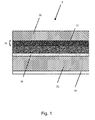
- FIG. 1 In the FIG. 1 is shown in cross-section (cross-section) the adhesive tape 3, which consists of a non-woven backing 31, on the upper side of a hardener mass 32 and on the lower side of a reaction mass 33 is applied.
- the adhesive tape 3 which consists of a non-woven backing 31, on the upper side of a hardener mass 32 and on the lower side of a reaction mass 33 is applied.
- the hardener mass 32 is 25% sunken in the carrier 31, which causes an optimal anchoring (39).
- release film 34 is present.
- reaction mass 33 is covered on the free side with a liner 35. Both hardener mass 32 and reaction mass 33 are applied over the entire width of the carrier 31, so the entire surface.
- FIG. 2 is shown in cross-section (cross-section) another variant of the adhesive tape 3, which consists of a non-woven backing 31, on the upper side of a hardener mass 32 and on the lower side of a reaction mass 33 is applied.
- the hardener mass 32 is 25% sunken in the carrier 31, which causes an optimal anchoring (39).
- release film 34 is present between carrier 31 and reaction mass 33.
- the release film extends over the entire width of the carrier 31st
- Both hardener mass 32 and reaction mass 33 are applied in the form of a strip.
- the strip of hardener compound 31 extends from the one longitudinal edge of the carrier 31 up to the middle of the carrier 31.
- the strip of reaction mass 33 extends from the opposite edge of the carrier 31 up to the middle of the carrier 31.
- FIG. 3 an alternative of the inventive method for wrapping elongate material is shown.
- an adhesive tape system of a first adhesive tape 3 comprising a textile support 31, on the upper side of a hardener mass 32 is applied, and a second adhesive tape 3a comprising a textile support 31 a, on the lower side of a reaction mass 33 is applied.
- Both hardener mass 32 and reaction mass 33 are in each case 25% sunken into the supports 31, 31a, which effects an optimal anchoring (39, 39a).
- the first adhesive tape 3 and the second adhesive tape 3a are guided in a helical line around the elongated product or envelop the elongate material in the axial direction such that the hardener mass 32 of the first adhesive tape 3 comes into contact with the reaction mass 33 of the second adhesive tape 3a.
- One of the adhesive tapes 3, 3a is wound in such a way that the support 31, 31a with the uncoated side is in contact with the material, so that the hardener mass 32 or the reaction mass 33 face outward. Then, the winding of the other adhesive tape 3, 3a takes place in such a way that hardener mass 32 and reaction mass 33 lie on one another so that the uncoated side of the other adhesive tape 3, 3a faces outward.
- FIG. 4 represents a further variant of the invention.
- This variant comprises a sheath 5, which consists of a covering 4, in which in an edge region of the covering 4, a first adhesive tape 3 is present, which is glued to the covering 4, that the first Adhesive tape 3 extends over one of the longitudinal edges of the covering 4, in a narrow compared to the width of the covering 4 edge region.
- the first adhesive tape 3 consists of a textile support 31, on which the hardener mass 32 is applied.
- the casing has in the edge region of the covering 4, namely on the opposite longitudinal edge, a second adhesive tape 3a, which is glued to the covering 4, that the adhesive tape 3a extends over the other of the two longitudinal edges of the covering 4, also in a narrow compared to the width of the covering 4 edge region.
- the second adhesive tape 3a also consists of a textile support 31a on which the reaction mass 33 is applied.
- the width (B3) of the covering 4 is greater by a factor of 1.5 than the sum of the widths (B1, B2) of the adhesive tapes 3, 3a.
- FIG. 5 a section of a wiring harness is shown, which is composed of a bundling of individual cables 7 and with the inventive adhesive tape 3 shown here simplified according to the in FIG. 1 sheathed variant is sheathed.
- the adhesive tape 3 is guided in a spiral movement around the wiring harness.
- the section of the wiring harness shown shows two windings I and II of the adhesive tape 3. To the left, further windings would extend, these are not shown here.
- the winding of the adhesive tape 3 takes place with an offset 3V of 50%, which is indicated in this figure by the darker color.
Landscapes
- Chemical & Material Sciences (AREA)
- Organic Chemistry (AREA)
- Engineering & Computer Science (AREA)
- Manufacturing & Machinery (AREA)
- Adhesive Tapes (AREA)
- Adhesives Or Adhesive Processes (AREA)
- Laminated Bodies (AREA)
- Braiding, Manufacturing Of Bobbin-Net Or Lace, And Manufacturing Of Nets By Knotting (AREA)
- Insulating Bodies (AREA)
Applications Claiming Priority (1)
| Application Number | Priority Date | Filing Date | Title |
|---|---|---|---|
| DE102013213726.5A DE102013213726A1 (de) | 2013-07-12 | 2013-07-12 | Verfahren zum Ummanteln von langgestrecktem Gut wie insbesondere Leitungen oder Kabelsätzen |
Publications (2)
| Publication Number | Publication Date |
|---|---|
| EP2826828A1 true EP2826828A1 (fr) | 2015-01-21 |
| EP2826828B1 EP2826828B1 (fr) | 2019-03-06 |
Family
ID=51178741
Family Applications (1)
| Application Number | Title | Priority Date | Filing Date |
|---|---|---|---|
| EP14176675.8A Active EP2826828B1 (fr) | 2013-07-12 | 2014-07-11 | Procédé destiné à l'enrobage de produit allongé, comme notamment des conduites ou des ensemble de câbles |
Country Status (8)
| Country | Link |
|---|---|
| US (1) | US9613733B2 (fr) |
| EP (1) | EP2826828B1 (fr) |
| CN (1) | CN104299726B (fr) |
| BR (1) | BR102014017022A2 (fr) |
| DE (1) | DE102013213726A1 (fr) |
| ES (1) | ES2728176T3 (fr) |
| MX (1) | MX352539B (fr) |
| RU (1) | RU2014128531A (fr) |
Cited By (2)
| Publication number | Priority date | Publication date | Assignee | Title |
|---|---|---|---|---|
| WO2016012617A1 (fr) * | 2014-07-25 | 2016-01-28 | Certoplast Technische Klebebänder Gmbh | Procédé de production d'un ruban adhésif |
| WO2021032822A1 (fr) * | 2019-08-22 | 2021-02-25 | Tesa Se | Procédé de recouvrement d'articles allongés, en particulier de lignes |
Families Citing this family (30)
| Publication number | Priority date | Publication date | Assignee | Title |
|---|---|---|---|---|
| JP6354636B2 (ja) * | 2015-03-31 | 2018-07-11 | ブラザー工業株式会社 | 粘着テープカートリッジ |
| DE102015217731B4 (de) * | 2015-09-16 | 2022-03-10 | Volkswagen Aktiengesellschaft | Fügeverfahren zur Herstellung eines Verbundwerkstücks |
| JP2017088723A (ja) | 2015-11-09 | 2017-05-25 | 日東電工株式会社 | 接着方法、接着構造体、および、接着キット |
| DE102016204898A1 (de) * | 2016-03-23 | 2017-09-28 | Tesa Se | Klebeband zum Ummanteln von langgestrecktem Gut wie insbesondere Kabelsätzen und Verfahren zur Ummantelung |
| US10297370B1 (en) * | 2017-12-14 | 2019-05-21 | Tesa Se | Forming a rigid cable harness with a curable sleeve |
| DE102018213969A1 (de) * | 2018-08-20 | 2020-02-20 | Tesa Se | Klebeband zum Ummanteln von langgestrecktem Gut wie insbesondere Kabelsätzen und Verfahren zur Ummantelung |
| DE102019103122A1 (de) | 2019-02-08 | 2020-08-13 | Tesa Se | Mit Feuchtigkeit härtbares Klebeband und Verfahren zum Ummanteln von langgestrecktem Gut insbesondere Leitungen |
| DE102019103123A1 (de) | 2019-02-08 | 2020-08-13 | Tesa Se | Thermisch erweichbares Klebeband und Verfahren zum Ummanteln von langgestrecktem Gut insbesondere Leitungen |
| DE102019103120A1 (de) | 2019-02-08 | 2020-08-13 | Tesa Se | UV-härtbares Klebeband und Verfahren zum Ummanteln von langgestrecktem Gut insbesondere Leitungen |
| DE102019103121A1 (de) | 2019-02-08 | 2020-08-13 | Tesa Se | Schrumpffolie und Verfahren zum Ummanteln von langgestrecktem Gut insbesondere Leitungen |
| DE102019103124B4 (de) | 2019-02-08 | 2022-02-03 | Tesa Se | Thermisch härtbares Klebeband, Verwendung zum Ummanteln von langgestrecktem Gut insbesondere Leitungen und Kabelstrang |
| DE102019210708B4 (de) | 2019-07-19 | 2025-06-26 | Tesa Se | Verwendung eines thermisch härtbaren Klebebands zum Ummanteln von langgestrecktem Gut, insbesondere Kabelsätzen |
| DE102019211178B3 (de) | 2019-07-26 | 2020-09-17 | Tesa Se | Verfahren zum Ummanteln von langgestrecktem Gut, ummanteltes Gut und dessen Verwendung |
| DE102019212589A1 (de) | 2019-08-22 | 2021-02-25 | Tesa Se | Verfahren zum Ummanteln von langgestrecktem Gut, insbesondere Leitungen |
| DE102019212591A1 (de) | 2019-08-22 | 2021-02-25 | Tesa Se | Verfahren zum Ummanteln von langgestrecktem Gut, insbesondere Leitungen |
| EP4017927A1 (fr) | 2019-08-23 | 2022-06-29 | tesa SE | Bande pouvant être ramollie par voie thermique et procédé pour recouvrir des articles allongés, en particulier des lignes |
| CN111403080A (zh) * | 2020-03-24 | 2020-07-10 | 东莞讯滔电子有限公司 | 电缆及其制造方法 |
| EP3957695A1 (fr) | 2020-08-17 | 2022-02-23 | tesa SE | Bande adhésive permettant d'envelopper une marchandise allongée telle que, en particulier les faisceaux de câbles et procédé d'enveloppement |
| DE102020212233B4 (de) | 2020-09-29 | 2025-07-31 | Tesa Se | Klebeband zum Ummanteln von langgestrecktem Gut wie insbesondere Kabelsätzen und Verwendung des Klebebands zur Ummantelung |
| CN116134554A (zh) * | 2020-09-29 | 2023-05-16 | 株式会社自动网络技术研究所 | 线束 |
| DE102021205196A1 (de) | 2021-05-20 | 2022-11-24 | Tesa Se | Klebeband zum Ummanteln von langgestrecktem Gut wie insbesondere Kabelsätzen und Verfahren zur Ummantelung |
| WO2022253985A1 (fr) | 2021-06-04 | 2022-12-08 | Tesa Se | Ruban adhésif et procédé de recouvrement d'articles allongés, en particulier de lignes |
| DE102021210731B4 (de) | 2021-06-04 | 2025-06-18 | Tesa Se | Klebeband und Verfahren zum Ummanteln von langgestrecktem Gut insbesondere Leitungen sowie Kabelstrang |
| DE102021210866A1 (de) | 2021-09-28 | 2023-03-30 | Tesa Se | Klebeband zum Ummanteln von langgestrecktem Gut wie insbesondere Kabelsätzen und Verfahren zur Ummantelung |
| DE102021126466A1 (de) | 2021-10-13 | 2023-04-13 | Tesa Se | Klebeband und Verfahren zum Ummanteln von langgestrecktem Gut insbesondere Leitungen |
| EP4269520A1 (fr) | 2022-04-27 | 2023-11-01 | tesa SE | Ruban adhésif pour gainer des articles allongés tels que des faisceaux de câbles et procédé de gainage |
| DE102022126654A1 (de) | 2022-10-13 | 2024-04-18 | Tesa Se | Klebeband und Verfahren zum Ummanteln von langgestrecktem Gut insbesondere Leitungen |
| DE102023105349A1 (de) | 2023-03-03 | 2024-09-05 | Tesa Se | Verfahren zum Konfektionieren von textilen Klebebändern |
| DE102023108284A1 (de) | 2023-03-31 | 2024-10-02 | Tesa Se | Klebeband zum Ummanteln von langgestrecktem Gut wie insbesondere Kabelsätzen und Verfahren zur Ummantelung |
| JP2026511732A (ja) | 2023-03-31 | 2026-04-14 | テーザ・ソシエタス・ヨーロピア | 長尺物品、例えば特にケーブルハーネスを被覆するための接着テープ及び被覆方法 |
Citations (13)
| Publication number | Priority date | Publication date | Assignee | Title |
|---|---|---|---|---|
| DE2115537A1 (en) * | 1971-03-31 | 1972-10-05 | Synt O Plast Gmbh Chemisch Tec | Bonding metal to metal - using coated webs |
| EP0071212B1 (fr) | 1981-07-27 | 1986-04-09 | Günter TESCH | Objet stratifié en forme de natte et procédé pour sa fabrication |
| DE3940292A1 (de) * | 1989-12-06 | 1991-06-13 | Hanns Buser | Verfahren zum verarbeiten von zweikomponenten-klebstoff |
| WO2002018509A1 (fr) * | 2000-08-31 | 2002-03-07 | Tesa Ag | Procede permettant d'envelopper un element allonge, en particulier un faisceau de cables, a l'aide d'une bande adhesive |
| EP1300452A2 (fr) | 2001-10-05 | 2003-04-09 | Tesa AG | Procédé pour enrober des produits longs |
| EP1312097A1 (fr) | 2000-07-28 | 2003-05-21 | Tesa AG | Procede servant a envelopper des objets allonges notamment des faisceaux de cables |
| EP1367608A2 (fr) | 2002-01-22 | 2003-12-03 | tesa AG | Procédé pour enrober des produits longs, en particulier des faisceaux de câbles, avec deux revêtements en forme de ruban, qui entourent ces produits sous forme tubulaire |
| DE10229527A1 (de) | 2002-07-01 | 2004-01-15 | Tesa Ag | Band aus einer Reihe hintereinander und überlappend angeordneter einzelner Ummantelungsabschnitte zum Ummanteln von langgestrecktem Gut, wie insbesondere Kabelsätzen |
| EP1448744A1 (fr) | 2001-10-16 | 2004-08-25 | certoplast Vorwerk & Sohn GmbH | Bande adhesive a surface support lissee |
| DE10329994A1 (de) | 2003-07-02 | 2005-01-20 | Tesa Ag | Verfahren zur Ummantelung von langgestrecktem Gut, wie insbesondere Kabelsätzen, mit einem Klebeband |
| WO2006108871A1 (fr) | 2005-04-14 | 2006-10-19 | Tesa Ag | Procede pour entourer un produit oblong, comme notamment des faisceaux de cables, d'une gaine |
| DE102009006935A1 (de) * | 2009-01-30 | 2010-08-05 | Tesa Se | Träger verstärkte hitzeaktivierbare Klebemassen |
| EP2497805A1 (fr) | 2011-03-07 | 2012-09-12 | tesa SE | Ruban adhésif pour le bandage de câbles |
Family Cites Families (12)
| Publication number | Priority date | Publication date | Assignee | Title |
|---|---|---|---|---|
| GB481593A (en) * | 1936-07-09 | 1938-03-09 | Callenders Cable & Const Co | Improvements in adhesive textile tapes |
| US3657379A (en) * | 1970-07-02 | 1972-04-18 | Ncr Co | Intercrossing resin/curing agent adhesive systems |
| US3837981A (en) * | 1971-05-10 | 1974-09-24 | T Flint | Epoxy tape |
| DE2131256A1 (de) * | 1971-06-24 | 1973-01-11 | Wevo Chemie Heinz Wenzel | Verfahren zum verbinden zweier werkstuecke |
| DE4334039A1 (de) * | 1993-10-06 | 1995-04-13 | Coroplast Fritz Mueller Kg | Klebeband sowie Verwendung des Klebebandes zum Umwickeln eines Leitungssatzes |
| DE10259457B4 (de) * | 2002-12-19 | 2010-01-07 | Tesa Se | Verfahren zum Aufbringen von Haftklebebändern auf raue und/oder unebene Oberflächen |
| DE102006042816A1 (de) | 2006-09-08 | 2008-06-26 | Tesa Ag | Hitze-aktiviert verklebbares Stanzungsflächenelement |
| DE202010003210U1 (de) * | 2010-03-05 | 2011-12-05 | Certoplast Vorwerk & Sohn Gmbh | Klebeband |
| DE202010014239U1 (de) * | 2010-10-14 | 2010-12-30 | Certoplast Vorwerk & Sohn Gmbh | Klebeband sowie aus dem Klebeband hergestellte Schlauchummantelung |
| JP5969217B2 (ja) | 2011-03-09 | 2016-08-17 | 日東電工株式会社 | 両面接着テープ |
| DE102011075160A1 (de) * | 2011-05-03 | 2012-11-08 | Tesa Se | Verfahren zur Herstellung eines Klebebandes insbesondere zum Umwickeln von Kabeln aus einem offenen textilen Träger und einer darauf einseitig beschichteten Haftklebemasse |
| DE102011075156A1 (de) * | 2011-05-03 | 2012-11-08 | Tesa Se | Klebeband zum Ummanteln von langgestrecktem Gut wie insbesondere Kabelsätzen und Verfahren zur Ummantelung |
-
2013
- 2013-07-12 DE DE102013213726.5A patent/DE102013213726A1/de not_active Withdrawn
-
2014
- 2014-07-07 MX MX2014008323A patent/MX352539B/es active IP Right Grant
- 2014-07-10 BR BRBR102014017022-7A patent/BR102014017022A2/pt not_active Application Discontinuation
- 2014-07-11 EP EP14176675.8A patent/EP2826828B1/fr active Active
- 2014-07-11 ES ES14176675T patent/ES2728176T3/es active Active
- 2014-07-11 CN CN201410541311.9A patent/CN104299726B/zh active Active
- 2014-07-11 RU RU2014128531A patent/RU2014128531A/ru not_active Application Discontinuation
- 2014-07-11 US US14/328,780 patent/US9613733B2/en active Active
Patent Citations (14)
| Publication number | Priority date | Publication date | Assignee | Title |
|---|---|---|---|---|
| DE2115537A1 (en) * | 1971-03-31 | 1972-10-05 | Synt O Plast Gmbh Chemisch Tec | Bonding metal to metal - using coated webs |
| EP0071212B1 (fr) | 1981-07-27 | 1986-04-09 | Günter TESCH | Objet stratifié en forme de natte et procédé pour sa fabrication |
| DE3940292A1 (de) * | 1989-12-06 | 1991-06-13 | Hanns Buser | Verfahren zum verarbeiten von zweikomponenten-klebstoff |
| EP1312097A1 (fr) | 2000-07-28 | 2003-05-21 | Tesa AG | Procede servant a envelopper des objets allonges notamment des faisceaux de cables |
| EP1315781A1 (fr) | 2000-08-31 | 2003-06-04 | Tesa AG | Procede permettant d'envelopper un element allonge, en particulier un faisceau de cables, a l'aide d'une bande adhesive |
| WO2002018509A1 (fr) * | 2000-08-31 | 2002-03-07 | Tesa Ag | Procede permettant d'envelopper un element allonge, en particulier un faisceau de cables, a l'aide d'une bande adhesive |
| EP1300452A2 (fr) | 2001-10-05 | 2003-04-09 | Tesa AG | Procédé pour enrober des produits longs |
| EP1448744A1 (fr) | 2001-10-16 | 2004-08-25 | certoplast Vorwerk & Sohn GmbH | Bande adhesive a surface support lissee |
| EP1367608A2 (fr) | 2002-01-22 | 2003-12-03 | tesa AG | Procédé pour enrober des produits longs, en particulier des faisceaux de câbles, avec deux revêtements en forme de ruban, qui entourent ces produits sous forme tubulaire |
| DE10229527A1 (de) | 2002-07-01 | 2004-01-15 | Tesa Ag | Band aus einer Reihe hintereinander und überlappend angeordneter einzelner Ummantelungsabschnitte zum Ummanteln von langgestrecktem Gut, wie insbesondere Kabelsätzen |
| DE10329994A1 (de) | 2003-07-02 | 2005-01-20 | Tesa Ag | Verfahren zur Ummantelung von langgestrecktem Gut, wie insbesondere Kabelsätzen, mit einem Klebeband |
| WO2006108871A1 (fr) | 2005-04-14 | 2006-10-19 | Tesa Ag | Procede pour entourer un produit oblong, comme notamment des faisceaux de cables, d'une gaine |
| DE102009006935A1 (de) * | 2009-01-30 | 2010-08-05 | Tesa Se | Träger verstärkte hitzeaktivierbare Klebemassen |
| EP2497805A1 (fr) | 2011-03-07 | 2012-09-12 | tesa SE | Ruban adhésif pour le bandage de câbles |
Non-Patent Citations (4)
| Title |
|---|
| "Textiltechnik-Vliesstofferzeugung", 1996, ARBEITGEBERKREIS GESAMTTEXTIL |
| "Vliesstoffe", 1982, GEORG THIEME VERLAG |
| DONATAS SATAS: "Handbook of Pressure Sensitive Adhesive Technology", 1989, VAN NOSTRAND |
| G. W. EHRENSTEIN: "Faserverbund-Kunststoffe", 2006, HANSER |
Cited By (2)
| Publication number | Priority date | Publication date | Assignee | Title |
|---|---|---|---|---|
| WO2016012617A1 (fr) * | 2014-07-25 | 2016-01-28 | Certoplast Technische Klebebänder Gmbh | Procédé de production d'un ruban adhésif |
| WO2021032822A1 (fr) * | 2019-08-22 | 2021-02-25 | Tesa Se | Procédé de recouvrement d'articles allongés, en particulier de lignes |
Also Published As
| Publication number | Publication date |
|---|---|
| RU2014128531A (ru) | 2016-02-10 |
| MX2014008323A (es) | 2015-04-28 |
| EP2826828B1 (fr) | 2019-03-06 |
| BR102014017022A2 (pt) | 2015-03-17 |
| MX352539B (es) | 2017-11-29 |
| ES2728176T3 (es) | 2019-10-22 |
| DE102013213726A1 (de) | 2015-01-15 |
| US20150013875A1 (en) | 2015-01-15 |
| CN104299726B (zh) | 2018-05-08 |
| US9613733B2 (en) | 2017-04-04 |
| CN104299726A (zh) | 2015-01-21 |
Similar Documents
| Publication | Publication Date | Title |
|---|---|---|
| EP2826828B1 (fr) | Procédé destiné à l'enrobage de produit allongé, comme notamment des conduites ou des ensemble de câbles | |
| EP3019571B2 (fr) | Procédé permettant d'envelopper un produit étendu en longueur, par exemple en particulier des fils ou des ensembles de câbles | |
| EP2522705B1 (fr) | Utilisation d'une bande de collage destinée à l'enrobage de marchandise allongée, comme notamment des ensemble de câbles et marchandise allongée enrobée d'une bande de collage | |
| EP2520628B1 (fr) | Utilisation d'une bande de collage destinée à l'enrobage de marchandise allongée, comme notamment des ensemble de câbles et marchandise allongée enrobée de la bande de collage | |
| EP2520627B1 (fr) | Utilisation d'une bande de collage destinée à l'enrobage de marchandise allongée, comme notamment des ensemble de câbles et marchandise allongée enrobée de la bande de collage | |
| EP3540024B1 (fr) | Bande adhésive destinée au groupement d'une marchandise allongée comme, en particulier des jeux de câbles, et procédé de groupement de marchandise allongée | |
| EP3433330B1 (fr) | Bande adhésive pour enrober des produits allongés, comme en particulier des ensembles de cables et procédé d' enrobage | |
| DE102011075160A1 (de) | Verfahren zur Herstellung eines Klebebandes insbesondere zum Umwickeln von Kabeln aus einem offenen textilen Träger und einer darauf einseitig beschichteten Haftklebemasse | |
| DE102011005200A1 (de) | Klebeband zum Ummanteln von langgestrecktem Gut wie insbesondere Kabelsätzen und Verfahren zur Ummantelung | |
| EP2695926A1 (fr) | Ruban adhésif réticulé par rayons électroniques destinée à l'enrobage de cables et utilisation pour l'enrobage | |
| EP4092092B1 (fr) | Bande adhésive permettant d'envelopper une marchandise allongée telle que, en particulier les faisceaux de câbles et procédé d'enveloppement | |
| EP4004951B1 (fr) | Procédé de chemisage d'articles allongés, en particulier de lignes | |
| EP3613819B1 (fr) | Bande adhésive destinée à l'enveloppement d'une marchandise allongée comme notamment les faisceaux de câbles et procédé d'enveloppement | |
| DE102011005162A1 (de) | Klebeland für die Kabelbandagierung | |
| DE102017219658A1 (de) | Verfahren zur Herstellung eines Klebebandes | |
| DE102019211874B4 (de) | Klebeband zum Umwickeln von Kabeln und Verwendung | |
| DE102019103124A1 (de) | Thermisch härtbares Klebeband und Verfahren zum Ummanteln von langgestrecktem Gut insbesondere Leitungen | |
| WO2021023810A1 (fr) | Ruban adhésif pour recouvrir des produits allongés, comme, en particulier, des ensembles de câbles, et procédé de recouvrement | |
| DE102020212233B4 (de) | Klebeband zum Ummanteln von langgestrecktem Gut wie insbesondere Kabelsätzen und Verwendung des Klebebands zur Ummantelung | |
| WO2024200730A2 (fr) | Ruban adhésif utilisé pour gainer des produits allongés, en particulier des faisceaux de câbles, et procédé de gainage |
Legal Events
| Date | Code | Title | Description |
|---|---|---|---|
| 17P | Request for examination filed |
Effective date: 20140711 |
|
| AK | Designated contracting states |
Kind code of ref document: A1 Designated state(s): AL AT BE BG CH CY CZ DE DK EE ES FI FR GB GR HR HU IE IS IT LI LT LU LV MC MK MT NL NO PL PT RO RS SE SI SK SM TR |
|
| AX | Request for extension of the european patent |
Extension state: BA ME |
|
| PUAI | Public reference made under article 153(3) epc to a published international application that has entered the european phase |
Free format text: ORIGINAL CODE: 0009012 |
|
| R17P | Request for examination filed (corrected) |
Effective date: 20150721 |
|
| RBV | Designated contracting states (corrected) |
Designated state(s): AL AT BE BG CH CY CZ DE DK EE ES FI FR GB GR HR HU IE IS IT LI LT LU LV MC MK MT NL NO PL PT RO RS SE SI SK SM TR |
|
| RAP1 | Party data changed (applicant data changed or rights of an application transferred) |
Owner name: TESA SE |
|
| STAA | Information on the status of an ep patent application or granted ep patent |
Free format text: STATUS: EXAMINATION IS IN PROGRESS |
|
| 17Q | First examination report despatched |
Effective date: 20180125 |
|
| REG | Reference to a national code |
Ref country code: DE Ref legal event code: R079 Ref document number: 502014011013 Country of ref document: DE Free format text: PREVIOUS MAIN CLASS: C09J0007040000 Ipc: C09J0005040000 |
|
| GRAP | Despatch of communication of intention to grant a patent |
Free format text: ORIGINAL CODE: EPIDOSNIGR1 |
|
| STAA | Information on the status of an ep patent application or granted ep patent |
Free format text: STATUS: GRANT OF PATENT IS INTENDED |
|
| RIC1 | Information provided on ipc code assigned before grant |
Ipc: C09J 5/04 20060101AFI20180903BHEP Ipc: C09J 7/21 20180101ALI20180903BHEP Ipc: C09J 7/35 20180101ALI20180903BHEP |
|
| INTG | Intention to grant announced |
Effective date: 20180921 |
|
| GRAS | Grant fee paid |
Free format text: ORIGINAL CODE: EPIDOSNIGR3 |
|
| GRAA | (expected) grant |
Free format text: ORIGINAL CODE: 0009210 |
|
| STAA | Information on the status of an ep patent application or granted ep patent |
Free format text: STATUS: THE PATENT HAS BEEN GRANTED |
|
| AK | Designated contracting states |
Kind code of ref document: B1 Designated state(s): AL AT BE BG CH CY CZ DE DK EE ES FI FR GB GR HR HU IE IS IT LI LT LU LV MC MK MT NL NO PL PT RO RS SE SI SK SM TR |
|
| REG | Reference to a national code |
Ref country code: GB Ref legal event code: FG4D Free format text: NOT ENGLISH |
|
| REG | Reference to a national code |
Ref country code: CH Ref legal event code: EP Ref country code: AT Ref legal event code: REF Ref document number: 1104499 Country of ref document: AT Kind code of ref document: T Effective date: 20190315 |
|
| REG | Reference to a national code |
Ref country code: DE Ref legal event code: R096 Ref document number: 502014011013 Country of ref document: DE |
|
| REG | Reference to a national code |
Ref country code: IE Ref legal event code: FG4D Free format text: LANGUAGE OF EP DOCUMENT: GERMAN |
|
| REG | Reference to a national code |
Ref country code: RO Ref legal event code: EPE |
|
| REG | Reference to a national code |
Ref country code: NL Ref legal event code: MP Effective date: 20190306 |
|
| REG | Reference to a national code |
Ref country code: LT Ref legal event code: MG4D |
|
| PG25 | Lapsed in a contracting state [announced via postgrant information from national office to epo] |
Ref country code: LT Free format text: LAPSE BECAUSE OF FAILURE TO SUBMIT A TRANSLATION OF THE DESCRIPTION OR TO PAY THE FEE WITHIN THE PRESCRIBED TIME-LIMIT Effective date: 20190306 Ref country code: NO Free format text: LAPSE BECAUSE OF FAILURE TO SUBMIT A TRANSLATION OF THE DESCRIPTION OR TO PAY THE FEE WITHIN THE PRESCRIBED TIME-LIMIT Effective date: 20190606 Ref country code: SE Free format text: LAPSE BECAUSE OF FAILURE TO SUBMIT A TRANSLATION OF THE DESCRIPTION OR TO PAY THE FEE WITHIN THE PRESCRIBED TIME-LIMIT Effective date: 20190306 Ref country code: FI Free format text: LAPSE BECAUSE OF FAILURE TO SUBMIT A TRANSLATION OF THE DESCRIPTION OR TO PAY THE FEE WITHIN THE PRESCRIBED TIME-LIMIT Effective date: 20190306 |
|
| PG25 | Lapsed in a contracting state [announced via postgrant information from national office to epo] |
Ref country code: HR Free format text: LAPSE BECAUSE OF FAILURE TO SUBMIT A TRANSLATION OF THE DESCRIPTION OR TO PAY THE FEE WITHIN THE PRESCRIBED TIME-LIMIT Effective date: 20190306 Ref country code: GR Free format text: LAPSE BECAUSE OF FAILURE TO SUBMIT A TRANSLATION OF THE DESCRIPTION OR TO PAY THE FEE WITHIN THE PRESCRIBED TIME-LIMIT Effective date: 20190607 Ref country code: BG Free format text: LAPSE BECAUSE OF FAILURE TO SUBMIT A TRANSLATION OF THE DESCRIPTION OR TO PAY THE FEE WITHIN THE PRESCRIBED TIME-LIMIT Effective date: 20190606 Ref country code: RS Free format text: LAPSE BECAUSE OF FAILURE TO SUBMIT A TRANSLATION OF THE DESCRIPTION OR TO PAY THE FEE WITHIN THE PRESCRIBED TIME-LIMIT Effective date: 20190306 Ref country code: LV Free format text: LAPSE BECAUSE OF FAILURE TO SUBMIT A TRANSLATION OF THE DESCRIPTION OR TO PAY THE FEE WITHIN THE PRESCRIBED TIME-LIMIT Effective date: 20190306 Ref country code: NL Free format text: LAPSE BECAUSE OF FAILURE TO SUBMIT A TRANSLATION OF THE DESCRIPTION OR TO PAY THE FEE WITHIN THE PRESCRIBED TIME-LIMIT Effective date: 20190306 |
|
| REG | Reference to a national code |
Ref country code: ES Ref legal event code: FG2A Ref document number: 2728176 Country of ref document: ES Kind code of ref document: T3 Effective date: 20191022 |
|
| PG25 | Lapsed in a contracting state [announced via postgrant information from national office to epo] |
Ref country code: SK Free format text: LAPSE BECAUSE OF FAILURE TO SUBMIT A TRANSLATION OF THE DESCRIPTION OR TO PAY THE FEE WITHIN THE PRESCRIBED TIME-LIMIT Effective date: 20190306 Ref country code: IT Free format text: LAPSE BECAUSE OF FAILURE TO SUBMIT A TRANSLATION OF THE DESCRIPTION OR TO PAY THE FEE WITHIN THE PRESCRIBED TIME-LIMIT Effective date: 20190306 Ref country code: PT Free format text: LAPSE BECAUSE OF FAILURE TO SUBMIT A TRANSLATION OF THE DESCRIPTION OR TO PAY THE FEE WITHIN THE PRESCRIBED TIME-LIMIT Effective date: 20190706 Ref country code: AL Free format text: LAPSE BECAUSE OF FAILURE TO SUBMIT A TRANSLATION OF THE DESCRIPTION OR TO PAY THE FEE WITHIN THE PRESCRIBED TIME-LIMIT Effective date: 20190306 Ref country code: EE Free format text: LAPSE BECAUSE OF FAILURE TO SUBMIT A TRANSLATION OF THE DESCRIPTION OR TO PAY THE FEE WITHIN THE PRESCRIBED TIME-LIMIT Effective date: 20190306 |
|
| PG25 | Lapsed in a contracting state [announced via postgrant information from national office to epo] |
Ref country code: PL Free format text: LAPSE BECAUSE OF FAILURE TO SUBMIT A TRANSLATION OF THE DESCRIPTION OR TO PAY THE FEE WITHIN THE PRESCRIBED TIME-LIMIT Effective date: 20190306 Ref country code: SM Free format text: LAPSE BECAUSE OF FAILURE TO SUBMIT A TRANSLATION OF THE DESCRIPTION OR TO PAY THE FEE WITHIN THE PRESCRIBED TIME-LIMIT Effective date: 20190306 |
|
| REG | Reference to a national code |
Ref country code: DE Ref legal event code: R097 Ref document number: 502014011013 Country of ref document: DE |
|
| PG25 | Lapsed in a contracting state [announced via postgrant information from national office to epo] |
Ref country code: IS Free format text: LAPSE BECAUSE OF FAILURE TO SUBMIT A TRANSLATION OF THE DESCRIPTION OR TO PAY THE FEE WITHIN THE PRESCRIBED TIME-LIMIT Effective date: 20190706 |
|
| PLBE | No opposition filed within time limit |
Free format text: ORIGINAL CODE: 0009261 |
|
| STAA | Information on the status of an ep patent application or granted ep patent |
Free format text: STATUS: NO OPPOSITION FILED WITHIN TIME LIMIT |
|
| PG25 | Lapsed in a contracting state [announced via postgrant information from national office to epo] |
Ref country code: DK Free format text: LAPSE BECAUSE OF FAILURE TO SUBMIT A TRANSLATION OF THE DESCRIPTION OR TO PAY THE FEE WITHIN THE PRESCRIBED TIME-LIMIT Effective date: 20190306 |
|
| 26N | No opposition filed |
Effective date: 20191209 |
|
| PG25 | Lapsed in a contracting state [announced via postgrant information from national office to epo] |
Ref country code: SI Free format text: LAPSE BECAUSE OF FAILURE TO SUBMIT A TRANSLATION OF THE DESCRIPTION OR TO PAY THE FEE WITHIN THE PRESCRIBED TIME-LIMIT Effective date: 20190306 Ref country code: MC Free format text: LAPSE BECAUSE OF FAILURE TO SUBMIT A TRANSLATION OF THE DESCRIPTION OR TO PAY THE FEE WITHIN THE PRESCRIBED TIME-LIMIT Effective date: 20190306 |
|
| REG | Reference to a national code |
Ref country code: CH Ref legal event code: PL |
|
| GBPC | Gb: european patent ceased through non-payment of renewal fee |
Effective date: 20190711 |
|
| PG25 | Lapsed in a contracting state [announced via postgrant information from national office to epo] |
Ref country code: TR Free format text: LAPSE BECAUSE OF FAILURE TO SUBMIT A TRANSLATION OF THE DESCRIPTION OR TO PAY THE FEE WITHIN THE PRESCRIBED TIME-LIMIT Effective date: 20190306 |
|
| REG | Reference to a national code |
Ref country code: BE Ref legal event code: MM Effective date: 20190731 |
|
| PG25 | Lapsed in a contracting state [announced via postgrant information from national office to epo] |
Ref country code: GB Free format text: LAPSE BECAUSE OF NON-PAYMENT OF DUE FEES Effective date: 20190711 |
|
| PG25 | Lapsed in a contracting state [announced via postgrant information from national office to epo] |
Ref country code: LU Free format text: LAPSE BECAUSE OF NON-PAYMENT OF DUE FEES Effective date: 20190711 Ref country code: BE Free format text: LAPSE BECAUSE OF NON-PAYMENT OF DUE FEES Effective date: 20190731 Ref country code: CH Free format text: LAPSE BECAUSE OF NON-PAYMENT OF DUE FEES Effective date: 20190731 Ref country code: LI Free format text: LAPSE BECAUSE OF NON-PAYMENT OF DUE FEES Effective date: 20190731 |
|
| PG25 | Lapsed in a contracting state [announced via postgrant information from national office to epo] |
Ref country code: IE Free format text: LAPSE BECAUSE OF NON-PAYMENT OF DUE FEES Effective date: 20190711 |
|
| REG | Reference to a national code |
Ref country code: AT Ref legal event code: MM01 Ref document number: 1104499 Country of ref document: AT Kind code of ref document: T Effective date: 20190711 |
|
| PG25 | Lapsed in a contracting state [announced via postgrant information from national office to epo] |
Ref country code: AT Free format text: LAPSE BECAUSE OF NON-PAYMENT OF DUE FEES Effective date: 20190711 |
|
| PG25 | Lapsed in a contracting state [announced via postgrant information from national office to epo] |
Ref country code: CY Free format text: LAPSE BECAUSE OF FAILURE TO SUBMIT A TRANSLATION OF THE DESCRIPTION OR TO PAY THE FEE WITHIN THE PRESCRIBED TIME-LIMIT Effective date: 20190306 |
|
| PG25 | Lapsed in a contracting state [announced via postgrant information from national office to epo] |
Ref country code: MT Free format text: LAPSE BECAUSE OF FAILURE TO SUBMIT A TRANSLATION OF THE DESCRIPTION OR TO PAY THE FEE WITHIN THE PRESCRIBED TIME-LIMIT Effective date: 20190306 Ref country code: HU Free format text: LAPSE BECAUSE OF FAILURE TO SUBMIT A TRANSLATION OF THE DESCRIPTION OR TO PAY THE FEE WITHIN THE PRESCRIBED TIME-LIMIT; INVALID AB INITIO Effective date: 20140711 |
|
| PG25 | Lapsed in a contracting state [announced via postgrant information from national office to epo] |
Ref country code: MK Free format text: LAPSE BECAUSE OF FAILURE TO SUBMIT A TRANSLATION OF THE DESCRIPTION OR TO PAY THE FEE WITHIN THE PRESCRIBED TIME-LIMIT Effective date: 20190306 |
|
| PGFP | Annual fee paid to national office [announced via postgrant information from national office to epo] |
Ref country code: RO Payment date: 20220630 Year of fee payment: 9 |
|
| PGFP | Annual fee paid to national office [announced via postgrant information from national office to epo] |
Ref country code: ES Payment date: 20220921 Year of fee payment: 9 Ref country code: CZ Payment date: 20220711 Year of fee payment: 9 |
|
| PG25 | Lapsed in a contracting state [announced via postgrant information from national office to epo] |
Ref country code: RO Free format text: LAPSE BECAUSE OF NON-PAYMENT OF DUE FEES Effective date: 20230711 Ref country code: CZ Free format text: LAPSE BECAUSE OF NON-PAYMENT OF DUE FEES Effective date: 20230711 |
|
| REG | Reference to a national code |
Ref country code: ES Ref legal event code: FD2A Effective date: 20240828 |
|
| PG25 | Lapsed in a contracting state [announced via postgrant information from national office to epo] |
Ref country code: ES Free format text: LAPSE BECAUSE OF NON-PAYMENT OF DUE FEES Effective date: 20230712 |
|
| PG25 | Lapsed in a contracting state [announced via postgrant information from national office to epo] |
Ref country code: ES Free format text: LAPSE BECAUSE OF NON-PAYMENT OF DUE FEES Effective date: 20230712 |
|
| PGFP | Annual fee paid to national office [announced via postgrant information from national office to epo] |
Ref country code: DE Payment date: 20250722 Year of fee payment: 12 |
|
| PGFP | Annual fee paid to national office [announced via postgrant information from national office to epo] |
Ref country code: FR Payment date: 20250725 Year of fee payment: 12 |