EP2829106B1 - Procédé et appareil de surveillance simultanée de canaux gsm - Google Patents
Procédé et appareil de surveillance simultanée de canaux gsm Download PDFInfo
- Publication number
- EP2829106B1 EP2829106B1 EP13714149.5A EP13714149A EP2829106B1 EP 2829106 B1 EP2829106 B1 EP 2829106B1 EP 13714149 A EP13714149 A EP 13714149A EP 2829106 B1 EP2829106 B1 EP 2829106B1
- Authority
- EP
- European Patent Office
- Prior art keywords
- channel
- signal
- channels
- base station
- bandwidth
- Prior art date
- Legal status (The legal status is an assumption and is not a legal conclusion. Google has not performed a legal analysis and makes no representation as to the accuracy of the status listed.)
- Not-in-force
Links
Images




Classifications
-
- H—ELECTRICITY
- H04—ELECTRIC COMMUNICATION TECHNIQUE
- H04W—WIRELESS COMMUNICATION NETWORKS
- H04W24/00—Supervisory, monitoring or testing arrangements
- H04W24/10—Scheduling measurement reports ; Arrangements for measurement reports
-
- H—ELECTRICITY
- H04—ELECTRIC COMMUNICATION TECHNIQUE
- H04W—WIRELESS COMMUNICATION NETWORKS
- H04W24/00—Supervisory, monitoring or testing arrangements
- H04W24/02—Arrangements for optimising operational condition
-
- H—ELECTRICITY
- H04—ELECTRIC COMMUNICATION TECHNIQUE
- H04W—WIRELESS COMMUNICATION NETWORKS
- H04W36/00—Hand-off or reselection arrangements
- H04W36/0005—Control or signalling for completing the hand-off
- H04W36/0055—Transmission or use of information for re-establishing the radio link
- H04W36/0069—Transmission or use of information for re-establishing the radio link in case of dual connectivity, e.g. decoupled uplink/downlink
-
- H—ELECTRICITY
- H04—ELECTRIC COMMUNICATION TECHNIQUE
- H04W—WIRELESS COMMUNICATION NETWORKS
- H04W36/00—Hand-off or reselection arrangements
- H04W36/0005—Control or signalling for completing the hand-off
- H04W36/0083—Determination of parameters used for hand-off, e.g. generation or modification of neighbour cell lists
- H04W36/0085—Hand-off measurements
- H04W36/0088—Scheduling hand-off measurements
-
- H—ELECTRICITY
- H04—ELECTRIC COMMUNICATION TECHNIQUE
- H04W—WIRELESS COMMUNICATION NETWORKS
- H04W36/00—Hand-off or reselection arrangements
- H04W36/16—Performing reselection for specific purposes
- H04W36/20—Performing reselection for specific purposes for optimising the interference level
-
- H—ELECTRICITY
- H04—ELECTRIC COMMUNICATION TECHNIQUE
- H04W—WIRELESS COMMUNICATION NETWORKS
- H04W36/00—Hand-off or reselection arrangements
- H04W36/24—Reselection being triggered by specific parameters
- H04W36/30—Reselection being triggered by specific parameters by measured or perceived connection quality data
-
- H—ELECTRICITY
- H04—ELECTRIC COMMUNICATION TECHNIQUE
- H04W—WIRELESS COMMUNICATION NETWORKS
- H04W48/00—Access restriction; Network selection; Access point selection
- H04W48/16—Discovering, processing access restriction or access information
-
- H—ELECTRICITY
- H04—ELECTRIC COMMUNICATION TECHNIQUE
- H04W—WIRELESS COMMUNICATION NETWORKS
- H04W52/00—Power management, e.g. Transmission Power Control [TPC] or power classes
- H04W52/02—Power saving arrangements
- H04W52/0209—Power saving arrangements in terminal devices
- H04W52/0225—Power saving arrangements in terminal devices using monitoring of external events, e.g. the presence of a signal
- H04W52/0229—Power saving arrangements in terminal devices using monitoring of external events, e.g. the presence of a signal where the received signal is a wanted signal
-
- H—ELECTRICITY
- H04—ELECTRIC COMMUNICATION TECHNIQUE
- H04W—WIRELESS COMMUNICATION NETWORKS
- H04W52/00—Power management, e.g. Transmission Power Control [TPC] or power classes
- H04W52/04—Transmission power control [TPC]
- H04W52/38—TPC being performed in particular situations
- H04W52/40—TPC being performed in particular situations during macro-diversity or soft handoff
-
- H—ELECTRICITY
- H04—ELECTRIC COMMUNICATION TECHNIQUE
- H04W—WIRELESS COMMUNICATION NETWORKS
- H04W88/00—Devices specially adapted for wireless communication networks, e.g. terminals, base stations or access point devices
- H04W88/02—Terminal devices
- H04W88/06—Terminal devices adapted for operation in multiple networks or having at least two operational modes, e.g. multi-mode terminals
-
- Y—GENERAL TAGGING OF NEW TECHNOLOGICAL DEVELOPMENTS; GENERAL TAGGING OF CROSS-SECTIONAL TECHNOLOGIES SPANNING OVER SEVERAL SECTIONS OF THE IPC; TECHNICAL SUBJECTS COVERED BY FORMER USPC CROSS-REFERENCE ART COLLECTIONS [XRACs] AND DIGESTS
- Y02—TECHNOLOGIES OR APPLICATIONS FOR MITIGATION OR ADAPTATION AGAINST CLIMATE CHANGE
- Y02D—CLIMATE CHANGE MITIGATION TECHNOLOGIES IN INFORMATION AND COMMUNICATION TECHNOLOGIES [ICT], I.E. INFORMATION AND COMMUNICATION TECHNOLOGIES AIMING AT THE REDUCTION OF THEIR OWN ENERGY USE
- Y02D30/00—Reducing energy consumption in communication networks
- Y02D30/70—Reducing energy consumption in communication networks in wireless communication networks
Definitions
- the technology discussed in this patent application relates generally to wireless communication devices, and more particularly, to methods and apparatuses for monitoring radio channels.
- Wireless communication networks are widely deployed to provide various communication services such as telephony, video, data, messaging, broadcasts, and so on.
- Such networks which are usually multiple access networks, support communications for multiple users by sharing the available network resources.
- UTRAN UMTS Terrestrial Radio Access Network
- the UTRAN is the radio access network (RAN) defined as a part of the Universal Mobile Telecommunications System (UMTS), a third generation (3G) mobile phone technology supported by the 3rd Generation Partnership Project (3GPP).
- UMTS Universal Mobile Telecommunications System
- 3GPP 3rd Generation Partnership Project
- the UMTS which is the successor to Global System for Mobile Communications (GSM) technologies, currently supports various air interface standards, such as Wideband-Code Division Multiple Access (W-CDMA), Time Division-Code Division Multiple Access (TD-CDMA), and Time Division-Synchronous Code Division Multiple Access (TD- SCDMA).
- W-CDMA Wideband-Code Division Multiple Access
- TD-CDMA Time Division-Code Division Multiple Access
- TD- SCDMA Time Division-Synchronous Code Division Multiple Access
- the UMTS also supports enhanced 3G data communications protocols, such as High Speed Packet Access (HSPA), which provides higher data transfer speeds and capacity to associated UMTS networks.
- HSPA High Speed Packet Access
- a single network device may include a GSM device having a single subscriber identity module (SIM).
- SIM subscriber identity module
- Another multi-network device may include a dual-SIM, dual standby (DSDS) device that has two SIM cards: one for each subscription.
- each subscription may be associated with one or more technology type.
- a first subscription may exclusively support 2G communication technology, such as GSM, while the second subscription may support one or more of 3G communication technologies (e.g., WCDMA) and/or 4G communication technologies (e.g., Long Term Evolution (LTE)).
- 3G communication technologies e.g., WCDMA
- 4G communication technologies e.g., Long Term Evolution (LTE)
- a wireless device in idle mode is required to measure and monitor the power levels in absolute radio-frequency channel numbers (ARFCNs) (hereinafter "channel") where a broadcast control channel (BCCH) is expected or detected.
- ARFCNs absolute radio-frequency channel numbers
- BCCH broadcast control channel
- the wireless device's receiver is tuned to each specific channel and the power in that channel is measured. After measuring the power in one specific channel, the receiver tunes to a subsequent channel and begins to perform another power level determination for that subsequent channel. This process continues, channel by channel until all the channel powers are measured. As such, receiver tuning overhead is considerable when the number of channels to be monitored is high. For a single SIM GSM device in idle mode, this measuring and monitoring procedure consumes significant power.
- European patent application EP 2 249 608 describes a mobile station capable of being served via a first radio access technology (RAT) and a second RAT.
- the mobile station includes a component configured to receive a permission to identify a cell of the first RAT in the absence of a first radio access type neighbour cell list for a serving cell of the second RAT.
- International Patent Application Publication No. WO 2004/030248 relates to a multi-mode mobile communications device and a method employing simultaneously operating receivers.
- European Patent Application Publication No. EP 2 330 761 relates to RSSI estimation in multi-technology communication terminals.
- One feature provides a method of monitoring radio channels in a wireless communication device that comprises associating with a serving base station by establishing, at least periodically, a communication link with the serving base station, receiving a signal having a bandwidth using a first wideband receiver, the signal including a plurality of channels each associated with a first technology type network, the plurality of channels including a first channel associated with the serving base station and at least a second channel associated with a non-serving base station, the plurality of channels having different center frequencies, demodulating a first data signal of the first channel, and determining a power level metric of the first and second channels while simultaneously receiving the first channel and demodulating the first data signal.
- the method further comprises transitioning the first receiver from an inactive power state to an active power state for a predefined period of time to receive the signal.
- the method further comprises determining to make signal measurements prior to transitioning the first receiver from the inactive power state to the active power state.
- the determining to make signal measurements includes determining to perform a Global System for Mobile Communications (GSM) idle mode scan, the plurality of channels comprising GSM channels having a 200 kHz bandwidth.
- GSM Global System for Mobile Communications
- the method further comprises receiving signals associated with a second technology type network, the second technology type network different from the first technology type network.
- the first technology type network is based on time division multiple access (TDMA) and the second technology type network is based on code division multiple access (CDMA).
- the first technology type network is GSM
- the second technology type network is Wideband Code Division Multiple Access (W-CDMA) or Long Term Evolution (LTE).
- the method further comprises associating with the non-serving base station after determining the power level of the second channel exceeds a predefined threshold.
- the bandwidth of the signal is greater than or equal to three (3) times a channel bandwidth of each of the plurality of channels associated with the first technology type network.
- the bandwidth of the signal is substantially equal to a channel bandwidth of a carrier associated with the second technology type network.
- the bandwidth is greater than or equal to five (5) MHz and the plurality of channels each have a channel bandwidth of 200 kHz.
- the first data signal is one of a synchronization channel, a broadcast control channel, or a paging control channel.
- the first receiver has a receiver bandwidth that includes a substantially linear phase response for at least 200 kHz.
- the method further comprises applying a compensation filter to the received signal to correct for gain loss at a lower edge and an upper edge of the signal's bandwidth.
- the method further comprises applying a tunable band pass filter to the received signal to extract each channel of the plurality of channels.
- the method further comprises determining that the power level metric of the second channel satisfies a cell reselection criteria or a handover criteria, performing a cell reselection if the wireless communication device is in a non-dedicated mode, and performing a handover if the wireless communication device is in a dedicated mode.
- the power level metric satisfies the cell reselection criteria or the handover criteria when at least one of an absolute power level of the second channel exceeds a first predefined threshold, a relative power level of the second channel exceeds a power level of the first channel by at least a second predefined threshold, an absolute signal to noise ratio (SNR) of the second channel exceeds a third predefined threshold, a relative signal strength indicator (RSSI) of one of the second channel exceeds a fourth predefined threshold, and/or a relative SNR of the second channel exceeds an SNR value of the first channel by a fifth predefined threshold.
- the first data signal of the first channel is demodulated and the power level metric of the second channel is determined without retuning an RF center frequency of the first receiver.
- a wireless communication device comprises a first wideband receiver adapted to associate with a serving base station by establishing, at least periodically, a communication link with the serving base station, and receive a signal having a bandwidth, the signal including a plurality of channels each associated with a first technology type network, the plurality of channels including a first channel associated with the serving base station and at least a second channel associated with a non-serving base station, the plurality of channels having different center frequencies, and a processing circuit communicatively coupled to the first receiver, the processing circuit adapted to demodulate a first data signal of the first channel, and determine a power level metric of the first and second channels while simultaneously receiving the first channel and demodulating the first data signal.
- the processing circuit is further adapted to transition the first receiver from an inactive power state to an active power state for a predefined period of time to receive the signal.
- the processing circuit is further adapted to determine to make signal measurements prior to transitioning the first receiver from the inactive power state to the active power state.
- the processing circuit adapted to determine to make signal measurements further causes the processing circuit to determine to perform a Global System for Mobile Communications (GSM) idle mode scan, the plurality of channels comprising GSM channels having a 200 kHz bandwidth.
- GSM Global System for Mobile Communications
- the first receiver is further adapted to receive signals associated with a second technology type network different from the first technology type network. According to another aspect, the first receiver is further configured to associate with the non-serving base station after the processing circuit determines that the power level of the second channel exceeds a predefined threshold. According to yet another aspect, the first data signal is a burst data signal.
- the processing circuit is further adapted to apply a compensation filter to the received signal to correct for gain loss at a lower edge and an upper edge of the signal's bandwidth.
- the processing circuit is further adapted to apply a tunable band pass filter to the received signal to extract each channel of the plurality of channels.
- the processing circuit is further adapted to determine that the power level metric of the second channel satisfies a cell reselection criteria or a handover criteria, perform a cell reselection if the wireless communication device is in a non-dedicated mode, and perform a handover if the wireless communication device is in a dedicated mode.
- the wireless communication device further comprises a second narrowband receiver communicatively coupled to the processing circuit and having a second bandwidth (e.g., 200 kHz) less than the signal bandwidth, wherein the second receiver is adapted to receive only a single channel of the plurality of channels of the first technology type network at once.
- a second narrowband receiver communicatively coupled to the processing circuit and having a second bandwidth (e.g., 200 kHz) less than the signal bandwidth, wherein the second receiver is adapted to receive only a single channel of the plurality of channels of the first technology type network at once.
- a wireless communications device that comprises means for associating with a serving base station by establishing, at least periodically, a communication link with the serving base station, means for receiving a signal having a bandwidth, the signal including a plurality of channels each associated with a first technology type network, the plurality of channels including a first channel associated with the serving base station and at least a second channel associated with a non-serving base station, the plurality of channels having different center frequencies, means for demodulating a first data signal of the first channel, and means for determining a power level metric of the second channel while simultaneously receiving the first channel and demodulating the first data signal.
- the wireless communication device further comprises means for transitioning the means for receiving from an inactive power state to an active power state for a predefined period of time to receive the signal.
- the wireless communication device further comprises means for determining that the power level metric of the second channel satisfies a cell reselection criteria or a handover criteria, means for performing a cell reselection if the wireless communication device is in a non-dedicated mode, and means for performing a handover if the wireless communication device is in a dedicated mode.
- Another feature provide a computer-readable storage medium comprising code for causing at least one processor of a wireless communication device to associate with a serving base station by establishing, at least periodically, a communication link with the serving base station, receive a signal having a bandwidth using a first wideband receiver, the signal including a plurality of channels each associated with a first technology type network, the plurality of channels including a first channel associated with the serving base station and at least a second channel associated with a non-serving base station, the plurality of channels having different center frequencies, demodulate a first data signal of the first channel, and determine a power level metric of the first and second channels while simultaneously receiving the first channel and demodulating the first data signal.
- the computer-readable storage medium comprises code for further causing the processor to transition the first receiver from an inactive power state to an active power state for a predefined period of time to receive the signal.
- the computer-readable storage medium comprises code for further causing the processor to determine that the power level metric of the second channel satisfies a cell reselection criteria or a handover criteria, perform a cell reselection if the wireless communication device is in a non-dedicated mode, and perform a handover if the wireless communication device is in a dedicated mode.
- base station is not associated with any one single wireless communication standard, and thus may include base transceiver stations (BTS), node Bs, evolved node Bs, etc.
- BTS base transceiver stations
- node Bs node Bs
- evolved node Bs etc.
- the term “wideband receiver” refers to a radio receiver having a bandwidth (i.e., the difference between the upper and lower cut-off frequencies of the receiver) that is at least equal to or greater than three times the bandwidth of a single channel associated with a communication/network technology type received by the receiver. For example, a receiver having a bandwidth of 600 kHz or greater may thus be a “wideband receiver” if it is used to receive GSM channels having a 200 kHz bandwidth.
- a “wideband signal” refers to the signal captured by the wideband receiver.
- GSM Global System for Mobile Communications
- RLC radio link control
- W-CDMA wideband code division multiple access
- LTE Long Term Evolution
- Universal Mobile Telecommunications System refers to the standards and protocols described in versions 11 or earlier of the W-CDMA, UMTS and LTE communications standards.
- RLC radio link control
- a wireless device In GSM, a wireless device is required to periodically monitor neighboring cells' base station powers. The GSM wireless device is also required to maintain synchronization with neighboring base stations by decoding a synchronization channel (SCH) and a broadcast control channel (BCCH). The wireless device performs these monitoring, measuring, and decoding steps in an idle mode procedure, which may be referred to as a cell reselection procedure.
- SCH synchronization channel
- BCCH broadcast control channel
- the wireless device performs these monitoring, measuring, and decoding steps in an idle mode procedure, which may be referred to as a cell reselection procedure.
- power consumed for these idle mode procedures is proportional to power ON time spent (e.g., time outside of a low power SLEEP mode or OFF mode) in a discontinuous reception (DRX) cycle. As such, reducing the total ON time reduces the idle mode power usage.
- the 3GPP standards provide a tune away time to complete up to six (6) neighbor cell measurements, but not enough time to observe a complete GSM band of operation. As such, a more complete and/or frequent picture of what is happening in the entire GSM band of operation is desired to enhance the chances of sustaining the call.
- the described apparatus and methods reduce the time taken for GSM IDLE mode procedures in such a way that the number of absolute radio-frequency channel numbers (ARFCNs) monitored is more than prior art solutions.
- the described aspects utilize a wideband receiver to reduce the number of RF tune in (i.e., the RF receiver is turned ON and captures a signal) and RF tune away (i.e., RF receiver is turned OFF or enters a low power mode) occasions. This helps increase the ratio of useful RF time (e.g., actual time spent capturing signals and making measurements) to total RF time expended including time spent turning ON/OFF the RF receiver and time spent tuning to different channel frequencies.
- the described apparatus and methods may include, but are not limited to, using a wideband WCDMA receiver for GSM measurements.
- one or more of the described aspects herein may perform measure 25 ARFCNs during a TDMA frame (e.g., 4.615 ms.
- prior art solutions may only measure 4 ARFCNs during the TDMA frame.
- the described aspects may complete an entire GSM band scan in five measurements, which may take less than 10 ms total to complete.
- FIG. 1 illustrates a schematic view of an exemplary network environment 100 according to one aspect of the disclosure.
- a wireless communication device 102 e.g., mobile phone, laptop computer, etc., may be associated with a serving base station 104. That is, the wireless device 102 may be "camped on" the serving base station 104 such that it may establish, at least periodically, a communication link 114 with the serving base station 104.
- the base station 104 may at the present time be the serving base station for the wireless device 102 because the device 102 may be in close proximity to the base station 104 and/or is able to establish communication links with the base station 104 that have a high signal to noise ratio (SNR) compared to other neighboring base stations 106, 108.
- SNR signal to noise ratio
- the wireless device 102 may also occasionally receive signals 116, 118, such as pilot signals, from the non-serving base stations 106, 108 to determine whether to perform a hand off or cell reselection based on the power level of the received signals 116, 118. For example, because the wireless device 102 may have moved closer to the base station 108, it may determine that the base station's received signal 118 is stronger (e.g., higher SNR) than its existing serving base station's signal 114, and thus, the wireless device 102 may perform a cell reselection such that the base station 108 becomes the new serving base station.
- signals 116, 118 such as pilot signals
- the signals 114, 116, 118 received by the wireless device 102 from the base stations 104, 106, 108 are each transmitted over a specific channel (e.g., ARFCN) of a plurality of channels with a band associated with a first technology type network (e.g., GSM).
- ARFCN a specific channel
- Each channel may have the same bandwidth (e.g., 200 kHz) but a different center frequency so that the channels do not overlap.
- the first signal 114, the second signal 116, and the third signal 118 may be centered at 890.100 MHz, 890.300 MHz, and 890.5 MHz, respectively.
- the first signal 114, the second signal 116, and the third signal 118 may be centered at 890.100 MHz, 894.700 MHz, and 901.5 MHz, respectively.
- Other neighboring base stations (not shown) may occupy different channels having different channel numbers with different center frequencies.
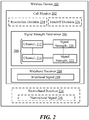
- FIG. 2 illustrates a schematic view of the wireless device 102 according to one aspect.
- the wireless device 102 includes a cell monitor module 202 that has a wideband receiver (e.g., first receiver) 204 and a signal strength determiner module 206.
- a wideband receiver e.g., first receiver
- the wireless device 102 performs simultaneous measurement of a plurality of channels (e.g., GSM channels) using the cell monitoring module 202.
- the cell monitoring module 202 may be configured to allow signal measurements to be taken for a set of channels 208 defining a band of the first technology type network (e.g., GSM network).
- the cell monitoring module 202 may perform a GSM idle mode cell measurement and monitoring procedure, such as a cell reselection or handover procedure, to identify cell reselection or handover candidates based on signal measurements and/or to maintain synchronization with neighboring cells (i.e., base stations of the neighboring cells) by decoding a synchronization channel (SCH) and/or a broadcast control channel (BCCH).
- SCH synchronization channel
- BCCH broadcast control channel
- the cell monitoring module 202 may initiate periodic monitoring for and measuring of signals 116 and 118, such as pilot signals, broadcast by the neighboring base stations 106 and 108 adjacent to the serving base station 104 currently associated with wireless device 102.
- signals 116 and 118 such as pilot signals
- the wireless device 102 In the idle mode, such a cell measurement and monitoring procedure allows the wireless device 102 to determine a signal power, such as a received signal strength indicator (RSSI), which can be used to reselect a new base station on which to camp (i.e., associate with).
- RSSI received signal strength indicator
- a power level metric e.g., SNR, absolute power level, relative power level, RSSI
- a cell reselection criteria relative to a power of the serving base station 104
- the wireless device 102 may select one of the neighboring base stations 106, 108 as the new serving base station.
- the cell reselection criteria may be satisfied if: the absolute power level of one of the non-serving neighboring base stations 106, 108 exceeds a predefined threshold; the power level of one of the non-serving neighboring base stations 106, 108 is relatively higher than the serving base station 104 by at least a predefined amount; the SNR of one of the non-serving neighboring base stations 106, 108 exceeds a predefined threshold; the RSSI of one of the non-serving neighboring base stations 106, 108 exceeds a predefined threshold; the SNR of one of the non-serving neighboring base stations 106, 108 is relatively higher than the serving base station 104 by at least a predefined amount; and/or the RSSI of one of the non-serving neighboring base stations 106, 108 is relatively higher than the serving base station 104 by at least a predefined amount.
- the above cell measurement and monitoring procedure may be used to identify handover candidates for the call. For example, if a power level metric (e.g., SNR, absolute power level, relative power level, RSSI) of one of the neighboring base stations 106, 108 satisfies a handover criteria relative to a power of serving base station 104, then the wireless device 102 may perform a call handover to one of the neighboring base stations 106, 108.
- a power level metric e.g., SNR, absolute power level, relative power level, RSSI
- the handover criteria may be satisfied if: the absolute power level of one of the non-serving neighboring base stations 106, 108 exceeds a predefined threshold; the power level of one of the non-serving neighboring base stations 106, 108 is relatively higher than the serving base station 104 by at least a predefined amount; the SNR of one of the non-serving neighboring base stations 106, 108 exceeds a predefined threshold; the RSSI of one of the non-serving neighboring base stations 106, 108 exceeds a predefined threshold; the SNR of one of the non-serving neighboring base stations 106, 108 is relatively higher than the serving base station 104 by at least a predefined amount; and/or the RSSI of one of the non-serving neighboring base stations 106, 108 is relatively higher than the serving base station 104 by at least a predefined amount.
- the power level metric measurements may be made at the same time the wireless device 102 receives and demodulates the signal 114 (e.g., a first channel) received by the serving base station 104.
- the power level metric measurements may be made for adjacent channels while the wireless device 102 receives and demodulates a data signal (e.g., first data signal), such as a burst data signal, associated with the first channel without having to change (e.g., retune) the center RF frequency of the wideband receiver 204.
- a data signal e.g., first data signal
- the cell monitoring module 202 may initiate operation of the wideband receiver 204 to capture/receive a wideband signal 210 across a wide bandwidth (e.g., first bandwidth).
- the wideband receiver 204 may initially be in a low power SLEEP mode or OFF state (maybe referred together as an "inactive power state") and then transitioned into a power ON state (e.g., "active power state) for a predetermined period of time before the wideband receiver 204 captures the wideband signal 210.
- the wideband receiver 204 may be transitioned into the power ON state in response to a determination that signal measurements need to be taken.
- the first bandwidth of the captured wideband signal 210 may cover/include the plurality of the set of channels 208 defining the band of the first technology type network.
- Power level measurements e.g., RSSI, SNR, absolute power, relative power, etc.
- RSSI may be performed on signals associated with each channel 212, 214 that make up the set of channels 208.
- the wireless device 102 and/or cell monitoring module 202 provides an efficient mechanism for performing the above-described monitoring and measurement procedure, as the captured wideband signal 210 enables the entire band corresponding to the set of channels 208 to be captured in a few measurements, as opposed to prior solutions that may require separate tuning to and monitoring/measuring for each of the set of channels 208.
- the wideband receiver 204 may have a linear phase response so that the wireless device 102 may demodulate and/or decode at least a portion of the wideband signal 210 captured.
- the wireless device 102 may perform power level measurements on signals 116, 118 received from neighboring base stations 106, 108 while at the same time receiving and demodulating the signal 114 transmitted by the serving base station 104. Since the receiver 204 is a wideband receiver, the signals 116, 118 may be received even though they are transmitted on different channels having center frequencies relatively far from the center frequency of the channel including the signal 114.
- the power level measurements performed on the signals 116, 118 may come free of cost since they are performed simultaneously while the wireless device 102 receives and demodulates the signal 114 from the serving base station 104, which it may be obligated to do anyway.
- the RF center frequency of the wideband receiver 204 does not have to be retuned/changed during this process since it has a wide enough bandwidth to receive all the channels' signals 114, 116, 118.
- the band may correspond to a GSM band, where the set of channels 208 may have a 200 kHz bandwidth and channel spacing, and each of the set of channels 208 may correspond to a respective absolute radio-frequency channel number (ARFCN).
- the wideband receiver 204 may have a bandwidth that captures/receives the wideband signal 210 across a 5 MHz bandwidth. Accordingly, the wideband signal 210 captured by wideband receiver 204 may include 25 GSM ARFCNs.
- the wideband receiver 204 may be part of a receiver or transceiver on a GSM-only capable wireless device. However, in other cases the wideband receiver 204 may be part of a receiver or transceiver on a multi-mode wireless device. For instance, the wideband receiver 204 may be used to receive data associated with a second technology type network, such as a 3G and/or 4G network including but not limited to W-CDMA and/or LTE.
- the wireless device 102 may also optionally include another narrowband receiver 216 (e.g., second receiver) that can also be used to receive narrowband signals 218, such as a single 200 kHz bandwidth GSM channel.
- the signal strength determiner 206 may be configured to determine a respective signal strength 220, 222 of signals associated with each channel 214, 216 of the set of channels 208 defining the band of the first technology type network.
- the signal strengths 220, 222 may be determined by processing the wideband signal 210 captured by the wideband receiver 204.
- the respective signal strengths 220, 222 may be signal strengths 1 to n corresponding to signals detected in each channel 212, 214 1 to n, where n is a positive integer.
- the signal strengths 220, 222 may be, but are not limited to, received signal strength indicators (RSSIs).
- the wireless device 102 and/or cell monitor module 202 can operate the wideband receiver 204 and the signal strength determiner 206 to efficiently monitor and measure all of the set of channels 208 defining the band of the first technology type network. Accordingly, the cell monitor module 202 is able to provide information for making (or itself make) a cell reselection decision 224 or handover decision 226 based on the resulting respective signal strengths 220, 222 corresponding to signals detected in each channel 212, 214 of the set of channels 208 defining the band of the first technology type network.
- the cell monitor module 202 may make a cell reselection decision 224, whereas it may make a handover decision 226 if the wireless device 102 is engaged in a call (i.e., dedicated mode).
- the cell monitor module 202 is illustrated in FIG. 2 as including the signal strength determiner 206 and the wideband receiver 204 components, each of these components may be implemented independently within the wireless device 102, or in any combination with other components of the wireless device 102.
- the wideband receiver 204 and the signal strength determiner 206 may be part of a receiver or transceiver subsystem or receiver chain.
- FIG. 3 illustrates the signal strength determiner 206 according to one aspect.
- the signal strength determiner 206 may also include one or more components for processing the captured wideband signal 210.
- the signal strength determiner 206 may include a sample capture component 302 configured to capture signal samples over the bandwidth of wideband receiver 204.
- the determiner 206 may further include a compensator component 304 configured to apply a compensation function to the sampled, captured signal.
- the compensator component 304 may apply an edge compensation filter to account and correct for any gain loss near the lower and upper cutoff frequencies of the wideband receiver's bandwidth.
- the signal strength determiner 206 may also include a filter component 306 configured retrieve baseband signals from the captured wideband signal 210.
- the wideband receiver 204 may be a 5 MHz bandwidth receiver.
- the filter component 306 may be a tunable band pass filter that retrieves samples belonging to each ARFCN within the wideband signal 210.
- the band pass filter may have a 200 kHz bandwidth that is tuned to align with the center frequency of each ARFCN within the wideband signal 210 in order to extract the baseband samples associated with that specific ARFCN (e.g., by removing/filtering away signal components associated with other ARFCNs).
- the signal strength determiner 206 may further include a summing component 308 configured to determine, from the output of the filter component 306, the signal power of the signal samples corresponding to each channel 212, 214 of the set of channels 208 (e.g., see FIG. 2 ) of the band of the first technology network.
- the summing component 308 may measure the RSSI in each specific ARFCN of the GSM band.
- the filtered portion of the samples from wideband signal 210 are complex numbers, and the summing component 308 may execute a power determination algorithm equal to ⁇ (I*I+Q*Q), where I in the equation stands for the in-phase (i.e., real) portion and Q stands for the quadrature-phase (i.e., imaginary) component of the complex signal.
- summing component 308 may determine the measured power of the signal as being proportional to the over-the-air (OTA) power in each particular ARFCN.
- OTA over-the-air
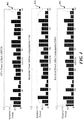
- FIG. 4 illustrates a series of graphs 402, 404, 406 that show the effect of the compensator component 304 according to one aspect.
- the graph 402 illustrates the over-the-air power of each ARFCN near the wireless device 102 before reception by the wireless device 102. This graph 402 represents the true power levels of the ARFCNs.
- the graph 404 illustrates the power levels of each ARFCN after reception by the wireless device 102, which exhibit gain loss at the lower and upper cutoff frequencies of the receiver's 204 bandwidth due to the wideband receiver's 204 frequency response.
- the graph 404 represents the power levels of the ARFCNs at the output of the sample capture component 302.
- the graph 406 illustrates the power levels of each ARFCN after compensating for wideband receiver's 204 frequency response.
- the power levels ARFCN after compensation should be substantially equal to the power levels transmitted over the air shown in the graph 402.
- the compensator component 304 applies compensation for the band edge ARFCNs to correct for the gain loss.
- the compensation component's 304 function, algorithm, or technique can be as simple as a complex division, but may also include other techniques. If compensation is not applied, then the power estimated for ARFCNs near the edges of the wideband receiver's bandwidth will have a negative bias. Essentially, the compensator component 304 accounts for such negative bias.
- FIG. 5 illustrates a series of graphs 502, 504 that show the effects and properties of the filter component 306 according to one aspect.
- the graph 502 shows the frequency response of the filter component 306 when it is tuned to the ARFCN 50.
- the filter has a 200 kHz passband.
- the graph 504 shows the output of the filter component 306 after the bandpass filter response shown in the graph 502 is applied to the compensated received wideband signal shown in the graph 406.
- FIG. 6 illustrates a schematic view of the signal strength determiner 206 that includes one or more components for parallel processing according to one aspect.
- the described aspects may include a digital implementation of the signal strength determiner 206 such that the filtering component 306 and the summing component 308 may include a plurality of components that operate in parallel for each ARFCN being measured.
- a first filter 602 may be tuned to a first ARFCN that is being received from the serving base station (e.g., base station 104 in FIG. 1 ).
- This filter's 602 output signal 603 represents the signal samples associated with only that ARFCN.
- the output signal 603 may undergo further baseband processing (e.g., demodulation, etc.).
- Another filter 604 may be tuned to a second ARFCN (e.g., ARFCN x) that is being received from a non-serving base station (e.g., base station 106 in FIG. 1 ).
- the output of this filter 604 may be input into a summing component 606 that performs a summing operation in the time domain equal to E (1*1 + Q*Q) to determine the power level of the ARFCN.
- the summing component 606 may utilize a Fast Fourier Transform (FFT) to obtain the power, e.g. RSSI of the ARFCN x.
- FFT Fast Fourier Transform
- Similar filter components and summing components may perform the same operations in parallel for each ARFCN captured by the wideband signal 210.
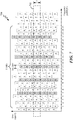
- FIG. 7 illustrates a schematic plot 700 of time versus frequency for a plurality of channels being broadcast by a plurality of base stations.
- Each channel may represent, for example, a GSM ARFCN having a channel bandwidth of 200 kHz, frames having eight (8) time slots each, and a time slot length of 0.577 ms.
- the channel bandwidths, time slot lengths, frame lengths, etc. may be associated with different communication protocols and therefore have different parameter values.
- the wireless device 102 may be a multi-mode device capable of receiving both GSM and W-CDMA signals.
- the wireless device 102 may have a wideband receiver 204 that is traditionally used for receiving W-CDMA signals and a narrow band receiver 216 that is traditionally used for receiving GSM signals.
- the wireless device 102 may be in a geographic region where GSM signals are located in the 900 MHz band and W-CDMA signals are located in the 2100 MHz band.
- the wireless device 102 is capable of receiving signals in the BC5 band since the wideband receiver 204 may have a bandwidth of 5 MHz.
- the wideband receiver 204 having a bandwidth of 5 MHz is tuned such that it is centered on the GSM ARFCN 13 (see FIG. 7 ).
- the ARFCN 13 e.g., first channel
- the ARFCN 13 may be broadcast by the serving base station 104 on which the wireless device 102 is camped on (i.e., associated with).
- the wideband receiver 204 may be expecting to receive and demodulate a data signal (e.g., first data signal), such as an SCH, BCCH, or PCH burst signal on ARFCN 13 at slot 4 (e.g., the shaded and cross-hatched slot 4 of ARFCN 13 shown in FIG. 7 ).
- a data signal e.g., first data signal
- slot 4 e.g., the shaded and cross-hatched slot 4 of ARFCN 13 shown in FIG. 7 .
- the 5 MHz wide bandwidth of the wideband receiver 204 captures signals associated with ARFCNs 1 - 25.
- the wideband receiver 204 may have a linear phase response throughout its entire bandwidth so that all the signals received by the ARFCNs 1 - 25 may be demodulated if desired (e.g., different burst data on different ARFCNs may also be received and demodulated).
- only a portion of the bandwidth of the wideband receiver 204 may have a linear phase response, such as a 200 kHz wide region in the center of the receiver's bandwidth so that it may receive and demodulate data signals within the linear phase portion (e.g., ARFCN 13 in FIG. 7 ).
- the wideband receiver 204 may initially be in an inactive power state (e.g., power OFF or low power SLEEP state). It may then transition into an active power state (e.g., power ON state) and capture/receive a wideband signal 210 for a predetermined period of time t before powering back down into the inactive power state. During the time period t, the wideband receiver 204 is able to capture a portion 702 (e.g., a window) of the signals in each ARFCN being transmitted by the base stations.
- the wireless device 102 may determine to make signal measurements before transitioning the wideband receiver 204 from the inactive power state to the active power state.
- the wireless device 102 may be in an idle mode when it wakes up synchronous to the serving base station for receiving SCH, BCCH, or PCH burst data on ARFCN 13 (e.g., the shaded, cross-hatched slot 4 of ARFCN 13 in FIG. 7 ).
- the wideband receiver 204 captures not only the SCH, BCCH, or PCH burst data on ARFCN 13, but also signals (e.g., at least a second channel) from ARFCNs 1 - 12 and 14 - 25.
- the signal strength determiner 206 may first apply a compensation filter to correct for any negative bias near the edges of the wideband receiver's 204 filter response (see e.g., FIG. 4 ).
- the signal strength determiner 206 may then make power level calculations for each of the ARFCNs 1 - 25 at the same time as it demodulates the burst data in ARFCN 13.
- the filtering component 306 and the summing component 308 may extract each ARFCN's signal samples and perform an FFT to determine the power level (e.g., RSSI) of each ARFCN (see e.g., FIGS. 5 and 6 ).
- the power level calculations made can be used by the wireless device 102 to determine whether to associate (e.g., camp on) with a different base station (e.g., cell reselection) or handoff the call if in dedicated mode.
- these power level calculations and handoff/cell reselection decisions come free of cost such that no additional RF tuning to each individual ARFCN is needed independent to the reception of the burst data that was to be received anyway from the serving base station on ARFCN 13. That is, in the illustrated example, the power level determinations of ARFCNs 1 - 12 and 14 - 25 come free of cost (i.e., no additional time needs to be spent specifically tuning to each of these channels) while the wideband receiver 204 receives the burst data (e.g., SCH, PCH, or BCCH shaded, cross-hatched slot 4) on ARFCN 13 as it may be scheduled to do so.
- the burst data e.g., SCH, PCH, or BCCH shaded, cross-hatched slot 4
- ARFCNs 5, 9, 13, 16, and 22 are active near the wireless device 102.
- the wireless device 102 activates (e.g., enters an active power state from an inactive power state) its wideband receiver 204
- the receiver 204 captures the signal portion 702 for a time period t that includes signals within ARFCNs 5, 9, 13, 16, and 22.
- the signal strength determiner 206 may then calculate power levels (e.g., RSSI) of ARFCNs 5, 9, 13, 16, and 22 within this time period t.
- the wireless device 102 may simultaneously receive and demodulate signal data associated with ARFCN 13.
- the wireless device 102, cell monitoring module 202, and/or the signal strength determiner 206 determines that ARFCNs 5, 9, 16, and/or 22 satisfy certain power level metrics (e.g., have a high RSSI compared to ARFCN 13 or have a higher SNR than ARFCN 13), then a decision to perform a handoff or cell reselection may be executed.
- certain power level metrics e.g., have a high RSSI compared to ARFCN 13 or have a higher SNR than ARFCN 13
- the wireless device 102 wakees up" from an idle mode to make the power level measurements and receive/demodulate the data signal from the serving base station, in other aspects the monitoring for signal power can be done any at time, as the GSM standard ensures that the ARFCN on which the BCH is transmitted is sending power over all 8 slots (e.g., always ON).
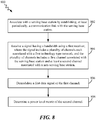
- FIG. 8 illustrates a flow diagram 800 for a method of monitoring radio channels in a wireless communication device according to one aspect.
- the wireless communication device may associate with a serving base station by establishing, at least periodically, a communication link with the serving base station 802.
- the wireless communication device may further receive a signal having a bandwidth using a first receiver, where the signal includes a plurality of channels each associated with a first technology type network, and the plurality of channels includes a first channel associated with the serving base station and at least a second channel associated with a non-serving base station 804.
- the wireless communication device may further demodulate a first data signal of the first channel 806, and determine a power level metric of the second channel 808.
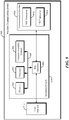
- FIG. 9 illustrates a conceptual block diagram of a hardware implementation for a wireless communication device 900 according to one aspect.
- the wireless communication device 900 may be representative of the wireless communication device 102 described above.
- the wireless communication device 900 may include a communication interface 910, a user interface 912, and a processing system 914.
- the processing system 914 may include a processor 904, a memory 905, a computer-readable medium 906, a bus interface 908, and a bus 902.
- the processing system 914 may be adapted to perform any of the steps, functions, and/or processes performed by a wireless communication device 102, the cell monitor 202, and/or the signal strength determiner 206 described with respect to FIGS. 1 , 2 , 3 , 4 , 5 , 6 , 7 , and/or 8.
- the processor 904 may be one or more processors that are adapted to process data for the wireless communication device 900.
- the processing circuit 904 may be a specialized processor, such as an application specific integrated circuit (ASIC) that serves as a: means for associating with a serving base station by establishing, at least periodically, a communication link with the serving base station; means for receiving a signal having a first bandwidth using a first receiver, the signal including a plurality of channels each associated with a first technology type network, the plurality of channels including a first channel associated with the serving base station and at least a second channel associated with a non-serving base station; means for demodulating a first data signal of the first channel; and means for determining a power level metric of the second channel.
- ASIC application specific integrated circuit
- processors 904 include microprocessors, microcontrollers, digital signal processors (DSPs), field programmable gate arrays (FPGAs), programmable logic devices (PLDs), state machines, gated logic, discrete hardware circuits, and other suitable hardware configured to perform the various functionality described throughout this disclosure.
- the processor 904 is also responsible for managing the bus 902, and executing software stored on the computer-readable medium 906 and/or memory 905.
- the software when executed by the processor 904, causes the processing system 914 to perform the various functions, steps, and/or processes described above for the wireless communication device 102.
- the computer-readable medium 906 may be used for storing data that is manipulated by the processor 904 when executing software.
- the memory circuit 905 may be non-volatile memory, such as but not limited to FLASH memory, magnetic or optical hard disk drives, etc.
- the memory storing the sector information and/or overhead messages (including configuration sequence number) may be volatile memory, such as DRAM (e.g., DDR SDRAM), SRAM, etc. that may be continuously powered so as to store the information indefinitely.
- DRAM e.g., DDR SDRAM
- SRAM SRAM
- Software shall be construed broadly to mean instructions, instruction sets, code, code segments, program code, programs, subprograms, software modules, applications, software applications, software packages, routines, subroutines, objects, executables, threads of execution, procedures, functions, etc., whether referred to as software, firmware, middleware, microcode, hardware description language, or otherwise.
- the software may reside on a computer-readable medium 906.
- the computer-readable medium 906 may be a non-transitory computer-readable medium.
- a non-transitory computer-readable medium includes, by way of example, a magnetic storage device (e.g., hard disk, floppy disk, magnetic strip), an optical disk (e.g., a compact disc (CD) or a digital versatile disc (DVD)), a smart card, a flash memory device (e.g., a card, a stick, or a key drive), a random access memory (RAM), a read only memory (ROM), a programmable ROM (PROM), an erasable PROM (EPROM), an electrically erasable PROM (EEPROM), a register, a removable disk, and any other suitable medium for storing software and/or instructions that may be accessed and read by a computer.
- a magnetic storage device e.g., hard disk, floppy disk, magnetic strip
- an optical disk e.g., a compact disc (CD) or a digital versatile disc (DVD)
- a smart card e.g., a flash memory device (e.g.
- the computer-readable medium may also include, by way of example, a carrier wave, a transmission line, and any other suitable medium for transmitting software and/or instructions that may be accessed and read by a computer.
- the computer-readable medium 906 may reside in the processing system 914, external to the processing system 914, or distributed across multiple entities including the processing system 914.
- the computer-readable medium 906 may be embodied in a computer program product.
- the processing system 914 may be implemented with a bus architecture, represented generally by the bus 902.
- the bus 902 may include any number of interconnecting buses and bridges depending on the specific application of the processing system 914 and the overall design constraints.
- the bus 902 links together various circuits including one or more processors (represented generally by the processor 904), a memory 905, and computer-readable media (represented generally by the computer-readable medium 906).
- the bus 902 may also link various other circuits such as timing sources, peripherals, voltage regulators, and power management circuits, which are well known in the art, and therefore, will not be described any further.
- a bus interface 908 provides an interface between the bus 902 and the communication interface 910.
- the communication interface 910 provides a means for communicating with other apparatus over a transmission medium.
- the communication interface 910 includes a wideband transceiver 916 and optionally a narrowband receiver 918 that allows the wireless communication device 900 to communicate with one or more wireless network nodes, such as one or more base stations and/or base station radio heads.
- the wideband transceiver 916 may include the wideband receiver 204 described above.
- the narrowband transceiver 918 may include the narrowband receiver 216 described above.
- a user interface 912 e.g., keypad, display, speaker, microphone, touchscreen display, etc.
- the communication interface 910 and/or the wideband transceiver 916 may serve as a: means for associating with a serving base station by establishing, at least periodically, a communication link with the serving base station; and means for receiving a signal having a first bandwidth, the signal including a plurality of channels each associated with a first technology type network, the plurality of channels including a first channel associated with the serving base station and at least a second channel associated with a non-serving base station.
- FIGS. 1 , 2 , 3 , 4 , 5 , 6 , 7 , 8 , and/or 9 may be rearranged and/or combined into a single component, step, feature or function or embodied in several components, steps, or functions. Additional elements, components, steps, and/or functions may also be added without departing from the invention.
- the apparatus, devices, and/or components illustrated in FIGS. 1 , 2 , 3 , 6 , and/or 9 may be configured to perform one or more of the methods, features, or steps described in FIGS. 4 , 5 , 7 , and/or 8.
- the algorithms described herein may also be efficiently implemented in software and/or embedded in hardware.
- the processing circuit 904 illustrated in FIG. 9 may be a specialized processor (e.g., an application specific integrated circuit (e.g., ASIC)) that is specifically designed and/or hard-wired to perform the algorithms, methods, and/or steps described in FIGS. 4 , 5 , 7 , and/or 8.
- a specialized processor e.g., ASIC
- ASIC application specific integrated circuit
- the computer-readable storage medium 906 may also store processor 904 readable instructions that when executed by a specialized processor (e.g., ASIC) causes the specialized processor to perform the algorithms, methods, and/or steps described in FIGS. 4 , 5 , 7 , and/or 8.
- a specialized processor e.g., ASIC
- aspects of the present disclosure may be described as a process that is depicted as a flowchart, a flow diagram, a structure diagram, or a block diagram. Although a flowchart may describe the operations as a sequential process, many of the operations can be performed in parallel or concurrently. In addition, the order of the operations may be re-arranged.
- a process is terminated when its operations are completed.
- a process may correspond to a method, a function, a procedure, a subroutine, a subprogram, etc.
- a process corresponds to a function
- its termination corresponds to a return of the function to the calling function or the main function.
- a storage medium may represent one or more devices for storing data, including read-only memory (ROM), random access memory (RAM), magnetic disk storage mediums, optical storage mediums, flash memory devices and/or other machine-readable mediums and, processor-readable mediums, and/or computer-readable mediums for storing information.
- ROM read-only memory
- RAM random access memory
- magnetic disk storage mediums magnetic disk storage mediums
- optical storage mediums flash memory devices and/or other machine-readable mediums and, processor-readable mediums, and/or computer-readable mediums for storing information.
- the terms “machine-readable medium”, “computer-readable medium”, and/or “processor-readable medium” may include, but are not limited to non-transitory mediums such as portable or fixed storage devices, optical storage devices, and various other mediums capable of storing, containing or carrying instruction(s) and/or data.
- aspects of the disclosure may be implemented by hardware, software, firmware, middleware, microcode, or any combination thereof.
- the program code or code segments to perform the necessary tasks may be stored in a machine-readable medium such as a storage medium or other storage(s).
- a processor may perform the necessary tasks.
- a code segment may represent a procedure, a function, a subprogram, a program, a routine, a subroutine, a module, a software package, a class, or any combination of instructions, data structures, or program statements.
- a code segment may be coupled to another code segment or a hardware circuit by passing and/or receiving information, data, arguments, parameters, or memory contents. Information, arguments, parameters, data, etc. may be passed, forwarded, or transmitted via any suitable means including memory sharing, message passing, token passing, network transmission, etc.
- DSP digital signal processor
- ASIC application specific integrated circuit
- FPGA field programmable gate array
- a general purpose processor may be a microprocessor, but in the alternative, the processor may be any conventional processor, controller, microcontroller, or state machine.
- a processor may also be implemented as a combination of computing components, e.g., a combination of a DSP and a microprocessor, a number of microprocessors, one or more microprocessors in conjunction with a DSP core, or any other such configuration.
- a software module may reside in RAM memory, flash memory, ROM memory, EPROM memory, EEPROM memory, registers, hard disk, a removable disk, a CD-ROM, or any other form of storage medium known in the art.
- a storage medium may be coupled to the processor such that the processor can read information from, and write information to, the storage medium. In the alternative, the storage medium may be integral to the processor.
Landscapes
- Engineering & Computer Science (AREA)
- Computer Networks & Wireless Communication (AREA)
- Signal Processing (AREA)
- Computer Security & Cryptography (AREA)
- Mobile Radio Communication Systems (AREA)
Claims (15)
- Procédé (800) de surveillance de canaux radio dans un dispositif de communication sans fil, comprenant l'étape ci-dessous consistant à :s'associer (802) à une station de base de desserte en établissant, au moins périodiquement, une liaison de communication avec la station de base de desserte ;caractérisé en ce que le procédé comprend les étapes ci-dessous consistant à :recevoir (804), pour une période de temps prédéterminée, un signal présentant une largeur de bande, en utilisant un premier récepteur à large bande, le signal incluant une pluralité de canaux associés chacun à un réseau d'un premier type de technologie, la pluralité de canaux incluant un premier canal associé à la station de base de desserte et au moins un second canal associé à une station de base de non-desserte, la pluralité de canaux présentant différentes fréquences centrales, dans lequel la largeur de bande du récepteur à large bande est au moins égale à trois fois la largeur de bande d'un canal unique de la pluralité de canaux ;démoduler (806) un premier signal de données du premier canal ; etdéterminer (808) une métrique de niveau de puissance de chacun des premier et second canaux sur la base du signal reçu par le récepteur à large bande, tout en recevant le premier canal et en démodulant le premier signal de données simultanément.
- Procédé selon la revendication 1, comprenant en outre l'étape ci-dessous consistant à :effectuer une transition du premier récepteur, d'un état d'alimentation inactive à un état d'alimentation active, pour une période de temps prédéfinie, en vue de recevoir le signal.
- Procédé selon la revendication 2, comprenant en outre l'étape ci-dessous consistant à :déterminer qu'il convient de réaliser des mesures de signal avant la transition du premier récepteur, de l'état d'alimentation inactive à l'état d'alimentation active.
- Procédé selon la revendication 3, dans lequel l'étape consistant à déterminer s'il convient de réaliser des mesures de signal consiste à déterminer s'il convient de mettre en oeuvre un balayage de mode veille de système mondial de communication avec les mobiles, GSM, la pluralité de canaux comportant des canaux de système GSM présentant une largeur de bande de 200 kHz.
- Procédé selon la revendication 1, comprenant en outre l'étape ci-dessous consistant à :recevoir des signaux associés à un réseau d'un second type de technologie, le réseau d'un second type de technologie étant différent du réseau d'un premier type de technologie.
- Procédé selon la revendication 5, dans lequel le réseau d'un premier type de technologie est basé sur l'accès multiple par répartition dans le temps, TDMA, et le réseau d'un second type de technologie est basé sur l'accès multiple par répartition en code, CDMA.
- Procédé selon la revendication 6, dans lequel le réseau d'un premier type de technologie est un réseau de système GSM et le réseau d'un second type de technologie est un réseau d'accès multiple par répartition en code à large bande, W-CDMA ou un réseau de technologie d'évolution à long terme, LTE.
- Procédé selon la revendication 1, comprenant en outre l'étape ci-dessous consistant à :appliquer un filtre de compensation au signal reçu en vue de corriger une perte de gain au niveau d'une arête inférieure et d'une arête supérieure de la largeur de bande du signal.
- Procédé selon la revendication 1, comprenant en outre l'étape ci-dessous consistant à :appliquer un filtre passe-bande réglable au signal reçu en vue d'extraire chaque canal de la pluralité de canaux.
- Procédé selon la revendication 1, comprenant en outre les étapes ci-dessous consistant à :déterminer que la métrique de niveau de puissance du second canal satisfait un critère de resélection de cellule ou un critère de transfert intercellulaire ;mettre en oeuvre une resélection de cellule si le dispositif de communication sans fil est dans un mode non dédié ; etmettre en oeuvre un transfert intercellulaire si le dispositif de communication sans fil est dans un mode dédié.
- Procédé selon la revendication 10, dans lequel la métrique de niveau de puissance satisfait le critère de resélection de cellule ou le critère de transfert intercellulaire lorsqu'au moins l'un parmi un niveau de puissance absolu du second canal est supérieur à un premier seuil prédéfini, un niveau de puissance relatif du second canal est supérieur à un niveau de puissance du premier canal, d'au moins un deuxième seuil prédéfini, un rapport « signal sur bruit », SNR, absolu du second canal est supérieur à un troisième seuil prédéfini, un indicateur d'intensité de signal relative, RSSI, de l'un du second canal est supérieur à un quatrième seuil prédéfini, et/ou un rapport SNR relatif du second canal est supérieur à une valeur de rapport SNR du premier canal, d'un cinquième seuil prédéfini.
- Procédé selon la revendication 1, dans lequel le premier signal de données du premier canal est démodulé et la métrique de niveau de puissance du second canal est déterminée sans régler à nouveau une fréquence centrale RF du récepteur à large bande.
- Dispositif de communication sans fil (102), comprenant :un moyen pour s'associer à une station de base de desserte en établissant, au moins périodiquement, une liaison de communication avec la station de base de desserte ;caractérisé en ce que le dispositif comprend :un moyen pour recevoir, pour une période de temps prédéterminée, un signal présentant une largeur de bande, en utilisant un premier récepteur à large bande, le signal incluant une pluralité de canaux associés chacun à un réseau d'un premier type de technologie, la pluralité de canaux incluant un premier canal associé à la station de base de desserte et au moins un second canal associé à une station de base de non-desserte, la pluralité de canaux présentant différentes fréquences centrales, dans lequel la largeur de bande du récepteur à large bande est au moins égale à trois fois la largeur de bande d'un canal unique de la pluralité de canaux ;un moyen pour démoduler un premier signal de données du premier canal ; etun moyen pour déterminer une métrique de niveau de puissance de chacun des premier et second canaux sur la base du signal reçu par le récepteur à large bande, tout en recevant le premier canal et en démodulant le premier signal de données simultanément.
- Dispositif selon la revendication 13, dans lequel :un premier récepteur (204) comporte le moyen d'association et le moyen de réception ; etun circuit de traitement couplé en communication avec le premier récepteur comporte le moyen de démodulation et le moyen de détermination.
- Support de stockage lisible par ordinateur comprenant un code pour amener au moins un processeur d'un dispositif de communication sans fil à :s'associer à une station de base de desserte en établissant, au moins périodiquement, une liaison de communication avec la station de base de desserte ;caractérisé en ce que le support de stockage lisible par ordinateur comporte un code pour amener au moins un processeur d'un dispositif de communication sans fil à :recevoir, pour une période de temps prédéterminée, un signal présentant une largeur de bande, en utilisant un premier récepteur à large bande, le signal incluant une pluralité de canaux associés chacun à un réseau d'un premier type de technologie, la pluralité de canaux incluant un premier canal associé à la station de base de desserte et au moins un second canal associé à une station de base de non-desserte, la pluralité de canaux présentant différentes fréquences centrales, dans lequel la largeur de bande du récepteur à large bande est au moins égale à trois fois la largeur de bande d'un canal unique de la pluralité de canaux ;démoduler un premier signal de données du premier canal ; etdéterminer une métrique de niveau de puissance de chacun des premier et second canaux sur la base du signal reçu par le récepteur à large bande, tout en recevant le premier canal et en démodulant le premier signal de données simultanément.
Applications Claiming Priority (3)
| Application Number | Priority Date | Filing Date | Title |
|---|---|---|---|
| US201261612750P | 2012-03-19 | 2012-03-19 | |
| US13/744,648 US8886208B2 (en) | 2012-03-19 | 2013-01-18 | Method and apparatus of simultaneously monitoring GSM channels |
| PCT/US2013/032793 WO2013142415A1 (fr) | 2012-03-19 | 2013-03-18 | Procédé et appareil de surveillance simultanée de canaux gsm |
Publications (2)
| Publication Number | Publication Date |
|---|---|
| EP2829106A1 EP2829106A1 (fr) | 2015-01-28 |
| EP2829106B1 true EP2829106B1 (fr) | 2017-04-19 |
Family
ID=49158102
Family Applications (1)
| Application Number | Title | Priority Date | Filing Date |
|---|---|---|---|
| EP13714149.5A Not-in-force EP2829106B1 (fr) | 2012-03-19 | 2013-03-18 | Procédé et appareil de surveillance simultanée de canaux gsm |
Country Status (6)
| Country | Link |
|---|---|
| US (1) | US8886208B2 (fr) |
| EP (1) | EP2829106B1 (fr) |
| JP (2) | JP2015514358A (fr) |
| KR (1) | KR101511484B1 (fr) |
| CN (1) | CN104272792A (fr) |
| WO (1) | WO2013142415A1 (fr) |
Families Citing this family (17)
| Publication number | Priority date | Publication date | Assignee | Title |
|---|---|---|---|---|
| US8971894B2 (en) * | 2012-06-22 | 2015-03-03 | Apple Inc. | Network reselection by a wireless communication device based on signal-to-noise ratio |
| US9173108B2 (en) | 2013-01-31 | 2015-10-27 | Qualcomm Incorporated | Parallel inter-radio access technology (IRAT) measurement in a communication system |
| US9014307B2 (en) | 2013-02-25 | 2015-04-21 | Itron, Inc. | Radio to analog-to-digital sample rate decoupled from digital subsystem |
| US9252998B2 (en) | 2013-02-25 | 2016-02-02 | Itron, Inc. | Radio to detect and compensate for frequency misalignment |
| US9426680B2 (en) * | 2013-02-25 | 2016-08-23 | Itron, Inc. | Real-time radio spectrum assessment engine |
| US9077487B2 (en) | 2013-02-25 | 2015-07-07 | Itron, Inc. | Radio to support channel plans of arbitrary width and/or spacing |
| KR102065020B1 (ko) * | 2013-03-11 | 2020-01-10 | 삼성전자주식회사 | 무선 통신 시스템에서 동기 획득 장치 및 방법 |
| US9564986B2 (en) | 2013-11-06 | 2017-02-07 | At&T Intellectual Property I, L.P. | Latency reduction and range extension system for radio networks |
| US9854487B2 (en) * | 2014-01-17 | 2017-12-26 | Verizon Patent And Licensing Inc. | Simplified call continuity |
| US20150365834A1 (en) * | 2014-06-16 | 2015-12-17 | Qualcomm Incorporated | Systems and methods for enhanced cell selection and cell re-selection |
| US9313109B1 (en) | 2015-04-17 | 2016-04-12 | Qualcomm Incorporated | System and method for controlling neighbor cell monitoring activity based on conditions of serving cell in a mobile communication device |
| US9992124B2 (en) | 2015-10-09 | 2018-06-05 | Itron, Inc. | Multi-channel decoder architecture |
| WO2017124327A1 (fr) * | 2016-01-20 | 2017-07-27 | Qualcomm Incorporated | Systèmes et procédés de mise en œuvre de fonctions multiples de module d'identification de l'abonné (sim) sur la même fréquence porteuse sur un dispositif de communication sans fil |
| US10993149B2 (en) * | 2016-05-23 | 2021-04-27 | Sony Corporation | Operating a terminal device in a cellular mobile communication network |
| US10645660B2 (en) * | 2017-06-09 | 2020-05-05 | Qualcomm Incorporated | Signaling of synchronization block patterns |
| WO2020014844A1 (fr) * | 2018-07-16 | 2020-01-23 | 北京小米移动软件有限公司 | Procédé, dispositif, système de surveillance de canal et support de données |
| CN111629411B (zh) * | 2019-02-27 | 2021-08-20 | 华为技术有限公司 | 一种通信系统间转移的方法以及相关设备 |
Citations (3)
| Publication number | Priority date | Publication date | Assignee | Title |
|---|---|---|---|---|
| WO2004030248A1 (fr) * | 2002-09-24 | 2004-04-08 | Motorola, Inc. | Dispositif de communications mobiles multimodes, et procede mettant en oeuvre des recepteurs fonctionnant simultanement |
| WO2011041662A1 (fr) * | 2009-10-01 | 2011-04-07 | Interdigital Patent Holdings, Inc. | Procédé et appareil destinés à exécuter des mesures inter-fréquences et/ou inter-technologies d'accès radio (rat) dans une unité d'émission-réception sans fil (wtru) à récepteurs multiples |
| EP2330761A2 (fr) * | 2009-12-03 | 2011-06-08 | Marvell World Trade Ltd. | Estimation RSSI dans des terminaux de communication à technologie multiple |
Family Cites Families (35)
| Publication number | Priority date | Publication date | Assignee | Title |
|---|---|---|---|---|
| DE69232943T2 (de) * | 1991-05-13 | 2003-08-28 | Xircom Wireless, Inc. | Sender/empfänger mit zwei betriebsarten |
| FI112303B (fi) * | 1995-05-16 | 2003-11-14 | Nokia Corp | Usealla taajuuskaistalla toimiva matkapuhelinjärjestelmä |
| US6553216B1 (en) * | 1995-12-14 | 2003-04-22 | Thomson Licensing, S.A. | RF tunable filter arrangement with tunable image trap |
| US5889827A (en) * | 1996-12-12 | 1999-03-30 | Ericsson Inc. | Method and apparatus for digital symbol detection using medium response estimates |
| US6603751B1 (en) * | 1998-02-13 | 2003-08-05 | Qualcomm Incorporated | Method and system for performing a handoff in a wireless communication system, such as a hard handoff |
| ATE357090T1 (de) * | 1998-06-24 | 2007-04-15 | Sk Telecom Co Ltd | Wiederholungsgerät mit telefonverbindung und festgeschalteter leitung |
| US6205334B1 (en) | 1998-11-24 | 2001-03-20 | Ericsson Inc. | Accelerated scanning of cellular channels by cellular radiotelephones |
| KR100405046B1 (ko) * | 2001-10-30 | 2003-11-07 | 주식회사 케이티프리텔 | 이동 통신 단말기의 데이터 서비스 사용 이력 관리에 의한배터리 대기시간 증대 방법 및 그 장치 |
| JP2003258703A (ja) * | 2002-02-27 | 2003-09-12 | Matsushita Electric Ind Co Ltd | 信号処理装置及びこの信号処理装置を具備した通信装置 |
| US6957054B2 (en) * | 2002-08-09 | 2005-10-18 | Freescale Semiconductor, Inc. | Radio receiver having a variable bandwidth IF filter and method therefor |
| GB2395622B (en) * | 2002-11-19 | 2004-09-29 | Nec Technologies | Cellular network acquisition method and apparatus |
| JP2004343559A (ja) * | 2003-05-16 | 2004-12-02 | Ip Flex Kk | 再構成可能な集積回路ユニットを有するデータ処理装置 |
| US7649869B2 (en) | 2005-08-12 | 2010-01-19 | Qualcomm, Incorporated | Efficient cell measurements during transmission gaps in a compressed mode |
| DE102005057098A1 (de) * | 2005-11-30 | 2007-05-31 | Siemens Ag | Verfahren zur Vorbereitung einer Verbindungsweiterschaltung in einem Funk-Kommunikationssystem |
| US7986661B2 (en) | 2006-03-02 | 2011-07-26 | Qualcomm Incorporated | Efficient utilization of transmission gaps for cell measurements |
| US7680215B2 (en) * | 2006-04-06 | 2010-03-16 | Telefonaktiebolaget L M Ericsson (Publ) | Apparatus and method for efficient inter radio access technology operation |
| CN101110633B (zh) * | 2006-07-19 | 2011-08-31 | 电信科学技术研究院 | Gsm系统与td-scdma系统初始同步的方法及装置 |
| JP4859678B2 (ja) * | 2007-01-09 | 2012-01-25 | 株式会社エヌ・ティ・ティ・ドコモ | セル選択方法、ユーザ端末及びセル選択装置 |
| WO2008096436A1 (fr) * | 2007-02-08 | 2008-08-14 | Fujitsu Limited | Dispositif terminal sans fil, dispositif de poste de base et procédé de communication sans fil |
| US8798619B2 (en) * | 2007-03-20 | 2014-08-05 | Qualcomm Incorporated | Method and apparatus for performing inter-system searches in idle mode |
| US8073500B2 (en) * | 2007-09-21 | 2011-12-06 | Kyocera Corporation | Detecting the presence of multiple communication access technologies |
| CN101472321B (zh) * | 2007-12-27 | 2010-11-10 | 华为技术有限公司 | 制式和频点的搜索方法以及装置 |
| EP2091197A1 (fr) | 2008-02-15 | 2009-08-19 | Motorola, Inc., A Corporation of the State of Delaware; | Procédé et dispositif pour détecter un canal GSM intéressant |
| JP4961040B2 (ja) * | 2008-09-22 | 2012-06-27 | シャープ株式会社 | 基地局装置、移動局装置、移動通信システムおよび通信方法 |
| KR101638911B1 (ko) * | 2009-03-06 | 2016-07-12 | 엘지전자 주식회사 | 다중 안테나 무선 통신 시스템에서 듀얼 모드 이동 단말기 및 이를 위한 제어 방법 |
| JP5427473B2 (ja) * | 2009-05-26 | 2014-02-26 | 京セラ株式会社 | 無線基地局及び無線通信方法 |
| US8121601B2 (en) * | 2009-04-01 | 2012-02-21 | Mediatek Inc. | Methods for integrating cell measurement procedures of a communication apparatus and communication apparatuses utilizing the same |
| US8842633B2 (en) | 2009-05-04 | 2014-09-23 | Blackberry Limited | Systems and methods for mobile stations to identify radio access technologies |
| KR101593591B1 (ko) * | 2009-09-25 | 2016-02-12 | 삼성전자주식회사 | 멀티 심 단말기의 프로토콜 처리 방법 및 장치 |
| CN102045891B (zh) * | 2009-10-26 | 2014-01-15 | 国基电子(上海)有限公司 | 双模切换通信装置 |
| CN102076008B (zh) * | 2009-11-24 | 2014-01-01 | 中兴通讯股份有限公司 | 一种终端测量时间调度的方法和终端 |
| CN102550069A (zh) * | 2009-11-27 | 2012-07-04 | 富士通东芝移动通信株式会社 | 移动无线终端、接收信号强度测定方法以及基站搜索方法 |
| EP2525603A1 (fr) * | 2010-01-14 | 2012-11-21 | Sharp Kabushiki Kaisha | Dispositif de station mobile, systeme de communications mobile et programme |
| CN101820637B (zh) * | 2010-03-23 | 2012-07-18 | 展讯通信(上海)有限公司 | 时分同步码分多址系统的测量方法及双模终端 |
| JP5068842B2 (ja) * | 2010-04-30 | 2012-11-07 | 株式会社エヌ・ティ・ティ・ドコモ | 移動通信システムにおけるユーザ装置及び方法 |
-
2013
- 2013-01-18 US US13/744,648 patent/US8886208B2/en not_active Expired - Fee Related
- 2013-03-18 KR KR1020147029125A patent/KR101511484B1/ko not_active Expired - Fee Related
- 2013-03-18 CN CN201380023500.0A patent/CN104272792A/zh active Pending
- 2013-03-18 WO PCT/US2013/032793 patent/WO2013142415A1/fr not_active Ceased
- 2013-03-18 EP EP13714149.5A patent/EP2829106B1/fr not_active Not-in-force
- 2013-03-18 JP JP2015501832A patent/JP2015514358A/ja not_active Withdrawn
-
2016
- 2016-05-06 JP JP2016093345A patent/JP2016174386A/ja active Pending
Patent Citations (3)
| Publication number | Priority date | Publication date | Assignee | Title |
|---|---|---|---|---|
| WO2004030248A1 (fr) * | 2002-09-24 | 2004-04-08 | Motorola, Inc. | Dispositif de communications mobiles multimodes, et procede mettant en oeuvre des recepteurs fonctionnant simultanement |
| WO2011041662A1 (fr) * | 2009-10-01 | 2011-04-07 | Interdigital Patent Holdings, Inc. | Procédé et appareil destinés à exécuter des mesures inter-fréquences et/ou inter-technologies d'accès radio (rat) dans une unité d'émission-réception sans fil (wtru) à récepteurs multiples |
| EP2330761A2 (fr) * | 2009-12-03 | 2011-06-08 | Marvell World Trade Ltd. | Estimation RSSI dans des terminaux de communication à technologie multiple |
Non-Patent Citations (1)
| Title |
|---|
| UWE BAEDER: "Universal Radio Communication Tester R&S CMU200", 1 July 2004 (2004-07-01), XP055223878 * |
Also Published As
| Publication number | Publication date |
|---|---|
| JP2015514358A (ja) | 2015-05-18 |
| US20130244673A1 (en) | 2013-09-19 |
| KR101511484B1 (ko) | 2015-04-17 |
| JP2016174386A (ja) | 2016-09-29 |
| KR20140128466A (ko) | 2014-11-05 |
| WO2013142415A1 (fr) | 2013-09-26 |
| EP2829106A1 (fr) | 2015-01-28 |
| US8886208B2 (en) | 2014-11-11 |
| CN104272792A (zh) | 2015-01-07 |
Similar Documents
| Publication | Publication Date | Title |
|---|---|---|
| US8886208B2 (en) | Method and apparatus of simultaneously monitoring GSM channels | |
| EP3508005B1 (fr) | Système et procédé de partage de résultats de mesure dans des dispositifs multi-sim | |
| EP2449835B1 (fr) | La méthode et l'appareil pour la réception discontinue autonome (drx) traitant avec les gâchettes en ligne dans les systèmes cellulaires | |
| US9883510B2 (en) | User equipment with improved tune-away performance during measurement | |
| US9615316B2 (en) | Methods and devices for facilitating modified cell reselection parameters and procedures when access terminals exhibit little or no mobility | |
| US9451614B2 (en) | System and methods for improving performance of a multi-SIM wireless device operating in single-SIM or multi-SIM standby mode | |
| US8554251B2 (en) | Device, method, and apparatus for offline discontinuous reception (DRX) processing in cellular systems | |
| US8989145B2 (en) | Methods and systems for a generic multi-radio access technology | |
| US9843939B2 (en) | Measurement of a first RAT based on metrics of a second RAT | |
| GB2514574A (en) | Method, apparatus and computer program for search and synchronisation | |
| WO2016168155A1 (fr) | Système et procédé permettant de commander une activité de surveillance de cellule voisine sur la base de conditions d'une cellule de desserte dans un dispositif de communication mobile | |
| JP2009532962A (ja) | 効率的な無線アクセス技術間動作のための装置および方法 | |
| US20130322313A1 (en) | Methods and devices for regulating power in wireless receiver circuits | |
| WO2015130904A1 (fr) | Amélioration apportée à l'acquisition de cellule défaillante | |
| US9363750B2 (en) | Devices and methods for control channel decoding with preamble skip to reduce decoding time |
Legal Events
| Date | Code | Title | Description |
|---|---|---|---|
| PUAI | Public reference made under article 153(3) epc to a published international application that has entered the european phase |
Free format text: ORIGINAL CODE: 0009012 |
|
| 17P | Request for examination filed |
Effective date: 20141016 |
|
| AK | Designated contracting states |
Kind code of ref document: A1 Designated state(s): AL AT BE BG CH CY CZ DE DK EE ES FI FR GB GR HR HU IE IS IT LI LT LU LV MC MK MT NL NO PL PT RO RS SE SI SK SM TR |
|
| AX | Request for extension of the european patent |
Extension state: BA ME |
|
| 17Q | First examination report despatched |
Effective date: 20150331 |
|
| DAX | Request for extension of the european patent (deleted) | ||
| REG | Reference to a national code |
Ref country code: DE Ref legal event code: R079 Ref document number: 602013020000 Country of ref document: DE Free format text: PREVIOUS MAIN CLASS: H04W0024100000 Ipc: H04W0036000000 |
|
| RIC1 | Information provided on ipc code assigned before grant |
Ipc: H04W 88/06 20090101ALN20161026BHEP Ipc: H04W 36/00 20090101AFI20161026BHEP Ipc: H04W 52/02 20090101ALN20161026BHEP Ipc: H04W 48/16 20090101ALI20161026BHEP |
|
| GRAP | Despatch of communication of intention to grant a patent |
Free format text: ORIGINAL CODE: EPIDOSNIGR1 |
|
| INTG | Intention to grant announced |
Effective date: 20161207 |
|
| GRAS | Grant fee paid |
Free format text: ORIGINAL CODE: EPIDOSNIGR3 |
|
| GRAA | (expected) grant |
Free format text: ORIGINAL CODE: 0009210 |
|
| AK | Designated contracting states |
Kind code of ref document: B1 Designated state(s): AL AT BE BG CH CY CZ DE DK EE ES FI FR GB GR HR HU IE IS IT LI LT LU LV MC MK MT NL NO PL PT RO RS SE SI SK SM TR |
|
| REG | Reference to a national code |
Ref country code: GB Ref legal event code: FG4D |
|
| REG | Reference to a national code |
Ref country code: CH Ref legal event code: EP |
|
| REG | Reference to a national code |
Ref country code: AT Ref legal event code: REF Ref document number: 886998 Country of ref document: AT Kind code of ref document: T Effective date: 20170515 |
|
| REG | Reference to a national code |
Ref country code: IE Ref legal event code: FG4D |
|
| REG | Reference to a national code |
Ref country code: DE Ref legal event code: R096 Ref document number: 602013020000 Country of ref document: DE |
|
| REG | Reference to a national code |
Ref country code: NL Ref legal event code: MP Effective date: 20170419 |
|
| REG | Reference to a national code |
Ref country code: LT Ref legal event code: MG4D |
|
| REG | Reference to a national code |
Ref country code: AT Ref legal event code: MK05 Ref document number: 886998 Country of ref document: AT Kind code of ref document: T Effective date: 20170419 |
|
| PG25 | Lapsed in a contracting state [announced via postgrant information from national office to epo] |
Ref country code: NL Free format text: LAPSE BECAUSE OF FAILURE TO SUBMIT A TRANSLATION OF THE DESCRIPTION OR TO PAY THE FEE WITHIN THE PRESCRIBED TIME-LIMIT Effective date: 20170419 |
|
| PG25 | Lapsed in a contracting state [announced via postgrant information from national office to epo] |
Ref country code: FI Free format text: LAPSE BECAUSE OF FAILURE TO SUBMIT A TRANSLATION OF THE DESCRIPTION OR TO PAY THE FEE WITHIN THE PRESCRIBED TIME-LIMIT Effective date: 20170419 Ref country code: NO Free format text: LAPSE BECAUSE OF FAILURE TO SUBMIT A TRANSLATION OF THE DESCRIPTION OR TO PAY THE FEE WITHIN THE PRESCRIBED TIME-LIMIT Effective date: 20170719 Ref country code: HR Free format text: LAPSE BECAUSE OF FAILURE TO SUBMIT A TRANSLATION OF THE DESCRIPTION OR TO PAY THE FEE WITHIN THE PRESCRIBED TIME-LIMIT Effective date: 20170419 Ref country code: GR Free format text: LAPSE BECAUSE OF FAILURE TO SUBMIT A TRANSLATION OF THE DESCRIPTION OR TO PAY THE FEE WITHIN THE PRESCRIBED TIME-LIMIT Effective date: 20170720 Ref country code: LT Free format text: LAPSE BECAUSE OF FAILURE TO SUBMIT A TRANSLATION OF THE DESCRIPTION OR TO PAY THE FEE WITHIN THE PRESCRIBED TIME-LIMIT Effective date: 20170419 Ref country code: ES Free format text: LAPSE BECAUSE OF FAILURE TO SUBMIT A TRANSLATION OF THE DESCRIPTION OR TO PAY THE FEE WITHIN THE PRESCRIBED TIME-LIMIT Effective date: 20170419 Ref country code: AT Free format text: LAPSE BECAUSE OF FAILURE TO SUBMIT A TRANSLATION OF THE DESCRIPTION OR TO PAY THE FEE WITHIN THE PRESCRIBED TIME-LIMIT Effective date: 20170419 |
|
| PG25 | Lapsed in a contracting state [announced via postgrant information from national office to epo] |
Ref country code: BG Free format text: LAPSE BECAUSE OF FAILURE TO SUBMIT A TRANSLATION OF THE DESCRIPTION OR TO PAY THE FEE WITHIN THE PRESCRIBED TIME-LIMIT Effective date: 20170719 Ref country code: SE Free format text: LAPSE BECAUSE OF FAILURE TO SUBMIT A TRANSLATION OF THE DESCRIPTION OR TO PAY THE FEE WITHIN THE PRESCRIBED TIME-LIMIT Effective date: 20170419 Ref country code: IS Free format text: LAPSE BECAUSE OF FAILURE TO SUBMIT A TRANSLATION OF THE DESCRIPTION OR TO PAY THE FEE WITHIN THE PRESCRIBED TIME-LIMIT Effective date: 20170819 Ref country code: PL Free format text: LAPSE BECAUSE OF FAILURE TO SUBMIT A TRANSLATION OF THE DESCRIPTION OR TO PAY THE FEE WITHIN THE PRESCRIBED TIME-LIMIT Effective date: 20170419 Ref country code: RS Free format text: LAPSE BECAUSE OF FAILURE TO SUBMIT A TRANSLATION OF THE DESCRIPTION OR TO PAY THE FEE WITHIN THE PRESCRIBED TIME-LIMIT Effective date: 20170419 Ref country code: LV Free format text: LAPSE BECAUSE OF FAILURE TO SUBMIT A TRANSLATION OF THE DESCRIPTION OR TO PAY THE FEE WITHIN THE PRESCRIBED TIME-LIMIT Effective date: 20170419 |
|
| REG | Reference to a national code |
Ref country code: DE Ref legal event code: R097 Ref document number: 602013020000 Country of ref document: DE |
|
| PG25 | Lapsed in a contracting state [announced via postgrant information from national office to epo] |
Ref country code: SK Free format text: LAPSE BECAUSE OF FAILURE TO SUBMIT A TRANSLATION OF THE DESCRIPTION OR TO PAY THE FEE WITHIN THE PRESCRIBED TIME-LIMIT Effective date: 20170419 Ref country code: RO Free format text: LAPSE BECAUSE OF FAILURE TO SUBMIT A TRANSLATION OF THE DESCRIPTION OR TO PAY THE FEE WITHIN THE PRESCRIBED TIME-LIMIT Effective date: 20170419 Ref country code: DK Free format text: LAPSE BECAUSE OF FAILURE TO SUBMIT A TRANSLATION OF THE DESCRIPTION OR TO PAY THE FEE WITHIN THE PRESCRIBED TIME-LIMIT Effective date: 20170419 Ref country code: CZ Free format text: LAPSE BECAUSE OF FAILURE TO SUBMIT A TRANSLATION OF THE DESCRIPTION OR TO PAY THE FEE WITHIN THE PRESCRIBED TIME-LIMIT Effective date: 20170419 Ref country code: EE Free format text: LAPSE BECAUSE OF FAILURE TO SUBMIT A TRANSLATION OF THE DESCRIPTION OR TO PAY THE FEE WITHIN THE PRESCRIBED TIME-LIMIT Effective date: 20170419 |
|
| PLBE | No opposition filed within time limit |
Free format text: ORIGINAL CODE: 0009261 |
|
| REG | Reference to a national code |
Ref country code: FR Ref legal event code: PLFP Year of fee payment: 6 |
|
| STAA | Information on the status of an ep patent application or granted ep patent |
Free format text: STATUS: NO OPPOSITION FILED WITHIN TIME LIMIT |
|
| PG25 | Lapsed in a contracting state [announced via postgrant information from national office to epo] |
Ref country code: IT Free format text: LAPSE BECAUSE OF FAILURE TO SUBMIT A TRANSLATION OF THE DESCRIPTION OR TO PAY THE FEE WITHIN THE PRESCRIBED TIME-LIMIT Effective date: 20170419 Ref country code: SM Free format text: LAPSE BECAUSE OF FAILURE TO SUBMIT A TRANSLATION OF THE DESCRIPTION OR TO PAY THE FEE WITHIN THE PRESCRIBED TIME-LIMIT Effective date: 20170419 |
|
| 26N | No opposition filed |
Effective date: 20180122 |
|
| PG25 | Lapsed in a contracting state [announced via postgrant information from national office to epo] |
Ref country code: SI Free format text: LAPSE BECAUSE OF FAILURE TO SUBMIT A TRANSLATION OF THE DESCRIPTION OR TO PAY THE FEE WITHIN THE PRESCRIBED TIME-LIMIT Effective date: 20170419 |
|
| REG | Reference to a national code |
Ref country code: CH Ref legal event code: PL |
|
| PG25 | Lapsed in a contracting state [announced via postgrant information from national office to epo] |
Ref country code: MC Free format text: LAPSE BECAUSE OF FAILURE TO SUBMIT A TRANSLATION OF THE DESCRIPTION OR TO PAY THE FEE WITHIN THE PRESCRIBED TIME-LIMIT Effective date: 20170419 |
|
| REG | Reference to a national code |
Ref country code: BE Ref legal event code: MM Effective date: 20180331 |
|
| REG | Reference to a national code |
Ref country code: IE Ref legal event code: MM4A |
|
| PG25 | Lapsed in a contracting state [announced via postgrant information from national office to epo] |
Ref country code: LU Free format text: LAPSE BECAUSE OF NON-PAYMENT OF DUE FEES Effective date: 20180318 |
|
| PG25 | Lapsed in a contracting state [announced via postgrant information from national office to epo] |
Ref country code: IE Free format text: LAPSE BECAUSE OF NON-PAYMENT OF DUE FEES Effective date: 20180318 |
|
| PG25 | Lapsed in a contracting state [announced via postgrant information from national office to epo] |
Ref country code: BE Free format text: LAPSE BECAUSE OF NON-PAYMENT OF DUE FEES Effective date: 20180331 Ref country code: CH Free format text: LAPSE BECAUSE OF NON-PAYMENT OF DUE FEES Effective date: 20180331 Ref country code: LI Free format text: LAPSE BECAUSE OF NON-PAYMENT OF DUE FEES Effective date: 20180331 |
|
| PG25 | Lapsed in a contracting state [announced via postgrant information from national office to epo] |
Ref country code: MT Free format text: LAPSE BECAUSE OF NON-PAYMENT OF DUE FEES Effective date: 20180318 |
|
| PG25 | Lapsed in a contracting state [announced via postgrant information from national office to epo] |
Ref country code: TR Free format text: LAPSE BECAUSE OF FAILURE TO SUBMIT A TRANSLATION OF THE DESCRIPTION OR TO PAY THE FEE WITHIN THE PRESCRIBED TIME-LIMIT Effective date: 20170419 |
|
| PGFP | Annual fee paid to national office [announced via postgrant information from national office to epo] |
Ref country code: DE Payment date: 20200214 Year of fee payment: 8 Ref country code: GB Payment date: 20200228 Year of fee payment: 8 |
|
| PG25 | Lapsed in a contracting state [announced via postgrant information from national office to epo] |
Ref country code: HU Free format text: LAPSE BECAUSE OF FAILURE TO SUBMIT A TRANSLATION OF THE DESCRIPTION OR TO PAY THE FEE WITHIN THE PRESCRIBED TIME-LIMIT; INVALID AB INITIO Effective date: 20130318 Ref country code: PT Free format text: LAPSE BECAUSE OF FAILURE TO SUBMIT A TRANSLATION OF THE DESCRIPTION OR TO PAY THE FEE WITHIN THE PRESCRIBED TIME-LIMIT Effective date: 20170419 |
|
| PG25 | Lapsed in a contracting state [announced via postgrant information from national office to epo] |
Ref country code: MK Free format text: LAPSE BECAUSE OF NON-PAYMENT OF DUE FEES Effective date: 20170419 Ref country code: CY Free format text: LAPSE BECAUSE OF FAILURE TO SUBMIT A TRANSLATION OF THE DESCRIPTION OR TO PAY THE FEE WITHIN THE PRESCRIBED TIME-LIMIT Effective date: 20170419 |
|
| PGFP | Annual fee paid to national office [announced via postgrant information from national office to epo] |
Ref country code: FR Payment date: 20200219 Year of fee payment: 8 |
|
| PG25 | Lapsed in a contracting state [announced via postgrant information from national office to epo] |
Ref country code: AL Free format text: LAPSE BECAUSE OF FAILURE TO SUBMIT A TRANSLATION OF THE DESCRIPTION OR TO PAY THE FEE WITHIN THE PRESCRIBED TIME-LIMIT Effective date: 20170419 |
|
| REG | Reference to a national code |
Ref country code: DE Ref legal event code: R119 Ref document number: 602013020000 Country of ref document: DE |
|
| GBPC | Gb: european patent ceased through non-payment of renewal fee |
Effective date: 20210318 |
|
| PG25 | Lapsed in a contracting state [announced via postgrant information from national office to epo] |
Ref country code: DE Free format text: LAPSE BECAUSE OF NON-PAYMENT OF DUE FEES Effective date: 20211001 Ref country code: FR Free format text: LAPSE BECAUSE OF NON-PAYMENT OF DUE FEES Effective date: 20210331 Ref country code: GB Free format text: LAPSE BECAUSE OF NON-PAYMENT OF DUE FEES Effective date: 20210318 |