EP2834896B1 - Circuit de commande - Google Patents
Circuit de commande Download PDFInfo
- Publication number
- EP2834896B1 EP2834896B1 EP12820879.0A EP12820879A EP2834896B1 EP 2834896 B1 EP2834896 B1 EP 2834896B1 EP 12820879 A EP12820879 A EP 12820879A EP 2834896 B1 EP2834896 B1 EP 2834896B1
- Authority
- EP
- European Patent Office
- Prior art keywords
- current
- control circuit
- transmission path
- energy
- module
- Prior art date
- Legal status (The legal status is an assumption and is not a legal conclusion. Google has not performed a legal analysis and makes no representation as to the accuracy of the status listed.)
- Not-in-force
Links
Images




Classifications
-
- H—ELECTRICITY
- H02—GENERATION; CONVERSION OR DISTRIBUTION OF ELECTRIC POWER
- H02H—EMERGENCY PROTECTIVE CIRCUIT ARRANGEMENTS
- H02H7/00—Emergency protective circuit arrangements specially adapted for specific types of electric machines or apparatus or for sectionalised protection of cable or line systems, and effecting automatic switching in the event of an undesired change from normal working conditions
- H02H7/26—Sectionalised protection of cable or line systems, e.g. for disconnecting a section on which a short-circuit, earth fault, or arc discharge has occured
- H02H7/268—Sectionalised protection of cable or line systems, e.g. for disconnecting a section on which a short-circuit, earth fault, or arc discharge has occured for DC systems
-
- H—ELECTRICITY
- H02—GENERATION; CONVERSION OR DISTRIBUTION OF ELECTRIC POWER
- H02H—EMERGENCY PROTECTIVE CIRCUIT ARRANGEMENTS
- H02H3/00—Emergency protective circuit arrangements for automatic disconnection directly responsive to an undesired change from normal electric working condition with or without subsequent reconnection ; integrated protection
- H02H3/16—Emergency protective circuit arrangements for automatic disconnection directly responsive to an undesired change from normal electric working condition with or without subsequent reconnection ; integrated protection responsive to fault current to earth, frame or mass
-
- H—ELECTRICITY
- H02—GENERATION; CONVERSION OR DISTRIBUTION OF ELECTRIC POWER
- H02J—ELECTRIC POWER NETWORKS; CIRCUIT ARRANGEMENTS OR SYSTEMS FOR SUPPLYING OR DISTRIBUTING ELECTRIC POWER; SYSTEMS FOR STORING ELECTRIC ENERGY
- H02J3/00—Circuit arrangements for AC mains or AC distribution networks
- H02J3/36—Arrangements for transfer of electric power between AC networks via high-voltage DC [HVDC] links; Arrangements for transfer of electric power between generators and networks via HVDC links
-
- H—ELECTRICITY
- H02—GENERATION; CONVERSION OR DISTRIBUTION OF ELECTRIC POWER
- H02M—APPARATUS FOR CONVERSION BETWEEN AC AND AC, BETWEEN AC AND DC, OR BETWEEN DC AND DC, AND FOR USE WITH MAINS OR SIMILAR POWER SUPPLY SYSTEMS; CONVERSION OF DC OR AC INPUT POWER INTO SURGE OUTPUT POWER; CONTROL OR REGULATION THEREOF
- H02M7/00—Conversion of AC power input into DC power output; Conversion of DC power input into AC power output
- H02M7/42—Conversion of DC power input into AC power output without possibility of reversal
- H02M7/44—Conversion of DC power input into AC power output without possibility of reversal by static converters
- H02M7/48—Conversion of DC power input into AC power output without possibility of reversal by static converters using discharge tubes with control electrode or semiconductor devices with control electrode
- H02M7/483—Converters with outputs that each can have more than two voltages levels
- H02M7/4835—Converters with outputs that each can have more than two voltages levels comprising two or more cells, each including a switchable capacitor, the capacitors having a nominal charge voltage which corresponds to a given fraction of the input voltage, and the capacitors being selectively connected in series to determine the instantaneous output voltage
-
- H—ELECTRICITY
- H02—GENERATION; CONVERSION OR DISTRIBUTION OF ELECTRIC POWER
- H02H—EMERGENCY PROTECTIVE CIRCUIT ARRANGEMENTS
- H02H9/00—Emergency protective circuit arrangements for limiting excess current or voltage without disconnection
- H02H9/04—Emergency protective circuit arrangements for limiting excess current or voltage without disconnection responsive to excess voltage
- H02H9/041—Emergency protective circuit arrangements for limiting excess current or voltage without disconnection responsive to excess voltage using a short-circuiting device
-
- H—ELECTRICITY
- H02—GENERATION; CONVERSION OR DISTRIBUTION OF ELECTRIC POWER
- H02J—ELECTRIC POWER NETWORKS; CIRCUIT ARRANGEMENTS OR SYSTEMS FOR SUPPLYING OR DISTRIBUTING ELECTRIC POWER; SYSTEMS FOR STORING ELECTRIC ENERGY
- H02J3/00—Circuit arrangements for AC mains or AC distribution networks
- H02J3/36—Arrangements for transfer of electric power between AC networks via high-voltage DC [HVDC] links; Arrangements for transfer of electric power between generators and networks via HVDC links
- H02J2003/365—Reducing harmonics or oscillations in HVDC
-
- H—ELECTRICITY
- H02—GENERATION; CONVERSION OR DISTRIBUTION OF ELECTRIC POWER
- H02M—APPARATUS FOR CONVERSION BETWEEN AC AND AC, BETWEEN AC AND DC, OR BETWEEN DC AND DC, AND FOR USE WITH MAINS OR SIMILAR POWER SUPPLY SYSTEMS; CONVERSION OF DC OR AC INPUT POWER INTO SURGE OUTPUT POWER; CONTROL OR REGULATION THEREOF
- H02M1/00—Details of apparatus for conversion
- H02M1/32—Means for protecting converters other than automatic disconnection
-
- Y—GENERAL TAGGING OF NEW TECHNOLOGICAL DEVELOPMENTS; GENERAL TAGGING OF CROSS-SECTIONAL TECHNOLOGIES SPANNING OVER SEVERAL SECTIONS OF THE IPC; TECHNICAL SUBJECTS COVERED BY FORMER USPC CROSS-REFERENCE ART COLLECTIONS [XRACs] AND DIGESTS
- Y02—TECHNOLOGIES OR APPLICATIONS FOR MITIGATION OR ADAPTATION AGAINST CLIMATE CHANGE
- Y02E—REDUCTION OF GREENHOUSE GAS [GHG] EMISSIONS, RELATED TO ENERGY GENERATION, TRANSMISSION OR DISTRIBUTION
- Y02E60/00—Enabling technologies; Technologies with a potential or indirect contribution to GHG emissions mitigation
- Y02E60/60—Arrangements for transfer of electric power between AC networks or generators via a high voltage DC link [HVCD]
Definitions
- the controller is adapted to determine a DC link voltage error signal, the DC link voltage error signal being the difference between a function of an actual DC link voltage and a function of a predefined reference DC link voltage, determine a DC link error power based on the DC link voltage error signal, determine a feed forward power, and generate a duty ratio for operating the power dissipating unit based on the DC link error power and the feed forward power.
- modules with bidirectional voltage capability in the control circuit enables combination of the control circuit with a LCC HVDC scheme in which the polarity of the DC voltage changes when the direction of the transmitted power is inverted.
- At least one primary switching block may include a second module, the second module including at least one second energy storage device. At least one second module may include at least one primary switching element to selectively direct current through the or each second energy storage device or cause current to bypass the or each second energy storage device. As indicated above with respect to the first modules, the construction of the or each second module in this manner allows its primary switching element(s) to be powered by its energy storage device(s), instead of an external power source, thus resulting a more compact control circuit.
- control unit may selectively switch the or each switching element in the or each second module of the second current transmission path portion to block or minimise current flowing through the second current transmission path portion and thereby cause current to be directed into the or each energy conversion element.
- control unit may selectively remove each energy storage device from the first and second current transmission path portions to generate an AC voltage (alternating voltage) waveform across the or each energy conversion element to remove energy from the power transmission lines.
- a first control circuit 20 according to a first embodiment of the invention is shown in Figure 2 .
- the first current transmission path portion 30 extends between the first and third terminals 22,34, and includes a plurality of series-connected first modules 36.
- Each first module 36 includes two pairs of primary switching elements connected in parallel with an energy storage device in the form of a first capacitor.
- the pairs of primary switching elements and the first capacitor are connected in a full-bridge arrangement to define a 4-quadrant bipolar module that can provide zero, negative or positive voltage and can conduct current in two directions.
- the first control circuit 20 further includes an auxiliary terminal 42 and an energy conversion block extending between the third and auxiliary terminals 34,42 such that the energy conversion block branches from the current transmission path.
- the energy conversion block includes a dump resistor 44 connected in series between the third and auxiliary terminals 34,42. It is envisaged that, in other embodiments of the invention, the dump resistor 44 may be replaced by a plurality of dump resistors.
- the auxiliary terminal 42 is connected to the second DC power transmission line 28.
- each 4-quadrant bipolar module is bypassed when the pairs of primary switching elements in each 4-quadrant bipolar module are configured to form a short circuit in the 4-quadrant bipolar module. This causes current in the first current transmission path portion 30 to pass through the short circuit and bypass the first capacitor, and so the 4-quadrant bipolar module provides a zero voltage, i.e. the 4-quadrant bipolar module is configured in a bypassed mode and thereby removed from the first current transmission path portion 30.
- the control unit 46 also controls the switching of the plurality of secondary switching elements 40.
- the first and second DC power transmission lines 26,28 interconnect first and second power converters 48,50 that are themselves connected to respective phases of corresponding first and second AC networks (not shown). Power is transmitted from the first AC network to the second AC network via the corresponding power converters and the first and second DC power transmission lines 26,28.
- the first AC network In the event that the second power converter 50 is unable to receive the transmitted power as a result of, for example, a fault in the second AC network, the first AC network must temporarily continue transmitting power into the DC transmission lines until the power transfer can be reduced to zero, which is typically 1-2 seconds for a wind generation plant. This may lead to accumulation of excess energy in the DC power transmission lines 26,28. Removal of the excess energy from the DC power transmission lines 26,28 is required in order to protect the DC power transmission lines 26,28 from an overvoltage and to ensure a low voltage fault ride-through, if necessary.
- the first control circuit 20 draws a relatively high current (typically 1.0 per unit) from the DC power transmission lines 26,28 and exchanges real power with the DC power transmission lines 26,28.
- the first control circuit 20 can be used as an energy removal device to remove excess energy from the DC power transmission lines 26,28.
- first modules 36 in the first control circuit 20 permits generation of a wide range of voltage waveforms to actively modify the current flowing through the dump resistor 44 so as to correspond to the excess energy to be removed from the DC power transmission lines 26,28.
- each first capacitor from the current transmission path has been found to allow a fast transfer of energy, i.e. excess power, from the DC power transmission lines 26,28 to the first control circuit 20 and thereby enables rapid regulation of the energy levels in the DC power transmission lines 26,28. This in turn permits the first control circuit 20 to respond quickly to a requirement to regulate energy levels in the DC power transmission lines 26,28 in the event of a fault in an associated electrical network.
- the second current transmission path portion 32 conducts a zero or near-zero current in the standby configuration and the energy removal mode. This thereby allows the use of low current, high voltage semiconductor devices in the second current transmission path portion 32, thus providing reductions in terms of losses, cost and footprint.
- a second control circuit 120 according to a second embodiment of the invention is shown in Figure 4 .
- the second control circuit 120 shown in Figure 4 is similar in structure and operation to the first control circuit 20 shown in Figure 1 , and like features share the same reference numerals.
- control unit 46 controls the selective removal of each second capacitor from the second current transmission path portion 32.
- Each second capacitor is selectively removable from the second current transmission path portion 32 as follows.
- each of the plurality of second modules 68 can be configured to have a lower rating than each of the plurality of first modules 36 so as to provide reductions in terms of losses, cost and footprint. This is because, as also set out above with respect to the first control circuit 20, the second current transmission path portion 32 conducts a zero or near-zero current in the standby configuration and the energy removal mode.
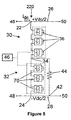
- a third control circuit 220 according to a third embodiment of the invention is shown in Figure 5 .
- the third control circuit 220 shown in Figure 5 is similar in structure and operation to the second control circuit 120 shown in Figure 4 , and like features share the same reference numerals.
- control unit 46 controls the selective removal of each second capacitor from the second current transmission path portion 32.
- Each second capacitor is selectively removable from the second current transmission path portion 32 in the same manner as the selective removal of each first module 36 from the first current transmission path portion 30 in the first control circuit 20.
- the operation of the third control circuit 220 is similar to the operation of the second control circuit 120.
- the use of the 4-quadrant bipolar modules in the second current transmission path portion 32 is beneficial in that it permits use of the third control circuit 220 in combination with a LCC HVDC scheme in which the polarity of the DC voltage changes when the direction of the transmitted power is inverted.
- a fourth control circuit 320 according to a fourth embodiment of the invention is shown in Figure 6 .
- the fourth control circuit 320 shown in Figure 6 is similar in structure and operation to the third control circuit 220 shown in Figure 5 , and like features share the same reference numerals.
- the fourth control circuit 320 differs from the third control circuit 220 in that:
- the first and second DC power transmission lines 26,28 interconnect first and second power converters 48,50 that are themselves connected to respective phases of corresponding first and second AC networks (not shown). Power is transmitted from the first AC network to the second AC network via the corresponding power converters and the first and second DC power transmission lines 26,28.
- the fourth control circuit 320 adopts a standby configuration in which the capacitors of the first and second modules 70 are connected in the current transmission path. Meanwhile the first and second current transmission path portions 30,32 are configured to maintain a zero or near-zero voltage across the dump resistor 44 in order to block or minimise current flowing through the dump resistor 44 and thereby minimise dissipation of energy via the dump resistor 44 when the fourth control circuit 320 is in the standby configuration.
- the purpose of configuring the first and second current transmission path portions 30,32 in this manner is to minimise power losses through energy dissipation via the dump resistor 44.
- the total voltage across the first current transmission path portion 30 is approximately equal to V DC , which is the voltage across the DC power transmission lines 26,28. In the standby configuration there is zero or minimal current flowing through the current transmission path.
- the first AC network must temporarily continue transmitting power into the DC transmission lines until the power transfer can be reduced to zero, which is typically 1-2 seconds for a wind generation plant. As indicated above, this may lead to accumulation of excess energy in the DC power transmission lines 26,28. Removal of the excess energy from the DC power transmission lines 26,28 is required in order to protect the DC power transmission lines 26,28 from an overvoltage and to ensure a low voltage fault ride-through, if necessary.
- the control unit 46 selectively removes each of the first and second capacitors from the first and second current transmission path portions 30,32 to generate a voltage waveform across each of the first and second current transmission path portions 30,32, which adds or subtracts finite voltage steps to the voltage across the DC transmission lines, V DC .
- the voltage waveforms across the first and second current transmission path portions 30,32 are shaped so as to generate an AC voltage waveform across the dump resistor 44.
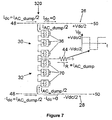
- a simulation model of the fourth control circuit 320 has been implemented using Matlab-Simulink to illustrate its operation.
- a representation of the simulation model is shown in Figure 8 in which each of the first and second capacitors are modelled as a DC voltage source and the fourth control circuit 320 is connected in parallel with a DC voltage source 74.
- a square voltage waveform demand is set for each of the first and second current transmission path portions 30,32.
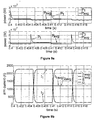
- the positive peak of each square voltage waveform demand for each of the first and second current transmission path portions 30,32 is set to Vdc, while the negative peak of each square voltage waveform demand for each of the first and second current transmission path portions 30,32 is a negative voltage value controlled by a proportional-integral regulator so as to restore any lost energy in the first and second capacitors with a view to achieving a zero net energy exchange over a single cycle, as shown in Figure 9a which illustrates, in graph form, the change in power P 1 across the plurality of first modules 36 and a zero net power exchange indicated by a nil average power P avg .
- the negative value of the generated voltage waveform causes a constant DC current to flow through the current transmission path from the second DC power transmission line 28 to the first DC power transmission line 26 to compensate for any loss of energy from the first and second capacitors to the dump resistor 44.
- the constant DC current offsets the AC current flowing through the current transmission path to the dump resistor 44 as shown in Figure 9b which illustrates, in graph form, the instantaneous current I 1 and a zero average current I 1avg in the first current transmission path portion 30 and the instantaneous current I 2 and a zero average current I 2avg in the second current transmission path portion 32.
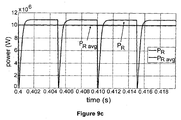
- Figure 9c shows, in graph form, the instantaneous power P R and average power P Ravg dissipated in the dump resistor 44.
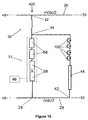
- a fifth control circuit 420 according to a fifth embodiment of the invention is shown in Figure 10 .
- the fifth control circuit 420 shown In Figure 10 is similar in structure to the second control circuit 120 shown in Figure 4 , and like features share the same reference numerals.
- the fifth control circuit 420 differs from the second control circuit 120 in that:
- the sixth control circuit 420 adopts a standby configuration in which each second capacitor is connected in the current transmission path. Meanwhile each auxiliary switching element 100 is switched to an off-state to inhibit flow of current in the dump resistor 44 to minimise energy losses.
- each auxiliary switching element 100 is switched to an on-state to permit flow of current in the dump resistor 44.
- the control unit 46 selectively removes each second capacitor from the second current transmission path portion to modify the voltage at the third terminal 34 to allow soft-switching of each auxiliary switching element 100 when each auxiliary switching element 100 is switched to an on-state.
- each auxiliary switching element 100 switches to an on-state to cause a DC current to flow from the DC power transmission lines 26,28 through the current transmission path and into the dump resistor 44. This permits energy dissipation via the dump resistor 44 so as to remove excess energy from the DC power transmission lines 26,28.
- each auxiliary switching element 100 is switched back to an off-state to inhibit flow of current in the dump resistor 44 before the fifth control circuit 420 is reconfigured in its standby configuration.
- the control unit 46 selectively removes each second capacitor from the second current transmission path portion to modify the voltage at the third terminal 34 to allow soft-switching of each auxiliary switching element 100 when each auxiliary switching element 100 is switched back to an off-state.
- the fifth control circuit 420 also provides a simpler configuration that is capable of removing energy from the DC power transmission lines 28,28.
- the second current transmission path portion 32 can be configured to have a lower rating than the plurality of series-connected auxiliary switching elements 100 so as to provide reductions in terms of losses, cost and footprint. This is because selective removal of each second capacitor from the current transmission path is not essential to control the removal of energy from the DC power transmission lines 26,28.
- each auxiliary switching element may be replaced by an auxiliary module to control flow of current in the dump resistor, each auxiliary module including at least one auxiliary energy storage device.
- each auxiliary module includes at least one auxiliary switching element to selectively direct current through the or each auxiliary energy storage device or cause current to bypass the or each auxiliary energy storage device.
- Each auxiliary module may be configured to have bidirectional current capability.
- each auxiliary module may be configured to have bidirectional current capability in the same manner as the first and second modules of the current transmission path as set out above in the earlier embodiments.
- each auxiliary switching element may be replaced by an auxiliary module that is configured to have unidirectional current capability, i.e. the or each auxiliary module is configured to be capable of conducting current in only one direction.
- each auxiliary module may include first and second sets of series-connected current flow control elements, each set of current flow control elements including an active switching element to selectively direct current through the or each auxiliary energy storage device and a passive current check element to limit current flow through the auxiliary module to a single direction, the first and second sets of series-connected current flow control elements and the or each auxiliary energy storage device being arranged in a full-bridge arrangement to define a 2-quadrant bipolar rationalised module that can provide zero, positive or negative voltage while conducting current in a single direction.
- one or more of the switching elements may be a different switching device such as a gate turn-off thyristor, a field effect transistor, an injection-enhanced gate transistor, an integrated gate commutated thyristor or any other self-commutated semiconductor device.
- the switching device is connected in parallel with an anti-parallel diode.
- the capacitor in each module may be replaced by a different energy storage device such as a fuel cell, a battery or any other energy storage device capable of storing and releasing its electrical energy to provide a voltage.
- a different energy storage device such as a fuel cell, a battery or any other energy storage device capable of storing and releasing its electrical energy to provide a voltage.
Landscapes
- Engineering & Computer Science (AREA)
- Power Engineering (AREA)
- Charge And Discharge Circuits For Batteries Or The Like (AREA)
Claims (18)
- Circuit de commande (20, 120, 220, 320, 420) comprenant :des première et deuxième bornes (22, 24) pour une connexion respective à des première et seconde lignes de transport d'électricité (26, 28) ;un chemin de transport de courant s'étendant entre les première et deuxième bornes (22, 24) et ayant des première et seconde parties de chemin de transport de courant (30, 32) séparées par une troisième borne (34), l'une ou l'autre des première et seconde parties de chemin de transport de courant (30, 32) ou les deux comportant au moins un module (36, 68, 70), le ou chaque module (36, 68, 70) comportant au moins un dispositif de stockage d'énergie,une borne auxiliaire (42) pour une connexion à la masse ou à la seconde ligne de transport d'électricité (28) ;un bloc de conversion d'énergie pour retirer de l'énergie des lignes de transport d'électricité (26, 28), le bloc de conversion d'énergie s'étendant entre la troisième borne et la borne auxiliaire (34, 42) de sorte que le bloc de conversion d'énergie bifurque du chemin de transport de courant, le bloc de conversion d'énergie comportant au moins un élément de conversion d'énergie (44) ; etune unité de commande (46) qui retire sélectivement le ou chaque dispositif de stockage d'énergie du chemin de transport de courant.
- Circuit de commande (20, 120, 220, 320, 420) selon la revendication 1, dans lequel l'unité de commande (46) retire sélectivement le ou chaque dispositif de stockage d'énergie du chemin de transport de courant pour amener le courant à circuler des lignes de transport d'électricité (26, 28) à travers le chemin de transport de courant et dans le ou chaque élément de conversion d'énergie (44) pour retirer l'énergie des lignes de transport d'électricité (26, 28).
- Circuit de commande (20, 120, 220, 320) selon l'une quelconque des revendications précédentes, dans lequel la première partie de chemin de transport de courant (30) comporte au moins un premier module (36), le ou chaque premier module (36) comportant au moins un premier dispositif de stockage d'énergie.
- Circuit de commande (20, 120, 220, 320) selon la revendication 3, dans lequel au moins un premier module (36) comporte au moins un élément de commutation primaire pour diriger sélectivement le courant à travers le ou chaque premier dispositif de stockage d'énergie ou amener le courant à court-circuiter le ou chaque premier dispositif de stockage d'énergie.
- Circuit de commande (20, 120, 220, 320, 420) selon l'une quelconque des revendications précédentes, dans lequel la seconde partie de chemin de transport de courant (32) comporte au moins un bloc de commutation primaire qui peut être commuté pour permettre ou empêcher sélectivement une circulation de courant dans la seconde partie de chemin de transport (32).
- Circuit de commande (20) selon la revendication 5, dans lequel au moins un bloc de commutation primaire comporte au moins un élément de commutation secondaire (40).
- Circuit de commande (120, 220, 320, 420) selon la revendication 5 ou la revendication 6, dans lequel au moins un bloc de commutation primaire comporte un second module (68, 70), le second module (68, 70) comportant au moins un second dispositif de stockage d'énergie.
- Circuit de commande (120, 220, 320, 420) selon la revendication 7, dans lequel au moins un second module (68, 70) comporte au moins un élément de commutation primaire pour diriger sélectivement le courant à travers le ou chaque second dispositif de stockage d'énergie ou amener le courant à court-circuiter le ou chaque second dispositif de stockage d'énergie.
- Circuit de commande (20, 120, 220, 320, 420) selon l'une quelconque des revendications 5 à 8, dans lequel l'unité de commande (46) commute sélectivement le ou chaque bloc de commutation primaire pour bloquer ou minimiser le courant dans la seconde partie de chemin de transport de courant (32) et amener ainsi le courant à être dirigé dans le ou chaque élément de conversion d'énergie (44).
- Circuit de commande (20) selon la revendication 9, lorsqu'elle dépend de la revendication 6, dans lequel l'unité de commande commute sélectivement le ou chaque élément de commutation secondaire (40) à un état bloqué pour bloquer le courant dans la seconde partie de chemin de transport de courant (32) et amener ainsi le courant à être dirigé dans le ou chaque élément de conversion d'énergie (44).
- Circuit de commande (120, 220, 320, 420) selon la revendication 9, lorsqu'elle dépend de la revendication 8, dans lequel l'unité de commande (46) commute sélectivement le ou chaque élément de commutation primaire dans le ou chaque second module (68, 70) pour bloquer ou minimiser le courant dans la seconde partie de chemin de transport de courant (32) et amener ainsi le courant à être dirigé dans le ou chaque élément de conversion d'énergie (44).
- Circuit de commande (320) selon la revendication 7 ou la revendication 8 lorsqu'elle dépend de la revendication 3 ou de la revendication 4, dans lequel l'unité de commande (46) retire sélectivement chaque dispositif de stockage d'énergie des première et seconde parties de chemin de transport de courant (30, 32) pour générer une forme d'onde de tension alternative aux bornes du ou de chaque élément de conversion d'énergie (44) pour retirer de l'énergie des lignes de transport d'électricité (26, 28).
- Circuit de commande (320) selon la revendication 12, dans lequel l'unité de commande (46) retire sélectivement chaque dispositif de stockage d'énergie des première et seconde parties de chemin de transport de courant (30, 32) pour générer une forme d'onde de tension carrée aux bornes de chacune des première et seconde parties de chemin de transport de courant (30, 32) et générer ainsi une forme d'onde de tension alternative aux bornes du ou de chaque élément de conversion d'énergie (44) pour retirer de l'énergie des lignes de transport d'électricité (26, 28).
- Circuit de commande (420) selon l'une quelconque des revendications précédentes, dans lequel le bloc de conversion d'énergie comporte en outre au moins un bloc de commutation auxiliaire qui peut être commuté pour permettre ou empêcher sélectivement la circulation de courant dans le ou chaque élément de conversion d'énergie (44).
- Circuit de commande (420) selon la revendication 14, dans lequel au moins un bloc de commutation auxiliaire comporte au moins un élément de commutation auxiliaire (100).
- Circuit de commande (420) selon la revendication 14 ou la revendication 15, dans lequel au moins un bloc de commutation auxiliaire comporte un module auxiliaire, le module auxiliaire comportant au moins un dispositif de stockage d'énergie auxiliaire.
- Circuit de commande (420) selon la revendication 16, dans lequel au moins un module auxiliaire comporte au moins un élément de commutation auxiliaire pour diriger sélectivement le courant à travers le ou chaque dispositif de stockage d'énergie auxiliaire ou amener le courant à court-circuiter le ou chaque dispositif de stockage d'énergie auxiliaire.
- Circuit de commande (420) selon l'une quelconque des revendications 14 à 17 lorsqu'elles dépendent de la revendication 7 ou de la revendication 8, dans lequel l'unité de commande (46) retire sélectivement chaque second dispositif de stockage d'énergie de la seconde partie de chemin de transport de courant (32) pour modifier la tension à la troisième borne (34) pour permettre une commutation par logiciel du ou de chaque bloc de commutation auxiliaire lorsque le ou chaque bloc de commutation auxiliaire est commuté.
Priority Applications (1)
| Application Number | Priority Date | Filing Date | Title |
|---|---|---|---|
| EP12820879.0A EP2834896B1 (fr) | 2012-03-01 | 2012-12-28 | Circuit de commande |
Applications Claiming Priority (3)
| Application Number | Priority Date | Filing Date | Title |
|---|---|---|---|
| PCT/EP2012/053571 WO2013127461A1 (fr) | 2012-03-01 | 2012-03-01 | Circuit de commande |
| PCT/GB2012/053278 WO2013128148A1 (fr) | 2012-03-01 | 2012-12-28 | Circuit de commande |
| EP12820879.0A EP2834896B1 (fr) | 2012-03-01 | 2012-12-28 | Circuit de commande |
Publications (2)
| Publication Number | Publication Date |
|---|---|
| EP2834896A1 EP2834896A1 (fr) | 2015-02-11 |
| EP2834896B1 true EP2834896B1 (fr) | 2016-05-25 |
Family
ID=52183098
Family Applications (1)
| Application Number | Title | Priority Date | Filing Date |
|---|---|---|---|
| EP12820879.0A Not-in-force EP2834896B1 (fr) | 2012-03-01 | 2012-12-28 | Circuit de commande |
Country Status (1)
| Country | Link |
|---|---|
| EP (1) | EP2834896B1 (fr) |
Cited By (3)
| Publication number | Priority date | Publication date | Assignee | Title |
|---|---|---|---|---|
| EP4329181A1 (fr) * | 2022-08-22 | 2024-02-28 | Siemens Aktiengesellschaft | Actionneur de frein modulaire à structure hybride |
| EP4329180A1 (fr) * | 2022-08-22 | 2024-02-28 | Siemens Aktiengesellschaft | Procédé de commande pour un actionneur de frein modulaire |
| US12119655B2 (en) | 2021-06-08 | 2024-10-15 | Hitachi Energy Ltd | Energy supporting device |
Families Citing this family (1)
| Publication number | Priority date | Publication date | Assignee | Title |
|---|---|---|---|---|
| CN110224413B (zh) * | 2019-06-11 | 2024-07-12 | 李洋 | 一种输配电调节装置及其计量方法、控制方法 |
-
2012
- 2012-12-28 EP EP12820879.0A patent/EP2834896B1/fr not_active Not-in-force
Cited By (6)
| Publication number | Priority date | Publication date | Assignee | Title |
|---|---|---|---|---|
| US12119655B2 (en) | 2021-06-08 | 2024-10-15 | Hitachi Energy Ltd | Energy supporting device |
| EP4329181A1 (fr) * | 2022-08-22 | 2024-02-28 | Siemens Aktiengesellschaft | Actionneur de frein modulaire à structure hybride |
| EP4329180A1 (fr) * | 2022-08-22 | 2024-02-28 | Siemens Aktiengesellschaft | Procédé de commande pour un actionneur de frein modulaire |
| WO2024041785A1 (fr) * | 2022-08-22 | 2024-02-29 | Siemens Aktiengesellschaft | Procédé de commande pour actionneur de frein modulaire |
| WO2024041786A1 (fr) * | 2022-08-22 | 2024-02-29 | Siemens Aktiengesellschaft | Actionneur de frein modulaire à conception hybride |
| US12438481B2 (en) | 2022-08-22 | 2025-10-07 | Innomotics Gmbh | Modular braking adjuster with hybrid design |
Also Published As
| Publication number | Publication date |
|---|---|
| EP2834896A1 (fr) | 2015-02-11 |
Similar Documents
| Publication | Publication Date | Title |
|---|---|---|
| US9306392B2 (en) | Control circuit for excess energy removal in power transmission lines | |
| US9209693B2 (en) | Control circuit for DC network to maintain zero net change in energy level | |
| EP2548277B1 (fr) | Compensateur statique de puissance réactive doté d'un convertisseur à plusieurs niveaux | |
| EP2750271A1 (fr) | Circuit de commande | |
| KR20130100285A (ko) | 영상 덤프 저항에 연결된 중성점을 갖는 hvdc 컨버터 | |
| US9847642B2 (en) | Control circuit | |
| US20150049530A1 (en) | Power electronic converter | |
| US20160352239A1 (en) | Power electronic converter | |
| EP2947741B1 (fr) | Circuit de commande | |
| EP2834896B1 (fr) | Circuit de commande | |
| Feldman et al. | DC fault ride-through capability and STATCOM operation of a hybrid voltage source converter arrangement for HVDC power transmission and reactive power compensation | |
| CA2864566A1 (fr) | Procede et systeme pour entrainer des machines electriques | |
| KR101116000B1 (ko) | 직렬 연결된 전류원 직/교류 전력 변환기들을 이용한 전력 변환 시스템 및 전력 변환 방법 | |
| EP2828967B1 (fr) | Convertisseur électronique de puissance |
Legal Events
| Date | Code | Title | Description |
|---|---|---|---|
| PUAI | Public reference made under article 153(3) epc to a published international application that has entered the european phase |
Free format text: ORIGINAL CODE: 0009012 |
|
| 17P | Request for examination filed |
Effective date: 20140930 |
|
| AK | Designated contracting states |
Kind code of ref document: A1 Designated state(s): AL AT BE BG CH CY CZ DE DK EE ES FI FR GB GR HR HU IE IS IT LI LT LU LV MC MK MT NL NO PL PT RO RS SE SI SK SM TR |
|
| AX | Request for extension of the european patent |
Extension state: BA ME |
|
| RIN1 | Information on inventor provided before grant (corrected) |
Inventor name: OKAEME, NNAMDI Inventor name: MANEIRO, JOSE Inventor name: DYKE, KEVIN J. Inventor name: TRAINER, DAVID REGINALD Inventor name: DAVIDSON, COLIN CHARNOCK |
|
| DAX | Request for extension of the european patent (deleted) | ||
| GRAP | Despatch of communication of intention to grant a patent |
Free format text: ORIGINAL CODE: EPIDOSNIGR1 |
|
| INTG | Intention to grant announced |
Effective date: 20151215 |
|
| RIN1 | Information on inventor provided before grant (corrected) |
Inventor name: DAVIDSON, COLIN CHARNOCK Inventor name: TRAINER, DAVID REGINALD Inventor name: MANEIRO, JOSE Inventor name: DYKE, KEVIN J. Inventor name: OKAEME, NNAMDI |
|
| RAP1 | Party data changed (applicant data changed or rights of an application transferred) |
Owner name: GENERAL ELECTRIC TECHNOLOGY GMBH |
|
| GRAS | Grant fee paid |
Free format text: ORIGINAL CODE: EPIDOSNIGR3 |
|
| GRAA | (expected) grant |
Free format text: ORIGINAL CODE: 0009210 |
|
| AK | Designated contracting states |
Kind code of ref document: B1 Designated state(s): AL AT BE BG CH CY CZ DE DK EE ES FI FR GB GR HR HU IE IS IT LI LT LU LV MC MK MT NL NO PL PT RO RS SE SI SK SM TR |
|
| REG | Reference to a national code |
Ref country code: GB Ref legal event code: FG4D |
|
| REG | Reference to a national code |
Ref country code: CH Ref legal event code: EP |
|
| REG | Reference to a national code |
Ref country code: IE Ref legal event code: FG4D Ref country code: AT Ref legal event code: REF Ref document number: 803034 Country of ref document: AT Kind code of ref document: T Effective date: 20160615 |
|
| REG | Reference to a national code |
Ref country code: DE Ref legal event code: R096 Ref document number: 602012019051 Country of ref document: DE |
|
| REG | Reference to a national code |
Ref country code: SE Ref legal event code: TRGR |
|
| REG | Reference to a national code |
Ref country code: LT Ref legal event code: MG4D |
|
| REG | Reference to a national code |
Ref country code: NL Ref legal event code: MP Effective date: 20160525 |
|
| PG25 | Lapsed in a contracting state [announced via postgrant information from national office to epo] |
Ref country code: FI Free format text: LAPSE BECAUSE OF FAILURE TO SUBMIT A TRANSLATION OF THE DESCRIPTION OR TO PAY THE FEE WITHIN THE PRESCRIBED TIME-LIMIT Effective date: 20160525 Ref country code: NL Free format text: LAPSE BECAUSE OF FAILURE TO SUBMIT A TRANSLATION OF THE DESCRIPTION OR TO PAY THE FEE WITHIN THE PRESCRIBED TIME-LIMIT Effective date: 20160525 Ref country code: LT Free format text: LAPSE BECAUSE OF FAILURE TO SUBMIT A TRANSLATION OF THE DESCRIPTION OR TO PAY THE FEE WITHIN THE PRESCRIBED TIME-LIMIT Effective date: 20160525 Ref country code: NO Free format text: LAPSE BECAUSE OF FAILURE TO SUBMIT A TRANSLATION OF THE DESCRIPTION OR TO PAY THE FEE WITHIN THE PRESCRIBED TIME-LIMIT Effective date: 20160825 |
|
| REG | Reference to a national code |
Ref country code: AT Ref legal event code: MK05 Ref document number: 803034 Country of ref document: AT Kind code of ref document: T Effective date: 20160525 |
|
| PG25 | Lapsed in a contracting state [announced via postgrant information from national office to epo] |
Ref country code: GR Free format text: LAPSE BECAUSE OF FAILURE TO SUBMIT A TRANSLATION OF THE DESCRIPTION OR TO PAY THE FEE WITHIN THE PRESCRIBED TIME-LIMIT Effective date: 20160826 Ref country code: ES Free format text: LAPSE BECAUSE OF FAILURE TO SUBMIT A TRANSLATION OF THE DESCRIPTION OR TO PAY THE FEE WITHIN THE PRESCRIBED TIME-LIMIT Effective date: 20160525 Ref country code: RS Free format text: LAPSE BECAUSE OF FAILURE TO SUBMIT A TRANSLATION OF THE DESCRIPTION OR TO PAY THE FEE WITHIN THE PRESCRIBED TIME-LIMIT Effective date: 20160525 Ref country code: LV Free format text: LAPSE BECAUSE OF FAILURE TO SUBMIT A TRANSLATION OF THE DESCRIPTION OR TO PAY THE FEE WITHIN THE PRESCRIBED TIME-LIMIT Effective date: 20160525 Ref country code: PT Free format text: LAPSE BECAUSE OF FAILURE TO SUBMIT A TRANSLATION OF THE DESCRIPTION OR TO PAY THE FEE WITHIN THE PRESCRIBED TIME-LIMIT Effective date: 20160926 |
|
| PG25 | Lapsed in a contracting state [announced via postgrant information from national office to epo] |
Ref country code: IT Free format text: LAPSE BECAUSE OF FAILURE TO SUBMIT A TRANSLATION OF THE DESCRIPTION OR TO PAY THE FEE WITHIN THE PRESCRIBED TIME-LIMIT Effective date: 20160525 |
|
| PG25 | Lapsed in a contracting state [announced via postgrant information from national office to epo] |
Ref country code: DK Free format text: LAPSE BECAUSE OF FAILURE TO SUBMIT A TRANSLATION OF THE DESCRIPTION OR TO PAY THE FEE WITHIN THE PRESCRIBED TIME-LIMIT Effective date: 20160525 Ref country code: CZ Free format text: LAPSE BECAUSE OF FAILURE TO SUBMIT A TRANSLATION OF THE DESCRIPTION OR TO PAY THE FEE WITHIN THE PRESCRIBED TIME-LIMIT Effective date: 20160525 Ref country code: RO Free format text: LAPSE BECAUSE OF FAILURE TO SUBMIT A TRANSLATION OF THE DESCRIPTION OR TO PAY THE FEE WITHIN THE PRESCRIBED TIME-LIMIT Effective date: 20160525 Ref country code: SK Free format text: LAPSE BECAUSE OF FAILURE TO SUBMIT A TRANSLATION OF THE DESCRIPTION OR TO PAY THE FEE WITHIN THE PRESCRIBED TIME-LIMIT Effective date: 20160525 Ref country code: EE Free format text: LAPSE BECAUSE OF FAILURE TO SUBMIT A TRANSLATION OF THE DESCRIPTION OR TO PAY THE FEE WITHIN THE PRESCRIBED TIME-LIMIT Effective date: 20160525 |
|
| PG25 | Lapsed in a contracting state [announced via postgrant information from national office to epo] |
Ref country code: PL Free format text: LAPSE BECAUSE OF FAILURE TO SUBMIT A TRANSLATION OF THE DESCRIPTION OR TO PAY THE FEE WITHIN THE PRESCRIBED TIME-LIMIT Effective date: 20160525 Ref country code: SM Free format text: LAPSE BECAUSE OF FAILURE TO SUBMIT A TRANSLATION OF THE DESCRIPTION OR TO PAY THE FEE WITHIN THE PRESCRIBED TIME-LIMIT Effective date: 20160525 Ref country code: AT Free format text: LAPSE BECAUSE OF FAILURE TO SUBMIT A TRANSLATION OF THE DESCRIPTION OR TO PAY THE FEE WITHIN THE PRESCRIBED TIME-LIMIT Effective date: 20160525 Ref country code: BE Free format text: LAPSE BECAUSE OF FAILURE TO SUBMIT A TRANSLATION OF THE DESCRIPTION OR TO PAY THE FEE WITHIN THE PRESCRIBED TIME-LIMIT Effective date: 20160525 |
|
| REG | Reference to a national code |
Ref country code: DE Ref legal event code: R097 Ref document number: 602012019051 Country of ref document: DE |
|
| PLBE | No opposition filed within time limit |
Free format text: ORIGINAL CODE: 0009261 |
|
| STAA | Information on the status of an ep patent application or granted ep patent |
Free format text: STATUS: NO OPPOSITION FILED WITHIN TIME LIMIT |
|
| 26N | No opposition filed |
Effective date: 20170228 |
|
| PG25 | Lapsed in a contracting state [announced via postgrant information from national office to epo] |
Ref country code: SI Free format text: LAPSE BECAUSE OF FAILURE TO SUBMIT A TRANSLATION OF THE DESCRIPTION OR TO PAY THE FEE WITHIN THE PRESCRIBED TIME-LIMIT Effective date: 20160525 |
|
| REG | Reference to a national code |
Ref country code: CH Ref legal event code: PL |
|
| PG25 | Lapsed in a contracting state [announced via postgrant information from national office to epo] |
Ref country code: MC Free format text: LAPSE BECAUSE OF FAILURE TO SUBMIT A TRANSLATION OF THE DESCRIPTION OR TO PAY THE FEE WITHIN THE PRESCRIBED TIME-LIMIT Effective date: 20160525 |
|
| REG | Reference to a national code |
Ref country code: FR Ref legal event code: ST Effective date: 20170831 |
|
| REG | Reference to a national code |
Ref country code: IE Ref legal event code: MM4A |
|
| PG25 | Lapsed in a contracting state [announced via postgrant information from national office to epo] |
Ref country code: LI Free format text: LAPSE BECAUSE OF NON-PAYMENT OF DUE FEES Effective date: 20161231 Ref country code: CH Free format text: LAPSE BECAUSE OF NON-PAYMENT OF DUE FEES Effective date: 20161231 Ref country code: LU Free format text: LAPSE BECAUSE OF NON-PAYMENT OF DUE FEES Effective date: 20161228 Ref country code: FR Free format text: LAPSE BECAUSE OF NON-PAYMENT OF DUE FEES Effective date: 20170102 |
|
| PG25 | Lapsed in a contracting state [announced via postgrant information from national office to epo] |
Ref country code: IE Free format text: LAPSE BECAUSE OF NON-PAYMENT OF DUE FEES Effective date: 20161228 |
|
| PGFP | Annual fee paid to national office [announced via postgrant information from national office to epo] |
Ref country code: SE Payment date: 20171229 Year of fee payment: 6 Ref country code: GB Payment date: 20171227 Year of fee payment: 6 |
|
| PGFP | Annual fee paid to national office [announced via postgrant information from national office to epo] |
Ref country code: DE Payment date: 20171229 Year of fee payment: 6 |
|
| PG25 | Lapsed in a contracting state [announced via postgrant information from national office to epo] |
Ref country code: HU Free format text: LAPSE BECAUSE OF FAILURE TO SUBMIT A TRANSLATION OF THE DESCRIPTION OR TO PAY THE FEE WITHIN THE PRESCRIBED TIME-LIMIT; INVALID AB INITIO Effective date: 20121228 |
|
| PG25 | Lapsed in a contracting state [announced via postgrant information from national office to epo] |
Ref country code: CY Free format text: LAPSE BECAUSE OF FAILURE TO SUBMIT A TRANSLATION OF THE DESCRIPTION OR TO PAY THE FEE WITHIN THE PRESCRIBED TIME-LIMIT Effective date: 20160525 Ref country code: IS Free format text: LAPSE BECAUSE OF FAILURE TO SUBMIT A TRANSLATION OF THE DESCRIPTION OR TO PAY THE FEE WITHIN THE PRESCRIBED TIME-LIMIT Effective date: 20160525 Ref country code: MK Free format text: LAPSE BECAUSE OF FAILURE TO SUBMIT A TRANSLATION OF THE DESCRIPTION OR TO PAY THE FEE WITHIN THE PRESCRIBED TIME-LIMIT Effective date: 20160525 Ref country code: HR Free format text: LAPSE BECAUSE OF FAILURE TO SUBMIT A TRANSLATION OF THE DESCRIPTION OR TO PAY THE FEE WITHIN THE PRESCRIBED TIME-LIMIT Effective date: 20160525 |
|
| PG25 | Lapsed in a contracting state [announced via postgrant information from national office to epo] |
Ref country code: BG Free format text: LAPSE BECAUSE OF FAILURE TO SUBMIT A TRANSLATION OF THE DESCRIPTION OR TO PAY THE FEE WITHIN THE PRESCRIBED TIME-LIMIT Effective date: 20160525 |
|
| PG25 | Lapsed in a contracting state [announced via postgrant information from national office to epo] |
Ref country code: MT Free format text: LAPSE BECAUSE OF NON-PAYMENT OF DUE FEES Effective date: 20161228 |
|
| PG25 | Lapsed in a contracting state [announced via postgrant information from national office to epo] |
Ref country code: TR Free format text: LAPSE BECAUSE OF FAILURE TO SUBMIT A TRANSLATION OF THE DESCRIPTION OR TO PAY THE FEE WITHIN THE PRESCRIBED TIME-LIMIT Effective date: 20160525 Ref country code: AL Free format text: LAPSE BECAUSE OF FAILURE TO SUBMIT A TRANSLATION OF THE DESCRIPTION OR TO PAY THE FEE WITHIN THE PRESCRIBED TIME-LIMIT Effective date: 20160525 |
|
| REG | Reference to a national code |
Ref country code: DE Ref legal event code: R119 Ref document number: 602012019051 Country of ref document: DE |
|
| REG | Reference to a national code |
Ref country code: SE Ref legal event code: EUG |
|
| PG25 | Lapsed in a contracting state [announced via postgrant information from national office to epo] |
Ref country code: SE Free format text: LAPSE BECAUSE OF NON-PAYMENT OF DUE FEES Effective date: 20181229 |
|
| GBPC | Gb: european patent ceased through non-payment of renewal fee |
Effective date: 20181228 |
|
| PG25 | Lapsed in a contracting state [announced via postgrant information from national office to epo] |
Ref country code: DE Free format text: LAPSE BECAUSE OF NON-PAYMENT OF DUE FEES Effective date: 20190702 |
|
| PG25 | Lapsed in a contracting state [announced via postgrant information from national office to epo] |
Ref country code: GB Free format text: LAPSE BECAUSE OF NON-PAYMENT OF DUE FEES Effective date: 20181228 |