EP2837664A1 - Élément occultant la lumière - Google Patents
Élément occultant la lumière Download PDFInfo
- Publication number
- EP2837664A1 EP2837664A1 EP14160622.8A EP14160622A EP2837664A1 EP 2837664 A1 EP2837664 A1 EP 2837664A1 EP 14160622 A EP14160622 A EP 14160622A EP 2837664 A1 EP2837664 A1 EP 2837664A1
- Authority
- EP
- European Patent Office
- Prior art keywords
- light
- repellent
- optical
- bleaching agent
- bleach
- Prior art date
- Legal status (The legal status is an assumption and is not a legal conclusion. Google has not performed a legal analysis and makes no representation as to the accuracy of the status listed.)
- Withdrawn
Links
- 230000001846 repelling effect Effects 0.000 title 1
- 239000007844 bleaching agent Substances 0.000 claims abstract description 33
- 239000005871 repellent Substances 0.000 claims abstract description 31
- 230000003287 optical effect Effects 0.000 claims abstract description 14
- 239000003504 photosensitizing agent Substances 0.000 claims abstract description 6
- 239000004611 light stabiliser Substances 0.000 claims abstract description 4
- 239000004890 Hydrophobing Agent Substances 0.000 claims abstract 2
- PJANXHGTPQOBST-UHFFFAOYSA-N stilbene Chemical class C=1C=CC=CC=1C=CC1=CC=CC=C1 PJANXHGTPQOBST-UHFFFAOYSA-N 0.000 claims abstract 2
- 238000009994 optical bleaching Methods 0.000 claims description 20
- YGSDEFSMJLZEOE-UHFFFAOYSA-N salicylic acid Chemical compound OC(=O)C1=CC=CC=C1O YGSDEFSMJLZEOE-UHFFFAOYSA-N 0.000 claims description 4
- 238000001228 spectrum Methods 0.000 claims description 4
- BLRPTPMANUNPDV-UHFFFAOYSA-N Silane Chemical compound [SiH4] BLRPTPMANUNPDV-UHFFFAOYSA-N 0.000 claims description 2
- VNEBWJSWMVTSHK-UHFFFAOYSA-L disodium;3-hydroxynaphthalene-2,7-disulfonate Chemical compound [Na+].[Na+].C1=C(S([O-])(=O)=O)C=C2C=C(S([O-])(=O)=O)C(O)=CC2=C1 VNEBWJSWMVTSHK-UHFFFAOYSA-L 0.000 claims description 2
- IEXIPYCHASVPFD-UHFFFAOYSA-L disodium;7-hydroxynaphthalene-1,3-disulfonate Chemical compound [Na+].[Na+].C1=C(S([O-])(=O)=O)C=C(S([O-])(=O)=O)C2=CC(O)=CC=C21 IEXIPYCHASVPFD-UHFFFAOYSA-L 0.000 claims description 2
- -1 p-naphthylamine Chemical compound 0.000 claims description 2
- FJKROLUGYXJWQN-UHFFFAOYSA-N papa-hydroxy-benzoic acid Natural products OC(=O)C1=CC=C(O)C=C1 FJKROLUGYXJWQN-UHFFFAOYSA-N 0.000 claims description 2
- 238000002360 preparation method Methods 0.000 claims description 2
- 229960004889 salicylic acid Drugs 0.000 claims description 2
- FZHAPNGMFPVSLP-UHFFFAOYSA-N silanamine Chemical class [SiH3]N FZHAPNGMFPVSLP-UHFFFAOYSA-N 0.000 claims description 2
- 229910000077 silane Inorganic materials 0.000 claims description 2
- 239000000853 adhesive Substances 0.000 claims 1
- 230000001070 adhesive effect Effects 0.000 claims 1
- 238000004519 manufacturing process Methods 0.000 abstract description 5
- 238000013461 design Methods 0.000 abstract description 3
- 239000011521 glass Substances 0.000 description 5
- 239000004005 microsphere Substances 0.000 description 5
- 239000004744 fabric Substances 0.000 description 4
- 230000004907 flux Effects 0.000 description 4
- 230000005855 radiation Effects 0.000 description 4
- 239000000126 substance Substances 0.000 description 4
- 239000003795 chemical substances by application Substances 0.000 description 2
- 238000000034 method Methods 0.000 description 2
- 238000010276 construction Methods 0.000 description 1
- 238000010411 cooking Methods 0.000 description 1
- 230000001419 dependent effect Effects 0.000 description 1
- 238000011161 development Methods 0.000 description 1
- 230000018109 developmental process Effects 0.000 description 1
- 230000000694 effects Effects 0.000 description 1
- 230000005670 electromagnetic radiation Effects 0.000 description 1
- 238000002474 experimental method Methods 0.000 description 1
- 230000006872 improvement Effects 0.000 description 1
- 230000003993 interaction Effects 0.000 description 1
- 239000000463 material Substances 0.000 description 1
- 230000007246 mechanism Effects 0.000 description 1
- 230000005012 migration Effects 0.000 description 1
- 238000013508 migration Methods 0.000 description 1
- 150000003961 organosilicon compounds Chemical class 0.000 description 1
- 238000005424 photoluminescence Methods 0.000 description 1
- 230000009466 transformation Effects 0.000 description 1
- 230000007723 transport mechanism Effects 0.000 description 1
- 238000001429 visible spectrum Methods 0.000 description 1
Images
Classifications
-
- C—CHEMISTRY; METALLURGY
- C09—DYES; PAINTS; POLISHES; NATURAL RESINS; ADHESIVES; COMPOSITIONS NOT OTHERWISE PROVIDED FOR; APPLICATIONS OF MATERIALS NOT OTHERWISE PROVIDED FOR
- C09D—COATING COMPOSITIONS, e.g. PAINTS, VARNISHES OR LACQUERS; FILLING PASTES; CHEMICAL PAINT OR INK REMOVERS; INKS; CORRECTING FLUIDS; WOODSTAINS; PASTES OR SOLIDS FOR COLOURING OR PRINTING; USE OF MATERIALS THEREFOR
- C09D5/00—Coating compositions, e.g. paints, varnishes or lacquers, characterised by their physical nature or the effects produced; Filling pastes
- C09D5/004—Reflecting paints; Signal paints
-
- C—CHEMISTRY; METALLURGY
- C09—DYES; PAINTS; POLISHES; NATURAL RESINS; ADHESIVES; COMPOSITIONS NOT OTHERWISE PROVIDED FOR; APPLICATIONS OF MATERIALS NOT OTHERWISE PROVIDED FOR
- C09D—COATING COMPOSITIONS, e.g. PAINTS, VARNISHES OR LACQUERS; FILLING PASTES; CHEMICAL PAINT OR INK REMOVERS; INKS; CORRECTING FLUIDS; WOODSTAINS; PASTES OR SOLIDS FOR COLOURING OR PRINTING; USE OF MATERIALS THEREFOR
- C09D7/00—Features of coating compositions, not provided for in group C09D5/00; Processes for incorporating ingredients in coating compositions
- C09D7/40—Additives
- C09D7/60—Additives non-macromolecular
- C09D7/63—Additives non-macromolecular organic
Definitions
- the invention relates to a light-repellent element.
- the invention belongs to the optical elements and can be used in the manufacture of light-rejecting (retroreflective and / or light-reflecting) devices.
- the retroreflective effect is widely used in road traffic safety systems. Most commonly used in domestic practice are retroreflective fabrics containing glass microspheres and retroreflectors in the form of prisms or microprisms.
- the quality of retroreflection characterizes the coefficient of retroreflection (the specific luminosity coefficient), which is calculated as a ratio of the reflection density of the sample to its illuminance and measured in candelas per lux and square meter (cd / lx * m2).
- specular reflection specular reflection
- diffused and mixed reflection specular reflection and diffuse unifying reflection
- the closest prior art to the invention is a retroreflective element which is in the form of a biconvex lens incorporating two lenses connected to each other with a spherical surface (the patent to the invention of the Russian Federation No 2434255 , MPK G02B 5/128, 2010).
- the shortcomings of such a light-repellent element are the complexity of the design and the high manufacturing cost.
- this known device has low coefficients of light reflection and retroreflection because the ultraviolet component of the light falling on the light-repellent element is not used for its transformation into visible light.
- the light-repellent elements may be light-reflecting or retroreflective or may combine the same and another method of interaction with the light.
- the retroreflective elements are formed of an optically transparent fabric.
- the light-repellent elements may, for. B. be used for road and construction.
- the human eye is sensitive only to a particular area of electromagnetic radiation, which is characterized as a visible spectrum and has a wavelength range of 400 to 700 nm.
- the broadcasts that are out of the visible range include infrared (waves longer than 700 nm) and ultraviolet (less than 400 nm).
- the optical bleaches have an ability to absorb the ultraviolet component of a light incident thereon in the 300-400 nm region and to convert the energy obtained to the visible part of the spectrum (400-500 nm). Thanks to fluorescence, the optical bleaching agents convert the ultraviolet contained in natural light and in the light of many artificial sources into a radiation of a visible perimeter so that the fluorescence becomes more intense.
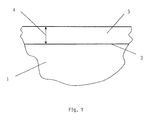
- the invention is based on a in the Fig. 1 illustrated embodiment illustrated.
- a working surface 2 of a light-repellent (retroreflective and / or light-reflecting) element 1 is illustrated, which is finished with an optical bleaching agent 3 with a layer thickness 4 that does not exceed 500 nm.
- the retroreflective elements are a technologically complicated combination of lenses that break a beam of light in opposite directions, typically in the form of glass microspheres and micropyramids. And in this and another case, the light from the source falls on the surface of the microlens, is broken, reflected from the inner surface and returns to the source. As a result, an optical effect of the retroreflection of the luminous flux is achieved.
- the retroreflective elements operate on means of transport such as plastic, automobile, motorcycle and bicycle rear reflectors. But there are not used micro but much larger pyramids. All retroreflective elements are formed from an optically transparent fabric.
- any light reflecting elements in shape and scope may be used.
- the light eg, from headlamps of a car
- the light-repellent (retroreflective and / or light-reflecting) element 1 first passes through the layer of optical bleach 3, with its ultraviolet component in the visible part of the spectrum (FIG. 400-500 nm) is converted.
- the luminous flux which is amplified in the visible part of the spectrum, goes to the working surface 2 of the light-repellent element 1. If this is a light reflecting variant of the light-repelling element 1 embodiment, then the amplified luminous flux reflects (mirror-like, diffused ) from the desktop 2, back out through the layer of optical bleach 3.
- the amplified luminous flux through the work surface 2 passes inside the optically transparent body material (the lens) of the retroreflective element 1, is reflected from its inner surface and again through the layer of the optical bleaching agent 3 back to the light source.
- Stilbenderivate are usually z.
- the preparations "Belofor OJIA”, “Ljuksafor 093” or “Optiblanc WS” are used Maximum maximum coefficients of coefficients of retroreflection and light reflection of the light-repellent element 1 are achieved in the case when the position of the main maximum of the photo-luminescence of the optical bleaching agent 3 is in the range of 510 - 550 nm.
- an adhesion accelerator is compounded in the optical bleaching agent 3, e.g. B. diamine-functional adhesion accelerator Aminoäthylaminopropiltrimetoxysilan, polyfunctional aminosilanes "Penta-65” and “Penta-69", the silane "Silquest A-1110".
- a light stabilizer is blended in the optical bleaching agent 3, e.g. "Fenosan 23", “Irganoks 1010”, “Benasol P”, “Tinuwin 327".
- Photosensitizers which absorb a short-wave UV radiation and pass it on to the optical bleach.
- the co-application of the photosensitizers and the optical bleaching agents allows to expand the amount of absorbed energy, increase the coefficients of retroreflection and light reflection of the light-repellent member 1, and the light resistance of the optical bleaching agent 3 and the body substance (the lens) of the light-repellent member 1 to guarantee.
- Salicylic acid, p-naphthylamine, R salt or G salt may be used as the photosensitizer.
- optical bleaching agent 3 For the improvement of the water-repellent properties of the optical bleaching agent 3 and the increase of its running time and frost resistance 3 hydrophobizing agents are added to the optical bleach, which consists mainly of organosilicon compounds, eg. "BIONIK MBO”, “KRISTALLIZOL”, “Chelsea Stone”.
- the layer thickness of the optical bleaching agent 3 should not exceed 500 nm, depending on the increase in the layer thickness of the optical bleaching agent 3 the coefficients of retroreflection and light reflection of the light-repellent element 1 increase first. Then the coefficients go up to the maximum sizes and then start to decrease.
- the optimum layer thickness of the optical bleaching agent 3 (depending on the body substance of the light-repellent member 1, the kind (the brand) of the optical bleaching agent 3 and the adhesion accelerator, the light stabilizer, the photosensitizer and the hydrophobizing agent) is 20-300 nm. In this case, grow the coefficients of retroreflection and light reflection of the light-repellent element 1 by 15-18%.
Landscapes
- Chemical & Material Sciences (AREA)
- Life Sciences & Earth Sciences (AREA)
- Engineering & Computer Science (AREA)
- Materials Engineering (AREA)
- Wood Science & Technology (AREA)
- Organic Chemistry (AREA)
- Surface Treatment Of Glass (AREA)
Applications Claiming Priority (1)
| Application Number | Priority Date | Filing Date | Title |
|---|---|---|---|
| RU2013138079 | 2013-08-15 |
Publications (1)
| Publication Number | Publication Date |
|---|---|
| EP2837664A1 true EP2837664A1 (fr) | 2015-02-18 |
Family
ID=50439140
Family Applications (1)
| Application Number | Title | Priority Date | Filing Date |
|---|---|---|---|
| EP14160622.8A Withdrawn EP2837664A1 (fr) | 2013-08-15 | 2014-03-19 | Élément occultant la lumière |
Country Status (1)
| Country | Link |
|---|---|
| EP (1) | EP2837664A1 (fr) |
Citations (4)
| Publication number | Priority date | Publication date | Assignee | Title |
|---|---|---|---|---|
| RU2059574C1 (ru) | 1992-05-07 | 1996-05-10 | Владимир Викторович Будов | Способ получения полых стеклянных микросфер |
| US20050089142A1 (en) * | 2003-10-27 | 2005-04-28 | Marek Henry S. | Scintillator coatings having barrier protection, light transmission, and light reflection properties |
| US7235736B1 (en) * | 2006-03-18 | 2007-06-26 | Solyndra, Inc. | Monolithic integration of cylindrical solar cells |
| DE102009019635A1 (de) * | 2009-04-30 | 2010-11-11 | Fraunhofer-Gesellschaft zur Förderung der angewandten Forschung e.V. | Optisches Bauelement sowie dessen Verwendung |
-
2014
- 2014-03-19 EP EP14160622.8A patent/EP2837664A1/fr not_active Withdrawn
Patent Citations (5)
| Publication number | Priority date | Publication date | Assignee | Title |
|---|---|---|---|---|
| RU2059574C1 (ru) | 1992-05-07 | 1996-05-10 | Владимир Викторович Будов | Способ получения полых стеклянных микросфер |
| WO1997042127A1 (fr) | 1992-05-07 | 1997-11-13 | Vladimir Viktorovich Budov | Procede de fabrication de microbilles de verre creuses |
| US20050089142A1 (en) * | 2003-10-27 | 2005-04-28 | Marek Henry S. | Scintillator coatings having barrier protection, light transmission, and light reflection properties |
| US7235736B1 (en) * | 2006-03-18 | 2007-06-26 | Solyndra, Inc. | Monolithic integration of cylindrical solar cells |
| DE102009019635A1 (de) * | 2009-04-30 | 2010-11-11 | Fraunhofer-Gesellschaft zur Förderung der angewandten Forschung e.V. | Optisches Bauelement sowie dessen Verwendung |
Similar Documents
| Publication | Publication Date | Title |
|---|---|---|
| EP3391105B1 (fr) | Verre de lunettes comportant un revêtement | |
| DE68918311T2 (de) | Von innen beleuchtetes retro-reflektierendes Lichtzeichen. | |
| DE10124370B4 (de) | Optisches Element mit Totalreflexion | |
| DE69829507T2 (de) | Gegenstand mit modulierender rückstrahlung | |
| CN106199774B (zh) | 光学体、制造其的方法、窗构件、建具和遮阳装置 | |
| DE112006000018T5 (de) | Reflexionsschirm, Verfahren zu dessen Herstellung und Projektionssystem des Reflexionstyps | |
| DE102014100767B4 (de) | Optisches Element und organisches Licht emittierendes Bauelement mit optischem Element | |
| EP0299091A1 (fr) | Dispositif de signalisation lumineuse | |
| EP1914118A3 (fr) | Miroir extérieur avec moyen lumineux | |
| DE102017127447A1 (de) | Plakettenbaugruppen, die sichtbare irisierende Muster ausstrahlen | |
| DE202015009835U1 (de) | Scheinwerfer für Kraftfahrzeuge mit Lasereinheit | |
| DE102008050693A1 (de) | Lampenbefestigung mit einer Effizienz-optimierten optischen Reflexionskonstruktion | |
| DE4312889B4 (de) | Vorwiegend direkt strahlende Leuchte mit einem abgehängten Lichtleitkörper | |
| DE102016207964A1 (de) | Außenspiegel für ein Kraftfahrzeug | |
| EP3211470A1 (fr) | Dispositif destiné à éclairer un réticule | |
| DE102008017322A1 (de) | Leuchte mit einem durchsichtigen Körper | |
| DE102016102934A1 (de) | Lichtmodul für einen Fahrzeugscheinwerfer | |
| AT518325B1 (de) | Facettiertes transparentes Objekt | |
| DE102011084270A1 (de) | Lichtleiter | |
| DE60303880T2 (de) | Reflektoreinrichtung für ein Fahrrad | |
| CN105754275A (zh) | 一种防蓝光眼镜基片 | |
| DE112013002886B4 (de) | Kosmetik-Behältnis | |
| DE102009037719B4 (de) | Einrichtungsgegenstand | |
| DE20016609U1 (de) | Leuchtenkörper | |
| EP2347173A1 (fr) | Dispositif d'éclairage permettant d'obtenir un éblouissement réduit |
Legal Events
| Date | Code | Title | Description |
|---|---|---|---|
| 17P | Request for examination filed |
Effective date: 20140319 |
|
| AK | Designated contracting states |
Kind code of ref document: A1 Designated state(s): AL AT BE BG CH CY CZ DE DK EE ES FI FR GB GR HR HU IE IS IT LI LT LU LV MC MK MT NL NO PL PT RO RS SE SI SK SM TR |
|
| AX | Request for extension of the european patent |
Extension state: BA ME |
|
| PUAI | Public reference made under article 153(3) epc to a published international application that has entered the european phase |
Free format text: ORIGINAL CODE: 0009012 |
|
| STAA | Information on the status of an ep patent application or granted ep patent |
Free format text: STATUS: THE APPLICATION IS DEEMED TO BE WITHDRAWN |
|
| 18D | Application deemed to be withdrawn |
Effective date: 20150819 |