EP2838143A1 - Electrode négative pour batterie rechargeable à électrolyte non aqueux et batterie rechargeable à électrolyte non aqueux l'utilisant - Google Patents
Electrode négative pour batterie rechargeable à électrolyte non aqueux et batterie rechargeable à électrolyte non aqueux l'utilisant Download PDFInfo
- Publication number
- EP2838143A1 EP2838143A1 EP13788248.6A EP13788248A EP2838143A1 EP 2838143 A1 EP2838143 A1 EP 2838143A1 EP 13788248 A EP13788248 A EP 13788248A EP 2838143 A1 EP2838143 A1 EP 2838143A1
- Authority
- EP
- European Patent Office
- Prior art keywords
- phase
- negative electrode
- nanosized
- nonaqueous electrolyte
- rechargeable battery
- Prior art date
- Legal status (The legal status is an assumption and is not a legal conclusion. Google has not performed a legal analysis and makes no representation as to the accuracy of the status listed.)
- Withdrawn
Links
- 239000011255 nonaqueous electrolyte Substances 0.000 title claims abstract description 111
- 239000002245 particle Substances 0.000 claims abstract description 454
- 239000011149 active material Substances 0.000 claims abstract description 65
- 229910052710 silicon Inorganic materials 0.000 claims abstract description 53
- 239000011230 binding agent Substances 0.000 claims abstract description 44
- 239000008187 granular material Substances 0.000 claims abstract description 42
- 239000004642 Polyimide Substances 0.000 claims abstract description 25
- 229920001721 polyimide Polymers 0.000 claims abstract description 25
- 229910052718 tin Inorganic materials 0.000 claims abstract description 23
- 229910052782 aluminium Inorganic materials 0.000 claims abstract description 22
- 229910052738 indium Inorganic materials 0.000 claims abstract description 20
- 229910052725 zinc Inorganic materials 0.000 claims abstract description 19
- 229910052787 antimony Inorganic materials 0.000 claims abstract description 17
- 238000005469 granulation Methods 0.000 claims abstract description 17
- 230000003179 granulation Effects 0.000 claims abstract description 17
- 229910052745 lead Inorganic materials 0.000 claims abstract description 17
- 239000011248 coating agent Substances 0.000 claims abstract description 12
- 238000000576 coating method Methods 0.000 claims abstract description 12
- 239000004693 Polybenzimidazole Substances 0.000 claims abstract description 8
- 229920002480 polybenzimidazole Polymers 0.000 claims abstract description 8
- 239000004952 Polyamide Substances 0.000 claims abstract description 5
- 239000004962 Polyamide-imide Substances 0.000 claims abstract description 5
- 229920002647 polyamide Polymers 0.000 claims abstract description 5
- 229920002312 polyamide-imide Polymers 0.000 claims abstract description 5
- 150000001875 compounds Chemical class 0.000 claims description 90
- 229910052744 lithium Inorganic materials 0.000 claims description 83
- WHXSMMKQMYFTQS-UHFFFAOYSA-N Lithium Chemical compound [Li] WHXSMMKQMYFTQS-UHFFFAOYSA-N 0.000 claims description 82
- 239000006104 solid solution Substances 0.000 claims description 49
- 239000000126 substance Substances 0.000 claims description 41
- 229910052742 iron Inorganic materials 0.000 claims description 38
- 239000006258 conductive agent Substances 0.000 claims description 37
- OKTJSMMVPCPJKN-UHFFFAOYSA-N Carbon Chemical compound [C] OKTJSMMVPCPJKN-UHFFFAOYSA-N 0.000 claims description 34
- 229910052804 chromium Inorganic materials 0.000 claims description 20
- 229910052748 manganese Inorganic materials 0.000 claims description 20
- 229910052750 molybdenum Inorganic materials 0.000 claims description 20
- 229910052758 niobium Inorganic materials 0.000 claims description 20
- 229910052703 rhodium Inorganic materials 0.000 claims description 20
- 229910052707 ruthenium Inorganic materials 0.000 claims description 20
- 229910052706 scandium Inorganic materials 0.000 claims description 20
- 229910052712 strontium Inorganic materials 0.000 claims description 20
- 229910052719 titanium Inorganic materials 0.000 claims description 20
- 229910052720 vanadium Inorganic materials 0.000 claims description 20
- 229910052727 yttrium Inorganic materials 0.000 claims description 20
- 229910052726 zirconium Inorganic materials 0.000 claims description 20
- 229910052713 technetium Inorganic materials 0.000 claims description 19
- 229910052788 barium Inorganic materials 0.000 claims description 18
- 229910052741 iridium Inorganic materials 0.000 claims description 18
- 229910052747 lanthanoid Inorganic materials 0.000 claims description 18
- 150000002602 lanthanoids Chemical class 0.000 claims description 18
- 229910052715 tantalum Inorganic materials 0.000 claims description 18
- 229910052721 tungsten Inorganic materials 0.000 claims description 18
- 229910052702 rhenium Inorganic materials 0.000 claims description 17
- 229910052735 hafnium Inorganic materials 0.000 claims description 16
- 229910052762 osmium Inorganic materials 0.000 claims description 16
- 229910052802 copper Inorganic materials 0.000 claims description 11
- 229910052709 silver Inorganic materials 0.000 claims description 11
- 239000003792 electrolyte Substances 0.000 claims description 9
- 239000006229 carbon black Substances 0.000 claims description 8
- 229910021419 crystalline silicon Inorganic materials 0.000 claims description 8
- 229910052737 gold Inorganic materials 0.000 claims description 8
- 229910021332 silicide Inorganic materials 0.000 claims description 8
- FVBUAEGBCNSCDD-UHFFFAOYSA-N silicide(4-) Chemical compound [Si-4] FVBUAEGBCNSCDD-UHFFFAOYSA-N 0.000 claims description 8
- 229920000049 Carbon (fiber) Polymers 0.000 claims description 7
- 239000004917 carbon fiber Substances 0.000 claims description 7
- 239000002041 carbon nanotube Substances 0.000 claims description 7
- 229910021393 carbon nanotube Inorganic materials 0.000 claims description 7
- VNWKTOKETHGBQD-UHFFFAOYSA-N methane Chemical compound C VNWKTOKETHGBQD-UHFFFAOYSA-N 0.000 claims description 7
- HBBGRARXTFLTSG-UHFFFAOYSA-N Lithium ion Chemical compound [Li+] HBBGRARXTFLTSG-UHFFFAOYSA-N 0.000 claims description 6
- 239000002033 PVDF binder Substances 0.000 claims description 6
- 229910001416 lithium ion Inorganic materials 0.000 claims description 6
- 229920002981 polyvinylidene fluoride Polymers 0.000 claims description 6
- 229920003048 styrene butadiene rubber Polymers 0.000 claims description 4
- 229920002134 Carboxymethyl cellulose Polymers 0.000 claims description 3
- 229920002125 Sokalan® Polymers 0.000 claims description 3
- 229910052732 germanium Inorganic materials 0.000 claims description 3
- 239000004584 polyacrylic acid Substances 0.000 claims description 3
- 239000012071 phase Substances 0.000 description 501
- XEEYBQQBJWHFJM-UHFFFAOYSA-N iron Substances [Fe] XEEYBQQBJWHFJM-UHFFFAOYSA-N 0.000 description 47
- 238000007599 discharging Methods 0.000 description 46
- 238000000034 method Methods 0.000 description 44
- 239000000843 powder Substances 0.000 description 44
- 239000002002 slurry Substances 0.000 description 35
- XUIMIQQOPSSXEZ-UHFFFAOYSA-N Silicon Chemical compound [Si] XUIMIQQOPSSXEZ-UHFFFAOYSA-N 0.000 description 31
- 239000004615 ingredient Substances 0.000 description 31
- 238000004519 manufacturing process Methods 0.000 description 30
- 239000010703 silicon Substances 0.000 description 28
- 239000007789 gas Substances 0.000 description 25
- VZSRBBMJRBPUNF-UHFFFAOYSA-N 2-(2,3-dihydro-1H-inden-2-ylamino)-N-[3-oxo-3-(2,4,6,7-tetrahydrotriazolo[4,5-c]pyridin-5-yl)propyl]pyrimidine-5-carboxamide Chemical compound C1C(CC2=CC=CC=C12)NC1=NC=C(C=N1)C(=O)NCCC(N1CC2=C(CC1)NN=N2)=O VZSRBBMJRBPUNF-UHFFFAOYSA-N 0.000 description 23
- QVGXLLKOCUKJST-UHFFFAOYSA-N atomic oxygen Chemical compound [O] QVGXLLKOCUKJST-UHFFFAOYSA-N 0.000 description 21
- 239000001301 oxygen Substances 0.000 description 21
- 229910052760 oxygen Inorganic materials 0.000 description 21
- 239000007773 negative electrode material Substances 0.000 description 20
- 230000007423 decrease Effects 0.000 description 18
- 238000006243 chemical reaction Methods 0.000 description 17
- 229910052751 metal Inorganic materials 0.000 description 16
- 239000011135 tin Substances 0.000 description 16
- 239000006230 acetylene black Substances 0.000 description 15
- 239000002184 metal Substances 0.000 description 15
- 239000007787 solid Substances 0.000 description 14
- RYGMFSIKBFXOCR-UHFFFAOYSA-N Copper Chemical compound [Cu] RYGMFSIKBFXOCR-UHFFFAOYSA-N 0.000 description 13
- PXHVJJICTQNCMI-UHFFFAOYSA-N Nickel Chemical compound [Ni] PXHVJJICTQNCMI-UHFFFAOYSA-N 0.000 description 13
- 239000011701 zinc Substances 0.000 description 13
- 238000010521 absorption reaction Methods 0.000 description 12
- 230000000052 comparative effect Effects 0.000 description 12
- 230000000694 effects Effects 0.000 description 12
- 239000010949 copper Substances 0.000 description 11
- 239000008151 electrolyte solution Substances 0.000 description 10
- 239000000203 mixture Substances 0.000 description 10
- 239000002904 solvent Substances 0.000 description 10
- 239000011812 mixed powder Substances 0.000 description 9
- 230000003252 repetitive effect Effects 0.000 description 9
- ZOXJGFHDIHLPTG-UHFFFAOYSA-N Boron Chemical compound [B] ZOXJGFHDIHLPTG-UHFFFAOYSA-N 0.000 description 8
- 229910052796 boron Inorganic materials 0.000 description 8
- 229910052799 carbon Inorganic materials 0.000 description 8
- 239000011889 copper foil Substances 0.000 description 8
- -1 thicker Substances 0.000 description 8
- VYPSYNLAJGMNEJ-UHFFFAOYSA-N Silicium dioxide Chemical compound O=[Si]=O VYPSYNLAJGMNEJ-UHFFFAOYSA-N 0.000 description 7
- 239000012298 atmosphere Substances 0.000 description 7
- 239000000463 material Substances 0.000 description 7
- 230000008569 process Effects 0.000 description 7
- XLYOFNOQVPJJNP-UHFFFAOYSA-N water Substances O XLYOFNOQVPJJNP-UHFFFAOYSA-N 0.000 description 7
- SECXISVLQFMRJM-UHFFFAOYSA-N N-Methylpyrrolidone Chemical compound CN1CCCC1=O SECXISVLQFMRJM-UHFFFAOYSA-N 0.000 description 6
- 229910052759 nickel Inorganic materials 0.000 description 6
- RTZKZFJDLAIYFH-UHFFFAOYSA-N Diethyl ether Chemical compound CCOCC RTZKZFJDLAIYFH-UHFFFAOYSA-N 0.000 description 5
- AFCARXCZXQIEQB-UHFFFAOYSA-N N-[3-oxo-3-(2,4,6,7-tetrahydrotriazolo[4,5-c]pyridin-5-yl)propyl]-2-[[3-(trifluoromethoxy)phenyl]methylamino]pyrimidine-5-carboxamide Chemical compound O=C(CCNC(=O)C=1C=NC(=NC=1)NCC1=CC(=CC=C1)OC(F)(F)F)N1CC2=C(CC1)NN=N2 AFCARXCZXQIEQB-UHFFFAOYSA-N 0.000 description 5
- 230000015572 biosynthetic process Effects 0.000 description 5
- 239000004020 conductor Substances 0.000 description 5
- 229920000642 polymer Polymers 0.000 description 5
- 239000007774 positive electrode material Substances 0.000 description 5
- XKRFYHLGVUSROY-UHFFFAOYSA-N Argon Chemical compound [Ar] XKRFYHLGVUSROY-UHFFFAOYSA-N 0.000 description 4
- 229910005331 FeSi2 Inorganic materials 0.000 description 4
- OAICVXFJPJFONN-UHFFFAOYSA-N Phosphorus Chemical compound [P] OAICVXFJPJFONN-UHFFFAOYSA-N 0.000 description 4
- ATJFFYVFTNAWJD-UHFFFAOYSA-N Tin Chemical compound [Sn] ATJFFYVFTNAWJD-UHFFFAOYSA-N 0.000 description 4
- 229910045601 alloy Inorganic materials 0.000 description 4
- 239000000956 alloy Substances 0.000 description 4
- 239000012159 carrier gas Substances 0.000 description 4
- 230000008602 contraction Effects 0.000 description 4
- 238000002296 dynamic light scattering Methods 0.000 description 4
- 230000005672 electromagnetic field Effects 0.000 description 4
- 238000011156 evaluation Methods 0.000 description 4
- 239000011888 foil Substances 0.000 description 4
- BHEPBYXIRTUNPN-UHFFFAOYSA-N hydridophosphorus(.) (triplet) Chemical compound [PH] BHEPBYXIRTUNPN-UHFFFAOYSA-N 0.000 description 4
- 239000007788 liquid Substances 0.000 description 4
- 150000002739 metals Chemical class 0.000 description 4
- 229910052698 phosphorus Inorganic materials 0.000 description 4
- 239000011574 phosphorus Substances 0.000 description 4
- 239000011164 primary particle Substances 0.000 description 4
- 238000010298 pulverizing process Methods 0.000 description 4
- 239000007784 solid electrolyte Substances 0.000 description 4
- 230000037303 wrinkles Effects 0.000 description 4
- VAYTZRYEBVHVLE-UHFFFAOYSA-N 1,3-dioxol-2-one Chemical compound O=C1OC=CO1 VAYTZRYEBVHVLE-UHFFFAOYSA-N 0.000 description 3
- YLZOPXRUQYQQID-UHFFFAOYSA-N 3-(2,4,6,7-tetrahydrotriazolo[4,5-c]pyridin-5-yl)-1-[4-[2-[[3-(trifluoromethoxy)phenyl]methylamino]pyrimidin-5-yl]piperazin-1-yl]propan-1-one Chemical compound N1N=NC=2CN(CCC=21)CCC(=O)N1CCN(CC1)C=1C=NC(=NC=1)NCC1=CC(=CC=C1)OC(F)(F)F YLZOPXRUQYQQID-UHFFFAOYSA-N 0.000 description 3
- WEVYAHXRMPXWCK-UHFFFAOYSA-N Acetonitrile Chemical compound CC#N WEVYAHXRMPXWCK-UHFFFAOYSA-N 0.000 description 3
- GYHNNYVSQQEPJS-UHFFFAOYSA-N Gallium Chemical compound [Ga] GYHNNYVSQQEPJS-UHFFFAOYSA-N 0.000 description 3
- ZMXDDKWLCZADIW-UHFFFAOYSA-N N,N-Dimethylformamide Chemical compound CN(C)C=O ZMXDDKWLCZADIW-UHFFFAOYSA-N 0.000 description 3
- 229910012990 NiSi2 Inorganic materials 0.000 description 3
- 238000002441 X-ray diffraction Methods 0.000 description 3
- XAGFODPZIPBFFR-UHFFFAOYSA-N aluminium Chemical compound [Al] XAGFODPZIPBFFR-UHFFFAOYSA-N 0.000 description 3
- 238000004458 analytical method Methods 0.000 description 3
- 229910052785 arsenic Inorganic materials 0.000 description 3
- RQNWIZPPADIBDY-UHFFFAOYSA-N arsenic atom Chemical compound [As] RQNWIZPPADIBDY-UHFFFAOYSA-N 0.000 description 3
- JFDZBHWFFUWGJE-UHFFFAOYSA-N benzonitrile Chemical compound N#CC1=CC=CC=C1 JFDZBHWFFUWGJE-UHFFFAOYSA-N 0.000 description 3
- 229910017052 cobalt Inorganic materials 0.000 description 3
- 239000010941 cobalt Substances 0.000 description 3
- GUTLYIVDDKVIGB-UHFFFAOYSA-N cobalt atom Chemical compound [Co] GUTLYIVDDKVIGB-UHFFFAOYSA-N 0.000 description 3
- 238000001816 cooling Methods 0.000 description 3
- 239000000498 cooling water Substances 0.000 description 3
- 238000009826 distribution Methods 0.000 description 3
- 238000010891 electric arc Methods 0.000 description 3
- 229910052733 gallium Inorganic materials 0.000 description 3
- 229910002804 graphite Inorganic materials 0.000 description 3
- 239000010439 graphite Substances 0.000 description 3
- 238000010191 image analysis Methods 0.000 description 3
- APFVFJFRJDLVQX-UHFFFAOYSA-N indium atom Chemical compound [In] APFVFJFRJDLVQX-UHFFFAOYSA-N 0.000 description 3
- 238000007254 oxidation reaction Methods 0.000 description 3
- 239000004332 silver Substances 0.000 description 3
- 239000000243 solution Substances 0.000 description 3
- 238000003786 synthesis reaction Methods 0.000 description 3
- 239000012808 vapor phase Substances 0.000 description 3
- YEJRWHAVMIAJKC-UHFFFAOYSA-N 4-Butyrolactone Chemical compound O=C1CCCO1 YEJRWHAVMIAJKC-UHFFFAOYSA-N 0.000 description 2
- 229910018999 CoSi2 Inorganic materials 0.000 description 2
- OIFBSDVPJOWBCH-UHFFFAOYSA-N Diethyl carbonate Chemical compound CCOC(=O)OCC OIFBSDVPJOWBCH-UHFFFAOYSA-N 0.000 description 2
- XTHFKEDIFFGKHM-UHFFFAOYSA-N Dimethoxyethane Chemical compound COCCOC XTHFKEDIFFGKHM-UHFFFAOYSA-N 0.000 description 2
- KMTRUDSVKNLOMY-UHFFFAOYSA-N Ethylene carbonate Chemical compound O=C1OCCO1 KMTRUDSVKNLOMY-UHFFFAOYSA-N 0.000 description 2
- 229910001290 LiPF6 Inorganic materials 0.000 description 2
- 229910016799 Mn4Si7 (MnSi1.75) Inorganic materials 0.000 description 2
- 229910019601 Rh3Si4 Inorganic materials 0.000 description 2
- 229910019845 RhSi1.33 Inorganic materials 0.000 description 2
- 229910019893 Ru2Si3 Inorganic materials 0.000 description 2
- 229910019907 RuSi1.5 Inorganic materials 0.000 description 2
- BQCADISMDOOEFD-UHFFFAOYSA-N Silver Chemical compound [Ag] BQCADISMDOOEFD-UHFFFAOYSA-N 0.000 description 2
- 229910003698 Sr3Si5 Inorganic materials 0.000 description 2
- 229910004118 SrSi1.67 Inorganic materials 0.000 description 2
- 229910004287 Tc4Si7 (TcSi1.75) Inorganic materials 0.000 description 2
- HCHKCACWOHOZIP-UHFFFAOYSA-N Zinc Chemical compound [Zn] HCHKCACWOHOZIP-UHFFFAOYSA-N 0.000 description 2
- JUZTWRXHHZRLED-UHFFFAOYSA-N [Si].[Cu].[Cu].[Cu].[Cu].[Cu] Chemical compound [Si].[Cu].[Cu].[Cu].[Cu].[Cu] JUZTWRXHHZRLED-UHFFFAOYSA-N 0.000 description 2
- 230000001070 adhesive effect Effects 0.000 description 2
- 238000004220 aggregation Methods 0.000 description 2
- 230000002776 aggregation Effects 0.000 description 2
- 229910052786 argon Inorganic materials 0.000 description 2
- 230000005540 biological transmission Effects 0.000 description 2
- 239000002134 carbon nanofiber Substances 0.000 description 2
- 239000003795 chemical substances by application Substances 0.000 description 2
- 239000006255 coating slurry Substances 0.000 description 2
- 229910052681 coesite Inorganic materials 0.000 description 2
- 229910021360 copper silicide Inorganic materials 0.000 description 2
- 238000005336 cracking Methods 0.000 description 2
- 229910052906 cristobalite Inorganic materials 0.000 description 2
- 238000002425 crystallisation Methods 0.000 description 2
- 230000008025 crystallization Effects 0.000 description 2
- JBTWLSYIZRCDFO-UHFFFAOYSA-N ethyl methyl carbonate Chemical compound CCOC(=O)OC JBTWLSYIZRCDFO-UHFFFAOYSA-N 0.000 description 2
- 238000000731 high angular annular dark-field scanning transmission electron microscopy Methods 0.000 description 2
- 229910003480 inorganic solid Inorganic materials 0.000 description 2
- 230000002427 irreversible effect Effects 0.000 description 2
- 238000004898 kneading Methods 0.000 description 2
- KWGKDLIKAYFUFQ-UHFFFAOYSA-M lithium chloride Chemical compound [Li+].[Cl-] KWGKDLIKAYFUFQ-UHFFFAOYSA-M 0.000 description 2
- 229910003002 lithium salt Inorganic materials 0.000 description 2
- 159000000002 lithium salts Chemical class 0.000 description 2
- 238000012423 maintenance Methods 0.000 description 2
- 238000002844 melting Methods 0.000 description 2
- 230000008018 melting Effects 0.000 description 2
- 238000002156 mixing Methods 0.000 description 2
- 239000002116 nanohorn Substances 0.000 description 2
- LQNUZADURLCDLV-UHFFFAOYSA-N nitrobenzene Chemical compound [O-][N+](=O)C1=CC=CC=C1 LQNUZADURLCDLV-UHFFFAOYSA-N 0.000 description 2
- 239000000377 silicon dioxide Substances 0.000 description 2
- 239000011856 silicon-based particle Substances 0.000 description 2
- 230000006641 stabilisation Effects 0.000 description 2
- 238000011105 stabilization Methods 0.000 description 2
- 229910052682 stishovite Inorganic materials 0.000 description 2
- 229910052905 tridymite Inorganic materials 0.000 description 2
- ZZXUZKXVROWEIF-UHFFFAOYSA-N 1,2-butylene carbonate Chemical compound CCC1COC(=O)O1 ZZXUZKXVROWEIF-UHFFFAOYSA-N 0.000 description 1
- LZDKZFUFMNSQCJ-UHFFFAOYSA-N 1,2-diethoxyethane Chemical compound CCOCCOCC LZDKZFUFMNSQCJ-UHFFFAOYSA-N 0.000 description 1
- WNXJIVFYUVYPPR-UHFFFAOYSA-N 1,3-dioxolane Chemical compound C1COCO1 WNXJIVFYUVYPPR-UHFFFAOYSA-N 0.000 description 1
- GDXHBFHOEYVPED-UHFFFAOYSA-N 1-(2-butoxyethoxy)butane Chemical compound CCCCOCCOCCCC GDXHBFHOEYVPED-UHFFFAOYSA-N 0.000 description 1
- DURPTKYDGMDSBL-UHFFFAOYSA-N 1-butoxybutane Chemical compound CCCCOCCCC DURPTKYDGMDSBL-UHFFFAOYSA-N 0.000 description 1
- NVLHGZIXTRYOKT-UHFFFAOYSA-N 1-chloro-2,3-dimethylbenzene Chemical compound CC1=CC=CC(Cl)=C1C NVLHGZIXTRYOKT-UHFFFAOYSA-N 0.000 description 1
- LBKMJZAKWQTTHC-UHFFFAOYSA-N 4-methyldioxolane Chemical compound CC1COOC1 LBKMJZAKWQTTHC-UHFFFAOYSA-N 0.000 description 1
- 238000004438 BET method Methods 0.000 description 1
- BVKZGUZCCUSVTD-UHFFFAOYSA-L Carbonate Chemical compound [O-]C([O-])=O BVKZGUZCCUSVTD-UHFFFAOYSA-L 0.000 description 1
- MYMOFIZGZYHOMD-UHFFFAOYSA-N Dioxygen Chemical compound O=O MYMOFIZGZYHOMD-UHFFFAOYSA-N 0.000 description 1
- 241000257465 Echinoidea Species 0.000 description 1
- 229910007558 Li2SiS3 Inorganic materials 0.000 description 1
- 229910013043 Li3PO4-Li2S-SiS2 Inorganic materials 0.000 description 1
- 229910013035 Li3PO4-Li2S—SiS2 Inorganic materials 0.000 description 1
- 229910012850 Li3PO4Li4SiO4 Inorganic materials 0.000 description 1
- 229910012810 Li3PO4—Li2S-SiS2 Inorganic materials 0.000 description 1
- 229910012797 Li3PO4—Li2S—SiS2 Inorganic materials 0.000 description 1
- 229910010088 LiAlO4 Inorganic materials 0.000 description 1
- 229910001559 LiC4F9SO3 Inorganic materials 0.000 description 1
- 229910000552 LiCF3SO3 Inorganic materials 0.000 description 1
- 229910012735 LiCo1/3Ni1/3Mn1/3O2 Inorganic materials 0.000 description 1
- 229910032387 LiCoO2 Inorganic materials 0.000 description 1
- 229910052493 LiFePO4 Inorganic materials 0.000 description 1
- 229910002993 LiMnO2 Inorganic materials 0.000 description 1
- 229910003005 LiNiO2 Inorganic materials 0.000 description 1
- 229910002097 Lithium manganese(III,IV) oxide Inorganic materials 0.000 description 1
- FXHOOIRPVKKKFG-UHFFFAOYSA-N N,N-Dimethylacetamide Chemical compound CN(C)C(C)=O FXHOOIRPVKKKFG-UHFFFAOYSA-N 0.000 description 1
- LMFWXTZEFKLNSB-UHFFFAOYSA-N OS(O)(=O)=O.OS(O)(=O)=O.OS(O)(=O)=O.P.P Chemical class OS(O)(=O)=O.OS(O)(=O)=O.OS(O)(=O)=O.P.P LMFWXTZEFKLNSB-UHFFFAOYSA-N 0.000 description 1
- 229920003171 Poly (ethylene oxide) Polymers 0.000 description 1
- 229920002873 Polyethylenimine Polymers 0.000 description 1
- 229910000676 Si alloy Inorganic materials 0.000 description 1
- 238000003917 TEM image Methods 0.000 description 1
- 229920005822 acrylic binder Polymers 0.000 description 1
- 239000000654 additive Substances 0.000 description 1
- 230000000996 additive effect Effects 0.000 description 1
- 239000000853 adhesive Substances 0.000 description 1
- 229910021417 amorphous silicon Inorganic materials 0.000 description 1
- 239000004760 aramid Substances 0.000 description 1
- 229920003235 aromatic polyamide Polymers 0.000 description 1
- 230000033228 biological regulation Effects 0.000 description 1
- 239000000919 ceramic Substances 0.000 description 1
- 239000002131 composite material Substances 0.000 description 1
- 238000007906 compression Methods 0.000 description 1
- 230000006835 compression Effects 0.000 description 1
- 239000002178 crystalline material Substances 0.000 description 1
- 230000006866 deterioration Effects 0.000 description 1
- SBZXBUIDTXKZTM-UHFFFAOYSA-N diglyme Chemical compound COCCOCCOC SBZXBUIDTXKZTM-UHFFFAOYSA-N 0.000 description 1
- IEJIGPNLZYLLBP-UHFFFAOYSA-N dimethyl carbonate Chemical compound COC(=O)OC IEJIGPNLZYLLBP-UHFFFAOYSA-N 0.000 description 1
- 229940113088 dimethylacetamide Drugs 0.000 description 1
- 229910001882 dioxygen Inorganic materials 0.000 description 1
- 239000006185 dispersion Substances 0.000 description 1
- 238000001035 drying Methods 0.000 description 1
- 238000002149 energy-dispersive X-ray emission spectroscopy Methods 0.000 description 1
- 238000004299 exfoliation Methods 0.000 description 1
- 239000002657 fibrous material Substances 0.000 description 1
- 238000011049 filling Methods 0.000 description 1
- 239000006232 furnace black Substances 0.000 description 1
- 239000011245 gel electrolyte Substances 0.000 description 1
- 238000010438 heat treatment Methods 0.000 description 1
- 239000001307 helium Substances 0.000 description 1
- 229910052734 helium Inorganic materials 0.000 description 1
- SWQJXJOGLNCZEY-UHFFFAOYSA-N helium atom Chemical compound [He] SWQJXJOGLNCZEY-UHFFFAOYSA-N 0.000 description 1
- XLYOFNOQVPJJNP-UHFFFAOYSA-M hydroxide Chemical compound [OH-] XLYOFNOQVPJJNP-UHFFFAOYSA-M 0.000 description 1
- 230000001771 impaired effect Effects 0.000 description 1
- 229910010272 inorganic material Inorganic materials 0.000 description 1
- 239000011147 inorganic material Substances 0.000 description 1
- 229910052909 inorganic silicate Inorganic materials 0.000 description 1
- 239000010416 ion conductor Substances 0.000 description 1
- 150000002642 lithium compounds Chemical class 0.000 description 1
- 229910001547 lithium hexafluoroantimonate(V) Inorganic materials 0.000 description 1
- WMFOQBRAJBCJND-UHFFFAOYSA-M lithium hydroxide Inorganic materials [Li+].[OH-] WMFOQBRAJBCJND-UHFFFAOYSA-M 0.000 description 1
- MHCFAGZWMAWTNR-UHFFFAOYSA-M lithium perchlorate Chemical compound [Li+].[O-]Cl(=O)(=O)=O MHCFAGZWMAWTNR-UHFFFAOYSA-M 0.000 description 1
- 229910001486 lithium perchlorate Inorganic materials 0.000 description 1
- 229910001537 lithium tetrachloroaluminate Inorganic materials 0.000 description 1
- 229910001496 lithium tetrafluoroborate Inorganic materials 0.000 description 1
- QSZMZKBZAYQGRS-UHFFFAOYSA-N lithium;bis(trifluoromethylsulfonyl)azanide Chemical compound [Li+].FC(F)(F)S(=O)(=O)[N-]S(=O)(=O)C(F)(F)F QSZMZKBZAYQGRS-UHFFFAOYSA-N 0.000 description 1
- 230000007246 mechanism Effects 0.000 description 1
- 229910044991 metal oxide Inorganic materials 0.000 description 1
- 150000004706 metal oxides Chemical class 0.000 description 1
- 239000011259 mixed solution Substances 0.000 description 1
- 239000012046 mixed solvent Substances 0.000 description 1
- 238000012986 modification Methods 0.000 description 1
- 230000004048 modification Effects 0.000 description 1
- 239000005543 nano-size silicon particle Substances 0.000 description 1
- 239000002070 nanowire Substances 0.000 description 1
- 239000004745 nonwoven fabric Substances 0.000 description 1
- 239000003960 organic solvent Substances 0.000 description 1
- 230000001590 oxidative effect Effects 0.000 description 1
- 239000005518 polymer electrolyte Substances 0.000 description 1
- 229920000098 polyolefin Polymers 0.000 description 1
- 229920001451 polypropylene glycol Polymers 0.000 description 1
- 238000002360 preparation method Methods 0.000 description 1
- RUOJZAUFBMNUDX-UHFFFAOYSA-N propylene carbonate Chemical compound CC1COC(=O)O1 RUOJZAUFBMNUDX-UHFFFAOYSA-N 0.000 description 1
- 230000009467 reduction Effects 0.000 description 1
- 238000011160 research Methods 0.000 description 1
- 239000011347 resin Substances 0.000 description 1
- 229920005989 resin Polymers 0.000 description 1
- 238000005096 rolling process Methods 0.000 description 1
- 150000003839 salts Chemical class 0.000 description 1
- 238000001878 scanning electron micrograph Methods 0.000 description 1
- 238000000926 separation method Methods 0.000 description 1
- 235000012239 silicon dioxide Nutrition 0.000 description 1
- 229910052814 silicon oxide Inorganic materials 0.000 description 1
- 239000002409 silicon-based active material Substances 0.000 description 1
- 239000011863 silicon-based powder Substances 0.000 description 1
- 239000012798 spherical particle Substances 0.000 description 1
- 239000007921 spray Substances 0.000 description 1
- 238000001694 spray drying Methods 0.000 description 1
- 229910001220 stainless steel Inorganic materials 0.000 description 1
- 239000010935 stainless steel Substances 0.000 description 1
- 238000003756 stirring Methods 0.000 description 1
Images













Classifications
-
- H—ELECTRICITY
- H01—ELECTRIC ELEMENTS
- H01M—PROCESSES OR MEANS, e.g. BATTERIES, FOR THE DIRECT CONVERSION OF CHEMICAL ENERGY INTO ELECTRICAL ENERGY
- H01M4/00—Electrodes
- H01M4/02—Electrodes composed of, or comprising, active material
- H01M4/36—Selection of substances as active materials, active masses, active liquids
- H01M4/362—Composites
- H01M4/364—Composites as mixtures
-
- H—ELECTRICITY
- H01—ELECTRIC ELEMENTS
- H01M—PROCESSES OR MEANS, e.g. BATTERIES, FOR THE DIRECT CONVERSION OF CHEMICAL ENERGY INTO ELECTRICAL ENERGY
- H01M4/00—Electrodes
- H01M4/02—Electrodes composed of, or comprising, active material
- H01M4/62—Selection of inactive substances as ingredients for active masses, e.g. binders, fillers
-
- H—ELECTRICITY
- H01—ELECTRIC ELEMENTS
- H01M—PROCESSES OR MEANS, e.g. BATTERIES, FOR THE DIRECT CONVERSION OF CHEMICAL ENERGY INTO ELECTRICAL ENERGY
- H01M4/00—Electrodes
- H01M4/02—Electrodes composed of, or comprising, active material
- H01M4/13—Electrodes for accumulators with non-aqueous electrolyte, e.g. for lithium-accumulators; Processes of manufacture thereof
- H01M4/134—Electrodes based on metals, Si or alloys
-
- H—ELECTRICITY
- H01—ELECTRIC ELEMENTS
- H01M—PROCESSES OR MEANS, e.g. BATTERIES, FOR THE DIRECT CONVERSION OF CHEMICAL ENERGY INTO ELECTRICAL ENERGY
- H01M4/00—Electrodes
- H01M4/02—Electrodes composed of, or comprising, active material
- H01M4/13—Electrodes for accumulators with non-aqueous electrolyte, e.g. for lithium-accumulators; Processes of manufacture thereof
-
- H—ELECTRICITY
- H01—ELECTRIC ELEMENTS
- H01M—PROCESSES OR MEANS, e.g. BATTERIES, FOR THE DIRECT CONVERSION OF CHEMICAL ENERGY INTO ELECTRICAL ENERGY
- H01M4/00—Electrodes
- H01M4/02—Electrodes composed of, or comprising, active material
- H01M4/36—Selection of substances as active materials, active masses, active liquids
-
- H—ELECTRICITY
- H01—ELECTRIC ELEMENTS
- H01M—PROCESSES OR MEANS, e.g. BATTERIES, FOR THE DIRECT CONVERSION OF CHEMICAL ENERGY INTO ELECTRICAL ENERGY
- H01M4/00—Electrodes
- H01M4/02—Electrodes composed of, or comprising, active material
- H01M4/36—Selection of substances as active materials, active masses, active liquids
- H01M4/38—Selection of substances as active materials, active masses, active liquids of elements or alloys
-
- H—ELECTRICITY
- H01—ELECTRIC ELEMENTS
- H01M—PROCESSES OR MEANS, e.g. BATTERIES, FOR THE DIRECT CONVERSION OF CHEMICAL ENERGY INTO ELECTRICAL ENERGY
- H01M4/00—Electrodes
- H01M4/02—Electrodes composed of, or comprising, active material
- H01M4/36—Selection of substances as active materials, active masses, active liquids
- H01M4/38—Selection of substances as active materials, active masses, active liquids of elements or alloys
- H01M4/386—Silicon or alloys based on silicon
-
- H—ELECTRICITY
- H01—ELECTRIC ELEMENTS
- H01M—PROCESSES OR MEANS, e.g. BATTERIES, FOR THE DIRECT CONVERSION OF CHEMICAL ENERGY INTO ELECTRICAL ENERGY
- H01M4/00—Electrodes
- H01M4/02—Electrodes composed of, or comprising, active material
- H01M4/36—Selection of substances as active materials, active masses, active liquids
- H01M4/38—Selection of substances as active materials, active masses, active liquids of elements or alloys
- H01M4/387—Tin or alloys based on tin
-
- H—ELECTRICITY
- H01—ELECTRIC ELEMENTS
- H01M—PROCESSES OR MEANS, e.g. BATTERIES, FOR THE DIRECT CONVERSION OF CHEMICAL ENERGY INTO ELECTRICAL ENERGY
- H01M4/00—Electrodes
- H01M4/02—Electrodes composed of, or comprising, active material
- H01M4/36—Selection of substances as active materials, active masses, active liquids
- H01M4/38—Selection of substances as active materials, active masses, active liquids of elements or alloys
- H01M4/42—Alloys based on zinc
-
- H—ELECTRICITY
- H01—ELECTRIC ELEMENTS
- H01M—PROCESSES OR MEANS, e.g. BATTERIES, FOR THE DIRECT CONVERSION OF CHEMICAL ENERGY INTO ELECTRICAL ENERGY
- H01M4/00—Electrodes
- H01M4/02—Electrodes composed of, or comprising, active material
- H01M4/36—Selection of substances as active materials, active masses, active liquids
- H01M4/38—Selection of substances as active materials, active masses, active liquids of elements or alloys
- H01M4/46—Alloys based on magnesium or aluminium
-
- H—ELECTRICITY
- H01—ELECTRIC ELEMENTS
- H01M—PROCESSES OR MEANS, e.g. BATTERIES, FOR THE DIRECT CONVERSION OF CHEMICAL ENERGY INTO ELECTRICAL ENERGY
- H01M4/00—Electrodes
- H01M4/02—Electrodes composed of, or comprising, active material
- H01M4/36—Selection of substances as active materials, active masses, active liquids
- H01M4/48—Selection of substances as active materials, active masses, active liquids of inorganic oxides or hydroxides
- H01M4/56—Selection of substances as active materials, active masses, active liquids of inorganic oxides or hydroxides of lead
-
- H—ELECTRICITY
- H01—ELECTRIC ELEMENTS
- H01M—PROCESSES OR MEANS, e.g. BATTERIES, FOR THE DIRECT CONVERSION OF CHEMICAL ENERGY INTO ELECTRICAL ENERGY
- H01M4/00—Electrodes
- H01M4/02—Electrodes composed of, or comprising, active material
- H01M4/62—Selection of inactive substances as ingredients for active masses, e.g. binders, fillers
- H01M4/621—Binders
-
- H—ELECTRICITY
- H01—ELECTRIC ELEMENTS
- H01M—PROCESSES OR MEANS, e.g. BATTERIES, FOR THE DIRECT CONVERSION OF CHEMICAL ENERGY INTO ELECTRICAL ENERGY
- H01M4/00—Electrodes
- H01M4/02—Electrodes composed of, or comprising, active material
- H01M4/62—Selection of inactive substances as ingredients for active masses, e.g. binders, fillers
- H01M4/621—Binders
- H01M4/622—Binders being polymers
-
- H—ELECTRICITY
- H01—ELECTRIC ELEMENTS
- H01M—PROCESSES OR MEANS, e.g. BATTERIES, FOR THE DIRECT CONVERSION OF CHEMICAL ENERGY INTO ELECTRICAL ENERGY
- H01M4/00—Electrodes
- H01M4/02—Electrodes composed of, or comprising, active material
- H01M4/62—Selection of inactive substances as ingredients for active masses, e.g. binders, fillers
- H01M4/621—Binders
- H01M4/622—Binders being polymers
- H01M4/623—Binders being polymers fluorinated polymers
-
- H—ELECTRICITY
- H01—ELECTRIC ELEMENTS
- H01M—PROCESSES OR MEANS, e.g. BATTERIES, FOR THE DIRECT CONVERSION OF CHEMICAL ENERGY INTO ELECTRICAL ENERGY
- H01M4/00—Electrodes
- H01M4/02—Electrodes composed of, or comprising, active material
- H01M4/62—Selection of inactive substances as ingredients for active masses, e.g. binders, fillers
- H01M4/624—Electric conductive fillers
- H01M4/625—Carbon or graphite
-
- H—ELECTRICITY
- H01—ELECTRIC ELEMENTS
- H01M—PROCESSES OR MEANS, e.g. BATTERIES, FOR THE DIRECT CONVERSION OF CHEMICAL ENERGY INTO ELECTRICAL ENERGY
- H01M4/00—Electrodes
- H01M4/02—Electrodes composed of, or comprising, active material
- H01M4/64—Carriers or collectors
- H01M4/66—Selection of materials
- H01M4/663—Selection of materials containing carbon or carbonaceous materials as conductive part, e.g. graphite, carbon fibres
-
- H—ELECTRICITY
- H01—ELECTRIC ELEMENTS
- H01M—PROCESSES OR MEANS, e.g. BATTERIES, FOR THE DIRECT CONVERSION OF CHEMICAL ENERGY INTO ELECTRICAL ENERGY
- H01M10/00—Secondary cells; Manufacture thereof
- H01M10/05—Accumulators with non-aqueous electrolyte
- H01M10/052—Li-accumulators
- H01M10/0525—Rocking-chair batteries, i.e. batteries with lithium insertion or intercalation in both electrodes; Lithium-ion batteries
-
- H—ELECTRICITY
- H01—ELECTRIC ELEMENTS
- H01M—PROCESSES OR MEANS, e.g. BATTERIES, FOR THE DIRECT CONVERSION OF CHEMICAL ENERGY INTO ELECTRICAL ENERGY
- H01M4/00—Electrodes
- H01M4/02—Electrodes composed of, or comprising, active material
- H01M2004/021—Physical characteristics, e.g. porosity, surface area
-
- H—ELECTRICITY
- H01—ELECTRIC ELEMENTS
- H01M—PROCESSES OR MEANS, e.g. BATTERIES, FOR THE DIRECT CONVERSION OF CHEMICAL ENERGY INTO ELECTRICAL ENERGY
- H01M4/00—Electrodes
- H01M4/02—Electrodes composed of, or comprising, active material
- H01M2004/026—Electrodes composed of, or comprising, active material characterised by the polarity
- H01M2004/027—Negative electrodes
-
- Y—GENERAL TAGGING OF NEW TECHNOLOGICAL DEVELOPMENTS; GENERAL TAGGING OF CROSS-SECTIONAL TECHNOLOGIES SPANNING OVER SEVERAL SECTIONS OF THE IPC; TECHNICAL SUBJECTS COVERED BY FORMER USPC CROSS-REFERENCE ART COLLECTIONS [XRACs] AND DIGESTS
- Y02—TECHNOLOGIES OR APPLICATIONS FOR MITIGATION OR ADAPTATION AGAINST CLIMATE CHANGE
- Y02E—REDUCTION OF GREENHOUSE GAS [GHG] EMISSIONS, RELATED TO ENERGY GENERATION, TRANSMISSION OR DISTRIBUTION
- Y02E60/00—Enabling technologies; Technologies with a potential or indirect contribution to GHG emissions mitigation
- Y02E60/10—Energy storage using batteries
Definitions
- This invention relates to a negative electrode for a nonaqueous electrolyte rechargeable battery and the like, and more particularly to a negative electrode for a nonaqueous electrolyte rechargeable battery with large-capacity and long-life.
- nonaqueous electrolyte rechargeable batteries using graphite as a negative electrode active material are used in practice.
- a negative electrode for nonaqueous electrolyte rechargeable battery 201 as shown in FIG. 26 has been used.
- the negative electrode for nonaqueous electrolyte rechargeable battery 201 includes active material particles 207, binder 209 and conductive agents 211 such as carbon black and the like that are mixed and kneaded to make slurry which is then applied onto a current collector 203 and dried to form an active material layer 205.
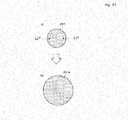
- FIG. 27 shows an active particle 207 that expands four times in volume and 60 % in linear expansion coefficient after charging and becomes a silicon active material particle 207a.
- binder such as styrene butadiene rubber and polyvinylidene fluoride that are commonly used in slurry including a graphite negative electrode active material cannot follow the expansion and the contraction, problems such as pulverization of the silicon negative electrode active material, exfoliation of the negative electrode active material from the current collector, cracking in the active material layer, and deterioration of conductivity between negative active materials arise and cause shorter life cycle compared to conventional graphite electrodes.
- Patent Document 1 Japanese Unexamined Patent Application Publication No. 2011-070892 ( JP-A-2011-070892 )
- negative electrode active materials and copper foil which is a current collector, adhere very strongly with the use of polyimide binder, and when the negative electrode active materials expand and contract, tension and compression are applied to the copper foil causing irreversible deformation of the copper foil such as occurrence of wrinkles. If this kind of irreversible deformation occurs, not only it harmfully affects the charging and discharging and deteriorates the cycle characteristics, but also the safety and reliability of the batteries and evenness of the products are impaired.
- the present invention was achieved in view of such problems. Its object is to obtain a negative electrode for a large-capacity nonaqueous electrolyte rechargeable battery having good cycle characteristics.
- the present invention provides a negative electrode for a nonaqueous electrolyte rechargeable battery and the like as described below.
- the present invention can provide a negative electrode for a large-capacity nonaqueous electrolyte rechargeable battery having good cycle characteristics.
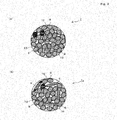
- FIG. 1 (a) is a cross-sectional view of a negative electrode for a nonaqueous electrolyte rechargeable battery 1 in accordance with the present invention.
- the negative electrode for a nonaqueous electrolyte rechargeable battery 1 has an active material layer 5 on a current collector 3.
- the active material layer 5 includes granules 7 and coating binder 8.
- the coating binder 8 comprises at least one type selected from the group consisting of polyimide, poly benzimidazole, polyamide imide, and polyamide.
- the granule 7 includes at least active material particles 9, which includes at least one type of an element A selected from the group consisting of Si, Sn, Al, Pb, Sb, Bi, Ge, In and Zn, and a granulation binder 10.
- the active material particles 9 it is preferable, but not limited as long as the active material particle 9 includes the element A, to use nanosized particles 11, 17, 18, 21, 22, 23, 27, 61, 67, 71, 75, 76, 79, 81, 83, 87, 91, 101, 109, 110, 113, 117, 119, 123, 125 or 129 that will be described below. Also, it is preferred that the average particle diameter of the active material particles 9 is from 2 nm to 500 nm. If the average particle diameter is less than 2 nm, handling of the active material particles 9 becomes difficult; and if the average particle diameter is larger than 500 nm, the particle diameter size is too large and the yield stress is not sufficient in many cases.
- the granulation binder 10 is the binder that can granulate, to use any one or more selected from the group consisting of polyimide, poly benzimidazole, styrene butadiene rubber, polyvinylidene fluoride, carboxyl methyl cellulose and polyacrylic acid. Unlike the coating binder 8, it is not necessary to use a strong adhesive material such as polyimide.
- conductive agents 6 may be added into the active material layer 5a of a negative electrode for a nonaqueous electrolyte rechargeable battery 1a.
- the conductive agent 6 is powder comprising at least one type of an electrically conductive material selected from the group consisting of carbon, copper, tin, zinc, nickel, silver and the like.
- the conductive agent 6 may be a simple substance powder of carbon, copper, tin, zinc, nickel, or silver, or may be an alloy of each of the metals. For example, carbon black, carbon nanotube, carbon fiber and the like may be used.
- Adding the conductive agents 6 improves the electrical conductivity of the active material layer 5a of the negative electrode for a nonaqueous electrolyte rechargeable battery 1a and facilitates charging and discharging.
- conductive agents 6 may be added into the granules 7a.
- the active material particles 9, the granulation binder 10 and the like are put into a mixer, and then mixed and kneaded to form slurry.
- the slurry contains 25 % to 90 % by weight of the active material particles, 0 % to 70 % by weight of the conductive agents, and 1 % to 30 % by weight of the binder.
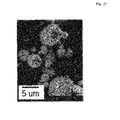
- the slurry is then granulated to form the granules 7 by means of a spray dry process, a rolling granulation process, a fluidized bed granulation process, a stirring granulation process, a wet crushing granulation process or the like.
- Slurry ingredients are put into a mixer, and mixed and kneaded to form slurry.
- the slurry ingredients include granules, conductive agents, binder, thicker, solvent, and the like.
- the slurry includes, together with the components forming the granules, the solid content of 25 % to 95 % by mass of the active material particles, 0 % to 70 % by mass of the conductive agents, 1 % to 30 % by mass of the binder (total amount of the granulation and coating binder), and 0 % to 25 % of the thicker.
- the ratios of the solid content are 50 % to 95 % by mass for the active material particles, 5 % to 30 % by mass for the conductive agents, and 5 % to 25 % by mass for the binder.
- the lesser amount of the binder impairs the adhesive property making it difficult for the granules and the electrode to maintain their shapes.
- the greater amount of the binder reduces the electrical conductivity, causing difficulties in charging and discharging.
- a common kneading machine used for preparation of slurry may be used as the mixer.
- An apparatus that can prepare the slurry such as a kneader, a stirrer, a disperser or a mixer may be used as well.
- N-methyl-2-pyrrolidone may be used as the solvent.
- conductive agents for example, commonly used carbon black, such as furnace black and acetylene black, carbon nanotube, carbon fiber and the like may be used as mentioned above.
- the carbon nanohorn has a structure of a grapheme sheet rolled up in a shape of a cone, and its actual form of the existence is an aggregation of forms like radial sea urchins in which the vertices of the many CNH are pointing outwardly.
- the outer diameter of the sea-urchin-like aggregation of CNH is approximately from 50 nm to 250 nm.
- the average particle diameter of approximately from 80 nm to 150 nm is particularly preferable for CNH.
- the average particle diameter of the conductive agent indicates the average particle diameter of the primary particles. Even for the acetylene black (AB) which has a highly developed structured shape, the primary particle diameter can defines the average particle diameter here, and the average particle diameter can be found by SEM photograph image analysis.
- both powdery and wire-shaped conductive agents may be used as well.
- the wire-shaped conductive agent is a wire of an electrically conductive material and any of the conductive materials mentioned for the powdery conductive agents may be used.
- a streak material such as carbon fiber, carbon nanotube, copper nanowire and nickel nanowire having the outer diameter of 300 nm or less may be used for the wire-shaped conductive agent.
- the use of the wire-shaped conductive agent facilitates retaining the electrical conductivity with the negative electrode active materials and current collectors, improves the current collectivity, and increases fibrous materials in the porous-film negative electrode which prevents the negative electrode from cracking.
- AB or copper powder as the powdery conductive agent
- VGCF vapor grown carbon fiber
- the length of the wire-shaped conductive agent is preferably from 0.1 ⁇ m to 2 mm.
- the outer diameter of the conductive agent is preferably from 2 nm to 500 nm, and more preferably, from 10 nm to 200 nm. It is sufficient to raise the productivity of the conductive agent if the length of the conductive agent is 0.1 ⁇ m or more, and it is easy to coat the slurry if the length is 2 mm or less. Also, composition is easy if the outer diameter of the conductive agent is greater than 2 nm, and mixing and kneading of the slurry is easy if the outer diameter of the conductive agent is less than 500 nm. The image analysis by SEM is used to measure the outer diameter and the length of the conductive material.
- the slurry is coated on one side of the current collector by using, for example, a coater.
- a commonly used coating apparatus that can coat slurry on current collectors such as a roll coater, a coater with doctor blades, a comma coater, and a die coater may be used as the coater.
- the current collector is foil made of at least one type of a metal selected from the group consisting of copper, nickel, and stainless steel. Each of the metals may be used as a simple substance, or an alloy of each of the metals may be used as well.
- the thickness of the foil is preferably from 4 ⁇ m to 35 ⁇ m, and more preferably, from 8 ⁇ m to 18 ⁇ m.
- the prepared slurry is uniformly coated onto the current collector, dried at the temperature of approximately 50 °C to 150 °C, and then set through a roll press to adjust the thickness. After that, at least one type of binder selected from the group consisting of polyimide, polyamide imide, poly benzimidazole, and polyamide is baked at the temperature from 150 °C to 350 °C to obtain the negative electrode for the nonaqueous electrolyte rechargeable battery.
- the active material particles are granulated into granules and the slurry including the granules is coated to form the active material layer.
- the stress applied onto the current collector due to the expansion and contraction of the negative electrode active material is relaxed, and deformation of the current collector due to charging and discharging can be prevented.
- the strong binder such as polyimide that can cohere to the current collector can be used as the coating binder and the negative electrode for the nonaqueous electrolyte rechargeable battery in accordance with the present invention has good cycle characteristics.
- the present invention makes use of the active material particles including the element A such as silicon that has a higher charging-discharging capacity per volume and per weight than carbon, it is possible to obtain a negative electrode for the nonaqueous electrolyte rechargeable battery that has a larger capacity than the conventional ones.
- a nanosized particle 11 in accordance with a first embodiment will be described below.
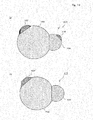
- FIG. 3s are schematic cross-sectional views of the nanosized particle 11.
- the nanosized particle 11 has a first phase 13 and a second phase 15.
- the first phase 13 has an approximately spherical surface except for an interface and the second phase 15 is joined to the first phase 13 via the interface.
- the interface between the first phase 13 and the second phase 15 is a flat or spherical surface.
- the interface may also be in a step-wise form.
- the first phase 13 is a simple substance of the element A, which is at least one type of an element selected from the group consisting of Si, Sn, Al, Pb, Sb, Bi, Ge, In and Zn.
- the element A is an element that can easily absorb lithium.
- the first phase 13 may be a solid solution including the element A as a main component.
- the first phase 13 may be a crystalline material, or may be amorphous.
- An element that constitutes the solid solution together with the element A may be an element selected from the group provided for the selection of the element A, or may be an element that is not mentioned in the group.
- the first phase 13 can absorb and desorb lithium.
- the first phase 13 absorbs lithium once to be alloyed and then desorb lithium to be de-alloyed and become amorphous.
- the approximately spherical surface except for the interface means that the surface is not limited to the spherical or elliptical shape, but the surface has a smooth curved surface for the most part and may partly has a flat surface. However, the shape differs from such a shape of a solid body having corners made through a crushing process.
- the second phase 15 is a crystalline compound of the element A and an element D.
- the element D is at least one type of an element selected from the group of Fe, Co, Ni, Ca, Sc, Ti, V, Cr, Mn, Sr, Y, Zr, Nb, Mo, Tc, Ru, Rh, Ba, lanthanoid elements (except for Pm), Hf, Ta, W, Re, Os, and Ir.
- x 2 as in FeSi 2 and CoSi 2 , but there are cases where x equals 1.33 as in Rh 3 Si 4 (RhSi 1.33 ), x equals 1.5 as in Ru 2 Si 3 (RuSi 1.5 ), x equals 1.67 as in Sr 3 Si 5 (SrSi 1.67 ), x equals 1.75 as in Mn 4 Si 7 (MnSi 1.75 ) and Tc 4 Si 7 (TcSi 1.75 ), and x equals 3 as in IrSi 3 .
- the second phase 15 hardly absorbs lithium. Also, other elements such as Tc, Re, or Os may be used as the element D.
- nanosized particles containing lanthanoid elements When water-based slurry is prepared to coat the nanosized particles, lanthanoid elements are not preferable since lantahoid elements tend to form hydroxide in water-based slurry causing separation between each phase.
- the nanosized particles containing lanthanoid elements also have a problem of being easily hydrogenated in the plasma during the formation. Nanosized particles containing lanthanoid elements can be used without problems if mixing of moisture into the plasma during the formation is prevented, or organic-solvent-based slurry is prepared.
- third phases 19 which are compounds of the element A and the element D may be dispersed in the first phase 13 as in a nanosized particle 17 shown in FIG. 3 (b) .
- the third phases 19 are covered with the first phase.
- a part of the third phase 19 may be exposed to the surface. That is, the whole of the third phase 19 may not necessarily be covered around by the first phase 13, but only a part of the third phase 19 may be covered.
- the single third phase 19 may be included.
- the surface of the second phase 15 may have a smooth and approximately spherical shape as the second phase 15 shown in FIG. 3(a) , or may be a polyhedron as the second phase 15' shown in FIG. 4 (a) .
- the second phase 15' becomes a polyhedron under an influence of the stability of crystallization of the compound of the element A and the element D and the like.
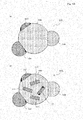
- a nanosized particle 22 shown in FIG. 4 (b) may have a plurality of the second phase 15.
- the relation of the melting points and wettability of the first phase 13 and the second phase 15, the influence of the cooling rate, or the like may cause the second phase 15 to be dispersed over the surface of the first phase 13 and joined thereto.
- the nanosized particle 22 can be a material for negative electrode having a high powdery conductivity, reducing the conduction agents and forming large-capacity negative electrode. Furthermore, a negative electrode that is excellent in high rate characteristics is obtained.
- the other element D may also be included as a solution or as a compound in the second phase 15 and/or in the third phase 19, which is a compound of one of the element D and the element A. That is, even if the nanosized particle includes two or more types of elements selected from the group provided for the selection of the element D, there is a case that a fourth phase 25 may not be formed like an element D' described below.
- the element A is Si
- one of the element D is Ni
- the other element D is Fe
- Fe may exist in NiSi 2 as a solid solution.
- the distribution of Ni and Fe is approximately the same in some cases, but is different in other cases, and the other element D is uniformly included in the second phase 15 and/or the third phase 19 in some cases, but is included only partially in other cases.
- the nanosized particle may also include the element D'.
- the element D' is an element selected from the group provided for the selection of the element D, and the element A, the element D, and the element D' are elements of different types.
- a nanosized particle 23 shown in FIG. 5 (a) includes the element D and the element D' and has the fourth phase 25, in addition to the second phase 15 which is a compound of the element A and the element D.
- the fourth phase 25 is a compound of the element A and the element D'.
- the nanosized particle 23 may include a solid solution (not shown in the drawing) which comprises the element D and the element D'.
- the second phase 15 may be a compound of Si and Fe
- the fourth phase 25 may be a compound of Si and Co
- the solid solution of the element D and the element D' may be the solid solution of Fe and Co.
- the third phase 19, which is a compound of the element A and the element D, and a fifth phase 29, which is a compound of the element A and the element D', may be dispersed in the first phase 13.
- the FIG. 5 (a) and FIG. 5 (b) show examples of the cases in which two types of elements are selected, three or more elements may be selected as well.
- the average diameter of these nanosized particles is preferably from 2 nm to 500 nm, and more preferably, from 50 nm to 300 nm.
- the yield stress increases when the particle size is small so, if the average particle diameter of the nanosized particle is from 2 nm to 500 nm, the particle diameter size is sufficiently small, the yield stress is sufficiently large, and pulverization due to charging and discharging may not easily occur. If the average particle diameter is less than 2 nm, handling of the nanosized particles after composition is difficult, and if the average diameter is more than 500 nm, the particle diameter size is too large and the yield stress is not sufficient.
- the atomic ratio of the element D to the sum of the element A and the element D is preferably from 0.01 % to 25 %. If this atomic ratio is from 0.01 % to 25 %, both cycle characteristics and large-capacity can be achieved when the nanosized particle 11 is used as a negative electrode material for the nonaqueous electrolyte rechargeable battery. On the other hand, if the ratio is less than 0.01 %, the volume expansion of the nanosized particle 11 at the time of lithium absorption cannot be suppressed, and if the ratio is over 25 %, then the amount of the element A which combines with the element D increases, resulting in the decrease of the element A sites that are able to absorb lithium and the loss of the advantages of the large-capacity. If the nanosized particle includes the element D', the atomic ratio of the sum of the element D and the element D' to the sum of the element A, the element D, and the element D' is preferably from 0.01 % to 25 %.
- the first phase is mainly crystalline silicon and the second phase is crystalline silicide.
- adding phosphorus or boron may enhance the conductivity of the silicon. Indium or gallium may be used instead of phosphorus, and arsenic may be used instead of boron. Improving the conductivity of the silicon of the first phase allows the negative electrode using these nanosized particles to have less internal resistance, an increased electrical current, and good high rate characteristics.
- adding oxygen to Si of the first phase suppresses Si sites which combines with Li so that the volume expansion due to Li absorption is suppressed and good life-cycle characteristics are obtained.
- the average particle diameter of the nanosized particles indicates the average particle diameter of the primary particles.
- image information from an electron microscope (SEM) is used together with volume-based median diameter of a dynamic light scattering photometer (DLS).
- the average particle diameter can be measured by, first, checking the particle shape from the SEM image, and then finding the particle diameter using an image analyzing software (for example, "A-zou-kun"(registered trademark) by Asahi Kasei Engineering), or dispersing the particles into a solvent and then measuring the particle diameter by a DLS (for example, DLS-8000 by Otsuka Electronics).
- the average diameter is defined by the primary particle diameter here and can be measured from the image analysis of SEM photographs. Furthermore, the average particle diameter can also be measured by measuring the specific surface area by BET method and the like and presuming that the particles are spherical. Before adopting this method, it is necessary to check by means of SEM or TEM observations that the nanosized particles are not porous but are solid.
- the first phase is mainly crystalline silicon
- oxygen may combine with the outermost surface of the nanosized particles 11. This is because, when the nanosized particles 11 are taken into the air, oxygen in the air reacts with an element on the surface of the nanosized particles 11. That is, the outermost surface of the nanosizedparticles 11 may have an amorphous layer having a thickness of 0.5 nm to 15 nm, and more particularly, if the first phase is mainly crystalline silicon, may have an oxidized film layer. Covering with the amorphous layer makes it possible to gain stabilization in the air and to use water-based solvent for the slurry, which increases the industrial utility value.
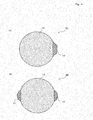
- the first phase 13 absorbs lithium as shown in FIG. 17 (a)
- the first phase 13 expands in volume.
- the second phase 15 does not easily absorb lithium
- the expansion of the first phase 13, which is in contact with the second phase 15 can be suppressed compared to the case without the second phase 15 as shown in FIG. 7 (b) . That is, if the first phase 13 absorbs lithium and tries to expand in volume, since the second phase 15 does not expand easily, the interface between the first phase 13 and the second phase 15 is not slippery, and, therefore, the second phase 15 acts as a wedge or a pin, relaxes the volumetric strain, and prevents the expansion of the nanosized particle as a whole.
- the nanosized particle 11 having the second phase 15 does not tend to expand easily when absorbing lithium and can easily return to its original shape with a restoring force when lithium is desorbed. Therefore, according to the present invention, even when the nanosized particle 11 absorbs lithium, the volumetric strain is relaxed and the decline of discharging capacity due to the repetitive charging-discharging can be suppressed.
- the second phase 15 since the second phase 15 includes the element D, the second phase 15 has high electrical conductivity. Especially, if the first phase 13 is Si or Ge, the conductivity of the nanosized particle 11 as a whole rises dramatically. Therefore, nanosized particles 11 have a plurality of nano-level current collection spots on each of the nanosized particles 11 and can be the material for a negative electrode having high conductivity even with a small amount of conduction agent, and a large-capacity negative electrode can be made. Furthermore, a negative electrode that is excellent in high rate characteristics is obtained.
- the expansion of the first phase 13 can be more effectively suppressed in the nanosized particle 17, which includes the third phase 19 in the first phase 13, and the nanosized particle 27, which includes the third phase 19 and the fifth phase 29, since more part of the first phase 13 is in contact with the phase that does not absorb lithium.
- the nanosized particle 23 and 27 that comprise both the second phase 15 and the fourth phase 25 have the same effect as the nanosized particle 11, and moreover, nano-level current collection spots increase and the current collectivity improves dramatically. It is preferable to add two or more types of D element because two or more compounds, which are easily separable from each other, are formed allowing the current collection spots to increase easily.
- these nanosized particles are synthesized by vapor phase synthesis. More specifically, these nanosized particles can be manufactured by generating plasma of the ingredient powder which is then heated up to about 10,000 K and cooled. There are several methods to generate plasma: (1) a method to heat the gas inductively using a high frequency electromagnetic field (2) a method to use arc discharge between electrodes (3) a method to heat the gas with microwave and the like; and any of the methods may be used.
- the element D is an element which forms a compound with the element A
- the plasma of the ingredient powder is generated and then cooled
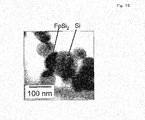
- a part of the element A forms a compound with the element D and the rest of the element A deposits as a simple substance or a solid solution. Therefore, the so to speak daruma-doll shaped nanosized particle 11 in which the first phase, which is a single substance or a solid solution of the element A, joins with the second phase, which is a compound of the element A and the element D, via an interface can be obtained.
- a nanosized particle manufacturing apparatus 31 shown in FIG. 6 has a high frequency coil 47 for generating plasma, which is wound around the upper outer wall of a reaction chamber 45.
- Alternative current of several MHz is applied onto the high frequency coil 47 from a high frequency power source 49.
- the preferred frequency is 4 MHz.
- the upper outer wall around which the high frequency coil 47 is wound is a cylindrical double-tube pipe made of quartz glass and the like, and cooling water is allowed to flow in the gap of the tubes to prevent the quartz glass from melting.
- a sheath gas supply opening 39 is provided together with an ingredient powder supply opening 35.
- Ingredient powder 37, together with carrier gas 43 (rare gas such as helium or argon), is supplied from an ingredient powder feeder through the ingredient powder supply opening 35 into plasma 51.
- sheath gas 41 is supplied through the sheath gas supply opening 39 to the reaction chamber 45.
- the sheath gas 41 is mixed gas of argon gas and oxygen gas or the like. It is not necessary to provide the ingredient powder supply opening 35 above the plasma 51 as shown in FIG. 6 , and a nozzle may be provided at the side of the plasma 51 in a horizontal direction. Also, the ingredient powder supply opening 35 may be cooled with cooling water.
- the property of the nanosized particle ingredient that is to be supplied to plasma is not limited to powder, and slurry of the ingredient powder or gaseous ingredient may also be supplied.
- the reaction chamber 45 maintains the pressure of the plasma reaction part and prevents dispersion of the manufactured fine powder.
- the reaction chamber 45 is also cooled by water to prevent damages caused by plasma.
- the reaction chamber 45 has a suction tube joined at the side, and a filter 53 that collects the synthesized fine powder is provided in the middle of the suction pipe.
- the suction pipe that connects the filter 53 from the reaction chamber 45 is also cooled by cooling water.
- the pressure in the reaction chamber 45 is controlled by the suction capacity of the vacuum pump (VP) provided at the lower side of the filter 53.
- VP vacuum pump
- the manufacturing method of the nanosized particle 11 is a bottom-up method in which the nanosized particle 11 deposits from plasma through gas and liquid to a solid, a particle becomes spherical at the droplet stage to form the spherical shaped nanosized particle 11.
- particles manufactured from a top-down method such as a crushing method or a mechanochemical method, which makes a large particle smaller, have distorted and rough shapes which differ greatly from the spherical shape of the nanosized particle 11.
- the nanosized particles 11, 17, 18, 21, and 22 can be obtained. Also, if mixed powder of each powder of the element A, the element D, and the element D' is used as the ingredient powder, the nanosized particles 23 and 27 are obtained. Furthermore, when oxygen is introduced into the first phase 13, for example, introducing the element A and its oxide AO 2 and the like such as Si and SiO 2 can easily control the composition ratio.
- a nanosized particle 61 in accordance with a second embodiment will be described.
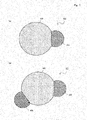
- FIG. 7(a) is a schematic cross-sectional view of a nanosized particle 61.
- the nanosized particle 61 has the sixth phase 63 and the seventh phase 65.
- the sixth phase 63 and the seventh phase 65 are both exposed to the outer surface of the nanosized particle 61.
- the sixth phase 63 and the seventh phase 65 are joined via an interface which is a flat or curved surface and have approximately spherical surfaces except for the interface.
- the sixth phase 63 is a simple substance or a solid solution of the element A, which is at least one type of an element selected from the group consisting of Si, Sn, Al, Pb, Sb, Bi, Ge, In, and Zn.
- the element A is an element that can easily absorb lithium.
- the element that forma a solid solution with the element A may be an element selected from the group provided for the selection of A or an element that is not mentioned in the group.
- the sixth phase 63 can absorb and desorb lithium.
- the approximately spherical surface except for the interface between the sixth phase 63 and the seventh phase 65 means that the sixth phase 63 and the seventh phase 65 have spherical or elliptical shapes except for the interface where the sixth phase 63 and the seventh phase 65 meet.
- the sixth phase 64 and the seventh phase 65 have approximately smooth curved surfaces except for the part where the sixth phase 63 and the seventh phase 65 meet.
- the shapes of the sixth phase 63 and the seventh phase 65 differ from the shapes of a solid and the like formed by crushing method and having corners on the surface.
- the interface shape of the joining part of the sixth phase 63 and the seventh phase 65 is circular or elliptical.
- the seventh phase 65 is crystalline, and is either a compound of the element A and an element M, or a simple substance or a solid solution of the element M.
- the element M is at least one type of an element selected from the group consisting of Cu, Ag, and Au. The element M does not absorb lithium easily and the seventh phase 65 hardly absorbs lithium.
- the seventh phase 65 is a simple substance or a solid solution of the element M.
- the seventh phase 65 is formed by copper silicide which is a compound of the element A and the element M.
- the seventh phase 65 is formed by a simple substance of the element M or a solid solution of the element M as the main component.
- the sixth phase 63 is crystalline silicon. It is also preferred that the sixth phase 63 is silicon added with phosphorous or boron. Addition of phosphorous or boron can enhance the conductivity of silicon. Indium or gallium may be used instead of phosphorus, and arsenic may be used instead of boron. Improving the conductivity of the silicon of the sixth phase 63 allows the negative electrode using these nanosized particles to have less internal resistance, an increased electrical current, and good high rate characteristics. Also, the sixth phase 63 can suppress the lithium reaction site by including oxygen. The capacity decreases when oxygen is included, but the volumetric expansion due to lithium absorption can be suppressed. The addition amount z of oxygen is preferably in the range of AO z (0 ⁇ z ⁇ 1). If z is more than 1, lithium absorption site of A is suppressed causing a decrease in capacity.
- the average particle diameter of the nanosized particle 61 is preferably from 2 nm to 500 nm, and more preferably, from 50 nm to 200 nm. According to Hall-Petch law, the yield stress increases when the particle size is small so, if the average particle diameter of the nanosized particle 61 is from 2nm to 500 nm, the particle diameter size is sufficiently small, the yield stress is sufficiently large, and pulverization due to charging and discharging may not easily occur. If the average particle diameter is less than 2 nm, handling of the nanosized particles after composition is difficult, and if the average diameter is more than 500 nm, the particle diameter size is too large and the yield stress is not sufficient.
- the atomic ratio of the element M to the sum of the element A and the element M is preferably from 0.01 % to 60 %. If this atomic ratio is from 0.01 % to 60 %, both cycle characteristics and large-capacity can be achieved when the nanosized particle 61 is used as a negative electrode material for the nonaqueous electrolyte rechargeable battery. On the other hand, if the ratio is less than 0.01 %, the volume expansion of the nanosized particle at the time of lithium absorption cannot be suppressed, and if the ratio is over 60 %, the advantages of the large-capacity are lost.
- the nanosized particle 61 in accordance with the second embodiment may have an eighth phase 69 as a nanosized particle 67 shown in FIG. 7 (b) .
- the nanosized particle 67 further includes an element M' which is selected from the group consisting of Cu, Ag, and Au, and the element M' is different from the element M.
- the eighth phase 69 is either a compound of the element A and the element M', or a simple substance or a solid solution of the element M'.
- the nanosized particle 67 is an example in which the element A is Si, the element M is Cu, the element M' is Ag, the sixth phase 63 is a simple substance or a solid solution of silicon, the seventh phase 65 is copper silicide, and the eighth phase 69 is a simple substance or a solid solution of silver.
- the sixth phase 63, the seventh phase 65, and the eighth phase 69 are all exposed to the outer surface, and the sixth phase 63, the seventh phase 65, and the eighth phase 69 are approximately spherical except for the interfaces.
- the nanosized particle 67 looks like a water molecule wherein small spherical shapes of the seventh phase 65 and the eighth phase 69 are joined to the surface of a large spherical shape of the sixth phase 63.
- the atomic ratio of the sum of the element M and the element M' to the sum of the element A, the element M, and the element M' is preferably from 0.01 % to 60 %.
- oxygen may combine with the outermost surface of the nanosized particles 61. This is because, when the nanosized particles 11 are taken into the air, oxygen in the air reacts with an element on the surface of the nanosized particles 61. That is, the outermost surface of the nanosized particles 61 may have an amorphous oxidized film having a thickness of 0.5 nm to 15 nm. Introducing oxygen in the range of AO z (0 ⁇ z ⁇ 1) to the sixth phase 63 makes it possible to gain stabilization in the air and to use water-based solvent for the slurry, which increases the industrial utility value.
- the sixth phase 63 expands in volume when the sixth phase 63 absorbs lithium.
- the seventh phase 65 does not absorb lithium, the expansion of part of the sixth phase 63, which is in contact with the seventh phase 65, can be suppressed. That is, if the sixth phase 63 absorbs lithium and tries to expand in volume, since the seventh phase 65 does not expand easily, the interface between the sixth phase 63 and the seventh phase 65 is not slippery, and the seventh phase 65 acts as a wedge or a pin, relaxes the volumetric strain, and prevents the expansion of the nanosized particle as a whole.
- the nanosized particle 61 having the seventh phase 65 has fewer tendencies to expand when absorbing lithium and can easily return to its original shape with a restoring force when lithium is desorbed. Therefore, according to the second embodiment, even when the nanosized particle 61 absorbs lithium, the volume expansion is suppressed and the decline of discharging capacity due to the repetitive charging-discharging can be suppressed.
- the seventh phase 65 since the seventh phase 65 includes the element M, the seventh phase 65 has higher electrical conductivity than the sixth phase 63. Therefore, nanosized particles 61 have a plurality of nano-level current collection spots on each of the nanosized particles 61 and can be the high conductive material for a negative electrod, and a negative electrode that is excellent in current collectivity can be obtained.
- the nanosized particle 67 comprising both the seventh phase 65 and the eighth phase 69 has the same effect as the nanosized particle 61, and moreover, nano-level current collection spots increase and the current collectivity improves dramatically.
- a nanosized particle 71 in accordance with a third embodiment will be described.
- same numerals will be given to the elements that have the same aspects as in the second embodiment and redundant description will be avoided.
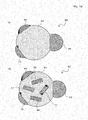
- FIG. 8 (a) is a schematic cross-sectional view of a nanosized particle 71.
- the nanosized particle 71 has the sixth phase 63, the seventh phase 65, and the ninth phase 73.
- the sixth phase 63 and the seventh phase 65 are joined via an interface, and the sixth phase 63 and the ninth phase 73 are joined via an interface.
- the sixth phase 63, the seventh phase 65, and the ninth phase 73 are exposed to the outer surface of the nanosized particle 71, and the sixth phase 63, the seventh phase 65, and the ninth phase 73 have approximately spherical surfaces except for the interfaces.
- the ninth phase 73 is a crystalline compound of the element A and the element D and has high conductivity.
- the element D is at least one type of an element selected from the group consisting of Fe, Co, Ni, Ca, Sc, Ti, V, Cr, Mn, Sr, Y, Zr, Nb, Mo, Tc, Ru, Rh, Ba, lanthanoid elements (except for Pm), Hf, Ta, W, Re, Os, and Ir.
- the ninth phase 73 hardly absorbs lithium or may absorb only a few.
- the atomic ratio of the element D to the sum of the element A and the element D is preferably from 0.01 % to 25 %. If this atomic ratio is from 0.01 % to 25 %, both cycle characteristics and large-capacity can be achieved when the nanosized particle is used as a negative electrode material for the nonaqueous electrolyte rechargeable battery. On the other hand, if the ratio is below 0.01 %, the expansion of the volume of the nanosized particle at the time of lithium absorption cannot be suppressed, and if the ratio is over 25 %, then the amount of the element D which combines with the element A increases, resulting in the decrease of the element A sites that are able to absorb lithium, and the advantages of the large-capacity are lost. If the nanosized particle includes the element D' as described below, the atomic ratio of the sum of the element D and the element D' to the sum of the element A, the element D, and the element D' is preferably from 0.01 % to 25 %.
- the nanosized particle 71 in accordance with the third embodiment may have tenth phases 77 which are compounds of the element A and the element D and are dispersed in the sixth phase 63 as a nanosized particle 77 shown in FIG. 8 (b) .
- the tenth phases 77 are covered with the sixth phase 63.
- the tenth phase 77 like the seventh phase 65, hardly absorbs lithium, or may absorb only a few.
- the single tenth phase 77 may be included.
- a part of the tenth phase 77 may be exposed to the surface. That is, it is not necessary to cover whole of the tenth phase 77 with the sixth phase 63 but only a part of the tenth phase 77 may be covered.
- the nanosized particles 71 and 75 may include the eighth phase 69 as a nanosized particle 79 shown in FIG. 9 (a) or as a nanosized particle 81 shown in FIG. 9 (b) .
- the nanosized particles 79 and 81 further include the element M' selected from the group consisting of Cu, Ag, and Au.
- the element M' is different from the element M.
- the eighth phase 69 is either a compound of the element A and the element M', or a simple substance or a solid solution of the element M'.
- the other element D may also be included as a solution or as a compound in the ninth phase 73 and/or in the tenth phase 77, which is a compound of one of the elements D and the element A. That is, even if the nanosized particle includes two or more types of elements selected from the group provided for the selection of the element D, there is a case that an eleventh phase 85 may not be formed like an element D' described below.
- the element A is Si
- one of the elements D is Ni
- the other element D is Fe
- Fe exists in NiSi 2 as a solid solution.
- the distribution of Ni and Fe is approximately the same in some cases, but is different in other cases, and the other element D is uniformly included in the ninth phase 73 and/or the tenth phase 77 in some cases, but in other cases, is included only partially.
- the nanosized particle 71 in accordance with the third embodiment may include the element D and the element D,' and has an eleventh phase 85 that is joined to the sixth phase 63 as a nanosized particle 83 shown in FIG. 10 (a) .
- the eleventh phase 85 is a compound of the element A and the element D'.
- the eleventh phase 85 is joined to the sixth phase 63 via an interface and is exposed to the outer surface.
- the element A is silicon
- the element D is iron
- the element D' is cobalt
- the sixth phase 63 is a single substance or a solid solution of silicon
- the ninth phase 73 is iron silicide
- the eleventh phase 85 is cobalt silicide.
- a solid solution of iron and cobalt may be formed in the sixth phase 63.
- the element D' is an element selected from the group consisting of Fe, Co, Ni, Ca, Sc, Ti, V, Cr, Mn, Sr, Y, Zr, Nb, Mo, Tc, Ru, Rh, Ba, lanthanoid elements (except for Pm), Hf, Ta, W, Re, Os, and Ir, and is different from the element D.
- the nanosized particle 83 in accordance with the third embodiment may include the element D and the element D' as a nanosized particle 87 shown in FIG. 10 (b) , and the tenth phases 77, which are compounds of the element A and the element D, and twelfth phases 89, which are compounds of the element A and the element D', may be dispersed in the sixth phase 63.
- the twelfth phases 89 are covered with the sixth phase 63.
- the twelfth phases 89 like the eleventh phase 85, hardly absorbs lithium, or may absorb only a few.
- the surface of the ninth phase 73 and the eleventh phase 85 except for the interfaces may have approximately smooth spherical shapes as the ninth phase 73 shown in FIG. 8 (a) and the eleventh phase 85 shown in FIG. 10 (a) , or may be polyhedron as the ninth phase 73' and the eleventh phase 85' of a nanosized particle 91 shown in FIG. 11 .
- the ninth phase 73' and the eleventh phase 85' become polyhedron due to the influence of crystallization of the compound of the element A and the element D.
- the nanosized particle 71 does not easily pulverize when lithium is absorbed.
- the sixth phase 63 expands in volume when lithium is absorbed.
- the seventh phase 65 and the ninth phase 73 hardly absorb lithium, the expansion of the sixth phase 63 which is in contact with the seventh phase 65 and the ninth phase 73 can be suppressed.
- the sixth phase 63 absorbs lithium and tries to expand in volume
- the interface between the sixth phase 63 and the seventh phase 65 or the ninth phase 73 is not slippery, and the seventh phase 65 and the ninth phase 73 act as wedges or pins, relax the volumetric strain, and prevent the expansion of the nanosized particle as a whole. Therefore, compared to the particle without the ninth phase 73, the nanosized particle 71 having the ninth phase 73 has fewer tendencies to expand when absorbing lithium and can easily return to its original shape with a restoring force when lithium is desorbed. Therefore, even if the nanosized particle 71 absorbs and desorbs lithium, the strain due to volumetric expansion is relaxed and the decline of discharging capacity due to the repetitive charging-discharging can be suppressed.
- the expansion of the sixth phase 63 can be suppressed more effectively with less amount of the tenth phase 77.
- the volumetric expansion is suppressed and the decline of discharging capacity due to the repetitive charging-discharging can be suppressed.
- the nanosized particle 79 and the nanosized particle 81 comprising both the seventh phase 65 and the eighth phase 69 have the same effects as the nanosized particle 61, and furthermore, nano-level current collection spots increase and the current collectivity improves effectively. Therefore, the high-rate characteristics are improved.
- the nanosized particle 83 and the nanosized particle 87 comprising both the ninth phase 73 and the eleventh phase 85 have the same effects as the nanosized particle 61, and furthermore, nano-level current collection spots increase and the current collectivity improves effectively. Therefore, the high-rate characteristics are improved.
- the expansion of the sixth phase 63 can be suppressed further.
- the decline of discharging capacity due to the repetitive charging-discharging can be suppressed for the nanosized particle 87 and the high-rate characteristics are improved.
- the manufacturing method for the nanosized particles according to the present invention will be described.
- the nanosized particles according to the present invention are synthesized by vapor phase synthesis. More specifically, the nanosized particles can be manufactured by generating plasma of the ingredient powder which is then heated up to about 10,000 K and cooled.
- the element M is an element that forms a compound with the element A
- the plasma of the ingredient powder is generated and then cooled
- a part of the element A forms a compound with the element M and the rest of the element A deposits as a simple substance or a solid solution.
- the element M and the element A deposit separately as a simple substance or a solid solution when plasma of the ingredient powder is generated and cooled.
- the so to speak daruma-doll shaped nanosized particle 61 in which the sixth phase, which is a single substance or a solid solution of the element A, joins with the seventh phase, which is either a compound of the element A and the element M, or a simple substance or a solid solution of the element M, via an interface can be obtained.
- An example of the manufacturing apparatus for manufacturing the nanosized particles is the nanosized particle manufacturing apparatus 31 shown in FIG. 6 .
- the manufacturing method of the nanosized particles is a bottom-up method in which the nanosized particle deposits from plasma through gas and liquid to a solid, a particle becomes spherical at the droplet stage, and the sixth phase 63 and the seventh phase 65 are formed in spherical shapes.
- particles manufactured from a top-down method such as a crushing method or a mechanochemical method, which makes a large particle smaller, have distorted and rough shapes which differ greatly from the spherical shape of the nanosized particle 61.
- the manufactured nanosized particles are heated in the atmosphere to promote the oxidization of the nanosized particles. For example, heating for an hour at 250°C in the atmosphere can oxidize and stabilize the nanosized particles. Also, by introducing oxygen intentionally into the sixth phase as AO z (0 ⁇ Z ⁇ 1), the initial capacity can be suppressed as well as the long-life characteristics can be improved. For example, introducing Si as the element A and its oxide SiO2 can control the composition ratio easily.
- the nanosized particle 61 in accordance with the second embodiment can be obtained.
- the nanosized particle 71 in accordance with the third embodiment can be obtained.
- the nanosized particle 79 in accordance with the third embodiment can be obtained.
- the nanosized particle 83 in accordance with the third embodiment can be obtained.
- a nanosized particle 101 in accordance with a fourth embodiment will be described.
- FIG. 12 (a) is a schematic cross-sectional view of a nanosized particle 101.
- the nanosized particle 101 has a thirteenth phase 103, a fourteenth phase 105, and a fifteenth phase 107, and the thirteenth phase 103, the fourteenth phase 105, and the fifteenth phase 107 are exposed to the outer surface of the nanosized particle 101.
- the outer surfaces of the thirteenth phase 103, the fourteenth phase 105, and the fifteenth phase 107 are approximately spherical except for interfaces.
- the thirteenth phase 103 and the fourteenth phase 105 are joined via an interface, and the thirteenth phase 103 and the fifteenth phase 107 are joined via an interface.
- the thirteenth phase 103 is a simple substance of an element A - 1, which is one type of an element selected from the group consisting of Si, Sn, Al, Pb, Sb, Bi, Ge, In, and Zn.
- the element A - 1 is an element that absorbs lithium easily.
- the thirteenth phase 103 may be a solid solution comprising the element A - 1 as a main component.
- the element that forms the solid solution with the element A - 1 may be an element selected from the group provided for the selection of A - 1 or an element that is not mentioned in the group.
- the thirteenth phase 103 can absorb and desorb lithium.
- the interface between the thirteenth phase 103 and the fourteenth phase 105 is a flat or curved surface.
- the interface between the thirteenth phase 103 and the fifteenth phase 107 is a flat or curved surface.
- the fourteenth phase 105 and the fifteenth phase 107 may be joined via an interface.
- the approximately spherical outer surface except for the interface between the thirteenth phase 103 and the fourteenth phase 105 means that the thirteenth phase 103 and the fourteenth phase 105 have spherical or elliptical shapes except for the part where the thirteenth phase 103 and the fourteenth phase 105 meet.
- the surface of the thirteenth phase 103 and the fourteenth phase 105 has approximately smooth curved surfaces except for the part where the thirteenth phase 103 and the fourteenth phase 105 meet.
- the shapes of the thirteenth phase 103 and the fourteenth phase 105 differ from the shapes of a solid and the like, that is formed by crushing method and has corners on the surface. The same can be said for the fifteenth phase 107.
- the interface shape of the joining part of the thirteenth phase 103 and the fourteenth phase 105 or the interface shape of the joining part of the thirteenth phase 103 and the fifteenth phase 107 is circular or elliptical.
- the fourteenth phase 105 is a simple substance or a solid solution of one type of an element A - 2.
- the element A - 2 is an element selected from the group consisting of Si, Sn, Al, Pb, Sb, Bi, Ge, In, and Zn and is different from the element A - 1.
- the element A - 2 can absorb and desorb Li.
- the thirteenth phase 103 is silicon added with phosphorous or boron. Adding phosphorous or boron can improve the conductivity of silicon. Indium or gallium may be used instead of phosphorus, and arsenic may be used instead of boron. Improving the conductivity of the silicon of the thirteenth phase 103 allows the negative electrode using these nanosized particles to have less internal resistance, an increased electrical current, and good high rate characteristics. Also, the thirteenth phase 103 can suppress the lithium reaction sites by including oxygen. The capacity decreases when oxygen is included, but the volumetric expansion due to lithium absorption can be suppressed. The addition amount z of oxygen is preferably in the range of AO z (0 ⁇ z ⁇ 1). If z is 1 or more, lithium absorption sites of A are suppressed causing a decrease in capacity.
- the fifteenth phase 107 is a crystalline compound of the element A - 1 and an element D.
- the element D is at least one type of an element selected from the group consisting of Fe, Co, Ni, Ca, Sc, Ti, V, Cr, Mn, Sr, Y, Zr, Nb, Mo, Tc, Ru, Rh, Ba, lanthanoid elements (except for Pm), Hf, Ta, W, Re, Os, and Ir.
- x 2 as in FeSi 2 and CoSi 2, but there are cases where x equals 1.33 as in Rh 3 Si 4 (RhSi 1.33 ), x equals 1.5 as in Ru 2 Si 3 (RuSi 1.5 ), x equals 1.67 as in Sr 3 Si 5 (SrSi 1.67 ), x equals 1.75 as in Mn 4 Si 7 (MnSi 1.75 ) and Tc 4 Si 7 (TcSi 1.75 ), and x equals 3 as in IrSi 3 .
- the fifteenth phase 107 hardly absorbs lithium or only absorbs a few.
- the average particle diameter of the nanosized particle 101 is preferably from 2 nm to 500 nm, and more preferably, from 50 nm to 300 nm. According to Hall-Petch law, the yield stress increases when the particle size is small so, if the average particle diameter of the nanosized particle 101 is from 2 nm to 500 nm, the particle diameter size is sufficiently small, the yield stress is sufficiently large, and pulverization due to charging and discharging may not easily occur. If the average diameter is less than 2 nm, handling of the nanosized particles after composition is difficult. If the average diameter is more than 500 nm, the particle diameter size is too large and the yield stress is not sufficient.
- the atomic ratio of the element D to the sum of the element A-1, the element A-2, and the element D is preferably from 0.01 % to 25 %. If this atomic ratio is from 0.01 % to 25 %, both cycle characteristics and large-capacity can be achieved when the nanosized particle 101 is used as a negative electrode material for the nonaqueous electrolyte rechargeable battery.
- the ratio is below 0.01 %, the expansion of the volume of the nanosized particle 101 at the time of lithium absorption cannot be suppressed, and if the ratio is over 25 %, then the amount of the element D which combines with the element A - 1 increases, resulting in the decrease of the element A - 1 sites that are able to absorb lithium, and the advantages of the large-capacity are lost.
- the nanosized particle includes the element D' as mentioned below, the atomic ratio of the sum of the element D and the element D' to the sum of the element A - 1, the element A - 2, the element D, and the element D' is preferably from 0.01 % to 25 %.
- sixteenth phases 111 which are compounds of the element A - 1 and the element D may be dispersed in the thirteenth phase 103 as in a nanosized particle 109 shown in FIG. 12 (b) .
- the sixteenth phases 111 are covered with the thirteenth phase 103.
- the sixteenth phase 111 like the fifteenth phase 107, hardly absorbs lithium.
- a part of the sixteenth phases 111 may be exposed to the surface. That is, the whole of the sixteenth phases 111 may not necessarily be covered around by the thirteenth phase 13, but only a part of the sixteenth phases 111 may be covered.
- the single sixteenth phases 111 may be included.
- the seventeenth phase 115 which is a compound of the element A - 1 and the element D, may be joined to the fourteenth phase 105 via an interface and exposed to the outer surface as a nanosized particle 113 shown in FIG. 13 (a) .
- the seventeenth phase 115 like the fifteenth phase 107, hardly absorbs lithium.
- the fifteenth phase 107 may have a smooth and approximately spherical shape as the fifteenth phase 107 shown in FIG. 12 (a) , or may be a polyhedron as the fifteenth phase 107' shown in FIG. 13 (b) .
- the polyhedron shape is generated when the nanosized particles 101, 109, 110, 113, or 117 join and are detached afterwards.
- the nanosized particle 101 according to the present invention may have an eighteenth phase 121 in addition to the fourteenth phase 105 as the nanosized particle 119 shown in FIG. 14 (a) .
- the eighteen phase 121 is a simple substance or a solid solution of an element A- 3 which is an element selected from the group consisting of Si, Sn, Al, Pb, Sb, Bi, Ge, In, and Zn and is different form the element A- 1 and the element A - 2.
- the eighteen phase 121 has a spherical outer surface and is exposed to the outer surface of the nanosized particle 119.
- silicon as the element A - 1, tin as the element A - 2, and aluminum as the element A - 3 may be used.
- the sixteenth phase 111 which is a compound of the element A - 1 and the element D, may be dispersed in the thirteenth phase 103 as in a nanosized particle 123 shown in FIG. 14 (b) .
- the other element D may also be included as a solution or as a compound in the fifteenth phase 107 and/or in the sixteenth phase 111, which are compound of one of the elements D and the element A - 1. That is, even if the nanosized particle includes two or more types of elements selected from the group provided for the selection of the element D, a nineteenth phase 127 may not be formed as in an element D' described below.
- the element A - 1 is Si
- one of the elements D is Ni
- the other element D is Fe
- Fe may exist in NiSi 2 as a solid solution.
- the distribution of Ni and Fe is approximately the same in some cases, but is different in other cases, and the other element D is uniformly included in the fifteenth phase 107 and/or in the sixteenth phase 111 in some cases, but in other cases, is included only partially.
- the nanosized particle may include the element D'.
- the element D' is an element selected from the group provided for the selection of the element D and is different from the element D.
- a nanosized particle 125 shown in FIG. 15 (a) includes the element D and the element D', and has a nineteenth phase 127 in addition to the fifteenth phase 107, which is a compound of the element A and the element D.
- the nineteenth phase 127 is a compound of the element A - 1 and the element D'.
- the nanosized particle 125 may include a solid solution comprising the element D and the element D' (not shown in the drawing). For example, if the fifteenth phase 107 is a compound of Si and Fe and the nineteenth phase 127 is a compound of Si and Co, then the solid solution of the element D and the element D' is a solid solution of Fe and Co.
- the sixteenth phase 11 which is a compound of the element A- 1 and the element D
- a twentieth phase 131 which is a compound of the element A - 1 and the element D'
- the sixteenth phase 111 or the twentieth phase 131 may be exposed to the surface as shown in FIG. 12 (c) .
- Oxygen may combine with the outermost surface of the nanosized particle 101. If the nanosized particle 101 is taken out into the air, oxygen in the air reacts with the element on the surface of the nanosized particle 101. That is, the outermost surface of the nanosized particle 101 may have an amorphous layer with a thickness of 0.5 nm to 15 nm, and particularly, may have an oxidized film layer if the thirteenth phase is mainly crystalline silicon.
- the thirteenth phase 103 expands in volume after absorbing lithium
- the fourteenth phase 105 also expands after absorbing lithium.
- the electrochemical potential of absorption of lithium is different for the thirteenth phase 103 and the fourteenth phase 105
- one of the phases primarily absorbs lithium and expands, while the expansion of the other phase becomes relatively smaller and suppresses the first phase from expanding. Therefore, compared to the nanosized particle that has only one of the phases, the nanosized particle 101, which has both the thirteenth phase 103 and the fourteenth phase 105, does not easily expand when absorbing lithium and the amount of absorption of lithium is suppressed. Therefore, according to the present invention, for the nanosized particle 101, the volumetric expansion is suppressed and the decline of discharging capacity due to the repetitive charging-discharging can be suppressed.
- the thirteenth phase 103 expands in volume when lithium is absorbed. However, since the fifteenth phase 107 hardly absorb lithium, the expansion of the thirteenth phase 103 which is in contact with the fifteenth phase 107 can be suppressed. That is, if the thirteenth phase 103 absorbs lithium and tries to expand in volume, since the fifteenth phase 107 does not expand easily, the interface between the thirteenth phase 103 and the fifteenth phase 107 is not slippery, and the fifteenth phase 107 acts as a wedge or a pin, relaxes the volumetric strain, and prevents the expansion of the nanosized particle as a whole.
- the nanosized particle 101 having the fifteenth phase 107 has fewer tendencies to expand when absorbing lithium and can easily return to its original shape with a restoring force when lithium is desorbed. Therefore, even when the nanosized particle 101 absorbs lithium, the strain due to volumetric expansion is relaxed and the decline of discharging capacity due to the repetitive charging-discharging can be suppressed.
- the nanosized particle 101 since the nanosized particle 101 does not expand easily, the nanosized parcicle 101 does not easily react with oxygen in the atmosphere when taken out in the atmosphere. If a nanosized particle having only one of the phases is left in the atmosphere without surface protection, the nanosized particle reacts with oxygen from the surface and oxidization proceeds from the surface into the particle so that the whole nanosized particle oxidizes. However, if the nanosized particle 101 of the present invention is left in the atmosphere, although the outermost surface of the particle reacts with oxygen, oxidization cannot easily reach the central part of the nanosized particle 101 since the nanosized particle does not expand easily and oxygen cannot easily enter into the particle.
- a common metal nanosized particle has a large specific surface area and oxidize easily as a whole, causing to generate heat or expand in volume, it is not necessary to coat the surface of the nanosized particle 101 of the present invention with an organic substance or a metal oxide, so that the nanosized particle 101 can be handled in the atmosphere in powdery state and the industrial utility value is high.
- both the thirteenth phase 103 and the fourteenth phase 105 comprise elements that can absorb lithium more greatly than carbon
- the nanosized particle 101 absorbs lithium more than the carbon negative electrode active material does.
- each of the nanosized particles 101 has nano-level current collecting spots so that the nanosized particle 101 can be a negative electrode material with good conductivity, and a negative electrode with good current collection properties can be obtained.
- the thirteenth phase 103 is formed by silicon of which the conductivity is low, a negative electrode having better conductivity than the silicon nano particle can be obtained by using metal elements such as tin or aluminum that has higher conductivity than silicon for the fourteenth phase 105.
- the expansion of the thirteenth phase 103 is suppressed since the most part of the thirteenth phase 13 is in contact with the phase that does not easily absorb lithium. As a result, even when the nanosized particle 109 absorbs lithium, the volumetric expansion and the decline of discharging capacity due to the repetitive charging-discharging can be suppressed.
- the nano-level current collection spots increase and the current collection properties are dramatically improved.
- the expansion of the thirteenth phase 103 can be suppressed further.
- the volumetric expansion and the decline of discharging capacity due to the repetitive charging-discharging can be suppressed for the nanosized particle 123 and the nanosized particle 129 even when lithium is absorbed.
- the nanosized particles according to the present invention are synthesized by vapor phase synthesis. More specifically, the nanosized particles can be manufactured by generating plasma of the ingredient powder which is then heated up to about 10,000 K and cooled. There are several methods to generate plasma: (1) a method to heat the gas inductively using a high frequency electromagnetic field (2) a method to use arc discharge between electrodes (3) a method to heat the gas with microwave and the like; and any of the methods may be used.
- the element D combines with the element A - 1 to form a compound and the element A - 1 and the element A - 2 does not form a compound
- a part of the element A-1 forms a compound with the element M and the rest of the element A - 1 and the element A - 2 deposit as a simple substance or a solid solution. Therefore, the nanosized particle 101 that includes the thirteenth phase of a single substance or a solid solution of the element A - 1 to which the fourteenth phase, which is a single substance or a solid solution of the element A - 2, and the fifteenth phase, which is a compound of the element A - 1 and the element D, are joined via the interfaces can be obtained.
- An example of the manufacturing apparatus for manufacturing the nanosized particles is the nanosized particle manufacturing apparatus 31 shown in FIG. 6 .
- the manufacturing method of the nanosized particles is a bottom-up method in which the nanosized particle deposits from plasma through gas and liquid to a solid, a particle becomes spherical at the droplet stage, and the thirteenth phase 103 and the fourteenth phase 105 are formed in spherical shapes.
- particles manufactured from a top-down method such as a crushing method or a mechanochemical method, which makes a large particle smaller, have distorted and rough shapes which differ greatly from the spherical shape of the nanosized particle 101.
- the nanosized particles 101, 109, 113, and 117 in accordance with the present invention can be obtained.
- the nanosized particles 119 and 123 can be obtained.
- the nanosized particles 125 and 129 can be obtained.
- the consisting elements For these nanosized particles, the consisting elements generate plasma, regardless of whether the plasma generator has a direct current system or alternative current system, and vaporize after cooling so that the consisting elements are mixed uniformly. With further cooling, the nanosized particles are formed from the vapor via nanosized droplets.
- the negative electrode for a nonaqueous electrolyte rechargeable battery in accordance with the present invention is used.
- a positive electrode active material a positive electrode active material, a conductive agent, a binder, and a solvent are mixed to prepare a composition of the positive electrode material.
- the composition of the positive electrode material is applied directly onto a metal current collector such as aluminum foil and then dried to prepare the positive material.
- any of the commonly used materials may be used; compounds such as LiCoO 2 , LiMn 2 O 4 , LiMnO 2 , LiNiO 2 , LiCo 1/3 Ni 1/3 Mn 1/3 O 2 , LiFePO 4 are the examples.
- a conductive agent for example, carbon black is used.
- a binder for example, polyvinylidene fluoride (PVdF) or water-soluble acrylic binder is used.
- PVdF polyvinylidene fluoride
- NMP N-methyl-2-pyrrolidone
- the content of the positive electrode active material, the conductive agent, the binder, and the solvent is at the level that is commonly used for nonaqueous electrolyte rechargeable batteries.
- any of the commonly used separators having a function of insulating electrical conduction between the positive and the negative electrodes can be used.
- microporous polyolefin film, porous aramid resin film, porous ceramics, non-woven fabric, and he like can be used.
- an electrolytic solution and an electrolyte for nonaqueous electrolyte rechargeable batteries Li-polymer batteries and the like
- an organic electrolytic solution nonaqueous electrolyte solution
- inorganic solid electrolyte solution polymer solid electrolyte and the like
- organic electrolytic solutions are: carbonate such as ethylene carbonate, propylene carbonate, butylene carbonate, diethyl carbonate, dimethyl carbonate, and methylethyl carbonate; ether such as diethyl ether, dibutyl ether, ethylene glycol dimethyl ether, ethylene glycol diethyl ether, ethylene glycol dibutyl ether and diethylene glycol dimethyl ether; aprotonic solvents such as benzonitrile, acetonitrile, tetrahydro franc, 2-methyl tetrahydro franc, gamma-butyrolactone, dioxolane, 4-methyl dioxolane, N, N-dimethyl formamide, dimethyl acetamide, dimethyl chlorobenzene, and nitrobenzene; or a mixed solvent in which two or more of the above solvents are mixed.
- carbonate such as ethylene carbonate, propylene carbonate, butylene carbonate, diethyl carbon
- one or two mixed electrolyte comprising lithium salt such as LiPF 6 , LiClO 4 , LiBF 4 , LiAlO 4 , LiAlCl 4 , LiSbF 6 , LiSCN, LiCl, LiCF 3 SO 3 , LiCF 3 CO 3 , LiC 4 F 9 SO 3 , LiN(CF 3 SO 2 ) 2 can be used.
- lithium salt such as LiPF 6 , LiClO 4 , LiBF 4 , LiAlO 4 , LiAlCl 4 , LiSbF 6 , LiSCN, LiCl, LiCF 3 SO 3 , LiCF 3 CO 3 , LiC 4 F 9 SO 3 , LiN(CF 3 SO 2 ) 2
- a compound that can form an effective solid electrolyte interface coating film on the surface of the negative electrode active material For example, a material that has unsaturated bond in the molecule and is reduction polymerizable when charged, such as vinylene carbonate (VC), can be added.
- VC vinylene carbonate
- solid lithium ion conductor instead of the organic electrolytic solutions above, solid lithium ion conductor can be used.
- a solid high polymer electrolyte in which a polymer such as polyethylene oxide, polypropylene oxide, and polyethylene imine is mixed with the lithium salt, or a polymer gel electrolyte, in which a polymer is immersed in an electrolytic solution and processed into gel, can be used.
- inorganic materials such as lithium nitrides, lithium halogenides, lithium oxyacid salts, Li 4 SiO 4 , Li 4 SiO 4 -Lil-LiOH, Li 3 PO 4 -Li 4 SiO 4 , Li 2 SiS 3 , Li 3 PO 4 -Li 2 S-SiS 2 , or sulfurate phosphorus compounds can be used as an inorganic solid electrolyte.
- a battery element is formed by disposing a separator between the positive electrode and the negative electrode mentioned above.
- Such battery elements are wound around, or layered in a cylindrical or square shaped battery case into which the electrolytic solution is poured to form a nonaqueous electrolyte rechargeable battery.
- FIG. 16 An example (cross-sectional view) of a nonaqueous electrolyte rechargeable battery of the present invention is shown in FIG. 16 .
- a nonaqueous electrolyte rechargeable battery 171 positive electrodes 173 and negative electrodes 175 are laminated via separators 177 in between in the order of "separator - positive electrode-separator - negative electrode", which is then wound around to form electrode plate group with the positive electrodes 173 being on the inside and inserted into a battery can 179.
- the positive electrodes 173 are connected to a positive electrode terminal 183 via a positive electrode lead 181 and the negative electrodes 175 are connected to the battery can 179 via a negative lead 185 so that chemical energy generated inside the nonaqueous electrolyte rechargeable battery 171 can be taken to the outside as electrical energy.
- a sealer 189 which comprises a circular lid plate and a positive electrode terminal 183 which is at the top thereof and is equipped with a safety valve mechanism inside, is installed at the top end (the opening part) of the battery can 179 via a circular insulating gasket to manufacture the nonaqueous electrolyte rechargeable battery 171 of the present invention.
- the nonaqueous electrolyte rechargeable battery using the negative electrode for the nonaqueous electrolyte rechargeable battery in accordance with the present invention includes the element A having a capacity which is larger than carbon per unit volume and per unit weight, its capacity is larger than the conventional nonaqueous electrolyte rechargeable batteries.
- the active material layer is formed by applying the slurry after the active material particles form granules, an active material layer with high porosity can be obtained. Because of the high porosity of the active material layer, no excessive force is applied to the current collector even if the active material particles expand and contract.
- the nonaqueous electrolyte rechargeable battery in accordance with the present invention has a long life.
- FIG. 18 shows the XRD diffraction pattern of the nanosized particles of Example 1-1 in the range from 10° to 90°. It is found that the nanosized particles in accordance with Example 1-1 comprise two components: Si and FeSi 2 . It is also found that Fe only exists as silicide, FeSi 2 , and the simple substance of Fe (valence is 0) hardly exists at all.
- FIG. 19 is a TEM image of the nanosized particles in accordance with Example 1-1.
- a nanosized particle which is an approximately spherical particle with a particle diameter of approximately 80 nm to 150 nm and is joined with a hemispherical particle via an interface, is observed.
- the dark colored spot is iron silicide including iron and the comparatively light colored spot is silicon.
- amorphous silicon oxide film of 2 nm to 4 nm thickness is formed on the surface of the nanosized particle.
- FIG. 20 (a) is a HAADF-STEM image of the nanosized particles
- FIG. 20 (b) is an EDS map of silicon atoms observed at the same spot
- FIG. 20 (c) is an EDS map of iron atoms observed at the same spot.
- nanosized particles with the particle diameter of approximately 50 nm to 150 nm are observed and each of the nanosized particles is approximately spherical respectively.
- silicon atoms exist over the whole nanosized particles and, from FIG. 20 (c) , many iron atoms are detected in the bright spots observed in FIG. 20 (a) .
- the nanosized particle has a structure in which the first phase formed by silicon is joined with the second phase formed by the compound of silicon and iron.
- 64 pts.mass of the nanosized particle is mixed with 5 pts.mass in terms of solid content of polyimide (HCI-1000S made by Hitachi Chemical Co., Ltd.) as a binder to produce slurry.
- This slurry is granulated by spray dry method to produce granules. Then, the obtained granules are heat-treated at 330 C° to solidify the binder included in the granules.
- FIG. 21 An SEM photograph of the granules is shown in FIG. 21 .
- the granules with the diameter of 1 ⁇ m to 10 ⁇ m are observed.
- the prepared slurry is applied to a thickness of 15 ⁇ m onto an electrolyte copper foil for current collectors (NC-WS made by Furukawa Electric Co., Ltd.) having a thickness of 10 ⁇ m by using a doctor blade of an automated coated apparatus, dried at 100 °C, pressed for thickness regulation, and then baked at 330 °C to manufacture a negative electrode for a nonaqueous electrolyte rechargeable battery.
- NC-WS made by Furukawa Electric Co., Ltd.
- FIG. 22 (a) A cross-sectional view of the negative electrode in accordance with Example 1-1 is shown in FIG. 22 (a) . It can be seen that granule particles are disposed having cavities on the current collector. Also, the negative electrode is taken out after 500 times of charging and discharging and the active material layer is removed to observe the current collector, which is shown in FIG. 22 (b) . It can be seen that hardly any wrinkles are generated on the current collector.
- a negative electrode for the nonaqueous electrolyte rechargeable battery, an electrolyte solution comprising a mixed solution of ethylene carbonate, diethyl carbonate, and ethylmethyl carbonate including 1.3 mol/L LiPF6 added with vinylene carbonate, and a counter electrode of metal Li foil are prepared to form three different lithium rechargeable batteries, and the charging and discharging characteristics are examined.
- the initial discharging capacity and discharging capacities after 1 to 200 cycles of charging and discharging are measured and then the maintenance rate of the discharging capacity is calculated to evaluate the characteristics.
- the discharging capacity is calculated on the basis of gross weight of silicide and Si that is an active material effective in absorbing and desorbing lithium.
- Cycle 1 charging is performed in the environment of 25 °C under the conditions of constant current and constant voltage up to the current value of 0.1 C and the voltage value 0.02 V, and the charging is stopped when the current value drops to 0.05 C.
- discharging is performed under the condition of the current value of 0.1 C until the voltage onto the metal Li becomes 1.5 V and the 0.1 C initial discharging capacity is measured.
- 1 C is the current value that can be fully charged in an hour.
- Cycle 31 charging is performed in the environment of 25 °C under the conditions of constant current and constant voltage up to the current value of 0.2 C and the voltage value 0.02 V, and the charging is stopped when the current value drops to 0.05 C. Next, discharging is performed under the condition of the current value of 0.5 C until the voltage onto the metal Li becomes 1.5 V.
- Cycle 32 charging is performed in the environment of 25 °C under the conditions of constant current and constant voltage up to the current value of 0.2 C and the voltage value 0.02 V, and the charging is stopped when the current value drops to 0.05 C. Next, discharging is performed under the condition of the current value of 1.0 C until the voltage onto the metal Li becomes 1.5 V.
- Cycle 33 charging is performed in the environment of 25 °C under the conditions of constant current and constant voltage up to the current value of 0.2 C and the voltage value 0.02 V, and the charging is stopped when the current value drops to 0.05 C. Next, discharging is performed under the condition of the current value of 2.0 C until the voltage onto the metal Li becomes 1.5 V.
- Cycle 34 charging is performed in the environment of 25 °C under the conditions of constant current and constant voltage up to the current value of 0.2 C and the voltage value 0.02 V, and the charging is stopped when the current value drops to 0.05 C. Next, discharging is performed under the condition of the current value of 5.0 C until the voltage onto the metal Li becomes 1.5 V.
- Example 1-1 Using the same nanosized particles as Example 1-1, a negative electrode is produced similarly as Example 1-1, except that 4 pts.mass of acetylene black is added when forming the granules and 4 pts.mass of acetylene black is added to the slurry.
- Example 1-1 The nanosized particles in accordance with Example 1-1 and acetylene black in the ratio of 64 pts.mass to 16 pts.mass are put into a mixer.
- a negative electrode is produced similarly as Example 1-1, except that, unlike Example 1-1, this was not granulated, but 20 pts.mass in terms of solid content of polyimide is further mixed as a binder to form the slurry.
- FIG. 23 (a) The cross-sectional view of the negative electrode in accordance with Comparative Example 1 is shown in FIG. 23 (a) .
- the active material particles are compactly disposed on the current collector and it can be seen that there are no cavities in the active material phase.
- FIG. 23 (b) a photograph of the current collector after one repetition of charging and discharging is shown in FIG. 23 (b) . It can be seen that there are many wrinkles on the current collector.
- Example 1-1 The evaluation result of the cycle characteristics of Example 1-1, Example 1-2, and Comparative Example 1 is shown in FIG. 24 . Compared to Comparative Example 1, Example 1-1 and Example 1-2 have higher capacity maintenance rates.
- the cycle characteristics are improved because the stress to the copper foil is relaxed and the copper foil does not wrinkle since there are many cavities in the active material layer.
- a negative electrode is produced similarly as Example 1-1, except that pure silicon particles having the particle diameter of 100 nm are used instead of the nanosized particles as the active material particles and the amount of polyimide added when producing the granules is 4 pts.mass.
- a negative electrode is produced similarly as Example 2-1, except that the amount of polyimide added when producing the granules is 7 pts.mass and the amount of polyimide added to the coating slurry is 13 pts.mass.
- a negative electrode is produced similarly as Example 2-1, except that the amount of polyimide added is 7 pts.mass and the amount of acetylene black is 7 pts.mass when producing the granules, and the amount of polyimide is 13 pts.mass and the amount of acetylene black is 9 pts.mass that are added to the coating slurry.
- a negative electrode is produced similarly as Comparative Example 1, except that pure silicon particles having the particle diameter of 100 nm are used instead of the nanosized particles as the active material particles.
- Examples 2-1 to 2-3 The conditions of each of Examples and Comparative Examples are shown in Table 1. That is, in Examples 2-1 to 2-3, the negative electrodes eventually include the same amount of the active material, acetylene black, and polyimide, but the amount that is to be added to the granules or the slurry is varied.
- Example 1-1 Example 1-2 Comparative Example 1
- Example 2-1 Example 2-2
- Example 2-3 Comparative Example 2
- Example 2-1 to 2-3 and Comparative Example 2 The evaluation result of the cycle characteristics of Example 2-1 to 2-3 and Comparative Example 2 is shown in FIG. 25 .
- the cycle characteristics of Example 2-1 to 2-3 are better because of granulation.
- the discharging capacity after 20 cycles is the largest when acetylene black and polyimide are added to the granules and the slurry at the ratio of Example 2-1.
Landscapes
- Chemical & Material Sciences (AREA)
- Chemical Kinetics & Catalysis (AREA)
- Electrochemistry (AREA)
- General Chemical & Material Sciences (AREA)
- Engineering & Computer Science (AREA)
- Materials Engineering (AREA)
- Composite Materials (AREA)
- Inorganic Chemistry (AREA)
- Battery Electrode And Active Subsutance (AREA)
- Secondary Cells (AREA)
- Manufacturing & Machinery (AREA)
Applications Claiming Priority (2)
| Application Number | Priority Date | Filing Date | Title |
|---|---|---|---|
| JP2012106309A JP5525003B2 (ja) | 2012-05-07 | 2012-05-07 | 非水電解質二次電池用負極及びそれを用いた非水電解質二次電池 |
| PCT/JP2013/062378 WO2013168605A1 (fr) | 2012-05-07 | 2013-04-26 | Electrode négative pour batterie rechargeable à électrolyte non aqueux et batterie rechargeable à électrolyte non aqueux l'utilisant |
Publications (2)
| Publication Number | Publication Date |
|---|---|
| EP2838143A1 true EP2838143A1 (fr) | 2015-02-18 |
| EP2838143A4 EP2838143A4 (fr) | 2016-01-20 |
Family
ID=49550650
Family Applications (1)
| Application Number | Title | Priority Date | Filing Date |
|---|---|---|---|
| EP13788248.6A Withdrawn EP2838143A4 (fr) | 2012-05-07 | 2013-04-26 | Electrode négative pour batterie rechargeable à électrolyte non aqueux et batterie rechargeable à électrolyte non aqueux l'utilisant |
Country Status (7)
| Country | Link |
|---|---|
| US (1) | US20150132646A1 (fr) |
| EP (1) | EP2838143A4 (fr) |
| JP (1) | JP5525003B2 (fr) |
| KR (1) | KR20150008099A (fr) |
| CN (1) | CN104471761B (fr) |
| TW (1) | TW201351762A (fr) |
| WO (1) | WO2013168605A1 (fr) |
Cited By (1)
| Publication number | Priority date | Publication date | Assignee | Title |
|---|---|---|---|---|
| EP3547423A4 (fr) * | 2016-11-25 | 2020-06-03 | Attaccato Limited Liability Company | Agent de formation de squelette et électrode négative l'utilisant |
Families Citing this family (18)
| Publication number | Priority date | Publication date | Assignee | Title |
|---|---|---|---|---|
| JP2015118871A (ja) * | 2013-12-19 | 2015-06-25 | 凸版印刷株式会社 | 非水電解質二次電池用負極、及び非水電解質二次電池 |
| JP2014157827A (ja) * | 2014-04-10 | 2014-08-28 | Furukawa Electric Co Ltd:The | 非水電解質二次電池用負極及びそれを用いた非水電解質二次電池 |
| JP6111453B2 (ja) * | 2015-02-26 | 2017-04-12 | 株式会社アイ.エス.テイ | ポリイミドコーティング活物質粒子、電極材料用スラリー、負極、電池、及び、ポリイミドコーティング活物質粒子の製造方法 |
| JP6477329B2 (ja) | 2015-07-28 | 2019-03-06 | 株式会社村田製作所 | 負極、電池、電池パック、電子機器、電動車両、蓄電装置および電力システム |
| CN105244509A (zh) * | 2015-11-17 | 2016-01-13 | 天津市捷威动力工业有限公司 | 一种金属导电剂及使用该种导电剂的锂离子电池 |
| JP6905529B2 (ja) * | 2015-12-28 | 2021-07-21 | ジョンソン、マッセイ、パブリック、リミテッド、カンパニーJohnson Matthey Public Limited Company | シリコン系材料並びにこれを製造及び使用する方法 |
| EP3521730A4 (fr) * | 2016-09-28 | 2020-05-20 | Clean Planet Inc. | Système de production de chaleur |
| JP7069727B2 (ja) * | 2018-01-10 | 2022-05-18 | トヨタ自動車株式会社 | 負極層 |
| US11955637B2 (en) | 2018-11-23 | 2024-04-09 | Attaccato Limited Liability Company | Electrode for non-aqueous electrolyte battery and non-aqueous electrolyte battery |
| CN111584925B (zh) * | 2019-02-22 | 2021-11-05 | 叶小剑 | 一种磷酸铁锂电池及其制备方法 |
| CN111564656A (zh) * | 2019-02-22 | 2020-08-21 | 叶小剑 | 一种锂聚合物电池及其制备方法 |
| JP7537752B2 (ja) * | 2019-09-06 | 2024-08-21 | Attaccato合同会社 | 骨格形成剤、これを用いた電極及び電極の製造方法 |
| JP7641708B2 (ja) * | 2020-03-09 | 2025-03-07 | 帝人株式会社 | 支持基材及びポリマー部材を有しかつ無機粒子を有する複合体、その製造方法、並びにこの方法に好適なポリマー粒子 |
| CN112563511B (zh) * | 2020-12-10 | 2022-03-04 | 深圳中科瑞能实业有限公司 | 一种含铝负极材料、负极极片及锂离子二次电池 |
| CN116031356B (zh) * | 2021-10-26 | 2025-07-01 | 新疆大学 | 具有聚酰胺基离子导体涂层的锌负极及其制备方法和应用 |
| US20230216032A1 (en) * | 2022-01-04 | 2023-07-06 | Prologium Technology Co., Ltd. | Composite negative active material ball |
| KR20250150060A (ko) * | 2023-03-15 | 2025-10-17 | 다이도 토쿠슈코 카부시키가이샤 | 리튬 이온 전지 부극 활물질 |
| KR102930601B1 (ko) * | 2023-07-14 | 2026-02-24 | 주식회사 엘지에너지솔루션 | 음극 활물질, 음극 활물질의 제조 방법, 음극 조성물, 이를 포함하는 리튬 이차 전지용 음극 및 음극을 포함하는 리튬 이차 전지 |
Family Cites Families (14)
| Publication number | Priority date | Publication date | Assignee | Title |
|---|---|---|---|---|
| JPH10116608A (ja) * | 1996-10-15 | 1998-05-06 | Matsushita Electric Ind Co Ltd | 電池用正極合剤の製造方法 |
| CN100438157C (zh) * | 2005-08-29 | 2008-11-26 | 松下电器产业株式会社 | 用于非水电解质二次电池的负极、其制造方法以及非水电解质二次电池 |
| JP4942319B2 (ja) * | 2005-09-07 | 2012-05-30 | 三洋電機株式会社 | リチウム二次電池 |
| KR101025278B1 (ko) * | 2008-05-29 | 2011-03-29 | 삼성에스디아이 주식회사 | 음극활물질, 이를 구비하는 음극 및 리튬이차전지 |
| JP5320847B2 (ja) * | 2008-06-23 | 2013-10-23 | 信越化学工業株式会社 | 31p変換多結晶珪素粒子の製造方法 |
| JP5503217B2 (ja) * | 2008-10-15 | 2014-05-28 | 古河電気工業株式会社 | リチウム二次電池用負極材料、リチウム二次電池用負極、それを用いたリチウム二次電池、リチウム二次電池用負極材料の製造方法、およびリチウム二次電池用負極の製造方法。 |
| KR101657113B1 (ko) * | 2008-10-31 | 2016-09-13 | 우베 고산 가부시키가이샤 | 폴리이미드 전구체 용액 조성물 |
| JP5448555B2 (ja) * | 2009-04-30 | 2014-03-19 | 古河電気工業株式会社 | リチウムイオン二次電池用負極、それを用いたリチウムイオン二次電池、リチウムイオン二次電池用の負極作製用のスラリー、リチウムイオン二次電池用負極の製造方法 |
| JP5035313B2 (ja) | 2009-09-25 | 2012-09-26 | 株式会社豊田自動織機 | リチウムイオン二次電池用負極及びその製造方法 |
| JP2011146158A (ja) * | 2010-01-12 | 2011-07-28 | Toyota Motor Corp | リチウム二次電池 |
| JP5985137B2 (ja) * | 2010-03-16 | 2016-09-06 | 日立マクセル株式会社 | 非水二次電池の製造方法 |
| JP5652070B2 (ja) * | 2010-04-28 | 2015-01-14 | 日立化成株式会社 | 複合粒子、複合粒子の製造方法、リチウムイオン二次電池用負極及びリチウムイオン二次電池 |
| US20120052299A1 (en) * | 2010-09-01 | 2012-03-01 | Jiang Fan | Non-spherical electroactive agglomerated particles, and electrodes and batteries comprising the same |
| JP2012209219A (ja) * | 2011-03-30 | 2012-10-25 | Sanyo Electric Co Ltd | 非水電解質二次電池 |
-
2012
- 2012-05-07 JP JP2012106309A patent/JP5525003B2/ja not_active Expired - Fee Related
-
2013
- 2013-04-26 WO PCT/JP2013/062378 patent/WO2013168605A1/fr not_active Ceased
- 2013-04-26 EP EP13788248.6A patent/EP2838143A4/fr not_active Withdrawn
- 2013-04-26 KR KR1020147031597A patent/KR20150008099A/ko not_active Ceased
- 2013-04-26 CN CN201380023368.3A patent/CN104471761B/zh not_active Expired - Fee Related
- 2013-05-03 TW TW102115879A patent/TW201351762A/zh unknown
-
2014
- 2014-11-06 US US14/535,263 patent/US20150132646A1/en not_active Abandoned
Cited By (1)
| Publication number | Priority date | Publication date | Assignee | Title |
|---|---|---|---|---|
| EP3547423A4 (fr) * | 2016-11-25 | 2020-06-03 | Attaccato Limited Liability Company | Agent de formation de squelette et électrode négative l'utilisant |
Also Published As
| Publication number | Publication date |
|---|---|
| EP2838143A4 (fr) | 2016-01-20 |
| JP5525003B2 (ja) | 2014-06-18 |
| JP2013235684A (ja) | 2013-11-21 |
| CN104471761B (zh) | 2016-12-21 |
| TW201351762A (zh) | 2013-12-16 |
| WO2013168605A1 (fr) | 2013-11-14 |
| CN104471761A (zh) | 2015-03-25 |
| US20150132646A1 (en) | 2015-05-14 |
| KR20150008099A (ko) | 2015-01-21 |
Similar Documents
| Publication | Publication Date | Title |
|---|---|---|
| US20150132646A1 (en) | Negative electrode for nonaqueous electrolyte rechargeable battery and nonaqueous electrolyte rechargeable battery using same | |
| EP3526844B1 (fr) | Bouillie de cathode pour batterie au lithium-ion | |
| CN103201060B (zh) | 锂离子二次电池用负极中所用的纳米尺寸粒子及其制造方法 | |
| CN102447101B (zh) | 锂二次电池负极活性材料和锂二次电池负极 | |
| JP5448555B2 (ja) | リチウムイオン二次電池用負極、それを用いたリチウムイオン二次電池、リチウムイオン二次電池用の負極作製用のスラリー、リチウムイオン二次電池用負極の製造方法 | |
| JP2014103052A (ja) | 非水電解質二次電池用負極及びそれを用いた非水電解質二次電池並びにその製造方法 | |
| JP7375569B2 (ja) | リチウムイオン電池用負極活物質 | |
| JP2013253012A (ja) | シリサイドを複合化したシリコン材料及びそれを用いた非水電解質二次電池 | |
| JP2013235682A (ja) | リチウムイオン二次電池用負極材料およびその製造方法、並びにそれを用いたリチウムイオン二次電池 | |
| CN109792047A (zh) | 负极活性物质、混合负极活性物质材料及负极活性物质的制备方法 | |
| KR102317162B1 (ko) | 리튬-이온 전지용 부극 활물질, 리튬-이온 전지용 부극 및 리튬-이온 전지 | |
| CN103222092B (zh) | 非水电解质二次电池 | |
| JP2013235685A (ja) | リチウムイオン二次電池用負極材料およびそれを用いたリチウムイオン二次電池用負極、並びにそれを用いたリチウムイオン二次電池 | |
| EP3971141A1 (fr) | Substance active d'électrode positive pour batterie secondaire à électrolyte non aqueuse, et électrode positive pour batterie secondaire à électrolyte non aqueuse | |
| JP5656570B2 (ja) | リチウムイオン二次電池用負極材料、リチウムイオン二次電池用負極、リチウムイオン二次電池、リチウムイオン二次電池用負極材料の製造方法 | |
| KR102851378B1 (ko) | 리튬 이온 전지용의 부극 재료 분말 | |
| JP2014197497A (ja) | 非水電解質二次電池用負極および非水電解質二次電池 | |
| JP7337580B2 (ja) | 多元系シリサイドおよびケイ素を含むリチウムイオン電池用負極材料 | |
| JP2013235683A (ja) | 非水電解質二次電池用負極及びそれを用いた非水電解質二次電池 | |
| JP2017103137A (ja) | リチウムイオン二次電池用負極活物質、リチウムイオン二次電池用負極及びリチウムイオン二次電池 | |
| JP7443851B2 (ja) | リチウムイオン電池の負極用粉末材料およびその製造方法 | |
| JP2014157827A (ja) | 非水電解質二次電池用負極及びそれを用いた非水電解質二次電池 | |
| EP4682983A1 (fr) | Matériau actif d'électrode négative de batterie au lithium-ion | |
| HK40009284B (en) | Cathode slurry for lithium ion battery |
Legal Events
| Date | Code | Title | Description |
|---|---|---|---|
| PUAI | Public reference made under article 153(3) epc to a published international application that has entered the european phase |
Free format text: ORIGINAL CODE: 0009012 |
|
| 17P | Request for examination filed |
Effective date: 20141113 |
|
| AK | Designated contracting states |
Kind code of ref document: A1 Designated state(s): AL AT BE BG CH CY CZ DE DK EE ES FI FR GB GR HR HU IE IS IT LI LT LU LV MC MK MT NL NO PL PT RO RS SE SI SK SM TR |
|
| AX | Request for extension of the european patent |
Extension state: BA ME |
|
| DAX | Request for extension of the european patent (deleted) | ||
| RA4 | Supplementary search report drawn up and despatched (corrected) |
Effective date: 20151217 |
|
| RIC1 | Information provided on ipc code assigned before grant |
Ipc: H01M 4/56 20060101ALI20151211BHEP Ipc: H01M 4/36 20060101ALI20151211BHEP Ipc: H01M 4/62 20060101AFI20151211BHEP Ipc: H01M 4/46 20060101ALI20151211BHEP Ipc: H01M 4/02 20060101ALN20151211BHEP Ipc: H01M 4/134 20100101ALI20151211BHEP Ipc: H01M 4/38 20060101ALI20151211BHEP Ipc: H01M 4/42 20060101ALI20151211BHEP Ipc: H01M 10/0525 20100101ALN20151211BHEP |
|
| STAA | Information on the status of an ep patent application or granted ep patent |
Free format text: STATUS: THE APPLICATION HAS BEEN WITHDRAWN |
|
| 18W | Application withdrawn |
Effective date: 20161215 |