EP2840331B1 - Procédé de détection de stagnation et suppression de stagnation dans des caloporteurs - Google Patents
Procédé de détection de stagnation et suppression de stagnation dans des caloporteurs Download PDFInfo
- Publication number
- EP2840331B1 EP2840331B1 EP14179617.7A EP14179617A EP2840331B1 EP 2840331 B1 EP2840331 B1 EP 2840331B1 EP 14179617 A EP14179617 A EP 14179617A EP 2840331 B1 EP2840331 B1 EP 2840331B1
- Authority
- EP
- European Patent Office
- Prior art keywords
- heat exchanger
- burner
- threshold value
- heated
- boiling
- Prior art date
- Legal status (The legal status is an assumption and is not a legal conclusion. Google has not performed a legal analysis and makes no representation as to the accuracy of the status listed.)
- Active
Links
Images

Classifications
-
- F—MECHANICAL ENGINEERING; LIGHTING; HEATING; WEAPONS; BLASTING
- F24—HEATING; RANGES; VENTILATING
- F24H—FLUID HEATERS, e.g. WATER OR AIR HEATERS, HAVING HEAT-GENERATING MEANS, e.g. HEAT PUMPS, IN GENERAL
- F24H9/00—Details
- F24H9/20—Arrangement or mounting of control or safety devices
-
- F—MECHANICAL ENGINEERING; LIGHTING; HEATING; WEAPONS; BLASTING
- F24—HEATING; RANGES; VENTILATING
- F24H—FLUID HEATERS, e.g. WATER OR AIR HEATERS, HAVING HEAT-GENERATING MEANS, e.g. HEAT PUMPS, IN GENERAL
- F24H9/00—Details
- F24H9/20—Arrangement or mounting of control or safety devices
- F24H9/2007—Arrangement or mounting of control or safety devices for water heaters
-
- F—MECHANICAL ENGINEERING; LIGHTING; HEATING; WEAPONS; BLASTING
- F24—HEATING; RANGES; VENTILATING
- F24D—DOMESTIC- OR SPACE-HEATING SYSTEMS, e.g. CENTRAL HEATING SYSTEMS; DOMESTIC HOT-WATER SUPPLY SYSTEMS; ELEMENTS OR COMPONENTS THEREFOR
- F24D19/00—Details
- F24D19/10—Arrangement or mounting of control or safety devices
- F24D19/1006—Arrangement or mounting of control or safety devices for water heating systems
-
- F—MECHANICAL ENGINEERING; LIGHTING; HEATING; WEAPONS; BLASTING
- F24—HEATING; RANGES; VENTILATING
- F24H—FLUID HEATERS, e.g. WATER OR AIR HEATERS, HAVING HEAT-GENERATING MEANS, e.g. HEAT PUMPS, IN GENERAL
- F24H15/00—Control of fluid heaters
- F24H15/20—Control of fluid heaters characterised by control inputs
- F24H15/212—Temperature of the water
- F24H15/215—Temperature of the water before heating
-
- F—MECHANICAL ENGINEERING; LIGHTING; HEATING; WEAPONS; BLASTING
- F24—HEATING; RANGES; VENTILATING
- F24H—FLUID HEATERS, e.g. WATER OR AIR HEATERS, HAVING HEAT-GENERATING MEANS, e.g. HEAT PUMPS, IN GENERAL
- F24H15/00—Control of fluid heaters
- F24H15/20—Control of fluid heaters characterised by control inputs
- F24H15/212—Temperature of the water
- F24H15/219—Temperature of the water after heating
-
- F—MECHANICAL ENGINEERING; LIGHTING; HEATING; WEAPONS; BLASTING
- F24—HEATING; RANGES; VENTILATING
- F24H—FLUID HEATERS, e.g. WATER OR AIR HEATERS, HAVING HEAT-GENERATING MEANS, e.g. HEAT PUMPS, IN GENERAL
- F24H15/00—Control of fluid heaters
- F24H15/20—Control of fluid heaters characterised by control inputs
- F24H15/242—Pressure
-
- F—MECHANICAL ENGINEERING; LIGHTING; HEATING; WEAPONS; BLASTING
- F24—HEATING; RANGES; VENTILATING
- F24H—FLUID HEATERS, e.g. WATER OR AIR HEATERS, HAVING HEAT-GENERATING MEANS, e.g. HEAT PUMPS, IN GENERAL
- F24H15/00—Control of fluid heaters
- F24H15/30—Control of fluid heaters characterised by control outputs; characterised by the components to be controlled
- F24H15/335—Control of pumps, e.g. on-off control
- F24H15/34—Control of the speed of pumps
-
- F—MECHANICAL ENGINEERING; LIGHTING; HEATING; WEAPONS; BLASTING
- F24—HEATING; RANGES; VENTILATING
- F24H—FLUID HEATERS, e.g. WATER OR AIR HEATERS, HAVING HEAT-GENERATING MEANS, e.g. HEAT PUMPS, IN GENERAL
- F24H15/00—Control of fluid heaters
- F24H15/30—Control of fluid heaters characterised by control outputs; characterised by the components to be controlled
- F24H15/355—Control of heat-generating means in heaters
- F24H15/36—Control of heat-generating means in heaters of burners
-
- F—MECHANICAL ENGINEERING; LIGHTING; HEATING; WEAPONS; BLASTING
- F24—HEATING; RANGES; VENTILATING
- F24H—FLUID HEATERS, e.g. WATER OR AIR HEATERS, HAVING HEAT-GENERATING MEANS, e.g. HEAT PUMPS, IN GENERAL
- F24H15/00—Control of fluid heaters
- F24H15/30—Control of fluid heaters characterised by control outputs; characterised by the components to be controlled
- F24H15/305—Control of valves
- F24H15/325—Control of valves of by-pass valves
Definitions
- the invention relates to a method for detecting and avoiding stagnation in heat exchangers, in particular in primary heat exchangers in heaters, in particular in condensing heaters, which transfer the heat of the fuel to the water to be heated and in which a Flow is carried out by several parallel connected pipes.
- Stagnation in the context of heat exchangers is understood to mean a local or global boiling of the heat transfer medium. This can lead to partial overheating and damage to the heat exchanger in one or more of the parallel connected tubes. Therefore, it is important to avoid stagnation and, in the event that it occurs, to recognize reliably in order to be able to initiate countermeasures in good time. While it is known that a heat exchanger with a large volume of heat transfer medium is less prone to stagnation, this is in conflict with the desire to make heaters compact and light in weight.
- a method according to the preamble of claim 1 or the preamble of claim 4 is known from document JPS 58 140 555 known.
- a characteristic process variable is detected for the occurrence of micro-boiling, which precedes the boiling effecting the stagnation, and is compared with a threshold value. If the threshold is exceeded, a threat of boiling and thus stagnation is detected and at least one operating parameter is changed so that the stagnation is counteracted.
- the variance of the pressure of the heat transfer medium to be heated is detected and compared with a threshold value.
- This process step takes advantage of the fact that boiling is preceded by so-called micro-boiling, in which small gas bubbles are formed in the region of the boundary layer of the flow, and after a short time collapse again in colder regions. This mechanism leads to an increase of the noise value on the pressure signal of the system pressure sensor.
- the variance about the mean value is determined in each case over time segments, for example over 1 s. If the variance exceeds a threshold, for example 3000 mbar 2 , microsilking is diagnosed. To avoid a false alarm, for example, in the case of diagnosed microsolvency, a counter may be incremented, for example, by 10, the counter for undiagnosed microsilking is decremented by the same or a smaller value, for example by 5. If the counter exceeds a predetermined counter reading, for example 250, then this is an indication that repeated microsyring has occurred over a relatively long period of time.
- a threshold for example 3000 mbar 2
- a counter may be incremented, for example, by 10, the counter for undiagnosed microsilking is decremented by the same or a smaller value, for example by 5. If the counter exceeds a predetermined counter reading, for example 250, then this is an indication that repeated microsyring has occurred over a relatively long period of time.
- the micro-boiling is detected.
- frequencies above 20 Hz or preferably above 100 Hz can be detected.
- the signal power or the signal level of the high-frequency component is compared with a threshold value.
- the ratio to the quasi-static fraction is formed and compared with a threshold value.
- the characteristic process variable is the negative gradient of the temperature spread between input and output for the heat transfer medium of the heat carrier to be heated.
- this is done in quasi-stationary operation.
- the design makes use of the fact that, when stagnation occurs, the heat transfer to the heat transfer medium is impaired, since no or a significantly reduced circulation occurs in one or more of the pipes connected in parallel. With regard to the total volume flow at the distribution or mixing points in the heat exchanger, this leads to a lower temperature spread, which according to the invention is detected and compared with a threshold value.
- Another effect is that under quasi-stationary operating conditions, ie with a constant burner load and constant water circulation, the stagnation with several pipes connected in parallel leads to an increase in the volume flow of the pipes not affected by the boiling. This means that the temperature difference between the inlet and outlet of the heat exchanger drops in the remaining pipes. If the negative gradient exceeds the temperature spread the threshold value, either the stagnation is recognized and a measure is initiated or another operating parameter is used.
- the embodiment described above is also suitable for detecting local boiling.
- the mass flow of the heat transfer medium to be heated is briefly increased before starting the burner of the heater.
- any gas bubbles present in the water cycle are expelled from the heat exchanger and, by means of the turbulent flow conditions present in the pump, are broken up into smaller bubbles which, due to the lower buoyancy forces, have a markedly reduced tendency to stagnate.
- FIG. 1 schematically shows a heater for performing the method according to the invention.
- the heater 1 comprises a burner 3 with a heat exchanger 2, with which the obtained by the burner 3 heat is transferred to a heat transfer medium.
- the heat transfer medium is usually water, which is circulated in a circuit by a pump 4.
- the heater 1 is connected to a heat sink 5 which is supplied with heat by the heater 1.
- a control device 11 is provided, which is connected to temperature sensors 6, 7 and / or a pressure sensor 8.
- control unit recognizes on the basis of the method according to the invention the entering or announcing stagnation and avoids the occurrence of stagnation by intervention in the rotational speed of the pump 4, in the operation of the burner 3 and / or in the position of the valve. 9 ,
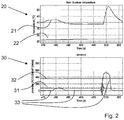
- FIG. 2 shows in the course of temperature 20, the time course of the temperatures 21, 22 at the output and input of the heat exchanger 2 from FIG. 1 , which was recorded with the temperature sensors 6 and 7, and in the pressure curve 30, the time course of the with the pressure sensor 8 from FIG. 1 measured system pressure 32, the variance 33 and the measured directly at the heat exchanger 2 pressure 31st
- the course of the pressure 31 at the heat exchanger 2 has at 478 s an onset of high-frequency content. This weakens at 480 s, then rises sharply at 498 s. This is due to the onset of 478 s microsilusion, which then boils at 498 s.
- the pressure fluctuations are due to the formation and in particular to the collapse of vapor bubbles.
- the course of the system pressure 32 has these high-frequency components also, but in a lower amplitude. This is due to the fact that the pressure sensor 8 is provided for the system pressure at a certain distance from the heat exchanger.
- micro-boiling and boiling can be clearly recognized.
- this threshold can be set so that the micro-boiling is already detected.
- the course of the pressure can be used as a further criterion. In any case, when a higher threshold is exceeded, the boiling, as occurs in the range from 498 s, and thus the stagnation certainly recognizable.
- the temperature profile 22 at the entrance of the heat exchanger 2 is almost constant, can be seen from the temperature profile 21 at the output of the heat exchanger microsolutions and boiling.
- the gradient between the temperatures at the output side of the heat exchanger and the input side is negative. This is monitored by comparing the negative gradient in quasi-steady state operation with a threshold and using it to detect stagnation.
- the sudden temperature increase at 500 s is due to a vapor bubble formation, through which the heated water is pushed out. In principle, it is also possible to evaluate such curves for detecting the stagnation.
Landscapes
- Engineering & Computer Science (AREA)
- Physics & Mathematics (AREA)
- Thermal Sciences (AREA)
- Chemical & Material Sciences (AREA)
- Combustion & Propulsion (AREA)
- Mechanical Engineering (AREA)
- General Engineering & Computer Science (AREA)
- Instantaneous Water Boilers, Portable Hot-Water Supply Apparatuses, And Control Of Portable Hot-Water Supply Apparatuses (AREA)
Claims (12)
- Procédé de détection et d'empêchement d'ébullitions dans des caloporteurs primaires (2) dans des appareils chauffants (1), en particulier des appareils chauffants à valeur calorifique, comprenant un brûleur (3) avec le caloporteur (2) avec lequel la chaleur obtenue par le brûleur (3) est transmise à un fluide caloporteur qui circule dans un circuit par une pompe (4), dans lequel la microébullition précédant l'ébullition est détectée, dans lequel une ou plusieurs grandeurs de processus (21, 22, 32, 33) caractérisant la microébullition sont détectées et comparées avec une valeur seuil et qu'en cas de dépassement de la valeur seuil au moins un paramètre de fonctionnement est modifié, lequel agit contre une ébullition, caractérisé en ce que la grandeur de processus caractérisante est la variance (33) de la pression (32, 31) du fluide caloporteur à chauffer.
- Procédé selon la revendication 1, dans lequel la variance (33) de la pression (32, 31) est mesurée respectivement sur de courtes périodes, en cas de dépassement de la valeur seuil un compteur est augmenté d'une valeur et en cas de non-atteinte de la valeur seuil un compteur est réduit d'une seconde valeur, dans lequel la seconde valeur est de préférence inférieure à la première valeur, et dans lequel au moins un paramètre de fonctionnement est modifié dès que l'état du compteur a dépassé une seconde valeur de seuil.
- Procédé selon l'une quelconque des revendications précédentes, dans lequel une autre grandeur de processus caractérisante est le gradient négatif de l'écart de température entre l'entrée et la sortie (22, 21) pour le fluide caloporteur à chauffer du caloporteur (2) en cas de sollicitation de brûleur constante et circulation de fluide caloporteur constante.
- Procédé de détection et d'empêchement d'ébullitions dans un ou plusieurs tubes d'un caloporteur primaire (2) comprenant plusieurs tubes montés en parallèle dans des appareils chauffants (1), en particulier des appareils chauffants à valeur calorifique, comprenant un brûleur (3) avec le caloporteur (2) avec lequel la chaleur obtenue par le brûleur (3) est transmise à un fluide caloporteur qui circule dans un circuit par une pompe (4), caractérisé en ce qu'une grandeur de processus (21, 22) caractérisant l'ébullition est détectée et comparée avec une valeur seuil et qu'en cas de dépassement de la valeur seuil au moins un paramètre de fonctionnement est modifié, lequel agit contre une ébullition, et que la grandeur de processus caractérisante est le gradient négatif de l'écart de température entre l'entrée et la sortie (22, 21) pour le fluide caloporteur à chauffer du caloporteur (1) en cas de sollicitation de brûleur constante et circulation de fluide caloporteur constante.
- Procédé selon la revendication 4, dans lequel la valeur seuil pour le gradient négatif de l'écart de température est 0,05 K/s, de préférence 0,1 K/s.
- Procédé selon la revendication 4, dans lequel la valeur seuil pour le gradient négatif de l'écart de température est inférieure de préférence à 63 % de l'écart de température dans le cas stationnaire divisé par le nombre des tubes montés en parallèle du caloporteur primaire (2).
- Procédé selon l'une quelconque des revendications 4 à 6, dans lequel la moyenne du gradient est calculée sur une période d'au moins 5 secondes, de préférence d'au moins 12 secondes.
- Procédé selon l'une quelconque des revendications précédentes, dans lequel la modification d'un paramètre de fonctionnement est la diminution du rapport entre la quantité de chaleur amenée et évacuée.
- Procédé selon la revendication 8, dans lequel la diminution du rapport entre la quantité de chaleur amenée et évacuée est atteinte en ce que le brûleur (3) est mis hors service ou la puissance du brûleur est réduite.
- Procédé selon l'une quelconque des revendications 1 à 8, dans lequel la modification d'un paramètre de fonctionnement est atteinte du fait que le courant massique du fluide caloporteur à chauffer est augmenté, en particulier par augmentation de la vitesse de rotation de pompe de la pompe (4) refoulant le fluide caloporteur à chauffer.
- Procédé selon l'une quelconque des revendications 1 à 7, dans lequel la modification du paramètre de fonctionnement est atteinte du fait qu'un parcours de déviation (10) est ouvert entre la sortie et l'entrée pour le fluide caloporteur à chauffer du caloporteur.
- Procédé selon l'une quelconque des revendications précédentes, dans lequel lors du démarrage du brûleur (3) de l'appareil de chauffage (1), le courant massique du fluide caloporteur à chauffer est augmenté à court terme, en particulier par l'augmentation de la vitesse de rotation de pompe de la pompe (4) refoulant le fluide caloporteur à chauffer.
Applications Claiming Priority (1)
| Application Number | Priority Date | Filing Date | Title |
|---|---|---|---|
| ATA622/2013A AT514681B1 (de) | 2013-08-05 | 2013-08-05 | Verfahren zur Erkennung und Vermeidung von Sieden in Wärmeübertragern |
Publications (2)
| Publication Number | Publication Date |
|---|---|
| EP2840331A1 EP2840331A1 (fr) | 2015-02-25 |
| EP2840331B1 true EP2840331B1 (fr) | 2018-11-14 |
Family
ID=51298558
Family Applications (1)
| Application Number | Title | Priority Date | Filing Date |
|---|---|---|---|
| EP14179617.7A Active EP2840331B1 (fr) | 2013-08-05 | 2014-08-04 | Procédé de détection de stagnation et suppression de stagnation dans des caloporteurs |
Country Status (3)
| Country | Link |
|---|---|
| EP (1) | EP2840331B1 (fr) |
| AT (1) | AT514681B1 (fr) |
| ES (1) | ES2710150T3 (fr) |
Families Citing this family (2)
| Publication number | Priority date | Publication date | Assignee | Title |
|---|---|---|---|---|
| WO2023073758A1 (fr) | 2021-10-25 | 2023-05-04 | 三菱電機株式会社 | Dispositif à cycle frigorifique |
| DE102023112905A1 (de) * | 2023-05-16 | 2024-11-21 | Vaillant Gmbh | Verfahren zum Betrieb mindestens eines Heizwasserkreises, Vorrichtung umfassend Heizwasserkreis und Heizgerät und Computerprogramm |
Family Cites Families (13)
| Publication number | Priority date | Publication date | Assignee | Title |
|---|---|---|---|---|
| JPS5822843A (ja) * | 1981-07-30 | 1983-02-10 | Sanyo Electric Co Ltd | 太陽熱集熱装置 |
| JPS58140555A (ja) * | 1982-02-16 | 1983-08-20 | Hitachi Chem Co Ltd | 貯湯湯沸器の温度制御装置 |
| JPH01289265A (ja) * | 1988-05-17 | 1989-11-21 | Ricoh Co Ltd | 基板の分割方法 |
| AU633042B2 (en) * | 1989-01-26 | 1993-01-21 | Otter Controls Limited | Controls for electrically powered heating elements |
| JPH05272805A (ja) * | 1992-03-25 | 1993-10-22 | Rinnai Corp | 給湯制御装置 |
| JPH06123489A (ja) * | 1992-10-08 | 1994-05-06 | Matsushita Electric Ind Co Ltd | 給湯機 |
| GB9503256D0 (en) * | 1995-02-20 | 1995-04-12 | Pifco Ltd | Improvements to liquid boiling apparatus |
| JP3880130B2 (ja) * | 1997-04-30 | 2007-02-14 | 株式会社ガスター | 一缶二水路式給湯装置およびその制御方法 |
| JP3862856B2 (ja) * | 1998-04-20 | 2006-12-27 | パロマ工業株式会社 | 保温機能付給湯器 |
| JP2005050713A (ja) * | 2003-07-30 | 2005-02-24 | Mitsubishi Electric Corp | 加熱調理器 |
| GB2452981B (en) * | 2007-09-21 | 2012-10-17 | Otter Controls Ltd | Electrical appliances |
| US20110008029A1 (en) * | 2008-01-29 | 2011-01-13 | Von Seidel Michael | Culinary electric hot water appliance with automatic switch |
| EP2682582B1 (fr) * | 2011-03-03 | 2016-12-21 | Toyota Jidosha Kabushiki Kaisha | Dispositif d'accélération de la mise en température pour moteur à combustion interne |
-
2013
- 2013-08-05 AT ATA622/2013A patent/AT514681B1/de not_active IP Right Cessation
-
2014
- 2014-08-04 ES ES14179617T patent/ES2710150T3/es active Active
- 2014-08-04 EP EP14179617.7A patent/EP2840331B1/fr active Active
Non-Patent Citations (1)
| Title |
|---|
| None * |
Also Published As
| Publication number | Publication date |
|---|---|
| ES2710150T3 (es) | 2019-04-23 |
| AT514681B1 (de) | 2015-06-15 |
| EP2840331A1 (fr) | 2015-02-25 |
| AT514681A1 (de) | 2015-02-15 |
Similar Documents
| Publication | Publication Date | Title |
|---|---|---|
| DE69912018T2 (de) | Verfahren und Vorrichtung zur örtlichen überwachten Regenerierung eines Partikelfilters | |
| EP2613097B2 (fr) | Appareil de chauffage | |
| DE102011002774A1 (de) | Verfahren zum Füllen und Nachfüllen von Wasser in einen Wasserkreislauf | |
| DE19524260C5 (de) | Heizgerät, insbesondere zur Innenraumbeheizung eines Kraftfahrzeuges | |
| EP2840331B1 (fr) | Procédé de détection de stagnation et suppression de stagnation dans des caloporteurs | |
| EP2680682B1 (fr) | Procédé de contrôle du fonctionnement d'un système de refroidissement d'un onduleur et onduleur | |
| DE202015106919U1 (de) | Umrichterkühlsystem | |
| AT515127B1 (de) | Verfahren zum Entlüften des Wärmeträgermediums von Heizgeräten | |
| DE102015016247B3 (de) | Heizeinrichtung | |
| DE102008027039B4 (de) | Temperiergerät mit Durchflussmessung | |
| DE102012107016B4 (de) | Verfahren zum Betreiben einer Heizung für eine Batterie eines zumindest teil- und/oder zeitweise elektrisch angetriebenen Kraftfahrzeugs | |
| DE102008038733A1 (de) | Verfahren zur Vermeidung von Überhitzungsschäden an einer thermischen Solaranlage | |
| EP2667104A2 (fr) | Installation et procédé de chauffage d'eau potable | |
| DE102014219267A1 (de) | Kühlsystem für eine Fahrzeugbatterie | |
| DE102011009750A1 (de) | Verfahren zum Betrieb eines Heizgerätes | |
| DE102009006722A1 (de) | Solarheizanlage, Verfahren und Vorrichtung zur Diagnose einer Luftmenge in einem mit einem Solarfluid befüllten Solarfluidkreis und zum Betreiben einer Solarheizanlage | |
| DE102016124405B3 (de) | Verfahren zur Bestimmung einer Verkalkung eines Gargeräts | |
| EP2868960A1 (fr) | Système d'évacuation équipé d'un tuyau de contrôle pour l'échangeur de chaleur à condensation | |
| EP2293005B1 (fr) | Surveillance d'écoulement d'un échangeur thermique | |
| EP2218972B1 (fr) | Procédé de fonctionnement d'une installation de chauffage et installation de chauffage | |
| DE1907987A1 (de) | Zwangsdurchlauferhitzer fuer aus organischen Fluessigkeiten bestehende Waermetraeger | |
| EP3367005B1 (fr) | Système de chauffage | |
| EP2851629A1 (fr) | Système de chauffage | |
| EP1684020A3 (fr) | Procédé de régulation d'une installation solaire | |
| EP2230035B1 (fr) | Procédé et dispositif destinés à l'équilibrage des températures du noyau de fusion |
Legal Events
| Date | Code | Title | Description |
|---|---|---|---|
| PUAI | Public reference made under article 153(3) epc to a published international application that has entered the european phase |
Free format text: ORIGINAL CODE: 0009012 |
|
| 17P | Request for examination filed |
Effective date: 20140804 |
|
| AK | Designated contracting states |
Kind code of ref document: A1 Designated state(s): AL AT BE BG CH CY CZ DE DK EE ES FI FR GB GR HR HU IE IS IT LI LT LU LV MC MK MT NL NO PL PT RO RS SE SI SK SM TR |
|
| AX | Request for extension of the european patent |
Extension state: BA ME |
|
| R17P | Request for examination filed (corrected) |
Effective date: 20150814 |
|
| RBV | Designated contracting states (corrected) |
Designated state(s): AL AT BE BG CH CY CZ DE DK EE ES FI FR GB GR HR HU IE IS IT LI LT LU LV MC MK MT NL NO PL PT RO RS SE SI SK SM TR |
|
| 17Q | First examination report despatched |
Effective date: 20160407 |
|
| STAA | Information on the status of an ep patent application or granted ep patent |
Free format text: STATUS: EXAMINATION IS IN PROGRESS |
|
| GRAP | Despatch of communication of intention to grant a patent |
Free format text: ORIGINAL CODE: EPIDOSNIGR1 |
|
| STAA | Information on the status of an ep patent application or granted ep patent |
Free format text: STATUS: GRANT OF PATENT IS INTENDED |
|
| INTG | Intention to grant announced |
Effective date: 20180627 |
|
| GRAS | Grant fee paid |
Free format text: ORIGINAL CODE: EPIDOSNIGR3 |
|
| GRAA | (expected) grant |
Free format text: ORIGINAL CODE: 0009210 |
|
| STAA | Information on the status of an ep patent application or granted ep patent |
Free format text: STATUS: THE PATENT HAS BEEN GRANTED |
|
| AK | Designated contracting states |
Kind code of ref document: B1 Designated state(s): AL AT BE BG CH CY CZ DE DK EE ES FI FR GB GR HR HU IE IS IT LI LT LU LV MC MK MT NL NO PL PT RO RS SE SI SK SM TR |
|
| REG | Reference to a national code |
Ref country code: CH Ref legal event code: EP Ref country code: AT Ref legal event code: REF Ref document number: 1065292 Country of ref document: AT Kind code of ref document: T Effective date: 20181115 |
|
| REG | Reference to a national code |
Ref country code: DE Ref legal event code: R096 Ref document number: 502014010042 Country of ref document: DE |
|
| REG | Reference to a national code |
Ref country code: IE Ref legal event code: FG4D Free format text: LANGUAGE OF EP DOCUMENT: GERMAN |
|
| REG | Reference to a national code |
Ref country code: NL Ref legal event code: FP |
|
| REG | Reference to a national code |
Ref country code: LT Ref legal event code: MG4D |
|
| REG | Reference to a national code |
Ref country code: ES Ref legal event code: FG2A Ref document number: 2710150 Country of ref document: ES Kind code of ref document: T3 Effective date: 20190423 |
|
| PG25 | Lapsed in a contracting state [announced via postgrant information from national office to epo] |
Ref country code: IS Free format text: LAPSE BECAUSE OF FAILURE TO SUBMIT A TRANSLATION OF THE DESCRIPTION OR TO PAY THE FEE WITHIN THE PRESCRIBED TIME-LIMIT Effective date: 20190314 Ref country code: BG Free format text: LAPSE BECAUSE OF FAILURE TO SUBMIT A TRANSLATION OF THE DESCRIPTION OR TO PAY THE FEE WITHIN THE PRESCRIBED TIME-LIMIT Effective date: 20190214 Ref country code: LT Free format text: LAPSE BECAUSE OF FAILURE TO SUBMIT A TRANSLATION OF THE DESCRIPTION OR TO PAY THE FEE WITHIN THE PRESCRIBED TIME-LIMIT Effective date: 20181114 Ref country code: HR Free format text: LAPSE BECAUSE OF FAILURE TO SUBMIT A TRANSLATION OF THE DESCRIPTION OR TO PAY THE FEE WITHIN THE PRESCRIBED TIME-LIMIT Effective date: 20181114 Ref country code: LV Free format text: LAPSE BECAUSE OF FAILURE TO SUBMIT A TRANSLATION OF THE DESCRIPTION OR TO PAY THE FEE WITHIN THE PRESCRIBED TIME-LIMIT Effective date: 20181114 Ref country code: NO Free format text: LAPSE BECAUSE OF FAILURE TO SUBMIT A TRANSLATION OF THE DESCRIPTION OR TO PAY THE FEE WITHIN THE PRESCRIBED TIME-LIMIT Effective date: 20190214 Ref country code: FI Free format text: LAPSE BECAUSE OF FAILURE TO SUBMIT A TRANSLATION OF THE DESCRIPTION OR TO PAY THE FEE WITHIN THE PRESCRIBED TIME-LIMIT Effective date: 20181114 |
|
| PG25 | Lapsed in a contracting state [announced via postgrant information from national office to epo] |
Ref country code: AL Free format text: LAPSE BECAUSE OF FAILURE TO SUBMIT A TRANSLATION OF THE DESCRIPTION OR TO PAY THE FEE WITHIN THE PRESCRIBED TIME-LIMIT Effective date: 20181114 Ref country code: SE Free format text: LAPSE BECAUSE OF FAILURE TO SUBMIT A TRANSLATION OF THE DESCRIPTION OR TO PAY THE FEE WITHIN THE PRESCRIBED TIME-LIMIT Effective date: 20181114 Ref country code: RS Free format text: LAPSE BECAUSE OF FAILURE TO SUBMIT A TRANSLATION OF THE DESCRIPTION OR TO PAY THE FEE WITHIN THE PRESCRIBED TIME-LIMIT Effective date: 20181114 Ref country code: GR Free format text: LAPSE BECAUSE OF FAILURE TO SUBMIT A TRANSLATION OF THE DESCRIPTION OR TO PAY THE FEE WITHIN THE PRESCRIBED TIME-LIMIT Effective date: 20190215 Ref country code: PT Free format text: LAPSE BECAUSE OF FAILURE TO SUBMIT A TRANSLATION OF THE DESCRIPTION OR TO PAY THE FEE WITHIN THE PRESCRIBED TIME-LIMIT Effective date: 20190314 |
|
| PG25 | Lapsed in a contracting state [announced via postgrant information from national office to epo] |
Ref country code: CZ Free format text: LAPSE BECAUSE OF FAILURE TO SUBMIT A TRANSLATION OF THE DESCRIPTION OR TO PAY THE FEE WITHIN THE PRESCRIBED TIME-LIMIT Effective date: 20181114 Ref country code: DK Free format text: LAPSE BECAUSE OF FAILURE TO SUBMIT A TRANSLATION OF THE DESCRIPTION OR TO PAY THE FEE WITHIN THE PRESCRIBED TIME-LIMIT Effective date: 20181114 Ref country code: PL Free format text: LAPSE BECAUSE OF FAILURE TO SUBMIT A TRANSLATION OF THE DESCRIPTION OR TO PAY THE FEE WITHIN THE PRESCRIBED TIME-LIMIT Effective date: 20181114 |
|
| REG | Reference to a national code |
Ref country code: DE Ref legal event code: R097 Ref document number: 502014010042 Country of ref document: DE |
|
| PG25 | Lapsed in a contracting state [announced via postgrant information from national office to epo] |
Ref country code: SM Free format text: LAPSE BECAUSE OF FAILURE TO SUBMIT A TRANSLATION OF THE DESCRIPTION OR TO PAY THE FEE WITHIN THE PRESCRIBED TIME-LIMIT Effective date: 20181114 Ref country code: EE Free format text: LAPSE BECAUSE OF FAILURE TO SUBMIT A TRANSLATION OF THE DESCRIPTION OR TO PAY THE FEE WITHIN THE PRESCRIBED TIME-LIMIT Effective date: 20181114 Ref country code: RO Free format text: LAPSE BECAUSE OF FAILURE TO SUBMIT A TRANSLATION OF THE DESCRIPTION OR TO PAY THE FEE WITHIN THE PRESCRIBED TIME-LIMIT Effective date: 20181114 Ref country code: SK Free format text: LAPSE BECAUSE OF FAILURE TO SUBMIT A TRANSLATION OF THE DESCRIPTION OR TO PAY THE FEE WITHIN THE PRESCRIBED TIME-LIMIT Effective date: 20181114 |
|
| PLBE | No opposition filed within time limit |
Free format text: ORIGINAL CODE: 0009261 |
|
| STAA | Information on the status of an ep patent application or granted ep patent |
Free format text: STATUS: NO OPPOSITION FILED WITHIN TIME LIMIT |
|
| 26N | No opposition filed |
Effective date: 20190815 |
|
| PG25 | Lapsed in a contracting state [announced via postgrant information from national office to epo] |
Ref country code: SI Free format text: LAPSE BECAUSE OF FAILURE TO SUBMIT A TRANSLATION OF THE DESCRIPTION OR TO PAY THE FEE WITHIN THE PRESCRIBED TIME-LIMIT Effective date: 20181114 |
|
| PG25 | Lapsed in a contracting state [announced via postgrant information from national office to epo] |
Ref country code: TR Free format text: LAPSE BECAUSE OF FAILURE TO SUBMIT A TRANSLATION OF THE DESCRIPTION OR TO PAY THE FEE WITHIN THE PRESCRIBED TIME-LIMIT Effective date: 20181114 |
|
| PG25 | Lapsed in a contracting state [announced via postgrant information from national office to epo] |
Ref country code: LI Free format text: LAPSE BECAUSE OF NON-PAYMENT OF DUE FEES Effective date: 20190831 Ref country code: MC Free format text: LAPSE BECAUSE OF FAILURE TO SUBMIT A TRANSLATION OF THE DESCRIPTION OR TO PAY THE FEE WITHIN THE PRESCRIBED TIME-LIMIT Effective date: 20181114 Ref country code: CH Free format text: LAPSE BECAUSE OF NON-PAYMENT OF DUE FEES Effective date: 20190831 Ref country code: LU Free format text: LAPSE BECAUSE OF NON-PAYMENT OF DUE FEES Effective date: 20190804 |
|
| REG | Reference to a national code |
Ref country code: BE Ref legal event code: MM Effective date: 20190831 |
|
| PG25 | Lapsed in a contracting state [announced via postgrant information from national office to epo] |
Ref country code: IE Free format text: LAPSE BECAUSE OF NON-PAYMENT OF DUE FEES Effective date: 20190804 |
|
| PG25 | Lapsed in a contracting state [announced via postgrant information from national office to epo] |
Ref country code: BE Free format text: LAPSE BECAUSE OF NON-PAYMENT OF DUE FEES Effective date: 20190831 |
|
| PG25 | Lapsed in a contracting state [announced via postgrant information from national office to epo] |
Ref country code: CY Free format text: LAPSE BECAUSE OF FAILURE TO SUBMIT A TRANSLATION OF THE DESCRIPTION OR TO PAY THE FEE WITHIN THE PRESCRIBED TIME-LIMIT Effective date: 20181114 |
|
| PG25 | Lapsed in a contracting state [announced via postgrant information from national office to epo] |
Ref country code: MT Free format text: LAPSE BECAUSE OF FAILURE TO SUBMIT A TRANSLATION OF THE DESCRIPTION OR TO PAY THE FEE WITHIN THE PRESCRIBED TIME-LIMIT Effective date: 20181114 Ref country code: HU Free format text: LAPSE BECAUSE OF FAILURE TO SUBMIT A TRANSLATION OF THE DESCRIPTION OR TO PAY THE FEE WITHIN THE PRESCRIBED TIME-LIMIT; INVALID AB INITIO Effective date: 20140804 |
|
| PG25 | Lapsed in a contracting state [announced via postgrant information from national office to epo] |
Ref country code: MK Free format text: LAPSE BECAUSE OF FAILURE TO SUBMIT A TRANSLATION OF THE DESCRIPTION OR TO PAY THE FEE WITHIN THE PRESCRIBED TIME-LIMIT Effective date: 20181114 |
|
| PGFP | Annual fee paid to national office [announced via postgrant information from national office to epo] |
Ref country code: AT Payment date: 20220727 Year of fee payment: 9 |
|
| REG | Reference to a national code |
Ref country code: AT Ref legal event code: MM01 Ref document number: 1065292 Country of ref document: AT Kind code of ref document: T Effective date: 20230804 |
|
| PG25 | Lapsed in a contracting state [announced via postgrant information from national office to epo] |
Ref country code: AT Free format text: LAPSE BECAUSE OF NON-PAYMENT OF DUE FEES Effective date: 20230804 |
|
| PG25 | Lapsed in a contracting state [announced via postgrant information from national office to epo] |
Ref country code: AT Free format text: LAPSE BECAUSE OF NON-PAYMENT OF DUE FEES Effective date: 20230804 |
|
| PGFP | Annual fee paid to national office [announced via postgrant information from national office to epo] |
Ref country code: NL Payment date: 20240729 Year of fee payment: 11 |
|
| PGFP | Annual fee paid to national office [announced via postgrant information from national office to epo] |
Ref country code: FR Payment date: 20240820 Year of fee payment: 11 |
|
| PGFP | Annual fee paid to national office [announced via postgrant information from national office to epo] |
Ref country code: ES Payment date: 20240902 Year of fee payment: 11 |
|
| PGFP | Annual fee paid to national office [announced via postgrant information from national office to epo] |
Ref country code: IT Payment date: 20240828 Year of fee payment: 11 |
|
| PGFP | Annual fee paid to national office [announced via postgrant information from national office to epo] |
Ref country code: DE Payment date: 20250730 Year of fee payment: 12 |
|
| PGFP | Annual fee paid to national office [announced via postgrant information from national office to epo] |
Ref country code: GB Payment date: 20250725 Year of fee payment: 12 |
|
| REG | Reference to a national code |
Ref country code: NL Ref legal event code: MM Effective date: 20250901 |