EP2845700A1 - Pince destinée à séparer des morceaux de chocolat - Google Patents
Pince destinée à séparer des morceaux de chocolat Download PDFInfo
- Publication number
- EP2845700A1 EP2845700A1 EP14183594.2A EP14183594A EP2845700A1 EP 2845700 A1 EP2845700 A1 EP 2845700A1 EP 14183594 A EP14183594 A EP 14183594A EP 2845700 A1 EP2845700 A1 EP 2845700A1
- Authority
- EP
- European Patent Office
- Prior art keywords
- pliers
- chocolate
- jaw
- piece
- forceps
- Prior art date
- Legal status (The legal status is an assumption and is not a legal conclusion. Google has not performed a legal analysis and makes no representation as to the accuracy of the status listed.)
- Granted
Links
Images





Classifications
-
- A—HUMAN NECESSITIES
- A23—FOODS OR FOODSTUFFS; TREATMENT THEREOF, NOT COVERED BY OTHER CLASSES
- A23G—COCOA; COCOA PRODUCTS, e.g. CHOCOLATE; SUBSTITUTES FOR COCOA OR COCOA PRODUCTS; CONFECTIONERY; CHEWING GUM; ICE-CREAM; PREPARATION THEREOF
- A23G7/00—Other apparatus or process specially adapted for the chocolate or confectionery industry
- A23G7/0018—Apparatus for cutting or dividing chocolate or candies
-
- A—HUMAN NECESSITIES
- A47—FURNITURE; DOMESTIC ARTICLES OR APPLIANCES; COFFEE MILLS; SPICE MILLS; SUCTION CLEANERS IN GENERAL
- A47J—KITCHEN EQUIPMENT; COFFEE MILLS; SPICE MILLS; APPARATUS FOR MAKING BEVERAGES
- A47J43/00—Implements for preparing or holding food, not provided for in other groups of this subclass
- A47J43/28—Other culinary hand implements, e.g. spatulas, pincers, forks or like food holders, ladles, skimming ladles, cooking spoons; Spoon-holders attached to cooking pots
-
- B—PERFORMING OPERATIONS; TRANSPORTING
- B26—HAND CUTTING TOOLS; CUTTING; SEVERING
- B26B—HAND-HELD CUTTING TOOLS NOT OTHERWISE PROVIDED FOR
- B26B17/00—Hand cutting tools, i.e. with the cutting action actuated by muscle power with two jaws which come into abutting contact
- B26B17/006—Hand cutting tools, i.e. with the cutting action actuated by muscle power with two jaws which come into abutting contact having cutting edges parallel to a pivot axis
-
- B—PERFORMING OPERATIONS; TRANSPORTING
- B26—HAND CUTTING TOOLS; CUTTING; SEVERING
- B26D—CUTTING; DETAILS COMMON TO MACHINES FOR PERFORATING, PUNCHING, CUTTING-OUT, STAMPING-OUT OR SEVERING
- B26D1/00—Cutting through work characterised by the nature or movement of the cutting member or particular materials not otherwise provided for; Apparatus or machines therefor; Cutting members therefor
- B26D1/01—Cutting through work characterised by the nature or movement of the cutting member or particular materials not otherwise provided for; Apparatus or machines therefor; Cutting members therefor involving a cutting member which does not travel with the work
- B26D1/12—Cutting through work characterised by the nature or movement of the cutting member or particular materials not otherwise provided for; Apparatus or machines therefor; Cutting members therefor involving a cutting member which does not travel with the work having a cutting member moving about an axis
- B26D1/25—Cutting through work characterised by the nature or movement of the cutting member or particular materials not otherwise provided for; Apparatus or machines therefor; Cutting members therefor involving a cutting member which does not travel with the work having a cutting member moving about an axis with a non-circular cutting member
- B26D1/34—Cutting through work characterised by the nature or movement of the cutting member or particular materials not otherwise provided for; Apparatus or machines therefor; Cutting members therefor involving a cutting member which does not travel with the work having a cutting member moving about an axis with a non-circular cutting member moving about an axis parallel to the line of cut
-
- B—PERFORMING OPERATIONS; TRANSPORTING
- B26—HAND CUTTING TOOLS; CUTTING; SEVERING
- B26F—PERFORATING; PUNCHING; CUTTING-OUT; STAMPING-OUT; SEVERING BY MEANS OTHER THAN CUTTING
- B26F3/00—Severing by means other than cutting; Apparatus therefor
- B26F3/002—Precutting and tensioning or breaking
-
- B—PERFORMING OPERATIONS; TRANSPORTING
- B26—HAND CUTTING TOOLS; CUTTING; SEVERING
- B26D—CUTTING; DETAILS COMMON TO MACHINES FOR PERFORATING, PUNCHING, CUTTING-OUT, STAMPING-OUT OR SEVERING
- B26D5/00—Arrangements for operating and controlling machines or devices for cutting, cutting-out, stamping-out, punching, perforating, or severing by means other than cutting
- B26D5/08—Means for actuating the cutting member to effect the cut
- B26D5/10—Hand or foot actuated means
Definitions
- the invention relates to a pair of pliers for separating chocolate pieces from a composite of chocolate pieces, in particular a so-called Toblerone chocolate.
- TOBLERONE the most famous Swiss chocolate. This chocolate is characterized in particular by your very special and typical shape.
- the Toblerone was invented in 1908 by the Swiss chocolatiers Theodor Tobler and Emil Baumann.
- the name Toblerone is a blend of Tobler and Torrone, the Italian name for honey almond nougat.
- Characteristic feature of such a chocolate is its triangular shape. There are different legends about the triangular shape of this chocolate. It is often assumed that Theodor Tobler had been inspired by the Swiss mountains, in particular the characteristic silhouette of the Matterhorn with its typical triangular shape. The details are unknown and do not play any decisive role here. At least today, the Toblerone is one of the best-known confectionery products worldwide. In 1969, in addition to the classic Toblerone in different sizes another Toblerone product was introduced for the first time, namely the Black Toblerone (now called Toblerone Dark). 1973 followed the white, in the 1990s the blue, 2008 the purple Toblerone "Fruit & Nut" with grapes and 2009 the variety "Honey & Crisp".
- FIG. 1 Figure 3 shows as a prior art illustration a common form of Toblerone chocolate offered in different sizes on the market.
- the shape of such a chocolate is registered as a three-dimensional Community trademark under CTM 000031237.
- a "biting off” of the bar is out of the question; This is mainly because the chocolate is very hard, the chocolate piece is bulky and barely bite off from the chocolate compound due to its triangular, prismatic shape. In addition, then the chocolate piece must still be bitten or at least crushed.
- GB 2270248 describes a device for breaking confectionery especially chocolate bars.
- the device comprises two housing parts into which a chocolate bar can be inserted.
- the two housing parts are flexibly connected to each other and by bending the housing parts introduced into the housing parts chocolate bar is broken.
- the device in GB 2270248 suitable for nearly planar (flat, flat) chocolate bars with a roughly equal top and bottom.
- the flat or virtually planar surface of the chocolate bar must be sufficiently large on the top and bottom, so over the device in GB 2270248 a bending force on the chocolate surface can act and thus leads to the breaking of the chocolate bar.
- the device is in GB 2270248 not suitable for separating chocolate pieces.
- IT 1200532 a device is described which looks similar to a staple device.
- the device has two flat surfaces, of which one surface is the support surface.
- the second surface is flexibly connected to the first surface on one side by a leaf spring. This makes it possible to compress the two surfaces feathery.
- a chocolate bar can be inserted.
- a piece of chocolate can be separated via a serrated rail which is fastened to the open end of the second surface.
- the device in IT 1200532 is intended to separate pieces of flat (flat, flat) chocolate bars. It is thus not possible to separate jagged, three-dimensionally spatially protruding pieces of a quasi prism-shaped chocolate composite.
- the object of the present invention is to provide a device for separating prism-shaped chocolate pieces from a chocolate composite from the typical three-dimensional shape of a Toblerone chocolate.
- a pair of pliers for separating pieces of chocolate is provided, in particular prism-shaped chocolate pieces of a Toblerone, comprising two manually operable pliers legs and at least one connecting joint, the pliers comprising a pliers head with at least two pliers jaws, and wherein the first pliers jaw is actively configured and a Shaping for generating a predetermined breaking point between one behind the other to a chocolate composite arranged quasi prism-shaped chocolate pieces and the second jaw is made passive, as a counterpart to the first jaw, and the separated piece of chocolate by the interaction the pliers jaws from the remaining chocolate composite is levered.
- the forceps arms are hinged together in the connecting joint. It is preferred that the two pliers legs are connected to each other with at least one spring element, against the spring force of the pliers is to move and which opens the pliers again after compression. In particular, the pliers legs are connected both articulated and with spring elements. The latter are used to reopen the pliers after it has been moved against the spring force the pliers.
- one of the pliers jaws comprises a receiving unit for receiving the separated piece of chocolate.
- a chocolate piece or chocolate rib of a Toblerone can be pinched or pried off the chocolate composite.
- the separated piece of chocolate falls onto the receiving unit and can be removed.
- the pliers head of the pliers according to the invention in particular comprises three pliers jaws.
- the third jaw jaw is designed as a press ram, which ejects the separated piece of chocolate from the pliers.
- the three jaws are hinged to the pliers legs.
- the pliers head of the forceps thus preferably comprises three forceps jaws, which are hingedly connected to the forceps arms.
- the pliers head comprising three pliers jaws is articulated to the pliers limbs via a connecting rod and four connecting links.
- the pliers head of the pliers which comprises, for example, three pliers jaws, is articulated to the pliers limbs via a connecting rod, connecting links, link, pivots and / or rollers.
- the basic equipment of the forceps preferably includes pliers legs, connecting joint and pliers head. It is preferred that the pliers work on the lever principle. In particular, two pliers legs make the beginning of the connecting joint rear end of the pliers and are compressed by the handles located on the forceps thighs. As a result, a force is generated and transmitted to the pliers head.
- the pliers head includes the pliers jaws, which represent starting from the connecting joint, the front end of the pliers.
- the force generated during compression of the forceps arms for example via a gripper-like movement on the chocolate composite, which can also be referred to as a chocolate bar, transmitted via the jaws.
- the pliers comprise a backdrop.
- a backdrop generally represents a transmission element for power transmission.
- the scenery allows a link guide in particular that a certain movement of the jaws on compression of the pliers legs is done.
- the scenery is in particular a slideway, engage in the roles and forcibly guided by the slide track.
- the scenery for example, a slot, a web or a groove as a slide track to implement movement of the gate in a movement of the roller track located in the slide.
- the transfer function of the slide guide is determined exclusively by the course of the slot, the web or the groove and is freely selectable within wide limits. Complex movements, in particular of the forceps jaws, can be realized in particular via the slotted guide.
- the second forceps jaw in which in particular the cutting unit is arranged, also includes openings.
- the second, in particular passively designed pliers jaw which may also be referred to as a movable jaw
- the third preferably provided with a punch pliers jaw together and divide the chocolate piece located in the receiving unit. For this presses the punch on the piece of chocolate and through the cutting unit so that it is divided.
- both the receiving unit has a corresponding shape to the severed piece of chocolate, as well as the punch a corresponding shape to the receiving unit.
- the pressing punch and the cutting unit preferably cooperate for dividing the chocolate piece located in the receiving unit.
- the press stamp has in particular the function of a Ausd Wegkopfes and can also be referred to as Auswerfkopf.
- the ram is attached in particular to the third jaw.
- the third jaw for example, is configured bent, includes a handle and is in particular to be referred to as a squeezer or ejector, since this forceps component has the function of ejecting or ejecting a separated piece of chocolate from the pliers.
- a piece of chocolate can be separated from the prismatic shape of a Toblerone chocolate from the chocolate composite, and, on the other hand, this piece of chocolate can optionally be shredded simultaneously when using the cutting unit and the press die.
- the invention relates to a pair of tongs for chopping pieces of chocolate, in particular prism-shaped chocolate pieces of a Toblerone, comprising two manually operable pliers legs and at least one connecting joint, wherein the pliers comprises a pliers head with two pliers jaws, and wherein the pliers jaw is actively configured and a press ram, over which a piece of chocolate located in the receiving unit of the passively configured jaw is pressed for cutting by the cutting unit.
- a pair of pliers a piece of chocolate already separated from a Toblerone composite is also cut into bite-sized pieces.
- the invention also relates to a kit for a pair of pliers for separating and / or dividing pieces of chocolate, in particular prism-shaped chocolate pieces of a Toblerone, wherein it is provided according to the invention in particular that the pliers head is modular, a passive designed jaw and one or two active comprises configured jaws, the jaws are replaceable.
- the user can therefore assemble "his" pliers by omitting one or the other component, for example the cutting unit for cutting the separated piece of chocolate.
- At least a passively designed jaw and one or two actively designed jaws should be present, the jaws are designed interchangeable.
- the advantage of the modular design of the forceps is that the jaws, such as the receiving unit and the Pressing punches to which the size of the piece of chocolate to be separated from the chocolate composite and / or cut into bite-sized pieces can be adapted to the Toblerone chocolate.
- FIG. 1 shows a Toblerone chocolate according to the prior art, namely the image of the registered three-dimensional brand CTM 000031237. Visible are the prism-shaped chocolate pieces, which are connected to each other via a common chocolate base in a chocolate composite.
- the quasi prism-shaped pieces of chocolate also referred to as chocolate ribs, have in particular a triangular shape, for example, are jagged and protrude three-dimensionally in the air.
- the consumer breaks off the outermost of the chocolate pieces for consumption. With mouth and teeth, such a chocolate piece is usually not separate.
- mechanical tools such as hammers and chisels are often used to cut them off.
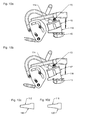
- FIGS. 2a and 2b show a pliers according to the invention for separating chocolate pieces, in particular quasi prism-shaped chocolate pieces of a Toblerone in the closed (2a) and open (2b) state, each in side view.
- the pliers 10 comprises two manually operable pliers legs 12 and 14, and at least one connecting joint 26, further a pliers head 22 with at least two jaws 16 and 18.
- the first pliers jaw 18 is actively configured and know a shape 34 for generating a predetermined breaking point between one behind the other to one Chocolate composite arranged quasi prism-shaped chocolate pieces 11 and the second jaw 16 is passively designed as a counterpart to the first jaw 18.
- a piece of chocolate is pried from the remaining chocolate composite 11.
- the pliers legs are connected via a connecting joint 26 hinged together.
- the two pliers legs 12 and 14 are also preferably connected to each other with a spring element 44, against the spring force the pliers is to move and which opens the pliers again after compression.
- the forceps according to the invention have two forceps arms 12 and 14, wherein the first forceps jaw 18 has a special shape 34 on its side facing away from the handle side.
- This shape for example in the form of a tapered edge - see FIGS. 2a and 2b - engages in the intermediate space, which is formed by two adjacent prism-shaped chocolate pieces 11 and generates a predetermined breaking point in the chocolate composite.
- the special edge of the molding 34 is then levered by the special edge of the molding 34 and the same is guided in a corresponding recess 35 on the opposite jaw 16 (see also FIG. 3b ).
- the second forceps jaw 16 of the forceps leg 14 comprises a receiving unit 36 for receiving the separated piece of chocolate. This is also off in plan view FIG. 3a seen.
- a cutting unit 40 which comprises openings 38, is arranged in the receiving unit 36 of the second jaw 16.
- the forceps head 22 of the forceps 10 has three forceps jaws 16, 18 and 20, which are pivotally connected to the forceps arms 12 and 14.
- the pliers head 22 of the pliers 10 which surrounds the three pliers jaws 16, 18 and 20 is articulated via a connecting rod 24 and four connecting joints 26, 28, 30 and 32 with the pliers limbs 12 and 14.
- the third forceps jaw 20 with press die 42 ejects the separated piece of chocolate from the forceps 10 (see also Figure 3c ).
- the second and third forceps jaw 16 and 20 thus act together via a lever movement in such a way that the piece of chocolate located in the receiving unit 36 is divided when the forceps arms 12 and 14 are compressed. It proves to be advantageous if, for this purpose, a cutting unit 40 is introduced into the receiving unit 36, because then the separated piece of chocolate is at the same time divided into smaller pieces, namely by the press ram 42 pushes the piece of chocolate against and through the cutting unit.
- the receiving unit 36 has a corresponding shape to the separated piece of chocolate, otherwise the piece of chocolate would not fit into the mold. In the same way, it makes sense if the pressing punch 42 has a corresponding shape to the receiving unit 36.
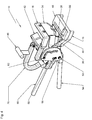
- FIGS. 4 to 14 show further preferred embodiments of the forceps.
- FIG. 4 shows the overall perspective view of a forceps 10 according to the invention for separating chocolate pieces, in particular quasi prism-shaped chocolate pieces of a Toblerone in the open state, obliquely from the front.
- the forceps 10 comprises two manually operable pliers legs 12 and 14 (see. FIG. 5 ), which in particular each have a handle 54, 60 (see FIG. 4 ).
- the forceps 10 comprises at least one connecting joint and a pliers head with at least two forceps jaws 16 and 18.
- the first forceps jaw 18 is actively configured, in particular movable and know a shape 34, for example in the form of a transverse knife. This shaping 34 serves to produce a predetermined breaking point between quasi prism-shaped pieces of chocolate arranged one behind the other to form a chocolate composite.
- the second pliers jaw 16 is passively designed as a counterpart to the first, actively designed pliers jaw 18. By interaction of the pliers jaws 16 and 18, a chocolate piece is pried from the chocolate composite.
- the pliers legs are hinged together via at least one connecting joint.
- the first forceps jaw 18 is in particular actively designed and movable and provides the head end of the actively configured, movable forceps leg 12 (see. FIG. 5 ).
- the second forceps jaw 16 is in particular passively configured and fixed and provides the head end of the passively configured, fixed forceps leg 14 (see FIG. FIG. 5 ).
- the pliers preferably comprise a recess 35, which in particular receives the shaping 34, for example a transverse knife, after a piece of chocolate, in particular in the form of a triangular chocolate rib, was separated from the chocolate composite or chocolate bars.
- the forceps jaw 16 preferably comprises a support 48 for the chocolate composite and a stop 50 for aligning the chocolate composite.
- the forceps 10 in addition to the two jaws 16, 18 and a third jaw 20, which performs the function of a squeezer.
- the third forceps jaw 20 has, for example, a handle 46, and at the head end, in particular, a pressing ram 42 with the function of a squeezing head is attached.
- the punch 42 is connected via a joint with the third jaw 20.
- the pressing punch 42 is preferably triangular in shape and thus has in particular the shape of the piece of chocolate to be separated.
- the shape of the press ram 42 is designed so that it fits snugly into the receiving unit 36 for the separated piece of chocolate.
- the receiving unit 36 in turn is designed so that the separated chocolate piece can be picked up by the receiving unit 36.
- a cutting unit 40 can be used, which is configured in particular star-shaped as a cutting star.
- the receiving unit 36 After a piece of chocolate has been separated from the chocolate compound or chocolate bar by the interaction of the jaws 16, 18 and the shaping 34, the separated piece of chocolate is picked up by the receiving unit 36.
- the press die 42 which is attached in an articulated manner to the third jaw 20, is pressed onto a severed piece of chocolate located in the receiving unit 36.
- the third forceps jaw 20 Upon further compression of the handles 54, 60, the third forceps jaw 20 further lowers with the ram 42 and pushes the separated piece of chocolate through the cutting unit 40, whereby the separated chocolate piece is cut into smaller, bite-sized pieces.
- the forceps 10 in particular comprises a link 56 with a slide track 104 (shown in FIG FIG. 9 ), which determines the direction of movement and the course of movement of the third jaw 20.
- the pliers 10 in particular comprise a roller 62 which is mounted on the leg on the third pliers jaw 20, the so-called squeezer, and with the link 56 and in particular the slide track 104 (shown in FIG FIG. 9 ) cooperates.
- the backdrop 56 has in particular a Fulcrum 52 on which the link 56 is preferably connected to the passively designed, in particular fixed part of the pliers.
- a hole is provided in the gate 56, in which a roller 58 engages, which is mounted on the pliers legs of the particular movable, actively designed pliers jaw.
- the punch 42 and the jaw 16, which includes the receiving unit 36 modular exchangeable, so that different sized punch 42 can be fitted to the respective size of the forceps jaw 16 with the correspondingly large receiving units 36 on the forceps 10.
- the receiving unit 36 may be modular exchangeable.
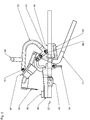
- FIG. 5 shows a side view from the left of the pliers in the open state.
- the forceps comprises a forceps leg 14, which is designed in particular passive and preferably fixed. With the forceps leg 14, the third jaw 20 is hingedly connected.
- the third jaw 20 with the function of a pusher can perform a pivotal movement at the pivot point 64 when the two pincers 12, 14 are compressed.
- the third jaw 20 comprises a handle 46 and a press die 42.
- the press die 42 for example in the form of a squeeze head, is pivotally connected to the third jaw 20 and can perform a rotational movement at the pivot point 70.
- the pliers leg 12 is in particular actively designed and movable.
- the pliers leg 12 can perform a rotational movement at the pivot point 66.
- the pivot point 66 represents the connecting joint of the pliers legs 12, 14.
- the actively configured pliers jaw which comprises a shaping 34, can be lowered onto the passively configured pliers jaw.
- the passively configured pliers jaw in particular comprises a stop 50, a support 48 and a cutting unit 40.
- the stop 50 ensures the correct positioning of the chocolate bar on the pliers.
- the support 48 serves as a support of the chocolate bar with a piece of chocolate to be separated, in particular a chocolate composite of a Toblerone chocolate bar.
- the cutting unit 40 is for cutting a severed piece of chocolate.
- the pliers head 22 preferably also includes the third pliers jaw 20 with the plunger 42.
- the two pliers legs 12 and 14 are also preferably connected to each other with a spring element 44, against the spring force the pliers is to move and which opens the pliers again after compression. So that the pliers limbs 12 and 14 are not pressed apart due to the spring action of the spring element 44 in the pliers at rest, the pliers include a tumbler, the in FIG. 5 is shown in open position with open pliers 68.
- FIG. 6 shows a pair of pliers 10, in which the forceps arms 12, 14 are pressed together and the jaws, which form the pliers head 22, thereby also compressed.
- the spring element 44 which is for example a coil spring, is compressed.
- the forceps 10 has in FIG. 6 reached the dead center 72, so that the two pliers legs 12, 14, which are connected via the pivot point 66 hinged together, can not be further compressed. So that the pliers 10 do not unintentionally open when the pliers legs 12, 14 are compressed due to the spring element 44, the pliers 10 comprise a tumbler 74, which in FIG FIG. 6 is shown in the "to" position.
- the tumbler has a pivot point 76 over which the tumbler can be manually closed and opened.
- the punch 42 When compressed jaws baking the punch 42 is recessed in the recess of the passively designed jaw as part of the pliers head 22 and covers the sheath unit 40, which is a protection against accidental intervention in the cutting unit 40.
- the pliers closed in FIG. 6 is also the shape 34, for example, a transverse knife sunk in a recess of the pliers head 22, whereby an unwanted intervention is prevented in the transverse blade.
- FIGS. 7a and 7b show the side view of the pliers from the right.
- FIGS. 7a and 7b are the different positions of the pliers legs and jaws "before” ( Figure 7a ) and after” ( FIG. 7b ) showing the separation of a piece of chocolate from the chocolate bar 11.
- Figure 7a the pliers are completely open and the pliers legs are not compressed.
- the first, actively designed and in particular movable jaw with the shaping is in the uppermost position 78 and thus in the starting position to separate a piece of chocolate from the chocolate composite 11.
- FIG. 7b is the first jaw in the position 82, in which is separated by the shaping of a piece of chocolate or chocolate rib from the chocolate bar 11.
- FIGS. 7a and 7b Based on the comparison of FIGS. 7a and 7b the interaction of link 56 and the roller 62 on the leg of the third jaw to the separation of a piece of chocolate from the chocolate bar 11 can be seen (shown in FIG FIG. 9 ).
- Figure 7a is the roller 62 of the third jaw in the initial or basic position 80.
- the backdrop has the task to control the movements of the third jaw targeted. This is done via the shape of the slide track 104 (shown in FIG FIG. 9 ).
- the rotational movement of the gate is effected by means of the actively designed, movable pliers limb mounted roller 58 which engages tangentially on the slot in the gate 86.
- the actively configured pliers jaw moves until position 82 is reached.
- the actively configured jaw stops "automatically” in position 82 when the forceps arms are compressed, when the roller of the third jaw jaw is in position 90 at the end of the first section of the slide track (shown in FIG. 9 ) is located.
- This position 90 represents the end of the operation in which a piece of chocolate has been severed from the chocolate bar 11 into position 82 by the molding attached to the actively configured jaw.
- the end of this step is conditioned by the shape of the slide track.
- the third jaw does not change its position in this step and is held by the first portion of the slide track "up". This leaves time for the separated piece of chocolate to tip over and then lay with its side on the cutting unit of the passively configured jaw.
- FIGS. 8a and 8b show the side view of the forceps 10 from the right. Shown is the interaction of scenery and role of the third jaw after a piece of chocolate 94 was separated from a chocolate composite, is tipped over and in the recess of the passively designed jaw located. By a reduction in pressure (reduced compression of the pliers legs), the role of the third pliers jaw is no longer attached to the slide track 104 (shown in FIG. 9 ). As a result, the pivotally mounted 64 third jaw 20 falls (see also FIG. 9 ) by the weight and due to the vertically downwardly facing shape of the slide track 104 on the separated piece of chocolate (second portion of the slide track 104 shown in FIG FIG. 9 ). The role of the third jaw is in FIG. 8a in position 98. The punch 42 is located on tilted Schokorippe 92 and is ready for pressing or pushing the piece of chocolate 94 through the cutting unit.
- FIG. 9 shows the third portion of the slide track 104 (shown in FIG. 9 ) used.
- This causes that forcibly guided in the slide track 104 role of the third jaw jaw ever further in the direction of position 102 in FIG. 8b moved (transition from FIG. 8a to 8b).
- the press ram 42 pushes the severed piece of chocolate 94 against the cutting unit of the first, passively designed jaw.
- the cutting unit shares the chocolate piece, for example, in three diamond-shaped pieces.
- the ram 42 in particular a squeezing head, presses the diamond-shaped pieces of the tongs after the division process.
- FIG. 8b thus shows the state in which the ram has divided and expressed 100 pieces of chocolate.
- the pliers by means of the spring element goes back to its open position. Since the spring element in the second portion of the slide track can not act on the role of the third pliers leg due to the shape of the slide track, the role of the third pliers jaw to the first portion of the slide track is performed by a "pull-up" of the handle on the third pliers jaw , In sub-area 1 of the slide track, the spring element can unfold its effect again.
- FIG. 9 shows the side view of a portion of the forceps from the right. Shown is the interaction of link 56 and roller 62 of the third jaw, which is positioned in the slide track 104.
- the first, actively configured pliers jaw 18 and the second, passively configured pliers jaw are compressed.
- the first and second jaws perform a rotary motion mediated by the articulated connection in the Pivot point 66 off.
- the roller 58 on the first, actively designed pliers legs which engages in a slot in the backdrop, the link 56 moves counterclockwise about the pivot point 52. At the fulcrum 52, the scenery is hinged to the second, passively designed jaw.
- the roller 62 of the third jaw 20 is guided along in the slide track 104.
- the geometry of the slide track 104 dictates the movement of the third jaw 20.
- the third jaw jaw 20 is pivotally connected to the second, passively designed pliers limb 64. This allows the third jaw 20 perform with the punch 42, the predetermined by the slide track 104 and mediated by the roller 62 movement.
- the slide track 104 comprises three sections. As long as the roller 62 is located in the partial area 1 of the slide track 106, the third jaw jaw remains in the starting position. If the pliers legs further compressed, then the backdrop continues to rotate about the pivot point 52, so that the roller 62 of the third jaw jaw is then in the partial region 2 of the slide track 108. In part 2, the third jaw then moves in the direction of the passively designed jaw, which has taken the separated piece of chocolate. Upon further compression of the pliers legs, the roller 62 of the third pliers jaw reaches the portion 3 of the slide track 110.
- the third pliers jaw mediated by the geometry of the slide track in part 3 has moved further towards the second, passively configured pliers jaw, causing the plunger 42nd has completely pushed the piece of chocolate through the cutting unit in the second, passively designed jaw.
- the separated piece of chocolate is cut and pressed by the punch 42 completely through the recess of the second, passively designed jaw.
- FIGS. 10a to 10d show the side view from the right to a portion of the pliers.
- the function of the ram 42 is shown.
- the press die 42 is mounted oscillatingly via a pivot point 70. This is necessary because the pieces of chocolate, for example chocolate ribs, of the chocolate bar differ from each other.
- the middle (or inner) chocolate ribs 116 have an additional corner 120 compared to the initial rib 112. There where In the case of the middle chocolate ribs 116, an additional corner 120 is present, with the initial rib a smooth surface 118. Due to this different geometry, these chocolate pieces (chocolate ribs) are not in the same position on the cutting unit 40.
- the press ram 42 pivots according to the respective geometry and lies down on the rib.
- one of the three cutting edges of the cutting unit 40 acts first and the chocolate rib would "burst" unintentionally.
- the pivoting portion 114 of the ram 42 is limited to avoid collision with other parts of the pincer.
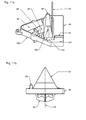
- FIG. 11 a and 11 b show the support 48 and the stopper 50 of the pliers.
- the support 48 is designed so that a separate piece of chocolate rests with less than half of the base surface on the support surface 122.
- the center of gravity 126 of the severed piece of chocolate 94 is located outside the end of the support surface 124. This causes the piece of chocolate 94 to tilt onto the cutting unit 40 after it has been separated from the chocolate bar 34 having the shape 34.
- the stopper 50 secures centering of the chocolate bar to the center of the forceps 130 FIG. 11 To recognize the openings 38 through which the shredded chocolate sections are pressed by means of the press ram from the pliers.
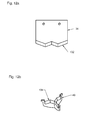
- FIG. 12a represents the shaping 34, for example in the form of a transverse knife.
- FIG. 12b represents the cutting unit 40, for example in the form of a cutting star.
- Shaping 34 and cutting unit 40 have a cutting edge 132, 134.
- the cutting edge can be linear, jagged or wavy, for example. In particular, no high force is required by a non-linear blade, because first the tips or radii in chocolate pieces, especially chocolate ribs, penetrate and thus the effect of precutting can take place.
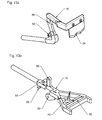
- FIG. 13a shows the representation of the actively designed, movable forceps jaw 18 with the attachment of the shaping 34, for example a transverse knife.
- the cross knife is screwed to the movable jaw.
- FIG. 13b shows the representation of the second, in particular passively designed, fixed forceps jaw 16 with the receiving unit for the separated chocolate piece and the cutting unit 40 in the form of a cutting star.
- the cutting star is embedded in the receiving unit of the fixed jaw.
- the pivot point for the first actively configured pliers leg 66, the pivot point for the third pliers jaw 64, the pivot point for the link 52 and the support for the spring element 96 shown.
- the passively configured pliers jaw also includes a recess 35 in which the shape, for example, a transverse knife can be taken with closed pliers.
- FIG. 14 shows the side view of the forceps from the left in the closed state, in which the forceps arms 12, 14 are compressed.
- the pliers are equipped with a tumbler. This is supported by a pivot point 76. Turning the tumbler 74 to the movable, actively designed pliers legs 12 to the stop, the leg of the tumbler 74 is above the pivot point 76, ie above the dead center 72. Thus, the tumbler 74 can not open, because the spring element 44, the movable , actively designed pliers legs against the leg of the tumbler 74 presses.
- the cutting edge of the passively positioned pliers jaw is in position 138 and is "recessed". The cutting edge of the cutting element is covered 136 by the ram.
Landscapes
- Engineering & Computer Science (AREA)
- Life Sciences & Earth Sciences (AREA)
- Mechanical Engineering (AREA)
- Forests & Forestry (AREA)
- Food Science & Technology (AREA)
- Chemical & Material Sciences (AREA)
- Polymers & Plastics (AREA)
- Food-Manufacturing Devices (AREA)
- Confectionery (AREA)
Applications Claiming Priority (1)
| Application Number | Priority Date | Filing Date | Title |
|---|---|---|---|
| DE202013104051U DE202013104051U1 (de) | 2013-09-06 | 2013-09-06 | Zange zum Abtrennen von Schokoladenstücken |
Publications (2)
| Publication Number | Publication Date |
|---|---|
| EP2845700A1 true EP2845700A1 (fr) | 2015-03-11 |
| EP2845700B1 EP2845700B1 (fr) | 2016-06-22 |
Family
ID=49511349
Family Applications (1)
| Application Number | Title | Priority Date | Filing Date |
|---|---|---|---|
| EP14183594.2A Active EP2845700B1 (fr) | 2013-09-06 | 2014-09-04 | Pince destinée à séparer des morceaux de chocolat |
Country Status (3)
| Country | Link |
|---|---|
| EP (1) | EP2845700B1 (fr) |
| DE (1) | DE202013104051U1 (fr) |
| DK (1) | DK2845700T3 (fr) |
Citations (7)
| Publication number | Priority date | Publication date | Assignee | Title |
|---|---|---|---|---|
| FR742229A (fr) * | 1933-03-02 | |||
| IT1200532B (it) | 1986-07-18 | 1989-01-18 | Marco Concetti | Arnese casalingo per il taglio del torrone |
| GB2270248A (en) | 1992-09-08 | 1994-03-09 | Jamie Slack | A confectionery breaker |
| DE202006019957U1 (de) * | 2006-02-16 | 2007-07-26 | Jabbusch, Wolfgang | Vorrichtung zum Zerteilen von Kleinkörpern, insbesondere Tabletten |
| US20090308211A1 (en) * | 2008-06-11 | 2009-12-17 | Mcbride Mark Tabin | Hand tool and method of using same |
| US20110289784A1 (en) * | 2010-05-31 | 2011-12-01 | David Thomas Jones | Spring biased lightweight ergonomic nipper with replaceable blades to accommodate smaller hands and one-handed use |
| US20130183631A1 (en) * | 2012-01-18 | 2013-07-18 | Suhail A. Khouri | Orthodontic Pliers for Four Quadrant V-Bends |
-
2013
- 2013-09-06 DE DE202013104051U patent/DE202013104051U1/de not_active Expired - Lifetime
-
2014
- 2014-09-04 DK DK14183594.2T patent/DK2845700T3/da active
- 2014-09-04 EP EP14183594.2A patent/EP2845700B1/fr active Active
Patent Citations (7)
| Publication number | Priority date | Publication date | Assignee | Title |
|---|---|---|---|---|
| FR742229A (fr) * | 1933-03-02 | |||
| IT1200532B (it) | 1986-07-18 | 1989-01-18 | Marco Concetti | Arnese casalingo per il taglio del torrone |
| GB2270248A (en) | 1992-09-08 | 1994-03-09 | Jamie Slack | A confectionery breaker |
| DE202006019957U1 (de) * | 2006-02-16 | 2007-07-26 | Jabbusch, Wolfgang | Vorrichtung zum Zerteilen von Kleinkörpern, insbesondere Tabletten |
| US20090308211A1 (en) * | 2008-06-11 | 2009-12-17 | Mcbride Mark Tabin | Hand tool and method of using same |
| US20110289784A1 (en) * | 2010-05-31 | 2011-12-01 | David Thomas Jones | Spring biased lightweight ergonomic nipper with replaceable blades to accommodate smaller hands and one-handed use |
| US20130183631A1 (en) * | 2012-01-18 | 2013-07-18 | Suhail A. Khouri | Orthodontic Pliers for Four Quadrant V-Bends |
Also Published As
| Publication number | Publication date |
|---|---|
| DK2845700T3 (da) | 2016-10-03 |
| EP2845700B1 (fr) | 2016-06-22 |
| DE202013104051U1 (de) | 2013-09-26 |
Similar Documents
| Publication | Publication Date | Title |
|---|---|---|
| DE102006012754B4 (de) | Chirurgisches Instrument | |
| DE2713410A1 (de) | Zange, insbesondere zum anbringen von ohrmarkierungen bei tieren | |
| EP0454615B1 (fr) | Pince pour couper des clous, des fils ou d'autres articles chirurgicaux similaires | |
| EP1159870A2 (fr) | Cisaille, notamment sécateur manuel pour le jardin et les branches | |
| EP0416358A2 (fr) | Tête de rasage pour rasoir mécanique | |
| DE202009001625U1 (de) | Vereinzelungsvorrichtung zum Abscheren von an einem Vorratsband aufgereihten Werkstücken | |
| DE3141248A1 (de) | "motorbetreibbarer schraubenzieher" | |
| EP1319456A1 (fr) | Découpeur de câbles | |
| EP2845700B1 (fr) | Pince destinée à séparer des morceaux de chocolat | |
| DE102014104146B4 (de) | Stanze | |
| EP3643465A1 (fr) | Outil manuel de type rabot de coupe | |
| EP3854550B1 (fr) | Connecteur rapide pour un couteau de machine à découper | |
| DE1300451B (de) | Scheibenschneidgeraet | |
| DE3407646A1 (de) | Vorrichtung zur entnahme von materialproben | |
| EP0058349A2 (fr) | Outil pour déformer, presser ou pour exécuter d'autres opérations sous l'application de pression | |
| DE9015493U1 (de) | Gerät zum Anschneiden von Stielen von Schnittblumen | |
| EP1045499A1 (fr) | Pince | |
| DE202016106708U1 (de) | Handgerät zum Zerkleinern von Lebensmitteln | |
| DE20308397U1 (de) | Baumschere | |
| DE326294C (de) | Vorrichtung zum Abstuetzen der Werkstuecke beim Abscheren an Schrauben- u. dgl. Pressen | |
| DE459543C (de) | Maschine zur Herstellung von Drahtstiften | |
| DE232560C (fr) | ||
| DE113958C (fr) | ||
| DE8321569U1 (de) | Zange, insbesondere zum Abisolieren und Schneiden von elektrischem Kabel sowie dessen Befestigung an Anschlußklemmen | |
| DE676538C (de) | Ohrmarkenzange |
Legal Events
| Date | Code | Title | Description |
|---|---|---|---|
| 17P | Request for examination filed |
Effective date: 20140904 |
|
| AK | Designated contracting states |
Kind code of ref document: A1 Designated state(s): AL AT BE BG CH CY CZ DE DK EE ES FI FR GB GR HR HU IE IS IT LI LT LU LV MC MK MT NL NO PL PT RO RS SE SI SK SM TR |
|
| AX | Request for extension of the european patent |
Extension state: BA ME |
|
| PUAI | Public reference made under article 153(3) epc to a published international application that has entered the european phase |
Free format text: ORIGINAL CODE: 0009012 |
|
| R17P | Request for examination filed (corrected) |
Effective date: 20150909 |
|
| RBV | Designated contracting states (corrected) |
Designated state(s): AL AT BE BG CH CY CZ DE DK EE ES FI FR GB GR HR HU IE IS IT LI LT LU LV MC MK MT NL NO PL PT RO RS SE SI SK SM TR |
|
| GRAP | Despatch of communication of intention to grant a patent |
Free format text: ORIGINAL CODE: EPIDOSNIGR1 |
|
| RIC1 | Information provided on ipc code assigned before grant |
Ipc: B26F 3/00 20060101ALI20160212BHEP Ipc: B26B 17/00 20060101AFI20160212BHEP |
|
| INTG | Intention to grant announced |
Effective date: 20160308 |
|
| GRAS | Grant fee paid |
Free format text: ORIGINAL CODE: EPIDOSNIGR3 |
|
| GRAA | (expected) grant |
Free format text: ORIGINAL CODE: 0009210 |
|
| AK | Designated contracting states |
Kind code of ref document: B1 Designated state(s): AL AT BE BG CH CY CZ DE DK EE ES FI FR GB GR HR HU IE IS IT LI LT LU LV MC MK MT NL NO PL PT RO RS SE SI SK SM TR |
|
| REG | Reference to a national code |
Ref country code: GB Ref legal event code: FG4D Free format text: NOT ENGLISH |
|
| REG | Reference to a national code |
Ref country code: CH Ref legal event code: EP |
|
| REG | Reference to a national code |
Ref country code: IE Ref legal event code: FG4D Free format text: LANGUAGE OF EP DOCUMENT: GERMAN |
|
| REG | Reference to a national code |
Ref country code: AT Ref legal event code: REF Ref document number: 807385 Country of ref document: AT Kind code of ref document: T Effective date: 20160715 |
|
| REG | Reference to a national code |
Ref country code: DE Ref legal event code: R096 Ref document number: 502014000971 Country of ref document: DE |
|
| REG | Reference to a national code |
Ref country code: FR Ref legal event code: PLFP Year of fee payment: 3 |
|
| REG | Reference to a national code |
Ref country code: NL Ref legal event code: FP |
|
| REG | Reference to a national code |
Ref country code: DK Ref legal event code: T3 Effective date: 20160926 |
|
| REG | Reference to a national code |
Ref country code: LT Ref legal event code: MG4D |
|
| PG25 | Lapsed in a contracting state [announced via postgrant information from national office to epo] |
Ref country code: NO Free format text: LAPSE BECAUSE OF FAILURE TO SUBMIT A TRANSLATION OF THE DESCRIPTION OR TO PAY THE FEE WITHIN THE PRESCRIBED TIME-LIMIT Effective date: 20160922 Ref country code: FI Free format text: LAPSE BECAUSE OF FAILURE TO SUBMIT A TRANSLATION OF THE DESCRIPTION OR TO PAY THE FEE WITHIN THE PRESCRIBED TIME-LIMIT Effective date: 20160622 Ref country code: LT Free format text: LAPSE BECAUSE OF FAILURE TO SUBMIT A TRANSLATION OF THE DESCRIPTION OR TO PAY THE FEE WITHIN THE PRESCRIBED TIME-LIMIT Effective date: 20160622 |
|
| PG25 | Lapsed in a contracting state [announced via postgrant information from national office to epo] |
Ref country code: HR Free format text: LAPSE BECAUSE OF FAILURE TO SUBMIT A TRANSLATION OF THE DESCRIPTION OR TO PAY THE FEE WITHIN THE PRESCRIBED TIME-LIMIT Effective date: 20160622 Ref country code: RS Free format text: LAPSE BECAUSE OF FAILURE TO SUBMIT A TRANSLATION OF THE DESCRIPTION OR TO PAY THE FEE WITHIN THE PRESCRIBED TIME-LIMIT Effective date: 20160622 Ref country code: GR Free format text: LAPSE BECAUSE OF FAILURE TO SUBMIT A TRANSLATION OF THE DESCRIPTION OR TO PAY THE FEE WITHIN THE PRESCRIBED TIME-LIMIT Effective date: 20160923 Ref country code: SE Free format text: LAPSE BECAUSE OF FAILURE TO SUBMIT A TRANSLATION OF THE DESCRIPTION OR TO PAY THE FEE WITHIN THE PRESCRIBED TIME-LIMIT Effective date: 20160622 Ref country code: LV Free format text: LAPSE BECAUSE OF FAILURE TO SUBMIT A TRANSLATION OF THE DESCRIPTION OR TO PAY THE FEE WITHIN THE PRESCRIBED TIME-LIMIT Effective date: 20160622 |
|
| PG25 | Lapsed in a contracting state [announced via postgrant information from national office to epo] |
Ref country code: RO Free format text: LAPSE BECAUSE OF FAILURE TO SUBMIT A TRANSLATION OF THE DESCRIPTION OR TO PAY THE FEE WITHIN THE PRESCRIBED TIME-LIMIT Effective date: 20160622 Ref country code: IS Free format text: LAPSE BECAUSE OF FAILURE TO SUBMIT A TRANSLATION OF THE DESCRIPTION OR TO PAY THE FEE WITHIN THE PRESCRIBED TIME-LIMIT Effective date: 20161022 Ref country code: EE Free format text: LAPSE BECAUSE OF FAILURE TO SUBMIT A TRANSLATION OF THE DESCRIPTION OR TO PAY THE FEE WITHIN THE PRESCRIBED TIME-LIMIT Effective date: 20160622 Ref country code: SK Free format text: LAPSE BECAUSE OF FAILURE TO SUBMIT A TRANSLATION OF THE DESCRIPTION OR TO PAY THE FEE WITHIN THE PRESCRIBED TIME-LIMIT Effective date: 20160622 |
|
| PG25 | Lapsed in a contracting state [announced via postgrant information from national office to epo] |
Ref country code: ES Free format text: LAPSE BECAUSE OF FAILURE TO SUBMIT A TRANSLATION OF THE DESCRIPTION OR TO PAY THE FEE WITHIN THE PRESCRIBED TIME-LIMIT Effective date: 20160622 Ref country code: SM Free format text: LAPSE BECAUSE OF FAILURE TO SUBMIT A TRANSLATION OF THE DESCRIPTION OR TO PAY THE FEE WITHIN THE PRESCRIBED TIME-LIMIT Effective date: 20160622 Ref country code: PL Free format text: LAPSE BECAUSE OF FAILURE TO SUBMIT A TRANSLATION OF THE DESCRIPTION OR TO PAY THE FEE WITHIN THE PRESCRIBED TIME-LIMIT Effective date: 20160622 Ref country code: PT Free format text: LAPSE BECAUSE OF FAILURE TO SUBMIT A TRANSLATION OF THE DESCRIPTION OR TO PAY THE FEE WITHIN THE PRESCRIBED TIME-LIMIT Effective date: 20161024 |
|
| REG | Reference to a national code |
Ref country code: DE Ref legal event code: R097 Ref document number: 502014000971 Country of ref document: DE |
|
| PLBE | No opposition filed within time limit |
Free format text: ORIGINAL CODE: 0009261 |
|
| STAA | Information on the status of an ep patent application or granted ep patent |
Free format text: STATUS: NO OPPOSITION FILED WITHIN TIME LIMIT |
|
| 26N | No opposition filed |
Effective date: 20170323 |
|
| REG | Reference to a national code |
Ref country code: IE Ref legal event code: MM4A |
|
| PG25 | Lapsed in a contracting state [announced via postgrant information from national office to epo] |
Ref country code: IE Free format text: LAPSE BECAUSE OF NON-PAYMENT OF DUE FEES Effective date: 20160904 |
|
| PG25 | Lapsed in a contracting state [announced via postgrant information from national office to epo] |
Ref country code: SI Free format text: LAPSE BECAUSE OF FAILURE TO SUBMIT A TRANSLATION OF THE DESCRIPTION OR TO PAY THE FEE WITHIN THE PRESCRIBED TIME-LIMIT Effective date: 20160622 |
|
| REG | Reference to a national code |
Ref country code: FR Ref legal event code: PLFP Year of fee payment: 4 |
|
| PG25 | Lapsed in a contracting state [announced via postgrant information from national office to epo] |
Ref country code: HU Free format text: LAPSE BECAUSE OF FAILURE TO SUBMIT A TRANSLATION OF THE DESCRIPTION OR TO PAY THE FEE WITHIN THE PRESCRIBED TIME-LIMIT; INVALID AB INITIO Effective date: 20140904 |
|
| PG25 | Lapsed in a contracting state [announced via postgrant information from national office to epo] |
Ref country code: MK Free format text: LAPSE BECAUSE OF FAILURE TO SUBMIT A TRANSLATION OF THE DESCRIPTION OR TO PAY THE FEE WITHIN THE PRESCRIBED TIME-LIMIT Effective date: 20160622 Ref country code: CY Free format text: LAPSE BECAUSE OF FAILURE TO SUBMIT A TRANSLATION OF THE DESCRIPTION OR TO PAY THE FEE WITHIN THE PRESCRIBED TIME-LIMIT Effective date: 20160622 Ref country code: MT Free format text: LAPSE BECAUSE OF FAILURE TO SUBMIT A TRANSLATION OF THE DESCRIPTION OR TO PAY THE FEE WITHIN THE PRESCRIBED TIME-LIMIT Effective date: 20160622 |
|
| PG25 | Lapsed in a contracting state [announced via postgrant information from national office to epo] |
Ref country code: BG Free format text: LAPSE BECAUSE OF FAILURE TO SUBMIT A TRANSLATION OF THE DESCRIPTION OR TO PAY THE FEE WITHIN THE PRESCRIBED TIME-LIMIT Effective date: 20160622 |
|
| REG | Reference to a national code |
Ref country code: FR Ref legal event code: PLFP Year of fee payment: 5 |
|
| PG25 | Lapsed in a contracting state [announced via postgrant information from national office to epo] |
Ref country code: TR Free format text: LAPSE BECAUSE OF FAILURE TO SUBMIT A TRANSLATION OF THE DESCRIPTION OR TO PAY THE FEE WITHIN THE PRESCRIBED TIME-LIMIT Effective date: 20160622 Ref country code: AL Free format text: LAPSE BECAUSE OF FAILURE TO SUBMIT A TRANSLATION OF THE DESCRIPTION OR TO PAY THE FEE WITHIN THE PRESCRIBED TIME-LIMIT Effective date: 20160622 |
|
| GBPC | Gb: european patent ceased through non-payment of renewal fee |
Effective date: 20180904 |
|
| PG25 | Lapsed in a contracting state [announced via postgrant information from national office to epo] |
Ref country code: GB Free format text: LAPSE BECAUSE OF NON-PAYMENT OF DUE FEES Effective date: 20180904 |
|
| PGFP | Annual fee paid to national office [announced via postgrant information from national office to epo] |
Ref country code: NL Payment date: 20220922 Year of fee payment: 9 Ref country code: LU Payment date: 20220920 Year of fee payment: 9 Ref country code: DK Payment date: 20220926 Year of fee payment: 9 Ref country code: CZ Payment date: 20220824 Year of fee payment: 9 |
|
| PGFP | Annual fee paid to national office [announced via postgrant information from national office to epo] |
Ref country code: MC Payment date: 20220920 Year of fee payment: 9 Ref country code: FR Payment date: 20220921 Year of fee payment: 9 |
|
| PGFP | Annual fee paid to national office [announced via postgrant information from national office to epo] |
Ref country code: IT Payment date: 20220930 Year of fee payment: 9 |
|
| P01 | Opt-out of the competence of the unified patent court (upc) registered |
Effective date: 20230517 |
|
| REG | Reference to a national code |
Ref country code: DK Ref legal event code: EBP Effective date: 20230930 |
|
| PG25 | Lapsed in a contracting state [announced via postgrant information from national office to epo] |
Ref country code: CZ Free format text: LAPSE BECAUSE OF NON-PAYMENT OF DUE FEES Effective date: 20230904 |
|
| REG | Reference to a national code |
Ref country code: NL Ref legal event code: MM Effective date: 20231001 |
|
| PG25 | Lapsed in a contracting state [announced via postgrant information from national office to epo] |
Ref country code: LU Free format text: LAPSE BECAUSE OF NON-PAYMENT OF DUE FEES Effective date: 20230904 |
|
| PG25 | Lapsed in a contracting state [announced via postgrant information from national office to epo] |
Ref country code: LU Free format text: LAPSE BECAUSE OF NON-PAYMENT OF DUE FEES Effective date: 20230904 Ref country code: MC Free format text: LAPSE BECAUSE OF NON-PAYMENT OF DUE FEES Effective date: 20231002 |
|
| PG25 | Lapsed in a contracting state [announced via postgrant information from national office to epo] |
Ref country code: NL Free format text: LAPSE BECAUSE OF NON-PAYMENT OF DUE FEES Effective date: 20231001 |
|
| PG25 | Lapsed in a contracting state [announced via postgrant information from national office to epo] |
Ref country code: NL Free format text: LAPSE BECAUSE OF NON-PAYMENT OF DUE FEES Effective date: 20231001 |
|
| PG25 | Lapsed in a contracting state [announced via postgrant information from national office to epo] |
Ref country code: FR Free format text: LAPSE BECAUSE OF NON-PAYMENT OF DUE FEES Effective date: 20230930 |
|
| PG25 | Lapsed in a contracting state [announced via postgrant information from national office to epo] |
Ref country code: DK Free format text: LAPSE BECAUSE OF NON-PAYMENT OF DUE FEES Effective date: 20230930 |
|
| PG25 | Lapsed in a contracting state [announced via postgrant information from national office to epo] |
Ref country code: DK Free format text: LAPSE BECAUSE OF NON-PAYMENT OF DUE FEES Effective date: 20230930 |
|
| PG25 | Lapsed in a contracting state [announced via postgrant information from national office to epo] |
Ref country code: IT Free format text: LAPSE BECAUSE OF NON-PAYMENT OF DUE FEES Effective date: 20230904 |
|
| PG25 | Lapsed in a contracting state [announced via postgrant information from national office to epo] |
Ref country code: IT Free format text: LAPSE BECAUSE OF NON-PAYMENT OF DUE FEES Effective date: 20230904 |
|
| REG | Reference to a national code |
Ref country code: CH Ref legal event code: U11 Free format text: ST27 STATUS EVENT CODE: U-0-0-U10-U11 (AS PROVIDED BY THE NATIONAL OFFICE) Effective date: 20251001 |
|
| PGFP | Annual fee paid to national office [announced via postgrant information from national office to epo] |
Ref country code: DE Payment date: 20250908 Year of fee payment: 12 |
|
| PGFP | Annual fee paid to national office [announced via postgrant information from national office to epo] |
Ref country code: BE Payment date: 20250919 Year of fee payment: 12 |
|
| PGFP | Annual fee paid to national office [announced via postgrant information from national office to epo] |
Ref country code: AT Payment date: 20250918 Year of fee payment: 12 |
|
| PGFP | Annual fee paid to national office [announced via postgrant information from national office to epo] |
Ref country code: CH Payment date: 20251001 Year of fee payment: 12 |