EP2849718B1 - Mélanges à effet rafraîchissant amélioré - Google Patents
Mélanges à effet rafraîchissant amélioré Download PDFInfo
- Publication number
- EP2849718B1 EP2849718B1 EP13718558.3A EP13718558A EP2849718B1 EP 2849718 B1 EP2849718 B1 EP 2849718B1 EP 13718558 A EP13718558 A EP 13718558A EP 2849718 B1 EP2849718 B1 EP 2849718B1
- Authority
- EP
- European Patent Office
- Prior art keywords
- acid
- mixtures
- phenyl
- oil
- und
- Prior art date
- Legal status (The legal status is an assumption and is not a legal conclusion. Google has not performed a legal analysis and makes no representation as to the accuracy of the status listed.)
- Active
Links
- UJNOLBSYLSYIBM-HPDCSRJSSA-N CC(C)C(CCC(C)C1)C1OC([C@@H](C)O)=O Chemical compound CC(C)C(CCC(C)C1)C1OC([C@@H](C)O)=O UJNOLBSYLSYIBM-HPDCSRJSSA-N 0.000 description 1
- ZBJCYZPANVLBRK-DMPSADRZSA-N CC(C)[C@H](CC[C@@H](C)C1)[C@@]11OC(CO)CO1 Chemical compound CC(C)[C@H](CC[C@@H](C)C1)[C@@]11OC(CO)CO1 ZBJCYZPANVLBRK-DMPSADRZSA-N 0.000 description 1
Classifications
-
- A—HUMAN NECESSITIES
- A23—FOODS OR FOODSTUFFS; TREATMENT THEREOF, NOT COVERED BY OTHER CLASSES
- A23L—FOODS, FOODSTUFFS OR NON-ALCOHOLIC BEVERAGES, NOT OTHERWISE PROVIDED FOR; PREPARATION OR TREATMENT THEREOF
- A23L27/00—Spices; Flavouring agents or condiments; Artificial sweetening agents; Table salts; Dietetic salt substitutes; Preparation or treatment thereof
- A23L27/20—Synthetic spices, flavouring agents or condiments
- A23L27/204—Aromatic compounds
-
- A—HUMAN NECESSITIES
- A61—MEDICAL OR VETERINARY SCIENCE; HYGIENE
- A61K—PREPARATIONS FOR MEDICAL, DENTAL OR TOILETRY PURPOSES
- A61K8/00—Cosmetics or similar toiletry preparations
- A61K8/18—Cosmetics or similar toiletry preparations characterised by the composition
- A61K8/30—Cosmetics or similar toiletry preparations characterised by the composition containing organic compounds
- A61K8/33—Cosmetics or similar toiletry preparations characterised by the composition containing organic compounds containing oxygen
-
- A—HUMAN NECESSITIES
- A23—FOODS OR FOODSTUFFS; TREATMENT THEREOF, NOT COVERED BY OTHER CLASSES
- A23G—COCOA; COCOA PRODUCTS, e.g. CHOCOLATE; SUBSTITUTES FOR COCOA OR COCOA PRODUCTS; CONFECTIONERY; CHEWING GUM; ICE-CREAM; PREPARATION THEREOF
- A23G3/00—Sweetmeats; Confectionery; Marzipan; Coated or filled products
- A23G3/34—Sweetmeats, confectionery or marzipan; Processes for the preparation thereof
- A23G3/36—Sweetmeats, confectionery or marzipan; Processes for the preparation thereof characterised by the composition containing organic or inorganic compounds
-
- A—HUMAN NECESSITIES
- A23—FOODS OR FOODSTUFFS; TREATMENT THEREOF, NOT COVERED BY OTHER CLASSES
- A23G—COCOA; COCOA PRODUCTS, e.g. CHOCOLATE; SUBSTITUTES FOR COCOA OR COCOA PRODUCTS; CONFECTIONERY; CHEWING GUM; ICE-CREAM; PREPARATION THEREOF
- A23G3/00—Sweetmeats; Confectionery; Marzipan; Coated or filled products
- A23G3/34—Sweetmeats, confectionery or marzipan; Processes for the preparation thereof
- A23G3/36—Sweetmeats, confectionery or marzipan; Processes for the preparation thereof characterised by the composition containing organic or inorganic compounds
- A23G3/38—Sucrose-free products
-
- A—HUMAN NECESSITIES
- A23—FOODS OR FOODSTUFFS; TREATMENT THEREOF, NOT COVERED BY OTHER CLASSES
- A23G—COCOA; COCOA PRODUCTS, e.g. CHOCOLATE; SUBSTITUTES FOR COCOA OR COCOA PRODUCTS; CONFECTIONERY; CHEWING GUM; ICE-CREAM; PREPARATION THEREOF
- A23G4/00—Chewing gum
- A23G4/06—Chewing gum characterised by the composition containing organic or inorganic compounds
-
- A—HUMAN NECESSITIES
- A23—FOODS OR FOODSTUFFS; TREATMENT THEREOF, NOT COVERED BY OTHER CLASSES
- A23G—COCOA; COCOA PRODUCTS, e.g. CHOCOLATE; SUBSTITUTES FOR COCOA OR COCOA PRODUCTS; CONFECTIONERY; CHEWING GUM; ICE-CREAM; PREPARATION THEREOF
- A23G9/00—Frozen sweets, e.g. ice confectionery, ice-cream; Mixtures therefor
- A23G9/32—Frozen sweets, e.g. ice confectionery, ice-cream; Mixtures therefor characterised by the composition containing organic or inorganic compounds
-
- A—HUMAN NECESSITIES
- A23—FOODS OR FOODSTUFFS; TREATMENT THEREOF, NOT COVERED BY OTHER CLASSES
- A23L—FOODS, FOODSTUFFS OR NON-ALCOHOLIC BEVERAGES, NOT OTHERWISE PROVIDED FOR; PREPARATION OR TREATMENT THEREOF
- A23L27/00—Spices; Flavouring agents or condiments; Artificial sweetening agents; Table salts; Dietetic salt substitutes; Preparation or treatment thereof
- A23L27/86—Addition of bitterness inhibitors
-
- A—HUMAN NECESSITIES
- A23—FOODS OR FOODSTUFFS; TREATMENT THEREOF, NOT COVERED BY OTHER CLASSES
- A23L—FOODS, FOODSTUFFS OR NON-ALCOHOLIC BEVERAGES, NOT OTHERWISE PROVIDED FOR; PREPARATION OR TREATMENT THEREOF
- A23L27/00—Spices; Flavouring agents or condiments; Artificial sweetening agents; Table salts; Dietetic salt substitutes; Preparation or treatment thereof
- A23L27/88—Taste or flavour enhancing agents
-
- A—HUMAN NECESSITIES
- A61—MEDICAL OR VETERINARY SCIENCE; HYGIENE
- A61K—PREPARATIONS FOR MEDICAL, DENTAL OR TOILETRY PURPOSES
- A61K31/00—Medicinal preparations containing organic active ingredients
- A61K31/045—Hydroxy compounds, e.g. alcohols; Salts thereof, e.g. alcoholates
-
- A—HUMAN NECESSITIES
- A61—MEDICAL OR VETERINARY SCIENCE; HYGIENE
- A61K—PREPARATIONS FOR MEDICAL, DENTAL OR TOILETRY PURPOSES
- A61K31/00—Medicinal preparations containing organic active ingredients
- A61K31/11—Aldehydes
-
- A—HUMAN NECESSITIES
- A61—MEDICAL OR VETERINARY SCIENCE; HYGIENE
- A61K—PREPARATIONS FOR MEDICAL, DENTAL OR TOILETRY PURPOSES
- A61K8/00—Cosmetics or similar toiletry preparations
- A61K8/18—Cosmetics or similar toiletry preparations characterised by the composition
- A61K8/30—Cosmetics or similar toiletry preparations characterised by the composition containing organic compounds
- A61K8/33—Cosmetics or similar toiletry preparations characterised by the composition containing organic compounds containing oxygen
- A61K8/34—Alcohols
-
- A—HUMAN NECESSITIES
- A61—MEDICAL OR VETERINARY SCIENCE; HYGIENE
- A61Q—SPECIFIC USE OF COSMETICS OR SIMILAR TOILETRY PREPARATIONS
- A61Q11/00—Preparations for care of the teeth, of the oral cavity or of dentures; Dentifrices, e.g. toothpastes; Mouth rinses
-
- A—HUMAN NECESSITIES
- A61—MEDICAL OR VETERINARY SCIENCE; HYGIENE
- A61Q—SPECIFIC USE OF COSMETICS OR SIMILAR TOILETRY PREPARATIONS
- A61Q19/00—Preparations for care of the skin
-
- A—HUMAN NECESSITIES
- A23—FOODS OR FOODSTUFFS; TREATMENT THEREOF, NOT COVERED BY OTHER CLASSES
- A23V—INDEXING SCHEME RELATING TO FOODS, FOODSTUFFS OR NON-ALCOHOLIC BEVERAGES AND LACTIC OR PROPIONIC ACID BACTERIA USED IN FOODSTUFFS OR FOOD PREPARATION
- A23V2002/00—Food compositions, function of food ingredients or processes for food or foodstuffs
-
- A—HUMAN NECESSITIES
- A61—MEDICAL OR VETERINARY SCIENCE; HYGIENE
- A61K—PREPARATIONS FOR MEDICAL, DENTAL OR TOILETRY PURPOSES
- A61K2800/00—Properties of cosmetic compositions or active ingredients thereof or formulation aids used therein and process related aspects
- A61K2800/20—Chemical, physico-chemical or functional or structural properties of the composition as a whole
- A61K2800/24—Thermal properties
- A61K2800/244—Endothermic; Cooling; Cooling sensation
Definitions
- the invention is in the field of substances with cooling sensory effect and relates to mixtures with improved cooling effect and preparations containing these mixtures.
- Flavoring flavor compositions with cooling effect e.g. Oral hygiene products, such as toothpastes and mouthwashes, and sweets such as sweets and chewing gum, their typical, fresh and pleasant taste.
- Substances which are widely used for the preparation of such flavor compositions with cooling effect are, for example, eucalyptol (1,8-cineole) and menthol.
- the use of these substances has some disadvantages.
- eucalyptol has a very strong medicinal taste, which many consumers find repulsive, especially when eucalyptol is used in higher doses.
- menthol With the use of menthol, the cooling effect begins with a certain delay, and at higher dosages the menthol develops a bitter, sharp and pungent taste, which has a rather unpleasant effect.
- the object of the present invention has thus been to provide formulations which have an improved physiological cooling effect and thereby have low or reduced undesirable properties, ie in addition also improves the perception of the taste of the refrigerants.
- the invention relates to mixtures containing
- R 1 and R 2 independently of one another represent hydrogen, a methyl or phenyl radical
- R 3 represents hydrogen, a phenyl, an alkenyl or a linear or branched alkyl radical having 1 to 5 C atoms
- the dashed double lines independently represent a single bond or double bond from each other
- the mixture according to the invention has an enhanced cooling effect without increasing the undesirable properties of the physiological cooling agents, such as stinging, burning or bitterness.
- the cooling effect of the physiological coolants is enhanced, even a reduction in puncturing, burning or bitterness can be achieved.
- Phenylalkenals (component a) are known substances which can be obtained by the relevant processes of organic chemistry and which are described, for example, by Maruoka et al. in JACS 11, pp. 7922-7924 (1988 )
- 2-phenyl-but-2-enal is already used in a wide variety of compositions. So will in WO 2010 146258 A the use of 2-phenyl-but-2-enal in deo-compositions and in WO 2008 149102 A described as a preservative. In WO 2008 049581 A is 2-phenyl-but-2-enal in Vietnamesearomen and in WO 2008 011742 A revealed as a flavor precursor for food. JP 2006 121958 A . JP 2006 025706 A . JP 200 020526 A . JP 2004 135522 A such as DE1921560A disclose 2-phenyl-but-2-enal for improving cocoa, nut, coffee and fish flavors.
- phenylalkenals of the formula (I) in which R 1 and R 2 are different and denote hydrogen or phenyl, R 3 is hydrogen, an alkenyl or a linear or branched alkyl group having 1 to 5 C atoms , and the dashed double lines independently represent a single bond or double bond.
- the phenylalkenal of formula (I) is selected from the group formed by 2-phenyl-but-2-enal, 2-phenyl-pent-2-enal, 3-phenyl-pentene 4-enal, 2-phenyl-pent-4-enal and mixtures thereof.
- Physiological coolants which are suitable for the purposes of the present invention, predominantly represent menthol or menthol compounds. Physiologically in this context means that they are also approved for oral use.
- a first important representative of the substances constituting component (b) is the Monomenthyl Succinate (FEMA GRAS 3810), which was already used as a substance in 1963 by Brown & Williamson Tobacco Corp. been patented ( US 3,111,127 ) and as a coolant subject of the property rights US 5,725,865 and 5,843,466 (V.Mane Fils ) .
- Both the succinate and the analogous monomenthyl glutarate (FEMA GRAS 4006) are important representatives of monomenthyl esters based on di- and polycarboxylic acids:
- FEMA GRAS 3807 Menthone glyceryl acetal
- FEMA GRAS 3808 Menthone glyceryl ketal
- the former structure is obtained by esterification of lactic acid with menthol, the latter by acetalization of menthone with glycerol (cf. DE 2608226 A1 , H & R). Also included in this group of compounds is 3- (I-menthoxy) -1,2, propanediol, also known as Cooling Agent 10 (FEMA GRAS 3784, cf. US 6,328,982 , TIC), and the 3- (I-menthoxy) -2-methyl-1,2, propanediol (FEMA GRAS 3849), which has an additional methyl group.
- Cooling Agent 10 FEMA GRAS 3784, cf. US 6,328,982 , TIC
- FEMA GRAS 3849 3- (I-menthoxy) -2-methyl-1,2, propanediol
- menthones glyceryl acetal / ketal and the Menthyl Lactate and Menthol Ethylene Glycol carbonates or menthol Propylene Glycol Carbonatw have proven that the Applicant under the names Frescolat ® MGA, Frescolat ® ML, Frecolat ® MGC and Frescolat ® MPC sells.
- menthol compounds were first developed which have a C-C bond in the 3-position and of which a number of representatives in accordance with the invention can also be used. These substances are generally referred to as WS types.
- Base is a menthol derivative in which the hydroxyl is replaced by a carboxyl group (WS-1). All other WS types are derived from this structure, such as, for example, the preferred species WS-3, WS-4, WS-5, WS-12, WS-14 and WS-30.
- the two following graphs show the synthetic routes:
- esters derived from WS-1 are described, for example, in US Pat US 4,157,384 , the corresponding N-substituted amides in J. Soc. Cosmet. Chem. Pp. 185-200 (1978 ) .
- preparations which contain, as component (b), cooling agents which are selected from the group formed by menthol, L-menthol, menthone glycerin acetal, menthyl lactate, substituted menthane-3-carboxamides, menthane-3-carboxylic acid N- ethylamide, 2-isopropyl-N, 2,3-trimethylbutanamide, substituted cyclohexanecarboxamides, 3-menthoxy-1,2-propanediol, 2-hydroxyethylmenthylcarbonate, 2-hydroxypropylmenthylcarbonate, N-acetylglycine-menthylester, menthylhydroxycarboxylic acid esters,. Menthyl 3-hydroxybutyrate, menthyl monosuccinate, 2-mercaptocyclodecanone, menthyl-2-pyrrolidin-5-one carboxylate and mixtures thereof.
- cooling agents which are selected from the group formed by menthol, L-menthol,
- the mixtures according to the invention may contain one or more flavoring substances as optional component ⁇ .
- Typical examples include: acetophenone, allyl capronate, alpha-ionone, beta-ionone, anisaldehyde, anisylacetate, anisylformate, benzaldehyde, benzothiazole, benzylacetate, benzylalcohol, benzylbenzoate, beta-ionone, butylbutyrate, butylcapronate, butylidenephthalide, carvone, camphene, caryophyllene, cineole, Cinnamyl acetate, citral, citronellol, citronellal, citronellyl acetate, cyclohexyl acetate, cymene, damascone, decalactone, dihydrocoumarin, dimethyl anthranilate, dimethyl anthranilate, dodecalactone, ethoxyeth
- the flavors are selected from the group consisting of anethole, menthone, isomenthone, menthyl acetate, menthofuran, mint lactone, eucalyptol, limonene, eugenol, pinene, sabin hydrate, 3-octanol, carvone, gamma-octalactone, gamma-nonalactone, Germacren-D, viridiflorol, 1,3E, 5Z-undecatriene, isopulegol, piperitone, 2-butanone, ethyl formate, 3-octyl acetate, isoamylisovalerate, hexanol, hexanal, cis-3-hexenol, linalool, alpha-terpineol, cis and trans carvylacetate , p-cymene, damascenone, damascone,
- the mixtures may contain as optional component (d) solvents.
- solvents Particularly suitable compounds are those selected from the group consisting of ethyl alcohol, 1,2-propylene glycol, triacetin, benzyl alcohol and fatty oils and mixtures thereof.
- the optional components (c) and (d) may each be in amounts of from about 0.1 to about 70% by weight, preferably about 1 to about 60% by weight, and especially about about 0.3 to about 70% by weight of the mixture (a + b) 5 to about 50 wt .-% are added.
- Cosmetic and / or pharmaceutical agents including oral and dental care
- Another object of the present invention relates to cosmetic and / or pharmaceutical preparations and especially oral and dental care compositions containing the inventive mixtures preferably in amounts of about 0.0001 to about 20 wt .-%, more preferably about 0.0005 to about 10 wt % and especially about 0.001 to about 5 wt .-%, and more preferably 0.001 to about 1 wt .-%.
- agents may contain other typical adjuncts and additives, such as mild surfactants, oils, emulsifiers, pearlescent waxes, bodying agents, thickeners, superfatting agents, stabilizers, polymers, silicone compounds, fats, waxes, lecithins, phospholipids, UV protection factors, humectants, biogenic agents , Antioxidants, deodorants, antiperspirants, antidandruff agents, film formers, swelling agents, insect repellents, self-tanner, tyrosine inhibitors (depigmenting agents), hydrotropes, solubilizers, preservatives, perfume oils, dyes and the like.
- mild surfactants oils, emulsifiers, pearlescent waxes, bodying agents, thickeners, superfatting agents, stabilizers, polymers, silicone compounds, fats, waxes, lecithins, phospholipids, UV protection factors, humectants, biogenic agents , Antioxidants, deodorants, anti
- Surfactants which may be present are anionic, nonionic, cationic and / or amphoteric or zwitterionic surfactants, the proportion of which in the compositions is usually from about 1 to 70, preferably from 5 to 50, and in particular from 10 to 30,% by weight.
- anionic surfactants are soaps, alkylbenzenesulfonates, alkanesulfonates, olefinsulfonates, alkyl ether sulfonates, glycerol ether sulfonates, ⁇ -methyl ester sulfonates, sulfo fatty acids, Alkyl sulfates, alkyl ether sulfates, glycerol ether sulfates, fatty acid ether sulfates, hydroxy mixed ether sulfates, monoglyceride (ether) sulfates, fatty acid amide (ether) sulfates, mono- and dialkyl sulfosuccinates, mono- and dialkyl sulfosuccinamates, sulfotriglycerides, amide soaps, ether carboxylic acids and their salts, fatty acid isethionates, fatty acid sarcosinates,
- anionic surfactants contain polyglycol ether chains, these may have a conventional, but preferably a narrow homolog distribution.
- Typical examples of nonionic surfactants are fatty alcohol polyglycol ethers, alkylphenol polyglycol ethers, fatty acid polyglycol ethers, fatty acid amide polyglycol ethers, fatty amine polyglycol ethers, alkoxylated triglycerides, mixed ethers, optionally partially oxidized alk (en) yloligoglycosides or glucuronic acid derivatives, fatty acid N-alkylglucamides, protein hydrolysates (especially wheat-based vegetable products).
- Nonionic surfactants contain polyglycol ether chains, these may have a conventional, but preferably a narrow homolog distribution.
- Typical examples of cationic surfactants are quaternary ammonium compounds such as dimethyl distearyl ammonium chloride, and ester quats, especially quaternized fatty acid trialkanolamine ester salts.
- Typical examples of amphoteric or zwitterionic surfactants are alkylbetaines, alkylamidobetaines, aminopropionates, aminoglycinates, imidazolinium betaines and sulfobetaines.
- surfactants mentioned are exclusively known compounds.
- particularly suitable mild, ie particularly skin-friendly surfactants are fatty alcohol polyglycol ether sulfates, monoglyceride sulfates, mono- and / or dialkyl sulfosuccinates, fatty acid isethionates, fatty acid sarcosinates, fatty acid taurides, fatty acid glutamates, ⁇ -olefinsulfonates, ethercarboxylic acids, alkyloligoglucosides, fatty acid glucamides, alkylamidobetaines, amphoacetals and / or protein fatty acid condensates, the latter preferably based on wheat proteins.
- oil bodies are Guerbet alcohols based on fatty alcohols having 6 to 18, preferably 8 to 10 carbon atoms, esters of linear C 6 -C 22 fatty acids with linear or branched C 6 -C 22 fatty alcohols or esters of branched C 6 -C 13 -carboxylic acids with linear or branched C 6 -C 22 -fatty alcohols, such as myristyl myristate, myristyl palmitate, myristyl stearate, Myristylisostearat, myristyl, Myristylbehenat, Myristylerucat, cetyl myristate, cetyl palmitate, cetyl stearate, Cetylisostearat, cetyl oleate, cetyl behenate, Cetylerucat, Stearylmyristat, stearyl palmitate, stearyl stearate , Stearylisostearat, stearyl oleate, ste
- esters of linear C 6 -C 22 -fatty acids with branched alcohols in particular 2-ethylhexanol
- esters of C 18 -C 38 -alkylhydroxycarboxylic acids with linear or branched C 6 -C 22 -fatty alcohols in particular Dioctyl malates
- esters of linear and / or branched fatty acids with polyhydric alcohols (such as propylene glycol, dimerdiol or trimer triol) and / or Guerbet alcohols triglycerides based on C 6 -C 10 fatty acids, liquid mono- / di- / Triglyceridmischieux based on C 6 -C 18 fatty acids, esters of C 6 -C 22 fatty alcohols and / or Guerbet alcohols with aromatic carboxylic acids, in particular benzoic acid, esters of C 2 -C 12 dicarboxylic acids with linear or branched alcohols having 1 to 22 carbon atoms
- Typical examples of fats are glycerides, i. solid or liquid vegetable or animal products consisting essentially of mixed glycerol esters of higher fatty acids, used as waxes i.a. natural waxes, e.g. Candelilla wax, carnauba wax, Japan wax, esparto wax wax, cork wax, guaruma wax, rice germ oil wax, sugarcane wax, ouricury wax, montan wax, beeswax, shellac wax, spermaceti, lanolin (wool wax), crepe fat, ceresin, ozokerite (earth wax), petrolatum, paraffin waxes, microwaxes; chemically modified waxes (hard waxes), e.g.
- waxes i.a. natural waxes, e.g. Candelilla wax, carnauba wax, Japan wax, esparto wax wax, cork wax, guaruma wax, rice germ oil wax, sugarcane
- synthetic waxes such as e.g. Polyalkylene waxes and polyethylene glycol waxes in question.
- fats come as additives and fat-like substances such as lecithins and phospholipids in question.
- lecithin those skilled in the art will understand those glycerophospholipids which are formed from fatty acids, glycerol, phosphoric acid and choline by esterification. Lecithins are therefore often referred to in the art as Phosphatidylcholine (PC).
- Examples of natural lecithins include the cephalins, which are also referred to as phosphatidic acids and derivatives of 1,2-diacyl-sn-glycerol-3-phosphoric acids.
- cephalins which are also referred to as phosphatidic acids and derivatives of 1,2-diacyl-sn-glycerol-3-phosphoric acids.
- phospholipids are usually understood as meaning mono- and preferably diesters of phosphoric acid with glycerol (glycerol phosphates), which are generally regarded as fats.
- sphingosines or sphingolipids are also suitable.
- Suitable pearlescing waxes are, for example: alkylene glycol esters, especially ethylene glycol distearate; Fatty acid alkanolamides, especially coconut fatty acid diethanolamide; Partial glycerides, especially stearic acid monoglyceride; Esters of polybasic, optionally hydroxy-substituted carboxylic acids with fatty alcohols having 6 to 22 carbon atoms, especially long-chain esters of tartaric acid; Fatty substances, such as fatty alcohols, fatty ketones, fatty aldehydes, fatty ethers and fatty carbonates, which in total have at least 24 carbon atoms, especially lauron and distearyl ether; Fatty acids such as stearic acid, hydroxystearic acid or behenic acid, ring-opening products of olefin epoxides having 12 to 22 carbon atoms with fatty alcohols having 12 to 22 carbon atoms and / or polyols having 2 to 15 carbon atoms
- fatty alcohols or hydroxy fatty alcohols having 12 to 22 and preferably 16 to 18 carbon atoms and in addition partial glycerides, fatty acids or hydroxy fatty acids into consideration. Preference is given to a combination of these substances with alkyl oligoglucosides and / or fatty acid N-methylglucamides of the same chain length and / or polyglycerol poly-12-hydroxystearates.
- Suitable thickening agents are, for example, Aerosil types (hydrophilic silicic acids), polysaccharides, in particular xanthan gum, guar guar, agar agar, alginates and tyloses, carboxymethyl cellulose and hydroxyethyl and hydroxypropylcellulose, also higher molecular weight polyethylene glycol mono- and diesters of fatty acids, polyacrylates, (eg Carbopole® and Pemulen types from Goodrich; Synthalene® from Sigma; Keltrol types from Kelco; Sepigel types from Seppic; Salcare types from Allied Colloids) , Polyacrylamides, polymers, polyvinyl alcohol and polyvinylpyrrolidone.
- Aerosil types hydrophilic silicic acids
- polysaccharides in particular xanthan gum, guar guar, agar agar, alginates and tyloses, carboxymethyl cellulose and hydroxyethyl and hydroxypropylcellulose
- Bentone ® Gel VS-5PC (Rheox)
- bentonites such as Bentone ® Gel VS-5PC (Rheox)
- surfactants such as, for example, ethoxylated fatty acid glycerides, esters of fatty acids with polyols, for example pentaerythritol or trimethylolpropane, fatty alcohol ethoxylates with narrow homolog distribution or alkyl oligoglucosides and also electrolytes, such as common salt and ammonium chloride.
- substances such as lanolin and lecithin as well as polyethoxylated or acylated lanolin and lecithin derivatives, polyol fatty acid esters, monoglycerides and fatty acid alkanolamides can be used, the latter also serving as foam stabilizers.
- metal salts of fatty acids e.g. Magnesium, aluminum and / or zinc stearate or ricinoleate can be used.
- Suitable cationic polymers are, for example, cationic cellulose derivatives, e.g. a quaternized hydroxyethylcellulose available under the name Polymer JR 400® from Amerchol, cationic starch, copolymers of diallylammonium salts and acrylamides, quaternized vinylpyrrolidone / vinylimidazole polymers, e.g.
- Luviquat® condensation products of polyglycols and amines, quaternized collagen polypeptides, such as lauryldimonium hydroxypropyl hydrolyzed collagen (Lamequat®L / Grünau), quaternized wheat polypeptides, polyethylenimine, cationic silicone polymers, e.g.
- Amodimethicones, copolymers of adipic acid and dimethylaminohydroxypropyldiethylenetriamine (Cartaretine® / Sandoz), copolymers of acrylic acid with dimethyldiallylammonium chloride (Merquat® 550 / Chemviron), polyaminopolyamides and their crosslinked water-soluble polymers, cationic chitin derivatives such as quaternized chitosan, optionally microcrystalline dispersed, condensation products of dihaloalkylene , such as Dibromobutane with bis-dialkylamines, e.g. Bis-dimethylamino-1,3-propane, cationic guar gum, e.g. Jaguar® CBS, Jaguar® C-17, Jaguar® C-16 from Celanese, quaternized ammonium salt polymers, e.g. Mirapol® A-15, Mirapol® AD-1, Mirapol® AZ-1 from Miranol.
- anionic, zwitterionic, amphoteric and nonionic polymers are vinyl acetate / crotonic acid copolymers, vinylpyrrolidone / vinyl acrylate copolymers, vinyl acetate / butyl maleate / isobornyl acrylate copolymers, methyl vinyl ether / maleic anhydride copolymers and their esters, uncrosslinked polyols crosslinked with polyols, acrylamidopropyltrimethylammonium chloride / acrylate Copolymers, octylacrylamide / methylmethacrylate / tert.butylaminoethylmethacrylate / 2-hydroxypropylmethacrylate copolymers, polyvinylpyrrolidone, vinylpyrrolidone / vinylacetate copolymers, vinylpyrrolidone / Dimethylaminoethylmethacrylat / vinylcaprolactam terpolymers and optionally
- Suitable silicone compounds are, for example, dimethylpolysiloxanes, methylphenylpolysiloxanes, cyclic silicones and amino, fatty acid, alcohol, polyether, epoxy, fluorine, glycoside and / or alkyl-modified silicone compounds which may be both liquid and resin-form at room temperature.
- simethicones which are mixtures of dimethicones having an average chain length of from 200 to 300 dimethylsiloxane units and hydrogenated silicates.
- UV-A filter in particular derivatives of benzoylmethane are suitable, such as 1- (4'-tert-butylphenyl) -3- (4'-methoxyphenyl) propane-1,3-dione, 4-tert-butyl 4'-methoxydibenzoylmethane (Parsol® 1789), 2- (4-diethylamino-2-hydroxybenzoyl) benzoic acid hexyl ester (Uvinul® A Plus), 1-phenyl-3- (4'-isopropylphenyl) -propane-1, 3-dione and enamine compounds.
- the UV-A and UV-B filters can also be used in mixtures.
- Particularly favorable combinations consist of the derivatives of benzoylmethane, e.g. 4-tert-butyl-4'-methoxydibenzoylmethane (Parsol® 1789) and 2-cyano-3,3-phenylcinnamic acid 2-ethylhexyl ester (octocrylene) in combination with esters of cinnamic acid, preferably 4-methoxycinnamic acid 2-ethylhexyl ester and / or 4-Methoxycinntklarepropylester and / or 4-Methoxycinntklareisoamylester.
- water-soluble filters e.g. 2-phenylbenzimidazole-5-sulfonic acid and their alkali, alkaline earth, ammonium, alkylammonium, alkanolammonium and glucammonium combined.
- insoluble photoprotective pigments namely finely dispersed metal oxides or salts
- suitable metal oxides are in particular zinc oxide and titanium dioxide and, in addition, oxides of iron, zirconium, silicon, manganese, aluminum and cerium and mixtures thereof.
- salts silicates (talc), barium sulfate or zinc stearate can be used.
- the oxides and salts are used in the form of the pigments for skin-care and skin-protecting emulsions and decorative cosmetics.
- the particles should have an average diameter of less than 100 nm, preferably between 5 and 50 nm and in particular between 15 and 30 nm.
- the pigments may have a spherical shape, but it is also possible to use those particles which have an ellipsoidal or otherwise deviating shape from the spherical shape.
- the pigments can also be surface-treated, ie hydrophilized or hydrophobized. Typical examples are coated titanium dioxides, for example Titandioxid T 805 (Degussa) or Eusolex ® T2000, Eusolex ® T, Eusolex ® T-ECO, Eusolex ® TS, Eusolex ® T-Aqua, Eusolex ® T-45D (all Merck), Uvinul TiO 2 (BASF).
- Suitable hydrophobic coating agents are in particular silicones and in particular trialkoxyoctylsilanes or simethicones.
- sunscreens so-called micro- or nanopigments are preferably used.
- micronized zinc oxide such as Z-COTE ® or Z-COTE HP1 ® is used.
- Humectants serve to further optimize the sensory properties of the composition and to regulate the moisture of the skin. At the same time, the low-temperature stability of the preparations according to the invention, in particular in the case of emulsions, is increased.
- the humectants are usually contained in an amount of 0.1 to 15 wt .-%, preferably 1 to 10 wt .-%, and especially 5 to 10 wt .-%.
- biogenic active substances include tocopherol, tocopherol acetate, tocopherol palmitate, ascorbic acid, (deoxy) ribonucleic acid and their fragmentation products, ⁇ -glucans, retinol, bisabolol, allantoin, phytantriol, panthenol, AHA acids, amino acids, ceramides, pseudoceramides, essential oils, plant extracts, such as Prunus extract, Bambaranussex Install and vitamin complexes to understand.
- Antioxidants interrupt the photochemical reaction chain, which is triggered when UV radiation penetrates the skin.
- Typical examples are amino acids (eg glycine, histidine, tyrosine, tryptophan) and their derivatives, imidazoles (eg urocaninic acid) and their derivatives, peptides such as D, L-carnosine, D-carnosine, L-carnosine and their derivatives (eg anserine) , Carotenoids, carotenes (eg ⁇ -carotene, ⁇ -carotene, lycopene) and their derivatives, chlorogenic acid and its derivatives, lipoic acid and its derivatives (eg dihydrolipoic acid), aurothioglucose, propylthiouracil and other thiols (eg thioredoxin, glutathione, cysteine, cystine, Cystamine and its glycosyl, N-acetyl, methyl, ethyl,
- Usual water-soluble additives are e.g. Preservatives, water-soluble fragrances, pH adjusters, e.g. Buffer mixtures, water-soluble thickeners, e.g. water-soluble natural or synthetic polymers such as e.g. Xanthan gum, hydroxyethyl cellulose, polyvinyl pyrrolidone or high molecular weight polyethylene oxides.
- Typical film formers are, for example, chitosan, microcrystalline chitosan, quaternized chitosan, polyvinylpyrrolidone, vinylpyrrolidone-vinyl acetate copolymers, polymers of the acrylic acid series, quaternary cellulose derivatives, collagen, hyaluronic acid or salts thereof and similar compounds.
- Suitable antidandruff active ingredients are piroctone olamine (1-hydroxy-4-methyl-6- (2,4,4-trimythylpentyl) -2- (1H) -pyridinonmonoethanolaminsalz) Baypival ® (Climbazole), Ketoconazol®, (4-acetyl-1 - ⁇ - 4- [2- (1H-imidazol-1-ylmethyl) -1,3-dioxylan-c-4-ylmethoxyphenyl ⁇ piperazine, ketoconazole, elubiol, selenium disulfide, sulfur colloid, Sulfur polyethyleneglycol sorbitan monooleate, sulfur trizinol polyethoxylate, black tea distillates, salicylic acid (or in combination with hexachlorophene), non-acidic monoethanolamide sulfosuccinate Na salt, Lamepon® UD (protein undecylenic acid condensate), zinc pyrithione, aluminum
- Suitable swelling agents for aqueous phases are montmorillonites, clay minerals, pemulen and alkyl-modified carbopol types (Goodrich). Other suitable polymers or swelling agents can the overview of R. Lochhead in Cosm.Toil. 108, 95 (1993 ) .
- Suitable insect repellents are N, N-diethyl-m-toluamide, 1,2-pentanediol or ethyl butylacetylaminopropionate.
- As a self-tanner dihydroxyacetone is suitable.
- Tyrosinhinbitoren that prevent the formation of melanin and find application in depigmenting, for example, arbutin, ferulic acid, kojic acid, coumaric acid and ascorbic acid (vitamin C) come into question.
- Toothpastes or toothpastes are generally understood to be gelatinous or pasty preparations of water, thickeners, humectants, abrasives or cleaning articles, surfactants, sweeteners, flavorings, deodorizing active ingredients and active ingredients for oral and dental diseases.
- all the usual cleaning body such as. As chalk, dicalcium phosphate, insoluble sodium metaphosphate, aluminum silicates, calcium pyrophosphate, finely divided resins, silicas, alumina and alumina trihydrate are used.
- suitable cleaning bodies for the toothpastes according to the invention are, above all, finely divided xerogel silicas, hydrogel silicas, precipitated silicas, alumina trihydrate and finely divided alpha alumina or mixtures of these cleansers in amounts of from 15 to 40% by weight of the toothpaste.
- the humectants are mainly low molecular weight polyethylene glycols, glycerol, sorbitol or mixtures of these products in amounts up to 50 wt .-% in question.
- the known thickeners are the thickening, finely divided gel silicas and hydrocolloids, such as.
- carboxymethyl cellulose As carboxymethyl cellulose, hydroxyethyl cellulose, hydroxypropyl guar, hydroxyethyl starch, polyvinyl pyrrolidone, high molecular weight polyethylene glycol, vegetable gums such as tragacanth, agar-agar, Irish moss, gum arabic, xantham gum, and carboxyvinyl polymers (eg. Carbopol ® grades) is suitable.
- the oral and dental care products may contain, in particular, surface-active substances, preferably anionic and nonionic foamy surfactants, such as the substances mentioned above, but especially alkyl ether sulfate salts, alkyl polyglucosides and mixtures thereof.
- surface-active substances preferably anionic and nonionic foamy surfactants, such as the substances mentioned above, but especially alkyl ether sulfate salts, alkyl polyglucosides and mixtures thereof.
- a preferred embodiment of the cosmetic preparations are toothpastes in the form of an aqueous, pasty dispersion containing polishing agents, humectants, viscosity regulators and optionally further customary components, and the mixture of menthofuran and menthol compounds in amounts of 0.5 to 2 wt .-%.
- a further preferred embodiment of the invention is a mouthwash in the form of an aqueous or aqueous-alcoholic solution containing the mixture of menthofuran and menthol compounds in amounts of from 0.5 to 2% by weight.
- a mouthwash in the form of an aqueous or aqueous-alcoholic solution containing the mixture of menthofuran and menthol compounds in amounts of from 0.5 to 2% by weight.
- Suitable preservatives are, for example, phenoxyethanol, formaldehyde solution, parabens, pentanediol or sorbic acid and the silver complexes known under the name Surfacine® and the further classes of compounds listed in Appendix 6, Parts A and B of the Cosmetics Regulation.
- Dyes which may be used are those which are suitable and approved for cosmetic purposes, as described, for example, in the publication " Cosmetic colorants "of the Dye Commission of the Irish Kla Klastician, Verlag Chemie, Weinheim, 1984, pp. 81-106 are compiled. Examples are Kochillerot A (CI 16255), Patent Blue V (CI42051), Indigotin (CI73015), Chlorophyllin (CI75810), Quinoline Yellow (CI47005), Titanium Dioxide (CI77891), Indanthrene Blue RS (CI 69800) and Krapplack (CI58000). As a luminescent dye and luminol may be included. These dyes are usually used in concentrations of 0.001 to 0.1 wt .-%, based on the total mixture.
- the total amount of auxiliaries and additives may be 1 to 50, preferably 5 to 40 wt .-% - based on the means - amount.
- the preparation of the agent can be carried out by conventional cold or hot processes; It is preferable to work according to the phase inversion temperature method.
- Another object of the invention relates to foods containing the mixtures according to the invention preferably in amounts of about 0.5 to about 20 wt .-%, more preferably about 1 to about 15 wt .-% and in particular about 2 to about 10 wt .-% contain.
- the oral preparation is baked goods, for example bread, dry biscuits, cakes, other pastries, confectionery (for example, chocolates, chocolate bar products, other bar products, fruit gums, hard and soft caramels, chewing gum), alcoholic or non-alcoholic beverages (for example coffee , Tea, iced tea, wine, wine-based beverages, beer, beer-based drinks, liqueurs, brandies, brandies, (carbonated) fruit-based sodas, (carbonated) isotonic drinks, (carbonated) soft drinks, nectars, spritzers, fruit and vegetable juices, fruit or vegetable Vegetable juice preparations, instant drinks (for example instant cocoa drinks, instant tea drinks, instant coffee drinks, instant fruit drinks), meat products (for example ham, fresh sausage or raw sausage preparations, spiced or marinated fresh or cured meat products), eggs or egg products (dry egg , Egg whites, yolks), cereal products (b Eg breakfast cereals, muesli bars, pre-cooked finished rice products), Dairy products (for example, milk drinks, buttermilk drinks,
- the mixtures according to the invention can also be found in chewing gum preparations. Depending on their composition, chewing gum can then be regarded as oral and dental care (medicinal chewing gum) or as a luxury food and thus as a subset of the food.
- the amount used of the mixtures according to the invention may be between about 0.5 and about 5 wt .-%, preferably about 1 to 3 about 3 wt .-% and in particular about 1.5 to 2.5 wt .-%.
- Chewing gums typically contain a water-insoluble and a water-soluble component.
- the water-insoluble base also known as the "rubber base”. usually includes natural or synthetic elastomers, resins, fats and oils, plasticizers, fillers, dyes and optionally waxes.
- the proportion of the base in the total composition is usually from 5 to 95, preferably 10 to 50 and in particular 20 to 35 wt .-% of.
- the base is comprised of 20 to 60% by weight of synthetic elastomers, 0 to 30% by weight of natural elastomers, 5 to 55% by weight of plasticizers, 4 to 35% by weight of fillers and minor amounts of additives such as dyes, antioxidants and the like, with the proviso that they are at most in small amounts soluble in water.
- Suitable synthetic elastomers are, for example, polyisobutylenes having average molecular weights (according to GPC) of 10,000 to 100,000 and preferably 50,000 to 80,000, isobutylene-isoprene copolymers ("butyl elastomers”), styrene-butadiene copolymers (styrene: butadiene ratio eg 1: 3 to 3: 1), polyvinyl acetates having average molecular weights (by GPC) of 2,000 to 90,000, and preferably 10,000 to 65,000, polyisoprenes, polyethylene, vinyl acetate-vinyl laurate copolymers, and mixtures thereof.
- suitable natural elastomers are rubbers such as smoked or liquid latex or guayules and natural rubbers such as Jelutong, Lechi caspi, Perillo, Sorva, Massaranduba balata, Massaranduba chocolate, Nispero, Rosindinba, Chicle, Gutta hang 1kang and mixtures thereof.
- the selection of synthetic and natural elastomers and their mixing ratios depends essentially on whether with the bubble gums are to be made bubbles ("bubble gums") or not.
- Elastomer blends containing Jelutong, Chicle, Sorva and Massaranduba are preferably used.
- esters of resin acids are suitable, for example esters of lower aliphatic alcohols or polyols with completely or partially cured, monomeric or oligomeric resin acids.
- the methyl, glycerol or Pentareythritester and mixtures thereof are used for this purpose.
- terpene resins are also suitable, which can be derived from alpha-pinene, beta-pinene, delta-limonene or mixtures thereof.
- Suitable fillers or texturing agents are magnesium or calcium carbonate, ground pumice, silicates, especially magnesium or aluminum silicates, clays, aluminum oxides.
- Talc titanium dioxide, mono-, di- and tricalcium phosphate as well as cellulose polymers.
- Suitable emulsifiers are tallow, hardened tallow, hardened or partially hydrogenated vegetable oils, cocoa butter, partial glycerides, lecithin, triacetin and saturated or unsaturated fatty acids having 6 to 22 and preferably 12 to 18 carbon atoms and mixtures thereof.
- Suitable dyes and whitening agents are the FD and C types, plant and fruit extracts and titanium dioxide permitted for coloring foods.
- the base stocks may contain waxes or be wax-free; Examples of wax-free compositions can be found inter alia in the patent specification US 5,286,500 , the contents of which are hereby expressly incorporated by reference.
- chewing gum preparations regularly contain a water-soluble portion formed, for example, from softeners, sweeteners, fillers, flavors, flavor enhancers, emulsifiers, colorants, acidulants, antioxidants, and the like, provided that the ingredients have at least sufficient water solubility .
- individual constituents may accordingly belong to both the water-insoluble and the water-soluble phase.
- the water-insoluble content accounts for 5 to 95 and preferably 20 to 80 wt .-% of the preparation.
- Water-soluble softeners or plasticizers are added to the chewing gum compositions to improve chewability and chewing sensation and are typically present in the blends in amounts of from 0.5 to 15 percent by weight.
- Typical examples are glycerol, lecithin and aqueous solutions of sorbitol, hardened starch hydrolysates or corn syrup.
- Suitable sweeteners are both sugar-containing and sugar-free compounds which are obtained in amounts of from 5 to 95, preferably from 20 to 80 and in particular from 30 to 60% by weight be used on the chewing gum composition.
- Typical saccharide sweeteners are sucrose, dextrose, maltose, dextrin, dried invert sugar, fructose, levulose, galactose, corn syrup and mixtures thereof.
- Suitable sugar substitutes are sorbitol, mannitol, xylitol, hardened starch hydrolysates, maltitol and mixtures thereof.
- HIAS High Intensity Articifical Sweeteners
- sucralose for example sucralose, aspartame, acesulfame salts, alitame, saccharin and saccharin salts, cyclamic acid and its salts, glycyrrhizines, dihydrochalcones, thaumatin, monellin and the like, alone or in mixtures
- hydrophobic HIAS the subject of the international patent application WO 2002 091849 A1 (Wrigleys) and Stevia extracts and their active ingredients, in particular ribeaudioside A are.
- the amount used of these substances depends primarily on their performance and is typically in the range of 0.02 to 8 wt .-%.
- Fillers such as, for example, polydextrose, raftilose, rafitilin, fructooligosaccharides (NutraFlora), palatinose oligosaccharides, guar gum hydrolysates (Sun Fiber) and dextrins are particularly suitable for the production of low-calorie chewing gums.
- the range of other flavors is virtually unlimited and uncritical of the essence of the invention.
- the total content of all flavorings is 0.1 to 15 and preferably 0.2 to 5 wt .-% based on the chewing gum composition.
- Suitable further flavoring agents are, for example, essential oils, synthetic flavors and the like, such as aniseed oil, star aniseed oil, caraway oil, eucalyptus oil, fennel oil, lemon oil, wintergreen oil, clove oil, and the like, which are also used, for example, in oral and dental care products.
- the chewing gums may further contain excipients and additives which are suitable, for example, for the care of the teeth, especially for controlling plaque and gingivitis, e.g. Chlorhexidine, CPC or trichlosan.
- excipients and additives which are suitable, for example, for the care of the teeth, especially for controlling plaque and gingivitis, e.g. Chlorhexidine, CPC or trichlosan.
- pH regulators eg buffer or urea
- anticaries agents eg phosphates or fluorides
- biogenic agents antibodies, enzymes, caffeine, plant extracts
- Another object of the invention relates to aroma and perfume formulations containing the inventive mixtures preferably in amounts of about 0.005 to about 50 wt .-%, more preferably about 0.01 to about 40 wt .-% and in particular about 0.1 to about 30 wt .-% included.
- Natural fragrances are extracts of flowers (lily, lavender, roses, jasmine, neroli, ylang-ylang), stems and leaves (geranium, patchouli, petitgrain), fruits (aniseed, coriander, caraway, juniper), fruit peel (bergamot, lemon, Oranges), roots (macis, angelica, celery, cardamom, costus, iris, calmus), wood (pine, sandal, guaiac, cedar, rosewood), herbs and grasses (tarragon, lemongrass, sage, thyme), Needles and twigs (spruce, fir, pine, pines), resins and balsams (galbanum, elemi, benzoin, myrrh, olibanum, opoponax).
- Typical synthetic fragrance compounds are products of the type of esters, ethers, aldehydes, ketones, alcohols and hydrocarbons. Fragrance compounds of the ester type are, for example, benzyl acetate, phenoxyethyl isobutyrate, p-tert-butylcyclohexyl acetate, linalyl acetate, dimethylbenzylcarbinyl acetate, phenylethyl acetate, linalyl benzoate, benzylformate, ethylmethylphenylglycinate, allylcyclohexylpropionate, styrallylpropionate and benzylsalicylate.
- the ethers include, for example, benzyl ethyl ether, to the aldehydes, for example, the linear alkanals having 8 to 18 carbon atoms, citral, citronellal, citronellyloxyacetaldehyde, cyclamen aldehyde, hydroxycitronellal, lilial and bourgeonal to the ketones such as the ionone, ⁇ -isomethylionone and methylatedryl ketone to the alcohols Anethole, citronellol, eugenol, isoeugenol, geraniol, linalool, phenylethyl alcohol and terpineol, the hydrocarbons mainly include the terpenes and balsams.
- fragrance oils are suitable as perfume oils, eg sage oil, chamomile oil, clove oil, lemon balm oil, mint oil, cinnamon oil, lime blossom oil, juniper berry oil, vetiver oil, oliban oil, galbanum oil, labolanum oil and lavandin oil.
- bergamot oil dihydromyrcenol, lilial, lyral, citronellol, phenylethyl alcohol, ⁇ -hexylcinnamaldehyde, geraniol, benzylacetone, cyclamen aldehyde, linalool, Boisambrene Forte, Ambroxan, indole, hedione, Sandelice, citron oil, tangerine oil, orange oil, Allylamylglycolat, Cyclovertal, Lavandinöl, Muskateller Sage oil, ⁇ -damascone, geranium oil Bourbon, cyclohexyl salicylate, Vertofix Coeur, Iso-E-Super, fixolide NP, evernyl, iraldeine gamma, phenylacetic acid, geranyl acetate, benzyl acetate, rose oxide, romilllat, irot
- Suitable flavors are, for example, peppermint oil, spearmint oil, aniseed oil, star aniseed oil, caraway oil, eucalyptus oil, fennel oil, lemon oil, wintergreen oil, clove oil and the like.
- mixtures according to the invention for the reinforcement and / or for the presentation of cosmetic preparations, Oral hygiene products, pharmaceutical preparations, foodstuffs and flavoring or perfuming preparations.
- a final object of the invention relates to pharmaceutical compositions containing the mixtures according to the invention for the liberation of the respiratory tract.
- One sample contained a standard fondant with a menthol content of 0.05% by weight without 2-phenyl-but-2-enal and the control sample contained 0.05% by weight of menthol plus an additional 100 ppm of 2-phenyl-but-2-enal.
- the compound of the invention does not alter the desired taste profile of the flavor; rather, it enhances the desired taste impressions.
- the intensity of menthol, coolness and impact is enhanced and the overall effect of the aroma unfolds better (descriptors menthol, cooling and impact).
- Table 1 Table 1 ⁇ / b> Sensory assessment Fondant with 0.05% menthol by weight Fondant with 0.05% by weight of menthol and 100 ppm of 2-phenyl-but-2-enal cooling effect 5.5 7.3 Impact 4.1 6.0 menthol 5.8 7.8
- Aroma Krauseminztyp (in% by weight) component Proportion of [%] 2-phenyl-but-2-enal 1 anethole 9 I-menthol (natural or synthetic) 30 Peppermint oil Piperita type (natural or reconstituted) 5 Peppermint oil Arvensis type (natural or reconstituted) 5 I-carvone 15 Krauseminzöl Cardiaca type (natural or reconstituted) 15 Spearmint oil spicata type (natural or reconstituted) 15 TOTAL 100
- Aroma wintergreen type (in% by weight) component Proportion of [%] 2-phenyl-but-2-enal 3 anethole 9 I-menthol (natural or synthetic) 45 Peppermint oil Piperita type (natural or reconstituted) 2 Peppermint oil Arvensis type (natural or reconstituted) 3 Spearmint oil spicata type (natural or reconstituted) 1 eugenol 7 eucalyptol 5 methyl salicylate 20 TOTAL 100
- Aroma Eucalyptus type (in% by weight) component Proportion of [%] 2-phenyl-but-2-enal 2 anethole 18 eucalyptol 15 eucalyptus 5 I-menthol (natural or synthetic) 50 Peppermint oil Piperita type (natural or reconstituted) 2 Peppermint oil Arvensis type (natural or reconstituted) 3 TOTAL 100
- Aroma cinnamon type in% by weight
- component Proportion of [%] 2-phenyl-but-2-enal 0.5 cinnamic aldehyde 10 anethole 9 eugenol 2 I-menthol (natural or synthetic)
- Peppermint oil Piperita type naturally or reconstituted
- Peppermint oil Arvensis type naturally or reconstituted
- Spearmint oil spicata natural or reconstituted
- Peppermint oil Piperita type (natural or reconstituted) 10
- Peppermint oil Arvensis type (natural or reconstituted) 10
- the 2-phenyl-but-2-enal causes a greater sense of freshness along with a higher Mentholgeschmacks- and cooling perception and provides - in comparison to the non-inventive flavor - a greater mouthfeel, especially at the onset of chewing ,
- Toothpaste (transparent gel formulation) with aroma cinnamon type (in% by weight) component Enteil Sorbitol 70% 63,00 Deionized water 11.31 saccharin 0.20 Sodiummonofluorphosphate 1.14 Solbrol 0.15 trisodium phosphate 0.10 PEG 1500 (PEG 32) 5.00 Sident 9 (Abrasive Silica) 8.00 Sident 22 S (Thick Silica) 8.00 sodium 0.60 sodium lauryl sulfate 1.50 Aroma cinnamon type 1.00 TOTAL 100
- the paste when brushed by the 2-phenyl-but-2-enal gains a clearer freshness profile along with a higher Mentholgeschmacks- and cooling perception and mediates - compared to the non-inventive flavor - a unique retronasal cooling.
- Toothpaste ('Silica opaque') with aroma peppermint type Cool (in% by weight) component proportion of Deionized water 26.53 Sorbitol 70% 45,00 Solbrol M Na salt 0.15 trisodium phosphate 0.10 saccharin 0.20 Sodium monofluorophosphate 1.12 PEG 1500 5.00 Sident 9 (Abrasive Silica) 10.00 Sident 22 S (Thick Silica) 8.00 sodium 0.90 Titanium (IV) oxide 0.50 Sodium lauryl sulfate (SLS) 1.50 Aroma peppermint type Cool 1.00 TOTAL 100
- the paste gains in brushing by the 2-phenyl-but-2-enal to mouth fullness and achieved - compared to the non-inventive flavor - a fresher mouthfeel together with a higher Mentholgeschmacks- and cooling perception.
- Toothpaste calcium carbonate base
- Cool in% by weight component proportion of Deionized water 27,50 saccharin 0.20 Solbrol M sodium salt 0.20 Sodium monofluorophosphate 0.80 Sorbitol 70% 29,00 calcium carbonate 35,00 Sident 22 S (Thick Silica) 2.50 sodium 1.30 Titanium (IV) oxide 0.50 sodium lauryl sulfate 2.00 Aroma Eucalyptus type Cool 1.00 TOTAL 100
- Mouthwash concentrate with wintergreen-type aroma (in% by weight) component proportion of Ethyl alcohol 96% 42,00 Cremophor RH 455 5.00 Deionized water 48.67 allantoin 0.20 Sodium saccharin 450 0.10 Color L-Blue 5000 (1% in water) 0.03 Aroma wintergreen type 4.00 TOTAL 100
- Sugar-free chewing gum (in% by weight) Ingredients amount gum base 30.00 Sorbitol, powdered Ad 100 Palatinit 9:50 xylitol 2:00 mannitol 3:00 aspartame 12:10 Acesulfame K 12:10 emulsifier 12:30 Sorbitol 70%. in water 14:00 glycerin 1:00 Aroma wintergreen type Cool 1.80 TOTAL 100
- Example 3b illustrates that the addition of 2-phenyl-but-2-enal to Example 3 a causes a marked increase in the intensity of the ethanol taste.
- Example 3c clarifies that the addition of 2-phenyl-but-2-enal with simultaneous reduction of the ethanol content leads to the fact that an approximately comparatively high ethanol intensity is nevertheless perceived as in Example 3a.
Landscapes
- Health & Medical Sciences (AREA)
- Life Sciences & Earth Sciences (AREA)
- Chemical & Material Sciences (AREA)
- Animal Behavior & Ethology (AREA)
- General Health & Medical Sciences (AREA)
- Public Health (AREA)
- Veterinary Medicine (AREA)
- Engineering & Computer Science (AREA)
- Polymers & Plastics (AREA)
- Food Science & Technology (AREA)
- Epidemiology (AREA)
- Nutrition Science (AREA)
- Inorganic Chemistry (AREA)
- Pharmacology & Pharmacy (AREA)
- Medicinal Chemistry (AREA)
- Emergency Medicine (AREA)
- Birds (AREA)
- Oral & Maxillofacial Surgery (AREA)
- Dermatology (AREA)
- Cosmetics (AREA)
- Compositions Of Macromolecular Compounds (AREA)
Claims (11)
- Mélanges, contenant(a) au moins un phénylalcénal A de formule (I)
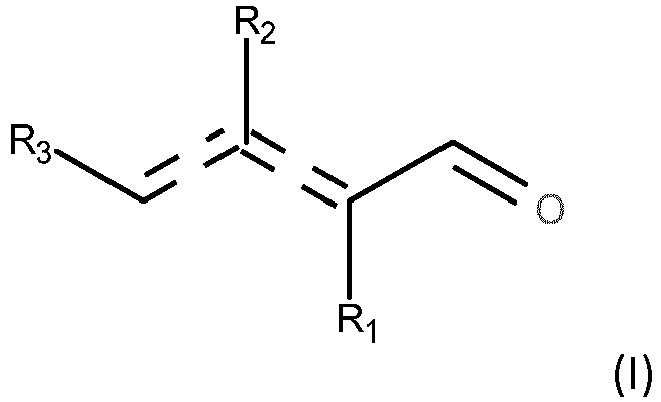 (b) au moins une substance active rafraîchissante physiologique.
 - Mélanges selon la revendication 1, caractérisés en ce que, dans la formule (I), R1 et R2 sont différents et représentent hydrogène ou phényle, R3 représente hydrogène, un radical alcényle ou un groupe alkyle linéaire ou ramifié comprenant 1 à 5 atomes de carbone et les doubles liaisons en pointillés représentent, indépendamment les unes des autres, une simple ou une double liaison.
- Mélanges selon les revendications 1 et/ou 2, caractérisés en ce qu'ils contiennent des phénylalcénals (composant a) qui sont choisis dans le groupe formé par le 2-phénylbut-2-énal, le 2-phénylpent-2-énal, le 3-phénylpent-4-énal, le 2-phénylpent-4-énal et leurs mélanges.
- Mélanges selon au moins l'une quelconque des revendications 1 à 3, caractérisés en ce qu'ils contiennent des substances actives rafraîchissantes physiologiques (composant b), qui sont choisies dans le groupe formé par le menthol, le L-menthol, le menthone-glycérol-acétal, le lactate de menthyle, les amides substitués de l'acide menthane-3-carboxylique, le N-éthylamide de l'acide menthane-3-carboxylique, le 2-isopropyl-N,2,3-triméthylbutanamide, les amides substitués de l'acide cyclohexanecarboxylique, le 3-menthoxy-1,2-propanediol, le carbonate de 2-hydroxyéthylmenthyle, le carbonate de 2-hydroxypropylmenthyle, l'ester menthylique de la N-acétylglycine, les esters de l'acide menthylhydroxycarboxylique, le 3-hydroxybutyrate de menthyle, le monosuccinate de menthyle, la 2-mercaptocyclodécanone, le 2-pyrrolidin-5-one-carboxylate de menthyle et leurs mélanges.
- Mélanges selon au moins l'une quelconque des revendications 1 à 4, caractérisés en ce qu'ils contiennent en outre(c) au moins un arôme et/ou(d) au moins un solvant.
- Mélanges selon la revendication 5, caractérisés en ce qu'ils contiennent des arômes (composant c) qui sont choisis dans le groupe qui est formé par l'anéthol, la menthone, l'isomenthone, l'acétate de menthyle, le menthofurane, la lactone de menthe, l'eucalyptol, le limonène, l'eugénol, le pinène, l'hydrate de sabinène, le 3-octanol, la carvone, la gamma-octalactone, la gamma-nonalactone, le germacrène-D, le viridiflorol, le 1,3E,5Z-undécatriène, l'isopulégol, la pipéritone, la 2-butanone, le formiate d'éthyle, l'acétate de 3-octyle, l'isovalérianate d'isoamyle, l'hexanol, l'hexanal, le cis-3-hexénol, le linalool, l'alpha-terpinéol, l'acétate de cis-carvyle et de trans-carvyle, le p-cymol, la damascenone, la damascone, l'oxyde de rose, le sulfure de diméthyle, le fenchol, le diéthylacétal d'acétaldéhyde, le cis-4-hepténal, l'isobutyraldéhyde, l'isovaléraldéhyde, la cis-jasmone, l'anisaldéhyde, le salicylate de méthyle, l'acétate de myrtényle, l'alcool 2-phényléthylique, l'isobutyrate de 2-phényléthyle, l'isovalérate de 2-phényléthyle, l'aldéhyde cinnamique, le géraniol, le nérol et leurs mélanges.
- Mélanges selon les revendications 5 et/ou 6, caractérisés en ce qu'ils contiennent des solvants (composant d) qui sont choisis dans le groupe formé par l'alcool éthylique, le 1,2-propylèneglycol, la triacétine, l'alcool benzylique et les huiles grasses et leurs mélanges.
- Préparations cosmétiques, agents de soin de la bouche, préparations pharmaceutiques, aliments, préparations d'arôme ou de parfum contenant des mélanges selon au moins l'une quelconque des revendications 1 à 7.
- Utilisation de composés de formule (I) pour le renforcement de l'effet rafraîchissant, de la fraîcheur et du goût de substances actives rafraîchissantes physiologiques.
- Utilisation de composés de formule (I) pour la diminution de l'amertume, du goût piquant ou de l'aigreur de substances actives rafraîchissantes physiologiques.
- Médicament contenant un mélange selon les revendications 1 à 7 pour la libération des voies respiratoires.
Priority Applications (1)
| Application Number | Priority Date | Filing Date | Title |
|---|---|---|---|
| EP13718558.3A EP2849718B1 (fr) | 2012-05-16 | 2013-04-18 | Mélanges à effet rafraîchissant amélioré |
Applications Claiming Priority (3)
| Application Number | Priority Date | Filing Date | Title |
|---|---|---|---|
| EP12003859 | 2012-05-16 | ||
| EP13718558.3A EP2849718B1 (fr) | 2012-05-16 | 2013-04-18 | Mélanges à effet rafraîchissant amélioré |
| PCT/EP2013/058118 WO2013171018A2 (fr) | 2012-05-16 | 2013-04-18 | Mélanges à effet rafraîchissant amélioré |
Publications (2)
| Publication Number | Publication Date |
|---|---|
| EP2849718A2 EP2849718A2 (fr) | 2015-03-25 |
| EP2849718B1 true EP2849718B1 (fr) | 2017-02-01 |
Family
ID=48184182
Family Applications (1)
| Application Number | Title | Priority Date | Filing Date |
|---|---|---|---|
| EP13718558.3A Active EP2849718B1 (fr) | 2012-05-16 | 2013-04-18 | Mélanges à effet rafraîchissant amélioré |
Country Status (3)
| Country | Link |
|---|---|
| US (1) | US9743685B2 (fr) |
| EP (1) | EP2849718B1 (fr) |
| WO (1) | WO2013171018A2 (fr) |
Families Citing this family (14)
| Publication number | Priority date | Publication date | Assignee | Title |
|---|---|---|---|---|
| JP5803047B2 (ja) * | 2011-06-30 | 2015-11-04 | 高砂香料工業株式会社 | 抗菌剤組成物 |
| EP3093002B1 (fr) | 2015-05-15 | 2018-04-25 | Symrise AG | Compositions des agents refroidissement liquides |
| US20190037896A1 (en) * | 2015-09-30 | 2019-02-07 | Wm. Wrigley Jr. Company | Cooling formulations |
| US10933039B2 (en) | 2016-05-05 | 2021-03-02 | Symrise Ag | Coolant mixtures |
| US20200188289A1 (en) | 2017-05-15 | 2020-06-18 | Firmenich Sa | Compositions comprising essential oils |
| CN111032004B (zh) | 2017-12-20 | 2023-10-20 | 弗门尼舍有限公司 | 口腔护理组合物 |
| JP7261419B2 (ja) * | 2018-06-15 | 2023-04-20 | 国立研究開発法人農業・食品産業技術総合研究機構 | メントールの刺激抑制剤および刺激抑制方法 |
| CN113993500B (zh) * | 2019-06-13 | 2025-08-12 | 德国德之馨香精香料公司 | 一种清凉制剂 |
| WO2021128307A1 (fr) * | 2019-12-27 | 2021-07-01 | 深圳雾芯科技有限公司 | Composition aromatique, et liquide de cigarette électronique contenant une composition aromatique |
| CN111418697A (zh) * | 2020-03-31 | 2020-07-17 | 内蒙古蒙牛乳业(集团)股份有限公司 | 冷冻饮品及其制备方法 |
| GB202103207D0 (en) * | 2021-03-08 | 2021-04-21 | Givaudan Sa | Organic compounds |
| US20220304353A1 (en) * | 2021-03-29 | 2022-09-29 | Health Well CBD Corp. | Electrolyte Beverage Composition |
| US20250059482A1 (en) * | 2021-12-27 | 2025-02-20 | Suntory Holdings Limited | Alcoholic beverage containing limonene |
| WO2023222213A1 (fr) * | 2022-05-18 | 2023-11-23 | Symrise Ag | Mélanges antimicrobiens |
Family Cites Families (36)
| Publication number | Priority date | Publication date | Assignee | Title |
|---|---|---|---|---|
| US3111127A (en) | 1961-06-27 | 1963-11-19 | Brown & Williamson Tobacco Corp | Smoking tobacco product and method of making the same |
| GB1054346A (fr) | 1964-10-01 | 1900-01-01 | ||
| NL149701C (nl) | 1965-12-08 | 1981-05-15 | Procter & Gamble | Werkwijze voor het bereiden van een tegen tandsteen werkzaam tandverzorgingsmiddel, dat als werkzaam bestanddeel een fosfonzuurderivaat bevat, alsmede gevormd tandverzorgingsmiddel. |
| DE1921560C3 (de) | 1968-04-26 | 1980-04-17 | International Flavors & Fragrances Inc., New York, N.Y. (V.St.A.) | 2-Phenyl-2-alkenale, deren Herstellung und Verwendung |
| US4157384A (en) | 1972-01-28 | 1979-06-05 | Wilkinson Sword Limited | Compositions having a physiological cooling effect |
| DE2224430C3 (de) | 1972-05-19 | 1980-10-09 | Henkel Kgaa, 4000 Duesseldorf | Zahnsteinbildung verhindernde Mund- und Zahnpflegemittel |
| US3879425A (en) | 1972-08-01 | 1975-04-22 | Int Flavors & Fragrances Inc | Ethylene acetal of 3-phenyl-4-pentenal |
| US3922237A (en) * | 1972-08-01 | 1975-11-25 | Int Flavors & Fragrances Inc | Novel perfume compositions and perfumed articles containing di-lower alkyl and lower alkylene acetals of 2-and 3-phenyl pentenals |
| DE2343196C3 (de) | 1973-08-27 | 1980-01-10 | Henkel Kgaa, 4000 Duesseldorf | Aiacycloalkan-2^-diphosphonsäuren oder deren wasserlösliche Salze |
| DE2608226A1 (de) | 1976-02-28 | 1977-09-08 | Haarmann & Reimer Gmbh | Mittel mit physiologischer kuehlwirkung |
| US4198393A (en) * | 1977-08-24 | 1980-04-15 | International Flavors & Fragrances Inc. | Cyclic acetals of 2-methyl-2-pentenal and food flavor uses thereof |
| JPS5888334A (ja) | 1981-11-20 | 1983-05-26 | Takasago Corp | 3−l−メントキシプロパン−1、2−ジオ−ル |
| US5286500A (en) | 1992-03-03 | 1994-02-15 | Wm. Wrigley Jr. Company | Wax-free chewing gum base |
| DE4226043A1 (de) | 1992-08-06 | 1994-02-10 | Haarmann & Reimer Gmbh | Mittel mit physiologischem Kühleffekt und für diese Mittel geeignete wirksame Verbindungen |
| US5585343A (en) * | 1993-11-02 | 1996-12-17 | Givaudan-Roure Corporation | Low VOC perfume formulations |
| US5725865A (en) | 1995-08-29 | 1998-03-10 | V. Mane Fils S.A. | Coolant compositions |
| US5843466A (en) | 1995-08-29 | 1998-12-01 | V. Mane Fils S.A. | Coolant compositions |
| US7025999B2 (en) | 2001-05-11 | 2006-04-11 | Wm. Wrigley Jr. Company | Chewing gum having prolonged sensory benefits |
| US5945088A (en) * | 1997-03-31 | 1999-08-31 | Pfizer Inc | Taste masking of phenolics using citrus flavors |
| CA2303094A1 (fr) * | 1998-07-02 | 2000-01-13 | Eugene H. Gans | Procedes et compositions permettant de produire un effet de refroidissement dans des tissus |
| JP4017758B2 (ja) * | 1998-08-04 | 2007-12-05 | 高砂香料工業株式会社 | 冷感剤組成物 |
| US6267974B1 (en) | 1999-04-16 | 2001-07-31 | Unilever Home & Personal Care Usa, Division Of Conopco, Inc. | Cosmetic compositions with sensate mixtures based on isopulegol |
| JP4587549B2 (ja) | 2000-10-23 | 2010-11-24 | 高砂香料工業株式会社 | 1−ハロゲノ−3−1−メントキシプロパン−2−オール |
| JP4723751B2 (ja) | 2001-04-23 | 2011-07-13 | 高砂香料工業株式会社 | 3−l−メントキシプロパン−1,2−ジオールの製造方法 |
| HUP0402425A3 (en) | 2001-11-23 | 2005-11-28 | Unilever Nv | Water continuous food product with cooling flavour |
| US20030161802A1 (en) | 2002-02-05 | 2003-08-28 | Flammer Linda J. | Anti-dandruff and anti-itch compositions containing sensate and sensate enhancer-containing compounds |
| JP2004135522A (ja) | 2002-10-16 | 2004-05-13 | Kiyomitsu Kawasaki | 魚節フレーバー組成物および該フレーバー組成物を含有する食品類 |
| JP2006020526A (ja) | 2004-07-06 | 2006-01-26 | Kiyomitsu Kawasaki | コーヒーフレーバー組成物および該フレーバー組成物を含有する飲食品類 |
| JP2006025706A (ja) | 2004-07-16 | 2006-02-02 | Kiyomitsu Kawasaki | ナッツ様フレーバー組成物 |
| JP2006121958A (ja) | 2004-10-28 | 2006-05-18 | Kiyomitsu Kawasaki | ココア様香料組成物 |
| SG139587A1 (en) | 2006-07-28 | 2008-02-29 | Givaudan Sa | Method of using organic compounds |
| ES2557160T3 (es) | 2006-10-23 | 2016-01-22 | Nestec S.A. | Modulación del aroma y el sabor mediante biotransformación en productos lácteos |
| GB0704163D0 (en) | 2007-03-02 | 2007-04-11 | Quest Int Serv Bv | Compositions comprising a physiological coolant |
| GB0710884D0 (en) | 2007-06-07 | 2007-07-18 | Univ Nottingham | Preservative |
| EP2272491A1 (fr) * | 2009-06-18 | 2011-01-12 | Robertet S.A. | Nouvelles compositions désodorisantes et produits désodorisants les renfermant |
| US20110195042A1 (en) * | 2010-02-10 | 2011-08-11 | Thomas Edward Huetter | Compositions, Methods and Kits Useful for Treating a Respiratory Symptom |
-
2013
- 2013-04-18 WO PCT/EP2013/058118 patent/WO2013171018A2/fr not_active Ceased
- 2013-04-18 US US14/401,691 patent/US9743685B2/en active Active
- 2013-04-18 EP EP13718558.3A patent/EP2849718B1/fr active Active
Non-Patent Citations (1)
| Title |
|---|
| None * |
Also Published As
| Publication number | Publication date |
|---|---|
| WO2013171018A2 (fr) | 2013-11-21 |
| WO2013171018A3 (fr) | 2014-04-10 |
| US20150139918A1 (en) | 2015-05-21 |
| EP2849718A2 (fr) | 2015-03-25 |
| US9743685B2 (en) | 2017-08-29 |
Similar Documents
| Publication | Publication Date | Title |
|---|---|---|
| WO2013171018A2 (fr) | Mélanges à effet rafraîchissant amélioré | |
| EP2789247B1 (fr) | Composition antioxydante | |
| EP3219303B1 (fr) | Compositions | |
| EP2931225B1 (fr) | Préparations refroidissantes | |
| EP2932956B1 (fr) | Capsules avec une charge d'agent actif élevée | |
| WO2013037977A2 (fr) | Préparations cosmétiques | |
| EP3390596B1 (fr) | Utilisation de 4-hydroxyacétophénone pour stabiliser le goût et l'odeur | |
| EP3294262B1 (fr) | Compositions des agents refroidissement liquides | |
| EP3689324B1 (fr) | Nouveaux agents rafraichissants et preparations les contenant | |
| EP3558030A1 (fr) | Mélange aromatique destiné à la réduction de l'odeur ou du goût d'amines biogènes | |
| DE202012013357U1 (de) | Zubereitungen | |
| EP2783578A1 (fr) | Produits de réaction de catechin | |
| JP6882144B6 (ja) | 組成物および化粧品組成物 | |
| EP3231294A1 (fr) | Composition et production d'extrait d'épinard avec du beta-ecdyson |
Legal Events
| Date | Code | Title | Description |
|---|---|---|---|
| PUAI | Public reference made under article 153(3) epc to a published international application that has entered the european phase |
Free format text: ORIGINAL CODE: 0009012 |
|
| 17P | Request for examination filed |
Effective date: 20141216 |
|
| AK | Designated contracting states |
Kind code of ref document: A2 Designated state(s): AL AT BE BG CH CY CZ DE DK EE ES FI FR GB GR HR HU IE IS IT LI LT LU LV MC MK MT NL NO PL PT RO RS SE SI SK SM TR |
|
| AX | Request for extension of the european patent |
Extension state: BA ME |
|
| RIN1 | Information on inventor provided before grant (corrected) |
Inventor name: LOGES, HUBERT Inventor name: MACHINEK, ARNOLD Inventor name: DILK, ERICH Inventor name: LAGES, RITA Inventor name: OERTLING, HEIKO Inventor name: NEUENDORFF, GABRIELE |
|
| DAX | Request for extension of the european patent (deleted) | ||
| GRAP | Despatch of communication of intention to grant a patent |
Free format text: ORIGINAL CODE: EPIDOSNIGR1 |
|
| RIC1 | Information provided on ipc code assigned before grant |
Ipc: A23G 9/32 20060101ALI20160726BHEP Ipc: A61Q 11/00 20060101ALI20160726BHEP Ipc: A61K 31/015 20060101ALI20160726BHEP Ipc: A61K 8/34 20060101AFI20160726BHEP Ipc: A61K 8/33 20060101ALI20160726BHEP Ipc: A61Q 19/00 20060101ALI20160726BHEP Ipc: A61K 31/045 20060101ALI20160726BHEP Ipc: A61Q 13/00 20060101ALI20160726BHEP Ipc: A61K 31/11 20060101ALI20160726BHEP |
|
| INTG | Intention to grant announced |
Effective date: 20160822 |
|
| GRAS | Grant fee paid |
Free format text: ORIGINAL CODE: EPIDOSNIGR3 |
|
| GRAA | (expected) grant |
Free format text: ORIGINAL CODE: 0009210 |
|
| AK | Designated contracting states |
Kind code of ref document: B1 Designated state(s): AL AT BE BG CH CY CZ DE DK EE ES FI FR GB GR HR HU IE IS IT LI LT LU LV MC MK MT NL NO PL PT RO RS SE SI SK SM TR |
|
| REG | Reference to a national code |
Ref country code: GB Ref legal event code: FG4D Free format text: NOT ENGLISH |
|
| REG | Reference to a national code |
Ref country code: CH Ref legal event code: EP Ref country code: AT Ref legal event code: REF Ref document number: 864957 Country of ref document: AT Kind code of ref document: T Effective date: 20170215 |
|
| REG | Reference to a national code |
Ref country code: IE Ref legal event code: FG4D Free format text: LANGUAGE OF EP DOCUMENT: GERMAN |
|
| REG | Reference to a national code |
Ref country code: DE Ref legal event code: R096 Ref document number: 502013006251 Country of ref document: DE |
|
| REG | Reference to a national code |
Ref country code: FR Ref legal event code: PLFP Year of fee payment: 5 |
|
| REG | Reference to a national code |
Ref country code: NL Ref legal event code: MP Effective date: 20170201 |
|
| REG | Reference to a national code |
Ref country code: LT Ref legal event code: MG4D |
|
| PG25 | Lapsed in a contracting state [announced via postgrant information from national office to epo] |
Ref country code: NO Free format text: LAPSE BECAUSE OF FAILURE TO SUBMIT A TRANSLATION OF THE DESCRIPTION OR TO PAY THE FEE WITHIN THE PRESCRIBED TIME-LIMIT Effective date: 20170501 Ref country code: LT Free format text: LAPSE BECAUSE OF FAILURE TO SUBMIT A TRANSLATION OF THE DESCRIPTION OR TO PAY THE FEE WITHIN THE PRESCRIBED TIME-LIMIT Effective date: 20170201 Ref country code: GR Free format text: LAPSE BECAUSE OF FAILURE TO SUBMIT A TRANSLATION OF THE DESCRIPTION OR TO PAY THE FEE WITHIN THE PRESCRIBED TIME-LIMIT Effective date: 20170502 Ref country code: IS Free format text: LAPSE BECAUSE OF FAILURE TO SUBMIT A TRANSLATION OF THE DESCRIPTION OR TO PAY THE FEE WITHIN THE PRESCRIBED TIME-LIMIT Effective date: 20170601 Ref country code: HR Free format text: LAPSE BECAUSE OF FAILURE TO SUBMIT A TRANSLATION OF THE DESCRIPTION OR TO PAY THE FEE WITHIN THE PRESCRIBED TIME-LIMIT Effective date: 20170201 Ref country code: FI Free format text: LAPSE BECAUSE OF FAILURE TO SUBMIT A TRANSLATION OF THE DESCRIPTION OR TO PAY THE FEE WITHIN THE PRESCRIBED TIME-LIMIT Effective date: 20170201 |
|
| PG25 | Lapsed in a contracting state [announced via postgrant information from national office to epo] |
Ref country code: NL Free format text: LAPSE BECAUSE OF FAILURE TO SUBMIT A TRANSLATION OF THE DESCRIPTION OR TO PAY THE FEE WITHIN THE PRESCRIBED TIME-LIMIT Effective date: 20170201 Ref country code: RS Free format text: LAPSE BECAUSE OF FAILURE TO SUBMIT A TRANSLATION OF THE DESCRIPTION OR TO PAY THE FEE WITHIN THE PRESCRIBED TIME-LIMIT Effective date: 20170201 Ref country code: PT Free format text: LAPSE BECAUSE OF FAILURE TO SUBMIT A TRANSLATION OF THE DESCRIPTION OR TO PAY THE FEE WITHIN THE PRESCRIBED TIME-LIMIT Effective date: 20170601 Ref country code: LV Free format text: LAPSE BECAUSE OF FAILURE TO SUBMIT A TRANSLATION OF THE DESCRIPTION OR TO PAY THE FEE WITHIN THE PRESCRIBED TIME-LIMIT Effective date: 20170201 Ref country code: ES Free format text: LAPSE BECAUSE OF FAILURE TO SUBMIT A TRANSLATION OF THE DESCRIPTION OR TO PAY THE FEE WITHIN THE PRESCRIBED TIME-LIMIT Effective date: 20170201 Ref country code: SE Free format text: LAPSE BECAUSE OF FAILURE TO SUBMIT A TRANSLATION OF THE DESCRIPTION OR TO PAY THE FEE WITHIN THE PRESCRIBED TIME-LIMIT Effective date: 20170201 Ref country code: PL Free format text: LAPSE BECAUSE OF FAILURE TO SUBMIT A TRANSLATION OF THE DESCRIPTION OR TO PAY THE FEE WITHIN THE PRESCRIBED TIME-LIMIT Effective date: 20170201 Ref country code: BG Free format text: LAPSE BECAUSE OF FAILURE TO SUBMIT A TRANSLATION OF THE DESCRIPTION OR TO PAY THE FEE WITHIN THE PRESCRIBED TIME-LIMIT Effective date: 20170501 |
|
| PG25 | Lapsed in a contracting state [announced via postgrant information from national office to epo] |
Ref country code: EE Free format text: LAPSE BECAUSE OF FAILURE TO SUBMIT A TRANSLATION OF THE DESCRIPTION OR TO PAY THE FEE WITHIN THE PRESCRIBED TIME-LIMIT Effective date: 20170201 Ref country code: IT Free format text: LAPSE BECAUSE OF FAILURE TO SUBMIT A TRANSLATION OF THE DESCRIPTION OR TO PAY THE FEE WITHIN THE PRESCRIBED TIME-LIMIT Effective date: 20170201 Ref country code: RO Free format text: LAPSE BECAUSE OF FAILURE TO SUBMIT A TRANSLATION OF THE DESCRIPTION OR TO PAY THE FEE WITHIN THE PRESCRIBED TIME-LIMIT Effective date: 20170201 Ref country code: CZ Free format text: LAPSE BECAUSE OF FAILURE TO SUBMIT A TRANSLATION OF THE DESCRIPTION OR TO PAY THE FEE WITHIN THE PRESCRIBED TIME-LIMIT Effective date: 20170201 Ref country code: SK Free format text: LAPSE BECAUSE OF FAILURE TO SUBMIT A TRANSLATION OF THE DESCRIPTION OR TO PAY THE FEE WITHIN THE PRESCRIBED TIME-LIMIT Effective date: 20170201 |
|
| REG | Reference to a national code |
Ref country code: DE Ref legal event code: R097 Ref document number: 502013006251 Country of ref document: DE |
|
| PG25 | Lapsed in a contracting state [announced via postgrant information from national office to epo] |
Ref country code: SM Free format text: LAPSE BECAUSE OF FAILURE TO SUBMIT A TRANSLATION OF THE DESCRIPTION OR TO PAY THE FEE WITHIN THE PRESCRIBED TIME-LIMIT Effective date: 20170201 Ref country code: DK Free format text: LAPSE BECAUSE OF FAILURE TO SUBMIT A TRANSLATION OF THE DESCRIPTION OR TO PAY THE FEE WITHIN THE PRESCRIBED TIME-LIMIT Effective date: 20170201 |
|
| REG | Reference to a national code |
Ref country code: CH Ref legal event code: PL |
|
| PLBE | No opposition filed within time limit |
Free format text: ORIGINAL CODE: 0009261 |
|
| STAA | Information on the status of an ep patent application or granted ep patent |
Free format text: STATUS: NO OPPOSITION FILED WITHIN TIME LIMIT |
|
| 26N | No opposition filed |
Effective date: 20171103 |
|
| REG | Reference to a national code |
Ref country code: IE Ref legal event code: MM4A |
|
| PG25 | Lapsed in a contracting state [announced via postgrant information from national office to epo] |
Ref country code: MC Free format text: LAPSE BECAUSE OF FAILURE TO SUBMIT A TRANSLATION OF THE DESCRIPTION OR TO PAY THE FEE WITHIN THE PRESCRIBED TIME-LIMIT Effective date: 20170201 |
|
| PG25 | Lapsed in a contracting state [announced via postgrant information from national office to epo] |
Ref country code: LU Free format text: LAPSE BECAUSE OF NON-PAYMENT OF DUE FEES Effective date: 20170418 Ref country code: SI Free format text: LAPSE BECAUSE OF FAILURE TO SUBMIT A TRANSLATION OF THE DESCRIPTION OR TO PAY THE FEE WITHIN THE PRESCRIBED TIME-LIMIT Effective date: 20170201 Ref country code: LI Free format text: LAPSE BECAUSE OF NON-PAYMENT OF DUE FEES Effective date: 20170430 Ref country code: CH Free format text: LAPSE BECAUSE OF NON-PAYMENT OF DUE FEES Effective date: 20170430 |
|
| REG | Reference to a national code |
Ref country code: BE Ref legal event code: MM Effective date: 20170430 |
|
| REG | Reference to a national code |
Ref country code: FR Ref legal event code: PLFP Year of fee payment: 6 |
|
| PG25 | Lapsed in a contracting state [announced via postgrant information from national office to epo] |
Ref country code: IE Free format text: LAPSE BECAUSE OF NON-PAYMENT OF DUE FEES Effective date: 20170418 |
|
| PG25 | Lapsed in a contracting state [announced via postgrant information from national office to epo] |
Ref country code: BE Free format text: LAPSE BECAUSE OF NON-PAYMENT OF DUE FEES Effective date: 20170430 |
|
| PG25 | Lapsed in a contracting state [announced via postgrant information from national office to epo] |
Ref country code: MT Free format text: LAPSE BECAUSE OF FAILURE TO SUBMIT A TRANSLATION OF THE DESCRIPTION OR TO PAY THE FEE WITHIN THE PRESCRIBED TIME-LIMIT Effective date: 20170201 |
|
| REG | Reference to a national code |
Ref country code: AT Ref legal event code: MM01 Ref document number: 864957 Country of ref document: AT Kind code of ref document: T Effective date: 20180418 |
|
| PG25 | Lapsed in a contracting state [announced via postgrant information from national office to epo] |
Ref country code: HU Free format text: LAPSE BECAUSE OF FAILURE TO SUBMIT A TRANSLATION OF THE DESCRIPTION OR TO PAY THE FEE WITHIN THE PRESCRIBED TIME-LIMIT; INVALID AB INITIO Effective date: 20130418 |
|
| PG25 | Lapsed in a contracting state [announced via postgrant information from national office to epo] |
Ref country code: CY Free format text: LAPSE BECAUSE OF FAILURE TO SUBMIT A TRANSLATION OF THE DESCRIPTION OR TO PAY THE FEE WITHIN THE PRESCRIBED TIME-LIMIT Effective date: 20170201 Ref country code: AT Free format text: LAPSE BECAUSE OF NON-PAYMENT OF DUE FEES Effective date: 20180418 |
|
| PG25 | Lapsed in a contracting state [announced via postgrant information from national office to epo] |
Ref country code: MK Free format text: LAPSE BECAUSE OF FAILURE TO SUBMIT A TRANSLATION OF THE DESCRIPTION OR TO PAY THE FEE WITHIN THE PRESCRIBED TIME-LIMIT Effective date: 20170201 |
|
| PG25 | Lapsed in a contracting state [announced via postgrant information from national office to epo] |
Ref country code: TR Free format text: LAPSE BECAUSE OF FAILURE TO SUBMIT A TRANSLATION OF THE DESCRIPTION OR TO PAY THE FEE WITHIN THE PRESCRIBED TIME-LIMIT Effective date: 20170201 |
|
| PG25 | Lapsed in a contracting state [announced via postgrant information from national office to epo] |
Ref country code: AL Free format text: LAPSE BECAUSE OF FAILURE TO SUBMIT A TRANSLATION OF THE DESCRIPTION OR TO PAY THE FEE WITHIN THE PRESCRIBED TIME-LIMIT Effective date: 20170201 |
|
| PGFP | Annual fee paid to national office [announced via postgrant information from national office to epo] |
Ref country code: DE Payment date: 20250417 Year of fee payment: 13 |
|
| PGFP | Annual fee paid to national office [announced via postgrant information from national office to epo] |
Ref country code: FR Payment date: 20250422 Year of fee payment: 13 |
|
| PGFP | Annual fee paid to national office [announced via postgrant information from national office to epo] |
Ref country code: GB Payment date: 20260324 Year of fee payment: 14 |