EP2853633A2 - Procédé destiné au pliage de pièces de linge - Google Patents
Procédé destiné au pliage de pièces de linge Download PDFInfo
- Publication number
- EP2853633A2 EP2853633A2 EP20140003198 EP14003198A EP2853633A2 EP 2853633 A2 EP2853633 A2 EP 2853633A2 EP 20140003198 EP20140003198 EP 20140003198 EP 14003198 A EP14003198 A EP 14003198A EP 2853633 A2 EP2853633 A2 EP 2853633A2
- Authority
- EP
- European Patent Office
- Prior art keywords
- laundry
- items
- longitudinal folding
- longitudinal
- folding station
- Prior art date
- Legal status (The legal status is an assumption and is not a legal conclusion. Google has not performed a legal analysis and makes no representation as to the accuracy of the status listed.)
- Granted
Links
Images



Classifications
-
- D—TEXTILES; PAPER
- D06—TREATMENT OF TEXTILES OR THE LIKE; LAUNDERING; FLEXIBLE MATERIALS NOT OTHERWISE PROVIDED FOR
- D06F—LAUNDERING, DRYING, IRONING, PRESSING OR FOLDING TEXTILE ARTICLES
- D06F89/00—Apparatus for folding textile articles with or without stapling
-
- B—PERFORMING OPERATIONS; TRANSPORTING
- B65—CONVEYING; PACKING; STORING; HANDLING THIN OR FILAMENTARY MATERIAL
- B65B—MACHINES, APPARATUS OR DEVICES FOR, OR METHODS OF, PACKAGING ARTICLES OR MATERIALS; UNPACKING
- B65B63/00—Auxiliary devices, not otherwise provided for, for operating on articles or materials to be packaged
- B65B63/04—Auxiliary devices, not otherwise provided for, for operating on articles or materials to be packaged for folding or winding articles, e.g. gloves or stockings
Definitions
- the invention relates to a method for folding laundry items according to the preamble of claim 1 and / or 11.
- the automatic folding of laundry items happens in at least one longitudinal folding station having folding machines.
- the items of laundry are individually conveyed through the longitudinal folding station and thereby folded along.
- the items of laundry are provided with at least one fold line extending in the longitudinal direction of the longitudinal folding station.
- blowing air acts on the items to be folded until it is safe to assume that items of laundry any size, but also any width and any Materiaien, are ready folded. Therefore, the duration of the blowing time is adapted to maximum length of laundry. For shorter laundry items blowing time is unnecessarily long. This can lead to the fact that blown air acts on the same during the removal of fully folded laundry items and thus the folding is partially reversed. In addition, an unnecessarily long blowing time leads to increased compressed air consumption and unnecessary noise pollution by compressed air nozzles exiting compressed air.
- the invention has for its object to provide a method for automatically folding laundry items, which has an increased folding performance and / or a shortened blowing time.
- a method for achieving this object comprises the measures of claim 1.
- the laundry items are transported through the longitudinal folding station with a transport speed which is adapted at least to their size, in particular length.
- the length of the items of laundry means that direction of extent of the same which runs in the transport direction of the items of laundry through the longitudinal folding station.
- the transport speed of the laundry items is adjusted by the longitudinal folding station, that the longitudinal folding is completed when the leading transverse edge of each garment is in the range of a discharge end of the longitudinal folding station, that is at the outlet end or just before.
- items of laundry of any type and size, large items of laundry and small items of laundry are transported as fast as possible through the longitudinal folding station, the speed being selected so that the transport time of the items through the longitudinal folding station is sufficient for at least one longitudinal fold of each item of laundry , Larger pieces of laundry are consequently transported more slowly through the longitudinal folding station than smaller items of laundry.
- the interruption of the further transport of larger laundry items is avoided by the Lssensfaltstation on the one hand and on the other hand ensures that with the faster transport of smaller items of laundry through the Lssensfaltstation even small laundry items after the longitudinal folding the outlet end of the longitudinal folding station at least have almost reached. Only when very large items of laundry are to be folded with a length which corresponds approximately to the length of the longitudinal folding station, must a short interruption of the further transport of the item of laundry for folding the same take place in the longitudinal folding station.
- the transport speed of short or small items of laundry through the longitudinal folding station is preferably provided to select the transport speed of short or small items of laundry through the longitudinal folding station to be greater than for longer or larger items of laundry and / or to accelerate short or small items of laundry in the longitudinal folding station and to delay larger, especially longer, items of laundry.
- the longitudinal folding station There is thus an individual adaptation of the transport speed of the laundry items by the longitudinal folding station.
- larger items of laundry - unless it is not laundry, which claim the entire length of the longitudinal folding station - are folded without interrupting their onward transport and smaller pieces of laundry are transported through the longitudinal folding station with greater transport speed, so that the folding process of different sizes of laundry over extends at least a majority of the length of the longitudinal folding station. Downtimes in the longitudinal folding station and transport times of the already finished small laundry item to the outlet end of the longitudinal folding station are eliminated.
- a preferred embodiment of the method provides that the transport speed of the items of laundry by the longitudinal folding station individually and preferably continuously adjusted at least to the length of the respective piece of laundry to be folded and adjusted accordingly.
- the transport speed of the items of laundry in the longitudinal folding station is adapted individually to the longitudinal folding time, which is smaller for shorter items of laundry than for longer items of laundry.
- This adjustment is made such that during the longitudinal folding time the garment has been transported across the entire longitudinal folding station, so that at the conclusion of each longitudinal fold or all longitudinal folds of the respective garment the leading (front) transverse edge of the same, both large items of laundry and small items of laundry, is located at or near the outlet end of the longitudinal folding station.
- This procedure means that all items of laundry, regardless of their size or length, pass through the longitudinal folding station in the shortest possible time and the at least one longitudinal fold is completely completed.
- the method is provided to adapt the feed rate of the laundry items to the longitudinal folding station to the transport speed of the laundry items by the longitudinal folding station. This will ensure that in the case of small items of laundry which are transported rapidly through the longitudinal folding station, the following items of laundry are fed to the longitudinal folding station with the least possible distance from the preceding item of laundry. Conversely, in the case of large items of laundry transported slowly through the longitudinal folding station, the delivery of subsequent items of laundry to the longitudinal folding station is delayed, so that there is no overlapping or overlapping of successive items of laundry in the longitudinal folding station.
- a particularly advantageous embodiment of the method provides for determining the sizes of the items of laundry, ie the dimensions of the items of laundry in the transport direction by the longitudinal folding station, in good time before the beginning of the longitudinal folding or the first longitudinal folding.
- the length of the respective item of laundry preferably of the laundry item to be folded next, is determined.
- the length determination can be done by at least one sensor. For example, it may be such a sensor which determines the time from the passage of the front transverse edge to the passage and the rear transverse edge of a respective item of laundry at the sensor. Due to the known transport speed of the laundry then the length of the same can be calculated. It is also conceivable, however, to use a position transducer, the contactless or in contact with the garment, so touching, the length of the transported past him laundry items scans.
- Another advantageous embodiment of the method provides to transport the folded laundry items from the last folding station with different feeding speeds to different stacking points behind the last folding station. Because the juxtaposed or successively arranged stacking points inevitably have different distances to the last folding station, can be achieved by the different feeding speeds that the folded laundry items need about the same time to reach the far different from the last folding station stacking stations. In particular, when the items of laundry are transported through the longitudinal folding station with a transport speed adapted to their size and thus the longitudinal folding duration in the items of laundry is approximately the same, it is possible to do so To ensure that the stacking of the laundry items takes place in about the same time and therefore does not have to wait until items to be stacked on far away stacking points have reached these remote stacking points.
- Another method for the solution of the above-mentioned object comprises the measures of claim 11.
- this method it is provided for longitudinal folding to monitor an upper region of a folding zone located above the folding templates, in particular a blowing chamber, to determine whether at least a part of the item of laundry is still in this monitored upper area. In this case, it is determined whether the item of laundry or a respective longitudinally folding part thereof has left the monitored upper area. This is a sign of the completion of the respective longitudinal folding process.
- this method it is possible to determine the duration of the respective longitudinal folding process and above all to determine when the longitudinal folding process, which lasts for different lengths depending on the size of the item of laundry, has ended.
- the blast air supply is then simultaneously started or released for subsequent longitudinal folding of the same item of laundry. It can be adapted to the duration of the respective L Lucassfaltvorgangs and achieved that the blast air acts only as long on the longitudinally to be folded laundry item until the respective longitudinal folding is done so the Blas Kunststoffdauer.
- the lower level at a distance, preferably parallel distance, lies over the folding templates.
- This distance is chosen in particular such that it lies above a main propagation surface of the laundry item respectively located in the longitudinal folding station.
- the main propagation surface of the item of laundry is, on the one hand, that surface which runs through the highest point of the laundry item lying in the longitudinal folding station and still unfolded.
- the unfolded item of laundry in the longitudinal folding station is not completely smooth, but somewhat undulating, so that the main propagation surface is that surface which does not exceed the optionally folded piece of laundry lying in the longitudinal folding station.
- the main propagation area is the area that lies just above the highest point of the longitudinally folded laundry item.
- the area is monitored by which at least a part of the laundry item to be folded longitudinally is moved by the blowing air during longitudinal folding.
- At least one line is monitored by the lower level of the upper region of the folding zone or the blowing chamber. This can be done by at least one preferably transversely, but optionally also longitudinal, over the longitudinal folding station extending light barrier or the like.
- the described linear, two-dimensional or three-dimensional monitoring possibilities of the upper area or the lower level of the upper area can reliably determine whether there is still a part of a laundry item in the upper area above the blowing or folding zone.
- this can be the time corresponding to the end of the respective folding process determine where the last point of each longitudinally to be folded laundry has left the monitored upper area of the blowing or folding zone.
- the device 10 is used for automatically folding laundry items 10 and for simultaneously destacking folded laundry items 10.
- the laundry items 10 may be of any type, preferably so-called flat linen, such as sheets, duvets, pillows, tablecloths, napkins or the like, but also Towels, including terry towels.
- the invention also relates to devices which serve for folding and / or stacking other items of laundry, for example garments, so-called moldings.
- the invention also relates to devices that serve only for folding laundry items 10.
- the device has the in the Fig. 1 left side via an input table 11 with at least one circulating input conveyor belt. From the input table 11 is in each case transported to a folding, spread laundry article 10 in the transport direction 12 to a longitudinal folding station 13. In the longitudinal folding station 13, the respective laundry item 10 is folded longitudinally at least once. In the embodiment shown, two longitudinal folds take place from opposite longitudinal sides of the item of laundry 10 in succession.
- the laundry item 10 receives two parallel, in the transport direction 12, ie longitudinally to the longitudinal folding station 13, extending fold lines on opposite sides of the direction of transport 12 extending laundry center.
- the respective item of laundry 10 is transported into a funnelfaltstation 14 of the device shown here.
- the respective laundry item 10 is transversely folded at least once.
- the folded laundry item 10 is transported by a lower output conveyor 15 against the transport direction 12 of the longitudinal folding station 13 to a stacking device 16 which is located below and / or next to the longitudinal folding station 13.
- the stacking device 16 has a parallel to the longitudinal folding station 13 extending conveyor 17, which in the illustrated embodiment four in the transport direction 12 consecutive stacker, for example in the Fig. 1 shown lift trucks 18, 19, 20 and 21, are assigned.
- the lift trucks 18 to 21 are at different distances from the output conveyor 15 of the Wienfaltstation 14, so that the delivery routes to the individual lift trucks 18 to 21 are of different lengths.
- the shortest conveying path leads to the lift truck 18 and the longest transport path to the farthest forklift 21.
- the conveyor 17 are assigned to each lift stacker 18 to 21 stacking plates, each having a folded laundry item 10 on the respective forklift 18, 19, 20 and 21 and deposit the stack of folded laundry items 10 already formed thereon.
- a length measuring device 35 is provided in front of the longitudinal folding station 13.
- the length measuring device 22 may also be provided at the end of the input table 11 or at the beginning of the longitudinal folding station 13.
- the length-measuring device 35 may be a sensor that determines the length of the item of laundry 10 without contact in the transport direction 12, that is to say in the longitudinal direction of the longitudinal folding station 13.
- the non-contact sensor determines the time required for the respective item of laundry 10 to be transported past it. From this time in connection with the known constant speed, with which the Laundry item 10 is transported along the sensor, the length of the laundry article 10 (seen in the transport direction 12) can be calculated by calculation. But it is also a displacement sensor conceivable that unrolls on the laundry item 10 and thereby determines the path of the laundry item 10 from the front transverse edge to the rear transverse edge under contact with the laundry item 10, this way directly results in the length of the laundry item 10.
- the longitudinal folding station 13 has a longitudinal conveyor 22 extending over the entire width and length thereof.
- the longitudinal conveyor 22 transports the laundry item 10 in the transport direction 12 through the longitudinal folding station 13.
- the longitudinal conveyor 22 has a continuous conveyor belt passing through the entire width of the longitudinal folding station 13 or more adjacent narrow conveyor belts.
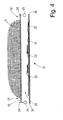
- the laundry item 10 is spread in the unfolded state and stretched out on ( Fig. 4 ).
- two elongated folding templates 23 are provided in the illustrated embodiment.
- the elongate, strip-shaped folding templates 23 extend parallel to one another in the longitudinal direction of the longitudinal folding station 13.
- the folding templates 23 are associated with different web halves of the longitudinal conveyor 22 with a parallel spacing.
- the folding templates 23 may be mutually variable at a distance to adapt to different sized, especially wide laundry items 10.
- the folding templates 23 are fixedly arranged at a small distance above the longitudinal conveyor 22. Outboard portions of the laundry 10 are successively first wrapped around the one folding template 23 and then around the other folding template 23 and thereby successively two longitudinal folds to bring about a third folding of the laundry 10 based on the same width.
- blower tubes 25, 26 are arranged along each of the opposite, parallel longitudinal edges 24 of the longitudinal folding station 13.
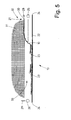
- the elongated, parallel to each other blowing tubes 25, 26 are arranged in the embodiment shown in a plane which is slightly above the folding templates 23 ( Fig. 5 ).
- Each blower tube 25, 26 serves to bring about a longitudinal folding of the laundry item 10.
- the tuyeres can produce a cylindrical jet of compressed air, but also a slightly conical one.
- the blower tubes 25, 26 are slightly rotatable about their longitudinal axes for folding the item of laundry 10, for example, back and forth in opposite directions.
- At least one light barrier 27 is provided above the blower tubes 25, 26.
- a transversely to the transport direction 12 horizontally extending light barrier 27 is in the 4 to 6 symbolically represented.
- the light barrier 27 has at least one (in the 4 to 6 right) light source 28 and one of these opposite (in the 4 to 6
- the light barrier 27 generates - if it is uninterrupted - a horizontal sensor line 30, which in the 4 to 6 symbolized by a series of points of light.
- the light source 28 and the reflector 29 are arranged at a short distance above the blower tubes 25, 26, so that the sensor line 30 of the light barrier 27 is at a parallel distance above a horizontal connecting line / plane between the blower tubes 25, 26.
- This sensor line 30 represents a lower limit of one in the 4 to 6
- the folding line 30, which is symbolized by a line grid, represents the folding area 32, the longitudinal folding station 13.
- the sensor line 30 thus divides the blowing space 32 into the upper area 31 and between the sensor line 30 and the folding templates 23 lower portion 33.
- the height of the lower portion 33 is selected so that it is a main propagation surface of the folded and unfolded or only partially folded garment 10, that is, each finished folded garment 10 after turning the right and left edge area to the folding templates 23 occupy only the lower area 33, but not the upper area 31 and thus each finished folded laundry item 10 lies below the sensor line 30.
- each side part of a laundry article 10 is laid around the respective folding template 23 in the longitudinal direction of the longitudinal folding station 13, a single photoelectric barrier 27 extends above the plane of the blower tubes 25, 26 with a sensor line 30 extending transversely to the transport direction 12 out.
- a plurality of distributed with more or less large distances to the length of the longitudinal folding station 13 distributed light barriers 27 with parallel, horizontal sensor lines 30 can be scanned surface contactless.
- the device has a circuit (not shown) and / or control, to which the measured length of the laundry item 10 supplied to the respective longitudinal folding station 13 is made available.
- the speed of the longitudinal conveyor 22 of the longitudinal folding station 13 is then changed, in particular adapted, in such a way that a front transverse edge 36 of the respective laundry item 10 after completion of the longitudinal folding as close as possible to a discharge end 34 at the front transverse edge Longitudinal folding station 13 is transported.
- the same control or circuit or a separate control or circuit receives a signal from the light barrier 27 when an edge region of the item of laundry 10 to be wrapped around the folding jets 23 by the air jets of the blower tubes 25, 26 is no longer in the upper region 31 of the blowing space 32.
- the circuit or control for the adjustment of the transport speed of the longitudinal conveyor 22 of the longitudinal folding station 13 to the length of the laundry item 10 can also be used to determine on which the different from the output conveyor 15 remote lift trucks 18 to 21 each folded piece of laundry 10 is stored.
- the controller remembers the size of the respective item of laundry 10 or the speed with which this has been transported through the longitudinal folding station 13 and accordingly places a laundry article 10, which was transported faster through the longitudinal folding station 13, onto the rearmost forklift 21. Larger items of laundry 10 are placed on the front forklift or 18 or 19.
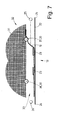
- Fig. 7 differs from the embodiment described above only in that instead of the transversely to the transport direction 12 extending photocell 27 (of the embodiment of the 4 to 6 ) is provided at least one extending in the longitudinal direction of light barrier.
- two parallel longitudinal light barriers 37, 38 are provided, in each case one light barrier 37, 38 per half of the longitudinal folding station 13. Both light barriers 37, 38 lie in a common horizontal plane slightly above the horizontal connecting plane between the blower tubes 25, 26.
- the horizontal plane in which the light barriers 37, 38 are located between an upper portion 31 and a lower portion 33 of the blowing chamber 32, that is still above the plane of the blow tubes 25, 26 on the folding templates 23.
- the longitudinal light barriers 37, 38 are located in a region through which the outer edge strips of the respective item of laundry 10 to be wrapped around the folding templates 23 by blowing air must be moved through. In this way, it can be reliably determined by the longitudinal light barriers 37 and 38 whether the longitudinal folding of the respective outer edge region of the item of laundry 10 has occurred at least for the most part or not.
- the longitudinal folding of the items of laundry 10 takes place as a function of at least the size, preferably length and / or width, of the same with different transport speeds of the respective item of laundry 10 in the transport direction 12 by the longitudinal folding station 13.
- the speed of the longitudinal conveyor 22 in the longitudinal folding station 13 is thereby to the size and optionally adapted to the material of the respective laundry article 10 to be folded.
- short laundry items 10 which are those whose lengths seen in the transport direction 12 and longitudinal direction of the longitudinal folding 13 are relatively small, transported faster by the longitudinal folding station 13 than longer pieces of laundry 10
- short laundry items 10 in the longitudinal folding 13 of Longitudinal conveyor 22 accelerates and longer laundry items 10 delayed by corresponding deceleration of the longitudinal conveyor 22 of the longitudinal folding station thirteenth
- length measuring device 35 is determined whether it is a small or large, especially short or long, laundry item 10.
- the length of the laundry item 10 is known, before the first longitudinal folding process of this laundry item 10 begins in the longitudinal folding station 13.
- the speed of the longitudinal conveyor 22 is determined by the control of the longitudinal folding station 13 and the longitudinal conveyor 22 is driven accordingly.
- large and small items of laundry 10 can be folded longitudinally twice in succession during the continuous further transport through the longitudinal folding station 13, specifically in the exemplary embodiments of FIGS FIGS. 2 and 3 first a right edge area around the right folding template 23 and then a left edge area around the left folding template 23.
- the longitudinal folding can also with larger or longer items of laundry 10 without Interruption of the further transport of the laundry by the longitudinal folding station 13 done. Only if such a large piece of laundry 10 is to be folded in the longitudinal folding station 13, which occupies almost the entire length of the longitudinal folding station 13, the further transport of the same has to be stopped by the Leksfaltstation 13 for longitudinal folds for such a very long piece of laundry 10 short term.
- the adaptation of the transport speed of the longitudinal conveyor 22 of the longitudinal folding station 13 to the length of each longitudinally to be folded item of laundry 10 is such that at the end of the last longitudinal folding in the Lssensfaltstation 13, a front transverse edge 36 of the finished folded laundry 10 is close to the outlet end 34, namely a front transverse edge, the longitudinal folding station 13 or close to the front ends of the folding templates 23 (FIG. Fig. 2 ) is located.
- a front transverse edge 36 of the finished folded laundry 10 is close to the outlet end 34, namely a front transverse edge, the longitudinal folding station 13 or close to the front ends of the folding templates 23 (FIG. Fig. 2 ) is located.
- a front transverse edge 36 of the finished folded laundry 10 is close to the outlet end 34, namely a front transverse edge, the longitudinal folding station 13 or close to the front ends of the folding templates 23 (FIG. Fig. 2 ) is located.
- a longer piece of laundry 10 Fig.
- the method described reduces the throughput time of the laundry items 10 by the longitudinal folding station 13 to a minimum by the laundry items 10 regardless of their size, especially length, are located after the longitudinal folds immediately before the outlet end 34 of the longitudinal folding 13 and thus all laundry items 10 regardless of their Size can be transported out immediately after the last longitudinal folding operation on the outlet end 34 from the longitudinal folding station 13.
- the folded laundry items 10 targeted to the lift trucks 18 to 21 are also provided to stack the folded laundry items 10 targeted to the lift trucks 18 to 21.
- smaller items of laundry 10 which have been transported through the longitudinal folding station 13 at a greater conveying speed of the longitudinal conveyor 22 and whose dwell time in the longitudinal folding station 13 is thus shorter in comparison to larger items of laundry 10, on the output conveyor 15 of the Buchfaltstation 14 farther or furthest away Stacker 21 or 20 stacked.
- Longer laundry items 10, which are transported more slowly through the longitudinal folding station 13, however, are placed on the closer to the output conveyor 15 horizontal stackers 18 or 19.
- longer transport paths of folded laundry items 10 to the more distant lift trucks 20, 21 are combined with shorter throughput times by the longitudinal folding station 13.
- the conveyor 17 which leads to the lift trucks 18 to 21, at such varying speeds that folded laundry items 10 reach the lift trucks 18 to 21 within approximately the same time.
- the folded laundry items 10 are then transported to the rearmost lift truck 21 with the greatest transport speed and to the front lift truck 18 with the lowest conveying speed.
- the transport speed of the conveyor 17 need not necessarily be based on the size of the folded laundry items 10; It can be adapted to the conveyor regardless of the size of the laundry items 10.
- blowing time of the blow tubes 25, 26 is adjusted to the duration of the respective longitudinal folding. It is characterized the compressed air outlet from the blowpipes 25 and 26 ended as soon as the respective longitudinal fold is completed. This has a least dependent on the length of the laundry items 10 Blaszeitregelung result. Preferably, however, the blowing time is also determined by the width and / or the material, especially terry cloth, of the laundry items 10.
- Blaszeitregelung is monitored whether there is still a portion of the laundry article 10 in the upper portion 31 of the blowing chamber 32.
- the lower, preferably horizontal, plane of the upper region 31, through which the sensor line 30 passes is monitored by the at least one transverse light barrier 27 at a parallel distance above the folding templates 23 and blower tubes 25, 26. Is the lying in the lower level of the upper portion 31 sensor line 30 between the light source 28 and the reflector 29 of the light barrier 27 is interrupted ( Fig. 5 ), there is still a momentarily to be folded part of the laundry article 10 in the upper region 31 of the blast space 32. It signals the ongoing folding process, which still requires 25 or 26 emerging from the nozzles of the blowpipe compressed air jet.
- the light barrier 27 in turn detects the completion of the folding of the left edge region of the laundry article 10 when it has left the upper region 31 of the blowing chamber 32 and is below the sensor line 30 of the light barrier 27 in the lower region 33 of the blowing chamber 32. Then the longitudinal folding process of the laundry article 10 in the longitudinal folding station 13 is completed and it is also the compressed air supply of the left blower tube 26 is interrupted.
- the longitudinal folding of the subsequent laundry item 10 can begin with the opening of the compressed air supply of the right blower tube 25, which first places the right edge region of the laundry item 10 around the right folding template 23. Thereafter, in the manner described above, the folding of the left edge portion of the laundry 10 by appropriate reversal of the compressed air supply of the blow tubes 25 and 26 and termination of the compressed air supply both blow tubes 25, 26 after the second longitudinal folds of the left edge portion of the laundry 10 on the previously folded right edge region thereof.
- each blowpipe 25 is supplied by the inventive method only over such a period of time with compressed air, which corresponds to the time required for the respective longitudinal folding.
- the method according to the invention controls the beginning of the second transverse folding following the first transverse folding.
- the invention has been described above in connection with a device for the combined folding of laundry items 10 and the stacking of folded laundry items 10.
- the invention is also suitable for devices that serve only for folding, in particular at least for longitudinal folding, of laundry items 10 or devices, with which folded laundry items 10 are only stored on different forklifts 18 to 21.
- the invention is not limited to devices for combined longitudinal folding and transverse folding.
- the invention is also suitable for devices that serve only for at least one longitudinal folding of laundry items 10.
- the invention is not limited to devices which have four forklifts 18 to 21 according to the embodiment shown in the figures.
- the invention is also suitable for devices with more or less than four forklifts 18 to 21.
Landscapes
- Engineering & Computer Science (AREA)
- Textile Engineering (AREA)
- Mechanical Engineering (AREA)
- Folding Of Thin Sheet-Like Materials, Special Discharging Devices, And Others (AREA)
- Treatment Of Fiber Materials (AREA)
Applications Claiming Priority (2)
| Application Number | Priority Date | Filing Date | Title |
|---|---|---|---|
| DE102013016075 | 2013-09-27 | ||
| DE201310020912 DE102013020912A1 (de) | 2013-09-27 | 2013-12-12 | Verfahren zum Falten von Wäschestücken |
Publications (3)
| Publication Number | Publication Date |
|---|---|
| EP2853633A2 true EP2853633A2 (fr) | 2015-04-01 |
| EP2853633A3 EP2853633A3 (fr) | 2015-08-19 |
| EP2853633B1 EP2853633B1 (fr) | 2017-02-01 |
Family
ID=51570241
Family Applications (1)
| Application Number | Title | Priority Date | Filing Date |
|---|---|---|---|
| EP14003198.0A Active EP2853633B1 (fr) | 2013-09-27 | 2014-09-16 | Procédé destiné au pliage de pièces de linge |
Country Status (3)
| Country | Link |
|---|---|
| US (1) | US9347172B2 (fr) |
| EP (1) | EP2853633B1 (fr) |
| DE (1) | DE102013020912A1 (fr) |
Families Citing this family (2)
| Publication number | Priority date | Publication date | Assignee | Title |
|---|---|---|---|---|
| CN110088385B (zh) * | 2016-05-05 | 2021-05-04 | G·罗佐夫 | 具有改进的驱动机构的紧凑型家用物品折叠机 |
| CN108755067B (zh) * | 2018-06-21 | 2020-11-06 | 金华优地工业设计有限公司 | 全自动衣物运载与衣架分离回收方法 |
Family Cites Families (13)
| Publication number | Priority date | Publication date | Assignee | Title |
|---|---|---|---|---|
| US2345411A (en) * | 1941-02-18 | 1944-03-28 | Norfolk Paper Co Inc | Method and machine for operating on sheet material |
| GB1066933A (en) * | 1964-03-27 | 1967-04-26 | Chicago Dryer Co | Improvements in and relating to article folding apparatus |
| DE2228284A1 (de) * | 1972-06-09 | 1974-02-14 | Robert L Sjostrom | Vorrichtung und verfahren zum falten von laken |
| US4093205A (en) * | 1976-09-30 | 1978-06-06 | Chicago Dryer Company | French folder construction |
| DE2750792C3 (de) * | 1977-11-14 | 1981-09-03 | Albert-Frankenthal Ag, 6710 Frankenthal | Falzapparat |
| DE3419146C2 (de) * | 1983-06-06 | 1986-11-13 | Herbert Kannegiesser Gmbh + Co, 4973 Vlotho | Vorrichtung zum mehrfachen Quer- und Längsfalten von Wäschestücken |
| DE3640373A1 (de) * | 1986-11-26 | 1988-06-09 | Winkler Duennebier Kg Masch | Verfahren und vorrichtung zum herstellen von gefalteten papieren und dgl. |
| US5556360A (en) * | 1991-03-27 | 1996-09-17 | Chicago Dryer Company | High production folder construction |
| US5921908A (en) * | 1997-05-30 | 1999-07-13 | Orman B.V. | Folding device and method for folding flat pieces of laundry in longitudinal direction |
| DE10241448A1 (de) * | 2002-09-06 | 2004-03-18 | Bahmüller Maschinenbau und Präzisionswerkzeug GmbH | Faltmaschine mit erhöhtem Durchsatz |
| DE102006021901B4 (de) * | 2006-05-11 | 2008-08-21 | Koenig & Bauer Aktiengesellschaft | Verfahren zum Längsfalzen von zu falzenden Produkten |
| DE102010012819A1 (de) * | 2010-03-25 | 2011-09-29 | Herbert Kannegiesser Gmbh | Verfahren zur Endbehandlung gewaschener Wäschestücke und Trockner |
| DE102010022835A1 (de) * | 2010-06-07 | 2011-12-08 | Herbert Kannegiesser Gmbh | Verfahren und Vorrichtung zum Falten und/oder Stapeln von Wäschestücken |
-
2013
- 2013-12-12 DE DE201310020912 patent/DE102013020912A1/de not_active Withdrawn
-
2014
- 2014-09-16 EP EP14003198.0A patent/EP2853633B1/fr active Active
- 2014-09-25 US US14/496,035 patent/US9347172B2/en active Active
Non-Patent Citations (1)
| Title |
|---|
| None |
Also Published As
| Publication number | Publication date |
|---|---|
| US9347172B2 (en) | 2016-05-24 |
| EP2853633B1 (fr) | 2017-02-01 |
| US20150094195A1 (en) | 2015-04-02 |
| DE102013020912A1 (de) | 2015-04-23 |
| EP2853633A3 (fr) | 2015-08-19 |
Similar Documents
| Publication | Publication Date | Title |
|---|---|---|
| EP2139776B1 (fr) | Dispositif et procédé pour la manipulation d'objets plats, en particulier de couches | |
| DE69704821T2 (de) | Vorrichtung zum Übereinanderstapeln plattenförmiger Gegenstände | |
| EP3023537B1 (fr) | Dispositif de pliage de linge | |
| EP3569762A1 (fr) | Procédé et dispositif pour étendre le linge | |
| DE102009000893B4 (de) | Verfahren und Vorrichtung zum Transport von flachen Werkstücken | |
| EP3636825B1 (fr) | Procédé et dispositif servant à acheminer des pièces de linge jusqu'à un dispositif de traitement de pièces de linge, en particulier une calandre | |
| EP2853633B1 (fr) | Procédé destiné au pliage de pièces de linge | |
| DE102010022835A1 (de) | Verfahren und Vorrichtung zum Falten und/oder Stapeln von Wäschestücken | |
| DE1240807B (de) | Vorrichtung zum Falten von Waeschestuecken | |
| EP0644119A1 (fr) | Méthode et dispositif pour la formation des piles, en particulier des biscuits | |
| EP3301218B1 (fr) | Procédé et dispositif de guidage de linge dans un dispositif de traitement du linge, de préférence dans une essoreuse | |
| EP0890538B1 (fr) | Refendeuse | |
| EP0505318B1 (fr) | Dispositif de pliage pour vêtement | |
| DE19522131C2 (de) | Transportvorrichtung für Blätter | |
| CH418953A (de) | Vorrichtung zum Zuführen von flachen Gegenständen zu mehreren Verpackungsmaschinen | |
| EP3702517B1 (fr) | Procédé et dispositif de pliage de linge | |
| EP1678367A2 (fr) | Procede et dispositif pour acheminer des pieces de linge jusqu'a un dispositif de traitement de pieces de linge | |
| EP2086292A1 (fr) | Procédé et dispositif destinés au déchargement électrostatique de produits d'impression sur plusieurs feuilles | |
| EP3569761B1 (fr) | Procédé et dispositif d'acheminement de linge en particulier vers une essoreuse | |
| DE102018006466A1 (de) | Verfahren und Vorrichtung zum Zuführen von Wäschestücken zu insbesondere einer Mangel | |
| DE3320381A1 (de) | Verfahren zum quer- und laengsfalten von waeschestuecken und vorrichtung zur durchfuehrung des verfahrens | |
| WO2013160403A2 (fr) | Système pour transporter des piles d'éléments plats | |
| EP1522509B1 (fr) | Appareil d'empilage de produits plats | |
| EP2507156B1 (fr) | Dispositif de collecte et d'empilement de papiers | |
| EP3656912A1 (fr) | Procédé et dispositifs d'acheminement de linge vers une engageuse automatique |
Legal Events
| Date | Code | Title | Description |
|---|---|---|---|
| PUAI | Public reference made under article 153(3) epc to a published international application that has entered the european phase |
Free format text: ORIGINAL CODE: 0009012 |
|
| 17P | Request for examination filed |
Effective date: 20140916 |
|
| AK | Designated contracting states |
Kind code of ref document: A2 Designated state(s): AL AT BE BG CH CY CZ DE DK EE ES FI FR GB GR HR HU IE IS IT LI LT LU LV MC MK MT NL NO PL PT RO RS SE SI SK SM TR |
|
| AX | Request for extension of the european patent |
Extension state: BA ME |
|
| PUAL | Search report despatched |
Free format text: ORIGINAL CODE: 0009013 |
|
| AK | Designated contracting states |
Kind code of ref document: A3 Designated state(s): AL AT BE BG CH CY CZ DE DK EE ES FI FR GB GR HR HU IE IS IT LI LT LU LV MC MK MT NL NO PL PT RO RS SE SI SK SM TR |
|
| AX | Request for extension of the european patent |
Extension state: BA ME |
|
| RIC1 | Information provided on ipc code assigned before grant |
Ipc: D06F 89/00 20060101AFI20150715BHEP |
|
| R17P | Request for examination filed (corrected) |
Effective date: 20160211 |
|
| RBV | Designated contracting states (corrected) |
Designated state(s): AL AT BE BG CH CY CZ DE DK EE ES FI FR GB GR HR HU IE IS IT LI LT LU LV MC MK MT NL NO PL PT RO RS SE SI SK SM TR |
|
| 17Q | First examination report despatched |
Effective date: 20160622 |
|
| GRAP | Despatch of communication of intention to grant a patent |
Free format text: ORIGINAL CODE: EPIDOSNIGR1 |
|
| INTG | Intention to grant announced |
Effective date: 20160902 |
|
| GRAS | Grant fee paid |
Free format text: ORIGINAL CODE: EPIDOSNIGR3 |
|
| GRAA | (expected) grant |
Free format text: ORIGINAL CODE: 0009210 |
|
| AK | Designated contracting states |
Kind code of ref document: B1 Designated state(s): AL AT BE BG CH CY CZ DE DK EE ES FI FR GB GR HR HU IE IS IT LI LT LU LV MC MK MT NL NO PL PT RO RS SE SI SK SM TR |
|
| REG | Reference to a national code |
Ref country code: GB Ref legal event code: FG4D Free format text: NOT ENGLISH |
|
| REG | Reference to a national code |
Ref country code: CH Ref legal event code: EP Ref country code: AT Ref legal event code: REF Ref document number: 865713 Country of ref document: AT Kind code of ref document: T Effective date: 20170215 |
|
| REG | Reference to a national code |
Ref country code: IE Ref legal event code: FG4D Free format text: LANGUAGE OF EP DOCUMENT: GERMAN |
|
| REG | Reference to a national code |
Ref country code: DE Ref legal event code: R096 Ref document number: 502014002569 Country of ref document: DE |
|
| REG | Reference to a national code |
Ref country code: NL Ref legal event code: MP Effective date: 20170201 |
|
| REG | Reference to a national code |
Ref country code: LT Ref legal event code: MG4D |
|
| PG25 | Lapsed in a contracting state [announced via postgrant information from national office to epo] |
Ref country code: FI Free format text: LAPSE BECAUSE OF FAILURE TO SUBMIT A TRANSLATION OF THE DESCRIPTION OR TO PAY THE FEE WITHIN THE PRESCRIBED TIME-LIMIT Effective date: 20170201 Ref country code: NO Free format text: LAPSE BECAUSE OF FAILURE TO SUBMIT A TRANSLATION OF THE DESCRIPTION OR TO PAY THE FEE WITHIN THE PRESCRIBED TIME-LIMIT Effective date: 20170501 Ref country code: IS Free format text: LAPSE BECAUSE OF FAILURE TO SUBMIT A TRANSLATION OF THE DESCRIPTION OR TO PAY THE FEE WITHIN THE PRESCRIBED TIME-LIMIT Effective date: 20170601 Ref country code: HR Free format text: LAPSE BECAUSE OF FAILURE TO SUBMIT A TRANSLATION OF THE DESCRIPTION OR TO PAY THE FEE WITHIN THE PRESCRIBED TIME-LIMIT Effective date: 20170201 Ref country code: LT Free format text: LAPSE BECAUSE OF FAILURE TO SUBMIT A TRANSLATION OF THE DESCRIPTION OR TO PAY THE FEE WITHIN THE PRESCRIBED TIME-LIMIT Effective date: 20170201 Ref country code: GR Free format text: LAPSE BECAUSE OF FAILURE TO SUBMIT A TRANSLATION OF THE DESCRIPTION OR TO PAY THE FEE WITHIN THE PRESCRIBED TIME-LIMIT Effective date: 20170502 |
|
| PG25 | Lapsed in a contracting state [announced via postgrant information from national office to epo] |
Ref country code: SE Free format text: LAPSE BECAUSE OF FAILURE TO SUBMIT A TRANSLATION OF THE DESCRIPTION OR TO PAY THE FEE WITHIN THE PRESCRIBED TIME-LIMIT Effective date: 20170201 Ref country code: NL Free format text: LAPSE BECAUSE OF FAILURE TO SUBMIT A TRANSLATION OF THE DESCRIPTION OR TO PAY THE FEE WITHIN THE PRESCRIBED TIME-LIMIT Effective date: 20170201 Ref country code: PL Free format text: LAPSE BECAUSE OF FAILURE TO SUBMIT A TRANSLATION OF THE DESCRIPTION OR TO PAY THE FEE WITHIN THE PRESCRIBED TIME-LIMIT Effective date: 20170201 Ref country code: BG Free format text: LAPSE BECAUSE OF FAILURE TO SUBMIT A TRANSLATION OF THE DESCRIPTION OR TO PAY THE FEE WITHIN THE PRESCRIBED TIME-LIMIT Effective date: 20170501 Ref country code: LV Free format text: LAPSE BECAUSE OF FAILURE TO SUBMIT A TRANSLATION OF THE DESCRIPTION OR TO PAY THE FEE WITHIN THE PRESCRIBED TIME-LIMIT Effective date: 20170201 Ref country code: RS Free format text: LAPSE BECAUSE OF FAILURE TO SUBMIT A TRANSLATION OF THE DESCRIPTION OR TO PAY THE FEE WITHIN THE PRESCRIBED TIME-LIMIT Effective date: 20170201 Ref country code: PT Free format text: LAPSE BECAUSE OF FAILURE TO SUBMIT A TRANSLATION OF THE DESCRIPTION OR TO PAY THE FEE WITHIN THE PRESCRIBED TIME-LIMIT Effective date: 20170601 Ref country code: ES Free format text: LAPSE BECAUSE OF FAILURE TO SUBMIT A TRANSLATION OF THE DESCRIPTION OR TO PAY THE FEE WITHIN THE PRESCRIBED TIME-LIMIT Effective date: 20170201 |
|
| REG | Reference to a national code |
Ref country code: FR Ref legal event code: PLFP Year of fee payment: 4 |
|
| PG25 | Lapsed in a contracting state [announced via postgrant information from national office to epo] |
Ref country code: IT Free format text: LAPSE BECAUSE OF FAILURE TO SUBMIT A TRANSLATION OF THE DESCRIPTION OR TO PAY THE FEE WITHIN THE PRESCRIBED TIME-LIMIT Effective date: 20170201 Ref country code: SK Free format text: LAPSE BECAUSE OF FAILURE TO SUBMIT A TRANSLATION OF THE DESCRIPTION OR TO PAY THE FEE WITHIN THE PRESCRIBED TIME-LIMIT Effective date: 20170201 Ref country code: RO Free format text: LAPSE BECAUSE OF FAILURE TO SUBMIT A TRANSLATION OF THE DESCRIPTION OR TO PAY THE FEE WITHIN THE PRESCRIBED TIME-LIMIT Effective date: 20170201 Ref country code: EE Free format text: LAPSE BECAUSE OF FAILURE TO SUBMIT A TRANSLATION OF THE DESCRIPTION OR TO PAY THE FEE WITHIN THE PRESCRIBED TIME-LIMIT Effective date: 20170201 Ref country code: CZ Free format text: LAPSE BECAUSE OF FAILURE TO SUBMIT A TRANSLATION OF THE DESCRIPTION OR TO PAY THE FEE WITHIN THE PRESCRIBED TIME-LIMIT Effective date: 20170201 |
|
| PGFP | Annual fee paid to national office [announced via postgrant information from national office to epo] |
Ref country code: CH Payment date: 20170912 Year of fee payment: 4 |
|
| REG | Reference to a national code |
Ref country code: DE Ref legal event code: R097 Ref document number: 502014002569 Country of ref document: DE |
|
| PG25 | Lapsed in a contracting state [announced via postgrant information from national office to epo] |
Ref country code: SM Free format text: LAPSE BECAUSE OF FAILURE TO SUBMIT A TRANSLATION OF THE DESCRIPTION OR TO PAY THE FEE WITHIN THE PRESCRIBED TIME-LIMIT Effective date: 20170201 Ref country code: DK Free format text: LAPSE BECAUSE OF FAILURE TO SUBMIT A TRANSLATION OF THE DESCRIPTION OR TO PAY THE FEE WITHIN THE PRESCRIBED TIME-LIMIT Effective date: 20170201 |
|
| PLBE | No opposition filed within time limit |
Free format text: ORIGINAL CODE: 0009261 |
|
| STAA | Information on the status of an ep patent application or granted ep patent |
Free format text: STATUS: NO OPPOSITION FILED WITHIN TIME LIMIT |
|
| 26N | No opposition filed |
Effective date: 20171103 |
|
| PG25 | Lapsed in a contracting state [announced via postgrant information from national office to epo] |
Ref country code: SI Free format text: LAPSE BECAUSE OF FAILURE TO SUBMIT A TRANSLATION OF THE DESCRIPTION OR TO PAY THE FEE WITHIN THE PRESCRIBED TIME-LIMIT Effective date: 20170201 |
|
| PG25 | Lapsed in a contracting state [announced via postgrant information from national office to epo] |
Ref country code: MC Free format text: LAPSE BECAUSE OF FAILURE TO SUBMIT A TRANSLATION OF THE DESCRIPTION OR TO PAY THE FEE WITHIN THE PRESCRIBED TIME-LIMIT Effective date: 20170201 |
|
| REG | Reference to a national code |
Ref country code: IE Ref legal event code: MM4A |
|
| REG | Reference to a national code |
Ref country code: BE Ref legal event code: MM Effective date: 20170930 |
|
| PG25 | Lapsed in a contracting state [announced via postgrant information from national office to epo] |
Ref country code: LU Free format text: LAPSE BECAUSE OF NON-PAYMENT OF DUE FEES Effective date: 20170916 |
|
| PG25 | Lapsed in a contracting state [announced via postgrant information from national office to epo] |
Ref country code: IE Free format text: LAPSE BECAUSE OF NON-PAYMENT OF DUE FEES Effective date: 20170916 |
|
| REG | Reference to a national code |
Ref country code: FR Ref legal event code: PLFP Year of fee payment: 5 |
|
| PG25 | Lapsed in a contracting state [announced via postgrant information from national office to epo] |
Ref country code: BE Free format text: LAPSE BECAUSE OF NON-PAYMENT OF DUE FEES Effective date: 20170930 |
|
| PG25 | Lapsed in a contracting state [announced via postgrant information from national office to epo] |
Ref country code: MT Free format text: LAPSE BECAUSE OF FAILURE TO SUBMIT A TRANSLATION OF THE DESCRIPTION OR TO PAY THE FEE WITHIN THE PRESCRIBED TIME-LIMIT Effective date: 20170201 |
|
| REG | Reference to a national code |
Ref country code: CH Ref legal event code: PL |
|
| PG25 | Lapsed in a contracting state [announced via postgrant information from national office to epo] |
Ref country code: HU Free format text: LAPSE BECAUSE OF FAILURE TO SUBMIT A TRANSLATION OF THE DESCRIPTION OR TO PAY THE FEE WITHIN THE PRESCRIBED TIME-LIMIT; INVALID AB INITIO Effective date: 20140916 |
|
| PG25 | Lapsed in a contracting state [announced via postgrant information from national office to epo] |
Ref country code: LI Free format text: LAPSE BECAUSE OF NON-PAYMENT OF DUE FEES Effective date: 20180930 Ref country code: CH Free format text: LAPSE BECAUSE OF NON-PAYMENT OF DUE FEES Effective date: 20180930 |
|
| PG25 | Lapsed in a contracting state [announced via postgrant information from national office to epo] |
Ref country code: CY Free format text: LAPSE BECAUSE OF FAILURE TO SUBMIT A TRANSLATION OF THE DESCRIPTION OR TO PAY THE FEE WITHIN THE PRESCRIBED TIME-LIMIT Effective date: 20170201 |
|
| PG25 | Lapsed in a contracting state [announced via postgrant information from national office to epo] |
Ref country code: MK Free format text: LAPSE BECAUSE OF FAILURE TO SUBMIT A TRANSLATION OF THE DESCRIPTION OR TO PAY THE FEE WITHIN THE PRESCRIBED TIME-LIMIT Effective date: 20170201 |
|
| PG25 | Lapsed in a contracting state [announced via postgrant information from national office to epo] |
Ref country code: TR Free format text: LAPSE BECAUSE OF FAILURE TO SUBMIT A TRANSLATION OF THE DESCRIPTION OR TO PAY THE FEE WITHIN THE PRESCRIBED TIME-LIMIT Effective date: 20170201 |
|
| PG25 | Lapsed in a contracting state [announced via postgrant information from national office to epo] |
Ref country code: AL Free format text: LAPSE BECAUSE OF FAILURE TO SUBMIT A TRANSLATION OF THE DESCRIPTION OR TO PAY THE FEE WITHIN THE PRESCRIBED TIME-LIMIT Effective date: 20170201 |
|
| REG | Reference to a national code |
Ref country code: AT Ref legal event code: MM01 Ref document number: 865713 Country of ref document: AT Kind code of ref document: T Effective date: 20190916 |
|
| PG25 | Lapsed in a contracting state [announced via postgrant information from national office to epo] |
Ref country code: AT Free format text: LAPSE BECAUSE OF NON-PAYMENT OF DUE FEES Effective date: 20190916 |
|
| P01 | Opt-out of the competence of the unified patent court (upc) registered |
Effective date: 20230529 |
|
| PGFP | Annual fee paid to national office [announced via postgrant information from national office to epo] |
Ref country code: GB Payment date: 20230810 Year of fee payment: 10 |
|
| GBPC | Gb: european patent ceased through non-payment of renewal fee |
Effective date: 20240916 |
|
| PG25 | Lapsed in a contracting state [announced via postgrant information from national office to epo] |
Ref country code: GB Free format text: LAPSE BECAUSE OF NON-PAYMENT OF DUE FEES Effective date: 20240916 |
|
| PGFP | Annual fee paid to national office [announced via postgrant information from national office to epo] |
Ref country code: DE Payment date: 20250926 Year of fee payment: 12 |
|
| PGFP | Annual fee paid to national office [announced via postgrant information from national office to epo] |
Ref country code: FR Payment date: 20250924 Year of fee payment: 12 |