EP2854108A2 - Anti-crénelage pour matériel infographique - Google Patents
Anti-crénelage pour matériel infographique Download PDFInfo
- Publication number
- EP2854108A2 EP2854108A2 EP20140182802 EP14182802A EP2854108A2 EP 2854108 A2 EP2854108 A2 EP 2854108A2 EP 20140182802 EP20140182802 EP 20140182802 EP 14182802 A EP14182802 A EP 14182802A EP 2854108 A2 EP2854108 A2 EP 2854108A2
- Authority
- EP
- European Patent Office
- Prior art keywords
- fragments
- fragment
- pixel
- aliasing
- processor
- Prior art date
- Legal status (The legal status is an assumption and is not a legal conclusion. Google has not performed a legal analysis and makes no representation as to the accuracy of the status listed.)
- Granted
Links
Images



Classifications
-
- G—PHYSICS
- G06—COMPUTING OR CALCULATING; COUNTING
- G06T—IMAGE DATA PROCESSING OR GENERATION, IN GENERAL
- G06T11/00—Two-dimensional [2D] image generation
- G06T11/40—Filling planar surfaces by adding surface attributes, e.g. adding colours or textures
-
- G—PHYSICS
- G06—COMPUTING OR CALCULATING; COUNTING
- G06T—IMAGE DATA PROCESSING OR GENERATION, IN GENERAL
- G06T2200/00—Indexing scheme for image data processing or generation, in general
- G06T2200/12—Indexing scheme for image data processing or generation, in general involving antialiasing
Definitions
- This relates generally to graphics processing and particularly to anti-aliasing.
- Geometric aliasing is a major problem in three dimensional (3D) graphics. Non-axis aligned triangle edges cause ugly staircase artifacts, and fine geometrical detail gives rise to flickering and aliasing as primitives may fall in between samples. This is fundamentally a signal processing problem as the rasterizer point samples the image signal, which has infinite frequency content due to sharp discontinuities.
- Aliasing primarily occurs at geometrical discontinuities, i.e., the silhouette edges of an object or interior silhouette edges at creases in a surface, at shading discontinuities, or due to primitives falling between sample points.
- MSAA performs anti-aliasing of all triangle edges and stores multiple samples (color and depth) for all pixels, even in the interior of triangles. This results in an unnecessarily high bandwidth and often redundant shading along shared edges. At high sampling rates, the bandwidth and memory become prohibitive. MSAA does not fully address the problem of small primitives that may still fall in between the sample points.
- an anti-aliasing method renders the majority of the screen at only one sample/pixel (spp), while using conservative rasterization to identify and shade pixels that require accurate anti-aliasing.
- One embodiment handles anti-aliasing of both triangle edges and intersections of triangles.
- Other embodiments handle anti-aliasing of only silhouette edges and intersections, or silhouettes only.
- the resulting quality may be nearly identical to a very high or even infinite MSAA rate, while the memory bandwidth is in most cases only marginally higher than rendering at one spp.
- aliasing is one of the key visual differences between offline productions and real-time graphics.
- One target of anti-aliasing is modern game workloads, which consist of complex scenes with a mix of different triangle sizes.
- An upper bound may be found for the resources (e.g., compute power and memory bandwidth) needed for perfect geometric antialiasing, against which current and future approximate antialiasing schemes can be compared.
- One embodiment focuses on visibility, and relies on existing techniques for shading, i.e., by shading once per fragment. In practice, this means visual results may be equivalent to multi-sampled anti-aliasing (MSAA) using an infinite sampling rate.
- MSAA multi-sampled anti-aliasing
- the pipeline may begin with an input assembler stage 22.
- the input assembler stage supplies data, such as triangles, to the pipeline.
- the vertex shader stage 24 processes vertices.
- the geometry shader 26 processes primitives such as triangles.
- a conservative rasterizer 28 determines which pixel primitives overlap, clips primitives, prepares primitives for the pixel shader, and determines how to invoke the pixel shader stage 36.
- the fixed function fragment compositing unit 32 is explained further hereinafter.
- the output merger stage 38 combines various types of output data, such as pixel shader values, depth, and sensor information with the contents of a render target and depth/stencil buffers to generate the final pipeline result.
- the rasterizer 28 uses a memory 30 for storing render bits.
- a fragment is the part of a triangle that overlaps a pixel.
- Figure 1 shows some examples of fragments (indicated by shading).
- a conservative depth range can be determined, denoted [ z min , z max ].
- the fragment to the left fully covers the pixel, while the two fragments on the right are partially covering the respective pixels.
- the bottom row illustrates the fragments' extents in depth.
- a conservative depth range, [ z min , z max ] can be computed (illustrated as dashed lines).
- a graphics hardware architecture may be capable of conservative triangle rasterization. With conservative rasterization enabled, all pixels that fully or partially overlap the triangle are marked as covered. This is commonly called outer conservative rasterization. It is also possible to perform inner conservative rasterization, where only fully covered pixels are marked as covered. In both modes, the pixel is shaded at the pixel center or at an appropriately chosen centroid location. If the shading point lies outside the triangle, the vertex attributes may be extrapolated in the same way as normal MSAA operates.
- a conservative rasterization may be performed instead of standard sample-tested rasterization.
- Conservative rasterization marks all pixels as covered that are, in any part, overlapping the triangle. Using conservative rasterization, it is also easy to detect if a pixel is fully covered by the triangle by performing an inner conservative test.
- the visibility computations may be deferred for all possibly intersecting and/or partially covered fragments, and compositing them analytically after rasterization of the frame (or tile in a tiled renderer).
- the number of fragments that need to be stored to memory may be kept at a minimum using a conservative z-prepass in some embodiments. Fragments that are fully covered by a single triangle and do not overlap in depth with other fragments do not need to be analytically resolved.
- the goal of one embodiment described below is to perform high-quality antialiasing of all visible triangle edges, as well as all visible intersections of interpenetrating triangles, giving results equivalent to very high or infinite MSAA rates.
- each triangle edge that requires high-quality anti-aliasing is marked as a discontinuity edge.
- Several different methods for this are known to those skilled in the art.
- Discontinuities may also be marked by duplicating shared vertices to break up the mesh connectivity where, for example, shading or texture discontinuities exist. A conservative estimate is to always mark all edges as discontinuity edges, even though this generates more anti-aliasing work.
- the scene may be rendered using (inner) conservative rasterization with depth-only output, i.e., only fragments that are fully covered are marked as inside. Then z-buffering (single sample per pixel) may be used to compute the minimum z max for each pixel (empty pixels are at z far ). Any fragments beyond this depth cannot intersect the frontmost fully covered fragment, so they may be culled in later passes, as illustrated in Figure 2 .
- z-buffering single sample per pixel
- the left image shows the cross section of four pixels, with the depth generated by the z-prepass shown as dashed lines.
- the scene is rendered using (outer) conservative rasterization.
- a z-test (less-equal) is enabled, disabling z-write, and outputting z min of each fragment.
- the number of fragments passing the z-test for each pixel is counted.
- the algorithm may also keep track of which pixels have fully covered fragments.
- a fragment generation pass is done as follows. Render the scene using (outer) conservative rasterization and shading enabled. Enable z-test (less-equal), but disable z-write, and output z min of each fragment.
- fragment count for the pixel is larger than one, or if the fragment is partially covered, the fragment is passed to the fragment buffer. Otherwise, the color (shaded at pixel center) is written, as in this case, the pixel is fully covered by a single fragment and no intersections occur. Alternatively, if fragment counts were not computed, all fragments that pass the depth test are stored to the fragment buffer.
- the stored fragments may contain all information needed to correctly resolve visibility at a later time.
- the first uses all shaded vertex positions, so they must be streamed out from the vertex shader.
- the second uses more memory per fragment, but does not include an extra level of indirection and does not require streaming out vertex positions, so may consume less bandwidth overall and has more coherent memory accesses.
- Alternative (2) is likely to be more efficient, but both alternatives may be used.
- Examples of data stored in a self-contained fragment include:
- a stored fragment be no larger than a typical buffer entry used for deferred shading in modern games and, ideally, it is in the range of 16-24 bytes or even smaller.
- the output from the fragment generation pass is a variably-sized array/list of fragments per pixel.
- the MSAA resolve operation is replaced by a pass that analytically or semi-analytically resolves visibility, using full analytical compositing, microrasterization, or precomputed rasterizatoin, as described below. This is done by sending all fragments for a pixel to a fragment compositing unit (FCU).
- FCU fragment compositing unit
- the FCU is initialized to the clear color, and outputs a final pixel color based on the fractional visibility of the different fragments. Internally, the FCU builds an appropriate data structure to perform this operation as efficiently as possible.
- the FCU can be implemented entirely in software, in fixed-function hardware, or as a combination of software and fixed-function hardware. Its operations may be controlled by the graphics driver, application code, firmware, or other hardware units.
- the FCU may also implement a combination of several techniques, choosing the most efficient for each list of fragments to be resolved. To help the decision, each fragment may be tagged as fully or partially covered, as identified by the inner conservative test.
- the algorithm may completely replace MSAA, performing antialiasing at all edges and triangle intersections.
- the conservative z-prepass may ensure that only one or a few fragments are stored for most pixels.
- the method can be modified to only perform analytical antialiasing of visible discontinuity edges (e.g., object edges and silhouettes), where aliasing is most likely to occur. This further reduces the number of fragments that need analytical composition.
- Discontinuity edges can be identified using mesh adjacency information. This involves preprocessing of the geometry, and additional code in the geometry shader or per-triangle compute shader. Another option is to use delay streams for silhouette detection. The following discussion assumes that discontinuity edge information is available to the pixel shader.
- Fragments along shared triangle edges that are not discontinuity edges can generally be rasterized as usual (i.e., using one sample/pixel at the pixel center), since by definition, they represent surfaces that cover the entire pixel. Potential intersections still have to be resolved using other means. Fragments along visible discontinuity edges may also be output for analytical compositing.
- a pixel may, for example, contain a mix of fragments from both discontinuity and non-discontinuity edges. Fragments may intersect each other, and even if only fragments from non-discontinuity edges exist (e.g., the fragments along the shared edge of two triangles), these may still intersect the fully covered background fragment. Hence, simple z-buffering at the pixel center is not always enough to resolve visibility robustly. Depending on the use case, there are different alternatives for handling this.
- alternative 1 the goal is to handle all fragment intersections and all discontinuity edges correctly, while rendering fully covered fragments and fragments from shared edges using a single sample per pixel. This can be done by doing the following sequence.
- the z min of the nearest fragment that fully covers the pixel is additionally stored, where "nearest" is defined as before. This can be implemented by storing z min to a render target or random access buffer using atomic operations. Then, the pixels that need analytical fragment compositing are identified. This may be used if any of the following cases exists in a pixel:
- the last two cases may be analytically resolved, as there is a chance the fragments may intersect each other.
- alternative 2 In a second alternative (“alternative 2”), assume that no intersecting fragments exist (i.e., no two triangles are interpenetrating), or that one does not care about handling intersections correctly. Intersections of static geometry can be avoided when modeling the geometry or using automatic mesh processing tools, while for dynamic geometry, robust collision handling methods can be used. Under this assumption, the algorithm can be further simplified.
- alternative 3 In a third, most simplified algorithm (“alternative 3"), assume that no fragments intersect or that intersections do not need to be handled (i.e., same as in alternative 2). Additionally, assume that there are no visible fragments from a discontinuity edge that lie behind "regular" fully covered or partially covered fragments from non-discontinuity edges. This assumption can result in visual artifacts at object silhouettes or other discontinuity edges if they lie very close to other geometry. Nevertheless, it may provide a useful tradeoff between performance and antialiasing quality for some use cases.
- the depth computed at the pixel center can be used for rendering all "regular" fragments (fully covered or fragments from non-discontinuity edges).
- the conservative z-prepass is modified so that the depth at the pixel center is written (instead of z max ).
- both z testing and writes are enabled. Fully covered fragments and fragments from non-discontinuity edges that overlap the pixel center, are shaded and the depth buffer updated. Fragments from discontinuity edges that lie closer in depth than the z-buffer value are output to the fragment buffer for later compositing.
- the generation of fragments for analytical compositing can be separated from the rendering of the "regular" fragments.
- the initial z-prepass can optionally be removed, as it serves less of a purpose (it only reduces shading cost, not the number of generated fragments).
- the initial z-prepass may alternatively be modified to output depth for both fully covered fragments and fragments from non-discontinuity edges that overlap the pixel center. In this case, it needs to use outer conservative rasterization.
- the pixel classification may be done in a separate pass, before the fragment generation pass, as the latter needs to know already at start whether all non-culled fragments should be output for a pixel or not. It is safe to overestimate the number of pixels that need analytical compositing, in case the exact rules are difficult/expensive to test.
- the classification may done as part of the conservative z-prepass or in a separate rendering pass. This can be implemented either using stencil operations, render target operations, or atomic operations on general memory buffers (e.g., with unordered access views (UAVs) in DirectX 11 (DX11)).
- UAVs unordered access views
- Alternative 3 does not depend on a prior classification of the pixels. However, if fragment output is implemented as a separate pass, it may benefit from a pixel classification to avoid unnecessary work. For example, one may use the stencil buffer to keep track of which pixels have fragments from non-discontinuity edges during the main rendering pass of the "regular" fragments.
- the pixels in a scene can be classified based on the complexity of their fragment geometry.
- Figure 3 shows examples of increasing complexity. From left to right, examples of increasing complexity are shown: (a) is trivially handled, (b)-(c) can be easily sorted, and (d) requires clipping before sorting. This is expected to be a rare case, and can thus be handled using a slower fallback mechanism.
- the pixels' properties are summarized below: (a) (b) (c) (d) partial coverage no yes yes yes overlapping in z no no yes yes intersecting no no no yes example interior object edge interior edge intersecting strategy no sort trivial sort can be sorted needs clipping expected frequency high medium high very low
- One advantage of sorting the fragments in order to do a simple front-to-back compositing, is that it is easy to extend this to support order-independent transparency.
- the fragments in a pixel may be sorted into a head list, which contains only the frontmost fragments that overlap in depth, after which there is a gap to the next fragment(s). If the pixel is fully covered after determining visibility of the head list, the remaining fragments can be safely ignored.
- the input is an array of N fragments, which is rearranged so that the n first items represent the head list (n is returned by HeadSort below):
- the algorithm keeps a tail pointer to the element immediately following the head list, and loops towards the end.
- an element is found that overlaps in z with the head list, it is swapped in, but the loop is only restarted if the added elements extends the z-range.
- the worst case time complexity is (N 2 ), but in practice the average is closer to (N) as N is typically small and few fragments overlap.
- DX11 Direct X11
- One problem is the lack of hardware support for conservative rasterization. This can currently be implemented by growing the primitive in the geometry shader. Alternatively, the rasterization may be done entirely in compute mode, where conservative rasterization can more easily be implemented.
- Fragments can be efficiently output to an append buffer using atomic operations, storing per-pixel linked lists of fragments.
- the resolve pass can then be implemented as compute shader by packing pixels that need work together.
- the efficiency is limited by the branch divergence of the compositing operations, and the varying number of fragments in nearby pixels.
- the operations may ideally be broken down into coherent smaller chunks of work, kept in shared local memory to keep utilization high at the expensive of (on chip) memory bandwidth.
- a sequence 10, shown in Figure 4 may be implemented in software, firmware and/or hardware.
- it may be implemented by computer executed instructions stored in one or more non-transitory computer readable media such as magnetic, optical or semiconductor storage.
- the instructions may be stored in memory accessed by a graphics processing unit.
- the sequence 10 of Figure 4 begins with a conservative Z-prepass using inner conservative rasterization at 1 spp (block 12). For each fully covered pixel, the maximum depth (Z-max) over the pixel is written to the depth buffer. The Z-max may be computed by evaluating the triangle's depth at all four corners of the pixel. At the end of this pass, the depth buffer represents a conservative piecewise continuous surface against which it is safe to cull subsequent rendering.
- a fragment count pass using outer conservative rasterization at 1 spp may be done in some embodiments (block 14).
- a depth test is enabled, but not depth writes. For each pixel, the minimum depth (Z-min) is output and for each pixel, the number of fragments that pass the depth test is counted. Pixels that are fully covered by a single triangle, without risk of intersections, get a count of 1. The count is higher for pixels with multiple potentially visible fragments.
- the main rendering pass uses outer conservative rasterization at 1 spp.
- a depth test is enabled, but not depth writes.
- the minimum depth (Z-min) is output.
- Each generated fragment that passes the depth test is shaded at the pixel center or at an appropriately chosen centroid location for partially covered fragments. Then one of the following actions may be taken in some embodiments.
- a sparse anti-aliasing pass (block 18) may be done over all fragments generated in the main rendering pass of block 16. For each pixel the list of associated fragments is processed to resolve visibility and color. The color of each fragment was computed already in the main rendering pass, so the partial visibility may be computed and the colors blended together accordingly.
- One of the following methods may be used in some embodiments.
- Extended methods may be used to only handle discontinuity edges (and intersections) in some embodiments. Since shading often changes smoothly in the interior of objects, the above algorithm can be extended to only handle the most important cases (discontinuity edges and intersections).This reduces the number of generated fragments and potentially saves power and bandwidth.
- One extension may use a conservative Z-prepass, as in the basic algorithm, while storing both the minimum (Z-min) and maximum (Z-max) depth of the nearest fully covered fragment.
- the fragment count pass operates as in the basic algorithm, but the pixels that need antialiasing are classified based on the following rules. Based on the fragments that pass the depth test, if any of the following cases occurs, mark the pixel for antialiasing:
- Case A ensures that all visible discontinuity edges are correctly antialiased.
- Case B and C ensure that intersecting fragments are correctly antialiased.
- the motivation for case C is that, if only two partially covered (non-discontinuity edge) fragments lie in front, they must by definition fully cover the pixel and there is no risk of intersections. However, if three or more such fragments exist, they may potentially come from different surfaces that intersect each other.
- the main rendering pass is done as before, but both depth test and depth writes are enabled.
- Each generated fragment that passes the depth test is shaded, as before. Then one of the following actions is taken:
- Case A is responsible for generating all fragments that need to be processed for anti-aliasing in the next pass (sparse anti-aliasing) described below.
- Case B and C correspond to standard z-buffer rendering of the remaining fragments using 1 spp. This avoids redundant shading at shared edges.
- Sparse anti-aliasing passes may be done with no changes as compared to basic algorithm. Fewer fragments need to be processed than before, as only pixels that were marked for antialiasing will have non- empty lists of fragments.
- Figure 5 illustrates an embodiment of a system 700.
- system 700 may be a media system although system 700 is not limited to this context.
- system 700 may be incorporated into a personal computer (PC), laptop computer, ultra-laptop computer, tablet, touch pad, portable computer, handheld computer, palmtop computer, personal digital assistant (PDA), cellular telephone, combination cellular telephone/PDA, television, smart device (e.g., smart phone, smart tablet or smart television), mobile internet device (MID), messaging device, data communication device, and so forth.
- PC personal computer
- PDA personal digital assistant
- cellular telephone combination cellular telephone/PDA
- television smart device (e.g., smart phone, smart tablet or smart television), mobile internet device (MID), messaging device, data communication device, and so forth.
- smart device e.g., smart phone, smart tablet or smart television
- MID mobile internet device
- system 700 comprises a platform 702 coupled to a display 720.
- Platform 702 may receive content from a content device such as content services device(s) 730 or content delivery device(s) 740 or other similar content sources.
- a navigation controller 750 comprising one or more navigation features may be used to interact with, for example, platform 702 and/or display 720. Each of these components is described in more detail below.
- platform 702 may comprise any combination of a chipset 705, processor 710, memory 712, storage 714, graphics subsystem 715, applications 716 and/or radio 718.
- Chipset 705 may provide intercommunication among processor 710, memory 712, storage 714, graphics subsystem 715, applications 716 and/or radio 718.
- chipset 705 may include a storage adapter (not depicted) capable of providing intercommunication with storage 714.
- Processor 710 may be implemented as Complex Instruction Set Computer (CISC) or Reduced Instruction Set Computer (RISC) processors, x86 instruction set compatible processors, multi-core, or any other microprocessor or central processing unit (CPU).
- processor 710 may comprise dual- core processor(s), dual-core mobile processor(s), and so forth. The processor may implement the sequence of Figure 4 together with memory 712.
- Memory 712 may be implemented as a volatile memory device such as, but not limited to, a Random Access Memory (RAM), Dynamic Random Access Memory (DRAM), or Static RAM (SRAM).
- RAM Random Access Memory
- DRAM Dynamic Random Access Memory
- SRAM Static RAM
- Storage 714 may be implemented as a non-volatile storage device such as, but not limited to, a magnetic disk drive, optical disk drive, tape drive, an internal storage device, an attached storage device, flash memory, battery backed-up SDRAM (synchronous DRAM), and/or a network accessible storage device.
- storage 714 may comprise technology to increase the storage performance enhanced protection for valuable digital media when multiple hard drives are included, for example.
- Graphics subsystem 715 may perform processing of images such as still or video for display.
- Graphics subsystem 715 may be a graphics processing unit (GPU) or a visual processing unit (VPU), for example.
- An analog or digital interface may be used to communicatively couple graphics subsystem 715 and display 720.
- the interface may be any of a High-Definition Multimedia Interface, DisplayPort, wireless HDMI, and/or wireless HD compliant techniques.
- Graphics subsystem 715 could be integrated into processor 710 or chipset 705.
- Graphics subsystem 715 could be a stand-alone card communicatively coupled to chipset 705.
- graphics and/or video processing techniques described herein may be implemented in various hardware architectures.
- graphics and/or video functionality may be integrated within a chipset.
- a discrete graphics and/or video processor may be used.
- the graphics and/or video functions may be implemented by a general purpose processor, including a multi-core processor.
- the functions may be implemented in a consumer electronics device.
- Radio 718 may include one or more radios capable of transmitting and receiving signals using various suitable wireless communications techniques. Such techniques may involve communications across one or more wireless networks. Exemplary wireless networks include (but are not limited to) wireless local area networks (WLANs), wireless personal area networks (WPANs), wireless metropolitan area network (WMANs), cellular networks, and satellite networks. In communicating across such networks, radio 718 may operate in accordance with one or more applicable standards in any version.
- WLANs wireless local area networks
- WPANs wireless personal area networks
- WMANs wireless metropolitan area network
- cellular networks and satellite networks.
- display 720 may comprise any television type monitor or display.
- Display 720 may comprise, for example, a computer display screen, touch screen display, video monitor, television-like device, and/or a television.
- Display 720 may be digital and/or analog.
- display 720 may be a holographic display.
- display 720 may be a transparent surface that may receive a visual projection.
- projections may convey various forms of information, images, and/or objects.
- such projections may be a visual overlay for a mobile augmented reality (MAR) application.
- MAR mobile augmented reality
- platform 702 may display user interface 722 on display 720.
- MAR mobile augmented reality
- content services device(s) 730 may be hosted by any national, international and/or independent service and thus accessible to platform 702 via the Internet, for example.
- Content services device(s) 730 may be coupled to platform 702 and/or to display 720.
- Platform 702 and/or content services device(s) 730 may be coupled to a network 760 to communicate (e.g., send and/or receive) media information to and from network 760.
- Content delivery device(s) 740 also may be coupled to platform 702 and/or to display 720.
- content services device(s) 730 may comprise a cable television box, personal computer, network, telephone, Internet enabled devices or appliance capable of delivering digital information and/or content, and any other similar device capable of unidirectionally or bidirectionally communicating content between content providers and platform 702 and/display 720, via network 760 or directly. It will be appreciated that the content may be communicated unidirectionally and/or bidirectionally to and from any one of the components in system 700 and a content provider via network 760. Examples of content may include any media information including, for example, video, music, medical and gaming information, and so forth.
- Content services device(s) 730 receives content such as cable television programming including media information, digital information, and/or other content.
- content providers may include any cable or satellite television or radio or Internet content providers. The provided examples are not meant to limit embodiments of the invention.
- platform 702 may receive control signals from navigation controller 750 having one or more navigation features.
- the navigation features of controller 750 may be used to interact with user interface 722, for example.
- navigation controller 750 may be a pointing device that may be a computer hardware component (specifically human interface device) that allows a user to input spatial (e.g., continuous and multi-dimensional) data into a computer.
- GUI graphical user interfaces
- televisions and monitors allow the user to control and provide data to the computer or television using physical gestures.
- Movements of the navigation features of controller 750 may be echoed on a display (e.g., display 720) by movements of a pointer, cursor, focus ring, or other visual indicators displayed on the display.
- a display e.g., display 720
- the navigation features located on navigation controller 750 may be mapped to virtual navigation features displayed on user interface 722, for example.
- controller 750 may not be a separate component but integrated into platform 702 and/or display 720. Embodiments, however, are not limited to the elements or in the context shown or described herein.
- drivers may comprise technology to enable users to instantly turn on and off platform 702 like a television with the touch of a button after initial boot-up, when enabled, for example.
- Program logic may allow platform 702 to stream content to media adaptors or other content services device(s) 730 or content delivery device(s) 740 when the platform is turned "off.”
- chip set 705 may comprise hardware and/or software support for 5.1 surround sound audio and/or high definition 7.1 surround sound audio, for example.
- Drivers may include a graphics driver for integrated graphics platforms.
- the graphics driver may comprise a peripheral component interconnect (PCI) Express graphics card.
- PCI peripheral component interconnect
- any one or more of the components shown in system 700 may be integrated.
- platform 702 and content services device(s) 730 may be integrated, or platform 702 and content delivery device(s) 740 may be integrated, or platform 702, content services device(s) 730, and content delivery device(s) 740 may be integrated, for example.
- platform 702 and display 720 may be an integrated unit. Display 720 and content service device(s) 730 may be integrated, or display 720 and content delivery device(s) 740 may be integrated, for example. These examples are not meant to limit the invention.
- system 700 may be implemented as a wireless system, a wired system, or a combination of both.
- system 700 may include components and interfaces suitable for communicating over a wireless shared media, such as one or more antennas, transmitters, receivers, transceivers, amplifiers, filters, control logic, and so forth.
- a wireless shared media may include portions of a wireless spectrum, such as the RF spectrum and so forth.
- system 700 may include components and interfaces suitable for communicating over wired communications media, such as input/output (I/O) adapters, physical connectors to connect the I/O adapter with a corresponding wired communications medium, a network interface card (NIC), disc controller, video controller, audio controller, and so forth.
- wired communications media may include a wire, cable, metal leads, printed circuit board (PCB), backplane, switch fabric, semiconductor material, twisted-pair wire, co-axial cable, fiber optics, and so forth.
- Platform 702 may establish one or more logical or physical channels to communicate information.
- the information may include media information and control information.
- Media information may refer to any data representing content meant for a user. Examples of content may include, for example, data from a voice conversation, videoconference, streaming video, electronic mail ("email") message, voice mail message, alphanumeric symbols, graphics, image, video, text and so forth. Data from a voice conversation may be, for example, speech information, silence periods, background noise, comfort noise, tones and so forth.
- Control information may refer to any data representing commands, instructions or control words meant for an automated system. For example, control information may be used to route media information through a system, or instruct a node to process the media information in a predetermined manner. The embodiments, however, are not limited to the elements or in the context shown or described in Figure 5 .
- system 700 may be embodied in varying physical styles or form factors.
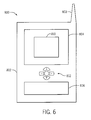
- Figure 6 illustrates embodiments of a small form factor device 800 in which system 700 may be embodied.
- device 800 may be implemented as a mobile computing device having wireless capabilities.
- a mobile computing device may refer to any device having a processing system and a mobile power source or supply, such as one or more batteries, for example.
- examples of a mobile computing device may include a personal computer (PC), laptop computer, ultra-laptop computer, tablet, touch pad, portable computer, handheld computer, palmtop computer, personal digital assistant (PDA), cellular telephone, combination cellular telephone/PDA, television, smart device (e.g., smart phone, smart tablet or smart television), mobile internet device (MID), messaging device, data communication device, and so forth.
- PC personal computer
- laptop computer ultra-laptop computer
- tablet touch pad
- portable computer handheld computer
- palmtop computer personal digital assistant
- PDA personal digital assistant
- cellular telephone e.g., cellular telephone/PDA
- television smart device (e.g., smart phone, smart tablet or smart television), mobile internet device (MID), messaging device, data communication device, and so forth.
- smart device e.g., smart phone, smart tablet or smart television
- MID mobile internet device
- Examples of a mobile computing device also may include computers that are arranged to be worn by a person, such as a wrist computer, finger computer, ring computer, eyeglass computer, belt-clip computer, arm-band computer, shoe computers, clothing computers, and other wearable computers.
- a mobile computing device may be implemented as a smart phone capable of executing computer applications, as well as voice communications and/or data communications.
- voice communications and/or data communications may be described with a mobile computing device implemented as a smart phone by way of example, it may be appreciated that other embodiments may be implemented using other wireless mobile computing devices as well. The embodiments are not limited in this context.
- the processor 710 may communicate with a camera 722 and a global positioning system sensor 720, in some embodiments.
- a memory 712, coupled to the processor 710, may store computer readable instructions for implementing the sequences shown in Figure 4 in software and/or firmware embodiments.
- device 800 may comprise a housing 802, a display 804, an input/output (I/O) device 806, and an antenna 808.
- Device 800 also may comprise navigation features 812.
- Display 804 may comprise any suitable display unit for displaying information appropriate for a mobile computing device.
- I/O device 806 may comprise any suitable I/O device for entering information into a mobile computing device. Examples for I/O device 806 may include an alphanumeric keyboard, a numeric keypad, a touch pad, input keys, buttons, switches, rocker switches, microphones, speakers, voice recognition device and software, and so forth. Information also may be entered into device 800 by way of microphone. Such information may be digitized by a voice recognition device. The embodiments are not limited in this context.
- Various embodiments may be implemented using hardware elements, software elements, or a combination of both.
- hardware elements may include processors, microprocessors, circuits, circuit elements (e.g., transistors, resistors, capacitors, inductors, and so forth), integrated circuits, application specific integrated circuits (ASIC), programmable logic devices (PLD), digital signal processors (DSP), field programmable gate array (FPGA), logic gates, registers, semiconductor device, chips, microchips, chip sets, and so forth.
- Examples of software may include software components, programs, applications, computer programs, application programs, system programs, machine programs, operating system software, middleware, firmware, software modules, routines, subroutines, functions, methods, procedures, software interfaces, application program interfaces (API), instruction sets, computing code, computer code, code segments, computer code segments, words, values, symbols, or any combination thereof. Determining whether an embodiment is implemented using hardware elements and/or software elements may vary in accordance with any number of factors, such as desired computational rate, power levels, heat tolerances, processing cycle budget, input data rates, output data rates, memory resources, data bus speeds and other design or performance constraints.
- graphics processing techniques described herein may be implemented in various hardware architectures. For example, graphics functionality may be integrated within a chipset. Alternatively, a discrete graphics processor may be used. As still another embodiment, the graphics functions may be implemented by a general purpose processor, including a multicore processor.
- Another example embodiment may be at least one non-transitory computer readable medium storing instructions executed by a processor to perform a sequence comprising finding pixels that in any part overlap a triangle, passing fragments to a buffer, and resolving visibility between multiple fragments.
- the medium may include said sequence including performing outer conservative rasterization.
- the medium may include said sequence including performing inner conservative rasterization.
- the medium may include said sequence including running all rendering passes at one sample per pixel.
- the medium may include said sequence including resolving visibility by performing micro-rasterization.
- the medium may include said sequence including analytically resolving visibility between multiple fragments.
- the medium may include said sequence including performing anti-aliasing at all edges and triangle intersections.
- the medium may include said sequence including performing anti-aliasing only at visible discontinuity edges.
- the medium may include said sequence including determining per pixel fragment counts.
- the medium may include said sequence including, for fragments passing a depth test, passing a fragment to a buffer if the fragment count for
- an apparatus comprising a processor to find pixels that in any part overlap a triangle, pass fragments to a buffer, and resolve visibility between multiple fragments, and a storage coupled to said processor.
- the apparatus may include said processor to perform outer conservative rasterization.
- the apparatus may include said processor to perform inner conservative rasterization.
- the apparatus may include said processor to run all rendering passes at one sample per pixel.
- the apparatus may include said processor to resolve visibility by performing micro-rasterization.
- the apparatus may include said processor to analytically resolve visibility between multiple fragments.
- the apparatus may include said processor to perform anti-aliasing at all edges and triangle intersections.
- the apparatus may include an operating system, a battery, firmware and a module to update said firmware.
- references throughout this specification to "one embodiment” or “an embodiment” mean that a particular feature, structure, or characteristic described in connection with the embodiment is included in at least one implementation encompassed within the present disclosure. Thus, appearances of the phrase “one embodiment” or “in an embodiment” are not necessarily referring to the same embodiment. Furthermore, the particular features, structures, or characteristics may be instituted in other suitable forms other than the particular embodiment illustrated and all such forms may be encompassed within the claims of the present application.
Landscapes
- Physics & Mathematics (AREA)
- General Physics & Mathematics (AREA)
- Engineering & Computer Science (AREA)
- Theoretical Computer Science (AREA)
- Image Generation (AREA)
Applications Claiming Priority (1)
| Application Number | Priority Date | Filing Date | Title |
|---|---|---|---|
| US14/037,635 US10134160B2 (en) | 2013-09-26 | 2013-09-26 | Anti-aliasing for graphics hardware |
Publications (3)
| Publication Number | Publication Date |
|---|---|
| EP2854108A2 true EP2854108A2 (fr) | 2015-04-01 |
| EP2854108A3 EP2854108A3 (fr) | 2015-07-01 |
| EP2854108B1 EP2854108B1 (fr) | 2019-12-11 |
Family
ID=51429103
Family Applications (1)
| Application Number | Title | Priority Date | Filing Date |
|---|---|---|---|
| EP14182802.0A Active EP2854108B1 (fr) | 2013-09-26 | 2014-08-29 | Anti-crénelage pour matériel infographique |
Country Status (2)
| Country | Link |
|---|---|
| US (1) | US10134160B2 (fr) |
| EP (1) | EP2854108B1 (fr) |
Cited By (1)
| Publication number | Priority date | Publication date | Assignee | Title |
|---|---|---|---|---|
| WO2021183246A1 (fr) * | 2020-03-11 | 2021-09-16 | Qualcomm Incorporated | Procédés et appareils anticrénelage de compression des bords |
Families Citing this family (21)
| Publication number | Priority date | Publication date | Assignee | Title |
|---|---|---|---|---|
| US9641592B2 (en) | 2013-11-11 | 2017-05-02 | Amazon Technologies, Inc. | Location of actor resources |
| US9805479B2 (en) | 2013-11-11 | 2017-10-31 | Amazon Technologies, Inc. | Session idle optimization for streaming server |
| US9582904B2 (en) | 2013-11-11 | 2017-02-28 | Amazon Technologies, Inc. | Image composition based on remote object data |
| US9604139B2 (en) * | 2013-11-11 | 2017-03-28 | Amazon Technologies, Inc. | Service for generating graphics object data |
| US9634942B2 (en) | 2013-11-11 | 2017-04-25 | Amazon Technologies, Inc. | Adaptive scene complexity based on service quality |
| US9374552B2 (en) | 2013-11-11 | 2016-06-21 | Amazon Technologies, Inc. | Streaming game server video recorder |
| US9578074B2 (en) | 2013-11-11 | 2017-02-21 | Amazon Technologies, Inc. | Adaptive content transmission |
| US10482577B2 (en) | 2016-07-27 | 2019-11-19 | Adobe Inc. | Dynamic spread anti-aliasing |
| KR102637736B1 (ko) * | 2017-01-04 | 2024-02-19 | 삼성전자주식회사 | 그래픽스 처리 방법 및 시스템 |
| US10719912B2 (en) | 2017-04-12 | 2020-07-21 | Microsoft Technology Licensing, Llc | Scaling and feature retention in graphical elements defined based on functions |
| US10628995B2 (en) | 2017-04-17 | 2020-04-21 | Microsoft Technology Licensing, Llc | Anti-aliasing of graphical elements defined based on functions |
| US10825238B2 (en) | 2017-05-03 | 2020-11-03 | Microsoft Technology Licensing, Llc | Visual edge rendering using geometry shader clipping |
| US10685473B2 (en) * | 2017-05-31 | 2020-06-16 | Vmware, Inc. | Emulation of geometry shaders and stream output using compute shaders |
| DE102019109757A1 (de) | 2018-04-12 | 2019-10-17 | Nvidia Corporation | Hinzufügen von mehr realismus zu einem von einem computergenerierten bild durch glätten von gezackten kanten |
| US11113790B2 (en) | 2018-04-12 | 2021-09-07 | Nvidia Corporation | Adding greater realism to a computer-generated image by smoothing jagged edges |
| US11151683B2 (en) * | 2019-09-26 | 2021-10-19 | Intel Corporation | Use of inner coverage information by a conservative rasterization pipeline to enable EarlyZ for conservative rasterization |
| US11882295B2 (en) | 2022-04-15 | 2024-01-23 | Meta Platforms Technologies, Llc | Low-power high throughput hardware decoder with random block access |
| US12266033B2 (en) | 2022-04-15 | 2025-04-01 | Meta Platforms Technologies, Llc | Destination update for blending modes in a graphics pipeline |
| US20230334736A1 (en) * | 2022-04-15 | 2023-10-19 | Meta Platforms Technologies, Llc | Rasterization Optimization for Analytic Anti-Aliasing |
| US20230334735A1 (en) * | 2022-04-15 | 2023-10-19 | Meta Platforms Technologies, Llc | 2D Rendering Hardware Architecture Based on Analytic Anti-Aliasing |
| US12131418B2 (en) | 2022-05-11 | 2024-10-29 | Adobe Inc. | Graphics processing unit instancing control |
Family Cites Families (11)
| Publication number | Priority date | Publication date | Assignee | Title |
|---|---|---|---|---|
| US5886701A (en) | 1995-08-04 | 1999-03-23 | Microsoft Corporation | Graphics rendering device and method for operating same |
| US6104407A (en) | 1997-09-23 | 2000-08-15 | Ati Technologies, Inc. | Method and apparatus for processing fragment pixel information in a three-dimensional graphics processing system |
| US6828983B1 (en) * | 2000-05-12 | 2004-12-07 | S3 Graphics Co., Ltd. | Selective super-sampling/adaptive anti-aliasing of complex 3D data |
| US6567099B1 (en) * | 2000-11-15 | 2003-05-20 | Sony Corporation | Method and system for dynamically allocating a frame buffer for efficient anti-aliasing |
| US7333119B1 (en) * | 2004-11-02 | 2008-02-19 | Nvidia Corporation | System and method for virtual coverage anti-aliasing |
| US7466316B1 (en) * | 2004-12-14 | 2008-12-16 | Nvidia Corporation | Apparatus, system, and method for distributing work to integrated heterogeneous processors |
| US7852350B2 (en) | 2007-07-26 | 2010-12-14 | Stmicroelectronics S.R.L. | Graphic antialiasing method and graphic system employing the method |
| JP4420113B2 (ja) * | 2008-01-16 | 2010-02-24 | 株式会社デンソー | 画像データ更新装置、及びプログラム |
| AU2009222438A1 (en) | 2009-09-25 | 2011-04-14 | Canon Kabushiki Kaisha | Anti-aliased polygon rendering |
| US8869138B2 (en) * | 2011-11-11 | 2014-10-21 | Wyse Technology L.L.C. | Robust firmware update with recovery logic |
| US9390540B2 (en) * | 2012-12-21 | 2016-07-12 | Nvidia Corporation | Deferred shading graphics processing unit, geometry data structure and method of performing anti-aliasing in deferred shading |
-
2013
- 2013-09-26 US US14/037,635 patent/US10134160B2/en active Active
-
2014
- 2014-08-29 EP EP14182802.0A patent/EP2854108B1/fr active Active
Non-Patent Citations (1)
| Title |
|---|
| None |
Cited By (3)
| Publication number | Priority date | Publication date | Assignee | Title |
|---|---|---|---|---|
| WO2021183246A1 (fr) * | 2020-03-11 | 2021-09-16 | Qualcomm Incorporated | Procédés et appareils anticrénelage de compression des bords |
| US11631215B2 (en) | 2020-03-11 | 2023-04-18 | Qualcomm Incorporated | Methods and apparatus for edge compression anti-aliasing |
| EP4242972A3 (fr) * | 2020-03-11 | 2023-11-22 | Qualcomm Incorporated | Procédés et appareils anticrénelage de compression des bords |
Also Published As
| Publication number | Publication date |
|---|---|
| EP2854108A3 (fr) | 2015-07-01 |
| US10134160B2 (en) | 2018-11-20 |
| EP2854108B1 (fr) | 2019-12-11 |
| US20150084981A1 (en) | 2015-03-26 |
Similar Documents
| Publication | Publication Date | Title |
|---|---|---|
| US10134160B2 (en) | Anti-aliasing for graphics hardware | |
| US11875453B2 (en) | Decoupled shading pipeline | |
| KR102475212B1 (ko) | 타일식 아키텍처들에서의 포비티드 렌더링 | |
| US9904977B2 (en) | Exploiting frame to frame coherency in a sort-middle architecture | |
| US10164459B2 (en) | Selective rasterization | |
| US10049486B2 (en) | Sparse rasterization | |
| US9390541B2 (en) | Programmable tile shader | |
| US9665973B2 (en) | Depth buffering | |
| US9959643B2 (en) | Variable rasterization order for motion blur and depth of field | |
| US9934604B2 (en) | Culling using masked depths for MSAA | |
| US9336561B2 (en) | Color buffer caching | |
| EP2804150A1 (fr) | Bouchons de filtre de rejet de mode d'adressage de texture | |
| KR20230018368A (ko) | 폐색 처리 기법을 위한 방법 및 장치 | |
| US9183652B2 (en) | Variable rasterization order for motion blur and depth of field | |
| US20150279089A1 (en) | Streaming compression anti-aliasing approach to deferred shading | |
| KR20220148814A (ko) | 효율적인 다중 뷰 래스터화를 위한 방법들 및 장치 | |
| KR102864226B1 (ko) | 가변 레이트 테셀레이션 | |
| EP2845186B1 (fr) | Anticrénelage efficace en énergie |
Legal Events
| Date | Code | Title | Description |
|---|---|---|---|
| PUAI | Public reference made under article 153(3) epc to a published international application that has entered the european phase |
Free format text: ORIGINAL CODE: 0009012 |
|
| 17P | Request for examination filed |
Effective date: 20140829 |
|
| AK | Designated contracting states |
Kind code of ref document: A2 Designated state(s): AL AT BE BG CH CY CZ DE DK EE ES FI FR GB GR HR HU IE IS IT LI LT LU LV MC MK MT NL NO PL PT RO RS SE SI SK SM TR |
|
| AX | Request for extension of the european patent |
Extension state: BA ME |
|
| PUAL | Search report despatched |
Free format text: ORIGINAL CODE: 0009013 |
|
| RAP1 | Party data changed (applicant data changed or rights of an application transferred) |
Owner name: INTEL CORPORATION |
|
| RIC1 | Information provided on ipc code assigned before grant |
Ipc: G06T 11/40 20060101AFI20150513BHEP |
|
| RIC1 | Information provided on ipc code assigned before grant |
Ipc: G06T 11/40 20060101AFI20150521BHEP |
|
| AK | Designated contracting states |
Kind code of ref document: A3 Designated state(s): AL AT BE BG CH CY CZ DE DK EE ES FI FR GB GR HR HU IE IS IT LI LT LU LV MC MK MT NL NO PL PT RO RS SE SI SK SM TR |
|
| AX | Request for extension of the european patent |
Extension state: BA ME |
|
| RBV | Designated contracting states (corrected) |
Designated state(s): AL AT BE BG CH CY CZ DE DK EE ES FI FR GB GR HR HU IE IS IT LI LT LU LV MC MK MT NL NO PL PT RO RS SE SI SK SM TR |
|
| 17Q | First examination report despatched |
Effective date: 20160720 |
|
| STAA | Information on the status of an ep patent application or granted ep patent |
Free format text: STATUS: EXAMINATION IS IN PROGRESS |
|
| GRAP | Despatch of communication of intention to grant a patent |
Free format text: ORIGINAL CODE: EPIDOSNIGR1 |
|
| STAA | Information on the status of an ep patent application or granted ep patent |
Free format text: STATUS: GRANT OF PATENT IS INTENDED |
|
| INTG | Intention to grant announced |
Effective date: 20190802 |
|
| GRAS | Grant fee paid |
Free format text: ORIGINAL CODE: EPIDOSNIGR3 |
|
| GRAA | (expected) grant |
Free format text: ORIGINAL CODE: 0009210 |
|
| STAA | Information on the status of an ep patent application or granted ep patent |
Free format text: STATUS: THE PATENT HAS BEEN GRANTED |
|
| AK | Designated contracting states |
Kind code of ref document: B1 Designated state(s): AL AT BE BG CH CY CZ DE DK EE ES FI FR GB GR HR HU IE IS IT LI LT LU LV MC MK MT NL NO PL PT RO RS SE SI SK SM TR |
|
| REG | Reference to a national code |
Ref country code: GB Ref legal event code: FG4D |
|
| REG | Reference to a national code |
Ref country code: CH Ref legal event code: EP |
|
| REG | Reference to a national code |
Ref country code: AT Ref legal event code: REF Ref document number: 1212948 Country of ref document: AT Kind code of ref document: T Effective date: 20191215 |
|
| REG | Reference to a national code |
Ref country code: DE Ref legal event code: R096 Ref document number: 602014058153 Country of ref document: DE |
|
| REG | Reference to a national code |
Ref country code: IE Ref legal event code: FG4D |
|
| REG | Reference to a national code |
Ref country code: NL Ref legal event code: FP |
|
| REG | Reference to a national code |
Ref country code: LT Ref legal event code: MG4D |
|
| PG25 | Lapsed in a contracting state [announced via postgrant information from national office to epo] |
Ref country code: SE Free format text: LAPSE BECAUSE OF FAILURE TO SUBMIT A TRANSLATION OF THE DESCRIPTION OR TO PAY THE FEE WITHIN THE PRESCRIBED TIME-LIMIT Effective date: 20191211 Ref country code: LV Free format text: LAPSE BECAUSE OF FAILURE TO SUBMIT A TRANSLATION OF THE DESCRIPTION OR TO PAY THE FEE WITHIN THE PRESCRIBED TIME-LIMIT Effective date: 20191211 Ref country code: ES Free format text: LAPSE BECAUSE OF FAILURE TO SUBMIT A TRANSLATION OF THE DESCRIPTION OR TO PAY THE FEE WITHIN THE PRESCRIBED TIME-LIMIT Effective date: 20191211 Ref country code: FI Free format text: LAPSE BECAUSE OF FAILURE TO SUBMIT A TRANSLATION OF THE DESCRIPTION OR TO PAY THE FEE WITHIN THE PRESCRIBED TIME-LIMIT Effective date: 20191211 Ref country code: NO Free format text: LAPSE BECAUSE OF FAILURE TO SUBMIT A TRANSLATION OF THE DESCRIPTION OR TO PAY THE FEE WITHIN THE PRESCRIBED TIME-LIMIT Effective date: 20200311 Ref country code: BG Free format text: LAPSE BECAUSE OF FAILURE TO SUBMIT A TRANSLATION OF THE DESCRIPTION OR TO PAY THE FEE WITHIN THE PRESCRIBED TIME-LIMIT Effective date: 20200311 Ref country code: LT Free format text: LAPSE BECAUSE OF FAILURE TO SUBMIT A TRANSLATION OF THE DESCRIPTION OR TO PAY THE FEE WITHIN THE PRESCRIBED TIME-LIMIT Effective date: 20191211 Ref country code: GR Free format text: LAPSE BECAUSE OF FAILURE TO SUBMIT A TRANSLATION OF THE DESCRIPTION OR TO PAY THE FEE WITHIN THE PRESCRIBED TIME-LIMIT Effective date: 20200312 |
|
| PG25 | Lapsed in a contracting state [announced via postgrant information from national office to epo] |
Ref country code: HR Free format text: LAPSE BECAUSE OF FAILURE TO SUBMIT A TRANSLATION OF THE DESCRIPTION OR TO PAY THE FEE WITHIN THE PRESCRIBED TIME-LIMIT Effective date: 20191211 Ref country code: RS Free format text: LAPSE BECAUSE OF FAILURE TO SUBMIT A TRANSLATION OF THE DESCRIPTION OR TO PAY THE FEE WITHIN THE PRESCRIBED TIME-LIMIT Effective date: 20191211 |
|
| PG25 | Lapsed in a contracting state [announced via postgrant information from national office to epo] |
Ref country code: AL Free format text: LAPSE BECAUSE OF FAILURE TO SUBMIT A TRANSLATION OF THE DESCRIPTION OR TO PAY THE FEE WITHIN THE PRESCRIBED TIME-LIMIT Effective date: 20191211 |
|
| PG25 | Lapsed in a contracting state [announced via postgrant information from national office to epo] |
Ref country code: EE Free format text: LAPSE BECAUSE OF FAILURE TO SUBMIT A TRANSLATION OF THE DESCRIPTION OR TO PAY THE FEE WITHIN THE PRESCRIBED TIME-LIMIT Effective date: 20191211 Ref country code: RO Free format text: LAPSE BECAUSE OF FAILURE TO SUBMIT A TRANSLATION OF THE DESCRIPTION OR TO PAY THE FEE WITHIN THE PRESCRIBED TIME-LIMIT Effective date: 20191211 Ref country code: PT Free format text: LAPSE BECAUSE OF FAILURE TO SUBMIT A TRANSLATION OF THE DESCRIPTION OR TO PAY THE FEE WITHIN THE PRESCRIBED TIME-LIMIT Effective date: 20200506 Ref country code: CZ Free format text: LAPSE BECAUSE OF FAILURE TO SUBMIT A TRANSLATION OF THE DESCRIPTION OR TO PAY THE FEE WITHIN THE PRESCRIBED TIME-LIMIT Effective date: 20191211 |
|
| PG25 | Lapsed in a contracting state [announced via postgrant information from national office to epo] |
Ref country code: SM Free format text: LAPSE BECAUSE OF FAILURE TO SUBMIT A TRANSLATION OF THE DESCRIPTION OR TO PAY THE FEE WITHIN THE PRESCRIBED TIME-LIMIT Effective date: 20191211 Ref country code: SK Free format text: LAPSE BECAUSE OF FAILURE TO SUBMIT A TRANSLATION OF THE DESCRIPTION OR TO PAY THE FEE WITHIN THE PRESCRIBED TIME-LIMIT Effective date: 20191211 Ref country code: IS Free format text: LAPSE BECAUSE OF FAILURE TO SUBMIT A TRANSLATION OF THE DESCRIPTION OR TO PAY THE FEE WITHIN THE PRESCRIBED TIME-LIMIT Effective date: 20200411 |
|
| REG | Reference to a national code |
Ref country code: DE Ref legal event code: R097 Ref document number: 602014058153 Country of ref document: DE |
|
| PGFP | Annual fee paid to national office [announced via postgrant information from national office to epo] |
Ref country code: NL Payment date: 20200814 Year of fee payment: 7 |
|
| REG | Reference to a national code |
Ref country code: AT Ref legal event code: MK05 Ref document number: 1212948 Country of ref document: AT Kind code of ref document: T Effective date: 20191211 |
|
| PLBE | No opposition filed within time limit |
Free format text: ORIGINAL CODE: 0009261 |
|
| STAA | Information on the status of an ep patent application or granted ep patent |
Free format text: STATUS: NO OPPOSITION FILED WITHIN TIME LIMIT |
|
| PG25 | Lapsed in a contracting state [announced via postgrant information from national office to epo] |
Ref country code: DK Free format text: LAPSE BECAUSE OF FAILURE TO SUBMIT A TRANSLATION OF THE DESCRIPTION OR TO PAY THE FEE WITHIN THE PRESCRIBED TIME-LIMIT Effective date: 20191211 |
|
| PGFP | Annual fee paid to national office [announced via postgrant information from national office to epo] |
Ref country code: FR Payment date: 20200724 Year of fee payment: 7 Ref country code: GB Payment date: 20200819 Year of fee payment: 7 Ref country code: DE Payment date: 20200819 Year of fee payment: 7 |
|
| 26N | No opposition filed |
Effective date: 20200914 |
|
| PG25 | Lapsed in a contracting state [announced via postgrant information from national office to epo] |
Ref country code: SI Free format text: LAPSE BECAUSE OF FAILURE TO SUBMIT A TRANSLATION OF THE DESCRIPTION OR TO PAY THE FEE WITHIN THE PRESCRIBED TIME-LIMIT Effective date: 20191211 Ref country code: PL Free format text: LAPSE BECAUSE OF FAILURE TO SUBMIT A TRANSLATION OF THE DESCRIPTION OR TO PAY THE FEE WITHIN THE PRESCRIBED TIME-LIMIT Effective date: 20191211 Ref country code: AT Free format text: LAPSE BECAUSE OF FAILURE TO SUBMIT A TRANSLATION OF THE DESCRIPTION OR TO PAY THE FEE WITHIN THE PRESCRIBED TIME-LIMIT Effective date: 20191211 |
|
| PG25 | Lapsed in a contracting state [announced via postgrant information from national office to epo] |
Ref country code: IT Free format text: LAPSE BECAUSE OF FAILURE TO SUBMIT A TRANSLATION OF THE DESCRIPTION OR TO PAY THE FEE WITHIN THE PRESCRIBED TIME-LIMIT Effective date: 20191211 |
|
| PG25 | Lapsed in a contracting state [announced via postgrant information from national office to epo] |
Ref country code: MC Free format text: LAPSE BECAUSE OF FAILURE TO SUBMIT A TRANSLATION OF THE DESCRIPTION OR TO PAY THE FEE WITHIN THE PRESCRIBED TIME-LIMIT Effective date: 20191211 |
|
| REG | Reference to a national code |
Ref country code: CH Ref legal event code: PL |
|
| PG25 | Lapsed in a contracting state [announced via postgrant information from national office to epo] |
Ref country code: LU Free format text: LAPSE BECAUSE OF NON-PAYMENT OF DUE FEES Effective date: 20200829 Ref country code: CH Free format text: LAPSE BECAUSE OF NON-PAYMENT OF DUE FEES Effective date: 20200831 Ref country code: LI Free format text: LAPSE BECAUSE OF NON-PAYMENT OF DUE FEES Effective date: 20200831 |
|
| REG | Reference to a national code |
Ref country code: BE Ref legal event code: MM Effective date: 20200831 |
|
| PG25 | Lapsed in a contracting state [announced via postgrant information from national office to epo] |
Ref country code: BE Free format text: LAPSE BECAUSE OF NON-PAYMENT OF DUE FEES Effective date: 20200831 Ref country code: IE Free format text: LAPSE BECAUSE OF NON-PAYMENT OF DUE FEES Effective date: 20200829 |
|
| REG | Reference to a national code |
Ref country code: DE Ref legal event code: R119 Ref document number: 602014058153 Country of ref document: DE |
|
| REG | Reference to a national code |
Ref country code: NL Ref legal event code: MM Effective date: 20210901 |
|
| GBPC | Gb: european patent ceased through non-payment of renewal fee |
Effective date: 20210829 |
|
| PG25 | Lapsed in a contracting state [announced via postgrant information from national office to epo] |
Ref country code: TR Free format text: LAPSE BECAUSE OF FAILURE TO SUBMIT A TRANSLATION OF THE DESCRIPTION OR TO PAY THE FEE WITHIN THE PRESCRIBED TIME-LIMIT Effective date: 20191211 Ref country code: MT Free format text: LAPSE BECAUSE OF FAILURE TO SUBMIT A TRANSLATION OF THE DESCRIPTION OR TO PAY THE FEE WITHIN THE PRESCRIBED TIME-LIMIT Effective date: 20191211 Ref country code: CY Free format text: LAPSE BECAUSE OF FAILURE TO SUBMIT A TRANSLATION OF THE DESCRIPTION OR TO PAY THE FEE WITHIN THE PRESCRIBED TIME-LIMIT Effective date: 20191211 |
|
| PG25 | Lapsed in a contracting state [announced via postgrant information from national office to epo] |
Ref country code: NL Free format text: LAPSE BECAUSE OF NON-PAYMENT OF DUE FEES Effective date: 20210901 Ref country code: MK Free format text: LAPSE BECAUSE OF FAILURE TO SUBMIT A TRANSLATION OF THE DESCRIPTION OR TO PAY THE FEE WITHIN THE PRESCRIBED TIME-LIMIT Effective date: 20191211 |
|
| PG25 | Lapsed in a contracting state [announced via postgrant information from national office to epo] |
Ref country code: GB Free format text: LAPSE BECAUSE OF NON-PAYMENT OF DUE FEES Effective date: 20210829 Ref country code: FR Free format text: LAPSE BECAUSE OF NON-PAYMENT OF DUE FEES Effective date: 20210831 Ref country code: DE Free format text: LAPSE BECAUSE OF NON-PAYMENT OF DUE FEES Effective date: 20220301 |