EP2857528A1 - Procédé de production d'une solution de sucre - Google Patents
Procédé de production d'une solution de sucre Download PDFInfo
- Publication number
- EP2857528A1 EP2857528A1 EP20130801065 EP13801065A EP2857528A1 EP 2857528 A1 EP2857528 A1 EP 2857528A1 EP 20130801065 EP20130801065 EP 20130801065 EP 13801065 A EP13801065 A EP 13801065A EP 2857528 A1 EP2857528 A1 EP 2857528A1
- Authority
- EP
- European Patent Office
- Prior art keywords
- sugar liquid
- membrane
- producing
- sugar
- concentrated
- Prior art date
- Legal status (The legal status is an assumption and is not a legal conclusion. Google has not performed a legal analysis and makes no representation as to the accuracy of the status listed.)
- Granted
Links
Images


Classifications
-
- C—CHEMISTRY; METALLURGY
- C13—SUGAR INDUSTRY
- C13K—SACCHARIDES OBTAINED FROM NATURAL SOURCES OR BY HYDROLYSIS OF NATURALLY OCCURRING DISACCHARIDES, OLIGOSACCHARIDES OR POLYSACCHARIDES
- C13K1/00—Glucose; Glucose-containing syrups
- C13K1/02—Glucose; Glucose-containing syrups obtained by saccharification of cellulosic materials
- C13K1/04—Purifying
-
- C—CHEMISTRY; METALLURGY
- C12—BIOCHEMISTRY; BEER; SPIRITS; WINE; VINEGAR; MICROBIOLOGY; ENZYMOLOGY; MUTATION OR GENETIC ENGINEERING
- C12P—FERMENTATION OR ENZYME-USING PROCESSES TO SYNTHESISE A DESIRED CHEMICAL COMPOUND OR COMPOSITION OR TO SEPARATE OPTICAL ISOMERS FROM A RACEMIC MIXTURE
- C12P19/00—Preparation of compounds containing saccharide radicals
- C12P19/02—Monosaccharides
-
- C—CHEMISTRY; METALLURGY
- C12—BIOCHEMISTRY; BEER; SPIRITS; WINE; VINEGAR; MICROBIOLOGY; ENZYMOLOGY; MUTATION OR GENETIC ENGINEERING
- C12P—FERMENTATION OR ENZYME-USING PROCESSES TO SYNTHESISE A DESIRED CHEMICAL COMPOUND OR COMPOSITION OR TO SEPARATE OPTICAL ISOMERS FROM A RACEMIC MIXTURE
- C12P19/00—Preparation of compounds containing saccharide radicals
- C12P19/14—Preparation of compounds containing saccharide radicals produced by the action of a carbohydrase (EC 3.2.x), e.g. by alpha-amylase, e.g. by cellulase, hemicellulase
-
- C—CHEMISTRY; METALLURGY
- C12—BIOCHEMISTRY; BEER; SPIRITS; WINE; VINEGAR; MICROBIOLOGY; ENZYMOLOGY; MUTATION OR GENETIC ENGINEERING
- C12P—FERMENTATION OR ENZYME-USING PROCESSES TO SYNTHESISE A DESIRED CHEMICAL COMPOUND OR COMPOSITION OR TO SEPARATE OPTICAL ISOMERS FROM A RACEMIC MIXTURE
- C12P7/00—Preparation of oxygen-containing organic compounds
- C12P7/40—Preparation of oxygen-containing organic compounds containing a carboxyl group including Peroxycarboxylic acids
- C12P7/56—Lactic acid
-
- C—CHEMISTRY; METALLURGY
- C13—SUGAR INDUSTRY
- C13K—SACCHARIDES OBTAINED FROM NATURAL SOURCES OR BY HYDROLYSIS OF NATURALLY OCCURRING DISACCHARIDES, OLIGOSACCHARIDES OR POLYSACCHARIDES
- C13K13/00—Sugars not otherwise provided for in this class
- C13K13/002—Xylose
-
- C—CHEMISTRY; METALLURGY
- C12—BIOCHEMISTRY; BEER; SPIRITS; WINE; VINEGAR; MICROBIOLOGY; ENZYMOLOGY; MUTATION OR GENETIC ENGINEERING
- C12P—FERMENTATION OR ENZYME-USING PROCESSES TO SYNTHESISE A DESIRED CHEMICAL COMPOUND OR COMPOSITION OR TO SEPARATE OPTICAL ISOMERS FROM A RACEMIC MIXTURE
- C12P2203/00—Fermentation products obtained from optionally pretreated or hydrolyzed cellulosic or lignocellulosic material as the carbon source
-
- Y—GENERAL TAGGING OF NEW TECHNOLOGICAL DEVELOPMENTS; GENERAL TAGGING OF CROSS-SECTIONAL TECHNOLOGIES SPANNING OVER SEVERAL SECTIONS OF THE IPC; TECHNICAL SUBJECTS COVERED BY FORMER USPC CROSS-REFERENCE ART COLLECTIONS [XRACs] AND DIGESTS
- Y02—TECHNOLOGIES OR APPLICATIONS FOR MITIGATION OR ADAPTATION AGAINST CLIMATE CHANGE
- Y02E—REDUCTION OF GREENHOUSE GAS [GHG] EMISSIONS, RELATED TO ENERGY GENERATION, TRANSMISSION OR DISTRIBUTION
- Y02E50/00—Technologies for the production of fuel of non-fossil origin
- Y02E50/10—Biofuels, e.g. bio-diesel
Definitions
- the present invention relates to a method for producing a sugar liquid from biomass.
- sugar liquid in recent years, methods for producing a sugar liquid by pretreating cellulosic biomass with an acid, hot water, alkali or the like and then adding cellulase thereto to perform hydrolysis have been widely studied.
- the thus obtained sugar liquid sometimes has a lower sugar concentration than a conventional sugar liquid derived from an edible material such as starch or cane juice.
- the sugar concentration in cases where the sugar concentration is low, the sugar concentration can be increased by distilling water in the sugar liquid by, for example, concentration under reduced pressure or concentration by heating.
- concentration under reduced pressure or concentration by heating for example, a case in which beet molasses is concentrated in an evaporator has been disclosed (see Patent Document 1).
- the present inventors found problems in culture of microorganisms using as a fermentation feedstock a cellulosic biomass sugar liquid, especially, concentrated cellulosic biomass sugar liquid, that precipitation of an insoluble substance containing magnesium as a major component may cause attachment of scale to a fermentation apparatus, clogging of pipes, clogging of a separation membrane, occurrence of a trouble in a pH/DO sensor, attachment of scale to a separation membrane during continuous culture, and difficulty in membrane separation of a fermentation product from the culture liquid.
- An object of the present invention is to provide a method for producing a sugar liquid, which method can prevent the above problems, that is, attachment of scale to a fermentation apparatus, clogging of pipes, clogging of a separation membrane, occurrence of a trouble in a pH/DO sensor and attachment of scale to a separation membrane during continuous culture, and enables membrane separation of a fermentation product from the culture liquid.
- the present invention aims to solve the problems described above, and the method for producing a sugar liquid of the present invention comprises the steps of: adding an alkali(s) to a concentrated cellulosic biomass sugar liquid to adjust the pH to not less than 7, so as to precipitate an insoluble substance(s) containing at least magnesium; and performing filtration through a microfiltration membrane to remove the insoluble substance(s), to obtain a sugar liquid as a permeate.
- the concentrated cellulosic biomass sugar liquid is a sugar liquid prepared by subjecting a hydrolysate obtained from a cellulosic biomass by any one or more of treatments selected from the group consisting of hydrothermal treatment, acid treatment, alkali treatment and enzyme treatment, to any one or more of treatments selected from the group consisting of membrane concentration, concentration under reduced pressure and concentration by heating.
- the pH of the concentrated cellulosic biomass sugar liquid is adjusted to not less than 8 with the alkali(s).
- the average pore size of the microfiltration membrane is within the range of 0.01 ⁇ m to 1 ⁇ m.
- the microfiltration membrane is a hollow fiber microfiltration membrane.
- one or more additives selected from the group consisting of nitrogen sources, metal salts, vitamins, amino acids, sugars, antifoaming agents and surfactants are further added.
- various kinds of chemical products can be produced using the sugar liquid obtained by the production method as a fermentation feedstock.
- a microorganism is cultured using, as a fermentation feedstock, a sugar liquid obtained by the above production method to allow production of a chemical product in the culture liquid, while the microorganism and the chemical product are continuously or intermittently filtered through a separation membrane. By this, the chemical product can be recovered.
- the above-mentioned problem that is, attachment of scale to a fermenter or a separation membrane
- an expensive method such as ion chromatography.
- This can be achieved by a simple method in which the following operations are carried out: an alkali(s) is/are added to a concentrated cellulosic biomass sugar liquid to adjust the pH to not less than 7, so as to precipitate an insoluble substance(s) containing at least magnesium; and the insoluble substance(s) is/are then removed by filtration through a microfiltration membrane, to obtain a sugar liquid as a permeate.
- improvement of the fermentation yield can be achieved as a novel effect by performing the above operations in cases where a concentrated cellulosic biomass sugar liquid is used as a fermentation feedstock.
- the method for producing a sugar liquid of the present invention can be used for producing a sugar liquid to be used as a fermentation feedstock from a cellulose-containing biomass.
- the sugar liquid produced by the present invention can be used as a fermentation feedstock for various kinds of chemical products.
- the method for producing a sugar liquid of the present invention comprises the steps of: adding an alkali(s) to a concentrated cellulosic biomass sugar liquid to adjust the pH to not less than 7, so as to precipitate an insoluble substance(s) containing at least magnesium; and performing filtration through a microfiltration membrane to remove said insoluble substance(s), to obtain a sugar liquid as a permeate.
- Fig. 1 is a diagram illustrating the block flow of a method for producing a sugar liquid of the present invention.
- Step (1) the step of adding an alkali(s) to a concentrated cellulosic biomass sugar liquid to adjust the pH to not less than 7, so as to precipitate an insoluble substance(s) containing at least magnesium [Step (1)], of the present invention is described.
- the concentrated cellulosic biomass sugar liquid to be used in the present invention means a sugar liquid which is an aqueous solution containing a sugar obtained by hydrolysis of a cellulosic biomass material and has been processed through a step of concentration by one or more concentration operations.
- the cellulosic biomass herein means a biomass containing cellulose.
- cellulosic biomass examples include herbaceous biomasses such as bagasse, switchgrass, napier grass, Erianthus, corn stover, rice straw, wheat straw, chaff and coconut husk; woody biomasses such as trees, poplar and waste building materials; and water environment-derived biomasses such as algae and seaweeds.
- herbaceous biomasses such as bagasse, switchgrass, napier grass, Erianthus, corn stover, rice straw, wheat straw, chaff and coconut husk
- woody biomasses such as trees, poplar and waste building materials
- water environment-derived biomasses such as algae and seaweeds.
- Such biomasses contain, in addition to cellulose and hemicellulose (which may be hereinafter referred to as "cellulose” as a general term for cellulose and hemicellulose), lignin as aromatic macromolecules, and the like.
- the sugar liquid herein means a sugar liquid obtained by subjecting the cellulosic biomass to one or more treatments selected from the group consisting of acid treatment, enzyme treatment, alkali treatment and pulverization treatment to perform hydrolysis of the cellulose component and/or hemicellulose component contained in the cellulosic biomass.
- the sugar liquid is not limited to the sugar liquid immediately after the hydrolysis, and an aqueous solution obtained after adding a microorganism to the hydrolysate and performing fermentation can also be regarded as the sugar liquid as long as the aqueous solution contains a sugar, and can be used in the present invention.
- the concentrated sugar liquid means a sugar liquid prepared by concentrating the cellulosic biomass sugar liquid by a known method such as evaporative concentration or membrane concentration.
- the concentration method may be a combination of a plurality of methods.
- the concentrated sugar liquid may also be a dilution prepared by adding water or the like to a liquid concentrated by the above concentration method, or to a sugar in the solid state prepared by removal of water by concentration.
- the operation of adding an alkali(s) to a concentrated cellulosic biomass sugar liquid to adjust the pH to not less than 7, so as to precipitate an insoluble substance(s) containing at least magnesium, is carried out.
- alkali(s) to be added include ammonia, aqueous ammonia, sodium hydroxide and potassium hydroxide.
- an alkali such as calcium hydroxide may also be used, calcium may cause production of scale similarly to magnesium, so that use of such an alkali is not advantageous.
- ammonia is especially preferably used.
- the obtained hydrolysate, as well as the concentrated sugar liquid often contain sulfate ions.
- ammonium sulfate can be produced as a salt.
- ammonium sulfate can be effectively used as a nitrogen source by microorganisms during their growth, fermentation production and the like. That is, the alkali to be used for the pH adjustment is most preferably ammonia.
- magnesium dissolved in the concentrated cellulosic biomass sugar liquid can be made into magnesium hydroxide, which can be precipitated as insoluble crystals.
- the pH is adjusted to preferably not less than 8, more preferably not less than 9, most preferably not less than 10.
- the upper limit of the pH is not limited as long as the pH is less than 14, but, since a pH higher than 12 does not especially increase the effect, the pH is preferably set to not more than 12 in view of reducing the amount of the alkali(s) used. That is, the pH is preferably within the range of 8 to 12, more preferably within the range of 9 to 12, most preferably within the range of 10 to 12.
- Examples of the method for feeding the alkali(s) to adjust the pH include a method in which the concentrated cellulosic biomass sugar liquid is preliminarily subjected to titration with the alkali(s) to be used, and a predetermined amount(s) of the alkali(s) is/are fed; and a method in which the alkali(s) is/are fed while the increase in the pH is monitored with a pH sensor or the like until a predetermined pH is achieved.
- an operation such as stirring or mixing may be carried out.
- precipitation of magnesium hydroxide may be carried out, if necessary, by an operation such as incubation or cooling.
- the time of the precipitation may be arbitrary set, and the precipitation is carried out for preferably not less than 1 minute, more preferably not less than 5 minutes, most preferably not less than 3 hours.
- This treatment also has an effect of disinfection, elimination and/or sterilization by exposure of microorganisms, molds, spores and/or the like contained in the sugar liquid to alkaline conditions.
- Fig. 2 is a diagram illustrating the block flow of another method for producing a sugar liquid of the present invention.
- the diagram shows a flow that utilizes, in the step of precipitation of magnesium hydroxide, a period such as transportation, keeping/storage, or transportation/keeping/storage of the concentrated cellulosic biomass sugar liquid. Since the precipitation of the insoluble substance(s) requires a certain period of time, the above periods can be effectively utilized for the purpose. Since, in the present invention, the pH is adjusted with an alkali(s) as described above, an improved keeping quality due to prevention of microbial contamination and the like can be achieved.
- the microfiltration membrane treatment may be preceded by addition of one or more of nutrients and auxiliary materials required for use of a sugar liquid as a fermentation feedstock, such as nitrogen sources, metal salts, vitamins, amino acids, sugars, antibiotics, surfactants and anti-foaming agents.
- nutrients and auxiliary materials required for use of a sugar liquid as a fermentation feedstock such as nitrogen sources, metal salts, vitamins, amino acids, sugars, antibiotics, surfactants and anti-foaming agents.
- nitrogen sources examples include ammonium sulfate, ammonium phosphate, casein, meat extract, yeast extract, peptone, soy peptone and corn steep liquor.
- Examples of the metal salts include those of molybdenum, cobalt, iron, copper, zinc, manganese, nickel, chrome, selenium, iodine, fluorine, silicon and vanadium.
- Examples of the vitamins include vitamin B12, thiamine, biotin and vitamin B1.
- sugars include glucose, arabinose, xylose, fructose, psicose, galactose, mannose, xylulose, threose, erythrose and ribose.
- amino acids include alanine, arginine, asparagine, aspartic acid, cysteine, glutamine, glutamic acid, glycine, histidine, isoleucine, leucine, lysine, methionine, phenylalanine, proline, serine, threonine, tryptophan, tyrosine and valine.
- antibiotics examples include tetracycline antibiotics, ⁇ -lactam antibiotics, aminoglycoside antibiotics, macrolide antibiotics and chloramphenicol antibiotics.
- surfactants examples include nonionic surfactants, anionic surfactants and cationic surfactants.
- necessary components in required amounts are preferably preliminarily added at this stage. This is carried out for the purpose of preventing the insoluble substance(s) from being generated again during the stage of fermentation due to addition of these components to the sugar liquid.
- the concentrated cellulosic biomass sugar liquid used in the present invention is preferably a sugar liquid prepared by concentration using a nanofiltration membrane and/or reverse osmosis membrane.
- the nanofiltration membrane is also called a nanofilter (nanofiltration membrane, NF membrane), and generally defined as a "membrane that allows permeation of monovalent ions, but blocks divalent ions".
- the membrane is considered to have fine voids having sizes of about several nanometers, and mainly used to block fine particles, molecules, ions, salts and the like in water.
- a reverse osmosis membrane is also called an RO membrane, and generally defined as a "membrane having a desalting function also for monovalent ions".
- the membrane is considered to have ultrafine voids having sizes of about several angstroms to several nanometers, and mainly used for removal of ion components such as seawater desalination and ultrapure water production.
- the material of the nanofiltration membrane or reverse osmosis membrane used in the present invention may be composed of a macromolecular compound, and examples of the macromolecular compound include cellulose acetate polymers, polyamides, polyesters, polyimides, vinyl polymers and polysulfones.
- the membrane is not limited to a membrane constituted by one of the materials, and may be a membrane comprising a plurality of the membrane materials.
- nanofiltration membrane As the nanofiltration membrane to be used in the present invention, a spiral-wound membrane element is preferred.
- preferred nanofiltration membrane elements include a cellulose acetate nanofiltration membrane element GE Sepa, manufactured by GE Osmonics; nanofiltration membrane elements NF99 and NF99HF, manufactured by Alfa-Laval, which have polyamide functional layers; nanofiltration membrane elements NF-45, NF-90, NF-200, NF-270 and NF-400, manufactured by FilmTec Corporation, which have cross-linked piperazine polyamide functional layers; and nanofiltration membrane elements SU-210, SU-220, SU-600 and SU-610, manufactured by Toray Industries, Inc., comprising a nanofiltration membrane UTC60, manufactured by the same manufacturer, which comprises a cross-linked piperazine polyamide as a major component.
- the nanofiltration membrane element is more preferably NF99, NF99HF; NF-45, NF-90, NF-200, NF-400, SU-210, SU-220, SU-600 or SU-610.
- the nanofiltration membrane element is still more preferably SU-210, SU-220, SU-600 or SU-610.
- Examples of the reverse osmosis membrane used in the present invention include composite membranes comprising a cellulose acetate polymer as a functional layer (hereinafter also referred to as cellulose acetate reverse osmosis membranes) and composite membranes comprising a polyamide as a functional layer (hereinafter also referred to as polyamide reverse osmosis membranes).
- Examples of the cellulose acetate polymer herein include polymers prepared with one of, or a mixture or mixed ester of two or more of, organic acid esters of cellulose such as cellulose acetate, cellulose diacetate, cellulose triacetate, cellulose propionate and cellulose butyrate.
- Examples of the polyamide include linear polymers and cross-linked polymers composed of aliphatic and/or aromatic diamine monomers.
- reverse osmosis membrane used in the present invention include polyamide reverse osmosis membrane modules manufactured by TORAY INDUSTRIES, INC. SUL-G10 and SUL-G20, which are ultralow-pressure type modules, and SU-710, SU-720, SU-720F, SU-710L, SU-720L, SU-720LF, SU-720R, SU-710P and SU-720P, which are low-pressure type modules, as well as SU-810, SU-820, SU-820L and SU-820FA, which are high-pressure type modules containing UTC80 as a reverse osmosis membrane; cellulose acetate reverse osmosis membranes manufactured by the same manufacturer SC-L100R, SC-L200R, SC-1100, SC-1200, SC-2100, SC-2200, SC-3100, SC-3200, SC-8100 and SC-8200; NTR-759HR, NTR-729HF, NTR-70SWC, ES10-D
- the use of the nanofiltration membrane and/or reverse osmosis membrane for concentrating the sugar liquid has an advantage that the sugar concentration in the sugar liquid can be increased and that fermentation inhibitors can be removed as a permeate.
- fermentation inhibitors herein means components, other than sugars, that inhibit fermentation in the fermentation step at a later stage, and specific examples of the fermentation inhibitors include aromatic compounds, furan compounds, organic acids and monovalent inorganic salts. Representative examples of such fermentation inhibitors include aromatic compounds and furan compounds such as furfural, hydroxymethylfurfural, vanillin, vanillic acid, syringic acid, coniferyl aldehyde, coumaric acid and ferulic acid.
- organic acids and inorganic salts examples include acetic acid and formic acid; and salts of potassium, sodium and the like.
- the sugar concentration in the concentrated sugar liquid may be arbitrary set within the range of 50 g/L to 400 g/L depending on, for example, the use of the concentrated sugar liquid.
- water may be added to the sugar liquid or the concentrated sugar liquid, followed by concentrating the resulting dilution through a nanofiltration membrane and/or a reverse osmosis membrane to a desired sugar concentration.
- fermentation inhibitors can be removed as a permeate.
- Use of a nanofiltration membrane is more preferred than use of a reverse osmosis membrane, since a nanofiltration membrane has higher effect of removing fermentation inhibitors.
- Whether to use a nanofiltration membrane or to use a reverse osmosis membrane may be selected in consideration of the concentration of fermentation inhibitors contained in the mixed sugar liquid, or of how the fermentation at a later stage is influenced by the fermentation inhibitors.
- Step (2) The step of filtration through a microfiltration membrane to remove the insoluble substance(s), to obtain a sugar liquid as a permeate [Step (2)], is described below.
- the precipitate containing magnesium hydroxide produced in the above step is filtered using a microfiltration membrane, to obtain a sugar liquid as a permeate.
- Microfiltration membranes are also called membrane filtration, and are separation membranes that can separate and remove particles having sizes of about 0.01 to 10 ⁇ m from a particulate suspension using a pressure difference as a driving force.
- Microfiltration membranes have pores having sizes within the range of 0.01 to 10 ⁇ m on their surfaces, and particulate components larger than the pores can be separated/removed to the membrane side.
- microfiltration membrane examples include, but are not limited to, cellulose acetate, aromatic polyamide, polyvinyl alcohol, polysulfone, polyvinylidene fluoride, polyethylene, polyacrylonitrile, ceramics, polypropylene, polycarbonate and polytetrafluoroethylene (Teflon (registered trademark)).
- the membrane is preferably a polyvinylidene fluoride microfiltration membrane in view of contamination resistance, chemical resistance, strength, filtration performance and the like.
- the average pore size of the microfiltration membrane used in the present invention is preferably 0.01 ⁇ m to 1 ⁇ m. This is because the size of the insoluble substance(s) in the concentrated cellulosic biomass sugar liquid to be precipitated by the alkaline precipitation is about 2 ⁇ m, and therefore the precipitated insoluble substance(s) can be almost completely removed by filtration using a microfiltration membrane in cases where the microfiltration membrane has an average pore size of 1 ⁇ m. On the other hand, in cases where the average pore size of the microfiltration membrane is less than 0.01 ⁇ m, complete removal of the precipitated insoluble substance(s) is, of course, theoretically possible, but the filtration flow rate (flux) is low, and the filtration requires high pressure in such cases, which are problematic.
- a membrane with an average pore size of not less than 0.01 ⁇ m that is, a microfiltration membrane.
- the microfiltration membrane treatment may be preceded by pretreatment by known solid-liquid separation, for example, centrifugation using a screw decanter or the like; filtration such as pressure or suction filtration; or membrane filtration such as microfiltration.
- the pretreatment can be effective means especially in cases where the concentrated cellulosic sugar liquid contains a large amount of organic solids, lignin, undegraded cellulose, xylan, oligosaccharides and/or the like irrespective of the pH adjustment. It should be noted that, even in cases where such solid-liquid separation is carried out, the insoluble substance(s) containing magnesium hydroxide cannot be removed without performing the filtration through a microfiltration membrane.
- Examples of the mode of the filtration through an ultrafiltration membrane include cross-flow filtration and dead-end filtration. In view of prevention of fouling and securing of the flux, cross-flow filtration is preferred.
- Microfiltration membranes can be classified into flat membranes and hollow fiber membranes. A hollow fiber membrane is preferred. In cases where a hollow fiber membrane is used, reverse washing can be carried out for removing dirt or scale components attached to the membrane surface, by applying pressure from the secondary side of the membrane using a solution containing an agent.
- Hollow fiber membranes can be classified into two types: internal pressure-type hollow fiber membranes (for filtration from the internal side to the external side) and external pressure-type hollow fiber membranes (for filtration from the external side to the internal side).
- an external pressure-type hollow fiber membrane may be preferably used.
- the component precipitated under alkaline conditions in the present invention is magnesium hydroxide
- the reverse washing is preferably carried out using an acidic agent.
- the acidic agent that may be preferably used include those having a pH within the range of 0.4 to 4 containing sulfuric acid, hydrochloric acid or the like.
- the chemical products can be manufactured.
- “Culturing a microorganism using the sugar liquid as a fermentation feedstock” herein means that one or more of the sugar components and the amino sources contained in the sugar liquid are utilized as nutrients for a microorganism to allow growth of the microorganism and metabolic conversion of the sugars.
- chemical products include alcohols, organic acids, amino acids, nucleic acids and enzymes, which are substances mass-produced in the fermentation industry. Such chemical products are produced and accumulated inside and outside the living body in the process of metabolism using sugar components contained in the sugar liquid as carbon sources.
- the chemical products that can be produced by the microorganisms include alcohols such as ethanol, 1,3-propanediol, 1,4-propanediol and glycerol; organic acids such as acetic acid, lactic acid, pyruvic acid, succinic acid, malic acid, itaconic acid and citric acid; nucleosides such as inosine and guanosine; nucleotides such as inosinic acid and guanylic acid; and amine compounds such as cadaverine.
- the sugar liquid of the present invention can also be applied to production of enzymes, antibiotics, recombinant proteins and the like.
- microorganisms to be used for production of such chemical products are not limited as long as the microorganisms are capable of efficiently producing the chemical products of interest.
- examples of the microorganisms include E. coli, yeasts, filamentous fungi and Basidiomycetes.
- the sugar liquid obtained by the method for producing a sugar liquid of the present invention is a sugar liquid from which the magnesium component has been removed.
- the sugar liquid can be preferably used in a method for producing a chemical product by intermittent or continuous filtration using a separation membrane.
- the separation membrane to be used herein may be any of organic polymer membranes such as PVDF membranes; and inorganic separation membranes such as zeolite membranes. Since the sugar liquid processed by the present invention is a sugar liquid from which the magnesium component has been removed, the sugar liquid has excellent long-term filterability, which is advantageous.
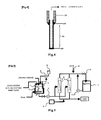
- Fig. 5 is a side view illustrating an example of the apparatus used in the method for producing a sugar liquid of the present invention.
- the concentrated cellulosic biomass sugar liquid is retained in a precipitation tank 1.
- the pH in the precipitation tank 1 is then adjusted.
- Examples of the method for the pH adjustment include a method in which an alkali is added from an alkali storage tank 6, and a method in which an alkali in the gas state such as ammonia gas is supplied from a diffuser tube 3.
- the amount of the alkali to be added can be controlled by monitoring the pH in the precipitation tank 1 with a pH sensor 4 while sending a signal from the sensor to an alkali supply control pump 5.
- the pH can be similarly adjusted while the amount of the gas is controlled with a valve.
- Air may be supplied from the diffuser tube 3 while the concentrated cellulosic biomass sugar liquid retained in the precipitation tank 1 is mixed, in order to achieve a uniform pH and to promote precipitation of magnesium hydroxide.
- the precipitation tank 1 may be equipped with a thermostat 2. Either incubation or cooling may be carried out by the thermostat 2, and cooling is preferably carried out in order to make the precipitation of magnesium hydroxide more likely to occur.
- the temperature for the cooling is not limited as long as the concentrated cellulosic biomass sugar liquid is not frozen.
- the precipitation tank 1 is connected to a microfiltration membrane module 8 through a microfiltration membrane pump 7.
- the microfiltration membrane mentioned above is arranged in the microfiltration membrane module 8.
- the microfiltration membrane module 8 may be provided with a compressed air supplier 9 placed inside the module, for washing of the membrane surface by aeration. By periodically using the compressed air supplier 9, dirt components attached to, or deposited on, the surface of the microfiltration membrane can be removed.
- the filtrate component from the microfiltration membrane module 8 is collected into an MF filtrate tank 11.
- the solid component separated in the primary side of the microfiltration membrane module 8 is discharged as appropriate.
- reverse washing of the hollow fiber membrane can be carried out with the filtrate stored in the MF filtrate tank 11, by applying pressure from the filtrate side using a reverse washing pump 10.
- the external pressure-type hollow fiber membrane can be washed with an aqueous acid solution supplied from an acid supply line 12, by supplying the acid from the acid supply line 12 into the pipe, closing a washing valve 13, and then applying pressure with the reverse washing pump 10.
- auxiliary material may be supplied to the precipitation tank 1.
- an auxiliary material is added to the concentrated cellulosic biomass sugar liquid, generation of an insoluble precipitate occurs in some cases.
- a gas may be supplied to the precipitation tank 1. In cases where ammonia gas, which is in the gas state, is fed as the alkali, the ammonia gas is especially preferably supplied from the diffuser tube 3.
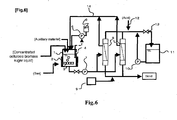
- Fig. 6 is a side view illustrating another example of the apparatus used in the method for producing a sugar liquid of the present invention.
- This apparatus is the same as the apparatus shown in Fig. 5 except that a cross-flow return line 14 is included.
- a liquid flow is generated on the membrane surface of the microfiltration membrane module 8 by a microfiltration membrane pump 7, to allow cross-flow filtration.
- Fig. 7 is a side view illustrating an example of an apparatus for producing a chemical product using the sugar liquid of the present invention as a fermentation feedstock.
- a fermentation apparatus 15 is provided with a fermenter 21 and a stirrer 19.
- an incubator 18 is placed for adjustment of the temperature to an optimum temperature for culturing of the microorganism used.
- the amount of the gas fed to the fermenter 21 through a vent pipe 16 can be controlled by placing a DO sensor 17 in the fermenter 21 and measuring the dissolved oxygen level during the fermentation, while using a signal from the sensor for controlling a valve.
- the gas is selected from nitrogen, oxygen, air and the like.
- a pH sensor 20 may be provided, and signals from the sensor may be used for controlling supply of an acid from an acid supply tank 22 and feeding of an alkali from an alkali supply tank 23.
- the fermenter 21 may be provided with a microfiltration membrane module 24 for separation of microbial cells from a chemical product produced in the culture liquid.
- cross-flow filtration is preferably carried out using a cross-flow pump 25.
- the filtrate of the microfiltration membrane module 24 is collected in a culture filtrate storage tank 26.
- the sugar liquid flow rate is preferably controlled by a sugar liquid flow rate controller 27 such that the amount of the sugar liquid fed into the fermenter 21 is the same as the amount of the filtrate from the microfiltration membrane.
- the concentrations of glucose and xylose contained in the sugar liquid were measured under the HPLC conditions described below based on comparison with standard samples.
- a cellulose rice straw was used as a cellulose.
- the cellulose was immersed in water, and subjected to treatment using an autoclave (manufactured by Nitto Koatsu Co., Ltd.) with stirring at a temperature of 180°C for 20 minutes. Thereafter, centrifugation (3000 G) was carried out to separate the solution component (hydrothermally treated liquid) from the solid (cellulose fraction).
- "Accellerase DUET” enzyme concentration, 40 g/L
- Genencor Genencor
- the pH of the concentrated sugar liquid 1 was 4.8, and the pH of the concentrated sugar liquid 2 was 3.8.
- Glucose (g/L) Xylose (g/L) Turbidity (NTU) Decomposition product of cellulose fraction 58 14 0
- Concentrated sugar liquid 1 180 41 0
- Glucose (g/L) Xylose (g/L) Turbidity (NTU) Decomposition product of hydrothermally treated liquid 2 12 0
- the pH of each of the concentrated cellulosic biomass liquids 1 and 2 prepared in the Reference Example 1 was adjusted using sodium hydroxide (1 N) to 6, 7, 8, 9, 10, 11, 12 or 13.
- the sugar liquids after the adjustment to the predetermined pHs were left to stand for 1 hour at a temperature of 25°C.
- the turbidity (Nephelometric Turbidity Units; NTU) was then measured.
- the turbidity of each sugar liquid was quantified using a high-performance laboratory turbidimeter (2100N) manufactured by HACH. The results are shown in Table 4.
- the turbidity of each sugar liquid before the pH adjustment was 0 (zero) NTU.
- the pH of the concentrated sugar liquid 1 obtained in the Example 1 was adjusted to 10, and the resulting sugar liquid was left to stand for 1 hour, followed by centrifuging (15,000 rpm, 5 minutes) 1 mL of the sample to separate and collect an insoluble substance as a precipitate.
- 1 mL of 1 N aqueous sulfuric acid solution was added to redissolve the insoluble substance.
- the resulting solution was then subjected to ion chromatography analysis (cation analysis) under the following conditions.
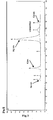
- chromatographic chart obtained by the above analysis is shown in Fig. 3 .
- peaks could be found at the positions corresponding to sodium ion (Na ion), potassium ion (K ion), magnesium ion (Mg ion) and calcium ion (Ca ion), and among these, Mg ion was found to be contained in an extremely large amount. Since alkalis and salts formed by Na ion or K ion are known to have high solubility even under alkaline conditions, these ions were assumed to be components dissolved in the sugar liquid, which also contained the insoluble substance.
- Mg ion is known to form magnesium hydroxide (Mg(OH) 2 ) under alkaline conditions, and its solubility product (K sp ) is 1.2 ⁇ 10 12 .
- K sp solubility product
- the particle sizes of the insoluble substance were found to show a distribution centered around 2000 nm (2 ⁇ m).
- the pHs of the concentrated sugar liquid 1, concentrated sugar liquid 2, concentrated sugar liquid 3 and concentrated sugar liquid 4 prepared in Reference Example 2 and Reference Example 3 were adjusted to 10 using 28% aqueous ammonia (Wako Pure Chemical Industries, Ltd.), and the resulting sugar liquids were left to stand for 1 hour, to provide aqueous sugar solutions (concentrated sugar liquid 1A, concentrated sugar liquid 2A, concentrated sugar liquid 3A and concentrated sugar liquid 4A).
- aqueous sugar solution as a test sample (1 L)
- filtration was performed using microfiltration membranes having different average pore sizes. The types and the average pore diameters of the membranes used are summarized in Table 6.
- Cross-flow filtration was performed by supplying each of the concentrated sugar liquids 1A to 4A at a pressure of 30 kPa at a temperature of 25°C, and an attempt was made to collect 0.5 L of a sugar solution from the membrane permeate side.
- the cross-flow filtration was carried out by setting each microfiltration membrane such that the membrane surface linear velocity was 30 cm/sec. and the membrane permeation flux was 0.1 m/day.
- all concentrated sugar liquids showed, only in the cases where MF-250 was used, decreases in filtration rates relative to those observed immediately after the filtration, and the filtration became impossible after collection of about 100 mL of the sugar solution.
- Filtrates obtained using the microfiltration membrane (HVLP) in Example 4 were used to carry out ethanol fermentation tests using an yeast (Saccharomycecs cerevisiae OC-2: wine yeast).
- the above yeast was precultured using YPD medium (2% glucose, 1% yeast extract (Bacto Yeast Extract /BD) and 2% polypeptone (Nihon Pharmaceutical Co., Ltd.)) for 1 day at a temperature of 25°C.
- YPD medium 2% glucose, 1% yeast extract (Bacto Yeast Extract /BD) and 2% polypeptone (Nihon Pharmaceutical Co., Ltd.)
- the pHs of the concentrated sugar liquid 1 and the concentrated sugar liquid 3 were adjusted to 6 using 1 N sulfuric acid, and the resulting sugar liquids were diluted to the sugar concentrations shown in Table 7 using sterile water before use.
- the preculture liquid was added at 5%.
- incubation was carried out at a temperature of 25°C for 35 hours.
- the concentrations of ethanol accumulated in the culture liquids obtained by this operation were quantified by gas chromatography.
- Example 8 sugar liquids before the filtration through the microfiltration membrane in Example 4 (the concentrated sugar liquid 1A and the concentrated sugar liquid 3A in Example 4, for which only the pH adjustment was carried out) were used to perform ethanol fermentation tests according to Example 5. The results are shown in Table 8. The concentrations of ethanol accumulated in the obtained culture liquids were found to be lower than those observed using the sugar liquids of the present invention in Example 5, which were treated with the microfiltration membrane. [Table 8] Glucose (g/L) Xylose (g/L) Ethanol (g/L) Concentrated sugar liquid 1A 45 10 13 Concentrated sugar liquid 3A 45 11 10
- Example 4 Using the filtrates obtained in Example 4 using a microfiltration membrane (HVLP) (the concentrated sugar liquid 1 and the concentrated sugar liquid 3) and the Lactococcus lactis JCM7638 strain, fermentation production of lactic acid was studied.
- HVLP microfiltration membrane
- the pHs of the concentrated sugar liquid 1 and the concentrated sugar liquid 3 were adjusted to 6 using 1 N sulfuric acid, and the resulting sugar liquids were diluted with sterile water to the sugar concentrations shown in Table 9.
- a preculture liquid containing the lactic acid bacterium was added at 5%.
- incubation was carried out at a temperature of 25°C for 35 hours.
- Static culture was performed for 24 hours at a temperature of 37°C.
- the concentration of L-lactic acid contained in the culture liquid was analyzed under the following conditions.
- L-lactic acid can be produced with either the sugar liquid 1 or the sugar liquid 3.
- the sugar liquid 3 showed a lower lactic acid productivity than the sugar liquid 1.
- the sugar liquid in Example 4 before the filtration through the microfiltration membrane was used to perform filtration through a hollow fiber ultrafiltration membrane having an average pore size of 0.08 ⁇ m ("TORAYFIL” (registered trademark) HFS, manufactured by Toray Industries, Inc.).
- TORAYFIL HFS is a PVDF external pressure-type hollow fiber membrane, in which a solution is filtered from the external side to the internal side of the hollow fiber.
- TORAYFIL HFS was cut into a 10-cm piece, and one end of the membrane was sealed using a silicone adhesive. To the other end, a silicone tube (Laboran, 2 ⁇ 4) was attached using the above adhesive, to provide a simplified membrane module ( Fig. 4 ).
- Fig. 4 a simplified membrane module
- the silicone tube 28 is connected to the hollow fiber microfiltration membrane 30 with the silicone adhesive 29 such that a solution outside the hollow fiber microfiltration membrane can be filtered by reducing the pressure in the hollow fiber microfiltration membrane 30.
- One end of the hollow fiber microfiltration membrane 30 was sealed with the silicone adhesive 29.
- the initial filtration flux was set to 1 m/day, and filtration was carried out for 24 hours. As a result, about 100 mL of a filtrate was obtained.
- the membrane flux was found to have decreased to 0.2 m/day.
- 1 N aqueous sulfuric acid solution was connected, and reverse washing was carried out from the inside to the outside of the hollow fiber at a membrane flux of 0.1 m/day.
- the simplified membrane module was then washed well with RO water, and filtration of the concentrated sugar liquid was started again. As a result of measurement of the filtration flux at this time, the filtration flux could be confirmed to have recovered to 1 m/day.
- the culture liquid 1 obtained after culturing the sugar liquid 1 of Example 6, and the culture liquid 1A obtained after culturing the sugar liquid 1A of Reference Example 2 were filtered, and the performance to separate the product, an aqueous lactic acid solution, from the microbial cells (lactic acid bacterium) was evaluated.
- the separation was carried out by placing the simplified hollow fiber module of Example 7 in a beaker containing 100 mL of each culture liquid, placing a magnetic stirring bar in the beaker, and performing filtration with stirring at 100 rpm using a stirrer.
- the initial filtration flux was set to 0.5 m/day when the filtration was started.
- the culture liquid 1A the filtration became impossible 20 minutes after the start.
- the culture liquid 1 the filtration could be continued for not less than 2 hours, and 8 mL of a filtrate (aqueous lactic acid solution) could be obtained.
- concentrated sugar liquid 1 is more preferred for separation (membrane separation) of the fermentation product (aqueous lactic acid solution) from the culture liquid after the fermentation.
Landscapes
- Chemical & Material Sciences (AREA)
- Organic Chemistry (AREA)
- Life Sciences & Earth Sciences (AREA)
- Biochemistry (AREA)
- Wood Science & Technology (AREA)
- Zoology (AREA)
- Engineering & Computer Science (AREA)
- General Health & Medical Sciences (AREA)
- Health & Medical Sciences (AREA)
- Microbiology (AREA)
- General Chemical & Material Sciences (AREA)
- Chemical Kinetics & Catalysis (AREA)
- Biotechnology (AREA)
- Bioinformatics & Cheminformatics (AREA)
- General Engineering & Computer Science (AREA)
- Genetics & Genomics (AREA)
- Emergency Medicine (AREA)
- Separation Using Semi-Permeable Membranes (AREA)
- Preparation Of Compounds By Using Micro-Organisms (AREA)
Applications Claiming Priority (2)
| Application Number | Priority Date | Filing Date | Title |
|---|---|---|---|
| JP2012127704 | 2012-06-05 | ||
| PCT/JP2013/065431 WO2013183617A1 (fr) | 2012-06-05 | 2013-06-04 | Procédé de production d'une solution de sucre |
Publications (3)
| Publication Number | Publication Date |
|---|---|
| EP2857528A1 true EP2857528A1 (fr) | 2015-04-08 |
| EP2857528A4 EP2857528A4 (fr) | 2015-12-09 |
| EP2857528B1 EP2857528B1 (fr) | 2018-07-18 |
Family
ID=49712008
Family Applications (1)
| Application Number | Title | Priority Date | Filing Date |
|---|---|---|---|
| EP13801065.7A Not-in-force EP2857528B1 (fr) | 2012-06-05 | 2013-06-04 | Procédé de production d'une solution de sucre |
Country Status (8)
| Country | Link |
|---|---|
| US (1) | US9765412B2 (fr) |
| EP (1) | EP2857528B1 (fr) |
| JP (1) | JP6330328B2 (fr) |
| AU (1) | AU2013272652B2 (fr) |
| BR (1) | BR112014029529B1 (fr) |
| CA (1) | CA2875083C (fr) |
| ES (1) | ES2682273T3 (fr) |
| WO (1) | WO2013183617A1 (fr) |
Families Citing this family (6)
| Publication number | Priority date | Publication date | Assignee | Title |
|---|---|---|---|---|
| MY180705A (en) | 2014-02-05 | 2020-12-07 | Toray Industries | Method for producing sugar solution |
| CN103936109B (zh) * | 2014-04-12 | 2016-08-17 | 大连双迪创新科技研究院有限公司 | 饮水电解制取装置 |
| KR101763367B1 (ko) * | 2015-04-09 | 2017-07-31 | 한국화학연구원 | 오염 미생물의 대사산물 생성을 최소화하는 바이오매스의 효소당화 방법 및 그 장치 |
| JP6600911B2 (ja) * | 2015-12-18 | 2019-11-06 | 昭和電工株式会社 | 植物性バイオマスの加水分解方法及び装置 |
| WO2018147289A1 (fr) * | 2017-02-07 | 2018-08-16 | 東レ株式会社 | Procédé de production d'alcool par fermentation continue et appareil de fermentation continue à utiliser pour celui-ci |
| GB201807987D0 (en) * | 2018-05-17 | 2018-07-04 | Univ Leeds Innovations Ltd | Reduction in microbial growth |
Family Cites Families (18)
| Publication number | Priority date | Publication date | Assignee | Title |
|---|---|---|---|---|
| US2073616A (en) * | 1927-07-15 | 1937-03-16 | Arthur B Foster | Galactan product and process of making same |
| US2892683A (en) * | 1953-07-08 | 1959-06-30 | Montedison Spa | Process of precipitating and filtering magnesium hydroxide |
| US3972775A (en) * | 1974-06-28 | 1976-08-03 | The United States Of America As Represented By The United States Energy Research And Development Administration | Conversion of cellulosic materials to sugar |
| US4743682A (en) * | 1984-11-27 | 1988-05-10 | Nestec S.A. | Methods for controlling the viscosity of protein hydrolysates |
| JPH0767399B2 (ja) * | 1987-04-08 | 1995-07-26 | 三菱化成エンジニアリング株式会社 | 甘蔗糖蜜中の蔗糖分の回収方法 |
| JPS6467173A (en) * | 1987-09-04 | 1989-03-13 | Sanei Kagaku Kogyo Kk | Preparation of vegetable or fruit juices |
| US5782982A (en) * | 1993-03-26 | 1998-07-21 | Arkenol, Inc. | Method of removing silica or silicates from solids resulting from the strong acid hydrolysis of cellulosic and hemicellulosic materials |
| JPH07242788A (ja) * | 1994-02-14 | 1995-09-19 | Wr Grace & Co Connecticut | 濃縮用の蒸発器内での堆積の防止方法 |
| JP4513075B2 (ja) * | 1999-12-02 | 2010-07-28 | 月島機械株式会社 | 炭酸ソーダの添加による軟化処理を含む限外ろ過処理による甘蔗からの精製糖製造プロセス |
| JP4196087B2 (ja) | 2003-07-10 | 2008-12-17 | パナソニック株式会社 | 電気掃除機 |
| JP4182524B2 (ja) | 2004-03-26 | 2008-11-19 | 北海道糖業株式会社 | ビート含蜜糖の製造方法 |
| JP4592487B2 (ja) * | 2005-04-27 | 2010-12-01 | 北海道糖業株式会社 | ビート含蜜糖乃至液糖組成物 |
| JP2008237213A (ja) | 2007-02-26 | 2008-10-09 | Toray Ind Inc | 連続発酵装置 |
| AU2008291588A1 (en) * | 2007-08-27 | 2009-03-05 | Iogen Energy Corporation | Method for the production of a fermentation product from a pretreated lignocellulosic feedstock |
| BRPI0817328A2 (pt) * | 2007-09-25 | 2015-03-24 | Kubota Kk | Método e aparelho para tratamento de resíduo orgânico. |
| CN101348429B (zh) * | 2008-09-05 | 2011-03-16 | 江南大学 | 一种阳离子树脂交换提取发酵液中丁二酸的方法 |
| CN102282264B (zh) * | 2009-01-14 | 2014-12-03 | 艾欧基能源公司 | 从本质纤维素原料生产葡萄糖的改进方法 |
| WO2011162009A1 (fr) | 2010-06-24 | 2011-12-29 | 東レ株式会社 | Procédé de production d'une solution aqueuse de sucre raffiné |
-
2013
- 2013-06-04 AU AU2013272652A patent/AU2013272652B2/en active Active
- 2013-06-04 CA CA2875083A patent/CA2875083C/fr not_active Expired - Fee Related
- 2013-06-04 JP JP2013535194A patent/JP6330328B2/ja active Active
- 2013-06-04 BR BR112014029529-8A patent/BR112014029529B1/pt active IP Right Grant
- 2013-06-04 EP EP13801065.7A patent/EP2857528B1/fr not_active Not-in-force
- 2013-06-04 US US14/405,239 patent/US9765412B2/en active Active
- 2013-06-04 ES ES13801065.7T patent/ES2682273T3/es active Active
- 2013-06-04 WO PCT/JP2013/065431 patent/WO2013183617A1/fr not_active Ceased
Also Published As
| Publication number | Publication date |
|---|---|
| CA2875083A1 (fr) | 2013-12-12 |
| ES2682273T3 (es) | 2018-09-19 |
| JPWO2013183617A1 (ja) | 2016-02-01 |
| US20150147787A1 (en) | 2015-05-28 |
| BR112014029529B1 (pt) | 2021-03-09 |
| CA2875083C (fr) | 2020-03-31 |
| AU2013272652B2 (en) | 2017-09-07 |
| BR112014029529A2 (pt) | 2017-06-27 |
| WO2013183617A1 (fr) | 2013-12-12 |
| JP6330328B2 (ja) | 2018-05-30 |
| US9765412B2 (en) | 2017-09-19 |
| EP2857528B1 (fr) | 2018-07-18 |
| AU2013272652A1 (en) | 2014-12-04 |
| EP2857528A4 (fr) | 2015-12-09 |
Similar Documents
| Publication | Publication Date | Title |
|---|---|---|
| EP2682472B1 (fr) | Procédé d'obtention de solution de sucre | |
| EP2860269B1 (fr) | Procédé de fabrication d'une solution de sucre | |
| CA2831543C (fr) | Procede de production d'une solution de sucre | |
| EP2650384A1 (fr) | Procédé de fabrication d'une solution aqueuse concentrée de sucre | |
| US20140308712A1 (en) | Method for producing concentrated aqueous sugar solution | |
| EP2857528B1 (fr) | Procédé de production d'une solution de sucre | |
| EP2546353A1 (fr) | Procédé de fabrication d'une solution de sucre pure et procédé de fabrication d'un produit chimique | |
| WO2011162009A1 (fr) | Procédé de production d'une solution aqueuse de sucre raffiné | |
| JP5728817B2 (ja) | キシロース糖液の製造方法 | |
| JP6167902B2 (ja) | 糖液の製造方法 | |
| JP2012191878A (ja) | 糖液の製造方法 |
Legal Events
| Date | Code | Title | Description |
|---|---|---|---|
| PUAI | Public reference made under article 153(3) epc to a published international application that has entered the european phase |
Free format text: ORIGINAL CODE: 0009012 |
|
| 17P | Request for examination filed |
Effective date: 20141230 |
|
| AK | Designated contracting states |
Kind code of ref document: A1 Designated state(s): AL AT BE BG CH CY CZ DE DK EE ES FI FR GB GR HR HU IE IS IT LI LT LU LV MC MK MT NL NO PL PT RO RS SE SI SK SM TR |
|
| AX | Request for extension of the european patent |
Extension state: BA ME |
|
| DAX | Request for extension of the european patent (deleted) | ||
| RA4 | Supplementary search report drawn up and despatched (corrected) |
Effective date: 20151109 |
|
| RIC1 | Information provided on ipc code assigned before grant |
Ipc: C13B 20/02 20110101ALI20151103BHEP Ipc: C13B 20/16 20110101ALI20151103BHEP Ipc: C12P 7/40 20060101ALI20151103BHEP Ipc: C12P 7/02 20060101ALI20151103BHEP Ipc: C13K 1/04 20060101AFI20151103BHEP Ipc: C12P 13/04 20060101ALI20151103BHEP Ipc: C12P 19/30 20060101ALI20151103BHEP |
|
| STAA | Information on the status of an ep patent application or granted ep patent |
Free format text: STATUS: EXAMINATION IS IN PROGRESS |
|
| 17Q | First examination report despatched |
Effective date: 20171121 |
|
| GRAP | Despatch of communication of intention to grant a patent |
Free format text: ORIGINAL CODE: EPIDOSNIGR1 |
|
| STAA | Information on the status of an ep patent application or granted ep patent |
Free format text: STATUS: GRANT OF PATENT IS INTENDED |
|
| INTG | Intention to grant announced |
Effective date: 20180306 |
|
| GRAS | Grant fee paid |
Free format text: ORIGINAL CODE: EPIDOSNIGR3 |
|
| GRAA | (expected) grant |
Free format text: ORIGINAL CODE: 0009210 |
|
| STAA | Information on the status of an ep patent application or granted ep patent |
Free format text: STATUS: THE PATENT HAS BEEN GRANTED |
|
| AK | Designated contracting states |
Kind code of ref document: B1 Designated state(s): AL AT BE BG CH CY CZ DE DK EE ES FI FR GB GR HR HU IE IS IT LI LT LU LV MC MK MT NL NO PL PT RO RS SE SI SK SM TR |
|
| REG | Reference to a national code |
Ref country code: GB Ref legal event code: FG4D |
|
| REG | Reference to a national code |
Ref country code: CH Ref legal event code: EP |
|
| REG | Reference to a national code |
Ref country code: IE Ref legal event code: FG4D |
|
| REG | Reference to a national code |
Ref country code: DE Ref legal event code: R096 Ref document number: 602013040554 Country of ref document: DE |
|
| REG | Reference to a national code |
Ref country code: AT Ref legal event code: REF Ref document number: 1019422 Country of ref document: AT Kind code of ref document: T Effective date: 20180815 |
|
| REG | Reference to a national code |
Ref country code: ES Ref legal event code: FG2A Ref document number: 2682273 Country of ref document: ES Kind code of ref document: T3 Effective date: 20180919 |
|
| REG | Reference to a national code |
Ref country code: NL Ref legal event code: MP Effective date: 20180718 |
|
| REG | Reference to a national code |
Ref country code: LT Ref legal event code: MG4D |
|
| REG | Reference to a national code |
Ref country code: AT Ref legal event code: MK05 Ref document number: 1019422 Country of ref document: AT Kind code of ref document: T Effective date: 20180718 |
|
| PG25 | Lapsed in a contracting state [announced via postgrant information from national office to epo] |
Ref country code: NL Free format text: LAPSE BECAUSE OF FAILURE TO SUBMIT A TRANSLATION OF THE DESCRIPTION OR TO PAY THE FEE WITHIN THE PRESCRIBED TIME-LIMIT Effective date: 20180718 |
|
| PG25 | Lapsed in a contracting state [announced via postgrant information from national office to epo] |
Ref country code: PL Free format text: LAPSE BECAUSE OF FAILURE TO SUBMIT A TRANSLATION OF THE DESCRIPTION OR TO PAY THE FEE WITHIN THE PRESCRIBED TIME-LIMIT Effective date: 20180718 Ref country code: RS Free format text: LAPSE BECAUSE OF FAILURE TO SUBMIT A TRANSLATION OF THE DESCRIPTION OR TO PAY THE FEE WITHIN THE PRESCRIBED TIME-LIMIT Effective date: 20180718 Ref country code: LT Free format text: LAPSE BECAUSE OF FAILURE TO SUBMIT A TRANSLATION OF THE DESCRIPTION OR TO PAY THE FEE WITHIN THE PRESCRIBED TIME-LIMIT Effective date: 20180718 Ref country code: SE Free format text: LAPSE BECAUSE OF FAILURE TO SUBMIT A TRANSLATION OF THE DESCRIPTION OR TO PAY THE FEE WITHIN THE PRESCRIBED TIME-LIMIT Effective date: 20180718 Ref country code: BG Free format text: LAPSE BECAUSE OF FAILURE TO SUBMIT A TRANSLATION OF THE DESCRIPTION OR TO PAY THE FEE WITHIN THE PRESCRIBED TIME-LIMIT Effective date: 20181018 Ref country code: GR Free format text: LAPSE BECAUSE OF FAILURE TO SUBMIT A TRANSLATION OF THE DESCRIPTION OR TO PAY THE FEE WITHIN THE PRESCRIBED TIME-LIMIT Effective date: 20181019 Ref country code: FI Free format text: LAPSE BECAUSE OF FAILURE TO SUBMIT A TRANSLATION OF THE DESCRIPTION OR TO PAY THE FEE WITHIN THE PRESCRIBED TIME-LIMIT Effective date: 20180718 Ref country code: AT Free format text: LAPSE BECAUSE OF FAILURE TO SUBMIT A TRANSLATION OF THE DESCRIPTION OR TO PAY THE FEE WITHIN THE PRESCRIBED TIME-LIMIT Effective date: 20180718 Ref country code: IS Free format text: LAPSE BECAUSE OF FAILURE TO SUBMIT A TRANSLATION OF THE DESCRIPTION OR TO PAY THE FEE WITHIN THE PRESCRIBED TIME-LIMIT Effective date: 20181118 Ref country code: NO Free format text: LAPSE BECAUSE OF FAILURE TO SUBMIT A TRANSLATION OF THE DESCRIPTION OR TO PAY THE FEE WITHIN THE PRESCRIBED TIME-LIMIT Effective date: 20181018 |
|
| PG25 | Lapsed in a contracting state [announced via postgrant information from national office to epo] |
Ref country code: HR Free format text: LAPSE BECAUSE OF FAILURE TO SUBMIT A TRANSLATION OF THE DESCRIPTION OR TO PAY THE FEE WITHIN THE PRESCRIBED TIME-LIMIT Effective date: 20180718 Ref country code: LV Free format text: LAPSE BECAUSE OF FAILURE TO SUBMIT A TRANSLATION OF THE DESCRIPTION OR TO PAY THE FEE WITHIN THE PRESCRIBED TIME-LIMIT Effective date: 20180718 Ref country code: AL Free format text: LAPSE BECAUSE OF FAILURE TO SUBMIT A TRANSLATION OF THE DESCRIPTION OR TO PAY THE FEE WITHIN THE PRESCRIBED TIME-LIMIT Effective date: 20180718 |
|
| REG | Reference to a national code |
Ref country code: DE Ref legal event code: R097 Ref document number: 602013040554 Country of ref document: DE |
|
| PG25 | Lapsed in a contracting state [announced via postgrant information from national office to epo] |
Ref country code: RO Free format text: LAPSE BECAUSE OF FAILURE TO SUBMIT A TRANSLATION OF THE DESCRIPTION OR TO PAY THE FEE WITHIN THE PRESCRIBED TIME-LIMIT Effective date: 20180718 Ref country code: CZ Free format text: LAPSE BECAUSE OF FAILURE TO SUBMIT A TRANSLATION OF THE DESCRIPTION OR TO PAY THE FEE WITHIN THE PRESCRIBED TIME-LIMIT Effective date: 20180718 Ref country code: EE Free format text: LAPSE BECAUSE OF FAILURE TO SUBMIT A TRANSLATION OF THE DESCRIPTION OR TO PAY THE FEE WITHIN THE PRESCRIBED TIME-LIMIT Effective date: 20180718 |
|
| PLBE | No opposition filed within time limit |
Free format text: ORIGINAL CODE: 0009261 |
|
| STAA | Information on the status of an ep patent application or granted ep patent |
Free format text: STATUS: NO OPPOSITION FILED WITHIN TIME LIMIT |
|
| PG25 | Lapsed in a contracting state [announced via postgrant information from national office to epo] |
Ref country code: SK Free format text: LAPSE BECAUSE OF FAILURE TO SUBMIT A TRANSLATION OF THE DESCRIPTION OR TO PAY THE FEE WITHIN THE PRESCRIBED TIME-LIMIT Effective date: 20180718 Ref country code: DK Free format text: LAPSE BECAUSE OF FAILURE TO SUBMIT A TRANSLATION OF THE DESCRIPTION OR TO PAY THE FEE WITHIN THE PRESCRIBED TIME-LIMIT Effective date: 20180718 Ref country code: SM Free format text: LAPSE BECAUSE OF FAILURE TO SUBMIT A TRANSLATION OF THE DESCRIPTION OR TO PAY THE FEE WITHIN THE PRESCRIBED TIME-LIMIT Effective date: 20180718 |
|
| 26N | No opposition filed |
Effective date: 20190423 |
|
| PG25 | Lapsed in a contracting state [announced via postgrant information from national office to epo] |
Ref country code: SI Free format text: LAPSE BECAUSE OF FAILURE TO SUBMIT A TRANSLATION OF THE DESCRIPTION OR TO PAY THE FEE WITHIN THE PRESCRIBED TIME-LIMIT Effective date: 20180718 |
|
| REG | Reference to a national code |
Ref country code: DE Ref legal event code: R119 Ref document number: 602013040554 Country of ref document: DE |
|
| PG25 | Lapsed in a contracting state [announced via postgrant information from national office to epo] |
Ref country code: MC Free format text: LAPSE BECAUSE OF FAILURE TO SUBMIT A TRANSLATION OF THE DESCRIPTION OR TO PAY THE FEE WITHIN THE PRESCRIBED TIME-LIMIT Effective date: 20180718 |
|
| REG | Reference to a national code |
Ref country code: CH Ref legal event code: PL |
|
| GBPC | Gb: european patent ceased through non-payment of renewal fee |
Effective date: 20190604 |
|
| REG | Reference to a national code |
Ref country code: BE Ref legal event code: MM Effective date: 20190630 |
|
| PG25 | Lapsed in a contracting state [announced via postgrant information from national office to epo] |
Ref country code: TR Free format text: LAPSE BECAUSE OF FAILURE TO SUBMIT A TRANSLATION OF THE DESCRIPTION OR TO PAY THE FEE WITHIN THE PRESCRIBED TIME-LIMIT Effective date: 20180718 |
|
| PG25 | Lapsed in a contracting state [announced via postgrant information from national office to epo] |
Ref country code: IE Free format text: LAPSE BECAUSE OF NON-PAYMENT OF DUE FEES Effective date: 20190604 Ref country code: GB Free format text: LAPSE BECAUSE OF NON-PAYMENT OF DUE FEES Effective date: 20190604 Ref country code: DE Free format text: LAPSE BECAUSE OF NON-PAYMENT OF DUE FEES Effective date: 20200101 |
|
| PG25 | Lapsed in a contracting state [announced via postgrant information from national office to epo] |
Ref country code: LI Free format text: LAPSE BECAUSE OF NON-PAYMENT OF DUE FEES Effective date: 20190630 Ref country code: BE Free format text: LAPSE BECAUSE OF NON-PAYMENT OF DUE FEES Effective date: 20190630 Ref country code: LU Free format text: LAPSE BECAUSE OF NON-PAYMENT OF DUE FEES Effective date: 20190604 Ref country code: CH Free format text: LAPSE BECAUSE OF NON-PAYMENT OF DUE FEES Effective date: 20190630 |
|
| PG25 | Lapsed in a contracting state [announced via postgrant information from national office to epo] |
Ref country code: FR Free format text: LAPSE BECAUSE OF NON-PAYMENT OF DUE FEES Effective date: 20190630 Ref country code: PT Free format text: LAPSE BECAUSE OF FAILURE TO SUBMIT A TRANSLATION OF THE DESCRIPTION OR TO PAY THE FEE WITHIN THE PRESCRIBED TIME-LIMIT Effective date: 20181118 |
|
| PG25 | Lapsed in a contracting state [announced via postgrant information from national office to epo] |
Ref country code: CY Free format text: LAPSE BECAUSE OF FAILURE TO SUBMIT A TRANSLATION OF THE DESCRIPTION OR TO PAY THE FEE WITHIN THE PRESCRIBED TIME-LIMIT Effective date: 20180718 |
|
| PG25 | Lapsed in a contracting state [announced via postgrant information from national office to epo] |
Ref country code: HU Free format text: LAPSE BECAUSE OF FAILURE TO SUBMIT A TRANSLATION OF THE DESCRIPTION OR TO PAY THE FEE WITHIN THE PRESCRIBED TIME-LIMIT; INVALID AB INITIO Effective date: 20130604 Ref country code: MT Free format text: LAPSE BECAUSE OF FAILURE TO SUBMIT A TRANSLATION OF THE DESCRIPTION OR TO PAY THE FEE WITHIN THE PRESCRIBED TIME-LIMIT Effective date: 20180718 |
|
| PGFP | Annual fee paid to national office [announced via postgrant information from national office to epo] |
Ref country code: IT Payment date: 20210511 Year of fee payment: 9 |
|
| PGFP | Annual fee paid to national office [announced via postgrant information from national office to epo] |
Ref country code: ES Payment date: 20210705 Year of fee payment: 9 |
|
| PG25 | Lapsed in a contracting state [announced via postgrant information from national office to epo] |
Ref country code: MK Free format text: LAPSE BECAUSE OF FAILURE TO SUBMIT A TRANSLATION OF THE DESCRIPTION OR TO PAY THE FEE WITHIN THE PRESCRIBED TIME-LIMIT Effective date: 20180718 |
|
| REG | Reference to a national code |
Ref country code: ES Ref legal event code: FD2A Effective date: 20230728 |
|
| PG25 | Lapsed in a contracting state [announced via postgrant information from national office to epo] |
Ref country code: IT Free format text: LAPSE BECAUSE OF NON-PAYMENT OF DUE FEES Effective date: 20220604 |
|
| PG25 | Lapsed in a contracting state [announced via postgrant information from national office to epo] |
Ref country code: ES Free format text: LAPSE BECAUSE OF NON-PAYMENT OF DUE FEES Effective date: 20220605 |