EP2864545B1 - Ruban de marquage, procédé d'application et procédé de fabrication du ruban de marquage - Google Patents
Ruban de marquage, procédé d'application et procédé de fabrication du ruban de marquage Download PDFInfo
- Publication number
- EP2864545B1 EP2864545B1 EP13796285.8A EP13796285A EP2864545B1 EP 2864545 B1 EP2864545 B1 EP 2864545B1 EP 13796285 A EP13796285 A EP 13796285A EP 2864545 B1 EP2864545 B1 EP 2864545B1
- Authority
- EP
- European Patent Office
- Prior art keywords
- layer
- marking tape
- marking
- tape
- conforming
- Prior art date
- Legal status (The legal status is an assumption and is not a legal conclusion. Google has not performed a legal analysis and makes no representation as to the accuracy of the status listed.)
- Active
Links
Images



Classifications
-
- B—PERFORMING OPERATIONS; TRANSPORTING
- B32—LAYERED PRODUCTS
- B32B—LAYERED PRODUCTS, i.e. PRODUCTS BUILT-UP OF STRATA OF FLAT OR NON-FLAT, e.g. CELLULAR OR HONEYCOMB, FORM
- B32B38/00—Ancillary operations in connection with laminating processes
- B32B38/0012—Mechanical treatment, e.g. roughening, deforming, stretching
-
- B—PERFORMING OPERATIONS; TRANSPORTING
- B32—LAYERED PRODUCTS
- B32B—LAYERED PRODUCTS, i.e. PRODUCTS BUILT-UP OF STRATA OF FLAT OR NON-FLAT, e.g. CELLULAR OR HONEYCOMB, FORM
- B32B7/00—Layered products characterised by the relation between layers; Layered products characterised by the relative orientation of features between layers, or by the relative values of a measurable parameter between layers, i.e. products comprising layers having different physical, chemical or physicochemical properties; Layered products characterised by the interconnection of layers
- B32B7/04—Interconnection of layers
- B32B7/12—Interconnection of layers using interposed adhesives or interposed materials with bonding properties
-
- B—PERFORMING OPERATIONS; TRANSPORTING
- B32—LAYERED PRODUCTS
- B32B—LAYERED PRODUCTS, i.e. PRODUCTS BUILT-UP OF STRATA OF FLAT OR NON-FLAT, e.g. CELLULAR OR HONEYCOMB, FORM
- B32B37/00—Methods or apparatus for laminating, e.g. by curing or by ultrasonic bonding
- B32B37/10—Methods or apparatus for laminating, e.g. by curing or by ultrasonic bonding characterised by the pressing technique, e.g. using action of vacuum or fluid pressure
-
- B—PERFORMING OPERATIONS; TRANSPORTING
- B32—LAYERED PRODUCTS
- B32B—LAYERED PRODUCTS, i.e. PRODUCTS BUILT-UP OF STRATA OF FLAT OR NON-FLAT, e.g. CELLULAR OR HONEYCOMB, FORM
- B32B37/00—Methods or apparatus for laminating, e.g. by curing or by ultrasonic bonding
- B32B37/12—Methods or apparatus for laminating, e.g. by curing or by ultrasonic bonding characterised by using adhesives
-
- B—PERFORMING OPERATIONS; TRANSPORTING
- B32—LAYERED PRODUCTS
- B32B—LAYERED PRODUCTS, i.e. PRODUCTS BUILT-UP OF STRATA OF FLAT OR NON-FLAT, e.g. CELLULAR OR HONEYCOMB, FORM
- B32B37/00—Methods or apparatus for laminating, e.g. by curing or by ultrasonic bonding
- B32B37/14—Methods or apparatus for laminating, e.g. by curing or by ultrasonic bonding characterised by the properties of the layers
- B32B37/15—Methods or apparatus for laminating, e.g. by curing or by ultrasonic bonding characterised by the properties of the layers with at least one layer being manufactured and immediately laminated before reaching its stable state, e.g. in which a layer is extruded and laminated while in semi-molten state
- B32B37/153—Methods or apparatus for laminating, e.g. by curing or by ultrasonic bonding characterised by the properties of the layers with at least one layer being manufactured and immediately laminated before reaching its stable state, e.g. in which a layer is extruded and laminated while in semi-molten state at least one layer is extruded and immediately laminated while in semi-molten state
-
- B—PERFORMING OPERATIONS; TRANSPORTING
- B32—LAYERED PRODUCTS
- B32B—LAYERED PRODUCTS, i.e. PRODUCTS BUILT-UP OF STRATA OF FLAT OR NON-FLAT, e.g. CELLULAR OR HONEYCOMB, FORM
- B32B5/00—Layered products characterised by the non- homogeneity or physical structure, i.e. comprising a fibrous, filamentary, particulate or foam layer; Layered products characterised by having a layer differing constitutionally or physically in different parts
- B32B5/02—Layered products characterised by the non- homogeneity or physical structure, i.e. comprising a fibrous, filamentary, particulate or foam layer; Layered products characterised by having a layer differing constitutionally or physically in different parts characterised by structural features of a fibrous or filamentary layer
- B32B5/022—Non-woven fabric
-
- B—PERFORMING OPERATIONS; TRANSPORTING
- B32—LAYERED PRODUCTS
- B32B—LAYERED PRODUCTS, i.e. PRODUCTS BUILT-UP OF STRATA OF FLAT OR NON-FLAT, e.g. CELLULAR OR HONEYCOMB, FORM
- B32B5/00—Layered products characterised by the non- homogeneity or physical structure, i.e. comprising a fibrous, filamentary, particulate or foam layer; Layered products characterised by having a layer differing constitutionally or physically in different parts
- B32B5/02—Layered products characterised by the non- homogeneity or physical structure, i.e. comprising a fibrous, filamentary, particulate or foam layer; Layered products characterised by having a layer differing constitutionally or physically in different parts characterised by structural features of a fibrous or filamentary layer
- B32B5/028—Net structure, e.g. spaced apart filaments bonded at the crossing points
-
- B—PERFORMING OPERATIONS; TRANSPORTING
- B32—LAYERED PRODUCTS
- B32B—LAYERED PRODUCTS, i.e. PRODUCTS BUILT-UP OF STRATA OF FLAT OR NON-FLAT, e.g. CELLULAR OR HONEYCOMB, FORM
- B32B5/00—Layered products characterised by the non- homogeneity or physical structure, i.e. comprising a fibrous, filamentary, particulate or foam layer; Layered products characterised by having a layer differing constitutionally or physically in different parts
- B32B5/22—Layered products characterised by the non- homogeneity or physical structure, i.e. comprising a fibrous, filamentary, particulate or foam layer; Layered products characterised by having a layer differing constitutionally or physically in different parts characterised by the presence of two or more layers which are next to each other and are fibrous, filamentary, formed of particles or foamed
- B32B5/24—Layered products characterised by the non- homogeneity or physical structure, i.e. comprising a fibrous, filamentary, particulate or foam layer; Layered products characterised by having a layer differing constitutionally or physically in different parts characterised by the presence of two or more layers which are next to each other and are fibrous, filamentary, formed of particles or foamed one layer being a fibrous or filamentary layer
- B32B5/26—Layered products characterised by the non- homogeneity or physical structure, i.e. comprising a fibrous, filamentary, particulate or foam layer; Layered products characterised by having a layer differing constitutionally or physically in different parts characterised by the presence of two or more layers which are next to each other and are fibrous, filamentary, formed of particles or foamed one layer being a fibrous or filamentary layer another layer next to it also being fibrous or filamentary
-
- B—PERFORMING OPERATIONS; TRANSPORTING
- B32—LAYERED PRODUCTS
- B32B—LAYERED PRODUCTS, i.e. PRODUCTS BUILT-UP OF STRATA OF FLAT OR NON-FLAT, e.g. CELLULAR OR HONEYCOMB, FORM
- B32B5/00—Layered products characterised by the non- homogeneity or physical structure, i.e. comprising a fibrous, filamentary, particulate or foam layer; Layered products characterised by having a layer differing constitutionally or physically in different parts
- B32B5/22—Layered products characterised by the non- homogeneity or physical structure, i.e. comprising a fibrous, filamentary, particulate or foam layer; Layered products characterised by having a layer differing constitutionally or physically in different parts characterised by the presence of two or more layers which are next to each other and are fibrous, filamentary, formed of particles or foamed
- B32B5/24—Layered products characterised by the non- homogeneity or physical structure, i.e. comprising a fibrous, filamentary, particulate or foam layer; Layered products characterised by having a layer differing constitutionally or physically in different parts characterised by the presence of two or more layers which are next to each other and are fibrous, filamentary, formed of particles or foamed one layer being a fibrous or filamentary layer
- B32B5/28—Layered products characterised by the non- homogeneity or physical structure, i.e. comprising a fibrous, filamentary, particulate or foam layer; Layered products characterised by having a layer differing constitutionally or physically in different parts characterised by the presence of two or more layers which are next to each other and are fibrous, filamentary, formed of particles or foamed one layer being a fibrous or filamentary layer impregnated with or embedded in a plastic substance
-
- E—FIXED CONSTRUCTIONS
- E01—CONSTRUCTION OF ROADS, RAILWAYS, OR BRIDGES
- E01F—ADDITIONAL WORK, SUCH AS EQUIPPING ROADS OR THE CONSTRUCTION OF PLATFORMS, HELICOPTER LANDING STAGES, SIGNS, SNOW FENCES, OR THE LIKE
- E01F9/00—Arrangement of road signs or traffic signals; Arrangements for enforcing caution
- E01F9/50—Road surface markings; Kerbs or road edgings, specially adapted for alerting road users
- E01F9/506—Road surface markings; Kerbs or road edgings, specially adapted for alerting road users characterised by the road surface marking material, e.g. comprising additives for improving friction or reflectivity; Methods of forming, installing or applying markings in, on or to road surfaces
-
- E—FIXED CONSTRUCTIONS
- E01—CONSTRUCTION OF ROADS, RAILWAYS, OR BRIDGES
- E01F—ADDITIONAL WORK, SUCH AS EQUIPPING ROADS OR THE CONSTRUCTION OF PLATFORMS, HELICOPTER LANDING STAGES, SIGNS, SNOW FENCES, OR THE LIKE
- E01F9/00—Arrangement of road signs or traffic signals; Arrangements for enforcing caution
- E01F9/50—Road surface markings; Kerbs or road edgings, specially adapted for alerting road users
- E01F9/576—Traffic lines
- E01F9/578—Traffic lines consisting of preformed elements, e.g. tapes, block-type elements specially designed or arranged to make up a traffic line
-
- E—FIXED CONSTRUCTIONS
- E01—CONSTRUCTION OF ROADS, RAILWAYS, OR BRIDGES
- E01F—ADDITIONAL WORK, SUCH AS EQUIPPING ROADS OR THE CONSTRUCTION OF PLATFORMS, HELICOPTER LANDING STAGES, SIGNS, SNOW FENCES, OR THE LIKE
- E01F9/00—Arrangement of road signs or traffic signals; Arrangements for enforcing caution
- E01F9/50—Road surface markings; Kerbs or road edgings, specially adapted for alerting road users
- E01F9/576—Traffic lines
- E01F9/588—Lane delineators for physically separating traffic lanes and discouraging but not preventing crossing
-
- B—PERFORMING OPERATIONS; TRANSPORTING
- B32—LAYERED PRODUCTS
- B32B—LAYERED PRODUCTS, i.e. PRODUCTS BUILT-UP OF STRATA OF FLAT OR NON-FLAT, e.g. CELLULAR OR HONEYCOMB, FORM
- B32B37/00—Methods or apparatus for laminating, e.g. by curing or by ultrasonic bonding
- B32B37/14—Methods or apparatus for laminating, e.g. by curing or by ultrasonic bonding characterised by the properties of the layers
- B32B37/24—Methods or apparatus for laminating, e.g. by curing or by ultrasonic bonding characterised by the properties of the layers with at least one layer not being coherent before laminating, e.g. made up from granular material sprinkled onto a substrate
- B32B2037/243—Coating
-
- B—PERFORMING OPERATIONS; TRANSPORTING
- B32—LAYERED PRODUCTS
- B32B—LAYERED PRODUCTS, i.e. PRODUCTS BUILT-UP OF STRATA OF FLAT OR NON-FLAT, e.g. CELLULAR OR HONEYCOMB, FORM
- B32B2405/00—Adhesive articles, e.g. adhesive tapes
-
- Y—GENERAL TAGGING OF NEW TECHNOLOGICAL DEVELOPMENTS; GENERAL TAGGING OF CROSS-SECTIONAL TECHNOLOGIES SPANNING OVER SEVERAL SECTIONS OF THE IPC; TECHNICAL SUBJECTS COVERED BY FORMER USPC CROSS-REFERENCE ART COLLECTIONS [XRACs] AND DIGESTS
- Y10—TECHNICAL SUBJECTS COVERED BY FORMER USPC
- Y10T—TECHNICAL SUBJECTS COVERED BY FORMER US CLASSIFICATION
- Y10T156/00—Adhesive bonding and miscellaneous chemical manufacture
- Y10T156/10—Methods of surface bonding and/or assembly therefor
-
- Y—GENERAL TAGGING OF NEW TECHNOLOGICAL DEVELOPMENTS; GENERAL TAGGING OF CROSS-SECTIONAL TECHNOLOGIES SPANNING OVER SEVERAL SECTIONS OF THE IPC; TECHNICAL SUBJECTS COVERED BY FORMER USPC CROSS-REFERENCE ART COLLECTIONS [XRACs] AND DIGESTS
- Y10—TECHNICAL SUBJECTS COVERED BY FORMER USPC
- Y10T—TECHNICAL SUBJECTS COVERED BY FORMER US CLASSIFICATION
- Y10T156/00—Adhesive bonding and miscellaneous chemical manufacture
- Y10T156/10—Methods of surface bonding and/or assembly therefor
- Y10T156/1002—Methods of surface bonding and/or assembly therefor with permanent bending or reshaping or surface deformation of self sustaining lamina
- Y10T156/1039—Surface deformation only of sandwich or lamina [e.g., embossed panels]
-
- Y—GENERAL TAGGING OF NEW TECHNOLOGICAL DEVELOPMENTS; GENERAL TAGGING OF CROSS-SECTIONAL TECHNOLOGIES SPANNING OVER SEVERAL SECTIONS OF THE IPC; TECHNICAL SUBJECTS COVERED BY FORMER USPC CROSS-REFERENCE ART COLLECTIONS [XRACs] AND DIGESTS
- Y10—TECHNICAL SUBJECTS COVERED BY FORMER USPC
- Y10T—TECHNICAL SUBJECTS COVERED BY FORMER US CLASSIFICATION
- Y10T428/00—Stock material or miscellaneous articles
- Y10T428/24—Structurally defined web or sheet [e.g., overall dimension, etc.]
- Y10T428/24479—Structurally defined web or sheet [e.g., overall dimension, etc.] including variation in thickness
- Y10T428/24612—Composite web or sheet
-
- Y—GENERAL TAGGING OF NEW TECHNOLOGICAL DEVELOPMENTS; GENERAL TAGGING OF CROSS-SECTIONAL TECHNOLOGIES SPANNING OVER SEVERAL SECTIONS OF THE IPC; TECHNICAL SUBJECTS COVERED BY FORMER USPC CROSS-REFERENCE ART COLLECTIONS [XRACs] AND DIGESTS
- Y10—TECHNICAL SUBJECTS COVERED BY FORMER USPC
- Y10T—TECHNICAL SUBJECTS COVERED BY FORMER US CLASSIFICATION
- Y10T428/00—Stock material or miscellaneous articles
- Y10T428/28—Web or sheet containing structurally defined element or component and having an adhesive outermost layer
- Y10T428/2848—Three or more layers
-
- Y—GENERAL TAGGING OF NEW TECHNOLOGICAL DEVELOPMENTS; GENERAL TAGGING OF CROSS-SECTIONAL TECHNOLOGIES SPANNING OVER SEVERAL SECTIONS OF THE IPC; TECHNICAL SUBJECTS COVERED BY FORMER USPC CROSS-REFERENCE ART COLLECTIONS [XRACs] AND DIGESTS
- Y10—TECHNICAL SUBJECTS COVERED BY FORMER USPC
- Y10T—TECHNICAL SUBJECTS COVERED BY FORMER US CLASSIFICATION
- Y10T442/00—Fabric [woven, knitted, or nonwoven textile or cloth, etc.]
- Y10T442/10—Scrim [e.g., open net or mesh, gauze, loose or open weave or knit, etc.]
-
- Y—GENERAL TAGGING OF NEW TECHNOLOGICAL DEVELOPMENTS; GENERAL TAGGING OF CROSS-SECTIONAL TECHNOLOGIES SPANNING OVER SEVERAL SECTIONS OF THE IPC; TECHNICAL SUBJECTS COVERED BY FORMER USPC CROSS-REFERENCE ART COLLECTIONS [XRACs] AND DIGESTS
- Y10—TECHNICAL SUBJECTS COVERED BY FORMER USPC
- Y10T—TECHNICAL SUBJECTS COVERED BY FORMER US CLASSIFICATION
- Y10T442/00—Fabric [woven, knitted, or nonwoven textile or cloth, etc.]
- Y10T442/60—Nonwoven fabric [i.e., nonwoven strand or fiber material]
- Y10T442/674—Nonwoven fabric with a preformed polymeric film or sheet
Definitions
- the invention relates to a marking tape for application on pavement, a method of applying the marking tape on pavement and a method of manufacturing the marking tape.
- the invention relates particularly to a pre-manufactured marking tape which can be retained on the pavement by an adhesive and which has a fibrous layer.
- Marking tapes for pavement marking are typically used to delineate traffic lanes on a roadway. Such a marking tape may extend continuously, such as along the outermost boundaries of the driving lanes, or intermittently, such as between lanes.
- Marking tapes are typically pre-manufactured and provided on rolls from which they can be removed and applied on the pavement by simply rolling the tape onto the pavement surface.
- marking tapes by principle differentiate from markings which are directly created on the pavement, for example by spraying, casting or painting.
- Available rolls may provide marking tape in lengths of 25 to 300 meters, for example.
- the length of the marking tape on a roll depends for example on the width, thickness of the tape and the materials used in the tape.
- the thickness of the marking tape as referred to in this specification corresponds to a measure in a dimension the tape would protrude from a surface on which it is applied in its intended orientation. This is typically the smallest dimension of the tape, whereas the width corresponds to measure in a dimension perpendicular to the length and the thickness.
- marking tapes While both types of markings have advantages a popular use of marking tapes is in construction work zones, where the marking tape is used to temporarily guide the traffic on the roadway around work areas. Accordingly the marking tape is often removed from the roadway after a period of time.
- marking tape is used for permanent marking of roadways.
- the marking tape desirably has sufficient structural integrity to prevent tearing. Further if the tape is intended to remain in place longer term, it is desirable to provide the tape with structural integrity sufficient to withstand the mechanical stress that vehicles and weather can cause.
- US 4,146,635 discloses a multi-layer surface marking tape material for use on roadway pavements, and having an anti-skid and wear-resisting upper layer and a lower primer layer for connecting the material to said pavement.
- the primer may be a bituminous thermoplastic layer allowing for detaching the tape from the road pavement by a heated blade tool.
- the multi-layer tape material comprises further an intermediate layer connected to the lower layer and the upper layer.
- the intermediate layer in one embodiment consists of a resin impregnated nonwoven fibrous structure.
- US 2011/0305901 discloses marking tape which includes a fibrous, nonwoven base material having a first side and a second side opposite the first side.
- a seal coat saturates a portion of the fibrous, nonwoven base material and provides a relatively non-porous coat surface.
- a carrier coat is applied to the coat surface, and a reflective material is applied to the carrier coat.
- the relatively non-porous coat surface is adapted to help prevent movement of the reflective material into the fibrous, nonwoven base material.
- An adhesive is applied to the second side.
- WO-A-95/08426 discloses a conformable pavement marking comprising an upper sheet and a base sheet, wherein the base layer comprises a fibrous scrim, a tie layer, and a conformance layer, the tie layer material impregnating the lower portion of the scrim, and material of the upper sheet impregnating the upper portion of the scrim
- US 5,679,437 discloses a marking tape including a top layer of pigmented vinyl paint with reflective glass beads incorporated therein applied to an intermediate backing layer of either aluminum or vinyl. The backing layer is then laminated to a polyester mesh reinforcement layer, and a pressure-sensitive adhesive hot melt is applied to the under side surface of the mesh for attachment to the roadway surface.
- marking tapes which are relatively durable, which stays generally in place under typical traffic and weather conditions and which maintains good optical appearance over a long term. Desirably such marking tape is further relatively lightweight and inexpensive.
- the invention relates to a marking tape for application on pavement.
- the marking tape comprises a core layer and an adhesive layer (preferably outside the core layer).
- the adhesive layer is adapted for retaining the marking tape on the pavement.
- the core layer is formed of a combination of a conforming layer of a, preferably non bituminous, thermoplastic material, a marking layer of a cross-linked material, and a fibrous layer.
- the conforming layer and the marking layer are in contact with each other over at least a portion of their extent (i.e. are at least partially contiguous) and are directly interconnected with each other.
- the fibrous layer is at least partially embedded in the conforming layer, and/or is at least partially embedded in the adhesive layer.
- the fibrous layer may be at least partially embedded in the conforming layer, in the adhesive layer or in both.
- the invention is advantageous in that it preferably provides for a marking tape having a relatively small thickness and having relatively high durability.
- the invention further allows for a so-called cold application of marking tape.
- the thermoplastic layer provides potential to gradually plastically conform to irregularities in the pavement after application of the marking tape, and thus may build up mechanical engagement with the pavement in use of the tape. Consequently the shear strength of the interconnection between the pavement and the marking tape may increase with increasing traffic rolling over the tape.
- Such self-adapting shear strength may help in maximizing traffic security because the marking tape may reliably stay in place.
- marking tape which is intended for temporary use may remain easily removable over a certain period of time in which the conforming layer has conformed only to a limited extent.
- the invention is advantageous in that it provides for a relatively dimensionally stable marking tape.
- the marking tape of the invention further may be relatively inexpensive and lightweight.
- the marking tape is a temporary marking tape.
- a temporary marking tape is preferably adapted for removable placement on a road surface, like for example used in a construction work zone.
- the marking tape is preferably removable by pulling the tape off from the road surface.
- the road surface may not be adversely affected by removal of the tape. Further this may be achieved by use of relatively inexpensive equipment. This is in contrast to grinding the tape or marking off which in some case might damage the road surface. Further in contrast to removing tape by use of a high pressure water jet or grinding device the marking tape of the invention may not require comparatively expensive equipment for removal from the road.
- the marking tape is a permanent marking tape.
- a permanent marking tape is preferably adapted for fixedly retaining on the road surface.
- Typically such a permanent marking tape cannot be pulled off from the road surface easily and typically tears upon attempting pulling it off from the road surface.
- the fibrous layer comprises a netting layer.
- the fibrous layer may, in addition, comprise a nonwoven layer.
- fibrous layer comprises a netting layer and a nonwoven layer.
- the netting layer and the nonwoven layer may be laminated or otherwise fixed with each other to form a composite netting/nonwoven fibrous layer.
- the nonwoven layer may comprise a spunbond or a melt blown nonwoven.
- the fibers which form the nonwoven layer may be made of polyethylene terephthalate (PET), polypropylene (PP), polyethylene (PE), polyamide (PA) or another suitable polymer.
- PET polyethylene terephthalate
- PP polypropylene
- PE polyethylene
- PA polyamide
- the nonwoven layer may have a particular area weight selected from a range of about 6 g/m 2 to about 150 g/m 2 , most preferable from a range of about 15 g/m 2 to about 80 g/m 2 .
- the conforming layer is at least partially arranged between the netting layer and the nonwoven layer.
- the netting layer and the nonwoven layer may be at least partially embedded within the conforming layer.
- a predominant part of the netting layer with respect to its thickness in a plane perpendicular to the tape length is embedded within the conforming layer, and the remaining part protrudes over the conforming layer.
- the nonwoven layer may be entirely or partially embedded in the conforming layer with respect to its thickness in a plane perpendicular to the tape length.
- this embodiment may only have a netting layer, for example may not comprise a nonwoven layer.
- a part, a predominant part or the whole of the netting layer with respect to its thickness in a plane perpendicular to the tape length may be embedded within the adhesive layer, and the remaining part (if any) may protrude outside the adhesive layer.
- a part or the whole of the remaining part (if any) of the netting layer (which protrudes outside the adhesive layer) may be embedded in the conforming layer.
- a predominant part of the nonwoven layer or the entire nonwoven layer with respect to its thickness in a plane perpendicular to the tape length is embedded within the conforming layer, and the remaining part, if present, protrudes over the conforming layer.
- This embodiment may only have a nonwoven layer, for example may not comprise a netting layer.
- the thermoplastic material is a thermoplastic elastomer (TPE) having both, thermoplastic and elastomeric properties.
- the thermoplastic material may be selected from among at least one of styrenic block copolymers, polyolefin and blends thereof, elastomeric alloys (TPE-v or TPV), thermoplastic polyurethanes, thermoplastic copolyesters and thermoplastic polyamides.
- the thermoplastic material may further comprise combinations thereof.
- the conforming layer is a thermoplastic material with conforming properties and may or may not contain suitable amount of fillers or master batches based on above mentioned resin types.
- TPE products are known under the designation Arnitel® (from the company DSM N.V.), EngageTM (Dow Chemical), Hytrel® (Du Pont), Lotryl (Arkema) Dryflex® and Mediprene® (ELASTO Ltd.), and KratonTM (Kraton).
- Arnitel® from the company DSM N.V.
- EngageTM Den Chemical
- Hytrel® Du Pont
- Lotryl Alkyl
- EASTO Ltd. ELASTO Ltd.
- KratonTM KratonTM (Kraton).
- TPU elastomers are commercially available under trade-names like Elastollan from BASF, Estane from Lubrizol and Desmopan from Bayer Material Science.
- thermoplastic materials are listed in the examples under A1 to A 24 below.
- thermoplastic material contains polar functional groups or elements.
- polar functional groups or elements preferably provides for a good adhesion with a further material, in particular with the material the marking layer is made of and/or with the material the adhesive layer is made of.
- Functional groups for the purpose of this specification incorporate for example ester, ether, urethane, ketone, carbonyl, aldehyde, alcohol or carbon acid or similar.
- the thermoplastic material may comprise a mixture of two or more thermoplastic materials, for example a polyolefin and a polyurethane. More preferably, the thermoplastic material may comprise a mixture of two or more polyolefins.
- the marking tape may have an extruded thickness in the range 10 ⁇ m to 1000 ⁇ m, preferably 100 ⁇ m to 700 ⁇ m, more preferably 150 ⁇ m to 450 ⁇ m. Generally, the whole marking tape will have a thickness in the range 1 to 2 mm.
- the marking tape, with the fibrous layer removed may have an E modulus in the range 10 to 140 N/mm 2 , preferably 20 to 90 N/mm 2 , more preferably 30 to 80 N/mm 2 , and most preferably 30 to 60 N/mm2. If the E modulus is too high then conformation properties are reduced. If the E modulus is too low the material is likely to be too easily removed, in use.
- the marking tape, with the fibrous layer removed may have an inelastic deformation of 5% or higher, preferably of 10% or higher.
- the marking tape, with the fibrous layer removed may have an inelastic deformation in the range 5% to 100%, preferably 10 to 80%, or 10% to 60%, more preferably 10 to 25% and most preferably 10 to 20%.
- the marking tape with the fibrous layer removed, may have both an E modulus in the range 10 to 140 N/mm 2 , preferably 20 to 90 N/mm 2 , more preferably 30 to 80 N/mm 2 , and most preferably 30 to 60 N/mm 2 and respectively an inelastic deformation in the ranges discussed above.
- the cross-linked material is selected from at least one of a polyurethane, epoxy, (meth)acrylate, acrylic, phenol or another material containing chemical reactive groups, including combinations thereof.
- Thermosetting polymers are preferred.
- the marking layer may be formed of a polyurethane which comprises polar chains.
- the polar chains of the polyurethane and the polar functional groups or elements of the thermoplastic material may interact and/or interlace with each other. Accordingly an excellent bond between the conforming layer and the marking layer may be achieved.
- the interconnection may be further reinforced by the nonwoven layer which may additionally bridge the interconnection.
- the adhesive layer comprises a pressure sensitive adhesive (PSA).
- PSA pressure sensitive adhesive
- the pressure sensitive adhesive may be selected such that it allows for the marking tape to be pressed against a roadway for adhering it removably thereto.
- Different types of adhesives may be employed, both chemical and mechanical types.
- Pressure sensitive adhesives are typically and preferably aggressively and permanently tacky at room temperature, adhere to substrates without the need for more than hand pressure, and require no activation by water, solvent or heat.
- Suitable pressure-sensitive adhesives include rubber-resin adhesives as taught in Freeman, US Pat. No. 3,451,537 , and acrylate copolymers as taught in Ulrich, U.S. Pat.v No. Re. 24,906 .
- Pressure sensitive adhesives useful in the present invention include non-tackified rubber adhesives, tackified rubber adhesives, such as natural rubber, olefins, silicones, polyisoprene, polybutadiene, polyurethanes, styrene-isoprene-styrene, and styrene-butadiene-styrene block copolymers, and other related eleastomers; and tackified or untackified acrylic adhesives such as copolymers which can be polymerized by radiation, solution, suspension, or emulsion techniques.
- Crosslinked adhesives are preferred, especially those pressure-sensitive adhesives crosslinked to provide high shear strength.
- a pressure sensitive adhesive may further be selected from hot melts or heat activated adhesives that are pressure sensitive at least at the time of application.
- the pressure sensitive adhesive may be based on an acrylic polymer.
- Particularly useful pressure sensitive adhesives may include acrylic polymers comprising repeating units of one or more alkyl (meth)acrylates of which the alkyl group has from 1 to 20 carbon atoms, for example 4 to 12 carbon atoms.
- alkyl (meth)acrylate monomers that may be used include isobornyl (meth)acrylate, ethyl(meth)acrylate, butyl(meth)acrylate, iso-octyl (meth)acrylate, 2-ethylhexyl (meth)acrylate and the like.
- the acrylic polymer may contain co-monomers including polar co-monomers such as ethylenically unsaturated acid monomers including for example (meth)acrylic acid and itaconic acid.
- the present invention may also include a stretch release pavement marking tape. Suitable adhesives may be those described in WO92/11333 .
- the adhesive layer is preferably arranged on the conforming layer, in particular directly on the conforming layer. A part of the netting layer protruding from the conforming layer may be embedded in the adhesive layer. This may help maximizing the shear strength of the interconnection between the conforming layer and the adhesive layer.
- the adhesive layer may be covered by a removable liner. The liner may prevent different portions of the marking tape wound on a roll to stick together and thus may facilitate unwinding. The skilled person will however recognize the liner is optional.
- the marking tape further comprises a multiplicity of reflective and/or retroreflective elements.
- the marking tape may for example comprise a multiplicity of retroreflective micro beads.
- the marking tape may further comprise an anti-skid material.
- an anti-skid material may comprise a multiplicity of granules having sharp edges which protrude over a surface of the marking layer. The marking tape may thus help maximizing safety in use of the tape in traffic.
- the marking tape is provided with a color pigment, for example yellow or white.
- the color pigment may be provided in the marking layer and/or the conforming layer.
- the marking tape may have a generally clear, for example transparent or translucent, marking layer and a conforming layer which comprises the color pigment.
- the marking tape further is coated with a silicone on one or both sides, for example on the marking layer. This may hinder tape portions from adhering with other tape portions during storage in a roll and during unwinding from the roll.
- the marking layer preferably forms an outside layer of the marking tape (eventually coated with silicone) and the adhesive layer preferably forms an opposite further outside layer (eventually covered by a removable liner).
- the conforming layer is preferably arranged between the marking layer and the adhesive layer.
- the marking tape comprises a generally flat or a structured surface.
- the structured surface may be formed by a multiplicity of protrusions protruding from a surface of the marking tape.
- the conforming layer may form a multiplicity of bulges or studs on its surface which are at least partially covered or coated by the marking layer.
- the marking layer may cover only the end of the protrusions or the end and lateral faces of the protrusions.
- the marking layer may cover the overall structured surface of the conforming layer in the form of a layer of a generally uniform thickness.
- a structured marking tape may provide for maximizing the durability, in particular maximizing the durability of retroreflective properties.
- the protrusions may be abraded partially over time reflective elements arranged on lateral surfaces of the protrusions may still provide for retroreflectivity of the tape.
- the invention relates to a method of applying a marking tape on pavement.
- the method comprises the steps of:
- the method of applying a marking tape on pavement comprises the step of providing a primer on the road surface.
- the primer preferably is adapted to bind dirt, dust or other particles on the road surface and further is preferably adapted to interact with the adhesive layer of the marking tape. Thus a good bond of the marking tape on the road surface may be achieved.
- the invention relates to a method of manufacturing a marking tape.
- the method comprises the steps of:
- the method comprises the step of extruding the thermoplastic material to form a conforming layer.
- the thermoplastic material may be an extrudate of a single thermoplastic material or a coextrudate of two or more different thermoplastic materials.
- the step of extruding the thermoplastic material comprises extruding the thermoplastic material through a flat film die.
- the so extruded flat film may be guided through at least one pair of rollers.
- One or both rollers optionally have a structured surface to provide the conforming layer with a structured surface.
- the extruded film may further be calendered to a desired thickness.
- the method comprises the step of providing a netting layer.
- the method may further comprise the step of combining the netting layer and the conforming layer.
- Such combination may be provided by jointly hot laminating the netting layer and the conforming layer. This preferably causes the netting layer to at least partially embed in the conforming layer.
- the combination may be provided by using an adhesive to adhere the netting layer and the conforming layer.
- the method comprises the step of providing a nonwoven layer.
- the method may further comprise the step of combining the nonwoven layer and the conforming layer.
- Such combination may be provided by jointly hot laminating the nonwoven layer and the conforming layer. This preferably causes the nonwoven layer to at least partially embed in the conforming layer.
- the combination may be provided by using an adhesive to adhere the nonwoven layer and the conforming layer.
- the method comprises the steps of providing the non-woven layer, the netting layer, and the conforming layer, and combining these three layers.
- the combination may be provided by hot calendering the three layers.
- the conforming layer maybe arranged on a combination of the netting layer and the nonwoven layer and the non woven layer may only be partially embedded in the conforming layer.
- the method comprises the step of providing a nonwoven layer and a netting layer for forming, in combination, the fibrous layer.
- the method may further comprise the step of combining the nonwoven layer, the netting layer and the conforming layer.
- the netting layer and the nonwoven layer may be arranged on the conforming layer on opposite sides.
- the combination may be provided by jointly hot laminating the nonwoven layer, the netting layer and the conforming layer. This preferably causes the nonwoven and/or netting layer to at least partially embed in the conforming layer.
- the method further comprises the step of arranging a second conforming layer on the first conforming layer with one of the nonwoven layer and the netting layer arranged between.
- the method may further comprise the step of arranging a third conforming layer on the first conforming layer with the other one of the nonwoven layer and the netting layer arranged between.
- a sandwich of three conforming layers may be formed with each of the nonwoven layer and the netting layer being enclosed between two of the three conforming layers.
- the method may further comprise the steps of:
- the method comprises the steps of providing a cross-linkable material, and coating the cross-linkable material onto the conforming layer.
- the method may comprise the step of coating the cross-linkable material on the netting layer and/or the nonwoven layer arranged on the conforming layer.
- the method comprises the step of coextruding the conforming layer from at least two thermoplastic materials that may be the same or different. Accordingly the method may comprise the step of coextruding one or multiple layers with at least two optionally different thermoplastic materials to form the conforming layer. At least one of thermoplastic materials preferably has polar functional groups or elements. Thus a conforming layer may be provided which is adapted for bonding with a cross-linkable or cross-linked material of a marking layer. Alternatively the at least two optionally different thermoplastic materials may be extruded individually and merged as long as the materials have not entirely hardened. Such merging may be performed by jointly running the extruded materials through a pair of rollers or through a calender.
- thermoplastic materials may be extruded individually, cooled to harden, and subsequently may be merged by calendering. Thereby the two optionally different thermoplastic materials may be re-heated by the calender for merging.
- the method comprises the step of coating the cross-linkable material on the conforming layer.
- the cross-linkable material may be coated in a generally liquid form onto the conforming layer.
- the cross-linkable material is coated on the nonwoven side (if present) of the conforming layer.
- the method may further comprise the step of depositing a multiplicity of reflective elements and optionally anti-skid particles onto the non-hardened cross-linkable material.
- the method may still further comprise the step of hardening the cross-linkable material.
- Fig. 1 shows a cross-section of a marking tape 10.
- the cross-section shown in the Figure relates to a cross-section in a plane perpendicular to a length or longitudinal dimension of the tape.
- the marking tape has a thickness T and a width W laterally to the longitudinal dimension.
- the thickness typically refers a dimension of the tape generally perpendicular to a surface on which the tape may be applied, for example the dimension in which the tape protrudes from that surface when applied thereto.
- the dimensions of other structures of the marking tape are referred to herein as "length", "width” and “thickness" accordingly.
- the marking tape has a core layer 11 which comprises a conforming layer 12 and a marking layer 13.
- the conforming layer 12 in the example consists of a thermoplastic material as defined in this specification.
- the marking layer 13 in the example consists of a cross-linked material as defined in this specification.
- a netting layer 14 and a nonwoven layer 15 are embedded within the core layer 11.
- the netting layer 14 is embedded in the conforming layer 12.
- the netting layer 14 is arranged outside the marking layer 13. Further the netting layer 14 may be predominantly embedded within the conforming layer 12 and may partially protrude from a boundary of the conforming layer 12 in a dimension of the tape thickness T.
- the marking tape 10 further has an adhesive layer 16 for retaining the marking tape on a surface, for example a surface of pavement or a road surface.
- the marking tape further may have a liner (not shown) which covers the adhesive layer 16.
- the adhesive layer 16 is arranged on the core layer 11, in particular on the side of the core layer carrying the conforming layer 12.
- the part of the netting layer 14 which protrudes over the conforming layer 12 preferably is embedded within the adhesive layer.
- a shear load to the tape may for example be caused by a vehicle over-rolling the tape, in particular along a curve or during increasing or reducing speed.
- the marking layer 13 and the conforming layer in the example are directly interconnected with each other.
- the interconnection may not comprise any additional adhesive or other bonding material.
- the nonwoven layer 15 in the example is partly embedded within the conforming layer 12 and additionally partly embedded in the marking layer 13.
- the shear strength of the bond between the conforming layer 12 and the marking layer 13 may be maximized.
- the nonwoven layer 15 and the netting layer 14 in combination form a fibrous layer, and that fibrous layer extends over the interconnection of the marking layer 13 with the conforming layer 12 as well over the interconnection of the conforming layer 12 with the adhesive layer 16. It has been found that thus a relatively durable marking tape construction is formed.
- the marking tape in the example further has a multiplicity of reflective elements 17.
- the reflective elements comprise glass beads as defined in this specification which are at least partially embedded within the marking layer 13.
- the nonwoven layer may form a support for the reflective elements 17.
- the marking tape shown may be obtained by pre-manufacturing the conforming layer including the netting layer 14 and the nonwoven layer 15 to form a precursor of the core layer 11.
- a core layer precursor has a side from which a part of the nonwoven layer 15 protrudes from the conforming layer 12, and the protruding part of the nonwoven layer is preferably not saturated by the thermoplastic material.
- a cross-linkable material for forming the marking layer 13 may be subsequently coated on the nonwoven side of this core layer precursor and saturate the protruding part of the nonwoven layer 15.
- Reflective elements 17 may be deposited into the still non-hardened cross-linkable material.
- the nonwoven layer preferably limits the sinking of reflective elements 17 into the soft cross-linkable material so that the reflective elements 17 finally protrude from the marking layer to a predetermined extent and therefore provide the marking tape with a reflective or retroreflective property.
- the thickness of the coating may be selected such that only a few layers or substantially a single layer of reflective elements are sufficient to provide the marking tape 10 with reflective or retroreflective properties.
- the marking layer may be maximized in thickness because the other portion of the marking layer extends into the nonwoven layer. This allows for maximizing the thickness of the marking layer independent from the amount of reflective elements needed and without use of a multilayer construction for the marking layer. This may be advantageous in that a maximized marking layer may help in providing a maximized strength and opacity. At the same time the amount of reflective elements may be minimized.
- Fig. 2 shows a marking tape 10' which is identical to the marking tape 10 of Fig. 1 except that the nonwoven layer 15 is predominantly or entirely embedded within the conforming layer.
- the marking layer 13' may be thinner than the marking layer 13 in Fig. 1 because the thickness of the nonwoven layer 15 available for receiving cross-linkable material for forming the marking layer is reduced relative to the example in Fig. 1 .
- the so formed marking tape may be minimized in thickness and thus for example allow for a maximized amount to be supplied on a roll.
- the marking layer may be obtained by an alternative manufacturing method and thus may have any desired thickness (although not shown).
- Fig. 3 shows a cross-section of a marking tape 20.
- the marking tape 20 has a core layer 21 comprising a conforming layer 22 and a marking layer 23.
- the conforming layer 22 in the example consists of a thermoplastic material as defined in this specification
- the marking layer 23 in the example consists of a cross-linked material as defined in this specification.
- a netting layer 24 is embedded within the core layer 21.
- the netting layer 24 is embedded in the conforming layer 22, and in more particular the netting layer 24 is preferably arranged outside the marking layer 23.
- the netting layer 24 may be predominantly embedded within the conforming layer 12 and may partially protrude from a boundary of the conforming layer 22 in a dimension of the tape thickness.
- the marking tape 20 further has an adhesive layer 26.
- a liner may cover the adhesive layer 26.
- the adhesive layer 26 is arranged on the side of the core layer 21 which carries the conforming layer 22.
- the part of the netting layer 24 which protrudes over the conforming layer 22 preferably is embedded within the adhesive layer 26. Further the marking layer 23 and the conforming layer 22 in the example are directly interconnected with each other.
- the marking tape in the example further has a multiplicity of reflective elements 27.
- the reflective elements comprise glass beads as defined in this specification which are at least partially embedded within the marking layer 23.
- the conforming layer 22 may form a support for the reflective elements 17.
- the example shown does not comprise a nonwoven layer but only netting layer 24. In this embodiment the netting layer 24 forms a fibrous layer.
- Fig. 4 shows a cross-section of a marking tape 30.
- the marking tape has a core layer 31 which comprises a conforming layer 32 and a marking layer 33.
- the conforming layer 32 in the example consists of a thermoplastic material as defined in this specification.
- the marking layer 33 in the example consists of a cross-linked material as defined in this specification.
- the marking tape 30 further has an adhesive layer 36 for retaining the marking tape 30 on a surface.
- the adhesive layer 36 is arranged on the conforming layer 32.
- the marking layer 33 and the conforming layer 32 in the example are directly interconnected with each other.
- the nonwoven layer 35 in the example is partly embedded within the conforming layer 32 and additionally partly embedded in the marking layer 33. Thus the shear strength of the bond between the conforming layer 32 and the marking layer 33 may be maximized.
- the example shown does not comprise a netting layer but only nonwoven layer 35. In this embodiment the nonwoven layer 35 forms a fibrous layer.
- the marking tape in the example further has a multiplicity of reflective elements 37 and optionally skids.
- the reflective elements comprise glass beads which are at least partially embedded within the marking layer 33.
- the nonwoven layer may form a support for the reflective elements 37 as described above.
- Fig. 5 shows a marking tape 30' which is identical to the marking tape shown in Fig. 4 except that the non-woven layer is entirely embedded within the conforming layer 32. This may provide for a marking layer having a minimized thickness as outlined in example of Fig. 2 .
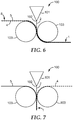
- Fig. 6 illustrates a method of manufacturing at least part of a marking tape according to the invention.
- the example shows a manufacturing line 100 comprising an extruder 101 equipped with a flat film die 102, and a pair of rollers 103 which are arranged at a predetermined distance relative to each other to form a predetermined clearance between.
- the rollers have a structured surface (not shown) for providing raised and/or recessed structures on the marking tape.
- a nonwoven layer 5 and a netting layer 4 are provided between the rollers 103.
- a netting layer 4 or a non-woven layer 5 may be used with the method illustrated in the example.
- the nonwoven layer 5 and the netting layer 4 are jointly provided from generally the same direction and guided on the entry side of the pair of rollers over only one of the rollers 103.
- the jointly supplied nonwoven layer 5 and the netting layer 4 together form a precursor 8 of a fibrous layer.
- a thermoplastic material 2 is extruded from the extruder 101 and guided between the pair of rollers 103 along with the fibrous layer precursor 8.
- the fibrous layer precursor 8 and the extruded thermoplastic material 2 are guided such that the netting layer 4 runs between the nonwoven layer 5 and the thermoplastic material 2.
- the thermoplastic material 2 and the fibrous layer precursor 8 are merged between the rollers 103.
- the soft thermoplastic material 2 extruded from the extruder 101 is urged by the rollers 103 to penetrate the fibrous layer precursor 8.
- the thermoplastic material 2 penetrates the fibrous layer precursor 8 in a direction from the netting layer 4 toward the nonwoven layer 5.
- the degree of saturation of the nonwoven layer 5 may particularly be adjustable.
- the temperature of the thermoplastic material 2 and the distance of the rollers 103 to each other may be selected such that the netting layer 4 gets entirely saturated by the thermoplastic material 2, whereas the nonwoven layer 5 gets only partially saturated by the thermoplastic material 2.
- a so formed precursor 1 of a core layer 1 may be subsequently coated by cross-linkable material, provided with reflective elements and an adhesive layer added to form a marking tape according to the invention.
- Fig. 7 illustrates an alternative method of manufacturing at least part of a marking tape according to the invention.
- the example shows the same manufacturing line 100 as shown in Fig. 6 .
- a nonwoven layer 5 and a netting layer 4 are provided between the rollers 103.
- the nonwoven layer 5 and the netting layer 4 are provided separately from each other from generally opposite directions.
- the nonwoven layer 5 is guided over one of the rolls of the rollers 103 and the netting layer 4 is guided over the other one of the rollers 103 on the entry side of the pair of rollers 103.
- the thermoplastic material 2 is extruded from the extruder 101 and guided between the nonwoven layer 5 and the netting layer 4.
- thermoplastic material 2 and the nonwoven layer 5 and netting layer 4 are merged between the rollers 103.
- the soft thermoplastic material 2 extruded from the extruder 101 and the nonwoven layer 5 and netting layer 4 are urged toward each other by the rollers 103 so that the thermoplastic material 2 penetrates the netting layer 4 as well as the nonwoven layer 5.
- the netting layer 4 may have larger open cells than the nonwoven layer 5 and thus may establish a lower resistance against saturation by thermoplastic material 2 than the nonwoven layer 5. Accordingly the thermoplastic material 2 may saturate the netting layer 4 to a greater extent than the nonwoven layer 5.
- a so formed precursor 1 of a core layer may for example be used to provide a marking tape as shown in Fig. 1 .
- Fig 8 shows a marking tape which is similar to the marking shown in Fig 3 except that the netting layer 24 is outside of the conforming layer 22 and is embedded within the adhesive layer 26.
- Fig 9 shows a marking tape which is similar to that shown in Fig 3 , except that the conforming layer comprises two, co-extruded sub conforming layers 22 and 22'.
- the netting is encapsulated (i.e. embedded) between the two sub conforming layers 22 and 22'.
- Fig 10 illustrates a method of manufacturing at least part of a marking tape according to Fig 9 .
- the example shows two extruders 101 each equipped with a flat film die 102, and a pair of rollers 103 which are arranged at a predetermined distance relative to each other to form a predetermined clearance between.
- the rollers have a structured surface (not shown) for providing raised and/or recessed structures on the marking tape.
- a fibrous layer consisting only of a netting layer 4 is provided between the rollers 103.
- a fibrous layer consisting of either a non-woven layer 5 only or both a netting layer 4 and a non-woven layer 5 may be used with the method illustrated in the example.
- the netting layer 4 is provided from generally the same direction and guided on the entry side of the pair of rollers centrally between the two rollers 103. Further a thermoplastic material 2 is extruded from one of the extruders 101 and a thermoplastic material 2' is extruded from the other extruder 101 and guided between the pair of rollers 103 on either side of the netting layer 4.
- the thermoplastic materials 2 and 2' may be the same or different. In the example shown the thermoplastic materials 2 and 2' are extruded on either side of the netting layer 4 which is therefore embedded between them.
- a so formed precursor 1 of a core layer 1 may be subsequently coated by cross-linkable material, provided with reflective elements and an adhesive layer added to form a marking tape according to the invention.
- thermoplastic material may be extruded in the form of two or more strands of thermoplastic material and combined with the netting layer and/or the nonwoven layer.
- two extruded strands of thermoplastic material may be run between the nonwoven layer and the netting layer.
- One of the extruded films may in one example entirely saturate the nonwoven layer and the other film may entirely or partially saturate the netting layer.
- the thermoplastic material may be coextruded or individually extruded and merged before merging with further layers.
- thermoplastic material may be extruded and cooled to form a thermoplastic film which subsequently may be laminated or calendered with the netting layer and/or nonwoven layer to form a core layer precursor.
- core layer precursor may then be coated with the cross-linkable material.
- thermoplastic raw materials and fillers used to extrude and/or co-extrude the conforming layer.
- the thicknesses specified for the materials A1 to A10 refer to flat or non-structured types of marking tape. For structured marking tapes greater thicknesses are preferably used.
- the following table 1 refers to a formulation of a polyurethane material D as it may be used for an exemplary marking layer.
- compositions and/or components listed in the table are available as different grades or types available from different suppliers, various of these different compositions and/or components seem to be likewise suitable for use with the present invention.
- the preferred thickness of such a layer or layers is within a range of about 50 ⁇ m to 500 ⁇ m, for example provided by coating.
- Table 1 Generic raw material name Molecular weight Composition Polyol 1 300 12.5 Polyol 2 900 6 Polyol 3 930 1 Filler 7 Additive package 3 Catalyst 0.02 Pigment 16.5 Solvent 4 Aliphatic polyisocyanate 191 (equivalent weight) 50
- a marking tape was manufactured by sequential coating/lamination using a laboratory knife coater heated to about 140 °C.
- the tape was manufactured by the following steps:
- the knife coater was set to a coating gap of typically 100 ⁇ m to 150 ⁇ m and the coater was heated up to a temperature of 140 °C. Prior to the coating operation the thermoplastic elastomer was molten in a ventilated oven.
- a marking tape was manufactured by extruding the conforming layer to the fibrous layer and / or netting layer using an extruder or respectively coextruder. The construction was completed by coating a 250 ⁇ m polyurethane marking layer on the side of the spunbond nonwoven (if present) using a knife coater followed by depositing the beads, skids and further reflective elements onto the polyurethane marking layer and curing the obtained marking tape in a ventilated oven for about 10 minutes at 120 °C.
- a combination of a conforming layer made of NBR rubber premix and a netting layer was provided.
- a polyurethane marking layer was coated on the NBR premix conforming layer.
- the tear resistance test was performed according to DIN 53356 or ASTM 1004. Samples of film having the dimensions of 100 mm x 50 mm were cut from the extruded film in both the machine direction (MD) and crossweb (CD) directions, respectively. The film thickness varied between 0.3 mm and 0.5 mm. Film thickness was measured and used in the calculation.
- a 50 mm cut was made in the edge of the film along the length of samples as described in the test method.
- the two partially connected strips produced by the cut were gripped in the jaws of the tensile tester and pulled in opposite directions at a crosshead speed of 100 mm/min.
- the E-modulus [N/mm 2 ] and the inelastic deformation [%] were measured on extruded Examples 15 to 24 and on the Comparative Example.
- the measured samples had no Netting- and/or Nonwoven layer so that a direct comparison could be made of the properties of the layers.
- the test results are given in Table 3.
- the E-modulus referred to in this specification was measured according to EN ISO 527-1. Samples of conforming layer having dimension of 25.4 x 140 mm were cut from the extruded film in cross web direction. Film thickness was measured and entered in the measurement software. Samples were clamped in the machine with a jaw distance of 100 mm. Measurement of the E-modulus was performed on a Tensile Tester.
Landscapes
- Engineering & Computer Science (AREA)
- Architecture (AREA)
- Civil Engineering (AREA)
- Structural Engineering (AREA)
- Mechanical Engineering (AREA)
- Textile Engineering (AREA)
- Physics & Mathematics (AREA)
- Fluid Mechanics (AREA)
- Laminated Bodies (AREA)
- Road Signs Or Road Markings (AREA)
- Road Repair (AREA)
Claims (18)
- Ruban de marquage pour une application sur chaussée, comprenant :- une couche centrale et une couche adhésive ;- dans lequel la couche adhésive est adaptée pour retenir le ruban de marquage sur la chaussée ; et- la couche centrale étant formée d'une combinaison d'une couche de conformation d'un matériau thermoplastique, d'une couche de marquage d'un matériau réticulé, et d'une couche fibreuse, dans lequel la couche fibreuse est au moins partiellement incorporée dans la couche de conformation ;- dans lequel la couche de conformation et la couche de marquage sont au moins partiellement contiguës et interconnectées directement l'une avec l'autre.
- Ruban de marquage selon la revendication 1, dans lequel la couche fibreuse comprend un filet et/ou un non-tissé.
- Ruban de marquage suivant la revendication 1 ou la revendication 2, dans lequel la couche fibreuse est au moins partiellement incorporée dans la couche adhésive.
- Ruban de marquage de l'une quelconque des revendications précédentes, dans lequel la couche fibreuse comprend un filet et un non-tissé et dans lequel la couche de conformation est au moins partiellement agencée entre le filet et le non-tissé.
- Ruban de marquage de l'une quelconque des revendications précédentes, dans lequel le matériau thermoplastique est choisi parmi au moins l'un d'un copolymère séquencé styrénique, une polyoléfine, un mélange de polyoléfines, un alliage d'élastomère, un polyuréthane thermoplastique, un copolyester thermoplastique, un polyamide thermoplastique, ou une combinaison de ceux-ci, incluant éventuellement au moins une charge ou au moins un mélange-maître de charge.
- Ruban de marquage tel que revendiqué dans l'une quelconque des revendications précédentes, dans lequel le matériau thermoplastique comprend un mélange de deux matériaux thermoplastiques ou plus.
- Ruban de marquage tel que revendiqué dans l'une quelconque des revendications précédentes, dans lequel le ruban de marquage a une épaisseur dans la plage de 10 µm à 1000 µm, de préférence de 100 µm à 700 µm, plus préférablement de 150 µm à 450 µm.
- Ruban de marquage tel que revendiqué dans l'une quelconque des revendications précédentes, dans lequel le ruban de marquage, la couche fibreuse ayant été retirée, a un module E mesuré selon la norme EN ISO 527-1, dans la plage de 10 à 140 N/mm2, de préférence de 20 à 90 N/mm2, plus préférablement de 30 à 80 N/mm2, et le plus préférablement de 30 à 60 N/mm2.
- Ruban de marquage de l'une quelconque des revendications précédentes, dans lequel le matériau réticulé est choisi parmi au moins l'un d'un polyuréthane, un époxy, un (méth)acrylate, un acrylique, un phénol ou un autre matériau contenant des groupes chimiques réactifs ou une combinaison de ceux-ci.
- Ruban de marquage de l'une quelconque des revendications précédentes, dans lequel la couche adhésive comprend un adhésif sensible à la pression d'un type choisi parmi le caoutchouc naturel non collant, le caoutchouc naturel rendu collant, les oléfines, les silicones, le polyisoprène, le polybutadiène, les polyuréthanes, les copolymères séquencés styrène-isoprène-styrène et styrène-butadiène-styrène, le styrène-éthylène-butylène-styrène, le styrène-éthylène-propène-styrène et d'autres élastomères apparentés ; des adhésifs acryliques rendus collants ou non collants et leurs copolymères incluant des groupes acides.
- Ruban de marquage de l'une quelconque des revendications précédentes, comprenant en outre une multiplicité d'éléments réfléchissants et/ou rétroréfléchissants, comprenant éventuellement des microbilles rétroréfléchissantes.
- Ruban de marquage de l'une quelconque des revendications précédentes, comprenant une surface généralement plate ou structurée, et dans lequel la surface structurée est formée par une multiplicité de saillies en saillie depuis le ruban de marquage.
- Procédé d'application d'un ruban de marquage sur une chaussée comprenant les étapes consistant à :- fournir un ruban de marquage de l'une quelconque des revendications précédentes, qui comprend une couche de conformation d'un matériau thermoplastique et une couche adhésive ;- placer une partie du ruban orienté avec la couche adhésive sur la chaussée ;- presser la partie du ruban sur la chaussée tout en maintenant le ruban de marquage à une température dans une plage d'environ 0 °C à environ 50 °C.
- Procédé de fabrication d'un ruban de marquage, comprenant les étapes consistant à :- fournir un matériau thermoplastique, un matériau réticulable, une couche fibreuse formée d'une couche non tissée et/ou d'une couche de filet, et un adhésif ;- fusionner le matériau thermoplastique, le matériau réticulable, la couche fibreuse, et l'adhésif pour former un ruban de marquage selon l'une quelconque des revendications 1 à 13.
- Procédé selon la revendication 14, comprenant en outre l'étape consistant à :- extruder le matériau thermoplastique pour former une couche de conformation.
- Procédé selon la revendication 14 ou 15, comprenant en outre l'étape consistant à :- laminer ou calandrer la couche de conformation et au moins un de la couche de filet et de la couche non tissée ;- revêtir le matériau réticulable sur la couche de filet et/ou la couche non tissée agencée sur la couche de conformation.
- Procédé selon l'une quelconque des revendications 14 à 16, comprenant en outre les étapes consistant à :- fournir une couche non tissée et une couche de filet pour former, en combinaison, la couche fibreuse ;- faire passer la couche non tissée sur un premier rouleau et la couche de filet sur un second rouleau ;- fournir le matériau thermoplastique entre la couche non tissée et la couche de filet ;- presser la couche non tissée, le matériau thermoplastique et la couche de filet entre les premier et second rouleaux.
- Procédé selon l'une quelconque des revendications 14 à 17, comprenant en outre l'étape consistant à :- coextruder une ou plusieurs couches avec au moins deux matériaux thermoplastiques différents pour former la couche de conformation.
Priority Applications (1)
| Application Number | Priority Date | Filing Date | Title |
|---|---|---|---|
| EP13796285.8A EP2864545B1 (fr) | 2012-05-30 | 2013-05-30 | Ruban de marquage, procédé d'application et procédé de fabrication du ruban de marquage |
Applications Claiming Priority (3)
| Application Number | Priority Date | Filing Date | Title |
|---|---|---|---|
| EP12170061 | 2012-05-30 | ||
| EP13796285.8A EP2864545B1 (fr) | 2012-05-30 | 2013-05-30 | Ruban de marquage, procédé d'application et procédé de fabrication du ruban de marquage |
| PCT/US2013/043235 WO2013181325A2 (fr) | 2012-05-30 | 2013-05-30 | Ruban de marquage, procédé d'application et procédé de fabrication du ruban de marquage |
Publications (3)
| Publication Number | Publication Date |
|---|---|
| EP2864545A2 EP2864545A2 (fr) | 2015-04-29 |
| EP2864545A4 EP2864545A4 (fr) | 2016-05-11 |
| EP2864545B1 true EP2864545B1 (fr) | 2020-08-12 |
Family
ID=49674050
Family Applications (1)
| Application Number | Title | Priority Date | Filing Date |
|---|---|---|---|
| EP13796285.8A Active EP2864545B1 (fr) | 2012-05-30 | 2013-05-30 | Ruban de marquage, procédé d'application et procédé de fabrication du ruban de marquage |
Country Status (3)
| Country | Link |
|---|---|
| US (3) | US11110695B2 (fr) |
| EP (1) | EP2864545B1 (fr) |
| WO (1) | WO2013181325A2 (fr) |
Families Citing this family (4)
| Publication number | Priority date | Publication date | Assignee | Title |
|---|---|---|---|---|
| US11011082B2 (en) | 2017-05-16 | 2021-05-18 | Promedica Health System, Inc. | Stairway safety device |
| WO2020044078A1 (fr) * | 2018-08-29 | 2020-03-05 | Vetex Nv | Élément de marquage comprenant un tissu de renfort |
| CN110835507B (zh) * | 2019-11-16 | 2021-06-11 | 泉州市信实科技有限公司 | 一种预制型塑胶跑道的施工工艺 |
| CN116948528B (zh) * | 2023-07-20 | 2024-06-21 | 深圳标朗环保新材料科技有限公司 | 一种道路标线涂料及其制备方法和道路标线涂层 |
Family Cites Families (44)
| Publication number | Priority date | Publication date | Assignee | Title |
|---|---|---|---|---|
| CA677797A (en) | 1955-11-18 | 1964-01-14 | Minnesota Mining And Manufacturing Company | Sheet material having a pressure-sensitive adhesive coating of acrylate ester copolymer |
| US3451537A (en) | 1966-02-28 | 1969-06-24 | Minnesota Mining & Mfg | Pressure-sensitive adhesive tape |
| GB1230097A (fr) | 1967-07-18 | 1971-04-28 | ||
| FR2040574A7 (en) | 1969-04-16 | 1971-01-22 | Goutelle Maurice Ets | Plastic road marking strip |
| US3770559A (en) | 1971-01-11 | 1973-11-06 | Evode Ltd | Pressure-sensitive adhesive laminate |
| IT1045336B (it) | 1973-03-21 | 1980-05-10 | Eigenmann Ludwig | Materiale retroriflettente associabile a strisce elastoplastiche e simili per segnaletica stradale orizzontale per esaltarne la vis filita sotto luce radente |
| US4146635A (en) * | 1976-04-15 | 1979-03-27 | Ludwig Eigenmann | Anti-skid, wear- and stress-resisting road marking tape material |
| GB1567527A (en) | 1976-04-15 | 1980-05-14 | Eigenmann Ludwig | Anti-skid wear- and stress-resisting road marking tape material |
| US4299874A (en) | 1980-03-31 | 1981-11-10 | Minnesota Mining And Manufacturing Company | Removable pavement-marking sheet material |
| BR8107486A (pt) | 1981-11-18 | 1983-07-05 | Snoline Spa | Material laminar elasto-plastico aplicavel a superficies estradais para a formacao de faixas divisorias e outros meios de sinalizacao |
| IT1153172B (it) | 1982-08-16 | 1987-01-14 | Ludwig Eigenmann | Metodo per rendere una striscia segnaletica prefabbricata riflettorizzata resistente all'aggressione delle lame da neve, metodo di produzione di elementi protrudenti, metodo di produzione della striscia e manufatto relativo |
| US4443510A (en) | 1982-09-23 | 1984-04-17 | Lukens General Industries, Inc. | Conformable removable reflective marking tape |
| DE3671652D1 (de) | 1985-07-23 | 1990-07-05 | Minnesota Mining & Mfg | Verfahren zum aufbringen von strassenmarkierungsklebbaendern. |
| IT1205186B (it) | 1987-06-25 | 1989-03-15 | Snoline Spa | Striscia segnaletica prefabbricata per uso temporaneo |
| US4925335A (en) | 1987-10-09 | 1990-05-15 | Ludwig Eigenmann | Prefabricated continuous roadmarking tape having optical and electromagnetic function |
| TW215105B (fr) | 1990-12-20 | 1993-10-21 | Minnesota Mining & Mfg | |
| ZA919417B (en) | 1990-12-24 | 1992-12-30 | Minnesota Mining & Mfg | Thermoplastic marking sheet |
| US5194113A (en) * | 1990-12-24 | 1993-03-16 | Minnesota Mining And Manufacturing Company | Process for making conformable thermoplastic marking sheet |
| WO1993017188A1 (fr) | 1992-02-19 | 1993-09-02 | Minnesota Mining And Manufacturing Company | Bande de marquage routier |
| EP0725718B1 (fr) * | 1993-09-20 | 1999-10-20 | Minnesota Mining And Manufacturing Company | Marquage de la chaussee et feuille de base |
| US5679437A (en) | 1995-07-31 | 1997-10-21 | Flex-O-Lite, Inc. | Reflective marking tape with mesh layer |
| NL1004432C2 (nl) | 1996-11-05 | 1998-05-08 | Hans Van Rij | Een eenvoudig afneembaar, laagvormig horizontale reflecterende belijning ten behoeve van verkeersstromen en/of andere markeertoepassingen. |
| US5777791A (en) | 1996-11-26 | 1998-07-07 | Minnesota Mining And Manufacturing Company | Wet retroreflective pavement marking articles |
| EP0850755A1 (fr) * | 1996-12-23 | 1998-07-01 | Minnesota Mining And Manufacturing Company | Feuille de signalisation conformable |
| US5981033A (en) | 1997-03-12 | 1999-11-09 | 3M Innovative Properties Company | Pavement marking tape |
| US6051297A (en) | 1997-07-16 | 2000-04-18 | 3M Innovative Properties Company | Self-contrasting retroreflective pavement marking tapes |
| US6024824A (en) | 1997-07-17 | 2000-02-15 | 3M Innovative Properties Company | Method of making articles in sheet form, particularly abrasive articles |
| US6100224A (en) | 1997-10-01 | 2000-08-08 | Exxon Chemical Patents Inc | Copolymers of ethylene α-olefin macromers and dicarboxylic monomers and derivatives thereof, useful as additives in lubricating oils and in fuels |
| SE513295C2 (sv) | 1998-03-09 | 2000-08-21 | Trelleborg Ind Ab | Vägmarkeringstejp för tillfälliga trafikmarkeringar samt förfarande för genomförande av sådana |
| KR100885329B1 (ko) | 2001-08-02 | 2009-02-26 | 쓰리엠 이노베이티브 프로퍼티즈 컴파니 | Al₂O₃-희토류 산화물-ZrO₂/HfO₂물질, 및그의 제조 및 사용 방법 |
| US7169831B2 (en) | 2001-09-27 | 2007-01-30 | 3M Innovative Properties Company | Pavement marking composition comprising ceramic fibers |
| US20030070579A1 (en) | 2001-10-01 | 2003-04-17 | Hong Le Hoa | Preformed thermoplastic pavement marking construction |
| US7066680B2 (en) | 2001-12-04 | 2006-06-27 | Integrated Paving Concepts Inc. | Method of forming an inlaid pattern in an asphalt surface |
| US6758567B2 (en) | 2002-01-22 | 2004-07-06 | Adl Attar | One-piece reflective marking sheet |
| US7700707B2 (en) | 2002-10-15 | 2010-04-20 | Exxonmobil Chemical Patents Inc. | Polyolefin adhesive compositions and articles made therefrom |
| US7513941B2 (en) | 2005-11-14 | 2009-04-07 | 3M Innovative Properties Company | Pavement marking, reflective elements, and methods of making micospheres |
| US20080280034A1 (en) | 2007-05-11 | 2008-11-13 | 3M Innovative Properties Company | Pavement marking and reflective elements having microspheres comprising lanthanum oxide and aluminum oxide with zirconia, titania, or mixtures thereof |
| WO2009085550A1 (fr) | 2007-12-21 | 2009-07-09 | 3M Innovative Properties Company | Marquages au sol rétro-réfléchissants |
| US20100055374A1 (en) | 2008-09-02 | 2010-03-04 | Greer Robert W | Retroflective pavement markers for wet weather |
| BR112012003662A2 (pt) | 2009-08-21 | 2016-03-29 | 3M Innovative Properties Co | demarcações de pavimentos, elementos refletivos, e métodos de preparo de mocroesferas. |
| CN106082683A (zh) | 2009-08-21 | 2016-11-09 | 3M创新有限公司 | 路面标记、反射元件、微球以及制备微球的方法 |
| KR100978213B1 (ko) | 2010-05-20 | 2010-08-26 | (주)원창이엔지 | 노면표시용 열가소성 핫멜트 부착식 노면시트용 조성물, 노면시트 및 이를 이용한 노면표시 시공방법 |
| CN101875823B (zh) | 2010-06-12 | 2013-10-02 | 河北中胶国际胶带有限公司 | 一种能发出荧光的路面反光胶粘带及其制造方法 |
| US20110305901A1 (en) * | 2010-06-14 | 2011-12-15 | Sanford Wyse | Nonwoven highway marking tape and method of manufacturing |
-
2013
- 2013-05-30 EP EP13796285.8A patent/EP2864545B1/fr active Active
- 2013-05-30 WO PCT/US2013/043235 patent/WO2013181325A2/fr not_active Ceased
- 2013-05-30 US US14/404,265 patent/US11110695B2/en active Active
-
2019
- 2019-03-12 US US16/351,162 patent/US20190210347A1/en not_active Abandoned
-
2021
- 2021-08-18 US US17/405,222 patent/US20210379882A1/en not_active Abandoned
Non-Patent Citations (1)
| Title |
|---|
| None * |
Also Published As
| Publication number | Publication date |
|---|---|
| US11110695B2 (en) | 2021-09-07 |
| WO2013181325A3 (fr) | 2014-01-23 |
| EP2864545A4 (fr) | 2016-05-11 |
| US20210379882A1 (en) | 2021-12-09 |
| EP2864545A2 (fr) | 2015-04-29 |
| US20190210347A1 (en) | 2019-07-11 |
| WO2013181325A2 (fr) | 2013-12-05 |
| US20150144257A1 (en) | 2015-05-28 |
Similar Documents
| Publication | Publication Date | Title |
|---|---|---|
| US20210379882A1 (en) | Marking tape, method of applying and method of manufacturing the marking tape | |
| CN1200626C (zh) | 具有两个表面的卷材及其制造方法 | |
| JP4803827B2 (ja) | 剥離ライナーおよび該ライナーを備える感圧接着シート | |
| US5536569A (en) | Thermoplastic marking sheet | |
| JP5541847B2 (ja) | 剥離ライナー付き粘着シート | |
| KR101669296B1 (ko) | 이형 재료 | |
| EP2231400A2 (fr) | Bande de solin multicouche | |
| KR102667972B1 (ko) | 접착 라미네이트 및 접착 라미네이트의 제조 방법 | |
| JP2002254563A (ja) | 積層体 | |
| US7648608B2 (en) | Method for producing a multilayer coextrudate and a film structure produced by this method | |
| EP0850755A1 (fr) | Feuille de signalisation conformable | |
| WO2003057993A1 (fr) | Marqueur de chaussee a element matriciel et son procede de fabrication | |
| US11939773B2 (en) | Roofing composites with integrated selvage edges | |
| CN110603130B (zh) | 异形膜 | |
| JP2002338706A (ja) | フッ化ビニリデン系樹脂フィルム | |
| EP2740623A1 (fr) | Joint d'étanchéité et son procédé de collage | |
| TWI828722B (zh) | 高密度柱體陣列 | |
| JP2011006523A (ja) | プロテクトフィルム | |
| JPH08118531A (ja) | マーキングフィルム積層シート | |
| JPH0341180A (ja) | 感圧接着布テープ | |
| US20210388241A1 (en) | Multilayered patches for sealing applications and related methods | |
| CN1241158A (zh) | 贴合性标志片 | |
| JP2003326629A (ja) | マーキングフィルム、レセプターシート及び乗り物用マーキングフィルム | |
| JP2025003401A (ja) | 粘着テープ | |
| FR3155740A1 (fr) | Multicouche comprenant une couche principale à base de polyoléfine |
Legal Events
| Date | Code | Title | Description |
|---|---|---|---|
| PUAI | Public reference made under article 153(3) epc to a published international application that has entered the european phase |
Free format text: ORIGINAL CODE: 0009012 |
|
| 17P | Request for examination filed |
Effective date: 20141125 |
|
| AK | Designated contracting states |
Kind code of ref document: A2 Designated state(s): AL AT BE BG CH CY CZ DE DK EE ES FI FR GB GR HR HU IE IS IT LI LT LU LV MC MK MT NL NO PL PT RO RS SE SI SK SM TR |
|
| AX | Request for extension of the european patent |
Extension state: BA ME |
|
| DAX | Request for extension of the european patent (deleted) | ||
| A4 | Supplementary search report drawn up and despatched |
Effective date: 20160412 |
|
| RIC1 | Information provided on ipc code assigned before grant |
Ipc: E01C 9/08 20060101ALI20160407BHEP Ipc: C09J 7/04 20060101AFI20160407BHEP |
|
| STAA | Information on the status of an ep patent application or granted ep patent |
Free format text: STATUS: EXAMINATION IS IN PROGRESS |
|
| 17Q | First examination report despatched |
Effective date: 20180329 |
|
| 17Q | First examination report despatched |
Effective date: 20180412 |
|
| REG | Reference to a national code |
Ref country code: DE Ref legal event code: R079 Ref document number: 602013071591 Country of ref document: DE Free format text: PREVIOUS MAIN CLASS: E01F0009080000 Ipc: C09J0007000000 |
|
| GRAP | Despatch of communication of intention to grant a patent |
Free format text: ORIGINAL CODE: EPIDOSNIGR1 |
|
| STAA | Information on the status of an ep patent application or granted ep patent |
Free format text: STATUS: GRANT OF PATENT IS INTENDED |
|
| RIC1 | Information provided on ipc code assigned before grant |
Ipc: C09J 7/00 20180101AFI20200204BHEP Ipc: C09J 7/21 20180101ALN20200204BHEP |
|
| INTG | Intention to grant announced |
Effective date: 20200220 |
|
| GRAS | Grant fee paid |
Free format text: ORIGINAL CODE: EPIDOSNIGR3 |
|
| GRAA | (expected) grant |
Free format text: ORIGINAL CODE: 0009210 |
|
| STAA | Information on the status of an ep patent application or granted ep patent |
Free format text: STATUS: THE PATENT HAS BEEN GRANTED |
|
| AK | Designated contracting states |
Kind code of ref document: B1 Designated state(s): AL AT BE BG CH CY CZ DE DK EE ES FI FR GB GR HR HU IE IS IT LI LT LU LV MC MK MT NL NO PL PT RO RS SE SI SK SM TR |
|
| REG | Reference to a national code |
Ref country code: CH Ref legal event code: EP |
|
| REG | Reference to a national code |
Ref country code: IE Ref legal event code: FG4D |
|
| REG | Reference to a national code |
Ref country code: DE Ref legal event code: R096 Ref document number: 602013071591 Country of ref document: DE |
|
| REG | Reference to a national code |
Ref country code: AT Ref legal event code: REF Ref document number: 1301540 Country of ref document: AT Kind code of ref document: T Effective date: 20200915 |
|
| REG | Reference to a national code |
Ref country code: LT Ref legal event code: MG4D |
|
| REG | Reference to a national code |
Ref country code: NL Ref legal event code: MP Effective date: 20200812 |
|
| PG25 | Lapsed in a contracting state [announced via postgrant information from national office to epo] |
Ref country code: FI Free format text: LAPSE BECAUSE OF FAILURE TO SUBMIT A TRANSLATION OF THE DESCRIPTION OR TO PAY THE FEE WITHIN THE PRESCRIBED TIME-LIMIT Effective date: 20200812 Ref country code: GR Free format text: LAPSE BECAUSE OF FAILURE TO SUBMIT A TRANSLATION OF THE DESCRIPTION OR TO PAY THE FEE WITHIN THE PRESCRIBED TIME-LIMIT Effective date: 20201113 Ref country code: NO Free format text: LAPSE BECAUSE OF FAILURE TO SUBMIT A TRANSLATION OF THE DESCRIPTION OR TO PAY THE FEE WITHIN THE PRESCRIBED TIME-LIMIT Effective date: 20201112 Ref country code: HR Free format text: LAPSE BECAUSE OF FAILURE TO SUBMIT A TRANSLATION OF THE DESCRIPTION OR TO PAY THE FEE WITHIN THE PRESCRIBED TIME-LIMIT Effective date: 20200812 Ref country code: SE Free format text: LAPSE BECAUSE OF FAILURE TO SUBMIT A TRANSLATION OF THE DESCRIPTION OR TO PAY THE FEE WITHIN THE PRESCRIBED TIME-LIMIT Effective date: 20200812 Ref country code: BG Free format text: LAPSE BECAUSE OF FAILURE TO SUBMIT A TRANSLATION OF THE DESCRIPTION OR TO PAY THE FEE WITHIN THE PRESCRIBED TIME-LIMIT Effective date: 20201112 Ref country code: LT Free format text: LAPSE BECAUSE OF FAILURE TO SUBMIT A TRANSLATION OF THE DESCRIPTION OR TO PAY THE FEE WITHIN THE PRESCRIBED TIME-LIMIT Effective date: 20200812 Ref country code: ES Free format text: LAPSE BECAUSE OF FAILURE TO SUBMIT A TRANSLATION OF THE DESCRIPTION OR TO PAY THE FEE WITHIN THE PRESCRIBED TIME-LIMIT Effective date: 20200812 |
|
| REG | Reference to a national code |
Ref country code: AT Ref legal event code: MK05 Ref document number: 1301540 Country of ref document: AT Kind code of ref document: T Effective date: 20200812 |
|
| PG25 | Lapsed in a contracting state [announced via postgrant information from national office to epo] |
Ref country code: LV Free format text: LAPSE BECAUSE OF FAILURE TO SUBMIT A TRANSLATION OF THE DESCRIPTION OR TO PAY THE FEE WITHIN THE PRESCRIBED TIME-LIMIT Effective date: 20200812 Ref country code: NL Free format text: LAPSE BECAUSE OF FAILURE TO SUBMIT A TRANSLATION OF THE DESCRIPTION OR TO PAY THE FEE WITHIN THE PRESCRIBED TIME-LIMIT Effective date: 20200812 Ref country code: RS Free format text: LAPSE BECAUSE OF FAILURE TO SUBMIT A TRANSLATION OF THE DESCRIPTION OR TO PAY THE FEE WITHIN THE PRESCRIBED TIME-LIMIT Effective date: 20200812 Ref country code: PL Free format text: LAPSE BECAUSE OF FAILURE TO SUBMIT A TRANSLATION OF THE DESCRIPTION OR TO PAY THE FEE WITHIN THE PRESCRIBED TIME-LIMIT Effective date: 20200812 Ref country code: IS Free format text: LAPSE BECAUSE OF FAILURE TO SUBMIT A TRANSLATION OF THE DESCRIPTION OR TO PAY THE FEE WITHIN THE PRESCRIBED TIME-LIMIT Effective date: 20201212 |
|
| PG25 | Lapsed in a contracting state [announced via postgrant information from national office to epo] |
Ref country code: RO Free format text: LAPSE BECAUSE OF FAILURE TO SUBMIT A TRANSLATION OF THE DESCRIPTION OR TO PAY THE FEE WITHIN THE PRESCRIBED TIME-LIMIT Effective date: 20200812 Ref country code: SM Free format text: LAPSE BECAUSE OF FAILURE TO SUBMIT A TRANSLATION OF THE DESCRIPTION OR TO PAY THE FEE WITHIN THE PRESCRIBED TIME-LIMIT Effective date: 20200812 Ref country code: DK Free format text: LAPSE BECAUSE OF FAILURE TO SUBMIT A TRANSLATION OF THE DESCRIPTION OR TO PAY THE FEE WITHIN THE PRESCRIBED TIME-LIMIT Effective date: 20200812 Ref country code: CZ Free format text: LAPSE BECAUSE OF FAILURE TO SUBMIT A TRANSLATION OF THE DESCRIPTION OR TO PAY THE FEE WITHIN THE PRESCRIBED TIME-LIMIT Effective date: 20200812 Ref country code: EE Free format text: LAPSE BECAUSE OF FAILURE TO SUBMIT A TRANSLATION OF THE DESCRIPTION OR TO PAY THE FEE WITHIN THE PRESCRIBED TIME-LIMIT Effective date: 20200812 |
|
| REG | Reference to a national code |
Ref country code: DE Ref legal event code: R097 Ref document number: 602013071591 Country of ref document: DE |
|
| PG25 | Lapsed in a contracting state [announced via postgrant information from national office to epo] |
Ref country code: AL Free format text: LAPSE BECAUSE OF FAILURE TO SUBMIT A TRANSLATION OF THE DESCRIPTION OR TO PAY THE FEE WITHIN THE PRESCRIBED TIME-LIMIT Effective date: 20200812 Ref country code: AT Free format text: LAPSE BECAUSE OF FAILURE TO SUBMIT A TRANSLATION OF THE DESCRIPTION OR TO PAY THE FEE WITHIN THE PRESCRIBED TIME-LIMIT Effective date: 20200812 |
|
| PLBE | No opposition filed within time limit |
Free format text: ORIGINAL CODE: 0009261 |
|
| STAA | Information on the status of an ep patent application or granted ep patent |
Free format text: STATUS: NO OPPOSITION FILED WITHIN TIME LIMIT |
|
| PG25 | Lapsed in a contracting state [announced via postgrant information from national office to epo] |
Ref country code: SK Free format text: LAPSE BECAUSE OF FAILURE TO SUBMIT A TRANSLATION OF THE DESCRIPTION OR TO PAY THE FEE WITHIN THE PRESCRIBED TIME-LIMIT Effective date: 20200812 |
|
| 26N | No opposition filed |
Effective date: 20210514 |
|
| PG25 | Lapsed in a contracting state [announced via postgrant information from national office to epo] |
Ref country code: IT Free format text: LAPSE BECAUSE OF FAILURE TO SUBMIT A TRANSLATION OF THE DESCRIPTION OR TO PAY THE FEE WITHIN THE PRESCRIBED TIME-LIMIT Effective date: 20200812 |
|
| PG25 | Lapsed in a contracting state [announced via postgrant information from national office to epo] |
Ref country code: SI Free format text: LAPSE BECAUSE OF FAILURE TO SUBMIT A TRANSLATION OF THE DESCRIPTION OR TO PAY THE FEE WITHIN THE PRESCRIBED TIME-LIMIT Effective date: 20200812 |
|
| REG | Reference to a national code |
Ref country code: CH Ref legal event code: PL |
|
| GBPC | Gb: european patent ceased through non-payment of renewal fee |
Effective date: 20210530 |
|
| PG25 | Lapsed in a contracting state [announced via postgrant information from national office to epo] |
Ref country code: LU Free format text: LAPSE BECAUSE OF NON-PAYMENT OF DUE FEES Effective date: 20210530 Ref country code: MC Free format text: LAPSE BECAUSE OF FAILURE TO SUBMIT A TRANSLATION OF THE DESCRIPTION OR TO PAY THE FEE WITHIN THE PRESCRIBED TIME-LIMIT Effective date: 20200812 Ref country code: LI Free format text: LAPSE BECAUSE OF NON-PAYMENT OF DUE FEES Effective date: 20210531 Ref country code: CH Free format text: LAPSE BECAUSE OF NON-PAYMENT OF DUE FEES Effective date: 20210531 |
|
| REG | Reference to a national code |
Ref country code: BE Ref legal event code: MM Effective date: 20210531 |
|
| PG25 | Lapsed in a contracting state [announced via postgrant information from national office to epo] |
Ref country code: IE Free format text: LAPSE BECAUSE OF NON-PAYMENT OF DUE FEES Effective date: 20210530 Ref country code: GB Free format text: LAPSE BECAUSE OF NON-PAYMENT OF DUE FEES Effective date: 20210530 |
|
| PG25 | Lapsed in a contracting state [announced via postgrant information from national office to epo] |
Ref country code: FR Free format text: LAPSE BECAUSE OF NON-PAYMENT OF DUE FEES Effective date: 20210531 |
|
| PG25 | Lapsed in a contracting state [announced via postgrant information from national office to epo] |
Ref country code: BE Free format text: LAPSE BECAUSE OF NON-PAYMENT OF DUE FEES Effective date: 20210531 |
|
| PG25 | Lapsed in a contracting state [announced via postgrant information from national office to epo] |
Ref country code: PT Free format text: LAPSE BECAUSE OF FAILURE TO SUBMIT A TRANSLATION OF THE DESCRIPTION OR TO PAY THE FEE WITHIN THE PRESCRIBED TIME-LIMIT Effective date: 20201214 |
|
| PG25 | Lapsed in a contracting state [announced via postgrant information from national office to epo] |
Ref country code: HU Free format text: LAPSE BECAUSE OF FAILURE TO SUBMIT A TRANSLATION OF THE DESCRIPTION OR TO PAY THE FEE WITHIN THE PRESCRIBED TIME-LIMIT; INVALID AB INITIO Effective date: 20130530 |
|
| PG25 | Lapsed in a contracting state [announced via postgrant information from national office to epo] |
Ref country code: CY Free format text: LAPSE BECAUSE OF FAILURE TO SUBMIT A TRANSLATION OF THE DESCRIPTION OR TO PAY THE FEE WITHIN THE PRESCRIBED TIME-LIMIT Effective date: 20200812 |
|
| PG25 | Lapsed in a contracting state [announced via postgrant information from national office to epo] |
Ref country code: MK Free format text: LAPSE BECAUSE OF FAILURE TO SUBMIT A TRANSLATION OF THE DESCRIPTION OR TO PAY THE FEE WITHIN THE PRESCRIBED TIME-LIMIT Effective date: 20200812 |
|
| PG25 | Lapsed in a contracting state [announced via postgrant information from national office to epo] |
Ref country code: MT Free format text: LAPSE BECAUSE OF FAILURE TO SUBMIT A TRANSLATION OF THE DESCRIPTION OR TO PAY THE FEE WITHIN THE PRESCRIBED TIME-LIMIT Effective date: 20200812 |
|
| PGFP | Annual fee paid to national office [announced via postgrant information from national office to epo] |
Ref country code: DE Payment date: 20250423 Year of fee payment: 13 |
|
| PG25 | Lapsed in a contracting state [announced via postgrant information from national office to epo] |
Ref country code: TR Free format text: LAPSE BECAUSE OF FAILURE TO SUBMIT A TRANSLATION OF THE DESCRIPTION OR TO PAY THE FEE WITHIN THE PRESCRIBED TIME-LIMIT Effective date: 20200812 |