EP2865725A2 - Composition de revetement pour la formation d'une couche formant barriere aux gaz, film formant barriere aux gaz, et procede pour la fabrication d'un film formant barriere aux gaz - Google Patents
Composition de revetement pour la formation d'une couche formant barriere aux gaz, film formant barriere aux gaz, et procede pour la fabrication d'un film formant barriere aux gaz Download PDFInfo
- Publication number
- EP2865725A2 EP2865725A2 EP20150151394 EP15151394A EP2865725A2 EP 2865725 A2 EP2865725 A2 EP 2865725A2 EP 20150151394 EP20150151394 EP 20150151394 EP 15151394 A EP15151394 A EP 15151394A EP 2865725 A2 EP2865725 A2 EP 2865725A2
- Authority
- EP
- European Patent Office
- Prior art keywords
- gas barrier
- resin
- film
- layer
- compound
- Prior art date
- Legal status (The legal status is an assumption and is not a legal conclusion. Google has not performed a legal analysis and makes no representation as to the accuracy of the status listed.)
- Granted
Links
- 0 C*NC(OC(CO)CO*OCC(CO)OC(NC)=O)=O Chemical compound C*NC(OC(CO)CO*OCC(CO)OC(NC)=O)=O 0.000 description 1
- AUOOXFVCWWKEKN-QKTWGNPWSA-N CC(COC[C@@H](CO1)OC1=O)(COCC(CO1)OC1=O)COCC(C[O]1C)OC1=O Chemical compound CC(COC[C@@H](CO1)OC1=O)(COCC(CO1)OC1=O)COCC(C[O]1C)OC1=O AUOOXFVCWWKEKN-QKTWGNPWSA-N 0.000 description 1
- DNSGQMOSYDHNHO-UHFFFAOYSA-N COCC(CO1)OC1=O Chemical compound COCC(CO1)OC1=O DNSGQMOSYDHNHO-UHFFFAOYSA-N 0.000 description 1
- KFYKKWKBPMVIFF-XFXZXTDPSA-N O=C1OC(C/[O]=C/CCCCCO/C=C(/CCO2)\OC2=O)CO1 Chemical compound O=C1OC(C/[O]=C/CCCCCO/C=C(/CCO2)\OC2=O)CO1 KFYKKWKBPMVIFF-XFXZXTDPSA-N 0.000 description 1
Images

Classifications
-
- B—PERFORMING OPERATIONS; TRANSPORTING
- B29—WORKING OF PLASTICS; WORKING OF SUBSTANCES IN A PLASTIC STATE IN GENERAL
- B29C—SHAPING OR JOINING OF PLASTICS; SHAPING OF MATERIAL IN A PLASTIC STATE, NOT OTHERWISE PROVIDED FOR; AFTER-TREATMENT OF THE SHAPED PRODUCTS, e.g. REPAIRING
- B29C48/00—Extrusion moulding, i.e. expressing the moulding material through a die or nozzle which imparts the desired form; Apparatus therefor
- B29C48/03—Extrusion moulding, i.e. expressing the moulding material through a die or nozzle which imparts the desired form; Apparatus therefor characterised by the shape of the extruded material at extrusion
- B29C48/09—Articles with cross-sections having partially or fully enclosed cavities, e.g. pipes or channels
- B29C48/10—Articles with cross-sections having partially or fully enclosed cavities, e.g. pipes or channels flexible, e.g. blown foils
-
- B—PERFORMING OPERATIONS; TRANSPORTING
- B05—SPRAYING OR ATOMISING IN GENERAL; APPLYING FLUENT MATERIALS TO SURFACES, IN GENERAL
- B05D—PROCESSES FOR APPLYING FLUENT MATERIALS TO SURFACES, IN GENERAL
- B05D5/00—Processes for applying liquids or other fluent materials to surfaces to obtain special surface effects, finishes or structures
-
- B—PERFORMING OPERATIONS; TRANSPORTING
- B29—WORKING OF PLASTICS; WORKING OF SUBSTANCES IN A PLASTIC STATE IN GENERAL
- B29C—SHAPING OR JOINING OF PLASTICS; SHAPING OF MATERIAL IN A PLASTIC STATE, NOT OTHERWISE PROVIDED FOR; AFTER-TREATMENT OF THE SHAPED PRODUCTS, e.g. REPAIRING
- B29C48/00—Extrusion moulding, i.e. expressing the moulding material through a die or nozzle which imparts the desired form; Apparatus therefor
- B29C48/03—Extrusion moulding, i.e. expressing the moulding material through a die or nozzle which imparts the desired form; Apparatus therefor characterised by the shape of the extruded material at extrusion
- B29C48/07—Flat, e.g. panels
- B29C48/08—Flat, e.g. panels flexible, e.g. films
-
- B—PERFORMING OPERATIONS; TRANSPORTING
- B29—WORKING OF PLASTICS; WORKING OF SUBSTANCES IN A PLASTIC STATE IN GENERAL
- B29C—SHAPING OR JOINING OF PLASTICS; SHAPING OF MATERIAL IN A PLASTIC STATE, NOT OTHERWISE PROVIDED FOR; AFTER-TREATMENT OF THE SHAPED PRODUCTS, e.g. REPAIRING
- B29C48/00—Extrusion moulding, i.e. expressing the moulding material through a die or nozzle which imparts the desired form; Apparatus therefor
- B29C48/16—Articles comprising two or more components, e.g. co-extruded layers
- B29C48/18—Articles comprising two or more components, e.g. co-extruded layers the components being layers
-
- B—PERFORMING OPERATIONS; TRANSPORTING
- B32—LAYERED PRODUCTS
- B32B—LAYERED PRODUCTS, i.e. PRODUCTS BUILT-UP OF STRATA OF FLAT OR NON-FLAT, e.g. CELLULAR OR HONEYCOMB, FORM
- B32B27/00—Layered products comprising a layer of synthetic resin
- B32B27/40—Layered products comprising a layer of synthetic resin comprising polyurethanes
-
- C—CHEMISTRY; METALLURGY
- C07—ORGANIC CHEMISTRY
- C07D—HETEROCYCLIC COMPOUNDS
- C07D317/00—Heterocyclic compounds containing five-membered rings having two oxygen atoms as the only ring hetero atoms
- C07D317/08—Heterocyclic compounds containing five-membered rings having two oxygen atoms as the only ring hetero atoms having the hetero atoms in positions 1 and 3
- C07D317/10—Heterocyclic compounds containing five-membered rings having two oxygen atoms as the only ring hetero atoms having the hetero atoms in positions 1 and 3 not condensed with other rings
- C07D317/32—Heterocyclic compounds containing five-membered rings having two oxygen atoms as the only ring hetero atoms having the hetero atoms in positions 1 and 3 not condensed with other rings with hetero atoms or with carbon atoms having three bonds to hetero atoms with at the most one bond to halogen, e.g. ester or nitrile radicals, directly attached to ring carbon atoms
- C07D317/34—Oxygen atoms
- C07D317/36—Alkylene carbonates; Substituted alkylene carbonates
-
- C—CHEMISTRY; METALLURGY
- C08—ORGANIC MACROMOLECULAR COMPOUNDS; THEIR PREPARATION OR CHEMICAL WORKING-UP; COMPOSITIONS BASED THEREON
- C08G—MACROMOLECULAR COMPOUNDS OBTAINED OTHERWISE THAN BY REACTIONS ONLY INVOLVING UNSATURATED CARBON-TO-CARBON BONDS
- C08G71/00—Macromolecular compounds obtained by reactions forming a ureide or urethane link, otherwise, than from isocyanate radicals in the main chain of the macromolecule
- C08G71/04—Polyurethanes
-
- C—CHEMISTRY; METALLURGY
- C08—ORGANIC MACROMOLECULAR COMPOUNDS; THEIR PREPARATION OR CHEMICAL WORKING-UP; COMPOSITIONS BASED THEREON
- C08J—WORKING-UP; GENERAL PROCESSES OF COMPOUNDING; AFTER-TREATMENT NOT COVERED BY SUBCLASSES C08B, C08C, C08F, C08G or C08H
- C08J5/00—Manufacture of articles or shaped materials containing macromolecular substances
- C08J5/18—Manufacture of films or sheets
-
- C—CHEMISTRY; METALLURGY
- C08—ORGANIC MACROMOLECULAR COMPOUNDS; THEIR PREPARATION OR CHEMICAL WORKING-UP; COMPOSITIONS BASED THEREON
- C08J—WORKING-UP; GENERAL PROCESSES OF COMPOUNDING; AFTER-TREATMENT NOT COVERED BY SUBCLASSES C08B, C08C, C08F, C08G or C08H
- C08J7/00—Chemical treatment or coating of shaped articles made of macromolecular substances
- C08J7/04—Coating
- C08J7/0427—Coating with only one layer of a composition containing a polymer binder
-
- C—CHEMISTRY; METALLURGY
- C08—ORGANIC MACROMOLECULAR COMPOUNDS; THEIR PREPARATION OR CHEMICAL WORKING-UP; COMPOSITIONS BASED THEREON
- C08J—WORKING-UP; GENERAL PROCESSES OF COMPOUNDING; AFTER-TREATMENT NOT COVERED BY SUBCLASSES C08B, C08C, C08F, C08G or C08H
- C08J7/00—Chemical treatment or coating of shaped articles made of macromolecular substances
- C08J7/04—Coating
- C08J7/043—Improving the adhesiveness of the coatings per se, e.g. forming primers
-
- C—CHEMISTRY; METALLURGY
- C08—ORGANIC MACROMOLECULAR COMPOUNDS; THEIR PREPARATION OR CHEMICAL WORKING-UP; COMPOSITIONS BASED THEREON
- C08J—WORKING-UP; GENERAL PROCESSES OF COMPOUNDING; AFTER-TREATMENT NOT COVERED BY SUBCLASSES C08B, C08C, C08F, C08G or C08H
- C08J7/00—Chemical treatment or coating of shaped articles made of macromolecular substances
- C08J7/04—Coating
- C08J7/048—Forming gas barrier coatings
-
- C—CHEMISTRY; METALLURGY
- C09—DYES; PAINTS; POLISHES; NATURAL RESINS; ADHESIVES; COMPOSITIONS NOT OTHERWISE PROVIDED FOR; APPLICATIONS OF MATERIALS NOT OTHERWISE PROVIDED FOR
- C09D—COATING COMPOSITIONS, e.g. PAINTS, VARNISHES OR LACQUERS; FILLING PASTES; CHEMICAL PAINT OR INK REMOVERS; INKS; CORRECTING FLUIDS; WOODSTAINS; PASTES OR SOLIDS FOR COLOURING OR PRINTING; USE OF MATERIALS THEREFOR
- C09D175/00—Coating compositions based on polyureas or polyurethanes; Coating compositions based on derivatives of such polymers
- C09D175/04—Polyurethanes
-
- C—CHEMISTRY; METALLURGY
- C09—DYES; PAINTS; POLISHES; NATURAL RESINS; ADHESIVES; COMPOSITIONS NOT OTHERWISE PROVIDED FOR; APPLICATIONS OF MATERIALS NOT OTHERWISE PROVIDED FOR
- C09D—COATING COMPOSITIONS, e.g. PAINTS, VARNISHES OR LACQUERS; FILLING PASTES; CHEMICAL PAINT OR INK REMOVERS; INKS; CORRECTING FLUIDS; WOODSTAINS; PASTES OR SOLIDS FOR COLOURING OR PRINTING; USE OF MATERIALS THEREFOR
- C09D175/00—Coating compositions based on polyureas or polyurethanes; Coating compositions based on derivatives of such polymers
- C09D175/04—Polyurethanes
- C09D175/08—Polyurethanes from polyethers
-
- C—CHEMISTRY; METALLURGY
- C09—DYES; PAINTS; POLISHES; NATURAL RESINS; ADHESIVES; COMPOSITIONS NOT OTHERWISE PROVIDED FOR; APPLICATIONS OF MATERIALS NOT OTHERWISE PROVIDED FOR
- C09D—COATING COMPOSITIONS, e.g. PAINTS, VARNISHES OR LACQUERS; FILLING PASTES; CHEMICAL PAINT OR INK REMOVERS; INKS; CORRECTING FLUIDS; WOODSTAINS; PASTES OR SOLIDS FOR COLOURING OR PRINTING; USE OF MATERIALS THEREFOR
- C09D175/00—Coating compositions based on polyureas or polyurethanes; Coating compositions based on derivatives of such polymers
- C09D175/04—Polyurethanes
- C09D175/12—Polyurethanes from compounds containing nitrogen and active hydrogen, the nitrogen atom not being part of an isocyanate group
-
- B—PERFORMING OPERATIONS; TRANSPORTING
- B29—WORKING OF PLASTICS; WORKING OF SUBSTANCES IN A PLASTIC STATE IN GENERAL
- B29C—SHAPING OR JOINING OF PLASTICS; SHAPING OF MATERIAL IN A PLASTIC STATE, NOT OTHERWISE PROVIDED FOR; AFTER-TREATMENT OF THE SHAPED PRODUCTS, e.g. REPAIRING
- B29C48/00—Extrusion moulding, i.e. expressing the moulding material through a die or nozzle which imparts the desired form; Apparatus therefor
- B29C48/16—Articles comprising two or more components, e.g. co-extruded layers
- B29C48/18—Articles comprising two or more components, e.g. co-extruded layers the components being layers
- B29C48/21—Articles comprising two or more components, e.g. co-extruded layers the components being layers the layers being joined at their surfaces
-
- B—PERFORMING OPERATIONS; TRANSPORTING
- B29—WORKING OF PLASTICS; WORKING OF SUBSTANCES IN A PLASTIC STATE IN GENERAL
- B29C—SHAPING OR JOINING OF PLASTICS; SHAPING OF MATERIAL IN A PLASTIC STATE, NOT OTHERWISE PROVIDED FOR; AFTER-TREATMENT OF THE SHAPED PRODUCTS, e.g. REPAIRING
- B29C48/00—Extrusion moulding, i.e. expressing the moulding material through a die or nozzle which imparts the desired form; Apparatus therefor
- B29C48/25—Component parts, details or accessories; Auxiliary operations
- B29C48/30—Extrusion nozzles or dies
-
- B—PERFORMING OPERATIONS; TRANSPORTING
- B29—WORKING OF PLASTICS; WORKING OF SUBSTANCES IN A PLASTIC STATE IN GENERAL
- B29C—SHAPING OR JOINING OF PLASTICS; SHAPING OF MATERIAL IN A PLASTIC STATE, NOT OTHERWISE PROVIDED FOR; AFTER-TREATMENT OF THE SHAPED PRODUCTS, e.g. REPAIRING
- B29C48/00—Extrusion moulding, i.e. expressing the moulding material through a die or nozzle which imparts the desired form; Apparatus therefor
- B29C48/25—Component parts, details or accessories; Auxiliary operations
- B29C48/30—Extrusion nozzles or dies
- B29C48/305—Extrusion nozzles or dies having a wide opening, e.g. for forming sheets
-
- C—CHEMISTRY; METALLURGY
- C08—ORGANIC MACROMOLECULAR COMPOUNDS; THEIR PREPARATION OR CHEMICAL WORKING-UP; COMPOSITIONS BASED THEREON
- C08J—WORKING-UP; GENERAL PROCESSES OF COMPOUNDING; AFTER-TREATMENT NOT COVERED BY SUBCLASSES C08B, C08C, C08F, C08G or C08H
- C08J2375/00—Characterised by the use of polyureas or polyurethanes; Derivatives of such polymers
- C08J2375/04—Polyurethanes
-
- C—CHEMISTRY; METALLURGY
- C08—ORGANIC MACROMOLECULAR COMPOUNDS; THEIR PREPARATION OR CHEMICAL WORKING-UP; COMPOSITIONS BASED THEREON
- C08J—WORKING-UP; GENERAL PROCESSES OF COMPOUNDING; AFTER-TREATMENT NOT COVERED BY SUBCLASSES C08B, C08C, C08F, C08G or C08H
- C08J2475/00—Characterised by the use of polyureas or polyurethanes; Derivatives of such polymers
- C08J2475/04—Polyurethanes
-
- Y—GENERAL TAGGING OF NEW TECHNOLOGICAL DEVELOPMENTS; GENERAL TAGGING OF CROSS-SECTIONAL TECHNOLOGIES SPANNING OVER SEVERAL SECTIONS OF THE IPC; TECHNICAL SUBJECTS COVERED BY FORMER USPC CROSS-REFERENCE ART COLLECTIONS [XRACs] AND DIGESTS
- Y10—TECHNICAL SUBJECTS COVERED BY FORMER USPC
- Y10T—TECHNICAL SUBJECTS COVERED BY FORMER US CLASSIFICATION
- Y10T428/00—Stock material or miscellaneous articles
- Y10T428/13—Hollow or container type article [e.g., tube, vase, etc.]
- Y10T428/131—Glass, ceramic, or sintered, fused, fired, or calcined metal oxide or metal carbide containing [e.g., porcelain, brick, cement, etc.]
- Y10T428/1317—Multilayer [continuous layer]
- Y10T428/1321—Polymer or resin containing [i.e., natural or synthetic]
-
- Y—GENERAL TAGGING OF NEW TECHNOLOGICAL DEVELOPMENTS; GENERAL TAGGING OF CROSS-SECTIONAL TECHNOLOGIES SPANNING OVER SEVERAL SECTIONS OF THE IPC; TECHNICAL SUBJECTS COVERED BY FORMER USPC CROSS-REFERENCE ART COLLECTIONS [XRACs] AND DIGESTS
- Y10—TECHNICAL SUBJECTS COVERED BY FORMER USPC
- Y10T—TECHNICAL SUBJECTS COVERED BY FORMER US CLASSIFICATION
- Y10T428/00—Stock material or miscellaneous articles
- Y10T428/13—Hollow or container type article [e.g., tube, vase, etc.]
- Y10T428/1352—Polymer or resin containing [i.e., natural or synthetic]
-
- Y—GENERAL TAGGING OF NEW TECHNOLOGICAL DEVELOPMENTS; GENERAL TAGGING OF CROSS-SECTIONAL TECHNOLOGIES SPANNING OVER SEVERAL SECTIONS OF THE IPC; TECHNICAL SUBJECTS COVERED BY FORMER USPC CROSS-REFERENCE ART COLLECTIONS [XRACs] AND DIGESTS
- Y10—TECHNICAL SUBJECTS COVERED BY FORMER USPC
- Y10T—TECHNICAL SUBJECTS COVERED BY FORMER US CLASSIFICATION
- Y10T428/00—Stock material or miscellaneous articles
- Y10T428/26—Web or sheet containing structurally defined element or component, the element or component having a specified physical dimension
- Y10T428/263—Coating layer not in excess of 5 mils thick or equivalent
-
- Y—GENERAL TAGGING OF NEW TECHNOLOGICAL DEVELOPMENTS; GENERAL TAGGING OF CROSS-SECTIONAL TECHNOLOGIES SPANNING OVER SEVERAL SECTIONS OF THE IPC; TECHNICAL SUBJECTS COVERED BY FORMER USPC CROSS-REFERENCE ART COLLECTIONS [XRACs] AND DIGESTS
- Y10—TECHNICAL SUBJECTS COVERED BY FORMER USPC
- Y10T—TECHNICAL SUBJECTS COVERED BY FORMER US CLASSIFICATION
- Y10T428/00—Stock material or miscellaneous articles
- Y10T428/26—Web or sheet containing structurally defined element or component, the element or component having a specified physical dimension
- Y10T428/269—Web or sheet containing structurally defined element or component, the element or component having a specified physical dimension including synthetic resin or polymer layer or component
-
- Y—GENERAL TAGGING OF NEW TECHNOLOGICAL DEVELOPMENTS; GENERAL TAGGING OF CROSS-SECTIONAL TECHNOLOGIES SPANNING OVER SEVERAL SECTIONS OF THE IPC; TECHNICAL SUBJECTS COVERED BY FORMER USPC CROSS-REFERENCE ART COLLECTIONS [XRACs] AND DIGESTS
- Y10—TECHNICAL SUBJECTS COVERED BY FORMER USPC
- Y10T—TECHNICAL SUBJECTS COVERED BY FORMER US CLASSIFICATION
- Y10T428/00—Stock material or miscellaneous articles
- Y10T428/31504—Composite [nonstructural laminate]
- Y10T428/31551—Of polyamidoester [polyurethane, polyisocyanate, polycarbamate, etc.]
Definitions
- This invention relates to a coating composition for forming a gas barrier layer, a film having gas barrier properties (gas barrier film), and a production method of a gas barrier film. More specifically, the present invention is concerned with a forming technology for gas barrier layers, which is applicable to a broad industrial field to provide gas barrier films equipped with an excellent gas barrier function and widely usable as packaging materials for foods, pharmaceuticals, cosmetics and daily necessaries and also to provide coating compositions for forming gas barrier layers on various base materials to impart anti-corrosion properties or gas barrier properties, and moreover, which is also excellent as a countermeasure for environmental problems in comparison with existing technologies.
- gas barrier materials and packaging materials making use of them are already well known.
- gas barrier films are widely used primarily to protect contents as various packaging materials led by food packaging materials and including pharmaceutical packaging materials, and also in the field of industrial materials.
- an aluminized film can be mentioned. This film, however, involves inter alia a problem in that different from resin films, it is opaque and its content is not visible.
- representative of resin materials that exhibit gas barrier properties are ethylene-vinyl alcohol copolymer resin (hereinafter abbreviated as "EVOH”) and vinylidene chloride resin (hereinafter abbreviated as "PVDC”).
- EVOH ethylene-vinyl alcohol copolymer resin
- PVDC vinylidene chloride resin
- the above-mentioned EVOH is excellent in hot melt formability, and is therefore used by processing it into single-layer films by melt extrusion or into double-layer films by co-extrusion with a resin such as polypropylene.
- EVOH is, however, accompanied by a drawback in that it is prone to moisture absorption and is lowered in gas barrier properties under high humidity.
- limitations are imposed on the use of EVOH because it is hardly soluble in organic solvents and cannot be formed into films by a coating method.
- PVDC is a resin, which is less temperature-dependent in gas barrier properties compared with EVOH and is formable by a coating method.
- the coating method has merits in that compared with a co-extrusion method, it requires simpler production equipment and can obtain films at relatively low cost.
- PVDC has substantially no hygroscopicity and exhibits good gas barrier properties even under high humidity, and is therefore applicable to various base materials for their coating irrespective of moisture permeability.
- Various PVDC-coated films produced by methods such as that described above are used as packaging materials for foods centering around those containing abundant water. Further, films with PVDC films laminated therein are used as gas barrier packaging materials for various foods no matter whether they are dry products or wet products.
- Packaging materials formed with PVDC involve issues to be described hereinafter. After use, these packaging materials are discarded as domestic waste from households. There is hence an indication that, as PVDC contains chlorine, chlorine gas which occurs upon incineration disposal causes acid rain. It is also indicated that PVDC produces noxious fumes upon burning and its incineration especially at low temperatures is a cause of the production of organic chlorine compounds considered to have strong carcinogenicity. For these issues, there is an outstanding strong desire for a switch to another material.
- PVC polyvinyl alcohol
- films with a water-soluble PVA-based resin coated thereon are available on the market.
- PVA is prone to moisture absorption like EVOH
- films formed with PVA exhibit highly excellent oxygen gas barrier property under low humidity conditions, but at relative humidities higher than 60%, their oxygen barrier property is drastically deteriorated so that they are considered to have low practical utility under such an environment. The replacement has, therefore, moved ahead only in limited applications.
- Patent Document 1 crosslinking with methacrylic acid
- Patent Document 2 introduction of a second component such as the addition of acrylic acid
- Patent Document 3 a method that provides EVOH or PVA with a crosslinked structure by heat treatment after formation of a film
- modified EVOH and PVA have, however, not been widely used yet as replacements for PVDC because they require, for example, heat treatment for the production of films.
- Patent Document 6 It has also been contrived to use the above-mentioned polyurethane resin as an emulsion (Patent Document 6).
- a water-based coating formulation however, a solvent-based coating system cannot be applied as it is. Accordingly, such an emulsion has not substituted yet for a PVDC coating formulation.
- Gas barrier films also include aluminized films, which have found wide spread utility centrally for snacks. However, as mentioned before, the contents are not visible in this case. Depending on the application, transparent films may be preferred in many instances. The invisibility of the contents may, therefore, become a drawback.
- coating compositions capable of imparting gas barrier properties to various base materials.
- Concerning, for example, coating compositions making use of an epoxy resin methods have been proposed to improve the gas barrier properties to oxygen, carbon dioxide and the like by increasing the contents of amine nitrogen in the compositions (Patent Documents 7 and 8).
- Patent Documents 7 and 8 Further improvements are desired because these coating compositions are not very high in barrier properties and their barrier properties are not high under high humidity conditions.
- epoxy resin compositions exhibit good performance in gas barrier properties, adhesiveness and chemical resistance, but involve drawbacks that they are short in pot life and poor in workability due to the high reactivity between polyamines and epoxy resins.
- Patent Document 5 a polyurethane resin having gas barrier properties as mentioned above and a gas barrier film containing it
- Patent Document 9 a stretched gas-barrier laminate film making use of a polyurethane-based thermoplastic elastomer
- thermoplastic resins and are therefore not suited for coating compositions.
- these resins are not equipped with any sufficient adhesiveness to base materials.
- packaging materials Upon using them as packaging materials for foods and pharmaceuticals, said packaging materials requiring gas barrier properties, it becomes necessary to laminate them as gas barrier layers on conventional general films with an adhesive being additionally applied to opposite sides of the gas barrier layers. Therefore, the above-described materials involve disadvantages in the manufacturing cost of laminated films and the process step of lamination, and moreover, there is a concern about effects on the environment by an increase in waste materials that is considered as a problem these days.
- the present inventors came to realize the importance of expanding the range of a study for the development of a new material that leads to a reduction in carbon dioxide emissions, and also of studying the applicability of materials which are new resins different in chemical structure from the conventional urethane resins, for example, like polyhydroxyurethane resins and moreover have not been used as forming materials for gas barrier films to date.
- objects of the present invention are, therefore, to find from materials - which have not heretofore been used as materials in coating compositions for forming films (barrier films), which exhibit gas barrier properties, or gas barrier layers on base materials - a material optimal as a material which is applicable to both of a melt forming method and a coating method, does not undergo much humidity-dependent variations in gas barrier properties, does not produce noxious fumes upon incineration disposal, and more preferably, leads to a reduction in carbon dioxide emissions; and by using the optimal material, to develop a coating composition useful for the formation of a gas barrier film and gas barrier layer and also a production method of a gas barrier film, said composition and method being capable of reducing a pollutant load itself on the environment.
- a coating composition for forming a gas barrier layer that exhibits gas barrier properties wherein the coating composition is configured such that a carbonate compound having at least two 5-membered cyclic carbonate groups and represented by the following formula (1) (Component A) and an amine compound having at least two amino groups (Component B) are reactable at an equivalent ratio of functional groups, as defined by the following equation, of 0.8 to 1.25 to form the gas barrier layer with a polyhydroxyurethane resin as a principal component.
- X 1 represents one of O, N and NR 2
- R 2 is a hydrogen atom or an alkyl group having 1 to 3 carbon atoms
- a is 1 when X 1 is O or NR 2 or 2 when X 1 is N
- R 1 is an aliphatic or aromatic hydrocarbon group and may contain at least one of O atoms and N atoms in a structure thereof.
- Equivalent ratio of functional groups mass of the carbonate compound in the coating composition ⁇ number of functional groups in the carbonate compound ⁇ molecular weight of the carbonate compound / mass of the amine compound in the coating composition ⁇ number of functional groups in the amine compound ⁇ molecular weight of the amine compound wherein the number of functional groups in the carbonate compound means the number of cyclic carbonate structures which the carbonate compound has in a molecule thereof, and the number of functional groups in the amine compound means the number of amino groups which the amine compound has in a molecule thereof.
- carbon dioxide may have been used as a forming material for -CO-O- bonds in the 5-membered cyclic carbonate groups, and carbon dioxide derived from the carbon dioxide as the forming material may be contained at 1 to 30 mass% in the gas barrier layer formed from the composition; and the amine compound having the amino groups (Component B) may comprise at least one of meta-xylenediamine and 1,3-bis(aminomethyl)cyclohexane.
- a gas barrier film wherein the gas barrier film is a single-layer or multilayer gas barrier film having a gas barrier layer, which has been formed from any one of the above-described coating compositions, and the gas barrier layer has a thickness of 0.1 to 200 ⁇ m and an oxygen permeation rate of not higher than 50 mL/m 2 ⁇ 24h ⁇ atm under conditions of a temperature of 23°C and a humidity of 0% to 90%.
- a production method of a gas barrier film formed of a single layer or multiple layers, at least one of said layer or layers that forms or form the film being a gas barrier layer that exhibits gas barrier properties which comprises applying, to a surface of a base material or a surface of a release paper, a coating composition that a carbonate compound represented by the above-described formula (1) (Component A) and an amine compound having at least two amino groups (Component B) arereactable at an equivalent ratio of functional groups, as defined by the following equation, of 0.8 to 1.25 to form a polyhydroxyurethane resin, and then conducting heating as needed, whereby the gas barrier layer is formed.
- a coating composition that a carbonate compound represented by the above-described formula (1) (Component A) and an amine compound having at least two amino groups (Component B) arereactable at an equivalent ratio of functional groups, as defined by the following equation, of 0.8 to 1.25 to form a polyhydroxyurethane resin, and then conducting heating as needed, whereby the gas barrier layer is formed
- Equivalent ratio of functional groups mass of the carbonate compound in the coating composition ⁇ number of functional groups in the carbonate compound ⁇ molecular weight of the carbonate compound / mass of the amine compound in the coating composition ⁇ number of functional groups in the amine compound ⁇ molecular weight of the amine compound .
- the number of functional groups in the carbonate compound means the number of cyclic carbonate structures which the carbonate compound has in a molecule thereof
- the number of functional groups in the amine compound means the number of amino groups which the amine compound has in a molecule thereof.
- the amine compound having the amino groups may comprise at least one of meta-xylenediamine and 1,3-bis(aminomethyl)cyclohexane.
- a gas barrier film formed of a single layer or multiple layers, at least one of said layer or layers that forms or form the film being a layer that exhibits gas barrier properties, wherein the layer that exhibits the gas barrier properties is formed of at least a film of a high molecular resin having, as repeating units of a high molecular backbone thereof, at least one of chemical structures represented by the following formulas (2-1) to (2-4), and the high molecular resin is a polyhydroxyurethane resin containing, as monomer units, a compound having at least two 5-membered cyclic carbonate groups and an amine compound having at least two amino groups and obtained by an addition reaction of the monomer units.
- Xs and Ys represent chemical structures formed of hydrocarbons or aromatic hydrocarbons derived from the monomer units, and the structures may each contain at least one of oxygen atoms, nitrogen atoms and sulfur
- the layer that exhibits the gas barrier properties may have a thickness of 0.1 to 100 ⁇ m, and the film may have an oxygen permeation rate of not higher than 50 mL/m 2 ⁇ 24h ⁇ atm under conditions of a temperature of 23°C and a humidity of 0% to 90%.
- the polyhydroxyurethane resin may have a weight average molecular weight of 10,000 to 100,000 and a hydroxyl number of 180 to 350 mgKOH/g.
- the carbonate compound may have been synthesized using carbon dioxide as one raw materials, and -O-CO- bonds derived from the carbon dioxide may account for 1 to 30 mass% of a mass of the polyhydroxyurethane resin obtained using the carbonate compound as monomer units.
- a production method of any one of the above-described gas barrier films which comprises applying the polyhydroxyurethane resin, which is defined above, in a form of a solution in an organic solvent to a base material, and allowing a volatile component to evaporate such that a resin layer containing the polyhydroxyurethane resin and having the gas barrier properties is formed on the base material.
- any one of the above-described production methods which comprises using the above-defined polyhydroxyurethane resin, and by melt extrusion, forming a resin film, which contains the polyhydroxyurethane resin and has the gas barrier properties, as the at least one of the layer or layers that forms or form the film.
- a coating composition capable of forming a gas barrier layer that contains, as a principal component thereof, a polyhydroxyurethane resin which can be synthesized using carbon dioxide as one of raw materials.
- the gas barrier layer can be formed by a simple method that applies the composition and then allows it to cure, and moreover, the thus-formed gas barrier layer does not have much humidity dependency and has high barrier properties, thereby making it possible to provide useful gas barrier films that can be used for various applications.
- the polyhydroxyurethane layer as the gas barrier layer can be formed by the simple method that applies a coating composition containing a cyclic carbonate compound and an amine compound and then cures the coating composition, the polyhydroxyurethane layer can be applied to various base materials to impart gas barrier properties to them, thereby enabling their surface modifications.
- the first aspect of the present invention can provide a technology that can contribute to resource saving and environmental protection, because the coating composition provided in the aspect can use carbon dioxide as a raw material.
- the use of a resin layer of a polyhydroxyurethane resin which can be synthesized using carbon dioxide as one of raw materials, can provide a gas barrier film which does not have much humidity dependency and has high barrier properties. Because a melt forming method and a coating method can each be used for the production of the gas barrier film, the second aspect of the present invention provides a production method that can obtain a useful gas barrier film by such a simple formingmethod. As an advantageous effect of the gas barrier film provided by the second aspect of the present invention in comparison with the PVDC resin applied by a coating method and used in common at present, it has an advantage that no noxious fumes are produced upon burning in disposal or the like.
- the polyhydroxyurethane resin can use carbon dioxide as a rawmaterial for its production.
- Technical advantageous effects of the second aspect of the present invention which are available from the replacement by the polyhydroxyurethane resin for the conventional PVDC resin or the like, are hence extremely significant when its advantageous effects of contribution to resource saving and environmental protection are included.
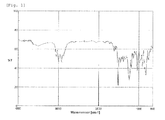
- FIG. 5 is a diagram showing an IR spectrum of a polyhydroxyurethane resin used in Example 2-1.
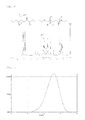
- FIG. 6 is a diagram showing an NMR chart of the polyhydroxyurethane resin used in Example 2-1.
- FIG. 7 is a diagram showing a GPC elution curve of the polyhydroxyurethane resin used in Example 2-1.
- the present invention will next be described in further detail based on best modes for carrying out the invention.
- the present invention is now divided into a first aspect and a second aspect, and these aspects will hereinafter be described successively.
- the coating composition is characterized in that a carbonate compound having at least two 5-membered cyclic carbonate groups and represented by the following formula (1) (Component A) and an amine compound having at least two amino groups (Component B) are reactable at an equivalent ratio of functional groups of 0.8 to 1.25 to form a gas barrier layer with a polyhydroxyurethane resin as a principal component.
- Component A a carbonate compound having at least two 5-membered cyclic carbonate groups and represented by the following formula (1)
- Component B an amine compound having at least two amino groups
- X 1 represents one of 0, N and NR 2
- R 2 is a hydrogen atom or an alkyl group having 1 to 3 carbon atoms
- a is 1 when X 1 is O or NR 2 or 2 when X 1 is N
- R 1 is an aliphatic or aromatic hydrocarbon group and may contain at least one of O atoms and N atoms in a structure thereof.
- the polyhydroxyurethane resin is obtained by reacting a cyclic carbonate compound, which has at least two 5-membered cyclic carbonate groups and represented by the above-described formula (1) (Component A) (hereinafter simply called “the cyclic carbonate compound”), and an amine compound, which has at least two amino groups (Component B), at an equivalent ratio of functional groups in the range of from 0.8 to 1.25.
- Component A cyclic carbonate compound
- Component B an amine compound, which has at least two amino groups
- the gas barrier layer that characterizes the present invention is formed of the polyhydroxyurethane resin obtained by reacting the specific component A and component B and contained as a principal component.
- the basic reaction in the formation of a film that makes up the barrier layer is a reaction between one cyclic carbonate group and one amino group.
- the reaction ratio of the component A to the component B it is the most fundamental condition for the formation of a coating film that the carbonate groups to amino groups contained in the respective compounds are at a relative ratio of 1.0 (equal in number). However, their relative ratio is not necessarily required to be 1.0, but a coating film can still be formed even in a state that either the carbonate groups or the amino groups are excessive.
- a range in which the formation of a film can be conducted well may be from 0.8 to 1.25 in terms of the equivalent ratio of functional groups.
- equivalent ratio of functional groups is of a similar concept as the molar equivalent ratio of functional groups, and is calculated by the below-described equation.
- the equivalent ratio of functional groups can be calculated such that in each of the numerator and denominator, the masses of the two or more compounds are added to obtain the total value of the masses of all the compounds and the molecular weights and numbers of functional groups of the two or more compounds are used as weighted averages based on all the compounds.
- number of functional groups in the below-described equation means the number of cyclic carbonate structures or amino groups which the cyclic carbonate compound or amino compound has in a molecule thereof.
- Equivalent ratio of functional groups mass of the carbonate compound in the coating composition ⁇ number of functional groups in the carbonate compound ⁇ molecular weight of the carbonate compound / mass of the amine compound in the coating composition ⁇ number of functional groups in the amine compound ⁇ molecular weight of the amine compound
- the above-described cyclic carbonate compound that characterizes the present invention may preferably be one obtained by the reaction between an epoxy compound and carbon dioxide, and specifically, can be obtained as will be described below.
- an epoxy compound as a raw material is reacted in the presence of a catalyst, at a temperature of 0°C to 160°C, under a carbon dioxide atmosphere pressurized to atmospheric pressure to 1 MPa or so, for 4 to 24 hours.
- a cyclic carbonate compound with carbon dioxide fixed at ester moieties thereof can be obtained.
- a gas barrier layer comprised of a polyhydroxyurethane resin as a principal component, said polyhydroxyurethane resin having been formed from the resin composition according to the present invention, contains therein -O-CO- bonds with carbon dioxide fixed therein.
- carbon dioxide can be incorporated in a range of from 1 to 30 mass% in the gas barrier layer formed from the coating composition according to the present invent ion. From the standpoint of effective use of carbon dioxide, the higher the content of carbon dioxide, the better.
- halides such as lithium chloride, lithium bromide, lithium iodide, sodium chloride, sodium bromide and sodium iodide, and quaternary ammonium salts.
- a catalyst may be used in an amount of 1 to 50 parts by mass, preferably 1 to 20 parts by mass per 100 parts by mass of the epoxy compound as the raw material.
- triphenylphosphine or the like may also be used at the same time to provide such a salt, that is, such a catalyst with improved solubility.
- the reaction between the epoxy compound and carbon dioxide can also be conducted in the presence of an organic solvent.
- an organic solvent such as N,N-dimethylformamide, dimethyl sulfoxide, dimethylacetamide and N-methyl-2-pyrrolidone, alcohol solvents such as methanol, ethanol, propanol, ethylene glycol and propylene glycol, and ether solvents such as ethylene glycol monomethyl ether, ethylene glycol dimethyl ether, propylene glycol methyl ether, diethylene glycol monomethyl ether, diethylene glycol dimethyl ether and tetrahydrofuran.
- amide solvents such as N,N-dimethylformamide, dimethyl sulfoxide, dimethylacetamide and N-methyl-2-pyrrolidone
- alcohol solvents such as methanol, ethanol, propanol, ethylene glycol and propylene glycol
- ether solvents such as ethylene glycol monomethyl ether, ethylene glycol dimethyl ether, propylene glyco
- any cyclic carbonate compound can be used insofar as it contains at least two cyclic carbonate groups in a molecule. More preferably, the use of a compound containing at least three cyclic carbonate groups is industrially advantageous in that the formation time of a cured film can be shortened. It is also preferred if the cyclic carbonate compound is liquid at room temperature, because the coating composition according to the present invention can be prepared without using a solvent.
- Cyclic carbonate compounds - each of which has, for example, an aromatic skeleton or an aliphatic, alicyclic and heterocyclic skeleton as a main skeleton of the compound, to which cyclic carbonate groups are bonded - are all usable.
- Compounds usable in the present invention will hereinafter be exemplified.
- cyclic carbonate compounds usable in the present invention and having aliphatic skeletons, respectively, compounds, such as illustrated below, are exemplified.
- alicyclic and heterocyclic carbonate compounds usable in the coating composition according to the present invention compounds, such as illustrated below, are exemplified.
- a situation may be considered to arise in which the fixing reaction of carbon dioxide is insufficient and the cyclic carbonate compound is obtained in a form that a compound with one or more epoxy groups still remaining at a like number of sites thereof and/or the epoxy compound as the raw material is mixed.
- the coating composition according to the present invention even a cyclic carbonate compound in the form that an epoxy compound is mixed therein is usable, and further, even with a coating composition prepared by subsequently adding an epoxy compound as a raw material, a good gas barrier layer can still be formed.
- the proportion of the cyclic carbonate compound may preferably be 50% or higher of the total amount of the cyclic carbonate compound and the epoxy compound.
- amine compound which is a constituent of the polyhydroxyurethane resin characterizing the present invention and is used together with the above-described cyclic carbonate compound conventionally-known amine compounds are all usable.
- Preferred examples include linear aliphatic polyamines such as ethylenediamine, diethylenetriamine, dipropylenetriamine, triethylenetetramine, tetraethylenepentamine, 1,3-diaminopropane, 1,4-diaminobutane, 1,6-diaminohexane, 1,8-diaminooctane, 1,10-diaminodecane and 1, 12-diaminododecane, cyclic aliphatic polyamines such as isophoronediamine, norbornanediamine, 1,6-cyclohexanediamine, piperazine, 2,5-diaminopyridine, 4,4'-diaminodicyclohexylmethane, 1,3-bis(amino
- Ethylene oxide adducts and propylene oxide adducts of these compounds can also be mentioned as preferred compounds.
- particularly preferred compounds are meta-xylenediamine and 1,3-bis(aminomethyl)cyclohexane.
- the coating composition according to the present invention is characterized in that it can form a gas barrier layer comprised of a polyhydroxyurethane resin as a principal component, said polyhydroxyurethane resin being obtainable by the reaction between the cyclic carbonate compound and amine compound as described above.
- the polyhydroxyurethane resin is, however, formed as a result of occurrence of the below-described addition reaction between the 5-membered cyclic carbonate structures (which are called “5-membered cyclic carbonate groups" in the present invention, but may hereinafter be also called simply "carbonate groups" in the component A and the amino groups in the component B.
- the polyhydroxyurethane resin that characterizes the present invention has at least one of two types of hydroxyurethane structures formed by the addition reaction between the carbonate group and the amino group and including a urethane bond and its adjacent hydroxyl group.
- These hydroxyurethane structure parts act as important parts in providing a film, which is to be formed with the polyhydroxyurethane resin, with gas barrier properties. Described specifically, it is considered that the hydroxyl groups in these structures form hydrogen bonds between molecules to limit motions of the molecular chains and the film exhibits gas barrier properties.
- Such a chemical structure is a structure not available from the reaction between an isocyanate compound and a polyol compound in a usual production process of a polyurethane, and this can be considered to characterize the present invention.
- the use of the coating composition according to the present invention makes it possible to provide a single-layer or multilayer gas barrier film having a gas barrier layer formed with the polyhydroxyurethane resin that characterizes the present invention.
- the gas barrier layer has a thickness of 0.1 to 200 ⁇ m, and the gas barrier layer has an oxygen permeation rate of not higher than 50 mL/m 2 ⁇ 24h ⁇ atm under conditions of a temperature of 23°C and a humidity of 0% to 90%. High gas barrier properties have been realized accordingly.
- the gas barrier layer of the polyhydroxyurethane resin as formed from the coating composition according to the present invention may contain an additive, as needed, such that another function may be imparted to the polyhydroxyurethane layer by the additive.
- anti-oxidants hindered phenol type, phosphite type, thioether type, and so on
- light stabilizers hindered amine type, and so on
- ultraviolet absorbers benzophenone type, benzotriazole type, and so on
- gas discoloration stabilizers hydrolysis inhibitors (carbodiimide type, and so on), metal deactivators, and the like either singly or in a combination of two or more thereof.
- the above-described polyhydroxyurethane layer may be a resin layer with another resin blended to an extent that does not impair the barrier properties. Accordingly, a resin different from the polyhydroxyurethane resin may be contained in the coating composition according to the present invention.
- a resin different from the polyhydroxyurethane resin may be contained in the coating composition according to the present invention.
- usable examples include polyester-based elastomers, polyamide-based elastomers, styrene-basedelastomers (SBS, SEBS, maleic acid-modified SEBS, and the like), olefin-based elastomers (EPR, EPDM, and the like), styrene-based resins (PS, HIPS, AS, ABS, AES, and the like), chlorinated resins (PVC, chlorinated polyethylene, and the like), olefin-based resins (PE, PP, EVA, and the like), ester-based resins, amide-based resin, and so on.
- the polyhydroxyurethane layer that characterizes the present invention may be one formed by using one of various crosslinking reactions that make use of some of hydroxyl groups or other chemical structures. Accordingly, such a crosslinking agent as will be described below may be added to the coating composition according to the present invention.
- a crosslinking agent in this case, any crosslinking agent can be used insofar as it reacts with hydroxyl groups, and preferred examples include urea resins, melamine resins, epoxy resins, polyisocyanates, acid anhydrides, and the like.
- the polyhydroxyurethane layer that makes up the gas barrier film according to the present invention may form a film as a single layer, or may be laminated on a base material or the like to provide a multilayer laminate.
- No particular limitation is imposed on the base material that makes up such a laminate.
- Illustrative are plastics, paper, fabrics, metals, ceramics, and the like.
- the coating composition according to the present invention can form a film, which has gas barrier properties, with good adhesiveness on a surface of such a base material.
- the base material is a resin film
- high molecular materials which have been conventionally used as packaging materials, are all usable.
- examples include polyolefin resins such as polyethylene, polypropylene and polystyrene, polyester resins such as polyethylene terephthalate and polylactic acid, polyamide resins such as nylon 6 and nylon 66, copolymers of polyimides or the like and these resins, and the like.
- Additives, for example, such as known antistatic agents, ultraviolet absorbers, plasticizers, lubricants and colorants may be incorporated in these high molecular materials as needed.
- Such a resin film may be an unstretched film, a uniaxially or biaxially stretched (oriented) film, or one subjected to a surface treatment such as corona discharge treatment.
- a resin film may have a thickness of preferably 1 to 200 ⁇ m, more preferably 5 to 150 ⁇ m.
- Such a resin film as a base material may be either a single-layer film or multilayer film, and a film with a metal such as aluminum or a metal oxide such as silica vapor-deposited thereon may also be used.
- the coating composition according to the present invention which contains the above-mentioned cyclic carbonate compound and amine compound as essential components, is applied to a surface of a base material or a surface of a release paper and heating may then be conducted as needed, whereby a polyhydroxyurethane layer can be readily formed as a gas barrier layer.
- the application of the coating composition according to the present invention can be conducted by a known coating machine such as a gravure coater, knife coater, reverse coater, bar coater, spray coater, or slit coater, and as an alternative, a method that coats with a brush or spatula can also be used.
- the coating composition according to the present invention When the coating composition according to the present invention is applied to abase material or release paper as described above, the curing reaction between the carbonate compound and the amine compound proceeds even in a room-temperature state so that a polyhydroxyurethane layer is formed. After the application, heating may be conducted as needed. Therefore, heating may be conducted at 0°C to 200°C as preferred curing conditions, or in a range of 60°C to 120°C as more preferred conditions.
- the method of the present invention for the production of the gas barrier film can easily achieve the formation of a film by conducting heating under such conditions as described above even if no catalyst has been specifically added to the coating composition of the present invention to be used. It is, however, possible to incorporate a catalyst, which promotes the film forming reaction, in the coating composition as needed.
- a catalyst usable in such a case include basic catalysts such as triethylamine, tributylamine, diazabicycloundecene (DBU), triethylenediamine (DABCO) and pyridine, Lewis acid catalysts such as tetrabutyl tin and dibutyl tin laurate, and the like. These catalysts may be used preferably in an amount of 0.01 to 10 parts by mass relative to the total amount (100 parts by mass) of the carbonate compound and amine compound to be used.
- the method of the present invention for the production of the gas barrier film can be conducted without addition of an organic solvent.
- an organic solvent may be incorporated as needed.
- the organic solvent include amide solvents such as N,N-dimethylformamide, dimethyl sulfoxide, dimethylacetamide and N-methyl-2-pyrrolidone, alcohol solvents such as methanol, ethanol, propanol, ethylene glycol and propylene glycol, and ether solvents such as ethylene glycol monomethyl ether, ethylene glycol dimethyl ether, propylene glycol methyl ether, diethylene glycol monomethyl ether, diethylene glycol dimethyl ether and tetrahydrofuran.
- the production can be conducted by adding a leveling material or defoaming agent.
- a leveling material or defoaming agent No particular limitation is imposed on the kind of such an additive. It can be used in any amount that does not impair the gas barrier properties. Preferably, it may be added in an amount of 1 to 10 mass% based on the mass of the polyhydroxyurethane resin.
- the gas barrier film according to the present invention is characterized in that a layer with a specific polyhydroxyurethaneresincontainedthereinisprovided as at least one layer that makes up the film.
- the polyhydroxyurethane resin that characterizes the present invention has, as repeating units of a high molecular backbone thereof, at least one of chemical structures represented by the following formulas (2-1) to (2-4). wherein Xs and Ys represent chemical structures formed of hydrocarbons or aromatic hydrocarbons derived from the monomer units, and the structures may each contain at least one of oxygen atoms, nitrogen atoms and sulfur atoms.
- the resin has been obtained by using the compound A, which has at least two 5-membered cyclic carbonate groups (which will hereinafter be abbreviated simply as "the cyclic carbonate groups") in a molecule thereof, and the compound B, which has at least two amino groups in a molecule thereof, as monomer units and subjecting them to a polyaddition reaction.
- the resin has the above-described chemical structure as will be described below.
- Xs and Ys represent chemical structures formed of hydrocarbons or aromatic hydrocarbons derived from the monomer units, and the structures may each contain at least one of oxygen atoms, nitrogen atoms and sulfur atoms.
- the polyhydroxyurethane resin that characterizes the present invention is characterized in that its backbone has the chemical structures each of which contains two urethane bonds and two hydroxyl groups. From an isocyanate compound and polyol compound in the production method of a polyurethane resin, said production method having been industrially employed to date, it is impossible to obtain a resin structure having hydroxyl groups on a backbone thereof.
- the polyhydroxyurethane resin having the above-described structures is a resin that has a novel structure clearly distinguishable from conventional polyurethane resins.
- the gas barrier properties of a resin a structure that contains polar functional groups on its backbone is generally considered to be advantageous.
- the hydroxyl groups on its backbone significantly contribute to the impartation of gas barrier properties. This is evident from the fact that polyethylene has no gas barrier properties although it is a resin structure similar to EVOH except for the deletion of the hydroxyl groups.
- the polyhydroxyurethane resin layer a layer containing the polyhydroxyurethane resin (hereinafter called "the polyhydroxyurethane resin layer") as at least one of layers that make up the film, has gas barrier properties. From the foregoing too, the gas barrier properties are considered to be attributable to the possession of the chemical structure, which contains the hydroxyl groups introduced on the backbone, by the polyhydroxyurethane resin.
- the polyhydroxyurethane resin which has the above-described structure and characterizes the present invention, may preferably have a weight average molecular weight of 10, 000 to 100, 000 from the standpoint of the strength and processability of the film.
- the hydroxyl number (JIS K1557), which represents the content of hydroxyl groups in the resin, may be preferably in a range of 180 to 350 mgKOH/g, with a range of 270 to 350 mgKOH/g being more preferred. This hydroxyl number is determined by the molecular weights of a cyclic carbonate and amine compound as raw materials, and can be adjusted by choosing an appropriate combination from usable compounds to be described subsequently herein.
- the performance of the gas barrier film according to the present invention may preferably be not higher than 50 mL/m 2 ⁇ 24h ⁇ atm in terms of oxygen permeation rate at a relative humidity of 90% or lower.
- the gas barrier properties become higher as the thickness of the polyhydroxyurethane resin layer increases, but become lower as the thickness of the polyhydroxyurethane resin layer decreases.
- the thickness of the polyhydroxyurethane resin layer may preferably be in a range of 0.1 to 100 ⁇ m, with a range of 10 to 50 ⁇ m being more preferred.
- the polyhydroxyurethane resin that characterizes the present invention is obtained from the cyclic carbonate compound and amine compound.
- the cyclic carbonate compound for use in this reaction may preferably be one obtained by a reaction between an epoxy compound and carbon dioxide. Described specifically, it is preferred to synthesize the polyhydroxyurethane resin, which characterizes the present invention, by using a cyclic carbonate compound which can be obtained as will be described below.
- an epoxy compound as a raw material is reacted in the presence of a catalyst, at a temperature of 0°C to 160°C, under a carbon dioxide atmosphere pressurized to atmospheric pressure to 1 MPa or so, for 4 to 24 hours.
- a cyclic carbonate compound with carbon dioxide fixed at ester moieties thereof can be obtained.
- the resultant polyurethane resin has, in its structure, -O-CO- bonds with carbon dioxide fixed therein.
- the content of -O-CO- bonds derived from carbon dioxide (the fixed amount of carbon dioxide) in the polyurethane resin may preferably be as high as possible from the standpoint of the effective use of carbon dioxide.
- the use of the above-described cyclic carbonate compound makes it possible to incorporate carbon dioxide, for example, in a range of 1 to 30 mass% in the structure of the polyhydroxyurethane resin for use in the present invention.
- the above-described polyhydroxyurethane resin is a resin in which -O-CO- bonds derived from carbon dioxide as a raw material account for 1 to 30 mass% of the mass of the resin.
- the catalyst for use in the above-mentioned reaction between the epoxy compound and carbon dioxide a similar catalyst as mentioned above with respect to the first aspect can be used likewise. Further, the reaction between the epoxy compound and carbon dioxide can also be conducted in the presence of an organic solvent. As the organic solvent for use in this reaction, any organic solvent can be used insofar as it can dissolve the catalyst. Specifically, similar catalysts as mentioned above with respect to the first aspect can be used.
- cyclic carbonate compound usable in the present invention No particular limitation is imposed on the structure of the cyclic carbonate compound usable in the present invention, and therefore, any compound can be used insofar as it contains at least two cyclic carbonate structures in a molecule thereof.
- Usable examples include cyclic carbonates having a benzene skeleton, aromatic polycyclic skeleton or condensed polycyclic aromatic skeleton, and also cyclic carbonates of the aliphatic or alicyclic type.
- Usable compounds will hereinafter be exemplified.
- each R represents H or CH 3 .
- each R represents H or CH 3 .
- polyfunctional amine compounds usable in the reactions with such cyclic carbonate compounds as mentioned above for the production of polyhydroxyurethane resins useful in the present invention conventionally-known polyfunctional amine compounds are all usable.
- Preferred examples include linear aliphatic polyamines such as ethylenediamine, 1,3-diaminopropane, 1,4-diaminobutane, 1,6-diaminohexane, 1,8-diaminooctane, 1,10-diaminodecane and 1,12-diaminododecane, cyclic aliphatic polyamines such as isophoronediamine, norbornanediamine, 1,6-cyclohexanediamine, piperazine and 2,5-diaminopyridine, aliphatic polyamines having aromatic rings such as xylenediamine, and aromatic polyamines such as methaphenylenediamine and diaminodiphenylmethane.
- the process for use in the present invention to produce the polyhydroxyurethane resin can be obtained by such a process as will be described hereinafter.
- the polyhydroxyurethane resin can be obtained, for example, by mixing such a cyclic carbonate compound and amine compound as described above in the presence or absence of a solvent and reacting them at a temperature of 40 to 200°C for 4 to 24 hours.
- any solvent can be used insofar as it is an organic solvent inert to the raw materials to be used and the polyhydroxyurethane resin to be obtained.
- Preferred examples include methyl ethyl ketone, methyl n-propyl ketone, methyl isobutyl ketone, diethyl ketone, methyl formate, ethyl formate, propyl formate, methyl acetate, ethyl acetate, butyl acetate, acetone, cyclohexanone, tetrahydrofuran, dioxane, toluene, xylene, dimethyl formamide, dimethyl sulfoxide, perchloroethylene, trichloroethylene, methanol, ethanol, propanol, ethylene glycol, propylene glycol, ethylene glycol monomethyl ether, ethylene glycol dimethyl ether, propylene glycol methyl ether, diethylene glycol monomethyl
- the production of the polyhydroxyurethane resin for use in the present invention can be conducted without specifically using any catalyst as described above. To promote the reaction, however, it is possible to conduct the production in the presence of such a catalyst as will be mentioned below.
- a catalyst include basic catalysts such as triethylamine, tributylamine, diazabicycloundecene (DBU), triethylenediamine (DABCO) and pyridine, Lewis acid catalysts such as tetrabutyl tin and dibutyl tin laurate, and the like.
- Such a catalyst may be used preferably in an amount of 0.01 to 10 parts by mass relative to the total amount (100 parts by mass) of the carbonate compound and amine compound to be used.
- additives may be added as needed.
- anti-oxidants hindered phenol type, phosphite type, thioether type, and so on
- light stabilizers hindered amine type, and so on
- ultraviolet absorbers benzophenone type, benzotriazole type, and so on
- gas discoloration stabilizers hydrazine type, and so on
- hydrolysis inhibitors carbodiimides, and so on
- metal deactivators and the like may be used either singly or in a combination of two or more thereof.
- the polyhydroxyurethane resin that characterizes the present invention can be crosslinked, as needed, with one of various crosslinking agents by using some of hydroxyl groups contained in the structure of the resin upon formation of its film (resin layer).
- the crosslinking agent any crosslinking agent can be used insofar as it reacts with hydroxyl groups.
- Preferred examples include urea resins, melamine resins, epoxy resins, polyisocyanates, acid anhydrides, and the like.
- the polyhydroxyurethane resin for use in the present invention which has been produced as described above, has gas barrier properties even in the form of a single layer formed with the resin.
- the film according to the present invention may, therefore, be formed of a single layer.
- it may be provided as a multilayer film stacked in combination with one or more layers made of another resin.
- the polyhydroxyurethane resin layer can be either an outer layer or an intermediate layer held between other resin layers, and can be provided as a gas barrier film no matter whether the polyhydroxyurethane resin layer is the outer layer or the intermediate layer.
- the resin usable as a forming material for another layer or other layers to be used in combination with the polyhydroxyurethane resin layer and high molecular materials which have been conventionally used as packaging materials are all usable.
- examples include polyolefin resins such as polyethylene, polypropylene and polystyrene, polyester resins such as polyethylene terephthalate and polylactic acid, polyamide resins such as nylon 6 and nylon 66, copolymers of polyimides or the like and these resins, and the like.
- Additives, for example, such as known antistatic agents, ultraviolet absorbers, plasticizers, lubricants and colorants may be incorporated in these high molecular materials as needed.
- the gas barrier film is produced by using the above-described polyhydroxyurethane resin that characterizes the present invention (hereinafter simply called "the polyhydroxyurethane resin").
- the gas barrier film can be obtained by either a method that subjects the polyhydroxyurethane resin to melt forming or a method that forms a polyhydroxyurethane resin layer on a base material by coating the resin in the form of a solution.
- a single-layer film can be obtained from the resin, for example, in a temperature range of 100 to 250°C by the inflation method or T-die method.
- the following various methods can be used: a method that directly obtains a multilayer film from the polyhydroxyurethane resin and another resin by co-extrusion; a method that forms a polyhydroxyurethane resin layer on a layer made of another resin (hereinafter called "the layer of another resin") by melt lamination; and a method that conversely arranges the layer of another resin by melt lamination either above or each of above and below the polyurethane resin layer obtained as a single-layer film.
- the film according to the present invention can be obtained, for example, by using the polyhydroxyurethane resin synthesized in a solvent usable for the above-mentioned production or a solution of the polyhydroxyurethane resin dissolved in such a solvent after its synthesis, applying it to a film as the base material by a gravure coater, knife coater, reverse coater, bar coater, spray coater, slit coater or the like, and allowing the solvent to evaporate.
- a resin film can be used as the layer of another resin to be stacked with the polyhydroxyurethane resin layer.
- the resin film may be an unstretched film, a uniaxially or biaxially stretched (oriented) film, or one subjected to a surface treatment such as corona discharge treatment.
- a resin film may have a thickness of preferably 1 to 200 ⁇ m, more preferably 5 to 150 ⁇ m.
- Such a resin film may be either a single-layer film or multilayer film, and a film with a metal such as aluminum or a metal oxide such as silica vapor-deposited thereon may also be used.
- Gas barrier films according to the present invention are useful, for example, as gas barrier packaging materials or wrapping films for various applications.
- the "equivalent ratio of functional groups" of a cyclic carbonate compound to an amine compound in each of the reactions to be described hereinafter is a value calculated by using the following equation as will be described below.
- Equivalent ratio of functional groups mass of the carbonate compound in the coating composition ⁇ number of functional groups in the carbonate compound ⁇ molecular weight of the carbonate compound / mass of the amine compound in the coating composition ⁇ number of functional groups in the amine compound ⁇ molecular weight of the amine compound
- the "number of functional groups in the carbonate compound ⁇ molecular weight of the carbonate compound" needed with respect to the cyclic carbonate compound in the above-described calculation equation is an index that indicates the molar equivalent of carbonate groups per gram of the carbonate compound, and therefore, is defined as "carbonate equivalent” and was actually measured by a measuring method to be described subsequently herein, because a cyclic carbonate compound synthesized from an epoxy compound and carbon dioxide in each example was obtained as a mixture of cyclic carbonate compounds having different numbers of carbonate groups in a molecule. It is to be noted that the amine compound is free of such a problem and the molar equivalent of amino groups can be determined from the molecular weight of the amine compound.
- the quotient obtained by dividing the consumed amount with the molecular weight of n-hexylamine was employed as the "carbonate equivalent" (unit: eq/g).
- the carbonate equivalent can be determined by [the amount of n-hexylamine (g) reacted with one (1) gram of the carbonate compound ⁇ 101.19 (unit : eq/g)].
- the content of carbon dioxide in the carbonate compound can be calculated from the "carbonate equivalent" obtained as described above. Described specifically, the content of carbon dioxide (%) can be determined by [the carbonate equivalent (eq/g) ⁇ 44 (the molecular weight of CO 2 ) ⁇ 100]. Each content of carbon dioxide, which is to be described subsequently herein, was determined through a calculation in a manner as described above.
- a p-aminophenol epoxy resin having an epoxy equivalent of 100 (trade name: "MY0510", product of Huntsman Advanced Materials L.L.C.; hereinafter abbreviated as "MY0510”; 100 parts), sodium iodide (product of Wako Pure Chemicals Industries, Ltd.; 20 parts), and N-methyl-2-pyrrolidone (150 parts) were charged in a reaction vessel equipped with a stirrer and an open reflux condenser. Carbon dioxide was next continuously bubbled under stirring at 100°C for 10 hours to conduct a reaction. Subsequently, the resulting reaction mixture was diluted with ethyl acetate (200 parts).
- the diluted reaction mixture was transferred to a separation funnel, and then washed four times with brine to remove N-methyl-2-pyrrolidone and sodium iodide. After the washing, an ethyl acetate layer was transferred to an evaporator, and ethyl acetate was removed under reduced pressure. As a result, a clear liquid compound (97 parts) was obtained (yield: 72%).
- the weight average molecular weight of the above-obtained substance was found to be 404 (polyethylene oxide equivalent).
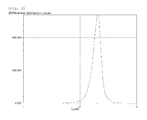
- a differential molecular weight distribution of "MY0510” used as the raw material is shown in FIG. 3
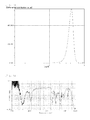
- a differential molecular weight distribution of the above-obtained substance is shown in FIG. 4 .
- the above-obtained substance was confirmed to be a compound, which contained cyclic carbonate groups introduced therein by the reaction between epoxy groups and carbon dioxide and had a structure represented by the below-described formula.
- This compound will hereinafter be designated as "A-1".
- the carbonate equivalent of this compound A-1 was measured by the above-mentioned method, and as a result, was found to be 0.0069 eq/g. Segments derived from carbon dioxide were, therefore, calculated to account for 30.4% of the compound A-1.
- N,N,N',N'-Tetraglycidyl-1,3-benzenedi(methanam ine) having an epoxy equivalent of 90 (trade name: "TETRAD-X”; product of Mitsubishi Gas Chemical Company, Inc.; 100 parts), sodium iodide (product of Wako Pure Chemicals Industries, Ltd.; 20 parts), and N-methyl-2-pyrrolidone (150 parts) were charged in a reaction vessel equipped with a stirrer and an open reflux condenser.
- N,N,N',N'-Tetraglycidyl-1,3-benzenedi(methanamine) will hereinafter be called "tetraglycidylxylenediamine".
- the above-obtained compound was confirmed to be a compound, which contained 5-membered cyclic carbonate groups introduced therein by the reaction between epoxy groups and carbon dioxide and had a structure represented by the below-described formula.
- This compound will hereinafter be designated as "A-2".
- the carbonate equivalent of this compound A-2 was measured by the above-mentioned method, and as a result, was found to be 0.0075 eq/g. Segments derived from carbon dioxide were, therefore, calculated to account for 33.0% of the chemical structure of the compound A-2.
- Glycerol polyglycidyl ether having an epoxy equivalent of 142 (trade name: "DENACOL EX-313"; product of Nagase Chemtex Corporation; 100 parts), sodium iodide (product of Wako Pure Chemicals Industries, Ltd.; 20 parts), and N-methyl-2-pyrrolidone (150 parts) were charged in a reaction vessel equipped with a stirrer and an open reflux condenser. Carbon dioxide was next continuously bubbled under stirring at 100°C for 10 hours to conduct a reaction. After completion of the reaction, the solvent was allowed to evaporate by an evaporator to obtain an oily compound (132 parts, yield: 99.9%).
- the above-obtained compound was confirmed to be a compound, which contained 5-membered cyclic carbonate groups introduced therein by the reaction between epoxy groups and carbon dioxide and had a structure represented by the below-described formula.
- This compound will hereinafter be designated as "A-3".
- the carbonate equivalent of this compound A-3 was measured by the above-mentioned method, and as a result, was found to be 0.0054 eq/g. Segments derived from carbon dioxide were, therefore, calculated to account for 23.8% of the compound A-3.
- the applied coated solution was subjected to a curing reaction at 80°C for 12 hours so that a single-layer film was formed from the coating solution.
- the thus-obtained film was transparent, and its thickness was 20 ⁇ m.
- the film so obtained was confirmed to exhibit good gas barrier properties as will be mentioned subsequently herein. Segments derived from carbon dioxide accounted for 21.0% (calculated value) of the polyhydroxyurethane resin which made up the film.
- the equivalent ratio of functional groups of the carbonate compound to the amine compound in the above-described reaction was 1.0.
- a coating solution was prepared as a coating composition of this example by combining and thoroughly stirring the compound A-2 obtained in Production Example 2 (100.0 parts), meta-xylenediamine (product of Mitsubishi Gas Chemical Company, Inc.; 51.0 parts) and a surface control agent ("BYK349", product of BYK-Chemie GmbH; 0.8 parts).
- the solution was applied to a release paper by a bar coater (No. 15), and in a similar manner as in Example 1, a single-layer film was formed from the coating solution.
- the film was transparent, and its thickness was 20 ⁇ m. Segments derived from carbon dioxide accounted for 21.7% (calculated value) of the barrier coating film.
- the equivalent ratio of functional groups of the carbonate compound to the amine compound in the above-described reaction was 1.0.
- a coating solution was prepared as a coating composition of this example by combining and thoroughly stirring the compound A-2 obtained in Production Example 2 (100.0 parts), 1,3-bisaminomethylcyclohexane (product of Mitsubishi Gas Chemical Company, Inc.; abbreviated as "13BAC” in the table to be described subsequently herein; 53.0 parts), and a surface control agent (trade name: "BYK349", product of BYK-Chemie GmbH; 0.8 parts).
- the solution was applied to a release paper by a bar coater (No. 15), and as in Example 1, a single-layer film was formed from the coating solution.
- the film was transparent, and its thickness was 20 ⁇ m. Segments derived from carbon dioxide accounted for 21.4% (calculated value) of the barrier coating film.
- the equivalent ratio of functional groups of the carbonate compound to the amine compound in the above-described reaction was 1.0.
- the film was transparent, and its thickness was 20 ⁇ m. Segments derived from carbon dioxide accounted for 22.1% (calculated value) of the barrier coating film. The equivalent ratio of functional groups of the carbonate compound to the amine compound in the above-described reaction was 1.0.
- a solution was prepared by adding, to a mixture of the compound A-2 obtained in Production Example 2 (50.0 parts) and meta-xylenediamine (product of Mitsubishi Gas Chemical Company, Inc.; 25.4 parts), tetraglycidylxylenediamine having an epoxy equivalent of 90 (trade name: "TETRAD-X", product of Mitsubishi Gas Chemical Company, Inc.; 50.0 parts), meta-xylenediamine (product of Mitsubishi Gas Chemical Company, Inc.; 18.9 parts), and ethyl acetate (163.5 parts). Further, a surface control agent ("BYK349", product of BYK-Chemie GmbH; 0.8 parts) was added, followed by thorough stirring to obtain a coating solution as a coating composition of this example.
- Example 2 the solution was applied to a release paper to form a single-layer film from the coating solution.
- the film so obtained was transparent, and its thickness was 20 ⁇ m. Segments derived from carbon dioxide accounted for 11.3% (calculated value) of the barrier coating film.
- the equivalent ratio of functional groups of the carbonate compound to the amine compound in the above-described reaction was 1.01.
- a film (barrier layer) was formed in a similar manner as in Example 1 except that the base material was changed from the release paper to a PET film of 23 ⁇ m thickness (trade name: "LUMIRROR", product of Toray Industries, Inc.; oxygen permeation rate: 71.3 mL/m 2 ⁇ 24h ⁇ atm at 23°C and 35%, 53.5 mL/m 2 ⁇ 24h ⁇ atm at 23°C and 65%, 50.2 mL/m 2 ⁇ 24h ⁇ atm at 23°C and 90%) to obtain a composite film.
- the film so obtained was transparent, and the thickness of the barrier layer formed on the base material was 20 ⁇ m.
- a film (barrier layer) was formed in a similar manner as in Example 1 except that the base material was changed from the release paper to a stretched polypropylene film of 60 ⁇ m thickness (trade name: "TORAYFAN", product of Toray Industries, Inc.; oxygen permeation rate : 641.5 mL/m 2 ⁇ 24h ⁇ atm at 23°C and 35%, 555.2 mL/m 2 ⁇ 24h ⁇ atm at 23°C and 65%, 542.2 mL/m 2 ⁇ 24h ⁇ atm at 23°C and 90%; abbreviated as "OPP” in the table to be described subsequently herein) to obtain a composite film.
- the film so obtained was transparent, and the thickness of the barrier layer formed on the base material was 20 ⁇ m.
- a coating solution was obtained by combining and thoroughly stirring tetraglycidylxylenediamine having an epoxy equivalent of 90 (trade name: "TETRAD-X”, product of Mitsubishi Gas Chemical Company, Inc.; 100.0 parts), meta-xylenediamine (product of Mitsubishi Gas Chemical Company, Inc.; 76.0 parts), and a surface control agent ("BYK349", product of BYK-Chemie GmbH; 0.9 parts).
- tetraglycidylxylenediamine having an epoxy equivalent of 90 (trade name: "TETRAD-X”, product of Mitsubishi Gas Chemical Company, Inc.; 100.0 parts), meta-xylenediamine (product of Mitsubishi Gas Chemical Company, Inc.; 76.0 parts), and a surface control agent ("BYK349", product of BYK-Chemie GmbH; 0.9 parts).
- the solution so obtained was applied to a release paper as in Example 1.
- the resulting film was hard and brittle, and cracked before measurement. Therefore, measurement of its oxygen permeation rate was not feasible.
- a solution was prepared with tetraglycidylxylenediamine having an epoxy equivalent of 90 (trade name: "TETRAD-X”, product of Mitsubishi Gas Chemical Company, Inc.; 100.0 parts), meta-xylenediamine (product of Mitsubishi Gas Chemical Company, Inc.; 76.0 parts), and ethyl acetate (176.0 parts) contained therein.
- a surface control agent (“BYK349", product of BYK-Chemie GmbH; 0.9 parts) was added, followed by thorough stirring to obtain a coating solution.
- a solution was prepared with glycerol polyglycidyl ether having an epoxy equivalent of 142 (trade name: "DENACOL EX-313"; product of Nagase Chemtex Corporation; 100.0 parts), meta-xylenediamine (product of Mitsubishi Gas Chemical Company, Inc.; 48.2 parts), and ethyl acetate (148.2 parts) contained therein.
- a surface control agent (“BYK349", product of BYK-Chemie GmbH; 0.7 parts) was added, followed by thorough stirring to obtain a coating solution.
- a film was formed in a similar manner as in Comparative Example 2 except that the base material was changed from the PET film to a stretched polypropylene film of 60 ⁇ m thickness (trade name: "TORAYFAN", product of Toray Industries, Inc.). The film was pale yellow and transparent, and the thickness of the barrier layer was 20 ⁇ m.
- a film was formed in a similar manner as in Comparative Example 3 except that the base material was changed from the PET film to a stretched polypropylene film of 60 ⁇ m thickness (trade name: "TORAYFAN", product of Toray Industries, Inc.). The film was pale yellow and transparent, and the thickness of the barrier layer was 20 ⁇ m.
- the films of the examples were confirmed to be low in oxygen permeation rate at each of the humidities and to have excellent gas barrier properties.
- the resulting films were confirmed to be usable as single-layer films owing to the possession of flexibility and also to be readily usable as multilayer barrier materials owing to the excellent adhesion properties to other base materials.
- the production methods of the examples are simple as production methods upon production of multilayer materials of excellent gas barrier properties.
- Table 2 it is the largest characteristic of the present invention that a urethane resin, which is generally excellent in adhesive force but is poor in gas barrier properties, is equipped with gas barrier properties. Such a pronounced advantageous effect has been brought about for the first time by the polyhydroxyurethane resin, which is an essential component in the present invention and is obtainable from the cyclic carbonate compound and the amine compound.
- the carbonate compound as an essential component in the coating composition according to the present invention contains carbon dioxide fixed at a high content as segments of the chemical structure, so that the resulting film is also a film with carbon dioxide fixed therein. This substantiates that the material provided by the present invention is industrially useful as a gas barrier film which can accommodate environmental problems.
- Bisphenol A diglycidyl ether having an epoxy equivalent of 192 (trade name: "jER828", product of Japan Epoxy Resin Co . , Ltd.; 100 parts), sodium iodide (product of Wako Pure Chemicals Industries, Ltd.; 20 parts), and N-methyl-2-pyrrolidone (100 parts) were charged in a reaction vessel equipped with a stirrer and an open reflux condenser. Carbon dioxide was next continuously bubbled under stirring at 100°C for 10 hours to conduct a reaction. After completion of the reaction, isopropanol (1,400 parts) was added to the reaction mixture, and the reaction product was separated out as a white precipitate. The precipitate was collected by filtration. The precipitate so obtained was recrystallized from toluene to obtain a white powder (52 parts, yield: 42%).
- the melting point was 178°C, and the melting point range was ⁇ 5°C.
- the powder was confirmed to be a compound, which contained cyclic carbonate groups introduced therein by the reaction between epoxy groups and carbon dioxide and had a structure represented by the below-described formula. This compound will hereinafter be designated as "I-A". Segments derived from carbon dioxide accounted for 20.5% of the chemical structure of the compound I-A (calculated value).
- a cyclic carbonate compound (I-B) of a structure represented by the below-described formula was synthesized in a similar manner as in Production Example 1 except that hydroquinone diglycidyl ether having an epoxy equivalent of 115 (trade name: "DENACOL EX203", product of Nagase Chemtex Corporation) was used as an epoxy compound.
- the compound I-B so obtained was white crystals, its melting point was 141°C, and its yield was 55%.
- the results of its IR analysis were similar to those of the compound I-A, and its purity by HPLC analysis was 97%. Segments derived from carbon dioxide accounted for 28.0% of the chemical structure of the compound I-B (calculated value).
- Neopentyl glycol diglycidyl ether having an epoxy equivalent of 138 (trade name: "DENACOL EX-211", product of Nagase Chemtex Corporation; 100 parts), sodium iodide (product of Wako Pure Chemicals Industries, Ltd.; 20 parts), and N-methyl-2-pyrrolidone (100 parts) were charged in a reaction vessel equipped with a stirrer and an open reflux condenser. Carbon dioxide was next continuously bubbled under stirring at 100°C for 10 hours to conduct a reaction. After completion of the reaction, the reaction mixture was poured into distilled water (1,000 mL), and a settled pale yellow liquid substance was collected.
- Ethylene glycol diglycidyl ether having an epoxy equivalent of 113 (trade name: "DENACOL EX-810", product of Nagase Chemtex Corporation; 100 parts), sodiumiodide (product of Wako Pure Chemicals Industries, Ltd.; 20 parts), and N-methyl-2-pyrrolidone (100 parts) were charged in a reaction vessel equipped with a stirrer and an open reflux condenser. Carbon dioxide was next continuously bubbled under stirring at 100°C for 10 hours to conduct a reaction. After completion of the reaction, the reaction mixture was diluted with ethyl acetate (200 parts).
- the weight average molecular weight of the resin was found to be 43, 000 (polystyrene equivalent) by GPC measurement ("GPC-8220” and "Column Super AW2500+AW3000+AW4000+AW5000", manufactured by Tosoh Corporation; this will apply equally to the subsequent examples) making use of DMF as a mobile phase.
- An IR spectrum of the above-obtained polyhydroxyurethane resin is shown in FIG. 5 .
- an NMR chart of the resin is shown in FIG. 6
- a GPC elution curve of the resin is shown in FIG. 7 .
- a 50- ⁇ m thick single-layer film of the polyhydroxyurethane resin was formed by a 20-mm diameter, single screw extruder, which was fitted with a T-die, under conditions of a cylinder temperature of 160°C, a roll temperature of 30°C and a take-up rate of 1 m/min.
- a polyurethane resin was obtained by using the compound I-A (100 parts) obtained in Production Example 2-1, 1,3-diaminopropane (product of Koei Chemical Company Limited; 17.3 parts) and N,N-dimethylformamide (117 parts) and reacting them as in Example 2-1.
- the results of IR analysis of the thus-obtained resin were similar to those of Example 2-1, the hydroxyl number of the resin was 221 mgKOH/g, and the weight average molecular weight of the resin by GPC measurement was 42,000 (polystyrene equivalent). From the resin so obtained, a 50- ⁇ m thick single-layer film of the polyhydroxyurethane resin was formed by a similar machine and under similar conditions as in Example 2-1.
- a polyurethane resin was obtained by using the compound I-A (100 parts) obtained in Production Example 2-1, meta-xylenediamine (product of Mitsubishi Gas Company, Inc.; 31.8 parts) and N,N-dimethylformamide (132 parts) and reacting them as in Example 2-1.
- the results of IR analysis of the thus-obtained resin were similar to those of Example 2-1, the hydroxyl number of the resin was 195 mgKOH/g, and the weight average molecular weight of the resin by GPC measurement was 31,000 (polystyrene equivalent). From the resin so obtained, a 50- ⁇ m thick single-layer film of the polyhydroxyurethane resin was formed by a similar machine and under similar conditions as in Example 2-1.
- a polyurethane resin was obtained by using the compound I-B (100 parts) obtained in Production Example 2-2, hexamethylenediamine (product of Asahi Kasei Chemicals Corporation; 37 parts) and N,N-dimethylformamide (137 parts) and reacting them as in Example 2-1.
- the results of IR analysis of the thus-obtained resin were similar to those of Example 2-1, the hydroxyl number of the resin was 258 mgKOH/g, and the weight average molecular weight of the resin by GPC measurement was 35, 000 (polystyrene equivalent). From the resin so obtained, a 50- ⁇ m thick single-layer film of the polyhydroxyurethane resin was formed by a similar machine and under similar conditions as in Example 2-1.
- a polyurethane resin was obtained by using the compound I-B (100 parts) obtained in Production Example 2-2, 1,3-diaminopropane (product of Koei Chemical Company Limited; 23.6 parts) and N,N-dimethylformamide (124 parts) and reacting them as in Example 2-1.
- the results of IR analysis of the thus-obtained resin were similar to those of Example 2-1, the hydroxyl number of the resin was 289 mgKOH/g, and the weight average molecular weight of the resin by GPC measurement was 31,000 (polystyrene equivalent). From the resin so obtained, a 50- ⁇ m thick film was formed by a similar machine and under similar conditions as in Example 2-1.
- a polyurethane resin was obtained by using the compound I-A (70 parts) obtained in Production Example 2-1, the compound I-C (30 parts) obtained in Production Example 2-3, hexamethylenediamine (product of Asahi Kasei Chemicals Corporation; 28.6 parts) and N,N-dimethylformamide (129 parts) and reacting them as in Example 2-1.
- the results of IR analysis of the thus-obtained resin were similar to those of Example 2-1, the hydroxyl number of the resin was 211 mgKOH/g, and the weight average molecular weight of the resin by GPC measurement was 30, 000 (polystyrene equivalent). From the resin so obtained, a 50- ⁇ m thick single-layer film of the polyhydroxyurethane resin was formed by a similar machine and under similar conditions as in Example 2-1.
- a polyurethane resin was obtained by using the compound I-D (100 parts) obtained in Production Example 2-4, ethylenediamine (product of Tosoh Corporation; 23 parts) and N,N-dimethylformamide (123 parts) and reacting them as in Example 2-1.
- the results of IR analysis of the thus-obtained resin were similar to those of Example 2-1, the hydroxyl number of the resin was 348 mgKOH/g, and the weight average molecular weight of the resin by GPC measurement was 22, 000 (polystyrene equivalent). From the resin so obtained, a 50- ⁇ m thick single-layer film of the polyhydroxyurethane resin was formed by a similar machine and under similar conditions as in Example 2-1.
- a multilayer sheet was formed by co-extrusion as will be described below. Described specifically, using the polyhydroxyurethane resin, which had been obtained in Example 2-1, for a layer A, a polypropylene resin (trade name: "FY-6C", product of Japan Polypropylene Corporation) for a layer B, and a modified polypropylene resin (trade name: "MODIC F534A", product of Mitsubishi Chemical Corporation) for an adhesive layer to be formed between the two layers of the layers A and B, a multilayer sheet was formed by co-extrusion while using the three extruders.
- the actual measurement value of the thickness of the whole film was 150 ⁇ m.
- the layer A was separated with a cutter, and its thickness was measured. As a result, the thickness of the layer A was found to be 50 ⁇ m.
- the polyhydroxyurethane resin obtained in Example 1 was dissolved in tetrahydrofuran to prepare a resin solution the concentration of which was 30%.
- the thus-obtained resin solution was then applied by a bar coater (No. 40) to a 30- ⁇ m thick polyethylene film subjected to corona treatment on one side thereof (trade name: "LIX FILM L6120", product of Toyobo Co., Ltd.).
- the thus-coated film was heated for 10 minutes in an oven controlled at 70°C to allow the solvent to evaporate, whereby a double-layer film with a polyhydroxyurethane resin layer formed on a polyethylene layer was formed.
- the thickness of the whole film was measured. As a result, it was found to be 45 ⁇ m. From this, the thickness of the polyhydroxyurethane resin layer formed on the polyethylene film as a base material was found to be 20 ⁇ m.
- the reaction product was collected by filtration, and was then dried at 80°C for 24 hours to obtain a polyurethane resin.
- the weight average molecular weight of the thus-obtained resin by GPC measurement was 42,000 (polystyrene equivalent).
- the polyurethane resin obtained in this comparative example was an ordinary polyurethane resin free of hydroxyl groups.
- a 50- ⁇ m thick single-layer film of the urethane resin was formed by a similar machine and under similar conditions as in Example 2-1, and the film was used.
- a 30% aqueous solution of a completely saponified polyvinyl alcohol resin (trade name: "PVA-105", product of Kuraray Co., Ltd.) was prepared, and was applied to a release paper by a bar coater (No. 40). The solvent was allowed to evaporate at 70°C to form a film, and the film was used. The thickness of the film was 20 ⁇ m.
- the evaluation of the resin in this case was performed by using "PVA-105" powder as it was, and the film evaluation was performed on the film so formed.
- an ethylene-vinyl alcohol copolymer resin having an ethylene content of 32 mol% (trade name: "PVA-105", product of Kuraray Co., Ltd.) was used, a 50- ⁇ m thick film was formed in a similar manner as in Example 1, and the film was used.
- the evaluation of the resin was performed by using "F-104B" pellets as they were, and the film evaluation was performed on the film so formed.
- Example 2-8 the polypropylene resin used in Example 2-8 (trade name: "FY-6C", product of Japan Polypropylene Corporation) was used, and a single-layer film formed as will be described below was used.
- the above-described formation of the film with the polypropylene resin was conducted by a 20-mm diameter, single screw extruder, which was fitted with a T-die, under conditions of a cylinder temperature of 190°C, a roll temperature of 30°C and a take-up rate of 1 m/min.
- the thickness of the film so obtained was 100 ⁇ m.
- Example 2-9 the 30- ⁇ m polyethylene film used as a base material in Example 2-9 was used as it was.
- melt flow rate MFR
- JIS K-7210 JIS K-7210
- value g/10 min
- the thickness of each film was actually measured by using a precision thickness gauge (manufactured by Ozaki Mfg. Co., Ltd.).
- the strength at rupture of each film was determined pursuant to JIS K-6251 by measuring its rupture strength at room temperature (25°C) according to a measuring method making use of an autograph (trade name: "AGS-J", manufactured by Shimadzu Corporation).
- each film was measured by a haze meter ("HZ-1", manufactured by Suga Test Instruments Co., Ltd.).
- a total quantity of light as measured by a haze meter is a total light transmittance, and the ratio of a diffuse transmittance to the total light transmittance is a haze.
- Haze % diffuse transmittance % ⁇ total light transmittance %
- the oxygen permeation rate was measured pursuant to JIS K-7126, and the oxygen permeation rate was used as a value for the evaluation of gas barrier properties. Specifically, as this value becomes smaller, the gas barrier properties can be determined to be better. Described specifically, the oxygen permeation rate was measured by an oxygen permeation rate measurement system ("OX-TRAN 2/21ML", manufactured by MOCON Inc.) under respective constant-temperature/constant-humidity conditions controlled at a temperature of 23°C and at a humidity of 30%, a humidity 65% and a humidity of 90%.
- Table 2-2 Physical Properties of Resins and Films in Examples and Comparative Examples Item Unit Ex. 2-8 Ex. 2-9 Comp. Ex. 2-4 Comp. Ex.
- Thickness ⁇ m 150 45 100 30 Film structure 3 layers 2 layers single layer single layer Oxygen permeation rate 23°C/35%RH *1 6 14 640 6,000 23°C/65%RH *1 7 15 640 6,100 23°C/90%RH *1 10 17 650 6,100 Strength at rupture MPa 38 39 38 40 Total light transmittance % 91.5 92.7 93.2 92.2 Haze % 1.6 1.6 1.4 1.1 *1: unit (O 2 mL/m 2 ⁇ 24h ⁇ atm)
- the barrier films (resin layers) of the polyhydroxyurethane resins which were used in the examples and characterize the present invention, exhibit excellent gas barrier properties and transparency without being affected by humidity.
- the oxygen permeation rates were lowered to one severalth compared with the polyurethane resin of the hydroxyl-free structure in Comparative Example 2-1.
- the distinct hydroxyl-containing chemical structures of the polyhydroxyurethane resins used in the examples contributed to the improved gas barrier properties of the resin layers formed with the polyhydroxyurethane resins.
- these distinct chemical structures are derived from carbon dioxide as a raw material, so that the polyhydroxyurethane resins used in the examples have, as resins produced from carbon dioxide, excellent environmental friendliness not found on the existing resins.
- the polyhydroxyurethane resins used in the examples are, different from PVA and EVOH employed as materials for gas barrier films at present, soluble in organic solvents and also excellent in heat melting properties, so that they are also superb in processability.
- multilayer films can be produced by both a melt forming method and a coating method. Moreover, the multilayer films obtained as described above have all been confirmed to exhibit excellent gas barrier properties.
- the use of the polyhydroxyurethane resin, which has been obtained using the cyclic carbonate compound and amine compound as raw materials, as a gas barrier layer makes it possible to obtain a gas barrier material which has been unavailable by the conventional technologies and is excellent as a solution to environmental problems.
- the gas barrier layer can be formed by a simple method, and moreover, the gas barrier layer is also excellent in the adhesiveness to a base material. Accordingly, the polyhydroxyurethane resin can be expected to find utility in gas barrier materials combined with various base materials.
- the polyhydroxyurethane resin can use carbon dioxide as a raw material
- the first aspect of the present invention provides a technology that is also prospective from the standpoint of global environmental protection.
- the use of the polyhydroxyurethane resin, which has been obtained using the cyclic carbonate compound and amine compound as rawmaterials, as a gas barrier layer makes it possible to obtain an excellent gas barrier film, which has been unavailable by the conventional technologies, does not have much humidity dependency and does not contain any halogen compound that produces hazardous gas.
- a melt forming method and a coating method are both applicable. Therefore, the polyhydroxyurethane resin is excellent in processability, and is industrially useful.
- the polyhydroxyurethane resin that characterizes the second aspect of the present invention can use carbon dioxide as a raw material
- the second aspect of the present invention provides a technology that is also prospective from the standpoint of global environmental protection.
Landscapes
- Chemical & Material Sciences (AREA)
- Organic Chemistry (AREA)
- Engineering & Computer Science (AREA)
- Chemical Kinetics & Catalysis (AREA)
- Medicinal Chemistry (AREA)
- Polymers & Plastics (AREA)
- Health & Medical Sciences (AREA)
- Materials Engineering (AREA)
- Life Sciences & Earth Sciences (AREA)
- Wood Science & Technology (AREA)
- Mechanical Engineering (AREA)
- Manufacturing & Machinery (AREA)
- Paints Or Removers (AREA)
- Laminated Bodies (AREA)
- Polyurethanes Or Polyureas (AREA)
Applications Claiming Priority (4)
| Application Number | Priority Date | Filing Date | Title |
|---|---|---|---|
| JP2011038977A JP5604329B2 (ja) | 2011-02-24 | 2011-02-24 | ガスバリア性フィルムおよび該ガスバリア性フィルムの製造方法 |
| JP2011107262A JP5795874B2 (ja) | 2011-05-12 | 2011-05-12 | 塗料組成物、ガスバリア性フィルム及びガスバリア性フィルムの製造方法 |
| EP12749523.2A EP2679644B1 (fr) | 2011-02-24 | 2012-02-22 | Composition de revêtement pour la formation d'une couche formant barrière aux gaz, film formant barrière aux gaz, et procédé pour la fabrication d'un fil formant barrière aux gaz |
| PCT/JP2012/054266 WO2012115146A1 (fr) | 2011-02-24 | 2012-02-22 | Composition de revêtement pour la formation d'une couche formant barrière aux gaz, film formant barrière aux gaz, et procédé pour la fabrication d'un fil formant barrière aux gaz |
Related Parent Applications (2)
| Application Number | Title | Priority Date | Filing Date |
|---|---|---|---|
| EP12749523.2A Division-Into EP2679644B1 (fr) | 2011-02-24 | 2012-02-22 | Composition de revêtement pour la formation d'une couche formant barrière aux gaz, film formant barrière aux gaz, et procédé pour la fabrication d'un fil formant barrière aux gaz |
| EP12749523.2A Division EP2679644B1 (fr) | 2011-02-24 | 2012-02-22 | Composition de revêtement pour la formation d'une couche formant barrière aux gaz, film formant barrière aux gaz, et procédé pour la fabrication d'un fil formant barrière aux gaz |
Publications (3)
| Publication Number | Publication Date |
|---|---|
| EP2865725A2 true EP2865725A2 (fr) | 2015-04-29 |
| EP2865725A3 EP2865725A3 (fr) | 2015-05-27 |
| EP2865725B1 EP2865725B1 (fr) | 2018-09-26 |
Family
ID=46720922
Family Applications (2)
| Application Number | Title | Priority Date | Filing Date |
|---|---|---|---|
| EP15151394.2A Active EP2865725B1 (fr) | 2011-02-24 | 2012-02-22 | Composition de revetement pour la formation d'une couche formant barriere aux gaz, film formant barriere aux gaz, et procede pour la fabrication d'un film formant barriere aux gaz |
| EP12749523.2A Active EP2679644B1 (fr) | 2011-02-24 | 2012-02-22 | Composition de revêtement pour la formation d'une couche formant barrière aux gaz, film formant barrière aux gaz, et procédé pour la fabrication d'un fil formant barrière aux gaz |
Family Applications After (1)
| Application Number | Title | Priority Date | Filing Date |
|---|---|---|---|
| EP12749523.2A Active EP2679644B1 (fr) | 2011-02-24 | 2012-02-22 | Composition de revêtement pour la formation d'une couche formant barrière aux gaz, film formant barrière aux gaz, et procédé pour la fabrication d'un fil formant barrière aux gaz |
Country Status (5)
| Country | Link |
|---|---|
| US (1) | US9540537B2 (fr) |
| EP (2) | EP2865725B1 (fr) |
| KR (2) | KR101536846B1 (fr) |
| CN (1) | CN103380183B (fr) |
| WO (1) | WO2012115146A1 (fr) |
Families Citing this family (22)
| Publication number | Priority date | Publication date | Assignee | Title |
|---|---|---|---|---|
| JP5795874B2 (ja) * | 2011-05-12 | 2015-10-14 | 大日精化工業株式会社 | 塗料組成物、ガスバリア性フィルム及びガスバリア性フィルムの製造方法 |
| JP5936272B2 (ja) * | 2012-11-12 | 2016-06-22 | 大日精化工業株式会社 | 太陽電池モジュール用バックシート |
| JP5939636B2 (ja) * | 2012-11-15 | 2016-06-22 | 大日精化工業株式会社 | 太陽電池モジュール用バックシート及び太陽電池モジュール用バックシートの製造方法 |
| US9795756B2 (en) | 2012-12-04 | 2017-10-24 | Mallinckrodt Hospital Products IP Limited | Cannula for minimizing dilution of dosing during nitric oxide delivery |
| TR201707036T4 (en) | 2012-12-04 | 2018-11-21 | Ino Therapeutics Llc | Cannula to minimize dose dilution during administration of nitric oxide |
| US9464209B2 (en) * | 2013-10-21 | 2016-10-11 | Ppg Industries Ohio, Inc. | Container coating compositions |
| WO2015164703A1 (fr) * | 2014-04-25 | 2015-10-29 | Valspar Sourcing, Inc. | Composés polycyclocarbonate et polymères et compositions formés à partir desdits composés |
| WO2015164692A1 (fr) * | 2014-04-25 | 2015-10-29 | Valspar Sourcing, Inc. | Composés de polycyclocarbonate et polymères formés à partir de ceux-ci |
| JP6224529B2 (ja) * | 2014-06-04 | 2017-11-01 | 大日精化工業株式会社 | ポリヒドロキシウレタンの製造方法 |
| JP6563242B2 (ja) * | 2015-03-31 | 2019-08-21 | 大日精化工業株式会社 | ポリヒドロキシウレタン樹脂の水分散体、水分散体の製造方法及び該水分散体を用いてなるガスバリア性フィルム |
| JP6321578B2 (ja) * | 2015-05-25 | 2018-05-09 | 大日精化工業株式会社 | ガスバリア性コーティング剤及びこれを用いたガスバリア性フィルム |
| JP6636818B2 (ja) * | 2016-02-15 | 2020-01-29 | 大日精化工業株式会社 | ポリヒドロキシウレタン樹脂及びこれを用いたガスバリア性コーティング剤及びこれを用いたガスバリア性フィルム |
| WO2018084102A1 (fr) * | 2016-11-02 | 2018-05-11 | 大日精化工業株式会社 | Dispersion de résine aqueuse de polyhydroxyuréthane, procédé de production de ladite dispersion aqueuse, film de résine formant barrière aux gaz produit en utilisant ladite dispersion aqueuse, composition de dispersion de résine aqueuse de polyhydroxyuréthane contenant un minéral argileux, agent d'enduction formant barrière aux gaz comprenant ladite composition, et film de résine formant barrière aux gaz |
| US11981774B2 (en) * | 2018-03-29 | 2024-05-14 | Agency For Science, Technology And Research | Crosslinked polymer and related methods thereof |
| WO2020004185A1 (fr) * | 2018-06-28 | 2020-01-02 | 積水化学工業株式会社 | Propylcatéchol substitué par carbonate cyclique, procédé de production de propylcatéchol substitué par carbonate cyclique, composition de résine contenant un propylcatéchol substitué par carbonate cyclique, et résine durcie |
| KR102816818B1 (ko) * | 2018-08-23 | 2025-06-05 | 도레이 카부시키가이샤 | 수지 필름, 적층체, 및 적층체의 제조 방법 |
| US11822117B2 (en) * | 2019-10-08 | 2023-11-21 | Corning Incorporated | Primary coating compositions with improved microbending performance |
| FI4063437T3 (fi) * | 2019-11-20 | 2025-08-27 | Dainichiseika Color Chem | Kaasusulkukalvo ja komposiittihartsikoostumus |
| WO2021124856A1 (fr) * | 2019-12-20 | 2021-06-24 | 日東電工株式会社 | Feuille adhésive |
| JP6899941B1 (ja) * | 2020-03-31 | 2021-07-07 | 大日精化工業株式会社 | 接着剤用樹脂組成物、接着剤、及び接着構造体 |
| MX2022014279A (es) | 2020-05-12 | 2022-12-07 | Nanometics Llc D B A Phd Biosciences | Elastomeros de poliuretano sin isocianato y composiciones que comprenden dichos elastomeros. |
| JP7468821B2 (ja) * | 2022-03-16 | 2024-04-16 | 王子ホールディングス株式会社 | バリア性積層体及び包装袋 |
Citations (9)
| Publication number | Priority date | Publication date | Assignee | Title |
|---|---|---|---|---|
| JPH0710283A (ja) | 1993-06-22 | 1995-01-13 | Sanyo Special Steel Co Ltd | 円柱状または円筒状材料の自動整列投入装置 |
| JPH07112518A (ja) | 1993-10-18 | 1995-05-02 | Teijin Ltd | 積層延伸フイルム |
| JPH0791368B2 (ja) | 1988-02-04 | 1995-10-04 | ピーピージー インダストリイズ,インコーポレイテッド | ガス透過性の低いバリアー材料 |
| JPH0791367B2 (ja) | 1988-02-04 | 1995-10-04 | ピーピージー インダストリイズ,インコーポレイテッド | 非ゲル化ポリアミン―ポリエポキシド樹脂 |
| JP2001098047A (ja) | 1999-07-27 | 2001-04-10 | Takeda Chem Ind Ltd | ガスバリア性ポリウレタン樹脂及びこれを含むガスバリア性フィルム |
| JP3489850B2 (ja) | 1993-03-30 | 2004-01-26 | 株式会社クラレ | ガスバリアー性材料 |
| JP3580331B2 (ja) | 1995-10-11 | 2004-10-20 | 三菱瓦斯化学株式会社 | 共重合ポリアミド |
| JP2005139435A (ja) | 2003-10-15 | 2005-06-02 | Mitsui Takeda Chemicals Inc | 水性ポリウレタン樹脂組成物及び積層フィルム |
| JP3801319B2 (ja) | 1996-12-27 | 2006-07-26 | 株式会社クレハ | 樹脂組成物及びそれからなるガスバリヤー性フィルム |
Family Cites Families (27)
| Publication number | Priority date | Publication date | Assignee | Title |
|---|---|---|---|---|
| US2522680A (en) * | 1949-07-20 | 1950-09-19 | American Cyanamid Co | Polymerizable dioxolane compound, products prepared therefrom, and methods of preparation |
| US3072613A (en) | 1957-08-20 | 1963-01-08 | Union Carbide Corp | Multiple cyclic carbonate polymers |
| US3084140A (en) * | 1957-10-31 | 1963-04-02 | Dow Chemical Co | Polyhydroxyurethanes |
| JPS57202317A (en) * | 1981-06-09 | 1982-12-11 | Dainippon Ink & Chem Inc | Curable resin composition |
| DE3529263A1 (de) | 1985-08-16 | 1987-02-19 | Hoechst Ag | Verfahren zur herstellung von 2-oxo-1,3-dioxolanen |
| EP0296098A3 (fr) | 1987-06-16 | 1989-08-23 | W.R. Grace & Co.-Conn. | Emulsion de polyuréthane réticulé, procédé et prépolymère pour sa production et procédé pour confectionner des revêtements à partir de cette émulsion |
| DE3723782A1 (de) * | 1987-07-16 | 1989-01-26 | Dainippon Ink & Chemicals | Verfahren zur herstellung von cyclocarbonatverbindungen |
| JP3100977B2 (ja) | 1990-11-20 | 2000-10-23 | 根上工業株式会社 | ポリウレタンビーズの製造方法 |
| JPH0625409A (ja) * | 1992-04-14 | 1994-02-01 | Kyowa Hakko Kogyo Co Ltd | ウレタン基含有重合体 |
| US5175231A (en) | 1992-04-17 | 1992-12-29 | Fiber-Cote Corporation | Urethane oligomers and polyurethanes |
| JP3042948B2 (ja) | 1993-09-28 | 2000-05-22 | 大日精化工業株式会社 | 吸水性ポリウレタンゲル微粒子及びその製造方法 |
| DE4344510A1 (de) | 1993-12-24 | 1995-06-29 | Hoechst Ag | Flüssige Zweikomponenten-Überzugsmittel |
| US6120905A (en) | 1998-06-15 | 2000-09-19 | Eurotech, Ltd. | Hybrid nonisocyanate polyurethane network polymers and composites formed therefrom |
| JP3840347B2 (ja) | 1999-05-11 | 2006-11-01 | 財団法人化学技術戦略推進機構 | 新規なポリヒドロキシウレタンの製造方法 |
| JP4185648B2 (ja) | 2000-03-28 | 2008-11-26 | 株式会社東京自働機械製作所 | ターレット形包装装置 |
| AU2002337780A1 (en) | 2001-10-01 | 2003-04-14 | Eurotech, Ltd. | Preparation of oligomeric cyclocarbonates and their use in ionisocyanate or hybrid nonisocyanate polyurethanes |
| JP2003327854A (ja) * | 2002-05-09 | 2003-11-19 | Japan Paint Manufacturers Association | 水性硬化性樹脂組成物 |
| JP4539814B2 (ja) | 2003-11-20 | 2010-09-08 | 日本ゼオン株式会社 | 粉体成形用熱可塑性ポリウレタン樹脂組成物及びその製造方法 |
| JP4400306B2 (ja) * | 2004-05-20 | 2010-01-20 | 日立化成工業株式会社 | 感光性樹脂組成物、これを用いた感光性エレメント、レジストパターンの形成方法及びプリント配線板の製造方法 |
| JP2006009001A (ja) | 2004-05-26 | 2006-01-12 | Japan Paint Manufacturers Association | ポリヒドロキシウレタンの製造方法 |
| JP2007291157A (ja) | 2006-04-21 | 2007-11-08 | Kansai Paint Co Ltd | 水性樹脂組成物及びこれを含む塗料組成物 |
| JP2007297544A (ja) * | 2006-05-01 | 2007-11-15 | Dai Ichi Kogyo Seiyaku Co Ltd | ポリヒドロキシウレタンの製造方法及びポリヒドロキシウレタン水分散体 |
| JP2008285539A (ja) * | 2007-05-16 | 2008-11-27 | Konishi Co Ltd | 硬化性樹脂組成物 |
| JP4994116B2 (ja) | 2007-05-25 | 2012-08-08 | 三井化学株式会社 | 水性ウレタン樹脂 |
| US20110033716A1 (en) * | 2008-04-18 | 2011-02-10 | Mitsui Chemicals, Inc. | Gas-barrier composition, coating film, process for producing the same, and layered material |
| JP5087063B2 (ja) | 2009-11-16 | 2012-11-28 | 大日精化工業株式会社 | 印刷インキバインダー及び印刷インキ |
| US10000609B2 (en) | 2010-08-26 | 2018-06-19 | Dainichiseika Color & Chemicals Mfg. Co., Ltd. | Self-crosslinking polysiloxane-modified polyhydroxy polyurethane resin, resin material containing same, method for producing same, artificial leather comprising same, and thermoplastic polyolefin skin material comprising same |
-
2012
- 2012-02-22 KR KR1020137024970A patent/KR101536846B1/ko active Active
- 2012-02-22 KR KR1020147033671A patent/KR101521072B1/ko active Active
- 2012-02-22 EP EP15151394.2A patent/EP2865725B1/fr active Active
- 2012-02-22 WO PCT/JP2012/054266 patent/WO2012115146A1/fr not_active Ceased
- 2012-02-22 EP EP12749523.2A patent/EP2679644B1/fr active Active
- 2012-02-22 CN CN201280009610.7A patent/CN103380183B/zh active Active
- 2012-02-22 US US14/000,053 patent/US9540537B2/en active Active
Patent Citations (9)
| Publication number | Priority date | Publication date | Assignee | Title |
|---|---|---|---|---|
| JPH0791368B2 (ja) | 1988-02-04 | 1995-10-04 | ピーピージー インダストリイズ,インコーポレイテッド | ガス透過性の低いバリアー材料 |
| JPH0791367B2 (ja) | 1988-02-04 | 1995-10-04 | ピーピージー インダストリイズ,インコーポレイテッド | 非ゲル化ポリアミン―ポリエポキシド樹脂 |
| JP3489850B2 (ja) | 1993-03-30 | 2004-01-26 | 株式会社クラレ | ガスバリアー性材料 |
| JPH0710283A (ja) | 1993-06-22 | 1995-01-13 | Sanyo Special Steel Co Ltd | 円柱状または円筒状材料の自動整列投入装置 |
| JPH07112518A (ja) | 1993-10-18 | 1995-05-02 | Teijin Ltd | 積層延伸フイルム |
| JP3580331B2 (ja) | 1995-10-11 | 2004-10-20 | 三菱瓦斯化学株式会社 | 共重合ポリアミド |
| JP3801319B2 (ja) | 1996-12-27 | 2006-07-26 | 株式会社クレハ | 樹脂組成物及びそれからなるガスバリヤー性フィルム |
| JP2001098047A (ja) | 1999-07-27 | 2001-04-10 | Takeda Chem Ind Ltd | ガスバリア性ポリウレタン樹脂及びこれを含むガスバリア性フィルム |
| JP2005139435A (ja) | 2003-10-15 | 2005-06-02 | Mitsui Takeda Chemicals Inc | 水性ポリウレタン樹脂組成物及び積層フィルム |
Also Published As
| Publication number | Publication date |
|---|---|
| US20130323491A1 (en) | 2013-12-05 |
| CN103380183A (zh) | 2013-10-30 |
| EP2679644B1 (fr) | 2019-05-01 |
| KR101521072B1 (ko) | 2015-05-15 |
| US9540537B2 (en) | 2017-01-10 |
| KR20150002890A (ko) | 2015-01-07 |
| EP2865725B1 (fr) | 2018-09-26 |
| EP2679644A4 (fr) | 2014-07-23 |
| EP2679644A1 (fr) | 2014-01-01 |
| KR20130126988A (ko) | 2013-11-21 |
| CN103380183B (zh) | 2016-03-23 |
| KR101536846B1 (ko) | 2015-07-14 |
| WO2012115146A1 (fr) | 2012-08-30 |
| EP2865725A3 (fr) | 2015-05-27 |
Similar Documents
| Publication | Publication Date | Title |
|---|---|---|
| EP2679644B1 (fr) | Composition de revêtement pour la formation d'une couche formant barrière aux gaz, film formant barrière aux gaz, et procédé pour la fabrication d'un fil formant barrière aux gaz | |
| JP5604329B2 (ja) | ガスバリア性フィルムおよび該ガスバリア性フィルムの製造方法 | |
| JP5795874B2 (ja) | 塗料組成物、ガスバリア性フィルム及びガスバリア性フィルムの製造方法 | |
| US8163843B2 (en) | Crystalline copolymers having high solubility in non-halogenated solvents, and their use | |
| TWI276653B (en) | A PET polyester packaging film capable of weld-cut sealing and thermal shrinkage | |
| JP5277233B2 (ja) | 熱可塑性ポリヒドロキシウレタンの製造方法 | |
| CN114096571B (zh) | 膜状成型体用树脂以及由该树脂构成的成型品 | |
| JP6050726B2 (ja) | 粘土鉱物含有ポリヒドロキシウレタン樹脂組成物の製造方法、粘土鉱物含有ポリヒドロキシウレタン樹脂組成物及び該組成物を用いたガスバリア性フィルム | |
| CA2446475A1 (fr) | Copolymere ethylene-alcool de vinyle modifie et methode de production du copolymere | |
| JPWO2009004745A1 (ja) | ポリエチレンテレフタレート系グラフト共重合樹脂およびその成形体の製造方法 | |
| JP2009167388A (ja) | ポリエチレンテレフタレート・非結晶性ポリエステル共重合樹脂およびその熱収縮性ラベルの製造方法 | |
| CN107636035A (zh) | 双液固化型组合物、双液型粘合剂、双液型涂布剂、层压体 | |
| KR101735635B1 (ko) | 케텐이민 화합물, 폴리에스테르 필름, 태양 전지 모듈용 백시트 및 태양 전지 모듈 | |
| JP4538578B2 (ja) | ポリエチレンテレフタレート系ポリエステルの熱融着性フィルムおよびその製造方法 | |
| EP1472088B1 (fr) | Structures multicouches protegees contre les rayons ultraviolets dans des melanges de copolyester/polycarbonate | |
| JP7750213B2 (ja) | 生分解性樹脂組成物及び成形体 | |
| EP4063437A1 (fr) | Film formant barrière aux gaz et composition de résine composite | |
| JP6636818B2 (ja) | ポリヒドロキシウレタン樹脂及びこれを用いたガスバリア性コーティング剤及びこれを用いたガスバリア性フィルム | |
| JP6994476B2 (ja) | ガスバリア性フィルム及びポリヒドロキシウレタン樹脂-澱粉ハイブリッド組成物 | |
| JP2019137800A (ja) | 匂い透過抑制用樹脂組成物、匂い透過抑制性フィルム、及び包装容器 | |
| JPH035143A (ja) | 熱収縮性フイルム | |
| WO2008044556A1 (fr) | Procédé de fabrication d'une plaque signalétique stratifiée, transparente, résistant à la chaleur et aux huiles, comprenant du téréphtalate de polyéthylène | |
| JP6960422B2 (ja) | 接着剤組成物及び積層体 | |
| JP6934349B2 (ja) | ポリヒドロキシウレタン樹脂組成物、該組成物を用いたガスバリア性コーティング剤及びガスバリア性フィルム | |
| JP2007217642A (ja) | 2液硬化型ガスバリア性ポリウレタン系樹脂及び積層フィルム |
Legal Events
| Date | Code | Title | Description |
|---|---|---|---|
| PUAL | Search report despatched |
Free format text: ORIGINAL CODE: 0009013 |
|
| PUAI | Public reference made under article 153(3) epc to a published international application that has entered the european phase |
Free format text: ORIGINAL CODE: 0009012 |
|
| 17P | Request for examination filed |
Effective date: 20150116 |
|
| AC | Divisional application: reference to earlier application |
Ref document number: 2679644 Country of ref document: EP Kind code of ref document: P |
|
| AK | Designated contracting states |
Kind code of ref document: A2 Designated state(s): AL AT BE BG CH CY CZ DE DK EE ES FI FR GB GR HR HU IE IS IT LI LT LU LV MC MK MT NL NO PL PT RO RS SE SI SK SM TR |
|
| AK | Designated contracting states |
Kind code of ref document: A3 Designated state(s): AL AT BE BG CH CY CZ DE DK EE ES FI FR GB GR HR HU IE IS IT LI LT LU LV MC MK MT NL NO PL PT RO RS SE SI SK SM TR |
|
| RIC1 | Information provided on ipc code assigned before grant |
Ipc: C09D 175/04 20060101AFI20150417BHEP Ipc: B29C 47/06 20060101ALI20150417BHEP Ipc: B32B 27/40 20060101ALI20150417BHEP Ipc: C08J 5/18 20060101ALI20150417BHEP |
|
| R17P | Request for examination filed (corrected) |
Effective date: 20151126 |
|
| RBV | Designated contracting states (corrected) |
Designated state(s): AL AT BE BG CH CY CZ DE DK EE ES FI FR GB GR HR HU IE IS IT LI LT LU LV MC MK MT NL NO PL PT RO RS SE SI SK SM TR |
|
| STAA | Information on the status of an ep patent application or granted ep patent |
Free format text: STATUS: EXAMINATION IS IN PROGRESS |
|
| 17Q | First examination report despatched |
Effective date: 20161221 |
|
| GRAP | Despatch of communication of intention to grant a patent |
Free format text: ORIGINAL CODE: EPIDOSNIGR1 |
|
| STAA | Information on the status of an ep patent application or granted ep patent |
Free format text: STATUS: GRANT OF PATENT IS INTENDED |
|
| INTG | Intention to grant announced |
Effective date: 20180423 |
|
| GRAS | Grant fee paid |
Free format text: ORIGINAL CODE: EPIDOSNIGR3 |
|
| GRAA | (expected) grant |
Free format text: ORIGINAL CODE: 0009210 |
|
| STAA | Information on the status of an ep patent application or granted ep patent |
Free format text: STATUS: THE PATENT HAS BEEN GRANTED |
|
| AC | Divisional application: reference to earlier application |
Ref document number: 2679644 Country of ref document: EP Kind code of ref document: P |
|
| AK | Designated contracting states |
Kind code of ref document: B1 Designated state(s): AL AT BE BG CH CY CZ DE DK EE ES FI FR GB GR HR HU IE IS IT LI LT LU LV MC MK MT NL NO PL PT RO RS SE SI SK SM TR |
|
| RAP1 | Party data changed (applicant data changed or rights of an application transferred) |
Owner name: DAINICHISEIKA COLOR & CHEMICALS MFG. CO., LTD. Owner name: UKIMA CHEMICALS & COLOR MFG. CO., LTD. |
|
| REG | Reference to a national code |
Ref country code: GB Ref legal event code: FG4D |
|
| RIN1 | Information on inventor provided before grant (corrected) |
Inventor name: KIMURA, KAZUYA Inventor name: TAKAHASHI, KENICHI Inventor name: HANADA, KAZUYUKI Inventor name: URUNO, MANABU |
|
| REG | Reference to a national code |
Ref country code: CH Ref legal event code: EP |
|
| REG | Reference to a national code |
Ref country code: AT Ref legal event code: REF Ref document number: 1046018 Country of ref document: AT Kind code of ref document: T Effective date: 20181015 |
|
| REG | Reference to a national code |
Ref country code: IE Ref legal event code: FG4D |
|
| REG | Reference to a national code |
Ref country code: DE Ref legal event code: R096 Ref document number: 602012051644 Country of ref document: DE |
|
| REG | Reference to a national code |
Ref country code: NL Ref legal event code: MP Effective date: 20180926 |
|
| PG25 | Lapsed in a contracting state [announced via postgrant information from national office to epo] |
Ref country code: GR Free format text: LAPSE BECAUSE OF FAILURE TO SUBMIT A TRANSLATION OF THE DESCRIPTION OR TO PAY THE FEE WITHIN THE PRESCRIBED TIME-LIMIT Effective date: 20181227 Ref country code: SE Free format text: LAPSE BECAUSE OF FAILURE TO SUBMIT A TRANSLATION OF THE DESCRIPTION OR TO PAY THE FEE WITHIN THE PRESCRIBED TIME-LIMIT Effective date: 20180926 Ref country code: BG Free format text: LAPSE BECAUSE OF FAILURE TO SUBMIT A TRANSLATION OF THE DESCRIPTION OR TO PAY THE FEE WITHIN THE PRESCRIBED TIME-LIMIT Effective date: 20181226 Ref country code: LT Free format text: LAPSE BECAUSE OF FAILURE TO SUBMIT A TRANSLATION OF THE DESCRIPTION OR TO PAY THE FEE WITHIN THE PRESCRIBED TIME-LIMIT Effective date: 20180926 Ref country code: FI Free format text: LAPSE BECAUSE OF FAILURE TO SUBMIT A TRANSLATION OF THE DESCRIPTION OR TO PAY THE FEE WITHIN THE PRESCRIBED TIME-LIMIT Effective date: 20180926 Ref country code: RS Free format text: LAPSE BECAUSE OF FAILURE TO SUBMIT A TRANSLATION OF THE DESCRIPTION OR TO PAY THE FEE WITHIN THE PRESCRIBED TIME-LIMIT Effective date: 20180926 Ref country code: NO Free format text: LAPSE BECAUSE OF FAILURE TO SUBMIT A TRANSLATION OF THE DESCRIPTION OR TO PAY THE FEE WITHIN THE PRESCRIBED TIME-LIMIT Effective date: 20181226 |
|
| REG | Reference to a national code |
Ref country code: LT Ref legal event code: MG4D |
|
| PG25 | Lapsed in a contracting state [announced via postgrant information from national office to epo] |
Ref country code: AL Free format text: LAPSE BECAUSE OF FAILURE TO SUBMIT A TRANSLATION OF THE DESCRIPTION OR TO PAY THE FEE WITHIN THE PRESCRIBED TIME-LIMIT Effective date: 20180926 Ref country code: HR Free format text: LAPSE BECAUSE OF FAILURE TO SUBMIT A TRANSLATION OF THE DESCRIPTION OR TO PAY THE FEE WITHIN THE PRESCRIBED TIME-LIMIT Effective date: 20180926 Ref country code: LV Free format text: LAPSE BECAUSE OF FAILURE TO SUBMIT A TRANSLATION OF THE DESCRIPTION OR TO PAY THE FEE WITHIN THE PRESCRIBED TIME-LIMIT Effective date: 20180926 |
|
| REG | Reference to a national code |
Ref country code: AT Ref legal event code: MK05 Ref document number: 1046018 Country of ref document: AT Kind code of ref document: T Effective date: 20180926 |
|
| PG25 | Lapsed in a contracting state [announced via postgrant information from national office to epo] |
Ref country code: NL Free format text: LAPSE BECAUSE OF FAILURE TO SUBMIT A TRANSLATION OF THE DESCRIPTION OR TO PAY THE FEE WITHIN THE PRESCRIBED TIME-LIMIT Effective date: 20180926 Ref country code: RO Free format text: LAPSE BECAUSE OF FAILURE TO SUBMIT A TRANSLATION OF THE DESCRIPTION OR TO PAY THE FEE WITHIN THE PRESCRIBED TIME-LIMIT Effective date: 20180926 Ref country code: AT Free format text: LAPSE BECAUSE OF FAILURE TO SUBMIT A TRANSLATION OF THE DESCRIPTION OR TO PAY THE FEE WITHIN THE PRESCRIBED TIME-LIMIT Effective date: 20180926 Ref country code: EE Free format text: LAPSE BECAUSE OF FAILURE TO SUBMIT A TRANSLATION OF THE DESCRIPTION OR TO PAY THE FEE WITHIN THE PRESCRIBED TIME-LIMIT Effective date: 20180926 Ref country code: CZ Free format text: LAPSE BECAUSE OF FAILURE TO SUBMIT A TRANSLATION OF THE DESCRIPTION OR TO PAY THE FEE WITHIN THE PRESCRIBED TIME-LIMIT Effective date: 20180926 Ref country code: ES Free format text: LAPSE BECAUSE OF FAILURE TO SUBMIT A TRANSLATION OF THE DESCRIPTION OR TO PAY THE FEE WITHIN THE PRESCRIBED TIME-LIMIT Effective date: 20180926 Ref country code: IS Free format text: LAPSE BECAUSE OF FAILURE TO SUBMIT A TRANSLATION OF THE DESCRIPTION OR TO PAY THE FEE WITHIN THE PRESCRIBED TIME-LIMIT Effective date: 20190126 Ref country code: PL Free format text: LAPSE BECAUSE OF FAILURE TO SUBMIT A TRANSLATION OF THE DESCRIPTION OR TO PAY THE FEE WITHIN THE PRESCRIBED TIME-LIMIT Effective date: 20180926 |
|
| PG25 | Lapsed in a contracting state [announced via postgrant information from national office to epo] |
Ref country code: SK Free format text: LAPSE BECAUSE OF FAILURE TO SUBMIT A TRANSLATION OF THE DESCRIPTION OR TO PAY THE FEE WITHIN THE PRESCRIBED TIME-LIMIT Effective date: 20180926 Ref country code: PT Free format text: LAPSE BECAUSE OF FAILURE TO SUBMIT A TRANSLATION OF THE DESCRIPTION OR TO PAY THE FEE WITHIN THE PRESCRIBED TIME-LIMIT Effective date: 20190126 Ref country code: SM Free format text: LAPSE BECAUSE OF FAILURE TO SUBMIT A TRANSLATION OF THE DESCRIPTION OR TO PAY THE FEE WITHIN THE PRESCRIBED TIME-LIMIT Effective date: 20180926 |
|
| REG | Reference to a national code |
Ref country code: DE Ref legal event code: R097 Ref document number: 602012051644 Country of ref document: DE |
|
| PG25 | Lapsed in a contracting state [announced via postgrant information from national office to epo] |
Ref country code: DK Free format text: LAPSE BECAUSE OF FAILURE TO SUBMIT A TRANSLATION OF THE DESCRIPTION OR TO PAY THE FEE WITHIN THE PRESCRIBED TIME-LIMIT Effective date: 20180926 |
|
| PLBE | No opposition filed within time limit |
Free format text: ORIGINAL CODE: 0009261 |
|
| STAA | Information on the status of an ep patent application or granted ep patent |
Free format text: STATUS: NO OPPOSITION FILED WITHIN TIME LIMIT |
|
| 26N | No opposition filed |
Effective date: 20190627 |
|
| REG | Reference to a national code |
Ref country code: CH Ref legal event code: PL |
|
| PG25 | Lapsed in a contracting state [announced via postgrant information from national office to epo] |
Ref country code: MC Free format text: LAPSE BECAUSE OF FAILURE TO SUBMIT A TRANSLATION OF THE DESCRIPTION OR TO PAY THE FEE WITHIN THE PRESCRIBED TIME-LIMIT Effective date: 20180926 Ref country code: LU Free format text: LAPSE BECAUSE OF NON-PAYMENT OF DUE FEES Effective date: 20190222 Ref country code: SI Free format text: LAPSE BECAUSE OF FAILURE TO SUBMIT A TRANSLATION OF THE DESCRIPTION OR TO PAY THE FEE WITHIN THE PRESCRIBED TIME-LIMIT Effective date: 20180926 |
|
| REG | Reference to a national code |
Ref country code: IE Ref legal event code: MM4A |
|
| PG25 | Lapsed in a contracting state [announced via postgrant information from national office to epo] |
Ref country code: LI Free format text: LAPSE BECAUSE OF NON-PAYMENT OF DUE FEES Effective date: 20190228 Ref country code: CH Free format text: LAPSE BECAUSE OF NON-PAYMENT OF DUE FEES Effective date: 20190228 |
|
| PG25 | Lapsed in a contracting state [announced via postgrant information from national office to epo] |
Ref country code: IE Free format text: LAPSE BECAUSE OF NON-PAYMENT OF DUE FEES Effective date: 20190222 |
|
| PG25 | Lapsed in a contracting state [announced via postgrant information from national office to epo] |
Ref country code: TR Free format text: LAPSE BECAUSE OF FAILURE TO SUBMIT A TRANSLATION OF THE DESCRIPTION OR TO PAY THE FEE WITHIN THE PRESCRIBED TIME-LIMIT Effective date: 20180926 |
|
| PG25 | Lapsed in a contracting state [announced via postgrant information from national office to epo] |
Ref country code: MT Free format text: LAPSE BECAUSE OF NON-PAYMENT OF DUE FEES Effective date: 20190222 |
|
| PG25 | Lapsed in a contracting state [announced via postgrant information from national office to epo] |
Ref country code: CY Free format text: LAPSE BECAUSE OF FAILURE TO SUBMIT A TRANSLATION OF THE DESCRIPTION OR TO PAY THE FEE WITHIN THE PRESCRIBED TIME-LIMIT Effective date: 20180926 |
|
| PG25 | Lapsed in a contracting state [announced via postgrant information from national office to epo] |
Ref country code: HU Free format text: LAPSE BECAUSE OF FAILURE TO SUBMIT A TRANSLATION OF THE DESCRIPTION OR TO PAY THE FEE WITHIN THE PRESCRIBED TIME-LIMIT; INVALID AB INITIO Effective date: 20120222 |
|
| PG25 | Lapsed in a contracting state [announced via postgrant information from national office to epo] |
Ref country code: MK Free format text: LAPSE BECAUSE OF FAILURE TO SUBMIT A TRANSLATION OF THE DESCRIPTION OR TO PAY THE FEE WITHIN THE PRESCRIBED TIME-LIMIT Effective date: 20180926 |
|
| PGFP | Annual fee paid to national office [announced via postgrant information from national office to epo] |
Ref country code: FR Payment date: 20251231 Year of fee payment: 15 |
|
| PGFP | Annual fee paid to national office [announced via postgrant information from national office to epo] |
Ref country code: GB Payment date: 20260106 Year of fee payment: 15 |
|
| PGFP | Annual fee paid to national office [announced via postgrant information from national office to epo] |
Ref country code: DE Payment date: 20251230 Year of fee payment: 15 |
|
| PGFP | Annual fee paid to national office [announced via postgrant information from national office to epo] |
Ref country code: BE Payment date: 20260105 Year of fee payment: 15 Ref country code: IT Payment date: 20260122 Year of fee payment: 15 |