EP2865738A1 - Produit noble épilamé - Google Patents
Produit noble épilamé Download PDFInfo
- Publication number
- EP2865738A1 EP2865738A1 EP20140189695 EP14189695A EP2865738A1 EP 2865738 A1 EP2865738 A1 EP 2865738A1 EP 20140189695 EP20140189695 EP 20140189695 EP 14189695 A EP14189695 A EP 14189695A EP 2865738 A1 EP2865738 A1 EP 2865738A1
- Authority
- EP
- European Patent Office
- Prior art keywords
- substrate
- epilame
- product according
- product
- chemical
- Prior art date
- Legal status (The legal status is an assumption and is not a legal conclusion. Google has not performed a legal analysis and makes no representation as to the accuracy of the status listed.)
- Granted
Links
Images
Classifications
-
- C—CHEMISTRY; METALLURGY
- C10—PETROLEUM, GAS OR COKE INDUSTRIES; TECHNICAL GASES CONTAINING CARBON MONOXIDE; FUELS; LUBRICANTS; PEAT
- C10M—LUBRICATING COMPOSITIONS; USE OF CHEMICAL SUBSTANCES EITHER ALONE OR AS LUBRICATING INGREDIENTS IN A LUBRICATING COMPOSITION
- C10M109/00—Lubricating compositions characterised by the base-material being a compound of unknown or incompletely defined constitution
-
- B—PERFORMING OPERATIONS; TRANSPORTING
- B32—LAYERED PRODUCTS
- B32B—LAYERED PRODUCTS, i.e. PRODUCTS BUILT-UP OF STRATA OF FLAT OR NON-FLAT, e.g. CELLULAR OR HONEYCOMB, FORM
- B32B15/00—Layered products comprising a layer of metal
- B32B15/04—Layered products comprising a layer of metal comprising metal as the main or only constituent of a layer, which is next to another layer of the same or of a different material
-
- B—PERFORMING OPERATIONS; TRANSPORTING
- B32—LAYERED PRODUCTS
- B32B—LAYERED PRODUCTS, i.e. PRODUCTS BUILT-UP OF STRATA OF FLAT OR NON-FLAT, e.g. CELLULAR OR HONEYCOMB, FORM
- B32B15/00—Layered products comprising a layer of metal
- B32B15/18—Layered products comprising a layer of metal comprising iron or steel
-
- B—PERFORMING OPERATIONS; TRANSPORTING
- B32—LAYERED PRODUCTS
- B32B—LAYERED PRODUCTS, i.e. PRODUCTS BUILT-UP OF STRATA OF FLAT OR NON-FLAT, e.g. CELLULAR OR HONEYCOMB, FORM
- B32B27/00—Layered products comprising a layer of synthetic resin
- B32B27/06—Layered products comprising a layer of synthetic resin as the main or only constituent of a layer, which is next to another layer of the same or of a different material
-
- B—PERFORMING OPERATIONS; TRANSPORTING
- B32—LAYERED PRODUCTS
- B32B—LAYERED PRODUCTS, i.e. PRODUCTS BUILT-UP OF STRATA OF FLAT OR NON-FLAT, e.g. CELLULAR OR HONEYCOMB, FORM
- B32B7/00—Layered products characterised by the relation between layers; Layered products characterised by the relative orientation of features between layers, or by the relative values of a measurable parameter between layers, i.e. products comprising layers having different physical, chemical or physicochemical properties; Layered products characterised by the interconnection of layers
- B32B7/04—Interconnection of layers
- B32B7/12—Interconnection of layers using interposed adhesives or interposed materials with bonding properties
-
- B—PERFORMING OPERATIONS; TRANSPORTING
- B32—LAYERED PRODUCTS
- B32B—LAYERED PRODUCTS, i.e. PRODUCTS BUILT-UP OF STRATA OF FLAT OR NON-FLAT, e.g. CELLULAR OR HONEYCOMB, FORM
- B32B9/00—Layered products comprising a layer of a particular substance not covered by groups B32B11/00 - B32B29/00
- B32B9/04—Layered products comprising a layer of a particular substance not covered by groups B32B11/00 - B32B29/00 comprising such particular substance as the main or only constituent of a layer, which is next to another layer of the same or of a different material
-
- C—CHEMISTRY; METALLURGY
- C10—PETROLEUM, GAS OR COKE INDUSTRIES; TECHNICAL GASES CONTAINING CARBON MONOXIDE; FUELS; LUBRICANTS; PEAT
- C10M—LUBRICATING COMPOSITIONS; USE OF CHEMICAL SUBSTANCES EITHER ALONE OR AS LUBRICATING INGREDIENTS IN A LUBRICATING COMPOSITION
- C10M177/00—Special methods of preparation of lubricating compositions; Chemical modification by after-treatment of components or of the whole of a lubricating composition, not covered by other classes
-
- G—PHYSICS
- G04—HOROLOGY
- G04B—MECHANICALLY-DRIVEN CLOCKS OR WATCHES; MECHANICAL PARTS OF CLOCKS OR WATCHES IN GENERAL; TIME PIECES USING THE POSITION OF THE SUN, MOON OR STARS
- G04B31/00—Bearings; Point suspensions or counter-point suspensions; Pivot bearings; Single parts therefor
- G04B31/08—Lubrication
-
- B—PERFORMING OPERATIONS; TRANSPORTING
- B32—LAYERED PRODUCTS
- B32B—LAYERED PRODUCTS, i.e. PRODUCTS BUILT-UP OF STRATA OF FLAT OR NON-FLAT, e.g. CELLULAR OR HONEYCOMB, FORM
- B32B2255/00—Coating on the layer surface
-
- B—PERFORMING OPERATIONS; TRANSPORTING
- B32—LAYERED PRODUCTS
- B32B—LAYERED PRODUCTS, i.e. PRODUCTS BUILT-UP OF STRATA OF FLAT OR NON-FLAT, e.g. CELLULAR OR HONEYCOMB, FORM
- B32B2307/00—Properties of the layers or laminate
- B32B2307/50—Properties of the layers or laminate having particular mechanical properties
- B32B2307/536—Hardness
-
- C—CHEMISTRY; METALLURGY
- C10—PETROLEUM, GAS OR COKE INDUSTRIES; TECHNICAL GASES CONTAINING CARBON MONOXIDE; FUELS; LUBRICANTS; PEAT
- C10N—INDEXING SCHEME ASSOCIATED WITH SUBCLASS C10M RELATING TO LUBRICATING COMPOSITIONS
- C10N2030/00—Specified physical or chemical properties which is improved by the additive characterising the lubricating composition, e.g. multifunctional additives
- C10N2030/06—Oiliness; Film-strength; Anti-wear; Resistance to extreme pressure
-
- C—CHEMISTRY; METALLURGY
- C10—PETROLEUM, GAS OR COKE INDUSTRIES; TECHNICAL GASES CONTAINING CARBON MONOXIDE; FUELS; LUBRICANTS; PEAT
- C10N—INDEXING SCHEME ASSOCIATED WITH SUBCLASS C10M RELATING TO LUBRICATING COMPOSITIONS
- C10N2040/00—Specified use or application for which the lubricating composition is intended
- C10N2040/06—Instruments or other precision apparatus, e.g. damping fluids
-
- C—CHEMISTRY; METALLURGY
- C10—PETROLEUM, GAS OR COKE INDUSTRIES; TECHNICAL GASES CONTAINING CARBON MONOXIDE; FUELS; LUBRICANTS; PEAT
- C10N—INDEXING SCHEME ASSOCIATED WITH SUBCLASS C10M RELATING TO LUBRICATING COMPOSITIONS
- C10N2080/00—Special pretreatment of the material to be lubricated, e.g. phosphatising or chromatising of a metal
-
- Y—GENERAL TAGGING OF NEW TECHNOLOGICAL DEVELOPMENTS; GENERAL TAGGING OF CROSS-SECTIONAL TECHNOLOGIES SPANNING OVER SEVERAL SECTIONS OF THE IPC; TECHNICAL SUBJECTS COVERED BY FORMER USPC CROSS-REFERENCE ART COLLECTIONS [XRACs] AND DIGESTS
- Y10—TECHNICAL SUBJECTS COVERED BY FORMER USPC
- Y10T—TECHNICAL SUBJECTS COVERED BY FORMER US CLASSIFICATION
- Y10T428/00—Stock material or miscellaneous articles
- Y10T428/26—Web or sheet containing structurally defined element or component, the element or component having a specified physical dimension
- Y10T428/263—Coating layer not in excess of 5 mils thick or equivalent
- Y10T428/264—Up to 3 mils
- Y10T428/265—1 mil or less
-
- Y—GENERAL TAGGING OF NEW TECHNOLOGICAL DEVELOPMENTS; GENERAL TAGGING OF CROSS-SECTIONAL TECHNOLOGIES SPANNING OVER SEVERAL SECTIONS OF THE IPC; TECHNICAL SUBJECTS COVERED BY FORMER USPC CROSS-REFERENCE ART COLLECTIONS [XRACs] AND DIGESTS
- Y10—TECHNICAL SUBJECTS COVERED BY FORMER USPC
- Y10T—TECHNICAL SUBJECTS COVERED BY FORMER US CLASSIFICATION
- Y10T428/00—Stock material or miscellaneous articles
- Y10T428/31504—Composite [nonstructural laminate]
- Y10T428/31652—Of asbestos
- Y10T428/31663—As siloxane, silicone or silane
Definitions
- the present invention relates to a product comprising a delicate substrate such as gold or rhodium on which an epilame layer is deposited.
- the proper functioning of a watch movement depends, among other things, on its lubrication.
- the durability of the lubricant depends in particular on its maintenance in the operating zone: every watchmaker, however, has noticed that a drop of lubricant spreads rapidly over a clean part.
- the lubricant holds in place when its surface tension is higher than that of the support on which said oil is placed. If the surface tension of the oil is too low, the oil spreads and does not stay in its place.
- the support is epilamated.
- a layer of epilame generally in the form of a hydrophobic and oleophobic invisible molecular layer, is deposited in order to avoid the spreading of the lubricant and its components.
- This epilame is a product that modifies the apparent surface tension of the support. Indeed, either it hangs the lubricant to stay in place or it pushes it to maintain it in specific areas.
- epilames there are two categories of epilames: the “mechanical” epilames that mechanically attach to the substrate and the “chemical” epilams are generally composed of 2 parts: the anchor (which will promote the grip chemical with the substrate) and the functional body (which gives the epilame power to the molecule, via fluorides for example).
- a current disadvantage lies in the fact that mechanical epilams naturally have a limited resistance to washing (little chemical grip with the surfaces because not necessarily optimized for, let alone with gold and rhodium by their surface chemical nature ). Stirring, cleaning baths, temperature solutions, etc. therefore participate in their degradation.
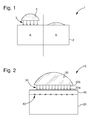
- a product 1 comprising a support 2 not adapted to an epilame 3 is shown. This support 2 must carry a lubricant 5.
- zone A an epilame 3 is placed on the support allowing the lubricant to be held on said support 2.
- zone B it is the same support 2 having undergone watchmaking washes. It can be seen that epilame 3 is no longer present.
- the chemical epilams used are epilams possessing, for example, a "silane" type anchor.
- a silane type anchor.
- the naturally occurring surface oxides allow covalent or strong anchoring between the silane anchor and the surface oxide.
- a delicate substrate is a substrate that can be gold, rhodium or plastic.
- anchors epilames anchor silane type
- the usual anchors epilames anchor silane type which like to attach to the surface oxides do not chemically bind to the gold-plated or rhodium-plated surfaces because the chemical affinities are limited. Therefore, only a mechanical anchorage similar to that of a paint layer on a support is made and such a substrate does not provide sufficient resistance to watchmaking washes.
- the invention relates to an epilamate product that overcomes the drawbacks of the prior art that is to say that provides a product whose epilame or Epilame molecular layer is resistant to watch washes regardless of the nature of the substrate.
- the invention relates to an epilamous product comprising a substrate on which an epilame is deposited, characterized in that the product further comprises a tie layer located between the substrate and the epilame and having a chemical affinity with said epilam such that said epilame and said substrate can hang together via a chemical bond.
- the epilame comprises an anchor portion and a functional portion, said tie layer having a chemical affinity with said anchor portion.
- the anchor is of the silane type and the tie layer is an oxide.
- the oxide of the tie layer is selected from the list comprising silicon oxide, aluminum oxide, titanium dioxide or a combination of these elements.
- the substrate has little chemical affinity with epilame.
- the substrate is a polymer.
- the substrate has a rhodium or gold surface.
- the attachment layer is invisible and reveals the substrate which is below so that the aesthetic appearance of the substrate is not impaired.
- the tie layer has a thickness of 1 to 500 nm.
- the chemical bond is of the covalent type.
- the chemical bond is of the hydrogen bond type.
- the present invention also relates to a timepiece comprising the epilamed product according to the invention.
- the figure 2 represents the epilamate product 10 according to the present invention.
- a product comprises a substrate 20.
- This substrate 20 is the product on which the epilam 30 or epilam molecular layer will be laid.
- This product 10 may be a part of a watch movement such as a bridge or platinum.
- This product 10 may also be a part of a micromechanical object such as a music box.
- this product may be suitable for all applications using an epilame.
- the watch application will be that used in the following description.
- the substrate 20 is made of a first material which may be a material known to the watch industry such as steel or brass.
- a chemical epilame layer must be deposited.
- a chemical epilame is generally composed of two parts: a part called anchor 30a which will promote chemical bonding with the substrate 20 and a part called functional body 30b which gives the epilame power to the molecule, via fluorines for example.
- the present invention consists in providing a tie layer 40 located between the substrate 20 and the epilame 30 as visible in FIG. figure 2 .
- this attachment layer 40 has the particularity of having a good affinity with the substrate whatever it is and a good affinity with the epilame 30 so that the connection between the adhesive layer 40 and the epilam 30 be strong.
- This affinity of the attachment layer 40 with the substrate 20 and the epilame 30 allows good adhesion of the epilame 30 with the substrate 20 regardless of the nature of the substrate 20.
- the 60 visible at the figure 2 show that the affinity between the support 20 and the layer 40 makes it possible to have a strong grip.
- the choice of the attachment layer is based on the selected epilame. Indeed, the part called the anchor 30a which will promote the chemical bond with the substrate 20 is not universal so that there is not an anchor that reacts with all the substrates 20. It therefore becomes necessary to adapt the anchor 30a and the attachment layer 40 to have good affinities.
- an usual anchor is a silane anchor 30a having the following structure.
- R 1 denotes a C 1 -C 18 alkoxyl or C 5 -C 18 cycloalkoxyl group and preferably a group chosen from C 1 -C 4 alkoxyl, in particular Methoxyl and Ethoxyl, or a hydroxyl group or a halogenated group and preferably a chloro group.
- R 2 and R 3 which may be identical or different, denotes a C 1 -C 18 alkoxyl or C 5 -C 18 cycloalkoxyl group and preferably a group chosen from C 1 -C 4 alkoxyl, in particular Methoxyl and Ethoxyl, or a hydroxyl group or a halogenated group and preferably a Chlorinated group, or a hydrogen atom or a linear or branched C1-C10 alkyl, C5-C18 cycloalkyl, C6-C18 aryl, preferably C1-C4 alkyl, preferably a methyl or ethyl radical.
- the tie layer 40 may then be composed of oxide such as silicon oxide SiO 2 , alumina or aluminum oxide Al 2 O 3 , titanium dioxide TiO 2 or a combination of these three elements.
- anchors 30a phosphonic derivative type or katechol can also be used. We then obtain a covalent bond in which two atoms share two electrons (one electron each or two electrons from the same atom) of one of their outer layers to form a pair of electrons linking the two atoms.
- bonds used to bind a compound donor to the acidic acid, that is to say a hydrogen atom bonded to a heteroatom (as in amines, alcohols, thiols) and an acceptor composed of a heteroatom (only nitrogen, oxygen or fluorine) carrying a non-binding doublet.
- the support 20 may also be a steel-type metal support having a gold or rhodium-plated surface.
- a first step is to provide the substrate 20 that is to say the part that must receive the epilame 30.
- This deposition step consists of depositing the attachment layer 40 on the substrate 20. For this, several methods can be used.
- One method is to use a vacuum evaporation technique.
- This vacuum evaporation technique relies on two elementary processes: the evaporation of a heated source and the condensation in the solid state of the evaporated material on the substrate.
- the evaporation takes place under vacuum, that is to say in a gaseous environment, vapor deposition excluded, containing extremely few particles.
- the particles of matter can propagate to the target without collision with other particles (for example in a vacuum of 10 -4 Pa, a particle of 0.4-nm in diameter with an average free path of 60 m, that is to say, it can travel an average of sixty meters before colliding with another particle).
- the collision of different atoms during evaporation can cause reactions that can change the nature of the desired deposit. For example, in oxygen is present, aluminum will form aluminum oxide. This phenomenon can also reduce the amount of vapor deposited.
- Another method is to use a method of flash evaporation.
- the material to be deposited is in the form of a wire which is continuously unwound and evaporated by contact with a very hot ceramic bar.
- ALD Atomic Layer Deposition
- the deposited adhesive layer is thus attached to the substrate.
- the deposited layer has a thickness of about 1 to 500 nanometers.
- the last step is then to deposit a drop of epilame 3 on the desired area.
- the attachment layer 40 is arranged to be invisible or transparent, that is to say that it allows the substrate to appear. This feature allows to have a hook layer 40 without damaging the visual substrate. Indeed, the advantage of having a gold or rhodium-plated substrate 20 is to have a superior visual effect. This effect must not be damaged by a layer that will mask the substrate 20.
Landscapes
- Chemical & Material Sciences (AREA)
- Chemical Kinetics & Catalysis (AREA)
- General Chemical & Material Sciences (AREA)
- Oil, Petroleum & Natural Gas (AREA)
- Organic Chemistry (AREA)
- Physics & Mathematics (AREA)
- General Physics & Mathematics (AREA)
- Ceramic Engineering (AREA)
- Engineering & Computer Science (AREA)
- Laminated Bodies (AREA)
- Other Surface Treatments For Metallic Materials (AREA)
- Lubricants (AREA)
- Physical Vapour Deposition (AREA)
- Chemical Vapour Deposition (AREA)
Abstract
Description
- La présente invention concerne un produit comprenant un substrat délicat comme de l'Or ou du Rhodium sur lequel une couche d'épilame est déposée.
- Le bon fonctionnement d'un mouvement horloger dépend entre autre de sa lubrification. La durabilité du lubrifiant dépend notamment de son maintien dans la zone de fonctionnement : tout horloger a cependant constaté qu'une goutte de lubrifiant s'étale rapidement sur une pièce propre. Le lubrifiant tient en place quand sa tension superficielle est plus haute que celle du support sur lequel ladite huile est placée. Si la tension superficielle de l'huile est trop basse, l'huile s'étale et ne reste pas à sa place.
- Pour résoudre cela, le support est épilamé. Pour cela, une couche d'épilame, généralement sous la forme d'une couche moléculaire invisible hydrophobe et oléophobe, est déposée afin d'éviter l'étalement du lubrifiant et de ses composants.
- Cet épilame est un produit qui modifie la tension superficielle apparente du support. En effet, soit il accroche le lubrifiant pour qu'il reste en place soit il le repousse pour le maintenir dans des zones bien déterminées.
- Il existe deux catégories d'épilames : les épilames « mécaniques » qui se fixent mécaniquement au substrat et les épilames « chimiques » sont globalement composés de 2 parties: l'ancre (qui favorisera l'accroche chimique avec le substrat) et le corps fonctionnel (qui donne le pouvoir épilame à la molécule, via des fluorés par exemple).
- Un inconvénient actuel réside dans le fait que les épilames mécaniques ont naturellement une résistance aux lavages limitée (peu d'accroche chimique avec les surfaces car pas optimisés forcément pour, et encore moins avec l'or et le rhodium de par leur nature chimique de surface). L'agitation, les bains de nettoyage, la température des solutions, etc. participent donc à leur dégradation. Sur la
figure 1 , un produit 1 comportant un support 2 non adapté à un épilame 3 est représenté. Ce support 2 doit porter un lubrifiant 5. - Sur la zone A, un épilame 3 est placé sur le support permettant au lubrifiant d'être maintenu sur ledit support 2. Sur la zone B, il s'agit du même support 2 ayant subi des lavages horlogers. On constate que l'épilame 3 n'est plus présent.
- Actuellement, les épilames chimiques utilisés sont des épilames possédant par exemple une ancre de type « silane ». Lors du dépôt de cet épilame sur un substrat de type acier, les oxydes de surfaces naturellement présents permettent un ancrage covalent ou fort entre l'ancre silane et l'oxyde de surface.
- Pour les épilames chimiques, un inconvénient apparait dans le cas où le substrat est délicat. Un substrat délicat est un substrat pouvant être en or, en rhodium ou en plastique. Dans ce cas, les ancres habituelles des épilames (ancre de type silane) qui aiment se fixer sur les oxydes de surfaces n'arrivent pas à se fixer chimiquement sur les surfaces de type dorées ou rhodiées car les affinités chimiques sont limitées. De ce fait, seul un ancrage mécanique semblable à celui d'une couche de peinture sur un support est réalisé et un tel substrat n'offre pas une résistance aux lavages horlogers suffisante.
- L'invention concerne un produit épilamé qui pallie les inconvénients de l'art antérieur c'est-à-dire qui permet de fournir un produit dont l'épilame ou couche moléculaire Epilame est résistant aux lavages horlogers peu importe la nature du substrat.
- A cet effet, l'invention concerne un produit épilamé comprenant un substrat sur lequel un épilame est déposé, caractérisé en ce que le produit comporte en outre une couche d'accroche située entre le substrat et l'épilame et possédant une affinité chimique avec ledit épilame de sorte que ledit épilame et ledit substrat puissent s'accrocher ensemble via une liaison chimique.
- Dans un premier mode de réalisation, l'épilame comprend une partie ancre et une partie fonctionnelle, ladite couche d'accroche ayant une affinité chimique avec ladite partie ancre.
- Dans un second mode de réalisation, l'ancre est du type silane et la couche d'accroche est un oxyde.
- Dans un troisième mode de réalisation, l'oxyde de la couche d'accroche est choisi dans la liste comprenant l'oxyde de silicium, l'oxyde d'aluminium, le dioxyde de titane ou une combinaison de ces éléments.
- Dans un quatrième mode de réalisation, le substrat possède peu d'affinité chimique avec l'épilame.
- Dans un autre mode de réalisation, le substrat est un polymère.
- Dans un autre mode de réalisation, le substrat présente une surface rhodiée ou dorée.
- Dans un autre mode de réalisation, la couche d'accroche est invisible et laisse apparaitre le substrat qui est dessous de telle manière que l'aspect esthétique du substrat ne soit pas altéré..
- Dans un autre mode de réalisation, la couche d'accroche a une épaisseur de 1 à 500 nm.
- Dans un autre mode de réalisation, la liaison chimique est du type covalente.
- Dans un autre mode de réalisation, la liaison chimique est du type liaison hydrogène.
- La présente invention concerne également une pièce d'horlogerie comprenant le produit épilamé selon l'invention.
- Les buts, avantages et caractéristiques de selon la présente invention apparaîtront plus clairement dans la description détaillée suivante d'au moins une forme de réalisation de l'invention donnée uniquement à titre d'exemple non limitatif et illustrée par les dessins annexés sur lesquels :
- La
figure 1 représente schématiquement le produit épilamé selon l'art antérieur. - La
figure 2 représente schématiquement le produit épilamé selon la présente invention. - La
figure 2 représente le produit épilamé 10 selon la présente invention. Un tel produit comprend un substrat 20. Ce substrat 20 est le produit sur lequel l'épilame 30 ou couche moléculaire Epilame sera posé. Ce produit 10 peut être une pièce d'un mouvement d'horlogerie comme un pont ou la platine. Ce produit 10 peut également être une pièce d'un objet micromécanique comme une boîte à musique. Bien entendu, il est possible que ce produit puisse convenir à toutes les applications utilisant un épilame. L'application horlogère sera celle utilisée dans la suite de la description. - Le substrat 20 est réalisé dans un premier matériau qui peut être un matériau connu de l'horlogerie comme l'acier ou le laiton.
- Sur ce substrat, une couche d'épilame 30 chimique doit être déposée. Un épilame chimique 30 est généralement composé de deux parties : une partie appelée ancre 30a qui favorisera l'accroche chimique avec le substrat 20 et une partie appelée corps fonctionnel 30b qui donne le pouvoir épilame à la molécule, via des fluorés par exemple.
- Afin d'assurer une bonne accroche de l'épilame 30 sur le substrat 20, peu importe la nature du substrat, la présente invention consiste à prévoir une couche d'accroche 40 située entre le substrat 20 et l'épilame 30 comme visible à la
figure 2 . - Avantageusement, cette couche d'accroche 40 possède la particularité de présenter une bonne affinité avec le substrat quel qu'il soit ainsi qu'une bonne affinité avec l'épilame 30 de sorte que la liaison entre la couche d'accroche 40 et l'épilame 30 soit forte. Cette affinité de la couche d'accroche 40 avec le substrat 20 et l'épilame 30 permet une bonne accroche de l'épilame 30 avec le substrat 20 peu importe la nature du substrat 20. Les croies 60 visibles à la
figure 2 montrent que l'affinité entre le support 20 et la couche 40 permet d'avoir une accroche forte. - Le choix de la couche d'accroche se fait en fonction de l'épilame choisi. En effet, la partie appelée l'ancre 30a qui favorisera l'accroche chimique avec le substrat 20 n'est pas universelle de sorte qu'il n'existe pas une ancre qui réagit avec tous les substrats 20. Il devient donc nécessaire d'adapter l'ancre 30a et la couche d'accroche 40 pour avoir de bonnes affinités.
- Par exemple, une ancre habituelle est une ancre 30a de type silane, ayant la structure suivante.

- R1 désigne un groupement Alkoxyle en C1-C18 ou cycloalkoxyle en C5-C18 et préférentiellement un groupement choisi parmi alkoxyle en C1-C4 en particulier Methoxyle et Ethoxyl ou un groupement Hydroxyle ou un groupement halogéné et préférentiellement un groupement Chloré.
- R2 et R3 identique ou différent désigne un groupement Alkoxyle en C1-C18 ou cycloalkoxyle en C5-C18 et préférentiellement un groupement choisi parmi alkoxyle en C1-C4 en particulier Methoxyle et Ethoxyl ou un groupement Hydroxyle ou un groupement halogéné et préférentiellement un groupement Chloré ou un atome d'hydrogène ou un radical alkyl linéaire ou ramifié en C1-C10, cycloalkyle en C5-C18, Aryle en C6-C18, de préférence Alkyle en C1-C4, préférentiellement un radical Méthyle ou Ethyle.
- Ces ancres 30a de types silanes ont une bonne affinité avec les oxydes de surface. La couche d'accroche 40 peut alors être composée d'oxyde comme de l'oxyde de silicium SiO2, de l'alumine ou oxyde d'aluminium Al2O3, dioxyde de titane TiO2 ou une combinaison de ces trois éléments. Pour ce type de couche d'accroche 40, des ancres 30a de type dérivé phosphonique ou katechol peuvent être également utilisées. On obtient alors une liaison de type covalente dans laquelle deux atomes partagent deux électrons (un électron chacun ou deux électrons venant du même atome) d'une de leurs couches externes afin de former un doublet d'électrons liant les deux atomes.
- Bien entendu, d'autres types de liaison sont possibles et des liaisons de type hydrogène utilisée pour lier un donneur composé à H acide, c'est-à-dire un atome d'hydrogène lié à un hétéroatome (comme dans les amines, alcools, thiols) et un accepteur composé d'un hétéroatome (uniquement azote, oxygène ou fluor) porteur d'un doublet non liant.
- Ainsi, il devient possible de réaliser des produits épilamés ayant comme substrat 20 dit délicat comme ceux réalisés avec des matériaux de type plastiques comme des polymères ou des matériaux dorés ou rhodiés qui présentent naturellement une mauvaise accroche avec l'épilame 30 ayant une ancre du type silane. Ces substrats ne possèdent en effet pas d'oxyde de surface pour l'accroche d'un épilame 30 ayant une ancre du type silane. Le support 20 peut aussi être un support en métal de type acier présentant une surface dorée ou rhodiée.
- Pour réaliser un tel produit épilamé 10, une première étape consiste à se munir du substrat 20 c'est-à-dire la pièce qui doit recevoir l'épilame 30.
- Une fois muni de ce substrat 20, une étape de dépôt est réalisée. Cette étape de dépôt consiste à déposer la couche d'accroche 40 sur le substrat 20. Pour cela, plusieurs méthodes peuvent être utilisées.
- Une première méthode consiste à utiliser une technique d'évaporation sous vide. Cette technique d'évaporation sous vide repose sur deux processus élémentaires : l'évaporation d'une source chauffée et la condensation à l'état solide de la matière évaporée sur le substrat. L'évaporation a lieu sous vide, c'est-à-dire dans un environnement gazeux, vapeur de dépôt exclue, contenant extrêmement peu de particules. Dans ces conditions, les particules de matière peuvent se propager jusqu'à la cible sans collision avec d'autres particules (Par exemple dans un vide de 10-4 Pa, une particule de 0.4-nm de diamètre à un libre parcours moyen de 60 m, c'est-à-dire qu'elle peut parcourir en moyenne soixante mètres avant de rentrer en collision avec une autre particule). En effet, la collision de différents atomes durant l'évaporation peut provoquer des réactions susceptibles de modifier la nature du dépôt souhaité. Par exemple, en présence d'oxygène, l'aluminium formera de l'oxyde d'aluminium. Ce phénomène peut aussi diminuer la quantité de vapeur déposée.
- Une autre méthode consiste à utiliser une méthode d'évaporation par flash. Dans cette méthode d'évaporation flash, la matière à déposer est sous forme d'un fil qui est continuellement dévidé et évaporé par contact avec une barre de céramique très chaude.
- Une autre méthode utilisée est la technique de dépôt de couche atomique (ALD: Atomic Layer Deposition). Cette méthode est un procédé de dépôt de couches minces atomiques. Le principe consiste à exposer une surface successivement à différents précurseurs chimiques afin d'obtenir des couches ultra-minces.
- La couche d'accroche déposée est ainsi accrochée au substrat. La couche déposée présente une épaisseur d'environ 1 à 500 nanomètre.
- La dernière étape consiste ensuite à déposer une goutte d'épilame 3 sur la zone désirée.
- Selon une première variante de l'invention, la couche d'accroche 40 est agencée pour être invisible ou transparente c'est-à-dire qu'elle laisse apparaitre le substrat. Cette caractéristique permet d'avoir une couche d'accroche 40 sans détériorer le visuel du substrat. En effet, l'intérêt d'avoir un substrat 20 doré ou rhodié est d'avoir un effet visuel supérieur. Cet effet ne doit donc pas être détérioré par une couche qui va masquer le substrat 20.
- On comprendra que diverses modifications et/ou améliorations et/ou combinaisons évidentes pour l'homme du métier peuvent être apportées aux différents modes de réalisation de l'invention exposée ci-dessus sans sortir du cadre de l'invention définie par les revendications annexées.
Claims (12)
- Produit épilamé (10) comprenant un substrat (20) sur lequel un épilame (30) est déposé, caractérisé en ce que le produit comporte en outre une couche d'accroche (40) située entre le substrat et l'épilame et possédant une affinité chimique avec ledit épilame de sorte que ledit épilame et ledit substrat puissent s'accrocher ensemble via une liaison chimique.
- Produit selon la revendication 1, caractérisé en ce que l'épilame (30) comprend au moins une partie ancre (30a) et une partie fonctionnelle (30b), ladite couche d'accroche ayant l'affinité chimique avec ladite partie ancre.
- Produit selon les revendications 1 ou 2, caractérisé en ce que la liaison chimique est du type covalente.
- Produit selon les revendications 1 ou 2, caractérisé en ce que la liaison chimique est du type liaison hydrogène.
- Produit selon les revendications 2 ou 3, caractérisé en ce que l'ancre est du type silane et la couche d'accroche (40) est un oxyde.
- Produit selon la revendication 5, caractérisé en ce que l'oxyde de la couche d'accroche (40) est choisi dans la liste comprenant l'oxyde de silicium, l'oxyde d'aluminium, le dioxyde de titane ou une combinaison de ces éléments.
- Produit selon l'une des revendications 1 à 6, caractérisé en ce que le substrat possède peu d'affinité chimique avec l'épilame.
- Produit selon la revendication 5, caractérisé en ce que le substrat (20) est un polymère.
- Produit selon la revendication 5, caractérisé en ce que le substrat (20) présente une surface rhodiée ou dorée.
- Produit selon l'une des revendications précédentes, caractérisé en ce que la couche d'accroche (40) est invisible et laisse apparaitre le substrat qui est dessous de telle manière que l'aspect esthétique du substrat ne soit pas altéré.
- Produit selon l'une des revendications précédentes, caractérisé en ce que la couche d'accroche a une épaisseur de 1 à 500 nm.
- Pièce d'horlogerie comprenant un produit épilamé selon l'une des revendications précédentes.
Priority Applications (1)
| Application Number | Priority Date | Filing Date | Title |
|---|---|---|---|
| EP14189695.1A EP2865738B1 (fr) | 2013-10-28 | 2014-10-21 | Produit noble épilamé |
Applications Claiming Priority (2)
| Application Number | Priority Date | Filing Date | Title |
|---|---|---|---|
| EP20130190495 EP2865737A1 (fr) | 2013-10-28 | 2013-10-28 | Produit noble épilame |
| EP14189695.1A EP2865738B1 (fr) | 2013-10-28 | 2014-10-21 | Produit noble épilamé |
Publications (2)
| Publication Number | Publication Date |
|---|---|
| EP2865738A1 true EP2865738A1 (fr) | 2015-04-29 |
| EP2865738B1 EP2865738B1 (fr) | 2021-06-30 |
Family
ID=49509966
Family Applications (2)
| Application Number | Title | Priority Date | Filing Date |
|---|---|---|---|
| EP20130190495 Withdrawn EP2865737A1 (fr) | 2013-10-28 | 2013-10-28 | Produit noble épilame |
| EP14189695.1A Active EP2865738B1 (fr) | 2013-10-28 | 2014-10-21 | Produit noble épilamé |
Family Applications Before (1)
| Application Number | Title | Priority Date | Filing Date |
|---|---|---|---|
| EP20130190495 Withdrawn EP2865737A1 (fr) | 2013-10-28 | 2013-10-28 | Produit noble épilame |
Country Status (5)
| Country | Link |
|---|---|
| US (1) | US20150118486A1 (fr) |
| EP (2) | EP2865737A1 (fr) |
| JP (1) | JP6041841B2 (fr) |
| CN (2) | CN109968760A (fr) |
| HK (1) | HK1205723A1 (fr) |
Families Citing this family (6)
| Publication number | Priority date | Publication date | Assignee | Title |
|---|---|---|---|---|
| EP3141520B1 (fr) * | 2015-09-08 | 2018-03-14 | Nivarox-FAR S.A. | Procédé de fabrication d'une pièce micromécanique horlogère et ladite pièce micromécanique horlogère |
| EP3192853B1 (fr) | 2016-01-15 | 2023-04-26 | Sikemia | Procede de traitement d'une surface pour l'obtention d'un revêtement oleophobe et/ou hydrophobe |
| KR102696309B1 (ko) | 2016-05-16 | 2024-08-16 | 블루스코프 스틸 리미티드 | 코팅 공정 |
| EP3786721A1 (fr) * | 2019-08-29 | 2021-03-03 | ETA SA Manufacture Horlogère Suisse | Procédé de collage de composants horlogers |
| EP3819713B1 (fr) * | 2019-11-05 | 2025-04-16 | Patek Philippe SA Genève | Ensemble d'horlogerie |
| US11910552B2 (en) * | 2020-06-17 | 2024-02-20 | Apple Inc. | Electronic devices with corrosion-resistant colored metal structures |
Citations (2)
| Publication number | Priority date | Publication date | Assignee | Title |
|---|---|---|---|---|
| WO2008052378A2 (fr) * | 2006-11-02 | 2008-05-08 | Rolex S.A. | Montre |
| EP1927648A1 (fr) * | 2006-12-01 | 2008-06-04 | Rolex Sa | Couche ultra-mince hydrophobe et oléophobe, procédé de fabrication et utilisation en horlogerie comme épilame |
Family Cites Families (10)
| Publication number | Priority date | Publication date | Assignee | Title |
|---|---|---|---|---|
| US4363844A (en) * | 1980-09-22 | 1982-12-14 | Lewis Terry W | Metallized information carrying discs |
| JPH0742568B2 (ja) * | 1985-10-22 | 1995-05-10 | セイコーエプソン株式会社 | 時計用外装部品 |
| JP2655036B2 (ja) * | 1986-01-21 | 1997-09-17 | セイコーエプソン株式会社 | 光学物品の製造方法 |
| JPH07119842B2 (ja) * | 1987-05-28 | 1995-12-20 | セイコーエプソン株式会社 | 無機コート膜を有する光学物品及びその製造方法 |
| JPH0261592A (ja) * | 1988-08-26 | 1990-03-01 | Seiko Epson Corp | 携帯時計用外装部品及びその製造方法 |
| CA2060294C (fr) * | 1991-02-06 | 2000-01-18 | Kazufumi Ogawa | Pellicule adsorbee par voie chimique et procede de fabrication |
| JP2002146271A (ja) * | 2000-11-16 | 2002-05-22 | Three M Innovative Properties Co | 撥水、撥油および防汚性コーティング組成物 |
| JP2009180664A (ja) * | 2008-01-31 | 2009-08-13 | Seiko Epson Corp | 透光性部材および時計 |
| US9714469B2 (en) * | 2010-12-23 | 2017-07-25 | Rolex Sa | Composition for increasing the lipophobicity of a watch-making component |
| DE102011076754A1 (de) * | 2011-05-31 | 2012-12-06 | Schott Ag | Substratelement für die Beschichtung mit einer Easy-to-clean Beschichtung |
-
2013
- 2013-10-28 EP EP20130190495 patent/EP2865737A1/fr not_active Withdrawn
-
2014
- 2014-10-21 EP EP14189695.1A patent/EP2865738B1/fr active Active
- 2014-10-23 US US14/521,912 patent/US20150118486A1/en not_active Abandoned
- 2014-10-24 JP JP2014216893A patent/JP6041841B2/ja active Active
- 2014-10-28 CN CN201910112951.0A patent/CN109968760A/zh active Pending
- 2014-10-28 CN CN201410587584.7A patent/CN104553140A/zh active Pending
-
2015
- 2015-07-06 HK HK15106417.5A patent/HK1205723A1/xx unknown
Patent Citations (2)
| Publication number | Priority date | Publication date | Assignee | Title |
|---|---|---|---|---|
| WO2008052378A2 (fr) * | 2006-11-02 | 2008-05-08 | Rolex S.A. | Montre |
| EP1927648A1 (fr) * | 2006-12-01 | 2008-06-04 | Rolex Sa | Couche ultra-mince hydrophobe et oléophobe, procédé de fabrication et utilisation en horlogerie comme épilame |
Also Published As
| Publication number | Publication date |
|---|---|
| JP6041841B2 (ja) | 2016-12-14 |
| JP2015085692A (ja) | 2015-05-07 |
| EP2865738B1 (fr) | 2021-06-30 |
| EP2865737A1 (fr) | 2015-04-29 |
| CN109968760A (zh) | 2019-07-05 |
| US20150118486A1 (en) | 2015-04-30 |
| HK1205723A1 (en) | 2015-12-24 |
| CN104553140A (zh) | 2015-04-29 |
Similar Documents
| Publication | Publication Date | Title |
|---|---|---|
| EP2865738A1 (fr) | Produit noble épilamé | |
| EP2846931B1 (fr) | Recouvrement de surfaces destinees a l'horlogerie a l'aide de compositions catanioniques contenant des molecules phosphoniques et des amines | |
| CH701499B1 (fr) | Procède de fabrication d'une pièce micromécanique en silicium renforcé. | |
| JP2012516242A5 (fr) | ||
| EP1636399A1 (fr) | Revetement pour une piece mecanique comprenant au moins une couche externe de carbone amorphe hydrogene et une couche de carbure de silicium hydrogene en contact avec la piece, et procede de depot d'un tel revetement | |
| CA3079979A1 (fr) | Piece comportant un revetement de protection a composition graduelle | |
| CN102923640B (zh) | 具有Au-Cu电极的半导体器件和半导体器件的制造方法 | |
| CH708746A2 (fr) | Produit noble épilamé. | |
| CH714139A2 (fr) | Revêtement protecteur pour composant horloger complexe. | |
| EP3006599B1 (fr) | Procédé de revêtement de la surface d'un substrat métallique | |
| CH681370A5 (en) | Solid lubricant coating prodn. for reducing friction between soft parts - by applying nickel@-phosphorus@ layer and gold@ layer and then heat treating | |
| FR2938696A1 (fr) | Procede de passivation d'un composant semi-conducteur et dispositif realise a l'aide d'un tel composant | |
| EP0718417A1 (fr) | Matériau multicouche | |
| EP3390685B1 (fr) | Procédé de protection d'une surface métallique d'une pièce par un revêtement en diamant et pièce ainsi obtenue | |
| EP2774000B1 (fr) | Procede anti-effets de charge pour la lithographie et la microscopie electronique | |
| FR3057475A1 (fr) | Procede de generation d'un jet de nanoparticules | |
| FR3024161A1 (fr) | Procede de nettoyage d'une chambre de depot | |
| Lekmine | Etude de l’efficacité inhibitrice des composés cycliques soufrés dans des milieux acides sur des dépôts composites élaborés par voie électrolytique | |
| WO2025068217A1 (fr) | Composant de rappel élastique pour mouvement horloger | |
| EP4726015A1 (fr) | Utilisation d'un polymere lineaire a base de siloxanes en tant qu'agent epilame | |
| FR3083467A1 (fr) | Procede de scellement de pieces entre elles avec un alliage eutectique a base d'aluminium | |
| CH711836B1 (fr) | Composant d'horlogerie comportant une couche superficielle auto-lubrifiante. | |
| EP4214581A1 (fr) | Procede de fabrication d'un composant de micromecanique, notamment d'un mobile d'horlogerie, dont la surface est optimisee | |
| EP4214580A1 (fr) | Composant de micromécanique, notamment un mobile d'horlogerie, notamment un mobile d'échappement, dont la surface est optimisée | |
| CH704467A2 (fr) | Procédé de dépôt sélectif d'un revêtement. |
Legal Events
| Date | Code | Title | Description |
|---|---|---|---|
| PUAI | Public reference made under article 153(3) epc to a published international application that has entered the european phase |
Free format text: ORIGINAL CODE: 0009012 |
|
| 17P | Request for examination filed |
Effective date: 20141021 |
|
| AK | Designated contracting states |
Kind code of ref document: A1 Designated state(s): AL AT BE BG CH CY CZ DE DK EE ES FI FR GB GR HR HU IE IS IT LI LT LU LV MC MK MT NL NO PL PT RO RS SE SI SK SM TR |
|
| AX | Request for extension of the european patent |
Extension state: BA ME |
|
| R17P | Request for examination filed (corrected) |
Effective date: 20151028 |
|
| RBV | Designated contracting states (corrected) |
Designated state(s): AL AT BE BG CH CY CZ DE DK EE ES FI FR GB GR HR HU IE IS IT LI LT LU LV MC MK MT NL NO PL PT RO RS SE SI SK SM TR |
|
| STAA | Information on the status of an ep patent application or granted ep patent |
Free format text: STATUS: EXAMINATION IS IN PROGRESS |
|
| 17Q | First examination report despatched |
Effective date: 20180806 |
|
| GRAP | Despatch of communication of intention to grant a patent |
Free format text: ORIGINAL CODE: EPIDOSNIGR1 |
|
| STAA | Information on the status of an ep patent application or granted ep patent |
Free format text: STATUS: GRANT OF PATENT IS INTENDED |
|
| INTG | Intention to grant announced |
Effective date: 20210129 |
|
| GRAS | Grant fee paid |
Free format text: ORIGINAL CODE: EPIDOSNIGR3 |
|
| GRAA | (expected) grant |
Free format text: ORIGINAL CODE: 0009210 |
|
| STAA | Information on the status of an ep patent application or granted ep patent |
Free format text: STATUS: THE PATENT HAS BEEN GRANTED |
|
| AK | Designated contracting states |
Kind code of ref document: B1 Designated state(s): AL AT BE BG CH CY CZ DE DK EE ES FI FR GB GR HR HU IE IS IT LI LT LU LV MC MK MT NL NO PL PT RO RS SE SI SK SM TR |
|
| REG | Reference to a national code |
Ref country code: GB Ref legal event code: FG4D Free format text: NOT ENGLISH Ref country code: CH Ref legal event code: EP |
|
| REG | Reference to a national code |
Ref country code: DE Ref legal event code: R096 Ref document number: 602014078409 Country of ref document: DE Ref country code: AT Ref legal event code: REF Ref document number: 1406354 Country of ref document: AT Kind code of ref document: T Effective date: 20210715 |
|
| REG | Reference to a national code |
Ref country code: IE Ref legal event code: FG4D Free format text: LANGUAGE OF EP DOCUMENT: FRENCH |
|
| REG | Reference to a national code |
Ref country code: LT Ref legal event code: MG9D |
|
| PG25 | Lapsed in a contracting state [announced via postgrant information from national office to epo] |
Ref country code: FI Free format text: LAPSE BECAUSE OF FAILURE TO SUBMIT A TRANSLATION OF THE DESCRIPTION OR TO PAY THE FEE WITHIN THE PRESCRIBED TIME-LIMIT Effective date: 20210630 Ref country code: BG Free format text: LAPSE BECAUSE OF FAILURE TO SUBMIT A TRANSLATION OF THE DESCRIPTION OR TO PAY THE FEE WITHIN THE PRESCRIBED TIME-LIMIT Effective date: 20210930 Ref country code: HR Free format text: LAPSE BECAUSE OF FAILURE TO SUBMIT A TRANSLATION OF THE DESCRIPTION OR TO PAY THE FEE WITHIN THE PRESCRIBED TIME-LIMIT Effective date: 20210630 |
|
| REG | Reference to a national code |
Ref country code: NL Ref legal event code: MP Effective date: 20210630 |
|
| REG | Reference to a national code |
Ref country code: AT Ref legal event code: MK05 Ref document number: 1406354 Country of ref document: AT Kind code of ref document: T Effective date: 20210630 |
|
| PG25 | Lapsed in a contracting state [announced via postgrant information from national office to epo] |
Ref country code: GR Free format text: LAPSE BECAUSE OF FAILURE TO SUBMIT A TRANSLATION OF THE DESCRIPTION OR TO PAY THE FEE WITHIN THE PRESCRIBED TIME-LIMIT Effective date: 20211001 Ref country code: LV Free format text: LAPSE BECAUSE OF FAILURE TO SUBMIT A TRANSLATION OF THE DESCRIPTION OR TO PAY THE FEE WITHIN THE PRESCRIBED TIME-LIMIT Effective date: 20210630 Ref country code: NO Free format text: LAPSE BECAUSE OF FAILURE TO SUBMIT A TRANSLATION OF THE DESCRIPTION OR TO PAY THE FEE WITHIN THE PRESCRIBED TIME-LIMIT Effective date: 20210930 Ref country code: RS Free format text: LAPSE BECAUSE OF FAILURE TO SUBMIT A TRANSLATION OF THE DESCRIPTION OR TO PAY THE FEE WITHIN THE PRESCRIBED TIME-LIMIT Effective date: 20210630 Ref country code: SE Free format text: LAPSE BECAUSE OF FAILURE TO SUBMIT A TRANSLATION OF THE DESCRIPTION OR TO PAY THE FEE WITHIN THE PRESCRIBED TIME-LIMIT Effective date: 20210630 |
|
| PG25 | Lapsed in a contracting state [announced via postgrant information from national office to epo] |
Ref country code: SK Free format text: LAPSE BECAUSE OF FAILURE TO SUBMIT A TRANSLATION OF THE DESCRIPTION OR TO PAY THE FEE WITHIN THE PRESCRIBED TIME-LIMIT Effective date: 20210630 Ref country code: SM Free format text: LAPSE BECAUSE OF FAILURE TO SUBMIT A TRANSLATION OF THE DESCRIPTION OR TO PAY THE FEE WITHIN THE PRESCRIBED TIME-LIMIT Effective date: 20210630 Ref country code: CZ Free format text: LAPSE BECAUSE OF FAILURE TO SUBMIT A TRANSLATION OF THE DESCRIPTION OR TO PAY THE FEE WITHIN THE PRESCRIBED TIME-LIMIT Effective date: 20210630 Ref country code: EE Free format text: LAPSE BECAUSE OF FAILURE TO SUBMIT A TRANSLATION OF THE DESCRIPTION OR TO PAY THE FEE WITHIN THE PRESCRIBED TIME-LIMIT Effective date: 20210630 Ref country code: AT Free format text: LAPSE BECAUSE OF FAILURE TO SUBMIT A TRANSLATION OF THE DESCRIPTION OR TO PAY THE FEE WITHIN THE PRESCRIBED TIME-LIMIT Effective date: 20210630 Ref country code: ES Free format text: LAPSE BECAUSE OF FAILURE TO SUBMIT A TRANSLATION OF THE DESCRIPTION OR TO PAY THE FEE WITHIN THE PRESCRIBED TIME-LIMIT Effective date: 20210630 Ref country code: PT Free format text: LAPSE BECAUSE OF FAILURE TO SUBMIT A TRANSLATION OF THE DESCRIPTION OR TO PAY THE FEE WITHIN THE PRESCRIBED TIME-LIMIT Effective date: 20211102 Ref country code: RO Free format text: LAPSE BECAUSE OF FAILURE TO SUBMIT A TRANSLATION OF THE DESCRIPTION OR TO PAY THE FEE WITHIN THE PRESCRIBED TIME-LIMIT Effective date: 20210630 Ref country code: NL Free format text: LAPSE BECAUSE OF FAILURE TO SUBMIT A TRANSLATION OF THE DESCRIPTION OR TO PAY THE FEE WITHIN THE PRESCRIBED TIME-LIMIT Effective date: 20210630 |
|
| PG25 | Lapsed in a contracting state [announced via postgrant information from national office to epo] |
Ref country code: PL Free format text: LAPSE BECAUSE OF FAILURE TO SUBMIT A TRANSLATION OF THE DESCRIPTION OR TO PAY THE FEE WITHIN THE PRESCRIBED TIME-LIMIT Effective date: 20210630 |
|
| REG | Reference to a national code |
Ref country code: DE Ref legal event code: R097 Ref document number: 602014078409 Country of ref document: DE |
|
| PG25 | Lapsed in a contracting state [announced via postgrant information from national office to epo] |
Ref country code: DK Free format text: LAPSE BECAUSE OF FAILURE TO SUBMIT A TRANSLATION OF THE DESCRIPTION OR TO PAY THE FEE WITHIN THE PRESCRIBED TIME-LIMIT Effective date: 20210630 |
|
| PLBE | No opposition filed within time limit |
Free format text: ORIGINAL CODE: 0009261 |
|
| STAA | Information on the status of an ep patent application or granted ep patent |
Free format text: STATUS: NO OPPOSITION FILED WITHIN TIME LIMIT |
|
| PG25 | Lapsed in a contracting state [announced via postgrant information from national office to epo] |
Ref country code: AL Free format text: LAPSE BECAUSE OF FAILURE TO SUBMIT A TRANSLATION OF THE DESCRIPTION OR TO PAY THE FEE WITHIN THE PRESCRIBED TIME-LIMIT Effective date: 20210630 |
|
| 26N | No opposition filed |
Effective date: 20220331 |
|
| REG | Reference to a national code |
Ref country code: BE Ref legal event code: MM Effective date: 20211031 |
|
| GBPC | Gb: european patent ceased through non-payment of renewal fee |
Effective date: 20211021 |
|
| PG25 | Lapsed in a contracting state [announced via postgrant information from national office to epo] |
Ref country code: MC Free format text: LAPSE BECAUSE OF FAILURE TO SUBMIT A TRANSLATION OF THE DESCRIPTION OR TO PAY THE FEE WITHIN THE PRESCRIBED TIME-LIMIT Effective date: 20210630 |
|
| PG25 | Lapsed in a contracting state [announced via postgrant information from national office to epo] |
Ref country code: LU Free format text: LAPSE BECAUSE OF NON-PAYMENT OF DUE FEES Effective date: 20211021 Ref country code: IT Free format text: LAPSE BECAUSE OF FAILURE TO SUBMIT A TRANSLATION OF THE DESCRIPTION OR TO PAY THE FEE WITHIN THE PRESCRIBED TIME-LIMIT Effective date: 20210630 Ref country code: GB Free format text: LAPSE BECAUSE OF NON-PAYMENT OF DUE FEES Effective date: 20211021 Ref country code: BE Free format text: LAPSE BECAUSE OF NON-PAYMENT OF DUE FEES Effective date: 20211031 |
|
| PG25 | Lapsed in a contracting state [announced via postgrant information from national office to epo] |
Ref country code: IE Free format text: LAPSE BECAUSE OF NON-PAYMENT OF DUE FEES Effective date: 20211021 |
|
| PG25 | Lapsed in a contracting state [announced via postgrant information from national office to epo] |
Ref country code: LT Free format text: LAPSE BECAUSE OF FAILURE TO SUBMIT A TRANSLATION OF THE DESCRIPTION OR TO PAY THE FEE WITHIN THE PRESCRIBED TIME-LIMIT Effective date: 20210630 |
|
| PG25 | Lapsed in a contracting state [announced via postgrant information from national office to epo] |
Ref country code: HU Free format text: LAPSE BECAUSE OF FAILURE TO SUBMIT A TRANSLATION OF THE DESCRIPTION OR TO PAY THE FEE WITHIN THE PRESCRIBED TIME-LIMIT; INVALID AB INITIO Effective date: 20141021 |
|
| PG25 | Lapsed in a contracting state [announced via postgrant information from national office to epo] |
Ref country code: CY Free format text: LAPSE BECAUSE OF FAILURE TO SUBMIT A TRANSLATION OF THE DESCRIPTION OR TO PAY THE FEE WITHIN THE PRESCRIBED TIME-LIMIT Effective date: 20210630 |
|
| P01 | Opt-out of the competence of the unified patent court (upc) registered |
Effective date: 20230615 |
|
| PG25 | Lapsed in a contracting state [announced via postgrant information from national office to epo] |
Ref country code: MK Free format text: LAPSE BECAUSE OF FAILURE TO SUBMIT A TRANSLATION OF THE DESCRIPTION OR TO PAY THE FEE WITHIN THE PRESCRIBED TIME-LIMIT Effective date: 20210630 |
|
| PG25 | Lapsed in a contracting state [announced via postgrant information from national office to epo] |
Ref country code: MT Free format text: LAPSE BECAUSE OF FAILURE TO SUBMIT A TRANSLATION OF THE DESCRIPTION OR TO PAY THE FEE WITHIN THE PRESCRIBED TIME-LIMIT Effective date: 20210630 |
|
| PGFP | Annual fee paid to national office [announced via postgrant information from national office to epo] |
Ref country code: FR Payment date: 20250923 Year of fee payment: 12 |
|
| REG | Reference to a national code |
Ref country code: CH Ref legal event code: U11 Free format text: ST27 STATUS EVENT CODE: U-0-0-U10-U11 (AS PROVIDED BY THE NATIONAL OFFICE) Effective date: 20251101 |
|
| PG25 | Lapsed in a contracting state [announced via postgrant information from national office to epo] |
Ref country code: TR Free format text: LAPSE BECAUSE OF FAILURE TO SUBMIT A TRANSLATION OF THE DESCRIPTION OR TO PAY THE FEE WITHIN THE PRESCRIBED TIME-LIMIT Effective date: 20210630 |
|
| PGFP | Annual fee paid to national office [announced via postgrant information from national office to epo] |
Ref country code: DE Payment date: 20250923 Year of fee payment: 12 |
|
| PGFP | Annual fee paid to national office [announced via postgrant information from national office to epo] |
Ref country code: CH Payment date: 20251101 Year of fee payment: 12 |