EP2869602A1 - Funkeinrichtung und Verfahren zur Mehr-Domänen Überwachung und Zugriffsmanagement - Google Patents
Funkeinrichtung und Verfahren zur Mehr-Domänen Überwachung und Zugriffsmanagement Download PDFInfo
- Publication number
- EP2869602A1 EP2869602A1 EP20130191511 EP13191511A EP2869602A1 EP 2869602 A1 EP2869602 A1 EP 2869602A1 EP 20130191511 EP20130191511 EP 20130191511 EP 13191511 A EP13191511 A EP 13191511A EP 2869602 A1 EP2869602 A1 EP 2869602A1
- Authority
- EP
- European Patent Office
- Prior art keywords
- radio network
- domain
- access
- radio
- availability
- Prior art date
- Legal status (The legal status is an assumption and is not a legal conclusion. Google has not performed a legal analysis and makes no representation as to the accuracy of the status listed.)
- Withdrawn
Links
Images


Classifications
-
- H—ELECTRICITY
- H04—ELECTRIC COMMUNICATION TECHNIQUE
- H04L—TRANSMISSION OF DIGITAL INFORMATION, e.g. TELEGRAPHIC COMMUNICATION
- H04L41/00—Arrangements for maintenance, administration or management of data switching networks, e.g. of packet switching networks
- H04L41/50—Network service management, e.g. ensuring proper service fulfilment according to agreements
- H04L41/5003—Managing SLA; Interaction between SLA and QoS
- H04L41/5009—Determining service level performance parameters or violations of service level contracts, e.g. violations of agreed response time or mean time between failures [MTBF]
- H04L41/5012—Determining service level performance parameters or violations of service level contracts, e.g. violations of agreed response time or mean time between failures [MTBF] determining service availability, e.g. which services are available at a certain point in time
-
- H—ELECTRICITY
- H04—ELECTRIC COMMUNICATION TECHNIQUE
- H04L—TRANSMISSION OF DIGITAL INFORMATION, e.g. TELEGRAPHIC COMMUNICATION
- H04L41/00—Arrangements for maintenance, administration or management of data switching networks, e.g. of packet switching networks
- H04L41/50—Network service management, e.g. ensuring proper service fulfilment according to agreements
- H04L41/5003—Managing SLA; Interaction between SLA and QoS
-
- H—ELECTRICITY
- H04—ELECTRIC COMMUNICATION TECHNIQUE
- H04L—TRANSMISSION OF DIGITAL INFORMATION, e.g. TELEGRAPHIC COMMUNICATION
- H04L43/00—Arrangements for monitoring or testing data switching networks
- H04L43/08—Monitoring or testing based on specific metrics, e.g. QoS, energy consumption or environmental parameters
- H04L43/0805—Monitoring or testing based on specific metrics, e.g. QoS, energy consumption or environmental parameters by checking availability
-
- H—ELECTRICITY
- H04—ELECTRIC COMMUNICATION TECHNIQUE
- H04L—TRANSMISSION OF DIGITAL INFORMATION, e.g. TELEGRAPHIC COMMUNICATION
- H04L43/00—Arrangements for monitoring or testing data switching networks
- H04L43/08—Monitoring or testing based on specific metrics, e.g. QoS, energy consumption or environmental parameters
- H04L43/0823—Errors, e.g. transmission errors
-
- H—ELECTRICITY
- H04—ELECTRIC COMMUNICATION TECHNIQUE
- H04W—WIRELESS COMMUNICATION NETWORKS
- H04W12/00—Security arrangements; Authentication; Protecting privacy or anonymity
- H04W12/06—Authentication
-
- H—ELECTRICITY
- H04—ELECTRIC COMMUNICATION TECHNIQUE
- H04W—WIRELESS COMMUNICATION NETWORKS
- H04W48/00—Access restriction; Network selection; Access point selection
- H04W48/18—Selecting a network or a communication service
-
- H—ELECTRICITY
- H04—ELECTRIC COMMUNICATION TECHNIQUE
- H04W—WIRELESS COMMUNICATION NETWORKS
- H04W8/00—Network data management
- H04W8/18—Processing of user or subscriber data, e.g. subscribed services, user preferences or user profiles; Transfer of user or subscriber data
-
- H—ELECTRICITY
- H04—ELECTRIC COMMUNICATION TECHNIQUE
- H04W—WIRELESS COMMUNICATION NETWORKS
- H04W8/00—Network data management
- H04W8/18—Processing of user or subscriber data, e.g. subscribed services, user preferences or user profiles; Transfer of user or subscriber data
- H04W8/183—Processing at user equipment or user record carrier
-
- H—ELECTRICITY
- H04—ELECTRIC COMMUNICATION TECHNIQUE
- H04L—TRANSMISSION OF DIGITAL INFORMATION, e.g. TELEGRAPHIC COMMUNICATION
- H04L63/00—Network architectures or network communication protocols for network security
- H04L63/18—Network architectures or network communication protocols for network security using different networks or channels, e.g. using out of band channels
-
- H—ELECTRICITY
- H04—ELECTRIC COMMUNICATION TECHNIQUE
- H04L—TRANSMISSION OF DIGITAL INFORMATION, e.g. TELEGRAPHIC COMMUNICATION
- H04L67/00—Network arrangements or protocols for supporting network services or applications
- H04L67/01—Protocols
- H04L67/12—Protocols specially adapted for proprietary or special-purpose networking environments, e.g. medical networks, sensor networks, networks in vehicles or remote metering networks
-
- H—ELECTRICITY
- H04—ELECTRIC COMMUNICATION TECHNIQUE
- H04W—WIRELESS COMMUNICATION NETWORKS
- H04W12/00—Security arrangements; Authentication; Protecting privacy or anonymity
- H04W12/40—Security arrangements using identity modules
- H04W12/45—Security arrangements using identity modules using multiple identity modules
-
- H—ELECTRICITY
- H04—ELECTRIC COMMUNICATION TECHNIQUE
- H04W—WIRELESS COMMUNICATION NETWORKS
- H04W4/00—Services specially adapted for wireless communication networks; Facilities therefor
- H04W4/70—Services for machine-to-machine communication [M2M] or machine type communication [MTC]
Definitions
- the present invention relates to a radio device for requesting and receiving a radio network service from at least one cellular radio network. It also relates to a method for operating a radio device and to a computer-readable medium.
- Radio devices operating in a cellular radio network are known to be configured to be prepared for the common tasks of mobile devices: receive phone calls, originate phone calls, send or receive data, e.g., SMS or packet-based data in particular by means of TCP-IP traffic from or to a remote server.
- a radio device needs to be equipped with subscription data, which are stored on a subscriber identity module (SIM).
- SIM subscriber identity module
- Those subscription data have to comprise all configuration information that allows the radio device to perform all the required services.
- a new type of application devices provides machine-type radio communication.
- machine-type communication For a subset of devices equipped with access to cellular radio networks the machine-type communication is required for relatively rare and not time-critical data transmissions only.
- special "data-only" subscriptions are provided by mobile operators, which typically are subscriptions at much lower cost due to the reduced usage of the cellular radio networks.
- US 2012/0135715 A1 describes a dual SIM terminal and an operating method thereof for supporting a dual standby and single-talk operation of the terminal device using a single baseband.
- the device checks whether a requested service is available in a currently used SIM. Upon determining that the service is not available in the currently used SIM, a SIM switching is performed, followed by performing the requested service using the second SIM.
- a user is enabled to select a SIM for performing a requested service upon determining that the network associated with the currently selected SIM is currently not in a state to provide the requested service.
- a radio device for requesting and receiving a radio network service from at least one cellular radio network.
- the radio device comprises:
- Radio network domains in the context of the present specification each comprise a cellular network infrastructure with a plurality of network cells in the same geographical area, and thus are potentially available at the same time and location to the radio device for providing radio network services, governed by a given multi-domain service subscription.
- a single cellular radio network thus can comprise two or more radio network domains, and at least two of the radio network domains are accessible in one or more of the cells of the cellular radio network.
- a radio network domain provides an individual set of configurations, which may influence the behaviour of the radio devices operating within the radio network domain of the cellular radio network, e.g. with access intervals, etc., but also with respect to charging airtime.
- Radio network services provided to the radio device include any radio transmission directed to the radio device (mobile-terminated MT) and any radio transmission directed from the radio device to wireless network nodes and usually subsequentially to a target device (mobile-originated MO).
- the radio network services comprise radio transmissions of payload data.
- the radio network services comprise a radio transmission of coded speech.
- Certain radio network services allow a delay in the transmission, other radio network services require a real-time interaction between the radio device as one endpoint of a communication and at least one target device as another endpoint of a communication.
- Some radio network services allow a rather high maximum error rate in the transmission of payload data, while others require a very low maximum error rate.
- the multi-domain access-control unit of the radio device is configured to maintain access to not more than one radio network domain at any given time, in many application cases specifically only one radio network domain at any given time. That is, for changing from a first radio network domain to a second radio network domain, it is required to terminate a given access to the first radio network domain, and obtain access to the second radio network domain using respective subscription information. This operation is controlled by the multi-domain access-control unit of the radio device.
- the radio device is thus advantageously configured for operation in a radio network environment that differentiates between different levels of service quality by providing a set of access-restricted radio network domains providing such different levels of quality for different types of applications controlling operation of radio devices and forming different application contexts with different requirements regarding the level of service quality.
- the radio device of the present invention allows a particularly flexible operation in such a multi-domain environment.
- the radio device enables data traffic created by the radio device to be served with a desired service quality level at any given time by using access to a respective one of a set of radio network domains.
- the radio device is capable of flexibly and dynamically selecting a desired service quality in accordance with given current requirements, which may for instance be requirements of an application controlling the operation of the radio device.
- an application may allow data traffic to and from the radio device to be served with an unknown, in particular unpredictable delay, and, at another point in time, require data traffic to be served with a defined high level of service quality, such as without delay.
- the flexibility of the radio device in navigating within such multi-domain radio network environments is enabled by the particular capability of the multi-domain monitoring unit of the radio device to monitor the multi-domain environment of radio network domains covered by the given multi-domain service subscription even while having access to a given domain of a set of radio network domains.
- the radio device is capable of immediately adapting any changing to another radio network domain providing the requested level of service quality based on the information provided by the multi-domain monitoring unit.
- the radio device is always informed about the current conditions of any of the radio network domain. For instance, a radio network domain broadcasts about its domain capabilities, available level of service quality, or it may temporally provide a blocking indication, a rejection of registration request, or a call barring.
- One advantage of the inventive solution is that it is based on the current situation of the radio network domain, that is if a radio device could perform a certain service, in particular a momentary service with the current subscription to a radio network domain, no switch is required while in other situations - with a lot of traffic on that domain - the service cannot be successfully be executed, and in effect the inventive radio device detects this situation and makes the switch to a radio network domain which is capable to fulfil this service.
- the multi-domain monitoring unit is configured to perform its monitoring task in an asynchronous manner. For instance, the multi-domain monitoring unit is configured to perform a monitoring operation regularly after a predefined time interval has lapsed. In another embodiment, the multi-domain monitoring unit is additionally or alternatively configured to perform the monitoring operation upon detecting an inability of the currently used radio network domain to provide a requested level of service quality.
- the multi-domain access-control unit is configured to determine a request quality of service level, hereinafter QoS level, associated with the requested radio network service.
- the multi-domain monitoring unit is configured to determine the availability information from a respective network domain in association with the respective QoS level and to generate from the second availability information, upon determination that the first availability information indicates non-availability of the requested radio network service from the first radio network domain, an output indicative of those second radio network domains with determined current availability of radio network services of the request QoS level or a QoS level higher than the request service-class.
- the first radio network domain is in some preferred application contexts of the present invention reserved for machine-to-machine radio network services only.
- the QoS level can be composed of one or more of the following parameters:
- the requested radio network service comprises time-critical service operations to be provided either without delay or with a determined maximum amount of delay in providing the time-critical service operations.
- the multi-domain monitoring unit is configured to determine whether the requested QoS, i.e. in this form: provision of momentary traffic, is currently available from the different radio network domains covered by the multi-domain subscription.
- the multi-domain access-control unit upon determining non-availability of the requested radio network service from the first radio network domain, is additionally configured to stop any communication with the first radio network domain and switch to obtaining and maintaining access to the second radio network domain. Thus, certain situations will lead to a switching from the default access to the first domain to an access to the second domain. In preferred embodiments, the multi-domain access-control unit is configured to by default obtain and maintain access to the first radio network domain.
- the multi-domain access-control unit is further configured to determine, while maintaining access to the second radio network domain, an availability of the requested radio network service from the first radio network domain, and, upon determination that the availability information indicates availability of the radio network services from the first radio network domain, instruct the multi-domain access-control unit to re-access the first radio network domain.
- the multi-domain access-control unit of the radio device is aware of the availability situation in both accessible radio network domains for requested types of radio network services and can therefore select - when a radio network service is to be accessed - the appropriate and available radio network domain for effecting the radio network service.
- a preferred application case of this type of embodiments provides that the radio device is by default registered in a first radio network domain that fulfils predefined criteria.
- One exemplary criterion is the provision of a predetermined lowest acceptable QoS level.
- the radio device is dedicated to perform machine-to-machine (M2M) communication
- the first radio network access domain is a dedicated M2M domain, which provides a QoS level specifically designed to serve service requests of M2M radio devices.
- M2M machine-to-machine
- M2M machine-to-machine
- metering such as metering of power consumption.
- the subscription information comprises at least one subscription identifier.
- the multi-domain subscription unit of such embodiments is configured to maintain a one-to-one assignment between, on one hand, the radio network domains in the set of radio network domains defined by the service subscription, and, on the other hand, respective subscription identifiers.
- the subscription information preferably further comprises at least one subscriber identification information for identifying and authenticating a subscriber when requesting access to a radio network domain.
- the number of different subscriber identification information is in different variants of such embodiments between (and including) one and the number of subscription identifiers.
- different radio network domains may be allocated to the same subscriber identification information.
- only one subscriber information is maintained for all different subscription identifiers.
- all radio network domains can be accessed by the radio device using the same subscriber identification information.
- there is respective individual subscriber identification information allocated to each radio network domain, i.e., subscription identifier meaning that for every radio network domain different subscriber identification information has to be provided.
- multi-domain access-control unit is configured to use first subscriber identification information allocated to the radio device for attaching to the first network domain and to use second subscriber identification information, which differs from the first subscriber identification information and is also allocated to the radio device, for attaching to the second network domain.
- second subscriber identification information which differs from the first subscriber identification information and is also allocated to the radio device, for attaching to the second network domain.
- different radio network domains are combined with different identities.
- Identities are in one embodiment stored in one physical entity, such as a subscriber identification device according to any known standard of cellular radio communication (SIM, USIM, UICC, MIM etc.).
- the multi-domain access control unit is configured to access at least one memory in at least one subscriber identification device, which is communicatively connectable or connected to the radio device.
- the subscriber identification device is configured to accommodate at least two subscriber identity modules, in particular, a first subscriber identity module, which stores first subscriber identification information, and a second subscriber identity module, which stores second first subscriber identification information.
- the multi-domain access-control unit is additionally configured to read the respective first or second subscriber identification information from the first or the second subscriber identity module.
- Preferred embodiments of the radio device have a control interface, such as an AT interface or a Java interface, for providing a communicative connection with an external application device.
- the multi-domain monitoring unit is in these embodiments configured to provide, via the control interface, the first and second availability information as the availability output.
- the multi-domain access-control unit is configured to receive via the control interface the following:
- the multi-domain access-control unit is further configured to obtain access to the selected second radio network domain upon receiving the access-control information.
- This embodiment enables an application process to make a decision to change the radio network domain based on the radio device informing the application process about any events making the change necessary by virtue of the monitoring results. In doing so the application process, which is the one who is able to know which type of communication is about to be executed, knows about the availability of radio network domains and its capabilities to perform required radio network services and can therefore control the handling of communication tasks.
- the multi-domain monitoring unit is configured to provide the first and second availability information as the availability output to the multi-domain access-control unit, and the multi-domain access-control unit is configured to select, in response to receiving the availability output, and obtain access to the selected one of the second radio network domains for serving the requested radio network service.
- the radio device is enabled to make a decision on the radio network domain to be used without input via the application control interface.
- the radio device of the embodiments described hereinabove finds advantageous application in many configurations that involve an operation of the radio device in accordance with an integrated application program that is loaded to a program memory of the radio device and run by a processor of the radio device.
- the radio device in order to allow control by an external application device, has a control interface for providing a communicative connection with the external application device.
- the multi-domain monitoring unit of the radio device is in such embodiments configured to provide, via the control interface, the first and second availability information as the availability output.
- the multi-domain access-control unit of the radio device of these embodiments is configured to receive via the control interface at least one of the following: a request for the radio network service; and access-control information indicative of that second radio network domain selected for obtaining access to, for requesting the radio network service; the multi-domain access-control unit is further configured to obtain access to the selected second radio network domain upon receiving the access-control information.
- a second aspect of the present invention concerns an application device that is suitable for interacting with such embodiments of the radio device of the first aspect of the present invention.
- the application device of this second aspect of the invention comprises
- a third aspect of the present aspect is formed by a method for operating a radio device.
- the method comprises
- the method of the third aspect of the invention shares the advantages explained in the context of the description of the radio device of the first aspect of the invention. Reference is therefore made to the above description.
- Embodiments of the method of the second aspect of the invention include operating the radio device in accordance with any additional functionality or any combination of additional functionalities provided by the embodiments of the radio device, which are described in the present specification and in the claims.
- a fourth aspect of the present invention is formed by a computer-readable medium containing a set of instructions that causes a processor of a radio device to perform a method according to the third aspect of the invention or one of its embodiments.
- Fig. 1 is a schematic block diagram of an embodiment of a radio device 100.
- the radio device 100 is configured for radio communication with one or more radio access networks for requesting and receiving a radio network service. Radio communication is effected by a radio-frequency part 102, which is connected with an antenna 104.
- the antenna 104 shown in Fig. 1 is to be understood as graphically representing any suitable antenna arrangement, which may comprise more than just one antenna.
- the radio-frequency part 102 is configured to generate and transform baseband signals into radio frequency signals for transmission via the antenna 104, in accordance with one or more radio telecommunication standards for communication of speech or other data, which are well known in the art.
- Non-limiting examples of standards suitable for use by the radio device 100 are generally referred to as second, third or fourth generation standards (2G, 3G, 4G).
- the radio-frequency part 102 is also configured to receive via the antenna 104 and convert received radio-frequency signals into baseband signals, based on the same standard or standards.
- the radio-frequency part 102 is connected with a multi-domain subscription unit 106.
- the multi-domain subscription unit is configured to provide at its output respective subscription information enabling access to a requested radio network domain from a set of radio network domains D1 to D4.
- the radio network domains D1 to D4 are covered by a multi-domain service subscription that is assumed to be activated for the radio device 100 for the purpose of the present description.
- a further domain D5 is not covered by the multi-domain service subscription, and is shown with a dotted outline for that reason.
- the multi-domain subscription thus allows the radio device 100 to select and access any one of the radio network domains D1 to D4, but not the radio network domain D5, for obtaining a requested radio network service.
- Application scenarios involving different ways of selection of the radio network domain to be accessed will be described further below.
- Each of the domains D1 to D4 comprises a respective cellular network infrastructure with a plurality of network cells in the same geographical area. The cells of any of the domains can additionally belong to any other of the domains.
- Domains D1 and D2 are part of the cellular wireless network N1 operated by one provider, and as such represent network N1 with a special set of parameters and/or access rights for radio devices that are subscribed to one or both of the domains.
- the domains D1 to D4 from the perspective of a user of the radio device 100, thus form alternatives to each other for obtaining a radio network service.
- the number of four domains D1 to D4 is used only by way of example for the present embodiment.
- the number of domains covered by a multi-domain service subscription may be any number equal or larger than 2.
- the multi-domain subscription unit 10 has access to the required sets of subscription information for all domains covered by the multi-domain subscription.
- the subscription information is stored in a memory 108.
- the memory 108 comprises one or more memory devices, depending on the particular implementation.
- the subscription information for different domains is stored in different memory devices.
- the different memory devices may be comprised by different subscriber identification devices.
- the subscription information for at least two of the domains covered by the multi-domain subscription is stored in a single memory device.
- the following description of the structure of the subscription information will focus on this embodiment. However, the same structure can be realized in embodiments employing more than one memory device for storing the subscription information.
- the multi-domain subscription unit 106 maintains a one-to-one assignment between, on one hand, the radio network domains D1 to D4 in the set of radio network domains defined by the service subscription, and, on the other hand, respective subscription identifiers I1 to I4. For each of the subscription identifiers, there is an allocation of respective subscriber identification information to be used for accessing the respective radio network domain.
- the subscriber information is shown under reference labels S1 to S3.
- the number of different subscriber identification information is between, and including, one and the number of subscription identifiers.
- the domains D1 and D2, which are allocated to the subscription identifiers I1 and I2 can be accessed using the same subscriber identification information S1. This may for instance be the case where a first provider operates the two domains D1 and D2, whereas different second and third providers operate the domains D3 and D4.
- the radio device 100 further has a multi-domain access-control unit 110. It is connected with the radio-frequency part 102 and with the multi-domain subscription unit 106 and configured to request and obtain required subscription information from the multi-domain subscription unit 106 and to control the process of requesting, using the respective subscription information, obtaining, and maintaining access to the requested one of the domains covered by the multi-domain subscription.
- the multi-domain access control unit 110 is further configured to maintain access to not more than one of the radio network domains D1 to D4 at a given time, for requesting and receiving a requested radio network service. This is graphically represented in Fig. 1 by a full double-arrow extending between the antenna 104 of the radio device 100 and the domain D1. Dotted double-arrows extending between the antenna 104 and the domains D2 to D4 indicate that the radio device does not have direct access to these domains while maintaining access to the domain D1.
- the radio device 100 further has a multi-domain monitoring unit 112, which is connected with the radio-frequency part 102 and the multi-domain access-control unit 110.
- the multi-domain monitoring unit 112 is configured to determine, while access to a given one of the radio network domains - by way of example: D1- is maintained, (first) availability information regarding the requested radio network service from the given radio network domain D1 and additional (second) availability information regarding the requested radio network service from at least one of the domains D1 to D4 covered by the multi-domain subscription.
- the multi-domain monitoring unit 112 evaluates information provided by the domains D1 to D4, for instance via broadcast channels.
- the information maintained by the multi-domain monitoring unit 112 may for instance comprise one or more of the following: cellular access technology (3G only, HSUPA, HSDPA, HSPA+ LTE, etc), availability (yes or no) of requested quality level of service (QoS class), data throughput, latency time (RTT round trip time), signal strength (RSSI for GSM, CPICH_RSCP for UMTS, RSRP strength for LTE) or signal quality (CPICH_Ec/io or RSRQ for LTE).
- One of the domains can exclusively support a certain technology, e.g., LTE.
- signal strength, quality or latency parameters it can be any value being representative for a certain radio capability or even being combined from single parameters to a certain set, i.e. QoS.
- the multi-domain monitoring unit 112 provides at its output to the multi-domain access control unit 110, for instance upon determination of non-availability of a currently requested radio network service from the current radio network domain D1, an availability output indicative at least of those of the radio network domains D2 to D4 with determined current availability of the radio network service that is requested or is to be requested.
- the domain D1 or access to this domain may be blocked. If a service that is currently requested or is scheduled to be requested in the near future is not allowed or supported by the current domain D1, the multi-domain access control unit 110 of the radio device 100 can take actions based on the monitoring of the other domains D2 to D4 in order to obtain the service (to be) requested. In particular, the radio device 100 may change its registered domain to access one of the domains D2 to D4, which is suitable for the desired service.
- the multi-domain access-control unit 110 is configured to obtain and maintain access to a first domain as a default domain, for instance the radio network domain D1.
- This can for instance be implemented by adding a corresponding default-domain information element to the subscription information. It is sufficient to provide the default-domain information element in the subscription information for the domain D1, the information element indicating that this is the default domain for the radio device 100.
- a default-information element is provided in the subscription information for every domain. In the present example, for the domains D2 to D4 this information element would have a complementary value indicating that these domains are not the default domain for the radio device 100.
- the multi-domain monitoring unit 112 continues determining the availability of the requested radio network service not only from the domain D2 (and, optionally, D3 and D4), but also from the default domain D1. Upon determination that the determined availability information indicates availability of the radio network services from the first radio network domain D1, the multi-domain access-control unit 112 re-accesses the first radio network domain D1.
- the default domain of one preferred application case is reserved for machine-to-machine (M2M) radio network services only.
- M2M domain is a domain to be used by smart metering radio devices for communication of measured data to a metering server.
- exceptional situations however, for instance involving construction or maintenance, communication via a different domain providing encrypted data communication may be required but not provided by the default M2M domain.
- the default domain D1 could be configured to generally support radio network services, in particular those which are momentary. Due to the limited priority of domain D1 within the network N1 it can, however, happen that the respective radio network service cannot be handled without unacceptable time-delay in domain D1. Now when the multi-domain access-control unit 110 is aware about the fact that domain D2 is able of executing respective radio network service without time-delay due to the higher priority - and of course connection fees - it will force a switch to domain D2 for executing the radio network service. Should it turn out in the meantime that domain D1 is now capable again, or that another radio network service is requested which can be well executed within domain D1, this is detected by the multi-domain monitoring unit 112 and a switch back to domain D1 is requested.
- the radio device 100 can be implemented in different ways.
- the different functional units described that is, the radio-frequency part, the multi-domain subscription unit, the multi-domain access-control unit, and the multi-domain monitoring unit are provided in the form of individual hardware components, such as integrated circuits, application-specific integrated circuits, microcontrollers or processors.
- the functional differentiation between the units described above need not be implemented correspondingly in a differentiation between different hardware components of a radio device.
- at least some of the hardware may be integrated in a single hardware component, such as in a processor, a system-on-chip or in a system-in-package.
- different hardware components can be provided on a circuit board.
- the multi-domain subscription unit, the multi-domain access-control unit, and the multi-domain monitoring unit are in one embodiment provided in integrated form as parts of a baseband processor of the radio device.
- the functionality of at least one of these components is in one embodiment implemented in the form of software or firmware to be executed by a processor of the radio device 100, for instance a baseband processor.
- Access capability to different domains may be implemented by providing separate units, each unit being configured for providing access to at least one of the different domains covered by the multi-domain subscription.
- a single unit provides the capability to access all domains covered by the multi-domain subscription.
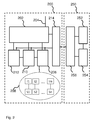
- Fig. 2 is a schematic block diagram of an arrangement of a radio device 200 and an application device 250.
- the application device 250 is connectable to the radio device 200. As such, the application device 250 may be disconnected from the radio device 200.
- the application device 200 and 250 are connected by a connection that is permanent in the view of a user.
- the radio device may for instance be comprised in a casing of the application device.
- the radio device 200 is similar to the radio device 100 described in the context of Fig. 1 .
- Functional units having a correspondence in the embodiment of Fig. 1 are in Fig. 2 shown under a reference label having the same last two digits as those used in Fig. 1 , and differ only in the first digit being a "2" instead of a "1".
- Fig. 1 For a description of their structure and functionality, reference is made to the above description in the context of Fig. 1 . The following description will focus on the differences of the radio device 200 in comparison with the radio device 100 of Fig. 1 .
- the radio device 200 additionally has a control interface 214, which is configured to provide a communicative connection between the radio device 200 and the external application device 250.
- the control interface 214 is in one embodiment an AT interface and serves for an exchange of payload and control information between the radio device 200 and the application device 250 by means of a command set named Hayes commands, AT commands or AT style commands.
- ETSI GSM 07.05 (3GPP TS 27.005) / 3GPP TS 27.007 specify exemplary AT style command sets for radio devices compatible with the GSM (2G) / UMTS (3G) standard.
- the control interface 214 is a Java interface.
- the control interface 214 is internally connected with the radio-frequency part 202, the multi-domain subscription unit 206, the multi-domain access-control unit 210, and with the multi-domain monitoring unit 212.
- the multi-domain monitoring unit 212 uses the control interface 214 to provide to the application device 250 the generated availability output indicative of whether or not a radio network service (to be) requested is available from the current radio network domain D1, to which the radio device currently maintains access, and from the other radio network domains D2 to D4 covered by the multi-domain service subscription.
- the multi-domain access-control unit 210 is additionally configured in this embodiment to receive, via the control interface 214, a request for the radio network service; and access-control information indicative of that second radio network domain selected for obtaining access to, for requesting the radio network service.
- the multi-domain access-control unit 210 is configured to obtain access to the selected radio network domain upon receiving the access-control information. In other words, control over the domain to be selected is performed by the application device 250, and the selection is communicated to the radio device via the control interface 214 and then executed under internal control by the multi-domain access control unit 210.
- the memory 208 storing subscription information is organized in a different manner in the present embodiment.
- the radio device operates with a multi-domain subscription covering four domains D1 to D4 (not shown in Fig. 2 ). It is noted that this alternative structure of allocation is merely shown here to provide another example. There is no correlation between the structure of subscription information and the provision of the control interface 214.
- the application device 250 comprises an application unit 252, a radio-service control unit 254 and an application control interface 256.
- the application unit 252 is configured to generate and communicate a request for a radio network service to the external radio device 200 via the application control interface 256.
- the application unit implements core functions of the application device. For instance, in an example of the application device forming a metering device, the application unit controls operation of a sensor, receives sensor signals and generates measuring data to be transmitted to a server by the radio device 200.
- the application unit provides a corresponding command to the radio device 200 that is communicated via the application control interface 256 of the application device 250 and the control interface 214 of the radio device 200.
- the radio-service control unit 254 is configured to receive from the radio device 200 via the control interface the availability output, which indicates whether or not the currently requested radio network service is available, not only from the radio network domain D1, to which the radio device currently maintains access, but also from at least one second of the radio network domains D2 to D4.
- the radio-service control is further configured to select a suitable domain, based on the current requirements regarding radio network services determined with a view to the needs of the application unit 252 and based on the availability output received from the radio device 200.
- the radio-service control unit 254 is configured to output, via the application control interface 256, access-control information to the external radio device 200.
- the access-control information is indicative of the selected network domain for providing the requested radio network service.
- Fig. 3 is a flow diagram illustrating embodiments of a method for operating a radio device in accordance with the present invention.
- the method is performed in the context of operating the radio device under a multi-domain service subscription enabling access to a requested radio network domain from a set of radio network domains (step 302).
- a first domain is selected and access to the first domain is requested and obtained, using respective subscription information from the multi-domain service subscription.
- access to the first domain is maintained while obtaining the requested radio network service from the first domain.
- access is always used to not more than one of the radio network domains at a given time.
- availability information regarding the requested radio network service from the current first domain is determined by evaluation of information provided by the domains. Furthermore, second availability information regarding the requested radio network service from at least one second radio network domain of the set of radio network domains is obtained in a monitoring process (step 306).
- an availability output indicative at least of those second radio network domains with determined current availability of the requested radio network service is provided (step 312). This triggers a selection of a suitable second domain, followed by accessing that domain using the required subscriber identification information, and by a request for the desired radio network service from the selected second domain (step 314).
- the process branches back to step 306 and monitors the availability of the requested services from all domains covered by the subscription, followed by steps 310 through 314.
- the availability of the other domains is monitored in step 316. Upon detection that the first domain is available for providing the currently requested service in step 318, the first domain is re-accessed in step 320.
- the embodiments described above are particularly advantageous for M2M application devices, as will be further explained in the following. For many M2M application devices it is acceptable that traffic may be delayed.
- the domain-based concept described above provides embodiments that let M2M application device be allocated from a separate group within a default M2M domain (or a subgroup of that domain). In certain situations, such M2M application devices may be barred from access to other domains, until the application requires access to other domains because a currently required radio network service cannot be delivered by the M2M domain.
- M2M application devices that allow delayed traffic are in some embodiments assigned to a default domain, which is the M2M domain.
- M2M application devices can be well distinguished from other M2M application devices. For those other M2M application devices, however, such transmission delay introduced by an assigned radio network domain may not be acceptable at all. And furthermore, there may be a group of M2M application devices having members, which sometimes accept that traffic services are delayed, but sometimes do not accept that, as decided by an application running on the M2M application device.
- an M2M application device maintaining access to the M2M domain receives a blocking indication, like getting no free resources of the M2M domain or a rejected M2M domain attach request due to specified reject causes for said domain and the desired QoS
- the radio device of the M2M application device informs the connected application device about the currently blocked state.
- the application device can instruct the radio device to switch domains so that communication can be activated again directly by switching to an appropriate domain.
- the radio device of the M2M application device informs the application device of the M2M application device of this fact (via the control interface).
- the application is in the position to select and thus eventually reactivate the currently not used identity and return to the default M2M device identity belonging to a domain allowing delayed traffic service provided by the M2M domain.
- embodiments described allow a management of different levels of Quality of Service (QoS) and service classes that can be provided by different ones of the domains.
- embodiments of the radio device provide the capability to use at least two different identities in the form of different subscriber identification information with respect to the network domains. These identities provide the ability to cope with different access allowances to the different levels of QoS provided by the different domains. For instance, specific domains allow and grant access for different QoS, for instance differentiation according to stationary devices, or degrees of mobility, and/ or traffic classes. A delayed realization of traffic may be thus form one traffic class especially for M2M application devices. On the other hand, real-time download or calls form another service class which can be supported for other application devices, including types of M2M application devices.
- the provision of a radio network service may depend on a current network load. A certain domain or domain access may be blocked by the network.
- the above embodiments of the radio device are capable of changing from the current domain to another domain in order to always have access to a domain that is suitable for delivering the currently desired radio network service. If the currently requested (or planned) radio network service is not allowed or supported by the current domain, the radio device will change the domain. The selection is based on that the radio device monitors the domains covered by the multi-domain service subscription. Some of the monitored domains may provide radio network services according to a different technology and the related data throughputs and latency times, provided for example by a different cellular access technology (3G only, HSUPA, HSDPA, HSPA+, LTE, etc). Of course, in case of no current service requests or in case the intended service is fitting to the current domain, no domain change is required.
- the identities provided by the multi-domain subscription and associated with access to different domains may be located in one physical entity. Only one of the identities is active at a time.
- the enhanced multi-domain operation of some embodiments follows certain rules for monitoring other domains, such as at least one of the following:
Landscapes
- Engineering & Computer Science (AREA)
- Computer Networks & Wireless Communication (AREA)
- Signal Processing (AREA)
- Computer Security & Cryptography (AREA)
- Databases & Information Systems (AREA)
- Environmental & Geological Engineering (AREA)
- Mobile Radio Communication Systems (AREA)
Priority Applications (6)
| Application Number | Priority Date | Filing Date | Title |
|---|---|---|---|
| EP20130191511 EP2869602A1 (de) | 2013-11-05 | 2013-11-05 | Funkeinrichtung und Verfahren zur Mehr-Domänen Überwachung und Zugriffsmanagement |
| ES14783850T ES2735012T3 (es) | 2013-11-05 | 2014-10-13 | Dispositivo de radio y procedimiento de gestión de acceso y monitorización multidominio |
| CN201480060374.0A CN105684468B (zh) | 2013-11-05 | 2014-10-13 | 用于多域监视和访问管理的无线电设备和过程 |
| EP14783850.2A EP3066847B1 (de) | 2013-11-05 | 2014-10-13 | Funkeinrichtung und verfahren zur mehr-domänen überwachung und zugriffsmanagement |
| PCT/EP2014/071876 WO2015067437A1 (en) | 2013-11-05 | 2014-10-13 | Radio device and process for multi-domain monitoring and access management |
| US15/029,079 US20160261469A1 (en) | 2013-11-05 | 2014-10-13 | Radio device and process for multi-domain monitoring and access management |
Applications Claiming Priority (1)
| Application Number | Priority Date | Filing Date | Title |
|---|---|---|---|
| EP20130191511 EP2869602A1 (de) | 2013-11-05 | 2013-11-05 | Funkeinrichtung und Verfahren zur Mehr-Domänen Überwachung und Zugriffsmanagement |
Publications (1)
| Publication Number | Publication Date |
|---|---|
| EP2869602A1 true EP2869602A1 (de) | 2015-05-06 |
Family
ID=49546277
Family Applications (2)
| Application Number | Title | Priority Date | Filing Date |
|---|---|---|---|
| EP20130191511 Withdrawn EP2869602A1 (de) | 2013-11-05 | 2013-11-05 | Funkeinrichtung und Verfahren zur Mehr-Domänen Überwachung und Zugriffsmanagement |
| EP14783850.2A Active EP3066847B1 (de) | 2013-11-05 | 2014-10-13 | Funkeinrichtung und verfahren zur mehr-domänen überwachung und zugriffsmanagement |
Family Applications After (1)
| Application Number | Title | Priority Date | Filing Date |
|---|---|---|---|
| EP14783850.2A Active EP3066847B1 (de) | 2013-11-05 | 2014-10-13 | Funkeinrichtung und verfahren zur mehr-domänen überwachung und zugriffsmanagement |
Country Status (5)
| Country | Link |
|---|---|
| US (1) | US20160261469A1 (de) |
| EP (2) | EP2869602A1 (de) |
| CN (1) | CN105684468B (de) |
| ES (1) | ES2735012T3 (de) |
| WO (1) | WO2015067437A1 (de) |
Cited By (1)
| Publication number | Priority date | Publication date | Assignee | Title |
|---|---|---|---|---|
| EP3328135A1 (de) * | 2016-11-29 | 2018-05-30 | Swisscom AG | Simultane operatordomänenanhängung eines kommunikationsendgeräts |
Families Citing this family (4)
| Publication number | Priority date | Publication date | Assignee | Title |
|---|---|---|---|---|
| WO2017197295A1 (en) * | 2016-05-12 | 2017-11-16 | M2MD Technologies, Inc. | Method and system for providing low bandwidth and high bandwidth communications services using different user equipment profiles |
| JP7110187B2 (ja) * | 2016-10-25 | 2022-08-01 | テレコム・イタリア・エッセ・ピー・アー | モバイル通信ネットワークにおける近接サービスアクセス |
| US9967813B1 (en) * | 2017-03-06 | 2018-05-08 | Sorenson Ip Holdings, Llc | Managing communication sessions with respect to multiple transport media |
| EP3884696A1 (de) * | 2018-11-20 | 2021-09-29 | Telefonaktiebolaget LM Ericsson (publ) | Verfahren und vorrichtung zum abstrahieren von netzwerkressourcen zur unterstützung der endbenutzermobilität |
Citations (6)
| Publication number | Priority date | Publication date | Assignee | Title |
|---|---|---|---|---|
| EP2268090A2 (de) * | 2009-06-26 | 2010-12-29 | Cellco Partnership D/B/A Verizon Wireless | System und Verfahren zur Verwendung mehrerer Telnehmeridentifizierungen zur Bereitstellung von differenzierten Diensten für die Teilnehmer |
| WO2011041913A1 (en) * | 2009-10-08 | 2011-04-14 | Connectif Solutions Inc. | System, method and integrated circuit chip for wireless multi- network telemetry |
| US20110117909A1 (en) * | 2009-11-17 | 2011-05-19 | Yaxin Cao | Method and system for dynamically selecting and configuring virtual modems (vms) based on performance metrics in a multi-sim multi-standby communication device |
| EP2384061A2 (de) * | 2010-04-30 | 2011-11-02 | Samsung Electronics Co., Ltd. | Vorrichtung und Verfahren für eine automatische SIM-Kartenauswahl gemäß einer Netzwerkumgebung in einem dualen Modusendgerät |
| US20120135715A1 (en) | 2009-06-05 | 2012-05-31 | Lg Electronics Inc. | Dual sim mobile terminal and operating method thereof |
| WO2012160201A1 (fr) * | 2011-05-25 | 2012-11-29 | Mobiquithings | Dispositif et procede de choix d'un reseau visite |
Family Cites Families (8)
| Publication number | Priority date | Publication date | Assignee | Title |
|---|---|---|---|---|
| EP2070345B1 (de) * | 2006-09-21 | 2019-11-13 | T-Mobile USA, Inc. | Registrierung eines drahtlosen geräts wie etwa die automatische registrierung eines wi-fi-aktivierten geräts |
| CN102065486A (zh) * | 2009-11-17 | 2011-05-18 | 美国博通公司 | 通信方法和系统 |
| US8908636B2 (en) * | 2010-06-21 | 2014-12-09 | Qualcomm Incorporated | Method and apparatus for QoS context transfer during inter radio access technology handover in a wireless communication system |
| JP2014521267A (ja) * | 2011-07-12 | 2014-08-25 | インターデイジタル パテント ホールディングス インコーポレイテッド | マルチratアクセスモード動作のための方法および装置 |
| CN104170357B (zh) * | 2012-03-13 | 2018-07-10 | 瑞典爱立信有限公司 | 无线网络中质量类索引的一般化 |
| US10334630B2 (en) * | 2012-12-10 | 2019-06-25 | Fujitsu Connected Technologies Limited | System and method for user-over-control plane messaging in a wireless network |
| US9216508B2 (en) * | 2014-01-14 | 2015-12-22 | Qualcomm Incorporated | Connectivity maintenance using a quality of service-based robot path planning algorithm |
| US10327217B2 (en) * | 2016-08-18 | 2019-06-18 | Zinwave, Ltd | Techniques for device registration and prioritization in a cellular as a service environment |
-
2013
- 2013-11-05 EP EP20130191511 patent/EP2869602A1/de not_active Withdrawn
-
2014
- 2014-10-13 CN CN201480060374.0A patent/CN105684468B/zh active Active
- 2014-10-13 WO PCT/EP2014/071876 patent/WO2015067437A1/en not_active Ceased
- 2014-10-13 EP EP14783850.2A patent/EP3066847B1/de active Active
- 2014-10-13 US US15/029,079 patent/US20160261469A1/en not_active Abandoned
- 2014-10-13 ES ES14783850T patent/ES2735012T3/es active Active
Patent Citations (6)
| Publication number | Priority date | Publication date | Assignee | Title |
|---|---|---|---|---|
| US20120135715A1 (en) | 2009-06-05 | 2012-05-31 | Lg Electronics Inc. | Dual sim mobile terminal and operating method thereof |
| EP2268090A2 (de) * | 2009-06-26 | 2010-12-29 | Cellco Partnership D/B/A Verizon Wireless | System und Verfahren zur Verwendung mehrerer Telnehmeridentifizierungen zur Bereitstellung von differenzierten Diensten für die Teilnehmer |
| WO2011041913A1 (en) * | 2009-10-08 | 2011-04-14 | Connectif Solutions Inc. | System, method and integrated circuit chip for wireless multi- network telemetry |
| US20110117909A1 (en) * | 2009-11-17 | 2011-05-19 | Yaxin Cao | Method and system for dynamically selecting and configuring virtual modems (vms) based on performance metrics in a multi-sim multi-standby communication device |
| EP2384061A2 (de) * | 2010-04-30 | 2011-11-02 | Samsung Electronics Co., Ltd. | Vorrichtung und Verfahren für eine automatische SIM-Kartenauswahl gemäß einer Netzwerkumgebung in einem dualen Modusendgerät |
| WO2012160201A1 (fr) * | 2011-05-25 | 2012-11-29 | Mobiquithings | Dispositif et procede de choix d'un reseau visite |
Cited By (1)
| Publication number | Priority date | Publication date | Assignee | Title |
|---|---|---|---|---|
| EP3328135A1 (de) * | 2016-11-29 | 2018-05-30 | Swisscom AG | Simultane operatordomänenanhängung eines kommunikationsendgeräts |
Also Published As
| Publication number | Publication date |
|---|---|
| EP3066847A1 (de) | 2016-09-14 |
| CN105684468B (zh) | 2020-02-14 |
| EP3066847B1 (de) | 2019-04-17 |
| WO2015067437A1 (en) | 2015-05-14 |
| US20160261469A1 (en) | 2016-09-08 |
| CN105684468A (zh) | 2016-06-15 |
| ES2735012T3 (es) | 2019-12-13 |
Similar Documents
| Publication | Publication Date | Title |
|---|---|---|
| EP2904855B1 (de) | Richtlinienbasierte roamingaktualisierungen für mobile vorrichtungen | |
| CA3051723C (en) | UPLINK DATA TRANSMISSION COMMAND | |
| EP2810457B1 (de) | Funkmodul, anwendungsvorrichtung und verfahren zum betrieb einer anwendungsvorrichtung zum austausch von anwendungsdaten über ein zellulares funkkommunikationsnetzwerk | |
| US10687204B1 (en) | Intelligent SIM profile procurement | |
| US11197202B2 (en) | System and method for operating a wireless network | |
| EP2291033B2 (de) | Telekommunikationsnetzwerk und verfahren für den zeitbasierten netzwerkzugang | |
| KR101317117B1 (ko) | 이동통신 시스템에서의 mtc 데이터의 혼잡 제어 방법 | |
| US9414305B2 (en) | Intelligent network selection system | |
| US12067390B2 (en) | Over-the-air firmware updates for dual-mode internet of things devices | |
| EP3066847B1 (de) | Funkeinrichtung und verfahren zur mehr-domänen überwachung und zugriffsmanagement | |
| EP3837805B1 (de) | Verfahren, vorrichtung und computerlesbare medien zur unterstützung von abonnements von ereignissen in einem kernnetzwerk | |
| US9313036B2 (en) | Communication fee prediction device, communication device, communication system, and charging method | |
| US12369071B2 (en) | System and method for reducing network component loads | |
| EP2848041B1 (de) | Verfahren und vorrichtungen für mehrfachprioritätszugang in einem drahtlosen netzwerksystem | |
| EP3021617A1 (de) | Verfahren zum Betrieb eines drahtlosen Kommunikationsgeräts in einem zellularen Netzwerk | |
| WO2015124316A1 (en) | Management of virtual subscriptions | |
| EP3313111A1 (de) | Kommunikationsnetzwerkinitiierter betreiberdomänenabonnementschaltung | |
| US11057754B2 (en) | Method for operating a wireless communication device |
Legal Events
| Date | Code | Title | Description |
|---|---|---|---|
| PUAI | Public reference made under article 153(3) epc to a published international application that has entered the european phase |
Free format text: ORIGINAL CODE: 0009012 |
|
| 17P | Request for examination filed |
Effective date: 20131105 |
|
| AK | Designated contracting states |
Kind code of ref document: A1 Designated state(s): AL AT BE BG CH CY CZ DE DK EE ES FI FR GB GR HR HU IE IS IT LI LT LU LV MC MK MT NL NO PL PT RO RS SE SI SK SM TR |
|
| AX | Request for extension of the european patent |
Extension state: BA ME |
|
| STAA | Information on the status of an ep patent application or granted ep patent |
Free format text: STATUS: THE APPLICATION IS DEEMED TO BE WITHDRAWN |
|
| 18D | Application deemed to be withdrawn |
Effective date: 20151107 |