EP2871193A1 - Oxyde de polyalkylène modifié - Google Patents
Oxyde de polyalkylène modifié Download PDFInfo
- Publication number
- EP2871193A1 EP2871193A1 EP13813421.8A EP13813421A EP2871193A1 EP 2871193 A1 EP2871193 A1 EP 2871193A1 EP 13813421 A EP13813421 A EP 13813421A EP 2871193 A1 EP2871193 A1 EP 2871193A1
- Authority
- EP
- European Patent Office
- Prior art keywords
- polyalkylene oxide
- modified polyalkylene
- oxide
- diisocyanate
- compound
- Prior art date
- Legal status (The legal status is an assumption and is not a legal conclusion. Google has not performed a legal analysis and makes no representation as to the accuracy of the status listed.)
- Granted
Links
Images
Classifications
-
- C—CHEMISTRY; METALLURGY
- C08—ORGANIC MACROMOLECULAR COMPOUNDS; THEIR PREPARATION OR CHEMICAL WORKING-UP; COMPOSITIONS BASED THEREON
- C08G—MACROMOLECULAR COMPOUNDS OBTAINED OTHERWISE THAN BY REACTIONS ONLY INVOLVING UNSATURATED CARBON-TO-CARBON BONDS
- C08G18/00—Polymeric products of isocyanates or isothiocyanates
- C08G18/06—Polymeric products of isocyanates or isothiocyanates with compounds having active hydrogen
- C08G18/28—Polymeric products of isocyanates or isothiocyanates with compounds having active hydrogen characterised by the compounds used containing active hydrogen
- C08G18/40—High-molecular-weight compounds
- C08G18/48—Polyethers
- C08G18/4833—Polyethers containing oxyethylene units
-
- A—HUMAN NECESSITIES
- A61—MEDICAL OR VETERINARY SCIENCE; HYGIENE
- A61K—PREPARATIONS FOR MEDICAL, DENTAL OR TOILETRY PURPOSES
- A61K8/00—Cosmetics or similar toiletry preparations
- A61K8/02—Cosmetics or similar toiletry preparations characterised by special physical form
- A61K8/0216—Solid or semisolid forms
-
- A—HUMAN NECESSITIES
- A61—MEDICAL OR VETERINARY SCIENCE; HYGIENE
- A61K—PREPARATIONS FOR MEDICAL, DENTAL OR TOILETRY PURPOSES
- A61K8/00—Cosmetics or similar toiletry preparations
- A61K8/18—Cosmetics or similar toiletry preparations characterised by the composition
- A61K8/72—Cosmetics or similar toiletry preparations characterised by the composition containing organic macromolecular compounds
- A61K8/84—Cosmetics or similar toiletry preparations characterised by the composition containing organic macromolecular compounds obtained by reactions otherwise than those involving only carbon-carbon unsaturated bonds
- A61K8/87—Polyurethanes
-
- A—HUMAN NECESSITIES
- A61—MEDICAL OR VETERINARY SCIENCE; HYGIENE
- A61Q—SPECIFIC USE OF COSMETICS OR SIMILAR TOILETRY PREPARATIONS
- A61Q19/00—Preparations for care of the skin
-
- C—CHEMISTRY; METALLURGY
- C08—ORGANIC MACROMOLECULAR COMPOUNDS; THEIR PREPARATION OR CHEMICAL WORKING-UP; COMPOSITIONS BASED THEREON
- C08G—MACROMOLECULAR COMPOUNDS OBTAINED OTHERWISE THAN BY REACTIONS ONLY INVOLVING UNSATURATED CARBON-TO-CARBON BONDS
- C08G18/00—Polymeric products of isocyanates or isothiocyanates
- C08G18/06—Polymeric products of isocyanates or isothiocyanates with compounds having active hydrogen
- C08G18/28—Polymeric products of isocyanates or isothiocyanates with compounds having active hydrogen characterised by the compounds used containing active hydrogen
- C08G18/2805—Compounds having only one group containing active hydrogen
- C08G18/2815—Monohydroxy compounds
- C08G18/283—Compounds containing ether groups, e.g. oxyalkylated monohydroxy compounds
-
- C—CHEMISTRY; METALLURGY
- C08—ORGANIC MACROMOLECULAR COMPOUNDS; THEIR PREPARATION OR CHEMICAL WORKING-UP; COMPOSITIONS BASED THEREON
- C08G—MACROMOLECULAR COMPOUNDS OBTAINED OTHERWISE THAN BY REACTIONS ONLY INVOLVING UNSATURATED CARBON-TO-CARBON BONDS
- C08G18/00—Polymeric products of isocyanates or isothiocyanates
- C08G18/06—Polymeric products of isocyanates or isothiocyanates with compounds having active hydrogen
- C08G18/28—Polymeric products of isocyanates or isothiocyanates with compounds having active hydrogen characterised by the compounds used containing active hydrogen
- C08G18/40—High-molecular-weight compounds
- C08G18/48—Polyethers
- C08G18/4833—Polyethers containing oxyethylene units
- C08G18/4837—Polyethers containing oxyethylene units and other oxyalkylene units
- C08G18/4841—Polyethers containing oxyethylene units and other oxyalkylene units containing oxyethylene end groups
-
- C—CHEMISTRY; METALLURGY
- C08—ORGANIC MACROMOLECULAR COMPOUNDS; THEIR PREPARATION OR CHEMICAL WORKING-UP; COMPOSITIONS BASED THEREON
- C08G—MACROMOLECULAR COMPOUNDS OBTAINED OTHERWISE THAN BY REACTIONS ONLY INVOLVING UNSATURATED CARBON-TO-CARBON BONDS
- C08G18/00—Polymeric products of isocyanates or isothiocyanates
- C08G18/06—Polymeric products of isocyanates or isothiocyanates with compounds having active hydrogen
- C08G18/70—Polymeric products of isocyanates or isothiocyanates with compounds having active hydrogen characterised by the isocyanates or isothiocyanates used
- C08G18/72—Polyisocyanates or polyisothiocyanates
- C08G18/73—Polyisocyanates or polyisothiocyanates acyclic
-
- C—CHEMISTRY; METALLURGY
- C08—ORGANIC MACROMOLECULAR COMPOUNDS; THEIR PREPARATION OR CHEMICAL WORKING-UP; COMPOSITIONS BASED THEREON
- C08G—MACROMOLECULAR COMPOUNDS OBTAINED OTHERWISE THAN BY REACTIONS ONLY INVOLVING UNSATURATED CARBON-TO-CARBON BONDS
- C08G18/00—Polymeric products of isocyanates or isothiocyanates
- C08G18/06—Polymeric products of isocyanates or isothiocyanates with compounds having active hydrogen
- C08G18/70—Polymeric products of isocyanates or isothiocyanates with compounds having active hydrogen characterised by the isocyanates or isothiocyanates used
- C08G18/72—Polyisocyanates or polyisothiocyanates
- C08G18/74—Polyisocyanates or polyisothiocyanates cyclic
- C08G18/75—Polyisocyanates or polyisothiocyanates cyclic cycloaliphatic
- C08G18/751—Polyisocyanates or polyisothiocyanates cyclic cycloaliphatic containing only one cycloaliphatic ring
- C08G18/752—Polyisocyanates or polyisothiocyanates cyclic cycloaliphatic containing only one cycloaliphatic ring containing at least one isocyanate or isothiocyanate group linked to the cycloaliphatic ring by means of an aliphatic group
- C08G18/753—Polyisocyanates or polyisothiocyanates cyclic cycloaliphatic containing only one cycloaliphatic ring containing at least one isocyanate or isothiocyanate group linked to the cycloaliphatic ring by means of an aliphatic group containing one isocyanate or isothiocyanate group linked to the cycloaliphatic ring by means of an aliphatic group having a primary carbon atom next to the isocyanate or isothiocyanate group
-
- C—CHEMISTRY; METALLURGY
- C08—ORGANIC MACROMOLECULAR COMPOUNDS; THEIR PREPARATION OR CHEMICAL WORKING-UP; COMPOSITIONS BASED THEREON
- C08G—MACROMOLECULAR COMPOUNDS OBTAINED OTHERWISE THAN BY REACTIONS ONLY INVOLVING UNSATURATED CARBON-TO-CARBON BONDS
- C08G18/00—Polymeric products of isocyanates or isothiocyanates
- C08G18/06—Polymeric products of isocyanates or isothiocyanates with compounds having active hydrogen
- C08G18/70—Polymeric products of isocyanates or isothiocyanates with compounds having active hydrogen characterised by the isocyanates or isothiocyanates used
- C08G18/72—Polyisocyanates or polyisothiocyanates
- C08G18/74—Polyisocyanates or polyisothiocyanates cyclic
- C08G18/75—Polyisocyanates or polyisothiocyanates cyclic cycloaliphatic
- C08G18/758—Polyisocyanates or polyisothiocyanates cyclic cycloaliphatic containing two or more cycloaliphatic rings
-
- C—CHEMISTRY; METALLURGY
- C08—ORGANIC MACROMOLECULAR COMPOUNDS; THEIR PREPARATION OR CHEMICAL WORKING-UP; COMPOSITIONS BASED THEREON
- C08G—MACROMOLECULAR COMPOUNDS OBTAINED OTHERWISE THAN BY REACTIONS ONLY INVOLVING UNSATURATED CARBON-TO-CARBON BONDS
- C08G18/00—Polymeric products of isocyanates or isothiocyanates
- C08G18/06—Polymeric products of isocyanates or isothiocyanates with compounds having active hydrogen
- C08G18/70—Polymeric products of isocyanates or isothiocyanates with compounds having active hydrogen characterised by the isocyanates or isothiocyanates used
- C08G18/72—Polyisocyanates or polyisothiocyanates
- C08G18/74—Polyisocyanates or polyisothiocyanates cyclic
- C08G18/76—Polyisocyanates or polyisothiocyanates cyclic aromatic
- C08G18/7614—Polyisocyanates or polyisothiocyanates cyclic aromatic containing only one aromatic ring
- C08G18/7621—Polyisocyanates or polyisothiocyanates cyclic aromatic containing only one aromatic ring being toluene diisocyanate including isomer mixtures
-
- C—CHEMISTRY; METALLURGY
- C08—ORGANIC MACROMOLECULAR COMPOUNDS; THEIR PREPARATION OR CHEMICAL WORKING-UP; COMPOSITIONS BASED THEREON
- C08G—MACROMOLECULAR COMPOUNDS OBTAINED OTHERWISE THAN BY REACTIONS ONLY INVOLVING UNSATURATED CARBON-TO-CARBON BONDS
- C08G18/00—Polymeric products of isocyanates or isothiocyanates
- C08G18/06—Polymeric products of isocyanates or isothiocyanates with compounds having active hydrogen
- C08G18/70—Polymeric products of isocyanates or isothiocyanates with compounds having active hydrogen characterised by the isocyanates or isothiocyanates used
- C08G18/72—Polyisocyanates or polyisothiocyanates
- C08G18/74—Polyisocyanates or polyisothiocyanates cyclic
- C08G18/76—Polyisocyanates or polyisothiocyanates cyclic aromatic
- C08G18/7657—Polyisocyanates or polyisothiocyanates cyclic aromatic containing two or more aromatic rings
- C08G18/7685—Polyisocyanates or polyisothiocyanates cyclic aromatic containing two or more aromatic rings containing two or more non-condensed aromatic rings directly linked to each other
-
- C—CHEMISTRY; METALLURGY
- C09—DYES; PAINTS; POLISHES; NATURAL RESINS; ADHESIVES; COMPOSITIONS NOT OTHERWISE PROVIDED FOR; APPLICATIONS OF MATERIALS NOT OTHERWISE PROVIDED FOR
- C09D—COATING COMPOSITIONS, e.g. PAINTS, VARNISHES OR LACQUERS; FILLING PASTES; CHEMICAL PAINT OR INK REMOVERS; INKS; CORRECTING FLUIDS; WOODSTAINS; PASTES OR SOLIDS FOR COLOURING OR PRINTING; USE OF MATERIALS THEREFOR
- C09D175/00—Coating compositions based on polyureas or polyurethanes; Coating compositions based on derivatives of such polymers
- C09D175/04—Polyurethanes
-
- A—HUMAN NECESSITIES
- A61—MEDICAL OR VETERINARY SCIENCE; HYGIENE
- A61K—PREPARATIONS FOR MEDICAL, DENTAL OR TOILETRY PURPOSES
- A61K2800/00—Properties of cosmetic compositions or active ingredients thereof or formulation aids used therein and process related aspects
- A61K2800/40—Chemical, physico-chemical or functional or structural properties of particular ingredients
- A61K2800/48—Thickener, Thickening system
Definitions
- the present invention relates to a modified polyalkylene oxide.
- nonionic polyurethane-based thickeners that exhibit thickening properties upon aggregation of hydrophobic groups are recently attracting more attention as thickeners, particularly for products such as cosmetics.
- polyurethane-based thickeners exhibit more increased thickening properties through the association of hydrophobic groups located at the terminals. Because of their nonionic nature, these polyurethane-based thickeners are excellent in salt tolerance, and can suitably be used in combination with ionic surfactants, while being capable of imparting additional rheological properties.
- Non-Patent Document 1 It is known in this field of technology that the thickening properties increase along with an increase in the chain length of hydrophobic groups located at the terminals.
- Examples of known polyurethane-based thickeners include: those having three hydrophobic groups that are linked through hydrophilic polyester segments of at least 1500 molecular weight each, with at least two of the three hydrophobic groups being located at the terminals (Patent Document 1); and those obtained by the reaction of (a) at least one water-soluble polyetherpolyol, (b) at least one water-insoluble organic polyisocyanate, (c) at least one monofunctional hydrophobic organic compound selected from the group consisting of compounds containing a hydrogen atom reactive with an isocyanate and organic monoisocyanates, and (d) at least one polyhydric alcohol or polyhydric alcohol ether (Patent Documents 2 and 3).
- Patent Document 4 a polyurethane-based thickener characterized by comprising a monohydric alcohol containing at least one other polar group and a trihydric alcohol as a polyhydric alcohol
- Patent Document 5 a viscosity modifier obtained by using a polyether monohydric alcohol containing as a hydrophobic group at least one branched chain or at least one secondary hydrocarbon group
- the thickening properties of the polyurethane-based thickeners obtained by such conventional techniques become greater, due to the increased association power of the hydrophobic groups.
- an increased number of carbon atoms at the terminal alcohol leads to poor affinity for water, and aqueous solutions containing such thickeners are likely to become tacky.
- the cosmetics exhibit a heavy feel when used.
- Another drawback is that because molecular chain terminals modified into hydrophobic groups lower the affinity for water, the aqueous solution becomes turbid.
- the proportion of hydrophobic groups may be decreased so that the transparency of the aqueous solution is improved. In this case, however, the viscosity decreases when a cationic surfactant (those used particularly for hair care products) is added.
- Polyurethane-based thickeners are nonionic. Thus, unlike polyacrylic acid-based thickeners, polyurethane-based thickeners, when used in combination with a cationic surfactant, do not generally produce the precipitation of aggregates resulting from the interaction between cations and anions. However, a polyurethane-based thickener in combination with a cationic surfactant results in a thickened liquid with poor transparency, thereby giving the liquid an undesirable appearance.
- Non-patent Document 1 J. Coating Technology Vol. 64, No. 804, pp. 87-94 (1992 )
- An object of the present invention is to provide a modified polyalkylene oxide capable of yielding an aqueous solution excellent in transparency with high viscosity, even when used in combination with a cationic surfactant.
- the present inventors conducted extensive research to achieve the above object and found a modified polyalkylene oxide that can be used as a thickener.
- the modified polyalkylene oxide is configured such that a specific polyalkylene oxide compound is bound at the terminals to specific polyether monohydric alcohols comprising an ethylene oxide/propylene oxide random copolymer and a monohydric alcohol via specific diisocyanates.
- the inventors also found that such a modified polyalkylene oxide can provide an aqueous solution excellent in transparency, even when combined with a cationic surfactant, and that a small amount of such a modified polyalkylene oxide can achieve high viscosity.
- the inventors made further improvements and completed the invention.
- the present invention includes the subject matter presented in the following items.
- the modified polyalkylene oxide according to the present invention even in combination with a cationic surfactant, maintains the excellent transparency of a solution without decreasing viscosity.
- the use of the modified polyalkylene oxide according to the present invention can provide a transparent and highly viscous aqueous solution.
- the modified polyalkylene oxide according to the present invention is obtained by reacting a specific polyalkylene oxide compound (A), a specific polyether monohydric alcohol (B), and a specific diisocyanate compound (C).
- a specific polyalkylene oxide compound (A) a specific polyether monohydric alcohol (B)
- a specific diisocyanate compound (C) a specific diisocyanate compound (C).
- these components may be simply referred to as (A), (B), and (C).
- the polyethylene oxide preferably has a number average molecular weight of about 6,000 to 30,000, and more preferably about 11,000 to 20,000.
- (A) having a number average molecular weight of 6,000 or more is less likely to cause a decrease in transparency of an aqueous solution of the modified polyalkylene oxide.
- the use of (A) having a number average molecular weight of 30,000 or less is less likely to cause a decrease in viscosity of an aqueous solution of the modified polyalkylene oxide.
- the number average molecular weight of the polyethylene oxide (A) is determined from the following formula using the hydroxyl number O 1 determined in accordance with method A in JIS K 155-1:2007 (Plastics - Polyols for Use in the Production of Polyurethane - Part 1: Determination of Hydroxyl Number). Specifically, the number average molecular weight is determined from the following formula assuming that the polyethylene oxide has a hydroxyl group at each end.
- the polyether monohydric alcohol may also be termed "polyoxyethylene polyoxypropylene monoalkyl ether in which ethylene oxide is randomly copolymerized with propylene oxide in the molar ratio (a/b) of 1 to 2 (preferably 1.1 to 1.5) and a C 15-24 linear-chain alkyl group is present.”
- the part [(OCH 2 CH 2 ) a -ran-(OCH 2 CH(CH 3 )) b ] indicates that the constitutional units (OCH 2 CH 2 ) and (OCH 2 CH(CH 3 )) are randomly copolymerized.
- the degree of polymerization of each constitutional unit is represented by a and b. From this, it is clear that the [ran] in [ ⁇ i -ran- ⁇ j ] indicates that the constitutional units ⁇ and ⁇ are randomly copolymerized at the polymerization degree of i and j, respectively.
- the a/b ratio of (B) is 1 to 2 as stated above, and preferably 1.1 to 1.5.
- the ratio of less than 1 is not preferable because the obtained modified polyalkylene oxide becomes less water soluble, and thus the aqueous solution exhibits decreased transparency.
- the ratio of more than 2 is not preferable because the aqueous solution becomes less viscous, and exhibits decreased transparency, particularly when the obtained modified polyalkylene oxide is used in combination with a cationic surfactant.
- a is an integer of 5 to 10.
- b is an integer of 5 to 8. More preferably, a is an integer of 5 to 10 whereas b is an integer of 5 to 8.
- a is 5 or more, an aqueous solution of the obtained modified polyalkylene oxide can exhibit increased viscosity.
- a is 10 or less, an aqueous solution of the obtained modified polyalkylene oxide can exhibit increased transparency.
- b is 5 or more, an aqueous solution of the obtained modified polyalkylene oxide can exhibit increased transparency.
- b is 8 or less, an aqueous solution of the obtained modified polyalkylene oxide can exhibit increased viscosity.
- R 1 is a linear-chain C 15-24 alkyl, preferably a linear-chain C 16-22 alkyl, and more preferably a linear-chain C 16-20 alkyl.
- an aqueous solution of the obtained modified polyalkylene oxide can exhibit increased viscosity.
- an aqueous solution of the obtained modified polyalkylene oxide can exhibit increased transparency.
- the random copolymer of propylene oxide and ethylene oxide is, for example, a blocked copolymer of propylene oxide and ethylene oxide
- the obtained modified polyalkylene oxide becomes less water soluble, and thus, the aqueous solution exhibits decreased transparency. Therefore, a blocked copolymer of propylene oxide and ethylene oxide is not preferable.
- addition polymerization of ethylene oxide and propylene oxide to a linear-chain monohydric saturated alcohol ordinary methods may be employed.
- the addition polymerization may be carried out by using radical polymerization employing a peroxide or an azo group-containing polymerization initiator or by using a thiol group-containing polymerization-chain-transfer agent that readily causes a chain-transfer reaction.
- (C) examples include 4,4'-diphenylmethane diisocyanate (MDI), 1,6-hexamethylene diisocyanate (HDI), dicyclohexylmethane-4,4'-diisocyanate (HMDI), 3-isocyanatemethyl-3,5,5-trimethyl cyclohexylisocyanate (IPDI), 1,8-dimethylbenzole-2,4-diisocyanate, and 2,4-tolylene diisocyanate (TDI).
- MDI 4,4'-diphenylmethane diisocyanate
- HDI 1,6-hexamethylene diisocyanate
- HMDI dicyclohexylmethane-4,4'-diisocyanate
- IPDI 3-isocyanatemethyl-3,5,5-trimethyl cyclohexylisocyanate
- 1,8-dimethylbenzole-2,4-diisocyanate 1,8-dimethylbenzole-2
- diisocyanate compounds dicyclohexylmethane-4,4'-diisocyanate (HMDI), and 1,6-hexamethylene diisocyanate (HDI) are preferable from the standpoint of excellent weatherability and transparency imparted to the obtained modified polyalkylene oxide.
- HMDI dicyclohexylmethane-4,4'-diisocyanate
- HDI 1,6-hexamethylene diisocyanate
- the molar amount of isocyanate groups in the isocyanate compound is preferably 0.8 to 1.2, and more preferably 0.9 to 1.1.
- the isocyanate groups are preferably present in an amount of 0.8 to 1.2 moles, and more preferably 0.9 to 1.1 moles, in the isocyanate compound
- the total amount of the terminal hydroxy groups in (A) and (B) is taken as a mole.
- the isocyanate group When the isocyanate group is present in an amount of 0.8 mole or more, not much unreacted polyether monohydric alcohol remains, and an aqueous solution of the obtained modified polyalkylene oxide is less likely to exhibit decreased viscosity. When the isocyanate group is present in an amount of 1.2 moles or less, the water solubility can be improved.
- the modified polyalkylene oxide according to the present invention can be obtained by reacting (A), (B), and (C), as stated above, and the compound represented by the following formula (I) is considered to be the major component.
- R 1 , R 2 , a, b, [(OCH 2 CH 2 ) a -ran-(OCH 2 CH(CH 3 )) b ], and n are as defined above, and m is an integer of 1 to 4.
- Examples of methods for reacting a polyalkylene oxide compound (A), a polyether monohydric alcohol (B), and a diisocyanate compound (C) include: methods comprising the step of dissolving or dispersing (A), (B), and (C) in a reaction solvent, such as toluene, xylene, and dimethylformamide, to carry out a reaction; and methods comprising the steps of pulverizing solids into powders (powders) or melting solids into liquids, uniformly mixing them, and heating the mixture to a predetermined temperature for reaction.
- a preferable method comprises the steps of continuously supplying heated and melted starting materials to a multi-screw extruder and mixing them in the extruder for reaction.
- the reaction temperature is preferably 70 to 210°C, more preferably 90 to 180°C, and still more preferably 100 to 160°C.
- the reaction time is suitably determined such that the reaction is complete, depending on the reaction temperature and the type of the polyalkylene oxide compound, polyether monohydric alcohol, and diisocyanate compound to be used.
- the reaction time refers to the mean residence time in the multi-screw extruder, which is determined by the following procedure.
- a trace of colorant e.g., pulverized red chalk or blue No.
- the time at which a portion with the deepest color is discharged is determined as the mean residence time.
- the amount of supply, the rotation speed, and the shape of the screws can be adjusted.
- a small amount of a reaction accelerator such as triethylamine, triethanolamine, dibutyltin diacetate, dibutyltin dilaurate, stannous octoate, and triethylenediamine, can be added to the reaction system to promote the reaction.
- the amount of the reaction accelerator to be added is preferably 200 to 2,000 mass ppm, and more preferably 500 to 1,000 mass ppm, based on the polyalkylene oxide compound.
- a modified polyalkylene oxide can be obtained by mixing a polyalkylene oxide compound, a polyether monohydric alcohol, and a diisocyanate compound in a suitable reactor, such as an extruder, and subjecting the mixture to a reaction.
- a modified polyalkylene oxide is obtained as a mixture largely comprising a component in which a polyalkylene oxide compound and a diisocyanate compound are repeatedly polymerized such that m in formula (I) is about 1 to 4.
- the mixture can be used without separation.
- the mixing ratio can be examined by a separation technique such as GPC.
- a component polymerized such that m is 1 to 2 is the main product.
- the obtained modified polyalkylene oxide can be used preferably in the production of cosmetics.
- the obtained modified polyalkylene oxide can be added and dissolved during the production process of cosmetics.
- the obtained modified polyalkylene oxide can preferably be added in an amount of 0.01 to 5% by mass, and more preferably 0.05 to 3% by mass.
- the present invention encompasses a cosmetic composition containing the modified polyalkylene oxide; in particular, a cosmetic composition containing the modified polyalkylene oxide in the aforementioned amount is preferable.
- the obtained modified polyalkylene oxide when contained in an amount of 0.01% by mass or more, produces the thickening effect more preferably.
- the obtained modified polyalkylene oxide can also be used after being diluted, for example, with water; an aqueous solution containing a salt, such as sodium chloride, or a surfactant; an aqueous solution of diethylene glycol monobutyl ether, triethylene glycol monobutyl ether, polypropylene glycol, propylene glycol, or the like; and polyethylene glycol 200.
- a salt such as sodium chloride, or a surfactant
- diethylene glycol monobutyl ether triethylene glycol monobutyl ether, polypropylene glycol, propylene glycol, or the like
- polyethylene glycol 200 polyethylene glycol 200.
- the obtained modified polyalkylene oxide can be diluted to a concentration of 5 to 50% by mass before use. To shorten the dissolution time period, the obtained modified polyalkylene oxide can be milled before use.
- the obtained modified polyalkylene oxide is milled to a median particle size of about 100 ⁇ m.
- the milling technique is not limited, cryomilling in liquid nitrogen is optimally used.
- the median particle size refers to the median size determined by a dry sieving method (JIS Z8815). Specifically, 50 g of a resin (modified polyalkylene oxide) is weighed out, and sieved by using JIS standard sieves (JIS Z8801), followed by weighing the resin of each sieve. The results indicate the point at which the cumulative percentage by mass of the resin retained in each sieve is 50%, and the particle size at that point is considered to be the median particle size.
- the modified polyalkylene oxide according to the present invention causes little change in viscosity when used in combination with a nonionic, anionic, or cationic surfactant, or a salt.
- the modified polyalkylene oxide can be used in an excellent manner in combination with cationic surfactants, which has conventionally been difficult to do. Even when the modified polyalkylene oxide is used in combination with a cationic surfactant, high transparency is retained.
- cationic surfactants examples include alkyl trimethyl ammonium chloride, stearyl trimethyl ammonium chloride, stearyl trimethyl ammonium bromide, cetostearyl trimethyl ammonium chloride, distearyl dimethyl ammonium chloride, stearyl dimethyl benzyl ammonium chloride, behenyl trimethyl ammonium bromide, benzalkonium chloride, behenic acid amide propyldimethyl hydroxypropyl ammonium chloride, stearic acid diethylaminoethyl amide, stearic acid dimethylaminopropylamide, and lanolin-derived quaternary ammonium salts.
- the modified polyalkylene oxide according to the present invention preferably has a number average molecular weight of 10,000 or more, more preferably 10,000 to 50,000, still more preferably 12,000 to 45,000, and still further preferably 15,000 to 40,000.
- the number average molecular weight in this specification is determined by GPC analysis under the conditions described in "GPC Analysis" in the Examples below.
- the present invention preferably encompasses a composition that contains, in addition to the modified polyalkylene oxide according to the present invention, a surfactant or a salt as described above (particularly a cationic surfactant).
- a composition contains a surfactant or a salt in an amount of, for example, 1.0 to 2% by mass, and preferably 0.2 to 1.5% by mass.
- the composition is preferably a cosmetic composition, and more preferably a hair care composition.
- a common technique can be employed for producing such a cosmetic composition or hair care composition, and the composition may contain other components.
- moisturizers e.g., glycol
- antibacterial components e.g., polylysine
- colorants e.g., fragrances, antioxidants, UV absorbers, and plant extracts.
- the viscosity of a 2% by mass aqueous solution of the modified polyalkylene oxide according to the present invention can be determined by measuring the viscosity at a shear rate of 0.001 to 1,000 [1/s] at 25°C using a cone-and-plate rheometer (AR2000 manufactured by TA Instruments) with a cone (60 mm, cone angle: 1°).
- a 2% by mass aqueous solution of the modified polyalkylene oxide according to the present invention preferably has a viscosity of about 100 to 300 [Pa ⁇ s] at a shear rate of 1 [1/s] as measured above.
- a cone-and-plate rheometer can detect viscous behavior in more detail than conventional B-type viscometers.
- the transparency of the modified polyalkylene oxide according to the present invention can be evaluated on the basis of light transmission at 425 nm that is measured by using a UV-visible spectrophotometer after placing a 1% by mass aqueous solution of the modified polyalkylene oxide on a quartz glass having an optical path length of 1 cm.
- the light transmittance determined in the above manner is preferably 70% or more, more preferably 80% or more, and still more preferably 90% or more.
- a cosmetic product that contains such a modified polyalkylene oxide having a light transmittance of 70% or more exhibits more increased transparency.
- conventional polyacrylic acid-based thickeners can provide an aqueous solution having a light transmittance of 90% or higher, such thickeners are not preferable because the aqueous solution becomes inhomogeneous and less viscous due to the precipitation of the polymer when the thickeners are used in combination with a cationic surfactant, which is useful for hair care products.
- the modified polyalkylene oxide according to the present invention can be processed into various molded articles using a device, such as a kneader, a roll, an extruder, and a hot press.
- the modified polyalkylene oxide is suitably processed into flexible molded articles, such as sheets and films.
- a fragrance and/or a surfactant can also be added in the molding process.
- the molded articles produced from the modified polyalkylene oxide according to the present invention are easily dissolved in water.
- the sheets and films produced from the modified polyalkylene oxide according to the present invention are water soluble, and can be easily dissolved in a small amount of moisture.
- Such sheets and films can suitably be used for cosmetic materials, such as facial masks, because of their quick dissolution in water, skin toner, and milky lotion for the skin, as well as their excellent adhesion. Additionally, such sheets and films can suitably be used, for example, for toiletry cleaning products due to their speedy dissolution in sewage.
- the modified polyalkylene oxide according to the present invention can also be molded by melt-mixing with another thermoplastic resin when molded, and can thus be used to improve the hydrophilicity and smoothness of the surface of the resin.
- a modified polyalkylene oxide was individually added to 294 g of ion-exchanged water and 294 g of an aqueous solution containing 1% by mass of stearyl trimethyl ammonium chloride, which is a cationic surfactant. The mixtures were stirred at 30°C at 300 rpm for 3 hours, thereby giving aqueous solutions containing 2% by mass of a modified polyalkylene oxide.
- the viscosity of the obtained aqueous solutions was measured at a shear rate in the range of 0.001 to 1,000 [1/s] at 25°C using a cone-and-plate rheometer (AR2000 manufactured by TA Instruments Inc.) with a cone (60 mm, cone angle 1°).
- aqueous solution containing 2% by mass of a modified polyalkylene oxide and an aqueous solution containing 2% by mass of a modified polyalkylene oxide and 1.0% by mass of stearyl trimethyl ammonium chloride were prepared in the same manner as in the above section (1).
- 4.5 mL of each of the solutions was centrifuged (1,800 rpm) to remove bubbles, and measured for light transmittance at 425 nm with a UV-visible spectrophotometer (UV-3150: Shimadzu Corp.) to evaluate transparency.
- PEO is the abbreviation for polyethylene oxide
- PEO conversion indicates the molecular weight of a modified polyalkylene oxide determined from a calibration curve created by using a PEO of a known molecular weight as a molecular weight marker of GPC.
- the median particle size was determined by a dry sieving method (JIS Z8815). Specifically, 50 g of a resin was weighed out, and sieved by using JIS standard sieves (JIS Z8801). The resin of each sieve was weighed, and the particle size at the point of cumulative mass of 50% was determined on the basis of the results.
- dicyclohexylmethane-4,4'-diisocyanate was placed in a storage tank B heated to 30°C, and stored in a nitrogen gas atmosphere.
- Tables 1 and 2 show the starting materials used and evaluation results.
- 1,6-hexamethylene diisocyanate was placed in a storage tank B heated to 30°C, and stored in a nitrogen gas atmosphere.
- Tables 1 and 2 show the starting materials used and evaluation results.
- dicyclohexylmethane-4,4'-diisocyanate was placed in a storage tank B heated to 30°C, and stored in a nitrogen gas atmosphere.
- Tables 1 and 2 show the starting materials used and evaluation results.
- dicyclohexylmethane-4,4'-diisocyanate was placed in a storage tank B heated to 30°C, and stored in a nitrogen gas atmosphere.
- Tables 1 and 2 show the starting materials used and evaluation results.
- 1,6-hexamethylene diisocyanate was placed in a storage tank B heated to 30°C, and stored in a nitrogen gas atmosphere.
- Tables 1 and 2 show the starting materials used and evaluation results.
- dicyclohexylmethane-4,4'-diisocyanate was placed in a storage tank B heated to 30°C, and stored in a nitrogen gas atmosphere.
- Tables 1 and 2 show the starting materials used and evaluation results.
- dicyclohexylmethane-4,4'-diisocyanate was placed in a storage tank B heated to 30°C, and stored in a nitrogen gas atmosphere.
- Tables 1 and 2 show the starting materials used and evaluation results.
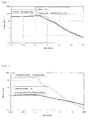
- Figs. 1 and 2 show the results of viscosity measurement of Example 1 and Comparative Example 3.
- Mn indicates a number average molecular weight.
- n, m, a, b, and R 1 are defined as in formulae (I) to (IV) above.
- the modified polyalkylene oxide obtained in Example 1 was molded into a sheet of 10 cm ⁇ 10 cm ⁇ 0.01 cm by using a hot press (manufactured by Gonno Suiatsuki Seisakusho, 40 t press, pressure: 4.9 MPa ⁇ G) set at 160°C.
- a hot press manufactured by Gonno Suiatsuki Seisakusho, 40 t press, pressure: 4.9 MPa ⁇ G
- the obtained sheet When folder in halt along the center line at 180 degrees, exhibited sufficient flexibility and strength without being fractured. Further, after the obtained sheet was cut into a 5 cm ⁇ 5 cm piece and immersed in 200 mL of ion-exchanged water at 25°C in a 300 mL beaker, the cut-out piece was fully dissolved in 10 seconds.
- Example 4 Poly-EO 90 4000 8 6 1.3 18 1.44 HMDI 1.00 50 35 10 5 9,500 1) Poly-EO: Polyethylene Oxide 2) HMDI : Dicyclohexylmethane-4,4'-diisocyanate, HDI: 1,6-Hexamethylene diisocyanate Table 2 Viscosity of 2% by mass aqueous solution [Pa ⁇ s] (Water) Viscosity of 2% by mass aqueous solution [Pa ⁇ s] (1% Stearyl trimethyl ammonium chloride) 0.001 [1/s] 0.01 [1/s] 0.1 [1/s] 1 [1/s] 10 [1/s] 100 [1/s] 1000 [1/s] Transparency [%] 0.001 [1/s] 0.01 [1/s] 0.1 [1/s] 1 [1/s] 10 [1/s] 100 [1/s] 1000 [1/s] Transparency [%] Example 1 400 430 410 160 21 2.5 0.67 91.5 400 430 410 400 21 2.5 0.67 91.5 Example 2
- Example 1 700 650 630 200 58 25 3.5 58.5 700 650 630 200 58 25 3.5 56.5 Comp.
- Example 2 350 350 330 120 15 1.5 0.07 85.5 350 350 330 120 15 1.5 0.07 62.5 Comp.
- Example 3 2100 2200 2150 130 11 1.1 0.15 88.5 8.2 10.1 7.8 5.4 2.6 1.2 05 88.5 Comp.
- Example 4 650 650 630 250 80 25 12 65.5 650 650 630 250 80 25 12 65.5
Landscapes
- Chemical & Material Sciences (AREA)
- Health & Medical Sciences (AREA)
- Organic Chemistry (AREA)
- Chemical Kinetics & Catalysis (AREA)
- Medicinal Chemistry (AREA)
- Polymers & Plastics (AREA)
- Life Sciences & Earth Sciences (AREA)
- General Health & Medical Sciences (AREA)
- Animal Behavior & Ethology (AREA)
- Public Health (AREA)
- Veterinary Medicine (AREA)
- Epidemiology (AREA)
- Birds (AREA)
- Engineering & Computer Science (AREA)
- Materials Engineering (AREA)
- Dermatology (AREA)
- Wood Science & Technology (AREA)
- Manufacturing & Machinery (AREA)
- Polyurethanes Or Polyureas (AREA)
- Cosmetics (AREA)
Applications Claiming Priority (2)
| Application Number | Priority Date | Filing Date | Title |
|---|---|---|---|
| JP2012152948 | 2012-07-06 | ||
| PCT/JP2013/068501 WO2014007366A1 (fr) | 2012-07-06 | 2013-07-05 | Oxyde de polyalkylène modifié |
Publications (3)
| Publication Number | Publication Date |
|---|---|
| EP2871193A1 true EP2871193A1 (fr) | 2015-05-13 |
| EP2871193A4 EP2871193A4 (fr) | 2016-03-09 |
| EP2871193B1 EP2871193B1 (fr) | 2018-06-27 |
Family
ID=49882117
Family Applications (1)
| Application Number | Title | Priority Date | Filing Date |
|---|---|---|---|
| EP13813421.8A Active EP2871193B1 (fr) | 2012-07-06 | 2013-07-05 | Oxyde de polyalkylène modifié |
Country Status (7)
| Country | Link |
|---|---|
| US (1) | US9605107B2 (fr) |
| EP (1) | EP2871193B1 (fr) |
| JP (1) | JP6214532B2 (fr) |
| KR (1) | KR102005465B1 (fr) |
| CN (1) | CN104428334B (fr) |
| CA (1) | CA2878312C (fr) |
| WO (1) | WO2014007366A1 (fr) |
Cited By (1)
| Publication number | Priority date | Publication date | Assignee | Title |
|---|---|---|---|---|
| EP3819352A4 (fr) * | 2018-07-04 | 2022-03-23 | Sumitomo Seika Chemicals Co., Ltd. | Composition de polissage |
Families Citing this family (3)
| Publication number | Priority date | Publication date | Assignee | Title |
|---|---|---|---|---|
| JP6400305B2 (ja) * | 2014-03-03 | 2018-10-03 | 住友精化株式会社 | ポリアルキレンオキシド変性物の溶解方法 |
| JP6878282B2 (ja) * | 2015-09-09 | 2021-05-26 | 住友精化株式会社 | 水中油型化粧料及び日焼け止め化粧料 |
| JP7185641B2 (ja) * | 2017-12-04 | 2022-12-07 | 住友精化株式会社 | 揮発性物質放散用組成物 |
Family Cites Families (16)
| Publication number | Priority date | Publication date | Assignee | Title |
|---|---|---|---|---|
| US4079028A (en) | 1975-10-03 | 1978-03-14 | Rohm And Haas Company | Polyurethane thickeners in latex compositions |
| US4155892A (en) | 1975-10-03 | 1979-05-22 | Rohm And Haas Company | Polyurethane thickeners for aqueous compositions |
| JPS5480349A (en) | 1977-12-06 | 1979-06-27 | Rohm & Haas | Polyurethane thickener for latex composition |
| DE4137247A1 (de) | 1991-11-13 | 1993-05-19 | Henkel Kgaa | Verdickungsmittel auf polyurethanbasis |
| DE4327481A1 (de) | 1993-08-16 | 1995-02-23 | Bayer Ag | Als Verdickungsmittel geeignete Polyurethane und ihre Verwendung zur Verdickung wäßriger Systeme |
| DE19503281A1 (de) | 1995-02-02 | 1996-08-08 | Bayer Ag | Als Verdickungsmittel für wäßrige Systeme geeignete Polyurethane |
| KR100404774B1 (ko) | 1995-09-06 | 2004-04-01 | 아사히 덴카 고교 가부시키가이샤 | 점성조정제 |
| JP3581452B2 (ja) | 1995-09-06 | 2004-10-27 | 旭電化工業株式会社 | 粘性調整剤 |
| JP3936977B2 (ja) * | 1999-02-26 | 2007-06-27 | サンノプコ株式会社 | 低感温性増粘剤 |
| JP2000303056A (ja) * | 1999-04-21 | 2000-10-31 | Sannopuko Kk | 増粘剤組成物 |
| DE19941242A1 (de) * | 1999-08-31 | 2001-03-08 | Basf Ag | Polyetheralkohole |
| JP4650967B2 (ja) | 2000-08-28 | 2011-03-16 | 株式会社Adeka | 増粘、粘性調整剤を含有する水系メタリックベース塗料組成物 |
| JP2003212950A (ja) * | 2002-01-17 | 2003-07-30 | Asahi Denka Kogyo Kk | チキソトロピー剤及びこれを含有するスプレー剤組成物 |
| JP2008081701A (ja) * | 2006-09-29 | 2008-04-10 | Nippon Polyurethane Ind Co Ltd | ポリイソシアネート組成物および該組成物を用いた硬質ポリウレタンフォームの製造方法 |
| JP2009001687A (ja) * | 2007-06-21 | 2009-01-08 | San Nopco Ltd | 粘性改良剤 |
| JP5124729B2 (ja) * | 2007-06-21 | 2013-01-23 | サンノプコ株式会社 | 粘性改良剤 |
-
2013
- 2013-07-05 CA CA2878312A patent/CA2878312C/fr not_active Expired - Fee Related
- 2013-07-05 JP JP2014523804A patent/JP6214532B2/ja active Active
- 2013-07-05 KR KR1020157001856A patent/KR102005465B1/ko not_active Expired - Fee Related
- 2013-07-05 CN CN201380036082.9A patent/CN104428334B/zh active Active
- 2013-07-05 EP EP13813421.8A patent/EP2871193B1/fr active Active
- 2013-07-05 WO PCT/JP2013/068501 patent/WO2014007366A1/fr not_active Ceased
- 2013-07-05 US US14/408,083 patent/US9605107B2/en active Active
Cited By (1)
| Publication number | Priority date | Publication date | Assignee | Title |
|---|---|---|---|---|
| EP3819352A4 (fr) * | 2018-07-04 | 2022-03-23 | Sumitomo Seika Chemicals Co., Ltd. | Composition de polissage |
Also Published As
| Publication number | Publication date |
|---|---|
| JP6214532B2 (ja) | 2017-10-18 |
| EP2871193B1 (fr) | 2018-06-27 |
| KR102005465B1 (ko) | 2019-07-31 |
| JPWO2014007366A1 (ja) | 2016-06-02 |
| CA2878312A1 (fr) | 2014-01-09 |
| CN104428334B (zh) | 2016-08-31 |
| CN104428334A (zh) | 2015-03-18 |
| US20150183920A1 (en) | 2015-07-02 |
| KR20150036175A (ko) | 2015-04-07 |
| WO2014007366A1 (fr) | 2014-01-09 |
| US9605107B2 (en) | 2017-03-28 |
| CA2878312C (fr) | 2019-04-30 |
| EP2871193A4 (fr) | 2016-03-09 |
Similar Documents
| Publication | Publication Date | Title |
|---|---|---|
| EP2871193B1 (fr) | Oxyde de polyalkylène modifié | |
| US8133509B2 (en) | Hydrogels based on aliphatic NCO prepolymers | |
| US7169844B2 (en) | Resin with function of oxidation inhibition and emulsion thereof | |
| CN109957091A (zh) | 一种适用于水性高溶剂体系粘度调节的聚氨酯聚合物及含有其的组合物 | |
| JP5698132B2 (ja) | 湿潤時の潤滑性が維持された樹脂組成物 | |
| JP6782160B2 (ja) | ポリイソシアネート重付加ポリオールの製造方法及び生成物 | |
| CN108264622B (zh) | 水性聚氨酯及其制备中间体和制备方法 | |
| JP5808760B2 (ja) | 水溶性ポリアルキレンオキシド変性物 | |
| JPWO2011132615A1 (ja) | 湿潤時の潤滑性が維持された樹脂組成物 | |
| JP5855437B2 (ja) | 水溶性ポリアルキレンオキシド変性物 | |
| JP5819322B2 (ja) | 水溶性ポリアルキレンオキシド変性物 | |
| JP6400305B2 (ja) | ポリアルキレンオキシド変性物の溶解方法 | |
| JP2015224212A (ja) | 粘性組成物 | |
| EP2524804A1 (fr) | Feuille conservant son pouvoir lubrifiant lorsqu'elle est mouillée | |
| JP2015224213A (ja) | 粘性組成物 | |
| JP2015189689A (ja) | 粘性組成物 | |
| JP2004043688A (ja) | 酸化防止機能性樹脂及びそのエマルション | |
| JP2011068715A (ja) | 湿潤時の潤滑性が維持された樹脂組成物 | |
| JP2015189690A (ja) | 粘性組成物 |
Legal Events
| Date | Code | Title | Description |
|---|---|---|---|
| PUAI | Public reference made under article 153(3) epc to a published international application that has entered the european phase |
Free format text: ORIGINAL CODE: 0009012 |
|
| 17P | Request for examination filed |
Effective date: 20150206 |
|
| AK | Designated contracting states |
Kind code of ref document: A1 Designated state(s): AL AT BE BG CH CY CZ DE DK EE ES FI FR GB GR HR HU IE IS IT LI LT LU LV MC MK MT NL NO PL PT RO RS SE SI SK SM TR |
|
| AX | Request for extension of the european patent |
Extension state: BA ME |
|
| DAX | Request for extension of the european patent (deleted) | ||
| RA4 | Supplementary search report drawn up and despatched (corrected) |
Effective date: 20160204 |
|
| RIC1 | Information provided on ipc code assigned before grant |
Ipc: A61K 8/87 20060101ALI20160129BHEP Ipc: C08G 18/48 20060101AFI20160129BHEP |
|
| GRAP | Despatch of communication of intention to grant a patent |
Free format text: ORIGINAL CODE: EPIDOSNIGR1 |
|
| INTG | Intention to grant announced |
Effective date: 20180108 |
|
| GRAS | Grant fee paid |
Free format text: ORIGINAL CODE: EPIDOSNIGR3 |
|
| GRAA | (expected) grant |
Free format text: ORIGINAL CODE: 0009210 |
|
| AK | Designated contracting states |
Kind code of ref document: B1 Designated state(s): AL AT BE BG CH CY CZ DE DK EE ES FI FR GB GR HR HU IE IS IT LI LT LU LV MC MK MT NL NO PL PT RO RS SE SI SK SM TR |
|
| REG | Reference to a national code |
Ref country code: GB Ref legal event code: FG4D |
|
| REG | Reference to a national code |
Ref country code: FR Ref legal event code: PLFP Year of fee payment: 6 |
|
| REG | Reference to a national code |
Ref country code: AT Ref legal event code: REF Ref document number: 1012265 Country of ref document: AT Kind code of ref document: T Effective date: 20180715 |
|
| REG | Reference to a national code |
Ref country code: DE Ref legal event code: R096 Ref document number: 602013039491 Country of ref document: DE |
|
| REG | Reference to a national code |
Ref country code: IE Ref legal event code: FG4D |
|
| PG25 | Lapsed in a contracting state [announced via postgrant information from national office to epo] |
Ref country code: FI Free format text: LAPSE BECAUSE OF FAILURE TO SUBMIT A TRANSLATION OF THE DESCRIPTION OR TO PAY THE FEE WITHIN THE PRESCRIBED TIME-LIMIT Effective date: 20180627 Ref country code: NO Free format text: LAPSE BECAUSE OF FAILURE TO SUBMIT A TRANSLATION OF THE DESCRIPTION OR TO PAY THE FEE WITHIN THE PRESCRIBED TIME-LIMIT Effective date: 20180927 Ref country code: BG Free format text: LAPSE BECAUSE OF FAILURE TO SUBMIT A TRANSLATION OF THE DESCRIPTION OR TO PAY THE FEE WITHIN THE PRESCRIBED TIME-LIMIT Effective date: 20180927 Ref country code: LT Free format text: LAPSE BECAUSE OF FAILURE TO SUBMIT A TRANSLATION OF THE DESCRIPTION OR TO PAY THE FEE WITHIN THE PRESCRIBED TIME-LIMIT Effective date: 20180627 Ref country code: SE Free format text: LAPSE BECAUSE OF FAILURE TO SUBMIT A TRANSLATION OF THE DESCRIPTION OR TO PAY THE FEE WITHIN THE PRESCRIBED TIME-LIMIT Effective date: 20180627 |
|
| REG | Reference to a national code |
Ref country code: NL Ref legal event code: MP Effective date: 20180627 |
|
| REG | Reference to a national code |
Ref country code: LT Ref legal event code: MG4D |
|
| PG25 | Lapsed in a contracting state [announced via postgrant information from national office to epo] |
Ref country code: LV Free format text: LAPSE BECAUSE OF FAILURE TO SUBMIT A TRANSLATION OF THE DESCRIPTION OR TO PAY THE FEE WITHIN THE PRESCRIBED TIME-LIMIT Effective date: 20180627 Ref country code: HR Free format text: LAPSE BECAUSE OF FAILURE TO SUBMIT A TRANSLATION OF THE DESCRIPTION OR TO PAY THE FEE WITHIN THE PRESCRIBED TIME-LIMIT Effective date: 20180627 Ref country code: RS Free format text: LAPSE BECAUSE OF FAILURE TO SUBMIT A TRANSLATION OF THE DESCRIPTION OR TO PAY THE FEE WITHIN THE PRESCRIBED TIME-LIMIT Effective date: 20180627 Ref country code: GR Free format text: LAPSE BECAUSE OF FAILURE TO SUBMIT A TRANSLATION OF THE DESCRIPTION OR TO PAY THE FEE WITHIN THE PRESCRIBED TIME-LIMIT Effective date: 20180928 |
|
| REG | Reference to a national code |
Ref country code: AT Ref legal event code: MK05 Ref document number: 1012265 Country of ref document: AT Kind code of ref document: T Effective date: 20180627 |
|
| PG25 | Lapsed in a contracting state [announced via postgrant information from national office to epo] |
Ref country code: NL Free format text: LAPSE BECAUSE OF FAILURE TO SUBMIT A TRANSLATION OF THE DESCRIPTION OR TO PAY THE FEE WITHIN THE PRESCRIBED TIME-LIMIT Effective date: 20180627 |
|
| PG25 | Lapsed in a contracting state [announced via postgrant information from national office to epo] |
Ref country code: PL Free format text: LAPSE BECAUSE OF FAILURE TO SUBMIT A TRANSLATION OF THE DESCRIPTION OR TO PAY THE FEE WITHIN THE PRESCRIBED TIME-LIMIT Effective date: 20180627 Ref country code: IS Free format text: LAPSE BECAUSE OF FAILURE TO SUBMIT A TRANSLATION OF THE DESCRIPTION OR TO PAY THE FEE WITHIN THE PRESCRIBED TIME-LIMIT Effective date: 20181027 Ref country code: SK Free format text: LAPSE BECAUSE OF FAILURE TO SUBMIT A TRANSLATION OF THE DESCRIPTION OR TO PAY THE FEE WITHIN THE PRESCRIBED TIME-LIMIT Effective date: 20180627 Ref country code: RO Free format text: LAPSE BECAUSE OF FAILURE TO SUBMIT A TRANSLATION OF THE DESCRIPTION OR TO PAY THE FEE WITHIN THE PRESCRIBED TIME-LIMIT Effective date: 20180627 Ref country code: CZ Free format text: LAPSE BECAUSE OF FAILURE TO SUBMIT A TRANSLATION OF THE DESCRIPTION OR TO PAY THE FEE WITHIN THE PRESCRIBED TIME-LIMIT Effective date: 20180627 Ref country code: AT Free format text: LAPSE BECAUSE OF FAILURE TO SUBMIT A TRANSLATION OF THE DESCRIPTION OR TO PAY THE FEE WITHIN THE PRESCRIBED TIME-LIMIT Effective date: 20180627 Ref country code: EE Free format text: LAPSE BECAUSE OF FAILURE TO SUBMIT A TRANSLATION OF THE DESCRIPTION OR TO PAY THE FEE WITHIN THE PRESCRIBED TIME-LIMIT Effective date: 20180627 |
|
| PG25 | Lapsed in a contracting state [announced via postgrant information from national office to epo] |
Ref country code: ES Free format text: LAPSE BECAUSE OF FAILURE TO SUBMIT A TRANSLATION OF THE DESCRIPTION OR TO PAY THE FEE WITHIN THE PRESCRIBED TIME-LIMIT Effective date: 20180627 Ref country code: SM Free format text: LAPSE BECAUSE OF FAILURE TO SUBMIT A TRANSLATION OF THE DESCRIPTION OR TO PAY THE FEE WITHIN THE PRESCRIBED TIME-LIMIT Effective date: 20180627 Ref country code: IT Free format text: LAPSE BECAUSE OF FAILURE TO SUBMIT A TRANSLATION OF THE DESCRIPTION OR TO PAY THE FEE WITHIN THE PRESCRIBED TIME-LIMIT Effective date: 20180627 |
|
| REG | Reference to a national code |
Ref country code: CH Ref legal event code: PL |
|
| REG | Reference to a national code |
Ref country code: DE Ref legal event code: R097 Ref document number: 602013039491 Country of ref document: DE |
|
| PG25 | Lapsed in a contracting state [announced via postgrant information from national office to epo] |
Ref country code: LU Free format text: LAPSE BECAUSE OF NON-PAYMENT OF DUE FEES Effective date: 20180705 Ref country code: MC Free format text: LAPSE BECAUSE OF FAILURE TO SUBMIT A TRANSLATION OF THE DESCRIPTION OR TO PAY THE FEE WITHIN THE PRESCRIBED TIME-LIMIT Effective date: 20180627 |
|
| REG | Reference to a national code |
Ref country code: BE Ref legal event code: MM Effective date: 20180731 |
|
| REG | Reference to a national code |
Ref country code: IE Ref legal event code: MM4A |
|
| PG25 | Lapsed in a contracting state [announced via postgrant information from national office to epo] |
Ref country code: IE Free format text: LAPSE BECAUSE OF NON-PAYMENT OF DUE FEES Effective date: 20180705 Ref country code: CH Free format text: LAPSE BECAUSE OF NON-PAYMENT OF DUE FEES Effective date: 20180731 Ref country code: LI Free format text: LAPSE BECAUSE OF NON-PAYMENT OF DUE FEES Effective date: 20180731 |
|
| PLBE | No opposition filed within time limit |
Free format text: ORIGINAL CODE: 0009261 |
|
| STAA | Information on the status of an ep patent application or granted ep patent |
Free format text: STATUS: NO OPPOSITION FILED WITHIN TIME LIMIT |
|
| PG25 | Lapsed in a contracting state [announced via postgrant information from national office to epo] |
Ref country code: BE Free format text: LAPSE BECAUSE OF NON-PAYMENT OF DUE FEES Effective date: 20180731 Ref country code: DK Free format text: LAPSE BECAUSE OF FAILURE TO SUBMIT A TRANSLATION OF THE DESCRIPTION OR TO PAY THE FEE WITHIN THE PRESCRIBED TIME-LIMIT Effective date: 20180627 |
|
| 26N | No opposition filed |
Effective date: 20190328 |
|
| PG25 | Lapsed in a contracting state [announced via postgrant information from national office to epo] |
Ref country code: SI Free format text: LAPSE BECAUSE OF FAILURE TO SUBMIT A TRANSLATION OF THE DESCRIPTION OR TO PAY THE FEE WITHIN THE PRESCRIBED TIME-LIMIT Effective date: 20180627 |
|
| PG25 | Lapsed in a contracting state [announced via postgrant information from national office to epo] |
Ref country code: AL Free format text: LAPSE BECAUSE OF FAILURE TO SUBMIT A TRANSLATION OF THE DESCRIPTION OR TO PAY THE FEE WITHIN THE PRESCRIBED TIME-LIMIT Effective date: 20180627 |
|
| PG25 | Lapsed in a contracting state [announced via postgrant information from national office to epo] |
Ref country code: MT Free format text: LAPSE BECAUSE OF NON-PAYMENT OF DUE FEES Effective date: 20180705 |
|
| PG25 | Lapsed in a contracting state [announced via postgrant information from national office to epo] |
Ref country code: TR Free format text: LAPSE BECAUSE OF FAILURE TO SUBMIT A TRANSLATION OF THE DESCRIPTION OR TO PAY THE FEE WITHIN THE PRESCRIBED TIME-LIMIT Effective date: 20180627 |
|
| PG25 | Lapsed in a contracting state [announced via postgrant information from national office to epo] |
Ref country code: HU Free format text: LAPSE BECAUSE OF FAILURE TO SUBMIT A TRANSLATION OF THE DESCRIPTION OR TO PAY THE FEE WITHIN THE PRESCRIBED TIME-LIMIT; INVALID AB INITIO Effective date: 20130705 Ref country code: PT Free format text: LAPSE BECAUSE OF FAILURE TO SUBMIT A TRANSLATION OF THE DESCRIPTION OR TO PAY THE FEE WITHIN THE PRESCRIBED TIME-LIMIT Effective date: 20180627 |
|
| PG25 | Lapsed in a contracting state [announced via postgrant information from national office to epo] |
Ref country code: MK Free format text: LAPSE BECAUSE OF NON-PAYMENT OF DUE FEES Effective date: 20180627 Ref country code: CY Free format text: LAPSE BECAUSE OF FAILURE TO SUBMIT A TRANSLATION OF THE DESCRIPTION OR TO PAY THE FEE WITHIN THE PRESCRIBED TIME-LIMIT Effective date: 20180627 |
|
| PGFP | Annual fee paid to national office [announced via postgrant information from national office to epo] |
Ref country code: FR Payment date: 20220720 Year of fee payment: 10 |
|
| P01 | Opt-out of the competence of the unified patent court (upc) registered |
Effective date: 20230524 |
|
| PG25 | Lapsed in a contracting state [announced via postgrant information from national office to epo] |
Ref country code: FR Free format text: LAPSE BECAUSE OF NON-PAYMENT OF DUE FEES Effective date: 20230731 |
|
| PGFP | Annual fee paid to national office [announced via postgrant information from national office to epo] |
Ref country code: GB Payment date: 20240725 Year of fee payment: 12 |
|
| PGFP | Annual fee paid to national office [announced via postgrant information from national office to epo] |
Ref country code: DE Payment date: 20250722 Year of fee payment: 13 |
|
| GBPC | Gb: european patent ceased through non-payment of renewal fee |
Effective date: 20250705 |
|
| PG25 | Lapsed in a contracting state [announced via postgrant information from national office to epo] |
Ref country code: GB Free format text: LAPSE BECAUSE OF NON-PAYMENT OF DUE FEES Effective date: 20250705 |