EP2871482B1 - Mikrochip und verfahren zur herstellung eines mikrochips - Google Patents
Mikrochip und verfahren zur herstellung eines mikrochips Download PDFInfo
- Publication number
- EP2871482B1 EP2871482B1 EP13817319.0A EP13817319A EP2871482B1 EP 2871482 B1 EP2871482 B1 EP 2871482B1 EP 13817319 A EP13817319 A EP 13817319A EP 2871482 B1 EP2871482 B1 EP 2871482B1
- Authority
- EP
- European Patent Office
- Prior art keywords
- substrate layer
- layer made
- microchip
- bonding
- silicone resin
- Prior art date
- Legal status (The legal status is an assumption and is not a legal conclusion. Google has not performed a legal analysis and makes no representation as to the accuracy of the status listed.)
- Not-in-force
Links
Images




Classifications
-
- B—PERFORMING OPERATIONS; TRANSPORTING
- B32—LAYERED PRODUCTS
- B32B—LAYERED PRODUCTS, i.e. PRODUCTS BUILT-UP OF STRATA OF FLAT OR NON-FLAT, e.g. CELLULAR OR HONEYCOMB, FORM
- B32B27/00—Layered products comprising a layer of synthetic resin
- B32B27/06—Layered products comprising a layer of synthetic resin as the main or only constituent of a layer, which is next to another layer of the same or of a different material
- B32B27/08—Layered products comprising a layer of synthetic resin as the main or only constituent of a layer, which is next to another layer of the same or of a different material of synthetic resin
-
- B—PERFORMING OPERATIONS; TRANSPORTING
- B81—MICROSTRUCTURAL TECHNOLOGY
- B81C—PROCESSES OR APPARATUS SPECIALLY ADAPTED FOR THE MANUFACTURE OR TREATMENT OF MICROSTRUCTURAL DEVICES OR SYSTEMS
- B81C3/00—Assembling of devices or systems from individually processed components
- B81C3/001—Bonding of two components
-
- B—PERFORMING OPERATIONS; TRANSPORTING
- B01—PHYSICAL OR CHEMICAL PROCESSES OR APPARATUS IN GENERAL
- B01L—CHEMICAL OR PHYSICAL LABORATORY APPARATUS FOR GENERAL USE
- B01L3/00—Containers or dishes for laboratory use, e.g. laboratory glassware; Droppers
- B01L3/50—Containers for the purpose of retaining a material to be analysed, e.g. test tubes
- B01L3/502—Containers for the purpose of retaining a material to be analysed, e.g. test tubes with fluid transport, e.g. in multi-compartment structures
- B01L3/5027—Containers for the purpose of retaining a material to be analysed, e.g. test tubes with fluid transport, e.g. in multi-compartment structures by integrated microfluidic structures, i.e. dimensions of channels and chambers are such that surface tension forces are important, e.g. lab-on-a-chip
- B01L3/502707—Containers for the purpose of retaining a material to be analysed, e.g. test tubes with fluid transport, e.g. in multi-compartment structures by integrated microfluidic structures, i.e. dimensions of channels and chambers are such that surface tension forces are important, e.g. lab-on-a-chip characterised by the manufacture of the container or its components
-
- B—PERFORMING OPERATIONS; TRANSPORTING
- B32—LAYERED PRODUCTS
- B32B—LAYERED PRODUCTS, i.e. PRODUCTS BUILT-UP OF STRATA OF FLAT OR NON-FLAT, e.g. CELLULAR OR HONEYCOMB, FORM
- B32B27/00—Layered products comprising a layer of synthetic resin
- B32B27/28—Layered products comprising a layer of synthetic resin comprising synthetic resins not wholly covered by any one of the sub-groups B32B27/30 - B32B27/42
- B32B27/283—Layered products comprising a layer of synthetic resin comprising synthetic resins not wholly covered by any one of the sub-groups B32B27/30 - B32B27/42 comprising polysiloxanes
-
- B—PERFORMING OPERATIONS; TRANSPORTING
- B32—LAYERED PRODUCTS
- B32B—LAYERED PRODUCTS, i.e. PRODUCTS BUILT-UP OF STRATA OF FLAT OR NON-FLAT, e.g. CELLULAR OR HONEYCOMB, FORM
- B32B3/00—Layered products comprising a layer with external or internal discontinuities or unevennesses, or a layer of non-planar shape; Layered products comprising a layer having particular features of form
- B32B3/26—Layered products comprising a layer with external or internal discontinuities or unevennesses, or a layer of non-planar shape; Layered products comprising a layer having particular features of form characterised by a particular shape of the outline of the cross-section of a continuous layer; characterised by a layer with cavities or internal voids ; characterised by an apertured layer
- B32B3/30—Layered products comprising a layer with external or internal discontinuities or unevennesses, or a layer of non-planar shape; Layered products comprising a layer having particular features of form characterised by a particular shape of the outline of the cross-section of a continuous layer; characterised by a layer with cavities or internal voids ; characterised by an apertured layer characterised by a layer formed with recesses or projections, e.g. hollows, grooves, protuberances, ribs
-
- B—PERFORMING OPERATIONS; TRANSPORTING
- B32—LAYERED PRODUCTS
- B32B—LAYERED PRODUCTS, i.e. PRODUCTS BUILT-UP OF STRATA OF FLAT OR NON-FLAT, e.g. CELLULAR OR HONEYCOMB, FORM
- B32B37/00—Methods or apparatus for laminating, e.g. by curing or by ultrasonic bonding
- B32B37/12—Methods or apparatus for laminating, e.g. by curing or by ultrasonic bonding characterised by using adhesives
-
- B—PERFORMING OPERATIONS; TRANSPORTING
- B01—PHYSICAL OR CHEMICAL PROCESSES OR APPARATUS IN GENERAL
- B01L—CHEMICAL OR PHYSICAL LABORATORY APPARATUS FOR GENERAL USE
- B01L2200/00—Solutions for specific problems relating to chemical or physical laboratory apparatus
- B01L2200/06—Fluid handling related problems
- B01L2200/0689—Sealing
-
- B—PERFORMING OPERATIONS; TRANSPORTING
- B01—PHYSICAL OR CHEMICAL PROCESSES OR APPARATUS IN GENERAL
- B01L—CHEMICAL OR PHYSICAL LABORATORY APPARATUS FOR GENERAL USE
- B01L2300/00—Additional constructional details
- B01L2300/08—Geometry, shape and general structure
- B01L2300/0809—Geometry, shape and general structure rectangular shaped
- B01L2300/0816—Cards, e.g. flat sample carriers usually with flow in two horizontal directions
-
- B—PERFORMING OPERATIONS; TRANSPORTING
- B01—PHYSICAL OR CHEMICAL PROCESSES OR APPARATUS IN GENERAL
- B01L—CHEMICAL OR PHYSICAL LABORATORY APPARATUS FOR GENERAL USE
- B01L2300/00—Additional constructional details
- B01L2300/08—Geometry, shape and general structure
- B01L2300/0887—Laminated structure
-
- B—PERFORMING OPERATIONS; TRANSPORTING
- B32—LAYERED PRODUCTS
- B32B—LAYERED PRODUCTS, i.e. PRODUCTS BUILT-UP OF STRATA OF FLAT OR NON-FLAT, e.g. CELLULAR OR HONEYCOMB, FORM
- B32B2383/00—Polysiloxanes
-
- B—PERFORMING OPERATIONS; TRANSPORTING
- B32—LAYERED PRODUCTS
- B32B—LAYERED PRODUCTS, i.e. PRODUCTS BUILT-UP OF STRATA OF FLAT OR NON-FLAT, e.g. CELLULAR OR HONEYCOMB, FORM
- B32B2457/00—Electrical equipment
-
- B—PERFORMING OPERATIONS; TRANSPORTING
- B81—MICROSTRUCTURAL TECHNOLOGY
- B81B—MICROSTRUCTURAL DEVICES OR SYSTEMS, e.g. MICROMECHANICAL DEVICES
- B81B2201/00—Specific applications of microelectromechanical systems
- B81B2201/05—Microfluidics
- B81B2201/058—Microfluidics not provided for in B81B2201/051 - B81B2201/054
-
- B—PERFORMING OPERATIONS; TRANSPORTING
- B81—MICROSTRUCTURAL TECHNOLOGY
- B81B—MICROSTRUCTURAL DEVICES OR SYSTEMS, e.g. MICROMECHANICAL DEVICES
- B81B2203/00—Basic microelectromechanical structures
- B81B2203/03—Static structures
- B81B2203/0323—Grooves
-
- B—PERFORMING OPERATIONS; TRANSPORTING
- B81—MICROSTRUCTURAL TECHNOLOGY
- B81B—MICROSTRUCTURAL DEVICES OR SYSTEMS, e.g. MICROMECHANICAL DEVICES
- B81B2203/00—Basic microelectromechanical structures
- B81B2203/03—Static structures
- B81B2203/0323—Grooves
- B81B2203/0338—Channels
-
- B—PERFORMING OPERATIONS; TRANSPORTING
- B81—MICROSTRUCTURAL TECHNOLOGY
- B81C—PROCESSES OR APPARATUS SPECIALLY ADAPTED FOR THE MANUFACTURE OR TREATMENT OF MICROSTRUCTURAL DEVICES OR SYSTEMS
- B81C2203/00—Forming microstructural systems
- B81C2203/03—Bonding two components
- B81C2203/032—Gluing
-
- G—PHYSICS
- G01—MEASURING; TESTING
- G01N—INVESTIGATING OR ANALYSING MATERIALS BY DETERMINING THEIR CHEMICAL OR PHYSICAL PROPERTIES
- G01N35/00—Automatic analysis not limited to methods or materials provided for in any single one of groups G01N1/00 - G01N33/00; Handling materials therefor
- G01N35/00029—Automatic analysis not limited to methods or materials provided for in any single one of groups G01N1/00 - G01N33/00; Handling materials therefor provided with flat sample substrates, e.g. slides
- G01N2035/00099—Characterised by type of test elements
- G01N2035/00158—Elements containing microarrays, i.e. "biochip"
-
- Y—GENERAL TAGGING OF NEW TECHNOLOGICAL DEVELOPMENTS; GENERAL TAGGING OF CROSS-SECTIONAL TECHNOLOGIES SPANNING OVER SEVERAL SECTIONS OF THE IPC; TECHNICAL SUBJECTS COVERED BY FORMER USPC CROSS-REFERENCE ART COLLECTIONS [XRACs] AND DIGESTS
- Y10—TECHNICAL SUBJECTS COVERED BY FORMER USPC
- Y10T—TECHNICAL SUBJECTS COVERED BY FORMER US CLASSIFICATION
- Y10T428/00—Stock material or miscellaneous articles
- Y10T428/24—Structurally defined web or sheet [e.g., overall dimension, etc.]
- Y10T428/24479—Structurally defined web or sheet [e.g., overall dimension, etc.] including variation in thickness
- Y10T428/24612—Composite web or sheet
Definitions
- the present technology relates to a microchip that includes a plurality of substrate layers. More particularly, the present technology relates to a microchip having a bonding layer provided at a boundary surface between substrate layers.
- microchip that is provided with a well or flow channel used to perform chemical and biological analysis on a substrate made of silicon or glass by applying micro-electro-mechanical technology to semiconductor industries has been developed.
- Such a microchip is beginning to be used, for example, for an electrochemical detector in liquid chromatography or a compact electrochemical sensor in medical fields.
- ⁇ -TAS micro-total-analysis systems
- ⁇ -TAS micro-total-analysis systems
- the ⁇ -TAS allows analysis to be performed with a small quantity of sample and a microchip to be disposed of (disposable), and thus it is particularly expected to be applicable to biological analysis that handles a small quantity of valuable and vulnerable sample or a large number of specimens.
- Such a microchip as described above is generally manufactured by bonding a substrate having a well or flow channel molded therein to another substrate. When substrates are bonded, it is necessary to reliably seal a microstructure to which a sample is introduced without damaging a microstructure such as a flow channel provided in the substrate.
- Patent Literature 1 discloses "a microchip including an area to which a solution is introduced while maintaining the inner pressure of the area to be negative relative to atmospheric pressure. This microchip is formed by bonding a plurality of substrate layers made of different materials. The microchip composed of such a composite material substrate layer may have insufficient bonding strength between substrate layers.
- WO 2011099246 discloses a microchip including a substrate structure including a fluid channel configured to contain a sample solution, wherein the fluid channel is maintained at a pressure lower than atmospheric pressure prior to injection of the sample solution into the fluid channel.
- Prior art includes WO 2008/032128 A1 , which discloses a method for bonding substrates to form fluidic devices.
- the bonding strength between substrate layers may be insufficient depending on combination of materials of a substrate layer that constitutes a microchip.
- a primary objective of the present technology is to provide technology for enhancing the bonding strength between substrate layers.
- the present technology provides a microchip comprising: a plurality of substrate layers; and bonding layers laminated on boundary surfaces between the substrate layers and which include a silicon compound, wherein at least one of the bonding layers includes an organic silicon compound, wherein the plurality of substrate layers include a substrate layer made of non-silicone resin and a substrate layer made of polydimethylsiloxane, and wherein both surfaces of the substrate layer made of polydimethylsiloxane are bonded to a first substrate layer made of non-silicone resin and a second substrate layer made of non-silicone resin through the bonding layer.
- the first substrate layer made of non-silicone resin may a groove on a bonding surface bonded to the substrate layer made of polydimethylsiloxane.
- the second substrate layer made of non-silicone resin and the substrate layer made of polydimethylsiloxane may be bonded through the bonding layer made of an organic silicon compound, the second substrate layer made of non-silicone resin has no groove on a bonding surface bonded to the substrate layer made of polydimethylsiloxane.
- the substrate layer made of polydimethylsiloxane may be bonded to the first substrate layer made of non-silicone resin through a bonding layer made of an inorganic silicon compound.
- the substrate layer made of polydimethylsiloxane may have a groove on a bonding surface bonded to the first substrate layer made of non-silicone resin.
- the first substrate layer made of non-silicone resin and the second substrate layer made of non-silicone resin may have each bonded to the substrate layer made of polydimethylsiloxane through the bonding layer made of an organic silicon compound.
- the first substrate layer made of non-silicone resin and the second substrate layer made of non-silicone resin may be composed of acrylic resin or polycarbonate, and may be impermeable to gas.
- the substrate layer made of polydimethylsiloxane may have a self-sealing ability due to elastic deformation.
- the groove may have an inner space which is negative pressure relative to atmospheric pressure.
- the present technology provides a method for manufacturing a microchip, the method comprising: forming a plurality of substrate layers to include a substrate layer made of non-silicone resin and a substrate layer made of polydimethylsiloxane; laminating a plurality of bonding layers onto boundary surfaces between the substrate layers, the bonding layers to include a silicon compound, and at least one of the bonding layers to include an organic silicon compound; and bonding both surfaces of the substrate layer made of polydimethylsiloxane to a first substrate layer made of non-silicone resin and a second substrate layer made of non-silicone resin through the bonding layer.
- the method for manufacturing a microchip may further include a bonding process of bonding each of the groove forming surface of the first substrate layer made of non-silicone resin and the surface of the second substrate layer made of non-silicone resin to a substrate layer made of polydimethylsiloxane, the groove forming surface of the first substrate layer being coated with the cross-linkable composition containing a silicon compound, the surface of the second substrate layer being coated with the cross-linkable composition containing an organic silicon compound and provided with no groove.
- microchip having enhanced bonding strength between substrate layers.
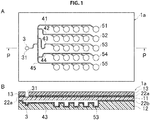
- FIG. 1 is a schematic diagram illustrating the configuration of a microchip 1a according to a first embodiment of the present technology.
- FIG. 1A is a schematic top view
- FIG. 1B is a schematic cross-sectional view corresponding to a section taken along the line P-P of FIG. 1A .
- a microchip indicated by reference numeral 1a in the figure is provided with an entry portion 3, wells 51 to 55, and flow channels 41 to 45.
- the entry portion 3 acts as an area for introducing liquid such as a sample solution and allows liquid to be introduced from the outside.
- the wells 51 to 55 are used as reaction fields of an object to be analyzed.
- the flow channels 41 to 45 are used to connect the entry portion 3 with each of the wells 51 to 55.
- the description is based on the assumption that five wells supplied with liquid through the flow channel 41 are all regarded as the well 51, and similarly, five wells supplied with liquid through the flow channels 42, 43, 44, and 45 are regarded as the wells 52, 53, 54, and 55, respectively.
- the configuration of the microchip according to the present technology is not limited to the number and arrangement of the entry portion 3, the flow channels 41 to 45, and the wells 51 to 55 as illustrated in FIG. 1 .
- the microchip according to the present technology is configured to include a plurality of substrate layers and a bonding layer.
- the bonding layer is made of a silicon compound provided at a boundary surface between substrate layers.
- at least one of the bonding layers is made of organic silicon compounds.
- the microchip 1a according to the present embodiment illustrated in FIG. 1B is configured to include, for example, three substrate layers 11, 12, and 13.
- a plurality of substrate layers 11, 12, and 13 constituting the microchip 1a preferably include a substrate layer made of non-silicone resin and a substrate layer made of polydimethylsiloxane.
- the substrate layer made of polydimethylsiloxane is referred to as substrate layer 11
- first substrate layer made of non-silicone resin of the two substrate layers to be bonded to the substrate layer 11
- second substrate layer made of non-silicone resin of the two substrate layers to be bonded to the substrate layer 11
- the substrate layer 12 has a groove on a surface bonded to the substrate layer 11.
- the groove corresponds to an area for introducing liquid such as a sample solution, and this area includes the entry portion 3, the flow channels 41 to 45, and the wells 51 to 55.
- the substrate layer 12 is bonded to the substrate layer 11 through a bonding layer 22b that is made of a silicon compound.
- the bonding layer 22b is a bonding layer made of an inorganic silicon compound.
- the substrate layer 13 does not have any groove on a surface bonded to the substrate layer 11, and the substrate layer 13 is bonded to the substrate layer 11 through a bonding layer 22a that is made of organic silicon compounds.
- the substrate layer 12 has a groove provided on a surface bonded to the substrate layer 11, and thus an area for introducing liquid such as the entry portion 3 provided in the microchip 1a is not in communication with the outside of the microchip 1a.
- the substrate layer 11 is made of a material having elasticity, it is possible to allow a portion of a puncture member such as a needle to penetrate from the outside of the microchip 1a to the entry portion 3 through an inlet 31 formed in the substrate layer 13. If a needle connected to a syringe previously filled with liquid penetrates to the substrate layer 11, it is possible to introduce liquid to an area such as the entry portion 3 in the microchip 1a.
- the sealed area is connected to only the inner part of the syringe even if a needle or the like penetrates to the substrate layer, and thus an air bubble is prohibited from entering the flow channels 41 to 45 or the wells 51 to 55 and the introduction of liquid is possible.
- the substrate layer 11 is made of a material having elasticity, the self-sealing ability of the substrate layer 11 allows a punctured portion to be sealed spontaneously.
- the spontaneous sealing of a punctured portion caused by a needle or the like due to elastic deformation of a substrate layer is defined as "self-sealing ability" of a substrate layer.
- the liquid to be introduced into the microchip 1a refers to a sample solution or the like that includes an object to be analyzed and a substance used to produce an object to be analyzed by making it react with another substance.
- an object to be analyzed can include proteins such as nucleic acids, for example, DNA or RNA, peptides, and antibodies.
- a biological sample including the object to be analyzed described above, such as blood, or a diluted solution thereof can also be employed as liquid to be introduced into the microchip 1a.
- an analysis method using the microchip 1a includes, for example, an analysis method using nucleic acid amplification reaction such as the known polymerase chain reaction (PCR) technique that carries out thermal cycling and a various isothermal amplification techniques without using thermal cycling.
- PCR polymerase chain reaction
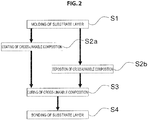
- a method for manufacturing the microchip 1a is described with reference to the flowchart illustrated in FIG. 2 .
- the reference numeral S1 in FIG. 2 indicates a substrate layer molding process.
- grooves corresponding to the entry portion 3, the flow channels 41 to 45, and the wells 51 to 55 are formed on the substrate layer 12, and an opening corresponding to the inlet 31 is formed on the substrate layer 13.
- the substrate layers 12 and 13 may employ glass, plastics, metals and ceramics as its material, and plastics are particularly preferred.
- the substrate layers 12 and 13 preferably employ a material that is impermeable to gas.
- plastic material having gas impermeability examples include polymethylmethacrylate (PMMA: acrylic resin), polycarbonate (PC), polystyrene (PS), polypropylene (PP), polyethylene (PE), polyethylene terephthalate (PET), diethylene glycol-bis-allyl carbonate, styrene-acrylonitrile copolymer (SAN resin), MMA-styrene copolymer (MS resin), TPX (poly(4-methyl-1-pentene)), polyolefin, SiMA (siloxanyl methacrylate monomer)-MMA copolymer, SiMA-fluorine containing monomer copolymer, silicone macromer-(A)-HFBuMA (heptafluorobutyl methacrylate)-MMA terpolymer, and disubstituted polyacetylene-based polymer.
- PMMA polymethylmethacrylate
- PC polycarbonate
- PS polystyrene
- PP polypropylene
- PE
- the entry portion 3 or the like can be molded in the substrate layers 12 and 13 by using a known technique.
- the molding is performed through wet etching or dry etching of a substrate layer made of glass, or alternatively nano-imprinting, injection molding or cutting of a substrate layer made of plastic.
- the microchip 1a is not limited to the configuration illustrated in FIG. 1 , but it is possible to mold an area such as the entry portion 3 for introducing liquid in the substrate layer 11, or alternatively, a portion of the area may be molded in the substrate layer 11 and the rest of the area may be formed in the substrate layer 12.
- the substrate layer molding process S1 is not an essential process, another substrate layers 12 and 13 having a groove or opening molded previously therein are prepared separately, and the process can start from a process S2 of laminating the substrate layers 12 and 13 with a cross-linkable composition, which will be described later.
- FIG. 2 the reference numeral S2 (S2a and S2b) indicates a process of laminating a cross-linkable composition onto the substrate layers 12 and 13.
- FIG. 3 is a schematic diagram illustrating each step from this process to a substrate layer bonding process S4. As illustrated in FIG. 3A , in this process, a cross-linkable composition 21b containing a silicon compound is laminated onto the substrate layer 12, and a cross-linkable composition 21a containing a silicon compound is laminated onto the substrate layer 13.
- the substrate layer 13 which is formed with only an opening corresponding to the inlet 31, has a surface on which a groove is not provided, and the surface is coated with the cross-linkable composition 21a containing organic silicon compounds (cross-linkable composition coating process S2a).
- the substrate layer 12 has a groove forming surface on which a groove corresponding to the entry portion 3 or the like is formed, and the cross-linkable composition 21b containing a silicon compound is deposited on the groove forming surface (cross-linkable composition deposition process S2b).
- the cross-linkable composition containing silicon compounds which is used in the process of manufacturing the microchip 1a, is, for example, a condensate that contains a silanol group produced by the hydrolysis and partial condensation of alkoxysilanes, and it may be in the state where the condensate is dispersed in liquid such as an alcohol solvent.
- the cross-linkable composition 21a to be used in the coating process S2a preferably contains organic silicon compounds.
- the cross-linkable compositions containing organic silicon compounds are, for example, those in which the condensate of alkoxysilane containing organic functional groups is added to a solvent in which the condensate containing the silanol group described above is dispersed.
- it may be a solvent or the like in which a condensate of alkyltrialkoxysilane and tetraalkoxysilane is contained.
- colloidal silica or the like may be added to the cross-linkable composition containing organic silicon compounds.
- the cross-linkable composition 21a containing organic silicon compounds used in this process may be available silicone hard coating agents or the like.
- a hard coating agent "NSC-1600” manufactured by NIPPON FINE CHEMICAL Co., Ltd. can be used.
- a hard coating agent "NSC-2705" manufactured by NIPPON FINE CHEMICAL Co., Ltd. can be used.
- the coating of the substrate layer 13 with the cross-linkable composition 21a containing organic silicon compounds can be performed using a known technique that includes, for example, dip coating, spray coating, flow coating, and spin coating.
- a coating technique in which organic chains contained in the cross-linkable composition 21a are retained is used, the coating method is not particularly limited as long as a technique suitable for the property or shape of the material of the substrate layer 13 is selected.
- the cross-linkable composition 21b used in the deposition process S2b contains silicon compounds, but it is not limited to a condensate containing organic silicon compounds, and a condensate containing silicon compounds that does not contain organic chains may be used.
- the silicon compounds that do not contain organic chains are referred to as "inorganic silicon compounds".
- the cross-linkable composition 21b includes, for example, a solution that contains a condensate of alkoxysilanes such as polysiloxane oligomer.
- the deposition of the cross-linkable composition 21b containing inorganic silicon compounds on the substrate layer 21b can be performed using a known technique that includes, for example, vacuum deposition, ion plating, and sputtering. From among these techniques, the deposition method is not particularly limited as long as a technique suitable for the property, shape, or the like of the material of the substrate layer 13 is selected.
- the microchip 1a In the process of manufacturing the microchip 1a illustrated in FIG. 3 , only the surfaces of the substrate layers 12 and 13, which are each in contact with the substrate layer 11, are coated or deposited with the cross-linkable compositions 21a and 21b, but other portions of each of the substrate layers 12 and 13 may be coated or deposited with the cross-linkable compositions 21a and 21b.
- the necessity of the coating or deposition of the cross-linkable composition 21a or 21b to regions other than the surfaces of the substrate layers 12 and 13 bonded to the substrate layer 11 is not particularly limited.
- this is also true for a microchip 1b according to a second embodiment and a microchip 1c according to a third embodiment, as described later.
- the selection of dip coating as a technique for coating the substrate layer 13 with the cross-linkable composition 21a makes it possible to coat all surfaces constituting the substrate layer 13 simultaneously.
- the cross-linkable composition 21a or 21b is coated to or deposited on an outer surface of the microchip 1a
- the cross-linkable composition 21a or 21b is cured by a curing process of the cross-linkable composition 21a or 21b described later, and then the outer surface of the microchip 1a is coated with a layer formed by curing the cross-linkable composition 21a or 21b.
- the outer surface of the microchip 1a that is coated with the layer is hardly damaged and thus the microchip 1a has improved durability.
- reference numeral S3 indicates a process of polymerizing and curing a cross-linkable composition.
- the cross-linkable compositions 21b and 21a laminated on the substrate layers 12 and 13 are heated and cured.
- this process is a process of forming bonding layers 22a and 22b by polymerizing the cross-linkable compositions 21a and 21b, respectively.
- the silanol group contained in the cross-linkable compositions 21a and 21b are heated and condensed to form a siloxane bond (Si-O-Si).
- the cross-linkable compositions 21a and 21b containing the siloxane bond are cured, thus the resulting layers are the bonding layers 22a and 22b.
- the cross-linkable composition 21a is heated in a state where it coats the substrate layer 13 and the cross-linkable composition 21b is heated in a state where it coats the substrate layer 12, thus the heating temperature may be determined depending on the material of the substrate layers 12 and 13.
- the heating temperature is, for example, preferably 80 to 120°C in a case where PC is used in the substrate layers 12 and 13, and is preferably 60 to 80°C in a case where PMMA is used.
- reference numeral S4 is a substrate layer bonding process.
- This process is a process of bonding the groove forming surface of the substrate layer 12 coated with the cross-linkable composition 21b containing silicon compounds (the surface having the area formed thereon) and the surface of the substrate layer 13 which has no groove and is coated with the cross-linkable composition 21a containing organic silicon compounds to the substrate layer 11. More specifically, for example, the substrate layer 12 is bonded to the substrate layer 11 and then the substrate layer 11 and the substrate layer 13 are bonded to each other. The order of bonding between substrate layers 11, 12, and 13 may begin from the bonding process between the substrate layers 11 and 13.
- the bonding layers 22b and 22a laminated on the substrate layers 12 and 13 contain a siloxane bond, and thus the substrate layer 11 is preferably formed of a material made of silicone resin that can form a siloxane bond with the bonding layers 22a and 22b. Furthermore, the substrate layer 11 is preferably composed of silicone-based elastomer having elasticity, and for example, polydimethylsiloxane (PDMS) is desirable.
- PDMS polydimethylsiloxane
- a plurality of substrate layers constituting the microchip preferably include the substrate layers 12 and 13 that are substrate layers made of non-silicone resin described above and the substrate layer 11 that is a substrate layer made of PDMS, and two surfaces of the substrate layer made of PDMS are preferably bonded to the substrate layers made of non-silicone resin (substrate layers 12 and 13) through the respective bonding layers 22b and 22a.
- This preferred arrangement is similarly applied to the second and third embodiments described later.
- an activation process is performed on the surface of the substrate layer 12 on which the bonding layer 22b is provided and on one surface of the substrate layer 11.
- the activation process may be performed by irradiating it with oxygen plasma or ultraviolet rays, and other known techniques such as ion beam irradiation may be used.
- the activation process allows a bond of an OH group to be produced on the surface of the bonding layer 22b on the substrate layer 12.
- the substrate layer 11 is made of silicone resin, a bond of an OH group is produced on the surface that is subjected to the activation process.
- the bond of an OH group produced on the substrate layer 11 and the bonding layer 22b has high reactivity, and if their processed surfaces are bonded to each other, a siloxane bond occurs and they are strongly bonded ( FIG. 3D ).
- the substrate layer 11 is bonded to the substrate layer 12 through the bonding layer 22b made of inorganic silicon compounds.
- the inner space of the groove formed in the substrate layer 12 is sealed hermetically.
- the inner space of the groove provided in the substrate layer 12 that corresponds to an area such as the entry portion 3 can be sealed hermetically to be negative pressure (1/100 atmospheric pressure) relative to atmospheric pressure.
- the area in the microchip to which liquid is introduced is at negative pressure relative to atmospheric pressure, and thus the liquid is sucked automatically by negative pressure in the microchip 1a upon introduction of the liquid and the introduction of liquid into the microchip 1a having a fine flow channel structure formed therein can be performed in a shorter period of time.
- materials of the substrate layers 12 and 13 are preferably impermeable to gas.
- a material such as PC having have gas impermeability in manufacturing the substrate layers 12 and 13 that constitute the outer surface of the microchip 1a allows the area such as the entry portion 3 to be maintained at negative pressure even when the microchip 1a is stored under atmospheric pressure.
- the substrate layers 12 and 13 are configured to include a material having gas impermeability, even if the microchip 1a is heated in the procedure of analysis, the liquid introduced into the wells 51 to 55 can be prevented from being vaporized by heating and being lost by penetrating through the substrate layer 11 (a liquid leak).
- the bonding between the substrate layers 13 and 11 is similarly performed through the processed surface ( FIG. 3F ).
- the substrate layer 11 is bonded to the surface of the substrate layer 13 in which a groove is not formed through the bonding layer 22a made of organic silicon compounds.
- the bonding layers 22a and 22b containing silicon compounds are provided in the bonding surfaces between the substrate layers 11 and 13 and between the substrate layers 11 and 12, and the substrate layers are bonded to each other through a siloxane bond, and accordingly the substrate layers 11, 12, and 13 can be strongly bonded to each other. Therefore, it is possible to reliably seal the microstructures such as the flow channel formed in the substrate layers.
- the microchip 1a even if a substrate layer made of glass is not used, a strong bonding state can be achieved by forming a siloxane bond. If a substrate made of glass is not used, the possibility of breakage of the microchip 1a is reduced as compared to the microchip using a substrate layer made of glass. In addition, no use of a substrate layer made of glass makes it possible to obtain weight reduction of the microchip 1a as well.
- the bonding layers 22a and 22b of the microchip 1a have advantages of increasing the strength of the microchip 1a itself, in addition to the advantage of strengthening the bonding between the substrate layers 11, 12, and 13.
- the bonding layers 22b and 22a are held between the substrate layers 11, 12 and 13, and thus the deformation of the microchip 1a is prevented.
- at least one bonding layer 22a of the microchip 1a is made of organic silicon compounds, thus it is flexible and cracking is less likely to occur, thereby improving the durability of the microchip 1a, as compared to a bonding layer made of silicon compounds that does not contain organic chains.
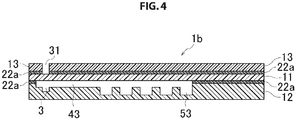
- FIG. 4 is a cross-sectional diagram schematically illustrating the configuration of a microchip 1b according to the second embodiment of the present technology.
- the microchip 1b has the same configuration as the first embodiment except that a bonding layer 22a is provided at the boundary surface between the substrate layer 11 and the substrate layer 12.
- the configuration that is the same as the first embodiment is denoted with the same reference numerals, and repeated description is omitted.
- the materials of the substrate layers 11, 12, and 13 that constitute the microchip 1b are the same as those of the substrate layers of the microchip 1a, which are denoted with the same reference numerals.
- the bonding layer 22a is provided at the boundary surface between the surface of the substrate layer 12 in which a groove corresponding to the area such as the entry portion 3 is formed and the substrate layer 11, which is the same as the boundary surface between the substrate layer 11 and the substrate layer 13.
- the method for manufacturing the microchip 1b is described with reference to the flowchart shown in FIG. 5 .
- the substrate layer molding process S1, the cross-linkable composition curing process S3, and the substrate layer bonding process S4 are similar to the process of manufacturing the microchip 1a according to the first embodiment.
- a cross-linkable composition coating process S2a different from that of the process of manufacturing the microchip 1a will be described with reference to FIG. 6 .
- a surface of the substrate layer 12 in which a groove corresponding to an area such as the entry portion 3 is formed and one surface of the substrate layer 13 are respectively coated with the cross-linkable composition 21a containing organic silicon compounds.
- each of the cross-linkable compositions 21a that coats the substrate layers 12 and 13 contains organic silicon compounds.
- the method for coating the substrate layers 12 and 13 with the cross-linkable composition 21a containing organic silicon compounds is similar to that mentioned in the first embodiment.
- S2a of coating the substrate layer 12 with the cross-linkable composition 21a only a portion of the substrate layer 12 that is in contact with the substrate layer 11 is coated.
- a mask may be applied on a portion of the substrate layer 12 that is not to be coated before the coating is applied (a masking layer is not illustrated in FIG. 6A ).
- the application of a mask can use, for example, a water-soluble resist.
- the portion of the substrate layer 12 in which a well or the like is formed is covered with a water-soluble resist and the substrate layer 12 is coated with the cross-linkable composition 21a.
- the removal of water-soluble resist from the substrate layer 12 is performed, for example, using water. In order to facilitate the removal of water-soluble resist, techniques such as ultrasound may be used together.
- a metal thin film may be used as well.
- a metal such as aluminum is applied to the substrate layer 12 with a thickness of approximately 100 nm by vapor deposition or sputtering.
- the removal of a metal thin film from the substrate layer 12 is performed using, for example, an alkaline aqueous solution.
- the metal thin film is peeled off from the substrate layer 12 using in combination with techniques such as ultrasonic waves, if necessary.
- a portion to which a mask is applied is not limited to the area such as the entry portion 3 to which a liquid is introduced.
- the surface of the substrate layer 12 may be masked.
- a portion of the substrate layer 12 may be coated with the cross-linkable composition 21a by the precision screen printing or the like without applying a mask to the substrate layer 12.
- the bonding layer 22a may be formed in the area such as the entry portion 3 to which a liquid is introduced, which is similar to the microchip 1a according to the first embodiment.
- the microchip 1b as long as the effects on a sample solution or analysis using the microchip 1b do not occur, whether or not a grooved portion of the substrate layer 12 is coated with the cross-linkable composition 21a is not particularly limited. In this regard, this is true for the microchip 1a according to the first embodiment and a microchip 1c according to a third embodiment described later.
- the cross-linkable composition containing organic silicon compounds that covers the substrate layer 12 and the cross-linkable composition containing organic silicon compounds that covers the substrate layer 13 are all indicated by the same reference numeral 21a, the composition of the cross-linkable compositions that cover the substrate layers 12 and 13 is not necessarily identical.
- the substrate layer 12 is made of PC and the substrate layer 13 is made of PMMA, a cross-linkable composition 21a containing appropriate organic silicon compounds depending on a material of the substrate layers may be selected.
- the cross-linkable composition 21a containing organic silicon compounds is polymerized through the curing process S3 to form the bonding layer 22a ( FIG. 6B ). Then, in the substrate layer bonding process S4, an activation process is performed on the bonding layer 22a provided on the substrate layer 12 and one surface of the substrate layer 11 made of silicone resin such as polydimethylsiloxane ( FIG. 6C ), and then the substrate layers 11 and 12 are bonded to each other ( FIG. 6D ). Similarly, for the substrate layer 13, an activation process is performed on the bonding layer 22a provided on the substrate layer 13 and another surface of the substrate layer 11 ( FIG. 6E ), and then the substrate layers 11 and 13 are bonded to each other ( FIG. 6F ).
- the bonding layer 22a containing silicon compounds is provided in the bonding surfaces between the substrate layers 11 and 12 and between the substrate layers 11 and 13, and thus the substrate layers 11, 12, and 13 can be strongly bonded. Furthermore, the bonding layers 22a and 22a laminated on the substrate layers 12 and 13 in the microchip 1b all contain organic silicon compounds, and thus the bonding layers are flexible and cracking is less likely to occur, thereby being hardly peeled from the substrate layers 11, 12, and 13 and improving the durability of the microchip 1b, as compared to a bonding layer that does not contain organic chains.
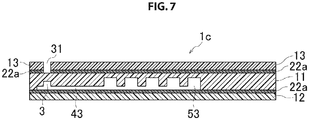
- FIG. 7 is a cross-sectional diagram schematically illustrating the configuration of a microchip 1c according to a third embodiment of the present technology.
- the substrate layer 11 has a groove formed in the surface to be bonded with the substrate layer 12.
- the substrate layers 12 and 13 are bonded to the substrate layer 11 through the bonding layer made of organic silicon compounds.
- an area such as the entry portion 3 to which a liquid is introduced is formed on the substrate layer 11.
- Other configurations are the same to those of the microchip 1b.
- the configuration that is the same as the microchip 1b is indicated by the same reference numeral, and repeated description is omitted.
- the materials of the substrate layers 11, 12, and 13 that constitute the microchip 1c are the same as those of the substrate layers of the microchip 1a according to the first embodiment, which are indicated by the same reference numerals.
- the method for manufacturing the microchip 1c has the manufacturing process procedure that is the same as that of the microchip 1b, and thus the flowchart is omitted.
- the substrate layer molding process S1 and the cross-linkable composition coating process S2a, which are partially different from the manufacturing process procedure of the microchip 1b, will be described with reference to FIG. 8 .
- a groove that corresponds to an area such as the entry portion 3 is formed in the substrate layer 11 made of silicone resin, for example, polydimethylsiloxane.
- the substrate layers 12 and 13 have the inlet 31 formed therein, but have no unevenness such as the wells 51 to 55.
- the cross-linkable composition coating process S2a one surface of each of the substrate layers 12 and 13 is coated with the cross-linkable composition 21a containing organic silicon compounds ( FIG. 8A ).
- the cross-linkable compositions 21a that cover the substrate layers 12 and 13 contain organic silicon compounds.
- the method for coating the substrate layers 12 and 13 with the cross-linkable composition 21a containing organic silicon compounds is similar to the technique used in the method for manufacturing the microchip 1a.
- the composition of the cross-linkable compositions 21a and 21a that cover the substrate layers 12 and 13 is not necessarily identical.
- the cross-linkable compositions 21a and 21a containing organic silicon compounds are polymerized through the curing process S3 to form the bonding layers 22a and 22a ( FIG. 8B ). Then, in substrate layer bonding process S4, an activation process is performed on the bonding layer 22a provided on the substrate layer 12 and the surface of the substrate layer 11 in which a groove is formed ( FIG. 8C ), and then the substrate layers 11 and 12 are bonded to each other ( FIG. 8D ). Similarly, for the substrate layer 13, an activation process is performed on the bonding layer 22a provided on the substrate layer 13 and another surface of the substrate layer 11 ( FIG. 8E ), and then the substrate layers 11 and 13 are bonded to each other ( FIG. 8F ).
- the bonding layer containing silicon compounds is provided at the bonding surfaces between the substrate layers 11 and 12 and between the substrate layers 11 and 13, and thus the substrate layers 11, 12, and 13 can be strongly bonded.
- the bonding layers 22a and 22a of the microchip 1c contain organic silicon compounds, and thus the bonding layers are flexible and cracking is less likely to occur.
- the substrate layer 11 made of silicone resin has a groove formed therein, and thus the substrate layers 12 and 13 have flat surfaces to which the bonding layers 22a and 22a are laminated.
- the substrate layers 12 and 13 can be easily coated with the cross-linkable composition 21a containing organic silicon compounds without using a technique such as vapor deposition because the silicon compounds contain organic chains.
- present technology may also be configured as below.
- the microstructure in the microchip is hermetically sealed, and thus a small quantity of valuable and vulnerable sample can be reliably analyzed.
- a substrate layer made of glass is not used, and thus lightening of the microchip is made possible as well. Therefore, it is easy to carry, and thus the microchip according to the present technology can be used in the determination of genotype, pathogen, or the like in clinical practice.
Landscapes
- Chemical & Material Sciences (AREA)
- Health & Medical Sciences (AREA)
- Clinical Laboratory Science (AREA)
- Analytical Chemistry (AREA)
- General Health & Medical Sciences (AREA)
- Hematology (AREA)
- Dispersion Chemistry (AREA)
- Chemical Kinetics & Catalysis (AREA)
- Engineering & Computer Science (AREA)
- Microelectronics & Electronic Packaging (AREA)
- Micromachines (AREA)
- Automatic Analysis And Handling Materials Therefor (AREA)
- Physical Or Chemical Processes And Apparatus (AREA)
- Lining Or Joining Of Plastics Or The Like (AREA)
Claims (10)
- Mikrochip (1a), umfassend:eine Vielzahl von Substratschichten (11, 12, 13); undBindungsschichten (22a, 22b), die auf Grenzflächen zwischen den Substratschichten laminiert sind und die eine Silikonverbindung aufweisen,wobei mindestens eine der Bindungsschichten eine organische Silikonverbindung aufweist,wobei die Vielzahl von Substratschichten eine aus einem Nicht-Silikon-Harz bestehende Substratschicht und eine aus Polydimethylsiloxan bestehende Substratschicht aufweist, undwobei beide Oberflächen der aus Polydimethylsiloxan bestehenden Substratschicht mit einer ersten, aus einem Nicht-Silikon-Harz bestehenden Substratschicht und einer zweiten, aus einem Nicht-Silikon-Harz bestehenden Substratschicht durch die Bindungsschicht verbunden sind.
- Mikrochip nach Anspruch 1,
wobei die erste, aus einem Nicht-Silikon-Harz bestehende Substratschicht eine Kerbe auf einer Bindungsfläche aufweist, die mit der aus Polydimethylsiloxan bestehenden Substratschicht verbunden ist,
wobei die zweite, aus einem Nicht-Silikon-Harz bestehende Substratschicht und die aus Polydimethylsiloxan bestehende Substratschicht durch die aus einer organischen Silikonverbindung bestehende Bindungsschicht miteinander verbunden sind, wobei die zweite aus einem Nicht-Silikon-Harz bestehende Substratschicht keine Kerbe auf einer Bindungsfläche aufweist, die mit der aus Polydimethylsiloxan bestehenden Substratschicht verbunden ist. - Mikrochip nach Anspruch 2, wobei die aus Polydimethylsiloxan bestehende Substratschicht mit der ersten, aus einem Nicht-Silikon-Harz bestehenden Substratschicht durch eine aus einer anorganischen Silikonverbindung bestehenden Bindungsschicht verbunden ist.
- Mikrochip nach Anspruch 1,
wobei die aus Polydimethylsiloxan bestehende Substratschicht eine Kerbe auf einer Bindungsfläche aufweist, die mit der ersten, aus einem Nicht-Silikon-Harz bestehenden Substratschicht verbunden ist,
wobei die erste, aus einem Nicht-Silikon-Harz bestehende Substratschicht und die zweite, aus einem Nicht-Silikon-Harz bestehende Substratschicht jeweils mit der aus Polydimethylsiloxan bestehenden Substratschicht durch die aus einer organischen Silikonverbindung bestehende Bindungsschicht miteinander verbunden sind. - Mikrochip nach Anspruch 3, wobei die erste, aus einem Nicht-Silikon-Harz bestehende Substratschicht und die zweite, aus einem Nicht-Silikon-Harz bestehende Substratschicht aus Acrylharz oder Polycarbonat bestehen.
- Mikrochip nach Anspruch 5, wobei die erste, aus einem Nicht-Silikon-Harz bestehende Substratschicht und die zweite, aus einem Nicht-Silikon-Harz bestehende Substratschicht gasundurchlässig sind.
- Mikrochip nach Anspruch 6,
wobei die aus Polydimethylsiloxan bestehende Substratschicht eine selbstversiegelnde Fähigkeit aufgrund von elastischer Verformung aufweist,
wobei die Kerbe einen Innenraum aufweist, der bezüglich des atmosphärischen Drucks Unterdruck ist. - Verfahren zur Herstellung eines Mikrochips, wobei das Verfahren das Folgende umfasst:Bilden einer Vielzahl von Substratschichten (11, 12, 13), damit diese eine aus einem Nicht-Silikon-Harz bestehende Substratschicht und eine aus Polydimethylsiloxan bestehende Substratschicht aufweisen;Laminieren einer Vielzahl von Bindungsschichten (22a, 22b) an Grenzflächen zwischen den Substratschichten, wobei die Bindungsschichten eine Silikonverbindung aufweisen, und mindestens eine der Bindungsschichten eine organische Silikonverbindung aufweist; undVerbinden beider Oberflächen der aus Polydimethylsiloxan bestehenden Substratschicht mit einer ersten, aus einem Nicht-Silikon-Harz bestehenden Substratschicht und einer zweiten, aus einem Nicht-Silikon-Harz bestehenden Substratschicht durch die Bindungsschicht.
- Verfahren zur Herstellung eines Mikrochips nach Anspruch 8:wobei die Bildung der Vielzahl von Bindungsschichten ein Abscheidungsverfahren zur Beschichtung einer eine Kerbe bildenden Oberfläche der ersten, aus einem Nicht-Silikon-Harz bestehenden Substratschicht (12) mit einer vernetzbaren Zusammensetzung, die eine Silikonverbindung enthält, umfasst, wobei die eine Kerbe bildende Oberfläche der ersten Substratschicht eine Kerbe aufweist, undein Beschichtungsverfahren zur Beschichtung einer Oberfläche der zweiten, aus einem Nicht-Silikon-Harz bestehenden Substratschicht (13) mit einer vernetzbaren Zusammensetzung, die eine organische Silikonverbindung enthält, wobei die Oberfläche der zweiten Substratschicht keine Kerbe aufweist.
- Verfahren zur Herstellung eines Mikrochips nach Anspruch 9,
wobei der Bindungsschritt die Verbindung jeder der eine Kerbe bildenden Oberfläche der ersten, aus einem Nicht-Silikon-Harz bestehenden Substratschicht und der Oberfläche der zweiten, aus einem Nicht-Silikon-Harz bestehenden Substratschicht mit der aus Polydimethylsiloxan bestehenden Substratschicht (11) umfasst, wobei die eine Kerbe bildende Oberfläche der ersten Substratschicht mit der vernetzbaren Zusammensetzung, die eine Silikonverbindung enthält, beschichtet wird, wobei die Oberfläche der zweiten Substratschicht mit der vernetzbaren Zusammensetzung, die eine organische Silikonverbindung enthält, beschichtet wird und keine Kerbe aufweist.
Priority Applications (1)
| Application Number | Priority Date | Filing Date | Title |
|---|---|---|---|
| EP18176114.9A EP3388841B1 (de) | 2012-07-09 | 2013-05-09 | Mikrochip und verfahren zur herstellung eines mikrochips |
Applications Claiming Priority (2)
| Application Number | Priority Date | Filing Date | Title |
|---|---|---|---|
| JP2012153584 | 2012-07-09 | ||
| PCT/JP2013/063054 WO2014010299A1 (ja) | 2012-07-09 | 2013-05-09 | マイクロチップ及びマイクロチップの製造方法 |
Related Child Applications (2)
| Application Number | Title | Priority Date | Filing Date |
|---|---|---|---|
| EP18176114.9A Division EP3388841B1 (de) | 2012-07-09 | 2013-05-09 | Mikrochip und verfahren zur herstellung eines mikrochips |
| EP18176114.9A Division-Into EP3388841B1 (de) | 2012-07-09 | 2013-05-09 | Mikrochip und verfahren zur herstellung eines mikrochips |
Publications (3)
| Publication Number | Publication Date |
|---|---|
| EP2871482A1 EP2871482A1 (de) | 2015-05-13 |
| EP2871482A4 EP2871482A4 (de) | 2016-03-09 |
| EP2871482B1 true EP2871482B1 (de) | 2018-07-18 |
Family
ID=49915774
Family Applications (2)
| Application Number | Title | Priority Date | Filing Date |
|---|---|---|---|
| EP13817319.0A Not-in-force EP2871482B1 (de) | 2012-07-09 | 2013-05-09 | Mikrochip und verfahren zur herstellung eines mikrochips |
| EP18176114.9A Active EP3388841B1 (de) | 2012-07-09 | 2013-05-09 | Mikrochip und verfahren zur herstellung eines mikrochips |
Family Applications After (1)
| Application Number | Title | Priority Date | Filing Date |
|---|---|---|---|
| EP18176114.9A Active EP3388841B1 (de) | 2012-07-09 | 2013-05-09 | Mikrochip und verfahren zur herstellung eines mikrochips |
Country Status (6)
| Country | Link |
|---|---|
| US (1) | US20150239217A1 (de) |
| EP (2) | EP2871482B1 (de) |
| JP (2) | JP6361503B2 (de) |
| CN (1) | CN104412110A (de) |
| SG (1) | SG11201500017YA (de) |
| WO (1) | WO2014010299A1 (de) |
Families Citing this family (7)
| Publication number | Priority date | Publication date | Assignee | Title |
|---|---|---|---|---|
| CN106391153B (zh) * | 2016-11-07 | 2019-04-09 | 华南理工大学 | 一种负压引导的微流体自律运动的微流控芯片 |
| JP6531749B2 (ja) * | 2016-11-21 | 2019-06-19 | ウシオ電機株式会社 | 基板の貼り合わせ方法、並びに、マイクロチップおよびその製造方法 |
| EP3556853B1 (de) * | 2016-12-13 | 2021-09-22 | Eiken Kagaku Kabushiki Kaisha | Mikrochip |
| CN106914286A (zh) * | 2017-01-12 | 2017-07-04 | 上海小海龟科技有限公司 | 一种生物芯片及其封装方法 |
| WO2021038049A1 (en) * | 2019-08-29 | 2021-03-04 | Astraveus | Apparatus and method for clamping a microfluidic device |
| CN115414971B (zh) * | 2022-08-03 | 2023-11-17 | 南方科技大学 | 微控流芯片的制备方法及微控流芯片 |
| WO2024254785A1 (zh) * | 2023-06-14 | 2024-12-19 | 深圳华大生命科学研究院 | 一种有机硅复合结构、制备方法及其微流道结构 |
Family Cites Families (21)
| Publication number | Priority date | Publication date | Assignee | Title |
|---|---|---|---|---|
| US6176962B1 (en) * | 1990-02-28 | 2001-01-23 | Aclara Biosciences, Inc. | Methods for fabricating enclosed microchannel structures |
| US6825047B1 (en) * | 1996-04-03 | 2004-11-30 | Applera Corporation | Device and method for multiple analyte detection |
| JP2002055030A (ja) * | 2000-08-10 | 2002-02-20 | Sanyo Electric Co Ltd | 半導体装置の解析方法 |
| JP3933058B2 (ja) * | 2002-02-25 | 2007-06-20 | 日立化成工業株式会社 | マイクロ流体システム用支持ユニット及びその製造方法 |
| JP2004325153A (ja) * | 2003-04-23 | 2004-11-18 | Aida Eng Ltd | マイクロチップ及びその製造方法 |
| JP2005257283A (ja) * | 2004-03-09 | 2005-09-22 | Fluidware Technologies Kk | マイクロチップ |
| JPWO2006025535A1 (ja) * | 2004-09-03 | 2008-05-08 | Jsr株式会社 | コーティング用組成物および下塗り剤、ならびに該組成物からなる塗膜を有する積層体、光触媒コーティングフィルムおよび成形体 |
| WO2006116616A2 (en) * | 2005-04-26 | 2006-11-02 | Applera Corporation | Systems and methods for multiple analyte detection |
| JP4000401B2 (ja) * | 2005-06-17 | 2007-10-31 | 株式会社リッチェル | 接合構造体 |
| EP1922364A4 (de) * | 2005-08-09 | 2010-04-21 | Univ North Carolina | Verfahren und materialien zur herstellung mikrofluidischer vorrichtungen |
| WO2007055151A1 (ja) * | 2005-11-11 | 2007-05-18 | Konica Minolta Medical & Graphic, Inc. | マイクロリアクタおよびマイクロ分析システム |
| EP2000496B1 (de) * | 2006-03-29 | 2018-08-15 | Zeon Corporation | Verfahren zur herstellung von einem geformten artikel aus harzverbundstoff |
| US20080014532A1 (en) * | 2006-07-14 | 2008-01-17 | 3M Innovative Properties Company | Laminate body, and method for manufacturing thin substrate using the laminate body |
| GR1006447B (el) * | 2006-09-15 | 2009-06-19 | Εθνικο Κεντρο Ερευνας Φυσικων Επιστημων (Εκεφε) "Δημοκριτος" | Μεθοδος συγκολλησης |
| WO2008065880A1 (en) * | 2006-12-01 | 2008-06-05 | Konica Minolta Opto, Inc. | Method for joining microchip substrate and microchip |
| JP2008175795A (ja) * | 2006-12-21 | 2008-07-31 | Sumitomo Bakelite Co Ltd | プラスチック製マイクロチップ、及びその製造方法、並びにそれを利用したバイオチップ又はマイクロ分析チップ |
| US8293061B2 (en) * | 2008-03-06 | 2012-10-23 | University Of Maryland College Park | Low temperature polymer bonding using UV/ozone surface treatment |
| WO2009131070A1 (ja) * | 2008-04-22 | 2009-10-29 | アルプス電気株式会社 | 接合部材及びその製造方法 |
| WO2010101044A1 (ja) * | 2009-03-03 | 2010-09-10 | コニカミノルタオプト株式会社 | マイクロチップ用カバー部材、マイクロチップ用カバー部材の製造方法、マイクロチップ、及びマイクロチップの製造方法 |
| JP5218443B2 (ja) * | 2010-02-10 | 2013-06-26 | ソニー株式会社 | マイクロチップ及びマイクロチップの製造方法 |
| WO2011122215A1 (ja) * | 2010-03-31 | 2011-10-06 | コニカミノルタオプト株式会社 | マイクロチップの製造方法及びマイクロチップ |
-
2013
- 2013-05-09 EP EP13817319.0A patent/EP2871482B1/de not_active Not-in-force
- 2013-05-09 CN CN201380035497.4A patent/CN104412110A/zh active Pending
- 2013-05-09 EP EP18176114.9A patent/EP3388841B1/de active Active
- 2013-05-09 US US14/408,498 patent/US20150239217A1/en not_active Abandoned
- 2013-05-09 JP JP2014524677A patent/JP6361503B2/ja active Active
- 2013-05-09 WO PCT/JP2013/063054 patent/WO2014010299A1/ja not_active Ceased
- 2013-05-09 SG SG11201500017YA patent/SG11201500017YA/en unknown
-
2018
- 2018-06-28 JP JP2018122948A patent/JP6627921B2/ja active Active
Non-Patent Citations (1)
| Title |
|---|
| None * |
Also Published As
| Publication number | Publication date |
|---|---|
| EP2871482A1 (de) | 2015-05-13 |
| EP3388841B1 (de) | 2019-12-11 |
| EP2871482A4 (de) | 2016-03-09 |
| JP6361503B2 (ja) | 2018-07-25 |
| US20150239217A1 (en) | 2015-08-27 |
| WO2014010299A1 (ja) | 2014-01-16 |
| EP3388841A1 (de) | 2018-10-17 |
| JPWO2014010299A1 (ja) | 2016-06-20 |
| CN104412110A (zh) | 2015-03-11 |
| SG11201500017YA (en) | 2015-02-27 |
| JP2019002932A (ja) | 2019-01-10 |
| JP6627921B2 (ja) | 2020-01-08 |
Similar Documents
| Publication | Publication Date | Title |
|---|---|---|
| EP2871482B1 (de) | Mikrochip und verfahren zur herstellung eines mikrochips | |
| JP5218443B2 (ja) | マイクロチップ及びマイクロチップの製造方法 | |
| JP5229215B2 (ja) | マイクロチップの製造方法 | |
| US7790109B2 (en) | Micro-fluid reaction vessel, method for manufacturing the same, and micro-fluid reaction method using the vessel | |
| EP2507001A1 (de) | Verbundartikel aus kunststoff | |
| EP2438154A1 (de) | Fluidische vorrichtung mit membranventilen | |
| WO2006035228A1 (en) | Microfluidic structure | |
| US20170341075A1 (en) | Methods and Apparatus for Coated Flowcells | |
| KR20110072275A (ko) | 미세 유체 소자 및 그 제조방법 | |
| KR20120120241A (ko) | 경질 실리콘 수지의 접착 방법, 미세 구조를 갖는 기판의 접합 방법 및 해당 접합 방법을 이용한 마이크로 유체 디바이스의 제조 방법 | |
| JP2005257283A (ja) | マイクロチップ | |
| US20140065035A1 (en) | Method for manufacturing a microvalve device mounted on a lab-on-a-chip, and microvalve device manufactured by same | |
| US9321051B2 (en) | Microfluidic device and method of manufacturing the same | |
| KR20150016043A (ko) | 미세유동장치 및 그 제조방법 | |
| JP2005249540A (ja) | マイクロチップ及びpdms基板と対面基板との貼り合わせ方法 | |
| JP5708683B2 (ja) | マイクロチップ及びマイクロチップの製造方法 | |
| EP2105744B1 (de) | Mikrochip und verfahren zur herstellung des mikrochips | |
| KR101402730B1 (ko) | 미세 유체 소자, 이의 제조방법, 및 이를 포함하는 바이오 분석 플랫폼 | |
| KR101489188B1 (ko) | 기판접합을 위한 기판표면처리방법 및 기판접합방법 | |
| KR101887554B1 (ko) | 엘라스토머-플라스틱 하이브리드 마이크로 디바이스 제조를 위한 이종 기판 접합방법 | |
| JP4992123B2 (ja) | マイクロチップ基板の接合方法、及びマイクロチップ | |
| JP5545255B2 (ja) | マイクロチップ及びその製造方法 | |
| JP2006027094A (ja) | ポリマーシートのハンドリング治具及びハンドリング方法 | |
| JP2006116881A (ja) | 蓋 |
Legal Events
| Date | Code | Title | Description |
|---|---|---|---|
| PUAI | Public reference made under article 153(3) epc to a published international application that has entered the european phase |
Free format text: ORIGINAL CODE: 0009012 |
|
| 17P | Request for examination filed |
Effective date: 20150102 |
|
| AK | Designated contracting states |
Kind code of ref document: A1 Designated state(s): AL AT BE BG CH CY CZ DE DK EE ES FI FR GB GR HR HU IE IS IT LI LT LU LV MC MK MT NL NO PL PT RO RS SE SI SK SM TR |
|
| AX | Request for extension of the european patent |
Extension state: BA ME |
|
| DAX | Request for extension of the european patent (deleted) | ||
| RA4 | Supplementary search report drawn up and despatched (corrected) |
Effective date: 20160208 |
|
| RIC1 | Information provided on ipc code assigned before grant |
Ipc: B01J 19/00 20060101ALI20160202BHEP Ipc: G01N 35/08 20060101AFI20160202BHEP Ipc: G01N 37/00 20060101ALI20160202BHEP |
|
| STAA | Information on the status of an ep patent application or granted ep patent |
Free format text: STATUS: EXAMINATION IS IN PROGRESS |
|
| 17Q | First examination report despatched |
Effective date: 20170127 |
|
| GRAP | Despatch of communication of intention to grant a patent |
Free format text: ORIGINAL CODE: EPIDOSNIGR1 |
|
| STAA | Information on the status of an ep patent application or granted ep patent |
Free format text: STATUS: GRANT OF PATENT IS INTENDED |
|
| INTG | Intention to grant announced |
Effective date: 20180206 |
|
| RIN1 | Information on inventor provided before grant (corrected) |
Inventor name: SEGAWA, YUJI Inventor name: WATANABE, HIDETOSHI Inventor name: KATO, YOSHIAKI |
|
| GRAS | Grant fee paid |
Free format text: ORIGINAL CODE: EPIDOSNIGR3 |
|
| GRAA | (expected) grant |
Free format text: ORIGINAL CODE: 0009210 |
|
| STAA | Information on the status of an ep patent application or granted ep patent |
Free format text: STATUS: THE PATENT HAS BEEN GRANTED |
|
| AK | Designated contracting states |
Kind code of ref document: B1 Designated state(s): AL AT BE BG CH CY CZ DE DK EE ES FI FR GB GR HR HU IE IS IT LI LT LU LV MC MK MT NL NO PL PT RO RS SE SI SK SM TR |
|
| REG | Reference to a national code |
Ref country code: GB Ref legal event code: FG4D |
|
| REG | Reference to a national code |
Ref country code: CH Ref legal event code: EP |
|
| REG | Reference to a national code |
Ref country code: IE Ref legal event code: FG4D |
|
| REG | Reference to a national code |
Ref country code: AT Ref legal event code: REF Ref document number: 1019934 Country of ref document: AT Kind code of ref document: T Effective date: 20180815 |
|
| REG | Reference to a national code |
Ref country code: DE Ref legal event code: R096 Ref document number: 602013040577 Country of ref document: DE |
|
| REG | Reference to a national code |
Ref country code: NL Ref legal event code: MP Effective date: 20180718 |
|
| REG | Reference to a national code |
Ref country code: LT Ref legal event code: MG4D |
|
| REG | Reference to a national code |
Ref country code: AT Ref legal event code: MK05 Ref document number: 1019934 Country of ref document: AT Kind code of ref document: T Effective date: 20180718 |
|
| PG25 | Lapsed in a contracting state [announced via postgrant information from national office to epo] |
Ref country code: NL Free format text: LAPSE BECAUSE OF FAILURE TO SUBMIT A TRANSLATION OF THE DESCRIPTION OR TO PAY THE FEE WITHIN THE PRESCRIBED TIME-LIMIT Effective date: 20180718 |
|
| PG25 | Lapsed in a contracting state [announced via postgrant information from national office to epo] |
Ref country code: PL Free format text: LAPSE BECAUSE OF FAILURE TO SUBMIT A TRANSLATION OF THE DESCRIPTION OR TO PAY THE FEE WITHIN THE PRESCRIBED TIME-LIMIT Effective date: 20180718 Ref country code: LT Free format text: LAPSE BECAUSE OF FAILURE TO SUBMIT A TRANSLATION OF THE DESCRIPTION OR TO PAY THE FEE WITHIN THE PRESCRIBED TIME-LIMIT Effective date: 20180718 Ref country code: RS Free format text: LAPSE BECAUSE OF FAILURE TO SUBMIT A TRANSLATION OF THE DESCRIPTION OR TO PAY THE FEE WITHIN THE PRESCRIBED TIME-LIMIT Effective date: 20180718 Ref country code: SE Free format text: LAPSE BECAUSE OF FAILURE TO SUBMIT A TRANSLATION OF THE DESCRIPTION OR TO PAY THE FEE WITHIN THE PRESCRIBED TIME-LIMIT Effective date: 20180718 Ref country code: BG Free format text: LAPSE BECAUSE OF FAILURE TO SUBMIT A TRANSLATION OF THE DESCRIPTION OR TO PAY THE FEE WITHIN THE PRESCRIBED TIME-LIMIT Effective date: 20181018 Ref country code: GR Free format text: LAPSE BECAUSE OF FAILURE TO SUBMIT A TRANSLATION OF THE DESCRIPTION OR TO PAY THE FEE WITHIN THE PRESCRIBED TIME-LIMIT Effective date: 20181019 Ref country code: NO Free format text: LAPSE BECAUSE OF FAILURE TO SUBMIT A TRANSLATION OF THE DESCRIPTION OR TO PAY THE FEE WITHIN THE PRESCRIBED TIME-LIMIT Effective date: 20181018 Ref country code: FI Free format text: LAPSE BECAUSE OF FAILURE TO SUBMIT A TRANSLATION OF THE DESCRIPTION OR TO PAY THE FEE WITHIN THE PRESCRIBED TIME-LIMIT Effective date: 20180718 Ref country code: AT Free format text: LAPSE BECAUSE OF FAILURE TO SUBMIT A TRANSLATION OF THE DESCRIPTION OR TO PAY THE FEE WITHIN THE PRESCRIBED TIME-LIMIT Effective date: 20180718 Ref country code: IS Free format text: LAPSE BECAUSE OF FAILURE TO SUBMIT A TRANSLATION OF THE DESCRIPTION OR TO PAY THE FEE WITHIN THE PRESCRIBED TIME-LIMIT Effective date: 20181118 |
|
| PG25 | Lapsed in a contracting state [announced via postgrant information from national office to epo] |
Ref country code: HR Free format text: LAPSE BECAUSE OF FAILURE TO SUBMIT A TRANSLATION OF THE DESCRIPTION OR TO PAY THE FEE WITHIN THE PRESCRIBED TIME-LIMIT Effective date: 20180718 Ref country code: LV Free format text: LAPSE BECAUSE OF FAILURE TO SUBMIT A TRANSLATION OF THE DESCRIPTION OR TO PAY THE FEE WITHIN THE PRESCRIBED TIME-LIMIT Effective date: 20180718 Ref country code: AL Free format text: LAPSE BECAUSE OF FAILURE TO SUBMIT A TRANSLATION OF THE DESCRIPTION OR TO PAY THE FEE WITHIN THE PRESCRIBED TIME-LIMIT Effective date: 20180718 |
|
| REG | Reference to a national code |
Ref country code: DE Ref legal event code: R097 Ref document number: 602013040577 Country of ref document: DE |
|
| PG25 | Lapsed in a contracting state [announced via postgrant information from national office to epo] |
Ref country code: IT Free format text: LAPSE BECAUSE OF FAILURE TO SUBMIT A TRANSLATION OF THE DESCRIPTION OR TO PAY THE FEE WITHIN THE PRESCRIBED TIME-LIMIT Effective date: 20180718 Ref country code: CZ Free format text: LAPSE BECAUSE OF FAILURE TO SUBMIT A TRANSLATION OF THE DESCRIPTION OR TO PAY THE FEE WITHIN THE PRESCRIBED TIME-LIMIT Effective date: 20180718 Ref country code: RO Free format text: LAPSE BECAUSE OF FAILURE TO SUBMIT A TRANSLATION OF THE DESCRIPTION OR TO PAY THE FEE WITHIN THE PRESCRIBED TIME-LIMIT Effective date: 20180718 Ref country code: EE Free format text: LAPSE BECAUSE OF FAILURE TO SUBMIT A TRANSLATION OF THE DESCRIPTION OR TO PAY THE FEE WITHIN THE PRESCRIBED TIME-LIMIT Effective date: 20180718 Ref country code: ES Free format text: LAPSE BECAUSE OF FAILURE TO SUBMIT A TRANSLATION OF THE DESCRIPTION OR TO PAY THE FEE WITHIN THE PRESCRIBED TIME-LIMIT Effective date: 20180718 |
|
| PLBE | No opposition filed within time limit |
Free format text: ORIGINAL CODE: 0009261 |
|
| STAA | Information on the status of an ep patent application or granted ep patent |
Free format text: STATUS: NO OPPOSITION FILED WITHIN TIME LIMIT |
|
| PG25 | Lapsed in a contracting state [announced via postgrant information from national office to epo] |
Ref country code: SK Free format text: LAPSE BECAUSE OF FAILURE TO SUBMIT A TRANSLATION OF THE DESCRIPTION OR TO PAY THE FEE WITHIN THE PRESCRIBED TIME-LIMIT Effective date: 20180718 Ref country code: SM Free format text: LAPSE BECAUSE OF FAILURE TO SUBMIT A TRANSLATION OF THE DESCRIPTION OR TO PAY THE FEE WITHIN THE PRESCRIBED TIME-LIMIT Effective date: 20180718 Ref country code: DK Free format text: LAPSE BECAUSE OF FAILURE TO SUBMIT A TRANSLATION OF THE DESCRIPTION OR TO PAY THE FEE WITHIN THE PRESCRIBED TIME-LIMIT Effective date: 20180718 |
|
| 26N | No opposition filed |
Effective date: 20190423 |
|
| PG25 | Lapsed in a contracting state [announced via postgrant information from national office to epo] |
Ref country code: SI Free format text: LAPSE BECAUSE OF FAILURE TO SUBMIT A TRANSLATION OF THE DESCRIPTION OR TO PAY THE FEE WITHIN THE PRESCRIBED TIME-LIMIT Effective date: 20180718 |
|
| PGFP | Annual fee paid to national office [announced via postgrant information from national office to epo] |
Ref country code: GB Payment date: 20190521 Year of fee payment: 7 |
|
| REG | Reference to a national code |
Ref country code: CH Ref legal event code: PL |
|
| PG25 | Lapsed in a contracting state [announced via postgrant information from national office to epo] |
Ref country code: LI Free format text: LAPSE BECAUSE OF NON-PAYMENT OF DUE FEES Effective date: 20190531 Ref country code: CH Free format text: LAPSE BECAUSE OF NON-PAYMENT OF DUE FEES Effective date: 20190531 Ref country code: MC Free format text: LAPSE BECAUSE OF FAILURE TO SUBMIT A TRANSLATION OF THE DESCRIPTION OR TO PAY THE FEE WITHIN THE PRESCRIBED TIME-LIMIT Effective date: 20180718 |
|
| REG | Reference to a national code |
Ref country code: BE Ref legal event code: MM Effective date: 20190531 |
|
| PG25 | Lapsed in a contracting state [announced via postgrant information from national office to epo] |
Ref country code: LU Free format text: LAPSE BECAUSE OF NON-PAYMENT OF DUE FEES Effective date: 20190509 |
|
| PG25 | Lapsed in a contracting state [announced via postgrant information from national office to epo] |
Ref country code: TR Free format text: LAPSE BECAUSE OF FAILURE TO SUBMIT A TRANSLATION OF THE DESCRIPTION OR TO PAY THE FEE WITHIN THE PRESCRIBED TIME-LIMIT Effective date: 20180718 |
|
| PG25 | Lapsed in a contracting state [announced via postgrant information from national office to epo] |
Ref country code: IE Free format text: LAPSE BECAUSE OF NON-PAYMENT OF DUE FEES Effective date: 20190509 |
|
| PG25 | Lapsed in a contracting state [announced via postgrant information from national office to epo] |
Ref country code: BE Free format text: LAPSE BECAUSE OF NON-PAYMENT OF DUE FEES Effective date: 20190531 |
|
| PG25 | Lapsed in a contracting state [announced via postgrant information from national office to epo] |
Ref country code: FR Free format text: LAPSE BECAUSE OF NON-PAYMENT OF DUE FEES Effective date: 20190531 Ref country code: PT Free format text: LAPSE BECAUSE OF FAILURE TO SUBMIT A TRANSLATION OF THE DESCRIPTION OR TO PAY THE FEE WITHIN THE PRESCRIBED TIME-LIMIT Effective date: 20181118 |
|
| GBPC | Gb: european patent ceased through non-payment of renewal fee |
Effective date: 20200509 |
|
| PG25 | Lapsed in a contracting state [announced via postgrant information from national office to epo] |
Ref country code: GB Free format text: LAPSE BECAUSE OF NON-PAYMENT OF DUE FEES Effective date: 20200509 |
|
| PG25 | Lapsed in a contracting state [announced via postgrant information from national office to epo] |
Ref country code: CY Free format text: LAPSE BECAUSE OF FAILURE TO SUBMIT A TRANSLATION OF THE DESCRIPTION OR TO PAY THE FEE WITHIN THE PRESCRIBED TIME-LIMIT Effective date: 20180718 |
|
| PG25 | Lapsed in a contracting state [announced via postgrant information from national office to epo] |
Ref country code: HU Free format text: LAPSE BECAUSE OF FAILURE TO SUBMIT A TRANSLATION OF THE DESCRIPTION OR TO PAY THE FEE WITHIN THE PRESCRIBED TIME-LIMIT; INVALID AB INITIO Effective date: 20130509 Ref country code: MT Free format text: LAPSE BECAUSE OF FAILURE TO SUBMIT A TRANSLATION OF THE DESCRIPTION OR TO PAY THE FEE WITHIN THE PRESCRIBED TIME-LIMIT Effective date: 20180718 |
|
| PG25 | Lapsed in a contracting state [announced via postgrant information from national office to epo] |
Ref country code: MK Free format text: LAPSE BECAUSE OF FAILURE TO SUBMIT A TRANSLATION OF THE DESCRIPTION OR TO PAY THE FEE WITHIN THE PRESCRIBED TIME-LIMIT Effective date: 20180718 |
|
| P01 | Opt-out of the competence of the unified patent court (upc) registered |
Effective date: 20230527 |
|
| PGFP | Annual fee paid to national office [announced via postgrant information from national office to epo] |
Ref country code: DE Payment date: 20240418 Year of fee payment: 12 |
|
| REG | Reference to a national code |
Ref country code: DE Ref legal event code: R119 Ref document number: 602013040577 Country of ref document: DE |
|
| PG25 | Lapsed in a contracting state [announced via postgrant information from national office to epo] |
Ref country code: DE Free format text: LAPSE BECAUSE OF NON-PAYMENT OF DUE FEES Effective date: 20251202 |