EP2872298B1 - Verfahren und vorrichtung zur kühlung eines flusses mit mindestens 35 % kohlendioxid und quecksilber - Google Patents
Verfahren und vorrichtung zur kühlung eines flusses mit mindestens 35 % kohlendioxid und quecksilber Download PDFInfo
- Publication number
- EP2872298B1 EP2872298B1 EP13747447.4A EP13747447A EP2872298B1 EP 2872298 B1 EP2872298 B1 EP 2872298B1 EP 13747447 A EP13747447 A EP 13747447A EP 2872298 B1 EP2872298 B1 EP 2872298B1
- Authority
- EP
- European Patent Office
- Prior art keywords
- mercury
- temperature
- heat exchanger
- liquid
- flow
- Prior art date
- Legal status (The legal status is an assumption and is not a legal conclusion. Google has not performed a legal analysis and makes no representation as to the accuracy of the status listed.)
- Active
Links
Images


Classifications
-
- F—MECHANICAL ENGINEERING; LIGHTING; HEATING; WEAPONS; BLASTING
- F25—REFRIGERATION OR COOLING; COMBINED HEATING AND REFRIGERATION SYSTEMS; HEAT PUMP SYSTEMS; MANUFACTURE OR STORAGE OF ICE; LIQUEFACTION SOLIDIFICATION OF GASES
- F25J—LIQUEFACTION, SOLIDIFICATION OR SEPARATION OF GASES OR GASEOUS OR LIQUEFIED GASEOUS MIXTURES BY PRESSURE AND COLD TREATMENT OR BY BRINGING THEM INTO THE SUPERCRITICAL STATE
- F25J3/00—Processes or apparatus for separating the constituents of gaseous or liquefied gaseous mixtures involving the use of liquefaction or solidification
- F25J3/02—Processes or apparatus for separating the constituents of gaseous or liquefied gaseous mixtures involving the use of liquefaction or solidification by rectification, i.e. by continuous interchange of heat and material between a vapour stream and a liquid stream
- F25J3/0204—Processes or apparatus for separating the constituents of gaseous or liquefied gaseous mixtures involving the use of liquefaction or solidification by rectification, i.e. by continuous interchange of heat and material between a vapour stream and a liquid stream characterised by the feed stream
- F25J3/0223—H2/CO mixtures, i.e. synthesis gas; Water gas or shifted synthesis gas
-
- B—PERFORMING OPERATIONS; TRANSPORTING
- B01—PHYSICAL OR CHEMICAL PROCESSES OR APPARATUS IN GENERAL
- B01D—SEPARATION
- B01D5/00—Condensation of vapours; Recovering volatile solvents by condensation
- B01D5/0057—Condensation of vapours; Recovering volatile solvents by condensation in combination with other processes
- B01D5/0075—Condensation of vapours; Recovering volatile solvents by condensation in combination with other processes with heat exchanging
-
- F—MECHANICAL ENGINEERING; LIGHTING; HEATING; WEAPONS; BLASTING
- F25—REFRIGERATION OR COOLING; COMBINED HEATING AND REFRIGERATION SYSTEMS; HEAT PUMP SYSTEMS; MANUFACTURE OR STORAGE OF ICE; LIQUEFACTION SOLIDIFICATION OF GASES
- F25J—LIQUEFACTION, SOLIDIFICATION OR SEPARATION OF GASES OR GASEOUS OR LIQUEFIED GASEOUS MIXTURES BY PRESSURE AND COLD TREATMENT OR BY BRINGING THEM INTO THE SUPERCRITICAL STATE
- F25J3/00—Processes or apparatus for separating the constituents of gaseous or liquefied gaseous mixtures involving the use of liquefaction or solidification
- F25J3/02—Processes or apparatus for separating the constituents of gaseous or liquefied gaseous mixtures involving the use of liquefaction or solidification by rectification, i.e. by continuous interchange of heat and material between a vapour stream and a liquid stream
- F25J3/0228—Processes or apparatus for separating the constituents of gaseous or liquefied gaseous mixtures involving the use of liquefaction or solidification by rectification, i.e. by continuous interchange of heat and material between a vapour stream and a liquid stream characterised by the separated product stream
- F25J3/0266—Processes or apparatus for separating the constituents of gaseous or liquefied gaseous mixtures involving the use of liquefaction or solidification by rectification, i.e. by continuous interchange of heat and material between a vapour stream and a liquid stream characterised by the separated product stream separation of carbon dioxide
-
- F—MECHANICAL ENGINEERING; LIGHTING; HEATING; WEAPONS; BLASTING
- F25—REFRIGERATION OR COOLING; COMBINED HEATING AND REFRIGERATION SYSTEMS; HEAT PUMP SYSTEMS; MANUFACTURE OR STORAGE OF ICE; LIQUEFACTION SOLIDIFICATION OF GASES
- F25J—LIQUEFACTION, SOLIDIFICATION OR SEPARATION OF GASES OR GASEOUS OR LIQUEFIED GASEOUS MIXTURES BY PRESSURE AND COLD TREATMENT OR BY BRINGING THEM INTO THE SUPERCRITICAL STATE
- F25J3/00—Processes or apparatus for separating the constituents of gaseous or liquefied gaseous mixtures involving the use of liquefaction or solidification
- F25J3/02—Processes or apparatus for separating the constituents of gaseous or liquefied gaseous mixtures involving the use of liquefaction or solidification by rectification, i.e. by continuous interchange of heat and material between a vapour stream and a liquid stream
- F25J3/0295—Start-up or control of the process; Details of the apparatus used, e.g. sieve plates, packings
-
- F—MECHANICAL ENGINEERING; LIGHTING; HEATING; WEAPONS; BLASTING
- F25—REFRIGERATION OR COOLING; COMBINED HEATING AND REFRIGERATION SYSTEMS; HEAT PUMP SYSTEMS; MANUFACTURE OR STORAGE OF ICE; LIQUEFACTION SOLIDIFICATION OF GASES
- F25J—LIQUEFACTION, SOLIDIFICATION OR SEPARATION OF GASES OR GASEOUS OR LIQUEFIED GASEOUS MIXTURES BY PRESSURE AND COLD TREATMENT OR BY BRINGING THEM INTO THE SUPERCRITICAL STATE
- F25J5/00—Arrangements of cold exchangers or cold accumulators in separation or liquefaction plants
- F25J5/002—Arrangements of cold exchangers or cold accumulators in separation or liquefaction plants for continuously recuperating cold, i.e. in a so-called recuperative heat exchanger
-
- F—MECHANICAL ENGINEERING; LIGHTING; HEATING; WEAPONS; BLASTING
- F25—REFRIGERATION OR COOLING; COMBINED HEATING AND REFRIGERATION SYSTEMS; HEAT PUMP SYSTEMS; MANUFACTURE OR STORAGE OF ICE; LIQUEFACTION SOLIDIFICATION OF GASES
- F25J—LIQUEFACTION, SOLIDIFICATION OR SEPARATION OF GASES OR GASEOUS OR LIQUEFIED GASEOUS MIXTURES BY PRESSURE AND COLD TREATMENT OR BY BRINGING THEM INTO THE SUPERCRITICAL STATE
- F25J5/00—Arrangements of cold exchangers or cold accumulators in separation or liquefaction plants
- F25J5/002—Arrangements of cold exchangers or cold accumulators in separation or liquefaction plants for continuously recuperating cold, i.e. in a so-called recuperative heat exchanger
- F25J5/005—Arrangements of cold exchangers or cold accumulators in separation or liquefaction plants for continuously recuperating cold, i.e. in a so-called recuperative heat exchanger in a reboiler-condenser, e.g. within a column
-
- F—MECHANICAL ENGINEERING; LIGHTING; HEATING; WEAPONS; BLASTING
- F25—REFRIGERATION OR COOLING; COMBINED HEATING AND REFRIGERATION SYSTEMS; HEAT PUMP SYSTEMS; MANUFACTURE OR STORAGE OF ICE; LIQUEFACTION SOLIDIFICATION OF GASES
- F25J—LIQUEFACTION, SOLIDIFICATION OR SEPARATION OF GASES OR GASEOUS OR LIQUEFIED GASEOUS MIXTURES BY PRESSURE AND COLD TREATMENT OR BY BRINGING THEM INTO THE SUPERCRITICAL STATE
- F25J2200/00—Processes or apparatus using separation by rectification
- F25J2200/02—Processes or apparatus using separation by rectification in a single pressure main column system
-
- F—MECHANICAL ENGINEERING; LIGHTING; HEATING; WEAPONS; BLASTING
- F25—REFRIGERATION OR COOLING; COMBINED HEATING AND REFRIGERATION SYSTEMS; HEAT PUMP SYSTEMS; MANUFACTURE OR STORAGE OF ICE; LIQUEFACTION SOLIDIFICATION OF GASES
- F25J—LIQUEFACTION, SOLIDIFICATION OR SEPARATION OF GASES OR GASEOUS OR LIQUEFIED GASEOUS MIXTURES BY PRESSURE AND COLD TREATMENT OR BY BRINGING THEM INTO THE SUPERCRITICAL STATE
- F25J2200/00—Processes or apparatus using separation by rectification
- F25J2200/70—Refluxing the column with a condensed part of the feed stream, i.e. fractionator top is stripped or self-rectified
-
- F—MECHANICAL ENGINEERING; LIGHTING; HEATING; WEAPONS; BLASTING
- F25—REFRIGERATION OR COOLING; COMBINED HEATING AND REFRIGERATION SYSTEMS; HEAT PUMP SYSTEMS; MANUFACTURE OR STORAGE OF ICE; LIQUEFACTION SOLIDIFICATION OF GASES
- F25J—LIQUEFACTION, SOLIDIFICATION OR SEPARATION OF GASES OR GASEOUS OR LIQUEFIED GASEOUS MIXTURES BY PRESSURE AND COLD TREATMENT OR BY BRINGING THEM INTO THE SUPERCRITICAL STATE
- F25J2205/00—Processes or apparatus using other separation and/or other processing means
- F25J2205/02—Processes or apparatus using other separation and/or other processing means using simple phase separation in a vessel or drum
- F25J2205/04—Processes or apparatus using other separation and/or other processing means using simple phase separation in a vessel or drum in the feed line, i.e. upstream of the fractionation step
-
- F—MECHANICAL ENGINEERING; LIGHTING; HEATING; WEAPONS; BLASTING
- F25—REFRIGERATION OR COOLING; COMBINED HEATING AND REFRIGERATION SYSTEMS; HEAT PUMP SYSTEMS; MANUFACTURE OR STORAGE OF ICE; LIQUEFACTION SOLIDIFICATION OF GASES
- F25J—LIQUEFACTION, SOLIDIFICATION OR SEPARATION OF GASES OR GASEOUS OR LIQUEFIED GASEOUS MIXTURES BY PRESSURE AND COLD TREATMENT OR BY BRINGING THEM INTO THE SUPERCRITICAL STATE
- F25J2205/00—Processes or apparatus using other separation and/or other processing means
- F25J2205/20—Processes or apparatus using other separation and/or other processing means using solidification of components
-
- F—MECHANICAL ENGINEERING; LIGHTING; HEATING; WEAPONS; BLASTING
- F25—REFRIGERATION OR COOLING; COMBINED HEATING AND REFRIGERATION SYSTEMS; HEAT PUMP SYSTEMS; MANUFACTURE OR STORAGE OF ICE; LIQUEFACTION SOLIDIFICATION OF GASES
- F25J—LIQUEFACTION, SOLIDIFICATION OR SEPARATION OF GASES OR GASEOUS OR LIQUEFIED GASEOUS MIXTURES BY PRESSURE AND COLD TREATMENT OR BY BRINGING THEM INTO THE SUPERCRITICAL STATE
- F25J2205/00—Processes or apparatus using other separation and/or other processing means
- F25J2205/40—Processes or apparatus using other separation and/or other processing means using hybrid system, i.e. combining cryogenic and non-cryogenic separation techniques
-
- F—MECHANICAL ENGINEERING; LIGHTING; HEATING; WEAPONS; BLASTING
- F25—REFRIGERATION OR COOLING; COMBINED HEATING AND REFRIGERATION SYSTEMS; HEAT PUMP SYSTEMS; MANUFACTURE OR STORAGE OF ICE; LIQUEFACTION SOLIDIFICATION OF GASES
- F25J—LIQUEFACTION, SOLIDIFICATION OR SEPARATION OF GASES OR GASEOUS OR LIQUEFIED GASEOUS MIXTURES BY PRESSURE AND COLD TREATMENT OR BY BRINGING THEM INTO THE SUPERCRITICAL STATE
- F25J2205/00—Processes or apparatus using other separation and/or other processing means
- F25J2205/60—Processes or apparatus using other separation and/or other processing means using adsorption on solid adsorbents, e.g. by temperature-swing adsorption [TSA] at the hot or cold end
-
- F—MECHANICAL ENGINEERING; LIGHTING; HEATING; WEAPONS; BLASTING
- F25—REFRIGERATION OR COOLING; COMBINED HEATING AND REFRIGERATION SYSTEMS; HEAT PUMP SYSTEMS; MANUFACTURE OR STORAGE OF ICE; LIQUEFACTION SOLIDIFICATION OF GASES
- F25J—LIQUEFACTION, SOLIDIFICATION OR SEPARATION OF GASES OR GASEOUS OR LIQUEFIED GASEOUS MIXTURES BY PRESSURE AND COLD TREATMENT OR BY BRINGING THEM INTO THE SUPERCRITICAL STATE
- F25J2205/00—Processes or apparatus using other separation and/or other processing means
- F25J2205/60—Processes or apparatus using other separation and/or other processing means using adsorption on solid adsorbents, e.g. by temperature-swing adsorption [TSA] at the hot or cold end
- F25J2205/66—Regenerating the adsorption vessel, e.g. kind of reactivation gas
-
- F—MECHANICAL ENGINEERING; LIGHTING; HEATING; WEAPONS; BLASTING
- F25—REFRIGERATION OR COOLING; COMBINED HEATING AND REFRIGERATION SYSTEMS; HEAT PUMP SYSTEMS; MANUFACTURE OR STORAGE OF ICE; LIQUEFACTION SOLIDIFICATION OF GASES
- F25J—LIQUEFACTION, SOLIDIFICATION OR SEPARATION OF GASES OR GASEOUS OR LIQUEFIED GASEOUS MIXTURES BY PRESSURE AND COLD TREATMENT OR BY BRINGING THEM INTO THE SUPERCRITICAL STATE
- F25J2210/00—Processes characterised by the type or other details of the feed stream
- F25J2210/04—Mixing or blending of fluids with the feed stream
-
- F—MECHANICAL ENGINEERING; LIGHTING; HEATING; WEAPONS; BLASTING
- F25—REFRIGERATION OR COOLING; COMBINED HEATING AND REFRIGERATION SYSTEMS; HEAT PUMP SYSTEMS; MANUFACTURE OR STORAGE OF ICE; LIQUEFACTION SOLIDIFICATION OF GASES
- F25J—LIQUEFACTION, SOLIDIFICATION OR SEPARATION OF GASES OR GASEOUS OR LIQUEFIED GASEOUS MIXTURES BY PRESSURE AND COLD TREATMENT OR BY BRINGING THEM INTO THE SUPERCRITICAL STATE
- F25J2210/00—Processes characterised by the type or other details of the feed stream
- F25J2210/70—Flue or combustion exhaust gas
-
- F—MECHANICAL ENGINEERING; LIGHTING; HEATING; WEAPONS; BLASTING
- F25—REFRIGERATION OR COOLING; COMBINED HEATING AND REFRIGERATION SYSTEMS; HEAT PUMP SYSTEMS; MANUFACTURE OR STORAGE OF ICE; LIQUEFACTION SOLIDIFICATION OF GASES
- F25J—LIQUEFACTION, SOLIDIFICATION OR SEPARATION OF GASES OR GASEOUS OR LIQUEFIED GASEOUS MIXTURES BY PRESSURE AND COLD TREATMENT OR BY BRINGING THEM INTO THE SUPERCRITICAL STATE
- F25J2215/00—Processes characterised by the type or other details of the product stream
- F25J2215/04—Recovery of liquid products
-
- F—MECHANICAL ENGINEERING; LIGHTING; HEATING; WEAPONS; BLASTING
- F25—REFRIGERATION OR COOLING; COMBINED HEATING AND REFRIGERATION SYSTEMS; HEAT PUMP SYSTEMS; MANUFACTURE OR STORAGE OF ICE; LIQUEFACTION SOLIDIFICATION OF GASES
- F25J—LIQUEFACTION, SOLIDIFICATION OR SEPARATION OF GASES OR GASEOUS OR LIQUEFIED GASEOUS MIXTURES BY PRESSURE AND COLD TREATMENT OR BY BRINGING THEM INTO THE SUPERCRITICAL STATE
- F25J2220/00—Processes or apparatus involving steps for the removal of impurities
- F25J2220/80—Separating impurities from carbon dioxide, e.g. H2O or water-soluble contaminants
-
- F—MECHANICAL ENGINEERING; LIGHTING; HEATING; WEAPONS; BLASTING
- F25—REFRIGERATION OR COOLING; COMBINED HEATING AND REFRIGERATION SYSTEMS; HEAT PUMP SYSTEMS; MANUFACTURE OR STORAGE OF ICE; LIQUEFACTION SOLIDIFICATION OF GASES
- F25J—LIQUEFACTION, SOLIDIFICATION OR SEPARATION OF GASES OR GASEOUS OR LIQUEFIED GASEOUS MIXTURES BY PRESSURE AND COLD TREATMENT OR BY BRINGING THEM INTO THE SUPERCRITICAL STATE
- F25J2220/00—Processes or apparatus involving steps for the removal of impurities
- F25J2220/80—Separating impurities from carbon dioxide, e.g. H2O or water-soluble contaminants
- F25J2220/82—Separating low boiling, i.e. more volatile components, e.g. He, H2, CO, Air gases, CH4
-
- F—MECHANICAL ENGINEERING; LIGHTING; HEATING; WEAPONS; BLASTING
- F25—REFRIGERATION OR COOLING; COMBINED HEATING AND REFRIGERATION SYSTEMS; HEAT PUMP SYSTEMS; MANUFACTURE OR STORAGE OF ICE; LIQUEFACTION SOLIDIFICATION OF GASES
- F25J—LIQUEFACTION, SOLIDIFICATION OR SEPARATION OF GASES OR GASEOUS OR LIQUEFIED GASEOUS MIXTURES BY PRESSURE AND COLD TREATMENT OR BY BRINGING THEM INTO THE SUPERCRITICAL STATE
- F25J2220/00—Processes or apparatus involving steps for the removal of impurities
- F25J2220/80—Separating impurities from carbon dioxide, e.g. H2O or water-soluble contaminants
- F25J2220/84—Separating high boiling, i.e. less volatile components, e.g. NOx, SOx, H2S
-
- F—MECHANICAL ENGINEERING; LIGHTING; HEATING; WEAPONS; BLASTING
- F25—REFRIGERATION OR COOLING; COMBINED HEATING AND REFRIGERATION SYSTEMS; HEAT PUMP SYSTEMS; MANUFACTURE OR STORAGE OF ICE; LIQUEFACTION SOLIDIFICATION OF GASES
- F25J—LIQUEFACTION, SOLIDIFICATION OR SEPARATION OF GASES OR GASEOUS OR LIQUEFIED GASEOUS MIXTURES BY PRESSURE AND COLD TREATMENT OR BY BRINGING THEM INTO THE SUPERCRITICAL STATE
- F25J2230/00—Processes or apparatus involving steps for increasing the pressure of gaseous process streams
- F25J2230/30—Compression of the feed stream
-
- F—MECHANICAL ENGINEERING; LIGHTING; HEATING; WEAPONS; BLASTING
- F25—REFRIGERATION OR COOLING; COMBINED HEATING AND REFRIGERATION SYSTEMS; HEAT PUMP SYSTEMS; MANUFACTURE OR STORAGE OF ICE; LIQUEFACTION SOLIDIFICATION OF GASES
- F25J—LIQUEFACTION, SOLIDIFICATION OR SEPARATION OF GASES OR GASEOUS OR LIQUEFIED GASEOUS MIXTURES BY PRESSURE AND COLD TREATMENT OR BY BRINGING THEM INTO THE SUPERCRITICAL STATE
- F25J2230/00—Processes or apparatus involving steps for increasing the pressure of gaseous process streams
- F25J2230/32—Compression of the product stream
-
- F—MECHANICAL ENGINEERING; LIGHTING; HEATING; WEAPONS; BLASTING
- F25—REFRIGERATION OR COOLING; COMBINED HEATING AND REFRIGERATION SYSTEMS; HEAT PUMP SYSTEMS; MANUFACTURE OR STORAGE OF ICE; LIQUEFACTION SOLIDIFICATION OF GASES
- F25J—LIQUEFACTION, SOLIDIFICATION OR SEPARATION OF GASES OR GASEOUS OR LIQUEFIED GASEOUS MIXTURES BY PRESSURE AND COLD TREATMENT OR BY BRINGING THEM INTO THE SUPERCRITICAL STATE
- F25J2230/00—Processes or apparatus involving steps for increasing the pressure of gaseous process streams
- F25J2230/80—Processes or apparatus involving steps for increasing the pressure of gaseous process streams the fluid being carbon dioxide
-
- F—MECHANICAL ENGINEERING; LIGHTING; HEATING; WEAPONS; BLASTING
- F25—REFRIGERATION OR COOLING; COMBINED HEATING AND REFRIGERATION SYSTEMS; HEAT PUMP SYSTEMS; MANUFACTURE OR STORAGE OF ICE; LIQUEFACTION SOLIDIFICATION OF GASES
- F25J—LIQUEFACTION, SOLIDIFICATION OR SEPARATION OF GASES OR GASEOUS OR LIQUEFIED GASEOUS MIXTURES BY PRESSURE AND COLD TREATMENT OR BY BRINGING THEM INTO THE SUPERCRITICAL STATE
- F25J2235/00—Processes or apparatus involving steps for increasing the pressure or for conveying of liquid process streams
- F25J2235/80—Processes or apparatus involving steps for increasing the pressure or for conveying of liquid process streams the fluid being carbon dioxide
-
- F—MECHANICAL ENGINEERING; LIGHTING; HEATING; WEAPONS; BLASTING
- F25—REFRIGERATION OR COOLING; COMBINED HEATING AND REFRIGERATION SYSTEMS; HEAT PUMP SYSTEMS; MANUFACTURE OR STORAGE OF ICE; LIQUEFACTION SOLIDIFICATION OF GASES
- F25J—LIQUEFACTION, SOLIDIFICATION OR SEPARATION OF GASES OR GASEOUS OR LIQUEFIED GASEOUS MIXTURES BY PRESSURE AND COLD TREATMENT OR BY BRINGING THEM INTO THE SUPERCRITICAL STATE
- F25J2245/00—Processes or apparatus involving steps for recycling of process streams
- F25J2245/02—Recycle of a stream in general, e.g. a by-pass stream
-
- F—MECHANICAL ENGINEERING; LIGHTING; HEATING; WEAPONS; BLASTING
- F25—REFRIGERATION OR COOLING; COMBINED HEATING AND REFRIGERATION SYSTEMS; HEAT PUMP SYSTEMS; MANUFACTURE OR STORAGE OF ICE; LIQUEFACTION SOLIDIFICATION OF GASES
- F25J—LIQUEFACTION, SOLIDIFICATION OR SEPARATION OF GASES OR GASEOUS OR LIQUEFIED GASEOUS MIXTURES BY PRESSURE AND COLD TREATMENT OR BY BRINGING THEM INTO THE SUPERCRITICAL STATE
- F25J2250/00—Details related to the use of reboiler-condensers
- F25J2250/02—Bath type boiler-condenser using thermo-siphon effect, e.g. with natural or forced circulation or pool boiling, i.e. core-in-kettle heat exchanger
-
- F—MECHANICAL ENGINEERING; LIGHTING; HEATING; WEAPONS; BLASTING
- F25—REFRIGERATION OR COOLING; COMBINED HEATING AND REFRIGERATION SYSTEMS; HEAT PUMP SYSTEMS; MANUFACTURE OR STORAGE OF ICE; LIQUEFACTION SOLIDIFICATION OF GASES
- F25J—LIQUEFACTION, SOLIDIFICATION OR SEPARATION OF GASES OR GASEOUS OR LIQUEFIED GASEOUS MIXTURES BY PRESSURE AND COLD TREATMENT OR BY BRINGING THEM INTO THE SUPERCRITICAL STATE
- F25J2270/00—Refrigeration techniques used
- F25J2270/02—Internal refrigeration with liquid vaporising loop
-
- F—MECHANICAL ENGINEERING; LIGHTING; HEATING; WEAPONS; BLASTING
- F25—REFRIGERATION OR COOLING; COMBINED HEATING AND REFRIGERATION SYSTEMS; HEAT PUMP SYSTEMS; MANUFACTURE OR STORAGE OF ICE; LIQUEFACTION SOLIDIFICATION OF GASES
- F25J—LIQUEFACTION, SOLIDIFICATION OR SEPARATION OF GASES OR GASEOUS OR LIQUEFIED GASEOUS MIXTURES BY PRESSURE AND COLD TREATMENT OR BY BRINGING THEM INTO THE SUPERCRITICAL STATE
- F25J2280/00—Control of the process or apparatus
- F25J2280/20—Control for stopping, deriming or defrosting after an emergency shut-down of the installation or for back up system
-
- F—MECHANICAL ENGINEERING; LIGHTING; HEATING; WEAPONS; BLASTING
- F25—REFRIGERATION OR COOLING; COMBINED HEATING AND REFRIGERATION SYSTEMS; HEAT PUMP SYSTEMS; MANUFACTURE OR STORAGE OF ICE; LIQUEFACTION SOLIDIFICATION OF GASES
- F25J—LIQUEFACTION, SOLIDIFICATION OR SEPARATION OF GASES OR GASEOUS OR LIQUEFIED GASEOUS MIXTURES BY PRESSURE AND COLD TREATMENT OR BY BRINGING THEM INTO THE SUPERCRITICAL STATE
- F25J2280/00—Control of the process or apparatus
- F25J2280/40—Control of freezing of components
-
- F—MECHANICAL ENGINEERING; LIGHTING; HEATING; WEAPONS; BLASTING
- F25—REFRIGERATION OR COOLING; COMBINED HEATING AND REFRIGERATION SYSTEMS; HEAT PUMP SYSTEMS; MANUFACTURE OR STORAGE OF ICE; LIQUEFACTION SOLIDIFICATION OF GASES
- F25J—LIQUEFACTION, SOLIDIFICATION OR SEPARATION OF GASES OR GASEOUS OR LIQUEFIED GASEOUS MIXTURES BY PRESSURE AND COLD TREATMENT OR BY BRINGING THEM INTO THE SUPERCRITICAL STATE
- F25J2290/00—Other details not covered by groups F25J2200/00 - F25J2280/00
- F25J2290/44—Particular materials used, e.g. copper, steel or alloys thereof or surface treatments used, e.g. enhanced surface
-
- F—MECHANICAL ENGINEERING; LIGHTING; HEATING; WEAPONS; BLASTING
- F25—REFRIGERATION OR COOLING; COMBINED HEATING AND REFRIGERATION SYSTEMS; HEAT PUMP SYSTEMS; MANUFACTURE OR STORAGE OF ICE; LIQUEFACTION SOLIDIFICATION OF GASES
- F25J—LIQUEFACTION, SOLIDIFICATION OR SEPARATION OF GASES OR GASEOUS OR LIQUEFIED GASEOUS MIXTURES BY PRESSURE AND COLD TREATMENT OR BY BRINGING THEM INTO THE SUPERCRITICAL STATE
- F25J2290/00—Other details not covered by groups F25J2200/00 - F25J2280/00
- F25J2290/90—Details about safety operation of the installation
-
- Y—GENERAL TAGGING OF NEW TECHNOLOGICAL DEVELOPMENTS; GENERAL TAGGING OF CROSS-SECTIONAL TECHNOLOGIES SPANNING OVER SEVERAL SECTIONS OF THE IPC; TECHNICAL SUBJECTS COVERED BY FORMER USPC CROSS-REFERENCE ART COLLECTIONS [XRACs] AND DIGESTS
- Y02—TECHNOLOGIES OR APPLICATIONS FOR MITIGATION OR ADAPTATION AGAINST CLIMATE CHANGE
- Y02C—CAPTURE, STORAGE, SEQUESTRATION OR DISPOSAL OF GREENHOUSE GASES [GHG]
- Y02C20/00—Capture or disposal of greenhouse gases
- Y02C20/40—Capture or disposal of greenhouse gases of CO2
-
- Y—GENERAL TAGGING OF NEW TECHNOLOGICAL DEVELOPMENTS; GENERAL TAGGING OF CROSS-SECTIONAL TECHNOLOGIES SPANNING OVER SEVERAL SECTIONS OF THE IPC; TECHNICAL SUBJECTS COVERED BY FORMER USPC CROSS-REFERENCE ART COLLECTIONS [XRACs] AND DIGESTS
- Y02—TECHNOLOGIES OR APPLICATIONS FOR MITIGATION OR ADAPTATION AGAINST CLIMATE CHANGE
- Y02P—CLIMATE CHANGE MITIGATION TECHNOLOGIES IN THE PRODUCTION OR PROCESSING OF GOODS
- Y02P10/00—Technologies related to metal processing
- Y02P10/10—Reduction of greenhouse gas [GHG] emissions
- Y02P10/146—Perfluorocarbons [PFC]; Hydrofluorocarbons [HFC]; Sulfur hexafluoride [SF6]
Definitions
- the present invention relates to a method of cooling a flow containing at least 35% carbon dioxide and mercury.
- the flow can be gaseous or liquid.
- the flow can contain 45% of carbon dioxide, 65% of carbon dioxide or 85% of carbon dioxide.
- the flow contains less than 20% methane.
- the flow may contain at least one of the following impurities: oxygen, nitrogen, argon, carbon monoxide, hydrogen.
- Appliances involving heat exchange on gases and liquids in low temperatures generally use brazed aluminum heat exchangers to achieve compactness, lightness and low cost compared to other heat resistant solutions. low temperatures (especially stainless steel).
- FR-A-2947329 describes a method of cooling a flow containing at least 35% carbon dioxide and mercury in a first stainless steel heat exchanger to a temperature of -30 ° C and from -30 ° C in a second aluminum heat exchanger.
- the first heat exchanger is designed to allow the accumulation of mercury and after the first exchanger a purification step makes it possible to reduce or even eliminate the mercury upstream of the second exchanger.
- the invention presented here aims, among others, to reduce the impact of mercury on the cost of the device.
- cooling to a temperature around -36 ° C (about 2 ° C above the triple point of mercury) in the first exchanger allows to recover as much mercury as possible before sending the fluid to be cooled in the second exchanger, which is better than stopping at -30 ° C as in FR-A-2947329 .
- the invention is based on the behavior of mercury when it cools.
- the brazed aluminum heat exchanger in the zone of the brazed aluminum heat exchanger where the feed gas is at temperatures above -38.6 ° C, the brazed aluminum heat exchanger is designed not to accumulate drops of mercury, with sloping passages, special spacings of the waves to minimize the risk of mercury trapping, no low point.
- the advantage of this aspect is that one can use a brazed aluminum heat exchanger, even in the presence of a lot of mercury. Indeed, micro-drops formed during the condensation of mercury can not give rise to corrosion because they are present in too small quantities.
- the condensed mercury is in fact evacuated continuously, without accumulation possible
- the same exchanger design would be inoperative for the part of the exchange cooler than -38.6 ° C (234.29 K). Indeed, the mercury would settle in solid form at least partly on the walls. Even if a portion of the solid mercury is entrained in the gas, the essential is trapped on the walls). During a warm-up shutdown, the melting mercury would form large drops since the amount involved would correspond to the accumulation over a long period of mercury traces in the gas phase below -38.8 ° C. A typical concentration of mercury would be 0.35 ⁇ g / Nm 3 of gas at 22 bar absolute.
- An advantage of this option is to avoid the use of adsorbent to stop the mercury and to limit the use of more expensive exchanger and / or less efficient at a reduced operating range.
- heat exchange in the second exchanger being smaller than in the first, the impact of using a second exchanger manufacturing and / or more expensive material is low on the price and performance of the unit
- a first (or even only) liquid mercury removal can be done in a liquid-gas separation pot, or in a liquid-gas direct contact column with packing to improve contact.
- a direct contact column is useful for stopping the liquid phase of mercury, but other means can be envisaged: liquid / gas separation by cyclone, deposition of solid mercury on a plate (which is not aluminum) colder than -38.8 ° C, gas drainage etc.
- the adsorbent may require NO 2 and N 2 O 4 to be removed from the gas. Stopping of NO 2 / N 2 O 4 in gaseous CO 2 is done well by washing with liquid CO 2 , the column in question operates, for CO 2 at about 20 bar at about -20 ° C to -30 ° C. ° C and therefore responds well to the previous points.
- the adsorbent may need to heat the gas, again, the use of brazed aluminum is possible because the gas is heated, it will not deposit mercury. A compact heat exchanger is therefore possible again although the gas contains mercury.
- the mercury stoppage will be much less expensive than in the conventional version (performed at room temperature, without prior condensation of a portion of the mercury) for several reasons.
- the quantity of mercury to be stopped is reduced. At lower temperatures, physical adsorption (or physisorption involving the formation of Van der Waals bonds) is favored, making it possible to increase the mercury capacity stopped per kg of adsorbent when it operates on the basis of Van der Waals connections.
- the gas is at a lower temperature, its volume flow rate is lower, for example its reduced volume of about 20% at -38 ° C compared with 35 ° C).
- the adsorbent will age less. It is possible to dry the gas at room temperature, but difficult to stop the NO 2 and N 2 O 4 .
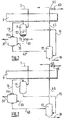
- FIG. 1 represents a variant of the process according to the invention
- the Figures 2 and 3 represent details of the Figure 1
- the Figures 4 and 5 represent methods according to the invention.
- the remainder of the mixture 1 may contain one or more of the following components: oxygen, nitrogen, argon, nitrogen oxide (NO or NO 2 or N 2 O), monoxide carbon, hydrogen, methane ...
- the mixture is filtered in a filter F to remove the dust and then compressed in a first compressor stage C1 to form a compressed flow 3.
- the compressed flow 3 at 35 ° C is compressed in a second compression stage C2, cooled in a cooler R2, compressed in a third compression stage C3, cooled in a cooler R3, compressed in a fourth compression stage C4, cooled in a cooler R4, compressed in a fifth compression stage C5 and cooled in a cooler R5 to form a flow 5 to between 6 and 20 bar abs.
- This flow rate of the mixture is purified with water in a bed of absorbent A2 to form a purified flow 7 at 35 ° C.
- the purified flow 7 is partially condensed in a first heat exchanger 9, which is an aluminum exchanger consisting of a stack of plates separated by fins.
- the partially condensed flow rate is sent at a temperature above -38.6 ° C, and below -34 ° C, or even below -34.5 ° C, for example at -35 ° C, in a first phase separator 11.
- the mercury is partially condensed and is purged with the liquid 15.
- the gas formed 13 in the phase separator 11 still contains at least 0.2 ⁇ g / Nm 3 of the mercury and is sent to the tubes of a second heat exchanger 35, allowing an indirect heat exchange between only two fluids, of the tube and shell type.
- the figure does not illustrate the multiplicity of tubes in which the gas 13 derived from the mixture partially condenses.
- the liquid formed 43 at -52 ° C is sent to a second phase separator 17, where also the liquid 15 of the first phase separator 11 is sent.
- the phase separators 11, 17 will preferably be made of stainless steel.
- Stainless steel can be 316L type.
- the lines connecting the first phase separator to the second exchanger and connecting the first phase separator to the second phase separator will preferably be made of stainless steel.
- the structured packings of the column 23 may be made of aluminum.
- the cooling temperature is above -54 ° C to avoid the risk of freezing carbon dioxide.
- a gas 45 of the second phase separator 17 is heated in the first heat exchanger.
- the liquid 19 of the second separator 17 is expanded in a valve 21 and sent to the top of the distillation column 23.
- a top gas 25 depleted of carbon dioxide but enriched in at least one of the impurities oxygen, nitrogen, argon, nitrogen oxide (NO or NO 2 / N 2 O 4 or N 2 O), carbon monoxide, hydrogen
- the impurities oxygen, nitrogen, argon, nitrogen oxide (NO or NO 2 / N 2 O 4 or N 2 O), carbon monoxide, hydrogen
- a tank liquid 27 is withdrawn in the bottom of the column and contains at least 80 mol% of carbon dioxide.
- the liquid 27 is divided in two, a flow 29 vaporizes in the first heat exchanger 9 without being relaxed. Part of the gas formed is sent to the bottom of the distillation column. The remainder 32 is part of the product of the process.
- the liquid 33 from the tank is expanded in a valve 31 to a pressure equivalent to or slightly greater than that of the triple point of the carbon dioxide it contains.
- the liquid is then sent to the calender of the second exchanger 35 where it vaporizes.
- the formed gas heats up in exchanger 9 and then is compressed by a compression stage C6 and cooled in a cooler R6 before being mixed with the vaporized liquid 32.
- the gas thus formed is compressed by the stages C7, C8, C9 and cooled by the coolers R7, R8, R9, R10 to form a condensed gas.
- This condensed gas is mixed with the liquid purge 41 of the second exchanger and partially pumped by a pump P1 to form a liquid product under pressure 51, at least 50 bar.
- the liquid purge 41 has previously been pumped into a pump P2.
- a portion 49 of the liquid serves as a cycle liquid, is expanded at the triple point in the valve 53 and sent to the second exchanger 35, mixed with the flow 33.
- Part of the mixture 47 is reheated in an exchanger E1 and serves to regenerate the adsorbent bed A1 which is in regeneration.
- the flow 55 used for the regeneration is mixed with the flow 3 downstream of the stage C1.
- a purge gas of more than -38.6 ° C will be sent to the exchanger 35 to melt the solidified mercury and evacuate it in gaseous form.
- These drain lines will be made of stainless steel.
- connection between the two phase separators 11, 17 is delicate since it is necessary to prevent the mercury from freezing in the pipe coming from the phase separator 11, to prevent it blocking the pipe, but to send anyway the liquid CO 2 from the phase separator 11 (to -35 ° C) below the liquid level of the phase separator 17 (which is at -52 ° C). If it were introduced into the gaseous zone, solid mercury could be carried by the gaseous fluid 45.
- a dip tube can be placed to collect the fluid 19 without taking the mercury which will flow to the bottom of the separation pot 17.
- the simple partial condensation in the phase separator 11 is sufficient to remove enough mercury, that the gas 13 can be treated without taking additional precautions to protect the elements of the device against the presence of mercury. In this case, it is not necessary to purge the exchanger 35 to remove the mercury, the latter being entrained in the liquid 15 to the separator 17.
- a mixture 7 contains at least 35 mol% of carbon dioxide, at least 60 mol%. of carbon dioxide, or even at least 80 mol%. of carbon dioxide. It contains at least 0.2 ⁇ g / Nm 3 of mercury or at least 2 ⁇ g / Nm 3 of mercury.
- the remainder of the mixture 7 may contain one or more of the following components: oxygen, nitrogen, argon, nitrogen oxide (NO or NO 2 or N 2 O), carbon monoxide carbon, hydrogen, methane.
- the mixture 7 is cooled in a first exchanger 9 which is a brazed aluminum plate and fin exchanger.
- the mixture cools to a temperature above -38.6 ° C and below -34 ° C, or even below -34.5 ° C, and is sent to a first phase separator 11 made of stainless steel.
- the product liquid 15 is removed from the phase separator and the gas 13 is sent to a second exchanger 35.
- This second exchanger 35 may be a tube and shell heat exchanger or a brazed plate and fin exchanger made of a metal other than aluminum or stainless steel plate and shell heat exchanger.
- the flow rate cools down to a third temperature below -38.6 ° C.
- part of the mercury is liquefied in the first phase separator 11 which is made of stainless steel. Since carbon dioxide is less dense than mercury, liquefied carbon dioxide is above mercury and can be removed by dip tube 57 without removing mercury. The liquid mercury can therefore be removed regularly by a line 59 and a valve 61, or completely when the process is stopped. In this case, the mercury is not sent to the second phase separator 17 but is removed from the apparatus and can be sold as a product. The remainder of the mercury solidifies in the exchanger 35 and is removed by sending a purge gas into the exchanger 35 to vaporize the mercury and evacuate it through line 63 and valve 65.
- the liquid mercury passes from the first phase separator 11 to the second phase separator 17 through line 15.
- the remainder of the mixture 7 may contain one or more of the following components: oxygen, nitrogen, argon, nitrogen oxide (NO or NO 2 or N 2 O), carbon monoxide carbon, hydrogen, methane.
- the mixture 7 is cooled in a first exchanger 9 which is a brazed aluminum plate and fin exchanger.
- the mixture cools to a temperature above -38.6 ° C and below -34 ° C, or even below -34.5 ° C, and is sent to a stainless steel phase separator 11.
- the product liquid 15 is removed from the phase separator and the gas 13 is sent to a second exchanger 35.
- This second exchanger 35 may be a tube and shell heat exchanger or a brazed plate and fin exchanger made of a metal other than aluminum or stainless steel plate and shell heat exchanger.
- the flow rate cools to a third temperature below -38.6 ° C and the mercury is deposited in solid form in the second exchanger.
- the second exchanger 35 may be a brazed plate and fin exchanger made of stainless steel or copper, nickel or tantalum or an alloy of at least two of these metals.
- Another fluid 45 is heated in the two heat exchangers to provide frigories.
- two different fluids can flow each in one of the exchangers.
- the liquid form 43 in the second exchanger can be treated in means sensitive to mercury corrosion, since the mercury concentration of the liquid will be less than 0.1 ⁇ g / Nm 3 .
- phase separator 11 As illustrated in Figure 5 the presence of the phase separator 11 is not essential.
Landscapes
- Engineering & Computer Science (AREA)
- Physics & Mathematics (AREA)
- Mechanical Engineering (AREA)
- Thermal Sciences (AREA)
- General Engineering & Computer Science (AREA)
- Chemical & Material Sciences (AREA)
- Chemical Kinetics & Catalysis (AREA)
- Separation By Low-Temperature Treatments (AREA)
- Treating Waste Gases (AREA)
Claims (11)
- Verfahren zur Kühlung eines Flusses, zumindest 35 % Kohlendioxid und zumindest 0,2 µg/Nm3 Quecksilber enthaltend, wobei das Quecksilber in flüssiger und/oder gasförmiger Form ist, wobeii) der Fluss in einem ersten gelöteten Plattenwärmetauscher (9) von einer ersten Temperatur bis auf eine zweite Temperatur über -38,6 °C gekühlt wird, um einen auf die zweite Temperatur gekühlten Fluss zu bilden, undii) der auf die zweite Temperatur gekühlte Fluss, der zumindest 35 % Kohlendioxid und zumindest 0,2 µg/Nm3 Quecksilber oder ein von diesem gekühlten Fluss abgeleitetes Gas (13) enthält, in einem zweiten Wärmetauscher (35), der ein Röhren-und Rohrbündelwärmetauscher oder ein Wärmetauscher mit gelöteten Platten und Rippen, oder ein Platten- und Rohrbündelwärmetauscher ist, auf eine dritte Temperatur unter -38,6 °C gekühlt wird, und eventuelliii) der auf die zweite Temperatur gekühlte Fluss, der zumindest 35 % Kohlendioxid und zumindest 0,2 µg/Nm3 Quecksilber enthält, zweiphasig ist, und sich in einem ersten Phasenabscheider (11) abscheidet, um flüssiges Quecksilber und das vom gekühlten Fluss abgeleitete, vom Quecksilber gereinigte Gas zu bilden, dadurch gekennzeichnet, dass der erste Wärmetauscher aus Aluminium ist, der zweite Wärmetauscher aus nichtrostendem Stahl, aus Kupfer, aus Nickel, aus Tantal oder einer Legierung zweier dieser Metalle ist und dadurch, dass die zweite Temperatur unter - 34 °C liegt.
- Verfahren nach Anspruch 1, wobei der Fluss teilweise im ersten Wärmetauscher (9) kondensiert und in einen ersten Phasenabscheider (11) geschickt wird, wobei der gasförmige Abschnitt (13), der aus dem ersten Phasenabscheider stammt, das aus dem gekühlten Fluss abgeleitete Gas bildet, wobei dieser gasförmige Abschnitt einen weniger hohen Gehalt an Quecksilber aufweist, als der im ersten Wärmetauscher gekühlte Fluss.
- Verfahren nach Anspruch 1 oder 2, wobei sich Quecksilber verfestigt und sich im zweiten Wärmetauscher (35) und/oder in einem zweiten Phasenabscheider (17) absetzt, der mit Flüssigkeit (15) versorgt wird, die mit Quecksilber oder mit dem flüssigen Quecksilber angereichert ist, das aus dem ersten Phasenabscheider (11) stammt.
- Verfahren nach Anspruch 3, wobei die Flüssigkeit, die aus dem ersten Phasenabscheider (11) stammt, in den zweiten Phasenabscheider (17) auf ein Niveau unterhalb des Flüssigkeitsniveaus desselben geschickt wird.
- Verfahren nach einem der vorhergehenden Ansprüche, wobei die zweite Temperatur über -36 °C liegt.
- Verfahren nach einem der vorhergehenden Ansprüche, wobei die zweite Temperatur unter -34,5 °C liegt.
- Verfahren nach einem der vorhergehenden Ansprüche, wobei die dritte Temperatur unter -50 °C und/oder über -54 °C liegt.
- Verfahren nach einem der vorhergehenden Ansprüche, wobei der gekühlte Fluss nicht gereinigt wird, um Quecksilber durch Adsorption zwischen dem ersten und dem zweiten Wärmetauscher (9, 35) zu eliminieren.
- Verfahren nach Anspruch 8, außer der Anspruch 8 hängt von einem der Ansprüche 2 oder 4 ab, wobei der gekühlte Fluss nicht gereinigt wird, um Quecksilber zwischen dem ersten und dem zweiten Wärmetauscher (9, 35) zu eliminieren.
- Verfahren nach einem der vorhergehenden Ansprüche, wobei der zweite Wärmetauscher (35) ein gelöteter Platten- und Rippenwärmetauscher aus nichtrostendem Stahl oder aus Kupfer, Nickel oder Tantal oder einer Legierung aus zumindest zwei dieser Metalle ist.
- Verfahren nach einem der vorhergehenden Ansprüche, wobei der auf die dritte Temperatur gekühlte Fluss danach auf einer Temperatur gleich oder kleiner der dritten Temperatur abgeschieden wird, um einen flüssigen Fluss zu erzeugen, der zumindest 80 % Kohlendioxid, oder gar zumindest 95 % Kohlendioxid enthält.
Applications Claiming Priority (2)
| Application Number | Priority Date | Filing Date | Title |
|---|---|---|---|
| FR1256769A FR2993350B1 (fr) | 2012-07-13 | 2012-07-13 | Procede et appareil de refroidissement d'un debit contenant au moins 35% de dioxyde de carbone et du mercure |
| PCT/FR2013/051684 WO2014009675A2 (fr) | 2012-07-13 | 2013-07-12 | Procédé et appareil de refroidissement d'un débit contenant au moins 35% de dioxyde de carbone et du mercure |
Publications (2)
| Publication Number | Publication Date |
|---|---|
| EP2872298A2 EP2872298A2 (de) | 2015-05-20 |
| EP2872298B1 true EP2872298B1 (de) | 2017-08-30 |
Family
ID=47294956
Family Applications (1)
| Application Number | Title | Priority Date | Filing Date |
|---|---|---|---|
| EP13747447.4A Active EP2872298B1 (de) | 2012-07-13 | 2013-07-12 | Verfahren und vorrichtung zur kühlung eines flusses mit mindestens 35 % kohlendioxid und quecksilber |
Country Status (7)
| Country | Link |
|---|---|
| US (1) | US9950274B2 (de) |
| EP (1) | EP2872298B1 (de) |
| CN (1) | CN104428613B (de) |
| AU (1) | AU2013288527A1 (de) |
| CA (1) | CA2877216C (de) |
| FR (1) | FR2993350B1 (de) |
| WO (1) | WO2014009675A2 (de) |
Families Citing this family (2)
| Publication number | Priority date | Publication date | Assignee | Title |
|---|---|---|---|---|
| CN106886266A (zh) * | 2015-12-15 | 2017-06-23 | 重庆道米科技有限公司 | 一种基于计算机电器元件散热的装置 |
| FR3161576A1 (fr) * | 2024-04-26 | 2025-10-31 | L'air Liquide, Societe Anonyme Pour L'etude Et L'exploitation Des Procedes Georges Claude | Procédé et appareil de séparation d’un mélange contenant du CO2, au moins un composant plus léger que le CO2 et du mercure |
Family Cites Families (10)
| Publication number | Priority date | Publication date | Assignee | Title |
|---|---|---|---|---|
| US4813987A (en) * | 1987-10-13 | 1989-03-21 | Mobil Oil Corporation | Process for the liquefaction of natural gas |
| FR2739916B1 (fr) * | 1995-10-11 | 1997-11-21 | Inst Francais Du Petrole | Procede et dispositif de liquefaction et de traitement d'un gaz naturel |
| US6119479A (en) * | 1998-12-09 | 2000-09-19 | Air Products And Chemicals, Inc. | Dual mixed refrigerant cycle for gas liquefaction |
| JP3892647B2 (ja) | 2000-06-28 | 2007-03-14 | 株式会社神戸製鋼所 | 溶接構造およびそれを備えた熱交換器 |
| US8250883B2 (en) * | 2006-12-26 | 2012-08-28 | Repsol Ypf, S.A. | Process to obtain liquefied natural gas |
| FR2918578B1 (fr) * | 2007-07-13 | 2010-01-01 | Air Liquide | Procede de purification d'un gaz contenant du co2 |
| FR2918579B1 (fr) * | 2007-07-13 | 2010-01-01 | Air Liquide | Procede de purification d'un gaz contenant du co2 par integration d'unite de purification par adsorption |
| US8381544B2 (en) * | 2008-07-18 | 2013-02-26 | Kellogg Brown & Root Llc | Method for liquefaction of natural gas |
| CN101618292A (zh) * | 2008-11-10 | 2010-01-06 | 李元胜 | 一种对工业三废进行综合利用的系统 |
| FR2947329A1 (fr) * | 2009-06-24 | 2010-12-31 | Air Liquide | Boite froide hybride. |
-
2012
- 2012-07-13 FR FR1256769A patent/FR2993350B1/fr not_active Expired - Fee Related
-
2013
- 2013-07-12 AU AU2013288527A patent/AU2013288527A1/en not_active Abandoned
- 2013-07-12 CN CN201380036468.XA patent/CN104428613B/zh active Active
- 2013-07-12 WO PCT/FR2013/051684 patent/WO2014009675A2/fr not_active Ceased
- 2013-07-12 EP EP13747447.4A patent/EP2872298B1/de active Active
- 2013-07-12 CA CA2877216A patent/CA2877216C/fr active Active
- 2013-07-12 US US14/413,899 patent/US9950274B2/en active Active
Non-Patent Citations (1)
| Title |
|---|
| None * |
Also Published As
| Publication number | Publication date |
|---|---|
| CA2877216C (fr) | 2020-09-15 |
| CN104428613B (zh) | 2016-12-07 |
| US20150157957A1 (en) | 2015-06-11 |
| FR2993350A1 (fr) | 2014-01-17 |
| EP2872298A2 (de) | 2015-05-20 |
| FR2993350B1 (fr) | 2018-06-15 |
| US9950274B2 (en) | 2018-04-24 |
| WO2014009675A3 (fr) | 2014-12-24 |
| WO2014009675A2 (fr) | 2014-01-16 |
| AU2013288527A1 (en) | 2015-02-05 |
| CN104428613A (zh) | 2015-03-18 |
| CA2877216A1 (fr) | 2014-01-16 |
Similar Documents
| Publication | Publication Date | Title |
|---|---|---|
| EP2938413B1 (de) | Verfahren und vorrichtung zur reinigung einer kohlendioxidreichen mischung bei niedriger temperatur | |
| EP2147270B1 (de) | Verfahren und vorrichtung zur trennung einer mischung aus wasserstoff, methan und kohlenmonoxid durch kryogene destillation | |
| EP2582446B1 (de) | Verfahren und vorrichtung zum trocknen und komprimieren eines co2 reichen stoffstroms | |
| JP5886281B2 (ja) | 発酵工程からの二酸化炭素の高圧回収 | |
| WO2013135993A2 (fr) | Procédé et appareil de séparation d'un mélange contenant du dioxyde de carbone par distillation | |
| WO2014128409A1 (fr) | Séparation à température subambiante d'un mélange gazeux contenant du dioxyde de carbone et un contaminant plus léger | |
| EP2673582B1 (de) | Verfahren und vorrichtung zur kryogenen trennung eines methanreichen stroms | |
| CA2877216C (fr) | Procede et appareil de refroidissement d'un debit contenant au moins 35% de dioxyde de carbone et du mercure | |
| FR2949978A1 (fr) | Procede de purification d'un flux gazeux comprenant du mercure | |
| FR2993352A1 (fr) | Procede et appareil de separation d'un gaz riche en dioxyde de carbone | |
| WO2012107667A2 (fr) | Procede et appareil de separation cryogenique d'un debit riche en methane | |
| WO2012055695A1 (en) | Process for the separation of contaminant or mixture of contaminants from a ch4-comprising gaseous feed stream | |
| WO2014049259A1 (fr) | Procédé et appareil de séparation d'un mélange contenant du dioxyde de carbone par distillation cryogénique | |
| FR3054304A1 (fr) | Procede et appareil de lavage a temperature cryogenique pour la production d’un melange d’hydrogene et d’azote | |
| WO2021115719A1 (fr) | Procédé et un dispositif de purification de gaz | |
| FR3119883A1 (fr) | Procédé et appareil de liquéfaction d’hydrogène | |
| FR2947329A1 (fr) | Boite froide hybride. | |
| WO2012132560A1 (ja) | アンモニアの精製方法およびアンモニア精製システム | |
| TWI618568B (zh) | Gas recovery and purification process | |
| WO2026008564A1 (fr) | Procédé de démarrage d'un appareil de séparation d'air par distillation cryogénique | |
| FR3148642A1 (fr) | Procédé et appareil de séparation d’un gaz contenant du dioxyde de carbone par condensation partielle et/ou distillation | |
| FR3167202A1 (fr) | Procédé et appareil de séparation d’air par distillation cryogénique | |
| WO2009087324A2 (fr) | Colonne de separation d'un melange de monoxyde de carbone et d'azote par distillation cryogenique et appareil incorporant une telle colonne | |
| FR2930325A1 (fr) | Appareil et procede de production d'argon par distillation cryogenique. |
Legal Events
| Date | Code | Title | Description |
|---|---|---|---|
| PUAI | Public reference made under article 153(3) epc to a published international application that has entered the european phase |
Free format text: ORIGINAL CODE: 0009012 |
|
| 17P | Request for examination filed |
Effective date: 20141222 |
|
| AK | Designated contracting states |
Kind code of ref document: A2 Designated state(s): AL AT BE BG CH CY CZ DE DK EE ES FI FR GB GR HR HU IE IS IT LI LT LU LV MC MK MT NL NO PL PT RO RS SE SI SK SM TR |
|
| AX | Request for extension of the european patent |
Extension state: BA ME |
|
| RIN1 | Information on inventor provided before grant (corrected) |
Inventor name: LECLERC, MATHIEU Inventor name: GRANADOS, LUDOVIC Inventor name: DARDE, ARTHUR Inventor name: TRAVERSAC, XAVIER Inventor name: BRIGLIA, ALAIN Inventor name: LOCKWOOD, FREDERICK |
|
| R17P | Request for examination filed (corrected) |
Effective date: 20150624 |
|
| RBV | Designated contracting states (corrected) |
Designated state(s): AL AT BE BG CH CY CZ DE DK EE ES FI FR GB GR HR HU IE IS IT LI LT LU LV MC MK MT NL NO PL PT RO RS SE SI SK SM TR |
|
| DAX | Request for extension of the european patent (deleted) | ||
| GRAP | Despatch of communication of intention to grant a patent |
Free format text: ORIGINAL CODE: EPIDOSNIGR1 |
|
| INTG | Intention to grant announced |
Effective date: 20170410 |
|
| GRAS | Grant fee paid |
Free format text: ORIGINAL CODE: EPIDOSNIGR3 |
|
| GRAA | (expected) grant |
Free format text: ORIGINAL CODE: 0009210 |
|
| AK | Designated contracting states |
Kind code of ref document: B1 Designated state(s): AL AT BE BG CH CY CZ DE DK EE ES FI FR GB GR HR HU IE IS IT LI LT LU LV MC MK MT NL NO PL PT RO RS SE SI SK SM TR |
|
| REG | Reference to a national code |
Ref country code: GB Ref legal event code: FG4D Free format text: NOT ENGLISH |
|
| REG | Reference to a national code |
Ref country code: CH Ref legal event code: EP |
|
| REG | Reference to a national code |
Ref country code: AT Ref legal event code: REF Ref document number: 923081 Country of ref document: AT Kind code of ref document: T Effective date: 20170915 |
|
| REG | Reference to a national code |
Ref country code: IE Ref legal event code: FG4D Free format text: LANGUAGE OF EP DOCUMENT: FRENCH |
|
| REG | Reference to a national code |
Ref country code: DE Ref legal event code: R096 Ref document number: 602013025813 Country of ref document: DE |
|
| REG | Reference to a national code |
Ref country code: NL Ref legal event code: MP Effective date: 20170830 |
|
| REG | Reference to a national code |
Ref country code: LT Ref legal event code: MG4D |
|
| REG | Reference to a national code |
Ref country code: AT Ref legal event code: MK05 Ref document number: 923081 Country of ref document: AT Kind code of ref document: T Effective date: 20170830 |
|
| PG25 | Lapsed in a contracting state [announced via postgrant information from national office to epo] |
Ref country code: AT Free format text: LAPSE BECAUSE OF FAILURE TO SUBMIT A TRANSLATION OF THE DESCRIPTION OR TO PAY THE FEE WITHIN THE PRESCRIBED TIME-LIMIT Effective date: 20170830 Ref country code: LT Free format text: LAPSE BECAUSE OF FAILURE TO SUBMIT A TRANSLATION OF THE DESCRIPTION OR TO PAY THE FEE WITHIN THE PRESCRIBED TIME-LIMIT Effective date: 20170830 Ref country code: SE Free format text: LAPSE BECAUSE OF FAILURE TO SUBMIT A TRANSLATION OF THE DESCRIPTION OR TO PAY THE FEE WITHIN THE PRESCRIBED TIME-LIMIT Effective date: 20170830 Ref country code: HR Free format text: LAPSE BECAUSE OF FAILURE TO SUBMIT A TRANSLATION OF THE DESCRIPTION OR TO PAY THE FEE WITHIN THE PRESCRIBED TIME-LIMIT Effective date: 20170830 Ref country code: NO Free format text: LAPSE BECAUSE OF FAILURE TO SUBMIT A TRANSLATION OF THE DESCRIPTION OR TO PAY THE FEE WITHIN THE PRESCRIBED TIME-LIMIT Effective date: 20171130 Ref country code: FI Free format text: LAPSE BECAUSE OF FAILURE TO SUBMIT A TRANSLATION OF THE DESCRIPTION OR TO PAY THE FEE WITHIN THE PRESCRIBED TIME-LIMIT Effective date: 20170830 |
|
| PG25 | Lapsed in a contracting state [announced via postgrant information from national office to epo] |
Ref country code: GR Free format text: LAPSE BECAUSE OF FAILURE TO SUBMIT A TRANSLATION OF THE DESCRIPTION OR TO PAY THE FEE WITHIN THE PRESCRIBED TIME-LIMIT Effective date: 20171201 Ref country code: ES Free format text: LAPSE BECAUSE OF FAILURE TO SUBMIT A TRANSLATION OF THE DESCRIPTION OR TO PAY THE FEE WITHIN THE PRESCRIBED TIME-LIMIT Effective date: 20170830 Ref country code: BG Free format text: LAPSE BECAUSE OF FAILURE TO SUBMIT A TRANSLATION OF THE DESCRIPTION OR TO PAY THE FEE WITHIN THE PRESCRIBED TIME-LIMIT Effective date: 20171130 Ref country code: LV Free format text: LAPSE BECAUSE OF FAILURE TO SUBMIT A TRANSLATION OF THE DESCRIPTION OR TO PAY THE FEE WITHIN THE PRESCRIBED TIME-LIMIT Effective date: 20170830 Ref country code: RS Free format text: LAPSE BECAUSE OF FAILURE TO SUBMIT A TRANSLATION OF THE DESCRIPTION OR TO PAY THE FEE WITHIN THE PRESCRIBED TIME-LIMIT Effective date: 20170830 Ref country code: IS Free format text: LAPSE BECAUSE OF FAILURE TO SUBMIT A TRANSLATION OF THE DESCRIPTION OR TO PAY THE FEE WITHIN THE PRESCRIBED TIME-LIMIT Effective date: 20171230 |
|
| PG25 | Lapsed in a contracting state [announced via postgrant information from national office to epo] |
Ref country code: NL Free format text: LAPSE BECAUSE OF FAILURE TO SUBMIT A TRANSLATION OF THE DESCRIPTION OR TO PAY THE FEE WITHIN THE PRESCRIBED TIME-LIMIT Effective date: 20170830 |
|
| PG25 | Lapsed in a contracting state [announced via postgrant information from national office to epo] |
Ref country code: DK Free format text: LAPSE BECAUSE OF FAILURE TO SUBMIT A TRANSLATION OF THE DESCRIPTION OR TO PAY THE FEE WITHIN THE PRESCRIBED TIME-LIMIT Effective date: 20170830 Ref country code: CZ Free format text: LAPSE BECAUSE OF FAILURE TO SUBMIT A TRANSLATION OF THE DESCRIPTION OR TO PAY THE FEE WITHIN THE PRESCRIBED TIME-LIMIT Effective date: 20170830 Ref country code: RO Free format text: LAPSE BECAUSE OF FAILURE TO SUBMIT A TRANSLATION OF THE DESCRIPTION OR TO PAY THE FEE WITHIN THE PRESCRIBED TIME-LIMIT Effective date: 20170830 Ref country code: PL Free format text: LAPSE BECAUSE OF FAILURE TO SUBMIT A TRANSLATION OF THE DESCRIPTION OR TO PAY THE FEE WITHIN THE PRESCRIBED TIME-LIMIT Effective date: 20170830 |
|
| PG25 | Lapsed in a contracting state [announced via postgrant information from national office to epo] |
Ref country code: IT Free format text: LAPSE BECAUSE OF FAILURE TO SUBMIT A TRANSLATION OF THE DESCRIPTION OR TO PAY THE FEE WITHIN THE PRESCRIBED TIME-LIMIT Effective date: 20170830 Ref country code: SM Free format text: LAPSE BECAUSE OF FAILURE TO SUBMIT A TRANSLATION OF THE DESCRIPTION OR TO PAY THE FEE WITHIN THE PRESCRIBED TIME-LIMIT Effective date: 20170830 Ref country code: EE Free format text: LAPSE BECAUSE OF FAILURE TO SUBMIT A TRANSLATION OF THE DESCRIPTION OR TO PAY THE FEE WITHIN THE PRESCRIBED TIME-LIMIT Effective date: 20170830 Ref country code: SK Free format text: LAPSE BECAUSE OF FAILURE TO SUBMIT A TRANSLATION OF THE DESCRIPTION OR TO PAY THE FEE WITHIN THE PRESCRIBED TIME-LIMIT Effective date: 20170830 |
|
| REG | Reference to a national code |
Ref country code: DE Ref legal event code: R097 Ref document number: 602013025813 Country of ref document: DE |
|
| PLBE | No opposition filed within time limit |
Free format text: ORIGINAL CODE: 0009261 |
|
| STAA | Information on the status of an ep patent application or granted ep patent |
Free format text: STATUS: NO OPPOSITION FILED WITHIN TIME LIMIT |
|
| 26N | No opposition filed |
Effective date: 20180531 |
|
| PG25 | Lapsed in a contracting state [announced via postgrant information from national office to epo] |
Ref country code: SI Free format text: LAPSE BECAUSE OF FAILURE TO SUBMIT A TRANSLATION OF THE DESCRIPTION OR TO PAY THE FEE WITHIN THE PRESCRIBED TIME-LIMIT Effective date: 20170830 |
|
| PG25 | Lapsed in a contracting state [announced via postgrant information from national office to epo] |
Ref country code: MT Free format text: LAPSE BECAUSE OF FAILURE TO SUBMIT A TRANSLATION OF THE DESCRIPTION OR TO PAY THE FEE WITHIN THE PRESCRIBED TIME-LIMIT Effective date: 20170830 |
|
| REG | Reference to a national code |
Ref country code: CH Ref legal event code: PL |
|
| GBPC | Gb: european patent ceased through non-payment of renewal fee |
Effective date: 20180712 |
|
| PG25 | Lapsed in a contracting state [announced via postgrant information from national office to epo] |
Ref country code: MC Free format text: LAPSE BECAUSE OF FAILURE TO SUBMIT A TRANSLATION OF THE DESCRIPTION OR TO PAY THE FEE WITHIN THE PRESCRIBED TIME-LIMIT Effective date: 20170830 Ref country code: LU Free format text: LAPSE BECAUSE OF NON-PAYMENT OF DUE FEES Effective date: 20180712 |
|
| REG | Reference to a national code |
Ref country code: BE Ref legal event code: MM Effective date: 20180731 |
|
| REG | Reference to a national code |
Ref country code: IE Ref legal event code: MM4A |
|
| PG25 | Lapsed in a contracting state [announced via postgrant information from national office to epo] |
Ref country code: GB Free format text: LAPSE BECAUSE OF NON-PAYMENT OF DUE FEES Effective date: 20180712 Ref country code: CH Free format text: LAPSE BECAUSE OF NON-PAYMENT OF DUE FEES Effective date: 20180731 Ref country code: LI Free format text: LAPSE BECAUSE OF NON-PAYMENT OF DUE FEES Effective date: 20180731 Ref country code: FR Free format text: LAPSE BECAUSE OF NON-PAYMENT OF DUE FEES Effective date: 20180731 Ref country code: IE Free format text: LAPSE BECAUSE OF NON-PAYMENT OF DUE FEES Effective date: 20180712 |
|
| PG25 | Lapsed in a contracting state [announced via postgrant information from national office to epo] |
Ref country code: BE Free format text: LAPSE BECAUSE OF NON-PAYMENT OF DUE FEES Effective date: 20180731 |
|
| PG25 | Lapsed in a contracting state [announced via postgrant information from national office to epo] |
Ref country code: TR Free format text: LAPSE BECAUSE OF FAILURE TO SUBMIT A TRANSLATION OF THE DESCRIPTION OR TO PAY THE FEE WITHIN THE PRESCRIBED TIME-LIMIT Effective date: 20170830 |
|
| PG25 | Lapsed in a contracting state [announced via postgrant information from national office to epo] |
Ref country code: HU Free format text: LAPSE BECAUSE OF FAILURE TO SUBMIT A TRANSLATION OF THE DESCRIPTION OR TO PAY THE FEE WITHIN THE PRESCRIBED TIME-LIMIT; INVALID AB INITIO Effective date: 20130712 Ref country code: PT Free format text: LAPSE BECAUSE OF FAILURE TO SUBMIT A TRANSLATION OF THE DESCRIPTION OR TO PAY THE FEE WITHIN THE PRESCRIBED TIME-LIMIT Effective date: 20170830 |
|
| PG25 | Lapsed in a contracting state [announced via postgrant information from national office to epo] |
Ref country code: MK Free format text: LAPSE BECAUSE OF NON-PAYMENT OF DUE FEES Effective date: 20170830 Ref country code: CY Free format text: LAPSE BECAUSE OF FAILURE TO SUBMIT A TRANSLATION OF THE DESCRIPTION OR TO PAY THE FEE WITHIN THE PRESCRIBED TIME-LIMIT Effective date: 20170830 |
|
| PG25 | Lapsed in a contracting state [announced via postgrant information from national office to epo] |
Ref country code: AL Free format text: LAPSE BECAUSE OF FAILURE TO SUBMIT A TRANSLATION OF THE DESCRIPTION OR TO PAY THE FEE WITHIN THE PRESCRIBED TIME-LIMIT Effective date: 20170830 |
|
| PGFP | Annual fee paid to national office [announced via postgrant information from national office to epo] |
Ref country code: DE Payment date: 20250722 Year of fee payment: 13 |