EP2879072A1 - Vorrichtung zur Registrierung biometrischer Informationen und Verfahren - Google Patents
Vorrichtung zur Registrierung biometrischer Informationen und Verfahren Download PDFInfo
- Publication number
- EP2879072A1 EP2879072A1 EP14195118.6A EP14195118A EP2879072A1 EP 2879072 A1 EP2879072 A1 EP 2879072A1 EP 14195118 A EP14195118 A EP 14195118A EP 2879072 A1 EP2879072 A1 EP 2879072A1
- Authority
- EP
- European Patent Office
- Prior art keywords
- biometric information
- posture
- feature amount
- registration data
- information registration
- Prior art date
- Legal status (The legal status is an assumption and is not a legal conclusion. Google has not performed a legal analysis and makes no representation as to the accuracy of the status listed.)
- Ceased
Links
Images






Classifications
-
- G—PHYSICS
- G06—COMPUTING OR CALCULATING; COUNTING
- G06F—ELECTRIC DIGITAL DATA PROCESSING
- G06F21/00—Security arrangements for protecting computers, components thereof, programs or data against unauthorised activity
- G06F21/30—Authentication, i.e. establishing the identity or authorisation of security principals
- G06F21/31—User authentication
- G06F21/32—User authentication using biometric data, e.g. fingerprints, iris scans or voiceprints
-
- G—PHYSICS
- G06—COMPUTING OR CALCULATING; COUNTING
- G06F—ELECTRIC DIGITAL DATA PROCESSING
- G06F18/00—Pattern recognition
- G06F18/20—Analysing
- G06F18/24—Classification techniques
- G06F18/241—Classification techniques relating to the classification model, e.g. parametric or non-parametric approaches
-
- G—PHYSICS
- G06—COMPUTING OR CALCULATING; COUNTING
- G06V—IMAGE OR VIDEO RECOGNITION OR UNDERSTANDING
- G06V40/00—Recognition of biometric, human-related or animal-related patterns in image or video data
- G06V40/10—Human or animal bodies, e.g. vehicle occupants or pedestrians; Body parts, e.g. hands
-
- G—PHYSICS
- G06—COMPUTING OR CALCULATING; COUNTING
- G06V—IMAGE OR VIDEO RECOGNITION OR UNDERSTANDING
- G06V40/00—Recognition of biometric, human-related or animal-related patterns in image or video data
- G06V40/10—Human or animal bodies, e.g. vehicle occupants or pedestrians; Body parts, e.g. hands
- G06V40/12—Fingerprints or palmprints
- G06V40/13—Sensors therefor
- G06V40/1312—Sensors therefor direct reading, e.g. contactless acquisition
-
- G—PHYSICS
- G06—COMPUTING OR CALCULATING; COUNTING
- G06V—IMAGE OR VIDEO RECOGNITION OR UNDERSTANDING
- G06V40/00—Recognition of biometric, human-related or animal-related patterns in image or video data
- G06V40/50—Maintenance of biometric data or enrolment thereof
-
- G—PHYSICS
- G06—COMPUTING OR CALCULATING; COUNTING
- G06V—IMAGE OR VIDEO RECOGNITION OR UNDERSTANDING
- G06V40/00—Recognition of biometric, human-related or animal-related patterns in image or video data
- G06V40/10—Human or animal bodies, e.g. vehicle occupants or pedestrians; Body parts, e.g. hands
- G06V40/14—Vascular patterns
Definitions
- the present disclosure is related to a technique for extracting biometric information from an image.
- Patent Document 1 discloses a technique for registering information of a posture of a living body in order to register biometric information.
- Patent Document 2 discloses a technique for registering information of a posture of a living body in order to register biometric information.
- Patent Document 3 discloses Japanese Laid-open Patent Publication No. 2007-94637
- Patent Document 4 discloses Japanese Laid-open Patent Publication No. 2010-27035
- a posture of a living body at the time of a process of registering biometric information may be different from a posture of the living body at the time of an authentication process. In this case, the accuracy of the authentication may be reduced.
- biometric information it is an object of techniques disclosed in embodiments to extract biometric information to be used to improve the accuracy of authentication.
- a biometric information registration device includes: a generator configured to collect a plurality of biometric information extracted from a plurality of images of a subject; a classifying unit configured to classify a posture of the subject in each of the plurality of images into one of a plurality of classes; and a determining unit configured to count a number of postures that corresponds to each of the plurality of classes, and store biometric information, from among the plurality of biometric information, associated with a certain class for which the number exceeds a threshold.
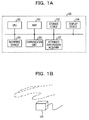
- FIG. 1A is a block diagram describing a hardware configuration of a biometric information extracting device 100 according to a first embodiment.
- FIG. 1B is a schematic diagram of a biometric sensor 105 described later.
- the biometric information extracting device 100 includes a CPU 101, a RAM 102, a storage device 103, a display device 104, the biometric sensor 105, a communication unit 106, an attribute information acquirer 107, and the like. These devices are connected by a bus and the like.
- the central processing unit (CPU) 101 is a central processing unit.
- the CPU 101 includes one or more cores.
- the random access memory (RAM) 102 is a volatile memory configured to temporarily store a program to be executed by the CPU 101, data to be processed by the CPU 101, and the like.
- the storage device 103 is a nonvolatile storage device.
- a read only memory (ROM), a solid state drive (SSD) such as a flash memory, a hard disk to be driven by a hard disk drive, or the like may be used, for example.
- a biometric information extraction program according to the present embodiment is stored in the storage device 103.
- the display device 104 is a liquid crystal display, an electroluminescence panel, or the like and is configured to display results of processes described later.
- the biometric sensor 105 is a sensor that functions as a biometric information acquirer configured to acquire biometric information of a user.
- the biometric sensor 105 is configured to acquire an image of a palm of a hand of a user without contacting the palm in the present embodiment.
- the biometric sensor 105 is a complementary metal oxide semiconductor (CMOS) camera or the like as an example.
- CMOS complementary metal oxide semiconductor
- the biometric sensor 105 acquires the outline of a palm of a hand or the like and uses a near infrared ray to acquire a venous pattern.
- the communication unit 106 is a connection interface to a local area network (LAN) or the like.
- the attribute information acquirer 107 is an input device such as a keyboard or a mouse and configured to input an ID identifying a user and the like, for example.
- the biometric information extraction program stored in the storage device 103 is loaded into the RAM 102 so as to be executable.
- the CPU 101 executes the biometric information extraction program loaded in the RAM 102.
- the processes are executed by the biometric information extracting device 100.
- a registration process, an authentication process, a classification process, and the like are executed.
- the registration process is a process of registering biometric information acquired by the biometric sensor 105 in a database.
- a venous pattern extracted from an image of a palm of a hand and characteristic amounts of a posture of the palm are registered in the database.
- the authentication process is a process of determining that an interested user is the same person as a registered user if a similarity between crosschecking biometric information acquired by the biometric sensor 105 and registration biometric information registered in the database is equal to or larger than a fourth predetermined threshold. In the present embodiment, it is determined that the interested user is the same person as the registered user if a similarity between a venous pattern acquired in the authentication process and the venous pattern registered in the database is equal to or larger than the fourth predetermined threshold.
- the classification process is a process of classifying, into one or more classes, the plurality of characteristic amounts of the posture that have been associated with a user and registered. Details of the processes are described later.
- FIG. 2 is a block diagram of functions that are achieved by the execution of the biometric information extraction program.
- a registration data generator 11 a posture feature amount extractor 12, a crosschecking data generator 13, a crosschecking processing unit 14, a post-crosschecking processing unit 15, a posture feature amount classifying unit 16, a registration data update determining unit 17, a database 18, and the like are achieved.
- a plurality of registration data items are associated with each user and registered in the database 18. For example, as exemplified in FIG. 2 , attribution information 1 and registration data items 1_1 to 1_m (m ⁇ 1) are registered in a registration data set 1 for a user 1. Characteristic amounts of a posture of a hand of the user 1 when authentication of the user 1 succeeds are stored in a posture feature amount history record 1. After the classification process described later, the posture feature amounts classified into classes, and the registration data items associated with the posture feature amounts, are registered in the posture feature amount history record 1.
- a plurality of pairs of biometric sensors 105 and attribute information acquirers 107 may be provided. Alternatively, a desired pair may be selected from the plurality of pairs based on a usage situation and attached.
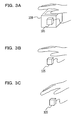
- FIGs. 3A and 3B are diagrams illustrating an example of the biometric sensor 105.
- a guide 108 on which a palm of a hand is to be placed may be provided for the biometric sensor 105.
- the guide 108 By providing the guide 108, a posture of the palm is easily fixed. This suppresses a variation in the posture of the palm at the time of the registration process or authentication process.
- the guide is not provided for the authentication process in some cases.
- the guide is replaced with a device that uses a biometric sensor that does not support the guide, the guide is not used for the subsequent authentication.
- the guide is used as an aid in inputting because of a lack of experience of the inputting for registration and is not used for the authentication from a certain time because of repetitive execution of the authentication and proficiency in the inputting.
- a common guide provided for registration is prepared, a guide is not prepared for each user and used for the authentication.
- the posture of the palm may vary.
- a posture of the palm at the time of the registration process may be different from a posture of the palm at the time of the authentication process and the accuracy of the authentication may be reduced.
- a device to be used for the registration process is different from a device to be used for the authentication process, or methods for using the device are different, or a positional relationship between the user and the device at the time of the registration process is different from a positional relationship between the user and the device at the time of the authentication process, or the like, an angle and position of a biometric information acquiring device used at the time of the registration process are different from an angle and position of the biometric information acquiring device used at the time of the authentication process, and thus a posture at the time of the authentication process is significantly different from a posture at the time of the registration process in some cases.
- An example in which the devices to be used are different is that in a system that is logged in using biometric authentication, registration is executed using the biometric information acquiring device connected to a stationary desktop PC within a corporate office and authentication is executed using the biometric information acquiring device installed in a tablet PC permitted to be taken out of a corporate office.
- an example in which the methods for using the device are different is that in a system in which the tablet PC is unlocked using biometric authentication, registration is executed with the tablet PC placed on a desk and authentication is executed with the tablet PC held.
- the positional relationship between the user and the device at the time of the registration process is different from the positional relationship between the user and the device at the time of the authentication process
- a positional relationship between the user and the biometric sensor at the time of the registration process is different from a positional relationship between the user and the biometric sensor at the time of the authentication process due to a movement of the biometric sensor.
- registration data items are classified in face authentication based on information that is a requirement for a facial orientation of a human subject, a requirement for illumination, a facial expression, and the like at the time of inputting. If a registration data item of a class associated with information at the time of authentication is unregistered, the registration data item is generated from input biometric information and additionally registered. Registration data items are prepared for classes and used for authentication and thereby inhibit an increase in a time for the authentication and an increase in a rate of rejecting a person.
- a registration data item associated with a class may not be added and updated. Even if a registration data item that is more suitable as a representative of a class than an initially registered registration data item is generated, the generated registration data item may not be updated and the accuracy of the authentication may not be improved.
- authentication data that is used for the authentication and is a venous pattern or the like is stored in a database
- the number of storage regions is increased and a cost increases.
- a security risk caused by leakage of authentication data increases.
- details of the authentication data are analyzed by a hill climb attack, the larger the amount of the authentication data, the more the detailed analysis is successful and the higher the possibility that the authentication data is fraudulently used.
- registration data items to be stored be minimal.
- a posture may significantly vary and it is difficult to execute the classification using only an ID of the device.
- the biometric information extracting device 100 extracts biometric information that enables the accuracy of authentication to be improved.
- details of processing executed by the biometric information extracting device 100 specifically, the registration process, crosschecking process, classification process, and crosschecking process after the classification are described.
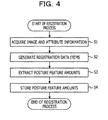
- FIG. 4 is a flowchart of an example of the registration process.
- the biometric sensor 105 acquires an image of a palm of a hand of a user
- the attribute information acquirer 107 acquires attribute information of the user (in step S1).
- the registration data generator 11 generates registration data items (registration biometric information) from the image of the palm (in step S2).
- the registration data items are the venous pattern.
- the posture feature amount extractor 12 extracts posture feature amounts from the image acquired in step S1 and representing the palm (in step S3).
- the posture feature amounts are amounts that characterize a posture of the living body.
- coordinate values of characteristic points of the palm in a coordinate system with its origin at the center of the biometric sensor 105 or the like may be used, as illustrated in FIGs. 5A and 5B.
- FIG. 5A is a side view of the biometric sensor 105 and the palm
- FIG. 5B is a top view of the biometric sensor 105 and the palm.
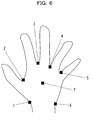
- a point 1 of the base of the thumb at the wrist points 2 to 5 between the fingers, a point 6 of the base of the little finger at the wrist, a central point 7 of the palm, and the like may be used as illustrated in FIG. 6 .
- the central point 7 is the center of gravity of the points 1 to 6 as an example.
- the posture feature amount extractor 12 associates the extracted posture feature amounts with attribution information and a venous pattern and registers the posture feature amounts in the database 18 (in step S4). By the aforementioned processes, the registration process is terminated.
- FIG. 7 is a flowchart of an example of the authentication process.
- the biometric sensor 105 acquires an image of a palm of a hand of a user and the attribute information acquirer 107 acquires attribute information of the user (in step S11).
- the crosschecking data generator 13 generates crosschecking data (biometric information for crosschecking) from the image acquired in step S11 and representing the palm (in step S12).
- the crosschecking data is a venous pattern.
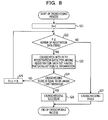
- FIG. 8 illustrates an example of a flowchart of details of the crosschecking executed in step S13.
- the crosschecking processing unit 14 assigns 1 to a variable R (in step S21).
- the crosschecking processing unit 14 determines whether or not the variable R is equal to or smaller than the number of registration data items associated with attribute information that matches the attribute information acquired in step S11 (in step S22).
- step S22 If the crosschecking processing unit 14 determines that the answer to step S22 is "Yes", the crosschecking processing unit 14 crosschecks the crosschecking data with an R-th registration data item that is represented by the variable R and is among the registration data items associated with the attribute information that matches the attribute information acquired in step S11 (in step S23).
- the crosschecking processing unit 14 determines whether or not a score (similarity) of the crosschecking of the R-th registration data with the crosschecking data is equal to or larger than the fourth predetermined threshold (in step S24). If the crosschecking processing unit 14 determines that the answer to step S24 is "No", the crosschecking processing unit 14 assigns R+1 to the variable R (in step S25). After that, the process is executed from step S22. If the crosschecking processing unit 14 determines that the answer to step S24 is "Yes", the crosschecking processing unit 14 determines that the crosschecking succeeds (in step S26). Then, the execution of the process represented by the flowchart is terminated. If the crosschecking processing unit 14 determines that the answer to step S22 is "No", the crosschecking processing unit 14 determines that the crosschecking fails (in step S27). Then, the execution of the process represented by the flowchart is terminated.
- the crosschecking processing unit 14 determines whether or not the crosschecking succeeds (in step S13). If the crosschecking processing unit 14 determines that the answer to step S13 is "Yes", the posture feature amount extractor 12 extracts posture feature amounts from the image acquired in step S11 and representing the palm (in step S14).
- the registration data update determining unit 17 determines a class into which the posture feature amounts extracted in step S14 are classified and assigns the posture feature amounts to the interested class (in step S15). The classification of the posture feature amounts is described later. Next, the registration data update determining unit 17 determines whether or not a registration data item has been registered in the interested class (in step S16). Specifically, the registration data update determining unit 17 determines whether or not a registration data item is able to be additionally registered.
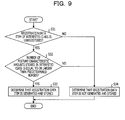
- FIG. 9 illustrates an example of a flowchart of the determination of whether or not the registration data item is additionally registered.
- the registration data update determining unit 17 determines whether or not a registration data item of the interested class is unregistered (in step S31). If the registration data update determining unit 17 determines that the answer to step S31 is "Yes", the registration data update determining unit 17 determines whether or not the number of posture feature amounts stored in the interested class is equal to or larger than a first predetermined number (in step S32). If the registration data update determining unit 17 determines that the answer to step S32 is "Yes", the registration data update determining unit 17 determines that the registration data item is generated and stored (in step S33). If the registration data update determining unit 17 determines that the answer to step S31 or step S32 is "No", the registration data update determining unit 17 determines that the registration data item is not generated and stored (in step S34).
- a registration data item associated with a class corresponding to posture feature amounts is not registered and the number of the registered posture feature amounts corresponding to the interested class is equal to or larger than the first predetermined number, it is determined that additional registration is possible.
- the fact that the number of the registered posture feature amounts is equal to or larger than the first predetermined number indicates that the frequency of inputting from a posture corresponding to the interested class is high.
- step S19 the registration data update determining unit 17 determines that the answer to step S16 is "No"
- the crosschecking processing unit 15 registers the posture feature amounts extracted in step S14 in a posture feature amount history record of the database 18 (in step S19). If the registration data update determining unit 17 determines that the answer to step S16 is "Yes”, the registration data generator 11 generates a registration data item from the crosschecking data generated in step S12 (in step S17). Next, the registration data generator 11 associates the registration data item generated in step S17 with the class to which the posture feature amounts are assigned in step S15 and additionally registers the registration data item in the database 18 (in step S18). Next, step S19 is executed.
- posture feature amounts are registered in a posture feature amount history record by the execution of the authentication process. If a registration data item is able to be additionally registered in each of classes, crosschecking data is additionally registered as a registration data item. Thus, a registration data item is registered in each of the classes.
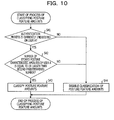
- FIG. 10 is a flowchart of an example of the process of classifying posture feature amounts into a plurality of classes.
- This process represented by the flowchart may be executed immediately after authentication of a predetermined user (user A) succeeds. Alternatively, the process represented by the flowchart may be executed in a time zone in which the possibility that the user A performs the authentication process is low.
- the posture feature amount classifying unit 16 determines whether or not the authentication process is currently unexecuted on the user A (in step S41).
- the posture feature amount classifying unit 16 determines whether or not the number of posture feature amounts associated with the interested user and registered is equal to or larger than a second predetermined number (in step S42). In this case, if the number of the posture feature amounts initially registered for confirmation in the process represented by the flowchart is equal to or larger than the second predetermined number, the answer is determined to be "Yes”. If the posture feature amount classifying unit 16 determines that the answer to step S42 is "No", the posture feature amount classifying unit 16 may determine that the number of the posture feature amounts is insufficient and is not suitable for the classification, and the registered posture feature amounts may be classified into a single class as initial values for the classification.
- step S42 determinations that the answer to step S42 is "Yes”
- the posture feature amount classifying unit 16 classifies the posture feature amounts (in step S43). After that, the execution of the process represented by the flowchart is terminated. If the posture feature amount classifying unit 16 determines that the answer to step S41 or S42 is "No", the posture feature amount classifying unit 16 does not classify the posture feature amounts (in step S44). After that, the execution of the process represented by the flowchart is terminated.
- the second predetermined number used in step S42 be equal to or larger than an upper limit of the number of classes estimated after the classification.
- the upper limit of the number of classes is described later.
- the posture feature amount classifying unit 16 associates stored registration data items with classes to which posture feature amounts of the registration data items belong.
- a plurality of registration data items associated with a certain class may be stored.
- a single registration data item associated with the interested class may be selected from among the plurality of registration data items.
- the posture feature amount classifying unit 16 uses a classification method for determining a representative point of posture feature amounts belonging to each of classes, a registration data item associated with a posture feature amount that is closest to the representative point among posture feature amounts belonging to the class may be determined as a registration data item associated with the interested class.
- a stored registration data item other than registration data items associated with the classes may be deleted.
- a stored posture feature amount other than posture feature amounts associated with registration data items associated with the classes may be deleted.
- the posture feature amount classifying unit 16 may store history records of the numbers of failures of the authentication and history records of the numbers of successes of the authentication, and if the number of the stored history records is equal to or larger than a fifth predetermined number and a probability that the authentication fails is lower than a third predetermined value, the posture feature amount classifying unit 16 may execute the classification and associate stored registration data items with the classes again. Alternatively, if a frequency at which a distance between a posture feature amount stored after the classification and a representative point of a class to which the posture feature amount belongs is equal to or larger than a sixth predetermined value exceeds a seventh predetermined number, the posture feature amount classifying unit 16 may execute the classification and associate stored registration data items with the classes again.
- hierarchical clustering and non-hierarchical clustering may be used.
- the posture feature amount classifying unit 16 starts the classification from an initial state in which each of registered posture feature amounts is treated as a respective class.
- the posture feature amount classifying unit 16 uses a distance function defined for each classification method to combine classes with each other.
- the posture feature amount classifying unit 16 sets a distance threshold in advance. If the number of the classes becomes equal to or smaller than the upper limit of the number of classes and a distance between classes to be combined is larger than the distance threshold, the posture feature amount classifying unit 16 terminates the classification.
- the more significantly the posture at the time of the inputting varies the larger the number of steps up to the classification of posture feature amounts into the same class.
- the more easily posture feature amounts are classified into different classes, and the posture feature amounts may be classified into classes corresponding to a larger number of types of postures.
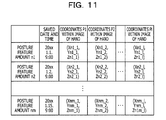
- FIG. 11 is a diagram illustrating details of a posture feature amount history record n of a registration data set n registered in the database 18.
- posture feature amounts n1 to nm are registered in the posture feature amount history record n.
- a saved date and time, coordinates of characteristic points of a hand, and the like are registered for each of the posture feature amounts.
- the posture feature amount classifying unit 16 selects initial representative points (C1, C2, ⁇ , Ck) from among the posture feature amounts n1, n2, ⁇ , nm. For example, the posture feature amount classifying unit 16 may select initial representative points so as to ensure that saved date and times are at equal intervals. Next, the posture feature amount classifying unit 16 calculates distances between the representative points and posture feature amounts other than the representative points and assigns the posture feature amounts to a class of a representative point of which a distance is shortest among the calculated distances.
- the posture feature amount classifying unit 16 calculates an average value of posture feature amounts belonging to each class and treats the average value as a new representative point.
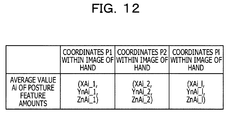
- An average value Ai of posture feature amounts Ni1, Ni2, Nij of a class I of a representative point Ci may be expressed as illustrated in FIG. 12
- the average value (XAi_a, YAi_a, ZAi_a) may be expressed by the following Equation (3), where 1 ⁇ a ⁇ l.
- posture feature amounts may be reliably classified into a number k of classes set in advance.
- storage regions for storing registration data items of each user may be clearly identified and efficiently used.
- the number k of the classes is set to a larger number than the number of types of devices to be used for the inputting, classes, corresponding to postures at the time of the inputting, of posture feature amounts are easily generated.
- a class that corresponds to a new posture may not be additionally generated if the number k of classes and the upper limit of the number of classes are fixed and reclassification is repeatedly executed, regardless of the fact that inputting from the new posture other than registration data items is executed.
- the number k of classes and the upper limit of the number of classes may be changed for reclassification.
- the posture feature amount classifying unit 16 calculates within-class variance of each class before the reclassification. If there is within-class variance that is equal to or larger than an eighth predetermined value, the posture feature amount classifying unit 16 increases the number k of classes and the upper limit of the number of classes and executes the reclassification.
- the number of classes of which within-class variance is equal to or larger than the eighth predetermined value may be used as the number k of classes and an increase in the upper limit of the number of classes.
- the number k of classes and the upper limit of the number of classes may be changed based on the number of times of the classification executed by the posture feature amount classifying unit as a method that is simpler than the calculation of the within-class variance and applies a low load to a system.
- the number k of classes and the upper limit of the number of classes may be increased in proportion to the number of times of the classification.
- a class that corresponds to a new posture may be generated.
- the registration leads to the improvement of the accuracy of the authentication.
- the number k of classes and the upper limit of the number of classes be equal to or smaller than the number of registration data items that are able to be registered for a single user.
- FIG. 13 is a flowchart of an example of the crosschecking process after the classification.
- the crosschecking process after the classification is executed only when posture feature amounts of a target user are already classified in step S13 illustrated in FIG. 7 .
- the crosschecking processing unit 14 sorts registration data items in order of increasing distance between posture feature amounts of each class and the posture feature amounts obtained from the image acquired in step S11 and representing the palm (in step S51).
- the crosschecking processing unit 14 assigns 1 to the variable R (in step S52).
- the crosschecking processing unit 14 determines whether or not the variable R is equal to or smaller than the number of the registration data items associated with the attribute information that matches the attribute information acquired in step S11 (in step S53). If the crosschecking processing unit 14 determines that the answer to step S53 is "Yes", the crosschecking processing unit 14 crosschecks the crosschecking data with the R-th registration data item represented by the variable R and is among the registration data items associated with the attribute information that matches the attribute information acquired in step S11 (in step S54).
- the crosschecking processing unit 14 determines whether or not a score (similarity) of the crosschecking of the R-th registration data item with the crosschecking data is equal to or larger than the fourth predetermined threshold (in step S55). If the crosschecking processing unit 14 determines that the answer to step S55 is "No", the crosschecking processing unit 14 assigns R+1 to the variable R (in step S56). After that, the process is executed from step S53. If the crosschecking processing unit 14 determines that the answer to step S55 is "Yes”, the crosschecking processing unit 14 determines that the crosschecking succeeds (in step S56). Then, the execution of the process represented by the flowchart is terminated. If the crosschecking processing unit 14 determines that the answer to step S53 is "No”, the crosschecking processing unit 14 determines that the crosschecking fails (in step S58). Then, the execution of the process represented by the flowchart is terminated.
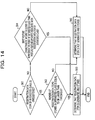
- the registration data update determining unit 17 may execute a determination process represented by a flowchart illustrated in FIG. 14 . As exemplified in FIG. 14 , the registration data update determining unit 17 determines whether or not a registration data item of an interested class is unregistered (in step S61). If the registration data update determining unit 17 determines that the answer to step S61 is "Yes", the registration data update determining unit 17 determines whether or not the number of posture feature amounts stored in the interested class is equal to or larger than the second predetermined number (in step S62). If the registration data update determining unit 17 determines that the answer to step S62 is "Yes", the registration data update determining unit 17 determines that a registration data item is generated and stored (in step S63).
- step S64 the registration data update determining unit 17 determines whether or not an input posture feature amount is closer to a representative point of the class than posture feature amounts associated with the registration data item of the interested class. If the registration data update determining unit 17 determines that the answer to step S64 is "Yes”, step S63 is executed. If the registration data update determining unit 17 determines that the answer to step S62 or S64 is "No", the registration data update determining unit 17 determines that the registration data item is not generated and stored (in step S65).
- the registration data update determining unit 17 determines that the crosschecking data is able to be additionally registered as a registration data item.
- the registration data generator 11 may discard existing registration data items already registered in the interested class and update and register the crosschecking data input instead.
- a registration data item that is close to a representative point of a class may be registered.
- differences between postures of registration data items and postures of authentication data are small, a time for the crosschecking process may be reduced, and the accuracy of the authentication may be improved.
- posture feature amounts are extracted from the biometric information, associated with the biometric information, and registered as new registration biometric information of the user. Since biometric information that is successfully crosschecked is registered, registration data items that are unconsciously input by a user and correspond to a posture may be registered. Thus, biometric information that is used to improve the accuracy of the authentication may be extracted.
- the posture feature amount classifying unit 16 automatically classifies posture feature amounts, the registration process and the crosschecking process may be efficiently achieved by automatically additionally registering registration data items associated with each class. In addition, if a registration data item that is more suitable as a representative of a class than already registered registration data items is generated, the registration data item is updated or additionally registered so as to be used for the authentication, and thus the accuracy of the authentication may be improved.
- an increase, caused by a reduction in a time for positioning, in a time for the authentication may be suppressed by using, for the authentication, registration data items associated with a class of each of the postures.
- registration data items associated with a class of each of the postures even if a certain posture significantly changes from a normal posture, it is highly likely that a registration data item of a class that is close to the certain posture exists, authentication of an interested person hardly fails, and an increase in a rate of rejecting the person may be inhibited.
- the registration data update determining unit does not determine that a registration data item is updated, a registration data item is not added, and thus only a minimal number of registration data items may be stored.
- the number of storage regions of the system may be reduced and the cost may be suppressed.
- the difficulty of analysis by a hill climb attack or the like increases and a security risk caused by leakage of data is reduced.
- the classification according to the present embodiment does not depend on the ID of a device. Thus, even if postures at the time of the inputting are significantly different due to the use of different methods for using the same device, appropriate classification is possible.
- a load of a user may be reduced and the usability may be increased.
- a plurality of registration data items may be used in the initial registration operation.
- a time for the crosschecking may be reduced by terminating the crosschecking process if the crosschecking with any of registration data items succeeds.
- the registration data items are sorted in order of increasing distance between posture feature amounts of each class and the posture feature amounts obtained from the image of the palm in the process represented by the flowchart illustrated in FIG. 13 , the process is not limited to this. For example, only a registration data item associated with a posture feature amount of which a distance is shortest among distances between the posture feature amounts acquired from the image of the palm and postural the characteristic amounts of each class may be crosschecked.
- an order in which registration data items are used for the crosschecking may be an order in which the registration data items are newly additionally registered or a reverse chronological order of dates when the last authentication is executed, for example. If a user is proficient at inputting of biometric information, a frequency at which the inputting is executed with the same posture as the latest inputting is high, and a probability that registration data items are selected based on the latest input state and crosschecked in order from a registration data item close to input authentication data is high. In addition, the authentication process may be completed for a shorter time.
- posture feature amounts may be extracted from a two-dimensional image of fingerprints or a three-dimensional image of the fingerprints.
- orthogonal coordinates with its origin at the top left of the two-dimensional image of the fingerprints may be used as an example, as illustrated in FIG. 15A .
- positional coordinates of the centers of the fingerprints may be used as posture feature amounts.
- Positional coordinates of the center of a fingerprint may be coordinates (X1, Y1) or (X2, Y2) based on a posture of the finger.
- a three-dimensional image of the fingerprints may be used.
- three-dimensional coordinates using the sensor as a standard may be used, like an image of a palmar vein image.
- posture feature amounts in this case three-dimensional positional coordinates of the centers of the fingers may be used.
- crosschecking is executed after the user is identified based on the attribute information.
- crosschecking data may be crosschecked with an unspecified number of registration data items without the acquisition of attribute information.
- posture feature amounts of the unspecified number of users may be classified without classification of posture feature amounts for each of the users.
- the biometric sensor 105 functions as a biometric information acquirer configured to acquire biometric information for the crosschecking from a living body of a user.
- the crosschecking processing unit 14 functions as a crosschecking unit configured to crosscheck biometric information registered in advance with the biometric information for the crosschecking.
- the registration data generator 11 functions as a registering unit configured to associate the biometric information for the crosschecking with posture feature amounts of the living body and register the biometric information for the crosschecking as additional registration biometric information if the crosschecking executed by the crosschecking unit succeeds.
- the posture feature amount classifying unit 16 functions as a classifying unit configured to classify a plurality of posture feature amounts registered by the registering unit into one or more classes.
- FIG. 16 illustrates an example in which the biometric information extracting device 100 according to the first embodiment is achieved by a system including a plurality of terminals and a server.
- the registration data generator 11, the posture feature amount extractor 12, and the crosschecking data generator 13 may be achieved in user terminals 200 that each include the biometric sensor 105 and the attribute information acquirer 107.
- the crosschecking processing unit 14, the post-crosschecking processing unit 15, the posture feature amount classifying unit 16, and the registration data update determining unit 17 may be achieved in the registration process and authentication process server 300 that includes the database 18.
- FIG. 17 is a diagram illustrating a hardware configuration of the system illustrated in FIG. 16 .
- the user terminals 200 each include a CPU, a RAM, a storage device, a display device, a biometric sensor, a communication unit, and an attribute information acquirer.
- the registration process and authentication process server 300 includes a CPU, a RAM, a storage device, a display device, and a communication unit.
- the biometric information extraction program is stored in one or more of the devices and executed by each of the devices.
Landscapes
- Engineering & Computer Science (AREA)
- Theoretical Computer Science (AREA)
- General Physics & Mathematics (AREA)
- Physics & Mathematics (AREA)
- Multimedia (AREA)
- Human Computer Interaction (AREA)
- Computer Security & Cryptography (AREA)
- General Engineering & Computer Science (AREA)
- Software Systems (AREA)
- Computer Hardware Design (AREA)
- Data Mining & Analysis (AREA)
- Bioinformatics & Cheminformatics (AREA)
- Evolutionary Computation (AREA)
- Evolutionary Biology (AREA)
- Computer Vision & Pattern Recognition (AREA)
- Bioinformatics & Computational Biology (AREA)
- Artificial Intelligence (AREA)
- Life Sciences & Earth Sciences (AREA)
- Collating Specific Patterns (AREA)
Applications Claiming Priority (1)
| Application Number | Priority Date | Filing Date | Title |
|---|---|---|---|
| JP2013249637A JP6197613B2 (ja) | 2013-12-02 | 2013-12-02 | 生体情報抽出装置、生体情報抽出方法、および生体情報抽出プログラム |
Publications (1)
| Publication Number | Publication Date |
|---|---|
| EP2879072A1 true EP2879072A1 (de) | 2015-06-03 |
Family
ID=52002743
Family Applications (1)
| Application Number | Title | Priority Date | Filing Date |
|---|---|---|---|
| EP14195118.6A Ceased EP2879072A1 (de) | 2013-12-02 | 2014-11-27 | Vorrichtung zur Registrierung biometrischer Informationen und Verfahren |
Country Status (3)
| Country | Link |
|---|---|
| US (1) | US9798958B2 (de) |
| EP (1) | EP2879072A1 (de) |
| JP (1) | JP6197613B2 (de) |
Cited By (2)
| Publication number | Priority date | Publication date | Assignee | Title |
|---|---|---|---|---|
| EP3575997A1 (de) * | 2018-06-01 | 2019-12-04 | Lg Electronics Inc. | Vorrichtung und verfahren zur vennenbiometrischen authentifizierung |
| WO2026029756A1 (en) * | 2024-07-30 | 2026-02-05 | Hid Global Corp. | Contacless portable full hand scanner |
Families Citing this family (7)
| Publication number | Priority date | Publication date | Assignee | Title |
|---|---|---|---|---|
| US8911087B2 (en) | 2011-05-20 | 2014-12-16 | Eyefluence, Inc. | Systems and methods for measuring reactions of head, eyes, eyelids and pupils |
| US10210318B2 (en) * | 2015-12-09 | 2019-02-19 | Daon Holdings Limited | Methods and systems for capturing biometric data |
| TWI604332B (zh) * | 2017-03-24 | 2017-11-01 | 緯創資通股份有限公司 | 遠距離的身份辨識方法及其系統與電腦可讀取記錄媒體 |
| JP6751072B2 (ja) * | 2017-12-27 | 2020-09-02 | 株式会社日立製作所 | 生体認証システム |
| CN110516087B (zh) * | 2019-04-23 | 2021-12-07 | 广州麦仑信息科技有限公司 | 一种大规模分布式全掌脉络数据的闪速搜索比对方法 |
| US11941629B2 (en) | 2019-09-27 | 2024-03-26 | Amazon Technologies, Inc. | Electronic device for automated user identification |
| US11270102B2 (en) | 2020-06-29 | 2022-03-08 | Amazon Technologies, Inc. | Electronic device for automated user identification |
Citations (6)
| Publication number | Priority date | Publication date | Assignee | Title |
|---|---|---|---|---|
| JP2003141542A (ja) | 2001-11-06 | 2003-05-16 | Toshiba Corp | 顔画像照合装置、顔画像照合システム及び顔画像照合方法 |
| JP2007094637A (ja) | 2005-09-28 | 2007-04-12 | Denso Corp | 顔画像認証装置 |
| JP2009258990A (ja) * | 2008-04-16 | 2009-11-05 | Panasonic Electric Works Co Ltd | 顔認証装置及び顔認証方法 |
| JP2010027035A (ja) | 2008-06-16 | 2010-02-04 | Canon Inc | 個人認証装置及び個人認証方法 |
| WO2011061862A1 (ja) | 2009-11-17 | 2011-05-26 | 株式会社日立製作所 | 生体情報を用いた認証システム及び認証装置 |
| EP2477155A1 (de) * | 2009-09-11 | 2012-07-18 | Fujitsu Limited | Biometrische authentifizierungsvorrichtung, biometrisches authentifizierungssystem und biometrisches authentifizierungsverfahren |
Family Cites Families (2)
| Publication number | Priority date | Publication date | Assignee | Title |
|---|---|---|---|---|
| JP2007048232A (ja) | 2005-08-12 | 2007-02-22 | Fuji Xerox Co Ltd | 情報処理装置、および情報処理方法、並びにコンピュータ・プログラム |
| JP5526955B2 (ja) * | 2010-04-09 | 2014-06-18 | ソニー株式会社 | 顔クラスタリング装置、顔クラスタリング方法、及びプログラム |
-
2013
- 2013-12-02 JP JP2013249637A patent/JP6197613B2/ja not_active Expired - Fee Related
-
2014
- 2014-11-26 US US14/554,573 patent/US9798958B2/en not_active Expired - Fee Related
- 2014-11-27 EP EP14195118.6A patent/EP2879072A1/de not_active Ceased
Patent Citations (6)
| Publication number | Priority date | Publication date | Assignee | Title |
|---|---|---|---|---|
| JP2003141542A (ja) | 2001-11-06 | 2003-05-16 | Toshiba Corp | 顔画像照合装置、顔画像照合システム及び顔画像照合方法 |
| JP2007094637A (ja) | 2005-09-28 | 2007-04-12 | Denso Corp | 顔画像認証装置 |
| JP2009258990A (ja) * | 2008-04-16 | 2009-11-05 | Panasonic Electric Works Co Ltd | 顔認証装置及び顔認証方法 |
| JP2010027035A (ja) | 2008-06-16 | 2010-02-04 | Canon Inc | 個人認証装置及び個人認証方法 |
| EP2477155A1 (de) * | 2009-09-11 | 2012-07-18 | Fujitsu Limited | Biometrische authentifizierungsvorrichtung, biometrisches authentifizierungssystem und biometrisches authentifizierungsverfahren |
| WO2011061862A1 (ja) | 2009-11-17 | 2011-05-26 | 株式会社日立製作所 | 生体情報を用いた認証システム及び認証装置 |
Non-Patent Citations (1)
| Title |
|---|
| GOH KAH ONG MICHAEL ET AL: "A contactless biometric system using multiple hand features", JOURNAL OF VISUAL COMMUNICATION AND IMAGE REPRESENTATION, vol. 23, no. 7, 1 October 2012 (2012-10-01), pages 1068 - 1084, XP055149117, ISSN: 1047-3203, DOI: 10.1016/j.jvcir.2012.07.004 * |
Cited By (3)
| Publication number | Priority date | Publication date | Assignee | Title |
|---|---|---|---|---|
| EP3575997A1 (de) * | 2018-06-01 | 2019-12-04 | Lg Electronics Inc. | Vorrichtung und verfahren zur vennenbiometrischen authentifizierung |
| US10592721B2 (en) | 2018-06-01 | 2020-03-17 | Lg Electronics Inc. | Biometric authentication device |
| WO2026029756A1 (en) * | 2024-07-30 | 2026-02-05 | Hid Global Corp. | Contacless portable full hand scanner |
Also Published As
| Publication number | Publication date |
|---|---|
| JP2015106386A (ja) | 2015-06-08 |
| US9798958B2 (en) | 2017-10-24 |
| US20150154474A1 (en) | 2015-06-04 |
| JP6197613B2 (ja) | 2017-09-20 |
Similar Documents
| Publication | Publication Date | Title |
|---|---|---|
| EP2879072A1 (de) | Vorrichtung zur Registrierung biometrischer Informationen und Verfahren | |
| CN104700013B (zh) | 生物认证装置和生物认证方法 | |
| Gamboa et al. | A behavioral biometric system based on human-computer interaction | |
| CN102598052B (zh) | 利用生物体信息的认证系统及认证装置 | |
| JP5660126B2 (ja) | 識別装置、識別方法、及びプログラム | |
| CN111898642B (zh) | 关键点检测方法、装置、电子设备及存储介质 | |
| EP2797019B1 (de) | Vorrichtung und Verfahren zur biometrischen Authentifizierung | |
| US7474769B1 (en) | Bioindex mechanism for increasing the relative speed of biometric identification against large population samples | |
| Miguel-Hurtado et al. | Predicting sex as a soft-biometrics from device interaction swipe gestures | |
| JP2010146073A (ja) | 生体認証装置、生体認証方法及び生体認証用コンピュータプログラムならびにコンピュータシステム | |
| Iloanusi | Fusion of finger types for fingerprint indexing using minutiae quadruplets | |
| KR20090004363A (ko) | 인증 시스템의 관리 방법 | |
| Wang et al. | The effectiveness of zoom touchscreen gestures for authentication and identification and its changes over time | |
| US10372890B2 (en) | Apparatus and method for verifying an identity of a user | |
| JP2012238256A (ja) | 生体認証装置、生体認証方法および生体認証プログラム | |
| CN106295559B (zh) | 一种数据处理的方法、指纹识别装置以及显示装置 | |
| Ben Jemaa et al. | Finger surfaces recognition using rank level fusion | |
| JPWO2013145249A1 (ja) | 生体認証装置、生体認証方法、および生体認証プログラム | |
| JP6276890B1 (ja) | 署名照合システム | |
| CN113434840A (zh) | 一种基于特征图的手机持续身份认证方法及装置 | |
| Guirguis et al. | Evaluating continuous authentication in smartphones | |
| JP6190109B2 (ja) | 照合装置および照合方法 | |
| JP6378416B1 (ja) | 署名照合システム | |
| Abdullah et al. | Folder Lock by Using Multimodal Biometric: Fingerprint and Signature Authentication | |
| ElMenshawy | Touchscreen patterns based authentication approach for smart phones |
Legal Events
| Date | Code | Title | Description |
|---|---|---|---|
| PUAI | Public reference made under article 153(3) epc to a published international application that has entered the european phase |
Free format text: ORIGINAL CODE: 0009012 |
|
| 17P | Request for examination filed |
Effective date: 20141127 |
|
| AK | Designated contracting states |
Kind code of ref document: A1 Designated state(s): AL AT BE BG CH CY CZ DE DK EE ES FI FR GB GR HR HU IE IS IT LI LT LU LV MC MK MT NL NO PL PT RO RS SE SI SK SM TR |
|
| AX | Request for extension of the european patent |
Extension state: BA ME |
|
| R17P | Request for examination filed (corrected) |
Effective date: 20150721 |
|
| RBV | Designated contracting states (corrected) |
Designated state(s): AL AT BE BG CH CY CZ DE DK EE ES FI FR GB GR HR HU IE IS IT LI LT LU LV MC MK MT NL NO PL PT RO RS SE SI SK SM TR |
|
| 17Q | First examination report despatched |
Effective date: 20160413 |
|
| STAA | Information on the status of an ep patent application or granted ep patent |
Free format text: STATUS: THE APPLICATION HAS BEEN REFUSED |
|
| 18R | Application refused |
Effective date: 20200521 |