EP2879875B2 - Flexible unterwasserröhre mit einer inneren und/oder äusseren polymerverschlusshülle mit polyethylen von hohem molekulargewicht - Google Patents
Flexible unterwasserröhre mit einer inneren und/oder äusseren polymerverschlusshülle mit polyethylen von hohem molekulargewicht Download PDFInfo
- Publication number
- EP2879875B2 EP2879875B2 EP13744525.0A EP13744525A EP2879875B2 EP 2879875 B2 EP2879875 B2 EP 2879875B2 EP 13744525 A EP13744525 A EP 13744525A EP 2879875 B2 EP2879875 B2 EP 2879875B2
- Authority
- EP
- European Patent Office
- Prior art keywords
- molecular weight
- high molecular
- internal
- sealing sheath
- weight polyethylene
- Prior art date
- Legal status (The legal status is an assumption and is not a legal conclusion. Google has not performed a legal analysis and makes no representation as to the accuracy of the status listed.)
- Active
Links
Images
Classifications
-
- B—PERFORMING OPERATIONS; TRANSPORTING
- B32—LAYERED PRODUCTS
- B32B—LAYERED PRODUCTS, i.e. PRODUCTS BUILT-UP OF STRATA OF FLAT OR NON-FLAT, e.g. CELLULAR OR HONEYCOMB, FORM
- B32B27/00—Layered products comprising a layer of synthetic resin
- B32B27/32—Layered products comprising a layer of synthetic resin comprising polyolefins
-
- B—PERFORMING OPERATIONS; TRANSPORTING
- B32—LAYERED PRODUCTS
- B32B—LAYERED PRODUCTS, i.e. PRODUCTS BUILT-UP OF STRATA OF FLAT OR NON-FLAT, e.g. CELLULAR OR HONEYCOMB, FORM
- B32B1/00—Layered products having a non-planar shape
- B32B1/08—Tubular products
-
- F—MECHANICAL ENGINEERING; LIGHTING; HEATING; WEAPONS; BLASTING
- F16—ENGINEERING ELEMENTS AND UNITS; GENERAL MEASURES FOR PRODUCING AND MAINTAINING EFFECTIVE FUNCTIONING OF MACHINES OR INSTALLATIONS; THERMAL INSULATION IN GENERAL
- F16L—PIPES; JOINTS OR FITTINGS FOR PIPES; SUPPORTS FOR PIPES, CABLES OR PROTECTIVE TUBING; MEANS FOR THERMAL INSULATION IN GENERAL
- F16L11/00—Hoses, i.e. flexible pipes
- F16L11/04—Hoses, i.e. flexible pipes made of rubber or flexible plastics
- F16L11/08—Hoses, i.e. flexible pipes made of rubber or flexible plastics with reinforcements embedded in the wall
- F16L11/085—Hoses, i.e. flexible pipes made of rubber or flexible plastics with reinforcements embedded in the wall comprising one or more braided layers
- F16L11/087—Hoses, i.e. flexible pipes made of rubber or flexible plastics with reinforcements embedded in the wall comprising one or more braided layers three or more layers
-
- B—PERFORMING OPERATIONS; TRANSPORTING
- B32—LAYERED PRODUCTS
- B32B—LAYERED PRODUCTS, i.e. PRODUCTS BUILT-UP OF STRATA OF FLAT OR NON-FLAT, e.g. CELLULAR OR HONEYCOMB, FORM
- B32B2270/00—Resin or rubber layer containing a blend of at least two different polymers
-
- B—PERFORMING OPERATIONS; TRANSPORTING
- B32—LAYERED PRODUCTS
- B32B—LAYERED PRODUCTS, i.e. PRODUCTS BUILT-UP OF STRATA OF FLAT OR NON-FLAT, e.g. CELLULAR OR HONEYCOMB, FORM
- B32B2307/00—Properties of the layers or laminate
- B32B2307/70—Other properties
- B32B2307/726—Permeability to liquids, absorption
- B32B2307/7265—Non-permeable
-
- B—PERFORMING OPERATIONS; TRANSPORTING
- B32—LAYERED PRODUCTS
- B32B—LAYERED PRODUCTS, i.e. PRODUCTS BUILT-UP OF STRATA OF FLAT OR NON-FLAT, e.g. CELLULAR OR HONEYCOMB, FORM
- B32B2597/00—Tubular articles, e.g. hoses, pipes
Definitions
- the present invention relates to a flexible underwater pipe intended for transporting hydrocarbons in deep water.
- the pipe includes a metal carcass, it is called rough-bore. If the pipe is free of metal casing, it is called smooth-bore. Generally, for the transport of hydrocarbons, a pipe comprising a carcass is preferred, while a pipe free of carcass will be suitable for the transport of water and/or water vapor under pressure.
- the metal carcass and the pressure arch are made up of longitudinal elements wound at short pitches, and they give the pipe its resistance to radial forces while the layers of traction armor are made up of metal wires wound at long pitches to resume the axial forces.
- the nature, number, sizing and organization of the layers constituting flexible pipes are essentially linked to their conditions of use and installation.
- the pipes may include layers additional to those mentioned above.
- short pitch winding designates any helical winding at a helix angle close to 90°, typically between 75° and 90°.
- long pitch winding covers helix angles less than 55°, typically between 25° and 55° for armor layers.
- Flexible pipes can be used at great depths, typically up to 3000 meters deep. They allow the transport of fluids, in particular hydrocarbons, having a temperature typically reaching 130°C and which can even exceed 150°C and an internal pressure which can reach 1000 bars, or even 1500 bars.
- the material constituting the internal or external sealing polymeric sheath must be chemically stable and capable of mechanically resisting the transported fluid and its characteristics (composition, temperature and pressure).
- the material must combine the characteristics of ductility, resistance to time (generally, the pipe must have a lifespan of at least 20 years), mechanical resistance, heat and pressure.
- the material must in particular be chemically inert with respect to the chemical compounds constituting the transported fluid.
- hydrocarbons transported include crude oil, water and gases under pressure.
- polyethylene polyethylene
- HDPE high density polyethylene
- a polyethylene-based sheath may be subject to the phenomenon of blistering.
- the sealing jacket made of polymer material is used to transport fluids composed of crude oil, water and gas under pressure and temperature.
- the polymer material of the sealing sheath absorbs the gases contained in the petroleum fluid according to their chemical nature (via their solubility coefficient) and the partial pressure of each of them.
- the saturation time of the polymer, the equilibration of the system depends on the diffusion coefficients and therefore essentially on the temperature. If the pressure in the flexible pipe decreases, the absorbed gases tend to extract themselves from the polymer in order to maintain the balance between the internal and external concentrations.
- the blistering phenomenon is observed for a sealing sheath based on polyethylene, crosslinked or not, in contact with a petroleum fluid containing corrosive gases which can diffuse within the sheath, under high pressure (greater than 200 bars). ) at a temperature of around 60°C for non-crosslinked polyethylenes, and 90°C for crosslinked polyethylenes.
- a flexible pipe whose sealing sheath is made of non-crosslinked or crosslinked polyethylene cannot be used at temperatures respectively above 60°C and 90°C.
- internal or external sealing polymeric sheaths based on polyamide or polyvinylidene fluoride experience less blistering phenomenon than sheaths based on polyethylene, crosslinked or not, but they are more expensive, and more subject to degradation. by hydrolysis in the case of a polyamide-based sheath.
- crosslinking is expensive in that it generally requires an additional crosslinking step and a crosslinking device, on the other hand difficulties are often encountered when a crosslinkable polyethylene is extruded. For example, it is often necessary to use unconventional equipment for extrusion and to carry out extrusion at low temperatures to avoid decomposition of the crosslinking catalyst (e.g. a free radical generating compound) during extrusion, as shown in the application FR 2 521 573 .
- the crosslinking catalyst e.g. a free radical generating compound
- One of the objectives of the present invention is to provide a flexible underwater pipe for the transport of hydrocarbons whose internal and/or external polymeric sealing sheath undergoes less, if at all, blistering phenomena, and for temperatures and/or higher pressures, than pipes comprising an internal and/or external polymeric sealing sheath based on crosslinked or non-crosslinked polyethylene, while retaining the mechanical properties of the sheath.
- a layer comprising a polyethylene with a very high molecular weight undergoes less, if at all, blistering phenomena than a layer based on polyethylene, crosslinked or not, currently used as a sheath of sealing of a flexible pipe, even at higher temperatures and/or pressures.
- a layer is therefore particularly suitable for use as an internal and/or external polymeric sealing sheath in a flexible pipe.
- the internal and/or external polymeric sheath for sealing the flexible pipe according to the invention comprises an ultra-high molecular weight polyethylene.
- a high molecular weight / very high molecular weight / ultra high molecular weight polyethylene is an ethylene homopolymer, or an ethylene copolymer containing less than 40% by weight, preferably less than 20% by weight. weight of units from ⁇ -olefin monomers comprising 3 to 10 carbon atoms, such as propylene, 1-butene, 4-methyl-2-pentene, 1-hexene, 1-octene or 1 -decene.
- high molecular weight/very high molecular weight/ultra high molecular weight polyethylenes are commercially available.
- GUR ® grades from Ticona, Montell 1900, 1900H from Lyondell, the 3040, 4040, 5040 and 6540 grades from Braskern and the Stamylan ® UH034 grade from DSM.
- Very high molecular weight polyethylenes are non-crosslinked.
- polymeric matrix is meant the continuous polymeric phase which forms the internal and/or external polymeric sealing sheath.
- the polymer matrix is a continuous matrix.
- the internal and/or external polymeric sealing sheath may optionally comprise components dispersed discontinuously in the polymeric matrix, but which are not part of the polymeric matrix. Such components can for example be fillers such as fibers.
- the polymer matrix of the internal and/or external polymeric sealing sheath is generally obtained by extrusion of one or more polymers (which will form the polymeric matrix) and possibly additives (masterbatch). During extrusion, some additives are incorporated into the polymer matrix, while others do not mix with the polymers forming the polymer matrix and disperse discontinuously in the polymer matrix, to form discontinuously dispersed components. in the polymer matrix.
- the pipe according to the invention comprises at least one internal and/or external polymeric sealing sheath whose polymeric matrix comprises a very high molecular weight polyethylene.
- the internal and/or external polymeric sealing sheath whose polymeric matrix comprises a very high molecular weight polyethylene is generally obtained by extrusion of one or more polymers (which will form the polymeric matrix), one of them being a very high molecular weight polyethylene, and possibly in the presence of additives.
- the pipe according to the invention comprises at least one internal and/or external polymeric sealing sheath comprising a component dispersed discontinuously in the polymeric matrix, said component comprising a very high molecular weight polyethylene.
- a component dispersed discontinuously in the polymer matrix of the internal and/or external polymeric sealing sheath comprises a very high molecular weight polyethylene.
- the component may be a filler such as a fiber.
- the component comprising a very high molecular weight polyethylene is generally one of the additives of the masterbatch used during extrusion.
- the polymer matrix of the internal and/or external polymeric sealing sheath may be free of very high molecular weight polyethylene.
- the pipe according to the invention comprises at least one internal and/or external polymeric sealing sheath comprising a component dispersed discontinuously in the polymeric matrix, said component comprising a very high molecular weight polyethylene and whose polymer matrix comprises a very high molecular weight polyethylene.
- the very high molecular weight polyethylene is therefore present both in the polymer matrix and in a component dispersed discontinuously in the polymer matrix.
- the internal and/or external polymeric sealing sheath comprises, in addition to very high molecular weight polyethylene, another polyolefin.
- other polyolefin is meant that the polyolefin is not a high molecular weight polyethylene.
- the other polyolefin of the internal and/or external polymeric sealing sheath is in particular a polyethylene, crosslinked or not, or a polypropylene, crosslinked or not.
- the internal and/or external polymeric sealing sheath comprises a very high molecular weight polyethylene and a non-crosslinked polyolefin, such as a non-crosslinked polyethylene or a non-crosslinked polypropylene.
- Very high molecular weight polyethylene is non-crosslinked.
- Such an internal and/or external polymeric sealing sheath is advantageously less expensive than a sheath comprising a crosslinked polymer, because its preparation does not require a crosslinking step (saving time) and an expensive crosslinking device.
- the internal and/or external polymeric sealing sheath comprises a very high molecular weight polyethylene and a crosslinked polyolefin, such as a crosslinked polyethylene or a crosslinked polypropylene.
- the very high molecular weight polyethylene of this internal and/or external polymeric sealing sheath is non-crosslinked.
- the crosslinked polyolefin can be crosslinked by silane, by peroxide, by epoxide or by maleic anhydride.
- An internal and/or external polymeric sealing sheath comprising a crosslinked polyolefin has certain properties (for example mechanical properties, heat resistance and/or resistance to blistering) improved compared to an internal and/or external polymeric sheath of sealing comprising a non-crosslinked polyolefin.
- the very high molecular weight polyethylene can be the majority polymer or the minority polymer.
- the mass ratio between the very high molecular weight polyethylene and the sum of the very high molecular weight polyethylene and the polyolefin is greater than 50%.
- the mass ratio between the very high molecular weight polyethylene and the sum of the very high molecular weight polyethylene and the polyolefin is between 55% and 95%.
- the very high molecular weight polyethylene may be in the minority (in the internal and/or external polymeric sealing sheath of the pipe, the mass ratio between the very high molecular weight polyethylene and the sum of the very high molecular weight polyethylene and polyolefin then being less than 50%).
- the mass ratio between the very high molecular weight polyethylene and the sum of the very high molecular weight polyethylene and the polyolefin is greater than 5%, in particular greater than 15%, in particular greater than 25%, and less than 50%.
- the very high molecular weight polyethylene and the other polyolefin belong to the polymer matrix of the internal and/or external polymeric sealing sheath.
- the pipe typically comprises at least one internal and/or external polymeric sealing sheath whose polymeric matrix comprises, in addition to very high molecular weight polyethylene, another polyolefin.
- the internal and/or external polymeric sealing sheath comprising a very high molecular weight polyethylene includes additives, such as antioxidants, anti-UV, lubricants and other fillers usually used in thermoplastics.
- Extrusion step a) can be carried out by any method known to those skilled in the art, for example using a single-screw or twin-screw extruder.
- a polymer matrix comprising very high molecular weight polyethylene can easily be coextruded, unlike a polymer matrix based on crosslinked polyethylene.
- the internal and/or external polymeric sealing sheath comprises several polymers (for example a very high molecular weight polyethylene and another polyolefin), the mixture of the two polymers can be carried out before or during extrusion.
- polymers for example a very high molecular weight polyethylene and another polyolefin
- the internal and/or external polymeric sheath for sealing the prepared flexible pipe comprises a very high molecular weight polyethylene, not crosslinked, and a polyolefin, crosslinked or not.
- the polyolefin of the internal and/or external polymeric sheath for sealing the prepared flexible pipe is not crosslinked.
- Very high molecular weight polyethylene is not cross-linked either.
- the process for preparing such a flexible underwater pipe generally does not involve extrusion of a crosslinkable polyolefin, which is often difficult, nor expensive crosslinking, which is advantageous.
- a crosslinkable polyolefin for example a crosslinkable polyethylene
- the extrusion of a crosslinkable polyolefin generally requires using unconventional extrusion equipment and performing the extrusion at low temperatures to avoid decomposition of the crosslinking catalyst during of extrusion, as shown in the application FR 2 521 573 .
- a (co)polymer of n-C14 to C24 alkyl acrylate named “ reactive processing additive”, is added during extrusion.
- the extrusion step a) of the process according to the invention does not require the introduction of such “reactive processing additives” and can be carried out in usual equipment.
- the process is generally free of a crosslinking step (no expensive crosslinking device is necessary).
- the process for preparing a flexible pipe comprising an internal and/or external polymeric sealing sheath comprising a very high molecular weight polyethylene and a non-crosslinked polyolefin is generally faster, simpler and less expensive than the process of preparation of a flexible pipe comprising an internal and/or external polymeric sealing sheath comprising a crosslinked polyethylene.
- the polyolefin of the internal and/or external polymeric sealing sheath of the prepared flexible pipe is crosslinked.
- Very high molecular weight polyethylene is non-crosslinked.
- step a a mixture comprising a very high molecular weight polyethylene (non-crosslinkable), a crosslinkable polyolefin and a crosslinking catalyst is extruded.
- very high molecular weight polyethylene serves as a support for the polyolefin crosslinking catalyst.
- the use of very high molecular weight polyethylene serving as a support for the polyolefin crosslinking catalyst advantageously makes it possible to avoid using a polyethylene (not having a high molecular weight, and not being crosslinkable) serving as a support to the crosslinking catalyst of the crosslinkable polyolefin.
- an internal and/or external polymeric sealing sheath comprising a crosslinkable polyolefin (for example a Crossflex ® crosslinkable polyethylene described below)
- a crosslinkable polyolefin for example a Crossflex ® crosslinkable polyethylene described below
- the catalyst for the crosslinking of the crosslinkable polyolefin is introduced via a masterbatch comprising polyethylene (non-crosslinkable), with a mass ratio of polyethylene (non-crosslinkable) to the crosslinkable polyolefin of the order of 5%.
- the resistance to the blistering phenomenon of this non-crosslinkable polyethylene is lower than that of a very high molecular weight polyethylene.
- non-crosslinkable polyethylene serving as a support for the crosslinking catalyst of the crosslinkable polyolefin
- very high molecular weight polyethylene serving as a support for the crosslinking catalyst of the crosslinkable polyolefin
- the polyolefin is crosslinked by silane, by peroxide, by epoxide or by maleic anhydride.
- the crosslinking of the polyolefin can be carried out physically, for example by electron, UV or gamma ray radiation, or chemically, for example by the silane, azo or peroxide method.
- the crosslinkable polyolefin used in step a) is a polyolefin carrying trialkoxysilane groups, in particular of formula -Si-(OR 10 )(OR 11 )(OR 12 ), where R 10 , R 11 and R 12 are independently alkyl groups, preferably n-propyl, isopropyl, ethyl or methyl, particularly preferably methyl because the Si-OMe functions are easily hydrolyzable into Si-OH silanol functions.
- the crosslinkable polyolefin is a polyethylene comprising side chains of formula -CH 2 -CH 2 -Si-(OR 10 )(OR 11 )(OR 12 ), where R 10 , R 11 and R 12 are as defined above, in particular side chains of formula-CH 2 -CH 2 -Si-(OMe) 3 .
- the crosslinkable polyolefin may in particular be a Crossflex ® crosslinkable polyethylene, of the following formula:
- Crosslinkable polyolefins are either commercial or can be prepared by techniques known to those skilled in the art.
- the crosslinking of step a2) consists of a hydrolysis of the alkoxysilane functions and a condensation of the silanol groups to form siloxane functions .
- This crosslinking can be catalyzed, typically by a silanol condensation catalyst, for example by a tin-based catalyst such as dioctyltin dilaurate (DOTL).
- DNL dioctyltin dilaurate
- a mixture comprising a very high molecular weight polyethylene (optionally serving as a support for dioctyltin dilaurate), a polyolefin carrying trialkoxysilane groups and a silanol condensation catalyst is extruded.
- the mass ratio between the very high molecular weight polyethylene and the sum of the very high molecular weight polyethylene and the silane grafted polyolefin is for example 5%.
- steps a2) of crosslinking we mean crosslinking of the crosslinkable polyolefin included in the layer obtained in step a), a i ) or a e ).
- steps a2), a2 i ) or a2 e ) are only carried out if the layer (internal and/or external sheath) prepared comprises a crosslinkable polyolefin.
- the internal and/or external polymeric sealing sheath obtained at the end of step a) (or a2) if crosslinking is carried out) is typically tubular, generally has a diameter of 50 mm to 600 mm, preferably 50 at 400 mm, a thickness of 1 mm to 150 mm, preferably 40 to 100 mm and a length of 1 m to 10 km.
- the method optionally comprises step b) of assembling the internal or external polymeric sealing sheath obtained during step a) (or a2) if crosslinking is carried out) with at least one other layer to form the pipe flexible submarine.
- API 17J The layers are thus assembled to form an underwater flexible pipe of unbonded type, as described in the normative documents published by the American Petroleum Institute (API), API 17J and API RP 17B.
- step b) is carried out.
- the internal polymeric sealing sheath comprising a very high molecular weight polyethylene which is obtained during step a
- this is generally added and calendered with a pressure arch, at least one tensile armor layer (generally two layers of armor) and an external polymeric sheath (possibly comprising a very high molecular weight polyethylene).
- This example makes it possible in particular to produce flexible pipes with smooth bore (“Smooth bore” in English).
- step a) when it is the internal polymeric sealing sheath comprising a very high molecular weight polyethylene which is obtained during step a), the extrusion of the internal sealing sheath (step a)) is typically carried out on the carcass, to obtain an assembly (carcass / internal polymeric sealing sheath comprising a very high molecular weight polyethylene) which will then be added and calendered with at least one other layer during step b), typically a vault pressure, at least one layer of traction armor (generally two layers of armor) and an external polymeric sheath (possibly comprising a very high molecular weight polyethylene).
- This example makes it possible in particular to produce flexible pipes with non-smooth passage (“Rough bore” in English).
- the extrusion of the external sealing sheath is typically carried out on a set of layers: at least one layer of traction armor (generally two layers of armor) / pressure vault / internal polymeric sealing sheath (possibly including a very high molecular weight polyethylene) / possibly carcass (the layers being listed from the outside towards the inside, the extrusion being carried out on the outer layer of this assembly, that is to say on a layer of tensile armor).
- Two typical preparation processes can then be distinguished, depending on whether a flexible pipe with smooth or non-smooth passage is desired at the end of the process.
- the invention relates to a flexible underwater pipe capable of being obtained by the aforementioned method.
- the invention relates to the use of the aforementioned flexible underwater pipe for the transport of hydrocarbons.
- the invention relates to the use of a polyethylene with very high molecular weight, or even ultra high molecular weight, in a internal and/or external polymeric sealing sheath of an underwater flexible pipe intended for the transport of hydrocarbons to increase the resistance of said internal and/or external polymeric sealing sheath to blistering.
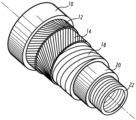
- this pipe is said to have a rough bore.
- the invention could also be applied to a so-called smooth-bore pipe, which does not have an internal carcass.
- the armor layers 12, 14 are obtained by winding at long pitch a set of wires made of metallic or composite material, of generally substantially rectangular section. The invention would also apply if these wires had a section of circular or complex geometry, of the self-stapled T type for example. In the figure, only two layers of armor 12 and 14 are shown, but the pipe could also include one or more additional pairs of armor.
- the armor layer 12 is called external because it is here the last, starting from the inside of the pipe, before the external sealing sheath 10.
Landscapes
- Engineering & Computer Science (AREA)
- General Engineering & Computer Science (AREA)
- Mechanical Engineering (AREA)
- Rigid Pipes And Flexible Pipes (AREA)
- Laminated Bodies (AREA)
- Compositions Of Macromolecular Compounds (AREA)
Claims (14)
- Flexible Unterwasserröhre nicht verbundenen Typs, die zum Transport von Kohlenwasserstoffen bestimmt ist, umfassend, von außen nach innen:- eine äußere Polymer-Dichtungshülle,- mindestens eine Zugbewehrungsbahn,- einen Druckbogen,- eine innere Polymer-Dichtungshülle,- eventuell ein Metallgerüst,wobei die äußere Polymer-Dichtungshülle und/oder die innere Polymer-Dichtungshülle ein Polyethylen mit unvernetztem sehr hohem Molekulargewicht umfasst/umfassen, dessen mittlere molekulare Masse in Masse (Mw) über 1.000.000 g/mol beträgt.
- Flexible Unterwasserröhre nach Anspruch 1, wobei das Polyethylen ein ultrahohes Molekulargewicht hat, wobei seine mittlere molekulare Masse in Masse (Mw) über 3.000.000 g/mol beträgt.
- Flexible Unterwasserröhre nach Anspruch 1 or 2, wobei das Polyethylen mit sehr hohem Molekulargewicht ein Ethylen-Homopolymer oder ein Ethylen-Copolymer ist, enthaltend unter 40 Gew.-% in Gewicht Einheiten aus α-Olefin-Monomeren, umfassend 3 bis 10 Kohlenstoffatome.
- Flexible Unterwasserröhre nach einem der Ansprüche 1 bis 3, wobei die innere oder äußere Polymer-Dichtungshülle das Polyethylen mit sehr hohem Molekulargewicht und ein anderes Polyolefin umfasst.
- Flexible Unterwasserröhre nach Anspruch 4, wobei das andere Polyolefin wie ein nicht vernetztes Polyethylen oder ein nicht vernetztes Polyprophylen nicht vernetzt ist.
- Flexible Unterwasserröhre nach Anspruch 4, wobei das andere Polyolefin wie ein vernetztes Polyethylen oder ein vernetztes Polyprophylen vernetzt ist.
- Flexible Unterwasserröhre nach einem der Ansprüche 4 bis 6, wobei das Massenverhältnis zwischen dem Polyethylen mit sehr hohem Molekulargewicht und der Summe des Polyethylens mit sehr hohem Molekulargewicht und des Polyolefins über 50 % beträgt.
- Flexible Unterwasserröhre nach einem der Ansprüche 4 bis 6, wobei das Massenverhältnis zwischen dem Polyethylen mit sehr hohem Molekulargewicht und der Summe des Polyethylens mit sehr hohem Molekulargewicht und des Polyolefins unter 50 % beträgt.
- Herstellungsverfahren der flexiblen Unterwasserröhre nach einem der Ansprüche 1 bis 8,umfassend die folgenden Schritte:a) Extrudieren, um eine innere oder äußere Polymer-Dichtungshülle zu bilden, die ein Polyethylen mit unvernetztem sehr hohem Molekulargewicht umfasst, dessen mittlere molekulare Masse in Masse (Mw) über 1.000.000 g/mol beträgt, wobei die Extrusion eventuell auf einer anderen Schicht durchgeführt wird,b) eventuell Verbinden der inneren oder äußeren Polymer-Dichtungshülle von Schritt a) mit mindestens einer anderen Schicht.
- Herstellungsverfahren nach Anspruch 9 der flexiblen Unterwasserröhre nach Anspruch 5 ohne Vernetzungsschritt.
- Herstellungsverfahren nach Anspruch 9 der flexiblen Unterwasserröhre nach Anspruch 6, umfassend die folgenden Schritte:a) Extrudieren, um eine innere oder äußere Polymer-Dichtungshülle zu bilden, die ein Polyethylen mit sehr hohem Molekulargewicht und ein vernetzbares Polyolefin umfasst, wobei die Extrusion eventuell auf einer anderen Schicht durchgeführt wird,a2) Vernetzen des vernetzbaren Polyolefins,c) eventuell Verbinden der inneren oder äußeren Polymer-Dichtungshülle von Schritt a2) mit mindestens einer anderen Schicht.
- Herstellungsverfahren nach Anspruch 11, wobei das vernetzbare Polyolefin ein Trialcoxysilangruppen tragendes Polyolefin ist.
- Verwendung einer flexiblen Unterwasserröhre nach einem der Ansprüche 1 bis 8 für den Transport von Kohlenwasserstoffen.
- Verwendung eines Polyethylens mit unvernetztem sehr hohem Molekulargewicht, dessen mittlere molekulare Masse in Masse (Mw) über 1.000.000 g/mol beträgt, in einer inneren und/oder äußeren Polymer-Dichtungshülle einer flexiblen Unterwasserröhre, die für den Transport von Kohlenwasserstoffen bestimmt ist, um die Widerstandsfähigkeit der inneren und/oder äußeren Polymer-Dichtungshülle gegenüber Blasenbildung zu erhöhen.
Applications Claiming Priority (2)
| Application Number | Priority Date | Filing Date | Title |
|---|---|---|---|
| FR1257601A FR2994242B1 (fr) | 2012-08-03 | 2012-08-03 | Conduite flexible sous marine comprenant une gaine polymerique interne et/ou externe d'etancheite comprenant un polyethylene a haut poids moleculaire |
| PCT/EP2013/066059 WO2014020052A1 (fr) | 2012-08-03 | 2013-07-31 | Conduite flexible sous marine comprenant une gaine polymérique interne et/ou externe d'étanchéité comprenant un polyéthylène à haut poids moléculaire |
Publications (3)
| Publication Number | Publication Date |
|---|---|
| EP2879875A1 EP2879875A1 (de) | 2015-06-10 |
| EP2879875B1 EP2879875B1 (de) | 2017-08-16 |
| EP2879875B2 true EP2879875B2 (de) | 2024-07-17 |
Family
ID=46963949
Family Applications (1)
| Application Number | Title | Priority Date | Filing Date |
|---|---|---|---|
| EP13744525.0A Active EP2879875B2 (de) | 2012-08-03 | 2013-07-31 | Flexible unterwasserröhre mit einer inneren und/oder äusseren polymerverschlusshülle mit polyethylen von hohem molekulargewicht |
Country Status (7)
| Country | Link |
|---|---|
| EP (1) | EP2879875B2 (de) |
| CN (1) | CN104640705B (de) |
| AU (1) | AU2013298600B2 (de) |
| BR (1) | BR112015002456B8 (de) |
| DK (1) | DK2879875T4 (de) |
| FR (1) | FR2994242B1 (de) |
| WO (1) | WO2014020052A1 (de) |
Families Citing this family (7)
| Publication number | Priority date | Publication date | Assignee | Title |
|---|---|---|---|---|
| FR2994242B1 (fr) | 2012-08-03 | 2015-03-06 | Technip France | Conduite flexible sous marine comprenant une gaine polymerique interne et/ou externe d'etancheite comprenant un polyethylene a haut poids moleculaire |
| FR3020440B1 (fr) | 2014-10-14 | 2017-02-10 | Technip France | Conduite flexible sous-marine comprenant une couche comprenant un polyethylene a resistance thermique accrue reticule |
| FR3050004B1 (fr) * | 2016-04-06 | 2018-05-04 | Technip France | Conduite sous-marine comprenant une gaine comprenant un copolymere bloc du polypropylene |
| FR3050005B1 (fr) * | 2016-04-06 | 2018-05-04 | Technip France | Conduite sous-marine comprenant une gaine comprenant un homopolymere de polypropylene |
| US11725098B2 (en) | 2017-12-18 | 2023-08-15 | Celanese International Corporation | Thermoplastic vulcanizate conduits for transporting hydrocarbon fluids |
| US11846371B2 (en) | 2018-09-24 | 2023-12-19 | Exxonmobil Chemical Patents Inc. | Thermoplastic blends and composites for flexible pipes |
| FR3146501A1 (fr) * | 2023-03-10 | 2024-09-13 | Technipfmc Subsea France | Conduite sous-marine comprenant une gaine interne d’étanchéité en polyaryléthercétone |
Citations (8)
| Publication number | Priority date | Publication date | Assignee | Title |
|---|---|---|---|---|
| US4518552A (en) † | 1983-11-09 | 1985-05-21 | Mitsuboshi Belting Ltd. | Method of producing accurately sized material of ultra high molecular weight polyethylene |
| WO2003044414A1 (en) † | 2001-11-19 | 2003-05-30 | Nkt Flexibles I/S | A flexible pipe with a tensile reinforcement |
| WO2007026168A1 (en) † | 2005-09-03 | 2007-03-08 | Keith Dixon-Roche | Flexible pipes |
| US7243686B2 (en) † | 2000-06-12 | 2007-07-17 | Bhp Billiton Petroleum Pty. Limited | Hose |
| WO2010008964A1 (en) † | 2008-07-16 | 2010-01-21 | Univation Technologies, Llc | Polyethylene compositions |
| US20100021665A1 (en) † | 2008-07-24 | 2010-01-28 | Kenneth Scott Jackson | Vulcanized biofuel hose |
| US20100116373A1 (en) † | 2005-05-18 | 2010-05-13 | Watson William R | Composite Pipe |
| WO2014020053A1 (fr) † | 2012-08-03 | 2014-02-06 | Technip France | Conduite flexible sous marine comprenant une couche comprenant un polyéthylène à résistance thermique accrue |
Family Cites Families (11)
| Publication number | Priority date | Publication date | Assignee | Title |
|---|---|---|---|---|
| FR2521573A1 (fr) | 1982-02-18 | 1983-08-19 | Inst Francais Du Petrole | Compositions de polyethylenes de haute ou moyenne densite extrudables et reticulables |
| FR2663401B1 (fr) | 1990-06-18 | 1992-09-18 | Coflexip | Conduite tubulaire flexible comportant une gaine en polyethylene reticule, dispositif et procede pour la fabrication d'une telle conduite. |
| US5918641A (en) * | 1990-06-18 | 1999-07-06 | Hardy; Jean | Flexible tubular conduit comprising a jacket made of crosslinked polyethylene device and process for manufacturing such a conduit |
| FR2732441B1 (fr) * | 1995-03-29 | 1997-05-30 | Coflexip | Conduite tubulaire flexible a gaine d'etancheite interne polymerique |
| CA2180784A1 (en) * | 1996-04-26 | 1997-10-27 | Andre Georges Cook | Use of cross-linked polyethylene and uhmw polyethylene in a sandwich pattern to form a composite liner to improve the chemical resistance and flexibility properties |
| FR2885672B1 (fr) * | 2005-05-11 | 2007-06-22 | Technip France Sa | Conduite tubulaire flexible a gaine anti-usure |
| US8187687B2 (en) * | 2006-03-21 | 2012-05-29 | Fiberspar Corporation | Reinforcing matrix for spoolable pipe |
| GB0612991D0 (en) * | 2006-06-29 | 2006-08-09 | Bhp Billiton Petroleum Pty Ltd | Improvements relating to hose |
| BR112012010086A2 (pt) | 2009-10-28 | 2020-08-18 | Nkt Flexibles I/S | tubo flexível, e , método para produzir um tubo flexível. |
| EP2553305A4 (de) * | 2010-03-31 | 2014-06-18 | Nat Oilwell Varco Denmark Is | Flexibles unverbundenes rohr und offshore-system damit |
| FR2994242B1 (fr) | 2012-08-03 | 2015-03-06 | Technip France | Conduite flexible sous marine comprenant une gaine polymerique interne et/ou externe d'etancheite comprenant un polyethylene a haut poids moleculaire |
-
2012
- 2012-08-03 FR FR1257601A patent/FR2994242B1/fr active Active
-
2013
- 2013-07-31 DK DK13744525.0T patent/DK2879875T4/da active
- 2013-07-31 EP EP13744525.0A patent/EP2879875B2/de active Active
- 2013-07-31 AU AU2013298600A patent/AU2013298600B2/en active Active
- 2013-07-31 BR BR112015002456A patent/BR112015002456B8/pt active IP Right Grant
- 2013-07-31 CN CN201380048182.3A patent/CN104640705B/zh active Active
- 2013-07-31 WO PCT/EP2013/066059 patent/WO2014020052A1/fr not_active Ceased
Patent Citations (8)
| Publication number | Priority date | Publication date | Assignee | Title |
|---|---|---|---|---|
| US4518552A (en) † | 1983-11-09 | 1985-05-21 | Mitsuboshi Belting Ltd. | Method of producing accurately sized material of ultra high molecular weight polyethylene |
| US7243686B2 (en) † | 2000-06-12 | 2007-07-17 | Bhp Billiton Petroleum Pty. Limited | Hose |
| WO2003044414A1 (en) † | 2001-11-19 | 2003-05-30 | Nkt Flexibles I/S | A flexible pipe with a tensile reinforcement |
| US20100116373A1 (en) † | 2005-05-18 | 2010-05-13 | Watson William R | Composite Pipe |
| WO2007026168A1 (en) † | 2005-09-03 | 2007-03-08 | Keith Dixon-Roche | Flexible pipes |
| WO2010008964A1 (en) † | 2008-07-16 | 2010-01-21 | Univation Technologies, Llc | Polyethylene compositions |
| US20100021665A1 (en) † | 2008-07-24 | 2010-01-28 | Kenneth Scott Jackson | Vulcanized biofuel hose |
| WO2014020053A1 (fr) † | 2012-08-03 | 2014-02-06 | Technip France | Conduite flexible sous marine comprenant une couche comprenant un polyéthylène à résistance thermique accrue |
Also Published As
| Publication number | Publication date |
|---|---|
| EP2879875A1 (de) | 2015-06-10 |
| BR112015002456A2 (pt) | 2017-10-10 |
| AU2013298600B2 (en) | 2016-08-04 |
| BR112015002456B8 (pt) | 2021-04-06 |
| FR2994242A1 (fr) | 2014-02-07 |
| CN104640705A (zh) | 2015-05-20 |
| FR2994242B1 (fr) | 2015-03-06 |
| AU2013298600A1 (en) | 2015-02-19 |
| WO2014020052A1 (fr) | 2014-02-06 |
| DK2879875T3 (en) | 2017-10-02 |
| BR112015002456B1 (pt) | 2020-12-29 |
| EP2879875B1 (de) | 2017-08-16 |
| CN104640705B (zh) | 2017-09-01 |
| DK2879875T4 (da) | 2024-09-16 |
Similar Documents
| Publication | Publication Date | Title |
|---|---|---|
| CA2880899C (fr) | Conduite flexible sous marine comprenant une couche comprenant un polyethylene a resistance thermique accrue | |
| EP2879875B1 (de) | Flexible unterwasserröhre mit einer inneren und/oder äusseren polymerverschlusshülle mit polyethylen von hohem molekulargewicht | |
| EP2516534B1 (de) | Flexibles unterwasserrohr mit einer schicht mit einem polymerharz mit einem polyedrischen oligomeren silsesquioxan | |
| EP3439871B1 (de) | Unterwasserrohr mit ummantelung mit polypropylenhomopolymer | |
| FR3076337A1 (fr) | Conduite flexible sous-marine comprenant une gaine externe multicouches | |
| FR3064711A1 (fr) | Conduite flexible avec nappes d'armures metalliques et nappes d'armures composites | |
| FR2935801A1 (fr) | Procede de determination de la tenue a la fatigue d'une composition polymerique | |
| EP3206866B1 (de) | Flexible unterwasserröhre mit einer schicht mit vernetztem polyethylen mit hoher wärmebeständigkeit | |
| EP2643154B1 (de) | Flexibler schlauch für den einsatz am meeresboden mit einer schicht aus einem polymer-harz mit aluminium- oder magnesium-silikat nano-röhrchen | |
| EP3439870B1 (de) | Unterwasserrohrs mit einer ummantelung mit einem polypropylenblockcopolymers | |
| FR2964173A1 (fr) | Structure tubulaire flexible comprenant une couche d'un compose polymerique fluore | |
| WO2022243424A1 (fr) | Conduite flexible sous-marine comprenant une couche anti-usure à base de polypropylène homopolymère | |
| FR3104667A1 (fr) | Conduite flexible sous-marine comprenant une couche comprenant du polyméthylpentène | |
| EP3810967B1 (de) | Flexibles rohr zum eintauchen in ein gewässer, verfahren zu seiner herstellung und seine verwendung | |
| FR3161008A1 (fr) | Conduite flexible sous-marine comprenant une couche polymérique intermédiaire à base de poly(éther de p-phénylène) | |
| FR3090799A1 (fr) | Conduite flexible destinee au transport, au sein d’une etendue d’eau, d’un fluide hydrocarbone et procede associe |
Legal Events
| Date | Code | Title | Description |
|---|---|---|---|
| PUAI | Public reference made under article 153(3) epc to a published international application that has entered the european phase |
Free format text: ORIGINAL CODE: 0009012 |
|
| 17P | Request for examination filed |
Effective date: 20150123 |
|
| AK | Designated contracting states |
Kind code of ref document: A1 Designated state(s): AL AT BE BG CH CY CZ DE DK EE ES FI FR GB GR HR HU IE IS IT LI LT LU LV MC MK MT NL NO PL PT RO RS SE SI SK SM TR |
|
| AX | Request for extension of the european patent |
Extension state: BA ME |
|
| RIN1 | Information on inventor provided before grant (corrected) |
Inventor name: TRONC, FREDERIC |
|
| DAX | Request for extension of the european patent (deleted) | ||
| TPAC | Observations filed by third parties |
Free format text: ORIGINAL CODE: EPIDOSNTIPA |
|
| GRAP | Despatch of communication of intention to grant a patent |
Free format text: ORIGINAL CODE: EPIDOSNIGR1 |
|
| STAA | Information on the status of an ep patent application or granted ep patent |
Free format text: STATUS: GRANT OF PATENT IS INTENDED |
|
| INTG | Intention to grant announced |
Effective date: 20170310 |
|
| GRAS | Grant fee paid |
Free format text: ORIGINAL CODE: EPIDOSNIGR3 |
|
| GRAA | (expected) grant |
Free format text: ORIGINAL CODE: 0009210 |
|
| STAA | Information on the status of an ep patent application or granted ep patent |
Free format text: STATUS: THE PATENT HAS BEEN GRANTED |
|
| AK | Designated contracting states |
Kind code of ref document: B1 Designated state(s): AL AT BE BG CH CY CZ DE DK EE ES FI FR GB GR HR HU IE IS IT LI LT LU LV MC MK MT NL NO PL PT RO RS SE SI SK SM TR |
|
| REG | Reference to a national code |
Ref country code: GB Ref legal event code: FG4D Free format text: NOT ENGLISH |
|
| REG | Reference to a national code |
Ref country code: CH Ref legal event code: EP |
|
| REG | Reference to a national code |
Ref country code: IE Ref legal event code: FG4D Free format text: LANGUAGE OF EP DOCUMENT: FRENCH |
|
| REG | Reference to a national code |
Ref country code: AT Ref legal event code: REF Ref document number: 918658 Country of ref document: AT Kind code of ref document: T Effective date: 20170915 |
|
| REG | Reference to a national code |
Ref country code: DE Ref legal event code: R096 Ref document number: 602013025128 Country of ref document: DE |
|
| REG | Reference to a national code |
Ref country code: DK Ref legal event code: T3 Effective date: 20170927 |
|
| REG | Reference to a national code |
Ref country code: NO Ref legal event code: T2 Effective date: 20170816 |
|
| REG | Reference to a national code |
Ref country code: NL Ref legal event code: FP |
|
| REG | Reference to a national code |
Ref country code: LT Ref legal event code: MG4D |
|
| REG | Reference to a national code |
Ref country code: AT Ref legal event code: MK05 Ref document number: 918658 Country of ref document: AT Kind code of ref document: T Effective date: 20170816 |
|
| PG25 | Lapsed in a contracting state [announced via postgrant information from national office to epo] |
Ref country code: SE Free format text: LAPSE BECAUSE OF FAILURE TO SUBMIT A TRANSLATION OF THE DESCRIPTION OR TO PAY THE FEE WITHIN THE PRESCRIBED TIME-LIMIT Effective date: 20170816 Ref country code: AT Free format text: LAPSE BECAUSE OF FAILURE TO SUBMIT A TRANSLATION OF THE DESCRIPTION OR TO PAY THE FEE WITHIN THE PRESCRIBED TIME-LIMIT Effective date: 20170816 Ref country code: LT Free format text: LAPSE BECAUSE OF FAILURE TO SUBMIT A TRANSLATION OF THE DESCRIPTION OR TO PAY THE FEE WITHIN THE PRESCRIBED TIME-LIMIT Effective date: 20170816 Ref country code: FI Free format text: LAPSE BECAUSE OF FAILURE TO SUBMIT A TRANSLATION OF THE DESCRIPTION OR TO PAY THE FEE WITHIN THE PRESCRIBED TIME-LIMIT Effective date: 20170816 |
|
| PG25 | Lapsed in a contracting state [announced via postgrant information from national office to epo] |
Ref country code: GR Free format text: LAPSE BECAUSE OF FAILURE TO SUBMIT A TRANSLATION OF THE DESCRIPTION OR TO PAY THE FEE WITHIN THE PRESCRIBED TIME-LIMIT Effective date: 20171117 Ref country code: IS Free format text: LAPSE BECAUSE OF FAILURE TO SUBMIT A TRANSLATION OF THE DESCRIPTION OR TO PAY THE FEE WITHIN THE PRESCRIBED TIME-LIMIT Effective date: 20171216 Ref country code: BG Free format text: LAPSE BECAUSE OF FAILURE TO SUBMIT A TRANSLATION OF THE DESCRIPTION OR TO PAY THE FEE WITHIN THE PRESCRIBED TIME-LIMIT Effective date: 20171116 Ref country code: PL Free format text: LAPSE BECAUSE OF FAILURE TO SUBMIT A TRANSLATION OF THE DESCRIPTION OR TO PAY THE FEE WITHIN THE PRESCRIBED TIME-LIMIT Effective date: 20170816 Ref country code: LV Free format text: LAPSE BECAUSE OF FAILURE TO SUBMIT A TRANSLATION OF THE DESCRIPTION OR TO PAY THE FEE WITHIN THE PRESCRIBED TIME-LIMIT Effective date: 20170816 Ref country code: RS Free format text: LAPSE BECAUSE OF FAILURE TO SUBMIT A TRANSLATION OF THE DESCRIPTION OR TO PAY THE FEE WITHIN THE PRESCRIBED TIME-LIMIT Effective date: 20170816 Ref country code: ES Free format text: LAPSE BECAUSE OF FAILURE TO SUBMIT A TRANSLATION OF THE DESCRIPTION OR TO PAY THE FEE WITHIN THE PRESCRIBED TIME-LIMIT Effective date: 20170816 |
|
| PG25 | Lapsed in a contracting state [announced via postgrant information from national office to epo] |
Ref country code: CZ Free format text: LAPSE BECAUSE OF FAILURE TO SUBMIT A TRANSLATION OF THE DESCRIPTION OR TO PAY THE FEE WITHIN THE PRESCRIBED TIME-LIMIT Effective date: 20170816 Ref country code: RO Free format text: LAPSE BECAUSE OF FAILURE TO SUBMIT A TRANSLATION OF THE DESCRIPTION OR TO PAY THE FEE WITHIN THE PRESCRIBED TIME-LIMIT Effective date: 20170816 |
|
| REG | Reference to a national code |
Ref country code: DE Ref legal event code: R026 Ref document number: 602013025128 Country of ref document: DE |
|
| PLBI | Opposition filed |
Free format text: ORIGINAL CODE: 0009260 |
|
| PLAX | Notice of opposition and request to file observation + time limit sent |
Free format text: ORIGINAL CODE: EPIDOSNOBS2 |
|
| PG25 | Lapsed in a contracting state [announced via postgrant information from national office to epo] |
Ref country code: IT Free format text: LAPSE BECAUSE OF FAILURE TO SUBMIT A TRANSLATION OF THE DESCRIPTION OR TO PAY THE FEE WITHIN THE PRESCRIBED TIME-LIMIT Effective date: 20170816 Ref country code: SK Free format text: LAPSE BECAUSE OF FAILURE TO SUBMIT A TRANSLATION OF THE DESCRIPTION OR TO PAY THE FEE WITHIN THE PRESCRIBED TIME-LIMIT Effective date: 20170816 Ref country code: EE Free format text: LAPSE BECAUSE OF FAILURE TO SUBMIT A TRANSLATION OF THE DESCRIPTION OR TO PAY THE FEE WITHIN THE PRESCRIBED TIME-LIMIT Effective date: 20170816 Ref country code: SM Free format text: LAPSE BECAUSE OF FAILURE TO SUBMIT A TRANSLATION OF THE DESCRIPTION OR TO PAY THE FEE WITHIN THE PRESCRIBED TIME-LIMIT Effective date: 20170816 |
|
| 26 | Opposition filed |
Opponent name: GE OIL & GAS UK LIMITED Effective date: 20180510 |
|
| REG | Reference to a national code |
Ref country code: FR Ref legal event code: PLFP Year of fee payment: 6 |
|
| PG25 | Lapsed in a contracting state [announced via postgrant information from national office to epo] |
Ref country code: SI Free format text: LAPSE BECAUSE OF FAILURE TO SUBMIT A TRANSLATION OF THE DESCRIPTION OR TO PAY THE FEE WITHIN THE PRESCRIBED TIME-LIMIT Effective date: 20170816 |
|
| PG25 | Lapsed in a contracting state [announced via postgrant information from national office to epo] |
Ref country code: MT Free format text: LAPSE BECAUSE OF FAILURE TO SUBMIT A TRANSLATION OF THE DESCRIPTION OR TO PAY THE FEE WITHIN THE PRESCRIBED TIME-LIMIT Effective date: 20170816 |
|
| PLBB | Reply of patent proprietor to notice(s) of opposition received |
Free format text: ORIGINAL CODE: EPIDOSNOBS3 |
|
| REG | Reference to a national code |
Ref country code: CH Ref legal event code: PL |
|
| PG25 | Lapsed in a contracting state [announced via postgrant information from national office to epo] |
Ref country code: MC Free format text: LAPSE BECAUSE OF FAILURE TO SUBMIT A TRANSLATION OF THE DESCRIPTION OR TO PAY THE FEE WITHIN THE PRESCRIBED TIME-LIMIT Effective date: 20170816 Ref country code: LU Free format text: LAPSE BECAUSE OF NON-PAYMENT OF DUE FEES Effective date: 20180731 |
|
| REG | Reference to a national code |
Ref country code: BE Ref legal event code: MM Effective date: 20180731 |
|
| PG25 | Lapsed in a contracting state [announced via postgrant information from national office to epo] |
Ref country code: CH Free format text: LAPSE BECAUSE OF NON-PAYMENT OF DUE FEES Effective date: 20180731 Ref country code: LI Free format text: LAPSE BECAUSE OF NON-PAYMENT OF DUE FEES Effective date: 20180731 |
|
| PG25 | Lapsed in a contracting state [announced via postgrant information from national office to epo] |
Ref country code: BE Free format text: LAPSE BECAUSE OF NON-PAYMENT OF DUE FEES Effective date: 20180731 |
|
| PLCK | Communication despatched that opposition was rejected |
Free format text: ORIGINAL CODE: EPIDOSNREJ1 |
|
| APBM | Appeal reference recorded |
Free format text: ORIGINAL CODE: EPIDOSNREFNO |
|
| APBP | Date of receipt of notice of appeal recorded |
Free format text: ORIGINAL CODE: EPIDOSNNOA2O |
|
| APAH | Appeal reference modified |
Free format text: ORIGINAL CODE: EPIDOSCREFNO |
|
| APBQ | Date of receipt of statement of grounds of appeal recorded |
Free format text: ORIGINAL CODE: EPIDOSNNOA3O |
|
| PG25 | Lapsed in a contracting state [announced via postgrant information from national office to epo] |
Ref country code: TR Free format text: LAPSE BECAUSE OF FAILURE TO SUBMIT A TRANSLATION OF THE DESCRIPTION OR TO PAY THE FEE WITHIN THE PRESCRIBED TIME-LIMIT Effective date: 20170816 |
|
| PG25 | Lapsed in a contracting state [announced via postgrant information from national office to epo] |
Ref country code: HU Free format text: LAPSE BECAUSE OF FAILURE TO SUBMIT A TRANSLATION OF THE DESCRIPTION OR TO PAY THE FEE WITHIN THE PRESCRIBED TIME-LIMIT; INVALID AB INITIO Effective date: 20130731 Ref country code: PT Free format text: LAPSE BECAUSE OF FAILURE TO SUBMIT A TRANSLATION OF THE DESCRIPTION OR TO PAY THE FEE WITHIN THE PRESCRIBED TIME-LIMIT Effective date: 20170816 |
|
| PLAB | Opposition data, opponent's data or that of the opponent's representative modified |
Free format text: ORIGINAL CODE: 0009299OPPO |
|
| PG25 | Lapsed in a contracting state [announced via postgrant information from national office to epo] |
Ref country code: CY Free format text: LAPSE BECAUSE OF FAILURE TO SUBMIT A TRANSLATION OF THE DESCRIPTION OR TO PAY THE FEE WITHIN THE PRESCRIBED TIME-LIMIT Effective date: 20170816 Ref country code: MK Free format text: LAPSE BECAUSE OF NON-PAYMENT OF DUE FEES Effective date: 20170816 Ref country code: HR Free format text: LAPSE BECAUSE OF FAILURE TO SUBMIT A TRANSLATION OF THE DESCRIPTION OR TO PAY THE FEE WITHIN THE PRESCRIBED TIME-LIMIT Effective date: 20170816 |
|
| R26 | Opposition filed (corrected) |
Opponent name: GE OIL & GAS UK LIMITED Effective date: 20180510 |
|
| PG25 | Lapsed in a contracting state [announced via postgrant information from national office to epo] |
Ref country code: AL Free format text: LAPSE BECAUSE OF FAILURE TO SUBMIT A TRANSLATION OF THE DESCRIPTION OR TO PAY THE FEE WITHIN THE PRESCRIBED TIME-LIMIT Effective date: 20170816 |
|
| APBU | Appeal procedure closed |
Free format text: ORIGINAL CODE: EPIDOSNNOA9O |
|
| PLAY | Examination report in opposition despatched + time limit |
Free format text: ORIGINAL CODE: EPIDOSNORE2 |
|
| PLBC | Reply to examination report in opposition received |
Free format text: ORIGINAL CODE: EPIDOSNORE3 |
|
| PLAY | Examination report in opposition despatched + time limit |
Free format text: ORIGINAL CODE: EPIDOSNORE2 |
|
| PLAH | Information related to despatch of examination report in opposition + time limit modified |
Free format text: ORIGINAL CODE: EPIDOSCORE2 |
|
| P01 | Opt-out of the competence of the unified patent court (upc) registered |
Effective date: 20230516 |
|
| RAP4 | Party data changed (patent owner data changed or rights of a patent transferred) |
Owner name: TECHNIPFMC SUBSEA FRANCE |
|
| PUAH | Patent maintained in amended form |
Free format text: ORIGINAL CODE: 0009272 |
|
| STAA | Information on the status of an ep patent application or granted ep patent |
Free format text: STATUS: PATENT MAINTAINED AS AMENDED |
|
| 27A | Patent maintained in amended form |
Effective date: 20240717 |
|
| AK | Designated contracting states |
Kind code of ref document: B2 Designated state(s): AL AT BE BG CH CY CZ DE DK EE ES FI FR GB GR HR HU IE IS IT LI LT LU LV MC MK MT NL NO PL PT RO RS SE SI SK SM TR |
|
| REG | Reference to a national code |
Ref country code: DE Ref legal event code: R102 Ref document number: 602013025128 Country of ref document: DE |
|
| REG | Reference to a national code |
Ref country code: NL Ref legal event code: FP |
|
| REG | Reference to a national code |
Ref country code: DK Ref legal event code: T4 Effective date: 20240910 |
|
| PGFP | Annual fee paid to national office [announced via postgrant information from national office to epo] |
Ref country code: DE Payment date: 20250711 Year of fee payment: 13 |
|
| PGFP | Annual fee paid to national office [announced via postgrant information from national office to epo] |
Ref country code: GB Payment date: 20250723 Year of fee payment: 13 |
|
| PGFP | Annual fee paid to national office [announced via postgrant information from national office to epo] |
Ref country code: FR Payment date: 20250730 Year of fee payment: 13 |
|
| PGFP | Annual fee paid to national office [announced via postgrant information from national office to epo] |
Ref country code: DK Payment date: 20260626 Year of fee payment: 14 |
|
| PGFP | Annual fee paid to national office [announced via postgrant information from national office to epo] |
Ref country code: NO Payment date: 20260630 Year of fee payment: 14 |
|
| PGFP | Annual fee paid to national office [announced via postgrant information from national office to epo] |
Ref country code: IE Payment date: 20260618 Year of fee payment: 14 |
|
| PGFP | Annual fee paid to national office [announced via postgrant information from national office to epo] |
Ref country code: NL Payment date: 20260630 Year of fee payment: 14 |