EP2880044B1 - Neues verfahren zur synthese von polyphosphate - Google Patents
Neues verfahren zur synthese von polyphosphate Download PDFInfo
- Publication number
- EP2880044B1 EP2880044B1 EP13750163.1A EP13750163A EP2880044B1 EP 2880044 B1 EP2880044 B1 EP 2880044B1 EP 13750163 A EP13750163 A EP 13750163A EP 2880044 B1 EP2880044 B1 EP 2880044B1
- Authority
- EP
- European Patent Office
- Prior art keywords
- general formula
- stand
- chain
- stands
- carbons
- Prior art date
- Legal status (The legal status is an assumption and is not a legal conclusion. Google has not performed a legal analysis and makes no representation as to the accuracy of the status listed.)
- Active
Links
- 238000000034 method Methods 0.000 title claims description 74
- 238000003786 synthesis reaction Methods 0.000 title claims description 34
- 230000015572 biosynthetic process Effects 0.000 title claims description 30
- 229920000388 Polyphosphate Polymers 0.000 title claims description 16
- 239000001205 polyphosphate Substances 0.000 title claims description 16
- 235000011176 polyphosphates Nutrition 0.000 title claims description 16
- 238000006243 chemical reaction Methods 0.000 claims description 60
- 125000004417 unsaturated alkyl group Chemical group 0.000 claims description 42
- 125000000217 alkyl group Chemical group 0.000 claims description 36
- 229920000137 polyphosphoric acid Polymers 0.000 claims description 34
- 150000003863 ammonium salts Chemical class 0.000 claims description 32
- JUJWROOIHBZHMG-UHFFFAOYSA-N Pyridine Chemical compound C1=CC=NC=C1 JUJWROOIHBZHMG-UHFFFAOYSA-N 0.000 claims description 30
- 150000001875 compounds Chemical class 0.000 claims description 27
- 125000001424 substituent group Chemical group 0.000 claims description 23
- 125000002950 monocyclic group Chemical group 0.000 claims description 22
- 108091034117 Oligonucleotide Proteins 0.000 claims description 21
- 239000002777 nucleoside Substances 0.000 claims description 21
- ZCYVEMRRCGMTRW-UHFFFAOYSA-N 7553-56-2 Chemical compound [I] ZCYVEMRRCGMTRW-UHFFFAOYSA-N 0.000 claims description 17
- 239000011630 iodine Substances 0.000 claims description 17
- 229910052740 iodine Inorganic materials 0.000 claims description 17
- -1 5-dicyanoimidazole Chemical compound 0.000 claims description 15
- 150000003833 nucleoside derivatives Chemical class 0.000 claims description 15
- UMJSCPRVCHMLSP-UHFFFAOYSA-N pyridine Natural products COC1=CC=CN=C1 UMJSCPRVCHMLSP-UHFFFAOYSA-N 0.000 claims description 15
- 125000003118 aryl group Chemical group 0.000 claims description 14
- 239000000203 mixture Substances 0.000 claims description 14
- KJUGUADJHNHALS-UHFFFAOYSA-N 1H-tetrazole Chemical compound C=1N=NNN=1 KJUGUADJHNHALS-UHFFFAOYSA-N 0.000 claims description 12
- 239000002253 acid Substances 0.000 claims description 12
- UQZZQHGRZPTZME-UHFFFAOYSA-N oxazaphospholidine Chemical compound C1CPNO1 UQZZQHGRZPTZME-UHFFFAOYSA-N 0.000 claims description 12
- 125000005843 halogen group Chemical group 0.000 claims description 10
- QTBSBXVTEAMEQO-UHFFFAOYSA-N Acetic acid Chemical compound CC(O)=O QTBSBXVTEAMEQO-UHFFFAOYSA-N 0.000 claims description 9
- PNDPGZBMCMUPRI-UHFFFAOYSA-N iodine Chemical compound II PNDPGZBMCMUPRI-UHFFFAOYSA-N 0.000 claims description 9
- 108020004707 nucleic acids Proteins 0.000 claims description 8
- 150000007523 nucleic acids Chemical class 0.000 claims description 8
- 102000039446 nucleic acids Human genes 0.000 claims description 8
- 102000004169 proteins and genes Human genes 0.000 claims description 7
- 108090000623 proteins and genes Proteins 0.000 claims description 7
- 239000002904 solvent Substances 0.000 claims description 7
- FHXTUNANRTZXDJ-UHFFFAOYSA-N 3-pyridin-2-yl-1,3,2-oxazaphospholidine Chemical class P1OCCN1C1=CC=CC=N1 FHXTUNANRTZXDJ-UHFFFAOYSA-N 0.000 claims description 6
- 125000002887 hydroxy group Chemical group [H]O* 0.000 claims description 5
- 239000007787 solid Substances 0.000 claims description 5
- 125000001495 ethyl group Chemical group [H]C([H])([H])C([H])([H])* 0.000 claims description 4
- 125000004123 n-propyl group Chemical group [H]C([H])([H])C([H])([H])C([H])([H])* 0.000 claims description 4
- 239000007790 solid phase Substances 0.000 claims description 4
- ZFFMLCVRJBZUDZ-UHFFFAOYSA-N 2,3-dimethylbutane Chemical group CC(C)C(C)C ZFFMLCVRJBZUDZ-UHFFFAOYSA-N 0.000 claims description 3
- 150000007513 acids Chemical class 0.000 claims description 3
- 239000007788 liquid Substances 0.000 claims description 2
- GONFBOIJNUKKST-UHFFFAOYSA-N 5-ethylsulfanyl-2h-tetrazole Chemical compound CCSC=1N=NNN=1 GONFBOIJNUKKST-UHFFFAOYSA-N 0.000 claims 2
- GXGKKIPUFAHZIZ-UHFFFAOYSA-N 5-benzylsulfanyl-2h-tetrazole Chemical compound C=1C=CC=CC=1CSC=1N=NNN=1 GXGKKIPUFAHZIZ-UHFFFAOYSA-N 0.000 claims 1
- 239000011833 salt mixture Substances 0.000 claims 1
- WEVYAHXRMPXWCK-UHFFFAOYSA-N Acetonitrile Chemical compound CC#N WEVYAHXRMPXWCK-UHFFFAOYSA-N 0.000 description 36
- YMWUJEATGCHHMB-UHFFFAOYSA-N Dichloromethane Chemical compound ClCCl YMWUJEATGCHHMB-UHFFFAOYSA-N 0.000 description 21
- ZMANZCXQSJIPKH-UHFFFAOYSA-N Triethylamine Chemical compound CCN(CC)CC ZMANZCXQSJIPKH-UHFFFAOYSA-N 0.000 description 21
- UHOVQNZJYSORNB-UHFFFAOYSA-N Benzene Chemical compound C1=CC=CC=C1 UHOVQNZJYSORNB-UHFFFAOYSA-N 0.000 description 19
- 239000000047 product Substances 0.000 description 18
- 239000001226 triphosphate Substances 0.000 description 17
- 239000000243 solution Substances 0.000 description 11
- XLYOFNOQVPJJNP-UHFFFAOYSA-N water Substances O XLYOFNOQVPJJNP-UHFFFAOYSA-N 0.000 description 10
- 235000011178 triphosphate Nutrition 0.000 description 9
- XPPKVPWEQAFLFU-UHFFFAOYSA-J diphosphate(4-) Chemical compound [O-]P([O-])(=O)OP([O-])([O-])=O XPPKVPWEQAFLFU-UHFFFAOYSA-J 0.000 description 8
- 235000011180 diphosphates Nutrition 0.000 description 8
- UNXRWKVEANCORM-UHFFFAOYSA-N triphosphoric acid Chemical compound OP(O)(=O)OP(O)(=O)OP(O)(O)=O UNXRWKVEANCORM-UHFFFAOYSA-N 0.000 description 8
- JLCPHMBAVCMARE-UHFFFAOYSA-N [3-[[3-[[3-[[3-[[3-[[3-[[3-[[3-[[3-[[3-[[3-[[5-(2-amino-6-oxo-1H-purin-9-yl)-3-[[3-[[3-[[3-[[3-[[3-[[5-(2-amino-6-oxo-1H-purin-9-yl)-3-[[5-(2-amino-6-oxo-1H-purin-9-yl)-3-hydroxyoxolan-2-yl]methoxy-hydroxyphosphoryl]oxyoxolan-2-yl]methoxy-hydroxyphosphoryl]oxy-5-(5-methyl-2,4-dioxopyrimidin-1-yl)oxolan-2-yl]methoxy-hydroxyphosphoryl]oxy-5-(6-aminopurin-9-yl)oxolan-2-yl]methoxy-hydroxyphosphoryl]oxy-5-(6-aminopurin-9-yl)oxolan-2-yl]methoxy-hydroxyphosphoryl]oxy-5-(6-aminopurin-9-yl)oxolan-2-yl]methoxy-hydroxyphosphoryl]oxy-5-(6-aminopurin-9-yl)oxolan-2-yl]methoxy-hydroxyphosphoryl]oxyoxolan-2-yl]methoxy-hydroxyphosphoryl]oxy-5-(5-methyl-2,4-dioxopyrimidin-1-yl)oxolan-2-yl]methoxy-hydroxyphosphoryl]oxy-5-(4-amino-2-oxopyrimidin-1-yl)oxolan-2-yl]methoxy-hydroxyphosphoryl]oxy-5-(5-methyl-2,4-dioxopyrimidin-1-yl)oxolan-2-yl]methoxy-hydroxyphosphoryl]oxy-5-(5-methyl-2,4-dioxopyrimidin-1-yl)oxolan-2-yl]methoxy-hydroxyphosphoryl]oxy-5-(6-aminopurin-9-yl)oxolan-2-yl]methoxy-hydroxyphosphoryl]oxy-5-(6-aminopurin-9-yl)oxolan-2-yl]methoxy-hydroxyphosphoryl]oxy-5-(4-amino-2-oxopyrimidin-1-yl)oxolan-2-yl]methoxy-hydroxyphosphoryl]oxy-5-(4-amino-2-oxopyrimidin-1-yl)oxolan-2-yl]methoxy-hydroxyphosphoryl]oxy-5-(4-amino-2-oxopyrimidin-1-yl)oxolan-2-yl]methoxy-hydroxyphosphoryl]oxy-5-(6-aminopurin-9-yl)oxolan-2-yl]methoxy-hydroxyphosphoryl]oxy-5-(4-amino-2-oxopyrimidin-1-yl)oxolan-2-yl]methyl [5-(6-aminopurin-9-yl)-2-(hydroxymethyl)oxolan-3-yl] hydrogen phosphate Polymers Cc1cn(C2CC(OP(O)(=O)OCC3OC(CC3OP(O)(=O)OCC3OC(CC3O)n3cnc4c3nc(N)[nH]c4=O)n3cnc4c3nc(N)[nH]c4=O)C(COP(O)(=O)OC3CC(OC3COP(O)(=O)OC3CC(OC3COP(O)(=O)OC3CC(OC3COP(O)(=O)OC3CC(OC3COP(O)(=O)OC3CC(OC3COP(O)(=O)OC3CC(OC3COP(O)(=O)OC3CC(OC3COP(O)(=O)OC3CC(OC3COP(O)(=O)OC3CC(OC3COP(O)(=O)OC3CC(OC3COP(O)(=O)OC3CC(OC3COP(O)(=O)OC3CC(OC3COP(O)(=O)OC3CC(OC3COP(O)(=O)OC3CC(OC3COP(O)(=O)OC3CC(OC3COP(O)(=O)OC3CC(OC3COP(O)(=O)OC3CC(OC3CO)n3cnc4c(N)ncnc34)n3ccc(N)nc3=O)n3cnc4c(N)ncnc34)n3ccc(N)nc3=O)n3ccc(N)nc3=O)n3ccc(N)nc3=O)n3cnc4c(N)ncnc34)n3cnc4c(N)ncnc34)n3cc(C)c(=O)[nH]c3=O)n3cc(C)c(=O)[nH]c3=O)n3ccc(N)nc3=O)n3cc(C)c(=O)[nH]c3=O)n3cnc4c3nc(N)[nH]c4=O)n3cnc4c(N)ncnc34)n3cnc4c(N)ncnc34)n3cnc4c(N)ncnc34)n3cnc4c(N)ncnc34)O2)c(=O)[nH]c1=O JLCPHMBAVCMARE-UHFFFAOYSA-N 0.000 description 7
- 238000004679 31P NMR spectroscopy Methods 0.000 description 6
- XKRFYHLGVUSROY-UHFFFAOYSA-N Argon Chemical compound [Ar] XKRFYHLGVUSROY-UHFFFAOYSA-N 0.000 description 6
- IAZDPXIOMUYVGZ-UHFFFAOYSA-N Dimethylsulphoxide Chemical compound CS(C)=O IAZDPXIOMUYVGZ-UHFFFAOYSA-N 0.000 description 6
- KFZMGEQAYNKOFK-UHFFFAOYSA-N Isopropanol Chemical compound CC(C)O KFZMGEQAYNKOFK-UHFFFAOYSA-N 0.000 description 6
- 239000003960 organic solvent Substances 0.000 description 5
- 239000011541 reaction mixture Substances 0.000 description 5
- 238000001644 13C nuclear magnetic resonance spectroscopy Methods 0.000 description 4
- 238000005160 1H NMR spectroscopy Methods 0.000 description 4
- IAZDPXIOMUYVGZ-WFGJKAKNSA-N Dimethyl sulfoxide Chemical compound [2H]C([2H])([2H])S(=O)C([2H])([2H])[2H] IAZDPXIOMUYVGZ-WFGJKAKNSA-N 0.000 description 4
- VYPSYNLAJGMNEJ-UHFFFAOYSA-N Silicium dioxide Chemical compound O=[Si]=O VYPSYNLAJGMNEJ-UHFFFAOYSA-N 0.000 description 4
- 235000014633 carbohydrates Nutrition 0.000 description 4
- 150000001720 carbohydrates Chemical class 0.000 description 4
- 125000004122 cyclic group Chemical group 0.000 description 4
- UAOMVDZJSHZZME-UHFFFAOYSA-N diisopropylamine Chemical compound CC(C)NC(C)C UAOMVDZJSHZZME-UHFFFAOYSA-N 0.000 description 4
- 239000013067 intermediate product Substances 0.000 description 4
- 239000002773 nucleotide Substances 0.000 description 4
- 239000000741 silica gel Substances 0.000 description 4
- 229910002027 silica gel Inorganic materials 0.000 description 4
- RYHBNJHYFVUHQT-UHFFFAOYSA-N 1,4-Dioxane Chemical compound C1COCCO1 RYHBNJHYFVUHQT-UHFFFAOYSA-N 0.000 description 3
- NZYNUEOURMSATK-UHFFFAOYSA-N 2-propan-2-yl-3-pyridin-2-yl-1,3,2-oxazaphospholidine Chemical compound CC(C)P1OCCN1C1=CC=CC=N1 NZYNUEOURMSATK-UHFFFAOYSA-N 0.000 description 3
- WFDIJRYMOXRFFG-UHFFFAOYSA-N Acetic anhydride Chemical compound CC(=O)OC(C)=O WFDIJRYMOXRFFG-UHFFFAOYSA-N 0.000 description 3
- OKKJLVBELUTLKV-UHFFFAOYSA-N Methanol Chemical compound OC OKKJLVBELUTLKV-UHFFFAOYSA-N 0.000 description 3
- 229910019142 PO4 Inorganic materials 0.000 description 3
- 229910052786 argon Inorganic materials 0.000 description 3
- 125000004432 carbon atom Chemical group C* 0.000 description 3
- 238000011161 development Methods 0.000 description 3
- 125000003835 nucleoside group Chemical group 0.000 description 3
- 230000003647 oxidation Effects 0.000 description 3
- 238000007254 oxidation reaction Methods 0.000 description 3
- 235000021317 phosphate Nutrition 0.000 description 3
- PTMHPRAIXMAOOB-UHFFFAOYSA-N phosphoramidic acid Chemical class NP(O)(O)=O PTMHPRAIXMAOOB-UHFFFAOYSA-N 0.000 description 3
- 108090000765 processed proteins & peptides Proteins 0.000 description 3
- 230000005588 protonation Effects 0.000 description 3
- 238000004611 spectroscopical analysis Methods 0.000 description 3
- 125000002264 triphosphate group Chemical class [H]OP(=O)(O[H])OP(=O)(O[H])OP(=O)(O[H])O* 0.000 description 3
- JCUFXZQUWAFYQC-UHFFFAOYSA-N 1,3,2-benzodioxaphosphinin-4-one Chemical compound C1=CC=C2C(=O)OPOC2=C1 JCUFXZQUWAFYQC-UHFFFAOYSA-N 0.000 description 2
- NLXLAEXVIDQMFP-UHFFFAOYSA-N Ammonium chloride Substances [NH4+].[Cl-] NLXLAEXVIDQMFP-UHFFFAOYSA-N 0.000 description 2
- VHUUQVKOLVNVRT-UHFFFAOYSA-N Ammonium hydroxide Chemical compound [NH4+].[OH-] VHUUQVKOLVNVRT-UHFFFAOYSA-N 0.000 description 2
- PAYRUJLWNCNPSJ-UHFFFAOYSA-N N-phenyl amine Natural products NC1=CC=CC=C1 PAYRUJLWNCNPSJ-UHFFFAOYSA-N 0.000 description 2
- WYURNTSHIVDZCO-UHFFFAOYSA-N Tetrahydrofuran Chemical compound C1CCOC1 WYURNTSHIVDZCO-UHFFFAOYSA-N 0.000 description 2
- HEDRZPFGACZZDS-MICDWDOJSA-N Trichloro(2H)methane Chemical compound [2H]C(Cl)(Cl)Cl HEDRZPFGACZZDS-MICDWDOJSA-N 0.000 description 2
- 150000001412 amines Chemical class 0.000 description 2
- 235000011114 ammonium hydroxide Nutrition 0.000 description 2
- 239000006227 byproduct Substances 0.000 description 2
- 239000003153 chemical reaction reagent Substances 0.000 description 2
- 238000009833 condensation Methods 0.000 description 2
- 230000005494 condensation Effects 0.000 description 2
- 239000003480 eluent Substances 0.000 description 2
- 150000002500 ions Chemical class 0.000 description 2
- 229910052757 nitrogen Inorganic materials 0.000 description 2
- 125000004433 nitrogen atom Chemical group N* 0.000 description 2
- 239000012071 phase Substances 0.000 description 2
- 150000008300 phosphoramidites Chemical class 0.000 description 2
- 150000003013 phosphoric acid derivatives Chemical class 0.000 description 2
- 102000004196 processed proteins & peptides Human genes 0.000 description 2
- 125000006239 protecting group Chemical group 0.000 description 2
- 238000011160 research Methods 0.000 description 2
- 239000000126 substance Substances 0.000 description 2
- 239000000758 substrate Substances 0.000 description 2
- 238000001308 synthesis method Methods 0.000 description 2
- MCTWTZJPVLRJOU-UHFFFAOYSA-N 1-methyl-1H-imidazole Chemical compound CN1C=CN=C1 MCTWTZJPVLRJOU-UHFFFAOYSA-N 0.000 description 1
- XGDRLCRGKUCBQL-UHFFFAOYSA-N 1h-imidazole-4,5-dicarbonitrile Chemical compound N#CC=1N=CNC=1C#N XGDRLCRGKUCBQL-UHFFFAOYSA-N 0.000 description 1
- UYLOQLKUWBXBBN-UHFFFAOYSA-N 2-(pyridin-2-ylamino)ethanol Chemical compound OCCNC1=CC=CC=N1 UYLOQLKUWBXBBN-UHFFFAOYSA-N 0.000 description 1
- WVNDAWXUAHYCRS-UHFFFAOYSA-N 2-pyridin-2-yl-1,3,2-oxazaphospholidine Chemical class N1CCOP1C1=CC=CC=N1 WVNDAWXUAHYCRS-UHFFFAOYSA-N 0.000 description 1
- LEKWPSZTAFUJIJ-UHFFFAOYSA-N 2-pyrimidin-2-yl-1,3,2-oxazaphospholidine Chemical class N1CCOP1C1=NC=CC=N1 LEKWPSZTAFUJIJ-UHFFFAOYSA-N 0.000 description 1
- DPFXGKVILLFDIA-UHFFFAOYSA-N 3-pyrimidin-2-yl-1,3,2-oxazaphospholidine Chemical class C1CN(PO1)c1ncccn1 DPFXGKVILLFDIA-UHFFFAOYSA-N 0.000 description 1
- ZOHPJLMDECSEKX-UHFFFAOYSA-N CC(C)N(C(C)C)P1OCCN1c1ncccc1 Chemical compound CC(C)N(C(C)C)P1OCCN1c1ncccc1 ZOHPJLMDECSEKX-UHFFFAOYSA-N 0.000 description 1
- 102000004190 Enzymes Human genes 0.000 description 1
- 108090000790 Enzymes Proteins 0.000 description 1
- LFQSCWFLJHTTHZ-UHFFFAOYSA-N Ethanol Chemical compound CCO LFQSCWFLJHTTHZ-UHFFFAOYSA-N 0.000 description 1
- KRHYYFGTRYWZRS-UHFFFAOYSA-M Fluoride anion Chemical compound [F-] KRHYYFGTRYWZRS-UHFFFAOYSA-M 0.000 description 1
- 238000005481 NMR spectroscopy Methods 0.000 description 1
- 239000007983 Tris buffer Substances 0.000 description 1
- WEVYAHXRMPXWCK-FIBGUPNXSA-N acetonitrile-d3 Chemical compound [2H]C([2H])([2H])C#N WEVYAHXRMPXWCK-FIBGUPNXSA-N 0.000 description 1
- 230000002378 acidificating effect Effects 0.000 description 1
- 239000012190 activator Substances 0.000 description 1
- KJLFPUOEYGVROH-UHFFFAOYSA-N aminophosphonic acid pyrrolidine Chemical compound NP(O)(O)=O.C1CCNC1 KJLFPUOEYGVROH-UHFFFAOYSA-N 0.000 description 1
- 238000004458 analytical method Methods 0.000 description 1
- 238000013459 approach Methods 0.000 description 1
- 230000004071 biological effect Effects 0.000 description 1
- 238000010170 biological method Methods 0.000 description 1
- 230000000903 blocking effect Effects 0.000 description 1
- 125000002915 carbonyl group Chemical group [*:2]C([*:1])=O 0.000 description 1
- 238000005341 cation exchange Methods 0.000 description 1
- 150000001768 cations Chemical class 0.000 description 1
- 239000007795 chemical reaction product Substances 0.000 description 1
- KOKITZGSFZHSQK-UHFFFAOYSA-N chlorophosphonous acid N-propan-2-ylpropan-2-amine Chemical compound OP(O)Cl.CC(C)NC(C)C.CC(C)NC(C)C KOKITZGSFZHSQK-UHFFFAOYSA-N 0.000 description 1
- 239000005289 controlled pore glass Substances 0.000 description 1
- 150000004691 decahydrates Chemical class 0.000 description 1
- 238000002405 diagnostic procedure Methods 0.000 description 1
- 229940043279 diisopropylamine Drugs 0.000 description 1
- 239000012154 double-distilled water Substances 0.000 description 1
- 230000009977 dual effect Effects 0.000 description 1
- 238000010828 elution Methods 0.000 description 1
- 230000002255 enzymatic effect Effects 0.000 description 1
- 239000007789 gas Substances 0.000 description 1
- 238000007429 general method Methods 0.000 description 1
- 125000000623 heterocyclic group Chemical group 0.000 description 1
- 238000004128 high performance liquid chromatography Methods 0.000 description 1
- 230000007062 hydrolysis Effects 0.000 description 1
- 238000006460 hydrolysis reaction Methods 0.000 description 1
- 125000002962 imidazol-1-yl group Chemical group [*]N1C([H])=NC([H])=C1[H] 0.000 description 1
- 125000001449 isopropyl group Chemical group [H]C([H])([H])C([H])(*)C([H])([H])[H] 0.000 description 1
- 238000004519 manufacturing process Methods 0.000 description 1
- 238000004949 mass spectrometry Methods 0.000 description 1
- 239000011159 matrix material Substances 0.000 description 1
- INYNZTORZHTWQM-UHFFFAOYSA-N n,n-dibutylbutan-1-amine;phosphono dihydrogen phosphate Chemical compound OP([O-])(=O)OP([O-])([O-])=O.CCCC[NH+](CCCC)CCCC.CCCC[NH+](CCCC)CCCC.CCCC[NH+](CCCC)CCCC INYNZTORZHTWQM-UHFFFAOYSA-N 0.000 description 1
- 239000012434 nucleophilic reagent Substances 0.000 description 1
- 229940127073 nucleoside analogue Drugs 0.000 description 1
- 125000003729 nucleotide group Chemical group 0.000 description 1
- AQSJGOWTSHOLKH-UHFFFAOYSA-N phosphite(3-) Chemical class [O-]P([O-])[O-] AQSJGOWTSHOLKH-UHFFFAOYSA-N 0.000 description 1
- WRMXOVHLRUVREB-UHFFFAOYSA-N phosphono phosphate;tributylazanium Chemical compound OP(O)(=O)OP([O-])([O-])=O.CCCC[NH+](CCCC)CCCC.CCCC[NH+](CCCC)CCCC WRMXOVHLRUVREB-UHFFFAOYSA-N 0.000 description 1
- SXADIBFZNXBEGI-UHFFFAOYSA-N phosphoramidous acid Chemical group NP(O)O SXADIBFZNXBEGI-UHFFFAOYSA-N 0.000 description 1
- 125000004437 phosphorous atom Chemical group 0.000 description 1
- XHXFXVLFKHQFAL-UHFFFAOYSA-N phosphoryl trichloride Chemical compound ClP(Cl)(Cl)=O XHXFXVLFKHQFAL-UHFFFAOYSA-N 0.000 description 1
- 238000003752 polymerase chain reaction Methods 0.000 description 1
- 239000000843 powder Substances 0.000 description 1
- 238000001556 precipitation Methods 0.000 description 1
- 238000000746 purification Methods 0.000 description 1
- 239000011347 resin Substances 0.000 description 1
- 229920005989 resin Polymers 0.000 description 1
- 238000012552 review Methods 0.000 description 1
- 238000010561 standard procedure Methods 0.000 description 1
- 238000006467 substitution reaction Methods 0.000 description 1
- YLQBMQCUIZJEEH-UHFFFAOYSA-N tetrahydrofuran Natural products C=1C=COC=1 YLQBMQCUIZJEEH-UHFFFAOYSA-N 0.000 description 1
- 238000002560 therapeutic procedure Methods 0.000 description 1
- IMFACGCPASFAPR-UHFFFAOYSA-N tributylamine Chemical compound CCCCN(CCCC)CCCC IMFACGCPASFAPR-UHFFFAOYSA-N 0.000 description 1
- 229940066528 trichloroacetate Drugs 0.000 description 1
- YNJBWRMUSHSURL-UHFFFAOYSA-N trichloroacetic acid Chemical compound OC(=O)C(Cl)(Cl)Cl YNJBWRMUSHSURL-UHFFFAOYSA-N 0.000 description 1
Classifications
-
- C—CHEMISTRY; METALLURGY
- C07—ORGANIC CHEMISTRY
- C07H—SUGARS; DERIVATIVES THEREOF; NUCLEOSIDES; NUCLEOTIDES; NUCLEIC ACIDS
- C07H19/00—Compounds containing a hetero ring sharing one ring hetero atom with a saccharide radical; Nucleosides; Mononucleotides; Anhydro-derivatives thereof
- C07H19/02—Compounds containing a hetero ring sharing one ring hetero atom with a saccharide radical; Nucleosides; Mononucleotides; Anhydro-derivatives thereof sharing nitrogen
- C07H19/04—Heterocyclic radicals containing only nitrogen atoms as ring hetero atom
- C07H19/06—Pyrimidine radicals
- C07H19/10—Pyrimidine radicals with the saccharide radical esterified by phosphoric or polyphosphoric acids
-
- C—CHEMISTRY; METALLURGY
- C07—ORGANIC CHEMISTRY
- C07F—ACYCLIC, CARBOCYCLIC OR HETEROCYCLIC COMPOUNDS CONTAINING ELEMENTS OTHER THAN CARBON, HYDROGEN, HALOGEN, OXYGEN, NITROGEN, SULFUR, SELENIUM OR TELLURIUM
- C07F9/00—Compounds containing elements of Groups 5 or 15 of the Periodic Table
- C07F9/02—Phosphorus compounds
- C07F9/547—Heterocyclic compounds, e.g. containing phosphorus as a ring hetero atom
- C07F9/6564—Heterocyclic compounds, e.g. containing phosphorus as a ring hetero atom having phosphorus atoms, with or without nitrogen, oxygen, sulfur, selenium or tellurium atoms, as ring hetero atoms
- C07F9/6581—Heterocyclic compounds, e.g. containing phosphorus as a ring hetero atom having phosphorus atoms, with or without nitrogen, oxygen, sulfur, selenium or tellurium atoms, as ring hetero atoms having phosphorus and nitrogen atoms with or without oxygen or sulfur atoms, as ring hetero atoms
- C07F9/6584—Heterocyclic compounds, e.g. containing phosphorus as a ring hetero atom having phosphorus atoms, with or without nitrogen, oxygen, sulfur, selenium or tellurium atoms, as ring hetero atoms having phosphorus and nitrogen atoms with or without oxygen or sulfur atoms, as ring hetero atoms having one phosphorus atom as ring hetero atom
- C07F9/65842—Cyclic amide derivatives of acids of phosphorus, in which one nitrogen atom belongs to the ring
- C07F9/65844—Cyclic amide derivatives of acids of phosphorus, in which one nitrogen atom belongs to the ring the phosphorus atom being part of a five-membered ring which may be condensed with another ring system
-
- C—CHEMISTRY; METALLURGY
- C07—ORGANIC CHEMISTRY
- C07H—SUGARS; DERIVATIVES THEREOF; NUCLEOSIDES; NUCLEOTIDES; NUCLEIC ACIDS
- C07H1/00—Processes for the preparation of sugar derivatives
- C07H1/02—Phosphorylation
- C07H1/04—Introducing polyphosphoric acid radicals
-
- C—CHEMISTRY; METALLURGY
- C07—ORGANIC CHEMISTRY
- C07H—SUGARS; DERIVATIVES THEREOF; NUCLEOSIDES; NUCLEOTIDES; NUCLEIC ACIDS
- C07H1/00—Processes for the preparation of sugar derivatives
- C07H1/02—Phosphorylation
Definitions
- the subject of the invention is a new method of the synthesis of polyphosphate analogues, such as nucleosides, oligonucleotides, carbohydrates, peptides and proteins, which are of biological importance and are used in organic chemistry, molecular biology and biotechnology.
- Polyphosphate analogues including in particular nucleoside 5'-triphosphates, display high biological activity and are responsible for the provision and storage of energy in live organisms.
- nucleoside 5'-triphosphates serve as basic units in the enzymatic synthesis of DNA molecules in live organisms' cells and are widely used in both basic research and advanced diagnostic and therapeutic processes.
- nucleoside 5'-triphosphates Due to their properties, as well as the fact that they serve as substrates for polymerases, nucleoside 5'-triphosphates are used in many biological applications catalyzed by the enzymes. Nucleoside 5'-triphosphates are mostly used as substrates in polymerase chain reactions to multiply DNA matrix with the use of polymerase.
- nucleoside 5'-triphosphates are most frequently obtained by means of biological methods, in which native DNA is degraded.
- many synthetic studies are being conducted with the aim of designing new methods of obtaining triphosphate analogues through chemical synthesis. Such methods would make it possible to expand the scale of the synthesis, maintaining the high quality and purity of the end product.
- nucleoside 5'-triphosphates based on the reaction of properly activated nucleoside monophosphate with pyrophosphate.
- nucleoside dichlorophosphate is generated in a reaction with bis(tri-n-butylamine) pyrophosphate, followed by the hydrolysis of the achieved cyclical intermediate product, which was discussed by: Ludwig, J. Acta Biochim. Biophys. Acad. Sci. Hung. 1981, 16, 131-3 , Ruth, J. L.; Cheng, Y. C. Mol. Pharmacol. 1981, 20, 415-22 .
- nucleoside 5'-triphosphate synthesis is based on a reaction of the activated nucleoside monophosphate in the form of the non-substituted phosphoroamidate, as presented by Tomasz, J.; Simoncsits, A.; Kajtar, M.; Krug, R. M.; Shatkin, A.,J. Nucleic Acids Res. 1978, 5, 2945-57 and Simoncsits, A.; Tomasz, J. Nucleic Acids Res. 1975, 2, 1223-33 ), or N -morpholine phosphoroamidate, as described by: Moffatt, J. G.; Khorana, H. G. J. Am. Chem. Soc.
- nucleotide triphosphates In one other method developed by Borch et al. and described in literature, the synthesis of nucleotide triphosphates involves generating a highly active intermediate product, i.e. pyrrolidine phosphoroamidate in the form of a dual ion, which undergoes fast condensation with tris(tetra-n-butylamine) pyrophosphate, as observed by Wu W.; Freel Meyers C. L.; Borch R. F. Org. Lett. 2004, 6, 2257-2260 . Even though the authors ensure that the synthesis is highly efficient, it involves many laborious stages, which significantly lengthens the process of achieving the desired nucleotide triphosphates.
- Chmielewski M.K. Chmielewski. "Protecting of a thermolabile Protecting Group: “Click-Clack” Approach” Organic Letters vol. 11. No.6 pages 3742-3745 ) revealed a water molecule reaction with a cyclic amidophosphite 3-pyridynyl-[1,3,2]oxazaphospholidine in the presence of strong acid. The reaction meant protonation of a nitrogen atom with strong acetic acid. Ludwig. J. et al. ( Ludwig. J. et al "Rapid and efficient synthesis " J. of Org, Chem. Vol. 54 no 3 pages 631-635 ) described triphosphates synthesis reactions, i.e.
- the method is based on a reaction of a carbonyl group of a cyclic six-membered ring (1,3,2-benzodioxaphosphorin-4on) with a pyrophosphate.
- Warnecke. S. at al. Warncckc. S. at al "Synthesis of Nucleoside Di- and Triphosphates." J. of Org, Chem. Vol.74 pages 3024 - 3030 ) described a method of triphosphates synthesis based in cyclic phosphates on the 5th oxidation state of a phosphorous atom. Strong bases are used in this method.
- the aim of the invention was the development of a new method of the synthesis of organic polyphosphate analogues, including in particular organic nucleoside polyphosphates, oligonucleotides, peptide carbohydrates or amino radicals, which is simpler, less costly and does not result in the production of byproducts.
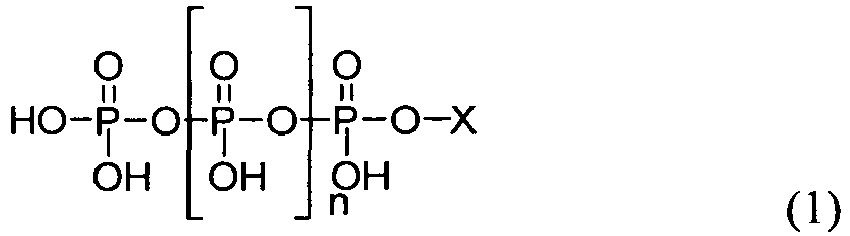
- the aim of the invention is a method of synthesis of organic polyphosphates of general formula 1, where n has a value of 0 to 2 while X stands for an organic radical, selected from nucleoside, oligonucleotide, peptide-carbohydrate or a protein radical is characterised in that it reacts with a compound of general formula 2, OH-X (2) where X stands for the above while an adequate substituted derivative of 2-pyridyl-[1,3,2]oxazaphospholidine or an adequate substituted derivative of 2-pyrimidyl-[1,3,2]oxazaphospholidine of general formula 3 in which
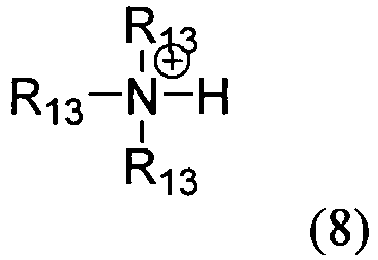
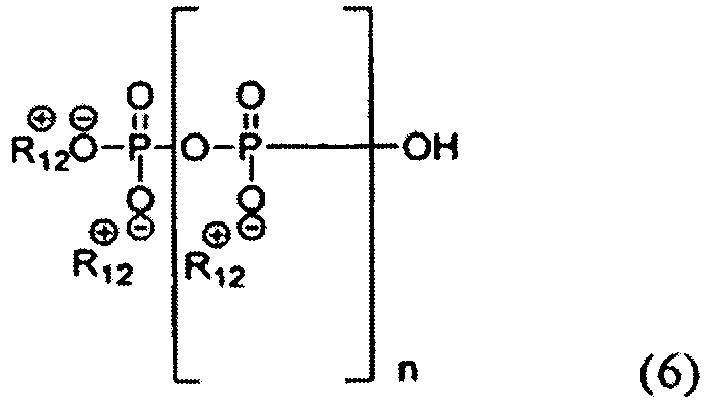
- the method described in the invention preferably uses the monohydric polyphosphoric acid ammonium salt of general formula of 5 or 6, in which the R 11 or R 12 substituents stand for groups of general formula 7 or 8. Moreover, the method preferably uses at least a double excess of the monohydric polyphosphoric acid ammonium salt.
- the reactions used in the method should take place in organic solvents, preferably in acetonitrile or methylene chloride.
- the second aspect of the invention is a development of a method of the synthesis of organic polyphosphates of the general formula 1, where n and X have the above-mentioned meaning, based on a reaction between the compound of general formula 4, in which R 1 , R 2 , R 3 , R 4 , R 5 , R 6 , R 7 and X have the above-mentioned meaning, and the polyphosphoric acid ammonium salt of general formula 5 or 6 in which n has a value of 0 to 2, and R 11 and R 12 stand for H, or respectively at least one R 11 substituent stands for a group of general formula 7, R 12 stands for a group of general formula 8, where the R 13 substituents stand for CH 3 or CH 2 -R 14 groups, where R 14 are the same or different and stand for a saturated alkyl with a chain of 1 to 8 carbons, unsaturated alkyl with a chain of 1 to 8 carbons, a monocyclic aryl, saturated alkyl with a chain of 1 to 8 carbon
- the method described by the invention preferably uses the monohydric polyphosphoric acid ammonium salt of general formula of 5 or 6, in which all the R 9 or R 10 substituents stand for a group of general formula 7 or 8. Moreover, the method preferably uses at least double excess of polyphosphoric acid ammonium salt.
- the reactions used in the method should take place in organic solvents, preferably in acetonitrile or methylene chloride.
- n has a value of 0 to 2 while X stands for an organic radical, selected from nucleoside, oligonucleotide, peptide-carbohydrate or a protein radical characterised in that it enters into a reaction between a compound of general formula 2 OH-X (2) where X stands for the above, and an adequate substituted derivative of 3-(pyridine-2-yl)-[1,3,2]oxazaphospholidine or an adequate substituted derivative of 3-(pyrimidyl-2-yl)-[1,3,2]oxazaphospholidine of general formula 3 where
- the method preferably uses the monohydric polyphosphoric acid ammonium salt of general formula of 5 or 6, in which all the R 11 or R 12 substituents stand for groups of general formula 7 or 8.
- the method described by the invention preferably uses a double excess of the monohydric polyphosphoric acid ammonium salt.
- the reactions should take place in organic solvents, preferably in acetonitrile.
- n and X have the above-mentioned meaning, based on a reaction of the compound of general formula 4, in which R 1 , R 2 , R 3 , R 4 , R 5 , R 6 , R 7 and X stand for the above, is oxidized with iodine, preferably dissolved in pyridine, and an oxide of an adequate substituted derivative of 3-(pyridine-2-yl)-[1,3,2]oxazaphospholidine or an adequate substituted derivative of 3-(pyrimidine-2-yl)-[1,3,2]oxazaphospholidine of general formula 9 is formed, which, in turn, reacts with polyphosphoric acid ammonium salt of general formula 5 or 6 where n has a value of 0 to 2 while R 11 and R 12 stand for H or at least one substituent R 11 stands for a group of general formula 7 R 12 -stands for a group of general formula 8 , where the R 13 substituent
- the method preferably uses the monohydric polyphosphoric acid ammonium salt, in which all the R 11 substituents stand for groups of general formula 7 or R 12 stand for a group of general formula 8.
- the method preferably uses at least a double excess of the polyphosphoric acid ammonium salt.
- the reactions should take place in organic solvents, preferably in acetonitrile or methylene chloride.
- the third aspect of the invention is a method of the synthesis of organic polyphosphates of general formula 1, in which n and X have the above-mentioned meaning, based on a reaction of the compound of general formula 4, in which R 1 , R 2 , R 3 , R 4 , R 5 , R 6 , R 7 and X have the above-mentioned meaning, and the polyphosphoric acid ammonium salt where n, R 11 and R 12 have the above meaning, in the presence of iodine, preferably dissolved in pyridine.
- the following reactions take place in the reaction mixture:
- the method described in the invention preferably uses the monohydric polyphosphoric acid ammonium salt of general formula of 5 or 6, in which all the R 10 or R 11 substituents stand for groups of general formula 7 or 8.
- the method preferably uses at least a double excess of the monohydric polyphosphoric acid ammonium salt and iodine, preferably dissolved in pyridine.
- the reactions should take place in organic solvents, preferably in acetonitrile or methylene chloride.
- the fourth aspect of the invention is a method employing solid bases, e.g. controlled pore glass CPG), which have hydroxyl groups. Hydroxyl groups of the bases are used to increase the nucleic acid (oligonucleotide) chain.
- the base is placed in reaction columns ensuring the flow of the liquid and gas.
- the method of the synthesis of organic phosphates 1, in which n has a value of 1 to 2, and X stands for the oligonucleotide or nucleic acid radical, is based on a reaction between a compound of general formula 2 X-OH (2) in which X stands for the oligonucleotide or nucleic acid radical, and the compound of general formula 3, in which R 1 , R 2 , R 3 , R 4 , R 5 , R 6 , R 7 and R 8 have the above meaning, in the presence of weak acid, preferably monohydric with iodine in the presence of pyridine, including especially 1-H-terazole, 5-ethylotio-1H-tetrazole, 4,5-dicyanoimidazole, 5-benzylotio-1H-tetrazole, acetic acid.
- a mixture of the polyphosphoric acid ammonium salt of general formula 5 or 6, in which all the R 11 or R 12 have the above meanings, is applied to the column, with at least 20-50 times the stoichiometric excess of the mixture of the acid and iodine with respect to the available hydroxyl groups that are formed as a result of the increase of the nucleic acid chain on the surface of the solid phase.
- the reaction lasts from 5 to 25 minutes.
- the product of the reaction is isolated using well-known methods.
- the method described in the invention uses a mixture of the polyphosphoric acid ammonium salt, preferably monohydric, with iodine at the ratio of 1:0.8 to 0.8 :1, preferably 1:1.
- the method described in the sixth aspect of the invention is of great importance to chemical oligonucleotide syntheses on a solid phase using automatic nucleic acid synthesizer.
- One advantage of the solution described in the invention is a simplified polyphosphate synthesis method, including especially that of nucleoside, oligonucleotide or carbohydrate polyphosphorates.
- the method described in the invention is characterised by a shorter time of the process and simplified procedures necessary to produce the triphosphate analogue.
- the invention may be used to produce triphosphate analogues of many compounds of biological importance, such as nucleosides, oligonucleotides, carbohydrates, peptides or proteins, which are a subject of comprehensive studies and development research due to their application potential in studies in the area of organic chemistry, molecular biology and biotechnology.
- the efficiency of the reaction was 70%.
- the obtained product was lyophilized from the anhydrous benzene.
- the solvent was vaporized, and the product of the reaction was eluted on the column filled with silica gel with 200-mesh molecules.
- the eluent phase used a mixture of solvents: benzene and triethylamine, with triethylamine volume fracture of 10%.
- the collected fractions containing the product of the reaction i.e. 5'-[3-(pyrid-2-yl)-[1,3,2]oxazaphospholidine]-3'- O -acetyl thymidyne were concentrated and lyophilised from anhydrous benzene.
- 5'- O -[3-(pyrid-2-yl)-[1,3,2]oxazaphospholidine]-3'- O -acetyl thymidyne was obtained.
- Invention used in the synthesis of DNA and RNA oligonucleotide 5'-triphosphates on a solid phase.
- oligonucleotides Two in the DNA series and two in the RNA series, were synthesized in accordance with table 1. After the synthesis, the last dimethoxytrityl group was removed, and the cyclic phosphoramidite product of example 1 of formula: was added to the reaction column in the presence of tiotereazole solution. Condensation time: 12 minutes. After the reaction column had been washed, a solution of the pyrophosphate acid was added in the presence of a 0.5-mole iodine solution in the mixture of pyridine/acetonitrile. Duration: 30 minutes.
- oligonucleotides were unlocked from the base using a nucleophilic reagent; data presented in table 1, column 2.
- Oligonucleotides of the RNA series were subjected to the solution of tetrabutyl fluoride in tetrahydrofuran for 2 hours in order to remove protecting groups in 2', followed by a precipitation in methanol and elution using the high-performance liquid chromatography (HPLC)
- Oligonucleotide triphosphate analogues were analysed using mass spectrometry, and the results were presented in table 1. Table 1.
- Oligonucleotide (typ) The used method of deblocking the oligomer Mass analysis The theoretical value The observed value PPP-TTTTTTTTTT (DNA) conc. ammonia solution temp 25 °C time 30 min. 3217,4 3219,5 PPP-ATATATATATATA (DNA) conc. ammonia solution temp 25 °C time 120 min. 3262,45 3269,34 PPP-UUUUUUUUUUUUU (RNA) AMA solution 3237,19 3239,5 PPP-GACUGACU (RNA) AMA solution 2747,27 2748,9
Landscapes
- Chemical & Material Sciences (AREA)
- Organic Chemistry (AREA)
- Health & Medical Sciences (AREA)
- Life Sciences & Earth Sciences (AREA)
- Biochemistry (AREA)
- General Health & Medical Sciences (AREA)
- Molecular Biology (AREA)
- Engineering & Computer Science (AREA)
- Biotechnology (AREA)
- Genetics & Genomics (AREA)
- Saccharide Compounds (AREA)
Claims (18)
- Syntheseverfahren zur Herstellung von organischen Polyphosphaten der allgemeinen Formel 1,

OH-X (2)
worin X wie oben definiert ist, und einem geigneten substituierten Derivat von 3-(Pyridin-2-yl)-[1,3,2]oxazaphospholidin oder einem geeigneten substituierten Derivat von 3-(Pirymidyl-2-yl) - [1,3,2] oxazaphospholidin der allgemeinen Formel 3 • R1, R2, R3, R4 gleich oder verschieden sind und für H, gesättigtes Alkyl mit einer Kettenlänge von 1 bis 8 Kohlenstoffatomen, ungesättigtes Alkyl mit einer Kettenlänge von 1 bis 8 Kohlenstoffatomen, monocyclisches Aryl oder ungesättigtes Alkyl mit einer Kettenlänge von 1 bis 8 Kohlenstoffen enthaltend einen monocyclischen oder bicyclischen Arylsubstituenten steht, wobei das gesättigte Alkyl, ungesättigte Alkyl und Aryl teilweise oder vollständig substituiert sind,• R5 für CH oder N steht,• R6 und R7 für H, CH3, Halogenatom, NO2, NH2, oder C2H5 stehen,• R8 für Halogenatom oder NR9R10 steht, worin R9 und R10 gleich oder verschieden sind und für Ethyl, n-Propyl oder Diisopropyl stehen,wobei in dem Fall, wenn R8 für NR9R10 steht, für die Reaktion zusätzlich eine schwache Säure verwendet wird, gefolgt von einer Umsetzung des Produktes dieser Reaktion der allgemeinen Formel 4,


- Verfahren nach Anspruch 1, dadurch gekennzeichnet, dass Ammoniumsalz der Monohydrogenpolyphosphorsäure der allgemeinen Formel 5 oder 6, worin die Substituenten R11 für Gruppen der Formel 7 stehen oder R12 für Gruppen der Formel 8 stehen, verwendet wird.
- Verfahren nach Anspruch 1 oder 2, dadurch gekennzeichnet, dass mindestens ein doppelter Überschuss vom Ammoniumsalz der Polyphosphorsäure verwendet wird.
- Verfahren nach einem der Ansprüche 1 oder 2 oder 3, dadurch gekennzeichnet, dass als schwache Säure 1-H-Tetrazol oder 5-Ethylthio-1H-tetrazol eingesetzt wird.
- Verfahren nach einem der Ansprüche 1 oder 2 oder 3 oder 4, dadurch gekennzeichnet, dass das in Pyridin gelöstes Jod eingesetzt wird.
- Syntheseverfahren zur Herstellung von organischen Polyphosphaten der allgemeinen Formel 1,

 • worin R1, R2, R3, R4 gleich oder verschieden sind und für H, gesättigtes Alkyl mit einer Kettenlänge von 1 bis 8 Kohlenstoffatomen, ungesättigtes Alkyl mit einer Kettenlänge von 1 bis 8 Kohlenstoffatomen, monocyclisches Aryl, oder ungesättigtes Alkyl mit einer Kettenlänge von 1 bis 8 Kohlenstoffen enthaltend einen monocyclischen oder bicyclischen Arylsubstituenten stehen, wobei das gesättigte Alkyl, das ungesättigte Alkyl und das Aryl teilweise oder vollständig substituiert sind,• R5 für CH oder N steht,• R6 und R7 für H, CH3, Halogenatom, NO2, NH2 oder C2H5 stehen,und X wie oben definiert ist, mit Ammoniumsalz der Polyphosphorsäure der allgemeinen Formel 5 oder 6,


- Verfahren nach Anspruch 6, dadurch gekennzeichnet, dass Ammoniumsalz der Monohydrogenpolyphosphorsäure der allgemeinen Formel 5, worin die Substituenten R11 für Gruppen der Formel 7 stehen und R12 für Gruppen der Formel 8 stehen, verwendet wird.
- Verfahren nach Anspruch 6 oder 7, dadurch gekennzeichnet, dass mindestens ein doppelter Überschuss vom Ammoniumsalz der Polyphosphorsäure verwendet wird.
- Verfahren nach einem der Ansprüche 6 oder 7 oder 8, dadurch gekennzeichnet, dass in Pyridin gelöstes Jod eingesetzt wird.
- Syntheseverfahren zur Herstellung von organischen Polyphosphaten der allgemeinen Formel 1,
 R1, R2, R3, R4 gleich oder verschieden sind und für H, gesättigtes Alkyl mit einer Kettenlänge von 1 bis 8 Kohlenstoffatomen, ungesättigtes Alkyl mit einer Kettenlänge von 1 bis 8 Kohlenstoffatomen, monocyclisches Aryl oder ungesättigtes Alkyl mit einer Kettenlänge von 1 bis 8 Kohlenstoffen enthaltend einen monocyclischen oder bicyclischen Aryl-Substituenten steht, wobei das gesättigte Alkyl, das ungesättigte Alkyl und das Aryl teilweise oder vollständig substituiert sind, stehen,R5 für CH oder N steht,R6 und R7 für H, CH3, Halogenatom, NO2, NH2 oder C2H5 stehen,und X wie oben definiert ist,• mit einem Ammoniumsalz der Polyphosphorsäure der allgemeinen Formel 5 oder 6,


- Verfahren nach Anspruch 10, dadurch gekennzeichnet, dass ein Ammoniumsalz der Monohydrogenpolyphosphorsäure der allgemeinen Formel 5 oder 6, worin die Substituenten R11 für Gruppen der Formel 7 stehen oder R12 für Gruppen der Formel 8 stehen, verwendet wird.
- Verfahren nach Anspruch 10 oder 11, dadurch gekennzeichnet, dass mindestens ein doppelter Überschuss vom Ammoniumsalz der Polyphosphorsäure verwendet wird.
- Verfahren nach einem der Ansprüche 10 oder 11 oder 12, dadurch gekennzeichnet, dass in Pyridin gelöstes Jod eingesetzt wird.
- Syntheseverfahren zur Herstellung von organischen Polyphosphaten der allgemeinen Formel 1,

X-OH (2)
worin X wie oben definiert ist, und eine Verbindung der allgemeinen Formel 3, R1, R2, R3, R4 gleich oder verschieden sind und für H, gesättigtes Alkyl mit einer Kettenlänge von 1 bis 8 Kohlenstoffatomen, ungesättigtes Alkyl mit einer Kettenlänge von 1 bis 8 Kohlenstoffatomen, monocyclisches Aryl, ungesättigtes Alkyl mit einer Kettenlänge von 1 bis 8 Kohlenstoffen enthaltend einen monocyclischen oder bicyclischen Aryl-Substituenten, worin das gesättigte Alkyl, das ungesättigte Alkyl und das Aryl teilweise oder vollständig substituiert sind, stehen,R5 für CH oder N steht,R6 und R7 für H, CH3, Halogenatom, NO2, NH2 oder C2H5 stehen,R8 für ein Halogenatom oder NR9R10 steht, worin R9 und R10 gleich oder verschieden sind und für Ethyl, n-Propyl oder Diisopropyl stehen,in Gegenwart von einer schwachen Säure umgesetzt werden und nach Abschluss der Reaktion die überschüssigen Lösungsmittel entfernt werden und die Säulen mit trockenem Acetonitril gewaschen werden und woraufhin das Gemisch enthaltend den Ammoniumsalz der Polyphosphorsäure der allgemeinen Formel 5 oder 6,


und Jod in Gegenwart von Pyridin in eine Säule hineingeführt wird, wobei ein mindestens 20-facher stöchiometrischer Überschuss von der Mischung der Polyphosphorsäure und Jod in Bezug auf die verfügbaren im Prozess des Nukleinsäurekettenwachstums auf der Oberfläche der festen Phase entstehenden Hydroxylgruppen verwendet wird und nach dem Abschluss der Reaktion die Verbindung der allgemeinen Formel 1 nach bekannten Methoden isoliert wird. - Verfahren nach Anspruch 14, dadurch gekennzeichnet, dass ein Ammoniumsalz der Monohydrogenpolyphosphorsäure der allgemeinen Formel 5 oder 6, worin alle Substituenten R11 für Gruppen der Formel 7 stehen oder R12 für Gruppen der Formel 8 stehen, verwendet wird.
- Verfahren nach Anspruch 14 oder 15, dadurch gekennzeichnet, dass ein Gemisch des Ammoniumsalzes der Monohydrogenpolyphosphorsäure mit Iod im Verhältnis von 1:0,8 bis 0,8: 1 verwendet wird.
- Verfahren nach einem der Ansprüche 14 oder 15 oder 16, dadurch gekennzeichnet, dass ein mindestens 50-facher stöchiometrischer Überschuss des Gemisches aus der Säure und Jod eingesetzt wird.
- Verfahren nach einem der Ansprüche 14 oder 15 oder 16 oder 17 dadurch gekennzeichnet, dass als schwache Säure 1-H-Terazol, 5-Ethylthio-1H-tetrazol, 4,5-Dicyanoimidazol, 5-Benzylthio-1H-tetrazol oder Essigsäure eingesetzt wird.
Applications Claiming Priority (2)
| Application Number | Priority Date | Filing Date | Title |
|---|---|---|---|
| PL400248A PL231078B1 (pl) | 2012-08-05 | 2012-08-05 | Sposób syntezy polifosforanów |
| PCT/PL2013/000098 WO2014025272A1 (en) | 2012-08-05 | 2013-07-29 | New method of polyphosphate synthesis |
Publications (2)
| Publication Number | Publication Date |
|---|---|
| EP2880044A1 EP2880044A1 (de) | 2015-06-10 |
| EP2880044B1 true EP2880044B1 (de) | 2019-11-27 |
Family
ID=48986196
Family Applications (1)
| Application Number | Title | Priority Date | Filing Date |
|---|---|---|---|
| EP13750163.1A Active EP2880044B1 (de) | 2012-08-05 | 2013-07-29 | Neues verfahren zur synthese von polyphosphate |
Country Status (4)
| Country | Link |
|---|---|
| US (1) | US9376460B2 (de) |
| EP (1) | EP2880044B1 (de) |
| PL (1) | PL231078B1 (de) |
| WO (1) | WO2014025272A1 (de) |
Families Citing this family (3)
| Publication number | Priority date | Publication date | Assignee | Title |
|---|---|---|---|---|
| WO2017194498A1 (en) * | 2016-05-12 | 2017-11-16 | Roche Innovation Center Copenhagen A/S | Enhanced coupling of stereodefined oxazaphospholidine phosphoramidite monomers to nucleoside or oligonucleotide |
| CN109680342B (zh) * | 2018-12-18 | 2021-09-28 | 上海药明康德新药开发有限公司 | DNA编码化合物库中On-DNA芳硝基化合物还原成On-DNA芳胺化合物的方法 |
| CN113354545B (zh) * | 2020-03-06 | 2023-06-23 | 深圳华大生命科学研究院 | 一种焦磷酸盐及其制备方法 |
-
2012
- 2012-08-05 PL PL400248A patent/PL231078B1/pl unknown
-
2013
- 2013-07-29 EP EP13750163.1A patent/EP2880044B1/de active Active
- 2013-07-29 WO PCT/PL2013/000098 patent/WO2014025272A1/en not_active Ceased
- 2013-07-29 US US14/412,951 patent/US9376460B2/en not_active Expired - Fee Related
Non-Patent Citations (1)
| Title |
|---|
| None * |
Also Published As
| Publication number | Publication date |
|---|---|
| EP2880044A1 (de) | 2015-06-10 |
| PL400248A1 (pl) | 2014-02-17 |
| PL231078B1 (pl) | 2019-01-31 |
| US9376460B2 (en) | 2016-06-28 |
| US20150203524A1 (en) | 2015-07-23 |
| WO2014025272A1 (en) | 2014-02-13 |
Similar Documents
| Publication | Publication Date | Title |
|---|---|---|
| JP2705914B2 (ja) | 新規ポリヌクレオチド | |
| US20120178710A1 (en) | Synthesis of cyclic diguanosine monophosphate and thiophosphate analogs thereof | |
| TW201734030A (zh) | 用於合成吲哚環核鹼基結合物之組成物及方法 | |
| CN103193843B (zh) | 由全保护核苷磷酰胺中间体通过酸催化合成核苷三磷酸和核苷二磷酸的方法 | |
| Forget et al. | Synthesis and enzymatic evaluation of ketose phosphonates: the interplay between mutarotation, monofluorination and acidity | |
| US9376460B2 (en) | Method of polyphosphate synthesis | |
| US8614312B2 (en) | Method for preparing nucleotides and related analogues by synthesis on soluble substrate, and biological tools thus prepared | |
| Rohloff et al. | Practical synthesis of cytidine-5-carboxamide-modified nucleotide reagents | |
| EP4450512A1 (de) | Verfahren zur herstellung von oligonukleotiden | |
| CN113354545B (zh) | 一种焦磷酸盐及其制备方法 | |
| WO2016110761A1 (en) | PROCESS FOR PRODUCING 1-β-D-ARABINOFURANOSYLCYTOSINE AND 2,2'-O-CYCLOCYTIDINE | |
| RU2446169C2 (ru) | Способ получения 5'-аминокарбонилфосфонатов нуклеозидов и способ получения хлорангидрида триметилсилильного эфира этоксикарбонилфосфоновой кислоты | |
| WO2022123501A1 (en) | Protected deoxydidehydro-nucleosides | |
| Hocková et al. | N-Branched acyclic nucleoside phosphonates as monomers for the synthesis of modified oligonucleotides | |
| Mori et al. | Synthesis and hybridization property of a boat-shaped pyranosyl nucleic acid containing an exocyclic methylene group in the sugar moiety | |
| Tisnerat et al. | Synthesis of triphosphate nucleoside prodrugs: γ‐ProTriPs | |
| RU2278869C2 (ru) | Новые субстраты концевой дезоксинуклеотидилтрансферазы | |
| JP2002080491A (ja) | 新規なヌクレオチドアナログ及びその製造法 | |
| Lavéna et al. | Synthetic studies on the preparation of nucleoside 5'-H-phosphonate monoesters under the Mitsunobu reaction conditions. | |
| Liu et al. | Synthesis of nucleoside 5′-H-phosphonothioates via nucleoside 5′-phosphinate intermediates | |
| US20150361124A1 (en) | Method for the solid-phase based synthesis of phosphate-bridged nucleoside conjugates | |
| Polakova et al. | Tetrofuranose nucleoside phosphonic acids: Synthesis and properties | |
| Fowler et al. | Chemical and Enzymatic Synthesis of 4′-Thio-β-d-Arabinofuranosylcytosine Monophosphate and Triphosphate | |
| JPH0372235B2 (de) | ||
| Katalenić et al. | Novel Diastereomeric Thymidine Cyclic 3′, 5′-threo-Phosphoramidates |
Legal Events
| Date | Code | Title | Description |
|---|---|---|---|
| PUAI | Public reference made under article 153(3) epc to a published international application that has entered the european phase |
Free format text: ORIGINAL CODE: 0009012 |
|
| 17P | Request for examination filed |
Effective date: 20141219 |
|
| AK | Designated contracting states |
Kind code of ref document: A1 Designated state(s): AL AT BE BG CH CY CZ DE DK EE ES FI FR GB GR HR HU IE IS IT LI LT LU LV MC MK MT NL NO PL PT RO RS SE SI SK SM TR |
|
| AX | Request for extension of the european patent |
Extension state: BA ME |
|
| DAX | Request for extension of the european patent (deleted) | ||
| STAA | Information on the status of an ep patent application or granted ep patent |
Free format text: STATUS: EXAMINATION IS IN PROGRESS |
|
| 17Q | First examination report despatched |
Effective date: 20170411 |
|
| GRAP | Despatch of communication of intention to grant a patent |
Free format text: ORIGINAL CODE: EPIDOSNIGR1 |
|
| STAA | Information on the status of an ep patent application or granted ep patent |
Free format text: STATUS: GRANT OF PATENT IS INTENDED |
|
| INTG | Intention to grant announced |
Effective date: 20190809 |
|
| RIN1 | Information on inventor provided before grant (corrected) |
Inventor name: ROMANOWSKA, JOANNA Inventor name: CHMIELEWSKI, MARCIN KRZYSZTOF |
|
| GRAS | Grant fee paid |
Free format text: ORIGINAL CODE: EPIDOSNIGR3 |
|
| GRAA | (expected) grant |
Free format text: ORIGINAL CODE: 0009210 |
|
| STAA | Information on the status of an ep patent application or granted ep patent |
Free format text: STATUS: THE PATENT HAS BEEN GRANTED |
|
| AK | Designated contracting states |
Kind code of ref document: B1 Designated state(s): AL AT BE BG CH CY CZ DE DK EE ES FI FR GB GR HR HU IE IS IT LI LT LU LV MC MK MT NL NO PL PT RO RS SE SI SK SM TR |
|
| REG | Reference to a national code |
Ref country code: GB Ref legal event code: FG4D |
|
| REG | Reference to a national code |
Ref country code: CH Ref legal event code: EP |
|
| REG | Reference to a national code |
Ref country code: AT Ref legal event code: REF Ref document number: 1206570 Country of ref document: AT Kind code of ref document: T Effective date: 20191215 |
|
| REG | Reference to a national code |
Ref country code: DE Ref legal event code: R096 Ref document number: 602013063364 Country of ref document: DE |
|
| REG | Reference to a national code |
Ref country code: IE Ref legal event code: FG4D |
|
| REG | Reference to a national code |
Ref country code: NL Ref legal event code: MP Effective date: 20191127 |
|
| REG | Reference to a national code |
Ref country code: LT Ref legal event code: MG4D |
|
| PG25 | Lapsed in a contracting state [announced via postgrant information from national office to epo] |
Ref country code: LV Free format text: LAPSE BECAUSE OF FAILURE TO SUBMIT A TRANSLATION OF THE DESCRIPTION OR TO PAY THE FEE WITHIN THE PRESCRIBED TIME-LIMIT Effective date: 20191127 Ref country code: SE Free format text: LAPSE BECAUSE OF FAILURE TO SUBMIT A TRANSLATION OF THE DESCRIPTION OR TO PAY THE FEE WITHIN THE PRESCRIBED TIME-LIMIT Effective date: 20191127 Ref country code: BG Free format text: LAPSE BECAUSE OF FAILURE TO SUBMIT A TRANSLATION OF THE DESCRIPTION OR TO PAY THE FEE WITHIN THE PRESCRIBED TIME-LIMIT Effective date: 20200227 Ref country code: FI Free format text: LAPSE BECAUSE OF FAILURE TO SUBMIT A TRANSLATION OF THE DESCRIPTION OR TO PAY THE FEE WITHIN THE PRESCRIBED TIME-LIMIT Effective date: 20191127 Ref country code: NO Free format text: LAPSE BECAUSE OF FAILURE TO SUBMIT A TRANSLATION OF THE DESCRIPTION OR TO PAY THE FEE WITHIN THE PRESCRIBED TIME-LIMIT Effective date: 20200227 Ref country code: GR Free format text: LAPSE BECAUSE OF FAILURE TO SUBMIT A TRANSLATION OF THE DESCRIPTION OR TO PAY THE FEE WITHIN THE PRESCRIBED TIME-LIMIT Effective date: 20200228 Ref country code: NL Free format text: LAPSE BECAUSE OF FAILURE TO SUBMIT A TRANSLATION OF THE DESCRIPTION OR TO PAY THE FEE WITHIN THE PRESCRIBED TIME-LIMIT Effective date: 20191127 Ref country code: LT Free format text: LAPSE BECAUSE OF FAILURE TO SUBMIT A TRANSLATION OF THE DESCRIPTION OR TO PAY THE FEE WITHIN THE PRESCRIBED TIME-LIMIT Effective date: 20191127 Ref country code: ES Free format text: LAPSE BECAUSE OF FAILURE TO SUBMIT A TRANSLATION OF THE DESCRIPTION OR TO PAY THE FEE WITHIN THE PRESCRIBED TIME-LIMIT Effective date: 20191127 |
|
| PG25 | Lapsed in a contracting state [announced via postgrant information from national office to epo] |
Ref country code: HR Free format text: LAPSE BECAUSE OF FAILURE TO SUBMIT A TRANSLATION OF THE DESCRIPTION OR TO PAY THE FEE WITHIN THE PRESCRIBED TIME-LIMIT Effective date: 20191127 Ref country code: RS Free format text: LAPSE BECAUSE OF FAILURE TO SUBMIT A TRANSLATION OF THE DESCRIPTION OR TO PAY THE FEE WITHIN THE PRESCRIBED TIME-LIMIT Effective date: 20191127 Ref country code: IS Free format text: LAPSE BECAUSE OF FAILURE TO SUBMIT A TRANSLATION OF THE DESCRIPTION OR TO PAY THE FEE WITHIN THE PRESCRIBED TIME-LIMIT Effective date: 20200327 |
|
| PG25 | Lapsed in a contracting state [announced via postgrant information from national office to epo] |
Ref country code: AL Free format text: LAPSE BECAUSE OF FAILURE TO SUBMIT A TRANSLATION OF THE DESCRIPTION OR TO PAY THE FEE WITHIN THE PRESCRIBED TIME-LIMIT Effective date: 20191127 |
|
| PG25 | Lapsed in a contracting state [announced via postgrant information from national office to epo] |
Ref country code: PT Free format text: LAPSE BECAUSE OF FAILURE TO SUBMIT A TRANSLATION OF THE DESCRIPTION OR TO PAY THE FEE WITHIN THE PRESCRIBED TIME-LIMIT Effective date: 20200419 Ref country code: EE Free format text: LAPSE BECAUSE OF FAILURE TO SUBMIT A TRANSLATION OF THE DESCRIPTION OR TO PAY THE FEE WITHIN THE PRESCRIBED TIME-LIMIT Effective date: 20191127 Ref country code: CZ Free format text: LAPSE BECAUSE OF FAILURE TO SUBMIT A TRANSLATION OF THE DESCRIPTION OR TO PAY THE FEE WITHIN THE PRESCRIBED TIME-LIMIT Effective date: 20191127 Ref country code: RO Free format text: LAPSE BECAUSE OF FAILURE TO SUBMIT A TRANSLATION OF THE DESCRIPTION OR TO PAY THE FEE WITHIN THE PRESCRIBED TIME-LIMIT Effective date: 20191127 Ref country code: DK Free format text: LAPSE BECAUSE OF FAILURE TO SUBMIT A TRANSLATION OF THE DESCRIPTION OR TO PAY THE FEE WITHIN THE PRESCRIBED TIME-LIMIT Effective date: 20191127 |
|
| PGFP | Annual fee paid to national office [announced via postgrant information from national office to epo] |
Ref country code: FR Payment date: 20200521 Year of fee payment: 8 |
|
| REG | Reference to a national code |
Ref country code: DE Ref legal event code: R097 Ref document number: 602013063364 Country of ref document: DE |
|
| PG25 | Lapsed in a contracting state [announced via postgrant information from national office to epo] |
Ref country code: SM Free format text: LAPSE BECAUSE OF FAILURE TO SUBMIT A TRANSLATION OF THE DESCRIPTION OR TO PAY THE FEE WITHIN THE PRESCRIBED TIME-LIMIT Effective date: 20191127 Ref country code: SK Free format text: LAPSE BECAUSE OF FAILURE TO SUBMIT A TRANSLATION OF THE DESCRIPTION OR TO PAY THE FEE WITHIN THE PRESCRIBED TIME-LIMIT Effective date: 20191127 |
|
| PGFP | Annual fee paid to national office [announced via postgrant information from national office to epo] |
Ref country code: GB Payment date: 20200529 Year of fee payment: 8 |
|
| REG | Reference to a national code |
Ref country code: AT Ref legal event code: MK05 Ref document number: 1206570 Country of ref document: AT Kind code of ref document: T Effective date: 20191127 |
|
| PLBE | No opposition filed within time limit |
Free format text: ORIGINAL CODE: 0009261 |
|
| STAA | Information on the status of an ep patent application or granted ep patent |
Free format text: STATUS: NO OPPOSITION FILED WITHIN TIME LIMIT |
|
| PGFP | Annual fee paid to national office [announced via postgrant information from national office to epo] |
Ref country code: DE Payment date: 20200529 Year of fee payment: 8 |
|
| 26N | No opposition filed |
Effective date: 20200828 |
|
| PG25 | Lapsed in a contracting state [announced via postgrant information from national office to epo] |
Ref country code: SI Free format text: LAPSE BECAUSE OF FAILURE TO SUBMIT A TRANSLATION OF THE DESCRIPTION OR TO PAY THE FEE WITHIN THE PRESCRIBED TIME-LIMIT Effective date: 20191127 Ref country code: AT Free format text: LAPSE BECAUSE OF FAILURE TO SUBMIT A TRANSLATION OF THE DESCRIPTION OR TO PAY THE FEE WITHIN THE PRESCRIBED TIME-LIMIT Effective date: 20191127 Ref country code: PL Free format text: LAPSE BECAUSE OF FAILURE TO SUBMIT A TRANSLATION OF THE DESCRIPTION OR TO PAY THE FEE WITHIN THE PRESCRIBED TIME-LIMIT Effective date: 20191127 |
|
| PG25 | Lapsed in a contracting state [announced via postgrant information from national office to epo] |
Ref country code: IT Free format text: LAPSE BECAUSE OF FAILURE TO SUBMIT A TRANSLATION OF THE DESCRIPTION OR TO PAY THE FEE WITHIN THE PRESCRIBED TIME-LIMIT Effective date: 20191127 |
|
| PG25 | Lapsed in a contracting state [announced via postgrant information from national office to epo] |
Ref country code: MC Free format text: LAPSE BECAUSE OF FAILURE TO SUBMIT A TRANSLATION OF THE DESCRIPTION OR TO PAY THE FEE WITHIN THE PRESCRIBED TIME-LIMIT Effective date: 20191127 |
|
| REG | Reference to a national code |
Ref country code: CH Ref legal event code: PL |
|
| REG | Reference to a national code |
Ref country code: BE Ref legal event code: MM Effective date: 20200731 |
|
| PG25 | Lapsed in a contracting state [announced via postgrant information from national office to epo] |
Ref country code: LI Free format text: LAPSE BECAUSE OF NON-PAYMENT OF DUE FEES Effective date: 20200731 Ref country code: CH Free format text: LAPSE BECAUSE OF NON-PAYMENT OF DUE FEES Effective date: 20200731 Ref country code: LU Free format text: LAPSE BECAUSE OF NON-PAYMENT OF DUE FEES Effective date: 20200729 |
|
| PG25 | Lapsed in a contracting state [announced via postgrant information from national office to epo] |
Ref country code: BE Free format text: LAPSE BECAUSE OF NON-PAYMENT OF DUE FEES Effective date: 20200731 |
|
| PG25 | Lapsed in a contracting state [announced via postgrant information from national office to epo] |
Ref country code: IE Free format text: LAPSE BECAUSE OF NON-PAYMENT OF DUE FEES Effective date: 20200729 |
|
| REG | Reference to a national code |
Ref country code: DE Ref legal event code: R119 Ref document number: 602013063364 Country of ref document: DE |
|
| GBPC | Gb: european patent ceased through non-payment of renewal fee |
Effective date: 20210729 |
|
| PG25 | Lapsed in a contracting state [announced via postgrant information from national office to epo] |
Ref country code: GB Free format text: LAPSE BECAUSE OF NON-PAYMENT OF DUE FEES Effective date: 20210729 Ref country code: DE Free format text: LAPSE BECAUSE OF NON-PAYMENT OF DUE FEES Effective date: 20220201 |
|
| PG25 | Lapsed in a contracting state [announced via postgrant information from national office to epo] |
Ref country code: TR Free format text: LAPSE BECAUSE OF FAILURE TO SUBMIT A TRANSLATION OF THE DESCRIPTION OR TO PAY THE FEE WITHIN THE PRESCRIBED TIME-LIMIT Effective date: 20191127 Ref country code: MT Free format text: LAPSE BECAUSE OF FAILURE TO SUBMIT A TRANSLATION OF THE DESCRIPTION OR TO PAY THE FEE WITHIN THE PRESCRIBED TIME-LIMIT Effective date: 20191127 Ref country code: FR Free format text: LAPSE BECAUSE OF NON-PAYMENT OF DUE FEES Effective date: 20210731 Ref country code: CY Free format text: LAPSE BECAUSE OF FAILURE TO SUBMIT A TRANSLATION OF THE DESCRIPTION OR TO PAY THE FEE WITHIN THE PRESCRIBED TIME-LIMIT Effective date: 20191127 |
|
| PG25 | Lapsed in a contracting state [announced via postgrant information from national office to epo] |
Ref country code: MK Free format text: LAPSE BECAUSE OF FAILURE TO SUBMIT A TRANSLATION OF THE DESCRIPTION OR TO PAY THE FEE WITHIN THE PRESCRIBED TIME-LIMIT Effective date: 20191127 |