EP2880290B1 - Abgasbehandlungssystem (ats) basierend auf einem pm-katalysatorfilter - Google Patents
Abgasbehandlungssystem (ats) basierend auf einem pm-katalysatorfilter Download PDFInfo
- Publication number
- EP2880290B1 EP2880290B1 EP13755975.3A EP13755975A EP2880290B1 EP 2880290 B1 EP2880290 B1 EP 2880290B1 EP 13755975 A EP13755975 A EP 13755975A EP 2880290 B1 EP2880290 B1 EP 2880290B1
- Authority
- EP
- European Patent Office
- Prior art keywords
- filter
- cat
- particulate matter
- amount
- temperature
- Prior art date
- Legal status (The legal status is an assumption and is not a legal conclusion. Google has not performed a legal analysis and makes no representation as to the accuracy of the status listed.)
- Active
Links
Images
Classifications
-
- F—MECHANICAL ENGINEERING; LIGHTING; HEATING; WEAPONS; BLASTING
- F02—COMBUSTION ENGINES; HOT-GAS OR COMBUSTION-PRODUCT ENGINE PLANTS
- F02D—CONTROLLING COMBUSTION ENGINES
- F02D41/00—Electrical control of supply of combustible mixture or its constituents
- F02D41/02—Circuit arrangements for generating control signals
- F02D41/021—Introducing corrections for particular conditions exterior to the engine
- F02D41/0235—Introducing corrections for particular conditions exterior to the engine in relation with the state of the exhaust gas treating apparatus
- F02D41/027—Introducing corrections for particular conditions exterior to the engine in relation with the state of the exhaust gas treating apparatus to purge or regenerate the exhaust gas treating apparatus
- F02D41/029—Introducing corrections for particular conditions exterior to the engine in relation with the state of the exhaust gas treating apparatus to purge or regenerate the exhaust gas treating apparatus the exhaust gas treating apparatus being a particulate filter
-
- F—MECHANICAL ENGINEERING; LIGHTING; HEATING; WEAPONS; BLASTING
- F01—MACHINES OR ENGINES IN GENERAL; ENGINE PLANTS IN GENERAL; STEAM ENGINES
- F01N—GAS-FLOW SILENCERS OR EXHAUST APPARATUS FOR MACHINES OR ENGINES IN GENERAL; GAS-FLOW SILENCERS OR EXHAUST APPARATUS FOR INTERNAL-COMBUSTION ENGINES
- F01N9/00—Electrical control of exhaust gas treating apparatus
- F01N9/002—Electrical control of exhaust gas treating apparatus of filter regeneration
-
- F—MECHANICAL ENGINEERING; LIGHTING; HEATING; WEAPONS; BLASTING
- F02—COMBUSTION ENGINES; HOT-GAS OR COMBUSTION-PRODUCT ENGINE PLANTS
- F02D—CONTROLLING COMBUSTION ENGINES
- F02D2200/00—Input parameters for engine control
- F02D2200/02—Input parameters for engine control the parameters being related to the engine
- F02D2200/08—Exhaust gas treatment apparatus parameters
- F02D2200/0812—Particle filter loading
-
- F—MECHANICAL ENGINEERING; LIGHTING; HEATING; WEAPONS; BLASTING
- F02—COMBUSTION ENGINES; HOT-GAS OR COMBUSTION-PRODUCT ENGINE PLANTS
- F02D—CONTROLLING COMBUSTION ENGINES
- F02D41/00—Electrical control of supply of combustible mixture or its constituents
- F02D41/02—Circuit arrangements for generating control signals
- F02D41/14—Introducing closed-loop corrections
- F02D41/1438—Introducing closed-loop corrections using means for determining characteristics of the combustion gases; Sensors therefor
- F02D41/1444—Introducing closed-loop corrections using means for determining characteristics of the combustion gases; Sensors therefor characterised by the characteristics of the combustion gases
- F02D41/1466—Introducing closed-loop corrections using means for determining characteristics of the combustion gases; Sensors therefor characterised by the characteristics of the combustion gases the characteristics being a soot concentration or content
- F02D41/1467—Introducing closed-loop corrections using means for determining characteristics of the combustion gases; Sensors therefor characterised by the characteristics of the combustion gases the characteristics being a soot concentration or content with determination means using an estimation
-
- F—MECHANICAL ENGINEERING; LIGHTING; HEATING; WEAPONS; BLASTING
- F02—COMBUSTION ENGINES; HOT-GAS OR COMBUSTION-PRODUCT ENGINE PLANTS
- F02D—CONTROLLING COMBUSTION ENGINES
- F02D41/00—Electrical control of supply of combustible mixture or its constituents
- F02D41/02—Circuit arrangements for generating control signals
- F02D41/14—Introducing closed-loop corrections
- F02D41/1438—Introducing closed-loop corrections using means for determining characteristics of the combustion gases; Sensors therefor
- F02D41/1473—Introducing closed-loop corrections using means for determining characteristics of the combustion gases; Sensors therefor characterised by the regulation method
- F02D41/1475—Regulating the air fuel ratio at a value other than stoichiometry
-
- F—MECHANICAL ENGINEERING; LIGHTING; HEATING; WEAPONS; BLASTING
- F02—COMBUSTION ENGINES; HOT-GAS OR COMBUSTION-PRODUCT ENGINE PLANTS
- F02D—CONTROLLING COMBUSTION ENGINES
- F02D41/00—Electrical control of supply of combustible mixture or its constituents
- F02D41/30—Controlling fuel injection
- F02D41/38—Controlling fuel injection of the high pressure type
- F02D41/40—Controlling fuel injection of the high pressure type with means for controlling injection timing or duration
- F02D41/402—Multiple injections
- F02D41/405—Multiple injections with post injections
-
- Y—GENERAL TAGGING OF NEW TECHNOLOGICAL DEVELOPMENTS; GENERAL TAGGING OF CROSS-SECTIONAL TECHNOLOGIES SPANNING OVER SEVERAL SECTIONS OF THE IPC; TECHNICAL SUBJECTS COVERED BY FORMER USPC CROSS-REFERENCE ART COLLECTIONS [XRACs] AND DIGESTS
- Y02—TECHNOLOGIES OR APPLICATIONS FOR MITIGATION OR ADAPTATION AGAINST CLIMATE CHANGE
- Y02T—CLIMATE CHANGE MITIGATION TECHNOLOGIES RELATED TO TRANSPORTATION
- Y02T10/00—Road transport of goods or passengers
- Y02T10/10—Internal combustion engine [ICE] based vehicles
- Y02T10/40—Engine management systems
Definitions
- the present invention refers to the field of exhaust gas treatment lines (ATS: After Treatment Systems) of the type based on PM-CAT filters, also known as PM-Kat or POC (Particulate Oxidation Catalyst), or Flow-through filters (FTF) or Open particulate filters or Partial flow filter (PFF) or Partial filter technology (PFT) or PM oxidation catalyst or PM filter catalyst.
- PM-CAT filters also known as PM-Kat or POC (Particulate Oxidation Catalyst)
- FFF Flow-through filters
- PFF Partial flow filter
- PFT Partial filter technology
- PM-CAT filters In order to capture the carbonaceous particulate matter.
- PM-CAT filters unlike the DPF filters (Diesel particulate filter), are open filters, in the sense that the alveoli made in the body of the filter are open and allow the passage of the gases in any saturation condition of the filter itself.
- the particulate matter is actually filtered by centrifugation, which causes the particulate matter to collide with and to settle within the porous walls of the alveoli, where it gets trapped.
- PM-CAT device An example of commercial name of a PM-CAT device is PM-Metalit TM of Emitec.
- the corrugated foil is formed to direct the gas flow so it impinges onto the metal fleece.
- the internal surfaces of the PM-Cat do not have catalyst coatings.
- the filtering power of PM-CAT filters is between 50% and 90%, thus they are to able to retain all the particulate matter until the alveoli are full the gas can flow through the filter without being treated.
- both the PM-CAT and the DPF filters are coupled with a DOC (Diesel Oxidation Catalyst), which is arranged upstream of the respective filter and promotes the production of NO 2 , in order to facilitate a natural reaction of the first type, namely promoting the reaction of the carbonaceous soot with the NO 2 in order to generate CO/CO2 according to the reaction C + NO 2 -> NO + CO/CO 2
- DOC Diesel Oxidation Catalyst
- Such reaction is said to occur naturally or passively when the filter reaches an interval of temperatures comprised between 220°C and 450°C approximately. This depends on the operating conditions of the heat engine. Thus such regeneration is called low temperature passive regeneration of the first type.
- a high temperature passive or natural regeneration is also known, and occurs when the filter reaches temperatures exceeding 550°C. Such natural regeneration of the second type is very rare.
- PM-CAT filters may be provided as part of the original equipment or they can be bought aftermarket and installed on the vehicle, since such devices do not affect the management devices of the heat engine.
- DPF filters are closed filters, they completely filter the exhaust gases and they tend to clog due to the saturation of particulate matter, in spite of the presence of such passive regeneration process.
- high temperature active regeneration cycles with temperatures from 560°C and an average value of 650°C, are commanded and managed by a control unit, in order to promote a reaction of the second type, this time being active, namely generating CO/CO 2 from the reaction of the accumulated carbonaceous soot C with the oxygen O 2 , thus freeing the DPF filter and allowing the engine apparatus/exhaust line (ATS) to restore its original performance.
- a control unit in order to promote a reaction of the second type, this time being active, namely generating CO/CO 2 from the reaction of the accumulated carbonaceous soot C with the oxygen O 2 , thus freeing the DPF filter and allowing the engine apparatus/exhaust line (ATS) to restore its original performance.
- ATS engine apparatus/exhaust line
- the gas temperature at the inlet of the DOC is usually held about at 400-450°C. Then due to the presence of HC, exothermal reactions are carried out within the DOC, so as the temperature at the outlet of the DOC increases by reaching said regeneration temperatures 560° - 650°C necessary for the filter following (downstream) the DOC.
- DPF filters cannot be installed aftermarket on vehicles that are not equipped with them originally, since they cannot manage the active regeneration cycles.
- Type-approval cycles performed by type-approval authorities include the test of the functioning of the heat engine according to predefined engine speed/power/time curves.
- the engine apparatus/exhaust line passes the type approval tests.
- Type approval cycles and emission limits change according to the type of vehicle. The actual operating conditions of the vehicle may be very different from the type approval cycles conditions.
- the vehicles originally equipped with PM-CAT filters may be used in a way different from the type-approval curves, thus the filters can be completely saturated and the particulate matter produced by the heat engine will be almost totally released in the environment.
- diagnosis systems detecting the saturation level of the PM-CAT filters are adopted.
- An example of such systems is given in WO2012082268 .
- a first aim of the present invention to improve the exhaust gas treatment systems based on PM-CAT filters, so that they can be more efficient, safe, and even suitable to very low-power work cycles.
- an exhaust gas treatment system (ATS) according to claim 1. Thanks to the present invention, it is possible to really implement a PM-CAT filter, that does not have any superficial treatment with noble metals (platinum, palladium, etc.), without running the risk of delivery unburnt hydrocarbons HC in the environment.
- ATS exhaust gas treatment system
- the service life of PM-CAT filters is prolonged and their functioning is more constant and reliable in time, to the point that the treatment systems based on such filters are suitable to be installed on all vehicle categories.
- PM-CAT filters may be used also in fields where only DPF filters have been used so far.
- It is also object of the present invention an internal combustion engine comprising the aforementioned exhaust gas treatment system and a vehicle comprising such engine.
- the system that is object of the present invention provides the active regeneration of PM-CAT filters similarly to what happens for DPF filters.
- the active regeneration may be a process per se known, which includes, for example, the post-injection of additional fuel during some specific strokes of the engine, so that the fuel burns in the exhaust gas treatment system rather than in the cylinders, promoting an active reaction of the second type, namely the oxidation of the carbon residues by means of oxygen.
- the expression "to induce an active regeneration” will mean to increase the temperature of the ATS by enriching the fuel/air ratio and/or by fuel post-injection techniques or the like, namely independently of the work point and of the work conditions of the internal combustion engine.
- the regeneration temperature of any filter depends also on the amount of particulate matter accumulated in the filter.
- PM-CAT filters of the same regeneration techniques as DPF filters for the same filter saturation percentage will cause an excessive increase of the temperatures reached during the regeneration process, which would damage the PM-CAT filters.
- the management of the regeneration of the PM-CAT filter is performed on the basis of a predictive estimation of the saturation level of the filter.
- a predictive estimation of the accumulation of particulate matter avoids to reach particulate levels that may bring to an uncontrollable second type regeneration, both passive and active.
- the predictive estimation is known in the field of DPF filters, but, if it was used as it is in the field of PM-CAT filters, it would be inadequate, since it would bring to an estimation of soot accumulation such that the regeneration should be five times more frequent than in the DPF filters.
- the estimator of the saturation level of the filter is based on:
- the first amount of particulate matter gives an additional contribution, by settling in the alveoli of the PM-CAT filter, while the other two are subtracted from the first one.
- the first amount is higher than the absolute value of the sum of the other two, above all when the engine operates in low power conditions, namely when the exhaust line does not reach a temperature that is high enough to allow a natural reaction of the first type.
- the present invention teaches how to apply the active regeneration to the PM-CAT filter.
- PM-CAT filters According to laboratory tests on specific intervals of temperature, (220 - 450°C), PM-CAT filters have proven to be more efficient than DPF filters in the promotion of first type reactions having a coefficient comprised between 1.6 and 2.
- the predictive estimation in particular the second model, is modified in order to take into account the higher efficiency of the PM-CAT filters with respect to the DPF filters in promoting the reaction of the first type.
- said second amount with respect to a DPF filter, is multiplied by a coefficient comprised between 1.6 and 2.
- Such coefficient represents a ratio between the efficiency of the PM-CAT filter and of the DPF filter in promoting the natural regeneration of the first type.
- the higher efficiency of the PM-CAT filter in promoting the reactions of the first type has to be taken into account and implies a reduction of the aforementioned estimation of the regeneration frequency.
- the reason of such anomalous behaviour is connected to the intrinsic characteristics of PM-CAT filters, which filtrate only 50% - 90% of the particulate produced by the heat engine.
- the first model of the grade of smoke which depends only on the characteristics of the heat engine, was weighted with a coefficient comprised between 0.5 and 0.9, namely equal to the filtration/capture/retention efficiency of the particulate matter filter.
- a first temperature sensor T1 is provided between the DOC and the PM-CAT. In this way the temperature is constantly monitored in order to avoid that it exceeds 650°C, which usually happens during the regeneration of the DPF filters. During the experimentation further problems have arisen.
- PM-CAT filters unlike DPF filters, allow the passage of unburnt hydrocarbons, since the PM-CAT filter does not have any superficial treatment with noble metals (platinum, palladium, etc.) that can remove/convert the HC.
- the present invention such problem has been solved by increasing the temperature at the inlet of the DOC to an optimal value of 550°C.
- the second temperature sensor T2 arranged upstream of the DOC and the first temperature sensor T1 arranged between the DOC and the PM-CAT allow to monitor in detail the regeneration process.
- such optimal interval of temperatures is reached by enriching the mixture, namely by lowering the lambda which represents the ratio between air and fuel.
- the temperature control strategy just upstream the PM-CAT namely by means of T1, allows to ensure a temperature of about 600 +/-50°C in the PM-CAT, which is lower than the regeneration temperature of the DPF.
- the control of temperature at the filter namely at the outlet of the DOC, can be controlled through the post injections suitable to carry out the exothermal reaction within the DOC needed for increasing of 50-100°C the temperature of the gas flow through the filter.
- the temperature difference between the inlet and the outlet of the DOC is at least 50°C lower than in the DOC of the know systems.
- the lambda varies in relation to the power/torque required to the engine, but the enriching that is necessary to promote the reaction, preferably of the second type, since it is more rapid, combined with the normal decrease of the lambda may result as intolerable, since the remarkable grade of smoke of the engine, above all when the power requests exceed 40% of the maximum power, induces the system to release particulate matter beyond the admissible limits. This happens because the PM-CAT filter is an open filter.
- maps of fuel supply/grade of smoke, different from the ones of the normal operating conditions of the vehicle have been used in order to give a lower limit to lambda corresponding to values between 1.5 and 1.1.
- the fuel supply map is unchanged until a remarkable torque/power is required, namely exceeding a preset threshold, for example 50% of the maximum power. Beyond such threshold, a device limiting the enrichment intervenes, namely a limiting device which avoids that the lambda goes below the aforementioned values.
- the enrichment curve is smoothed, according to any law, for example in the lambda interval between 1.5 and 1.1, wherein the lower limit, 1.1, cannot be passed.
- a filter-saturator for example, may be used in order to avoid the enrichments to exceed 1.1 - intended as a lower limit - and possibly to level/smooth the progression of the enrichment in the interval between 1.5 and 1.1, wherein 1.1 is the lower limit.
- filter for the limiting means, is attributed to a logical function commonly used to program the engine control units through controllistic schemes.
- An example of limiting means is given for example on US20040084015 .
- intervals of intervention of the limiting means may be varied according to the characteristics of the engine, to the presence of the supercharging, etc..
- a PM-CAT filter can be used as an alternative to a DPF filter in the field of the DPF filter usage.
- the service life of the PM-CAT filter can be extended extraordinarily and the use of the vehicle can be also very different from the usage curves of the type-approval cycles. An optimal behaviour of the system can be guaranteed regardless of its usage.
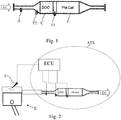
- FIG. 1 shows a schematic view of a portion of the ATS system that is object of the present invention, comprising a catalyst C and an open-particulate filter F with a first temperature sensor placed between the catalyst and the filter.
- a second temperature sensor T2 is placed upstream of the catalyst C and a lambda sensor is placed upstream the second temperature sensor T2.
- FIG. 2 shows an overall schematic view of the ATS system interacting with an internal combustion engine E.
- the estimator is integrated in the ECU which is connected to the aforementioned sensors T1, T2, lambda and which controls the injection and the post-injection of the fuel by means of the injectors J in the cylinder chambers of the internal combustion engine E.
- the present invention may advantageously be realized by means of a computer program, which comprises program code means performing one or more steps of said method, when said program is run on a control unit (ECU).
- a computer program which comprises program code means performing one or more steps of said method, when said program is run on a control unit (ECU).
- ECU control unit
Landscapes
- Engineering & Computer Science (AREA)
- Chemical & Material Sciences (AREA)
- Combustion & Propulsion (AREA)
- Mechanical Engineering (AREA)
- General Engineering & Computer Science (AREA)
- Exhaust Gas After Treatment (AREA)
- Processes For Solid Components From Exhaust (AREA)
Claims (18)
- Abgasbehandlungssystem (ATS) für eine Brennkraftmaschine, das auf einem PM-Kat-Partikelfilter (Partikeloxidationskatalysator) (F) und einem Dieseloxidationskatalysator (Diesel Oxidation Catalyst, DOC), der in einer Richtung des Abgasabflusses (EG) stromaufwärts des PM-Kat-Filters angeordnet ist, basiert, wobei das System Regenerationsmittel umfasst, die geeignet sind, eine aktive Regenerationsreaktion von in dem Partikelfilter (F) angesammeltem Feinstaub zu fördern, wobei der PM-Kat ein offenes Filter ist, welches das Hindurchströmen der Gase in beliebigem Sättigungszustand des Filters selbst ermöglicht und keinerlei Oberflächenbehandlung mit Edelmetallen aufweist, wobei das System dadurch gekennzeichnet ist, dass die Regenerationsmittel dafür ausgelegt sind, eine Temperatur an einem Eingang des Dieseloxidationskatalysators (C) während einer aktiven Regenerationsreaktion bei ungefähr 550 °C zu halten.
- System nach Anspruch 1, wobei die aktiven Regenerationsmittel geeignet sind, die Kraftstoffanreicherung zu erhöhen, und/oder geeignet sind, Nacheinspritzungen von Kraftstoff zu steuern, um die Temperatur des Eingangs des Dieseloxidationskatalysators (C) bei ungefähr 550 °C und die Temperatur des PM-Kat-Partikelfilters (F) bei einem Wert von 600+/-50 °C zu halten.
- System nach einem der vorhergehenden Ansprüche, wobei die aktiven Regenerationsmittel eine Schätzfunktion wenigstens zum Schätzen einer ersten Menge an Feinstaub, der von der Brennkraftmaschine erzeugt wurde, umfassen.
- System nach Anspruch 3, wobei die Schätzfunktion Mittel zum Gewichten der ersten Menge an Feinstaub mit einem Koeffizienten, der zu einer Rückhalteeffizienz des Filters proportional ist, umfasst.
- System nach einem der vorhergehenden Ansprüche 3 oder 4, wobei die Schätzfunktion außerdem geeignet ist, eine zweite Menge an Feinstaub zu schätzen, der mittels einer auf der Reduktion von NO2 zu NO basierenden Reaktion in CO/CO2 umgewandelt wurde.
- System nach einem der Ansprüche 3 bis 4, wobei die Schätzfunktion außerdem geeignet ist, eine dritte Menge an Feinstaub zu schätzen, der mittels einer auf der Reduktion des O2 basierenden natürlichen Reaktion in CO/CO2 umgewandelt wurde.
- System nach einem der vorhergehenden Ansprüche, welches ferner einen ersten Temperatursensor (T1) zwischen dem DOC-Katalysator und dem PM-Kat-Filter (F) umfasst.
- System nach Anspruch 7, welches ferner, in einer Richtung des Abgasstroms, einen zweiten Temperatursensor (T2), der stromaufwärts des DOC-Katalysators (C) angeordnet ist, und/oder eine Lambda-Sonde (Λ), die stromaufwärts des Katalysators (C) und stromaufwärts des zweiten Temperatursensors (T2), falls vorhanden, angeordnet ist, umfasst.
- Abgasbehandlungsverfahren zur Steuerung des Systems nach einem der vorhergehenden Ansprüche 1-8, welches die Schritte (i) des Förderns einer aktiven Regeneration des Feinstaubs des PM-Kat-Partikelfilters, (ii) des Haltens einer Temperatur des Eingangs des Dieseloxidationskatalysators (C) während der Umwandlungsreaktion durch Erhöhen einer Kraftstoffanreicherung bei ungefähr 550 °C umfasst.
- Verfahren nach Anspruch 9, welches ferner den Schritt (iii) des Steuerns von Nacheinspritzungen von Kraftstoff, um die Temperatur des PM-Kat-Filters bei einem Wert von 600+/-50 °C zu halten, umfasst.
- Verfahren nach Anspruch 9 oder 10, welches den Schritt (iv) des Durchführens einer solchen aktiven Regeneration durch Steuern einer Temperatur in dem PM-Kat-Partikelfilter (F) in Abhängigkeit von einer Gesamtmenge von in dem Partikelfilter (F) angesammeltem Feinstaub und von einer Menge von nacheingespritztem Kraftstoff umfasst.
- Verfahren nach Anspruch 11, welches ferner einen Schritt (v) des Schätzens wenigstens einer ersten Menge an Feinstaub, der von der Brennkraftmaschine erzeugt wurde, umfasst, um die Gesamtmenge von in dem Filter (F) angesammeltem Feinstaub zu schätzen.
- Verfahren nach Anspruch 11, welches ferner einen Schritt (vi) des Gewichtens der ersten Menge an Feinstaub mit einem Koeffizienten, der zu einer Rückhalteeffizienz des Partikelfilters (F) proportional ist, umfasst.
- Verfahren nach einem der Ansprüche 12 oder 13, welches ferner wenigstens einen der folgenden Schritte umfasst:- (vii) Schätzen einer zweiten Menge an Feinstaub, der mittels einer auf der Reduktion von NO2 zu NO basierenden natürlichen Reaktion in CO/CO2 umgewandelt wurde;- (viii) Schätzen einer dritten Menge an Feinstaub, der mittels einer auf der Reduktion von O2 basierenden natürlichen Reaktion in CO/CO2 umgewandelt wurde.
- Computerprogramm, welches Programmcodemittel umfasst, die dafür ausgelegt sind, die Schritte (i - viii) eines der Ansprüche 9 bis 14 auszuführen, wenn ein solches Programm auf einer Steuereinheit (ECU) in einem System nach einem der Ansprüche 1 bis 8 ausgeführt wird.
- Computerlesbares Mittel, welches ein aufgezeichnetes Programm umfasst, wobei das computerlesbare Mittel Programmcodemittel umfasst, die dafür ausgelegt sind, die Schritte (i - viii) eines der Ansprüche 9 bis 14 auszuführen, wenn das Programm auf einer Steuereinheit (ECU) in einem System nach einem der Ansprüche 1 bis 8 ausgeführt wird.
- Brennkraftmaschine, welche ein Abgasbehandlungssystem (ATS) nach einem der Ansprüche 1 bis 8 umfasst.
- Fahrzeug, welches eine Brennkraftmaschine nach Anspruch 17 umfasst.
Priority Applications (1)
| Application Number | Priority Date | Filing Date | Title |
|---|---|---|---|
| EP13755975.3A EP2880290B1 (de) | 2012-07-31 | 2013-07-31 | Abgasbehandlungssystem (ats) basierend auf einem pm-katalysatorfilter |
Applications Claiming Priority (5)
| Application Number | Priority Date | Filing Date | Title |
|---|---|---|---|
| EP12178646.1A EP2693025A1 (de) | 2012-07-31 | 2012-07-31 | Abgasbehandlungssystem (ATS) basierend auf einem Partikel-Katalysatorfilter |
| EP12178647.9A EP2693026A1 (de) | 2012-07-31 | 2012-07-31 | Abgasbehandlungssystem (ATS) für einen Verbrennungsmotor |
| EP12178643.8A EP2693024A1 (de) | 2012-07-31 | 2012-07-31 | Abgas-Behandlungssystem (ATS) basierend auf einem Partikelfilter, der unverbrannte Kohlenwasserstoffe (HC) nicht entfernen/umwandeln kann |
| EP13755975.3A EP2880290B1 (de) | 2012-07-31 | 2013-07-31 | Abgasbehandlungssystem (ats) basierend auf einem pm-katalysatorfilter |
| PCT/EP2013/066089 WO2014020064A1 (en) | 2012-07-31 | 2013-07-31 | Exhaust gas treatment system (ats) based on a pm-cat filter |
Publications (2)
| Publication Number | Publication Date |
|---|---|
| EP2880290A1 EP2880290A1 (de) | 2015-06-10 |
| EP2880290B1 true EP2880290B1 (de) | 2018-09-05 |
Family
ID=49084968
Family Applications (3)
| Application Number | Title | Priority Date | Filing Date |
|---|---|---|---|
| EP13755975.3A Active EP2880290B1 (de) | 2012-07-31 | 2013-07-31 | Abgasbehandlungssystem (ats) basierend auf einem pm-katalysatorfilter |
| EP13756332.6A Active EP2880291B1 (de) | 2012-07-31 | 2013-07-31 | Abgasbehandlungssystem (ats) für einen verbrennungsmotor |
| EP13755974.6A Withdrawn EP2880289A1 (de) | 2012-07-31 | 2013-07-31 | Abgasbehandlungssystem (ats) basierend auf einem pm-katalysatorfilter |
Family Applications After (2)
| Application Number | Title | Priority Date | Filing Date |
|---|---|---|---|
| EP13756332.6A Active EP2880291B1 (de) | 2012-07-31 | 2013-07-31 | Abgasbehandlungssystem (ats) für einen verbrennungsmotor |
| EP13755974.6A Withdrawn EP2880289A1 (de) | 2012-07-31 | 2013-07-31 | Abgasbehandlungssystem (ats) basierend auf einem pm-katalysatorfilter |
Country Status (3)
| Country | Link |
|---|---|
| EP (3) | EP2880290B1 (de) |
| ES (2) | ES2700145T3 (de) |
| WO (3) | WO2014020063A1 (de) |
Families Citing this family (2)
| Publication number | Priority date | Publication date | Assignee | Title |
|---|---|---|---|---|
| WO2016137870A1 (en) * | 2015-02-25 | 2016-09-01 | Carrier Corporation | Air control valve for transportation refrigeration system |
| IT201900013215A1 (it) * | 2019-07-29 | 2021-01-29 | Fpt Ind Spa | Sistema di trattamento dei gas di scarico (ats) basato su un filtro pm-cat |
Citations (1)
| Publication number | Priority date | Publication date | Assignee | Title |
|---|---|---|---|---|
| DE10020170C1 (de) * | 2000-04-25 | 2001-09-06 | Emitec Emissionstechnologie | Verfahren zum Entfernen von Rußpartikeln aus einem Abgas und zugehöriges Auffangelement |
Family Cites Families (10)
| Publication number | Priority date | Publication date | Assignee | Title |
|---|---|---|---|---|
| JP3598961B2 (ja) * | 2000-09-26 | 2004-12-08 | 日産自動車株式会社 | 内燃機関の排気浄化装置 |
| CN1535351A (zh) | 2001-07-26 | 2004-10-06 | �����Զ�����ҵ��ʽ���� | 排气净化装置 |
| US6805095B2 (en) | 2002-11-05 | 2004-10-19 | Ford Global Technologies, Llc | System and method for estimating and controlling cylinder air charge in a direct injection internal combustion engine |
| FR2864146B1 (fr) * | 2003-12-23 | 2006-03-03 | Renault Sas | Procede de determination en temps reel de la masse de particules presente dans un filtre a particules de vehicule automobile |
| DE102005025737A1 (de) * | 2005-06-04 | 2007-01-11 | Daimlerchrysler Ag | Betriebsverfahren für eine Einspritzbrennkraftmaschine |
| JP4306722B2 (ja) * | 2006-11-24 | 2009-08-05 | トヨタ自動車株式会社 | 燃料噴射装置 |
| DE102008036127A1 (de) * | 2008-08-01 | 2010-02-04 | Emitec Gesellschaft Für Emissionstechnologie Mbh | Verfahren zum Betrieb einer Abgasanlage mit Lambda-Regelung |
| DE102008058418A1 (de) | 2008-11-21 | 2010-05-27 | Emitec Gesellschaft Für Emissionstechnologie Mbh | Verfahren zur Regeneration eines offenen Partikelabscheiders |
| DE102008064167B4 (de) * | 2008-12-22 | 2016-07-21 | Volkswagen Ag | Regenerieren eines Partikelfilters eines Kraftfahrzeuges |
| US8942887B2 (en) | 2010-12-16 | 2015-01-27 | Caterpillar Inc. | Machine, exhaust particulate filter system, and method |
-
2013
- 2013-07-31 EP EP13755975.3A patent/EP2880290B1/de active Active
- 2013-07-31 EP EP13756332.6A patent/EP2880291B1/de active Active
- 2013-07-31 WO PCT/EP2013/066087 patent/WO2014020063A1/en not_active Ceased
- 2013-07-31 EP EP13755974.6A patent/EP2880289A1/de not_active Withdrawn
- 2013-07-31 WO PCT/EP2013/066091 patent/WO2014020065A1/en not_active Ceased
- 2013-07-31 WO PCT/EP2013/066089 patent/WO2014020064A1/en not_active Ceased
- 2013-07-31 ES ES13755975T patent/ES2700145T3/es active Active
- 2013-07-31 ES ES13756332T patent/ES2729005T3/es active Active
Patent Citations (1)
| Publication number | Priority date | Publication date | Assignee | Title |
|---|---|---|---|---|
| DE10020170C1 (de) * | 2000-04-25 | 2001-09-06 | Emitec Emissionstechnologie | Verfahren zum Entfernen von Rußpartikeln aus einem Abgas und zugehöriges Auffangelement |
Also Published As
| Publication number | Publication date |
|---|---|
| EP2880290A1 (de) | 2015-06-10 |
| WO2014020064A1 (en) | 2014-02-06 |
| WO2014020063A1 (en) | 2014-02-06 |
| EP2880291A1 (de) | 2015-06-10 |
| ES2729005T3 (es) | 2019-10-29 |
| ES2700145T3 (es) | 2019-02-14 |
| WO2014020065A1 (en) | 2014-02-06 |
| EP2880291B1 (de) | 2019-03-13 |
| EP2880289A1 (de) | 2015-06-10 |
Similar Documents
| Publication | Publication Date | Title |
|---|---|---|
| CN101371015B (zh) | 废气净化方法以及废气净化系统 | |
| CN101375026B (zh) | 废气净化方法以及废气净化系统 | |
| US6622480B2 (en) | Diesel particulate filter unit and regeneration control method of the same | |
| Bermúdez et al. | Pre-DPF water injection technique for pressure drop control in loaded wall-flow diesel particulate filters | |
| US8146351B2 (en) | Regeneration systems and methods for particulate filters using virtual brick temperature sensors | |
| JP2013057308A (ja) | 排気ガス浄化装置およびこれを制御する方法 | |
| JP5830832B2 (ja) | フィルタ再生装置 | |
| US9067160B2 (en) | Exhaust gas purification system | |
| US9027333B2 (en) | Soot pre-loading of particulate matter aftertreatment devices as means for reducing hydrocarbon emissions during cold start | |
| US8375705B2 (en) | Exhaust system implementing low-temperature regeneration strategy | |
| KR101353648B1 (ko) | 내연 기관의 배기 정화 장치 | |
| EP2880290B1 (de) | Abgasbehandlungssystem (ats) basierend auf einem pm-katalysatorfilter | |
| JP2018096314A (ja) | 内燃機関システム | |
| JP2010174794A (ja) | 排ガス浄化装置 | |
| EP2693024A1 (de) | Abgas-Behandlungssystem (ATS) basierend auf einem Partikelfilter, der unverbrannte Kohlenwasserstoffe (HC) nicht entfernen/umwandeln kann | |
| EP3771810B1 (de) | Abgasbehandlungssystem | |
| KR20120036008A (ko) | 자동차 배출가스 저감장치 | |
| JP2012087649A (ja) | 内燃機関の排気浄化装置 | |
| EP2693026A1 (de) | Abgasbehandlungssystem (ATS) für einen Verbrennungsmotor | |
| EP2693025A1 (de) | Abgasbehandlungssystem (ATS) basierend auf einem Partikel-Katalysatorfilter | |
| US8745967B2 (en) | System and method for controlling exhaust regeneration | |
| JP2011220252A (ja) | 後処理バーナシステムの燃焼昇温制御方法及び装置 | |
| Lou et al. | Impacts of Continuously Regenerating Trap Technology on the Regulated Gas Emissions for a China-V Diesel Engine | |
| Zelenka et al. | Development of a particulate trap system for commercial vehicles with burner-supported regeneration | |
| JP2018193861A (ja) | 内燃機関の排気浄化装置 |
Legal Events
| Date | Code | Title | Description |
|---|---|---|---|
| PUAI | Public reference made under article 153(3) epc to a published international application that has entered the european phase |
Free format text: ORIGINAL CODE: 0009012 |
|
| 17P | Request for examination filed |
Effective date: 20150121 |
|
| AK | Designated contracting states |
Kind code of ref document: A1 Designated state(s): AL AT BE BG CH CY CZ DE DK EE ES FI FR GB GR HR HU IE IS IT LI LT LU LV MC MK MT NL NO PL PT RO RS SE SI SK SM TR |
|
| AX | Request for extension of the european patent |
Extension state: BA ME |
|
| DAX | Request for extension of the european patent (deleted) | ||
| STAA | Information on the status of an ep patent application or granted ep patent |
Free format text: STATUS: EXAMINATION IS IN PROGRESS |
|
| 17Q | First examination report despatched |
Effective date: 20170717 |
|
| GRAP | Despatch of communication of intention to grant a patent |
Free format text: ORIGINAL CODE: EPIDOSNIGR1 |
|
| STAA | Information on the status of an ep patent application or granted ep patent |
Free format text: STATUS: GRANT OF PATENT IS INTENDED |
|
| INTG | Intention to grant announced |
Effective date: 20180328 |
|
| GRAS | Grant fee paid |
Free format text: ORIGINAL CODE: EPIDOSNIGR3 |
|
| GRAA | (expected) grant |
Free format text: ORIGINAL CODE: 0009210 |
|
| STAA | Information on the status of an ep patent application or granted ep patent |
Free format text: STATUS: THE PATENT HAS BEEN GRANTED |
|
| AK | Designated contracting states |
Kind code of ref document: B1 Designated state(s): AL AT BE BG CH CY CZ DE DK EE ES FI FR GB GR HR HU IE IS IT LI LT LU LV MC MK MT NL NO PL PT RO RS SE SI SK SM TR |
|
| REG | Reference to a national code |
Ref country code: GB Ref legal event code: FG4D |
|
| REG | Reference to a national code |
Ref country code: CH Ref legal event code: EP |
|
| REG | Reference to a national code |
Ref country code: AT Ref legal event code: REF Ref document number: 1038086 Country of ref document: AT Kind code of ref document: T Effective date: 20180915 |
|
| REG | Reference to a national code |
Ref country code: IE Ref legal event code: FG4D |
|
| REG | Reference to a national code |
Ref country code: DE Ref legal event code: R096 Ref document number: 602013043176 Country of ref document: DE |
|
| REG | Reference to a national code |
Ref country code: CH Ref legal event code: NV Representative=s name: HEPP WENGER RYFFEL AG, CH |
|
| REG | Reference to a national code |
Ref country code: NL Ref legal event code: FP |
|
| REG | Reference to a national code |
Ref country code: SE Ref legal event code: TRGR |
|
| REG | Reference to a national code |
Ref country code: LT Ref legal event code: MG4D |
|
| PG25 | Lapsed in a contracting state [announced via postgrant information from national office to epo] |
Ref country code: RS Free format text: LAPSE BECAUSE OF FAILURE TO SUBMIT A TRANSLATION OF THE DESCRIPTION OR TO PAY THE FEE WITHIN THE PRESCRIBED TIME-LIMIT Effective date: 20180905 Ref country code: BG Free format text: LAPSE BECAUSE OF FAILURE TO SUBMIT A TRANSLATION OF THE DESCRIPTION OR TO PAY THE FEE WITHIN THE PRESCRIBED TIME-LIMIT Effective date: 20181205 Ref country code: LT Free format text: LAPSE BECAUSE OF FAILURE TO SUBMIT A TRANSLATION OF THE DESCRIPTION OR TO PAY THE FEE WITHIN THE PRESCRIBED TIME-LIMIT Effective date: 20180905 Ref country code: FI Free format text: LAPSE BECAUSE OF FAILURE TO SUBMIT A TRANSLATION OF THE DESCRIPTION OR TO PAY THE FEE WITHIN THE PRESCRIBED TIME-LIMIT Effective date: 20180905 Ref country code: NO Free format text: LAPSE BECAUSE OF FAILURE TO SUBMIT A TRANSLATION OF THE DESCRIPTION OR TO PAY THE FEE WITHIN THE PRESCRIBED TIME-LIMIT Effective date: 20181205 Ref country code: GR Free format text: LAPSE BECAUSE OF FAILURE TO SUBMIT A TRANSLATION OF THE DESCRIPTION OR TO PAY THE FEE WITHIN THE PRESCRIBED TIME-LIMIT Effective date: 20181206 |
|
| REG | Reference to a national code |
Ref country code: ES Ref legal event code: FG2A Ref document number: 2700145 Country of ref document: ES Kind code of ref document: T3 Effective date: 20190214 |
|
| REG | Reference to a national code |
Ref country code: AT Ref legal event code: MK05 Ref document number: 1038086 Country of ref document: AT Kind code of ref document: T Effective date: 20180905 |
|
| PG25 | Lapsed in a contracting state [announced via postgrant information from national office to epo] |
Ref country code: HR Free format text: LAPSE BECAUSE OF FAILURE TO SUBMIT A TRANSLATION OF THE DESCRIPTION OR TO PAY THE FEE WITHIN THE PRESCRIBED TIME-LIMIT Effective date: 20180905 Ref country code: AL Free format text: LAPSE BECAUSE OF FAILURE TO SUBMIT A TRANSLATION OF THE DESCRIPTION OR TO PAY THE FEE WITHIN THE PRESCRIBED TIME-LIMIT Effective date: 20180905 Ref country code: LV Free format text: LAPSE BECAUSE OF FAILURE TO SUBMIT A TRANSLATION OF THE DESCRIPTION OR TO PAY THE FEE WITHIN THE PRESCRIBED TIME-LIMIT Effective date: 20180905 |
|
| PG25 | Lapsed in a contracting state [announced via postgrant information from national office to epo] |
Ref country code: RO Free format text: LAPSE BECAUSE OF FAILURE TO SUBMIT A TRANSLATION OF THE DESCRIPTION OR TO PAY THE FEE WITHIN THE PRESCRIBED TIME-LIMIT Effective date: 20180905 Ref country code: EE Free format text: LAPSE BECAUSE OF FAILURE TO SUBMIT A TRANSLATION OF THE DESCRIPTION OR TO PAY THE FEE WITHIN THE PRESCRIBED TIME-LIMIT Effective date: 20180905 Ref country code: IS Free format text: LAPSE BECAUSE OF FAILURE TO SUBMIT A TRANSLATION OF THE DESCRIPTION OR TO PAY THE FEE WITHIN THE PRESCRIBED TIME-LIMIT Effective date: 20190105 Ref country code: AT Free format text: LAPSE BECAUSE OF FAILURE TO SUBMIT A TRANSLATION OF THE DESCRIPTION OR TO PAY THE FEE WITHIN THE PRESCRIBED TIME-LIMIT Effective date: 20180905 Ref country code: PL Free format text: LAPSE BECAUSE OF FAILURE TO SUBMIT A TRANSLATION OF THE DESCRIPTION OR TO PAY THE FEE WITHIN THE PRESCRIBED TIME-LIMIT Effective date: 20180905 Ref country code: CZ Free format text: LAPSE BECAUSE OF FAILURE TO SUBMIT A TRANSLATION OF THE DESCRIPTION OR TO PAY THE FEE WITHIN THE PRESCRIBED TIME-LIMIT Effective date: 20180905 |
|
| PG25 | Lapsed in a contracting state [announced via postgrant information from national office to epo] |
Ref country code: SM Free format text: LAPSE BECAUSE OF FAILURE TO SUBMIT A TRANSLATION OF THE DESCRIPTION OR TO PAY THE FEE WITHIN THE PRESCRIBED TIME-LIMIT Effective date: 20180905 Ref country code: PT Free format text: LAPSE BECAUSE OF FAILURE TO SUBMIT A TRANSLATION OF THE DESCRIPTION OR TO PAY THE FEE WITHIN THE PRESCRIBED TIME-LIMIT Effective date: 20190105 Ref country code: SK Free format text: LAPSE BECAUSE OF FAILURE TO SUBMIT A TRANSLATION OF THE DESCRIPTION OR TO PAY THE FEE WITHIN THE PRESCRIBED TIME-LIMIT Effective date: 20180905 |
|
| REG | Reference to a national code |
Ref country code: DE Ref legal event code: R097 Ref document number: 602013043176 Country of ref document: DE |
|
| PLBE | No opposition filed within time limit |
Free format text: ORIGINAL CODE: 0009261 |
|
| STAA | Information on the status of an ep patent application or granted ep patent |
Free format text: STATUS: NO OPPOSITION FILED WITHIN TIME LIMIT |
|
| PG25 | Lapsed in a contracting state [announced via postgrant information from national office to epo] |
Ref country code: DK Free format text: LAPSE BECAUSE OF FAILURE TO SUBMIT A TRANSLATION OF THE DESCRIPTION OR TO PAY THE FEE WITHIN THE PRESCRIBED TIME-LIMIT Effective date: 20180905 |
|
| 26N | No opposition filed |
Effective date: 20190606 |
|
| PG25 | Lapsed in a contracting state [announced via postgrant information from national office to epo] |
Ref country code: SI Free format text: LAPSE BECAUSE OF FAILURE TO SUBMIT A TRANSLATION OF THE DESCRIPTION OR TO PAY THE FEE WITHIN THE PRESCRIBED TIME-LIMIT Effective date: 20180905 |
|
| PG25 | Lapsed in a contracting state [announced via postgrant information from national office to epo] |
Ref country code: MC Free format text: LAPSE BECAUSE OF FAILURE TO SUBMIT A TRANSLATION OF THE DESCRIPTION OR TO PAY THE FEE WITHIN THE PRESCRIBED TIME-LIMIT Effective date: 20180905 |
|
| PG25 | Lapsed in a contracting state [announced via postgrant information from national office to epo] |
Ref country code: TR Free format text: LAPSE BECAUSE OF FAILURE TO SUBMIT A TRANSLATION OF THE DESCRIPTION OR TO PAY THE FEE WITHIN THE PRESCRIBED TIME-LIMIT Effective date: 20180905 |
|
| REG | Reference to a national code |
Ref country code: BE Ref legal event code: MM Effective date: 20190731 |
|
| PG25 | Lapsed in a contracting state [announced via postgrant information from national office to epo] |
Ref country code: BE Free format text: LAPSE BECAUSE OF NON-PAYMENT OF DUE FEES Effective date: 20190731 Ref country code: LU Free format text: LAPSE BECAUSE OF NON-PAYMENT OF DUE FEES Effective date: 20190731 |
|
| PG25 | Lapsed in a contracting state [announced via postgrant information from national office to epo] |
Ref country code: IE Free format text: LAPSE BECAUSE OF NON-PAYMENT OF DUE FEES Effective date: 20190731 |
|
| PG25 | Lapsed in a contracting state [announced via postgrant information from national office to epo] |
Ref country code: CY Free format text: LAPSE BECAUSE OF FAILURE TO SUBMIT A TRANSLATION OF THE DESCRIPTION OR TO PAY THE FEE WITHIN THE PRESCRIBED TIME-LIMIT Effective date: 20180905 |
|
| PG25 | Lapsed in a contracting state [announced via postgrant information from national office to epo] |
Ref country code: MT Free format text: LAPSE BECAUSE OF FAILURE TO SUBMIT A TRANSLATION OF THE DESCRIPTION OR TO PAY THE FEE WITHIN THE PRESCRIBED TIME-LIMIT Effective date: 20180905 Ref country code: HU Free format text: LAPSE BECAUSE OF FAILURE TO SUBMIT A TRANSLATION OF THE DESCRIPTION OR TO PAY THE FEE WITHIN THE PRESCRIBED TIME-LIMIT; INVALID AB INITIO Effective date: 20130731 |
|
| PG25 | Lapsed in a contracting state [announced via postgrant information from national office to epo] |
Ref country code: MK Free format text: LAPSE BECAUSE OF FAILURE TO SUBMIT A TRANSLATION OF THE DESCRIPTION OR TO PAY THE FEE WITHIN THE PRESCRIBED TIME-LIMIT Effective date: 20180905 |
|
| P01 | Opt-out of the competence of the unified patent court (upc) registered |
Effective date: 20230519 |
|
| PGFP | Annual fee paid to national office [announced via postgrant information from national office to epo] |
Ref country code: NL Payment date: 20250724 Year of fee payment: 13 |
|
| PGFP | Annual fee paid to national office [announced via postgrant information from national office to epo] |
Ref country code: ES Payment date: 20250811 Year of fee payment: 13 |
|
| PGFP | Annual fee paid to national office [announced via postgrant information from national office to epo] |
Ref country code: DE Payment date: 20250728 Year of fee payment: 13 |
|
| PGFP | Annual fee paid to national office [announced via postgrant information from national office to epo] |
Ref country code: IT Payment date: 20250701 Year of fee payment: 13 |
|
| PGFP | Annual fee paid to national office [announced via postgrant information from national office to epo] |
Ref country code: GB Payment date: 20250722 Year of fee payment: 13 |
|
| PGFP | Annual fee paid to national office [announced via postgrant information from national office to epo] |
Ref country code: FR Payment date: 20250725 Year of fee payment: 13 |
|
| PGFP | Annual fee paid to national office [announced via postgrant information from national office to epo] |
Ref country code: CH Payment date: 20250801 Year of fee payment: 13 Ref country code: SE Payment date: 20250725 Year of fee payment: 13 |