EP2881115A1 - Medicine against gastroesophageal reflux disease - Google Patents
Medicine against gastroesophageal reflux disease Download PDFInfo
- Publication number
- EP2881115A1 EP2881115A1 EP13825231.7A EP13825231A EP2881115A1 EP 2881115 A1 EP2881115 A1 EP 2881115A1 EP 13825231 A EP13825231 A EP 13825231A EP 2881115 A1 EP2881115 A1 EP 2881115A1
- Authority
- EP
- European Patent Office
- Prior art keywords
- methyl
- agent
- compound
- reflux disease
- gastroesophageal reflux
- Prior art date
- Legal status (The legal status is an assumption and is not a legal conclusion. Google has not performed a legal analysis and makes no representation as to the accuracy of the status listed.)
- Withdrawn
Links
- 208000021302 gastroesophageal reflux disease Diseases 0.000 title claims abstract description 61
- 239000003814 drug Substances 0.000 title claims description 21
- 229940079593 drug Drugs 0.000 title description 7
- 239000003795 chemical substances by application Substances 0.000 claims abstract description 56
- 150000003839 salts Chemical class 0.000 claims abstract description 31
- 229940002612 prodrug Drugs 0.000 claims abstract description 24
- 239000000651 prodrug Substances 0.000 claims abstract description 24
- ALLLQQUASFFEKP-UHFFFAOYSA-N 3-methyl-4-[[6-[2-methylpropyl(1,3-thiazol-2-ylsulfonyl)amino]-2,3-dihydro-1h-inden-5-yl]oxymethyl]benzoic acid Chemical compound N=1C=CSC=1S(=O)(=O)N(CC(C)C)C1=CC=2CCCC=2C=C1OCC1=CC=C(C(O)=O)C=C1C ALLLQQUASFFEKP-UHFFFAOYSA-N 0.000 claims abstract description 23
- 229940126409 proton pump inhibitor Drugs 0.000 claims description 22
- 239000000612 proton pump inhibitor Substances 0.000 claims description 22
- 208000024891 symptom Diseases 0.000 claims description 19
- 210000000111 lower esophageal sphincter Anatomy 0.000 claims description 18
- 230000001052 transient effect Effects 0.000 claims description 14
- 230000002496 gastric effect Effects 0.000 claims description 12
- 239000000203 mixture Substances 0.000 claims description 11
- 210000004211 gastric acid Anatomy 0.000 claims description 10
- 239000004480 active ingredient Substances 0.000 claims description 9
- 238000010992 reflux Methods 0.000 claims description 9
- 201000006549 dyspepsia Diseases 0.000 claims description 8
- 208000024798 heartburn Diseases 0.000 claims description 8
- 239000002325 prokinetic agent Substances 0.000 claims description 8
- VTYYLEPIZMXCLO-UHFFFAOYSA-L Calcium carbonate Chemical class [Ca+2].[O-]C([O-])=O VTYYLEPIZMXCLO-UHFFFAOYSA-L 0.000 claims description 7
- 229940121891 Dopamine receptor antagonist Drugs 0.000 claims description 7
- 229940122957 Histamine H2 receptor antagonist Drugs 0.000 claims description 7
- 229940069428 antacid Drugs 0.000 claims description 7
- 239000003159 antacid agent Substances 0.000 claims description 7
- 230000001458 anti-acid effect Effects 0.000 claims description 7
- 239000003210 dopamine receptor blocking agent Substances 0.000 claims description 7
- 239000003485 histamine H2 receptor antagonist Substances 0.000 claims description 7
- 239000003223 protective agent Substances 0.000 claims description 7
- ZBFDAUIVDSSISP-UHFFFAOYSA-N 5-methoxy-2-[(4-methoxy-3,5-dimethyl-2-pyridinyl)methylsulfinyl]-1H-imidazo[4,5-b]pyridine Chemical compound N=1C2=NC(OC)=CC=C2NC=1S(=O)CC1=NC=C(C)C(OC)=C1C ZBFDAUIVDSSISP-UHFFFAOYSA-N 0.000 claims description 6
- SUBDBMMJDZJVOS-UHFFFAOYSA-N 5-methoxy-2-{[(4-methoxy-3,5-dimethylpyridin-2-yl)methyl]sulfinyl}-1H-benzimidazole Chemical compound N=1C2=CC(OC)=CC=C2NC=1S(=O)CC1=NC=C(C)C(OC)=C1C SUBDBMMJDZJVOS-UHFFFAOYSA-N 0.000 claims description 6
- IQPSEEYGBUAQFF-UHFFFAOYSA-N Pantoprazole Chemical compound COC1=CC=NC(CS(=O)C=2NC3=CC=C(OC(F)F)C=C3N=2)=C1OC IQPSEEYGBUAQFF-UHFFFAOYSA-N 0.000 claims description 6
- 229960004770 esomeprazole Drugs 0.000 claims description 6
- SUBDBMMJDZJVOS-DEOSSOPVSA-N esomeprazole Chemical compound C([S@](=O)C1=NC2=CC=C(C=C2N1)OC)C1=NC=C(C)C(OC)=C1C SUBDBMMJDZJVOS-DEOSSOPVSA-N 0.000 claims description 6
- HRRXCXABAPSOCP-UHFFFAOYSA-N ilaprazole Chemical compound COC1=CC=NC(CS(=O)C=2NC3=CC(=CC=C3N=2)N2C=CC=C2)=C1C HRRXCXABAPSOCP-UHFFFAOYSA-N 0.000 claims description 6
- 229950008491 ilaprazole Drugs 0.000 claims description 6
- 229960003174 lansoprazole Drugs 0.000 claims description 6
- MJIHNNLFOKEZEW-UHFFFAOYSA-N lansoprazole Chemical compound CC1=C(OCC(F)(F)F)C=CN=C1CS(=O)C1=NC2=CC=CC=C2N1 MJIHNNLFOKEZEW-UHFFFAOYSA-N 0.000 claims description 6
- 229960000381 omeprazole Drugs 0.000 claims description 6
- 229960005019 pantoprazole Drugs 0.000 claims description 6
- 229960004157 rabeprazole Drugs 0.000 claims description 6
- YREYEVIYCVEVJK-UHFFFAOYSA-N rabeprazole Chemical compound COCCCOC1=CC=NC(CS(=O)C=2NC3=CC=CC=C3N=2)=C1C YREYEVIYCVEVJK-UHFFFAOYSA-N 0.000 claims description 6
- 229950008375 tenatoprazole Drugs 0.000 claims description 6
- 230000003628 erosive effect Effects 0.000 claims description 4
- 230000002265 prevention Effects 0.000 abstract description 13
- 150000001875 compounds Chemical class 0.000 description 47
- VEXZGXHMUGYJMC-UHFFFAOYSA-N Hydrochloric acid Chemical compound Cl VEXZGXHMUGYJMC-UHFFFAOYSA-N 0.000 description 28
- 210000003238 esophagus Anatomy 0.000 description 25
- 230000003040 nociceptive effect Effects 0.000 description 25
- 229940126062 Compound A Drugs 0.000 description 21
- NLDMNSXOCDLTTB-UHFFFAOYSA-N Heterophylliin A Natural products O1C2COC(=O)C3=CC(O)=C(O)C(O)=C3C3=C(O)C(O)=C(O)C=C3C(=O)OC2C(OC(=O)C=2C=C(O)C(O)=C(O)C=2)C(O)C1OC(=O)C1=CC(O)=C(O)C(O)=C1 NLDMNSXOCDLTTB-UHFFFAOYSA-N 0.000 description 21
- 230000010412 perfusion Effects 0.000 description 20
- 230000000638 stimulation Effects 0.000 description 19
- 238000000034 method Methods 0.000 description 14
- 241000282693 Cercopithecidae Species 0.000 description 13
- QTBSBXVTEAMEQO-UHFFFAOYSA-N Acetic acid Chemical compound CC(O)=O QTBSBXVTEAMEQO-UHFFFAOYSA-N 0.000 description 12
- 241001465754 Metazoa Species 0.000 description 12
- 239000002253 acid Substances 0.000 description 12
- 239000007924 injection Substances 0.000 description 11
- 238000002347 injection Methods 0.000 description 11
- 206010020751 Hypersensitivity Diseases 0.000 description 10
- FAPWRFPIFSIZLT-UHFFFAOYSA-M Sodium chloride Chemical compound [Na+].[Cl-] FAPWRFPIFSIZLT-UHFFFAOYSA-M 0.000 description 10
- 208000026935 allergic disease Diseases 0.000 description 10
- 238000011156 evaluation Methods 0.000 description 10
- 235000009200 high fat diet Nutrition 0.000 description 10
- 230000009610 hypersensitivity Effects 0.000 description 10
- 239000011780 sodium chloride Substances 0.000 description 10
- WEVYAHXRMPXWCK-UHFFFAOYSA-N Acetonitrile Chemical compound CC#N WEVYAHXRMPXWCK-UHFFFAOYSA-N 0.000 description 9
- 239000007788 liquid Substances 0.000 description 9
- 210000001519 tissue Anatomy 0.000 description 9
- 210000002784 stomach Anatomy 0.000 description 8
- 206010067171 Regurgitation Diseases 0.000 description 6
- 230000009471 action Effects 0.000 description 6
- 230000000747 cardiac effect Effects 0.000 description 6
- 230000000694 effects Effects 0.000 description 6
- 238000002474 experimental method Methods 0.000 description 6
- 238000005259 measurement Methods 0.000 description 6
- 239000012188 paraffin wax Substances 0.000 description 6
- 241000282567 Macaca fascicularis Species 0.000 description 5
- 238000010171 animal model Methods 0.000 description 5
- 230000037396 body weight Effects 0.000 description 5
- 238000004140 cleaning Methods 0.000 description 5
- 239000000126 substance Substances 0.000 description 5
- 238000012360 testing method Methods 0.000 description 5
- WZUVPPKBWHMQCE-UHFFFAOYSA-N Haematoxylin Chemical compound C12=CC(O)=C(O)C=C2CC2(O)C1C1=CC=C(O)C(O)=C1OC2 WZUVPPKBWHMQCE-UHFFFAOYSA-N 0.000 description 4
- 229940124413 agent for gastroesophageal reflux disease Drugs 0.000 description 4
- 238000011088 calibration curve Methods 0.000 description 4
- 230000001747 exhibiting effect Effects 0.000 description 4
- 238000009472 formulation Methods 0.000 description 4
- 210000003736 gastrointestinal content Anatomy 0.000 description 4
- 238000004519 manufacturing process Methods 0.000 description 4
- 239000000243 solution Substances 0.000 description 4
- 210000000278 spinal cord Anatomy 0.000 description 4
- 230000001225 therapeutic effect Effects 0.000 description 4
- LFQSCWFLJHTTHZ-UHFFFAOYSA-N Ethanol Chemical compound CCO LFQSCWFLJHTTHZ-UHFFFAOYSA-N 0.000 description 3
- 206010061218 Inflammation Diseases 0.000 description 3
- KFZMGEQAYNKOFK-UHFFFAOYSA-N Isopropanol Chemical compound CC(C)O KFZMGEQAYNKOFK-UHFFFAOYSA-N 0.000 description 3
- OKKJLVBELUTLKV-UHFFFAOYSA-N Methanol Chemical compound OC OKKJLVBELUTLKV-UHFFFAOYSA-N 0.000 description 3
- ZMANZCXQSJIPKH-UHFFFAOYSA-N Triethylamine Chemical compound CCN(CC)CC ZMANZCXQSJIPKH-UHFFFAOYSA-N 0.000 description 3
- 238000004458 analytical method Methods 0.000 description 3
- 239000002775 capsule Substances 0.000 description 3
- 230000003247 decreasing effect Effects 0.000 description 3
- 230000004054 inflammatory process Effects 0.000 description 3
- 238000001294 liquid chromatography-tandem mass spectrometry Methods 0.000 description 3
- 229940126589 solid medicine Drugs 0.000 description 3
- 210000003594 spinal ganglia Anatomy 0.000 description 3
- 238000009423 ventilation Methods 0.000 description 3
- IJGRMHOSHXDMSA-UHFFFAOYSA-N Atomic nitrogen Chemical compound N#N IJGRMHOSHXDMSA-UHFFFAOYSA-N 0.000 description 2
- OYPRJOBELJOOCE-UHFFFAOYSA-N Calcium Chemical compound [Ca] OYPRJOBELJOOCE-UHFFFAOYSA-N 0.000 description 2
- ROSDSFDQCJNGOL-UHFFFAOYSA-N Dimethylamine Chemical compound CNC ROSDSFDQCJNGOL-UHFFFAOYSA-N 0.000 description 2
- 108010010803 Gelatin Proteins 0.000 description 2
- NTYJJOPFIAHURM-UHFFFAOYSA-N Histamine Chemical compound NCCC1=CN=CN1 NTYJJOPFIAHURM-UHFFFAOYSA-N 0.000 description 2
- 229920002153 Hydroxypropyl cellulose Polymers 0.000 description 2
- BAVYZALUXZFZLV-UHFFFAOYSA-N Methylamine Chemical compound NC BAVYZALUXZFZLV-UHFFFAOYSA-N 0.000 description 2
- 206010030216 Oesophagitis Diseases 0.000 description 2
- 229930040373 Paraformaldehyde Natural products 0.000 description 2
- NQRYJNQNLNOLGT-UHFFFAOYSA-N Piperidine Chemical compound C1CCNCC1 NQRYJNQNLNOLGT-UHFFFAOYSA-N 0.000 description 2
- 150000007513 acids Chemical class 0.000 description 2
- 239000013543 active substance Substances 0.000 description 2
- 230000004075 alteration Effects 0.000 description 2
- 239000002585 base Substances 0.000 description 2
- WGQKYBSKWIADBV-UHFFFAOYSA-N benzylamine Chemical compound NCC1=CC=CC=C1 WGQKYBSKWIADBV-UHFFFAOYSA-N 0.000 description 2
- 239000008280 blood Substances 0.000 description 2
- 210000004369 blood Anatomy 0.000 description 2
- 210000000133 brain stem Anatomy 0.000 description 2
- 229910052791 calcium Inorganic materials 0.000 description 2
- 239000011575 calcium Substances 0.000 description 2
- 125000003178 carboxy group Chemical group [H]OC(*)=O 0.000 description 2
- 210000001175 cerebrospinal fluid Anatomy 0.000 description 2
- 229960001253 domperidone Drugs 0.000 description 2
- FGXWKSZFVQUSTL-UHFFFAOYSA-N domperidone Chemical compound C12=CC=CC=C2NC(=O)N1CCCN(CC1)CCC1N1C2=CC=C(Cl)C=C2NC1=O FGXWKSZFVQUSTL-UHFFFAOYSA-N 0.000 description 2
- YQGOJNYOYNNSMM-UHFFFAOYSA-N eosin Chemical compound [Na+].OC(=O)C1=CC=CC=C1C1=C2C=C(Br)C(=O)C(Br)=C2OC2=C(Br)C(O)=C(Br)C=C21 YQGOJNYOYNNSMM-UHFFFAOYSA-N 0.000 description 2
- 208000006881 esophagitis Diseases 0.000 description 2
- 230000000763 evoking effect Effects 0.000 description 2
- 229920000159 gelatin Polymers 0.000 description 2
- 239000008273 gelatin Substances 0.000 description 2
- 235000019322 gelatine Nutrition 0.000 description 2
- 235000011852 gelatine desserts Nutrition 0.000 description 2
- 239000011521 glass Substances 0.000 description 2
- -1 hydrobromates Chemical class 0.000 description 2
- 239000001863 hydroxypropyl cellulose Substances 0.000 description 2
- 235000010977 hydroxypropyl cellulose Nutrition 0.000 description 2
- 239000003112 inhibitor Substances 0.000 description 2
- 150000002500 ions Chemical class 0.000 description 2
- HQKMJHAJHXVSDF-UHFFFAOYSA-L magnesium stearate Chemical compound [Mg+2].CCCCCCCCCCCCCCCCCC([O-])=O.CCCCCCCCCCCCCCCCCC([O-])=O HQKMJHAJHXVSDF-UHFFFAOYSA-L 0.000 description 2
- TTWJBBZEZQICBI-UHFFFAOYSA-N metoclopramide Chemical compound CCN(CC)CCNC(=O)C1=CC(Cl)=C(N)C=C1OC TTWJBBZEZQICBI-UHFFFAOYSA-N 0.000 description 2
- 229960004503 metoclopramide Drugs 0.000 description 2
- 238000000386 microscopy Methods 0.000 description 2
- 238000012986 modification Methods 0.000 description 2
- 230000004048 modification Effects 0.000 description 2
- 210000004400 mucous membrane Anatomy 0.000 description 2
- 229920002866 paraformaldehyde Polymers 0.000 description 2
- 208000000689 peptic esophagitis Diseases 0.000 description 2
- 239000012071 phase Substances 0.000 description 2
- 239000008363 phosphate buffer Substances 0.000 description 2
- 230000000069 prophylactic effect Effects 0.000 description 2
- 230000009467 reduction Effects 0.000 description 2
- 230000011514 reflex Effects 0.000 description 2
- 238000010186 staining Methods 0.000 description 2
- 238000007920 subcutaneous administration Methods 0.000 description 2
- XLYOFNOQVPJJNP-UHFFFAOYSA-N water Chemical compound O XLYOFNOQVPJJNP-UHFFFAOYSA-N 0.000 description 2
- 239000003643 water by type Substances 0.000 description 2
- DJAHKBBSJCDSOZ-AJLBTXRUSA-N (5z,9e,13e)-6,10,14,18-tetramethylnonadeca-5,9,13,17-tetraen-2-one;(5e,9e,13e)-6,10,14,18-tetramethylnonadeca-5,9,13,17-tetraen-2-one Chemical compound CC(C)=CCC\C(C)=C\CC\C(C)=C\CC\C(C)=C/CCC(C)=O.CC(C)=CCC\C(C)=C\CC\C(C)=C\CC\C(C)=C\CCC(C)=O DJAHKBBSJCDSOZ-AJLBTXRUSA-N 0.000 description 1
- BGRJTUBHPOOWDU-NSHDSACASA-N (S)-(-)-sulpiride Chemical compound CCN1CCC[C@H]1CNC(=O)C1=CC(S(N)(=O)=O)=CC=C1OC BGRJTUBHPOOWDU-NSHDSACASA-N 0.000 description 1
- HZAXFHJVJLSVMW-UHFFFAOYSA-N 2-Aminoethan-1-ol Chemical compound NCCO HZAXFHJVJLSVMW-UHFFFAOYSA-N 0.000 description 1
- WGTASENVNYJZBK-UHFFFAOYSA-N 3,4,5-trimethoxyamphetamine Chemical compound COC1=CC(CC(C)N)=CC(OC)=C1OC WGTASENVNYJZBK-UHFFFAOYSA-N 0.000 description 1
- YPELFRMCRYSPKZ-UHFFFAOYSA-N 4-amino-5-chloro-2-ethoxy-N-({4-[(4-fluorophenyl)methyl]morpholin-2-yl}methyl)benzamide Chemical compound CCOC1=CC(N)=C(Cl)C=C1C(=O)NCC1OCCN(CC=2C=CC(F)=CC=2)C1 YPELFRMCRYSPKZ-UHFFFAOYSA-N 0.000 description 1
- 206010000060 Abdominal distension Diseases 0.000 description 1
- 206010000087 Abdominal pain upper Diseases 0.000 description 1
- GUBGYTABKSRVRQ-XLOQQCSPSA-N Alpha-Lactose Chemical compound O[C@@H]1[C@@H](O)[C@@H](O)[C@@H](CO)O[C@H]1O[C@@H]1[C@@H](CO)O[C@H](O)[C@H](O)[C@H]1O GUBGYTABKSRVRQ-XLOQQCSPSA-N 0.000 description 1
- 206010002091 Anaesthesia Diseases 0.000 description 1
- 239000004475 Arginine Substances 0.000 description 1
- 229920002134 Carboxymethyl cellulose Polymers 0.000 description 1
- 206010008479 Chest Pain Diseases 0.000 description 1
- 241000193163 Clostridioides difficile Species 0.000 description 1
- OCUCCJIRFHNWBP-IYEMJOQQSA-L Copper gluconate Chemical class [Cu+2].OC[C@@H](O)[C@@H](O)[C@H](O)[C@@H](O)C([O-])=O.OC[C@@H](O)[C@@H](O)[C@H](O)[C@@H](O)C([O-])=O OCUCCJIRFHNWBP-IYEMJOQQSA-L 0.000 description 1
- 206010011224 Cough Diseases 0.000 description 1
- FBPFZTCFMRRESA-KVTDHHQDSA-N D-Mannitol Chemical compound OC[C@@H](O)[C@@H](O)[C@H](O)[C@H](O)CO FBPFZTCFMRRESA-KVTDHHQDSA-N 0.000 description 1
- 208000019505 Deglutition disease Diseases 0.000 description 1
- 206010012735 Diarrhoea Diseases 0.000 description 1
- 206010015137 Eructation Diseases 0.000 description 1
- WQZGKKKJIJFFOK-GASJEMHNSA-N Glucose Natural products OC[C@H]1OC(O)[C@H](O)[C@@H](O)[C@@H]1O WQZGKKKJIJFFOK-GASJEMHNSA-N 0.000 description 1
- WHUUTDBJXJRKMK-UHFFFAOYSA-N Glutamic acid Natural products OC(=O)C(N)CCC(O)=O WHUUTDBJXJRKMK-UHFFFAOYSA-N 0.000 description 1
- DGAQECJNVWCQMB-PUAWFVPOSA-M Ilexoside XXIX Chemical compound C[C@@H]1CC[C@@]2(CC[C@@]3(C(=CC[C@H]4[C@]3(CC[C@@H]5[C@@]4(CC[C@@H](C5(C)C)OS(=O)(=O)[O-])C)C)[C@@H]2[C@]1(C)O)C)C(=O)O[C@H]6[C@@H]([C@H]([C@@H]([C@H](O6)CO)O)O)O.[Na+] DGAQECJNVWCQMB-PUAWFVPOSA-M 0.000 description 1
- ODKSFYDXXFIFQN-BYPYZUCNSA-P L-argininium(2+) Chemical compound NC(=[NH2+])NCCC[C@H]([NH3+])C(O)=O ODKSFYDXXFIFQN-BYPYZUCNSA-P 0.000 description 1
- CKLJMWTZIZZHCS-REOHCLBHSA-N L-aspartic acid Chemical compound OC(=O)[C@@H](N)CC(O)=O CKLJMWTZIZZHCS-REOHCLBHSA-N 0.000 description 1
- WHUUTDBJXJRKMK-VKHMYHEASA-N L-glutamic acid Chemical compound OC(=O)[C@@H](N)CCC(O)=O WHUUTDBJXJRKMK-VKHMYHEASA-N 0.000 description 1
- KDXKERNSBIXSRK-YFKPBYRVSA-N L-lysine Chemical compound NCCCC[C@H](N)C(O)=O KDXKERNSBIXSRK-YFKPBYRVSA-N 0.000 description 1
- GUBGYTABKSRVRQ-QKKXKWKRSA-N Lactose Natural products OC[C@H]1O[C@@H](O[C@H]2[C@H](O)[C@@H](O)C(O)O[C@@H]2CO)[C@H](O)[C@@H](O)[C@H]1O GUBGYTABKSRVRQ-QKKXKWKRSA-N 0.000 description 1
- KMZQAVXSMUKBPD-DJWKRKHSSA-N Lafutidine Chemical compound C=1C=COC=1C[S+]([O-])CC(=O)NC\C=C/COC(N=CC=1)=CC=1CN1CCCCC1 KMZQAVXSMUKBPD-DJWKRKHSSA-N 0.000 description 1
- KDXKERNSBIXSRK-UHFFFAOYSA-N Lysine Natural products NCCCCC(N)C(O)=O KDXKERNSBIXSRK-UHFFFAOYSA-N 0.000 description 1
- 239000004472 Lysine Substances 0.000 description 1
- FYYHWMGAXLPEAU-UHFFFAOYSA-N Magnesium Chemical compound [Mg] FYYHWMGAXLPEAU-UHFFFAOYSA-N 0.000 description 1
- 229930195725 Mannitol Natural products 0.000 description 1
- 229920000168 Microcrystalline cellulose Polymers 0.000 description 1
- QQQIECGTIMUVDS-UHFFFAOYSA-N N-[[4-[2-(dimethylamino)ethoxy]phenyl]methyl]-3,4-dimethoxybenzamide Chemical compound C1=C(OC)C(OC)=CC=C1C(=O)NCC1=CC=C(OCCN(C)C)C=C1 QQQIECGTIMUVDS-UHFFFAOYSA-N 0.000 description 1
- MBBZMMPHUWSWHV-BDVNFPICSA-N N-methylglucamine Chemical compound CNC[C@H](O)[C@@H](O)[C@H](O)[C@H](O)CO MBBZMMPHUWSWHV-BDVNFPICSA-N 0.000 description 1
- 229910019142 PO4 Inorganic materials 0.000 description 1
- QGMRQYFBGABWDR-UHFFFAOYSA-M Pentobarbital sodium Chemical compound [Na+].CCCC(C)C1(CC)C(=O)NC(=O)[N-]C1=O QGMRQYFBGABWDR-UHFFFAOYSA-M 0.000 description 1
- ZLMJMSJWJFRBEC-UHFFFAOYSA-N Potassium Chemical compound [K] ZLMJMSJWJFRBEC-UHFFFAOYSA-N 0.000 description 1
- ALLWOAVDORUJLA-UHFFFAOYSA-N Rebamipida Chemical compound C=1C(=O)NC2=CC=CC=C2C=1CC(C(=O)O)NC(=O)C1=CC=C(Cl)C=C1 ALLWOAVDORUJLA-UHFFFAOYSA-N 0.000 description 1
- SMTZFNFIKUPEJC-UHFFFAOYSA-N Roxane Chemical compound CC(=O)OCC(=O)NCCCOC1=CC=CC(CN2CCCCC2)=C1 SMTZFNFIKUPEJC-UHFFFAOYSA-N 0.000 description 1
- 229920002472 Starch Polymers 0.000 description 1
- 229910000831 Steel Inorganic materials 0.000 description 1
- 229930006000 Sucrose Natural products 0.000 description 1
- CZMRCDWAGMRECN-UGDNZRGBSA-N Sucrose Chemical compound O[C@H]1[C@H](O)[C@@H](CO)O[C@@]1(CO)O[C@@H]1[C@H](O)[C@@H](O)[C@H](O)[C@@H](CO)O1 CZMRCDWAGMRECN-UGDNZRGBSA-N 0.000 description 1
- 206010047700 Vomiting Diseases 0.000 description 1
- 238000010521 absorption reaction Methods 0.000 description 1
- 150000001242 acetic acid derivatives Chemical class 0.000 description 1
- 239000012190 activator Substances 0.000 description 1
- 229910052783 alkali metal Inorganic materials 0.000 description 1
- 150000001340 alkali metals Chemical class 0.000 description 1
- 229910052784 alkaline earth metal Inorganic materials 0.000 description 1
- 150000001342 alkaline earth metals Chemical class 0.000 description 1
- WNROFYMDJYEPJX-UHFFFAOYSA-K aluminium hydroxide Chemical compound [OH-].[OH-].[OH-].[Al+3] WNROFYMDJYEPJX-UHFFFAOYSA-K 0.000 description 1
- LCWAOCHOPBSGMU-UHFFFAOYSA-J aluminum;magnesium;sodium;hydrogen carbonate;oxygen(2-);silicon;trihydroxide Chemical compound [OH-].[OH-].[OH-].[O-2].[Na+].[Mg+2].[Al+3].[Si].OC([O-])=O LCWAOCHOPBSGMU-UHFFFAOYSA-J 0.000 description 1
- 150000001412 amines Chemical class 0.000 description 1
- 150000003863 ammonium salts Chemical class 0.000 description 1
- 230000037005 anaesthesia Effects 0.000 description 1
- ODKSFYDXXFIFQN-UHFFFAOYSA-N arginine Natural products OC(=O)C(N)CCCNC(N)=N ODKSFYDXXFIFQN-UHFFFAOYSA-N 0.000 description 1
- 125000003118 aryl group Chemical group 0.000 description 1
- 235000003704 aspartic acid Nutrition 0.000 description 1
- SRSXLGNVWSONIS-UHFFFAOYSA-N benzenesulfonic acid Chemical class OS(=O)(=O)C1=CC=CC=C1 SRSXLGNVWSONIS-UHFFFAOYSA-N 0.000 description 1
- 150000001558 benzoic acid derivatives Chemical class 0.000 description 1
- WQZGKKKJIJFFOK-VFUOTHLCSA-N beta-D-glucose Chemical compound OC[C@H]1O[C@@H](O)[C@H](O)[C@@H](O)[C@@H]1O WQZGKKKJIJFFOK-VFUOTHLCSA-N 0.000 description 1
- OQFSQFPPLPISGP-UHFFFAOYSA-N beta-carboxyaspartic acid Natural products OC(=O)C(N)C(C(O)=O)C(O)=O OQFSQFPPLPISGP-UHFFFAOYSA-N 0.000 description 1
- 239000011230 binding agent Substances 0.000 description 1
- 239000006172 buffering agent Substances 0.000 description 1
- 239000001768 carboxy methyl cellulose Substances 0.000 description 1
- 235000010948 carboxy methyl cellulose Nutrition 0.000 description 1
- 239000008112 carboxymethyl-cellulose Substances 0.000 description 1
- CQOVPNPJLQNMDC-ZETCQYMHSA-N carnosine Chemical compound [NH3+]CCC(=O)N[C@H](C([O-])=O)CC1=CNC=N1 CQOVPNPJLQNMDC-ZETCQYMHSA-N 0.000 description 1
- 238000005119 centrifugation Methods 0.000 description 1
- FHRSHSOEWXUORL-HDJSIYSDSA-N cetraxate Chemical compound C1C[C@@H](C[NH3+])CC[C@@H]1C(=O)OC1=CC=C(CCC([O-])=O)C=C1 FHRSHSOEWXUORL-HDJSIYSDSA-N 0.000 description 1
- 229950009533 cetraxate Drugs 0.000 description 1
- 208000013116 chronic cough Diseases 0.000 description 1
- 229960001380 cimetidine Drugs 0.000 description 1
- CCGSUNCLSOWKJO-UHFFFAOYSA-N cimetidine Chemical compound N#CNC(=N/C)\NCCSCC1=NC=N[C]1C CCGSUNCLSOWKJO-UHFFFAOYSA-N 0.000 description 1
- 150000001860 citric acid derivatives Chemical class 0.000 description 1
- 239000011248 coating agent Substances 0.000 description 1
- 230000000295 complement effect Effects 0.000 description 1
- 230000001143 conditioned effect Effects 0.000 description 1
- NISGSNTVMOOSJQ-UHFFFAOYSA-N cyclopentanamine Chemical compound NC1CCCC1 NISGSNTVMOOSJQ-UHFFFAOYSA-N 0.000 description 1
- JAUGGEIKQIHSMF-UHFFFAOYSA-N dialuminum;dimagnesium;dioxido(oxo)silane;oxygen(2-);hydrate Chemical compound O.[O-2].[O-2].[Mg+2].[Mg+2].[Al+3].[Al+3].[O-][Si]([O-])=O.[O-][Si]([O-])=O.[O-][Si]([O-])=O JAUGGEIKQIHSMF-UHFFFAOYSA-N 0.000 description 1
- ZBCBWPMODOFKDW-UHFFFAOYSA-N diethanolamine Chemical compound OCCNCCO ZBCBWPMODOFKDW-UHFFFAOYSA-N 0.000 description 1
- 239000003085 diluting agent Substances 0.000 description 1
- 201000010099 disease Diseases 0.000 description 1
- 208000037265 diseases, disorders, signs and symptoms Diseases 0.000 description 1
- 238000001035 drying Methods 0.000 description 1
- 229950003246 ecabet Drugs 0.000 description 1
- 238000010828 elution Methods 0.000 description 1
- 239000003995 emulsifying agent Substances 0.000 description 1
- 239000000839 emulsion Substances 0.000 description 1
- CCIVGXIOQKPBKL-UHFFFAOYSA-N ethanesulfonic acid Chemical class CCS(O)(=O)=O CCIVGXIOQKPBKL-UHFFFAOYSA-N 0.000 description 1
- 229960001596 famotidine Drugs 0.000 description 1
- XUFQPHANEAPEMJ-UHFFFAOYSA-N famotidine Chemical compound NC(N)=NC1=NC(CSCCC(N)=NS(N)(=O)=O)=CS1 XUFQPHANEAPEMJ-UHFFFAOYSA-N 0.000 description 1
- 239000000796 flavoring agent Substances 0.000 description 1
- 235000013355 food flavoring agent Nutrition 0.000 description 1
- 125000000524 functional group Chemical group 0.000 description 1
- 229940045140 gaviscon Drugs 0.000 description 1
- 239000008103 glucose Substances 0.000 description 1
- 235000001727 glucose Nutrition 0.000 description 1
- 235000013922 glutamic acid Nutrition 0.000 description 1
- 239000004220 glutamic acid Substances 0.000 description 1
- 239000008187 granular material Substances 0.000 description 1
- 239000007902 hard capsule Substances 0.000 description 1
- 229960001340 histamine Drugs 0.000 description 1
- 238000000265 homogenisation Methods 0.000 description 1
- 150000003840 hydrochlorides Chemical class 0.000 description 1
- XMBWDFGMSWQBCA-UHFFFAOYSA-N hydrogen iodide Chemical class I XMBWDFGMSWQBCA-UHFFFAOYSA-N 0.000 description 1
- 229920003132 hydroxypropyl methylcellulose phthalate Polymers 0.000 description 1
- 229940031704 hydroxypropyl methylcellulose phthalate Drugs 0.000 description 1
- 238000001990 intravenous administration Methods 0.000 description 1
- 238000011835 investigation Methods 0.000 description 1
- SUMDYPCJJOFFON-UHFFFAOYSA-N isethionic acid Chemical class OCCS(O)(=O)=O SUMDYPCJJOFFON-UHFFFAOYSA-N 0.000 description 1
- 229960005302 itopride Drugs 0.000 description 1
- 150000003893 lactate salts Chemical class 0.000 description 1
- 239000008101 lactose Substances 0.000 description 1
- 229960003303 lafutidine Drugs 0.000 description 1
- 229960004145 levosulpiride Drugs 0.000 description 1
- 239000000314 lubricant Substances 0.000 description 1
- 229940099076 maalox Drugs 0.000 description 1
- 239000011777 magnesium Substances 0.000 description 1
- 229910052749 magnesium Inorganic materials 0.000 description 1
- 235000019359 magnesium stearate Nutrition 0.000 description 1
- 239000000594 mannitol Substances 0.000 description 1
- 235000010355 mannitol Nutrition 0.000 description 1
- 230000007246 mechanism Effects 0.000 description 1
- AFVFQIVMOAPDHO-UHFFFAOYSA-M methanesulfonate group Chemical class CS(=O)(=O)[O-] AFVFQIVMOAPDHO-UHFFFAOYSA-M 0.000 description 1
- OLVDNFGALIADBL-UHFFFAOYSA-N methyl 3-methyl-4-[[6-[2-methylpropyl(1,3-thiazol-2-ylsulfonyl)amino]-2,3-dihydro-1h-inden-5-yl]oxymethyl]benzoate Chemical compound CC1=CC(C(=O)OC)=CC=C1COC(C(=C1)N(CC(C)C)S(=O)(=O)C=2SC=CN=2)=CC2=C1CCC2 OLVDNFGALIADBL-UHFFFAOYSA-N 0.000 description 1
- 239000008108 microcrystalline cellulose Substances 0.000 description 1
- 235000019813 microcrystalline cellulose Nutrition 0.000 description 1
- 229940016286 microcrystalline cellulose Drugs 0.000 description 1
- 238000002156 mixing Methods 0.000 description 1
- 238000012544 monitoring process Methods 0.000 description 1
- 229960004085 mosapride Drugs 0.000 description 1
- 210000000214 mouth Anatomy 0.000 description 1
- 210000005036 nerve Anatomy 0.000 description 1
- 150000002823 nitrates Chemical class 0.000 description 1
- 229910052757 nitrogen Inorganic materials 0.000 description 1
- 229960004872 nizatidine Drugs 0.000 description 1
- SGXXNSQHWDMGGP-IZZDOVSWSA-N nizatidine Chemical compound [O-][N+](=O)\C=C(/NC)NCCSCC1=CSC(CN(C)C)=N1 SGXXNSQHWDMGGP-IZZDOVSWSA-N 0.000 description 1
- 238000002414 normal-phase solid-phase extraction Methods 0.000 description 1
- 230000035515 penetration Effects 0.000 description 1
- 229960002275 pentobarbital sodium Drugs 0.000 description 1
- 230000002572 peristaltic effect Effects 0.000 description 1
- 235000021317 phosphate Nutrition 0.000 description 1
- 150000003013 phosphoric acid derivatives Chemical class 0.000 description 1
- 239000002504 physiological saline solution Substances 0.000 description 1
- 239000006187 pill Substances 0.000 description 1
- SUWYPNNPLSRNPS-UNTSEYQFSA-N plaunotol Chemical compound CC(C)=CCC\C(C)=C\CC\C(CO)=C\CC\C(C)=C\CO SUWYPNNPLSRNPS-UNTSEYQFSA-N 0.000 description 1
- 229950009291 plaunotol Drugs 0.000 description 1
- SUWYPNNPLSRNPS-UHFFFAOYSA-N plaunotol Natural products CC(C)=CCCC(C)=CCCC(CO)=CCCC(C)=CCO SUWYPNNPLSRNPS-UHFFFAOYSA-N 0.000 description 1
- 229950004693 polaprezinc Drugs 0.000 description 1
- 108700035912 polaprezinc Proteins 0.000 description 1
- 239000001267 polyvinylpyrrolidone Substances 0.000 description 1
- 235000013855 polyvinylpyrrolidone Nutrition 0.000 description 1
- 229920000036 polyvinylpyrrolidone Polymers 0.000 description 1
- 229910052700 potassium Inorganic materials 0.000 description 1
- 239000011591 potassium Substances 0.000 description 1
- 239000000843 powder Substances 0.000 description 1
- 238000002360 preparation method Methods 0.000 description 1
- 239000003755 preservative agent Substances 0.000 description 1
- 230000002335 preservative effect Effects 0.000 description 1
- 239000008213 purified water Substances 0.000 description 1
- 229960000620 ranitidine Drugs 0.000 description 1
- VMXUWOKSQNHOCA-LCYFTJDESA-N ranitidine Chemical compound [O-][N+](=O)/C=C(/NC)NCCSCC1=CC=C(CN(C)C)O1 VMXUWOKSQNHOCA-LCYFTJDESA-N 0.000 description 1
- 229950004535 rebamipide Drugs 0.000 description 1
- 230000002787 reinforcement Effects 0.000 description 1
- 230000004044 response Effects 0.000 description 1
- 229960003320 roxatidine Drugs 0.000 description 1
- 229910052708 sodium Inorganic materials 0.000 description 1
- 239000011734 sodium Substances 0.000 description 1
- RCVIHORGZULVTN-YGJXXQMASA-M sodium;(1r,4as,10ar)-1,4a-dimethyl-7-propan-2-yl-6-sulfo-2,3,4,9,10,10a-hexahydrophenanthrene-1-carboxylate Chemical compound [Na+].OC(=O)[C@@](C)([C@@H]1CC2)CCC[C@]1(C)C1=C2C=C(C(C)C)C(S([O-])(=O)=O)=C1 RCVIHORGZULVTN-YGJXXQMASA-M 0.000 description 1
- 239000007901 soft capsule Substances 0.000 description 1
- 239000002904 solvent Substances 0.000 description 1
- 210000005070 sphincter Anatomy 0.000 description 1
- 239000003381 stabilizer Substances 0.000 description 1
- 239000008107 starch Substances 0.000 description 1
- 235000019698 starch Nutrition 0.000 description 1
- 239000010959 steel Substances 0.000 description 1
- 238000003756 stirring Methods 0.000 description 1
- MNQYNQBOVCBZIQ-JQOFMKNESA-A sucralfate Chemical compound O[Al](O)OS(=O)(=O)O[C@@H]1[C@@H](OS(=O)(=O)O[Al](O)O)[C@H](OS(=O)(=O)O[Al](O)O)[C@@H](COS(=O)(=O)O[Al](O)O)O[C@H]1O[C@@]1(COS(=O)(=O)O[Al](O)O)[C@@H](OS(=O)(=O)O[Al](O)O)[C@H](OS(=O)(=O)O[Al](O)O)[C@@H](OS(=O)(=O)O[Al](O)O)O1 MNQYNQBOVCBZIQ-JQOFMKNESA-A 0.000 description 1
- 229960004291 sucralfate Drugs 0.000 description 1
- 150000003467 sulfuric acid derivatives Chemical class 0.000 description 1
- 239000000375 suspending agent Substances 0.000 description 1
- 239000000725 suspension Substances 0.000 description 1
- 239000006188 syrup Substances 0.000 description 1
- 235000020357 syrup Nutrition 0.000 description 1
- 239000003826 tablet Substances 0.000 description 1
- 238000004885 tandem mass spectrometry Methods 0.000 description 1
- 150000003892 tartrate salts Chemical class 0.000 description 1
- IKBKZGMPCYNSLU-RGVLZGJSSA-N tegaserod Chemical compound C1=C(OC)C=C2C(/C=N/NC(=N)NCCCCC)=CNC2=C1 IKBKZGMPCYNSLU-RGVLZGJSSA-N 0.000 description 1
- 229960002876 tegaserod Drugs 0.000 description 1
- 229950006156 teprenone Drugs 0.000 description 1
- QEMXHQIAXOOASZ-UHFFFAOYSA-N tetramethylammonium Chemical compound C[N+](C)(C)C QEMXHQIAXOOASZ-UHFFFAOYSA-N 0.000 description 1
- 229940124597 therapeutic agent Drugs 0.000 description 1
- 210000000115 thoracic cavity Anatomy 0.000 description 1
- LBLYYCQCTBFVLH-UHFFFAOYSA-M toluenesulfonate group Chemical group C=1(C(=CC=CC1)S(=O)(=O)[O-])C LBLYYCQCTBFVLH-UHFFFAOYSA-M 0.000 description 1
- 230000009466 transformation Effects 0.000 description 1
- 238000000844 transformation Methods 0.000 description 1
- LENZDBCJOHFCAS-UHFFFAOYSA-N tris Chemical compound OCC(N)(CO)CO LENZDBCJOHFCAS-UHFFFAOYSA-N 0.000 description 1
- 229910021642 ultra pure water Inorganic materials 0.000 description 1
- 239000012498 ultrapure water Substances 0.000 description 1
- 238000005406 washing Methods 0.000 description 1
- 239000000080 wetting agent Substances 0.000 description 1
Images

Classifications
-
- A—HUMAN NECESSITIES
- A61—MEDICAL OR VETERINARY SCIENCE; HYGIENE
- A61K—PREPARATIONS FOR MEDICAL, DENTAL OR TOILETRY PURPOSES
- A61K31/00—Medicinal preparations containing organic active ingredients
- A61K31/33—Heterocyclic compounds
- A61K31/395—Heterocyclic compounds having nitrogen as a ring hetero atom, e.g. guanethidine or rifamycins
- A61K31/41—Heterocyclic compounds having nitrogen as a ring hetero atom, e.g. guanethidine or rifamycins having five-membered rings with two or more ring hetero atoms, at least one of which being nitrogen, e.g. tetrazole
- A61K31/425—Thiazoles
- A61K31/426—1,3-Thiazoles
-
- A—HUMAN NECESSITIES
- A61—MEDICAL OR VETERINARY SCIENCE; HYGIENE
- A61K—PREPARATIONS FOR MEDICAL, DENTAL OR TOILETRY PURPOSES
- A61K31/00—Medicinal preparations containing organic active ingredients
- A61K31/33—Heterocyclic compounds
- A61K31/395—Heterocyclic compounds having nitrogen as a ring hetero atom, e.g. guanethidine or rifamycins
- A61K31/435—Heterocyclic compounds having nitrogen as a ring hetero atom, e.g. guanethidine or rifamycins having six-membered rings with one nitrogen as the only ring hetero atom
- A61K31/44—Non condensed pyridines; Hydrogenated derivatives thereof
- A61K31/4427—Non condensed pyridines; Hydrogenated derivatives thereof containing further heterocyclic ring systems
- A61K31/4439—Non condensed pyridines; Hydrogenated derivatives thereof containing further heterocyclic ring systems containing a five-membered ring with nitrogen as a ring hetero atom, e.g. omeprazole
-
- A—HUMAN NECESSITIES
- A61—MEDICAL OR VETERINARY SCIENCE; HYGIENE
- A61K—PREPARATIONS FOR MEDICAL, DENTAL OR TOILETRY PURPOSES
- A61K31/00—Medicinal preparations containing organic active ingredients
- A61K31/33—Heterocyclic compounds
- A61K31/395—Heterocyclic compounds having nitrogen as a ring hetero atom, e.g. guanethidine or rifamycins
- A61K31/435—Heterocyclic compounds having nitrogen as a ring hetero atom, e.g. guanethidine or rifamycins having six-membered rings with one nitrogen as the only ring hetero atom
- A61K31/44—Non condensed pyridines; Hydrogenated derivatives thereof
- A61K31/4427—Non condensed pyridines; Hydrogenated derivatives thereof containing further heterocyclic ring systems
- A61K31/444—Non condensed pyridines; Hydrogenated derivatives thereof containing further heterocyclic ring systems containing a six-membered ring with nitrogen as a ring heteroatom, e.g. amrinone
-
- A—HUMAN NECESSITIES
- A61—MEDICAL OR VETERINARY SCIENCE; HYGIENE
- A61K—PREPARATIONS FOR MEDICAL, DENTAL OR TOILETRY PURPOSES
- A61K45/00—Medicinal preparations containing active ingredients not provided for in groups A61K31/00 - A61K41/00
- A61K45/06—Mixtures of active ingredients without chemical characterisation, e.g. antiphlogistics and cardiaca
-
- A—HUMAN NECESSITIES
- A61—MEDICAL OR VETERINARY SCIENCE; HYGIENE
- A61P—SPECIFIC THERAPEUTIC ACTIVITY OF CHEMICAL COMPOUNDS OR MEDICINAL PREPARATIONS
- A61P1/00—Drugs for disorders of the alimentary tract or the digestive system
- A61P1/04—Drugs for disorders of the alimentary tract or the digestive system for ulcers, gastritis or reflux esophagitis, e.g. antacids, inhibitors of acid secretion, mucosal protectants
-
- A—HUMAN NECESSITIES
- A61—MEDICAL OR VETERINARY SCIENCE; HYGIENE
- A61P—SPECIFIC THERAPEUTIC ACTIVITY OF CHEMICAL COMPOUNDS OR MEDICINAL PREPARATIONS
- A61P21/00—Drugs for disorders of the muscular or neuromuscular system
-
- A—HUMAN NECESSITIES
- A61—MEDICAL OR VETERINARY SCIENCE; HYGIENE
- A61P—SPECIFIC THERAPEUTIC ACTIVITY OF CHEMICAL COMPOUNDS OR MEDICINAL PREPARATIONS
- A61P43/00—Drugs for specific purposes, not provided for in groups A61P1/00-A61P41/00
-
- A—HUMAN NECESSITIES
- A61—MEDICAL OR VETERINARY SCIENCE; HYGIENE
- A61K—PREPARATIONS FOR MEDICAL, DENTAL OR TOILETRY PURPOSES
- A61K2121/00—Preparations for use in therapy
Definitions
- the present invention relates to the use of 4-[( ⁇ 6-[isobutyl(1,3-thiazol-2-ylsulfonyl)amino]-2,3-dihydro-1H-inden-5-yl ⁇ oxy)methyl]-3-methyl benzoic acid, a salt thereof or a prodrug thereof (hereinafter, may be abbreviated as the compound of the present invention) as a therapeutic or ameliorating agent for Gastroesophageal Reflux Disease (hereinafter, may be abbreviated as GERD (Gastroesophageal Reflux Disease)).
- GERD Gastroesophageal Reflux Disease
- GERD is a disease which affects healthy lives by the reflux of gastric acid or stomach contents into the esophagus and is accompanied by troublesome symptoms or physical complications.
- the troublesome symptoms are mainly heartburn, acid regurgitation and the like, and complications such as esophagitis (reflux esophagitis) can be caused.
- GERD unaccompanied by esophagitis has also been called Non-Erosive Reflux Disease (NERD ( N on- E rosive R eflux D isease)) in recent years.
- NERD Non-Erosive Reflux Disease
- proton pump inhibitors are used for treatment of GERD.
- the US FDA points out that particularly proton pump inhibitors which are frequently used are related to an increase in the fracture rate and Clostridium difficile-associated diarrhea, and a warning is given that the use thereof should be limited to a low dose or a short period of time.
- the inhibitors are desultorily used, which has been seen as a problem.
- existing agents including proton pump inhibitors have weak effects on subjective symptoms of patients classified into NERD which does not have mucosal damages as compared to subjective symptoms accompanied by reflux esophagitis caused by mucosal damages.
- the compound of the present invention is a compound described in Example 2 (105) in Patent Document 1 and also reported in Patent Document 2 and Patent Document 3. In these documents, however, it is not suggested that the compound of the present invention is useful as an agent for GERD.
- An object of the present invention is to provide an agent for treating or ameliorating gastroesophageal reflux disease.
- the present invention is as follows.
- the compound of the present invention suppresses hypersensitivity elicited by acids and stimulation other than acids, and thus is effective in the treatment of GERD or amelioration of typical symptoms such as heartburn and acid regurgitation.
- the compound of the present invention also has a suppressive action on transient lower esophageal sphincter relaxation, and thus can also suppress the onset or relapse of GERD by suppressing the reflux of gastric acid or stomach contents.
- the compound of the present invention means 4-[( ⁇ 6-[isobutyl(1,3-thiazol-2-ylsulfonyl)amino]-2,3-dihydro-1H-inden-5-yl ⁇ oxy)methyl]-3-methyl benzoic acid, a salt thereof or a prodrug thereof, and particularly Compound A can be produced by suitably improving the method described in WO 2002/072564 and a known method, e.g. the method described in Synlett 2002, No. 1, 239-242 or Comprehensive Organic Transformations: A Guide to Functional Group Preparations, 2nd Edition (Richard C. Larock, John Wiley & Sons Inc., 1999 ) and the like, and using the methods in combination.
- Salts of the compound of the present invention include acid addition salts (e.g. inorganic salts such as hydrochlorides, hydrobromates, hydroiodides, sulfates, phosphates and nitrates; and organic salts such as acetates, lactates, tartrates, benzoates, citrates, methanesulfonates, ethanesulfonates, benzene sulfonates, toluenesulfonates, isethionates, glucuronates and gluconates), salts of alkali metals (potassium, sodium etc.), salts of alkaline earth metals (calcium, magnesium etc.), ammonium salts or salts of pharmaceutically acceptable organic amines (e.g.
- inorganic salts such as hydrochlorides, hydrobromates, hydroiodides, sulfates, phosphates and nitrates
- organic salts such as acetates, lactates
- the compound of the present invention can be converted into a corresponding salt by a known method.
- prodrugs of the compound of the present invention include compounds in which the carboxy group of Compound A is alkyl-esterified, phenyl-esterified, carboxymethyl-esterified, dimethylaminomethyl-esterified, pivaloyloxymethyl-esterified, ethoxycarbonyloxyethyl-esterified, phthalidyl-esterified, (5-methyl-2-oxo-1,3-dioxolen-4-yl)methyl-esterified, cyclohexyloxycarbonylethyl-esterified or methyl-amidated, and these compounds can be produced by known methods.
- the compound in which the carboxy group of Compound A is alkyl-esterified is preferably methyl 4-( ⁇ [6-(N-isobutylthiazole-2-sulfonamido)-2,3-dihydro-1H-inden-5-yl]oxy ⁇ methyl)-3-methylbenzoate.
- the symptoms of GERD mainly include heartburn and acid regurgitation, and these are generally called typical symptoms.
- examples of accessory symptoms of GERD include epigastralgia, dysphagia, emesis, eructation, and abdominal distension
- examples of atypical symptoms include chest pain, chronic cough and laryngopharyngeal symptoms.
- the amelioration of GERD means that one or more symptoms observed in GERD disappear or are recessive as compared to symptoms before administration of the compound of the present invention.
- the compound of the present invention is effective in the amelioration of typical symptoms such as heartburn and/or acid regurgitation in GERD.
- the compound of the present invention is also effective in the treatment or amelioration of NERD of GERD, and further effective for a patient with GERD or a patient with NERD in which agents used as therapeutic agents for GERD, in particular, proton pump inhibitors are not effective.
- the compound of the present invention also has a suppressive action on Transient Lower Esophageal Sphincter Relaxation (TLESR: T ransient L ower E sophageal S phincter R elaxation), and thus can suppress the onset or relapse of GERD by suppressing the reflux of gastric acid and stomach contents.
- TLESR Transient Lower Esophageal Sphincter Relaxation
- the compound of the present invention generally reduces the exposure of gastric acid to the esophagus, and thus is useful in the treatment or amelioration of GERD.
- the compound of the present invention is orally administered in a dose of 10 mg to 300 mg (e.g. 10 mg, 30 mg, 100 mg, 300 mg) per adult per administration once to three times daily.
- the dose varies depending on various conditions such as age, body weight, symptoms, therapeutic effects, administration methods and treatment time. Therefore, in some cases, an amount less than the above-mentioned dose is enough, and in other cases, administration beyond the range is needed.
- the compound of the present invention may be administered in combination with a different agent for (1) the complement and/or reinforcement of the effects of prevention or relapse prevention, or treatment or amelioration of gastroesophageal reflux disease by the compound of the present invention, (2) improvements in pharmacokinetics and absorption of the compound of the present invention or a different agent, and a decrease in dose, and/or (3) reduction of side effects of a different agent.
- a concomitant drug of the compound of the present invention and a different agent may be administered in the form of a combined agent in which both components are combined in a formulation, or may be administered as different formulations.
- Administration as different formulations includes coadministration and administration at intervals.
- a different agent may be administered after the compound of the present invention is administered, or the compound of the present invention may be administered after a different agent is administered.
- the administration methods for each administration may be same or different. Examples of different agents herein include proton pump inhibitors, histamine H2 receptor antagonists, gastrointestinal prokinetic agents, oral antacid mixtures, mucosal protective agents, and dopamine receptor antagonists.
- proton pump inhibitors examples include omeprazole, esomeprazole, pantoprazole, rabeprazole, tenatoprazole, ilaprazole, and lansoprazole.
- histamine H2 receptor antagonists examples include cimetidine, ranitidine, famotidine, roxatidine, nizatidine, and lafutidine.
- gastrointestinal prokinetic agents examples include domperidone, metoclopramide, mosapride, itopride, and tegaserod.
- oral antacid mixtures examples include Maalox (registered trademark), Aludrox (registered trademark), and Gaviscon (registered trademark).
- mucosal protective agents examples include polaprezinc, ecabet sodium, rebamipide, teprenone, cetraxate, sucralfate, and plaunotol.
- dopamine receptor antagonists examples include metoclopramide, domperidone, and levosulpiride.
- the weight ratio between the compound of the present invention and a different agent is not particularly restricted.
- two or more agents of any same type or different types may be administered in combination.
- Different agents include not only agents which have been found so far but also agents which will be found in the future based on the above-mentioned mechanism.
- the compound of the present invention When the compound of the present invention is administered independently or administered in combination with a different agent, the compound is used as a solid medicine for internal use or a liquid medicine for internal use for oral administration.
- the solid medicines for internal use for oral administration include tablets, pills, capsules, powders, and granules.
- Capsules include hard capsules and soft capsules.
- formulations are produced from one or more active substances themselves or after mixing the substances with an activator (e.g. lactose, mannitol, glucose, microcrystalline cellulose, or starch), a binder (e.g. hydroxypropyl cellulose, polyvinylpyrrolidone or magnesium aluminometasilicate), a disintegrator (e.g. calcium carboxymethyl cellulose), a lubricant (e.g. magnesium stearate), a stabilizer, a solubilizing agent (e.g.
- an activator e.g. lactose, mannitol, glucose, microcrystalline cellulose, or starch
- a binder e.g. hydroxypropyl cellulose, polyvinylpyrrolidone or magnesium aluminometasilicate
- the medicines may be coated with coating agents (e.g. white sugar, gelatin, hydroxypropyl cellulose, and hydroxypropyl methylcellulose phthalate) as needed, or coated with two or more layers.
- coating agents e.g. white sugar, gelatin, hydroxypropyl cellulose, and hydroxypropyl methylcellulose phthalate
- capsules of substances which can be absorbed such as gelatin are also included.
- the liquid medicines for internal use for oral administration include pharmaceutically acceptable solutions, suspensions, emulsions, syrups, and elixirs.
- a diluent which is generally used (e.g. purified water, ethanol or a mixed liquid thereof).
- the liquid medicines may further contain a wetting agent, a suspending agent, an emulsifier, a sweeting agent, a flavoring agent, an aromatic, a preservative, a buffering agent and the like.
- Example 1 Evaluation in hypersensitivity model evoked by acid
- Cynomolgus monkeys (aged 4 to 6 years, female, Japan Laboratory Animals, Inc., no history of administration) were acclimated to a monkey chair for 2 days or more, and were fasted for 12 hours or more. After that, on the day of experiment, the monkeys were immobilized in the monkey chair after the measurement of body weight, and were acclimated for another one hour or more.
- An electrostimulation catheter was inserted from a nostril, and electrical stimulation was applied at the position approximately 10 cm above the cardiac part of stomach (the upper esophagus). The voltage was increased in increments of approximately 2 V/sec, and the voltage (V) exhibiting a specific nociceptive behavior (an escape reflex behavior to escape from a cage) in an individual was obtained.
- the number of animals in each group were as follows; 3 animals in the healthy control group (the group in which perfusion of saline, administration of vehicle, and perfusion of saline were carried out in a sequential order), 5 animals in the control group (the group in which perfusion of saline, administration of vehicle, and perfusion of hydrochloric acid were carried out in a sequential order) and the 0.01 mg/kg Compound A group (the group in which perfusion of saline, administration of Compound A and perfusion of hydrochloric acid were carried out in a sequential order) and 7 animals in the 0.1 mg/kg Compound A group (the group in which perfusion of saline, administration of Compound A and perfusion of hydrochloric acid were carried out in a sequential order).
- the nociceptive threshold (V) was used as the endpoint.
- the endpoint was assessedby comparing the nociceptive thresholds before and after perfusion of hydrochloric acid, the nociceptive threshold of the vehicle-administered group at each time point and the nociceptive threshold of the Compound A-administered group at each time point.
- the nociceptive thresholds of the healthy control group were not changed at all time points, and were nearly constant.
- the nociceptive threshold of the control group the nociceptive threshold decreased immediately after hydrochloric acid perfusion, and was maintained up to 120 minutes after hydrochloric acid perfusion.
- the nociceptive threshold of the Compound A-administered groups decrease in the nociceptive thresholds observed after hydrochloric acid perfusion in the control group were dose-dependently suppressed, and in the 0.1 mg/kg Compound A-administered group, the nociceptive threshold was suppressed to a normal level.
- the suppressive action was maintained even at 120 minutes after hydrochloric acid perfusion.
- damage and inflammation images of the esophageal mucosal tissue were observed.
- the compound of the present invention is effective in the treatment or amelioration of GERD symptoms caused by the reflux of gastric acid, particularly heartburn and acid regurgitation accompanied by esophageal mucosal damages.
- Example 2 Evaluation in hypersensitivity model evoked by electrical stimulation
- Cynomolgus monkeys (aged 4 to 6 years, female, Japan Laboratory Animals, Inc., no history of administration) were acclimated to a monkey chair for 2 days or more, and were fasted for 12 hours or more. After that, on the day of experiment, the monkeys were immobilized in the monkey chair after the measurement of body weight, and were acclimated for another one hour or more.
- An electrostimulation catheter was inserted from a nostril, and electrical stimulation was applied at the position approximately 10 cm above the cardiac part of stomach (the upper esophagus). The voltage was increased in increments of approximately 2 V/sec, and the voltage (V) exhibiting a specific nociceptive behavior (an escape reflex behavior to escape from a cage) in an individual was obtained.
- Hypersensitivity was induced by continuous electrical stimulation to the position approximately 3 cm above the cardiac region (the lower esophagus). That is, an electrostimulation catheter was inserted from a nostril, and electrical stimulation was applied at the position of the lower esophagus for 30 minutes.
- the vehicle or Compound A (0.1 mg/kg) was subcutaneously administered 30 minutes before the beginning of eliciting by electrical stimulation. The number of animals was 3 in each group.
- the nociceptive threshold (V) was used as the endpoint.
- the endpoint was assessed by comparing the nociceptive thresholds before and after continuous electrical stimulation, the nociceptive threshold of the vehicle-administered group at each time point and the nociceptive threshold of the Compound A-administered group at each time point.
- the nociceptive threshold of the control group the group in which administration of a medium and continuous electrical stimulation were carried out in a sequential order
- the nociceptive threshold decreased immediately after eliciting and was maintained up to 120 minutes after continuous electrical stimulation.
- the nociceptive threshold of the Compound A-administered group the group in which administration of Compound A and continuous electrical stimulation were carried out in a sequential order
- a decrease in the nociceptive threshold observed in the control group after continuous electrical stimulation was suppressed to a normal level.
- the suppressive action was maintained even at 120 minutes after continuous electrical stimulation.
- damage and inflammation images of the esophageal mucosal tissue were not observed.
- the compound of the present invention is effective in the treatment or amelioration of GERD which is not caused by inflammation accompanied by the reflux of gastric acid or stomach contents, particularly NERD.
- Cynomolgus monkeys (aged 4 to 6 years, female, Japan Laboratory Animals, Inc., no history of administration) were immobilized in a monkey chair, and Compound A was subcutaneously administered thereto (0.1 mg/kg), followed by collecting blood at 180 minutes after administration. The blood samples were centrifuged at 10000 g at 4°C for 3 minutes to collect plasma. Next, the cerebrospinal fluid was collected under anesthesia by intravenous administration of pentobarbital sodium, and the lower esophagus, the upper esophagus, the dorsal root ganglion, the spinal cord and the brain stem were then collected.
- the dorsal root ganglion and the spinal cord were collected from the first to sixth thoracic spinal cord, which controls esophageal nerves.
- To the collected tissue 4 times the amount of saline per wet weight of each tissue was added, followed by homogenization using Physcotron to obtain each tissue homogenate. The number of animals was 3.
- the concentration of Compound A in each tissue was measured by a LC/MS/MS method.
- the average concentrations in plasma, the cerebrospinal fluid, the lower esophagus, the upper esophagus, the dorsal root ganglion, the spinal cord and the brain stem tissue were 3.79, 0.07, 0.25, 0.28, 0.62, 0.19 and 0.22 ng/mL, respectively.
- the percentages to the concentration in plasma were 1.9, 6.7, 7.3, 16.3, 5.1 and 5.7%, respectively.
- TLESR transient lower esophaegeal sphincter relaxation
- Cynomolgus monkeys (aged 4 to 6 years, female, Japan Laboratory Animals, Inc., no history of administration) are acclimated to a monkey chair for 2 days or more, and are fasted for 12 hours or more. After that, on the day of experiment, the monkeys are immobilized in the monkey chair after the measurement of body weight, and are acclimated for another one hour or more.
- a high-fat diet/air injection catheter and a sensor catheter for measuring pressure are inserted from a nostril. A high-fat diet is injected into the stomach so that the final volume will be 80 mL, and air is then injected up to a pressure in the stomach of 10 mmHg, and maintained.
- the pressure in the esophagus is measured by a sensor catheter in the stomach, the lower esophageal sphincter region and the position approximately 3 cm above the lower esophageal sphincter.
- the frequency of TLESR is measured for 45 minutes from the injection of high-fat diet before and after the subcutaneous administration of Compound A (0.1 mg/kg) to the end of ventilation.
- Cynomolgus monkeys (aged 4 to 6 years, female, Japan Laboratory Animals, Inc., no history of administration) were acclimated to a monkey chair for 2 days or more, and were fasted for 12 hours or more. After that, on the day of experiment, the monkeys were immobilized in the monkey chair after the measurement of body weight, and was acclimated for another one hour or more.
- a high-fat diet/air injection catheter and a sensor catheter for measuring pressure were inserted from a nostril and the oral cavity. A high-fat diet was injected into the stomach so that the final volume would be 80 mL, and air was then injected up to a pressure in the stomach of 20 mmHg, and maintained.
- the pressure in the esophagus was measured by a sensor catheter in the lower esophageal sphincter region and the positions approximately 2, 3 and 6 cm above the lower esophageal sphincter.
- Compound A was subcutaneously administered (0.01 and 0.1 mg/kg), and the injection of high-fat diet and ventilation were carried out at 30 minutes after subcutaneous administration.
- the frequency of TLESR was measured for 45 minutes from the injection of high-fat diet to the end of ventilation.
- TLESR was measured considering that the relaxation response of the lower esophageal sphincter region was longer by 0.5 seconds and was not elicited by peristaltic motion occurring in the esophagus, and the rate of reduction of pressure was greater than 0.5 seconds, and measured.
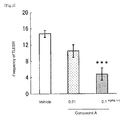
- the number of animals in the groups (the control group (the vehicle-administered group), the 0.01 mg/kg Compound A-subcutaneously-administered group and the 0.1 mg/kg Compound A-subcutaneously-administered group) was 4, respectively.
- TLESR did not occur before the injection of high-fat diet and the injection of air at all, however, occurred by the injection of high-fat diet and the injection of air.
- Compound A suppresses the occurrence of TLESR after the injection of high-fat diet and air, and thus the compound of the present invention can suppress the onset or relapse of GERD by suppressing the reflux of gastric acid and gastric contents, and further is effective in the treatment or amelioration of GERD.
- the compound of the present invention is useful in the prevention or relapse prevention, treatment or amelioration of GERD.
Landscapes
- Health & Medical Sciences (AREA)
- Life Sciences & Earth Sciences (AREA)
- Chemical & Material Sciences (AREA)
- Veterinary Medicine (AREA)
- Public Health (AREA)
- Medicinal Chemistry (AREA)
- General Health & Medical Sciences (AREA)
- Animal Behavior & Ethology (AREA)
- Pharmacology & Pharmacy (AREA)
- Epidemiology (AREA)
- General Chemical & Material Sciences (AREA)
- Organic Chemistry (AREA)
- Nuclear Medicine, Radiotherapy & Molecular Imaging (AREA)
- Engineering & Computer Science (AREA)
- Chemical Kinetics & Catalysis (AREA)
- Bioinformatics & Cheminformatics (AREA)
- Neurology (AREA)
- Orthopedic Medicine & Surgery (AREA)
- Physical Education & Sports Medicine (AREA)
- Pharmaceuticals Containing Other Organic And Inorganic Compounds (AREA)
- Medicines That Contain Protein Lipid Enzymes And Other Medicines (AREA)
- Thiazole And Isothizaole Compounds (AREA)
- Acyclic And Carbocyclic Compounds In Medicinal Compositions (AREA)
Abstract
Description
- The present invention relates to the use of 4-[({6-[isobutyl(1,3-thiazol-2-ylsulfonyl)amino]-2,3-dihydro-1H-inden-5-yl}oxy)methyl]-3-methyl benzoic acid, a salt thereof or a prodrug thereof (hereinafter, may be abbreviated as the compound of the present invention) as a therapeutic or ameliorating agent for Gastroesophageal Reflux Disease (hereinafter, may be abbreviated as GERD (Gastroesophageal Reflux Disease)).
- GERD is a disease which affects healthy lives by the reflux of gastric acid or stomach contents into the esophagus and is accompanied by troublesome symptoms or physical complications. The troublesome symptoms are mainly heartburn, acid regurgitation and the like, and complications such as esophagitis (reflux esophagitis) can be caused. Meanwhile, GERD unaccompanied by esophagitis has also been called Non-Erosive Reflux Disease (NERD (Non-Erosive Reflux Disease)) in recent years.
- Nowadays, proton pump inhibitors, histamine H2 inhibitors, gastrointestinal prokinetic agents, Chinese medicinal drugs and the like are used for treatment of GERD. The US FDA points out that particularly proton pump inhibitors which are frequently used are related to an increase in the fracture rate and Clostridium difficile-associated diarrhea, and a warning is given that the use thereof should be limited to a low dose or a short period of time. Although there are limitations of the effects, the inhibitors are desultorily used, which has been seen as a problem. In addition, it is known that existing agents including proton pump inhibitors have weak effects on subjective symptoms of patients classified into NERD which does not have mucosal damages as compared to subjective symptoms accompanied by reflux esophagitis caused by mucosal damages. Patients in which proton pump inhibitors are not effective have less options, and the QOL (Quality Of Life) of the patients cannot be controlled sufficiently. Therefore, it is strongly demanded that novel drugs, which do not have side effects, for GERD, in particular NERD, in which existing treatment is not effective, be developed.
- Incidentally, the compound of the present invention is a compound described in Example 2 (105) in Patent Document 1 and also reported in Patent Document 2 and Patent Document 3. In these documents, however, it is not suggested that the compound of the present invention is useful as an agent for GERD.
-
- Patent Document 1:
WO 2002/072564 - Patent Document 2:
WO 2002/072145 - Patent Document 3 :
WO 2008/099907 - An object of the present invention is to provide an agent for treating or ameliorating gastroesophageal reflux disease.
- As a result of intensive investigation, the present inventors found that the above-mentioned problem is solved by the compound of the present invention, thereby completing the present invention.
- That is, the present invention is as follows.
- [1] A therapeutic and/or ameliorating agent for gastroesophageal reflux disease, containing 4-[({6-[isobutyl(1,3-thiazol-2-ylsulfonyl)amino]-2,3-dihydro-1H-inden-5-yl}oxy)methyl]-3-methyl benzoic acid represented by the following formula:

- [2] The agent according to [1] above, wherein the gastroesophageal reflux disease is non-erosive.
- [3] The agent according to [1] or [2] above, wherein the symptoms of the gastroesophageal reflux disease are heartburn and/or acid reflux.
- [4] The agent according to any of [1] to [3] above, wherein the gastroesophageal reflux disease is resistant to a proton pump inhibitor.
- [5] The agent according to any of [1] to [4] above, which is used in combination with a medicine selected from proton pump inhibitors, histamine H2 receptor antagonists, gastrointestinal prokinetic agents, oral antacid mixtures, mucosal protective agents and dopamine receptor antagonists.
- [6] The agent according to any of [1] to [3] above, which is used in combination with a proton pump inhibitor.
- [7] The agent according to [5] or [6] above, wherein the proton pump inhibitor is a medicine selected from omeprazole, esomeprazole, pantoprazole, rabeprazole, tenatoprazole, ilaprazole and lansoprazole.
- [8] An agent for suppressing hypersensitivity in the esophagus, containing 4-[({6-[isobutyl(1,3-thiazol-2-ylsulfonyl)amino]-2,3-dihydro-1H-inden-5-yl}oxy)methyl]-3-methyl benzoic acid, a salt thereof or a prodrug thereof as an active ingredient.
- [9] An agent for suppressing transient lower esophageal sphincter relaxation, containing 4-[({6-[isobutyl(1,3-thiazol-2-ylsulfonyl)amino]-2,3-dihydro-1H-inden-5-yl}oxy)methyl]-3-methyl benzoic acid, a salt thereof or a prodrug thereof as an active ingredient.
- [10] The agent according to [9] above, which reduces the frequency of transient lower esophageal sphincter relaxation.
- [11] The agent according to [9] or [10] above for suppressing the reflux of gastric acid and/or gastric contents.
- [12] The agent according to any of [9] to [11] above for the prevention or relapse prevention, treatment and/or amelioration of gastroesophageal reflux disease.
- [13] The agent according to [12] above, wherein the gastroesophageal reflux disease is non-erosive.
- [14] The agent according to [12] or [13] above, wherein the symptoms of gastroesophageal reflux disease are heartburn and/or acid reflux.
- [15] The agent according to any of [12] to [14] above, wherein the gastroesophageal reflux disease is resistant to a proton pump inhibitor.
- [16] The agent according to any of [12] to [14] above, which is used in combination with a medicine selected from proton pump inhibitors, histamine H2 receptor antagonists, gastrointestinal prokinetic agents, oral antacid mixtures, mucosal protective agents and dopamine receptor antagonists.
- [17] The agent according to any of [12] to [14] above, which is used in combination with a proton pump inhibitor.
- [18] The agent according to [16] or [17] above, wherein the proton pump inhibitor is a medicine selected from omeprazole, esomeprazole, pantoprazole, rabeprazole, tenatoprazole, ilaprazole and lansoprazole.
- [19] An agent for suppressing the reflux of gastric acid and/or gastric contents, containing 4-[({6-[isobutyl(1,3-thiazol-2-ylsulfonyl)amino]-2,3-dihydro-1H-inden-5-yl}oxy)methyl]-3-methyl benzoic acid, a salt thereof or a prodrug thereof as an active ingredient.
- [20] The agent according to [19] above for the prevention and/or treatment of regurgitation.
- [21] A prophylactic or relapse-prevention agent for gastroesophageal reflux disease, containing 4-[({6-[isobutyl(1,3-thiazol-2-ylsulfonyl)amino]-2,3-dihydro-1H-inden-5-yl}oxy)methyl]-3-methyl benzoic acid, a salt thereof or a prodrug thereof as an active ingredient.
- [22] The agent according to [21] above, wherein the gastroesophageal reflux disease is non-erosive.
- [23] The agent according to [21] or [22] above, which is used in combination with a medicine selected from proton pump inhibitors, histamine H2 receptor antagonists, gastrointestinal prokinetic agents, oral antacid mixtures, mucosal protective agents and dopamine receptor antagonists.
- [24] The agent according to [23] above, wherein the proton pump inhibitor is a medicine selected from omeprazole, esomeprazole, pantoprazole, rabeprazole, tenatoprazole, ilaprazole and lansoprazole.
- [25] 4-[({6-[Isobutyl(1,3-thiazol-2-ylsulfonyl)amino]-2,3-dihydro-1H-inden-5-yl}oxy)methyl]-3-methyl benzoic acid, a salt thereof or a prodrug thereof for use in the prevention or relapse prevention, treatment and/or amelioration of gastroesophageal reflux disease.
- [26] A use of 4-[({6-[isobutyl(1,3-thiazol-2-ylsulfonyl)amino]-2,3-dihydro-1H-inden-5-yl}oxy)methyl]-3-methyl benzoic acid, a salt thereof or a prodrug thereof for manufacturing a prophylactic or relapse-prevention, therapeutic and/or ameliorating agent for gastroesophageal reflux disease.
- [27] A method of prevention or relapse prevention, treatment and/or amelioration of gastroesophageal reflux disease, comprising administering a pharmaceutically effective amount of 4-[({6-[isobutyl(1,3-thiazol-2-ylsulfonyl)amino]-2,3-dihydro-1H-inden-5-yl}oxy)methyl]-3-methyl benzoic acid, a salt thereof or a prodrug thereof to a patient with gastroesophageal reflux disease.
- [28] 4-[({6-[Isobutyl(1,3-thiazol-2-ylsulfonyl)amino]-2,3-dihydro-1H-inden-5-yl}oxy)methyl]-3-methyl benzoic acid, a salt thereof or a prodrug thereof for use in suppressing hypersensitivity in the esophagus.
- [29] A use of 4-[({6-[isobutyl(1,3-thiazol-2-ylsulfonyl)amino]-2,3-dihydro-1H-inden-5-yl}oxy)methyl]-3-methyl benzoic acid, a salt thereof or a prodrug thereof for manufacturing an agent for suppressing hypersensitivity in the esophagus.
- [30] A method for suppressing hypersensitivity in the esophagus, comprising administering a pharmaceutically effective amount of 4-[({6-[isobutyl(1,3-thiazol-2-ylsulfonyl)amino]-2,3-dihydro-1H-inden-5-yl}oxy)methyl]-3-methyl benzoic acid, a salt thereof or a prodrug thereof to a patient with gastroesophageal reflux disease.
- [31] 4-[({6-[Isobutyl(1,3-thiazol-2-ylsulfonyl)amino]-2,3-dihydro-1H-inden-5-yl}oxy)methyl]-3-methyl benzoic acid, a salt thereof or a prodrug thereof for use in suppressing transient lower esophageal sphincter relaxation.
- [32] A use of 4-[({6-[isobutyl(1,3-thiazol-2-ylsulfonyl)amino]-2,3-dihydro-1H-inden-5-yl}oxy)methyl]-3-methyl benzoic acid, a salt thereof or a prodrug thereof for manufacturing an agent for suppressing transient lower esophageal sphincter relaxation.
- [33] A method for suppressing transient lower esophageal sphincter relaxation, comprising administering a pharmaceutically effective amount of 4-[({6-[isobutyl(1,3-thiazol-2-ylsulfonyl)amino]-2,3-dihydro-1H-inden-5-yl}oxy)methyl]-3-methyl benzoic acid, a salt thereof or a prodrug thereof to a patient with gastroesophageal reflux disease.
- [34] A medicine formed by combining 4-[({6-[isobutyl(1,3-thiazol-2-ylsulfonyl)amino]-2,3-dihydro-1H-inden-5-yl}oxy)methyl]-3-methyl benzoic acid, a salt thereof or a prodrug thereof with an agent selected from proton pump inhibitors, histamine H2 receptor antagonists, gastrointestinal prokinetic agents, oral antacid mixtures, mucosal protective agents and dopamine receptor antagonists.
- [35] The medicine according to [34] above, wherein the proton pump inhibitor is a medicine selected from omeprazole, esomeprazole, pantoprazole, rabeprazole, tenatoprazole, ilaprazole and lansoprazole.
- [36] A article of manufacture comprising 4-[({6-[Isobutyl(1,3-thiazol-2-ylsulfonyl)amino]-2,3-dihydro-1H-inden-5-yl}oxy)methyl]-3-methyl benzoic acid, a salt thereof or a prodrug thereof, a container containing the compound, and a package insert or a label indicating that the compound can be used to prevent, prevent relapse of, or treat gastroesophageal reflux disease and/or ameliorate a symptom thereof.
- The compound of the present invention suppresses hypersensitivity elicited by acids and stimulation other than acids, and thus is effective in the treatment of GERD or amelioration of typical symptoms such as heartburn and acid regurgitation. The compound of the present invention also has a suppressive action on transient lower esophageal sphincter relaxation, and thus can also suppress the onset or relapse of GERD by suppressing the reflux of gastric acid or stomach contents.
-
- [
Fig. 1] Fig. 1 shows the evaluation results of the compound of the present invention in a hypersensitivity model elicited by an acid, wherein the axis of ordinate indicates the voltage (V) of electrical stimulation exhibiting a specific nociceptive behavior, and the end of perfusion of hydrochloric acid or a physiological saline solution into the esophagus is considered as 0-min of time (min) on the axis of abscissa, and open circles (ο) indicate the healthy control group, closed circles (●) indicate the control group, closed triangles (A) indicate the Compound A (0.01 mg/kg)-administered group, and open triangles (Δ) indicate the Compound A (0.1 mg/kg)-administered group. - [
Fig. 2] Fig. 2 shows the evaluation results of the compound of the present invention in a hypersensitivity model elicited by electrical stimulation, wherein the axis of ordinate indicates the voltage (V) of electrical stimulation exhibiting a specific nociceptive behavior, and the end of electrical stimulation for 30 minutes is considered as 0-min of time (min) on the axis of abscissa, and closed circles (●) indicate the control group, and closed triangles (A) indicate the Compound A (0.1 mg/kg)-administered group. - [
Fig. 3] Fig. 3 shows the evaluation results of the compound of the present invention in a model of transient lower esophageal sphincter relaxation, wherein the axis of ordinate indicates the frequency of transient lower esophageal sphincter relaxation, and "***" indicates a significant difference (P < 0.01) from the control group (the medium-administered group) by a multiple comparison test by Steel's test. - In the present specification, the compound of the present invention means 4-[({6-[isobutyl(1,3-thiazol-2-ylsulfonyl)amino]-2,3-dihydro-1H-inden-5-yl}oxy)methyl]-3-methyl benzoic acid, a salt thereof or a prodrug thereof, and particularly Compound A can be produced by suitably improving the method described in
WO 2002/072564 and a known method, e.g. the method described in Synlett 2002, No. 1, 239-242 or Comprehensive Organic Transformations: A Guide to Functional Group Preparations, 2nd Edition (Richard C. Larock, John Wiley & Sons Inc., 1999) and the like, and using the methods in combination. - Salts of the compound of the present invention include acid addition salts (e.g. inorganic salts such as hydrochlorides, hydrobromates, hydroiodides, sulfates, phosphates and nitrates; and organic salts such as acetates, lactates, tartrates, benzoates, citrates, methanesulfonates, ethanesulfonates, benzene sulfonates, toluenesulfonates, isethionates, glucuronates and gluconates), salts of alkali metals (potassium, sodium etc.), salts of alkaline earth metals (calcium, magnesium etc.), ammonium salts or salts of pharmaceutically acceptable organic amines (e.g. tetramethylammonium, triethylamine, methylamine, dimethylamine, cyclopentylamine, benzylamine, phenethylamine, piperidine, monoethanolamine, diethanolamine, tris(hydroxymethyl)aminomethane, lysine, arginine, and N-methyl-D-glucamine), and the like. The compound of the present invention can be converted into a corresponding salt by a known method.
- Examples of prodrugs of the compound of the present invention include compounds in which the carboxy group of Compound A is alkyl-esterified, phenyl-esterified, carboxymethyl-esterified, dimethylaminomethyl-esterified, pivaloyloxymethyl-esterified, ethoxycarbonyloxyethyl-esterified, phthalidyl-esterified, (5-methyl-2-oxo-1,3-dioxolen-4-yl)methyl-esterified, cyclohexyloxycarbonylethyl-esterified or methyl-amidated, and these compounds can be produced by known methods. The compound in which the carboxy group of Compound A is alkyl-esterified is preferably methyl 4-({[6-(N-isobutylthiazole-2-sulfonamido)-2,3-dihydro-1H-inden-5-yl]oxy}methyl)-3-methylbenzoate.
- In the present specification, the symptoms of GERD mainly include heartburn and acid regurgitation, and these are generally called typical symptoms. Meanwhile, examples of accessory symptoms of GERD include epigastralgia, dysphagia, emesis, eructation, and abdominal distension, and examples of atypical symptoms include chest pain, chronic cough and laryngopharyngeal symptoms.
- In the present specification, the amelioration of GERD means that one or more symptoms observed in GERD disappear or are recessive as compared to symptoms before administration of the compound of the present invention.
- The compound of the present invention is effective in the amelioration of typical symptoms such as heartburn and/or acid regurgitation in GERD. The compound of the present invention is also effective in the treatment or amelioration of NERD of GERD, and further effective for a patient with GERD or a patient with NERD in which agents used as therapeutic agents for GERD, in particular, proton pump inhibitors are not effective. Furthermore, the compound of the present invention also has a suppressive action on Transient Lower Esophageal Sphincter Relaxation (TLESR: Transient Lower Esophageal Sphincter Relaxation), and thus can suppress the onset or relapse of GERD by suppressing the reflux of gastric acid and stomach contents. The compound of the present invention generally reduces the exposure of gastric acid to the esophagus, and thus is useful in the treatment or amelioration of GERD.
- Usually, the compound of the present invention is orally administered in a dose of 10 mg to 300 mg (e.g. 10 mg, 30 mg, 100 mg, 300 mg) per adult per administration once to three times daily. Naturally, the dose varies depending on various conditions such as age, body weight, symptoms, therapeutic effects, administration methods and treatment time. Therefore, in some cases, an amount less than the above-mentioned dose is enough, and in other cases, administration beyond the range is needed.
- The compound of the present invention may be administered in combination with a different agent for (1) the complement and/or reinforcement of the effects of prevention or relapse prevention, or treatment or amelioration of gastroesophageal reflux disease by the compound of the present invention, (2) improvements in pharmacokinetics and absorption of the compound of the present invention or a different agent, and a decrease in dose, and/or (3) reduction of side effects of a different agent.
- A concomitant drug of the compound of the present invention and a different agent may be administered in the form of a combined agent in which both components are combined in a formulation, or may be administered as different formulations. Administration as different formulations includes coadministration and administration at intervals. For administration at intervals, a different agent may be administered after the compound of the present invention is administered, or the compound of the present invention may be administered after a different agent is administered. The administration methods for each administration may be same or different. Examples of different agents herein include proton pump inhibitors, histamine H2 receptor antagonists, gastrointestinal prokinetic agents, oral antacid mixtures, mucosal protective agents, and dopamine receptor antagonists.
- Examples of proton pump inhibitors include omeprazole, esomeprazole, pantoprazole, rabeprazole, tenatoprazole, ilaprazole, and lansoprazole.
- Examples of histamine H2 receptor antagonists include cimetidine, ranitidine, famotidine, roxatidine, nizatidine, and lafutidine.
- Examples of gastrointestinal prokinetic agents include domperidone, metoclopramide, mosapride, itopride, and tegaserod.
- Examples of oral antacid mixtures include Maalox (registered trademark), Aludrox (registered trademark), and Gaviscon (registered trademark).
- Examples of mucosal protective agents include polaprezinc, ecabet sodium, rebamipide, teprenone, cetraxate, sucralfate, and plaunotol.
- Examples of dopamine receptor antagonists include metoclopramide, domperidone, and levosulpiride.
- The weight ratio between the compound of the present invention and a different agent is not particularly restricted.
- As different agents, two or more agents of any same type or different types may be administered in combination.
- Different agents include not only agents which have been found so far but also agents which will be found in the future based on the above-mentioned mechanism.
- When the compound of the present invention is administered independently or administered in combination with a different agent, the compound is used as a solid medicine for internal use or a liquid medicine for internal use for oral administration.
- The solid medicines for internal use for oral administration include tablets, pills, capsules, powders, and granules. Capsules include hard capsules and soft capsules. For such solid medicines for internal use, formulations are produced from one or more active substances themselves or after mixing the substances with an activator (e.g. lactose, mannitol, glucose, microcrystalline cellulose, or starch), a binder (e.g. hydroxypropyl cellulose, polyvinylpyrrolidone or magnesium aluminometasilicate), a disintegrator (e.g. calcium carboxymethyl cellulose), a lubricant (e.g. magnesium stearate), a stabilizer, a solubilizing agent (e.g. glutamic acid or aspartic acid) and the like according to usual methods, and used. In addition, the medicines may be coated with coating agents (e.g. white sugar, gelatin, hydroxypropyl cellulose, and hydroxypropyl methylcellulose phthalate) as needed, or coated with two or more layers. Further, capsules of substances which can be absorbed such as gelatin are also included.
- The liquid medicines for internal use for oral administration include pharmaceutically acceptable solutions, suspensions, emulsions, syrups, and elixirs. For such liquid medicines, one or more active substances are dissolved, suspended or emulsified in a diluent which is generally used (e.g. purified water, ethanol or a mixed liquid thereof). The liquid medicines may further contain a wetting agent, a suspending agent, an emulsifier, a sweeting agent, a flavoring agent, an aromatic, a preservative, a buffering agent and the like.
- The present invention will be described in more detail by the following examples. It should be noted, however, that the present invention is not limited thereto. Various alterations and modifications can be made by those of skill in the art based on the description of the present invention, and these alterations and modifications are also included in the present invention.
- Cynomolgus monkeys (aged 4 to 6 years, female, Japan Laboratory Animals, Inc., no history of administration) were acclimated to a monkey chair for 2 days or more, and were fasted for 12 hours or more. After that, on the day of experiment, the monkeys were immobilized in the monkey chair after the measurement of body weight, and were acclimated for another one hour or more. An electrostimulation catheter was inserted from a nostril, and electrical stimulation was applied at the position approximately 10 cm above the cardiac part of stomach (the upper esophagus). The voltage was increased in increments of approximately 2 V/sec, and the voltage (V) exhibiting a specific nociceptive behavior (an escape reflex behavior to escape from a cage) in an individual was obtained. This was carried out three times every 2 to 3 minutes at each evaluation time point, and the average value was used as a nociceptive threshold at each time point. Saline or hydrochloric acid (1.5 N) was perfused from the position approximately 3 cm above the cardiac region (the lower esophagus) to the stomach at an injection rate of 160 mL/h for 30 minutes. The nociceptive thresholds were measured before and after perfusion of saline in the esophagus, before perfusion of hydrochloric acid in the esophagus and at 0, 30, 60, 90 and 120 minutes after perfusion of hydrochloric acid in the esophagus. The vehicle or Compound A (0.01 and 0.1 mg/kg, respectively) was subcutaneously administered 30 minutes before the start of the perfusion of hydrochloric acid.
- The number of animals in each group were as follows; 3 animals in the healthy control group (the group in which perfusion of saline, administration of vehicle, and perfusion of saline were carried out in a sequential order), 5 animals in the control group (the group in which perfusion of saline, administration of vehicle, and perfusion of hydrochloric acid were carried out in a sequential order) and the 0.01 mg/kg Compound A group (the group in which perfusion of saline, administration of Compound A and perfusion of hydrochloric acid were carried out in a sequential order) and 7 animals in the 0.1 mg/kg Compound A group (the group in which perfusion of saline, administration of Compound A and perfusion of hydrochloric acid were carried out in a sequential order). The end of the perfusion of hydrochloric acid (in the control group and the Compound A-administered group) or saline (in the healthy control group) in the esophagus for 30 minutes was considered as the base time (0 min), and perfusion of saline in the esophagus in all test groups was carried out between 90 and 120 minutes before the base time.
- The nociceptive threshold (V) was used as the endpoint. The endpoint was assessedby comparing the nociceptive thresholds before and after perfusion of hydrochloric acid, the nociceptive threshold of the vehicle-administered group at each time point and the nociceptive threshold of the Compound A-administered group at each time point.
- In addition, after the end of the experiment, the entire periphery of the lower esophageal tissue approximately 3 cm above the cardiac region in which the acid was perfused was extracted, and was immersed in a 4% paraformaldehyde phosphate buffer to produce a paraffin embedded block. A paraffin section with a thickness of 4 µm was produced from the paraffin embedded block, and put on a MAS coated slide glass (MATSUNAMI). Hematoxylin eosin staining was carried out, and the section was observed by microscopy.
- As shown in
Fig. 1 , the nociceptive thresholds of the healthy control group were not changed at all time points, and were nearly constant. About the nociceptive threshold of the control group, the nociceptive threshold decreased immediately after hydrochloric acid perfusion, and was maintained up to 120 minutes after hydrochloric acid perfusion. On the other hand, about the nociceptive threshold of the Compound A-administered groups, decrease in the nociceptive thresholds observed after hydrochloric acid perfusion in the control group were dose-dependently suppressed, and in the 0.1 mg/kg Compound A-administered group, the nociceptive threshold was suppressed to a normal level. In addition, the suppressive action was maintained even at 120 minutes after hydrochloric acid perfusion. Furthermore, in the esophageal tissue in which the acid was perfused under the experimental conditions, damage and inflammation images of the esophageal mucosal tissue were observed. - From the above results, it was suggested that the compound of the present invention is effective in the treatment or amelioration of GERD symptoms caused by the reflux of gastric acid, particularly heartburn and acid regurgitation accompanied by esophageal mucosal damages.
- Cynomolgus monkeys (aged 4 to 6 years, female, Japan Laboratory Animals, Inc., no history of administration) were acclimated to a monkey chair for 2 days or more, and were fasted for 12 hours or more. After that, on the day of experiment, the monkeys were immobilized in the monkey chair after the measurement of body weight, and were acclimated for another one hour or more. An electrostimulation catheter was inserted from a nostril, and electrical stimulation was applied at the position approximately 10 cm above the cardiac part of stomach (the upper esophagus). The voltage was increased in increments of approximately 2 V/sec, and the voltage (V) exhibiting a specific nociceptive behavior (an escape reflex behavior to escape from a cage) in an individual was obtained. This was carried out three times every 2 to 3 minutes at each evaluation time point, and the average value was used as a nociceptive behavior threshold at each time point. Hypersensitivity was induced by continuous electrical stimulation to the position approximately 3 cm above the cardiac region (the lower esophagus). That is, an electrostimulation catheter was inserted from a nostril, and electrical stimulation was applied at the position of the lower esophagus for 30 minutes. The vehicle or Compound A (0.1 mg/kg) was subcutaneously administered 30 minutes before the beginning of eliciting by electrical stimulation. The number of animals was 3 in each group.
- The nociceptive threshold (V) was used as the endpoint. The endpoint was assessed by comparing the nociceptive thresholds before and after continuous electrical stimulation, the nociceptive threshold of the vehicle-administered group at each time point and the nociceptive threshold of the Compound A-administered group at each time point.
- In addition, after the end of the experiment, the entire periphery of the lower esophagus tissue approximately 3 cm above the cardiac region in which electrical stimulation was carried out was extracted, and was immersed in a 4% paraformaldehyde phosphate buffer to produce a paraffin embedded block. A paraffin section with a thickness of 4 µm was produced from the paraffin embedded block, and put on a MAS coated slide glass (MATSUNAMI). Hematoxylin eosin staining was carried out, and the section was observed by microscopy.
- As shown in
Fig. 2 , about the nociceptive threshold of the control group (the group in which administration of a medium and continuous electrical stimulation were carried out in a sequential order), the nociceptive threshold decreased immediately after eliciting and was maintained up to 120 minutes after continuous electrical stimulation. On the other hand, about the nociceptive threshold of the Compound A-administered group (the group in which administration of Compound A and continuous electrical stimulation were carried out in a sequential order), a decrease in the nociceptive threshold observed in the control group after continuous electrical stimulation was suppressed to a normal level. In addition, the suppressive action was maintained even at 120 minutes after continuous electrical stimulation. Furthermore, in the esophageal tissue in which continuous electrical stimulation was carried out under the experimental conditions, damage and inflammation images of the esophageal mucosal tissue were not observed. - From the above results, it was suggested that the compound of the present invention is effective in the treatment or amelioration of GERD which is not caused by inflammation accompanied by the reflux of gastric acid or stomach contents, particularly NERD.
- Cynomolgus monkeys (aged 4 to 6 years, female, Japan Laboratory Animals, Inc., no history of administration) were immobilized in a monkey chair, and Compound A was subcutaneously administered thereto (0.1 mg/kg), followed by collecting blood at 180 minutes after administration. The blood samples were centrifuged at 10000 g at 4°C for 3 minutes to collect plasma. Next, the cerebrospinal fluid was collected under anesthesia by intravenous administration of pentobarbital sodium, and the lower esophagus, the upper esophagus, the dorsal root ganglion, the spinal cord and the brain stem were then collected. Furthermore, the dorsal root ganglion and the spinal cord were collected from the first to sixth thoracic spinal cord, which controls esophageal nerves. To the collected tissue, 4 times the amount of saline per wet weight of each tissue was added, followed by homogenization using Physcotron to obtain each tissue homogenate. The number of animals was 3.
- The concentration of Compound A in each tissue was measured by a LC/MS/MS method.
- To the samples for 50 µL of a calibration curve and test samples of Compound A, 1 mL of ultrapure water and an internal standard substance were added under ice cold conditions, followed by stirring. To a solid phase extraction cartridge (
OASIS MAX 30 mg/l cc, Waters Corporation) which had been conditioned in advance, each sample was loaded and washing was carried out, followed by centrifugation, and a cleaning liquid was discharged from the cartridge for drying. Further, elution was carried out with 1 mL of an acetonitrile/acetic acid mixed liquid (49 : 1), and the eluate was concentrated and dried under a current of nitrogen (40°C or less). The residue was redissolved in 200 µL of a methanol/0.1 vol% acetic acid solution (70 : 30) to obtain a sample for the measurement of LC/MS/MS. - The analysis by LC/MS/MS was carried out under the following conditions.
-
- Measuring device: Nanospace 3033 (Shiseido Co., Ltd.)
- Analysis column: SunFire C18 3.5 µm (2.1 mm i.d. X 100 mm, 3.5 µm, Waters Corporation)
- Mobile phase: Acetonitrile/0.1 vol% acetic acid solution (70 : 30)
- Cleaning liquid for cleaning port (one component): 2-propanol
- Cleaning liquid for cleaning port (two components): Mobile phase
- [acetonitrile/0.1 vol% acetic acid solution (70 : 30)]
- Flow rate: 0.2 mL/min
- Column temperature: 35°C
- Sample temperature: 4°C
- Analysis time: 13 minutes
-
- Measuring device: API4000 (AB SCIEX)
- Ion source: ESI
- Scan type: MRM
- Polarity: Negative
- Temperature: 650°C
- Monitoring ion: Q1: 499.0 (m/z), Q3: 147.3 (m/z)
- Using the peak area ratio (standard substance/internal standard substance) obtained by the measurement of a sample for a calibration curve, the calibration curve (y = aX + b, Y: Peak area ratio, X: Concentration) was made from the single regression line by the least squares method, and the peak area ratios of test samples were applied to the calibration curve to calculate a measured value.
- At 180 minutes after administration of Compound A, the average concentrations in plasma, the cerebrospinal fluid, the lower esophagus, the upper esophagus, the dorsal root ganglion, the spinal cord and the brain stem tissue were 3.79, 0.07, 0.25, 0.28, 0.62, 0.19 and 0.22 ng/mL, respectively. The percentages to the concentration in plasma were 1.9, 6.7, 7.3, 16.3, 5.1 and 5.7%, respectively.
- Cynomolgus monkeys (aged 4 to 6 years, female, Japan Laboratory Animals, Inc., no history of administration) are acclimated to a monkey chair for 2 days or more, and are fasted for 12 hours or more. After that, on the day of experiment, the monkeys are immobilized in the monkey chair after the measurement of body weight, and are acclimated for another one hour or more. A high-fat diet/air injection catheter and a sensor catheter for measuring pressure are inserted from a nostril. A high-fat diet is injected into the stomach so that the final volume will be 80 mL, and air is then injected up to a pressure in the stomach of 10 mmHg, and maintained. The pressure in the esophagus is measured by a sensor catheter in the stomach, the lower esophageal sphincter region and the position approximately 3 cm above the lower esophageal sphincter. The frequency of TLESR is measured for 45 minutes from the injection of high-fat diet before and after the subcutaneous administration of Compound A (0.1 mg/kg) to the end of ventilation.
- Cynomolgus monkeys (aged 4 to 6 years, female, Japan Laboratory Animals, Inc., no history of administration) were acclimated to a monkey chair for 2 days or more, and were fasted for 12 hours or more. After that, on the day of experiment, the monkeys were immobilized in the monkey chair after the measurement of body weight, and was acclimated for another one hour or more. A high-fat diet/air injection catheter and a sensor catheter for measuring pressure were inserted from a nostril and the oral cavity. A high-fat diet was injected into the stomach so that the final volume would be 80 mL, and air was then injected up to a pressure in the stomach of 20 mmHg, and maintained. The pressure in the esophagus was measured by a sensor catheter in the lower esophageal sphincter region and the positions approximately 2, 3 and 6 cm above the lower esophageal sphincter. Compound A was subcutaneously administered (0.01 and 0.1 mg/kg), and the injection of high-fat diet and ventilation were carried out at 30 minutes after subcutaneous administration. The frequency of TLESR was measured for 45 minutes from the injection of high-fat diet to the end of ventilation. Here, TLESR was measured considering that the relaxation response of the lower esophageal sphincter region was longer by 0.5 seconds and was not elicited by peristaltic motion occurring in the esophagus, and the rate of reduction of pressure was greater than 0.5 seconds, and measured. The number of animals in the groups (the control group (the vehicle-administered group), the 0.01 mg/kg Compound A-subcutaneously-administered group and the 0.1 mg/kg Compound A-subcutaneously-administered group) was 4, respectively.
- TLESR did not occur before the injection of high-fat diet and the injection of air at all, however, occurred by the injection of high-fat diet and the injection of air. As shown in
Fig. 3 , the frequency of TLESR in the Compound A-administered group dose-dependently decreased as compared to the frequency of TLESR in the control group (the vehicle-administered group). - As in the above results, it was suggested that Compound A suppresses the occurrence of TLESR after the injection of high-fat diet and air, and thus the compound of the present invention can suppress the onset or relapse of GERD by suppressing the reflux of gastric acid and gastric contents, and further is effective in the treatment or amelioration of GERD.
- The compound of the present invention is useful in the prevention or relapse prevention, treatment or amelioration of GERD.
Claims (10)
- An agent for suppressing transient lower esophageal sphincter relaxation, comprising 4-[({6-[isobutyl(1,3-thiazol-2-ylsulfonyl)amino]-2,3-dihydro-1H-inden-5-yl}oxy)methyl]-3-methyl benzoic acid, a salt thereof or a prodrug thereof as an active ingredient.
- The agent according to claim 1, which reduces the frequency of transient lower esophageal sphincter relaxation.
- An agent for suppressing the reflux of gastric acid and/or gastric contents, comprising 4-[({6-[isobutyl(1,3-thiazol-2-ylsulfonyl)amino]-2,3-dihydro-1H-inden-5-yl}oxy)methyl]-3-methyl benzoic acid, a salt thereof or a prodrug thereof as an active ingredient.
- An agent for preventing or relapse-preventing gastroesophageal reflux disease, comprising 4-[({6-[isobutyl(1,3-thiazol-2-ylsulfonyl)amino]-2,3-dihydro-1H-inden-5-yl}oxy)methyl]-3-methyl benzoic acid, a salt thereof or a prodrug thereof as an active ingredient.
- An agent for treating or ameliorating gastroesophageal reflux disease, comprising 4-[({6-[isobutyl(1,3-thiazol-2-ylsulfonyl)amino]-2,3-dihydro-1H-inden-5-yl}oxy)methyl]-3-methyl benzoic acid, a salt thereof or a prodrug thereof as an active ingredient.
- The agent according to claim 5, wherein the gastroesophageal reflux disease is non-erosive.
- The agent according to claim 5 or 6, wherein the symptoms of the gastroesophageal reflux disease are heartburn and/or acid reflux.
- The agent according to any one of claims 5 to 7, wherein the gastroesophageal reflux disease is resistant to a proton pump inhibitor.
- The agent according to any one of claims 5 to 8, which is used in combination with a medicine selected from proton pump inhibitors, histamine H2 receptor antagonists, gastrointestinal prokinetic agents, oral antacid mixtures, mucosal protective agents and dopamine receptor antagonists.
- The agent according to claim 9, wherein the proton pump inhibitor is a medicine selected from omeprazole, esomeprazole, pantoprazole, rabeprazole, tenatoprazole, ilaprazole and lansoprazole.
Applications Claiming Priority (3)
| Application Number | Priority Date | Filing Date | Title |
|---|---|---|---|
| JP2012169037 | 2012-07-31 | ||
| JP2012281959 | 2012-12-26 | ||
| PCT/JP2013/070581 WO2014021306A1 (en) | 2012-07-31 | 2013-07-30 | Medicine against gastroesophageal reflux disease |
Publications (2)
| Publication Number | Publication Date |
|---|---|
| EP2881115A1 true EP2881115A1 (en) | 2015-06-10 |
| EP2881115A4 EP2881115A4 (en) | 2016-03-16 |
Family
ID=50026069
Family Applications (1)
| Application Number | Title | Priority Date | Filing Date |
|---|---|---|---|
| EP13825231.7A Withdrawn EP2881115A4 (en) | 2012-07-31 | 2013-07-30 | Medicine against gastroesophageal reflux disease |
Country Status (17)
| Country | Link |
|---|---|
| US (1) | US20140039004A1 (en) |
| EP (1) | EP2881115A4 (en) |
| JP (2) | JP5664831B2 (en) |
| KR (1) | KR20150036115A (en) |
| CN (1) | CN104519883B (en) |
| AU (1) | AU2013297532B2 (en) |
| BR (1) | BR112015002113A2 (en) |
| CA (1) | CA2878137A1 (en) |
| IL (1) | IL236496A0 (en) |
| MX (1) | MX2015000976A (en) |
| NZ (1) | NZ703526A (en) |
| PH (1) | PH12015500001A1 (en) |
| RU (1) | RU2635766C2 (en) |
| SG (1) | SG11201500551RA (en) |
| TW (1) | TW201410241A (en) |
| WO (1) | WO2014021306A1 (en) |
| ZA (1) | ZA201500652B (en) |
Families Citing this family (2)
| Publication number | Priority date | Publication date | Assignee | Title |
|---|---|---|---|---|
| US20140039004A1 (en) * | 2012-07-31 | 2014-02-06 | Ono Pharmaceutical Co., Ltd. | Method of treating of gastroesophageal reflux disease |
| US11092567B2 (en) * | 2017-03-21 | 2021-08-17 | International Business Machines Corporation | Biosensor electrode having three-dimensional structured sensing surfaces |
Family Cites Families (8)
| Publication number | Priority date | Publication date | Assignee | Title |
|---|---|---|---|---|
| PT1369419E (en) * | 2001-03-12 | 2007-08-16 | Ono Pharmaceutical Co | N-phenylarylsulfonamide compound, drug containing the compound as active ingredient, intermediate for the compound, and processes for producing the same |
| JP4175113B2 (en) * | 2001-03-14 | 2008-11-05 | 小野薬品工業株式会社 | A therapeutic agent for depression containing an EP1 antagonist as an active ingredient |
| JP2007023028A (en) * | 2005-06-16 | 2007-02-01 | Ono Pharmaceut Co Ltd | Inner ear disease treatment |
| CA2631991A1 (en) * | 2005-12-23 | 2007-06-28 | Astrazeneca Ab | Heterocyclic gaba-b modulators |
| EP1976532B1 (en) * | 2006-01-27 | 2015-11-11 | Yale University | Fast acting inhibitor of gastric acid secretion |
| BRPI0807942A2 (en) | 2007-02-16 | 2014-07-01 | Ono Pharmaceutical Co | THERAPEUTIC AGENT FOR URINARY EXCRETION DISORDER |
| JP2008214224A (en) * | 2007-03-01 | 2008-09-18 | Ono Pharmaceut Co Ltd | Thiazolylsulfonylamide compounds |
| US20140039004A1 (en) * | 2012-07-31 | 2014-02-06 | Ono Pharmaceutical Co., Ltd. | Method of treating of gastroesophageal reflux disease |
-
2013
- 2013-07-26 US US13/952,131 patent/US20140039004A1/en not_active Abandoned
- 2013-07-30 KR KR20157001344A patent/KR20150036115A/en not_active Withdrawn
- 2013-07-30 BR BR112015002113A patent/BR112015002113A2/en not_active IP Right Cessation
- 2013-07-30 CN CN201380040177.8A patent/CN104519883B/en not_active Expired - Fee Related
- 2013-07-30 WO PCT/JP2013/070581 patent/WO2014021306A1/en not_active Ceased
- 2013-07-30 RU RU2015106931A patent/RU2635766C2/en not_active IP Right Cessation
- 2013-07-30 EP EP13825231.7A patent/EP2881115A4/en not_active Withdrawn
- 2013-07-30 TW TW102127228A patent/TW201410241A/en unknown
- 2013-07-30 AU AU2013297532A patent/AU2013297532B2/en not_active Ceased
- 2013-07-30 MX MX2015000976A patent/MX2015000976A/en unknown
- 2013-07-30 SG SG11201500551RA patent/SG11201500551RA/en unknown
- 2013-07-30 CA CA2878137A patent/CA2878137A1/en not_active Abandoned
- 2013-07-30 JP JP2014528164A patent/JP5664831B2/en not_active Expired - Fee Related
- 2013-07-30 NZ NZ703526A patent/NZ703526A/en not_active IP Right Cessation
-
2014
- 2014-12-10 JP JP2014250124A patent/JP5935863B2/en not_active Expired - Fee Related
- 2014-12-28 IL IL236496A patent/IL236496A0/en unknown
-
2015
- 2015-01-05 PH PH12015500001A patent/PH12015500001A1/en unknown
- 2015-01-28 ZA ZA2015/00652A patent/ZA201500652B/en unknown
Also Published As
| Publication number | Publication date |
|---|---|
| AU2013297532A1 (en) | 2015-01-29 |
| MX2015000976A (en) | 2015-04-10 |
| ZA201500652B (en) | 2016-08-31 |
| NZ703526A (en) | 2017-03-31 |
| JP2015071635A (en) | 2015-04-16 |
| EP2881115A4 (en) | 2016-03-16 |
| KR20150036115A (en) | 2015-04-07 |
| IL236496A0 (en) | 2015-02-26 |
| CN104519883A (en) | 2015-04-15 |
| US20140039004A1 (en) | 2014-02-06 |
| RU2015106931A (en) | 2016-09-20 |
| PH12015500001A1 (en) | 2015-02-23 |
| JP5664831B2 (en) | 2015-02-04 |
| AU2013297532B2 (en) | 2017-09-14 |
| BR112015002113A2 (en) | 2017-07-04 |
| CN104519883B (en) | 2017-05-10 |
| SG11201500551RA (en) | 2015-04-29 |
| JP5935863B2 (en) | 2016-06-15 |
| JPWO2014021306A1 (en) | 2016-07-21 |
| CA2878137A1 (en) | 2014-02-06 |
| RU2635766C2 (en) | 2017-11-15 |
| WO2014021306A1 (en) | 2014-02-06 |
| TW201410241A (en) | 2014-03-16 |
Similar Documents
| Publication | Publication Date | Title |
|---|---|---|
| EP2087890B1 (en) | Sustained release preparation for tissue regeneration therapy | |
| KR101996245B1 (en) | Pharmaceutical combination comprising a selective s1p1 receptor agonist | |
| US20120282187A1 (en) | Method for treating or preventing thrombosis using dabigatran etexilate or a salt thereof with improved safety profile over conventional warfarin therapy | |
| WO2007086493A1 (en) | Medicine for transnasal administration | |
| KR20010108298A (en) | Methods and compositions using (+)norcisapride in combination with proton pump inhibitors or h2 receptor antagonists | |
| PT2086535E (en) | Angiotensin ii receptor antagonist for the treatment of systemic diseases in cats | |
| KR20170042504A (en) | PPAR compounds for use in the treatment of fibrotic diseases | |
| WO2010081862A2 (en) | Methods and preparations for protecting critically ill patients | |
| CN102821765A (en) | Methods and compositions for improving nerve conduction velocity | |
| US9987279B2 (en) | Pharmaceutical composition for prevention and/or treatment of urinary incontinence | |
| EP3730134B1 (en) | Medicinal composition for preventing or treating secondary hyperparathyroidism under maintenance dialysis | |
| ES2560215T3 (en) | Compounds for the suppression of a peripheral nerve disorder caused by an anticancer agent | |
| AU2013297532B2 (en) | Medicine against gastroesophageal reflux disease | |
| Garlicki et al. | Effect of intraarticular tramadol administration in the rat model of knee joint inflammation | |
| EP1772149A1 (en) | Drug for prevention or treatment of diabetes | |
| KR20090083891A (en) | S-nitrosothiol compound and related derivatives | |
| WO2010009524A1 (en) | Use of the angiotensin-(1-7) peptide, analogues, agonists and derivatives thereof for the treatment of painful conditions | |
| KR20220004640A (en) | dyskinesia treatment drugs | |
| US20100247584A1 (en) | Compositions useful for treating gastroesophageal reflux disease | |
| US20220288089A1 (en) | Peripherally-restricted dual-acting kappa and delta opioid agonist for analgesia in pain states involving the inflammatory response | |
| EP3950058A1 (en) | Pharmaceutical composition having favorable stability | |
| RU2852719C2 (en) | Dosing regimen for injectable composition of fexuprazan | |
| Shakya et al. | Role of brain angiotensin (1-7) in chronic hyperglycaemia induced nephropathy in wistar rats | |
| US9233103B2 (en) | Methods for treating heartburn, gastric bleeding or hemorrhage in patients receiving clopidogrel therapy | |
| CA3085706C (en) | Medicinal composition for preventing or treating secondary hyperparathyroidism under maintenance dialysis |
Legal Events
| Date | Code | Title | Description |
|---|---|---|---|
| PUAI | Public reference made under article 153(3) epc to a published international application that has entered the european phase |
Free format text: ORIGINAL CODE: 0009012 |
|
| 17P | Request for examination filed |
Effective date: 20150123 |
|
| AK | Designated contracting states |
Kind code of ref document: A1 Designated state(s): AL AT BE BG CH CY CZ DE DK EE ES FI FR GB GR HR HU IE IS IT LI LT LU LV MC MK MT NL NO PL PT RO RS SE SI SK SM TR |
|
| AX | Request for extension of the european patent |
Extension state: BA ME |
|
| DAX | Request for extension of the european patent (deleted) | ||
| RA4 | Supplementary search report drawn up and despatched (corrected) |
Effective date: 20160212 |
|
| RIC1 | Information provided on ipc code assigned before grant |
Ipc: A61P 43/00 20060101ALI20160208BHEP Ipc: A61K 31/444 20060101ALI20160208BHEP Ipc: A61K 45/06 20060101ALI20160208BHEP Ipc: A61P 1/04 20060101ALI20160208BHEP Ipc: A61K 31/426 20060101AFI20160208BHEP Ipc: A61K 45/00 20060101ALI20160208BHEP Ipc: A61K 31/4439 20060101ALI20160208BHEP |
|
| GRAP | Despatch of communication of intention to grant a patent |
Free format text: ORIGINAL CODE: EPIDOSNIGR1 |
|
| INTG | Intention to grant announced |
Effective date: 20170223 |
|
| GRAJ | Information related to disapproval of communication of intention to grant by the applicant or resumption of examination proceedings by the epo deleted |
Free format text: ORIGINAL CODE: EPIDOSDIGR1 |
|
| INTC | Intention to grant announced (deleted) | ||
| GRAP | Despatch of communication of intention to grant a patent |
Free format text: ORIGINAL CODE: EPIDOSNIGR1 |
|
| INTG | Intention to grant announced |
Effective date: 20170804 |
|
| GRAJ | Information related to disapproval of communication of intention to grant by the applicant or resumption of examination proceedings by the epo deleted |
Free format text: ORIGINAL CODE: EPIDOSDIGR1 |
|
| INTC | Intention to grant announced (deleted) | ||
| GRAP | Despatch of communication of intention to grant a patent |
Free format text: ORIGINAL CODE: EPIDOSNIGR1 |
|
| INTG | Intention to grant announced |
Effective date: 20180126 |
|
| STAA | Information on the status of an ep patent application or granted ep patent |
Free format text: STATUS: THE APPLICATION IS DEEMED TO BE WITHDRAWN |
|
| 18D | Application deemed to be withdrawn |
Effective date: 20180606 |