EP2882013A1 - Précurseur de matériau actif d'anode pour batterie secondaire au lithium, matériau actif d'anode fabriqué en l'utilisant, et batterie secondaire au lithium le comprenant - Google Patents
Précurseur de matériau actif d'anode pour batterie secondaire au lithium, matériau actif d'anode fabriqué en l'utilisant, et batterie secondaire au lithium le comprenant Download PDFInfo
- Publication number
- EP2882013A1 EP2882013A1 EP13799899.3A EP13799899A EP2882013A1 EP 2882013 A1 EP2882013 A1 EP 2882013A1 EP 13799899 A EP13799899 A EP 13799899A EP 2882013 A1 EP2882013 A1 EP 2882013A1
- Authority
- EP
- European Patent Office
- Prior art keywords
- active material
- positive electrode
- electrode active
- particle
- secondary battery
- Prior art date
- Legal status (The legal status is an assumption and is not a legal conclusion. Google has not performed a legal analysis and makes no representation as to the accuracy of the status listed.)
- Granted
Links
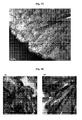
Images






Classifications
-
- H—ELECTRICITY
- H01—ELECTRIC ELEMENTS
- H01M—PROCESSES OR MEANS, e.g. BATTERIES, FOR THE DIRECT CONVERSION OF CHEMICAL ENERGY INTO ELECTRICAL ENERGY
- H01M4/00—Electrodes
- H01M4/02—Electrodes composed of, or comprising, active material
- H01M4/36—Selection of substances as active materials, active masses, active liquids
- H01M4/48—Selection of substances as active materials, active masses, active liquids of inorganic oxides or hydroxides
- H01M4/52—Selection of substances as active materials, active masses, active liquids of inorganic oxides or hydroxides of nickel, cobalt or iron
- H01M4/525—Selection of substances as active materials, active masses, active liquids of inorganic oxides or hydroxides of nickel, cobalt or iron of mixed oxides or hydroxides containing iron, cobalt or nickel for inserting or intercalating light metals, e.g. LiNiO2, LiCoO2 or LiCoOxFy
-
- H—ELECTRICITY
- H01—ELECTRIC ELEMENTS
- H01M—PROCESSES OR MEANS, e.g. BATTERIES, FOR THE DIRECT CONVERSION OF CHEMICAL ENERGY INTO ELECTRICAL ENERGY
- H01M4/00—Electrodes
- H01M4/02—Electrodes composed of, or comprising, active material
- H01M4/13—Electrodes for accumulators with non-aqueous electrolyte, e.g. for lithium-accumulators; Processes of manufacture thereof
-
- H—ELECTRICITY
- H01—ELECTRIC ELEMENTS
- H01M—PROCESSES OR MEANS, e.g. BATTERIES, FOR THE DIRECT CONVERSION OF CHEMICAL ENERGY INTO ELECTRICAL ENERGY
- H01M4/00—Electrodes
- H01M4/02—Electrodes composed of, or comprising, active material
- H01M4/13—Electrodes for accumulators with non-aqueous electrolyte, e.g. for lithium-accumulators; Processes of manufacture thereof
- H01M4/134—Electrodes based on metals, Si or alloys
-
- C—CHEMISTRY; METALLURGY
- C01—INORGANIC CHEMISTRY
- C01G—COMPOUNDS CONTAINING METALS NOT COVERED BY SUBCLASSES C01D OR C01F
- C01G53/00—Compounds of nickel
- C01G53/40—Complex oxides containing nickel and at least one other metal element
- C01G53/42—Complex oxides containing nickel and at least one other metal element containing alkali metals, e.g. LiNiO2
- C01G53/44—Complex oxides containing nickel and at least one other metal element containing alkali metals, e.g. LiNiO2 containing manganese
- C01G53/50—Complex oxides containing nickel and at least one other metal element containing alkali metals, e.g. LiNiO2 containing manganese of the type (MnO2)n-, e.g. Li(NixMn1-x)O2 or Li(MyNixMn1-x-y)O2
-
- C—CHEMISTRY; METALLURGY
- C01—INORGANIC CHEMISTRY
- C01G—COMPOUNDS CONTAINING METALS NOT COVERED BY SUBCLASSES C01D OR C01F
- C01G53/00—Compounds of nickel
- C01G53/80—Compounds containing nickel, with or without oxygen or hydrogen, and containing one or more other elements
- C01G53/82—Compounds containing nickel, with or without oxygen or hydrogen, and containing two or more other elements
-
- H—ELECTRICITY
- H01—ELECTRIC ELEMENTS
- H01M—PROCESSES OR MEANS, e.g. BATTERIES, FOR THE DIRECT CONVERSION OF CHEMICAL ENERGY INTO ELECTRICAL ENERGY
- H01M10/00—Secondary cells; Manufacture thereof
- H01M10/05—Accumulators with non-aqueous electrolyte
- H01M10/052—Li-accumulators
-
- H—ELECTRICITY
- H01—ELECTRIC ELEMENTS
- H01M—PROCESSES OR MEANS, e.g. BATTERIES, FOR THE DIRECT CONVERSION OF CHEMICAL ENERGY INTO ELECTRICAL ENERGY
- H01M10/00—Secondary cells; Manufacture thereof
- H01M10/05—Accumulators with non-aqueous electrolyte
- H01M10/052—Li-accumulators
- H01M10/0525—Rocking-chair batteries, i.e. batteries with lithium insertion or intercalation in both electrodes; Lithium-ion batteries
-
- H—ELECTRICITY
- H01—ELECTRIC ELEMENTS
- H01M—PROCESSES OR MEANS, e.g. BATTERIES, FOR THE DIRECT CONVERSION OF CHEMICAL ENERGY INTO ELECTRICAL ENERGY
- H01M4/00—Electrodes
- H01M4/02—Electrodes composed of, or comprising, active material
- H01M4/13—Electrodes for accumulators with non-aqueous electrolyte, e.g. for lithium-accumulators; Processes of manufacture thereof
- H01M4/131—Electrodes based on mixed oxides or hydroxides, or on mixtures of oxides or hydroxides, e.g. LiCoOx
-
- H—ELECTRICITY
- H01—ELECTRIC ELEMENTS
- H01M—PROCESSES OR MEANS, e.g. BATTERIES, FOR THE DIRECT CONVERSION OF CHEMICAL ENERGY INTO ELECTRICAL ENERGY
- H01M4/00—Electrodes
- H01M4/02—Electrodes composed of, or comprising, active material
- H01M4/13—Electrodes for accumulators with non-aqueous electrolyte, e.g. for lithium-accumulators; Processes of manufacture thereof
- H01M4/139—Processes of manufacture
-
- H—ELECTRICITY
- H01—ELECTRIC ELEMENTS
- H01M—PROCESSES OR MEANS, e.g. BATTERIES, FOR THE DIRECT CONVERSION OF CHEMICAL ENERGY INTO ELECTRICAL ENERGY
- H01M4/00—Electrodes
- H01M4/02—Electrodes composed of, or comprising, active material
- H01M4/36—Selection of substances as active materials, active masses, active liquids
- H01M4/362—Composites
-
- H—ELECTRICITY
- H01—ELECTRIC ELEMENTS
- H01M—PROCESSES OR MEANS, e.g. BATTERIES, FOR THE DIRECT CONVERSION OF CHEMICAL ENERGY INTO ELECTRICAL ENERGY
- H01M4/00—Electrodes
- H01M4/02—Electrodes composed of, or comprising, active material
- H01M4/36—Selection of substances as active materials, active masses, active liquids
- H01M4/48—Selection of substances as active materials, active masses, active liquids of inorganic oxides or hydroxides
- H01M4/50—Selection of substances as active materials, active masses, active liquids of inorganic oxides or hydroxides of manganese
- H01M4/505—Selection of substances as active materials, active masses, active liquids of inorganic oxides or hydroxides of manganese of mixed oxides or hydroxides containing manganese for inserting or intercalating light metals, e.g. LiMn2O4 or LiMn2OxFy
-
- C—CHEMISTRY; METALLURGY
- C01—INORGANIC CHEMISTRY
- C01P—INDEXING SCHEME RELATING TO STRUCTURAL AND PHYSICAL ASPECTS OF SOLID INORGANIC COMPOUNDS
- C01P2002/00—Crystal-structural characteristics
- C01P2002/80—Crystal-structural characteristics defined by measured data other than those specified in group C01P2002/70
-
- C—CHEMISTRY; METALLURGY
- C01—INORGANIC CHEMISTRY
- C01P—INDEXING SCHEME RELATING TO STRUCTURAL AND PHYSICAL ASPECTS OF SOLID INORGANIC COMPOUNDS
- C01P2004/00—Particle morphology
- C01P2004/01—Particle morphology depicted by an image
- C01P2004/04—Particle morphology depicted by an image obtained by TEM, STEM, STM or AFM
-
- H—ELECTRICITY
- H01—ELECTRIC ELEMENTS
- H01M—PROCESSES OR MEANS, e.g. BATTERIES, FOR THE DIRECT CONVERSION OF CHEMICAL ENERGY INTO ELECTRICAL ENERGY
- H01M4/00—Electrodes
- H01M4/02—Electrodes composed of, or comprising, active material
- H01M2004/021—Physical characteristics, e.g. porosity, surface area
-
- H—ELECTRICITY
- H01—ELECTRIC ELEMENTS
- H01M—PROCESSES OR MEANS, e.g. BATTERIES, FOR THE DIRECT CONVERSION OF CHEMICAL ENERGY INTO ELECTRICAL ENERGY
- H01M4/00—Electrodes
- H01M4/02—Electrodes composed of, or comprising, active material
- H01M2004/026—Electrodes composed of, or comprising, active material characterised by the polarity
- H01M2004/028—Positive electrodes
-
- Y—GENERAL TAGGING OF NEW TECHNOLOGICAL DEVELOPMENTS; GENERAL TAGGING OF CROSS-SECTIONAL TECHNOLOGIES SPANNING OVER SEVERAL SECTIONS OF THE IPC; TECHNICAL SUBJECTS COVERED BY FORMER USPC CROSS-REFERENCE ART COLLECTIONS [XRACs] AND DIGESTS
- Y02—TECHNOLOGIES OR APPLICATIONS FOR MITIGATION OR ADAPTATION AGAINST CLIMATE CHANGE
- Y02E—REDUCTION OF GREENHOUSE GAS [GHG] EMISSIONS, RELATED TO ENERGY GENERATION, TRANSMISSION OR DISTRIBUTION
- Y02E60/00—Enabling technologies; Technologies with a potential or indirect contribution to GHG emissions mitigation
- Y02E60/10—Energy storage using batteries
-
- Y—GENERAL TAGGING OF NEW TECHNOLOGICAL DEVELOPMENTS; GENERAL TAGGING OF CROSS-SECTIONAL TECHNOLOGIES SPANNING OVER SEVERAL SECTIONS OF THE IPC; TECHNICAL SUBJECTS COVERED BY FORMER USPC CROSS-REFERENCE ART COLLECTIONS [XRACs] AND DIGESTS
- Y02—TECHNOLOGIES OR APPLICATIONS FOR MITIGATION OR ADAPTATION AGAINST CLIMATE CHANGE
- Y02P—CLIMATE CHANGE MITIGATION TECHNOLOGIES IN THE PRODUCTION OR PROCESSING OF GOODS
- Y02P70/00—Climate change mitigation technologies in the production process for final industrial or consumer products
- Y02P70/50—Manufacturing or production processes characterised by the final manufactured product
Definitions
- the present disclosure relates to a positive electrode active material precursor for a lithium secondary battery, a positive electrode active material manufactured by using thereof, and a lithium secondary battery comprising the same. More specifically, it relates to a positive electrode active material precursor for a lithium secondary battery as a secondary particle, lithium composite oxide, comprising a plurality of transition metals and formed by gathering of a plurality of primary particles having different a-axis direction length to c-axis direction length ratio, wherein the a-axis direction length to c-axis direction length ratio of the primary particle making up the secondary particle is increased from the center to the surface of the secondary particle; a positive electrode active material; and a lithium secondary battery comprising the same.
- a secondary battery satisfying these requirements may be a lithium secondary battery, and the lithium secondary battery may be largely classified into a lithium sulfur battery using a sulfur-based material as a positive electrode active material and a lithium ion battery using a lithiated transition metal oxide as a positive electrode active material.
- the positive electrode active material is a material playing the most importance role to the battery performance and safety of the lithium secondary battery, and it may be a chalcogenide compound.
- composite metal oxides such as LiCoO 2 , LiMn 2 O 4 , LiNiO 2 , LiNi 1-x Co x O 2 (0 ⁇ x ⁇ 1) and LiMnO 2 are being studied.
- This positive electrode active material is mixed to a conducting material such as carbon black, a binder and a solvent to prepare a positive electrode active material slurry composition, and then the composition is coated on a thin metal plate such as aluminum foil to be used as a positive electrode of a lithium ion secondary battery.
- the Mn-based positive electrode active material such as LiMn 2 O 4 and LiMnO 2 is attractive material because it is easy to synthesize, cheap and environment-friendly, but it has a shortcoming of small capacity.
- the Co-based positive electrode active material such as LiCoO 2 shows good electric conductivity, high battery voltage and excellent electrode characteristics, but it has a shortcoming of expensive price.
- a non-aqueous electrolyte battery such as a lithium ion secondary battery as a representative high capacity-type secondary battery can be continuously discharged for a long time due to low load of about 0.2 C. Accordingly, it is mainly used as a power supply for a mobile field and the like, but current density per electrode area at low load is only 0.01 A/cm 2 .
- the high capacity-type non-aqueous electrolyte battery is not suitable for a power supply for high load used in a power-driven field requiring discharge at high current where current density is 0.1 A/cm 2 and more such as power-driven motorcycle and power-driven assistance bicycle.
- pulse discharge characteristic of high current becomes important due to frequent on/off of the power supply, but enough pulse discharge capacity cannot be obtained by the high capacity-type non-aqueous electrolyte battery used in the mobile field and the like.
- high current discharge is possible by a high output-type power supply capacitor and the like, but long-term continuous discharge is difficult due to very small capacity.
- the present invention is objected to provide a positive electrode active material precursor for a lithium secondary battery, which has a novel structure exerting high capacity by controlling shape of a primary particle making up a secondary particle and concentration gradient of metal ions in the primary particle, and a positive electrode active material manufactured by using thereof.
- the present invention is objected to provide a lithium secondary battery comprising the positive electrode active material for a lithium secondary battery.
- a positive electrode active material precursor for a lithium secondary battery which is a secondary particle comprising a plurality of transition metals, formed by gathering a plurality of primary particles having different a-axis direction length to c-axis direction length ratio, and having average particle diameter of the range from 4 to 20 ⁇ m, wherein the a-axis direction length to c-axis direction length ratio of the primary particle making up the secondary particle is increased from the center to the surface of the secondary particle.
- At least one metal making up the primary particle may show continuous concentration gradient in the primary particle.
- the a-axis orientation of the primary particle may be headed to the center of the secondary particle, and the particles may be adjoining each other and grow to a fixed route.
- contact resistance in the particle may be significantly reduced because the primary particles are continuously arranged while headed to the center as described above, and also, output may be improved and high capacity characteristic may be obtained in accordance with that insertion of lithium ions becomes easier.
- the a-axis direction length of the primary particle may be in the range of 0.01 to 0.95 of the secondary particle radius.
- the primary particle may be in the form of rectangular parallelepiped, cube, elliptical ball or inclined rectangular parallelepiped.
- the secondary particle may comprise a first interior, wherein the a-axis direction length to c-axis direction length ratio of the primary particle is constant; and a second interior, wherein the a-axis direction length to c-axis direction length ratio of the primary particle is increasing.
- the a-axis direction length to c-axis direction length ratio of the primary particle of the first interior may be 0.5 to 2.0
- the a-axis direction length to c-axis direction length ratio of the primary particle of the second interior may be 2 to 30.
- At least one metal making up the primary particle of the second interior may have continuous concentration in the primary particle.
- the continuous concentration gradient slopes of the metal showing continuous concentration gradient in the primary particle may be two or more.
- the secondary particle may further comprise a surface maintaining layer, where the metal concentration is constant, on the outside.
- the present invention provides a positive electrode active material for a lithium secondary battery, which is a secondary particle comprising a plurality of transition metals, formed by gathering of a plurality of primary particles having different a-axis direction length to c-axis direction length ratio, and having average particle diameter of the range from 4 to 20 ⁇ m, wherein the a-axis direction length to c-axis direction length ratio of the primary particle making up the secondary particle is increased from the center to the surface of the secondary particle.
- At least one metal ion making up the primary particle may show continuous concentration gradient in the primary particle.
- the concentration gradient slopes of the metal showing concentration gradient in the primary particle may be two or more.
- the a-axis orientation of the primary particle may be headed to the center of the positive electrode active material as a secondary particle, and the particles may be adjoining each other and grow to a fixed route.
- contact resistance in the particle may be significantly reduced because the primary particles are continuously arranged while headed to the center as described above, and also, output may be improved and high capacity characteristic may be obtained in accordance with that insertion of lithium ions becomes easier.
- oxidation numbers, +2 and +3, of Ni may be mixed from the particle surface to the part having radius 0.1 to 0.7 time of the particle radius.
- the primary particle may be in the form of rectangular parallelepiped, cube, elliptical ball or inclined rectangular parallelepiped.
- the a-axis direction length of the primary particle may be in the range of 0.01 to 0.95 of the positive electrode active material radius.
- the positive electrode active material for a lithium secondary battery of the present invention may comprises a first interior, wherein the a-axis direction length to c-axis direction length ratio of the primary particle is constant; and a second interior, wherein the a-axis direction length to c-axis direction length ratio of the primary particle is increasing.
- the a-axis direction length to c-axis direction length ratio of the primary particle of the first interior may be 0.8 to 1.2, and the a-axis direction length to c-axis direction length ratio of the primary particle of the second interior is 3 to 12.
- the first interior of the positive electrode active material for a lithium secondary battery may be expressed by an empirical formula of Li ⁇ [Ni 1-(a+b+c )Co a Mn b M c ]O 2 (1.0 ⁇ 1.2, 0.00 ⁇ a ⁇ 0.40, 0.00 ⁇ b ⁇ 0.35, 0.00 ⁇ c ⁇ 0.05, 0.05 ⁇ a+b+c ⁇ 0.5), and the secondary interior of the secondary particle may be expressed by an empirical formula of Li ⁇ [Ni 1-(x+y+z )Co x Mn y M z ]O 2 (1.0 ⁇ 1.2, 0.07 ⁇ x ⁇ 0.3, 0.2 ⁇ y ⁇ 0.5, 0.00 ⁇ z ⁇ 0.1, 0.3 ⁇ x+y+z ⁇ 0.7), wherein M is at least one selected from the group consisting elements Al, Mg, Fe, Cr, V, Ti, Mo, Sc, Ce and La.
- the metal ion concentration in the first interior of the secondary particle, may be constant, and, in the second interior, at least one metal making up the primary particle of the second interior may have continuous concentration gradient in the primary particle.
- the positive electrode active material for a lithium secondary battery of the present invention may show concentration gradient of at least one metal making up the secondary particle from the center to the surface of the secondary particle.
- the positive electrode active material for a lithium secondary battery of the present invention is characterized that metals show concentration gradient also in the primary particle itself, and metal concentration is gradually changed in the primary particle, and thereby metals may show concentration gradient from the center to the surface of the positive electrode active material in the positive electrode active material as a secondary particle, which is formed by gathering of the primary particles.
- metals show the concentration gradient in the positive electrode active material.
- concentrations of all metal may show concentration gradient in the entire positive electrode active material; in the entire positive electrode active material, concentrations of some transition metal may be constant while concentrations of other transition metals may show concentration gradient; or in some part of the positive electrode active material, Ni concentration may be constant while Co and Mn may show concentration gradient, and in the part connected thereto, Co concentration may be constant while Ni and Mn may show concentration gradient.
- the positive electrode active material may further comprise a surface maintaining layer, where the concentrations of metal ions are constant. Namely, stability and electrochemical characteristic of a structure itself may be improved by further forming a surface maintaining layer, where the concentrations of all transition metal making up the positive electrode active material are constant, on the outside of the particle.
- the present invention further provides a lithium secondary battery comprising the positive electrode active material according to the present invention.
- the a-axis direction length to c-axis direction length ratio is changed primary particle from the center to the surface in the interior of the secondary particle, and the a-axis orientation of the primary particle is headed to the center of the positive electrode active material as a secondary particle, and the particles are adjoining each other and grow to a fixed route. Accordingly, it has effects that insertion and secession of a lithium ion may become easier, and high capacity can be obtained by reduced electric resistance between particles.
- FIG. 1 is an internal cross-sectional image of the positive electrode active material for a lithium secondary battery according to the present invention.
- the positive electrode active material for a lithium secondary battery 100 is a secondary particle formed by gathering a plurality of primary particles 10 as a small crystal, and it is characterized that the a-axis direction length to c-axis direction length ratio of the primary particle is increased toward a direction from A, a central point, to A', i.e., from the center to the surface of the secondary particle.
- FIG. 2 is a drawing schematically describing that the primary particle of the positive electrode active material for a lithium secondary battery has the coordinates B(a, b, c) when locating the primary particle of the positive electrode active material for a lithium secondary battery according to the present invention to the origin A(0, 0, 0) of the three-dimensional coordinates having x-axis, y-axis and z-axis. Accordingly, the "a", "b” and “c” are judged to be corresponded to length, width and height of an imaginary cube illustrated in FIG. 2 .
- the secondary particle is made up of" the first interior where the a-axis direction length to c-axis direction length ratio is constant; and the second interior where the a-axis direction length to c-axis direction length ratio is increasing.
- the second interior is characterized that the a-axis orientation of the primary particle is headed to the center of the positive electrode active material as a secondary particle, and the particles are adjoining each other and grow to a fixed route.
- FIG. 3 is another cross-sectional image of the positive electrode active material for a lithium secondary battery 100' according to the present invention.
- the positive electrode active material for a lithium secondary battery 100 is characterized that the a-axis orientation of the primary particle 10 is headed to the center of the active material as a secondary particle, and the primary particles are adjoining each other and grow to a fixed route.
- the positive electrode active material for a lithium secondary battery wherein the a-axis orientation of the primary particle is headed to the center and the adjoined particles grow to a fixed route as described above, an electrolyte solution is delivered to the inside of the positive electrode active material for a lithium secondary battery 100', and a lithium ion can be easily inserted to the space formed between the fixed routes, and thereby the battery output may be improved, electric energy generated inside of the particle can be effectively delivered due to reduced contact resistance between the particles. As a result, high capacity can be displayed.
- the primary particle of the first interior is characterized that the a-axis direction length to c-axis direction length ratio of the primary particle of the first interior may be 0.5 to 2.0, and the a-axis direction length to c-axis direction length ratio of the primary particle of the second interior may be 2 to 30.
- the positive electrode active material for a lithium secondary battery 100 is characterized that primary particles of relatively circular type having width and length of 0.8 to 1.2 are formed in the interior, and primary particles having increased aspect ratio as going to the surface are agglutinated.
- the a-axis direction length to c-axis direction length ratio is highly increased in the second interior, compared with the first interior.
- the a-axis direction length of the primary particle is in the range of 0.01 to 0.95 of the secondary particle radius.
- the primary particles are adjoined each other and grow to a fixed route, but in the range thereof, it is preferred that the a-axis direction length of the primary particle is in the range of 0.01 to 0.95 of the secondary particle radius.
- the first interior of the secondary particle of the positive electrode active material for a lithium secondary battery is expressed by an empirical formula of Li ⁇ [Ni 1-(a+b+c) Co a Mn b M c ]O 2 (1.0 ⁇ 1.2, 0.00 ⁇ a ⁇ 0.40, 0.00 ⁇ b ⁇ 0.35, 0.00 ⁇ c ⁇ 0.05, 0.05 ⁇ a+b+c ⁇ 0.5), and the secondary interior of the secondary particle of the positive electrode active material for a lithium secondary battery is expressed by an empirical formula of Li ⁇ [Ni 1-(x+y+z) Co x Mn y M z ]O 2 (1.0 ⁇ 1.2, 0.07 ⁇ x ⁇ 0.3, 0.2 ⁇ y ⁇ 0.5, 0.00 ⁇ z ⁇ 0.1, 0.3 ⁇ x+y+z ⁇ 0.7), wherein M is at least one selected from the group consisting elements Al, Mg, Fe, Cr, V, Ti, Mo, Sc, Ce and La. Namely, in one embodiment of the present invention, the positive electrode active material for a lithium secondary battery is expressed by an empirical formula of Li ⁇ [Ni
- the secondary particle of the positive electrode active material for a lithium secondary battery is characterized that oxidation numbers, +2 and +3, of Ni are mixed from the particle surface to the part having radius 0.1 to 0.7 time of the particle radius, i.e., at the part where the active material particles are directly contacted to an electrolyte solution.
- oxidation numbers, +2 and +3 of Ni are mixed from the particle surface to the part having radius 0.1 to 0.7 time of the particle radius, i.e., at the part where the active material particles are directly contacted to an electrolyte solution.
- At least one metal making up the primary particle of the positive electrode active material for a lithium secondary battery shows continuous concentration gradient in the primary particle, and particularly, at least one metal making up the primary particle existing in the second interior of the secondary particle shows continuous concentration gradient in the primary particle itself.
- the positive electrode active material for a lithium secondary battery grows while also showing continuous concentration gradient inside of the primary particle. Further, the a-axis orientation of the primary particle is headed to the center of the positive electrode active material as a secondary particle, and the particles are adjoining each other and grow to a fixed route.
- Example 1 Manufacture of Precursor and Active Material Having Constant Mn Concentration in Entire Particle and Showing Concentration Gradients of Ni and Co in Entire Particle
- Distilled water 4 liter was poured into a coprecipitation reactor (Volume: 4 L, Power of a rotary motor: 80 W or more), and then nitrogen gas was supplied into the reactor at the rate of 0.5 liter/min to remove dissolved oxygen followed by stirring at 1000 rpm while keeping the reactor temperature at 50°C.
- a coprecipitation reactor Volume: 4 L, Power of a rotary motor: 80 W or more
- nitrogen gas was supplied into the reactor at the rate of 0.5 liter/min to remove dissolved oxygen followed by stirring at 1000 rpm while keeping the reactor temperature at 50°C.
- the metal composite hydroxide manufactured as described above and lithium hydroxide (LiOH) were mixed at the molar ratio of 1 : 1.07, heated at the rate of 2°C/min, and then kept at 500 °C for 10 hours for conducting pre-calcination.
- the resulting material was calcined at 780°C for 20 hours to obtain positive electrode active material powder of Example 1-1, wherein the first interior was constant as Li[Ni 0.75 Mn 0.25 ]O 2 , and in the second interior, the Mn concentration was maintained as 0.25 from Li[Ni 0.75 Mn 0.25 ]O 2 to Li[Ni 0.55 Co 0.20 Mn 0.25 ]O 2 , and Ni and Co have continuous constant concentration gradient in the entire particle, and average concentration in the particle was expressed by Li(Ni 0.60 Co 0.15 Mn 0.25 )O 2 .
- Example 1-1 The procedure of Example 1-1 was repeated except for continuing the reaction as maintaining the said molar ratio when the molar ratio of the metal aqueous solution reached 55 : 20 : 25 during the particle forming process for further comprising a surface maintaining sections having thickness of 0.2 ⁇ m, 0.5 ⁇ m and 1.0 ⁇ m, respectively, so as to obtain spherical nickel-manganese-cobalt composite hydroxides of Examples 1-2 to 1-4 containing the second interior having concentration gradient and a surface maintaining section.
- Particles having constant metal ion concentration expressed by Li(Ni 0.60 Co 0.15 Mn 0.25 )O 2 in the entire particle were manufactured.
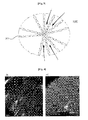
- FIG. 4 is a TEM image of the cross-section of the precursor (a) and the positive electrode active material powder (b), which were manufactured according to Example 1-1 and have concentration gradient in the entire particle
- FIG. 5 is an image indicating an a-axis and a c-axis in the positive electrode active material powder manufactured according to Example 1-1.
- the a-axis direction length to c-axis direction length ratio was increased from the center to the surface of the secondary particle, and the primary particles were arranged side by side toward the center of the particle.
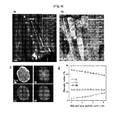
- FIG. 6 represents the result of measuring Co/Ni ratios in the primary particle of the precursor (a) and the positive electrode active material (b) manufactured according to Example 1-1.
- FIG. 6 it was confirmed that the Co/Ni ratios in the primary particle of the precursor and the positive electrode active material were gradually changed, and as a result, the Co/Ni ratio at the surface part was higher than the Co/Ni ratio at the center part.
- FIGs 7 and 8 are TEM images measuring the cross sections of the active materials manufactured in Examples 1-3 and 1-4, which had a surface maintaining section having thickness of 0.5 ⁇ m and 1.0 ⁇ m, respectively.
- FIG. 7 and FIG. 8 it was confirmed that the primary particles had orientation toward the center even when the surface maintaining section was formed, and the a-axis direction length to c-axis direction length ratio was increasing.
- FIG. 9 represents a TEM image of the cross-section of the positive electrode active material, which was manufactured in Comparative Example 1 and had constant metal concentration of Li(Ni 0.60 Co 0.15 Mn 0.25 )O 2 in the entire particle. It was confirmed that the average particle concentration was identical with that of Example 1 as Li(Ni 0.60 Co 0.15 Mn 0.25 )O 2 , but unlike the positive electrode active material having concentration gradient in the entire particle, the a-axis direction length to c-axis direction length ratio was constant and there was no orientation toward the center of the particle.
- Batteries were manufactured by using the active material particle powders manufactured in Examples 1-1 to 1-4, and then capacity, life time characteristic and DSC characteristic were measured. The results were shown in the following Table 1.
- Example 2 Manufacture of Precursor and Active Material Having Constant Mn Concentration in Entire Particle and Showing Concentration Gradients of Ni and Co in Entire Particle
- Example 1 In order to make the Mn concentration in the entire particle constant as 0.3 and concentration gradients of Co and Ni, first of all, 2.4 M metal aqueous solution, wherein nickel sulfate, cobalt sulfate and manganese sulfate are mixed at the molar ratio of 70 : 0 : 30, was used, and then the procedure of Example 1 was repeated except for continuing the reaction by using the metal aqueous solution whose concentration was changing until the concentration became 50 : 20 : 30 to obtain a precursor and an active material of Example 2-1.
- Example 2-1 The procedure of Example 2-1 was repeated except for continuing the reaction as maintaining the said molar ratio when the molar ratio of the metal aqueous solution reached 50 : 20 : 30 during the composite particle forming process for further comprising a surface maintaining sections having thickness of 0.5 ⁇ m, so as to obtain a precursor and an active material of Example 2-2.
- Approximate center of the active material particle powder manufactured in Example 2-2 was cut with a hydrogen ion beam, and a sample for measurement was prepared. Then, TEM images were taken.
- FIG. 10 represents a TEM image of the cross-section of the positive electrode active material powder manufactured according to Example 2-2. It was confirmed that the primary particles had orientation toward the center even when the Mn concentration was constant as 0.3, the concentrations of Co and Ni showed gradient, and a surface maintaining section was formed, and the a-axis direction length to c-axis direction length ratio was increasing.
- Batteries were manufactured by using the active material particle powders manufactured in Examples 2-1 to 2-2, and then capacity, life time characteristic and DSC characteristic were measured. The results were shown in the following Table 2.
- Example 1 In order to make the Co concentration in the entire particle constant as 0.1 and concentration gradients of Ni and Mn, first of all, 2.4 M metal aqueous solution, wherein nickel sulfate, cobalt sulfate and manganese sulfate are mixed at the molar ratio of 85 : 10 : 05, was used, and then the procedure of Example 1 was repeated except for continuing the reaction by using the metal aqueous solution whose concentration was changing until the concentration became 60 : 10 : 30 to obtain a positive electrode active material precursor and a positive electrode active material, thereby obtaining a positive electrode active material powder of Example 3-1.
- Example 3-1 The procedure of Example 3-1 was repeated except for continuing the reaction as maintaining the said molar ratio when the molar ratio of the metal aqueous solution reached 60 : 10 : 30 during the composite particle forming process for further comprising a surface maintaining sections having thickness of 0.2 ⁇ m and 0.5 ⁇ m, respectively, so as to obtain spherical nickel-manganese-cobalt composite hydroxide precursors of Examples 3-2 and 3-3 containing the second interior having concentration gradient and a surface maintaining section.
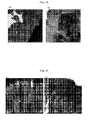
- FIGs. 11 and 12 represent TEM images of the precursor (a) of Example 3-2 and Example 3-3 and the positive electrode active material (b). It was confirmed that when the thickness of the surface maintaining section were 0.2 ⁇ m and 0.5 ⁇ m, respectively, the a-axis direction length to c-axis direction length ratio of the primary particle was increased, and the primary particles grew with the orientation toward the center of the secondary particle in both of the precursor and the active material.
- Particles having constant metal ion concentration expressed by Li(Ni 0.65 Co 0.10 Mn 0.25 )O 2 in the entire particle were manufactured, and the cross-sectional TEM image thereof was shown in FIG. 13 . It was confirmed that the particle had constant a-axis direction length to c-axis direction length ratio, and did not show the orientation toward the center of the particle.
- Batteries were manufactured by using the active material particle powders manufactured in Examples 3-1 to 3-3, and then capacity, life time characteristic and DSC characteristic were measured. The results were shown in the following Table 3.
- Ni concentration in the entire particle constant as 0.8 and concentration gradients of Co and Mn
- nickel sulfate, cobalt sulfate and manganese sulfate were mixed at the molar ratio of 80 : 20 : 00, and then the procedure of Example 1 was repeated except for continuing the reaction by using the metal aqueous solution whose concentration was changing until the concentration became 80 : 01 : 19 to obtain a positive electrode active material powder of Example 4-1, wherein the first interior had concentration of Li[Ni 0.80 Co 0.20 ]O 2 and the second interior had constant continuous concentration gradient from Li[Ni 0.80 Co 0.20 ]O 2 to Li[Ni 0.80 Co 0.01 Mn 0.19 ]O 2 .
- Example 4 The procedure of Example 4 was repeated except for continuing the reaction as maintaining the said molar ratio when the molar ratio of the metal aqueous solution reached 80 : 01 : 19 during the composite particle forming process for further comprising a surface maintaining sections having thickness of 0.2 ⁇ m and 0.5 ⁇ m, respectively, so as to obtain spherical nickel-manganese-cobalt composite hydroxides of Examples 4-2 and 4-3 containing the second interior having concentration gradient and a surface maintaining section.
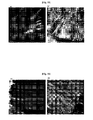
- FIG. 14 represents a TEM image of the precursor (a) and the positive electrode active material (b) of Example 4-3. It was confirmed that the a-axis direction length to c-axis direction length ratio of the primary particle was increased, and the primary particles grew with the orientation toward the center of the particle in both of the precursor and the active material, wherein the Ni concentration was constant as 0.8, the Co and Mn concentrations showed gradient, and a surface maintaining section was contained thereto.
- Particles having constant metal ion concentration expressed by Li(Ni 0.65 Co 0.10 Mn 0.25 )O 2 in the entire particle were manufactured.
- Example 5-1 In order to make the Ni concentration in the entire particle constant as 0.75 and concentration gradients of Co and Mn as Example 5-1, first of all, nickel sulfate, cobalt sulfate and manganese sulfate were mixed at the molar ratio of 75 : 25 : 00, and then the procedure of Example 1 was repeated except for continuing the reaction by using the metal aqueous solution whose concentration was changing until the concentration became 75 : 02 : 23 to obtain a positive electrode active material powder, wherein the first interior had concentration of Li[Ni 0.75 Co 0.25 ]O 2 and the second interior had constant continuous concentration gradient from Li[Ni 0.75 Co 0.25 ]O 2 to Li[Ni 0.75 Co 0.02 Mn 0.23 ]O 2 .
- Example 4 The procedure of Example 4 was repeated except for continuing the reaction as maintaining the said molar ratio when the molar ratio of the metal aqueous solution reached 75 : 02 : 23 during the composite particle forming process for further comprising a surface maintaining sections having thickness of 0.2 ⁇ m and 0.5 ⁇ m, respectively, so as to obtain spherical nickel-manganese-cobalt composite hydroxides of Examples 5-2 and 5-3 containing the second interior having concentration gradient and a surface maintaining section.
- Ni concentration in the entire particle constant as 0.70 and concentration gradients of Co and Mn as Example 6, first of all, nickel sulfate, cobalt sulfate and manganese sulfate were mixed at the molar ratio of 70 : 30 : 00, and then the procedure of Example 1 was repeated except for continuing the reaction by using the metal aqueous solution whose concentration was changing until the concentration became 70 : 02 : 28 to obtain a positive electrode active material powder, wherein the first interior had concentration of Li[Ni 0.70 Co 0.30 ]O 2 and the second interior had constant continuous concentration gradient up to Li[Ni 0.70 Co 0.02 Mn 0.28 ]O 2 .
- Example 4 The procedure of Example 4 was repeated except for continuing the reaction as maintaining the said molar ratio when the molar ratio of the metal aqueous solution reached 70 : 02 : 28 during the composite particle forming process for further comprising a surface maintaining sections having thickness of 0.2 ⁇ m and 0.5 ⁇ m, respectively, so as to obtain spherical nickel-manganese-cobalt composite hydroxides of Examples 6-2 and 6-3 containing the second interior having concentration gradient and a surface maintaining section.
- Example 7 In order to make the Ni concentration in the entire particle constant as 0.65 and concentration gradients of Co and Mn as Example 7, first of all, nickel sulfate, cobalt sulfate and manganese sulfate were mixed at the molar ratio of 65 : 35 : 00, and then the procedure of Example 1 was repeated except for continuing the reaction by using the metal aqueous solution whose concentration was changing until the concentration became 65 : 02 : 33 to obtain a positive electrode active material powder, wherein the first interior had concentration of Li[Ni 0.65 Co 0.35 ]O 2 and the second interior had constant continuous concentration gradient up to Li[Ni 0.65 Co 0.02 Mn 0.33 ]O 2 .
- Example 4 The procedure of Example 4 was repeated except for continuing the reaction as maintaining the said molar ratio when the molar ratio of the metal aqueous solution reached 65 : 02 : 33 during the composite particle forming process for further comprising a surface maintaining sections having thickness of 0.2 ⁇ m and 0.5 ⁇ m, respectively, so as to obtain spherical nickel-manganese-cobalt composite hydroxides of Examples 7-2 and 7-3 containing the second interior having concentration gradient and a surface maintaining section.
- Particles having constant metal ion concentration expressed by Li(Ni 0.62 Co 0.15 Mn 0.23 )O 2 in the entire particle were manufactured.
- Batteries were manufactured by using the active material particle powders, which were manufactured in Examples 4 to 7 and had constant Ni concentration and concentration gradients of Co and Mn in the entire particle, and then capacity, life time characteristic and DSC characteristic were measured. The results were shown in the following Table 4.
- Example 8 In order to make the Ni concentration in the entire particle constant as 0.9 and concentration gradients of Co and Mn as Example 8, first of all, nickel sulfate, cobalt sulfate and manganese sulfate were mixed at the molar ratio of 90 : 10 : 00, and then the procedure of Example 1 was repeated except for continuing the reaction by using the metal aqueous solution whose concentration was changing until the concentration became 90 : 01 : 09 to obtain a positive electrode active material powder, wherein the first interior had concentration of Li[Ni 0.90 Co 0.10 ]O 2 and the second interior had constant continuous concentration gradient up to Li[Ni 0.90 Co 0.01 Mn 0.09 ]O 2 .
- Example 9 In order to make the Ni concentration in the entire particle constant as 0.6 and concentration gradients of Co and Mn as Example 9, first of all, nickel sulfate, cobalt sulfate and manganese sulfate were mixed at the molar ratio of 60 : 40 : 00, and then the procedure of Example 1 was repeated except for continuing the reaction by using the metal aqueous solution whose concentration was changing until the concentration became 60 : 02 : 38 to obtain a positive electrode active material powder of Example 9-1, wherein the first interior had concentration of Li[Ni 0.60 Co 0.40 ]O 2 and the second interior had constant continuous concentration gradient up to Li[Ni 0.60 Co 0.02 Mn 0.38 ]O 2 .
- Example 9-2 nickel sulfate, cobalt sulfate and manganese sulfate were mixed at the molar ratio of 60 : 20 : 20, and then the procedure of Example 1 was repeated except for continuing the reaction by using the metal aqueous solution whose concentration was changing until the concentration became 60 : 02 : 38 to obtain a positive electrode active material powder of Example 9-2, wherein the first interior had concentration of Li[Ni 0.60 Co 0.20 Mn 0.20 ]O 2 and the second interior had constant continuous concentration gradient up to Li[Ni 0.60 Co 0.02 Mn 0.38 ]O 2 .
- Example 10 In order to make the Ni concentration in the entire particle constant as 0.5 and concentration gradients of Co and Mn as Example 10, first of all, nickel sulfate, cobalt sulfate and manganese sulfate were mixed at the molar ratio of 50 : 50 : 00, and then the procedure of Example 1 was repeated except for continuing the reaction by using the metal aqueous solution whose concentration was changing until the concentration became 50 : 20 : 30 to obtain a positive electrode active material powder of Example 10-1, wherein the first interior had concentration of Li[Ni 0.50 Co 0.50 ]O 2 and the second interior had constant continuous concentration gradient up to Li[Ni 0.50 Co 0.2 Mn 0.3 ]O 2 .
- Example 1 nickel sulfate, cobalt sulfate and manganese sulfate were mixed at the molar ratio of 50 : 30 : 20, and then the procedure of Example 1 was repeated except for continuing the reaction by using the metal aqueous solution whose concentration was changing until the concentration became 50 : 20 : 30 to obtain a positive electrode active material powder of Example 10-2, wherein the first interior had concentration of Li[Ni 0.50 Co 0.30 Mn 0.20 ]O 2 and the second interior had constant continuous concentration gradient up to Li[Ni 0.50 Co 0.20 Mn 0.30 ]O 2 .
- Example 10-3 nickel sulfate, cobalt sulfate and manganese sulfate were mixed at the molar ratio of 50 : 20 : 30, and then the procedure of Example 1 was repeated except for continuing the reaction by using the metal aqueous solution whose concentration was changing until the concentration became 50 : 05 : 45 to obtain a positive electrode active material powder of Example 10-3, wherein the first interior had concentration of Li[Ni 0.50 Co 0.20 Mn 0.30 ]O 2 and the second interior had constant continuous concentration gradient up to Li[Ni 0.50 Co 0.05 Mn 0.45 ]O 2 .
- Batteries were manufactured by using the active material particle powders, which were manufactured in Examples 8 to 10 and had constant Ni concentration and concentration gradients of Co and Mn in the entire particle, and then capacity, life time characteristic and DSC characteristic were measured. The results were shown in the following Table 5.
- Ni:Co:Mn Example 11-1 55:15:30
- Example 11-2 55:20:25
- Example 11-3 60:15:25
- Example 11-4 60:10:30
- Particles having constant metal ion concentration expressed by Li(Ni 0.62 Co 0.13 Mn 0.25 )O 2 in the entire particle were manufactured.
- Batteries were manufactured by using the active material particle powders manufactured in Examples 11 to 11-4, and then capacity, life time characteristic and DSC characteristic were measured. The results were shown in the following Table 7.
- Particles having constant metal ion concentration expressed by Li(Ni 0.62 Co 0.15 Mn 0.23 )O 2 in the entire particle were manufactured.
- Batteries were manufactured by using the active material particle powders manufactured in Examples 12 to 12-4, and then capacity, life time characteristic and DSC characteristic were measured. The results were shown in the following Table 9.
- Example 13-6 A sample of the nickel-manganese-cobalt composite hydroxide manufactured in Example 13-6 was manufactured, and then a TEM image was taken. The result was shown in FIG. 17 .
- Particles having constant metal ion concentration expressed by Li(Ni 0.68 Co 0.12 Mn 0.20 )O 2 in the entire particle were manufactured.
- Batteries were manufactured by using the active material particle powders manufactured in Examples 13-1 to 13-6, and then capacity, life time characteristic and DSC characteristic were measured. The results were shown in the following Table 11.
- Example 1 In order to manufacture a positive electrode active material precursor and a positive electrode active material continuously comprising the first interior, wherein the Co composition was constant, and the Ni and Mn compositions showed concentration gradient, and the second interior, wherein the Mn composition was constant, and the Co and Ni compositions showed concentration gradient, the procedure of Example 1 was repeated except for using a metal aqueous solution whose concentration was changing until the concentration became 55:20:25 while mixing a mixture of nickel sulfate, cobalt sulfate and manganese sulfate at the composition of 65:10:25 to a mixture of nickel sulfate, cobalt sulfate and manganese sulfate at the composition of 75:10:15 to manufacture a positive electrode active material particle, so as to obtain a positive electrode active material precursor positive electrode active material of Example 14-1, wherein in the first interior, the Co composition was constant, and the Ni and Mn compositions showed concentration gradient, and in the second interior, wherein the Mn composition was constant, and the Co
- Example 4 The procedure of Example 4 was repeated except for continuing the reaction as maintaining the said molar ratio when the molar ratio of the metal aqueous solution reached 55 : 20 : 25 during the particle forming process for further comprising surface maintaining sections having thickness of 0.2 ⁇ m and 0.5 ⁇ m, respectively, so as to obtain spherical nickel-manganese-cobalt composite hydroxides of Examples 14-2 and 14-3 containing the second interior having concentration gradient and a surface maintaining section.
- Batteries were manufactured by using the active material particle powders manufactured in Examples 14-1 to 14-3, and then capacity, life time characteristic and DSC characteristic were measured. The results were shown in the following Table 12.
- FIGs. 18 and 19 represent TEM images of the core part (a) having constant concentration and the shell part (b) showing concentration gradient.
- the core part having constant concentration was in the form of a circle, but the a-axis direction length to c-axis direction length ratio of the primary particle was increased in the shell part showing concentration gradient.
- Example 16-1 90:05:05 50:20:30 0.2 ⁇ m
- Example 16-2 80:10:10 50:20:30 0.2 ⁇ m
- Example 16-3 70:10:20 50:20:30 0.2 ⁇ m
- Example 16-7 70:10:20 50:20:30 1.0 ⁇ m
- Example 16-8 70:10:20 50:20:30 1.5 ⁇ m
- Example 16-9 70:10:20 50:20:30 2.0 ⁇ m
- the active material particle manufactured in Example of the present invention was determined that Ni oxidation number from the surface to the 2 ⁇ m depth was +2 or more. Accordingly, it was confirmed that the oxidation numbers +2 and +3 were mixed, and the oxidation numbers of Mn and Co were constant.
- the a-axis direction length to c-axis direction length ratio is changed primary particle from the center to the surface in the interior of the secondary particle, and the a-axis orientation of the primary particle is headed to the center of the positive electrode active material as a secondary particle, and the particles are adjoining each other and grow to a fixed route. Accordingly, it has effects that insertion and secession of a lithium ion may become easier, and high capacity can be obtained by reduced electric resistance between particles.
Landscapes
- Chemical & Material Sciences (AREA)
- Chemical Kinetics & Catalysis (AREA)
- Electrochemistry (AREA)
- General Chemical & Material Sciences (AREA)
- Engineering & Computer Science (AREA)
- Inorganic Chemistry (AREA)
- Materials Engineering (AREA)
- Organic Chemistry (AREA)
- Manufacturing & Machinery (AREA)
- Composite Materials (AREA)
- Battery Electrode And Active Subsutance (AREA)
Priority Applications (2)
| Application Number | Priority Date | Filing Date | Title |
|---|---|---|---|
| EP17169793.1A EP3236517B1 (fr) | 2012-06-08 | 2013-06-10 | Précurseur de matériau actif d'électrode positive pour batterie secondaire au lithium, matériau actif d'électrode positive fabriqué à l'aide de celui-ci et batterie secondaire au lithium le comprenant |
| PL13799899T PL2882013T3 (pl) | 2012-06-08 | 2013-06-10 | Prekursor materiału aktywnego elektrody dodatniej dla litowej baterii akumulatorowej, materiał aktywny elektrody dodatniej wytworzony przy jego użyciu oraz zawierająca go litowa bateria akumulatorowa |
Applications Claiming Priority (3)
| Application Number | Priority Date | Filing Date | Title |
|---|---|---|---|
| KR20120061836 | 2012-06-08 | ||
| KR20120115047A KR20130138073A (ko) | 2012-06-08 | 2012-10-16 | 리튬 이차 전지용 양극활물질 전구체, 이를 이용하여 제조된 양극활물질 및 이를 포함하는 리튬 이차 전지 |
| PCT/KR2013/005084 WO2013183974A1 (fr) | 2012-06-08 | 2013-06-10 | Précurseur de matériau actif d'anode pour batterie secondaire au lithium, matériau actif d'anode fabriqué en l'utilisant, et batterie secondaire au lithium le comprenant |
Related Child Applications (2)
| Application Number | Title | Priority Date | Filing Date |
|---|---|---|---|
| EP17169793.1A Division EP3236517B1 (fr) | 2012-06-08 | 2013-06-10 | Précurseur de matériau actif d'électrode positive pour batterie secondaire au lithium, matériau actif d'électrode positive fabriqué à l'aide de celui-ci et batterie secondaire au lithium le comprenant |
| EP17169793.1A Division-Into EP3236517B1 (fr) | 2012-06-08 | 2013-06-10 | Précurseur de matériau actif d'électrode positive pour batterie secondaire au lithium, matériau actif d'électrode positive fabriqué à l'aide de celui-ci et batterie secondaire au lithium le comprenant |
Publications (4)
| Publication Number | Publication Date |
|---|---|
| EP2882013A1 true EP2882013A1 (fr) | 2015-06-10 |
| EP2882013A4 EP2882013A4 (fr) | 2015-11-11 |
| EP2882013B1 EP2882013B1 (fr) | 2022-01-12 |
| EP2882013B8 EP2882013B8 (fr) | 2022-03-16 |
Family
ID=49984043
Family Applications (2)
| Application Number | Title | Priority Date | Filing Date |
|---|---|---|---|
| EP13799899.3A Active EP2882013B8 (fr) | 2012-06-08 | 2013-06-10 | Précurseur de matériau actif d'électrode positive pour batterie secondaire au lithium, matériau actif d'électrode positive fabriqué en l'utilisant, et batterie secondaire au lithium le comprenant |
| EP17169793.1A Active EP3236517B1 (fr) | 2012-06-08 | 2013-06-10 | Précurseur de matériau actif d'électrode positive pour batterie secondaire au lithium, matériau actif d'électrode positive fabriqué à l'aide de celui-ci et batterie secondaire au lithium le comprenant |
Family Applications After (1)
| Application Number | Title | Priority Date | Filing Date |
|---|---|---|---|
| EP17169793.1A Active EP3236517B1 (fr) | 2012-06-08 | 2013-06-10 | Précurseur de matériau actif d'électrode positive pour batterie secondaire au lithium, matériau actif d'électrode positive fabriqué à l'aide de celui-ci et batterie secondaire au lithium le comprenant |
Country Status (8)
| Country | Link |
|---|---|
| US (2) | US9337487B2 (fr) |
| EP (2) | EP2882013B8 (fr) |
| KR (5) | KR20130138073A (fr) |
| CN (3) | CN107093740B (fr) |
| ES (1) | ES2910046T3 (fr) |
| HU (1) | HUE058161T2 (fr) |
| PL (1) | PL2882013T3 (fr) |
| WO (1) | WO2013183974A1 (fr) |
Cited By (16)
| Publication number | Priority date | Publication date | Assignee | Title |
|---|---|---|---|---|
| CN107611355A (zh) * | 2016-07-11 | 2018-01-19 | Ecopro Bm有限公司 | 锂二次电池用锂复合氧化物及其制备方法 |
| EP3272710A1 (fr) * | 2016-07-20 | 2018-01-24 | Samsung SDI Co., Ltd. | Matériau actif à base de nickel pour batterie secondaire au lithium, son procédé de préparation et batterie secondaire au lithium incorporant une électrode positive comprenant le matériau actif à base de nickel |
| EP3272711A1 (fr) * | 2016-07-20 | 2018-01-24 | Samsung SDI Co., Ltd. | Matériau actif à base de nickel pour batterie secondaire au lithium, son procédé de préparation et batterie secondaire au lithium comprenant une électrode positive l'incorporant |
| US20180040891A1 (en) * | 2016-08-02 | 2018-02-08 | Ecopro Bm Co., Ltd. | Lithium Complex Oxide for Lithium Secondary Battery Positive Active Material and Method of Preparing the Same |
| CN107681150A (zh) * | 2016-08-02 | 2018-02-09 | Ecopro Bm有限公司 | 锂二次电池用锂复合氧化物及其制备方法 |
| CN107681127A (zh) * | 2016-08-02 | 2018-02-09 | Ecopro Bm有限公司 | 锂二次电池用锂复合氧化物及其制备方法 |
| CN107681151A (zh) * | 2016-08-02 | 2018-02-09 | Ecopro Bm有限公司 | 锂二次电池用锂复合氧化物及其制备方法 |
| EP3312912A4 (fr) * | 2015-06-17 | 2018-05-02 | LG Chem, Ltd. | Matériau actif de cathode pour batterie secondaire, son procédé de préparation, et batterie secondaire le comprenant |
| EP3249723A4 (fr) * | 2015-09-30 | 2018-05-02 | LG Chem, Ltd. | Matériau actif de cathode pour pile rechargeable et pile rechargeable le comprenant |
| EP3441366A4 (fr) * | 2016-04-08 | 2020-01-22 | IUCF-HYU (Industry-University Cooperation Foundation Hanyang University) | Matériau actif d'électrode positive, son procédé de préparation, et batterie rechargeable au lithium le comprenant |
| EP3557668A4 (fr) * | 2016-12-20 | 2020-02-19 | BYD Company Limited | Matériau ternaire et son procédé de préparation, bouillie de batterie, électrode positive et batterie au lithium |
| CN113488626A (zh) * | 2016-07-11 | 2021-10-08 | Ecopro Bm有限公司 | 锂二次电池用锂复合氧化物及其制备方法 |
| EP3770121A4 (fr) * | 2018-03-23 | 2022-01-05 | Sumitomo Chemical Company Limited | Oxyde métallique contenant du lithium, matériau actif d'électrode positive pour batteries secondaires au lithium, électrode positive pour batteries secondaires au lithium, et batterie secondaire au lithium |
| US11309542B2 (en) | 2016-12-08 | 2022-04-19 | Samsung Sdi Co., Ltd. | Nickel-based active material for lithium secondary battery, preparing method thereof, and lithium secondary battery including positive electrode including the same |
| US11456458B2 (en) | 2016-12-08 | 2022-09-27 | Samsung Sdi Co., Ltd. | Nickel-based active material precursor for lithium secondary battery, preparing method thereof, nickel-based active material for lithium secondary battery formed thereof, and lithium secondary battery comprising positive electrode including the nickel-based active material |
| EP4657566A1 (fr) * | 2024-05-31 | 2025-12-03 | Prime Planet Energy & Solutions, Inc. | Matériau actif d'électrode positive, plaque d'électrode positive et batterie secondaire à électrolyte non aqueux |
Families Citing this family (134)
| Publication number | Priority date | Publication date | Assignee | Title |
|---|---|---|---|---|
| KR20130138073A (ko) * | 2012-06-08 | 2013-12-18 | 한양대학교 산학협력단 | 리튬 이차 전지용 양극활물질 전구체, 이를 이용하여 제조된 양극활물질 및 이를 포함하는 리튬 이차 전지 |
| AU2014248900C1 (en) | 2013-03-12 | 2017-06-08 | Apple Inc. | High voltage, high volumetric energy density Li-ion battery using advanced cathode materials |
| WO2016126095A1 (fr) * | 2015-02-02 | 2016-08-11 | 한양대학교 산학협력단 | Matériau actif d'électrode positive et batterie rechargeable le comprenant |
| KR20150134259A (ko) | 2014-05-21 | 2015-12-01 | 주식회사 에너세라믹 | 리튬복합금속산화물 및 이를 포함하는 리튬이차전지 |
| US10217991B2 (en) * | 2014-06-02 | 2019-02-26 | Sk Innovation Co., Ltd. | Lithium secondary battery |
| US10490851B2 (en) * | 2014-06-02 | 2019-11-26 | Sk Innovation Co., Ltd. | Lithium secondary battery |
| JP6246079B2 (ja) * | 2014-06-18 | 2017-12-13 | 日本碍子株式会社 | リチウム二次電池用正極活物質板の製造方法 |
| WO2016002158A1 (fr) * | 2014-06-30 | 2016-01-07 | 三洋電機株式会社 | Matière active d'électrode positive pour batterie secondaire à électrolyte non aqueux, et batterie secondaire à électrolyte non aqueux mettant en œuvre celle-ci |
| US9716265B2 (en) | 2014-08-01 | 2017-07-25 | Apple Inc. | High-density precursor for manufacture of composite metal oxide cathodes for Li-ion batteries |
| KR101568263B1 (ko) * | 2014-08-07 | 2015-11-11 | 주식회사 에코프로 | 리튬 이차 전지용 양극활물질 및 이를 포함하는 리튬 이차 전지 |
| KR101577179B1 (ko) * | 2014-09-11 | 2015-12-16 | 주식회사 에코프로 | 리튬 이차 전지용 양극활물질 및 이를 포함하는 리튬 이차 전지 |
| KR101555594B1 (ko) * | 2014-10-02 | 2015-10-06 | 주식회사 에코프로 | 리튬 이차 전지용 양극활물질 및 이를 포함하는 리튬 이차 전지 |
| KR101593401B1 (ko) * | 2014-10-14 | 2016-02-12 | 주식회사 이엔에프테크놀로지 | 다공성 구조를 갖는 리튬전지용 양극활물질 및 제조방법 |
| CN107112515B (zh) | 2014-10-28 | 2020-08-18 | 株式会社Lg 化学 | 锂二次电池用正极活性材料、其制备方法和包含其的锂二次电池 |
| EP3215462A1 (fr) | 2014-11-07 | 2017-09-13 | Basf Se | Oxyde mixte de métaux de transition pour batteries à ions lithium |
| KR102311460B1 (ko) * | 2014-11-21 | 2021-10-08 | 에스케이이노베이션 주식회사 | 리튬 이차 전지 |
| KR102296877B1 (ko) * | 2014-12-03 | 2021-08-31 | 에스케이이노베이션 주식회사 | 리튬 이차 전지 |
| KR102312369B1 (ko) * | 2014-12-16 | 2021-10-12 | 에스케이이노베이션 주식회사 | 리튬 이차 전지 |
| KR102349703B1 (ko) * | 2014-12-22 | 2022-01-12 | 에스케이온 주식회사 | 리튬 이차 전지 |
| KR102296819B1 (ko) * | 2014-12-30 | 2021-08-31 | 에스케이이노베이션 주식회사 | 리튬 이차 전지 |
| WO2016175597A1 (fr) * | 2015-04-30 | 2016-11-03 | 주식회사 엘지화학 | Matériau actif de cathode pour batterie secondaire, procédé de préparation associé et batterie secondaire le comprenant |
| JP6564064B2 (ja) * | 2015-04-30 | 2019-08-21 | エルジー・ケム・リミテッド | 二次電池用正極活物質、この製造方法及びこれを含む二次電池 |
| KR102366065B1 (ko) * | 2015-06-11 | 2022-02-21 | 에스케이온 주식회사 | 리튬 이차 전지 |
| KR102494741B1 (ko) | 2015-08-10 | 2023-01-31 | 에스케이온 주식회사 | 리튬 이차 전지 |
| WO2017058650A1 (fr) | 2015-09-30 | 2017-04-06 | Hongli Dai | Matériaux actifs de cathode, leurs précurseurs et procédés de préparation |
| KR101982790B1 (ko) * | 2015-10-20 | 2019-05-27 | 주식회사 엘지화학 | 다층 구조의 리튬 금속 산화물들을 포함하는 리튬 이차전지용 양극 활물질 및 그것을 포함하는 양극 |
| KR102006207B1 (ko) * | 2015-11-30 | 2019-08-02 | 주식회사 엘지화학 | 이차전지용 양극활물질 및 이를 포함하는 이차전지 |
| KR101927295B1 (ko) | 2015-11-30 | 2018-12-10 | 주식회사 엘지화학 | 이차전지용 양극활물질 및 이를 포함하는 이차전지 |
| EP3386014B1 (fr) * | 2015-11-30 | 2024-05-29 | LG Energy Solution, Ltd. | Matériau actif de cathode pour accumulateur et accumulateur comprenant celui-ci |
| WO2017095139A1 (fr) * | 2015-11-30 | 2017-06-08 | 주식회사 엘지화학 | Matériau actif d'électrode positive pour pile rechargeable et pile rechargeable le comprenant |
| WO2017095134A1 (fr) * | 2015-11-30 | 2017-06-08 | 주식회사 엘지화학 | Matière active de cathode pour batterie secondaire et batterie secondaire la comprenant |
| JP6737586B2 (ja) * | 2015-11-30 | 2020-08-12 | トヨタ自動車株式会社 | 正極活物質とそれを用いたリチウムイオン二次電池 |
| KR102004457B1 (ko) * | 2015-11-30 | 2019-07-29 | 주식회사 엘지화학 | 이차전지용 양극활물질 및 이를 포함하는 이차전지 |
| WO2017095133A1 (fr) * | 2015-11-30 | 2017-06-08 | 주식회사 엘지화학 | Matériau actif de cathode pour une batterie rechargeable et batterie rechargeable comprenant ce dernier |
| KR20200091960A (ko) * | 2016-02-08 | 2020-07-31 | 가부시키가이샤 무라타 세이사쿠쇼 | 이차 전지용 정극 활물질, 이차 전지용 정극, 이차 전지, 전지 팩, 전동 차량, 전력 저장 시스템, 전동 공구 및 전자 기기 |
| JP6723545B2 (ja) * | 2016-03-04 | 2020-07-15 | エルジー・ケム・リミテッド | 二次電池用正極活物質、その製造方法およびこれを含む二次電池 |
| KR101937896B1 (ko) | 2016-03-04 | 2019-01-14 | 주식회사 엘지화학 | 이차전지용 양극활물질의 전구체 및 이를 이용하여 제조된 양극활물질 |
| WO2017150949A1 (fr) * | 2016-03-04 | 2017-09-08 | 주식회사 엘지화학 | Matériau actif de cathode pour accumulateur, son procédé de fabrication, et accumulateur le comprenant |
| WO2017160856A1 (fr) | 2016-03-14 | 2017-09-21 | Apple Inc. | Matériaux actifs de cathode pour batteries au lithium-ion |
| KR101684219B1 (ko) * | 2016-04-05 | 2016-12-08 | 한양대학교 산학협력단 | 양극활물질, 및 이를 포함하는 이차 전지 |
| KR102307908B1 (ko) * | 2016-07-20 | 2021-10-05 | 삼성에스디아이 주식회사 | 리튬이차전지용 니켈계 활물질, 그 제조방법 및 이를 포함하는 양극을 포함한 리튬이차전지 |
| KR102295366B1 (ko) * | 2016-07-20 | 2021-08-31 | 삼성에스디아이 주식회사 | 리튬이차전지용 니켈계 활물질, 그 제조방법 및 이를 포함하는 양극을 포함한 리튬이차전지 |
| US11476460B2 (en) | 2016-07-29 | 2022-10-18 | Sumitomo Metal Mining Co., Ltd. | Nickel manganese composite hydroxide and method for producing same, positive electrode active material for nonaqueous electrolyte secondary battery and method for producing same, and nonaqueous electrolyte secondary battery |
| JP7215169B2 (ja) | 2016-07-29 | 2023-01-31 | 住友金属鉱山株式会社 | ニッケルマンガン複合水酸化物とその製造方法、非水系電解質二次電池用正極活物質とその製造方法、および非水系電解質二次電池 |
| KR101912202B1 (ko) * | 2016-08-02 | 2018-10-26 | 주식회사 에코프로비엠 | 리튬 이차전지용 리튬복합 산화물 및 이의 제조 방법 |
| KR101874340B1 (ko) * | 2016-08-02 | 2018-07-05 | 주식회사 에코프로비엠 | 리튬 이차전지용 리튬복합 산화물 및 이의 제조 방법 |
| WO2018057584A1 (fr) | 2016-09-20 | 2018-03-29 | Apple Inc. | Matériaux actifs de cathode présentant des morphologies de particules améliorées |
| JP2019530630A (ja) | 2016-09-21 | 2019-10-24 | アップル インコーポレイテッドApple Inc. | リチウムイオン電池用の表面安定化カソード材料及びその合成方法 |
| KR102332440B1 (ko) * | 2016-10-28 | 2021-11-26 | 삼성에스디아이 주식회사 | 리튬 이차 전지용 양극 활물질, 이의 제조 방법 및 이를 포함하는 리튬 이차 전지 |
| KR101897365B1 (ko) * | 2016-11-23 | 2018-09-10 | 울산과학기술원 | 리튬 이차전지용 양극 활물질, 이들의 제조방법, 및 이를 포함하는 리튬 이차전지 |
| CN110073527B (zh) | 2016-12-02 | 2023-07-14 | 三星Sdi株式会社 | 镍活性物质前驱体及其制备方法、镍活性物质以及锂二次电池 |
| CN110226251B (zh) * | 2016-12-02 | 2022-07-05 | 三星Sdi株式会社 | 镍活性物质前驱体及其制备方法、镍活性物质以及锂二次电池 |
| KR102172842B1 (ko) | 2016-12-02 | 2020-11-02 | 삼성에스디아이 주식회사 | 리튬이차전지용 니켈계 활물질 전구체, 그 제조방법, 이로부터 형성된 리튬이차전지용 니켈계 활물질 및 이를 포함하는 양극을 함유한 리튬이차전지 |
| KR102025190B1 (ko) | 2016-12-22 | 2019-09-25 | 주식회사 포스코 | 양극 활물질, 이의 제조 방법, 및 이를 포함하는 리튬 이차 전지 |
| US20180183046A1 (en) * | 2016-12-28 | 2018-06-28 | Lg Chem, Ltd. | Positive electrode active material for lithium secondary battery, method for preparing the same, and lithium secondary battery including the same |
| KR102117621B1 (ko) * | 2016-12-28 | 2020-06-02 | 주식회사 엘지화학 | 리튬이차전지용 양극활물질, 이의 제조방법, 및 이를 포함하는 리튬 이차전지 |
| KR101866105B1 (ko) * | 2016-12-30 | 2018-06-08 | 울산과학기술원 | 표면처리된 활물질 및 이의 표면처리 방법 |
| KR102086100B1 (ko) * | 2017-03-31 | 2020-03-06 | (주)포스코케미칼 | 금속이 코팅된 리튬 이차 전지용 양극활물질의 제조방법 및 이의 의하여 제조된 리튬 이차 전지용 양극활물질 |
| WO2019013605A1 (fr) * | 2017-07-14 | 2019-01-17 | 한양대학교 산학협력단 | Matériau actif positif, son procédé de fabrication, et batterie secondaire au lithium le comprenant |
| CN107579236B (zh) * | 2017-09-13 | 2021-11-05 | 桑顿新能源科技(长沙)有限公司 | 全梯度高镍三元前驱体及全梯度高镍三元正极材料的制备方法 |
| KR102130484B1 (ko) * | 2017-11-15 | 2020-07-06 | 주식회사 에코프로비엠 | 이차전지용 양극 활물질 및 이의 제조 방법 |
| JP7049551B2 (ja) | 2017-11-21 | 2022-04-07 | エルジー エナジー ソリューション リミテッド | 二次電池用正極材及びこれを含むリチウム二次電池 |
| KR102268079B1 (ko) * | 2017-11-21 | 2021-06-23 | 주식회사 엘지화학 | 이차전지용 양극 활물질, 그 제조방법 및 이를 포함하는 리튬 이차전지 |
| KR102159243B1 (ko) | 2017-11-22 | 2020-09-23 | 주식회사 에코프로비엠 | 리튬 이차 전지용 양극활물질 |
| KR102041578B1 (ko) * | 2017-12-08 | 2019-11-06 | 주식회사 포스코 | 리튬 이차 전지용 양극 활물질 및 이를 포함하는 리튬 이차 전지 |
| KR20190075729A (ko) | 2017-12-21 | 2019-07-01 | 재단법인 포항산업과학연구원 | 리튬 이차 전지용 양극 활물질 및 이의 제조 방법, 상기 양극 활물질을 포함하는 리튬 이차 전지 |
| KR102472882B1 (ko) * | 2018-01-18 | 2022-11-30 | 에스케이온 주식회사 | 리튬 이차 전지 |
| CN111656585A (zh) * | 2018-01-29 | 2020-09-11 | 三星Sdi株式会社 | 用于锂二次电池的阴极活性物质和包括其的锂二次电池 |
| KR102410662B1 (ko) | 2018-02-01 | 2022-06-17 | 주식회사 엘지에너지솔루션 | 이차전지용 양극 활물질, 그 제조방법 및 이를 포함하는 리튬 이차전지 |
| KR102313092B1 (ko) | 2018-04-04 | 2021-10-18 | 주식회사 엘지화학 | 리튬 이차전지용 양극 활물질의 제조방법, 리튬 이차전지용 양극 활물질, 이를 포함하는 리튬 이차전지용 양극 및 리튬 이차전지 |
| WO2019194609A1 (fr) | 2018-04-04 | 2019-10-10 | 주식회사 엘지화학 | Procédé de fabrication de matériau de cathode active pour batterie secondaire au lithium, matériau de cathode active pour batterie secondaire au lithium, cathode comprenant celui-ci pour batterie secondaire au lithium et batterie secondaire au lithium comprenant celui-ci |
| KR102302038B1 (ko) | 2018-05-11 | 2021-09-15 | 주식회사 엘지화학 | 리튬 이차전지용 양극 활물질, 이의 제조방법, 이를 포함하는 리튬 이차전지용 양극 및 리튬 이차전지 |
| CN108649205A (zh) * | 2018-05-15 | 2018-10-12 | 哈尔滨工业大学 | 一种具有变斜率浓度梯度掺杂结构的锂离子电池正极材料及其制备 |
| KR102453273B1 (ko) | 2018-05-23 | 2022-10-11 | 주식회사 엘지에너지솔루션 | 리튬 이차전지용 양극재, 이를 포함하는 리튬 이차전지용 양극 및 리튬 이차전지 |
| KR102256298B1 (ko) | 2018-06-26 | 2021-05-26 | 삼성에스디아이 주식회사 | 리튬이차전지용 니켈계 활물질 전구체, 이의 제조방법, 이로부터 형성된 리튬이차전지용 니켈계 활물질 및 이를 포함하는 양극을 함유한 리튬이차전지 |
| KR102288296B1 (ko) | 2018-06-28 | 2021-08-10 | 주식회사 엘지화학 | 리튬 이차전지용 양극 활물질, 이의 제조방법, 이를 포함하는 리튬 이차전지용 양극 및 리튬 이차전지 |
| KR102513950B1 (ko) * | 2018-07-06 | 2023-03-23 | 에스케이온 주식회사 | 리튬 이차 전지 |
| KR102513949B1 (ko) * | 2018-07-06 | 2023-03-23 | 에스케이온 주식회사 | 리튬 이차 전지 |
| EP3591748B1 (fr) | 2018-07-06 | 2026-01-07 | SK On Co., Ltd. | Batterie secondaire au lithium |
| CN108878869B (zh) * | 2018-07-31 | 2021-07-13 | 桑顿新能源科技(长沙)有限公司 | 锂离子电池用梯度结构的ncm三元正极材料及制法与应用 |
| US11695108B2 (en) | 2018-08-02 | 2023-07-04 | Apple Inc. | Oxide mixture and complex oxide coatings for cathode materials |
| US11721807B2 (en) | 2018-08-14 | 2023-08-08 | Samsung Sdi Co., Ltd. | Nickel-based active material precursor for lithium secondary battery, preparation method thereof, nickel-based active material for lithium secondary battery formed therefrom, and lithium secondary battery including cathode including the nickel-based active material |
| US11749799B2 (en) | 2018-08-17 | 2023-09-05 | Apple Inc. | Coatings for cathode active materials |
| KR102272266B1 (ko) * | 2018-08-27 | 2021-07-02 | 삼성에스디아이 주식회사 | 리튬 이차 전지용 양극 활물질, 이의 제조방법 및 이를 포함하는 리튬 이차 전지 |
| KR102299253B1 (ko) | 2018-09-12 | 2021-09-07 | 주식회사 포스코 | 양극 활물질, 이의 제조 방법, 및 이를 포함하는 리튬 이차 전지 |
| US11349118B2 (en) | 2018-09-24 | 2022-05-31 | Uchicago Argonne, Llc | Tangent gradient concentration material for battery, digital gradient concentration material for battery |
| KR102182358B1 (ko) * | 2018-11-02 | 2020-11-24 | 삼성에스디아이 주식회사 | 리튬 이차 전지용 양극 활물질, 이의 제조 방법 및 이를 포함하는 리튬 이차 전지 |
| KR102309288B1 (ko) * | 2018-11-13 | 2021-10-07 | 한양대학교 산학협력단 | 양극활물질 및 이를 포함하는 리튬이차전지 |
| KR102382916B1 (ko) * | 2019-01-24 | 2022-04-06 | 주식회사 배터리솔루션 | 도핑원소를 포함하는 리튬이차전지용 복합금속산화물, 이로부터 형성된 리튬이차전지용 양극활물질 및 이를 포함하는 리튬이차전지 |
| WO2020153833A1 (fr) * | 2019-01-24 | 2020-07-30 | 한양대학교 산학협력단 | Oxyde métallique composite pour batterie secondaire au lithium comprenant un élément dopant, matériau actif d'électrode positive pour batterie secondaire au lithium préparé à partir de celui-ci et batterie secondaire au lithium en comprenant |
| US10978741B2 (en) | 2019-02-04 | 2021-04-13 | Uchicago Argonne, Llc | Non-aqueous electrolytes for electrochemical cells |
| US12334552B2 (en) | 2019-05-02 | 2025-06-17 | Dong-A University Research Foundation For Industry-Academy Cooperation | Positive active material for rechargeable lithium battery, method of preparing the same, and rechargeable lithium battery including the same |
| EP3989316A4 (fr) * | 2019-07-10 | 2023-08-09 | Battery Solution | Matériau actif de cathode pour batterie secondaire au lithium, procédé de fabrication associé et batterie secondaire au lithium le comprenant |
| KR102242486B1 (ko) * | 2019-08-19 | 2021-04-21 | 주식회사 에코프로비엠 | 양극 활물질 및 이를 포함하는 리튬 이차전지 |
| US12206100B2 (en) | 2019-08-21 | 2025-01-21 | Apple Inc. | Mono-grain cathode materials |
| US12074321B2 (en) | 2019-08-21 | 2024-08-27 | Apple Inc. | Cathode active materials for lithium ion batteries |
| US11757096B2 (en) | 2019-08-21 | 2023-09-12 | Apple Inc. | Aluminum-doped lithium cobalt manganese oxide batteries |
| KR102611043B1 (ko) | 2019-08-28 | 2023-12-06 | 에스케이온 주식회사 | 리튬 이차 전지 |
| JP7386988B2 (ja) * | 2019-10-23 | 2023-11-27 | エルジー・ケム・リミテッド | 正極活物質、これを含む正極およびリチウム二次電池 |
| CN112886001B (zh) * | 2019-11-29 | 2024-07-26 | 艾可普罗Bm有限公司 | 正极活性材料及包括其的锂二次电池 |
| KR102300282B1 (ko) * | 2019-12-04 | 2021-09-10 | (주)이엠티 | 고온 저장 특성이 우수한 리튬이온 이차전지용 양극 활물질, 이를 포함하는 리튬이온 이차전지 및 그 제조 방법 |
| EP4084137A4 (fr) * | 2019-12-26 | 2024-01-24 | Iucf-Hyu (Industry-University Cooperation Foundation Hanyang University) | Matériau actif d'électrode positive contenant du fluor pour batterie secondaire au lithium, et batterie secondaire au lithium le comprenant |
| WO2021154026A1 (fr) * | 2020-01-29 | 2021-08-05 | 주식회사 엘지화학 | Précurseur de matériau actif d'électrode positive pour batterie secondaire, matériau actif d'électrode positive et batterie secondaire au lithium le comprenant |
| WO2021154021A1 (fr) * | 2020-01-29 | 2021-08-05 | 주식회사 엘지화학 | Précurseur de matériau actif d'électrode positive pour batterie secondaire, matériau actif d'électrode positive, et batterie secondaire au lithium le comprenant |
| EP4037030A4 (fr) * | 2020-01-29 | 2022-12-21 | Lg Chem, Ltd. | Précurseur de matériau actif d'électrode positive pour batterie secondaire, matériau actif d'électrode positive, son procédé de production, et batterie secondaire au lithium le comprenant |
| CN115152054A (zh) * | 2020-02-21 | 2022-10-04 | 辰星锂电 | 具有超细晶粒和高取向一次颗粒的正电极活性材料以及包括其的锂二次电池 |
| CN113193186B (zh) * | 2020-03-20 | 2025-05-30 | 宁德新能源科技有限公司 | 正极活性材料、电化学装置和电子装置 |
| KR102606683B1 (ko) * | 2020-03-26 | 2023-11-28 | 주식회사 엘지화학 | 양극 활물질의 제조 방법 |
| KR102339704B1 (ko) * | 2020-06-18 | 2021-12-15 | 주식회사 에코프로비엠 | 양극 활물질 및 이를 포함하는 리튬 이차전지 |
| CA3180426A1 (fr) | 2020-06-25 | 2021-12-30 | Richard K. Holman | Structure d'alliage microcomposite |
| KR102713195B1 (ko) * | 2020-08-25 | 2024-10-04 | 한양대학교 산학협력단 | 무코발트 양극활물질 및 이를 포함하는 리튬이차전지 |
| AU2021349358A1 (en) | 2020-09-24 | 2023-02-09 | 6K Inc. | Systems, devices, and methods for starting plasma |
| KR102586106B1 (ko) * | 2020-10-29 | 2023-10-05 | 삼성에스디아이 주식회사 | 리튬 이차 전지용 양극 활물질, 이의 제조 방법 및 이를 포함하는 리튬 이차전지 |
| CA3196653A1 (fr) | 2020-10-30 | 2022-05-05 | Sunil Bhalchandra BADWE | Systemes et procedes de synthese de poudres metalliques spheroidales |
| KR102624905B1 (ko) * | 2020-11-25 | 2024-01-12 | (주)포스코퓨처엠 | 배향성 구조를 갖는 리튬전지용 양극활물질 및 이의 제조방법 |
| CN116325225A (zh) * | 2020-12-04 | 2023-06-23 | 艾可普罗 Bm 有限公司 | 正极活性物质及包括其的锂二次电池 |
| US20230387405A1 (en) | 2021-01-08 | 2023-11-30 | Lg Chem, Ltd. | Positive Electrode Active Material, and Positive Electrode and Lithium Secondary Battery Which Include the Same |
| AU2022206483A1 (en) | 2021-01-11 | 2023-08-31 | 6K Inc. | Methods and systems for reclamation of li-ion cathode materials using microwave plasma processing |
| CN112786834A (zh) * | 2021-01-26 | 2021-05-11 | 蜂巢能源科技有限公司 | 一种正极极片及包含其的锂离子电池 |
| JP7691194B2 (ja) * | 2021-03-22 | 2025-06-11 | エルジー・ケム・リミテッド | 正極活物質、これを含む正極及びリチウム二次電池 |
| US20240145672A1 (en) | 2021-03-22 | 2024-05-02 | Lg Chem, Ltd. | Positive Electrode Active Material, Positive Electrode Including the Same, and Lithium Secondary Battery |
| JP7772468B2 (ja) | 2021-03-22 | 2025-11-18 | エルジー・ケム・リミテッド | 正極活物質、これを含む正極及びリチウム二次電池 |
| WO2022212291A1 (fr) | 2021-03-31 | 2022-10-06 | 6K Inc. | Systèmes et procédés de fabrication additive de céramiques de nitrure métallique |
| KR20230031454A (ko) * | 2021-08-27 | 2023-03-07 | 주식회사 한솔케미칼 | 음극 활물질, 그의 제조방법 및 이를 포함하는 리튬 이차전지 |
| KR102786561B1 (ko) * | 2021-11-16 | 2025-03-26 | 주식회사 에스엠랩 | 양극활물질, 이의 제조방법, 및 이를 포함하는 리튬이차전지 |
| KR102787045B1 (ko) | 2022-03-22 | 2025-03-25 | 삼성에스디아이 주식회사 | 리튬 이차 전지용 양극 활물질 및 이의 제조 방법과 이를 포함하는 리튬 이차 전지 |
| CN114843507B (zh) * | 2022-03-28 | 2023-04-11 | 佛山市德方纳米科技有限公司 | 单核多壳磷酸锰铁锂正极材料及制备方法、二次电池 |
| WO2023229928A1 (fr) | 2022-05-23 | 2023-11-30 | 6K Inc. | Appareil à plasma à micro-ondes et procédés de traitement de matériaux à l'aide d'un revêtement intérieur |
| US12040162B2 (en) | 2022-06-09 | 2024-07-16 | 6K Inc. | Plasma apparatus and methods for processing feed material utilizing an upstream swirl module and composite gas flows |
| KR102930893B1 (ko) * | 2022-06-16 | 2026-02-25 | 주식회사 에코프로비엠 | 양극 활물질 및 이를 포함하는 리튬 이차전지 |
| WO2024044498A1 (fr) | 2022-08-25 | 2024-02-29 | 6K Inc. | Appareil à plasma et procédés de traitement de matériau d'alimentation à l'aide d'un dispositif de prévention d'entrée de poudre (pip) |
| US12195338B2 (en) | 2022-12-15 | 2025-01-14 | 6K Inc. | Systems, methods, and device for pyrolysis of methane in a microwave plasma for hydrogen and structured carbon powder production |
| WO2024136554A1 (fr) | 2022-12-23 | 2024-06-27 | 주식회사 엘지에너지솔루션 | Matériau actif d'électrode positive, son procédé de fabrication, et électrode positive et batterie secondaire au lithium le comprenant |
| WO2026034983A1 (fr) * | 2024-08-05 | 2026-02-12 | 주식회사 에코프로비엠 | Matériau actif d'électrode positive et batterie secondaire au lithium le comprenant |
Family Cites Families (24)
| Publication number | Priority date | Publication date | Assignee | Title |
|---|---|---|---|---|
| JP3032757B1 (ja) * | 1999-02-18 | 2000-04-17 | 株式会社東芝 | 非水電解液二次電池 |
| JP2001243951A (ja) * | 2000-02-28 | 2001-09-07 | Sumitomo Metal Mining Co Ltd | 非水系電解質二次電池用正極活物質および該正極活物質を用いた非水系電解質二次電池 |
| NZ520452A (en) * | 2002-10-31 | 2005-03-24 | Lg Chemical Ltd | Anion containing mixed hydroxide and lithium transition metal oxide with gradient of metal composition |
| JP2004265806A (ja) * | 2003-03-04 | 2004-09-24 | Canon Inc | リチウム金属複合酸化物粒子、前記リチウム金属複合酸化物粒子の製造方法、前記リチウム金属複合酸化物粒子を含有す電極構造体、前記電極構造体の製造方法、及び前記電極構造体を有するリチウム二次電池 |
| JP4740409B2 (ja) * | 2003-06-11 | 2011-08-03 | 株式会社日立製作所 | 電気自動車或いはハイブリット自動車用リチウム二次電池 |
| JP4089526B2 (ja) * | 2003-06-26 | 2008-05-28 | トヨタ自動車株式会社 | 正極活物質およびその製造方法ならびに電池 |
| KR101220677B1 (ko) * | 2005-04-28 | 2013-01-09 | 닛산 지도우샤 가부시키가이샤 | 비수 전해질 리튬 이온 전지용 정극 재료 및 이를 이용한 전지 |
| JP4996117B2 (ja) * | 2006-03-23 | 2012-08-08 | 住友金属鉱山株式会社 | 非水系電解質二次電池用正極活物質およびその製造方法とそれを用いた非水系電解質二次電池 |
| KR100822012B1 (ko) * | 2006-03-30 | 2008-04-14 | 한양대학교 산학협력단 | 리튬 전지용 양극 활물질, 그 제조 방법 및 그를 포함하는리튬 이차 전지 |
| CN101501898A (zh) * | 2006-06-26 | 2009-08-05 | 松下电器产业株式会社 | 非水电解质二次电池用正极活性物质以及非水电解质二次电池 |
| EP2071650A4 (fr) * | 2007-03-30 | 2013-04-03 | Panasonic Corp | Matériau actif pour batteries d'accumulateurs à électrolyte non aqueux et son procédé de production |
| EP2466671A3 (fr) * | 2007-09-04 | 2012-08-22 | Mitsubishi Chemical Corporation | Poudre de composé à base de métal de transition au lithium, son procédé de fabrication, substance à séchage par atomisation servant de précurseur de frittage et électrode positive de batterie secondaire au lithium et batterie secondaire au lithium l'utilisant |
| EP2214234B1 (fr) * | 2007-11-12 | 2014-01-08 | Toda Kogyo Corporation | Poudre de particules d'oxyde d'un composite à base de li-ni pour pile rechargeable à électrolyte non aqueux, procédé de production de la poudre et pile rechargeable à électrolyte non aqueux |
| JP5189384B2 (ja) * | 2008-02-29 | 2013-04-24 | 株式会社日立製作所 | リチウム二次電池 |
| JP2009259798A (ja) * | 2008-03-19 | 2009-11-05 | Panasonic Corp | 非水電解質二次電池 |
| CN102024950B (zh) * | 2009-09-09 | 2018-05-25 | 株式会社村田制作所 | 正极活性物质及其制备方法、正极和非水电解质电池 |
| JP5549437B2 (ja) * | 2010-07-08 | 2014-07-16 | ソニー株式会社 | 正極活物質、非水電解質電池および正極活物質の製造方法 |
| CN101984022B (zh) * | 2010-10-26 | 2011-08-10 | 西峡龙成特种材料有限公司 | 多管外热式煤粉分解设备 |
| US9577261B2 (en) * | 2011-03-18 | 2017-02-21 | Semiconductor Energy Laboratory Co., Ltd. | Lithium ion secondary battery and method for manufacturing the same |
| KR102131859B1 (ko) * | 2011-03-25 | 2020-07-08 | 가부시키가이샤 한도오따이 에네루기 켄큐쇼 | 리튬 이온 2차 전지 |
| WO2012137535A1 (fr) * | 2011-04-07 | 2012-10-11 | 日本碍子株式会社 | Particules précurseurs de matériau actif de cathode, particules précurseurs de matériau actif de cathode pour batterie secondaire au lithium et batterie secondaire au lithium |
| WO2012137391A1 (fr) * | 2011-04-07 | 2012-10-11 | 日本碍子株式会社 | Matériau actif de cathode pour batterie rechargeable au lithium et batterie rechargeable au lithium |
| JP6011838B2 (ja) * | 2011-08-31 | 2016-10-19 | トヨタ自動車株式会社 | リチウム二次電池 |
| KR20130138073A (ko) * | 2012-06-08 | 2013-12-18 | 한양대학교 산학협력단 | 리튬 이차 전지용 양극활물질 전구체, 이를 이용하여 제조된 양극활물질 및 이를 포함하는 리튬 이차 전지 |
-
2012
- 2012-10-16 KR KR20120115047A patent/KR20130138073A/ko active Pending
-
2013
- 2013-06-10 WO PCT/KR2013/005084 patent/WO2013183974A1/fr not_active Ceased
- 2013-06-10 ES ES13799899T patent/ES2910046T3/es active Active
- 2013-06-10 CN CN201710126448.1A patent/CN107093740B/zh active Active
- 2013-06-10 PL PL13799899T patent/PL2882013T3/pl unknown
- 2013-06-10 HU HUE13799899A patent/HUE058161T2/hu unknown
- 2013-06-10 US US14/118,661 patent/US9337487B2/en active Active
- 2013-06-10 EP EP13799899.3A patent/EP2882013B8/fr active Active
- 2013-06-10 CN CN201380041902.3A patent/CN104521039B/zh active Active
- 2013-06-10 EP EP17169793.1A patent/EP3236517B1/fr active Active
- 2013-06-10 KR KR20130065711A patent/KR101510940B1/ko active Active
- 2013-06-10 CN CN201710126449.6A patent/CN107293689B/zh active Active
-
2015
- 2015-01-29 KR KR1020150014136A patent/KR101611784B1/ko active Active
-
2016
- 2016-04-05 KR KR1020160041360A patent/KR101720042B1/ko active Active
- 2016-04-06 US US15/092,303 patent/US10283757B2/en active Active
-
2017
- 2017-02-03 KR KR1020170015761A patent/KR101849719B1/ko active Active
Cited By (29)
| Publication number | Priority date | Publication date | Assignee | Title |
|---|---|---|---|---|
| US10854870B2 (en) | 2015-06-17 | 2020-12-01 | Lg Chem, Ltd. | Positive electrode active material for secondary battery, method of preparing the same, and secondary battery including the positive electrode active material |
| EP3312912A4 (fr) * | 2015-06-17 | 2018-05-02 | LG Chem, Ltd. | Matériau actif de cathode pour batterie secondaire, son procédé de préparation, et batterie secondaire le comprenant |
| US10243201B2 (en) | 2015-06-17 | 2019-03-26 | Lg Chem, Ltd. | Positive electrode active material for secondary battery, method of preparing the same, and secondary battery including the positive electrode active material |
| US10862156B2 (en) | 2015-09-30 | 2020-12-08 | Lg Chem, Ltd. | Positive electrode active material for secondary battery and secondary battery including the same |
| EP3249723A4 (fr) * | 2015-09-30 | 2018-05-02 | LG Chem, Ltd. | Matériau actif de cathode pour pile rechargeable et pile rechargeable le comprenant |
| EP3441366A4 (fr) * | 2016-04-08 | 2020-01-22 | IUCF-HYU (Industry-University Cooperation Foundation Hanyang University) | Matériau actif d'électrode positive, son procédé de préparation, et batterie rechargeable au lithium le comprenant |
| CN113488626B (zh) * | 2016-07-11 | 2024-06-25 | Ecoprobm有限公司 | 锂二次电池用锂复合氧化物及其制备方法 |
| CN107611355A (zh) * | 2016-07-11 | 2018-01-19 | Ecopro Bm有限公司 | 锂二次电池用锂复合氧化物及其制备方法 |
| CN113488626A (zh) * | 2016-07-11 | 2021-10-08 | Ecopro Bm有限公司 | 锂二次电池用锂复合氧化物及其制备方法 |
| CN107611355B (zh) * | 2016-07-11 | 2021-08-13 | Ecopro Bm有限公司 | 锂二次电池用锂复合氧化物及其制备方法 |
| EP3315638B1 (fr) * | 2016-07-11 | 2021-04-21 | Ecopro Bm Co., Ltd. | Oxyde complexe de lithium pour matériau active positif de batterie secondaire au lithium et son procédé de préparation |
| US11302919B2 (en) | 2016-07-20 | 2022-04-12 | Samsung Sdi Co., Ltd. | Nickel-based active material for lithium secondary battery, method of preparing the same, and lithium secondary battery including positive electrode including the nickel-based active material |
| EP3272711A1 (fr) * | 2016-07-20 | 2018-01-24 | Samsung SDI Co., Ltd. | Matériau actif à base de nickel pour batterie secondaire au lithium, son procédé de préparation et batterie secondaire au lithium comprenant une électrode positive l'incorporant |
| EP3272710A1 (fr) * | 2016-07-20 | 2018-01-24 | Samsung SDI Co., Ltd. | Matériau actif à base de nickel pour batterie secondaire au lithium, son procédé de préparation et batterie secondaire au lithium incorporant une électrode positive comprenant le matériau actif à base de nickel |
| US11742482B2 (en) | 2016-07-20 | 2023-08-29 | Samsung Sdi Co., Ltd. | Nickel-based active material for lithium secondary battery, method of preparing the same, and lithium secondary battery including positive electrode including the nickel-based active material |
| US11569503B2 (en) | 2016-07-20 | 2023-01-31 | Samsung Sdi Co., Ltd. | Nickel-based active material for lithium secondary battery, method of preparing the same, and lithium secondary battery including positive electrode including the nickel-based active material |
| CN107681127B (zh) * | 2016-08-02 | 2021-03-16 | Ecopro Bm有限公司 | 锂二次电池用锂复合氧化物及其制备方法 |
| CN107681127A (zh) * | 2016-08-02 | 2018-02-09 | Ecopro Bm有限公司 | 锂二次电池用锂复合氧化物及其制备方法 |
| CN107681150A (zh) * | 2016-08-02 | 2018-02-09 | Ecopro Bm有限公司 | 锂二次电池用锂复合氧化物及其制备方法 |
| US20180040891A1 (en) * | 2016-08-02 | 2018-02-08 | Ecopro Bm Co., Ltd. | Lithium Complex Oxide for Lithium Secondary Battery Positive Active Material and Method of Preparing the Same |
| US10483540B2 (en) * | 2016-08-02 | 2019-11-19 | Ecopro Bm Co., Ltd. | Lithium complex oxide for lithium secondary battery positive active material and method of preparing the same |
| CN107681152A (zh) * | 2016-08-02 | 2018-02-09 | Ecopro Bm有限公司 | 锂二次电池用锂复合氧化物及其制备方法 |
| CN107681151A (zh) * | 2016-08-02 | 2018-02-09 | Ecopro Bm有限公司 | 锂二次电池用锂复合氧化物及其制备方法 |
| US12057577B2 (en) | 2016-08-02 | 2024-08-06 | Ecopro Bm Co., Ltd. | Lithium complex oxide for lithium secondary battery positive active material and method of preparing the same |
| US11309542B2 (en) | 2016-12-08 | 2022-04-19 | Samsung Sdi Co., Ltd. | Nickel-based active material for lithium secondary battery, preparing method thereof, and lithium secondary battery including positive electrode including the same |
| US11456458B2 (en) | 2016-12-08 | 2022-09-27 | Samsung Sdi Co., Ltd. | Nickel-based active material precursor for lithium secondary battery, preparing method thereof, nickel-based active material for lithium secondary battery formed thereof, and lithium secondary battery comprising positive electrode including the nickel-based active material |
| EP3557668A4 (fr) * | 2016-12-20 | 2020-02-19 | BYD Company Limited | Matériau ternaire et son procédé de préparation, bouillie de batterie, électrode positive et batterie au lithium |
| EP3770121A4 (fr) * | 2018-03-23 | 2022-01-05 | Sumitomo Chemical Company Limited | Oxyde métallique contenant du lithium, matériau actif d'électrode positive pour batteries secondaires au lithium, électrode positive pour batteries secondaires au lithium, et batterie secondaire au lithium |
| EP4657566A1 (fr) * | 2024-05-31 | 2025-12-03 | Prime Planet Energy & Solutions, Inc. | Matériau actif d'électrode positive, plaque d'électrode positive et batterie secondaire à électrolyte non aqueux |
Also Published As
| Publication number | Publication date |
|---|---|
| EP2882013A4 (fr) | 2015-11-11 |
| KR20150024371A (ko) | 2015-03-06 |
| CN107293689A (zh) | 2017-10-24 |
| EP3236517B1 (fr) | 2020-03-04 |
| KR101510940B1 (ko) | 2015-04-10 |
| KR20170017969A (ko) | 2017-02-15 |
| EP2882013B8 (fr) | 2022-03-16 |
| ES2910046T3 (es) | 2022-05-11 |
| EP3236517A1 (fr) | 2017-10-25 |
| EP2882013B1 (fr) | 2022-01-12 |
| CN104521039A (zh) | 2015-04-15 |
| US20140158932A1 (en) | 2014-06-12 |
| CN107293689B (zh) | 2021-04-23 |
| US9337487B2 (en) | 2016-05-10 |
| KR20130138147A (ko) | 2013-12-18 |
| WO2013183974A1 (fr) | 2013-12-12 |
| CN107093740B (zh) | 2020-12-01 |
| US20160218350A1 (en) | 2016-07-28 |
| KR101720042B1 (ko) | 2017-03-30 |
| HUE058161T2 (hu) | 2022-07-28 |
| CN107093740A (zh) | 2017-08-25 |
| KR20160043531A (ko) | 2016-04-21 |
| KR101611784B1 (ko) | 2016-04-14 |
| KR20130138073A (ko) | 2013-12-18 |
| PL2882013T3 (pl) | 2022-05-30 |
| CN104521039B (zh) | 2017-03-29 |
| US10283757B2 (en) | 2019-05-07 |
| KR101849719B1 (ko) | 2018-04-19 |
Similar Documents
| Publication | Publication Date | Title |
|---|---|---|
| EP3236517B1 (fr) | Précurseur de matériau actif d'électrode positive pour batterie secondaire au lithium, matériau actif d'électrode positive fabriqué à l'aide de celui-ci et batterie secondaire au lithium le comprenant | |
| US10950856B2 (en) | Positive electrode active material precursor for lithium secondary battery, positive electrode active material manufactured by using thereof, and lithium secondary battery including the same | |
| CN106063001B (zh) | 非水电解质二次电池 | |
| US9391318B2 (en) | Active material particles for a lithium secondary battery | |
| EP2662914B1 (fr) | Matière active d'anode à gradient de concentration dans la particule entière pour batterie secondaire au lithium, son procédé de préparation, et batterie secondaire au lithium comprenant cette matière | |
| EP2985822B1 (fr) | Matériau actif d'électrode positive et cellule à électrolyte non aqueux | |
| EP2963705A1 (fr) | Materiau actif de cathode pour batterie secondaire au lithium | |
| EP2966711A1 (fr) | Matière d'anode active pour une batterie secondaire au lithium, son procédé de fabrication et batterie secondaire au lithium l'utilisant | |
| CN113381000A (zh) | 一种正极材料及锂离子电池 | |
| Hou et al. | Drastic enhancement in the rate and cyclic behavior of LiMn2O4 electrodes at elevated temperatures by phosphorus doping | |
| CN102315443A (zh) | 镍类正极活性物质及其制备方法和锂电池 | |
| CN108807928B (zh) | 一种金属氧化物及锂离子电池的合成 | |
| EP2287947A1 (fr) | Matière active d électrode positive pour pile secondaire au lithium et pile secondaire au lithium | |
| US11258055B2 (en) | Cathode active material of lithium secondary battery | |
| WO2013043449A1 (fr) | Cellules électrochimiques au lithium-ion à grande capacité et leurs procédés de fabrication | |
| EP3016183A2 (fr) | Matériau actif d'électrode positive et batterie secondaire comprenant celui-ci |
Legal Events
| Date | Code | Title | Description |
|---|---|---|---|
| PUAI | Public reference made under article 153(3) epc to a published international application that has entered the european phase |
Free format text: ORIGINAL CODE: 0009012 |
|
| 17P | Request for examination filed |
Effective date: 20150112 |
|
| AK | Designated contracting states |
Kind code of ref document: A1 Designated state(s): AL AT BE BG CH CY CZ DE DK EE ES FI FR GB GR HR HU IE IS IT LI LT LU LV MC MK MT NL NO PL PT RO RS SE SI SK SM TR |
|
| AX | Request for extension of the european patent |
Extension state: BA ME |
|
| DAX | Request for extension of the european patent (deleted) | ||
| RIN1 | Information on inventor provided before grant (corrected) |
Inventor name: PARK, JANG-WOOK Inventor name: NOH, HYUNG-JOO Inventor name: SUN, YANG-KOOK |
|
| RA4 | Supplementary search report drawn up and despatched (corrected) |
Effective date: 20151009 |
|
| RIC1 | Information provided on ipc code assigned before grant |
Ipc: H01M 4/525 20100101ALI20151005BHEP Ipc: C01G 53/00 20060101ALI20151005BHEP Ipc: H01M 4/36 20060101AFI20151005BHEP Ipc: H01M 10/052 20100101ALI20151005BHEP |
|
| STAA | Information on the status of an ep patent application or granted ep patent |
Free format text: STATUS: EXAMINATION IS IN PROGRESS |
|
| 17Q | First examination report despatched |
Effective date: 20181023 |
|
| GRAP | Despatch of communication of intention to grant a patent |
Free format text: ORIGINAL CODE: EPIDOSNIGR1 |
|
| STAA | Information on the status of an ep patent application or granted ep patent |
Free format text: STATUS: GRANT OF PATENT IS INTENDED |
|
| INTG | Intention to grant announced |
Effective date: 20210122 |
|
| GRAS | Grant fee paid |
Free format text: ORIGINAL CODE: EPIDOSNIGR3 |
|
| GRAJ | Information related to disapproval of communication of intention to grant by the applicant or resumption of examination proceedings by the epo deleted |
Free format text: ORIGINAL CODE: EPIDOSDIGR1 |
|
| GRAL | Information related to payment of fee for publishing/printing deleted |
Free format text: ORIGINAL CODE: EPIDOSDIGR3 |
|
| STAA | Information on the status of an ep patent application or granted ep patent |
Free format text: STATUS: EXAMINATION IS IN PROGRESS |
|
| INTC | Intention to grant announced (deleted) | ||
| GRAP | Despatch of communication of intention to grant a patent |
Free format text: ORIGINAL CODE: EPIDOSNIGR1 |
|
| STAA | Information on the status of an ep patent application or granted ep patent |
Free format text: STATUS: GRANT OF PATENT IS INTENDED |
|
| GRAJ | Information related to disapproval of communication of intention to grant by the applicant or resumption of examination proceedings by the epo deleted |
Free format text: ORIGINAL CODE: EPIDOSDIGR1 |
|
| GRAP | Despatch of communication of intention to grant a patent |
Free format text: ORIGINAL CODE: EPIDOSNIGR1 |
|
| GRAC | Information related to communication of intention to grant a patent modified |
Free format text: ORIGINAL CODE: EPIDOSCIGR1 |
|
| INTG | Intention to grant announced |
Effective date: 20210902 |
|
| INTG | Intention to grant announced |
Effective date: 20210913 |
|
| INTG | Intention to grant announced |
Effective date: 20210929 |
|
| GRAA | (expected) grant |
Free format text: ORIGINAL CODE: 0009210 |
|
| STAA | Information on the status of an ep patent application or granted ep patent |
Free format text: STATUS: THE PATENT HAS BEEN GRANTED |
|
| AK | Designated contracting states |
Kind code of ref document: B1 Designated state(s): AL AT BE BG CH CY CZ DE DK EE ES FI FR GB GR HR HU IE IS IT LI LT LU LV MC MK MT NL NO PL PT RO RS SE SI SK SM TR |
|
| REG | Reference to a national code |
Ref country code: GB Ref legal event code: FG4D |
|
| REG | Reference to a national code |
Ref country code: CH Ref legal event code: EP |
|
| REG | Reference to a national code |
Ref country code: DE Ref legal event code: R096 Ref document number: 602013080680 Country of ref document: DE |
|
| REG | Reference to a national code |
Ref country code: IE Ref legal event code: FG4D |
|
| REG | Reference to a national code |
Ref country code: AT Ref legal event code: REF Ref document number: 1462963 Country of ref document: AT Kind code of ref document: T Effective date: 20220215 |
|
| REG | Reference to a national code |
Ref country code: CH Ref legal event code: PK Free format text: BERICHTIGUNG B8 Ref country code: CH Ref legal event code: PK Free format text: TITEL |
|
| REG | Reference to a national code |
Ref country code: SE Ref legal event code: TRGR |
|
| REG | Reference to a national code |
Ref country code: LT Ref legal event code: MG9D |
|
| REG | Reference to a national code |
Ref country code: ES Ref legal event code: FG2A Ref document number: 2910046 Country of ref document: ES Kind code of ref document: T3 Effective date: 20220511 |
|
| REG | Reference to a national code |
Ref country code: NL Ref legal event code: MP Effective date: 20220112 |
|
| REG | Reference to a national code |
Ref country code: DE Ref legal event code: R081 Ref document number: 602013080680 Country of ref document: DE Owner name: LG CHEM. LTD., KR Free format text: FORMER OWNERS: ENERCERAMIC INC, SEOUL, KR; IUCF-HYU (INDUSTRY-UNIVERSITY COOPERATION FOUNDATION HANYANG UNIVERSITY), SEOUL, KR Ref country code: DE Ref legal event code: R082 Ref document number: 602013080680 Country of ref document: DE Representative=s name: HOFFMANN - EITLE PATENT- UND RECHTSANWAELTE PA, DE Ref country code: DE Ref legal event code: R082 Ref document number: 602013080680 Country of ref document: DE Representative=s name: HOFFMANN EITLE PATENT- UND RECHTSANWAELTE PART, DE |
|
| REG | Reference to a national code |
Ref country code: NO Ref legal event code: T2 Effective date: 20220112 |
|
| REG | Reference to a national code |
Ref country code: AT Ref legal event code: MK05 Ref document number: 1462963 Country of ref document: AT Kind code of ref document: T Effective date: 20220112 |
|
| REG | Reference to a national code |
Ref country code: GB Ref legal event code: 732E Free format text: REGISTERED BETWEEN 20220526 AND 20220601 |
|
| PG25 | Lapsed in a contracting state [announced via postgrant information from national office to epo] |
Ref country code: NL Free format text: LAPSE BECAUSE OF FAILURE TO SUBMIT A TRANSLATION OF THE DESCRIPTION OR TO PAY THE FEE WITHIN THE PRESCRIBED TIME-LIMIT Effective date: 20220112 |
|
| REG | Reference to a national code |
Ref country code: NO Ref legal event code: CHAD Owner name: LG CHEM LTD, SOUTH KOREA |
|
| RAP2 | Party data changed (patent owner data changed or rights of a patent transferred) |
Owner name: LG CHEM, LTD. |
|
| REG | Reference to a national code |
Ref country code: HU Ref legal event code: GB9C Owner name: LG CHEM, LTD., KR Free format text: FORMER OWNER(S): IUCF-HYU (INDUSTRY-UNIVERSITY COOPERATION FOUNDATION HANYANG UNIVERSITY), KR; ENERCERAMIC INC, KR Ref country code: HU Ref legal event code: FH1C Free format text: FORMER REPRESENTATIVE(S): SBGK SZABADALMI UEGYVIVOEI IRODA, HU Representative=s name: SBGK SZABADALMI UEGYVIVOEI IRODA, HU Ref country code: HU Ref legal event code: AG4A Ref document number: E058161 Country of ref document: HU |
|
| PG25 | Lapsed in a contracting state [announced via postgrant information from national office to epo] |
Ref country code: RS Free format text: LAPSE BECAUSE OF FAILURE TO SUBMIT A TRANSLATION OF THE DESCRIPTION OR TO PAY THE FEE WITHIN THE PRESCRIBED TIME-LIMIT Effective date: 20220112 Ref country code: PT Free format text: LAPSE BECAUSE OF FAILURE TO SUBMIT A TRANSLATION OF THE DESCRIPTION OR TO PAY THE FEE WITHIN THE PRESCRIBED TIME-LIMIT Effective date: 20220512 Ref country code: LT Free format text: LAPSE BECAUSE OF FAILURE TO SUBMIT A TRANSLATION OF THE DESCRIPTION OR TO PAY THE FEE WITHIN THE PRESCRIBED TIME-LIMIT Effective date: 20220112 Ref country code: HR Free format text: LAPSE BECAUSE OF FAILURE TO SUBMIT A TRANSLATION OF THE DESCRIPTION OR TO PAY THE FEE WITHIN THE PRESCRIBED TIME-LIMIT Effective date: 20220112 Ref country code: BG Free format text: LAPSE BECAUSE OF FAILURE TO SUBMIT A TRANSLATION OF THE DESCRIPTION OR TO PAY THE FEE WITHIN THE PRESCRIBED TIME-LIMIT Effective date: 20220412 |
|
| REG | Reference to a national code |
Ref country code: BE Ref legal event code: PD Owner name: LG CHEM, LTD.; KR Free format text: DETAILS ASSIGNMENT: CHANGE OF OWNER(S), ASSIGNMENT; FORMER OWNER NAME: IUCF-HYU (INDUSTRY-UNIVERSITY COOPERATION FOUNDATION HANYANG UNIVERSITY) Effective date: 20220622 |
|
| PG25 | Lapsed in a contracting state [announced via postgrant information from national office to epo] |
Ref country code: LV Free format text: LAPSE BECAUSE OF FAILURE TO SUBMIT A TRANSLATION OF THE DESCRIPTION OR TO PAY THE FEE WITHIN THE PRESCRIBED TIME-LIMIT Effective date: 20220112 Ref country code: GR Free format text: LAPSE BECAUSE OF FAILURE TO SUBMIT A TRANSLATION OF THE DESCRIPTION OR TO PAY THE FEE WITHIN THE PRESCRIBED TIME-LIMIT Effective date: 20220413 Ref country code: FI Free format text: LAPSE BECAUSE OF FAILURE TO SUBMIT A TRANSLATION OF THE DESCRIPTION OR TO PAY THE FEE WITHIN THE PRESCRIBED TIME-LIMIT Effective date: 20220112 Ref country code: AT Free format text: LAPSE BECAUSE OF FAILURE TO SUBMIT A TRANSLATION OF THE DESCRIPTION OR TO PAY THE FEE WITHIN THE PRESCRIBED TIME-LIMIT Effective date: 20220112 |
|
| PG25 | Lapsed in a contracting state [announced via postgrant information from national office to epo] |
Ref country code: IS Free format text: LAPSE BECAUSE OF FAILURE TO SUBMIT A TRANSLATION OF THE DESCRIPTION OR TO PAY THE FEE WITHIN THE PRESCRIBED TIME-LIMIT Effective date: 20220512 |
|
| REG | Reference to a national code |
Ref country code: DE Ref legal event code: R097 Ref document number: 602013080680 Country of ref document: DE |
|
| PG25 | Lapsed in a contracting state [announced via postgrant information from national office to epo] |
Ref country code: SM Free format text: LAPSE BECAUSE OF FAILURE TO SUBMIT A TRANSLATION OF THE DESCRIPTION OR TO PAY THE FEE WITHIN THE PRESCRIBED TIME-LIMIT Effective date: 20220112 Ref country code: SK Free format text: LAPSE BECAUSE OF FAILURE TO SUBMIT A TRANSLATION OF THE DESCRIPTION OR TO PAY THE FEE WITHIN THE PRESCRIBED TIME-LIMIT Effective date: 20220112 Ref country code: RO Free format text: LAPSE BECAUSE OF FAILURE TO SUBMIT A TRANSLATION OF THE DESCRIPTION OR TO PAY THE FEE WITHIN THE PRESCRIBED TIME-LIMIT Effective date: 20220112 Ref country code: EE Free format text: LAPSE BECAUSE OF FAILURE TO SUBMIT A TRANSLATION OF THE DESCRIPTION OR TO PAY THE FEE WITHIN THE PRESCRIBED TIME-LIMIT Effective date: 20220112 Ref country code: DK Free format text: LAPSE BECAUSE OF FAILURE TO SUBMIT A TRANSLATION OF THE DESCRIPTION OR TO PAY THE FEE WITHIN THE PRESCRIBED TIME-LIMIT Effective date: 20220112 Ref country code: CZ Free format text: LAPSE BECAUSE OF FAILURE TO SUBMIT A TRANSLATION OF THE DESCRIPTION OR TO PAY THE FEE WITHIN THE PRESCRIBED TIME-LIMIT Effective date: 20220112 |
|
| PLBE | No opposition filed within time limit |
Free format text: ORIGINAL CODE: 0009261 |
|
| STAA | Information on the status of an ep patent application or granted ep patent |
Free format text: STATUS: NO OPPOSITION FILED WITHIN TIME LIMIT |
|
| PG25 | Lapsed in a contracting state [announced via postgrant information from national office to epo] |
Ref country code: AL Free format text: LAPSE BECAUSE OF FAILURE TO SUBMIT A TRANSLATION OF THE DESCRIPTION OR TO PAY THE FEE WITHIN THE PRESCRIBED TIME-LIMIT Effective date: 20220112 |
|
| 26N | No opposition filed |
Effective date: 20221013 |
|
| PG25 | Lapsed in a contracting state [announced via postgrant information from national office to epo] |
Ref country code: MC Free format text: LAPSE BECAUSE OF FAILURE TO SUBMIT A TRANSLATION OF THE DESCRIPTION OR TO PAY THE FEE WITHIN THE PRESCRIBED TIME-LIMIT Effective date: 20220112 |
|
| REG | Reference to a national code |
Ref country code: CH Ref legal event code: PL |
|
| PG25 | Lapsed in a contracting state [announced via postgrant information from national office to epo] |
Ref country code: SI Free format text: LAPSE BECAUSE OF FAILURE TO SUBMIT A TRANSLATION OF THE DESCRIPTION OR TO PAY THE FEE WITHIN THE PRESCRIBED TIME-LIMIT Effective date: 20220112 |
|
| PG25 | Lapsed in a contracting state [announced via postgrant information from national office to epo] |
Ref country code: LU Free format text: LAPSE BECAUSE OF NON-PAYMENT OF DUE FEES Effective date: 20220610 Ref country code: LI Free format text: LAPSE BECAUSE OF NON-PAYMENT OF DUE FEES Effective date: 20220630 Ref country code: IE Free format text: LAPSE BECAUSE OF NON-PAYMENT OF DUE FEES Effective date: 20220610 Ref country code: CH Free format text: LAPSE BECAUSE OF NON-PAYMENT OF DUE FEES Effective date: 20220630 |
|
| PG25 | Lapsed in a contracting state [announced via postgrant information from national office to epo] |
Ref country code: IT Free format text: LAPSE BECAUSE OF FAILURE TO SUBMIT A TRANSLATION OF THE DESCRIPTION OR TO PAY THE FEE WITHIN THE PRESCRIBED TIME-LIMIT Effective date: 20220112 |
|
| PG25 | Lapsed in a contracting state [announced via postgrant information from national office to epo] |
Ref country code: MK Free format text: LAPSE BECAUSE OF FAILURE TO SUBMIT A TRANSLATION OF THE DESCRIPTION OR TO PAY THE FEE WITHIN THE PRESCRIBED TIME-LIMIT Effective date: 20220112 Ref country code: CY Free format text: LAPSE BECAUSE OF FAILURE TO SUBMIT A TRANSLATION OF THE DESCRIPTION OR TO PAY THE FEE WITHIN THE PRESCRIBED TIME-LIMIT Effective date: 20220112 |
|
| PG25 | Lapsed in a contracting state [announced via postgrant information from national office to epo] |
Ref country code: MT Free format text: LAPSE BECAUSE OF FAILURE TO SUBMIT A TRANSLATION OF THE DESCRIPTION OR TO PAY THE FEE WITHIN THE PRESCRIBED TIME-LIMIT Effective date: 20220112 |
|
| P01 | Opt-out of the competence of the unified patent court (upc) registered |
Free format text: CASE NUMBER: UPC_APP_325304/2023 Effective date: 20230523 |
|
| PGFP | Annual fee paid to national office [announced via postgrant information from national office to epo] |
Ref country code: PL Payment date: 20250522 Year of fee payment: 13 Ref country code: DE Payment date: 20250520 Year of fee payment: 13 |
|
| PGFP | Annual fee paid to national office [announced via postgrant information from national office to epo] |
Ref country code: GB Payment date: 20250520 Year of fee payment: 13 |
|
| PGFP | Annual fee paid to national office [announced via postgrant information from national office to epo] |
Ref country code: NO Payment date: 20250523 Year of fee payment: 13 |
|
| PGFP | Annual fee paid to national office [announced via postgrant information from national office to epo] |
Ref country code: BE Payment date: 20250520 Year of fee payment: 13 |
|
| PGFP | Annual fee paid to national office [announced via postgrant information from national office to epo] |
Ref country code: HU Payment date: 20250623 Year of fee payment: 13 Ref country code: FR Payment date: 20250521 Year of fee payment: 13 |
|
| PGFP | Annual fee paid to national office [announced via postgrant information from national office to epo] |
Ref country code: SE Payment date: 20250523 Year of fee payment: 13 |
|
| PGFP | Annual fee paid to national office [announced via postgrant information from national office to epo] |
Ref country code: ES Payment date: 20250714 Year of fee payment: 13 |
|
| PG25 | Lapsed in a contracting state [announced via postgrant information from national office to epo] |
Ref country code: TR Free format text: LAPSE BECAUSE OF FAILURE TO SUBMIT A TRANSLATION OF THE DESCRIPTION OR TO PAY THE FEE WITHIN THE PRESCRIBED TIME-LIMIT Effective date: 20220112 |