EP2889360A2 - Verfahren zur verarbeitung von brennbaren kohlenstoffhaltigen und/oder kohlenwasserstoffhaltigen produkten, reaktor zur durchführung des verfahrens (varianten) und vorrichtung zur verarbeitung von brennbaren kohlenstoffhaltigen und/oder kohlenwasserstoffhaltigen produkten - Google Patents
Verfahren zur verarbeitung von brennbaren kohlenstoffhaltigen und/oder kohlenwasserstoffhaltigen produkten, reaktor zur durchführung des verfahrens (varianten) und vorrichtung zur verarbeitung von brennbaren kohlenstoffhaltigen und/oder kohlenwasserstoffhaltigen produkten Download PDFInfo
- Publication number
- EP2889360A2 EP2889360A2 EP13822942.2A EP13822942A EP2889360A2 EP 2889360 A2 EP2889360 A2 EP 2889360A2 EP 13822942 A EP13822942 A EP 13822942A EP 2889360 A2 EP2889360 A2 EP 2889360A2
- Authority
- EP
- European Patent Office
- Prior art keywords
- hydrocarbon
- products
- reactor
- liquid
- zone
- Prior art date
- Legal status (The legal status is an assumption and is not a legal conclusion. Google has not performed a legal analysis and makes no representation as to the accuracy of the status listed.)
- Withdrawn
Links
Images

Classifications
-
- C—CHEMISTRY; METALLURGY
- C10—PETROLEUM, GAS OR COKE INDUSTRIES; TECHNICAL GASES CONTAINING CARBON MONOXIDE; FUELS; LUBRICANTS; PEAT
- C10B—DESTRUCTIVE DISTILLATION OF CARBONACEOUS MATERIALS FOR PRODUCTION OF GAS, COKE, TAR, OR SIMILAR MATERIALS
- C10B1/00—Retorts
- C10B1/02—Stationary retorts
- C10B1/04—Vertical retorts
-
- C—CHEMISTRY; METALLURGY
- C10—PETROLEUM, GAS OR COKE INDUSTRIES; TECHNICAL GASES CONTAINING CARBON MONOXIDE; FUELS; LUBRICANTS; PEAT
- C10B—DESTRUCTIVE DISTILLATION OF CARBONACEOUS MATERIALS FOR PRODUCTION OF GAS, COKE, TAR, OR SIMILAR MATERIALS
- C10B49/00—Destructive distillation of solid carbonaceous materials by direct heating with heat-carrying agents including the partial combustion of the solid material to be treated
- C10B49/02—Destructive distillation of solid carbonaceous materials by direct heating with heat-carrying agents including the partial combustion of the solid material to be treated with hot gases or vapours, e.g. hot gases obtained by partial combustion of the charge
- C10B49/04—Destructive distillation of solid carbonaceous materials by direct heating with heat-carrying agents including the partial combustion of the solid material to be treated with hot gases or vapours, e.g. hot gases obtained by partial combustion of the charge while moving the solid material to be treated
-
- C—CHEMISTRY; METALLURGY
- C10—PETROLEUM, GAS OR COKE INDUSTRIES; TECHNICAL GASES CONTAINING CARBON MONOXIDE; FUELS; LUBRICANTS; PEAT
- C10B—DESTRUCTIVE DISTILLATION OF CARBONACEOUS MATERIALS FOR PRODUCTION OF GAS, COKE, TAR, OR SIMILAR MATERIALS
- C10B57/00—Other carbonising or coking processes; Features of destructive distillation processes in general
- C10B57/12—Applying additives during coking
-
- C—CHEMISTRY; METALLURGY
- C10—PETROLEUM, GAS OR COKE INDUSTRIES; TECHNICAL GASES CONTAINING CARBON MONOXIDE; FUELS; LUBRICANTS; PEAT
- C10B—DESTRUCTIVE DISTILLATION OF CARBONACEOUS MATERIALS FOR PRODUCTION OF GAS, COKE, TAR, OR SIMILAR MATERIALS
- C10B57/00—Other carbonising or coking processes; Features of destructive distillation processes in general
- C10B57/18—Modifying the properties of the distillation gases in the oven
-
- C—CHEMISTRY; METALLURGY
- C10—PETROLEUM, GAS OR COKE INDUSTRIES; TECHNICAL GASES CONTAINING CARBON MONOXIDE; FUELS; LUBRICANTS; PEAT
- C10K—PURIFYING OR MODIFYING THE CHEMICAL COMPOSITION OF COMBUSTIBLE GASES CONTAINING CARBON MONOXIDE
- C10K1/00—Purifying combustible gases containing carbon monoxide
- C10K1/02—Dust removal
- C10K1/026—Dust removal by centrifugal forces
Definitions
- the inventions are related to industrial processing of combustible carbon- and hydrocarbon products and can be used, in particular, for processing the variety of manmade and household waste, processing of low grade fossil fuels, such as lignite, oil shale and the like.
- the product gas is delivered for further use, which may include further purification and burning the gas for heating (for example, heating a steam boiler).
- further purification and burning the gas for heating for example, heating a steam boiler.
- the aforementioned load is sequentially delivered into the heating zone, pyrolysis zone, coking, gasification, and cooling zones, and the solid products are discharged from the reactor, and at least a fraction of the gaseous products are burned, at that, the gasifying agent used is the combustion (flue) gas mixed with the air and vapor or steam, and the process control is carried out by changing the fraction of the flue gas in the gasifying agent
- the gasifying agent used is the combustion (flue) gas mixed with the air and vapor or steam
- the process control is carried out by changing the fraction of the flue gas in the gasifying agent
- the disadvantages of this method include the excess amount of chemically unbound carbon in the solid residue at the outlet of the reactor, a high content of water, carbon dioxide and acid components in the product gas, which reduce the efficiency of its further use, as well as its low calorific value.
- the disadvantage of this method is the large amount of liquid-drop and solid impurities in the processed product, and with as the size of these impurities reduces, their retrieval becomes more difficult or even impossible.
- the closest one to the said method for processing the carbonaceous fuels and hydrocarbon waste is the industrial method of their high temperature treatment by layers in a reactor with an effective volume of 18 cu m, the functional diameter of 1,500 mm and the active height of 10,000 mm, with the presence of the nozzle when applying oxygen agent and water vapor or steam.
- This technology includes the oxidation, carbonization and pyrolysis of the combustible components, forming the steam-gas mixture and solid residue, and their cooling, separation and discharge from the working chamber of the reactor; at that, a zone for synthesis and hydrogenation of hydrocarbons is provided behind the coking and pyrolysis zone, chemically unbounded carbon is separated in the coking and pyrolysis zone, and this carbon is treated with water vapor or steam in the combustion zone with the emission of free hydrogen, which is fed into the synthesis and hydrogenation zone, consistently performing synthesis and hydrogenation of hydrocarbons [For detailed description of the invention, see Russian patent No. 2385343, published on December 10, 2008 , MPK C10B 49/02, F23G 5/027, published on March 27, 2010 (bulletin No. 9).]
- the problem solved by the first invention of the group and the achieved technical result comprise development of the new environmentally friendly method of industrial processing of combustible carbon and hydrocarbon products, improving the quality of purification of the steam-gas mixture from solid and liquid-drop impurities, increasing the process productivity and simplifying the required hardware design.
- the process of processing of combustible carbon and/or hydrocarbon products includes preparation of a charge or batch of processed products and their sequential processing by layers in a reactor with the presence of a nozzle when applying an oxygen agent and water vapor or steam, and comprises the phases of heating the charge, pyrolysis of combustible components, coking, combustion, formation of a solid residue which is discharged from a working chamber of the reactor, formation of a steam-gas mixture (aerosol), which includes carbon particles, cooling the steam-gas mixture with the deposition of solid and liquid particles and its discharge from the working chamber of the reactor.
- a steam-gas mixture aserosol
- an aerosol sorption zone is formed by, at a minimum, flushing the upper part of the charge by liquid hydrocarbon-containing products and/or by adding to the charge or batch solid hydrocarbon-containing products having a softening point above 60 °C and the end boiling point above 300 °C.
- 2116570 which includes the sealed operating chamber equipped with the appropriate control and measurement instrumentation, which includes the following operating zones, arranged in the technological sequence: zone for discharging the solid residues of the processing with the discharge window, air and water vapor or steam supply zone, air and water vapor or steam heating zone, combustion, coking, pyrolysis, waste heating zones, zone for separating the steam-gas products with at least one separation channel, and zone for waste loading with the gate chamber or gateway, and each zone is equipped with a temperature sensor, and the channels for air supply and separation of steam-gas products are equipped with pressure sensors.
- This device has the same disadvantages as the technology implemented by means of it: namely, the large quantities of solid and liquid-drop impurities are present in the processed products, including their fine fractions, which discharge and removal makes the equipment unusable in a relatively short period of time.
- the industrial reactor which includes the sealed operating chamber which has the following operating zones, located in the technological sequence: zone for discharging the solid residues of the processing with the discharge window, air and water vapor or steam supply zone with the appropriate channels, air and water vapor or steam heating zone, combustion, coking, pyrolysis zones, zone for synthesis and hydrogenation of hydrocarbons, processed products heating zone, zone for separating the steam-gas products with at least one separation channel, and zone for processed products loading with the gate chamber or gateway, and each zone is equipped with the temperature or pressure sensors [For detailed description of the invention, see Russian patent No. 2385343 ].
- the problem solved by the second and third inventions of the group and the achieved technical results are the following: development of new reactor designs for environmentally friendly industrial processing of combustible carbon and hydrocarbon products, improving the quality of the steam-gas mixture purification from solid and liquid-drop impurities, increasing the equipment productivity and simplifying the required hardware design.
- the first version of the reactor for continuous processing of combustible carbon- and/or hydrocarbon products includes a sealed operating chamber with a feed opening in the upper lid and the following operating zones, arranged in the technological sequence: zone for discharging solid residues from the processing with a discharging window, air and/or oxygen and water vapor or steam supply zone with appropriate channels, air and/or oxygen heating zone, combustion, coking and pyrolysis zones, zone for heating the processed products, zone for separating the steam-gas mixture with at least one processed products discharge or separation channel, and a processing product loading zone with a gate chamber or gateway, and each zone of the operating chamber is equipped with at least one temperature sensor, and the zone for heating the air and/or oxygen and the steam-gas mixture separation zone are equipped with pressure sensors, and the operating chamber includes a sorption zone for solid and liquid carbon and/or hydrocarbon-containing particles, equipped with additional temperature sensors.
- the second version of the reactor for continuous processing of combustible carbon- and/or hydrocarbon products includes a sealed operating chamber with a feed opening in the upper lid and the following operating zones, arranged in the technological sequence: zone for discharging solid residues from the processing with a discharging window, air and/or oxygen and water vapor or steam supply zone with appropriate channels, air and/or oxygen heating zone, combustion, coking and pyrolysis zones, zone for heating the processed products, zone for separating the steam-gas mixture with at least one discharge or separation channel, processed products loading zone with a gate chamber or gateway, and each zone of the operating chamber is equipped with at least one temperature sensor, and the zone for heating the air and/or oxygen and the steam-gas mixture separation zone are equipped with pressure sensors, and the operating chamber includes a sorption zone for solid and liquid carbon and/or hydrocarbon-containing particles, equipped with additional temperature sensors.
- the upper part of the reactor is equipped with a device for supplying liquid hydrocarbons which provides for their uniform distribution over the cross section
- the standalone reactor does not represent a final step in obtaining a marketable product. For this purpose, it is embedded in the appropriate installation.
- an apparatus for processing the condensed fuels which includes the reactor, the feed assembly, the discharge assembly for discharging of solid and non-combustible by-products, the steam-gas mixture discharge unit, a cleaning unit for purification and removing the solid and liquid carbonaceous particles (usually a cyclone), liquid products condensation unit, Florence flasks for condensates (waters and organic fractions), and liquid hydrocarbon waste tank sump [For detailed description of the invention, see Russian patent No. 2152561 .]
- thermochemical conversion of solid organic materials into fuel components which includes the reactor, the feed assembly for feeding the raw products into the feed opening in the upper lid of the reactor, the discharge assembly for discharging of solid and non-combustible by-products, the steam-gas mixture discharge unit, cyclone separator for coarse filtering (cleaning unit for purification and removing the solid and liquid carbonaceous particles), liquid products condensation unit, Florence flasks for condensates (waters and organic fractions), and liquid hydrocarbon waste tank sump [For detailed description of the invention, see Russian patent No. 2275416, published on March 28, 2005 , MPK C10L 5/48, F23G 5/027, published on April 27, 2006.]
- the problem solved by the fourth invention of the group and the achieved technical results are the following: development of new installation for environmentally friendly industrial processing of combustible carbon and hydrocarbon products, improving the quality of the steam-gas mixture purification from solid and liquid-drop impurities, increasing the equipment productivity and simplifying the required hardware design.
- the installation for processing combustible carbon- and/or hydrocarbon products includes a reactor (either of the two aforementioned models) with a feed opening in the upper lid and a gate chamber or gateway for batch or charge feeding of processed products, a discharge assembly for discharging of solid and non-combustible by-products, a steam-gas mixture discharge unit, cyclone separator for coarse filtering (cleaning unit for purification and removing the solid and liquid carbonaceous particles), liquid products condensation unit, Florence flasks for condensates, and liquid hydrocarbon waste tank or waste tank sump.
- the cyclone-type cleaning unit for purification and removing the solid and liquid carbonaceous particles and the liquid products condensation unit there is an additional steam-gas mixture purification unit, consisting of a centrifugal separator for fine purification and at least one selective-type cyclone, and the liquid hydrocarbon-containing waste tank or waste tank sump is equipped with a separate feed dispenser for charging the liquid hydrocarbon-containing waste to the distribution device located at the upper lid of the reactor.
- a separate feed dispenser for charging the liquid hydrocarbon-containing waste to the distribution device located at the upper lid of the reactor.
- Florence flasks are equipped with feeding devices for charging the water and/or organic fractions into the combustion zone of the reactor.
- Method for processing the combustible carbon and/or hydrocarbon-containing products is implemented using the respective devices - two models of reactors and a special installation.
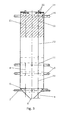
- Reactor for continuous processing of combustible carbon- and / or hydrocarbon products contains a sealed operating chamber (1) with a feed opening (2) in the upper lid (3) and the following operating zones (4), arranged in the technological sequence: zone for discharging solid residues from the processing with the discharging window (5); air and/or oxygen and water vapor or steam supply zone (6) with the appropriate channels (7); zone for vapor or steam supply (8) through the channels (9); air and/or oxygen heating zone (10); combustion zone (11); coking and pyrolysis zones (12); zone for heating the processed products (13); zone for separating the steam-gas mixture (14) with at least one separating or discharge channel (15); processed products loading zone (16) with the gate chamber or gateway for batch or charge feeding of processed products (17) (feed unit), and each zone of the operating chamber (1) is equipped with at least one temperature sensor (18), and air heating zones (10) and steam-gas mixture separation zone (14) are equipped with pressure sensors (19), and the operating chamber (1) includes the sorption zone for solid and liquid carbon and/
- the upper part of the reactor can be equipped with an inlet (22) for external (i.e., from outside) feeding of liquid hydrocarbons (22), such as waste oils or organic layer of oil sludges, liquid asphalts, etc. which provides for their uniform distribution over the cross section of the reactor.
- liquid hydrocarbons such as waste oils or organic layer of oil sludges, liquid asphalts, etc.
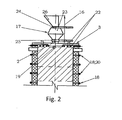
- Gate chamber or gateway for batch or charge feeding of processed products (17) is equipped with two conventionally sealed (i.e., leak-free during operation) shutters (24) and (25), sequentially arranged to form an intermediate hopper (23), which are located between a feed hopper (26) and a feed opening (2) in the upper lid of the reactor (3).
- Conditional tightness implies the elimination of leakage of refined products into the atmosphere or, in case of leakage, the maximum allowable concentrations are not exceeded.
- Forming a slight suction pressure in the course of separation the steam-gas mixture in combination with the existing level of tightness of the gate chamber or gateway (17) suggest the absence of implying the environmental stress on the natural environment by this technology.
- Reactor for continuous processing of combustible carbon- and / or hydrocarbon products includes the same elements as the first version, except that the upper part of the reactor is initially equipped with an inlet (22) for external (i.e., from outside) feeding of liquid hydrocarbons (22), which provides for their uniform distribution over the cross section of the reactor.
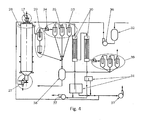
- Installation for processing combustible carbon- and/or hydrocarbon products includes a reactor (either of the two aforementioned models), the gate chamber or gateway (17) for batch or charge feeding of processed products (feed unit) into a feed opening (2), located at the upper lid of the reactor (3), the discharge assembly for discharging of solid and non-combustible by-products (27), the gas-vapor mixture discharge unit (28), cyclone separator for coarse filtering (cleaning unit for purification and removing the solid and liquid carbonaceous particles) (29), liquid products condensation unit (30), Florence flasks (31) for condensates (waters and organic fractions), and liquid hydrocarbon waste tank or waste tank sump (32).
- an additional steam-gas mixture purification unit consisting of a centrifugal separator for fine purification (34) and at least one selective-type cyclone (35), and the liquid hydrocarbon waste tank or waste tank sump (32) is equipped with a separate feed dispenser (36) (e.g., a pump) for charging the liquid hydrocarbon waste to the dispenser located at the upper lid of the reactor (3) (for forced distribution through nozzles or self-gravity distribution, etc.)
- a separate feed dispenser e.g., a pump
- Florence flasks (31) are equipped with the feeding devices (37) for charging the water and/or organic fractions into the combustion zone of the reactor (11).
- the method for processing combustible carbon- and/or hydrocarbon products includes the preparation of the charge or batch which consists of processed products (hereinafter referred to as the "charge") and their sequential layer-by-layer processing in the reactor with the presence of the nozzle when applying oxygen agent and water vapor or steam, and includes the steps of heating the charge or batch, pyrolysis of combustible components, coking, combustion, formation of a solid residue, which is discharged from the working chamber (operating chamber 1) of the reactor, formation of steam-gas mixture (aerosol), which includes carbon particles, cooling the steam-gas mixture with the deposition of solid and liquid particles and its discharge from the working chamber (operating chamber 1) of the reactor.
- the charge which consists of processed products
- the aerosol sorption zone (21) is formed by, at a minimum, flushing the upper part of the charge or batch by liquid hydrocarbon-containing products and/or by adding to the batch or charge the solid hydrocarbon-containing products having a softening point above 60 °C and the end boiling point above 300 °C.
- the weight ratio of liquid hydrocarbon-containing products used for flushing the upper part of the charge or batch to the solid original hydrocarbon-containing products in the composition of the charge or batch amounts to (1-3):10, and weight ratio of added solid hydrocarbon-containing products to the original hydrocarbon-containing products in the composition of the charge or batch amounts to (2-5):10, with the weight ratio of liquid hydrocarbon-containing products used for flushing the upper part of the charge or batch to the added solid hydrocarbon-containing products and original hydrocarbon-containing products in the composition of the charge or batch amounting to (1-3):(12-15).
- the centrifugal force is applied to the steam-gas mixture at the outlet of the reactor (28) at the nodes (29) and (33) for removal of solid and liquid carbonaceous particles.
- the nozzle consists of the limestone with grain size ranging from 10 to 80 mm.
- the nozzle contains chemically unbounded carbon; in particular, the nozzle contains the pelletized fly ash containing chemically unbounded carbon, or the rings made from heat-resistant steel are used as a fitting.
- waste oil and/or organic (upper) layer oil sludges and/or liquid asphalts are used as the liquid hydrocarbon-containing products, and, at a minimum, solid oil refinery waste is used as the added solid hydrocarbon-containing products having a softening point above 60 °C and the end boiling point above 300 °C.
- the particles of the carbon within the steam-gas mixture are mentioned only when they have a clear positive or negative effect.
- the main objective of the continuous industrial processing of combustible carbon- and/or hydrocarbon-containing products is obtaining a steam-gas mixture, purified from solid and liquid-drop impurities. Moreover, any possible following "traditional" purification of the steam-gas mixture should be rejected and disregarded as obviously inefficient, ineffective and leading to deposition of tar and carbon-black on the surfaces of the apparatus, valves, fittings, control and measurement instrumentation and automatic equipment.
- an aerosol dust particles, including the carbon-black and condensed liquid droplets carried away from the combustion zone (11) and generated by friction of moving layers of the charge or batch
- sorption zone (21) is formed at the stage of heating the charge or batch, coking and pyrolysis by, at a minimum, flushing the upper part of the charge or batch by liquid hydrocarbon-containing products and/or by adding to the batch or charge the solid hydrocarbon-containing products having a softening point above 60 °C and the end boiling point above 300 °C.
- the weight ratio of liquid hydrocarbon-containing products used for flushing the upper part of the charge or batch to the solid original hydrocarbon-containing products in the composition of the charge or batch should be equal to (1-3):10. If the quantity of hydrocarbon-containing products differs from the above ratio, it leads to insufficient quality of purification of the steam-gas mixture or to unnecessary expenditure of liquid hydrocarbon products, although, for example, in case of their conscious processing it can be justified. However, then this technology should be implemented by means of special processing methods. The same applies to the weight ratio of added solid hydrocarbon-containing products to the original hydrocarbon-containing products in the composition of the charge or batch, which should be equal to (2-5):10.
- composition of the charge or batch includes added solid hydrocarbon-containing products and original hydrocarbon-containing products, which weight ratio should be equal to (1-3):(12-15). Any deviations from these limits result in a serious shift of the calculated boundaries of the sorption zone (21).
- waste oil and/or organic (upper) layer oil sludges and/or liquid asphalts are used as the liquid hydrocarbon-containing products
- solid oil refinery waste such as bitumen, petroleum pitches, cracking residues, solid pyrolysis residues and others, is used as the added solid hydrocarbon-containing products having a softening point above 60 °C and the end boiling point above 300 °C.
- the centrifugal force is applied to the steam-gas mixture, purified in the reactor, at the nodes (29) and (33), which allows to separate the finest particles of mechanical impurities due to the increase of their kinetic energy, and quite often the power of cyclone equipment assembly (29), which is used to settle the particles larger than 25 microns, is insufficient - the process requires the fine centrifugal separation of the node (33) using the separator (34), which allows to separate particles with sizes of 5-25 microns, which flow into selective-type cyclones (35) after consolidation. Next, they flow into the common reservoir (38).
- a fitting is used to ensure the gas tightness of the charge or batch being processed.
- a limestone with grain size ranging from 10 to 80 mm can be used for the nozzle.
- the reactor will function as a kiln, and a powder of calcium oxide will be present at the outlet, which can be directly used for production of mixes and mortars, and the sulfur content in the steam-gas mixture will be reduced as a result of the following reactions: CaO+H 2 S ⁇ CaS+H 2 O; CaO+S+C ⁇ CaS+CO.
- nozzles used can be extended through the use of those nozzles that contain chemically unbounded carbon.
- a graphic example of such nozzles is the nozzle made of pelletized fly ash containing chemically unbounded carbon. Such carbon is burned in the reactor and decarburized nozzle becomes the raw material for producing, for example, high-quality cement.
- Raschig rings made of heat-resistant steel and having a large free volume can be used as a fitting for the processing of high-ash products.
- reactors used for the continuous processing of combustible carbon- and/or hydrocarbon-containing products include special zones formed in the operating chambers, which are capable of maintain an operating temperature no higher than 300 °C - sorption zone for solid and liquid carbon- and/or hydrocarbon-containing particles (21), which are equipped with additional temperature sensors (20) for managing the processing and cleaning of impurities from the steam-gas mixture.
- This zone (21) is formed as a result of softening of hydrocarbon-containing products, intentionally added to the composition of the charge or batch, having a softening point above 60 °C, such as bitumen, petroleum pitches, cracking residues, solid pyrolysis residues and others.
- processed products and fitting being "wetted” by low-melting hydrocarbons, are able to adsorb a variety of related impurities on their surfaces - both solid (dust, carbon-black) and liquid (liquid-drop organic compounds).
- Selection of low-melting hydrocarbons added to the charge or batch composition introduces a new functionality to the zones previously used only for heating, coking and pyrolysis of the charge or batch (13) and (12): it allows to use it as an effective "wet” filter - the sorption zone (21).
- the upper part of the reactor is equipped with an inlet (22) for external feeding of liquid hydrocarbons (22), which provides for their uniform distribution over the cross section of the reactor and for additional flushing of the charge or batch through its nozzles, perforated tubes and the like.
- the gate chamber or gateway for batch or charge feeding of processed products (17) is equipped with two conventionally sealed shutters (24) and (25), sequentially arranged to form an intermediate hopper (23), which are located between the feed hopper (26) and the feed opening (2) in the upper lid of the reactor (3).
- a slight suction pressure 500-5,000 Pa may be observed in the upper part of the reactor. This tightness is sufficient to ensure the environmental safety of the process.
- those liquid hydrocarbon-containing waste that flows into the appropriate reservoir (38), may be forwarded to the dispenser (22) located at the upper lid of the reactor (3) for the flushing of charge or batch - either alone or in addition to "external" liquid hydrocarbon-containing products from the waste tank sump (32), fed into the same area in order to create a sorption zone (21).
- Water and/or the organic fraction from the Florence flasks (31) is partially fed into the combustion zone of the reactor (11) via the channels (9), originally designed for steam supply, and partially - for further processing.
- a backup node used for additional purification of the steam-gas mixture (39) may be set up, which is structurally similar to the node (33). Using this node is capable of bringing the quality of purification of the mixture in approximate accordance with the sanitary standards.
- Example 1 Coal waste (briquettes with the thickness of 40 mm and height of 40 mm) should be reprocessed.
- Rings (32x32x3) made from heat-resistant steel (20X23H18) are used as a fitting/nozzle - 1,000 kg/hour.
- CaCO3 in the form of pieces with linear sizes of 10-80 mm is fed at the rate of 35 kg/hour.
- the oily waste is fed at the rate of 200 kg/hour and the off-spec bitumen is supplied at the rate of 400 kg/hour. (This solves the problem of disposal of waste oils and bitumen).
- Temperature in the combustion zone (11) does not exceed 1,100 °C.
- the outflow at the outlet of the reactor (28) equaled to 1,819 kg/hour and was characterized by the following structure (kg/hour): nozzle - 1,000; ash - 768; carbon-containing products - 30; CaS - 6.3; CaO - 15.
- the content of solid and liquid-drop impurities was measured by transmitting a part of a gas stream by a compressor (1-6 l/min) through a cooler and fibrous filter. According to the weight difference of clean and contaminated filter and volume of the transmitted gas, the content of the particles was determined. Gas offtake for analysis of solid and liquid-drop impurities was carried at the outlet of the reactor, after treatment performed using the 900-mm cyclone (29), newly installed centrifugal separator (33), and a backup centrifugal separator (39).
- coal waste (briquettes with the thickness of 40 mm and height of 40 mm) should be reprocessed.
- Composition of coal briquettes and elemental composition of the combustible mass, quantity of briquettes, amount of calcium carbonate are the same as in Example 1. The difference lies in the absence of the sorption zone, since no liquid hydrocarbons like the oily waste and the off-spec bitumen are fed.
- Temperature in the combustion zone does not exceed 1,100 °C.
- the outflow at the outlet of the reactor equaled to 1,809 kg/hour and was characterized by the following structure (kg/hour): nozzle - 1,000; ash - 768; carbon-containing products - 20; CaS - 6.3; CaO - 15.
- the content of solid and liquid-drop impurities was measured by transmitting a part of a gas stream by a compressor (1-6 l/min) through a cooler and fibrous filter. According to the weight difference of clean and contaminated filter and volume of the transmitted gas, the content of the particles was determined. Gas offtake for analysis of solid and liquid-drop impurities was carried at the outlet of the reactor, after treatment performed using the 900-mm cyclone (27), newly installed centrifugal separator (33), and a backup centrifugal separator (39).
- Example 3 Carbon-containing raw product - the coke produced during coking slightly metamorphosed coals with the reduced caking capacity (i.e. coke not used for metal smelting) - should be processed.
- Rings (32x32x3) made from heat-resistant steel (20X23H18) are used as a fitting/nozzle - 300 kg/hour.
- CaCO3 in the form of pieces with linear sizes of 10-80 mm is fed at the rate of 112 kg/hour.
- the oily waste is fed at the rate of 300 kg/hour.
- Temperature in the combustion zone (11) does not exceed 1,200 °C.
- the outflow at the outlet of the reactor (28) equaled to 525 kg/hour and was characterized by the following structure (kg/hour): nozzle - 300; ash - 129; carbon-containing products - 30; CaS - 14.8; CaO - 51.5;
- the content of solid and liquid-drop impurities was measured by transmitting a part of a gas stream by a compressor (1-6 l/min) through a cooler and fibrous filter. According to the weight difference of clean and contaminated filter and volume of the transmitted gas, the content of the particles was determined. Gas offtake for analysis of solid and liquid-drop impurities was carried at the outlet of the reactor, after treatment performed using the 900-mm cyclone (29), newly installed centrifugal separator (33), and a backup centrifugal separator (39).
Landscapes
- Chemical & Material Sciences (AREA)
- Engineering & Computer Science (AREA)
- Oil, Petroleum & Natural Gas (AREA)
- Organic Chemistry (AREA)
- Materials Engineering (AREA)
- Combustion & Propulsion (AREA)
- Chemical Kinetics & Catalysis (AREA)
- General Chemical & Material Sciences (AREA)
- Production Of Liquid Hydrocarbon Mixture For Refining Petroleum (AREA)
- Processing Of Solid Wastes (AREA)
- Separation, Recovery Or Treatment Of Waste Materials Containing Plastics (AREA)
Applications Claiming Priority (2)
| Application Number | Priority Date | Filing Date | Title |
|---|---|---|---|
| RU2012131681/05A RU2495076C1 (ru) | 2012-07-25 | 2012-07-25 | Способ переработки горючих углерод- и/или углеводородсодержащих продуктов, реактор для его осуществления (варианты) и установка для переработки горючих углерод- и/или углеводородсодержащих продуктов |
| PCT/RU2013/000634 WO2014017955A2 (ru) | 2012-07-25 | 2013-07-23 | Способ переработки горючих углерод- и/или углеводородсодержащих продуктов, реактор для его осуществления (варианты) и установка для переработки горючих углерод- и/или углеводородсодержащих продуктов |
Publications (2)
| Publication Number | Publication Date |
|---|---|
| EP2889360A2 true EP2889360A2 (de) | 2015-07-01 |
| EP2889360A4 EP2889360A4 (de) | 2016-04-06 |
Family
ID=49302950
Family Applications (1)
| Application Number | Title | Priority Date | Filing Date |
|---|---|---|---|
| EP13822942.2A Withdrawn EP2889360A4 (de) | 2012-07-25 | 2013-07-23 | Verfahren zur verarbeitung von brennbaren kohlenstoffhaltigen und/oder kohlenwasserstoffhaltigen produkten, reaktor zur durchführung des verfahrens (varianten) und vorrichtung zur verarbeitung von brennbaren kohlenstoffhaltigen und/oder kohlenwasserstoffhaltigen produkten |
Country Status (5)
| Country | Link |
|---|---|
| US (1) | US20150144476A1 (de) |
| EP (1) | EP2889360A4 (de) |
| CN (1) | CN104937076A (de) |
| RU (1) | RU2495076C1 (de) |
| WO (1) | WO2014017955A2 (de) |
Cited By (1)
| Publication number | Priority date | Publication date | Assignee | Title |
|---|---|---|---|---|
| CN113831943A (zh) * | 2016-07-05 | 2021-12-24 | 戈登可再生能源有限公司 | 一种用于加工可再用的燃料的装置 |
Families Citing this family (9)
| Publication number | Priority date | Publication date | Assignee | Title |
|---|---|---|---|---|
| PL3491052T3 (pl) | 2016-07-26 | 2023-10-23 | Prti Global Management Llc | Aparatura i metoda do termicznego rozkładu opon i innych odpadów |
| US20180086994A1 (en) * | 2016-09-29 | 2018-03-29 | Expander Energy Inc. | Process For Converting Carbonaceous Material Into Low Tar Synthetic Gas |
| RU2629666C1 (ru) * | 2016-12-28 | 2017-08-31 | Общество с ограниченной ответственностью "Газпром трансгаз Екатеринбург" | Способ утилизации углеродсодержащих отходов |
| DE102018132661B4 (de) | 2018-12-18 | 2020-10-01 | Thyssenkrupp Ag | Verfahren zur Kohlenwasserstoffpyrolyse mit räumlich getrennter Beheizungs- und Reaktionszone innerhalb des Reaktorraums |
| CZ308787B6 (cs) * | 2019-09-06 | 2021-05-19 | TyReCycle a.s. | Způsob kontinuálního termického zpracování ojetých nebo poškozených či jinak znehodnocených pneumatik a zařízení k provádění tohoto způsobu |
| WO2022148865A1 (en) * | 2021-01-11 | 2022-07-14 | Pronovation B.V. | Carbonization and pyrolyzation method and system |
| WO2022169659A1 (en) * | 2021-02-04 | 2022-08-11 | Exxonmobil Research And Engineering Company | Upgrading pyrolysis carbon |
| AU2021101230A4 (en) * | 2021-03-01 | 2021-05-06 | PRTI Global Management, LLC | Apparatus and method for thermally demanufacturing tires and other waste products |
| CN115558526B (zh) * | 2022-12-05 | 2023-04-11 | 浙江百能科技有限公司 | 旋风热解炉及基于其的热解气化系统及工艺 |
Family Cites Families (16)
| Publication number | Priority date | Publication date | Assignee | Title |
|---|---|---|---|---|
| FR1453921A (fr) * | 1965-07-09 | 1966-07-22 | Gazogène de reformage | |
| RU2015158C1 (ru) | 1987-10-02 | 1994-06-30 | Студевик АБ | Способ очистки загрязненного горючего газа |
| US5052313A (en) * | 1990-04-19 | 1991-10-01 | Combustion Design Corporation | Waste treatment system and method |
| TW245651B (en) * | 1994-02-24 | 1995-04-21 | Babcock & Wilcox Co | Black liquor gasifier |
| RU2079051C1 (ru) | 1994-06-23 | 1997-05-10 | Институт химической физики в Черноголовке РАН | Способ переработки твердых бытовых отходов |
| RU2062284C1 (ru) * | 1994-06-23 | 1996-06-20 | Институт химической физики в Черноголовке РАН | Способ переработки горючих отходов типа изношенных шин или подобных резиновых отходов |
| DE69629728T2 (de) | 1996-09-02 | 2004-06-03 | Fioter Oy | Verfahren zur aufbereitung von ölhaltigem abfall |
| RU2152561C1 (ru) | 1998-01-22 | 2000-07-10 | Институт проблем химической физики РАН | Способ переработки конденсированных горючих |
| RU2142357C1 (ru) * | 1998-07-03 | 1999-12-10 | Тульский государственный университет | Способ переработки изношенных шин |
| RU2229060C2 (ru) | 2002-07-22 | 2004-05-20 | Закрытое акционерное общество "СОЦИАЛЬНО-ОРИЕНТИРОВАННОЕ ПРЕДПРИЯТИЕ" | Установка для термической переработки нефтешламов |
| US7452392B2 (en) * | 2003-11-29 | 2008-11-18 | Nick Peter A | Process for pyrolytic heat recovery enhanced with gasification of organic material |
| RU2275416C1 (ru) * | 2005-03-28 | 2006-04-27 | Владимир Алексеевич Лихоманенко | Способ термохимической переработки органического сырья в топливные компоненты и установка для его осуществления |
| MD3917C2 (ro) * | 2006-09-20 | 2009-12-31 | Dinano Ecotechnology Llc | Procedeu de prelucrare termochimică a materiei prime ce conţine carbon |
| RU2342598C1 (ru) | 2007-02-27 | 2008-12-27 | Анатолий Павлович Кузнецов | Газификатор для термической переработки углеродсодержащих отходов и способ их переработки |
| RU2385343C1 (ru) * | 2008-12-10 | 2010-03-27 | Закрытое Акционерное Общество Научно-Производственная Компания "Интергаз" | Способ переработки углерод- и/или углеводородсодержащих продуктов и реактор для его осуществления |
| CN102580650B (zh) * | 2012-02-10 | 2013-06-05 | 中国石油大学(北京) | 一种微波生物质热解连续反应装置及方法 |
-
2012
- 2012-07-25 RU RU2012131681/05A patent/RU2495076C1/ru active
-
2013
- 2013-07-23 US US14/404,618 patent/US20150144476A1/en not_active Abandoned
- 2013-07-23 WO PCT/RU2013/000634 patent/WO2014017955A2/ru not_active Ceased
- 2013-07-23 EP EP13822942.2A patent/EP2889360A4/de not_active Withdrawn
- 2013-07-23 CN CN201380038983.1A patent/CN104937076A/zh active Pending
Cited By (1)
| Publication number | Priority date | Publication date | Assignee | Title |
|---|---|---|---|---|
| CN113831943A (zh) * | 2016-07-05 | 2021-12-24 | 戈登可再生能源有限公司 | 一种用于加工可再用的燃料的装置 |
Also Published As
| Publication number | Publication date |
|---|---|
| EP2889360A4 (de) | 2016-04-06 |
| US20150144476A1 (en) | 2015-05-28 |
| WO2014017955A2 (ru) | 2014-01-30 |
| WO2014017955A8 (ru) | 2014-05-22 |
| CN104937076A (zh) | 2015-09-23 |
| WO2014017955A3 (ru) | 2014-04-03 |
| RU2495076C1 (ru) | 2013-10-10 |
Similar Documents
| Publication | Publication Date | Title |
|---|---|---|
| EP2889360A2 (de) | Verfahren zur verarbeitung von brennbaren kohlenstoffhaltigen und/oder kohlenwasserstoffhaltigen produkten, reaktor zur durchführung des verfahrens (varianten) und vorrichtung zur verarbeitung von brennbaren kohlenstoffhaltigen und/oder kohlenwasserstoffhaltigen produkten | |
| EP2321387B1 (de) | Zweistufiges staubvergasungssystem und -verfahren | |
| RU2471856C2 (ru) | Автотермический способ непрерывной газификации субстанций с высоким содержанием углерода | |
| US5347068A (en) | Method of simultaneous disposal of solid and liquid wastes | |
| US6333015B1 (en) | Synthesis gas production and power generation with zero emissions | |
| RU2572998C2 (ru) | Сингаз, полученный с помощью плазменной газификации | |
| US9631153B2 (en) | Adaptable universal method for producing synthetic products | |
| KR102203125B1 (ko) | 단계식 가스화에서의 제 2 단 가스화기 | |
| US20090056537A1 (en) | Method and Device for the process-integrated hot gas purification of dust and gas components of a synthesis gas | |
| UA77679C2 (en) | Ecologically clean method for producing energy from coal | |
| CN1646858A (zh) | 用于废物处理设备的再循环系统 | |
| CN1782037A (zh) | 煤气化设备和方法 | |
| CN1928027A (zh) | 通过部分氧化由含灰分的燃料制备的淤浆以及完全骤冷粗制气而生产合成气的方法和设备 | |
| CA2113636A1 (en) | Process for producing synthetic or fuel gases from solid or pasty residues and waste or low-grade fuels in a gasifying reactor | |
| JPH09235559A (ja) | 直立炉中で残留物および廃棄物を物質的およびエネルギー的に利用する方法 | |
| RU2066338C1 (ru) | Способ термического разложения твердых углеродсодержащих материалов с использованием твердого теплоносителя, установка для осуществления способа, реактор для разложения твердых углеродсодержащих материалов и нагреватель-газификатор твердого теплоносителя | |
| KR101764302B1 (ko) | 제강 슬래그를 이용한 타르 개질 방법 및 시스템 | |
| Wenning | The VEBA OEL technologie pyrolysis process | |
| WO2006087310A1 (fr) | Installation de production d'hydrogene ou de gaz de synthese par gazeification | |
| JP2011006575A (ja) | ガス化可燃性ガス含有物の沈降分離方法及び沈降分離装置、並びにガス化可燃性ガスの利用方法 | |
| RU127379U1 (ru) | Реактор для непрерывной переработки горючих углерод- и/или углеводородсодержащих продуктов (варианты) и установка для переработки горючих углерод- и/или углеводородсодеражащих продуктов | |
| DE19730385A1 (de) | Verfahren zur Erzeugung von Brenn- und Synthesegas aus Pyrolyseprodukten | |
| DE102014000471A1 (de) | Verfahren zur thermischen Spaltung von organischen Abfallstoffen | |
| EP4079422A1 (de) | Verfahren zum betrieb eines vergasungsofens und vergasungsofen | |
| JPH10140167A (ja) | 炭素及び灰分を含有する可燃物、残留物、廃棄物の選別とガス化のための方法と装置 |
Legal Events
| Date | Code | Title | Description |
|---|---|---|---|
| PUAI | Public reference made under article 153(3) epc to a published international application that has entered the european phase |
Free format text: ORIGINAL CODE: 0009012 |
|
| 17P | Request for examination filed |
Effective date: 20150225 |
|
| AK | Designated contracting states |
Kind code of ref document: A2 Designated state(s): AL AT BE BG CH CY CZ DE DK EE ES FI FR GB GR HR HU IE IS IT LI LT LU LV MC MK MT NL NO PL PT RO RS SE SI SK SM TR |
|
| AX | Request for extension of the european patent |
Extension state: BA ME |
|
| DAX | Request for extension of the european patent (deleted) | ||
| A4 | Supplementary search report drawn up and despatched |
Effective date: 20160307 |
|
| RIC1 | Information provided on ipc code assigned before grant |
Ipc: C10B 1/04 20060101ALI20160301BHEP Ipc: C10B 57/12 20060101ALI20160301BHEP Ipc: C10B 49/04 20060101ALI20160301BHEP Ipc: F23G 5/027 20060101ALI20160301BHEP Ipc: C10B 57/18 20060101ALI20160301BHEP Ipc: C10B 49/02 20060101AFI20160301BHEP Ipc: C10L 5/48 20060101ALI20160301BHEP Ipc: C10K 1/02 20060101ALI20160301BHEP |
|
| 17Q | First examination report despatched |
Effective date: 20180411 |
|
| STAA | Information on the status of an ep patent application or granted ep patent |
Free format text: STATUS: THE APPLICATION IS DEEMED TO BE WITHDRAWN |
|
| 18D | Application deemed to be withdrawn |
Effective date: 20181023 |