EP2889633B1 - Appareil de détermination de détérioration de batterie pour véhicule électrique et procédé associé - Google Patents
Appareil de détermination de détérioration de batterie pour véhicule électrique et procédé associé Download PDFInfo
- Publication number
- EP2889633B1 EP2889633B1 EP14175227.9A EP14175227A EP2889633B1 EP 2889633 B1 EP2889633 B1 EP 2889633B1 EP 14175227 A EP14175227 A EP 14175227A EP 2889633 B1 EP2889633 B1 EP 2889633B1
- Authority
- EP
- European Patent Office
- Prior art keywords
- battery
- degradation
- time
- program instructions
- determining
- Prior art date
- Legal status (The legal status is an assumption and is not a legal conclusion. Google has not performed a legal analysis and makes no representation as to the accuracy of the status listed.)
- Active
Links
Images


Classifications
-
- G—PHYSICS
- G01—MEASURING; TESTING
- G01R—MEASURING ELECTRIC VARIABLES; MEASURING MAGNETIC VARIABLES
- G01R31/00—Arrangements for testing electric properties; Arrangements for locating electric faults; Arrangements for electrical testing characterised by what is being tested not provided for elsewhere
- G01R31/36—Arrangements for testing, measuring or monitoring the electrical condition of accumulators or electric batteries, e.g. capacity or state of charge [SoC]
-
- B—PERFORMING OPERATIONS; TRANSPORTING
- B60—VEHICLES IN GENERAL
- B60L—PROPULSION OF ELECTRICALLY-PROPELLED VEHICLES; SUPPLYING ELECTRIC POWER FOR AUXILIARY EQUIPMENT OF ELECTRICALLY-PROPELLED VEHICLES; ELECTRODYNAMIC BRAKE SYSTEMS FOR VEHICLES IN GENERAL; MAGNETIC SUSPENSION OR LEVITATION FOR VEHICLES; MONITORING OPERATING VARIABLES OF ELECTRICALLY-PROPELLED VEHICLES; ELECTRIC SAFETY DEVICES FOR ELECTRICALLY-PROPELLED VEHICLES
- B60L3/00—Electric devices on electrically-propelled vehicles for safety purposes; Monitoring operating variables, e.g. speed, deceleration or energy consumption
- B60L3/12—Recording operating variables ; Monitoring of operating variables
-
- B—PERFORMING OPERATIONS; TRANSPORTING
- B60—VEHICLES IN GENERAL
- B60L—PROPULSION OF ELECTRICALLY-PROPELLED VEHICLES; SUPPLYING ELECTRIC POWER FOR AUXILIARY EQUIPMENT OF ELECTRICALLY-PROPELLED VEHICLES; ELECTRODYNAMIC BRAKE SYSTEMS FOR VEHICLES IN GENERAL; MAGNETIC SUSPENSION OR LEVITATION FOR VEHICLES; MONITORING OPERATING VARIABLES OF ELECTRICALLY-PROPELLED VEHICLES; ELECTRIC SAFETY DEVICES FOR ELECTRICALLY-PROPELLED VEHICLES
- B60L53/00—Methods of charging batteries, specially adapted for electric vehicles; Charging stations or on-board charging equipment therefor; Exchange of energy storage elements in electric vehicles
- B60L53/10—Methods of charging batteries, specially adapted for electric vehicles; Charging stations or on-board charging equipment therefor; Exchange of energy storage elements in electric vehicles characterised by the energy transfer between the charging station and the vehicle
- B60L53/11—DC charging controlled by the charging station, e.g. mode 4
-
- B—PERFORMING OPERATIONS; TRANSPORTING
- B60—VEHICLES IN GENERAL
- B60L—PROPULSION OF ELECTRICALLY-PROPELLED VEHICLES; SUPPLYING ELECTRIC POWER FOR AUXILIARY EQUIPMENT OF ELECTRICALLY-PROPELLED VEHICLES; ELECTRODYNAMIC BRAKE SYSTEMS FOR VEHICLES IN GENERAL; MAGNETIC SUSPENSION OR LEVITATION FOR VEHICLES; MONITORING OPERATING VARIABLES OF ELECTRICALLY-PROPELLED VEHICLES; ELECTRIC SAFETY DEVICES FOR ELECTRICALLY-PROPELLED VEHICLES
- B60L58/00—Methods or circuit arrangements for monitoring or controlling batteries or fuel cells, specially adapted for electric vehicles
- B60L58/10—Methods or circuit arrangements for monitoring or controlling batteries or fuel cells, specially adapted for electric vehicles for monitoring or controlling batteries
- B60L58/16—Methods or circuit arrangements for monitoring or controlling batteries or fuel cells, specially adapted for electric vehicles for monitoring or controlling batteries responding to battery ageing, e.g. to the number of charging cycles or the state of health [SoH]
-
- G—PHYSICS
- G01—MEASURING; TESTING
- G01R—MEASURING ELECTRIC VARIABLES; MEASURING MAGNETIC VARIABLES
- G01R31/00—Arrangements for testing electric properties; Arrangements for locating electric faults; Arrangements for electrical testing characterised by what is being tested not provided for elsewhere
- G01R31/36—Arrangements for testing, measuring or monitoring the electrical condition of accumulators or electric batteries, e.g. capacity or state of charge [SoC]
- G01R31/3644—Constructional arrangements
- G01R31/3648—Constructional arrangements comprising digital calculation means, e.g. for performing an algorithm
-
- G—PHYSICS
- G01—MEASURING; TESTING
- G01R—MEASURING ELECTRIC VARIABLES; MEASURING MAGNETIC VARIABLES
- G01R31/00—Arrangements for testing electric properties; Arrangements for locating electric faults; Arrangements for electrical testing characterised by what is being tested not provided for elsewhere
- G01R31/36—Arrangements for testing, measuring or monitoring the electrical condition of accumulators or electric batteries, e.g. capacity or state of charge [SoC]
- G01R31/385—Arrangements for measuring battery or accumulator variables
- G01R31/387—Determining ampere-hour charge capacity or SoC
- G01R31/388—Determining ampere-hour charge capacity or SoC involving voltage measurements
-
- G—PHYSICS
- G01—MEASURING; TESTING
- G01R—MEASURING ELECTRIC VARIABLES; MEASURING MAGNETIC VARIABLES
- G01R31/00—Arrangements for testing electric properties; Arrangements for locating electric faults; Arrangements for electrical testing characterised by what is being tested not provided for elsewhere
- G01R31/36—Arrangements for testing, measuring or monitoring the electrical condition of accumulators or electric batteries, e.g. capacity or state of charge [SoC]
- G01R31/392—Determining battery ageing or deterioration, e.g. state of health
-
- H—ELECTRICITY
- H01—ELECTRIC ELEMENTS
- H01M—PROCESSES OR MEANS, e.g. BATTERIES, FOR THE DIRECT CONVERSION OF CHEMICAL ENERGY INTO ELECTRICAL ENERGY
- H01M10/00—Secondary cells; Manufacture thereof
- H01M10/42—Methods or arrangements for servicing or maintenance of secondary cells or secondary half-cells
- H01M10/48—Accumulators combined with arrangements for measuring, testing or indicating the condition of cells, e.g. the level or density of the electrolyte
-
- B—PERFORMING OPERATIONS; TRANSPORTING
- B60—VEHICLES IN GENERAL
- B60L—PROPULSION OF ELECTRICALLY-PROPELLED VEHICLES; SUPPLYING ELECTRIC POWER FOR AUXILIARY EQUIPMENT OF ELECTRICALLY-PROPELLED VEHICLES; ELECTRODYNAMIC BRAKE SYSTEMS FOR VEHICLES IN GENERAL; MAGNETIC SUSPENSION OR LEVITATION FOR VEHICLES; MONITORING OPERATING VARIABLES OF ELECTRICALLY-PROPELLED VEHICLES; ELECTRIC SAFETY DEVICES FOR ELECTRICALLY-PROPELLED VEHICLES
- B60L2240/00—Control parameters of input or output; Target parameters
- B60L2240/40—Drive Train control parameters
- B60L2240/54—Drive Train control parameters related to batteries
- B60L2240/545—Temperature
-
- B—PERFORMING OPERATIONS; TRANSPORTING
- B60—VEHICLES IN GENERAL
- B60L—PROPULSION OF ELECTRICALLY-PROPELLED VEHICLES; SUPPLYING ELECTRIC POWER FOR AUXILIARY EQUIPMENT OF ELECTRICALLY-PROPELLED VEHICLES; ELECTRODYNAMIC BRAKE SYSTEMS FOR VEHICLES IN GENERAL; MAGNETIC SUSPENSION OR LEVITATION FOR VEHICLES; MONITORING OPERATING VARIABLES OF ELECTRICALLY-PROPELLED VEHICLES; ELECTRIC SAFETY DEVICES FOR ELECTRICALLY-PROPELLED VEHICLES
- B60L2240/00—Control parameters of input or output; Target parameters
- B60L2240/40—Drive Train control parameters
- B60L2240/54—Drive Train control parameters related to batteries
- B60L2240/547—Voltage
-
- B—PERFORMING OPERATIONS; TRANSPORTING
- B60—VEHICLES IN GENERAL
- B60L—PROPULSION OF ELECTRICALLY-PROPELLED VEHICLES; SUPPLYING ELECTRIC POWER FOR AUXILIARY EQUIPMENT OF ELECTRICALLY-PROPELLED VEHICLES; ELECTRODYNAMIC BRAKE SYSTEMS FOR VEHICLES IN GENERAL; MAGNETIC SUSPENSION OR LEVITATION FOR VEHICLES; MONITORING OPERATING VARIABLES OF ELECTRICALLY-PROPELLED VEHICLES; ELECTRIC SAFETY DEVICES FOR ELECTRICALLY-PROPELLED VEHICLES
- B60L2250/00—Driver interactions
- B60L2250/10—Driver interactions by alarm
-
- G—PHYSICS
- G01—MEASURING; TESTING
- G01R—MEASURING ELECTRIC VARIABLES; MEASURING MAGNETIC VARIABLES
- G01R31/00—Arrangements for testing electric properties; Arrangements for locating electric faults; Arrangements for electrical testing characterised by what is being tested not provided for elsewhere
- G01R31/36—Arrangements for testing, measuring or monitoring the electrical condition of accumulators or electric batteries, e.g. capacity or state of charge [SoC]
- G01R31/371—Arrangements for testing, measuring or monitoring the electrical condition of accumulators or electric batteries, e.g. capacity or state of charge [SoC] with remote indication, e.g. on external chargers
-
- H—ELECTRICITY
- H01—ELECTRIC ELEMENTS
- H01M—PROCESSES OR MEANS, e.g. BATTERIES, FOR THE DIRECT CONVERSION OF CHEMICAL ENERGY INTO ELECTRICAL ENERGY
- H01M2220/00—Batteries for particular applications
- H01M2220/20—Batteries in motive systems, e.g. vehicle, ship, plane
-
- Y—GENERAL TAGGING OF NEW TECHNOLOGICAL DEVELOPMENTS; GENERAL TAGGING OF CROSS-SECTIONAL TECHNOLOGIES SPANNING OVER SEVERAL SECTIONS OF THE IPC; TECHNICAL SUBJECTS COVERED BY FORMER USPC CROSS-REFERENCE ART COLLECTIONS [XRACs] AND DIGESTS
- Y02—TECHNOLOGIES OR APPLICATIONS FOR MITIGATION OR ADAPTATION AGAINST CLIMATE CHANGE
- Y02E—REDUCTION OF GREENHOUSE GAS [GHG] EMISSIONS, RELATED TO ENERGY GENERATION, TRANSMISSION OR DISTRIBUTION
- Y02E60/00—Enabling technologies; Technologies with a potential or indirect contribution to GHG emissions mitigation
- Y02E60/10—Energy storage using batteries
-
- Y—GENERAL TAGGING OF NEW TECHNOLOGICAL DEVELOPMENTS; GENERAL TAGGING OF CROSS-SECTIONAL TECHNOLOGIES SPANNING OVER SEVERAL SECTIONS OF THE IPC; TECHNICAL SUBJECTS COVERED BY FORMER USPC CROSS-REFERENCE ART COLLECTIONS [XRACs] AND DIGESTS
- Y02—TECHNOLOGIES OR APPLICATIONS FOR MITIGATION OR ADAPTATION AGAINST CLIMATE CHANGE
- Y02T—CLIMATE CHANGE MITIGATION TECHNOLOGIES RELATED TO TRANSPORTATION
- Y02T10/00—Road transport of goods or passengers
- Y02T10/60—Other road transportation technologies with climate change mitigation effect
- Y02T10/70—Energy storage systems for electromobility, e.g. batteries
-
- Y—GENERAL TAGGING OF NEW TECHNOLOGICAL DEVELOPMENTS; GENERAL TAGGING OF CROSS-SECTIONAL TECHNOLOGIES SPANNING OVER SEVERAL SECTIONS OF THE IPC; TECHNICAL SUBJECTS COVERED BY FORMER USPC CROSS-REFERENCE ART COLLECTIONS [XRACs] AND DIGESTS
- Y02—TECHNOLOGIES OR APPLICATIONS FOR MITIGATION OR ADAPTATION AGAINST CLIMATE CHANGE
- Y02T—CLIMATE CHANGE MITIGATION TECHNOLOGIES RELATED TO TRANSPORTATION
- Y02T10/00—Road transport of goods or passengers
- Y02T10/60—Other road transportation technologies with climate change mitigation effect
- Y02T10/7072—Electromobility specific charging systems or methods for batteries, ultracapacitors, supercapacitors or double-layer capacitors
-
- Y—GENERAL TAGGING OF NEW TECHNOLOGICAL DEVELOPMENTS; GENERAL TAGGING OF CROSS-SECTIONAL TECHNOLOGIES SPANNING OVER SEVERAL SECTIONS OF THE IPC; TECHNICAL SUBJECTS COVERED BY FORMER USPC CROSS-REFERENCE ART COLLECTIONS [XRACs] AND DIGESTS
- Y02—TECHNOLOGIES OR APPLICATIONS FOR MITIGATION OR ADAPTATION AGAINST CLIMATE CHANGE
- Y02T—CLIMATE CHANGE MITIGATION TECHNOLOGIES RELATED TO TRANSPORTATION
- Y02T90/00—Enabling technologies or technologies with a potential or indirect contribution to GHG emissions mitigation
- Y02T90/10—Technologies relating to charging of electric vehicles
- Y02T90/12—Electric charging stations
-
- Y—GENERAL TAGGING OF NEW TECHNOLOGICAL DEVELOPMENTS; GENERAL TAGGING OF CROSS-SECTIONAL TECHNOLOGIES SPANNING OVER SEVERAL SECTIONS OF THE IPC; TECHNICAL SUBJECTS COVERED BY FORMER USPC CROSS-REFERENCE ART COLLECTIONS [XRACs] AND DIGESTS
- Y02—TECHNOLOGIES OR APPLICATIONS FOR MITIGATION OR ADAPTATION AGAINST CLIMATE CHANGE
- Y02T—CLIMATE CHANGE MITIGATION TECHNOLOGIES RELATED TO TRANSPORTATION
- Y02T90/00—Enabling technologies or technologies with a potential or indirect contribution to GHG emissions mitigation
- Y02T90/10—Technologies relating to charging of electric vehicles
- Y02T90/14—Plug-in electric vehicles
Definitions
- the present invention relates to a battery degradation determining apparatus and method according to the preamble of independent claims 1 and 4, respectively, which are known form FR 2 977 678 A1 .
- EP 2 530 478 A2 discloses a condition determination device for determining a condition of an electric storage device including a current detector, a voltage detector, and a controller.
- the controller is configured to detect charging currents and voltages and to determine a condition of the electric storage device based thereon.
- US 2001/0022518 A1 discloses a capacity estimation method, degradation estimation method and degradation estimation apparatus for lithium-ion batteries.
- An electric vehicle uses a battery-powered motor operating by electrical energy output by a battery. Since the electric vehicle mainly uses a battery formed of one battery pack that includes a plurality of rechargeable/dischargeable secondary cells, the electrical vehicle advantageously outputs no emission gases and low noise.
- a hybrid vehicle commonly refers to a gasoline-electric hybrid vehicle that uses gasoline to power an internal-combustion engine and an electric battery to power an electric motor.
- a battery management system that manages charge and discharge of each battery cell by measuring a voltage of each battery cell and voltage and current of the entire battery, and guarantees performance of the battery cell by determining degradation of each battery cell.
- the battery used for the electric vehicle is degraded by continuous usage, and therefore performance of the battery deteriorates.
- travel distance is reduced and output of the vehicle during acceleration under same state of charge (SOC) is degraded.
- a battery degradation determining apparatus for an electric vehicle is defined in independent claim 1.
- the battery degradation determining apparatus for an electric vehicle may further include a degradation determiner also executed by the controller and configured to determine whether the battery is degraded using the degradation of the battery calculated by the degradation calculator. Further, the time for maintaining the constant voltage mode may increase exponentially based on the degradation of the battery. The time for maintaining the constant voltage mode is from a time when a voltage of the battery reaches the predetermined voltage by the constant current mode to a time when an SOC of the battery reaches a predetermined level.
- a determining method of battery degradation for an electric vehicle according to the present invention is defined in independent claim 4.
- the condition determining degradation of the battery is satisfied when the temperature of a battery is within a room temperature range.
- the time for maintaining the constant voltage mode is from a time when a voltage of the battery reaches the predetermined voltage by the constant current mode to a time when an SOC of the battery reaches a predetermined level.
- the degradation determiner may be configured to determine that the battery is degraded when the degradation degree of the battery is greater than a predetermined level, and the degradation determiner may be configured to output an alarm indicating an inspection of the battery to a driver.
- vehicle or “vehicular” or other similar term as used herein is inclusive of motor vehicles in general such as passenger automobiles including sports utility vehicles (SUV), buses, trucks, various commercial vehicles, watercraft including a variety of boats and ships, aircraft, and the like, and includes hybrid vehicles, electric vehicles, plug-in hybrid electric vehicles, hydrogen-powered vehicles and other alternative fuel vehicles (e.g. fuels derived from resources other than petroleum).
- a hybrid vehicle is a vehicle that has two or more sources of power, for example both gasoline-powered and electric-powered vehicles.
- controller refers to a hardware device that includes a memory and a processor.
- the memory is configured to store the modules and the processor is specifically configured to execute said modules to perform one or more processes which are described further below.
- control logic of the present invention may be embodied as non-transitory computer readable media on a computer readable medium containing executable program instructions executed by a processor, controller or the like.
- the computer readable mediums include, but are not limited to, ROM, RAM, compact disc (CD)-ROMs, magnetic tapes, floppy disks, flash drives, smart cards and optical data storage devices.
- the computer readable recording medium can also be distributed in network coupled computer systems so that the computer readable media is stored and executed in a distributed fashion, e.g., by a telematics server or a Controller Area Network (CAN).
- a telematics server or a Controller Area Network (CAN).
- CAN Controller Area Network
- a quick charging method of a battery for an electric vehicle may be classified into a constant current mode (CC mode) and a constant voltage mode (CV mode).
- CC mode constant current mode
- CV mode constant voltage mode
- the battery may be charged in the constant current mode according to a predetermined current map.
- the battery may be charged in the constant voltage mode after the voltage of the battery reaches a predetermined voltage (for example, about 4.2 V) by charging the battery in the constant current mode.
- a state of charge (SOC) of the battery reaches a predetermined level (for example, about 80 %), complete charging of the battery may be determined.
- SOC state of charge
- a charging time in the constant current mode may be a time duration for the voltage of the battery to reach the predetermined voltage. Since initial SOC of batteries may be different, the charging time in the constant current mode may vary according to the different batteries. Further, a charging time in the constant voltage mode may be a time from when a voltage of the battery reaches a predetermined voltage (for example, about 4.2 V) to a normal charge condition (for example, an SOC of about 80 %). In other words, the charging time in the constant voltage mode may not be related to initial SOC of the battery. Therefore, the time for maintaining the constant voltage mode may be about the same. However, since the battery may be degraded according to continuous usage, internal resistance of the battery may be increased.
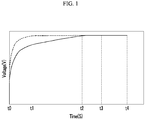
- FIG. 1 is an exemplary graph illustrating a time for maintaining a constant voltage mode according to a degradation degree of a battery for an electric vehicle.
- a time for maintaining the constant current mode of a battery that is degraded by about 11 % (refer to the solid line of FIG. 1 ) with a time for maintaining the constant current mode of a battery that is degraded by about 33 % (refer to the dotted line of FIG. 1 )
- the time for maintaining the constant current mode (tO-tl) of a battery that is degraded by about 11 % is greater than the time for maintaining the constant current mode (t0-t2) of a battery that is degraded by about 33 %.
- the time for maintaining the constant voltage mode (t2-t3) of a battery that is degraded by about 11 % is less than the time for maintaining the constant voltage mode (t1-t4) of a battery that is degraded by about 33 %.
- the time for maintaining the constant current mode may be decreased and the time for maintaining the voltage current mode may be increased based on the degradation of the battery.
- a technical feature of the present invention includes determining, by the controller, whether the battery is degraded using the time for maintaining the constant voltage mode that is varied based on the amount of degradation of the battery.
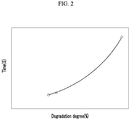
- FIG. 2 is an exemplary graph illustrating a relationship of a time for maintaining the constant voltage mode and degradation of the battery for an electric vehicle.
- the time for maintaining the constant voltage mode is exponentially increased according to a degradation degree of the battery.
- the degradation degree of the battery may be determined from the time for maintaining the constant voltage mode using Equation 1.
- Equation 1 a and b may be determined such that the relation equation may be determined according to a type of vehicle and performance of the battery.
- FIG. 3 is an exemplary block diagram illustrating a battery degradation determining apparatus for an electric vehicle according to an exemplary embodiment of the present invention.
- a battery degradation determining apparatus 20 for an electric vehicle may include a charger 22 configured to charge a battery 10 disposed within an electric vehicle, a measurer 24 configured to measure a time for maintaining the constant voltage mode from the charger 22, a degradation calculator 26 configured to calculate a degradation degree of the battery 10 using the time for maintaining the constant voltage mode measured by the measurer 24, and a degradation determiner 28 configured to determine whether the battery 10 is degraded using a calculated value from the degradation calculator 26.
- the charger 22, the measurer 24, the degradation calculator 26, and the degradation determiner 28 may be executed by a controller having a processor and a memory.
- the charger 22 may be configured to charge the battery using a quick charging method or a slow charging method.
- the charger 22 may be configured to charge the battery in a constant current mode until a voltage of the battery reaches a predetermined voltage (e.g., a cell voltage of about 4.2 V).
- a predetermined voltage e.g., a cell voltage of about 4.2 V.
- the charger 22 may be configured to charge the battery 10 in a constant current mode until the battery satisfies a normal charge condition (e.g., an SOC of about 80 %).
- the measurer 24 may be configured to measure a time for maintaining the constant current mode and a time for maintaining the constant voltage mode when the charger 22 charges the battery 10, and the measurer 24 may be configured to measure overall information regarding the battery including current, voltage, temperature, and SOC of the battery.
- the time for maintaining the constant current mode may be a time period from the initial charge time to a time when the voltage of the battery reaches the predetermined voltage.
- the time for maintaining the constant voltage mode may be a time period from the time when the voltage of the battery reaches the predetermined voltage to a time when an SOC of the battery reaches the normal charge condition.
- the normal charge condition may mean that the SOC of the battery reaches a predetermined SOC.
- the degradation calculator 26 may be configured to determine a degradation degree of the battery from the time for maintaining the constant voltage mode measured by the measurer 24. As described above, the time for maintaining the constant voltage mode increases exponentially according to the degradation degree of the battery. Therefore, the degradation degree of the battery may be calculated using Equation 1.
- the degradation determiner 28 may be configured to determine whether the battery is degraded using the degradation degree of the battery calculated by the degradation calculator 26. In other words, when the degradation degree of the battery is greater than a predetermined level, the degradation determiner 28 may be configured to determine that the battery is degraded and may provide an alarm to a driver indication the need for an inspection of the battery via an instrument panel of the vehicle. Since the status of the battery may be provided to the driver quantitatively, the driver may establish a strategy for diagnosis of the battery.
- the degradation degree of the battery may be calculated at room temperature.
- the temperature may be in a range of between about 20 degrees and 30 degrees Celsius.
- FIG. 4 is an exemplary flowchart illustrating a determining method of battery degradation for an electric vehicle according to an exemplary embodiment of the present invention.
- the battery of the electric vehicle may be charged in a quick charge method at step S10.
- the charger 22 may be configured to charge the battery while applying a substantially constant current to the battery based on the constant current mode at the initial time of charging, and the charger 22 may be configured to charge the battery while applying a substantially constant voltage based on the constant voltage mode when the voltage of the battery reaches a predetermined voltage (for example, about 4.2 V).
- a predetermined voltage for example, about 4.2 V
- the measurer 24 may be configured to measure current, voltage, and temperature of the battery using a sensor at step S20.
- the degradation determiner 28 may be configured to determine whether a condition for determining degradation of the battery is satisfied at step S30.
- the condition for determining degradation of the battery may be satisfied when the temperature of the battery is about room temperature (e.g., between about 20 degrees and 30 degrees Celsius).
- the degradation determiner 28 may not perform a process of determining battery degradation.
- the measurer 24 may be configured to measure a time for maintaining the constant voltage mode during quick charge of the battery at step S40.
- the degradation calculator 26 may be configured to calculate a degradation degree of the battery using the time for maintaining the constant voltage mode at step S50.
- the degradation degree of the battery may be calculated from Equation 1.
- the degradation determiner may be configured to determine that the battery is degraded when the degradation degree of the battery is greater than a predetermined level at step S60.
- the degradation determiner 28 may be configured to output an alarm indicating an inspection of the battery to a driver via the instrument panel of the vehicle at step S70. Accordingly, the driver may determine a diagnostic strategy according to usage of the battery by being provided with the degradation status of the battery.
- degradation of a battery may be determined quantitatively using a time for maintaining a constant voltage mode when quick charging the battery disposed within an electric vehicle. Further, a diagnosis strategy may be established according to degradation the battery.
Landscapes
- Engineering & Computer Science (AREA)
- Physics & Mathematics (AREA)
- General Physics & Mathematics (AREA)
- Power Engineering (AREA)
- Transportation (AREA)
- Mechanical Engineering (AREA)
- Sustainable Development (AREA)
- Life Sciences & Earth Sciences (AREA)
- Sustainable Energy (AREA)
- Chemical & Material Sciences (AREA)
- Chemical Kinetics & Catalysis (AREA)
- Electrochemistry (AREA)
- General Chemical & Material Sciences (AREA)
- Manufacturing & Machinery (AREA)
- Secondary Cells (AREA)
- Electric Propulsion And Braking For Vehicles (AREA)
- Charge And Discharge Circuits For Batteries Or The Like (AREA)
Claims (7)
- Appareil de détermination de dégradation de batterie pour un véhicule comprenant :un chargeur (22) configuré pour charger une batterie (10) dans un mode de courant constant à une tension prédéterminée et pour charger la batterie (10) dans un mode de tension constante lorsqu'une tension de la batterie (10) atteint la tension prédéterminée à un moment où un SOC de la batterie atteint un niveau prédéterminé ;un dispositif de mesure (24) configuré pour mesurer un temps pour conserver le mode de tension constante ;un calculateur de dégradation (23) configuré pour calculer un degré de dégradation de la batterie (10) à l'aide du temps mesuré pour conserver le mode de tension constante ;un dispositif de commande comprenant un processeur et une mémoire configurée pour stocker des instructions de programme, dans lequel le processeur est configuré pour exécuter les instructions de programme, les instructions de programme, lorsqu'elles sont exécutées, étant configurées pour exécuter le chargeur (22), le dispositif de mesure (24) et le calculateur de dégradation (26) si une condition pour déterminer un degré de dégradation de la batterie (10) est remplie ;caractérisé en ce quela condition pour déterminer une dégradation de la batterie (10) est remplie lorsque la température de la batterie (10) se situe dans une plage de température ambiante.
- Appareil de détermination de dégradation de batterie pour un véhicule selon la revendication 1, comprenant en outre
un dispositif de détermination de dégradation (28) configuré pour déterminer si la batterie (10) est dégradée à l'aide du degré de dégradation calculé de la batterie, dans lequel les instructions de programme, lorsqu'elles sont exécutées, sont en outre configurées pour exécuter le dispositif de détermination de dégradation (28). - Appareil de détermination de dégradation de batterie pour un véhicule selon la revendication 1 ou 2, dans lequel
le temps pour conserver le mode de tension constante augmente de manière exponentielle en fonction de la dégradation de la batterie (10). - Procédé de détermination d'une dégradation de batterie pour un véhicule, consistant :à mesurer, au moyen d'un dispositif de commande, une tension et une température d'une batterie (10) ;à déterminer, au moyen du dispositif de commande, si une condition pour déterminer une dégradation de la batterie (10) est remplie ;à charger la batterie (10) dans un mode de courant constant à une tension prédéterminée ;à charger la batterie (10) dans un mode de tension constante lorsqu'une tension de la batterie (10) atteint la tension prédéterminée à un moment où un SOC de la batterie atteint un niveau prédéterminé ;à mesurer, au moyen du dispositif de commande, un temps pour conserver le mode de tension constante ; età calculer, au moyen du dispositif de commande, un degré de dégradation de la batterie (10) à partir du temps mesuré pour conserver le mode de tension constante ;caractérisé en ce quela condition pour déterminer une dégradation de la batterie (10) est remplie lorsque la température de la batterie (10) se situe dans une plage de température ambiante.
- Procédé de détermination d'une dégradation de batterie pour un véhicule selon la revendication 4, consistant en outre :à déterminer, au moyen du dispositif de commande, que la batterie (10) est dégradée lorsque le degré de dégradation de la batterie (10) est supérieur à un niveau prédéterminé ; età transmettre, au moyen du dispositif de commande, une alarme qui indique une inspection nécessaire de la batterie (10).
- Support non transitoire lisible par ordinateur contenant des instructions de programmes exécutées par un dispositif de commande, le support lisible par ordinateur comprenant :des instruction de programme qui mesurent une tension et une température d'une batterie (10) ;des instructions de programme qui déterminent si une condition pour déterminer une dégradation de la batterie (10) est remplie ;des instructions de programme qui chargent la batterie (10) dans un mode de courant constant à une tension prédéterminée ;des instructions de programme qui chargent la batterie (10) dans un mode de tension constante lorsqu'une tension de la batterie (10) atteint la tension prédéterminée à un moment où un SOC de la batterie atteint un niveau prédéterminé ;des instructions de programme qui mesurent un temps pour conserver le mode de tension constante ; etdes instructions de programme qui calculent un degré de dégradation de la batterie à partir du temps mesuré pour conserver le mode de tension constante ;caractérisé en ce quela condition pour déterminer une dégradation de la batterie (10) est remplie lorsque la température de la batterie (10) se situe dans une plage de température ambiante.
- Support non transitoire lisible par ordinateur selon la revendication 6, comprenant :des instructions de programme qui déterminent que la batterie est dégradée lorsque le degré de dégradation de la batterie (10) est supérieur à un niveau prédéterminé ; etdes instructions de programme qui transmettent une alarme qui indique une inspection nécessaire de la batterie (10).
Applications Claiming Priority (1)
| Application Number | Priority Date | Filing Date | Title |
|---|---|---|---|
| KR1020130150698A KR101526414B1 (ko) | 2013-12-05 | 2013-12-05 | 전기 자동차용 배터리의 열화도 판정 장치 및 방법 |
Publications (3)
| Publication Number | Publication Date |
|---|---|
| EP2889633A2 EP2889633A2 (fr) | 2015-07-01 |
| EP2889633A3 EP2889633A3 (fr) | 2015-10-21 |
| EP2889633B1 true EP2889633B1 (fr) | 2019-09-25 |
Family
ID=51178678
Family Applications (1)
| Application Number | Title | Priority Date | Filing Date |
|---|---|---|---|
| EP14175227.9A Active EP2889633B1 (fr) | 2013-12-05 | 2014-07-01 | Appareil de détermination de détérioration de batterie pour véhicule électrique et procédé associé |
Country Status (4)
| Country | Link |
|---|---|
| US (1) | US20150160304A1 (fr) |
| EP (1) | EP2889633B1 (fr) |
| KR (1) | KR101526414B1 (fr) |
| CN (1) | CN104698384A (fr) |
Families Citing this family (14)
| Publication number | Priority date | Publication date | Assignee | Title |
|---|---|---|---|---|
| US9707854B2 (en) * | 2013-06-18 | 2017-07-18 | Atieva, Inc. | Series booster pack for battery system capacity recovery |
| JP6488105B2 (ja) * | 2014-10-28 | 2019-03-20 | 株式会社東芝 | 蓄電池評価装置及び方法 |
| KR101684092B1 (ko) * | 2015-04-08 | 2016-12-07 | 현대자동차주식회사 | 열화도 산출 장치 및 방법 |
| CN106646262A (zh) * | 2017-01-03 | 2017-05-10 | 重庆长安汽车股份有限公司 | 一种动力电池容量估算方法、系统及电动汽车 |
| CN106772113A (zh) * | 2017-03-29 | 2017-05-31 | 四川长虹电器股份有限公司 | 一种基于蓄电池端电压变化判断老化程度的方法 |
| KR102441505B1 (ko) * | 2017-12-11 | 2022-09-07 | 현대자동차주식회사 | 전기 자동차의 배터리 충전 방법 |
| KR101840619B1 (ko) * | 2018-01-11 | 2018-03-20 | (주)엠에스엔코리아 | 배터리 실험 장치 |
| KR102530940B1 (ko) * | 2018-04-23 | 2023-05-11 | 현대자동차주식회사 | 차량용 에너지저장장치 시스템 |
| CN112534625B (zh) * | 2018-08-28 | 2024-08-13 | 本田技研工业株式会社 | 诊断装置、诊断方法及存储介质 |
| KR102521576B1 (ko) * | 2019-03-18 | 2023-04-12 | 주식회사 엘지에너지솔루션 | 배터리 관리 장치 |
| KR102660502B1 (ko) * | 2019-04-18 | 2024-04-24 | 현대모비스 주식회사 | 자동차용 배터리 관리 방법 및 장치 |
| FR3105435B1 (fr) * | 2019-12-23 | 2021-11-19 | Renault Sas | Procédé d’identification du début de l’accélération de la dégradation de l’état de santé de batteries d’accumulateurs électriques |
| JP2021163388A (ja) * | 2020-04-02 | 2021-10-11 | 富士通株式会社 | 異常検知プログラム、異常検知方法および異常検知装置 |
| JP2024029887A (ja) * | 2022-08-23 | 2024-03-07 | 株式会社スリーダムアライアンス | リチウム二次電池セルの制御方法、リチウム二次電池セルの制御装置 |
Family Cites Families (11)
| Publication number | Priority date | Publication date | Assignee | Title |
|---|---|---|---|---|
| JP3687636B2 (ja) * | 1998-01-19 | 2005-08-24 | 松下電器産業株式会社 | 二次電池の劣化検出方法及び劣化検出機能を具備した充電器 |
| US6586940B2 (en) * | 2000-03-13 | 2003-07-01 | Nippon Telegraph And Telephone Corporation | Capacity estimation method, degradation estimation method and degradation estimation apparatus for lithium-ion cells, and lithium-ion batteries |
| KR100406796B1 (ko) * | 2001-10-17 | 2003-11-21 | 삼성에스디아이 주식회사 | 이차전지의 유효 만방전 용량을 정밀하게 추정하는 방법 |
| JP2007078506A (ja) * | 2005-09-14 | 2007-03-29 | Matsushita Electric Ind Co Ltd | 二次電池の寿命判定装置 |
| JP2012016078A (ja) * | 2010-06-29 | 2012-01-19 | Hitachi Ltd | 充電制御システム |
| US8030894B2 (en) * | 2010-08-03 | 2011-10-04 | Ford Global Technologies, Llc | System and method for rebalancing a vehicle battery |
| CN103328996B (zh) * | 2011-01-05 | 2016-05-18 | 株式会社Lg化学 | 估计电池的可用时间的装置和方法、包括该装置的电池组和车辆 |
| JP6044114B2 (ja) * | 2011-06-03 | 2016-12-14 | 株式会社Gsユアサ | 状態判定装置、蓄電装置、状態判定方法 |
| FR2977678A1 (fr) * | 2011-07-07 | 2013-01-11 | Commissariat Energie Atomique | Procede de diagnostic d'une batterie |
| KR101526641B1 (ko) * | 2011-12-08 | 2015-06-08 | 현대자동차주식회사 | 차량의 고전압배터리 열화 판정 방법 |
| FR3011393B1 (fr) * | 2013-10-01 | 2017-02-10 | Centre Nat Rech Scient | Procede et appareil d'evaluation de l'etat de sante d'une batterie lithium |
-
2013
- 2013-12-05 KR KR1020130150698A patent/KR101526414B1/ko not_active Expired - Fee Related
-
2014
- 2014-06-27 US US14/317,502 patent/US20150160304A1/en not_active Abandoned
- 2014-07-01 EP EP14175227.9A patent/EP2889633B1/fr active Active
- 2014-07-18 CN CN201410345341.2A patent/CN104698384A/zh active Pending
Non-Patent Citations (1)
| Title |
|---|
| None * |
Also Published As
| Publication number | Publication date |
|---|---|
| KR101526414B1 (ko) | 2015-06-05 |
| CN104698384A (zh) | 2015-06-10 |
| US20150160304A1 (en) | 2015-06-11 |
| EP2889633A2 (fr) | 2015-07-01 |
| EP2889633A3 (fr) | 2015-10-21 |
Similar Documents
| Publication | Publication Date | Title |
|---|---|---|
| EP2889633A2 (fr) | Appareil de détermination de détérioration de batterie pour véhicule électrique et procédé associé | |
| CN106054079B (zh) | 用于计算劣化程度的装置和方法 | |
| US10656211B2 (en) | Method of predicting time for charging battery of eco-friendly vehicle | |
| USRE47527E1 (en) | System and method for calculating distance to empty of green vehicle | |
| US9846202B2 (en) | Degradation estimation method for high voltage battery | |
| US9568558B2 (en) | Apparatus and method for controlling converter | |
| US9413182B2 (en) | System and method for periodically charging sub-battery for an electric vehicle based on the SOC discharge rate | |
| US8515700B2 (en) | Apparatus and method for estimating state of health of battery of vehicle | |
| CN106033112B (zh) | 用于使用电池模型参数评估健康状态的系统和方法 | |
| US9446677B2 (en) | Technique of determining degradation of high-voltage battery for vehicle | |
| US8560257B2 (en) | Dynamic battery capacity estimation | |
| US9463710B2 (en) | System and method of balancing battery cell | |
| CN102455411B (zh) | 自适应的缓慢变化电流检测 | |
| EP3551494B1 (fr) | Procede permettant l'estimation de l'etat de charge d'une batterie | |
| US20160084917A1 (en) | Apparatus and method for diagnosing degradation of a high voltage battery of a vehicle | |
| EP3531150A1 (fr) | Système de gestion de batterie | |
| JP2010066229A (ja) | バッテリの故障検出装置およびバッテリの故障検出方法 | |
| JP7100151B2 (ja) | 電池制御装置 | |
| JP2024538006A (ja) | バッテリー診断装置及び方法 | |
| US20140184233A1 (en) | Method for checking deterioration of battery | |
| US20160084910A1 (en) | Systems and methods for estimating battery system energy capability | |
| KR20130126128A (ko) | 배터리의 저항측정방법 및 장치, 이를 이용한 배터리 관리 시스템 | |
| US11852690B2 (en) | Method and system for estimating degradation of battery for vehicle | |
| KR20200002302A (ko) | 배터리 교체 관리 시스템 | |
| WO2014018048A1 (fr) | Système de gestion de pile |
Legal Events
| Date | Code | Title | Description |
|---|---|---|---|
| PUAI | Public reference made under article 153(3) epc to a published international application that has entered the european phase |
Free format text: ORIGINAL CODE: 0009012 |
|
| 17P | Request for examination filed |
Effective date: 20140701 |
|
| AK | Designated contracting states |
Kind code of ref document: A2 Designated state(s): AL AT BE BG CH CY CZ DE DK EE ES FI FR GB GR HR HU IE IS IT LI LT LU LV MC MK MT NL NO PL PT RO RS SE SI SK SM TR |
|
| AX | Request for extension of the european patent |
Extension state: BA ME |
|
| PUAL | Search report despatched |
Free format text: ORIGINAL CODE: 0009013 |
|
| AK | Designated contracting states |
Kind code of ref document: A3 Designated state(s): AL AT BE BG CH CY CZ DE DK EE ES FI FR GB GR HR HU IE IS IT LI LT LU LV MC MK MT NL NO PL PT RO RS SE SI SK SM TR |
|
| AX | Request for extension of the european patent |
Extension state: BA ME |
|
| RIC1 | Information provided on ipc code assigned before grant |
Ipc: G01R 31/36 20060101AFI20150911BHEP Ipc: H01M 10/48 20060101ALI20150911BHEP Ipc: H02J 7/00 20060101ALI20150911BHEP Ipc: B60L 11/18 20060101ALI20150911BHEP |
|
| R17P | Request for examination filed (corrected) |
Effective date: 20160421 |
|
| RBV | Designated contracting states (corrected) |
Designated state(s): AL AT BE BG CH CY CZ DE DK EE ES FI FR GB GR HR HU IE IS IT LI LT LU LV MC MK MT NL NO PL PT RO RS SE SI SK SM TR |
|
| GRAP | Despatch of communication of intention to grant a patent |
Free format text: ORIGINAL CODE: EPIDOSNIGR1 |
|
| STAA | Information on the status of an ep patent application or granted ep patent |
Free format text: STATUS: GRANT OF PATENT IS INTENDED |
|
| RIC1 | Information provided on ipc code assigned before grant |
Ipc: H01M 10/48 20060101ALI20190509BHEP Ipc: H02J 7/00 20060101ALI20190509BHEP Ipc: G01R 31/36 20190101AFI20190509BHEP |
|
| INTG | Intention to grant announced |
Effective date: 20190529 |
|
| GRAS | Grant fee paid |
Free format text: ORIGINAL CODE: EPIDOSNIGR3 |
|
| GRAA | (expected) grant |
Free format text: ORIGINAL CODE: 0009210 |
|
| STAA | Information on the status of an ep patent application or granted ep patent |
Free format text: STATUS: THE PATENT HAS BEEN GRANTED |
|
| AK | Designated contracting states |
Kind code of ref document: B1 Designated state(s): AL AT BE BG CH CY CZ DE DK EE ES FI FR GB GR HR HU IE IS IT LI LT LU LV MC MK MT NL NO PL PT RO RS SE SI SK SM TR |
|
| REG | Reference to a national code |
Ref country code: GB Ref legal event code: FG4D |
|
| REG | Reference to a national code |
Ref country code: CH Ref legal event code: EP |
|
| REG | Reference to a national code |
Ref country code: AT Ref legal event code: REF Ref document number: 1184336 Country of ref document: AT Kind code of ref document: T Effective date: 20191015 |
|
| REG | Reference to a national code |
Ref country code: IE Ref legal event code: FG4D |
|
| REG | Reference to a national code |
Ref country code: DE Ref legal event code: R096 Ref document number: 602014054125 Country of ref document: DE |
|
| REG | Reference to a national code |
Ref country code: NL Ref legal event code: MP Effective date: 20190925 |
|
| PG25 | Lapsed in a contracting state [announced via postgrant information from national office to epo] |
Ref country code: LT Free format text: LAPSE BECAUSE OF FAILURE TO SUBMIT A TRANSLATION OF THE DESCRIPTION OR TO PAY THE FEE WITHIN THE PRESCRIBED TIME-LIMIT Effective date: 20190925 Ref country code: HR Free format text: LAPSE BECAUSE OF FAILURE TO SUBMIT A TRANSLATION OF THE DESCRIPTION OR TO PAY THE FEE WITHIN THE PRESCRIBED TIME-LIMIT Effective date: 20190925 Ref country code: SE Free format text: LAPSE BECAUSE OF FAILURE TO SUBMIT A TRANSLATION OF THE DESCRIPTION OR TO PAY THE FEE WITHIN THE PRESCRIBED TIME-LIMIT Effective date: 20190925 Ref country code: FI Free format text: LAPSE BECAUSE OF FAILURE TO SUBMIT A TRANSLATION OF THE DESCRIPTION OR TO PAY THE FEE WITHIN THE PRESCRIBED TIME-LIMIT Effective date: 20190925 Ref country code: NO Free format text: LAPSE BECAUSE OF FAILURE TO SUBMIT A TRANSLATION OF THE DESCRIPTION OR TO PAY THE FEE WITHIN THE PRESCRIBED TIME-LIMIT Effective date: 20191225 Ref country code: BG Free format text: LAPSE BECAUSE OF FAILURE TO SUBMIT A TRANSLATION OF THE DESCRIPTION OR TO PAY THE FEE WITHIN THE PRESCRIBED TIME-LIMIT Effective date: 20191225 |
|
| REG | Reference to a national code |
Ref country code: LT Ref legal event code: MG4D |
|
| PG25 | Lapsed in a contracting state [announced via postgrant information from national office to epo] |
Ref country code: RS Free format text: LAPSE BECAUSE OF FAILURE TO SUBMIT A TRANSLATION OF THE DESCRIPTION OR TO PAY THE FEE WITHIN THE PRESCRIBED TIME-LIMIT Effective date: 20190925 Ref country code: LV Free format text: LAPSE BECAUSE OF FAILURE TO SUBMIT A TRANSLATION OF THE DESCRIPTION OR TO PAY THE FEE WITHIN THE PRESCRIBED TIME-LIMIT Effective date: 20190925 Ref country code: GR Free format text: LAPSE BECAUSE OF FAILURE TO SUBMIT A TRANSLATION OF THE DESCRIPTION OR TO PAY THE FEE WITHIN THE PRESCRIBED TIME-LIMIT Effective date: 20191226 |
|
| REG | Reference to a national code |
Ref country code: AT Ref legal event code: MK05 Ref document number: 1184336 Country of ref document: AT Kind code of ref document: T Effective date: 20190925 |
|
| PG25 | Lapsed in a contracting state [announced via postgrant information from national office to epo] |
Ref country code: PL Free format text: LAPSE BECAUSE OF FAILURE TO SUBMIT A TRANSLATION OF THE DESCRIPTION OR TO PAY THE FEE WITHIN THE PRESCRIBED TIME-LIMIT Effective date: 20190925 Ref country code: EE Free format text: LAPSE BECAUSE OF FAILURE TO SUBMIT A TRANSLATION OF THE DESCRIPTION OR TO PAY THE FEE WITHIN THE PRESCRIBED TIME-LIMIT Effective date: 20190925 Ref country code: NL Free format text: LAPSE BECAUSE OF FAILURE TO SUBMIT A TRANSLATION OF THE DESCRIPTION OR TO PAY THE FEE WITHIN THE PRESCRIBED TIME-LIMIT Effective date: 20190925 Ref country code: AT Free format text: LAPSE BECAUSE OF FAILURE TO SUBMIT A TRANSLATION OF THE DESCRIPTION OR TO PAY THE FEE WITHIN THE PRESCRIBED TIME-LIMIT Effective date: 20190925 Ref country code: ES Free format text: LAPSE BECAUSE OF FAILURE TO SUBMIT A TRANSLATION OF THE DESCRIPTION OR TO PAY THE FEE WITHIN THE PRESCRIBED TIME-LIMIT Effective date: 20190925 Ref country code: PT Free format text: LAPSE BECAUSE OF FAILURE TO SUBMIT A TRANSLATION OF THE DESCRIPTION OR TO PAY THE FEE WITHIN THE PRESCRIBED TIME-LIMIT Effective date: 20200127 Ref country code: RO Free format text: LAPSE BECAUSE OF FAILURE TO SUBMIT A TRANSLATION OF THE DESCRIPTION OR TO PAY THE FEE WITHIN THE PRESCRIBED TIME-LIMIT Effective date: 20190925 Ref country code: AL Free format text: LAPSE BECAUSE OF FAILURE TO SUBMIT A TRANSLATION OF THE DESCRIPTION OR TO PAY THE FEE WITHIN THE PRESCRIBED TIME-LIMIT Effective date: 20190925 Ref country code: IT Free format text: LAPSE BECAUSE OF FAILURE TO SUBMIT A TRANSLATION OF THE DESCRIPTION OR TO PAY THE FEE WITHIN THE PRESCRIBED TIME-LIMIT Effective date: 20190925 |
|
| PG25 | Lapsed in a contracting state [announced via postgrant information from national office to epo] |
Ref country code: SM Free format text: LAPSE BECAUSE OF FAILURE TO SUBMIT A TRANSLATION OF THE DESCRIPTION OR TO PAY THE FEE WITHIN THE PRESCRIBED TIME-LIMIT Effective date: 20190925 Ref country code: CZ Free format text: LAPSE BECAUSE OF FAILURE TO SUBMIT A TRANSLATION OF THE DESCRIPTION OR TO PAY THE FEE WITHIN THE PRESCRIBED TIME-LIMIT Effective date: 20190925 Ref country code: SK Free format text: LAPSE BECAUSE OF FAILURE TO SUBMIT A TRANSLATION OF THE DESCRIPTION OR TO PAY THE FEE WITHIN THE PRESCRIBED TIME-LIMIT Effective date: 20190925 Ref country code: IS Free format text: LAPSE BECAUSE OF FAILURE TO SUBMIT A TRANSLATION OF THE DESCRIPTION OR TO PAY THE FEE WITHIN THE PRESCRIBED TIME-LIMIT Effective date: 20200224 |
|
| REG | Reference to a national code |
Ref country code: DE Ref legal event code: R097 Ref document number: 602014054125 Country of ref document: DE |
|
| PG2D | Information on lapse in contracting state deleted |
Ref country code: IS |
|
| PG25 | Lapsed in a contracting state [announced via postgrant information from national office to epo] |
Ref country code: DK Free format text: LAPSE BECAUSE OF FAILURE TO SUBMIT A TRANSLATION OF THE DESCRIPTION OR TO PAY THE FEE WITHIN THE PRESCRIBED TIME-LIMIT Effective date: 20190925 Ref country code: IS Free format text: LAPSE BECAUSE OF FAILURE TO SUBMIT A TRANSLATION OF THE DESCRIPTION OR TO PAY THE FEE WITHIN THE PRESCRIBED TIME-LIMIT Effective date: 20200126 |
|
| PLBE | No opposition filed within time limit |
Free format text: ORIGINAL CODE: 0009261 |
|
| STAA | Information on the status of an ep patent application or granted ep patent |
Free format text: STATUS: NO OPPOSITION FILED WITHIN TIME LIMIT |
|
| 26N | No opposition filed |
Effective date: 20200626 |
|
| PG25 | Lapsed in a contracting state [announced via postgrant information from national office to epo] |
Ref country code: SI Free format text: LAPSE BECAUSE OF FAILURE TO SUBMIT A TRANSLATION OF THE DESCRIPTION OR TO PAY THE FEE WITHIN THE PRESCRIBED TIME-LIMIT Effective date: 20190925 |
|
| PG25 | Lapsed in a contracting state [announced via postgrant information from national office to epo] |
Ref country code: MC Free format text: LAPSE BECAUSE OF FAILURE TO SUBMIT A TRANSLATION OF THE DESCRIPTION OR TO PAY THE FEE WITHIN THE PRESCRIBED TIME-LIMIT Effective date: 20190925 |
|
| REG | Reference to a national code |
Ref country code: CH Ref legal event code: PL |
|
| REG | Reference to a national code |
Ref country code: BE Ref legal event code: MM Effective date: 20200731 |
|
| PG25 | Lapsed in a contracting state [announced via postgrant information from national office to epo] |
Ref country code: LU Free format text: LAPSE BECAUSE OF NON-PAYMENT OF DUE FEES Effective date: 20200701 Ref country code: IE Free format text: LAPSE BECAUSE OF NON-PAYMENT OF DUE FEES Effective date: 20200701 Ref country code: LI Free format text: LAPSE BECAUSE OF NON-PAYMENT OF DUE FEES Effective date: 20200731 Ref country code: CH Free format text: LAPSE BECAUSE OF NON-PAYMENT OF DUE FEES Effective date: 20200731 |
|
| PG25 | Lapsed in a contracting state [announced via postgrant information from national office to epo] |
Ref country code: BE Free format text: LAPSE BECAUSE OF NON-PAYMENT OF DUE FEES Effective date: 20200731 |
|
| PG25 | Lapsed in a contracting state [announced via postgrant information from national office to epo] |
Ref country code: TR Free format text: LAPSE BECAUSE OF FAILURE TO SUBMIT A TRANSLATION OF THE DESCRIPTION OR TO PAY THE FEE WITHIN THE PRESCRIBED TIME-LIMIT Effective date: 20190925 Ref country code: MT Free format text: LAPSE BECAUSE OF FAILURE TO SUBMIT A TRANSLATION OF THE DESCRIPTION OR TO PAY THE FEE WITHIN THE PRESCRIBED TIME-LIMIT Effective date: 20190925 Ref country code: CY Free format text: LAPSE BECAUSE OF FAILURE TO SUBMIT A TRANSLATION OF THE DESCRIPTION OR TO PAY THE FEE WITHIN THE PRESCRIBED TIME-LIMIT Effective date: 20190925 |
|
| PG25 | Lapsed in a contracting state [announced via postgrant information from national office to epo] |
Ref country code: MK Free format text: LAPSE BECAUSE OF FAILURE TO SUBMIT A TRANSLATION OF THE DESCRIPTION OR TO PAY THE FEE WITHIN THE PRESCRIBED TIME-LIMIT Effective date: 20190925 |
|
| P01 | Opt-out of the competence of the unified patent court (upc) registered |
Effective date: 20230526 |
|
| PGFP | Annual fee paid to national office [announced via postgrant information from national office to epo] |
Ref country code: DE Payment date: 20250624 Year of fee payment: 12 |
|
| PGFP | Annual fee paid to national office [announced via postgrant information from national office to epo] |
Ref country code: GB Payment date: 20260624 Year of fee payment: 13 |
|
| PGFP | Annual fee paid to national office [announced via postgrant information from national office to epo] |
Ref country code: FR Payment date: 20260625 Year of fee payment: 13 |