EP2894676A2 - Réseau de cellules solaires ayant deux types différents de cellules - Google Patents
Réseau de cellules solaires ayant deux types différents de cellules Download PDFInfo
- Publication number
- EP2894676A2 EP2894676A2 EP15150388.5A EP15150388A EP2894676A2 EP 2894676 A2 EP2894676 A2 EP 2894676A2 EP 15150388 A EP15150388 A EP 15150388A EP 2894676 A2 EP2894676 A2 EP 2894676A2
- Authority
- EP
- European Patent Office
- Prior art keywords
- cell
- cells
- solar cell
- array
- type
- Prior art date
- Legal status (The legal status is an assumption and is not a legal conclusion. Google has not performed a legal analysis and makes no representation as to the accuracy of the status listed.)
- Granted
Links
Images


Classifications
-
- H—ELECTRICITY
- H10—SEMICONDUCTOR DEVICES; ELECTRIC SOLID-STATE DEVICES NOT OTHERWISE PROVIDED FOR
- H10F—INORGANIC SEMICONDUCTOR DEVICES SENSITIVE TO INFRARED RADIATION, LIGHT, ELECTROMAGNETIC RADIATION OF SHORTER WAVELENGTH OR CORPUSCULAR RADIATION
- H10F19/00—Integrated devices, or assemblies of multiple devices, comprising at least one photovoltaic cell covered by group H10F10/00, e.g. photovoltaic modules
- H10F19/90—Structures for connecting between photovoltaic cells, e.g. interconnections or insulating spacers
- H10F19/902—Structures for connecting between photovoltaic cells, e.g. interconnections or insulating spacers for series or parallel connection of photovoltaic cells
- H10F19/904—Structures for connecting between photovoltaic cells, e.g. interconnections or insulating spacers for series or parallel connection of photovoltaic cells characterised by the shapes of the structures
-
- H—ELECTRICITY
- H10—SEMICONDUCTOR DEVICES; ELECTRIC SOLID-STATE DEVICES NOT OTHERWISE PROVIDED FOR
- H10F—INORGANIC SEMICONDUCTOR DEVICES SENSITIVE TO INFRARED RADIATION, LIGHT, ELECTROMAGNETIC RADIATION OF SHORTER WAVELENGTH OR CORPUSCULAR RADIATION
- H10F19/00—Integrated devices, or assemblies of multiple devices, comprising at least one photovoltaic cell covered by group H10F10/00, e.g. photovoltaic modules
-
- H—ELECTRICITY
- H10—SEMICONDUCTOR DEVICES; ELECTRIC SOLID-STATE DEVICES NOT OTHERWISE PROVIDED FOR
- H10F—INORGANIC SEMICONDUCTOR DEVICES SENSITIVE TO INFRARED RADIATION, LIGHT, ELECTROMAGNETIC RADIATION OF SHORTER WAVELENGTH OR CORPUSCULAR RADIATION
- H10F19/00—Integrated devices, or assemblies of multiple devices, comprising at least one photovoltaic cell covered by group H10F10/00, e.g. photovoltaic modules
- H10F19/90—Structures for connecting between photovoltaic cells, e.g. interconnections or insulating spacers
- H10F19/902—Structures for connecting between photovoltaic cells, e.g. interconnections or insulating spacers for series or parallel connection of photovoltaic cells
-
- Y—GENERAL TAGGING OF NEW TECHNOLOGICAL DEVELOPMENTS; GENERAL TAGGING OF CROSS-SECTIONAL TECHNOLOGIES SPANNING OVER SEVERAL SECTIONS OF THE IPC; TECHNICAL SUBJECTS COVERED BY FORMER USPC CROSS-REFERENCE ART COLLECTIONS [XRACs] AND DIGESTS
- Y02—TECHNOLOGIES OR APPLICATIONS FOR MITIGATION OR ADAPTATION AGAINST CLIMATE CHANGE
- Y02E—REDUCTION OF GREENHOUSE GAS [GHG] EMISSIONS, RELATED TO ENERGY GENERATION, TRANSMISSION OR DISTRIBUTION
- Y02E10/00—Energy generation through renewable energy sources
- Y02E10/50—Photovoltaic [PV] energy
Definitions
- the present disclosure relates to the field of solar cell arrays.
- Photovoltaic cells also known as solar cells
- solar cells are one of the most important new devices for producing electrical energy that has become commercially competitive with other energy sources over the past several years.
- Considerable effort has gone into increasing the solar conversion efficiency of solar cells.
- solar cells are currently being used in a number of commercial and consumer-oriented applications. While significant progress has been made in this area, the requirement for solar cells to meet the needs of more sophisticated applications has not kept pace with demand.
- Applications such as satellites used in data communications, for example, have dramatically increased the demand for solar cells with improved power and energy conversion characteristics.
- Solar cells often are fabricated from semiconductor wafers in vertical, multifunction structures, and the wafers or cells are laid out in a planar array, with the individual solar cells connected together in columns in a series electrical current.
- the shape and structure of the columns forming the array, as well as the number of cells it contains, are determined in part by the desired output voltage and current.
- the present disclosure describes solar cell arrays that include multiple cells connected to one another in series on a surface.
- the array includes first and second different types of solar cells. Incorporating two different types of cells can facilitate various layouts of the cells in the array, including compact arrangements. In some implementations, the use of two different types of cells can allow arrangements in which voltage terminals of opposite polarity to be disposed at a sufficiently large distance from one another so as to help reduce the occurrence of ESD.
- a solar cell device in one aspect, for example, includes an array of solar cells disposed on a surface region having a periphery and an interior area. Each cell in the array has a top side and a bottom side, two long side edges opposite one another, and two short side edges opposite one another.
- the array includes cells of a first type and cells of a second different type. Each cell of the first type has metallization on its bottom side and one or more electrical contacts on its top side adjacent one of its short side edges.
- Each cell of the second type has metallization on its bottom side and one or more electrical contacts on its top side adjacent one of its long side edges.
- the cells in the array are connected to one another in series.
- the solar cell device further includes a first terminal electrically connected directly to a first cell in the series connection, and a second terminal electrically connected directly to a last cell in the series connection.
- the first cell is disposed at the periphery, and the last cell is disposed at the interior area.
- the cells can be connected in series from the first cell to the last cell along a clockwise or counterclockwise winding path.
- the winding path has a spiral-type shape.
- the first terminal is a lower voltage terminal of negative polarity
- the second terminal is a higher voltage terminal of positive polarity.
- the second terminal is disposed at a location in the interior area that is sufficiently distant from the first terminal so as to reduce occurrence of electrostatic discharge.
- a solar cell panel can include multiple arrays of solar cells each of which can be configured as described above. Different ones of the arrays can have their cells arranged, for example, in a series connection along a clockwise or counterclockwise path so as to achieve cancellation of magnetic moments generated by currents in the arrays.
- the present disclosure describes solar cell arrays that include multiple cells connected to one another in series on a surface.
- the array includes first and second different types of solar cells. Incorporating two different types of cells can facilitate various layouts of the cells in the array, including compact arrangements.
- the use of two different types of cells also can allow arrangements in which voltage terminals of opposite polarity, which are connected, respectively, to the first and last cells in the series, to be disposed at a sufficient distance from one another so as to help reduce the occurrence of ESD.
- a first cell in the series connection can be disposed at the periphery of array, whereas a last cell in the series connection can be disposed, for example, at an interior area of the array.
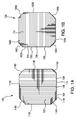
- FIGS. 1A and 1B illustrate, respectively, examples of first and second types of solar cells in accordance with the invention.
- FIG. 1A is a top plan view of a semiconductor solar cell 100 of the first type.
- the solar cell 100 which can be scribed or cut out from a substantially circular semiconductor wafer at the end of a fabrication process, can have a substantially rectangular shape.
- the solar cell 100 has two parallel long side edges 112A, 112B opposite one another, and two parallel short side edges 114A, 114B opposite one another.
- the longer side edges 112A, 112B are substantially perpendicular to the shorter side edges 114A, 114B.
- adjacent side edges of the solar cell may not form right-angles with one another; instead, the corners 116A, 116B, 116C, 116D of the solar cell 100 may appear as cut-off or rounded. The result is that the solar cell 100 may not be perfectly rectangular-shaped.
- one or more electrical contacts 104, 106, 108 are provided along one of the short side edges 114A at the top surface of the cell 100.
- Vertical conductors 102 extend in parallel over the top surface of the cell 100 and function to make electrical contact with the top layer of the cell and collect charge when the surface is illuminated. Thus, the conductors 102 extend substantially in parallel with the long side edges 112A, 112B.
- the top surface of the cell 100 also includes an electrically conducting bus 110, which extends along the periphery of the cell 100 at the short side edge 114A and at the corners 116A, 116D.
- the bus 110 functions to electrically connect each of the conductors 102, and also to connect to the electrical contacts 104, 106, 108 on the top surface of the cell 100.
- the bottom surface of the solar cell 100 can be covered substantially entirely with a metallic layer so as to serve as a lower, or bottom surface (i.e., backside), metallic contact for the cell 100.
- the solar cell is an n-on-p device.
- the top surface (as shown in FIG. 1A ) serves as the cathode, whereas the bottom or backside surface serves as the anode.
- the solar cell 100 can be, for example, a III-V multi-junction solar cell that includes a bottom cell, a middle cell and a top cell. Other implementations may use a different arrangement for the solar cell 100.
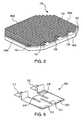
- FIG. 1B is a top plan view of a semiconductor solar cell 150 of the second type
- FIG. 2 is a perspective view of the same solar cell.
- the solar cell 150 of the second type can be similar to the solar cell 100 of the first type.
- the solar cell 150 can have two parallel long side edges 162A, 162B opposite one another, and two parallel short side edges 164A, 164B opposite one another.
- the longer side edges 162A, 162B are substantially perpendicular to the shorter side edges 164A, 164B.
- the overall shape and dimensions of the solar cell 150 can be substantially the same as the shape and dimensions of the solar cell 100.
- adjacent side edges of the solar cell 150 may not form right-angles with one another; instead, the corners 166A, 166B, 166C, 166D of the solar cell 150 may appear as cut-off or rounded. The result is that the solar cell 150 may not be perfectly rectangular-shaped.
- the second type of solar cell 150 also includes one or more electrical contacts 154, 156, 158 at the top surface of the cell 100.
- the contacts 104, 106, 108 for the solar cell 100 of FIG. 1A are provided along one of the short side edges 114A
- the contacts 154, 156, 158 for the solar cell 150 of FIG. 1B are provided along one of the long side edges 162A.
- Horizontal conductors 152 extend in parallel over the top surface of the cell 150 and function to make electrical contact with the top layer of the cell and collect charge when the surface is illuminated.
- the conductors 152 extend substantially in parallel with the short side edges 164A, 164B.
- the top surface of the cell 150 also includes an electrically conducting bus 160, which extends along the periphery of the cell 100 at the long side edge 162A and at the corners 166C, 166D.
- the bus 110 functions to electrically connect each of the conductors 152, and also to connect to the electrical contacts 154, 156, 158 on the top surface of the cell 150.
- the bottom surface of the solar cell 150 can be covered substantially entirely with a metallic layer so as to serve as a lower, or bottom surface (i.e., backside), metallic contact for the cell 150.
- FIG. 3A illustrates multiple solar cell arrays 200, 300, 400, 500 each of which includes solar cells of two different types, A and B.
- solar cells of type A correspond to the solar cell 100 of FIG. 1A
- solar cells of type B correspond to the solar cell 150 of FIG. 1B .
- the cells of each particular array (e.g., array 200) are arranged in a series connection and are supported, for example, by a lower substrate.
- the surface of the substrate on which the cells of a particular array are supported can include a periphery and an interior region.
- the series connection for the array 200 includes a first solar cell 201a whose bottom surface anode is connected to the top surface cathode contact(s) of the next adjacent cell 201b.
- the series connection of cells in the array 200 follows a clockwise spiral-type shape winding path 204 that starts with the first cell 201a at the periphery of the surface of the support substrate and ends with the last cell 203 disposed at the interior area of the surface of the support substrate.
- the support substrate is usually a composite material with an aluminum honeycomb core.
- the bottom surface anode of the cell 201b is connected to the top surface cathode contact(s) of the next adjacent 201c.
- the series connection continues in this fashion such that the bottom surface anode of each cell (other than the last cell 203) is connected to the top surface cathode contact(s) of the next adjacent cell.
- the electrical contacts on the next cell when connecting the bottom surface of one cell in the series to the electrical contacts on the top surface of the next cell, it is desirable for the electrical contacts on the next cell to be located at the side edge of that cell that is closest to a side edge of the previous cell.
- the next cell when a connection is made from one cell to a next cell in the same column, the next cell is of type A, which has electrical contacts on one of its short side edges (i.e., the short side edge that is adjacent to the previous cell).
- the next cell when a connection is made from one cell to a next cell in the same row, the next cell is of type B, which has electrical contacts on one of its longer side edges (i.e., the long side edge that is adjacent to the previous cell).
- the next cell when a connection is made from one cell to a next cell in the same row, the next cell is of type B, which has electrical contacts on one of its long side edges (i.e., the long side edge that is adjacent to the previous cell).
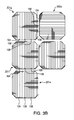
- FIG. 3B which shows a partial, enlarged version of the some of the cells 201e, 201f, 201g, 202a in the upper left-hand section of the array 200, illustrates the relative positioning of the cells and their top surface contacts.
- the cell 201e and the next cell 201f are both of type A, and the top surface contacts 104, 106, 108 of the cell 201f are located at its lower side edge, which is adjacent the top side edge of the cell 201e.
- this allows the two cells 201e, 201f to be connected electrically by an interconnect 300 that connects the metalized bottom surface of the cell 201e to one or more of the top surface contacts of the cell 201f.
- the metallized bottom surface of the cell 201f can be connected by an interconnect 300 in a similar fashion to one or more of the top surface contacts of the next cell 201 g, which also is of type A.
- the cell 201g in the upper left-hand corner of the array 200 is of type A
- the next cell 202a is of type B
- the top surface contacts 154, 156, 158 of the cell 202a are located at its left-hand side edge, which is adjacent the right-hand side edge of the cell 201g.
- this allows the two cells 201g, 202a to be connected electrically by an interconnect 300 that connects the metalized bottom surface of the cell 201 g to one or more of the top surface contacts of the cell 202a.
- the metallized bottom surface of the cell 202a can be connected by an interconnect 300 in a similar manner to one or more of the top surface contacts of the next cell 202b, which also is of type B.
- FIG. 5 illustrates further details of the interconnect 600 according to some implementations.
- the interconnect 600 can include, for example, first and second flat contact members 310, 311 that extend outward for contact, respectively, with two of the top surface contacts on one of the solar cells.
- the flat contact members 310, 311 should be spaced from one another at a distance that is the same as the distance between adjacent top surface contacts (e.g., contacts 104, 106 of the cell 201e; or contacts 156, 158 of the cell 202a).
- An advantage of providing two separate contact members and two top surface contacts is to achieve improved reliability in the event one of the electrical contacts is broken or otherwise shorts.
- the interconnect 600 is serpentine shaped, with middle portions 312, 313 for electrical contact with the metal layer on the bottom surface of one of the solar cells.
- the interconnect 600 can include one or more gaps 317, 318, where the planar surface changes direction, for stress relief. The details of the interconnect 600 may differ in other implementations.
- each array (e.g., array 200) includes a first terminal electrically connected directly to the first cell 201a in the series connection, and a second terminal electrically connected directly to a last cell 203 in the series connection.
- the first terminal connected to the first cell 201a is a lower voltage terminal of negative (-) polarity
- the second terminal connected to the last cell 203 is a higher voltage terminal of positive (+) polarity.
- the second terminal can be disposed at an interior area of the array that is sufficiently distant from the first terminal so as to reduce occurrence of electrostatic discharge. In some cases, the second terminal may be disposed at or near the center of the array, although in other instances, this need not be the case.
- a feed-through hole for the positive (+) terminal can be provided through the support substrate on which the cells of the array are supported.
- the series connection of the cells of the array 200 are arranged along a clockwise spiral-type path, in other arrays, the series connection of the cells can be arranged along a counterclockwise spiral-type path (see, e.g., arrays 300 and 400).
- each array of FIG. 2A (e.g., array 200) are arranged in columns and rows, different configurations may be used for other implementations.
- the array may include multiple rows, where the cells in a particular row are slightly offset or staggered from the cells of an adjacent row.
- the array may include multiple columns, where the cells in a particular column are slightly offset or staggered from the cells of an adjacent column.
- each array can depend on the particular needs of the application for the solar cell array. In some implementations, there are at least twenty-seven cells, each of which provides about a two-volt increase. More generally, however, the array can include a greater or lesser number of cells.
- Multiple solar cell arrays can be combined and connected electrically to form a solar cell panel.
- four sub-arrays 200, 300, 400, 500 are provided to form a single panel.
- the negative (-) terminal of each of the sub-arrays 200, 300, 400, 500 can be connected to a common cathode bus 700.
- Each of the arrays 300, 400, 500 can be similar to the array 200 as described above.
- the series connection of the cells in each particular array 200, 300, 400, 500 may follow a clockwise spiral-type shape winding path.
- the series connection of the cells in each particular array 200, 300, 400, 500 may follow a counterclockwise spiral-type shape winding path.
- some of the arrays in the panel have a clockwise spiral-type shape winding path, whereas other ones of the arrays have a counterclockwise spiral-type shape winding path.
- each sub-array 200, 500 having a clockwise spiral-type path is adjacent only sub-arrays 300, 400 having a counterclockwise spiral-type path.
- FIG. 3A shows a panel having four sub-arrays 200, 300, 400, 500, other implementations can include fewer or more arrays.
Landscapes
- Photovoltaic Devices (AREA)
Applications Claiming Priority (1)
| Application Number | Priority Date | Filing Date | Title |
|---|---|---|---|
| US14/151,236 US20150194551A1 (en) | 2014-01-09 | 2014-01-09 | Solar cell array having two different types of cells |
Publications (3)
| Publication Number | Publication Date |
|---|---|
| EP2894676A2 true EP2894676A2 (fr) | 2015-07-15 |
| EP2894676A3 EP2894676A3 (fr) | 2015-08-26 |
| EP2894676B1 EP2894676B1 (fr) | 2021-05-19 |
Family
ID=52232107
Family Applications (1)
| Application Number | Title | Priority Date | Filing Date |
|---|---|---|---|
| EP15150388.5A Active EP2894676B1 (fr) | 2014-01-09 | 2015-01-07 | Réseau de cellules solaires ayant deux types différents de cellules |
Country Status (2)
| Country | Link |
|---|---|
| US (1) | US20150194551A1 (fr) |
| EP (1) | EP2894676B1 (fr) |
Cited By (1)
| Publication number | Priority date | Publication date | Assignee | Title |
|---|---|---|---|---|
| CN111725344A (zh) * | 2020-06-29 | 2020-09-29 | 合肥阳光新能源科技有限公司 | 一种光伏组件及光伏阵列 |
Families Citing this family (12)
| Publication number | Priority date | Publication date | Assignee | Title |
|---|---|---|---|---|
| USD765024S1 (en) * | 2013-12-11 | 2016-08-30 | Solaero Technologies Corp. | Solar cell |
| USD765590S1 (en) * | 2013-12-11 | 2016-09-06 | Solaero Technologies Corp. | Solar cell |
| US10370766B2 (en) | 2016-10-27 | 2019-08-06 | The Regents Of The University Of California | Hybrid photo-electrochemical and photo-voltaic cells |
| USD804059S1 (en) * | 2016-10-28 | 2017-11-28 | Solarcity Corporation | Photovoltaic roof tile |
| US11575058B2 (en) | 2017-06-30 | 2023-02-07 | Mitsubishi Electric Corporation | Solar power generator, solar array wing, and space structure |
| TWI661572B (zh) * | 2017-07-21 | 2019-06-01 | 海力雅集成股份有限公司 | 太陽能模組及其製法 |
| USD838667S1 (en) * | 2017-10-16 | 2019-01-22 | Flex Ltd. | Busbar-less solar cell |
| USD839180S1 (en) * | 2017-10-31 | 2019-01-29 | Flex Ltd. | Busbar-less solar cell |
| JP1659105S (fr) * | 2019-03-08 | 2020-05-11 | ||
| USD909961S1 (en) * | 2019-06-06 | 2021-02-09 | Grouphug, Inc. | Solar panel assembly |
| CN111900225B (zh) * | 2020-06-30 | 2021-11-16 | 上海空间电源研究所 | 一种空间太阳电池阵互连结构、太阳电池阵及其成型方法 |
| WO2022075308A1 (fr) * | 2020-10-05 | 2022-04-14 | 株式会社カネカ | Élément de batterie solaire |
Family Cites Families (13)
| Publication number | Priority date | Publication date | Assignee | Title |
|---|---|---|---|---|
| IT1239117B (it) * | 1988-11-01 | 1993-09-28 | Gen Electric | Pannello solare antielettrostatico |
| JPH08204220A (ja) * | 1995-01-31 | 1996-08-09 | Mitsubishi Electric Corp | 太陽電池セル、太陽電池モジュール及び太陽電池モジュール群 |
| US6248950B1 (en) * | 1998-02-21 | 2001-06-19 | Space Systems/Loral, Inc. | Solar array augmented electrostatic discharge for spacecraft in geosynchronous earth orbit |
| JPH11238897A (ja) * | 1998-02-23 | 1999-08-31 | Canon Inc | 太陽電池モジュール製造方法および太陽電池モジュール |
| FR2822436B1 (fr) * | 2001-03-21 | 2003-08-15 | Cit Alcatel | Panneau solaire ayant des bornes electriques reparties sur sa surface |
| JP5153097B2 (ja) * | 2006-07-31 | 2013-02-27 | 三洋電機株式会社 | 太陽電池モジュール |
| KR20100097219A (ko) * | 2007-12-18 | 2010-09-02 | 데이4 에너지 인코포레이티드 | Pv 스트링으로 에지 액세스를 수행하는 광전지 모듈, 연결 방법, 장치, 및 시스템 |
| US20110011439A1 (en) * | 2008-02-25 | 2011-01-20 | Masatomo Hasegawa | Photovoltaic power system |
| TWI493732B (zh) * | 2009-02-17 | 2015-07-21 | Shinetsu Chemical Co | Solar module |
| JP2012527786A (ja) * | 2009-05-25 | 2012-11-08 | デイ4 エネルギー インコーポレイテッド | 光起電力モジュールストリング装置およびそのための影に入ることからの保護 |
| US20120318319A1 (en) * | 2011-06-17 | 2012-12-20 | Solopower, Inc. | Methods of interconnecting thin film solar cells |
| US9000288B2 (en) * | 2011-07-22 | 2015-04-07 | Space Systems/Loral, Llc | Current collector bar and grid pattern for a photovoltaic solar cell |
| WO2013106896A1 (fr) * | 2012-01-17 | 2013-07-25 | Day4 Energy Inc. | Module photovoltaïque composé d'ensembles de cellules avec adhésif pour fixer les ensembles au module |
-
2014
- 2014-01-09 US US14/151,236 patent/US20150194551A1/en not_active Abandoned
-
2015
- 2015-01-07 EP EP15150388.5A patent/EP2894676B1/fr active Active
Non-Patent Citations (1)
| Title |
|---|
| None |
Cited By (2)
| Publication number | Priority date | Publication date | Assignee | Title |
|---|---|---|---|---|
| CN111725344A (zh) * | 2020-06-29 | 2020-09-29 | 合肥阳光新能源科技有限公司 | 一种光伏组件及光伏阵列 |
| CN111725344B (zh) * | 2020-06-29 | 2022-04-08 | 阳光新能源开发股份有限公司 | 一种光伏组件及光伏阵列 |
Also Published As
| Publication number | Publication date |
|---|---|
| US20150194551A1 (en) | 2015-07-09 |
| EP2894676A3 (fr) | 2015-08-26 |
| EP2894676B1 (fr) | 2021-05-19 |
Similar Documents
| Publication | Publication Date | Title |
|---|---|---|
| EP2894676B1 (fr) | Réseau de cellules solaires ayant deux types différents de cellules | |
| US9960292B2 (en) | Radially arranged metal contact fingers for solar cells | |
| CN104205347A (zh) | 包含搭叠光伏瓦片的光伏模块及其制造工艺 | |
| TWI656649B (zh) | 光伏模組 | |
| US20220311078A1 (en) | Microbattery assembly | |
| WO2013044114A1 (fr) | Architectures pour batteries à électrolyte solide | |
| CN106165117B (zh) | 用于具有改进的电池连接拓扑的光伏模块的背侧接触层 | |
| US8796534B2 (en) | Solar cell and assembly of a plurality of solar cells | |
| KR20190013952A (ko) | 광전지 어셈블리, 광전지 어레이 및 태양 전지 어셈블리 | |
| US12615852B2 (en) | Solar module with optimized interconnection and method of manufacturing the same | |
| EP4672923A2 (fr) | Cellule solaire à contact arrière et module photovoltaïque | |
| US20180190847A1 (en) | Non-orthogonally patterned monolithically integrated thin film pv | |
| CN117296160A (zh) | 太阳能电池串和用于制造太阳能电池串的方法 | |
| EP2854183A1 (fr) | Cellule solaire à contact arrière | |
| US12495622B2 (en) | Solar-cell module | |
| JP6871044B2 (ja) | 太陽電池モジュール | |
| JP5459766B2 (ja) | 太陽電池パネル、太陽電池パネルの帯電抑制方法及び人工衛星搭載用太陽光発電装置 | |
| KR102026101B1 (ko) | 태양전지 모듈 및 이를 이용한 태양전지 어레이 | |
| CN106165118B (zh) | 用于具有旁路配置的pv模块的背侧接触层 | |
| JP7265655B1 (ja) | 太陽電池モジュール | |
| CN111584660A (zh) | 光伏组件和包括其的光伏装置 | |
| JP7711116B2 (ja) | 太陽電池モジュール | |
| EP3058596B1 (fr) | Ensemble de cellules photovoltaïques et son procédé de fabrication | |
| KR101816183B1 (ko) | 태양 전지 모듈 | |
| CN116759480A (zh) | 太阳能电池模块及电池组件 |
Legal Events
| Date | Code | Title | Description |
|---|---|---|---|
| PUAI | Public reference made under article 153(3) epc to a published international application that has entered the european phase |
Free format text: ORIGINAL CODE: 0009012 |
|
| 17P | Request for examination filed |
Effective date: 20150107 |
|
| AK | Designated contracting states |
Kind code of ref document: A2 Designated state(s): AL AT BE BG CH CY CZ DE DK EE ES FI FR GB GR HR HU IE IS IT LI LT LU LV MC MK MT NL NO PL PT RO RS SE SI SK SM TR |
|
| AX | Request for extension of the european patent |
Extension state: BA ME |
|
| PUAL | Search report despatched |
Free format text: ORIGINAL CODE: 0009013 |
|
| AK | Designated contracting states |
Kind code of ref document: A3 Designated state(s): AL AT BE BG CH CY CZ DE DK EE ES FI FR GB GR HR HU IE IS IT LI LT LU LV MC MK MT NL NO PL PT RO RS SE SI SK SM TR |
|
| AX | Request for extension of the european patent |
Extension state: BA ME |
|
| RIC1 | Information provided on ipc code assigned before grant |
Ipc: H01L 31/05 20140101AFI20150721BHEP |
|
| R17P | Request for examination filed (corrected) |
Effective date: 20160225 |
|
| RBV | Designated contracting states (corrected) |
Designated state(s): AL AT BE BG CH CY CZ DE DK EE ES FI FR GB GR HR HU IE IS IT LI LT LU LV MC MK MT NL NO PL PT RO RS SE SI SK SM TR |
|
| STAA | Information on the status of an ep patent application or granted ep patent |
Free format text: STATUS: EXAMINATION IS IN PROGRESS |
|
| 17Q | First examination report despatched |
Effective date: 20180418 |
|
| GRAP | Despatch of communication of intention to grant a patent |
Free format text: ORIGINAL CODE: EPIDOSNIGR1 |
|
| STAA | Information on the status of an ep patent application or granted ep patent |
Free format text: STATUS: GRANT OF PATENT IS INTENDED |
|
| INTG | Intention to grant announced |
Effective date: 20210127 |
|
| GRAS | Grant fee paid |
Free format text: ORIGINAL CODE: EPIDOSNIGR3 |
|
| GRAA | (expected) grant |
Free format text: ORIGINAL CODE: 0009210 |
|
| STAA | Information on the status of an ep patent application or granted ep patent |
Free format text: STATUS: THE PATENT HAS BEEN GRANTED |
|
| AK | Designated contracting states |
Kind code of ref document: B1 Designated state(s): AL AT BE BG CH CY CZ DE DK EE ES FI FR GB GR HR HU IE IS IT LI LT LU LV MC MK MT NL NO PL PT RO RS SE SI SK SM TR |
|
| REG | Reference to a national code |
Ref country code: GB Ref legal event code: FG4D |
|
| REG | Reference to a national code |
Ref country code: CH Ref legal event code: EP |
|
| REG | Reference to a national code |
Ref country code: DE Ref legal event code: R096 Ref document number: 602015069361 Country of ref document: DE |
|
| REG | Reference to a national code |
Ref country code: AT Ref legal event code: REF Ref document number: 1394841 Country of ref document: AT Kind code of ref document: T Effective date: 20210615 |
|
| REG | Reference to a national code |
Ref country code: IE Ref legal event code: FG4D |
|
| REG | Reference to a national code |
Ref country code: LT Ref legal event code: MG9D |
|
| REG | Reference to a national code |
Ref country code: AT Ref legal event code: MK05 Ref document number: 1394841 Country of ref document: AT Kind code of ref document: T Effective date: 20210519 |
|
| REG | Reference to a national code |
Ref country code: NL Ref legal event code: MP Effective date: 20210519 |
|
| PG25 | Lapsed in a contracting state [announced via postgrant information from national office to epo] |
Ref country code: BG Free format text: LAPSE BECAUSE OF FAILURE TO SUBMIT A TRANSLATION OF THE DESCRIPTION OR TO PAY THE FEE WITHIN THE PRESCRIBED TIME-LIMIT Effective date: 20210819 Ref country code: AT Free format text: LAPSE BECAUSE OF FAILURE TO SUBMIT A TRANSLATION OF THE DESCRIPTION OR TO PAY THE FEE WITHIN THE PRESCRIBED TIME-LIMIT Effective date: 20210519 Ref country code: LT Free format text: LAPSE BECAUSE OF FAILURE TO SUBMIT A TRANSLATION OF THE DESCRIPTION OR TO PAY THE FEE WITHIN THE PRESCRIBED TIME-LIMIT Effective date: 20210519 Ref country code: FI Free format text: LAPSE BECAUSE OF FAILURE TO SUBMIT A TRANSLATION OF THE DESCRIPTION OR TO PAY THE FEE WITHIN THE PRESCRIBED TIME-LIMIT Effective date: 20210519 Ref country code: HR Free format text: LAPSE BECAUSE OF FAILURE TO SUBMIT A TRANSLATION OF THE DESCRIPTION OR TO PAY THE FEE WITHIN THE PRESCRIBED TIME-LIMIT Effective date: 20210519 |
|
| PG25 | Lapsed in a contracting state [announced via postgrant information from national office to epo] |
Ref country code: RS Free format text: LAPSE BECAUSE OF FAILURE TO SUBMIT A TRANSLATION OF THE DESCRIPTION OR TO PAY THE FEE WITHIN THE PRESCRIBED TIME-LIMIT Effective date: 20210519 Ref country code: SE Free format text: LAPSE BECAUSE OF FAILURE TO SUBMIT A TRANSLATION OF THE DESCRIPTION OR TO PAY THE FEE WITHIN THE PRESCRIBED TIME-LIMIT Effective date: 20210519 Ref country code: NO Free format text: LAPSE BECAUSE OF FAILURE TO SUBMIT A TRANSLATION OF THE DESCRIPTION OR TO PAY THE FEE WITHIN THE PRESCRIBED TIME-LIMIT Effective date: 20210819 Ref country code: PL Free format text: LAPSE BECAUSE OF FAILURE TO SUBMIT A TRANSLATION OF THE DESCRIPTION OR TO PAY THE FEE WITHIN THE PRESCRIBED TIME-LIMIT Effective date: 20210519 Ref country code: PT Free format text: LAPSE BECAUSE OF FAILURE TO SUBMIT A TRANSLATION OF THE DESCRIPTION OR TO PAY THE FEE WITHIN THE PRESCRIBED TIME-LIMIT Effective date: 20210920 Ref country code: ES Free format text: LAPSE BECAUSE OF FAILURE TO SUBMIT A TRANSLATION OF THE DESCRIPTION OR TO PAY THE FEE WITHIN THE PRESCRIBED TIME-LIMIT Effective date: 20210519 Ref country code: GR Free format text: LAPSE BECAUSE OF FAILURE TO SUBMIT A TRANSLATION OF THE DESCRIPTION OR TO PAY THE FEE WITHIN THE PRESCRIBED TIME-LIMIT Effective date: 20210820 Ref country code: LV Free format text: LAPSE BECAUSE OF FAILURE TO SUBMIT A TRANSLATION OF THE DESCRIPTION OR TO PAY THE FEE WITHIN THE PRESCRIBED TIME-LIMIT Effective date: 20210519 Ref country code: IS Free format text: LAPSE BECAUSE OF FAILURE TO SUBMIT A TRANSLATION OF THE DESCRIPTION OR TO PAY THE FEE WITHIN THE PRESCRIBED TIME-LIMIT Effective date: 20210919 |
|
| PG25 | Lapsed in a contracting state [announced via postgrant information from national office to epo] |
Ref country code: NL Free format text: LAPSE BECAUSE OF FAILURE TO SUBMIT A TRANSLATION OF THE DESCRIPTION OR TO PAY THE FEE WITHIN THE PRESCRIBED TIME-LIMIT Effective date: 20210519 |
|
| PG25 | Lapsed in a contracting state [announced via postgrant information from national office to epo] |
Ref country code: RO Free format text: LAPSE BECAUSE OF FAILURE TO SUBMIT A TRANSLATION OF THE DESCRIPTION OR TO PAY THE FEE WITHIN THE PRESCRIBED TIME-LIMIT Effective date: 20210519 Ref country code: SM Free format text: LAPSE BECAUSE OF FAILURE TO SUBMIT A TRANSLATION OF THE DESCRIPTION OR TO PAY THE FEE WITHIN THE PRESCRIBED TIME-LIMIT Effective date: 20210519 Ref country code: SK Free format text: LAPSE BECAUSE OF FAILURE TO SUBMIT A TRANSLATION OF THE DESCRIPTION OR TO PAY THE FEE WITHIN THE PRESCRIBED TIME-LIMIT Effective date: 20210519 Ref country code: EE Free format text: LAPSE BECAUSE OF FAILURE TO SUBMIT A TRANSLATION OF THE DESCRIPTION OR TO PAY THE FEE WITHIN THE PRESCRIBED TIME-LIMIT Effective date: 20210519 Ref country code: CZ Free format text: LAPSE BECAUSE OF FAILURE TO SUBMIT A TRANSLATION OF THE DESCRIPTION OR TO PAY THE FEE WITHIN THE PRESCRIBED TIME-LIMIT Effective date: 20210519 Ref country code: DK Free format text: LAPSE BECAUSE OF FAILURE TO SUBMIT A TRANSLATION OF THE DESCRIPTION OR TO PAY THE FEE WITHIN THE PRESCRIBED TIME-LIMIT Effective date: 20210519 |
|
| REG | Reference to a national code |
Ref country code: DE Ref legal event code: R097 Ref document number: 602015069361 Country of ref document: DE |
|
| PLBE | No opposition filed within time limit |
Free format text: ORIGINAL CODE: 0009261 |
|
| STAA | Information on the status of an ep patent application or granted ep patent |
Free format text: STATUS: NO OPPOSITION FILED WITHIN TIME LIMIT |
|
| 26N | No opposition filed |
Effective date: 20220222 |
|
| PG25 | Lapsed in a contracting state [announced via postgrant information from national office to epo] |
Ref country code: IS Free format text: LAPSE BECAUSE OF FAILURE TO SUBMIT A TRANSLATION OF THE DESCRIPTION OR TO PAY THE FEE WITHIN THE PRESCRIBED TIME-LIMIT Effective date: 20210919 Ref country code: AL Free format text: LAPSE BECAUSE OF FAILURE TO SUBMIT A TRANSLATION OF THE DESCRIPTION OR TO PAY THE FEE WITHIN THE PRESCRIBED TIME-LIMIT Effective date: 20210519 |
|
| PG25 | Lapsed in a contracting state [announced via postgrant information from national office to epo] |
Ref country code: IT Free format text: LAPSE BECAUSE OF FAILURE TO SUBMIT A TRANSLATION OF THE DESCRIPTION OR TO PAY THE FEE WITHIN THE PRESCRIBED TIME-LIMIT Effective date: 20210519 |
|
| PG25 | Lapsed in a contracting state [announced via postgrant information from national office to epo] |
Ref country code: MC Free format text: LAPSE BECAUSE OF FAILURE TO SUBMIT A TRANSLATION OF THE DESCRIPTION OR TO PAY THE FEE WITHIN THE PRESCRIBED TIME-LIMIT Effective date: 20210519 |
|
| REG | Reference to a national code |
Ref country code: CH Ref legal event code: PL |
|
| GBPC | Gb: european patent ceased through non-payment of renewal fee |
Effective date: 20220107 |
|
| REG | Reference to a national code |
Ref country code: BE Ref legal event code: MM Effective date: 20220131 |
|
| PG25 | Lapsed in a contracting state [announced via postgrant information from national office to epo] |
Ref country code: LU Free format text: LAPSE BECAUSE OF NON-PAYMENT OF DUE FEES Effective date: 20220107 Ref country code: GB Free format text: LAPSE BECAUSE OF NON-PAYMENT OF DUE FEES Effective date: 20220107 |
|
| PG25 | Lapsed in a contracting state [announced via postgrant information from national office to epo] |
Ref country code: BE Free format text: LAPSE BECAUSE OF NON-PAYMENT OF DUE FEES Effective date: 20220131 |
|
| PG25 | Lapsed in a contracting state [announced via postgrant information from national office to epo] |
Ref country code: LI Free format text: LAPSE BECAUSE OF NON-PAYMENT OF DUE FEES Effective date: 20220131 Ref country code: CH Free format text: LAPSE BECAUSE OF NON-PAYMENT OF DUE FEES Effective date: 20220131 |
|
| PG25 | Lapsed in a contracting state [announced via postgrant information from national office to epo] |
Ref country code: IE Free format text: LAPSE BECAUSE OF NON-PAYMENT OF DUE FEES Effective date: 20220107 |
|
| PG25 | Lapsed in a contracting state [announced via postgrant information from national office to epo] |
Ref country code: HU Free format text: LAPSE BECAUSE OF FAILURE TO SUBMIT A TRANSLATION OF THE DESCRIPTION OR TO PAY THE FEE WITHIN THE PRESCRIBED TIME-LIMIT; INVALID AB INITIO Effective date: 20150107 |
|
| PG25 | Lapsed in a contracting state [announced via postgrant information from national office to epo] |
Ref country code: MK Free format text: LAPSE BECAUSE OF FAILURE TO SUBMIT A TRANSLATION OF THE DESCRIPTION OR TO PAY THE FEE WITHIN THE PRESCRIBED TIME-LIMIT Effective date: 20210519 Ref country code: CY Free format text: LAPSE BECAUSE OF FAILURE TO SUBMIT A TRANSLATION OF THE DESCRIPTION OR TO PAY THE FEE WITHIN THE PRESCRIBED TIME-LIMIT Effective date: 20210519 |
|
| PG25 | Lapsed in a contracting state [announced via postgrant information from national office to epo] |
Ref country code: MT Free format text: LAPSE BECAUSE OF FAILURE TO SUBMIT A TRANSLATION OF THE DESCRIPTION OR TO PAY THE FEE WITHIN THE PRESCRIBED TIME-LIMIT Effective date: 20210519 |
|
| REG | Reference to a national code |
Ref country code: DE Ref legal event code: R079 Ref document number: 602015069361 Country of ref document: DE Free format text: PREVIOUS MAIN CLASS: H01L0031050000 Ipc: H10F0019900000 |
|
| PG25 | Lapsed in a contracting state [announced via postgrant information from national office to epo] |
Ref country code: TR Free format text: LAPSE BECAUSE OF FAILURE TO SUBMIT A TRANSLATION OF THE DESCRIPTION OR TO PAY THE FEE WITHIN THE PRESCRIBED TIME-LIMIT Effective date: 20210519 |
|
| PGFP | Annual fee paid to national office [announced via postgrant information from national office to epo] |
Ref country code: FR Payment date: 20251208 Year of fee payment: 12 |
|
| PGFP | Annual fee paid to national office [announced via postgrant information from national office to epo] |
Ref country code: DE Payment date: 20251203 Year of fee payment: 12 |