EP2897201B1 - Procédé de préparation d'un matériau actif de cathode pour une batterie secondaire au lithium - Google Patents
Procédé de préparation d'un matériau actif de cathode pour une batterie secondaire au lithium Download PDFInfo
- Publication number
- EP2897201B1 EP2897201B1 EP14814161.7A EP14814161A EP2897201B1 EP 2897201 B1 EP2897201 B1 EP 2897201B1 EP 14814161 A EP14814161 A EP 14814161A EP 2897201 B1 EP2897201 B1 EP 2897201B1
- Authority
- EP
- European Patent Office
- Prior art keywords
- active material
- cathode active
- manganese
- lithium
- secondary battery
- Prior art date
- Legal status (The legal status is an assumption and is not a legal conclusion. Google has not performed a legal analysis and makes no representation as to the accuracy of the status listed.)
- Active
Links
Images



Classifications
-
- H—ELECTRICITY
- H01—ELECTRIC ELEMENTS
- H01M—PROCESSES OR MEANS, e.g. BATTERIES, FOR THE DIRECT CONVERSION OF CHEMICAL ENERGY INTO ELECTRICAL ENERGY
- H01M4/00—Electrodes
- H01M4/02—Electrodes composed of, or comprising, active material
- H01M4/13—Electrodes for accumulators with non-aqueous electrolyte, e.g. for lithium-accumulators; Processes of manufacture thereof
- H01M4/131—Electrodes based on mixed oxides or hydroxides, or on mixtures of oxides or hydroxides, e.g. LiCoOx
-
- C—CHEMISTRY; METALLURGY
- C01—INORGANIC CHEMISTRY
- C01G—COMPOUNDS CONTAINING METALS NOT COVERED BY SUBCLASSES C01D OR C01F
- C01G53/00—Compounds of nickel
- C01G53/40—Complex oxides containing nickel and at least one other metal element
- C01G53/42—Complex oxides containing nickel and at least one other metal element containing alkali metals, e.g. LiNiO2
- C01G53/44—Complex oxides containing nickel and at least one other metal element containing alkali metals, e.g. LiNiO2 containing manganese
- C01G53/50—Complex oxides containing nickel and at least one other metal element containing alkali metals, e.g. LiNiO2 containing manganese of the type (MnO2)n-, e.g. Li(NixMn1-x)O2 or Li(MyNixMn1-x-y)O2
-
- H—ELECTRICITY
- H01—ELECTRIC ELEMENTS
- H01M—PROCESSES OR MEANS, e.g. BATTERIES, FOR THE DIRECT CONVERSION OF CHEMICAL ENERGY INTO ELECTRICAL ENERGY
- H01M4/00—Electrodes
- H01M4/02—Electrodes composed of, or comprising, active material
- H01M4/04—Processes of manufacture in general
- H01M4/0402—Methods of deposition of the material
- H01M4/0419—Methods of deposition of the material involving spraying
-
- H—ELECTRICITY
- H01—ELECTRIC ELEMENTS
- H01M—PROCESSES OR MEANS, e.g. BATTERIES, FOR THE DIRECT CONVERSION OF CHEMICAL ENERGY INTO ELECTRICAL ENERGY
- H01M4/00—Electrodes
- H01M4/02—Electrodes composed of, or comprising, active material
- H01M4/04—Processes of manufacture in general
- H01M4/0402—Methods of deposition of the material
- H01M4/0421—Methods of deposition of the material involving vapour deposition
-
- H—ELECTRICITY
- H01—ELECTRIC ELEMENTS
- H01M—PROCESSES OR MEANS, e.g. BATTERIES, FOR THE DIRECT CONVERSION OF CHEMICAL ENERGY INTO ELECTRICAL ENERGY
- H01M4/00—Electrodes
- H01M4/02—Electrodes composed of, or comprising, active material
- H01M4/04—Processes of manufacture in general
- H01M4/0471—Processes of manufacture in general involving thermal treatment, e.g. firing, sintering, backing particulate active material, thermal decomposition, pyrolysis
-
- H—ELECTRICITY
- H01—ELECTRIC ELEMENTS
- H01M—PROCESSES OR MEANS, e.g. BATTERIES, FOR THE DIRECT CONVERSION OF CHEMICAL ENERGY INTO ELECTRICAL ENERGY
- H01M4/00—Electrodes
- H01M4/02—Electrodes composed of, or comprising, active material
- H01M4/13—Electrodes for accumulators with non-aqueous electrolyte, e.g. for lithium-accumulators; Processes of manufacture thereof
- H01M4/131—Electrodes based on mixed oxides or hydroxides, or on mixtures of oxides or hydroxides, e.g. LiCoOx
- H01M4/1315—Electrodes based on mixed oxides or hydroxides, or on mixtures of oxides or hydroxides, e.g. LiCoOx containing halogen atoms, e.g. LiCoOxFy
-
- H—ELECTRICITY
- H01—ELECTRIC ELEMENTS
- H01M—PROCESSES OR MEANS, e.g. BATTERIES, FOR THE DIRECT CONVERSION OF CHEMICAL ENERGY INTO ELECTRICAL ENERGY
- H01M4/00—Electrodes
- H01M4/02—Electrodes composed of, or comprising, active material
- H01M4/13—Electrodes for accumulators with non-aqueous electrolyte, e.g. for lithium-accumulators; Processes of manufacture thereof
- H01M4/139—Processes of manufacture
-
- H—ELECTRICITY
- H01—ELECTRIC ELEMENTS
- H01M—PROCESSES OR MEANS, e.g. BATTERIES, FOR THE DIRECT CONVERSION OF CHEMICAL ENERGY INTO ELECTRICAL ENERGY
- H01M4/00—Electrodes
- H01M4/02—Electrodes composed of, or comprising, active material
- H01M4/13—Electrodes for accumulators with non-aqueous electrolyte, e.g. for lithium-accumulators; Processes of manufacture thereof
- H01M4/139—Processes of manufacture
- H01M4/1391—Processes of manufacture of electrodes based on mixed oxides or hydroxides, or on mixtures of oxides or hydroxides, e.g. LiCoOx
-
- H—ELECTRICITY
- H01—ELECTRIC ELEMENTS
- H01M—PROCESSES OR MEANS, e.g. BATTERIES, FOR THE DIRECT CONVERSION OF CHEMICAL ENERGY INTO ELECTRICAL ENERGY
- H01M4/00—Electrodes
- H01M4/02—Electrodes composed of, or comprising, active material
- H01M4/13—Electrodes for accumulators with non-aqueous electrolyte, e.g. for lithium-accumulators; Processes of manufacture thereof
- H01M4/139—Processes of manufacture
- H01M4/1391—Processes of manufacture of electrodes based on mixed oxides or hydroxides, or on mixtures of oxides or hydroxides, e.g. LiCoOx
- H01M4/13915—Processes of manufacture of electrodes based on mixed oxides or hydroxides, or on mixtures of oxides or hydroxides, e.g. LiCoOx containing halogen atoms, e.g. LiCoOxFy
-
- H—ELECTRICITY
- H01—ELECTRIC ELEMENTS
- H01M—PROCESSES OR MEANS, e.g. BATTERIES, FOR THE DIRECT CONVERSION OF CHEMICAL ENERGY INTO ELECTRICAL ENERGY
- H01M4/00—Electrodes
- H01M4/02—Electrodes composed of, or comprising, active material
- H01M4/36—Selection of substances as active materials, active masses, active liquids
- H01M4/362—Composites
- H01M4/366—Composites as layered products
-
- H—ELECTRICITY
- H01—ELECTRIC ELEMENTS
- H01M—PROCESSES OR MEANS, e.g. BATTERIES, FOR THE DIRECT CONVERSION OF CHEMICAL ENERGY INTO ELECTRICAL ENERGY
- H01M4/00—Electrodes
- H01M4/02—Electrodes composed of, or comprising, active material
- H01M4/36—Selection of substances as active materials, active masses, active liquids
- H01M4/48—Selection of substances as active materials, active masses, active liquids of inorganic oxides or hydroxides
- H01M4/50—Selection of substances as active materials, active masses, active liquids of inorganic oxides or hydroxides of manganese
- H01M4/505—Selection of substances as active materials, active masses, active liquids of inorganic oxides or hydroxides of manganese of mixed oxides or hydroxides containing manganese for inserting or intercalating light metals, e.g. LiMn2O4 or LiMn2OxFy
-
- H—ELECTRICITY
- H01—ELECTRIC ELEMENTS
- H01M—PROCESSES OR MEANS, e.g. BATTERIES, FOR THE DIRECT CONVERSION OF CHEMICAL ENERGY INTO ELECTRICAL ENERGY
- H01M4/00—Electrodes
- H01M4/02—Electrodes composed of, or comprising, active material
- H01M4/36—Selection of substances as active materials, active masses, active liquids
- H01M4/48—Selection of substances as active materials, active masses, active liquids of inorganic oxides or hydroxides
- H01M4/52—Selection of substances as active materials, active masses, active liquids of inorganic oxides or hydroxides of nickel, cobalt or iron
- H01M4/525—Selection of substances as active materials, active masses, active liquids of inorganic oxides or hydroxides of nickel, cobalt or iron of mixed oxides or hydroxides containing iron, cobalt or nickel for inserting or intercalating light metals, e.g. LiNiO2, LiCoO2 or LiCoOxFy
-
- C—CHEMISTRY; METALLURGY
- C01—INORGANIC CHEMISTRY
- C01P—INDEXING SCHEME RELATING TO STRUCTURAL AND PHYSICAL ASPECTS OF SOLID INORGANIC COMPOUNDS
- C01P2002/00—Crystal-structural characteristics
- C01P2002/20—Two-dimensional structures
-
- C—CHEMISTRY; METALLURGY
- C01—INORGANIC CHEMISTRY
- C01P—INDEXING SCHEME RELATING TO STRUCTURAL AND PHYSICAL ASPECTS OF SOLID INORGANIC COMPOUNDS
- C01P2004/00—Particle morphology
- C01P2004/01—Particle morphology depicted by an image
- C01P2004/03—Particle morphology depicted by an image obtained by SEM
-
- C—CHEMISTRY; METALLURGY
- C01—INORGANIC CHEMISTRY
- C01P—INDEXING SCHEME RELATING TO STRUCTURAL AND PHYSICAL ASPECTS OF SOLID INORGANIC COMPOUNDS
- C01P2004/00—Particle morphology
- C01P2004/80—Particles consisting of a mixture of two or more inorganic phases
-
- C—CHEMISTRY; METALLURGY
- C01—INORGANIC CHEMISTRY
- C01P—INDEXING SCHEME RELATING TO STRUCTURAL AND PHYSICAL ASPECTS OF SOLID INORGANIC COMPOUNDS
- C01P2006/00—Physical properties of inorganic compounds
- C01P2006/40—Electric properties
-
- H—ELECTRICITY
- H01—ELECTRIC ELEMENTS
- H01M—PROCESSES OR MEANS, e.g. BATTERIES, FOR THE DIRECT CONVERSION OF CHEMICAL ENERGY INTO ELECTRICAL ENERGY
- H01M10/00—Secondary cells; Manufacture thereof
- H01M10/05—Accumulators with non-aqueous electrolyte
- H01M10/052—Li-accumulators
-
- H—ELECTRICITY
- H01—ELECTRIC ELEMENTS
- H01M—PROCESSES OR MEANS, e.g. BATTERIES, FOR THE DIRECT CONVERSION OF CHEMICAL ENERGY INTO ELECTRICAL ENERGY
- H01M4/00—Electrodes
- H01M4/02—Electrodes composed of, or comprising, active material
- H01M2004/021—Physical characteristics, e.g. porosity, surface area
-
- H—ELECTRICITY
- H01—ELECTRIC ELEMENTS
- H01M—PROCESSES OR MEANS, e.g. BATTERIES, FOR THE DIRECT CONVERSION OF CHEMICAL ENERGY INTO ELECTRICAL ENERGY
- H01M4/00—Electrodes
- H01M4/02—Electrodes composed of, or comprising, active material
- H01M2004/026—Electrodes composed of, or comprising, active material characterised by the polarity
- H01M2004/028—Positive electrodes
-
- H—ELECTRICITY
- H01—ELECTRIC ELEMENTS
- H01M—PROCESSES OR MEANS, e.g. BATTERIES, FOR THE DIRECT CONVERSION OF CHEMICAL ENERGY INTO ELECTRICAL ENERGY
- H01M2220/00—Batteries for particular applications
- H01M2220/20—Batteries in motive systems, e.g. vehicle, ship, plane
-
- Y—GENERAL TAGGING OF NEW TECHNOLOGICAL DEVELOPMENTS; GENERAL TAGGING OF CROSS-SECTIONAL TECHNOLOGIES SPANNING OVER SEVERAL SECTIONS OF THE IPC; TECHNICAL SUBJECTS COVERED BY FORMER USPC CROSS-REFERENCE ART COLLECTIONS [XRACs] AND DIGESTS
- Y02—TECHNOLOGIES OR APPLICATIONS FOR MITIGATION OR ADAPTATION AGAINST CLIMATE CHANGE
- Y02E—REDUCTION OF GREENHOUSE GAS [GHG] EMISSIONS, RELATED TO ENERGY GENERATION, TRANSMISSION OR DISTRIBUTION
- Y02E60/00—Enabling technologies; Technologies with a potential or indirect contribution to GHG emissions mitigation
- Y02E60/10—Energy storage using batteries
-
- Y—GENERAL TAGGING OF NEW TECHNOLOGICAL DEVELOPMENTS; GENERAL TAGGING OF CROSS-SECTIONAL TECHNOLOGIES SPANNING OVER SEVERAL SECTIONS OF THE IPC; TECHNICAL SUBJECTS COVERED BY FORMER USPC CROSS-REFERENCE ART COLLECTIONS [XRACs] AND DIGESTS
- Y02—TECHNOLOGIES OR APPLICATIONS FOR MITIGATION OR ADAPTATION AGAINST CLIMATE CHANGE
- Y02P—CLIMATE CHANGE MITIGATION TECHNOLOGIES IN THE PRODUCTION OR PROCESSING OF GOODS
- Y02P70/00—Climate change mitigation technologies in the production process for final industrial or consumer products
- Y02P70/50—Manufacturing or production processes characterised by the final manufactured product
Definitions
- the present disclosure relates to a cathode active material for a lithium secondary battery and a method for manufacturing the same, and more particularly, to a cathode active material for a lithium secondary battery with improved rate characteristics and a method for manufacturing the same.
- EVs electric vehicles
- HEVs hybrid electric vehicles
- Electric vehicles (EVs) and hybrid electric vehicles (HEVs) use Ni-MH secondary batteries or lithium secondary batteries having a high energy density, a high discharge voltage and output stability as a power source, and when a lithium secondary battery is used in an electric vehicle, the lithium secondary battery needs to be used for ten or more years under a severe condition along with a high energy density and capability of providing a high output in a short time, and thus is necessarily required to have much better stability and long-term life characteristics than an existing small-sized lithium secondary battery. Also, a secondary battery in use for an electric vehicle (EV) and a hybrid electric vehicle (HEV) needs to be excellent in rate characteristics and power characteristics based on an operating condition of the vehicle.
- lithium-containing cobalt oxide such as LiCoO 2 of a layered structure
- lithium-containing nickel oxide such as LiNiO 2 of a layered structure
- lithium-containing manganese oxide such as LiMn 2 O 4 of a spinel crystal structure
- LiCoO 2 has excellent material properties including excellent cycle characteristics and is being widely used at present, but has low safety and because cobalt as a raw material is a finite resource, is costly and insufficient to use in large amounts as a power source in the field of industries such as electric vehicles. According to characteristics of a manufacturing method, applying LiNiO 2 to a mass production process at a reasonable cost is impractical.
- lithium manganese oxide such as LiMnO 2 and LiMn 2 O 4 has an advantage of using manganese noted for an abundant and eco-friendly resource as a raw material, and thus is attracting much attention as an alternative cathode active material to LiCoO 2 .
- these exemplary lithium manganese oxides have also a shortcoming of poor cycle characteristics.
- LiMnO 2 has a drawback of low initial capacity and in that several tens of charging and discharging cycles are needed until it reaches a predetermined capacity.
- LiMn 2 O 4 experiences a serious capacity reduction during cycles, and particularly, has a disadvantage of drastic degradation in cycle characteristics due to decomposition of an electrolyte solution and manganese release at high temperature higher than or equal to 50°C.
- lithium nickel-manganese-cobalt-based composite oxide of a layered structure is proposed as a good active material having excellent battery performance balance while overcoming or minimizing the problems of each cathode active material.
- lithium nickel-manganese-cobalt-based composite oxide of a layered structure needs improvements of, in particular, rate characteristics for a wide range of applications. Fluorine coating of these materials provides such improvement, see Yang-Kook Sun et al., Advanced Materials, vol. 24 (9), 1192-1196 , WO 2008/069351 A1 , and US 2009/087362 A1 .
- the present disclosure is designed to solve the problem of the related art, and therefore, the present disclosure is directed to providing a method for manufacturing the cathode active material for a lithium secondary battery with improved rate characteristics.
- a lithium nickel-manganese-cobalt cathode active material for a lithium secondary battery wherein the lithium nickel-manganese-cobalt cathode active material has a layered structure and a fluorine-coated surface, and the fluorine-coated surface has a spinel-like phase.
- the lithium nickel-manganese-cobalt cathode active material may be any cathode active material having a composition higher than or equal to 50 wt% of Mn among nickel, manganese, and cobalt, and its non-limiting example may be represented by the following general formula 1, but is not limited thereto: [General Formula 1] Li x Ni y Mn z Co 1-y-z O 2 where z>y, z>1-y-z ⁇ 0, and x ⁇ 1.
- lithium nickel-manganese-cobalt cathode active material may be represented by the following general formula 2: [General Formula 2] Li x Ni y Mn z Co 1-y-z M ⁇ O 2 where z>y, z>1-y-z ⁇ 0, x ⁇ 1, 0 ⁇ 1, and M is at least one metal selected from the group consisting of B, Li, Mg, Al, Ca, Sr, Cr, V, Ti, Fe, Co, Ni, Zr, Zn, Si, Y, Nb, Ga, Sn, Mo, W, and combinations thereof.
- general formula 2 Li x Ni y Mn z Co 1-y-z M ⁇ O 2 where z>y, z>1-y-z ⁇ 0, x ⁇ 1, 0 ⁇ 1, and M is at least one metal selected from the group consisting of B, Li, Mg, Al, Ca, Sr, Cr, V, Ti, Fe, Co, Ni, Zr, Zn, Si, Y, Nb, Ga, Sn,
- the lithium nickel-manganese-cobalt cathode active material may have a secondary grain size of a longest diameter from 20 nm to 200 ⁇ m.
- the fluorine-coated surface may have a thickness from 2 nm to 20 ⁇ m.
- a z/y value representing an Mn/Ni atomic ratio may be 1 ⁇ z/y ⁇ 20.
- the fluorine coating may be made by a compound selected from the group consisting of polyvinylidene fluoride (PVdF), AlF 3 , NH 4 F, CsF, KF, LiF, NaF, RbF, TiF, AgF, AgF 2 , BaF 2 , CaF 2 , CuF 2 , CdF 2 , FeF 2 , HgF 2 , Hg 2 F 2 , MnF 2 , MgF 2 , NiF 2 , PbF 2 , SnF 2 , SrF 2 , XeF 2 , ZnF 2 , AlF 2 , BF 3 , BiF 3 , CeF 3 , CrF 3 , DyF 3 , EuF 3 , GaF 3 , GdF 3 , FeF 3 , HoF 3 , InF 3 , LaF 3 , LuF 3 , MnF 3 , NdF 3 , VOF 3 , PrF 3 , S
- a method for manufacturing a lithium nickel-manganese-cobalt cathode active material for a lithium secondary battery including (a) uniformly mixing a nickel compound, a manganese compound, and cobalt compound, (b) adding a lithium compound to a resultant of (a) and performing a baking treatment to obtain a layered lithium nickel-manganese-cobalt cathode active material, and (c) coating fluorine on a surface of the layered lithium nickel-manganese-cobalt cathode active material so that the fluorine coated surface has a spinel-like phase.
- the fluorine coating may be performed by a solid state reaction method using heat treatment, a spray drying method, or a vapor reaction method.
- a cathode for a lithium secondary battery manufactured from a cathode mix slurry including the above lithium nickel-manganese-cobalt cathode active material for a lithium secondary battery.
- a lithium secondary battery including a cathode, an anode, a separator interposed between the cathode and the anode, and an electrolyte solution, wherein the cathode is the above cathode for a lithium secondary battery.
- a battery module including the above lithium secondary battery as a unit cell.
- a battery pack including the above battery module as a power source of a medium and large-sized device.
- the medium and large-sized device may be an electric vehicle, a hybrid electric vehicle, a plug-in electric vehicle, or an energy storage system.
- a lithium secondary battery with improved rate characteristics that may be charged to a capacity close to a full charge in a short time when compared to a related art is provided.
- the lithium secondary battery is adequate for high capacity and suitable for use as a power source of a medium- or large-sized device.
- a layered lithium nickel-manganese-cobalt cathode active material of the present disclosure is surface-coated with fluorine.
- the layered lithium nickel-manganese-cobalt cathode active material may be any cathode active material having a composition higher than or equal to 50 wt% of Mn among nickel, manganese, and cobalt, and its non-limiting example may be represented by the following general formula 1, but is not limited thereto.
- a z/y value representing a Mn/Ni atomic ratio is preferably 1 ⁇ z/y ⁇ 20.
- safety may significantly reduce, and when the z/y value is lower than the lower limit, it is difficult to expect a high capacity.
- a non-limiting example of the layered lithium nickel-manganese-cobalt cathode active material may be represented by the following general formula 2: [General Formula 2] Li x Ni y Mn z Co 1-y-z M ⁇ O 2 where z>y, z>1-y-z ⁇ 0, x ⁇ 1, 0 ⁇ 1, and M is at least one metal selected from the group consisting of B, Li, Mg, Al, Ca, Sr, Cr, V, Ti, Fe, Co, Ni, Zr, Zn, Si, Y, Nb, Ga, Sn, Mo, W, and combinations thereof.
- a z/y value representing a Mn/Ni atomic ratio is preferably 1 ⁇ z/y ⁇ 20. Also, in the above general formulas 1 and 2, z ⁇ 0.5 is preferred.
- the lithium nickel-manganese-cobalt cathode active material may have a grain size of a longest diameter from 20 nm to 200 ⁇ m, but is not limited thereto.
- the fluorine coating is applied to the surface of the layered lithium nickel-manganese-cobalt cathode active material, namely, a target material for coating, to create a reducing environment when baking so that the surface of the cathode active material may form a spinel-like phase.
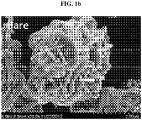
- FIGS. 1a and 1b FIGS. 1a and 1b ;
- FIG. 1a is a scanning electron microscope (SEM) image of a fluorine-coated cathode active material according to an aspect of the present disclosure
- FIG. 1b is an SEM image of the cathode active material before fluorine coating, and in the SEM images, the lithium nickel-manganese-cobalt cathode active material has a flake form.
- the lithium nickel-manganese-cobalt cathode active material according to an aspect of the present disclosure has an advantage of being less attacked from an electrolyte solution because a protective coating is formed by a uniform or nearly uniform fluorine coating provided on the cathode active material particles.
- a principle of forming the spinel-like phase by applying fluorine onto the surface of the layered cathode active material of General Formula 1 is not yet clarified, but is figured out by experiment results. Moreover, by the fluorine coating of the cathode active material, the influence on acid produced near the cathode active material decreases, or reactivity of the cathode active material with an electrolyte solution is suppressed, so a phenomenon in which the battery capacity drastically reduces may be resolved, and consequently, charging/discharging characteristics, life characteristics, a high voltage and high rate characteristics, and thermal safety may be improved.
- the cathode active material having the spinel-like phase surface structure according to an aspect of the present disclosure is advantageous in improving the rate characteristics, compared to a cathode active material having gone through fluorine coating without modifying a surface structure.
- fluorine containing compounds used in the fluorine coating include, but are not limited to, polyvinylidene fluoride (PVdF), AlF 3 , NH 4 F, CsF, KF, LiF, NaF, RbF, TiF, AgF, AgF 2 , BaF 2 , CaF 2 , CuF 2 , CdF 2 , FeF 2 , HgF 2 , Hg 2 F 2 , MnF 2 , MgF 2 , NiF 2 , PbF 2 , SnF 2 , SrF 2 , XeF 2 , ZnF 2 , AlF 2 , BF 3 , BiF 3 , CeF 3 , CrF 3 , DyF 3 , EuF 3 , GaF 3 , GdF 3 , FeF 3 , HoF 3 , InF 3 , LaF 3 , LuF 3 , MnF 3 , NdF 3 , VOF 3 , PrF 3
- the fluorine coated surface may have a thickness from 2 nm to 20 ⁇ m or from 2 nm to 5 ⁇ m, but is not limited thereto.
- a spinel-like phase may not be properly formed, and when the fluorine coated surface is thicker than the upper limit, movement of Li ions may be unfavorable and many side reactions with an electrolyte solution may occur.
- the content of the fluorine coating may be from 0.01 to 8 wt% or from 0.01 to 5 wt% based on the weight of the cathode active material.
- the content of the fluorine coating is less than the lower limit, modification to a layered spinel-like phase structure is not made on the surface of the cathode active material, and when the content of the fluorine coating is in excess beyond the upper limit, a relative ratio of the cathode active material reduces and a capacity or energy density reduces.
- a method for manufacturing lithium nickel-manganese-cobalt-based composite oxide for a lithium secondary battery according to the present disclosure may include, but is not limited to the following steps of:
- the nickel compound may include, for example, Ni(OH) 2 , NiO, NiOOH, NiCO 3 ⁇ 2Ni(OH) 2 ⁇ 4H 2 O, NiC 2 O 4 ⁇ 2H 2 O, Ni(NO 3 ) 2 ⁇ 6H 2 O, NiSO 4 , NiSO 4 ⁇ 6H 2 O, nickel salt of fatty acid, and nickel halide.
- a nickel compound not including a nitrogen or sulfur atom during baking treatment such as Ni(OH) 2 , NiO, NiOOH, NiCO 3 ⁇ 2Ni(OH) 2 ⁇ 4H 2 O, and NiC 2 O 4 ⁇ 2H 2 O, is preferred in that it does not produce a harmful substance such as NO x and SO x during a baking process.
- Such nickel compounds may be used singularly or in combination.
- the manganese compound may include, for example, manganese oxide such as Mn 2 O 3 , MnO 2 , and Mn 3 O 4 , MnCO 3 , Mn(NO 3 ) 2 , MnSO 4 ; manganese salt such as manganese acetate, manganese(II) dicarboxylate, manganese citrate, and manganese salt of fatty acid; and halide such as manganese chloride.
- MnO 2 , Mn 2 O 3 , and Mn 3 O 4 are preferred, and this is because they are available as an industrial raw material at a low cost while not producing No x and SO x and gas such as CO 2 during baking treatment.
- Such manganese compounds may be used singularly or in combination.
- the cobalt compound may include, for example, Co(OH) 2 , CoOOH, CoO, Co 2 O 3 , Co 3 O 4 , Co(OCOCH 3 ) 2 ⁇ 4H 2 O, CoCl 2 , Co(NO 3 ) 2 ⁇ 6H 2 O, and Co(SO 4 ) 2 ⁇ 7H 2 O.
- Co(OH) 2 , CoOOH, CoO, Co 2 O 3 , and Co 3 O 4 are preferred in that they do not produce a harmful substance such as NO x and SO x during baking treatment.
- Co(OH) 2 and CoOOH are more preferred from the perspective of a low cost in the industrial aspect and high reactivity.
- Such cobalt compounds may be used singularly or in combination.
- a method of mixing the raw materials is not limited to a particular one, and the raw materials may be mixed by a wet or dry process.
- a method using a machine such as a ball mill, a vibratory mill, and a bead mill may be contemplated.
- the wet mixing is preferred because it allows for more uniform mixing and increased reactivity of a mixture in a baking process.
- a mixing time may change based on a mixing method. However, so long as the raw materials are uniformly mixed at a particulate level, any mixing time may be used. For example, when mixing using a ball mill (wet or dry mixing), a mixing time is generally from about 1 hour to about two days, and when mixing using a bead mill (wet continuous method), a dwell time is generally from about 0.1 hour to about 6 hours.
- a drying method is not limited to a particular one. However, in terms of uniformity of a particulate material to be produced, powder flowability and powder processing performance, and efficiency in forming spherical secondary particles, spray drying is preferred.
- the powder obtained by spray drying is sufficiently mixed with lithium-containing compounds such as Li 2 CO 3 , LiNO 3 , LiNO 2 , LiOH, LiOH ⁇ H 2 O, LiH, LiF, LiCl, LiBr, LiI, CH 3 OOLi, Li 2 O, Li 2 SO 4 , lithium dicarboxylate, lithium citrate, and lithium salt of fatty acid and alkyl lithium.
- lithium-containing compounds such as Li 2 CO 3 , LiNO 3 , LiNO 2 , LiOH, LiOH ⁇ H 2 O, LiH, LiF, LiCl, LiBr, LiI, CH 3 OOLi, Li 2 O, Li 2 SO 4 , lithium dicarboxylate, lithium citrate, and lithium salt of fatty acid and alkyl lithium.
- a baking condition is determined based on a composition and lithium compound materials being used.
- a baking temperature is generally 800°C or higher, preferably 900°C or higher, more preferably 950°C or higher, and generally 1100°C or lower, preferably 1075°C or lower, more preferably 1050°C or lower.
- a coating method may include, but is not limited to, for example, a solid phase reaction which performs heat treatment on the fluorine-containing compound and the cathode active material at a proper temperature, a spray drying method which dissolves the fluorine-containing compound in a solvent and disperses/sprays it, or a vapor reaction using gas.
- the solid phase reaction is advantageous in aspects of a process or costs, and may include a process of heat treatment at 300 to 600°C for 5 to 10 hours.
- the cathode active material of the present disclosure manufactured in this way may form a cathode mix with a binder and a conductive material generally used in the art.
- the binder is a substance that aids the binding of the cathode active material and the conductive material etc. and the binding of the cathode active material to the current collector, and may be added in an amount of, for example, 1 to 30 parts by weight based on 100 parts by weight of the cathode active material, but its content is not specially limited in the present disclosure.
- the binder is not limited to a particular one, but may include, for example, polyvinylidene fluoride (PVdF), polytetrafluoroethylene (PTFE), fluororubber, styrene-butadiene rubber (SBR), and cellulose-based resin.
- the conductive material may be added in an amount of, for example, 1 to 50 parts by weight based on 100 parts by weight of the cathode active material, but its content is not specially limited in the present disclosure.
- the conductive material is not limited to a specific type if it is conductive while not causing a chemical change in the battery in question, and may include, for example, a carbon black-based conductive material such as graphite or acetylene black.
- a dispersant may be selected from the group consisting of N-methyl-2-pyrrolidone, diacetone alcohol, dimethylformaldehyde, propyleneglycol monomethylether, methyl cellosolve, ethyl cellosolve, butyl cellosolve, isopropyl cellosolve, acetylacetone, methyl isobutyl ketone, n-butyl acetate, cellosolve acetate, toluene, xylene, and mixtures thereof, but is not limited thereto.
- the cathode mix slurry is coated on a cathode current collector and dried to form a cathode for a lithium secondary battery.
- the cathode current collector generally has a thickness from 10 to 500 ⁇ m.
- the cathode current collector is not limited to a specific type if it has high conductivity while not causing a chemical change in the corresponding battery, and may be made from, for example, stainless steel, aluminum, nickel, titanium, baked carbon, or aluminum or stainless steel treated with carbon, nickel, titanium, or silver on the surface.
- a thickness of the cathode mix slurry on the cathode current collector is not specially limited, and may be, for example, from 10 to 300 ⁇ m, and a loading amount of active materials may be 5 to 50 mg/cm 2 .
- a lithium secondary battery including a cathode, an anode, a separator interposed between the cathode and the anode, and an electrolyte solution, wherein the above cathode is used as the cathode.
- the lithium secondary battery may be fabricated by manufacturing an anode, a separator, and an electrolyte solution by a general method known in the art and assembling them with the cathode.
- an anode active material may include a general anode active material usable in an anode of a conventional electrochemical cell, in particular, a lithium adsorption material such as a lithium metal or a lithium alloy, carbon, petroleum coke, activated carbon, graphite, or other carbons is preferred.
- An anode current collector may be, as a non-limiting example, a foil made from copper, gold, nickel or copper alloy, or combinations thereof.
- a polyolefin-based film of porous polyethylene and porous polypropylene, an organic/inorganic composite separator having a porous coating layer formed on a porous substrate, a non-woven film, and engineering plastic may be used, but is not limited thereto.
- a lamination/stacking process and a folding process as well as a winding process being generally used may be contemplated.
- the electrolyte solution usable in an exemplary embodiment of the present disclosure may be an electrolyte solution in which a salt, for example, of A + B - structure, where A + represents an alkali metal cation such as Li + , Na + and K + , or combinations thereof, and B - represents an anion such as PF 6 - , BF 4 - , Cl - , Br - , I - , ClO 4 - , AsF 6 - , CH 3 CO 2 - , CF 3 SO 3 - , N(CF 3 SO 2 ) 2 - and C(CF 2 SO 2 ) 3 - , or combinations thereof, is dissolved or dissociated in an organic solvent including, but is not limited to, propylene carbonate (PC), ethylene carbonate (EC), diethyl carbonate (DEC), dimethyl carbonate (DMC), dipropyl carbonate (DPC), dimethylsulfoxide, acetonitrile, dimethoxyethane,
- a halogen containing solvent such as carbon tetrachloride and trifluoroethylene may be additionally included, and to improve the preserving characteristics at high temperature, carbon dioxide gas may be additionally included, and fluoro-ethylene carbonate (FEC), propene sultone (PRS), and fluoro-propylene carbonate (FPC) may be additionally included.
- FEC fluoro-ethylene carbonate
- PRS propene sultone
- FPC fluoro-propylene carbonate
- Injection of the electrolyte solution may be performed in a proper step among a battery fabrication process based on a manufacturing process and required physical properties of a final product. That is, injection of the electrolyte solution may be applied before battery assembling or in a final step of battery assembling.
- the secondary battery according to the present disclosure may be not only used in a battery cell which may be used as a power source of a small device, but also used as a unit battery in a medium-large sized battery module including a plurality of battery cells.
- the present disclosure provides a battery pack including the battery module as a power source of a medium and large-sized device, and the medium and large-sized device may be used in an electric car including an electric vehicle (EV), a hybrid electric vehicle (HEV), and a plug-in hybrid electric vehicle (PHEV), an energy storage system, and the like.
- EV electric vehicle
- HEV hybrid electric vehicle
- PHEV plug-in hybrid electric vehicle
- the lithium nickel-manganese-cobalt composite oxide was dissolved in a dispersant along with a conductive material and a binder to obtain a slurry, and the slurry was coated on an aluminum current collector and dried at temperature of 100 to 130°C for 2 hours, to manufacture a cathode.
- the cathode obtained in Embodiment example 1 was used as a cathode of a lithium secondary battery.
- Li metal As an anode, a generally available Li metal was used.
- a cathode was manufactured by the same method as Embodiment example 1 except non-fluorine-coated layered lithium nickel-manganese-cobalt composite oxide was used.
- Comparative example 2 Manufacture of lithium secondary battery
- a lithium secondary battery was manufactured by the same method as Embodiment example 2 except the cathode obtained in Comparative example 1 was used.
- a discharge capacity was measured at a rate of 0.1C, 0.5C, 1.0C, and 2.0C at an operating voltage from 2.75 to 4.45V.
- a discharge capacity at 0.5C is shown in FIGS. 2a and 2b .
- FIG. 2b is a triplicate experiment graph of a cell fabricated by the same method using a bare cathode active material manufactured by the same method, and it can be seen that even the cells using the same type of cathode active material show a significant discharge capacity difference. It is found that this big difference has occurred because the bare sample free of fluorine coating on the surface of the cathode active material is susceptible to surface exposure to an electrolyte solution, leading to a side reaction which accelerates the degradation, in particular, an electrolyte solution side reaction occurs more intensively at a certain partial zone of the cathode active material.
- rate capability of the battery cell exhibiting the highest discharge capacity in Comparative example 2 and the battery cell of Embodiment example 2 is shown in FIG. 3 .
Landscapes
- Chemical & Material Sciences (AREA)
- Chemical Kinetics & Catalysis (AREA)
- Electrochemistry (AREA)
- General Chemical & Material Sciences (AREA)
- Engineering & Computer Science (AREA)
- Materials Engineering (AREA)
- Manufacturing & Machinery (AREA)
- Inorganic Chemistry (AREA)
- Composite Materials (AREA)
- Organic Chemistry (AREA)
- Battery Electrode And Active Subsutance (AREA)
- Secondary Cells (AREA)
- Inorganic Compounds Of Heavy Metals (AREA)
Claims (1)
- Procédé de fabrication d'un matériau de cathode actif pour une batterie rechargeable, le procédé consistant à :(a) mélanger uniformément un composé de nickel et un composé de manganèse ;(b) ajouter un composé de lithium à une résultante de (a) et effectuer un traitement de cuisson au four pour obtenir un matériau actif en couche pour cathode représenté par la formule générale suivante :
[Formule générale] LixNiyMn2MαO2
où z>y, z≥0,5, x≥1, 0≤α≤1, et M est un ou plusieurs métaux sélectionnés dans le groupe constitué de B, Li, Mg, Al, Ca, Sr, Cr, V, Ti, Fe, Co, Ni, Zr, Zn, Si, Y, Nb, Ga, Sn, Mo, W, et des combinaisons de ces derniers ; et(c) revêtir de fluor une surface du matériau actif en couche pour cathode, caractérisé en ce que le revêtement est effectué par un procédé de réaction à l'état solide utilisant un traitement thermique de sorte que la surface revêtue de fluor a une phase de type spinelle, dans lequel le procédé de réaction à l'état solide consiste à mélanger le matériau actif en couche pour cathode avec du fluorure de polyvinylidène (PVdF) et à effectuer le traitement thermique entre 300 et 600°C pendant 5 à 10 heures.
Applications Claiming Priority (2)
| Application Number | Priority Date | Filing Date | Title |
|---|---|---|---|
| KR20130069947 | 2013-06-18 | ||
| PCT/KR2014/005375 WO2014204213A1 (fr) | 2013-06-18 | 2014-06-18 | Matériau actif de cathode pour batterie secondaire au lithium et procédé de préparation pour ce dernier |
Publications (3)
| Publication Number | Publication Date |
|---|---|
| EP2897201A1 EP2897201A1 (fr) | 2015-07-22 |
| EP2897201A4 EP2897201A4 (fr) | 2016-05-25 |
| EP2897201B1 true EP2897201B1 (fr) | 2019-05-15 |
Family
ID=52676013
Family Applications (1)
| Application Number | Title | Priority Date | Filing Date |
|---|---|---|---|
| EP14814161.7A Active EP2897201B1 (fr) | 2013-06-18 | 2014-06-18 | Procédé de préparation d'un matériau actif de cathode pour une batterie secondaire au lithium |
Country Status (6)
| Country | Link |
|---|---|
| US (1) | US9972834B2 (fr) |
| EP (1) | EP2897201B1 (fr) |
| JP (1) | JP6200959B2 (fr) |
| KR (1) | KR101667968B1 (fr) |
| CN (1) | CN104781964B (fr) |
| WO (1) | WO2014204213A1 (fr) |
Families Citing this family (25)
| Publication number | Priority date | Publication date | Assignee | Title |
|---|---|---|---|---|
| JP6172529B2 (ja) | 2014-07-22 | 2017-08-02 | トヨタ自動車株式会社 | リチウムイオン二次電池用正極活物質およびその利用 |
| US10109858B1 (en) * | 2015-05-08 | 2018-10-23 | Tronox Llc | Method for preparing electrolytic manganese dioxide |
| KR101770820B1 (ko) | 2015-07-09 | 2017-08-23 | 이환 | 양극 활물질용 리튬망간산화물의 제조방법 |
| US11011746B2 (en) | 2015-07-13 | 2021-05-18 | Samsung Electronics Co., Ltd. | Composite cathode active material for lithium battery, cathode for lithium battery including the same, and lithium battery including the cathode |
| KR102547064B1 (ko) * | 2016-03-18 | 2023-06-23 | 삼성에스디아이 주식회사 | 유기전해액 및 상기 전해액을 채용한 리튬 전지 |
| KR20170124105A (ko) | 2016-04-29 | 2017-11-09 | 한양대학교 산학협력단 | 양극활물질, 그 제조 방법, 및 이를 포함하는 리튬이차전지 |
| KR20180018884A (ko) * | 2016-08-09 | 2018-02-22 | 인천대학교 산학협력단 | 수계 리튬이차전지용 표면 처리된 양극 활물질 |
| US20180145317A1 (en) * | 2016-11-18 | 2018-05-24 | Semiconductor Energy Laboratory Co., Ltd. | Positive electrode active material, method for manufacturing positive electrode active material, and secondary battery |
| CN106935799B (zh) * | 2017-03-17 | 2018-10-12 | 江苏润寅石墨烯科技有限公司 | 一种稳定的镍钴锰酸锂三元锂电池正极片及制备方法 |
| KR102266508B1 (ko) | 2017-09-26 | 2021-06-16 | 주식회사 엘지에너지솔루션 | 전지 급속 충전 시스템 |
| KR102164006B1 (ko) | 2017-11-16 | 2020-10-12 | 삼성에스디아이 주식회사 | 리튬 이차 전지용 양극 활물질, 이를 포함하는 리튬 이차 전지 및 전지모듈 |
| CN107959015B (zh) * | 2017-11-23 | 2018-11-16 | 江苏贝肯盛创新能源科技有限公司 | 一种改性锂电池正极材料、制备方法及包含其的锂电池 |
| CN108511710B (zh) * | 2018-03-22 | 2020-09-11 | 中南大学 | 富锂锰基锂离子电池正极材料及其制备方法 |
| KR20190130932A (ko) | 2018-05-15 | 2019-11-25 | 삼성에스디아이 주식회사 | 리튬이차전지용 양극활물질 및 이를 포함하는 양극을 포함한 리튬이차전지 |
| DE102018114009A1 (de) * | 2018-06-12 | 2019-12-12 | Volkswagen Aktiengesellschaft | Aktivmaterialkörper für einen Akkumulator |
| PL3836259T3 (pl) * | 2018-09-28 | 2022-09-19 | Lg Chem, Ltd. | Materiał czynny elektrody dodatniej dla akumulatora, sposób jego wytwarzania i zawierający go akumulator litowy |
| EP3657581B1 (fr) | 2018-11-14 | 2025-12-31 | Samsung SDI Co., Ltd. | Matériau actif positif pour batterie au lithium rechargeable, son procédé de préparation et batterie au lithium rechargeable le comprenant |
| US11757092B2 (en) | 2018-11-15 | 2023-09-12 | Samsung Sdi Co., Ltd. | Positive active material for rechargeable lithium battery, method of preparing the same and rechargeable lithium battery including the same |
| JP2020087810A (ja) * | 2018-11-29 | 2020-06-04 | セイコーエプソン株式会社 | 活物質、活物質の製造方法、電極複合体、二次電池および電子機器 |
| KR102363371B1 (ko) * | 2019-02-01 | 2022-02-14 | 삼성에스디아이 주식회사 | 리튬 이차 전지용 양극 활물질, 이의 제조방법 및 이를 포함하는 리튬 이차 전지 |
| US12586791B2 (en) | 2019-12-26 | 2026-03-24 | Iucf-Hyu (Industry-University Cooperation Foundation Hanyang University) | Fluorine-containing positive electrode active material for lithium secondary battery, and lithium secondary battery including same |
| CN111554907B (zh) * | 2020-05-15 | 2022-08-05 | 深圳澳睿新能源科技有限公司 | 脂肪酸在制备锂离子电池中的应用及制取电极材料的方法 |
| JP7807758B2 (ja) * | 2020-10-16 | 2026-01-28 | ビーエーエスエフ ソシエタス・ヨーロピア | イッテルビウムを含有する固体リチウムイオン伝導度材料及びその調製方法 |
| US12580182B2 (en) | 2021-07-07 | 2026-03-17 | Samsung Electronics Co., Ltd. | Coated cathode active material, method of preparing the same, and cathode and non-aqueous electrolyte secondary battery each including the same |
| CN115148981B (zh) * | 2022-08-17 | 2026-03-24 | 宁波容百新能源科技股份有限公司 | 一种锂离子电池正极材料及其制备方法和应用 |
Family Cites Families (22)
| Publication number | Priority date | Publication date | Assignee | Title |
|---|---|---|---|---|
| KR100441520B1 (ko) * | 2002-05-28 | 2004-07-23 | 삼성에스디아이 주식회사 | 리튬 이차 전지용 양극 활물질 및 그 제조방법 |
| KR100565990B1 (ko) * | 2003-11-24 | 2006-03-30 | 전자부품연구원 | 리튬 2차전지용 양극 활물질, 그 제조 방법 및 그를포함하는 리튬 2차전지 |
| JP2006012426A (ja) * | 2004-06-22 | 2006-01-12 | Nichia Chem Ind Ltd | 非水電解質二次電池用正極活物質および非水電解質二次電池 |
| JP4582579B2 (ja) * | 2004-12-07 | 2010-11-17 | Agcセイミケミカル株式会社 | リチウム二次電池用正極材料 |
| KR100822013B1 (ko) | 2005-04-15 | 2008-04-14 | 주식회사 에너세라믹 | 불소화합물코팅 리튬이차전지 양극 활물질 및 그 제조방법 |
| JP5223166B2 (ja) * | 2006-02-07 | 2013-06-26 | 日産自動車株式会社 | 電池活物質および二次電池 |
| WO2008069351A1 (fr) * | 2006-12-05 | 2008-06-12 | Sk Energy Co., Ltd. | Matériau actif pour cathode en spinelle coeur-écorce utilisée dans des batteries secondaires au lithium, batteries secondaires les comprenant et procédé de préparation associé |
| CN101622741A (zh) * | 2007-03-05 | 2010-01-06 | 户田工业株式会社 | 非水电解质二次电池用Li-Ni复合氧化物粒子粉末及其制造方法、以及非水电解质二次电池 |
| US8389160B2 (en) * | 2008-10-07 | 2013-03-05 | Envia Systems, Inc. | Positive electrode materials for lithium ion batteries having a high specific discharge capacity and processes for the synthesis of these materials |
| JP5111421B2 (ja) * | 2009-03-27 | 2013-01-09 | 株式会社日立製作所 | リチウム二次電池用正極材料,リチウム二次電池及びそれを用いた二次電池モジュール |
| JP5791877B2 (ja) * | 2009-09-30 | 2015-10-07 | 三洋電機株式会社 | 正極活物質、この正極活物質の製造方法、及び、正極活物質を用いた非水電解質二次電池 |
| BR112012010448A2 (pt) | 2009-11-05 | 2016-03-08 | Umicore Nv | pó de óxido de metal de transição de lítio para uso em uma bateria recarregável, processo para cobrir o mesmo, e, uso de um pó de óxido de metal de transição de lítio |
| US8852452B2 (en) * | 2009-11-05 | 2014-10-07 | Umicore | Core-shell lithium transition metal oxides |
| JP2011171150A (ja) * | 2010-02-19 | 2011-09-01 | Sony Corp | 正極活物質、正極および非水電解質二次電池 |
| US8741484B2 (en) | 2010-04-02 | 2014-06-03 | Envia Systems, Inc. | Doped positive electrode active materials and lithium ion secondary battery constructed therefrom |
| JP5621600B2 (ja) * | 2011-01-11 | 2014-11-12 | 旭硝子株式会社 | リチウムイオン二次電池用の正極活物質およびその製造方法 |
| JP6086501B2 (ja) * | 2011-04-18 | 2017-03-01 | エルジー ケム. エルティーディ. | 正極活物質、及びそれを含むリチウム二次電池 |
| EP2696409B1 (fr) * | 2011-05-23 | 2017-08-09 | LG Chem, Ltd. | Batterie secondaire au lithium à haute densité énergétique présentant des caractéristiques de densité énergétique améliorées |
| JPWO2012176903A1 (ja) * | 2011-06-24 | 2015-02-23 | 旭硝子株式会社 | リチウムイオン二次電池用正極活物質の製造方法 |
| KR20130033154A (ko) | 2011-09-26 | 2013-04-03 | 전자부품연구원 | 리튬 이차전지용 양극 활물질, 그의 제조방법 및 그를 포함하는 리튬이차전지 |
| JP5831769B2 (ja) * | 2011-11-16 | 2015-12-09 | トヨタ自動車株式会社 | リチウムイオン二次電池及びその製造方法 |
| KR101400593B1 (ko) | 2012-12-06 | 2014-05-27 | 삼성정밀화학 주식회사 | 양극 활물질, 이의 제조방법 및 이를 포함하는 리튬 이차 전지 |
-
2014
- 2014-06-18 EP EP14814161.7A patent/EP2897201B1/fr active Active
- 2014-06-18 JP JP2015537653A patent/JP6200959B2/ja active Active
- 2014-06-18 US US14/438,025 patent/US9972834B2/en active Active
- 2014-06-18 WO PCT/KR2014/005375 patent/WO2014204213A1/fr not_active Ceased
- 2014-06-18 CN CN201480003024.0A patent/CN104781964B/zh active Active
- 2014-06-18 KR KR1020140074346A patent/KR101667968B1/ko active Active
Non-Patent Citations (1)
| Title |
|---|
| None * |
Also Published As
| Publication number | Publication date |
|---|---|
| JP2015533257A (ja) | 2015-11-19 |
| JP6200959B2 (ja) | 2017-09-20 |
| KR20140147049A (ko) | 2014-12-29 |
| EP2897201A4 (fr) | 2016-05-25 |
| US9972834B2 (en) | 2018-05-15 |
| WO2014204213A1 (fr) | 2014-12-24 |
| US20150287984A1 (en) | 2015-10-08 |
| EP2897201A1 (fr) | 2015-07-22 |
| KR101667968B1 (ko) | 2016-10-20 |
| CN104781964A (zh) | 2015-07-15 |
| CN104781964B (zh) | 2018-03-06 |
Similar Documents
| Publication | Publication Date | Title |
|---|---|---|
| EP2897201B1 (fr) | Procédé de préparation d'un matériau actif de cathode pour une batterie secondaire au lithium | |
| KR101574044B1 (ko) | 비수 전해질 2차 전지 및 그 제조 방법 | |
| US9666901B2 (en) | Additive for electrolyte solution, non-aqueous electrolyte solution including the additive and lithium secondary battery including the electrolyte solution | |
| US9559350B2 (en) | Method for producing nonaqueous electrolyte secondary battery | |
| KR101702070B1 (ko) | 표면 부산물이 감소된 양극 활물질 및 그의 제조방법 | |
| US8568620B2 (en) | Electrode composite material, method for making the same, and lithium ion battery using the same | |
| EP3340348B1 (fr) | Matériau actif d'électrode positive pour batterie secondaire au lithium, contenant de l'oxyde de cobalt et de lithium haute tension ayant un élément dopant, et son procédé de préparation | |
| KR102010014B1 (ko) | 리튬 이차전지 및 그의 구동방법 | |
| KR20150069334A (ko) | 양극 활물질, 이의 제조방법 및 이를 포함하는 리튬이차전지 | |
| EP3382780B1 (fr) | Matériau actif d'électrode positive pour batterie rechargeable au lithium, contenant de l'oxyde de cobalt et de lithium haute tension, et son procédé de préparation | |
| WO2007010915A1 (fr) | Batterie secondaire électrolytique non aqueuse et procédé de fabrication idoine | |
| KR101776896B1 (ko) | 리튬 이차전지용 양극 활물질 및 그의 제조방법 | |
| EP3054506B1 (fr) | Matière active d'anode pour batterie rechargeable au lithium, son procédé de fabrication, batterie rechargeable au lithium la comprenant | |
| KR20110084200A (ko) | 비방전 용량이 높은 리튬 이온 배터리용 양극 재료 및 이 재료의 합성 방법 | |
| EP3203568B1 (fr) | Additif d'électrolyte pour batterie secondaire au lithium, électrolyte non aqueux et batterie secondaire au lithium comprenant l'additif d'électrolyte | |
| US20180123186A1 (en) | Method of manufacturing lithium secondary battery and lithium secondary battery manufactured by the same | |
| KR101423818B1 (ko) | 리튬 이온 2차 전지의 전처리 방법 및 사용 방법 | |
| KR101909317B1 (ko) | 리튬 이차전지용 양극 활물질 및 그의 제조방법 | |
| KR101991057B1 (ko) | 리튬 이차전지 및 그의 구동방법 | |
| US9203115B2 (en) | Method of manufacturing nonaqueous electrolyte secondary battery | |
| KR101776895B1 (ko) | 리튬 이차전지용 양극 활물질 및 그의 제조방법 | |
| KR20150069335A (ko) | 양극 활물질의 제조 방법, 이 방법에 따라 제조된 양극 활물질 및 이를 포함하는 리튬 이차 전지 | |
| KR101639313B1 (ko) | 리튬 이차전지용 양극 및 이를 포함하는 리튬 이차전지 | |
| CN116325238B (zh) | 锂二次电池用正极活性材料及其制备方法 | |
| KR20150021844A (ko) | 양극 활물질, 그의 제조방법 및 상기 양극 활물질을 포함하는 리튬이차전지 |
Legal Events
| Date | Code | Title | Description |
|---|---|---|---|
| PUAI | Public reference made under article 153(3) epc to a published international application that has entered the european phase |
Free format text: ORIGINAL CODE: 0009012 |
|
| 17P | Request for examination filed |
Effective date: 20150413 |
|
| AK | Designated contracting states |
Kind code of ref document: A1 Designated state(s): AL AT BE BG CH CY CZ DE DK EE ES FI FR GB GR HR HU IE IS IT LI LT LU LV MC MK MT NL NO PL PT RO RS SE SI SK SM TR |
|
| AX | Request for extension of the european patent |
Extension state: BA ME |
|
| RA4 | Supplementary search report drawn up and despatched (corrected) |
Effective date: 20160428 |
|
| RIC1 | Information provided on ipc code assigned before grant |
Ipc: H01M 4/505 20100101ALI20160421BHEP Ipc: H01M 4/02 20060101ALN20160421BHEP Ipc: H01M 4/525 20100101AFI20160421BHEP Ipc: H01M 4/36 20060101ALI20160421BHEP Ipc: H01M 4/131 20100101ALI20160421BHEP Ipc: H01M 4/1391 20100101ALI20160421BHEP Ipc: H01M 10/052 20100101ALN20160421BHEP Ipc: C01G 53/00 20060101ALI20160421BHEP |
|
| DAX | Request for extension of the european patent (deleted) | ||
| STAA | Information on the status of an ep patent application or granted ep patent |
Free format text: STATUS: EXAMINATION IS IN PROGRESS |
|
| 17Q | First examination report despatched |
Effective date: 20170614 |
|
| GRAP | Despatch of communication of intention to grant a patent |
Free format text: ORIGINAL CODE: EPIDOSNIGR1 |
|
| STAA | Information on the status of an ep patent application or granted ep patent |
Free format text: STATUS: GRANT OF PATENT IS INTENDED |
|
| RIC1 | Information provided on ipc code assigned before grant |
Ipc: H01M 4/131 20100101ALI20190130BHEP Ipc: H01M 4/1391 20100101ALI20190130BHEP Ipc: H01M 4/02 20060101ALN20190130BHEP Ipc: C01G 53/00 20060101ALI20190130BHEP Ipc: H01M 4/505 20100101ALI20190130BHEP Ipc: H01M 4/36 20060101ALI20190130BHEP Ipc: H01M 10/052 20100101ALN20190130BHEP Ipc: H01M 4/525 20100101AFI20190130BHEP Ipc: H01M 4/139 20100101ALI20190130BHEP |
|
| RIC1 | Information provided on ipc code assigned before grant |
Ipc: H01M 10/052 20100101ALN20190206BHEP Ipc: H01M 4/02 20060101ALN20190206BHEP Ipc: H01M 4/139 20100101ALI20190206BHEP Ipc: H01M 4/505 20100101ALI20190206BHEP Ipc: H01M 4/36 20060101ALI20190206BHEP Ipc: H01M 4/131 20100101ALI20190206BHEP Ipc: H01M 4/525 20100101AFI20190206BHEP Ipc: C01G 53/00 20060101ALI20190206BHEP Ipc: H01M 4/1391 20100101ALI20190206BHEP |
|
| INTG | Intention to grant announced |
Effective date: 20190226 |
|
| GRAS | Grant fee paid |
Free format text: ORIGINAL CODE: EPIDOSNIGR3 |
|
| GRAA | (expected) grant |
Free format text: ORIGINAL CODE: 0009210 |
|
| STAA | Information on the status of an ep patent application or granted ep patent |
Free format text: STATUS: THE PATENT HAS BEEN GRANTED |
|
| AK | Designated contracting states |
Kind code of ref document: B1 Designated state(s): AL AT BE BG CH CY CZ DE DK EE ES FI FR GB GR HR HU IE IS IT LI LT LU LV MC MK MT NL NO PL PT RO RS SE SI SK SM TR |
|
| REG | Reference to a national code |
Ref country code: CH Ref legal event code: EP |
|
| REG | Reference to a national code |
Ref country code: IE Ref legal event code: FG4D |
|
| REG | Reference to a national code |
Ref country code: DE Ref legal event code: R096 Ref document number: 602014046921 Country of ref document: DE |
|
| RAP2 | Party data changed (patent owner data changed or rights of a patent transferred) |
Owner name: LG CHEM, LTD. |
|
| REG | Reference to a national code |
Ref country code: NL Ref legal event code: MP Effective date: 20190515 |
|
| REG | Reference to a national code |
Ref country code: LT Ref legal event code: MG4D |
|
| PG25 | Lapsed in a contracting state [announced via postgrant information from national office to epo] |
Ref country code: LT Free format text: LAPSE BECAUSE OF FAILURE TO SUBMIT A TRANSLATION OF THE DESCRIPTION OR TO PAY THE FEE WITHIN THE PRESCRIBED TIME-LIMIT Effective date: 20190515 Ref country code: HR Free format text: LAPSE BECAUSE OF FAILURE TO SUBMIT A TRANSLATION OF THE DESCRIPTION OR TO PAY THE FEE WITHIN THE PRESCRIBED TIME-LIMIT Effective date: 20190515 Ref country code: ES Free format text: LAPSE BECAUSE OF FAILURE TO SUBMIT A TRANSLATION OF THE DESCRIPTION OR TO PAY THE FEE WITHIN THE PRESCRIBED TIME-LIMIT Effective date: 20190515 Ref country code: NL Free format text: LAPSE BECAUSE OF FAILURE TO SUBMIT A TRANSLATION OF THE DESCRIPTION OR TO PAY THE FEE WITHIN THE PRESCRIBED TIME-LIMIT Effective date: 20190515 Ref country code: SE Free format text: LAPSE BECAUSE OF FAILURE TO SUBMIT A TRANSLATION OF THE DESCRIPTION OR TO PAY THE FEE WITHIN THE PRESCRIBED TIME-LIMIT Effective date: 20190515 Ref country code: FI Free format text: LAPSE BECAUSE OF FAILURE TO SUBMIT A TRANSLATION OF THE DESCRIPTION OR TO PAY THE FEE WITHIN THE PRESCRIBED TIME-LIMIT Effective date: 20190515 Ref country code: NO Free format text: LAPSE BECAUSE OF FAILURE TO SUBMIT A TRANSLATION OF THE DESCRIPTION OR TO PAY THE FEE WITHIN THE PRESCRIBED TIME-LIMIT Effective date: 20190815 Ref country code: PT Free format text: LAPSE BECAUSE OF FAILURE TO SUBMIT A TRANSLATION OF THE DESCRIPTION OR TO PAY THE FEE WITHIN THE PRESCRIBED TIME-LIMIT Effective date: 20190915 Ref country code: AL Free format text: LAPSE BECAUSE OF FAILURE TO SUBMIT A TRANSLATION OF THE DESCRIPTION OR TO PAY THE FEE WITHIN THE PRESCRIBED TIME-LIMIT Effective date: 20190515 |
|
| PG25 | Lapsed in a contracting state [announced via postgrant information from national office to epo] |
Ref country code: GR Free format text: LAPSE BECAUSE OF FAILURE TO SUBMIT A TRANSLATION OF THE DESCRIPTION OR TO PAY THE FEE WITHIN THE PRESCRIBED TIME-LIMIT Effective date: 20190816 Ref country code: LV Free format text: LAPSE BECAUSE OF FAILURE TO SUBMIT A TRANSLATION OF THE DESCRIPTION OR TO PAY THE FEE WITHIN THE PRESCRIBED TIME-LIMIT Effective date: 20190515 Ref country code: RS Free format text: LAPSE BECAUSE OF FAILURE TO SUBMIT A TRANSLATION OF THE DESCRIPTION OR TO PAY THE FEE WITHIN THE PRESCRIBED TIME-LIMIT Effective date: 20190515 Ref country code: BG Free format text: LAPSE BECAUSE OF FAILURE TO SUBMIT A TRANSLATION OF THE DESCRIPTION OR TO PAY THE FEE WITHIN THE PRESCRIBED TIME-LIMIT Effective date: 20190815 |
|
| REG | Reference to a national code |
Ref country code: AT Ref legal event code: MK05 Ref document number: 1134483 Country of ref document: AT Kind code of ref document: T Effective date: 20190515 |
|
| PG25 | Lapsed in a contracting state [announced via postgrant information from national office to epo] |
Ref country code: SK Free format text: LAPSE BECAUSE OF FAILURE TO SUBMIT A TRANSLATION OF THE DESCRIPTION OR TO PAY THE FEE WITHIN THE PRESCRIBED TIME-LIMIT Effective date: 20190515 Ref country code: RO Free format text: LAPSE BECAUSE OF FAILURE TO SUBMIT A TRANSLATION OF THE DESCRIPTION OR TO PAY THE FEE WITHIN THE PRESCRIBED TIME-LIMIT Effective date: 20190515 Ref country code: CZ Free format text: LAPSE BECAUSE OF FAILURE TO SUBMIT A TRANSLATION OF THE DESCRIPTION OR TO PAY THE FEE WITHIN THE PRESCRIBED TIME-LIMIT Effective date: 20190515 Ref country code: AT Free format text: LAPSE BECAUSE OF FAILURE TO SUBMIT A TRANSLATION OF THE DESCRIPTION OR TO PAY THE FEE WITHIN THE PRESCRIBED TIME-LIMIT Effective date: 20190515 Ref country code: EE Free format text: LAPSE BECAUSE OF FAILURE TO SUBMIT A TRANSLATION OF THE DESCRIPTION OR TO PAY THE FEE WITHIN THE PRESCRIBED TIME-LIMIT Effective date: 20190515 Ref country code: DK Free format text: LAPSE BECAUSE OF FAILURE TO SUBMIT A TRANSLATION OF THE DESCRIPTION OR TO PAY THE FEE WITHIN THE PRESCRIBED TIME-LIMIT Effective date: 20190515 |
|
| REG | Reference to a national code |
Ref country code: CH Ref legal event code: PL |
|
| REG | Reference to a national code |
Ref country code: DE Ref legal event code: R097 Ref document number: 602014046921 Country of ref document: DE |
|
| PG25 | Lapsed in a contracting state [announced via postgrant information from national office to epo] |
Ref country code: SM Free format text: LAPSE BECAUSE OF FAILURE TO SUBMIT A TRANSLATION OF THE DESCRIPTION OR TO PAY THE FEE WITHIN THE PRESCRIBED TIME-LIMIT Effective date: 20190515 Ref country code: IT Free format text: LAPSE BECAUSE OF FAILURE TO SUBMIT A TRANSLATION OF THE DESCRIPTION OR TO PAY THE FEE WITHIN THE PRESCRIBED TIME-LIMIT Effective date: 20190515 Ref country code: MC Free format text: LAPSE BECAUSE OF FAILURE TO SUBMIT A TRANSLATION OF THE DESCRIPTION OR TO PAY THE FEE WITHIN THE PRESCRIBED TIME-LIMIT Effective date: 20190515 |
|
| PLBE | No opposition filed within time limit |
Free format text: ORIGINAL CODE: 0009261 |
|
| STAA | Information on the status of an ep patent application or granted ep patent |
Free format text: STATUS: NO OPPOSITION FILED WITHIN TIME LIMIT |
|
| REG | Reference to a national code |
Ref country code: BE Ref legal event code: MM Effective date: 20190630 |
|
| PG25 | Lapsed in a contracting state [announced via postgrant information from national office to epo] |
Ref country code: TR Free format text: LAPSE BECAUSE OF FAILURE TO SUBMIT A TRANSLATION OF THE DESCRIPTION OR TO PAY THE FEE WITHIN THE PRESCRIBED TIME-LIMIT Effective date: 20190515 |
|
| 26N | No opposition filed |
Effective date: 20200218 |
|
| PG25 | Lapsed in a contracting state [announced via postgrant information from national office to epo] |
Ref country code: PL Free format text: LAPSE BECAUSE OF FAILURE TO SUBMIT A TRANSLATION OF THE DESCRIPTION OR TO PAY THE FEE WITHIN THE PRESCRIBED TIME-LIMIT Effective date: 20190515 Ref country code: IE Free format text: LAPSE BECAUSE OF NON-PAYMENT OF DUE FEES Effective date: 20190618 |
|
| PG25 | Lapsed in a contracting state [announced via postgrant information from national office to epo] |
Ref country code: CH Free format text: LAPSE BECAUSE OF NON-PAYMENT OF DUE FEES Effective date: 20190630 Ref country code: BE Free format text: LAPSE BECAUSE OF NON-PAYMENT OF DUE FEES Effective date: 20190630 Ref country code: LI Free format text: LAPSE BECAUSE OF NON-PAYMENT OF DUE FEES Effective date: 20190630 Ref country code: SI Free format text: LAPSE BECAUSE OF FAILURE TO SUBMIT A TRANSLATION OF THE DESCRIPTION OR TO PAY THE FEE WITHIN THE PRESCRIBED TIME-LIMIT Effective date: 20190515 Ref country code: LU Free format text: LAPSE BECAUSE OF NON-PAYMENT OF DUE FEES Effective date: 20190618 |
|
| PG25 | Lapsed in a contracting state [announced via postgrant information from national office to epo] |
Ref country code: CY Free format text: LAPSE BECAUSE OF FAILURE TO SUBMIT A TRANSLATION OF THE DESCRIPTION OR TO PAY THE FEE WITHIN THE PRESCRIBED TIME-LIMIT Effective date: 20190515 |
|
| PG25 | Lapsed in a contracting state [announced via postgrant information from national office to epo] |
Ref country code: IS Free format text: LAPSE BECAUSE OF FAILURE TO SUBMIT A TRANSLATION OF THE DESCRIPTION OR TO PAY THE FEE WITHIN THE PRESCRIBED TIME-LIMIT Effective date: 20190915 |
|
| PG25 | Lapsed in a contracting state [announced via postgrant information from national office to epo] |
Ref country code: MT Free format text: LAPSE BECAUSE OF FAILURE TO SUBMIT A TRANSLATION OF THE DESCRIPTION OR TO PAY THE FEE WITHIN THE PRESCRIBED TIME-LIMIT Effective date: 20190515 Ref country code: HU Free format text: LAPSE BECAUSE OF FAILURE TO SUBMIT A TRANSLATION OF THE DESCRIPTION OR TO PAY THE FEE WITHIN THE PRESCRIBED TIME-LIMIT; INVALID AB INITIO Effective date: 20140618 |
|
| PG25 | Lapsed in a contracting state [announced via postgrant information from national office to epo] |
Ref country code: MK Free format text: LAPSE BECAUSE OF FAILURE TO SUBMIT A TRANSLATION OF THE DESCRIPTION OR TO PAY THE FEE WITHIN THE PRESCRIBED TIME-LIMIT Effective date: 20190515 |
|
| P01 | Opt-out of the competence of the unified patent court (upc) registered |
Effective date: 20230323 |
|
| P02 | Opt-out of the competence of the unified patent court (upc) changed |
Effective date: 20230411 |
|
| REG | Reference to a national code |
Ref country code: DE Ref legal event code: R081 Ref document number: 602014046921 Country of ref document: DE Owner name: LG ENERGY SOLUTION, LTD., KR Free format text: FORMER OWNER: LG CHEM. LTD., SEOUL, KR |
|
| REG | Reference to a national code |
Ref country code: GB Ref legal event code: 732E Free format text: REGISTERED BETWEEN 20230824 AND 20230831 |
|
| PGFP | Annual fee paid to national office [announced via postgrant information from national office to epo] |
Ref country code: DE Payment date: 20250520 Year of fee payment: 12 |
|
| PGFP | Annual fee paid to national office [announced via postgrant information from national office to epo] |
Ref country code: GB Payment date: 20250520 Year of fee payment: 12 |
|
| PGFP | Annual fee paid to national office [announced via postgrant information from national office to epo] |
Ref country code: FR Payment date: 20250521 Year of fee payment: 12 |