EP2900660B1 - 3-hétéroarylisoxazoline-5-carboxamides et 3-hétéroarylisoxazoline-5-thioamides à action herbicide et fongicide - Google Patents
3-hétéroarylisoxazoline-5-carboxamides et 3-hétéroarylisoxazoline-5-thioamides à action herbicide et fongicide Download PDFInfo
- Publication number
- EP2900660B1 EP2900660B1 EP13766510.5A EP13766510A EP2900660B1 EP 2900660 B1 EP2900660 B1 EP 2900660B1 EP 13766510 A EP13766510 A EP 13766510A EP 2900660 B1 EP2900660 B1 EP 2900660B1
- Authority
- EP
- European Patent Office
- Prior art keywords
- plants
- group
- chlorine
- fluorine
- radicals
- Prior art date
- Legal status (The legal status is an assumption and is not a legal conclusion. Google has not performed a legal analysis and makes no representation as to the accuracy of the status listed.)
- Active
Links
- 0 CC(C)CC1=CC*C(OC*)=C1 Chemical compound CC(C)CC1=CC*C(OC*)=C1 0.000 description 6
- TXAXWZOCTYNQNB-UHFFFAOYSA-N CC(C)c1cc(S(C)(=O)=O)ncc1 Chemical compound CC(C)c1cc(S(C)(=O)=O)ncc1 TXAXWZOCTYNQNB-UHFFFAOYSA-N 0.000 description 1
- MTPQXKQSLSNTGF-UHFFFAOYSA-N CC1(C)C=NOC=C1 Chemical compound CC1(C)C=NOC=C1 MTPQXKQSLSNTGF-UHFFFAOYSA-N 0.000 description 1
- SFOAYAVLNXLWBN-UHFFFAOYSA-N CC1(C)CNOCC1 Chemical compound CC1(C)CNOCC1 SFOAYAVLNXLWBN-UHFFFAOYSA-N 0.000 description 1
- KWKXQCMPXDOLFS-UHFFFAOYSA-N CCC1OCOC1 Chemical compound CCC1OCOC1 KWKXQCMPXDOLFS-UHFFFAOYSA-N 0.000 description 1
- FHUOVURIBNJZCS-UHFFFAOYSA-N CCNC(CCC(C)C)S(C)O Chemical compound CCNC(CCC(C)C)S(C)O FHUOVURIBNJZCS-UHFFFAOYSA-N 0.000 description 1
- SNZNASFILKIGGM-UHFFFAOYSA-N CCc1cc(C(F)(F)F)ncc1 Chemical compound CCc1cc(C(F)(F)F)ncc1 SNZNASFILKIGGM-UHFFFAOYSA-N 0.000 description 1
- WSUVRKLNFYZHSD-UHFFFAOYSA-N CCc1nccc(OC)n1 Chemical compound CCc1nccc(OC)n1 WSUVRKLNFYZHSD-UHFFFAOYSA-N 0.000 description 1
Classifications
-
- A—HUMAN NECESSITIES
- A01—AGRICULTURE; FORESTRY; ANIMAL HUSBANDRY; HUNTING; TRAPPING; FISHING
- A01N—PRESERVATION OF BODIES OF HUMANS OR ANIMALS OR PLANTS OR PARTS THEREOF; BIOCIDES, e.g. AS DISINFECTANTS, AS PESTICIDES OR AS HERBICIDES; PEST REPELLANTS OR ATTRACTANTS; PLANT GROWTH REGULATORS
- A01N43/00—Biocides, pest repellants or attractants, or plant growth regulators containing heterocyclic compounds
- A01N43/72—Biocides, pest repellants or attractants, or plant growth regulators containing heterocyclic compounds having rings with nitrogen atoms and oxygen or sulfur atoms as ring hetero atoms
- A01N43/80—Biocides, pest repellants or attractants, or plant growth regulators containing heterocyclic compounds having rings with nitrogen atoms and oxygen or sulfur atoms as ring hetero atoms five-membered rings with one nitrogen atom and either one oxygen atom or one sulfur atom in positions 1,2
-
- C—CHEMISTRY; METALLURGY
- C07—ORGANIC CHEMISTRY
- C07D—HETEROCYCLIC COMPOUNDS
- C07D413/00—Heterocyclic compounds containing two or more hetero rings, at least one ring having nitrogen and oxygen atoms as the only ring hetero atoms
- C07D413/02—Heterocyclic compounds containing two or more hetero rings, at least one ring having nitrogen and oxygen atoms as the only ring hetero atoms containing two hetero rings
- C07D413/04—Heterocyclic compounds containing two or more hetero rings, at least one ring having nitrogen and oxygen atoms as the only ring hetero atoms containing two hetero rings directly linked by a ring-member-to-ring-member bond
-
- C—CHEMISTRY; METALLURGY
- C07—ORGANIC CHEMISTRY
- C07D—HETEROCYCLIC COMPOUNDS
- C07D413/00—Heterocyclic compounds containing two or more hetero rings, at least one ring having nitrogen and oxygen atoms as the only ring hetero atoms
- C07D413/14—Heterocyclic compounds containing two or more hetero rings, at least one ring having nitrogen and oxygen atoms as the only ring hetero atoms containing three or more hetero rings
-
- C—CHEMISTRY; METALLURGY
- C07—ORGANIC CHEMISTRY
- C07D—HETEROCYCLIC COMPOUNDS
- C07D417/00—Heterocyclic compounds containing two or more hetero rings, at least one ring having nitrogen and sulfur atoms as the only ring hetero atoms, not provided for by group C07D415/00
- C07D417/02—Heterocyclic compounds containing two or more hetero rings, at least one ring having nitrogen and sulfur atoms as the only ring hetero atoms, not provided for by group C07D415/00 containing two hetero rings
- C07D417/04—Heterocyclic compounds containing two or more hetero rings, at least one ring having nitrogen and sulfur atoms as the only ring hetero atoms, not provided for by group C07D415/00 containing two hetero rings directly linked by a ring-member-to-ring-member bond
-
- C—CHEMISTRY; METALLURGY
- C07—ORGANIC CHEMISTRY
- C07D—HETEROCYCLIC COMPOUNDS
- C07D417/00—Heterocyclic compounds containing two or more hetero rings, at least one ring having nitrogen and sulfur atoms as the only ring hetero atoms, not provided for by group C07D415/00
- C07D417/14—Heterocyclic compounds containing two or more hetero rings, at least one ring having nitrogen and sulfur atoms as the only ring hetero atoms, not provided for by group C07D415/00 containing three or more hetero rings
-
- C—CHEMISTRY; METALLURGY
- C07—ORGANIC CHEMISTRY
- C07F—ACYCLIC, CARBOCYCLIC OR HETEROCYCLIC COMPOUNDS CONTAINING ELEMENTS OTHER THAN CARBON, HYDROGEN, HALOGEN, OXYGEN, NITROGEN, SULFUR, SELENIUM OR TELLURIUM
- C07F9/00—Compounds containing elements of Groups 5 or 15 of the Periodic Table
- C07F9/02—Phosphorus compounds
- C07F9/547—Heterocyclic compounds, e.g. containing phosphorus as a ring hetero atom
- C07F9/6558—Heterocyclic compounds, e.g. containing phosphorus as a ring hetero atom containing at least two different or differently substituted hetero rings neither condensed among themselves nor condensed with a common carbocyclic ring or ring system
- C07F9/65583—Heterocyclic compounds, e.g. containing phosphorus as a ring hetero atom containing at least two different or differently substituted hetero rings neither condensed among themselves nor condensed with a common carbocyclic ring or ring system each of the hetero rings containing nitrogen as ring hetero atom
-
- C—CHEMISTRY; METALLURGY
- C07—ORGANIC CHEMISTRY
- C07F—ACYCLIC, CARBOCYCLIC OR HETEROCYCLIC COMPOUNDS CONTAINING ELEMENTS OTHER THAN CARBON, HYDROGEN, HALOGEN, OXYGEN, NITROGEN, SULFUR, SELENIUM OR TELLURIUM
- C07F9/00—Compounds containing elements of Groups 5 or 15 of the Periodic Table
- C07F9/02—Phosphorus compounds
- C07F9/547—Heterocyclic compounds, e.g. containing phosphorus as a ring hetero atom
- C07F9/6558—Heterocyclic compounds, e.g. containing phosphorus as a ring hetero atom containing at least two different or differently substituted hetero rings neither condensed among themselves nor condensed with a common carbocyclic ring or ring system
- C07F9/65586—Heterocyclic compounds, e.g. containing phosphorus as a ring hetero atom containing at least two different or differently substituted hetero rings neither condensed among themselves nor condensed with a common carbocyclic ring or ring system at least one of the hetero rings does not contain nitrogen as ring hetero atom
Definitions
- the invention relates to the technical field of herbicides and fungicides, in particular that of herbicides for the selective control of weeds and grass weeds in crops.
- Pesticides (2010) 21-31 and Letters in Organic Chemistry (2010), 7, 502 are also known 3-phenylisoxazoline-5-carboxamides which are in the 5-position of the isoxazoline ring Wear hydrogen atom. For some of the compounds mentioned, a fungicidal action is disclosed.
- the object of the present invention is to provide herbicidal and fungicidally active compounds.
- Alkyl is saturated, straight-chain or branched hydrocarbon radicals having in each case the number of carbon atoms, for example C 1 -C 6 -alkyl, such as methyl, ethyl, propyl, 1-methylethyl, butyl, 1-methyl-propyl, 2-methylpropyl, 1,1 -Dimethylethyl, pentyl, 1-methylbutyl, 2-methylbutyl, 3-methylbutyl, 2,2-dimethylpropyl, 1-ethylpropyl, hexyl, 1,1-dimethylpropyl, 1,2-dimethylpropyl, 1-methylpentyl, 2-methylpentyl , 3-methylpentyl, 4-methylpentyl, 1,1-dimethylbutyl, 1,2-dimethylbutyl, 1,3-dimethylbutyl, 2,2-dimethylbutyl, 2,3-dimethylbutyl, 3,3-dimethylbutyl, 1-ethylbuty
- Alkyl substituted by halogen means straight-chain or branched alkyl groups, in which groups the hydrogen atoms may be partially or completely replaced by halogen atoms, eg C 1 -C 2 -haloalkyl such as chloromethyl, bromomethyl, dichloromethyl, trichloromethyl, fluoromethyl, difluoromethyl, trifluoromethyl, chlorofluoromethyl, Dichlorofluoromethyl, chlorodifluoromethyl, 1-chloroethyl, 1-bromoethyl, 1-fluoroethyl, 2-fluoroethyl, 2,2-difluoroethyl, 2,2,2-trifluoroethyl, 2-chloro-2-fluoroethyl, 2-chloro, 2-difluoroethyl, 2,2-dichloro-2-fluoroethyl, 2,2,2-trichloroethyl, pentafluoroethyl and 1,
- Alkenyl denotes unsaturated, straight-chain or branched hydrocarbon radicals having in each case the number of carbon atoms and a double bond in any desired position, for example C 2 -C 6 -alkenyl, such as ethenyl, 1-propenyl, 2-propenyl, 1-methylethenyl, 1-butenyl, 2-butenyl, 3-butenyl, 1-methyl-1-propenyl, 2-methyl-1-propenyl, 1-methyl-2-propenyl, 2-methyl-2-propenyl, 1-pentenyl, 2-pentenyl, 3 Pentenyl, 4-pentenyl, 1-methyl-1-butenyl, 2-methyl-1-butenyl, 3-methyl-1-butenyl, 1-methyl-2-butenyl, 2-methyl-2-butenyl, 3-methyl 2-butenyl, 1-methyl-3-butenyl, 2-methyl-3-butenyl, 3-methyl-3-butenyl, 1,1-dimethyl-2-prop
- Alkynyl means straight-chain or branched hydrocarbon radicals having in each case the number of carbon atoms and a triple bond in any position, for example C 2 -C 6 -alkynyl, such as ethynyl, 1-propynyl, 2-propynyl (or Propargyl), 1-butynyl, 2-butynyl, 3-butynyl, 1-methyl-2-propynyl, 1-pentynyl, 2-pentynyl, 3-pentynyl, 4-pentynyl, 3-methyl-1-butynyl, 1-methyl 2-butynyl, 1-methyl-3-butynyl, 2-methyl-3-butynyl, 1,1-dimethyl-2-propynyl, 1-ethyl-2-propynyl, 1-hexynyl, 2-hexynyl, 3-hexynyl , 4-hexynyl, 5-hexynyl, 3-
- Alkoxy means saturated, straight-chain or branched alkoxy radicals having in each case the number of carbon atoms, for example C 1 -C 6 -alkoxy, such as methoxy, ethoxy, propoxy, 1-methylethoxy, butoxy, 1-methyl-propoxy, 2-methylpropoxy, 1,1 -Dimethylethoxy, pentoxy, 1-methylbutoxy, 2-methylbutoxy, 3-methylbutoxy, 2,2-dimethylpropoxy, 1-ethylpropoxy, hexoxy, 1,1-dimethylpropoxy, 1,2-dimethylpropoxy, 1-methylpentoxy, 2-methylpentoxy, 3 Methylpentoxy, 4-methylpentoxy, 1,1-dimethylbutoxy, 1,2-dimethylbutoxy, 1,3-dimethylbutoxy, 2,2-dimethylbutoxy, 2,3-dimethylbutoxy, 3,3-dimethylbutoxy, 1-ethylbutoxy, 2-ethylbutoxy , 1,1,2-trimethylpropoxy, 1,2,2-tri
- Alkoxy substituted by halogen means straight-chain or branched alkoxy radicals having in each case the number of carbon atoms, in which groups the hydrogen atoms may be partially or completely replaced by halogen atoms as mentioned above, for example C 1 -C 2 -haloalkoxy, such as chloromethoxy, bromomethoxy, dichloromethoxy, Trichloromethoxy, fluoromethoxy, difluoromethoxy, trifluoromethoxy, chlorofluoromethoxy, dichlorofluoromethoxy, chlorodifluoromethoxy, 1-chloroethoxy, 1-bromoethoxy, 1-fluoroethoxy, 2-fluoroethoxy, 2,2-difluoroethoxy, 2,2,2-trifluoroethoxy, 2-chloro 2-fluoroethoxy, 2-chloro, 2-difluoroethoxy, 2,2-dichloro-2-fluoroethoxy, 2,2,2-trichloroethoxy
- the compounds of the formula (I) can exist as stereoisomers.
- stereoisomers can be obtained from the mixtures obtained in the preparation by customary separation methods, for example by chromatographic separation methods.
- Stereoisomers can be selectively prepared by using stereoselective reactions using optically active starting materials and / or auxiliaries.
- the invention also relates to all stereoisomers and mixtures thereof which are of the formula (I), but not specifically defined. However, in the following, for the sake of simplicity, reference is always made to compounds of the formula (I), although both the pure compounds and optionally also mixtures with different proportions of isomeric compounds are meant.
- the compounds of the formula (I) have acidic properties and can form salts with inorganic or organic bases or with metal ions, if appropriate also internal salts or adducts. If the compounds of the formula (I) bear hydroxy, carboxy or other groups which induce acidic properties, these compounds can be reacted with bases to form salts.
- Suitable bases are hydroxides, carbonates, bicarbonates of the alkali metals and alkaline earth metals, in particular those of sodium, potassium, magnesium and calcium, furthermore ammonia, primary, secondary and tertiary amines having (C 1 -C 4 ) -alkyl groups, mono , Di- and trialkanolamines of (C 1 -C 4 ) -alkanols, choline and chlorocholine.
- the compounds according to the invention can be prepared according to reactions known per se to the person skilled in the art, for example by the reaction sequence mentioned in Scheme 1.
- Compounds of the present invention substituted in the 4- and 5-positions of the isoxazoline ring system can also be prepared by 1,3-dipolar cycloaddition by suitably employing 1,2-disubstituted olefins as dipolarophiles. In most cases, this reaction produces diastereomeric mixtures which can be separated by column chromatography.
- Optically active isoxazolines can be obtained by chiral HPLC of suitable precursors or final stages, as well as by enantioselective reactions such as enzymatic ester or amide cleavage or by the use of chiral auxiliary reagents on Dipolarophiel as described by Olssen, ( J. Org. Chem. 1988, 53, 2468 ).
- Compounds of the invention can also be prepared by the use of commercially available, suitably substituted alkenes as starting material. Thus, suitably substituted acrylic acid esters or acrylic acid amides can be used.
- Transformations of the functional groups R 3 are possible both at the stage of the alkenes and at the stage of the isoxazolines.
- Scheme 4 describes access to various R 3 -substituted isoxazolines.
- Scheme 6 describes the access to 3-heteroarylisoxazoline-5-thioamides by reacting the 3-heteroarylisoxazoline-5-carboxamides using the Lawesson reagent. (Lit .: WYETH, WO2003 / 93277 , Lit .: Wishka DG, Walker DP, Tetrahedron Letters 2011, 52, 4713-4715 )
- Collections of compounds of formula (I) and / or their salts, which may be synthesized following the above reactions, may also be prepared in a parallelized manner, which may be done in a manual, partially automated or fully automated manner. It is possible, for example, to automate the reaction procedure, the work-up or the purification of the products or intermediates. Overall, this is understood as a procedure, as for example by D. Tiebes in Combinatorial Chemistry - Synthesis, Analysis, Screening (publisher Günther Jung), Verlag Wiley 1999, on pages 1 to 34 is described.
- a number of commercially available devices can be used, for example, Calypso reaction blocks (Caylpso reaction blocks) from Barnstead International, Dubuque, lowa 52004-0797, USA or reaction stations from Radleys, Shirehill, Saffron Walden, Essex, CB 11 3AZ, England or MultiPROBE Automated Workstations of Perkin Elmar, Waltham, Massachusetts 02451, USA.
- Calypso reaction blocks Calypso reaction blocks
- chromatographic apparatuses are available, inter alia, for example the company ISCO, Inc., 4700 Superior Street, Lincoln, NE 68504, USA.
- the listed equipment leads to a modular procedure, in which the individual work steps are automated, but between the work steps, manual operations must be performed.
- This can be circumvented by the use of partially or completely integrated automation systems in which the respective automation modules are operated, for example, by robots.
- Such automation systems can be obtained, for example, from Caliper, Hopkinton, MA 01748, USA.
- the preparation of compounds of formula (I) and their salts may be wholly or partially by solid phase assisted methods.
- solid phase assisted methods are adequately described in the specialist literature, eg Barry A. Bunin in The Combinatorial Index, Academic Press, 1998 and Combinatorial Chemistry - Synthesis, Analysis, Screening (publisher Günther Jung), publisher Wiley, 1999 .
- the use of solid-phase assisted synthetic methods allows a number of protocols known from the literature, which in turn can be carried out manually or automatically.
- the reactions can be carried out, for example, by means of IRORI technology in microreactors (microreactors) from Nexus Biosystems, 12140 Community Road, Poway, CA92064, USA.
- the preparation according to the methods described herein provides compounds of formula (I) and their salts in the form of substance collections called libraries.
- the present invention also provides libraries containing at least two compounds of formula (I) and their salts.
- the present invention therefore also provides a method for controlling undesirable plants or for regulating the growth of plants, preferably in plant crops, wherein one or more compounds of the invention are applied to the plants (eg harmful plants such as monocotyledonous or dicotyledonous weeds or undesired crop plants), the seeds (eg grains, seeds or vegetative propagules such as tubers or sprout parts with buds) or the area on which the plants grow (eg the acreage) are applied.
- the compounds according to the invention can be applied, for example, in pre-sowing (possibly also by incorporation into the soil), pre-emergence or postemergence process become.
- some representatives of the monocotyledonous and dicotyledonous weed flora can be mentioned, which can be controlled by the compounds according to the invention, without the intention of limiting them to certain species.
- the compounds according to the invention are applied to the surface of the earth before germination, then either the emergence of the weed seedlings is completely prevented or the weeds grow up to the cotyledon stage, but then cease their growth and finally die off completely after a lapse of three to four weeks.
- the compounds of the invention have excellent herbicidal activity against mono- and dicotyledonous weeds, crops of economically important crops, e.g. dicotyledonous cultures of the genera Arachis, Beta, Brassica, Cucumis, Cucurbita, Helianthus, Daucus, Glycine, Gossypium, Ipomoea, Lactuca, Linum, Lycopersicon, Nicotiana, Phaseolus, Pisum, Solanum, Vicia, or monocotyledonous cultures of the genera Allium, Pineapple, Asparagus , Avena, Hordeum, Oryza, Panicum, Saccharum, Secale, Sorghum, Triticale, Triticum, Zea, in particular Zea and Triticum, depending on the structure of the respective compound of the invention and their application rate only insignificantly or not at all damaged.
- the present compounds are very well suited for the selective control of undesired plant growth in crops such as agricultural crops or ornamental plants.
- the compounds according to the invention (depending on their respective structure and the applied application rate) have excellent growth-regulatory properties in crop plants. They regulate the plant's metabolism and can thus be used to specifically influence plant constituents and facilitate harvesting, such as be used by triggering desiccation and stunted growth. Furthermore, they are also suitable for the general control and inhibition of undesirable vegetative growth, without killing the plants. Inhibition of vegetative growth plays an important role in many monocotyledonous and dicotyledonous crops, since, for example, storage formation can thereby be reduced or completely prevented.
- the compounds according to the invention can also be used for controlling harmful plants in crops of known or yet to be developed genetically modified plants.
- the transgenic plants are usually characterized by particular advantageous properties, for example by resistance to certain pesticides, especially certain herbicides, resistance to plant diseases or pathogens of plant diseases such as certain insects or microorganisms such as fungi, bacteria or viruses.
- Other special properties relate, for example, to the crop in terms of quantity, Quality, shelf life, composition and special ingredients.
- transgenic plants with increased starch content or altered quality of the starch or those with other fatty acid composition of the crop are known.
- Other special properties may include tolerance or resistance to abiotic stressors such as heat, cold, drought, salt and ultraviolet radiation.
- cereals such as wheat, barley, rye, oats, millet, rice, manioc and maize or also crops of sugar beet, cotton, soya, rapeseed, potato, tomato, pea and other vegetables.
- the compounds of the formula (I) according to the invention can be used as herbicides in crops which are resistant to the phytotoxic effects of the herbicides or have been made genetically resistant.
- nucleic acid molecules can be introduced into plasmids that allow mutagenesis or sequence alteration by recombination of DNA sequences.
- base exchanges can be made, partial sequences removed or natural or synthetic sequences added.
- adapters or linkers can be attached to the fragments, see eg Sambrook et al., 1989, Molecular Cloning, A Laboratory Manual, 2nd Edition Cold Spring Harbor Laboratory Press, Cold Spring Harbor, NY ; or Winnacker "Genes and Clones", VCH Weinheim 2nd edition 1996
- the production of plant cells having a reduced activity of a gene product can be achieved, for example, by the expression of at least one corresponding antisense RNA, a sense RNA to obtain a cosuppression effect or the expression of at least one appropriately engineered ribozyme which specifically transcribes the above gene product splits.
- DNA molecules may be used which comprise the entire coding sequence of a gene product, including any flanking sequences that may be present, as well as DNA molecules which comprise only parts of the coding sequence, which parts must be long enough to be present in the cells to cause an antisense effect. It is also possible to use DNA sequences which have a high degree of homology to the coding sequences of a gene product, but are not completely identical.
- the synthesized protein may be located in any compartment of the plant cell.
- the coding region can be linked to DNA sequences that ensure localization in a particular compartment.
- sequences are known to the person skilled in the art (see, for example Braun et al., EMBO J. 11 (1992), 3219-3227 ; Wolter et al., Proc. Natl. Acad. Sci. USA 85 (1988), 846-850 ; Sonnewald et al., Plant J. 1 (1991), 95-106 ).
- the expression of the nucleic acid molecules can also take place in the organelles of the plant cells.
- the transgenic plant cells can be regenerated to whole plants by known techniques.
- the transgenic plants may, in principle, be plants of any plant species, that is, both monocotyledonous and dicotyledonous plants.
- the compounds (I) according to the invention can be used in transgenic cultures which are resistant to growth substances such as 2,4 D, dicamba or herbicides, the essential plant enzymes, for example acetolactate synthases (ALS), EPSP synthases, glutamine synthases (GS) or hydroxyphenylpyruvate dioxygenases (HPPD), respectively, are resistant to herbicides from the group of sulfonylureas, glyphosate, glufosinate or benzoylisoxazole and analogous drugs, or against any combination of these drugs.
- the essential plant enzymes for example acetolactate synthases (ALS), EPSP synthases, glutamine synthases (GS) or hydroxyphenylpyruvate dioxygenases (HPPD), respectively, are resistant to herbicides from the group of sulfonylureas, glyphosate, glufosinate or benzoylisoxazole and analogous drugs, or against any combination of
- the compounds according to the invention can particularly preferably be employed in transgenic crop plants which are resistant to a combination of glyphosates and glufosinates, glyphosates and sulfonylureas or imidazolinones. Most preferably, the compounds of the invention in transgenic crops such. As corn or soybean with the trade name or the name OptimumTM GATTM (Glyphosate ALS Tolerant) can be used.
- the invention therefore also relates to the use of the compounds of the formula (I) according to the invention and of the compounds of the formula (Ia) as herbicides for controlling harmful plants in transgenic crop plants.
- the compounds according to the invention can be used in the form of wettable powders, emulsifiable concentrates, sprayable solutions, dusts or granules in the customary formulations.
- the invention therefore also relates to herbicidal and plant growth-regulating agents which contain the compounds according to the invention.
- the compounds of the invention are particularly suitable as herbicides.
- the compounds according to the invention can be formulated in various ways, depending on which biological and / or chemical-physical parameters are predetermined. Possible formulation options are, for example: wettable powder (WP), water-soluble powders (SP), water-soluble concentrates, emulsifiable concentrates (EC), emulsions (EW), such as oil-in-water and water Water-in-oil emulsions, sprayable solutions, suspension concentrates (SC), oil- or water-based dispersions, oil-miscible solutions, capsule suspensions (CS), dusts (DP), mordants, granules for litter and soil application, granules (GR) in the form of micro, spray, elevator and adsorption granules, water dispersible granules (WG), water soluble granules (SG), ULV formulations, microcapsules and waxes.
- WP wettable powder
- SP water-soluble powders
- EC emulsifiable concentrates
- EW
- the compounds according to the invention can also be administered in combinations with other active substances, such as, for example, Insecticides, acaricides, herbicides, fungicides, as well as with safeners, fertilizers and / or growth regulators, e.g. in the form of a ready-made formulation or as a tank mix.
- Suitable safeners are, for example, mefenpyr-diethyl, cyprosulfamide, isoxadifen-ethyl, cloquintocet-mexyl and dichloromide.
- Injectable powders are preparations which are uniformly dispersible in water and contain surfactants of the ionic and / or nonionic type (wetting agents, dispersants), eg polyoxyethylated alkylphenols, polyoxethylated fatty alcohols, polyoxethylated fatty amines, fatty alcohol polyglycol ether sulfates, alkanesulfonates, alkylbenzenesulfonates, sodium lignosulfonate . 2,2'-dinaphthylmethane-6,6'-disulfonic acid sodium, dibutylnaphthalene-sulfonic acid sodium or oleoylmethyltaurine acid.
- the herbicidal active compounds are finely ground, for example, in customary apparatus such as hammer mills, blower mills and air-jet mills and mixed simultaneously or subsequently with the formulation auxiliaries.
- Emulsifiable concentrates are prepared by dissolving the active ingredient in an organic solvent, e.g. Butanol, cyclohexanone, dimethylformamide, xylene or higher-boiling aromatics or hydrocarbons or mixtures of organic solvents with the addition of one or more surfactants of ionic and / or nonionic type (emulsifiers).
- organic solvent e.g. Butanol, cyclohexanone, dimethylformamide, xylene or higher-boiling aromatics or hydrocarbons or mixtures of organic solvents.
- alkylarylsulfonic acid calcium salts such as calcium dodecylbenzenesulfonate or nonionic emulsifiers
- fatty acid polyglycol esters alkylaryl polyglycol ethers, fatty alcohol polyglycol ethers, propylene oxide-ethylene oxide condensation products, alkyl polyethers, sorbitan esters such as e.g. Sorbitan fatty acid esters or polyoxethylenesorbitan esters such as e.g. Polyoxyethylene.
- Dusts are obtained by milling the active ingredient with finely divided solids, e.g. Talc, natural clays such as kaolin, bentonite and pyrophyllite, or diatomaceous earth.
- finely divided solids e.g. Talc, natural clays such as kaolin, bentonite and pyrophyllite, or diatomaceous earth.
- Suspension concentrates may be water or oil based. They can be prepared, for example, by wet grinding using commercially available bead mills and, if appropriate, addition of surfactants, as described, for example, in US Pat. are already listed above for the other formulation types.
- Emulsions e.g. Oil-in-water (EW) emulsions may be prepared, for example, by means of stirrers, colloid mills and / or static mixers using aqueous organic solvents and optionally surfactants such as those described e.g. listed above for the other formulation types.
- EW Oil-in-water
- Granules can be prepared either by spraying the active ingredient on adsorptive, granulated inert material or by applying Active substance concentrates by means of adhesives, for example polyvinyl alcohol, sodium polyacrylate or mineral oils, on the surface of carriers such as sand, kaolinites or granulated inert material. It is also possible to granulate suitable active ingredients in the manner customary for the production of fertilizer granules, if desired in admixture with fertilizers.
- adhesives for example polyvinyl alcohol, sodium polyacrylate or mineral oils
- Water-dispersible granules are generally prepared by the usual methods such as spray drying, fluidized bed granulation, plate granulation, mixing with high-speed mixers and extrusion without solid inert material.
- the agrochemical preparations generally contain from 0.1 to 99% by weight, in particular from 0.1 to 95% by weight, of compounds according to the invention.
- the active ingredient concentration is, for example, about 10 to 90 wt .-%, the remainder to 100 wt .-% consists of conventional formulation components.
- the active ingredient concentration may be about 1 to 90, preferably 5 to 80 wt .-%.
- Dust-like formulations contain 1 to 30 wt .-% of active ingredient, preferably usually 5 to 20 wt .-% of active ingredient, sprayable solutions contain about 0.05 to 80, preferably 2 to 50 wt .-% of active ingredient.
- the active ingredient content depends, in part, on whether the active compound is liquid or solid and which granulating aids, fillers, etc. are used.
- the content of active ingredient is, for example, between 1 and 95% by weight, preferably between 10 and 80% by weight.
- the active substance formulations mentioned optionally contain the customary adhesion, wetting, dispersing, emulsifying, penetrating, preserving, antifreeze and solvent, fillers, carriers and dyes, antifoams, evaporation inhibitors and the pH and the Viscosity-influencing agent.
- the compounds according to the invention can also be administered in combinations with other pesticidally active substances, such as e.g. Insecticides, acaricides, herbicides, fungicides, as well as with safeners, fertilizers and / or growth regulators, e.g. in the form of a ready-made formulation or as a tank mix.
- pesticidally active substances such as e.g. Insecticides, acaricides, herbicides, fungicides, as well as with safeners, fertilizers and / or growth regulators, e.g. in the form of a ready-made formulation or as a tank mix.
- the formulations present in commercial form are optionally diluted in a customary manner, e.g. for wettable powders, emulsifiable concentrates, dispersions and water-dispersible granules by means of water. Dust-like preparations, ground or scattered granules and sprayable solutions are usually no longer diluted with other inert substances before use.
- the type of herbicide used u.a. varies the required application rate of the compounds of formula (I). It can vary within wide limits, e.g. between 0.001 and 1.0 kg / ha or more of active substance, but is preferably between 0.005 and 750 g / ha.
- the compounds according to the invention also have good fungicidal properties.
- the present invention thus also relates to an agent for controlling unwanted microorganisms comprising the compounds of the invention. Preference is given to fungicidal compositions which contain agriculturally useful auxiliaries, solvents, carriers, surface-active substances or extenders.
- the invention also relates to a method for controlling unwanted microorganisms, characterized in that one exerts the compounds of the invention on the phytopathogenic fungi and / or their habitat.
- the carrier means a natural or synthetic, organic or inorganic substance, with which the active ingredients for better usability, especially for application to plants or plant parts or seeds, mixed or combined.
- the carrier which may be solid or liquid, is generally inert and should be useful in agriculture.
- Suitable solid or liquid carriers are: for example, ammonium salts and ground natural minerals, such as kaolins, clays, talc, chalk, quartz, attapulgite, montmorillonite or diatomaceous earth, and ground synthetic minerals, such as finely divided silica, alumina and natural or synthetic silicates, resins, waxes, solids Fertilizers, water, alcohols, especially butanol, organic solvents, mineral and vegetable oils and derivatives thereof. Mixtures of such carriers can also be used.
- solid carriers for granules are: for example, broken and fractionated natural rocks such as calcite, marble, pumice, sepiolite, dolomite and synthetic granules of inorganic and organic flours and granules of organic material such as sawdust, coconut shells, corncobs and tobacco stalks.
- Suitable liquefied gaseous diluents or carriers are those liquids which are gaseous at normal temperature and under atmospheric pressure, for example aerosol propellants, such as halogenated hydrocarbons, as well as butane, propane, nitrogen and carbon dioxide.
- Adhesives such as carboxymethyl cellulose, natural and synthetic powdery, granular or latex polymers may be used in the formulations, such as gum arabic, polyvinyl alcohol, polyvinyl acetate, as well as natural phospholipids such as cephalins and lecithins, and synthetic phospholipids.
- Other additives may be mineral and vegetable oils.
- organic solvents can also be used as auxiliary solvents.
- Suitable liquid solvents are essentially: aromatics, such as xylene, toluene or alkylnaphthalenes, chlorinated aromatics or chlorinated aliphatic hydrocarbons, such as chlorobenzenes, chloroethylenes or dichloromethane, aliphatic hydrocarbons, such as cyclohexane or paraffins, for example petroleum fractions, mineral and vegetable oils, alcohols, such as Butanol or glycol and their ethers and esters, ketones, such as acetone, methyl ethyl ketone, methyl isobutyl ketone or cyclohexanone, strongly polar solvents such as dimethylformamide and dimethyl sulfoxide, and water.
- aromatics such as xylene, toluene or alkylnaphthalenes
- chlorinated aromatics or chlorinated aliphatic hydrocarbons such as chlorobenzenes, chloroethylenes or dichloromethane
- the agents of the invention may additionally contain other ingredients, e.g. surfactants.
- Suitable surface-active substances are emulsifying and / or foam-forming agents, dispersants or wetting agents having ionic or nonionic properties or mixtures of these surface-active substances.
- Examples thereof are salts of polyacrylic acid, salts of lignosulphonic acid, salts of phenolsulphonic acid or naphthalenesulphonic acid, polycondensates of ethylene oxide with fatty alcohols or with fatty acids or with fatty amines, substituted phenols (preferably alkylphenols or arylphenols), salts of sulphosuccinic acid esters, taurine derivatives (preferably alkyl taurates), phosphoric esters of polyethoxylated alcohols or phenols, fatty acid esters of polyols, and derivatives of the compounds containing sulphates, sulphonates and phosphates, eg Alkylaryl polyglycol ethers, alkylsulfonates, alkyl sulfates, arylsulfonates, protein hydrolysates, lignin-sulphite liquors and methylcellulose.
- a surfactant is necessary when one of the active ingredients and / or one of the inert carriers is not soluble in water and when applied in water.
- the proportion of surface-active substances is between 5 and 40 percent by weight of the agent according to the invention.
- Dyes such as inorganic pigments, e.g. Iron oxide, titanium oxide, ferrocyan blue and organic dyes such as alizarin, azo and metal phthalocyanine dyes and trace nutrients such as salts of iron, manganese, boron, copper, cobalt, molybdenum and zinc.
- the active ingredients can be combined with any solid or liquid additive commonly used for formulation purposes.
- the agents and formulations according to the invention contain between 0.05 and 99% by weight, 0.01 and 98% by weight, preferably between 0.1 and 95% by weight, particularly preferably between 0.5 and 90%. Active ingredient, most preferably between 10 and 70 weight percent.
- active compounds or compositions according to the invention as such or depending on their respective physical and / or chemical properties in the form of their formulations or the use forms prepared therefrom, such as aerosols, capsule suspensions, cold mist concentrates, Hot mist concentrates, encapsulated granules, fine granules, flowable concentrates for the treatment of seeds, ready-to-use solutions, dustable powders, emulsifiable concentrates, oil-in-water emulsions, water-in-oil emulsions, macrogranules, microgranules, oil dispersible powders, oil miscible flowable concentrates, oil-miscible liquids, foams, pastes, pesticide-encased seed, suspension concentrates, suspension-emulsion concentrates, soluble concentrates, suspensions, wettable powders, soluble powders, dusts and granules, water-soluble granules or tablets, water-soluble powders for seed treatment, wettable powders, Active substance-im
- the formulations mentioned can be prepared in a manner known per se, e.g. by mixing the active compounds with at least one customary diluent, solvent or diluent, emulsifier, dispersing and / or binding or fixing agent, wetting agent, water repellent, optionally siccatives and UV stabilizers and optionally dyes and pigments, defoaming agents, preservatives, secondary thickeners, adhesives, gibberellins and other processing aids.
- compositions according to the invention comprise not only formulations which are already ready for use and which can be applied to the plant or the seed with a suitable apparatus, but also commercial concentrates which have to be diluted with water before use.
- the compounds according to the invention as such or in their (commercial) formulations and in the formulations prepared from these formulations in admixture with other (known) agents such as insecticides, attractants, sterilants, bactericides, acaricides, nematicides, fungicides, growth regulators, herbicides, fertilizers , Safeners or semiochemicals.
- the treatment according to the invention of the plants and plant parts with the compounds or agents according to the invention takes place directly or by acting on their environment, habitat or storage space according to the usual treatment methods, eg by dipping, (spraying), (spraying), sprinkling, evaporating, atomizing, misting, (sprinkling), foaming, brushing, spreading, pouring (drenchen), drip irrigation and propagation material, in particular in seeds, Furthermore, by dry pickling, wet pickling, slurry pickling, encrusting, single or multi-layer wrapping, etc. It is also possible to apply the active ingredients by the ultra-low-volume method or to inject the active ingredient preparation or the active ingredient itself into the soil.
- the invention further comprises a method of treating seed.
- the invention further relates to seed which has been treated according to one of the methods described in the previous paragraph.
- the seeds according to the invention are used in methods for the protection of seed from undesirable microorganisms.
- a seed treated with at least one compound according to the invention is used.
- the compounds or compositions according to the invention are also suitable for the treatment of seed.
- Much of the crop damage caused by harmful organisms is caused by infestation of the seed during storage or after sowing, and during and after germination of the plant. This phase is particularly critical because the roots and shoots of the growing plant are particularly sensitive and may cause only a small damage to the death of the plant. There is therefore a great interest in protecting the seed and the germinating plant by using suitable means.
- the present invention therefore also relates to a method of protecting seed and germinating plants from the infestation of phytopathogenic fungi by treating the seed with an agent according to the invention.
- the invention also relates to the use of the seed treatment agents of the invention for protecting the seed and the germinating plant from phytopathogenic fungi.
- the invention relates to seed which has been treated with an agent according to the invention for protection against phytopathogenic fungi.
- One of the advantages of the present invention is that due to the particular systemic properties of the compounds or compositions of the invention, treatment of the seed with these compounds or agents not only protects the seed itself, but also the resulting plants after emergence from phytopathogenic fungi , In this way, the immediate treatment of the culture at the time of sowing or shortly afterwards can be omitted.
- compositions according to the invention are suitable for the protection of seed of any plant variety used in agriculture, in the greenhouse, in forests or in horticulture and viticulture.
- these are seeds of cereals (such as wheat, barley, rye, triticale, millet and oats), corn, cotton, soybean, rice, potatoes, sunflower, bean, coffee, turnip (eg sugarbeet and fodder beet), peanut, Oilseed rape, poppy, olive, coconut, cocoa, sugarcane, tobacco, vegetables (such as tomato, cucumber, onions and lettuce), lawn and ornamental plants (see also below).
- cereals such as wheat, barley, rye, triticale and oats
- corn and rice are seeds of particular importance.
- the agent according to the invention is applied to the seed alone or in a suitable formulation.
- the seed is treated in a condition that is so stable that no damage occurs during the treatment.
- the treatment of the seed can be done at any time between harvesting and sowing.
- seed is used which has been separated from the plant and freed from flasks, shells, stems, hull, wool or pulp.
- seed may be used which has been harvested, cleaned and dried to a moisture content below 15% by weight.
- seed can also be used, which after drying, for example, treated with water and then dried again.
- the amount of the agent and / or other additives applied to the seed is chosen so that germination of the seed is not impaired or the resulting plant is not damaged. This is especially important for active ingredients, which can show phytotoxic effects in certain application rates.
- the agents according to the invention can be applied directly, ie without containing further components and without being diluted. In general, it is preferable to apply the agents to the seed in the form of a suitable formulation. Suitable formulations and methods for seed treatment are known to the person skilled in the art and are described, for example, in the following documents: US 4,272,417 A . US 4,245,432 A . US 4,808,430 . US 5,876,739 .
- the compounds which can be used according to the invention can be converted into the customary seed dressing formulations, such as solutions, emulsions, suspensions, powders, foams, slurries or other seed coating compositions, as well as ULV formulations.
- These formulations are prepared in a known manner by mixing the active ingredients with conventional additives, such as conventional extenders and solvents or diluents, dyes, wetting agents, dispersants, Emulsifiers, defoamers, preservatives, secondary thickeners, adhesives, gibberellins and even water.
- Dyes which may be present in the seed dressing formulations which can be used according to the invention are all dyes customary for such purposes. Both water-insoluble pigments and water-soluble dyes are useful in this case. Examples which may be mentioned are the dyes known under the names Rhodamine B, CI Pigment Red 112 and CI Solvent Red 1.
- Suitable wetting agents which may be present in the seed dressing formulations which can be used according to the invention are all wetting-promoting substances customary for the formulation of agrochemical active compounds. Preferably used are alkylnaphthalene sulfonates, such as diisopropyl or diisobutyl naphthalene sulfonates.
- Suitable dispersants and / or emulsifiers which may be present in the seed dressing formulations which can be used according to the invention are all nonionic, anionic and cationic dispersants customary for the formulation of agrochemical active compounds.
- Preferably usable are nonionic or anionic dispersants or mixtures of nonionic or anionic dispersants.
- Particularly suitable nonionic dispersants are, in particular, ethylene oxide-propylene oxide, block polymers, alkylphenol polyglycol ethers and tristryrylphenol polyglycol ethers and their phosphated or sulfated derivatives.
- Suitable anionic dispersants are in particular lignosulfonates, polyacrylic acid salts and arylsulfonate-formaldehyde condensates.
- Defoamers which may be present in the seed-dressing formulations which can be used according to the invention are all foam-inhibiting substances customary for the formulation of agrochemical active compounds.
- Preferably usable are silicone defoamers and magnesium stearate.
- Preservatives which may be present in the seed dressing formulations which can be used according to the invention are all substances which can be used for such purposes in agrochemical compositions. Examples include dichlorophen and Benzylalkoholhemiformal.
- Suitable secondary thickeners which may be present in the seed dressing formulations which can be used according to the invention are all substances which can be used for such purposes in agrochemical compositions. Preferably considered come cellulose derivatives, acrylic acid derivatives, xanthan, modified clays and fumed silica.
- Suitable adhesives which may be present in the seed dressing formulations which can be used according to the invention are all customary binders which can be used in pickling agents. Preferably mentioned are polyvinylpyrrolidone, polyvinyl acetate, polyvinyl alcohol and Tylose.
- the seed dressing formulations which can be used according to the invention can be used either directly or after prior dilution with water for the treatment of seed of various kinds, including seed of transgenic plants.
- Fungicides can be used for the control of Plasmodiophoromycetes, Oomycetes, Chytridiomycetes, Zygomycetes, Ascomycetes, Basidiomycetes and Deuteromycetes.
- Bactericides can be used in crop protection for controlling Pseudomonadaceae, Rhizobiaceae, Enterobacteriaceae, Corynebacteriaceae and Streptomycetaceae.
- the fungicidal compositions according to the invention can be used curatively or protectively for controlling phytopathogenic fungi.
- the invention therefore also relates to curative and protective methods for controlling phytopathogenic fungi by the use of the active compounds or agents according to the invention, which is applied to the seed, the plant or plant parts, the fruits or the soil in which the plants grow.
- compositions of the invention for controlling phytopathogenic fungi in crop protection comprise an effective but non-phytotoxic amount of the active compounds according to the invention.
- Effective but non-phytotoxic amount means an amount of the agent of the invention sufficient to sufficiently control or completely kill the fungal disease of the plant and at the same time not bring about any appreciable symptoms of phytotoxicity. This rate of application may generally vary over a wider range. It depends on several factors, for example the fungus to be controlled, the plant, the climatic conditions and the ingredients of the compositions according to the invention.
- the good plant tolerance of the active ingredients in the necessary concentrations for controlling plant diseases allows treatment of aboveground plant parts, of plant and seed, and the soil. According to the invention, all plants and parts of plants can be treated.
- plants are understood as meaning all plants and plant populations, such as desired and undesired wild plants or crop plants (including naturally occurring crop plants).
- Crop plants can be plants which can be obtained by conventional breeding and optimization methods or by biotechnological and genetic engineering methods or combinations of these methods, including the transgenic plants and including the plant varieties which can or can not be protected by plant breeders' rights.
- Plant parts are to be understood as meaning all aboveground and subterranean parts and organs of the plants, such as shoot, leaf, flower and root, examples of which include leaves, needles, stems, stems, flowers, fruiting bodies, fruits and seeds, and roots, tubers and rhizomes.
- the plant parts also include crops and vegetative and generative propagation material, such as cuttings, tubers, rhizomes, offshoots and seeds.
- crops and vegetative and generative propagation material such as cuttings, tubers, rhizomes, offshoots and seeds.
- the compounds of the invention are suitable for good plant tolerance, favorable toxicity to warm-blooded animals and good environmental compatibility for the protection of plants and plant organs, for increasing crop yields, improving the quality of the harvested crop. They can preferably be used as crop protection agents. They are effective against normally sensitive and resistant species as well as against all or individual stages of development.
- the following main crops are mentioned: maize, soybean, cotton, Brassica oilseeds such as Brassica napus (eg canola), Brassica rapa, B.
- juncea eg (arable) mustard
- Brassica carinata eg (arable) mustard
- rice e.g., wheat sugar beet
- cane oats
- rye e.g., barley
- millet e.g., triticale
- flax e.g., grape, kaolin
- wine e.g., grape, kaolin
- various fruits and vegetables of various botanical taxa such as Rosaceae sp.
- pome fruits such as apple and pear, but also drupes such as apricots, cherries, almonds and peaches and soft fruits such as strawberries
- Ribesioidae sp. Juglandaceae sp.
- Betulaceae sp. Anacardiaceae sp., Fagaceae sp., Moraceae sp., Oleaceae sp., Actinidaceae sp., Lauraceae sp., Musaceae sp. (for example, banana trees and plantations), Rubiaceae sp.
- Theaceae sp. for example, coffee
- Theaceae sp. Sterculiceae sp.
- Rutaceae sp. for example, lemons, organs and grapefruit
- Solanaceae sp. for example, tomatoes, potatoes, peppers, eggplants
- Liliaceae sp. Compositae sp.
- lettuce, artichoke and chicory - including root chicory, endive or common chicory for example, Umbelliferae sp.
- Umbelliferae sp. for example, carrots, parsley, celery and celeriac
- Cucurbitaceae sp. for example cucumber - including gherkin, squash, watermelon, gourd and melons
- Cruciferae sp. for example, white cabbage, red cabbage, broccoli, cauliflower, Brussels sprouts, pak choi, kohlrabi, radishes, horseradish, cress and Chinese cabbage
- Leguminosae sp. for example, peanuts, peas, and beans - such as barley bean and field bean
- Chenopodiaceae sp. for example, Swiss chard, fodder beet, spinach, beetroot), Malvaceae (for example okra), asparagaceae (for example asparagus); Useful plants and ornamental plants in the garden and forest; and each genetically modified species of these plants.
- plants and their parts can be treated.
- wild-type or plant species obtained by conventional biological breeding methods such as crossing or protoplast fusion
- plant cultivars and their parts are treated.
- transgenic plants and plant cultivars obtained by genetic engineering if appropriate in combination with conventional methods (Genetically Modified Organisms), and parts thereof are treated.
- the term "parts” or “parts of plants” or “plant parts” has been explained above. It is particularly preferred according to the invention to treat plants of the respective commercially available or in use plant cultivars. Plant varieties are understood to be plants with new properties ("traits”), which can be obtained either by conventional breeding, by mutagenesis or by recombinant DNA techniques have been grown.
- the treatment method of the invention may be used for the treatment of genetically modified organisms (GMOs), e.g. As plants or seeds are used.
- GMOs genetically modified organisms
- Genetically modified plants are plants in which a heterologous gene has been stably integrated into the genome.
- heterologous gene essentially refers to a gene that is provided or assembled outside the plant and that when introduced into the nuclear genome, chloroplast genome or mitochondrial genome imparts new or improved agronomic or other properties to the transformed plant Expressing protein or polypeptide, or that it downregulates or shuts down another gene present in the plant or other genes present in the plant (for example by means of antisense technology, cosuppression technology or RNAi technology [RNA Interference]).
- a heterologous gene present in the genome is also referred to as a transgene.
- a transgene defined by its specific presence in the plant genome is referred to as a transformation or transgenic event.
- the treatment according to the invention can also lead to superadditive (“synergistic”) effects.
- the following effects are possible, which go beyond the expected effects: reduced application rates and / or extended spectrum of action and / or increased efficacy of the active ingredients and compositions that can be used according to the invention, better plant growth, increased tolerance to high or low Temperatures, increased tolerance to drought or water or soil salinity, increased flowering, harvest relief, ripening, higher yields, larger fruits, greater plant height, intense green color of the leaf, earlier flowering, higher quality and / or higher nutritional value of the harvested products, higher sugar concentration in the fruits, better storage and / or processability of the harvested products.
- the active compound combinations according to the invention can also exert a strengthening effect on plants. They are therefore suitable for mobilizing the plant defense system against attack by unwanted phytopathogenic fungi and / or microorganisms and / or viruses. This may optionally be one of the reasons for the increased effectiveness of the combinations according to the invention, for example against fungi.
- Plant-strengthening (resistance-inducing) substances in the present context should also mean those substances or substance combinations capable of stimulating the plant defense system in such a way that the treated plants, when subsequently inoculated with undesirable phytopathogenic fungi, have a considerable degree of resistance to these undesired ones exhibit phytopathogenic fungi.
- the compounds of the invention can therefore be used for the protection of plants against attack by the mentioned pathogens within a certain period of time after the treatment.
- the period of time over which a protective effect is achieved generally extends from 1 to 10 days, preferably 1 to 7 days, after the treatment of the plants with the active substances.
- Plants and plant varieties which are preferably treated according to the invention include all plants which have genetic material conferring on these plants particularly advantageous, useful features (whether obtained by breeding and / or biotechnology).
- Plants and plant varieties which are also preferably treated according to the invention are resistant to one or more biotic stress factors, ie these plants have an improved defense against animal and microbial pests such as nematodes, insects, mites, phytopathogenic fungi, bacteria, viruses and / or viroids ,
- nematode-resistant plants are, for example, the following US Patent Applications: 11 / 765,491 . 11 / 765.494 . 10 / 926.819 . 10 / 782.020 . 12 / 032,479 . 10 / 783.417 . 10 / 782.096 . 11 / 657.964 . 12 / 192.904 . 11 / 396.808 .
- Plants and plant varieties which can also be treated according to the invention are those plants which are resistant to one or more abiotic stress factors.
- abiotic stress conditions include drought, cold and heat conditions, osmotic stress, waterlogging, increased soil salt content, increased exposure to minerals, ozone conditions, high light conditions, limited availability of nitrogen nutrients, limited availability of phosphorous nutrients or avoidance of shadows.
- Plants and plant varieties which can also be treated according to the invention are those plants which are characterized by increased yield properties.
- An increased yield can in these plants z. B. based on improved plant physiology, improved plant growth and improved plant development, such as water efficiency, water retention efficiency, improved nitrogen utilization, increased carbon assimilation, improved photosynthesis, increased germination and accelerated Abreife.
- Yield can be further influenced by improved plant architecture (under stress and non-stress conditions), including early flowering, control of flowering for hybrid seed production, seedling growth, plant size, internode count and spacing, root growth, seed size, fruit size, Pod size, pod or ear number, number of seeds per pod or ear, seed mass, increased seed filling, reduced seed drop, reduced pod popping and stability.
- Plants which can be treated according to the invention are hybrid plants which already express the properties of the heterosis or the hybrid effect, which generally leads to higher yield, higher vigor, better health and better resistance to biotic and abiotic stress factors. Such plants are typically produced by crossing an inbred male sterile parental line (the female crossover partner) with another inbred male fertile parent line (the male crossbred partner). The hybrid seed is typically harvested from the male sterile plants and sold to propagators.
- Pollen sterile plants can sometimes be produced (eg in maize) by delaving (ie mechanical removal of the male reproductive organs or the male flowers); however, it is more common for male sterility to be due to genetic determinants in the plant genome.
- the desired product as one wants to harvest from the hybrid plants, is the seeds
- CMS cytoplasmic male sterility
- genetic determinants of pollen sterility may also be localized in the nuclear genome.
- Pollen sterile plants can also be obtained using plant biotechnology methods such as genetic engineering.
- a particularly favorable means for the production of male sterile plants is in WO 89/10396
- a ribonuclease such as a barnase is selectively expressed in the tapetum cells in the stamens. The fertility can then be restorated by expression of a ribonuclease inhibitor such as barstar in the tapetum cells.
- Plants or plant varieties which can be treated according to the invention are herbicidally tolerant plants, ie plants that have been tolerated to one or more given herbicides. Such plants can be obtained either by genetic transformation or by selection of plants containing a mutation conferring such herbicide tolerance.
- Herbicide-tolerant plants are, for example, glyphosate-tolerant plants, ie plants that have been tolerated to the herbicide glyphosate or its salts. Plants can be made tolerant to glyphosate by various methods.
- glyphosate-tolerant plants can be obtained by transforming the plant with a gene encoding the enzyme 5-enolpyruvylshikimate-3-phosphate synthase (EPSPS).
- EPSPS 5-enolpyruvylshikimate-3-phosphate synthase
- Examples of such EPSPS genes are the AroA gene (mutant CT7) of the bacterium Salmonella typhimurium ( Comai et al., 1983, Science 221, 370-371 ), the CP4 gene of the bacterium Agrobacterium sp. ( Barry et al., 1992, Curr. Topics Plant Physiol.
- Glyphosate-tolerant plants can also be obtained by expressing a gene encoding a glyphosate oxidoreductase enzyme coded. Glyphosate-tolerant plants can also be obtained by expressing a gene encoding a glyphosate acetyltransferase enzyme.
- Glyphosate-tolerant plants can also be obtained by selecting plants which select naturally occurring mutations of the above mentioned genes. Plants expressing EPSPS genes conferring glyphosate tolerance are described. Plants which confer other glyphosate tolerance genes, eg decarboxylase genes, are described. Other herbicide-resistant plants are, for example, plants which have been tolerated to herbicides which inhibit the enzyme glutamine synthase, such as bialaphos, phosphinotricin or glufosinate. Such plants can be obtained by expressing an enzyme which detoxifies the herbicide or a mutant of the enzyme glutamine synthase, which is resistant to inhibition.
- Such an effective detoxifying enzyme is, for example, an enzyme encoding a phosphinotricin acetyltransferase (such as the bar or pat protein from Streptomyces species). Plants expressing an exogenous phosphinotricin acetyltransferase have been described. Further herbicide-tolerant plants are also plants tolerant to the herbicides which inhibit the enzyme hydroxyphenylpyruvate dioxygenase (HPPD).
- HPPD hydroxyphenylpyruvate dioxygenase
- the hydroxyphenylpyruvate dioxygenases are enzymes that catalyze the reaction in which para-hydroxyphenylpyruvate (HPP) is converted to homogentisate.
- Plants tolerant to HPPD inhibitors may be transformed with a gene encoding a naturally occurring resistant HPPD enzyme or a gene encoding a mutant or chimeric HPPD enzyme, as described in U.S. Pat WO 96/38567 . WO 99/24585 . WO 99/24586 . WO 2009/144079 . WO 2002/046387 or US 6,768,044 described.
- Tolerance to HPPD inhibitors can also be achieved by transforming plants with genes encoding certain enzymes that allow the formation of homogentisate despite inhibition of the native HPPD enzyme by the HPPD inhibitor. Such plants are in WO 99/34008 and WO 02/36787 described.
- Tolerance of plants to HPPD inhibitors can also be improved by transforming plants with a gene encoding a prephenate dehydrogenase enzyme in addition to a gene encoding an HPPD-tolerant enzyme, as described in U.S. Pat WO 2004/024928 is described.
- plants can be made even more tolerant to HPPD inhibitors by having a gene in them Genome coding for an enzyme that metabolizes or degrades HPPD inhibitors, such as CYP450 enzymes (see WO 2007/103567 and WO 2008/150473 ).
- Other herbicide-resistant plants are plants that have been tolerated to acetolactate synthase (ALS) inhibitors.
- ALS inhibitors examples include sulfonylurea, imidazolinone, triazolopyrimidines, pyrimidinyloxy (thio) benzoates and / or sulfonylaminocarbonyltriazolinone herbicides.
- ALS also known as acetohydroxy acid synthase, AHAS
- AHAS acetohydroxy acid synthase
- sulfonylurea and imidazolinone tolerant plants are also described.
- Other plants that are tolerant to imidazolinone and / or sulfonylurea can be obtained by induced mutagenesis, selection in cell cultures in the presence of the herbicide or by mutation breeding (cf., for example Soybean US 5,084,082 , For Rice WO 97/41218 , For Sugar beet US 5,773,702 and WO 99/057965 , For Salad US 5,198,599 or for Sunflower WO 01/065922 ).
- 5-chloronicotinaldehyde oxime (2.1 g) was initially charged in N, N-dimethylformamide (200 mL) under nitrogen and N-chlorosuccinimide (1.9 g) was added (clear yellow solution). The temperature first drops to 20 ° C and then a temperature increase / exotherm occurs (after 20 minutes: 21 ° C, after 40 minutes: 24 ° C, after 55 minutes: 28 ° C) and the solution decolorized again and became 4 h stirred. Methacrylic acid ethyl ester (2.3 g) was added dropwise over 12 minutes and the reaction mixture was cooled simultaneously to 17 ° C with an ice bath.
- Ethyl 3- (5-chloropyridin-3-yl) -5-methyl-4,5-dihydro-1,2-oxazole-5-carboxylate (3.9 g) was taken up in methanol (24 mL) (brown suspension ) and sodium hydroxide solution (2M solution, 10.7 mL) was slowly added dropwise under ice-water bath cooling. The reaction mixture was further stirred for 10 minutes with cooling and then stirred for 2 h at RT. The methanol was removed by rotary evaporation at 40 ° C. and the residue was taken up in water and washed twice with dichloromethane in a separatory funnel.
- R 1 R 2 R 3 R 4 R A R B R C Y AX 9.1 H H me H me H H O A.38 9.2 H H me H Cl H H O A.38 9.3 H H me H me H H O A.64 9.4 H H me H Cl H H O A.64 9.5 H H me H me H H O A.74 9.6 H H me H Cl H H O A.74 9.7 H H me H me H H O A.103 9.8 H H me H Cl H H O A.103 9.9 H H me H me H H O A.112 9.10 H H me H Cl H H O A.112 9.11 H H me H me H H O A.143 9.12 H H me H Cl H H O A, 143 9.13 H H me H me H H O A.146 9.14 H H me H Cl H H O A.146 9.15 H H me H me H H O A.204 9.16 H H me H Cl H H O A.204 9.17 H H me H me H O A.220 9.18 H H me H Cl H H O A.
- a dust is obtained by mixing 10 parts by weight of a compound of formula (I) and 90 parts by weight of talc as an inert material and comminuting in a hammer mill.
- a wettable powder easily dispersible in water is obtained by mixing 25 parts by weight of a compound of formula (I), 64 parts by weight of kaolin-containing quartz as an inert material, 10 parts by weight of potassium lignosulfonate and 1 part by weight of oleoylmethyltaurine sodium as a wetting and dispersing agent Grinded a pin mill.
- a water-dispersible dispersion concentrate is obtained by adding 20 parts by weight of a compound of formula (I), 6 parts by weight of alkylphenol polyglycol ether (®Triton X 207), 3 parts by weight of isotridecanol polyglycol ether (8 EO) and 71 parts by weight paraffinic mineral oil (boiling range, for example, about 255 to about 277 ° C) and milled in a ball mill to a fineness of less than 5 microns.
- a compound of formula (I) 6 parts by weight of alkylphenol polyglycol ether (®Triton X 207), 3 parts by weight of isotridecanol polyglycol ether (8 EO) and 71 parts by weight paraffinic mineral oil (boiling range, for example, about 255 to about 277 ° C) and milled in a ball mill to a fineness of less than 5 microns.
- An emulsifiable concentrate is obtained from 15 parts by weight of a compound of the formula (I), 75 parts by weight of cyclohexanone as solvent and 10 parts by weight of ethoxylated nonylphenol as emulsifier.
- a water-dispersible granule is obtained by reacting 75 parts by weight of a compound of the formula (I) according to the invention, 10 " lignosulfonic acid calcium, 5 “ sodium lauryl sulfate, 3 " Polyvinyl alcohol and 7 " kaolin milled, ground on a pin mill and granulated the powder in a fluidized bed by spraying water as Granulier crampkeit.
- a water-dispersible granule is also obtained by reacting 25 parts by weight of a compound of the formula (I) 5 " 2,2'-dinaphthylmethane-6,6'-disulfonic acid sodium, 2 " oleoylmethyl tauric acid sodium, 1 " polyvinyl alcohol, 17 " Calcium carbonate and 50 " water Homogenized on a colloid mill and pre-crushed, then ground on a bead mill and the suspension thus obtained in a spray tower by means of a Einstoffdüse atomized and dried.
- Seeds or rhizome pieces of monocotyledonous and dicotyledonous harmful plants are placed in sandy loam soil in pots from 9 to 13 cm in diameter and covered with soil.
- the herbicides formulated as emulsifiable concentrates or dusts are applied to the surface of the cover soil in the form of aqueous dispersions or suspensions or emulsions with a water application rate of 300 to 800 l / ha in different dosages.
- the pots are kept in the greenhouse for further cultivation of the plants under optimal conditions. After 3 to 4 weeks of life of the test plants in the greenhouse under optimal growth conditions, the effect of the compounds of the invention is determined by optical Bonitur.
- the compounds of Nos are determined by optical Bonitur.
- Seeds of monocotyledonous and dicotyledonous weeds are placed in sandy loam soil in cardboard pots, covered with soil and grown in the greenhouse under good growth conditions. Two to three weeks after sowing, the test plants are treated in a trefoil study.
- the compounds of the invention formulated as wettable powders or as emulsion concentrates are sprayed onto the surface of the green parts of the plant at a rate of 600 to 800 l / ha of water. After 3 to 4 weeks of life of the test plants in the greenhouse under optimal growth conditions, the effect of the compounds of the invention is determined by optical Bonitur.
- the compounds of Nos are determined by optical Bonitur.
Landscapes
- Chemical & Material Sciences (AREA)
- Organic Chemistry (AREA)
- Life Sciences & Earth Sciences (AREA)
- General Health & Medical Sciences (AREA)
- Health & Medical Sciences (AREA)
- Biochemistry (AREA)
- Molecular Biology (AREA)
- Dentistry (AREA)
- Engineering & Computer Science (AREA)
- Wood Science & Technology (AREA)
- Zoology (AREA)
- Environmental Sciences (AREA)
- Plant Pathology (AREA)
- Pest Control & Pesticides (AREA)
- Agronomy & Crop Science (AREA)
- Agricultural Chemicals And Associated Chemicals (AREA)
- Plural Heterocyclic Compounds (AREA)
- Catching Or Destruction (AREA)
Claims (14)
- 3-Hétéroarylisoxazoline-5-carboxamides et 3-hétéroarylisoxazoline-5-thioamides de formule (I) et leurs N-oxydes
 R1 et R2 signifient chacun indépendamment l'un de l'autre hydrogène, fluor, chlore, brome, iode, cyano, ou alkyle en (C1-C4) substitué par m radicaux du groupe constitué par fluor, chlore, brome, iode et cyano ;R3 signifie alkyle en (C1-C4), cycloalkyle en (C3-C4), alcényle en (C2-C3) ou alcynyle en (C2-C3), chacun substitués par m radicaux du groupe constitué par fluor, chlore, brome, cyano, alcoxy en (C1-C2);R4 signifie hydrogène ou alkyle en (C1-C8);A signifie une liaison ou une unité bivalente du groupe constitué par aus CH2, CH2CH2, CHCH3, CH2CH2CH2, CH(CH2CH3), CH(CH3)CH2, C(CH3)2, C(CH3)2CH2, C(iPr)CH3, CH(CH2iPr)CH2, CH2CH=CH, C(CH3)2C≡C, CH(CF3)CH2, CH(CH3)CH2O, CH2CH2O, CH(cPr)CH2O, CH(CH2OCH3), CH(CH2CH2SCH3), CH(COOH), CH(COOCH3), CH(COOH)CH2, CH(COOCH3)CH2, CH2COH(CF3), CH(CONHCH3), CH(CONHCH3)CH2 et CH2CH2CONHCH2;Y signifie oxygène ou soufre ;X signifie cyano, hydroxy, X1,oualkyle en (C1-C12), cycloalkyle en (C3-C8), alcényle en (C2-C12) ou alcynyle en (C2-C12), chacun substitués par m radicaux du groupe constitué par fluor, chlore, cyano, hydroxy, OR7, X1, OX1, NHX1, S(O)nR5, CO2R8, CONR6R8, CONR8SO2R5 et POR9R9;X1 signifie un cycle subsitué par s radicaux du groupe constitué par R6, R6a, R8 et R9, du groupe constitué par


 Het signifie pyridin-2-yle, pyridin-3-yle, pyridin-4-yle, pyridazin-3-yle, pyridazin-4-yle, pyrimidin-2-yle, pyrimidin-4-yle, pyrimidin-5-yle, pyrazin-2-yle, 1,2,4-triazin-3-yle, 1,2,4-triazin-5-yle, 1,2,4-triazin-6-yle, 1,3,5-triazin-2-yle, pyrrol-3-yle, furan-2-yle, furan-3-yle, thiophén-2-yle, thiophén-3-yle, pyrazol-3-yle, pyrazol-4-yle, oxazol-2-yle, oxazol-4-yle, oxazol-5-yle, thiazol-2-yle, thiazol-4-yle, thiazol-5-yle, isoxazol-3-yle, isoxazol-4-yle, isoxazol-5-yle, isothiazol-3-yle, isothiazol-4-yle, isothiazol-5-yle, 1H-1,2,3-triazol-4-yle, 2H-1,2,3-triazol-4-yle, 1H-1,2,4-triazol-3-yle, 1,2,4-oxadiazol-3-yle, 1,2,4-oxadiazol-5-yle, 1,2,4-thiadiazol-3-yle, 1,2,4-thiadiazol-5-yle, 1,3,4-oxadiazol-2-yle, 1,3,4-thiadiazol-2-yle ou 2H-tétrazol-5-yle ;R signifie fluor, chlore, brome, cyano,ou alkyle en (C1-C6) substitué par m radicaux du groupe constitué par fluor et chlore,ou alcoxy en (C1-C6) substitué par m radicaux du groupe constitué par fluor et chlore ;R5 signifie méthyle ou éthyle ;R6 signifie hydrogène ou R5;R6a signifie fluor, chlore, brome, iode, cyano, hydroxy, S(O)nR5, ou alcoxy en (C1-C6), alcényloxy en (C2-C6) ou alcynyloxy en (C2-C6), chacun substitués par m radicaux du groupe constitué par fluor, chlore, brome, cyano et alcoxy en (C1-C2);R7 signifie hydrogène ou alkyle en (C1-C6) substitué par m radicaux du groupe constitué par fluor et chlore ;R8 signifie R7;R9 signifie alcoxy en (C1-C3) :m signifie 0, 1, 2 ou 3 ;n signifie 0, 1 ou 2 ; ets signifie 0, 1, 2, 3 ou 4.
 - Agents herbicides, caractérisés par une teneur herbicide efficace en au moins un composé de formule (I) et leurs N-oxydes
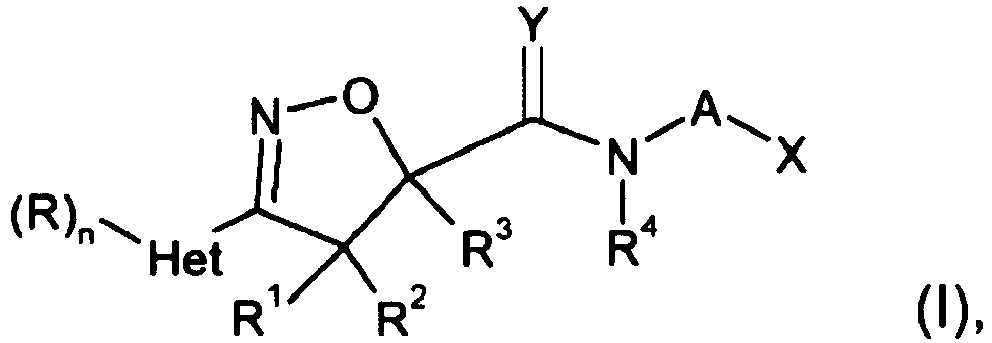 R1 et R2 signifient chacun indépendamment l'un de l'autre hydrogène, fluor, chlore, brome, iode, cyano, ou alkyle en (C1-C4) substitué par m radicaux du groupe constitué par fluor, chlore, brome, iode et cyano ;R3 signifie alkyle en (C1-C4), cycloalkyle en (C3-C4), alcényle en (C2-C3) ou alcynyle en (C2-C3), chacun substitués par m radicaux du groupe constitué par fluor, chlore, brome, cyano, alcoxy en (C1-C2);R4 signifie hydrogène ou alkyle en (C1-C8);A signifie une liaison ou une unité bivalente du groupe constitué par aus CH2, CH2CH2, CHCH3, CH2CH2CH2, CH(CH2CH3), CH(CH3)CH2, C(CH3)2, C(CH3)2CH2, C(iPr)CH3, CH(CH2iPr)CH2, CH2CH=CH, C(CH3)2C≡C, CH(CF3)CH2, CH(CH3)CH2O, CH2CH2O, CH(cPr)CH2O, CH(CH2OCH3), CH(CH2CH2SCH3), CH(COOH), CH(COOCH3), CH(COOH)CH2, CH(COOCH3)CH2, CH2COH(CF3), CH(CONHCH3), CH(CONHCH3)CH2 et CH2CH2CONHCH2;Y signifie oxygène ou soufre ;X signifie hydrogène, cyano, hydroxy, X1,oualkyle en (C1-C12), cycloalkyle en (C3-C8), alcényle en (C2-C12) ou alcynyle en (C2-C12), chacun substitués par m radicaux du groupe constitué par fluor, chlore, cyano, hydroxy, OR7, X1, OX1, NHX1, S(O)nR5, CO2R8, CONR6R8, CONR8SO2R5 et POR9R9;X1 signifie un cycle subsitué par s radicaux du groupe constitué par R6, R6a, R8 et R9, du groupe constitué par




 Het signifie pyridin-2-yle, pyridin-3-yle, pyridin-4-yle, pyridazin-3-yle, pyridazin-4-yle, pyrimidin-2-yle, pyrimidin-4-yle, pyrimidin-5-yle, pyrazin-2-yle, 1,2,4-triazin-3-yle, 1,2,4-triazin-5-yle, 1,2,4-triazin-6-yle, 1,3,5-triazin-2-yle, pyrrol-3-yle, furan-2-yle, furan-3-yle, thiophén-2-yle, thiophén-3-yle, pyrazol-3-yle, pyrazol-4-yle, oxazol-2-yle, oxazol-4-yle, oxazol-5-yle, thiazol-2-yle, thiazol-4-yle, thiazol-5-yle, isoxazol-3-yle, isoxazol-4-yle, isoxazol-5-yle, isothiazol-3-yle, isothiazol-4-yle, isothiazol-5-yle, 1H-1,2,3-triazol-4-yle, 2H-1,2,3-triazol-4-yle, 1H-1,2,4-triazol-3-yle, 1,2,4-oxadiazol-3-yle, 1,2,4-oxadiazol-5-yle, 1,2,4-thiadiazol-3-yle, 1,2,4-thiadiazol-5-yle, 1,3,4-oxadiazol-2-yle, 1,3,4-thiadiazol-2-yle ou 2H-tétrazol-5-yle ;R signifie fluor, chlore, brome, cyano,ou alkyle en (C1-C6) substitué par m radicaux du groupe constitué par fluor et chlore,ou alcoxy en (C1-C6) substitué par m radicaux du groupe constitué par fluor et chlore ;R5 signifie méthyle ou éthyle ;R6 signifie hydrogène ou R5;R6a signifie fluor, chlore, brome, iode, cyano, hydroxy, S(O)nR5, ou alcoxy en (C1-C6), alcényloxy en (C2-C6) ou alcynyloxy en (C2-C6), chacun substitués par m radicaux du groupe constitué par fluor, chlore, brome, cyano et alcoxy en (C1-C2);R7 signifie hydrogène ou alkyle en (C1-C6) substitué par m radicaux du groupe constitué par fluor et chlore ;R8 signifie R7;R9 signifie alcoxy en (C1-C3);m signifie 0, 1, 2 ou 3 ;n signifie 0, 1 ou 2 ; ets signifie 0, 1, 2, 3 ou 4.
 - Agents herbicides selon la revendication 2 en mélange avec des adjuvants de formulation.
- Agents herbicides selon la revendication 2 ou 3, contenant au moins une autre substance à effet pesticide du groupe des insecticides, acaricides, herbicides, fongicides, agents protecteurs et régulateurs de croissance.
- Agents herbicides selon la revendication 4, contenant un agent protecteur.
- Agents herbicides selon la revendication 5, dans lesquels l'agent protecteur est choisi dans le groupe constitué par le méfenpyr-diéthyle, le cyprosulfamide, l'isoxadifène-éthyle, le cloquintocet-mexyl, le bénoxacor et le dichlormid.
- Agents herbicides selon l'une quelconque des revendications 4 à 6, contenant un autre herbicide.
- Procédé de lutte contre des plantes indésirables, caractérisé en ce qu'une quantité efficace d'au moins un composé de formule (I) selon la revendication 2 ou d'un agent herbicide selon l'une quelconque des revendications 4 à 9 est appliqué sur les plantes ou à l'emplacement de la végétation indésirable.
- Utilisation de composés de formule (I) selon la revendication 2 ou d'agents herbicides selon l'une quelconque des revendications 2 à 7 pour lutter contre des plantes indésirables.
- Utilisation selon la revendication 9, caractérisée en ce que les composés de formule (I) sont utilisés pour lutter contre des plantes indésirables dans des cultures de plantes utiles.
- Utilisation selon la revendication 10, caractérisée en ce que les plantes utiles sont des plantes utiles transgéniques.
- Agents fongicides, caractérisés par une teneur fongicide efficace en au moins un composé de formule (I) selon la revendication 2.
- Agents fongicides selon la revendication 12 en mélange avec des adjuvants de formulation.
- Agents fongicides selon la revendication 12 ou 13, contenant au moins une autre substance à effet pesticide du groupe des insecticides, acaricides, herbicides, fongicides, agents protecteurs et régulateurs de croissance.
Priority Applications (1)
| Application Number | Priority Date | Filing Date | Title |
|---|---|---|---|
| EP13766510.5A EP2900660B1 (fr) | 2012-09-25 | 2013-09-20 | 3-hétéroarylisoxazoline-5-carboxamides et 3-hétéroarylisoxazoline-5-thioamides à action herbicide et fongicide |
Applications Claiming Priority (3)
| Application Number | Priority Date | Filing Date | Title |
|---|---|---|---|
| EP12185775 | 2012-09-25 | ||
| PCT/EP2013/069613 WO2014048853A1 (fr) | 2012-09-25 | 2013-09-20 | 3-hétéroarylisoxazoline-5-carboxamides et 3-hétéroarylisoxazoline-5-thioamides ayant des effets herbicides et fongicides |
| EP13766510.5A EP2900660B1 (fr) | 2012-09-25 | 2013-09-20 | 3-hétéroarylisoxazoline-5-carboxamides et 3-hétéroarylisoxazoline-5-thioamides à action herbicide et fongicide |
Publications (2)
| Publication Number | Publication Date |
|---|---|
| EP2900660A1 EP2900660A1 (fr) | 2015-08-05 |
| EP2900660B1 true EP2900660B1 (fr) | 2018-01-17 |
Family
ID=47044813
Family Applications (1)
| Application Number | Title | Priority Date | Filing Date |
|---|---|---|---|
| EP13766510.5A Active EP2900660B1 (fr) | 2012-09-25 | 2013-09-20 | 3-hétéroarylisoxazoline-5-carboxamides et 3-hétéroarylisoxazoline-5-thioamides à action herbicide et fongicide |
Country Status (6)
| Country | Link |
|---|---|
| US (1) | US10104892B2 (fr) |
| EP (1) | EP2900660B1 (fr) |
| JP (1) | JP6397820B2 (fr) |
| CN (1) | CN104797577B (fr) |
| BR (1) | BR112015006560A2 (fr) |
| WO (1) | WO2014048853A1 (fr) |
Families Citing this family (12)
| Publication number | Priority date | Publication date | Assignee | Title |
|---|---|---|---|---|
| JP6285937B2 (ja) | 2012-09-25 | 2018-02-28 | バイエル・クロップサイエンス・アクチェンゲゼルシャフト | 除草性および殺真菌性の5−オキシ置換3−フェニルイソオキサゾリン−5−カルボキサミドおよび5−オキシ置換3−フェニルイソオキサゾリン−5−チオアミド |
| DK2900645T3 (da) | 2012-09-25 | 2019-10-14 | Bayer Cropscience Ag | Herbicidt aktive 3-phenylisoxazolinderivater |
| JP2017095353A (ja) * | 2014-03-27 | 2017-06-01 | 日本曹達株式会社 | イソオキサゾリン−5−カルボキサミド化合物および有害生物防除剤 |
| US9809555B2 (en) | 2015-12-02 | 2017-11-07 | Rotam Agrochem International Company Limited | Form of mefenpyr-diethyl, a process for its preparation and use of the same |
| US11613522B2 (en) | 2017-06-13 | 2023-03-28 | Bayer Aktiengesellschaft | Herbicidally active 3-phenylisoxazoline-5-carboxamides of tetrahydro- and dihydrofurancarboxamides |
| DK3638665T3 (da) | 2017-06-13 | 2021-10-11 | Bayer Ag | Herbicidt virksomme 3-phenylisoxazolin-5-carboxamider af tetrahydro- og dihydrofurancarboxylsyrer og -estere |
| JP7198519B2 (ja) | 2017-08-17 | 2023-01-04 | バイエル・アクチエンゲゼルシヤフト | シクロペンチルカルボン酸類及びエステル類の除草活性3-フェニル-5-トリフルオロメチルイソオキサゾリン-5-カルボキサミド類 |
| CA3089286A1 (fr) | 2018-01-25 | 2019-08-01 | Bayer Aktiengesellschaft | 3-phenyl-isoxazoline-5-carboxamides de derives d'acide cyclopentenyl-carboxylique a action herbicide |
| ES2950189T3 (es) | 2019-03-12 | 2023-10-05 | Bayer Ag | 3-fenilisoxazolina-5-carboxamidas de ésteres de ácido ciclopentenilcarboxílico que contienen s herbicidas |
| MX2023000970A (es) | 2020-07-23 | 2023-03-01 | Bayer Ag | Metodo de preparacion de aminofuranos. |
| CN113234066A (zh) * | 2021-05-21 | 2021-08-10 | 浙江工业大学 | 类丙环唑化合物及其制备方法和应用 |
| WO2025223566A1 (fr) * | 2024-04-26 | 2025-10-30 | 青岛清原化合物有限公司 | Composé de 3-phénylisoxazoline-5-carboxamide, procédé de préparation, composition herbicide et utilisation associée |
Family Cites Families (13)
| Publication number | Priority date | Publication date | Assignee | Title |
|---|---|---|---|---|
| GB1162257A (en) | 1965-09-22 | 1969-08-20 | Danippon Pharmaceutical Co Ltd | 3-(5-Nitro-2-Furyl) Isoxazole Derivatives and methods of preparation thereof |
| DE4017665A1 (de) | 1990-06-01 | 1991-12-05 | Hoechst Ag | Pflanzenschuetzende substituierte isoxazoline, isoxazole, isothiazoline und isothiazole sowie verfahren zu ihrer herstellung und ihre verwendung |
| DE4026018A1 (de) | 1990-08-17 | 1992-02-20 | Hoechst Ag | Isoxazoline oder isothiazoline enthaltende pflanzenschuetzende mittel und neue isoxazoline und isothiazoline |
| JP3054470B2 (ja) | 1991-08-06 | 2000-06-19 | 株式会社シマノ | スピニングリール |
| DE59208312D1 (de) | 1991-06-25 | 1997-05-15 | Hoechst Schering Agrevo Gmbh | Neue Isoxazoline und Isothiazoline, sie enthaltende pflanzenschützende Mittel sowie ein Nachweisverfahren zur Identifizieurung potentieller pflanzenschützender Mittel |
| KR100392072B1 (ko) * | 2000-09-07 | 2003-07-22 | 한국화학연구원 | 제초활성을 갖는 5-벤질옥시메틸-1,2-이속사졸린 유도체화합물 |
| KR100594544B1 (ko) | 2003-08-27 | 2006-06-30 | 주식회사 엘지생명과학 | 이소옥사졸린 구조를 갖는 캐스파제 저해제 |
| AU2005219788B2 (en) * | 2004-03-05 | 2010-06-03 | Nissan Chemical Corporation | Isoxazoline-substituted benzamide compound and noxious organism control agent |
| JP2005314407A (ja) * | 2004-03-31 | 2005-11-10 | Nippon Nohyaku Co Ltd | 新規なハロアルキルスルホンアニリド誘導体、除草剤及びその使用方法並びにその中間体 |
| CN103003247B (zh) | 2010-07-21 | 2015-06-10 | 拜耳知识产权有限责任公司 | 4-(4-卤代烷基-3-硫代苯甲酰基)吡唑及其作为除草剂的用途 |
| EA024512B1 (ru) * | 2011-03-31 | 2016-09-30 | Байер Интеллектуэль Проперти Гмбх | Гербицидно и фунгицидно действующие 3-фенилизоксазолин-5-карбоксамиды и 3-фенилизоксазолин-5-тиоамиды |
| DK2900645T3 (da) | 2012-09-25 | 2019-10-14 | Bayer Cropscience Ag | Herbicidt aktive 3-phenylisoxazolinderivater |
| JP6285937B2 (ja) | 2012-09-25 | 2018-02-28 | バイエル・クロップサイエンス・アクチェンゲゼルシャフト | 除草性および殺真菌性の5−オキシ置換3−フェニルイソオキサゾリン−5−カルボキサミドおよび5−オキシ置換3−フェニルイソオキサゾリン−5−チオアミド |
-
2013
- 2013-09-20 EP EP13766510.5A patent/EP2900660B1/fr active Active
- 2013-09-20 US US14/429,914 patent/US10104892B2/en active Active
- 2013-09-20 CN CN201380061036.4A patent/CN104797577B/zh active Active
- 2013-09-20 BR BR112015006560A patent/BR112015006560A2/pt not_active Application Discontinuation
- 2013-09-20 WO PCT/EP2013/069613 patent/WO2014048853A1/fr not_active Ceased
- 2013-09-20 JP JP2015532430A patent/JP6397820B2/ja active Active
Also Published As
| Publication number | Publication date |
|---|---|
| CN104797577B (zh) | 2018-01-12 |
| JP6397820B2 (ja) | 2018-09-26 |
| BR112015006560A2 (pt) | 2017-07-04 |
| US20150223461A1 (en) | 2015-08-13 |
| JP2015535821A (ja) | 2015-12-17 |
| CN104797577A (zh) | 2015-07-22 |
| EP2900660A1 (fr) | 2015-08-05 |
| US10104892B2 (en) | 2018-10-23 |
| WO2014048853A1 (fr) | 2014-04-03 |
Similar Documents
| Publication | Publication Date | Title |
|---|---|---|
| EP2900660B1 (fr) | 3-hétéroarylisoxazoline-5-carboxamides et 3-hétéroarylisoxazoline-5-thioamides à action herbicide et fongicide | |
| EP2900644B1 (fr) | 3-phénylisoxazoline-5-carboxamides 5-oxy-substitués et 3-phénylisoxazoline-5-thioamides 5-oxy-substitués à action herbicide et fongicide | |
| EP3743411B1 (fr) | 3-phénylisoxazolino-5-carboxamides de dérivés d'acides carboxyliques et de cyclopentényle à action herbicide | |
| EP3638666B1 (fr) | Herbicides efficaces a base de 3-phenylisoxazoline-5-carboxamides d'amides d'acide carboxylique de tétrahydro et dihydrofurane | |
| WO2012130798A1 (fr) | 3-phénylisoxazolino-5-carboxamides et 3-phénylisoxazolino-5-thioamides à activité herbicide et fongicide | |
| EP2609088A1 (fr) | Dérivés de 5-iode-triazole | |
| EP2558456A1 (fr) | Dérivés de dithiine utilisés en tant que fongicides | |
| EP2558470B1 (fr) | Dérivé de dithiinopyridazindione comme fongicides | |
| EP2601199B1 (fr) | Dérivé de dithiinopyridazinone | |
| EP2264011A1 (fr) | Hétéroarylamidine et son utilisation en tant que fongicide | |
| WO2011117184A1 (fr) | Dérivés de fludioxonil | |
| EP2264010A1 (fr) | Hétarylamidine | |
| WO2011032656A1 (fr) | Dérivés de pyrimidine à substitution 5-fluor-3-thio | |
| EA040946B1 (ru) | Гербицидно активные 3-фенилизоксазолин-5-карбоксамиды тетрагидро- и дигидрофурановых карбоксамидов и их применение |
Legal Events
| Date | Code | Title | Description |
|---|---|---|---|
| PUAI | Public reference made under article 153(3) epc to a published international application that has entered the european phase |
Free format text: ORIGINAL CODE: 0009012 |
|
| 17P | Request for examination filed |
Effective date: 20150428 |
|
| AK | Designated contracting states |
Kind code of ref document: A1 Designated state(s): AL AT BE BG CH CY CZ DE DK EE ES FI FR GB GR HR HU IE IS IT LI LT LU LV MC MK MT NL NO PL PT RO RS SE SI SK SM TR |
|
| AX | Request for extension of the european patent |
Extension state: BA ME |
|
| DAX | Request for extension of the european patent (deleted) | ||
| 17Q | First examination report despatched |
Effective date: 20160803 |
|
| GRAP | Despatch of communication of intention to grant a patent |
Free format text: ORIGINAL CODE: EPIDOSNIGR1 |
|
| STAA | Information on the status of an ep patent application or granted ep patent |
Free format text: STATUS: GRANT OF PATENT IS INTENDED |
|
| INTG | Intention to grant announced |
Effective date: 20170526 |
|
| GRAJ | Information related to disapproval of communication of intention to grant by the applicant or resumption of examination proceedings by the epo deleted |
Free format text: ORIGINAL CODE: EPIDOSDIGR1 |
|
| STAA | Information on the status of an ep patent application or granted ep patent |
Free format text: STATUS: EXAMINATION IS IN PROGRESS |
|
| INTC | Intention to grant announced (deleted) | ||
| GRAP | Despatch of communication of intention to grant a patent |
Free format text: ORIGINAL CODE: EPIDOSNIGR1 |
|
| STAA | Information on the status of an ep patent application or granted ep patent |
Free format text: STATUS: GRANT OF PATENT IS INTENDED |
|
| GRAS | Grant fee paid |
Free format text: ORIGINAL CODE: EPIDOSNIGR3 |
|
| INTG | Intention to grant announced |
Effective date: 20171110 |
|
| GRAA | (expected) grant |
Free format text: ORIGINAL CODE: 0009210 |
|
| STAA | Information on the status of an ep patent application or granted ep patent |
Free format text: STATUS: THE PATENT HAS BEEN GRANTED |
|
| AK | Designated contracting states |
Kind code of ref document: B1 Designated state(s): AL AT BE BG CH CY CZ DE DK EE ES FI FR GB GR HR HU IE IS IT LI LT LU LV MC MK MT NL NO PL PT RO RS SE SI SK SM TR |
|
| REG | Reference to a national code |
Ref country code: GB Ref legal event code: FG4D Free format text: NOT ENGLISH |
|
| REG | Reference to a national code |
Ref country code: CH Ref legal event code: EP |
|
| REG | Reference to a national code |
Ref country code: IE Ref legal event code: FG4D Free format text: LANGUAGE OF EP DOCUMENT: GERMAN |
|
| REG | Reference to a national code |
Ref country code: DE Ref legal event code: R096 Ref document number: 502013009293 Country of ref document: DE Ref country code: AT Ref legal event code: REF Ref document number: 964310 Country of ref document: AT Kind code of ref document: T Effective date: 20180215 |
|
| REG | Reference to a national code |
Ref country code: NL Ref legal event code: MP Effective date: 20180117 |
|
| REG | Reference to a national code |
Ref country code: LT Ref legal event code: MG4D |
|
| PG25 | Lapsed in a contracting state [announced via postgrant information from national office to epo] |
Ref country code: NL Free format text: LAPSE BECAUSE OF FAILURE TO SUBMIT A TRANSLATION OF THE DESCRIPTION OR TO PAY THE FEE WITHIN THE PRESCRIBED TIME-LIMIT Effective date: 20180117 |
|
| PG25 | Lapsed in a contracting state [announced via postgrant information from national office to epo] |
Ref country code: LT Free format text: LAPSE BECAUSE OF FAILURE TO SUBMIT A TRANSLATION OF THE DESCRIPTION OR TO PAY THE FEE WITHIN THE PRESCRIBED TIME-LIMIT Effective date: 20180117 Ref country code: ES Free format text: LAPSE BECAUSE OF FAILURE TO SUBMIT A TRANSLATION OF THE DESCRIPTION OR TO PAY THE FEE WITHIN THE PRESCRIBED TIME-LIMIT Effective date: 20180117 Ref country code: CY Free format text: LAPSE BECAUSE OF FAILURE TO SUBMIT A TRANSLATION OF THE DESCRIPTION OR TO PAY THE FEE WITHIN THE PRESCRIBED TIME-LIMIT Effective date: 20180117 Ref country code: NO Free format text: LAPSE BECAUSE OF FAILURE TO SUBMIT A TRANSLATION OF THE DESCRIPTION OR TO PAY THE FEE WITHIN THE PRESCRIBED TIME-LIMIT Effective date: 20180417 Ref country code: HR Free format text: LAPSE BECAUSE OF FAILURE TO SUBMIT A TRANSLATION OF THE DESCRIPTION OR TO PAY THE FEE WITHIN THE PRESCRIBED TIME-LIMIT Effective date: 20180117 Ref country code: FI Free format text: LAPSE BECAUSE OF FAILURE TO SUBMIT A TRANSLATION OF THE DESCRIPTION OR TO PAY THE FEE WITHIN THE PRESCRIBED TIME-LIMIT Effective date: 20180117 |
|
| REG | Reference to a national code |
Ref country code: FR Ref legal event code: PLFP Year of fee payment: 6 |
|
| PG25 | Lapsed in a contracting state [announced via postgrant information from national office to epo] |
Ref country code: IS Free format text: LAPSE BECAUSE OF FAILURE TO SUBMIT A TRANSLATION OF THE DESCRIPTION OR TO PAY THE FEE WITHIN THE PRESCRIBED TIME-LIMIT Effective date: 20180517 Ref country code: GR Free format text: LAPSE BECAUSE OF FAILURE TO SUBMIT A TRANSLATION OF THE DESCRIPTION OR TO PAY THE FEE WITHIN THE PRESCRIBED TIME-LIMIT Effective date: 20180418 Ref country code: RS Free format text: LAPSE BECAUSE OF FAILURE TO SUBMIT A TRANSLATION OF THE DESCRIPTION OR TO PAY THE FEE WITHIN THE PRESCRIBED TIME-LIMIT Effective date: 20180117 Ref country code: PL Free format text: LAPSE BECAUSE OF FAILURE TO SUBMIT A TRANSLATION OF THE DESCRIPTION OR TO PAY THE FEE WITHIN THE PRESCRIBED TIME-LIMIT Effective date: 20180117 Ref country code: SE Free format text: LAPSE BECAUSE OF FAILURE TO SUBMIT A TRANSLATION OF THE DESCRIPTION OR TO PAY THE FEE WITHIN THE PRESCRIBED TIME-LIMIT Effective date: 20180117 Ref country code: LV Free format text: LAPSE BECAUSE OF FAILURE TO SUBMIT A TRANSLATION OF THE DESCRIPTION OR TO PAY THE FEE WITHIN THE PRESCRIBED TIME-LIMIT Effective date: 20180117 Ref country code: BG Free format text: LAPSE BECAUSE OF FAILURE TO SUBMIT A TRANSLATION OF THE DESCRIPTION OR TO PAY THE FEE WITHIN THE PRESCRIBED TIME-LIMIT Effective date: 20180417 |
|
| PG25 | Lapsed in a contracting state [announced via postgrant information from national office to epo] |
Ref country code: MT Free format text: LAPSE BECAUSE OF FAILURE TO SUBMIT A TRANSLATION OF THE DESCRIPTION OR TO PAY THE FEE WITHIN THE PRESCRIBED TIME-LIMIT Effective date: 20180117 |
|
| REG | Reference to a national code |
Ref country code: DE Ref legal event code: R097 Ref document number: 502013009293 Country of ref document: DE |
|
| PG25 | Lapsed in a contracting state [announced via postgrant information from national office to epo] |
Ref country code: AL Free format text: LAPSE BECAUSE OF FAILURE TO SUBMIT A TRANSLATION OF THE DESCRIPTION OR TO PAY THE FEE WITHIN THE PRESCRIBED TIME-LIMIT Effective date: 20180117 Ref country code: IT Free format text: LAPSE BECAUSE OF FAILURE TO SUBMIT A TRANSLATION OF THE DESCRIPTION OR TO PAY THE FEE WITHIN THE PRESCRIBED TIME-LIMIT Effective date: 20180117 Ref country code: RO Free format text: LAPSE BECAUSE OF FAILURE TO SUBMIT A TRANSLATION OF THE DESCRIPTION OR TO PAY THE FEE WITHIN THE PRESCRIBED TIME-LIMIT Effective date: 20180117 Ref country code: EE Free format text: LAPSE BECAUSE OF FAILURE TO SUBMIT A TRANSLATION OF THE DESCRIPTION OR TO PAY THE FEE WITHIN THE PRESCRIBED TIME-LIMIT Effective date: 20180117 |
|
| PLBE | No opposition filed within time limit |
Free format text: ORIGINAL CODE: 0009261 |
|
| STAA | Information on the status of an ep patent application or granted ep patent |
Free format text: STATUS: NO OPPOSITION FILED WITHIN TIME LIMIT |
|
| PG25 | Lapsed in a contracting state [announced via postgrant information from national office to epo] |
Ref country code: DK Free format text: LAPSE BECAUSE OF FAILURE TO SUBMIT A TRANSLATION OF THE DESCRIPTION OR TO PAY THE FEE WITHIN THE PRESCRIBED TIME-LIMIT Effective date: 20180117 Ref country code: SM Free format text: LAPSE BECAUSE OF FAILURE TO SUBMIT A TRANSLATION OF THE DESCRIPTION OR TO PAY THE FEE WITHIN THE PRESCRIBED TIME-LIMIT Effective date: 20180117 Ref country code: CZ Free format text: LAPSE BECAUSE OF FAILURE TO SUBMIT A TRANSLATION OF THE DESCRIPTION OR TO PAY THE FEE WITHIN THE PRESCRIBED TIME-LIMIT Effective date: 20180117 Ref country code: SK Free format text: LAPSE BECAUSE OF FAILURE TO SUBMIT A TRANSLATION OF THE DESCRIPTION OR TO PAY THE FEE WITHIN THE PRESCRIBED TIME-LIMIT Effective date: 20180117 |
|
| 26N | No opposition filed |
Effective date: 20181018 |
|
| PG25 | Lapsed in a contracting state [announced via postgrant information from national office to epo] |
Ref country code: SI Free format text: LAPSE BECAUSE OF FAILURE TO SUBMIT A TRANSLATION OF THE DESCRIPTION OR TO PAY THE FEE WITHIN THE PRESCRIBED TIME-LIMIT Effective date: 20180117 |
|
| PG25 | Lapsed in a contracting state [announced via postgrant information from national office to epo] |
Ref country code: MC Free format text: LAPSE BECAUSE OF FAILURE TO SUBMIT A TRANSLATION OF THE DESCRIPTION OR TO PAY THE FEE WITHIN THE PRESCRIBED TIME-LIMIT Effective date: 20180117 |
|
| REG | Reference to a national code |
Ref country code: CH Ref legal event code: PL |
|
| GBPC | Gb: european patent ceased through non-payment of renewal fee |
Effective date: 20180920 |
|
| REG | Reference to a national code |
Ref country code: BE Ref legal event code: MM Effective date: 20180930 |
|
| REG | Reference to a national code |
Ref country code: IE Ref legal event code: MM4A |
|
| PG25 | Lapsed in a contracting state [announced via postgrant information from national office to epo] |
Ref country code: LU Free format text: LAPSE BECAUSE OF NON-PAYMENT OF DUE FEES Effective date: 20180920 |
|
| PG25 | Lapsed in a contracting state [announced via postgrant information from national office to epo] |
Ref country code: IE Free format text: LAPSE BECAUSE OF NON-PAYMENT OF DUE FEES Effective date: 20180920 |
|
| PG25 | Lapsed in a contracting state [announced via postgrant information from national office to epo] |
Ref country code: LI Free format text: LAPSE BECAUSE OF NON-PAYMENT OF DUE FEES Effective date: 20180930 Ref country code: CH Free format text: LAPSE BECAUSE OF NON-PAYMENT OF DUE FEES Effective date: 20180930 Ref country code: BE Free format text: LAPSE BECAUSE OF NON-PAYMENT OF DUE FEES Effective date: 20180930 |
|
| PG25 | Lapsed in a contracting state [announced via postgrant information from national office to epo] |
Ref country code: GB Free format text: LAPSE BECAUSE OF NON-PAYMENT OF DUE FEES Effective date: 20180920 |
|
| REG | Reference to a national code |
Ref country code: AT Ref legal event code: MM01 Ref document number: 964310 Country of ref document: AT Kind code of ref document: T Effective date: 20180920 |
|
| PG25 | Lapsed in a contracting state [announced via postgrant information from national office to epo] |
Ref country code: AT Free format text: LAPSE BECAUSE OF NON-PAYMENT OF DUE FEES Effective date: 20180920 |
|
| PG25 | Lapsed in a contracting state [announced via postgrant information from national office to epo] |
Ref country code: TR Free format text: LAPSE BECAUSE OF FAILURE TO SUBMIT A TRANSLATION OF THE DESCRIPTION OR TO PAY THE FEE WITHIN THE PRESCRIBED TIME-LIMIT Effective date: 20180117 |
|
| PG25 | Lapsed in a contracting state [announced via postgrant information from national office to epo] |
Ref country code: PT Free format text: LAPSE BECAUSE OF FAILURE TO SUBMIT A TRANSLATION OF THE DESCRIPTION OR TO PAY THE FEE WITHIN THE PRESCRIBED TIME-LIMIT Effective date: 20180117 |
|
| PG25 | Lapsed in a contracting state [announced via postgrant information from national office to epo] |
Ref country code: MK Free format text: LAPSE BECAUSE OF NON-PAYMENT OF DUE FEES Effective date: 20180117 Ref country code: HU Free format text: LAPSE BECAUSE OF FAILURE TO SUBMIT A TRANSLATION OF THE DESCRIPTION OR TO PAY THE FEE WITHIN THE PRESCRIBED TIME-LIMIT; INVALID AB INITIO Effective date: 20130920 |
|
| PGFP | Annual fee paid to national office [announced via postgrant information from national office to epo] |
Ref country code: DE Payment date: 20250819 Year of fee payment: 13 |
|
| PGFP | Annual fee paid to national office [announced via postgrant information from national office to epo] |
Ref country code: FR Payment date: 20250821 Year of fee payment: 13 |