EP2903044A1 - Molécules organiques destinées à être utilisées dans des éléments de construction opto-électroniques - Google Patents
Molécules organiques destinées à être utilisées dans des éléments de construction opto-électroniques Download PDFInfo
- Publication number
- EP2903044A1 EP2903044A1 EP14184773.1A EP14184773A EP2903044A1 EP 2903044 A1 EP2903044 A1 EP 2903044A1 EP 14184773 A EP14184773 A EP 14184773A EP 2903044 A1 EP2903044 A1 EP 2903044A1
- Authority
- EP
- European Patent Office
- Prior art keywords
- substituted
- group
- aromatic
- atoms
- radicals
- Prior art date
- Legal status (The legal status is an assumption and is not a legal conclusion. Google has not performed a legal analysis and makes no representation as to the accuracy of the status listed.)
- Withdrawn
Links
- 0 *c1c(*)[o]nc1 Chemical compound *c1c(*)[o]nc1 0.000 description 11
Images


Classifications
-
- C—CHEMISTRY; METALLURGY
- C09—DYES; PAINTS; POLISHES; NATURAL RESINS; ADHESIVES; COMPOSITIONS NOT OTHERWISE PROVIDED FOR; APPLICATIONS OF MATERIALS NOT OTHERWISE PROVIDED FOR
- C09B—ORGANIC DYES OR CLOSELY-RELATED COMPOUNDS FOR PRODUCING DYES, e.g. PIGMENTS; MORDANTS; LAKES
- C09B57/00—Other synthetic dyes of known constitution
- C09B57/008—Triarylamine dyes containing no other chromophores
-
- H—ELECTRICITY
- H10—SEMICONDUCTOR DEVICES; ELECTRIC SOLID-STATE DEVICES NOT OTHERWISE PROVIDED FOR
- H10K—ORGANIC ELECTRIC SOLID-STATE DEVICES
- H10K85/00—Organic materials used in the body or electrodes of devices covered by this subclass
- H10K85/60—Organic compounds having low molecular weight
- H10K85/631—Amine compounds having at least two aryl rest on at least one amine-nitrogen atom, e.g. triphenylamine
-
- C—CHEMISTRY; METALLURGY
- C09—DYES; PAINTS; POLISHES; NATURAL RESINS; ADHESIVES; COMPOSITIONS NOT OTHERWISE PROVIDED FOR; APPLICATIONS OF MATERIALS NOT OTHERWISE PROVIDED FOR
- C09K—MATERIALS FOR MISCELLANEOUS APPLICATIONS, NOT PROVIDED FOR ELSEWHERE
- C09K11/00—Luminescent materials, e.g. electroluminescent or chemiluminescent
- C09K11/06—Luminescent materials, e.g. electroluminescent or chemiluminescent containing organic luminescent materials
-
- H—ELECTRICITY
- H10—SEMICONDUCTOR DEVICES; ELECTRIC SOLID-STATE DEVICES NOT OTHERWISE PROVIDED FOR
- H10K—ORGANIC ELECTRIC SOLID-STATE DEVICES
- H10K50/00—Organic light-emitting devices
- H10K50/10—OLEDs or polymer light-emitting diodes [PLED]
- H10K50/11—OLEDs or polymer light-emitting diodes [PLED] characterised by the electroluminescent [EL] layers
-
- Y—GENERAL TAGGING OF NEW TECHNOLOGICAL DEVELOPMENTS; GENERAL TAGGING OF CROSS-SECTIONAL TECHNOLOGIES SPANNING OVER SEVERAL SECTIONS OF THE IPC; TECHNICAL SUBJECTS COVERED BY FORMER USPC CROSS-REFERENCE ART COLLECTIONS [XRACs] AND DIGESTS
- Y02—TECHNOLOGIES OR APPLICATIONS FOR MITIGATION OR ADAPTATION AGAINST CLIMATE CHANGE
- Y02E—REDUCTION OF GREENHOUSE GAS [GHG] EMISSIONS, RELATED TO ENERGY GENERATION, TRANSMISSION OR DISTRIBUTION
- Y02E10/00—Energy generation through renewable energy sources
- Y02E10/50—Photovoltaic [PV] energy
- Y02E10/549—Organic PV cells
-
- Y—GENERAL TAGGING OF NEW TECHNOLOGICAL DEVELOPMENTS; GENERAL TAGGING OF CROSS-SECTIONAL TECHNOLOGIES SPANNING OVER SEVERAL SECTIONS OF THE IPC; TECHNICAL SUBJECTS COVERED BY FORMER USPC CROSS-REFERENCE ART COLLECTIONS [XRACs] AND DIGESTS
- Y02—TECHNOLOGIES OR APPLICATIONS FOR MITIGATION OR ADAPTATION AGAINST CLIMATE CHANGE
- Y02P—CLIMATE CHANGE MITIGATION TECHNOLOGIES IN THE PRODUCTION OR PROCESSING OF GOODS
- Y02P70/00—Climate change mitigation technologies in the production process for final industrial or consumer products
- Y02P70/50—Manufacturing or production processes characterised by the final manufactured product
Definitions
- the invention relates to novel organic molecules and their use in optoelectronic components, in particular in organic light-emitting diodes (OLEDs).
- OLEDs organic light-emitting diodes
- OLED Organic Light Emitting Diodes
- an OLED is generally composed of several layers and there is a need for optimized materials for all of them, the emitter layer (EML: emissive layer ) still forms the core of such a device, which consists of the actual emitter, which ultimately produces the electrical energy in photons converts, and optional host molecules (hosts) exists.
- EML emissive layer
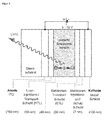
- Such components are usually realized in layer structures, which consist predominantly of organic materials.
- FIG. 1 a simplified structure shown as an example.
- the heart of such components is the emitter layer, in which usually emitting molecules are embedded in a matrix.
- the energy contained in the excitons can be emitted by the corresponding emitters in the form of light, in this case speaking of electroluminescence.
- An overview of the function of OLEDs can be found, for example H. Yersin, Top. Curr. Chem. 2004, 241, 1 and H. Yersin, "Highly Efficient OLEDs with Phosphorescent Materials”; Wiley-VCH, Weinheim, Germany, 2008 ,
- the triplet emitters suitable for triplet harvesting typically employ transition metal complex compounds in which the metal is selected from the third period of the transition metals. These are predominantly very expensive precious metals such as iridium, platinum or gold. (See also H. Yersin, Top. Curr. Chem. 2004, 241, 1 and MA Baldo, DF O'Brien, ME Thompson, SR Forrest, Phys. Rev. B 1999, 60, 14422 ).
- the invention relates to purely organic molecules (dyes) and their use as emitters in OLEDs (organic light-emitting diodes) and in other opto-electronic components.
- the invention relates in one aspect to organic molecules comprising or consisting of a chemical structure according to formula A (dyes, emitter molecules).
- (Het) Ar represents a conjugated organic group selected from the group consisting of unsubstituted and substituted aromatic, heteroaromatic and conjugated double bonds fixed to cis-trans isomerization.
- D is a chemically bonded donor group with electron-donating properties and A is an unsubstituted or substituted 5- or 6-membered ring resulting from an [i + j] cycloaddition in the case of a 5-ring consisting of a dipolarophile and a 1 , 3-dipole and in the case of a 6-ring may be formed from a diene and a dienophile, wherein in one embodiment A contains at least one heteroatom.
- each of i and j contiguous atoms of the reacting species are linked to form a ring system with a total of i + j atoms.
- D and A are attached to non-adjacent atoms of the (Het) Ar group.
- the organic molecule of formula A is present as a dimeric system in which the two same or different rings A and A 'bridge through a spacer which is a substituted or unsubstituted aromatic or heteroaromatic ring system having from 5 to 60 aromatic ring atoms. This results in a dimer of the formula A *.
- a and D are not bound to directly adjacent atoms of the group (Het) Ar and A 'and D' are not bound to directly adjacent atoms of the group (Het) Ar '.
- A is A '
- D is D'
- (Het) Ar is (Het) Ar '.
- the invention also relates to organic molecules according to formula A in which to the unit A a unit (Het) Ar 'and to this in turn a unit D' is bound, so that these organic molecules have a structure of the formula A '.
- (Het) Ar is a conjugated organic group selected from the group consisting of unsubstituted and substituted aromatic, heteroaromatic and conjugated double bonds fixed to cis-trans isomerization.
- (Het) Ar ' is a conjugated organic group selected from the group consisting of unsubstituted and substituted aromatic, heteroaromatic and conjugated cis-trans isomerization-fixed double bonds, which may be the same or different, equal in one embodiment (Het ) Ar.
- D and D ' are independently a chemically bonded donor group with electron donating properties, where D and D' are the same in one embodiment.
- A is an unsubstituted or substituted 5- or 6-membered ring having in an optionally at least one heteroatom resulting from a [i + j] cycloaddition in the case of a 5-ring of a dipolarophile and a 1,3-dipole and in the case of a 6-ring can be formed from a diene and a dienophile, wherein A and D are preferably not bound to directly adjacent atoms of the group (Het) Ar and wherein A and D 'preferably not at directly adjacent atoms of the group ( Het) Ar 'are bound.
- (Het) Ar and (Het) Ar ' are independently a substituted or unsubstituted phenyl ring.
- Preferred organic molecules of the invention are those in which at least one of the substituents A, A ', D or D' has a heteroatom X, via which the substituent is covalently bonded to (Het) Ar or (Het) Ar ', wherein in particular, the heteroatom is selected from the group consisting of N, O, P, S, Se.
- the organic molecule is an organic molecule having a structure of formula C.
- F is an unsubstituted or substituted 5- or 6-membered ring which optionally contains heteroatoms and which consists of an [i + j] cycloaddition in the case of a 5-membered ring of a dipolarophile and a 1,3-dipole and in the case of a 6-membered ring Rings from a diene and a dienophile can be formed.
- the organic molecule is present as a dimer bridged by a spacer and has a structure of the formula C *.
- the invention also relates to organic molecules having structures of the formula C, C 'and C * in which R1 is Ar and Ar1, so that structures of the formulas D, D' and D * result.
- the units F, F ', R and spacer are defined correspondingly as in the formulas C, C' and C *.
- carbazole as a substituent or derived structures is a key motif in many colorants and phosphors. 1,2,3-6 For this reason, carbazole-substituted compounds as known to those skilled in the art are common compounds used, for example, in organic light-emitting diodes. 7-9
- X, X 1 , X 2 are each independently selected from the group consisting of the fragment CR and N.
- Z 1 -Z 3 are each independently selected from the group consisting of the fragment CRR ', CR, NR, N and O, wherein depending on the fragment between Z 1 and Z 2 either a single or a double bond and between Z 2 and Z 3 either a single or a double bond is present, and between X and Z 1 always a single bond is present.
- R 3 is the same or different at each occurrence, H, deuterium, F, CF 3 or an aliphatic, aromatic and / or heteroaromatic hydrocarbon radical having 1 to 20 carbon atoms, in which one or more H atoms replaced by F or CF 3 could be. Two or more substituents R 3 may also together form a mono- or polycyclic aliphatic ring system.
- the dimers connected via an unsubstituted or substituted phenyl ring as a spacer are also those which have a structure of the formula I or K.
- organic molecules according to the invention also include organic molecules having a structure of the formula A "
- Ar a conjugated organic group selected from the group consisting of unsubstituted and substituted aromatic, heteroaromatic and conjugated double bonds fixed to cistrans isomerization
- D a chemically bonded donor group with electron-donating properties
- A a chemically bound fragment which gives a [i + j] cycloaddition product from a click reaction with a complementary unit B.
- a and D are not bound to directly adjacent atoms of the conjugated organic group (Het) Ar.
- the fragment B occurring in the cycloaddition product is selected from the group consisting of C, N, S, P, O and Se.
- the invention relates in one aspect to a process for the preparation of the organic molecules according to the invention comprising an [i + j] cycloaddition (click reaction) of the Het (Ar) or (Het) Ar 'group provided with a donor group D or D', which carries a click-reactive group selected from a dipolarophile, 1,3-dipole, dienophile and diene with a corresponding complementary group to form an unsubstituted or substituted 5- or 6-membered ring A or A ', respectively.
- ABC is a 1,3-dipole
- WZ is a dipolarophile that undergoes a dipolar cycloaddition (click reaction) to form an unsubstituted or substituted 5-membered ring.
- Examples of dienophiles and dipolarophiles and corresponding dienes and 1,3-dipoles are in FIG. 2 specified.
- the synthesis via a cycloaddition is advantageous, since the corresponding starting materials are generally readily available and the cycloaddition can also generally be carried out in good yields with a low purification effort.
- the non-fluorescent N- (4-azidophenyl) carbazole is used.
- a copper-catalyzed alkyne-azide-click reaction with the catalyst system copper (I) iodide in solvents such as diisopropylamine is suitable for the cycloaddition.
- 1,3-dipolar cycloadditions can be performed using cyclic octynes such as cyclooctyne.
- Driving force of this reaction is reducing the hoop stress, which is why the expert in this context from engl. strain promoted azide alkyne cycloaddition speaks. 16 Typical yields for such reactions are 74% to 98%.
- the proportion of the organic molecule according to the invention at the emitter or absorber in one embodiment is 1% to 99%; the proportion of the emitter in optical light-emitting components, in particular in OLEDs, is preferably between 5 and 80%. In an alternative embodiment, the proportion of the organic molecule at the emitter or absorber is 100%.
- optoelectronic components comprising an organic molecule according to the invention, wherein the optoelectronic component is in particular formed as a component selected from the group consisting of organic light emitting device, organic diode, organic solar cell, organic transistor, organic light emitting diode, light emitting electrochemical cell, organic field effect transistor and organic laser.
- the organic molecule is used as the emission material in an emission layer, wherein it can be used in combination with a matrix material or in particular as a pure layer or.
- the proportion of the organic molecule as emission material in an emission layer in optical light-emitting components, in particular in OLEDs is between 5% and 80%.
- the light-emitting layer having an organic molecule according to the invention is applied to a substrate.
- the invention also relates to an optoelectronic component comprising an organic molecule according to the invention which has a substrate, an anode and a cathode, wherein the anode and the cathode are applied to the substrate, and the light-emitting layer is applied between the anode and cathode.
- the invention relates to an optoelectronic component, wherein the light-emitting layer comprises only an organic molecule according to the invention in 100% concentration, wherein the anode and the cathode is applied to the substrate, and the light-emitting layer between anode and cathode is applied.
- the optoelectronic component according to the invention also has a host material whose triplet (T1) and singlet (S1) energy levels are higher in energy than the triplet (T1) and singlet (S1) energy levels of organic molecule, wherein the anode and the cathode is applied to the substrate, and the light-emitting layer between anode and cathode is applied.
- the optoelectronic component according to the invention comprises a substrate, an anode, a cathode and at least one respective hole and electron injecting layer and at least one light-emitting layer, wherein the at least one light-emitting layer has an organic molecule according to the invention and a host material whose triplet (T1) and singlet (S1) energy levels are higher in energy than the triplet (T1) and singlet (S1) Energy levels of the organic molecule, and wherein the anode and the cathode is applied to the substrate, and the hole and electron injecting layer between the anode and cathode is applied and the light emitting layer between holes and electron injecting layer is applied.
- T1 and singlet (S1) energy levels are higher in energy than the triplet (T1) and singlet (S1) Energy levels of the organic molecule
- the optoelectronic component according to the invention comprises a substrate, an anode, a cathode and at least one hole- and one electron-injecting layer, and at least one hole- and one electron-transporting layer, and at least one light-emitting layer, wherein the at least one light-emitting layer Layer has an organic molecule according to the invention and a host material whose triplet (T1) and singlet (S1) energy levels are higher in energy than the triplet (T1) and singlet (S1) energy levels of the organic molecule, and wherein the anode and the Cathode is applied to the substrate, and the hole and electron injecting layer between the anode and cathode is applied, and the hole and electron transporting layer between holes and electron injecting layer is applied, and the light emitting layer between hole and electron transporting Schic ht is upset.
- T1 and singlet (S1) energy levels are higher in energy than the triplet (T1) and singlet (S1) energy levels of the organic molecule
- the invention also relates in one embodiment to a light-emitting material comprising an organic molecule and a host material according to the invention, wherein the triplet (T1) and singlet (S1) energy levels of the host material are higher in energy than the triplet (T1) and singlet (S1 ) Energy levels of the organic molecule, and wherein the organic molecule emits fluorescence or thermally activated delayed fluorescence, and a deltaE (S1-T1) value between the lowest excited singlet (S1) and the underlying triplet (T1) state of smaller than 3000 cm -1 .
- the invention also provides a process for producing an optoelectronic component comprising an organic molecule according to the invention.
- the method is characterized by the application of the organic molecule to a carrier, wherein the application preferably takes place wet-chemically, by means of colloidal suspension or by means of sublimation.
- an organic molecule according to the invention is introduced into a matrix material for conducting electrons or holes in an optoelectronic component.
- the invention additionally relates to the use of a molecule according to the invention for converting UV radiation or blue light into visible light, in particular into green, yellow or red light (down conversion), in particular in an optoelectronic component.
- This decoupling can be traced, for example, by quantum mechanical calculations of the HOMO and LUMO. Accordingly, these two frontier orbitals should show no or the least possible overlap.
- the pi system of the central basic unit can be mainly either part of the HOMO or the LUMO.
- the aromatic and heteroaromatic ring systems of the molecules of the invention are twisted against each other. This twist breaks the conjugation of the pi systems, which localizes HOMO and LUMO on different parts of the molecule and is not delocalized over the entire molecule. This twist can be detected, for example, by X-ray crystallography (see also FIG. 2 ).
- the frontier orbitals could be visualized, as in FIGS. 5 to 13 is shown.
- the HOMO is located on the electron-donating donor group, while the LUMO is on the electron-accepting acceptor group.
- the emission of the compounds according to the invention is therefore based on the twist between donor and acceptor, whereby a small ⁇ E ST value is caused.
- the compounds according to the invention can also be used in biology or medicine, in particular in a method for labeling cells, for example as a luminescence marker.
- a method for labeling cells for example as a luminescence marker.
- Suitability for this application has been demonstrated by convocal microscopy.
- HeLa cells were labeled with molecules 2 and 7 and stimulated to luminesce by laser.
- phosphors were preferentially incorporated in the endosomal-lysosomal system.
- An aryl group for the purposes of this invention contains 6 to 40 carbon atoms;
- a heteroaryl group contains 2 to 40 C atoms and at least one heteroatom, with the proviso that the sum of C atoms and heteroatoms gives at least 5.
- the heteroatoms are preferably selected from N, O and / or S.
- aryl group or heteroaryl either a simple aromatic cycle, ie benzene, or a simple heteroaromatic cycle, for example pyridine, pyrimidine, thiophene, etc., or a fused aryl or heteroaryl group, for example naphthalene, anthracene, phenanthrene, quinoline, isoquinoline, etc., understood.
- An aromatic ring system in the sense of this invention contains 6 to 60 carbon atoms in the ring system.
- a heteroaromatic ring system in the sense of this invention contains 1 to 60 C atoms and at least one heteroatom in the ring system, with the proviso that the sum of C atoms and heteroatoms gives at least 5.
- the heteroatoms are preferably selected from N, O and / or S.
- An aromatic or heteroaromatic ring system in the sense of this invention is to be understood as meaning a system which does not necessarily contain only aryl or heteroaryl groups but in which also several aryl or heteroaryl groups Heteroaryl groups by a non-aromatic unit (preferably less than 10% of the atoms other than H), such as.
- N or O atom or a carbonyl group may be interrupted.
- systems such as 9,9'-spirobifluorene, 9,9-diarylfluorene, triarylamine, diaryl ethers, stilbene, etc. are to be understood as aromatic ring systems in the context of this invention, and also systems in which two or more aryl groups, for example by a linear or cyclic alkyl group or interrupted by a silyl group.
- systems in which two or more aryl or heteroaryl groups are bonded directly to each other, such as.
- biphenyl or terphenyl also be understood as an aromatic or heteroaromatic ring system.
- a cyclic alkyl, alkoxy or thioalkoxy group is understood as meaning a monocyclic, a bicyclic or a polycyclic group.
- a C 1 - to C 40 -alkyl group in which individual H atoms or CH 2 groups may be substituted by the abovementioned groups, for example the radicals methyl, ethyl, n-propyl, i Propyl, cyclopropyl, n -butyl, i -butyl, s -butyl, t -butyl, cyclobutyl, 2-methylbutyl, n -pentyl, s -pentyl, t -pentyl, 2-pentyl, neo -pentyl, cyclopentyl, n Hexyl, s -hexyl, t -hexyl, 2-hexyl, 3-hexyl, neo-hexyl, cyclohexyl, 1-methylcyclopentyl, 2-methylpentyl, n-heptyl,
- alkenyl group is understood as meaning, for example, ethenyl, propenyl, butenyl, pentenyl, cyclopentenyl, hexenyl, cyclohexenyl, heptenyl, cycloheptenyl, octenyl, cyclooctenyl or cyclooctadienyl.
- alkynyl groups include ethynyl, propynyl, butynyl, Pentinyl, hexynyl, heptynyl or octynyl understood.
- aromatic or heteroaromatic ring system having 5-60 aromatic ring atoms, which may be substituted in each case with the abovementioned radicals and which may be linked via any position on the aromatic or heteroaromatic, are understood, for example, groups which are derived from benzene, naphthalene , Anthracene, benzanthracene, phenanthrene, benzophenanthrene, pyrene, chrysene, perylene, fluoranthene, benzfluoranthene, naphthacene, pentacene, benzpyrene, biphenyl, biphenylene, terphenyl, terphenylene, fluorene, spirobifluorene, dihydrophenanthrene, dihydropyrene, tetrahydropyrene, cis- or trans- Indenofluorene, cis or trans monobenzoindenofluorene, cis or trans dibenz
- 9- (4-Nitrophenyl) -9H-carbazole The synthesis was carried out according to a modified literature procedure for 100 mmol carbazole. 10 K 2 CO 3 was replaced by K 3 PO 4 and dioxane was used as solvent instead of DMF. Recrystallization from CHCl 3 gave 9- (4-nitrophenyl) -9H-carbazole in 90% yield as a yellow solid.
- 9- (4-Azidophenyl) -9H-carbazole 1 A stirred suspension of 9- (4-aminophenyl) -9H-carbazole (9.04 g, 35.0 mmol, 1.00 equiv.) In a mixture of 100 mL of water and 7 mL of concentrated hydrochloric acid was cooled to 0 ° C. A solution of sodium nitrite (2.66 g, 38.5 mmol, 1.10 equiv.) In 38 mL of water was added dropwise. Meanwhile, the color of the precipitate changed from white to red, indicating the formation of a diazonium salt.
- IR (DRIFT): v 3416 (vw), 3052 (vw), 2412 (vw), 2254 (vw), 2115 (vs), 2115 (vs), 1596 (m), 1507 (w), 1478 ( vs), 1450 (s), 1364 (vs), 1336 (w), 1319 (w), 1289 (w), 1275 (s), 1230 (s), 1182 (s), 1148 (s), 1128 ( m), 1110 m, 1014 m, 998 w, 932 w, 912 w, 855 w, 832 w, 812 w, 777 w, 752 vs), 725 (vs), 665 (m), 641 (m), 621 (m), 570 (m), 531 (m), 510 (m), 448 (m), 425 (m) cm -1 .
- IR (ATR): v 2921 (vw), 1677 (w), 1606 (w), 1523 (m), 1478 (w), 1450 (m), 1415 (w), 1366 (w), 1332 ( w), 1318 (w), 1224 (m), 1181 (w), 1148 (w), 1113 (w), 1071 (w), 1035 (w), 1025 (w), 991 (w), 908 ( w), 844 (w), 828 (w), 792 (w), 776 (vw), 747 (m), 722 (m), 687 (m), 638 (w), 619 (w), 567 ( w), 542 (w), 502 (w), 465 (w), 424 (w) cm -1 .
- the X-ray structure of 2 is in FIG. 3 specified.
- IR (ATR): v 3269 (w), 2972 (w), 1625 (w), 1599 (w), 1518 (m), 1478 (m), 1451 (m), 1361 (m), 1334 ( w), 1315 (m), 1233 (m), 1204 (w), 1174 (m), 1146 (m), 1117 (w), 1102 (w), 1047 (m), 990 (w), 962 ( m), 930 (w), 917 (w), 859 (w), 837 (m), 804 (m), 747 (s), 723 (s), 670 (w), 622 (m), 562 ( w), 542 (m), 456 (w), 428 (w) cm -1 .
- Carbazolpeptoid 4 For the synthesis of 77.0 mg (. 0.100 mmol, 1.00 equiv) of 2-Chlorotritylchloridresin in a fritted plastic syringe (Multisyntech) were swollen with 1 mL of dichloromethane for 30 minutes.
- the first submonomer is added by reaction of 75.0 mg of bromoacetic acid (0.540 mmol, 5.40 equiv.) And 97 ⁇ L DIPEA (70.0 mg, 0.540 mmol, 5.40 equiv.) In 1 mL dichloromethane on a vibration plate for 40 minutes at room temperature, followed by washing with dichloromethane (2 mL) and N , N- dimethylacetamide (DMA, five times with 2 mL).
- the bromoacetylated resin was incubated with 2 M tert- butyl (6-aminohexyl) carbamate solution (0.400 mL, 0.800 mmol, 8.00 equiv.) In DMA on a rattle plate at room temperature, followed by washing with DMA (3 times 2 mL).
- the reaction time for the exchange was 30 minutes for tert -butyl (6-aminohexyl) carbamate.
- bromoacetylations were performed by reacting the resin with 1.2 M bromoacetic acid solution (0.660 mL, 1.03 mmol, 7.92 equiv.) In DMA and 122 ⁇ L DIC (100 mg, 0.790 mmol, 7.90 equiv.) For 30 min. Coupling steps were continued until the desired peptoid length was achieved. For the last exchange reaction, the resin was incubated with 2M propargylamine solution (0., 400 mL, 0.800 mmol, 8.00 equiv.) In DMA on a vibration plate at room temperature for 30 minutes.
- the resin was swelled in dry THF and 23 mg of Cu (CH 3 CN) 4 PF 6 (61.0 ⁇ mol, 0.610 equiv) was weighed directly into the plastic syringe containing the resin.
- 34 mg of azidocarbazole 1 (0.120 mmol, 1.20 equiv.)
- 33 ⁇ L of 2,6-lutidine (30.0 mg, 0.278 mmol, 2.78 equiv.)
- the resin was shaken for 18 h at room temperature.
- the peptoid was cleaved from the resin by using 2.00 mL of 50% trifluoroacetic acid (TFA) in dichloromethane (v / v) for 18 h at room temperature. After collecting the cleavage solution, the resin was washed with methanol (five times with 3 mL). The elution and washings were pooled. The solvent was removed under reduced pressure, followed by HPLC purification of the crude product and subsequent lyophilization. After cleavage, HPLC purification and lyophilization, Compound 4 was obtained as a white solid in 0.4% yield. (0.5 mg, 0.370 ⁇ mol) MS (MALDI-TOF, C 71 H 115 N 17 O 8 ): calc .: 1333.9; Found: 1334.9 [(M + H)] + .
- MS MALDI-TOF, C 71 H 115 N 17 O 8
- the compounds according to the invention in one aspect of the invention can also be used in biology or medicine, in particular in a method for labeling cells, for example as luminescence markers.
- a method for labeling cells for example as luminescence markers.
- Suitability for this application has been demonstrated by confocal microscopy.
- HeLa cells were labeled with molecules 2 and 7 and stimulated to luminesce by laser.
- the phosphors were preferably taken in the endosomal-lysosomal system of a cell.
- HeLa cells were incubated with a 30 ⁇ mol / L solution of 2 (EH) or 7 (IL) in Dulbecco's Modified Eagle Medium (DMEM) (20 mmol / L stock in DMSO, freshly diluted 666x in DMEM) at 37 ° C for 24 h and then subjected to fluorescence onvocal microscopy using a Leica SP5-TCS (DMI6000) inverted microscope.
- DMEM Dulbecco's Modified Eagle Medium
Landscapes
- Chemical & Material Sciences (AREA)
- Physics & Mathematics (AREA)
- Spectroscopy & Molecular Physics (AREA)
- Engineering & Computer Science (AREA)
- Materials Engineering (AREA)
- Organic Chemistry (AREA)
- Electroluminescent Light Sources (AREA)
Priority Applications (3)
| Application Number | Priority Date | Filing Date | Title |
|---|---|---|---|
| EP14184773.1A EP2903044A1 (fr) | 2014-02-04 | 2014-09-15 | Molécules organiques destinées à être utilisées dans des éléments de construction opto-électroniques |
| PCT/EP2015/052347 WO2015118035A1 (fr) | 2014-02-04 | 2015-02-04 | Molécules organiques destinées à être utilisées dans des composants optoélectroniques |
| EP15704739.0A EP3103148B1 (fr) | 2014-02-04 | 2015-02-04 | Molécules organiques destinées à être utilisées dans des éléments de construction opto-électroniques |
Applications Claiming Priority (2)
| Application Number | Priority Date | Filing Date | Title |
|---|---|---|---|
| EP14153893 | 2014-02-04 | ||
| EP14184773.1A EP2903044A1 (fr) | 2014-02-04 | 2014-09-15 | Molécules organiques destinées à être utilisées dans des éléments de construction opto-électroniques |
Publications (1)
| Publication Number | Publication Date |
|---|---|
| EP2903044A1 true EP2903044A1 (fr) | 2015-08-05 |
Family
ID=50030214
Family Applications (2)
| Application Number | Title | Priority Date | Filing Date |
|---|---|---|---|
| EP14184773.1A Withdrawn EP2903044A1 (fr) | 2014-02-04 | 2014-09-15 | Molécules organiques destinées à être utilisées dans des éléments de construction opto-électroniques |
| EP15704739.0A Active EP3103148B1 (fr) | 2014-02-04 | 2015-02-04 | Molécules organiques destinées à être utilisées dans des éléments de construction opto-électroniques |
Family Applications After (1)
| Application Number | Title | Priority Date | Filing Date |
|---|---|---|---|
| EP15704739.0A Active EP3103148B1 (fr) | 2014-02-04 | 2015-02-04 | Molécules organiques destinées à être utilisées dans des éléments de construction opto-électroniques |
Country Status (2)
| Country | Link |
|---|---|
| EP (2) | EP2903044A1 (fr) |
| WO (1) | WO2015118035A1 (fr) |
Cited By (1)
| Publication number | Priority date | Publication date | Assignee | Title |
|---|---|---|---|---|
| US11101434B2 (en) * | 2017-04-21 | 2021-08-24 | Universal Display Corporation | Organic electroluminescent materials and devices |
Families Citing this family (7)
| Publication number | Priority date | Publication date | Assignee | Title |
|---|---|---|---|---|
| PL3634417T3 (pl) | 2017-05-17 | 2023-09-25 | Arcus Biosciences, Inc. | Pochodne chinazolino-pirazolowe do leczenia chorób związanych z nowotworem |
| KR102536247B1 (ko) * | 2017-12-22 | 2023-05-25 | 삼성디스플레이 주식회사 | 헤테로고리 화합물 및 이를 포함한 유기 발광 소자 |
| KR102668688B1 (ko) | 2018-07-23 | 2024-05-24 | 삼성디스플레이 주식회사 | 유기 발광 소자 |
| KR102661468B1 (ko) | 2019-02-15 | 2024-04-30 | 삼성디스플레이 주식회사 | 유기 발광 소자 및 이를 포함한 전자 장치 |
| KR102897919B1 (ko) | 2019-11-14 | 2025-12-09 | 삼성디스플레이 주식회사 | 유기 발광 소자 및 이를 포함한 장치 |
| KR102776384B1 (ko) | 2020-05-06 | 2025-03-10 | 삼성디스플레이 주식회사 | 발광 소자 및 이를 포함하는 전자 장치 |
| KR102797538B1 (ko) | 2020-05-19 | 2025-04-21 | 삼성디스플레이 주식회사 | 유기 발광 소자 및 이를 포함한 전자 장치 |
-
2014
- 2014-09-15 EP EP14184773.1A patent/EP2903044A1/fr not_active Withdrawn
-
2015
- 2015-02-04 EP EP15704739.0A patent/EP3103148B1/fr active Active
- 2015-02-04 WO PCT/EP2015/052347 patent/WO2015118035A1/fr not_active Ceased
Non-Patent Citations (29)
| Title |
|---|
| A. C. GRIMSDALE; K. L. CHAN; R. E. MARTIN; P. G. JOKISZ; A. B. HOLMES, CHEM REV, vol. 109, 2009, pages 897 - 1091 |
| A. KLAMT; G. SCHÜÜRMANN, PERKIN TRANS., vol. 2, 1993, pages 799 - 805 |
| C. T. LEE; W. T. YANG; R. G. PARR, PHYS. REV. B, vol. 37, 1988, pages 785 - 789 |
| C. W. TORNOE; C. CHRISTENSEN; M. MELDAL, J. ORG. CHEM., vol. 67, 2002, pages 3057 - 3064 |
| CLAUDINE KATAN ET AL: "Position Isomerism on One and Two Photon Absorption in Multibranched Chromophores: A TDDFT Investigation", JOURNAL OF CHEMICAL THEORY AND COMPUTATION, vol. 6, no. 11, 21 October 2010 (2010-10-21), pages 3410 - 3426, XP055160813, ISSN: 1549-9618, DOI: 10.1021/ct1004406 * |
| D. K. KÖLMEL; D. FÜRNISS; S. SUSANTO; A. LAUER; C. GRABHER; S. BRÄSE; U. SCHEPERS, PHARMACEUTICALS (BASEL), vol. 5, 2012, pages 1265 - 1281 |
| D. VOLZ; T. BAUMANN; H. FLUGGE; M. MYDLAK; T. GRAB; M. BACHLE; C. BARNER-KOWOLLIK; S. BRASE, J MATER CHEM, vol. 22, 2012, pages 20786 - 20790 |
| F. WEIGEND; R. AHLRICHS, PHYS. CHEM. CHEM. PHYS., vol. 7, 2005, pages 3297 - 3305 |
| FABIAN ZIESCHANG ET AL: "Solvent Controlled Energy Transfer Processes in Triarylamine-Triazole Based Dendrimers", JOURNAL OF PHYSICAL CHEMISTRY C, vol. 117, no. 39, 19 September 2013 (2013-09-19), pages 19816 - 19831, XP055160810, ISSN: 1932-7447, DOI: 10.1021/jp404708x * |
| G. M. SHELDRICK, ACTA CRYSTALLOGRAPHICA SECTION A, vol. 64, 2008, pages 112 - 122 |
| G. MOAD; M. CHEN; M. HAUSSLER; A. POSTMA; E. RIZZARDO; S. H. THANG, POLYM CHEM-UK, vol. 2, 2011, pages 492 - 519 |
| H. JANG; A. FAFARMAN; J. M. HOLUB; K. KIRSHENBAUM, ORG. LETT., vol. 7, 2005, pages 1951 - 1954 |
| H. YERSIN, TOP. CURR. CHEM., vol. 241, 2004, pages 1 |
| H. YERSIN: "Highly Efficient OLEDs with Phosphorescent Materials", 2008, WILEY-VCH |
| M. A. BALDO; D. F. O'BRIEN; M. E. THOMPSON; S. R. FORREST, PHYS. REV. B, vol. 60, 1999, pages 14422 |
| M. TAVASLI; T. N. MOORE; Y. H. ZHENG; M. R. BRYCE; M. A. FOX; G. C. GRIFFITHS; V. JANKUS; H. A. AI-ATTAR; A. P. MONKMAN, J MATER CHEM, vol. 22, 2012, pages 6419 - 6428 |
| N. J. AGARD; J. A. PRESCHER; C. R. BERTOZZI, J. AM. CHEM. SOC., vol. 126, 2004, pages 15046 - 15047 |
| R. LEVINSON; P. BERDAHL; H. AKBARI, SOL ENERG MAT SOL C, vol. 89, 2005, pages 351 - 389 |
| R. N. ZUCKERMANN; J. M. KERR; S. B. H. KENT; W. H. MOOS, J. AM. CHEM. SOC., vol. 114, 1992, pages 10646 - 10647 |
| S. FERY-FORGUES; D. LAVABRE, J. CHEM. EDUC., vol. 76, 1999, pages 1260 - 1264 |
| S. GRIMME; J. ANTONY; S. EHRLICH; H. KRIEG, J. CHEM. PHYS., 2010, pages 132 |
| S. Y. TAKIZAWA; V. A. MONTES; P. ANZENBACHER, CHEM MATER, vol. 21, 2009, pages 2452 - 2458 |
| T. SCHRÖDER; K. SCHMITZ; N. NIEMEIER; T. S. BALABAN; H. F. KRUG; U. SCHEPERS; S. BRÄSE, BIOCONJ. CHEM., vol. 18, 2007, pages 342 - 354 |
| TANG ET AL., APPL. PHYS. LETT., vol. 51, 1987, pages 913 |
| V. V. ROSTOVTSEV; L. G. GREEN; V. V. FOKIN; K. B. SHARPLESS, ANGEW. CHEM., vol. 41, 2002, pages 2596 - 2599 |
| W. MAES; T. H. NGO; G. RONG; A. S. STARUKHIN; M. M. KRUK; W. DEHAEN, EUR J ORG CHEM, 2010, pages 2576 - 2586 |
| Y. F. LAN; J. J. LIN, DYES PIGMENTS, vol. 90, 2011, pages 21 - 27 |
| Y. HEISCHKEL; H. W. SCHMIDT, MACROMOL CHEM PHYSIC, vol. 199, 1998, pages 869 - 880 |
| ZHANG Q ET AL: "'Click' synthesis of starburst triphenylamine as potential emitting material", DYES AND PIGMENTS, ELSEVIER APPLIED SCIENCE PUBLISHERS. BARKING, GB, vol. 81, no. 1, 1 April 2009 (2009-04-01), pages 80 - 84, XP025672880, ISSN: 0143-7208, [retrieved on 20080919], DOI: 10.1016/J.DYEPIG.2008.09.005 * |
Cited By (1)
| Publication number | Priority date | Publication date | Assignee | Title |
|---|---|---|---|---|
| US11101434B2 (en) * | 2017-04-21 | 2021-08-24 | Universal Display Corporation | Organic electroluminescent materials and devices |
Also Published As
| Publication number | Publication date |
|---|---|
| EP3103148B1 (fr) | 2019-12-11 |
| EP3103148A1 (fr) | 2016-12-14 |
| WO2015118035A1 (fr) | 2015-08-13 |
Similar Documents
| Publication | Publication Date | Title |
|---|---|---|
| EP3335253B1 (fr) | Matériaux pour dispositifs électroniques | |
| EP3033405B1 (fr) | Matériaux destinés à des dispositifs électroniques | |
| EP3341349B1 (fr) | Dérivés de 6,9,15,18-tétrahydro-s-indacéno[1,2-b:5,6-b']difluorène et leur utilisation dans et des dispositifs électroniques | |
| EP3238286B1 (fr) | Matériaux pour dispositifs électroniques | |
| EP3114102B1 (fr) | Materiaux pour dispositifs electroniques | |
| EP3044286B1 (fr) | Dispositif d'électroluminescence organique | |
| EP2038370B1 (fr) | Nouveaux matériaux destinés à des dispositifs électroluminescents organiques | |
| EP2705552B1 (fr) | Composés pour dispositifs électroniques | |
| EP3103148B1 (fr) | Molécules organiques destinées à être utilisées dans des éléments de construction opto-électroniques | |
| EP3132476A1 (fr) | Matières pour dispositifs électroniques | |
| EP3131901A1 (fr) | Matières pour dispositifs électroniques | |
| EP3710557B1 (fr) | Composition pour dispositifs électroniques organiques | |
| DE102010048607A1 (de) | Verbindungen für elektronische Vorrichtungen | |
| EP3057947A2 (fr) | Matériaux pour dispositifs électroniques | |
| EP2791105A1 (fr) | Composés destinés à des dispositifs électroniques | |
| WO2011057701A1 (fr) | Composés organiques pour dispositifs électro-luminescents | |
| DE102010014933A1 (de) | Materialien für elektronische Vorrichtungen | |
| EP2922932A1 (fr) | Matériaux pour dispositifs électroniques | |
| EP3347354B1 (fr) | Matières pour dispositifs électroluminescents organiques | |
| EP3247766B1 (fr) | Molécules organiques à utiliser dans des composants optoélectroniques | |
| EP3615542A1 (fr) | Composés pour dispositifs électroniques | |
| EP2984150B1 (fr) | Matériaux pour dispositifs électroniques | |
| DE102010024897A1 (de) | Materialien für organische Elektrolumineszenzvorrichtungen | |
| DE102010010631A1 (de) | Materialien für elektronische Vorrichtungen | |
| WO2016096069A1 (fr) | Composés pour dispositifs électroniques |
Legal Events
| Date | Code | Title | Description |
|---|---|---|---|
| PUAI | Public reference made under article 153(3) epc to a published international application that has entered the european phase |
Free format text: ORIGINAL CODE: 0009012 |
|
| 17P | Request for examination filed |
Effective date: 20140915 |
|
| AK | Designated contracting states |
Kind code of ref document: A1 Designated state(s): AL AT BE BG CH CY CZ DE DK EE ES FI FR GB GR HR HU IE IS IT LI LT LU LV MC MK MT NL NO PL PT RO RS SE SI SK SM TR |
|
| AX | Request for extension of the european patent |
Extension state: BA ME |
|
| STAA | Information on the status of an ep patent application or granted ep patent |
Free format text: STATUS: THE APPLICATION IS DEEMED TO BE WITHDRAWN |
|
| 18D | Application deemed to be withdrawn |
Effective date: 20160206 |