EP2906575B1 - Complexes métalliques - Google Patents
Complexes métalliques Download PDFInfo
- Publication number
- EP2906575B1 EP2906575B1 EP13762407.8A EP13762407A EP2906575B1 EP 2906575 B1 EP2906575 B1 EP 2906575B1 EP 13762407 A EP13762407 A EP 13762407A EP 2906575 B1 EP2906575 B1 EP 2906575B1
- Authority
- EP
- European Patent Office
- Prior art keywords
- group
- atoms
- radicals
- substituted
- aromatic
- Prior art date
- Legal status (The legal status is an assumption and is not a legal conclusion. Google has not performed a legal analysis and makes no representation as to the accuracy of the status listed.)
- Active
Links
- 0 CC1(C*)CC=CCC1 Chemical compound CC1(C*)CC=CCC1 0.000 description 30
- JNCRVWKJBRKINB-UHFFFAOYSA-N CC(C)(CC1(C)C)c(cc2[N+]([O-])=O)c1cc2[N+]([O-])=O Chemical compound CC(C)(CC1(C)C)c(cc2[N+]([O-])=O)c1cc2[N+]([O-])=O JNCRVWKJBRKINB-UHFFFAOYSA-N 0.000 description 1
- GTZZEPHSPGREEC-UHFFFAOYSA-N CC1(C)C(C)=C(C)N(C)C1(C)C Chemical compound CC1(C)C(C)=C(C)N(C)C1(C)C GTZZEPHSPGREEC-UHFFFAOYSA-N 0.000 description 1
- UAUJREQYWLVAHP-UHFFFAOYSA-N CCCCN1c(nc(C(C)(C)C)cc2)c2-c2nc3cc(C)c(C)cc3[n]2C11CCCC1 Chemical compound CCCCN1c(nc(C(C)(C)C)cc2)c2-c2nc3cc(C)c(C)cc3[n]2C11CCCC1 UAUJREQYWLVAHP-UHFFFAOYSA-N 0.000 description 1
- DZZOMRVVMULGNN-UHFFFAOYSA-O C[S+](C)C[n]1c(-c(cccc2)c2O)nc2ccccc12 Chemical compound C[S+](C)C[n]1c(-c(cccc2)c2O)nc2ccccc12 DZZOMRVVMULGNN-UHFFFAOYSA-O 0.000 description 1
- WNJZGUZYODIDKC-UHFFFAOYSA-N C[n]1nc(-c2ccccc2)nc1 Chemical compound C[n]1nc(-c2ccccc2)nc1 WNJZGUZYODIDKC-UHFFFAOYSA-N 0.000 description 1
- XVGNXIPGIPGMTJ-UHFFFAOYSA-N Cc1c(C)cc2nc(-c3ccccc3N)[nH]c2c1 Chemical compound Cc1c(C)cc2nc(-c3ccccc3N)[nH]c2c1 XVGNXIPGIPGMTJ-UHFFFAOYSA-N 0.000 description 1
- YGSDEFSMJLZEOE-UHFFFAOYSA-N OC(c(cccc1)c1O)=O Chemical compound OC(c(cccc1)c1O)=O YGSDEFSMJLZEOE-UHFFFAOYSA-N 0.000 description 1
Classifications
-
- C—CHEMISTRY; METALLURGY
- C07—ORGANIC CHEMISTRY
- C07F—ACYCLIC, CARBOCYCLIC OR HETEROCYCLIC COMPOUNDS CONTAINING ELEMENTS OTHER THAN CARBON, HYDROGEN, HALOGEN, OXYGEN, NITROGEN, SULFUR, SELENIUM OR TELLURIUM
- C07F15/00—Compounds containing elements of Groups 8, 9, 10 or 18 of the Periodic Table
- C07F15/0006—Compounds containing elements of Groups 8, 9, 10 or 18 of the Periodic Table compounds of the platinum group
- C07F15/0033—Iridium compounds
-
- C—CHEMISTRY; METALLURGY
- C07—ORGANIC CHEMISTRY
- C07D—HETEROCYCLIC COMPOUNDS
- C07D471/00—Heterocyclic compounds containing nitrogen atoms as the only ring hetero atoms in the condensed system, at least one ring being a six-membered ring with one nitrogen atom, not provided for by groups C07D451/00 - C07D463/00
- C07D471/02—Heterocyclic compounds containing nitrogen atoms as the only ring hetero atoms in the condensed system, at least one ring being a six-membered ring with one nitrogen atom, not provided for by groups C07D451/00 - C07D463/00 in which the condensed system contains two hetero rings
- C07D471/04—Ortho-condensed systems
-
- C—CHEMISTRY; METALLURGY
- C07—ORGANIC CHEMISTRY
- C07D—HETEROCYCLIC COMPOUNDS
- C07D471/00—Heterocyclic compounds containing nitrogen atoms as the only ring hetero atoms in the condensed system, at least one ring being a six-membered ring with one nitrogen atom, not provided for by groups C07D451/00 - C07D463/00
- C07D471/02—Heterocyclic compounds containing nitrogen atoms as the only ring hetero atoms in the condensed system, at least one ring being a six-membered ring with one nitrogen atom, not provided for by groups C07D451/00 - C07D463/00 in which the condensed system contains two hetero rings
- C07D471/08—Bridged systems
-
- C—CHEMISTRY; METALLURGY
- C07—ORGANIC CHEMISTRY
- C07D—HETEROCYCLIC COMPOUNDS
- C07D471/00—Heterocyclic compounds containing nitrogen atoms as the only ring hetero atoms in the condensed system, at least one ring being a six-membered ring with one nitrogen atom, not provided for by groups C07D451/00 - C07D463/00
- C07D471/02—Heterocyclic compounds containing nitrogen atoms as the only ring hetero atoms in the condensed system, at least one ring being a six-membered ring with one nitrogen atom, not provided for by groups C07D451/00 - C07D463/00 in which the condensed system contains two hetero rings
- C07D471/10—Spiro-condensed systems
-
- C—CHEMISTRY; METALLURGY
- C07—ORGANIC CHEMISTRY
- C07D—HETEROCYCLIC COMPOUNDS
- C07D471/00—Heterocyclic compounds containing nitrogen atoms as the only ring hetero atoms in the condensed system, at least one ring being a six-membered ring with one nitrogen atom, not provided for by groups C07D451/00 - C07D463/00
- C07D471/12—Heterocyclic compounds containing nitrogen atoms as the only ring hetero atoms in the condensed system, at least one ring being a six-membered ring with one nitrogen atom, not provided for by groups C07D451/00 - C07D463/00 in which the condensed system contains three hetero rings
- C07D471/14—Ortho-condensed systems
-
- C—CHEMISTRY; METALLURGY
- C07—ORGANIC CHEMISTRY
- C07D—HETEROCYCLIC COMPOUNDS
- C07D487/00—Heterocyclic compounds containing nitrogen atoms as the only ring hetero atoms in the condensed system, not provided for by groups C07D451/00 - C07D477/00
- C07D487/02—Heterocyclic compounds containing nitrogen atoms as the only ring hetero atoms in the condensed system, not provided for by groups C07D451/00 - C07D477/00 in which the condensed system contains two hetero rings
- C07D487/04—Ortho-condensed systems
-
- C—CHEMISTRY; METALLURGY
- C07—ORGANIC CHEMISTRY
- C07D—HETEROCYCLIC COMPOUNDS
- C07D487/00—Heterocyclic compounds containing nitrogen atoms as the only ring hetero atoms in the condensed system, not provided for by groups C07D451/00 - C07D477/00
- C07D487/12—Heterocyclic compounds containing nitrogen atoms as the only ring hetero atoms in the condensed system, not provided for by groups C07D451/00 - C07D477/00 in which the condensed system contains three hetero rings
- C07D487/14—Ortho-condensed systems
-
- C—CHEMISTRY; METALLURGY
- C07—ORGANIC CHEMISTRY
- C07D—HETEROCYCLIC COMPOUNDS
- C07D491/00—Heterocyclic compounds containing in the condensed ring system both one or more rings having oxygen atoms as the only ring hetero atoms and one or more rings having nitrogen atoms as the only ring hetero atoms, not provided for by groups C07D451/00 - C07D459/00, C07D463/00, C07D477/00 or C07D489/00
- C07D491/12—Heterocyclic compounds containing in the condensed ring system both one or more rings having oxygen atoms as the only ring hetero atoms and one or more rings having nitrogen atoms as the only ring hetero atoms, not provided for by groups C07D451/00 - C07D459/00, C07D463/00, C07D477/00 or C07D489/00 in which the condensed system contains three hetero rings
- C07D491/20—Spiro-condensed systems
-
- C—CHEMISTRY; METALLURGY
- C07—ORGANIC CHEMISTRY
- C07D—HETEROCYCLIC COMPOUNDS
- C07D498/00—Heterocyclic compounds containing in the condensed system at least one hetero ring having nitrogen and oxygen atoms as the only ring hetero atoms
- C07D498/02—Heterocyclic compounds containing in the condensed system at least one hetero ring having nitrogen and oxygen atoms as the only ring hetero atoms in which the condensed system contains two hetero rings
- C07D498/04—Ortho-condensed systems
-
- C—CHEMISTRY; METALLURGY
- C07—ORGANIC CHEMISTRY
- C07D—HETEROCYCLIC COMPOUNDS
- C07D498/00—Heterocyclic compounds containing in the condensed system at least one hetero ring having nitrogen and oxygen atoms as the only ring hetero atoms
- C07D498/02—Heterocyclic compounds containing in the condensed system at least one hetero ring having nitrogen and oxygen atoms as the only ring hetero atoms in which the condensed system contains two hetero rings
- C07D498/10—Spiro-condensed systems
-
- C—CHEMISTRY; METALLURGY
- C07—ORGANIC CHEMISTRY
- C07D—HETEROCYCLIC COMPOUNDS
- C07D498/00—Heterocyclic compounds containing in the condensed system at least one hetero ring having nitrogen and oxygen atoms as the only ring hetero atoms
- C07D498/12—Heterocyclic compounds containing in the condensed system at least one hetero ring having nitrogen and oxygen atoms as the only ring hetero atoms in which the condensed system contains three hetero rings
- C07D498/14—Ortho-condensed systems
-
- C—CHEMISTRY; METALLURGY
- C07—ORGANIC CHEMISTRY
- C07D—HETEROCYCLIC COMPOUNDS
- C07D498/00—Heterocyclic compounds containing in the condensed system at least one hetero ring having nitrogen and oxygen atoms as the only ring hetero atoms
- C07D498/12—Heterocyclic compounds containing in the condensed system at least one hetero ring having nitrogen and oxygen atoms as the only ring hetero atoms in which the condensed system contains three hetero rings
- C07D498/20—Spiro-condensed systems
-
- C—CHEMISTRY; METALLURGY
- C07—ORGANIC CHEMISTRY
- C07F—ACYCLIC, CARBOCYCLIC OR HETEROCYCLIC COMPOUNDS CONTAINING ELEMENTS OTHER THAN CARBON, HYDROGEN, HALOGEN, OXYGEN, NITROGEN, SULFUR, SELENIUM OR TELLURIUM
- C07F15/00—Compounds containing elements of Groups 8, 9, 10 or 18 of the Periodic Table
- C07F15/0006—Compounds containing elements of Groups 8, 9, 10 or 18 of the Periodic Table compounds of the platinum group
- C07F15/0086—Platinum compounds
-
- C—CHEMISTRY; METALLURGY
- C07—ORGANIC CHEMISTRY
- C07F—ACYCLIC, CARBOCYCLIC OR HETEROCYCLIC COMPOUNDS CONTAINING ELEMENTS OTHER THAN CARBON, HYDROGEN, HALOGEN, OXYGEN, NITROGEN, SULFUR, SELENIUM OR TELLURIUM
- C07F7/00—Compounds containing elements of Groups 4 or 14 of the Periodic Table
- C07F7/02—Silicon compounds
- C07F7/08—Compounds having one or more C—Si linkages
- C07F7/10—Compounds having one or more C—Si linkages containing nitrogen having a Si-N linkage
-
- C—CHEMISTRY; METALLURGY
- C07—ORGANIC CHEMISTRY
- C07F—ACYCLIC, CARBOCYCLIC OR HETEROCYCLIC COMPOUNDS CONTAINING ELEMENTS OTHER THAN CARBON, HYDROGEN, HALOGEN, OXYGEN, NITROGEN, SULFUR, SELENIUM OR TELLURIUM
- C07F7/00—Compounds containing elements of Groups 4 or 14 of the Periodic Table
- C07F7/02—Silicon compounds
- C07F7/08—Compounds having one or more C—Si linkages
- C07F7/18—Compounds having one or more C—Si linkages as well as one or more C—O—Si linkages
- C07F7/1804—Compounds having Si-O-C linkages
-
- C—CHEMISTRY; METALLURGY
- C07—ORGANIC CHEMISTRY
- C07F—ACYCLIC, CARBOCYCLIC OR HETEROCYCLIC COMPOUNDS CONTAINING ELEMENTS OTHER THAN CARBON, HYDROGEN, HALOGEN, OXYGEN, NITROGEN, SULFUR, SELENIUM OR TELLURIUM
- C07F9/00—Compounds containing elements of Groups 5 or 15 of the Periodic Table
- C07F9/02—Phosphorus compounds
- C07F9/547—Heterocyclic compounds, e.g. containing phosphorus as a ring hetero atom
- C07F9/6564—Heterocyclic compounds, e.g. containing phosphorus as a ring hetero atom having phosphorus atoms, with or without nitrogen, oxygen, sulfur, selenium or tellurium atoms, as ring hetero atoms
- C07F9/6581—Heterocyclic compounds, e.g. containing phosphorus as a ring hetero atom having phosphorus atoms, with or without nitrogen, oxygen, sulfur, selenium or tellurium atoms, as ring hetero atoms having phosphorus and nitrogen atoms with or without oxygen or sulfur atoms, as ring hetero atoms
- C07F9/6584—Heterocyclic compounds, e.g. containing phosphorus as a ring hetero atom having phosphorus atoms, with or without nitrogen, oxygen, sulfur, selenium or tellurium atoms, as ring hetero atoms having phosphorus and nitrogen atoms with or without oxygen or sulfur atoms, as ring hetero atoms having one phosphorus atom as ring hetero atom
-
- C—CHEMISTRY; METALLURGY
- C07—ORGANIC CHEMISTRY
- C07F—ACYCLIC, CARBOCYCLIC OR HETEROCYCLIC COMPOUNDS CONTAINING ELEMENTS OTHER THAN CARBON, HYDROGEN, HALOGEN, OXYGEN, NITROGEN, SULFUR, SELENIUM OR TELLURIUM
- C07F9/00—Compounds containing elements of Groups 5 or 15 of the Periodic Table
- C07F9/02—Phosphorus compounds
- C07F9/547—Heterocyclic compounds, e.g. containing phosphorus as a ring hetero atom
- C07F9/6564—Heterocyclic compounds, e.g. containing phosphorus as a ring hetero atom having phosphorus atoms, with or without nitrogen, oxygen, sulfur, selenium or tellurium atoms, as ring hetero atoms
- C07F9/6581—Heterocyclic compounds, e.g. containing phosphorus as a ring hetero atom having phosphorus atoms, with or without nitrogen, oxygen, sulfur, selenium or tellurium atoms, as ring hetero atoms having phosphorus and nitrogen atoms with or without oxygen or sulfur atoms, as ring hetero atoms
- C07F9/6584—Heterocyclic compounds, e.g. containing phosphorus as a ring hetero atom having phosphorus atoms, with or without nitrogen, oxygen, sulfur, selenium or tellurium atoms, as ring hetero atoms having phosphorus and nitrogen atoms with or without oxygen or sulfur atoms, as ring hetero atoms having one phosphorus atom as ring hetero atom
- C07F9/65842—Cyclic amide derivatives of acids of phosphorus, in which one nitrogen atom belongs to the ring
- C07F9/65846—Cyclic amide derivatives of acids of phosphorus, in which one nitrogen atom belongs to the ring the phosphorus atom being part of a six-membered ring which may be condensed with another ring system
-
- C—CHEMISTRY; METALLURGY
- C09—DYES; PAINTS; POLISHES; NATURAL RESINS; ADHESIVES; COMPOSITIONS NOT OTHERWISE PROVIDED FOR; APPLICATIONS OF MATERIALS NOT OTHERWISE PROVIDED FOR
- C09K—MATERIALS FOR MISCELLANEOUS APPLICATIONS, NOT PROVIDED FOR ELSEWHERE
- C09K11/00—Luminescent materials, e.g. electroluminescent or chemiluminescent
- C09K11/06—Luminescent materials, e.g. electroluminescent or chemiluminescent containing organic luminescent materials
-
- H—ELECTRICITY
- H10—SEMICONDUCTOR DEVICES; ELECTRIC SOLID-STATE DEVICES NOT OTHERWISE PROVIDED FOR
- H10K—ORGANIC ELECTRIC SOLID-STATE DEVICES
- H10K85/00—Organic materials used in the body or electrodes of devices covered by this subclass
- H10K85/10—Organic polymers or oligomers
-
- H—ELECTRICITY
- H10—SEMICONDUCTOR DEVICES; ELECTRIC SOLID-STATE DEVICES NOT OTHERWISE PROVIDED FOR
- H10K—ORGANIC ELECTRIC SOLID-STATE DEVICES
- H10K85/00—Organic materials used in the body or electrodes of devices covered by this subclass
- H10K85/30—Coordination compounds
- H10K85/341—Transition metal complexes, e.g. Ru(II)polypyridine complexes
- H10K85/342—Transition metal complexes, e.g. Ru(II)polypyridine complexes comprising iridium
-
- H—ELECTRICITY
- H10—SEMICONDUCTOR DEVICES; ELECTRIC SOLID-STATE DEVICES NOT OTHERWISE PROVIDED FOR
- H10K—ORGANIC ELECTRIC SOLID-STATE DEVICES
- H10K85/00—Organic materials used in the body or electrodes of devices covered by this subclass
- H10K85/30—Coordination compounds
- H10K85/341—Transition metal complexes, e.g. Ru(II)polypyridine complexes
- H10K85/346—Transition metal complexes, e.g. Ru(II)polypyridine complexes comprising platinum
-
- H—ELECTRICITY
- H10—SEMICONDUCTOR DEVICES; ELECTRIC SOLID-STATE DEVICES NOT OTHERWISE PROVIDED FOR
- H10K—ORGANIC ELECTRIC SOLID-STATE DEVICES
- H10K85/00—Organic materials used in the body or electrodes of devices covered by this subclass
- H10K85/40—Organosilicon compounds, e.g. TIPS pentacene
-
- C—CHEMISTRY; METALLURGY
- C09—DYES; PAINTS; POLISHES; NATURAL RESINS; ADHESIVES; COMPOSITIONS NOT OTHERWISE PROVIDED FOR; APPLICATIONS OF MATERIALS NOT OTHERWISE PROVIDED FOR
- C09K—MATERIALS FOR MISCELLANEOUS APPLICATIONS, NOT PROVIDED FOR ELSEWHERE
- C09K2211/00—Chemical nature of organic luminescent or tenebrescent compounds
- C09K2211/18—Metal complexes
- C09K2211/185—Metal complexes of the platinum group, i.e. Os, Ir, Pt, Ru, Rh or Pd
-
- H—ELECTRICITY
- H10—SEMICONDUCTOR DEVICES; ELECTRIC SOLID-STATE DEVICES NOT OTHERWISE PROVIDED FOR
- H10K—ORGANIC ELECTRIC SOLID-STATE DEVICES
- H10K2101/00—Properties of the organic materials covered by group H10K85/00
- H10K2101/10—Triplet emission
-
- H—ELECTRICITY
- H10—SEMICONDUCTOR DEVICES; ELECTRIC SOLID-STATE DEVICES NOT OTHERWISE PROVIDED FOR
- H10K—ORGANIC ELECTRIC SOLID-STATE DEVICES
- H10K2102/00—Constructional details relating to the organic devices covered by this subclass
-
- H—ELECTRICITY
- H10—SEMICONDUCTOR DEVICES; ELECTRIC SOLID-STATE DEVICES NOT OTHERWISE PROVIDED FOR
- H10K—ORGANIC ELECTRIC SOLID-STATE DEVICES
- H10K2102/00—Constructional details relating to the organic devices covered by this subclass
- H10K2102/10—Transparent electrodes, e.g. using graphene
- H10K2102/101—Transparent electrodes, e.g. using graphene comprising transparent conductive oxides [TCO]
- H10K2102/103—Transparent electrodes, e.g. using graphene comprising transparent conductive oxides [TCO] comprising indium oxides, e.g. ITO
-
- H—ELECTRICITY
- H10—SEMICONDUCTOR DEVICES; ELECTRIC SOLID-STATE DEVICES NOT OTHERWISE PROVIDED FOR
- H10K—ORGANIC ELECTRIC SOLID-STATE DEVICES
- H10K50/00—Organic light-emitting devices
- H10K50/10—OLEDs or polymer light-emitting diodes [PLED]
- H10K50/11—OLEDs or polymer light-emitting diodes [PLED] characterised by the electroluminescent [EL] layers
-
- H—ELECTRICITY
- H10—SEMICONDUCTOR DEVICES; ELECTRIC SOLID-STATE DEVICES NOT OTHERWISE PROVIDED FOR
- H10K—ORGANIC ELECTRIC SOLID-STATE DEVICES
- H10K50/00—Organic light-emitting devices
- H10K50/10—OLEDs or polymer light-emitting diodes [PLED]
- H10K50/11—OLEDs or polymer light-emitting diodes [PLED] characterised by the electroluminescent [EL] layers
- H10K50/12—OLEDs or polymer light-emitting diodes [PLED] characterised by the electroluminescent [EL] layers comprising dopants
-
- H—ELECTRICITY
- H10—SEMICONDUCTOR DEVICES; ELECTRIC SOLID-STATE DEVICES NOT OTHERWISE PROVIDED FOR
- H10K—ORGANIC ELECTRIC SOLID-STATE DEVICES
- H10K50/00—Organic light-emitting devices
- H10K50/10—OLEDs or polymer light-emitting diodes [PLED]
- H10K50/14—Carrier transporting layers
- H10K50/15—Hole transporting layers
- H10K50/155—Hole transporting layers comprising dopants
-
- H—ELECTRICITY
- H10—SEMICONDUCTOR DEVICES; ELECTRIC SOLID-STATE DEVICES NOT OTHERWISE PROVIDED FOR
- H10K—ORGANIC ELECTRIC SOLID-STATE DEVICES
- H10K50/00—Organic light-emitting devices
- H10K50/10—OLEDs or polymer light-emitting diodes [PLED]
- H10K50/14—Carrier transporting layers
- H10K50/15—Hole transporting layers
- H10K50/156—Hole transporting layers comprising a multilayered structure
-
- H—ELECTRICITY
- H10—SEMICONDUCTOR DEVICES; ELECTRIC SOLID-STATE DEVICES NOT OTHERWISE PROVIDED FOR
- H10K—ORGANIC ELECTRIC SOLID-STATE DEVICES
- H10K50/00—Organic light-emitting devices
- H10K50/10—OLEDs or polymer light-emitting diodes [PLED]
- H10K50/14—Carrier transporting layers
- H10K50/16—Electron transporting layers
-
- H—ELECTRICITY
- H10—SEMICONDUCTOR DEVICES; ELECTRIC SOLID-STATE DEVICES NOT OTHERWISE PROVIDED FOR
- H10K—ORGANIC ELECTRIC SOLID-STATE DEVICES
- H10K50/00—Organic light-emitting devices
- H10K50/10—OLEDs or polymer light-emitting diodes [PLED]
- H10K50/17—Carrier injection layers
- H10K50/171—Electron injection layers
-
- H—ELECTRICITY
- H10—SEMICONDUCTOR DEVICES; ELECTRIC SOLID-STATE DEVICES NOT OTHERWISE PROVIDED FOR
- H10K—ORGANIC ELECTRIC SOLID-STATE DEVICES
- H10K50/00—Organic light-emitting devices
- H10K50/10—OLEDs or polymer light-emitting diodes [PLED]
- H10K50/18—Carrier blocking layers
-
- H—ELECTRICITY
- H10—SEMICONDUCTOR DEVICES; ELECTRIC SOLID-STATE DEVICES NOT OTHERWISE PROVIDED FOR
- H10K—ORGANIC ELECTRIC SOLID-STATE DEVICES
- H10K50/00—Organic light-emitting devices
- H10K50/10—OLEDs or polymer light-emitting diodes [PLED]
- H10K50/18—Carrier blocking layers
- H10K50/181—Electron blocking layers
-
- H—ELECTRICITY
- H10—SEMICONDUCTOR DEVICES; ELECTRIC SOLID-STATE DEVICES NOT OTHERWISE PROVIDED FOR
- H10K—ORGANIC ELECTRIC SOLID-STATE DEVICES
- H10K50/00—Organic light-emitting devices
- H10K50/80—Constructional details
- H10K50/805—Electrodes
- H10K50/82—Cathodes
-
- H—ELECTRICITY
- H10—SEMICONDUCTOR DEVICES; ELECTRIC SOLID-STATE DEVICES NOT OTHERWISE PROVIDED FOR
- H10K—ORGANIC ELECTRIC SOLID-STATE DEVICES
- H10K50/00—Organic light-emitting devices
- H10K50/80—Constructional details
- H10K50/805—Electrodes
- H10K50/82—Cathodes
- H10K50/826—Multilayers, e.g. opaque multilayers
-
- H—ELECTRICITY
- H10—SEMICONDUCTOR DEVICES; ELECTRIC SOLID-STATE DEVICES NOT OTHERWISE PROVIDED FOR
- H10K—ORGANIC ELECTRIC SOLID-STATE DEVICES
- H10K85/00—Organic materials used in the body or electrodes of devices covered by this subclass
- H10K85/30—Coordination compounds
-
- H—ELECTRICITY
- H10—SEMICONDUCTOR DEVICES; ELECTRIC SOLID-STATE DEVICES NOT OTHERWISE PROVIDED FOR
- H10K—ORGANIC ELECTRIC SOLID-STATE DEVICES
- H10K85/00—Organic materials used in the body or electrodes of devices covered by this subclass
- H10K85/60—Organic compounds having low molecular weight
- H10K85/615—Polycyclic condensed aromatic hydrocarbons, e.g. anthracene
- H10K85/626—Polycyclic condensed aromatic hydrocarbons, e.g. anthracene containing more than one polycyclic condensed aromatic rings, e.g. bis-anthracene
-
- H—ELECTRICITY
- H10—SEMICONDUCTOR DEVICES; ELECTRIC SOLID-STATE DEVICES NOT OTHERWISE PROVIDED FOR
- H10K—ORGANIC ELECTRIC SOLID-STATE DEVICES
- H10K85/00—Organic materials used in the body or electrodes of devices covered by this subclass
- H10K85/60—Organic compounds having low molecular weight
- H10K85/631—Amine compounds having at least two aryl rest on at least one amine-nitrogen atom, e.g. triphenylamine
-
- H—ELECTRICITY
- H10—SEMICONDUCTOR DEVICES; ELECTRIC SOLID-STATE DEVICES NOT OTHERWISE PROVIDED FOR
- H10K—ORGANIC ELECTRIC SOLID-STATE DEVICES
- H10K85/00—Organic materials used in the body or electrodes of devices covered by this subclass
- H10K85/60—Organic compounds having low molecular weight
- H10K85/631—Amine compounds having at least two aryl rest on at least one amine-nitrogen atom, e.g. triphenylamine
- H10K85/633—Amine compounds having at least two aryl rest on at least one amine-nitrogen atom, e.g. triphenylamine comprising polycyclic condensed aromatic hydrocarbons as substituents on the nitrogen atom
-
- H—ELECTRICITY
- H10—SEMICONDUCTOR DEVICES; ELECTRIC SOLID-STATE DEVICES NOT OTHERWISE PROVIDED FOR
- H10K—ORGANIC ELECTRIC SOLID-STATE DEVICES
- H10K85/00—Organic materials used in the body or electrodes of devices covered by this subclass
- H10K85/60—Organic compounds having low molecular weight
- H10K85/649—Aromatic compounds comprising a hetero atom
- H10K85/654—Aromatic compounds comprising a hetero atom comprising only nitrogen as heteroatom
-
- H—ELECTRICITY
- H10—SEMICONDUCTOR DEVICES; ELECTRIC SOLID-STATE DEVICES NOT OTHERWISE PROVIDED FOR
- H10K—ORGANIC ELECTRIC SOLID-STATE DEVICES
- H10K85/00—Organic materials used in the body or electrodes of devices covered by this subclass
- H10K85/60—Organic compounds having low molecular weight
- H10K85/649—Aromatic compounds comprising a hetero atom
- H10K85/657—Polycyclic condensed heteroaromatic hydrocarbons
- H10K85/6572—Polycyclic condensed heteroaromatic hydrocarbons comprising only nitrogen in the heteroaromatic polycondensed ring system, e.g. phenanthroline or carbazole
-
- Y—GENERAL TAGGING OF NEW TECHNOLOGICAL DEVELOPMENTS; GENERAL TAGGING OF CROSS-SECTIONAL TECHNOLOGIES SPANNING OVER SEVERAL SECTIONS OF THE IPC; TECHNICAL SUBJECTS COVERED BY FORMER USPC CROSS-REFERENCE ART COLLECTIONS [XRACs] AND DIGESTS
- Y02—TECHNOLOGIES OR APPLICATIONS FOR MITIGATION OR ADAPTATION AGAINST CLIMATE CHANGE
- Y02E—REDUCTION OF GREENHOUSE GAS [GHG] EMISSIONS, RELATED TO ENERGY GENERATION, TRANSMISSION OR DISTRIBUTION
- Y02E10/00—Energy generation through renewable energy sources
- Y02E10/50—Photovoltaic [PV] energy
- Y02E10/549—Organic PV cells
Definitions
- a substituent R may additionally coordinate to the metal; the following compounds are excluded from the invention:
- N or O atom or a carbonyl group may be interrupted.
- systems such as 9,9'-spirobifluorene, 9,9-diarylfluorene, triarylamine, diaryl ethers, stilbene, etc. are to be understood as aromatic ring systems in the context of this invention, and also systems in which two or more aryl groups, for example by a linear or cyclic alkyl group or interrupted by a silyl group.
- systems in which two or more aryl or heteroaryl groups are bonded directly to each other, such as.
- biphenyl or terphenyl also be understood as an aromatic or heteroaromatic ring system.
- aromatic or heteroaromatic ring system having 5-60 aromatic ring atoms, which may be substituted in each case with the abovementioned radicals R and which may be linked via any position on the aromatic or heteroaromatic, are understood, for example, groups which are derived from benzene, Naphthalene, anthracene, benzanthracene, phenanthrene, benzophenanthrene, pyrene, chrysene, perylene, fluoranthene, benzfluoranthene, naphthacene, pentacene, benzpyrene, biphenyl, biphenylene, terphenyl, terphenylene, fluorene, spirobifluorene, dihydrophenanthrene, dihydropyrene, tetrahydropyrene, cis- or trans-indenofluorene , cis or trans monobenzoindenofluorene, cis or trans dibenzo
- the organic electroluminescent device contains the compound of the formula (1) or the preferred embodiments listed above as the emitting compound in one or more emitting layers.
- reaction mixture is stirred for 16 h at room temperature, then slowly added with 500 ml of saturated sodium sulfite solution, the aqueous phase is separated, the organic phase is washed three times with 1000 ml of water, dried over sodium sulfate, filtered through a short column of silica gel and then withdraws the solvent. The solid is then recrystallized once from a little (about 100 ml) of ethanol. Yield: 121.2 g (365 mmol), 73%; Purity: about 95% after 1 H NMR.
- S16 x 2HCl can be obtained from S16 by dissolving in dichloromethane and introducing gaseous HCl to saturation and then removing the dichloromethane.
- the complexes according to the invention can also be processed from solution and lead there to process technology significantly simpler OLEDs, in comparison to the vacuum-processed OLEDs, with nevertheless good properties.
- the production of such components is based on the production of polymeric light-emitting diodes (PLEDs), which has already been described many times in the literature (eg in US Pat WO 2004/037887 ).
- the structure is composed of substrate / ITO / PEDOT (80 nm) / interlayer (80 nm) / emission layer (80 nm) / cathode.
- substrates from Technoprint Sodalimeglas
- the ITO structure indium tin oxide, a transparent, conductive anode
- PEDOT is a polythiophene derivative (Baytron P VAI 4083sp.) From HC Starck, Goslar, which is supplied as aqueous dispersion) is also applied by spin coating in the clean room as buffer layer.
- the required spin rate depends on the degree of dilution and the specific spin coater geometry (typically 80 nm: 4500 rpm).
- the substrates are baked for 10 minutes at 180 ° C on a hot plate.
Landscapes
- Chemical & Material Sciences (AREA)
- Organic Chemistry (AREA)
- Engineering & Computer Science (AREA)
- Materials Engineering (AREA)
- Inorganic Chemistry (AREA)
- Crystallography & Structural Chemistry (AREA)
- Biochemistry (AREA)
- Molecular Biology (AREA)
- General Health & Medical Sciences (AREA)
- Life Sciences & Earth Sciences (AREA)
- Health & Medical Sciences (AREA)
- Electroluminescent Light Sources (AREA)
- Nitrogen Condensed Heterocyclic Rings (AREA)
- Pyridine Compounds (AREA)
- Nitrogen And Oxygen Or Sulfur-Condensed Heterocyclic Ring Systems (AREA)
- Plural Heterocyclic Compounds (AREA)
- Compositions Of Macromolecular Compounds (AREA)
Claims (17)
- Composé de la formule (1) :
M(L)n(L')m formule (1)
lequel composé contient une moitié M(L)n de la formule (2) ou de la formule (3) : M est un métal de transition ;X est sélectionné pour chaque occurrence, de manière identique ou différente, parmi le groupe qui est constitué par CR et N ;Y est sélectionné pour chaque occurrence, de manière identique ou différente, parmi le groupe qui est constitué par C(R1)2, Si(R1)2, PR1, P(=O)R1 et BR1 ;Z est sélectionné pour chaque occurrence, de manière identique ou différente, parmi le groupe qui est constitué par NR1, O et C(R1)2 ;D est pour chaque occurrence, de manière identique ou différente, C ou N, étant entendu qu'au moins un D représente N ;E est pour chaque occurrence, de manière identique ou différente, C ou N, étant entendu qu'au moins l'un des groupes E et D dans le cycle à cinq éléments représente N ;R, R1 sont pour chaque occurrence, de manière identique ou différente, H, D, F, CI, Br, I, N(R2)2, CN, NO2, OH, COOH, C(=O)N(R2)2, Si(R2)3, B(OR2)2, C(=O)R2, P(=O)(R2)2, S(=O)R2, S(=O)2R2, OSO2R2, un groupe alkyle, alcoxy ou thioalcoxy en chaîne droite qui comporte 1 à 20 atome(s) de C ou un groupe alkényle ou alkynyle qui comporte 2 à 20 atomes de C ou un groupe alkyle, alcoxy ou thioalcoxy ramifié ou cyclique qui comporte 3 à 20 atomes de C, lequel groupe peut dans chaque cas être substitué par un radical ou par plusieurs radicaux R2, où un ou plusieurs groupe(s) CH2 non adjacents peut/peuvent être remplacé(s) par R2C=CR2, C=C, Si(R2)2, C=O, NR2, O, S ou CONR2 et où un ou plusieurs atome(s) de H peut/peuvent être remplacé(s) par D, F, CI, Br, I ou CN, ou un système de cycle aromatique ou hétéroaromatique qui comporte 5 à 60 atomes de cycle aromatique, lequel système de cycle peut dans chaque cas être substitué par un radical ou par plusieurs radicaux R2, ou un groupe aryloxy ou hétéroaryloxy qui comporte 5 à 40 atomes de cycle aromatique, lequel groupe peut être substitué par un radical ou par plusieurs radicaux R2, ou un groupe aralkyle ou hétéroaralkyle qui comporte 5 à 40 atomes de cycle aromatique, lequel groupe peut être substitué par un radical ou par plusieurs radicaux R2, ou un groupe diarylamino, un groupe dihétéroarylamino ou un groupe arylhétéroarylamino qui comporte 10 à 40 atomes de cycle aromatique, lequel groupe peut être substitué par un radical ou par plusieurs radicaux R2 ; deux radicaux R adjacents ou deux radicaux R1 adjacents peuvent ici également former un système de cycle aliphatique, aromatique ou hétéroaromatique monocyclique ou polycyclique l'un avec l'autre ; qui plus est, R et R1 peuvent également former un système de cycle aliphatique ou hétéroaromatique monocyclique ou polycyclique l'un avec l'autre;R2 est pour chaque occurrence, de manière identique ou différente, H, D, F, CI, Br, I, N(R3)2, CN, NO2, Si(R3)3, B(OR3)2, C(=O)R3, P(=O)(R3)2, S(=O)R3, S(=O)2R3, OSO2R3, un groupe alkyle, alcoxy ou thioalcoxy en chaîne droite qui comporte 1 à 20 atome(s) de C ou un groupe alkényle ou alkynyle qui comporte 2 à 20 atomes de C ou un groupe alkyle, alcoxy ou thioalcoxy ramifié ou cyclique qui comporte 3 à 20 atomes de C, lequel groupe peut dans chaque cas être substitué par un radical ou par plusieurs radicaux R3, où un ou plusieurs groupe(s) CH2 non adjacents peut/peuvent être remplacé(s) par R3C=CR3, C=C, Si(R3)2, C=O, NR3, O, S ou CONR3 et où un ou plusieurs atome(s) de H peut/peuvent être remplacé(s) par D, F, CI, Br, I, CN ou NO2, ou un système de cycle aromatique ou hétéroaromatique qui comporte 5 à 60 atomes de cycle aromatique, lequel système de cycle peut dans chaque cas être substitué par un radical ou par plusieurs radicaux R3, ou un groupe aryloxy ou hétéroaryloxy qui comporte 5 à 40 atomes de cycle aromatique, lequel groupe peut être substitué par un radical ou par plusieurs radicaux R3, ou un groupe aralkyle ou hétéroaralkyle qui comporte 5 à 40 atomes de cycle aromatique, lequel groupe peut être substitué par un radical ou par plusieurs radicaux R3, ou un groupe diarylamino, un groupe dihétéroarylamino ou un groupe arylhétéroarylamino qui comporte 10 à 40 atomes de cycle aromatique, lequel groupe peut être substitué par un radical ou par plusieurs radicaux R3 ; deux radicaux R2 adjacents l'un à l'autre ou plus adjacents les uns aux autres ou R2 avec R ou avec R1 peuvent ici former un système de cycle aliphatique, aromatique ou hétéroaromatique monocyclique ou polycyclique ;R3 est pour chaque occurrence, de manière identique ou différente, H, D, F ou un radical hydrocarbone aliphatique, aromatique et/ou hétéroaromatique qui comporte 1 à 20 atome(s) de C, où, en outre, un ou plusieurs atome(s) de H peut/peuvent être remplacé(s) par F ; deux substituants R3 ou plus peuvent ici également former un système de cycle aliphatique monocyclique ou polycyclique l'un avec l'autre ou les uns avec les autres ;L' est, de manière identique ou différente pour chaque occurrence, n'importe quel co-ligand souhaité ;n est 1, 2 ou 3 ;m est 0, 1, 2, 3 ou 4 ;une pluralité de ligands L les uns avec les autres ou le ligand L avec le ligand L' peuvent également être liés ici via une liaison simple ou un pont divalent ou trivalent et ainsi former un système de ligands tridenté, tétradenté, pentadenté ou hexadenté, où, dans ce cas, le ligand L' n'est pas un co-ligand séparé, mais en lieu et place, est un groupe de coordination ;
qui plus est, un substituant R peut également, de manière additionnelle, être coordonné sur le métal ;
les composés qui suivent sont exclus de l'invention :
- Composé selon la revendication 1, caractérisé en ce que M est sélectionné parmi le groupe qui est constitué par le chrome, le molybdène, le tungstène, le rhénium, le ruthénium, l'osmium, le rhodium, l'iridium, le nickel, le palladium, le platine, le cuivre, l'argent et l'or, en particulier le molybdène, le tungstène, le rhénium, le ruthénium, l'osmium, l'iridium, le cuivre, le platine et l'or.
- Composé selon la revendication 1 ou 2, caractérisé en ce que les moitiés de la formule (2) sont sélectionnées parmi les moitiés des formules (2a), (2b) et (2c) et les moitiés de la formule (3) sont sélectionnées parmi les moitiés des formules (3a), (3b) et (3c) :


- Composé selon une ou plusieurs des revendications 1 à 3, caractérisé en ce que le groupe -Y-Z- représente, de manière identique ou différente pour chaque occurrence, -C(R1)2-NR1-, -C(R1)2-O-, -Si(R1)2-NR1-, -Si(R1)2-O- ou -C(R1)2-C(R1)2-.
- Composé selon une ou plusieurs des revendications 1 à 4, caractérisé en ce que R1 est sélectionné, de manière identique ou différente pour chaque occurrence, parmi le groupe qui est constitué par F, CN, un groupe alkyle en chaîne droite qui comporte 1 à 10 atome(s) de C ou un groupe alkyle ramifié ou cyclique qui comporte 3 à 10 atomes de C, lequel groupe peut dans chaque cas être substitué par un radical ou par plusieurs radicaux R2, où un ou plusieurs groupe(s) CH2 non adjacents peut/peuvent être remplacé(s) par R2C=CR2 et où un ou plusieurs atome(s) de H peut/peuvent être remplacé(s) par F, ou un système de cycle aromatique ou hétéroaromatique qui comporte 5 à 30 atomes de cycle aromatique, lequel système de cycle peut dans chaque cas être substitué par un radical ou par plusieurs radicaux R2, ou un groupe aryloxy ou hétéroaryloxy qui comporte 5 à 30 atomes de cycle aromatique, lequel groupe peut être substitué par un radical ou par plusieurs radicaux R2, ou un groupe aralkyle ou hétéroaralkyle qui comporte 5 à 40 atomes de cycle aromatique, lequel groupe peut être substitué par un radical ou par plusieurs radicaux R2, ou un groupe diarylamino, un groupe dihétéroarylamino ou un groupe arylhétéroarylamino qui comporte 10 à 30 atomes de cycle aromatique, lequel groupe peut être substitué par un radical ou par plusieurs radicaux R2 ; deux radicaux R1 adjacents peuvent ici également former un système de cycle aliphatique, aromatique ou hétéroaromatique monocyclique ou polycyclique l'un avec l'autre ; qui plus est, R et R1 peuvent également former un système de cycle aliphatique ou hétéroaromatique monocyclique ou polycyclique l'un avec l'autre.
- Composé selon une ou plusieurs des revendications 1 à 5, caractérisé en ce qu'aucun groupe X dans le ligand L ne représente N, ou un ou deux groupe(s) X dans le ligand L représente(nt) N.
- Composé selon une ou plusieurs des revendications 1 à 6, caractérisé en ce que les moitiés de la formule (2) sont sélectionnées parmi les moitiés des formules (2-A) à (2-G) et en ce que les moitiés de la formule (3) sont sélectionnées parmi les moitiés des formules (3-A) à (3-H) :


- Composé selon une ou plusieurs des revendications 1 à 7, caractérisé en ce que le groupe E représente N et soit le groupe D dans le cycle à cinq éléments, soit le groupe D dans le cycle à six éléments représente N, tandis que l'autre groupe D représente C, ou en ce que le groupe E représente C et les deux groupes D représentent N.
- Composé selon une ou plusieurs des revendications 1 à 8, caractérisé en ce que, si un ou plusieurs groupe(s) X représente(nt) azote, un groupe R qui n'est égal ni à hydrogène, ni à deutérium, de façon préférable un groupe qui est sélectionné parmi CF3, OCF3, des groupes alkyle ou alcoxy qui comportent 1 à 10 atome(s) de C, en particulier des groupes alkyle ou alcoxy ramifiés ou cycliques qui comportent 3 à 10 atomes de C, des systèmes de cycle aromatique ou hétéroaromatique ou des groupes aralkyle ou hétéroaralkyle, où ces groupes peuvent chacun, en option, être substitués par un radical ou par plusieurs radicaux R2, est lié en tant que substituant adjacent à cet atome d'azote.
- Composé selon une ou plusieurs des revendications 1 à 9, caractérisé en ce que deux groupes X adjacents représentent CR et les radicaux respectifs R, en association avec les atomes de C, forment un cycle de la formule (4) ou de la formule (5) :
 A1, A3 sont, de manière identique ou différente pour chaque occurrence, C(R4)2, O, S, NR4 ou C(=O) ;A2 est C(R2)2, O, S, NR4 ou C(=O) ;G est un groupe alkylène qui comporte 1, 2 ou 3 atome(s) de C, lequel groupe peut être substitué par un radical ou par plusieurs radicaux R3, ou est -CR3=CR3- ou un groupe arylène ou hétéroarylène ortho-lié qui comporte 5 à 14 atomes de cycle aromatique, lequel groupe peut être substitué par un radical ou par plusieurs radicaux R3 ;R4 est, de manière identique ou différente pour chaque occurrence, F, un groupe alkyle ou alcoxy en chaîne droite qui comporte 1 à 20 atome(s) de C, un groupe alkyle ou alcoxy ramifié ou cyclique qui comporte 3 à 20 atomes de C, lequel groupe peut dans chaque cas être substitué par un radical ou par plusieurs radicaux R3, où un ou plusieurs groupe(s) CH2 non adjacents peut/ peuvent être remplacé(s) par R3C=CR3, C=C, Si(R3)2, C=O, NR3, O, S ou CONR3 et où un ou plusieurs atome(s) de H peut/ peuvent être remplacé(s) par D ou F, ou un système de cycle aromatique ou hétéroaromatique qui comporte 5 à 24 atomes de cycle aromatique, lequel système de cycle peut dans chaque cas être substitué par un radical ou par plusieurs radicaux R3, ou un groupe aryloxy ou hétéroaryloxy qui comporte 5 à 24 atomes de cycle aromatique, lequel groupe peut être substitué par un radical ou par plusieurs radicaux R3, ou un groupe aralkyle ou hétéroaralkyle qui comporte 5 à 24 atomes de cycle aromatique, lequel groupe peut être substitué par un radical ou par plusieurs radicaux R3 ; deux radicaux R4 qui sont liés au même atome de carbone peuvent former un système de cycle aliphatique ou aromatique l'un avec l'autre ici et peuvent de fait former un système spiro ; qui plus est, R4 peut former un système de cycle aliphatique avec un radical R, R1 ou R2 adjacent ;étant entendu que deux hétéroatomes dans A1-A2-A3 ne sont pas liés directement l'un à l'autre.
 - Composé selon une ou plusieurs des revendications 1 à 10, sélectionné parmi les structures des formules (12) à (23) :


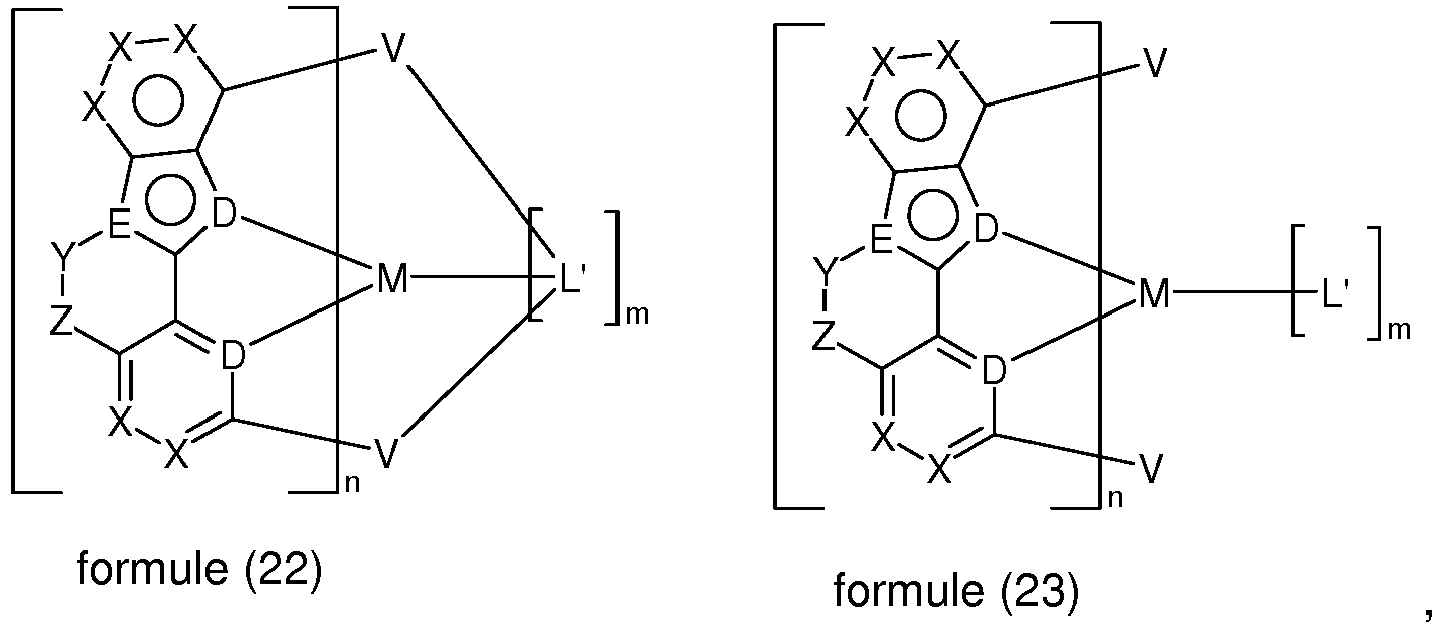
- Composé selon une ou plusieurs des revendications 1 à 11, caractérisé en ce que les ligands L' sont sélectionnés parmi le groupe qui est constitué par le monoxyde de carbone, le monoxyde d'azote, les cyanures d'alkyle, les cyanures d'aryle, les isocyanures d'alkyle, les isocyanures d'aryle, les amines, les phosphines, les phosphites, les arsines, les stibines, les hétérocycles qui contiennent de l'azote, les carbènes, un hydrure, un deutérure, les halogénures F-, Cl-, Br- et I-, les alkylacétylures, les arylacétylures, le cyanure, le cyanate, l'isocyanate, le thiocyanate, l'isothiocyanate, les alcoolates aliphatiques ou aromatiques, les thioalcoolates aliphatiques ou aromatiques, les amides, les carboxylates, les groupes aryle, O2-, S2-, les carbures, les nitrènes, N3-, les diamines, les imines, les diimines, les hétérocycles qui contiennent deux atomes d'azote, les diphosphines, les 1,3-dicétonates qui sont dérivés à partir des 1,3-dicétones, les 3-cétonates qui sont dérivés à partir des 3-cétoesters, les carboxylates qui sont dérivés à partir d'acides aminocarboxyliques, les salicyliminates qui sont dérivés à partir des salicylimines, les dialcoolates qui sont dérivés à partir des dialcools, les dithiolates qui sont dérivés à partir des dithiols, les bis(pyrazolylborates), les bis(imidazolyl)borates, les 3-(2-pyridyl)diazoles, les 3-(2-pyridyl)triazoles, les ligands monoanioniques, neutres ou dianioniques bidentés, en particulier les ligands monoanioniques, lesquels ligands qui, avec le métal, forment un cycle à cinq éléments ou à six éléments cyclométallaté qui comporte au moins une liaison métal-carbone.
- Procédé pour la préparation d'un composé selon une ou plusieurs des revendications 1 à 12 au moyen de la réaction des ligands libres L et en option L' avec des alcoxydes de métaux de la formule (75), avec des cétocétonates de métaux de la formule (76), avec des halogénures de métaux de la formule (77), avec des complexes de métaux dimériques de la formule (78) ou avec des complexes de métaux de la formule (79) :


- Oligomère, polymère ou dendrimère contenant un ou plusieurs composé(s) selon une ou plusieurs des revendications 1 à 12, où une ou plusieurs liaison(s) est/sont présente(s) depuis le composé sur le polymère, l'oligomère ou le dendrimère.
- Formulation comprenant un composé selon une ou plusieurs des revendications 1 à 12 ou un oligomère, un polymère ou un dendrimère selon la revendication 14 et au moins un autre composé, en particulier un solvant et/ou un autre composé organique ou inorganique, lequel est de manière analogue utilisé dans le dispositif électronique.
- Utilisation d'un composé selon une ou plusieurs des revendications 1 à 12 ou d'un oligomère, d'un polymère ou d'un dendrimère selon la revendication 14 dans un dispositif électronique.
- Dispositif électronique, en particulier sélectionné parmi le groupe qui est constitué par les dispositifs électroluminescents organiques, les circuits intégrés organiques, les transistors à effet de champ organiques, les transistors à film mince organiques, les transistors à émission de lumière/électroluminescents organiques, les cellules solaires organiques, les détecteurs optiques organiques, les photorécepteurs organiques, les dispositifs à extinction de champ organiques, les cellules électrochimiques à émission de lumière ou électroluminescentes ou les diodes laser organiques, comprenant, dans au moins une couche, au moins un composé selon une ou plusieurs des revendications 1 à 12 ou un oligomère, un polymère ou un dendrimère selon la revendication 14.
Priority Applications (1)
| Application Number | Priority Date | Filing Date | Title |
|---|---|---|---|
| EP13762407.8A EP2906575B1 (fr) | 2012-10-09 | 2013-09-11 | Complexes métalliques |
Applications Claiming Priority (3)
| Application Number | Priority Date | Filing Date | Title |
|---|---|---|---|
| EP12006990 | 2012-10-09 | ||
| EP13762407.8A EP2906575B1 (fr) | 2012-10-09 | 2013-09-11 | Complexes métalliques |
| PCT/EP2013/002726 WO2014056564A1 (fr) | 2012-10-09 | 2013-09-11 | Complexes métalliques |
Publications (2)
| Publication Number | Publication Date |
|---|---|
| EP2906575A1 EP2906575A1 (fr) | 2015-08-19 |
| EP2906575B1 true EP2906575B1 (fr) | 2018-01-17 |
Family
ID=47048930
Family Applications (1)
| Application Number | Title | Priority Date | Filing Date |
|---|---|---|---|
| EP13762407.8A Active EP2906575B1 (fr) | 2012-10-09 | 2013-09-11 | Complexes métalliques |
Country Status (6)
| Country | Link |
|---|---|
| US (1) | US9831446B2 (fr) |
| EP (1) | EP2906575B1 (fr) |
| JP (1) | JP6242905B2 (fr) |
| KR (1) | KR102102103B1 (fr) |
| CN (1) | CN104718219B (fr) |
| WO (1) | WO2014056564A1 (fr) |
Families Citing this family (27)
| Publication number | Priority date | Publication date | Assignee | Title |
|---|---|---|---|---|
| JP4551480B1 (ja) | 2009-08-31 | 2010-09-29 | 富士フイルム株式会社 | 有機電界発光素子 |
| JP6064653B2 (ja) * | 2013-02-15 | 2017-01-25 | 東洋インキScホールディングス株式会社 | 蛍光材料、蛍光性樹脂組成物および化合物 |
| KR20150039551A (ko) * | 2013-10-02 | 2015-04-10 | 제이에스알 가부시끼가이샤 | 경화성 조성물, 경화막 및 그의 형성 방법, 그리고 화합물 |
| KR101711917B1 (ko) * | 2013-12-09 | 2017-03-13 | 제일모직 주식회사 | 화합물, 이를 포함하는 유기광전자소자 및 표시장치 |
| US9911931B2 (en) * | 2014-06-26 | 2018-03-06 | Universal Display Corporation | Organic electroluminescent materials and devices |
| WO2016034262A1 (fr) * | 2014-09-05 | 2016-03-10 | Merck Patent Gmbh | Formulations et dispositifs électroniques |
| JP6686891B2 (ja) * | 2014-10-07 | 2020-04-22 | コニカミノルタ株式会社 | イリジウム錯体、有機エレクトロルミネッセンス材料、有機エレクトロルミネッセンス素子、表示装置及び照明装置 |
| US11930662B2 (en) * | 2015-06-04 | 2024-03-12 | Arizona Board Of Regents On Behalf Of Arizona State University | Transparent electroluminescent devices with controlled one-side emissive displays |
| CN105096121B (zh) * | 2015-06-25 | 2017-07-25 | 百度在线网络技术(北京)有限公司 | 声纹认证方法和装置 |
| EP3328872B1 (fr) * | 2015-07-30 | 2019-05-29 | Merck Patent GmbH | Complexes métalliques électroluminescents pontés destinés à être utilisés dans des dispositifs électroniques |
| KR102461970B1 (ko) | 2015-11-27 | 2022-10-31 | 엘지디스플레이 주식회사 | 유기발광 표시장치 |
| KR102443940B1 (ko) * | 2015-12-07 | 2022-09-15 | 엘지디스플레이 주식회사 | 유기 발광 표시 장치 |
| CN105713029B (zh) * | 2016-03-02 | 2019-02-01 | 吉林奥来德光电材料股份有限公司 | 一种含杂环配体的化合物及其制备方法和应用 |
| KR102693423B1 (ko) * | 2016-10-26 | 2024-08-09 | 삼성전자주식회사 | 유기금속 화합물 및 이를 포함한 유기 발광 소자 |
| WO2018149793A1 (fr) * | 2017-02-14 | 2018-08-23 | Merck Patent Gmbh | Procédé de production de composés métalliques ortho-metallés |
| JP7082984B2 (ja) * | 2017-02-20 | 2022-06-09 | ノヴァレッド ゲーエムベーハー | 電子半導体デバイスおよびその電子半導体デバイスの製造方法および化合物 |
| US10944062B2 (en) | 2017-05-18 | 2021-03-09 | Universal Display Corporation | Organic electroluminescent materials and devices |
| CN109661734B (zh) * | 2017-08-11 | 2022-04-15 | 株式会社Lg化学 | 有机电致发光器件及其制造方法 |
| KR102316066B1 (ko) * | 2018-07-27 | 2021-10-21 | 주식회사 엘지화학 | 잉크 조성물, 이를 이용한 유기 발광 소자 및 이의 제조방법 |
| US12281129B2 (en) | 2018-12-12 | 2025-04-22 | Universal Display Corporation | Organic electroluminescent materials and devices |
| US11737349B2 (en) * | 2018-12-12 | 2023-08-22 | Universal Display Corporation | Organic electroluminescent materials and devices |
| CN113227174B (zh) * | 2018-12-28 | 2024-04-26 | 戴纳索尔埃拉斯托默罗斯有限公司 | 官能化橡胶 |
| EP3956338A1 (fr) | 2019-04-15 | 2022-02-23 | Merck Patent GmbH | Complexes métalliques |
| KR20210143987A (ko) * | 2020-05-20 | 2021-11-30 | 삼성디스플레이 주식회사 | 유기금속 화합물 및 이를 포함하는 유기 발광 소자 |
| US12286447B2 (en) | 2020-10-06 | 2025-04-29 | Universal Display Corporation | Organic electroluminescent materials and devices |
| US20220106333A1 (en) * | 2020-10-06 | 2022-04-07 | American Air Liquide, Inc. | Indium precursors for vapor depositions |
| CN112300405B (zh) * | 2020-11-04 | 2022-03-22 | 湖南工学院 | 一种铜配位聚合物及其制备方法、晶体、用途 |
Family Cites Families (16)
| Publication number | Priority date | Publication date | Assignee | Title |
|---|---|---|---|---|
| JP4154138B2 (ja) * | 2000-09-26 | 2008-09-24 | キヤノン株式会社 | 発光素子、表示装置及び金属配位化合物 |
| JP2003007469A (ja) | 2001-06-25 | 2003-01-10 | Canon Inc | 発光素子及び表示装置 |
| JP4211433B2 (ja) * | 2002-08-14 | 2009-01-21 | 三菱化学株式会社 | 有機金属錯体、発光色素、有機電界発光素子材料および有機電界発光素子 |
| JP4193523B2 (ja) * | 2002-08-14 | 2008-12-10 | 三菱化学株式会社 | 有機金属錯体、発光色素、有機電界発光素子材料、および有機電界発光素子 |
| DE10310887A1 (de) * | 2003-03-11 | 2004-09-30 | Covion Organic Semiconductors Gmbh | Matallkomplexe |
| JP5198856B2 (ja) * | 2004-05-19 | 2013-05-15 | メルク パテント ゲーエムベーハー | 金属錯体 |
| US20070166566A1 (en) * | 2006-01-18 | 2007-07-19 | Eastman Kodak Company | Electroluminescent device including a gallium complex |
| TWI327148B (en) * | 2006-12-28 | 2010-07-11 | Ind Tech Res Inst | Organic metal complexes |
| US8815411B2 (en) * | 2007-11-09 | 2014-08-26 | The Regents Of The University Of Michigan | Stable blue phosphorescent organic light emitting devices |
| DE102009007038A1 (de) * | 2009-02-02 | 2010-08-05 | Merck Patent Gmbh | Metallkomplexe |
| JP5423363B2 (ja) | 2009-12-07 | 2014-02-19 | コニカミノルタ株式会社 | 有機エレクトロルミネッセンス素子、表示装置及び照明装置 |
| US8691401B2 (en) * | 2010-04-16 | 2014-04-08 | Basf Se | Bridged benzimidazole-carbene complexes and use thereof in OLEDS |
| DE102010027316A1 (de) * | 2010-07-16 | 2012-01-19 | Merck Patent Gmbh | Metallkomplexe |
| DE102010027317A1 (de) * | 2010-07-16 | 2012-01-19 | Merck Patent Gmbh | Metallkomplexe |
| DE102010046512A1 (de) * | 2010-09-24 | 2012-03-29 | Merck Patent Gmbh | Phosphorhaltige Metallkomplexe |
| US9444059B2 (en) * | 2013-02-21 | 2016-09-13 | Semiconductor Energy Laboratory Co., Ltd. | Organometallic complex, light-emitting element, light-emitting device, electronic device, and lighting device |
-
2013
- 2013-09-11 KR KR1020157012088A patent/KR102102103B1/ko active Active
- 2013-09-11 US US14/434,167 patent/US9831446B2/en active Active
- 2013-09-11 CN CN201380052558.8A patent/CN104718219B/zh active Active
- 2013-09-11 WO PCT/EP2013/002726 patent/WO2014056564A1/fr not_active Ceased
- 2013-09-11 JP JP2015536002A patent/JP6242905B2/ja active Active
- 2013-09-11 EP EP13762407.8A patent/EP2906575B1/fr active Active
Also Published As
| Publication number | Publication date |
|---|---|
| US9831446B2 (en) | 2017-11-28 |
| EP2906575A1 (fr) | 2015-08-19 |
| KR102102103B1 (ko) | 2020-04-20 |
| WO2014056564A1 (fr) | 2014-04-17 |
| KR20150066579A (ko) | 2015-06-16 |
| US20150270500A1 (en) | 2015-09-24 |
| CN104718219A (zh) | 2015-06-17 |
| JP2016500674A (ja) | 2016-01-14 |
| CN104718219B (zh) | 2017-11-03 |
| JP6242905B2 (ja) | 2017-12-06 |
Similar Documents
| Publication | Publication Date | Title |
|---|---|---|
| EP2882763B1 (fr) | Complexes métalliques | |
| EP3044284B1 (fr) | Complexes métalliques | |
| EP3478698B1 (fr) | Procédé pour séparer des mélanges d'énantiomères de complexes métalliques | |
| EP3094638B1 (fr) | Complexes métalliques | |
| DE112010004049B4 (de) | Metallkomplexe | |
| DE112011102366B4 (de) | Metallkomplexe | |
| EP2935291B1 (fr) | Complexes d'iridium et leur utilisation dans les oligomères, polymères ou dendrimères dans les dispositifs electroniques | |
| EP2935292B1 (fr) | Complexes metalliques | |
| EP2935293B1 (fr) | Complexes du iridium et leur utilisation dans les dispositifs electroniques en particulier les dispositifs electroluminescentes | |
| EP3046927B1 (fr) | Complexes d'iridium phényl-pyridine polycyclique et dérivés pour oled desdits complexes | |
| EP3160976B1 (fr) | Complexes métalliques | |
| EP3174890B1 (fr) | Complexes métalliques | |
| EP2714704B1 (fr) | Complexes métalliques | |
| EP2906575A1 (fr) | Complexes métalliques | |
| EP3328872B1 (fr) | Complexes métalliques électroluminescents pontés destinés à être utilisés dans des dispositifs électroniques | |
| WO2010086089A1 (fr) | Complexes métalliques | |
| DE102010027316A1 (de) | Metallkomplexe | |
| EP2984093B1 (fr) | Complexes métalliques et leur utilisation dans des dispositifs électroniques | |
| WO2014044347A1 (fr) | Complexes métalliques | |
| WO2020212296A1 (fr) | Complexes métalliques | |
| EP4069709B1 (fr) | Complexes métalliques |
Legal Events
| Date | Code | Title | Description |
|---|---|---|---|
| PUAI | Public reference made under article 153(3) epc to a published international application that has entered the european phase |
Free format text: ORIGINAL CODE: 0009012 |
|
| 17P | Request for examination filed |
Effective date: 20150209 |
|
| AK | Designated contracting states |
Kind code of ref document: A1 Designated state(s): AL AT BE BG CH CY CZ DE DK EE ES FI FR GB GR HR HU IE IS IT LI LT LU LV MC MK MT NL NO PL PT RO RS SE SI SK SM TR |
|
| AX | Request for extension of the european patent |
Extension state: BA ME |
|
| DAX | Request for extension of the european patent (deleted) | ||
| 17Q | First examination report despatched |
Effective date: 20160803 |
|
| GRAP | Despatch of communication of intention to grant a patent |
Free format text: ORIGINAL CODE: EPIDOSNIGR1 |
|
| INTG | Intention to grant announced |
Effective date: 20170920 |
|
| GRAS | Grant fee paid |
Free format text: ORIGINAL CODE: EPIDOSNIGR3 |
|
| GRAA | (expected) grant |
Free format text: ORIGINAL CODE: 0009210 |
|
| AK | Designated contracting states |
Kind code of ref document: B1 Designated state(s): AL AT BE BG CH CY CZ DE DK EE ES FI FR GB GR HR HU IE IS IT LI LT LU LV MC MK MT NL NO PL PT RO RS SE SI SK SM TR |
|
| REG | Reference to a national code |
Ref country code: GB Ref legal event code: FG4D Free format text: NOT ENGLISH |
|
| REG | Reference to a national code |
Ref country code: CH Ref legal event code: EP |
|
| REG | Reference to a national code |
Ref country code: IE Ref legal event code: FG4D Free format text: LANGUAGE OF EP DOCUMENT: GERMAN |
|
| REG | Reference to a national code |
Ref country code: DE Ref legal event code: R096 Ref document number: 502013009291 Country of ref document: DE Ref country code: AT Ref legal event code: REF Ref document number: 964319 Country of ref document: AT Kind code of ref document: T Effective date: 20180215 |
|
| REG | Reference to a national code |
Ref country code: NL Ref legal event code: MP Effective date: 20180117 |
|
| REG | Reference to a national code |
Ref country code: LT Ref legal event code: MG4D |
|
| PG25 | Lapsed in a contracting state [announced via postgrant information from national office to epo] |
Ref country code: NL Free format text: LAPSE BECAUSE OF FAILURE TO SUBMIT A TRANSLATION OF THE DESCRIPTION OR TO PAY THE FEE WITHIN THE PRESCRIBED TIME-LIMIT Effective date: 20180117 |
|
| PG25 | Lapsed in a contracting state [announced via postgrant information from national office to epo] |
Ref country code: NO Free format text: LAPSE BECAUSE OF FAILURE TO SUBMIT A TRANSLATION OF THE DESCRIPTION OR TO PAY THE FEE WITHIN THE PRESCRIBED TIME-LIMIT Effective date: 20180417 Ref country code: FI Free format text: LAPSE BECAUSE OF FAILURE TO SUBMIT A TRANSLATION OF THE DESCRIPTION OR TO PAY THE FEE WITHIN THE PRESCRIBED TIME-LIMIT Effective date: 20180117 Ref country code: LT Free format text: LAPSE BECAUSE OF FAILURE TO SUBMIT A TRANSLATION OF THE DESCRIPTION OR TO PAY THE FEE WITHIN THE PRESCRIBED TIME-LIMIT Effective date: 20180117 Ref country code: HR Free format text: LAPSE BECAUSE OF FAILURE TO SUBMIT A TRANSLATION OF THE DESCRIPTION OR TO PAY THE FEE WITHIN THE PRESCRIBED TIME-LIMIT Effective date: 20180117 Ref country code: ES Free format text: LAPSE BECAUSE OF FAILURE TO SUBMIT A TRANSLATION OF THE DESCRIPTION OR TO PAY THE FEE WITHIN THE PRESCRIBED TIME-LIMIT Effective date: 20180117 Ref country code: CY Free format text: LAPSE BECAUSE OF FAILURE TO SUBMIT A TRANSLATION OF THE DESCRIPTION OR TO PAY THE FEE WITHIN THE PRESCRIBED TIME-LIMIT Effective date: 20180117 |
|
| PG25 | Lapsed in a contracting state [announced via postgrant information from national office to epo] |
Ref country code: PL Free format text: LAPSE BECAUSE OF FAILURE TO SUBMIT A TRANSLATION OF THE DESCRIPTION OR TO PAY THE FEE WITHIN THE PRESCRIBED TIME-LIMIT Effective date: 20180117 Ref country code: RS Free format text: LAPSE BECAUSE OF FAILURE TO SUBMIT A TRANSLATION OF THE DESCRIPTION OR TO PAY THE FEE WITHIN THE PRESCRIBED TIME-LIMIT Effective date: 20180117 Ref country code: BG Free format text: LAPSE BECAUSE OF FAILURE TO SUBMIT A TRANSLATION OF THE DESCRIPTION OR TO PAY THE FEE WITHIN THE PRESCRIBED TIME-LIMIT Effective date: 20180417 Ref country code: SE Free format text: LAPSE BECAUSE OF FAILURE TO SUBMIT A TRANSLATION OF THE DESCRIPTION OR TO PAY THE FEE WITHIN THE PRESCRIBED TIME-LIMIT Effective date: 20180117 Ref country code: LV Free format text: LAPSE BECAUSE OF FAILURE TO SUBMIT A TRANSLATION OF THE DESCRIPTION OR TO PAY THE FEE WITHIN THE PRESCRIBED TIME-LIMIT Effective date: 20180117 Ref country code: IS Free format text: LAPSE BECAUSE OF FAILURE TO SUBMIT A TRANSLATION OF THE DESCRIPTION OR TO PAY THE FEE WITHIN THE PRESCRIBED TIME-LIMIT Effective date: 20180517 Ref country code: GR Free format text: LAPSE BECAUSE OF FAILURE TO SUBMIT A TRANSLATION OF THE DESCRIPTION OR TO PAY THE FEE WITHIN THE PRESCRIBED TIME-LIMIT Effective date: 20180418 |
|
| PG25 | Lapsed in a contracting state [announced via postgrant information from national office to epo] |
Ref country code: MT Free format text: LAPSE BECAUSE OF FAILURE TO SUBMIT A TRANSLATION OF THE DESCRIPTION OR TO PAY THE FEE WITHIN THE PRESCRIBED TIME-LIMIT Effective date: 20180117 |
|
| REG | Reference to a national code |
Ref country code: DE Ref legal event code: R097 Ref document number: 502013009291 Country of ref document: DE |
|
| PG25 | Lapsed in a contracting state [announced via postgrant information from national office to epo] |
Ref country code: AL Free format text: LAPSE BECAUSE OF FAILURE TO SUBMIT A TRANSLATION OF THE DESCRIPTION OR TO PAY THE FEE WITHIN THE PRESCRIBED TIME-LIMIT Effective date: 20180117 Ref country code: EE Free format text: LAPSE BECAUSE OF FAILURE TO SUBMIT A TRANSLATION OF THE DESCRIPTION OR TO PAY THE FEE WITHIN THE PRESCRIBED TIME-LIMIT Effective date: 20180117 Ref country code: RO Free format text: LAPSE BECAUSE OF FAILURE TO SUBMIT A TRANSLATION OF THE DESCRIPTION OR TO PAY THE FEE WITHIN THE PRESCRIBED TIME-LIMIT Effective date: 20180117 Ref country code: IT Free format text: LAPSE BECAUSE OF FAILURE TO SUBMIT A TRANSLATION OF THE DESCRIPTION OR TO PAY THE FEE WITHIN THE PRESCRIBED TIME-LIMIT Effective date: 20180117 |
|
| PLBE | No opposition filed within time limit |
Free format text: ORIGINAL CODE: 0009261 |
|
| STAA | Information on the status of an ep patent application or granted ep patent |
Free format text: STATUS: NO OPPOSITION FILED WITHIN TIME LIMIT |
|
| PG25 | Lapsed in a contracting state [announced via postgrant information from national office to epo] |
Ref country code: CZ Free format text: LAPSE BECAUSE OF FAILURE TO SUBMIT A TRANSLATION OF THE DESCRIPTION OR TO PAY THE FEE WITHIN THE PRESCRIBED TIME-LIMIT Effective date: 20180117 Ref country code: SK Free format text: LAPSE BECAUSE OF FAILURE TO SUBMIT A TRANSLATION OF THE DESCRIPTION OR TO PAY THE FEE WITHIN THE PRESCRIBED TIME-LIMIT Effective date: 20180117 Ref country code: DK Free format text: LAPSE BECAUSE OF FAILURE TO SUBMIT A TRANSLATION OF THE DESCRIPTION OR TO PAY THE FEE WITHIN THE PRESCRIBED TIME-LIMIT Effective date: 20180117 Ref country code: SM Free format text: LAPSE BECAUSE OF FAILURE TO SUBMIT A TRANSLATION OF THE DESCRIPTION OR TO PAY THE FEE WITHIN THE PRESCRIBED TIME-LIMIT Effective date: 20180117 |
|
| 26N | No opposition filed |
Effective date: 20181018 |
|
| PG25 | Lapsed in a contracting state [announced via postgrant information from national office to epo] |
Ref country code: SI Free format text: LAPSE BECAUSE OF FAILURE TO SUBMIT A TRANSLATION OF THE DESCRIPTION OR TO PAY THE FEE WITHIN THE PRESCRIBED TIME-LIMIT Effective date: 20180117 |
|
| PG25 | Lapsed in a contracting state [announced via postgrant information from national office to epo] |
Ref country code: MC Free format text: LAPSE BECAUSE OF FAILURE TO SUBMIT A TRANSLATION OF THE DESCRIPTION OR TO PAY THE FEE WITHIN THE PRESCRIBED TIME-LIMIT Effective date: 20180117 |
|
| REG | Reference to a national code |
Ref country code: CH Ref legal event code: PL |
|
| GBPC | Gb: european patent ceased through non-payment of renewal fee |
Effective date: 20180911 |
|
| REG | Reference to a national code |
Ref country code: BE Ref legal event code: MM Effective date: 20180930 |
|
| REG | Reference to a national code |
Ref country code: IE Ref legal event code: MM4A |
|
| PG25 | Lapsed in a contracting state [announced via postgrant information from national office to epo] |
Ref country code: LU Free format text: LAPSE BECAUSE OF NON-PAYMENT OF DUE FEES Effective date: 20180911 |
|
| PG25 | Lapsed in a contracting state [announced via postgrant information from national office to epo] |
Ref country code: IE Free format text: LAPSE BECAUSE OF NON-PAYMENT OF DUE FEES Effective date: 20180911 |
|
| PG25 | Lapsed in a contracting state [announced via postgrant information from national office to epo] |
Ref country code: BE Free format text: LAPSE BECAUSE OF NON-PAYMENT OF DUE FEES Effective date: 20180930 Ref country code: LI Free format text: LAPSE BECAUSE OF NON-PAYMENT OF DUE FEES Effective date: 20180930 Ref country code: CH Free format text: LAPSE BECAUSE OF NON-PAYMENT OF DUE FEES Effective date: 20180930 Ref country code: FR Free format text: LAPSE BECAUSE OF NON-PAYMENT OF DUE FEES Effective date: 20180930 |
|
| PG25 | Lapsed in a contracting state [announced via postgrant information from national office to epo] |
Ref country code: GB Free format text: LAPSE BECAUSE OF NON-PAYMENT OF DUE FEES Effective date: 20180911 |
|
| REG | Reference to a national code |
Ref country code: AT Ref legal event code: MM01 Ref document number: 964319 Country of ref document: AT Kind code of ref document: T Effective date: 20180911 |
|
| PG25 | Lapsed in a contracting state [announced via postgrant information from national office to epo] |
Ref country code: AT Free format text: LAPSE BECAUSE OF NON-PAYMENT OF DUE FEES Effective date: 20180911 |
|
| PG25 | Lapsed in a contracting state [announced via postgrant information from national office to epo] |
Ref country code: TR Free format text: LAPSE BECAUSE OF FAILURE TO SUBMIT A TRANSLATION OF THE DESCRIPTION OR TO PAY THE FEE WITHIN THE PRESCRIBED TIME-LIMIT Effective date: 20180117 |
|
| PG25 | Lapsed in a contracting state [announced via postgrant information from national office to epo] |
Ref country code: PT Free format text: LAPSE BECAUSE OF FAILURE TO SUBMIT A TRANSLATION OF THE DESCRIPTION OR TO PAY THE FEE WITHIN THE PRESCRIBED TIME-LIMIT Effective date: 20180117 |
|
| PG25 | Lapsed in a contracting state [announced via postgrant information from national office to epo] |
Ref country code: MK Free format text: LAPSE BECAUSE OF NON-PAYMENT OF DUE FEES Effective date: 20180117 Ref country code: HU Free format text: LAPSE BECAUSE OF FAILURE TO SUBMIT A TRANSLATION OF THE DESCRIPTION OR TO PAY THE FEE WITHIN THE PRESCRIBED TIME-LIMIT; INVALID AB INITIO Effective date: 20130911 |
|
| P01 | Opt-out of the competence of the unified patent court (upc) registered |
Effective date: 20230518 |
|
| REG | Reference to a national code |
Ref country code: DE Ref legal event code: R081 Ref document number: 502013009291 Country of ref document: DE Owner name: UDC IRELAND LTD., IE Free format text: FORMER OWNER: MERCK PATENT GMBH, 64293 DARMSTADT, DE |
|
| P03 | Opt-out of the competence of the unified patent court (upc) deleted | ||
| P01 | Opt-out of the competence of the unified patent court (upc) registered |
Effective date: 20240207 |
|
| PGFP | Annual fee paid to national office [announced via postgrant information from national office to epo] |
Ref country code: DE Payment date: 20250929 Year of fee payment: 13 |