EP2984093B1 - Complexes métalliques et leur utilisation dans des dispositifs électroniques - Google Patents
Complexes métalliques et leur utilisation dans des dispositifs électroniques Download PDFInfo
- Publication number
- EP2984093B1 EP2984093B1 EP14710815.3A EP14710815A EP2984093B1 EP 2984093 B1 EP2984093 B1 EP 2984093B1 EP 14710815 A EP14710815 A EP 14710815A EP 2984093 B1 EP2984093 B1 EP 2984093B1
- Authority
- EP
- European Patent Office
- Prior art keywords
- group
- atoms
- radicals
- formula
- substituted
- Prior art date
- Legal status (The legal status is an assumption and is not a legal conclusion. Google has not performed a legal analysis and makes no representation as to the accuracy of the status listed.)
- Active
Links
- 0 CC1(C*)CCCCC1 Chemical compound CC1(C*)CCCCC1 0.000 description 31
- SCJCLTCLYYYMGS-UHFFFAOYSA-N CC(C(C#N)=C1N2C=CC=C1)=CC2=O Chemical compound CC(C(C#N)=C1N2C=CC=C1)=CC2=O SCJCLTCLYYYMGS-UHFFFAOYSA-N 0.000 description 1
- TVAFIFFOHPKWQJ-UHFFFAOYSA-N CC(C(CC1)(F)F)=C(C)C1(F)F Chemical compound CC(C(CC1)(F)F)=C(C)C1(F)F TVAFIFFOHPKWQJ-UHFFFAOYSA-N 0.000 description 1
- APOHUPCALKVSJE-UHFFFAOYSA-N CC(C)(C(C1(C)C)(F)F)C(C)=C1I Chemical compound CC(C)(C(C1(C)C)(F)F)C(C)=C1I APOHUPCALKVSJE-UHFFFAOYSA-N 0.000 description 1
- HTHUSQAHTSBNKE-UHFFFAOYSA-N CC(C)(C1(C)C)C(C)=C(C)N1c1ccccc1 Chemical compound CC(C)(C1(C)C)C(C)=C(C)N1c1ccccc1 HTHUSQAHTSBNKE-UHFFFAOYSA-N 0.000 description 1
- XHOFHQHCKSZEOC-UHFFFAOYSA-N CC(C)(C=C(C)C1(C)C)c2c1cccc2 Chemical compound CC(C)(C=C(C)C1(C)C)c2c1cccc2 XHOFHQHCKSZEOC-UHFFFAOYSA-N 0.000 description 1
- MOWKQVZOVSARKZ-UHFFFAOYSA-N CC(C)(C=C1C)c(cccc2)c2N1c1ccccc1 Chemical compound CC(C)(C=C1C)c(cccc2)c2N1c1ccccc1 MOWKQVZOVSARKZ-UHFFFAOYSA-N 0.000 description 1
- OGUKGFAGZFIGEE-UHFFFAOYSA-N CC(C)(CC1)C(C)=C(C)N1c1ccccc1 Chemical compound CC(C)(CC1)C(C)=C(C)N1c1ccccc1 OGUKGFAGZFIGEE-UHFFFAOYSA-N 0.000 description 1
- UUAPMJMVAHWSFR-UHFFFAOYSA-N CC1(C)C(C)(C)C(C)=C(C)C(C)(C)C1(C)C Chemical compound CC1(C)C(C)(C)C(C)=C(C)C(C)(C)C1(C)C UUAPMJMVAHWSFR-UHFFFAOYSA-N 0.000 description 1
- VEGCBNUSBMHDHZ-UHFFFAOYSA-N CC1(C)C(C)=C(C)C(C)(C)CC1 Chemical compound CC1(C)C(C)=C(C)C(C)(C)CC1 VEGCBNUSBMHDHZ-UHFFFAOYSA-N 0.000 description 1
- AANOIIROKSDTKN-UHFFFAOYSA-N CC1=C(C)Oc2ccccc2O1 Chemical compound CC1=C(C)Oc2ccccc2O1 AANOIIROKSDTKN-UHFFFAOYSA-N 0.000 description 1
- BEUVUUIUFRDYME-UHFFFAOYSA-N CC1=C(C2C=CC=CC2)C=C(C=CC=C2)N2C1=O Chemical compound CC1=C(C2C=CC=CC2)C=C(C=CC=C2)N2C1=O BEUVUUIUFRDYME-UHFFFAOYSA-N 0.000 description 1
- VWQJLWBDHNWJEB-UHFFFAOYSA-N CCC1(C)C(N23)=CC=CC2=NC(C)=C(C)C3=[O]C1(CC)C=C Chemical compound CCC1(C)C(N23)=CC=CC2=NC(C)=C(C)C3=[O]C1(CC)C=C VWQJLWBDHNWJEB-UHFFFAOYSA-N 0.000 description 1
- OWPFZWVRCBXCOL-UHFFFAOYSA-N CCCCC(C)(C)C1=CC(N23)=[O]C(CC)(CC)[IH]C2=Cc([o]c2c4cccc2)c4C3=C1 Chemical compound CCCCC(C)(C)C1=CC(N23)=[O]C(CC)(CC)[IH]C2=Cc([o]c2c4cccc2)c4C3=C1 OWPFZWVRCBXCOL-UHFFFAOYSA-N 0.000 description 1
- OSILBMSORKFRTB-UHFFFAOYSA-N Nc1nccc2ccccc12 Chemical compound Nc1nccc2ccccc12 OSILBMSORKFRTB-UHFFFAOYSA-N 0.000 description 1
- SZXUTTGMFUSMCE-UHFFFAOYSA-N c1cnc(-c2ccccn2)[nH]1 Chemical compound c1cnc(-c2ccccn2)[nH]1 SZXUTTGMFUSMCE-UHFFFAOYSA-N 0.000 description 1
Classifications
-
- H—ELECTRICITY
- H10—SEMICONDUCTOR DEVICES; ELECTRIC SOLID-STATE DEVICES NOT OTHERWISE PROVIDED FOR
- H10K—ORGANIC ELECTRIC SOLID-STATE DEVICES
- H10K85/00—Organic materials used in the body or electrodes of devices covered by this subclass
- H10K85/30—Coordination compounds
- H10K85/341—Transition metal complexes, e.g. Ru(II)polypyridine complexes
- H10K85/342—Transition metal complexes, e.g. Ru(II)polypyridine complexes comprising iridium
-
- C—CHEMISTRY; METALLURGY
- C07—ORGANIC CHEMISTRY
- C07F—ACYCLIC, CARBOCYCLIC OR HETEROCYCLIC COMPOUNDS CONTAINING ELEMENTS OTHER THAN CARBON, HYDROGEN, HALOGEN, OXYGEN, NITROGEN, SULFUR, SELENIUM OR TELLURIUM
- C07F15/00—Compounds containing elements of Groups 8, 9, 10 or 18 of the Periodic Table
- C07F15/0006—Compounds containing elements of Groups 8, 9, 10 or 18 of the Periodic Table compounds of the platinum group
- C07F15/0033—Iridium compounds
-
- C—CHEMISTRY; METALLURGY
- C09—DYES; PAINTS; POLISHES; NATURAL RESINS; ADHESIVES; COMPOSITIONS NOT OTHERWISE PROVIDED FOR; APPLICATIONS OF MATERIALS NOT OTHERWISE PROVIDED FOR
- C09K—MATERIALS FOR MISCELLANEOUS APPLICATIONS, NOT PROVIDED FOR ELSEWHERE
- C09K11/00—Luminescent materials, e.g. electroluminescent or chemiluminescent
- C09K11/02—Use of particular materials as binders, particle coatings or suspension media therefor
- C09K11/025—Use of particular materials as binders, particle coatings or suspension media therefor non-luminescent particle coatings or suspension media
-
- C—CHEMISTRY; METALLURGY
- C09—DYES; PAINTS; POLISHES; NATURAL RESINS; ADHESIVES; COMPOSITIONS NOT OTHERWISE PROVIDED FOR; APPLICATIONS OF MATERIALS NOT OTHERWISE PROVIDED FOR
- C09K—MATERIALS FOR MISCELLANEOUS APPLICATIONS, NOT PROVIDED FOR ELSEWHERE
- C09K11/00—Luminescent materials, e.g. electroluminescent or chemiluminescent
- C09K11/06—Luminescent materials, e.g. electroluminescent or chemiluminescent containing organic luminescent materials
-
- H—ELECTRICITY
- H10—SEMICONDUCTOR DEVICES; ELECTRIC SOLID-STATE DEVICES NOT OTHERWISE PROVIDED FOR
- H10K—ORGANIC ELECTRIC SOLID-STATE DEVICES
- H10K50/00—Organic light-emitting devices
- H10K50/10—OLEDs or polymer light-emitting diodes [PLED]
- H10K50/11—OLEDs or polymer light-emitting diodes [PLED] characterised by the electroluminescent [EL] layers
-
- H—ELECTRICITY
- H10—SEMICONDUCTOR DEVICES; ELECTRIC SOLID-STATE DEVICES NOT OTHERWISE PROVIDED FOR
- H10K—ORGANIC ELECTRIC SOLID-STATE DEVICES
- H10K71/00—Manufacture or treatment specially adapted for the organic devices covered by this subclass
- H10K71/10—Deposition of organic active material
- H10K71/12—Deposition of organic active material using liquid deposition, e.g. spin coating
-
- H—ELECTRICITY
- H10—SEMICONDUCTOR DEVICES; ELECTRIC SOLID-STATE DEVICES NOT OTHERWISE PROVIDED FOR
- H10K—ORGANIC ELECTRIC SOLID-STATE DEVICES
- H10K85/00—Organic materials used in the body or electrodes of devices covered by this subclass
- H10K85/60—Organic compounds having low molecular weight
- H10K85/649—Aromatic compounds comprising a hetero atom
- H10K85/654—Aromatic compounds comprising a hetero atom comprising only nitrogen as heteroatom
-
- H—ELECTRICITY
- H10—SEMICONDUCTOR DEVICES; ELECTRIC SOLID-STATE DEVICES NOT OTHERWISE PROVIDED FOR
- H10K—ORGANIC ELECTRIC SOLID-STATE DEVICES
- H10K85/00—Organic materials used in the body or electrodes of devices covered by this subclass
- H10K85/60—Organic compounds having low molecular weight
- H10K85/649—Aromatic compounds comprising a hetero atom
- H10K85/657—Polycyclic condensed heteroaromatic hydrocarbons
- H10K85/6572—Polycyclic condensed heteroaromatic hydrocarbons comprising only nitrogen in the heteroaromatic polycondensed ring system, e.g. phenanthroline or carbazole
-
- C—CHEMISTRY; METALLURGY
- C09—DYES; PAINTS; POLISHES; NATURAL RESINS; ADHESIVES; COMPOSITIONS NOT OTHERWISE PROVIDED FOR; APPLICATIONS OF MATERIALS NOT OTHERWISE PROVIDED FOR
- C09K—MATERIALS FOR MISCELLANEOUS APPLICATIONS, NOT PROVIDED FOR ELSEWHERE
- C09K2211/00—Chemical nature of organic luminescent or tenebrescent compounds
- C09K2211/10—Non-macromolecular compounds
- C09K2211/1003—Carbocyclic compounds
- C09K2211/1007—Non-condensed systems
-
- C—CHEMISTRY; METALLURGY
- C09—DYES; PAINTS; POLISHES; NATURAL RESINS; ADHESIVES; COMPOSITIONS NOT OTHERWISE PROVIDED FOR; APPLICATIONS OF MATERIALS NOT OTHERWISE PROVIDED FOR
- C09K—MATERIALS FOR MISCELLANEOUS APPLICATIONS, NOT PROVIDED FOR ELSEWHERE
- C09K2211/00—Chemical nature of organic luminescent or tenebrescent compounds
- C09K2211/10—Non-macromolecular compounds
- C09K2211/1003—Carbocyclic compounds
- C09K2211/1011—Condensed systems
-
- C—CHEMISTRY; METALLURGY
- C09—DYES; PAINTS; POLISHES; NATURAL RESINS; ADHESIVES; COMPOSITIONS NOT OTHERWISE PROVIDED FOR; APPLICATIONS OF MATERIALS NOT OTHERWISE PROVIDED FOR
- C09K—MATERIALS FOR MISCELLANEOUS APPLICATIONS, NOT PROVIDED FOR ELSEWHERE
- C09K2211/00—Chemical nature of organic luminescent or tenebrescent compounds
- C09K2211/10—Non-macromolecular compounds
- C09K2211/1018—Heterocyclic compounds
- C09K2211/1025—Heterocyclic compounds characterised by ligands
- C09K2211/1029—Heterocyclic compounds characterised by ligands containing one nitrogen atom as the heteroatom
-
- C—CHEMISTRY; METALLURGY
- C09—DYES; PAINTS; POLISHES; NATURAL RESINS; ADHESIVES; COMPOSITIONS NOT OTHERWISE PROVIDED FOR; APPLICATIONS OF MATERIALS NOT OTHERWISE PROVIDED FOR
- C09K—MATERIALS FOR MISCELLANEOUS APPLICATIONS, NOT PROVIDED FOR ELSEWHERE
- C09K2211/00—Chemical nature of organic luminescent or tenebrescent compounds
- C09K2211/10—Non-macromolecular compounds
- C09K2211/1018—Heterocyclic compounds
- C09K2211/1025—Heterocyclic compounds characterised by ligands
- C09K2211/1044—Heterocyclic compounds characterised by ligands containing two nitrogen atoms as heteroatoms
-
- C—CHEMISTRY; METALLURGY
- C09—DYES; PAINTS; POLISHES; NATURAL RESINS; ADHESIVES; COMPOSITIONS NOT OTHERWISE PROVIDED FOR; APPLICATIONS OF MATERIALS NOT OTHERWISE PROVIDED FOR
- C09K—MATERIALS FOR MISCELLANEOUS APPLICATIONS, NOT PROVIDED FOR ELSEWHERE
- C09K2211/00—Chemical nature of organic luminescent or tenebrescent compounds
- C09K2211/10—Non-macromolecular compounds
- C09K2211/1018—Heterocyclic compounds
- C09K2211/1025—Heterocyclic compounds characterised by ligands
- C09K2211/1059—Heterocyclic compounds characterised by ligands containing three nitrogen atoms as heteroatoms
-
- C—CHEMISTRY; METALLURGY
- C09—DYES; PAINTS; POLISHES; NATURAL RESINS; ADHESIVES; COMPOSITIONS NOT OTHERWISE PROVIDED FOR; APPLICATIONS OF MATERIALS NOT OTHERWISE PROVIDED FOR
- C09K—MATERIALS FOR MISCELLANEOUS APPLICATIONS, NOT PROVIDED FOR ELSEWHERE
- C09K2211/00—Chemical nature of organic luminescent or tenebrescent compounds
- C09K2211/10—Non-macromolecular compounds
- C09K2211/1018—Heterocyclic compounds
- C09K2211/1025—Heterocyclic compounds characterised by ligands
- C09K2211/1092—Heterocyclic compounds characterised by ligands containing sulfur as the only heteroatom
-
- C—CHEMISTRY; METALLURGY
- C09—DYES; PAINTS; POLISHES; NATURAL RESINS; ADHESIVES; COMPOSITIONS NOT OTHERWISE PROVIDED FOR; APPLICATIONS OF MATERIALS NOT OTHERWISE PROVIDED FOR
- C09K—MATERIALS FOR MISCELLANEOUS APPLICATIONS, NOT PROVIDED FOR ELSEWHERE
- C09K2211/00—Chemical nature of organic luminescent or tenebrescent compounds
- C09K2211/18—Metal complexes
- C09K2211/185—Metal complexes of the platinum group, i.e. Os, Ir, Pt, Ru, Rh or Pd
-
- H—ELECTRICITY
- H10—SEMICONDUCTOR DEVICES; ELECTRIC SOLID-STATE DEVICES NOT OTHERWISE PROVIDED FOR
- H10K—ORGANIC ELECTRIC SOLID-STATE DEVICES
- H10K2101/00—Properties of the organic materials covered by group H10K85/00
- H10K2101/10—Triplet emission
-
- H—ELECTRICITY
- H10—SEMICONDUCTOR DEVICES; ELECTRIC SOLID-STATE DEVICES NOT OTHERWISE PROVIDED FOR
- H10K—ORGANIC ELECTRIC SOLID-STATE DEVICES
- H10K2101/00—Properties of the organic materials covered by group H10K85/00
- H10K2101/90—Multiple hosts in the emissive layer
-
- H—ELECTRICITY
- H10—SEMICONDUCTOR DEVICES; ELECTRIC SOLID-STATE DEVICES NOT OTHERWISE PROVIDED FOR
- H10K—ORGANIC ELECTRIC SOLID-STATE DEVICES
- H10K85/00—Organic materials used in the body or electrodes of devices covered by this subclass
- H10K85/30—Coordination compounds
-
- H—ELECTRICITY
- H10—SEMICONDUCTOR DEVICES; ELECTRIC SOLID-STATE DEVICES NOT OTHERWISE PROVIDED FOR
- H10K—ORGANIC ELECTRIC SOLID-STATE DEVICES
- H10K85/00—Organic materials used in the body or electrodes of devices covered by this subclass
- H10K85/40—Organosilicon compounds, e.g. TIPS pentacene
-
- H—ELECTRICITY
- H10—SEMICONDUCTOR DEVICES; ELECTRIC SOLID-STATE DEVICES NOT OTHERWISE PROVIDED FOR
- H10K—ORGANIC ELECTRIC SOLID-STATE DEVICES
- H10K85/00—Organic materials used in the body or electrodes of devices covered by this subclass
- H10K85/60—Organic compounds having low molecular weight
- H10K85/615—Polycyclic condensed aromatic hydrocarbons, e.g. anthracene
-
- H—ELECTRICITY
- H10—SEMICONDUCTOR DEVICES; ELECTRIC SOLID-STATE DEVICES NOT OTHERWISE PROVIDED FOR
- H10K—ORGANIC ELECTRIC SOLID-STATE DEVICES
- H10K85/00—Organic materials used in the body or electrodes of devices covered by this subclass
- H10K85/60—Organic compounds having low molecular weight
- H10K85/615—Polycyclic condensed aromatic hydrocarbons, e.g. anthracene
- H10K85/624—Polycyclic condensed aromatic hydrocarbons, e.g. anthracene containing six or more rings
-
- H—ELECTRICITY
- H10—SEMICONDUCTOR DEVICES; ELECTRIC SOLID-STATE DEVICES NOT OTHERWISE PROVIDED FOR
- H10K—ORGANIC ELECTRIC SOLID-STATE DEVICES
- H10K85/00—Organic materials used in the body or electrodes of devices covered by this subclass
- H10K85/60—Organic compounds having low molecular weight
- H10K85/631—Amine compounds having at least two aryl rest on at least one amine-nitrogen atom, e.g. triphenylamine
-
- H—ELECTRICITY
- H10—SEMICONDUCTOR DEVICES; ELECTRIC SOLID-STATE DEVICES NOT OTHERWISE PROVIDED FOR
- H10K—ORGANIC ELECTRIC SOLID-STATE DEVICES
- H10K85/00—Organic materials used in the body or electrodes of devices covered by this subclass
- H10K85/60—Organic compounds having low molecular weight
- H10K85/631—Amine compounds having at least two aryl rest on at least one amine-nitrogen atom, e.g. triphenylamine
- H10K85/633—Amine compounds having at least two aryl rest on at least one amine-nitrogen atom, e.g. triphenylamine comprising polycyclic condensed aromatic hydrocarbons as substituents on the nitrogen atom
-
- Y—GENERAL TAGGING OF NEW TECHNOLOGICAL DEVELOPMENTS; GENERAL TAGGING OF CROSS-SECTIONAL TECHNOLOGIES SPANNING OVER SEVERAL SECTIONS OF THE IPC; TECHNICAL SUBJECTS COVERED BY FORMER USPC CROSS-REFERENCE ART COLLECTIONS [XRACs] AND DIGESTS
- Y02—TECHNOLOGIES OR APPLICATIONS FOR MITIGATION OR ADAPTATION AGAINST CLIMATE CHANGE
- Y02E—REDUCTION OF GREENHOUSE GAS [GHG] EMISSIONS, RELATED TO ENERGY GENERATION, TRANSMISSION OR DISTRIBUTION
- Y02E10/00—Energy generation through renewable energy sources
- Y02E10/50—Photovoltaic [PV] energy
- Y02E10/549—Organic PV cells
Definitions
- the present invention relates to metal complexes for use in electronic devices, in particular as emitters in organic electroluminescent devices, as well as organic electroluminescent devices containing these metal complexes.
- OLEDs organic electroluminescent devices
- OLEDs organic electroluminescent devices
- US Pat US 4539507 US 5151629 .
- EP 0676461 and WO 98/27136 described.
- organometallic complexes that show phosphorescence instead of fluorescence ( MA Baldo et al., Appl. Phys. Lett. 1999, 75, 4-6 ).
- organometallic compounds for quantum mechanical reasons, up to four times energy and power efficiency is possible using organometallic compounds as phosphorescence emitters.
- OLEDs that show triplet emission, especially in terms of efficiency, operating voltage and lifetime.
- iridium and platinum complexes are used in phosphorescent OLEDs as triplet emitters in particular.
- An improvement of these OLEDs could be achieved by using metal complexes with polypodal ligands or cryptates, whereby the complexes have a higher thermal stability, which leads to a longer lifetime of the OLEDs ( WO 04/081017 . WO 05/113563 . WO 06/008069 ). Again, however, further improvements are desirable.
- Iridium complexes are furthermore known from the prior art which contain quinalozine derivatives as ligands ( WO 2011/044988 and DE 10 2009 049 587 ).
- the object of the present invention is therefore to provide new metal complexes which are suitable as emitters for use in OLEDs.
- the indices n and m are chosen so that the coordination number on the metal M in total, depending on the metal, corresponds to the usual coordination number for this metal. This is usually the coordination number 4, 5 or 6 for transition metals depending on the metal. It is generally known that metal coordination compounds have different coordination numbers depending on the metal and on the oxidation state of the metal, ie bind a different number of ligands.
- An aryl group for the purposes of this invention contains 6 to 40 carbon atoms;
- a heteroaryl group contains 2 to 40 C atoms and at least one heteroatom, with the proviso that the sum of C atoms and heteroatoms gives at least 5.
- the heteroatoms are an aryl group or heteroaryl group is either a simple aromatic cycle, ie benzene, or a simple heteroaromatic cycle, for example pyridine, pyrimidine, thiophene, etc., or a fused aryl group. or heteroaryl group, for example, naphthalene, anthracene, phenanthrene, quinoline, isoquinoline, etc. understood.
- the ligands can also bind to the metal via a carbene carbon atom.
- a cyclic carbene in the context of this invention is a cyclic group which binds to the metal via a neutral carbon atom.
- the cyclic group may be saturated or unsaturated.
- Arduengo carbenes ie those carbenes, in which two nitrogen atoms are bonded to the carbene C atom, are preferred here.
- a five-membered arduengo carbene or another unsaturated five-membered carbene is also regarded as an aryl group in the context of this invention.
- An aromatic ring system in the sense of this invention contains 6 to 60 carbon atoms in the ring system.
- a heteroaromatic ring system in the sense of this invention contains 2 to 60 C atoms and at least one heteroatom in the ring system, with the proviso that the sum of C atoms and heteroatoms gives at least 5.
- the heteroatoms are preferably selected from N, O and / or S.
- An aromatic or heteroaromatic ring system in the sense of this invention is to be understood as meaning a system which does not necessarily contain only aryl or heteroaryl groups but in which also several aryl or heteroaryl groups a non-aromatic moiety (preferably less than 10% of the atoms other than H), such as e.g.
- N or O atom or a carbonyl group may be connected.
- systems such as 9,9'-spirobifluorene, 9,9-diarylfluorene, triarylamine, diaryl ethers, stilbene, etc. are to be understood as aromatic ring systems in the context of this invention, and also systems in which two or more aryl groups, for example by a linear or cyclic alkylene group or linked by a silylene group.
- a cyclic alkyl, alkoxy or thioalkoxy group is understood as meaning a monocyclic, a bicyclic or a polycyclic group.
- a C 1 - to C 40 -alkyl group in which individual H atoms or CH 2 groups may be substituted by the abovementioned groups, for example the radicals methyl, ethyl, n-propyl, i Propyl, n-butyl, i -butyl, s -butyl, t -butyl, 2-methylbutyl, n -pentyl, s -pentyl, tert -pentyl, 2-pentyl, neo -pentyl, cyclopentyl, n -hexyl, s -Hexyl, tert-hexyl, 2-hexyl, 3-hexyl, cyclohexyl, 2-methylpentyl, neo-hexyl, n-heptyl, 2-heptyl, 3-heptyl, 4-heptyl, cyclohexyl, 2-
- alkenyl group is understood as meaning, for example, ethenyl, propenyl, butenyl, pentenyl, cyclopentenyl, hexenyl, cyclohexenyl, heptenyl, cycloheptenyl, octenyl, cyclooctenyl or cyclooctadienyl.
- alkynyl group is meant, for example, ethynyl, propynyl, butynyl, pentynyl, hexynyl, heptynyl or octynyl.
- a C 1 - to C 40 -alkoxy group is understood as meaning, for example, methoxy, trifluoromethoxy, ethoxy, n-propoxy, i-propoxy, n-butoxy, i-butoxy, s-butoxy, t-butoxy or 2-methylbutoxy.
- aromatic or heteroaromatic ring system having 5-60 aromatic ring atoms, which may be substituted in each case with the abovementioned radicals R and which may be linked via any position on the aromatic or heteroaromatic, are understood, for example, groups which are derived from benzene, Naphthalene, anthracene, benzanthracene, phenanthrene, benzophenanthrene, pyrene, chrysene, perylene, fluoranthene, benzfluoranthene, naphthacene, pentacene, benzpyrene, biphenyl, biphenylene, terphenyl, terphenylene, fluorene, spirobifluorene, dihydrophenanthrene, dihydropyrene, tetrahydropyrene, cis- or trans-indenofluorene , cis or trans monobenzoindenofluorene, cis or trans dibenzo
- M is a tetracoordinated, pentacoordinated or hexacoordinated transition metal, more preferably selected from the group consisting of chromium, molybdenum, tungsten, rhenium, ruthenium, osmium, rhodium, iridium, nickel, Palladium, platinum, copper, silver and gold, especially molybdenum, tungsten, rhenium, ruthenium, osmium, iridium, platinum, copper and gold. Most preferred are iridium and platinum.
- the metals can be in different oxidation states available.
- M is a tetracoordinate metal
- the subscript n is 1 or 2.
- n 1 or 2
- M is a hexacoordinated metal
- the ligands L are bidentate ligands which bind to the metal M via a carbon atom and an exocyclic oxygen atom, sulfur atom or nitrogen atom.
- the groups of the formula (3) or (4) can be bound in any position on the ligand L.
- Preferred embodiments of the partial structure according to formula (2) are therefore the structures of the following formulas (5) to (17), wherein X is the same or different at each occurrence is CR or N and the other symbols and indices have the meanings given above.
- a maximum of two groups X more preferably a maximum of one group X per cycle for nitrogen, and the other groups X in the cycle are CR.
- a maximum of two groups Y more preferably a maximum of one group Y, most preferably no group Y per cycle for nitrogen, and the other symbols Y in the cycle are CR.
- At most one group X and one group Y stand for N and the other groups X and Y stand for CR. More preferably, at most one group X is CR and the other groups X and the groups Y stand for CR.
- Preferred embodiments of the formulas (5), (7) and (8) are the structures of the following formulas (5a) to (5d), (7a) to (7c) and (8a) to (8c), wherein the symbols and indices used have the meanings given above.
- the coordinating group A in the partial structures of the formulas (2) and (5) to (17) and the preferred embodiments is O or S, more preferably O.
- one or more groups X and / or Y in the ligand L are N, it is preferred if at least one substituent R other than H or D is bonded adjacent to this N atom, in particular a sterically demanding substituent. This preference can be explained by the fact that the corresponding nitrogen atom is sterically shielded and thus is no longer available for coordination to the metal M. This leads to the more selective formation of the metal complexes of the invention and thus to higher yields and larger purities.
- Sterically demanding substituents are, for example, alkyl groups, in particular branched and cyclic alkyl groups, alkoxy groups, substituted amino groups, aralkyl groups and aromatic and heteroaromatic ring systems, as defined above in the definition of R.
- this alkyl group preferably has 3 to 10 C atoms, in particular 4 to 8 C atoms. It is furthermore preferably a secondary or tertiary alkyl group in which the secondary or tertiary carbon atom is either directly attached is bound to the ligand or bound via a CH 2 group to the ligand.
- This alkyl group is particularly preferably selected from the structures of the following formulas (R-1) to (R-33), wherein in each case the attachment of these groups to the ligand is also shown: wherein Lig denotes the attachment of the alkyl group to the ligand.
- R is an alkoxy group
- this alkoxy group preferably has 3 to 10 C atoms.
- this alkoxy group is selected from the structures of the following formulas (R-34) to (R-47), wherein in each case the attachment of these groups to the ligand is also shown: wherein Lig denotes the attachment of the alkyl group to the ligand.
- each of these alkyl groups preferably has 1 to 8 C atoms, more preferably 1 to 6 C atoms.
- suitable alkyl groups are methyl, ethyl or the structures listed above as groups (R-1) to (R-33).
- the dialkylamino group is particularly preferably selected from the structures of the following formulas (R-48) to (R-55), wherein in each case the attachment of these groups to the ligand is also shown: wherein Lig denotes the attachment of the alkyl group to the ligand.
- R is an aralkyl group
- this aralkyl group is preferably selected from the structures of the following formulas (R-56) to (R-69), wherein in each case the attachment of these groups to the ligand is also shown: wherein Lig denotes the attachment of the aralkyl group to the ligand and the phenyl groups may each be substituted by one or more radicals R 1 .
- the alkyl, alkoxy, dialkylamino and aralkyl groups may, depending on the exact structure, also have one or more stereocenters. Since the basic structure of the complex can also be a chiral structure, it is possible to form diastereomers, especially if there are several such alkyl, alkoxy, dialkylamino and aralkyl groups with stereocenters.
- the complexes according to the invention then comprise both the mixtures of the different diastereomers or the corresponding racemates as well as the individual isolated diastereomers or enantiomers.
- R is an aromatic or heteroaromatic ring system
- this aromatic or heteroaromatic ring system preferably has 5 to 30 aromatic ring atoms, more preferably 5 to 24 aromatic ring atoms.
- this aromatic or heteroaromatic ring system preferably contains no aryl or heteroaryl groups in which more than two aromatic six-membered rings are condensed directly to one another.
- the aromatic or heteroaromatic ring system contains no condensed aryl or heteroaryl groups at all, and most preferably it contains only phenyl groups.
- the aromatic ring system is preferably selected from the Structures of the following formulas (R-70) to (R-84), whereby in each case the attachment of these groups to the ligand is also shown: wherein Lig denotes the attachment of the aromatic or heteroaromatic ring system to the ligand and the phenyl groups may each be substituted by one or more radicals R 1 .
- heteroaromatic ring system is preferably selected from the structures of the following formulas (R-85) to (R-112), wherein in each case the attachment of these groups to the ligand is also shown: wherein Lig denotes the attachment of the aromatic or heteroaromatic ring system to the ligand and the aromatic and heteroaromatic groups may each be substituted by one or more radicals R 1 .
- the groups of formula (18), (19), (20) and (20a) to (20d) are also preferred groups when they are bonded adjacent to an N atom in the ligand.
- benzylic protons protons which bind to a carbon atom which are bonded directly to the heteroaromatic ligand.
- the absence of acidic benzylic protons is achieved in formulas (18), (20) and (20a) by defining A 1 and A 3 when they stand for C (R 3 ) 2 such that R 3 is not hydrogen is.
- the absence of acidic benzylic protons in formula (19), (20b) and (20c) is automatically achieved by being a bicyclic structure.
- R 1 Due to the rigid spatial arrangement, R 1 , if it is H, is significantly less acidic than benzylic protons because the corresponding anion of the bicyclic structure is not mesomerically stabilized. Even if R 1 in formula (19), (20b), (20c) and (20d) is H, this is a non-acidic proton in the sense of the present application.
- At most one of the groups A 1 , A 2 and A 3 is a heteroatom, in particular O or NR 3 , and the other two groups are C (R 3 ) 2 or C (R 1 ) 2 or A 1 and A 3 are identical or different each occurrence of O or NR 3 and A 2 is C (R 1 ) 2 .
- a 1 and A 3 are identical or different at each occurrence for C (R 3 ) 2 and A 2 is C (R 1 ) 2 and particularly preferably for C (R 3 ) 2 .
- Preferred embodiments of formula (18) are thus the structures of formula (18-A), (18-B), (18-C) and (18-D), and a particularly preferred embodiment of formula (18-A) the structure of the formula (18-E), where R 1 and R 3 have the abovementioned meanings and A 1 , A 2 and A 3 are the same or different at each occurrence as O or NR 3 .
- the radicals R 1 which are bonded to the bridgehead are H, D, F or CH 3 .
- a 2 is preferably C (R 1 ) 2 or O, and particularly preferably C (R 3 ) 2 .
- Preferred embodiments of the formula (19) are thus a structures of the formula (19-A) and (19-B), and a particularly preferred embodiment of the formula (19-A) is a structure of the formula (19-C), wherein the symbols used have the meanings given above.
- the group G in the formulas (19), (19-A), (19-B) and (19-C) is an ethylene group which may be substituted by one or more radicals R 2 , wherein R 2 is preferred the same or different at each occurrence for H or an alkyl group having 1 to 4 carbon atoms is a group -C (R 2 ) 2 -C (R 2 ) 2 -, or an ortho-arylene group having 6 to 10 carbon atoms, which may be substituted by one or more radicals R 2 , but is preferably unsubstituted , in particular an ortho-phenylene group, which may be substituted by one or more radicals R 2 , but is preferably unsubstituted.
- At most one of the groups A 1 , A 2 and A 3 is a heteroatom, in particular O or NR 3
- the other groups are C (R 3 ) 2 or C, respectively (R 1 ) 2 or A 1 and A 3 are the same or different at each occurrence of O or NR 3 and A 2 is the same or different at each occurrence for C (R 1 ) 2
- a 1 and A 3 are identical or different at each occurrence for C (R 3 ) 2 and A 2 is identical or different at each occurrence for C (R 1 ) 2 and particularly preferably for C (R 3 ) 2 .
- Preferred embodiments of the formula (20) are thus the structures of the formula (20-A) to (20-J), where R 1 and R 3 have the abovementioned meanings and A 1 , A 2 and A 3 are the same or different at each occurrence as O or NR 3 .
- Preferred embodiments of the formula (20a) are the structures of the following formulas (20a-A) to (20a-E), where R 1 and R 3 have the abovementioned meanings and A 1 , A 2 and A 3 are the same or different at each occurrence as O or NR 3 .
- the radicals R 1 which are bonded to the bridgehead are particularly preferably H for H, D, F or CH 3 2 for C (R 1 ) 2 .
- Preferred embodiments of the formula (20b), (20c) and (20d) are thus the structures of the formulas (20b-A), (20c-A) and (20dA), wherein the symbols used have the meanings given above.
- two radicals R 3 which are bonded to the same carbon atom, together form an aliphatic or aromatic ring system and thus form a spiro system;
- R 3 can form an aliphatic ring system with an adjacent radical R or R 1 .
- R 3 in the groups of the formulas (18), (19), (20) and (20a) to (20d) and in the preferred embodiments is identical or different at each occurrence for F, a straight-chain one Alkyl group having 1 to 3 carbon atoms, in particular methyl, or an aromatic or heteroaromatic ring system having 5 to 12 aromatic ring atoms, which may be substituted by one or more radicals R 2 , but is preferably unsubstituted;
- two radicals R 3 which are bonded to the same carbon atom, together form an aliphatic or aromatic ring system and thus form a spiro system;
- R 3 can form an aliphatic ring system with an adjacent radical R or R 1 .
- Examples of particularly suitable groups of the formula (20) are the groups (20-1) to (20-30) listed below:
- radicals R are the same or different, preferably selected from the group consisting of H, D, F, on each occurrence.
- Br, I, N (R 1 ) 2 , CN, Si (R 1 ) 3 , B (OR 1 ) 2 , C ( O) R 1 , a straight chain alkyl group of 1 to 10 C atoms or an alkenyl group having 2 to 10 C atoms or a branched or cyclic alkyl group having 3 to 10 C atoms, each of which may be substituted by one or more radicals R 1 , wherein one or more H atoms by D or F can be replaced, or an aromatic or heteroaromatic ring system having 5 to 30 aromatic ring atoms, which may be substituted by one or more radicals R 1 each; two adjacent radicals R or R with R 1 can also form a mono- or polycyclic, aliphatic
- radicals R on each occurrence are identically or differently selected from the group consisting of H, D, F, N (R 1 ) 2 , a straight-chain alkyl group having 1 to 6 C atoms or a branched or cyclic alkyl group having 3 to 10 C atoms, wherein one or more H atoms may be replaced by D or F, or an aromatic or heteroaromatic ring system having 5 to 24 aromatic ring atoms, each of which may be substituted by one or more radicals R 1 ; in this case, two adjacent radicals R or R with R 1 can also form a mono- or polycyclic, aliphatic or aromatic ring system with one another.
- one of the substituents R in the partial structures of the formula (2) or (5) to (17) represents a coordinating group which also coordinates to the metal M.
- Preferred coordinating groups R are aryl or heteroaryl groups, for example phenyl or pyridyl, aryl or alkyl cyanides, aryl or alkyl isocyanides, amines or amides, alcohols or alcoholates, thio alcohols or thioalcoholates, phosphines, phosphites, carbonyl functions, carboxylates, carbamides or aryl or alkyl acetylides.
- substructures M (L) n of the following formula (23) are accessible, where the symbols and indices used have the abovementioned meanings and Z stands for C or N. Analogous to these structures, further structures with tridentate or tetradentate ligands are possible.
- a bridging unit V may also be present which links this ligand L with one or more further ligands L and L '.
- a bridging unit V is present, such that the ligands have a tridentate or polydentate or polypodal character. There may also be two such bridging units V present. This leads to the formation of macrocyclic ligands or to the formation of cryptates.
- Preferred structures with polydentate ligands or with polydentate ligands are the metal complexes of the following formulas (24) to (28), wherein the symbols used have the meanings given above, wherein n in the formulas (24), (26) and (28) is 2 or 3 and V preferably represents a bridging unit containing 1 to 80 atoms from the third, fourth, fifth and / or sixth main group (group 13, 14, 15 or 16 according to IUPAC) or a 3- to 6-membered homo- or heterocycle which covalently connects the part-ligands L with each other or L with L '.
- the bridging unit V may also be substituted by one or more radicals R 1 .
- the bridging unit V can also be constructed asymmetrically, ie the combination of V to L or L 'does not have to be identical.
- the bridging unit V may be neutral, single, double or triple negative or single, double or triple positively charged.
- V is neutral or simply negative or simply positively charged.
- the charge of V is preferably chosen so that a total of a neutral complex is formed.
- V is preferably the same or different in each occurrence selected from the group consisting of B, B (R 1 ) - , B (C (R 1 ) 2 ) 3 , (R 1 ) B (C (R 1 ) 2 ) 3 - , B (O) 3 , (R 1 ) B (O) 3 - , B (C (R 1 ) 2 C (R 1 ) 2 ) 3 , (R 1 ) B (C (R 1 ) 2 C (R 1 ) 2 ) 3 - , B (C (R 1 ) 2 O) 3 , (R 1 ) B ( C (R 1 ) 2 O) 3 - , B (OC (R 1 ) 2 ) 3 , (R 1 ) B (OC (R 1 ) 2 ) 3 - , C (R 1 ), CO -
- ligand groups L 'are described as they occur in formula (1). Accordingly, the ligand groups L 'are chosen if they are bound to L via a bridging unit V.
- the ligands L ' are preferably identical or different at each occurrence neutral, monoanionic, dianionic or trianionic ligands, particularly preferably neutral or monoanionic ligands. They may be monodentate, bidentate, tridentate or tetradentate and are preferably bidentate, so preferably have two coordination sites. As described above, the ligands L 'may also be bonded to L via a bridging group V.
- Preferred neutral, monodentate ligands L ' are the same or different at each occurrence selected from carbon monoxide, nitrogen monoxide, alkyl cyanides, such as.
- alkyl cyanides such as.
- amines such as.
- trifluorophosphine trimethylphosphine, tricyclohexylphosphine, tri- tert -butylphosphine, triphenylphosphine, tris (pentafluorophenyl) phosphine, phosphites, such as.
- trimethyl phosphite triethyl phosphite, arsines, such as.
- Trifluorostibine trimethylstibine, tricyclohexylstibine, tri- tert- butylstibine, triphenylstibin, tris (pentafluorophenyl) stibine, nitrogen-containing heterocycles, such as.
- pyridine pyridazine, pyrazine, pyrimidine, triazine, and carbenes, in particular Arduengo carbenes.
- Preferred monoanionic monodentate ligands L ' are the same or different at each occurrence selected from hydride, deuteride, the halides F - , Cl - , Br - and I - , alkyl acetylides, such. As methyl-C ⁇ C - , tert-butyl-C ⁇ C - , arylacetylidene, such as. As phenyl-C ⁇ C - , cyanide, cyanate, isocyanate, thiocyanate, isothiocyanate, aliphatic or aromatic alcoholates, such as.
- dimethylamide, diethylamide, di-iso -propylamid, morpholide, carboxylates such.
- acetate, trifluoroacetate, propionate, benzoate, aryl groups such as.
- Phenyl, naphthyl, and anionic nitrogen-containing heterocycles such as pyrrolidine, imidazolide, pyrazolide.
- the alkyl groups in these groups are preferably C 1 -C 20 -alkyl groups, particularly preferably C 1 -C 10 -alkyl groups, very particularly preferably C 1 -C 4 -alkyl groups.
- An aryl group is also understood to mean heteroaryl groups. These groups are as defined above.
- Preferred neutral or mono- or dianionic, bidentate or higher-dentate ligands L ' are the same or different at each occurrence selected from diamines, such. Ethylenediamine, N, N, N ', N'-tetramethylethylenediamine, propylenediamine, N, N, N', N'-tetramethylpropylenediamine, cis- or trans -diaminocyclohexane, cis- or trans-N, N, N ' , N'-tetramethyldiaminocyclohexane, imines, such as. B.
- B. 2,2'-bipyridine, o-phenanthroline, diphosphines such as. Bis (diphenylphosphino) methane, bis (diphenylphosphino) ethane, bis (diphenylphosphino) propane, bis (diphenylphosphino) butane, bis (dimethylphosphino) methane, bis (dimethylphosphino) ethane, bis (dimethylphosphino) propane, Bis (diethylphosphino) methane, bis (diethylphosphino) ethane, bis (diethylphosphino) propane, bis (di- tert- butylphosphino) methane, bis (di- tert- butylphosphino) ethane, bis ( tert- butylphosphino) propane, 1 , 3-Diketonaten derived from 1,3-diketones, such as.
- Acetylacetone benzoylacetone, 1,5-diphenylacetylacetone, dibenzoylmethane, bis (1,1,1-trifluoroacetyl) methane, 2,2,6,6-tetramethyl-3,5-heptanedione, 3-ketonates derived from 3-ketoesters , such as For example, ethyl acetoacetate, carboxylates derived from aminocarboxylic acids, such as.
- pyridine-2-carboxylic acid quinoline-2-carboxylic acid, glycine, N, N-dimethylglycine, alanine, N, N-dimethylaminoalanine, salicyliminates derived from salicylimines, such as.
- methylsalicylimine, ethylsalicylimine, phenylsalicylimine dialcoholates derived from dialcohols, such as.
- ethylene glycol 1,3-propylene glycol and dithiolates derived from dithiols, such as. For example, 1,2-ethylenedithiol, 1,3-propylenedithiol.
- Preferred tridentate ligands are borates of nitrogen-containing heterocycles, such as. As tetrakis (1-imidazolyl) borate and tetrakis (1-pyrazolyl) borate.
- bidentate monoanionic ligands L ' which have with the metal a cyclometallated five-membered ring or six-membered ring with at least one metal-carbon bond, in particular the same or different, are preferably identical or different, in particular a cyclometallated five-membered ring.
- ligands such as are generally used in the field of phosphorescent metal complexes for organic electroluminescent devices, ie, phenylpyridine, naphthylpyridine, phenylquinoline, phenylisoquinoline, etc. ligands, each of which may be substituted by one or more R radicals.
- the combination of two groups represented by the following formulas (43) to (65) is particularly suitable, one group bonding via a neutral nitrogen atom or a carbene atom and the other group via a negatively charged carbon atom or a negative one charged nitrogen atom binds.
- the ligand L 'can then from the Groups of formulas (43) to (65) are formed by these groups each bind to each other at the position indicated by #.
- the position at which the groups coordinate to the metal are indicated by *.
- These groups can also be bound to the ligand L via one or two bridging units V.
- the symbols used have the same meaning as described above, and preferably are a maximum of three symbols X in each group for N, more preferably, a maximum of two symbols X in each group for N, most preferably stands at most one symbol X. in each group for N. More preferably, all symbols X stand for CR.
- ligands L ' are ⁇ 5 -cyclopentadienyl, ⁇ 5 -pentamethylcyclopentadienyl, ⁇ 6 -benzene or ⁇ 7 -cycloheptatrienyl, which in each case may be substituted by one or more radicals R 1 .
- ligands L ' are 1,3,5-cis-cyclohexane derivatives, in particular of the formula (66), 1,1,1-tri (methylene) methane derivatives, in particular of the formula (67) and 1,1,1-trisubstituted methanes , in particular of the formulas (68) and (69), wherein in the formulas in each case the coordination to the metal M is shown, R has the meaning given above and G, same or different at each occurrence, stands for O -, S -, COO -, P (R 1) 2 or N (R 1 ) 2 stands.
- several adjacent radicals R can also be
- radicals R are the same or different at each occurrence selected from the group consisting of H, F, Br, CN, B (OR 1 ) 2 , a straight-chain alkyl group having 1 to 5 carbon atoms, in particular methyl, or a branched or cyclic alkyl group having 3 to 5 C-atoms, in particular iso-propyl or tert-butyl, wherein one or more H atoms may be replaced by F, or an aromatic or heteroaromatic ring system having 5 to 12 aromatic ring atoms, each by one or several radicals R 1 may be substituted;
- several adjacent radicals R can also form a mono- or polycyclic, aliphatic, aromatic and / or benzoannellated ring system with one another.
- the complexes according to the invention can be facial or pseudofacial, or they can be meridional or pseudomeridional.
- the metal complexes according to the invention can in principle be prepared by various methods. However, the methods described below have been found to be particularly suitable.
- metal compounds in particular iridium compounds, which carry both alcoholate and / or halide and / or hydroxyl and also ketoketonate radicals. These connections can also be loaded.
- Corresponding iridium compounds which are particularly suitable as starting materials are known in WO 04/085449 disclosed. Particularly suitable is [IrCl 2 (acac) 2 ] - , for example Na [IrCl 2 (acac) 2 ].
- Other particularly suitable iridium educts are iridium (III) tris (acetylacetonate) and iridium (III) tris (2,2,6,6-tetramethyl-3,5-heptanedionate).
- Heteroleptic complexes can, for example, also according to WO 05/042548 be synthesized.
- the synthesis can be activated, for example, thermally, photochemically, by microwave radiation and / or in an autoclave.
- the ligands are preferably reacted with Na [IrCl 2 (acac) 2 ] or Ir (acac) 3 in the melt or in an inert solvent, such as.
- an inert solvent such as.
- polyalcohols ethylene glycol, glycerol, etc.
- polyether-alcohols di-, tri- tetraethylene glycol
- polyethers di-, tri-, tetra-, polyethylene glycol
- a ratio of the ligand to the iridium compound of 1: 3 to 1: 100, preferably 1: 4 - used 1:10.
- ligand L For the preparation of heteroleptic iridium complexes with two ligands L, it is preferred to use the ligand L with a suitable Ir precursor Iridium (III) chloride hydrate to react in the presence of a protic solvent or solvent mixture to chloro-bridged dimeric iridium complexes [L 2 IrCl] 2 , which then with one or more ligands L ', optionally with the addition of additives such as bases or salts ( WO 2007/065523 ), continue to be implemented.
- Ir precursor Iridium (III) chloride hydrate for react in the presence of a protic solvent or solvent mixture to chloro-bridged dimeric iridium complexes [L 2 IrCl] 2 , which then with one or more ligands L ', optionally with the addition of additives such as bases or salts ( WO 2007/065523 ), continue to be implemented.
- the compounds according to the invention of formula (1) can be obtained in high purity, preferably more than 99% (determined by means of 1 H-NMR and / or HPLC).
- the synthesis methods 1 to 102 according to the invention can be prepared, inter alia, using the synthesis methods explained here.
- the compounds of the invention described above can also be used as repeating units in conjugated, partially conjugated or nonconjugated oligomers, polymers or dendrimers.
- an oligomer is to be understood as meaning a compound having about 3 to 10 repeat units, which may be identical or different.
- the polymerization is preferably carried out via a bromine or boronic acid functionality.
- such compounds can be synthesized, inter alia, in polyfluorenes (for example according to US Pat EP 842208 or WO 00/22026 ), Poly-spirobifluorenes (eg according to EP 707020 or EP 894107 ), Poly-dihydrophenanthrenes (e.g.
- Another object of the invention are thus conjugated, partially conjugated or non-conjugated oligomers, polymers or dendrimers containing one or more of the compounds of formula (1), wherein at least one of the above-defined radicals R represents a bond to the polymer or dendrimer.
- R represents a bond to the polymer or dendrimer.
- the oligomers, polymers or dendrimers may contain, in addition to the units listed above, other units selected, for example, from repeating units having hole transport properties or electron transport properties.
- the materials known from the prior art are suitable.
- oligomers, polymers, copolymers and dendrimers are distinguished by their good solubility in organic solvents and high efficiency and stability in organic electroluminescent devices.
- the compounds according to the invention of the formula (1) in particular those which are functionalized by halogens, can also be further functionalized by customary reaction types and thus be converted into extended compounds of the formula (1).
- the functionalization with arylboronic acids according to Suzuki or with amines according to Hartwig-Buchwald should be mentioned here.
- solutions or formulations of the compounds according to formula (1) are required. It may be preferred to use mixtures of two or more solvents.
- Another object of the present invention is a formulation containing a compound of the invention and at least one further compound.
- the further compound may for example be a solvent.
- Suitable solvents are, for example, toluene, o-, m- or p-xylene, anisoles, methyl benzoate, dimethylanisoles, mesitylenes, Tetralin, veratrole, chlorobenzene, phenoxytoluene, in particular 3-phenoxytoluene, dioxane, THF, methyl-THf, THP or mixtures of these solvents.
- the further compound can also be a further organic or inorganic compound which is likewise used in the electronic device, for example a matrix material.
- This further compound may also be polymeric.
- the above-described compounds of the formula (1) or the above-mentioned preferred embodiments can be used in an electronic device as an active component. Another object of the present invention is therefore the use of a compound according to formula (1) or according to one of the preferred embodiments in an electronic device. Furthermore, the compounds according to the invention can be used for the production of singlet oxygen, in photocatalysis or in oxygen sensors.
- Yet another object of the present invention is an electronic device containing at least one compound according to formula (1) or according to one of the preferred embodiments.
- An electronic device is understood to mean a device which contains anode, cathode and at least one layer, this layer containing at least one organic or organometallic compound.
- the electronic device according to the invention thus contains anode, cathode and at least one layer which contains at least one compound of the above-mentioned formula (1).
- preferred electronic devices are selected from the group consisting of organic electroluminescent devices (OLEDs, PLEDs), organic integrated circuits (O-ICs), organic field effect transistors (O-FETs), organic thin film transistors (O-TFTs), organic light-emitting Transistors (O-LETs), organic solar cells (O-SCs), organic optical detectors, organic photoreceptors, organic field quench devices (O-FQDs), light-emitting electrochemical cells (LECs) or organic laser diodes (O-laser), containing in at least one layer at least one compound according to the above-mentioned formula (1). Particularly preferred are organic electroluminescent devices.
- Active components are generally the organic or inorganic materials incorporated between the anode and cathode, for example, charge injection, charge transport or charge blocking materials, but especially emission materials and matrix materials.
- the compounds according to the invention exhibit particularly good properties as emission material in organic electroluminescent devices.
- a preferred embodiment of the invention are therefore organic electroluminescent devices.
- the organic electroluminescent device includes cathode, anode and at least one emitting layer.
- they may also contain further layers, for example one or more hole injection layers, hole transport layers, hole blocking layers, electron transport layers, electron injection layers, exciton blocking layers, electron blocking layers, charge generation layers and / or organic or inorganic p / n junctions.
- interlayers may be introduced between two emitting layers which, for example, have an exciton-blocking function and / or control the charge balance in the electroluminescent device. It should be noted, however, that not necessarily each of these layers must be present.
- the organic electroluminescent device may contain an emitting layer, or it may contain a plurality of emitting layers. If several emission layers are present, they preferably have a total of a plurality of emission maxima between 380 nm and 750 nm, so that overall white emission results, ie in the emitting layers different emitting compounds are used, which can fluoresce or phosphoresce.
- a preferred embodiment is three-layer systems, wherein the three layers show blue, green and orange or red emission (see eg. WO 2005/011013 ) or systems which have more than three emitting layers.
- Another preferred embodiment is two-layer systems, the two layers show either blue and yellow or blue-green and orange emission. Two-layer systems are of particular interest for lighting applications. Such embodiments are particularly suitable with the compounds according to the invention, since they often show yellow or orange emission.
- the white-emitting electroluminescent devices can be used for lighting applications or as a backlight for displays or with color filters as a display.
- the organic electroluminescent device contains the compound of the formula (1) or the preferred embodiments listed above as the emitting compound in one or more emitting layers.
- the compound of the formula (1) When the compound of the formula (1) is used as an emitting compound in an emitting layer, it is preferably used in combination with one or more matrix materials.
- the mixture of the compound according to formula (1) and the matrix material contains between 1 and 99% by volume, preferably between 2 and 90% by volume, more preferably between 3 and 40% by volume, in particular between 5 and 15% by volume .-% of the compound according to formula (1) based on the total mixture of emitter and matrix material. Accordingly, the mixture contains between 99 and 1% by volume, preferably between 98 and 10% by volume, more preferably between 97 and 60% by volume, in particular between 95 and 85% by volume of the matrix material or of the matrix materials to the total mixture of emitter and matrix material.
- the triplet level of the matrix material is higher than the triplet level of the emitter.
- Suitable matrix materials for the compounds according to the invention are ketones, phosphine oxides, sulfoxides and sulfones, for. B. according to WO 2004/013080 . WO 2004/093207 . WO 2006/005627 or WO 2010/006680 , Triarylamines, carbazole derivatives, e.g. CBP (N, N-biscarbazolylbiphenyl), m-CBP or the in WO 2005/039246 . US 2005/0069729 . JP 2004/288381 .
- EP 1205527 . WO 2008/086851 or US 2009/0134784 disclosed carbazole derivatives, indolocarbazole derivatives, e.g.
- Indenocarbazole derivatives e.g. B. according to WO 2010/136109 or WO 2011/000455
- Azacarbazoles e.g. B. according to EP 1617710 .
- EP 1617711 e.g. EP 1731584 .
- JP 2005/347160 bipolar matrix materials, e.g. B. according to WO 2007/137725 , Silane, z. B. according to WO 2005/111172 , Azaborole or Boronester, z. B. according to WO 2006/117052 , Diazasilolderivete, z. B.
- WO 2010/054729 Diazaphospholderivate, z. B. according to WO 2010/054730 , Triazine derivatives, e.g. B. according to WO 2010/015306 . WO 2007/063754 or WO 2008/056746 , Zinc complexes, e.g. B. according to EP 652273 or WO 2009/062578 , Dibenzofuran derivatives, e.g. B. according to WO 2009/148015 , or bridged carbazole derivatives, e.g. B. according to US 2009/0136779 . WO 2010/050778 . WO 2011/042107 or WO 2011/088877 ,
- a preferred combination is, for example, the use of an aromatic ketone or a triazine derivative with a triarylamine derivative or a carbazole derivative as a mixed matrix for the metal complex according to the invention.
- triplet emitter with the shorter-wave emission spectrum serves as a co-matrix for the triplet emitter with the longer-wave emission spectrum.
- blue or green emitting triplet emitters can be used as a co-matrix for the complexes of the formula (1) according to the invention.
- low work function metals, metal alloys or multilayer structures of various metals are preferable, such as alkaline earth metals, alkali metals, main group metals or lathanoids (eg, Ca, Ba, Mg, Al, In, Mg, Yb, Sm, etc.).
- alkaline earth metals alkali metals
- main group metals or lathanoids eg, Ca, Ba, Mg, Al, In, Mg, Yb, Sm, etc.
- alloys of an alkali or alkaline earth metal and silver for example an alloy of magnesium and silver.
- further metals which have a relatively high work function such as, for example, B. Ag, which then usually combinations of metals, such as Ca / Ag or Ba / Ag are used.
- a metallic cathode and the organic semiconductor may also be preferred to introduce between a metallic cathode and the organic semiconductor a thin intermediate layer of a material with a high dielectric constant.
- Suitable examples of these are alkali metal or alkaline earth metal fluorides, but also the corresponding oxides or carbonates (eg LiF, Li 2 O, BaF 2 , MgO, NaF, CsF, Cs 2 CO 3 , etc.).
- the layer thickness of this layer is preferably between 0.5 and 5 nm.
- the anode high workfunction materials are preferred.
- the anode has a work function greater than 4.5 eV. Vacuum up.
- metals with a high redox potential such as Ag, Pt or Au, are suitable for this purpose.
- metal / metal oxide electrons for example Al / Ni / NiO x , Al / PtO x
- at least one of the electrodes must be transparent to allow either the irradiation of the organic material (O-SC) or the outcoupling of light (OLED / PLED, O-LASER).
- a preferred construction uses a transparent anode.
- Preferred anode materials here are conductive mixed metal oxides. Particularly preferred are indium tin oxide (ITO) or indium zinc oxide (IZO). Preference is furthermore given to conductive, doped organic materials, in particular conductive doped polymers.
- the device is structured accordingly (depending on the application), contacted and finally hermetically sealed because the life of such devices drastically shortened in the presence of water and / or air.
- an organic electroluminescent device characterized in that one or more layers are coated with a sublimation process.
- the materials are vapor-deposited in vacuum sublimation systems at an initial pressure of usually less than 10 -5 mbar, preferably less than 10 -6 mbar. It is also possible that the initial pressure is even lower, for example less than 10 -7 mbar.
- an organic electroluminescent device characterized in that one or more layers are coated with the OVPD (Organic Vapor Phase Deposition) method or with the aid of a carrier gas sublimation.
- the materials are applied at a pressure between 10 -5 mbar and 1 bar.
- OVJP Organic Vapor Jet Printing
- OVJP Organic Vapor Jet Printing
- an organic electroluminescent device characterized in that one or more layers of solution, such. B. by spin coating, or with any printing process, such. B. screen printing, flexographic printing or offset printing, but particularly preferably LITI (Light Induced Thermal Imaging, thermal transfer printing) or ink-jet printing (ink jet printing) can be produced.
- LITI Light Induced Thermal Imaging, thermal transfer printing
- ink-jet printing ink jet printing
- soluble compounds are necessary, which are obtained for example by suitable substitution.
- the organic electroluminescent device may also be fabricated as a hybrid system by applying one or more layers of solution and depositing one or more other layers.
- a hybrid system by applying one or more layers of solution and depositing one or more other layers.
- the following syntheses are carried out under an inert gas atmosphere in dried solvents.
- the metal complexes are additionally handled in the absence of light or under yellow light.
- the solvents and reagents may e.g. from Sigma-ALDRICH or ABCR.
- the numbers in the literature known compounds, some of which are also indicated in square brackets, are the CAS numbers of the compounds.
- the salts and glass beads are filtered through a celite layer, the salts are washed twice with 200 ml dioxane each time, the filtrate is concentrated to dryness, the residue is taken up in 500 ml ethyl acetate, the organic phase is washed three times with 300 ml each time ml of water, once with 300 ml of saturated brine, dried over magnesium sulfate and concentrated in vacuo to dryness.
- Variant A tris-acetylacetonato-iridium (III) as iridium starting material
- the entire ampoule must have the indicated temperature.
- the synthesis can be carried out in a stirred autoclave with glass insert. After cooling (CAUTION: the ampoules are usually under pressure!), The ampoule is opened, the sinter cake is mixed with 100 g glass beads (3 mm diameter) in 100 ml of a suspension medium (the suspension medium is chosen so that the ligand is good, but the metal complex is poorly soluble in it, typical suspending agents are methanol, ethanol, dichloromethane, acetone, THF, ethyl acetate, toluene, etc.) stirred for 3 h and thereby mechanically digested.
- the fine suspension is decanted from the glass beads, the solid is filtered off with suction, washed with 50 ml of the suspension medium and dried in vacuo.
- the dry solid is placed in a continuous hot extractor on a 3-5 cm high Alox bed (Alox, basic activity level 1) and then with an extractant (initial amount about 500 ml, the extractant is chosen so that the complex therein in the Heat is good and sparingly soluble in the cold, particularly suitable extractants are hydrocarbons such as toluene, xylenes, mesitylene, naphthalene, o-dichlorobenzene, halogenated aliphatic hydrocarbons are generally unsuitable because they may halogenate or decompose the complexes).
- the extractant is concentrated in vacuo to about 100 ml.
- Metal complexes which have too good solubility in the extractant are brought to crystallization by the dropwise addition of 200 ml of methanol.
- the solid of the suspensions thus obtained is filtered off with suction, washed once with about 50 ml of methanol and dried. After drying, the purity of the metal complex is determined by NMR and / or HPLC. If the purity is below 99.5%, the hot extraction step is repeated, omitting the Alox bed from the 2nd extraction. If a purity of 99.5 - 99.9% is reached, the metal complex is tempered or sublimated. Annealing is carried out under high vacuum (p approx.
- the sublimation is carried out in a high vacuum (p about 10 -6 mbar) in the temperature range of about 300-400 ° C, wherein the sublimation is preferably carried out in the form of a fractional sublimation.
- the deduced fac metal complexes precipitate as a mixture of diastereomers.
- the enantiomers ⁇ , ⁇ of the point group C3 generally have a significantly lower solubility in the extractant than the enantiomers of the point group C1, which consequently accumulate in the mother liquor. A separation of the C3 from the C1 diastereomers in this way is often possible.
- the diastereomers can also be separated by chromatography. Become Enantiomerically pure ligands of group C1 are used to form a pair of diastereomers ⁇ , ⁇ of group C3. The diastereomers can be separated by crystallization or chromatography and thus obtained as enantiomerically pure compounds.
- Variant B tris (2,2,6,6-tetramethyl-3,5-heptanedionato) iridium (III) as iridium starting material
- a mixture of 10 mmol of sodium bisacetylacetonato-dichloro-iridate (III) [770720-50-8], 22 mmol of ligand L and a Glasummantelter magnetic stirrer are placed in a cylindrical reaction vessel (40 ml volume) with screw cap and Teflonseptum under inert gas (nitrogen or argon).
- the reaction mixture is slowly heated with stirring until a melt forms. Then the temperature slows to 20 ° C Steps every 20 min. increased until the final temperature (see below) is reached, wherein the acetylacetone is released via a cannula in the septum.
- the reaction mixture is held at the final temperature for a further 20 hours.
- the sinter cake is mechanically comminuted, with 100 g glass beads (3 mm diameter) in 100 ml of the specified suspension agent (the suspension medium is chosen so that the ligand is well, the chloro-dimer of the formula [Ir (L) 2 Cl ] 2, however, is poorly soluble therein, typical suspending agents include diethyl ether, tert-butyl methyl ether, ethyl acetate, dichloromethane, acetone, ethyl acetate, toluene, etc.) for 3 h, thereby mechanically digested.
- the fine suspension is decanted from the glass beads, the solid is sucked off ([Ir (L) 2 Cl] 2 , which still contains about 2 eq of NaCl (hereinafter referred to as the crude chloro-dimer) and dried in vacuo obtained crude chloro-dimer is used below without further purification.
- the crude chloro-dimer obtained in 2) of the formula [Ir (L) 2 Cl] 2 is suspended in a mixture of 75 ml of 2-ethoxyethanol and 25 ml of water and treated with 13 mmol of the ligand L ', and 15 mmol sodium carbonate. After stirring for 20 h under reflux and light exclusion, another 75 ml of water are added dropwise, filtered off with suction from the solid, washed three times with 50 ml of water and three times with 50 ml of methanol and dried in vacuo.
- the dry solid is placed in a continuous hot extractor on a 3-5 cm high bed of celite and then with the indicated extractant (initial amount about 300 ml, the extractant is chosen so that the complex is good in the heat and in the cold poorly soluble, particularly suitable extractants are hydrocarbons such as toluene, xylenes, mesitylene, naphthalene, o-dichlorobenzene, acetone, ethyl acetate (EE), dichloromethane (DCM), etc.) extracted. After completion of the extraction, the extractant is concentrated in vacuo to about 100 ml.
- the indicated extractant initial amount about 300 ml, the extractant is chosen so that the complex is good in the heat and in the cold poorly soluble, particularly suitable extractants are hydrocarbons such as toluene, xylenes, mesitylene, naphthalene, o-dichlorobenzene, acetone, ethyl acetate
- Metal complexes which have too good solubility in the extractant are brought to crystallization by concentration of the eluate to 50 ml and dropwise addition of 200 ml of methanol.
- the solid of the suspensions thus obtained is filtered off with suction, washed once with about 50 ml of methanol and dried. After drying, the purity of the metal complex is determined by NMR and / or HPLC. If the purity is below 99.5%, the hot extraction step is repeated. If a purity of 99.5 - 99.9% is reached, the metal complex is tempered or sublimated.
- the purification can also be carried out by chromatography on silica gel or Alox with suitable eluents (see below).
- Annealing is carried out under high vacuum (p approx. 10 -6 mbar) in the temperature range of approx. 200 - 300 ° C.
- the sublimation is carried out in a high vacuum (p about 10 -6 mbar) in the temperature range of about 250-400 ° C, wherein the sublimation is preferably carried out in the form of a fractional sublimation.
- the abovementioned compounds are obtained by reacting the crude chloro dimers of the formula [Ir (L) 2 Cl] 2 with the ligands L 'in dipolar protic solvents (ethylene glycol, propylene glycol, glycerol, diethylene glycol, triethylene glycol, etc.). Usually, mixtures are included Both complex types of the formula Ir (L) 2 (L ') and the formula Ir (L) (L') 2 , which can be separated by chromatography.
- the ligands L 'in dipolar protic solvents ethylene glycol, propylene glycol, glycerol, diethylene glycol, triethylene glycol, etc.
- the relative amounts of the complex types of the formula Ir (L) 2 (L ') and the formula Ir (L) (L') 2 can be determined by the stoichiometric ratio of [Ir (L) 2 Cl] 2 to co-ligand L ' to be controlled.
- the product of the formula Ir (L) 2 (L') predominantly forms, but with a stoichiometric ratio of [Ir (L) 2 Cl] 2 to L 'from about 1: 6 to about 1:12, the majority of the product of the formula Ir (L) (L') 2 .
- the crude chloro-dimer obtained in 2) of the formula [Ir (L) 2 Cl] 2 is introduced into 100 ml of the specified solvent.
- the reaction mixture is degassed by passing an inert gas stream (nitrogen or argon) with stirring. Then add the indicated amount of ligand L 'and the mixture is stirred under exclusion of light for 48 h at 160 ° C. After cooling to 70 ° C is added dropwise 100 ml of ethanol, allowed to cool with stirring, filtered off with suction from the precipitated solid, washed three times with 30 ml of ethanol and dried in vacuo.
- the sublimation is carried out in a high vacuum (p about 10 -6 mbar) in the temperature range of about 250-400 ° C, wherein the sublimation is preferably carried out in the form of a fractional sublimation.
- inventive OLEDs and OLEDs according to the prior art is carried out according to a general method according to WO 2004/058911 , which is adapted to the conditions described here (layer thickness variation, materials used).
- the following examples introduce the results of different OLEDs.
- Glass plates with structured ITO indium tin oxide form the substrates onto which the OLEDs are applied.
- the OLEDs have in principle the following layer structure: Substrate / hole transport layer 1 (HTL1) consisting of HTM doped with 3% NDP-9 (commercially available from Novaled), 20 nm / hole transport layer 2 (HTL2) / electron blocker layer (EBL) / emission layer (EML) / optional hole blocking layer (HBL) / electron transport layer (ETL) / optional electron injection layer (EIL) and finally a cathode.
- the cathode is formed by a 100 nm thick aluminum layer.
- the emission layer always consists of at least one matrix material (host material, host material) and an emitting dopant (dopant, emitter), which is admixed to the matrix material or the matrix materials by co-evaporation in a specific volume fraction.
- the electron transport layer may consist of a mixture of two materials.
- Table 1 The exact structure of the OLEDs is shown in Table 1.
- the materials used to make the OLEDs are shown in Table 4.
- the OLEDs are characterized by default.
- the electroluminescence spectra, the current efficiency (measured in cd / A) and the voltage (measured at 1000 cd / m 2 in V) are determined from current-voltage-brightness characteristics (JUL characteristic curves).
- JUL characteristic curves current-voltage-brightness characteristics
- the service life is determined.
- the lifetime is defined as the time after which the luminance has dropped to a certain level from a certain starting luminance.
- the term LD50 means that the stated lifetime is the time at which the luminance has fallen to 50% of the starting luminance, ie from 1000 cd / m 2 to 500 cd / m 2 .
- the values for the lifetime can be converted to an indication for other starting luminous densities with the aid of conversion formulas known to the person skilled in the art.
- the life for a starting luminous flux of 1000 cd / m 2 is a common statement.
- the iridium complexes according to the invention can also be processed from solution and lead there to process technology significantly simpler OLEDs, in comparison to the vacuum-processed OLEDs, with nevertheless good properties.
- the production of such components is based on the production of polymeric light-emitting diodes (PLEDs), which has already been described many times in the literature (eg in US Pat WO 2004/037887 ).
- the structure is composed of substrate / ITO / PEDOT (80 nm) / interlayer (80 nm) / emission layer (80 nm) / cathode.
- substrates of the company Technoprint Sodalimeglas
- ITO structure indium tin oxide, a transparent, conductive anode
- the substrates are cleaned in the clean room with DI water and a detergent (Deconex 15 PF) and then activated by a UV / ozone plasma treatment.
- an 80 nm layer of PEDOT PEDOT is a polythiophene derivative (Baytron P VAI 4083sp.) From HC Starck, Goslar, which is supplied as aqueous dispersion) is also applied by spin coating in the clean room as buffer layer.
- the required spin rate depends on the degree of dilution and the specific spin coater geometry from (typical for 80 nm: 4500 rpm).
- the substrates are baked for 10 minutes at 180 ° C on a hot plate.
- the interlayer used is for hole injection, in this case HIL-012 is used by Merck.
- the interlayer can also be replaced by one or more layers, which merely have to fulfill the condition that they are not replaced by the downstream processing step of the EML deposition from solution.
- the emitters according to the invention are dissolved together with the matrix materials in toluene.
- the typical solids content of such solutions is between 16 and 25 g / L, if, as here, the typical for a device layer thickness of 80 nm is to be achieved by spin coating.
- the solution-processed devices contain an emission layer of (polystyrene): M1: M2: Ir complex (25%: 25%: 40%: 10%).
- the emission layer is spin-coated in an inert gas atmosphere, in this case argon, and baked at 130 ° C. for 30 minutes.
- a cathode of barium (5 nm) and then aluminum (100 nm) high-purity metals from Aldrich, especially barium 99.99% (Order No.
Landscapes
- Chemical & Material Sciences (AREA)
- Engineering & Computer Science (AREA)
- Materials Engineering (AREA)
- Organic Chemistry (AREA)
- Physics & Mathematics (AREA)
- Spectroscopy & Molecular Physics (AREA)
- Manufacturing & Machinery (AREA)
- Optics & Photonics (AREA)
- Crystallography & Structural Chemistry (AREA)
- Inorganic Chemistry (AREA)
- Electroluminescent Light Sources (AREA)
Claims (16)
- Composé de la formule (1) :
M(L)n(L')m formule (1)
qui contient une moitié M(L)n de la formule (2) : M est un métal de transition ;A est pour chaque occurrence, de manière identique ou différente, O, S ou NR ;X est pour chaque occurrence, de manière identique ou différente, CR ou N ;
ou deux groupes adjacents représentent un groupe de la formule (3) ou (4) : Y est pour chaque occurrence, de manière identique ou différente, CR ou N ;E est pour chaque occurrence, de manière identique ou différente, CR2, NR, O ou S ;R est pour chaque occurrence, de manière identique ou différente, H, D, F, Cl, Br, I, N(R1)2, P(R1)2, CN, NO2, Si(R1)3, B(OR1)2, C(=O)R1, P(=O)(R1)2, S(=O)R1, S(=O)2R1, OSO2R1, OH, SH, un groupe alkyle, alcoxy ou thioalcoxy en chaîne droite qui comporte de 1 à 40 atome(s) de C ou un groupe alkényle ou alkynyle en chaîne droite qui comporte de 2 à 40 atomes de C ou un groupe alkyle, alkényle, alkynyle, alcoxy ou thioalcoxy ramifié ou cyclique qui comporte de 3 à 40 atomes de C, lequel peut dans chaque cas être substitué par un radical ou par plusieurs radicaux R1, où un ou plusieurs groupe(s) CH2 non adjacents peut/peuvent être remplacé(s) par R1C=CR1, C≡C, Si(R1)2, Ge(R1)2, Sn(R1)2, C=O, C=S, C=Se, C=NR1, P(=O)(R1), SO, SO2, NR1, O, S ou CONR1 et où un ou plusieurs atome(s) de H peut/peuvent être remplacé(s) par D, F, Cl, Br, I, CN ou NO2, ou un système de cycle aromatique ou hétéroaromatique qui comporte de 5 à 60 atomes de cycle aromatique, lequel peut dans chaque cas être substitué par un radical ou par plusieurs radicaux R1, ou un groupe aralkyle ou hétéroaralkyle qui comporte de 5 à 60 atomes de cycle aromatique, lequel peut être substitué par un radical ou par plusieurs radicaux R1, ou un groupe aryloxy ou hétéroaryloxy qui comporte de 5 à 60 atomes de cycle aromatique, lequel peut être substitué par un radical ou par plusieurs radicaux R1, ou un groupe diarylamino, un groupe dihétéroarylamino ou un groupe arylhétéroarylamino qui comporte de 10 à 40 atomes de cycle aromatique, lequel peut être substitué par un radical ou par plusieurs radicaux R1 ; deux radicaux R adjacents ou plus peuvent également former un système de cycle aliphatique, aromatique et/ou benzo-fusionné mono- ou polycyclique l'un avec l'autre ou les uns avec les autres ;R1 est pour chaque occurrence, de manière identique ou différente, H, D, F, Cl, Br, I, N(R2)2, CN, NO2, Si(R2)3, B(OR2)2, C(=O)R2, P(=O)(R2)2, S(=O)R2, S(=O)2R2, OSO2R2, un groupe alkyle, alcoxy ou thioalcoxy en chaîne droite qui comporte de 1 à 40 atome(s) de C ou un groupe alkényle ou alkynyle en chaîne droite qui comporte de 2 à 40 atomes de C ou un groupe alkyle, alkényle, alkynyle, alcoxy ou thioalcoxy ramifié ou cyclique qui comporte de 3 à 40 atomes de C, lequel peut dans chaque cas être substitué par un radical ou par plusieurs radicaux R2, où un ou plusieurs groupe(s) CH2 non adjacents peut/peuvent être remplacé(s) par R2C=CR2, C=C, Si(R2)2, Ge(R2)2, Sn(R2)2, C=O, C=S, C=Se, C=NR2, P(=O)(R2), SO, SO2, NR2, O, S ou CONR2 et où un ou plusieurs atome(s) de H peut/peuvent être remplacé(s) par D, F, Cl, Br, I, CN ou NO2, ou un système de cycle aromatique ou hétéroaromatique qui comporte de 5 à 60 atomes de cycle aromatique, lequel peut dans chaque cas être substitué par un radical ou par plusieurs radicaux R2, ou un groupe aryloxy ou hétéroaryloxy qui comporte de 5 à 60 atomes de cycle aromatique, lequel peut être substitué par un radical ou par plusieurs radicaux R2, ou un groupe diarylamino, un groupe dihétéroarylamino ou un groupe arylhétéroarylamino qui comporte de 10 à 40 atomes de cycle aromatique, lequel peut être substitué par un radical ou par plusieurs radicaux R2 ; deux radicaux R1 adjacents ou plus peuvent ici former un système de cycle aliphatique ou aromatique mono- ou polycyclique l'un avec l'autre ou les uns avec les autres ;R2 est pour chaque occurrence, de manière identique ou différente, H, D, F ou un radical organique aliphatique, aromatique et/ou hétéroaromatique qui comporte de 1 à 20 atome(s) de C, en particulier un radical hydrocarbone, où, en outre, un ou plusieurs atome(s) de H peut/peuvent être remplacé(s) par D ou F ; deux substituants R2 ou plus peuvent ici également former un système de cycle aliphatique ou aromatique mono- ou polycyclique l'un avec l'autre ou les uns avec les autres ;L' est, de manière identique ou différente pour chaque occurrence, n'importe quel co-ligand souhaité ;n est 1, 2 ou 3 ;m est 0, 1, 2, 3 ou 4 ;les ligands d'une pluralité de ligands L peuvent ici également être liés les uns aux autres ou L peut être lié à L' via n'importe quel pont souhaité V et peuvent ainsi former un système de ligand(s) tridenté, tétradenté, pentadenté ou hexadenté.
 - Composé selon la revendication 1, caractérisé en ce que M est sélectionné parmi le groupe qui est constitué par l'iridium, le platine, le chrome, le molybdène, le tungstène, le rhénium, le ruthénium, l'osmium, le rhodium, le nickel, le palladium, le cuivre, l'argent et l'or.
- Composé selon la revendication 1 ou 2, caractérisé en ce que la moitié de la formule (2) est sélectionnée parmi les structures des formules (5) à (17):


- Composé selon une ou plusieurs des revendications 1 à 3, caractérisé en ce qu'un maximum de deux groupes X, de préférence un maximum d'un groupe X par cycle, représente(nt) l'azote et les autres groupes X dans le cycle représentent CR, et en ce qu'un maximum de deux groupes Y, de préférence un maximum d'un groupe Y par cycle, représente(nt) l'azote, et les autres symboles Y dans le cycle représentent CR.
- Composé selon une ou plusieurs des revendications 1 à 4, caractérisé en ce que la moitié de la formule (2) est sélectionnée parmi les structures des formules (5a) à (5d), (7a) à (7c) et (8a) à (8c) :


- Composé selon une ou plusieurs des revendications 1 à 5, caractérisé en ce que A représente O ou S.
- Composé selon une ou plusieurs des revendications 1 à 6, caractérisé en ce que, si un ou plusieurs groupe(s) X représente(nt) N, au moins un substituant R qui n'est pas égal à H ou D, en particulier un groupe alkyle, un groupe alcoxy, un groupe amino substitué, un groupe aralkyle ou un système de cycle aromatique ou hétéroaromatique, est lié en une position adjacente à cet atome de N.
- Composé selon une ou plusieurs des revendications 1 à 7, caractérisé en ce que le ligand L comporte deux atomes de carbone adjacents, lesquels sont dans chaque cas substitués par des radicaux R, où les radicaux R respectifs, en association avec les atomes de C, forment un cycle de la formule/des formules (18), (19), (20) ou (20a) à (20d) :

 A1, A3 sont, de manière identique ou différente pour chaque occurrence, C(R3)2, O, S, NR3 ou C(=O) ;A2 est, de manière identique ou différente pour chaque occurrence, C(R1)2, O, S, NR3 ou C(=O) ;
ou les deux groupes A2 dans la formule (20) représentent en association un groupe de la formule (21) ou (22) qui suit :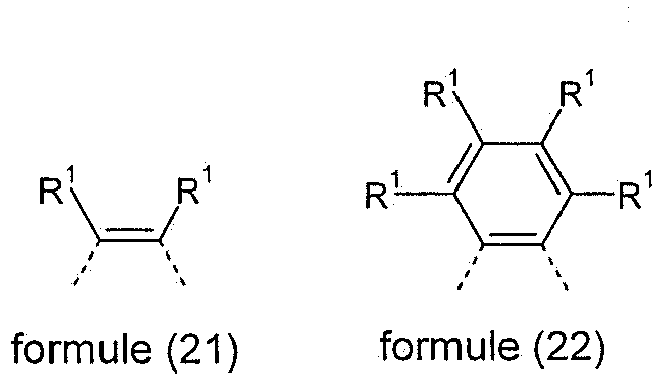 G est un groupe alkylène qui comporte 1, 2 ou 3 atome(s) de C, lequel peut être substitué par un radical ou par plusieurs radicaux R2, -CR2=CR2- ou un groupe arylène ou hétéroarylène ortho-lié qui comporte de 5 à 14 atomes de cycle aromatique, lequel peut être substitué par un radical ou par plusieurs radicaux R2 ;R3 est, de manière identique ou différente pour chaque occurrence, F, un groupe alkyle ou alcoxy en chaîne droite qui comporte de 1 à 20 atome(s) de C, un groupe alkyle ou alcoxy ramifié ou cyclique qui comporte de 3 à 20 atomes de C, lequel peut dans chaque cas être substitué par un radical ou par plusieurs radicaux R2, où un ou plusieurs groupe(s) CH2 non adjacents peut/peuvent être remplacé(s) par R2C=CR2, C≡C, Si(R2)2, C=O, NR2, O, S ou CONR2 et où un ou plusieurs atome(s) de H peut/peuvent être remplacé(s) par D ou F, ou un système de cycle aromatique ou hétéroaromatique qui comporte de 5 à 24 atomes de cycle aromatique, lequel peut dans chaque cas être substitué par un radical ou par plusieurs radicaux R2, ou un groupe aryloxy ou hétéroaryloxy qui comporte de 5 à 24 atomes de cycle aromatique, lequel peut être substitué par un radical ou par plusieurs radicaux R2, ou un groupe aralkyle ou hétéroaralkyle qui comporte de 5 à 24 atomes de cycle aromatique, lequel peut être substitué par un radical ou par plusieurs radicaux R2 ; deux radicaux R3 peuvent ici former un système de cycle aliphatique ou aromatique l'un avec l'autre ; en outre, R3 peut former un système de cycle aliphatique avec un radical R ou R1 adjacent ;étant entendu que deux hétéroatomes dans A1-A2-A3 ne sont pas liés directement l'un à l'autre.
 - Composé selon une ou plusieurs des revendications 1 à 8, lequel est sélectionné parmi les structures des formules (24) à (28) :


- Composé selon une ou plusieurs des revendications 1 à 9, caractérisé en ce que L' est sélectionné, de manière identique ou différente pour chaque occurrence, parmi le groupe qui est constitué par le monoxyde de carbone, le monoxyde d'azote, les cyanures d'alkyle, les cyanures d'aryle, les isocyanures d'alkyle, les isocyanures d'aryle, les amines, les phosphines, les phosphites, les arsines, les stibines, les hétérocycles contenant de l'azote, les carbènes, un hydrure, un deutéride, les halogénures F-, Cl-, Br et I-, les alkylacétylures, les arylacétylures, un cyanure, un cyanate, un isocyanate, un thiocyanate, un isothiocyanate, les alcoolates aliphatiques ou aromatiques, les thioalcoolates aliphatiques ou aromatiques, les amides, les carboxylates, les groupes aryle, O2-, S2-, les carbures, les nitrènes, les diamines, les imines, les diimines, les diphosphines, les 1,3-dicétonates qui sont dérivés à partir des 1,3-dicétones, les 3-cétonates qui sont dérivés à partir des 3-cétoesters, les carboxylates qui sont dérivés à partir des acides aminocarboxyliques, les salicyliminates qui sont dérivés à partir des salicylimines, les dialcoolates, les dithiolates, les borates d'hétérocycles contenant de l'azote et des ligands, lesquels sont formés au moyen d'une combinaison des groupes des formules (43) à (65), où un groupe est lié via un atome d'azote neutre ou un atome de carbone carbène et l'autre groupe est lié via un atome de carbone chargé négativement ou un atome d'azote chargé négativement et le ligand est formé par l'intermédiaire de la liaison de ces groupes les uns aux autres, dans chaque cas au niveau de la position qui est indiquée au moyen de # ;
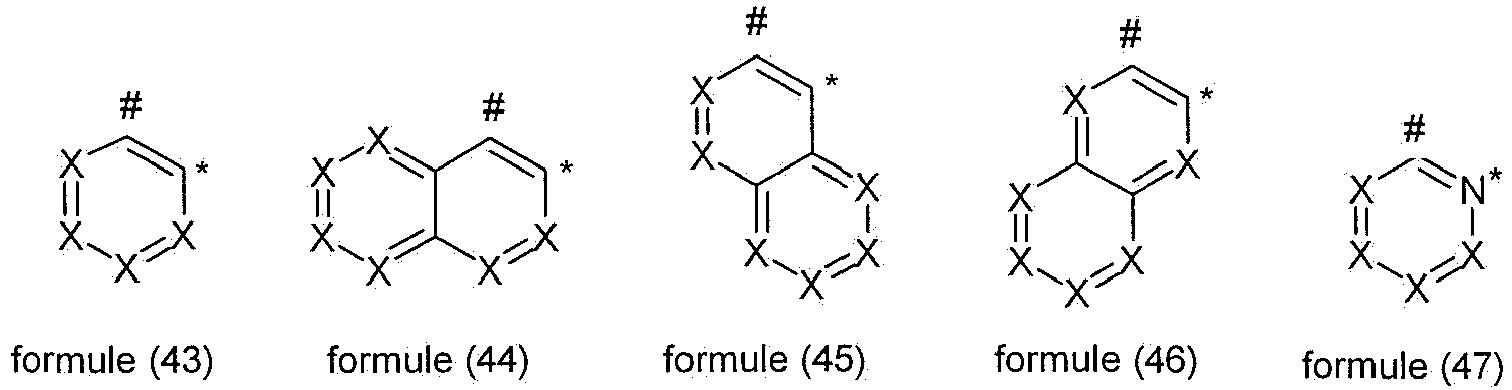


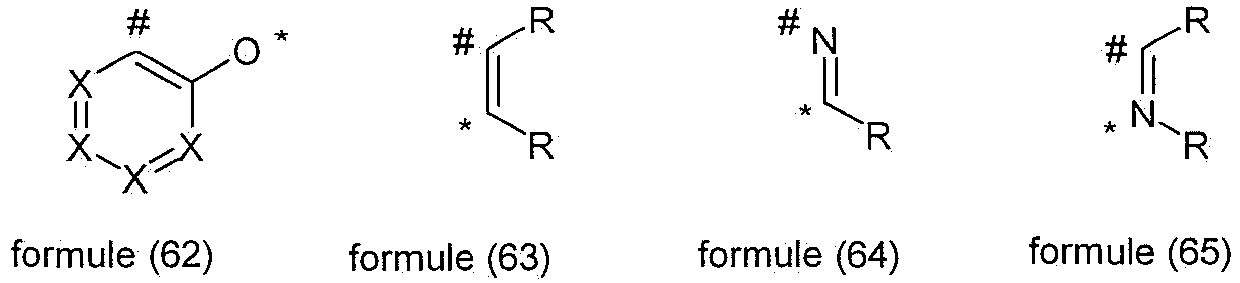
- Procédé pour la préparation d'un composé selon une ou plusieurs des revendications 1 à 10 au moyen de la réaction du ligand libre correspondant avec des alcoxydes de métal/métaux de la formule (70), avec des cétocétonates de métal/métaux de la formule (71), avec des halogénures de métal/métaux de la formule (72), avec des complexes de métal/métaux dimériques de la formule (73) ou avec des composés de métal/métaux qui sont porteurs à la fois de radicaux alcoolate et/ou halogénure et/ou hydroxyle et également de radicaux cétocétonate :
M(OR1)n formule (70)

MHaln formule (72)

- Oligomère, polymère ou dendrimère contenant un ou plusieurs des composés selon une ou plusieurs des revendications 1 à 10, où au moins l'un des radicaux R représente une liaison sur l'oligomère, le polymère ou le dendrimère.
- Formulation comprenant au moins un composé selon une ou plusieurs des revendications 1 à 10 ou un oligomère, un polymère ou un dendrimère selon la revendication 12 et au moins un autre composé, en particulier un solvant.
- Utilisation d'un composé selon une ou plusieurs des revendications 1 à 10 ou d'un oligomère, d'un polymère ou d'un dendrimère selon la revendication 12 dans un dispositif électronique ou pour la génération d'un oxygène singulet ou lors d'une photocatalyse ou dans des capteurs d'oxygène.
- Dispositif électronique comprenant au moins un composé selon une ou plusieurs des revendications 1 à 10 ou au moins un oligomère, un polymère ou un dendrimère selon la revendication 12, en particulier sélectionné parmi le groupe qui est constitué par les dispositifs électroluminescents organiques, les circuits intégrés organiques, les transistors à effet de champ organiques, les transistors à film mince organiques, les transistors à émission de lumière organiques, les cellules solaires organiques, les détecteurs optiques organiques, les photorécepteurs organiques, les dispositifs à extinction de champ organiques, les cellules électrochimiques à émission de lumière ou les diodes laser organiques.
- Dispositif électronique selon la revendication 15, lequel est un dispositif électroluminescent organique, caractérisé en ce que le composé selon une ou plusieurs des revendications 1 à 10 est utilisé en tant que composé d'émission dans une ou plusieurs couche(s) d'émission, de préférence en combinaison avec un matériau de matrice.
Priority Applications (1)
| Application Number | Priority Date | Filing Date | Title |
|---|---|---|---|
| EP14710815.3A EP2984093B1 (fr) | 2013-04-11 | 2014-03-14 | Complexes métalliques et leur utilisation dans des dispositifs électroniques |
Applications Claiming Priority (3)
| Application Number | Priority Date | Filing Date | Title |
|---|---|---|---|
| EP13001885 | 2013-04-11 | ||
| EP14710815.3A EP2984093B1 (fr) | 2013-04-11 | 2014-03-14 | Complexes métalliques et leur utilisation dans des dispositifs électroniques |
| PCT/EP2014/000707 WO2014166577A1 (fr) | 2013-04-11 | 2014-03-14 | Complexes métalliques et leur utilisation dans des dispositifs électroniques |
Publications (2)
| Publication Number | Publication Date |
|---|---|
| EP2984093A1 EP2984093A1 (fr) | 2016-02-17 |
| EP2984093B1 true EP2984093B1 (fr) | 2018-09-26 |
Family
ID=48128059
Family Applications (1)
| Application Number | Title | Priority Date | Filing Date |
|---|---|---|---|
| EP14710815.3A Active EP2984093B1 (fr) | 2013-04-11 | 2014-03-14 | Complexes métalliques et leur utilisation dans des dispositifs électroniques |
Country Status (4)
| Country | Link |
|---|---|
| US (1) | US10050218B2 (fr) |
| EP (1) | EP2984093B1 (fr) |
| KR (1) | KR20150139965A (fr) |
| WO (1) | WO2014166577A1 (fr) |
Families Citing this family (6)
| Publication number | Priority date | Publication date | Assignee | Title |
|---|---|---|---|---|
| EP3032605B1 (fr) | 2014-12-08 | 2019-08-21 | LG Display Co., Ltd. | Dispositif électroluminescent organique |
| CN105964270B (zh) * | 2016-04-22 | 2018-10-19 | 蔺爱国 | 一种用于污水处理的光催化剂及其制备方法 |
| CN105921153B (zh) * | 2016-04-22 | 2019-02-19 | 杭州博锐思科技有限公司 | 一种复合光催化剂及其制备方法 |
| KR102542467B1 (ko) | 2017-11-08 | 2023-06-12 | 삼성전자주식회사 | 유기금속 화합물, 이를 포함한 유기 발광 소자 및 이를 포함한 진단용 조성물 |
| CN108997335B (zh) * | 2018-07-19 | 2020-05-05 | 浙江工业大学 | 一种吡啶并喹唑啉酮类化合物及其制备方法和应用 |
| KR20220056223A (ko) * | 2019-09-02 | 2022-05-04 | 메르크 파텐트 게엠베하 | 유기 전계발광 디바이스용 재료 |
Family Cites Families (1)
| Publication number | Priority date | Publication date | Assignee | Title |
|---|---|---|---|---|
| DE102009049587A1 (de) * | 2009-10-16 | 2011-04-21 | Merck Patent Gmbh | Metallkomplexe |
-
2014
- 2014-03-14 KR KR1020157032148A patent/KR20150139965A/ko not_active Withdrawn
- 2014-03-14 EP EP14710815.3A patent/EP2984093B1/fr active Active
- 2014-03-14 WO PCT/EP2014/000707 patent/WO2014166577A1/fr not_active Ceased
- 2014-03-14 US US14/783,642 patent/US10050218B2/en not_active Expired - Fee Related
Non-Patent Citations (1)
| Title |
|---|
| None * |
Also Published As
| Publication number | Publication date |
|---|---|
| EP2984093A1 (fr) | 2016-02-17 |
| US20160308149A1 (en) | 2016-10-20 |
| WO2014166577A1 (fr) | 2014-10-16 |
| US10050218B2 (en) | 2018-08-14 |
| KR20150139965A (ko) | 2015-12-14 |
Similar Documents
| Publication | Publication Date | Title |
|---|---|---|
| EP2906575B1 (fr) | Complexes métalliques | |
| EP2311112B1 (fr) | Dispositif électronique contenant des complexes métalliques avec des ligands isonitriles | |
| DE112011102366B4 (de) | Metallkomplexe | |
| DE112010004049B4 (de) | Metallkomplexe | |
| EP2935292B1 (fr) | Complexes metalliques | |
| EP2294160B1 (fr) | Dispositif électronique contenant des complexes métalliques | |
| EP2935291B1 (fr) | Complexes d'iridium et leur utilisation dans les oligomères, polymères ou dendrimères dans les dispositifs electroniques | |
| EP2935293B1 (fr) | Complexes du iridium et leur utilisation dans les dispositifs electroniques en particulier les dispositifs electroluminescentes | |
| EP3044284B1 (fr) | Complexes métalliques | |
| EP3046927B1 (fr) | Complexes d'iridium phényl-pyridine polycyclique et dérivés pour oled desdits complexes | |
| WO2010086089A1 (fr) | Complexes métalliques | |
| EP3328872B1 (fr) | Complexes métalliques électroluminescents pontés destinés à être utilisés dans des dispositifs électroniques | |
| DE102009041414A1 (de) | Metallkomplexe | |
| WO2010099852A1 (fr) | Complexes métalliques avec des ligands azaborol, et dispositif électronique correspondant | |
| WO2016015815A1 (fr) | Complexes métalliques | |
| EP2984093B1 (fr) | Complexes métalliques et leur utilisation dans des dispositifs électroniques | |
| DE102012020167A1 (de) | Metallkomplexe | |
| WO2014044347A1 (fr) | Complexes métalliques | |
| WO2020212296A1 (fr) | Complexes métalliques | |
| EP4069709B1 (fr) | Complexes métalliques | |
| DE102015006708A1 (de) | Metallkomplexe | |
| DE102014012818A1 (de) | Metallkomplexe |
Legal Events
| Date | Code | Title | Description |
|---|---|---|---|
| PUAI | Public reference made under article 153(3) epc to a published international application that has entered the european phase |
Free format text: ORIGINAL CODE: 0009012 |
|
| 17P | Request for examination filed |
Effective date: 20150821 |
|
| AK | Designated contracting states |
Kind code of ref document: A1 Designated state(s): AL AT BE BG CH CY CZ DE DK EE ES FI FR GB GR HR HU IE IS IT LI LT LU LV MC MK MT NL NO PL PT RO RS SE SI SK SM TR |
|
| AX | Request for extension of the european patent |
Extension state: BA ME |
|
| DAX | Request for extension of the european patent (deleted) | ||
| GRAP | Despatch of communication of intention to grant a patent |
Free format text: ORIGINAL CODE: EPIDOSNIGR1 |
|
| STAA | Information on the status of an ep patent application or granted ep patent |
Free format text: STATUS: GRANT OF PATENT IS INTENDED |
|
| INTG | Intention to grant announced |
Effective date: 20180404 |
|
| GRAS | Grant fee paid |
Free format text: ORIGINAL CODE: EPIDOSNIGR3 |
|
| GRAJ | Information related to disapproval of communication of intention to grant by the applicant or resumption of examination proceedings by the epo deleted |
Free format text: ORIGINAL CODE: EPIDOSDIGR1 |
|
| GRAL | Information related to payment of fee for publishing/printing deleted |
Free format text: ORIGINAL CODE: EPIDOSDIGR3 |
|
| STAA | Information on the status of an ep patent application or granted ep patent |
Free format text: STATUS: REQUEST FOR EXAMINATION WAS MADE |
|
| GRAR | Information related to intention to grant a patent recorded |
Free format text: ORIGINAL CODE: EPIDOSNIGR71 |
|
| STAA | Information on the status of an ep patent application or granted ep patent |
Free format text: STATUS: GRANT OF PATENT IS INTENDED |
|
| GRAD | Information related to intention to grant a patent modified |
Free format text: ORIGINAL CODE: EPIDOSCIGR71 |
|
| GRAJ | Information related to disapproval of communication of intention to grant by the applicant or resumption of examination proceedings by the epo deleted |
Free format text: ORIGINAL CODE: EPIDOSDIGR1 |
|
| GRAL | Information related to payment of fee for publishing/printing deleted |
Free format text: ORIGINAL CODE: EPIDOSDIGR3 |
|
| GRAR | Information related to intention to grant a patent recorded |
Free format text: ORIGINAL CODE: EPIDOSNIGR71 |
|
| GRAS | Grant fee paid |
Free format text: ORIGINAL CODE: EPIDOSNIGR3 |
|
| GRAA | (expected) grant |
Free format text: ORIGINAL CODE: 0009210 |
|
| STAA | Information on the status of an ep patent application or granted ep patent |
Free format text: STATUS: THE PATENT HAS BEEN GRANTED |
|
| GRAJ | Information related to disapproval of communication of intention to grant by the applicant or resumption of examination proceedings by the epo deleted |
Free format text: ORIGINAL CODE: EPIDOSDIGR1 |
|
| GRAL | Information related to payment of fee for publishing/printing deleted |
Free format text: ORIGINAL CODE: EPIDOSDIGR3 |
|
| GRAP | Despatch of communication of intention to grant a patent |
Free format text: ORIGINAL CODE: EPIDOSNIGR1 |
|
| GRAS | Grant fee paid |
Free format text: ORIGINAL CODE: EPIDOSNIGR3 |
|
| INTC | Intention to grant announced (deleted) | ||
| INTG | Intention to grant announced |
Effective date: 20180816 |
|
| AK | Designated contracting states |
Kind code of ref document: B1 Designated state(s): AL AT BE BG CH CY CZ DE DK EE ES FI FR GB GR HR HU IE IS IT LI LT LU LV MC MK MT NL NO PL PT RO RS SE SI SK SM TR |
|
| INTG | Intention to grant announced |
Effective date: 20180817 |
|
| REG | Reference to a national code |
Ref country code: GB Ref legal event code: FG4D Free format text: NOT ENGLISH |
|
| REG | Reference to a national code |
Ref country code: CH Ref legal event code: EP |
|
| GRAP | Despatch of communication of intention to grant a patent |
Free format text: ORIGINAL CODE: EPIDOSNIGR1 |
|
| GRAS | Grant fee paid |
Free format text: ORIGINAL CODE: EPIDOSNIGR3 |
|
| REG | Reference to a national code |
Ref country code: AT Ref legal event code: REF Ref document number: 1045913 Country of ref document: AT Kind code of ref document: T Effective date: 20181015 |
|
| REG | Reference to a national code |
Ref country code: IE Ref legal event code: FG4D Free format text: LANGUAGE OF EP DOCUMENT: GERMAN |
|
| REG | Reference to a national code |
Ref country code: DE Ref legal event code: R096 Ref document number: 502014009564 Country of ref document: DE |
|
| INTG | Intention to grant announced |
Effective date: 20180817 |
|
| REG | Reference to a national code |
Ref country code: NL Ref legal event code: MP Effective date: 20180926 |
|
| PG25 | Lapsed in a contracting state [announced via postgrant information from national office to epo] |
Ref country code: FI Free format text: LAPSE BECAUSE OF FAILURE TO SUBMIT A TRANSLATION OF THE DESCRIPTION OR TO PAY THE FEE WITHIN THE PRESCRIBED TIME-LIMIT Effective date: 20180926 Ref country code: LT Free format text: LAPSE BECAUSE OF FAILURE TO SUBMIT A TRANSLATION OF THE DESCRIPTION OR TO PAY THE FEE WITHIN THE PRESCRIBED TIME-LIMIT Effective date: 20180926 Ref country code: BG Free format text: LAPSE BECAUSE OF FAILURE TO SUBMIT A TRANSLATION OF THE DESCRIPTION OR TO PAY THE FEE WITHIN THE PRESCRIBED TIME-LIMIT Effective date: 20181226 Ref country code: NO Free format text: LAPSE BECAUSE OF FAILURE TO SUBMIT A TRANSLATION OF THE DESCRIPTION OR TO PAY THE FEE WITHIN THE PRESCRIBED TIME-LIMIT Effective date: 20181226 Ref country code: GR Free format text: LAPSE BECAUSE OF FAILURE TO SUBMIT A TRANSLATION OF THE DESCRIPTION OR TO PAY THE FEE WITHIN THE PRESCRIBED TIME-LIMIT Effective date: 20181227 Ref country code: RS Free format text: LAPSE BECAUSE OF FAILURE TO SUBMIT A TRANSLATION OF THE DESCRIPTION OR TO PAY THE FEE WITHIN THE PRESCRIBED TIME-LIMIT Effective date: 20180926 Ref country code: SE Free format text: LAPSE BECAUSE OF FAILURE TO SUBMIT A TRANSLATION OF THE DESCRIPTION OR TO PAY THE FEE WITHIN THE PRESCRIBED TIME-LIMIT Effective date: 20180926 |
|
| REG | Reference to a national code |
Ref country code: LT Ref legal event code: MG4D |
|
| PG25 | Lapsed in a contracting state [announced via postgrant information from national office to epo] |
Ref country code: LV Free format text: LAPSE BECAUSE OF FAILURE TO SUBMIT A TRANSLATION OF THE DESCRIPTION OR TO PAY THE FEE WITHIN THE PRESCRIBED TIME-LIMIT Effective date: 20180926 Ref country code: AL Free format text: LAPSE BECAUSE OF FAILURE TO SUBMIT A TRANSLATION OF THE DESCRIPTION OR TO PAY THE FEE WITHIN THE PRESCRIBED TIME-LIMIT Effective date: 20180926 Ref country code: HR Free format text: LAPSE BECAUSE OF FAILURE TO SUBMIT A TRANSLATION OF THE DESCRIPTION OR TO PAY THE FEE WITHIN THE PRESCRIBED TIME-LIMIT Effective date: 20180926 |
|
| PG25 | Lapsed in a contracting state [announced via postgrant information from national office to epo] |
Ref country code: ES Free format text: LAPSE BECAUSE OF FAILURE TO SUBMIT A TRANSLATION OF THE DESCRIPTION OR TO PAY THE FEE WITHIN THE PRESCRIBED TIME-LIMIT Effective date: 20180926 Ref country code: IS Free format text: LAPSE BECAUSE OF FAILURE TO SUBMIT A TRANSLATION OF THE DESCRIPTION OR TO PAY THE FEE WITHIN THE PRESCRIBED TIME-LIMIT Effective date: 20190126 Ref country code: EE Free format text: LAPSE BECAUSE OF FAILURE TO SUBMIT A TRANSLATION OF THE DESCRIPTION OR TO PAY THE FEE WITHIN THE PRESCRIBED TIME-LIMIT Effective date: 20180926 Ref country code: PL Free format text: LAPSE BECAUSE OF FAILURE TO SUBMIT A TRANSLATION OF THE DESCRIPTION OR TO PAY THE FEE WITHIN THE PRESCRIBED TIME-LIMIT Effective date: 20180926 Ref country code: IT Free format text: LAPSE BECAUSE OF FAILURE TO SUBMIT A TRANSLATION OF THE DESCRIPTION OR TO PAY THE FEE WITHIN THE PRESCRIBED TIME-LIMIT Effective date: 20180926 Ref country code: CZ Free format text: LAPSE BECAUSE OF FAILURE TO SUBMIT A TRANSLATION OF THE DESCRIPTION OR TO PAY THE FEE WITHIN THE PRESCRIBED TIME-LIMIT Effective date: 20180926 Ref country code: NL Free format text: LAPSE BECAUSE OF FAILURE TO SUBMIT A TRANSLATION OF THE DESCRIPTION OR TO PAY THE FEE WITHIN THE PRESCRIBED TIME-LIMIT Effective date: 20180926 Ref country code: RO Free format text: LAPSE BECAUSE OF FAILURE TO SUBMIT A TRANSLATION OF THE DESCRIPTION OR TO PAY THE FEE WITHIN THE PRESCRIBED TIME-LIMIT Effective date: 20180926 |
|
| PG25 | Lapsed in a contracting state [announced via postgrant information from national office to epo] |
Ref country code: SM Free format text: LAPSE BECAUSE OF FAILURE TO SUBMIT A TRANSLATION OF THE DESCRIPTION OR TO PAY THE FEE WITHIN THE PRESCRIBED TIME-LIMIT Effective date: 20180926 Ref country code: PT Free format text: LAPSE BECAUSE OF FAILURE TO SUBMIT A TRANSLATION OF THE DESCRIPTION OR TO PAY THE FEE WITHIN THE PRESCRIBED TIME-LIMIT Effective date: 20190126 Ref country code: SK Free format text: LAPSE BECAUSE OF FAILURE TO SUBMIT A TRANSLATION OF THE DESCRIPTION OR TO PAY THE FEE WITHIN THE PRESCRIBED TIME-LIMIT Effective date: 20180926 |
|
| REG | Reference to a national code |
Ref country code: DE Ref legal event code: R097 Ref document number: 502014009564 Country of ref document: DE |
|
| PG25 | Lapsed in a contracting state [announced via postgrant information from national office to epo] |
Ref country code: DK Free format text: LAPSE BECAUSE OF FAILURE TO SUBMIT A TRANSLATION OF THE DESCRIPTION OR TO PAY THE FEE WITHIN THE PRESCRIBED TIME-LIMIT Effective date: 20180926 |
|
| PLBE | No opposition filed within time limit |
Free format text: ORIGINAL CODE: 0009261 |
|
| STAA | Information on the status of an ep patent application or granted ep patent |
Free format text: STATUS: NO OPPOSITION FILED WITHIN TIME LIMIT |
|
| 26N | No opposition filed |
Effective date: 20190627 |
|
| PG25 | Lapsed in a contracting state [announced via postgrant information from national office to epo] |
Ref country code: SI Free format text: LAPSE BECAUSE OF FAILURE TO SUBMIT A TRANSLATION OF THE DESCRIPTION OR TO PAY THE FEE WITHIN THE PRESCRIBED TIME-LIMIT Effective date: 20180926 Ref country code: MC Free format text: LAPSE BECAUSE OF FAILURE TO SUBMIT A TRANSLATION OF THE DESCRIPTION OR TO PAY THE FEE WITHIN THE PRESCRIBED TIME-LIMIT Effective date: 20180926 |
|
| REG | Reference to a national code |
Ref country code: CH Ref legal event code: PL |
|
| GBPC | Gb: european patent ceased through non-payment of renewal fee |
Effective date: 20190314 |
|
| PG25 | Lapsed in a contracting state [announced via postgrant information from national office to epo] |
Ref country code: LU Free format text: LAPSE BECAUSE OF NON-PAYMENT OF DUE FEES Effective date: 20190314 |
|
| REG | Reference to a national code |
Ref country code: BE Ref legal event code: MM Effective date: 20190331 |
|
| PG25 | Lapsed in a contracting state [announced via postgrant information from national office to epo] |
Ref country code: IE Free format text: LAPSE BECAUSE OF NON-PAYMENT OF DUE FEES Effective date: 20190314 Ref country code: GB Free format text: LAPSE BECAUSE OF NON-PAYMENT OF DUE FEES Effective date: 20190314 Ref country code: LI Free format text: LAPSE BECAUSE OF NON-PAYMENT OF DUE FEES Effective date: 20190331 Ref country code: CH Free format text: LAPSE BECAUSE OF NON-PAYMENT OF DUE FEES Effective date: 20190331 |
|
| PG25 | Lapsed in a contracting state [announced via postgrant information from national office to epo] |
Ref country code: FR Free format text: LAPSE BECAUSE OF NON-PAYMENT OF DUE FEES Effective date: 20190331 Ref country code: BE Free format text: LAPSE BECAUSE OF NON-PAYMENT OF DUE FEES Effective date: 20190331 |
|
| PG25 | Lapsed in a contracting state [announced via postgrant information from national office to epo] |
Ref country code: TR Free format text: LAPSE BECAUSE OF FAILURE TO SUBMIT A TRANSLATION OF THE DESCRIPTION OR TO PAY THE FEE WITHIN THE PRESCRIBED TIME-LIMIT Effective date: 20180926 |
|
| PG25 | Lapsed in a contracting state [announced via postgrant information from national office to epo] |
Ref country code: MT Free format text: LAPSE BECAUSE OF FAILURE TO SUBMIT A TRANSLATION OF THE DESCRIPTION OR TO PAY THE FEE WITHIN THE PRESCRIBED TIME-LIMIT Effective date: 20180926 |
|
| REG | Reference to a national code |
Ref country code: AT Ref legal event code: MM01 Ref document number: 1045913 Country of ref document: AT Kind code of ref document: T Effective date: 20190314 |
|
| PG25 | Lapsed in a contracting state [announced via postgrant information from national office to epo] |
Ref country code: AT Free format text: LAPSE BECAUSE OF NON-PAYMENT OF DUE FEES Effective date: 20190314 |
|
| PG25 | Lapsed in a contracting state [announced via postgrant information from national office to epo] |
Ref country code: CY Free format text: LAPSE BECAUSE OF FAILURE TO SUBMIT A TRANSLATION OF THE DESCRIPTION OR TO PAY THE FEE WITHIN THE PRESCRIBED TIME-LIMIT Effective date: 20180926 |
|
| PG25 | Lapsed in a contracting state [announced via postgrant information from national office to epo] |
Ref country code: HU Free format text: LAPSE BECAUSE OF FAILURE TO SUBMIT A TRANSLATION OF THE DESCRIPTION OR TO PAY THE FEE WITHIN THE PRESCRIBED TIME-LIMIT; INVALID AB INITIO Effective date: 20140314 |
|
| PG25 | Lapsed in a contracting state [announced via postgrant information from national office to epo] |
Ref country code: MK Free format text: LAPSE BECAUSE OF FAILURE TO SUBMIT A TRANSLATION OF THE DESCRIPTION OR TO PAY THE FEE WITHIN THE PRESCRIBED TIME-LIMIT Effective date: 20180926 |
|
| P01 | Opt-out of the competence of the unified patent court (upc) registered |
Effective date: 20230518 |
|
| REG | Reference to a national code |
Ref country code: DE Ref legal event code: R081 Ref document number: 502014009564 Country of ref document: DE Owner name: UDC IRELAND LTD., IE Free format text: FORMER OWNER: MERCK PATENT GMBH, 64293 DARMSTADT, DE |
|
| P03 | Opt-out of the competence of the unified patent court (upc) deleted | ||
| P01 | Opt-out of the competence of the unified patent court (upc) registered |
Effective date: 20240207 |
|
| PGFP | Annual fee paid to national office [announced via postgrant information from national office to epo] |
Ref country code: DE Payment date: 20260327 Year of fee payment: 13 |