EP2908153A2 - Reconnaissance d'objets dynamiques au moyen d'ultrason - Google Patents
Reconnaissance d'objets dynamiques au moyen d'ultrason Download PDFInfo
- Publication number
- EP2908153A2 EP2908153A2 EP15152516.9A EP15152516A EP2908153A2 EP 2908153 A2 EP2908153 A2 EP 2908153A2 EP 15152516 A EP15152516 A EP 15152516A EP 2908153 A2 EP2908153 A2 EP 2908153A2
- Authority
- EP
- European Patent Office
- Prior art keywords
- motor vehicle
- ultrasound
- pulses
- sensor
- environment
- Prior art date
- Legal status (The legal status is an assumption and is not a legal conclusion. Google has not performed a legal analysis and makes no representation as to the accuracy of the status listed.)
- Withdrawn
Links
- 238000002604 ultrasonography Methods 0.000 title claims abstract description 19
- 238000001514 detection method Methods 0.000 title description 7
- 238000000034 method Methods 0.000 claims abstract description 17
- 238000011156 evaluation Methods 0.000 claims abstract description 16
- 238000005259 measurement Methods 0.000 claims description 14
- 230000000977 initiatory effect Effects 0.000 claims description 2
- 230000005540 biological transmission Effects 0.000 abstract description 6
- 230000000875 corresponding effect Effects 0.000 description 5
- 230000003068 static effect Effects 0.000 description 4
- 238000013461 design Methods 0.000 description 2
- 238000001228 spectrum Methods 0.000 description 2
- 230000001276 controlling effect Effects 0.000 description 1
- 230000002596 correlated effect Effects 0.000 description 1
- 230000001419 dependent effect Effects 0.000 description 1
- 238000010586 diagram Methods 0.000 description 1
- 238000012544 monitoring process Methods 0.000 description 1
- 238000012545 processing Methods 0.000 description 1
- 230000002123 temporal effect Effects 0.000 description 1
Images


Classifications
-
- G—PHYSICS
- G01—MEASURING; TESTING
- G01S—RADIO DIRECTION-FINDING; RADIO NAVIGATION; DETERMINING DISTANCE OR VELOCITY BY USE OF RADIO WAVES; LOCATING OR PRESENCE-DETECTING BY USE OF THE REFLECTION OR RERADIATION OF RADIO WAVES; ANALOGOUS ARRANGEMENTS USING OTHER WAVES
- G01S15/00—Systems using the reflection or reradiation of acoustic waves, e.g. sonar systems
- G01S15/88—Sonar systems specially adapted for specific applications
- G01S15/93—Sonar systems specially adapted for specific applications for anti-collision purposes
- G01S15/931—Sonar systems specially adapted for specific applications for anti-collision purposes of land vehicles
-
- G—PHYSICS
- G01—MEASURING; TESTING
- G01S—RADIO DIRECTION-FINDING; RADIO NAVIGATION; DETERMINING DISTANCE OR VELOCITY BY USE OF RADIO WAVES; LOCATING OR PRESENCE-DETECTING BY USE OF THE REFLECTION OR RERADIATION OF RADIO WAVES; ANALOGOUS ARRANGEMENTS USING OTHER WAVES
- G01S15/00—Systems using the reflection or reradiation of acoustic waves, e.g. sonar systems
- G01S15/02—Systems using the reflection or reradiation of acoustic waves, e.g. sonar systems using reflection of acoustic waves
- G01S15/06—Systems determining the position data of a target
- G01S15/42—Simultaneous measurement of distance and other co-ordinates
-
- G—PHYSICS
- G01—MEASURING; TESTING
- G01S—RADIO DIRECTION-FINDING; RADIO NAVIGATION; DETERMINING DISTANCE OR VELOCITY BY USE OF RADIO WAVES; LOCATING OR PRESENCE-DETECTING BY USE OF THE REFLECTION OR RERADIATION OF RADIO WAVES; ANALOGOUS ARRANGEMENTS USING OTHER WAVES
- G01S15/00—Systems using the reflection or reradiation of acoustic waves, e.g. sonar systems
- G01S15/02—Systems using the reflection or reradiation of acoustic waves, e.g. sonar systems using reflection of acoustic waves
- G01S15/50—Systems of measurement, based on relative movement of the target
- G01S15/58—Velocity or trajectory determination systems; Sense-of-movement determination systems
- G01S15/582—Velocity or trajectory determination systems; Sense-of-movement determination systems using transmission of interrupted pulse-modulated waves and based upon the Doppler effect resulting from movement of targets
-
- G—PHYSICS
- G01—MEASURING; TESTING
- G01S—RADIO DIRECTION-FINDING; RADIO NAVIGATION; DETERMINING DISTANCE OR VELOCITY BY USE OF RADIO WAVES; LOCATING OR PRESENCE-DETECTING BY USE OF THE REFLECTION OR RERADIATION OF RADIO WAVES; ANALOGOUS ARRANGEMENTS USING OTHER WAVES
- G01S15/00—Systems using the reflection or reradiation of acoustic waves, e.g. sonar systems
- G01S15/66—Sonar tracking systems
-
- G—PHYSICS
- G01—MEASURING; TESTING
- G01S—RADIO DIRECTION-FINDING; RADIO NAVIGATION; DETERMINING DISTANCE OR VELOCITY BY USE OF RADIO WAVES; LOCATING OR PRESENCE-DETECTING BY USE OF THE REFLECTION OR RERADIATION OF RADIO WAVES; ANALOGOUS ARRANGEMENTS USING OTHER WAVES
- G01S15/00—Systems using the reflection or reradiation of acoustic waves, e.g. sonar systems
- G01S15/87—Combinations of sonar systems
-
- G—PHYSICS
- G01—MEASURING; TESTING
- G01S—RADIO DIRECTION-FINDING; RADIO NAVIGATION; DETERMINING DISTANCE OR VELOCITY BY USE OF RADIO WAVES; LOCATING OR PRESENCE-DETECTING BY USE OF THE REFLECTION OR RERADIATION OF RADIO WAVES; ANALOGOUS ARRANGEMENTS USING OTHER WAVES
- G01S7/00—Details of systems according to groups G01S13/00, G01S15/00, G01S17/00
- G01S7/52—Details of systems according to groups G01S13/00, G01S15/00, G01S17/00 of systems according to group G01S15/00
- G01S7/539—Details of systems according to groups G01S13/00, G01S15/00, G01S17/00 of systems according to group G01S15/00 using analysis of echo signal for target characterisation; Target signature; Target cross-section
Definitions
- the invention relates to a device for detecting dynamic objects in the environment of a motor vehicle by means of ultrasound according to the preamble of claim 1 and a corresponding method according to the preamble of claim 4.
- the publication DE 10 2012 000 724 A1 discloses a method and an apparatus for driving a motor vehicle with a semi-automatic driving function for longitudinal and lateral guidance of the motor vehicle, the driver of the motor vehicle permanently monitors the semi-automatic driving function, an environment detection of the motor vehicle is performed, from the environment data road users are determined in the environment, and when active semi-automatic driving function a takeover request with the aim of termination of the semi-automatic driving function to the driver, if a moving object is determined in the environment of the motor vehicle, which can not be assigned to the determined by the environment detection road users.
- the publication DE 10 2010 028 829 A1 relates to a method and a device for determining the position of an object relative to a vehicle, in particular a motor vehicle, for use in a driver assistance system of the vehicle.
- a first ultrasonic pulse is emitted by an ultrasonic sensor arranged on the vehicle, wherein the ultrasonic pulse comprises a plurality of predetermined transmission frequencies which lead to a variation of the directional characteristic of the ultrasonic sensor.
- the emitted first ultrasonic pulse is reflected at the object and received again as the first echo pulse by the emitting or another ultrasonic sensor arranged on the vehicle.
- a frequency spectrum of the first echo pulse is determined and determined in dependence on the frequency spectrum of the first echo pulse and the directional characteristics, a first absolute value of a relative storage angle of the object.
- Doppler shifts of moving objects due to the known frequencies of the transmission pulse can be excluded in order to correct the conditional by the directional characteristic of the Sendepules angle determination.
- the invention is therefore based on the object to improve the detection of dynamic objects, especially pedestrians, in the environment of a motor vehicle.
- the distance and the angular position of an object in the vicinity of a motor vehicle and thus its spatial position can be determined in a simple manner.
- the evaluation unit determines the angular position of the object from the relative phase position of the received reflected pulses.
- the angular position can also be determined from the phase position. If the angular position is determined both by the distance difference and by the phase position, the accuracy of the angle determination can be increased.
- the device has per sensor element a device for Doppler analysis of the received reflected pulses in order to estimate the relative speed of the detected object.
- the relative speed between the object and the vehicle can be determined directly, so that it can be decided relatively quickly whether the object is dynamic or static.
- the classification or plausibility check allows an assignment of the determined object to a road user, in particular whether the road user in the surroundings of the vehicle is a pedestrian.
- a Doppler analysis of the received reflected pulses for determining the relative speed of the object is performed, so that the dynamics of the detected object is directly recognizable.
- the predetermined models include at least a pedestrian model and a cyclist model. In this way, especially at slow reverse, as is the case with a rearward parking case, particularly vulnerable groups of suddenly appearing in the roadway road users are covered.
- a degree of danger can be determined, which advantageously makes it possible to design the vehicle-side action as a function of the degree of danger.
- the action on the vehicle side is more preferably a driver warning and / or an intervention in the driving function.
- an intervention in the driving function for example, a braking intervention and / or a steering intervention take place.
- Fig. 1 shows the situation of the rear environment detection of a motor vehicle 1 using the example of a reverse drive, for example when parking.
- the rearward environment shown schematically here is divided into two areas, namely a short range 2 and a long range 3.
- a short range 2 For monitoring the long range 3 radar is usually used and ultrasound is not usable at greater distances.
- the angle, distance and relative speed of an object can be determined on the basis of the radar properties.
- Radar systems are not suitable for the surveillance of short-range 2, mainly ultrasonic-based systems are used here.
- Conventional ultrasound systems are essentially only used for the measurement of distances and dynamic objects such as suddenly approaching dynamic objects such as pedestrians are hardly determinable with regard to the actual location and the relative speed.
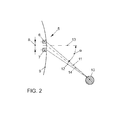
- Fig. 2 shows a schematic representation of an example of an angle-resolving ultrasonic array 5 consisting of two adjacently arranged sensor elements 6 and 7, which are arranged at a predetermined distance 8 from each other in the present example in the outer wall 9 of a motor vehicle (not shown).
- an object 10 which may be particularly dynamic, such as a pedestrian.
- the object is arranged to the vertical axis 13 of the sensor array 5 at an angle ⁇ , wherein the angle ⁇ is given by the included angle between the axis 13 of the sensor array 5 and the connecting line 14 between the object 10 and the sensor array 5.
- To determine the object angle of the Sensor array 5 at least two sensor elements 6, 7, wherein the angle determination can be performed in different ways.
- the independent distance measurements of the two sensor elements 6, 7 can be related to each other and from the difference of the distances of the object angle can be determined. Furthermore, it is possible that, for example, the sensor element 6 transmits a transmission pulse, which is reflected at the object 10. The reflected pulse is detected by both sensor elements 6, 7 and the object angle can be determined from the different phase position of the detected pulses. It is obvious that the use of an ultrasonic sensor array 5 with more than two sensor elements 6, 7 leads to a better angular resolution.
- Fig. 3 1 shows a block diagram of an ultrasonic sensor 4 for determining dynamic parameters of a dynamic object 10 located in the vicinity 2 of a motor vehicle 1, for example a pedestrian.
- the ultrasonic sensor 4 comprises a sensor array 5 which has at least two adjacent sensor elements 6 and 7 arranged at a predetermined distance from one another.
- the sensor elements 6, 7 are designed as transmit / receive units and emit transmit pulses 15 or receive pulses 16 reflected on objects.
- the received reflected pulses 16 of each sensor element 6, 7 are respectively examined in a Doppler processing means 18, 19 for deviation from the base frequency of the transmit pulses 15 and the frequency shift results of each sensor element 6, 7 are combined with the respective received reflected pulses 16 Sensor element 6, 7 forwarded to an evaluation unit 20.
- the evaluation unit 20 the reception pulses 16 and their determined Doppler shifts are processed and, taking into account the corresponding transmission pulses, their transit times and thus the distances to an object are determined.
- the phases between the received pulses 16 of the sensor elements 6, 7 can be determined in correlation to the corresponding transmit pulses 15.
- the object angles can be determined to objects in the near field.
- the relative velocity of an object 10 in the near field can be determined from the Doppler information.
- the evaluation unit outputs its distance, relative velocity and object angle to a predefined axis of the sensor array 5.
- a control device 17 which controls the individual components, namely the at least two sensor elements 6, 7, the Doppler wornen 18, 19 and the evaluation device 20.
- the ultrasonic sensor comprises a sensor array 5 with two sensor elements 6, 7, an evaluation device 20 and a control device 20.
- a sensor array 5 with two sensor elements 6, 7, an evaluation device 20 and a control device 20.
- distances and object angles can consequently be determined. Due to the lack of a Doppler evaluation of the received reflected pulses 16 by the corresponding Doppler devices 18, 19, no direct relative velocities can be determined.
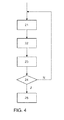
- Fig. 4 shows in schematic form the sequence of the method for determining dynamic objects, in particular pedestrians in a vicinity of a motor vehicle by means of ultrasonic sensors.
- a first step 21 the measurement step, the measurement and detection of objects in the vicinity of a motor vehicle by means of the described ultrasonic sensor, wherein the measurement of the near area with at least one of the preceding ultrasonic sensors takes place, wherein at least one ultrasonic sensor 4 with the "basic equipment " necessary is.
- This measurement step therefore yields at least the distance of an object in the near zone and its object angle to the ultrasound sensor, so that the position of the object in the near zone is fixed. If a Doppler analysis is done, it can already be decided whether it is a static or dynamic object and the relative speed can be determined.
- the temporal and spatial changes of the positions of the detected objects are tracked, i. tracked by storing, analyzing and merging the consecutive results of measurement step 21. This results in the movement course or the trajectory of the detected objects in the vicinity of the motor vehicle, from which the speeds of the tracked objects can be derived even without Doppler method. It is irrelevant for this consideration whether the trajectories are generated and viewed in the vehicle coordinate system or in the roadway-fixed coordinate system.
- the results of the tracking step 22 are further analyzed in an object classification step 23.
- the trajectory of a cyclist usually has a continuously differentiable behavior and in particular abrupt changes in direction are not common.
- the trajectory of a pedestrian is essentially continuous but not necessarily differentiable, since pedestrians can make abrupt changes in direction.
- the speed of a pedestrian usually moves in a narrow speed interval of 0 to 5 km / h, so that dynamic objects showing this speed interval are, with some probability, pedestrians.
- a threat exists. If this is not the case, the procedure returns to the beginning. If there is a danger, an action 25 is initiated. Depending on the degree of danger, for example, a warning to the driver or it is a suitable braking process initiated.
- a plausibility check is carried out, by means of which a detected dynamic object can be plausibly identified, for example, as a pedestrian due to its behavior.
Landscapes
- Engineering & Computer Science (AREA)
- Radar, Positioning & Navigation (AREA)
- Remote Sensing (AREA)
- Physics & Mathematics (AREA)
- Computer Networks & Wireless Communication (AREA)
- General Physics & Mathematics (AREA)
- Acoustics & Sound (AREA)
- Measurement Of Velocity Or Position Using Acoustic Or Ultrasonic Waves (AREA)
- Traffic Control Systems (AREA)
Applications Claiming Priority (1)
| Application Number | Priority Date | Filing Date | Title |
|---|---|---|---|
| DE102014202752.7A DE102014202752B4 (de) | 2014-02-14 | 2014-02-14 | Erkennung dynamischer Objekte mittels Ultraschall |
Publications (2)
| Publication Number | Publication Date |
|---|---|
| EP2908153A2 true EP2908153A2 (fr) | 2015-08-19 |
| EP2908153A3 EP2908153A3 (fr) | 2016-01-13 |
Family
ID=52449961
Family Applications (1)
| Application Number | Title | Priority Date | Filing Date |
|---|---|---|---|
| EP15152516.9A Withdrawn EP2908153A3 (fr) | 2014-02-14 | 2015-01-26 | Reconnaissance d'objets dynamiques au moyen d'ultrason |
Country Status (2)
| Country | Link |
|---|---|
| EP (1) | EP2908153A3 (fr) |
| DE (1) | DE102014202752B4 (fr) |
Cited By (3)
| Publication number | Priority date | Publication date | Assignee | Title |
|---|---|---|---|---|
| EP3156820A1 (fr) * | 2015-10-13 | 2017-04-19 | Valeo Schalter und Sensoren GmbH | Procede de detection d'un objet dynamique dans l'environnement d'un vehicule automobile en fonction d'informations provenant d'un dispositif de detection par ultrasons cote vehicule, systeme d'assistance au conducteur et vehicule automobile |
| CN112526525A (zh) * | 2019-09-17 | 2021-03-19 | 罗伯特·博世有限公司 | 对静态对象和动态对象的分类 |
| WO2021069130A1 (fr) | 2019-10-08 | 2021-04-15 | Robert Bosch Gmbh | Procédé et dispositif de classification d'un objet, plus particulièrement dans l'environnement d'un véhicule automobile |
Families Citing this family (5)
| Publication number | Priority date | Publication date | Assignee | Title |
|---|---|---|---|---|
| DE102016213254B3 (de) * | 2016-07-20 | 2017-07-13 | Volkswagen Aktiengesellschaft | Verfahren zum Erfassen einer Objektbewegung eines Objekts in einer Umgebung eines Kraftfahrzeugs, Steuervorrichtung und Kraftfahrzeugs |
| DE102020215453A1 (de) | 2020-12-08 | 2022-06-09 | Robert Bosch Gesellschaft mit beschränkter Haftung | Verfahren und Vorrichtung zum Detektieren von bewegten Objekten in einer Umgebung eines Fahrzeugs |
| DE102021212067A1 (de) | 2021-10-26 | 2023-04-27 | Robert Bosch Gesellschaft mit beschränkter Haftung | Verfahren zur Klassifizierung von wenigstens einem Objekt in einer Umgebung eines Fahrzeugs mittels eines Ultraschallsensorsystem sowie Steuereinrichtung, Ultraschallsensorsystem und Fahrzeug |
| DE102022201090A1 (de) | 2022-02-02 | 2023-08-03 | Robert Bosch Gesellschaft mit beschränkter Haftung | Verfahren zum infrastrukturgestützten Assistieren eines Kraftfahrzeugs |
| DE102022201084A1 (de) | 2022-02-02 | 2023-08-03 | Robert Bosch Gesellschaft mit beschränkter Haftung | Verfahren zum infrastrukturgestützten Assistieren eines Kraftfahrzeugs |
Citations (2)
| Publication number | Priority date | Publication date | Assignee | Title |
|---|---|---|---|---|
| DE102010028829A1 (de) | 2010-05-11 | 2011-11-17 | Robert Bosch Gmbh | Verfahren und Vorrichtung zur Bestimmung der Position eines Objektes relativ zu einem Fahrzeug, insbesondere einem Kraftfahrzeug, zur Verwendung in einem Fahrerassistenzsystem des Fahrzeuges |
| DE102012000724A1 (de) | 2011-06-29 | 2013-01-03 | Volkswagen Ag | Verfahren und Vorrichtung zum teilautomatisierten Fahren eines Kraftfahrzeugs |
Family Cites Families (8)
| Publication number | Priority date | Publication date | Assignee | Title |
|---|---|---|---|---|
| DE10257842A1 (de) * | 2002-05-07 | 2003-11-27 | Bosch Gmbh Robert | Verfahren zur Bestimmung einer Unfallgefahr eines ersten Objekts mit wenigstens einem zweiten Objekt |
| US20080065328A1 (en) * | 2006-09-08 | 2008-03-13 | Andreas Eidehall | Method and system for collision avoidance |
| DE102008021068B4 (de) * | 2008-04-26 | 2019-06-13 | Volkswagen Ag | Gefahrenwarneinrichtung für ein Kraftfahrzeug und Fahrerassistenzsystem |
| DE102009028992A1 (de) * | 2009-08-28 | 2011-03-03 | Robert Bosch Gmbh | Verfahren und Vorrichtung zur Bestimmung der Position eines Hindernisses relativ zu einem Fahrzeug, insbesondere einem Kraftfahrzeug, zur Verwendung in einem Fahrerassistenzsystem des Fahrzeuges |
| DE102009029465A1 (de) * | 2009-09-15 | 2011-04-21 | Robert Bosch Gmbh | Verfahren zur Bestimmung von Bewegungsrichtung und Relativgeschwindigkeit |
| DE102010063438A1 (de) * | 2010-12-17 | 2012-06-21 | Robert Bosch Gmbh | Schallwellenbasierter Sensor zur Umfelddetektion und Verwendung desselben |
| WO2012147284A1 (fr) * | 2011-04-26 | 2012-11-01 | 株式会社村田製作所 | Dispositif de détection d'objet mobile |
| DE102012202582A1 (de) * | 2012-02-20 | 2013-08-22 | Robert Bosch Gmbh | Verfahren zur Lokalisierung von Objekten mittels Ultraschall |
-
2014
- 2014-02-14 DE DE102014202752.7A patent/DE102014202752B4/de active Active
-
2015
- 2015-01-26 EP EP15152516.9A patent/EP2908153A3/fr not_active Withdrawn
Patent Citations (2)
| Publication number | Priority date | Publication date | Assignee | Title |
|---|---|---|---|---|
| DE102010028829A1 (de) | 2010-05-11 | 2011-11-17 | Robert Bosch Gmbh | Verfahren und Vorrichtung zur Bestimmung der Position eines Objektes relativ zu einem Fahrzeug, insbesondere einem Kraftfahrzeug, zur Verwendung in einem Fahrerassistenzsystem des Fahrzeuges |
| DE102012000724A1 (de) | 2011-06-29 | 2013-01-03 | Volkswagen Ag | Verfahren und Vorrichtung zum teilautomatisierten Fahren eines Kraftfahrzeugs |
Cited By (4)
| Publication number | Priority date | Publication date | Assignee | Title |
|---|---|---|---|---|
| EP3156820A1 (fr) * | 2015-10-13 | 2017-04-19 | Valeo Schalter und Sensoren GmbH | Procede de detection d'un objet dynamique dans l'environnement d'un vehicule automobile en fonction d'informations provenant d'un dispositif de detection par ultrasons cote vehicule, systeme d'assistance au conducteur et vehicule automobile |
| CN112526525A (zh) * | 2019-09-17 | 2021-03-19 | 罗伯特·博世有限公司 | 对静态对象和动态对象的分类 |
| WO2021069130A1 (fr) | 2019-10-08 | 2021-04-15 | Robert Bosch Gmbh | Procédé et dispositif de classification d'un objet, plus particulièrement dans l'environnement d'un véhicule automobile |
| US12228688B2 (en) | 2019-10-08 | 2025-02-18 | Robert Bosch Gmbh | Method and a device for classifying an object, in particular in the surroundings of a motor vehicle |
Also Published As
| Publication number | Publication date |
|---|---|
| EP2908153A3 (fr) | 2016-01-13 |
| DE102014202752B4 (de) | 2017-06-14 |
| DE102014202752A1 (de) | 2015-09-03 |
Similar Documents
| Publication | Publication Date | Title |
|---|---|---|
| DE102014202752B4 (de) | Erkennung dynamischer Objekte mittels Ultraschall | |
| EP3485290B1 (fr) | Procédé et système de balayage d'un produit | |
| DE102015209878B3 (de) | Verfahren und Vorrichtung zur Erfassung von Objekten im Umfeld eines Fahrzeugs | |
| EP1660362B1 (fr) | Procede et dispositif pour saisir la distance momentanee separant un vehicule d'un obstacle | |
| DE19655360B4 (de) | Verfahren und Abstandsmesseinrichtung zur von den Fahrzeugdaten abhängigen Abstandsmessung von Hindernissen | |
| EP2667219B1 (fr) | Détection d'objets radar avec un capteur radar d'un véhicule automobile | |
| DE102013008953B4 (de) | Verfahren zum Betreiben einer Radareinrichtung eines Fahrzeugs, insbesondere eines Kraftwagens, sowie Radareinrichtung für ein Fahrzeug, insbesondere einen Kraftwagen | |
| EP1947476A2 (fr) | Procédé destiné à assister un processus de stationnement d'un véhicule | |
| EP2046619B1 (fr) | Système d'assistance au conducteur | |
| DE102011018159A1 (de) | Vorrichtung und Verfahren zur Fahrerunterstützung | |
| DE102009047066A1 (de) | Verfahren zur Warnung vor einem Objekt in der Umgebung eines Fahrzeugs sowie Fahrassistentensystem | |
| EP3177942A1 (fr) | Procédé de reconnaissance d'au moins un objet dans une zone environnante d'un véhicule automobile au moyen d'un capteur à ultrasons, système d'aide à la conduite et véhicule automobile | |
| WO2016071191A1 (fr) | Procédé de fonctionnement d'un système d'aide à la conduite d'un véhicule automobile, système d'aide à la conduite et véhicule automobile | |
| EP2087478B1 (fr) | Procédé pour éviter les collisions de véhicules avec des objets | |
| DE102014202497B4 (de) | Schätzung geometrischer Parameter eines fahrbahnfesten seitlichen Objekts | |
| WO2017080787A1 (fr) | Détection latérale de rail de sécurité par un capteur de distance dans le véhicule | |
| WO2019038174A1 (fr) | Évitement d'avertissements d'angle mort dûs à des éclaboussures | |
| DE102016213369A1 (de) | Verfahren und Vorrichtung zur Überwachung eines Totwinkelbereichs eines Fahrzeugs | |
| WO2013164115A1 (fr) | Procédé pour faire fonctionner un capteur de distance servant à détecter un environnement | |
| EP2472286B1 (fr) | Procédé d'évaluation de signaux d'un capteur à ultrasons et dispositif de détection d'environnement dans un véhicule | |
| WO2017108237A1 (fr) | Procédé pour adapter une courbe de valeurs seuils d'écho pour un capteur à ultrasons d'un véhicule automobile | |
| DE102008061359A1 (de) | Einrichtung und Verfahren zur Überwachung eines Fahrzeugumfelds | |
| EP2068172A2 (fr) | Placement adaptif des zéros dans le diagramme d'antenne difference de mono-impulsion pour améliorer la résolution angulaire aux positions des objets | |
| EP2605039A1 (fr) | Procédé de détection dýobjets dans lýenvironnement dýun véhicule | |
| DE102021212067A1 (de) | Verfahren zur Klassifizierung von wenigstens einem Objekt in einer Umgebung eines Fahrzeugs mittels eines Ultraschallsensorsystem sowie Steuereinrichtung, Ultraschallsensorsystem und Fahrzeug |
Legal Events
| Date | Code | Title | Description |
|---|---|---|---|
| PUAI | Public reference made under article 153(3) epc to a published international application that has entered the european phase |
Free format text: ORIGINAL CODE: 0009012 |
|
| AK | Designated contracting states |
Kind code of ref document: A2 Designated state(s): AL AT BE BG CH CY CZ DE DK EE ES FI FR GB GR HR HU IE IS IT LI LT LU LV MC MK MT NL NO PL PT RO RS SE SI SK SM TR |
|
| AX | Request for extension of the european patent |
Extension state: BA ME |
|
| PUAL | Search report despatched |
Free format text: ORIGINAL CODE: 0009013 |
|
| AK | Designated contracting states |
Kind code of ref document: A3 Designated state(s): AL AT BE BG CH CY CZ DE DK EE ES FI FR GB GR HR HU IE IS IT LI LT LU LV MC MK MT NL NO PL PT RO RS SE SI SK SM TR |
|
| AX | Request for extension of the european patent |
Extension state: BA ME |
|
| RIC1 | Information provided on ipc code assigned before grant |
Ipc: G01S 15/66 20060101ALI20151209BHEP Ipc: G01S 15/58 20060101ALI20151209BHEP Ipc: G01S 15/42 20060101ALI20151209BHEP Ipc: G01S 7/539 20060101ALI20151209BHEP Ipc: G01S 15/93 20060101AFI20151209BHEP |
|
| 17P | Request for examination filed |
Effective date: 20160713 |
|
| RBV | Designated contracting states (corrected) |
Designated state(s): AL AT BE BG CH CY CZ DE DK EE ES FI FR GB GR HR HU IE IS IT LI LT LU LV MC MK MT NL NO PL PT RO RS SE SI SK SM TR |
|
| 17Q | First examination report despatched |
Effective date: 20180201 |
|
| GRAP | Despatch of communication of intention to grant a patent |
Free format text: ORIGINAL CODE: EPIDOSNIGR1 |
|
| RIC1 | Information provided on ipc code assigned before grant |
Ipc: G01S 7/539 20060101ALI20191030BHEP Ipc: G01S 15/66 20060101ALI20191030BHEP Ipc: G01S 15/42 20060101ALI20191030BHEP Ipc: G01S 15/58 20060101ALI20191030BHEP Ipc: G01S 15/87 20060101AFI20191030BHEP Ipc: G01S 15/93 20060101ALI20191030BHEP |
|
| INTG | Intention to grant announced |
Effective date: 20191122 |
|
| STAA | Information on the status of an ep patent application or granted ep patent |
Free format text: STATUS: THE APPLICATION IS DEEMED TO BE WITHDRAWN |
|
| 18D | Application deemed to be withdrawn |
Effective date: 20200603 |