EP2910125B1 - Composition d'insecticide - Google Patents
Composition d'insecticide Download PDFInfo
- Publication number
- EP2910125B1 EP2910125B1 EP15163354.2A EP15163354A EP2910125B1 EP 2910125 B1 EP2910125 B1 EP 2910125B1 EP 15163354 A EP15163354 A EP 15163354A EP 2910125 B1 EP2910125 B1 EP 2910125B1
- Authority
- EP
- European Patent Office
- Prior art keywords
- compound
- imidacloprid
- kinds
- treatment
- compounds
- Prior art date
- Legal status (The legal status is an assumption and is not a legal conclusion. Google has not performed a legal analysis and makes no representation as to the accuracy of the status listed.)
- Expired - Lifetime
Links
Classifications
-
- A—HUMAN NECESSITIES
- A01—AGRICULTURE; FORESTRY; ANIMAL HUSBANDRY; HUNTING; TRAPPING; FISHING
- A01N—PRESERVATION OF BODIES OF HUMANS OR ANIMALS OR PLANTS OR PARTS THEREOF; BIOCIDES, e.g. AS DISINFECTANTS, AS PESTICIDES OR AS HERBICIDES; PEST REPELLANTS OR ATTRACTANTS; PLANT GROWTH REGULATORS
- A01N43/00—Biocides, pest repellants or attractants, or plant growth regulators containing heterocyclic compounds
- A01N43/48—Biocides, pest repellants or attractants, or plant growth regulators containing heterocyclic compounds having rings with two nitrogen atoms as the only ring hetero atoms
- A01N43/56—1,2-Diazoles; Hydrogenated 1,2-diazoles
-
- A—HUMAN NECESSITIES
- A01—AGRICULTURE; FORESTRY; ANIMAL HUSBANDRY; HUNTING; TRAPPING; FISHING
- A01N—PRESERVATION OF BODIES OF HUMANS OR ANIMALS OR PLANTS OR PARTS THEREOF; BIOCIDES, e.g. AS DISINFECTANTS, AS PESTICIDES OR AS HERBICIDES; PEST REPELLANTS OR ATTRACTANTS; PLANT GROWTH REGULATORS
- A01N43/00—Biocides, pest repellants or attractants, or plant growth regulators containing heterocyclic compounds
- A01N43/34—Biocides, pest repellants or attractants, or plant growth regulators containing heterocyclic compounds having rings with one nitrogen atom as the only ring hetero atom
- A01N43/40—Biocides, pest repellants or attractants, or plant growth regulators containing heterocyclic compounds having rings with one nitrogen atom as the only ring hetero atom six-membered rings
-
- A—HUMAN NECESSITIES
- A01—AGRICULTURE; FORESTRY; ANIMAL HUSBANDRY; HUNTING; TRAPPING; FISHING
- A01N—PRESERVATION OF BODIES OF HUMANS OR ANIMALS OR PLANTS OR PARTS THEREOF; BIOCIDES, e.g. AS DISINFECTANTS, AS PESTICIDES OR AS HERBICIDES; PEST REPELLANTS OR ATTRACTANTS; PLANT GROWTH REGULATORS
- A01N43/00—Biocides, pest repellants or attractants, or plant growth regulators containing heterocyclic compounds
- A01N43/48—Biocides, pest repellants or attractants, or plant growth regulators containing heterocyclic compounds having rings with two nitrogen atoms as the only ring hetero atoms
- A01N43/50—1,3-Diazoles; Hydrogenated 1,3-diazoles
-
- A—HUMAN NECESSITIES
- A01—AGRICULTURE; FORESTRY; ANIMAL HUSBANDRY; HUNTING; TRAPPING; FISHING
- A01N—PRESERVATION OF BODIES OF HUMANS OR ANIMALS OR PLANTS OR PARTS THEREOF; BIOCIDES, e.g. AS DISINFECTANTS, AS PESTICIDES OR AS HERBICIDES; PEST REPELLANTS OR ATTRACTANTS; PLANT GROWTH REGULATORS
- A01N47/00—Biocides, pest repellants or attractants, or plant growth regulators containing organic compounds containing a carbon atom not being member of a ring and having no bond to a carbon or hydrogen atom, e.g. derivatives of carbonic acid
- A01N47/40—Biocides, pest repellants or attractants, or plant growth regulators containing organic compounds containing a carbon atom not being member of a ring and having no bond to a carbon or hydrogen atom, e.g. derivatives of carbonic acid the carbon atom having a double or triple bond to nitrogen, e.g. cyanates, cyanamides
-
- A—HUMAN NECESSITIES
- A01—AGRICULTURE; FORESTRY; ANIMAL HUSBANDRY; HUNTING; TRAPPING; FISHING
- A01N—PRESERVATION OF BODIES OF HUMANS OR ANIMALS OR PLANTS OR PARTS THEREOF; BIOCIDES, e.g. AS DISINFECTANTS, AS PESTICIDES OR AS HERBICIDES; PEST REPELLANTS OR ATTRACTANTS; PLANT GROWTH REGULATORS
- A01N47/00—Biocides, pest repellants or attractants, or plant growth regulators containing organic compounds containing a carbon atom not being member of a ring and having no bond to a carbon or hydrogen atom, e.g. derivatives of carbonic acid
- A01N47/40—Biocides, pest repellants or attractants, or plant growth regulators containing organic compounds containing a carbon atom not being member of a ring and having no bond to a carbon or hydrogen atom, e.g. derivatives of carbonic acid the carbon atom having a double or triple bond to nitrogen, e.g. cyanates, cyanamides
- A01N47/42—Biocides, pest repellants or attractants, or plant growth regulators containing organic compounds containing a carbon atom not being member of a ring and having no bond to a carbon or hydrogen atom, e.g. derivatives of carbonic acid the carbon atom having a double or triple bond to nitrogen, e.g. cyanates, cyanamides containing —N=CX2 groups, e.g. isothiourea
-
- A—HUMAN NECESSITIES
- A01—AGRICULTURE; FORESTRY; ANIMAL HUSBANDRY; HUNTING; TRAPPING; FISHING
- A01N—PRESERVATION OF BODIES OF HUMANS OR ANIMALS OR PLANTS OR PARTS THEREOF; BIOCIDES, e.g. AS DISINFECTANTS, AS PESTICIDES OR AS HERBICIDES; PEST REPELLANTS OR ATTRACTANTS; PLANT GROWTH REGULATORS
- A01N47/00—Biocides, pest repellants or attractants, or plant growth regulators containing organic compounds containing a carbon atom not being member of a ring and having no bond to a carbon or hydrogen atom, e.g. derivatives of carbonic acid
- A01N47/40—Biocides, pest repellants or attractants, or plant growth regulators containing organic compounds containing a carbon atom not being member of a ring and having no bond to a carbon or hydrogen atom, e.g. derivatives of carbonic acid the carbon atom having a double or triple bond to nitrogen, e.g. cyanates, cyanamides
- A01N47/42—Biocides, pest repellants or attractants, or plant growth regulators containing organic compounds containing a carbon atom not being member of a ring and having no bond to a carbon or hydrogen atom, e.g. derivatives of carbonic acid the carbon atom having a double or triple bond to nitrogen, e.g. cyanates, cyanamides containing —N=CX2 groups, e.g. isothiourea
- A01N47/44—Guanidine; Derivatives thereof
Definitions
- the compounds represented by the general formula [Ia] which are usable in the present invention are the known compounds exhibiting insecticidal action (refer to Patent Literature Nos. 1, 2 and 3).
- the neonicotinoid compound imidacloprid which is utilizable in the present invention, is a compound known to have insecticidal action, and is described in the Pesticide Manual, 12th editi on (Non-Patent Literature No. 1), etc., imidacloprid (chemical name: 1-(6-chloro-3-pyridylmethyl)-N-nitroimidazolidin-2-ylideneamine.
- Non-Patent Literature No. 1 Pesticide Manual, 12th Edition, British Crop Protection Council .
- the present inventors with a specific view to reduction in application rate of agricultural chemicals or pesticides from the standpoint of prevention of the environmental pollution, etc., conducted repeated intensive research, and as a result, found that a mixture of a compound represented by the general formula [Ia] with the neonicotinoid compound imidacloprid can produce a greater effect than would be expected when both of the compounds individually are applied solely, thus enabling a reduction in the rate or number of application of agrochemicals or pesticides to be realized.
- the present invention relates to:
- a combination of a compound represented by the general formula [Ia] with the neonicotinoid compound imidacloprid can result in the development or elicitation of a higher insecticidal effect than would be expected when each of the compounds is applied solely, namely the synergistic effect, thus enabling reductions in the rate or number of application of agrochemicals to be realized.
- C 1-6 haloalkyl group represented by R 1 for example, there are used C 1-6 alkyl groups substituted by 1 to 10 (preferably 1 to 5) of halogen atoms (e.g., fluorine, chlorine, bromine, iodine), such as chloromethyl, fluoromethyl, bromomethyl, 2-chloroethyl, dichloromethyl, trichloromethyl, trifluoromethyl, 2,2,2-trifluoroethyl, pentafluoroethyl, heptafluoropropyl, or nonafluorobutyl, etc.
- halogen atoms e.g., fluorine, chlorine, bromine, iodine
- halogen atom represented by R 1 R 2 and R 4 there is used a fluorine, chlorine, bromine or iodine atom.
- halogen atoms and C 1-6 haloalkyl groups are preferable chlorine and trifluoromethyl.
- halogen atom chlorine is preferable.
- Their position of substitution preferably is the 2-position in the case of the mother cyclic group being a phenyl group, and the 3-position in the case of the mother cyclic group being a pyridyl group, respectively.
- R 3 a C 1-6 group which is situated for substitution at the 3-position (the position of substitution refers to a position relative to 2-aminobenzoic acid used as a base nucleus), a 3-methyl group is preferred.
- R 4 a hydrogen atom, and a halogen atom which are situated for substitution at the 4- position (the position of substitution refers to a position relative to 2-aminobenzoic acid used as a base nucleus), a hydrogen atom and a 5-chlorine are preferred
- R 5 a C 1-6 alkyl group, an isopropyl group are preferred.
- the compound represented by the general formula [Ia] preferable are 2-[1-(3-chloropyridin-2-yl)-3-trifluoromethylpyrazol-5-ylcarbonylamino]-N-isopropyl-3-methylbenzamide, 5-chloro-2-[1-(3-chloropyridin-2-yl)-3-trifluoromethylpyrazol-5-ylcarbonylamino]-N-isopropyl-3-methylbenzamide, 2-[1-(3-chloropyridin-2-yl)-3-chloropyrazol-5-ylcarbonylamino]-N-isopropyl-3-methylbenzamide, 5-chloro-2-[1-(3-chloropyridin-2-yl)-3-chloropyrazol-5-ylcarbonylamino]-N-isopropyl-3-methylbenzamide, 2-[3-bromo-1-(3-chloropyridin-2-yl)pyrazol
- the neonicotinoid compound is imidacloprid.
- the salt of the compound [Ia] may be any salts, so long as they are agrochemically acceptable salts.
- Such salts are exemplified by salts to be formed with inorganic bases (e.g., alkali metals, such as sodium, potassium and lithium, etc., alkaline earth metals, such as calcium and magnesium, etc., ammonia and the like), organic bases (e.g., pyridine, collidine, triethylamine, triethanolamine, etc.), inorganic acids (e.g., hydrochloric acid, hydrobromic acid, hydroiodic acid, phosphoric acid, sulfuric acid, perchloric acid, etc.) or organic acids (e.g., formic acid, acetic acid, tartaric acid, malic acid, citric acid, oxalic acid, succinic acid, benzoic acid, picric acid, methanesulfonic acid, p-toluenesulfonic acid, etc.).
- the compound [Ia] or a salt thereof can be produced, for example, by the methods described in WO01/070671 , WO03/015519 and WO03/016284 or methods similar thereto.
- the neonicotinoid compound imidacloprid can be produced, for example, by the methods as described individually in JP-A-Hei 3-157308 (Patent Literature No. 4), JP-A-Hei 2-000171 (Patent Literature No. 5), JP-A-Sho 61-178981 (Patent Literature No. 6), JP-A-Hei 6-183918 (Patent Literature No. 7), JP-A-Hei 4-154741 (Patent Literature No. 8), JP-A-Hei 7-179448 (Patent Literature No. 9) and JP-A-Sho 62-207266 (Patent Literature No. 10), or the similar methods thereto.
- compositions of the present invention as an agrochemical preparation, such as insecticides, insecticide-acaricide combinations and fungicide-insecticide combinations, etc.
- one or not less than two kinds (preferably one kind) of the compounds [Ia] or their salts and one or two or more kinds (preferably one kind) of the neonicotinoid compound imidacloprid, depending upon the object of use are dissolved or suspended in a suitable liquid carrier, or are admixed with, or adsorbed on, a suitable solid carrier to thereby be used in the forms which the common agrochemicals can take, namely, by way of the formulations, such as wettable powders, aqueous suspensions, emulsions or emulsifiable concentrates, soluble liquids or solutions, ULV preparations, dusts, granules, tablets, jumbo preparations, pastes, foamable preparations, aerosols, microcapsules, coating preparations for seeds, fumigants, smokes,
- an emulsion or emulsifiable concentrate can be manufactured by mixing for dissolution uniformly the compound [Ia] or its salt and the neonicotinoid compound imidacloprid as well as an emulsifier and an organic solvent, etc.
- a granule, a granular wettable powder and the like can be manufactured by mixing uniformly the compound [Ia] or its salt and the neonicotinoid compound imidacloprid, as well as a dispersing agent (surfactant), binder and extender (or solid carrier), etc., followed by granulation.
- a dust e.g.
- a DL dust, etc. can be manufactured by mixing for pulverizing uniformly the compound [Ia] or its salt, the neonicotinoid compound imidacloprid and an extender (or solid carrier), etc.
- a flowable preparation can be manufactured by mixing for dispersion the ingredients, such as the compound [Ia] or its salt and the neonicotinoid compound imidacloprid, a dispersing agent, etc. with use of a stirring machine, followed by wet pulverization with Dyno-Mill, etc.
- the solid carrier i.e., diluents and extenders
- vegetable powders e.g., soybean meal, tobacco meal, wheat flour, wood powder, etc.
- mineral powders e.g., kaolin, bentonite, sepiolite, clays such as acid clay, etc., talc such as talc venetum and powdered talc, etc., silica such as diatomaceous earth and powdered mica, etc., water-soluble materials such as lactose, ammonium sulfate, urea, sodium hydrogencarbonate, sodium thiosulfate, disodium hydrogenphosphate, sodium acetate and sodium carbonate, etc., and the like), calcium carbonate, alumina, powdered sulfur or activated carbon, etc. and these can suitably be used by mixing one or not less than two (preferably not less than one but not more than three kinds) in appropriate ratios.
- antioxidants e.g., dibutylhydroxytoluene (BHT), butylhydroxyanisole (BHA), tetrakis[3-(3,5-di-tert-butyl-4-hydroxyphenyl)propionyloxymethyl]methane (Irganox 1010), DL-tocopherol, propyl gallate, erysorbic acid, sodium erysorbate, isopropyl citrate, etc.), phosphoric acid, PAP auxiliary agent (isopropyl acid phosphate), cyclodextrin (Toyoderin P), or tall oil fatty acids (Hartall fatty acids), etc., and these can appropriately be used by mixing one or two or more kinds (preferably not less than one but not more than three kinds) of them in suitable ratios.
- antioxidants e.g., dibutylhydroxytoluene (BHT), butylhydroxyanisole (BHA), tetrakis[3-(3,5-di-ter
- PAP auxiliary agent e.g., isopropyl acid phosphate
- talc e.g., talc
- these can appropriately be used by mixing one or two or more kinds (preferably, not less than one but not more than three kinds) in suitable ratios.
- anti-coagulating agent use is made of white carbon, diatomaceous earth, magnesium stearate, aluminum oxide or titanium dioxide, etc., and these can suitably used by mixing one or two or more kinds (preferably, not less than one but not more than three kinds) of them in appropriate ratios.
- antioxidant use is made of dibutylhydroxytoluene, 4,4-thiobis-6-tert-butyl-3-methylphenol,butylhydroxyanisole, para-octylphenol, mono(or di- or tri-) ( ⁇ -methylbenzyl)phenol, 2,6-di-tert-butyl-4-methylphenol or tetrakis[3-(3,5-di-tert- butyl-4-hydroxyphenyl)propionyl-oxymethyl]methane, etc. and these can appropriately be used by mixing one or two or more kinds (preferably, not less than one but not more than three kinds) of them in suitable ratios.
- the floating agent which is particularly utilized for the manufacture of jumbo preparations, preferably includes, for example, powdered bases with a specific gravity of not more than 1 (preferably 1 to 0.5), and the like.
- the said powdered bases are preferably exemplified by those with a particle size of not more than 600 ⁇ m, preferably 600 ⁇ m to 10 ⁇ m; the inorganic ones are naturally-occurring glassy or vitreous materials being provided with one or several independent air bubbles through the burning treatment, and include, for example, perlite composed of perlite and obsidian, Shirasu Balloons (tradename) composed of Shirasu, vermiculite composed of vermiculite rock, etc.
- microsized hollow materials based on aluminosilicate as produced through the burning treatment, etc. while the organic ones can be exemplified by higher fatty acids commonly called “waxy substances" which are in the solid state at ambient temperature, such as stearic acid and palmitic acid, as well as higher alcohols, such as stearyl alcohol, paraffin wax and the like.
- waxy substances are water-repellent and resistant to water-penetration, there develops the likelihood that the active ingredients of agrochemicals tend to be entrapped in such waxy substances over an extended period of time and get difficult to be dispersed into water, and consequently, such active ingredients are preferably used by mixing with the above-described glassy or vitreous hollow materials.
- silicone-based anti-foaming agents e.g., Antifoam E20, etc.
- these can suitably be used by mixing one or two or more kinds (preferably, not less than one but not more than three kinds) of them in appropriate ratios.
- ethylene glycol diethylene glycol, polyethylene glycol or glycerol, etc.
- these can suitably be utilized by mixing one or two or more kinds (preferably, not less than one but not more than three kinds) of them in appropriate ratios.
- UV absorber use is made of 2-(2'-hydroxy-5'-methylphenyl)benzotriazole, 2-ethoxy-2'-methyloxalic acid bisanilide or dimethyl succinate/1-(2-hydroxyethyl)-4-hydroxy-2,2,6,6-tetramethylpiperidine polycondensates, etc., and these can suitably be used by mixing one or two or more kinds (preferably, not less than one but not more than three kinds) of them in appropriate ratios.
- coloring agent use is made of Cyaningreen G, Eriogreen B400, etc., and these can suitably be used by mixing one or two or more kinds (preferably, not less than one but not more than three kinds) of them in appropriate ratios.
- the jumbo preparation, dust, granule, granular wettable powder, wettable powder, etc. may be used after being packed as divided in 20 to 200 g unit portions in bags made of a water-soluble film in order to simplify their application.
- the said water-soluble film is exemplified by polyvinyl alcohol, carboxymethylcellulose, starch, gelatin, polyvinylpyrrolidone, polyacrylic acid and its salts, Pullulan (tradename: starch-based polysaccharides) or Paogen (tradename: water-soluble thermoplastic polymer), etc.
- composition preparations according to the present invention it is possible to control the release of both or either one of the active ingredients, as the case may be, to thereby sustain its or their insecticidal effect(s) over a prolonged period of time.
- the compound [Ia] or its salt and the neonicotinoid compound imidacloprid as combined are normally contained in the composition of the present invention at the rate of about 0.1 to 80% by weight based on the total weight of the composition.
- they are utilized in the form of, for example, emulsifiable concentrate, soluble liquid, wettable powder (e.g., granular wettable powder), aqueous suspension preparation or microemulsion, etc., they are suitably incorporated into such formulations at the rate in the range of normally about 1 to 80% by weight, preferably about 10 to 50% by weight.
- formulations forms such as oil solution, dust, etc.
- they are suitably formulated into such formulations at the rate in the range of normally about 0.1 to 50% by weight, preferably about 0.1 to 20 % by weight.
- they are used in the formulations forms, such as granule, tablet, jumbo preparation, etc., they are incorporated into such formulations at the rate in the range of normally about 0.5 to 50% by weight, preferably about 0.5 to 10 %by weight.
- the compound [Ia] or its salt and the neonicotinoid compound imidacloprid are contained in the composition of the present invention at the rate of 1:0.1 to 1:20 on a weight ratio, preferably 1:0.2 to 1:10 on a weight ratio.
- additives other than the above-mentioned active ingredients are usually in the range of about 0.001 to 99.9% by weight, preferably about 1 to 99% by weight, though they vary depending upon the type or content of the active ingredients of agrochemicals, or the formulation of agrochemical preparations, etc. More particularly, it is preferred to add, on the basis of the total weight of the composition, a surfactant at rates in the range of normally about 1 to 30% by weight, preferably about 1 to 15% by weight, a fluidizing auxiliary agent at rates in the range of about 1 to 20% by weight, and a carrier at rates in the range of about 1 to 90% by weight, preferably about 1 to 70% by weight, respectively.
- a surfactant at rates in the range of normally about 0.1 to 10% by weight, preferably about 0.5 to 5% by weight, and a binder at rates in the range of about 0.1 to 15% by weight, preferably about 0.5 to 5% by weight, respectively, as well as an extender, such as lactose, ammonium sulfate or clay, etc.
- a surfactant at rates in the range of normally about 0.1 to 10% by weight, preferably about 0.5 to 5% by weight, and a stabilizer at rates in the range of about 0.1 to 10 % by weight, preferably about 0.5 to 5% by weight, respectively, as well as an extender, such as clay, etc.
- a surfactant at rates in the range of normally about 0.1 to 15% by weight, preferably about 0.5 to 5% by weight, a binder at rates in the range of about 0.5 to 10% by weight, preferably about 0.5 to 5% by weight, and a floating agent at rates in the range of about 0.5 to 40% by weight, preferably about 1 to 20% by weight, respectively, as well as an extender, such clay, etc.
- a wettable powder e.g., a granular wettable powder
- a wettable powder and the like on the occasion of use, are desirably applied or sprayed after being suitably diluted (e.g., about 100- to 5,000-fold dilution) with water, etc.
- composition of the present invention can suitably be used after being incorporated with the active ingredients of agrochemicals other than the compound [Ia] or its salt and the neonicotinoid compound imidacloprid, such as other insecticidal active ingredients, acaricidal active ingredients, fungicidal active ingredients, nematicidal active ingredients, herbicidal active ingredients, plant hormone agents, plant growth regulators, synergists (e.g., piperonyl butoxide, sesamex sulfoxide, MGK 264, N-decylimidazole, WARF-antiresistant, TBPT, TPP, IBP, PSCP, CH 3 I, t-phenylbutenone, diethyl maleate, DMC, FDMC, ETP, ETN), attractants, repellents or fertilizers, etc.
- active ingredients of agrochemicals other than the compound [Ia] or its salt and the neonicotinoid compound imidacloprid such as other
- insecticidal active ingredients acaricidal active ingredients and bactericidal active ingredients which can be incorporated into the compositions of the present invention:
- O-Ethyl O-4-nitrophenyl phosphonothioate EPN
- acephate isoxathion
- isofenfos isoprocarb
- etrimfos oxydeprofos
- quinalphos cadusafos
- chlorethoxyfos chlorpyrifos, chlorpyrifos-methyl, chlorofenvinphos, salithion, cyanophos, disulfoton, dimethoate, sulprofos, diazinon, thiometon, tetrachlorvinphos, tebupirimfos, trichlorphon, naled, vamidothion, pyraclophos, pyridafenthion, pyrimiphos-methyl, fenitrothion, fenthion, phenthoate, butathiofos, prothiofos, propaphos, profenofos,
- Acaricidal active ingredients :
- Clofentezine dienochlor, tebufenpyrad, pyridaben, hexythiazox, fenazaquin, fenpyroximate, etoxazole, amitraz, bromopropylate, fenbutatin oxide, pyrimidifen, BPPS (propargite), tebufenpyrad and dicofol.
- Iprobenphos (IBP), ampropylfos, edifenphos, chlorthiophos, tolclofos-methyl, fosetyl, ipconazole, imazalil, imibenconazole, etaconazole, epoxiconazole, cyproconazole, diniconazole, difenoconazole, tetraconazole, tebuconazole, triadimenol, triadimefon, triticonazole, triforine, bitertanol, viniconazole, fenarimol, fenbuconazole, fluotrimazole, furconazole-cis, flusilazole, flutriafol, bromuconazole, propiconazole, hexaconazole, pefurazoate, penconazole, myclobutanil, metconazole, cabendazin, debacarb, pro
- other active ingredients of agrochemicals all are the known active ingredients of agrochemicals.
- the other active ingredients of agrochemicals may be contained in one or two or more kinds (preferably, not less than one but not more than three kinds) in the compositions.
- compositions of the present invention exhibit an improved degree of safety to mammals and crops, while they possess enhanced insecticidal action against many species of insect pests (inclusive of arthropods other than the class Insecta ).
- compositions can produce the synergistic effect, additionally, the application rates of either one or both of the compound [Ia] and imidacloprid can be reduced from the ones specified for single uses of these compounds, thereby leading to a by far reduced risk of causing chemical injuries.
- compositions of the present invention are specifically applicable, for example, to the control of the below-described insect pests: Namely, they are especially effective for controlling the insect pests, which are exemplified by: insect pests of the order Hemiptera , such as Eurydema rugosum, Scotinophara lurida, Riptortus clavatus, Stephanitis nashi, Laodelphax striatellus, Nilaparvata lugens, Nephotettix cincticeps, Unaspis yanonensis, Aphis glycines, Lipaphis erysimi, Brevicoryne brassicae, Aphis gossypii, Myzus persicae, Aulacorthum solani, Aphis spiraecola, Bemisia tabaci, Trialeurodes vaporariorum, Sogatella furcifera, Empoasca onukii, Pseudoco
- insect pests of the family Blattodea such as Blattella germanica, Periplaneta fuliginosa, Periplaneta japonica, Periplaneta Americana and the like
- nematodes such as Aphelenchoides besseyi, Nothotylenchus acris and the like
- termites such as Coptotermes formosanus, Reticulitermes speratus, Odontotermes formosanus, Cryptotermes domesticus and the like, etc.
- compositions of the present invention can find application in the field of treatment of livestock diseases and in the industry of animal husbandry as well as in maintenance of the public hygiene by exterminating arthropoids and parasite insects living in and/or on the bodies of the class Vertebrate, such as humans, cattle, sheep, goats, hogs, poultry, dogs, cats and fishes.
- compositions of the present invention show an extremely low toxicity and can be used as an excellent agrochemical composition.
- compositions of the present invention can be sprayed over paddy fields, fields, fruit tree orchards, non-cultivated waste lands, houses, etc. by use of the per se known methods to thereby exterminate the above-mentioned living insect pests (injurious insects) by allowing such insect pests to contact with or ingest them.
- the compositions of the present invention can be administered to vertebrates internally (in the body) or externally (on the body surface) to thereby exterminate the arthropods parasitic on such vertebrate or parasites.
- the application method for such agrochemical preparations can be exemplified by the foliage application, trunk or bark application, ULV application, granule foliar-application, land or soil application, soil drenching, water-surface application, soil incorporation, nursery bed incorporation, seedling-raising box treatment, nursery bed treatment, plant foot treatment, planting furrow treatment, planting row treatment, side row treatment, trunk or bark drenching, trunk or bark spreading, seed coating or dressing, seed immersion or soaking, poison bait, fertilizer incorporation or water blending or mixing for irrigation, etc., but are not understood to be limited to them.
- the application time for the combination preparations comprising the composition of the present invention or mixtures of the preparations each containing a single different active ingredient may be any arbitrary occasions in advance of planting in the case of treatment of seeds, seed potatoes or bulbs, etc.; and may be the occasions of sowing, seedling-raising or seedling planting for the improved efficacy, although it can be any occasion during the vegetation period after seedling planting, in the case of treatment of the soil; and may be any occasions during the seedling raising period and during the vegetation period on the farm field in the case of foliar application or spraying.
- the crop to be raised by seedling in the farm field is able to be subjected not only to seed treatment, but also soil incorporation treatment on the whole surface of the field or on the furrows in advance of planting.
- compositions of the present invention through their mixed use with natural-enemy microbial formulations, their combined utilization with natural-enemy organisms (e.g., natural enemy insects, such as parasitic bees and predacious beetles, predacious acarides, parasitic nematodes, insect-pathogenic microbes, etc.), their combined use with insect pheromones, their combined employment with genetically modified crops, their combined utilization with attractants and repellents, and the like, can contribute to promotion of the IMP (Integrated Pest Management).
- natural-enemy organisms e.g., natural enemy insects, such as parasitic bees and predacious beetles, predacious acarides, parasitic nematodes, insect-pathogenic microbes, etc.
- natural-enemy organisms e.g., natural enemy insects, such as parasitic bees and predacious beetles, predacious acarides, parasitic nematodes, insect-pathogenic microbes
- the disturbance in signal communication or the utilization of the natural enemies can be employed to thereby secure by far the originally intended effect of such signal communication disturbance or the natural-enemy utilization, thus ensuring that the pest control would keep on working over a prolonged period of time.
- compositions of the present invention can be applied to thereby suppress the proliferation of injurious insects other than the targeted one, which proliferation has been the problem of great concern in the control of insect pests by way of the disturbance in signal communication or with utilization of natural enemies, and can therefore provide the by far improved integrated pest control.
- the application rate of the compositions of the present invention can be varied over a widened range, depending for example upon the time, location and method of application, etc. but the application is desirably effected at rates of about 0.3 to 3,000 g, preferably about 50 to 1,000 g, of the active ingredient (the total sum of the amounts of the compound [Ia] or its salt and the neonicotinoid compound imidacloprid per hectare.
- composition of the present invention is formulated into the form of wettable powder
- a final concentration of the active ingredient the total sum of the concentrations of the compound [Ia] or its salt and the neonicotinoid compound imidacloprid of about 0.1 to 1,000 ppm, preferably about 10 to 200 ppm, for foliage application, and about 1 to 10,000 ppm, preferably about 100 to 2,000 ppm, for drenching into the soil.
- the Compounds (I-1), (I-2), (I-3), (I-4), (I-5) and (I-6) are understood to designate 2-[1-(3-chloropyridin-2-yl)-3-trifluoromethylpyrazol-5-ylcarbonylamino]-N-isopropyl-3-methylbenzamide, 5-chloro-2-[1-(3-chloropyridin-2-yl)-3-trifluoromethylpyrazol-5-ylcarbonylamino]-N-isopropyl-3-methylbenzamide, 2-[1-(3-chloropyridin-2-yl)-3-chloropyrazol-5-ylcarbonylamino]-N-isopropyl-3-methylbenzamide, 5-chloro-2-[1-(3-chloropyridin-2-yl)-3-chloropyrazol-5-ylcarbonylamino]-N-isopropyl-3-methylbenzamide, 2-
- Example 1 (comparative, not forming part of the invention)
- a solution of 20 parts of nitenpyram and 80 parts of cyclodextrin (tradename: Toyoderin P; manufactured by JT Foods Co., Ltd.) in 400 parts of water is spray-dried to give a cyclodextrin clathrate A of nitenpyram.
- Example 5 (comparative, not forming part of the invention)
- a test compound was dissolved by addition of acetone containing 5 % of Tween 20 (tradename) at the rate of 0.1 ml per 1 mg of the test compound, and after the solution is diluted with aqueous 5,000-fold diluted DAIN solution to a predetermined concentration, soybean leaves after complete development of primary leaves were treated through soaking in the insecticide solution for several seconds. After the insecticide solution was dried, four primary leaves were cut off and placed in an ice-cream cup (with a capacity of 180 ml), in which 10 heads of 3-instra larvae of Spodoptera litura were released. The ice-cream cup was kept in a breeding room controlled at a constant temperature (25°C), and the number of dead larvae was counted three days later.
- Tween 20 tradename
- the death rate of larvae was calculated by the following equation, and the results were shown in Table 1.
- Death rate of larvae Number of larvae dead / Number of larvae tested ⁇ 100
- Table 1 Insecticidal effect in soybean plants against Spodoptera litura through soaking treatment of leaves Compound Compound Concentration (ppm) Death rate, 3 days later, % Compound (I-2) 0.03 30 Clothianidin 0.03 0 Compound (I-2) + clothianidin 0.03 + 0.03 70* 30** Notes: *; Activity found by the combination of two kinds of the compounds (actual effect) **; Activity calculated by Colby's equation (expected effect)
- test compound was dissolved by adding acetone containing 5 % of Tween 20 (tradename) at the rate of 0.1 ml per 1 mg of the test compound, and the insecticide solution prepared by diluting the solution with ion-exchange water to a predetermined concentration was charged into a light-shielded Erlenmeyer flask (100 ml), into which the root portion of a soybean plant in the stage of development of primary leaves was soaked after being washed with running water to remove soil. Five days after root soaking, two primary leaves were cut off and placed in an ice-cream cup (with a capacity of 180 ml), into which 10 heads of 3-instar larvae were released.
- Tween 20 tradename
- the ice-cream cup was kept in a breeding room controlled at a constant temperature (25°C), and 5 days later, the number of dead larvae was counted.
- the death rate of larvae was calculated by the following equation, with the results being tabulated in Tables 2 and 3.
- Test Example 3 (comparative, not forming part of the invention) Insecticidal effect against Chilo suppressalis through drenching treatment of the soil with the insecticide solution
- Each of the insecticide solutions prepared was drenched onto the surface of the plant root soil for a cabbage plant grown in a cell tray (with a soil capacity of 24 ml). Four days later, the above-ground part of the plant was cut and placed in a plastic cup, into which 10 heads of 2-instar larvae of Plutella xylostella were released. The cup was kept in a breeding chamber controlled at a constant temperature (25°C), and the number of living larvae was counted 4 days later. The death rate of larvae was calculated by the following equation, and the results were shown in Tables 6 and 7.
- Test Example 5 (comparative, not forming part of the invention) Insecticidal effect against Plutella xylostella through soaking treatment of the bait crop: A test compound was dissolved by adding acetone containing 5 % of Tween 20 (tradename) at the rate of 0.1 ml per 1 mg of the test compound, and the insecticide solution was prepared by diluting the solution with an aqueous 5,000-fold diluted DAIN solution to a predetermined concentration.
- a cabbage leaf was cut off at the site of petiole and soaked in the insecticide solution for several seconds. After the solution was dried, the leaf was placed in an ice-cream cup (with a capacity of 180 ml), into which 10 heads of 2-instar larvae of Plutella xylostella were released. The cup was kept in a breeding room controlled at a constant temperature (25°C), and the number of dead larvae was counted 4 days later.
- compositions of the present invention can be utilized as an insecticide for agricultural and horticultural uses.
Landscapes
- Life Sciences & Earth Sciences (AREA)
- Dentistry (AREA)
- Wood Science & Technology (AREA)
- Plant Pathology (AREA)
- Health & Medical Sciences (AREA)
- Engineering & Computer Science (AREA)
- Agronomy & Crop Science (AREA)
- General Health & Medical Sciences (AREA)
- Pest Control & Pesticides (AREA)
- Zoology (AREA)
- Environmental Sciences (AREA)
- Agricultural Chemicals And Associated Chemicals (AREA)
- Catching Or Destruction (AREA)
- Pretreatment Of Seeds And Plants (AREA)
- Pharmaceuticals Containing Other Organic And Inorganic Compounds (AREA)
Claims (9)
- Composition insecticide qui comprend de l'imidaclopride et un ou pas moins de deux types de composés étant choisis parmi un composé représenté par la formule


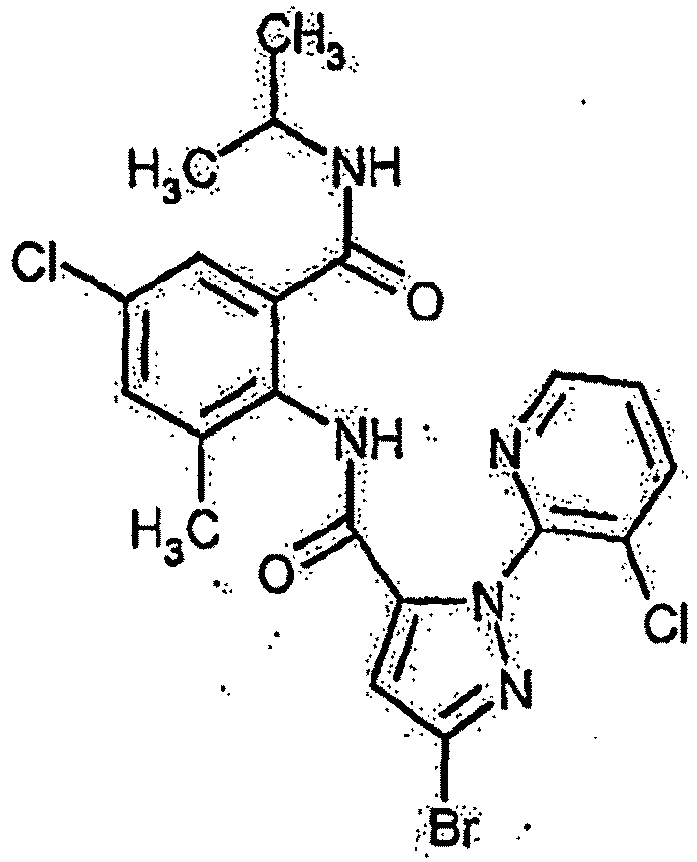
- Composition insecticide selon la revendication 1, dans laquelle, dans le composé représenté par la formule générale [la], R1 est un atome de chlore ou de brome, ou un groupe trifluorométhyle, R2 est un atome de chlore, R3 est un groupe méthyle, R5 est un groupe isopropyle, R4 est un atome d'hydrogène ou de chlore, et X est N.
- Composition insecticide selon la revendication 1, dans laquelle le composé représenté par la formule [la] est 2-[1-(3-chloropyridin-2-yl)-3-trifluorométhylpyrazol-5-ylcarbonylamino]-N-isopropyl-3-méthylbenzamide, 2-[1-(3-chloropyridin-2-yl)-3-chloropyrazol-5-ylcarbonylamino]-N-isopropyl-3-méthyl-benzamide, ou 2-[3-bromo-1-(3-chloropyridin-2-yl)-pyrazol-5-yl-carbonylamino]-N-isopropyl-3-méthyl-benzamide.
- Procédé de lutte contre un insecte nuisible, qui comprend l'application de la composition insecticide selon l'une quelconque des revendications 1 à 3 à des emplacements autres que le site auquel l'insecte nuisible inflige directement des lésions.
- Procédé de lutte contre un insecte nuisible, caractérisé en ce que ledit procédé comprend le mélange de deux types des composés, à savoir un composé représenté par la formule générale [la] :

- Procédé de lutte contre un insecte nuisible, caractérisé en ce que ledit procédé comprend la croissance de semis avec utilisation de la terre pour lever les semis qui contient dans celle-ci deux types des composés, à savoir un composé représenté par la formule générale [la]

- Procédé de lutte contre un insecte nuisible, caractérisé en ce que ledit procédé comprend l'application de deux types des composés, à savoir un composé représenté par la formule général [la] et l'imidaclopride sont présent dans la proportion de 1 :0,1 à 1 :20 selon un rapport pondérat ou un sel de celui-ci selon l'une quelconque des revendications 1 à 3 et l'imidaclopride, sur la terre d'un champ agricole par traitement par pulvérisation, traitement de trou de plantation, incorporation de terre traitée dans un trou de plantation, traitement des racines de plantes ou incorporation de terre traitée avec les racines des plantes pendant la période dans l'intervalle du temps de repiquage à la période de végétation pour une culture destinée à être cultivée par le procédé de repiquage.
- Procédé de lutte contre un insecte nuisible, caractérisé en ce que ledit procédé comprend la conduite du traitement d'immersion, traitement de poudrage ou traitement d'enrobage d'une graine, une pomme de terre de semence ou un bulbe avec deux types des composés, à savoir un composé représenté par la formule générale [la] ou un sel de celui-ci selon l'une quelconque des revendications 1 à 3 et l'imidaclopride, dans le cas d'une culture destinée à être cultivée par semis ou ensemencement direct d'une graine, une pomme de terre de semence ou un bulbe sur le champ agricole.
- Procédé de lutte contre un insecte nuisible, caractérisé en ce que ledit procédé comprend le traitement de la terre d'un champ agricole avec deux types des composés, à savoir un composé représenté par la formule générale [la] ou un sel de celui-ci selon l'une quelconque des revendications 1 à 3 et l'imidaclopride, par traitement de pulvérisation, traitement des racines de plantes ou incorporation de terre traitée avec les racines de plantes pendant la période de végétation pour une culture destinée à être cultivée par semis ou ensemencement direct d'une graine, une pomme de terre de semence ou un bulbe sur le champ agricole.
Applications Claiming Priority (4)
| Application Number | Priority Date | Filing Date | Title |
|---|---|---|---|
| JP2004048376 | 2004-02-24 | ||
| JP2004158349 | 2004-05-27 | ||
| EP12002294.2A EP2474227B1 (fr) | 2004-02-24 | 2005-02-21 | Compositions d'insecticide |
| EP05719327A EP1719409B1 (fr) | 2004-02-24 | 2005-02-21 | Composition insecticide |
Related Parent Applications (2)
| Application Number | Title | Priority Date | Filing Date |
|---|---|---|---|
| EP12002294.2A Division EP2474227B1 (fr) | 2004-02-24 | 2005-02-21 | Compositions d'insecticide |
| EP05719327A Division EP1719409B1 (fr) | 2004-02-24 | 2005-02-21 | Composition insecticide |
Publications (2)
| Publication Number | Publication Date |
|---|---|
| EP2910125A1 EP2910125A1 (fr) | 2015-08-26 |
| EP2910125B1 true EP2910125B1 (fr) | 2018-05-02 |
Family
ID=34889367
Family Applications (4)
| Application Number | Title | Priority Date | Filing Date |
|---|---|---|---|
| EP15163354.2A Expired - Lifetime EP2910125B1 (fr) | 2004-02-24 | 2005-02-21 | Composition d'insecticide |
| EP05719327A Expired - Lifetime EP1719409B1 (fr) | 2004-02-24 | 2005-02-21 | Composition insecticide |
| EP12002626.5A Expired - Lifetime EP2484209B1 (fr) | 2004-02-24 | 2005-02-21 | Compositions d'insecticide |
| EP12002294.2A Expired - Lifetime EP2474227B1 (fr) | 2004-02-24 | 2005-02-21 | Compositions d'insecticide |
Family Applications After (3)
| Application Number | Title | Priority Date | Filing Date |
|---|---|---|---|
| EP05719327A Expired - Lifetime EP1719409B1 (fr) | 2004-02-24 | 2005-02-21 | Composition insecticide |
| EP12002626.5A Expired - Lifetime EP2484209B1 (fr) | 2004-02-24 | 2005-02-21 | Compositions d'insecticide |
| EP12002294.2A Expired - Lifetime EP2474227B1 (fr) | 2004-02-24 | 2005-02-21 | Compositions d'insecticide |
Country Status (14)
| Country | Link |
|---|---|
| US (4) | US9095137B2 (fr) |
| EP (4) | EP2910125B1 (fr) |
| JP (3) | JP5341925B2 (fr) |
| KR (3) | KR101290861B1 (fr) |
| AU (1) | AU2005213943B2 (fr) |
| BR (1) | BRPI0507843A (fr) |
| CA (1) | CA2556300C (fr) |
| ES (4) | ES2387678T3 (fr) |
| HU (2) | HUE025361T2 (fr) |
| MX (2) | MXPA06009301A (fr) |
| TR (1) | TR201807764T4 (fr) |
| TW (1) | TWI356676B (fr) |
| WO (1) | WO2005079575A1 (fr) |
| ZA (1) | ZA200607014B (fr) |
Families Citing this family (23)
| Publication number | Priority date | Publication date | Assignee | Title |
|---|---|---|---|---|
| TWI325302B (en) | 2001-08-13 | 2010-06-01 | Du Pont | Benzoxazinone compounds |
| AR036872A1 (es) | 2001-08-13 | 2004-10-13 | Du Pont | Compuesto de antranilamida, composicion que lo comprende y metodo para controlar una plaga de invertebrados |
| TWI283164B (en) | 2001-09-21 | 2007-07-01 | Du Pont | Anthranilamide arthropodicide treatment |
| VN23181A1 (en) | 2003-01-28 | 2010-07-26 | Du Pont | Cyano anthranilamide insecticides |
| DE102004006075A1 (de) | 2003-11-14 | 2005-06-16 | Bayer Cropscience Ag | Wirkstoffkombinationen mit insektiziden Eigenschaften |
| DE10353281A1 (de) | 2003-11-14 | 2005-06-16 | Bayer Cropscience Ag | Wirkstoffkombination mit insektiziden und akariziden Eigenschaften |
| DE102004021564A1 (de) | 2003-11-14 | 2005-07-07 | Bayer Cropscience Ag | Wirkstoffkombinationen mit insektiziden Eigenschaften |
| EP1691611A1 (fr) | 2003-12-04 | 2006-08-23 | Bayer CropScience Aktiengesellschaft | Combinaisons d'agents presentant des proprietes insecticides |
| DE10356550A1 (de) | 2003-12-04 | 2005-07-07 | Bayer Cropscience Ag | Wirkstoffkombinationen mit insektiziden Eigenschaften |
| KR100870174B1 (ko) | 2003-12-04 | 2008-11-24 | 바이엘 크롭사이언스 아게 | 살충 및 살비성을 가지는 활성 물질 배합물 |
| AU2005239827A1 (en) * | 2004-05-10 | 2005-11-17 | Syngenta Participations Ag | Pesticidal mixtures |
| GT200500179A (es) * | 2004-07-01 | 2006-02-23 | Mezclas sinergistas de agentes de antranilamida para el control de plagas de invertebrados | |
| JP2007246495A (ja) * | 2006-03-20 | 2007-09-27 | Mitsui Chemicals Inc | 病害虫防除方法 |
| JP2010222342A (ja) * | 2009-02-26 | 2010-10-07 | Sumitomo Chemical Co Ltd | 有害生物防除組成物 |
| TWI501726B (zh) * | 2009-09-04 | 2015-10-01 | Du Pont | N-(苯腈)吡唑甲醯胺含水配方 |
| WO2011040629A1 (fr) * | 2009-09-30 | 2011-04-07 | Sumitomo Chemical Company, Limited | Composition et procédé permettant de lutter contre les arthropodes nuisibles |
| KR101295228B1 (ko) * | 2011-01-05 | 2013-08-09 | 동부팜한농 주식회사 | 축사 및 양계 소독용 살충제 조성물 및 이의 제조방법 |
| WO2013191312A1 (fr) * | 2012-06-19 | 2013-12-27 | 주식회사 동부한농 | Composition insecticide pour désinfecter un abri pour bétail et une ferme avicole, et son procédé de préparation |
| BR102017019120B1 (pt) | 2017-09-06 | 2023-01-31 | UPL Corporation Limited | Mistura compreendendo um bioestimulante à base de folcisteína e um inseticida obtendo ação potencializadora dos resultados de ordens qualitativa, quantitativa e temporal observados em uma cultura agrícola de uma planta de interesse |
| KR20220075235A (ko) * | 2019-10-03 | 2022-06-07 | 아다마 마켓심 리미티드 | 농약 혼합물 |
| JP2021058152A (ja) * | 2019-10-08 | 2021-04-15 | フマキラー株式会社 | 虫捕獲液及び虫捕獲器 |
| WO2021162826A1 (fr) * | 2020-02-12 | 2021-08-19 | Corn Products Development, Inc. | Compositions auxiliaires d'écoulement |
| MX2023003826A (es) * | 2020-10-01 | 2023-04-13 | Upl Do Brasil Ind E Comercio De Insumos Agropecuarios S A | Composicion fotoestable y metodo para reducir o controlar una poblacion de malezas aplicando dicha composicion. |
Citations (1)
| Publication number | Priority date | Publication date | Assignee | Title |
|---|---|---|---|---|
| EP1686857B1 (fr) * | 2003-11-14 | 2008-12-10 | Bayer CropScience AG | Combinaisons d'agents a proprietes insecticides |
Family Cites Families (31)
| Publication number | Priority date | Publication date | Assignee | Title |
|---|---|---|---|---|
| JPH066585B2 (ja) | 1985-02-04 | 1994-01-26 | 日本バイエルアグロケム株式会社 | ニトロメチレン誘導体、その製法及び殺虫剤 |
| JPH0717621B2 (ja) | 1986-03-07 | 1995-03-01 | 日本バイエルアグロケム株式会社 | 新規ヘテロ環式化合物 |
| IN167709B (fr) | 1987-08-01 | 1990-12-08 | Takeda Chemical Industries Ltd | |
| JP2546003B2 (ja) | 1988-12-27 | 1996-10-23 | 武田薬品工業株式会社 | グアニジン誘導体、その製造法及び殺虫剤 |
| JP2738019B2 (ja) | 1989-05-25 | 1998-04-08 | ブラザー工業株式会社 | 三次元成形装置 |
| HU214992B (hu) | 1989-10-06 | 1998-12-28 | Nippon Soda Co. Ltd. | Eljárás aminszármazékok előállítására és ilyen vegyületeket tartalmazó inszekticid készítmények |
| TW240163B (en) | 1992-07-22 | 1995-02-11 | Syngenta Participations Ag | Oxadiazine derivatives |
| US5434181A (en) | 1993-10-26 | 1995-07-18 | Mitsui Toatsu Chemicals, Inc. | Furanyl insecticide |
| AU718566B2 (en) | 1996-04-29 | 2000-04-13 | Syngenta Participations Ag | Pesticidal compositions |
| GB9816638D0 (en) | 1998-07-30 | 1998-09-30 | Novartis Ag | Organic compounds |
| CN100340559C (zh) | 1998-12-23 | 2007-10-03 | 布里斯托尔-迈尔斯斯奎布药品公司 | 作为凝血因子xa抑制剂的含氮杂双环 |
| JP2001081003A (ja) | 1999-07-12 | 2001-03-27 | Kumiai Chem Ind Co Ltd | 水田用殺菌殺虫剤組成物 |
| MY138097A (en) | 2000-03-22 | 2009-04-30 | Du Pont | Insecticidal anthranilamides |
| GB0118137D0 (en) | 2001-07-25 | 2001-09-19 | Syngenta Ltd | Insecticidal mixture |
| TWI325302B (en) | 2001-08-13 | 2010-06-01 | Du Pont | Benzoxazinone compounds |
| AR036872A1 (es) * | 2001-08-13 | 2004-10-13 | Du Pont | Compuesto de antranilamida, composicion que lo comprende y metodo para controlar una plaga de invertebrados |
| JP2003055115A (ja) | 2001-08-14 | 2003-02-26 | Meiji Seika Kaisha Ltd | 水稲用殺虫殺菌混合組成物 |
| ES2319743T3 (es) | 2001-08-16 | 2009-05-12 | E.I. Du Pont De Nemours And Company | Antranilamidas sustituidas para controlar plagas de invertebrados. |
| DE10140108A1 (de) | 2001-08-16 | 2003-03-06 | Bayer Cropscience Ag | Fungizide Wirkstoffkombinationen |
| EP1427415B1 (fr) | 2001-09-21 | 2009-08-12 | Brystol-Myers Squibb Company | Composes contenant du lactame et leurs derives en tant qu'inhibiteurs du facteur xa |
| MXPA04002647A (es) * | 2001-09-21 | 2004-06-07 | Du Pont | Antranilamidas artropodicidas. |
| TWI283164B (en) * | 2001-09-21 | 2007-07-01 | Du Pont | Anthranilamide arthropodicide treatment |
| JP2003321310A (ja) | 2002-05-08 | 2003-11-11 | Bayer Cropscience Kk | 農薬組成物 |
| JP4353724B2 (ja) | 2002-05-13 | 2009-10-28 | 住友化学株式会社 | 徐放化農薬製剤及びそれを用いた水稲病害虫防除方法 |
| GB0212451D0 (en) | 2002-05-30 | 2002-07-10 | Chief Tv Ltd | Improvements in and relating to ball games apparatus |
| JP2004048376A (ja) | 2002-07-11 | 2004-02-12 | Asahi Glass Co Ltd | 自動車用ガラスアンテナ装置 |
| JP2004158349A (ja) | 2002-11-07 | 2004-06-03 | Alps Electric Co Ltd | 押釦スイッチ |
| KR20050075001A (ko) | 2002-11-15 | 2005-07-19 | 이 아이 듀폰 디 네모아 앤드 캄파니 | 신규 안트라닐아미드 살충제 |
| VN23181A1 (en) | 2003-01-28 | 2010-07-26 | Du Pont | Cyano anthranilamide insecticides |
| AU2005239827A1 (en) | 2004-05-10 | 2005-11-17 | Syngenta Participations Ag | Pesticidal mixtures |
| GT200500179A (es) | 2004-07-01 | 2006-02-23 | Mezclas sinergistas de agentes de antranilamida para el control de plagas de invertebrados |
-
2005
- 2005-02-21 EP EP15163354.2A patent/EP2910125B1/fr not_active Expired - Lifetime
- 2005-02-21 CA CA2556300A patent/CA2556300C/fr not_active Expired - Lifetime
- 2005-02-21 KR KR1020127009576A patent/KR101290861B1/ko not_active Expired - Lifetime
- 2005-02-21 US US10/590,309 patent/US9095137B2/en active Active
- 2005-02-21 EP EP05719327A patent/EP1719409B1/fr not_active Expired - Lifetime
- 2005-02-21 HU HUE12002626A patent/HUE025361T2/en unknown
- 2005-02-21 ES ES05719327T patent/ES2387678T3/es not_active Expired - Lifetime
- 2005-02-21 HU HUE12002294A patent/HUE026253T2/en unknown
- 2005-02-21 EP EP12002626.5A patent/EP2484209B1/fr not_active Expired - Lifetime
- 2005-02-21 MX MXPA06009301A patent/MXPA06009301A/es active IP Right Grant
- 2005-02-21 KR KR1020067017077A patent/KR101316999B1/ko not_active Expired - Lifetime
- 2005-02-21 KR KR1020127009575A patent/KR101290951B1/ko not_active Expired - Lifetime
- 2005-02-21 MX MX2015010119A patent/MX381560B/es unknown
- 2005-02-21 AU AU2005213943A patent/AU2005213943B2/en not_active Expired
- 2005-02-21 ES ES12002626.5T patent/ES2535842T3/es not_active Expired - Lifetime
- 2005-02-21 ES ES15163354.2T patent/ES2676309T3/es not_active Expired - Lifetime
- 2005-02-21 BR BRPI0507843-1A patent/BRPI0507843A/pt not_active Application Discontinuation
- 2005-02-21 EP EP12002294.2A patent/EP2474227B1/fr not_active Expired - Lifetime
- 2005-02-21 TR TR2018/07764T patent/TR201807764T4/tr unknown
- 2005-02-21 WO PCT/JP2005/002708 patent/WO2005079575A1/fr not_active Ceased
- 2005-02-21 ES ES12002294.2T patent/ES2538587T3/es not_active Expired - Lifetime
- 2005-02-22 TW TW094105187A patent/TWI356676B/zh not_active IP Right Cessation
-
2006
- 2006-08-22 ZA ZA2006/07014A patent/ZA200607014B/en unknown
-
2010
- 2010-05-27 US US12/788,679 patent/US9018235B2/en not_active Expired - Lifetime
-
2011
- 2011-02-14 JP JP2011028498A patent/JP5341925B2/ja not_active Expired - Lifetime
- 2011-07-04 JP JP2011148563A patent/JP5410476B2/ja not_active Expired - Lifetime
-
2013
- 2013-10-03 JP JP2013208259A patent/JP5674891B2/ja not_active Expired - Lifetime
-
2015
- 2015-06-22 US US14/745,629 patent/US9408390B2/en not_active Expired - Lifetime
-
2016
- 2016-05-31 US US15/168,611 patent/US20160270396A1/en not_active Abandoned
Patent Citations (1)
| Publication number | Priority date | Publication date | Assignee | Title |
|---|---|---|---|---|
| EP1686857B1 (fr) * | 2003-11-14 | 2008-12-10 | Bayer CropScience AG | Combinaisons d'agents a proprietes insecticides |
Also Published As
Similar Documents
| Publication | Publication Date | Title |
|---|---|---|
| US9408390B2 (en) | Insecticide compositions | |
| JP5687490B2 (ja) | 非生物的ストレスに対する植物体の耐性を増大させるためのストロビルリン | |
| JP2010504740A (ja) | 植物固有の生産力の増強方法 | |
| JP4722581B2 (ja) | 殺虫剤組成物 | |
| JP2002114612A (ja) | 水田用農薬組成物及びその使用方法 | |
| JP2006008658A (ja) | 殺虫剤組成物 | |
| CN100466906C (zh) | 杀虫剂组合物 | |
| JP2006089467A (ja) | 殺虫剤組成物 | |
| JP2002338414A (ja) | 農業害虫防除剤組成物 | |
| JPH0558401B2 (fr) |
Legal Events
| Date | Code | Title | Description |
|---|---|---|---|
| PUAI | Public reference made under article 153(3) epc to a published international application that has entered the european phase |
Free format text: ORIGINAL CODE: 0009012 |
|
| AC | Divisional application: reference to earlier application |
Ref document number: 1719409 Country of ref document: EP Kind code of ref document: P Ref document number: 2474227 Country of ref document: EP Kind code of ref document: P |
|
| AK | Designated contracting states |
Kind code of ref document: A1 Designated state(s): AT BE BG CH CY CZ DE DK EE ES FI FR GB GR HU IE IS IT LI LT LU MC NL PL PT RO SE SI SK TR |
|
| 17P | Request for examination filed |
Effective date: 20160226 |
|
| RBV | Designated contracting states (corrected) |
Designated state(s): AT BE BG CH CY CZ DE DK EE ES FI FR GB GR HU IE IS IT LI LT LU MC NL PL PT RO SE SI SK TR |
|
| 17Q | First examination report despatched |
Effective date: 20160519 |
|
| STAA | Information on the status of an ep patent application or granted ep patent |
Free format text: STATUS: EXAMINATION IS IN PROGRESS |
|
| GRAP | Despatch of communication of intention to grant a patent |
Free format text: ORIGINAL CODE: EPIDOSNIGR1 |
|
| STAA | Information on the status of an ep patent application or granted ep patent |
Free format text: STATUS: GRANT OF PATENT IS INTENDED |
|
| INTG | Intention to grant announced |
Effective date: 20171122 |
|
| GRAS | Grant fee paid |
Free format text: ORIGINAL CODE: EPIDOSNIGR3 |
|
| GRAA | (expected) grant |
Free format text: ORIGINAL CODE: 0009210 |
|
| STAA | Information on the status of an ep patent application or granted ep patent |
Free format text: STATUS: THE PATENT HAS BEEN GRANTED |
|
| AC | Divisional application: reference to earlier application |
Ref document number: 2474227 Country of ref document: EP Kind code of ref document: P Ref document number: 1719409 Country of ref document: EP Kind code of ref document: P |
|
| AK | Designated contracting states |
Kind code of ref document: B1 Designated state(s): AT BE BG CH CY CZ DE DK EE ES FI FR GB GR HU IE IS IT LI LT LU MC NL PL PT RO SE SI SK TR |
|
| REG | Reference to a national code |
Ref country code: GB Ref legal event code: FG4D |
|
| REG | Reference to a national code |
Ref country code: CH Ref legal event code: EP Ref country code: AT Ref legal event code: REF Ref document number: 994251 Country of ref document: AT Kind code of ref document: T Effective date: 20180515 |
|
| REG | Reference to a national code |
Ref country code: DE Ref legal event code: R096 Ref document number: 602005053924 Country of ref document: DE |
|
| REG | Reference to a national code |
Ref country code: IE Ref legal event code: FG4D |
|
| REG | Reference to a national code |
Ref country code: ES Ref legal event code: FG2A Ref document number: 2676309 Country of ref document: ES Kind code of ref document: T3 Effective date: 20180718 |
|
| REG | Reference to a national code |
Ref country code: NL Ref legal event code: MP Effective date: 20180502 |
|
| REG | Reference to a national code |
Ref country code: LT Ref legal event code: MG4D |
|
| PG25 | Lapsed in a contracting state [announced via postgrant information from national office to epo] |
Ref country code: SE Free format text: LAPSE BECAUSE OF FAILURE TO SUBMIT A TRANSLATION OF THE DESCRIPTION OR TO PAY THE FEE WITHIN THE PRESCRIBED TIME-LIMIT Effective date: 20180502 Ref country code: FI Free format text: LAPSE BECAUSE OF FAILURE TO SUBMIT A TRANSLATION OF THE DESCRIPTION OR TO PAY THE FEE WITHIN THE PRESCRIBED TIME-LIMIT Effective date: 20180502 Ref country code: BG Free format text: LAPSE BECAUSE OF FAILURE TO SUBMIT A TRANSLATION OF THE DESCRIPTION OR TO PAY THE FEE WITHIN THE PRESCRIBED TIME-LIMIT Effective date: 20180802 Ref country code: LT Free format text: LAPSE BECAUSE OF FAILURE TO SUBMIT A TRANSLATION OF THE DESCRIPTION OR TO PAY THE FEE WITHIN THE PRESCRIBED TIME-LIMIT Effective date: 20180502 |
|
| PG25 | Lapsed in a contracting state [announced via postgrant information from national office to epo] |
Ref country code: GR Free format text: LAPSE BECAUSE OF FAILURE TO SUBMIT A TRANSLATION OF THE DESCRIPTION OR TO PAY THE FEE WITHIN THE PRESCRIBED TIME-LIMIT Effective date: 20180803 Ref country code: NL Free format text: LAPSE BECAUSE OF FAILURE TO SUBMIT A TRANSLATION OF THE DESCRIPTION OR TO PAY THE FEE WITHIN THE PRESCRIBED TIME-LIMIT Effective date: 20180502 |
|
| REG | Reference to a national code |
Ref country code: AT Ref legal event code: MK05 Ref document number: 994251 Country of ref document: AT Kind code of ref document: T Effective date: 20180502 |
|
| PG25 | Lapsed in a contracting state [announced via postgrant information from national office to epo] |
Ref country code: CZ Free format text: LAPSE BECAUSE OF FAILURE TO SUBMIT A TRANSLATION OF THE DESCRIPTION OR TO PAY THE FEE WITHIN THE PRESCRIBED TIME-LIMIT Effective date: 20180502 Ref country code: RO Free format text: LAPSE BECAUSE OF FAILURE TO SUBMIT A TRANSLATION OF THE DESCRIPTION OR TO PAY THE FEE WITHIN THE PRESCRIBED TIME-LIMIT Effective date: 20180502 Ref country code: EE Free format text: LAPSE BECAUSE OF FAILURE TO SUBMIT A TRANSLATION OF THE DESCRIPTION OR TO PAY THE FEE WITHIN THE PRESCRIBED TIME-LIMIT Effective date: 20180502 Ref country code: AT Free format text: LAPSE BECAUSE OF FAILURE TO SUBMIT A TRANSLATION OF THE DESCRIPTION OR TO PAY THE FEE WITHIN THE PRESCRIBED TIME-LIMIT Effective date: 20180502 Ref country code: DK Free format text: LAPSE BECAUSE OF FAILURE TO SUBMIT A TRANSLATION OF THE DESCRIPTION OR TO PAY THE FEE WITHIN THE PRESCRIBED TIME-LIMIT Effective date: 20180502 Ref country code: SK Free format text: LAPSE BECAUSE OF FAILURE TO SUBMIT A TRANSLATION OF THE DESCRIPTION OR TO PAY THE FEE WITHIN THE PRESCRIBED TIME-LIMIT Effective date: 20180502 Ref country code: PL Free format text: LAPSE BECAUSE OF FAILURE TO SUBMIT A TRANSLATION OF THE DESCRIPTION OR TO PAY THE FEE WITHIN THE PRESCRIBED TIME-LIMIT Effective date: 20180502 |
|
| REG | Reference to a national code |
Ref country code: DE Ref legal event code: R097 Ref document number: 602005053924 Country of ref document: DE |
|
| PLBE | No opposition filed within time limit |
Free format text: ORIGINAL CODE: 0009261 |
|
| STAA | Information on the status of an ep patent application or granted ep patent |
Free format text: STATUS: NO OPPOSITION FILED WITHIN TIME LIMIT |
|
| 26N | No opposition filed |
Effective date: 20190205 |
|
| PG25 | Lapsed in a contracting state [announced via postgrant information from national office to epo] |
Ref country code: SI Free format text: LAPSE BECAUSE OF FAILURE TO SUBMIT A TRANSLATION OF THE DESCRIPTION OR TO PAY THE FEE WITHIN THE PRESCRIBED TIME-LIMIT Effective date: 20180502 |
|
| REG | Reference to a national code |
Ref country code: DE Ref legal event code: R119 Ref document number: 602005053924 Country of ref document: DE |
|
| REG | Reference to a national code |
Ref country code: CH Ref legal event code: PL |
|
| GBPC | Gb: european patent ceased through non-payment of renewal fee |
Effective date: 20190221 |
|
| PG25 | Lapsed in a contracting state [announced via postgrant information from national office to epo] |
Ref country code: MC Free format text: LAPSE BECAUSE OF FAILURE TO SUBMIT A TRANSLATION OF THE DESCRIPTION OR TO PAY THE FEE WITHIN THE PRESCRIBED TIME-LIMIT Effective date: 20180502 Ref country code: LU Free format text: LAPSE BECAUSE OF NON-PAYMENT OF DUE FEES Effective date: 20190221 |
|
| REG | Reference to a national code |
Ref country code: BE Ref legal event code: MM Effective date: 20190228 |
|
| REG | Reference to a national code |
Ref country code: IE Ref legal event code: MM4A |
|
| PG25 | Lapsed in a contracting state [announced via postgrant information from national office to epo] |
Ref country code: CH Free format text: LAPSE BECAUSE OF NON-PAYMENT OF DUE FEES Effective date: 20190228 Ref country code: LI Free format text: LAPSE BECAUSE OF NON-PAYMENT OF DUE FEES Effective date: 20190228 |
|
| PG25 | Lapsed in a contracting state [announced via postgrant information from national office to epo] |
Ref country code: GB Free format text: LAPSE BECAUSE OF NON-PAYMENT OF DUE FEES Effective date: 20190221 Ref country code: IE Free format text: LAPSE BECAUSE OF NON-PAYMENT OF DUE FEES Effective date: 20190221 Ref country code: DE Free format text: LAPSE BECAUSE OF NON-PAYMENT OF DUE FEES Effective date: 20190903 |
|
| PG25 | Lapsed in a contracting state [announced via postgrant information from national office to epo] |
Ref country code: BE Free format text: LAPSE BECAUSE OF NON-PAYMENT OF DUE FEES Effective date: 20190228 Ref country code: FR Free format text: LAPSE BECAUSE OF NON-PAYMENT OF DUE FEES Effective date: 20190228 |
|
| PG25 | Lapsed in a contracting state [announced via postgrant information from national office to epo] |
Ref country code: PT Free format text: LAPSE BECAUSE OF FAILURE TO SUBMIT A TRANSLATION OF THE DESCRIPTION OR TO PAY THE FEE WITHIN THE PRESCRIBED TIME-LIMIT Effective date: 20180903 |
|
| PG25 | Lapsed in a contracting state [announced via postgrant information from national office to epo] |
Ref country code: CY Free format text: LAPSE BECAUSE OF FAILURE TO SUBMIT A TRANSLATION OF THE DESCRIPTION OR TO PAY THE FEE WITHIN THE PRESCRIBED TIME-LIMIT Effective date: 20180502 |
|
| PG25 | Lapsed in a contracting state [announced via postgrant information from national office to epo] |
Ref country code: IS Free format text: LAPSE BECAUSE OF FAILURE TO SUBMIT A TRANSLATION OF THE DESCRIPTION OR TO PAY THE FEE WITHIN THE PRESCRIBED TIME-LIMIT Effective date: 20180902 |
|
| PG25 | Lapsed in a contracting state [announced via postgrant information from national office to epo] |
Ref country code: HU Free format text: LAPSE BECAUSE OF FAILURE TO SUBMIT A TRANSLATION OF THE DESCRIPTION OR TO PAY THE FEE WITHIN THE PRESCRIBED TIME-LIMIT; INVALID AB INITIO Effective date: 20050221 |
|
| P01 | Opt-out of the competence of the unified patent court (upc) registered |
Effective date: 20230516 |
|
| PGFP | Annual fee paid to national office [announced via postgrant information from national office to epo] |
Ref country code: ES Payment date: 20240301 Year of fee payment: 20 |
|
| PGFP | Annual fee paid to national office [announced via postgrant information from national office to epo] |
Ref country code: TR Payment date: 20240129 Year of fee payment: 20 Ref country code: IT Payment date: 20240123 Year of fee payment: 20 |