EP2913152A1 - Meule-boisseau et fabrication d'une meule-boisseau - Google Patents
Meule-boisseau et fabrication d'une meule-boisseau Download PDFInfo
- Publication number
- EP2913152A1 EP2913152A1 EP15000503.1A EP15000503A EP2913152A1 EP 2913152 A1 EP2913152 A1 EP 2913152A1 EP 15000503 A EP15000503 A EP 15000503A EP 2913152 A1 EP2913152 A1 EP 2913152A1
- Authority
- EP
- European Patent Office
- Prior art keywords
- cup
- carrier
- grinding
- grinding wheel
- wheel according
- Prior art date
- Legal status (The legal status is an assumption and is not a legal conclusion. Google has not performed a legal analysis and makes no representation as to the accuracy of the status listed.)
- Withdrawn
Links
- 238000004519 manufacturing process Methods 0.000 title claims description 17
- 238000005498 polishing Methods 0.000 title 2
- 238000000227 grinding Methods 0.000 claims abstract description 95
- 238000007731 hot pressing Methods 0.000 claims abstract description 10
- 239000000463 material Substances 0.000 claims description 16
- 239000011230 binding agent Substances 0.000 claims description 13
- 239000002184 metal Substances 0.000 claims description 9
- 229910052751 metal Inorganic materials 0.000 claims description 9
- 238000000034 method Methods 0.000 claims description 9
- 229920003002 synthetic resin Polymers 0.000 claims description 9
- 239000000057 synthetic resin Substances 0.000 claims description 9
- 230000008569 process Effects 0.000 claims description 8
- 239000004033 plastic Substances 0.000 claims description 7
- 239000000203 mixture Substances 0.000 claims description 5
- 230000004927 fusion Effects 0.000 claims description 4
- 230000009471 action Effects 0.000 claims description 2
- 239000007769 metal material Substances 0.000 claims description 2
- 150000002739 metals Chemical class 0.000 claims description 2
- 230000006835 compression Effects 0.000 claims 1
- 238000007906 compression Methods 0.000 claims 1
- 239000000843 powder Substances 0.000 description 4
- 238000004026 adhesive bonding Methods 0.000 description 3
- 150000001875 compounds Chemical class 0.000 description 3
- 238000003825 pressing Methods 0.000 description 3
- 229920005989 resin Polymers 0.000 description 3
- 239000011347 resin Substances 0.000 description 3
- CSCPPACGZOOCGX-UHFFFAOYSA-N Acetone Chemical compound CC(C)=O CSCPPACGZOOCGX-UHFFFAOYSA-N 0.000 description 2
- 239000000853 adhesive Substances 0.000 description 2
- 230000001070 adhesive effect Effects 0.000 description 2
- 239000003795 chemical substances by application Substances 0.000 description 2
- 239000003822 epoxy resin Substances 0.000 description 2
- 229920000647 polyepoxide Polymers 0.000 description 2
- 230000007704 transition Effects 0.000 description 2
- 239000006061 abrasive grain Substances 0.000 description 1
- 239000002318 adhesion promoter Substances 0.000 description 1
- 239000007767 bonding agent Substances 0.000 description 1
- 238000005266 casting Methods 0.000 description 1
- 238000010276 construction Methods 0.000 description 1
- 238000005238 degreasing Methods 0.000 description 1
- 229910003460 diamond Inorganic materials 0.000 description 1
- 239000010432 diamond Substances 0.000 description 1
- 239000000945 filler Substances 0.000 description 1
- 239000012535 impurity Substances 0.000 description 1
- 238000003780 insertion Methods 0.000 description 1
- 230000037431 insertion Effects 0.000 description 1
- 230000003993 interaction Effects 0.000 description 1
- 238000003754 machining Methods 0.000 description 1
- 238000002156 mixing Methods 0.000 description 1
- 238000000465 moulding Methods 0.000 description 1
- 230000000717 retained effect Effects 0.000 description 1
- 238000005488 sandblasting Methods 0.000 description 1
- 238000000926 separation method Methods 0.000 description 1
- 238000007493 shaping process Methods 0.000 description 1
Images
Classifications
-
- B—PERFORMING OPERATIONS; TRANSPORTING
- B24—GRINDING; POLISHING
- B24D—TOOLS FOR GRINDING, BUFFING OR SHARPENING
- B24D18/00—Manufacture of grinding tools or other grinding devices, e.g. wheels, not otherwise provided for
- B24D18/0009—Manufacture of grinding tools or other grinding devices, e.g. wheels, not otherwise provided for using moulds or presses
-
- B—PERFORMING OPERATIONS; TRANSPORTING
- B24—GRINDING; POLISHING
- B24D—TOOLS FOR GRINDING, BUFFING OR SHARPENING
- B24D7/00—Bonded abrasive wheels, or wheels with inserted abrasive blocks, designed for acting otherwise than only by their periphery, e.g. by the front face; Bushings or mountings therefor
- B24D7/16—Bushings; Mountings
-
- B—PERFORMING OPERATIONS; TRANSPORTING
- B24—GRINDING; POLISHING
- B24D—TOOLS FOR GRINDING, BUFFING OR SHARPENING
- B24D7/00—Bonded abrasive wheels, or wheels with inserted abrasive blocks, designed for acting otherwise than only by their periphery, e.g. by the front face; Bushings or mountings therefor
- B24D7/02—Wheels in one piece
Definitions
- cup wheels are already part of the prior art and are for example in the DE 25 48 28 1 C2 and the DE 26 14 743 A1 shown.
- Cup wheels are used to grind metals, e.g. during tool grinding. These include e.g. Machining techniques such as grooving, chamfering, finishing of drills and tools, etc.
- a cup grinding wheel consists essentially of a carrier (grinding cup) and a grinding body in ring form, which identifies or forms grinding surfaces on its surface. The abrasive surfaces are provided with superabrasives such as CBN or diamond, which are bonded together in a metal and / or synthetic resin bond.
- the abrasive article is first made by placing the binder and superabrasives in a mold and then hot pressed. After this hot pressing process, the annular abrasive article is removed from the mold and placed in another shape.
- This further, second form is designed so that it specifies the geometry of the carrier (cupping cup).
- the binding powder (binder) for the carrier in the form of metal powder, synthetic resin, metal-resin mixture, etc. is filled and then hot-pressed.
- the cup grinding wheel is ready after forming.
- the grinding cup has a support geometry in the area of the grinding wheel in the inside. This support geometry, often designed as a ring, fixes and supports the abrasive body on the carrier. This support ring must be machined according to the wear of the slip ring (such as by turning in a lathe).
- a driven device such as a lathe
- an independent plastic support ring is inserted behind the grinding body.
- the grinding wheel and pot are made separately and then glued together. This is the case, for example, if the abrasive body can not be pushed over a ring formed by the carrier due to its shape.
- the support ring is subsequently, after the bonding of abrasive article on the cup, by casting a plastic, such as epoxy resin, produced, including an additional mold is needed.
- This production variant also has significant disadvantages:
- the grinding body and the cup are made separately from each other in their own form. Additional steps, such as the réelleverguss by an epoxy resin to create the support ring and a gluing of the abrasive article on the carrier, form an increased effort for themselves.
- a bonding agent (primer) must be applied to the adhesive surfaces before bonding the abrasive article to the carrier pretreat. Otherwise, a sufficient adhesive bond can not be ensured.
- they must be pretreated, for example by sandblasting and degreasing, with an agent such as acetone and coated with an adhesion promoter (primer).
- the object of the invention is to avoid the disadvantages described above and to provide a comparison with the prior art improved cup grinding wheel or a method for producing such a cup grinding wheel.
- the grinding body is substantially completely formed as a cone ring.
- a design as a cone ring requires less material for the construction of the grinding wheel, less mass must be set in motion when putting the grinding wheel into operation.
- the abrasive body forms a ring-shaped connection region, it can be fastened to a carrier via this annular region of connection.
- the cup-shaped carrier has an annular receiving surface at its front edge region, it can receive the connection region of the grinding body on this receiving surface.
- a fusion between the materials of the abrasive article and the carrier being effected during the hot pressing process.
- a support ring can be dispensed with.
- the compound is much stronger than a compound which is made by gluing or the like.
- the inner grinding surface on the inside of the abrasive body is not covered by the cup-shaped carrier and thus the inner side is usable as réelleschleif Chemistry, then this cup grinding wheel allows a wider range of processing options. Furthermore, in the case of wear of the abrasive body of the support ring, not by, for example, a lathe, be deducted.
- an upper die punch body and an abrasive die die are inserted into the die ring and pressure is applied to the abrasive body material between the dies. This ensures that the material for the abrasive body solidifies and this preformed in its position waiting to be in the next Steps to be connected to the vehicle. A removal of the grinding wheel is not necessary.
- a hot forming step when the abrasive die die is removed and replaced with a backing by a bolt, thereby introducing the material for the cup-shaped carrier, with the preformed abrasive body remaining in place in the die, labor is saved and the risk of forming the die is minimized Slip ring of the slip ring is damaged.
- a carrier upper punch is inserted into the upper die stamp and carrier upper punch are pressed together with the Abrasive Oberst Zi against the carrier lower punch, wherein the abrasive body is hot pressed with the cup-shaped carrier. Due to the common hot pressing of the carrier and the grinding wheel, a mixing of the materials in the carrier and in the grinding wheel is produced. In this case, a compound is produced which has no dividing line. Due to this very good connection, it is not necessary to incorporate a support ring. It is also not necessary that the carrier itself forms a support ring that supports the abrasive article.
- the cup-shaped carrier is made of a metallic material
- the abrasive body comprises metallic binder and the cup-shaped carrier made of a plastic, preferably synthetic resin .Wird, when the abrasive article has a synthetic resin as a binder.
- synthetic resin is used as a binder in the carrier, a filler such as preferably metal powder is incorporated. This ensures that a connection of the materials between the carrier and abrasive body can take place without a dividing line.
- Protection is also desired for a method of making a cup grinding wheel comprising a cup-shaped carrier and an annular abrasive article.
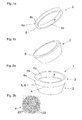
- the FIG. 1a shows an abrasive article 3.
- the abrasive article 3 made of super abrasive grain and a binder preferably has four faces. At the end faces of the annular grinding body 3 is ever a connection region 5 and a Stirnschleif Chemistry 4b. On the outside, the grinding wheel 3 forms an outer grinding surface 4a. The inner side 7 of the grinding wheel 3 forms the inner grinding surface 4c.
- the FIG. 1b shows a pot-shaped carrier 2.
- the carrier 2 is, depending on which material of the grinding wheel 3 (in the FIG. 1b not apparent) is essentially entirely made of metal or plastic.
- the common ones Variant represents a combination of plastic and metal, as it also in the detail view X, Fig. 2b , it can be seen.
- the cup-shaped carrier 2 forms the receiving surface 6 on one of its end faces.
- the carrier 2 has an opening which is located in the bottom of the carrier 2. This is not apparent in this representation 1 b, since it is covered by the jacket of the carrier 2. About this receiving opening 17 (in the FIG. 2a not apparent, in the FIGS. 5a and 5b ), the cup grinding wheel 1 is clamped on a grinding device.
- FIG. 2a shows an abrasive body 3 attached to the carrier 2.
- the grinding body 3 was fused with its connection region 5 with the annular receiving surface 6 of the carrier 2.
- Die Schleifanalysis 3 Sind an dem Schleifscale 3 bequest.
- the grinding surfaces 4a, 4b, 4c are retained. Only the connection area 5 is lost by the attachment to the carrier 2 and can not be used as a grinding surface.
- the detail X from the FIG. 2a will be in the FIG. 2b explained in more detail.
- FIG. 2b shows a detail view X from the FIG. 2a shown schematically.
- the detailed view X shows that the material of the abrasive article 3 has mixed with the material of the carrier 2.
- the binder 23 may be both of metallic origin or made of synthetic resin. It would also be conceivable to have a mixture of both.
- an abrasive article 3 having a resin bond as the binder 23 is used on a support 2 with a mixed resin or metal-synthetic resin mixture.
- a metal powder for the carrier 2 is used for a grinding body 3 with a metal bond as a binder 23, a metal powder for the carrier 2 is used.
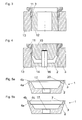
- FIG. 3 schematically shows a manufacturing process, called preforming step, in which the grinding body 3 is preformed in a mold consisting of a press ring 13, a pad lower punch 12 and a top cover stamp 11.
- preforming step a manufacturing process, called preforming step, in which the grinding body 3 is preformed in a mold consisting of a press ring 13, a pad lower punch 12 and a top cover stamp 11.
- the mixture of binder 23 and superabrasive agent 22 is filled into the region between covering upper punch 11, pad lower punch 12 and pressing ring 13.
- the material located there is solidified under pressure. No additional temperature is added.
- FIG. 4 shows how the pad undercurrent 12 has been replaced by the carrier lower punch 14.
- the already preformed abrasive body 3 also remains in the exchange of the punches 14, 15 and 16 in its position.
- the carrier upper punch 15 is introduced after the filling of the material for the carrier 2.
- the in the FIG. 4 not apparent opening 17, which is then provided for receiving the cup wheel 1 on a grinding device is formed by the bolt 16.
- the carrier 2 is formed during the hot-forming step by the interaction of lining upper punch 11, carrier upper punch 15, carrier lower punch 14, pin 16 and press ring 13 and simultaneously fused with the grinding wheel 3.
- the abrasive body 3 does not have to be removed from the mold between the steps - thus there is no risk of breakage during the shaping of the slip ring 3. Due to the joint pressing during the hot forming step, there is an optimized connection between the grinding body 3 and the carrier 2, so that a support ring 20 (in FIG. 4 not shown) can be omitted. Under the microscope, a fusion of the material between the grinding wheel 3 and 2 carrier is visible and therefore also detectable. In the manufacturing process by adhesive bonding and in a standard production with two separate hot forming steps is below the Microscope to establish a clear interface between the grinding wheel 3 and 2 carrier.
- FIG. 5a shows a cup grinding wheel 1 with a support ring 20.
- the support ring 20 is formed by the carrier 2.
- the support 2 supports the abrasive body 3. If the abrasive body 3 is worn on its face grinding surface 4b, then the support ring 20 would have to be displaced to the rear by being twisted off by means of a lathe or another device.
- FIG. 5b shows the cup grinding wheel 1 according to the invention. It is apparent that no disturbing support ring 20 is attached to the grinding wheel 3 or the carrier 2. This results in three grinding surfaces - the outer grinding surface 4a, the Stirnschleif Chemistry 4b and the inner grinding surface 4c. These three grinding surfaces can be used to machine a workpiece. If the cup grinding wheel 1 has to be pulled off at its frontal grinding surface 4b, no support ring 20 has to be reworked.
Landscapes
- Engineering & Computer Science (AREA)
- Mechanical Engineering (AREA)
- Manufacturing & Machinery (AREA)
- Polishing Bodies And Polishing Tools (AREA)
Applications Claiming Priority (1)
| Application Number | Priority Date | Filing Date | Title |
|---|---|---|---|
| ATA142/2014A AT515475B1 (de) | 2014-02-28 | 2014-02-28 | Herstellung einer Topfscheibe |
Publications (1)
| Publication Number | Publication Date |
|---|---|
| EP2913152A1 true EP2913152A1 (fr) | 2015-09-02 |
Family
ID=52573581
Family Applications (1)
| Application Number | Title | Priority Date | Filing Date |
|---|---|---|---|
| EP15000503.1A Withdrawn EP2913152A1 (fr) | 2014-02-28 | 2015-02-23 | Meule-boisseau et fabrication d'une meule-boisseau |
Country Status (6)
| Country | Link |
|---|---|
| US (1) | US10016874B2 (fr) |
| EP (1) | EP2913152A1 (fr) |
| AT (1) | AT515475B1 (fr) |
| BR (1) | BR102015004265B1 (fr) |
| DE (1) | DE202015009441U1 (fr) |
| ES (1) | ES1206189Y (fr) |
Cited By (1)
| Publication number | Priority date | Publication date | Assignee | Title |
|---|---|---|---|---|
| CN108555783A (zh) * | 2016-02-25 | 2018-09-21 | 泉州众志新材料科技有限公司 | 一种人造石倒角轮的制备方法 |
Families Citing this family (1)
| Publication number | Priority date | Publication date | Assignee | Title |
|---|---|---|---|---|
| AT520966A1 (de) * | 2018-03-12 | 2019-09-15 | Tyrolit Schleifmittelwerke Swarovski Kg | Schleifwerkzeug zum Schleifen eines Motorblocks |
Citations (5)
| Publication number | Priority date | Publication date | Assignee | Title |
|---|---|---|---|---|
| GB451641A (en) * | 1935-02-19 | 1936-08-10 | Norton Grinding Wheel Co Ltd | Methods of making abrasive wheels |
| GB557194A (en) * | 1942-06-25 | 1943-11-09 | Ernest Douglas Teague | Improvements in abrasive tools |
| US2469398A (en) * | 1946-04-12 | 1949-05-10 | Abrasive Dressing Tool Company | Abrasive wheel and method of making the same |
| DE2614743A1 (de) * | 1975-04-07 | 1976-10-21 | Edenvale Eng Works | Verfahren zur herstellung von schleifkoerpern |
| EP2119524A1 (fr) * | 2008-05-15 | 2009-11-18 | Celsia S.P.A. | Électrode bimétallique pour broyeur par érosion et procédé de fabrication |
Family Cites Families (5)
| Publication number | Priority date | Publication date | Assignee | Title |
|---|---|---|---|---|
| US2703437A (en) * | 1950-09-01 | 1955-03-08 | Frederick W Lindblad | Method of making abrasive articles |
| US2942387A (en) * | 1958-03-03 | 1960-06-28 | Frederick W Lindblad | Cup-shaped diamond grinding wheel |
| IE42010B1 (en) * | 1974-08-15 | 1980-05-21 | Edenvale Eng Works | Abrasive products |
| DE2548281A1 (de) | 1975-10-28 | 1977-05-05 | Du Pont | Schleifkoerper |
| US6102789A (en) * | 1998-03-27 | 2000-08-15 | Norton Company | Abrasive tools |
-
2014
- 2014-02-28 AT ATA142/2014A patent/AT515475B1/de active
-
2015
- 2015-02-23 ES ES201830023U patent/ES1206189Y/es not_active Expired - Fee Related
- 2015-02-23 DE DE202015009441.4U patent/DE202015009441U1/de not_active Expired - Lifetime
- 2015-02-23 EP EP15000503.1A patent/EP2913152A1/fr not_active Withdrawn
- 2015-02-26 BR BR102015004265-5A patent/BR102015004265B1/pt active IP Right Grant
- 2015-02-26 US US14/632,190 patent/US10016874B2/en not_active Expired - Fee Related
Patent Citations (5)
| Publication number | Priority date | Publication date | Assignee | Title |
|---|---|---|---|---|
| GB451641A (en) * | 1935-02-19 | 1936-08-10 | Norton Grinding Wheel Co Ltd | Methods of making abrasive wheels |
| GB557194A (en) * | 1942-06-25 | 1943-11-09 | Ernest Douglas Teague | Improvements in abrasive tools |
| US2469398A (en) * | 1946-04-12 | 1949-05-10 | Abrasive Dressing Tool Company | Abrasive wheel and method of making the same |
| DE2614743A1 (de) * | 1975-04-07 | 1976-10-21 | Edenvale Eng Works | Verfahren zur herstellung von schleifkoerpern |
| EP2119524A1 (fr) * | 2008-05-15 | 2009-11-18 | Celsia S.P.A. | Électrode bimétallique pour broyeur par érosion et procédé de fabrication |
Cited By (1)
| Publication number | Priority date | Publication date | Assignee | Title |
|---|---|---|---|---|
| CN108555783A (zh) * | 2016-02-25 | 2018-09-21 | 泉州众志新材料科技有限公司 | 一种人造石倒角轮的制备方法 |
Also Published As
| Publication number | Publication date |
|---|---|
| US20150246428A1 (en) | 2015-09-03 |
| BR102015004265B1 (pt) | 2023-01-10 |
| BR102015004265A8 (pt) | 2021-09-08 |
| BR102015004265A2 (pt) | 2016-02-02 |
| AT515475A1 (de) | 2015-09-15 |
| ES1206189Y (es) | 2018-05-16 |
| US10016874B2 (en) | 2018-07-10 |
| DE202015009441U1 (de) | 2017-08-16 |
| AT515475B1 (de) | 2016-04-15 |
| ES1206189U (es) | 2018-02-22 |
Similar Documents
| Publication | Publication Date | Title |
|---|---|---|
| DE102007007161B4 (de) | Verfahren und Vorrichtung zum Blocken von Brillengläsern aus Kunststoff für deren Bearbeitung und/oder Beschichtung | |
| DE69914961T2 (de) | Schleifwerkzeug | |
| DE2523501A1 (de) | Verfahren zur herstellung eines schleifwerkzeugs zum schleifen und polieren | |
| DE102012001732A1 (de) | Werkzeugkopf für ein modulares Schaftwerkzeug | |
| DE2536090A1 (de) | Schleifkoerper und verfahren zu seiner herstellung | |
| AT515475B1 (de) | Herstellung einer Topfscheibe | |
| EP4171848B1 (fr) | Procédé de fabrication d'une ébauche et procédé de traitement ultérieur de l'ébauche en un segment de traitement | |
| EP3928905A1 (fr) | Procédé de fabrication d'une ébauche et procédé de traitement ultérieur de l'ébauche en un segment de traitement | |
| EP3219439B1 (fr) | Meule | |
| EP0606635A1 (fr) | Procédé de fabrication d'outils de meulage et outil ainsi réalisé | |
| WO2019025229A1 (fr) | Procédé pour la fabrication d'un segment opératoire pour un outil d'usinage abrasif | |
| DE2916709A1 (de) | Werkzeuge mit schneiden aus harten stoffen | |
| DE19939883A1 (de) | Herstellung von Steinschliffwerkzeugen und deren Anordnung | |
| DE112004001097T5 (de) | Harzbindungsdiamantenwerkzeug und Herstellungsverfahren für dasselbe | |
| DE712710C (de) | Verfahren und Vorrichtung zur Wiederherstellung abgenutzter ringfoermiger Werkzeuge, wie Ziehmatrizen, Lehr-, Luenett- und Pressringe | |
| EP1837123A1 (fr) | Outil destiné au traitement de surfaces et son procédé de fabrication | |
| EP3928894A1 (fr) | Procédé de fabrication d'une ébauche et procédé de traitement ultérieur de l'ébauche en un segment de traitement | |
| EP3356111B1 (fr) | Dispositif de formation de pièces additionnelles | |
| AT166945B (de) | Verfahren zur Herstellung komplizierter Formkörper aus Hartmetall | |
| DE102006012926A1 (de) | Werkzeug zum Bearbeiten von Oberflächen und Verfahren zur Herstellung eines solchen Werkzeugs | |
| DE3542193C1 (de) | Werkzeug zum maschinellen Entfernen von Formteilungsgraten an Formlingen | |
| DE102021104481A1 (de) | Verfahren zur Herstellung einer Schleifscheibe | |
| DE2917705A1 (de) | Schleifwerkzeug und verfahren zu seiner herstellung | |
| DE3502249C2 (fr) | ||
| EP3928893A1 (fr) | Procédé de fabrication d'un segment de traitement doté d'une projection de particules de matériau dur sur la face supérieure |
Legal Events
| Date | Code | Title | Description |
|---|---|---|---|
| PUAI | Public reference made under article 153(3) epc to a published international application that has entered the european phase |
Free format text: ORIGINAL CODE: 0009012 |
|
| AK | Designated contracting states |
Kind code of ref document: A1 Designated state(s): AL AT BE BG CH CY CZ DE DK EE ES FI FR GB GR HR HU IE IS IT LI LT LU LV MC MK MT NL NO PL PT RO RS SE SI SK SM TR |
|
| AX | Request for extension of the european patent |
Extension state: BA ME |
|
| 17P | Request for examination filed |
Effective date: 20160120 |
|
| RBV | Designated contracting states (corrected) |
Designated state(s): AL AT BE BG CH CY CZ DE DK EE ES FI FR GB GR HR HU IE IS IT LI LT LU LV MC MK MT NL NO PL PT RO RS SE SI SK SM TR |
|
| 17Q | First examination report despatched |
Effective date: 20160624 |
|
| STAA | Information on the status of an ep patent application or granted ep patent |
Free format text: STATUS: THE APPLICATION HAS BEEN WITHDRAWN |
|
| 18W | Application withdrawn |
Effective date: 20170809 |
|
| 110E | Request filed for conversion into a national patent application [according to art. 135 epc] |
Effective date: 20170817 |