EP2913603A1 - Rekuperator - Google Patents
Rekuperator Download PDFInfo
- Publication number
- EP2913603A1 EP2913603A1 EP15157052.0A EP15157052A EP2913603A1 EP 2913603 A1 EP2913603 A1 EP 2913603A1 EP 15157052 A EP15157052 A EP 15157052A EP 2913603 A1 EP2913603 A1 EP 2913603A1
- Authority
- EP
- European Patent Office
- Prior art keywords
- drum
- recuperator
- connection
- channels
- end region
- Prior art date
- Legal status (The legal status is an assumption and is not a legal conclusion. Google has not performed a legal analysis and makes no representation as to the accuracy of the status listed.)
- Granted
Links
Images



Classifications
-
- F—MECHANICAL ENGINEERING; LIGHTING; HEATING; WEAPONS; BLASTING
- F24—HEATING; RANGES; VENTILATING
- F24F—AIR-CONDITIONING; AIR-HUMIDIFICATION; VENTILATION; USE OF AIR CURRENTS FOR SCREENING
- F24F12/00—Use of energy recovery systems in air conditioning, ventilation or screening
- F24F12/001—Use of energy recovery systems in air conditioning, ventilation or screening with heat-exchange between supplied and exhausted air
- F24F12/006—Use of energy recovery systems in air conditioning, ventilation or screening with heat-exchange between supplied and exhausted air using an air-to-air heat exchanger
-
- F—MECHANICAL ENGINEERING; LIGHTING; HEATING; WEAPONS; BLASTING
- F24—HEATING; RANGES; VENTILATING
- F24F—AIR-CONDITIONING; AIR-HUMIDIFICATION; VENTILATION; USE OF AIR CURRENTS FOR SCREENING
- F24F13/00—Details common to, or for air-conditioning, air-humidification, ventilation or use of air currents for screening
- F24F13/30—Arrangement or mounting of heat-exchangers
-
- F—MECHANICAL ENGINEERING; LIGHTING; HEATING; WEAPONS; BLASTING
- F24—HEATING; RANGES; VENTILATING
- F24F—AIR-CONDITIONING; AIR-HUMIDIFICATION; VENTILATION; USE OF AIR CURRENTS FOR SCREENING
- F24F3/00—Air-conditioning systems in which conditioned primary air is supplied from one or more central stations to distributing units in the rooms or spaces where it may receive secondary treatment; Apparatus specially designed for such systems
- F24F3/12—Air-conditioning systems in which conditioned primary air is supplied from one or more central stations to distributing units in the rooms or spaces where it may receive secondary treatment; Apparatus specially designed for such systems characterised by the treatment of the air otherwise than by heating and cooling
- F24F3/14—Air-conditioning systems in which conditioned primary air is supplied from one or more central stations to distributing units in the rooms or spaces where it may receive secondary treatment; Apparatus specially designed for such systems characterised by the treatment of the air otherwise than by heating and cooling by humidification; by dehumidification
- F24F3/147—Air-conditioning systems in which conditioned primary air is supplied from one or more central stations to distributing units in the rooms or spaces where it may receive secondary treatment; Apparatus specially designed for such systems characterised by the treatment of the air otherwise than by heating and cooling by humidification; by dehumidification with both heat and humidity transfer between supplied and exhausted air
-
- F—MECHANICAL ENGINEERING; LIGHTING; HEATING; WEAPONS; BLASTING
- F28—HEAT EXCHANGE IN GENERAL
- F28D—HEAT-EXCHANGE APPARATUS, NOT PROVIDED FOR IN ANOTHER SUBCLASS, IN WHICH THE HEAT-EXCHANGE MEDIA DO NOT COME INTO DIRECT CONTACT
- F28D21/00—Heat-exchange apparatus not covered by any of the groups F28D1/00 - F28D20/00
- F28D21/0001—Recuperative heat exchangers
- F28D21/0014—Recuperative heat exchangers the heat being recuperated from waste air or from vapors
-
- F—MECHANICAL ENGINEERING; LIGHTING; HEATING; WEAPONS; BLASTING
- F28—HEAT EXCHANGE IN GENERAL
- F28D—HEAT-EXCHANGE APPARATUS, NOT PROVIDED FOR IN ANOTHER SUBCLASS, IN WHICH THE HEAT-EXCHANGE MEDIA DO NOT COME INTO DIRECT CONTACT
- F28D21/00—Heat-exchange apparatus not covered by any of the groups F28D1/00 - F28D20/00
- F28D21/0015—Heat and mass exchangers, e.g. with permeable walls
-
- F—MECHANICAL ENGINEERING; LIGHTING; HEATING; WEAPONS; BLASTING
- F24—HEATING; RANGES; VENTILATING
- F24F—AIR-CONDITIONING; AIR-HUMIDIFICATION; VENTILATION; USE OF AIR CURRENTS FOR SCREENING
- F24F12/00—Use of energy recovery systems in air conditioning, ventilation or screening
- F24F12/001—Use of energy recovery systems in air conditioning, ventilation or screening with heat-exchange between supplied and exhausted air
- F24F2012/008—Use of energy recovery systems in air conditioning, ventilation or screening with heat-exchange between supplied and exhausted air cyclic routing supply and exhaust air
-
- Y—GENERAL TAGGING OF NEW TECHNOLOGICAL DEVELOPMENTS; GENERAL TAGGING OF CROSS-SECTIONAL TECHNOLOGIES SPANNING OVER SEVERAL SECTIONS OF THE IPC; TECHNICAL SUBJECTS COVERED BY FORMER USPC CROSS-REFERENCE ART COLLECTIONS [XRACs] AND DIGESTS
- Y02—TECHNOLOGIES OR APPLICATIONS FOR MITIGATION OR ADAPTATION AGAINST CLIMATE CHANGE
- Y02B—CLIMATE CHANGE MITIGATION TECHNOLOGIES RELATED TO BUILDINGS, e.g. HOUSING, HOUSE APPLIANCES OR RELATED END-USER APPLICATIONS
- Y02B30/00—Energy efficient heating, ventilation or air conditioning [HVAC]
- Y02B30/56—Heat recovery units
Definitions
- the present invention relates to a recuperator having separate spaces or channels for the two gas streams through heat-permeable walls, serving to provide thermal energy, which may be present both as sensible and as latent heat. from a warm gas stream to a cold gas stream.
- recuperators form ventilation systems for buildings that suck in outside air for ventilation of the building and dissipate exhaust air from the building to the outside. Since the exhaust air is usually warmer than the supplied outside air, the recuperator is used for heat recovery by at least part of the heat of the discharged air flow is used to heat the supplied cold air flow (winter operation). Furthermore, such recuperators can contribute to the cooling of buildings at higher outdoor temperatures by at least a portion of the heat of the outside air sucked in for ventilation of the building is then transferred to the outgoing air from the building (summer operation).
- a heat recuperator which can transmit both sensible and latent heat while also allowing control of the moisture exchange.
- the two air streams are alternately passed through two groups of channels of the recuperator, so that the moisture that condenses during removal from the building in a group of channels, in a subsequent use of this group of channels for the incoming outside air evaporates again and thereby with the supplied air flow get back into the building.
- this can also be realized in winter antifreeze, which prevents the freezing of the recuperator by ice formation due to the condensed moisture at very low outside temperatures.
- Each group of channels of the recuperator is formed in a manner known per se by heat exchangers, in each case by a multiplicity of very small channels, in order to correspondingly enlarge the channel surface which is effective during the heat transfer.
- switching means are needed here a plurality of valves disposed between the four ports and the channels. This results in a relatively complex structure with different valve flaps and multiple actuators. Even if only one drive element fails, the function of the recuperator can be impaired. In addition, the valve flaps can still be an obstacle to the air flows even in the open state.
- Object of the present invention is therefore to provide an inexpensive to manufacture recuperator of the type mentioned, which has a simple construction and high reliability.
- the switching means comprise a drum rotatably mounted about a rotation axis, in which run the first group of channels and the second group of channels, wherein the drum is positionable both in a first drum position, the first operating position of the two groups of channels, as well as being positionable into a second drum position corresponding to the second operating position of the two groups of channels.
- the two groups of channels of the recuperator are adjusted relative to the other components of the recuperator in their spatial position.
- the two groups of channels at both end regions can each be alternately connected to different of the four connections of the recuperator, which serve to supply and remove the two air streams.
- Both groups of channels can be alternately flowed through by one of the two gas streams and / or in alternating directions.
- the main advantage lies in the fact that only a single adjustment and thus only a single actuator for the switching means is required. As a result, not only the construction, but in particular the control of the device is simplified. In addition, the susceptibility to errors is significantly reduced, resulting in a higher reliability.
- recuperator In addition to this structurally particularly simple construction, a recuperator is created, which is not only particularly cost-effective to produce, but also easy to assemble and maintain and overall easy to handle.
- recuperator invention allows in particular a good and highly accurate controllability of the humidity of the indoor climate inside the building and an integrated frost protection, which prevents the freezing of the recuperator even at outdoor temperatures below freezing.
- the first drum position is rotated relative to the second drum position by an angle of 180 °.
- the drum is axially symmetrical with respect to its axis of rotation.
- the drum has in each case at least two separate openings in each end face, which are distributed uniformly over the circumference.
- the resulting in both end faces total four openings each with one of the two end regions of one of the two channel groups connected.
- the two groups of channels thus open with their end portions in the end faces of the drum.
- the openings arranged in the end faces of the drum are each connected to an end region of a group of channels via a collecting space formed in the housing of the drum and conducting a gas flow.
- the two groups of channels thus open in this way each indirectly in the end faces of the drum.
- each bearing element in this case has to carry out the gas streams on two pipe sections or through holes, which are connected on the side applied by the drum via further line elements or serving as a line interior of the Rekuperatorgepuruses with one of the four terminals of the recuperator.
- the two line pieces or through holes in each bearing element are offset by a twist angle of 180 ° to each other.
- the axis of rotation of the preferably circular-cylindrical drum runs perpendicular to the contact surfaces of the two bearing elements.
- the at least two provided in the end faces of the drum openings and the two formed in each bearing element through holes at least largely aligned with each other when the drum is in one of the two drum positions, the first and the second operating position of the two Correspond to groups of channels.
- each end-side opening of the drum and the respectively located behind the end, connected to this opening collecting space of the drum is divided by a preferably wall-shaped separating element into two subregions. In this way, at least four openings or partial openings, which are distributed uniformly over the circumference of the circumference, then result in each end face.
- the drum can be additionally adjusted in at least a third drum position, which is offset from the first and second drum position in each case by a twist angle of 90 °. In this third position as well, all four openings or partial openings formed in the end faces of the drum rest against a corresponding opening cross-section of the opposite contact surface of the bearing element.
- Each of the two gas streams is divided at this drum position in or in front of the first bearing element into two sub-streams, one sub-stream is passed through half of all channels of the first channel group, while the other sub-stream flows through half of all channels of the second channel group. In or behind the second bearing element, the two partial flows are then brought together again. Overall, there is no heat transfer contact with the other gas stream. In this way, therefore, a particularly simple bypass function can be realized, which requires neither an additional line nor additional valves.
- the drum may also be circular cylindrical and be mounted in a bore of a fixed receiving element, wherein the channels extending in the drum via pairs of openings, respectively in the lateral surface of the drum and in the wall surface surrounding the drum Bore of the receiving element are provided, can be connected to flow lines, which are each connected to a port of the recuperator.
- the individual channels each extend in a plane lying at least substantially perpendicular to the axis of rotation of the drum.
- a particularly simple control of the recuperator according to the invention can be achieved in that control means are provided by which the drum is rotated in response to a fixed predetermined or freely adjustable period of time by means of an adjusting motor. For example, every 10 or 30 minutes the drum position can be adjusted to reverse the flow through the channels.
- a particularly good controllability of the indoor climate in the building can also be achieved by providing control means or control means by which the switching means are automatically actuated as a function of at least one parameter detectable by corresponding measuring means.
- the temperature and / or an absolute or relative humidity value can be measured and, when predetermined or adjustable limit values are reached, the drum can be correspondingly rotated by means of an adjusting motor.
- first fan is assigned to the first or second connection and a second fan is assigned to the third or fourth connection.
- second fan is assigned to the third or fourth connection.
- recuperator according to the invention is used as part of a ventilation system on a building, it is particularly advantageous if a fan between the drum and the building-side inlet and the second fan between the drum and the building-side outlet is arranged, since in this way the energy losses the fans can be supplied to the building.
- the present invention also relates to a corresponding method for operating a recuperator, which is designed in particular according to the preamble of claim 1. It is essential in this method that the groups of channels between the terminals are intermittently rotated about a common axis of rotation so that they are alternately connected at their two end regions to one of at least two different terminals.
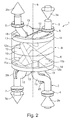
- FIG. 1 is shown in addition to the essential components of a recuperator 1 according to the invention used as part of a ventilation system on a building and the flow path of the two air streams 2 and 3.
- the reference numeral 2a is associated with the warm exhaust air flow supplied from the building and the reference numeral 3a is associated with the cold air flow supplied from the outside.
- the cooled exhaust air flow 2b is discharged to the environment, while the heated supply air flow 3b is led into the building interior (winter operation).
- the supplied first air flow 2a enters the recuperator 1 through a first connection 4 and out of the recuperator 1 through a second connection 5.
- the second air flow 3a is guided through a third connection 6 into the recuperator 1 and out of the recuperator 1 through a fourth connection 7.
- a circular cylindrical drum 8 is arranged, which can be rotated by a drive means not shown here about a vertically mounted here rotation axis 9.
- the central heat exchanger 10 with the plurality of separate from each other by heat-conducting walls channels of the two channel groups 11 and 12, which are flowed through opposite to each other.
- the entirety of the individual channels of the first channel group 11 and the entirety of the individual channels of the second channel group 12 are in the FIGS. 1 . 2 and 5 but each indicated only by a single obliquely oriented to the rotation axis 9 strips.
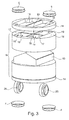
- the drum 8 is mounted axially between two relative to the recuperator 1 stationary disc-shaped bearing elements 14 and sealed against the front side.
- each bearing element 14 two large, angularly executed passage openings 15 are formed, which are connected on the side facing away from the drum 8 via further line spaces in Rekuperatorgephaseuse with one of the four ports 4, 5, 6, 7 of the recuperator 1.
- Each of the two through openings 15, which are offset relative to each other with respect to the axis of rotation 7 by an angle of 180 °, is thereby flowed through by two partial streams 13.
- the running in the central heat exchanger 10 channels of the two channel groups 11 and 12 open at both end regions in each case in a frontally open plenum 16, which is divided by a central partition 17 into two equal subspaces.
- This partition 17 extends from the heat exchanger 10 to the respective end face 18 of the drum 8, so that in the end face 18 a total of four rectangular openings 19 are formed, which are offset relative to each other by 90 °. Through each of these four partial openings 19, one of the four partial streams 13 passes through.
- the four partial openings 19 are in the in FIG. 1 shown first drum position A in each case a partial region of the passage opening 15 in the respectively associated contact surface of the bearing element 14 opposite. After a rotation of the drum 8 by 90 °, each partial opening 19 of the drum 8 is opposite to a different partial area of the same or the other through-opening 15 in a bearing element 14.
- drum position A which also FIG. 4a corresponds, the first air flow 2 flows through the channel group 11, while the second air flow 3 flows through the channel group 12.
- second drum position B After a rotation D of the drum 8 (FIG. Figures 4b and 4c ) by 180 ° in the in Figures 2 and FIG. 4d shown second drum position B flow both air streams 2, 3 through the respective other channel group 12, 11, wherein each channel of the groups 11, 12 also in the reverse direction of the respective other air stream 3, 2 flows through.
- moisture of the discharged air stream 2 which condenses during the drum position A in the channels of the group 11, evaporate after switching the drum 8 to the drum position B in the air stream 3, which is now fed through the channels of the group 11, so that the moisture is returned to the building interior.
- the drum position A corresponds to a first operating position of the recuperator 1 in which the first end portion 11a of the first group 11 of channels is conductively connected to the first terminal 4 and the second end portion 11b of this first group 11 of channels is connected to the second terminal 5 the first end portion 12a of the second group 12 of channels is connected to the third terminal 6 and the second end portion 12b of this second group 12 of channels is connected to the fourth terminal 7.
- the drum position B corresponds to a second operating position of the recuperator 1 in which the first end portion 11a of the first group 11 of channels is conductively connected to the fourth terminal 7 and the second end portion 11b of this first group 11 of channels is connected to the third terminal 6, during the first end region 12a the second group 12 of channels is connected to the second terminal 5 and the second end area 12b of this second group 12 of channels is connected to the first terminal 4.
- two fans 20 are provided, which are each arranged inside the building.
- the fan 20 for the air flow 2a discharged from the building is located between the drum 8 and the first port 4, while the fan 20 for the building air supply 3b is mounted between the drum 8 and the fourth port 7.
- FIG. 5 an intermediate position C is shown, in which the drum 8 is rotated by only 90 ° with respect to the two drum positions A and B.
- One of the two partial streams 13 is thereby guided through half of all channels of the first channel group 11, while the associated second partial stream 13 flows through half of all channels of the second channel group 12. Since in this case the channels of the two channel groups 11 and 12 are only flowed through by two part streams 13 one and the same air flow 2 or 3, takes place in the central heat exchanger 10 no heat transfer from the warmer air flow 2 to the colder air flow 3.
- This intermediate position C thus provides a Bypass function, which is made possible in a particularly simple manner without additional lines or valves.
Landscapes
- Engineering & Computer Science (AREA)
- Mechanical Engineering (AREA)
- General Engineering & Computer Science (AREA)
- Chemical & Material Sciences (AREA)
- Combustion & Propulsion (AREA)
- Physics & Mathematics (AREA)
- Thermal Sciences (AREA)
- Heat-Exchange Devices With Radiators And Conduit Assemblies (AREA)
- Air Supply (AREA)
Abstract
- mindestens einen ersten Anschluss (4), durch den der erste Gasstrom (2) dem Rekuperator (1) zuführbar ist,
- mindestens einen zweiten Anschluss (5), durch den der erste Gasstrom (2) aus dem Rekuperator (1) abführbar ist,
- mindestens einen dritten Anschluss (6), durch den der zweite Gasstrom (3) dem Rekuperator (1) zuführbar ist,
- mindestens einen vierten Anschluss (7), durch den der zweite Gasstrom (3) aus dem Rekuperator (1) abführbar ist,
- eine erste Gruppe (11) von Kanälen mit zwei Endbereichen (11a, 11 b), wobei in einer ersten Betriebsposition der erste Endbereich (11a) mit dem ersten Anschluss (4) und der zweite Endbereich (11 b) mit dem zweiten Anschluss (5) verbunden ist, und wobei in einer zweiten Betriebsposition der erste Endbereich (11a) mit dem vierten Anschluss (7) und der zweite Endbereich (11 b) mit dem dritten Anschluss (6) verbunden ist,
- eine zweite Gruppe (12) von Kanälen mit zwei Endbereichen (12a, 12b), wobei in einer ersten Betriebsposition der erste Endbereich (12a) mit dem dritten Anschluss (6) und der zweite Endbereich (12b) mit dem vierten Anschluss (7) verbunden ist, und wobei in einer zweiten Betriebsposition der erste Endbereich (12a) mit dem zweiten Anschluss (5) und der zweite Endbereich (12b) mit dem ersten Anschluss (4) verbunden ist,
- und Umschaltmittel mit einer um eine Rotationsachse (9) drehbar gelagerten Trommel (8), in welcher die erste Gruppe von Kanälen (11) und die zweite Gruppe von Kanälen (12) verlaufen, und die in eine erste Trommelposition (A), die der ersten Betriebsposition der Gruppen von Kanälen (11, 12) entspricht, sowie in eine zweite Trommelposition (B), die der zweiten Betriebsposition der Gruppen von Kanälen (11, 12) entspricht, gedreht werden kann.
Description
- Die vorliegende Erfindung betrifft einen Rekuperator nach dem Oberbegriff von Anspruch 1. Derartige Rekuperatoren, die für die beiden Gasströme durch wärmedurchlässige Wände voneinander getrennte Räume bzw. Kanäle aufweisen, dienen dazu, thermische Energie, die sowohl als fühlbare als auch als latente Wärme vorliegen kann, von einem warmen Gasstrom auf einen kalten Gasstrom zu übertragen.
- Ein bevorzugtes Einsatzgebiet dieser Rekuperatoren bilden dabei Lüftungssysteme für Gebäude, die Außenluft zur Belüftung des Gebäudes ansaugen und Abluft aus dem Gebäude nach außen abführen. Da die Abluft in der Regel wärmer ist als die zugeführte Außenluft, dient der Rekuperator zur Wärmerückgewinnung, indem zumindest ein Teil der Wärme des abgeführten Luftstroms zur Erwärmung des zugeführten Kaltluftstroms genutzt wird (Winterbetrieb). Ferner können derartige Rekuperatoren bei höheren Außentemperaturen auch zur Kühlung von Gebäuden beitragen, indem zumindest ein Teil der Wärme der zur Belüftung des Gebäudes angesaugten Außenluft dann auf die aus dem Gebäude nach außen abgeführte Abluft übertragen wird (Sommerbetrieb).
- Bei herkömmlichen Rekuperatoren wird mit der Abluft auch die darin enthaltene Feuchtigkeit aus dem Gebäude abgeführt, was insbesondere im Winter bei trockener Außenluft zu einem Absinken der relativen Luftfeuchtigkeit im Gebäude führt. Da dies mit Nachteilen für das Wohlbefinden und die Gesundheit von Gebäudebewohnern sowie mit Beschädigungen von Einrichtungen insbesondere aus Holz verbunden ist, sind entgegenwirkende Maßnahmen wie der beispielsweise der Einsatz von Luftbefeuchtern bekannt, die aber mit weiteren Nachteilen wie zusätzlichem Energieverbrauch einhergehen.
- Aus der
EP 1 485 657 B1 bzw. der entsprechendenDE 603 04 321 T2 , von der die vorliegende Erfindung im Oberbegriff von Anspruch 1 ausgeht, ist ein Wärme-Rekuperator bekannt, der sowohl fühlbare als auch latente Wärme übertragen kann und dabei auch eine Regelung des Feuchte-Austauschs ermöglicht. Dazu werden die beiden Luftströme abwechselnd durch zwei Gruppen von Kanälen des Rekuperators geleitet, so dass die Feuchtigkeit, die während des Abführens aus dem Gebäude in einer Kanalgruppe kondensiert, bei einer anschließenden Verwendung dieser Kanalgruppe für die zuströmende Außenluft wieder verdampft und hierdurch mit dem zugeführten Luftstrom wieder in das Gebäude hineingelangt. - Auf diese Weise kann im Winter das nachteilige Absinken und im Sommer das ebenfalls nachteilige Ansteigen der relativen Luftfeuchtigkeit im Gebäude verhindert oder zumindest reduziert werden.
- Außerdem kann hierdurch im Winter auch ein Frostschutz realisiert werden, der bei sehr geringen Außentemperaturen das Zufrieren des Rekuperators durch Eisbildung infolge der kondensierten Feuchtigkeit verhindert.
- Jede Gruppe von Kanälen des Rekuperators ist in an sich von Wärmetauschern bekannter Weise jeweils durch eine Vielzahl von sehr kleinen Kanälen gebildet, um die bei der Wärmeübertragung wirksame Kanal-Oberfläche entsprechend zu vergrößern.
- Um beim Betrieb des Rekuperators in den beiden sich abwechselnden Betriebspositionen die abwechselnde Leitung der Luftströme durch die Kanäle zu erreichen, werden allerdings Umschaltmittel benötigt, die hier eine Mehrzahl von Ventilen umfassen, welche zwischen den vier Anschlüssen und den Kanälen angeordnet sind. Hierdurch ergibt sich ein relativ komplexer Aufbau mit verschiedenen Ventilklappen und mehreren Stellantrieben. Schon beim Ausfall nur eines Antriebsorgans kann die Funktion des Rekuperators beeinträchtigt sein. Außerdem können die Ventilklappen auch im geöffneten Zustand noch ein Hindernis für die Luftströme darstellen.
- Aufgabe der vorliegenden Erfindung ist es daher, einen preiswert herzustellenden Rekuperator der eingangs genannten Art zu schaffen, der eine einfache Konstruktion und eine hohe Zuverlässigkeit aufweist.
- Diese Aufgabe wird erfindungsgemäß durch einen Rekuperator nach Anspruch 1 gelöst. Vorteilhafte Ausgestaltungen und Weiterbildungen der Erfindung ergeben sich aus den abhängigen Ansprüchen.
- Wesentlich bei der erfindungsgemäßen Lösung ist es, dass die Umschaltmittel eine um eine Rotationsachse drehbar gelagerte Trommel umfassen, in welcher die erste Gruppe von Kanälen und die zweite Gruppe von Kanälen verlaufen, wobei die Trommel sowohl in eine erste Trommelposition positionierbar ist, die der ersten Betriebsposition der beiden Gruppen von Kanälen entspricht, als auch in eine zweite Trommelposition positionierbar ist, die der zweiten Betriebsposition der beiden Gruppen von Kanälen entspricht.
- Es werden dabei also die beiden Gruppen von Kanälen des Rekuperators relativ zu den übrigen Komponenten des Rekuperators in ihrer räumlichen Lage verstellt. So können die beiden Gruppen von Kanälen an beiden Endbereichen jeweils abwechselnd mit verschiedenen der vier Anschlüsse des Rekuperators verbunden werden, welche dem Zuführen und Abführen der beiden Luftströme dienen. Beide Gruppen von Kanälen können so abwechselnd von einem der beiden Gasströme und/oder in wechselnder Richtung durchströmt werden.
- Der Hauptvorteil liegt dabei darin, dass nur eine einzige Verstellbewegung und somit auch nur ein einziger Stellantrieb für die Umschaltmittel erforderlich ist. Hierdurch wird nicht nur die Konstruktion, sondern insbesondere auch die Steuerung des Gerätes vereinfacht. Außerdem wird auch die Fehleranfälligkeit erheblich reduziert, was zu einer höheren Betriebssicherheit führt.
- Auf diese konstruktiv besonders einfache Bauweise wird zudem ein Rekuperator geschaffen, der nicht nur besonders kostengünstig herstellbar ist, sondern der auch leicht zu montieren und zu warten und insgesamt einfach handzuhaben ist.
- Dabei bleiben die weiteren Vorteile eines der
EP 1 485 657 B1 entsprechenden Rekuperators erhalten. So ermöglicht der erfindungsgemäße Rekuperator insbesondere eine gute und hochgenaue Regelbarkeit der Feuchtigkeit des Raumklimas im Gebäudeinneren sowie einen integrierten Frostschutz, der das Einfrieren des Rekuperators auch bei Außentemperaturen unter dem Gefrierpunkt verhindert. - Von Vorteil ist es, wenn die erste Trommelposition gegenüber der zweiten Trommelposition um einen Winkel von 180° verdreht ist. Dadurch wird sowohl eine Vertauschung der beiden Kanalgruppen für die beiden Gasströme als auch eine Umkehr der Strömungsrichtung in jeder Kanalgruppe erreicht, wodurch die Vorteile des erfindungsgemäßen Rekuperators besonders stark wirksam werden. Vorteilhafterweise ist die Trommel dabei bezüglich ihrer Rotationsachse achsensymmetrisch ausgebildet.
- Besonders vorteilhaft ist es ferner, wenn die Trommel in jeder Stirnseite jeweils mindestens zwei voneinander getrennte Öffnungen aufweist, die gleichmäßig über den Kreisumfang verteilt sind. Dabei sind die sich hierbei in beiden Stirnseiten insgesamt ergebenden vier Öffnungen jeweils mit einem der beiden Endbereiche von einer der beiden Kanalgruppen verbunden. Die beiden Gruppen von Kanälen münden also mit ihren Endbereichen in den Stirnseiten der Trommel.
- Günstig ist es dabei, wenn die in den Stirnseiten der Trommel angeordneten Öffnungen jeweils über einen in dem Gehäuse der Trommel ausgebildeten und einen Gasstrom leitenden Sammelraum mit einem Endbereich einer Gruppe von Kanälen verbunden sind. Die beiden Gruppen von Kanälen münden auf diese Weise also jeweils mittelbar in den Stirnseiten der Trommel.
- Gemäß einer besonders bevorzugten Ausführungsform der Erfindung wird vorgeschlagen, die Trommel in axialer Richtung zwischen zwei ortsfesten und insbesondere scheibenförmig ausgebildeten Lagerelementen zu lagern und diesen gegenüber stirnseitig abzudichten. Jedes Lagerelement weist dabei zur Durchführung der Gasströme zwei Leitungsstücke oder Durchgangsöffnungen auf, die auf der von der Trommel angewandten Seite über weitere Leitungselemente oder über als Leitung dienende Innenräume des Rekuperatorgehäuses mit jeweils einem der vier Anschlüsse des Rekuperators verbunden sind. Die zwei Leitungsstücke oder Durchgangsöffnungen in jedem Lagerelement sind dabei um einen Verdrehwinkel von 180° zueinander versetzt. Die Drehachse der vorzugsweise kreiszylindrisch ausgebildeten Trommel verläuft dabei senkrecht zu den Kontaktflächen der beiden Lagerelemente.
- Besonders vorteilhaft ist es dabei, wenn die mindestens zwei in den Stirnseiten der Trommel vorgesehenen Öffnungen und die zwei in jedem Lagerelement ausgebildeten Durchgangsöffnungen zumindest größtenteils miteinander fluchten, wenn sich die Trommel in einer der beiden Trommelpositionen befindet, die der ersten und der zweiten Betriebsposition der beiden Gruppen von Kanälen entsprechen.
- Nach einer weiteren besonders bevorzugten Ausführungsform der Erfindung ist vorgesehen, dass jede stirnseitige Öffnung der Trommel und der jeweils hinter der Stirnseite liegende, mit dieser Öffnung verbundene Sammelraum der Trommel durch ein vorzugsweise wandförmiges Trennelement in jeweils zwei Teilbereiche unterteilt wird. Auf diese Weise ergeben sich dann in jeder Stirnseite jeweils mindestens vier Öffnungen oder Teilöffnungen, die gleichmäßig über den Kreisumfang verteilt angeordnet sind.
- Besonders vorteilhaft ist es dabei, wenn die Trommel zusätzlich auch in mindestens eine dritte Trommelposition verstellt werden kann, die gegenüber der ersten und zweiten Trommelposition jeweils um einen Verdrehwinkel von 90° versetzt ist. Auch in dieser dritten Position liegen dann wieder alle vier in den Stirnseiten der Trommel ausgebildeten Öffnungen bzw. Teilöffnungen an jeweils einem entsprechenden Öffnungsquerschnitt der gegenüberliegenden Kontaktfläche des Lagerelements an.
- Jeder der beiden Gasströme wird bei dieser Trommelposition in oder vor dem ersten Lagerelement in zwei Teilströme aufgeteilt, von denen ein Teilstrom durch die Hälfte aller Kanäle der ersten Kanalgruppe geführt wird, während der andere Teilstrom durch die Hälfte aller Kanäle der zweiten Kanalgruppe strömt. In oder hinter dem zweiten Lagerelement werden die beiden Teilströme dann wieder zusammengeführt. Insgesamt gibt es hierbei keinen wärmeübertragenden Kontakt mit dem anderen Gasstrom. Auf diese Weise kann somit eine besonders einfache Bypass-Funktion realisiert werden, die weder eine zusätzliche Leitung noch zusätzliche Ventile benötigt.
- Gemäß einer alternativen Ausführungsform der Erfindung kann die Trommel auch kreiszylinderförmig ausgebildet und in einer Bohrung eines feststehenden Aufnahmeelements gelagert sein, wobei die in der Trommel verlaufenden Kanäle über Öffnungspaare, die jeweils in der Mantelfläche der Trommel und in der Wandfläche der die Trommel umgebenden Bohrung des Aufnahmeelements vorgesehen sind, mit Strömungsleitungen verbunden werden können, welche mit jeweils einem Anschluss des Rekuperators verbunden sind. Die einzelnen Kanäle verlaufen hierbei jeweils in einer zumindest im Wesentlichen senkrecht zur Drehachse der Trommel liegenden Ebene.
- Eine besonders einfache Steuerung des erfindungsgemäßen Rekuperators kann dadurch erreicht werden, dass Steuermittel vorgesehen sind, durch die die Trommel in Abhängigkeit von einer fest vorgegebenen oder frei einstellbaren Zeitdauer mittels eines Verstellmotors verdreht wird. So kann beispielsweise alle 10 oder 30 Minuten die Trommelposition verstellt werden, um die Durchströmungen der Kanäle zu vertauschen.
- Eine besonders gute Regelbarkeit des Raumklimas im Gebäude kann außerdem dadurch erreicht werden, dass Steuermittel oder Regelmittel vorgesehen sind, durch die die Umschaltmittel in Abhängigkeit von mindestens einem durch entsprechende Messmittel erfassbaren Parameter automatisch betätigt werden. So kann beispielsweise die Temperatur und/oder ein absoluter oder relativer Luftfeuchtigkeitswert gemessen werden und beim Erreichen vorgegebener oder einstellbarer Grenzwerte die Trommel mittels eines Verstellmotors entsprechend verdreht werden.
- Besonders vorteilhaft ist es, wenn dem ersten oder zweiten Anschluss ein erster Ventilator und dem dritten oder vierten Anschluss ein zweiter Ventilator zugeordnet ist. So ist die Strömung der beiden Gasströme jeweils in der gewünschten Weise einstellbar.
- Wenn der erfindungsgemäße Rekuperator dabei als Bestandteil eines Lüftungssystems an einem Gebäude eingesetzt wird, ist es besonders vorteilhaft, wenn ein Ventilator zwischen der Trommel und dem gebäudeseitigen Einlass und der zweite Ventilator zwischen der Trommel und dem gebäudeseitigen Auslass angeordnet ist, da auf diese Weise die Energieverluste der Ventilatoren dem Gebäude zugeführt werden können.
- Die vorliegende Erfindung betrifft auch ein entsprechendes Verfahren zum Betrieb eines Rekuperators, welcher insbesondere nach dem Oberbegriff von Anspruch 1 ausgebildet ist. Wesentlich bei diesem Verfahren ist, dass die Gruppen von Kanälen zwischen den Anschlüssen intermittierend derart um eine gemeinsame Rotationsachse gedreht werden, dass sie an ihren beiden Endbereichen abwechselnd mit jeweils einem von mindestens zwei verschiedenen Anschlüssen verbunden sind.
- Hierdurch kann auf besonders einfache Weise ein hoher Wirkungsgrad des Rekuperators erreicht werden, der sowohl die fühlbare als auch die latente Wärme ausnützt. Auch kann die Feuchtigkeit der im Inneren eines Gebäudes mit diesem Verfahren besonders gut und genau geregelt werden und es wird auch im Winter stets ein frostgeschützter Betrieb des Rekuperators ermöglicht.
- Weitere Vorteile und Merkmale der Erfindung ergeben sich aus der nachfolgenden Beschreibung und den in den Zeichnungen dargestellten Ausführungsbeispielen. Es zeigen:
- Figur 1:
- eine schematische Darstellung einer ersten Ausführungsvariante eines erfindungsgemäßen Rekuperators in einer ersten Trommelposition,
- Figur 2:
- schematische Darstellung des Rekuperators aus
Figur 1 in einer zweiten Trommelposition, - Figur 3:
- vergrößerte und teilweise auseinander gezogene Darstellung des Trommelbereichs aus
Figur 1 , - Figur 4a-4d:
- schematische Darstellung der Verstellung der Trommel des Rekuperators aus
Figur 1 , und - Figur 5:
- schematische Darstellung einer Bypass-Position des Rekuperators aus
Figur 1 . - In
Figur 1 ist neben den wesentlichen Bestandteilen eines als Bestandteil einer Lüftungsanlage an einem Gebäude eingesetzten erfindungsgemäßen Rekuperators 1 auch der Strömungsweg der beiden Luftströme 2 und 3 dargestellt. Dabei ist das Bezugszeichen 2a dem warmen aus dem Gebäude zugeführten Abluftstrom und das Bezugszeichen 3a dem kalten von außen zugeführten Luftstrom zugeordnet. Nach dem Passieren des Rekuperators 1 wird der abgekühlte Abluftstrom 2b an die Umgebung abgegeben, während der erwärmte Zuluftstrom 3b in das Gebäudeinnere geführt wird (Winterbetrieb). - Dabei tritt der zugeführte erste Luftstrom 2a durch einen ersten Anschluss 4 in den Rekuperator 1 ein und durch einen zweiten Anschluss 5 wieder aus dem Rekuperator 1 aus. In entsprechender Weise wird der zweite Luftstrom 3a durch einen dritten Anschluss 6 in den Rekuperator 1 hinein und durch einen vierten Anschluss 7 wieder aus dem Rekuperator 1 heraus geführt.
- Zwischen diesen vier Anschlüssen 4, 5, 6, 7 ist eine kreiszylinderförmige Trommel 8 angeordnet, die von einem hier nicht näher dargestellten Antriebsmittel um eine hier vertikal gelagerte Rotationsachse 9 gedreht werden kann. Im Inneren der Trommel 8 befinden sich der zentrale Wärmetauscher 10 mit der Vielzahl der voneinander durch wärmeleitende Wände getrennten Kanälen der beiden Kanalgruppen 11 und 12, die einander entgegengerichtet durchströmt werden. Die Gesamtheit der einzelnen Kanäle der ersten Kanalgruppe 11 und die Gesamtheit der einzelnen Kanäle der zweiten Kanalgruppe 12 sind in den
Figuren 1 ,2 und5 aber jeweils nur durch einen einzigen schräg zur Rotationsachse 9 orientierten Streifen angedeutet. - In dem dargestellten Ausführungsbeispiel werden die beiden zugeführten Luftströme 2a und 3a zwischen den Anschlüssen 4, 6 und der Trommel 8 in Leitungsräumen, die in dem hier nicht dargestellten Gehäuse des Rekuperators 1 vorgesehen sind, in jeweils zwei Teilströme 13 aufgeteilt, welche nach dem Durchströmen der Trommel 8 vor den beiden Anschlüssen 5 und 7 in entsprechenden Sammelräumen des Rekuperators 1 wieder zu jeweils einem Abluftstrom 2b, 3b zusammengeführt werden.
- Die Trommel 8 ist axial zwischen zwei relativ zum Rekuperator 1 ortsfesten scheibenförmigen Lagerelementen 14 gelagert und diesen gegenüber stirnseitig abgedichtet. In jedem Lagerelement 14 sind zwei große, eckig ausgeführte Durchgangsöffnungen 15 ausgebildet auf, die auf der von der Trommel 8 abgewandten Seite über weitere Leitungsräume im Rekuperatorgehäuse mit jeweils einem der vier Anschlüsse 4, 5, 6, 7 des Rekuperators 1 verbunden sind. Jede der beiden Durchgangsöffnungen 15, die relativ zueinander bezüglich der Rotationsachse 7 um einen Winkel von um 180° versetzt sind, wird dabei von zwei Teilströmen 13 durchströmt.
- Die in dem zentralen Wärmetauscher 10 verlaufenden Kanäle der beiden Kanalgruppen 11 und 12 münden an beiden Endbereichen jeweils in einen stirnseitig offenen Sammelraum 16, der durch eine mittige Trennwand 17 in zwei gleichgroße Teilräume unterteilt ist. Diese Trennwand 17 erstreckt sich von dem Wärmetauscher 10 bis zu der jeweiligen Stirnseite 18 der Trommel 8, so dass in der Stirnseite 18 insgesamt vier rechteckige Öffnungen 19 ausgebildet sind, die relativ zueinander um jeweils 90° versetzt sind. Durch jede dieser vier Teilöffnungen 19 geht einer der insgesamt vier Teilströme 13 hindurch.
- Die vier Teilöffnungen 19 liegen in der in
Figur 1 dargestellten ersten Trommelposition A jeweils einem Teilbereich der Durchgangsöffnung 15 in der jeweils zugehörigen Anlagefläche des Lagerelements 14 gegenüber. Nach einer Drehung der Trommel 8 um 90° liegt jede Teilöffnung 19 der Trommel 8 einem anderen Teilbereich der gleichen oder der anderen Durchgangsöffnung 15 in einem Lagerelement 14 gegenüber. - In der in
Figur 1 dargestellten Trommelposition A, die auchFigur 4a entspricht, strömt der erste Luftstrom 2 durch die Kanalgruppe 11, während der zweite Luftstrom 3 durch die Kanalgruppe 12 strömt. Nach einer Drehung D der Trommel 8 (Figuren 4b und 4c ) um 180° in die in denFiguren 2 undFigur 4d dargestellte zweite Trommelposition B strömen beide Luftströme 2, 3 durch die jeweils andere Kanalgruppe 12, 11, wobei jeder Kanal der Gruppen 11, 12 auch noch in umgekehrter Richtung von dem jeweils anderen Luftstrom 3, 2 durchströmt wird. Auf diese Weise kann Feuchtigkeit des abgeführten Luftstroms 2, die während der Trommelposition A in den Kanälen der Gruppe 11 kondensiert, nach einer Umschaltung der Trommel 8 in die Trommelposition B in den Luftstrom 3 verdampfen, der nun durch die Kanäle der Gruppe 11 zugeführt wird, so dass die Feuchtigkeit wieder in das Gebäudeinnere zurückgeführt wird. - Die Trommelposition A entspricht einer ersten Betriebsposition des Rekuperators 1, in welcher der erste Endbereich 11a der ersten Gruppe 11 von Kanälen leitungsmäßig mit dem ersten Anschluss 4 und der zweite Endbereich 11 b dieser ersten Gruppe 11 von Kanälen mit dem zweiten Anschluss 5 verbunden ist, während der erste Endbereich 12a der zweiten Gruppe 12 von Kanälen mit dem dritten Anschluss 6 und der zweite Endbereich 12b dieser zweiten Gruppe 12 von Kanälen mit dem vierten Anschluss 7 verbunden ist.
- Demgegenüber entspricht die Trommelposition B einer zweiten Betriebsposition des Rekuperators 1, in welcher der erste Endbereich 11a der ersten Gruppe 11 von Kanälen leitungsmäßig mit dem vierten Anschluss 7 und der zweite Endbereich 11 b dieser ersten Gruppe 11 von Kanälen mit dem dritten Anschluss 6 verbunden ist, während der erste Endbereich 12a der zweiten Gruppe 12 von Kanälen mit dem zweiten Anschluss 5 und der zweite Endbereich 12b dieser zweiten Gruppe 12 von Kanälen mit dem ersten Anschluss 4 verbunden ist.
- Zur Förderung der Luftströme 2 und 3 sind zwei Ventilatoren 20 vorgesehen, die jeweils gebäudeinnenseitig angeordnet sind. So befindet sich der Ventilator 20 für den aus dem Gebäude abgeführten Luftstrom 2a zwischen der Trommel 8 und dem ersten Anschluss 4, während der Ventilator 20 für den dem Gebäude zugeführten Luftstrom 3b zwischen der Trommel 8 und dem vierten Anschluss 7 angebracht ist.
- In
Figur 5 ist eine Zwischenposition C dargestellt, in der die Trommel 8 nur um 90° gegenüber den beiden Trommelpositionen A und B verdreht ist. Einer der beiden Teilströme 13 wird dabei durch die Hälfte aller Kanäle der ersten Kanalgruppe 11 geführt, während der zugehörige zweite Teilstrom 13 durch die Hälfte aller Kanäle der zweiten Kanalgruppe 12 strömt. Da hierbei die Kanäle der beiden Kanalgruppen 11 und 12 nur von zwei Teilströmen 13 ein und desselben Luftstroms 2 oder 3 durchströmt werden, erfolgt in dem zentralen Wärmetauscher 10 kein Wärmeübergang von dem wärmeren Luftstrom 2 auf den kälteren Luftstrom 3. Diese Zwischenposition C stellt somit eine Bypass-Funktion bereit, die auf besonders einfache Weise ohne zusätzliche Leitungen oder Ventile ermöglicht wird.
Claims (14)
- Rekuperator (1) zur Übertragung von thermischer Energie von einem ersten Gasstrom (2) zu einem zweiten Gasstrom (3), umfassend:- mindestens einen ersten Anschluss (4), durch den der erste Gasstrom (2) dem Rekuperator (1) zuführbar ist,- mindestens einen zweiten Anschluss (5), durch den der erste Gasstrom (2) aus dem Rekuperator (1) abführbar ist,- mindestens einen dritten Anschluss (6), durch den der zweite Gasstrom (3) dem Rekuperator (1) zuführbar ist,- mindestens einen vierten Anschluss (7), durch den der zweite Gasstrom (3) aus dem Rekuperator (1) abführbar ist,- eine erste Gruppe (11) von Kanälen mit zwei Endbereichen (11a, 11 b), wobei in einer ersten Betriebsposition der erste Endbereich (11a) mit dem ersten Anschluss (4) und der zweite Endbereich (11b) mit dem zweiten Anschluss (5) verbunden ist, und wobei in einer zweiten Betriebsposition der erste Endbereich (11a) mit dem vierten Anschluss (7) und der zweite Endbereich (11 b) mit dem dritten Anschluss (6) verbunden ist,- eine zweite Gruppe (12) von Kanälen mit zwei Endbereichen (12a, 12b), wobei in einer ersten Betriebsposition der erste Endbereich (12a) mit dem dritten Anschluss (6) und der zweite Endbereich (12b) mit dem vierten Anschluss (7) verbunden ist, und wobei in einer zweiten Betriebsposition der erste Endbereich (12a) mit dem zweiten Anschluss (5) und der zweite Endbereich (12b) mit dem ersten Anschluss (4) verbunden ist,- mindestens ein Umschaltmittel, durch welches die Gruppen (11, 12) von Kanälen jeweils von der ersten Betriebsposition in die zweite Betriebsposition oder umgekehrt umschaltbar sind,
dadurch gekennzeichnet,
dass die Umschaltmittel eine um eine Rotationsachse (9) drehbar gelagerte Trommel (8) umfassen, in welcher die erste Gruppe von Kanälen (11) und die zweite Gruppe von Kanälen (12) verlaufen,
wobei die Trommel (8) in eine erste Trommelposition (A) drehbar ist, die der ersten Betriebsposition der Gruppen von Kanälen (11, 12) entspricht,
und wobei die Trommel (8) in eine zweite Trommelposition (B) drehbar ist, die der zweiten Betriebsposition der Gruppen von Kanälen (11, 12) entspricht. - Rekuperator (1) nach Anspruch 1,dadurch gekennzeichnet, dass die erste Trommelposition (A) gegenüber der zweiten Trommelposition (B) um einen Verdrehwinkel von 180° versetzt ist.
- Rekuperator (1) nach Anspruch 1 oder 2, dadurch gekennzeichnet, dass die Trommel (8) in jeder Stirnseite (18) jeweils mindestens zwei Öffnungen (19) aufweist, die jeweils mit einem Endbereich (11a, 11 b, 12a, 12b) von einer der beiden Gruppen (11, 12) von Kanälen verbunden sind.
- Rekuperator (1) nach Anspruch 3, dadurch gekennzeichnet, dass die in den Stirnseiten (18) der Trommel (8) angeordneten Öffnungen (19) jeweils über einen im Inneren der Trommel (8) ausgebildeten Sammelraum (16) mit einem Endbereich (11a, 11 b, 12a, 12b) einer Gruppe (11, 12) von Kanälen verbunden sind.
- Rekuperator (1) nach Anspruch 3 oder 4, dadurch gekennzeichnet, dass die Trommel (8) in axialer Richtung zwischen zwei relativ zum Rekuperator (1) feststehenden Lagerelementen (14) gelagert und diesen gegenüber stirnseitig abgedichtet ist, wobei die Lagerelemente (14) jeweils zwei Durchgangsöffnungen (15) aufweisen, die über Leitungselemente mit jeweils einem Anschluss (4, 5, 6, 7) des Rekuperators (1) verbunden sind.
- Rekuperator (1) nach Anspruch 5, dadurch gekennzeichnet, dass die mindestens zwei stirnseitigen Öffnungen (19) der Trommel (8) und die zwei Durchgangsöffnungen (15) der beiden Lagerelemente (14) in den beiden Trommelpositionen (A, B) zumindest zu einem überwiegenden Teil miteinander fluchten.
- Rekuperator (1) nach einem der Ansprüche 3 bis 6, dadurch ge- kennzeichnet, dass die stirnseitigen Öffnungen (19) der Trommel (8) und die hiermit verbundenen Sammelräume (16) durch zumindest ein Trennelement (17) derart in jeweils mindestens zwei Teilbereiche unterteilt sind, dass in jeder Stirnseite (18) jeweils mindestens vier Öffnungen (19) ausgebildet sind.
- Rekuperator (1) nach Anspruch 7, dadurch gekennzeichnet, dass die Trommel (8) in mindestens eine dritte Trommelposition (C) verstellbar ist, die gegenüber der ersten und zweiten Trommelposition (A, B) jeweils um einen Verdrehwinkel von 90° versetzt ist.
- Rekuperator (1) nach Anspruch 1,dadurch gekennzeichnet, dass die Trommel (8) kreiszylinderförmig ausgebildet und in einer Bohrung eines feststehenden Aufnahmeelements gelagert ist, wobei die in der Trommel (8) verlaufenden Gruppen (11, 12) von Kanälen über Öffnungspaare, die jeweils in der Mantelfläche der Trommel (8) und der diese umgebenden Wandfläche der Bohrung des Aufnahmeelements vorgesehen sind, mit Strömungsleitungen verbindbar sind, welche zu jeweils einem Anschluss des Rekuperators (1) führen.
- Rekuperator (1) nach einem der vorherigen Ansprüche, dadurch gekennzeichnet, dass Steuermittel vorgesehen sind, durch die die Umschaltmittel in Abhängigkeit von einer vorgegebenen oder einstellbaren Zeitdauer betätigbar sind.
- Rekuperator (1) nach einem der vorherigen Ansprüche, dadurch gekennzeichnet, dass Steuermittel oder Regeimittel vorgesehen sind, durch die die Umschaltmittel in Abhängigkeit von mindestens einem durch Messmittel erfassbaren Parameter betätigbar sind.
- Rekuperator (1) nach einem der vorherigen Ansprüche, dadurch gekennzeichnet, dass dem ersten oder zweiten Anschluss (4, 5) ein erster Ventilator (20) zugeordnet ist, und dass dem dritten oder vierten Anschluss (6, 7) ein zweiter Ventilator (20) zugeordnet ist.
- Rekuperator (1) nach Anspruch 12, dadurch gekennzeichnet, dass er als Bestandteil eines Lüftungssystems an einem Gebäude eingesetzt ist, wobei ein Ventilator (20) zwischen der Trommel (8) und dem Anschluss (4) des gebäudeseitigen Einlasses und der zweite Ventilator (20) zwischen der Trommel (8) und dem Anschluss (7) des gebäudeseitigen Auslasses angeordnet ist.
- Verfahren zum Betrieb eines Rekuperators (1), der für die Übertragung von thermischer Energie von einem ersten Gasstrom (2) zu einem zweiten Gasstrom (3) mindestens vier Anschlüsse (4, 5, 6, 7) zum Zuführen und Abführen der beiden Gasströme (2, 3) sowie zwischen diesen Anschlüssen (4, 5, 6, 7) angeordnete Gruppen (11, 12) von Kanälen umfasst,
dadurch gekennzeichnet,
dass die Gruppen (11, 12) von Kanälen zwischen den Anschlüssen (4, 5, 6, 7) intermittierend derart um eine gemeinsame Rotationsachse (9) gedreht werden, dass sie an beiden Seiten abwechselnd mit jeweils einem von mindestens zwei verschiedenen Anschlüssen (4, 7 - 6, 5) verbunden sind.
Applications Claiming Priority (1)
| Application Number | Priority Date | Filing Date | Title |
|---|---|---|---|
| DE102014102640.3A DE102014102640A1 (de) | 2014-02-27 | 2014-02-27 | Verbesserter Rekuperator |
Publications (2)
| Publication Number | Publication Date |
|---|---|
| EP2913603A1 true EP2913603A1 (de) | 2015-09-02 |
| EP2913603B1 EP2913603B1 (de) | 2020-04-01 |
Family
ID=52669446
Family Applications (1)
| Application Number | Title | Priority Date | Filing Date |
|---|---|---|---|
| EP15157052.0A Active EP2913603B1 (de) | 2014-02-27 | 2015-02-27 | Rekuperator und Verfahren zum Betrieb eines Rekuperators |
Country Status (3)
| Country | Link |
|---|---|
| EP (1) | EP2913603B1 (de) |
| DE (1) | DE102014102640A1 (de) |
| ES (1) | ES2800607T3 (de) |
Citations (4)
| Publication number | Priority date | Publication date | Assignee | Title |
|---|---|---|---|---|
| DE19521542A1 (de) * | 1995-06-13 | 1996-12-19 | Stiebel Eltron Gmbh & Co Kg | Raumlüftungsgerät |
| WO2003098120A1 (en) * | 2002-05-21 | 2003-11-27 | Mg Innovations Corp. | An air conditioning device comprising recovery cells with inlet and exhaust ducts at both ends where the air flows are controlled by rotating deflectors |
| EP1485657B1 (de) | 2002-03-11 | 2006-03-29 | Level Holding B.V. | Wärmerekuperator mit frostschutz |
| WO2010128522A1 (en) * | 2009-05-04 | 2010-11-11 | Bry Air [Asia] Pvt. Ltd. | Desiccant unit control system and method |
Family Cites Families (4)
| Publication number | Priority date | Publication date | Assignee | Title |
|---|---|---|---|---|
| FR2319099A1 (fr) * | 1975-07-24 | 1977-02-18 | Seum Expl Usines Metallurg | Dispositif recuperateur de chaleur |
| SE508957C2 (sv) * | 1996-02-02 | 1998-11-16 | Bo Broberg | Regenerativ värmeåtervinningsenhet innefattande värmeackumulator som genom en svängningsrörelse uppvisar en spjällfunktion samt värmeåtervinningsaggregat med två ihopkopplade värmeåtervinningsenheter |
| DE19703793A1 (de) * | 1997-02-01 | 1998-08-06 | Schmelzer & Schneider Gmbh | Verfahren und Vorrichtung zur Entfeuchtung von Luft |
| US8973649B2 (en) * | 2008-12-23 | 2015-03-10 | Tai-Her Yang | Heat exchange apparatus with a rotating disk and automatic control of heat exchange between two fluid streams by modulation of disk rotating speed and/or flow rate |
-
2014
- 2014-02-27 DE DE102014102640.3A patent/DE102014102640A1/de not_active Withdrawn
-
2015
- 2015-02-27 ES ES15157052T patent/ES2800607T3/es active Active
- 2015-02-27 EP EP15157052.0A patent/EP2913603B1/de active Active
Patent Citations (5)
| Publication number | Priority date | Publication date | Assignee | Title |
|---|---|---|---|---|
| DE19521542A1 (de) * | 1995-06-13 | 1996-12-19 | Stiebel Eltron Gmbh & Co Kg | Raumlüftungsgerät |
| EP1485657B1 (de) | 2002-03-11 | 2006-03-29 | Level Holding B.V. | Wärmerekuperator mit frostschutz |
| DE60304321T2 (de) | 2002-03-11 | 2006-12-14 | Level Holding B.V. | Wärmerekuperator mit frostschutz |
| WO2003098120A1 (en) * | 2002-05-21 | 2003-11-27 | Mg Innovations Corp. | An air conditioning device comprising recovery cells with inlet and exhaust ducts at both ends where the air flows are controlled by rotating deflectors |
| WO2010128522A1 (en) * | 2009-05-04 | 2010-11-11 | Bry Air [Asia] Pvt. Ltd. | Desiccant unit control system and method |
Also Published As
| Publication number | Publication date |
|---|---|
| ES2800607T3 (es) | 2021-01-04 |
| EP2913603B1 (de) | 2020-04-01 |
| DE102014102640A1 (de) | 2015-08-27 |
Similar Documents
| Publication | Publication Date | Title |
|---|---|---|
| EP2660525A2 (de) | Belüftungsvorrichtung | |
| DE60304321T2 (de) | Wärmerekuperator mit frostschutz | |
| EP2676076A1 (de) | Raumklimagerät mit einem flüssigkeit-luft wärmeaustauschgerät mit peltierelementen | |
| EP3186853B1 (de) | Temperiereinrichtung | |
| DE102006055536A1 (de) | Drehschieber mit mehreren Querschnittsverstellgliedern | |
| DE102006006731A1 (de) | Kühlanlage | |
| DE69717420T2 (de) | Regenerative wärmerückgewinnungsanlage mit als ventil dienenden kippbaren wärmespeichern | |
| EP2976583B1 (de) | Kältegerät und luftverteilerventil dafür | |
| DE102008053554A1 (de) | Klimasystem für ein Gebäude | |
| DE202012103631U1 (de) | Vorrichtung zum wärme- und feuchtigkeitsregulierenden Belüften eines Innenraums | |
| DE102010045381A1 (de) | Wärmeaustauscher | |
| DE3224277A1 (de) | Verfahren und waermerueckgewinnungssystem zum regenerativen waermeaustausch | |
| EP4232758B1 (de) | Lüftungsvorrichtung | |
| DE102010006038B4 (de) | Vorrichtung zur Regelung eines Fluidstroms | |
| EP2913603B1 (de) | Rekuperator und Verfahren zum Betrieb eines Rekuperators | |
| DE102011051526B4 (de) | Klimatisierungseinrichtung zum Konditionieren eines Luftstroms | |
| DE10128379A1 (de) | Vorrichtung zur dezentralen Belüftung eines Raumes und Lüftungsanlage für mehrere Räume | |
| DE1604125C3 (de) | Luftaufbereitungsanlage | |
| EP3222923A1 (de) | Belüftungssystem mit wärmetauscher | |
| DE102013102347A1 (de) | Raumlufttechnische Baugruppe | |
| DE2329108C2 (de) | Doppelkanal für eine Raumbelüftungsanlage | |
| EP3192477B1 (de) | Medizinisches temperiergerät | |
| DE69417411T2 (de) | Klimaanlage und verfahren zur betriebssteuerung | |
| EP2282137B1 (de) | Wärmetauschereinheit mit Luftstromlenkungselementen | |
| DE102019008908A1 (de) | Lüftungsgerät |
Legal Events
| Date | Code | Title | Description |
|---|---|---|---|
| PUAI | Public reference made under article 153(3) epc to a published international application that has entered the european phase |
Free format text: ORIGINAL CODE: 0009012 |
|
| AK | Designated contracting states |
Kind code of ref document: A1 Designated state(s): AL AT BE BG CH CY CZ DE DK EE ES FI FR GB GR HR HU IE IS IT LI LT LU LV MC MK MT NL NO PL PT RO RS SE SI SK SM TR |
|
| AX | Request for extension of the european patent |
Extension state: BA ME |
|
| RAP1 | Party data changed (applicant data changed or rights of an application transferred) |
Owner name: VASCO GROUP NV |
|
| 17P | Request for examination filed |
Effective date: 20160225 |
|
| RBV | Designated contracting states (corrected) |
Designated state(s): AL AT BE BG CH CY CZ DE DK EE ES FI FR GB GR HR HU IE IS IT LI LT LU LV MC MK MT NL NO PL PT RO RS SE SI SK SM TR |
|
| GRAP | Despatch of communication of intention to grant a patent |
Free format text: ORIGINAL CODE: EPIDOSNIGR1 |
|
| STAA | Information on the status of an ep patent application or granted ep patent |
Free format text: STATUS: GRANT OF PATENT IS INTENDED |
|
| INTG | Intention to grant announced |
Effective date: 20191015 |
|
| GRAS | Grant fee paid |
Free format text: ORIGINAL CODE: EPIDOSNIGR3 |
|
| GRAA | (expected) grant |
Free format text: ORIGINAL CODE: 0009210 |
|
| STAA | Information on the status of an ep patent application or granted ep patent |
Free format text: STATUS: THE PATENT HAS BEEN GRANTED |
|
| AK | Designated contracting states |
Kind code of ref document: B1 Designated state(s): AL AT BE BG CH CY CZ DE DK EE ES FI FR GB GR HR HU IE IS IT LI LT LU LV MC MK MT NL NO PL PT RO RS SE SI SK SM TR |
|
| REG | Reference to a national code |
Ref country code: GB Ref legal event code: FG4D Free format text: NOT ENGLISH |
|
| REG | Reference to a national code |
Ref country code: AT Ref legal event code: REF Ref document number: 1251850 Country of ref document: AT Kind code of ref document: T Effective date: 20200415 Ref country code: CH Ref legal event code: EP |
|
| REG | Reference to a national code |
Ref country code: DE Ref legal event code: R096 Ref document number: 502015012127 Country of ref document: DE |
|
| REG | Reference to a national code |
Ref country code: IE Ref legal event code: FG4D Free format text: LANGUAGE OF EP DOCUMENT: GERMAN |
|
| REG | Reference to a national code |
Ref country code: NL Ref legal event code: FP |
|
| PG25 | Lapsed in a contracting state [announced via postgrant information from national office to epo] |
Ref country code: BG Free format text: LAPSE BECAUSE OF FAILURE TO SUBMIT A TRANSLATION OF THE DESCRIPTION OR TO PAY THE FEE WITHIN THE PRESCRIBED TIME-LIMIT Effective date: 20200701 |
|
| REG | Reference to a national code |
Ref country code: LT Ref legal event code: MG4D |
|
| PG25 | Lapsed in a contracting state [announced via postgrant information from national office to epo] |
Ref country code: PT Free format text: LAPSE BECAUSE OF FAILURE TO SUBMIT A TRANSLATION OF THE DESCRIPTION OR TO PAY THE FEE WITHIN THE PRESCRIBED TIME-LIMIT Effective date: 20200817 Ref country code: LT Free format text: LAPSE BECAUSE OF FAILURE TO SUBMIT A TRANSLATION OF THE DESCRIPTION OR TO PAY THE FEE WITHIN THE PRESCRIBED TIME-LIMIT Effective date: 20200401 Ref country code: CZ Free format text: LAPSE BECAUSE OF FAILURE TO SUBMIT A TRANSLATION OF THE DESCRIPTION OR TO PAY THE FEE WITHIN THE PRESCRIBED TIME-LIMIT Effective date: 20200401 Ref country code: SE Free format text: LAPSE BECAUSE OF FAILURE TO SUBMIT A TRANSLATION OF THE DESCRIPTION OR TO PAY THE FEE WITHIN THE PRESCRIBED TIME-LIMIT Effective date: 20200401 Ref country code: IS Free format text: LAPSE BECAUSE OF FAILURE TO SUBMIT A TRANSLATION OF THE DESCRIPTION OR TO PAY THE FEE WITHIN THE PRESCRIBED TIME-LIMIT Effective date: 20200801 Ref country code: FI Free format text: LAPSE BECAUSE OF FAILURE TO SUBMIT A TRANSLATION OF THE DESCRIPTION OR TO PAY THE FEE WITHIN THE PRESCRIBED TIME-LIMIT Effective date: 20200401 Ref country code: GR Free format text: LAPSE BECAUSE OF FAILURE TO SUBMIT A TRANSLATION OF THE DESCRIPTION OR TO PAY THE FEE WITHIN THE PRESCRIBED TIME-LIMIT Effective date: 20200702 Ref country code: NO Free format text: LAPSE BECAUSE OF FAILURE TO SUBMIT A TRANSLATION OF THE DESCRIPTION OR TO PAY THE FEE WITHIN THE PRESCRIBED TIME-LIMIT Effective date: 20200701 |
|
| PG25 | Lapsed in a contracting state [announced via postgrant information from national office to epo] |
Ref country code: LV Free format text: LAPSE BECAUSE OF FAILURE TO SUBMIT A TRANSLATION OF THE DESCRIPTION OR TO PAY THE FEE WITHIN THE PRESCRIBED TIME-LIMIT Effective date: 20200401 Ref country code: HR Free format text: LAPSE BECAUSE OF FAILURE TO SUBMIT A TRANSLATION OF THE DESCRIPTION OR TO PAY THE FEE WITHIN THE PRESCRIBED TIME-LIMIT Effective date: 20200401 Ref country code: RS Free format text: LAPSE BECAUSE OF FAILURE TO SUBMIT A TRANSLATION OF THE DESCRIPTION OR TO PAY THE FEE WITHIN THE PRESCRIBED TIME-LIMIT Effective date: 20200401 |
|
| PG25 | Lapsed in a contracting state [announced via postgrant information from national office to epo] |
Ref country code: AL Free format text: LAPSE BECAUSE OF FAILURE TO SUBMIT A TRANSLATION OF THE DESCRIPTION OR TO PAY THE FEE WITHIN THE PRESCRIBED TIME-LIMIT Effective date: 20200401 |
|
| REG | Reference to a national code |
Ref country code: ES Ref legal event code: FG2A Ref document number: 2800607 Country of ref document: ES Kind code of ref document: T3 Effective date: 20210104 |
|
| REG | Reference to a national code |
Ref country code: DE Ref legal event code: R097 Ref document number: 502015012127 Country of ref document: DE |
|
| PG25 | Lapsed in a contracting state [announced via postgrant information from national office to epo] |
Ref country code: RO Free format text: LAPSE BECAUSE OF FAILURE TO SUBMIT A TRANSLATION OF THE DESCRIPTION OR TO PAY THE FEE WITHIN THE PRESCRIBED TIME-LIMIT Effective date: 20200401 Ref country code: SM Free format text: LAPSE BECAUSE OF FAILURE TO SUBMIT A TRANSLATION OF THE DESCRIPTION OR TO PAY THE FEE WITHIN THE PRESCRIBED TIME-LIMIT Effective date: 20200401 Ref country code: EE Free format text: LAPSE BECAUSE OF FAILURE TO SUBMIT A TRANSLATION OF THE DESCRIPTION OR TO PAY THE FEE WITHIN THE PRESCRIBED TIME-LIMIT Effective date: 20200401 Ref country code: DK Free format text: LAPSE BECAUSE OF FAILURE TO SUBMIT A TRANSLATION OF THE DESCRIPTION OR TO PAY THE FEE WITHIN THE PRESCRIBED TIME-LIMIT Effective date: 20200401 |
|
| PLBE | No opposition filed within time limit |
Free format text: ORIGINAL CODE: 0009261 |
|
| STAA | Information on the status of an ep patent application or granted ep patent |
Free format text: STATUS: NO OPPOSITION FILED WITHIN TIME LIMIT |
|
| PG25 | Lapsed in a contracting state [announced via postgrant information from national office to epo] |
Ref country code: SK Free format text: LAPSE BECAUSE OF FAILURE TO SUBMIT A TRANSLATION OF THE DESCRIPTION OR TO PAY THE FEE WITHIN THE PRESCRIBED TIME-LIMIT Effective date: 20200401 Ref country code: PL Free format text: LAPSE BECAUSE OF FAILURE TO SUBMIT A TRANSLATION OF THE DESCRIPTION OR TO PAY THE FEE WITHIN THE PRESCRIBED TIME-LIMIT Effective date: 20200401 |
|
| 26N | No opposition filed |
Effective date: 20210112 |
|
| PG25 | Lapsed in a contracting state [announced via postgrant information from national office to epo] |
Ref country code: SI Free format text: LAPSE BECAUSE OF FAILURE TO SUBMIT A TRANSLATION OF THE DESCRIPTION OR TO PAY THE FEE WITHIN THE PRESCRIBED TIME-LIMIT Effective date: 20200401 |
|
| PG25 | Lapsed in a contracting state [announced via postgrant information from national office to epo] |
Ref country code: MC Free format text: LAPSE BECAUSE OF FAILURE TO SUBMIT A TRANSLATION OF THE DESCRIPTION OR TO PAY THE FEE WITHIN THE PRESCRIBED TIME-LIMIT Effective date: 20200401 |
|
| PG25 | Lapsed in a contracting state [announced via postgrant information from national office to epo] |
Ref country code: LU Free format text: LAPSE BECAUSE OF NON-PAYMENT OF DUE FEES Effective date: 20210227 |
|
| PG25 | Lapsed in a contracting state [announced via postgrant information from national office to epo] |
Ref country code: IE Free format text: LAPSE BECAUSE OF NON-PAYMENT OF DUE FEES Effective date: 20210227 |
|
| PGFP | Annual fee paid to national office [announced via postgrant information from national office to epo] |
Ref country code: NL Payment date: 20230220 Year of fee payment: 9 |
|
| PGFP | Annual fee paid to national office [announced via postgrant information from national office to epo] |
Ref country code: FR Payment date: 20230220 Year of fee payment: 9 Ref country code: ES Payment date: 20230317 Year of fee payment: 9 Ref country code: CH Payment date: 20230307 Year of fee payment: 9 Ref country code: AT Payment date: 20230215 Year of fee payment: 9 |
|
| PG25 | Lapsed in a contracting state [announced via postgrant information from national office to epo] |
Ref country code: HU Free format text: LAPSE BECAUSE OF FAILURE TO SUBMIT A TRANSLATION OF THE DESCRIPTION OR TO PAY THE FEE WITHIN THE PRESCRIBED TIME-LIMIT; INVALID AB INITIO Effective date: 20150227 |
|
| PGFP | Annual fee paid to national office [announced via postgrant information from national office to epo] |
Ref country code: IT Payment date: 20230228 Year of fee payment: 9 Ref country code: GB Payment date: 20230221 Year of fee payment: 9 Ref country code: DE Payment date: 20230216 Year of fee payment: 9 Ref country code: BE Payment date: 20230220 Year of fee payment: 9 |
|
| PG25 | Lapsed in a contracting state [announced via postgrant information from national office to epo] |
Ref country code: CY Free format text: LAPSE BECAUSE OF FAILURE TO SUBMIT A TRANSLATION OF THE DESCRIPTION OR TO PAY THE FEE WITHIN THE PRESCRIBED TIME-LIMIT Effective date: 20200401 |
|
| PG25 | Lapsed in a contracting state [announced via postgrant information from national office to epo] |
Ref country code: MK Free format text: LAPSE BECAUSE OF FAILURE TO SUBMIT A TRANSLATION OF THE DESCRIPTION OR TO PAY THE FEE WITHIN THE PRESCRIBED TIME-LIMIT Effective date: 20200401 |
|
| REG | Reference to a national code |
Ref country code: DE Ref legal event code: R119 Ref document number: 502015012127 Country of ref document: DE |
|
| PG25 | Lapsed in a contracting state [announced via postgrant information from national office to epo] |
Ref country code: MT Free format text: LAPSE BECAUSE OF FAILURE TO SUBMIT A TRANSLATION OF THE DESCRIPTION OR TO PAY THE FEE WITHIN THE PRESCRIBED TIME-LIMIT Effective date: 20200401 |
|
| REG | Reference to a national code |
Ref country code: CH Ref legal event code: PL |
|
| REG | Reference to a national code |
Ref country code: NL Ref legal event code: MM Effective date: 20240301 |
|
| REG | Reference to a national code |
Ref country code: AT Ref legal event code: MM01 Ref document number: 1251850 Country of ref document: AT Kind code of ref document: T Effective date: 20240227 |
|
| PG25 | Lapsed in a contracting state [announced via postgrant information from national office to epo] |
Ref country code: CH Free format text: LAPSE BECAUSE OF NON-PAYMENT OF DUE FEES Effective date: 20240229 |
|
| GBPC | Gb: european patent ceased through non-payment of renewal fee |
Effective date: 20240227 |
|
| PG25 | Lapsed in a contracting state [announced via postgrant information from national office to epo] |
Ref country code: AT Free format text: LAPSE BECAUSE OF NON-PAYMENT OF DUE FEES Effective date: 20240227 |
|
| PG25 | Lapsed in a contracting state [announced via postgrant information from national office to epo] |
Ref country code: CH Free format text: LAPSE BECAUSE OF NON-PAYMENT OF DUE FEES Effective date: 20240229 Ref country code: AT Free format text: LAPSE BECAUSE OF NON-PAYMENT OF DUE FEES Effective date: 20240227 |
|
| PG25 | Lapsed in a contracting state [announced via postgrant information from national office to epo] |
Ref country code: NL Free format text: LAPSE BECAUSE OF NON-PAYMENT OF DUE FEES Effective date: 20240301 |
|
| PG25 | Lapsed in a contracting state [announced via postgrant information from national office to epo] |
Ref country code: NL Free format text: LAPSE BECAUSE OF NON-PAYMENT OF DUE FEES Effective date: 20240301 |
|
| REG | Reference to a national code |
Ref country code: BE Ref legal event code: MM Effective date: 20240229 |
|
| PG25 | Lapsed in a contracting state [announced via postgrant information from national office to epo] |
Ref country code: DE Free format text: LAPSE BECAUSE OF NON-PAYMENT OF DUE FEES Effective date: 20240903 |
|
| PG25 | Lapsed in a contracting state [announced via postgrant information from national office to epo] |
Ref country code: BE Free format text: LAPSE BECAUSE OF NON-PAYMENT OF DUE FEES Effective date: 20240229 |
|
| PG25 | Lapsed in a contracting state [announced via postgrant information from national office to epo] |
Ref country code: GB Free format text: LAPSE BECAUSE OF NON-PAYMENT OF DUE FEES Effective date: 20240227 |
|
| PG25 | Lapsed in a contracting state [announced via postgrant information from national office to epo] |
Ref country code: FR Free format text: LAPSE BECAUSE OF NON-PAYMENT OF DUE FEES Effective date: 20240229 |
|
| PG25 | Lapsed in a contracting state [announced via postgrant information from national office to epo] |
Ref country code: GB Free format text: LAPSE BECAUSE OF NON-PAYMENT OF DUE FEES Effective date: 20240227 Ref country code: FR Free format text: LAPSE BECAUSE OF NON-PAYMENT OF DUE FEES Effective date: 20240229 Ref country code: DE Free format text: LAPSE BECAUSE OF NON-PAYMENT OF DUE FEES Effective date: 20240903 Ref country code: BE Free format text: LAPSE BECAUSE OF NON-PAYMENT OF DUE FEES Effective date: 20240229 |
|
| PG25 | Lapsed in a contracting state [announced via postgrant information from national office to epo] |
Ref country code: IT Free format text: LAPSE BECAUSE OF NON-PAYMENT OF DUE FEES Effective date: 20240227 |
|
| REG | Reference to a national code |
Ref country code: ES Ref legal event code: FD2A Effective date: 20250402 |
|
| PG25 | Lapsed in a contracting state [announced via postgrant information from national office to epo] |
Ref country code: ES Free format text: LAPSE BECAUSE OF NON-PAYMENT OF DUE FEES Effective date: 20240228 |
|
| PG25 | Lapsed in a contracting state [announced via postgrant information from national office to epo] |
Ref country code: TR Free format text: LAPSE BECAUSE OF FAILURE TO SUBMIT A TRANSLATION OF THE DESCRIPTION OR TO PAY THE FEE WITHIN THE PRESCRIBED TIME-LIMIT Effective date: 20200401 |