EP2914580B1 - Thioarylderivate als gpr120-agonisten - Google Patents
Thioarylderivate als gpr120-agonisten Download PDFInfo
- Publication number
- EP2914580B1 EP2914580B1 EP13852301.4A EP13852301A EP2914580B1 EP 2914580 B1 EP2914580 B1 EP 2914580B1 EP 13852301 A EP13852301 A EP 13852301A EP 2914580 B1 EP2914580 B1 EP 2914580B1
- Authority
- EP
- European Patent Office
- Prior art keywords
- phenyl
- pyridin
- ylmethoxy
- propionic acid
- difluoro
- Prior art date
- Legal status (The legal status is an assumption and is not a legal conclusion. Google has not performed a legal analysis and makes no representation as to the accuracy of the status listed.)
- Active
Links
- 0 CCC(C)=CN=C([*@](C)CC(C)(*)C(O)=O)*=C Chemical compound CCC(C)=CN=C([*@](C)CC(C)(*)C(O)=O)*=C 0.000 description 5
- JMGCIJFLCLBBST-UHFFFAOYSA-N CC(C)Sc1c(COc(c(F)cc(CCC(O)=O)c2)c2F)cnc(C)n1 Chemical compound CC(C)Sc1c(COc(c(F)cc(CCC(O)=O)c2)c2F)cnc(C)n1 JMGCIJFLCLBBST-UHFFFAOYSA-N 0.000 description 1
- SFJIVKMVBQUCDD-UHFFFAOYSA-N CC(C)Sc1c(COc2ccc(C(C3)C3C(O)=O)cc2F)cccn1 Chemical compound CC(C)Sc1c(COc2ccc(C(C3)C3C(O)=O)cc2F)cccn1 SFJIVKMVBQUCDD-UHFFFAOYSA-N 0.000 description 1
- OCTPOESSZCYWLK-UHFFFAOYSA-N CC(C)Sc1c(COc2ccc(C(CC(O)=O)CO3)c3c2)cccn1 Chemical compound CC(C)Sc1c(COc2ccc(C(CC(O)=O)CO3)c3c2)cccn1 OCTPOESSZCYWLK-UHFFFAOYSA-N 0.000 description 1
- GVUSPAVIUOTQLV-UHFFFAOYSA-N CCCOCC1NC(S)=CCC1 Chemical compound CCCOCC1NC(S)=CCC1 GVUSPAVIUOTQLV-UHFFFAOYSA-N 0.000 description 1
- ONYLCJGNUFZUDM-UHFFFAOYSA-N COc1cc(CCC(O)=O)ccc1OCc(cccn1)c1SC1CCCC1 Chemical compound COc1cc(CCC(O)=O)ccc1OCc(cccn1)c1SC1CCCC1 ONYLCJGNUFZUDM-UHFFFAOYSA-N 0.000 description 1
- MURRBSLDJPNPBG-UHFFFAOYSA-N OC(C(C1)C1c(cc1)cc(F)c1OCc(cccn1)c1SC1CCC1)=O Chemical compound OC(C(C1)C1c(cc1)cc(F)c1OCc(cccn1)c1SC1CCC1)=O MURRBSLDJPNPBG-UHFFFAOYSA-N 0.000 description 1
- XZWWDMRLSAAMRG-UHFFFAOYSA-N OC(C(C1)C1c(cc1)cc(F)c1OCc(cccn1)c1SC1CCCC1)=O Chemical compound OC(C(C1)C1c(cc1)cc(F)c1OCc(cccn1)c1SC1CCCC1)=O XZWWDMRLSAAMRG-UHFFFAOYSA-N 0.000 description 1
- KNAZBXDSGVUDQW-UHFFFAOYSA-N OC(C(C1)C1c(cc1)cc(F)c1OCc1cccc(SC2CCC2)n1)=O Chemical compound OC(C(C1)C1c(cc1)cc(F)c1OCc1cccc(SC2CCC2)n1)=O KNAZBXDSGVUDQW-UHFFFAOYSA-N 0.000 description 1
- KKZHSXNOBSEXNN-UHFFFAOYSA-N OC(C(C1)C1c(cc1F)cc(F)c1OCc(cccn1)c1SCC1CC1)=O Chemical compound OC(C(C1)C1c(cc1F)cc(F)c1OCc(cccn1)c1SCC1CC1)=O KKZHSXNOBSEXNN-UHFFFAOYSA-N 0.000 description 1
- JJCBWUBQEIYMJA-UHFFFAOYSA-N OC(C(C1)C1c(cc1F)cc(F)c1OCc1cccc(SC2CCCC2)n1)=O Chemical compound OC(C(C1)C1c(cc1F)cc(F)c1OCc1cccc(SC2CCCC2)n1)=O JJCBWUBQEIYMJA-UHFFFAOYSA-N 0.000 description 1
- ZXWLNZCTEFQFRU-UHFFFAOYSA-N OC(C1C(Cc(cc2F)cc(F)c2OCc2cccc(SC3CCCC3)n2)C1)=O Chemical compound OC(C1C(Cc(cc2F)cc(F)c2OCc2cccc(SC3CCCC3)n2)C1)=O ZXWLNZCTEFQFRU-UHFFFAOYSA-N 0.000 description 1
- CVSYUWZIONKZLH-UHFFFAOYSA-N OC(CCc(cc1F)cc(F)c1OCc(cccn1)c1SCCC(F)(F)F)=O Chemical compound OC(CCc(cc1F)cc(F)c1OCc(cccn1)c1SCCC(F)(F)F)=O CVSYUWZIONKZLH-UHFFFAOYSA-N 0.000 description 1
Classifications
-
- C—CHEMISTRY; METALLURGY
- C07—ORGANIC CHEMISTRY
- C07D—HETEROCYCLIC COMPOUNDS
- C07D213/00—Heterocyclic compounds containing six-membered rings, not condensed with other rings, with one nitrogen atom as the only ring hetero atom and three or more double bonds between ring members or between ring members and non-ring members
- C07D213/02—Heterocyclic compounds containing six-membered rings, not condensed with other rings, with one nitrogen atom as the only ring hetero atom and three or more double bonds between ring members or between ring members and non-ring members having three double bonds between ring members or between ring members and non-ring members
- C07D213/04—Heterocyclic compounds containing six-membered rings, not condensed with other rings, with one nitrogen atom as the only ring hetero atom and three or more double bonds between ring members or between ring members and non-ring members having three double bonds between ring members or between ring members and non-ring members having no bond between the ring nitrogen atom and a non-ring member or having only hydrogen or carbon atoms directly attached to the ring nitrogen atom
- C07D213/60—Heterocyclic compounds containing six-membered rings, not condensed with other rings, with one nitrogen atom as the only ring hetero atom and three or more double bonds between ring members or between ring members and non-ring members having three double bonds between ring members or between ring members and non-ring members having no bond between the ring nitrogen atom and a non-ring member or having only hydrogen or carbon atoms directly attached to the ring nitrogen atom with hetero atoms or with carbon atoms having three bonds to hetero atoms with at the most one bond to halogen, e.g. ester or nitrile radicals, directly attached to ring carbon atoms
- C07D213/62—Oxygen or sulfur atoms
- C07D213/70—Sulfur atoms
-
- A—HUMAN NECESSITIES
- A61—MEDICAL OR VETERINARY SCIENCE; HYGIENE
- A61K—PREPARATIONS FOR MEDICAL, DENTAL OR TOILETRY PURPOSES
- A61K31/00—Medicinal preparations containing organic active ingredients
- A61K31/33—Heterocyclic compounds
- A61K31/395—Heterocyclic compounds having nitrogen as a ring hetero atom, e.g. guanethidine or rifamycins
- A61K31/435—Heterocyclic compounds having nitrogen as a ring hetero atom, e.g. guanethidine or rifamycins having six-membered rings with one nitrogen as the only ring hetero atom
- A61K31/44—Non condensed pyridines; Hydrogenated derivatives thereof
-
- A—HUMAN NECESSITIES
- A61—MEDICAL OR VETERINARY SCIENCE; HYGIENE
- A61P—SPECIFIC THERAPEUTIC ACTIVITY OF CHEMICAL COMPOUNDS OR MEDICINAL PREPARATIONS
- A61P1/00—Drugs for disorders of the alimentary tract or the digestive system
- A61P1/16—Drugs for disorders of the alimentary tract or the digestive system for liver or gallbladder disorders, e.g. hepatoprotective agents, cholagogues, litholytics
-
- A—HUMAN NECESSITIES
- A61—MEDICAL OR VETERINARY SCIENCE; HYGIENE
- A61P—SPECIFIC THERAPEUTIC ACTIVITY OF CHEMICAL COMPOUNDS OR MEDICINAL PREPARATIONS
- A61P19/00—Drugs for skeletal disorders
- A61P19/08—Drugs for skeletal disorders for bone diseases, e.g. rachitism, Paget's disease
- A61P19/10—Drugs for skeletal disorders for bone diseases, e.g. rachitism, Paget's disease for osteoporosis
-
- A—HUMAN NECESSITIES
- A61—MEDICAL OR VETERINARY SCIENCE; HYGIENE
- A61P—SPECIFIC THERAPEUTIC ACTIVITY OF CHEMICAL COMPOUNDS OR MEDICINAL PREPARATIONS
- A61P29/00—Non-central analgesic, antipyretic or antiinflammatory agents, e.g. antirheumatic agents; Non-steroidal antiinflammatory drugs [NSAID]
-
- A—HUMAN NECESSITIES
- A61—MEDICAL OR VETERINARY SCIENCE; HYGIENE
- A61P—SPECIFIC THERAPEUTIC ACTIVITY OF CHEMICAL COMPOUNDS OR MEDICINAL PREPARATIONS
- A61P3/00—Drugs for disorders of the metabolism
-
- A—HUMAN NECESSITIES
- A61—MEDICAL OR VETERINARY SCIENCE; HYGIENE
- A61P—SPECIFIC THERAPEUTIC ACTIVITY OF CHEMICAL COMPOUNDS OR MEDICINAL PREPARATIONS
- A61P3/00—Drugs for disorders of the metabolism
- A61P3/04—Anorexiants; Antiobesity agents
-
- A—HUMAN NECESSITIES
- A61—MEDICAL OR VETERINARY SCIENCE; HYGIENE
- A61P—SPECIFIC THERAPEUTIC ACTIVITY OF CHEMICAL COMPOUNDS OR MEDICINAL PREPARATIONS
- A61P3/00—Drugs for disorders of the metabolism
- A61P3/06—Antihyperlipidemics
-
- A—HUMAN NECESSITIES
- A61—MEDICAL OR VETERINARY SCIENCE; HYGIENE
- A61P—SPECIFIC THERAPEUTIC ACTIVITY OF CHEMICAL COMPOUNDS OR MEDICINAL PREPARATIONS
- A61P3/00—Drugs for disorders of the metabolism
- A61P3/08—Drugs for disorders of the metabolism for glucose homeostasis
- A61P3/10—Drugs for disorders of the metabolism for glucose homeostasis for hyperglycaemia, e.g. antidiabetics
-
- A—HUMAN NECESSITIES
- A61—MEDICAL OR VETERINARY SCIENCE; HYGIENE
- A61P—SPECIFIC THERAPEUTIC ACTIVITY OF CHEMICAL COMPOUNDS OR MEDICINAL PREPARATIONS
- A61P43/00—Drugs for specific purposes, not provided for in groups A61P1/00-A61P41/00
-
- C—CHEMISTRY; METALLURGY
- C07—ORGANIC CHEMISTRY
- C07D—HETEROCYCLIC COMPOUNDS
- C07D213/00—Heterocyclic compounds containing six-membered rings, not condensed with other rings, with one nitrogen atom as the only ring hetero atom and three or more double bonds between ring members or between ring members and non-ring members
- C07D213/02—Heterocyclic compounds containing six-membered rings, not condensed with other rings, with one nitrogen atom as the only ring hetero atom and three or more double bonds between ring members or between ring members and non-ring members having three double bonds between ring members or between ring members and non-ring members
- C07D213/04—Heterocyclic compounds containing six-membered rings, not condensed with other rings, with one nitrogen atom as the only ring hetero atom and three or more double bonds between ring members or between ring members and non-ring members having three double bonds between ring members or between ring members and non-ring members having no bond between the ring nitrogen atom and a non-ring member or having only hydrogen or carbon atoms directly attached to the ring nitrogen atom
- C07D213/60—Heterocyclic compounds containing six-membered rings, not condensed with other rings, with one nitrogen atom as the only ring hetero atom and three or more double bonds between ring members or between ring members and non-ring members having three double bonds between ring members or between ring members and non-ring members having no bond between the ring nitrogen atom and a non-ring member or having only hydrogen or carbon atoms directly attached to the ring nitrogen atom with hetero atoms or with carbon atoms having three bonds to hetero atoms with at the most one bond to halogen, e.g. ester or nitrile radicals, directly attached to ring carbon atoms
- C07D213/78—Carbon atoms having three bonds to hetero atoms, with at the most one bond to halogen, e.g. ester or nitrile radicals
- C07D213/79—Acids; Esters
- C07D213/80—Acids; Esters in position 3
-
- C—CHEMISTRY; METALLURGY
- C07—ORGANIC CHEMISTRY
- C07D—HETEROCYCLIC COMPOUNDS
- C07D241/00—Heterocyclic compounds containing 1,4-diazine or hydrogenated 1,4-diazine rings
- C07D241/02—Heterocyclic compounds containing 1,4-diazine or hydrogenated 1,4-diazine rings not condensed with other rings
- C07D241/10—Heterocyclic compounds containing 1,4-diazine or hydrogenated 1,4-diazine rings not condensed with other rings having three double bonds between ring members or between ring members and non-ring members
- C07D241/14—Heterocyclic compounds containing 1,4-diazine or hydrogenated 1,4-diazine rings not condensed with other rings having three double bonds between ring members or between ring members and non-ring members with hetero atoms or with carbon atoms having three bonds to hetero atoms with at the most one bond to halogen, e.g. ester or nitrile radicals, directly attached to ring carbon atoms
- C07D241/18—Oxygen or sulfur atoms
Definitions
- the present invention relates to novel thioaryl derivatives as GPR120 agonists, a method for preparing the same, a pharmaceutical composition comprising the same and use thereof.
- a GPR120 agonist means a compound which can be effectively used for preventing or treating diabetes, complications of diabetes, inflammation, obesity, non-alcoholic fatty liver, steatohepatitis or osteoporosis by promoting GLP-1 in the gastrointestinal tract and anti-inflammatory action.
- Diabetes is divided into two types-i.e., insulin-dependent type 1 diabetes and insulin-independent (insulin-resistant) type 2 diabetes which is found in 90% or more of diabetic patients.
- sulfonlyureas act directly on the pancreas to cause insulin secretion
- metformins have the mechanism of action of preventing glucolysis in the liver.
- a single drug hardly accomplishes the expected effect in many cases and each drug also has its side effects.
- sulfonylureas have problems of decreasing the function of the pancreas and incurring hypoglycemia due to excessive secretion of insulin
- metformins cause gastroenteric disorders or renal toxicity.
- Glitazones also have side effects of weight gain, serious heart failure, etc.
- incretin-related drugs such as DPPIV inhibitors or Exenatide
- DPPIV inhibitors which have recently entered the market
- DPPIV inhibitors have a marginal effect
- Galvus has the side effect of skin toxicity
- Exenatide has a disadvantage in that it must be given by means of injection.
- GPR120 agonists which are noted for possible treatment of type 2 diabetes, are known to have (1) an antidiabetic effect caused by the actions of increasing incretin hormone in intestinal cells, (2) anti-inflammatory action in macrophages, and (3) an action of improvement on insulin resistance in lipocytes. They are also known as a possible treatment of type 1 diabetes by the action of improvement on proliferation of pancreas cells.
- G protein-coupled receptor 120 is expressed copiously in intestines, lungs, adipose tissue, and macrophages which induce inflammation, and is activated by long chain free fatty acid (FFA). GPR120 stimulates the secretion of glucagon-like peptide-1 (GLP-1) by FFA. GLP-1, an incretin hormone, is known to stimulate the secretion of insulin in the pancreas dependently on blood glucose level, and also to have the effect of improvement of insulin resistance, proliferation of ⁇ -cells, appetite loss and increase of satiety.
- FFA long chain free fatty acid
- GPR120 is known to relate with improvement of insulin resistance and anti-inflammatory effect, and therefore, it is regarded as a target for developing a drug to effectively improve insulin resistance, type 2 diabetes and obesity involving low-level chronic inflammation. Furthermore, in animal experiments of type 1 diabetes, GPR120 agonists are reported to improve the secretion of insulin by the action of proliferation of ⁇ -cells.
- GPR120 agonists are actively in progress.
- two aryl groups are connected with a center bridge structure, and the characteristic feature is that one of two aryl groups is substituted by carboxylic acid.
- GPR120 agonist compounds are disclosed in WO2011/159297 , WO2010/080537 , WO2010/104195 , WO2010/048207 , WO2009/147990 , WO2008/066131 , WO2008/103500 and WO2008/139879 .
- the object of the present invention is to provide novel thioaryl derivatives as GPR120 agonists.
- Another object of the present invention is to provide a method for preparing the thioaryl derivatives.
- Still another object of the present invention is to provide a pharmaceutical composition for the prevention and treatment of diabetes, complications of diabetes, inflammation, obesity, non-alcoholic fatty liver, steatohepatitis or osteoporosis which comprises as active components the thioaryl derivatives, and a method for preparing the composition.
- a still further object of the present invention is to provide thioaryl derivatives as GPR120 agonists for use in preventing and treating diabetes, complications of diabetes, inflammation, obesity, non-alcoholic fatty liver, steatohepatitis or osteoporosis which use the thioaryl derivatives as active components.
- the present invention provides thioaryl derivatives of Formula 1, or pharmaceutically acceptable salts or R or S isomers thereof: wherein,
- the compounds of Formula 1 according to the present invention can form pharmaceutically acceptable salts, which include acid-addition salts which are formed from inorganic acids such as hydrochloric acid, sulfuric acid, nitric acid, phosphoric acid, hydrobromic acid and hydroiodic acid; organic acids such as tartaric acid, formic acid, citric acid, acetic acid, trichloroacetic acid, trifluoroacetic acid, gluconic acid, benzoic acid, lactic acid, fumaric acid, maleic acid and salicylic acid; or sulfonic acids such as methanesulfonic acid, ethanesulfonic acid, benzenesulfonic acid and p-toluenesulfonic acid, which form non-toxic acid-addition salts including pharmaceutically acceptable anion.
- inorganic acids such as hydrochloric acid, sulfuric acid, nitric acid, phosphoric acid, hydrobromic acid and hydroiodic acid
- organic acids such as tart
- the pharmaceutically acceptable carboxylic acid salts include the salts with alkali metal or alkali earth metal such as lithium, sodium, potassium, calcium and magnesium; salts with amino acid such as lysine, arginine and guanidine; organic salts such as dicyclohexylamine, N-methyl-D-glucamine, tris(hydroxymethyl)methylamine, diethanolamine, choline and triethylamine.
- alkali metal or alkali earth metal such as lithium, sodium, potassium, calcium and magnesium
- salts with amino acid such as lysine, arginine and guanidine
- organic salts such as dicyclohexylamine, N-methyl-D-glucamine, tris(hydroxymethyl)methylamine, diethanolamine, choline and triethylamine.
- the compounds of Formula 1 according to the present invention can be converted into their salts by conventional methods.
- the compounds of Formula 1 according to the present invention can have an asymmetric carbon center and asymmetric axis or plane, they can exist as E- or Z-isomer, R- or S-isomer, racemic mixtures or diastereoisomer mixtures and each diastereoisomer, all of which are within the scope of the present invention.
- the term "the compounds of Formula 1" is used to mean all the compounds of Formula 1, including the pharmaceutically acceptable salts and isomers thereof.
- Halogen or halo means fluoride (F), chlorine (Cl), bromine (Br) or iodine (I).
- Alkyl means straight or branched hydrocarbons which can include single bond, double bond or triple bond and is preferably C 1 -C 6 -alkyl.
- alkyl include, but are not limited to, methyl, ethyl, n-propyl, i-propyl, n-butyl, i-butyl, tert-butyl, acetylene, vinyl, trifluoromethyl and the like.
- Cycloalkyl means partially or fully saturated single or fused ring hydrocarbons and is preferably C 3 -C 10 -cycloalkyl.
- Examples of cycloalkyl include, but are not limited to, cyclopropyl, cyclobutyl, cyclopentyl, cyclohexyl, cyclohexenyl and the like.
- Aryl means aromatic hydrocarbons and includes, but is not limited to, phenyl, naphthyl and the like.
- Heteroaryl means aromatic hydrocarbons which form a single or fused ring including at least one hetero atom selected from N, O and S.
- heteroaryl include, but are not limited to, pyridinyl, pyrimidinyl, pyridazinyl, oxadiazolyl, isoxadiazolyl, tetrazolyl, triazolyl, indolyl, isoxazolyl, oxazolyl, thiazolyl, imidazolyl, thiophenyl, benzthiazole, benzimidazole, 1,2,3,4-tetrahydroisoquinolyl, thiazolopyridyl and the like.
- Heterocyclyl means partially or fully saturated hydrocarbons which form a single or fused ring including at least one hetero atom selected from N, O and S, and is preferably C 3 -C 10 -heterocyclyl.
- heterocyclyl include, but are not limited to, pyrrolidinyl, piperidinyl, morpholinyl, imidazolinyl, piperazinyl, tetrahydrofuran, tetrahydrothiofuran and the like.
- Arylalkyl and heteroarylalkyl mean groups which are formed by the combination of the above-mentioned aryl with alkyl and heteroaryl with alkyl. Examples include, but are not limited to, benzyl, thiophene methyl, pyrimidine methyl and the like.
- alkyl, cycloalkyl, aryl, heteroaryl, heterocyclyl, arylalkyl and heteroarylalkyl may be substituted by at least one group selected from the following groups: alkyl, cycloalkyl, heterocyclyl, aryl, heteroaryl, arylalkyl, heteroarylalkyl, heterocyclylalkyl, oxo, cyano, halo, nitro, -OR, -OC(O)R, -OC(O)OR, SR, -S(O)R, -S(O) 2 R, -C(O)R, -C(O)OR, -C(S)R, -C(O)NRR, -NR 2 , -NRCHO, -NRC(O)R, -NRC(O)NRR, -C(S)NRR, -NRC(S)R and -NRC(S)NRR,
- Preferable compounds of Formula 1 according to the present invention used as GPR120 agonists are as follows: wherein,
- Still other preferable compounds of Formula 1 according to the present invention used as GPR120 agonists are as follows: wherein,
- Representative compounds of Formula 1 according to the present invention include, but are not limited to, the following compounds:
- the present invention also provides a method for preparing the compounds of Formula 1.
- the method for preparing the compounds of Formula 1 is explained based on exemplary reactions in order to illustrate the present invention.
- a person skilled in the art could prepare the compounds of Formula 1 by various methods based on the structure of Formula 1. That is, the compounds of Formula 1 may be prepared by the methods described herein or by combining various methods disclosed in the prior art, which should be interpreted as being within the scope of the present invention. Accordingly, a method for preparing the compounds of Formula 1 is not limited to the following methods. wherein,
- reaction scheme 1 will be explained in detail.
- Compound 4 can be obtained by the reaction of Compound 2 in which X is halogen with Compound 3 in the presence of a conventional base.
- Compound 4 is also obtained by Mitsunobu reaction of Compound 2 in which X is hydroxyl, amine or thiol with Compound 3.
- Compound 4 is hydrolyzed by using metallic base to obtain Compound 1.
- Exemplary bases include, but are not limited to, metallic base such as sodium hydride (NaH), sodium hydroxide (NaOH), potassium hydroxide (KOH), lithium hydroxide (LiOH), cesium carbonate (CS 2 CO 3 ), sodium carbonate (Na 2 CO 3 ) and potassium carbonate (K 2 CO 3 ), and organic base such as diisopropylethylamine, triethylamine and 1,8-diazabicyclo[5,4,0]undec-7-ene (DBU).
- metallic base such as sodium hydride (NaH), sodium hydroxide (NaOH), potassium hydroxide (KOH), lithium hydroxide (LiOH), cesium carbonate (CS 2 CO 3 ), sodium carbonate (Na 2 CO 3 ) and potassium carbonate (K 2 CO 3
- organic base such as diisopropylethylamine, triethylamine and 1,8-diazabicyclo[5,4,0]undec-7-ene (DBU).
- Preferable solvents include, but are not limited to, dimethylformamide, dimethylacetamide, tetrahydrofuran, acetonitrile, methanol, ethanol, water, 1,2-dichloroethane, dimethylsulfoxide, ethylether, methyl tert-butylether, methylene chloride, chloroform and mixtures thereof.
- the compounds of Formula 1 obtained by the above methods can be separated or purified from the reaction products by conventional methods such as recrystallization, ionospheresis, silica gel column chromatography or ion-exchange chromatography.
- the compounds according to the present invention can be prepared by a variety of methods, which should be interpreted as being within the scope of the present invention.
- the compounds of Formula 1 according to the present invention have the effect of GPR120 agonists. Accordingly, the present invention provides a pharmaceutical composition as GPR120 agonists comprising the compounds of Formula 1, pharmaceutically acceptable salts or R or S isomers thereof as an active component.
- Exemplary diseases which can be prevented or treated by the pharmaceutical composition according to the present invention as GPR120 agonists include, but are not limited to, diabetes, complications of diabetes, inflammation, obesity, non-alcoholic fatty liver, steatohepatitis or osteoporosis.
- the pharmaceutical composition of the present invention can be used to prevent or treat type 1 or type 2 diabetes.
- the present invention provides a composition for lowering blood glucose level comprising an effective amount of a compound of Formula 1, a pharmaceutically acceptable salt or an R or S isomer thereof and a pharmaceutically acceptable carrier.
- the present invention provides a method for preparing the composition for preventing or treating diabetes, complications of diabetes, inflammation, obesity, non-alcoholic fatty liver, steatohepatitis or osteoporosis which comprises the step of mixing the compound of Formula 1, a pharmaceutically acceptable salt or an R or S isomer thereof as an active component and a pharmaceutically acceptable carrier.
- the "pharmaceutical composition” or the “composition for lowering blood glucose level” can include other components such as carriers, diluents, excipients, etc., in addition to the active component of the present invention.
- the pharmaceutical composition can include pharmaceutically acceptable carriers, diluents, excipients or combinations thereof as necessary.
- the pharmaceutical composition facilitates the administration of compounds into the body.
- Various methods for administering the compounds include, but are not limited to, oral, injection, aerosol, parenteral and local administration.
- carriers mean compounds that facilitate the addition of compounds into the cell or tissue.
- DMSO dimethylsulfoxide
- DMSO dimethylsulfoxide
- diluents mean compounds that not only stabilize a biologically active form but are diluted in solvent dissolving the compounds. Dissolved salts in buffer are used as diluents in this field.
- a conventionally used buffer is a phosphate buffer saline mimicking salt form in body fluid. Since buffer solution can control the pH of the solution at low concentration, buffer diluents hardly modify the biological activity of compounds.
- pharmaceutically acceptable means such property that does not impair the biological activity and physical property of compounds.
- the compounds according to the present invention can be formulated as various pharmaceutically administered dosage forms.
- an active component-specifically, the compound of Formula 1 or a pharmaceutically acceptable salt or an R or S isomer thereof- is mixed with selected pharmaceutically acceptable carriers considering the dosage form to be prepared.
- the pharmaceutical composition of the present invention can be formulated as injections, oral preparations and the like, as needed.
- the compounds of the present invention can be formulated by conventional methods using known pharmaceutical carriers and excipients, and inserted into a unit or multi-unit containers.
- the formulations may be solution, suspension or emulsion in oil or aqueous solvent and include conventional dispersing agents, suspending agents or stabilizing agents.
- the compounds may be, for example, dry powder form which is dissolved in sterilized pyrogen-free water before use.
- the compounds of the present invention can be formulated into suppositories by using a conventional suppository base such as cocoa butter or other glycerides.
- Solid forms for oral administration include capsules, tablets, pills, powders and granules. Capsules and tablets are preferred. Tablets and pills are preferably enteric-coated.
- Solid forms are manufactured by mixing the compounds of the present invention with at least one carrier selected from inert diluents such as sucrose, lactose or starch, lubricants such as magnesium stearate, disintegrating agents, binders and the like.
- carrier selected from inert diluents such as sucrose, lactose or starch, lubricants such as magnesium stearate, disintegrating agents, binders and the like.
- the compounds according to the present invention can be administered in combination with other drugs-for example, other antidiabetics, as required.
- the dose of the compounds according to the present invention is determined by a physician's prescription considering the patient's body weight, age and disease condition.
- a typical dose for adults is in the range of about 0.3 to 500 mg per day according to the frequency and intensity of administration.
- a typical daily dose of intramuscular or intravenous administration for adults is in the range of about 1 to 300 mg per day which can be administered in divided unit dosages. Some patients need a higher daily dose.
- the present invention also provides compounds of formula I for use in a method for preventing or treating diseases by using an effective amount of the compound of Formula 1 or a pharmaceutically acceptable salt or an R or S isomer thereof as an active component of GPR120 agonists.
- Representative diseases to be treated by GPR120 agonists include, but are not limited to, metabolic disorders such as the above-mentioned diabetes, complications of diabetes, inflammation, obesity, non-alcoholic fatty liver, steatohepatitis, osteoporosis and the like.
- treatment is used to mean deterring, delaying or ameliorating the progress of diseases in a subject exhibiting symptoms of diseases.
- prevention is used to mean deterring, delaying or ameliorating the sign of diseases in a subject at risk of exhibiting symptoms of diseases, even if he or she does not exhibit the symptoms.
- the thioaryl derivatives of Formula 1 according to the present invention promote GLP-1 formation in the gastrointestinal tract and improve insulin resistance in macrophages, pancreas cells, etc. due to anti-inflammatory action, and can accordingly be effectively used for preventing or treating diabetes, complications of diabetes, inflammation, obesity, non-alcoholic fatty liver, steatohepatitis or osteoporosis.
- M means molar concentration and N means normal concentration.
- N means normal concentration.
- Step A 2-isopropylsulfanyl-nicotinic acid
- Step B (2-isopropylsulfanyl-pyridin-3-yl)-methanol
- Step B 4-benzyloxy-3,5-difluoro-benzaldehyde
- Step C ( E )-3-(4-benzyloxy-3,5-difluoro-phoyl)-acrylic acid ethyl ester
- Step D 3-(3,5-difluoro-4-hydroxy-phenyl)-propionic acid ethyl ester
- Step A ( E )-3-(4-benzyloxy-phenyl)-2-methyl-acrylic acid ethyl ester
- Step B 3-(4-hydroxy-phenyl)-2-methyl-propionic acid ethyl ester
- Step A 6-sec-butylsulfanyl-pyridine-2-carboxylic acid ethyl ester
- 6-Mercapto-pyridine-2-carboxylic acid ethyl ester (0.25 g, 1.3 mmol) was added with DMF (7 mL), and the mixture was cooled to 0°C. NaH (0.065 g, 1.56 mmol) was added thereto, and the mixture was stirred for 30 minutes.
- 2-Iodobutane (0.2 mL, 1.56 mmol) was added thereto, and the mixture was stirred at room temperature for 3 hours. The reactant was added with water and then extracted with EtOAc. The organic layer was separated, dried with MgSO 4 , and purified by column chromatography to obtain the title compound (0.17 g, 52%).
- Step B (6-sec-butylsulfanyl-pyridin-2-yl)-methanol
- 6-sec-Butylsulfanyl-pyridine-2-carboxylic acid ethyl ester (0.17 g, 0.71 mmol) obtained in Step A was dissolved in anhydrous THF (3 mL). 2.0 M LiBH 4 solution (0.5 mL, 1.0 mmol) was added thereto, and the mixture was stirred at 40 °C for 1 hour. After the termination of the reaction, the reactant was cooled to room temperature. The reactant was added with water and then extracted with EtOAc. The organic layer was separated, dried with MgSO 4 , and concentrated under reduced pressure to obtain the title compound (0.126 g, 90%).
- Step B ( E )-3-(4-benzyloxy-3-fluoro-phenyl)-acrylic acid methyl ester
- Step C 3-(3-fluoro-4-hydroxy-phenyl)-propionic acid methyl ester
- Step A ( E )-3-(2-fluoro-4-methoxy-phenyl)-acrylic acid ethyl ester
- Step B 3-(2-fluoro-4-methoxy-phenyl)-propionic acid ethyl ester
- Step C 3-(2-fluoro-4-hydroxy-phenyl)-propionic acid ethyl ester
- Step A 2-cyclopentylsulfanyl-nicotinic acid
- Step B (2-cyclopentylsulfanyl-pyridin-3-yl)-methanol
- Step B 2-isopropylsulfanyl-6-methyl-nicotinic acid methyl ester
- Step C (2-isopropylsulfanyl-6-methyl-nicotinic acid-3-yl)-methanol
- Step D 3-chloromethyl-2-isopropylsulfanyl-6-methyl-pyridine
- Step C (2-Isopropylsulfanyl-6-methyl-nicotinic acid-3-yl)-methanol (184 mg, 0.931 mmol) obtained in Step C was reacted in the same manner as in Step C of Preparation Example 8 to obtain the title compound, which was used in the next step without a separate purification process.
- Step A 2-isobutylsulfanyl-nicotinic acid
- Step B (2-isobutylsulfanyl-pyridin-3-yl)-methanol
- Step D ( E )-4-(4-benzyloxy-phenyl)-2-betenoic acid ethyl ester
- Step C (4-Benzyloxy-phenyl)-acetaldehyde (0.5 g, 2.21 mmol) obtained in Step C was reacted in the same manner as in Step C of Preparation Example 2 to obtain the title compound (0.55 g, 84%).
- Step E 4-(4-hydroxy-phenyl)-butyric acid ethyl ester
- Step A 6-isopropylsulfanyl-pyridine-2-carboxylic acid methyl ester
- 6-Bromo-pyridine-2-carboxylic acid methyl ester (0.15 g, 0.69 mmol) was added with DMF (2.3 mL), Cs 2 CO 3 (0.45 g, 1.38 mmol) and 2-propanethiol (0.064 mL, 0.69 mmol) in turn, and the mixture was stirred at room temperature for 18 hours. After the termination of the reaction, the reactant was filtered and concentrated under reduced pressure to obtain the title compound (0.13 g, 88%).
- Step B (6-isopropylsulfanyl-pyridin-2-yl)-methanol
- 6-Isopropylsulfanyl-pyridine-2-carboxylic acid methyl ester (0.13 g, 0.61 mmol) obtained in Step A was dissolved in anhydrous THF (3 mL). 2.0M LiBH 4 solution (0.5 mL, 1 mmol) was added thereto, and the mixture was stirred at 40 °C for 1 hour. After the termination of the reaction, the reactant was cooled to room temperature, added with water, and extracted with EtOAc. The organic layer was separated, dried with MgSO 4 , and concentrated under reduced pressure to obtain the title compound (0.08 g, 70%).
- Step A 2-t-butylsulfanyl-nicotinic acid ethyl ester
- Step B (2-t-butylsulfanyl-pyridin-3-yl)-methanol
- Step A 2-cyclopropylmethylsulfanyl-nicotinic acid
- Step B (2-cyclopropylmethylsulfanyl-pyridin-3-yl)-methanol
- Step A 2-(2,2,2-trifluoro-ethylsulfanyl)-nicotinic acid
- Step B [2-(2,2,2-trifluoro-ethylsulfanyl)-pyridin-3-yl]-methanol
- Step C 3-chloromethyl-2-(2,2,2-trifluoro-ethylsulfanyl)-pyridine
- Step A 6-mercapto-pyridine-2-carboxylic acid ethyl ester
- Step B 6-cyclopropylmethylsulfanyl-pyridine-2-carboxylic acid ethyl ester
- Step D 2-chloromethyl-6-cyclopropylmethylsulfanyl-pyridine
- Step A 3-mercapto-pyrazine-2-carboxylic acid methyl ester
- Step B 3-isopropylsulfanyl-pyrazine-2-carboxylic acid methyl ester
- Step D 2-chloromethyl-3-isopropylsulfanyl-pyrazine
- Step A 2-cyclohexylsulfanyl-nicotinic acid
- Step B (2-cyclohexylsulfanyl-pyridin-3-yl)-methanol
- Step B (2-Cyclohexylsulfanyl-pyridin-3-yl)-methanol (0.25 g, 1.12 mmol) obtained in Step B was reacted in the same manner as in Step C of Preparation Example 14 to obtain the title compound, which was used in the next step without a separate purification process.
- Step A 2-cyclobutylsulfanyl-nicotinic acid
- Step B (2-cyclobutylsulfanyl-pyridin-3-yl)-methanol
- Step B (2-Cyclobutylsulfanyl-pyridin-3-yl)-methanol (0.06 g, 0.31 mmol) obtained in Step B was reacted in the same manner as in Step C of Preparation Example 14 to obtain the title compound, which was used in the next step without a separate purification process.
- Step A 2-chloropyrimidine-4-carboxylic acid ethyl ester
- Step B 2-isopropylsulfanyl-pyrimidine-4-carboxylic acid ethyl ester
- Step A 2-(3,3,3-trifluoro-propylsulfanyl)-nicotinic acid
- Step B [2-(3,3,3-trifluoro-propylsulfanyl)-pyridin-3-yl]-methanol
- Step C 3-chloromethyl-2-(3,3,3-trifluoro-propylsulfanyl)-pyridine
- Step A 6-cyclopentylsulfanyl-pyridine-2-carboxylic acid methyl ester
- Step B (6-cyclopentylsulfanyl-pyridin-2-yl)-methanol
- Step A 6-cyclohexylsulfanyl-pyridine-2-carboxylic acid methyl ester
- Step B (6-cyclohexylsulfanyl-pyridin-2-yl)-methanol
- Step A 6-ethyl-2-isopropylsulfanyl-nicotinic acid methyl ester
- Step B (6-ethyl-2-isopropylsulfanyl-pyridin-3-yl)-methanol
- Step B (6-Ethyl-2-isopropylsulfanyl-pyridin-3-yl)-methanol (29 mg, 0.13mmol) obtained in Step B was reacted in the same manner as in Step C of Preparation Example 16 to obtain the title compound, which was used in the next step without a separate purification process.
- Step B 2-isopropylsulfanyl-5-methyl-nicotinic acid
- Step D 3-chloromethyl-2-isopropylsulfanyl-5-methyl-pyridine
- Step A 2-(4-benzyloxy-3,5-difluoro-phenyl)-cyclopropane-carboxylic acid ethyl ester
- Step B 2-(3,5-difluoro-4-hydroxy-phenyl)-cyclopropane-carboxylic acid ethyl ester
- Step A (E)-3-(3-fluoro-4-methoxy-phenyl)-2-methyl-acrylic acid ethyl ester
- Step B 3-(3-fluoro-4-methoxy-phenyl)-2-methyl-propionic acid ethyl ester
- Step C 3-(3-fluoro-4-hydroxy-phenyl]-2-methyl-propionic acid methyl ester
- Step A 2-sec-butylsulfanyl-nicotinic acid
- Step B (2-sec-butylsulfanyl-pyridin-3-yl)-methanol
- Step A (E)-3-(4-benzyloxy-3,5-difluoro-phenyl)-2-methyl-acrylic acid ethyl ester
- Step B 3-(3,5-difluoro-4-hydroxy-phenyl)-2-methyl-propionic acid ethyl ester
- Step A 2-chloro-6-methoxy-nicotinic acid
- Step B 2-chloro-6-methoxy-nicotinic acid methyl ester
- Step C 2-isopropylsulfanyl-6-methoxy-nicotinic acid methyl ester
- Step D (2-isopropylsulfanyl-6-methoxy-pyridin-3-yl)-methanol
- Step D (2-Isopropylsulfanyl-6-methoxy-pyridin-3-yl)-methanol (27 mg, 0.12 mmol) obtained in Step D was reacted in the same manner as in Step C of Preparation Example 8 to obtain the title compound, which was used in the next step without a separate purification process.
- Step A 2-cyclopentylsulfanyl-6-methyl-nicotinic acid methyl ester
- Step B (2-cyclopentylsulfanyl-6-methyl-pyridin-3-yl)-methanol
- Step A 6-cyclobutylsulfanyl-pyridine-2-carboxylic acid ethyl ester
- Step B (6-cyclobutylsulfanyl-pyridin-2-yl)-methanol
- Step B (E)-3-(4-benzyloxy-3-methoxy-phenyl)-acrylic acid ethyl ester
- Step C 3-(4-hydroxy-3-methoxy-phenyl)-propionic acid ethyl ester
- Step B 3-(4-benzyloxy-phenyl)-3-hydroxy-2,2-dimethyl-propionic acid ethyl ester
- Step C 3-(4-benzyloxy-phenyl)-2,2-dimethyl-propionic acid ethyl ester
- Step D 3-(4-hydroxy-phenyl)-2,2-dimethyl-propionic acid ethyl ester
- Step A 4-isopropylsulfanyl-2-methyl-pyrimidine-5-carboxylic acid methyl ester
- Step A 2-cyclopentylsulfanyl-6-methoxy-nicotinic acid methyl ester
- Step B (2-cyclopentylsulfanyl-6-methoxy-pyridin-3-yl)-methanol
- Step B (E)-3-(4-benzyloxy-3-chloro-phenyl)-acrylic acid ethyl ester
- Step C 3-(3-chloro-4-hydroxy-phenyl)-propionic acid ethyl ester
- Step B 4-benzyloxy-2,3-dimethyl-benzaldehyde
- Step C ( E )-3-(4-benzyloxy-2,3-dimethyl-phenyl)-acrylic acid ethyl ester
- Step D 3-(4-hydroxy-2,3-dimethyl-phenyl]-propionic acid ethyl ester
- Step A ( E )-3-(3-fluoro-4-methoxy-phenyl)-acrylic acid ethyl ester
- Step B 2-(3-fluoro-4-methoxy-phenyl)-cyclopropanecarboxylic acid ethyl ester
- Step C 2-[3-fluoro-4-hydroxy-phenyl]-cyclopropanecarboxylic acid ethyl ester
- Step B 4-benzyloxy-2-chloro-benzaldehyde
- Step C ( E )-3-(4-benzyloxy-2-chloro-phenyl)-acrylic acid ethyl ester
- Step B 4-Benzyloxy-2-chloro-benzaldehyde (0.50 g, 2.02 mmol) obtained in Step B was reacted in the same manner as in Step C of Preparation Example 2 to obtain the title compound (0.61 g, racemic mixture, 95%).
- Step D 2-(4-benzyloxy-2-chloro-phenyl)-cyclopropanecarboxylic acid ethyl ester
- Step E 2-(2-chloro-4-hydroxy-phenyl)-cyclopropanecarboxylic acid ethyl ester
- Step A ( E )-3-(4-benzyloxy-3-chloro-phenyl)-2-methyl-acrylic acid ethyl ester
- Step B 3-(3-chloro-4-hydroxy-phenyl)-2-methyl-propionic acid ethyl ester
- Step A 2-(4-benzyloxy-3-chloro-phenyl)-cyclopropanecarboxylic acid ethyl ester
- Step B 2-(3-chloro-4-hydroxy-phenyl)-cyclopropanecarboxylic acid ethyl ester
- Step A ( E )-3-(4-methoxy-2,3-dimethyl-phenyl)-acrylic acid ethyl ester
- Step B 2-(4-methoxy-2,3-dimethyl-phenyl)-cyclopropanecarboxylic acid ethyl ester
- Step C 2-(4-hydroxy-2,3-dimethyl-phenyl)-cyclopropanecarboxylic acid ethyl ester
- Step B ( E )-4-(4-benzyloxy-3,5-difluoro-phoyl)-2-butenoic acid ethyl ester
- Step C 2-(4-benzyloxy-3,5-difluoro-benzyl)-cyclopropanecarboxylic acid ethyl ester
- Step D 2-(3,5-difluoro-4-hydroxy-benzyl]-cyclopropanecarboxylic acid ethyl ester
- Step A 4-chloromethyl-6,8-difluoro-7-hydroxy-2-chromenone
- Step B (5,7-difluoro-6-hydroxy-benzofuran-3-yl)-acetic acid
- Step A 4-Chloromethyl-6,8-difluoro-7-hydroxy-2-chromenone (0.2 g, 0.81 mmol) obtained in Step A was dissolved in 1N NaOH aqueous solution (8 mL), and the mixture was stirred under reflux for 2 hours. The reactant was acidified by the addition of sulfuric acid, and then extracted with EtOAc. The organic layer was dried with MgSO 4 , and distilled under reduced pressure to obtain the title compound (0.16 g).
- Step C (5,7-difluoro-6-hydroxy-benzofuran-3-yl)-acetic acid methyl ester
- Step B 2-(3-fluoro-4-methoxy-phenyl)-cyclopropanecarbaldehyde
- Step D [2-(3-fluoro-4-methoxy-phenyl)-cyclopropyl]-acetic acid
- Step E [2-(3-fluoro-4-methoxy-phenyl)-cyclopropyl]-acetic acid methyl ester
- Step F [2-(3-fluoro-4-hydroxy-phenyl)-cyclopropyl]-acetic acid methyl ester
- Step A 2-(4-benzyloxy-3,5-difluoro-phenyl)-cyclopropanecarbonyl chloride
- Step B (R)-4-benzyl-3-[2-(4-benzyloxy-3,5-difluoro-phenyl)-cyclopropane carbonyl]-oxazolidin-2-on (57, more polar), (58, less polar)
- Step A 2-(4-benzyloxy-3,5-difluoro-phenyl)-cyclopropane carboxylic acid
- Step B 2-(4-benzyloxy-3,5-difluoro-phenyl)-cyclopropane carboxylic acid methyl ester
- Step C 2-(3,5-difluoro-4-hydroxy-phenyl)-cyclopropane carboxylic acid methyl ester
- Step A 2-(4-benzyloxy-3,5-difluoro-phenyl)-cyclopropane carboxylic acid
- Step B 2-(4-benzyloxy-3,5-difluoro-phenyl)-cyclopropane carboxylic acid methyl ester
- Step C 2-(3,5-difluoro-4-hydroxy-phenyl)-cyclopropane carboxylic acid methyl ester
- Step A 2-(3-fluoro-4-methoxy-phenyl)-cyclopropane carboxylic acid
- Step B 2-(3-fluoro-4-methoxy-phenyl)-cyclopropanecarbonyl chloride
- Step C (R)-4-benzyl-3-[2-(3-fluoro-4-methoxy-phenyl)-cyclopropanecarbonyl] -oxazolidin-2-on (61, more polar) (62, less polar)
- Step A 2-(3-fluoro-4-methoxy-phenyl)-cyclopropane carboxylic acid
- Step B 2-(3-fluoro-4-methoxy-phenyl)-cyclopropane carboxylic acid methyl ester
- Step A 2-(3-Fluoro-4-methoxy-phenyl)-cyclopropane carboxylic acid obtained in Step A was reacted in the same manner as in Step B of Preparation Example 59 to obtain the title compound (0.173 g, two-step yield 87%).
- Step C 2-(3-fluoro-4-hydroxy-phenyl)-cyclopropane carboxylic acid methyl ester
- Step A 2-(3-fluoro-4-methoxy-phenyl)-cyclopropane carboxylic acid
- Step B 2-(3-fluoro-4-methoxy-phenyl)-cyclopropane carboxylic acid methyl ester
- Step C 2-(3-fluoro-4-hydroxy-phenyl)-cyclopropane carboxylic acid methyl ester
- Step A 2-(4-benzyloxy-3-chloro-phenyl)-cyclopropane carboxylic acid
- Step B 2-(4-benzyloxy-3-chloro-phenyl)-cyclopropane carbonyl chloride
- Step C (R)-4-benzyl-3-[2-(4-benzyloxy-3-chloro-phenyl)-cyclopropane carbonyl]-oxazolidin-2-on
- Step D 2-(4-benzyloxy-3-chloro-phenyl)-cyclopropane carboxylic acid
- Step E 2-(4-benzyloxy-3-chloro-phenyl)-cyclopropane carboxylic acid methyl ester
- Step F 2-(3-chloro-4-hydroxy-phenyl)-cyclopropane carboxylic acid methyl ester
- Step A 2-(4-benzyloxy-3-chloro-phenyl)-cyclopropane carboxylic acid
- Step B 2-(4-benzyloxy-3-chloro-phenyl)-cyclopropane carboxylic acid methyl ester
- Step C 2-(3-chloro-4-hydroxy-phenyl)-cyclopropane carboxylic acid methyl ester
- Step A ( E )-3-(2-fluoro-4-methoxy-phenyl)-acrylic acid ethyl ester
- Step B 2-(2-fluoro-4-methoxy-phenyl)-cyclopropane carboxylic acid ethyl ester
- Step C 2-(2-fluoro-4-hydroxy-phenyl)-cyclopropane carboxylic acid ethyl ester
- Step A 3-[3,5-difluoro-4-(2-isopropylsulfanyl-pyridin-3-ylmethoxy)phenyl]-propionic acid ethyl ester
- Step B 3-[3,5-difluoro-4-(2-isopropylsulfanyl-pyridin-3-ylmethoxy)-phenyl]-propionic acid
- Step A 3-[4-(2-isopropylsulfanyl-pyridin-3-ylmethoxy)phenyl]-propionic acid methyl ester
- Step B 3-[4-(2-isopropylsulfanyl-pyridin-3-ylmethoxy)-phenyl]-propionic acid
- Step A 3-[4-(2-isopropylsulfanyl-5-methyl-pyridin-3-ylmethoxy)phenyl]-2-methyl-propionic acid ethyl ester
- Step B 3-[4-(2-isopropylsulfanyl-5-methyl-pyridin-3-ylmethoxy)-phenyl]-2-methyl-propionic acid
- Step A 3-[4-(2-isopropylsulfanyl-pyridin-3-ylmethoxy)-phenyl]-2-methyl-propionic acid ethyl ester
- Step B 3-[4-(2-isopropylsulfanyl-pyridin-3-ylmethoxy)-phenyl]-2-methyl-propionic acid
- Step A 3-[4-(2-Isopropylsulfanyl-pyridin-3-ylmethoxy)-phenyl]-2-methyl-propionic acid ethyl ester (0.06 g 0.16 mmol) obtained in Step A was reacted in the same manner as in Step A of Example 1 to obtain the title compound (0.037 g, 66%).
- Step A 3 - [3,5 -difluoro-4-(2-propylsulfanyl-pyridin-3-ylmethoxy)-phenyl]-propionic acid ethyl ester
- Step B 3-[3,5-difluoro-4-(2-propylsulfanyl-pyridin-3-ylmethoxy)-phenyl]-propionic acid
- Step A 3-[3,5-Difluoro-4-(2-propylsulfanyl-pyridin-3-ylmethoxy)-phenyl]-propionic acid ethyl ester (0.155 g, 0.39 mmol) obtained in Step A was reacted in the same manner as in Step B of Example 1 to obtain the title compound (0.139 g, 96%).
- Example 16 3-[4-(2- t -butylsulfanyl-pyridin-3-ylmethoxy)-3,5-difluorophenyl]-propionic acid
- Step A 3-[4-(2- t -butylsulfanyl-pyridin-3-ylmethoxy)-3,5-difluoro-phenyl]-propionic acid ethyl ester
- Step B 3-[4-(2- t -butylsulfanyl-pyridin-3-ylmethoxy)-3,5-difluoro-phenyl]-propionic acid
- Step A 3-[4-(2-cyclopropylmethylsulfanyl-pyndin-3-ylmethoxy)-3,5-difluorophenyl]-propionic acid ethyl ester
- Step B 3-[4-(2-cyclopropylmethylsulfanyl-pyndin-3-ylmethoxy)-3,5-difluorophenyl]-propionic acid
- Step A 3- ⁇ 3,5-difluoro-4-[2-(2,2,2-trifluoro-ethylsulfanyl)-pyridin-3-yl methoxy]-phenyl ⁇ -propionic acid ethyl ester
- Step B 3- ⁇ 3,5-difluoro-4-[2-(2,2,2-trifluoro-ethylsulfanyl)-pyridin-3-yl methoxy]-phenyl ⁇ -propionic acid
- Step A 3-[4-(2-sec-butylsulfanyl-pyridin-3-ylmethoxy)-3,5-difluoro-phenyl]-propionic acid ethyl ester
- Step B 3-[4-(2-sec-butylsulfanyl-pyridin-3-ylmethoxy)-3,5-difluoro-phenyl]-propionic acid
- Step A 3-[3,5-difluoro-4-(3-isopropylsulfanyl-pyrazin-2-ylmethoxy)-phenyl]-propionic acid ethyl ester
- Step B 3-[3,5-difluoro-4-(3-isopropylsulfanyl-pyrazin-2-ylmethoxy)-phenyl]-propionic acid
- Step A 3-[3,5-difluoro-4-(2-isopropylsulfanyl-pyrimidin-4-ylmethoxy)phenyl]-propionic acid ethyl ester
- Step B 3-[3,5-difluoro-4-(2-isopropylsulfanyl-pyrimidin-4-ylmethoxy)-phenyl]-propionic acid
- Step A 3-[4-(2-butylsulfanyl-pyridin-3-ylmethoxy)-3,5-difluoro-phenyl]-propionic acid ethyl ester
- Step B 3-[4-(2-butylsulfanyl-pyridin-3-ylmethoxy)-3,5-difluoro-phenyl]-propionic acid
- Step A 3-[4-(2-Butylsulfanyl-pyridin-3-ylmethoxy)-3,5-difluoro-phenyl]-propionic acid ethyl ester (0.12 g, 0.29 mmol) obtained in Step A was reacted in the same manner as in Step B of Example 1 to obtain the title compound (0.071 g, 64%).
- Example 27 3- ⁇ 3,5-difluoro-4-[2-(3,3,3-trifluoro-propylsulfanyl)-pyridin-3-ylmethoxy]-phenyl ⁇ -propionic acid
- Step A 3- ⁇ 3,5-difluoro-4-[2-(3,3,3-trifluoro-propylsulfanyl)-pyridin-3-yl methoxy]-phenyl ⁇ -propionic acid ethyl ester
- Step B 3- ⁇ 3,5-difluoro-4-[2-(3,3,3-trifluoro-propylsulfanyl)-pyridin-3-yl methoxy]-phenyl ⁇ -propionic acid
- Step A 3- ⁇ 4-[2-(2,2-dimethyl-propylsulfanyl)-pyridin-3-ylmethoxy]-3,5-difluoro-phenyl ⁇ -propionic acid ethyl ester
- Step B 3- ⁇ 4-[2-(2,2-dimethyl-propylsulfanyl)-pyridin-3-ylmethoxy]-3,5-difluoro-phenyl ⁇ -propionic acid
- Step A 3- ⁇ 4-[2-(2,2-Dimethyl-propylsulfanyl)-pyridin-3-ylmethoxy]-3,5-difluorophenyl ⁇ -propionic acid ethyl ester (0.06 g, 0.14 mmol) obtained in Step A was reacted in the same manner as in Step B of Example 1 to obtain the title compound (0.022 g, 40%).
- Step A 3 -[4-(6-cyclobutylsulfanyl-pyridin-2-ylmethoxy)-3,5-difluoro-phenyl]-2-methyl-propionic acid ethyl ester
- Step B 3-[4-(6-cyclobutylsulfanyl-pyridin-2-ylmethoxy)-3,5-difluoro-phoyl]-2-methyl-propionic acid
- Step A 3-[4-(6-sec-butylsulfanyl-pyridin-2-ylmethoxy)-3,5-difluoro-phenyl]-2-methyl-propionic acid ethyl ester
- Step B 3-[4-(6-sec-butylsulfanyl-pyridin-2-ylmethoxy)-3,5-difluoro-phenyl]-2-methyl-propionic acid
- Example 62 2-[4-(2-cyclopentylsulfanyl-pyridin-3-ylmethoxy)-3,5-difluorophenyl]-cyclopropane carboxylic acid
- Example 65 2-[3,5-difluoro-4-(2-isopropylsulfanyl-pyridin-3-ylmethoxy)-phenyl]-cycloprppane carboxylic acid
- Step A 3-[3,5-difluoro-4-(4-isopropylsulfanyl-2-methyl-pyrimidin-5-yl methoxy)-phenyl]-propionic acid ethyl ester
- Step B 3-[3,5-difluoro-4-(4-isopropylsulfanyl-2-methyl-pyrimidin-5-yl methoxy)-phenyl]-propionic acid
- Example 84 2-[4-(2-cyclopropylmethylsulfanyl-pyridin-3-ylmethoxy)-3-fluoro-phenyl]-cyclopropane carboxylic acid
- Example 88 2-[4-(2-cyclobutylsulfanyl-pyridin-3-ylmethoxy)-3-fluorophenyl]-cyclopropane carboxylic acid
- Example 90 2-[2-chloro-4-(6-chlorobutylsulfanyl-pyridin-2-ylmethoxy)-phenyl]-cyclopropane carboxylic acid
Landscapes
- Health & Medical Sciences (AREA)
- Chemical & Material Sciences (AREA)
- Organic Chemistry (AREA)
- Veterinary Medicine (AREA)
- Public Health (AREA)
- General Health & Medical Sciences (AREA)
- Animal Behavior & Ethology (AREA)
- Life Sciences & Earth Sciences (AREA)
- Pharmacology & Pharmacy (AREA)
- Medicinal Chemistry (AREA)
- Chemical Kinetics & Catalysis (AREA)
- General Chemical & Material Sciences (AREA)
- Nuclear Medicine, Radiotherapy & Molecular Imaging (AREA)
- Bioinformatics & Cheminformatics (AREA)
- Engineering & Computer Science (AREA)
- Diabetes (AREA)
- Obesity (AREA)
- Hematology (AREA)
- Epidemiology (AREA)
- Rheumatology (AREA)
- Physical Education & Sports Medicine (AREA)
- Orthopedic Medicine & Surgery (AREA)
- Endocrinology (AREA)
- Gastroenterology & Hepatology (AREA)
- Pain & Pain Management (AREA)
- Child & Adolescent Psychology (AREA)
- Emergency Medicine (AREA)
- Pyridine Compounds (AREA)
- Pharmaceuticals Containing Other Organic And Inorganic Compounds (AREA)
- Plural Heterocyclic Compounds (AREA)
Claims (9)
- Thioarylderivate der Formel 1 oder pharmazeutisch annehmbare Salze oder R- oder S-Isomere davon:
 A, B, D, E, F, G, H und I unabhängig Kohlenstoff oder Stickstoff darstellen,R1 Alkyl, gegebenenfalls substituiert mit Halogen, oder Cycloalkyl darstellt; oder R1 Cycloalkyl, Heterocycloalkyl, Alkylcycloalkyl, Alkylaryl, Heteroaryl oder Alkylheteroaryl darstellt,R2 und R3 unabhängig Wasserstoff, Halogen oder gegebenenfalls substituiertes Alkyl, Cycloalkyl, Heterocycloalkyl, Alkoxy, Cycloalkoxy, Aryloxy, Heteroaryloxy, Aminoalkyl, Aminocycloalkyl, Aminoaryl, Alkylamin, Cycloalkylamin, Aminoheteroaryl, Thioalkyl, Thioaryl oder Thioheteroaryl darstellen,R4, R5, R6 und R7 unabhängig Wasserstoff, Fluor, Alkyl oder Cycloalkyl darstellen; R4 und R6 alternativ miteinander verbunden sind, um einen Ring zu bilden, R5 und R7 miteinander verbunden sind, um einen Ring zu bilden, oder eines von R4 und R5 mit J verbunden ist, um einen Ring zu bilden,J nicht vorhanden ist oder Kohlenstoff oder O darstellt,K Kohlenstoff darstellt undM O oder S darstellt undn eine ganze Zahl von 0 bis 4 darstellt.
- Thioarylderivate oder pharmazeutisch annehmbare Salze oder R- oder S-Isomere davon gemäss Anspruch 1, ausgewählt aus den nachstehenden Verbindungen der Formeln 1-1 und 1-2:

 R1 C1-C6-Alkyl, C3-C10-Cycloalkyl, C1-C6-Alkyl-C3-C10-cycloalkyl, C1-C6-Alkyl-C3-C10-heterocycloalkyl, C1-C6-Alkylaryl oder C1-C6-Alkyl-C5-C6-heteroaryl darstellt, jedes R2 unabhängig Wasserstoff, Halogen oder gegebenenfalls substituiertes C1-C6-Alkyl, C3-C10-Cyclo-C1-C6-alkyl, Heterocycloalkyl, C1-C6-Alkoxy, C3-C10-Cycloalkoxy, Aryloxy, Heteroaryloxy, Amino-C1-C6-alkyl, Amino-C3-C10-cycloalkyl, Aminoaryl, Di(C1-C6-alkyl)amin, C3-C10-Cycloalkylamin, Aminoheteroaryl, Thio-C1-C6-alkyl, Thioaryl oder Thioheteroaryl darstellt,n eine ganze Zahl von 0 bis 3 darstellt undD, E, F, G, H, I, J, K, M, R3, R4, R5, R6 und R7 wie in Anspruch 1 definiert sind.
- Thioarylderivate oder pharmazeutisch annehmbare Salze oder R- oder S-Isomere davon gemäss Anspruch 1, ausgewählt aus den nachstehenden Verbindungen der Formeln 1-3 bis 1-5:
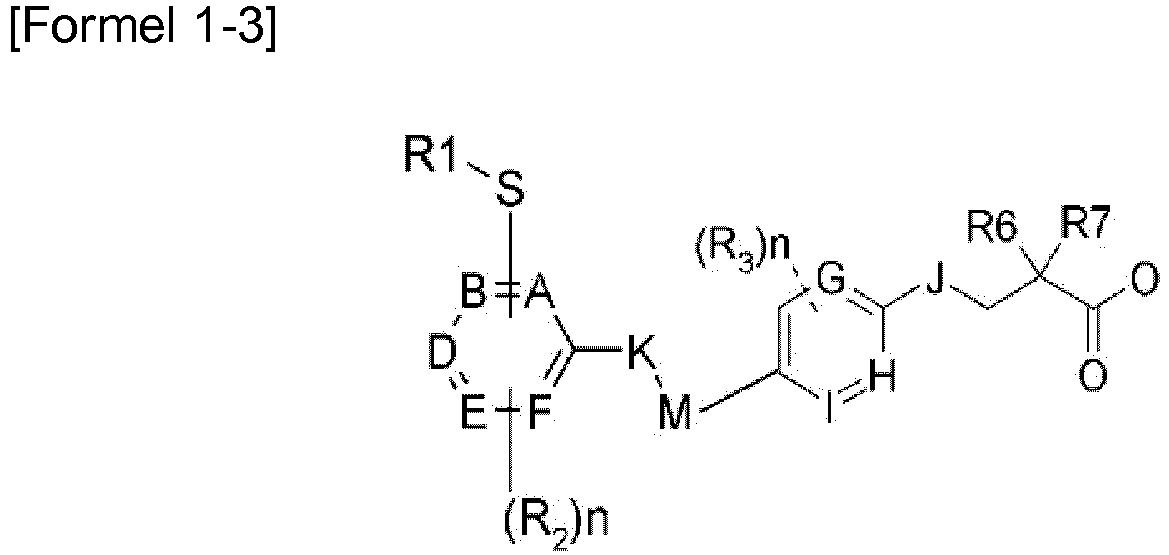

 jedes R3 unabhängig Wasserstoff, Halogen oder gegebenenfalls substituiertes C1-C6-Alkyl, C3-C10-Cyclo-C1-C6-alkyl, Heterocycloalkyl, C1-C6-Alkoxy, C3-C10-Cycloalkoxy, Aryloxy, Heteroaryloxy, Amino-C1-C6-alkyl, Amino-C3-C10-cycloalkyl, Aminoaryl, Di(C1-C6-alkyl)amin, C3-C10-Cycloalkylamin, Aminoheteroaryl, Thio-C1-C6-alkyl, Thioaryl oder Thioheteroaryl darstellt,R6 und R7 unabhängig Wasserstoff, Fluor oder C1-C6-Alkyl darstellen undn, A, B, D, E, F, G, H, I, J, K, M, R1 und R2 wie in Anspruch 1 definiert sind.
- Thioarylderivate oder pharmazeutisch annehmbare Salze oder R- oder S-Isomere davon, ausgewählt aus den nachstehenden Verbindungen der Formeln 1-6 oder 1-7:

 A, B, D, E, F, G und I unabhängig Kohlenstoff oder Stickstoff darstellen,R1 Alkyl, gegebenenfalls substituiert mit Halogen oder Cycloalkyl, darstellt; oder R1 Cycloalkyl, Heterocycloalkyl, Alkylcycloalkyl, Alkylaryl, Heteroaryl oder Alkylheteroaryl darstellt,R2 unabhängig Wasserstoff, Halogen oder gegebenenfalls substituiertes Alkyl, Cycloalkyl, Heterocycloalkyl, Alkoxy, Cycloalkoxy, Aryloxy, Heteroaryloxy, Aminoalkyl, Aminocycloalkyl, Aminoaryl, Alkylamin, Cycloalkylamin, Aminoheteroaryl, Thioalkyl, Thioaryl oder Thioheteroaryl darstellt,R3 unabhängig Wasserstoff, Halogen oder gegebenenfalls substituiertes C1-C6-Alkyl, C3-C10-Cyclo-C1-C6-alkyl, Heterocycloalkyl, C1-C6-Alkoxy, C3-C10-Cycloalkoxy, Aryloxy, Heteroaryloxy, Amino-C1-C6-alkyl, Amino-C3-C10-cycloalkyl, Aminoaryl, Di(C1-C6-alkyl)amin, C3-C10-Cycloalkylamin, Aminoheteroaryl, Thio-C1-C6-alkyl, Thioaryl oder Thioheteroaryl darstellt, undK Kohlenstoff darstellt,M O oder S darstellt undn eine ganze Zahl von 0 bis 4 darstellt.
- Thioarylderivate oder pharmazeutisch annehmbare Salze oder R- oder S-Isomere davon gemäss Anspruch 1 oder 4, ausgewählt aus den nachstehenden Verbindungen:3-[3,5-Difluor-4-(2-isopropylsulfanyl-pyridin-3-ylmethoxy)-phenyl]-propionsäure;3-[4-(2-Isopropylsulfanyl-pyridin-3-ylmethoxy)-phenyl]-propionsäure;3-[4-(2-Isopropylsulfanyl-5-methyl-pyridin-3-ylmethoxy)-phenyl]-2-methyl-propionsäure;3-[4-(2-Isopropylsulfanyl-pyridin-3-ylmethoxy)-phenyl]-2-methyl-propionsäure;3-[4-(2-Isopropylsulfanyl-5-methyl-pyridin-3-ylmethoxy)-phenyl]-propionsäure;3-[3-Fluor-4-(2-isopropylsulfanyl-pyridin-3-ylmethoxy)-phenyl]-propionsäure;3-[2-Fluor-4-(2-isopropylsulfanyl-pyridin-3-ylmethoxy)-phenyl]-propionsäure;3-[4-(2-Cyclopentylsulfanyl-pyridin-3-ylmethoxy)-phenyl]-2-methyl-propionsäure;3-[3,5-Difluor-4-(2-isopropylsulfanyl-6-methyl-pyridin-3-ylmethoxy)-phenyl]-propionsäure;3-[4-(2-Ethylsulfanyl-pyridin-3-ylmethoxy)-3,5-difluorphenyl]-propionsäure;3-[3,5-Difluor-4-(2-isobutylsulfanyl-pyridin-3-ylmethoxy)-phenyl]-propionsäure;3-[4-(2-Cyclopentylsulfanyl-pyridin-3-ylmethoxy)-3,5-difluor-phenyl]-propionsäure;4-[4-(2-Isopropylsulfanyl-pyridin-3-ylmethoxy)-phenyl]-buttersäure;3-[3,5-Difluor-4-(2-propylsulfanyl-pyridin-3-ylmethoxy)-phenyl]-propionsäure;3-[4-(2-t-Butylsulfanyl-pyridin-3-ylmethoxy)-3,5-difluor-phenyl]-propionsäure;3-[4-(2-Cyclopropylmethylsulfanyl-pyridin-3-ylmethoxy)-3,5-difluor-phenyl]-propionsäure;3-{3,5-Difluor-4-[2-(2,2,2-trifluor-ethylsulfanyl)-pyridin-3-ylmethoxy]-phenyl}-propionsäure;3-[4-(2-sek-Butylsulfanyl-pyridin-3-ylmethoxy)-3,5-difluor-phenyl]-propionsäure;3-[3,5-Difluor-4-(3-isopropylsulfanyl-pyrazin-2-ylmethoxy)-phenyl]-propionsäure;4-[4-(2-Cyclopentylsulfanyl-pyridin-3-ylmethoxy)-phenyl]-buttersäure;3-[4-(2-Cyclohexylsulfanyl-pyridin-3-ylmethoxy)-3,5-difluor-phenyl]-propionsäure;3-[4-(2-Cyclobutylsulfanyl-pyridin-3-ylmethoxy)-3,5-difluor-phenyl]-propionsäure;3-[3,5-Difluor-4-(2-isopropylsulfanyl-pyrimidin-4-ylmethoxy)-phenyl]-propionsäure;3-[4-(2-Cyclopentylsulfanyl-pyridin-3-ylmethoxy)-phenyl]-2-methyl-propionsäure;4-[4-(2-Butylsulfanyl-pyridin-3-ylmethoxy)-3,5-difluorphenyl]-propionsäure;3-{3,5-Difluor-4-[2-(3,3,3-trifluor-propylsulfanyl)-pyridin-3-ylmethoxy]-phenyl}-propionsäure;3-{4-[2-(2,2-Dimethyl-propylsulfanyl)-pyridin-3-ylmethoxy]-3,5-difluor-phenyl}-propionsäure;3-[4-(6-Cyclopentylsulfanyl)-pyridin-2-ylmethoxy]-phenyl]-propionsäure;3-[4-(6-Cyclopentylsulfanyl)-pyridin-2-ylmethoxy]-3,5-difluor-phenyl]-propionsäure;3-[4-(6-Cyclohexylsulfanyl)-pyridin-2-ylmethoxy]-3,5-difluor-phenyl]-propionsäure;3-[4-(6-Ethyl-2-isopropylsulfanyl)-pyridin-3-ylmethoxy]-3,5-difluor-phenyl]-propionsäure;3-[3,5-Difluor-4-(6-isopropylsulfanyl-pyridin-2-ylmethoxy)-phenyl]-propionsäure;3-[4-(6-sek-Butylsulfanyl-pyridin-2-ylmethoxy)-3,5-difluor-phenyl]-propionsäure;2-[4-(6-Cyclopentylsulfanyl-pyridin-2-ylmethoxy)-3,5-difluor-phenyl]-cyclopropancarbonsäure;2-[4-(2-Cyclobutylsulfanyl-pyridin-3-ylmethoxy)-3,5-difluor-phenyl]-cyclopropancarbonsäure;3-[4-(2-Cyclobutylsulfanyl-pyridin-3-ylmethoxy)-3-fluorphenyl]-2-methyl-propionsäure;3-[4-(2-Cyclopentylsulfanyl-pyridin-3-ylmethoxy)-3-fluor-phenyl]-2-methyl-propionsäure;3-[4-(2-sek-Butylsulfanyl-pyridin-3-ylmethoxy)-3-fluorphenyl]-2-methyl-propionsäure;3-[4-(2-Cyclopropylmethylsulfanyl-pyridin-3-ylmethoxy)-3-fluor-phenyl]-2-methyl-propionsäure;3-[3,5-Difluor-4-(2-isopropylsulfanyl-pyridin-3-ylmethoxy)-phenyl]-2-methyl-propionsäure;3-[4-(2-sek-Butylsulfanyl-pyridin-3-ylmethoxy)-3,5-difluor-phenyl]-2-methyl-propionsäure;3-[3,5-Difluor-4-(2-isopropylsulfanyl-6-methoxy-pyridin-3-ylmethoxy)-phenyl]-propionsäure;3-[4-(6-Cyclopentylsulfanyl-pyridin-2-ylmethoxy)-3,5-difluor-phenyl]-2-methyl-propionsäure;3-[4-(2-Cyclopentylsulfanyl-6-methyl-pyridin-3-ylmethoxy)-3,5-difluor-phenyl]-propionsäure;3-[4-(6-Cyclobutylsulfanyl-pyridin-2-ylmethoxy)-3,5-difluor-phenyl]-2-methyl-propionsäure;3-[4-(2-Cyclopentylsulfanyl-pyridin-3-ylmethoxy)-3,5-difluor-phenyl]-2-methyl-propionsäure;3-[4-(6-sek-Butylsulfanyl-pyridin-2-ylmethoxy)-3,5-difluor-phenyl]-2-methyl-propionsäure;3-[3,5-Difluor-4-(6-isopropylsulfanyl-pyridin-2-ylmethoxy)-phenyl]-2-methyl-propionsäure;3-[4-(2-Cyclopropylmethylsulfanyl-pyridin-3-ylmethoxy)-3,5-difluor-phenyl]-2-methyl-propionsäure;3-[3,5-Difluor-4-(2-propylsulfanyl-pyridin-3-ylmethoxy)-phenyl]-2-methyl-propionsäure;3-[3-Fluor-4-(6-isopropylsulfanyl-pyridin-2-ylmethoxy)-phenyl]-2-methyl-propionsäure;3-[4-(6-sek-Butylsulfanyl-pyridin-2-ylmethoxy)-3-fluorphenyl]-2-methyl-propionsäure;3-[4-(6-Cyclopentylsulfanyl-pyridin-2-ylmethoxy)-3-fluor-phenyl]-2-methyl-propionsäure;3-[4-(6-Cyclobutylsulfanyl-pyridin-2-ylmethoxy)-3-fluorphenyl]-2-methyl-propionsäure;3-[4-(2-Cyclobutylsulfanyl-pyridin-3-ylmethoxy)-3,5-difluor-phenyl]-2-methyl-propionsäure;3-[4-(2-Isopropylsulfanyl-pyridin-3-ylmethoxy)-3-methoxy-phenyl]-propionsäure;3-[4-(2-Cyclopentylsulfanyl-pyridin-3-ylmethoxy)-3-methoxy-phenyl]-propionsäure;[6-(2-Isopropylsulfanyl-pyridin-3-ylmethoxy)-2,3-dihydro-benzofuran-3-yl]-essigsäure;3-[3-Fluor-4-(2-isopropylsulfanyl-pyridin-3-ylmethoxy)-phenyl]-2-methyl-propionsäure;4-[4-(2-Butylsulfanyl-pyridin-3-ylmethoxy)-3-fluorphenyl]-2-methyl-propionsäure;2-[4-(2-Cyclopentylsulfanyl-pyridin-3-ylmethoxy)-3,5-difluor-phenyl]-cyclopropancarbonsäure;2-[4-(2-Cyclopropylmethylsulfanyl-pyridin-3-ylmethoxy)-3,5-difluor-phenyl]-cyclopropancarbonsäure;2-[3,5-Difluor-4-(6-isopropylsulfanyl-pyridin-2-ylmethoxy)-phenyl]-cyclopropancarbonsäure;2-[3,5-Difluor-4-(2-isopropylsulfanyl-pyridin-3-ylmethoxy)-phenyl]-cyclopropancarbonsäure;2-[4-(2-Butylsulfanyl-pyridin-3-ylmethoxy)-3,5-difluorphenyl]-cyclopropancarbonsäure;[6-(6-Isopropylsulfanyl-pyridin-2-ylmethoxy)-2,3-dihydro-benzofuran-3-yl]-essigsäure;[6-(6-Cyclopentylsulfanyl-pyridin-2-ylmethoxy)-2,3-dihydro-benzofuran-3-yl]-essigsäure;3-[4-(2-Isopropylsulfanyl-pyridin-3-ylmethoxy)-phenyl]-2,2-dimethyl-propionsäure;3-[4-(6-Isopropylsulfanyl-pyridin-2-ylmethoxy)-phenyl]-2,2-dimethyl-propionsäure;3-[3,5-Difluor-4-(4-isopropylsulfanyl-2-methyl-pyrimidin-5-ylmethoxy)-phenyl]-propionsäure;3-[4-(6-Isopropylsulfanyl-pyridin-2-ylmethoxy)-3-methoxy-phenyl]-propionsäure;3-[4-(6-Cyclopentylsulfanyl-pyridin-2-ylmethoxy)-3-methoxy-phenyl]-propionsäure;[6-(2-Cyclopentylsulfanyl-pyridin-3-ylmethoxy)-2,3-dihydro-benzofuran-3-yl]-essigsäure;2-[4-(6-Cyclobutylsulfanyl-pyridin-2-ylmethoxy)-3,5-difluor-phenyl]-cyclopropancarbonsäure;3-[4-(2-Cyclopentylsulfanyl-6-methoxy-pyridin-3-ylmethoxy)-3,5-difluor-phenyl]-propionsäure;3-[3-Chlor-4-(2-isopropylsulfanyl-pyridin-3-ylmethoxy)-phenyl]-propionsäure;3-[3-Chlor-4-(2-cyclopentylsulfanyl-pyridin-3-ylmethoxy)-phenyl]-propionsäure;3-[4-(2-Isopropylsulfanyl-pyridin-3-ylmethoxy)-2,3-dimethyl-phenyl]-propionsäure;3-[4-(2-Cyclopentylsulfanyl-pyridin-3-ylmethoxy)-2,3-dimethyl-phenyl]-propionsäure;[(S)-6-(2-Cyclopentylsulfanyl-pyridin-3-ylmethoxy)-2,3-dihydro-benzofuran-3-yl]-essigsäure;[(R)-6-(2-Cyclopentylsulfanyl-pyridin-3-ylmethoxy)-2,3-dihydro-benzofuran-3-yl]-essigsäure;2-[3-Fluor-4-(2-isopropylsulfanyl-pyridin-3-ylmethoxy)-phenyl]-cyclopropancarbonsäure;2-[4-(2-Cyclopropylmethylsulfanyl-pyridin-3-ylmethoxy)-3-fluor-phenyl]-cyclopropancarbonsäure;2-[4-(6-Cyclopentylsulfanyl-pyridin-2-ylmethoxy)-3-fluor-phenyl]-cyclopropancarbonsäure;2-[4-(6-Cyclobutylsulfanyl-pyridin-2-ylmethoxy)-3-fluorphenyl]-cyclopropancarbonsäure;2-[4-(2-Cyclopentylsulfanyl-pyridin-3-ylmethoxy)-3-fluor-phenyl]-cyclopropancarbonsäure;2-[4-(2-Cyclobutylsulfanyl-pyridin-3-ylmethoxy)-3-fluorphenyl]-cyclopropancarbonsäure;2-[2-Chlor-4-(2-isopropylsulfanyl-pyridin-3-ylmethoxy)-phenyl]-cyclopropancarbonsäure;2-[2-Chlor-4-(6-chlorbutylsulfanyl-pyridin-2-ylmethoxy)-phenyl]-cyclopropancarbonsäure;3-[3-Chlor-4-(2-cyclopropylmethylsulfanyl-pyridin-3-ylmethoxy)-phenyl]-2-methyl-propionsäure;3-[3-Chlor-4-(2-propylsulfanyl-pyridin-3-ylmethoxy)-phenyl]-2-methyl-propionsäure;3-[3-Chlor-4-(6-isopropylsulfanyl-pyridin-2-ylmethoxy)-phenyl]-2-methyl-propionsäure;3-[3-Chlor-4-(6-cyclopentylsulfanyl-pyridin-2-ylmethoxy)-phenyl]-2-methyl-propionsäure;3-[3-Chlor-4-(2-cyclobutylsulfanyl-pyridin-3-ylmethoxy)-phenyl]-2-methyl-propionsäure;3-[3-Chlor-4-(6-cyclobutylsulfanyl-pyridin-2-ylmethoxy)-phenyl]-2-methyl-propionsäure;2-[3-Chlor-4-(2-isopropylsulfanyl-pyridin-3-ylmethoxy)-phenyl]-cyclopropancarbonsäure;2-[3-Chlor-4-(6-cyclopropylmethylsulfanyl-pyridin-2-ylmethoxy)-phenyl]-cyclopropancarbonsäure;2-[3-Chlor-4-(6-isopropylsulfanyl-pyridin-2-ylmethoxy)-phenyl]-cyclopropancarbonsäure;2-[3-Chlor-4-(6-cyclopentylsulfanyl-pyridin-2-ylmethoxy)-phenyl]-cyclopropancarbonsäure;2-[3-Chlor-4-(2-cyclopentylsulfanyl-pyridin-3-ylmethoxy)-phenyl]-cyclopropancarbonsäure;2-[3-Chlor-4-(2-cyclobutylsulfanyl-pyridin-3-ylmethoxy)-phenyl]-cyclopropancarbonsäure;2-[3-Chlor-4-(6-cyclobutylsulfanyl-pyridin-2-ylmethoxy)-phenyl]-cyclopropancarbonsäure;2-[2-Chlor-4-(6-chlorpentylsulfanyl-pyridin-2-ylmethoxy)-phenyl]-cyclopropancarbonsäure;2-[4-(2-Isopropylsulfanyl-pyridin-3-ylmethoxy)-2,3-dimethyl-phenyl]-cyclopropancarbonsäure;2-[4-(2-Cyclopropylmethylsulfanyl-pyridin-3-ylmethoxy)-2,3-dimethyl-phenyl]-cyclopropancarbonsäure;2-[3-Chlor-4-(2-cyclopropylmethylsulfanyl-pyridin-3-ylmethoxy)-phenyl]-cyclopropancarbonsäure;2-[3-Chlor-4-(2-propylsulfanyl-pyridin-3-ylmethoxy)-phenyl]-cyclopropancarbonsäure;2-[3-Chlor-4-(2-isopropylsulfanyl-6-methoxy-pyridin-3-ylmethoxy)-phenyl]-cyclopropancarbonsäure;2-[4-(6-Cyclopentylsulfanyl-pyridin-2-ylmethoxy)-3,5-difluor-benzyl]-cyclopropancarbonsäure;[6-(2-Cyclobutylsulfanyl-pyridin-3-ylmethoxy)-5,7-difluor-2,3-dihydro-benzofuran-3-yl]-essigsäure;2-[2,3-Dimethyl-4-(2-propylsulfanyl-pyridin-3-ylmethoxy)-phenyl]-cyclopropancarbonsäure;2-[4-(2-Cyclobutylsulfanyl-pyridin-3-ylmethoxy)-2,3-dimethyl-phenyl]-cyclopropancarbonsäure;2-[4-(6-Isopropylsulfanyl-pyridin-2-ylmethoxy)-2,3-dimethyl-phenyl]-cyclopropancarbonsäure;2-[4-(6-Cyclobutylsulfanyl-pyridin-2-ylmethoxy)-3,5-difluor-benzyl]-cyclopropancarbonsäure;2-[3,5-Difluor-4-(2-isopropylsulfanyl-pyridin-3-ylmethoxy)-benzyl]-cyclopropancarbonsäure;2-[3,5-Difluor-4-(2-propylsulfanyl-pyridin-3-ylmethoxy)-benzyl]-cyclopropancarbonsäure;[6-(2-Cyclopentylsulfanyl-pyridin-3-ylmethoxy)-7-methyl-benzofuran-3-yl]-essigsäure;2-[3-Fluor-4-(2-propylsulfanyl-pyridin-3-ylmethoxy)-phenyl]-cyclopropancarbonsäure (weniger polar);{2-[4-(6-Cyclopentylsulfanyl-pyridin-2-ylmethoxy)-3-fluor-phenyl]-cyclopropyl}-essigsäure;{2-[3-Fluor-4-(2-propylsulfanyl-pyridin-3-ylmethoxy)-phenyl]-cyclopropyl}-essigsäure;[6-(2-Cyclopentylsulfanyl-pyridin-3-ylmethoxy)-5,7-difluor-benzofuran-3-yl]-essigsäure;[6-(2-Cyclopentylsulfanyl-pyridin-3-ylmethoxy)-5,7-difluor-2,3-dihydro-benzofuran-3-yl]-essigsäure;2-[3-Chlor-4-(2-cyclobutylsulfanyl-pyridin-3-ylmethoxy)-phenyl]-cyclopropancarbonsäure (weniger polar);2-[3-Chlor-4-(2-cyclobutylsulfanyl-pyridin-3-ylmethoxy)-phenyl]-cyclopropancarbonsäure (polarer);2-[3-Chlor-4-(2-isopropylsulfanyl-pyridin-3-ylmethoxy)-phenyl]-cyclopropancarbonsäure (polarer);2-[3-Chlor-4-(2-cyclopropylmethylsulfanyl-pyridin-3-ylmethoxy)-phenyl]-cyclopropancarbonsäure (polarer);2-[3-Chlor-4-(6-cyclopropylmethylsulfanyl-pyridin-2-ylmethoxy)-phenyl]-cyclopropancarbonsäure (polarer);2-[4-(2-Cyclopropylmethylsulfanyl-pyridin-3-ylmethoxy)-3-fluor-phenyl]-cyclopropancarbonsäure (weniger polar);2-[4-(2-Cyclopentylsulfanyl-pyridin-3-ylmethoxy)-3-fluor-phenyl]-cyclopropancarbonsäure (weniger polar);2-[3-Fluor-4-(6-isopropylsulfanyl-pyridin-2-ylmethoxy)-phenyl]-cyclopropancarbonsäure (weniger polar);2-[3-Chlor-4-(6-cyclobutylsulfanyl-pyridin-2-ylmethoxy)-phenyl]-cyclopropancarbonsäure (polarer);2-[4-(2-Cyclobutylsulfanyl-pyridin-3-ylmethoxy)-3-fluorphenyl]-cyclopropancarbonsäure (weniger polar);2-[4-(6-Cyclopentylsulfanyl-pyridin-2-ylmethoxy)-3-fluor-phenyl]-cyclopropancarbonsäure (weniger polar);2-[4-(6-Cyclobutylsulfanyl-pyridin-2-ylmethoxy)-3-fluorphenyl]-cyclopropancarbonsäure (weniger polar);2-[4-(2-Cyclopropylmethylsulfanyl-pyridin-3-ylmethoxy)-3,5-difluor-phenyl]-cyclopropancarbonsäure (weniger polar);2-[4-(2-Cyclopropylmethylsulfanyl-pyridin-3-ylmethoxy)-3,5-difluor-phenyl]-cyclopropancarbonsäure (polarer);2-[3,5-Difluor-4-(2-isopropylsulfanyl-pyridin-3-ylmethoxy)-phenyl]-cyclopropancarbonsäure (polarer);2-[3,5-Difluor-4-(2-propylsulfanyl-pyridin-3-ylmethoxy)-phenyl]-cyclopropancarbonsäure (polarer);2-[4-(2-Cyclopentylsulfanyl-pyridin-3-ylmethoxy)-3,5-difluor-phenyl]-cyclopropancarbonsäure (polarer);3-[3-Chlor-4-(6-isopropylsulfanyl-pyridin-2-ylmethoxy)-phenyl]-propionsäure;3-[3-Chlor-4-(6-cyclopropylmethylsulfanyl-pyridin-2-ylmethoxy)-phenyl]-propionsäure;3-[3-Chlor-4-(6-cyclopentylsulfanyl-pyridin-2-ylmethoxy)-phenyl]-propionsäure;3-[3-Fluor-4-(2-propylsulfanyl-pyridin-3-ylmethoxy)-phenyl]-propionsäure;3-[4-(2-Cyclobutylsulfanyl-pyridin-3-ylmethoxy)-3-fluorphenyl]-propionsäure;3-[4-(2-Cyclopentylsulfanyl-pyridin-3-ylmethoxy)-3-fluor-phenyl]-propionsäure;3-[4-(2-Cyclopropylmethylsulfanyl-pyridin-3-ylmethoxy)-3-fluor-phenyl]-propionsäure;3-[4-(6-Cyclobutylsulfanyl-pyridin-2-ylmethoxy)-3-fluorphenyl]-propionsäure;3-[3-Fluor-4-(6-isopropylsulfanyl-pyridin-2-ylmethoxy)-phenyl]-propionsäure;3-[4-(6-Cyclopentylsulfanyl-pyridin-2-ylmethoxy)-3-fluor-phenyl]-propionsäure;3-[4-(6-Cyclopropylmethylsulfanyl-pyridin-2-ylmethoxy)-3-fluor-phenyl]-propionsäure;2-[3,5-Difluor-4-(6-isopropylsulfanyl-pyridin-2-ylmethoxy)-phenyl]-cyclopropancarbonsäure (polarer);2-[4-(6-Cyclopropylmethylsulfanyl-pyridin-2-ylmethoxy)-3,5-difluor-phenyl]-cyclopropancarbonsäure (polarer);2-[4-(6-Cyclopentylsulfanyl-pyridin-2-ylmethoxy)-3,5-difluor-phenyl]-cyclopropancarbonsäure (polarer);2-[4-(6-Cyclobutylsulfanyl-pyridin-2-ylmethoxy)-3,5-difluor-phenyl]-cyclopropancarbonsäure (polarer);2-[4-(2-Cyclobutylsulfanyl-pyridin-3-ylmethoxy)-3,5-difluor-phenyl]-cyclopropancarbonsäure (polarer);3-[3-Chlor-4-(2-cyclopropylmethylsulfanyl-pyridin-3-ylmethoxy)-phenyl]-propionsäure;3-[3-Chlor-4-(2-cyclobutylsulfanyl-pyridin-3-ylmethoxy)-phenyl]-propionsäure;3-[3-Chlor-4-(6-cyclobutylsulfanyl-pyridin-2-ylmethoxy)-phenyl]-propionsäure;3-[3-Chlor-4-(2-isopropylsulfanyl-6-methyl-pyridin-3-ylmethoxy)-phenyl]-propionsäure;3-[3-Chlor-4-(2-cyclopentylsulfanyl-6-methyl-pyridin-3-ylmethoxy)-phenyl]-propionsäure;2-[3-Fluor-4-(2-isopropylsulfanyl-pyridin-3-ylmethoxy)-phenyl]-cyclopropancarbonsäure (polarer);2-[3-Fluor-4-(2-propylsulfanyl-pyridin-3-ylmethoxy)-phenyl]-cyclopropancarbonsäure (polarer);2-[4-(2-Cyclopentylsulfanyl-pyridin-3-ylmethoxy)-3-fluor-phenyl]-cyclopropancarbonsäure (polarer);2-[4-(2-Cyclopropylmethylsulfanyl-pyridin-3-ylmethoxy)-3-fluor-phenyl]-cyclopropancarbonsäure (polarer);2-[3-Fluor-4-(6-isopropylsulfanyl-pyridin-2-ylmethoxy)-phenyl]-cyclopropancarbonsäure (polarer);2-[4-(6-Cyclobutylsulfanyl-pyridin-2-ylmethoxy)-3-fluorphenyl]-cyclopropancarbonsäure (polarer);2-[4-(6-Cyclopentylsulfanyl-pyridin-2-ylmethoxy)-3-fluor-phenyl]-cyclopropancarbonsäure (polarer);2-[4-(2-Cyclobutylsulfanyl-pyridin-3-ylmethoxy)-3-fluorphenyl]-cyclopropancarbonsäure (polarer);2-[4-(6-Cyclopropylmethylsulfanyl-pyridin-2-ylmethoxy)-3-fluor-phenyl]-cyclopropancarbonsäure (polarer);3-[4-[(2-Cyclopentylsulfanyl-pyridin-3-ylmethoxy)-2-fluor-phenyl]-propionsäure;2-[4-[(2-Cyclopentylsulfanyl-pyridin-3-ylmethoxy)-2-fluor-phenyl]-cyclopropancarbonsäure;3-[4-[(2-Cyclobutylsulfanyl-pyridin-3-ylmethoxy)-2-fluor-phenyl]-propionsäure;3-[4-[(6-Cyclobutylsulfanyl-pyridin-2-ylmethoxy)-2-fluor-phenyl]-propionsäure;3-[4-[(6-Cyclopentylsulfanyl-pyridin-2-ylmethoxy)-2-fluor-phenyl]-propionsäure;3-[4-[(2-Cyclopropylmethylsulfanyl-pyridin-3-ylmethoxy)-2-fluor-phenyl]-propionsäure;3-[4-[(6-Cyclopropylmethylsulfanyl-pyridin-2-ylmethoxy)-2-fluor-phenyl]-propionsäure;3-[4-[(2-Cyclobutylsulfanyl-pyridin-3-ylmethoxy)-phenyl]-propionsäure;3-[4-[(6-Cyclobutylsulfanyl-pyridin-2-ylmethoxy)-phenyl]-propionsäure;3-[4-[(2-Cyclopropylmethylsulfanyl-pyridin-3-ylmethoxy)-phenyl]-propionsäure;3-[4-[(6-Cyclopropylmethylsulfanyl-pyridin-2-ylmethoxy)-phenyl]-propionsäure;3-[4-[(2-Cyclopentylsulfanyl-6-methyl-pyridin-3-ylmethoxy)-phenyl]-propionsäure und3-[4-[(2-Isopropylsulfanyl-6-methyl-pyridin-3-ylmethoxy)-phenyl]-propionsäure.
- Pharmazeutische Zusammensetzung als GPR120-Agonisten, umfassend die Thioarylderivate, pharmazeutisch annehmbaren Salze oder R- oder S-Isomere davon gemäss Anspruch 1 oder 4 und einen pharmazeutisch annehmbaren Träger.
- Pharmazeutische Zusammensetzung zur Verwendung bei der Prävention oder Behandlung von Diabetes, Komplikationen bei Diabetes, Entzündung, Fettleibigkeit, nichtalkoholischer Fettleber, Steatohepatitis oder Osteoporose, umfassend die Thioarylderivate, pharmazeutisch annehmbaren Salze oder R- oder S-Isomere davon gemäss Anspruch 1 oder 4 und einen pharmazeutisch annehmbaren Träger.
- Zusammensetzung zur Senkung des Blutglucosespiegels, umfassend die Thioarylderivate, pharmazeutisch annehmbaren Salze oder R- oder S-Isomere davon gemäss Anspruch 1 oder 4 und einen pharmazeutisch annehmbaren Träger.
- Verfahren zur Herstellung einer Zusammensetzung zur Prävention oder Behandlung von Diabetes, Komplikationen bei Diabetes, Entzündung, Fettleibigkeit, nichtalkoholischer Fettleber, Steatohepatitis oder Osteoporose, das den Schritt zum Mischen der Thioarylderivate, pharmazeutisch annehmbaren Salze oder R- oder S-Isomere davon gemäss Anspruch 1 oder 4 mit einem pharmazeutisch annehmbaren Träger umfasst.
Applications Claiming Priority (2)
| Application Number | Priority Date | Filing Date | Title |
|---|---|---|---|
| KR20120124502 | 2012-11-05 | ||
| PCT/KR2013/009928 WO2014069963A1 (en) | 2012-11-05 | 2013-11-05 | Thioaryl derivatives as gpr120 agonists |
Publications (3)
| Publication Number | Publication Date |
|---|---|
| EP2914580A1 EP2914580A1 (de) | 2015-09-09 |
| EP2914580A4 EP2914580A4 (de) | 2016-06-01 |
| EP2914580B1 true EP2914580B1 (de) | 2019-02-20 |
Family
ID=50627764
Family Applications (1)
| Application Number | Title | Priority Date | Filing Date |
|---|---|---|---|
| EP13852301.4A Active EP2914580B1 (de) | 2012-11-05 | 2013-11-05 | Thioarylderivate als gpr120-agonisten |
Country Status (6)
| Country | Link |
|---|---|
| US (1) | US9447044B2 (de) |
| EP (1) | EP2914580B1 (de) |
| JP (1) | JP6310931B2 (de) |
| KR (1) | KR101942752B1 (de) |
| TW (1) | TWI610917B (de) |
| WO (1) | WO2014069963A1 (de) |
Families Citing this family (7)
| Publication number | Priority date | Publication date | Assignee | Title |
|---|---|---|---|---|
| CA2974060C (en) | 2015-02-05 | 2022-08-30 | Piramal Enterprises Limited | Compounds containing carbon-carbon linker as gpr120 agonists |
| CN109475635A (zh) | 2016-03-15 | 2019-03-15 | 玛丽女王伦敦大学 | 治疗肥胖症的方法 |
| WO2018049328A1 (en) * | 2016-09-12 | 2018-03-15 | Numerate, Inc. | Bicyclic compounds useful as gpr120 modulators |
| KR102537985B1 (ko) | 2016-09-12 | 2023-05-30 | 인테그랄 헬스 인코퍼레이티드 | Gpr120 조정제로서 유용한 단환형 화합물 |
| JP2021517142A (ja) | 2018-03-15 | 2021-07-15 | アクザム ソシエタ ペル アチオニ | 置換ピラゾールffa4/gpr120受容体作動薬 |
| US20210236443A1 (en) * | 2018-04-20 | 2021-08-05 | Krish Biotech Research Private Limited | Method of treatment of non-alcoholic steatohepatitis, nash |
| KR102404012B1 (ko) * | 2019-06-24 | 2022-05-30 | 아주대학교 산학협력단 | 비알코올성 지방간 질환 예방 또는 치료용 약학 조성물 |
Family Cites Families (24)
| Publication number | Priority date | Publication date | Assignee | Title |
|---|---|---|---|---|
| CA1309557C (en) * | 1985-06-18 | 1992-10-27 | Robert N. Young | Leukotriene antagonists |
| JPH04297466A (ja) * | 1990-06-22 | 1992-10-21 | Nippon Shinyaku Co Ltd | テトラゾール誘導体及び医薬 |
| EP1332131A2 (de) | 2000-11-07 | 2003-08-06 | Bristol-Myers Squibb Company | Säurederivate und ihre verwendung als inhibitoren von serinproteasen |
| DE60216094T2 (de) * | 2001-06-07 | 2007-06-06 | Eli Lilly And Co., Indianapolis | Modulatoren der peroxisom-proliferator-aktivierten rezeptoren (ppar) |
| SE0102299D0 (sv) * | 2001-06-26 | 2001-06-26 | Astrazeneca Ab | Compounds |
| ATE363278T1 (de) * | 2001-09-14 | 2007-06-15 | Novo Nordisk As | Neue liganden für die hisb10 zn2+ stellen des insulin-hexamers in der r-konformation |
| WO2004013109A1 (ja) * | 2002-08-02 | 2004-02-12 | Sankyo Company, Limited | レゾルシノール誘導体 |
| US7820837B2 (en) * | 2003-05-30 | 2010-10-26 | Takeda Pharmaceutical Company Limited | Condensed ring compound |
| WO2005051890A1 (en) * | 2003-11-19 | 2005-06-09 | Smithkline Beecham Corporation | Aminophenylcyclopropyl carboxylic acids and derivatives as agonists to gpr40 |
| CA2662305C (en) * | 2006-09-07 | 2012-04-17 | Amgen Inc. | Heterocyclic gpr40 modulators |
| JP5405120B2 (ja) | 2006-12-01 | 2014-02-05 | Msd株式会社 | 新規フェニル−イソキサゾール−3−オール誘導体 |
| KR20090113382A (ko) | 2007-02-22 | 2009-10-30 | 아이알엠 엘엘씨 | G 단백질-커플링된 수용체의 조절제로서의 티아졸 유도체 |
| EP2154131A4 (de) | 2007-04-26 | 2011-09-21 | Pharmafrontier Co Ltd | Inhibitor des g-protein-gekoppelten rezeptors und pharmazeutisches produkt |
| JP5591706B2 (ja) * | 2007-10-10 | 2014-09-17 | アムジエン・インコーポレーテツド | 置換ビフェニルgpr40調節因子 |
| ES2423793T3 (es) * | 2008-05-26 | 2013-09-24 | Genfit | Compuestos agonistas de PPAR, preparación y usos para el tratamiento de la diabetes y/o dislipidemias |
| CA2725316A1 (en) | 2008-06-02 | 2009-12-10 | Banyu Pharmaceutical Co., Ltd. | Novel isoxazole derivative |
| EA022417B1 (ru) * | 2008-10-21 | 2015-12-30 | Саймабэй Терапевтикс, Инк. | Арильные агонисты рецептора gpr120 и их применение |
| AR074760A1 (es) | 2008-12-18 | 2011-02-09 | Metabolex Inc | Agonistas del receptor gpr120 y usos de los mismos en medicamentos para el tratamiento de diabetes y el sindrome metabolico. |
| WO2010104195A1 (en) | 2009-03-11 | 2010-09-16 | Banyu Pharmaceutical Co.,Ltd. | Novel isoindolin-1-one derivative |
| EP2486005B1 (de) * | 2009-10-06 | 2014-06-18 | Bristol-Myers Squibb Company | Pyrrolidin-gpr40-modulatoren |
| ES2526124T3 (es) | 2010-06-16 | 2015-01-07 | Cymabay Therapeutics, Inc. | Agonistas del receptor GPR120 y sus usos |
| WO2013185766A1 (en) * | 2012-06-15 | 2013-12-19 | Syddansk Universitet | Gpr120 receptor modulators |
| TWI692469B (zh) * | 2012-11-09 | 2020-05-01 | 南韓商Lg化學股份有限公司 | Gpr40受體促效劑,製造該促效劑的方法以及含有該促效劑作爲活性劑的醫藥組成物 |
| PT3013796T (pt) * | 2013-06-27 | 2020-03-26 | Lg Chemical Ltd | Derivados biarílicos como agonistas de gpr120 |
-
2013
- 2013-11-04 KR KR1020130132987A patent/KR101942752B1/ko not_active Expired - Fee Related
- 2013-11-05 EP EP13852301.4A patent/EP2914580B1/de active Active
- 2013-11-05 TW TW102140081A patent/TWI610917B/zh not_active IP Right Cessation
- 2013-11-05 US US14/440,495 patent/US9447044B2/en active Active
- 2013-11-05 WO PCT/KR2013/009928 patent/WO2014069963A1/en not_active Ceased
- 2013-11-05 JP JP2015540608A patent/JP6310931B2/ja not_active Expired - Fee Related
Also Published As
| Publication number | Publication date |
|---|---|
| JP6310931B2 (ja) | 2018-04-11 |
| KR20140059138A (ko) | 2014-05-15 |
| JP2015535279A (ja) | 2015-12-10 |
| KR101942752B1 (ko) | 2019-01-28 |
| TW201431841A (zh) | 2014-08-16 |
| TWI610917B (zh) | 2018-01-11 |
| US9447044B2 (en) | 2016-09-20 |
| US20150291527A1 (en) | 2015-10-15 |
| EP2914580A1 (de) | 2015-09-09 |
| WO2014069963A1 (en) | 2014-05-08 |
| EP2914580A4 (de) | 2016-06-01 |
Similar Documents
| Publication | Publication Date | Title |
|---|---|---|
| JP5322951B2 (ja) | グルカゴン受容体の新規アンタゴニスト | |
| EP3172185B1 (de) | Substituierte phenylalkansäureverbindungen als gpr120-agonisten und verwendungen davon | |
| CA2540536C (en) | Salts and polymorphs of a potent antidiabetic compound | |
| US9447044B2 (en) | Thioaryl derivatives as GPR120 agonists | |
| KR101662217B1 (ko) | Gpr120 효능제로서의 바이아릴 유도체 | |
| CZ234292A3 (en) | Amides, process of their preparation and pharmaceutical compositions in which said amides are comprised | |
| TW201341356A (zh) | 作為gpr促效劑之苯基烷酸衍生物 | |
| JP2023530708A (ja) | 甲状腺様作用剤 | |
| JP2024524765A (ja) | アミド化合物とその応用 | |
| CN107162921B (zh) | 一类苯氧乙酸衍生物、其制备方法及其作为药物的用途 | |
| CN104326950A (zh) | 苯氧乙酸类衍生物、其制备方法及其作为药物的用途 | |
| EP3409671B1 (de) | Isothiazolderivate als gpr120-agonisten zur behandlung von typ-ii-diabetes | |
| WO2016104451A1 (ja) | 新規複素環誘導体 | |
| JP7478251B2 (ja) | イオンチャネルアンタゴニスト/遮断剤およびその用途 | |
| CN105008345A (zh) | 可用作gpr120的激动剂的双环吡咯衍生物 | |
| CN106061943B (zh) | 可用作gpr120的激动剂的双环吡咯类衍生物 | |
| CN107162913B (zh) | 一类新型氘代苯丙酸衍生物、其制备方法及其作为药物的用途 | |
| CN108003074B (zh) | 联苯羧酸类化合物及其制备方法和用途 | |
| PT2307375E (pt) | Compostos da fenantrenona, composições e métodos | |
| HK40005165B (en) | Isothiazole derivatives as gpr120 agonists for the treatment of type ii diabetes | |
| HK1230597A1 (en) | Bicyclic pyrrole derivatives useful as agonists of grp120 | |
| JP2006527215A (ja) | パラ置換されたフェニルカルバメート |
Legal Events
| Date | Code | Title | Description |
|---|---|---|---|
| PUAI | Public reference made under article 153(3) epc to a published international application that has entered the european phase |
Free format text: ORIGINAL CODE: 0009012 |
|
| 17P | Request for examination filed |
Effective date: 20150602 |
|
| AK | Designated contracting states |
Kind code of ref document: A1 Designated state(s): AL AT BE BG CH CY CZ DE DK EE ES FI FR GB GR HR HU IE IS IT LI LT LU LV MC MK MT NL NO PL PT RO RS SE SI SK SM TR |
|
| AX | Request for extension of the european patent |
Extension state: BA ME |
|
| DAX | Request for extension of the european patent (deleted) | ||
| RIC1 | Information provided on ipc code assigned before grant |
Ipc: A61P 3/10 20060101ALI20160420BHEP Ipc: C07D 241/18 20060101ALI20160420BHEP Ipc: A61K 31/44 20060101ALI20160420BHEP Ipc: C07D 213/80 20060101AFI20160420BHEP Ipc: C07D 213/70 20060101ALI20160420BHEP |
|
| RA4 | Supplementary search report drawn up and despatched (corrected) |
Effective date: 20160502 |
|
| STAA | Information on the status of an ep patent application or granted ep patent |
Free format text: STATUS: EXAMINATION IS IN PROGRESS |
|
| 17Q | First examination report despatched |
Effective date: 20170322 |
|
| RAP1 | Party data changed (applicant data changed or rights of an application transferred) |
Owner name: LG CHEM, LTD. |
|
| GRAP | Despatch of communication of intention to grant a patent |
Free format text: ORIGINAL CODE: EPIDOSNIGR1 |
|
| STAA | Information on the status of an ep patent application or granted ep patent |
Free format text: STATUS: GRANT OF PATENT IS INTENDED |
|
| INTG | Intention to grant announced |
Effective date: 20180912 |
|
| GRAS | Grant fee paid |
Free format text: ORIGINAL CODE: EPIDOSNIGR3 |
|
| GRAA | (expected) grant |
Free format text: ORIGINAL CODE: 0009210 |
|
| STAA | Information on the status of an ep patent application or granted ep patent |
Free format text: STATUS: THE PATENT HAS BEEN GRANTED |
|
| AK | Designated contracting states |
Kind code of ref document: B1 Designated state(s): AL AT BE BG CH CY CZ DE DK EE ES FI FR GB GR HR HU IE IS IT LI LT LU LV MC MK MT NL NO PL PT RO RS SE SI SK SM TR |
|
| REG | Reference to a national code |
Ref country code: GB Ref legal event code: FG4D |
|
| REG | Reference to a national code |
Ref country code: CH Ref legal event code: EP |
|
| REG | Reference to a national code |
Ref country code: DE Ref legal event code: R096 Ref document number: 602013051183 Country of ref document: DE |
|
| REG | Reference to a national code |
Ref country code: AT Ref legal event code: REF Ref document number: 1097985 Country of ref document: AT Kind code of ref document: T Effective date: 20190315 |
|
| REG | Reference to a national code |
Ref country code: IE Ref legal event code: FG4D |
|
| REG | Reference to a national code |
Ref country code: NL Ref legal event code: MP Effective date: 20190220 |
|
| REG | Reference to a national code |
Ref country code: LT Ref legal event code: MG4D |
|
| PG25 | Lapsed in a contracting state [announced via postgrant information from national office to epo] |
Ref country code: FI Free format text: LAPSE BECAUSE OF FAILURE TO SUBMIT A TRANSLATION OF THE DESCRIPTION OR TO PAY THE FEE WITHIN THE PRESCRIBED TIME-LIMIT Effective date: 20190220 Ref country code: NO Free format text: LAPSE BECAUSE OF FAILURE TO SUBMIT A TRANSLATION OF THE DESCRIPTION OR TO PAY THE FEE WITHIN THE PRESCRIBED TIME-LIMIT Effective date: 20190520 Ref country code: SE Free format text: LAPSE BECAUSE OF FAILURE TO SUBMIT A TRANSLATION OF THE DESCRIPTION OR TO PAY THE FEE WITHIN THE PRESCRIBED TIME-LIMIT Effective date: 20190220 Ref country code: PT Free format text: LAPSE BECAUSE OF FAILURE TO SUBMIT A TRANSLATION OF THE DESCRIPTION OR TO PAY THE FEE WITHIN THE PRESCRIBED TIME-LIMIT Effective date: 20190620 Ref country code: LT Free format text: LAPSE BECAUSE OF FAILURE TO SUBMIT A TRANSLATION OF THE DESCRIPTION OR TO PAY THE FEE WITHIN THE PRESCRIBED TIME-LIMIT Effective date: 20190220 Ref country code: NL Free format text: LAPSE BECAUSE OF FAILURE TO SUBMIT A TRANSLATION OF THE DESCRIPTION OR TO PAY THE FEE WITHIN THE PRESCRIBED TIME-LIMIT Effective date: 20190220 |
|
| PG25 | Lapsed in a contracting state [announced via postgrant information from national office to epo] |
Ref country code: RS Free format text: LAPSE BECAUSE OF FAILURE TO SUBMIT A TRANSLATION OF THE DESCRIPTION OR TO PAY THE FEE WITHIN THE PRESCRIBED TIME-LIMIT Effective date: 20190220 Ref country code: GR Free format text: LAPSE BECAUSE OF FAILURE TO SUBMIT A TRANSLATION OF THE DESCRIPTION OR TO PAY THE FEE WITHIN THE PRESCRIBED TIME-LIMIT Effective date: 20190521 Ref country code: HR Free format text: LAPSE BECAUSE OF FAILURE TO SUBMIT A TRANSLATION OF THE DESCRIPTION OR TO PAY THE FEE WITHIN THE PRESCRIBED TIME-LIMIT Effective date: 20190220 Ref country code: LV Free format text: LAPSE BECAUSE OF FAILURE TO SUBMIT A TRANSLATION OF THE DESCRIPTION OR TO PAY THE FEE WITHIN THE PRESCRIBED TIME-LIMIT Effective date: 20190220 Ref country code: BG Free format text: LAPSE BECAUSE OF FAILURE TO SUBMIT A TRANSLATION OF THE DESCRIPTION OR TO PAY THE FEE WITHIN THE PRESCRIBED TIME-LIMIT Effective date: 20190520 Ref country code: IS Free format text: LAPSE BECAUSE OF FAILURE TO SUBMIT A TRANSLATION OF THE DESCRIPTION OR TO PAY THE FEE WITHIN THE PRESCRIBED TIME-LIMIT Effective date: 20190620 |
|
| REG | Reference to a national code |
Ref country code: AT Ref legal event code: MK05 Ref document number: 1097985 Country of ref document: AT Kind code of ref document: T Effective date: 20190220 |
|
| PG25 | Lapsed in a contracting state [announced via postgrant information from national office to epo] |
Ref country code: SK Free format text: LAPSE BECAUSE OF FAILURE TO SUBMIT A TRANSLATION OF THE DESCRIPTION OR TO PAY THE FEE WITHIN THE PRESCRIBED TIME-LIMIT Effective date: 20190220 Ref country code: RO Free format text: LAPSE BECAUSE OF FAILURE TO SUBMIT A TRANSLATION OF THE DESCRIPTION OR TO PAY THE FEE WITHIN THE PRESCRIBED TIME-LIMIT Effective date: 20190220 Ref country code: DK Free format text: LAPSE BECAUSE OF FAILURE TO SUBMIT A TRANSLATION OF THE DESCRIPTION OR TO PAY THE FEE WITHIN THE PRESCRIBED TIME-LIMIT Effective date: 20190220 Ref country code: EE Free format text: LAPSE BECAUSE OF FAILURE TO SUBMIT A TRANSLATION OF THE DESCRIPTION OR TO PAY THE FEE WITHIN THE PRESCRIBED TIME-LIMIT Effective date: 20190220 Ref country code: IT Free format text: LAPSE BECAUSE OF FAILURE TO SUBMIT A TRANSLATION OF THE DESCRIPTION OR TO PAY THE FEE WITHIN THE PRESCRIBED TIME-LIMIT Effective date: 20190220 Ref country code: ES Free format text: LAPSE BECAUSE OF FAILURE TO SUBMIT A TRANSLATION OF THE DESCRIPTION OR TO PAY THE FEE WITHIN THE PRESCRIBED TIME-LIMIT Effective date: 20190220 Ref country code: AL Free format text: LAPSE BECAUSE OF FAILURE TO SUBMIT A TRANSLATION OF THE DESCRIPTION OR TO PAY THE FEE WITHIN THE PRESCRIBED TIME-LIMIT Effective date: 20190220 Ref country code: CZ Free format text: LAPSE BECAUSE OF FAILURE TO SUBMIT A TRANSLATION OF THE DESCRIPTION OR TO PAY THE FEE WITHIN THE PRESCRIBED TIME-LIMIT Effective date: 20190220 |
|
| REG | Reference to a national code |
Ref country code: DE Ref legal event code: R097 Ref document number: 602013051183 Country of ref document: DE |
|
| PG25 | Lapsed in a contracting state [announced via postgrant information from national office to epo] |
Ref country code: SM Free format text: LAPSE BECAUSE OF FAILURE TO SUBMIT A TRANSLATION OF THE DESCRIPTION OR TO PAY THE FEE WITHIN THE PRESCRIBED TIME-LIMIT Effective date: 20190220 Ref country code: PL Free format text: LAPSE BECAUSE OF FAILURE TO SUBMIT A TRANSLATION OF THE DESCRIPTION OR TO PAY THE FEE WITHIN THE PRESCRIBED TIME-LIMIT Effective date: 20190220 |
|
| PLBE | No opposition filed within time limit |
Free format text: ORIGINAL CODE: 0009261 |
|
| STAA | Information on the status of an ep patent application or granted ep patent |
Free format text: STATUS: NO OPPOSITION FILED WITHIN TIME LIMIT |
|
| PG25 | Lapsed in a contracting state [announced via postgrant information from national office to epo] |
Ref country code: AT Free format text: LAPSE BECAUSE OF FAILURE TO SUBMIT A TRANSLATION OF THE DESCRIPTION OR TO PAY THE FEE WITHIN THE PRESCRIBED TIME-LIMIT Effective date: 20190220 |
|
| 26N | No opposition filed |
Effective date: 20191121 |
|
| PG25 | Lapsed in a contracting state [announced via postgrant information from national office to epo] |
Ref country code: SI Free format text: LAPSE BECAUSE OF FAILURE TO SUBMIT A TRANSLATION OF THE DESCRIPTION OR TO PAY THE FEE WITHIN THE PRESCRIBED TIME-LIMIT Effective date: 20190220 |
|
| PG25 | Lapsed in a contracting state [announced via postgrant information from national office to epo] |
Ref country code: TR Free format text: LAPSE BECAUSE OF FAILURE TO SUBMIT A TRANSLATION OF THE DESCRIPTION OR TO PAY THE FEE WITHIN THE PRESCRIBED TIME-LIMIT Effective date: 20190220 |
|
| REG | Reference to a national code |
Ref country code: CH Ref legal event code: PL |
|
| PG25 | Lapsed in a contracting state [announced via postgrant information from national office to epo] |
Ref country code: MC Free format text: LAPSE BECAUSE OF FAILURE TO SUBMIT A TRANSLATION OF THE DESCRIPTION OR TO PAY THE FEE WITHIN THE PRESCRIBED TIME-LIMIT Effective date: 20190220 Ref country code: LI Free format text: LAPSE BECAUSE OF NON-PAYMENT OF DUE FEES Effective date: 20191130 Ref country code: LU Free format text: LAPSE BECAUSE OF NON-PAYMENT OF DUE FEES Effective date: 20191105 Ref country code: CH Free format text: LAPSE BECAUSE OF NON-PAYMENT OF DUE FEES Effective date: 20191130 |
|
| REG | Reference to a national code |
Ref country code: BE Ref legal event code: MM Effective date: 20191130 |
|
| PG25 | Lapsed in a contracting state [announced via postgrant information from national office to epo] |
Ref country code: IE Free format text: LAPSE BECAUSE OF NON-PAYMENT OF DUE FEES Effective date: 20191105 |
|
| PG25 | Lapsed in a contracting state [announced via postgrant information from national office to epo] |
Ref country code: BE Free format text: LAPSE BECAUSE OF NON-PAYMENT OF DUE FEES Effective date: 20191130 |
|
| PG25 | Lapsed in a contracting state [announced via postgrant information from national office to epo] |
Ref country code: CY Free format text: LAPSE BECAUSE OF FAILURE TO SUBMIT A TRANSLATION OF THE DESCRIPTION OR TO PAY THE FEE WITHIN THE PRESCRIBED TIME-LIMIT Effective date: 20190220 |
|
| PG25 | Lapsed in a contracting state [announced via postgrant information from national office to epo] |
Ref country code: HU Free format text: LAPSE BECAUSE OF FAILURE TO SUBMIT A TRANSLATION OF THE DESCRIPTION OR TO PAY THE FEE WITHIN THE PRESCRIBED TIME-LIMIT; INVALID AB INITIO Effective date: 20131105 Ref country code: MT Free format text: LAPSE BECAUSE OF FAILURE TO SUBMIT A TRANSLATION OF THE DESCRIPTION OR TO PAY THE FEE WITHIN THE PRESCRIBED TIME-LIMIT Effective date: 20190220 |
|
| PG25 | Lapsed in a contracting state [announced via postgrant information from national office to epo] |
Ref country code: MK Free format text: LAPSE BECAUSE OF FAILURE TO SUBMIT A TRANSLATION OF THE DESCRIPTION OR TO PAY THE FEE WITHIN THE PRESCRIBED TIME-LIMIT Effective date: 20190220 |
|
| P01 | Opt-out of the competence of the unified patent court (upc) registered |
Effective date: 20230523 |
|
| PGFP | Annual fee paid to national office [announced via postgrant information from national office to epo] |
Ref country code: DE Payment date: 20241021 Year of fee payment: 12 |
|
| PGFP | Annual fee paid to national office [announced via postgrant information from national office to epo] |
Ref country code: GB Payment date: 20241021 Year of fee payment: 12 |
|
| PGFP | Annual fee paid to national office [announced via postgrant information from national office to epo] |
Ref country code: FR Payment date: 20241022 Year of fee payment: 12 |
|
| REG | Reference to a national code |
Ref country code: DE Ref legal event code: R119 Ref document number: 602013051183 Country of ref document: DE |